

#bip110
bip110
26,947 views
318 Discussing
Hot
Latest

·
--
BIP-110 Minority Chain Comes Back to Life After 23 Days
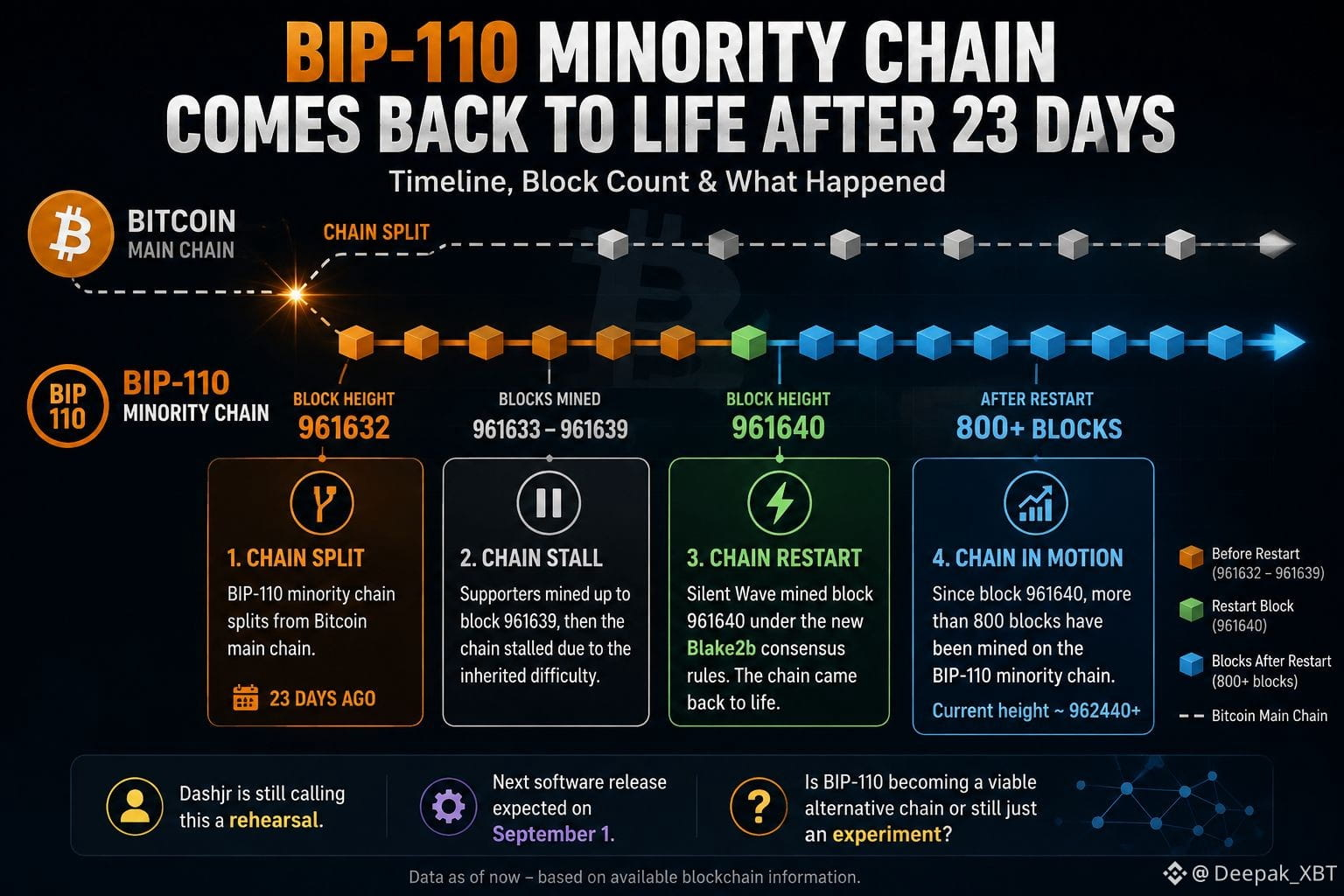
The BIP-110 minority chain split from Bitcoin at block 961632.
Supporters initially managed to mine up to block 961639 before the chain stalled under the inherited Bitcoin difficulty.
Then came block 961640.
Silent Wave mined that block under the new Blake2b consensus rules, and the chain began moving again.
Since that restart at block 961640, more than 800 blocks have been mined on the BIP-110 minority chain.
Dashjr is still describing the current phase as a rehearsal, with a new software release reportedly expected on September 1.
now the real question is whether this momentum can continue.
#bitcoin #BIP110 #BTC☀
BIP-110 Minority Chain Comes Back to Life After 23 Days
The BIP-110 minority chain split from Bitcoin at block 961632.
Supporters initially managed to mine up to block 961639 before the chain stalled under the inherited Bitcoin difficulty.
Then came block 961640.
Silent Wave mined that block under the new Blake2b consensus rules, and the chain began moving again.
Since that restart at block 961640, more than 800 blocks have been mined on the BIP-110 minority chain.
Dashjr is still describing the current phase as a rehearsal, with a new software release reportedly expected on September 1.
now the real question is whether this momentum can continue.
#bitcoin #BIP110 #BTC☀
The BIP-110 minority chain split from Bitcoin at block 961632.
Supporters initially managed to mine up to block 961639 before the chain stalled under the inherited Bitcoin difficulty.
Then came block 961640.
Silent Wave mined that block under the new Blake2b consensus rules, and the chain began moving again.
Since that restart at block 961640, more than 800 blocks have been mined on the BIP-110 minority chain.
Dashjr is still describing the current phase as a rehearsal, with a new software release reportedly expected on September 1.
now the real question is whether this momentum can continue.
#bitcoin #BIP110 #BTC☀
255

·
--
Recent comments from Michael Saylor and Adam Back highlight ongoing debate over Bitcoin's BIP‑110 proposal.
BIP‑110 aims to limit non‑monetary data on the Bitcoin network, sparking discussion about transaction spam and protocol efficiency.
The proposal has prompted community developers to revisit Bitcoin's inscription ecosystem, which has grown alongside ordinals.
On‑chain metrics show a modest rise in fee‑per‑byte rates since the debate resurfaced, indicating heightened user attention.
Bitcoin’s robust hash rate remains above 350 EH/s, reinforcing network security amid governance discussions.
📊 DYOR before forming an opinion on how protocol changes might affect long‑term utility and adoption.
What are your thoughts on balancing innovation with Bitcoin’s core monetary role? #CryptoNews #Bitcoin #BIP110 #Blockchain #GAMERXERO
Recent comments from Michael Saylor and Adam Back highlight ongoing debate over Bitcoin's BIP‑110 proposal.
BIP‑110 aims to limit non‑monetary data on the Bitcoin network, sparking discussion about transaction spam and protocol efficiency.
The proposal has prompted community developers to revisit Bitcoin's inscription ecosystem, which has grown alongside ordinals.
On‑chain metrics show a modest rise in fee‑per‑byte rates since the debate resurfaced, indicating heightened user attention.
Bitcoin’s robust hash rate remains above 350 EH/s, reinforcing network security amid governance discussions.
📊 DYOR before forming an opinion on how protocol changes might affect long‑term utility and adoption.
What are your thoughts on balancing innovation with Bitcoin’s core monetary role? #CryptoNews #Bitcoin #BIP110 #Blockchain #GAMERXERO
BIP‑110 aims to limit non‑monetary data on the Bitcoin network, sparking discussion about transaction spam and protocol efficiency.
The proposal has prompted community developers to revisit Bitcoin's inscription ecosystem, which has grown alongside ordinals.
On‑chain metrics show a modest rise in fee‑per‑byte rates since the debate resurfaced, indicating heightened user attention.
Bitcoin’s robust hash rate remains above 350 EH/s, reinforcing network security amid governance discussions.
📊 DYOR before forming an opinion on how protocol changes might affect long‑term utility and adoption.
What are your thoughts on balancing innovation with Bitcoin’s core monetary role? #CryptoNews #Bitcoin #BIP110 #Blockchain #GAMERXERO


20

·
--
BIP 110: This debate is, at its core, not a technical dispute, but a philosophical one over “who gets to define Bitcoin.”
Adam Back’s argument is sharp: trying to filter what others consider “junk data” through the consensus layer violates the underlying spirit of Bitcoin’s permissionless nature. He describes the strict review within the developer community as an “immune system”—not by voting, but through the natural screening that occurs when hundreds of developers’ technical arguments filter out unreasonable proposals. If you want to bypass that mechanism, fork on your own—don’t drag the main chain into a trial run.
Michael Saylor’s retort is even more direct: BIP 110 would turn a petty argument over OP_RETURN spam into a consensus change that would invalidate currently valid transactions. The real risk isn’t what data ends up on-chain; it’s the precedent of “we can invalidate old transactions to cleanse on-chain content.” Once that door is opened, Bitcoin’s anti-censorship narrative fractures.
I lean toward this assessment: on-chain “junk” has never been Bitcoin’s biggest enemy—subjective content governance is. The miner transaction-fee market will resolve the economic issues on its own, and the consensus layer shouldn’t be used for moral filtering.
For those holding $BTC , what’s worth watching in this round of discussion isn’t whether the proposal can pass—most likely it won’t—but that the core development community’s stance on the “boundary of the consensus layer” is becoming increasingly clear. This kind of conservatism is precisely the moat of long-term value.
#BIP110 #Bitcoin #MichaelSaylor
BIP 110: This debate is, at its core, not a technical dispute, but a philosophical one over “who gets to define Bitcoin.”
Adam Back’s argument is sharp: trying to filter what others consider “junk data” through the consensus layer violates the underlying spirit of Bitcoin’s permissionless nature. He describes the strict review within the developer community as an “immune system”—not by voting, but through the natural screening that occurs when hundreds of developers’ technical arguments filter out unreasonable proposals. If you want to bypass that mechanism, fork on your own—don’t drag the main chain into a trial run.
Michael Saylor’s retort is even more direct: BIP 110 would turn a petty argument over OP_RETURN spam into a consensus change that would invalidate currently valid transactions. The real risk isn’t what data ends up on-chain; it’s the precedent of “we can invalidate old transactions to cleanse on-chain content.” Once that door is opened, Bitcoin’s anti-censorship narrative fractures.
I lean toward this assessment: on-chain “junk” has never been Bitcoin’s biggest enemy—subjective content governance is. The miner transaction-fee market will resolve the economic issues on its own, and the consensus layer shouldn’t be used for moral filtering.
For those holding $BTC , what’s worth watching in this round of discussion isn’t whether the proposal can pass—most likely it won’t—but that the core development community’s stance on the “boundary of the consensus layer” is becoming increasingly clear. This kind of conservatism is precisely the moat of long-term value.
#BIP110 #Bitcoin #MichaelSaylor
Adam Back’s argument is sharp: trying to filter what others consider “junk data” through the consensus layer violates the underlying spirit of Bitcoin’s permissionless nature. He describes the strict review within the developer community as an “immune system”—not by voting, but through the natural screening that occurs when hundreds of developers’ technical arguments filter out unreasonable proposals. If you want to bypass that mechanism, fork on your own—don’t drag the main chain into a trial run.
Michael Saylor’s retort is even more direct: BIP 110 would turn a petty argument over OP_RETURN spam into a consensus change that would invalidate currently valid transactions. The real risk isn’t what data ends up on-chain; it’s the precedent of “we can invalidate old transactions to cleanse on-chain content.” Once that door is opened, Bitcoin’s anti-censorship narrative fractures.
I lean toward this assessment: on-chain “junk” has never been Bitcoin’s biggest enemy—subjective content governance is. The miner transaction-fee market will resolve the economic issues on its own, and the consensus layer shouldn’t be used for moral filtering.
For those holding $BTC , what’s worth watching in this round of discussion isn’t whether the proposal can pass—most likely it won’t—but that the core development community’s stance on the “boundary of the consensus layer” is becoming increasingly clear. This kind of conservatism is precisely the moat of long-term value.
#BIP110 #Bitcoin #MichaelSaylor
62

Adam Back & Michael Saylor Oppose BIP-110 as Bitcoin Fork Risk Grows
Leading Bitcoin advocates Adam Back and Michael Saylor have publicly opposed BIP-110, warning that the proposal could create unnecessary division and increase the risk of a Bitcoin network fork. Miner support for the proposal remains close to zero, making activation highly unlikely.
🔹 Key Facts:
Adam Back and Michael Saylor rejected BIP-110, citing technical and governance concerns.
The proposal aims to temporarily restrict certain non-financial data stored on the Bitcoin blockchain.
Miner signaling is still near 0%, far below the required threshold for activation, reducing the chances of the proposal moving forward.
💡 Expert Insight:
The debate highlights Bitcoin's decentralized governance model. While protocol discussions are common, major changes generally require broad agreement across developers, miners, businesses, and users before they can be adopted.
#bitcoin #BIP110 #MichaelSaylor #AdamBack #CryptoNews $BTC
{future}(BTCUSDT)
Adam Back & Michael Saylor Oppose BIP-110 as Bitcoin Fork Risk Grows
Leading Bitcoin advocates Adam Back and Michael Saylor have publicly opposed BIP-110, warning that the proposal could create unnecessary division and increase the risk of a Bitcoin network fork. Miner support for the proposal remains close to zero, making activation highly unlikely.
🔹 Key Facts:
Adam Back and Michael Saylor rejected BIP-110, citing technical and governance concerns.
The proposal aims to temporarily restrict certain non-financial data stored on the Bitcoin blockchain.
Miner signaling is still near 0%, far below the required threshold for activation, reducing the chances of the proposal moving forward.
💡 Expert Insight:
The debate highlights Bitcoin's decentralized governance model. While protocol discussions are common, major changes generally require broad agreement across developers, miners, businesses, and users before they can be adopted.
#bitcoin #BIP110 #MichaelSaylor #AdamBack #CryptoNews $BTC
Leading Bitcoin advocates Adam Back and Michael Saylor have publicly opposed BIP-110, warning that the proposal could create unnecessary division and increase the risk of a Bitcoin network fork. Miner support for the proposal remains close to zero, making activation highly unlikely.
🔹 Key Facts:
Adam Back and Michael Saylor rejected BIP-110, citing technical and governance concerns.
The proposal aims to temporarily restrict certain non-financial data stored on the Bitcoin blockchain.
Miner signaling is still near 0%, far below the required threshold for activation, reducing the chances of the proposal moving forward.
💡 Expert Insight:
The debate highlights Bitcoin's decentralized governance model. While protocol discussions are common, major changes generally require broad agreement across developers, miners, businesses, and users before they can be adopted.
#bitcoin #BIP110 #MichaelSaylor #AdamBack #CryptoNews $BTC

81

·
--
Michael Saylor's latest salvo: BIP 110 isn't just a proposal, it's a potential threat to Bitcoin's core neutrality, risking a 15%+ deviation from its foundational principles.
This isn't just about a few lines of code; it's a philosophical battle for Bitcoin's soul. Saylor, a staunch advocate for Bitcoin's decentralized and permissionless nature, argues that introducing protocol-level intervention in disputed transactions fundamentally compromises the network's neutrality. Allowing markets and node policies to govern such disputes is, in his view, the only path to preserving Bitcoin's integrity as a censorship-resistant asset. The implication? If BIP 110 gains traction, we could see significant debate and potentially bifurcated network sentiment, impacting investor confidence and price action. Smart money is watching how node operators and miners react. #Bitcoin #BIP110 #CryptoDebate
Keep an eye on the hash rate distribution and the response from major mining pools; a shift here could signal a critical juncture for the network's future direction. A consensus failure around this proposal could trigger a sharp downturn, testing support at $50,000. #MarketAnalysis
Will Bitcoin's community rally to protect its neutrality, or will this proposal push it towards a more governed future?
Michael Saylor's latest salvo: BIP 110 isn't just a proposal, it's a potential threat to Bitcoin's core neutrality, risking a 15%+ deviation from its foundational principles.
This isn't just about a few lines of code; it's a philosophical battle for Bitcoin's soul. Saylor, a staunch advocate for Bitcoin's decentralized and permissionless nature, argues that introducing protocol-level intervention in disputed transactions fundamentally compromises the network's neutrality. Allowing markets and node policies to govern such disputes is, in his view, the only path to preserving Bitcoin's integrity as a censorship-resistant asset. The implication? If BIP 110 gains traction, we could see significant debate and potentially bifurcated network sentiment, impacting investor confidence and price action. Smart money is watching how node operators and miners react. #Bitcoin #BIP110 #CryptoDebate
Keep an eye on the hash rate distribution and the response from major mining pools; a shift here could signal a critical juncture for the network's future direction. A consensus failure around this proposal could trigger a sharp downturn, testing support at $50,000. #MarketAnalysis
Will Bitcoin's community rally to protect its neutrality, or will this proposal push it towards a more governed future?
This isn't just about a few lines of code; it's a philosophical battle for Bitcoin's soul. Saylor, a staunch advocate for Bitcoin's decentralized and permissionless nature, argues that introducing protocol-level intervention in disputed transactions fundamentally compromises the network's neutrality. Allowing markets and node policies to govern such disputes is, in his view, the only path to preserving Bitcoin's integrity as a censorship-resistant asset. The implication? If BIP 110 gains traction, we could see significant debate and potentially bifurcated network sentiment, impacting investor confidence and price action. Smart money is watching how node operators and miners react. #Bitcoin #BIP110 #CryptoDebate
Keep an eye on the hash rate distribution and the response from major mining pools; a shift here could signal a critical juncture for the network's future direction. A consensus failure around this proposal could trigger a sharp downturn, testing support at $50,000. #MarketAnalysis
Will Bitcoin's community rally to protect its neutrality, or will this proposal push it towards a more governed future?
26

📰 Saylor Turns Up Heat With 110 Reasons Why BIP-110 Is Flawed: BIP-110 debate intensifies as key voices weigh in on Bitcoin's future
On July 20, 2026, Michael Saylor has published an extensive critique of BIP-110, outlining 110 reasons why the proposed Bitcoin improvement protocol could be detrimental to the network. The intervention adds significant weight to the ongoing debate.
The BIP-110 discussion has divided the Bitcoin community, with proponents arguing for necessary upgrades and opponents warning of unintended consequences. Saylor's detailed analysis provides a comprehensive counterargument.
The outcome of this debate could shape Bitcoin's technical trajectory for years to come. As one of the largest institutional holders, Saylor's perspective carries substantial weight.
📌 Key Takeaway:
Saylor's 110-point critique of BIP-110 highlights the deep divisions within the Bitcoin community over the protocol's future development path.
#Bitcoin #BIP110
#BinanceAlphaAlert
📰 Saylor Turns Up Heat With 110 Reasons Why BIP-110 Is Flawed: BIP-110 debate intensifies as key voices weigh in on Bitcoin's future
On July 20, 2026, Michael Saylor has published an extensive critique of BIP-110, outlining 110 reasons why the proposed Bitcoin improvement protocol could be detrimental to the network. The intervention adds significant weight to the ongoing debate.
The BIP-110 discussion has divided the Bitcoin community, with proponents arguing for necessary upgrades and opponents warning of unintended consequences. Saylor's detailed analysis provides a comprehensive counterargument.
The outcome of this debate could shape Bitcoin's technical trajectory for years to come. As one of the largest institutional holders, Saylor's perspective carries substantial weight.
📌 Key Takeaway:
Saylor's 110-point critique of BIP-110 highlights the deep divisions within the Bitcoin community over the protocol's future development path.
#Bitcoin #BIP110
#BinanceAlphaAlert
On July 20, 2026, Michael Saylor has published an extensive critique of BIP-110, outlining 110 reasons why the proposed Bitcoin improvement protocol could be detrimental to the network. The intervention adds significant weight to the ongoing debate.
The BIP-110 discussion has divided the Bitcoin community, with proponents arguing for necessary upgrades and opponents warning of unintended consequences. Saylor's detailed analysis provides a comprehensive counterargument.
The outcome of this debate could shape Bitcoin's technical trajectory for years to come. As one of the largest institutional holders, Saylor's perspective carries substantial weight.
📌 Key Takeaway:
Saylor's 110-point critique of BIP-110 highlights the deep divisions within the Bitcoin community over the protocol's future development path.
#Bitcoin #BIP110
#BinanceAlphaAlert
12

·
--
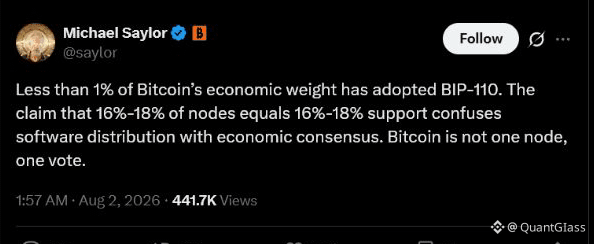
Michael Saylor posted to question whether the number of publicly visible nodes directly represents the economic support rate for BIP-110. His core argument is that the distribution of software nodes does not equal the actual adoption by economic participants such as exchanges, custodians, wallets, and payment services.
The official Bitcoin BIPs repository shows that BIP-110 is still in Draft status, with the title “Reduced Data Temporary Softfork.” Therefore, the focus of the debate right now is not simply tallying which software someone runs, but how to determine how much economic support a consensus change has truly received from real economic entities.
Saylor says that the economic activity carried by different nodes is not the same. This is his publicly stated view and not a conclusion that has already been independently verified across the network; however, it raises a question worth discussing: how should Bitcoin consensus be measured?
When judging Bitcoin consensus, do you place more value on the number of public nodes, or on the actual execution by miners, wallets, and transaction services?
$BTC #Bitcoin #BIP110
Source: Michael Saylor’s official X and the official Bitcoin BIPs repository, for information sharing only.
Michael Saylor posted to question whether the number of publicly visible nodes directly represents the economic support rate for BIP-110. His core argument is that the distribution of software nodes does not equal the actual adoption by economic participants such as exchanges, custodians, wallets, and payment services.
The official Bitcoin BIPs repository shows that BIP-110 is still in Draft status, with the title “Reduced Data Temporary Softfork.” Therefore, the focus of the debate right now is not simply tallying which software someone runs, but how to determine how much economic support a consensus change has truly received from real economic entities.
Saylor says that the economic activity carried by different nodes is not the same. This is his publicly stated view and not a conclusion that has already been independently verified across the network; however, it raises a question worth discussing: how should Bitcoin consensus be measured?
When judging Bitcoin consensus, do you place more value on the number of public nodes, or on the actual execution by miners, wallets, and transaction services?
$BTC #Bitcoin #BIP110
Source: Michael Saylor’s official X and the official Bitcoin BIPs repository, for information sharing only.
The official Bitcoin BIPs repository shows that BIP-110 is still in Draft status, with the title “Reduced Data Temporary Softfork.” Therefore, the focus of the debate right now is not simply tallying which software someone runs, but how to determine how much economic support a consensus change has truly received from real economic entities.
Saylor says that the economic activity carried by different nodes is not the same. This is his publicly stated view and not a conclusion that has already been independently verified across the network; however, it raises a question worth discussing: how should Bitcoin consensus be measured?
When judging Bitcoin consensus, do you place more value on the number of public nodes, or on the actual execution by miners, wallets, and transaction services?
$BTC #Bitcoin #BIP110
Source: Michael Saylor’s official X and the official Bitcoin BIPs repository, for information sharing only.
32

·
--
everyone thinks bitcoin will always prioritize pure payments and proposals like this just sail through but actually bip-110 is a perfect case study of why that's cope.
traders been getting wrecked by the ordinals spam driving up fees and clogging mempools. hard to time entries when the chain feels like a jpeg dumpster fire ngl.
bip-110 is the proposal aiming to limit ordinals-style data storage including some op_return usage for one year. the goal is reducing non-financial data on the chain to keep $BTC block space focused on payments.
with miner support still around 1.42% activation remains unlikely. for now it's a governance discussion not a change to $BTC itself or how $ORDI inscriptions work.
what's your take on this?
#Bitcoin #BTC #BIP110
everyone thinks bitcoin will always prioritize pure payments and proposals like this just sail through but actually bip-110 is a perfect case study of why that's cope.
traders been getting wrecked by the ordinals spam driving up fees and clogging mempools. hard to time entries when the chain feels like a jpeg dumpster fire ngl.
bip-110 is the proposal aiming to limit ordinals-style data storage including some op_return usage for one year. the goal is reducing non-financial data on the chain to keep $BTC block space focused on payments.
with miner support still around 1.42% activation remains unlikely. for now it's a governance discussion not a change to $BTC itself or how $ORDI inscriptions work.
what's your take on this?
#Bitcoin #BTC #BIP110
traders been getting wrecked by the ordinals spam driving up fees and clogging mempools. hard to time entries when the chain feels like a jpeg dumpster fire ngl.
bip-110 is the proposal aiming to limit ordinals-style data storage including some op_return usage for one year. the goal is reducing non-financial data on the chain to keep $BTC block space focused on payments.
with miner support still around 1.42% activation remains unlikely. for now it's a governance discussion not a change to $BTC itself or how $ORDI inscriptions work.
what's your take on this?
#Bitcoin #BTC #BIP110

88

🚨 BIP-110 MANDATORY SIGNALING WITH 2.6% MINER SUPPORT – $TUT & $BMT AT RISK ⚠️
📊 The network just flipped a critical switch: mandatory signaling for BIP-110 is live, backed by only 2.6% of miners. That’s not a consensus — that’s a dangling fork with no lifeline. ⏱️ When a proposal enters enforcement mode with this little support, the probability of a stalled or minority chain spikes sharply, and the market knows it.
🔍 Smart money is likely watching liquidity pools around $TUT and $BMT for a sweep toward the lows. Any bounce from here will need to reclaim structural levels quickly, or the uncertainty premium will keep pressuring bids. 💡 This isn’t a panic sell — it’s a positioning game. The key is whether accumulation appears at these discounted levels or if the fork narrative drives further distribution.
💬 Are you treating this as a headline-driven dip, or are you waiting for the fork resolution to define your next move? 👇
⚠️ Not financial advice. Always manage your risk. 🛡️
🏷️ #BIP110 #TUT #BMT #Crypto #ForkRisk
🐻 🌊
🚨 BIP-110 MANDATORY SIGNALING WITH 2.6% MINER SUPPORT – $TUT & $BMT AT RISK ⚠️
📊 The network just flipped a critical switch: mandatory signaling for BIP-110 is live, backed by only 2.6% of miners. That’s not a consensus — that’s a dangling fork with no lifeline. ⏱️ When a proposal enters enforcement mode with this little support, the probability of a stalled or minority chain spikes sharply, and the market knows it.
🔍 Smart money is likely watching liquidity pools around $TUT and $BMT for a sweep toward the lows. Any bounce from here will need to reclaim structural levels quickly, or the uncertainty premium will keep pressuring bids. 💡 This isn’t a panic sell — it’s a positioning game. The key is whether accumulation appears at these discounted levels or if the fork narrative drives further distribution.
💬 Are you treating this as a headline-driven dip, or are you waiting for the fork resolution to define your next move? 👇
⚠️ Not financial advice. Always manage your risk. 🛡️
🏷️ #BIP110 #TUT #BMT #Crypto #ForkRisk
🐻 🌊
📊 The network just flipped a critical switch: mandatory signaling for BIP-110 is live, backed by only 2.6% of miners. That’s not a consensus — that’s a dangling fork with no lifeline. ⏱️ When a proposal enters enforcement mode with this little support, the probability of a stalled or minority chain spikes sharply, and the market knows it.
🔍 Smart money is likely watching liquidity pools around $TUT and $BMT for a sweep toward the lows. Any bounce from here will need to reclaim structural levels quickly, or the uncertainty premium will keep pressuring bids. 💡 This isn’t a panic sell — it’s a positioning game. The key is whether accumulation appears at these discounted levels or if the fork narrative drives further distribution.
💬 Are you treating this as a headline-driven dip, or are you waiting for the fork resolution to define your next move? 👇
⚠️ Not financial advice. Always manage your risk. 🛡️
🏷️ #BIP110 #TUT #BMT #Crypto #ForkRisk
🐻 🌊
174

Article
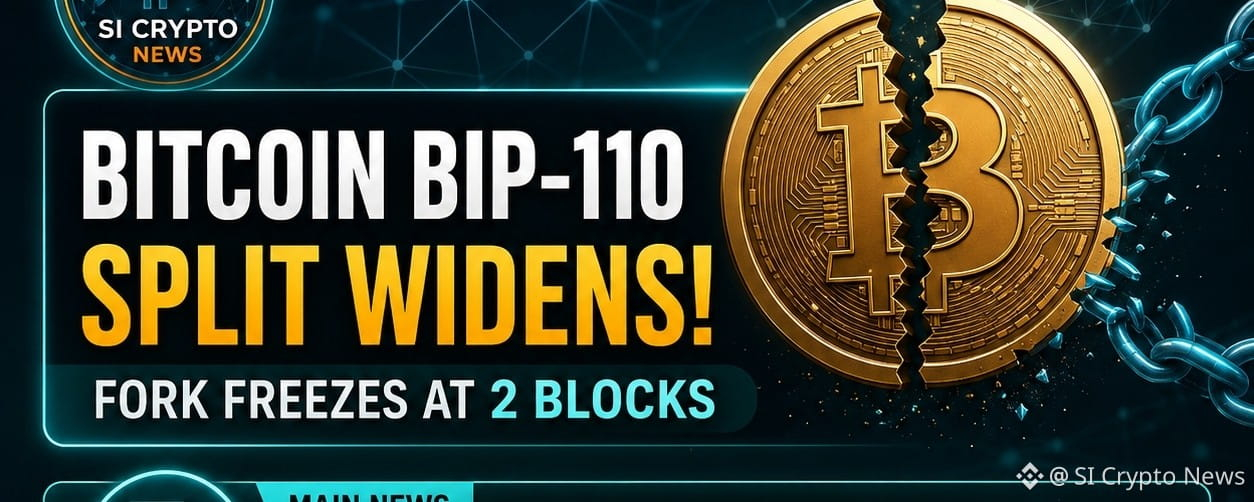
Bitcoin's BIP-110 fork is receiving very little support from miners. The fork stopped after only 2 blocks, whileThe ongoing dispute regarding BIP-110 on the Bitcoin network has entered an interesting phase. A minority chain supporting BIP-110 has almost stopped advancing after creating only two blocks, while Bitcoin's main chain continues to move forward as usual.
According to the latest situation, the BIP-110 chain had stopped at block 961,633, while Bitcoin's main chain had reached block 961,744. This created a difference of approximately 111 blocks between the two chains.
Bitcoin's BIP-110 fork is receiving very little support from miners. The fork stopped after only 2 blocks, while
The ongoing dispute regarding BIP-110 on the Bitcoin network has entered an interesting phase. A minority chain supporting BIP-110 has almost stopped advancing after creating only two blocks, while Bitcoin's main chain continues to move forward as usual.
According to the latest situation, the BIP-110 chain had stopped at block 961,633, while Bitcoin's main chain had reached block 961,744. This created a difference of approximately 111 blocks between the two chains.
According to the latest situation, the BIP-110 chain had stopped at block 961,633, while Bitcoin's main chain had reached block 961,744. This created a difference of approximately 111 blocks between the two chains.
78
·
--
BIP-110 Fork Fiasco Ends: after eight hours, they only dug out two blocks and then immediately ran out of steam. This so-called "computing power defense battle" didn’t even get past the threshold before the market slapped it down.
Even more awkwardly, Luke Dashjr was pushed right onto the hot seat of calls for "removal." A core developer who long positioned himself as a "Bitcoin purist" has now lost trust for pushing a fork proposal that clearly deviates from miners’ consensus—surely a bitter irony.
At the end of the day, Bitcoin’s value has never been driven by any one person’s will. Over more than a decade, the logic of decentralized governance has proven one thing: any attempt to bypass community consensus and forcibly "hijack" the network through technical means will ultimately be rejected by both computing power and the market.
This also serves as a reminder to everyone who cares about BTC:
First, don’t let FOMO be triggered easily by the "hard fork" narrative. Historically, the vast majority of fork attempts end in failure, and only a handful truly make it to real-world rollout.
Second, pay attention to developments within developer communities. Roadmap disputes within the Core team often have more impact on the long-term direction than price fluctuations.
Third, BTC’s real moat is still consensus. When consensus is strong enough, technical disagreements can only remain at the discussion level.
In the short term, this failed attempt has limited impact on the price at $BTC , but in the long term, it further reinforces Bitcoin’s network property of being "the hardest to change"—which is precisely its most core competitive strength as a store of value.
Just keep watching the drama—don’t get carried away.
#BTC #比特币 #BIP110
BIP-110 Fork Fiasco Ends: after eight hours, they only dug out two blocks and then immediately ran out of steam. This so-called "computing power defense battle" didn’t even get past the threshold before the market slapped it down.
Even more awkwardly, Luke Dashjr was pushed right onto the hot seat of calls for "removal." A core developer who long positioned himself as a "Bitcoin purist" has now lost trust for pushing a fork proposal that clearly deviates from miners’ consensus—surely a bitter irony.
At the end of the day, Bitcoin’s value has never been driven by any one person’s will. Over more than a decade, the logic of decentralized governance has proven one thing: any attempt to bypass community consensus and forcibly "hijack" the network through technical means will ultimately be rejected by both computing power and the market.
This also serves as a reminder to everyone who cares about BTC:
First, don’t let FOMO be triggered easily by the "hard fork" narrative. Historically, the vast majority of fork attempts end in failure, and only a handful truly make it to real-world rollout.
Second, pay attention to developments within developer communities. Roadmap disputes within the Core team often have more impact on the long-term direction than price fluctuations.
Third, BTC’s real moat is still consensus. When consensus is strong enough, technical disagreements can only remain at the discussion level.
In the short term, this failed attempt has limited impact on the price at $BTC , but in the long term, it further reinforces Bitcoin’s network property of being "the hardest to change"—which is precisely its most core competitive strength as a store of value.
Just keep watching the drama—don’t get carried away.
#BTC #比特币 #BIP110
Even more awkwardly, Luke Dashjr was pushed right onto the hot seat of calls for "removal." A core developer who long positioned himself as a "Bitcoin purist" has now lost trust for pushing a fork proposal that clearly deviates from miners’ consensus—surely a bitter irony.
At the end of the day, Bitcoin’s value has never been driven by any one person’s will. Over more than a decade, the logic of decentralized governance has proven one thing: any attempt to bypass community consensus and forcibly "hijack" the network through technical means will ultimately be rejected by both computing power and the market.
This also serves as a reminder to everyone who cares about BTC:
First, don’t let FOMO be triggered easily by the "hard fork" narrative. Historically, the vast majority of fork attempts end in failure, and only a handful truly make it to real-world rollout.
Second, pay attention to developments within developer communities. Roadmap disputes within the Core team often have more impact on the long-term direction than price fluctuations.
Third, BTC’s real moat is still consensus. When consensus is strong enough, technical disagreements can only remain at the discussion level.
In the short term, this failed attempt has limited impact on the price at $BTC , but in the long term, it further reinforces Bitcoin’s network property of being "the hardest to change"—which is precisely its most core competitive strength as a store of value.
Just keep watching the drama—don’t get carried away.
#BTC #比特币 #BIP110
21


·
--
🚨 LATEST UPDATE 🚨
The BIP-110 Bitcoin branch is struggling to gain momentum. After moving only two blocks to reach 961,633, the chain has stalled while the main network has progressed significantly. The gap between the two chains has now widened to 88 blocks as mining support remains low. 📉
This development is critical because the BIP-110 branch is currently in a mandatory signaling phase. Without a significant increase in hashpower support from miners, this branch may struggle to advance through its difficulty adjustment period. Major industry figures have expressed concerns that such consensus-level changes could impact network neutrality and credibility. ⛓️
Do you believe miner support will increase for this branch?
#Bitcoin #BIP110 #Blockchain $BTC
$SUI $TAO
🚨 LATEST UPDATE 🚨
The BIP-110 Bitcoin branch is struggling to gain momentum. After moving only two blocks to reach 961,633, the chain has stalled while the main network has progressed significantly. The gap between the two chains has now widened to 88 blocks as mining support remains low. 📉
This development is critical because the BIP-110 branch is currently in a mandatory signaling phase. Without a significant increase in hashpower support from miners, this branch may struggle to advance through its difficulty adjustment period. Major industry figures have expressed concerns that such consensus-level changes could impact network neutrality and credibility. ⛓️
Do you believe miner support will increase for this branch?
#Bitcoin #BIP110 #Blockchain $BTC
$SUI $TAO
The BIP-110 Bitcoin branch is struggling to gain momentum. After moving only two blocks to reach 961,633, the chain has stalled while the main network has progressed significantly. The gap between the two chains has now widened to 88 blocks as mining support remains low. 📉
This development is critical because the BIP-110 branch is currently in a mandatory signaling phase. Without a significant increase in hashpower support from miners, this branch may struggle to advance through its difficulty adjustment period. Major industry figures have expressed concerns that such consensus-level changes could impact network neutrality and credibility. ⛓️
Do you believe miner support will increase for this branch?
#Bitcoin #BIP110 #Blockchain $BTC
$SUI $TAO
81

·
--
Bullish
Verified
BIP 110 Bitcoin Fork Watch
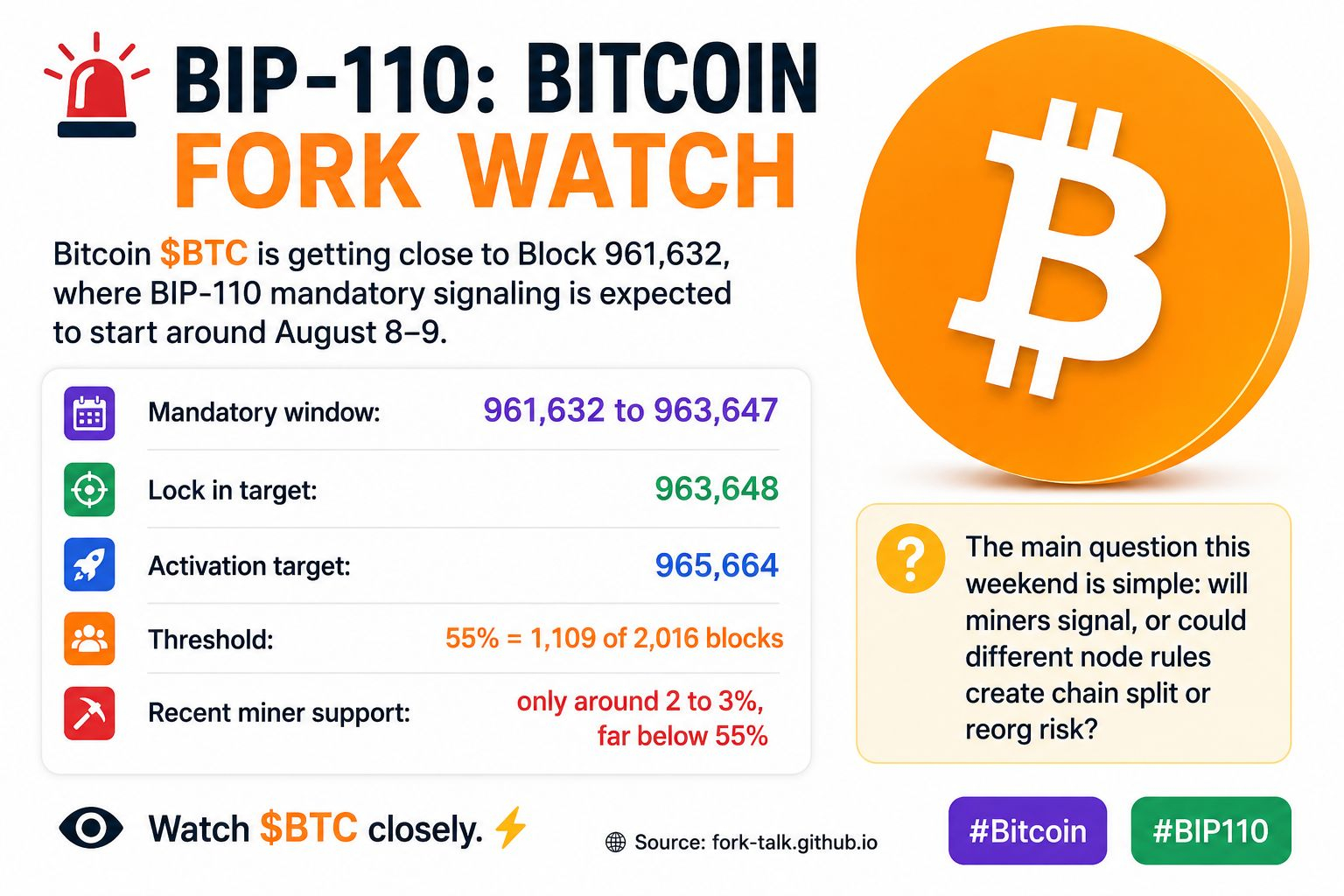
Bitcoin $BTC is getting close to Block 961,632, where BIP 110 mandatory signaling is expected to start around August 8 9.
Mandatory window: 961,632 to 963,647
Lock in target: 963,648
Activation target: 965,664
Threshold: 55% = 1,109 of 2,016 blocks
Recent miner support: only around 2 to 3%, far below 55%
The main question this weekend is simple: will miners signal, or could different node rules create chain split or reorg risk?
Watch $BTC closely.
#bitcoin #BIP110 #bip110forksignalingexpectedthisweekend
{future}(BTCUSDT)
BIP 110 Bitcoin Fork Watch
Bitcoin $BTC is getting close to Block 961,632, where BIP 110 mandatory signaling is expected to start around August 8 9.
Mandatory window: 961,632 to 963,647
Lock in target: 963,648
Activation target: 965,664
Threshold: 55% = 1,109 of 2,016 blocks
Recent miner support: only around 2 to 3%, far below 55%
The main question this weekend is simple: will miners signal, or could different node rules create chain split or reorg risk?
Watch $BTC closely.
#bitcoin #BIP110 #bip110forksignalingexpectedthisweekend
Bitcoin $BTC is getting close to Block 961,632, where BIP 110 mandatory signaling is expected to start around August 8 9.
Mandatory window: 961,632 to 963,647
Lock in target: 963,648
Activation target: 965,664
Threshold: 55% = 1,109 of 2,016 blocks
Recent miner support: only around 2 to 3%, far below 55%
The main question this weekend is simple: will miners signal, or could different node rules create chain split or reorg risk?
Watch $BTC closely.
#bitcoin #BIP110 #bip110forksignalingexpectedthisweekend
2
8
1.2k

·
--
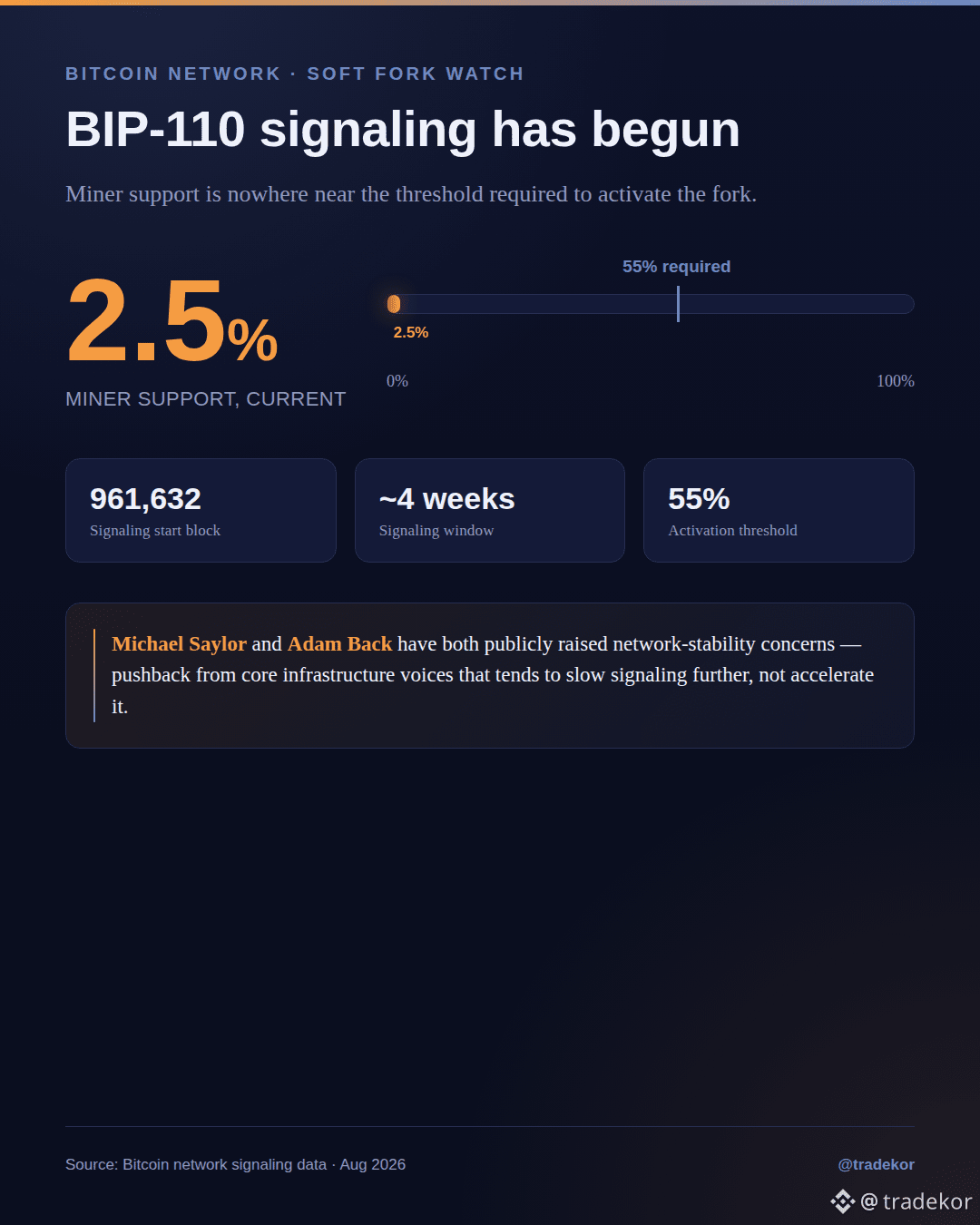
Bitcoin's BIP-110 soft fork signaling just began — miner support sits at 2.5%, far short of the 55% needed to activate.
The signaling window opened at block 961,632 and runs roughly four weeks. Mechanically, that 55% threshold exists so a fork this consequential can't move on a thin majority — and right now it isn't close.
The tension is real: Michael Saylor and Adam Back have both flagged network-stability concerns publicly, and that kind of pushback from core infrastructure voices tends to slow signaling further, not accelerate it.
Our read: barring a coordinated late push from a handful of large pools, this lapses without activation, and $BTC's near-term risk stays keyed to macro and ETF flows, not fork drama. Falsifiable — if weekly signaling climbs meaningfully from here, that thesis breaks and it's worth watching closely.
Worth tracking the weekly signaling % rather than daily noise.
Not financial advice. DYOR.
#Bitcoin #BIP110 #SoftFork #CryptoNews
Bitcoin's BIP-110 soft fork signaling just began — miner support sits at 2.5%, far short of the 55% needed to activate.
The signaling window opened at block 961,632 and runs roughly four weeks. Mechanically, that 55% threshold exists so a fork this consequential can't move on a thin majority — and right now it isn't close.
The tension is real: Michael Saylor and Adam Back have both flagged network-stability concerns publicly, and that kind of pushback from core infrastructure voices tends to slow signaling further, not accelerate it.
Our read: barring a coordinated late push from a handful of large pools, this lapses without activation, and $BTC 's near-term risk stays keyed to macro and ETF flows, not fork drama. Falsifiable — if weekly signaling climbs meaningfully from here, that thesis breaks and it's worth watching closely.
Worth tracking the weekly signaling % rather than daily noise.
Not financial advice. DYOR.
#Bitcoin #BIP110 #SoftFork #CryptoNews
The signaling window opened at block 961,632 and runs roughly four weeks. Mechanically, that 55% threshold exists so a fork this consequential can't move on a thin majority — and right now it isn't close.
The tension is real: Michael Saylor and Adam Back have both flagged network-stability concerns publicly, and that kind of pushback from core infrastructure voices tends to slow signaling further, not accelerate it.
Our read: barring a coordinated late push from a handful of large pools, this lapses without activation, and $BTC 's near-term risk stays keyed to macro and ETF flows, not fork drama. Falsifiable — if weekly signaling climbs meaningfully from here, that thesis breaks and it's worth watching closely.
Worth tracking the weekly signaling % rather than daily noise.
Not financial advice. DYOR.
#Bitcoin #BIP110 #SoftFork #CryptoNews
49

·
--
Bearish
Verified
#BIP110ForkSignalingExpectedThisWeekend
🚨 BITCOIN HAS A CONSENSUS PROBLEM? THIS WEEKEND COULD MATTER.
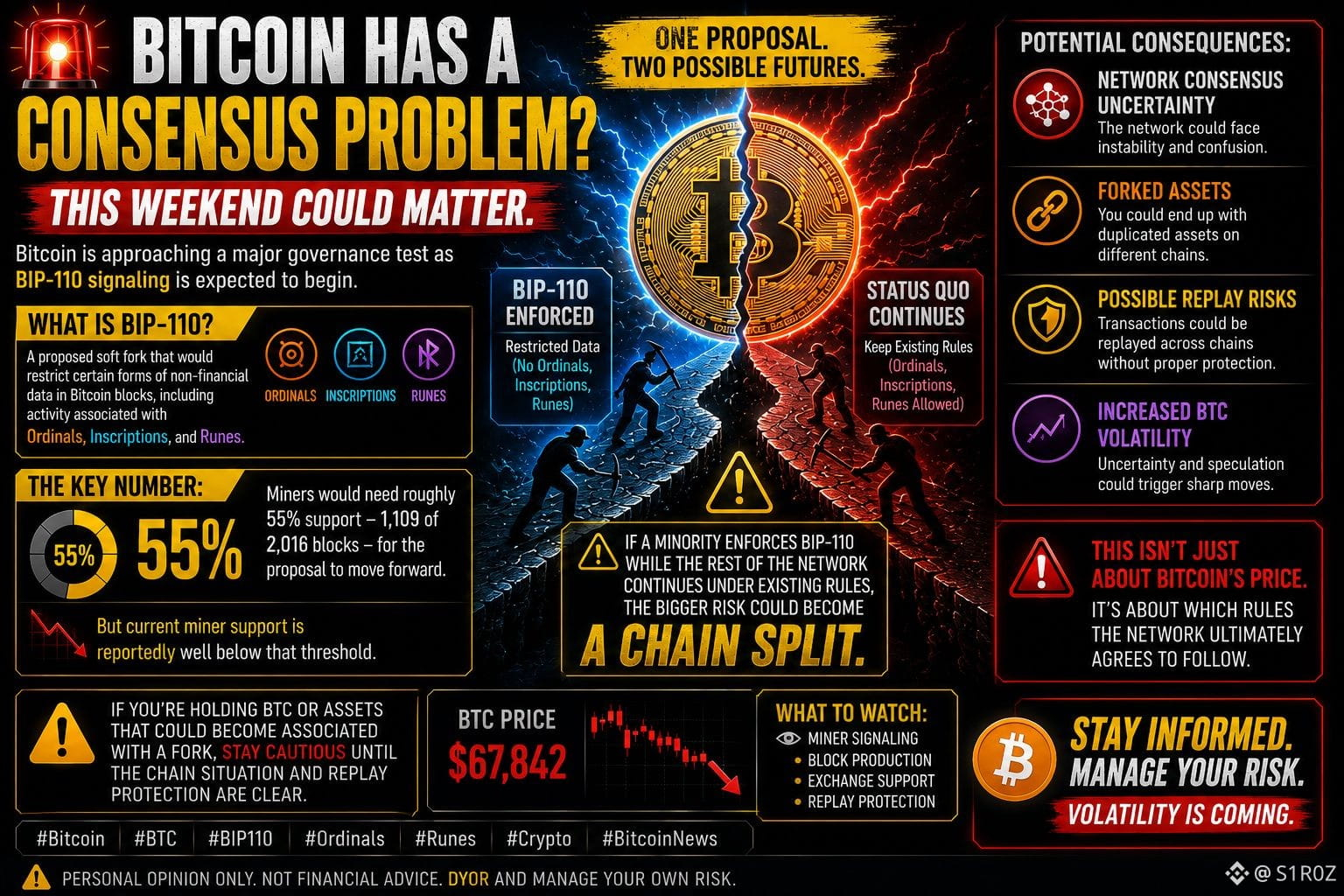
Bitcoin is approaching a major governance test as BIP-110 signaling is expected to begin.
⚠️ What’s BIP-110?
A proposed soft fork that would restrict certain forms of non-financial data in Bitcoin blocks, including activity associated with Ordinals, Inscriptions, and Runes.
🎯 The key number:
Miners would need roughly 55% support — 1,109 of 2,016 blocks — for the proposal to move forward.
But current miner support is reportedly well below that threshold.
And that’s where things get interesting. 👀
If a minority enforces BIP-110 while the rest of the network continues under existing rules, the bigger risk could become a chain split.
💥 Potential consequences:
• Network consensus uncertainty
• Forked assets
• Possible replay risks
• Increased BTC volatility
This isn't just about Bitcoin's price.
It's about which rules the network ultimately agrees to follow.
🚨 If you're holding BTC or assets that could become associated with a fork, stay cautious until the chain situation and replay protection are clear.
$TUT
{spot}(TUTUSDT)
$LAB
{future}(LABUSDT)
$BANK
{spot}(BANKUSDT)
#Bitcoin #BTC #BIP110 #Ordinals #Runes #Crypto #BitcoinNews
📌 Personal opinion only. Not financial advice. DYOR and manage your own risk.
#BIP110ForkSignalingExpectedThisWeekend
🚨 BITCOIN HAS A CONSENSUS PROBLEM? THIS WEEKEND COULD MATTER.
Bitcoin is approaching a major governance test as BIP-110 signaling is expected to begin.
⚠️ What’s BIP-110?
A proposed soft fork that would restrict certain forms of non-financial data in Bitcoin blocks, including activity associated with Ordinals, Inscriptions, and Runes.
🎯 The key number:
Miners would need roughly 55% support — 1,109 of 2,016 blocks — for the proposal to move forward.
But current miner support is reportedly well below that threshold.
And that’s where things get interesting. 👀
If a minority enforces BIP-110 while the rest of the network continues under existing rules, the bigger risk could become a chain split.
💥 Potential consequences:
• Network consensus uncertainty
• Forked assets
• Possible replay risks
• Increased BTC volatility
This isn't just about Bitcoin's price.
It's about which rules the network ultimately agrees to follow.
🚨 If you're holding BTC or assets that could become associated with a fork, stay cautious until the chain situation and replay protection are clear.
$TUT
$LAB
$BANK
#Bitcoin #BTC #BIP110 #Ordinals #Runes #Crypto #BitcoinNews
📌 Personal opinion only. Not financial advice. DYOR and manage your own risk.
🚨 BITCOIN HAS A CONSENSUS PROBLEM? THIS WEEKEND COULD MATTER.
Bitcoin is approaching a major governance test as BIP-110 signaling is expected to begin.
⚠️ What’s BIP-110?
A proposed soft fork that would restrict certain forms of non-financial data in Bitcoin blocks, including activity associated with Ordinals, Inscriptions, and Runes.
🎯 The key number:
Miners would need roughly 55% support — 1,109 of 2,016 blocks — for the proposal to move forward.
But current miner support is reportedly well below that threshold.
And that’s where things get interesting. 👀
If a minority enforces BIP-110 while the rest of the network continues under existing rules, the bigger risk could become a chain split.
💥 Potential consequences:
• Network consensus uncertainty
• Forked assets
• Possible replay risks
• Increased BTC volatility
This isn't just about Bitcoin's price.
It's about which rules the network ultimately agrees to follow.
🚨 If you're holding BTC or assets that could become associated with a fork, stay cautious until the chain situation and replay protection are clear.
$TUT
$LAB
$BANK
#Bitcoin #BTC #BIP110 #Ordinals #Runes #Crypto #BitcoinNews
📌 Personal opinion only. Not financial advice. DYOR and manage your own risk.
19

·
--
Article
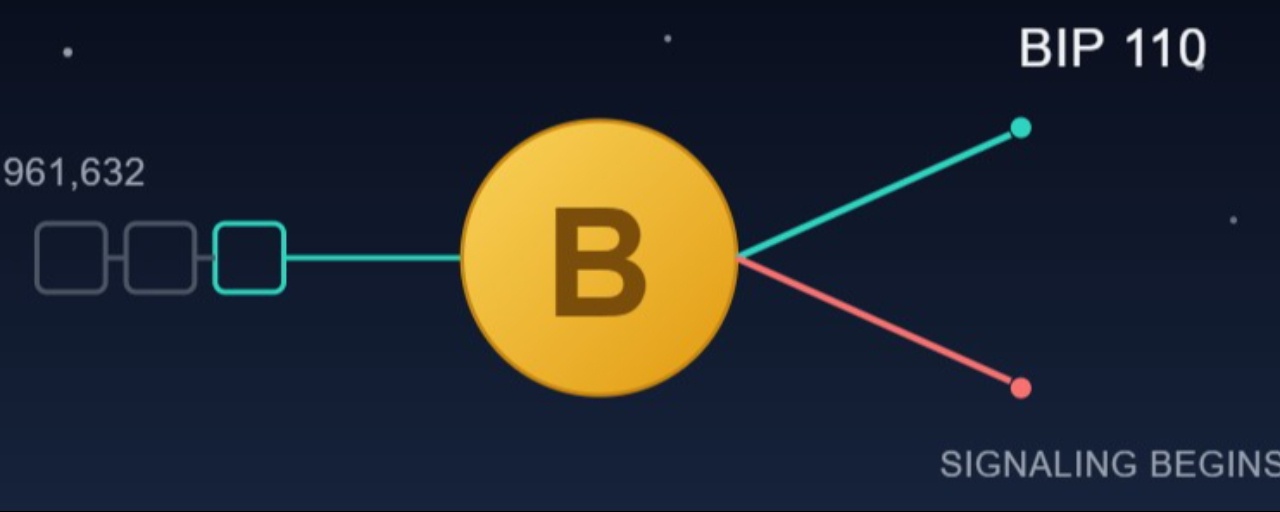
BITCOIN HITS BLOCK 961,632: THE BIP-110 SHOWDOWN BEGINSBitcoin just crossed a checkpoint that's been building for months. Block 961,632 has now triggered the mandatory signaling window for BIP-110, one of the most argued over proposals in recent Bitcoin history.
What is BIP-110 actually about?
It's a temporary soft fork designed to restrict how much non financial data gets packed into Bitcoin transactions, mainly targeting the kind of activity behind Ordinals, Runes, and BRC-20 inscriptions. Supporters call it protecting Bitcoin's core purpose. Critics call it a dangerous precedent.
📊 Key numbers that matter:
💡 Miner support is sitting under 2.5%, nowhere near the 55% threshold needed for activation. That gap isn't small, it's almost a canyon.
🛡️ Industry heavyweights like Michael Saylor and Adam Back have both pushed back, warning that forcing this kind of change through could shake network trust more than the data problem it's trying to fix.
⏳ The signaling window runs roughly four weeks, closing out around block 965,664. Backers are pushing this as a user activated soft fork, meaning node operators, not miners, are being asked to enforce it. With numbers this low though, momentum looks thin.
For $BTC and $ETH holders, this isn't a panic moment, it's a watch and learn moment. Nothing changes for daily transactions right now. What matters is whether this turns into a real governance test, or fades out quietly like other proposals before it.
This is exactly why Bitcoin still stands apart. No single company, founder, or exchange can force an update through. Every change has to earn genuine consensus, block by block.
🗣️ Where do you stand, should Bitcoin restrict how block space is used, or should the market keep deciding on its own? Drop your thoughts below 👇
#BTC走势分析 #BIP110 #bip110softforkattemptbegins #Binance #CryptoNews
#bip110softforkattemptbegins
BITCOIN HITS BLOCK 961,632: THE BIP-110 SHOWDOWN BEGINS
Bitcoin just crossed a checkpoint that's been building for months. Block 961,632 has now triggered the mandatory signaling window for BIP-110, one of the most argued over proposals in recent Bitcoin history.
What is BIP-110 actually about?
It's a temporary soft fork designed to restrict how much non financial data gets packed into Bitcoin transactions, mainly targeting the kind of activity behind Ordinals, Runes, and BRC-20 inscriptions. Supporters call it protecting Bitcoin's core purpose. Critics call it a dangerous precedent.
📊 Key numbers that matter:
💡 Miner support is sitting under 2.5%, nowhere near the 55% threshold needed for activation. That gap isn't small, it's almost a canyon.
🛡️ Industry heavyweights like Michael Saylor and Adam Back have both pushed back, warning that forcing this kind of change through could shake network trust more than the data problem it's trying to fix.
⏳ The signaling window runs roughly four weeks, closing out around block 965,664. Backers are pushing this as a user activated soft fork, meaning node operators, not miners, are being asked to enforce it. With numbers this low though, momentum looks thin.
For $BTC and $ETH holders, this isn't a panic moment, it's a watch and learn moment. Nothing changes for daily transactions right now. What matters is whether this turns into a real governance test, or fades out quietly like other proposals before it.
This is exactly why Bitcoin still stands apart. No single company, founder, or exchange can force an update through. Every change has to earn genuine consensus, block by block.
🗣️ Where do you stand, should Bitcoin restrict how block space is used, or should the market keep deciding on its own? Drop your thoughts below 👇
#BTC走势分析 #BIP110 #bip110softforkattemptbegins #Binance #CryptoNews
#bip110softforkattemptbegins
What is BIP-110 actually about?
It's a temporary soft fork designed to restrict how much non financial data gets packed into Bitcoin transactions, mainly targeting the kind of activity behind Ordinals, Runes, and BRC-20 inscriptions. Supporters call it protecting Bitcoin's core purpose. Critics call it a dangerous precedent.
📊 Key numbers that matter:
💡 Miner support is sitting under 2.5%, nowhere near the 55% threshold needed for activation. That gap isn't small, it's almost a canyon.
🛡️ Industry heavyweights like Michael Saylor and Adam Back have both pushed back, warning that forcing this kind of change through could shake network trust more than the data problem it's trying to fix.
⏳ The signaling window runs roughly four weeks, closing out around block 965,664. Backers are pushing this as a user activated soft fork, meaning node operators, not miners, are being asked to enforce it. With numbers this low though, momentum looks thin.
For $BTC and $ETH holders, this isn't a panic moment, it's a watch and learn moment. Nothing changes for daily transactions right now. What matters is whether this turns into a real governance test, or fades out quietly like other proposals before it.
This is exactly why Bitcoin still stands apart. No single company, founder, or exchange can force an update through. Every change has to earn genuine consensus, block by block.
🗣️ Where do you stand, should Bitcoin restrict how block space is used, or should the market keep deciding on its own? Drop your thoughts below 👇
#BTC走势分析 #BIP110 #bip110softforkattemptbegins #Binance #CryptoNews
#bip110softforkattemptbegins
167

·
--
Bearish
Verified
#bip110forksignalingexpectedthisweekend
🚨 BIP-110 ENTERS A CRITICAL PHASE FOR BITCOIN
Bitcoin’s controversial BIP-110 is moving into mandatory signaling, putting miners and the wider community under the spotlight. The proposal would temporarily restrict certain forms of large arbitrary data storage on Bitcoin.
⛏️ The key issue is consensus. BIP-110 requires 55% signaling for early lock-in, while the mandatory phase is designed to push the deployment toward activation if earlier lock-in doesn’t occur.
📊 TRADING VIEW: SELL 📉
The contentious upgrade debate could increase short-term BTC volatility and risk sentiment. Watch miner signaling, network reaction, and BTC price closely.
❓ Will BIP-110 pressure BTC or strengthen Bitcoin long term? "CLICK ON THE BELOW YELLOW COIN TAG TO GO TO DESIRED TRADING PAGE TO GET BENEFIT TRADE"$BTC $SOL $BICO
#bitcoin #BIP110
{spot}(BICOUSDT)
{spot}(SOLUSDT)
{spot}(BTCUSDT)
#bip110forksignalingexpectedthisweekend
🚨 BIP-110 ENTERS A CRITICAL PHASE FOR BITCOIN
Bitcoin’s controversial BIP-110 is moving into mandatory signaling, putting miners and the wider community under the spotlight. The proposal would temporarily restrict certain forms of large arbitrary data storage on Bitcoin.
⛏️ The key issue is consensus. BIP-110 requires 55% signaling for early lock-in, while the mandatory phase is designed to push the deployment toward activation if earlier lock-in doesn’t occur.
📊 TRADING VIEW: SELL 📉
The contentious upgrade debate could increase short-term BTC volatility and risk sentiment. Watch miner signaling, network reaction, and BTC price closely.
❓ Will BIP-110 pressure BTC or strengthen Bitcoin long term? "CLICK ON THE BELOW YELLOW COIN TAG TO GO TO DESIRED TRADING PAGE TO GET BENEFIT TRADE"$BTC $SOL $BICO
#bitcoin #BIP110
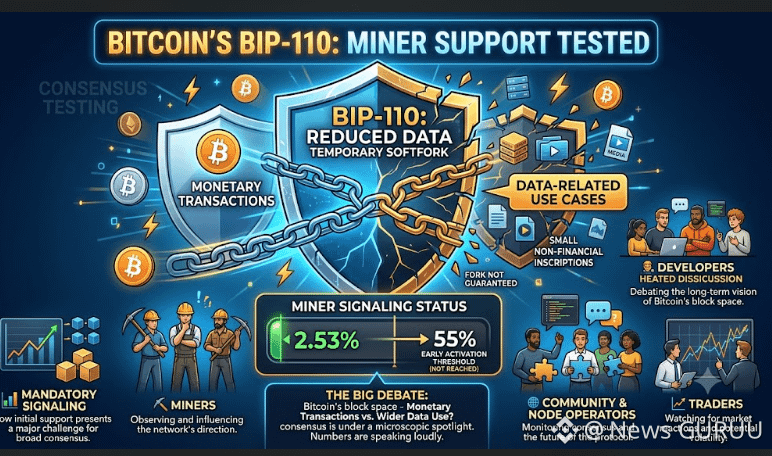
🚨 BIP-110 ENTERS A CRITICAL PHASE FOR BITCOIN
Bitcoin’s controversial BIP-110 is moving into mandatory signaling, putting miners and the wider community under the spotlight. The proposal would temporarily restrict certain forms of large arbitrary data storage on Bitcoin.
⛏️ The key issue is consensus. BIP-110 requires 55% signaling for early lock-in, while the mandatory phase is designed to push the deployment toward activation if earlier lock-in doesn’t occur.
📊 TRADING VIEW: SELL 📉
The contentious upgrade debate could increase short-term BTC volatility and risk sentiment. Watch miner signaling, network reaction, and BTC price closely.
❓ Will BIP-110 pressure BTC or strengthen Bitcoin long term? "CLICK ON THE BELOW YELLOW COIN TAG TO GO TO DESIRED TRADING PAGE TO GET BENEFIT TRADE"$BTC $SOL $BICO
#bitcoin #BIP110
2
1.7k
·
--
🚨 BIP-110 Enters the Mandatory Signaling Phase Tomorrow
The current miner support rate is only 2.45%, far from the triggering threshold. The risk of a chain split on $BTC is heating up.
A chain split is not an exaggeration. Looking back at protocol disputes in Bitcoin’s history, the most dangerous signal is not fierce confrontation, but this kind of silence—“almost nobody is responding”—which means community consensus has not yet formed.
With a 2.45% support rate, it’s either that miners are collectively cold-shouldering it, or that opposing forces are building up momentum. No matter which possibility it is, the signaling changes over the next 48 hours are worth watching closely.
#比特币 #BIP110
🚨 BIP-110 Enters the Mandatory Signaling Phase Tomorrow
The current miner support rate is only 2.45%, far from the triggering threshold. The risk of a chain split on $BTC is heating up.
A chain split is not an exaggeration. Looking back at protocol disputes in Bitcoin’s history, the most dangerous signal is not fierce confrontation, but this kind of silence—“almost nobody is responding”—which means community consensus has not yet formed.
With a 2.45% support rate, it’s either that miners are collectively cold-shouldering it, or that opposing forces are building up momentum. No matter which possibility it is, the signaling changes over the next 48 hours are worth watching closely.
#比特币 #BIP110
The current miner support rate is only 2.45%, far from the triggering threshold. The risk of a chain split on $BTC is heating up.
A chain split is not an exaggeration. Looking back at protocol disputes in Bitcoin’s history, the most dangerous signal is not fierce confrontation, but this kind of silence—“almost nobody is responding”—which means community consensus has not yet formed.
With a 2.45% support rate, it’s either that miners are collectively cold-shouldering it, or that opposing forces are building up momentum. No matter which possibility it is, the signaling changes over the next 48 hours are worth watching closely.
#比特币 #BIP110
54

·
--
$BTC
{future}(BTCUSDT)
🚨Bitcoin Hits Block 961,632 & BIP-110 Debate Begins 🛠️
A new soft fork attempt (BIP-110) has officially kicked off on the Bitcoin network.
Right now, miner support is sitting at very low levels, meaning activation isn't happening anytime soon, but it's sparking great conversations about Bitcoin governance.
How do you feel about base-layer protocol changes?
Drop your thoughts below! 👇
#bitcoin #BTC #CryptoNews #BinanceSquare #BIP110
$BTC
🚨Bitcoin Hits Block 961,632 & BIP-110 Debate Begins 🛠️
A new soft fork attempt (BIP-110) has officially kicked off on the Bitcoin network.
Right now, miner support is sitting at very low levels, meaning activation isn't happening anytime soon, but it's sparking great conversations about Bitcoin governance.
How do you feel about base-layer protocol changes?
Drop your thoughts below! 👇
#bitcoin #BTC #CryptoNews #BinanceSquare #BIP110
🚨Bitcoin Hits Block 961,632 & BIP-110 Debate Begins 🛠️
A new soft fork attempt (BIP-110) has officially kicked off on the Bitcoin network.
Right now, miner support is sitting at very low levels, meaning activation isn't happening anytime soon, but it's sparking great conversations about Bitcoin governance.
How do you feel about base-layer protocol changes?
Drop your thoughts below! 👇
#bitcoin #BTC #CryptoNews #BinanceSquare #BIP110
117

⛏️ Important update on the Bitcoin mining process: Foundry USA calls for voting on BIP-110
Foundry USA Pool, which controls 33% of the world’s Bitcoin hash rate, urges miners to vote in support of the BIP-110 improvement proposal. Currently, signals of support for the proposal are extremely weak, at less than 1% since the voting process began.
━━━━━━━━━━━━━━
📊 Impact: 📈 High
🏷️ BITCOIN
#Bitcoin #BIP110 #Mining #FoundryUSA #CryptoUpgrade
🔗 Source: https://cryptobriefing.com/foundry-usa-bip-110-miner-vote/
⛏️ Important update on the Bitcoin mining process: Foundry USA calls for voting on BIP-110
Foundry USA Pool, which controls 33% of the world’s Bitcoin hash rate, urges miners to vote in support of the BIP-110 improvement proposal. Currently, signals of support for the proposal are extremely weak, at less than 1% since the voting process began.
━━━━━━━━━━━━━━
📊 Impact: 📈 High
🏷️ BITCOIN
#Bitcoin #BIP110 #Mining #FoundryUSA #CryptoUpgrade
🔗 Source: https://cryptobriefing.com/foundry-usa-bip-110-miner-vote/
Foundry USA Pool, which controls 33% of the world’s Bitcoin hash rate, urges miners to vote in support of the BIP-110 improvement proposal. Currently, signals of support for the proposal are extremely weak, at less than 1% since the voting process began.
━━━━━━━━━━━━━━
📊 Impact: 📈 High
🏷️ BITCOIN
#Bitcoin #BIP110 #Mining #FoundryUSA #CryptoUpgrade
🔗 Source: https://cryptobriefing.com/foundry-usa-bip-110-miner-vote/
9
Log in to explore more content
Join global crypto users on Binance Square
⚡️ Get latest and useful information about crypto.
💬 Trusted by the world’s largest crypto exchange.
👍 Discover real insights from verified creators.
Email / Phone number
Trending Topics
1
#UKFCAWinsCourtOrderToRecover851400Pounds
11,557 views
537 Discussing
2
#ChainlinkLaunchesCCIP2WithEnterpriseVerification
25,333 views
753 Discussing
3
#GoldFallsTo$4144
9,908 views
125 Discussing
4
#QNTFallsOver40%FromMorningHigh
62,634 views
1,169 Discussing
5
#USDTAdds845900HoldersInPast7Days
8,618 views
316 Discussing
6
#KospiFalls2.7%SamsungSKHynixDropOver5%
17,316 views
502 Discussing
7
#BitgetCEOConfirms$388MStolenInHack
4,396 views
39 Discussing
8
#BTCFallsBelow$83000
25,324 views
156 Discussing
9
#BitgetDetailsSecurityIncidentTimeline
33,869 views
637 Discussing
10
#BitcoinSpotETFs$2.39BWeeklyNetInflow
11,247 views
43 Discussing