
#anthropic
anthropic
541,573 views
2,842 Discussing
Hot
Latest

·
--
Verified
ANTHROPIC CONTRACT (GREEN)
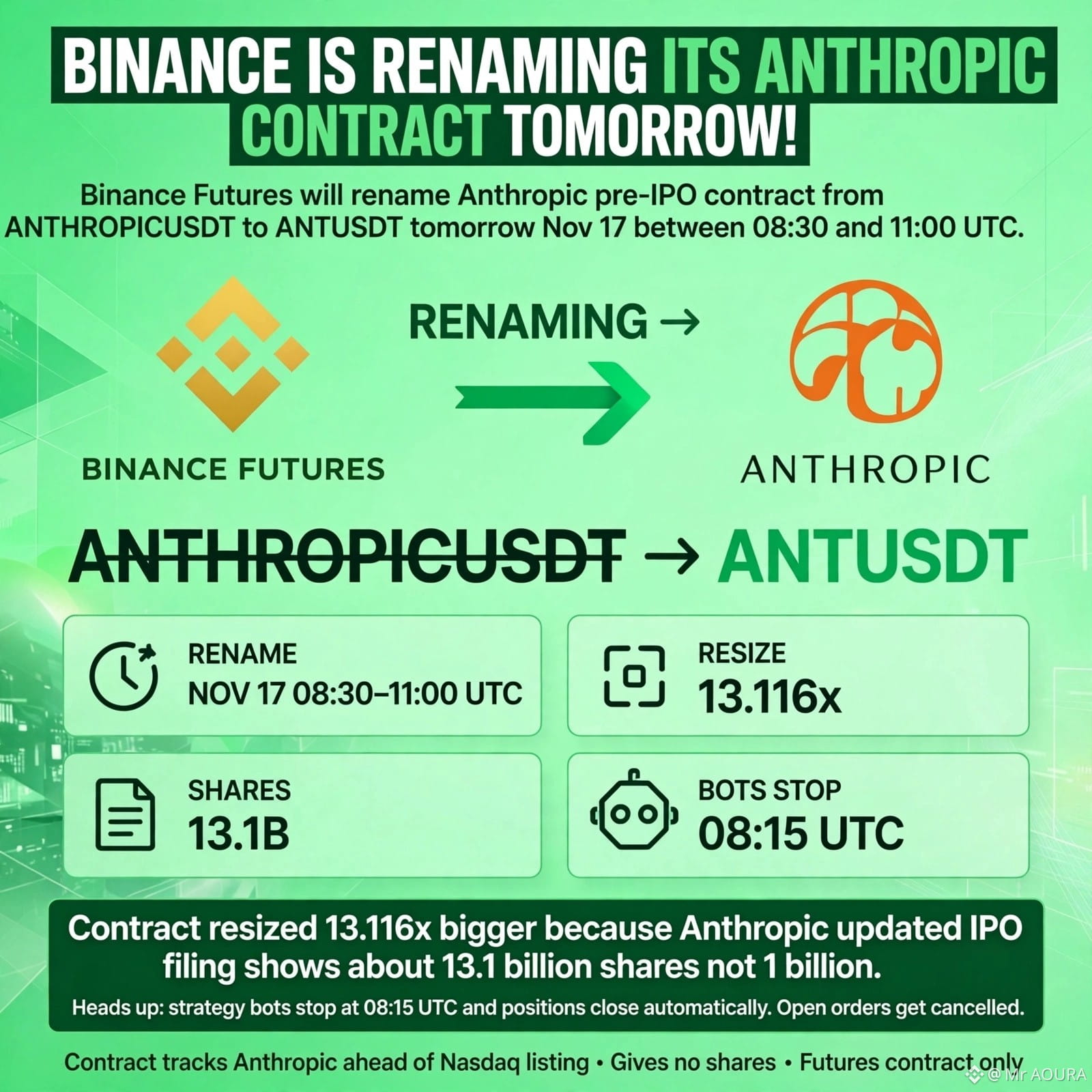
🔄 BINANCE IS RENAMING ITS ANTHROPIC CONTRACT TOMORROW!
Binance Futures will rename its Anthropic pre-IPO contract from ANTHROPICUSDT to ANTUSDT tomorrow, November 17, between 08:30 and 11:00 UTC.
The contract is also being resized — 13.116 times bigger — because Anthropic's updated IPO filing shows about 13.1 billion shares, not 1 billion.
Heads up if you trade it: strategy bots stop at 08:15 UTC and their positions close automatically. Open orders get cancelled during the change.
This contract tracks Anthropic ahead of its Nasdaq listing — it gives you no shares in the company. Are you watching the Anthropic IPO? 👇
#Binance #Anthropic #Crypto
(Info only, not financial advice)
552

·
--
Verified
Article
Anthropic Lists Thursday: Why the IPO Price Is Not the Price You'll PayDisclosure: It is not financial advice
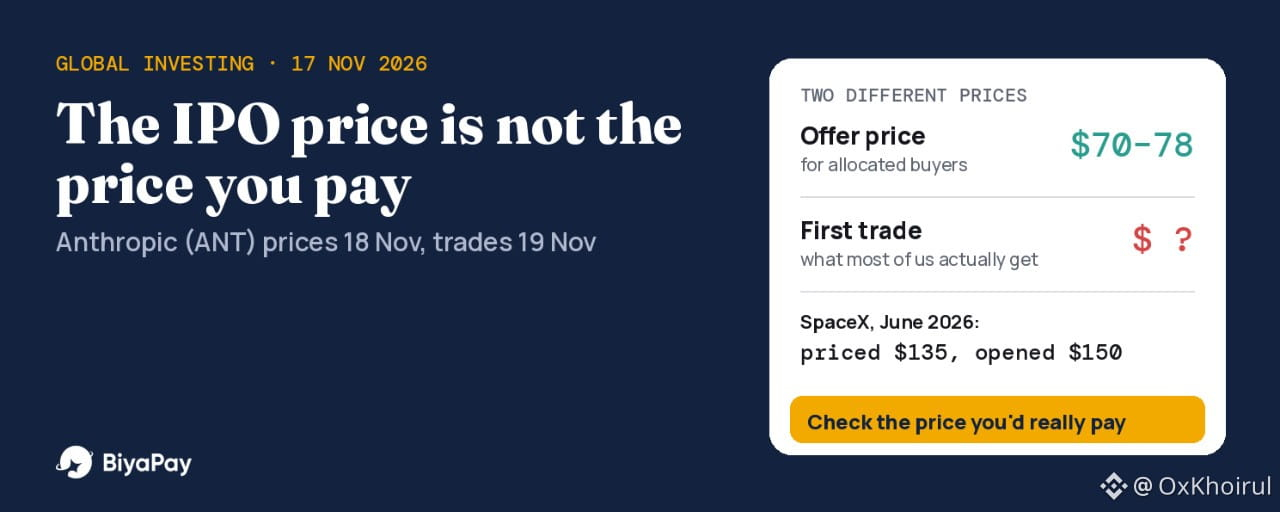
Anthropic is set to price its IPO on the evening of 18 November and start trading on Nasdaq on 19 November under the ticker ANT. The marketed range is $70 to $78 a share, CNBC reports a valuation of about $1.405 trillion, and up to 20% of the shares may go to retail investors, well above the 5–10% that is more typical.
That headline range is where a common misunderstanding starts. "I'll buy Anthropic at $74" sounds reasonable, but the $70–78 range is the offer price, the price paid by people who receive an allocation before trading begins. Everyone else buys on the open market, at whatever price the first trade and the trades after it produce. Those can be very different numbers.
I wanted to see how big that gap can be in real money, so I ran the numbers on the most recent mega-IPO we can actually check: SpaceX, which listed five months ago.
The two prices, using SpaceX as a real example
SpaceX priced its IPO at $135. When it began trading on 12 June 2026, the first trade was at $150, 11.1% above the offer. It closed day one at $160.95, up 19.2%, and kept running: the highest closing price so far was $201.80 on 16 June, with an intraday high of $225.64 that day. By the 16 November close it was $137.36.
Here is what $1,000 became by 16 November, depending on where you got in (no fees included):
At the offer price of $135 (allocated buyers): 7.41 shares, now worth $1,017, up 1.7%At the opening trade of $150: 6.67 shares, now worth $916, down 8.4%At the first-day close of $160.95: 6.21 shares, now worth $853, down 14.7%At the peak close of $201.80: 4.96 shares, now worth $681, down 31.9%
Same company, same five months, and a 33-point spread in outcomes based on nothing but entry price. The allocated buyer is roughly flat. The person who bought into the excitement in week one is down almost a third. Nothing about SpaceX the business changed in those first four days; only the price did.
What Anthropic's range implies, worked out
Dividing the reported $1.405 trillion valuation by the $74 midpoint gives roughly 19.0 billion shares outstanding. That lets us translate any share price into a company value. The examples below are illustrations, not forecasts:
$70 (bottom of range): about $1.33 trillion$74 (midpoint): about $1.41 trillion$78 (top of range): about $1.48 trillion$86.67 (top of range plus an 11% opening pop, the same as SpaceX's): about $1.65 trillion$101.99 (top of range plus 31%, the same as SpaceX's day-one high): about $1.94 trillion
Now compare that with revenue. According to the filing figures reported by Yahoo Finance on 12 November, Anthropic made $33.2 billion in revenue in the first nine months of 2026, up 1,206%, with $16.3 billion in the first half. That means about $16.9 billion in the third quarter alone. Multiply by four and you get a run-rate of about $67.6 billion a year. That is my simplification, and it assumes revenue simply holds at Q3 levels.
On that run-rate, the midpoint values Anthropic at about 20.8 times sales. A SpaceX-style 11% pop from the top of the range moves it to about 24.3 times; a 31% pop moves it to about 28.6 times. The business is identical in all five lines. Only the price you pay changes what you are betting on.
A few more facts from the same reporting are worth keeping in mind: operating losses narrowed to $1.3 billion over nine months from $5.2 billion a year earlier, and the company has $895.4 billion of committed future spending, $69.8 billion of it due within 12 months. Fast growth, heavy spending. That mix is exactly what makes the price swing.
Why the first few days are often expensive
This is not just a SpaceX story. Jay Ritter's long-running IPO data at the University of Florida covers 9,253 US IPOs from 1980 to 2024. The average first-day return was 18.9%. But for someone who bought at the first-day close and held for three years, the average return was 19.1%, compared with 39.6% for the overall market over the same periods. For buyers at the offer price, the three-year figure was about 36.3%. For 2011–2024, the average first-day pop was even bigger at 23.0%, and three-year returns from the first close were weaker.
These are averages across thousands of companies, not a prediction for any single stock. But the pattern is consistent: much of the easy gain tends to go to whoever gets the offer price, and secondary buyers start from a higher base.
One detail makes ANT especially relevant here. The offering is 825 million shares out of roughly 19 billion, only about 4.3% of the company. When a small slice of a very famous company hits the market with heavy retail demand, the price can move sharply in either direction.
When this applies, and when it doesn't
It applies if you plan to buy ANT on the open market on 19 November or in the days after. That is most retail investors, including anyone using a platform without IPO subscription. On BiyaPay, the Help Center states that IPO subscription is currently not supported (published 10 February 2026), so a BiyaPay user would be a secondary-market buyer by definition and should think in terms of the opening price, not the $70–78 range.
It applies less if you actually receive an allocation at the offer price, although even then SpaceX shows that a strong first day can fade.
It also matters less if you are buying a small amount and genuinely plan to hold for many years. Over a long horizon, the business result matters more than a 10–20% difference in entry price. "Many years" has to be an honest plan, though, not a hope.
It does not tell you whether Anthropic is a good or bad company. This is about price, not quality.
My take
I find Anthropic one of the most interesting listings of the year, and I understand the urge to own it on day one. But the SpaceX numbers changed how I think about it. If I want exposure, my personal approach is to decide in advance the maximum price I am willing to pay, based on what that price implies about the company's value, instead of reacting to whatever the opening print turns out to be. If the first trade comes in far above that number, waiting costs me nothing but a story. Chasing the opening pop is the decision I would be most likely to regret, because it is the one with the least information behind it.
Checklist before you buy a hot IPO on day one
Know which price you are actually getting. If you have no allocation, the offer range is not your price.Translate your price into a company value. Shares outstanding times price per share, then compare it with revenue.Expect the first trade to come later than the regular open. New listings usually take a while to open, so do not assume ANT trades at 09:30 New York time.Set a maximum price in advance and use a limit order rather than buying at any price.Size the position so that a 30% drop, like SpaceX from its peak close, would not hurt your finances.Read the governance section. Anthropic is a public benefit corporation; its Long-Term Benefit Trust elects some directors, and Class F shares carry 50.1% of the voting power with no economic rights, so Class A buyers get economic exposure but limited control.Check the lock-up schedule in the prospectus. When early holders become free to sell, extra supply can hit the price.
#BiyaPay #IPO #Anthropic #GlobalInvesting
Anthropic Lists Thursday: Why the IPO Price Is Not the Price You'll Pay
Disclosure: It is not financial advice
Anthropic is set to price its IPO on the evening of 18 November and start trading on Nasdaq on 19 November under the ticker ANT. The marketed range is $70 to $78 a share, CNBC reports a valuation of about $1.405 trillion, and up to 20% of the shares may go to retail investors, well above the 5–10% that is more typical.
That headline range is where a common misunderstanding starts. "I'll buy Anthropic at $74" sounds reasonable, but the $70–78 range is the offer price, the price paid by people who receive an allocation before trading begins. Everyone else buys on the open market, at whatever price the first trade and the trades after it produce. Those can be very different numbers.
I wanted to see how big that gap can be in real money, so I ran the numbers on the most recent mega-IPO we can actually check: SpaceX, which listed five months ago.
The two prices, using SpaceX as a real example
SpaceX priced its IPO at $135. When it began trading on 12 June 2026, the first trade was at $150, 11.1% above the offer. It closed day one at $160.95, up 19.2%, and kept running: the highest closing price so far was $201.80 on 16 June, with an intraday high of $225.64 that day. By the 16 November close it was $137.36.
Here is what $1,000 became by 16 November, depending on where you got in (no fees included):
At the offer price of $135 (allocated buyers): 7.41 shares, now worth $1,017, up 1.7%At the opening trade of $150: 6.67 shares, now worth $916, down 8.4%At the first-day close of $160.95: 6.21 shares, now worth $853, down 14.7%At the peak close of $201.80: 4.96 shares, now worth $681, down 31.9%
Same company, same five months, and a 33-point spread in outcomes based on nothing but entry price. The allocated buyer is roughly flat. The person who bought into the excitement in week one is down almost a third. Nothing about SpaceX the business changed in those first four days; only the price did.
What Anthropic's range implies, worked out
Dividing the reported $1.405 trillion valuation by the $74 midpoint gives roughly 19.0 billion shares outstanding. That lets us translate any share price into a company value. The examples below are illustrations, not forecasts:
$70 (bottom of range): about $1.33 trillion$74 (midpoint): about $1.41 trillion$78 (top of range): about $1.48 trillion$86.67 (top of range plus an 11% opening pop, the same as SpaceX's): about $1.65 trillion$101.99 (top of range plus 31%, the same as SpaceX's day-one high): about $1.94 trillion
Now compare that with revenue. According to the filing figures reported by Yahoo Finance on 12 November, Anthropic made $33.2 billion in revenue in the first nine months of 2026, up 1,206%, with $16.3 billion in the first half. That means about $16.9 billion in the third quarter alone. Multiply by four and you get a run-rate of about $67.6 billion a year. That is my simplification, and it assumes revenue simply holds at Q3 levels.
On that run-rate, the midpoint values Anthropic at about 20.8 times sales. A SpaceX-style 11% pop from the top of the range moves it to about 24.3 times; a 31% pop moves it to about 28.6 times. The business is identical in all five lines. Only the price you pay changes what you are betting on.
A few more facts from the same reporting are worth keeping in mind: operating losses narrowed to $1.3 billion over nine months from $5.2 billion a year earlier, and the company has $895.4 billion of committed future spending, $69.8 billion of it due within 12 months. Fast growth, heavy spending. That mix is exactly what makes the price swing.
Why the first few days are often expensive
This is not just a SpaceX story. Jay Ritter's long-running IPO data at the University of Florida covers 9,253 US IPOs from 1980 to 2024. The average first-day return was 18.9%. But for someone who bought at the first-day close and held for three years, the average return was 19.1%, compared with 39.6% for the overall market over the same periods. For buyers at the offer price, the three-year figure was about 36.3%. For 2011–2024, the average first-day pop was even bigger at 23.0%, and three-year returns from the first close were weaker.
These are averages across thousands of companies, not a prediction for any single stock. But the pattern is consistent: much of the easy gain tends to go to whoever gets the offer price, and secondary buyers start from a higher base.
One detail makes ANT especially relevant here. The offering is 825 million shares out of roughly 19 billion, only about 4.3% of the company. When a small slice of a very famous company hits the market with heavy retail demand, the price can move sharply in either direction.
When this applies, and when it doesn't
It applies if you plan to buy ANT on the open market on 19 November or in the days after. That is most retail investors, including anyone using a platform without IPO subscription. On BiyaPay, the Help Center states that IPO subscription is currently not supported (published 10 February 2026), so a BiyaPay user would be a secondary-market buyer by definition and should think in terms of the opening price, not the $70–78 range.
It applies less if you actually receive an allocation at the offer price, although even then SpaceX shows that a strong first day can fade.
It also matters less if you are buying a small amount and genuinely plan to hold for many years. Over a long horizon, the business result matters more than a 10–20% difference in entry price. "Many years" has to be an honest plan, though, not a hope.
It does not tell you whether Anthropic is a good or bad company. This is about price, not quality.
My take
I find Anthropic one of the most interesting listings of the year, and I understand the urge to own it on day one. But the SpaceX numbers changed how I think about it. If I want exposure, my personal approach is to decide in advance the maximum price I am willing to pay, based on what that price implies about the company's value, instead of reacting to whatever the opening print turns out to be. If the first trade comes in far above that number, waiting costs me nothing but a story. Chasing the opening pop is the decision I would be most likely to regret, because it is the one with the least information behind it.
Checklist before you buy a hot IPO on day one
Know which price you are actually getting. If you have no allocation, the offer range is not your price.Translate your price into a company value. Shares outstanding times price per share, then compare it with revenue.Expect the first trade to come later than the regular open. New listings usually take a while to open, so do not assume ANT trades at 09:30 New York time.Set a maximum price in advance and use a limit order rather than buying at any price.Size the position so that a 30% drop, like SpaceX from its peak close, would not hurt your finances.Read the governance section. Anthropic is a public benefit corporation; its Long-Term Benefit Trust elects some directors, and Class F shares carry 50.1% of the voting power with no economic rights, so Class A buyers get economic exposure but limited control.Check the lock-up schedule in the prospectus. When early holders become free to sell, extra supply can hit the price.
#BiyaPay #IPO #Anthropic #GlobalInvesting
401

·
--
This is the biggest test for the AI boom.
Anthropic, the maker of Claude, starts trading Nov 19 on Nasdaq as ANT.
Price: 70 to 78 dollars
Raise: Up to 64.4 billion dollars IPO + 26 billion private placement
Total: Up to 90.4 billion dollars
Valuation: Up to 1.4 trillion dollars
That would beat SpaceX and become the largest IPO in history.
Demand is massive. Orders are 6x to 7x oversubscribed. Many investors will get less than they asked for.
Growth is real. Revenue run rate hit 81 billion dollars in October, up from 65 billion in July. 40 percent of Fortune 100 use Claude.
But risk is real too. Compute commitments are 900 billion dollars over 10 years. Q3 saw a 567 million dollar operating loss.
Google and Nvidia are putting 10 billion each. They need Anthropic to win.
If ANT pops, AI is back. If it falls, the whole AI trade reprices lower.
Will you buy ANT on Day 1, wait for a dip, or skip it?
#Aİ #Anthropic
#AnthropicIPOTestsInvestorAppetiteForAI
168
·
--
Verified
#anthropicipotestsinvestorappetiteforai
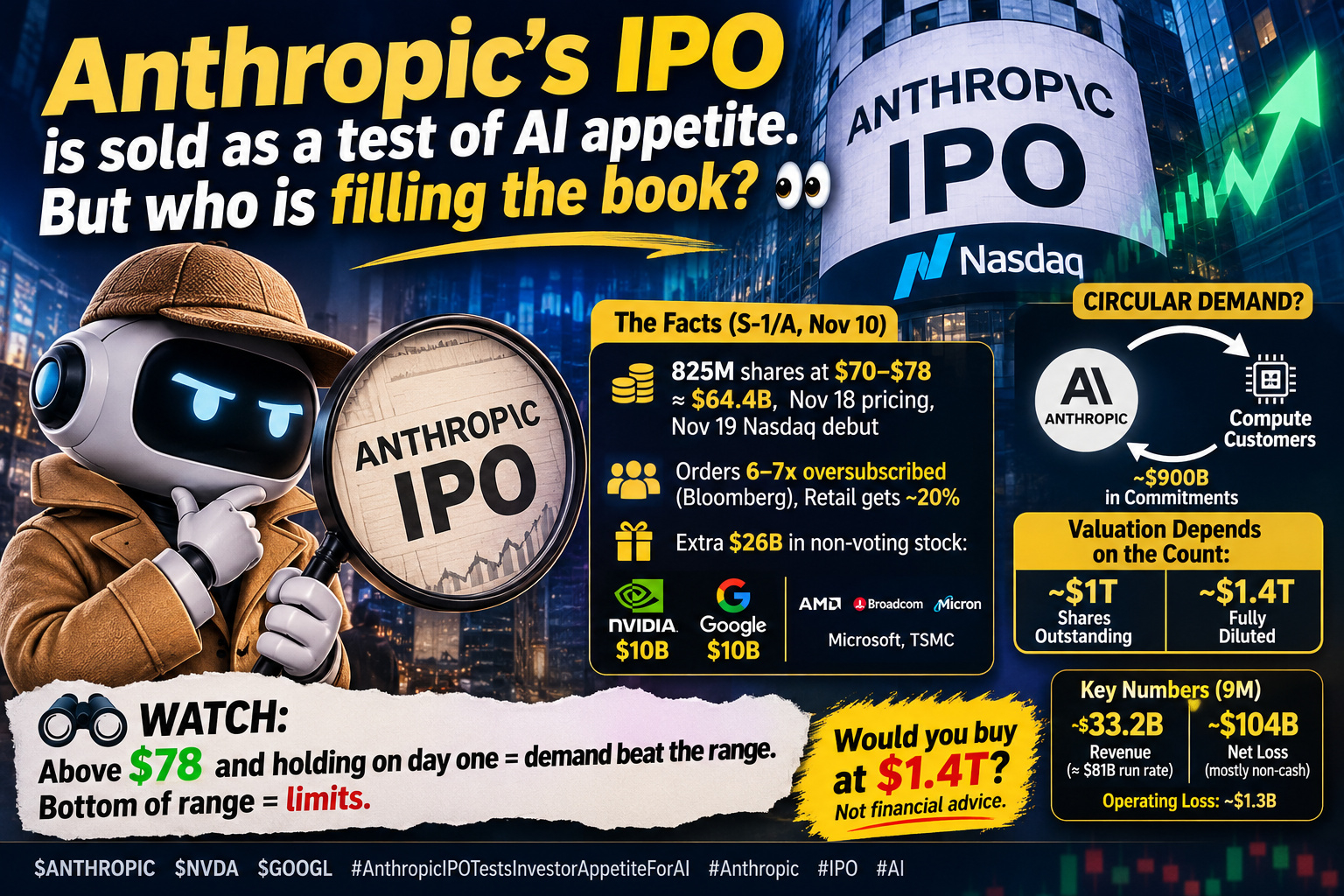
Anthropic's IPO is sold as a test of AI appetite. But who is filling the book? 👀
📌 The facts (S-1/A, Nov 10)
• 825M shares at $70–$78, up to ~$64.4B. Pricing Nov 18, Nasdaq debut Nov 19.
• Orders reportedly 6–7x oversubscribed (Bloomberg). Retail gets ~20%.
• Extra $26B in non-voting stock: Nvidia and Google $10B each, the rest from AMD, Broadcom, Micron, Microsoft, TSMC.
⚖️ Cross-check
Those buyers also sell Anthropic compute, and it has ~$900B in commitments. Demand is real, but part of it is circular.
Valuation depends on the count: ~$1T on shares outstanding vs ~$1.4T fully diluted.
9M revenue: $33.2B (company-defined run rate ~$81B). Net loss: $104B, mostly non-cash. Operating loss: ~$1.3B.
🎯 Watch: above $78 and holding on day one = demand beat the range. Bottom of range = limits.
Would you buy at $1.4T? Not financial advice.
$ANTHROPIC
{future}(ANTHROPICUSDT)
$NVDA
{future}(NVDAUSDT)
$GOOGL
{future}(GOOGLUSDT)
#Anthropic #IPO #Aİ
#anthropicipotestsinvestorappetiteforai
Anthropic's IPO is sold as a test of AI appetite. But who is filling the book? 👀
📌 The facts (S-1/A, Nov 10)
• 825M shares at $70–$78, up to ~$64.4B. Pricing Nov 18, Nasdaq debut Nov 19.
• Orders reportedly 6–7x oversubscribed (Bloomberg). Retail gets ~20%.
• Extra $26B in non-voting stock: Nvidia and Google $10B each, the rest from AMD, Broadcom, Micron, Microsoft, TSMC.
⚖️ Cross-check
Those buyers also sell Anthropic compute, and it has ~$900B in commitments. Demand is real, but part of it is circular.
Valuation depends on the count: ~$1T on shares outstanding vs ~$1.4T fully diluted.
9M revenue: $33.2B (company-defined run rate ~$81B). Net loss: $104B, mostly non-cash. Operating loss: ~$1.3B.
🎯 Watch: above $78 and holding on day one = demand beat the range. Bottom of range = limits.
Would you buy at $1.4T? Not financial advice.
$ANTHROPIC
$NVDA
$GOOGL
#Anthropic #IPO #Aİ
1.4k

·
--
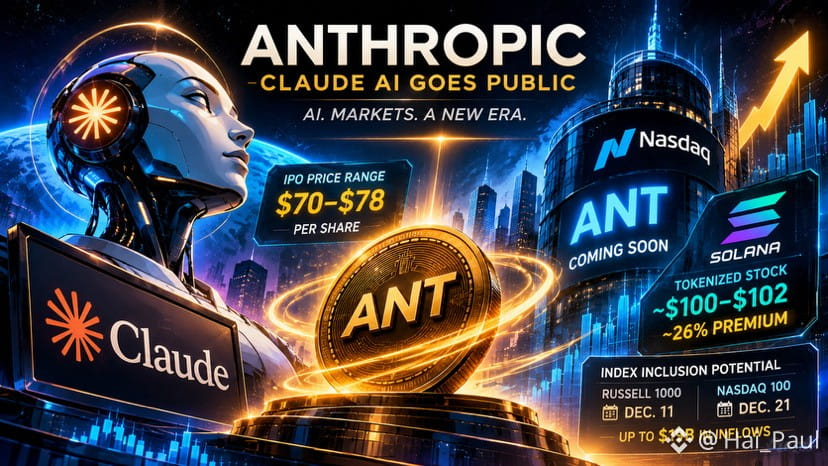
🤖 ANTHROPIC IPO: AI MEETS TOKENIZED STOCKS ON SOLANA
Anthropic, the company behind Claude AI, is preparing for its Nasdaq debut under the ticker ANT, with trading expected to begin on November 19, 2026. Its proposed IPO price range is $70–$78 per share, attracting significant attention from traditional investors and the crypto community.
🔥 TOKENIZED EXPOSURE TRADES AT A PREMIUM
A tokenized Anthropic share proxy on Solana has reportedly traded around $100–$102, roughly 26–30% above the IPO price ceiling. However, this is not official ANT stock. Tokenized proxies carry additional risks, including pricing gaps, liquidity constraints and differences in shareholder rights.
📈 INDEX INCLUSION COULD DRIVE BILLIONS
If Anthropic meets the eligibility requirements, FTSE Russell indicates potential inclusion in the Russell 1000 after December 11, while Nasdaq 100 inclusion could follow before December 21.
Reuters reports that index-related demand across major benchmarks could generate approximately $19 billion in passive investment flows, potentially creating significant demand for ANT shares.
🌐 WHY CRYPTO SHOULD PAY ATTENTION
This story highlights the growing intersection between AI companies, traditional equity markets and tokenization. Solana-based assets are creating new ways to access market exposure, although they are not substitutes for owning the underlying shares.
Will Anthropic become a major bridge between the AI boom and tokenized financial markets?
For informational purposes only. Not financial advice. Do your own research.
#Anthropic #ClaudeAI #Solana #TokenizedStocks #CryptoMarket
1
162

Binance is adjusting its Anthropic pre-IPO perp today, and the details matter if you trade it.
From 17:30 JST, the ANTHROPICUSDT contract is suspended for a resize, and it comes back as ANTUSDT around 20:00 JST, after a short cancel-only phase.
The share count behind the contract jumps from 1 billion to about 13.1 billion, based on Anthropic's latest filing. The scale factor is 13.116.
What that means in practice:
- Strategy bots on the contract are terminated at 17:15 JST, positions auto-closed and NOT restored.
- Open orders are cancelled, positions closed out and re-established.
- Trading, funding and liquidations pause during the adjustment.
$BNB $591.04, -0.8% on the day, sitting just under $600 while its own exchange reshapes the contract underneath it.
Anthropic is expected to list on Thursday. Are you watching the perp, or waiting for the real shares?
Not financial advice.
#Binance #Anthropic


> OPENAI CFO: ANTHROPIC IPO 'GOOD FOR US,' UNCONCERNED WITH 'BEING SECOND'
> OPENAI CFO: RETAIL INVESTORS READY FOR DIRECT ACCESS TO FRONTIER AI MODELS
$OPENAI #OPENAI $ANTHROPIC #ANTHROPIC
> OPENAI CFO: ANTHROPIC IPO 'GOOD FOR US,' UNCONCERNED WITH 'BEING SECOND'
> OPENAI CFO: RETAIL INVESTORS READY FOR DIRECT ACCESS TO FRONTIER AI MODELS
$OPENAI #OPENAI $ANTHROPIC #ANTHROPIC
> OPENAI CFO: RETAIL INVESTORS READY FOR DIRECT ACCESS TO FRONTIER AI MODELS
$OPENAI #OPENAI $ANTHROPIC #ANTHROPIC
5

·
--
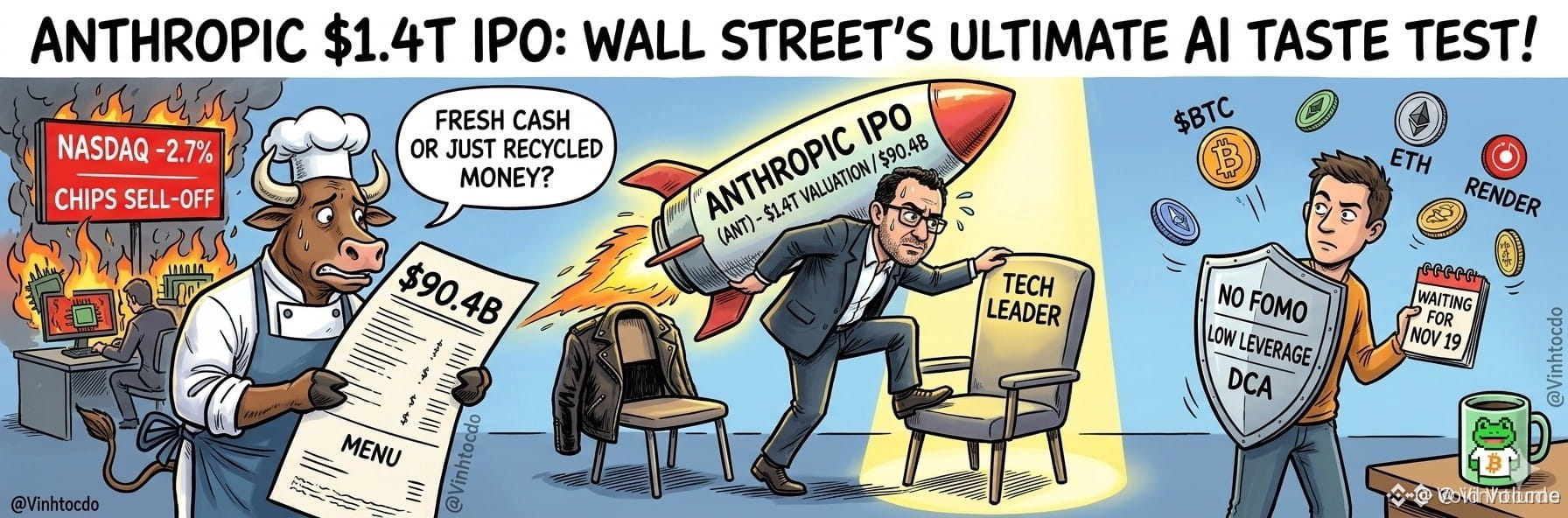
🚨 $ANTHROPIC NASDAQ DEBUT SERVES AS THE ULTIMATE LIQUIDITY STRESS TEST FOR AI CAPITAL! 💥
📊 Institutional allocation faces a structural reality check as a major public debut lands right after a sharp 2.7 percent contraction across tech indexes. Smart money is watching order flow closely to see if fresh capital absorbs the supply or if this liquidity pool gets drained. ⚡
💡 Chasing headline momentum here ignores basic risk parameters and leaves portfolios exposed to aggressive shakeouts. Lower leverage, let the pricing settle, and DCA methodically into high-conviction zones rather than falling into retail traps. 🌊
💬 Are you treating this massive public debut as an accumulation window or stepping aside until market breadth stabilizes? 👇
⚠️ Not financial advice. Always manage your risk. 🛡️
🏷️ #ANTHROPIC #NVDA #EVAA #SmartMoney #MarketStructure
🔥 💎
5
> GOOGLE DEEPMIND STRATEGY CHIEF JASJEET SEKHON DEPARTS FOR ANTHROPIC - $GOOGL
$ANTHROPIC #ANTHROPIC #GOOGL
> GOOGLE DEEPMIND STRATEGY CHIEF JASJEET SEKHON DEPARTS FOR ANTHROPIC - $GOOGL
$ANTHROPIC #ANTHROPIC #GOOGL
$ANTHROPIC #ANTHROPIC #GOOGL
12

·
--
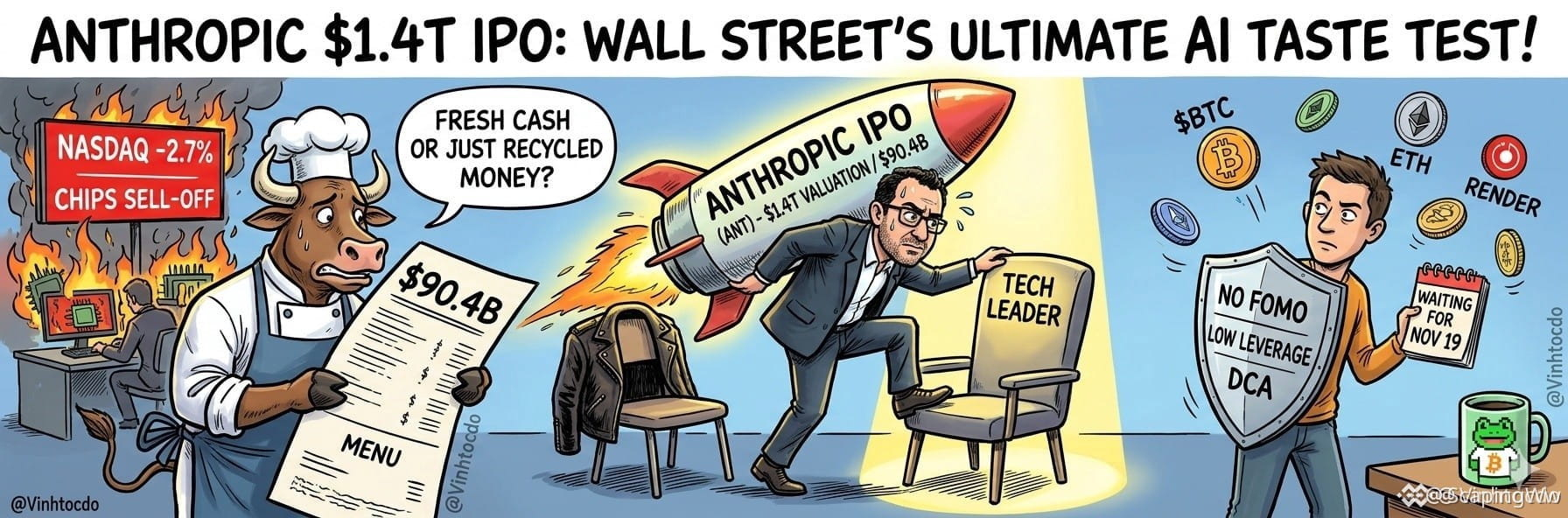
🚨 $ANTHROPIC 1.4 TRILLION DOLLAR IPO IS THE ULTIMATE LIQUIDITY TEST FOR AI! 💥
Wall Street is stepping into the ring with a massive 90 billion dollar raise just as tech sectors bleed red ink across the board. 📊 This colossal listing acts as a brutal pressure test to see if fresh institutional capital is still backing the artificial intelligence narrative or rotating out.
Smart money avoids chasing headline FOMO when volatility spikes this hard. ⚡ Lower your leverage, let the order books settle post-launch, and scale in through calculated accumulation rather than blindly chasing the wick.
🤔 Are you positioning for a breakout bounce or waiting for the macro dust to settle before deploying capital? 👇
⚠️ Not financial advice. Always manage your risk. 🛡️
🏷️ #ANTHROPIC #IPO #AI #CryptoTrading #MarketShift
🔥 💎
9
> ALTIMETER CAPITAL CEO GERSTNER: ANTHROPIC IPO IS 10 TO 20 TIMES OVERSUBSCRIBED
$ANTHROPIC #ANTHROPIC
> ALTIMETER CAPITAL CEO GERSTNER: ANTHROPIC IPO IS 10 TO 20 TIMES OVERSUBSCRIBED
$ANTHROPIC #ANTHROPIC
$ANTHROPIC #ANTHROPIC
9

·
--
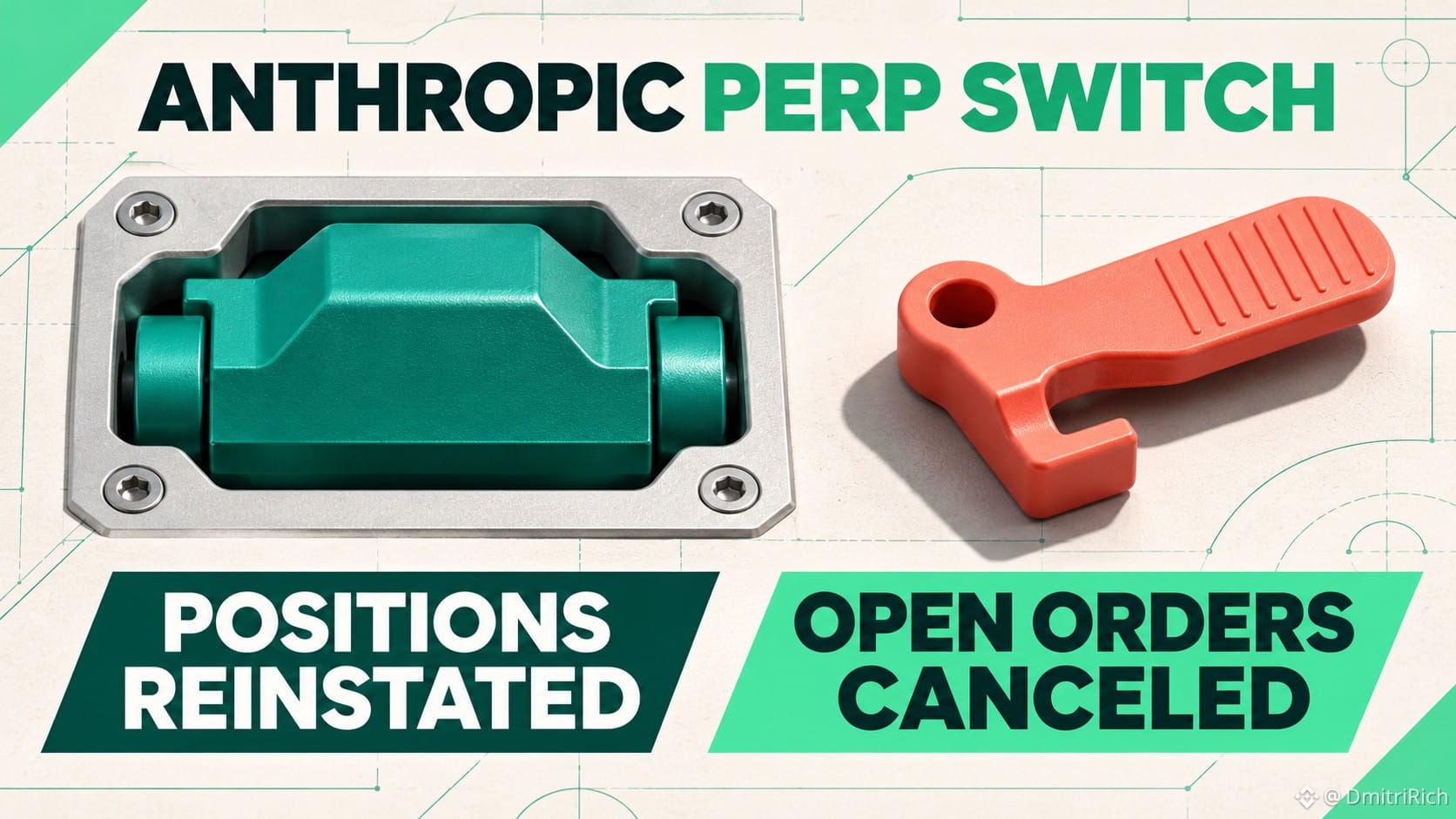
Your #Anthropic perp position can come back without its stop. On Nov 17 at 08:30 UTC, #Binance plans to halt ANTHROPICUSDT, resize the contract and rename it ANTUSDT.
Binance says it will close and reinstate regular positions during the adjustment, but cancel open orders, including take-profits and stop-losses. Strategy bot positions are the exception: they’ll be closed and won’t come back.
When normal order entry resumes, check the new symbol, position size and margin. Then verify which protective orders actually exist before assuming your old risk setup is still in place.
154

Verified
🚨 THE ANTHROPIC IPO TRAP: WHEN THE SHOVEL SELLERS BUY THEIR OWN PICKS!
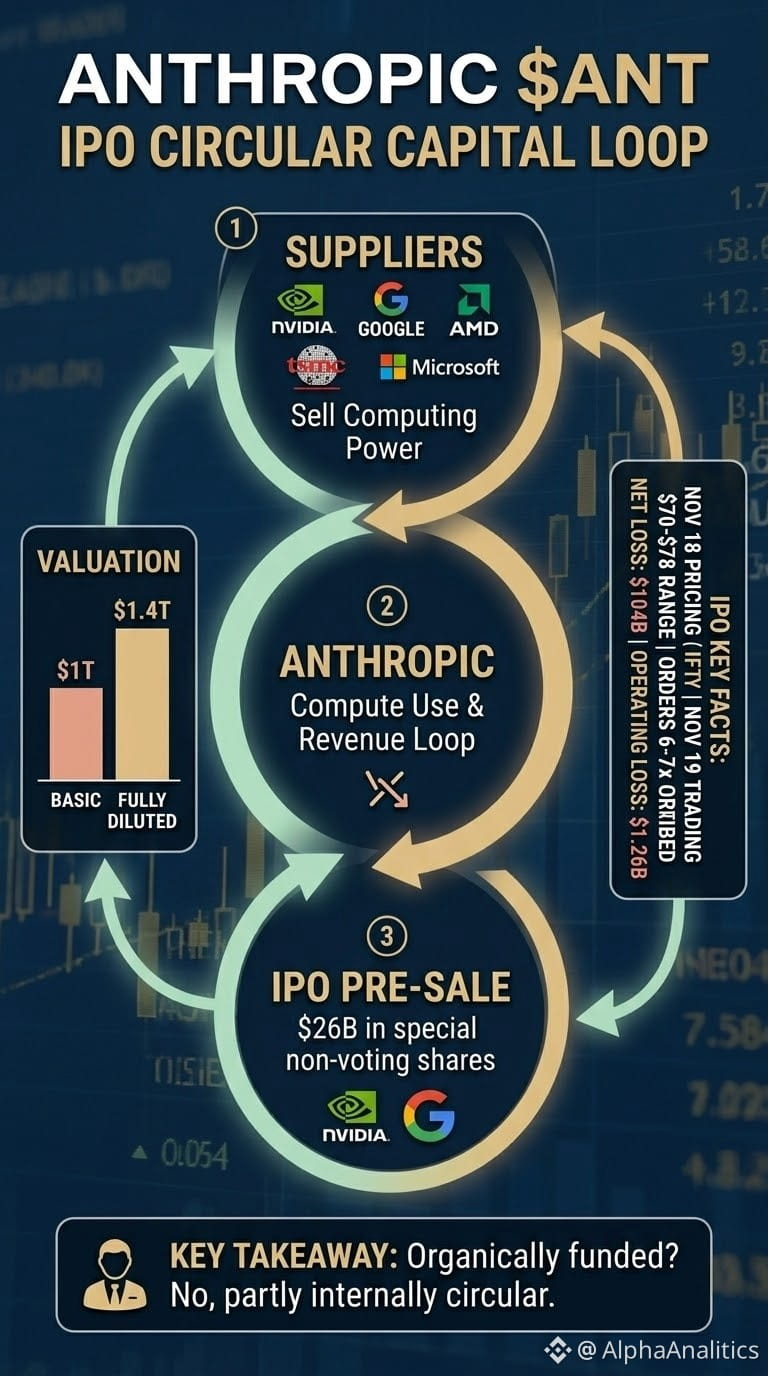
The upcoming Nasdaq debut of Anthropic under $ANTHROPIC (pricing November 18, trading November 19) is being hailed as the ultimate test of investor appetite for AI. But if you look past the headline hype of a $1T to $1.4T valuation and heavy oversubscription, a fascinating circular loop emerges.
Let's break down what the filing actually reveals:
🔄 The Circular Capital Loop: Out of the massive capital structure, $26 billion is pre-sold directly to Anthropic’s hardware and cloud suppliers—with Nvidia and Google taking about $10 billion each, alongside Microsoft, AMD, Broadcom, Micron, and TSMC. They sell compute to Anthropic; Anthropic uses the proceeds to buy more compute.
📊 The Financial Reality: While 9-month revenue hit an impressive $33.2 billion, the net loss sits at $104 billion (though largely non-cash accounting charges, with an operating loss of $1.26 billion).
⚖️ Valuation Split: Basic shares price in around a $1T valuation ($70–$78 range), but fully diluted counts push it toward $1.4 trillion.
The Bottom Line: A packed order book proves massive demand for the IPO, but a supplier-funded ecosystem raises questions about organic market validation versus internal liquidity recycling.
Are you bidding on the $ANT debut, or staying on the sidelines? Let's discuss below! 👇
#Anthropic #IPO #ArtificialIntelligence #BinanceSquare
708
·
--
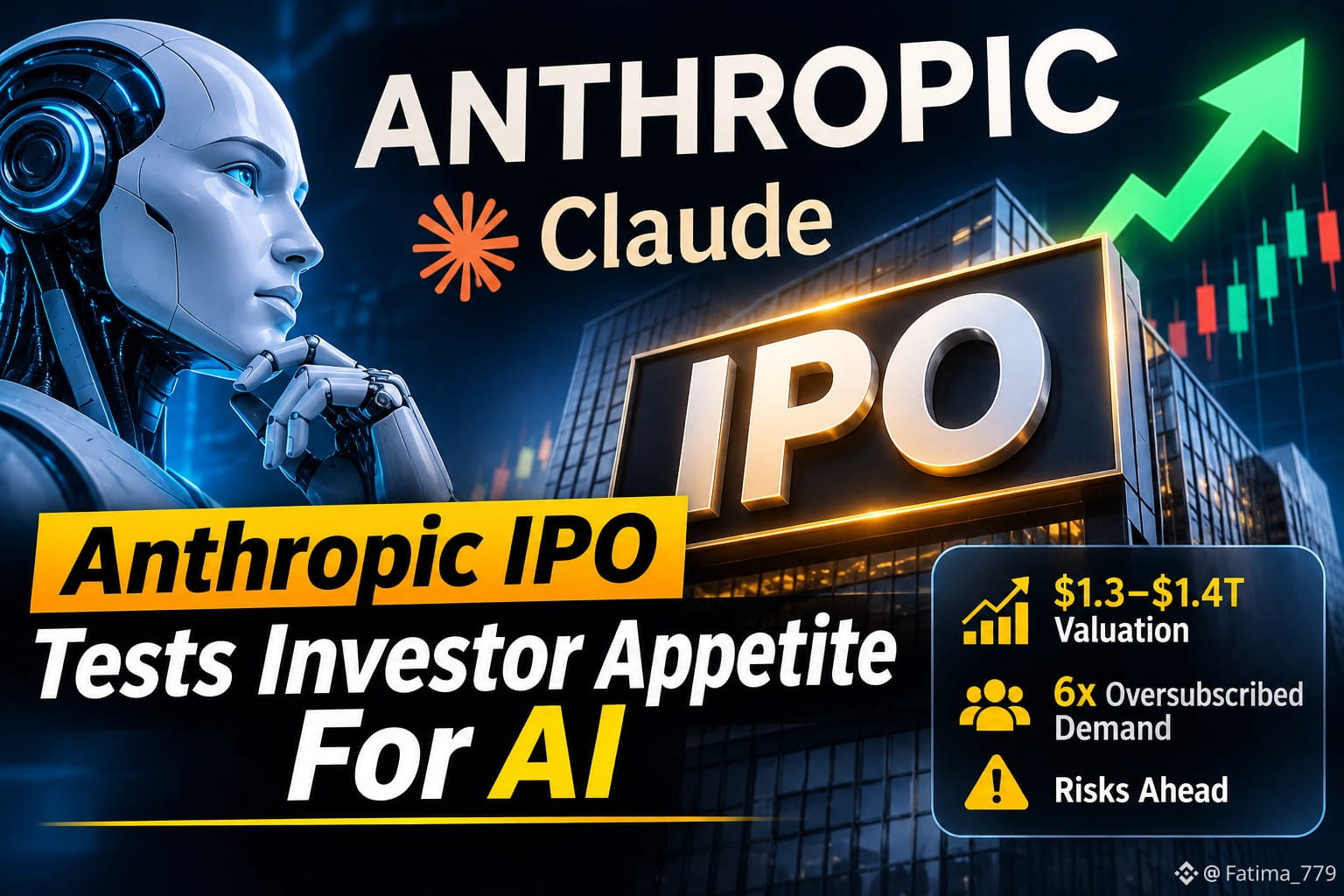
Anthropic IPO: A Major Test of Investor Confidence in AI!
Anthropic's planned blockbuster IPO is putting the artificial intelligence sector under the spotlight, as investors assess whether massive AI valuations can be justified by real business growth.
The company behind Claude AI is targeting a valuation of approximately $1.3–$1.4 trillion, potentially making its public debut one of the largest in market history.
Strong demand: Investor interest in the proposed offering has been substantial, with reports indicating strong early subscription demand.
Revenue growth: Anthropic's business has expanded rapidly, driven by growing enterprise adoption of its AI models.
Rising costs: Massive spending on computing infrastructure, chips and AI development remains a major concern.
Market implications: The IPO could influence how investors value other AI companies and technology stocks.
The bigger question: Will investors continue paying premium valuations for AI growth, or will profitability and infrastructure costs become the deciding factors?
#Anthropic #AI #CryptoNews #AnthropicIPOTestsInvestorAppetiteForAI
40

·
--
#AnthropicIPOTestsInvestorAppetiteForAI 🤖
Anthropic’s upcoming IPO could become one of the biggest tests of investor confidence in the AI industry.
The company behind Claude is targeting a valuation of around $1.3–$1.4 trillion, with strong early demand from institutional investors. Reports indicate that its IPO order book was around six times oversubscribed during the roadshow.
But strong demand doesn't mean there are no risks.
Investors still need to consider rising AI infrastructure costs, competition from Google and OpenAI, and whether Anthropic can maintain its competitive advantage over the long term.
The bigger question is whether AI companies can justify these massive valuations through sustainable revenue and profits.
I think this IPO could influence how investors value the entire AI sector.
What do you think? Is the AI market entering another major growth phase, or are valuations getting ahead of reality?
#Anthropic #AI #ArtificialIntelligence #TechStocks
$HYUNDAI
{future}(HYUNDAIUSDT)
$MSFTB
{spot}(MSFTBUSDT)
$EVAA
{future}(EVAAUSDT)
#AnthropicIPOTestsInvestorAppetiteForAI 🤖
Anthropic’s upcoming IPO could become one of the biggest tests of investor confidence in the AI industry.
The company behind Claude is targeting a valuation of around $1.3–$1.4 trillion, with strong early demand from institutional investors. Reports indicate that its IPO order book was around six times oversubscribed during the roadshow.
But strong demand doesn't mean there are no risks.
Investors still need to consider rising AI infrastructure costs, competition from Google and OpenAI, and whether Anthropic can maintain its competitive advantage over the long term.
The bigger question is whether AI companies can justify these massive valuations through sustainable revenue and profits.
I think this IPO could influence how investors value the entire AI sector.
What do you think? Is the AI market entering another major growth phase, or are valuations getting ahead of reality?
#Anthropic #AI #ArtificialIntelligence #TechStocks
$HYUNDAI
$MSFTB
$EVAA
2
39

🚨 ANTHROPIC IPO: THE NEXT BIG AI MARKET MOMENT? 👀
The AI race is getting bigger, and investors are watching closely!
If Anthropic goes public, could it become one of the biggest IPO stories in the AI industry? 🚀
🔥 Here's what makes it interesting:
🔹 Growing competition in AI
🔹 Rising demand for AI technology
🔹 Investor appetite for AI companies
🔹 Potential impact on the wider tech market
🔹 More attention on AI-related crypto projects
💡 My question is simple:
Would you invest in an Anthropic IPO, or would you rather stick with established AI players?
👇 Choose your side:
🟢 ANTHROPIC — Future AI Giant
🔴 ESTABLISHED TECH — Safer Bet?
Let's discuss!
$TAO $FET $RENDER
{spot}(TAOUSDT)
{spot}(FETUSDT)
{spot}(RENDERUSDT)
#Anthropic #Aİ #artificialintelligence #BinanceSquare
🚨 ANTHROPIC IPO: THE NEXT BIG AI MARKET MOMENT? 👀
The AI race is getting bigger, and investors are watching closely!
If Anthropic goes public, could it become one of the biggest IPO stories in the AI industry? 🚀
🔥 Here's what makes it interesting:
🔹 Growing competition in AI
🔹 Rising demand for AI technology
🔹 Investor appetite for AI companies
🔹 Potential impact on the wider tech market
🔹 More attention on AI-related crypto projects
💡 My question is simple:
Would you invest in an Anthropic IPO, or would you rather stick with established AI players?
👇 Choose your side:
🟢 ANTHROPIC — Future AI Giant
🔴 ESTABLISHED TECH — Safer Bet?
Let's discuss!
$TAO $FET $RENDER
#Anthropic #Aİ #artificialintelligence #BinanceSquare

334

·
--
Bullish
#anthropicipotestsinvestorappetiteforai
🚨 ANTHROPIC IPO COULD REVEAL WHETHER THE AI BOOM IS LOSING STEAM!
Wall Street is facing a major test as Anthropic prepares for one of the biggest technology IPOs in history.
The company behind Claude is targeting a valuation of approximately $1.3–$1.4 trillion, putting investor confidence in artificial intelligence under the spotlight.
🔥 What Happened?
Investor demand reportedly reached 6 times the available shares during the IPO roadshow.
Anthropic is seeking to raise approximately $64 billion.
Investors are questioning whether its AI leadership can survive growing competition from Google and other major players.
Massive computing costs and uncertain long-term profitability remain major concerns.
📊 Why It Matters
Anthropic's IPO could become a benchmark for the entire AI industry.
A successful debut could strengthen confidence in AI companies, semiconductor stocks, and infrastructure investments.
However, weak demand or a disappointing market debut could trigger fresh concerns about excessive AI valuations and whether the billions invested in this sector can generate sustainable returns.
The bigger question is whether investors are still willing to pay premium prices for the future of AI.
#Anthropic #Aİ #CryptoMarket
471

·
--
Bullish
Verified
🚨 ANTHROPIC'S IPO MAY BE THE BIGGEST AI MARKET TEST OF THE DECADE
Most investors are looking at Anthropic's IPO as a simple question:
"Does Wall Street still want AI?"
But the real story may be hiding in the order book.
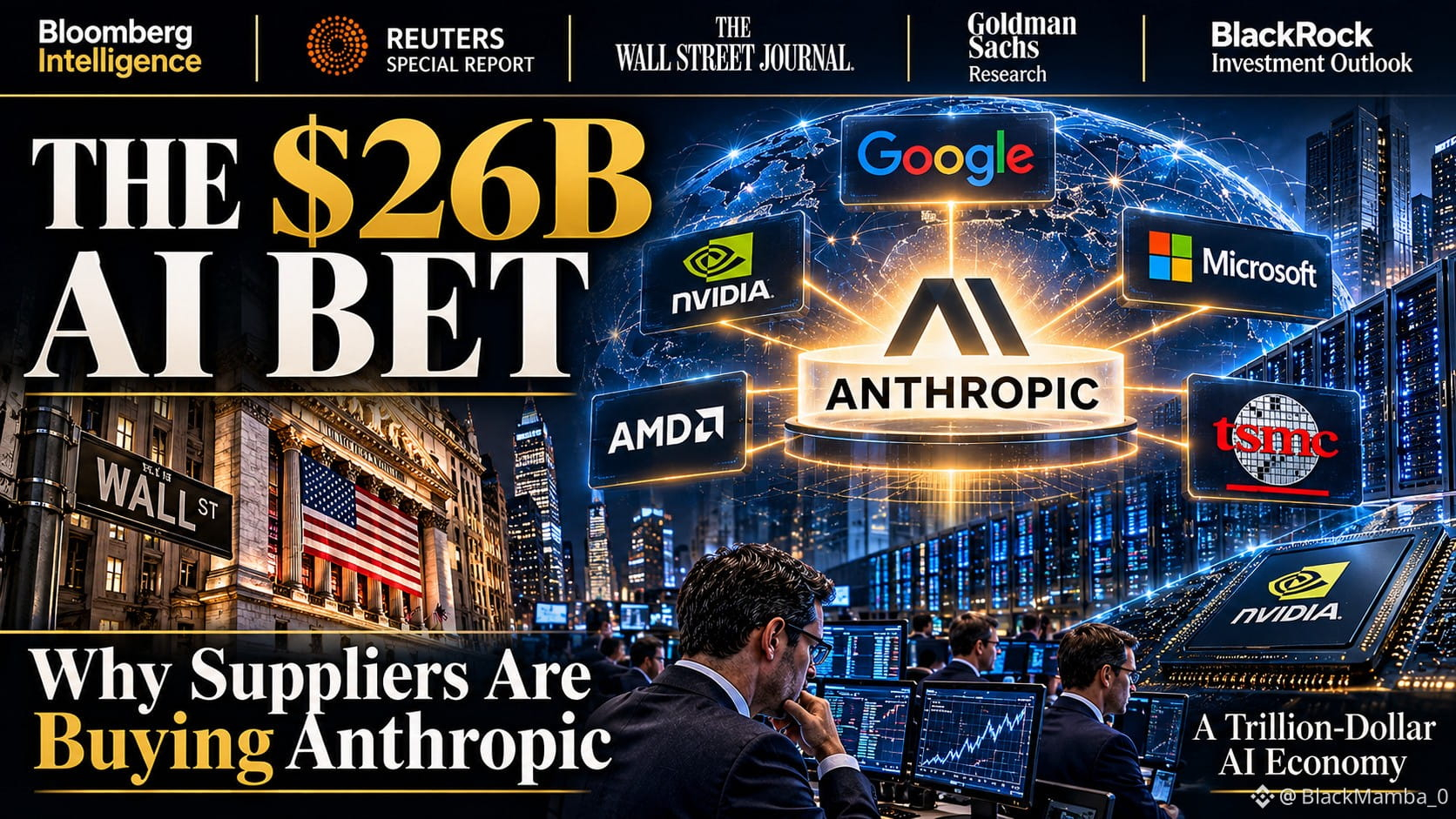
According to reports, roughly $26B of the offering is expected to be purchased by companies that already supply Anthropic's AI infrastructure.
Think about that for a second.
The companies selling the compute are also buying the shares.
Google. NVIDIA. AMD. Broadcom. Microsoft. Micron. TSMC.
This creates a unique ecosystem where infrastructure providers are not merely supporting the AI boom, they're becoming direct stakeholders in it.
🔍 Why this matters
The AI trade is evolving beyond software.
We're now witnessing an entire economic network forming around AI, where chips, cloud infrastructure, data centers, and model developers are becoming increasingly interconnected.
The IPO itself may be less important than what it reveals:
Institutional players are willing to commit capital across the entire AI value chain.
📊 Key Numbers
• IPO Range: $70-$78 • Nasdaq Ticker: $ANT • Expected Pricing: Nov 18 • Expected Trading: Nov 19 • Revenue (9 Months): $33.2B • Prior Year Revenue: $2.5B
⚠️ What Investors Should Watch
✅ Does the stock price above range? ✅ Does demand remain strong after Day 1? ✅ Which valuation headline is being used? ✅ Can AI businesses eventually justify today's expectations?
A crowded order book proves demand for shares.
It does NOT prove the economics of AI have already been solved.
The market's next challenge is proving that AI enthusiasm can translate into long-term profitability.
Trade Here👇
{future}(ANTHROPICUSDT)
{future}(BTCUSDT)
{future}(GOOGLUSDT)
#Anthropic #ArtificialIntelligence #Google #NVIDIA
#anthropicipotestsinvestorappetiteforai
🚨 ANTHROPIC'S IPO MAY BE THE BIGGEST AI MARKET TEST OF THE DECADE
Most investors are looking at Anthropic's IPO as a simple question:
"Does Wall Street still want AI?"
But the real story may be hiding in the order book.
According to reports, roughly $26B of the offering is expected to be purchased by companies that already supply Anthropic's AI infrastructure.
Think about that for a second.
The companies selling the compute are also buying the shares.
Google. NVIDIA. AMD. Broadcom. Microsoft. Micron. TSMC.
This creates a unique ecosystem where infrastructure providers are not merely supporting the AI boom, they're becoming direct stakeholders in it.
🔍 Why this matters
The AI trade is evolving beyond software.
We're now witnessing an entire economic network forming around AI, where chips, cloud infrastructure, data centers, and model developers are becoming increasingly interconnected.
The IPO itself may be less important than what it reveals:
Institutional players are willing to commit capital across the entire AI value chain.
📊 Key Numbers
• IPO Range: $70-$78 • Nasdaq Ticker: $ANT • Expected Pricing: Nov 18 • Expected Trading: Nov 19 • Revenue (9 Months): $33.2B • Prior Year Revenue: $2.5B
⚠️ What Investors Should Watch
✅ Does the stock price above range? ✅ Does demand remain strong after Day 1? ✅ Which valuation headline is being used? ✅ Can AI businesses eventually justify today's expectations?
A crowded order book proves demand for shares.
It does NOT prove the economics of AI have already been solved.
The market's next challenge is proving that AI enthusiasm can translate into long-term profitability.
Trade Here👇
#Anthropic #ArtificialIntelligence #Google #NVIDIA
#anthropicipotestsinvestorappetiteforai
287
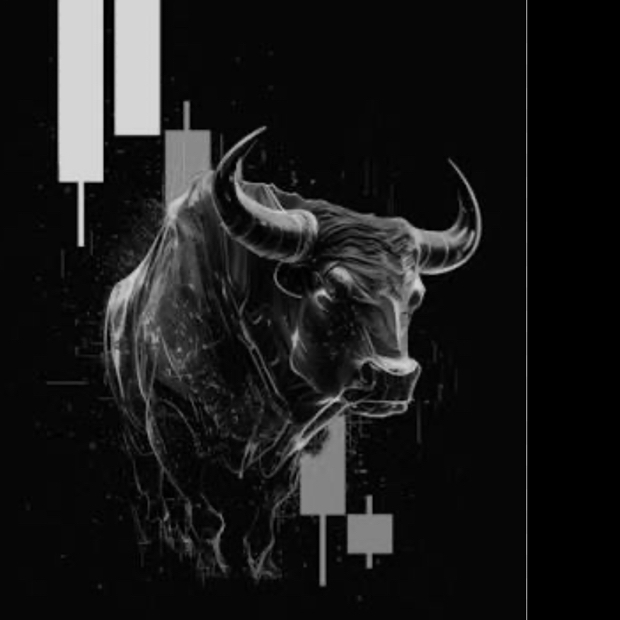
🚨 $ANTHROPIC PRE-IPO PERP CONTRACT RESCALING WILL WIPE UNPROTECTED POSITIONS ON NOVEMBER 17! ⚠️
Institutional restructuring on $ANTHROPIC derivatives requires immediate operational oversight as the contract factor adjusts by approximately 13.116 following the S-1/A-2 filing update. 📊 All automated bots terminate and open orders cancel completely between 08:30 and 11:00 UTC, leaving active exposure completely naked upon market resumption. ⚡
Unrealized gains and losses shift directly into your main margin ledger while risk parameters vanish into thin air. Prudent risk management demands manual verification of all structural stop-loss orders the second trading unlocks. 🔍 Are your current margin allocations prepared for this structural settlement shift? 👇
⚠️ Not financial advice. Always manage your risk. 🛡️
🏷️ #ANTHROPIC #RiskManagement #Futures #Crypto
🔥 💎
6

·
--
Bullish
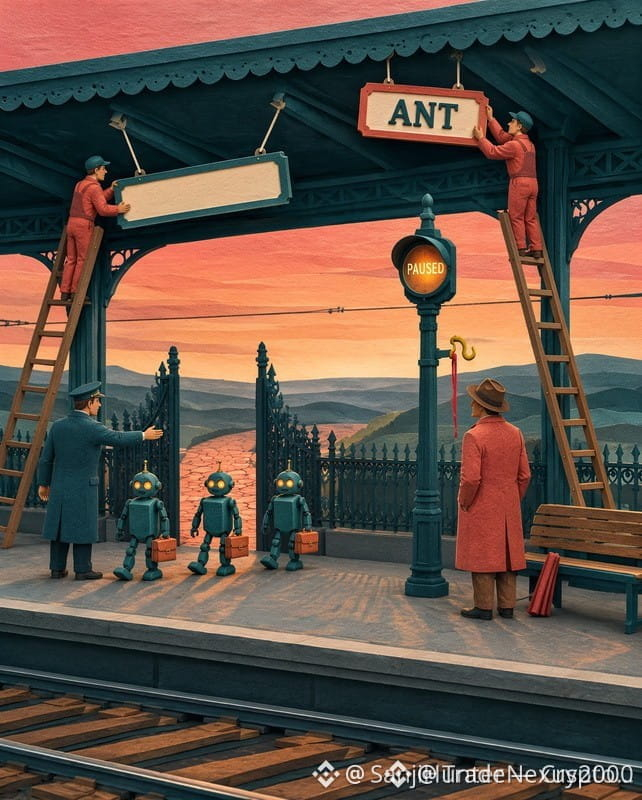
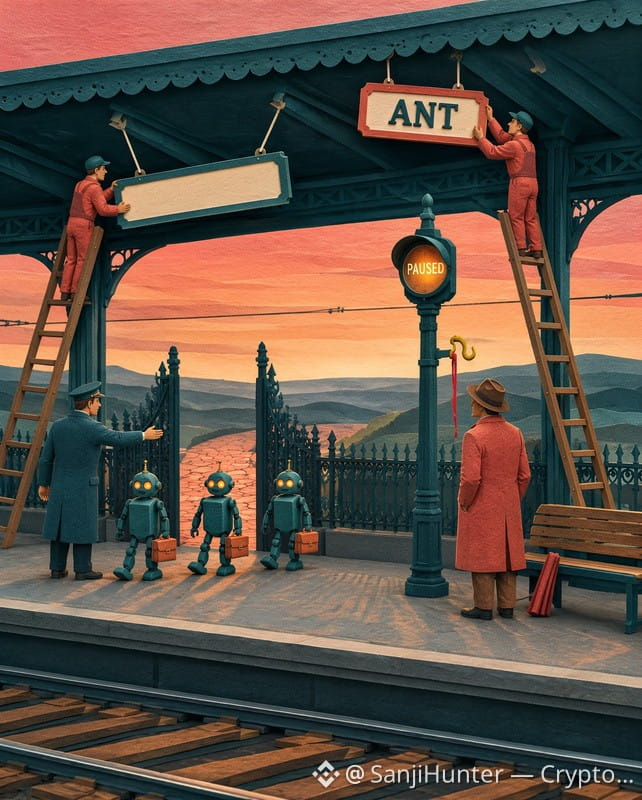
ANTHROPIC PERP BECOMES ANTUSDT TOMORROW, AND YOUR STOP-LOSS WON'T SURVIVE THE SWITCH
Binance Futures will rescale $ANTHROPIC USDT Pre-IPO Perp by a factor of about 13.116 and rename it ANTUSDT on November 17
The reason: Anthropic's S-1/A-2 points to roughly 13.12B shares, versus the 1B estimate the contract launched with
{future}(ANTHROPICUSDT)
⏰ The timeline matters more than the math
At 08:15 UTC every Grid, DCA and Snowball bot on this contract is terminated and its positions closed, and those bots will not be restored
From 08:30 to about 11:00 UTC, trading, funding, mark price and liquidations are suspended, and all open orders are cancelled, including reduce-only TP/SL
Unrealized PnL settles to your Cross Margin account, and isolated margin moves there too
⚠️ So when trading resumes, a position can be back without the stop you set
After a short Post-Only window, re-place your TP/SL in the new ANTUSDT units before anything else
If Anthropic updates its filing again, Binance says another adjustment is possible, so this may not be the last one
$ANTHROPIC #Anthropic #BİNANCEFUTURES #PreIPO
ANTHROPIC PERP BECOMES ANTUSDT TOMORROW, AND YOUR STOP-LOSS WON'T SURVIVE THE SWITCH
Binance Futures will rescale $ANTHROPIC USDT Pre-IPO Perp by a factor of about 13.116 and rename it ANTUSDT on November 17
The reason: Anthropic's S-1/A-2 points to roughly 13.12B shares, versus the 1B estimate the contract launched with
⏰ The timeline matters more than the math
At 08:15 UTC every Grid, DCA and Snowball bot on this contract is terminated and its positions closed, and those bots will not be restored
From 08:30 to about 11:00 UTC, trading, funding, mark price and liquidations are suspended, and all open orders are cancelled, including reduce-only TP/SL
Unrealized PnL settles to your Cross Margin account, and isolated margin moves there too
⚠️ So when trading resumes, a position can be back without the stop you set
After a short Post-Only window, re-place your TP/SL in the new ANTUSDT units before anything else
If Anthropic updates its filing again, Binance says another adjustment is possible, so this may not be the last one
$ANTHROPIC #Anthropic #BİNANCEFUTURES #PreIPO
175
Log in to explore more content
Join global crypto users on Binance Square
⚡️ Get latest and useful information about crypto.
💬 Trusted by the world’s largest crypto exchange.
👍 Discover real insights from verified creators.
Email / Phone number
Trending Topics
1
#A Packed Week of Earnings and Data Tests Markets
72,529 views
464 Discussing
2
#AnthropicIPOTestsInvestorAppetiteForAI
142,258 views
1,564 Discussing
3
#NvidiaBoardNotConsideringHuang’sReturnasCEO
5,425 views
127 Discussing
4
#WhatInvestmentSignalsDo13FFilingsReveal?
3,362 views
89 Discussing
5
#SevenUSBanksDisclose$29.4MInXRPETFHoldings
1,114 views
27 Discussing
6
#InvescoStablecoinReservesFundLaunchesOnEthereum
1,014 views
31 Discussing
7
#CypherpunkReports$306MQ3NetProfit
522 views
9 Discussing
8
#OPTIMJACKAttackInfectsAtLeast186Websites
2,853 views
69 Discussing
9
#StrategySells2.09MMSTRSharesFor$244.7M
1,529 views
16 Discussing
10
#StablecoinMarketShrinksAtFastestPaceSinceTerraLuna
4,191 views
50 Discussing