
#aichipslumpnasdaq
aichipslumpnasdaq
The Nasdaq fell 3.4% last week as AI chip stocks slumped: Sandisk -27.4%, Micron -22%, and the VanEck Semiconductor ETF -11.2%. Oil fell 12.8% and the 10-year yield hit a two-month low of 4.86%. Berkshire posted a record $9.6B Q3 buyback. Nvidia's board is probing reports that CEO Jensen Huang was targeted by a suspected spy operation. Is this a dip to buy or the start of a deeper slide? 👇
Hot
Latest


·
--
Verified
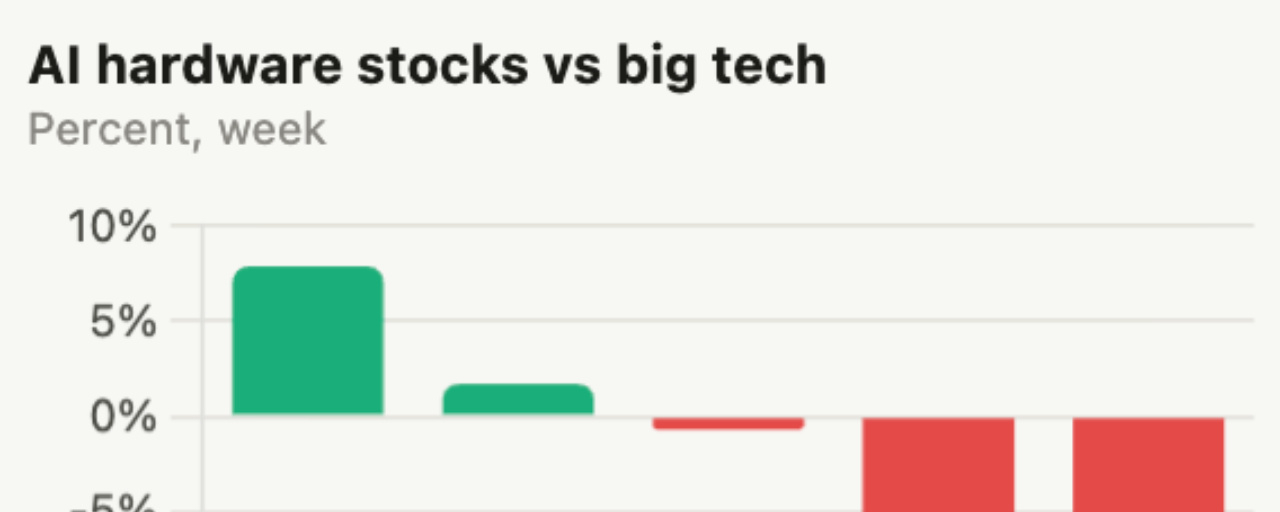
Article
TradFi News | Nasdaq Drops 3.4% in Week as AI Chip Stocks Slump; Berkshire Posts Record $9.6 Billion BuybackUS stock futures open Sunday evening after a damaging week for AI stocks. The Nasdaq Composite fell 3.4% in the week to November 6, the S&P 500 lost 2.7%, the Dow slipped 0.9% and the small-cap Russell 2000 shed 2.05%, according to Investor’s Business Daily.
Nasdaq 100 futures were indicated modestly lower after Nvidia’s board opened an investigation following reports that CEO Jensen Huang was targeted by a suspected Chinese espionage operation, according to IBD, CNBC and NBC News. Lawmakers from both parties have also raised questions about the reports, CNBC said.
AI Hardware Stocks Lead the Losses
After a post-election rally on Wednesday, when the Dow jumped 3%, AI infrastructure stocks fell sharply on Thursday and dragged down the wider market. Friday’s AI-led bounce faded into a mixed close.
Sandisk (SNDK) rose 3.55% to $835.06 on Friday but fell 27.4% on the week. It is down 64.5% from its late-June peak, according to MarketSurge.Micron (MU) gained 5.1% to $690 on Friday but dropped 22% on the week and is 45% below its high.
The VanEck Semiconductor ETF (SMH) fell 11.2% on the week and the iShares Expanded Tech-Software ETF (IGV) lost 5.2%.
Apple, Microsoft and Amazon Hold Up
Big tech held up better than the rest of the sector:
Amazon (AMZN) jumped 7.9% on the week to $259.30.Microsoft (MSFT) rose 1.7% to $530.62.Apple (AAPL) slipped 0.7% to $342.37.
Microsoft and Amazon rallied Wednesday as investors bet that existing data center operators could gain if rivals’ projects are delayed, according to IBD.
Oil Falls 12.8% as Yields Hit Two-Month Low
US crude futures fell 12.8% on the week to $90.83 a barrel, pressured by hopes for US–Iran diplomacy, according to IBD. President Donald Trump told CNN that renewed US strikes on Iran are “highly unlikely” if talks progress. The Energy Select SPDR ETF (XLE) fell 12%.
The 10-year Treasury yield fell 7 basis points to 4.86%, a two-month low.
Some sectors gained. The US Global Jets ETF (JETS) rose 6.6%, homebuilders gained 1.3% and financials 1.15%.
Berkshire Posts Record Buyback
Berkshire Hathaway bought back $9.6 billion of its own shares in the third quarter, up from $4.5 billion in Q2. That beat its previous record of $9.3 billion, set in Q3 2020.
Operating earnings: fell 6% to $12.7 billion, roughly in line with estimates, as weaker insurance underwriting and investment income weighed. Railroad, utility and other operations improved.Revenue: rose 11% to $105.6 billion, above estimates of $100.96 billion.Cash: rose to $377.4 billion from $365.5 billion in Q2, but remains below Q1’s $397.4 billion.Stock portfolio: Berkshire sold a net $400 million or so of stocks in Q3, after net purchases of about $20 billion in Q2.
Berkshire stock has risen for five straight weeks and hit a record high on Thursday. Under new CEO Greg Abel, the company has largely kept Warren Buffett’s conglomerate-and-investment approach.
Indexes Below Key Moving Averages
All major indexes are below their 50-day moving averages, and the Nasdaq and Russell 2000 are also below their 200-day lines, according to IBD. IBD’s Ed Carson said one weak bounce is not enough to signal a market bottom, and that investors should be defensive and wait for clear evidence of a turnaround.
TradFi News | Nasdaq Drops 3.4% in Week as AI Chip Stocks Slump; Berkshire Posts Record $9.6 Billion Buyback
US stock futures open Sunday evening after a damaging week for AI stocks. The Nasdaq Composite fell 3.4% in the week to November 6, the S&P 500 lost 2.7%, the Dow slipped 0.9% and the small-cap Russell 2000 shed 2.05%, according to Investor’s Business Daily.
Nasdaq 100 futures were indicated modestly lower after Nvidia’s board opened an investigation following reports that CEO Jensen Huang was targeted by a suspected Chinese espionage operation, according to IBD, CNBC and NBC News. Lawmakers from both parties have also raised questions about the reports, CNBC said.
AI Hardware Stocks Lead the Losses
After a post-election rally on Wednesday, when the Dow jumped 3%, AI infrastructure stocks fell sharply on Thursday and dragged down the wider market. Friday’s AI-led bounce faded into a mixed close.
Sandisk (SNDK) rose 3.55% to $835.06 on Friday but fell 27.4% on the week. It is down 64.5% from its late-June peak, according to MarketSurge.Micron (MU) gained 5.1% to $690 on Friday but dropped 22% on the week and is 45% below its high.
The VanEck Semiconductor ETF (SMH) fell 11.2% on the week and the iShares Expanded Tech-Software ETF (IGV) lost 5.2%.
Apple, Microsoft and Amazon Hold Up
Big tech held up better than the rest of the sector:
Amazon (AMZN) jumped 7.9% on the week to $259.30.Microsoft (MSFT) rose 1.7% to $530.62.Apple (AAPL) slipped 0.7% to $342.37.
Microsoft and Amazon rallied Wednesday as investors bet that existing data center operators could gain if rivals’ projects are delayed, according to IBD.
Oil Falls 12.8% as Yields Hit Two-Month Low
US crude futures fell 12.8% on the week to $90.83 a barrel, pressured by hopes for US–Iran diplomacy, according to IBD. President Donald Trump told CNN that renewed US strikes on Iran are “highly unlikely” if talks progress. The Energy Select SPDR ETF (XLE) fell 12%.
The 10-year Treasury yield fell 7 basis points to 4.86%, a two-month low.
Some sectors gained. The US Global Jets ETF (JETS) rose 6.6%, homebuilders gained 1.3% and financials 1.15%.
Berkshire Posts Record Buyback
Berkshire Hathaway bought back $9.6 billion of its own shares in the third quarter, up from $4.5 billion in Q2. That beat its previous record of $9.3 billion, set in Q3 2020.
Operating earnings: fell 6% to $12.7 billion, roughly in line with estimates, as weaker insurance underwriting and investment income weighed. Railroad, utility and other operations improved.Revenue: rose 11% to $105.6 billion, above estimates of $100.96 billion.Cash: rose to $377.4 billion from $365.5 billion in Q2, but remains below Q1’s $397.4 billion.Stock portfolio: Berkshire sold a net $400 million or so of stocks in Q3, after net purchases of about $20 billion in Q2.
Berkshire stock has risen for five straight weeks and hit a record high on Thursday. Under new CEO Greg Abel, the company has largely kept Warren Buffett’s conglomerate-and-investment approach.
Indexes Below Key Moving Averages
All major indexes are below their 50-day moving averages, and the Nasdaq and Russell 2000 are also below their 200-day lines, according to IBD. IBD’s Ed Carson said one weak bounce is not enough to signal a market bottom, and that investors should be defensive and wait for clear evidence of a turnaround.
1
3
12
17.9k

Article
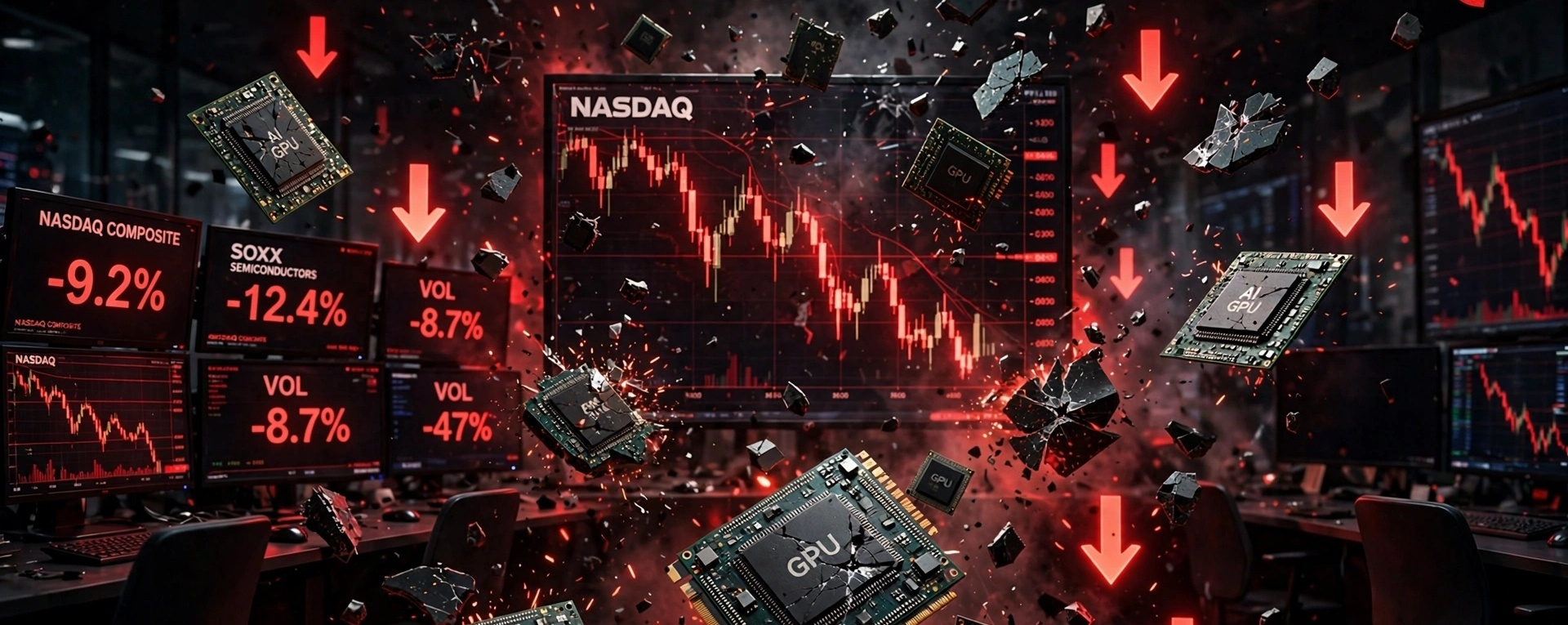
AIChipSlumpNasdaq#AIChipSlumpNasdaq $2.5 trillion lost in one day — Is the AI bubble bursting? If you went to bed early on November 5, you might have missed a significant decline in the Nasdaq, the largest since April 2025. The Nasdaq Composite fell 5.52% to 24,315 The Nasdaq-100 fell 6.36% The S&P 500 declined 4.36% The Dow dropped 3.44% The Nasdaq is now officially in correction territory, down over 10% from its record high on October 6. The primary cause of this decline was one sector: AI chips. Nvidia (NVDA): -9.26% — Lost over $400 billion in one day, closing at $181.60 AMD: -17.26% — Despite recording its best quarter ever, with $13.38 billion in revenue, a 44.7% year-over-year increase Micron: -17.46% SanDisk: -22.26% Broadcom: -10.43% Intel: -10.33% ARM: -13.08% Qualcomm: -9.49% The Philadelphia Semiconductor Index fell 12.3%, marking the worst day since the COVID crash in March 2020. All 30 chip stocks closed in negative territory. 1. **US Midterm Election Results** Democrats won the midterms. The market is now concerned about potential new regulations, moratoriums, and delays on new AI data centers in states like Texas, Georgia, and Ohio. UBS estimates that 30% of the expected 2028 US data center additions could face delays. Goldman Sachs suggests that up to 45% of planned capacity may be affected. 2. **Doubts About AI Spending** Large tech companies are investing hundreds of billions in AI infrastructure. Investors are now questioning when this investment will yield returns. While hyperscalers saw a rise on Wednesday with hopes for slower capital expenditures, chips faced a decline on Thursday due to concerns regarding weaker demand. The market is currently uncertain. 3. **Weak Forecasts** Qualcomm reported a 26% year-over-year decline in smartphone chip sales, which undermined confidence across the sector. When a major chip company provides a weak outlook, it often leads to broad selling in the industry. AMD's data center revenue surged 97% year-over-year to $8.55 billion. Demand remains active. Nvidia's earnings report is scheduled for November 17, which will serve as a key indicator. This was not a fundamental collapse; it was driven by a valuation reset, political concerns, and a reduction in crowded positions. The AI trade had become overly saturated, with investors heavily positioned in stocks like NVDA, AMD, and MU. When anxiety arose, many rushed to sell. 1. When the Nasdaq declines, Bitcoin typically follows. A risk-off approach often leads to sell-offs in crypto first. 2. However, during financial panic, savvy investors tend to accumulate assets. 3. Keep an eye on Nvidia's earnings on November 17. A positive report could lead to rebounds in both the Nasdaq and crypto markets, while a negative outcome could result in further declines. - Panic sell your BTC/ETH at a loss - Leverage long positions to try to catch the bottom - Invest all your money in every dip - Hold cash and wait for confirmation before making decisions - Dollar-cost average slowly with small amounts instead of going all-in - Monitor two key levels: Nasdaq support at 24,000 and Bitcoin support at $95,000 - Focus on macroeconomic trends rather than influencers This is not the conclusion of AI; it is the end of uncritical AI enthusiasm. Companies that have substantial revenue will endure, while those driven by hype may not survive. Typically, every bull market experiences 2-3 corrections of 10-15%. This is one of those instances. Weaker investors are exiting, while stronger ones are accumulating. Is this the burst of the AI bubble or a great buying opportunity for 2026? Comment: or Share this with anyone who invested in NVDA at its peak. For further insights on macroeconomics and crypto, follow for data-driven analysis without hype. This is not financial advice. Conduct your own research. This is for educational purposes only.
AIChipSlumpNasdaq
#AIChipSlumpNasdaq $2.5 trillion lost in one day — Is the AI bubble bursting? If you went to bed early on November 5, you might have missed a significant decline in the Nasdaq, the largest since April 2025. The Nasdaq Composite fell 5.52% to 24,315 The Nasdaq-100 fell 6.36% The S&P 500 declined 4.36% The Dow dropped 3.44% The Nasdaq is now officially in correction territory, down over 10% from its record high on October 6. The primary cause of this decline was one sector: AI chips. Nvidia (NVDA): -9.26% — Lost over $400 billion in one day, closing at $181.60 AMD: -17.26% — Despite recording its best quarter ever, with $13.38 billion in revenue, a 44.7% year-over-year increase Micron: -17.46% SanDisk: -22.26% Broadcom: -10.43% Intel: -10.33% ARM: -13.08% Qualcomm: -9.49% The Philadelphia Semiconductor Index fell 12.3%, marking the worst day since the COVID crash in March 2020. All 30 chip stocks closed in negative territory. 1. **US Midterm Election Results** Democrats won the midterms. The market is now concerned about potential new regulations, moratoriums, and delays on new AI data centers in states like Texas, Georgia, and Ohio. UBS estimates that 30% of the expected 2028 US data center additions could face delays. Goldman Sachs suggests that up to 45% of planned capacity may be affected. 2. **Doubts About AI Spending** Large tech companies are investing hundreds of billions in AI infrastructure. Investors are now questioning when this investment will yield returns. While hyperscalers saw a rise on Wednesday with hopes for slower capital expenditures, chips faced a decline on Thursday due to concerns regarding weaker demand. The market is currently uncertain. 3. **Weak Forecasts** Qualcomm reported a 26% year-over-year decline in smartphone chip sales, which undermined confidence across the sector. When a major chip company provides a weak outlook, it often leads to broad selling in the industry. AMD's data center revenue surged 97% year-over-year to $8.55 billion. Demand remains active. Nvidia's earnings report is scheduled for November 17, which will serve as a key indicator. This was not a fundamental collapse; it was driven by a valuation reset, political concerns, and a reduction in crowded positions. The AI trade had become overly saturated, with investors heavily positioned in stocks like NVDA, AMD, and MU. When anxiety arose, many rushed to sell. 1. When the Nasdaq declines, Bitcoin typically follows. A risk-off approach often leads to sell-offs in crypto first. 2. However, during financial panic, savvy investors tend to accumulate assets. 3. Keep an eye on Nvidia's earnings on November 17. A positive report could lead to rebounds in both the Nasdaq and crypto markets, while a negative outcome could result in further declines. - Panic sell your BTC/ETH at a loss - Leverage long positions to try to catch the bottom - Invest all your money in every dip - Hold cash and wait for confirmation before making decisions - Dollar-cost average slowly with small amounts instead of going all-in - Monitor two key levels: Nasdaq support at 24,000 and Bitcoin support at $95,000 - Focus on macroeconomic trends rather than influencers This is not the conclusion of AI; it is the end of uncritical AI enthusiasm. Companies that have substantial revenue will endure, while those driven by hype may not survive. Typically, every bull market experiences 2-3 corrections of 10-15%. This is one of those instances. Weaker investors are exiting, while stronger ones are accumulating. Is this the burst of the AI bubble or a great buying opportunity for 2026? Comment: or Share this with anyone who invested in NVDA at its peak. For further insights on macroeconomics and crypto, follow for data-driven analysis without hype. This is not financial advice. Conduct your own research. This is for educational purposes only.
288

·
--
Bullish
📉 AI Chip Slump Hits Nasdaq – What's Happening?
The Nasdaq and major technology stocks faced heavy selling pressure last week as AI chip companies suffered big losses.
Latest Update:
Nasdaq dropped 5.52% on November 5.
Nvidia fell around 9%.
AMD lost around 17%.
Semiconductor stocks suffered their biggest daily decline since 2020.
On Monday, Asian markets and US futures showed signs of recovery.
Why Is This Happening?
Investors are worried that new regulations and slower data-center construction could affect future demand for AI chips.
Stocks to Watch:
$NVDAB $AMD $AVGO $INTC $TSM
What's Next?
If investors regain confidence, AI stocks may recover. However, continued uncertainty could create more pressure on technology stocks.
Final Thought:
AI is still growing, but investors want to see real profits from AI investments.
#AIChipSlumpNasdaq #NVIDIA #NASDAQ #StockMarket #Technology
{stock_us}(AMD.US)
{spot}(NVDABUSDT)
{spot}(TSMBUSDT)
📉 AI Chip Slump Hits Nasdaq – What's Happening?
The Nasdaq and major technology stocks faced heavy selling pressure last week as AI chip companies suffered big losses.
Latest Update:
Nasdaq dropped 5.52% on November 5.
Nvidia fell around 9%.
AMD lost around 17%.
Semiconductor stocks suffered their biggest daily decline since 2020.
On Monday, Asian markets and US futures showed signs of recovery.
Why Is This Happening?
Investors are worried that new regulations and slower data-center construction could affect future demand for AI chips.
Stocks to Watch:
$NVDAB $AMD $AVGO $INTC $TSM
What's Next?
If investors regain confidence, AI stocks may recover. However, continued uncertainty could create more pressure on technology stocks.
Final Thought:
AI is still growing, but investors want to see real profits from AI investments.
#AIChipSlumpNasdaq #NVIDIA #NASDAQ #StockMarket #Technology
107

·
--
#AIChipSlumpNasdaq
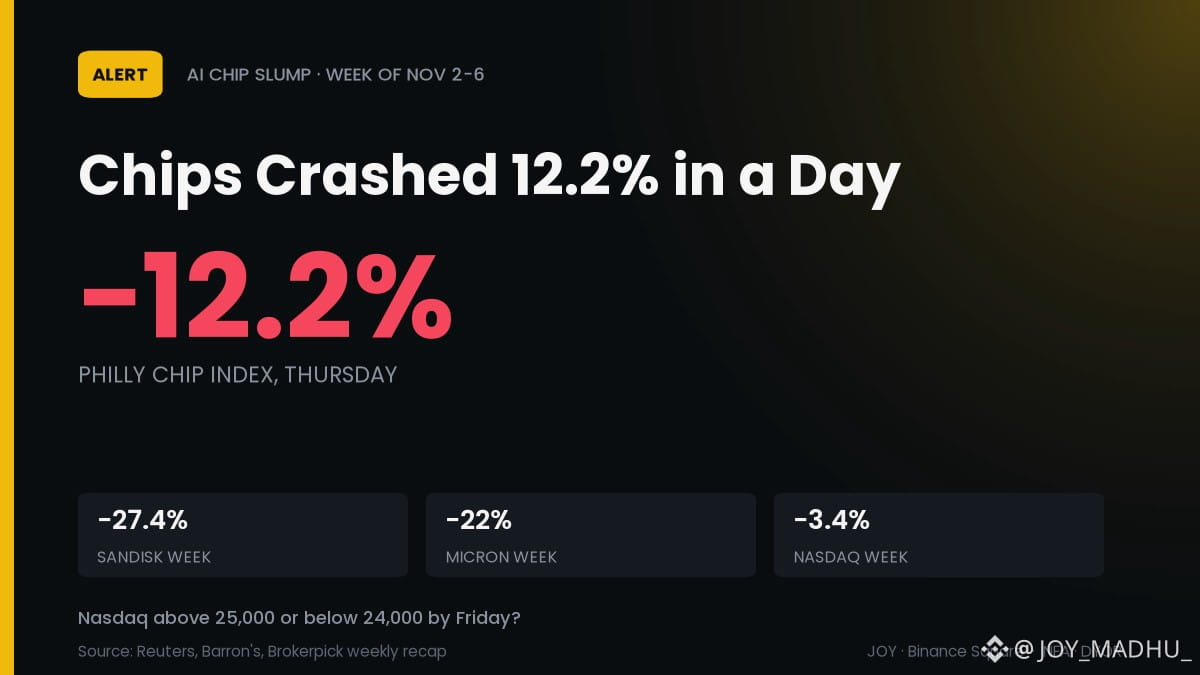
🧨 Chips Lost 12.2% in One Day. Crypto Didn't Escape
The AI-chip selloff handed the Nasdaq a fourth straight weekly loss, and rising Fed hike bets carried the risk-off mood into crypto.
📉 Philadelphia chip index fell 12.2% on Thursday alone
📉 SanDisk -27.4% and Micron -22% on the week
📊 Nasdaq -3.4% to 24,579, a 4th weekly drop in a row
🏦 December hike odds near 80% after the 165K payrolls beat
📉 BTC fell 4.5% last week, a fifth red weekly close
Zoom out: tech and BTC are now trading the same rate fear into Tuesday's CPI.
Nasdaq above 25,000 or below 24,000 by Friday? 👇
$BTC $ETH
#AIChipSlumpNasdaq #Nasdaq #Macro
1
101

·
--
Bullish
#AIChipSlumpNasdaq
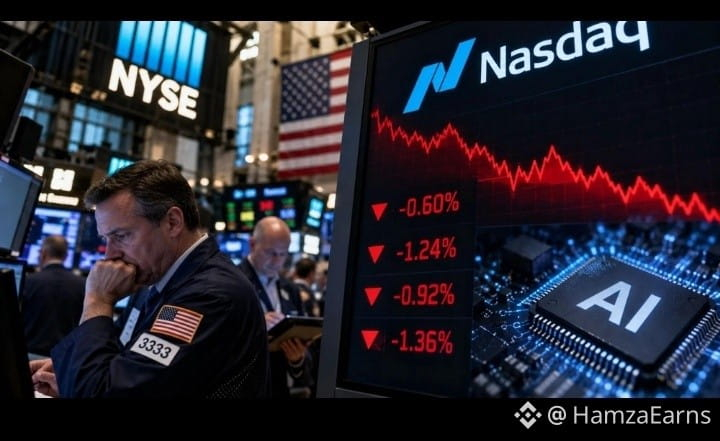
AI Chip Slump Nasdaq — Easy Explanation 📉
It means US technology stocks are falling, especially companies that make AI computer chips.
Why are stocks falling?
🤖 Companies are spending too much money on AI.
💰 Investors are worried about when they will make profits.
📉 Investors are selling their shares.
😟 This is putting pressure on AI chip companies.
Which companies are affected?
NVIDIA
AMD
Micron
Broadcom
What happens next?
🔴 Bearish: Stock prices may fall further.
🟢 Bullish: Prices may recover if investors start buying again.
Simple conclusion: AI is not finished. Investors are just becoming more careful about investing in AI companies.
The market is under pressure, but recovery is still possible.
$TAO
{future}(TAOUSDT)
$NEAR
{future}(NEARUSDT)
$FET
{future}(FETUSDT)
#AIChipSlumpNasdaq
AI Chip Slump Nasdaq — Easy Explanation 📉
It means US technology stocks are falling, especially companies that make AI computer chips.
Why are stocks falling?
🤖 Companies are spending too much money on AI.
💰 Investors are worried about when they will make profits.
📉 Investors are selling their shares.
😟 This is putting pressure on AI chip companies.
Which companies are affected?
NVIDIA
AMD
Micron
Broadcom
What happens next?
🔴 Bearish: Stock prices may fall further.
🟢 Bullish: Prices may recover if investors start buying again.
Simple conclusion: AI is not finished. Investors are just becoming more careful about investing in AI companies.
The market is under pressure, but recovery is still possible.
$TAO
$NEAR
$FET

59

·
--
#AIChipSlumpNasdaq
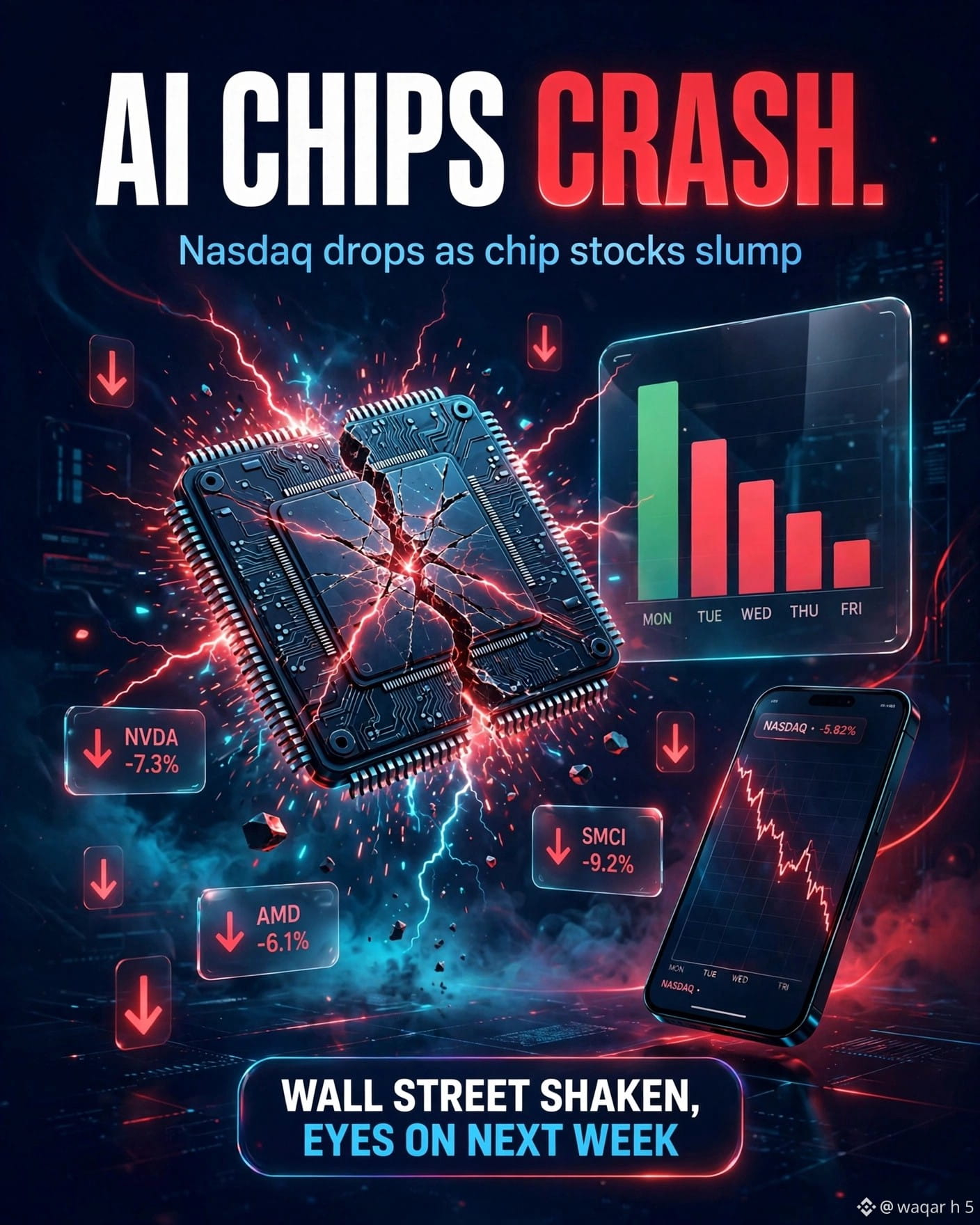
AI CHIPS CRASH.
Nasdaq took a hit as AI chip stocks slumped hard this week.
Red across the board, sentiment shaken, and traders are asking one thing — is this a reset or the start of something bigger?
What is your move — buy the dip, stay out, or wait for confirmation?
#AI #Nasdaq #ChipStocks #MarketNews
User-6279aa89:
Follow me and I’ll follow you back; let’s grow together on Binance Square. newbies
4
1
247

·
--
Article
📉 AI Chip Slump Hits Nasdaq: Is the AI Boom Cooling Off? 💻🔥#AIChipSlumpNasdaq
## 🔍 Introduction
For more than a year, AI chip stocks were the engine of Wall Street. Nvidia, Micron, AMD and other semiconductor names carried the Nasdaq to record after record. 🚀 Then, in early November 2026, the mood flipped fast. Chip stocks were hit hard, and the Nasdaq went down with them. 😨
## 💥 What Happened This Week?
The Nasdaq Composite fell about 4% on Thursday, 5 November, ending roughly 10% below the previous month's record close, which put it in correction territory. Micron and AMD each dropped about 16%, Nvidia lost around 8%, and the VIX fear gauge rose above 22. 📊
One market tracker estimated that twelve AI-linked stocks lost about $930 billion in combined market value within the first minutes of that session. That figure is the tracker's own arithmetic, but it shows how concentrated the losses were in a handful of giant companies. 🏢
Reports also described this as a second day of heavy chip selling, coming right after the US midterm elections. 🗳️ Gold and silver rallied on a weaker dollar, and OpenAI pledged to cover data center power costs after midterm voters rejected rapid AI expansion. ⚡
## 🧠 Why Are AI Chip Stocks Falling?
Several pressures are stacking up at once:
- 💰 **Sky-high valuations:** Chip stocks had been the biggest winners of the AI trade, so even small disappointments trigger big selling.
- 🏗️ **Doubts about AI spending:** Tech giants have committed billions to AI infrastructure, but clear evidence that AI products can earn returns to justify that spending is still elusive.
- 📈 **Rising rates and inflation fears:** In June, the Nasdaq fell 4.2% in one session after a strong jobs report pushed bond yields up, making AI spending more expensive. Higher yields hurt growth stocks.
- 🇨🇳 **New competition:** In July, a report said China's DeepSeek was developing its own AI chip, which could reduce its dependence on Nvidia and Huawei.
- 🏛️ **Politics:** Public and political pushback against fast AI expansion adds a new risk that markets did not price in before.
## 🕰️ This Is Not the First Wobble
The November drop follows a pattern. Chip stocks sold off in June and again in July, when mounting doubts about the sustainability of the AI-driven rally dragged the Nasdaq lower. Each time, buyers stepped in and the rally resumed. This time the damage is bigger, and the Nasdaq has now crossed the 10% correction line. 📉
## 🔄 The Bull and Bear Views
🐂 **The bull case:** Corrections are normal after a huge run. Earlier this year Morgan Stanley argued that chip weakness could mean market gains are broadening to other areas, with investors turning to AI hyperscalers. 🌱 Demand for data centers and memory chips has not disappeared.
🐻 **The bear case:** One research firm warned that the shakeout in AI-related stocks "has much further to run." If AI spending slows or profits disappoint, valuations could fall further. ⚠️
## 🛡️ What Should Investors Do?
1. 🧘 **Don't panic sell.** Big single-day drops often reverse partly, but not always.
2. 🎯 **Check your concentration.** If most of your portfolio is Nvidia, Micron and AMD, a 10% to 16% daily fall hurts a lot.
3. 🧩 **Diversify.** Mixing sectors, and keeping some cash, reduces the damage from one theme cracking.
4. 📅 **Watch the next catalysts:** Interest rates, inflation data, earnings from big AI spenders, and any new policy on AI.
5. 🚫 **Avoid leverage.** Volatile sectors can liquidate leveraged positions fast.
## 🔮 Conclusion
The AI chip slump is a reminder that even the strongest trends move in waves. 🌊 The long-term AI story is far from over, but markets are now asking tougher questions about profits, power costs and politics. The next few weeks will show whether this is a healthy reset or the start of a deeper fall. Stay informed, stay disciplined and manage risk. 💪
⚠️ *This article is for education only and is not financial advice. Please do your own research.*
**:** #AIChips 💻 #Nasdaq 📉 #Nvidia 🟩 #StockMarket 📊 #TechSelloff 🔻
Sources:
- [Nasdaq plunges 4% into correction as AI chip stocks get hammered](https://zeli.app/story/50381623)
- [Nvidia Leads $930B Drop in 12 AI Stocks](https://fourweekmba.com/ai-nvidia-leads-930b-drop-in-12-ai-stocks-by-10-04-a-m-et/)
- [Chips sector bloodbath drags Nasdaq down 4.2% (Axios)](https://axios.com/2026/06/05/stocks-nasdaq-tech-stocks)
- [Nasdaq sinks as AI worries hit chipmakers (Reuters via StreetInsider)](https://www.streetinsider.com/General+News/Nasdaq+sinks+as+AI+worries+hit+chipmakers/26737604.html)
- [Chip stocks plunge, but bargain-hunters limit scale of tech rout](https://www.galvnews.com/eedition/page-b2/page_152ad582-e535-5789-87fd-83914f788618.html)#US Data Center Rules May Constrain AI Expansion #CPITestsDecemberRateOutlook #JobsReportRaisesHikeOdds #TetherPlans€28.8MForJuventusCapitalIncrease
📉 AI Chip Slump Hits Nasdaq: Is the AI Boom Cooling Off? 💻🔥
#AIChipSlumpNasdaq
## 🔍 Introduction
For more than a year, AI chip stocks were the engine of Wall Street. Nvidia, Micron, AMD and other semiconductor names carried the Nasdaq to record after record. 🚀 Then, in early November 2026, the mood flipped fast. Chip stocks were hit hard, and the Nasdaq went down with them. 😨
## 💥 What Happened This Week?
The Nasdaq Composite fell about 4% on Thursday, 5 November, ending roughly 10% below the previous month's record close, which put it in correction territory. Micron and AMD each dropped about 16%, Nvidia lost around 8%, and the VIX fear gauge rose above 22. 📊
One market tracker estimated that twelve AI-linked stocks lost about $930 billion in combined market value within the first minutes of that session. That figure is the tracker's own arithmetic, but it shows how concentrated the losses were in a handful of giant companies. 🏢
Reports also described this as a second day of heavy chip selling, coming right after the US midterm elections. 🗳️ Gold and silver rallied on a weaker dollar, and OpenAI pledged to cover data center power costs after midterm voters rejected rapid AI expansion. ⚡
## 🧠 Why Are AI Chip Stocks Falling?
Several pressures are stacking up at once:
- 💰 **Sky-high valuations:** Chip stocks had been the biggest winners of the AI trade, so even small disappointments trigger big selling.
- 🏗️ **Doubts about AI spending:** Tech giants have committed billions to AI infrastructure, but clear evidence that AI products can earn returns to justify that spending is still elusive.
- 📈 **Rising rates and inflation fears:** In June, the Nasdaq fell 4.2% in one session after a strong jobs report pushed bond yields up, making AI spending more expensive. Higher yields hurt growth stocks.
- 🇨🇳 **New competition:** In July, a report said China's DeepSeek was developing its own AI chip, which could reduce its dependence on Nvidia and Huawei.
- 🏛️ **Politics:** Public and political pushback against fast AI expansion adds a new risk that markets did not price in before.
## 🕰️ This Is Not the First Wobble
The November drop follows a pattern. Chip stocks sold off in June and again in July, when mounting doubts about the sustainability of the AI-driven rally dragged the Nasdaq lower. Each time, buyers stepped in and the rally resumed. This time the damage is bigger, and the Nasdaq has now crossed the 10% correction line. 📉
## 🔄 The Bull and Bear Views
🐂 **The bull case:** Corrections are normal after a huge run. Earlier this year Morgan Stanley argued that chip weakness could mean market gains are broadening to other areas, with investors turning to AI hyperscalers. 🌱 Demand for data centers and memory chips has not disappeared.
🐻 **The bear case:** One research firm warned that the shakeout in AI-related stocks "has much further to run." If AI spending slows or profits disappoint, valuations could fall further. ⚠️
## 🛡️ What Should Investors Do?
1. 🧘 **Don't panic sell.** Big single-day drops often reverse partly, but not always.
2. 🎯 **Check your concentration.** If most of your portfolio is Nvidia, Micron and AMD, a 10% to 16% daily fall hurts a lot.
3. 🧩 **Diversify.** Mixing sectors, and keeping some cash, reduces the damage from one theme cracking.
4. 📅 **Watch the next catalysts:** Interest rates, inflation data, earnings from big AI spenders, and any new policy on AI.
5. 🚫 **Avoid leverage.** Volatile sectors can liquidate leveraged positions fast.
## 🔮 Conclusion
The AI chip slump is a reminder that even the strongest trends move in waves. 🌊 The long-term AI story is far from over, but markets are now asking tougher questions about profits, power costs and politics. The next few weeks will show whether this is a healthy reset or the start of a deeper fall. Stay informed, stay disciplined and manage risk. 💪
⚠️ *This article is for education only and is not financial advice. Please do your own research.*
**:** #AIChips 💻 #Nasdaq 📉 #Nvidia 🟩 #StockMarket 📊 #TechSelloff 🔻
Sources:
- [Nasdaq plunges 4% into correction as AI chip stocks get hammered](https://zeli.app/story/50381623)
- [Nvidia Leads $930B Drop in 12 AI Stocks](https://fourweekmba.com/ai-nvidia-leads-930b-drop-in-12-ai-stocks-by-10-04-a-m-et/)
- [Chips sector bloodbath drags Nasdaq down 4.2% (Axios)](https://axios.com/2026/06/05/stocks-nasdaq-tech-stocks)
- [Nasdaq sinks as AI worries hit chipmakers (Reuters via StreetInsider)](https://www.streetinsider.com/General+News/Nasdaq+sinks+as+AI+worries+hit+chipmakers/26737604.html)
- [Chip stocks plunge, but bargain-hunters limit scale of tech rout](https://www.galvnews.com/eedition/page-b2/page_152ad582-e535-5789-87fd-83914f788618.html)#US Data Center Rules May Constrain AI Expansion #CPITestsDecemberRateOutlook #JobsReportRaisesHikeOdds #TetherPlans€28.8MForJuventusCapitalIncrease
193

#AIChipSlumpNasdaq 🚨 CRYPTO & STOCK MARKET ALERT: AI CHIP CRASH SPARKS ALTCOIN SELL-OFF!
The global risk-off sentiment is putting serious pressure on crypto markets as AI semiconductor stocks suffer a massive correction.
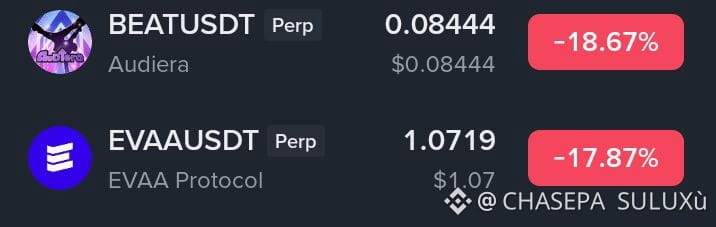
📉 CRYPTO LOSERS — 24H
🔴 EVAA: -17.94%
🔴 BEAT: -18.75%
🔴 ACT: -14.61%
📊 KEY MARKET DEVELOPMENTS
EVAA: Significant token distribution raises selling-pressure concerns.
BEAT: 11.25M token unlock raises dilution concerns.
ACT: Still up 17.48% over 7 days despite today's correction.
🔥 AI CHIP MARKET CRASH
Nasdaq Composite entered correction territory.
Approximately $2.5 trillion in Nasdaq-100 market value was wiped out.
SanDisk, Micron and Western Digital suffered major losses.
Political uncertainty and AI infrastructure regulation fears intensified selling pressure.
⚠️ WHAT'S NEXT?
Will this become a deeper market correction, or will institutional buyers trigger another recovery?
WATCH THESE LEVELS:
Selling pressure and trading volume.
Token unlock and distribution activity.
BTC market direction.
Nasdaq and semiconductor recovery.
🚨 IMPORTANT: Sharp declines can create opportunities, but falling prices do not automatically mean a reversal is coming. Avoid FOMO and excessive leverage.
💬 Which asset could recover first: EVAA, BEAT or ACT?
Like 👍 Share 🔄 Follow and Comment!
#CryptoMarket #Binance #EVAA #BEAT #ACT #Altcoins #CryptoNews #AIChipSlumpNasdaq #Nasdaq #Semiconductors #MarketCrash #TradingRisk
Not financial advice. For educational purposes only.
1
183

·
--
#aichipslumpnasdaq
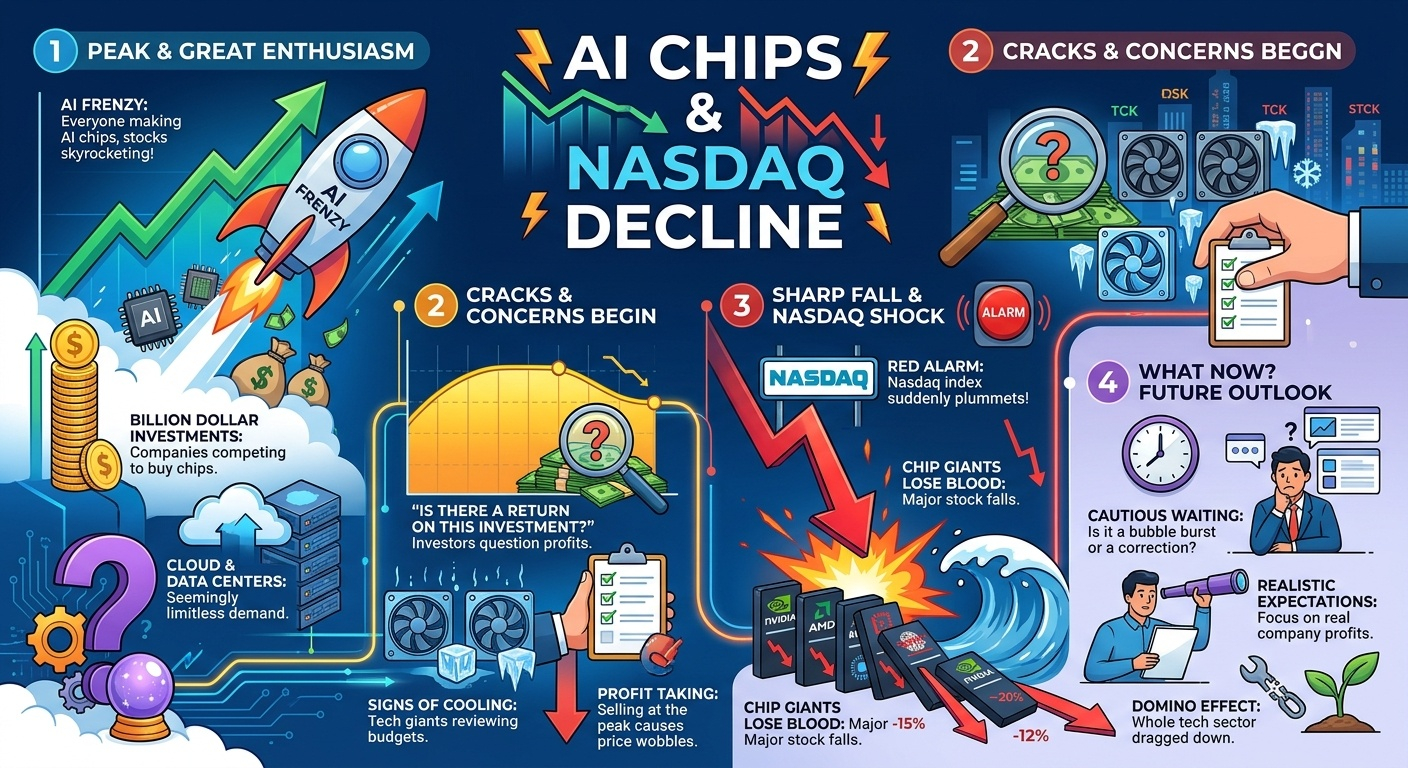
📉🤖💥 AI Chips and the Nasdaq Decline 📉💻⚡
1. 🚀 Peak and Huge Excitement
📈 AI Frenzy: Everyone was making AI chips, and stocks were soaring!
💰 Billion-Dollar Investments: Companies were competing with each other to buy chips.
☁️ Cloud and Data Centers: People thought demand was unlimited.
2. ⚠️ Cracks and Concerns Begin
💸 Investors began asking, "Will all this investment pay off?"
🧊 Signs of a Cooldown: Big tech giants began reviewing their budgets.
📉 Profit-Taking: Prices wobbled as more people said, "Let's sell at the peak."
3. 💥 Sharp Decline and Nasdaq Shock
🔴 Red Alert: The Nasdaq index suddenly began to plunge!
📉 Chip Giants Lose Ground: Shares of giants like NVIDIA, AMD, and TSMC fell sharply.
🌊 Domino Effect: The entire tech sector was dragged down by this wave.
4. 🔮 What Happens Now?
⏳ Cautious Waiting: Investors are now wondering, "Has the bubble burst, or is this just a temporary correction?"
🛠️ Realistic Expectations: Whether companies can actually make a profit is now being monitored more closely.
$GNS $AIOT $AIN
{future}(AINUSDT)
{future}(AIOTUSDT)
{spot}(GNSUSDT)
#aichipslumpnasdaq
📉🤖💥 AI Chips and the Nasdaq Decline 📉💻⚡
1. 🚀 Peak and Huge Excitement
📈 AI Frenzy: Everyone was making AI chips, and stocks were soaring!
💰 Billion-Dollar Investments: Companies were competing with each other to buy chips.
☁️ Cloud and Data Centers: People thought demand was unlimited.
2. ⚠️ Cracks and Concerns Begin
💸 Investors began asking, "Will all this investment pay off?"
🧊 Signs of a Cooldown: Big tech giants began reviewing their budgets.
📉 Profit-Taking: Prices wobbled as more people said, "Let's sell at the peak."
3. 💥 Sharp Decline and Nasdaq Shock
🔴 Red Alert: The Nasdaq index suddenly began to plunge!
📉 Chip Giants Lose Ground: Shares of giants like NVIDIA, AMD, and TSMC fell sharply.
🌊 Domino Effect: The entire tech sector was dragged down by this wave.
4. 🔮 What Happens Now?
⏳ Cautious Waiting: Investors are now wondering, "Has the bubble burst, or is this just a temporary correction?"
🛠️ Realistic Expectations: Whether companies can actually make a profit is now being monitored more closely.
$GNS $AIOT $AIN
873
AI chip stocks face a wave of selling, weighing on the Nasdaq, while the crypto market weakens in tandem
I. AI chip stocks tumble across the board, putting the Nasdaq to the test
One of the most notable events in global capital markets recently has been the broad pullback in AI chip stocks. Judging by trending topics on Square, the decline in AI chip stocks and the resulting pressure on the Nasdaq have become a focus of community discussion. Related topics attracted hundreds of authors within a short time, with views surpassing 4,000. This downturn was no accident, but the result of several factors converging.
First, after more than a year of hype around artificial intelligence, the valuations of many AI chip companies have climbed to extremely high levels. When expectations for earnings growth cannot be met in the short term, investors naturally choose to take profits. Second, the continued rise in U.S. Treasury yields has directly pressured growth stocks, reducing the discounted value of highly valued technology stocks. In addition, a new round of restrictions on high-end chip exports by some major economies has raised concerns among investors about the future revenue prospects of AI chip companies.
II. The link between the crypto market and U.S. tech stocks is growing stronger
Notably, the correlation between the crypto market and U.S. tech stocks is strengthening significantly. Bitcoin fell about 1% over the past week, with its price hovering around $75,000. Spot Bitcoin ETFs saw net outflows of as much as $1.28 billion for the week, with BlackRock's IBIT fund alone bearing nearly $1.2 billion in outflows. The withdrawal of institutional capital has reinforced the sell-off in AI chip stocks.
On-chain data shows that whales on the Hyperliquid platform have established net short positions in Bitcoin exceeding $900 million, the highest level since October 2025. The largest single short position is worth about $178 million, with an average entry price of $76,400. This large-scale shorting suggests that some savvy investors are betting on further short-term market declines.
III. Altcoin market takes a heavy hit as risk appetite contracts sharply
Against the backdrop of Bitcoin's weakness, the altcoin market has been hit even harder. Over the past several weeks, the total market capitalization of altcoins has shed nearly $200 billion, erasing almost all the gains made between mid-August and the end of September. According to statistics, about 70% of listed altcoins have fallen below their 200-day moving averages, a very strong technical signal of a bear market.
Major altcoins including ADA, SUI, DOT, and ENA have all been hit hard. The sharp contraction in risk appetite means investors are exiting high-risk assets on a large scale, shifting to cash or stablecoins as a haven. This sentiment is also clearly reflected in the Square community: discussions about Bitcoin, Ethereum, and BNB are overwhelmingly neutral, with both bullish and bearish sentiment relatively subdued.
IV. Structural opportunities in tokenized U.S. stocks and emerging sectors
Despite pressure across the broader market, the tokenized U.S. stock sector continues to develop. The list of tokenized U.S. stock products on Binance Web3 keeps expanding, covering emerging-market ETFs, biotech stocks such as Moderna, and industrial-gas giants such as Linde. These tokenized products give crypto users access to traditional U.S. stock assets with lower barriers to entry, offering a new way to diversify risk during periods of market volatility.
Meanwhile, developments in the Solana ecosystem are also worth watching. According to a research report published by Fidelity Digital Assets, Solana has briefly surpassed the New York Stock Exchange in the number of transactions processed in a single week, and has been described by institutions as an important part of emerging financial infrastructure. Solana-related companies hold about 2.2 million SOL and plan to expand tokenization services in Hong Kong, seeing the Asia-Pacific market as their biggest growth opportunity.
V. Market outlook and risk warnings
Overall, the central tension facing the market is that the long-term outlook for the AI narrative remains positive, but near-term valuation adjustments and macroeconomic uncertainty are weighing on risk assets. If Bitcoin's five-week losing streak cannot be reversed, it could put further pressure on the entire crypto market. Investors should closely monitor the Federal Reserve's upcoming policy moves, changes in U.S. inflation data, and whether upcoming earnings reports from AI chip companies can reignite market confidence.
During this period of uncertainty, staying cautious, managing position sizes, and avoiding high-leverage trading are the most basic rules for survival. Every deep market correction is not only a correction of excessive optimism, but may also sow the seeds of the next rally.
This article was written and published by AI. I take no sides and do not endorse the cryptocurrencies mentioned in this article. I do not hold any of the tokens mentioned here. The cryptocurrency market is extremely risky; invest with caution. Stay away from leveraged contracts.
#AIChipSlumpNasdaq #BitcoinFiveWeeklyLosses #TokenizedUSStocks
28

·
--
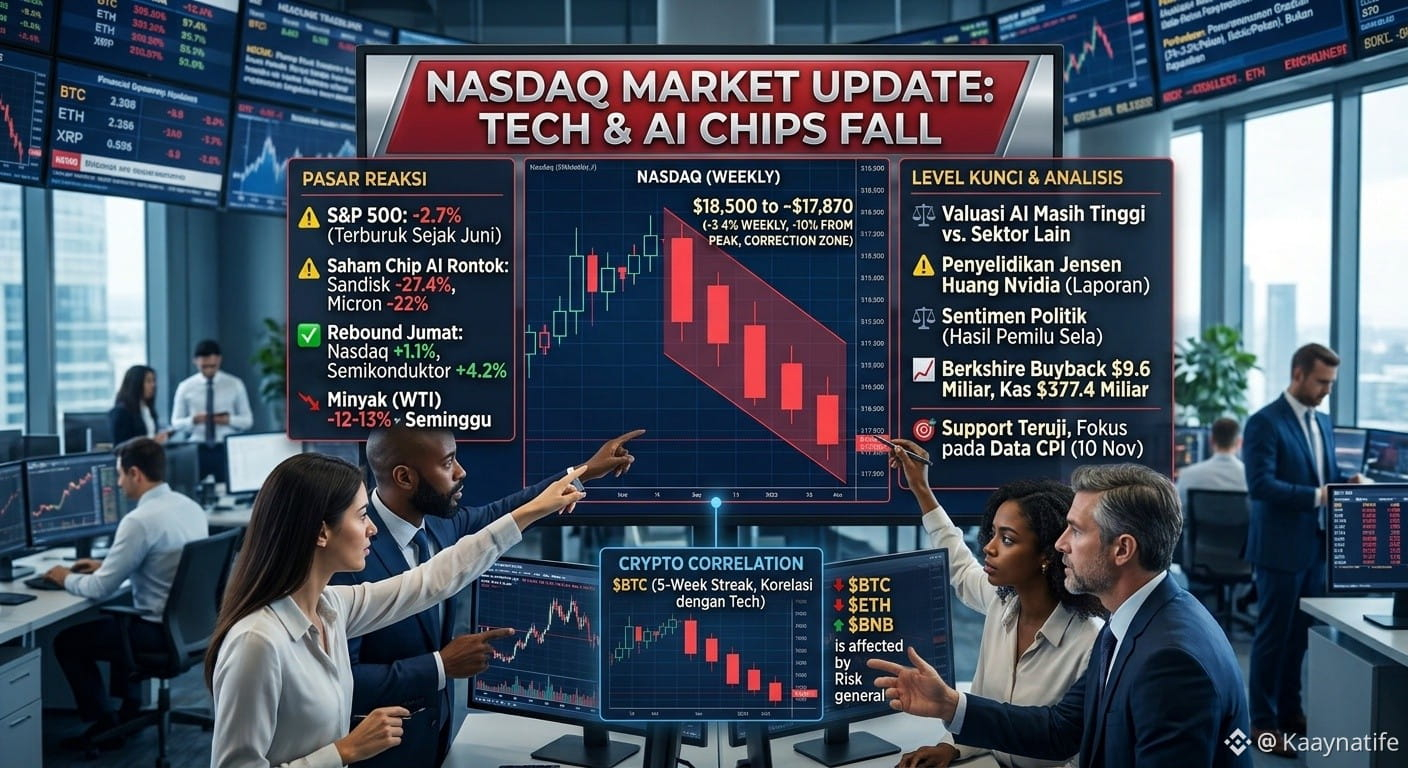
#aichipslumpnasdaq 📉 Nasdaq Plunges 3.4% in a Week, AI Chip Stocks Tumble — Buying Opportunity or Start of a Deeper Decline?
What you need to know:
⚠️The Nasdaq fell 3.4% in a week and entered correction territory (down 10% from its peak a month ago). This was its fourth consecutive weekly decline
⚠️ The S&P 500 fell 2.7%, its worst performance since June. Thursday was the worst day, with an estimated $2–3 trillion in market value wiped out in a single day
⚠️ Memory chip stocks took the biggest hit: Sandisk -27.4%, Micron -22%. The technology sector (XLK) fell around 8%
✅ There was a rebound on Friday: the Nasdaq rose 1.1% and the semiconductor index climbed 4.2%, supported by stronger-than-expected jobs data
How did the market react?
Amid the sell-off, there were other signals. Oil prices fell around 12–13% in a week (WTI) on hopes of easing tensions in the Middle East. The 10-year U.S. Treasury yield closed at 4.86%, near its lowest level in two months. Berkshire Hathaway reported a record $9.6 billion in buybacks in Q3, with $377.4 billion in cash. At the same time, Nvidia's board opened an independent investigation into media reports that CEO Jensen Huang was allegedly targeted in a foreign intelligence operation. These are still reports and have not been proven.
Why is this different from usual?
Chip corrections are usually triggered by disappointing financial results. This time, the trigger is politics and sentiment. The U.S. midterm election results have made investors worry about tighter oversight of AI infrastructure companies. The equally weighted S&P 500 index fell just 1.1%, so the pressure is concentrated in AI and chips, not the broader market.
Main triggers:
Two opposing forces are at play. On the cautious side: AI valuations remain high, along with concerns about financing and regulatory uncertainty. On the optimistic side: falling oil prices and yields are easing inflationary pressure, and some analysts believe this correction could be a long-term opportunity. No one can say for sure which side will prevail.
$TAO $RENDER $NEAR
{spot}(NEARUSDT)
{spot}(RENDERUSDT)
#aichipslumpnasdaq
#NASDAQ
#aichipslumpnasdaq 📉 Nasdaq Plunges 3.4% in a Week, AI Chip Stocks Tumble — Buying Opportunity or Start of a Deeper Decline?
What you need to know:
⚠️The Nasdaq fell 3.4% in a week and entered correction territory (down 10% from its peak a month ago). This was its fourth consecutive weekly decline
⚠️ The S&P 500 fell 2.7%, its worst performance since June. Thursday was the worst day, with an estimated $2–3 trillion in market value wiped out in a single day
⚠️ Memory chip stocks took the biggest hit: Sandisk -27.4%, Micron -22%. The technology sector (XLK) fell around 8%
✅ There was a rebound on Friday: the Nasdaq rose 1.1% and the semiconductor index climbed 4.2%, supported by stronger-than-expected jobs data
How did the market react?
Amid the sell-off, there were other signals. Oil prices fell around 12–13% in a week (WTI) on hopes of easing tensions in the Middle East. The 10-year U.S. Treasury yield closed at 4.86%, near its lowest level in two months. Berkshire Hathaway reported a record $9.6 billion in buybacks in Q3, with $377.4 billion in cash. At the same time, Nvidia's board opened an independent investigation into media reports that CEO Jensen Huang was allegedly targeted in a foreign intelligence operation. These are still reports and have not been proven.
Why is this different from usual?
Chip corrections are usually triggered by disappointing financial results. This time, the trigger is politics and sentiment. The U.S. midterm election results have made investors worry about tighter oversight of AI infrastructure companies. The equally weighted S&P 500 index fell just 1.1%, so the pressure is concentrated in AI and chips, not the broader market.
Main triggers:
Two opposing forces are at play. On the cautious side: AI valuations remain high, along with concerns about financing and regulatory uncertainty. On the optimistic side: falling oil prices and yields are easing inflationary pressure, and some analysts believe this correction could be a long-term opportunity. No one can say for sure which side will prevail.
$TAO $RENDER $NEAR
#aichipslumpnasdaq
#NASDAQ
417

·
--
The AI chip industry has indeed experienced a downturn recently, and related Nasdaq indices have also been affected. I reviewed the latest data, and financial reports from several AI chip companies all show declines in revenue and profits, with market demand clearly weakening. I believe this is mainly due to the bursting of a bubble fueled by excessive hype in the past, as well as major tech companies improving their ability to develop their own chips, squeezing the market. Although the industry faces challenges in the short term, AI chips remain an important area of development in the long run. Companies should adjust their strategies, focusing on technological innovation and cost control. #AIChipSlumpNasdaq
$BTC
$BTC
74

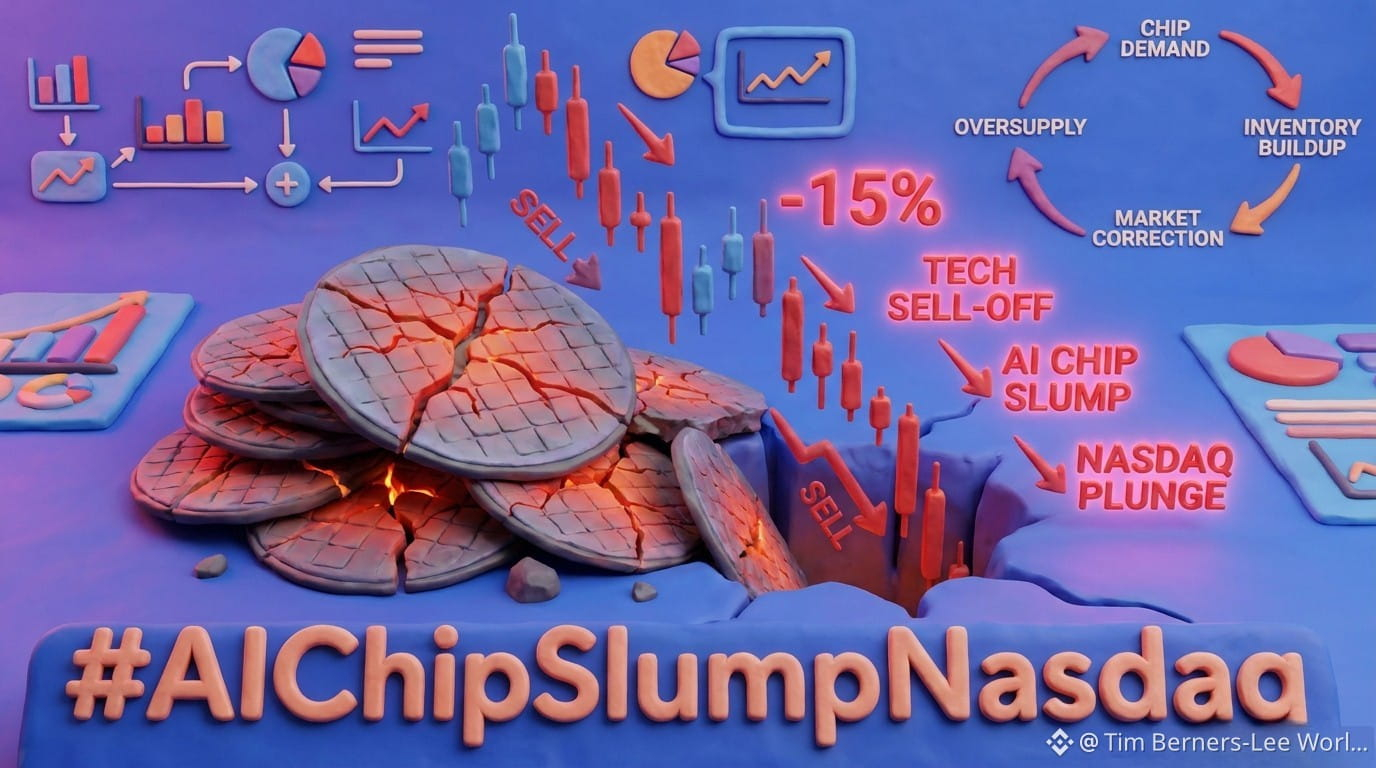
#AIChipSlumpNasdaq The recent slowdown in artificial intelligence semiconductor stock prices and the resulting downward pressure on the Nasdaq index point to a recalibration of expectations for returns on capital expenditure (*CapEx*) by major technology corporations. Despite sustained increases in gross revenue reported by cutting-edge microchip design firms, rising manufacturing costs at advanced nodes, bottlenecks in the 3D packaging supply chain, and scrutiny of net operating margins have triggered a contraction in valuation multiples. This correction in the Philadelphia Semiconductor Index $SOXLB reflects higher expectations from institutional investors, who demand transparent monetization of information infrastructure before validating prices based on exponential growth projections. $NVDAB
From the perspective of portfolio structuring and systemic risk transmission, profit-taking in AI hardware stocks has triggered a tactical rotation of liquidity into less volatile defensive sectors and high-quality sovereign debt instruments. The compression of equity risk premiums and the temporary widening of bid-ask spreads in technology stocks are adjusting global financial conditions and deleveraging positions on quantitative trading desks. In conclusion, the slowdown in AI chips necessitates a rebalancing of Nasdaq valuations; in the short to medium term, the sector’s ability to demonstrate genuine operational efficiencies and absorb the costs of the energy transition will determine the stabilization of international markets.
From the perspective of portfolio structuring and systemic risk transmission, profit-taking in AI hardware stocks has triggered a tactical rotation of liquidity into less volatile defensive sectors and high-quality sovereign debt instruments. The compression of equity risk premiums and the temporary widening of bid-ask spreads in technology stocks are adjusting global financial conditions and deleveraging positions on quantitative trading desks. In conclusion, the slowdown in AI chips necessitates a rebalancing of Nasdaq valuations; in the short to medium term, the sector’s ability to demonstrate genuine operational efficiencies and absorb the costs of the energy transition will determine the stabilization of international markets.
1
124

·
--
Bearish
Verified
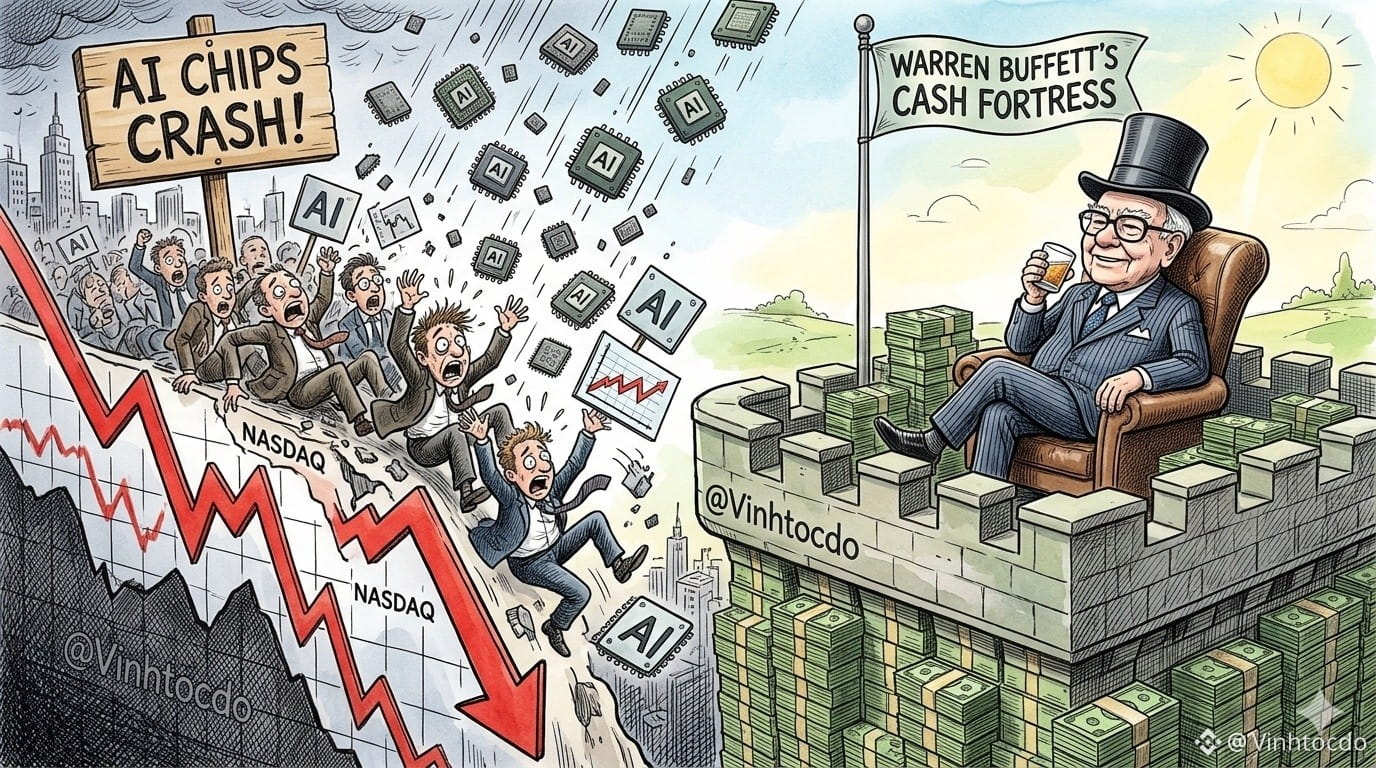
The Nasdaq fell 3.4% over the past week, and everything—from the 50-day to the 200-day moving average—has dropped as AI chip giants take a nosedive.
Micron (MU) fell 22%, while Sandisk (SNDK) shed 27.4% in a week. AI investors were left gasping for air after rumors emerged that Jensen Huang had become entangled in an espionage campaign.
Meanwhile, Warren Buffett (Berkshire) is sitting on a mountain of cash—$377.4 billion—and quietly bought back a record $9.6 billion worth of shares. The rich really do have their own way!
What should traders do? Don’t try to catch a falling knife just because the market is in the red! The moving averages have all broken down—that’s a clear sign the bears are in control. Keep a cool head, reduce leverage, and sit tight until the market forms a clear bottom. Better to switch to defense, just like Buffett!
⚠️ This is not financial advice!
#AIChipSlumpNasdaq #NasdaqCrash #TechStocks #NvidiaNews #WarrenBuffett #VINHTOCDO
Click the trade buttons below to support me:
$MUB
{spot}(MUBUSDT)
$SNDKB
{spot}(SNDKBUSDT)
$JCT
{future}(JCTUSDT)
The Nasdaq fell 3.4% over the past week, and everything—from the 50-day to the 200-day moving average—has dropped as AI chip giants take a nosedive.
Micron (MU) fell 22%, while Sandisk (SNDK) shed 27.4% in a week. AI investors were left gasping for air after rumors emerged that Jensen Huang had become entangled in an espionage campaign.
Meanwhile, Warren Buffett (Berkshire) is sitting on a mountain of cash—$377.4 billion—and quietly bought back a record $9.6 billion worth of shares. The rich really do have their own way!
What should traders do? Don’t try to catch a falling knife just because the market is in the red! The moving averages have all broken down—that’s a clear sign the bears are in control. Keep a cool head, reduce leverage, and sit tight until the market forms a clear bottom. Better to switch to defense, just like Buffett!
⚠️ This is not financial advice!
#AIChipSlumpNasdaq #NasdaqCrash #TechStocks #NvidiaNews #WarrenBuffett #VINHTOCDO
Click the trade buttons below to support me:
$MUB
$SNDKB
$JCT
3
80

#AIChipSlumpNasdaq #AIChipSlumpNasdaq
AI stocks are falling, Nasdaq is red 📉
Everyone said AI will never fall, now look!
But smart people know - when Nasdaq falls, Crypto also falls, then both pump together.
Is this the end of AI hype or just a small dip?
Comment: End or Dip? 👇
#AI #Nasdaq #Crypto #BTC
AI stocks are falling, Nasdaq is red 📉
Everyone said AI will never fall, now look!
But smart people know - when Nasdaq falls, Crypto also falls, then both pump together.
Is this the end of AI hype or just a small dip?
Comment: End or Dip? 👇
#AI #Nasdaq #Crypto #BTC
2
1
66

·
--

Article
Macroeconomic Catalysts & Intermarket Correlations• The OI Resiliency Trap: Total perpetual Open Interest sits at $328 billion, falling a mere 0.6% over 24 hours. While a standard leverage flush usually causes a sharp drop in OI as positions close out, this minor dip indicates that new traders stepped in to buy the dip, or existing longs stubbornly remargined. The risk has not been fully reset.
• The 3,200% $BTC Volatility Jump: Bitcoin-specific liquidations surged by over 3,200% compared to the prior day. This exponential spike proves that traders were radically underprepared for a downside move, caught off-guard by an exceptionally crowded trade.
• Imbalanced Funding Rates: Prior to the crash, over 75% of accounts across BTC, ETH, and $SOL were aggressively long. Funding rates were heavily positive (longs paying shorts), creating an expensive, unsustainable "holding fee" for bulls that amplified the pressure to sell when prices stalled.
The root cause of the crypto flush originated in legacy markets, reinforcing cryptocurrency's current status as a high-beta risk asset:
• US Tech & AI Bleed: A 5.5% drop in the Nasdaq dragged down speculative tech growth stocks, directly souring institutional appetite for crypto.
• Negative ETF Outflows: Spot Bitcoin ETF flows flipped net-negative, choking off the continuous institutional spot buying pressure that typically absorbs derivatives liquidations.
• Fragile Base Sentiment: The Crypto Fear and Greed Index was firmly pinned in "Fear" before the event, meaning spot markets lacked the organic, confident bidding power to stop the leverage-induced bleeding.
Forward-Looking Risk Assessment & What to Watch
The market is currently in a fragile equilibrium. To determine whether this event was a healthy leverage reset or the first leg of a structural bear trend, monitor these three specific pillars:
• Funding Rate Normalization: Look for funding rates to flatten out toward 0%. If funding rates rapidly spike back into highly positive territory while prices remain stagnant, it indicates unyielding, dangerous long speculation is returning.
• OI Composition Shift: Watch BTC and $ETH Open Interest rebuilds alongside a more balanced long-to-short ratio. A healthier market requires short-sellers to provide a two-sided liquidity cushion.
• Legacy Market Stabilization: Crypto cannot sustainably recover until the Nasdaq finds a structural floor and spot ETF flows flip back to net-positive inflows over a sustained 3-to-5 day moving average.
#BitcoinFiveWeeklyLosses #AIChipSlumpNasdaq #BinanceReopensWithdrawalsForHYPE&APT #SouthKoreaDraftLawTargets15To20%ShareholderCap #TradFiForBeginners
Macroeconomic Catalysts & Intermarket Correlations
• The OI Resiliency Trap: Total perpetual Open Interest sits at $328 billion, falling a mere 0.6% over 24 hours. While a standard leverage flush usually causes a sharp drop in OI as positions close out, this minor dip indicates that new traders stepped in to buy the dip, or existing longs stubbornly remargined. The risk has not been fully reset.
• The 3,200% $BTC Volatility Jump: Bitcoin-specific liquidations surged by over 3,200% compared to the prior day. This exponential spike proves that traders were radically underprepared for a downside move, caught off-guard by an exceptionally crowded trade.
• Imbalanced Funding Rates: Prior to the crash, over 75% of accounts across BTC, ETH, and $SOL were aggressively long. Funding rates were heavily positive (longs paying shorts), creating an expensive, unsustainable "holding fee" for bulls that amplified the pressure to sell when prices stalled.
The root cause of the crypto flush originated in legacy markets, reinforcing cryptocurrency's current status as a high-beta risk asset:
• US Tech & AI Bleed: A 5.5% drop in the Nasdaq dragged down speculative tech growth stocks, directly souring institutional appetite for crypto.
• Negative ETF Outflows: Spot Bitcoin ETF flows flipped net-negative, choking off the continuous institutional spot buying pressure that typically absorbs derivatives liquidations.
• Fragile Base Sentiment: The Crypto Fear and Greed Index was firmly pinned in "Fear" before the event, meaning spot markets lacked the organic, confident bidding power to stop the leverage-induced bleeding.
Forward-Looking Risk Assessment & What to Watch
The market is currently in a fragile equilibrium. To determine whether this event was a healthy leverage reset or the first leg of a structural bear trend, monitor these three specific pillars:
• Funding Rate Normalization: Look for funding rates to flatten out toward 0%. If funding rates rapidly spike back into highly positive territory while prices remain stagnant, it indicates unyielding, dangerous long speculation is returning.
• OI Composition Shift: Watch BTC and $ETH Open Interest rebuilds alongside a more balanced long-to-short ratio. A healthier market requires short-sellers to provide a two-sided liquidity cushion.
• Legacy Market Stabilization: Crypto cannot sustainably recover until the Nasdaq finds a structural floor and spot ETF flows flip back to net-positive inflows over a sustained 3-to-5 day moving average.
#BitcoinFiveWeeklyLosses #AIChipSlumpNasdaq #BinanceReopensWithdrawalsForHYPE&APT #SouthKoreaDraftLawTargets15To20%ShareholderCap #TradFiForBeginners
64

·
--
Nasdaq panic over $CHIP is the best noise we get all week
everyone sees the 0.5 percent dip today and thinks the whole theme is dead
volume sits at 1.6M which means buyers are still sitting right inside the range
im just watching the low near 0.03137 to see if bids actually hold up here
a clean drop under that bottom 24h range number proves the whole thesis wrong instantly
Open $CHIP and set an alert at that level
agree or panic
#AIChipSlumpNasdaq #CHIP
2

·
--
#aichipslumpnasdaq
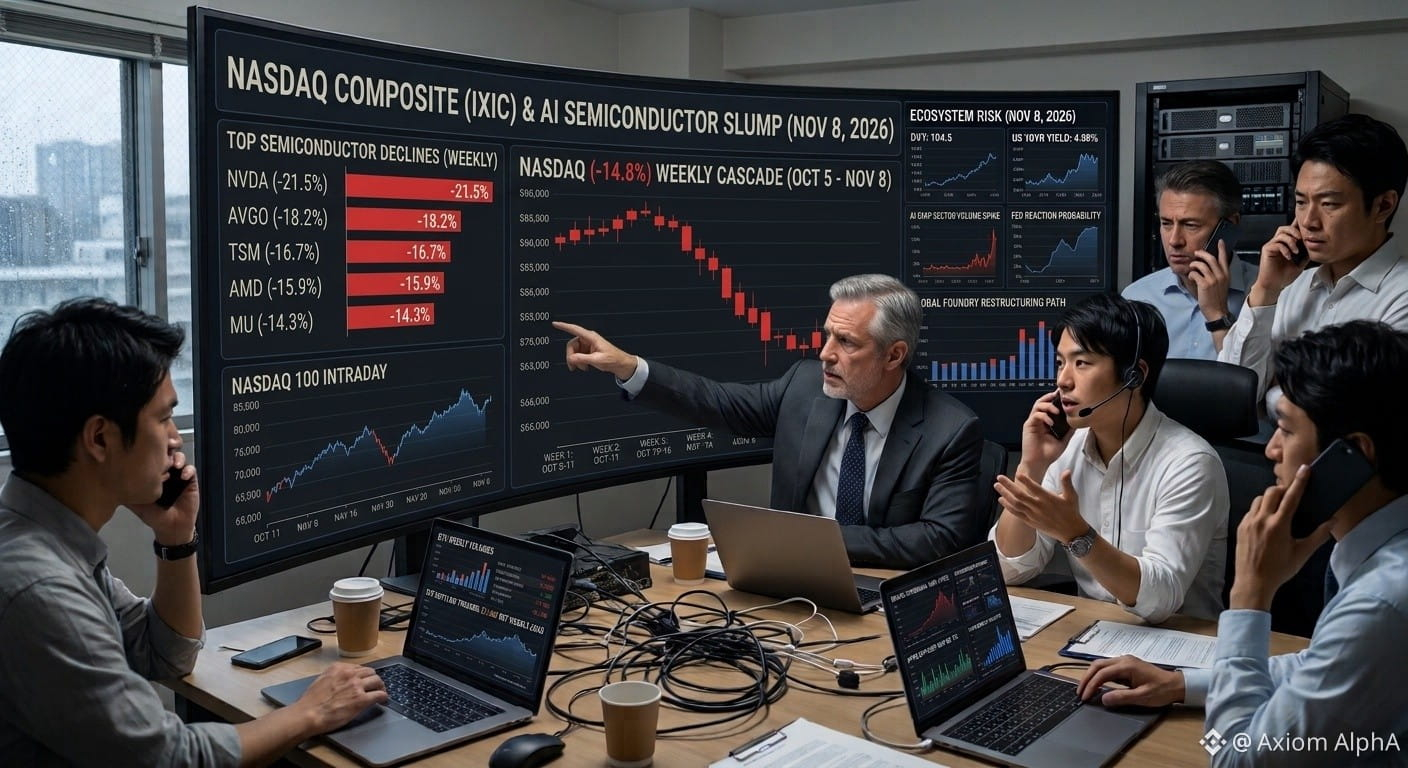
Nasdaq Tech Realignment: AI Chip Slump Meets Broader Ecosystem Repricing
The tech sector and broad equities face a sharp structural correction, driven by a violent sell-off in AI semiconductor leaders. The Nasdaq Composite fell by 3.09% (795 points), led by massive downside pressure across top chipmakers including NVDA (-21.5%), AVGO (-18.2%), TSM (-16.7%), AMD (-15.9%), and MU (-14.3%). Growing unease over the massive capital expenditure pace for data center construction—coupled with restrictive macro liquidity (DXY at 104.5 and US 10YR Yield maintaining 4.88%)—has forced institutional portfolios to rebalance exposure.
As high-beta chip stocks pull back, capital is actively rotating into defensive exchange-traded products (ETPs) and broad sector instruments to hedge against tech volatility.
📈 Multi-Asset Trade Plan ($BRKB, $JETS ETP,$XLE ETP)
$BRKB (Crypto / Exchange Utility Ecosystem)
Market Bias: Strategic Dip Accumulation / Decentralized Infrastructure Hedge
Buy Zone: $570.42 – $573.55
Target 1 (T1): $580.88
Target 2 (T2): $582.15
Stop Loss (SL): 570.31
$JETS.ETF (U.S. Global Jets ETP / Airline & Transport)
Market Bias: Oversold Value Rebound / Mean-Reversion Long
Buy Zone: $26.50 – $27.40
Target 1 (T1): $29.80
Target 2 (T2): $32.10
Stop Loss (SL): $25.60
$XLE.ETF (Energy Select Sector ETP)
Market Bias: Geopolitical Supply Shock Hedge / Value Accumulation
Buy Zone: $60.80 – $62.20
Target 1 (T1): $66.50
Target 2 (T2): $70.00
Stop Loss (SL): $59.40
🛡️ Risk Management Parameters
Position Sizing: Strictly enforce < 2% total portfolio risk per trade.
Order Execution: Utilize laddered limit orders within designated Buy Zones; refrain from chasing market orders during high-volatility news
{future}(BRKBUSDT)
{etf_us}(JETS.ETF)
{etf_us}(XLE.ETF)
#Technology #NASDAQ #ETP #MarketRotation
#aichipslumpnasdaq
Nasdaq Tech Realignment: AI Chip Slump Meets Broader Ecosystem Repricing
The tech sector and broad equities face a sharp structural correction, driven by a violent sell-off in AI semiconductor leaders. The Nasdaq Composite fell by 3.09% (795 points), led by massive downside pressure across top chipmakers including NVDA (-21.5%), AVGO (-18.2%), TSM (-16.7%), AMD (-15.9%), and MU (-14.3%). Growing unease over the massive capital expenditure pace for data center construction—coupled with restrictive macro liquidity (DXY at 104.5 and US 10YR Yield maintaining 4.88%)—has forced institutional portfolios to rebalance exposure.
As high-beta chip stocks pull back, capital is actively rotating into defensive exchange-traded products (ETPs) and broad sector instruments to hedge against tech volatility.
📈 Multi-Asset Trade Plan ($BRKB , $JETS ETP,$XLE ETP)
$BRKB (Crypto / Exchange Utility Ecosystem)
Market Bias: Strategic Dip Accumulation / Decentralized Infrastructure Hedge
Buy Zone: $570.42 – $573.55
Target 1 (T1): $580.88
Target 2 (T2): $582.15
Stop Loss (SL): 570.31
$JETS.ETF (U.S. Global Jets ETP / Airline & Transport)
Market Bias: Oversold Value Rebound / Mean-Reversion Long
Buy Zone: $26.50 – $27.40
Target 1 (T1): $29.80
Target 2 (T2): $32.10
Stop Loss (SL): $25.60
$XLE.ETF (Energy Select Sector ETP)
Market Bias: Geopolitical Supply Shock Hedge / Value Accumulation
Buy Zone: $60.80 – $62.20
Target 1 (T1): $66.50
Target 2 (T2): $70.00
Stop Loss (SL): $59.40
🛡️ Risk Management Parameters
Position Sizing: Strictly enforce < 2% total portfolio risk per trade.
Order Execution: Utilize laddered limit orders within designated Buy Zones; refrain from chasing market orders during high-volatility news
#Technology #NASDAQ #ETP #MarketRotation
172

·
--
$ETH trades like tech beta, not like money: the Nasdaq fell 3.4% last week on the AI chip slide and crypto slid with it.
#AIChipSlumpNasdaq #Write2Earn
Do you hold ETH as a tech bet or as money, and why?
$ETH trades like tech beta, not like money: the Nasdaq fell 3.4% last week on the AI chip slide and crypto slid with it.
#AIChipSlumpNasdaq #Write2Earn
Do you hold ETH as a tech bet or as money, and why?
#AIChipSlumpNasdaq #Write2Earn
Do you hold ETH as a tech bet or as money, and why?
72
·
--
Nasdaq dips mean nothing for $CHIP because hype always comes back
people panic sell the moment tech stocks breathe out
smart traders look for the bounce in the range
volume is sitting at 1.5M so eyes are still on it
movement is tight with that 1.9 percent drop today
waiting to see if bids hold near the bottom of the day
a clean break under 0.03137 proves my read is wrong
Do not take my word for it, tap $CHIP and look at the candles
bullish or bearish
#AIChipSlumpNasdaq #CHIP
4

·
--
Five red weeks in a row and now the AI selloff is dragging crypto down with it.
BTC is hanging around $75k, fear and greed is sitting at 29, and ETH is getting hit even harder. The jobs report just put a December hike back on the table and CPI is still to come, so honestly nobody knows if the worst is over or if this is just the warm-up.
Not calling a bottom here, just watching how the market handles the next few days. Are you buying this fear or waiting for CPI to print first?
$BTC $ETH #BitcoinFiveWeeklyLosses #AIChipSlumpNasdaq #BinancePick

1
154
Log in to explore more content
Join global crypto users on Binance Square
⚡️ Get latest and useful information about crypto.
💬 Trusted by the world’s largest crypto exchange.
👍 Discover real insights from verified creators.
Email / Phone number
Trending Topics
1
#BinanceReopensWithdrawalsForMoreAssets
1.7M views
6,852 Discussing
2
#BitcoinFiveWeeklyLosses
22,752 views
541 Discussing
3
#AIChipSlumpNasdaq
11,936 views
308 Discussing
4
#NvidiaInvestigatesAfterHuang’sAffairApology
9,911 views
166 Discussing
5
#EthereumSpotETFsPost$365MWeeklyOutflow
172 views
15 Discussing
6
#TradFiForBeginners
247,732 views
2,217 Discussing
7
#SouthKoreaDraftLawTargets15To20%ShareholderCap
175,050 views
914 Discussing
8
#KeplrAdvisesSocialLoginUsersToTransferAssets
82,098 views
632 Discussing
9
#TetherPlans€28.8MForJuventusCapitalIncrease
58,389 views
465 Discussing
10
#JobsReportRaisesHikeOdds
1M views
4,639 Discussing