
#blackrock
blackrock
11.3M views
14,990 Discussing
Hot
Latest

BlackRock BUIDL Gains 24/7 Liquidity via Securitize and Ethena
Securitize and Ethena Labs launched a $100M liquidity facility to enable 24/7 swaps between BlackRock BUIDL and stablecoins.
#BlackRock #RWA
BlackRock BUIDL Gains 24/7 Liquidity via Securitize and Ethena
Securitize and Ethena Labs launched a $100M liquidity facility to enable 24/7 swaps between BlackRock BUIDL and stablecoins.
#BlackRock #RWA
Securitize and Ethena Labs launched a $100M liquidity facility to enable 24/7 swaps between BlackRock BUIDL and stablecoins.
#BlackRock #RWA

BLKUS+0.57%
26


·
--
BlackRock's iShares 0-1 Year Treasury Bond ETF, tokenized by Ondo on Solana, is now worth $423,586,289, up 64.39% in the past 30 days.
It held $8,325,830 just 90 days ago, and took in $88,211,369 of net inflows in the past 7 days alone.
#ONDO #blackRock
{future}(ONDOUSDT)
{future}(BNBUSDT)
{future}(AGTUSDT)
BlackRock's iShares 0-1 Year Treasury Bond ETF, tokenized by Ondo on Solana, is now worth $423,586,289, up 64.39% in the past 30 days.
It held $8,325,830 just 90 days ago, and took in $88,211,369 of net inflows in the past 7 days alone.
#ONDO #blackRock
It held $8,325,830 just 90 days ago, and took in $88,211,369 of net inflows in the past 7 days alone.
#ONDO #blackRock


1
401

·
--
BlackRock’s BUIDL Gets $100M Facility for 24/7 Stablecoin Swaps.
BlackRock’s BUIDL tokenized fund now has access to a $100 million liquidity facility launched by Securitize and Ethena Labs, allowing eligible institutional investors to exchange fund shares for stablecoins, including USDC, around the clock.
The facility starts with $50 million in initial liquidity, split between BUIDL and USDC. An additional $50 million reserve can be activated within an hour as the initial pool is used, bringing total capacity to $100 million. Securitize will manage operations as BUIDL’s regulated transfer agent.
The development builds on the existing relationship between the companies. Ethena’s USDtb stablecoin is already backed primarily by BUIDL, creating a direct connection between BlackRock’s tokenized fund and Ethena’s stablecoin infrastructure.
The new facility addresses a major limitation of traditional financial markets: institutional investors can now access stablecoin liquidity outside conventional trading hours, including weekends. However, the service is restricted to eligible institutions, and larger redemptions will still depend on BUIDL’s standard procedures.$LINK
{future}(LINKUSDT)
#blackRock
BlackRock’s BUIDL Gets $100M Facility for 24/7 Stablecoin Swaps.
BlackRock’s BUIDL tokenized fund now has access to a $100 million liquidity facility launched by Securitize and Ethena Labs, allowing eligible institutional investors to exchange fund shares for stablecoins, including USDC, around the clock.
The facility starts with $50 million in initial liquidity, split between BUIDL and USDC. An additional $50 million reserve can be activated within an hour as the initial pool is used, bringing total capacity to $100 million. Securitize will manage operations as BUIDL’s regulated transfer agent.
The development builds on the existing relationship between the companies. Ethena’s USDtb stablecoin is already backed primarily by BUIDL, creating a direct connection between BlackRock’s tokenized fund and Ethena’s stablecoin infrastructure.
The new facility addresses a major limitation of traditional financial markets: institutional investors can now access stablecoin liquidity outside conventional trading hours, including weekends. However, the service is restricted to eligible institutions, and larger redemptions will still depend on BUIDL’s standard procedures.$LINK
#blackRock

1
133

🚨 BlackRock Leads a Massive Bitcoin ETF Sell-Off!
Bitcoin ETFs faced another brutal session on November 11, with nearly $300 million flowing out of US spot Bitcoin funds.
Here's the breakdown:
🔴 BlackRock ($IBIT): $269.7 million in net outflows.
🔴 Grayscale ($GBTC): $39.13 million in outflows.
🟢 Morgan Stanley ($MSBT): $8.96 million in net inflows, making it the only fund to record positive flows.
Overall, US spot Bitcoin ETFs recorded approximately $299.9 million in net outflows.
BlackRock accounted for the largest share of the selling pressure, highlighting how institutional ETF demand can shift during periods of market uncertainty.
Institutional money is moving, and all eyes are on whether Bitcoin ETF inflows return in the coming sessions. 👀
#Bitcoin #BTC #BlackRock #Crypto
$BTC
{future}(BTCUSDT)
🚨 BlackRock Leads a Massive Bitcoin ETF Sell-Off!
Bitcoin ETFs faced another brutal session on November 11, with nearly $300 million flowing out of US spot Bitcoin funds.
Here's the breakdown:
🔴 BlackRock ($IBIT): $269.7 million in net outflows.
🔴 Grayscale ($GBTC): $39.13 million in outflows.
🟢 Morgan Stanley ($MSBT): $8.96 million in net inflows, making it the only fund to record positive flows.
Overall, US spot Bitcoin ETFs recorded approximately $299.9 million in net outflows.
BlackRock accounted for the largest share of the selling pressure, highlighting how institutional ETF demand can shift during periods of market uncertainty.
Institutional money is moving, and all eyes are on whether Bitcoin ETF inflows return in the coming sessions. 👀
#Bitcoin #BTC #BlackRock #Crypto
$BTC
55
BlackRock Bitcoin ETF Outflows Hit $2B
US spot Bitcoin ETF outflows reached $2B over 9 sessions as Wednesday saw $300M in exits.
#BitcoinETF #BlackRock
BlackRock Bitcoin ETF Outflows Hit $2B
US spot Bitcoin ETF outflows reached $2B over 9 sessions as Wednesday saw $300M in exits.
#BitcoinETF #BlackRock
US spot Bitcoin ETF outflows reached $2B over 9 sessions as Wednesday saw $300M in exits.
#BitcoinETF #BlackRock

BTC-3.32%
BLKUS+0.57%
2

·
--
Bearish
🚨🤯⚠️$BTC ... $1.13 BILLION JUST LEFT U.S. BITCOIN ETFs IN FOUR TRADING SESSIONS! 📉
Bitcoin's institutional investment story is facing another serious test.
U.S. spot Bitcoin ETFs have recorded four consecutive sessions of net outflows, with more than $1.13 BILLION withdrawn between November 5 and November 10.
And one name stands out: BlackRock. 👀
📊 THE NUMBERS:
November 5: −$430.2M
November 6: −$411.9M
November 9: −$201.1M
November 10: −$95.0M
Four-session total: −$1.138B
But here's where it gets interesting.
BlackRock's iShares Bitcoin Trust (IBIT) alone lost approximately $799.4 MILLION across those four sessions.
On November 10:
IBIT: −$78.2M
Fidelity's FBTC: −$36.8M
Morgan Stanley's MSBT: +$20M
So while money continues to leave the overall ETF market, not every fund is experiencing withdrawals.
WHY THIS MATTERS:
Spot Bitcoin ETFs have become an important channel for institutional and traditional-market exposure to BTC.
Persistent outflows can signal weaker demand through that channel and add pressure to market sentiment.
But ETF outflows do NOT automatically mean every investor is selling Bitcoin, or that the entire crypto market is abandoning BTC.
Now the next sessions matter.
Will institutional demand return, or will the withdrawal streak continue?
THE BIG QUESTION: Is this just a temporary reset in institutional positioning—or are Bitcoin ETFs entering a deeper demand slowdown? 🤔
#MarketLens #Bitcoin #BTC #BlackRock #CryptoNews
$BTC
{future}(BTCUSDT)
🚨🤯⚠️$BTC ... $1.13 BILLION JUST LEFT U.S. BITCOIN ETFs IN FOUR TRADING SESSIONS! 📉
Bitcoin's institutional investment story is facing another serious test.
U.S. spot Bitcoin ETFs have recorded four consecutive sessions of net outflows, with more than $1.13 BILLION withdrawn between November 5 and November 10.
And one name stands out: BlackRock. 👀
📊 THE NUMBERS:
November 5: −$430.2M
November 6: −$411.9M
November 9: −$201.1M
November 10: −$95.0M
Four-session total: −$1.138B
But here's where it gets interesting.
BlackRock's iShares Bitcoin Trust (IBIT) alone lost approximately $799.4 MILLION across those four sessions.
On November 10:
IBIT: −$78.2M
Fidelity's FBTC: −$36.8M
Morgan Stanley's MSBT: +$20M
So while money continues to leave the overall ETF market, not every fund is experiencing withdrawals.
WHY THIS MATTERS:
Spot Bitcoin ETFs have become an important channel for institutional and traditional-market exposure to BTC.
Persistent outflows can signal weaker demand through that channel and add pressure to market sentiment.
But ETF outflows do NOT automatically mean every investor is selling Bitcoin, or that the entire crypto market is abandoning BTC.
Now the next sessions matter.
Will institutional demand return, or will the withdrawal streak continue?
THE BIG QUESTION: Is this just a temporary reset in institutional positioning—or are Bitcoin ETFs entering a deeper demand slowdown? 🤔
#MarketLens #Bitcoin #BTC #BlackRock #CryptoNews
$BTC


1
52

BlackRock (NYSE:BLK) reports substantial inflows into its Bitcoin ETF as holders move coins off private wallets for perceived safety.
Investors citing kidnapping and custody risks are shifting Bitcoin into BlackRock's fund structure, according to recent client feedback.
Management is highlighting artificial intelligence as a generational investment theme while seeing rising interest in Canadian resource assets.
There is more going on at BlackRock than the Bitcoin ETF safety trade and its AI and Canadian resources push. We have also spotted 4 big wins worth knowing about at BlackRock.
$BTC #blackRock
{future}(BTCUSDT)
BlackRock (NYSE:BLK) reports substantial inflows into its Bitcoin ETF as holders move coins off private wallets for perceived safety.
Investors citing kidnapping and custody risks are shifting Bitcoin into BlackRock's fund structure, according to recent client feedback.
Management is highlighting artificial intelligence as a generational investment theme while seeing rising interest in Canadian resource assets.
There is more going on at BlackRock than the Bitcoin ETF safety trade and its AI and Canadian resources push. We have also spotted 4 big wins worth knowing about at BlackRock.
$BTC #blackRock
BTC-3.32%
BLKUS+0.57%
1
43

·
--
Bearish
$BTC 👇🚨BLACKROCK SELLING BITCOIN 🚨📅 10 Nov:* *$78.2M* Outflow from IBIT
📉 7 Days:* *$1.66 BILLION* Outflow — 7 Days Straight!
📉 Total BTC ETF:* *$95M* Outflow — 4th Day in a Row
> BlackRock is not selling because it wants to — Investors are redeeming IBIT shares, and BlackRock has to sell BTC to pay them.
> This is why BTC is under pressure a
BTC 73.800
🌟Smart Money is Exiting — Are You Buying or Waiting? Comment 👇
#CryptoWala99 #BlackRock #BLACKROCK

BTC-3.32%
BLKUS+0.57%
106

·
--
Bearish
🚨 JUST IN: BLACKROCK SELLS $78.24 MILLION WORTH OF BITCOIN! 🐻
One of the world's largest asset managers has reportedly sold $78.24 million worth of $BTC.
This raises an important question for the crypto market…
Is institutional demand starting to weaken, or is this simply routine portfolio and ETF-related activity?
Here's what traders should watch:
⚠️ Bitcoin ETF net flows.
⚠️ Institutional accumulation versus distribution.
⚠️ BTC exchange inflows and outflows.
⚠️ Spot buying pressure.
⚠️ Key Bitcoin support levels.
One important reminder: A single reported sale does not automatically signal a bearish institutional outlook.
The bigger picture is what matters.
Are institutions accumulating the dip or reducing their Bitcoin exposure?
#Bitcoin #BTC #BlackRock #CryptoMarket #BitcoinETF


BTC-3.32%
BLKUS+0.57%
1
56

·
--
BlackRock crypto holdings have dropped 4.77 billion dollars so far in November, and that is the biggest wallet in the market shrinking. 📰
Arkham Intelligence data, reported by KuCoin, shows BlackRock crypto portfolio fell from 71.17 billion dollars at the start of November to 66.39 billion dollars, with the iShares Bitcoin Trust down 3.89 billion dollars, about 6.09 percent, holding 796,705 BTC against 815,657 BTC at the start of the month. 📊 The iShares Ethereum Trust lost 199,957 ETH in the same period, down to 3.02 million ETH, while Bitcoin is down 5.21 percent and Ethereum down 10.36 percent over the past 7 days. My reading is that this is the same story as the ETF outflows told from the other side, because when the largest holder in crypto sheds almost 5 billion dollars in eleven days, every bounce meets sellers, and traders should not fight that flow with big size until the holdings stop shrinking.
Does BlackRock selling slow down this week, or is November a full month of distribution? 🤔
Follow for more trades.
#Crypto #Bitcoin #FuturesTrading #TradingSignals #BlackRock

4

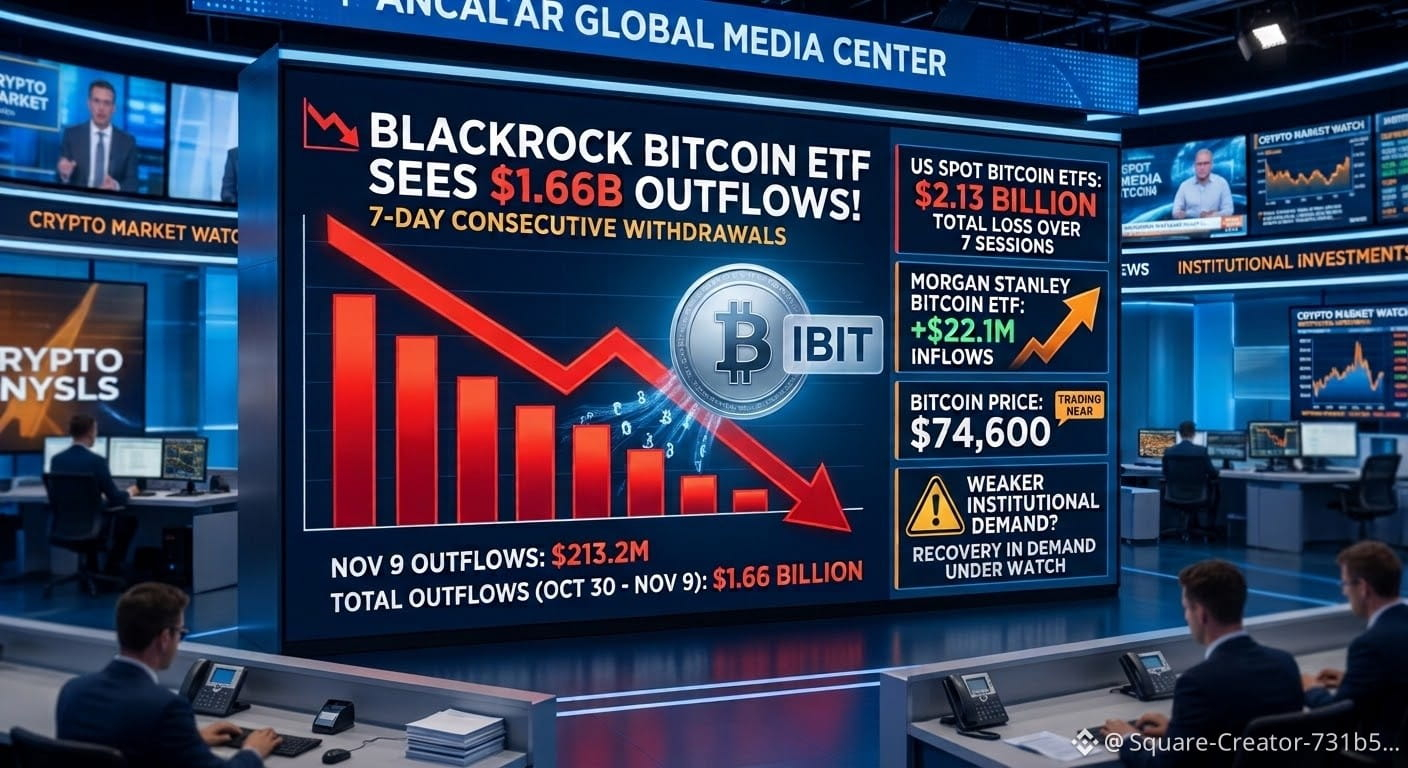
📉🟠 BlackRock Bitcoin ETF Sees $1.66B in Outflows!
💸 BlackRock’s Bitcoin ETF (IBIT) recorded seven consecutive days of withdrawals, totaling approximately $1.66 billion from October 30 to November 9, 2026.
📊 Key Details:
Nov 9 outflows: $213.2 million.
US spot Bitcoin ETFs lost around $2.13 billion over seven sessions.
Morgan Stanley’s Bitcoin ETF saw $22.1 million in inflows.
Bitcoin traded near $74,600.
⚠️ Continued outflows suggest weaker demand through traditional investment funds, but they don't guarantee further Bitcoin price declines.
👀 Investors are watching for a recovery in institutional demand.
#Bitcoin 🟠 #BlackRock 🏦 #IBIT 📉 #BitcoinETF 💰 #ETFOutflows 🔻 #InstitutionalInvestors 📊 #CryptoInvesting 💸
$BTC
{spot}(BTCUSDT)
📉🟠 BlackRock Bitcoin ETF Sees $1.66B in Outflows!
💸 BlackRock’s Bitcoin ETF (IBIT) recorded seven consecutive days of withdrawals, totaling approximately $1.66 billion from October 30 to November 9, 2026.
📊 Key Details:
Nov 9 outflows: $213.2 million.
US spot Bitcoin ETFs lost around $2.13 billion over seven sessions.
Morgan Stanley’s Bitcoin ETF saw $22.1 million in inflows.
Bitcoin traded near $74,600.
⚠️ Continued outflows suggest weaker demand through traditional investment funds, but they don't guarantee further Bitcoin price declines.
👀 Investors are watching for a recovery in institutional demand.
#Bitcoin 🟠 #BlackRock 🏦 #IBIT 📉 #BitcoinETF 💰 #ETFOutflows 🔻 #InstitutionalInvestors 📊 #CryptoInvesting 💸
$BTC
BTC-3.32%
IBITETF-3.90%
1
81

·
--
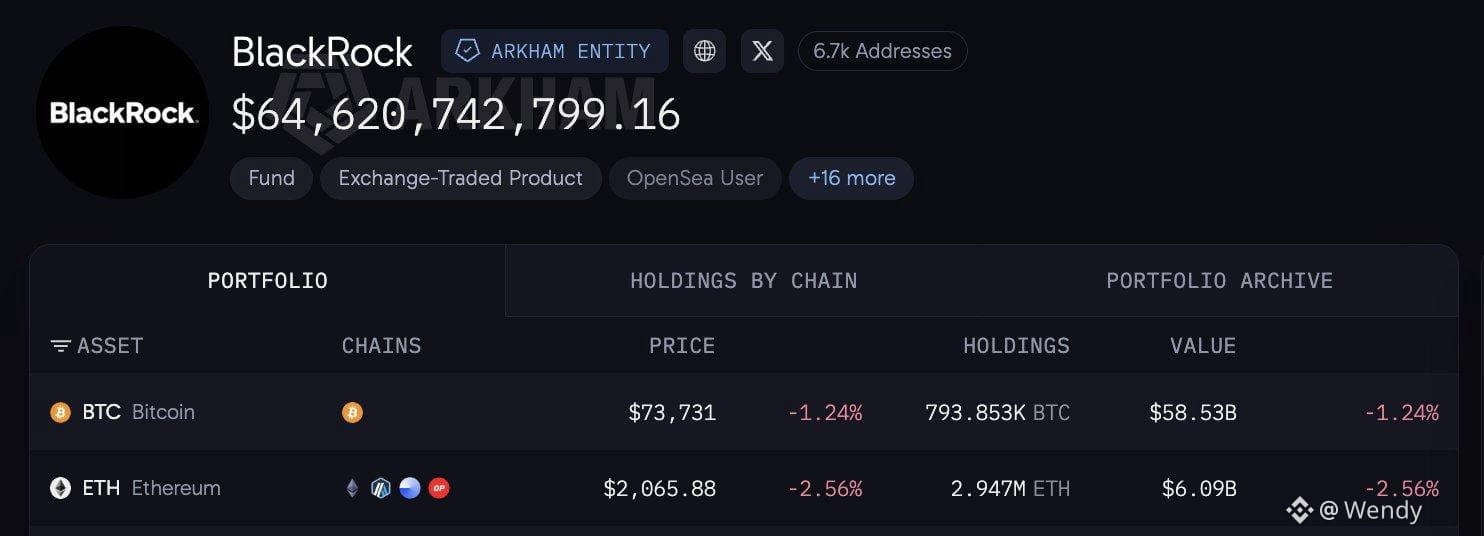
🚨 BLACKROCK HOLDS $64.62 BILLION IN BITCOIN AND ETHEREUM!
According to Arkham’s on-chain snapshot, BlackRock-linked wallets currently hold:
🟠 793,853 $BTC: $58.53B
🔵 2.947M $ETH: $6.09B
💵 $USDT: Just 4.13K
Bitcoin accounts for over 90% of the tracked BTC and ETH holdings.
These assets are largely associated with BlackRock’s investment products, including crypto ETFs, rather than its own corporate treasury.
$64.62B in BTC and ETH, but barely any USDT on-chain.
Follow me for more latest updates
#Bitcoin #BlackRock $BTC
{future}(BTCUSDT)
🚨 BLACKROCK HOLDS $64.62 BILLION IN BITCOIN AND ETHEREUM!
According to Arkham’s on-chain snapshot, BlackRock-linked wallets currently hold:
🟠 793,853 $BTC : $58.53B
🔵 2.947M $ETH: $6.09B
💵 $USDT: Just 4.13K
Bitcoin accounts for over 90% of the tracked BTC and ETH holdings.
These assets are largely associated with BlackRock’s investment products, including crypto ETFs, rather than its own corporate treasury.
$64.62B in BTC and ETH, but barely any USDT on-chain.
Follow me for more latest updates
#Bitcoin #BlackRock $BTC
3
349

🚨🚨 BREAKING NEWS 💥
🚨 $213 MILLION BITCOIN EXIT! IS WALL STREET LOSING CONFIDENCE? 🐻⚠️
A major warning sign for Bitcoin investors!
BlackRock's iShares Bitcoin Trust (IBIT) recorded approximately $213 MILLION in net outflows on November 9.
But that's not the whole story:
📉 $213M exited BlackRock's IBIT. 📉 US spot Bitcoin ETFs recorded approximately $201M in combined net outflows. ⚠️ IBIT extended its outflow streak to seven consecutive trading sessions. 💰 Despite the withdrawals, IBIT still maintains substantial cumulative investor inflows.
The BIG question: Is institutional money stepping away from Bitcoin, taking profits, or simply repositioning?
One thing is clear: ETF flows deserve serious attention.
🔥 WALL STREET IS SENDING A SIGNAL — BUT IS THIS THE START OF A BIGGER SELL-OFF OR A GOLDEN BUYING OPPORTUNITY?
👇 What's your view? BEARISH WARNING or BULLISH OPPORTUNITY?
Follow for more breaking crypto news, market insights and daily analysis.
#Bitcoin #BlackRock #CryptoNews

1
111

Article
BlackRock IBIT Sees $3.6B in Whale ConversionsInstitutional Bitcoin demand is evolving. While headline data shows net outflows for BlackRock IBIT, a deeper look at the ledger reveals $3.6B in Bitcoin to IBIT conversions. This signifies a massive shift in how large scale players manage their exposure.
Whales are moving away from direct spot holdings toward the ETF structure to mitigate security risks and simplify regulatory compliance. This creates a massive liquidity cushion that net outflows fail to capture.
For the macro trader, the signal is clear. The underlying appetite for Bitcoin via BlackRock is accelerating through direct conversions, suggesting that the perceived value of the ETF wrapper is increasing even amidst short term price volatility.
#BlackRock #BitcoinETF
BlackRock IBIT Sees $3.6B in Whale Conversions
Institutional Bitcoin demand is evolving. While headline data shows net outflows for BlackRock IBIT, a deeper look at the ledger reveals $3.6B in Bitcoin to IBIT conversions. This signifies a massive shift in how large scale players manage their exposure.
Whales are moving away from direct spot holdings toward the ETF structure to mitigate security risks and simplify regulatory compliance. This creates a massive liquidity cushion that net outflows fail to capture.
For the macro trader, the signal is clear. The underlying appetite for Bitcoin via BlackRock is accelerating through direct conversions, suggesting that the perceived value of the ETF wrapper is increasing even amidst short term price volatility.
#BlackRock #BitcoinETF
BTC-3.32%
BLKUS+0.57%
23
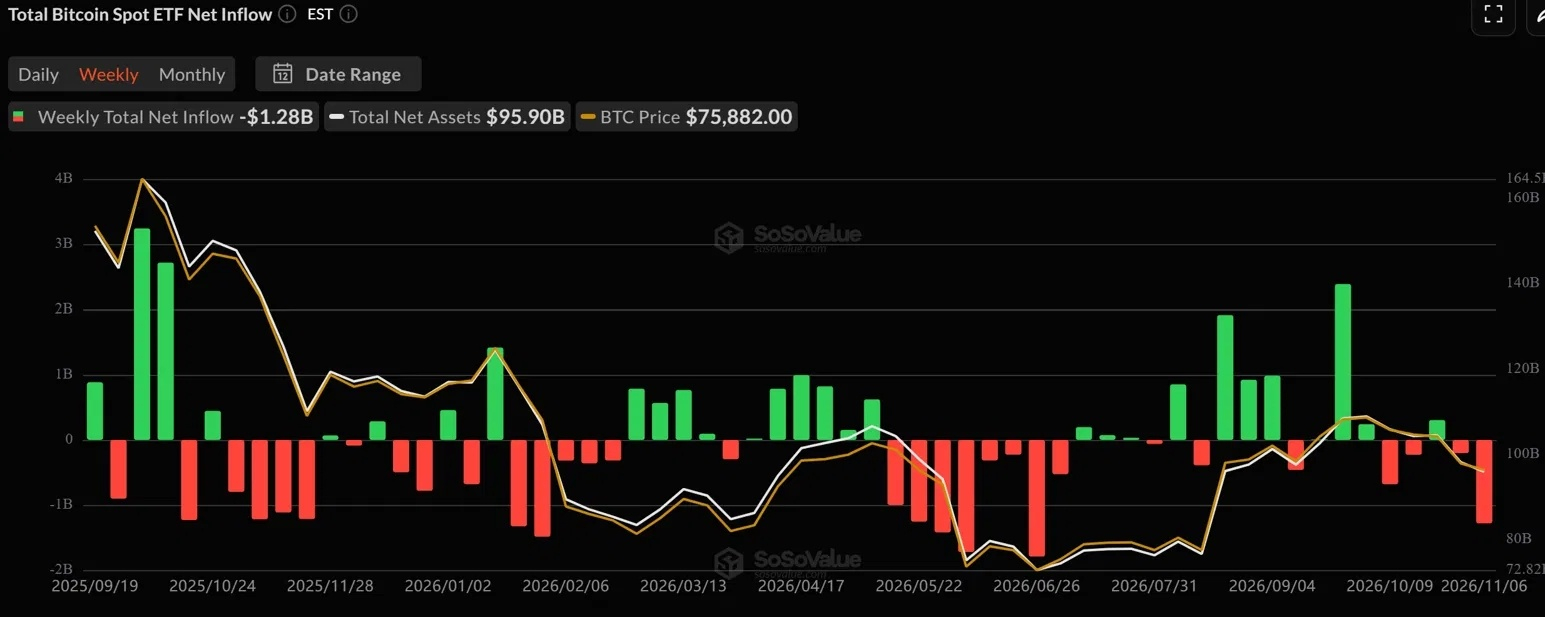
Institutional momentum is shifting as BlackRock IBIT recorded $201M in net outflows on Monday, bringing total withdrawals to $1.66B over 7 sessions.
#BitcoinETF #BlackRock
Institutional momentum is shifting as BlackRock IBIT recorded $201M in net outflows on Monday, bringing total withdrawals to $1.66B over 7 sessions.
#BitcoinETF #BlackRock
#BitcoinETF #BlackRock
IBITETF-3.90%
32

Article
The Ultimate Crypto Irony: BlackRock Now Holds $5B in BTC as "Kidnapping Fears" GrowBitcoin was literally built to eliminate the middleman. The original vision was simple: be your own bank, hold your own keys, and trust no one.
Yet, here we are in 2026, and a fascinating shift is happening. High-net-worth Bitcoin whales are voluntarily handing over more than $5 billion worth of their digital gold to BlackRock—the absolute titan of traditional Wall Street finance.
Why are die-hard crypto holders running back to a centralized custodian? The answer isn't just about convenience or tax efficiency. It’s about personal safety.
From Digital Security to Physical Safety
For years, the biggest threat to your crypto was a phishing link, a smart contract exploit, or losing your seed phrase. But as Bitcoin's value has skyrocketed, a much darker threat has emerged in the real world: physical targeted extortion and kidnapping.
When you are your own bank, you are also your own security detail. If bad actors find out you are sitting on tens of millions of dollars in self-custodied BTC, a simple USB drive in a home safe isn't going to protect you from a physical home invasion.
By wrapping their holdings into BlackRock’s Spot Bitcoin ETF, institutional players and ultra-wealthy individuals are effectively erasing the target on their backs. You can't force someone to transfer millions in crypto at gunpoint if their wealth is tied up in a regulated Wall Street fund with strict withdrawal windows and institutional clearance protocols.
The Paradox of Decentralization
This introduces a massive paradox for the crypto ecosystem:
The Pro: It proves institutional maturation. Wall Street infrastructure is protecting capital from real-world threats, making big capital feel safe enough to stay in the asset class.The Con: It centralizes supply. Handing billions to a multi-trillion-dollar asset manager concentrates voting and economic power right back into the hands of the legacy financial system Bitcoin was meant to replace.
Ultimately, this trend highlights a harsh truth about massive wealth. Freedom from banks sounds incredible in theory, but when absolute privacy becomes a safety liability, even the biggest whales will pay Wall Street to hold the keys.
What’s your take? Is using an ETF for personal safety a smart move, or is it a complete betrayal of the "Not Your Keys, Not Your Coins" ethos? Drop your thoughts below!
#Bitcoin #BTC走势分析 #BlackRock #CryptoSecurity #Write2Earn
The Ultimate Crypto Irony: BlackRock Now Holds $5B in BTC as "Kidnapping Fears" Grow
Bitcoin was literally built to eliminate the middleman. The original vision was simple: be your own bank, hold your own keys, and trust no one.
Yet, here we are in 2026, and a fascinating shift is happening. High-net-worth Bitcoin whales are voluntarily handing over more than $5 billion worth of their digital gold to BlackRock—the absolute titan of traditional Wall Street finance.
Why are die-hard crypto holders running back to a centralized custodian? The answer isn't just about convenience or tax efficiency. It’s about personal safety.
From Digital Security to Physical Safety
For years, the biggest threat to your crypto was a phishing link, a smart contract exploit, or losing your seed phrase. But as Bitcoin's value has skyrocketed, a much darker threat has emerged in the real world: physical targeted extortion and kidnapping.
When you are your own bank, you are also your own security detail. If bad actors find out you are sitting on tens of millions of dollars in self-custodied BTC, a simple USB drive in a home safe isn't going to protect you from a physical home invasion.
By wrapping their holdings into BlackRock’s Spot Bitcoin ETF, institutional players and ultra-wealthy individuals are effectively erasing the target on their backs. You can't force someone to transfer millions in crypto at gunpoint if their wealth is tied up in a regulated Wall Street fund with strict withdrawal windows and institutional clearance protocols.
The Paradox of Decentralization
This introduces a massive paradox for the crypto ecosystem:
The Pro: It proves institutional maturation. Wall Street infrastructure is protecting capital from real-world threats, making big capital feel safe enough to stay in the asset class.The Con: It centralizes supply. Handing billions to a multi-trillion-dollar asset manager concentrates voting and economic power right back into the hands of the legacy financial system Bitcoin was meant to replace.
Ultimately, this trend highlights a harsh truth about massive wealth. Freedom from banks sounds incredible in theory, but when absolute privacy becomes a safety liability, even the biggest whales will pay Wall Street to hold the keys.
What’s your take? Is using an ETF for personal safety a smart move, or is it a complete betrayal of the "Not Your Keys, Not Your Coins" ethos? Drop your thoughts below!
#Bitcoin #BTC走势分析 #BlackRock #CryptoSecurity #Write2Earn
232

·
--
BlackRock Bitcoin ETF Sees $2 Billion in Net Outflows Over Nine Days, Accelerating to Nearly $300 Million on Wednesday
From a fund-flow perspective, spot Bitcoin ETFs have been the primary channel for institutional capital to enter BTC, so their net inflows and outflows often reflect institutional sentiment before the price itself does. According to Cointelegraph, U.S. spot Bitcoin ETFs saw cumulative net outflows of nearly $2 billion over nine trading days, with outflows accelerating to nearly $300 million on Wednesday alone, compared with just $95 million the previous day.
The significance of this data lies not in the size of a single day’s figure, but in the shift in pace. Outflows of $95 million the previous day followed by nearly $300 million on Wednesday indicate that the momentum behind withdrawals increased markedly in just one day. Nine consecutive days of cumulative net outflows, combined with the acceleration in daily outflows, suggest that institutional buying support is weakening, rather than this being merely a short-term fluctuation. For BTC, the sustained withdrawal of spot ETFs, a major source of institutional buying, could create direct price pressure.
It is important to distinguish between weakening fund flows and a trend reversal. According to the same source, banks such as Barclays are still increasing their holdings in these ETFs, indicating that long-term allocation-oriented capital has not yet withdrawn. Short-term outflows and long-term holdings are therefore coexisting. This also explains why consecutive net outflows have not triggered a crash, but have instead mainly translated into downward pressure.
From the perspective of liquidity transmission, ETF net outflows mean that primary-market market makers need to reduce their spot BTC holdings to meet redemptions, indirectly tightening marginal buying demand in the spot market. When buying demand falls while selling pressure stays the same or rises, prices are more likely to move lower in search of support. The market may therefore be more inclined to interpret this as a signal of weakening fund flows rather than a technical pullback.
However, there are countervailing factors as well. Institutional holdings are still being increased by Barclays and others, indicating that allocation demand has not reversed. These outflows are also often concentrated in specific trading windows and may be driven by macro liquidity, the direction of the U.S. dollar, or short-term profit-taking rather than deteriorating fundamentals. If the macro environment improves or new capital flows back in, the momentum behind outflows may soon ease.
What to watch next: For those tracking $BTC , the key consideration from a trading perspective is whether the momentum behind outflows is confirmed to persist on a daily basis, rather than drawing conclusions from a single acceleration. If daily outflows continue to grow and spot trading volume weakens at the same time, the signal of weakening fund flows will be more reliable. Conversely, if outflows quickly subside, this is more likely to be a short-term fluctuation. The relationship between price levels and trading volume offers stronger confirmation than a single ETF figure.
$BTC #BitcoinETF #BlackRock #CryptoFlows
The above is a summary of information and personal analysis, and does not constitute investment advice.
Follow me for ongoing coverage of key market developments and data.

·
--
#BTCETF $IBIT #BlackRock比特币ETF Outflows reached as much as $2 billion over nine days! Yesterday, daily outflows surged to nearly $300 million, compared with just $95 million the day before. Five consecutive days of outflows have totaled $1.44 billion. At what market levels did this wave of large outflows occur? Is it profit-taking or major holders selling off? Worth watching closely!
#BitcoinETF $IBIT #BlackRock Bitcoin ETF outflows hit $2B over nine sessions! Daily outflows surged to nearly $300M yesterday, up from $95M the day before. Five consecutive days of withdrawals reached $1.44B. Is this profit-taking or large-scale selling? Market reaction coming soon!
#BitcoinETF $IBIT #BlackRock Bitcoin ETF outflows hit $2B over nine sessions! Daily outflows surged to nearly $300M yesterday, up from $95M the day before. Five consecutive days of withdrawals reached $1.44B. Is this profit-taking or large-scale selling? Market reaction coming soon!
IBITETF-3.90%
BLKUS+0.57%
3

🏦 BLACKROCK'S IBIT SEES HEAVY OUTFLOWS!
↳ Around $1.21B withdrawn
↳ Institutional sentiment weakens
↳ Investors turn cautious
#blackRock #bitcoin
🏦 BLACKROCK'S IBIT SEES HEAVY OUTFLOWS!
↳ Around $1.21B withdrawn
↳ Institutional sentiment weakens
↳ Investors turn cautious
#blackRock #bitcoin
↳ Around $1.21B withdrawn
↳ Institutional sentiment weakens
↳ Investors turn cautious
#blackRock #bitcoin
56

·
--
Article
🧞BlackRock withdraws $1.21 billion from Bitcoin ETF: what do major investors know?🧞BlackRock withdraws $1.21 billion from Bitcoin ETF: what do major investors know?
A warning sign has appeared in the cryptocurrency market. The world’s largest investment firm, BlackRock, has faced a major outflow from its Bitcoin fund, IBIT.
In the first week of November, investors withdrew approximately $1.21 billion from the fund. This accounted for most of the total outflow from U.S. spot Bitcoin ETFs, which amounted to about $1.28 billion.
🧞BlackRock withdraws $1.21 billion from Bitcoin ETF: what do major investors know?
🧞BlackRock withdraws $1.21 billion from Bitcoin ETF: what do major investors know?
A warning sign has appeared in the cryptocurrency market. The world’s largest investment firm, BlackRock, has faced a major outflow from its Bitcoin fund, IBIT.
In the first week of November, investors withdrew approximately $1.21 billion from the fund. This accounted for most of the total outflow from U.S. spot Bitcoin ETFs, which amounted to about $1.28 billion.
2
190
Log in to explore more content
Join global crypto users on Binance Square
⚡️ Get latest and useful information about crypto.
💬 Trusted by the world’s largest crypto exchange.
👍 Discover real insights from verified creators.
Email / Phone number
Trending Topics
1
#HuangExitNvidiaStrategyInFocus
9,394 views
355 Discussing
2
#AnthropicRejectsIPODelayValuationinQuestion
574,390 views
4,739 Discussing
3
#BitMineReports$6.3BNetLossForFiscal2026
2,161 views
74 Discussing
4
#ChipStocksExtendLossesAfterNvidiaCEOChange
2,984 views
159 Discussing
5
#ThailandProposes$148KDailyStablecoinDepositWithdrawalCaps
216 views
12 Discussing
6
#CoreWeaveJumps10%On168%RevenueGrowth
119,508 views
1,392 Discussing
7
#ZcashFallsBelow$1000ForFirstTimeSinceSeptember
63,152 views
249 Discussing
8
#MSCIRemovalMayCurbStrategy’sBitcoinBuying
25,564 views
410 Discussing
9
#TradFiForBeginners
498,661 views
3,453 Discussing
10
#USJoblessClaimsRise
19.1M views
7,602 Discussing