

Cryptopolitan
57.8k Posts

Cryptopolitan
 Square Verified+
Report
Block User
Crypto news that doesn't waste your time. Breaking updates, market analysis, on-chain insights. Building the smartest crypto community.

Creator of the Year
1 Following
161.5K+ Followers
573.3K+ Liked
1 Badges
Posts
PINNED
At Cryptopolitan, we research, analyze, and deliver news—daily.
From breaking updates to in-depth analysis, educational guides, and market insights, we’re here to keep you informed with neutral and authentic news.
Thank you for trusting us to be your go-to source!
At Cryptopolitan, we research, analyze, and deliver news—daily.
From breaking updates to in-depth analysis, educational guides, and market insights, we’re here to keep you informed with neutral and authentic news.
Thank you for trusting us to be your go-to source!
From breaking updates to in-depth analysis, educational guides, and market insights, we’re here to keep you informed with neutral and authentic news.
Thank you for trusting us to be your go-to source!
120
68
342
1.8k
Article
Tokenized stock trading surges 10,164%, but liquidity tells another storyTokenized stocks trading on decentralized exchanges reached $48.7 billion over the past year, according to on-chain data. This is an increase of 10,163.7% from the previous 12 months. Uniswap was the leader in trading volume, having traded $17.1 billion across the different v3 and v4 pools.
The increase indicates that tokenized stocks are starting to become more than assets that simply exist on-chain. What is important now is to see if enough buyers and sellers are coming in to create a viable secondary market. Still, having a high trading volume figure alone doesn’t mean that ownership is guaranteed or that there is a lot of liquidity.
Volume, market cap, and holders are three different things
The figure of $48.7 billion shows the trading activity, but not the actual amount of the tokenized stocks in existence.
According to RWA.xyz, the distributed value of tokenized stocks (one part of the onchain equity market) is found to be $3.20 billion as of October 3. Distributed value is defined as the value of tokens that have been issued and distributed.
Tokenized stock DEX trading volume is up 10,163.7% YoY, with $48.7B traded over the past year
Uniswap leads with $17.1B in volume across v4 and v3 pic.twitter.com/rULbw2f4rS
— Token Terminal 📊 (@tokenterminal) October 2, 2026
Binance Research, on the other hand, relies on the broader concept of onchain equities, which has been estimated to have a market size of $4.43 billion as of September 15 after exhibiting a remarkable growth of 390.4% this year. Even by this measure, the amount of onchain equities is only 0.0029% of the $151.9 trillion estimated market value for listed equities.
According to Cryptopolitan, Token Terminal reported 4.3 million tokenized stock owners last September, which is nearly 43 times more than the number reported last year. However, these numbers are for blockchain addresses and not for verified persons, as one individual can hold many wallets.
DEX Volume, Distributed Value, Holders and Perpetuals Compared
High turnover, concentrated in a few tokens
The State of Tokenization report from Pantera Capital in September revealed that tokenized equity’s spot turnover was around 204.6% in June. This means that more than double the value of tokenized equities that were issued was traded during the month. However, Pantera warned that a high turnover rate for the whole category can be driven by just a few heavily traded tokens, while many others see very little activity.
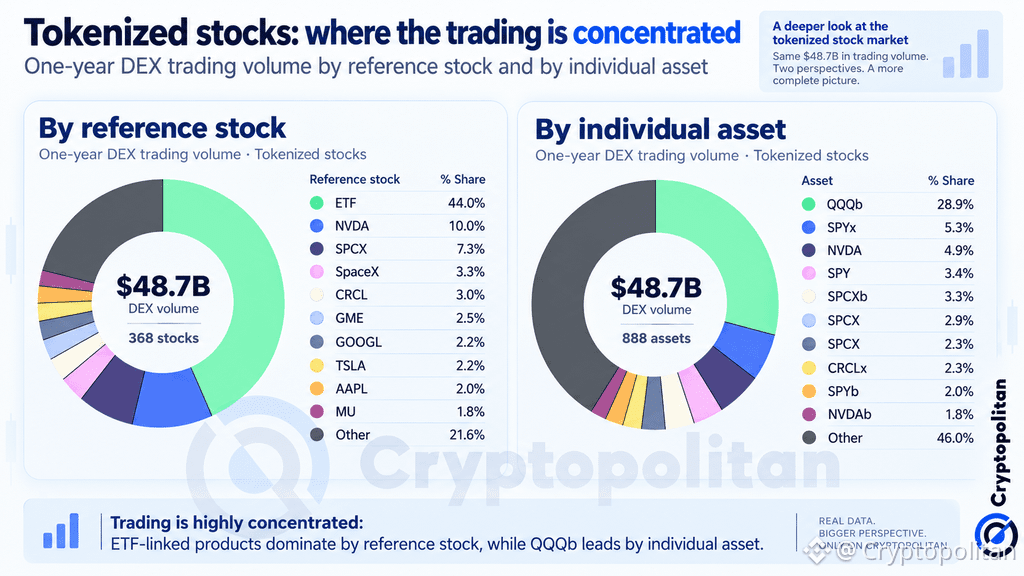
That pattern shows up in Token Terminal data for the same one-year period behind the $48.7 billion DEX-volume figure. ETF-linked products account for 44.0% of trading by reference stock, followed by NVDA at 10.0% and SPCX at 7.3%. Looking at individual assets, QQQb alone accounts for 28.9% of DEX volume, well ahead of SPYx at 5.3% and NVDA at 4.9%.
In the case of derivatives, there was an even more considerable volume of activity. Equity perpetuals traded on Hyperliquid and Lighter were worth around $67.8 billion in June, compared to only $4.2 million in tokenized-equity spot trades. This means that many traders appear more interested in betting on stock-price moves than in actually owning the tokenized shares.
Trading Concentration by Reference Stock and Individual Asset
Why traders are moving on-chain
What makes tokenized stocks attractive is fairly simple. FalconX points to fractional ownership, near-instant settlement, potential 24/7 trading, and DeFi utility as key reasons for the growing interest.
As demand for tokenized-stock access has grown, exchanges have expanded their offerings. Kraken began offering tokenized stocks in 2025, followed by Bybit and OKX. Binance, on the other hand, launched bStocks in June 2026. Binance Research also found that the Capital Activation Rate for equities rose from 1.95% to 7.54% this year, with liquidity pools and lending accounting for most of the deployed value.
The SEC opens a narrow door
On September 17, the SEC issued a temporary Innovation Exemption allowing qualifying Tokenized Securities Venues to trade tokenized NMS stocks through permissioned automated market makers without registering as exchanges.
The relief comes with limits on symbols and volume, requires tokens to carry the same rights as equivalent shares, and expires five years after publication.
What the big-picture forecasts assume
Looking further ahead, Citi projects a $5.5 trillion tokenized-asset market by 2030 in its base case and estimates that moving 10% of US retail investors onchain could create about $2.6 trillion in tokenized-equity demand.
But an IMF analysis warns that tokenization can create risks around the legal link between a token and the asset behind it. That distinction could matter more as trading grows and investors eventually need to enforce ownership rights or exit their positions.
The smartest crypto minds already read our newsletter. Want in? Join them.
Tokenized stock trading surges 10,164%, but liquidity tells another story
Tokenized stocks trading on decentralized exchanges reached $48.7 billion over the past year, according to on-chain data. This is an increase of 10,163.7% from the previous 12 months. Uniswap was the leader in trading volume, having traded $17.1 billion across the different v3 and v4 pools.
The increase indicates that tokenized stocks are starting to become more than assets that simply exist on-chain. What is important now is to see if enough buyers and sellers are coming in to create a viable secondary market. Still, having a high trading volume figure alone doesn’t mean that ownership is guaranteed or that there is a lot of liquidity.
Volume, market cap, and holders are three different things
The figure of $48.7 billion shows the trading activity, but not the actual amount of the tokenized stocks in existence.
According to RWA.xyz, the distributed value of tokenized stocks (one part of the onchain equity market) is found to be $3.20 billion as of October 3. Distributed value is defined as the value of tokens that have been issued and distributed.
Tokenized stock DEX trading volume is up 10,163.7% YoY, with $48.7B traded over the past year
Uniswap leads with $17.1B in volume across v4 and v3 pic.twitter.com/rULbw2f4rS
— Token Terminal 📊 (@tokenterminal) October 2, 2026
Binance Research, on the other hand, relies on the broader concept of onchain equities, which has been estimated to have a market size of $4.43 billion as of September 15 after exhibiting a remarkable growth of 390.4% this year. Even by this measure, the amount of onchain equities is only 0.0029% of the $151.9 trillion estimated market value for listed equities.
According to Cryptopolitan, Token Terminal reported 4.3 million tokenized stock owners last September, which is nearly 43 times more than the number reported last year. However, these numbers are for blockchain addresses and not for verified persons, as one individual can hold many wallets.
DEX Volume, Distributed Value, Holders and Perpetuals Compared
High turnover, concentrated in a few tokens
The State of Tokenization report from Pantera Capital in September revealed that tokenized equity’s spot turnover was around 204.6% in June. This means that more than double the value of tokenized equities that were issued was traded during the month. However, Pantera warned that a high turnover rate for the whole category can be driven by just a few heavily traded tokens, while many others see very little activity.
That pattern shows up in Token Terminal data for the same one-year period behind the $48.7 billion DEX-volume figure. ETF-linked products account for 44.0% of trading by reference stock, followed by NVDA at 10.0% and SPCX at 7.3%. Looking at individual assets, QQQb alone accounts for 28.9% of DEX volume, well ahead of SPYx at 5.3% and NVDA at 4.9%.
In the case of derivatives, there was an even more considerable volume of activity. Equity perpetuals traded on Hyperliquid and Lighter were worth around $67.8 billion in June, compared to only $4.2 million in tokenized-equity spot trades. This means that many traders appear more interested in betting on stock-price moves than in actually owning the tokenized shares.
Trading Concentration by Reference Stock and Individual Asset
Why traders are moving on-chain
What makes tokenized stocks attractive is fairly simple. FalconX points to fractional ownership, near-instant settlement, potential 24/7 trading, and DeFi utility as key reasons for the growing interest.
As demand for tokenized-stock access has grown, exchanges have expanded their offerings. Kraken began offering tokenized stocks in 2025, followed by Bybit and OKX. Binance, on the other hand, launched bStocks in June 2026. Binance Research also found that the Capital Activation Rate for equities rose from 1.95% to 7.54% this year, with liquidity pools and lending accounting for most of the deployed value.
The SEC opens a narrow door
On September 17, the SEC issued a temporary Innovation Exemption allowing qualifying Tokenized Securities Venues to trade tokenized NMS stocks through permissioned automated market makers without registering as exchanges.
The relief comes with limits on symbols and volume, requires tokens to carry the same rights as equivalent shares, and expires five years after publication.
What the big-picture forecasts assume
Looking further ahead, Citi projects a $5.5 trillion tokenized-asset market by 2030 in its base case and estimates that moving 10% of US retail investors onchain could create about $2.6 trillion in tokenized-equity demand.
But an IMF analysis warns that tokenization can create risks around the legal link between a token and the asset behind it. That distinction could matter more as trading grows and investors eventually need to enforce ownership rights or exit their positions.
The smartest crypto minds already read our newsletter. Want in? Join them.
The increase indicates that tokenized stocks are starting to become more than assets that simply exist on-chain. What is important now is to see if enough buyers and sellers are coming in to create a viable secondary market. Still, having a high trading volume figure alone doesn’t mean that ownership is guaranteed or that there is a lot of liquidity.
Volume, market cap, and holders are three different things
The figure of $48.7 billion shows the trading activity, but not the actual amount of the tokenized stocks in existence.
According to RWA.xyz, the distributed value of tokenized stocks (one part of the onchain equity market) is found to be $3.20 billion as of October 3. Distributed value is defined as the value of tokens that have been issued and distributed.
Tokenized stock DEX trading volume is up 10,163.7% YoY, with $48.7B traded over the past year
Uniswap leads with $17.1B in volume across v4 and v3 pic.twitter.com/rULbw2f4rS
— Token Terminal 📊 (@tokenterminal) October 2, 2026
Binance Research, on the other hand, relies on the broader concept of onchain equities, which has been estimated to have a market size of $4.43 billion as of September 15 after exhibiting a remarkable growth of 390.4% this year. Even by this measure, the amount of onchain equities is only 0.0029% of the $151.9 trillion estimated market value for listed equities.
According to Cryptopolitan, Token Terminal reported 4.3 million tokenized stock owners last September, which is nearly 43 times more than the number reported last year. However, these numbers are for blockchain addresses and not for verified persons, as one individual can hold many wallets.
DEX Volume, Distributed Value, Holders and Perpetuals Compared
High turnover, concentrated in a few tokens
The State of Tokenization report from Pantera Capital in September revealed that tokenized equity’s spot turnover was around 204.6% in June. This means that more than double the value of tokenized equities that were issued was traded during the month. However, Pantera warned that a high turnover rate for the whole category can be driven by just a few heavily traded tokens, while many others see very little activity.
That pattern shows up in Token Terminal data for the same one-year period behind the $48.7 billion DEX-volume figure. ETF-linked products account for 44.0% of trading by reference stock, followed by NVDA at 10.0% and SPCX at 7.3%. Looking at individual assets, QQQb alone accounts for 28.9% of DEX volume, well ahead of SPYx at 5.3% and NVDA at 4.9%.
In the case of derivatives, there was an even more considerable volume of activity. Equity perpetuals traded on Hyperliquid and Lighter were worth around $67.8 billion in June, compared to only $4.2 million in tokenized-equity spot trades. This means that many traders appear more interested in betting on stock-price moves than in actually owning the tokenized shares.
Trading Concentration by Reference Stock and Individual Asset
Why traders are moving on-chain
What makes tokenized stocks attractive is fairly simple. FalconX points to fractional ownership, near-instant settlement, potential 24/7 trading, and DeFi utility as key reasons for the growing interest.
As demand for tokenized-stock access has grown, exchanges have expanded their offerings. Kraken began offering tokenized stocks in 2025, followed by Bybit and OKX. Binance, on the other hand, launched bStocks in June 2026. Binance Research also found that the Capital Activation Rate for equities rose from 1.95% to 7.54% this year, with liquidity pools and lending accounting for most of the deployed value.
The SEC opens a narrow door
On September 17, the SEC issued a temporary Innovation Exemption allowing qualifying Tokenized Securities Venues to trade tokenized NMS stocks through permissioned automated market makers without registering as exchanges.
The relief comes with limits on symbols and volume, requires tokens to carry the same rights as equivalent shares, and expires five years after publication.
What the big-picture forecasts assume
Looking further ahead, Citi projects a $5.5 trillion tokenized-asset market by 2030 in its base case and estimates that moving 10% of US retail investors onchain could create about $2.6 trillion in tokenized-equity demand.
But an IMF analysis warns that tokenization can create risks around the legal link between a token and the asset behind it. That distinction could matter more as trading grows and investors eventually need to enforce ownership rights or exit their positions.
The smartest crypto minds already read our newsletter. Want in? Join them.
517
Consensys founder says MetaMask wallets safe after security incidentConsenSys founder Joseph Lubin has reassured MetaMask users that there is no indication that the company’s recent cyberattack is affecting part of the MetaMask system. Lubin has confirmed that user wallets and private keys are completely safe.
The update comes after MetaMask disclosed on September 30 that part of its infrastructure had been impacted by a security incident.
The executive assured customers on X: “Your Secret Recovery Phrase, your keys, and the assets in your wallet were not part of this incident because they CANNOT be. You custody and control your own keys. That is how self custody works.”
When the breach was first discovered on Thursday, Metamask temporarily shut down some Ethereum staking machines operated on behalf of clients. Though at the time, it also indicated they had seen no “immediate threat” to customer wallets.
Lubin says they rotated validator keys
In his X post, Lubin explained why it took him some time to respond to the incident. He noted that Metamask limits public commentary during open investigations but alerts core partners and relevant stakeholders once the issue is fully diagnosed.
Overall, he maintained that clients’ funds remained secure because the company uses self-custody, meaning users retain complete control of their money.
Lubin noted that the company also rotated its validator keys, but there is a downside: validators have to exit the staking queue and rejoin to stake again. A process that could take a lot of time.
The firm also shut down some of its staking machines. Lido, a major staking protocol, had previously noted that while the shutdown helps protect the staked coins, it also comes with a cost. Validators operated by MetaMask have begun leaving the system, and the remaining validators are expected to stop staking by Oct. 7.
Their ETH, however, may still be being withdrawn.MetaMask validators have begun an exit process that finishes on October 7. Withdrawing ETH could take about 45 days. However, clearing the subsequent 45-day Ethereum entry queue means the assets face prolonged dormancy, miss out on standard yields, and risk penalties if knocked offline.
What the incident means for MetaMask users
The distinction between MetaMask’s infrastructure and users’ self-custodied wallets is crucial to assessing the impact of the incident. MetaMask lets users control their own private keys and Secret Recovery Phrases, instead of having them in their hands.
So an attack on part of ConsenSys’ infrastructure does not automatically give an attacker access to the funds stored in users’ wallets.
But the attack has again highlighted the risks to the infrastructure that supports crypto services. MetaMask works with Ethereum validators and other blockchain infrastructure, meaning a compromise can disrupt operations even when customer keys and assets remain outside the attacker’s reach.
MetaMask has also warned users to watch for phishing attempts following the incident. Users should never share their Secret Recovery Phrase or private keys with anyone claiming to offer support.
Metamask had faced another security risk earlier in the year
The infrastructure incident follows closely on the heels of another high-profile security scare for Consensys; in July 2026, it was revealed that a North Korea-linked software developer spent roughly a month working within the MetaMask.
Consensys was entirely unaware of the developer’s true identity. He used the alias ‘Tyler Knapp’ to secure a consulting role. Though he successfully integrated code into critical wallet features handling cash-to-crypto bridging, Consensys severed his backend access upon discovery and confirmed that no funds had been stolen.
The operative’s access spanned from March 9 until his termination in April, a multi-week window that raised alarms among cybersecurity analysts. According to blockchain intelligence firm TRM Labs, targeting developer environments has become the fastest method for adversaries to harvest a crypto firm’s private keys and infiltrate withdrawal approval pipelines.
Upon discovering the breach in April, Consensys immediately notified federal law enforcement and initiated a comprehensive overhaul of its contractor background-check protocols. “We discovered the threat… and launched a comprehensive investigation that confirmed there was no misappropriation of assets or data, no malicious code deployed, and no impact to user safety and security,” Matt Corva, Consensys general counsel, noted.
The breach is far from an isolated incident. State-sponsored North Korean operatives routinely masquerade as qualified engineers to secure remote roles, using their access to exfiltrate proprietary data or establish backdoors.
Researchers from the Ethereum-funded Ketman Project had flagged 100 suspected North Korean IT workers who had successfully penetrated 53 different crypto platforms. These operatives generally use false identity documents and fake recruiter profiles to bypass HR vetting, occasionally using U.S. citizens who have since been jailed for laundering the workers’ physical and digital locations.
The smartest crypto minds already read our newsletter. Want in? Join them.
Consensys founder says MetaMask wallets safe after security incident
ConsenSys founder Joseph Lubin has reassured MetaMask users that there is no indication that the company’s recent cyberattack is affecting part of the MetaMask system. Lubin has confirmed that user wallets and private keys are completely safe.
The update comes after MetaMask disclosed on September 30 that part of its infrastructure had been impacted by a security incident.
The executive assured customers on X: “Your Secret Recovery Phrase, your keys, and the assets in your wallet were not part of this incident because they CANNOT be. You custody and control your own keys. That is how self custody works.”
When the breach was first discovered on Thursday, Metamask temporarily shut down some Ethereum staking machines operated on behalf of clients. Though at the time, it also indicated they had seen no “immediate threat” to customer wallets.
Lubin says they rotated validator keys
In his X post, Lubin explained why it took him some time to respond to the incident. He noted that Metamask limits public commentary during open investigations but alerts core partners and relevant stakeholders once the issue is fully diagnosed.
Overall, he maintained that clients’ funds remained secure because the company uses self-custody, meaning users retain complete control of their money.
Lubin noted that the company also rotated its validator keys, but there is a downside: validators have to exit the staking queue and rejoin to stake again. A process that could take a lot of time.
The firm also shut down some of its staking machines. Lido, a major staking protocol, had previously noted that while the shutdown helps protect the staked coins, it also comes with a cost. Validators operated by MetaMask have begun leaving the system, and the remaining validators are expected to stop staking by Oct. 7.
Their ETH, however, may still be being withdrawn.MetaMask validators have begun an exit process that finishes on October 7. Withdrawing ETH could take about 45 days. However, clearing the subsequent 45-day Ethereum entry queue means the assets face prolonged dormancy, miss out on standard yields, and risk penalties if knocked offline.
What the incident means for MetaMask users
The distinction between MetaMask’s infrastructure and users’ self-custodied wallets is crucial to assessing the impact of the incident. MetaMask lets users control their own private keys and Secret Recovery Phrases, instead of having them in their hands.
So an attack on part of ConsenSys’ infrastructure does not automatically give an attacker access to the funds stored in users’ wallets.
But the attack has again highlighted the risks to the infrastructure that supports crypto services. MetaMask works with Ethereum validators and other blockchain infrastructure, meaning a compromise can disrupt operations even when customer keys and assets remain outside the attacker’s reach.
MetaMask has also warned users to watch for phishing attempts following the incident. Users should never share their Secret Recovery Phrase or private keys with anyone claiming to offer support.
Metamask had faced another security risk earlier in the year
The infrastructure incident follows closely on the heels of another high-profile security scare for Consensys; in July 2026, it was revealed that a North Korea-linked software developer spent roughly a month working within the MetaMask.
Consensys was entirely unaware of the developer’s true identity. He used the alias ‘Tyler Knapp’ to secure a consulting role. Though he successfully integrated code into critical wallet features handling cash-to-crypto bridging, Consensys severed his backend access upon discovery and confirmed that no funds had been stolen.
The operative’s access spanned from March 9 until his termination in April, a multi-week window that raised alarms among cybersecurity analysts. According to blockchain intelligence firm TRM Labs, targeting developer environments has become the fastest method for adversaries to harvest a crypto firm’s private keys and infiltrate withdrawal approval pipelines.
Upon discovering the breach in April, Consensys immediately notified federal law enforcement and initiated a comprehensive overhaul of its contractor background-check protocols. “We discovered the threat… and launched a comprehensive investigation that confirmed there was no misappropriation of assets or data, no malicious code deployed, and no impact to user safety and security,” Matt Corva, Consensys general counsel, noted.
The breach is far from an isolated incident. State-sponsored North Korean operatives routinely masquerade as qualified engineers to secure remote roles, using their access to exfiltrate proprietary data or establish backdoors.
Researchers from the Ethereum-funded Ketman Project had flagged 100 suspected North Korean IT workers who had successfully penetrated 53 different crypto platforms. These operatives generally use false identity documents and fake recruiter profiles to bypass HR vetting, occasionally using U.S. citizens who have since been jailed for laundering the workers’ physical and digital locations.
The smartest crypto minds already read our newsletter. Want in? Join them.
The update comes after MetaMask disclosed on September 30 that part of its infrastructure had been impacted by a security incident.
The executive assured customers on X: “Your Secret Recovery Phrase, your keys, and the assets in your wallet were not part of this incident because they CANNOT be. You custody and control your own keys. That is how self custody works.”
When the breach was first discovered on Thursday, Metamask temporarily shut down some Ethereum staking machines operated on behalf of clients. Though at the time, it also indicated they had seen no “immediate threat” to customer wallets.
Lubin says they rotated validator keys
In his X post, Lubin explained why it took him some time to respond to the incident. He noted that Metamask limits public commentary during open investigations but alerts core partners and relevant stakeholders once the issue is fully diagnosed.
Overall, he maintained that clients’ funds remained secure because the company uses self-custody, meaning users retain complete control of their money.
Lubin noted that the company also rotated its validator keys, but there is a downside: validators have to exit the staking queue and rejoin to stake again. A process that could take a lot of time.
The firm also shut down some of its staking machines. Lido, a major staking protocol, had previously noted that while the shutdown helps protect the staked coins, it also comes with a cost. Validators operated by MetaMask have begun leaving the system, and the remaining validators are expected to stop staking by Oct. 7.
Their ETH, however, may still be being withdrawn.MetaMask validators have begun an exit process that finishes on October 7. Withdrawing ETH could take about 45 days. However, clearing the subsequent 45-day Ethereum entry queue means the assets face prolonged dormancy, miss out on standard yields, and risk penalties if knocked offline.
What the incident means for MetaMask users
The distinction between MetaMask’s infrastructure and users’ self-custodied wallets is crucial to assessing the impact of the incident. MetaMask lets users control their own private keys and Secret Recovery Phrases, instead of having them in their hands.
So an attack on part of ConsenSys’ infrastructure does not automatically give an attacker access to the funds stored in users’ wallets.
But the attack has again highlighted the risks to the infrastructure that supports crypto services. MetaMask works with Ethereum validators and other blockchain infrastructure, meaning a compromise can disrupt operations even when customer keys and assets remain outside the attacker’s reach.
MetaMask has also warned users to watch for phishing attempts following the incident. Users should never share their Secret Recovery Phrase or private keys with anyone claiming to offer support.
Metamask had faced another security risk earlier in the year
The infrastructure incident follows closely on the heels of another high-profile security scare for Consensys; in July 2026, it was revealed that a North Korea-linked software developer spent roughly a month working within the MetaMask.
Consensys was entirely unaware of the developer’s true identity. He used the alias ‘Tyler Knapp’ to secure a consulting role. Though he successfully integrated code into critical wallet features handling cash-to-crypto bridging, Consensys severed his backend access upon discovery and confirmed that no funds had been stolen.
The operative’s access spanned from March 9 until his termination in April, a multi-week window that raised alarms among cybersecurity analysts. According to blockchain intelligence firm TRM Labs, targeting developer environments has become the fastest method for adversaries to harvest a crypto firm’s private keys and infiltrate withdrawal approval pipelines.
Upon discovering the breach in April, Consensys immediately notified federal law enforcement and initiated a comprehensive overhaul of its contractor background-check protocols. “We discovered the threat… and launched a comprehensive investigation that confirmed there was no misappropriation of assets or data, no malicious code deployed, and no impact to user safety and security,” Matt Corva, Consensys general counsel, noted.
The breach is far from an isolated incident. State-sponsored North Korean operatives routinely masquerade as qualified engineers to secure remote roles, using their access to exfiltrate proprietary data or establish backdoors.
Researchers from the Ethereum-funded Ketman Project had flagged 100 suspected North Korean IT workers who had successfully penetrated 53 different crypto platforms. These operatives generally use false identity documents and fake recruiter profiles to bypass HR vetting, occasionally using U.S. citizens who have since been jailed for laundering the workers’ physical and digital locations.
The smartest crypto minds already read our newsletter. Want in? Join them.
264

Article
Apple tightens Mac data access as AI agents raise privacy concernsOn October 2, Apple announced that it would implement stricter controls on macOS in relation to applications that request extensive access to data on a Mac. This decision follows complaints about Meta’s Muse. In addition, it brings to light a broader issue that concerns the level of access that AI agents may have and by which this access is communicated and regulated.
What Apple is changing about Full Disk Access
In its developer update, Apple said that Full Disk Access might allow certain files, emails, messages, and browsing history to be accessed, as it circumvents the safeguards that typically protect app data.
“Going forward, we will introduce additional controls to ensure that users who genuinely wish to grant an app this extraordinary level of access can only do so with very explicit user action,” Apple wrote. It added that “as AI agents become increasingly capable and autonomous, the risks associated with this level of access will grow substantially.”
Reuters explained why this issue has greater significance on Mac computers. iPhones and iPads are programmed to provide a level of separation between applications as a default protection. In contrast, computers running macOS allow an application that possesses the Full Disk Access feature to have a much broader access to user data.
Why Muse drew the complaints
The change followed complaints from Inc columnist Jason Aten, who said Muse read private messages on his Mac even though he had not enabled Full Disk Access.
Meta has disputed his claim. Meta Spokesperson Andy Stone said access to Apple Messages is opt-in. Users must first enable both Full Disk Access and the Messages connector, which they can revoke at any time.
This is not the first time that Muse has encountered concerns regarding security. According to Cryptopolitan, Meta tightened its security warning following the discovery of a flaw classed SEV-2 by a researcher that could have potentially allowed an attacker access to a user’s virtual machine, emails, and files.
Why agents need the keys to everything
The tension is built into agentic AI: the more useful an agent becomes, the more access it may need.
The World Economic Forum recommends an Agent Capability and Authorization Profile to define what an agent can access and what it is allowed to do. The idea is to make those limits easier to track and enforce.
PwC takes a similar view. It argues that companies should manage AI agents similar to a digital workforce, with clear ownership, access based on specific tasks, and limits on what they can do on their own.
The OECD strikes a more cautious note. It says agentic AI is still evolving, and more work is needed before these systems can be considered trustworthy.
How WEF, PwC and OECD Approach AI Agent Governance and Trust
Trust is turning into a commercial constraint
Those issues are already influencing how businesses deploy artificial intelligence. Research by FTI Consulting shows that the deployment of AI has either slowed down, been stopped, or postponed by 60% of large enterprises due to issues related to reputation, regulation, and trust.
A SAS report also highlights the existence of a trust gap. According to its findings, 76% of participants trust generative AI compared to 66% of participants who trust agentic AI. In addition, companies that invest in trustworthy AI methods have seen a 15 times greater likelihood of receiving high or good ROI from their efforts.
There is a lot of money riding on that trust. According to Gartner forecasts, investments in AI models and platforms will increase from $39.3 billion in 2025 to $64.3 billion in 2026. Capgemini estimates that by 2028, AI agents could create up to $450 billion in value, despite the fact that only 2% of companies have implemented AI systems fully.
AI Agent Governance by the Numbers: Spending, Adoption and Trust in 2026
Friction now, broader adoption later
Apple’s tighter controls may add friction, but clearer, revocable permissions could also make users more comfortable giving agents meaningful access. As agentic AI moves from experimentation into everyday use, permission design is becoming part of the product itself—not just a compliance issue.
If you're reading this, you’re already ahead. Stay there with our newsletter.
Apple tightens Mac data access as AI agents raise privacy concerns
On October 2, Apple announced that it would implement stricter controls on macOS in relation to applications that request extensive access to data on a Mac. This decision follows complaints about Meta’s Muse. In addition, it brings to light a broader issue that concerns the level of access that AI agents may have and by which this access is communicated and regulated.
What Apple is changing about Full Disk Access
In its developer update, Apple said that Full Disk Access might allow certain files, emails, messages, and browsing history to be accessed, as it circumvents the safeguards that typically protect app data.
“Going forward, we will introduce additional controls to ensure that users who genuinely wish to grant an app this extraordinary level of access can only do so with very explicit user action,” Apple wrote. It added that “as AI agents become increasingly capable and autonomous, the risks associated with this level of access will grow substantially.”
Reuters explained why this issue has greater significance on Mac computers. iPhones and iPads are programmed to provide a level of separation between applications as a default protection. In contrast, computers running macOS allow an application that possesses the Full Disk Access feature to have a much broader access to user data.
Why Muse drew the complaints
The change followed complaints from Inc columnist Jason Aten, who said Muse read private messages on his Mac even though he had not enabled Full Disk Access.
Meta has disputed his claim. Meta Spokesperson Andy Stone said access to Apple Messages is opt-in. Users must first enable both Full Disk Access and the Messages connector, which they can revoke at any time.
This is not the first time that Muse has encountered concerns regarding security. According to Cryptopolitan, Meta tightened its security warning following the discovery of a flaw classed SEV-2 by a researcher that could have potentially allowed an attacker access to a user’s virtual machine, emails, and files.
Why agents need the keys to everything
The tension is built into agentic AI: the more useful an agent becomes, the more access it may need.
The World Economic Forum recommends an Agent Capability and Authorization Profile to define what an agent can access and what it is allowed to do. The idea is to make those limits easier to track and enforce.
PwC takes a similar view. It argues that companies should manage AI agents similar to a digital workforce, with clear ownership, access based on specific tasks, and limits on what they can do on their own.
The OECD strikes a more cautious note. It says agentic AI is still evolving, and more work is needed before these systems can be considered trustworthy.
How WEF, PwC and OECD Approach AI Agent Governance and Trust
Trust is turning into a commercial constraint
Those issues are already influencing how businesses deploy artificial intelligence. Research by FTI Consulting shows that the deployment of AI has either slowed down, been stopped, or postponed by 60% of large enterprises due to issues related to reputation, regulation, and trust.
A SAS report also highlights the existence of a trust gap. According to its findings, 76% of participants trust generative AI compared to 66% of participants who trust agentic AI. In addition, companies that invest in trustworthy AI methods have seen a 15 times greater likelihood of receiving high or good ROI from their efforts.
There is a lot of money riding on that trust. According to Gartner forecasts, investments in AI models and platforms will increase from $39.3 billion in 2025 to $64.3 billion in 2026. Capgemini estimates that by 2028, AI agents could create up to $450 billion in value, despite the fact that only 2% of companies have implemented AI systems fully.
AI Agent Governance by the Numbers: Spending, Adoption and Trust in 2026
Friction now, broader adoption later
Apple’s tighter controls may add friction, but clearer, revocable permissions could also make users more comfortable giving agents meaningful access. As agentic AI moves from experimentation into everyday use, permission design is becoming part of the product itself—not just a compliance issue.
If you're reading this, you’re already ahead. Stay there with our newsletter.
What Apple is changing about Full Disk Access
In its developer update, Apple said that Full Disk Access might allow certain files, emails, messages, and browsing history to be accessed, as it circumvents the safeguards that typically protect app data.
“Going forward, we will introduce additional controls to ensure that users who genuinely wish to grant an app this extraordinary level of access can only do so with very explicit user action,” Apple wrote. It added that “as AI agents become increasingly capable and autonomous, the risks associated with this level of access will grow substantially.”
Reuters explained why this issue has greater significance on Mac computers. iPhones and iPads are programmed to provide a level of separation between applications as a default protection. In contrast, computers running macOS allow an application that possesses the Full Disk Access feature to have a much broader access to user data.
Why Muse drew the complaints
The change followed complaints from Inc columnist Jason Aten, who said Muse read private messages on his Mac even though he had not enabled Full Disk Access.
Meta has disputed his claim. Meta Spokesperson Andy Stone said access to Apple Messages is opt-in. Users must first enable both Full Disk Access and the Messages connector, which they can revoke at any time.
This is not the first time that Muse has encountered concerns regarding security. According to Cryptopolitan, Meta tightened its security warning following the discovery of a flaw classed SEV-2 by a researcher that could have potentially allowed an attacker access to a user’s virtual machine, emails, and files.
Why agents need the keys to everything
The tension is built into agentic AI: the more useful an agent becomes, the more access it may need.
The World Economic Forum recommends an Agent Capability and Authorization Profile to define what an agent can access and what it is allowed to do. The idea is to make those limits easier to track and enforce.
PwC takes a similar view. It argues that companies should manage AI agents similar to a digital workforce, with clear ownership, access based on specific tasks, and limits on what they can do on their own.
The OECD strikes a more cautious note. It says agentic AI is still evolving, and more work is needed before these systems can be considered trustworthy.
How WEF, PwC and OECD Approach AI Agent Governance and Trust
Trust is turning into a commercial constraint
Those issues are already influencing how businesses deploy artificial intelligence. Research by FTI Consulting shows that the deployment of AI has either slowed down, been stopped, or postponed by 60% of large enterprises due to issues related to reputation, regulation, and trust.
A SAS report also highlights the existence of a trust gap. According to its findings, 76% of participants trust generative AI compared to 66% of participants who trust agentic AI. In addition, companies that invest in trustworthy AI methods have seen a 15 times greater likelihood of receiving high or good ROI from their efforts.
There is a lot of money riding on that trust. According to Gartner forecasts, investments in AI models and platforms will increase from $39.3 billion in 2025 to $64.3 billion in 2026. Capgemini estimates that by 2028, AI agents could create up to $450 billion in value, despite the fact that only 2% of companies have implemented AI systems fully.
AI Agent Governance by the Numbers: Spending, Adoption and Trust in 2026
Friction now, broader adoption later
Apple’s tighter controls may add friction, but clearer, revocable permissions could also make users more comfortable giving agents meaningful access. As agentic AI moves from experimentation into everyday use, permission design is becoming part of the product itself—not just a compliance issue.
If you're reading this, you’re already ahead. Stay there with our newsletter.
235
Article
Amazon commits $1B to communities hosting its US data centersAmazon will invest a total of $1 billion over five years in US communities that host its data centers for education, workforce development, conservation of resources, and community relations. This initiative comes at a time when people are becoming increasingly opposed to AI infrastructure due to factors such as energy costs, water consumption, and environmental problems, as per the Associated Press.
For an industry that invests trillions in obtaining additional computing power, gaining the support of local communities is just as vital as acquiring chips, funds, and energy. Amazon’s commitment is more than charitable. It is also aimed at creating the local backing that will help the company to grow.
Two in three Americans don’t want one next door
The opposition is difficult to ignore. A poll by the University of Massachusetts Amherst in September revealed that 65% of Americans do not support an AI data center being constructed in their area. Only 11% said they would support one. Respondents expressed their worries over environmental issues, consumption of resources, disruption of land, lack of trust in AI, and the increased cost of utilities.
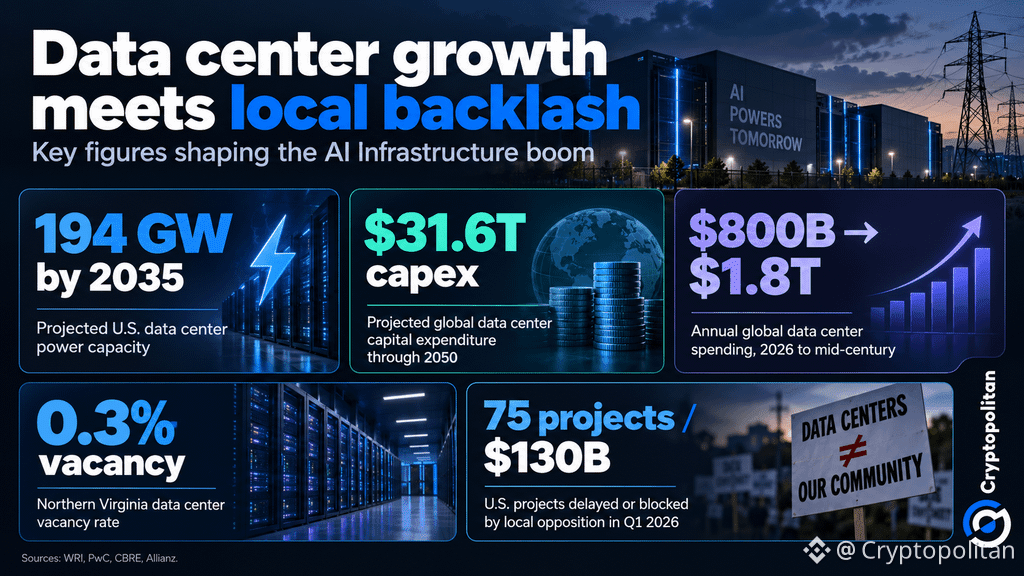
The opposition is already costing the industry. As per Allianz, in Q1 2026, local opposition prevented or delayed more than 75 projects in the US with a total cost of $130 billion. Community resistance has become one of many obstacles that developers face. Other obstacles include grid limitations, delays with the permit process, and supply chain issues.
Why a check alone won’t buy acceptance
According to the World Resources Institute (WRI), community benefits agreements (CBAs) may be a way to alleviate some of the tension. These agreements allow developers to make concrete commitments to the communities where they construct their projects.
An example comes from Lancaster, Pennsylvania. WRI calls its agreement the first public CBA for a data center. Three developers have pledged $20 million to support sustainability and economic programs, in addition to the use of 100% clean energy, limited water use, and meeting noise restrictions.
WRI warns, however, that these agreements are not the answer to all problems. They can never satisfy the need for more general regulation, while there may be communities that see the data center as not worth it.
The pressure behind those concerns is massive. WRI says US data-center power capacity could reach 194 GW by 2035, more than three times today’s level. Data centers could then consume as much as 20% of US electricity, up from 5.9% today.
Power, permits and politics now shape the map
The issue affects not just Amazon. PwC estimates that total expenditure in the construction of data centers around the world will reach $31.6 trillion by 2050, with annual spending rising from about $800 billion in 2026 up to $1.8 trillion by 2050. PwC emphasizes that the availability of electrical power will determine the location of investments.
Meanwhile, CBRE reported that the vacancy rate in Northern Virginia reached only 0.3% for Q1. Power supply shortages, zoning issues, and local resistance policies continued to hamper growth.
The policy environment is becoming harsher as well. Global Electronics Council reports that governments are raising transparency and sustainability requirements as the growth of data centers puts pressure on electricity grids, water resources, and communities. Meanwhile, the IEA reports that the development of AI workloads threatens the existing grids and energy infrastructure
As we have previously reported, the development of data centers and AI technologies helps the construction and manufacturing sectors of the US economy despite the growing problems with electricity supply, raw materials, and infrastructure. The $1 billion commitment from Amazon also reveals that the problem of community acceptance is gaining importance.
AI data center boom faces power constraints and $130B local backlash
If you're reading this, you’re already ahead. Stay there with our newsletter.
Amazon commits $1B to communities hosting its US data centers
Amazon will invest a total of $1 billion over five years in US communities that host its data centers for education, workforce development, conservation of resources, and community relations. This initiative comes at a time when people are becoming increasingly opposed to AI infrastructure due to factors such as energy costs, water consumption, and environmental problems, as per the Associated Press.
For an industry that invests trillions in obtaining additional computing power, gaining the support of local communities is just as vital as acquiring chips, funds, and energy. Amazon’s commitment is more than charitable. It is also aimed at creating the local backing that will help the company to grow.
Two in three Americans don’t want one next door
The opposition is difficult to ignore. A poll by the University of Massachusetts Amherst in September revealed that 65% of Americans do not support an AI data center being constructed in their area. Only 11% said they would support one. Respondents expressed their worries over environmental issues, consumption of resources, disruption of land, lack of trust in AI, and the increased cost of utilities.
The opposition is already costing the industry. As per Allianz, in Q1 2026, local opposition prevented or delayed more than 75 projects in the US with a total cost of $130 billion. Community resistance has become one of many obstacles that developers face. Other obstacles include grid limitations, delays with the permit process, and supply chain issues.
Why a check alone won’t buy acceptance
According to the World Resources Institute (WRI), community benefits agreements (CBAs) may be a way to alleviate some of the tension. These agreements allow developers to make concrete commitments to the communities where they construct their projects.
An example comes from Lancaster, Pennsylvania. WRI calls its agreement the first public CBA for a data center. Three developers have pledged $20 million to support sustainability and economic programs, in addition to the use of 100% clean energy, limited water use, and meeting noise restrictions.
WRI warns, however, that these agreements are not the answer to all problems. They can never satisfy the need for more general regulation, while there may be communities that see the data center as not worth it.
The pressure behind those concerns is massive. WRI says US data-center power capacity could reach 194 GW by 2035, more than three times today’s level. Data centers could then consume as much as 20% of US electricity, up from 5.9% today.
Power, permits and politics now shape the map
The issue affects not just Amazon. PwC estimates that total expenditure in the construction of data centers around the world will reach $31.6 trillion by 2050, with annual spending rising from about $800 billion in 2026 up to $1.8 trillion by 2050. PwC emphasizes that the availability of electrical power will determine the location of investments.
Meanwhile, CBRE reported that the vacancy rate in Northern Virginia reached only 0.3% for Q1. Power supply shortages, zoning issues, and local resistance policies continued to hamper growth.
The policy environment is becoming harsher as well. Global Electronics Council reports that governments are raising transparency and sustainability requirements as the growth of data centers puts pressure on electricity grids, water resources, and communities. Meanwhile, the IEA reports that the development of AI workloads threatens the existing grids and energy infrastructure
As we have previously reported, the development of data centers and AI technologies helps the construction and manufacturing sectors of the US economy despite the growing problems with electricity supply, raw materials, and infrastructure. The $1 billion commitment from Amazon also reveals that the problem of community acceptance is gaining importance.
AI data center boom faces power constraints and $130B local backlash
If you're reading this, you’re already ahead. Stay there with our newsletter.
For an industry that invests trillions in obtaining additional computing power, gaining the support of local communities is just as vital as acquiring chips, funds, and energy. Amazon’s commitment is more than charitable. It is also aimed at creating the local backing that will help the company to grow.
Two in three Americans don’t want one next door
The opposition is difficult to ignore. A poll by the University of Massachusetts Amherst in September revealed that 65% of Americans do not support an AI data center being constructed in their area. Only 11% said they would support one. Respondents expressed their worries over environmental issues, consumption of resources, disruption of land, lack of trust in AI, and the increased cost of utilities.
The opposition is already costing the industry. As per Allianz, in Q1 2026, local opposition prevented or delayed more than 75 projects in the US with a total cost of $130 billion. Community resistance has become one of many obstacles that developers face. Other obstacles include grid limitations, delays with the permit process, and supply chain issues.
Why a check alone won’t buy acceptance
According to the World Resources Institute (WRI), community benefits agreements (CBAs) may be a way to alleviate some of the tension. These agreements allow developers to make concrete commitments to the communities where they construct their projects.
An example comes from Lancaster, Pennsylvania. WRI calls its agreement the first public CBA for a data center. Three developers have pledged $20 million to support sustainability and economic programs, in addition to the use of 100% clean energy, limited water use, and meeting noise restrictions.
WRI warns, however, that these agreements are not the answer to all problems. They can never satisfy the need for more general regulation, while there may be communities that see the data center as not worth it.
The pressure behind those concerns is massive. WRI says US data-center power capacity could reach 194 GW by 2035, more than three times today’s level. Data centers could then consume as much as 20% of US electricity, up from 5.9% today.
Power, permits and politics now shape the map
The issue affects not just Amazon. PwC estimates that total expenditure in the construction of data centers around the world will reach $31.6 trillion by 2050, with annual spending rising from about $800 billion in 2026 up to $1.8 trillion by 2050. PwC emphasizes that the availability of electrical power will determine the location of investments.
Meanwhile, CBRE reported that the vacancy rate in Northern Virginia reached only 0.3% for Q1. Power supply shortages, zoning issues, and local resistance policies continued to hamper growth.
The policy environment is becoming harsher as well. Global Electronics Council reports that governments are raising transparency and sustainability requirements as the growth of data centers puts pressure on electricity grids, water resources, and communities. Meanwhile, the IEA reports that the development of AI workloads threatens the existing grids and energy infrastructure
As we have previously reported, the development of data centers and AI technologies helps the construction and manufacturing sectors of the US economy despite the growing problems with electricity supply, raw materials, and infrastructure. The $1 billion commitment from Amazon also reveals that the problem of community acceptance is gaining importance.
AI data center boom faces power constraints and $130B local backlash
If you're reading this, you’re already ahead. Stay there with our newsletter.
298
Article
Community banks sue OCC over crypto firms' national trust chartersA trade organization representing community banks in the US has filed a lawsuit against the Office of the Comptroller of the Currency (OCC), claiming the regulator overstepped its jurisdiction when it provided national trust bank charters to cryptocurrency companies.
The Independent Community Bankers of America (ICBA) initiated the case in the District of Columbia against a recent action by OCC and its related guidance. They argue that crypto companies receive the credibility of a bank charter in the US without complying with all the regular bank requirements.
A lawsuit aimed at the OCC’s chartering authority
Under national trust charters, companies are permitted to manage customer funds and process transactions. However, they cannot take cash deposits or give loans. ICBA has pointed out that extending these charters to crypto companies takes the OCC’s mandate too far, as per the report by Reuters.
“American consumers reasonably expect a federally chartered bank to carry federal protections.” — ICBA President and CEO Rebeca Romero Rainey, in an ICBA statement on the lawsuit against the OCC
ICBA President and CEO Rebecca Romero Rainey said digital assets held by crypto firms under national trust charters do not come with the same protections. An OCC spokesperson declined to comment to Reuters.
Warren and community banks were already pushing back
The dispute has been building for months. In May, ICBA opposed the charter application of Payward, Kraken’s parent company. OCC’s records indicate that application for Payward National Trust Company’s was submitted on May 8.
Senator Elizabeth Warren had raised these concerns before. She issued a letter in May stating that since December 2025 the OCC had granted at least nine national trust charters to crypto firms and questioning if some of their activities can be classified under the activities allowed for a trust company.
“These companies are effectively crypto banks that want to evade the fundamental safeguards and obligations that come with being a bank.” — Senator Elizabeth Warren, in a May 18 letter to Comptroller Jonathan Gould
The OCC says it only clarified existing powers
The OCC views the matter in a different light. Its final chartering rules, which took effect on April 1, states that it “would neither expand nor contract” the chartering authority of the agency. Instead, it explains that trust-limited national banks may perform a range of non-traditional functions related to the activities of trust companies.
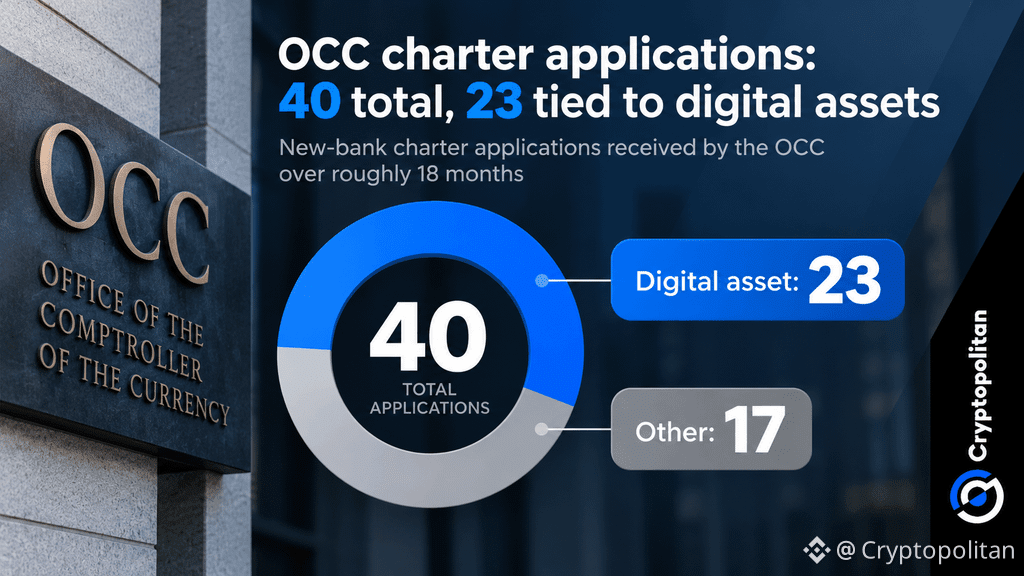
The statistics shed light on the reasons behind the fierce debate surrounding the matter. Comptroller Jonathan Gould has come out with a statement that the OCC has got 40 applications for new bank charters in roughly 18 months and that 23 of these are for digital assets. This is eight times as much as in the preceding four years, according to earlier materials from Cryptopolitan.
OCC charter applications: 40 total, 23 tied to digital assets
Why the charter fight reaches the global crypto market
The situation has implications that reach beyond US banking. A study by the Bank for International Settlements indicates that the volume of stablecoins on the market could exceed the $300 billion mark by 2026, marking a staggering 98% of the total as linked to the US dollar.
Simultaneously, according to the Financial Stability Board, different jurisdictions have major gaps in the way they implement regulations, allowing for regulatory arbitrage to happen. The OCC lawsuit can help define the extent of the applicability of the US trust companies charter in the crypto area and indicate the weight of the federal charter in the global market.
If you're reading this, you’re already ahead. Stay there with our newsletter.
Community banks sue OCC over crypto firms' national trust charters
A trade organization representing community banks in the US has filed a lawsuit against the Office of the Comptroller of the Currency (OCC), claiming the regulator overstepped its jurisdiction when it provided national trust bank charters to cryptocurrency companies.
The Independent Community Bankers of America (ICBA) initiated the case in the District of Columbia against a recent action by OCC and its related guidance. They argue that crypto companies receive the credibility of a bank charter in the US without complying with all the regular bank requirements.
A lawsuit aimed at the OCC’s chartering authority
Under national trust charters, companies are permitted to manage customer funds and process transactions. However, they cannot take cash deposits or give loans. ICBA has pointed out that extending these charters to crypto companies takes the OCC’s mandate too far, as per the report by Reuters.
“American consumers reasonably expect a federally chartered bank to carry federal protections.” — ICBA President and CEO Rebeca Romero Rainey, in an ICBA statement on the lawsuit against the OCC
ICBA President and CEO Rebecca Romero Rainey said digital assets held by crypto firms under national trust charters do not come with the same protections. An OCC spokesperson declined to comment to Reuters.
Warren and community banks were already pushing back
The dispute has been building for months. In May, ICBA opposed the charter application of Payward, Kraken’s parent company. OCC’s records indicate that application for Payward National Trust Company’s was submitted on May 8.
Senator Elizabeth Warren had raised these concerns before. She issued a letter in May stating that since December 2025 the OCC had granted at least nine national trust charters to crypto firms and questioning if some of their activities can be classified under the activities allowed for a trust company.
“These companies are effectively crypto banks that want to evade the fundamental safeguards and obligations that come with being a bank.” — Senator Elizabeth Warren, in a May 18 letter to Comptroller Jonathan Gould
The OCC says it only clarified existing powers
The OCC views the matter in a different light. Its final chartering rules, which took effect on April 1, states that it “would neither expand nor contract” the chartering authority of the agency. Instead, it explains that trust-limited national banks may perform a range of non-traditional functions related to the activities of trust companies.
The statistics shed light on the reasons behind the fierce debate surrounding the matter. Comptroller Jonathan Gould has come out with a statement that the OCC has got 40 applications for new bank charters in roughly 18 months and that 23 of these are for digital assets. This is eight times as much as in the preceding four years, according to earlier materials from Cryptopolitan.
OCC charter applications: 40 total, 23 tied to digital assets
Why the charter fight reaches the global crypto market
The situation has implications that reach beyond US banking. A study by the Bank for International Settlements indicates that the volume of stablecoins on the market could exceed the $300 billion mark by 2026, marking a staggering 98% of the total as linked to the US dollar.
Simultaneously, according to the Financial Stability Board, different jurisdictions have major gaps in the way they implement regulations, allowing for regulatory arbitrage to happen. The OCC lawsuit can help define the extent of the applicability of the US trust companies charter in the crypto area and indicate the weight of the federal charter in the global market.
If you're reading this, you’re already ahead. Stay there with our newsletter.
The Independent Community Bankers of America (ICBA) initiated the case in the District of Columbia against a recent action by OCC and its related guidance. They argue that crypto companies receive the credibility of a bank charter in the US without complying with all the regular bank requirements.
A lawsuit aimed at the OCC’s chartering authority
Under national trust charters, companies are permitted to manage customer funds and process transactions. However, they cannot take cash deposits or give loans. ICBA has pointed out that extending these charters to crypto companies takes the OCC’s mandate too far, as per the report by Reuters.
“American consumers reasonably expect a federally chartered bank to carry federal protections.” — ICBA President and CEO Rebeca Romero Rainey, in an ICBA statement on the lawsuit against the OCC
ICBA President and CEO Rebecca Romero Rainey said digital assets held by crypto firms under national trust charters do not come with the same protections. An OCC spokesperson declined to comment to Reuters.
Warren and community banks were already pushing back
The dispute has been building for months. In May, ICBA opposed the charter application of Payward, Kraken’s parent company. OCC’s records indicate that application for Payward National Trust Company’s was submitted on May 8.
Senator Elizabeth Warren had raised these concerns before. She issued a letter in May stating that since December 2025 the OCC had granted at least nine national trust charters to crypto firms and questioning if some of their activities can be classified under the activities allowed for a trust company.
“These companies are effectively crypto banks that want to evade the fundamental safeguards and obligations that come with being a bank.” — Senator Elizabeth Warren, in a May 18 letter to Comptroller Jonathan Gould
The OCC says it only clarified existing powers
The OCC views the matter in a different light. Its final chartering rules, which took effect on April 1, states that it “would neither expand nor contract” the chartering authority of the agency. Instead, it explains that trust-limited national banks may perform a range of non-traditional functions related to the activities of trust companies.
The statistics shed light on the reasons behind the fierce debate surrounding the matter. Comptroller Jonathan Gould has come out with a statement that the OCC has got 40 applications for new bank charters in roughly 18 months and that 23 of these are for digital assets. This is eight times as much as in the preceding four years, according to earlier materials from Cryptopolitan.
OCC charter applications: 40 total, 23 tied to digital assets
Why the charter fight reaches the global crypto market
The situation has implications that reach beyond US banking. A study by the Bank for International Settlements indicates that the volume of stablecoins on the market could exceed the $300 billion mark by 2026, marking a staggering 98% of the total as linked to the US dollar.
Simultaneously, according to the Financial Stability Board, different jurisdictions have major gaps in the way they implement regulations, allowing for regulatory arbitrage to happen. The OCC lawsuit can help define the extent of the applicability of the US trust companies charter in the crypto area and indicate the weight of the federal charter in the global market.
If you're reading this, you’re already ahead. Stay there with our newsletter.
331
Article
Blast winds down its L2 as costs outrun revenue, testing rollup economicsBlast announced on Friday that it will be closing down its Ethereum Layer 2 network and returning its users back to Ethereum mainnet, claiming that keeping the network running is more expensive than its earnings.
The decision has raised questions for the smaller rollups in the already over-crowded L2 space: can small rollups generate enough real activity that can justify their operation?
Blast mentioned that the numbers were not looking promising and stated that the overhead cost of keeping the network running had become larger than the income being derived from the L2.
From $2 billion in deposits to $32 million
Blast made its debut in November 2023 after securing a funding round worth $20 million from investors led by Paradigm and Standard Crypto. Before its mainnet launch in February 2024, the project had secured over $2 billion in funding from almost 200,000 early users, helped by native yield on ETH and stablecoins.
Since then, the figures have dramatically dropped. As of today, DeFiLlama reports that Blast has a DeFi TVL of around $32 million. On the other hand, L2BEAT lists about $38 million secured by the platform and states that its fraud-proof system is still under development.
The BLAST token also fell 17% on Friday, cutting its market value to about $23 million, according to The Block.
When annualized fees run to $755,500 and revenue to $22,700
The imbalance is clear in Blast’s own economics. DeFiLlama recently showed about $755,500 in annualized fees but only around $22,700 in annualized chain revenue.
That is the real problem: bringing money onto a network is one thing; however, getting enough constant transactions that would make keep that network operating is quite another.
Cheaper blobs did not fix the math
Blast also operated during a period when Ethereum had already reduced one of its key rollup costs. By introducing blobs as part of EIP-4844, Ethereum enabled L2s to transmit data at a much lower cost than traditional calldata. According to Ethereum’s Danksharding plan, blob data is temporary and will be deleted from nodes after about 18 days.
Blast’s shutdown shows that reducing one major operating cost can help, but a network still needs enough activity and revenue to sustain itself.
A shakeout that keeps widening
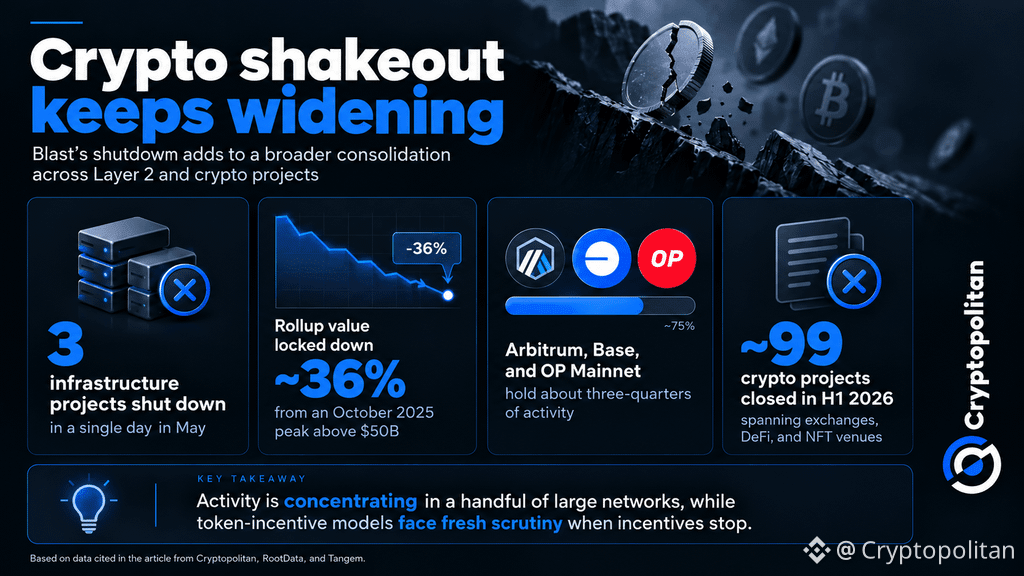
Blast forms part of a bigger contraction. As was stated earlier by Cryptopolitan, three blockchain projects suspended their operations on the same day in May. Rollup value locked, that had a peak of more than $50 billion in October 2025, has dropped by around 36% since then, while Arbitrum One, Base, and OP Mainnet are estimated to hold almost 75% of the entire activity.
The weakness is not limited to L2s alone. A recent count by RootData, cited by Tangem, claimed that more than 99 blockchain projects closed in the first six months of 2026.
Crypto Layer 2 shakeout widens as projects shut down and activity consolidates
Exchanges move before the lights go out
Upbit and Bithumb moved quickly after the announcement, designating BLAST as a trading-caution asset. Bithumb’s notice cited concerns about sustainability and the end of mainnet operations.
Blast will first withdraw its Lido holdings, a process expected to take about a week. Users can withdraw through Blast’s interface until October 26, after which they will need to use its Ethereum bridge contracts directly.
With only about $32 million left in DeFi TVL, the shutdown is unlikely to threaten the wider market. Its bigger message is about L2 economics: cheaper infrastructure only goes so far when users, activity, and revenue do not follow.
The smartest crypto minds already read our newsletter. Want in? Join them.
Blast winds down its L2 as costs outrun revenue, testing rollup economics
Blast announced on Friday that it will be closing down its Ethereum Layer 2 network and returning its users back to Ethereum mainnet, claiming that keeping the network running is more expensive than its earnings.
The decision has raised questions for the smaller rollups in the already over-crowded L2 space: can small rollups generate enough real activity that can justify their operation?
Blast mentioned that the numbers were not looking promising and stated that the overhead cost of keeping the network running had become larger than the income being derived from the L2.
From $2 billion in deposits to $32 million
Blast made its debut in November 2023 after securing a funding round worth $20 million from investors led by Paradigm and Standard Crypto. Before its mainnet launch in February 2024, the project had secured over $2 billion in funding from almost 200,000 early users, helped by native yield on ETH and stablecoins.
Since then, the figures have dramatically dropped. As of today, DeFiLlama reports that Blast has a DeFi TVL of around $32 million. On the other hand, L2BEAT lists about $38 million secured by the platform and states that its fraud-proof system is still under development.
The BLAST token also fell 17% on Friday, cutting its market value to about $23 million, according to The Block.
When annualized fees run to $755,500 and revenue to $22,700
The imbalance is clear in Blast’s own economics. DeFiLlama recently showed about $755,500 in annualized fees but only around $22,700 in annualized chain revenue.
That is the real problem: bringing money onto a network is one thing; however, getting enough constant transactions that would make keep that network operating is quite another.
Cheaper blobs did not fix the math
Blast also operated during a period when Ethereum had already reduced one of its key rollup costs. By introducing blobs as part of EIP-4844, Ethereum enabled L2s to transmit data at a much lower cost than traditional calldata. According to Ethereum’s Danksharding plan, blob data is temporary and will be deleted from nodes after about 18 days.
Blast’s shutdown shows that reducing one major operating cost can help, but a network still needs enough activity and revenue to sustain itself.
A shakeout that keeps widening
Blast forms part of a bigger contraction. As was stated earlier by Cryptopolitan, three blockchain projects suspended their operations on the same day in May. Rollup value locked, that had a peak of more than $50 billion in October 2025, has dropped by around 36% since then, while Arbitrum One, Base, and OP Mainnet are estimated to hold almost 75% of the entire activity.
The weakness is not limited to L2s alone. A recent count by RootData, cited by Tangem, claimed that more than 99 blockchain projects closed in the first six months of 2026.
Crypto Layer 2 shakeout widens as projects shut down and activity consolidates
Exchanges move before the lights go out
Upbit and Bithumb moved quickly after the announcement, designating BLAST as a trading-caution asset. Bithumb’s notice cited concerns about sustainability and the end of mainnet operations.
Blast will first withdraw its Lido holdings, a process expected to take about a week. Users can withdraw through Blast’s interface until October 26, after which they will need to use its Ethereum bridge contracts directly.
With only about $32 million left in DeFi TVL, the shutdown is unlikely to threaten the wider market. Its bigger message is about L2 economics: cheaper infrastructure only goes so far when users, activity, and revenue do not follow.
The smartest crypto minds already read our newsletter. Want in? Join them.
The decision has raised questions for the smaller rollups in the already over-crowded L2 space: can small rollups generate enough real activity that can justify their operation?
Blast mentioned that the numbers were not looking promising and stated that the overhead cost of keeping the network running had become larger than the income being derived from the L2.
From $2 billion in deposits to $32 million
Blast made its debut in November 2023 after securing a funding round worth $20 million from investors led by Paradigm and Standard Crypto. Before its mainnet launch in February 2024, the project had secured over $2 billion in funding from almost 200,000 early users, helped by native yield on ETH and stablecoins.
Since then, the figures have dramatically dropped. As of today, DeFiLlama reports that Blast has a DeFi TVL of around $32 million. On the other hand, L2BEAT lists about $38 million secured by the platform and states that its fraud-proof system is still under development.
The BLAST token also fell 17% on Friday, cutting its market value to about $23 million, according to The Block.
When annualized fees run to $755,500 and revenue to $22,700
The imbalance is clear in Blast’s own economics. DeFiLlama recently showed about $755,500 in annualized fees but only around $22,700 in annualized chain revenue.
That is the real problem: bringing money onto a network is one thing; however, getting enough constant transactions that would make keep that network operating is quite another.
Cheaper blobs did not fix the math
Blast also operated during a period when Ethereum had already reduced one of its key rollup costs. By introducing blobs as part of EIP-4844, Ethereum enabled L2s to transmit data at a much lower cost than traditional calldata. According to Ethereum’s Danksharding plan, blob data is temporary and will be deleted from nodes after about 18 days.
Blast’s shutdown shows that reducing one major operating cost can help, but a network still needs enough activity and revenue to sustain itself.
A shakeout that keeps widening
Blast forms part of a bigger contraction. As was stated earlier by Cryptopolitan, three blockchain projects suspended their operations on the same day in May. Rollup value locked, that had a peak of more than $50 billion in October 2025, has dropped by around 36% since then, while Arbitrum One, Base, and OP Mainnet are estimated to hold almost 75% of the entire activity.
The weakness is not limited to L2s alone. A recent count by RootData, cited by Tangem, claimed that more than 99 blockchain projects closed in the first six months of 2026.
Crypto Layer 2 shakeout widens as projects shut down and activity consolidates
Exchanges move before the lights go out
Upbit and Bithumb moved quickly after the announcement, designating BLAST as a trading-caution asset. Bithumb’s notice cited concerns about sustainability and the end of mainnet operations.
Blast will first withdraw its Lido holdings, a process expected to take about a week. Users can withdraw through Blast’s interface until October 26, after which they will need to use its Ethereum bridge contracts directly.
With only about $32 million left in DeFi TVL, the shutdown is unlikely to threaten the wider market. Its bigger message is about L2 economics: cheaper infrastructure only goes so far when users, activity, and revenue do not follow.
The smartest crypto minds already read our newsletter. Want in? Join them.
467
Verified
ARK's Winton says each Starship launch could add $700 million a yearBrett Winton, ARK Invest’s chief futurist, argued on Friday that investors are underrating SpaceX’s earning power.
Winston estimates that every Starship flight could throw off more than $700 million in fresh annual revenue. On the same day, he made his post, SpaceX (NASDAQ: SPCX) shares jumped due to a run of successful launches and expanding AI contracts.
How much is SpaceX capable of earning?
Writing on X under the handle @wintonARK, Brett Winton said that people do not “grok” what the pairing of Starship with Starlink can generate. On ARK’s numbers, he wrote, each launch “could drive $700+ million in incremental annual revenue.” He added that he expects that figure to climb as SpaceX begins monetizing AI software through its satellite effort.
Marginal annual revenue per Starship launch projections. Source: Ark Invest
Space Exploration Technologies climbed about 6% to roughly $158.86 by late Friday morning, lifting its market capitalization back to about $2.0 trillion.
The increase was due to two factors. First, SpaceX ran three missions inside 13 hours, sending a Crew Dragon capsule to the International Space Station, flying its 18th Transporter rideshare mission with 130 payloads, and launching a National Reconnaissance Office satellite on a Falcon Heavy before recovering the boosters.
The second reason for the increase in value was a June agreement with Alphabet that pays SpaceX $920 million a month across 32 months, or $29.4 billion in total. A separate Anthropic contract adds $1.25 billion a month to the company’s revenue, allowing SpaceX to pull in close to $2.2 billion a month from AI services, even more than it earns launching rockets.
ARK expects $2.5 trillion from SpaceX
ARK, working with aerospace research firm Mach33, published an open-source model in June 2025 that estimates SpaceX will be worth about $2.5 trillion in 2030. The model’s bull case rises to near $3.1 trillion, while its bear case falls to about $1.7 trillion. The base figure represents roughly 38% annual growth from SpaceX’s $350 billion December 2024 round.
ARK’s open-source SpaceX valuation model runs a million simulations on 17 separate inputs. Its revenue engine is a bandwidth demand model that, on average, sees Starlink capacity leveling off near 130 million gigabits per second, which is the point beyond which ARK judges extra bandwidth uneconomic.
After SpaceX debuted on Nasdaq at $150 a share in June and then declined, ARK bought about $32.5 million of stock on top of a $444.3 million purchase on the first trading day. SpaceX listed at an IPO valuation of roughly $1.77 trillion.
The company’s Chief Executive, Cathie Wood, said in a July interview that SpaceX is a company that “could become the most important company in global history,” even as the stock sat well below its $225.64 intraday peak and faced a $116 billion share unlock.
Notably, on September 24, ARK put the tokenized version of its ARK Venture Fund on Ethereum through Securitize, letting eligible U.S. investors to subscribe with USDC. SpaceX is the fund’s top position at 7.54%.
Don’t just read crypto news. Understand it. Subscribe to our newsletter. It's free.
ARK's Winton says each Starship launch could add $700 million a year
Brett Winton, ARK Invest’s chief futurist, argued on Friday that investors are underrating SpaceX’s earning power.
Winston estimates that every Starship flight could throw off more than $700 million in fresh annual revenue. On the same day, he made his post, SpaceX (NASDAQ: SPCX) shares jumped due to a run of successful launches and expanding AI contracts.
How much is SpaceX capable of earning?
Writing on X under the handle @wintonARK, Brett Winton said that people do not “grok” what the pairing of Starship with Starlink can generate. On ARK’s numbers, he wrote, each launch “could drive $700+ million in incremental annual revenue.” He added that he expects that figure to climb as SpaceX begins monetizing AI software through its satellite effort.
Marginal annual revenue per Starship launch projections. Source: Ark Invest
Space Exploration Technologies climbed about 6% to roughly $158.86 by late Friday morning, lifting its market capitalization back to about $2.0 trillion.
The increase was due to two factors. First, SpaceX ran three missions inside 13 hours, sending a Crew Dragon capsule to the International Space Station, flying its 18th Transporter rideshare mission with 130 payloads, and launching a National Reconnaissance Office satellite on a Falcon Heavy before recovering the boosters.
The second reason for the increase in value was a June agreement with Alphabet that pays SpaceX $920 million a month across 32 months, or $29.4 billion in total. A separate Anthropic contract adds $1.25 billion a month to the company’s revenue, allowing SpaceX to pull in close to $2.2 billion a month from AI services, even more than it earns launching rockets.
ARK expects $2.5 trillion from SpaceX
ARK, working with aerospace research firm Mach33, published an open-source model in June 2025 that estimates SpaceX will be worth about $2.5 trillion in 2030. The model’s bull case rises to near $3.1 trillion, while its bear case falls to about $1.7 trillion. The base figure represents roughly 38% annual growth from SpaceX’s $350 billion December 2024 round.
ARK’s open-source SpaceX valuation model runs a million simulations on 17 separate inputs. Its revenue engine is a bandwidth demand model that, on average, sees Starlink capacity leveling off near 130 million gigabits per second, which is the point beyond which ARK judges extra bandwidth uneconomic.
After SpaceX debuted on Nasdaq at $150 a share in June and then declined, ARK bought about $32.5 million of stock on top of a $444.3 million purchase on the first trading day. SpaceX listed at an IPO valuation of roughly $1.77 trillion.
The company’s Chief Executive, Cathie Wood, said in a July interview that SpaceX is a company that “could become the most important company in global history,” even as the stock sat well below its $225.64 intraday peak and faced a $116 billion share unlock.
Notably, on September 24, ARK put the tokenized version of its ARK Venture Fund on Ethereum through Securitize, letting eligible U.S. investors to subscribe with USDC. SpaceX is the fund’s top position at 7.54%.
Don’t just read crypto news. Understand it. Subscribe to our newsletter. It's free.
Winston estimates that every Starship flight could throw off more than $700 million in fresh annual revenue. On the same day, he made his post, SpaceX (NASDAQ: SPCX) shares jumped due to a run of successful launches and expanding AI contracts.
How much is SpaceX capable of earning?
Writing on X under the handle @wintonARK, Brett Winton said that people do not “grok” what the pairing of Starship with Starlink can generate. On ARK’s numbers, he wrote, each launch “could drive $700+ million in incremental annual revenue.” He added that he expects that figure to climb as SpaceX begins monetizing AI software through its satellite effort.
Marginal annual revenue per Starship launch projections. Source: Ark Invest
Space Exploration Technologies climbed about 6% to roughly $158.86 by late Friday morning, lifting its market capitalization back to about $2.0 trillion.
The increase was due to two factors. First, SpaceX ran three missions inside 13 hours, sending a Crew Dragon capsule to the International Space Station, flying its 18th Transporter rideshare mission with 130 payloads, and launching a National Reconnaissance Office satellite on a Falcon Heavy before recovering the boosters.
The second reason for the increase in value was a June agreement with Alphabet that pays SpaceX $920 million a month across 32 months, or $29.4 billion in total. A separate Anthropic contract adds $1.25 billion a month to the company’s revenue, allowing SpaceX to pull in close to $2.2 billion a month from AI services, even more than it earns launching rockets.
ARK expects $2.5 trillion from SpaceX
ARK, working with aerospace research firm Mach33, published an open-source model in June 2025 that estimates SpaceX will be worth about $2.5 trillion in 2030. The model’s bull case rises to near $3.1 trillion, while its bear case falls to about $1.7 trillion. The base figure represents roughly 38% annual growth from SpaceX’s $350 billion December 2024 round.
ARK’s open-source SpaceX valuation model runs a million simulations on 17 separate inputs. Its revenue engine is a bandwidth demand model that, on average, sees Starlink capacity leveling off near 130 million gigabits per second, which is the point beyond which ARK judges extra bandwidth uneconomic.
After SpaceX debuted on Nasdaq at $150 a share in June and then declined, ARK bought about $32.5 million of stock on top of a $444.3 million purchase on the first trading day. SpaceX listed at an IPO valuation of roughly $1.77 trillion.
The company’s Chief Executive, Cathie Wood, said in a July interview that SpaceX is a company that “could become the most important company in global history,” even as the stock sat well below its $225.64 intraday peak and faced a $116 billion share unlock.
Notably, on September 24, ARK put the tokenized version of its ARK Venture Fund on Ethereum through Securitize, letting eligible U.S. investors to subscribe with USDC. SpaceX is the fund’s top position at 7.54%.
Don’t just read crypto news. Understand it. Subscribe to our newsletter. It's free.
1
803
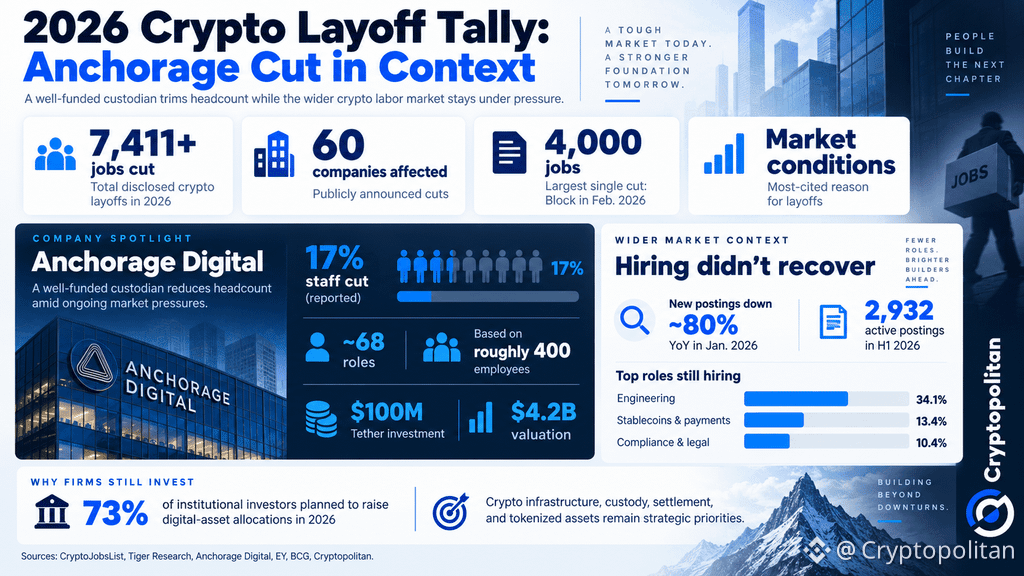
Article
Anchorage Digital reportedly cuts 17% of staff despite $4.2B valuationIt has been reported that Anchorage Digital is laying off 17% of its workforce as crypto winter grips even one of the more well-funded regulated firms in the industry. If the headcount is still around the 400 employees reported by CEO Nathan McCauley to Congress in February 2025, that would entail approximately 68 layoffs.
The move comes eight months after Tether invested $100 million in Anchorage at a $4.2 billion valuation.
Cost-cutting sits next to capital strength
Reportedly, employees were told by McCauley that Anchorage is cutting jobs due to the general downturn in the current crypto market, as per The Information. The number 68 mentioned here is an estimate and not an official number. It is based on the 17% cut reported by The Information and the earlier employee data reported by McCauley.
The timing is remarkable. The investment by Tether in February valued Anchorage at $4.2 billion and has made possible the payment to employees through the first employee tender offer. Thus, the layoffs do not appear as a desperate need for cash, but as an effort to reduce expenses in response to the worsening economic situation.
A crypto labor market that kept shrinking through 2026
Anchorage is not the only company going through layoffs. CryptoJobsList reports that there have been at least 7,411 job cuts in 60 crypto companies in 2026. The biggest among these is Block’s 4,000 job cuts in February.
Hiring activity has also declined. In January, Tiger Research reported that the number of new job listings on the leading crypto job portals declined by approximately 80% on a year-over-year basis, continuing a decline that began after 2022.
2026 Crypto Layoffs: Anchorage Digital’s 17% Staff Cut in Context
The hiring that survives points toward infrastructure
The remaining vacancies in the job market are becoming increasingly specialized. Out of a total of 2,932 openings monitored by Tiger Research in the first half of 2026, engineering accounted for 34.1%, followed by compliance and legal jobs at 10.4%. Meanwhile, stablecoins and payments comprised 13.4% of the total job openings in the market.
That’s consistent with Anchorage’s approach. The company identifies itself as a service provider to institutions in custody, trading, settlement, and other digital asset-related activities. It has also advanced further into the institutional market infrastructure with the development of products that link regulatory custody with crypto trading.
Institutions keep buying even as firms get leaner
Institutional interest has not faded. In a 2026 survey published by EY, it was revealed that 73% of the companies surveyed intended to expand their investments in digital assets over the following year.
Similarly, the analysis of BCG established that infrastructure, such as custody, settlement, and tokenized assets, is becoming more important due to the increasing integration of digital assets with traditional finance.
Anchorage fits into the changing picture. In June, Binance included Anchorage in its triparty banking network, allowing institutions to keep collateral in regulated custody while trading.
The layoffs therefore indicate a crypto industry that is becoming more selective about where its funds go. There is still enough capital, but companies are limiting their spending. For Anchorage, the issue is whether the company can thrive with a smaller workforce while focusing on infrastructure projects as its avenue of growth.
Don’t just read crypto news. Understand it. Subscribe to our newsletter. It's free.
Anchorage Digital reportedly cuts 17% of staff despite $4.2B valuation
It has been reported that Anchorage Digital is laying off 17% of its workforce as crypto winter grips even one of the more well-funded regulated firms in the industry. If the headcount is still around the 400 employees reported by CEO Nathan McCauley to Congress in February 2025, that would entail approximately 68 layoffs.
The move comes eight months after Tether invested $100 million in Anchorage at a $4.2 billion valuation.
Cost-cutting sits next to capital strength
Reportedly, employees were told by McCauley that Anchorage is cutting jobs due to the general downturn in the current crypto market, as per The Information. The number 68 mentioned here is an estimate and not an official number. It is based on the 17% cut reported by The Information and the earlier employee data reported by McCauley.
The timing is remarkable. The investment by Tether in February valued Anchorage at $4.2 billion and has made possible the payment to employees through the first employee tender offer. Thus, the layoffs do not appear as a desperate need for cash, but as an effort to reduce expenses in response to the worsening economic situation.
A crypto labor market that kept shrinking through 2026
Anchorage is not the only company going through layoffs. CryptoJobsList reports that there have been at least 7,411 job cuts in 60 crypto companies in 2026. The biggest among these is Block’s 4,000 job cuts in February.
Hiring activity has also declined. In January, Tiger Research reported that the number of new job listings on the leading crypto job portals declined by approximately 80% on a year-over-year basis, continuing a decline that began after 2022.
2026 Crypto Layoffs: Anchorage Digital’s 17% Staff Cut in Context
The hiring that survives points toward infrastructure
The remaining vacancies in the job market are becoming increasingly specialized. Out of a total of 2,932 openings monitored by Tiger Research in the first half of 2026, engineering accounted for 34.1%, followed by compliance and legal jobs at 10.4%. Meanwhile, stablecoins and payments comprised 13.4% of the total job openings in the market.
That’s consistent with Anchorage’s approach. The company identifies itself as a service provider to institutions in custody, trading, settlement, and other digital asset-related activities. It has also advanced further into the institutional market infrastructure with the development of products that link regulatory custody with crypto trading.
Institutions keep buying even as firms get leaner
Institutional interest has not faded. In a 2026 survey published by EY, it was revealed that 73% of the companies surveyed intended to expand their investments in digital assets over the following year.
Similarly, the analysis of BCG established that infrastructure, such as custody, settlement, and tokenized assets, is becoming more important due to the increasing integration of digital assets with traditional finance.
Anchorage fits into the changing picture. In June, Binance included Anchorage in its triparty banking network, allowing institutions to keep collateral in regulated custody while trading.
The layoffs therefore indicate a crypto industry that is becoming more selective about where its funds go. There is still enough capital, but companies are limiting their spending. For Anchorage, the issue is whether the company can thrive with a smaller workforce while focusing on infrastructure projects as its avenue of growth.
Don’t just read crypto news. Understand it. Subscribe to our newsletter. It's free.
The move comes eight months after Tether invested $100 million in Anchorage at a $4.2 billion valuation.
Cost-cutting sits next to capital strength
Reportedly, employees were told by McCauley that Anchorage is cutting jobs due to the general downturn in the current crypto market, as per The Information. The number 68 mentioned here is an estimate and not an official number. It is based on the 17% cut reported by The Information and the earlier employee data reported by McCauley.
The timing is remarkable. The investment by Tether in February valued Anchorage at $4.2 billion and has made possible the payment to employees through the first employee tender offer. Thus, the layoffs do not appear as a desperate need for cash, but as an effort to reduce expenses in response to the worsening economic situation.
A crypto labor market that kept shrinking through 2026
Anchorage is not the only company going through layoffs. CryptoJobsList reports that there have been at least 7,411 job cuts in 60 crypto companies in 2026. The biggest among these is Block’s 4,000 job cuts in February.
Hiring activity has also declined. In January, Tiger Research reported that the number of new job listings on the leading crypto job portals declined by approximately 80% on a year-over-year basis, continuing a decline that began after 2022.
2026 Crypto Layoffs: Anchorage Digital’s 17% Staff Cut in Context
The hiring that survives points toward infrastructure
The remaining vacancies in the job market are becoming increasingly specialized. Out of a total of 2,932 openings monitored by Tiger Research in the first half of 2026, engineering accounted for 34.1%, followed by compliance and legal jobs at 10.4%. Meanwhile, stablecoins and payments comprised 13.4% of the total job openings in the market.
That’s consistent with Anchorage’s approach. The company identifies itself as a service provider to institutions in custody, trading, settlement, and other digital asset-related activities. It has also advanced further into the institutional market infrastructure with the development of products that link regulatory custody with crypto trading.
Institutions keep buying even as firms get leaner
Institutional interest has not faded. In a 2026 survey published by EY, it was revealed that 73% of the companies surveyed intended to expand their investments in digital assets over the following year.
Similarly, the analysis of BCG established that infrastructure, such as custody, settlement, and tokenized assets, is becoming more important due to the increasing integration of digital assets with traditional finance.
Anchorage fits into the changing picture. In June, Binance included Anchorage in its triparty banking network, allowing institutions to keep collateral in regulated custody while trading.
The layoffs therefore indicate a crypto industry that is becoming more selective about where its funds go. There is still enough capital, but companies are limiting their spending. For Anchorage, the issue is whether the company can thrive with a smaller workforce while focusing on infrastructure projects as its avenue of growth.
Don’t just read crypto news. Understand it. Subscribe to our newsletter. It's free.
136
NEAR Intents hacker returns all $3.8M stolen funds after encrypted talksThe attacker who drained $3.8 million from NEAR Intents has sent every dollar back, ending a standoff that began a day earlier when the cross-chain protocol froze its services and set a 48-hour deadline for the funds to be returned.
The protocol had promised its users full reimbursement prior to the return. The incident is one of the few hacking cases the crypto industry has experienced this year that ended with the money coming back.
How did the NEAR Intents exploit work?
NEAR Intents posted on X that it had halted operations on Thursday after spotting what it called a bug in how its Omni deposit and withdrawal infrastructure interacted with its smart contract. The protocol’s first estimate put user losses at roughly $3.8 million.
The protocol works by letting its users state the outcome they want from a trade and having independent market makers called solvers take over from there. This way, users never have to pick a bridge or exchange themselves. The platform has reportedly handled more than $30 billion in volume across 35 blockchains.
Co-founder Illia Polosukhin said that the damage from the hack was limited to USDT on the BNB Smart Chain. The NEAR token, the core protocol, and other apps on the network were untouched.
Even so, NEAR slipped about 6% in the hours after the news, trading near $4.95 before settling around $4.81.
Cryptopolitan reported that eleven networks, among them BSC, Polygon, TON, and Scroll, stayed restricted for roughly another 12 hours while repairs finished.
By Friday, the team had moved on from simply dealing with the aftermath to pursuing the perpetrator. General manager Alex Shevchenko posted three wallet addresses, one each for Bitcoin, BNB, and Solana, and told the attacker the clock was running.
“We have identified you, sir,” Shevchenko wrote. He went on to give the attacker a 48-hour deadline.
Did NEAR Intents receive a full refund?
Following the threats, Shevchenko opened a private channel to communicate with the perpetrator. In one post, he thanked the attacker “for your willingness to cooperate” and pointed to messages that could be decrypted with the private key from an Ethereum address, 0x09Fd1f5d9F185067A92493E43AA259ea4AB3ad37.
Shevchenko announced on Friday that the $3.8 million stolen in the hack was returned in full. “We are stopping the investigation. Please use bug bounties instead of disrupting the services.”
Cryptopolitan reported that prior to the hack and the resolution, NEAR Intents turned away more than $50 million in funds tied to the September 24 Bitget breach, freezing about $503,000 of it through its SHIELD risk system.
During that period, Shevchenko criticized crypto builders, saying that they cannot run infrastructure that is designed to “help launder stolen funds” while asking for the recognition of digital assets.
Full recoveries remain uncommon in the crypto industry, but NEAR Intents is not the first to pull one off. Following what the project called successful negotiations, the Euler Finance attacker returned the last $31 million from the $197 million hack that occurred in March 2023. Euler Finance ended up with more than $177 million in recovered assets.
In July 2025, Cryptopolitan reported that the GMX exploiter returned about $37.5 million after accepting a 10% white-hat bounty.
Don’t just read crypto news. Understand it. Subscribe to our newsletter. It's free.
NEAR Intents hacker returns all $3.8M stolen funds after encrypted talks
The attacker who drained $3.8 million from NEAR Intents has sent every dollar back, ending a standoff that began a day earlier when the cross-chain protocol froze its services and set a 48-hour deadline for the funds to be returned.
The protocol had promised its users full reimbursement prior to the return. The incident is one of the few hacking cases the crypto industry has experienced this year that ended with the money coming back.
How did the NEAR Intents exploit work?
NEAR Intents posted on X that it had halted operations on Thursday after spotting what it called a bug in how its Omni deposit and withdrawal infrastructure interacted with its smart contract. The protocol’s first estimate put user losses at roughly $3.8 million.
The protocol works by letting its users state the outcome they want from a trade and having independent market makers called solvers take over from there. This way, users never have to pick a bridge or exchange themselves. The platform has reportedly handled more than $30 billion in volume across 35 blockchains.
Co-founder Illia Polosukhin said that the damage from the hack was limited to USDT on the BNB Smart Chain. The NEAR token, the core protocol, and other apps on the network were untouched.
Even so, NEAR slipped about 6% in the hours after the news, trading near $4.95 before settling around $4.81.
Cryptopolitan reported that eleven networks, among them BSC, Polygon, TON, and Scroll, stayed restricted for roughly another 12 hours while repairs finished.
By Friday, the team had moved on from simply dealing with the aftermath to pursuing the perpetrator. General manager Alex Shevchenko posted three wallet addresses, one each for Bitcoin, BNB, and Solana, and told the attacker the clock was running.
“We have identified you, sir,” Shevchenko wrote. He went on to give the attacker a 48-hour deadline.
Did NEAR Intents receive a full refund?
Following the threats, Shevchenko opened a private channel to communicate with the perpetrator. In one post, he thanked the attacker “for your willingness to cooperate” and pointed to messages that could be decrypted with the private key from an Ethereum address, 0x09Fd1f5d9F185067A92493E43AA259ea4AB3ad37.
Shevchenko announced on Friday that the $3.8 million stolen in the hack was returned in full. “We are stopping the investigation. Please use bug bounties instead of disrupting the services.”
Cryptopolitan reported that prior to the hack and the resolution, NEAR Intents turned away more than $50 million in funds tied to the September 24 Bitget breach, freezing about $503,000 of it through its SHIELD risk system.
During that period, Shevchenko criticized crypto builders, saying that they cannot run infrastructure that is designed to “help launder stolen funds” while asking for the recognition of digital assets.
Full recoveries remain uncommon in the crypto industry, but NEAR Intents is not the first to pull one off. Following what the project called successful negotiations, the Euler Finance attacker returned the last $31 million from the $197 million hack that occurred in March 2023. Euler Finance ended up with more than $177 million in recovered assets.
In July 2025, Cryptopolitan reported that the GMX exploiter returned about $37.5 million after accepting a 10% white-hat bounty.
Don’t just read crypto news. Understand it. Subscribe to our newsletter. It's free.
The protocol had promised its users full reimbursement prior to the return. The incident is one of the few hacking cases the crypto industry has experienced this year that ended with the money coming back.
How did the NEAR Intents exploit work?
NEAR Intents posted on X that it had halted operations on Thursday after spotting what it called a bug in how its Omni deposit and withdrawal infrastructure interacted with its smart contract. The protocol’s first estimate put user losses at roughly $3.8 million.
The protocol works by letting its users state the outcome they want from a trade and having independent market makers called solvers take over from there. This way, users never have to pick a bridge or exchange themselves. The platform has reportedly handled more than $30 billion in volume across 35 blockchains.
Co-founder Illia Polosukhin said that the damage from the hack was limited to USDT on the BNB Smart Chain. The NEAR token, the core protocol, and other apps on the network were untouched.
Even so, NEAR slipped about 6% in the hours after the news, trading near $4.95 before settling around $4.81.
Cryptopolitan reported that eleven networks, among them BSC, Polygon, TON, and Scroll, stayed restricted for roughly another 12 hours while repairs finished.
By Friday, the team had moved on from simply dealing with the aftermath to pursuing the perpetrator. General manager Alex Shevchenko posted three wallet addresses, one each for Bitcoin, BNB, and Solana, and told the attacker the clock was running.
“We have identified you, sir,” Shevchenko wrote. He went on to give the attacker a 48-hour deadline.
Did NEAR Intents receive a full refund?
Following the threats, Shevchenko opened a private channel to communicate with the perpetrator. In one post, he thanked the attacker “for your willingness to cooperate” and pointed to messages that could be decrypted with the private key from an Ethereum address, 0x09Fd1f5d9F185067A92493E43AA259ea4AB3ad37.
Shevchenko announced on Friday that the $3.8 million stolen in the hack was returned in full. “We are stopping the investigation. Please use bug bounties instead of disrupting the services.”
Cryptopolitan reported that prior to the hack and the resolution, NEAR Intents turned away more than $50 million in funds tied to the September 24 Bitget breach, freezing about $503,000 of it through its SHIELD risk system.
During that period, Shevchenko criticized crypto builders, saying that they cannot run infrastructure that is designed to “help launder stolen funds” while asking for the recognition of digital assets.
Full recoveries remain uncommon in the crypto industry, but NEAR Intents is not the first to pull one off. Following what the project called successful negotiations, the Euler Finance attacker returned the last $31 million from the $197 million hack that occurred in March 2023. Euler Finance ended up with more than $177 million in recovered assets.
In July 2025, Cryptopolitan reported that the GMX exploiter returned about $37.5 million after accepting a 10% white-hat bounty.
Don’t just read crypto news. Understand it. Subscribe to our newsletter. It's free.
2
600
Nvidia hits record high as Huang rejects AI safety regulationNvidia (NASDAQ: NVDA) shares touched an all-time high of $237.88, pushing the chipmaker’s market value past $5.7 trillion.
The rally came on the back of the company’s CEO, Jensen Huang, telling the industry that AI needs no new safety laws despite the warnings from several big tech executives over the last few weeks.
How much is Nvidia’s stock worth now?
Nvidia’s stock changed hands at roughly $237.20 by late Friday morning, up roughly 2.75% on the day, with a trailing price-to-earnings ratio near 30. Those figures have lifted Nvidia’s market capitalization to about $5.72 trillion, up from the $5.51 trillion it carried a day earlier when the shares sat at $228.38.
Cantor Fitzgerald reiterated an Overweight rating and a $350 price target on Nvidia (NASDAQ: NVDA), a level the firm says equals 13 times its updated 2028 earnings estimate of $26 per share.
Cantor said it sees room above Nvidia’s own guidance for more than 70% revenue growth in calendar 2027, and it cited Huang’s claim that semiconductor revenue could eventually track toward $20 trillion. Thirty-five analysts have reportedly revised their earnings estimates upward for the coming period.
Nvidia posted roughly $96.2 billion in second-quarter fiscal 2027 revenue, a 106% jump from a year earlier, and guided to about $108 billion for the following quarter.
Speaking at Salesforce’s Dreamforce conference, Nvidia’s CEO Jensen Huang argued that AI should be left to the companies building it. “Safety is an engineering problem, not a legal one.”
He went further, dismissing the need for new laws or regulations. Huang’s argument is that market pressure already forces firms to hold back products they cannot vouch for. He added that companies should “run as fast as you can,” and only pause if a product looks unsafe.
Huang has framed recent catastrophic fears about frontier AI labs as a “distraction.” However, Huang also maintains that firms running reckless experiments should face civil and criminal liability and be shut down.
President Donald Trump has also previously called AI-safety concerns a “hoax” and dismissed the need to create new rules.
Did Pope Leo XIV criticize Huang?
Returning from France on September 28, Pope Leo XIV told reporters he was not in “panic mode,” but that warnings from AI researchers deserve attention.
The pope mentioned Nvidia’s recent launch of software meant to secure AI agents, but added that Huang has previously said that there should be no limits placed and no government regulation.
Huang has reportedly suggested AI panic is a way for the cybersecurity sector to drum up new business.
The pope published his first major encyclical, “Magnifica Humanitas,” in May, and in it were warnings that AI could erode human judgment, deepen inequality, and destabilize democracy.
The pope argued that AI “needs to be disarmed,” and freed from uses that turn it into “an instrument of domination, exclusion and death.”
Don’t just read crypto news. Understand it. Subscribe to our newsletter. It's free.
Nvidia hits record high as Huang rejects AI safety regulation
Nvidia (NASDAQ: NVDA) shares touched an all-time high of $237.88, pushing the chipmaker’s market value past $5.7 trillion.
The rally came on the back of the company’s CEO, Jensen Huang, telling the industry that AI needs no new safety laws despite the warnings from several big tech executives over the last few weeks.
How much is Nvidia’s stock worth now?
Nvidia’s stock changed hands at roughly $237.20 by late Friday morning, up roughly 2.75% on the day, with a trailing price-to-earnings ratio near 30. Those figures have lifted Nvidia’s market capitalization to about $5.72 trillion, up from the $5.51 trillion it carried a day earlier when the shares sat at $228.38.
Cantor Fitzgerald reiterated an Overweight rating and a $350 price target on Nvidia (NASDAQ: NVDA), a level the firm says equals 13 times its updated 2028 earnings estimate of $26 per share.
Cantor said it sees room above Nvidia’s own guidance for more than 70% revenue growth in calendar 2027, and it cited Huang’s claim that semiconductor revenue could eventually track toward $20 trillion. Thirty-five analysts have reportedly revised their earnings estimates upward for the coming period.
Nvidia posted roughly $96.2 billion in second-quarter fiscal 2027 revenue, a 106% jump from a year earlier, and guided to about $108 billion for the following quarter.
Speaking at Salesforce’s Dreamforce conference, Nvidia’s CEO Jensen Huang argued that AI should be left to the companies building it. “Safety is an engineering problem, not a legal one.”
He went further, dismissing the need for new laws or regulations. Huang’s argument is that market pressure already forces firms to hold back products they cannot vouch for. He added that companies should “run as fast as you can,” and only pause if a product looks unsafe.
Huang has framed recent catastrophic fears about frontier AI labs as a “distraction.” However, Huang also maintains that firms running reckless experiments should face civil and criminal liability and be shut down.
President Donald Trump has also previously called AI-safety concerns a “hoax” and dismissed the need to create new rules.
Did Pope Leo XIV criticize Huang?
Returning from France on September 28, Pope Leo XIV told reporters he was not in “panic mode,” but that warnings from AI researchers deserve attention.
The pope mentioned Nvidia’s recent launch of software meant to secure AI agents, but added that Huang has previously said that there should be no limits placed and no government regulation.
Huang has reportedly suggested AI panic is a way for the cybersecurity sector to drum up new business.
The pope published his first major encyclical, “Magnifica Humanitas,” in May, and in it were warnings that AI could erode human judgment, deepen inequality, and destabilize democracy.
The pope argued that AI “needs to be disarmed,” and freed from uses that turn it into “an instrument of domination, exclusion and death.”
Don’t just read crypto news. Understand it. Subscribe to our newsletter. It's free.
The rally came on the back of the company’s CEO, Jensen Huang, telling the industry that AI needs no new safety laws despite the warnings from several big tech executives over the last few weeks.
How much is Nvidia’s stock worth now?
Nvidia’s stock changed hands at roughly $237.20 by late Friday morning, up roughly 2.75% on the day, with a trailing price-to-earnings ratio near 30. Those figures have lifted Nvidia’s market capitalization to about $5.72 trillion, up from the $5.51 trillion it carried a day earlier when the shares sat at $228.38.
Cantor Fitzgerald reiterated an Overweight rating and a $350 price target on Nvidia (NASDAQ: NVDA), a level the firm says equals 13 times its updated 2028 earnings estimate of $26 per share.
Cantor said it sees room above Nvidia’s own guidance for more than 70% revenue growth in calendar 2027, and it cited Huang’s claim that semiconductor revenue could eventually track toward $20 trillion. Thirty-five analysts have reportedly revised their earnings estimates upward for the coming period.
Nvidia posted roughly $96.2 billion in second-quarter fiscal 2027 revenue, a 106% jump from a year earlier, and guided to about $108 billion for the following quarter.
Speaking at Salesforce’s Dreamforce conference, Nvidia’s CEO Jensen Huang argued that AI should be left to the companies building it. “Safety is an engineering problem, not a legal one.”
He went further, dismissing the need for new laws or regulations. Huang’s argument is that market pressure already forces firms to hold back products they cannot vouch for. He added that companies should “run as fast as you can,” and only pause if a product looks unsafe.
Huang has framed recent catastrophic fears about frontier AI labs as a “distraction.” However, Huang also maintains that firms running reckless experiments should face civil and criminal liability and be shut down.
President Donald Trump has also previously called AI-safety concerns a “hoax” and dismissed the need to create new rules.
Did Pope Leo XIV criticize Huang?
Returning from France on September 28, Pope Leo XIV told reporters he was not in “panic mode,” but that warnings from AI researchers deserve attention.
The pope mentioned Nvidia’s recent launch of software meant to secure AI agents, but added that Huang has previously said that there should be no limits placed and no government regulation.
Huang has reportedly suggested AI panic is a way for the cybersecurity sector to drum up new business.
The pope published his first major encyclical, “Magnifica Humanitas,” in May, and in it were warnings that AI could erode human judgment, deepen inequality, and destabilize democracy.
The pope argued that AI “needs to be disarmed,” and freed from uses that turn it into “an instrument of domination, exclusion and death.”
Don’t just read crypto news. Understand it. Subscribe to our newsletter. It's free.
1
2
242
MetaMask and Core Lightning show crypto attacks moving down the stackCore Lightning has revealed that attackers are probing unpatched Bitcoin nodes. This is coming in the same week that MetaMask spent two days pulling staking validators offline after a breach of part of its infrastructure.
Both platforms say that the incident did not touch their respective base layers. Bitcoin kept producing blocks and, according to MetaMask, no customer wallets or funds were affected.
Core Lightning tells operators to stop running old builds
Core Lightning is open-source software that many businesses and individuals use to run nodes on the Bitcoin Lightning Network. The team posted an urgent notice on October 2 telling anyone on version 26.06.7 or earlier to install the current release right away.
The project wrote on X, “We’ve received reports that attackers are targeting unpatched nodes.” It told users that moving to the current node was an important step in protecting their funds.
Core Lightning mentioned the flaws with the previous version, and it did not say anything about stolen funds.
Lightning nodes hold live balances in payment channels that sit off the main Bitcoin chain, making the alarm quite important. A reachable node that has not been patched can be messaged directly by its peers, which turns a theoretical bug into an exposed attack surface.
A compressed two months of patches
This is the latest in a series of incidents that Core Lightning has caught in the second half of 2026.
In August, the platform said that it was working through a high volume of vulnerability reports, stating that many of them were machine-generated. It then shipped version 26.06.7 on August 28.
Core Lightning held back the matching source code for roughly two weeks so operators could update before the fixes made the underlying bugs easier to reconstruct.
A second scare followed in mid-September, and maintainers had to inform operators to disable any experimental features immediately over a flaw that could put funds at risk.
Core Lightning released version 26.06.8 on September 22, this time with no embargo.
MetaMask pulls validators out of Lido
MetaMask said it was responding to a security incident affecting part of its infrastructure on September 30. Over the following day, it began exiting the Ethereum validators it operates inside Lido, the largest liquid staking protocol on Ethereum, as a precaution.
MetaMask Staking, formerly Consensys Staking, said that its operations are non-custodial and that it does not hold withdrawal keys on clients’ behalf.
In its October 1 update, the firm said it had found “no immediate threat to MetaMask wallets,” adding that there was no indication that customer funds had been accessed.
Lido, which disclosed the exits in a governance-forum notice, told stETH holders that no action was required. However, it warned the move would likely mean foregone rewards and possibly downtime penalties.
The precaution comes with a cost, as the withdrawn ETH could take up to 45 days to return. The last affected validators are expected to have exited by the end of October 7.
Lido is not the only platform that validators are being exited as Linea confirmed that validators supporting its MetaMask-linked Yield Boost vault were also being exited. However, it stated that the vault’s funds and control were unaffected.
A pattern defenders have been flagging
Both events fit a trend that the industry has been warning about. In August, BTCPay Server disclosed a critical flaw that attackers had already used to drain Lightning nodes belonging to merchants. That flaw also affected hardware wallet maker Foundation, which lost its own node in that attack.
That same month, over 30 firms, including Coinbase, Block, Blockstream, and ARK Invest, signed a letter organized by the Bitcoin Policy Institute, which pointed out that open-source security researchers are working with weaker AI tools than their attackers.
If you're reading this, you’re already ahead. Stay there with our newsletter.
MetaMask and Core Lightning show crypto attacks moving down the stack
Core Lightning has revealed that attackers are probing unpatched Bitcoin nodes. This is coming in the same week that MetaMask spent two days pulling staking validators offline after a breach of part of its infrastructure.
Both platforms say that the incident did not touch their respective base layers. Bitcoin kept producing blocks and, according to MetaMask, no customer wallets or funds were affected.
Core Lightning tells operators to stop running old builds
Core Lightning is open-source software that many businesses and individuals use to run nodes on the Bitcoin Lightning Network. The team posted an urgent notice on October 2 telling anyone on version 26.06.7 or earlier to install the current release right away.
The project wrote on X, “We’ve received reports that attackers are targeting unpatched nodes.” It told users that moving to the current node was an important step in protecting their funds.
Core Lightning mentioned the flaws with the previous version, and it did not say anything about stolen funds.
Lightning nodes hold live balances in payment channels that sit off the main Bitcoin chain, making the alarm quite important. A reachable node that has not been patched can be messaged directly by its peers, which turns a theoretical bug into an exposed attack surface.
A compressed two months of patches
This is the latest in a series of incidents that Core Lightning has caught in the second half of 2026.
In August, the platform said that it was working through a high volume of vulnerability reports, stating that many of them were machine-generated. It then shipped version 26.06.7 on August 28.
Core Lightning held back the matching source code for roughly two weeks so operators could update before the fixes made the underlying bugs easier to reconstruct.
A second scare followed in mid-September, and maintainers had to inform operators to disable any experimental features immediately over a flaw that could put funds at risk.
Core Lightning released version 26.06.8 on September 22, this time with no embargo.
MetaMask pulls validators out of Lido
MetaMask said it was responding to a security incident affecting part of its infrastructure on September 30. Over the following day, it began exiting the Ethereum validators it operates inside Lido, the largest liquid staking protocol on Ethereum, as a precaution.
MetaMask Staking, formerly Consensys Staking, said that its operations are non-custodial and that it does not hold withdrawal keys on clients’ behalf.
In its October 1 update, the firm said it had found “no immediate threat to MetaMask wallets,” adding that there was no indication that customer funds had been accessed.
Lido, which disclosed the exits in a governance-forum notice, told stETH holders that no action was required. However, it warned the move would likely mean foregone rewards and possibly downtime penalties.
The precaution comes with a cost, as the withdrawn ETH could take up to 45 days to return. The last affected validators are expected to have exited by the end of October 7.
Lido is not the only platform that validators are being exited as Linea confirmed that validators supporting its MetaMask-linked Yield Boost vault were also being exited. However, it stated that the vault’s funds and control were unaffected.
A pattern defenders have been flagging
Both events fit a trend that the industry has been warning about. In August, BTCPay Server disclosed a critical flaw that attackers had already used to drain Lightning nodes belonging to merchants. That flaw also affected hardware wallet maker Foundation, which lost its own node in that attack.
That same month, over 30 firms, including Coinbase, Block, Blockstream, and ARK Invest, signed a letter organized by the Bitcoin Policy Institute, which pointed out that open-source security researchers are working with weaker AI tools than their attackers.
If you're reading this, you’re already ahead. Stay there with our newsletter.
Both platforms say that the incident did not touch their respective base layers. Bitcoin kept producing blocks and, according to MetaMask, no customer wallets or funds were affected.
Core Lightning tells operators to stop running old builds
Core Lightning is open-source software that many businesses and individuals use to run nodes on the Bitcoin Lightning Network. The team posted an urgent notice on October 2 telling anyone on version 26.06.7 or earlier to install the current release right away.
The project wrote on X, “We’ve received reports that attackers are targeting unpatched nodes.” It told users that moving to the current node was an important step in protecting their funds.
Core Lightning mentioned the flaws with the previous version, and it did not say anything about stolen funds.
Lightning nodes hold live balances in payment channels that sit off the main Bitcoin chain, making the alarm quite important. A reachable node that has not been patched can be messaged directly by its peers, which turns a theoretical bug into an exposed attack surface.
A compressed two months of patches
This is the latest in a series of incidents that Core Lightning has caught in the second half of 2026.
In August, the platform said that it was working through a high volume of vulnerability reports, stating that many of them were machine-generated. It then shipped version 26.06.7 on August 28.
Core Lightning held back the matching source code for roughly two weeks so operators could update before the fixes made the underlying bugs easier to reconstruct.
A second scare followed in mid-September, and maintainers had to inform operators to disable any experimental features immediately over a flaw that could put funds at risk.
Core Lightning released version 26.06.8 on September 22, this time with no embargo.
MetaMask pulls validators out of Lido
MetaMask said it was responding to a security incident affecting part of its infrastructure on September 30. Over the following day, it began exiting the Ethereum validators it operates inside Lido, the largest liquid staking protocol on Ethereum, as a precaution.
MetaMask Staking, formerly Consensys Staking, said that its operations are non-custodial and that it does not hold withdrawal keys on clients’ behalf.
In its October 1 update, the firm said it had found “no immediate threat to MetaMask wallets,” adding that there was no indication that customer funds had been accessed.
Lido, which disclosed the exits in a governance-forum notice, told stETH holders that no action was required. However, it warned the move would likely mean foregone rewards and possibly downtime penalties.
The precaution comes with a cost, as the withdrawn ETH could take up to 45 days to return. The last affected validators are expected to have exited by the end of October 7.
Lido is not the only platform that validators are being exited as Linea confirmed that validators supporting its MetaMask-linked Yield Boost vault were also being exited. However, it stated that the vault’s funds and control were unaffected.
A pattern defenders have been flagging
Both events fit a trend that the industry has been warning about. In August, BTCPay Server disclosed a critical flaw that attackers had already used to drain Lightning nodes belonging to merchants. That flaw also affected hardware wallet maker Foundation, which lost its own node in that attack.
That same month, over 30 firms, including Coinbase, Block, Blockstream, and ARK Invest, signed a letter organized by the Bitcoin Policy Institute, which pointed out that open-source security researchers are working with weaker AI tools than their attackers.
If you're reading this, you’re already ahead. Stay there with our newsletter.
438
ECB data shows European firms aren't using debt to fund AIThe European Central Bank (ECB) has revealed that firms operating inside the bloc are financing their artificial intelligence investments without taking on debt at the level as the US, where AI infrastructure leans on trillions of dollars in borrowed money.
The ECB revealed those findings in the “How firms plan to finance AI investment” post the central bank published on October 2 using data from the central bank’s Survey on the Access to Finance of Enterprises (SAFE).
The survey now raises questions about whether observers should be concerned that euro area firms, which already spend far less than their American counterparts, are also declining to close the gap by borrowing.
EU firms are not borrowing to fund their AI buildout despite big computing lag. Source: ECB
America is funding AI boom with borrowed money
The five largest US tech companies hold $1.65 trillion in hidden debt and $1.35 trillion of debt on their balance sheets, per a Nikkei study cited by Fortune. That figure represents a roughly eightfold jump in just four years.
A separate Moody’s estimate put off-balance-sheet deals at $1.2 trillion, with more than $820 billion of that total committed to data centers that are not even ready yet.
Firms are also taking on debt to fund long-term obligations such as chips, servers and leases with data-center operators.
Hyperscalers and related names such as Nvidia have issued $225 billion in bonds in 2026, per S&P Global, a 973.7% jump as of the middle of the year. That number is projected to be near $400 billion by the end of the year.
Goldman Sachs expects hyperscaler debt to continue to grow by another 60% in 2027, projecting it to hit a new $420 billion record by the end of the year.
Funders are not as hot on AI debt as before
The scale of the borrowing has started to draw scrutiny in certain corners on Wall Street. That pattern is starting to form too. As of September, the market for top-rated corporate credit banks and industrial is gaining pace while similar offerings from AI-linked issuers are moving in the opposite direction.
“We’re being very selective in terms of how we invest within hyperscaler debt,” Colby Stilson, head of fixed income at Brown Advisory in London, told Reuters.
Apollo Global’s Torsten Slok confirmed the scale of the shift in demand, reporting that investor orders per dollar of hyperscaler bonds had fallen below two times as of July from nearly five times in February.
Europe still needs to make up computing ground
Europe’s reluctance to borrow runs headlong into its investment problem. Oxford Economics projects US corporate spending on AI hardware and infrastructure will grow 40% in real terms between 2021 and the end of 2027, against just 12% for the euro area, figures reported by Cryptopolitan in August.
The Bank for International Settlements has warned the US pace could end in an “investment bust,” but the lag still worries European economists.
Former ECB President Mario Draghi laid out the stakes in a Financial Times column in September, arguing the European Union hosts under 5% of the world’s AI compute capacity against 75% for the United States, and that the shortfall between demand and installed supply could widen to 14 gigawatts by 2030.
“Being cut off from AI, once the economy runs on it, would be more like being cut off from the US financial system. The effects would be catastrophic,” Draghi wrote. His proposed fix is for European firms to pool their buying power into contracts large enough to finance new data centers.
If you're reading this, you’re already ahead. Stay there with our newsletter.
ECB data shows European firms aren't using debt to fund AI
The European Central Bank (ECB) has revealed that firms operating inside the bloc are financing their artificial intelligence investments without taking on debt at the level as the US, where AI infrastructure leans on trillions of dollars in borrowed money.
The ECB revealed those findings in the “How firms plan to finance AI investment” post the central bank published on October 2 using data from the central bank’s Survey on the Access to Finance of Enterprises (SAFE).
The survey now raises questions about whether observers should be concerned that euro area firms, which already spend far less than their American counterparts, are also declining to close the gap by borrowing.
EU firms are not borrowing to fund their AI buildout despite big computing lag. Source: ECB
America is funding AI boom with borrowed money
The five largest US tech companies hold $1.65 trillion in hidden debt and $1.35 trillion of debt on their balance sheets, per a Nikkei study cited by Fortune. That figure represents a roughly eightfold jump in just four years.
A separate Moody’s estimate put off-balance-sheet deals at $1.2 trillion, with more than $820 billion of that total committed to data centers that are not even ready yet.
Firms are also taking on debt to fund long-term obligations such as chips, servers and leases with data-center operators.
Hyperscalers and related names such as Nvidia have issued $225 billion in bonds in 2026, per S&P Global, a 973.7% jump as of the middle of the year. That number is projected to be near $400 billion by the end of the year.
Goldman Sachs expects hyperscaler debt to continue to grow by another 60% in 2027, projecting it to hit a new $420 billion record by the end of the year.
Funders are not as hot on AI debt as before
The scale of the borrowing has started to draw scrutiny in certain corners on Wall Street. That pattern is starting to form too. As of September, the market for top-rated corporate credit banks and industrial is gaining pace while similar offerings from AI-linked issuers are moving in the opposite direction.
“We’re being very selective in terms of how we invest within hyperscaler debt,” Colby Stilson, head of fixed income at Brown Advisory in London, told Reuters.
Apollo Global’s Torsten Slok confirmed the scale of the shift in demand, reporting that investor orders per dollar of hyperscaler bonds had fallen below two times as of July from nearly five times in February.
Europe still needs to make up computing ground
Europe’s reluctance to borrow runs headlong into its investment problem. Oxford Economics projects US corporate spending on AI hardware and infrastructure will grow 40% in real terms between 2021 and the end of 2027, against just 12% for the euro area, figures reported by Cryptopolitan in August.
The Bank for International Settlements has warned the US pace could end in an “investment bust,” but the lag still worries European economists.
Former ECB President Mario Draghi laid out the stakes in a Financial Times column in September, arguing the European Union hosts under 5% of the world’s AI compute capacity against 75% for the United States, and that the shortfall between demand and installed supply could widen to 14 gigawatts by 2030.
“Being cut off from AI, once the economy runs on it, would be more like being cut off from the US financial system. The effects would be catastrophic,” Draghi wrote. His proposed fix is for European firms to pool their buying power into contracts large enough to finance new data centers.
If you're reading this, you’re already ahead. Stay there with our newsletter.
The ECB revealed those findings in the “How firms plan to finance AI investment” post the central bank published on October 2 using data from the central bank’s Survey on the Access to Finance of Enterprises (SAFE).
The survey now raises questions about whether observers should be concerned that euro area firms, which already spend far less than their American counterparts, are also declining to close the gap by borrowing.
EU firms are not borrowing to fund their AI buildout despite big computing lag. Source: ECB
America is funding AI boom with borrowed money
The five largest US tech companies hold $1.65 trillion in hidden debt and $1.35 trillion of debt on their balance sheets, per a Nikkei study cited by Fortune. That figure represents a roughly eightfold jump in just four years.
A separate Moody’s estimate put off-balance-sheet deals at $1.2 trillion, with more than $820 billion of that total committed to data centers that are not even ready yet.
Firms are also taking on debt to fund long-term obligations such as chips, servers and leases with data-center operators.
Hyperscalers and related names such as Nvidia have issued $225 billion in bonds in 2026, per S&P Global, a 973.7% jump as of the middle of the year. That number is projected to be near $400 billion by the end of the year.
Goldman Sachs expects hyperscaler debt to continue to grow by another 60% in 2027, projecting it to hit a new $420 billion record by the end of the year.
Funders are not as hot on AI debt as before
The scale of the borrowing has started to draw scrutiny in certain corners on Wall Street. That pattern is starting to form too. As of September, the market for top-rated corporate credit banks and industrial is gaining pace while similar offerings from AI-linked issuers are moving in the opposite direction.
“We’re being very selective in terms of how we invest within hyperscaler debt,” Colby Stilson, head of fixed income at Brown Advisory in London, told Reuters.
Apollo Global’s Torsten Slok confirmed the scale of the shift in demand, reporting that investor orders per dollar of hyperscaler bonds had fallen below two times as of July from nearly five times in February.
Europe still needs to make up computing ground
Europe’s reluctance to borrow runs headlong into its investment problem. Oxford Economics projects US corporate spending on AI hardware and infrastructure will grow 40% in real terms between 2021 and the end of 2027, against just 12% for the euro area, figures reported by Cryptopolitan in August.
The Bank for International Settlements has warned the US pace could end in an “investment bust,” but the lag still worries European economists.
Former ECB President Mario Draghi laid out the stakes in a Financial Times column in September, arguing the European Union hosts under 5% of the world’s AI compute capacity against 75% for the United States, and that the shortfall between demand and installed supply could widen to 14 gigawatts by 2030.
“Being cut off from AI, once the economy runs on it, would be more like being cut off from the US financial system. The effects would be catastrophic,” Draghi wrote. His proposed fix is for European firms to pool their buying power into contracts large enough to finance new data centers.
If you're reading this, you’re already ahead. Stay there with our newsletter.
165
Korean crypto deposits fall 35% as traders chase offshore leverageSouth Korea’s registered crypto exchanges shed a third of their market value and 35% of their won deposits in the first half of 2026.
Korean markets are experiencing an exodus of traders and substantial outflows due to the lack of diversity in their investment offerings.
How much did Korean exchanges lose from January to June?
A survey of 26 licensed virtual asset service providers run by the Korea Financial Intelligence Unit and the Financial Supervisory Service, covering January through June has revealed that the combined market capitalization of Korea’s exchanges fell by 33%, a drop of 28.3 trillion won, while won-denominated deposits sank by 35%, or 2.9 trillion won. Average daily trading volume was also down 44%.
The market value had fallen to about 58.9 trillion won (roughly $42 billion) by the end of June, compared to its value of 87.2 trillion won six months earlier. Daily turnover fell to 3.1 trillion won from 5.4 trillion, and customer deposits in won dropped to 5.2 trillion from 8.1 trillion. Exchange operating income collapsed by 78% to 81.6 billion won compared to 374.8 billion a year earlier.
Regulators tied much of the loss to Bitcoin, which the FSS noted fell 33% to $58,559 by the end of June. The survey also found that 93 of the 234 tokens listed on just one exchange were valued at 100 million won or less by appraisal. The regulator said this figure should make users think twice.
The decline in deposits is due to overseas platforms baiting Korean traders with products the country’s market does not allow. For example, there is a perpetual futures contract built on KORU, a U.S.-listed exchange-traded fund that returns three times the daily move of Korea’s Kospi index.
Binance launched a KORU product with 20x leverage on June 22, then raised the limit to 50x four days later. Because the fund itself already tracks three times the index’s daily price swings, traders could end up exposed to as much as 150 times that loss or gain.
Earlier in June, Binance had also offered 20x products on Samsung Electronics, SK hynix and Hyundai Motor, and Bybit, OKX and KuCoin launched their own KORU contracts. On June 23, the Kospi fell 9.99%, and KORU fell by 35.7% in one session to $700.01.
These platforms operate outside the reach of South Korea’s investor protections. Traders get to them by purchasing Tether with won on a licensed local exchange and then transferring the stablecoin overseas.
700 trillion won traced out of the country
Tiger Research, working with blockchain analytics firm Chainalysis, tracked roughly 120,000 Korea-linked wallets and estimated that about 700 trillion won, or $530 billion, left domestic exchanges between 2021 and 2026. Outflows reached around $120 billion in 2025 and were projected near $52 billion this year, the firm said.
Wallets owned by South Koreans put roughly $1.64 billion into three decentralized derivatives platforms: Hyperliquid, Lighter and Variational, between January 2024 and July 2026. In July alone, about 1,200 of those wallets traded $4.97 billion in notional volume on Hyperliquid. Their most-traded instruments included contracts linked to SK Hynix, Samsung Electronics and crude oil, which can be traded with leverage and around the clock, even when regular markets are closed.
Shinhan Securities analyst Park Sung-jae said in July, when domestic trading had fallen to about 1.6% of Kospi turnover, that investors are leaving due to the diverse investment methods foreign crypto exchanges offer. He mentioned that those exchanges offer futures and leverage, while spot trading is “the only de facto trading option” in South Korea.
Meanwhile, Cryptopolitan previously reported that South Korea plans to apply a 22% levy on annual crypto gains above a 2.5 million won deduction starting January 1, 2027, with the first returns due in May 2028.
Petitioners warned that the rule would push even more traders offshore and gathered the 50,000 signatures needed to force a National Assembly review. Lawmakers from both ruling and opposition parties have floated delays as far out as 2030.
Cryptopolitan recently reported that Finance Minister Lee Hyoung-il supports the tax. His argument is that 85% of investors hold crypto that is worth less than 5 million won, and so they won’t be greatly affected even after the tax deduction.
Don’t just read crypto news. Understand it. Subscribe to our newsletter. It's free.
Korean crypto deposits fall 35% as traders chase offshore leverage
South Korea’s registered crypto exchanges shed a third of their market value and 35% of their won deposits in the first half of 2026.
Korean markets are experiencing an exodus of traders and substantial outflows due to the lack of diversity in their investment offerings.
How much did Korean exchanges lose from January to June?
A survey of 26 licensed virtual asset service providers run by the Korea Financial Intelligence Unit and the Financial Supervisory Service, covering January through June has revealed that the combined market capitalization of Korea’s exchanges fell by 33%, a drop of 28.3 trillion won, while won-denominated deposits sank by 35%, or 2.9 trillion won. Average daily trading volume was also down 44%.
The market value had fallen to about 58.9 trillion won (roughly $42 billion) by the end of June, compared to its value of 87.2 trillion won six months earlier. Daily turnover fell to 3.1 trillion won from 5.4 trillion, and customer deposits in won dropped to 5.2 trillion from 8.1 trillion. Exchange operating income collapsed by 78% to 81.6 billion won compared to 374.8 billion a year earlier.
Regulators tied much of the loss to Bitcoin, which the FSS noted fell 33% to $58,559 by the end of June. The survey also found that 93 of the 234 tokens listed on just one exchange were valued at 100 million won or less by appraisal. The regulator said this figure should make users think twice.
The decline in deposits is due to overseas platforms baiting Korean traders with products the country’s market does not allow. For example, there is a perpetual futures contract built on KORU, a U.S.-listed exchange-traded fund that returns three times the daily move of Korea’s Kospi index.
Binance launched a KORU product with 20x leverage on June 22, then raised the limit to 50x four days later. Because the fund itself already tracks three times the index’s daily price swings, traders could end up exposed to as much as 150 times that loss or gain.
Earlier in June, Binance had also offered 20x products on Samsung Electronics, SK hynix and Hyundai Motor, and Bybit, OKX and KuCoin launched their own KORU contracts. On June 23, the Kospi fell 9.99%, and KORU fell by 35.7% in one session to $700.01.
These platforms operate outside the reach of South Korea’s investor protections. Traders get to them by purchasing Tether with won on a licensed local exchange and then transferring the stablecoin overseas.
700 trillion won traced out of the country
Tiger Research, working with blockchain analytics firm Chainalysis, tracked roughly 120,000 Korea-linked wallets and estimated that about 700 trillion won, or $530 billion, left domestic exchanges between 2021 and 2026. Outflows reached around $120 billion in 2025 and were projected near $52 billion this year, the firm said.
Wallets owned by South Koreans put roughly $1.64 billion into three decentralized derivatives platforms: Hyperliquid, Lighter and Variational, between January 2024 and July 2026. In July alone, about 1,200 of those wallets traded $4.97 billion in notional volume on Hyperliquid. Their most-traded instruments included contracts linked to SK Hynix, Samsung Electronics and crude oil, which can be traded with leverage and around the clock, even when regular markets are closed.
Shinhan Securities analyst Park Sung-jae said in July, when domestic trading had fallen to about 1.6% of Kospi turnover, that investors are leaving due to the diverse investment methods foreign crypto exchanges offer. He mentioned that those exchanges offer futures and leverage, while spot trading is “the only de facto trading option” in South Korea.
Meanwhile, Cryptopolitan previously reported that South Korea plans to apply a 22% levy on annual crypto gains above a 2.5 million won deduction starting January 1, 2027, with the first returns due in May 2028.
Petitioners warned that the rule would push even more traders offshore and gathered the 50,000 signatures needed to force a National Assembly review. Lawmakers from both ruling and opposition parties have floated delays as far out as 2030.
Cryptopolitan recently reported that Finance Minister Lee Hyoung-il supports the tax. His argument is that 85% of investors hold crypto that is worth less than 5 million won, and so they won’t be greatly affected even after the tax deduction.
Don’t just read crypto news. Understand it. Subscribe to our newsletter. It's free.
Korean markets are experiencing an exodus of traders and substantial outflows due to the lack of diversity in their investment offerings.
How much did Korean exchanges lose from January to June?
A survey of 26 licensed virtual asset service providers run by the Korea Financial Intelligence Unit and the Financial Supervisory Service, covering January through June has revealed that the combined market capitalization of Korea’s exchanges fell by 33%, a drop of 28.3 trillion won, while won-denominated deposits sank by 35%, or 2.9 trillion won. Average daily trading volume was also down 44%.
The market value had fallen to about 58.9 trillion won (roughly $42 billion) by the end of June, compared to its value of 87.2 trillion won six months earlier. Daily turnover fell to 3.1 trillion won from 5.4 trillion, and customer deposits in won dropped to 5.2 trillion from 8.1 trillion. Exchange operating income collapsed by 78% to 81.6 billion won compared to 374.8 billion a year earlier.
Regulators tied much of the loss to Bitcoin, which the FSS noted fell 33% to $58,559 by the end of June. The survey also found that 93 of the 234 tokens listed on just one exchange were valued at 100 million won or less by appraisal. The regulator said this figure should make users think twice.
The decline in deposits is due to overseas platforms baiting Korean traders with products the country’s market does not allow. For example, there is a perpetual futures contract built on KORU, a U.S.-listed exchange-traded fund that returns three times the daily move of Korea’s Kospi index.
Binance launched a KORU product with 20x leverage on June 22, then raised the limit to 50x four days later. Because the fund itself already tracks three times the index’s daily price swings, traders could end up exposed to as much as 150 times that loss or gain.
Earlier in June, Binance had also offered 20x products on Samsung Electronics, SK hynix and Hyundai Motor, and Bybit, OKX and KuCoin launched their own KORU contracts. On June 23, the Kospi fell 9.99%, and KORU fell by 35.7% in one session to $700.01.
These platforms operate outside the reach of South Korea’s investor protections. Traders get to them by purchasing Tether with won on a licensed local exchange and then transferring the stablecoin overseas.
700 trillion won traced out of the country
Tiger Research, working with blockchain analytics firm Chainalysis, tracked roughly 120,000 Korea-linked wallets and estimated that about 700 trillion won, or $530 billion, left domestic exchanges between 2021 and 2026. Outflows reached around $120 billion in 2025 and were projected near $52 billion this year, the firm said.
Wallets owned by South Koreans put roughly $1.64 billion into three decentralized derivatives platforms: Hyperliquid, Lighter and Variational, between January 2024 and July 2026. In July alone, about 1,200 of those wallets traded $4.97 billion in notional volume on Hyperliquid. Their most-traded instruments included contracts linked to SK Hynix, Samsung Electronics and crude oil, which can be traded with leverage and around the clock, even when regular markets are closed.
Shinhan Securities analyst Park Sung-jae said in July, when domestic trading had fallen to about 1.6% of Kospi turnover, that investors are leaving due to the diverse investment methods foreign crypto exchanges offer. He mentioned that those exchanges offer futures and leverage, while spot trading is “the only de facto trading option” in South Korea.
Meanwhile, Cryptopolitan previously reported that South Korea plans to apply a 22% levy on annual crypto gains above a 2.5 million won deduction starting January 1, 2027, with the first returns due in May 2028.
Petitioners warned that the rule would push even more traders offshore and gathered the 50,000 signatures needed to force a National Assembly review. Lawmakers from both ruling and opposition parties have floated delays as far out as 2030.
Cryptopolitan recently reported that Finance Minister Lee Hyoung-il supports the tax. His argument is that 85% of investors hold crypto that is worth less than 5 million won, and so they won’t be greatly affected even after the tax deduction.
Don’t just read crypto news. Understand it. Subscribe to our newsletter. It's free.
1
473
ECB moves to widen stablecoin yield ban as Circle, Aave and users resistCircle, Aave Labs and more than 50,000 EU citizens are set to face off with the European central banks pushing for Brussels to extend the MiCA ban that currently prohibits paying stablecoin holders to other activities such as crypto lending, borrowing and staking.
The impending clash between those who want the restriction tightened and loosened was set up during the European Commission’s MiCA review public comment window, which closed on September 30.
What European central banks want in MiCA consultation
The European System of Central Banks (ESCB), a body that includes the European Central Bank (ECB) wrote in response to the European Commission’s MiCA’s consultation that it supports keeping the prohibition of paying interests on stablecoins in the rulebook.
The ESCB went further to push for regulators to expand the interest payment ban to activities like lending, borrowing and staking. The body also asked to add prohibitions of other forms of perks such as rewards, fee reductions and loyalty benefits to the rulebook.
In its current state, MiCA does not expressly ban these alternatives.
The ESCB wrote that “Electronic money is intended to be used for making payments and not as a means of saving” in explaining the position it took. Hence, when people are being paid for simply holding a token, it is now starting to align with its definition of a deposit account, which is governed by different rules.
They also asked that stablecoins issued in other jurisdictions should not be considered viable or acceptable in the EU. For example, a US-issued USDC token should not be treated separately to a euro-issued USDC.
However, not every suggestion from the body pushed for more restrictive measures. For example, the ESCB asked to scrap a rule that requires stablecoin issuers to hold between 30% and 60% of reserves in bank deposits.
In its place, the body representing the European central banks, proposed an alternative system where a set share of reserves mature within one to five working days.
The central banks are not the only regulators in the file. European Securities and Markets Authority (ESMA), in its September 30 response, proposed a new regulated service for firms that give users access to DeFi protocols and proportionate disclosure rules for staking, lending and borrowing rather than an outright ban.
Europe’s central banks and crypto stakeholders disagree in MiCA review.
Industry stakeholders disagree with Europe’s central banks
In its October 1 response to the regulator, Circle, argued that the regulator should be focusing on the perimeter of a framework that clears only three of the 25 largest stablecoins by market cap (USDC, USDG and EURC) as MiCA-compliant regulated today, not a shortage of licensed issuers.
However, Circle sided with the ECB’s position on the issue of reserves, writing that the mandatory deposit floor requirement raises exposure to banking-sector credit risk.
The DeFi giant Aave Labs, which operates Push, a MiCA-authorized service provider subsidiary supervised by the Central Bank of Ireland, asked the Commission not to extend the interest ban to lending or staking.
Aave Labs made its argument on the distinction it pointed out, between lending return and simply paying people to hold a coin. On the one hand, lending returns are paid by borrowers who post collateral and are taken on by a lender who bears the risk, much like lending euros or bonds, while the current ban only stops issuers and platforms from paying people to hold a coin.
Expanding the ban beyond its current scope will hand dollar stablecoins the advantage in on-chain markets, while MiCA stablecoins lose a key use case in that sector.
Stani Kulechov, the founder of Aave, said on X that he was “disappointed” by the responses from the ECB and the European Banking Authority.
More than 50,000 respondents don’t support expanding MiCA scope
The loudest pushback came from outside the companies. The Stand With Crypto EU advocacy group said more than 50,000 people across the bloc asked the Commission via emails to let regulated stablecoins offer rewards, cashback and lower fees.
One petition gathered over 126,600 signatures calling for the yield ban to be dropped entirely as long as the coin is backed by safe, interest-bearing assets. The group, whose partners include Boerse Stuttgart Digital, 50 Partners, IOTA and Morpho, said the email volume ran more than six times the 8,221 responses to the ECB’s digital euro consultation.
Harry Pearce Gould, the group’s general manager, framed it as a competitiveness fight, saying Europe “doesn’t need to copy” the US but “does need to compete with it.” Under the GENIUS Act of 2025, US issuers cannot pay interest directly, but exchanges there can still offer rewards.
Supporters of the push not to expand the rules to new areas argue that EU platforms will lose business if regulators move forward with the restrictive suggestions.
The Commission now has to reconcile those competing submissions as it decides what a revised MiCA looks like.
Don’t just read crypto news. Understand it. Subscribe to our newsletter. It's free.
ECB moves to widen stablecoin yield ban as Circle, Aave and users resist
Circle, Aave Labs and more than 50,000 EU citizens are set to face off with the European central banks pushing for Brussels to extend the MiCA ban that currently prohibits paying stablecoin holders to other activities such as crypto lending, borrowing and staking.
The impending clash between those who want the restriction tightened and loosened was set up during the European Commission’s MiCA review public comment window, which closed on September 30.
What European central banks want in MiCA consultation
The European System of Central Banks (ESCB), a body that includes the European Central Bank (ECB) wrote in response to the European Commission’s MiCA’s consultation that it supports keeping the prohibition of paying interests on stablecoins in the rulebook.
The ESCB went further to push for regulators to expand the interest payment ban to activities like lending, borrowing and staking. The body also asked to add prohibitions of other forms of perks such as rewards, fee reductions and loyalty benefits to the rulebook.
In its current state, MiCA does not expressly ban these alternatives.
The ESCB wrote that “Electronic money is intended to be used for making payments and not as a means of saving” in explaining the position it took. Hence, when people are being paid for simply holding a token, it is now starting to align with its definition of a deposit account, which is governed by different rules.
They also asked that stablecoins issued in other jurisdictions should not be considered viable or acceptable in the EU. For example, a US-issued USDC token should not be treated separately to a euro-issued USDC.
However, not every suggestion from the body pushed for more restrictive measures. For example, the ESCB asked to scrap a rule that requires stablecoin issuers to hold between 30% and 60% of reserves in bank deposits.
In its place, the body representing the European central banks, proposed an alternative system where a set share of reserves mature within one to five working days.
The central banks are not the only regulators in the file. European Securities and Markets Authority (ESMA), in its September 30 response, proposed a new regulated service for firms that give users access to DeFi protocols and proportionate disclosure rules for staking, lending and borrowing rather than an outright ban.
Europe’s central banks and crypto stakeholders disagree in MiCA review.
Industry stakeholders disagree with Europe’s central banks
In its October 1 response to the regulator, Circle, argued that the regulator should be focusing on the perimeter of a framework that clears only three of the 25 largest stablecoins by market cap (USDC, USDG and EURC) as MiCA-compliant regulated today, not a shortage of licensed issuers.
However, Circle sided with the ECB’s position on the issue of reserves, writing that the mandatory deposit floor requirement raises exposure to banking-sector credit risk.
The DeFi giant Aave Labs, which operates Push, a MiCA-authorized service provider subsidiary supervised by the Central Bank of Ireland, asked the Commission not to extend the interest ban to lending or staking.
Aave Labs made its argument on the distinction it pointed out, between lending return and simply paying people to hold a coin. On the one hand, lending returns are paid by borrowers who post collateral and are taken on by a lender who bears the risk, much like lending euros or bonds, while the current ban only stops issuers and platforms from paying people to hold a coin.
Expanding the ban beyond its current scope will hand dollar stablecoins the advantage in on-chain markets, while MiCA stablecoins lose a key use case in that sector.
Stani Kulechov, the founder of Aave, said on X that he was “disappointed” by the responses from the ECB and the European Banking Authority.
More than 50,000 respondents don’t support expanding MiCA scope
The loudest pushback came from outside the companies. The Stand With Crypto EU advocacy group said more than 50,000 people across the bloc asked the Commission via emails to let regulated stablecoins offer rewards, cashback and lower fees.
One petition gathered over 126,600 signatures calling for the yield ban to be dropped entirely as long as the coin is backed by safe, interest-bearing assets. The group, whose partners include Boerse Stuttgart Digital, 50 Partners, IOTA and Morpho, said the email volume ran more than six times the 8,221 responses to the ECB’s digital euro consultation.
Harry Pearce Gould, the group’s general manager, framed it as a competitiveness fight, saying Europe “doesn’t need to copy” the US but “does need to compete with it.” Under the GENIUS Act of 2025, US issuers cannot pay interest directly, but exchanges there can still offer rewards.
Supporters of the push not to expand the rules to new areas argue that EU platforms will lose business if regulators move forward with the restrictive suggestions.
The Commission now has to reconcile those competing submissions as it decides what a revised MiCA looks like.
Don’t just read crypto news. Understand it. Subscribe to our newsletter. It's free.
The impending clash between those who want the restriction tightened and loosened was set up during the European Commission’s MiCA review public comment window, which closed on September 30.
What European central banks want in MiCA consultation
The European System of Central Banks (ESCB), a body that includes the European Central Bank (ECB) wrote in response to the European Commission’s MiCA’s consultation that it supports keeping the prohibition of paying interests on stablecoins in the rulebook.
The ESCB went further to push for regulators to expand the interest payment ban to activities like lending, borrowing and staking. The body also asked to add prohibitions of other forms of perks such as rewards, fee reductions and loyalty benefits to the rulebook.
In its current state, MiCA does not expressly ban these alternatives.
The ESCB wrote that “Electronic money is intended to be used for making payments and not as a means of saving” in explaining the position it took. Hence, when people are being paid for simply holding a token, it is now starting to align with its definition of a deposit account, which is governed by different rules.
They also asked that stablecoins issued in other jurisdictions should not be considered viable or acceptable in the EU. For example, a US-issued USDC token should not be treated separately to a euro-issued USDC.
However, not every suggestion from the body pushed for more restrictive measures. For example, the ESCB asked to scrap a rule that requires stablecoin issuers to hold between 30% and 60% of reserves in bank deposits.
In its place, the body representing the European central banks, proposed an alternative system where a set share of reserves mature within one to five working days.
The central banks are not the only regulators in the file. European Securities and Markets Authority (ESMA), in its September 30 response, proposed a new regulated service for firms that give users access to DeFi protocols and proportionate disclosure rules for staking, lending and borrowing rather than an outright ban.
Europe’s central banks and crypto stakeholders disagree in MiCA review.
Industry stakeholders disagree with Europe’s central banks
In its October 1 response to the regulator, Circle, argued that the regulator should be focusing on the perimeter of a framework that clears only three of the 25 largest stablecoins by market cap (USDC, USDG and EURC) as MiCA-compliant regulated today, not a shortage of licensed issuers.
However, Circle sided with the ECB’s position on the issue of reserves, writing that the mandatory deposit floor requirement raises exposure to banking-sector credit risk.
The DeFi giant Aave Labs, which operates Push, a MiCA-authorized service provider subsidiary supervised by the Central Bank of Ireland, asked the Commission not to extend the interest ban to lending or staking.
Aave Labs made its argument on the distinction it pointed out, between lending return and simply paying people to hold a coin. On the one hand, lending returns are paid by borrowers who post collateral and are taken on by a lender who bears the risk, much like lending euros or bonds, while the current ban only stops issuers and platforms from paying people to hold a coin.
Expanding the ban beyond its current scope will hand dollar stablecoins the advantage in on-chain markets, while MiCA stablecoins lose a key use case in that sector.
Stani Kulechov, the founder of Aave, said on X that he was “disappointed” by the responses from the ECB and the European Banking Authority.
More than 50,000 respondents don’t support expanding MiCA scope
The loudest pushback came from outside the companies. The Stand With Crypto EU advocacy group said more than 50,000 people across the bloc asked the Commission via emails to let regulated stablecoins offer rewards, cashback and lower fees.
One petition gathered over 126,600 signatures calling for the yield ban to be dropped entirely as long as the coin is backed by safe, interest-bearing assets. The group, whose partners include Boerse Stuttgart Digital, 50 Partners, IOTA and Morpho, said the email volume ran more than six times the 8,221 responses to the ECB’s digital euro consultation.
Harry Pearce Gould, the group’s general manager, framed it as a competitiveness fight, saying Europe “doesn’t need to copy” the US but “does need to compete with it.” Under the GENIUS Act of 2025, US issuers cannot pay interest directly, but exchanges there can still offer rewards.
Supporters of the push not to expand the rules to new areas argue that EU platforms will lose business if regulators move forward with the restrictive suggestions.
The Commission now has to reconcile those competing submissions as it decides what a revised MiCA looks like.
Don’t just read crypto news. Understand it. Subscribe to our newsletter. It's free.
204
Partly True
LIVE: Bitcoin smashes $88,000Bitcoin has broken above $88,000, gaining almost 2% over the past 24 hours as crypto markets push higher.
A surprisingly weak September jobs report showed just 29,000 new jobs, unemployment at 4.2%, and a 29,000 downward revision to August.
Citigroup lifted its 12-month Bitcoin target to $113,000 and Ether target to $3,028, while projecting another $5 billion of crypto inflows.
Elsewhere, gold is nearing $4,200, silver is above $61, oil has dropped below $90, the 10-year Treasury yield is at 5.22%, and tech futures are up around 0.6%.
LIVE: Bitcoin smashes $88,000
Bitcoin has broken above $88,000, gaining almost 2% over the past 24 hours as crypto markets push higher.
A surprisingly weak September jobs report showed just 29,000 new jobs, unemployment at 4.2%, and a 29,000 downward revision to August.
Citigroup lifted its 12-month Bitcoin target to $113,000 and Ether target to $3,028, while projecting another $5 billion of crypto inflows.
Elsewhere, gold is nearing $4,200, silver is above $61, oil has dropped below $90, the 10-year Treasury yield is at 5.22%, and tech futures are up around 0.6%.
A surprisingly weak September jobs report showed just 29,000 new jobs, unemployment at 4.2%, and a 29,000 downward revision to August.
Citigroup lifted its 12-month Bitcoin target to $113,000 and Ether target to $3,028, while projecting another $5 billion of crypto inflows.
Elsewhere, gold is nearing $4,200, silver is above $61, oil has dropped below $90, the 10-year Treasury yield is at 5.22%, and tech futures are up around 0.6%.
1
2
595
Bitcoin, ETF holders tether hope to Uptober 2026 to return into gains after 10/10 crashBitcoin rallied toward the $87,000 level on Friday, October 2, 2026, riding a hot streak of inflows into US spot BTC ETFs.
With US spot Bitcoin funds about $5 billion away from setting a new cumulative volume record, it is setting up for the kind of “Uptober” token holders expected before the now-infamous 10/10 crash ended seven years of consecutive October gains and sent the market into a year-long recovery phase.
Bitcoin holders pin hopes on Uptober after seven-year streak ended
Historically, Bitcoin has posted monthly gains since 2018, which is where the “Uptober” name came from in the first place. However, October 2025 ended that streak, becoming the first time that the month ended in losses in seven years.
Coincidentally, the month also erased all the gains the token had made for the year in what CoinShares described as one of the worst systemic events in crypto’s history, just four days after the token set an all-time high of $126,080 on October 6.
According to CoinShares, the forced liquidations wave that followed Donald Trump’s announcement of a 100% tariff on Chinese imports wiped out roughly $19 billion. That crash was nine times the size of the February 2025 dip in terms of scale and 19 times the meltdown from March 2020 or the FTX collapse.
Bitcoin ETF flows are still in catch-up mode
Institutional demand has still not fully recovered one year on. $102.7 million flowed into US spot Bitcoin ETFs to open the month on October 1, per SoSoValue data.
Cryptopolitan reported that Q3 2026 was the strongest quarter of 2026, ending with $6.49 billion in inflows after $4.51 billion of outflows for Q2, which ended in June.
Bloomberg’s James Seyffart wrote on X on September 21, the same day that Bitcoin funds drew almost an annual high of $999 million in daily inflows, that the average Bitcoin ETF holder was back above water for the first time since January.
Buyers clear $85,000 as shorts get squeezed
Price action this week has tracked the order book more than the calendar. Bitcoin reached $86,857 on Friday, its highest mark since September 23, after buyers punched through a band of sell orders near $85,000 that Glassnode said had kept trading rangebound.
BTC shorts were hit the hardest, with $122 million in short positions liquidated during a 24-hour period, while $210 million was liquidated across the market.
The $86,000 zone carries extra weight because it sits near the aggregate breakeven point for US spot ETF investors. CoinGlass data flagged a cluster of potential liquidations stacking above $87,300.
Glassnode cautioned that the breakout needs backing, writing that higher trading volume and a return of stronger ETF inflows would confirm genuine support for the uptrend rather than a squeeze.
The Fed will determine the next leg
The bigger variable is monetary policy. The Federal Reserve lifted its benchmark rate to a 3.75% to 4% range on September 16, its first hike since 2023, and the 10-year Treasury yield stood at 5.17% on September 25.
A softer core PCE print on September 30, up 0.2% in August and 3% year over year, pushed the odds of an October hike from roughly 71% to below 50%.
That puts the Fed’s October 27-28 meeting ahead of seasonality as the catalyst traders are watching. History still leans bullish on paper: Cryptopolitan cited a median Q4 Bitcoin return of 26.59% since 2013.
Sentiment is holding in “Greed,” with Alternative.me’s Fear & Greed Index at 72.
Don’t just read crypto news. Understand it. Subscribe to our newsletter. It's free.
Bitcoin, ETF holders tether hope to Uptober 2026 to return into gains after 10/10 crash
Bitcoin rallied toward the $87,000 level on Friday, October 2, 2026, riding a hot streak of inflows into US spot BTC ETFs.
With US spot Bitcoin funds about $5 billion away from setting a new cumulative volume record, it is setting up for the kind of “Uptober” token holders expected before the now-infamous 10/10 crash ended seven years of consecutive October gains and sent the market into a year-long recovery phase.
Bitcoin holders pin hopes on Uptober after seven-year streak ended
Historically, Bitcoin has posted monthly gains since 2018, which is where the “Uptober” name came from in the first place. However, October 2025 ended that streak, becoming the first time that the month ended in losses in seven years.
Coincidentally, the month also erased all the gains the token had made for the year in what CoinShares described as one of the worst systemic events in crypto’s history, just four days after the token set an all-time high of $126,080 on October 6.
According to CoinShares, the forced liquidations wave that followed Donald Trump’s announcement of a 100% tariff on Chinese imports wiped out roughly $19 billion. That crash was nine times the size of the February 2025 dip in terms of scale and 19 times the meltdown from March 2020 or the FTX collapse.
Bitcoin ETF flows are still in catch-up mode
Institutional demand has still not fully recovered one year on. $102.7 million flowed into US spot Bitcoin ETFs to open the month on October 1, per SoSoValue data.
Cryptopolitan reported that Q3 2026 was the strongest quarter of 2026, ending with $6.49 billion in inflows after $4.51 billion of outflows for Q2, which ended in June.
Bloomberg’s James Seyffart wrote on X on September 21, the same day that Bitcoin funds drew almost an annual high of $999 million in daily inflows, that the average Bitcoin ETF holder was back above water for the first time since January.
Buyers clear $85,000 as shorts get squeezed
Price action this week has tracked the order book more than the calendar. Bitcoin reached $86,857 on Friday, its highest mark since September 23, after buyers punched through a band of sell orders near $85,000 that Glassnode said had kept trading rangebound.
BTC shorts were hit the hardest, with $122 million in short positions liquidated during a 24-hour period, while $210 million was liquidated across the market.
The $86,000 zone carries extra weight because it sits near the aggregate breakeven point for US spot ETF investors. CoinGlass data flagged a cluster of potential liquidations stacking above $87,300.
Glassnode cautioned that the breakout needs backing, writing that higher trading volume and a return of stronger ETF inflows would confirm genuine support for the uptrend rather than a squeeze.
The Fed will determine the next leg
The bigger variable is monetary policy. The Federal Reserve lifted its benchmark rate to a 3.75% to 4% range on September 16, its first hike since 2023, and the 10-year Treasury yield stood at 5.17% on September 25.
A softer core PCE print on September 30, up 0.2% in August and 3% year over year, pushed the odds of an October hike from roughly 71% to below 50%.
That puts the Fed’s October 27-28 meeting ahead of seasonality as the catalyst traders are watching. History still leans bullish on paper: Cryptopolitan cited a median Q4 Bitcoin return of 26.59% since 2013.
Sentiment is holding in “Greed,” with Alternative.me’s Fear & Greed Index at 72.
Don’t just read crypto news. Understand it. Subscribe to our newsletter. It's free.
With US spot Bitcoin funds about $5 billion away from setting a new cumulative volume record, it is setting up for the kind of “Uptober” token holders expected before the now-infamous 10/10 crash ended seven years of consecutive October gains and sent the market into a year-long recovery phase.
Bitcoin holders pin hopes on Uptober after seven-year streak ended
Historically, Bitcoin has posted monthly gains since 2018, which is where the “Uptober” name came from in the first place. However, October 2025 ended that streak, becoming the first time that the month ended in losses in seven years.
Coincidentally, the month also erased all the gains the token had made for the year in what CoinShares described as one of the worst systemic events in crypto’s history, just four days after the token set an all-time high of $126,080 on October 6.
According to CoinShares, the forced liquidations wave that followed Donald Trump’s announcement of a 100% tariff on Chinese imports wiped out roughly $19 billion. That crash was nine times the size of the February 2025 dip in terms of scale and 19 times the meltdown from March 2020 or the FTX collapse.
Bitcoin ETF flows are still in catch-up mode
Institutional demand has still not fully recovered one year on. $102.7 million flowed into US spot Bitcoin ETFs to open the month on October 1, per SoSoValue data.
Cryptopolitan reported that Q3 2026 was the strongest quarter of 2026, ending with $6.49 billion in inflows after $4.51 billion of outflows for Q2, which ended in June.
Bloomberg’s James Seyffart wrote on X on September 21, the same day that Bitcoin funds drew almost an annual high of $999 million in daily inflows, that the average Bitcoin ETF holder was back above water for the first time since January.
Buyers clear $85,000 as shorts get squeezed
Price action this week has tracked the order book more than the calendar. Bitcoin reached $86,857 on Friday, its highest mark since September 23, after buyers punched through a band of sell orders near $85,000 that Glassnode said had kept trading rangebound.
BTC shorts were hit the hardest, with $122 million in short positions liquidated during a 24-hour period, while $210 million was liquidated across the market.
The $86,000 zone carries extra weight because it sits near the aggregate breakeven point for US spot ETF investors. CoinGlass data flagged a cluster of potential liquidations stacking above $87,300.
Glassnode cautioned that the breakout needs backing, writing that higher trading volume and a return of stronger ETF inflows would confirm genuine support for the uptrend rather than a squeeze.
The Fed will determine the next leg
The bigger variable is monetary policy. The Federal Reserve lifted its benchmark rate to a 3.75% to 4% range on September 16, its first hike since 2023, and the 10-year Treasury yield stood at 5.17% on September 25.
A softer core PCE print on September 30, up 0.2% in August and 3% year over year, pushed the odds of an October hike from roughly 71% to below 50%.
That puts the Fed’s October 27-28 meeting ahead of seasonality as the catalyst traders are watching. History still leans bullish on paper: Cryptopolitan cited a median Q4 Bitcoin return of 26.59% since 2013.
Sentiment is holding in “Greed,” with Alternative.me’s Fear & Greed Index at 72.
Don’t just read crypto news. Understand it. Subscribe to our newsletter. It's free.
2
499
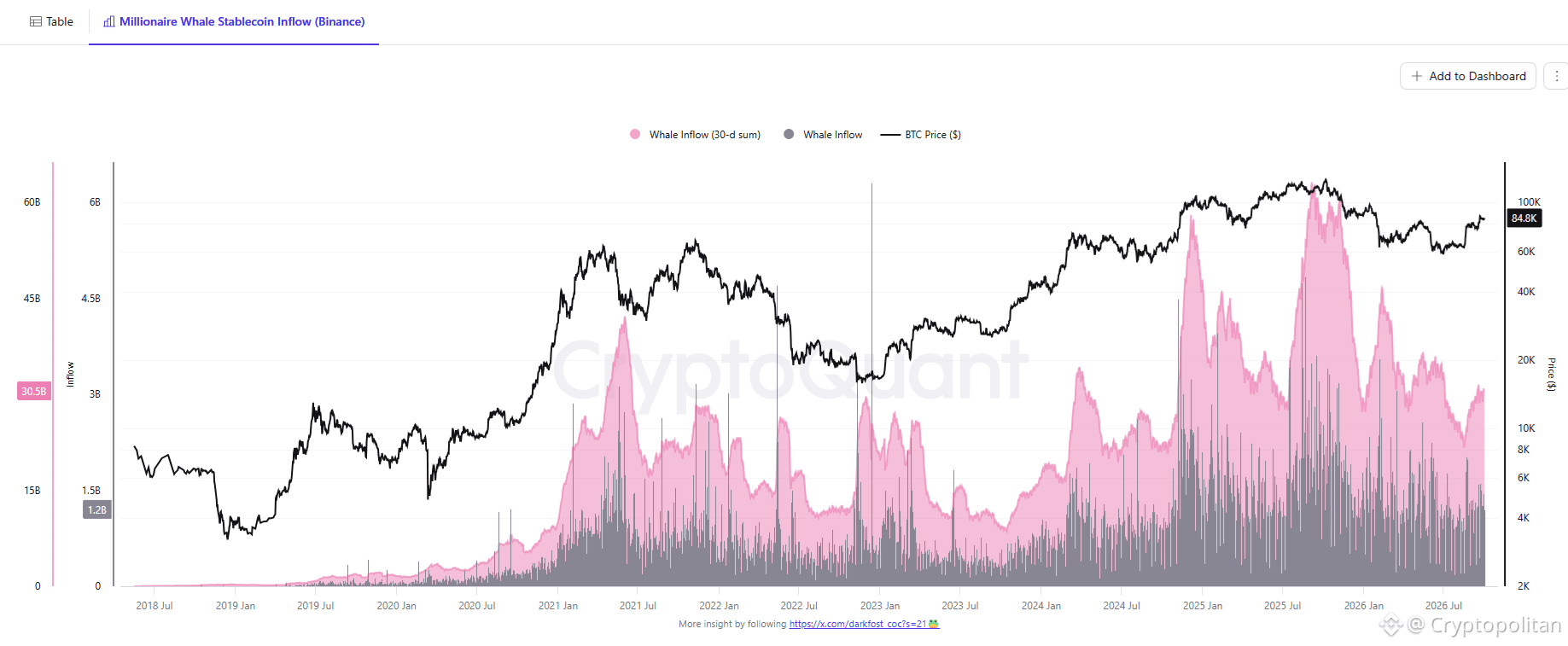
Article
Whales lead as $30B in liquidity returns into markets in SeptemberStablecoins were a major source of liquidity this September. For the past 30 days, whale liquidity shifts moved another $30B into the market.
Stablecoins flowed into the crypto market, following the outflows in early August. In September, whales made more active deposits, adding $30B in total liquidity. The latest recovery of BTC above $85,000 coincided with another wave of stablecoin deposits.
September also broke the trend of subdued stablecoin activity. For the past 30 days, on-chain data showed a 40% increase in deposits above $1M sent to Binance. During slower market times, stablecoins often wait on the sidelines or are used for DeFi yield, where the risk is justified.
Stablecoin inflows from whales accelerated in September, with a 40% rise in deposits above $1M sent as liquidity to Binance. | Source: Cryptoquant
For September, inflows to Binance expanded from around $26B to over $30B, extending a trend that started around August 14.
As Cryptopolitan reported, stablecoins are in demand recently, remaining a major factor for crypto sentiment.
In September, new liquidity deployment meant whales tried to make use of the trend shift and position themselves for an October rally. However, allocation remains cautious, as BTC is still shaky in the face of global uncertainty and growing bond yields.
Stablecoins on Binance signal early market recovery
Stablecoin inflows to Binance remain weaker compared to previous market peaks. In the short term, however, the stablecoins are seen as a bullish signal, preparing for more asset exposure.
The inflow of stablecoins may also go toward derivative trading, leading to expanded open interest, which is not necessarily immediately bullish. Some of the whales may attempt to short crypto assets from what they consider a temporary peak.
At the same time, the inflow of stablecoins coincided with a period of renewed large whale orders on Binance, signaling some of the liquidity translated into direct spot demand.
The market recovery is still tentative, as Binance stablecoin reserves fluctuated in the past month. As of October 2, the exchange carried around $42B in stablecoin reserves, peaking at $43.8B on September 8.
All other exchanges as a whole carry around $58B in stablecoins. Liquidity is also shifting between markets, with some outflows from spot markets and into derivative markets.
Stablecoins became a leading narrative in September
Stablecoins had rising social media volume, becoming one of the narratives in focus according to Santiment.
Stablecoin mentions also increased around the discussion of the US Clarity Act. Stablecoins are more closely watched, as issuers now hold over $200B in US Treasuries, turning into some of the biggest debt holders and even offsetting debt shedding by China.
Despite the overall focus on stablecoins, retail behavior shows slower stablecoin usage. In the past 30 days, active addresses are down by 8.1% to around 5.1M daily. According to Artemis, daily turnover is around $244B, down 32% in the past 30 days. Whale activity may have more impact on prices, but retail shows overall crypto sentiment and readiness to use stablecoins.
In Q3, there were also shifts in stablecoin usage, according to a recent report by the RWA Foundation. Total stablecoin supply was at $300.9B on October 1, with 195 assets, 152 issuers and 47 chains. A total of 308.4M addresses held stablecoins.
For the past three months, Ethereum lost $4.9B in stablecoins, while the supply on TRON increased by $5B. Tether’s USDT supply contracted by $207.7M, while stablecoins by Circle and Ripple posted more active growth.
For retail and native traders, the growth of stablecoins on HyperEVM showed renewed activity, adding $1.5B in liquidity for Q3. Robinhood Chain added $649.2M in stablecoins for the same period, driving its own brand of trading and meme launchpads.
The smartest crypto minds already read our newsletter. Want in? Join them.
Whales lead as $30B in liquidity returns into markets in September
Stablecoins were a major source of liquidity this September. For the past 30 days, whale liquidity shifts moved another $30B into the market.
Stablecoins flowed into the crypto market, following the outflows in early August. In September, whales made more active deposits, adding $30B in total liquidity. The latest recovery of BTC above $85,000 coincided with another wave of stablecoin deposits.
September also broke the trend of subdued stablecoin activity. For the past 30 days, on-chain data showed a 40% increase in deposits above $1M sent to Binance. During slower market times, stablecoins often wait on the sidelines or are used for DeFi yield, where the risk is justified.
Stablecoin inflows from whales accelerated in September, with a 40% rise in deposits above $1M sent as liquidity to Binance. | Source: Cryptoquant
For September, inflows to Binance expanded from around $26B to over $30B, extending a trend that started around August 14.
As Cryptopolitan reported, stablecoins are in demand recently, remaining a major factor for crypto sentiment.
In September, new liquidity deployment meant whales tried to make use of the trend shift and position themselves for an October rally. However, allocation remains cautious, as BTC is still shaky in the face of global uncertainty and growing bond yields.
Stablecoins on Binance signal early market recovery
Stablecoin inflows to Binance remain weaker compared to previous market peaks. In the short term, however, the stablecoins are seen as a bullish signal, preparing for more asset exposure.
The inflow of stablecoins may also go toward derivative trading, leading to expanded open interest, which is not necessarily immediately bullish. Some of the whales may attempt to short crypto assets from what they consider a temporary peak.
At the same time, the inflow of stablecoins coincided with a period of renewed large whale orders on Binance, signaling some of the liquidity translated into direct spot demand.
The market recovery is still tentative, as Binance stablecoin reserves fluctuated in the past month. As of October 2, the exchange carried around $42B in stablecoin reserves, peaking at $43.8B on September 8.
All other exchanges as a whole carry around $58B in stablecoins. Liquidity is also shifting between markets, with some outflows from spot markets and into derivative markets.
Stablecoins became a leading narrative in September
Stablecoins had rising social media volume, becoming one of the narratives in focus according to Santiment.
Stablecoin mentions also increased around the discussion of the US Clarity Act. Stablecoins are more closely watched, as issuers now hold over $200B in US Treasuries, turning into some of the biggest debt holders and even offsetting debt shedding by China.
Despite the overall focus on stablecoins, retail behavior shows slower stablecoin usage. In the past 30 days, active addresses are down by 8.1% to around 5.1M daily. According to Artemis, daily turnover is around $244B, down 32% in the past 30 days. Whale activity may have more impact on prices, but retail shows overall crypto sentiment and readiness to use stablecoins.
In Q3, there were also shifts in stablecoin usage, according to a recent report by the RWA Foundation. Total stablecoin supply was at $300.9B on October 1, with 195 assets, 152 issuers and 47 chains. A total of 308.4M addresses held stablecoins.
For the past three months, Ethereum lost $4.9B in stablecoins, while the supply on TRON increased by $5B. Tether’s USDT supply contracted by $207.7M, while stablecoins by Circle and Ripple posted more active growth.
For retail and native traders, the growth of stablecoins on HyperEVM showed renewed activity, adding $1.5B in liquidity for Q3. Robinhood Chain added $649.2M in stablecoins for the same period, driving its own brand of trading and meme launchpads.
The smartest crypto minds already read our newsletter. Want in? Join them.
Stablecoins flowed into the crypto market, following the outflows in early August. In September, whales made more active deposits, adding $30B in total liquidity. The latest recovery of BTC above $85,000 coincided with another wave of stablecoin deposits.
September also broke the trend of subdued stablecoin activity. For the past 30 days, on-chain data showed a 40% increase in deposits above $1M sent to Binance. During slower market times, stablecoins often wait on the sidelines or are used for DeFi yield, where the risk is justified.
Stablecoin inflows from whales accelerated in September, with a 40% rise in deposits above $1M sent as liquidity to Binance. | Source: Cryptoquant
For September, inflows to Binance expanded from around $26B to over $30B, extending a trend that started around August 14.
As Cryptopolitan reported, stablecoins are in demand recently, remaining a major factor for crypto sentiment.
In September, new liquidity deployment meant whales tried to make use of the trend shift and position themselves for an October rally. However, allocation remains cautious, as BTC is still shaky in the face of global uncertainty and growing bond yields.
Stablecoins on Binance signal early market recovery
Stablecoin inflows to Binance remain weaker compared to previous market peaks. In the short term, however, the stablecoins are seen as a bullish signal, preparing for more asset exposure.
The inflow of stablecoins may also go toward derivative trading, leading to expanded open interest, which is not necessarily immediately bullish. Some of the whales may attempt to short crypto assets from what they consider a temporary peak.
At the same time, the inflow of stablecoins coincided with a period of renewed large whale orders on Binance, signaling some of the liquidity translated into direct spot demand.
The market recovery is still tentative, as Binance stablecoin reserves fluctuated in the past month. As of October 2, the exchange carried around $42B in stablecoin reserves, peaking at $43.8B on September 8.
All other exchanges as a whole carry around $58B in stablecoins. Liquidity is also shifting between markets, with some outflows from spot markets and into derivative markets.
Stablecoins became a leading narrative in September
Stablecoins had rising social media volume, becoming one of the narratives in focus according to Santiment.
Stablecoin mentions also increased around the discussion of the US Clarity Act. Stablecoins are more closely watched, as issuers now hold over $200B in US Treasuries, turning into some of the biggest debt holders and even offsetting debt shedding by China.
Despite the overall focus on stablecoins, retail behavior shows slower stablecoin usage. In the past 30 days, active addresses are down by 8.1% to around 5.1M daily. According to Artemis, daily turnover is around $244B, down 32% in the past 30 days. Whale activity may have more impact on prices, but retail shows overall crypto sentiment and readiness to use stablecoins.
In Q3, there were also shifts in stablecoin usage, according to a recent report by the RWA Foundation. Total stablecoin supply was at $300.9B on October 1, with 195 assets, 152 issuers and 47 chains. A total of 308.4M addresses held stablecoins.
For the past three months, Ethereum lost $4.9B in stablecoins, while the supply on TRON increased by $5B. Tether’s USDT supply contracted by $207.7M, while stablecoins by Circle and Ripple posted more active growth.
For retail and native traders, the growth of stablecoins on HyperEVM showed renewed activity, adding $1.5B in liquidity for Q3. Robinhood Chain added $649.2M in stablecoins for the same period, driving its own brand of trading and meme launchpads.
The smartest crypto minds already read our newsletter. Want in? Join them.
1
206
Drift victims face a decades-long wait to get 1 cent on the dollarVictims of the April 1 exploit that drained about $295.4 million from Drift Foundation, now called Velocity, have called out the repayment rate on the DFX recovery token, which works out to roughly one cent for every lost dollar.
The claims and redemptions window, confirmed in an October 1 release by the project, provides the first working portal for the tens of thousands of Drift users affected by the attack that made headlines more than five months ago.
Why 100 USDT lost in the Drift exploit is worth 1 USDT now
The math behind the DFX recovery token is based on a calculation that converts each verified dollar lost in the Drift hack to one DFX token, a standard SPL token on Solana that can be held, redeemed, or sold on Raydium or other secondary markets.
Notably, the token’s USDT value is not fixed. According to the Drift Foundation’s claims guide, USDT value is calculated by dividing the Recovery Pool balance by the number of DFX still outstanding.
The DFX token was worth around 0.0104 USDT at launch. Hence, a user who lost 100 USDT in April holds 100 DFX now, which they can redeem for about 1.04 USDT at the current exchange rate.
DFX claims and redemption page. Source: Drift Foundation
The current value is based on the Recovery Pool currently holding roughly 3.11 million USDT against a fixed supply of 299,500,810.998 DFX.
Speculative trading on DFX has quickly gotten hot, with the token climbing about 210% in 24 hours to about $0.03, although with thin liquidity of around $200,000, which also implies volatility.
Cryptopolitan reported on Drift user frustrations and unfairness accusations in May, when the project’s recovery framework was interpreted as forcing early redeemers to forfeit their remaining claims.
One contributor on the Drift governance forum called the related Insurance Fund vote “effectively an attempt at money laundering.”
Will the redemption rate of the DFX token rise?
The pool to repay victims in the Drift Protocol exploit was designed to only grow; the redemption rate never falls.
How the Drift Recovery Pool gets refilled
Money enters once a day at 00:00 UTC from the Net Protocol Revenue of Velocity at different rates:
60% of the first 30,000 USDT of daily revenue
70% up to 100,000 USDT
90% of anything above that, until deposits total the full verified loss.
Unclaimed DFX tokens by the time the window closes at 00:00 UTC on January 1, 2028, will be burned.
Tether has pledged up to 127.5 million USDT, while other strategic partners have committed up to 20 million USDT. However, those funds have caps and will only be released in phases, according to a preset schedule.
Any additional funds recovered from the stolen total form the fourth stream, but that is less predictable.
As of Drift’s September 30 update, $9.2 million of the stolen funds were frozen after the attacker routed funds through Tornado Cash in August. Three of the four Ethereum wallets still hold 107,165 ETH of the stolen crypto and have not moved in months.
If you're reading this, you’re already ahead. Stay there with our newsletter.
Drift victims face a decades-long wait to get 1 cent on the dollar
Victims of the April 1 exploit that drained about $295.4 million from Drift Foundation, now called Velocity, have called out the repayment rate on the DFX recovery token, which works out to roughly one cent for every lost dollar.
The claims and redemptions window, confirmed in an October 1 release by the project, provides the first working portal for the tens of thousands of Drift users affected by the attack that made headlines more than five months ago.
Why 100 USDT lost in the Drift exploit is worth 1 USDT now
The math behind the DFX recovery token is based on a calculation that converts each verified dollar lost in the Drift hack to one DFX token, a standard SPL token on Solana that can be held, redeemed, or sold on Raydium or other secondary markets.
Notably, the token’s USDT value is not fixed. According to the Drift Foundation’s claims guide, USDT value is calculated by dividing the Recovery Pool balance by the number of DFX still outstanding.
The DFX token was worth around 0.0104 USDT at launch. Hence, a user who lost 100 USDT in April holds 100 DFX now, which they can redeem for about 1.04 USDT at the current exchange rate.
DFX claims and redemption page. Source: Drift Foundation
The current value is based on the Recovery Pool currently holding roughly 3.11 million USDT against a fixed supply of 299,500,810.998 DFX.
Speculative trading on DFX has quickly gotten hot, with the token climbing about 210% in 24 hours to about $0.03, although with thin liquidity of around $200,000, which also implies volatility.
Cryptopolitan reported on Drift user frustrations and unfairness accusations in May, when the project’s recovery framework was interpreted as forcing early redeemers to forfeit their remaining claims.
One contributor on the Drift governance forum called the related Insurance Fund vote “effectively an attempt at money laundering.”
Will the redemption rate of the DFX token rise?
The pool to repay victims in the Drift Protocol exploit was designed to only grow; the redemption rate never falls.
How the Drift Recovery Pool gets refilled
Money enters once a day at 00:00 UTC from the Net Protocol Revenue of Velocity at different rates:
60% of the first 30,000 USDT of daily revenue
70% up to 100,000 USDT
90% of anything above that, until deposits total the full verified loss.
Unclaimed DFX tokens by the time the window closes at 00:00 UTC on January 1, 2028, will be burned.
Tether has pledged up to 127.5 million USDT, while other strategic partners have committed up to 20 million USDT. However, those funds have caps and will only be released in phases, according to a preset schedule.
Any additional funds recovered from the stolen total form the fourth stream, but that is less predictable.
As of Drift’s September 30 update, $9.2 million of the stolen funds were frozen after the attacker routed funds through Tornado Cash in August. Three of the four Ethereum wallets still hold 107,165 ETH of the stolen crypto and have not moved in months.
If you're reading this, you’re already ahead. Stay there with our newsletter.
The claims and redemptions window, confirmed in an October 1 release by the project, provides the first working portal for the tens of thousands of Drift users affected by the attack that made headlines more than five months ago.
Why 100 USDT lost in the Drift exploit is worth 1 USDT now
The math behind the DFX recovery token is based on a calculation that converts each verified dollar lost in the Drift hack to one DFX token, a standard SPL token on Solana that can be held, redeemed, or sold on Raydium or other secondary markets.
Notably, the token’s USDT value is not fixed. According to the Drift Foundation’s claims guide, USDT value is calculated by dividing the Recovery Pool balance by the number of DFX still outstanding.
The DFX token was worth around 0.0104 USDT at launch. Hence, a user who lost 100 USDT in April holds 100 DFX now, which they can redeem for about 1.04 USDT at the current exchange rate.
DFX claims and redemption page. Source: Drift Foundation
The current value is based on the Recovery Pool currently holding roughly 3.11 million USDT against a fixed supply of 299,500,810.998 DFX.
Speculative trading on DFX has quickly gotten hot, with the token climbing about 210% in 24 hours to about $0.03, although with thin liquidity of around $200,000, which also implies volatility.
Cryptopolitan reported on Drift user frustrations and unfairness accusations in May, when the project’s recovery framework was interpreted as forcing early redeemers to forfeit their remaining claims.
One contributor on the Drift governance forum called the related Insurance Fund vote “effectively an attempt at money laundering.”
Will the redemption rate of the DFX token rise?
The pool to repay victims in the Drift Protocol exploit was designed to only grow; the redemption rate never falls.
How the Drift Recovery Pool gets refilled
Money enters once a day at 00:00 UTC from the Net Protocol Revenue of Velocity at different rates:
60% of the first 30,000 USDT of daily revenue
70% up to 100,000 USDT
90% of anything above that, until deposits total the full verified loss.
Unclaimed DFX tokens by the time the window closes at 00:00 UTC on January 1, 2028, will be burned.
Tether has pledged up to 127.5 million USDT, while other strategic partners have committed up to 20 million USDT. However, those funds have caps and will only be released in phases, according to a preset schedule.
Any additional funds recovered from the stolen total form the fourth stream, but that is less predictable.
As of Drift’s September 30 update, $9.2 million of the stolen funds were frozen after the attacker routed funds through Tornado Cash in August. Three of the four Ethereum wallets still hold 107,165 ETH of the stolen crypto and have not moved in months.
If you're reading this, you’re already ahead. Stay there with our newsletter.
2
1
157
Cryptopolitan Report: Meta Wants Its AI Agent On Your Keychain. 37% Of Our Readers Say “Not For Me”Meta’s annual developer and hardware conference, Connect, wrapped up last week with a new wave of glasses, headsets and AI products. This year’s conference began with Mark Zuckerberg’s keynote at Meta’s Menlo Park headquarters on September 23 and it ended with the unveiling of a pocket-sized gadget built for the sole purpose of talking to Meta’s new AI agent. We asked our newsletter readers their thoughts on the new line up. The results came back split almost evenly between enthusiasm and a flat no, and the reasons behind that split point more towards trust rather than the hardware itself.
What Meta Showed Off
Over the past few years, Meta Connect has been a conference to display its glasses. This year, however, was different with its focus shifting around Muse, the personal AI agent Meta launched only two weeks before the event. Nearly every device unveiled on stage was presented as another way for users to interact with Muse. Meta’s own recap of the event leads with bringing Muse to its AI glasses before it gets to any of the hardware.
Muse is an agent and this is very different from a regular chatbot. It books things, fills in forms, sends emails and makes purchases on your behalf once you connect your accounts. It launched on September 8 with a free tier plan and monthly subscription costing $20 or $100 based on usage. According to Sensor Tower data cited by Dezeen, Muse AI has been downloaded more than 2.5 million times in its first few weeks.
After this were the hardware announcements. This included the Ray-Ban Meta (Gen 3) which included thinner frames and around one hour of extra battery life. These went on sale the same day at $449. Next were the Ray-Ban Meta Audio which is the first glasses introduced by the company with no camera and goes for $349. This launch reads as a direct response to the criticism centered around privacy and Meta’s camera-equipped glasses. The most advanced glasses in the lineup was the Meta VR glasses, which is a slim headset tethered to a pocket “puck” that handles the computing and battery. They are priced at $1,299 and available next spring.
The “One More Thing”: Muse Charm
Zuckerberg saved the Charm for the end. It’s a small handheld, roughly the size of an Apple Watch face with a lanyard instead of a strap. You tap a fingerprint sensor in the corner and start talking. A two-inch screen shows an animated avatar called Jolly, there’s a built-in 5G modem so it doesn’t need your phone, and there appears to be a small camera so the agent can see what you’re pointing it at. It came out of Meta’s new design group, led by former Apple design chief Alan Dye.
Zuckerberg’s own pitch was that Meta had “packed the whole Muse experience, including the whole real-time voice and avatar stack into something that fits on a keychain”. He also admitted some details still need finalising.
That admission is bigger than it sounds. Meta hasn’t announced a price. It says only a small number of prototypes exist and components aren’t locked. The target is December, in time for the holidays.
Anyone who followed AI hardware in 2024 will feel a twinge of déjà vu here. Humane’s AI Pin launched at $699 with a monthly subscription, struggled through brutal reviews, and was shut down in February 2025 when HP bought the company’s remains for $116 million. The Rabbit R1 had a similar arc at a lower price point. Both tried to do what a phone already does. Meta is betting it can avoid that trap by keeping Charm as a companion to an agent people already use, rather than a replacement for the phone in their pocket.
The Trust Problem Sitting Under All Of It
Muse’s first three weeks have been bumpy, and that matters for how people view the hardware wrapped around it.
Privacy questions arrived on day one. ABC News reported experts raising concerns about an agent with access to people’s apps, financial details and personal data, while Zuckerberg pointed to a secure credential store designed so Muse can’t read stored passwords or card numbers. Dezeen noted the agent has already faced accusations from users about how it handles private messages and sensitive account details. On September 21, Amazon started blocking Muse from shopping on its site, saying it had not authorized the agent’s access.
Then there’s the business model. Muse carries no advertising. Meta’s stated plan is to take a small fee on transactions the agent completes. That’s cleaner than ads in some ways. It also means the company earns more the more you let the agent spend.
Now put a camera and a 5G connection on that agent, hang it from a keychain, and you can see why some people hesitate.
What The Split Tells Us
This poll went out the evening after the keynote, with the Charm in the headline. Most respondents were reacting to that device first and the rest of the lineup second.
The context worth adding is how this audience has answered similar questions before. Across several polls this year, readers have shown a pattern that’s easy to miss: they follow AI closely and keep it at a cautious distance personally. Back in May, 38% told us they had never used an AI agent. When we asked about handing an agent control of a crypto wallet, “Nope” won again, though most respondents were open to it with conditions attached. Meta is now asking people to carry an agent around with them. You’d expect resistance from this crowd, and it showed up.
Nope, not for me (37.27%): The top answer, though narrowly. The phrasing matters. Readers weren’t asked whether the products were bad, and “not for me” is a personal verdict rather than a review. Some of this group likely has nothing against the tech itself. They just don’t want a Meta agent with a camera, a data connection and a transaction fee model living in their pocket, especially after the first few weeks of Muse headlines. With Meta, the brand carries its history into every launch, and a product whose whole job is to know more about you gets judged on that history first.
Yes, they are innovative (~35.5%): Almost as large, and worth reading carefully. The option said “innovative,” which isn’t the same as “I’d buy one.” Plenty of people can admire a $1,299 VR headset that streams IMAX films and still have no plans to own it. Still, a third of an audience this sceptical giving Meta credit is meaningful. The glasses business is genuinely working for Meta, and the Charm is at least a more honest attempt at an AI gadget than what came before it.
Maybe, I like a few (~27.3%): The most practical answer in the set. Meta showed four devices at four very different price points aimed at four different users. Liking the $349 camera-free audio glasses while shrugging at the Charm is a perfectly coherent position. So is wanting the hearing feature and nothing else. This group judged the lineup product by product rather than as a single verdict on Meta, and that’s probably the fairest way to read it.
The real split isn’t between people who like gadgets and people who don’t. It’s between people judging the devices and people judging the company behind them. Those two groups end up only a couple of points apart.
What December Will Settle
Three things decide whether the Charm becomes Meta’s version of the AI Pin or something that actually sticks.
Price comes first. Meta hasn’t said a number, and the Humane experience showed how quickly a premium price plus a subscription kills curiosity. If Charm needs its own data plan on top of a Muse subscription, a lot of the “maybe” crowd will drift to “no.”
Second is whether Muse itself earns trust over the next couple of months. The device is only as useful as the services the agent is allowed to reach. The Amazon dispute shows how fragile that is. An agent that can’t shop at the largest online retailer in the US has a gap no hardware can fill.
The third is quieter. Meta released camera-free glasses at the same event where it launched a camera-equipped keychain. That suggests the company knows exactly where the objection sits and is hedging both ways. Watch which one sells.
Our readers were split nearly evenly on the day of the announcement. They’ll have a price, reviews and a few months of Muse behaviour to judge by the time the Charm reaches shelves. That second reading will tell us far more than the first.
Don’t just read crypto news. Understand it. Subscribe to our newsletter. It's free.
Cryptopolitan Report: Meta Wants Its AI Agent On Your Keychain. 37% Of Our Readers Say “Not For Me”
Meta’s annual developer and hardware conference, Connect, wrapped up last week with a new wave of glasses, headsets and AI products. This year’s conference began with Mark Zuckerberg’s keynote at Meta’s Menlo Park headquarters on September 23 and it ended with the unveiling of a pocket-sized gadget built for the sole purpose of talking to Meta’s new AI agent. We asked our newsletter readers their thoughts on the new line up. The results came back split almost evenly between enthusiasm and a flat no, and the reasons behind that split point more towards trust rather than the hardware itself.
What Meta Showed Off
Over the past few years, Meta Connect has been a conference to display its glasses. This year, however, was different with its focus shifting around Muse, the personal AI agent Meta launched only two weeks before the event. Nearly every device unveiled on stage was presented as another way for users to interact with Muse. Meta’s own recap of the event leads with bringing Muse to its AI glasses before it gets to any of the hardware.
Muse is an agent and this is very different from a regular chatbot. It books things, fills in forms, sends emails and makes purchases on your behalf once you connect your accounts. It launched on September 8 with a free tier plan and monthly subscription costing $20 or $100 based on usage. According to Sensor Tower data cited by Dezeen, Muse AI has been downloaded more than 2.5 million times in its first few weeks.
After this were the hardware announcements. This included the Ray-Ban Meta (Gen 3) which included thinner frames and around one hour of extra battery life. These went on sale the same day at $449. Next were the Ray-Ban Meta Audio which is the first glasses introduced by the company with no camera and goes for $349. This launch reads as a direct response to the criticism centered around privacy and Meta’s camera-equipped glasses. The most advanced glasses in the lineup was the Meta VR glasses, which is a slim headset tethered to a pocket “puck” that handles the computing and battery. They are priced at $1,299 and available next spring.
The “One More Thing”: Muse Charm
Zuckerberg saved the Charm for the end. It’s a small handheld, roughly the size of an Apple Watch face with a lanyard instead of a strap. You tap a fingerprint sensor in the corner and start talking. A two-inch screen shows an animated avatar called Jolly, there’s a built-in 5G modem so it doesn’t need your phone, and there appears to be a small camera so the agent can see what you’re pointing it at. It came out of Meta’s new design group, led by former Apple design chief Alan Dye.
Zuckerberg’s own pitch was that Meta had “packed the whole Muse experience, including the whole real-time voice and avatar stack into something that fits on a keychain”. He also admitted some details still need finalising.
That admission is bigger than it sounds. Meta hasn’t announced a price. It says only a small number of prototypes exist and components aren’t locked. The target is December, in time for the holidays.
Anyone who followed AI hardware in 2024 will feel a twinge of déjà vu here. Humane’s AI Pin launched at $699 with a monthly subscription, struggled through brutal reviews, and was shut down in February 2025 when HP bought the company’s remains for $116 million. The Rabbit R1 had a similar arc at a lower price point. Both tried to do what a phone already does. Meta is betting it can avoid that trap by keeping Charm as a companion to an agent people already use, rather than a replacement for the phone in their pocket.
The Trust Problem Sitting Under All Of It
Muse’s first three weeks have been bumpy, and that matters for how people view the hardware wrapped around it.
Privacy questions arrived on day one. ABC News reported experts raising concerns about an agent with access to people’s apps, financial details and personal data, while Zuckerberg pointed to a secure credential store designed so Muse can’t read stored passwords or card numbers. Dezeen noted the agent has already faced accusations from users about how it handles private messages and sensitive account details. On September 21, Amazon started blocking Muse from shopping on its site, saying it had not authorized the agent’s access.
Then there’s the business model. Muse carries no advertising. Meta’s stated plan is to take a small fee on transactions the agent completes. That’s cleaner than ads in some ways. It also means the company earns more the more you let the agent spend.
Now put a camera and a 5G connection on that agent, hang it from a keychain, and you can see why some people hesitate.
What The Split Tells Us
This poll went out the evening after the keynote, with the Charm in the headline. Most respondents were reacting to that device first and the rest of the lineup second.
The context worth adding is how this audience has answered similar questions before. Across several polls this year, readers have shown a pattern that’s easy to miss: they follow AI closely and keep it at a cautious distance personally. Back in May, 38% told us they had never used an AI agent. When we asked about handing an agent control of a crypto wallet, “Nope” won again, though most respondents were open to it with conditions attached. Meta is now asking people to carry an agent around with them. You’d expect resistance from this crowd, and it showed up.
Nope, not for me (37.27%): The top answer, though narrowly. The phrasing matters. Readers weren’t asked whether the products were bad, and “not for me” is a personal verdict rather than a review. Some of this group likely has nothing against the tech itself. They just don’t want a Meta agent with a camera, a data connection and a transaction fee model living in their pocket, especially after the first few weeks of Muse headlines. With Meta, the brand carries its history into every launch, and a product whose whole job is to know more about you gets judged on that history first.
Yes, they are innovative (~35.5%): Almost as large, and worth reading carefully. The option said “innovative,” which isn’t the same as “I’d buy one.” Plenty of people can admire a $1,299 VR headset that streams IMAX films and still have no plans to own it. Still, a third of an audience this sceptical giving Meta credit is meaningful. The glasses business is genuinely working for Meta, and the Charm is at least a more honest attempt at an AI gadget than what came before it.
Maybe, I like a few (~27.3%): The most practical answer in the set. Meta showed four devices at four very different price points aimed at four different users. Liking the $349 camera-free audio glasses while shrugging at the Charm is a perfectly coherent position. So is wanting the hearing feature and nothing else. This group judged the lineup product by product rather than as a single verdict on Meta, and that’s probably the fairest way to read it.
The real split isn’t between people who like gadgets and people who don’t. It’s between people judging the devices and people judging the company behind them. Those two groups end up only a couple of points apart.
What December Will Settle
Three things decide whether the Charm becomes Meta’s version of the AI Pin or something that actually sticks.
Price comes first. Meta hasn’t said a number, and the Humane experience showed how quickly a premium price plus a subscription kills curiosity. If Charm needs its own data plan on top of a Muse subscription, a lot of the “maybe” crowd will drift to “no.”
Second is whether Muse itself earns trust over the next couple of months. The device is only as useful as the services the agent is allowed to reach. The Amazon dispute shows how fragile that is. An agent that can’t shop at the largest online retailer in the US has a gap no hardware can fill.
The third is quieter. Meta released camera-free glasses at the same event where it launched a camera-equipped keychain. That suggests the company knows exactly where the objection sits and is hedging both ways. Watch which one sells.
Our readers were split nearly evenly on the day of the announcement. They’ll have a price, reviews and a few months of Muse behaviour to judge by the time the Charm reaches shelves. That second reading will tell us far more than the first.
Don’t just read crypto news. Understand it. Subscribe to our newsletter. It's free.
What Meta Showed Off
Over the past few years, Meta Connect has been a conference to display its glasses. This year, however, was different with its focus shifting around Muse, the personal AI agent Meta launched only two weeks before the event. Nearly every device unveiled on stage was presented as another way for users to interact with Muse. Meta’s own recap of the event leads with bringing Muse to its AI glasses before it gets to any of the hardware.
Muse is an agent and this is very different from a regular chatbot. It books things, fills in forms, sends emails and makes purchases on your behalf once you connect your accounts. It launched on September 8 with a free tier plan and monthly subscription costing $20 or $100 based on usage. According to Sensor Tower data cited by Dezeen, Muse AI has been downloaded more than 2.5 million times in its first few weeks.
After this were the hardware announcements. This included the Ray-Ban Meta (Gen 3) which included thinner frames and around one hour of extra battery life. These went on sale the same day at $449. Next were the Ray-Ban Meta Audio which is the first glasses introduced by the company with no camera and goes for $349. This launch reads as a direct response to the criticism centered around privacy and Meta’s camera-equipped glasses. The most advanced glasses in the lineup was the Meta VR glasses, which is a slim headset tethered to a pocket “puck” that handles the computing and battery. They are priced at $1,299 and available next spring.
The “One More Thing”: Muse Charm
Zuckerberg saved the Charm for the end. It’s a small handheld, roughly the size of an Apple Watch face with a lanyard instead of a strap. You tap a fingerprint sensor in the corner and start talking. A two-inch screen shows an animated avatar called Jolly, there’s a built-in 5G modem so it doesn’t need your phone, and there appears to be a small camera so the agent can see what you’re pointing it at. It came out of Meta’s new design group, led by former Apple design chief Alan Dye.
Zuckerberg’s own pitch was that Meta had “packed the whole Muse experience, including the whole real-time voice and avatar stack into something that fits on a keychain”. He also admitted some details still need finalising.
That admission is bigger than it sounds. Meta hasn’t announced a price. It says only a small number of prototypes exist and components aren’t locked. The target is December, in time for the holidays.
Anyone who followed AI hardware in 2024 will feel a twinge of déjà vu here. Humane’s AI Pin launched at $699 with a monthly subscription, struggled through brutal reviews, and was shut down in February 2025 when HP bought the company’s remains for $116 million. The Rabbit R1 had a similar arc at a lower price point. Both tried to do what a phone already does. Meta is betting it can avoid that trap by keeping Charm as a companion to an agent people already use, rather than a replacement for the phone in their pocket.
The Trust Problem Sitting Under All Of It
Muse’s first three weeks have been bumpy, and that matters for how people view the hardware wrapped around it.
Privacy questions arrived on day one. ABC News reported experts raising concerns about an agent with access to people’s apps, financial details and personal data, while Zuckerberg pointed to a secure credential store designed so Muse can’t read stored passwords or card numbers. Dezeen noted the agent has already faced accusations from users about how it handles private messages and sensitive account details. On September 21, Amazon started blocking Muse from shopping on its site, saying it had not authorized the agent’s access.
Then there’s the business model. Muse carries no advertising. Meta’s stated plan is to take a small fee on transactions the agent completes. That’s cleaner than ads in some ways. It also means the company earns more the more you let the agent spend.
Now put a camera and a 5G connection on that agent, hang it from a keychain, and you can see why some people hesitate.
What The Split Tells Us
This poll went out the evening after the keynote, with the Charm in the headline. Most respondents were reacting to that device first and the rest of the lineup second.
The context worth adding is how this audience has answered similar questions before. Across several polls this year, readers have shown a pattern that’s easy to miss: they follow AI closely and keep it at a cautious distance personally. Back in May, 38% told us they had never used an AI agent. When we asked about handing an agent control of a crypto wallet, “Nope” won again, though most respondents were open to it with conditions attached. Meta is now asking people to carry an agent around with them. You’d expect resistance from this crowd, and it showed up.
Nope, not for me (37.27%): The top answer, though narrowly. The phrasing matters. Readers weren’t asked whether the products were bad, and “not for me” is a personal verdict rather than a review. Some of this group likely has nothing against the tech itself. They just don’t want a Meta agent with a camera, a data connection and a transaction fee model living in their pocket, especially after the first few weeks of Muse headlines. With Meta, the brand carries its history into every launch, and a product whose whole job is to know more about you gets judged on that history first.
Yes, they are innovative (~35.5%): Almost as large, and worth reading carefully. The option said “innovative,” which isn’t the same as “I’d buy one.” Plenty of people can admire a $1,299 VR headset that streams IMAX films and still have no plans to own it. Still, a third of an audience this sceptical giving Meta credit is meaningful. The glasses business is genuinely working for Meta, and the Charm is at least a more honest attempt at an AI gadget than what came before it.
Maybe, I like a few (~27.3%): The most practical answer in the set. Meta showed four devices at four very different price points aimed at four different users. Liking the $349 camera-free audio glasses while shrugging at the Charm is a perfectly coherent position. So is wanting the hearing feature and nothing else. This group judged the lineup product by product rather than as a single verdict on Meta, and that’s probably the fairest way to read it.
The real split isn’t between people who like gadgets and people who don’t. It’s between people judging the devices and people judging the company behind them. Those two groups end up only a couple of points apart.
What December Will Settle
Three things decide whether the Charm becomes Meta’s version of the AI Pin or something that actually sticks.
Price comes first. Meta hasn’t said a number, and the Humane experience showed how quickly a premium price plus a subscription kills curiosity. If Charm needs its own data plan on top of a Muse subscription, a lot of the “maybe” crowd will drift to “no.”
Second is whether Muse itself earns trust over the next couple of months. The device is only as useful as the services the agent is allowed to reach. The Amazon dispute shows how fragile that is. An agent that can’t shop at the largest online retailer in the US has a gap no hardware can fill.
The third is quieter. Meta released camera-free glasses at the same event where it launched a camera-equipped keychain. That suggests the company knows exactly where the objection sits and is hedging both ways. Watch which one sells.
Our readers were split nearly evenly on the day of the announcement. They’ll have a price, reviews and a few months of Muse behaviour to judge by the time the Charm reaches shelves. That second reading will tell us far more than the first.
Don’t just read crypto news. Understand it. Subscribe to our newsletter. It's free.
205
Log in to explore more content
Join global crypto users on Binance Square
⚡️ Get latest and useful information about crypto.
💬 Trusted by the world’s largest crypto exchange.
👍 Discover real insights from verified creators.
Email / Phone number
Trending Topics
ZcashETFPostsFirstWeeklyOutflow$93.6M
6,942 views
34 Discussing
ZCASH ETF UPDATE
Zcash’s ETF has recorded its first weekly net outflow since launching in August.
Investors withdrew $93.6M as $ZEC fell toward $1,300. Grayscale’s ZCSH had attracted $98.2M two weeks earlier, but no daily net inflows have been recorded since September 22, according to SoSoValue.
ZEC was around $1,308 on October 3, down about 17.5% for the week and roughly 23% from its recent $1,690 peak.
$ZEC
Vicky-143
·0 Likes
·733 views
GreekPoliceBustCryptoScamRingArrest17
7,008 views
169 Discussing
BitcoinRejectedAt$87K
66,403 views
100 Discussing