

#cryptoeducation
cryptoeducation
3.5M views
20,548 Discussing
Hot
Latest
·
--
🚀 Crypto From Zero to Advanced | Daily Series
Starting today, I’m launching a daily crypto education series on Binance Square.
If you’re new to crypto and want to understand it from the ground up, this series is for you.
📚 We’ll cover everything step by step, including:
• Cryptocurrency basics
• Bitcoin & Blockchain
• Binance fundamentals
• Spot Trading
• Market & Limit Orders
• Wallets & Networks
• Market Cap & Liquidity
• Technical Analysis
• Risk Management
• Futures & Leverage
• Advanced Crypto Concepts
🎯 1 Day = 1 Lesson
Simple explanations. Practical examples. No unnecessary complexity.
Follow along and let’s learn crypto from zero to advanced, one day at a time.
Day 1 starts today. 🚀
#CryptoEducation #Bitcoin #Binance #Crypto
🚀 Crypto From Zero to Advanced | Daily Series
Starting today, I’m launching a daily crypto education series on Binance Square.
If you’re new to crypto and want to understand it from the ground up, this series is for you.
📚 We’ll cover everything step by step, including:
• Cryptocurrency basics
• Bitcoin & Blockchain
• Binance fundamentals
• Spot Trading
• Market & Limit Orders
• Wallets & Networks
• Market Cap & Liquidity
• Technical Analysis
• Risk Management
• Futures & Leverage
• Advanced Crypto Concepts
🎯 1 Day = 1 Lesson
Simple explanations. Practical examples. No unnecessary complexity.
Follow along and let’s learn crypto from zero to advanced, one day at a time.
Day 1 starts today. 🚀
#CryptoEducation #Bitcoin #Binance #Crypto
Starting today, I’m launching a daily crypto education series on Binance Square.
If you’re new to crypto and want to understand it from the ground up, this series is for you.
📚 We’ll cover everything step by step, including:
• Cryptocurrency basics
• Bitcoin & Blockchain
• Binance fundamentals
• Spot Trading
• Market & Limit Orders
• Wallets & Networks
• Market Cap & Liquidity
• Technical Analysis
• Risk Management
• Futures & Leverage
• Advanced Crypto Concepts
🎯 1 Day = 1 Lesson
Simple explanations. Practical examples. No unnecessary complexity.
Follow along and let’s learn crypto from zero to advanced, one day at a time.
Day 1 starts today. 🚀
#CryptoEducation #Bitcoin #Binance #Crypto
5
·
--
Constraints:
- No markdown (so no markdown formatting like **, *, etc.)
- Start with: 'Crypto Term of the Day:'
- 120-160 words total (including everything: title, body, ending line, hashtags). Must count words.
- Use one simple analogy from everyday life.
- Explain why a crypto investor needs to understand this.
- End with: "Save this post and share it with your crypto friends!"
- Final line: #Crypto #DeFi #CryptoEducation #Blockchain (with spaces as shown). The final line must be exactly that line? Probably exactly that line with those tags. Ensure there is a line break before final line? Not required but okay.
We must output ONLY the final post text — no extra commentary. So output a single block of text with the required content.
Word count: 120-160 words inclusive. Let's aim for around 140 words. Must count.
Let's draft.
First line: "Crypto Term of the Day:" (that's 4 words? Actually "Crypto" 1, "Term" 2, "of" 3, "the" 4, "Day:" 5). So 5 words.
Then body explaining on-chain vs off-chain, differences, analogy, why investor needs to understand.
Then ending line: "Save this post and share it with your crypto friends!" (Count words: Save(1) this2 post3 and4 share5 it6 with7 your8 crypto9 friends!10) => 10 words.
Final line: "#Crypto
Constraints:
- No markdown (so no markdown formatting like **, *, etc.)
- Start with: 'Crypto Term of the Day:'
- 120-160 words total (including everything: title, body, ending line, hashtags). Must count words.
- Use one simple analogy from everyday life.
- Explain why a crypto investor needs to understand this.
- End with: "Save this post and share it with your crypto friends!"
- Final line: #Crypto #DeFi #CryptoEducation #Blockchain (with spaces as shown). The final line must be exactly that line? Probably exactly that line with those tags. Ensure there is a line break before final line? Not required but okay.
We must output ONLY the final post text — no extra commentary. So output a single block of text with the required content.
Word count: 120-160 words inclusive. Let's aim for around 140 words. Must count.
Let's draft.
First line: "Crypto Term of the Day:" (that's 4 words? Actually "Crypto" 1, "Term" 2, "of" 3, "the" 4, "Day:" 5). So 5 words.
Then body explaining on-chain vs off-chain, differences, analogy, why investor needs to understand.
Then ending line: "Save this post and share it with your crypto friends!" (Count words: Save(1) this2 post3 and4 share5 it6 with7 your8 crypto9 friends!10) => 10 words.
Final line: "#Crypto
- No markdown (so no markdown formatting like **, *, etc.)
- Start with: 'Crypto Term of the Day:'
- 120-160 words total (including everything: title, body, ending line, hashtags). Must count words.
- Use one simple analogy from everyday life.
- Explain why a crypto investor needs to understand this.
- End with: "Save this post and share it with your crypto friends!"
- Final line: #Crypto #DeFi #CryptoEducation #Blockchain (with spaces as shown). The final line must be exactly that line? Probably exactly that line with those tags. Ensure there is a line break before final line? Not required but okay.
We must output ONLY the final post text — no extra commentary. So output a single block of text with the required content.
Word count: 120-160 words inclusive. Let's aim for around 140 words. Must count.
Let's draft.
First line: "Crypto Term of the Day:" (that's 4 words? Actually "Crypto" 1, "Term" 2, "of" 3, "the" 4, "Day:" 5). So 5 words.
Then body explaining on-chain vs off-chain, differences, analogy, why investor needs to understand.
Then ending line: "Save this post and share it with your crypto friends!" (Count words: Save(1) this2 post3 and4 share5 it6 with7 your8 crypto9 friends!10) => 10 words.
Final line: "#Crypto

·
--
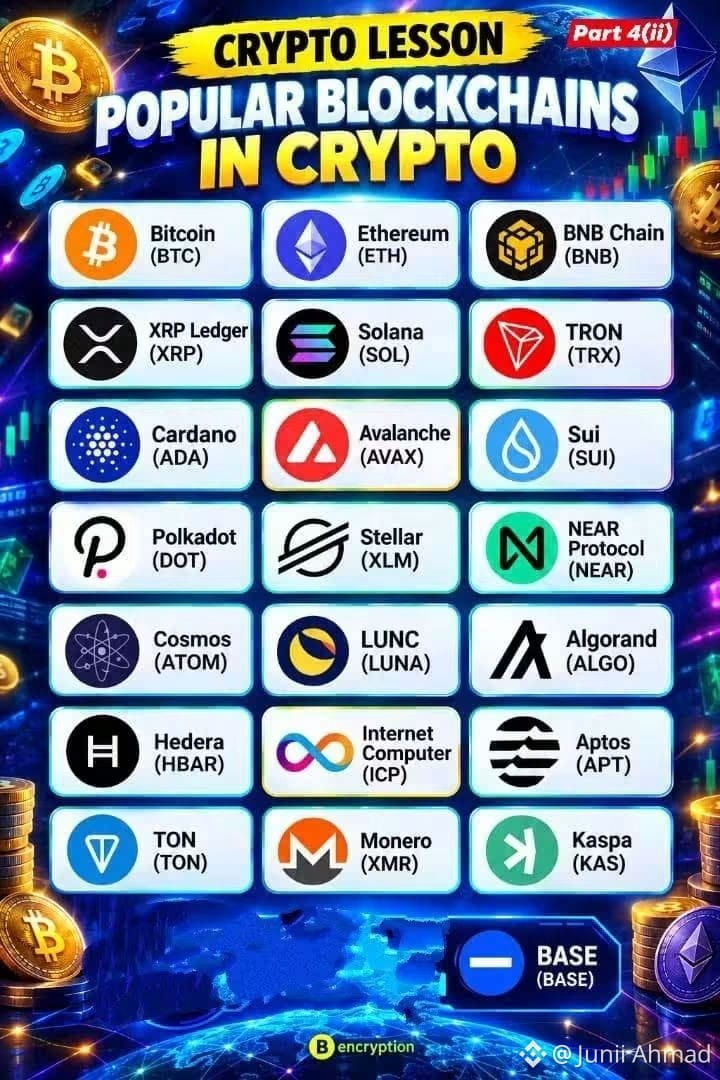
MAJOR BLOCKCHAIN NETWORKS IN CRYPTO
Understanding the backbone of Web3! Here is a quick breakdown of the major blockchain networks driving the crypto ecosystem today:
🔹 Bitcoin ($BTC ) — The pioneer of cryptocurrency & a premier store of value, secured by Proof-of-Work (PoW).
🔹 Ethereum ($ETH ) — The smart contract giant, powering the largest DeFi & NFT ecosystems.
🔹 BNB Chain ($BNB ) — Optimized for high speed, ultra-low fees, and a thriving dApp & gaming landscape.
🔹 XRP Ledger (XRP) — Designed for lightning-fast cross-border payments and institutional settlements.
🔹 Solana (SOL) — High-throughput Layer-1 delivering massive scalability and low transaction costs.
🔹 TRON (TRX) — The leader in daily high-volume transfers & global USDT stablecoin liquidity.
🔹 Cardano (ADA) — Built on a research-first, peer-reviewed Proof-of-Stake (PoS) architecture.
🔹 Base (BASE) — Coinbase’s Ethereum Layer-2 built to scale dApps and onboard the next billion users on-chain.
🔹 Avalanche (AVAX) — Offers instant finality and customizable, application-specific Subnets.
🔹 Sui (SUI) — Next-gen high-speed L1 leveraging an object-centric data model for ultra-fast execution.
🔹 Terra Classic (LUNC) — Cosmos-based network driven by community governance, staking, and burn mechanics.
🔹 Polkadot (DOT) — The multi-chain protocol enabling seamless interoperability between custom blockchains.
🔹 Stellar (XLM) — Built to bridge traditional finance with crypto for fast, low-cost cross-border transfers.
🔹 NEAR Protocol (NEAR) — Developer-friendly, highly scalable blockchain powered by Nightshade sharding.
🔹 Cosmos (ATOM) — The Internet of Blockchains, powered by the Inter-Blockchain Communication (IBC) protocol.
🔹 Hedera (HBAR) — Enterprise-grade distributed ledger powered by innovative Hashgraph technology.
#cryptoeducation #blockchain #cryptotrading #BinanceSquare #CryptoNews
MAJOR BLOCKCHAIN NETWORKS IN CRYPTO
Understanding the backbone of Web3! Here is a quick breakdown of the major blockchain networks driving the crypto ecosystem today:
🔹 Bitcoin ($BTC ) — The pioneer of cryptocurrency & a premier store of value, secured by Proof-of-Work (PoW).
🔹 Ethereum ($ETH ) — The smart contract giant, powering the largest DeFi & NFT ecosystems.
🔹 BNB Chain ($BNB ) — Optimized for high speed, ultra-low fees, and a thriving dApp & gaming landscape.
🔹 XRP Ledger (XRP) — Designed for lightning-fast cross-border payments and institutional settlements.
🔹 Solana (SOL) — High-throughput Layer-1 delivering massive scalability and low transaction costs.
🔹 TRON (TRX) — The leader in daily high-volume transfers & global USDT stablecoin liquidity.
🔹 Cardano (ADA) — Built on a research-first, peer-reviewed Proof-of-Stake (PoS) architecture.
🔹 Base (BASE) — Coinbase’s Ethereum Layer-2 built to scale dApps and onboard the next billion users on-chain.
🔹 Avalanche (AVAX) — Offers instant finality and customizable, application-specific Subnets.
🔹 Sui (SUI) — Next-gen high-speed L1 leveraging an object-centric data model for ultra-fast execution.
🔹 Terra Classic (LUNC) — Cosmos-based network driven by community governance, staking, and burn mechanics.
🔹 Polkadot (DOT) — The multi-chain protocol enabling seamless interoperability between custom blockchains.
🔹 Stellar (XLM) — Built to bridge traditional finance with crypto for fast, low-cost cross-border transfers.
🔹 NEAR Protocol (NEAR) — Developer-friendly, highly scalable blockchain powered by Nightshade sharding.
🔹 Cosmos (ATOM) — The Internet of Blockchains, powered by the Inter-Blockchain Communication (IBC) protocol.
🔹 Hedera (HBAR) — Enterprise-grade distributed ledger powered by innovative Hashgraph technology.
#cryptoeducation #blockchain #cryptotrading #BinanceSquare #CryptoNews
Understanding the backbone of Web3! Here is a quick breakdown of the major blockchain networks driving the crypto ecosystem today:
🔹 Bitcoin ($BTC ) — The pioneer of cryptocurrency & a premier store of value, secured by Proof-of-Work (PoW).
🔹 Ethereum ($ETH ) — The smart contract giant, powering the largest DeFi & NFT ecosystems.
🔹 BNB Chain ($BNB ) — Optimized for high speed, ultra-low fees, and a thriving dApp & gaming landscape.
🔹 XRP Ledger (XRP) — Designed for lightning-fast cross-border payments and institutional settlements.
🔹 Solana (SOL) — High-throughput Layer-1 delivering massive scalability and low transaction costs.
🔹 TRON (TRX) — The leader in daily high-volume transfers & global USDT stablecoin liquidity.
🔹 Cardano (ADA) — Built on a research-first, peer-reviewed Proof-of-Stake (PoS) architecture.
🔹 Base (BASE) — Coinbase’s Ethereum Layer-2 built to scale dApps and onboard the next billion users on-chain.
🔹 Avalanche (AVAX) — Offers instant finality and customizable, application-specific Subnets.
🔹 Sui (SUI) — Next-gen high-speed L1 leveraging an object-centric data model for ultra-fast execution.
🔹 Terra Classic (LUNC) — Cosmos-based network driven by community governance, staking, and burn mechanics.
🔹 Polkadot (DOT) — The multi-chain protocol enabling seamless interoperability between custom blockchains.
🔹 Stellar (XLM) — Built to bridge traditional finance with crypto for fast, low-cost cross-border transfers.
🔹 NEAR Protocol (NEAR) — Developer-friendly, highly scalable blockchain powered by Nightshade sharding.
🔹 Cosmos (ATOM) — The Internet of Blockchains, powered by the Inter-Blockchain Communication (IBC) protocol.
🔹 Hedera (HBAR) — Enterprise-grade distributed ledger powered by innovative Hashgraph technology.
#cryptoeducation #blockchain #cryptotrading #BinanceSquare #CryptoNews
61

·
--
Article
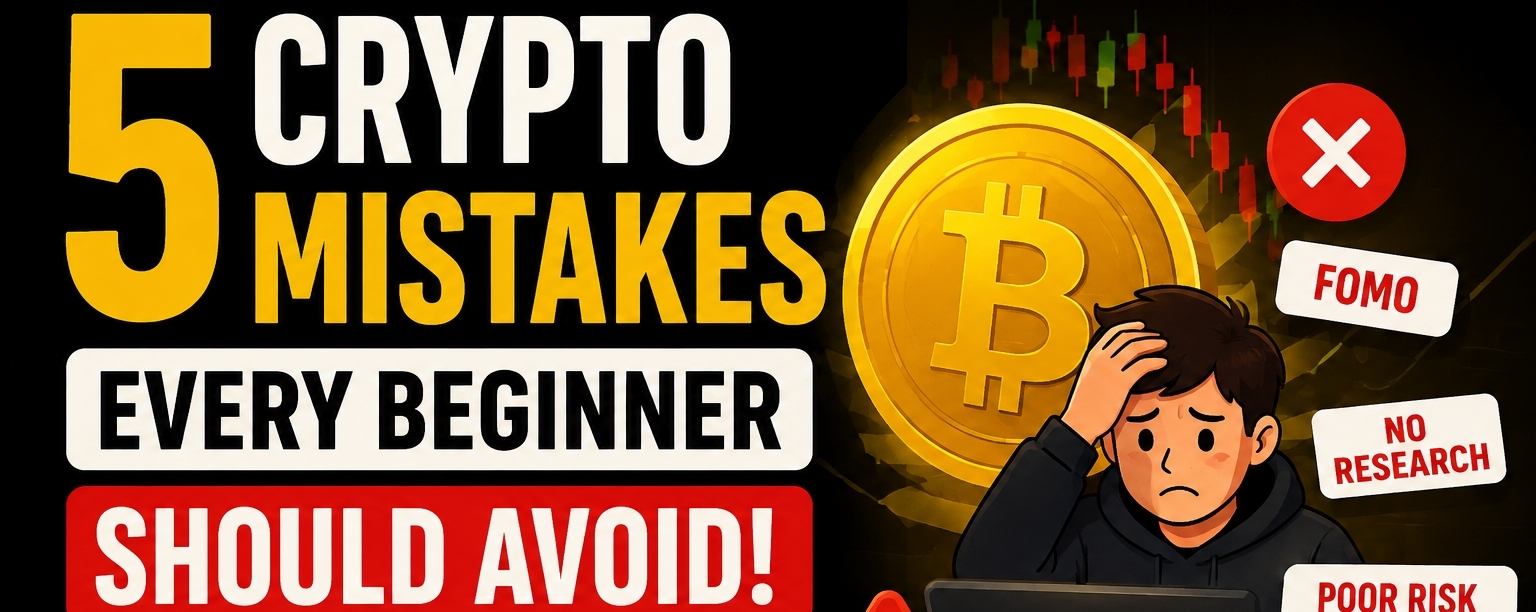
🚀 5 Crypto Mistakes Every Beginner Should AvoidMany new traders enter the crypto market hoping to make quick profits. While crypto offers exciting opportunities, beginners often make mistakes that can lead to unnecessary losses.
1. Investing Without Research
Before buying any cryptocurrency, take time to understand the project. Never invest just because someone on social media says a coin will go up.
2. Following the Crowd
Many beginners buy when everyone is excited and prices are already high. This is often called FOMO (Fear of Missing Out). Smart traders follow a plan instead of emotions.
3. Ignoring Risk Management
Never invest all your money in a single trade. Managing risk is one of the most important skills in trading.
4. Panic Selling
Crypto prices move up and down every day. Selling in fear during a market dip can turn temporary losses into real losses.
5. Expecting Instant Success
Successful traders focus on learning and consistency. Building experience takes time, patience, and discipline.
Final Thoughts
Crypto trading is not about getting rich overnight. The traders who survive long-term are those who keep learning, manage risk carefully, and stay disciplined.
#CryptoTrading. #bitcoin #Binance #cryptoeducation #tradingtips
🚀 5 Crypto Mistakes Every Beginner Should Avoid
Many new traders enter the crypto market hoping to make quick profits. While crypto offers exciting opportunities, beginners often make mistakes that can lead to unnecessary losses.
1. Investing Without Research
Before buying any cryptocurrency, take time to understand the project. Never invest just because someone on social media says a coin will go up.
2. Following the Crowd
Many beginners buy when everyone is excited and prices are already high. This is often called FOMO (Fear of Missing Out). Smart traders follow a plan instead of emotions.
3. Ignoring Risk Management
Never invest all your money in a single trade. Managing risk is one of the most important skills in trading.
4. Panic Selling
Crypto prices move up and down every day. Selling in fear during a market dip can turn temporary losses into real losses.
5. Expecting Instant Success
Successful traders focus on learning and consistency. Building experience takes time, patience, and discipline.
Final Thoughts
Crypto trading is not about getting rich overnight. The traders who survive long-term are those who keep learning, manage risk carefully, and stay disciplined.
#CryptoTrading. #bitcoin #Binance #cryptoeducation #tradingtips
1. Investing Without Research
Before buying any cryptocurrency, take time to understand the project. Never invest just because someone on social media says a coin will go up.
2. Following the Crowd
Many beginners buy when everyone is excited and prices are already high. This is often called FOMO (Fear of Missing Out). Smart traders follow a plan instead of emotions.
3. Ignoring Risk Management
Never invest all your money in a single trade. Managing risk is one of the most important skills in trading.
4. Panic Selling
Crypto prices move up and down every day. Selling in fear during a market dip can turn temporary losses into real losses.
5. Expecting Instant Success
Successful traders focus on learning and consistency. Building experience takes time, patience, and discipline.
Final Thoughts
Crypto trading is not about getting rich overnight. The traders who survive long-term are those who keep learning, manage risk carefully, and stay disciplined.
#CryptoTrading. #bitcoin #Binance #cryptoeducation #tradingtips
87

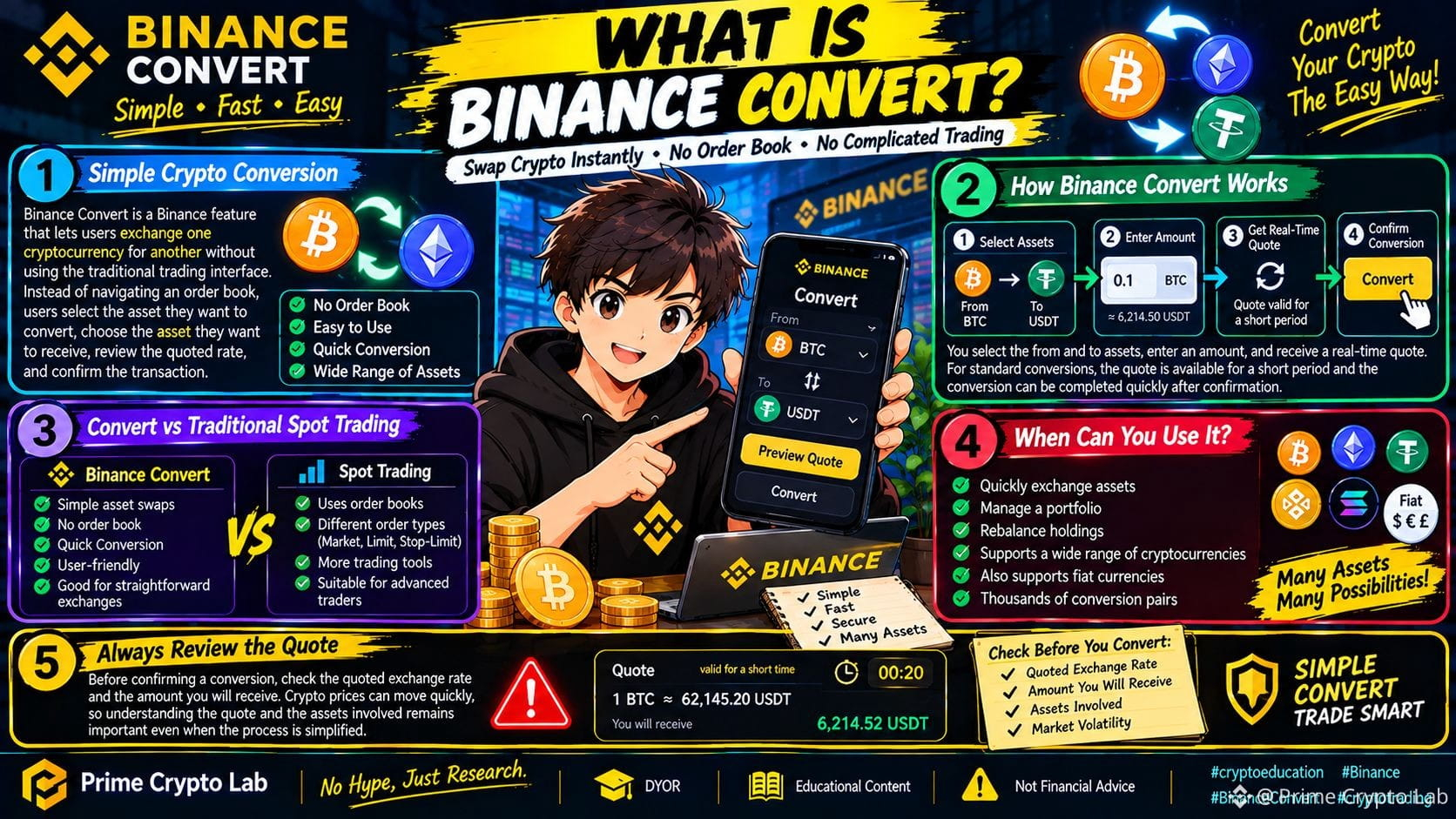
🔄 What Is Binance Convert?
📊 1. Simple Crypto Conversion
Bitcoin $BTC — Binance Convert is a Binance feature that lets users exchange one cryptocurrency for another without using the traditional trading interface. Instead of navigating an order book, users select the asset they want to convert, choose the asset they want to receive, review the quoted rate, and confirm the transaction.
⚡ 2. How Binance Convert Works
Users select their from and to assets, enter an amount, and receive a real-time quote. For standard conversions, the quote is available for a short period and the conversion can be completed quickly after confirmation.
🔁 3. Convert vs Traditional Spot Trading
Ethereum $ETH — Binance Convert is designed to simplify asset swaps, while traditional Spot Trading provides tools such as order books and different order types. Convert can therefore be useful for users who want a straightforward way to exchange assets without managing a trading interface.
🎯 4. When Can You Use It?
Binance says Convert can be useful for quickly exchanging assets, managing a portfolio, or rebalancing holdings. It supports a wide range of cryptocurrencies, and Binance's current support documentation says it also supports fiat currencies and thousands of conversion pairs.
⚠️ 5. Always Review the Quote
Solana $SOL — Before confirming a conversion, check the quoted exchange rate and the amount you will receive. Crypto prices can move quickly, so understanding the quote and the assets involved remains important even when the process is simplified.
Prime Crypto Lab — No Hype, Just Research.
DYOR | Educational Content | Not Financial Advice
#cryptoeducation #Binance #BinanceConvert #cryptotrading
🔄 What Is Binance Convert?
📊 1. Simple Crypto Conversion
Bitcoin $BTC — Binance Convert is a Binance feature that lets users exchange one cryptocurrency for another without using the traditional trading interface. Instead of navigating an order book, users select the asset they want to convert, choose the asset they want to receive, review the quoted rate, and confirm the transaction.
⚡ 2. How Binance Convert Works
Users select their from and to assets, enter an amount, and receive a real-time quote. For standard conversions, the quote is available for a short period and the conversion can be completed quickly after confirmation.
🔁 3. Convert vs Traditional Spot Trading
Ethereum $ETH — Binance Convert is designed to simplify asset swaps, while traditional Spot Trading provides tools such as order books and different order types. Convert can therefore be useful for users who want a straightforward way to exchange assets without managing a trading interface.
🎯 4. When Can You Use It?
Binance says Convert can be useful for quickly exchanging assets, managing a portfolio, or rebalancing holdings. It supports a wide range of cryptocurrencies, and Binance's current support documentation says it also supports fiat currencies and thousands of conversion pairs.
⚠️ 5. Always Review the Quote
Solana $SOL — Before confirming a conversion, check the quoted exchange rate and the amount you will receive. Crypto prices can move quickly, so understanding the quote and the assets involved remains important even when the process is simplified.
Prime Crypto Lab — No Hype, Just Research.
DYOR | Educational Content | Not Financial Advice
#cryptoeducation #Binance #BinanceConvert #cryptotrading
📊 1. Simple Crypto Conversion
Bitcoin $BTC — Binance Convert is a Binance feature that lets users exchange one cryptocurrency for another without using the traditional trading interface. Instead of navigating an order book, users select the asset they want to convert, choose the asset they want to receive, review the quoted rate, and confirm the transaction.
⚡ 2. How Binance Convert Works
Users select their from and to assets, enter an amount, and receive a real-time quote. For standard conversions, the quote is available for a short period and the conversion can be completed quickly after confirmation.
🔁 3. Convert vs Traditional Spot Trading
Ethereum $ETH — Binance Convert is designed to simplify asset swaps, while traditional Spot Trading provides tools such as order books and different order types. Convert can therefore be useful for users who want a straightforward way to exchange assets without managing a trading interface.
🎯 4. When Can You Use It?
Binance says Convert can be useful for quickly exchanging assets, managing a portfolio, or rebalancing holdings. It supports a wide range of cryptocurrencies, and Binance's current support documentation says it also supports fiat currencies and thousands of conversion pairs.
⚠️ 5. Always Review the Quote
Solana $SOL — Before confirming a conversion, check the quoted exchange rate and the amount you will receive. Crypto prices can move quickly, so understanding the quote and the assets involved remains important even when the process is simplified.
Prime Crypto Lab — No Hype, Just Research.
DYOR | Educational Content | Not Financial Advice
#cryptoeducation #Binance #BinanceConvert #cryptotrading
115

I Started Crypto With $30 — My Beginner's Guide to Binance Spot TradingI Started Crypto With $30 — My Beginner's Guide to Binance Spot Trading
🚨 STOP CHASING 100X COINS. START LEARNING HOW CRYPTO ACTUALLY WORKS.
What if you had only $30 to start learning crypto?
Would you buy Bitcoin?
Ethereum?
A random meme coin?
Or would you keep your money and learn first?
I'm asking because I'm starting my own crypto journey with a small amount — not because I think $30 will make me rich, but because I want to understand how crypto trading actually works without risking a huge amount of money.
I'm not a professional trader.
I'm not a financial advisor.
I'm simply documenting what I'm learning about Binance, Spot Trading, Bitcoin, Ethereum, technical analysis, ricosk management, and crypto markets.
And if you're also a beginner, maybe we can learn together.
🧠 1. What Is Crypto Trading?
Let's start from zero.
Cryptocurrency is a type of digital asset that uses blockchain technology.
Bitcoin was the first major cryptocurrency, while Ethereum introduced a programmable blockchain that can support applications and smart contracts.
But when people say:
"I trade crypto."
They can mean several different things.
The two major approaches beginners often encounter are:
Spot Trading
You buy an asset such as BTC or ETH and hold it in your Spot Wallet.
If the price increases, the value of your asset increases.
If the price decreases, your position loses value.
Futures Trading
Futures allow traders to speculate on price movements using derivatives and, in many cases, leverage.
This can dramatically increase both potential gains and losses.
For a beginner, understanding Spot Trading first can make the basic mechanics easier to learn.
₿ 2. Bitcoin vs Ethereum
Two names appear everywhere in crypto:
Bitcoin (BTC)
and
Ethereum (ETH).
But they aren't exactly the same thing.
Bitcoin
Bitcoin was designed primarily as a decentralized digital monetary system and store-of-value-like asset.
Its supply is limited.
That limited supply is one reason Bitcoin is often compared with scarce assets such as gold.
Ethereum
Ethereum is a programmable blockchain.
Its ecosystem supports smart contracts and decentralized applications.
ETH is the native asset of the Ethereum network.
So when you're comparing BTC and ETH, you're not simply comparing two versions of the same thing.
You're comparing two different crypto networks with different purposes.
💰 3. Why I'm Starting With Only $30
Here's something I wish more beginners understood:
You don't need a huge amount of money to start learning.
You need a huge amount of money only if you're trying to make huge absolute profits.
That's a completely different goal.
My first objective isn't:
❌ "Turn $30 into $3,000."
My first objective is:
✅ Understand how Spot Trading works.
✅ Learn how orders work.
✅ Learn how to read charts.
✅ Understand fees.
✅ Learn risk management.
✅ Learn how emotions affect decisions.
✅ Avoid losing money through stupid mistakes.
If I can learn all of that with a small amount, I can make better decisions later.
📊 4. How I Would Divide $30
I wouldn't put the entire $30 into one trade.
A simple learning approach could be:
$10 — First position
Use a small amount to understand how buying and selling actually works.
$10 — Second opportunity
Keep some capital available instead of entering everything at once.
$10 — Reserve
Don't touch it unless there's a reason.
This isn't a magic strategy.
It's simply a way of avoiding the beginner mistake of putting all available capital into one trade.
🪙 5. What Is Spot Trading?
Spot trading is relatively simple.
Imagine ETH is trading at $2,700.
You decide to buy $10 worth of ETH.
You now own a small amount of ETH.
If ETH rises, the value of your holding increases.
If ETH falls, the value decreases.
There is no guaranteed profit.
That's the most important part.
Spot Trading ≠ Guaranteed Income
Crypto can move quickly in both directions.
That's why the first question shouldn't be:
"How much money can I make?"
A better question is:
"How much money am I prepared to risk?"
🛒 6. Market Order vs Limit Order
When buying crypto on an exchange such as Binance, you'll encounter different order types.
Two basic ones are:
Market Order
A market order attempts to execute immediately at the best available price in the market.
It's simple.
But the exact execution price can vary depending on market conditions and liquidity.
Limit Order
A limit order allows you to specify the price at which you want your order to execute.
For example:
ETH is trading around $2,700.
You might decide:
"I only want to buy if ETH reaches $2,650."
You can place a limit order around that level.
However, there is no guarantee that the market will reach your price or that the order will execute.
Understanding these two order types is one of the first things a beginner should learn.
📈 7. How Do I Decide When to Buy?
This is where things become interesting.
I don't want to blindly buy something just because:
"BTC is pumping!"
Instead, I'd look at several things.
1️⃣ Trend
Is price generally moving upward, downward, or sideways?
2️⃣ Support
Has price repeatedly found buying interest around a particular area?
3️⃣ Resistance
Has price repeatedly struggled to move above a particular area?
4️⃣ Volume
Is the price movement supported by meaningful trading activity?
5️⃣ Market Conditions
What's happening with the overall crypto market?
6️⃣ News
Are there major economic, regulatory, institutional, or crypto-specific developments?
7️⃣ Risk/Reward
Does the potential upside justify the amount I'm risking?
None of these guarantees the future.
They're simply tools for making a more informed decision.
🧠 8. Why Beginners Lose Money
Many beginners think trading is mostly about finding the perfect coin.
I think psychology is just as important.
Here are some common problems:
FOMO
You see BTC suddenly going up.
Everyone on social media is celebrating.
You buy because you're afraid of missing the move.
Then price falls.
Revenge Trading
You lose $5.
Instead of stopping, you try to immediately make it back.
You take another trade.
Then another.
The loss gets bigger.
Overtrading
You feel like you need to trade every day.
You don't.
Sometimes the best trade is no trade.
Greed
You make a small profit.
Instead of following your plan, you keep holding because you want more.
Then the market reverses.
Panic Selling
Price drops.
You become scared.
You sell at the worst possible moment.
Then price recovers.
These emotional mistakes can be more damaging than not knowing a technical indicator.
🛑 9. Risk Management Comes First
If you're serious about learning trading, learn this before learning complicated indicators.
Never risk money you need for:
• Food
• Rent
• Tuition
• Bills
• Debt payments
• Emergency expenses
Crypto markets can be highly volatile.
A trade should never put your basic life expenses at risk.
And never borrow money simply to trade.
📉 10. What Is Stop-Loss?
A stop-loss is a tool that can help limit losses if the market moves against your position.
Imagine:
You buy an asset.
You decide beforehand:
"If price reaches this level, my original trade idea is no longer valid."
You can use an appropriate order to exit according to your plan.
The exact level depends on the trading setup.
There isn't one universal stop-loss percentage that works for every trade.
That's why copying someone else's stop-loss without understanding the setup can be dangerous.
📚 11. The Indicators I'm Learning
You don't need 25 indicators on your screen.
I'm focusing on understanding a few basic concepts first.
RSI
The Relative Strength Index can help analyze momentum.
But:
RSI above 70 does NOT automatically mean "SELL."
And:
RSI below 30 does NOT automatically mean "BUY."
Market context matters.
Moving Averages
Moving averages can help identify trends and smooth short-term price movements.
Volume
Volume helps provide context about market activity.
Support & Resistance
These are among the simplest concepts to understand and practice.
The goal isn't to predict the future perfectly.
The goal is to build a repeatable decision-making process.
🌎 12. Don't Look at One Chart Only
Another lesson I'm learning:
Crypto doesn't exist in isolation.
Bitcoin can be affected by:
• US monetary policy
• Interest-rate expectations
• Inflation data
• Employment data
• ETF flows
• Institutional activity
• Regulation
• Geopolitical events
• Stablecoin liquidity
• Crypto-specific news
That's why I don't want to make trading decisions based on one TikTok, one tweet, or one Binance Square post.
Information needs context.
🔍 13. My Pre-Trade Checklist
Before entering a trade, I'd ask:
Market
☐ What's happening with BTC?
☐ What's happening with ETH?
☐ Is the broader market bullish, bearish, or ranging?
Technical
☐ What's the current trend?
☐ Where are important support levels?
☐ Where is resistance?
☐ What's happening with volume?
☐ Is momentum strengthening or weakening?
Fundamental
☐ Is there important news?
☐ Is there a major economic event today?
☐ Is there unusual market volatility?
Risk
☐ How much am I risking?
☐ Where is my invalidation level?
☐ What's my potential target?
☐ Is the risk/reward reasonable?
Psychology
☐ Am I entering because of FOMO?
☐ Am I trying to recover a previous loss?
☐ Do I actually have a plan?
If I can't answer these questions, I shouldn't feel pressured to trade.
🚨 14. Be Careful With Crypto Influencers
This is one of the biggest lessons for beginners.
You'll see posts like:
"BTC TO $150K!!!"
"100X GEM!!!"
"BUY BEFORE IT'S TOO LATE!!!"
"GUARANTEED PROFIT!!!"
Don't automatically believe them.
Nobody knows the future price with certainty.
A person can make a correct prediction once and still have a terrible long-term process.
Instead of asking:
"Who predicted the price?"
Ask:
"What evidence did they use?"
"What was their timeframe?"
"What would prove their thesis wrong?"
That's a much healthier way to think about markets.
🔐 15. Protect Your Binance Account
Making money isn't the only goal.
Keeping your account secure is also important.
Use:
🔒 Strong unique password
🔒 Two-factor authentication
🔒 Anti-phishing/security features
🔒 Official Binance website/app
And never share your:
❌ Password
❌ 2FA codes
❌ Seed phrase
❌ Private keys
with anyone.
If someone messages you promising guaranteed profits in exchange for access to your account, treat it as a major warning sign.
📅 16. My 30-Day Crypto Learning Challenge
Instead of trying to become a professional trader overnight, here's a better challenge.
Week 1
Learn:
• Bitcoin
• Ethereum
• Blockchain
• Spot Trading
• Market orders
• Limit orders
Week 2
Learn:
• Candlesticks
• Support
• Resistance
• Trend
• Volume
Week 3
Learn:
• RSI
• Moving averages
• Risk management
• Stop-loss
• Position sizing
Week 4
Practice:
• Analyze charts
• Write down trade ideas
• Record hypothetical entries
• Track what happened afterward
• Review mistakes
You can learn a huge amount without constantly putting real money at risk.
💵 17. Can $30 Make Me Rich?
Honestly?
That's not the right question.
$30 is not a shortcut to wealth.
But $30 can potentially buy something more valuable:
Experience.
If I lose $2 while learning a lesson and understand why I lost it, that lesson may be more valuable than a random $2 profit.
The goal is to build a process.
Then, if your knowledge and financial situation grow over time, you can decide whether you're comfortable increasing your capital.
🚀 18. What I Want to Do Next
I'm going to document my crypto learning journey here.
I'll be sharing:
📊 BTC analysis
🟣 ETH analysis
📈 Spot Trading lessons
🧠 Trading psychology
💰 Risk management
📰 Important crypto news
📚 Beginner tutorials
❌ Mistakes I make
✅ Lessons I learn
I'm not going to promise:
"Buy this and you'll get rich."
Instead, I want to show the reasoning behind a trade idea and what happens afterward.
Because learning how to think is more valuable than blindly following signals.
🎯 Final Thoughts
If you're completely new to crypto, don't feel pressured to become a trader tomorrow.
You don't need:
❌ $10,000
❌ 20 indicators
❌ 100x leverage
❌ A secret strategy
❌ A "guaranteed" signal
You need:
✅ Knowledge
✅ Patience
✅ Risk management
✅ Discipline
✅ A repeatable process
I'm starting with $30, but the real goal isn't turning $30 into a fortune.
The real goal is learning how the market works.
And if you're also starting from zero...
Let's learn together.
👇 YOUR TURN
I'm building this account around beginner-friendly crypto education.
Comment below:
1️⃣ BTC
2️⃣ ETH
3️⃣ Spot Trading
4️⃣ Technical Analysis
5️⃣ Risk Management
Tell me which one you want me to explain in my next article.
And if you're starting your crypto journey too, follow me — I'll document what I learn, including the wins, the mistakes and everything in between.
Learn first. Trade responsibly. Never risk money you can't afford to lose.
#Binance #BinanceSquareFamily #crypto #Bitcoin #BTC #Ethereum #ETH #SpotTrading #CryptoTrading #TradingForBeginners #CryptoBeginner #TechnicalAnalysis #RiskManagement #Blockchain #cryptoeducation
I Started Crypto With $30 — My Beginner's Guide to Binance Spot Trading
I Started Crypto With $30 — My Beginner's Guide to Binance Spot Trading
🚨 STOP CHASING 100X COINS. START LEARNING HOW CRYPTO ACTUALLY WORKS.
What if you had only $30 to start learning crypto?
Would you buy Bitcoin?
Ethereum?
A random meme coin?
Or would you keep your money and learn first?
I'm asking because I'm starting my own crypto journey with a small amount — not because I think $30 will make me rich, but because I want to understand how crypto trading actually works without risking a huge amount of money.
I'm not a professional trader.
I'm not a financial advisor.
I'm simply documenting what I'm learning about Binance, Spot Trading, Bitcoin, Ethereum, technical analysis, ricosk management, and crypto markets.
And if you're also a beginner, maybe we can learn together.
🧠 1. What Is Crypto Trading?
Let's start from zero.
Cryptocurrency is a type of digital asset that uses blockchain technology.
Bitcoin was the first major cryptocurrency, while Ethereum introduced a programmable blockchain that can support applications and smart contracts.
But when people say:
"I trade crypto."
They can mean several different things.
The two major approaches beginners often encounter are:
Spot Trading
You buy an asset such as BTC or ETH and hold it in your Spot Wallet.
If the price increases, the value of your asset increases.
If the price decreases, your position loses value.
Futures Trading
Futures allow traders to speculate on price movements using derivatives and, in many cases, leverage.
This can dramatically increase both potential gains and losses.
For a beginner, understanding Spot Trading first can make the basic mechanics easier to learn.
₿ 2. Bitcoin vs Ethereum
Two names appear everywhere in crypto:
Bitcoin (BTC)
and
Ethereum (ETH).
But they aren't exactly the same thing.
Bitcoin
Bitcoin was designed primarily as a decentralized digital monetary system and store-of-value-like asset.
Its supply is limited.
That limited supply is one reason Bitcoin is often compared with scarce assets such as gold.
Ethereum
Ethereum is a programmable blockchain.
Its ecosystem supports smart contracts and decentralized applications.
ETH is the native asset of the Ethereum network.
So when you're comparing BTC and ETH, you're not simply comparing two versions of the same thing.
You're comparing two different crypto networks with different purposes.
💰 3. Why I'm Starting With Only $30
Here's something I wish more beginners understood:
You don't need a huge amount of money to start learning.
You need a huge amount of money only if you're trying to make huge absolute profits.
That's a completely different goal.
My first objective isn't:
❌ "Turn $30 into $3,000."
My first objective is:
✅ Understand how Spot Trading works.
✅ Learn how orders work.
✅ Learn how to read charts.
✅ Understand fees.
✅ Learn risk management.
✅ Learn how emotions affect decisions.
✅ Avoid losing money through stupid mistakes.
If I can learn all of that with a small amount, I can make better decisions later.
📊 4. How I Would Divide $30
I wouldn't put the entire $30 into one trade.
A simple learning approach could be:
$10 — First position
Use a small amount to understand how buying and selling actually works.
$10 — Second opportunity
Keep some capital available instead of entering everything at once.
$10 — Reserve
Don't touch it unless there's a reason.
This isn't a magic strategy.
It's simply a way of avoiding the beginner mistake of putting all available capital into one trade.
🪙 5. What Is Spot Trading?
Spot trading is relatively simple.
Imagine ETH is trading at $2,700.
You decide to buy $10 worth of ETH.
You now own a small amount of ETH.
If ETH rises, the value of your holding increases.
If ETH falls, the value decreases.
There is no guaranteed profit.
That's the most important part.
Spot Trading ≠ Guaranteed Income
Crypto can move quickly in both directions.
That's why the first question shouldn't be:
"How much money can I make?"
A better question is:
"How much money am I prepared to risk?"
🛒 6. Market Order vs Limit Order
When buying crypto on an exchange such as Binance, you'll encounter different order types.
Two basic ones are:
Market Order
A market order attempts to execute immediately at the best available price in the market.
It's simple.
But the exact execution price can vary depending on market conditions and liquidity.
Limit Order
A limit order allows you to specify the price at which you want your order to execute.
For example:
ETH is trading around $2,700.
You might decide:
"I only want to buy if ETH reaches $2,650."
You can place a limit order around that level.
However, there is no guarantee that the market will reach your price or that the order will execute.
Understanding these two order types is one of the first things a beginner should learn.
📈 7. How Do I Decide When to Buy?
This is where things become interesting.
I don't want to blindly buy something just because:
"BTC is pumping!"
Instead, I'd look at several things.
1️⃣ Trend
Is price generally moving upward, downward, or sideways?
2️⃣ Support
Has price repeatedly found buying interest around a particular area?
3️⃣ Resistance
Has price repeatedly struggled to move above a particular area?
4️⃣ Volume
Is the price movement supported by meaningful trading activity?
5️⃣ Market Conditions
What's happening with the overall crypto market?
6️⃣ News
Are there major economic, regulatory, institutional, or crypto-specific developments?
7️⃣ Risk/Reward
Does the potential upside justify the amount I'm risking?
None of these guarantees the future.
They're simply tools for making a more informed decision.
🧠 8. Why Beginners Lose Money
Many beginners think trading is mostly about finding the perfect coin.
I think psychology is just as important.
Here are some common problems:
FOMO
You see BTC suddenly going up.
Everyone on social media is celebrating.
You buy because you're afraid of missing the move.
Then price falls.
Revenge Trading
You lose $5.
Instead of stopping, you try to immediately make it back.
You take another trade.
Then another.
The loss gets bigger.
Overtrading
You feel like you need to trade every day.
You don't.
Sometimes the best trade is no trade.
Greed
You make a small profit.
Instead of following your plan, you keep holding because you want more.
Then the market reverses.
Panic Selling
Price drops.
You become scared.
You sell at the worst possible moment.
Then price recovers.
These emotional mistakes can be more damaging than not knowing a technical indicator.
🛑 9. Risk Management Comes First
If you're serious about learning trading, learn this before learning complicated indicators.
Never risk money you need for:
• Food
• Rent
• Tuition
• Bills
• Debt payments
• Emergency expenses
Crypto markets can be highly volatile.
A trade should never put your basic life expenses at risk.
And never borrow money simply to trade.
📉 10. What Is Stop-Loss?
A stop-loss is a tool that can help limit losses if the market moves against your position.
Imagine:
You buy an asset.
You decide beforehand:
"If price reaches this level, my original trade idea is no longer valid."
You can use an appropriate order to exit according to your plan.
The exact level depends on the trading setup.
There isn't one universal stop-loss percentage that works for every trade.
That's why copying someone else's stop-loss without understanding the setup can be dangerous.
📚 11. The Indicators I'm Learning
You don't need 25 indicators on your screen.
I'm focusing on understanding a few basic concepts first.
RSI
The Relative Strength Index can help analyze momentum.
But:
RSI above 70 does NOT automatically mean "SELL."
And:
RSI below 30 does NOT automatically mean "BUY."
Market context matters.
Moving Averages
Moving averages can help identify trends and smooth short-term price movements.
Volume
Volume helps provide context about market activity.
Support & Resistance
These are among the simplest concepts to understand and practice.
The goal isn't to predict the future perfectly.
The goal is to build a repeatable decision-making process.
🌎 12. Don't Look at One Chart Only
Another lesson I'm learning:
Crypto doesn't exist in isolation.
Bitcoin can be affected by:
• US monetary policy
• Interest-rate expectations
• Inflation data
• Employment data
• ETF flows
• Institutional activity
• Regulation
• Geopolitical events
• Stablecoin liquidity
• Crypto-specific news
That's why I don't want to make trading decisions based on one TikTok, one tweet, or one Binance Square post.
Information needs context.
🔍 13. My Pre-Trade Checklist
Before entering a trade, I'd ask:
Market
☐ What's happening with BTC?
☐ What's happening with ETH?
☐ Is the broader market bullish, bearish, or ranging?
Technical
☐ What's the current trend?
☐ Where are important support levels?
☐ Where is resistance?
☐ What's happening with volume?
☐ Is momentum strengthening or weakening?
Fundamental
☐ Is there important news?
☐ Is there a major economic event today?
☐ Is there unusual market volatility?
Risk
☐ How much am I risking?
☐ Where is my invalidation level?
☐ What's my potential target?
☐ Is the risk/reward reasonable?
Psychology
☐ Am I entering because of FOMO?
☐ Am I trying to recover a previous loss?
☐ Do I actually have a plan?
If I can't answer these questions, I shouldn't feel pressured to trade.
🚨 14. Be Careful With Crypto Influencers
This is one of the biggest lessons for beginners.
You'll see posts like:
"BTC TO $150K!!!"
"100X GEM!!!"
"BUY BEFORE IT'S TOO LATE!!!"
"GUARANTEED PROFIT!!!"
Don't automatically believe them.
Nobody knows the future price with certainty.
A person can make a correct prediction once and still have a terrible long-term process.
Instead of asking:
"Who predicted the price?"
Ask:
"What evidence did they use?"
"What was their timeframe?"
"What would prove their thesis wrong?"
That's a much healthier way to think about markets.
🔐 15. Protect Your Binance Account
Making money isn't the only goal.
Keeping your account secure is also important.
Use:
🔒 Strong unique password
🔒 Two-factor authentication
🔒 Anti-phishing/security features
🔒 Official Binance website/app
And never share your:
❌ Password
❌ 2FA codes
❌ Seed phrase
❌ Private keys
with anyone.
If someone messages you promising guaranteed profits in exchange for access to your account, treat it as a major warning sign.
📅 16. My 30-Day Crypto Learning Challenge
Instead of trying to become a professional trader overnight, here's a better challenge.
Week 1
Learn:
• Bitcoin
• Ethereum
• Blockchain
• Spot Trading
• Market orders
• Limit orders
Week 2
Learn:
• Candlesticks
• Support
• Resistance
• Trend
• Volume
Week 3
Learn:
• RSI
• Moving averages
• Risk management
• Stop-loss
• Position sizing
Week 4
Practice:
• Analyze charts
• Write down trade ideas
• Record hypothetical entries
• Track what happened afterward
• Review mistakes
You can learn a huge amount without constantly putting real money at risk.
💵 17. Can $30 Make Me Rich?
Honestly?
That's not the right question.
$30 is not a shortcut to wealth.
But $30 can potentially buy something more valuable:
Experience.
If I lose $2 while learning a lesson and understand why I lost it, that lesson may be more valuable than a random $2 profit.
The goal is to build a process.
Then, if your knowledge and financial situation grow over time, you can decide whether you're comfortable increasing your capital.
🚀 18. What I Want to Do Next
I'm going to document my crypto learning journey here.
I'll be sharing:
📊 BTC analysis
🟣 ETH analysis
📈 Spot Trading lessons
🧠 Trading psychology
💰 Risk management
📰 Important crypto news
📚 Beginner tutorials
❌ Mistakes I make
✅ Lessons I learn
I'm not going to promise:
"Buy this and you'll get rich."
Instead, I want to show the reasoning behind a trade idea and what happens afterward.
Because learning how to think is more valuable than blindly following signals.
🎯 Final Thoughts
If you're completely new to crypto, don't feel pressured to become a trader tomorrow.
You don't need:
❌ $10,000
❌ 20 indicators
❌ 100x leverage
❌ A secret strategy
❌ A "guaranteed" signal
You need:
✅ Knowledge
✅ Patience
✅ Risk management
✅ Discipline
✅ A repeatable process
I'm starting with $30, but the real goal isn't turning $30 into a fortune.
The real goal is learning how the market works.
And if you're also starting from zero...
Let's learn together.
👇 YOUR TURN
I'm building this account around beginner-friendly crypto education.
Comment below:
1️⃣ BTC
2️⃣ ETH
3️⃣ Spot Trading
4️⃣ Technical Analysis
5️⃣ Risk Management
Tell me which one you want me to explain in my next article.
And if you're starting your crypto journey too, follow me — I'll document what I learn, including the wins, the mistakes and everything in between.
Learn first. Trade responsibly. Never risk money you can't afford to lose.
#Binance #BinanceSquareFamily #crypto #Bitcoin #BTC #Ethereum #ETH #SpotTrading #CryptoTrading #TradingForBeginners #CryptoBeginner #TechnicalAnalysis #RiskManagement #Blockchain #cryptoeducation
🚨 STOP CHASING 100X COINS. START LEARNING HOW CRYPTO ACTUALLY WORKS.
What if you had only $30 to start learning crypto?
Would you buy Bitcoin?
Ethereum?
A random meme coin?
Or would you keep your money and learn first?
I'm asking because I'm starting my own crypto journey with a small amount — not because I think $30 will make me rich, but because I want to understand how crypto trading actually works without risking a huge amount of money.
I'm not a professional trader.
I'm not a financial advisor.
I'm simply documenting what I'm learning about Binance, Spot Trading, Bitcoin, Ethereum, technical analysis, ricosk management, and crypto markets.
And if you're also a beginner, maybe we can learn together.
🧠 1. What Is Crypto Trading?
Let's start from zero.
Cryptocurrency is a type of digital asset that uses blockchain technology.
Bitcoin was the first major cryptocurrency, while Ethereum introduced a programmable blockchain that can support applications and smart contracts.
But when people say:
"I trade crypto."
They can mean several different things.
The two major approaches beginners often encounter are:
Spot Trading
You buy an asset such as BTC or ETH and hold it in your Spot Wallet.
If the price increases, the value of your asset increases.
If the price decreases, your position loses value.
Futures Trading
Futures allow traders to speculate on price movements using derivatives and, in many cases, leverage.
This can dramatically increase both potential gains and losses.
For a beginner, understanding Spot Trading first can make the basic mechanics easier to learn.
₿ 2. Bitcoin vs Ethereum
Two names appear everywhere in crypto:
Bitcoin (BTC)
and
Ethereum (ETH).
But they aren't exactly the same thing.
Bitcoin
Bitcoin was designed primarily as a decentralized digital monetary system and store-of-value-like asset.
Its supply is limited.
That limited supply is one reason Bitcoin is often compared with scarce assets such as gold.
Ethereum
Ethereum is a programmable blockchain.
Its ecosystem supports smart contracts and decentralized applications.
ETH is the native asset of the Ethereum network.
So when you're comparing BTC and ETH, you're not simply comparing two versions of the same thing.
You're comparing two different crypto networks with different purposes.
💰 3. Why I'm Starting With Only $30
Here's something I wish more beginners understood:
You don't need a huge amount of money to start learning.
You need a huge amount of money only if you're trying to make huge absolute profits.
That's a completely different goal.
My first objective isn't:
❌ "Turn $30 into $3,000."
My first objective is:
✅ Understand how Spot Trading works.
✅ Learn how orders work.
✅ Learn how to read charts.
✅ Understand fees.
✅ Learn risk management.
✅ Learn how emotions affect decisions.
✅ Avoid losing money through stupid mistakes.
If I can learn all of that with a small amount, I can make better decisions later.
📊 4. How I Would Divide $30
I wouldn't put the entire $30 into one trade.
A simple learning approach could be:
$10 — First position
Use a small amount to understand how buying and selling actually works.
$10 — Second opportunity
Keep some capital available instead of entering everything at once.
$10 — Reserve
Don't touch it unless there's a reason.
This isn't a magic strategy.
It's simply a way of avoiding the beginner mistake of putting all available capital into one trade.
🪙 5. What Is Spot Trading?
Spot trading is relatively simple.
Imagine ETH is trading at $2,700.
You decide to buy $10 worth of ETH.
You now own a small amount of ETH.
If ETH rises, the value of your holding increases.
If ETH falls, the value decreases.
There is no guaranteed profit.
That's the most important part.
Spot Trading ≠ Guaranteed Income
Crypto can move quickly in both directions.
That's why the first question shouldn't be:
"How much money can I make?"
A better question is:
"How much money am I prepared to risk?"
🛒 6. Market Order vs Limit Order
When buying crypto on an exchange such as Binance, you'll encounter different order types.
Two basic ones are:
Market Order
A market order attempts to execute immediately at the best available price in the market.
It's simple.
But the exact execution price can vary depending on market conditions and liquidity.
Limit Order
A limit order allows you to specify the price at which you want your order to execute.
For example:
ETH is trading around $2,700.
You might decide:
"I only want to buy if ETH reaches $2,650."
You can place a limit order around that level.
However, there is no guarantee that the market will reach your price or that the order will execute.
Understanding these two order types is one of the first things a beginner should learn.
📈 7. How Do I Decide When to Buy?
This is where things become interesting.
I don't want to blindly buy something just because:
"BTC is pumping!"
Instead, I'd look at several things.
1️⃣ Trend
Is price generally moving upward, downward, or sideways?
2️⃣ Support
Has price repeatedly found buying interest around a particular area?
3️⃣ Resistance
Has price repeatedly struggled to move above a particular area?
4️⃣ Volume
Is the price movement supported by meaningful trading activity?
5️⃣ Market Conditions
What's happening with the overall crypto market?
6️⃣ News
Are there major economic, regulatory, institutional, or crypto-specific developments?
7️⃣ Risk/Reward
Does the potential upside justify the amount I'm risking?
None of these guarantees the future.
They're simply tools for making a more informed decision.
🧠 8. Why Beginners Lose Money
Many beginners think trading is mostly about finding the perfect coin.
I think psychology is just as important.
Here are some common problems:
FOMO
You see BTC suddenly going up.
Everyone on social media is celebrating.
You buy because you're afraid of missing the move.
Then price falls.
Revenge Trading
You lose $5.
Instead of stopping, you try to immediately make it back.
You take another trade.
Then another.
The loss gets bigger.
Overtrading
You feel like you need to trade every day.
You don't.
Sometimes the best trade is no trade.
Greed
You make a small profit.
Instead of following your plan, you keep holding because you want more.
Then the market reverses.
Panic Selling
Price drops.
You become scared.
You sell at the worst possible moment.
Then price recovers.
These emotional mistakes can be more damaging than not knowing a technical indicator.
🛑 9. Risk Management Comes First
If you're serious about learning trading, learn this before learning complicated indicators.
Never risk money you need for:
• Food
• Rent
• Tuition
• Bills
• Debt payments
• Emergency expenses
Crypto markets can be highly volatile.
A trade should never put your basic life expenses at risk.
And never borrow money simply to trade.
📉 10. What Is Stop-Loss?
A stop-loss is a tool that can help limit losses if the market moves against your position.
Imagine:
You buy an asset.
You decide beforehand:
"If price reaches this level, my original trade idea is no longer valid."
You can use an appropriate order to exit according to your plan.
The exact level depends on the trading setup.
There isn't one universal stop-loss percentage that works for every trade.
That's why copying someone else's stop-loss without understanding the setup can be dangerous.
📚 11. The Indicators I'm Learning
You don't need 25 indicators on your screen.
I'm focusing on understanding a few basic concepts first.
RSI
The Relative Strength Index can help analyze momentum.
But:
RSI above 70 does NOT automatically mean "SELL."
And:
RSI below 30 does NOT automatically mean "BUY."
Market context matters.
Moving Averages
Moving averages can help identify trends and smooth short-term price movements.
Volume
Volume helps provide context about market activity.
Support & Resistance
These are among the simplest concepts to understand and practice.
The goal isn't to predict the future perfectly.
The goal is to build a repeatable decision-making process.
🌎 12. Don't Look at One Chart Only
Another lesson I'm learning:
Crypto doesn't exist in isolation.
Bitcoin can be affected by:
• US monetary policy
• Interest-rate expectations
• Inflation data
• Employment data
• ETF flows
• Institutional activity
• Regulation
• Geopolitical events
• Stablecoin liquidity
• Crypto-specific news
That's why I don't want to make trading decisions based on one TikTok, one tweet, or one Binance Square post.
Information needs context.
🔍 13. My Pre-Trade Checklist
Before entering a trade, I'd ask:
Market
☐ What's happening with BTC?
☐ What's happening with ETH?
☐ Is the broader market bullish, bearish, or ranging?
Technical
☐ What's the current trend?
☐ Where are important support levels?
☐ Where is resistance?
☐ What's happening with volume?
☐ Is momentum strengthening or weakening?
Fundamental
☐ Is there important news?
☐ Is there a major economic event today?
☐ Is there unusual market volatility?
Risk
☐ How much am I risking?
☐ Where is my invalidation level?
☐ What's my potential target?
☐ Is the risk/reward reasonable?
Psychology
☐ Am I entering because of FOMO?
☐ Am I trying to recover a previous loss?
☐ Do I actually have a plan?
If I can't answer these questions, I shouldn't feel pressured to trade.
🚨 14. Be Careful With Crypto Influencers
This is one of the biggest lessons for beginners.
You'll see posts like:
"BTC TO $150K!!!"
"100X GEM!!!"
"BUY BEFORE IT'S TOO LATE!!!"
"GUARANTEED PROFIT!!!"
Don't automatically believe them.
Nobody knows the future price with certainty.
A person can make a correct prediction once and still have a terrible long-term process.
Instead of asking:
"Who predicted the price?"
Ask:
"What evidence did they use?"
"What was their timeframe?"
"What would prove their thesis wrong?"
That's a much healthier way to think about markets.
🔐 15. Protect Your Binance Account
Making money isn't the only goal.
Keeping your account secure is also important.
Use:
🔒 Strong unique password
🔒 Two-factor authentication
🔒 Anti-phishing/security features
🔒 Official Binance website/app
And never share your:
❌ Password
❌ 2FA codes
❌ Seed phrase
❌ Private keys
with anyone.
If someone messages you promising guaranteed profits in exchange for access to your account, treat it as a major warning sign.
📅 16. My 30-Day Crypto Learning Challenge
Instead of trying to become a professional trader overnight, here's a better challenge.
Week 1
Learn:
• Bitcoin
• Ethereum
• Blockchain
• Spot Trading
• Market orders
• Limit orders
Week 2
Learn:
• Candlesticks
• Support
• Resistance
• Trend
• Volume
Week 3
Learn:
• RSI
• Moving averages
• Risk management
• Stop-loss
• Position sizing
Week 4
Practice:
• Analyze charts
• Write down trade ideas
• Record hypothetical entries
• Track what happened afterward
• Review mistakes
You can learn a huge amount without constantly putting real money at risk.
💵 17. Can $30 Make Me Rich?
Honestly?
That's not the right question.
$30 is not a shortcut to wealth.
But $30 can potentially buy something more valuable:
Experience.
If I lose $2 while learning a lesson and understand why I lost it, that lesson may be more valuable than a random $2 profit.
The goal is to build a process.
Then, if your knowledge and financial situation grow over time, you can decide whether you're comfortable increasing your capital.
🚀 18. What I Want to Do Next
I'm going to document my crypto learning journey here.
I'll be sharing:
📊 BTC analysis
🟣 ETH analysis
📈 Spot Trading lessons
🧠 Trading psychology
💰 Risk management
📰 Important crypto news
📚 Beginner tutorials
❌ Mistakes I make
✅ Lessons I learn
I'm not going to promise:
"Buy this and you'll get rich."
Instead, I want to show the reasoning behind a trade idea and what happens afterward.
Because learning how to think is more valuable than blindly following signals.
🎯 Final Thoughts
If you're completely new to crypto, don't feel pressured to become a trader tomorrow.
You don't need:
❌ $10,000
❌ 20 indicators
❌ 100x leverage
❌ A secret strategy
❌ A "guaranteed" signal
You need:
✅ Knowledge
✅ Patience
✅ Risk management
✅ Discipline
✅ A repeatable process
I'm starting with $30, but the real goal isn't turning $30 into a fortune.
The real goal is learning how the market works.
And if you're also starting from zero...
Let's learn together.
👇 YOUR TURN
I'm building this account around beginner-friendly crypto education.
Comment below:
1️⃣ BTC
2️⃣ ETH
3️⃣ Spot Trading
4️⃣ Technical Analysis
5️⃣ Risk Management
Tell me which one you want me to explain in my next article.
And if you're starting your crypto journey too, follow me — I'll document what I learn, including the wins, the mistakes and everything in between.
Learn first. Trade responsibly. Never risk money you can't afford to lose.
#Binance #BinanceSquareFamily #crypto #Bitcoin #BTC #Ethereum #ETH #SpotTrading #CryptoTrading #TradingForBeginners #CryptoBeginner #TechnicalAnalysis #RiskManagement #Blockchain #cryptoeducation
109
·
--
how to protect ur money in crypto💰 YOUR FIRST GOAL IN CRYPTO SHOULD BE TO PROTECT YOUR CAPITAL! 📊
Many people enter crypto hoping to make quick profits, but they often forget one important rule: Protecting your money comes first!
🔥 5 Golden Rules for Every Crypto Trader:
✅ 1. Start Small: Never invest more than you can afford to lose.
✅ 2. Avoid High Leverage: High leverage can increase both your profits and your losses.
✅ 3. Use Stop Loss: Always decide how much you are willing to lose before entering a trade.
✅ 4. Don't Follow the Hype: Research a coin before investing your hard-earned money.
✅ 5. Stay Patient: Real progress comes from discipline, not overnight dreams.
📌 Remember: You don't have to make money on every trade. Sometimes, staying out of the market is the smartest decision.
💎 Protect your capital. Learn from your mistakes. Keep improving!
👇 LET'S DISCUSS!
What is your biggest goal in crypto?
1️⃣ Making my first $100
2️⃣ Becoming a disciplined trader
3️⃣ Building a long-term portfolio
4️⃣ Learning Futures trading
💬 Drop your answer in the comments!
#Bitcoin❗ #BTC #TradingTips #cryptoeducation 💡🚀
how to protect ur money in crypto
💰 YOUR FIRST GOAL IN CRYPTO SHOULD BE TO PROTECT YOUR CAPITAL! 📊
Many people enter crypto hoping to make quick profits, but they often forget one important rule: Protecting your money comes first!
🔥 5 Golden Rules for Every Crypto Trader:
✅ 1. Start Small: Never invest more than you can afford to lose.
✅ 2. Avoid High Leverage: High leverage can increase both your profits and your losses.
✅ 3. Use Stop Loss: Always decide how much you are willing to lose before entering a trade.
✅ 4. Don't Follow the Hype: Research a coin before investing your hard-earned money.
✅ 5. Stay Patient: Real progress comes from discipline, not overnight dreams.
📌 Remember: You don't have to make money on every trade. Sometimes, staying out of the market is the smartest decision.
💎 Protect your capital. Learn from your mistakes. Keep improving!
👇 LET'S DISCUSS!
What is your biggest goal in crypto?
1️⃣ Making my first $100
2️⃣ Becoming a disciplined trader
3️⃣ Building a long-term portfolio
4️⃣ Learning Futures trading
💬 Drop your answer in the comments!
#Bitcoin❗ #BTC #TradingTips #cryptoeducation 💡🚀
Many people enter crypto hoping to make quick profits, but they often forget one important rule: Protecting your money comes first!
🔥 5 Golden Rules for Every Crypto Trader:
✅ 1. Start Small: Never invest more than you can afford to lose.
✅ 2. Avoid High Leverage: High leverage can increase both your profits and your losses.
✅ 3. Use Stop Loss: Always decide how much you are willing to lose before entering a trade.
✅ 4. Don't Follow the Hype: Research a coin before investing your hard-earned money.
✅ 5. Stay Patient: Real progress comes from discipline, not overnight dreams.
📌 Remember: You don't have to make money on every trade. Sometimes, staying out of the market is the smartest decision.
💎 Protect your capital. Learn from your mistakes. Keep improving!
👇 LET'S DISCUSS!
What is your biggest goal in crypto?
1️⃣ Making my first $100
2️⃣ Becoming a disciplined trader
3️⃣ Building a long-term portfolio
4️⃣ Learning Futures trading
💬 Drop your answer in the comments!
#Bitcoin❗ #BTC #TradingTips #cryptoeducation 💡🚀
28

·
--
ETH Education
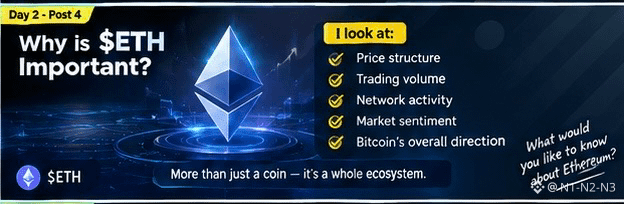
🧠 WHY IS $ETH IMPORTANT?
Ethereum is more than just a cryptocurrency. Its blockchain supports smart contracts and a large ecosystem of decentralized applications.
When studying $ETH, I usually look at:
🔹 Price structure
🔹 Trading volume
🔹 Network activity
🔹 Market sentiment
🔹 Bitcoin's overall direction
Understanding the technology can be just as important as watching the price.
What would you like to know about Ethereum?
#ETH #Ethereum #cryptoeducation #Web3 #BİNANCESQUARE #Write2Earn!
ETH Education
🧠 WHY IS $ETH IMPORTANT?
Ethereum is more than just a cryptocurrency. Its blockchain supports smart contracts and a large ecosystem of decentralized applications.
When studying $ETH , I usually look at:
🔹 Price structure
🔹 Trading volume
🔹 Network activity
🔹 Market sentiment
🔹 Bitcoin's overall direction
Understanding the technology can be just as important as watching the price.
What would you like to know about Ethereum?
#ETH #Ethereum #cryptoeducation #Web3 #BİNANCESQUARE #Write2Earn!
🧠 WHY IS $ETH IMPORTANT?
Ethereum is more than just a cryptocurrency. Its blockchain supports smart contracts and a large ecosystem of decentralized applications.
When studying $ETH , I usually look at:
🔹 Price structure
🔹 Trading volume
🔹 Network activity
🔹 Market sentiment
🔹 Bitcoin's overall direction
Understanding the technology can be just as important as watching the price.
What would you like to know about Ethereum?
#ETH #Ethereum #cryptoeducation #Web3 #BİNANCESQUARE #Write2Earn!
37

🎓 Binance is offering $BTC for learning — no trading competition required.
Binance Academy has replenished its Bitcoin Learn & Earn rewards for October.
Eligible new Binance users can:
📚 Study the Bitcoin material
✅ Complete the quiz correctly
🎁 Receive 0.00001 BTC
Important details:
• Only users registered after Oct. 1, 00:00 UTC qualify
• KYC is required
• First 5,000 eligible users each month
• One reward per user
• Reward vouchers expire 14 days after distribution
🕌 For Muslim crypto users, I like the educational lesson here more than the reward itself:
Learn what an asset actually is before deciding whether to put money into it.
A good research process should ask:
• What problem does it solve?
• How is new supply created?
• Who controls the network?
• Where does any promised return come from?
• Are you buying the asset itself or entering another financial contract built around it?
I’m not making a Shariah ruling on Bitcoin here.
📌 Knowledge before capital. Research before reward-chasing.
Would you like a Muslim investor’s 10-point checklist for researching any crypto project?
#Bitcoin #CryptoEducation #IslamicFinance #HalalCryptoGuide
{spot}(BTCUSDT)
🎓 Binance is offering $BTC for learning — no trading competition required.
Binance Academy has replenished its Bitcoin Learn & Earn rewards for October.
Eligible new Binance users can:
📚 Study the Bitcoin material
✅ Complete the quiz correctly
🎁 Receive 0.00001 BTC
Important details:
• Only users registered after Oct. 1, 00:00 UTC qualify
• KYC is required
• First 5,000 eligible users each month
• One reward per user
• Reward vouchers expire 14 days after distribution
🕌 For Muslim crypto users, I like the educational lesson here more than the reward itself:
Learn what an asset actually is before deciding whether to put money into it.
A good research process should ask:
• What problem does it solve?
• How is new supply created?
• Who controls the network?
• Where does any promised return come from?
• Are you buying the asset itself or entering another financial contract built around it?
I’m not making a Shariah ruling on Bitcoin here.
📌 Knowledge before capital. Research before reward-chasing.
Would you like a Muslim investor’s 10-point checklist for researching any crypto project?
#Bitcoin #CryptoEducation #IslamicFinance #HalalCryptoGuide
Binance Academy has replenished its Bitcoin Learn & Earn rewards for October.
Eligible new Binance users can:
📚 Study the Bitcoin material
✅ Complete the quiz correctly
🎁 Receive 0.00001 BTC
Important details:
• Only users registered after Oct. 1, 00:00 UTC qualify
• KYC is required
• First 5,000 eligible users each month
• One reward per user
• Reward vouchers expire 14 days after distribution
🕌 For Muslim crypto users, I like the educational lesson here more than the reward itself:
Learn what an asset actually is before deciding whether to put money into it.
A good research process should ask:
• What problem does it solve?
• How is new supply created?
• Who controls the network?
• Where does any promised return come from?
• Are you buying the asset itself or entering another financial contract built around it?
I’m not making a Shariah ruling on Bitcoin here.
📌 Knowledge before capital. Research before reward-chasing.
Would you like a Muslim investor’s 10-point checklist for researching any crypto project?
#Bitcoin #CryptoEducation #IslamicFinance #HalalCryptoGuide
72
·
--
AI is a great translator for crypto jargon. It's also confidently wrong sometimes. The trick is using it for the first and protecting yourself from the second.
Here's the routine I'd suggest for any term you don't understand:
1. Ask for the plain version. "Explain slippage to someone who has never traded, with one numeric example."
2. Ask what it's unsure about. "What parts of this vary by exchange or change over time?" This often surfaces the details most likely to be outdated.
3. Check the one fact that matters against an official source, like Binance Academy, Binance Support, or the project's own docs. AI can invent fees, limits, and menu names that sound perfectly reasonable.
4. Explain it back in your own words. If you can't, you didn't learn it yet.
Two hard rules: never paste a seed phrase or private key into any AI tool, and never treat an AI answer as a reason to buy or sell.
Used this way, AI shortens the learning curve. Used blindly, it just gives you wrong answers faster.
What's one crypto term that took you way too long to understand?
#AI #crypto #Binance #cryptoeducation
AI is a great translator for crypto jargon. It's also confidently wrong sometimes. The trick is using it for the first and protecting yourself from the second.
Here's the routine I'd suggest for any term you don't understand:
1. Ask for the plain version. "Explain slippage to someone who has never traded, with one numeric example."
2. Ask what it's unsure about. "What parts of this vary by exchange or change over time?" This often surfaces the details most likely to be outdated.
3. Check the one fact that matters against an official source, like Binance Academy, Binance Support, or the project's own docs. AI can invent fees, limits, and menu names that sound perfectly reasonable.
4. Explain it back in your own words. If you can't, you didn't learn it yet.
Two hard rules: never paste a seed phrase or private key into any AI tool, and never treat an AI answer as a reason to buy or sell.
Used this way, AI shortens the learning curve. Used blindly, it just gives you wrong answers faster.
What's one crypto term that took you way too long to understand?
#AI #crypto #Binance #cryptoeducation
Here's the routine I'd suggest for any term you don't understand:
1. Ask for the plain version. "Explain slippage to someone who has never traded, with one numeric example."
2. Ask what it's unsure about. "What parts of this vary by exchange or change over time?" This often surfaces the details most likely to be outdated.
3. Check the one fact that matters against an official source, like Binance Academy, Binance Support, or the project's own docs. AI can invent fees, limits, and menu names that sound perfectly reasonable.
4. Explain it back in your own words. If you can't, you didn't learn it yet.
Two hard rules: never paste a seed phrase or private key into any AI tool, and never treat an AI answer as a reason to buy or sell.
Used this way, AI shortens the learning curve. Used blindly, it just gives you wrong answers faster.
What's one crypto term that took you way too long to understand?
#AI #crypto #Binance #cryptoeducation
24
What Is a Crypto Wallet💡
A crypto wallet is a tool that allows you to interact with your digital assets.
There are two common types:
🔐 Hot Wallet — connected to the internet and convenient for everyday use.
🧊 Cold Wallet — kept offline and commonly used for longer-term storage.
One important rule: Never share your seed phrase or private key with anyone.
Your crypto security starts with protecting your wallet information. 🔒
#Crypto101 #CryptoEducation #Blockchain #BinanceSquare
What Is a Crypto Wallet
💡
A crypto wallet is a tool that allows you to interact with your digital assets.
There are two common types:
🔐 Hot Wallet — connected to the internet and convenient for everyday use.
🧊 Cold Wallet — kept offline and commonly used for longer-term storage.
One important rule: Never share your seed phrase or private key with anyone.
Your crypto security starts with protecting your wallet information. 🔒
#Crypto101 #CryptoEducation #Blockchain #BinanceSquare
A crypto wallet is a tool that allows you to interact with your digital assets.
There are two common types:
🔐 Hot Wallet — connected to the internet and convenient for everyday use.
🧊 Cold Wallet — kept offline and commonly used for longer-term storage.
One important rule: Never share your seed phrase or private key with anyone.
Your crypto security starts with protecting your wallet information. 🔒
#Crypto101 #CryptoEducation #Blockchain #BinanceSquare
1

·
--
🎓 Bridging Traditional Finance & Web3 with Binance Academy
I just wrapped up the Understanding Stocks course on Binance Academy and earned my certificate 📜✨
Understanding traditional financial assets like stocks isn't just about the stock market—it’s crucial for mastering macro economics, understanding tokenized equities, and seeing where crypto fits into the broader global economy, Knowledge is always the highest-yielding asset in any market cycle 📈💡
#BinanceAcademyCourse #Binance #cryptoeducation #LearningJourney @Binance_Academy
🎓 Bridging Traditional Finance & Web3 with Binance Academy
I just wrapped up the Understanding Stocks course on Binance Academy and earned my certificate 📜✨
Understanding traditional financial assets like stocks isn't just about the stock market—it’s crucial for mastering macro economics, understanding tokenized equities, and seeing where crypto fits into the broader global economy, Knowledge is always the highest-yielding asset in any market cycle 📈💡
#BinanceAcademyCourse #Binance #cryptoeducation #LearningJourney @Binance Academy
I just wrapped up the Understanding Stocks course on Binance Academy and earned my certificate 📜✨
Understanding traditional financial assets like stocks isn't just about the stock market—it’s crucial for mastering macro economics, understanding tokenized equities, and seeing where crypto fits into the broader global economy, Knowledge is always the highest-yielding asset in any market cycle 📈💡
#BinanceAcademyCourse #Binance #cryptoeducation #LearningJourney @Binance Academy


Binance Academy
·
--
Stocks are the language the modern economy speaks
👉 this course teaches you to read it.
Understanding Stocks is now live on Binance Academy! Learn, share the certificate, and win Binance swag.
Campaign period: Sep 30 – Oct 11, 2026
🔸 Complete Understanding Stocks course & earn your certificate
🔸 Follow @Binance Academy on Square
🔸 Share your certificate with #BinanceAcademyCourse
🔸 Fill in the shipping info
🔸 Wait for results!
10 winners will be selected on Oct 12, 2026 — chosen based on creativity and relevance in sharing their certificate and learning journey. Make your post stand out. 🏆
Note: Campaign unavailable in certain regions due to compliance requirements.
👉 this course teaches you to read it.
Understanding Stocks is now live on Binance Academy! Learn, share the certificate, and win Binance swag.
Campaign period: Sep 30 – Oct 11, 2026
🔸 Complete Understanding Stocks course & earn your certificate
🔸 Follow @Binance Academy on Square
🔸 Share your certificate with #BinanceAcademyCourse
🔸 Fill in the shipping info
🔸 Wait for results!
10 winners will be selected on Oct 12, 2026 — chosen based on creativity and relevance in sharing their certificate and learning journey. Make your post stand out. 🏆
Note: Campaign unavailable in certain regions due to compliance requirements.
2
74
🚀 Welcome to Crypto Friend Club! 🤝
Hey crypto friends! 👋
I’m here to learn about crypto, share what I discover, and grow together. 📊
💡 Learn with me.
📈 Grow with me.
🤝 Let’s explore crypto together.
I’ll be sharing:
• Crypto basics 🧠
• Market insights 📊
• Useful Binance tips 🔥
• Interesting crypto updates 🚀
No complications — just crypto explained like friends talking. 😄
If you’re also learning about crypto, follow me and join the club! 🫶
#CryptoFriendClub #BinanceSquare #crypto #Web3 #cryptoeducation
🚀 Welcome to Crypto Friend Club! 🤝
Hey crypto friends! 👋
I’m here to learn about crypto, share what I discover, and grow together. 📊
💡 Learn with me.
📈 Grow with me.
🤝 Let’s explore crypto together.
I’ll be sharing:
• Crypto basics 🧠
• Market insights 📊
• Useful Binance tips 🔥
• Interesting crypto updates 🚀
No complications — just crypto explained like friends talking. 😄
If you’re also learning about crypto, follow me and join the club! 🫶
#CryptoFriendClub #BinanceSquare #crypto #Web3 #cryptoeducation
Hey crypto friends! 👋
I’m here to learn about crypto, share what I discover, and grow together. 📊
💡 Learn with me.
📈 Grow with me.
🤝 Let’s explore crypto together.
I’ll be sharing:
• Crypto basics 🧠
• Market insights 📊
• Useful Binance tips 🔥
• Interesting crypto updates 🚀
No complications — just crypto explained like friends talking. 😄
If you’re also learning about crypto, follow me and join the club! 🫶
#CryptoFriendClub #BinanceSquare #crypto #Web3 #cryptoeducation
1
163

🚀 Crypto isn’t about getting rich overnight — it’s about learning before the opportunity comes.
Markets move fast. Narratives change. New projects appear every day. But one thing stays important: knowledge. 📚
Before you buy a coin, ask yourself:
🔹 What problem does it solve?
🔹 What is driving its demand?
🔹 What are the risks?
🔹 Am I investing or simply chasing hype?
The biggest advantage in crypto isn’t always having more money — sometimes it’s having better information and stronger discipline. 🧠💎
What matters more to you in crypto: research, patience, or timing? 👇
#Crypto #Binance #bitcoin #Web3 #cryptoeducation
🚀 Crypto isn’t about getting rich overnight — it’s about learning before the opportunity comes.
Markets move fast. Narratives change. New projects appear every day. But one thing stays important: knowledge. 📚
Before you buy a coin, ask yourself:
🔹 What problem does it solve?
🔹 What is driving its demand?
🔹 What are the risks?
🔹 Am I investing or simply chasing hype?
The biggest advantage in crypto isn’t always having more money — sometimes it’s having better information and stronger discipline. 🧠💎
What matters more to you in crypto: research, patience, or timing? 👇
#Crypto #Binance #bitcoin #Web3 #cryptoeducation
Markets move fast. Narratives change. New projects appear every day. But one thing stays important: knowledge. 📚
Before you buy a coin, ask yourself:
🔹 What problem does it solve?
🔹 What is driving its demand?
🔹 What are the risks?
🔹 Am I investing or simply chasing hype?
The biggest advantage in crypto isn’t always having more money — sometimes it’s having better information and stronger discipline. 🧠💎
What matters more to you in crypto: research, patience, or timing? 👇
#Crypto #Binance #bitcoin #Web3 #cryptoeducation
86

Here's your free alpha...
Over 70 percent of on-chain transactions can be linked to a real-world identity with basic clustering tools, according to several chain analytics studies from 2024.
Privacy is not about hiding. It is about not broadcasting your entire financial life to anyone with an internet connection.
→ ZK rollups now process over 30 percent of Ethereum Layer 2 activity, proving that zero-knowledge proofs can scale without exposing user data. The same cryptography that cuts fees can cut surveillance.
→ Zero-knowledge KYC is moving from theory to production. Projects like zkPass and similar frameworks let users prove they passed verification without revealing passport numbers or addresses.
→ Regulatory pressure on privacy coins pushed some exchanges to delist them in 2023 and 2024. Yet institutional demand for confidential transactions keeps rising, especially among funds that cannot reveal position sizes.
→ Financial privacy is becoming a compliance feature, not a loophole. Banks spend billions on data protection. Crypto should not be the only financial system where your salary is public forever.
The next cycle will not be won by the loudest chain. It will be won by the one that lets you prove what matters and hide what does not.
Follow for daily updates
#CryptoEducation #TradingTips #HODL #Ethereum #DeFi
📱 Follow @PoorCryptoMan
Here's your free alpha...
Over 70 percent of on-chain transactions can be linked to a real-world identity with basic clustering tools, according to several chain analytics studies from 2024.
Privacy is not about hiding. It is about not broadcasting your entire financial life to anyone with an internet connection.
→ ZK rollups now process over 30 percent of Ethereum Layer 2 activity, proving that zero-knowledge proofs can scale without exposing user data. The same cryptography that cuts fees can cut surveillance.
→ Zero-knowledge KYC is moving from theory to production. Projects like zkPass and similar frameworks let users prove they passed verification without revealing passport numbers or addresses.
→ Regulatory pressure on privacy coins pushed some exchanges to delist them in 2023 and 2024. Yet institutional demand for confidential transactions keeps rising, especially among funds that cannot reveal position sizes.
→ Financial privacy is becoming a compliance feature, not a loophole. Banks spend billions on data protection. Crypto should not be the only financial system where your salary is public forever.
The next cycle will not be won by the loudest chain. It will be won by the one that lets you prove what matters and hide what does not.
Follow for daily updates
#CryptoEducation #TradingTips #HODL #Ethereum #DeFi
📱 Follow @PoorCryptoMan
Over 70 percent of on-chain transactions can be linked to a real-world identity with basic clustering tools, according to several chain analytics studies from 2024.
Privacy is not about hiding. It is about not broadcasting your entire financial life to anyone with an internet connection.
→ ZK rollups now process over 30 percent of Ethereum Layer 2 activity, proving that zero-knowledge proofs can scale without exposing user data. The same cryptography that cuts fees can cut surveillance.
→ Zero-knowledge KYC is moving from theory to production. Projects like zkPass and similar frameworks let users prove they passed verification without revealing passport numbers or addresses.
→ Regulatory pressure on privacy coins pushed some exchanges to delist them in 2023 and 2024. Yet institutional demand for confidential transactions keeps rising, especially among funds that cannot reveal position sizes.
→ Financial privacy is becoming a compliance feature, not a loophole. Banks spend billions on data protection. Crypto should not be the only financial system where your salary is public forever.
The next cycle will not be won by the loudest chain. It will be won by the one that lets you prove what matters and hide what does not.
Follow for daily updates
#CryptoEducation #TradingTips #HODL #Ethereum #DeFi
📱 Follow @PoorCryptoMan
5

·
--
📚 Is your crypto portfolio a house of cards? One bad news cycle and you’re down 50%? Diversification isn’t just a buzzword; it’s your survival strategy in volatile markets. **What is it?** Spreading capital across different asset classes to reduce risk. In crypto, this means not putting all eggs in one basket. **How it works** Correlation matters. Bitcoin and Ethereum often move together. During a "risk-off" event, both crash. True diversification includes stablecoins, distinct sectors (DeFi, Layer 1s, AI tokens), and even traditional assets like gold or equities. By mixing assets with low correlation, a drop in one sector is offset by stability in another. **Benefits** 1. **Volatility Reduction:** Your portfolio swings less violently. 2. **Opportunity Capture:** Different sectors lead at different times. When DeFi is hot, Layer 1s might lag, and vice versa. 3. **Psychological Edge:** Smaller drawdowns prevent panic selling. **Common Mistakes** ❌ **False Diversification:** Holding 10 different L1 tokens that all behave like Bitcoin. This is concentration, not diversification. ❌ **Over-diversification:** Holding 100 altcoins you can’t track effectively. ❌ **Ignoring Correlations:** Thinking holding BTC and ETH is enough. **Pro Tip** Rebalance quarterly. If one asset grows to 50% of your portfolio, sell some to bring it back to target allocation. This forces you to "sell high" and "buy low" systematically. Which sector do you believe will lead the next bull run? Let’s debate in the comments. 👇 $BTC $ETH #CryptoEducation #PortfolioManagement
#Web3
📚 Is your crypto portfolio a house of cards? One bad news cycle and you’re down 50%? Diversification isn’t just a buzzword; it’s your survival strategy in volatile markets. **What is it?** Spreading capital across different asset classes to reduce risk. In crypto, this means not putting all eggs in one basket. **How it works** Correlation matters. Bitcoin and Ethereum often move together. During a "risk-off" event, both crash. True diversification includes stablecoins, distinct sectors (DeFi, Layer 1s, AI tokens), and even traditional assets like gold or equities. By mixing assets with low correlation, a drop in one sector is offset by stability in another. **Benefits** 1. **Volatility Reduction:** Your portfolio swings less violently. 2. **Opportunity Capture:** Different sectors lead at different times. When DeFi is hot, Layer 1s might lag, and vice versa. 3. **Psychological Edge:** Smaller drawdowns prevent panic selling. **Common Mistakes** ❌ **False Diversification:** Holding 10 different L1 tokens that all behave like Bitcoin. This is concentration, not diversification. ❌ **Over-diversification:** Holding 100 altcoins you can’t track effectively. ❌ **Ignoring Correlations:** Thinking holding BTC and ETH is enough. **Pro Tip** Rebalance quarterly. If one asset grows to 50% of your portfolio, sell some to bring it back to target allocation. This forces you to "sell high" and "buy low" systematically. Which sector do you believe will lead the next bull run? Let’s debate in the comments. 👇 $BTC $ETH #CryptoEducation #PortfolioManagement
#Web3
#Web3
83

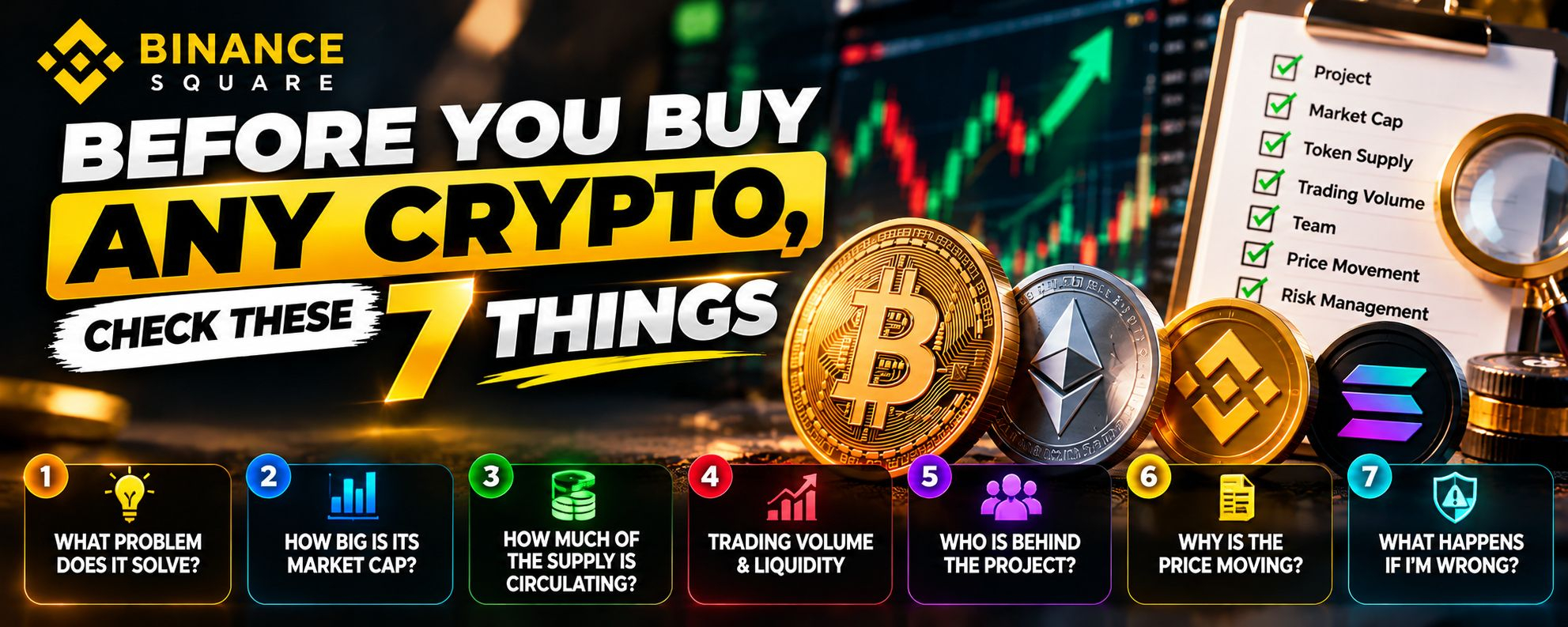
Article
Before You Buy Any Crypto, Ask These 7 Questions 🔎Seeing a coin suddenly pump can create FOMO.
The hardest part isn't finding a coin that is moving.
The harder part is deciding whether you actually understand what you're buying.
Before I consider any crypto asset, I like to ask these 7 questions.
1. What problem does it solve?
Don't start with the price.
First, understand the project.
What does it actually do? What problem is it trying to solve? Who is supposed to use it?
If you can't explain the project in a few simple sentences, you probably need to learn more before considering it.
2. How big is its market cap?
A coin priced at $0.01 isn't automatically “cheap.”
The number of tokens in circulation matters.
That's why I look at market capitalization, not just the price of one token.
A low token price can still represent a very large valuation.
3. How much of the supply is already circulating?
Token supply can make a huge difference.
Check:
Circulating supplyMaximum supplyTotal supplyFuture token unlocks
A project with a large amount of tokens scheduled to enter circulation can have very different supply dynamics from one with a more limited circulating supply.
4. Is there enough trading volume and liquidity?
A coin may look interesting, but if trading activity and liquidity are low, entering or exiting a position can be more difficult.
I want to know whether there is meaningful market activity before I even think about a trade.
5. Who is behind the project?
Look at the team, development activity, documentation, partnerships, and public information.
You don't need to believe every claim you see on social media.
Verify important information from reliable sources.
6. Why is the price moving?
This is one of the most important questions.
If a coin is suddenly up 30%, don't immediately ask:
“How much higher can it go?”
Ask:
“Why did it move?”
Was there major news?
A new listing?
A product launch?
A market-wide move?
Or simply a short-term burst of speculation?
Understanding the reason behind a move can be more useful than chasing the move itself.
7. What happens if I'm wrong?
This question gets ignored when the market is exciting.
Before entering a trade, decide how much risk you're actually willing to accept.
Never assume a coin has to go higher just because it has already gone higher.
Markets can move in either direction.
The Bottom Line
You don't need to know every cryptocurrency.
You don't need to catch every pump.
And you definitely don't need to trade every day.
Sometimes the best decision is simply to do more research and wait.
The next time you see a coin making a huge move, try these 7 questions before clicking Buy.
Which question do you think new crypto users ignore the most — #1, #3, #4, #5, #6, or #7? 👇
Educational content only. This is not financial advice. Crypto assets and trading involve significant risk. Always do your own research.
$BTC
#BinanceSquare #cryptoeducation #CryptoTips #BTC走势分析 #BTC
Before You Buy Any Crypto, Ask These 7 Questions 🔎
Seeing a coin suddenly pump can create FOMO.
The hardest part isn't finding a coin that is moving.
The harder part is deciding whether you actually understand what you're buying.
Before I consider any crypto asset, I like to ask these 7 questions.
1. What problem does it solve?
Don't start with the price.
First, understand the project.
What does it actually do? What problem is it trying to solve? Who is supposed to use it?
If you can't explain the project in a few simple sentences, you probably need to learn more before considering it.
2. How big is its market cap?
A coin priced at $0.01 isn't automatically “cheap.”
The number of tokens in circulation matters.
That's why I look at market capitalization, not just the price of one token.
A low token price can still represent a very large valuation.
3. How much of the supply is already circulating?
Token supply can make a huge difference.
Check:
Circulating supplyMaximum supplyTotal supplyFuture token unlocks
A project with a large amount of tokens scheduled to enter circulation can have very different supply dynamics from one with a more limited circulating supply.
4. Is there enough trading volume and liquidity?
A coin may look interesting, but if trading activity and liquidity are low, entering or exiting a position can be more difficult.
I want to know whether there is meaningful market activity before I even think about a trade.
5. Who is behind the project?
Look at the team, development activity, documentation, partnerships, and public information.
You don't need to believe every claim you see on social media.
Verify important information from reliable sources.
6. Why is the price moving?
This is one of the most important questions.
If a coin is suddenly up 30%, don't immediately ask:
“How much higher can it go?”
Ask:
“Why did it move?”
Was there major news?
A new listing?
A product launch?
A market-wide move?
Or simply a short-term burst of speculation?
Understanding the reason behind a move can be more useful than chasing the move itself.
7. What happens if I'm wrong?
This question gets ignored when the market is exciting.
Before entering a trade, decide how much risk you're actually willing to accept.
Never assume a coin has to go higher just because it has already gone higher.
Markets can move in either direction.
The Bottom Line
You don't need to know every cryptocurrency.
You don't need to catch every pump.
And you definitely don't need to trade every day.
Sometimes the best decision is simply to do more research and wait.
The next time you see a coin making a huge move, try these 7 questions before clicking Buy.
Which question do you think new crypto users ignore the most — #1, #3, #4, #5, #6, or #7? 👇
Educational content only. This is not financial advice. Crypto assets and trading involve significant risk. Always do your own research.
$BTC
#BinanceSquare #cryptoeducation #CryptoTips #BTC走势分析 #BTC
The hardest part isn't finding a coin that is moving.
The harder part is deciding whether you actually understand what you're buying.
Before I consider any crypto asset, I like to ask these 7 questions.
1. What problem does it solve?
Don't start with the price.
First, understand the project.
What does it actually do? What problem is it trying to solve? Who is supposed to use it?
If you can't explain the project in a few simple sentences, you probably need to learn more before considering it.
2. How big is its market cap?
A coin priced at $0.01 isn't automatically “cheap.”
The number of tokens in circulation matters.
That's why I look at market capitalization, not just the price of one token.
A low token price can still represent a very large valuation.
3. How much of the supply is already circulating?
Token supply can make a huge difference.
Check:
Circulating supplyMaximum supplyTotal supplyFuture token unlocks
A project with a large amount of tokens scheduled to enter circulation can have very different supply dynamics from one with a more limited circulating supply.
4. Is there enough trading volume and liquidity?
A coin may look interesting, but if trading activity and liquidity are low, entering or exiting a position can be more difficult.
I want to know whether there is meaningful market activity before I even think about a trade.
5. Who is behind the project?
Look at the team, development activity, documentation, partnerships, and public information.
You don't need to believe every claim you see on social media.
Verify important information from reliable sources.
6. Why is the price moving?
This is one of the most important questions.
If a coin is suddenly up 30%, don't immediately ask:
“How much higher can it go?”
Ask:
“Why did it move?”
Was there major news?
A new listing?
A product launch?
A market-wide move?
Or simply a short-term burst of speculation?
Understanding the reason behind a move can be more useful than chasing the move itself.
7. What happens if I'm wrong?
This question gets ignored when the market is exciting.
Before entering a trade, decide how much risk you're actually willing to accept.
Never assume a coin has to go higher just because it has already gone higher.
Markets can move in either direction.
The Bottom Line
You don't need to know every cryptocurrency.
You don't need to catch every pump.
And you definitely don't need to trade every day.
Sometimes the best decision is simply to do more research and wait.
The next time you see a coin making a huge move, try these 7 questions before clicking Buy.
Which question do you think new crypto users ignore the most — #1, #3, #4, #5, #6, or #7? 👇
Educational content only. This is not financial advice. Crypto assets and trading involve significant risk. Always do your own research.
$BTC
#BinanceSquare #cryptoeducation #CryptoTips #BTC走势分析 #BTC
48

·
--
𝐇𝐞𝐫𝐞'𝐬 𝐞𝐱𝐚𝐜𝐭𝐥𝐲 𝐰𝐡𝐚𝐭 𝐈'𝐝 𝐝𝐨. 👇
𝐹𝑖𝑟𝑠𝑡 — 𝐼 𝑤𝑜𝑢𝑙𝑑 𝑁𝑂𝑇 𝑡𝑟𝑎𝑑𝑒 𝑖𝑡.
$5 𝑤𝑖𝑡𝒉 𝑓𝑒𝑒𝑠 = 𝑦𝑜𝑢 𝑙𝑜𝑠𝑒 𝑏𝑒𝑓𝑜𝑟𝑒 𝑦𝑜𝑢 𝑒𝑣𝑒𝑛 𝑠𝑡𝑎𝑟𝑡.
𝑇𝒉𝑎𝑡'𝑠 𝑛𝑜𝑡 𝑖𝑛𝑣𝑒𝑠𝑡𝑖𝑛𝑔. 𝑇𝒉𝑎𝑡'𝑠 𝑑𝑜𝑛𝑎𝑡𝑖𝑛𝑔 𝑡𝑜 𝑡𝒉𝑒 𝑒𝑥𝑐𝒉𝑎𝑛𝑔𝑒.
𝐻𝑒𝑟𝑒'𝑠 𝑤𝒉𝑎𝑡 𝐼'𝑑 𝑎𝑐𝑡𝑢𝑎𝑙𝑙𝑦 𝑑𝑜:
Step 1 — Convert to USDT
Keep it stable. Don't let it sit in a volatile coin while you're still learning.
Step 2 — Study for 30 days. Free.
Binance Academy. YouTube. Read charts every day.
Don't touch the $5. Just watch and learn.
Step 3 — Paper trade first
Practice without real money.
Write down every trade you WOULD make.
Track if you would have won or lost.
Step 4 — Add more only when ready
$5 won't make you rich.
But the knowledge you build with it?
That's worth thousands.
The truth:
Every big crypto trader started somewhere small.
The ones who made it didn't start with more money.
They started with more patience.
Your $5 is not your investment.
Your $5 is your tuition fee.
Started with less than $10? Comment your story 👇
Follow for real crypto education — no hype.
#cryptouniverseofficial #bitcoin #BinanceSquareFamily #CryptoEducation
𝐇𝐞𝐫𝐞'𝐬 𝐞𝐱𝐚𝐜𝐭𝐥𝐲 𝐰𝐡𝐚𝐭 𝐈'𝐝 𝐝𝐨. 👇
𝐹𝑖𝑟𝑠𝑡 — 𝐼 𝑤𝑜𝑢𝑙𝑑 𝑁𝑂𝑇 𝑡𝑟𝑎𝑑𝑒 𝑖𝑡.
$5 𝑤𝑖𝑡𝒉 𝑓𝑒𝑒𝑠 = 𝑦𝑜𝑢 𝑙𝑜𝑠𝑒 𝑏𝑒𝑓𝑜𝑟𝑒 𝑦𝑜𝑢 𝑒𝑣𝑒𝑛 𝑠𝑡𝑎𝑟𝑡.
𝑇𝒉𝑎𝑡'𝑠 𝑛𝑜𝑡 𝑖𝑛𝑣𝑒𝑠𝑡𝑖𝑛𝑔. 𝑇𝒉𝑎𝑡'𝑠 𝑑𝑜𝑛𝑎𝑡𝑖𝑛𝑔 𝑡𝑜 𝑡𝒉𝑒 𝑒𝑥𝑐𝒉𝑎𝑛𝑔𝑒.
𝐻𝑒𝑟𝑒'𝑠 𝑤𝒉𝑎𝑡 𝐼'𝑑 𝑎𝑐𝑡𝑢𝑎𝑙𝑙𝑦 𝑑𝑜:
Step 1 — Convert to USDT
Keep it stable. Don't let it sit in a volatile coin while you're still learning.
Step 2 — Study for 30 days. Free.
Binance Academy. YouTube. Read charts every day.
Don't touch the $5. Just watch and learn.
Step 3 — Paper trade first
Practice without real money.
Write down every trade you WOULD make.
Track if you would have won or lost.
Step 4 — Add more only when ready
$5 won't make you rich.
But the knowledge you build with it?
That's worth thousands.
The truth:
Every big crypto trader started somewhere small.
The ones who made it didn't start with more money.
They started with more patience.
Your $5 is not your investment.
Your $5 is your tuition fee.
Started with less than $10? Comment your story 👇
Follow for real crypto education — no hype.
#cryptouniverseofficial #bitcoin #BinanceSquareFamily #CryptoEducation
𝐹𝑖𝑟𝑠𝑡 — 𝐼 𝑤𝑜𝑢𝑙𝑑 𝑁𝑂𝑇 𝑡𝑟𝑎𝑑𝑒 𝑖𝑡.
$5 𝑤𝑖𝑡𝒉 𝑓𝑒𝑒𝑠 = 𝑦𝑜𝑢 𝑙𝑜𝑠𝑒 𝑏𝑒𝑓𝑜𝑟𝑒 𝑦𝑜𝑢 𝑒𝑣𝑒𝑛 𝑠𝑡𝑎𝑟𝑡.
𝑇𝒉𝑎𝑡'𝑠 𝑛𝑜𝑡 𝑖𝑛𝑣𝑒𝑠𝑡𝑖𝑛𝑔. 𝑇𝒉𝑎𝑡'𝑠 𝑑𝑜𝑛𝑎𝑡𝑖𝑛𝑔 𝑡𝑜 𝑡𝒉𝑒 𝑒𝑥𝑐𝒉𝑎𝑛𝑔𝑒.
𝐻𝑒𝑟𝑒'𝑠 𝑤𝒉𝑎𝑡 𝐼'𝑑 𝑎𝑐𝑡𝑢𝑎𝑙𝑙𝑦 𝑑𝑜:
Step 1 — Convert to USDT
Keep it stable. Don't let it sit in a volatile coin while you're still learning.
Step 2 — Study for 30 days. Free.
Binance Academy. YouTube. Read charts every day.
Don't touch the $5. Just watch and learn.
Step 3 — Paper trade first
Practice without real money.
Write down every trade you WOULD make.
Track if you would have won or lost.
Step 4 — Add more only when ready
$5 won't make you rich.
But the knowledge you build with it?
That's worth thousands.
The truth:
Every big crypto trader started somewhere small.
The ones who made it didn't start with more money.
They started with more patience.
Your $5 is not your investment.
Your $5 is your tuition fee.
Started with less than $10? Comment your story 👇
Follow for real crypto education — no hype.
#cryptouniverseofficial #bitcoin #BinanceSquareFamily #CryptoEducation
1
1
61

·
--
> *PUBLIC ADDRESS vs PRIVATE KEY*
> Your wallet has two keys. One to share, one to hide.
> Public Address = Like your email. Share it freely to receive crypto.
> Private Key = Like your password. NEVER share. It controls your funds.
> Not your keys = Not your coins.
> Day 5 of learning. Follow for Day 6.
$BTC $ETH $BNB
#CryptoEducation #Web3 #LearnAndGrow
> *PUBLIC ADDRESS vs PRIVATE KEY*
> Your wallet has two keys. One to share, one to hide.
> Public Address = Like your email. Share it freely to receive crypto.
> Private Key = Like your password. NEVER share. It controls your funds.
> Not your keys = Not your coins.
> Day 5 of learning. Follow for Day 6.
$BTC $ETH $BNB
#CryptoEducation #Web3 #LearnAndGrow
> Your wallet has two keys. One to share, one to hide.
> Public Address = Like your email. Share it freely to receive crypto.
> Private Key = Like your password. NEVER share. It controls your funds.
> Not your keys = Not your coins.
> Day 5 of learning. Follow for Day 6.
$BTC $ETH $BNB
#CryptoEducation #Web3 #LearnAndGrow
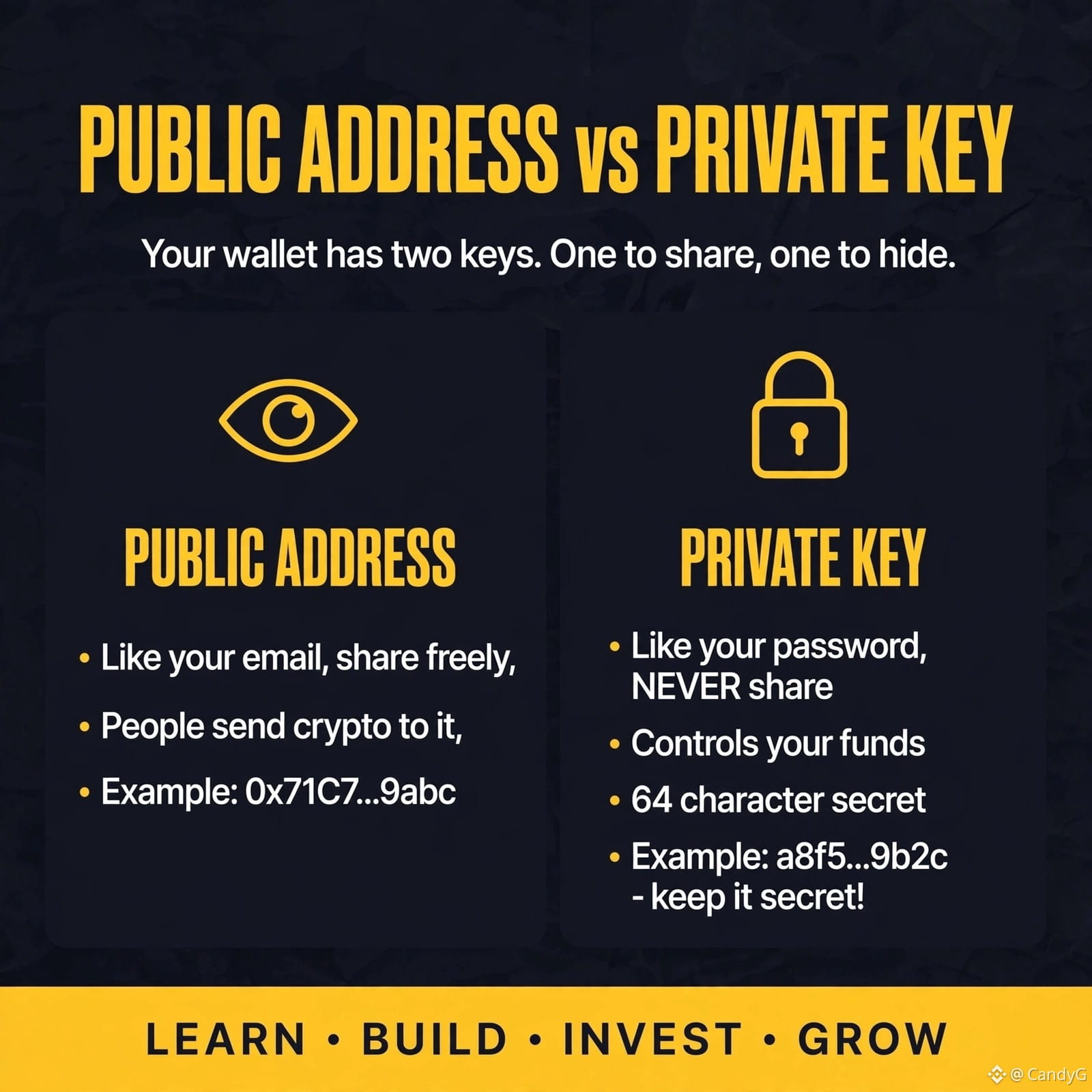
1
107
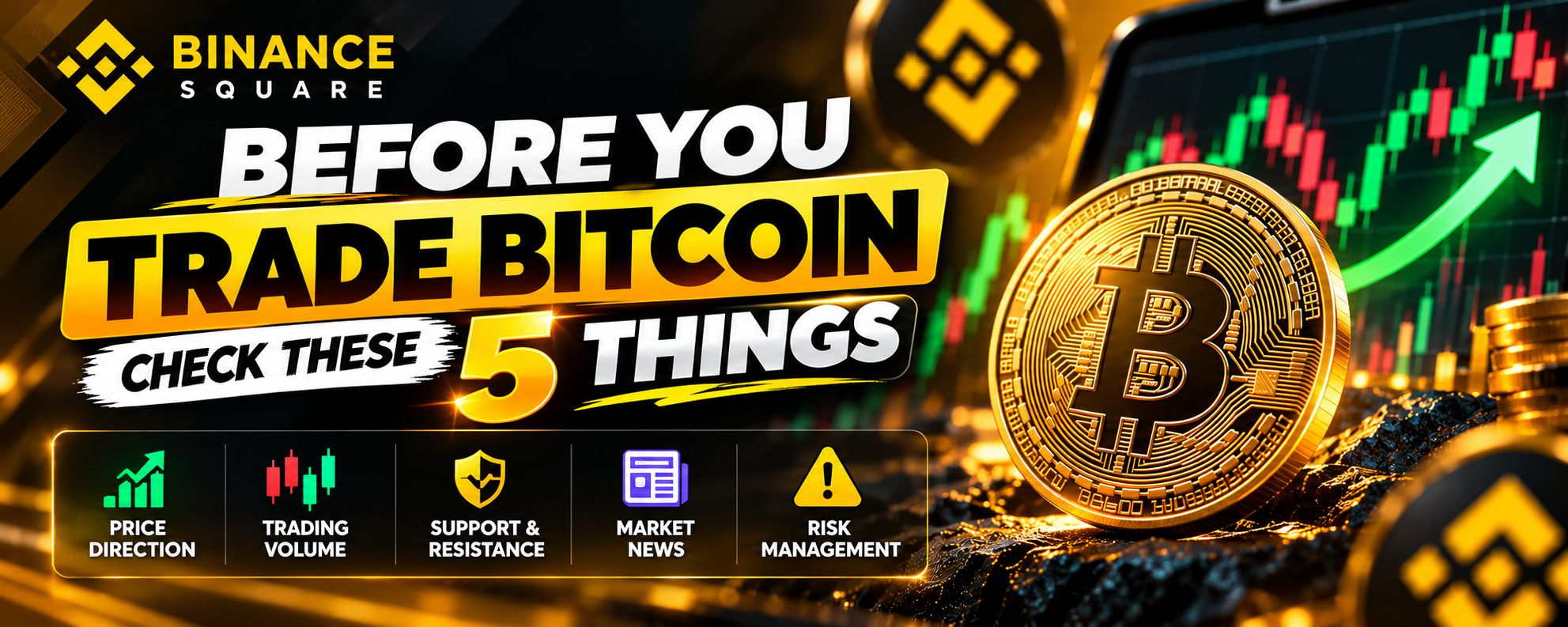
Article
Before You Trade Bitcoin, Check These 5 Things 👀Bitcoin can move quickly, and seeing a big green or red candle can make you want to enter a trade immediately.
But before making a decision, there are a few things worth checking first.
1. Check the Price Direction 📈
First, look at the bigger picture.
Is Bitcoin generally making higher highs and higher lows, or is the market moving in the opposite direction?
Don't make your entire decision from a single candle.
2. Look at Trading Volume 📊
Price movement and volume can tell you different things.
A large price move accompanied by increased volume can provide more context about market participation. Low-volume moves may require more caution because they can be less informative.
3. Identify Support and Resistance
Support is an area where buyers have previously shown interest.
Resistance is an area where selling pressure has previously appeared.
These levels can help you understand where price has reacted before.
4. Check What's Happening in the Market 🌎
Bitcoin doesn't move in isolation.
Before trading, consider whether there is important crypto news, major economic data, regulatory news, or another event that could affect market sentiment.
5. Think About Risk Before the Trade ⚠️
This is the part many beginners overlook.
Before entering a trade, ask yourself:
“What would make my trading idea wrong?”
Knowing your risk beforehand is generally more useful than deciding what to do after the market has already moved against you.
Final Thought
You don't need to predict every Bitcoin move.
A better habit is to slow down, gather information, and understand the risk before making a trade.
What do you check first before trading $BTC — price, volume, support/resistance, or news? 👇
Educational content only. This is not financial advice. Cryptocurrency trading involves significant risk.
#BinanceSquare #BTC #CryptoTrading #CryptoEducation
Before You Trade Bitcoin, Check These 5 Things 👀
Bitcoin can move quickly, and seeing a big green or red candle can make you want to enter a trade immediately.
But before making a decision, there are a few things worth checking first.
1. Check the Price Direction 📈
First, look at the bigger picture.
Is Bitcoin generally making higher highs and higher lows, or is the market moving in the opposite direction?
Don't make your entire decision from a single candle.
2. Look at Trading Volume 📊
Price movement and volume can tell you different things.
A large price move accompanied by increased volume can provide more context about market participation. Low-volume moves may require more caution because they can be less informative.
3. Identify Support and Resistance
Support is an area where buyers have previously shown interest.
Resistance is an area where selling pressure has previously appeared.
These levels can help you understand where price has reacted before.
4. Check What's Happening in the Market 🌎
Bitcoin doesn't move in isolation.
Before trading, consider whether there is important crypto news, major economic data, regulatory news, or another event that could affect market sentiment.
5. Think About Risk Before the Trade ⚠️
This is the part many beginners overlook.
Before entering a trade, ask yourself:
“What would make my trading idea wrong?”
Knowing your risk beforehand is generally more useful than deciding what to do after the market has already moved against you.
Final Thought
You don't need to predict every Bitcoin move.
A better habit is to slow down, gather information, and understand the risk before making a trade.
What do you check first before trading $BTC — price, volume, support/resistance, or news? 👇
Educational content only. This is not financial advice. Cryptocurrency trading involves significant risk.
#BinanceSquare #BTC #CryptoTrading #CryptoEducation
But before making a decision, there are a few things worth checking first.
1. Check the Price Direction 📈
First, look at the bigger picture.
Is Bitcoin generally making higher highs and higher lows, or is the market moving in the opposite direction?
Don't make your entire decision from a single candle.
2. Look at Trading Volume 📊
Price movement and volume can tell you different things.
A large price move accompanied by increased volume can provide more context about market participation. Low-volume moves may require more caution because they can be less informative.
3. Identify Support and Resistance
Support is an area where buyers have previously shown interest.
Resistance is an area where selling pressure has previously appeared.
These levels can help you understand where price has reacted before.
4. Check What's Happening in the Market 🌎
Bitcoin doesn't move in isolation.
Before trading, consider whether there is important crypto news, major economic data, regulatory news, or another event that could affect market sentiment.
5. Think About Risk Before the Trade ⚠️
This is the part many beginners overlook.
Before entering a trade, ask yourself:
“What would make my trading idea wrong?”
Knowing your risk beforehand is generally more useful than deciding what to do after the market has already moved against you.
Final Thought
You don't need to predict every Bitcoin move.
A better habit is to slow down, gather information, and understand the risk before making a trade.
What do you check first before trading $BTC — price, volume, support/resistance, or news? 👇
Educational content only. This is not financial advice. Cryptocurrency trading involves significant risk.
#BinanceSquare #BTC #CryptoTrading #CryptoEducation
1
42
Log in to explore more content
Join global crypto users on Binance Square
⚡️ Get latest and useful information about crypto.
💬 Trusted by the world’s largest crypto exchange.
👍 Discover real insights from verified creators.
Email / Phone number
Trending Topics
1
#NFPWatch
10.9M views
19,290 Discussing
2
#BitcoinFundingRateTriplesTo10%
170,887 views
1,201 Discussing
3
#BitcoinSurpasses$86KUp2.99%
56,104 views
114 Discussing
4
#ZcashFalls21%FromSeptemberPeak
90,609 views
856 Discussing
5
#USSeptemberPayrollsAdd29KUnemploymentRises4.2%
73,792 views
523 Discussing
6
#XRPPostsFirstThreeGreenMonthsInQ3
62,565 views
716 Discussing
7
#BNBChainTokenizedStocksTop$1BAt30%Share
27,805 views
38 Discussing
8
#BitcoinRisesToward$85K
126,919 views
157 Discussing
9
#AmazonPlansToSell$8BNvidiaChips
8,197 views
91 Discussing
10
#NEARFallsToAround$4.70Down14%
50,559 views
118 Discussing