

#economicoutlook
economicoutlook
229,228 views
332 Discussing
Hot
Latest

·
--
Eurozone Economic Outlook Darkens 📉
The Bank of France is set to revise its 2026 growth forecast downward, according to outgoing Governor Francois Villeroy de Galhau. This decision comes on the heels of a sluggish start to the year, compounded by ongoing tensions in the Middle East. The downward revision is likely to have a ripple effect on the broader European economy, potentially influencing investor sentiment and market trends. As the economic landscape continues to evolve, market participants will be closely watching for any signs of instability. The Bank of France's revised forecast is expected to be announced later this month, providing further insight into the region's economic prospects.
#EurozoneEconomy #GrowthForecast #FinancialMarkets #EconomicOutlook
Eurozone Economic Outlook Darkens 📉
The Bank of France is set to revise its 2026 growth forecast downward, according to outgoing Governor Francois Villeroy de Galhau. This decision comes on the heels of a sluggish start to the year, compounded by ongoing tensions in the Middle East. The downward revision is likely to have a ripple effect on the broader European economy, potentially influencing investor sentiment and market trends. As the economic landscape continues to evolve, market participants will be closely watching for any signs of instability. The Bank of France's revised forecast is expected to be announced later this month, providing further insight into the region's economic prospects.
#EurozoneEconomy #GrowthForecast #FinancialMarkets #EconomicOutlook
The Bank of France is set to revise its 2026 growth forecast downward, according to outgoing Governor Francois Villeroy de Galhau. This decision comes on the heels of a sluggish start to the year, compounded by ongoing tensions in the Middle East. The downward revision is likely to have a ripple effect on the broader European economy, potentially influencing investor sentiment and market trends. As the economic landscape continues to evolve, market participants will be closely watching for any signs of instability. The Bank of France's revised forecast is expected to be announced later this month, providing further insight into the region's economic prospects.
#EurozoneEconomy #GrowthForecast #FinancialMarkets #EconomicOutlook
131

·
--
Article
KDI Keeps 2026 and 2027 Inflation Forecasts UnchangedSouth Korea's Korea Development Institute (KDI) has maintained its inflation forecasts for 2026 and 2027, according to Jin10. The institute expects the average inflation rate to remain at 2.7% in 2026, unchanged from its previous estimate, and to be 2.2% in 2027, also consistent with earlier projections.
This stability in forecasts indicates that KDI does not see significant inflationary pressures increasing or decreasing over the next two years, suggesting a relatively stable economic outlook. The unchanged forecasts are notable given the global economic uncertainties and the varying inflation trends observed in other major economies.
KDI’s decision to keep its inflation projections steady reflects a view that current economic policies and external factors are likely to keep inflation within a manageable range. It also signals that policymakers may not need to implement aggressive measures to control inflation in the near future, focusing instead on sustaining growth and stability.
As inflation remains a key concern for many economies, KDI’s consistent outlook provides some reassurance to investors and policymakers that inflationary pressures in South Korea are expected to stay within target levels for the foreseeable future. The forecasts will continue to be monitored as economic conditions evolve. #SouthKorea #InflationForecast #EconomicOutlook
KDI Keeps 2026 and 2027 Inflation Forecasts Unchanged
South Korea's Korea Development Institute (KDI) has maintained its inflation forecasts for 2026 and 2027, according to Jin10. The institute expects the average inflation rate to remain at 2.7% in 2026, unchanged from its previous estimate, and to be 2.2% in 2027, also consistent with earlier projections.
This stability in forecasts indicates that KDI does not see significant inflationary pressures increasing or decreasing over the next two years, suggesting a relatively stable economic outlook. The unchanged forecasts are notable given the global economic uncertainties and the varying inflation trends observed in other major economies.
KDI’s decision to keep its inflation projections steady reflects a view that current economic policies and external factors are likely to keep inflation within a manageable range. It also signals that policymakers may not need to implement aggressive measures to control inflation in the near future, focusing instead on sustaining growth and stability.
As inflation remains a key concern for many economies, KDI’s consistent outlook provides some reassurance to investors and policymakers that inflationary pressures in South Korea are expected to stay within target levels for the foreseeable future. The forecasts will continue to be monitored as economic conditions evolve. #SouthKorea #InflationForecast #EconomicOutlook
This stability in forecasts indicates that KDI does not see significant inflationary pressures increasing or decreasing over the next two years, suggesting a relatively stable economic outlook. The unchanged forecasts are notable given the global economic uncertainties and the varying inflation trends observed in other major economies.
KDI’s decision to keep its inflation projections steady reflects a view that current economic policies and external factors are likely to keep inflation within a manageable range. It also signals that policymakers may not need to implement aggressive measures to control inflation in the near future, focusing instead on sustaining growth and stability.
As inflation remains a key concern for many economies, KDI’s consistent outlook provides some reassurance to investors and policymakers that inflationary pressures in South Korea are expected to stay within target levels for the foreseeable future. The forecasts will continue to be monitored as economic conditions evolve. #SouthKorea #InflationForecast #EconomicOutlook
26
·
--
Article
INDONESIA PRESIDENT SEES GDP GROWTH REACHING 6% BY YEAR-ENDIndonesia's president expressed optimism that the country's GDP growth could reach 6% by the end of the year. Speaking publicly, he highlighted positive economic indicators and ongoing reforms that support this growth target amid a recovering global economy.
The president's statement reflects confidence in Indonesia’s economic trajectory, supported by strong domestic consumption, investment inflows, and export performance. He emphasized that current data points to a resilient economy capable of sustaining accelerated growth rates through the remainder of 2026.
Analysts and market observers are closely watching Indonesia’s economic performance, as the country continues to implement policies aimed at boosting infrastructure, reducing regulatory barriers, and attracting foreign investment. These efforts are seen as key drivers behind the projected growth rate.
Achieving a 6% GDP growth would mark a significant milestone for Indonesia, reinforcing its position as one of Southeast Asia’s fastest-growing economies. The government remains committed to sustaining this momentum, even as global economic uncertainties persist.
More details are available in the official Binance Square post. #Indonesia #GDPGrowth #EconomicOutlook
INDONESIA PRESIDENT SEES GDP GROWTH REACHING 6% BY YEAR-END
Indonesia's president expressed optimism that the country's GDP growth could reach 6% by the end of the year. Speaking publicly, he highlighted positive economic indicators and ongoing reforms that support this growth target amid a recovering global economy.
The president's statement reflects confidence in Indonesia’s economic trajectory, supported by strong domestic consumption, investment inflows, and export performance. He emphasized that current data points to a resilient economy capable of sustaining accelerated growth rates through the remainder of 2026.
Analysts and market observers are closely watching Indonesia’s economic performance, as the country continues to implement policies aimed at boosting infrastructure, reducing regulatory barriers, and attracting foreign investment. These efforts are seen as key drivers behind the projected growth rate.
Achieving a 6% GDP growth would mark a significant milestone for Indonesia, reinforcing its position as one of Southeast Asia’s fastest-growing economies. The government remains committed to sustaining this momentum, even as global economic uncertainties persist.
More details are available in the official Binance Square post. #Indonesia #GDPGrowth #EconomicOutlook
The president's statement reflects confidence in Indonesia’s economic trajectory, supported by strong domestic consumption, investment inflows, and export performance. He emphasized that current data points to a resilient economy capable of sustaining accelerated growth rates through the remainder of 2026.
Analysts and market observers are closely watching Indonesia’s economic performance, as the country continues to implement policies aimed at boosting infrastructure, reducing regulatory barriers, and attracting foreign investment. These efforts are seen as key drivers behind the projected growth rate.
Achieving a 6% GDP growth would mark a significant milestone for Indonesia, reinforcing its position as one of Southeast Asia’s fastest-growing economies. The government remains committed to sustaining this momentum, even as global economic uncertainties persist.
More details are available in the official Binance Square post. #Indonesia #GDPGrowth #EconomicOutlook
46
·
--
Fed's Musalem Says He Wanted to Remove 'Easing Bias' 📊
The Federal Reserve's stance on monetary policy has taken a notable shift, as a key official reveals a desire to remove the 'easing bias'. This significant statement implies a potential change in the Fed's approach to interest rates and stimulus measures. The market impact is likely to be substantial, as investors reassess their expectations for future rate cuts and economic growth. A removal of the easing bias could lead to increased volatility in the financial markets, as traders adjust to a potentially more hawkish tone from the Fed. This development may have far-reaching implications for various asset classes, including cryptocurrencies.
#Crypto #Markets #FedDecision #EconomicOutlook
Fed's Musalem Says He Wanted to Remove 'Easing Bias' 📊
The Federal Reserve's stance on monetary policy has taken a notable shift, as a key official reveals a desire to remove the 'easing bias'. This significant statement implies a potential change in the Fed's approach to interest rates and stimulus measures. The market impact is likely to be substantial, as investors reassess their expectations for future rate cuts and economic growth. A removal of the easing bias could lead to increased volatility in the financial markets, as traders adjust to a potentially more hawkish tone from the Fed. This development may have far-reaching implications for various asset classes, including cryptocurrencies.
#Crypto #Markets #FedDecision #EconomicOutlook
The Federal Reserve's stance on monetary policy has taken a notable shift, as a key official reveals a desire to remove the 'easing bias'. This significant statement implies a potential change in the Fed's approach to interest rates and stimulus measures. The market impact is likely to be substantial, as investors reassess their expectations for future rate cuts and economic growth. A removal of the easing bias could lead to increased volatility in the financial markets, as traders adjust to a potentially more hawkish tone from the Fed. This development may have far-reaching implications for various asset classes, including cryptocurrencies.
#Crypto #Markets #FedDecision #EconomicOutlook
38

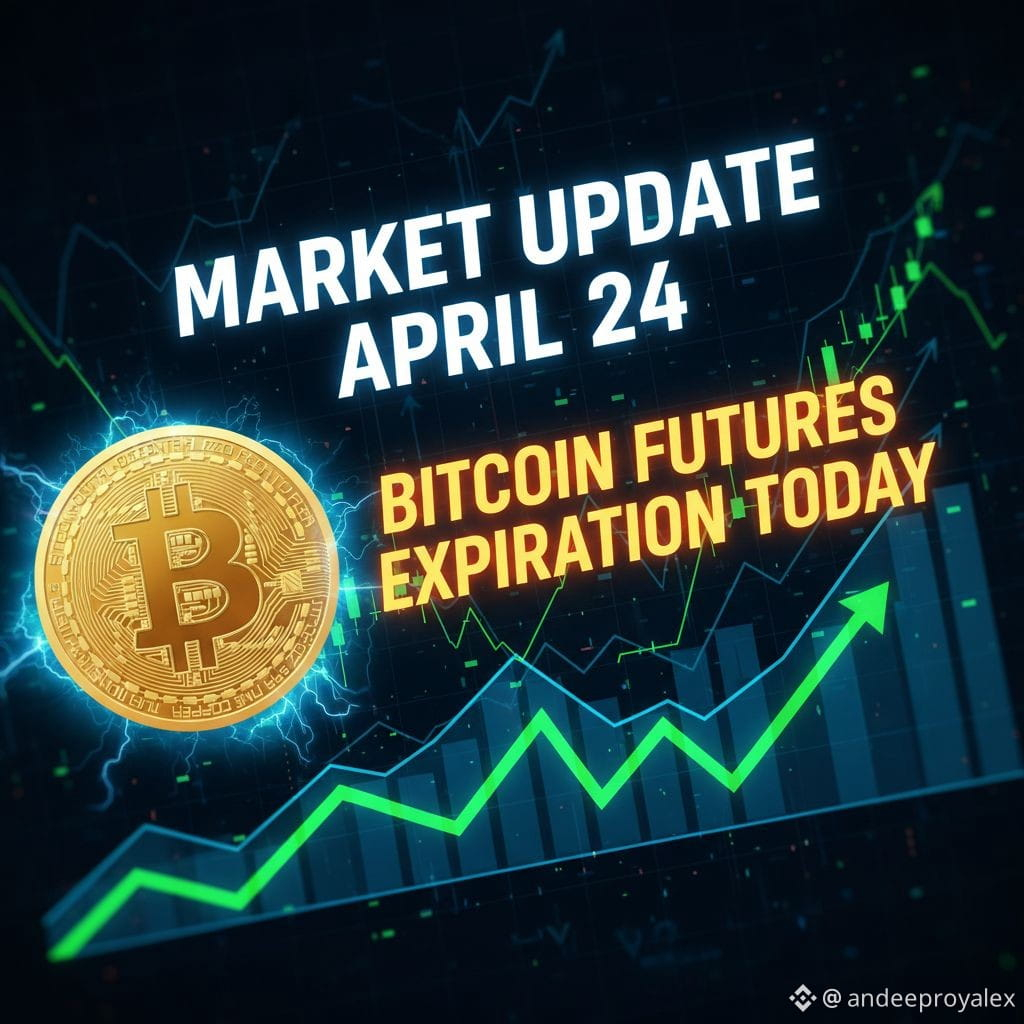
Market Update for Friday, April 24
UK Retail Sales m/m (2:00 PM UK Time):
The UK retail sales data showed no change (0.0%) compared to the previous month’s decline of -0.4%. This indicates a stabilization in consumer spending, which is a positive sign for the UK economy amid ongoing inflation concerns.
$BTC
{spot}(BTCUSDT)
Swiss National Bank (SNB) Chairman Schlegel Speaks (4:00 PM):
Market participants will closely watch SNB Chairman Schlegel’s speech for any hints on future monetary policy, especially regarding interest rates and inflation management in Switzerland.
$ETH
{spot}(ETHUSDT)
Canada Core Retail Sales m/m (8:30 PM):
Core retail sales in Canada remained steady at 0.8%, matching forecasts and previous data. This steady consumer spending supports the Canadian economy’s resilience.
$BNB
{spot}(BNBUSDT)
Canada Retail Sales m/m (8:30 PM):
Overall retail sales in Canada showed a slight slowdown to 0.9% growth, down from 1.1% previously, signaling a minor cooling in consumer activity.
US Revised University of Michigan (UoM) Consumer Sentiment (10:00 PM):
Consumer sentiment in the US improved slightly to 48.5, up from 47.6, reflecting cautious optimism among consumers despite economic uncertainties.
US Bitcoin Futures Expiration (11:00 PM):
Today marks the expiration of Bitcoin futures contracts, an event that often leads to increased volatility in the cryptocurrency market. Traders should be prepared for potential price swings as positions are settled.
Helpful Information:
Retail sales data is a key indicator of consumer spending and economic health.
Central bank speeches can influence currency and stock markets significantly.
Bitcoin futures expiration can cause short-term market volatility, impacting crypto prices.
#CryptoSurge💧
#MarketWatch"
#BitcoinFuturesETF
#RetailSalesUpdate
#EconomicOutlook
Market Update for Friday, April 24
UK Retail Sales m/m (2:00 PM UK Time):
The UK retail sales data showed no change (0.0%) compared to the previous month’s decline of -0.4%. This indicates a stabilization in consumer spending, which is a positive sign for the UK economy amid ongoing inflation concerns.
$BTC
Swiss National Bank (SNB) Chairman Schlegel Speaks (4:00 PM):
Market participants will closely watch SNB Chairman Schlegel’s speech for any hints on future monetary policy, especially regarding interest rates and inflation management in Switzerland.
$ETH
Canada Core Retail Sales m/m (8:30 PM):
Core retail sales in Canada remained steady at 0.8%, matching forecasts and previous data. This steady consumer spending supports the Canadian economy’s resilience.
$BNB
Canada Retail Sales m/m (8:30 PM):
Overall retail sales in Canada showed a slight slowdown to 0.9% growth, down from 1.1% previously, signaling a minor cooling in consumer activity.
US Revised University of Michigan (UoM) Consumer Sentiment (10:00 PM):
Consumer sentiment in the US improved slightly to 48.5, up from 47.6, reflecting cautious optimism among consumers despite economic uncertainties.
US Bitcoin Futures Expiration (11:00 PM):
Today marks the expiration of Bitcoin futures contracts, an event that often leads to increased volatility in the cryptocurrency market. Traders should be prepared for potential price swings as positions are settled.
Helpful Information:
Retail sales data is a key indicator of consumer spending and economic health.
Central bank speeches can influence currency and stock markets significantly.
Bitcoin futures expiration can cause short-term market volatility, impacting crypto prices.
#CryptoSurge💧
#MarketWatch"
#BitcoinFuturesETF
#RetailSalesUpdate
#EconomicOutlook
UK Retail Sales m/m (2:00 PM UK Time):
The UK retail sales data showed no change (0.0%) compared to the previous month’s decline of -0.4%. This indicates a stabilization in consumer spending, which is a positive sign for the UK economy amid ongoing inflation concerns.
$BTC
Swiss National Bank (SNB) Chairman Schlegel Speaks (4:00 PM):
Market participants will closely watch SNB Chairman Schlegel’s speech for any hints on future monetary policy, especially regarding interest rates and inflation management in Switzerland.
$ETH
Canada Core Retail Sales m/m (8:30 PM):
Core retail sales in Canada remained steady at 0.8%, matching forecasts and previous data. This steady consumer spending supports the Canadian economy’s resilience.
$BNB
Canada Retail Sales m/m (8:30 PM):
Overall retail sales in Canada showed a slight slowdown to 0.9% growth, down from 1.1% previously, signaling a minor cooling in consumer activity.
US Revised University of Michigan (UoM) Consumer Sentiment (10:00 PM):
Consumer sentiment in the US improved slightly to 48.5, up from 47.6, reflecting cautious optimism among consumers despite economic uncertainties.
US Bitcoin Futures Expiration (11:00 PM):
Today marks the expiration of Bitcoin futures contracts, an event that often leads to increased volatility in the cryptocurrency market. Traders should be prepared for potential price swings as positions are settled.
Helpful Information:
Retail sales data is a key indicator of consumer spending and economic health.
Central bank speeches can influence currency and stock markets significantly.
Bitcoin futures expiration can cause short-term market volatility, impacting crypto prices.
#CryptoSurge💧
#MarketWatch"
#BitcoinFuturesETF
#RetailSalesUpdate
#EconomicOutlook
132

Verified
#USInitialJoblessClaimsStayBelow200K
A number that looks simple is telling a much bigger story.
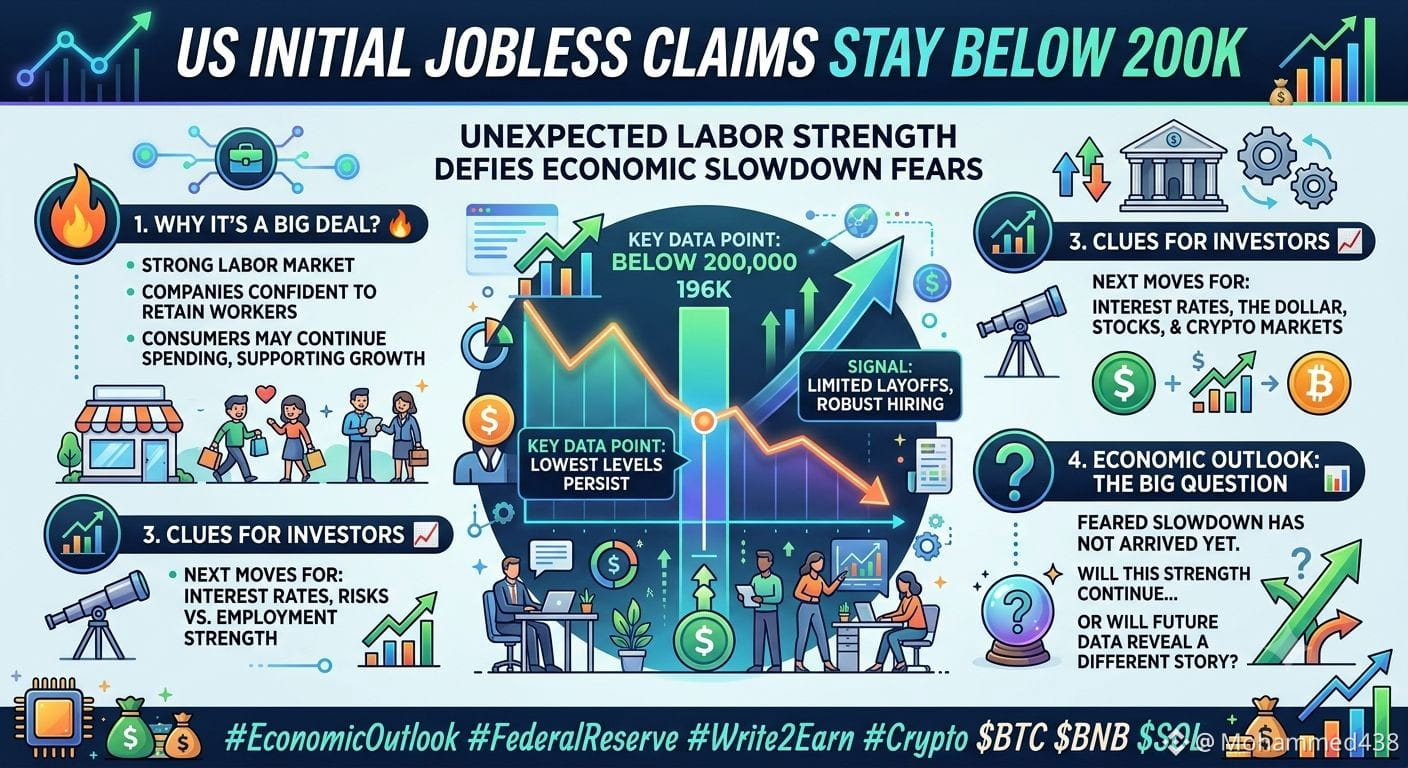
Initial jobless claims remained below 200K, signaling that layoffs are still limited and the U.S. labor market continues to show unexpected strength despite concerns about economic slowdown.
Why is this a big deal? 🔥
A strong labor market means:
💼 Companies are still confident enough to keep workers
🛒 Consumers may continue spending, supporting economic growth
🏦 The Federal Reserve must carefully balance inflation risks with employment strength
For investors, this data is more than just a weekly report — it’s a clue about the next moves for interest rates, the dollar, stocks, and crypto markets.
The economy is sending a message:
The slowdown many feared has not arrived yet.
Now the biggest question:
Will this strength continue… or will future data reveal a different story? 📊
#EconomicOutlook #FederalReserve #Write2Earn #Crypto
$BTC
{spot}(BTCUSDT)
$BNB
{spot}(BNBUSDT)
$SOL
{spot}(SOLUSDT)
#USInitialJoblessClaimsStayBelow200K
A number that looks simple is telling a much bigger story.
Initial jobless claims remained below 200K, signaling that layoffs are still limited and the U.S. labor market continues to show unexpected strength despite concerns about economic slowdown.
Why is this a big deal? 🔥
A strong labor market means:
💼 Companies are still confident enough to keep workers
🛒 Consumers may continue spending, supporting economic growth
🏦 The Federal Reserve must carefully balance inflation risks with employment strength
For investors, this data is more than just a weekly report — it’s a clue about the next moves for interest rates, the dollar, stocks, and crypto markets.
The economy is sending a message:
The slowdown many feared has not arrived yet.
Now the biggest question:
Will this strength continue… or will future data reveal a different story? 📊
#EconomicOutlook #FederalReserve #Write2Earn #Crypto
$BTC
$BNB
$SOL
A number that looks simple is telling a much bigger story.
Initial jobless claims remained below 200K, signaling that layoffs are still limited and the U.S. labor market continues to show unexpected strength despite concerns about economic slowdown.
Why is this a big deal? 🔥
A strong labor market means:
💼 Companies are still confident enough to keep workers
🛒 Consumers may continue spending, supporting economic growth
🏦 The Federal Reserve must carefully balance inflation risks with employment strength
For investors, this data is more than just a weekly report — it’s a clue about the next moves for interest rates, the dollar, stocks, and crypto markets.
The economy is sending a message:
The slowdown many feared has not arrived yet.
Now the biggest question:
Will this strength continue… or will future data reveal a different story? 📊
#EconomicOutlook #FederalReserve #Write2Earn #Crypto
$BTC
$BNB
$SOL
1
1
112

·
--
Bullish
🚨 BREAKING: WORLD BANK SOUNDS GLOBAL ECONOMIC ALARM 🌍📉🔥
While markets celebrate geopolitical progress, a much bigger warning is emerging behind the scenes 👀⚡
📌 The World Bank has officially downgraded growth forecasts for two-thirds of the world's economies 💣
⚠️ THE SHOCKING FORECAST: • Global growth expected to slow to 2.5% 📉 • Lowest pace since the COVID-era recovery 🌍 • Rising borrowing costs continue to hurt economies 🏦 • Inflation pressures remain stubbornly high 🔥 • Ongoing Middle East tensions weigh on growth ⚠️
💥 WHY THIS MATTERS: • Slower growth means weaker consumer demand 📊 • Businesses could face tougher economic conditions 🚨 • Governments may struggle with higher debt burdens 💰 • Global markets could face increased volatility ⚡
👀 THE BIG CONTRAST: • Stocks are rallying on hopes of geopolitical stability 📈 • The World Bank is warning of a major economic slowdown 📉
💭 BOTTOM LINE: Wall Street may be celebrating today, but the World Bank is warning that the global economy is heading toward its weakest growth environment since the pandemic. 🔥🌍
👇 WHAT HAPPENS NEXT?
A. Soft Landing 🚀 B. Global Recession Risk ⚠️ C. Slow Growth, No Crisis 📊
$H
{future}(HUSDT)
$VELVET
{future}(VELVETUSDT)
$ESPORTS
{future}(ESPORTSUSDT)
#WorldBank #GlobalGrowth #Stocks #BreakingNews #EconomicOutlook
🚨 BREAKING: WORLD BANK SOUNDS GLOBAL ECONOMIC ALARM 🌍📉🔥
While markets celebrate geopolitical progress, a much bigger warning is emerging behind the scenes 👀⚡
📌 The World Bank has officially downgraded growth forecasts for two-thirds of the world's economies 💣
⚠️ THE SHOCKING FORECAST: • Global growth expected to slow to 2.5% 📉 • Lowest pace since the COVID-era recovery 🌍 • Rising borrowing costs continue to hurt economies 🏦 • Inflation pressures remain stubbornly high 🔥 • Ongoing Middle East tensions weigh on growth ⚠️
💥 WHY THIS MATTERS: • Slower growth means weaker consumer demand 📊 • Businesses could face tougher economic conditions 🚨 • Governments may struggle with higher debt burdens 💰 • Global markets could face increased volatility ⚡
👀 THE BIG CONTRAST: • Stocks are rallying on hopes of geopolitical stability 📈 • The World Bank is warning of a major economic slowdown 📉
💭 BOTTOM LINE: Wall Street may be celebrating today, but the World Bank is warning that the global economy is heading toward its weakest growth environment since the pandemic. 🔥🌍
👇 WHAT HAPPENS NEXT?
A. Soft Landing 🚀 B. Global Recession Risk ⚠️ C. Slow Growth, No Crisis 📊
$H
$VELVET
$ESPORTS
#WorldBank #GlobalGrowth #Stocks #BreakingNews #EconomicOutlook
While markets celebrate geopolitical progress, a much bigger warning is emerging behind the scenes 👀⚡
📌 The World Bank has officially downgraded growth forecasts for two-thirds of the world's economies 💣
⚠️ THE SHOCKING FORECAST: • Global growth expected to slow to 2.5% 📉 • Lowest pace since the COVID-era recovery 🌍 • Rising borrowing costs continue to hurt economies 🏦 • Inflation pressures remain stubbornly high 🔥 • Ongoing Middle East tensions weigh on growth ⚠️
💥 WHY THIS MATTERS: • Slower growth means weaker consumer demand 📊 • Businesses could face tougher economic conditions 🚨 • Governments may struggle with higher debt burdens 💰 • Global markets could face increased volatility ⚡
👀 THE BIG CONTRAST: • Stocks are rallying on hopes of geopolitical stability 📈 • The World Bank is warning of a major economic slowdown 📉
💭 BOTTOM LINE: Wall Street may be celebrating today, but the World Bank is warning that the global economy is heading toward its weakest growth environment since the pandemic. 🔥🌍
👇 WHAT HAPPENS NEXT?
A. Soft Landing 🚀 B. Global Recession Risk ⚠️ C. Slow Growth, No Crisis 📊
$H
$VELVET
$ESPORTS
#WorldBank #GlobalGrowth #Stocks #BreakingNews #EconomicOutlook
371

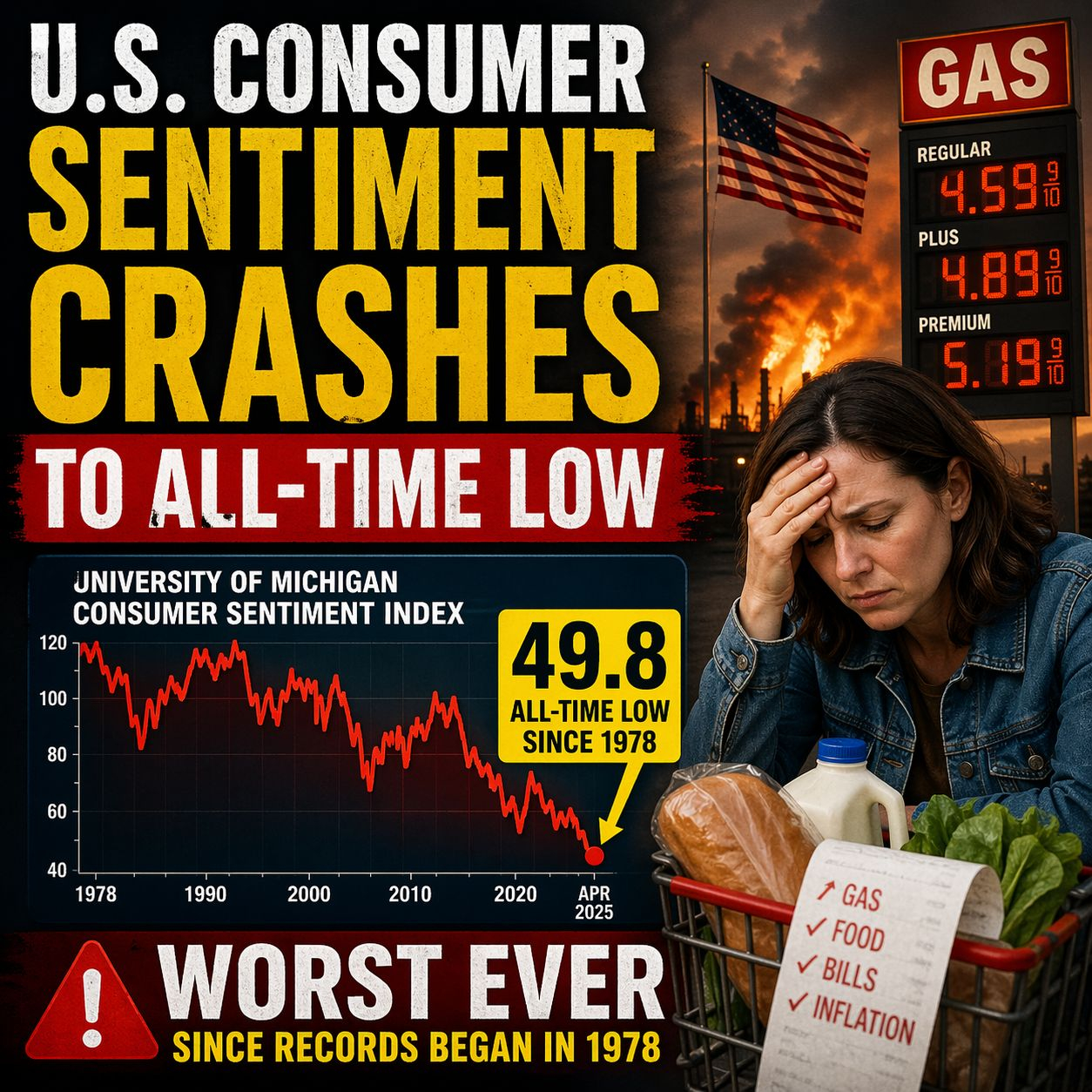
Consumer sentiment in the U.S. fell to an all-time low last month, falling to its lowest level since records began back in 1978 for April.
The University of Michigan index slipped to 49.8, from March's reading of 53.3 as households responded to the economic effects connected with the Iran confrontation and surge in energy prices. It has been widespread across income groups and demographics, mirroring increasing apprehension over inflation and the economy ahead.
#ConsumerSentiment #USEconomy #Inflation #Markets #EconomicOutlook
$OPN
{future}(OPNUSDT)
$APE
{future}(APEUSDT)
$TREE
{future}(TREEUSDT)
Consumer sentiment in the U.S. fell to an all-time low last month, falling to its lowest level since records began back in 1978 for April.
The University of Michigan index slipped to 49.8, from March's reading of 53.3 as households responded to the economic effects connected with the Iran confrontation and surge in energy prices. It has been widespread across income groups and demographics, mirroring increasing apprehension over inflation and the economy ahead.
#ConsumerSentiment #USEconomy #Inflation #Markets #EconomicOutlook
$OPN
$APE
$TREE
The University of Michigan index slipped to 49.8, from March's reading of 53.3 as households responded to the economic effects connected with the Iran confrontation and surge in energy prices. It has been widespread across income groups and demographics, mirroring increasing apprehension over inflation and the economy ahead.
#ConsumerSentiment #USEconomy #Inflation #Markets #EconomicOutlook
$OPN
$APE
$TREE
363

·
--
Bullish
🚨 Market Alert
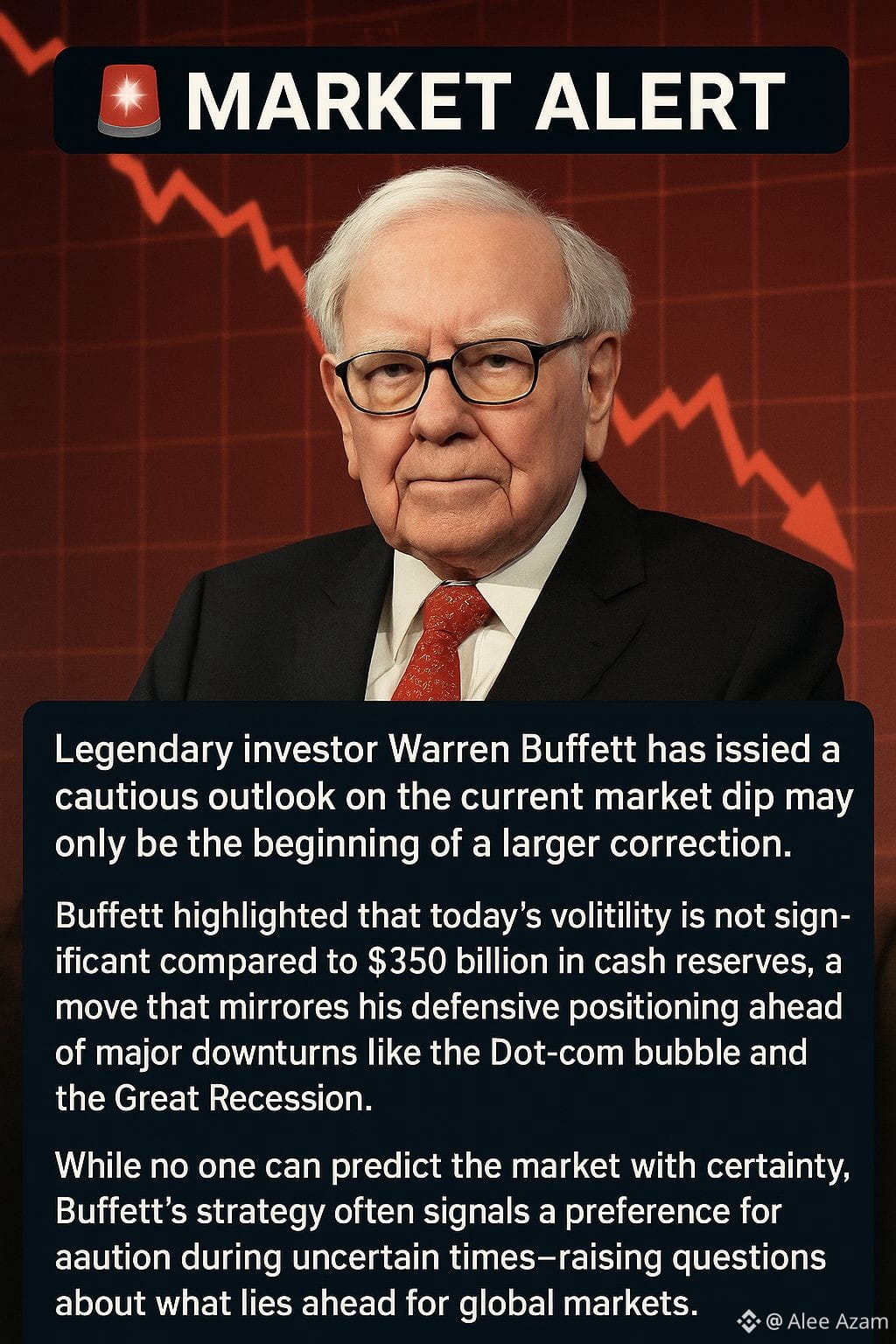
Legendary investor Warren Buffett has issued a cautious outlook on the current market conditions, suggesting that the recent dip may only be the beginning of a larger correction.
Buffett highlighted that today’s volatility is not significant compared to what could potentially unfold in the near future.
Notably, Berkshire Hathaway is reportedly holding approximately $350 billion in cash reserves, a move that mirrors his defensive positioning ahead of major downturns like the Dot com bubble and the Great Recession.
While no one can predict the market with certainty, Buffett’s strategy often signals a preference for caution during uncertain times raising questions about what lies ahead for global markets.
#WarrenBuffett #marketcrash #InvestSmart #FinancialMarkets #EconomicOutlook $BTC $XRP $SOL
🚨 Market Alert
Legendary investor Warren Buffett has issued a cautious outlook on the current market conditions, suggesting that the recent dip may only be the beginning of a larger correction.
Buffett highlighted that today’s volatility is not significant compared to what could potentially unfold in the near future.
Notably, Berkshire Hathaway is reportedly holding approximately $350 billion in cash reserves, a move that mirrors his defensive positioning ahead of major downturns like the Dot com bubble and the Great Recession.
While no one can predict the market with certainty, Buffett’s strategy often signals a preference for caution during uncertain times raising questions about what lies ahead for global markets.
#WarrenBuffett #marketcrash #InvestSmart #FinancialMarkets #EconomicOutlook $BTC $XRP $SOL
Legendary investor Warren Buffett has issued a cautious outlook on the current market conditions, suggesting that the recent dip may only be the beginning of a larger correction.
Buffett highlighted that today’s volatility is not significant compared to what could potentially unfold in the near future.
Notably, Berkshire Hathaway is reportedly holding approximately $350 billion in cash reserves, a move that mirrors his defensive positioning ahead of major downturns like the Dot com bubble and the Great Recession.
While no one can predict the market with certainty, Buffett’s strategy often signals a preference for caution during uncertain times raising questions about what lies ahead for global markets.
#WarrenBuffett #marketcrash #InvestSmart #FinancialMarkets #EconomicOutlook $BTC $XRP $SOL
1
61

U.S.–Iran Talks Hit a New Roadblock as Energy Markets React
President Trump said Iran’s formal response to the latest U.S. peace proposal was “TOTALLY UNACCEPTABLE,” offering no details about what Tehran conveyed through Pakistani mediators. The comment signals that negotiations to turn the current cease-fire into a durable agreement remain stalled, even as intermittent clashes and competing blockades continue to strain stability across the Persian Gulf.
The Strait of Hormuz remains effectively constrained—an acute pressure point for global energy flows. Markets are already pricing in prolonged disruption: Brent crude moved higher (around $104/barrel), U.S. benchmark WTI rose toward $98, and U.S. stock futures edged down as investors assessed the fading prospects of a near-term breakthrough.
On the domestic front, Energy Secretary Chris Wright indicated the administration would be open to pausing the federal gas tax (18.4 cents per gallon) to provide limited relief at the pump. While that could modestly reduce retail prices, it would not fully offset the increase since the conflict began—and it could also raise longer-term questions about Highway Trust Fund financing.
For businesses and consumers alike, the immediate takeaway is clear: geopolitics is still driving energy volatility, and policy options aimed at cushioning the impact may offer only partial, temporary relief.
#Geopolitics #EnergyMarkets #OilPrices #MiddleEast #EconomicOutlook
$ADA
{spot}(ADAUSDT)
$APT
{spot}(APTUSDT)
$LINK
{spot}(LINKUSDT)
U.S.–Iran Talks Hit a New Roadblock as Energy Markets React
President Trump said Iran’s formal response to the latest U.S. peace proposal was “TOTALLY UNACCEPTABLE,” offering no details about what Tehran conveyed through Pakistani mediators. The comment signals that negotiations to turn the current cease-fire into a durable agreement remain stalled, even as intermittent clashes and competing blockades continue to strain stability across the Persian Gulf.
The Strait of Hormuz remains effectively constrained—an acute pressure point for global energy flows. Markets are already pricing in prolonged disruption: Brent crude moved higher (around $104/barrel), U.S. benchmark WTI rose toward $98, and U.S. stock futures edged down as investors assessed the fading prospects of a near-term breakthrough.
On the domestic front, Energy Secretary Chris Wright indicated the administration would be open to pausing the federal gas tax (18.4 cents per gallon) to provide limited relief at the pump. While that could modestly reduce retail prices, it would not fully offset the increase since the conflict began—and it could also raise longer-term questions about Highway Trust Fund financing.
For businesses and consumers alike, the immediate takeaway is clear: geopolitics is still driving energy volatility, and policy options aimed at cushioning the impact may offer only partial, temporary relief.
#Geopolitics #EnergyMarkets #OilPrices #MiddleEast #EconomicOutlook
$ADA
$APT
$LINK
President Trump said Iran’s formal response to the latest U.S. peace proposal was “TOTALLY UNACCEPTABLE,” offering no details about what Tehran conveyed through Pakistani mediators. The comment signals that negotiations to turn the current cease-fire into a durable agreement remain stalled, even as intermittent clashes and competing blockades continue to strain stability across the Persian Gulf.
The Strait of Hormuz remains effectively constrained—an acute pressure point for global energy flows. Markets are already pricing in prolonged disruption: Brent crude moved higher (around $104/barrel), U.S. benchmark WTI rose toward $98, and U.S. stock futures edged down as investors assessed the fading prospects of a near-term breakthrough.
On the domestic front, Energy Secretary Chris Wright indicated the administration would be open to pausing the federal gas tax (18.4 cents per gallon) to provide limited relief at the pump. While that could modestly reduce retail prices, it would not fully offset the increase since the conflict began—and it could also raise longer-term questions about Highway Trust Fund financing.
For businesses and consumers alike, the immediate takeaway is clear: geopolitics is still driving energy volatility, and policy options aimed at cushioning the impact may offer only partial, temporary relief.
#Geopolitics #EnergyMarkets #OilPrices #MiddleEast #EconomicOutlook
$ADA
$APT
$LINK


1
285

⚠️ Federal Warning: Monetary policy may change if inflation doesn’t fall!
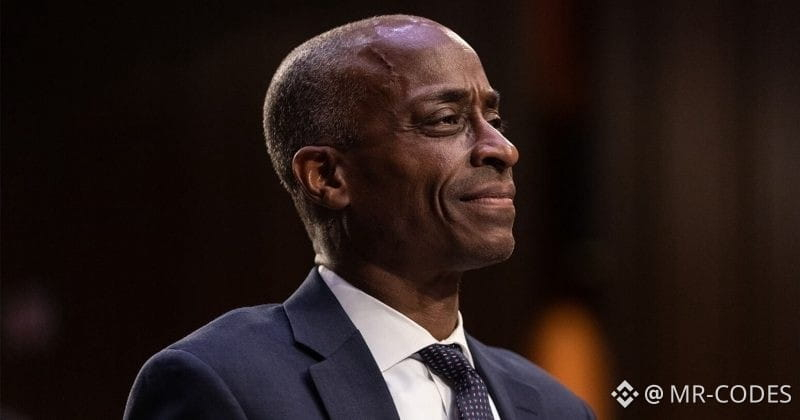
Federal Reserve Vice Chair Philip Jefferson warns that monetary policy could change if inflation remains above the 2% target. This warning has major implications for cryptocurrency markets and high-risk assets in general.
━━━━━━━━━━━━━━
📊 Impact: 🔥 Very high
🏷️ REGULATION
#FederalReserve #Inflation #MonetaryPolicy #CryptoMarkets #EconomicOutlook
🔗 Source: https://cryptobriefing.com/fed-jefferson-inflation-policy-warning/
⚠️ Federal Warning: Monetary policy may change if inflation doesn’t fall!
Federal Reserve Vice Chair Philip Jefferson warns that monetary policy could change if inflation remains above the 2% target. This warning has major implications for cryptocurrency markets and high-risk assets in general.
━━━━━━━━━━━━━━
📊 Impact: 🔥 Very high
🏷️ REGULATION
#FederalReserve #Inflation #MonetaryPolicy #CryptoMarkets #EconomicOutlook
🔗 Source: https://cryptobriefing.com/fed-jefferson-inflation-policy-warning/
Federal Reserve Vice Chair Philip Jefferson warns that monetary policy could change if inflation remains above the 2% target. This warning has major implications for cryptocurrency markets and high-risk assets in general.
━━━━━━━━━━━━━━
📊 Impact: 🔥 Very high
🏷️ REGULATION
#FederalReserve #Inflation #MonetaryPolicy #CryptoMarkets #EconomicOutlook
🔗 Source: https://cryptobriefing.com/fed-jefferson-inflation-policy-warning/
1
183
⚡️ Bank of England warns: energy price volatility may continue until 2027
Hoow Bill warned by the Bank of England that energy price volatility could continue until 2027, which may affect the profitability of Bitcoin mining. These fluctuations could lead to tighter monetary policies and accelerate the consolidation process among companies in the digital currency mining sector.
━━━━━━━━━━━━━━
📊 Impact: 📈 High
🏷️ BITCOIN
#BitcoinMining #EnergyPrices #EconomicOutlook #Cryptocurrency #BankOfEngland
📰 Source: cryptobriefing.com
⚡️ Bank of England warns: energy price volatility may continue until 2027
Hoow Bill warned by the Bank of England that energy price volatility could continue until 2027, which may affect the profitability of Bitcoin mining. These fluctuations could lead to tighter monetary policies and accelerate the consolidation process among companies in the digital currency mining sector.
━━━━━━━━━━━━━━
📊 Impact: 📈 High
🏷️ BITCOIN
#BitcoinMining #EnergyPrices #EconomicOutlook #Cryptocurrency #BankOfEngland
📰 Source: cryptobriefing.com
Hoow Bill warned by the Bank of England that energy price volatility could continue until 2027, which may affect the profitability of Bitcoin mining. These fluctuations could lead to tighter monetary policies and accelerate the consolidation process among companies in the digital currency mining sector.
━━━━━━━━━━━━━━
📊 Impact: 📈 High
🏷️ BITCOIN
#BitcoinMining #EnergyPrices #EconomicOutlook #Cryptocurrency #BankOfEngland
📰 Source: cryptobriefing.com
27
🏛️ Differences within the U.S. Federal system regarding challenges in curbing inflation
Recent reports show that there are differing views within the U.S. Federal Reserve about how effective current policies are in controlling inflation. Critics argue that ongoing challenges may affect the stability of high-risk assets in the coming period.
━━━━━━━━━━━━━━
📊 Impact: 📈 High
🏷️ REGULATION
#FederalReserve #Inflation #MonetaryPolicy #EconomicOutlook #MarketVolatility
📰 Source: cryptobriefing.com
🏛️ Differences within the U.S. Federal system regarding challenges in curbing inflation
Recent reports show that there are differing views within the U.S. Federal Reserve about how effective current policies are in controlling inflation. Critics argue that ongoing challenges may affect the stability of high-risk assets in the coming period.
━━━━━━━━━━━━━━
📊 Impact: 📈 High
🏷️ REGULATION
#FederalReserve #Inflation #MonetaryPolicy #EconomicOutlook #MarketVolatility
📰 Source: cryptobriefing.com
Recent reports show that there are differing views within the U.S. Federal Reserve about how effective current policies are in controlling inflation. Critics argue that ongoing challenges may affect the stability of high-risk assets in the coming period.
━━━━━━━━━━━━━━
📊 Impact: 📈 High
🏷️ REGULATION
#FederalReserve #Inflation #MonetaryPolicy #EconomicOutlook #MarketVolatility
📰 Source: cryptobriefing.com
20

·
--
#WallStreetOpensHigherOnTechRebound
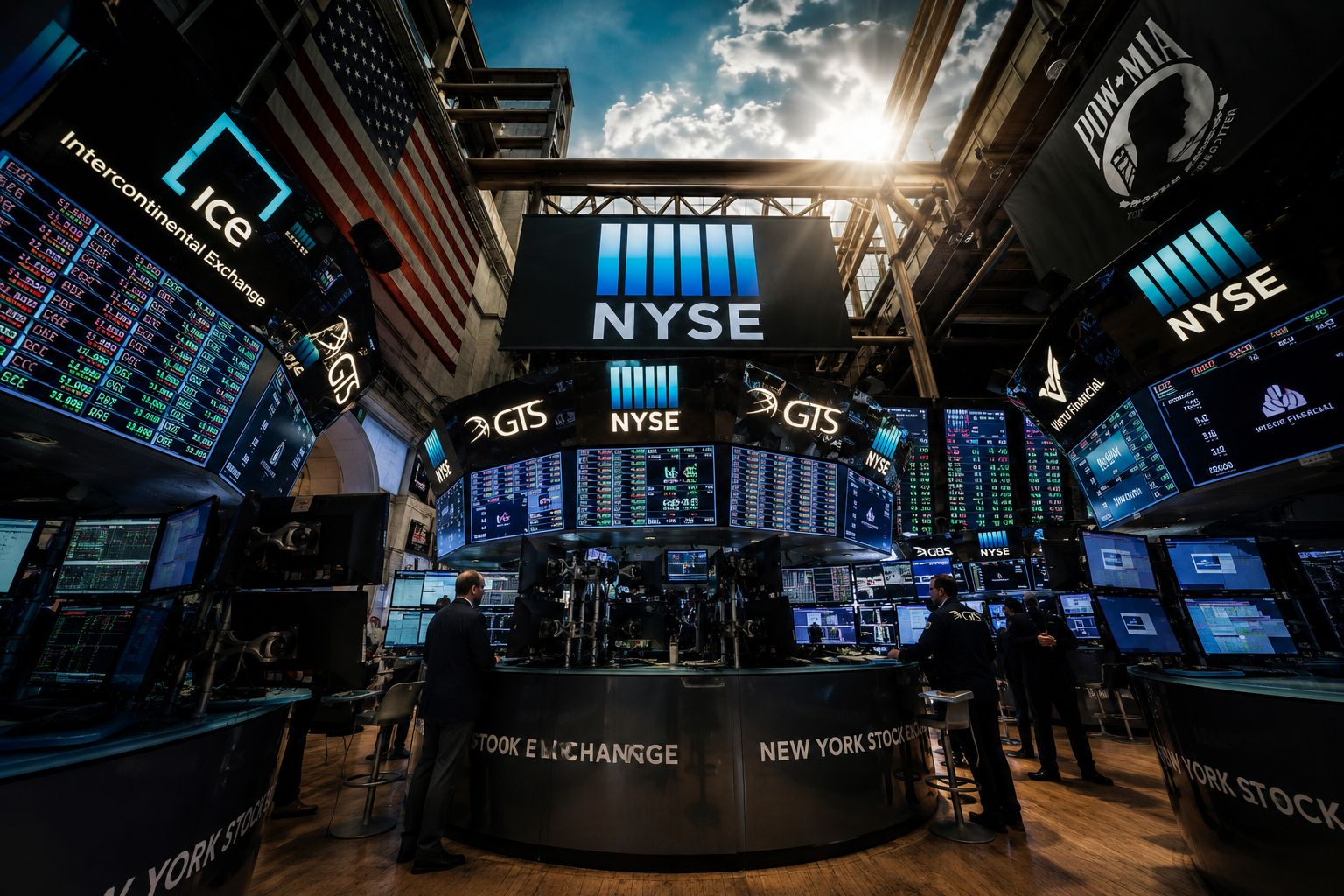
Wall Street kicked off the trading session in positive territory as technology stocks led the market higher, fueling renewed investor optimism. Strong buying interest in major tech companies helped offset broader market concerns, with investors positioning themselves ahead of key earnings reports and economic data.
📈 Market Highlights:
• Tech stocks spearheaded the rally, lifting major indices.
• Investors remained focused on corporate earnings and AI-driven growth.
• Market sentiment improved as risk appetite returned.
• Traders continue to monitor inflation trends and upcoming Federal Reserve signals for clues on future interest rate decisions.
💡 While today's rebound reflects renewed confidence in the technology sector, market volatility remains a factor as investors navigate economic uncertainty and evolving monetary policy.
🔍 Key Themes to Watch:
✅ Big Tech earnings
✅ AI and semiconductor momentum
✅ Interest rate outlook
✅ Inflation and macroeconomic data
Will the tech-led rally continue, or is this just a short-term bounce? Share your thoughts below! 👇
#WallStreet #InvestSmart #Marketupdates #EconomicOutlook
#WallStreetOpensHigherOnTechRebound
Wall Street kicked off the trading session in positive territory as technology stocks led the market higher, fueling renewed investor optimism. Strong buying interest in major tech companies helped offset broader market concerns, with investors positioning themselves ahead of key earnings reports and economic data.
📈 Market Highlights:
• Tech stocks spearheaded the rally, lifting major indices.
• Investors remained focused on corporate earnings and AI-driven growth.
• Market sentiment improved as risk appetite returned.
• Traders continue to monitor inflation trends and upcoming Federal Reserve signals for clues on future interest rate decisions.
💡 While today's rebound reflects renewed confidence in the technology sector, market volatility remains a factor as investors navigate economic uncertainty and evolving monetary policy.
🔍 Key Themes to Watch:
✅ Big Tech earnings
✅ AI and semiconductor momentum
✅ Interest rate outlook
✅ Inflation and macroeconomic data
Will the tech-led rally continue, or is this just a short-term bounce? Share your thoughts below! 👇
#WallStreet #InvestSmart #Marketupdates #EconomicOutlook
Wall Street kicked off the trading session in positive territory as technology stocks led the market higher, fueling renewed investor optimism. Strong buying interest in major tech companies helped offset broader market concerns, with investors positioning themselves ahead of key earnings reports and economic data.
📈 Market Highlights:
• Tech stocks spearheaded the rally, lifting major indices.
• Investors remained focused on corporate earnings and AI-driven growth.
• Market sentiment improved as risk appetite returned.
• Traders continue to monitor inflation trends and upcoming Federal Reserve signals for clues on future interest rate decisions.
💡 While today's rebound reflects renewed confidence in the technology sector, market volatility remains a factor as investors navigate economic uncertainty and evolving monetary policy.
🔍 Key Themes to Watch:
✅ Big Tech earnings
✅ AI and semiconductor momentum
✅ Interest rate outlook
✅ Inflation and macroeconomic data
Will the tech-led rally continue, or is this just a short-term bounce? Share your thoughts below! 👇
#WallStreet #InvestSmart #Marketupdates #EconomicOutlook
82


🌐 💼 Could Today's G20 Discussions Shape Tomorrow's Economic Playbook? 🌍
I have learned that the world's biggest economic changes rarely begin with loud announcements. They often start with thoughtful conversations around one table.
G20 discussions bring together major economies to exchange views on growth, trade, financial stability, and shared global challenges. While no single meeting rewrites the future, the ideas shared can influence long term policy directions and market expectations.
Investors, businesses, and policymakers pay attention because cooperation can strengthen confidence across supply chains, capital flows, and international commerce. Small policy signals today can become meaningful trends over time.
The real edge is not predicting every headline. It is understanding the bigger story that connects global decisions with everyday markets.
The future is often written one discussion at a time, long before most people notice.
🌎 Which G20 priority do you believe could have the biggest impact on tomorrow's economy?
Disclaimer: This post is for educational purposes only and is not financial advice.
#G20 #GlobalEconomy #EconomicOutlook #Write2Earn #GrowWithSAC
🌐 💼 Could Today's G20 Discussions Shape Tomorrow's Economic Playbook? 🌍
I have learned that the world's biggest economic changes rarely begin with loud announcements. They often start with thoughtful conversations around one table.
G20 discussions bring together major economies to exchange views on growth, trade, financial stability, and shared global challenges. While no single meeting rewrites the future, the ideas shared can influence long term policy directions and market expectations.
Investors, businesses, and policymakers pay attention because cooperation can strengthen confidence across supply chains, capital flows, and international commerce. Small policy signals today can become meaningful trends over time.
The real edge is not predicting every headline. It is understanding the bigger story that connects global decisions with everyday markets.
The future is often written one discussion at a time, long before most people notice.
🌎 Which G20 priority do you believe could have the biggest impact on tomorrow's economy?
Disclaimer: This post is for educational purposes only and is not financial advice.
#G20 #GlobalEconomy #EconomicOutlook #Write2Earn #GrowWithSAC
I have learned that the world's biggest economic changes rarely begin with loud announcements. They often start with thoughtful conversations around one table.
G20 discussions bring together major economies to exchange views on growth, trade, financial stability, and shared global challenges. While no single meeting rewrites the future, the ideas shared can influence long term policy directions and market expectations.
Investors, businesses, and policymakers pay attention because cooperation can strengthen confidence across supply chains, capital flows, and international commerce. Small policy signals today can become meaningful trends over time.
The real edge is not predicting every headline. It is understanding the bigger story that connects global decisions with everyday markets.
The future is often written one discussion at a time, long before most people notice.
🌎 Which G20 priority do you believe could have the biggest impact on tomorrow's economy?
Disclaimer: This post is for educational purposes only and is not financial advice.
#G20 #GlobalEconomy #EconomicOutlook #Write2Earn #GrowWithSAC

2
313

·
--
Bullish
🔥 MARKET REBOUND: ASSESSING ITS FOUNDATIONS
⚡ The recent rally across global markets sparks optimism, but discerning its true drivers is crucial for long-term positioning. Many assets, including crypto, have seen significant upside. 📈
🧠 This isn't merely a surface event; it's a complex interplay of evolving macro narratives. Key elements include disinflation hopes and anticipation of central bank policy shifts.
📊 The deeper mechanism hinges on liquidity and a potential re-rating of risk. Investors are weighing persistent inflation against resilient economic data. 📊 Is this genuine recovery or a tactical bounce?
⚖️ My viewpoint: the rebound's durability is conditional. While disinflation trends are encouraging, central banks like the Fed remain data-dependent. "Higher-for-longer" still looms.
🧩 Corporate earnings, though mixed, have shown some resilience, preventing a complete capitulation. This provides a floor, but growth concerns persist across sectors.
🔥 For crypto participants, a sustained rebound signals improving risk appetite. Capital flows into high-beta assets generally benefit. Yet, volatility remains a companion.
The true test lies in whether underlying economic fundamentals validate current market pricing. Are we building a new base, or merely correcting an oversold condition? 💡
What truly anchors this rebound? Is it sustainable growth, or just a tactical reallocation amidst policy uncertainty? Let's discuss.
#MarketRebound #Macro #CryptoMarkets #RiskOn #EconomicOutlook
🔥 MARKET REBOUND: ASSESSING ITS FOUNDATIONS
⚡ The recent rally across global markets sparks optimism, but discerning its true drivers is crucial for long-term positioning. Many assets, including crypto, have seen significant upside. 📈
🧠 This isn't merely a surface event; it's a complex interplay of evolving macro narratives. Key elements include disinflation hopes and anticipation of central bank policy shifts.
📊 The deeper mechanism hinges on liquidity and a potential re-rating of risk. Investors are weighing persistent inflation against resilient economic data. 📊 Is this genuine recovery or a tactical bounce?
⚖️ My viewpoint: the rebound's durability is conditional. While disinflation trends are encouraging, central banks like the Fed remain data-dependent. "Higher-for-longer" still looms.
🧩 Corporate earnings, though mixed, have shown some resilience, preventing a complete capitulation. This provides a floor, but growth concerns persist across sectors.
🔥 For crypto participants, a sustained rebound signals improving risk appetite. Capital flows into high-beta assets generally benefit. Yet, volatility remains a companion.
The true test lies in whether underlying economic fundamentals validate current market pricing. Are we building a new base, or merely correcting an oversold condition? 💡
What truly anchors this rebound? Is it sustainable growth, or just a tactical reallocation amidst policy uncertainty? Let's discuss.
#MarketRebound #Macro #CryptoMarkets #RiskOn #EconomicOutlook
⚡ The recent rally across global markets sparks optimism, but discerning its true drivers is crucial for long-term positioning. Many assets, including crypto, have seen significant upside. 📈
🧠 This isn't merely a surface event; it's a complex interplay of evolving macro narratives. Key elements include disinflation hopes and anticipation of central bank policy shifts.
📊 The deeper mechanism hinges on liquidity and a potential re-rating of risk. Investors are weighing persistent inflation against resilient economic data. 📊 Is this genuine recovery or a tactical bounce?
⚖️ My viewpoint: the rebound's durability is conditional. While disinflation trends are encouraging, central banks like the Fed remain data-dependent. "Higher-for-longer" still looms.
🧩 Corporate earnings, though mixed, have shown some resilience, preventing a complete capitulation. This provides a floor, but growth concerns persist across sectors.
🔥 For crypto participants, a sustained rebound signals improving risk appetite. Capital flows into high-beta assets generally benefit. Yet, volatility remains a companion.
The true test lies in whether underlying economic fundamentals validate current market pricing. Are we building a new base, or merely correcting an oversold condition? 💡
What truly anchors this rebound? Is it sustainable growth, or just a tactical reallocation amidst policy uncertainty? Let's discuss.
#MarketRebound #Macro #CryptoMarkets #RiskOn #EconomicOutlook

17
33
776

·
--
Bullish
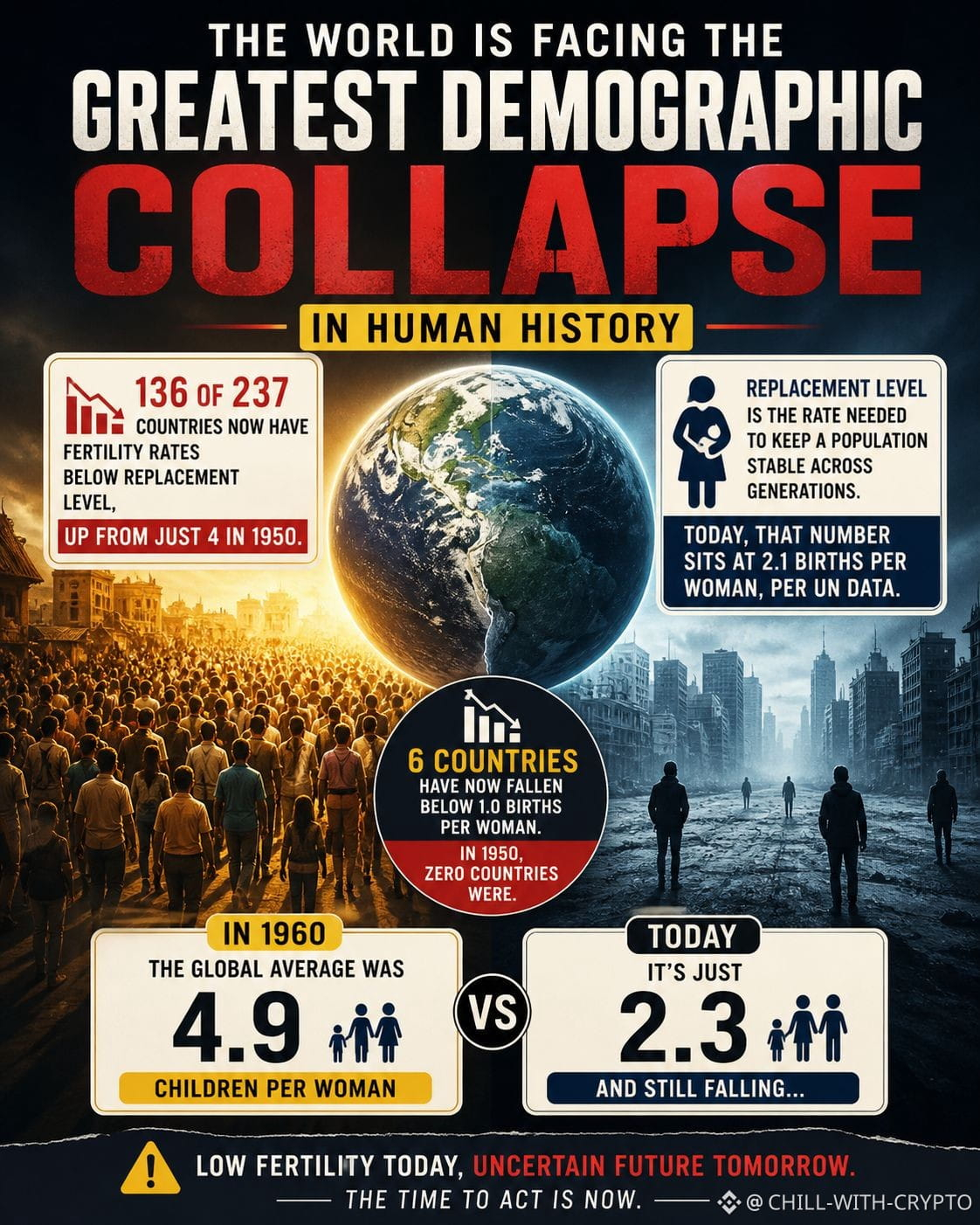
The Silent Crisis: world is facing the greatest demographic COLLAPSE in human history. A Global Demographic Shift Unfolding
The world is entering a historic demographic turning point one that could reshape economies, societies, and the future of growth itself.
Out of 237 countries, 136 now have fertility rates below the replacement level, a dramatic rise from just 4 countries in 1950. Replacement level—set at 2.1 births per woman—is the threshold needed to maintain population stability across generations.
Even more striking, 6 countries have now dropped below 1.0 births per woman, a level once unheard of in modern history. Back in 1950, not a single country was in this zone.
The global trend tells a powerful story: In 1960, the world averaged 4.9 children per woman.
Today, that number has fallen to 2.3—and continues to decline.
This isn’t just a statistic it’s a structural shift with long-term consequences for labor markets, economic growth, and global stability.
#DemographicCrisis #GlobalTrends #PopulationDecline #EconomicOutlook #FutureOfWork $CL
{future}(CLUSDT)
$BZ
{future}(BZUSDT)
$BTC
{spot}(BTCUSDT)
The Silent Crisis: world is facing the greatest demographic COLLAPSE in human history. A Global Demographic Shift Unfolding
The world is entering a historic demographic turning point one that could reshape economies, societies, and the future of growth itself.
Out of 237 countries, 136 now have fertility rates below the replacement level, a dramatic rise from just 4 countries in 1950. Replacement level—set at 2.1 births per woman—is the threshold needed to maintain population stability across generations.
Even more striking, 6 countries have now dropped below 1.0 births per woman, a level once unheard of in modern history. Back in 1950, not a single country was in this zone.
The global trend tells a powerful story: In 1960, the world averaged 4.9 children per woman.
Today, that number has fallen to 2.3—and continues to decline.
This isn’t just a statistic it’s a structural shift with long-term consequences for labor markets, economic growth, and global stability.
#DemographicCrisis #GlobalTrends #PopulationDecline #EconomicOutlook #FutureOfWork $CL
$BZ
$BTC
The world is entering a historic demographic turning point one that could reshape economies, societies, and the future of growth itself.
Out of 237 countries, 136 now have fertility rates below the replacement level, a dramatic rise from just 4 countries in 1950. Replacement level—set at 2.1 births per woman—is the threshold needed to maintain population stability across generations.
Even more striking, 6 countries have now dropped below 1.0 births per woman, a level once unheard of in modern history. Back in 1950, not a single country was in this zone.
The global trend tells a powerful story: In 1960, the world averaged 4.9 children per woman.
Today, that number has fallen to 2.3—and continues to decline.
This isn’t just a statistic it’s a structural shift with long-term consequences for labor markets, economic growth, and global stability.
#DemographicCrisis #GlobalTrends #PopulationDecline #EconomicOutlook #FutureOfWork $CL
$BZ
$BTC
331

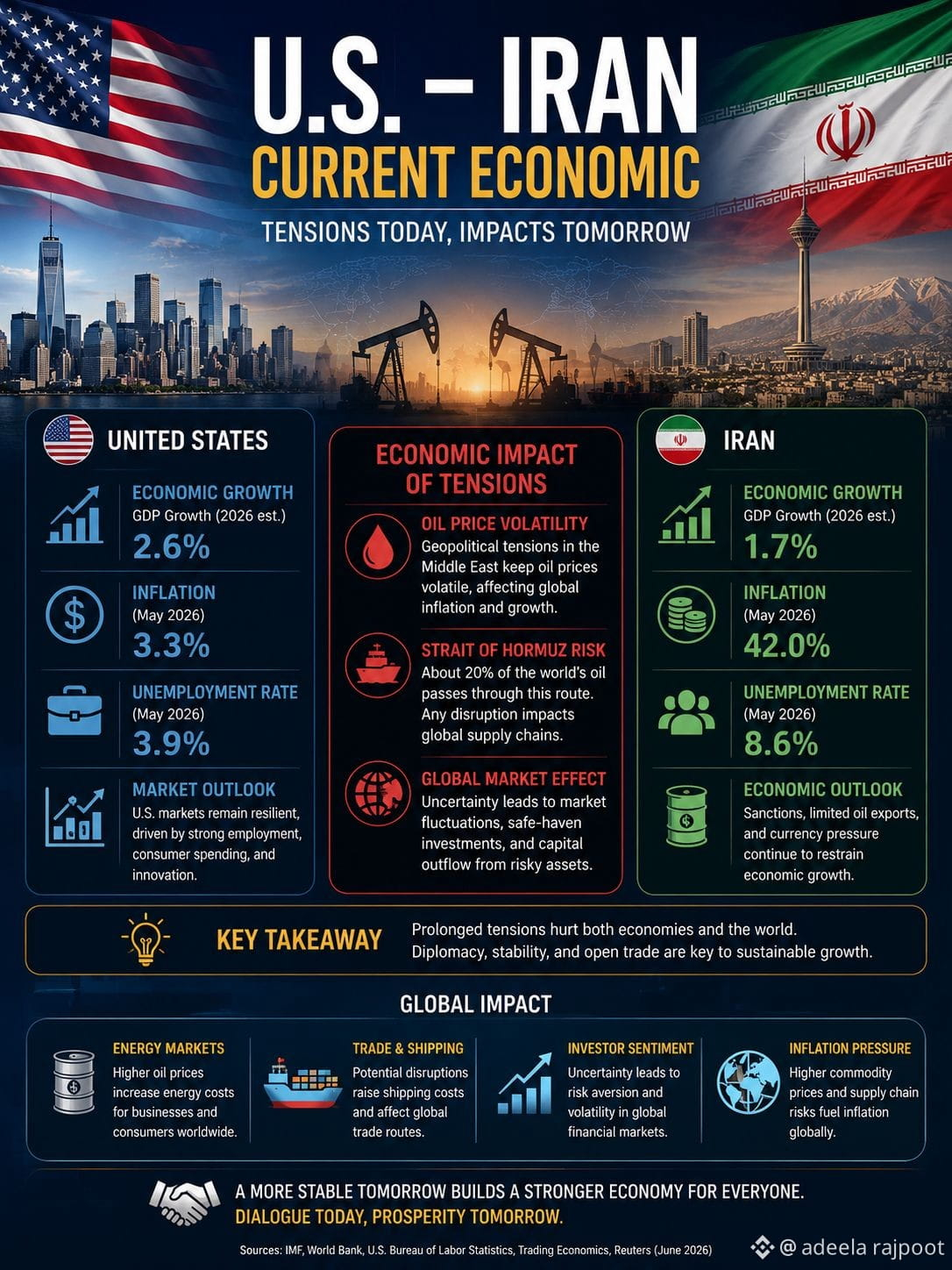
🇺🇸🇮🇷 U.S.–Iran Economic Watch | 2026
Markets don't just react to headlines—they react to uncertainty.
As tensions between the United States and Iran continue to shape global markets, the economic impact is reaching far beyond the two countries. Oil prices remain highly volatile, shipping routes through the Strait of Hormuz are still a key concern, and investors are closely watching every diplomatic development. Recent reports of a tentative agreement have eased some pressure, but uncertainty remains over how quickly trade and energy flows can fully recover. (Reuters)
For investors, this is a reminder that geopolitics and economics are deeply connected. Stability encourages investment and growth, while prolonged conflict raises inflation, disrupts supply chains, and creates uncertainty across global financial markets.
The biggest lesson? Long-term economic resilience is built through stability, open trade, and smart policy—not conflict.
#Economy #USA #Iran #OilMarket #GlobalMarkets #Investing #CurrentAffairs #Finance #Geopolitics #EconomicOutlook
{spot}(BTCUSDT)
🇺🇸🇮🇷 U.S.–Iran Economic Watch | 2026
Markets don't just react to headlines—they react to uncertainty.
As tensions between the United States and Iran continue to shape global markets, the economic impact is reaching far beyond the two countries. Oil prices remain highly volatile, shipping routes through the Strait of Hormuz are still a key concern, and investors are closely watching every diplomatic development. Recent reports of a tentative agreement have eased some pressure, but uncertainty remains over how quickly trade and energy flows can fully recover. (Reuters)
For investors, this is a reminder that geopolitics and economics are deeply connected. Stability encourages investment and growth, while prolonged conflict raises inflation, disrupts supply chains, and creates uncertainty across global financial markets.
The biggest lesson? Long-term economic resilience is built through stability, open trade, and smart policy—not conflict.
#Economy #USA #Iran #OilMarket #GlobalMarkets #Investing #CurrentAffairs #Finance #Geopolitics #EconomicOutlook
Markets don't just react to headlines—they react to uncertainty.
As tensions between the United States and Iran continue to shape global markets, the economic impact is reaching far beyond the two countries. Oil prices remain highly volatile, shipping routes through the Strait of Hormuz are still a key concern, and investors are closely watching every diplomatic development. Recent reports of a tentative agreement have eased some pressure, but uncertainty remains over how quickly trade and energy flows can fully recover. (Reuters)
For investors, this is a reminder that geopolitics and economics are deeply connected. Stability encourages investment and growth, while prolonged conflict raises inflation, disrupts supply chains, and creates uncertainty across global financial markets.
The biggest lesson? Long-term economic resilience is built through stability, open trade, and smart policy—not conflict.
#Economy #USA #Iran #OilMarket #GlobalMarkets #Investing #CurrentAffairs #Finance #Geopolitics #EconomicOutlook
2
131

·
--
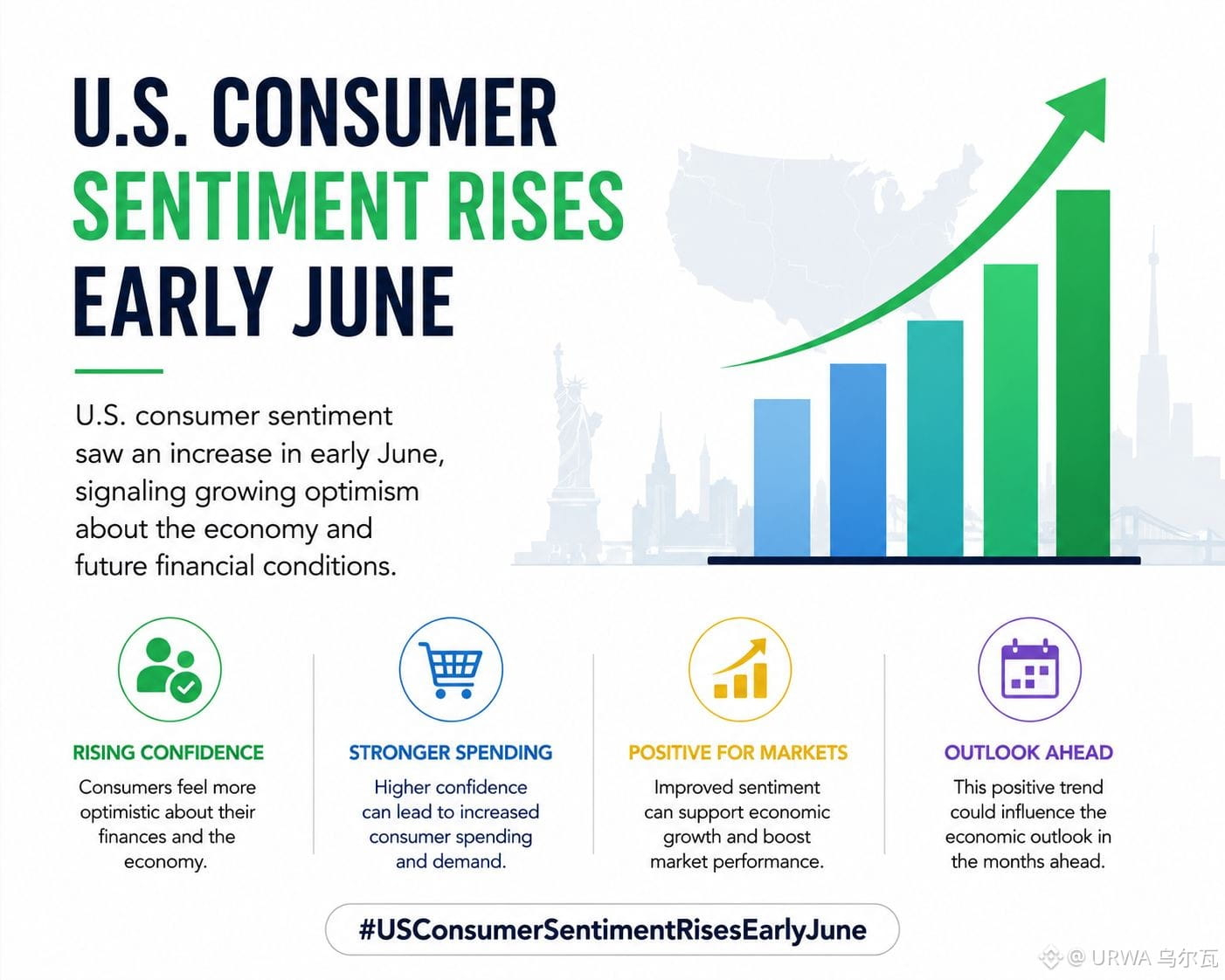
The latest rise in U.S. consumer sentiment is an encouraging sign for the economy. When people feel more confident about their financial future, spending and business activity often improve as well.
While challenges still exist, this improvement suggests that consumers are becoming more optimistic about the months ahead. It will be interesting to see how this trend influences markets and economic growth throughout the rest of the year.
#USConsumerSentimentRisesEarlyJune #Economy #Marketstatus #InvestingRevolution #EconomicOutlook
The latest rise in U.S. consumer sentiment is an encouraging sign for the economy. When people feel more confident about their financial future, spending and business activity often improve as well.
While challenges still exist, this improvement suggests that consumers are becoming more optimistic about the months ahead. It will be interesting to see how this trend influences markets and economic growth throughout the rest of the year.
#USConsumerSentimentRisesEarlyJune #Economy #Marketstatus #InvestingRevolution #EconomicOutlook
While challenges still exist, this improvement suggests that consumers are becoming more optimistic about the months ahead. It will be interesting to see how this trend influences markets and economic growth throughout the rest of the year.
#USConsumerSentimentRisesEarlyJune #Economy #Marketstatus #InvestingRevolution #EconomicOutlook
2
350

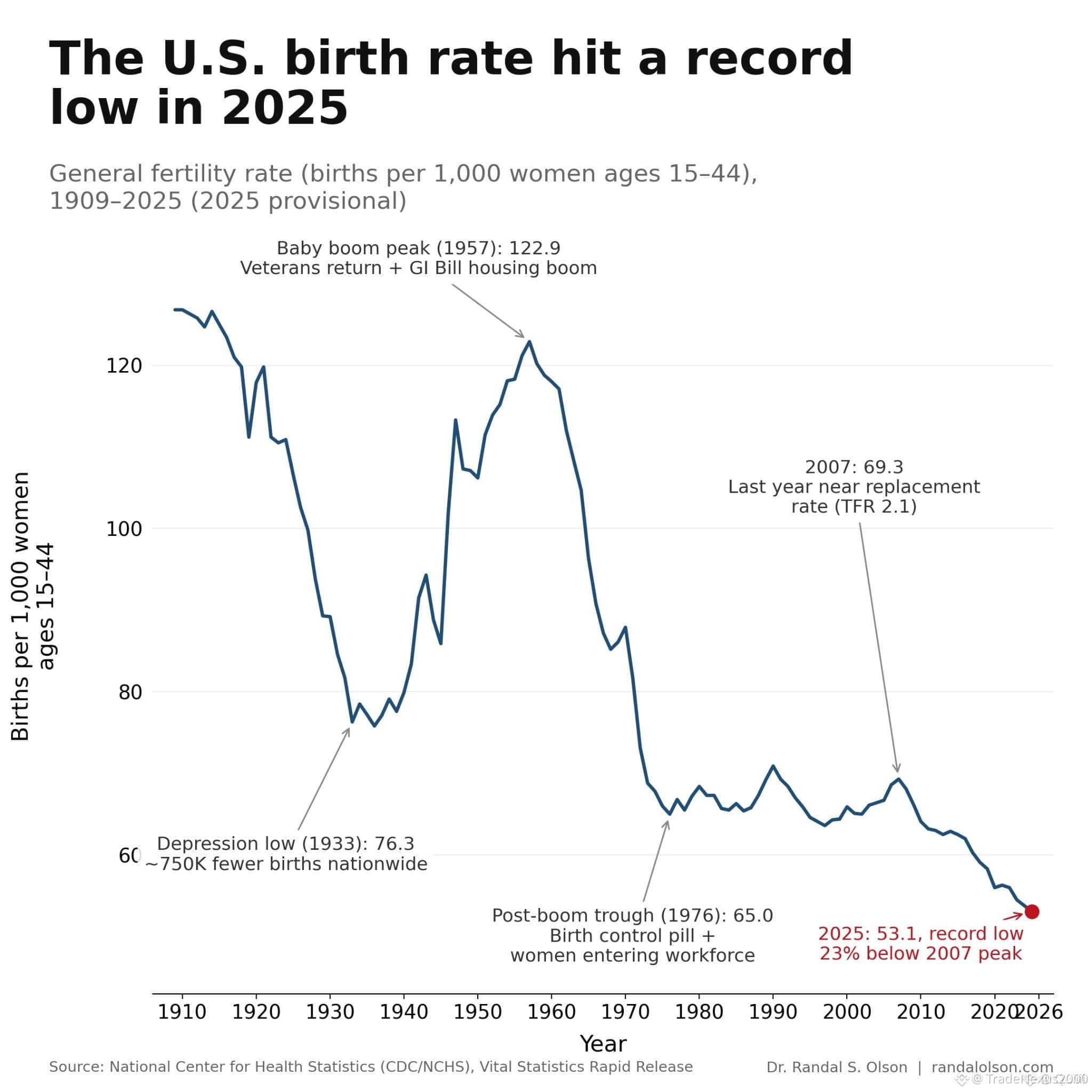
⚠️ DEMOGRAPHIC COLLAPSE THREATENS FIAT INFRASTRUCTURE: WHY $BTC IS THE MACRO HEDGE 📉
U.S. birth rates are cascading down multi-decade lows, signaling an irreversible demographic pivot toward an aging population. 📊 Institutional macro desks view this trend through a clear lens: a shrinking productive workforce creates structural deficits that central banks will eventually monetize through expanded liquidity pools.
As sovereign fiscal burdens compound over the coming decade, capital preservation strategies will shift aggressively toward scarce, unencumbered hard assets. 🔍 Smart money is already mapping out this long-term structural rotation to hedge against systemic debasement. 💬 How will you position your portfolio as sovereign debt dynamics force central banks to print infinitely? 👇
⚠️ Not financial advice. Always manage your risk. 🛡️
🏷️ #BTC #Macro #SmartMoney #EconomicOutlook #Crypto
🏦 🔍
⚠️ DEMOGRAPHIC COLLAPSE THREATENS FIAT INFRASTRUCTURE: WHY $BTC IS THE MACRO HEDGE 📉
U.S. birth rates are cascading down multi-decade lows, signaling an irreversible demographic pivot toward an aging population. 📊 Institutional macro desks view this trend through a clear lens: a shrinking productive workforce creates structural deficits that central banks will eventually monetize through expanded liquidity pools.
As sovereign fiscal burdens compound over the coming decade, capital preservation strategies will shift aggressively toward scarce, unencumbered hard assets. 🔍 Smart money is already mapping out this long-term structural rotation to hedge against systemic debasement. 💬 How will you position your portfolio as sovereign debt dynamics force central banks to print infinitely? 👇
⚠️ Not financial advice. Always manage your risk. 🛡️
🏷️ #BTC #Macro #SmartMoney #EconomicOutlook #Crypto
🏦 🔍
U.S. birth rates are cascading down multi-decade lows, signaling an irreversible demographic pivot toward an aging population. 📊 Institutional macro desks view this trend through a clear lens: a shrinking productive workforce creates structural deficits that central banks will eventually monetize through expanded liquidity pools.
As sovereign fiscal burdens compound over the coming decade, capital preservation strategies will shift aggressively toward scarce, unencumbered hard assets. 🔍 Smart money is already mapping out this long-term structural rotation to hedge against systemic debasement. 💬 How will you position your portfolio as sovereign debt dynamics force central banks to print infinitely? 👇
⚠️ Not financial advice. Always manage your risk. 🛡️
🏷️ #BTC #Macro #SmartMoney #EconomicOutlook #Crypto
🏦 🔍
28
Log in to explore more content
Join global crypto users on Binance Square
⚡️ Get latest and useful information about crypto.
💬 Trusted by the world’s largest crypto exchange.
👍 Discover real insights from verified creators.
Email / Phone number
Trending Topics
1
#BinanceLaunchesBinanceIntelligence
36,762 views
450 Discussing
2
#EvernorthXRPTreasuryCompletesSPACMerger
32,517 views
294 Discussing
3
#ADAGains10%Above$0.27
31,065 views
206 Discussing
4
#ETHUp70%InQ3ButLiquidityFalls
224,820 views
1,380 Discussing
5
#EthStakingExitQueueHits2026High
83,132 views
930 Discussing
6
#FedOctoberHoldOdds82.3%
84,420 views
914 Discussing
7
#Nikkei225Jumps2.5%ToThreeMonthHigh
94,901 views
1,222 Discussing
8
#CircleMints$2.75BUSDCOnSolanaIn7Days
2,546 views
53 Discussing
9
#DriftHackVictimsBeginClaims
199,653 views
1,877 Discussing
10
#SolanaTokenizedStockVolumeTops$4.4BInSeptember
14,709 views
136 Discussing