

#crosschain
crosschain
304,209 views
2,419 Discussing
Hot
Latest

·
--
Cross-Chain Bridges Are Becoming Crypto Infrastructure — Not Just Tools
For years, blockchain bridges were treated as risky edge cases — a necessary evil to move assets between chains. That narrative is changing fast.
The next architectural layer of crypto is interoperability infrastructure. Protocols like Wormhole, LayerZero, and Chainlink CCIP are evolving from simple token bridges into generalized messaging layers — capable of passing arbitrary data, contract calls, and state proofs across chains.
Why does this matter structurally?
🔹 Capital fragmentation is the biggest drag on DeFi efficiency. Liquidity siloed on $ETH and $SOL cannot compound across ecosystems — but cross-chain messaging layers let protocols deploy unified liquidity strategies spanning multiple VMs.
🔹 Intent-based architectures abstract bridging entirely. Users declare what they want; solvers compete across chains to fill. The bridge becomes invisible infrastructure — the rails, not the destination.
🔹 $BTC remains the largest pool of idle on-chain capital. Trustless BTC bridging — secured by ZK proofs rather than federations — unlocks that capital for cross-chain DeFi without custodial risk.
The chains that win long-term will not just be fast — they will be composable. Cross-chain interoperability is not a feature anymore; it is the connective tissue the entire multi-chain ecosystem runs on.
Build for composability. That is where the real leverage is.
#CrossChain #Interoperability #DeFi #Web3 #Crypto
Cross-Chain Bridges Are Becoming Crypto Infrastructure — Not Just Tools
For years, blockchain bridges were treated as risky edge cases — a necessary evil to move assets between chains. That narrative is changing fast.
The next architectural layer of crypto is interoperability infrastructure. Protocols like Wormhole, LayerZero, and Chainlink CCIP are evolving from simple token bridges into generalized messaging layers — capable of passing arbitrary data, contract calls, and state proofs across chains.
Why does this matter structurally?
🔹 Capital fragmentation is the biggest drag on DeFi efficiency. Liquidity siloed on $ETH and $SOL cannot compound across ecosystems — but cross-chain messaging layers let protocols deploy unified liquidity strategies spanning multiple VMs.
🔹 Intent-based architectures abstract bridging entirely. Users declare what they want; solvers compete across chains to fill. The bridge becomes invisible infrastructure — the rails, not the destination.
🔹 $BTC remains the largest pool of idle on-chain capital. Trustless BTC bridging — secured by ZK proofs rather than federations — unlocks that capital for cross-chain DeFi without custodial risk.
The chains that win long-term will not just be fast — they will be composable. Cross-chain interoperability is not a feature anymore; it is the connective tissue the entire multi-chain ecosystem runs on.
Build for composability. That is where the real leverage is.
#CrossChain #Interoperability #DeFi #Web3 #Crypto
For years, blockchain bridges were treated as risky edge cases — a necessary evil to move assets between chains. That narrative is changing fast.
The next architectural layer of crypto is interoperability infrastructure. Protocols like Wormhole, LayerZero, and Chainlink CCIP are evolving from simple token bridges into generalized messaging layers — capable of passing arbitrary data, contract calls, and state proofs across chains.
Why does this matter structurally?
🔹 Capital fragmentation is the biggest drag on DeFi efficiency. Liquidity siloed on $ETH and $SOL cannot compound across ecosystems — but cross-chain messaging layers let protocols deploy unified liquidity strategies spanning multiple VMs.
🔹 Intent-based architectures abstract bridging entirely. Users declare what they want; solvers compete across chains to fill. The bridge becomes invisible infrastructure — the rails, not the destination.
🔹 $BTC remains the largest pool of idle on-chain capital. Trustless BTC bridging — secured by ZK proofs rather than federations — unlocks that capital for cross-chain DeFi without custodial risk.
The chains that win long-term will not just be fast — they will be composable. Cross-chain interoperability is not a feature anymore; it is the connective tissue the entire multi-chain ecosystem runs on.
Build for composability. That is where the real leverage is.
#CrossChain #Interoperability #DeFi #Web3 #Crypto
29
·
--
Cross-chain interoperability is the infrastructure layer almost no one talks about — but it determines whether crypto becomes one unified financial system or a collection of isolated islands.
Cosmos IBC (Inter-Blockchain Communication) has been live since 2021, processing billions in cross-chain transfers with no bridge smart contract at its core. The protocol works at the consensus layer: light clients verify finality on each connected chain, eliminating the wrapped-asset honeypot model that has cost the industry over 2 billion dollars in bridge exploits.
Yet IBC remains underappreciated because Cosmos chains lack the brand recognition of $ETH or $BNB. The tech, however, is mature. Over 100 IBC-connected chains now share liquidity through this standard, and Avalanche is actively exploring IBC compatibility — a signal that the interoperability war is converging on a common baseline.
The broader thesis: multi-chain is permanent. Liquidity will fragment across dozens of execution environments, and the protocols that make cross-chain UX feel like a single chain will capture disproportionate value. IBC has a four-year head start on live, trust-minimized cross-chain messaging that most bridge designs still cannot match.
Whether $DOT XCM, LayerZero, or IBC ultimately wins the interoperability standard debate, one thing is clear: the infrastructure connecting chains matters as much as the chains themselves.
#CrossChain #Interoperability #IBC #DeFi #Cosmos
Cross-chain interoperability is the infrastructure layer almost no one talks about — but it determines whether crypto becomes one unified financial system or a collection of isolated islands.
Cosmos IBC (Inter-Blockchain Communication) has been live since 2021, processing billions in cross-chain transfers with no bridge smart contract at its core. The protocol works at the consensus layer: light clients verify finality on each connected chain, eliminating the wrapped-asset honeypot model that has cost the industry over 2 billion dollars in bridge exploits.
Yet IBC remains underappreciated because Cosmos chains lack the brand recognition of $ETH or $BNB . The tech, however, is mature. Over 100 IBC-connected chains now share liquidity through this standard, and Avalanche is actively exploring IBC compatibility — a signal that the interoperability war is converging on a common baseline.
The broader thesis: multi-chain is permanent. Liquidity will fragment across dozens of execution environments, and the protocols that make cross-chain UX feel like a single chain will capture disproportionate value. IBC has a four-year head start on live, trust-minimized cross-chain messaging that most bridge designs still cannot match.
Whether $DOT XCM, LayerZero, or IBC ultimately wins the interoperability standard debate, one thing is clear: the infrastructure connecting chains matters as much as the chains themselves.
#CrossChain #Interoperability #IBC #DeFi #Cosmos
Cosmos IBC (Inter-Blockchain Communication) has been live since 2021, processing billions in cross-chain transfers with no bridge smart contract at its core. The protocol works at the consensus layer: light clients verify finality on each connected chain, eliminating the wrapped-asset honeypot model that has cost the industry over 2 billion dollars in bridge exploits.
Yet IBC remains underappreciated because Cosmos chains lack the brand recognition of $ETH or $BNB . The tech, however, is mature. Over 100 IBC-connected chains now share liquidity through this standard, and Avalanche is actively exploring IBC compatibility — a signal that the interoperability war is converging on a common baseline.
The broader thesis: multi-chain is permanent. Liquidity will fragment across dozens of execution environments, and the protocols that make cross-chain UX feel like a single chain will capture disproportionate value. IBC has a four-year head start on live, trust-minimized cross-chain messaging that most bridge designs still cannot match.
Whether $DOT XCM, LayerZero, or IBC ultimately wins the interoperability standard debate, one thing is clear: the infrastructure connecting chains matters as much as the chains themselves.
#CrossChain #Interoperability #IBC #DeFi #Cosmos
50
·
--
Bridge security is the single most underappreciated bottleneck in cross-chain growth — and the numbers prove it.
Over $2.5 billion was lost to bridge exploits across 2021–2023. Wormhole, Ronin, Nomad — these weren't edge cases. They were systematic failures of the trust assumptions baked into early bridge architecture. Lock-and-mint models, multi-sig validator sets, and off-chain relayers all introduced points of failure that smart adversaries found quickly.
The good news: the industry learned. The next generation of bridges is moving toward trust-minimized designs — light client verification, ZK-proof-based state proofs, and native chain messaging like IBC and LayerZero on $ETH. These approaches reduce reliance on external validators and anchor security to the underlying L1s themselves.
$AVAX subnet communication and $BNB cross-chain infrastructure are also maturing, with isolated liquidity pools reducing contagion risk. The goal is a world where bridging a token carries no more trust overhead than an on-chain swap.
Until bridge security reaches that bar, TVL fragmentation across chains is partly a rational security hedge — not just ecosystem tribalism. Traders and developers parking capital on one chain are implicitly pricing bridge risk.
Watch bridge audit quality, validator decentralization, and ZK-proof adoption as the real signals of when cross-chain capital flow becomes truly frictionless.
$ETH $AVAX $BNB
#CrossChain #BridgeSecurity #DeFi #Web3 #CryptoAlpha
Bridge security is the single most underappreciated bottleneck in cross-chain growth — and the numbers prove it.
Over $2.5 billion was lost to bridge exploits across 2021–2023. Wormhole, Ronin, Nomad — these weren't edge cases. They were systematic failures of the trust assumptions baked into early bridge architecture. Lock-and-mint models, multi-sig validator sets, and off-chain relayers all introduced points of failure that smart adversaries found quickly.
The good news: the industry learned. The next generation of bridges is moving toward trust-minimized designs — light client verification, ZK-proof-based state proofs, and native chain messaging like IBC and LayerZero on $ETH . These approaches reduce reliance on external validators and anchor security to the underlying L1s themselves.
$AVAX subnet communication and $BNB cross-chain infrastructure are also maturing, with isolated liquidity pools reducing contagion risk. The goal is a world where bridging a token carries no more trust overhead than an on-chain swap.
Until bridge security reaches that bar, TVL fragmentation across chains is partly a rational security hedge — not just ecosystem tribalism. Traders and developers parking capital on one chain are implicitly pricing bridge risk.
Watch bridge audit quality, validator decentralization, and ZK-proof adoption as the real signals of when cross-chain capital flow becomes truly frictionless.
$ETH $AVAX $BNB
#CrossChain #BridgeSecurity #DeFi #Web3 #CryptoAlpha
Over $2.5 billion was lost to bridge exploits across 2021–2023. Wormhole, Ronin, Nomad — these weren't edge cases. They were systematic failures of the trust assumptions baked into early bridge architecture. Lock-and-mint models, multi-sig validator sets, and off-chain relayers all introduced points of failure that smart adversaries found quickly.
The good news: the industry learned. The next generation of bridges is moving toward trust-minimized designs — light client verification, ZK-proof-based state proofs, and native chain messaging like IBC and LayerZero on $ETH . These approaches reduce reliance on external validators and anchor security to the underlying L1s themselves.
$AVAX subnet communication and $BNB cross-chain infrastructure are also maturing, with isolated liquidity pools reducing contagion risk. The goal is a world where bridging a token carries no more trust overhead than an on-chain swap.
Until bridge security reaches that bar, TVL fragmentation across chains is partly a rational security hedge — not just ecosystem tribalism. Traders and developers parking capital on one chain are implicitly pricing bridge risk.
Watch bridge audit quality, validator decentralization, and ZK-proof adoption as the real signals of when cross-chain capital flow becomes truly frictionless.
$ETH $AVAX $BNB
#CrossChain #BridgeSecurity #DeFi #Web3 #CryptoAlpha
79
·
--
Capital efficiency is becoming crypto's defining competitive advantage — and cross-chain composability is the engine driving it.
For most of crypto's history, liquidity was trapped in silos. Bitcoin on one chain. Ethereum ecosystem assets on another. Polkadot parachains operating in parallel universes. Each island had its own yield opportunities, but moving between them meant custodial bridges, wrapped assets, and trust assumptions that eroded returns before you even began.
The shift happening now is architectural. Interoperability is moving from bridging tokens to executing unified strategies across multiple chains simultaneously. The difference is massive.
Composable cross-chain rails unlock something profound: the same dollar works harder. Yield stacks without proportional risk multiplication. Liquidity concentrates where returns are highest, automatically.
$DOT's shared security and XCM messaging, $AVAX's Subnet architecture, and $ETH's L2 interoperability standards are converging on this vision from different directions. The protocols that win won't just be fast or cheap — they'll be the ones where capital never sits idle.
We're early in this transition. Most users still think of chains as separate destinations. The next wave of DeFi power users will think of them as one unified liquidity layer with variable execution environments.
Cross-chain isn't a feature. It's the next capital market layer.
#CrossChain #DeFi #CryptoInfrastructure #Interoperability #Web3
Capital efficiency is becoming crypto's defining competitive advantage — and cross-chain composability is the engine driving it.
For most of crypto's history, liquidity was trapped in silos. Bitcoin on one chain. Ethereum ecosystem assets on another. Polkadot parachains operating in parallel universes. Each island had its own yield opportunities, but moving between them meant custodial bridges, wrapped assets, and trust assumptions that eroded returns before you even began.
The shift happening now is architectural. Interoperability is moving from bridging tokens to executing unified strategies across multiple chains simultaneously. The difference is massive.
Composable cross-chain rails unlock something profound: the same dollar works harder. Yield stacks without proportional risk multiplication. Liquidity concentrates where returns are highest, automatically.
$DOT 's shared security and XCM messaging, $AVAX 's Subnet architecture, and $ETH 's L2 interoperability standards are converging on this vision from different directions. The protocols that win won't just be fast or cheap — they'll be the ones where capital never sits idle.
We're early in this transition. Most users still think of chains as separate destinations. The next wave of DeFi power users will think of them as one unified liquidity layer with variable execution environments.
Cross-chain isn't a feature. It's the next capital market layer.
#CrossChain #DeFi #CryptoInfrastructure #Interoperability #Web3
For most of crypto's history, liquidity was trapped in silos. Bitcoin on one chain. Ethereum ecosystem assets on another. Polkadot parachains operating in parallel universes. Each island had its own yield opportunities, but moving between them meant custodial bridges, wrapped assets, and trust assumptions that eroded returns before you even began.
The shift happening now is architectural. Interoperability is moving from bridging tokens to executing unified strategies across multiple chains simultaneously. The difference is massive.
Composable cross-chain rails unlock something profound: the same dollar works harder. Yield stacks without proportional risk multiplication. Liquidity concentrates where returns are highest, automatically.
$DOT 's shared security and XCM messaging, $AVAX 's Subnet architecture, and $ETH 's L2 interoperability standards are converging on this vision from different directions. The protocols that win won't just be fast or cheap — they'll be the ones where capital never sits idle.
We're early in this transition. Most users still think of chains as separate destinations. The next wave of DeFi power users will think of them as one unified liquidity layer with variable execution environments.
Cross-chain isn't a feature. It's the next capital market layer.
#CrossChain #DeFi #CryptoInfrastructure #Interoperability #Web3
168
·
--
Cross-chain bridges lost over $2.5 billion to exploits between 2021 and 2024. The response has quietly reshaped how the entire multi-chain stack is being rebuilt.
The first generation of bridges relied on multisig validator sets — small groups of signers whose private keys became high-value targets. One compromised key, or a malicious majority, and the entire locked TVL drained in minutes. The attack surface was enormous relative to the security budget.
The new generation is taking a different architectural approach:
— ZK-proof bridges verify state transitions cryptographically without trusting any validator set. The math is the security layer, not the human.
— Light client bridges run on-chain verification of the source chain’s consensus directly, eliminating the middle layer entirely.
— Intent-based protocols remove the custodial bridge entirely — solvers fill orders on the destination chain, bearing the inventory risk themselves.
None of these are fully mature yet, but the direction is clear: trust minimization as the design principle, not just the marketing tagline.
For $BTC holders, this matters because wrapped BTC’s credibility depends on bridge security. For $ETH, ZK bridges strengthen the L2 exit guarantee. For $SOL, native interoperability design will determine how much external liquidity it can sustainably absorb.
Bridges are not a side-show. They are the circulatory system of multi-chain capital.
#CrossChain #BridgeSecurity #DeFi #CryptoInfrastructure #Web3
Cross-chain bridges lost over $2.5 billion to exploits between 2021 and 2024. The response has quietly reshaped how the entire multi-chain stack is being rebuilt.
The first generation of bridges relied on multisig validator sets — small groups of signers whose private keys became high-value targets. One compromised key, or a malicious majority, and the entire locked TVL drained in minutes. The attack surface was enormous relative to the security budget.
The new generation is taking a different architectural approach:
— ZK-proof bridges verify state transitions cryptographically without trusting any validator set. The math is the security layer, not the human.
— Light client bridges run on-chain verification of the source chain’s consensus directly, eliminating the middle layer entirely.
— Intent-based protocols remove the custodial bridge entirely — solvers fill orders on the destination chain, bearing the inventory risk themselves.
None of these are fully mature yet, but the direction is clear: trust minimization as the design principle, not just the marketing tagline.
For $BTC holders, this matters because wrapped BTC’s credibility depends on bridge security. For $ETH , ZK bridges strengthen the L2 exit guarantee. For $SOL , native interoperability design will determine how much external liquidity it can sustainably absorb.
Bridges are not a side-show. They are the circulatory system of multi-chain capital.
#CrossChain #BridgeSecurity #DeFi #CryptoInfrastructure #Web3
The first generation of bridges relied on multisig validator sets — small groups of signers whose private keys became high-value targets. One compromised key, or a malicious majority, and the entire locked TVL drained in minutes. The attack surface was enormous relative to the security budget.
The new generation is taking a different architectural approach:
— ZK-proof bridges verify state transitions cryptographically without trusting any validator set. The math is the security layer, not the human.
— Light client bridges run on-chain verification of the source chain’s consensus directly, eliminating the middle layer entirely.
— Intent-based protocols remove the custodial bridge entirely — solvers fill orders on the destination chain, bearing the inventory risk themselves.
None of these are fully mature yet, but the direction is clear: trust minimization as the design principle, not just the marketing tagline.
For $BTC holders, this matters because wrapped BTC’s credibility depends on bridge security. For $ETH , ZK bridges strengthen the L2 exit guarantee. For $SOL , native interoperability design will determine how much external liquidity it can sustainably absorb.
Bridges are not a side-show. They are the circulatory system of multi-chain capital.
#CrossChain #BridgeSecurity #DeFi #CryptoInfrastructure #Web3
78
·
--
Cross-chain interoperability is no longer a research topic — it is the plumbing crypto has always needed.
When the ecosystem was small, one chain could host everything. Now capital is fragmented across dozens of networks: DeFi yields on $ETH L2s, meme momentum on $SOL, and institutional settlement anchored to $BTC. Users are multi-chain whether they planned to be or not.
But bridges have been the weakest link. The largest DeFi hacks in history targeted cross-chain infrastructure, not base layers. That history forced a design rethink: from wrapped-asset custodial bridges toward zero-knowledge validity proofs, trust-minimized light clients, and messaging layers that pass state rather than just tokens.
The threshold that matters: when bridging becomes cheap, fast, and boring. Boring means it works without drama. Cheap means friction disappears. Fast means arbitrage closes cross-chain price gaps in seconds rather than minutes.
When that threshold is crossed, the mental model of "which chain am I on" fades. Capital routes to yield and use-case automatically. Ecosystems stop competing for users and start competing for activity — a much healthier game.
Interoperability does not pick a winner. It makes the whole map bigger. That is why watching bridge volume, message-layer throughput, and ZK-proof latency is one of the more underrated metrics in crypto right now.
The future is multi-chain with connective tissue. $BTC $ETH $SOL
#CrossChain #Interoperability #DeFi #CryptoInfrastructure #MultiChain
Cross-chain interoperability is no longer a research topic — it is the plumbing crypto has always needed.
When the ecosystem was small, one chain could host everything. Now capital is fragmented across dozens of networks: DeFi yields on $ETH L2s, meme momentum on $SOL , and institutional settlement anchored to $BTC . Users are multi-chain whether they planned to be or not.
But bridges have been the weakest link. The largest DeFi hacks in history targeted cross-chain infrastructure, not base layers. That history forced a design rethink: from wrapped-asset custodial bridges toward zero-knowledge validity proofs, trust-minimized light clients, and messaging layers that pass state rather than just tokens.
The threshold that matters: when bridging becomes cheap, fast, and boring. Boring means it works without drama. Cheap means friction disappears. Fast means arbitrage closes cross-chain price gaps in seconds rather than minutes.
When that threshold is crossed, the mental model of "which chain am I on" fades. Capital routes to yield and use-case automatically. Ecosystems stop competing for users and start competing for activity — a much healthier game.
Interoperability does not pick a winner. It makes the whole map bigger. That is why watching bridge volume, message-layer throughput, and ZK-proof latency is one of the more underrated metrics in crypto right now.
The future is multi-chain with connective tissue. $BTC $ETH $SOL
#CrossChain #Interoperability #DeFi #CryptoInfrastructure #MultiChain
When the ecosystem was small, one chain could host everything. Now capital is fragmented across dozens of networks: DeFi yields on $ETH L2s, meme momentum on $SOL , and institutional settlement anchored to $BTC . Users are multi-chain whether they planned to be or not.
But bridges have been the weakest link. The largest DeFi hacks in history targeted cross-chain infrastructure, not base layers. That history forced a design rethink: from wrapped-asset custodial bridges toward zero-knowledge validity proofs, trust-minimized light clients, and messaging layers that pass state rather than just tokens.
The threshold that matters: when bridging becomes cheap, fast, and boring. Boring means it works without drama. Cheap means friction disappears. Fast means arbitrage closes cross-chain price gaps in seconds rather than minutes.
When that threshold is crossed, the mental model of "which chain am I on" fades. Capital routes to yield and use-case automatically. Ecosystems stop competing for users and start competing for activity — a much healthier game.
Interoperability does not pick a winner. It makes the whole map bigger. That is why watching bridge volume, message-layer throughput, and ZK-proof latency is one of the more underrated metrics in crypto right now.
The future is multi-chain with connective tissue. $BTC $ETH $SOL
#CrossChain #Interoperability #DeFi #CryptoInfrastructure #MultiChain
62

·
--
Bullish
HTLC stands for Hash Time Locked Contract.
It uses two key conditions to coordinate a cross chain exchange:
A secret condition, called a hashlock
A time limit, called a timelock
The basic idea is simple.
One side locks funds using the agreed conditions. The other side does the same on another network.
If the required secret is revealed, the exchange can proceed.
If the conditions are not fulfilled within the defined time, the timelock supports the refund path according to the settlement rules.
Omniston uses paired HTLC logic as part of its cross chain architecture, helping coordinate execution across different networks.
@stonfi
#STONfi #DeFi #TON #CrossChain
HTLC stands for Hash Time Locked Contract.
It uses two key conditions to coordinate a cross chain exchange:
A secret condition, called a hashlock
A time limit, called a timelock
The basic idea is simple.
One side locks funds using the agreed conditions. The other side does the same on another network.
If the required secret is revealed, the exchange can proceed.
If the conditions are not fulfilled within the defined time, the timelock supports the refund path according to the settlement rules.
Omniston uses paired HTLC logic as part of its cross chain architecture, helping coordinate execution across different networks.
@STONfi DEX
#STONfi #DeFi #TON #CrossChain
It uses two key conditions to coordinate a cross chain exchange:
A secret condition, called a hashlock
A time limit, called a timelock
The basic idea is simple.
One side locks funds using the agreed conditions. The other side does the same on another network.
If the required secret is revealed, the exchange can proceed.
If the conditions are not fulfilled within the defined time, the timelock supports the refund path according to the settlement rules.
Omniston uses paired HTLC logic as part of its cross chain architecture, helping coordinate execution across different networks.
@STONfi DEX
#STONfi #DeFi #TON #CrossChain
2
11

·
--
Article
STON.fi Is Building Beyond a DEXSTON.fi Is Building Beyond a DEX
What if moving value across chains didn’t require users to think about bridges, wrapped assets, or where liquidity lives?
That is the direction @ston_fi is taking with Omniston.
Instead of treating cross-chain activity as a simple asset transfer, Omniston coordinates liquidity across different networks through an RFQ-based system and resolvers.
A user can request something as simple as:
USDT on TON → USDC on another supported chain
Behind that simple action, resolvers compete to provide executable quotes, while HTLC-based settlement helps connect the two sides of the transaction.
The interesting part is the user experience:
Different chains.
Different liquidity sources.
One execution flow.
#STONfi has expanded its cross-chain infrastructure across networks including TON, Ethereum, Base, BNB Chain, Polygon, Arbitrum, Avalanche, TRON, Robinhood Chain and X Layer.
But chain count isn't the real story.
The bigger opportunity is making blockchain fragmentation less visible to users and applications.
If Omniston continues adding liquidity, resolvers, assets and integrations, STON.fi could evolve from a TON-focused DEX into infrastructure that helps applications access liquidity across multiple ecosystems.
The long-term question isn't how many chains STON.fi supports.
It's how effectively it can make those chains feel like one connected liquidity environment.
#STONfi #Omniston #CrossChain
STON.fi Is Building Beyond a DEX
STON.fi Is Building Beyond a DEX
What if moving value across chains didn’t require users to think about bridges, wrapped assets, or where liquidity lives?
That is the direction @ston_fi is taking with Omniston.
Instead of treating cross-chain activity as a simple asset transfer, Omniston coordinates liquidity across different networks through an RFQ-based system and resolvers.
A user can request something as simple as:
USDT on TON → USDC on another supported chain
Behind that simple action, resolvers compete to provide executable quotes, while HTLC-based settlement helps connect the two sides of the transaction.
The interesting part is the user experience:
Different chains.
Different liquidity sources.
One execution flow.
#STONfi has expanded its cross-chain infrastructure across networks including TON, Ethereum, Base, BNB Chain, Polygon, Arbitrum, Avalanche, TRON, Robinhood Chain and X Layer.
But chain count isn't the real story.
The bigger opportunity is making blockchain fragmentation less visible to users and applications.
If Omniston continues adding liquidity, resolvers, assets and integrations, STON.fi could evolve from a TON-focused DEX into infrastructure that helps applications access liquidity across multiple ecosystems.
The long-term question isn't how many chains STON.fi supports.
It's how effectively it can make those chains feel like one connected liquidity environment.
#STONfi #Omniston #CrossChain
What if moving value across chains didn’t require users to think about bridges, wrapped assets, or where liquidity lives?
That is the direction @ston_fi is taking with Omniston.
Instead of treating cross-chain activity as a simple asset transfer, Omniston coordinates liquidity across different networks through an RFQ-based system and resolvers.
A user can request something as simple as:
USDT on TON → USDC on another supported chain
Behind that simple action, resolvers compete to provide executable quotes, while HTLC-based settlement helps connect the two sides of the transaction.
The interesting part is the user experience:
Different chains.
Different liquidity sources.
One execution flow.
#STONfi has expanded its cross-chain infrastructure across networks including TON, Ethereum, Base, BNB Chain, Polygon, Arbitrum, Avalanche, TRON, Robinhood Chain and X Layer.
But chain count isn't the real story.
The bigger opportunity is making blockchain fragmentation less visible to users and applications.
If Omniston continues adding liquidity, resolvers, assets and integrations, STON.fi could evolve from a TON-focused DEX into infrastructure that helps applications access liquidity across multiple ecosystems.
The long-term question isn't how many chains STON.fi supports.
It's how effectively it can make those chains feel like one connected liquidity environment.
#STONfi #Omniston #CrossChain
42
·
--
Bullish
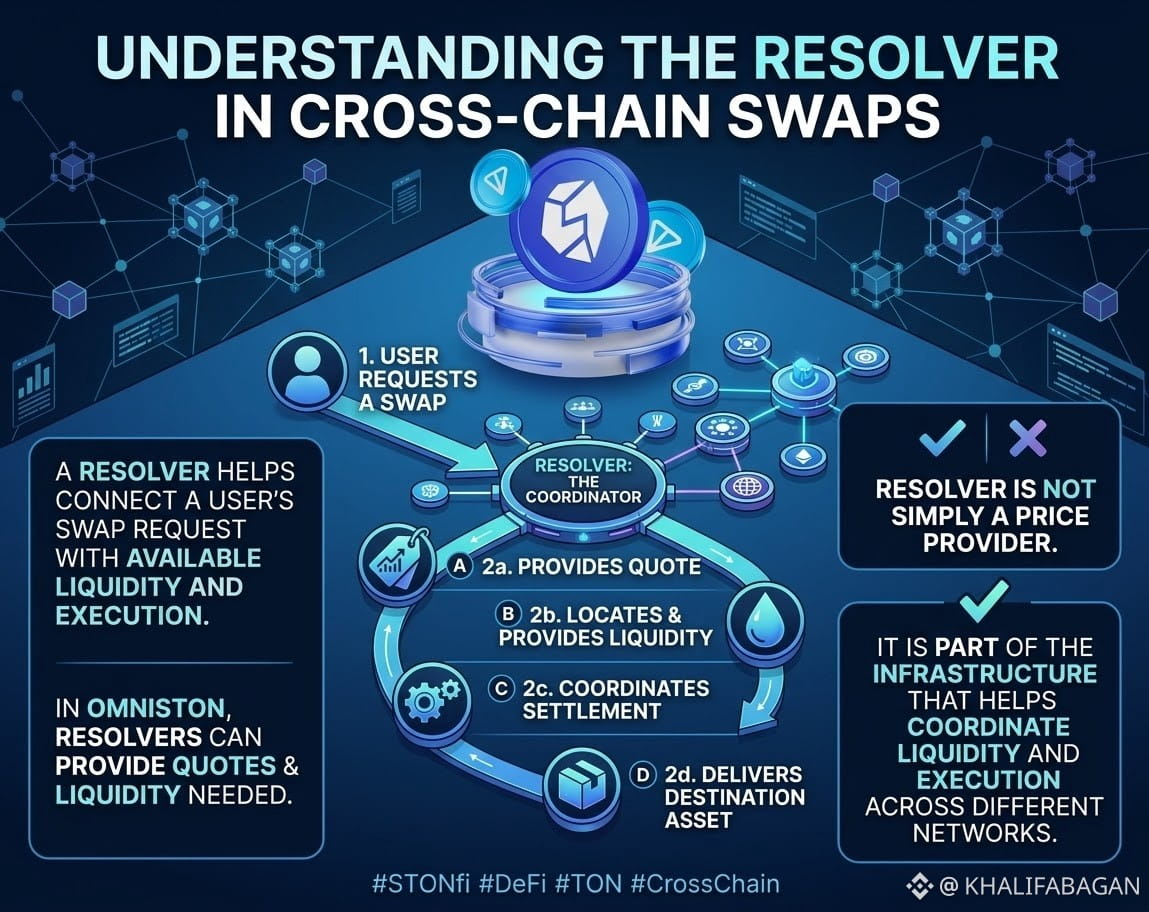
What does a resolver actually do in a cross chain swap?
A resolver helps connect a user's swap request with available liquidity and execution.
In Omniston, resolvers can provide quotes and the liquidity needed for the requested route.
The basic flow is:
User requests a swap
Resolver provides a quote
Liquidity is made available
Settlement is coordinated
Destination asset is delivered
So a resolver is not simply a price provider.
It is part of the infrastructure that helps coordinate liquidity and execution across different networks.
#STONfi #DeFi #TON #CrossChain
What does a resolver actually do in a cross chain swap?
A resolver helps connect a user's swap request with available liquidity and execution.
In Omniston, resolvers can provide quotes and the liquidity needed for the requested route.
The basic flow is:
User requests a swap
Resolver provides a quote
Liquidity is made available
Settlement is coordinated
Destination asset is delivered
So a resolver is not simply a price provider.
It is part of the infrastructure that helps coordinate liquidity and execution across different networks.
#STONfi #DeFi #TON #CrossChain
A resolver helps connect a user's swap request with available liquidity and execution.
In Omniston, resolvers can provide quotes and the liquidity needed for the requested route.
The basic flow is:
User requests a swap
Resolver provides a quote
Liquidity is made available
Settlement is coordinated
Destination asset is delivered
So a resolver is not simply a price provider.
It is part of the infrastructure that helps coordinate liquidity and execution across different networks.
#STONfi #DeFi #TON #CrossChain
1
7
·
--
Bullish
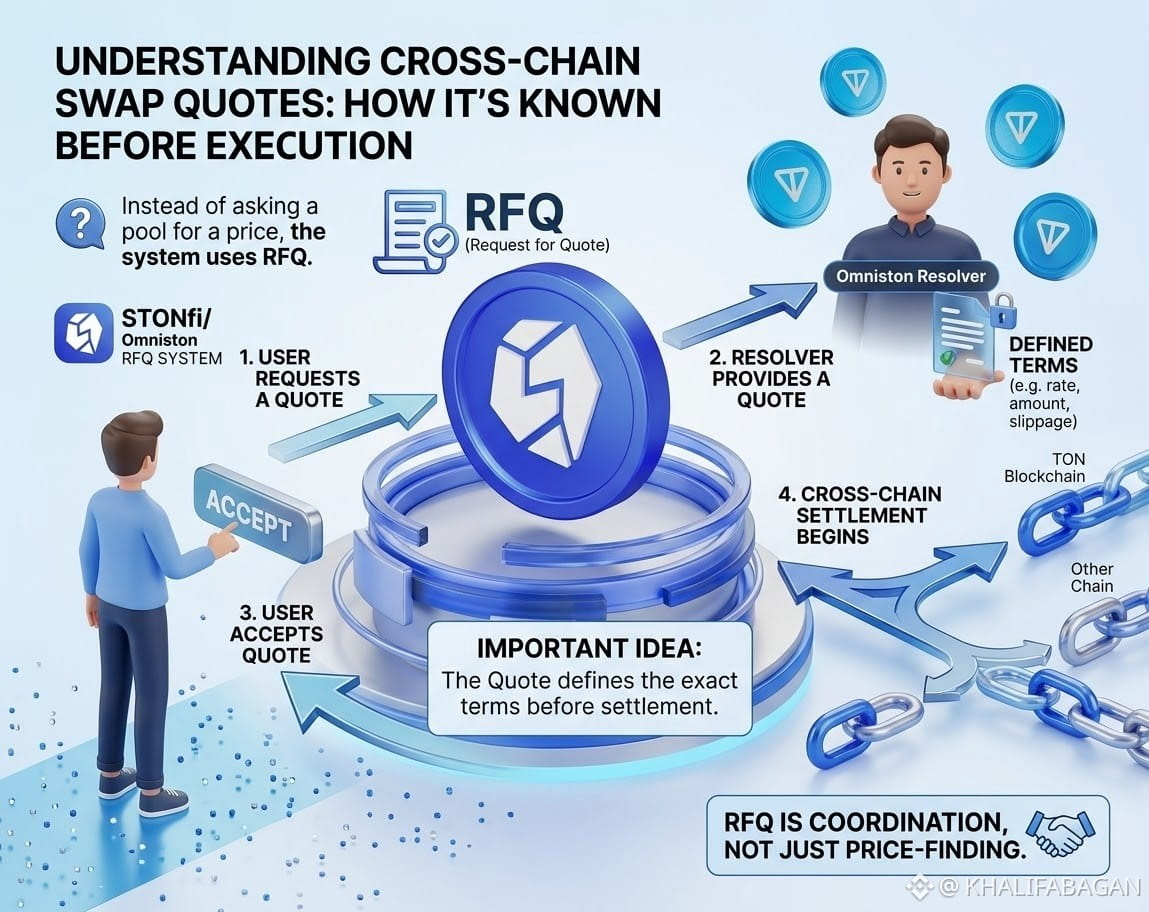
How does a cross chain swap know what you will receive before execution?
One important piece is RFQ, or Request for Quote.
Instead of simply asking a pool for a price, the system requests a quote for the intended swap.
In Omniston, resolvers provide these quotes and help coordinate the execution across chains.
The basic flow is:
User requests a quote
Resolver provides a quote
User accepts the quoted terms
Cross chain settlement begins
The important idea is that the quote defines the terms of the intended exchange before settlement.
RFQ is therefore not just about finding a price. It is part of how cross chain execution is coordinated.
@stonfi
#STONfi #DeFi #TON #CrossChain
How does a cross chain swap know what you will receive before execution?
One important piece is RFQ, or Request for Quote.
Instead of simply asking a pool for a price, the system requests a quote for the intended swap.
In Omniston, resolvers provide these quotes and help coordinate the execution across chains.
The basic flow is:
User requests a quote
Resolver provides a quote
User accepts the quoted terms
Cross chain settlement begins
The important idea is that the quote defines the terms of the intended exchange before settlement.
RFQ is therefore not just about finding a price. It is part of how cross chain execution is coordinated.
@STONfi DEX
#STONfi #DeFi #TON #CrossChain
One important piece is RFQ, or Request for Quote.
Instead of simply asking a pool for a price, the system requests a quote for the intended swap.
In Omniston, resolvers provide these quotes and help coordinate the execution across chains.
The basic flow is:
User requests a quote
Resolver provides a quote
User accepts the quoted terms
Cross chain settlement begins
The important idea is that the quote defines the terms of the intended exchange before settlement.
RFQ is therefore not just about finding a price. It is part of how cross chain execution is coordinated.
@STONfi DEX
#STONfi #DeFi #TON #CrossChain
2
29
·
--
Ask a random user which chain their money sits on, and most can't answer. That's the point.
The multi-chain era solved scaling but created a quieter tax: fragmentation. The same dollar now exists on a dozen ledgers, each copy demanding its own liquidity, its own bridges, its own security assumptions. Capital sits idle not for lack of opportunity, but because moving it between chains costs fees, time, and trust.
Bridges became the deepest attack surface in crypto history — not because the tech was weak, but because value concentrated at the seams between systems.
The next phase inverts this. Chain abstraction flips the model: users express outcomes — swap this, earn that — and infrastructure routes execution across whichever chains are cheapest and safest. Intent-based routing makes chains compete underneath, invisible to the person holding the wallet.
We've seen this pattern before. Nobody asks which server region runs their app. Nobody asks which rail settles their coffee payment. Chains are heading the same direction: from product to plumbing.
So the real question isn't which chain wins. It's who owns the routing layer — the piece that turns a fragmented mess into one seamless market.
The chains that stop demanding loyalty and start offering liquidity will quietly take the flow.
$ETH $SOL $DOT
#CrossChain #ChainAbstraction #Crypto #Web3 #Liquidity
Ask a random user which chain their money sits on, and most can't answer. That's the point.
The multi-chain era solved scaling but created a quieter tax: fragmentation. The same dollar now exists on a dozen ledgers, each copy demanding its own liquidity, its own bridges, its own security assumptions. Capital sits idle not for lack of opportunity, but because moving it between chains costs fees, time, and trust.
Bridges became the deepest attack surface in crypto history — not because the tech was weak, but because value concentrated at the seams between systems.
The next phase inverts this. Chain abstraction flips the model: users express outcomes — swap this, earn that — and infrastructure routes execution across whichever chains are cheapest and safest. Intent-based routing makes chains compete underneath, invisible to the person holding the wallet.
We've seen this pattern before. Nobody asks which server region runs their app. Nobody asks which rail settles their coffee payment. Chains are heading the same direction: from product to plumbing.
So the real question isn't which chain wins. It's who owns the routing layer — the piece that turns a fragmented mess into one seamless market.
The chains that stop demanding loyalty and start offering liquidity will quietly take the flow.
$ETH $SOL $DOT
#CrossChain #ChainAbstraction #Crypto #Web3 #Liquidity
The multi-chain era solved scaling but created a quieter tax: fragmentation. The same dollar now exists on a dozen ledgers, each copy demanding its own liquidity, its own bridges, its own security assumptions. Capital sits idle not for lack of opportunity, but because moving it between chains costs fees, time, and trust.
Bridges became the deepest attack surface in crypto history — not because the tech was weak, but because value concentrated at the seams between systems.
The next phase inverts this. Chain abstraction flips the model: users express outcomes — swap this, earn that — and infrastructure routes execution across whichever chains are cheapest and safest. Intent-based routing makes chains compete underneath, invisible to the person holding the wallet.
We've seen this pattern before. Nobody asks which server region runs their app. Nobody asks which rail settles their coffee payment. Chains are heading the same direction: from product to plumbing.
So the real question isn't which chain wins. It's who owns the routing layer — the piece that turns a fragmented mess into one seamless market.
The chains that stop demanding loyalty and start offering liquidity will quietly take the flow.
$ETH $SOL $DOT
#CrossChain #ChainAbstraction #Crypto #Web3 #Liquidity
AngelOfCrypto_-:
nice
1
1.4k
·
--
Bullish
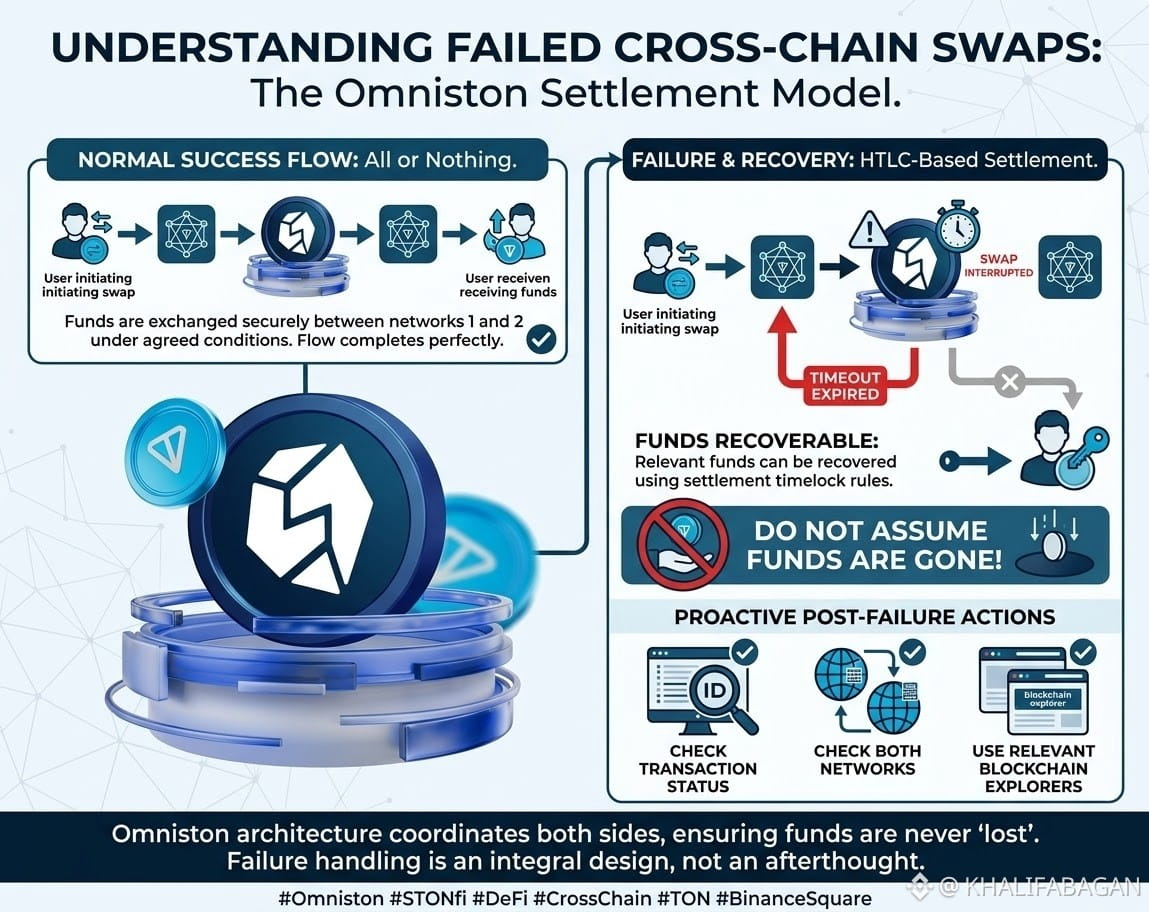
What happens when a cross chain swap does not complete?
It depends on the settlement architecture.
Omniston uses HTLC based settlement with timelock logic to coordinate the two sides of a cross chain swap.
The goal is an all or nothing flow:
The swap completes under the agreed conditions, or the relevant funds can be recovered according to the settlement rules.
So when a swap appears to fail, do not assume the funds are gone.
Check the transaction status, both networks, and the relevant blockchain explorers.
Failure handling is part of cross chain architecture, not an afterthought.
#BinanceSquare #STONfi #DeFi #CrossChain #TON
What happens when a cross chain swap does not complete?
It depends on the settlement architecture.
Omniston uses HTLC based settlement with timelock logic to coordinate the two sides of a cross chain swap.
The goal is an all or nothing flow:
The swap completes under the agreed conditions, or the relevant funds can be recovered according to the settlement rules.
So when a swap appears to fail, do not assume the funds are gone.
Check the transaction status, both networks, and the relevant blockchain explorers.
Failure handling is part of cross chain architecture, not an afterthought.
#BinanceSquare #STONfi #DeFi #CrossChain #TON
It depends on the settlement architecture.
Omniston uses HTLC based settlement with timelock logic to coordinate the two sides of a cross chain swap.
The goal is an all or nothing flow:
The swap completes under the agreed conditions, or the relevant funds can be recovered according to the settlement rules.
So when a swap appears to fail, do not assume the funds are gone.
Check the transaction status, both networks, and the relevant blockchain explorers.
Failure handling is part of cross chain architecture, not an afterthought.
#BinanceSquare #STONfi #DeFi #CrossChain #TON
2
39

·
--
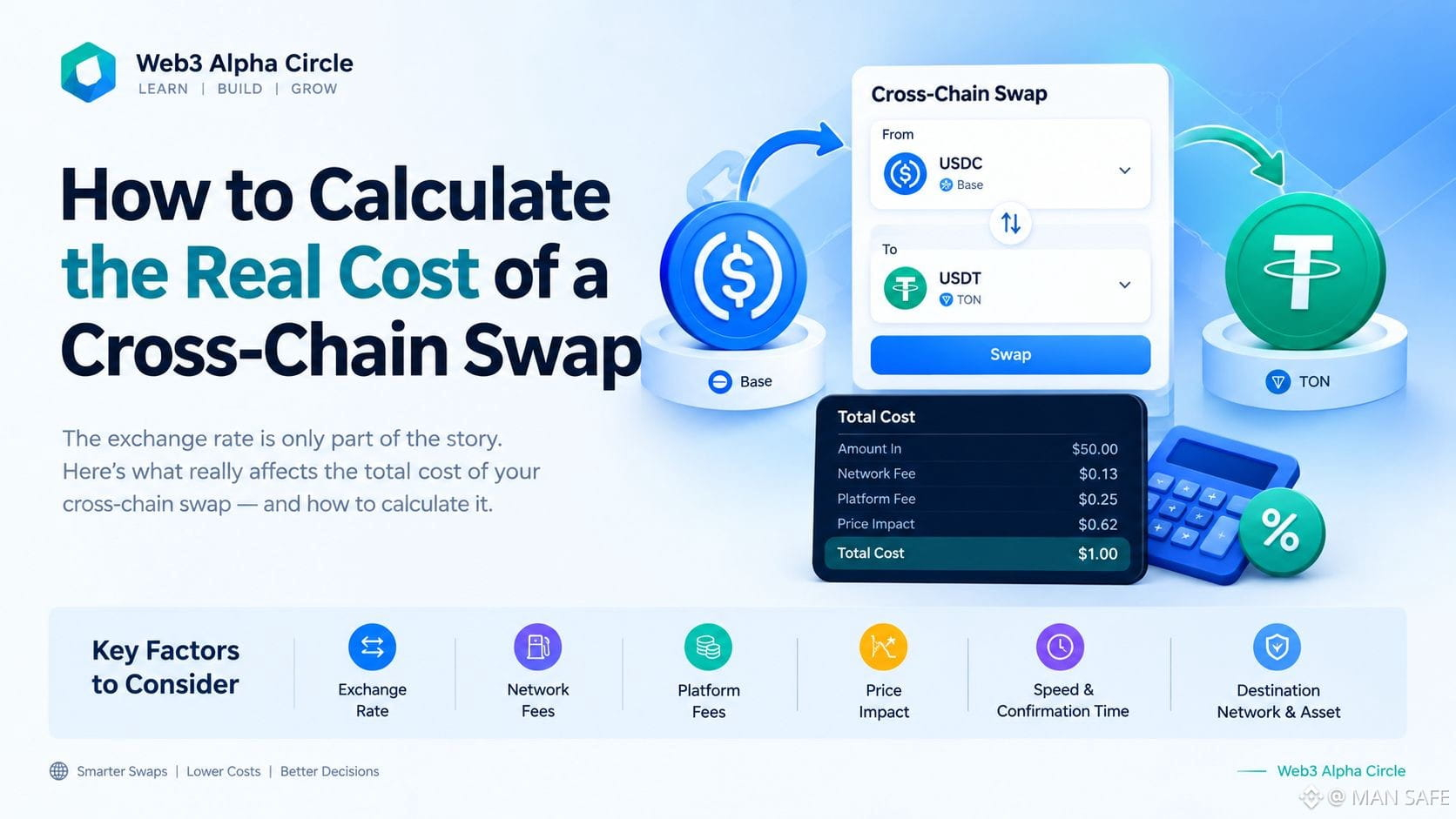
How to Calculate the Real Cost of a Cross-Chain Swap
A cross-chain swap isn't just about the network fee.
To understand the real cost, compare what you send with what you receive.
For example:
500 $USDC → 496 $USDT
➜ Difference: 4 USDT
➜ Effective cost: 0.8%
But that difference may include more than a simple fee. Consider:
➜ Network fees
➜ Exchange-rate differences
➜ Price impact
➜ Slippage
➜ Execution costs
➜ Final amount received
When comparing routes, don't focus only on the cheapest gas fee.
Check the final output.
With cross-chain infrastructure such as STON.fi and Omniston, always review the live quote for your specific amount before confirming.
Simple rule:
What you send → What you receive = the starting point for understanding the real cost.
Always verify the asset, network, destination wallet, fees, and expected output before signing.
#CrossChain #STONfi
How to Calculate the Real Cost of a Cross-Chain Swap
A cross-chain swap isn't just about the network fee.
To understand the real cost, compare what you send with what you receive.
For example:
500 $USDC → 496 $USDT
➜ Difference: 4 USDT
➜ Effective cost: 0.8%
But that difference may include more than a simple fee. Consider:
➜ Network fees
➜ Exchange-rate differences
➜ Price impact
➜ Slippage
➜ Execution costs
➜ Final amount received
When comparing routes, don't focus only on the cheapest gas fee.
Check the final output.
With cross-chain infrastructure such as STON.fi and Omniston, always review the live quote for your specific amount before confirming.
Simple rule:
What you send → What you receive = the starting point for understanding the real cost.
Always verify the asset, network, destination wallet, fees, and expected output before signing.
#CrossChain #STONfi
A cross-chain swap isn't just about the network fee.
To understand the real cost, compare what you send with what you receive.
For example:
500 $USDC → 496 $USDT
➜ Difference: 4 USDT
➜ Effective cost: 0.8%
But that difference may include more than a simple fee. Consider:
➜ Network fees
➜ Exchange-rate differences
➜ Price impact
➜ Slippage
➜ Execution costs
➜ Final amount received
When comparing routes, don't focus only on the cheapest gas fee.
Check the final output.
With cross-chain infrastructure such as STON.fi and Omniston, always review the live quote for your specific amount before confirming.
Simple rule:
What you send → What you receive = the starting point for understanding the real cost.
Always verify the asset, network, destination wallet, fees, and expected output before signing.
#CrossChain #STONfi
73

·
--
Bullish
Why Can a Cross-Chain Swap Take Longer Than a Normal Swap?
A cross-chain swap can look simple on the surface:
USDT on Ethereum → asset on TON
But there’s more happening behind that transaction than with a normal same-chain swap.
With a regular DEX swap, both assets are on the same blockchain. The transaction stays within one network, and once it’s confirmed, the swap is complete.
Cross-chain swaps have to coordinate across different blockchain environments.
That can involve:
• Source-chain transaction
• Route and liquidity selection
• Cross-chain execution
• Destination-chain settlement
• Network confirmations
So if a cross-chain swap takes longer, it doesn’t automatically mean something went wrong. There are simply more moving parts that need to line up.
This is where infrastructure like Omniston becomes useful. It coordinates routing and cross-chain execution across supported networks and liquidity sources, reducing the need for users to manually figure out the route themselves.
https://ston.fi/omniston
If a swap takes longer than expected, check its status before assuming it failed:
Source transaction → Execution → Destination settlement
The bigger point is that cross-chain swaps aren't just normal swaps with another network added.
They’re about coordinating different blockchain environments to produce one final outcome.
As DeFi becomes more multi-chain, that coordination layer becomes increasingly important.
#STONfi #Omniston #DeFi #CrossChain
Why Can a Cross-Chain Swap Take Longer Than a Normal Swap?
A cross-chain swap can look simple on the surface:
USDT on Ethereum → asset on TON
But there’s more happening behind that transaction than with a normal same-chain swap.
With a regular DEX swap, both assets are on the same blockchain. The transaction stays within one network, and once it’s confirmed, the swap is complete.
Cross-chain swaps have to coordinate across different blockchain environments.
That can involve:
• Source-chain transaction
• Route and liquidity selection
• Cross-chain execution
• Destination-chain settlement
• Network confirmations
So if a cross-chain swap takes longer, it doesn’t automatically mean something went wrong. There are simply more moving parts that need to line up.
This is where infrastructure like Omniston becomes useful. It coordinates routing and cross-chain execution across supported networks and liquidity sources, reducing the need for users to manually figure out the route themselves.
https://ston.fi/omniston
If a swap takes longer than expected, check its status before assuming it failed:
Source transaction → Execution → Destination settlement
The bigger point is that cross-chain swaps aren't just normal swaps with another network added.
They’re about coordinating different blockchain environments to produce one final outcome.
As DeFi becomes more multi-chain, that coordination layer becomes increasingly important.
#STONfi #Omniston #DeFi #CrossChain
A cross-chain swap can look simple on the surface:
USDT on Ethereum → asset on TON
But there’s more happening behind that transaction than with a normal same-chain swap.
With a regular DEX swap, both assets are on the same blockchain. The transaction stays within one network, and once it’s confirmed, the swap is complete.
Cross-chain swaps have to coordinate across different blockchain environments.
That can involve:
• Source-chain transaction
• Route and liquidity selection
• Cross-chain execution
• Destination-chain settlement
• Network confirmations
So if a cross-chain swap takes longer, it doesn’t automatically mean something went wrong. There are simply more moving parts that need to line up.
This is where infrastructure like Omniston becomes useful. It coordinates routing and cross-chain execution across supported networks and liquidity sources, reducing the need for users to manually figure out the route themselves.
https://ston.fi/omniston
If a swap takes longer than expected, check its status before assuming it failed:
Source transaction → Execution → Destination settlement
The bigger point is that cross-chain swaps aren't just normal swaps with another network added.
They’re about coordinating different blockchain environments to produce one final outcome.
As DeFi becomes more multi-chain, that coordination layer becomes increasingly important.
#STONfi #Omniston #DeFi #CrossChain

1
183
·
--
Bullish
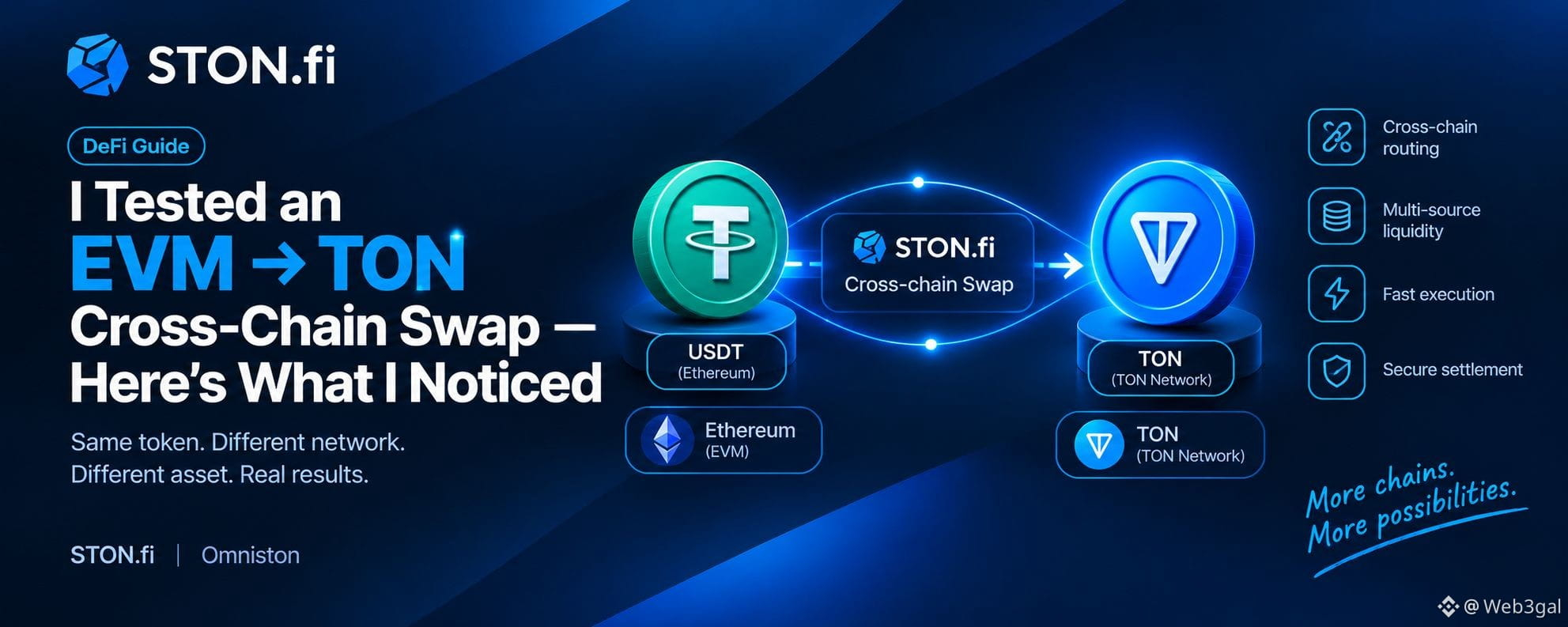
I wanted to see what an EVM → TON cross-chain swap actually looks like in practice, so I tested the flow on STON.fi.
I started with 50 USDT and selected TON as the destination.
The quote showed 34.6127 TON, with an estimated value of around $49.87 against the $50 sent.
What caught my attention wasn’t the small difference in value. It was the destination asset.
It’s easy to think:
USDT → USDT
But the actual swap was:
USDT on Ethereum → TON on TON
That made one thing clear: with cross-chain swaps, checking the destination is just as important as checking what you’re sending.
The interface showed the expected output and route before confirmation, while Omniston handled the routing and cross-chain execution using available liquidity.
The useful part of the test wasn’t simply seeing the swap go through. It was seeing how many details are worth checking before confirming:
Source asset → Source network → Destination asset → Destination network → Expected output
When you’re moving between chains, those details matter.
https://ston.fi/omniston
#STONfi #Omniston #TON #TON #CrossChain
I wanted to see what an EVM → TON cross-chain swap actually looks like in practice, so I tested the flow on STON.fi.
I started with 50 USDT and selected TON as the destination.
The quote showed 34.6127 TON, with an estimated value of around $49.87 against the $50 sent.
What caught my attention wasn’t the small difference in value. It was the destination asset.
It’s easy to think:
USDT → USDT
But the actual swap was:
USDT on Ethereum → TON on TON
That made one thing clear: with cross-chain swaps, checking the destination is just as important as checking what you’re sending.
The interface showed the expected output and route before confirmation, while Omniston handled the routing and cross-chain execution using available liquidity.
The useful part of the test wasn’t simply seeing the swap go through. It was seeing how many details are worth checking before confirming:
Source asset → Source network → Destination asset → Destination network → Expected output
When you’re moving between chains, those details matter.
https://ston.fi/omniston
#STONfi #Omniston #TON #TON #CrossChain
I started with 50 USDT and selected TON as the destination.
The quote showed 34.6127 TON, with an estimated value of around $49.87 against the $50 sent.
What caught my attention wasn’t the small difference in value. It was the destination asset.
It’s easy to think:
USDT → USDT
But the actual swap was:
USDT on Ethereum → TON on TON
That made one thing clear: with cross-chain swaps, checking the destination is just as important as checking what you’re sending.
The interface showed the expected output and route before confirmation, while Omniston handled the routing and cross-chain execution using available liquidity.
The useful part of the test wasn’t simply seeing the swap go through. It was seeing how many details are worth checking before confirming:
Source asset → Source network → Destination asset → Destination network → Expected output
When you’re moving between chains, those details matter.
https://ston.fi/omniston
#STONfi #Omniston #TON #TON #CrossChain
1
228

·
--
What if moving between blockchains felt like changing lanes instead of changing roads?Today, TON, Ethereum, BNB Chain, Base, Arbitrum, TRON and others have separate liquidity and applications.
Moving between them can mean dealing with bridges, wallets, gas, routes and execution.
For users, that’s friction.
STON.fi’s Omniston is being built as cross-chain execution infrastructure that coordinates quotes, liquidity and settlement across supported networks.
The bigger idea:
Users shouldn’t need to understand the infrastructure.
Choose what you have.
Choose what you want.
Choose where it should arrive.
Let the infrastructure handle the complexity.
The best cross-chain experience may simply feel like changing #ton #DeFi #CrossChain
What if moving between blockchains felt like changing lanes instead of changing roads?
Today, TON, Ethereum, BNB Chain, Base, Arbitrum, TRON and others have separate liquidity and applications.
Moving between them can mean dealing with bridges, wallets, gas, routes and execution.
For users, that’s friction.
STON.fi’s Omniston is being built as cross-chain execution infrastructure that coordinates quotes, liquidity and settlement across supported networks.
The bigger idea:
Users shouldn’t need to understand the infrastructure.
Choose what you have.
Choose what you want.
Choose where it should arrive.
Let the infrastructure handle the complexity.
The best cross-chain experience may simply feel like changing #ton #DeFi #CrossChain
Moving between them can mean dealing with bridges, wallets, gas, routes and execution.
For users, that’s friction.
STON.fi’s Omniston is being built as cross-chain execution infrastructure that coordinates quotes, liquidity and settlement across supported networks.
The bigger idea:
Users shouldn’t need to understand the infrastructure.
Choose what you have.
Choose what you want.
Choose where it should arrive.
Let the infrastructure handle the complexity.
The best cross-chain experience may simply feel like changing #ton #DeFi #CrossChain
112

·
--
Most Cross-Chain Campaigns Start With a Swap. STON.fi Starts With Context.
Cross-chain activity can feel complicated when users have to figure out the mechanics before they even understand what they’re participating in.
That’s what makes STON.fi’s “One Swap. Across Chains” campaign interesting.
Instead of pushing users straight into a swap, the campaign begins with a 2 week waitlist phase.
During this period, users have the opportunity to become a Priority Passenger before the main campaign gets underway.
What happens during the waitlist?
Connect a TON wallet and join the waitlist.
The first 1,000 eligible participants can receive:
• 1,000 bonus miles
• A personalized Priority Passenger Ticket
And the interesting part is that these aren’t simply points sitting on a dashboard.
They are miles that can be used toward limited Flight Deals released throughout the campaign.
So the campaign experience becomes:
Waitlist → Earn Miles → Unlock Flight Deals → Explore Cross-Chain Swaps
That structure gives the early stage a purpose beyond simply collecting signups.
It also gives users an opportunity to become familiar with how STON.fi approaches cross-chain activity before jumping into the actual swap experience.
Why the waitlist matters
The campaign is designed around participation from the beginning.
Rather than:
Swap first → understand later
the experience is closer to:
Join early → explore the system → earn miles → participate with context
There is also a time sensitive element.
Only 1,000 Priority Passenger spots are available, and the 1,000 mile joining bonus is tied to the waitlist stage.
Once that stage closes, that specific early participant opportunity is no longer available.
For anyone already exploring cross-chain swaps, TON, or the STON.fi ecosystem, the waitlist is worth checking out while it remains open.
🔗 cross-chain.ston.fi
@ston_fi @ton_blockchain
#STONfi #TON #defi #CrossChain
Most Cross-Chain Campaigns Start With a Swap. STON.fi Starts With Context.
Cross-chain activity can feel complicated when users have to figure out the mechanics before they even understand what they’re participating in.
That’s what makes STON.fi’s “One Swap. Across Chains” campaign interesting.
Instead of pushing users straight into a swap, the campaign begins with a 2 week waitlist phase.
During this period, users have the opportunity to become a Priority Passenger before the main campaign gets underway.
What happens during the waitlist?
Connect a TON wallet and join the waitlist.
The first 1,000 eligible participants can receive:
• 1,000 bonus miles
• A personalized Priority Passenger Ticket
And the interesting part is that these aren’t simply points sitting on a dashboard.
They are miles that can be used toward limited Flight Deals released throughout the campaign.
So the campaign experience becomes:
Waitlist → Earn Miles → Unlock Flight Deals → Explore Cross-Chain Swaps
That structure gives the early stage a purpose beyond simply collecting signups.
It also gives users an opportunity to become familiar with how STON.fi approaches cross-chain activity before jumping into the actual swap experience.
Why the waitlist matters
The campaign is designed around participation from the beginning.
Rather than:
Swap first → understand later
the experience is closer to:
Join early → explore the system → earn miles → participate with context
There is also a time sensitive element.
Only 1,000 Priority Passenger spots are available, and the 1,000 mile joining bonus is tied to the waitlist stage.
Once that stage closes, that specific early participant opportunity is no longer available.
For anyone already exploring cross-chain swaps, TON, or the STON.fi ecosystem, the waitlist is worth checking out while it remains open.
🔗 cross-chain.ston.fi
@ston_fi @ton_blockchain
#STONfi #TON #defi #CrossChain
Cross-chain activity can feel complicated when users have to figure out the mechanics before they even understand what they’re participating in.
That’s what makes STON.fi’s “One Swap. Across Chains” campaign interesting.
Instead of pushing users straight into a swap, the campaign begins with a 2 week waitlist phase.
During this period, users have the opportunity to become a Priority Passenger before the main campaign gets underway.
What happens during the waitlist?
Connect a TON wallet and join the waitlist.
The first 1,000 eligible participants can receive:
• 1,000 bonus miles
• A personalized Priority Passenger Ticket
And the interesting part is that these aren’t simply points sitting on a dashboard.
They are miles that can be used toward limited Flight Deals released throughout the campaign.
So the campaign experience becomes:
Waitlist → Earn Miles → Unlock Flight Deals → Explore Cross-Chain Swaps
That structure gives the early stage a purpose beyond simply collecting signups.
It also gives users an opportunity to become familiar with how STON.fi approaches cross-chain activity before jumping into the actual swap experience.
Why the waitlist matters
The campaign is designed around participation from the beginning.
Rather than:
Swap first → understand later
the experience is closer to:
Join early → explore the system → earn miles → participate with context
There is also a time sensitive element.
Only 1,000 Priority Passenger spots are available, and the 1,000 mile joining bonus is tied to the waitlist stage.
Once that stage closes, that specific early participant opportunity is no longer available.
For anyone already exploring cross-chain swaps, TON, or the STON.fi ecosystem, the waitlist is worth checking out while it remains open.
🔗 cross-chain.ston.fi
@ston_fi @ton_blockchain
#STONfi #TON #defi #CrossChain

72

·
--
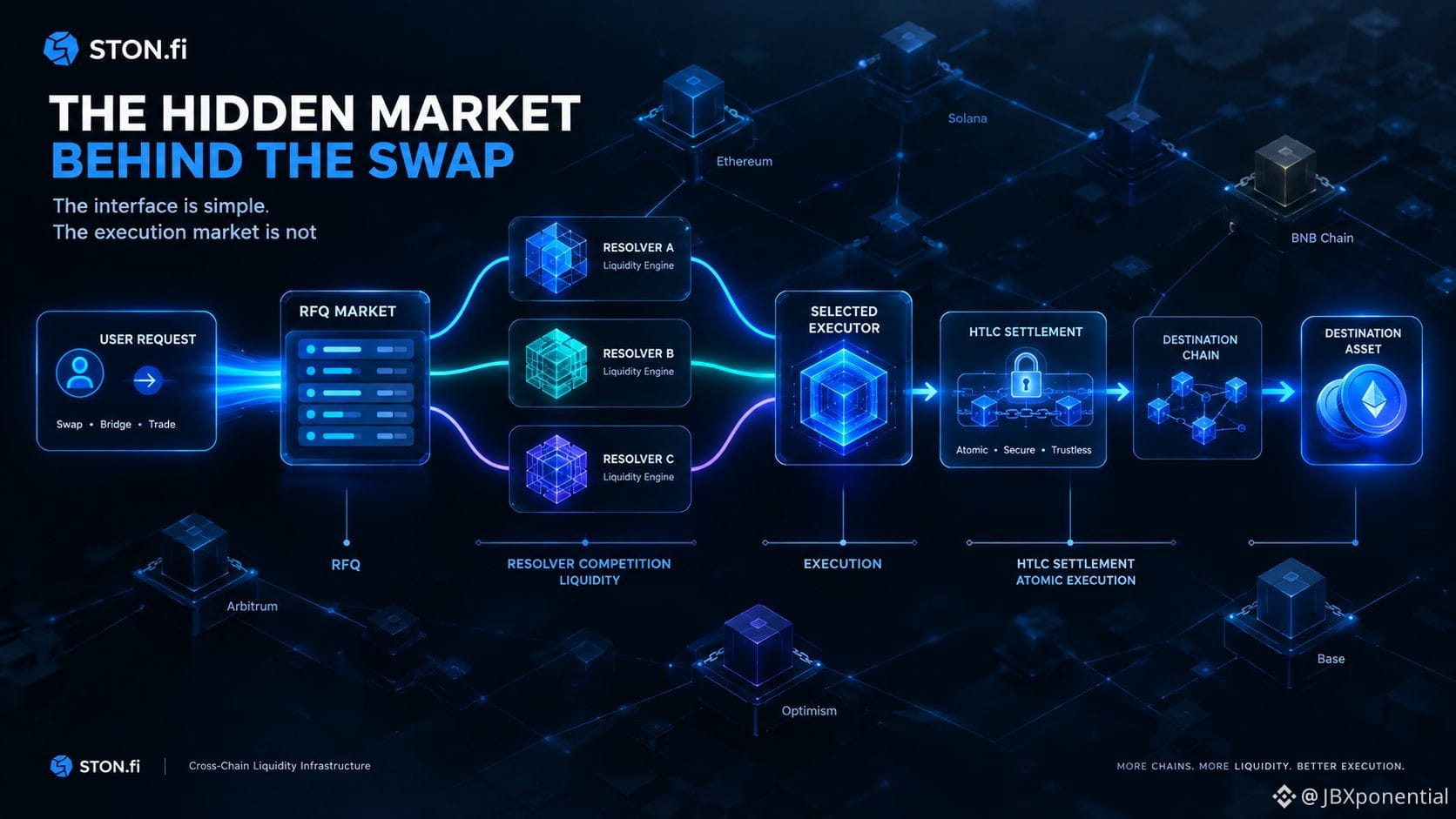
The Hidden Market Behind a Cross-Chain Swap
Most users think about a cross-chain transaction like this:
Asset A → Bridge → Asset B
But resolver-based systems introduce a different architecture.
A user can submit a cross-chain request, resolvers compete to fill it, and the selected resolver participates in settlement using cryptographic conditions enforced through HTLCs.
That creates several layers worth studying:
1. RFQ layer
The user requests an executable quote.
2. Resolver layer
Liquidity providers compete to fulfil the request.
3. Execution layer
The resolver supplies the destination-side asset.
4. Settlement layer
The transaction follows predefined cryptographic conditions.
5. Recovery layer
Timelock mechanisms provide a path for refunds when the intended settlement does not complete.
This is why cross-chain infrastructure deserves more attention than simply asking:
“Which chain does this support?”
A better research question is:
“How does the system coordinate liquidity and settlement across chains?”
That is where much of the actual architecture lives.
STON.fi's current cross-chain implementation uses Omniston for this execution model.
@ston_fi #STON.fi $STON #Stonbassador #DeFi #TON #CrossChain #Omniston
The Hidden Market Behind a Cross-Chain Swap
Most users think about a cross-chain transaction like this:
Asset A → Bridge → Asset B
But resolver-based systems introduce a different architecture.
A user can submit a cross-chain request, resolvers compete to fill it, and the selected resolver participates in settlement using cryptographic conditions enforced through HTLCs.
That creates several layers worth studying:
1. RFQ layer
The user requests an executable quote.
2. Resolver layer
Liquidity providers compete to fulfil the request.
3. Execution layer
The resolver supplies the destination-side asset.
4. Settlement layer
The transaction follows predefined cryptographic conditions.
5. Recovery layer
Timelock mechanisms provide a path for refunds when the intended settlement does not complete.
This is why cross-chain infrastructure deserves more attention than simply asking:
“Which chain does this support?”
A better research question is:
“How does the system coordinate liquidity and settlement across chains?”
That is where much of the actual architecture lives.
STON.fi's current cross-chain implementation uses Omniston for this execution model.
@ston_fi #STON.fi $STON #Stonbassador #DeFi #TON #CrossChain #Omniston
Most users think about a cross-chain transaction like this:
Asset A → Bridge → Asset B
But resolver-based systems introduce a different architecture.
A user can submit a cross-chain request, resolvers compete to fill it, and the selected resolver participates in settlement using cryptographic conditions enforced through HTLCs.
That creates several layers worth studying:
1. RFQ layer
The user requests an executable quote.
2. Resolver layer
Liquidity providers compete to fulfil the request.
3. Execution layer
The resolver supplies the destination-side asset.
4. Settlement layer
The transaction follows predefined cryptographic conditions.
5. Recovery layer
Timelock mechanisms provide a path for refunds when the intended settlement does not complete.
This is why cross-chain infrastructure deserves more attention than simply asking:
“Which chain does this support?”
A better research question is:
“How does the system coordinate liquidity and settlement across chains?”
That is where much of the actual architecture lives.
STON.fi's current cross-chain implementation uses Omniston for this execution model.
@ston_fi #STON.fi $STON #Stonbassador #DeFi #TON #CrossChain #Omniston
88
·
--
Cross-chain used to mean one thing: trust a bridge. And bridges became the industry's most expensive lesson — $2B+ lost to exploits, almost all from the same design flaw: a multisig or small validator set holding assets, waiting to be stolen.
The next phase removes the custodian. Light clients, ZK proofs, and native verification let chains verify each other's state directly — no committee holding funds, just math checking math. The question shifts from "who secures this bridge?" to "what can this chain cryptographically prove about that one?"
Watch the architecture, not the marketing. Wrapped assets are custodial trust with a token interface. Native verification is trust-minimized settlement. Same UX surface, fundamentally different failure modes: one can be hacked, the other has to be wrong about cryptography.
The endgame matters more than any single protocol. Once cross-chain verification is cheap and standard, chains stop competing on isolation and start competing as execution environments for the same global liquidity. Capital no longer picks a chain — it routes. Apps stop being chain-native and become chain-agnostic by default.
The unlock isn't better bridges. It's bridges disappearing into infrastructure — invisible, verified, boring. The most successful cross-chain tech will be the kind nobody talks about, because the security model graduated from "trust this multisig" to "verify these proofs."
That's what interoperability looks like grown up: fewer headlines, more guarantees.
$BTC $ETH $SOL
#Crypto #Blockchain #CrossChain #DeFi #Interoperability
Cross-chain used to mean one thing: trust a bridge. And bridges became the industry's most expensive lesson — $2B+ lost to exploits, almost all from the same design flaw: a multisig or small validator set holding assets, waiting to be stolen.
The next phase removes the custodian. Light clients, ZK proofs, and native verification let chains verify each other's state directly — no committee holding funds, just math checking math. The question shifts from "who secures this bridge?" to "what can this chain cryptographically prove about that one?"
Watch the architecture, not the marketing. Wrapped assets are custodial trust with a token interface. Native verification is trust-minimized settlement. Same UX surface, fundamentally different failure modes: one can be hacked, the other has to be wrong about cryptography.
The endgame matters more than any single protocol. Once cross-chain verification is cheap and standard, chains stop competing on isolation and start competing as execution environments for the same global liquidity. Capital no longer picks a chain — it routes. Apps stop being chain-native and become chain-agnostic by default.
The unlock isn't better bridges. It's bridges disappearing into infrastructure — invisible, verified, boring. The most successful cross-chain tech will be the kind nobody talks about, because the security model graduated from "trust this multisig" to "verify these proofs."
That's what interoperability looks like grown up: fewer headlines, more guarantees.
$BTC $ETH $SOL
#Crypto #Blockchain #CrossChain #DeFi #Interoperability
The next phase removes the custodian. Light clients, ZK proofs, and native verification let chains verify each other's state directly — no committee holding funds, just math checking math. The question shifts from "who secures this bridge?" to "what can this chain cryptographically prove about that one?"
Watch the architecture, not the marketing. Wrapped assets are custodial trust with a token interface. Native verification is trust-minimized settlement. Same UX surface, fundamentally different failure modes: one can be hacked, the other has to be wrong about cryptography.
The endgame matters more than any single protocol. Once cross-chain verification is cheap and standard, chains stop competing on isolation and start competing as execution environments for the same global liquidity. Capital no longer picks a chain — it routes. Apps stop being chain-native and become chain-agnostic by default.
The unlock isn't better bridges. It's bridges disappearing into infrastructure — invisible, verified, boring. The most successful cross-chain tech will be the kind nobody talks about, because the security model graduated from "trust this multisig" to "verify these proofs."
That's what interoperability looks like grown up: fewer headlines, more guarantees.
$BTC $ETH $SOL
#Crypto #Blockchain #CrossChain #DeFi #Interoperability
67


292 million dollars vanished in a rival exploit five months ago. 🚨 Now Chainlink CCIP 2.0 is handing banks the keys to run custom security checks on every cross-chain transfer. 🏦 This is how institutional infrastructure hardens after a disaster. Watch how fast traditional finance adopts native verification. $LINK #Write2Earn #CryptoSecurity #CrossChain #DeFi
292 million dollars vanished in a rival exploit five months ago. 🚨 Now Chainlink CCIP 2.0 is handing banks the keys to run custom security checks on every cross-chain transfer. 🏦 This is how institutional infrastructure hardens after a disaster. Watch how fast traditional finance adopts native verification. $LINK #Write2Earn #CryptoSecurity #CrossChain #DeFi

78
Log in to explore more content
Join global crypto users on Binance Square
⚡️ Get latest and useful information about crypto.
💬 Trusted by the world’s largest crypto exchange.
👍 Discover real insights from verified creators.
Email / Phone number
Trending Topics
1
#ADAGains10%Above$0.27
7,413 views
140 Discussing
2
#ETHUp70%InQ3ButLiquidityFalls
87,202 views
840 Discussing
3
#EthStakingExitQueueHits2026High
33,703 views
633 Discussing
4
#FedOctoberHoldOdds82.3%
32,839 views
600 Discussing
5
#Nikkei225Jumps2.5%ToThreeMonthHigh
64,911 views
984 Discussing
6
#CircleMints$2.75BUSDCOnSolanaIn7Days
1,196 views
37 Discussing
7
#DriftHackVictimsBeginClaims
152,094 views
1,624 Discussing
8
#SolanaTokenizedStockVolumeTops$4.4BInSeptember
12,038 views
129 Discussing
9
#BitcoinSpotETFsDraw$6.34BInflowsInQ3
49,150 views
259 Discussing
10
#EthereumValidatorExitQueueJumps392%
283,282 views
2,489 Discussing