

#omniston
omniston
27,766 views
383 Discussing
Hot
Latest

Should a cross-chain swap fee be something you calculate yourself, or something the interface tells you directly?
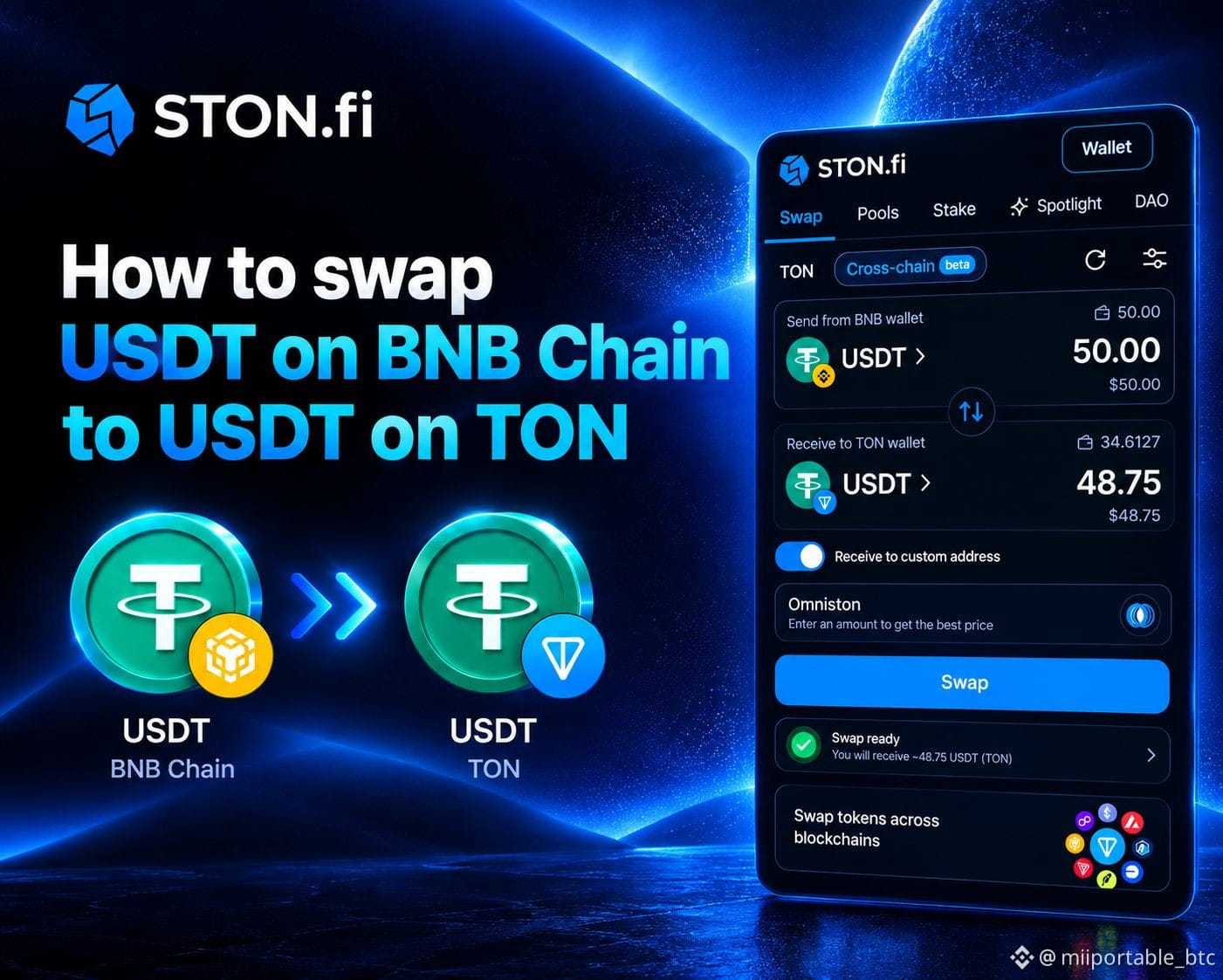
Testing BNB Chain USDT into TON USDT on STON.fi's cross-chain feature: 12.48 USDT sent, valued at $12.47, against 12.41 USDT received, valued at $12.40. Rather than leaving the actual cost implicit in the gap between those two numbers, the interface labeled this specific result best route and stated the fee outright:
0.56%. Checking that figure against the sent and received amounts confirms it lines up exactly, a small but meaningful detail, since it means the platform is showing its work rather than asking users to trust an unexplained final number.
The best route label itself is worth understanding. It implies Omniston compared available liquidity paths for this specific trade before settling on this result, rather than executing through one single fixed route regardless of conditions. That's a meaningfully different design from a simple, single-pool swap with no alternatives considered.
One caution worth stating directly. Broad network support for BNB Chain does not guarantee every specific asset pair is available and quotable at every moment. Always check the live interface for your exact route before assuming it behaves identically to any example, including this one.
$TON continues to be worth watching for cross-chain interfaces that state fees explicitly rather than leaving them for users to calculate on their own.
Ston.fi: https://ston.fi/
Cross-chain: https://app.ston.fi/swap
@stonfi @ton_blockchain
#tonecoin #DEF #Omniston
Should a cross-chain swap fee be something you calculate yourself, or something the interface tells you directly?
Testing BNB Chain USDT into TON USDT on STON.fi's cross-chain feature: 12.48 USDT sent, valued at $12.47, against 12.41 USDT received, valued at $12.40. Rather than leaving the actual cost implicit in the gap between those two numbers, the interface labeled this specific result best route and stated the fee outright:
0.56%. Checking that figure against the sent and received amounts confirms it lines up exactly, a small but meaningful detail, since it means the platform is showing its work rather than asking users to trust an unexplained final number.
The best route label itself is worth understanding. It implies Omniston compared available liquidity paths for this specific trade before settling on this result, rather than executing through one single fixed route regardless of conditions. That's a meaningfully different design from a simple, single-pool swap with no alternatives considered.
One caution worth stating directly. Broad network support for BNB Chain does not guarantee every specific asset pair is available and quotable at every moment. Always check the live interface for your exact route before assuming it behaves identically to any example, including this one.
$TON continues to be worth watching for cross-chain interfaces that state fees explicitly rather than leaving them for users to calculate on their own.
Ston.fi: https://ston.fi/
Cross-chain: https://app.ston.fi/swap
@STONfi DEX @Ton Network
#tonecoin #DEF #Omniston
Testing BNB Chain USDT into TON USDT on STON.fi's cross-chain feature: 12.48 USDT sent, valued at $12.47, against 12.41 USDT received, valued at $12.40. Rather than leaving the actual cost implicit in the gap between those two numbers, the interface labeled this specific result best route and stated the fee outright:
0.56%. Checking that figure against the sent and received amounts confirms it lines up exactly, a small but meaningful detail, since it means the platform is showing its work rather than asking users to trust an unexplained final number.
The best route label itself is worth understanding. It implies Omniston compared available liquidity paths for this specific trade before settling on this result, rather than executing through one single fixed route regardless of conditions. That's a meaningfully different design from a simple, single-pool swap with no alternatives considered.
One caution worth stating directly. Broad network support for BNB Chain does not guarantee every specific asset pair is available and quotable at every moment. Always check the live interface for your exact route before assuming it behaves identically to any example, including this one.
$TON continues to be worth watching for cross-chain interfaces that state fees explicitly rather than leaving them for users to calculate on their own.
Ston.fi: https://ston.fi/
Cross-chain: https://app.ston.fi/swap
@STONfi DEX @Ton Network
#tonecoin #DEF #Omniston
79

·
--
Omniston Hits $7.5M: The Cross-Chain Surge
Cross-chain adoption is often measured by how many networks a protocol supports. I think an important question everyone needs to have in mind is: are people actually using those connections?
Omniston’s latest milestone is worth taking note of. Its cumulative cross-chain swap volume has now surpassed $7.5 million, more than doubling the $3 million milestone reached earlier this month. $GRAM
The difference between $3 million and $7.5 million represents a 2.5× increase from the earlier milestone.
And the weekly numbers provide another useful piece of context.
Between September 17 and September 23, Omniston processed approximately $1.8 million in cross-chain volume, representing a 26% increase from the previous week.
The most revealing statistic for me is not actually the $7.5 million. It is the route concentration.
During the September 17–23 period, BNB Chain → TON accounted for 78% of Omniston's cross-chain volume.
That is a large share. If the weekly volume was approximately $1.8 million, 78% would translate to roughly $1.4 million moving along that route.
That tells us something important about how cross-chain products are actually used.
Users do not necessarily distribute their activity evenly across every available network. They tend to follow specific liquidity needs, assets, opportunities, and destinations.
This is why a long supported-chain list can sometimes be misleading.
A protocol could theoretically support ten networks, but if most users repeatedly move between two of them, those two connections are doing most of the practical work.
For me, the $7.5 million milestone matters as evidence that Omniston is beginning to generate measurable cross-chain activity at a faster pace.
The $3 million → $7.5 million jump is significant.
The $1.8 million weekly volume is another useful signal.
But the 78% BNB Chain → TON concentration is perhaps the most interesting piece of information because it shows where actual demand is currently clustering.
$BTC $ETH #TrendingTopic #Omniston
Omniston Hits $7.5M: The Cross-Chain Surge
Cross-chain adoption is often measured by how many networks a protocol supports. I think an important question everyone needs to have in mind is: are people actually using those connections?
Omniston’s latest milestone is worth taking note of. Its cumulative cross-chain swap volume has now surpassed $7.5 million, more than doubling the $3 million milestone reached earlier this month. $GRAM
The difference between $3 million and $7.5 million represents a 2.5× increase from the earlier milestone.
And the weekly numbers provide another useful piece of context.
Between September 17 and September 23, Omniston processed approximately $1.8 million in cross-chain volume, representing a 26% increase from the previous week.
The most revealing statistic for me is not actually the $7.5 million. It is the route concentration.
During the September 17–23 period, BNB Chain → TON accounted for 78% of Omniston's cross-chain volume.
That is a large share. If the weekly volume was approximately $1.8 million, 78% would translate to roughly $1.4 million moving along that route.
That tells us something important about how cross-chain products are actually used.
Users do not necessarily distribute their activity evenly across every available network. They tend to follow specific liquidity needs, assets, opportunities, and destinations.
This is why a long supported-chain list can sometimes be misleading.
A protocol could theoretically support ten networks, but if most users repeatedly move between two of them, those two connections are doing most of the practical work.
For me, the $7.5 million milestone matters as evidence that Omniston is beginning to generate measurable cross-chain activity at a faster pace.
The $3 million → $7.5 million jump is significant.
The $1.8 million weekly volume is another useful signal.
But the 78% BNB Chain → TON concentration is perhaps the most interesting piece of information because it shows where actual demand is currently clustering.
$BTC $ETH #TrendingTopic #Omniston
Cross-chain adoption is often measured by how many networks a protocol supports. I think an important question everyone needs to have in mind is: are people actually using those connections?
Omniston’s latest milestone is worth taking note of. Its cumulative cross-chain swap volume has now surpassed $7.5 million, more than doubling the $3 million milestone reached earlier this month. $GRAM
The difference between $3 million and $7.5 million represents a 2.5× increase from the earlier milestone.
And the weekly numbers provide another useful piece of context.
Between September 17 and September 23, Omniston processed approximately $1.8 million in cross-chain volume, representing a 26% increase from the previous week.
The most revealing statistic for me is not actually the $7.5 million. It is the route concentration.
During the September 17–23 period, BNB Chain → TON accounted for 78% of Omniston's cross-chain volume.
That is a large share. If the weekly volume was approximately $1.8 million, 78% would translate to roughly $1.4 million moving along that route.
That tells us something important about how cross-chain products are actually used.
Users do not necessarily distribute their activity evenly across every available network. They tend to follow specific liquidity needs, assets, opportunities, and destinations.
This is why a long supported-chain list can sometimes be misleading.
A protocol could theoretically support ten networks, but if most users repeatedly move between two of them, those two connections are doing most of the practical work.
For me, the $7.5 million milestone matters as evidence that Omniston is beginning to generate measurable cross-chain activity at a faster pace.
The $3 million → $7.5 million jump is significant.
The $1.8 million weekly volume is another useful signal.
But the 78% BNB Chain → TON concentration is perhaps the most interesting piece of information because it shows where actual demand is currently clustering.
$BTC $ETH #TrendingTopic #Omniston

1
293

·
--
Article
Omniston Is Expanding Beyond STON.fi: What the MoonPay Trade Integration MeansThere is an interesting development around STON.fi that is easy to overlook if you only think of it as a DEX on TON.
Omniston has now been integrated into MoonPay Trade.
At first glance, this might look like another integration announcement.
I think the more interesting question is:
Why does an infrastructure built by STON.fi matter when other wallets and applications start using it?
Let’s break it down.
What is Omniston?
Omniston is STON.fi’s cross-chain execution layer.
The idea is relatively simple:
Instead of every wallet, aggregator or DeFi application having to build its own cross-chain execution infrastructure, they can integrate with Omniston.
Under the hood, Omniston uses a resolver-based model.
When a user wants to execute a trade, resolvers compete to provide liquidity and fulfill the request. Settlement is coordinated through linked Hashed Timelock Contracts (HTLCs).
The important part is that the system is designed around atomic execution.
Either the swap completes according to the agreed conditions, or the funds can be refunded through the timelock mechanism.
That is a very different architecture from the traditional “lock an asset here, mint a wrapped representation there” bridge model.
So, what does MoonPay Trade add?
MoonPay Trade provides a unified API for on-chain execution, settlement, asset conversion and payments across hundreds of chains and protocols.
With Omniston integrated into that infrastructure, TON trades can now become accessible to applications and partners using MoonPay Trade.
STON.fi specifically points to wallets and apps such as Keeper as examples of products that can make TON assets available inside their own trading experience.
And this is where the integration becomes more interesting.
The user doesn't necessarily need to know that Omniston is sitting underneath the experience.
They simply interact with the wallet or application.
The infrastructure does the difficult work in the background.
Why this matters for TON
One of the recurring challenges in crypto is liquidity fragmentation.
There are thousands of tokens, multiple chains, different wallets, different liquidity venues and different execution systems.
Users don't necessarily care which infrastruc kiture provider is routing the trade.
They care about things like:
✓ Can I access the asset?
✓ Can I get a reasonable quote?
✓ How much will I receive?
✓ How long will the transaction take?
✓ Do I have to move through another platform first?
This is why infrastructure integrations can matter more than another interface feature.
If more wallets and applications can access TON liquidity through the same underlying infrastructure, TON assets can potentially become easier to reach outside the TON-native ecosystem.
The bigger idea behind Omniston
This is also why I think it is useful to look at Omniston separately from STON.fi's trading interface.
STON.fi is the product users can interact with.
Omniston is infrastructure that other applications can build on.
That distinction matters.
According to STON.fi's documentation, Omniston is designed to be integrated by wallets, aggregators, exchanges and DeFi applications through its developer infrastructure.
So the long-term question isn't simply:
“How many people use STON.fi?”
There is another question:
“How many applications can use Omniston to make cross-chain or TON liquidity easier to access?”
That's a much broader infrastructure thesis.
And this is where cross-chain becomes interesting
STON.fi's current product direction goes beyond TON-only swaps.
Its platform now positions itself around access to DeFi across TON, EVM chains and TRON, while Omniston provides the execution layer for cross-chain swaps.
For users, that means the complexity of moving between ecosystems can increasingly happen behind the interface.
For developers, it means they don't necessarily have to build every piece of that infrastructure themselves.
That difference is important.
What I'm watching next
For me, the interesting part of this integration isn't the announcement itself.
I'd be watching three things:
1. Actual usage
How much real trading activity starts flowing through integrations using Omniston?
2. More integrations
Does this remain a small number of partners, or does Omniston become infrastructure used across multiple wallets, aggregators and DeFi applications?
3. Execution quality
Cross-chain infrastructure ultimately has to deliver more than connectivity.
Quotes, liquidity, fees, settlement time and failure handling all matter.
If the infrastructure works well but users consistently get poor execution, adoption becomes difficult.
Final thought
The MoonPay Trade integration gives us another way to look at what STON.fi is building.
It isn't only about giving users another place to swap tokens.
The bigger idea is making liquidity and execution more accessible to other applications.
If Omniston can become infrastructure that wallets, aggregators and DeFi apps plug into, then STON.fi's reach doesn't have to be limited to its own interface.
And that's the part I'll be watching.
Not just:
“Where can I swap tokens?”
But:
“How is STON.fi trying to make liquidity across different chains easier for applications and users to access?”
That is where the infrastructure story gets interesting.
#Omniston #Toncoin #defi #cryptooinsigts #STONfi
$TON $BTC
Omniston Is Expanding Beyond STON.fi: What the MoonPay Trade Integration Means
There is an interesting development around STON.fi that is easy to overlook if you only think of it as a DEX on TON.
Omniston has now been integrated into MoonPay Trade.
At first glance, this might look like another integration announcement.
I think the more interesting question is:
Why does an infrastructure built by STON.fi matter when other wallets and applications start using it?
Let’s break it down.
What is Omniston?
Omniston is STON.fi’s cross-chain execution layer.
The idea is relatively simple:
Instead of every wallet, aggregator or DeFi application having to build its own cross-chain execution infrastructure, they can integrate with Omniston.
Under the hood, Omniston uses a resolver-based model.
When a user wants to execute a trade, resolvers compete to provide liquidity and fulfill the request. Settlement is coordinated through linked Hashed Timelock Contracts (HTLCs).
The important part is that the system is designed around atomic execution.
Either the swap completes according to the agreed conditions, or the funds can be refunded through the timelock mechanism.
That is a very different architecture from the traditional “lock an asset here, mint a wrapped representation there” bridge model.
So, what does MoonPay Trade add?
MoonPay Trade provides a unified API for on-chain execution, settlement, asset conversion and payments across hundreds of chains and protocols.
With Omniston integrated into that infrastructure, TON trades can now become accessible to applications and partners using MoonPay Trade.
STON.fi specifically points to wallets and apps such as Keeper as examples of products that can make TON assets available inside their own trading experience.
And this is where the integration becomes more interesting.
The user doesn't necessarily need to know that Omniston is sitting underneath the experience.
They simply interact with the wallet or application.
The infrastructure does the difficult work in the background.
Why this matters for TON
One of the recurring challenges in crypto is liquidity fragmentation.
There are thousands of tokens, multiple chains, different wallets, different liquidity venues and different execution systems.
Users don't necessarily care which infrastruc kiture provider is routing the trade.
They care about things like:
✓ Can I access the asset?
✓ Can I get a reasonable quote?
✓ How much will I receive?
✓ How long will the transaction take?
✓ Do I have to move through another platform first?
This is why infrastructure integrations can matter more than another interface feature.
If more wallets and applications can access TON liquidity through the same underlying infrastructure, TON assets can potentially become easier to reach outside the TON-native ecosystem.
The bigger idea behind Omniston
This is also why I think it is useful to look at Omniston separately from STON.fi's trading interface.
STON.fi is the product users can interact with.
Omniston is infrastructure that other applications can build on.
That distinction matters.
According to STON.fi's documentation, Omniston is designed to be integrated by wallets, aggregators, exchanges and DeFi applications through its developer infrastructure.
So the long-term question isn't simply:
“How many people use STON.fi?”
There is another question:
“How many applications can use Omniston to make cross-chain or TON liquidity easier to access?”
That's a much broader infrastructure thesis.
And this is where cross-chain becomes interesting
STON.fi's current product direction goes beyond TON-only swaps.
Its platform now positions itself around access to DeFi across TON, EVM chains and TRON, while Omniston provides the execution layer for cross-chain swaps.
For users, that means the complexity of moving between ecosystems can increasingly happen behind the interface.
For developers, it means they don't necessarily have to build every piece of that infrastructure themselves.
That difference is important.
What I'm watching next
For me, the interesting part of this integration isn't the announcement itself.
I'd be watching three things:
1. Actual usage
How much real trading activity starts flowing through integrations using Omniston?
2. More integrations
Does this remain a small number of partners, or does Omniston become infrastructure used across multiple wallets, aggregators and DeFi applications?
3. Execution quality
Cross-chain infrastructure ultimately has to deliver more than connectivity.
Quotes, liquidity, fees, settlement time and failure handling all matter.
If the infrastructure works well but users consistently get poor execution, adoption becomes difficult.
Final thought
The MoonPay Trade integration gives us another way to look at what STON.fi is building.
It isn't only about giving users another place to swap tokens.
The bigger idea is making liquidity and execution more accessible to other applications.
If Omniston can become infrastructure that wallets, aggregators and DeFi apps plug into, then STON.fi's reach doesn't have to be limited to its own interface.
And that's the part I'll be watching.
Not just:
“Where can I swap tokens?”
But:
“How is STON.fi trying to make liquidity across different chains easier for applications and users to access?”
That is where the infrastructure story gets interesting.
#Omniston #Toncoin #defi #cryptooinsigts #STONfi
$TON $BTC
Omniston has now been integrated into MoonPay Trade.
At first glance, this might look like another integration announcement.
I think the more interesting question is:
Why does an infrastructure built by STON.fi matter when other wallets and applications start using it?
Let’s break it down.
What is Omniston?
Omniston is STON.fi’s cross-chain execution layer.
The idea is relatively simple:
Instead of every wallet, aggregator or DeFi application having to build its own cross-chain execution infrastructure, they can integrate with Omniston.
Under the hood, Omniston uses a resolver-based model.
When a user wants to execute a trade, resolvers compete to provide liquidity and fulfill the request. Settlement is coordinated through linked Hashed Timelock Contracts (HTLCs).
The important part is that the system is designed around atomic execution.
Either the swap completes according to the agreed conditions, or the funds can be refunded through the timelock mechanism.
That is a very different architecture from the traditional “lock an asset here, mint a wrapped representation there” bridge model.
So, what does MoonPay Trade add?
MoonPay Trade provides a unified API for on-chain execution, settlement, asset conversion and payments across hundreds of chains and protocols.
With Omniston integrated into that infrastructure, TON trades can now become accessible to applications and partners using MoonPay Trade.
STON.fi specifically points to wallets and apps such as Keeper as examples of products that can make TON assets available inside their own trading experience.
And this is where the integration becomes more interesting.
The user doesn't necessarily need to know that Omniston is sitting underneath the experience.
They simply interact with the wallet or application.
The infrastructure does the difficult work in the background.
Why this matters for TON
One of the recurring challenges in crypto is liquidity fragmentation.
There are thousands of tokens, multiple chains, different wallets, different liquidity venues and different execution systems.
Users don't necessarily care which infrastruc kiture provider is routing the trade.
They care about things like:
✓ Can I access the asset?
✓ Can I get a reasonable quote?
✓ How much will I receive?
✓ How long will the transaction take?
✓ Do I have to move through another platform first?
This is why infrastructure integrations can matter more than another interface feature.
If more wallets and applications can access TON liquidity through the same underlying infrastructure, TON assets can potentially become easier to reach outside the TON-native ecosystem.
The bigger idea behind Omniston
This is also why I think it is useful to look at Omniston separately from STON.fi's trading interface.
STON.fi is the product users can interact with.
Omniston is infrastructure that other applications can build on.
That distinction matters.
According to STON.fi's documentation, Omniston is designed to be integrated by wallets, aggregators, exchanges and DeFi applications through its developer infrastructure.
So the long-term question isn't simply:
“How many people use STON.fi?”
There is another question:
“How many applications can use Omniston to make cross-chain or TON liquidity easier to access?”
That's a much broader infrastructure thesis.
And this is where cross-chain becomes interesting
STON.fi's current product direction goes beyond TON-only swaps.
Its platform now positions itself around access to DeFi across TON, EVM chains and TRON, while Omniston provides the execution layer for cross-chain swaps.
For users, that means the complexity of moving between ecosystems can increasingly happen behind the interface.
For developers, it means they don't necessarily have to build every piece of that infrastructure themselves.
That difference is important.
What I'm watching next
For me, the interesting part of this integration isn't the announcement itself.
I'd be watching three things:
1. Actual usage
How much real trading activity starts flowing through integrations using Omniston?
2. More integrations
Does this remain a small number of partners, or does Omniston become infrastructure used across multiple wallets, aggregators and DeFi applications?
3. Execution quality
Cross-chain infrastructure ultimately has to deliver more than connectivity.
Quotes, liquidity, fees, settlement time and failure handling all matter.
If the infrastructure works well but users consistently get poor execution, adoption becomes difficult.
Final thought
The MoonPay Trade integration gives us another way to look at what STON.fi is building.
It isn't only about giving users another place to swap tokens.
The bigger idea is making liquidity and execution more accessible to other applications.
If Omniston can become infrastructure that wallets, aggregators and DeFi apps plug into, then STON.fi's reach doesn't have to be limited to its own interface.
And that's the part I'll be watching.
Not just:
“Where can I swap tokens?”
But:
“How is STON.fi trying to make liquidity across different chains easier for applications and users to access?”
That is where the infrastructure story gets interesting.
#Omniston #Toncoin #defi #cryptooinsigts #STONfi
$TON $BTC
1
19
·
--
Article
Arc Adds a New Dimension to STON.fi Cross-Chain SwapsMoving stablecoins across blockchains still feels more complicated than it should.
A user may hold USDT on TON, want USDC somewhere else, and have no real interest in knowing which bridge, liquidity pool, resolver, or settlement mechanism makes the transaction possible. What matters is simple: how much do I send, how much do I receive, how long will it take, and where will the funds arrive?
Arc’s integration with STON.fi signals more than the addition of another blockchain; it expands the underlying liquidity network that users can access without having to navigate each chain individually. $GRAM
Circle launched Arc’s public mainnet on September 16, 2026, positioning it as an open Layer-1 built specifically around financial markets, real-time money movement and stablecoin-based activity. Arc uses USDC for network fees, rather than requiring users to maintain a separate volatile gas token. It also targets sub-second finality and stablecoin-native financial applications.
Now, STON.fi users can access USDC on Arc through cross-chain swaps, connecting it with TON and other supported networks.
Arc Strengthens the Infrastructure Behind the Swap
There are already plenty of blockchains. That is not the shortage.
The real problem is that liquidity, assets, wallets, gas requirements and applications are still fragmented between them.
Adding another chain can actually make this problem worse if users are expected to understand every network individually.
Arc takes an interesting approach because it is being designed around stablecoin finance from the beginning.
USDC is not simply another token available on Arc. It is integrated into the network's fee model, meaning users can pay network fees in USDC rather than having to acquire a separate native gas asset.
From a user's perspective, that distinction matters. Imagine I have USDC and want to move value into another ecosystem.
On a conventional network, I may need to think about:
USDC → gas token → transaction → bridge → destination token → another gas requirement.
The more steps involved, the more opportunities there are for confusion.
Arc is attempting to remove at least one of those complications at the network level.
And when an infrastructure like Omniston is layered on top, the bigger opportunity becomes connecting that simpler stablecoin environment with liquidity elsewhere.
Cross-Chain Value Is All About the Path
Most users do not wake up thinking:
“Today I want to interact with Ethereum.”
They usually think:
“I have this asset. I want that asset.”
The blockchain is often just the infrastructure underneath the transaction.
STON.fi's Omniston architecture is designed around this abstraction. Instead of forcing users to manually discover and coordinate every route, it can use a resolver-based system to obtain quotes, coordinate execution and settle the transaction across independent networks. STON.fi describes Omniston as a cross-chain execution layer rather than a conventional bridge.
It changes the model.
The user does not necessarily need to think:
TON → bridge → Arc → swap → destination.
The experience can increasingly become:
“I have this. I want that.”
Everything between those two points becomes infrastructure.
For me, that's a much more ambitious direction for DeFi UX.
$BTC $ETH #Omniston #ARC #STONfi #TrendingTopic
Arc Adds a New Dimension to STON.fi Cross-Chain Swaps
Moving stablecoins across blockchains still feels more complicated than it should.
A user may hold USDT on TON, want USDC somewhere else, and have no real interest in knowing which bridge, liquidity pool, resolver, or settlement mechanism makes the transaction possible. What matters is simple: how much do I send, how much do I receive, how long will it take, and where will the funds arrive?
Arc’s integration with STON.fi signals more than the addition of another blockchain; it expands the underlying liquidity network that users can access without having to navigate each chain individually. $GRAM
Circle launched Arc’s public mainnet on September 16, 2026, positioning it as an open Layer-1 built specifically around financial markets, real-time money movement and stablecoin-based activity. Arc uses USDC for network fees, rather than requiring users to maintain a separate volatile gas token. It also targets sub-second finality and stablecoin-native financial applications.
Now, STON.fi users can access USDC on Arc through cross-chain swaps, connecting it with TON and other supported networks.
Arc Strengthens the Infrastructure Behind the Swap
There are already plenty of blockchains. That is not the shortage.
The real problem is that liquidity, assets, wallets, gas requirements and applications are still fragmented between them.
Adding another chain can actually make this problem worse if users are expected to understand every network individually.
Arc takes an interesting approach because it is being designed around stablecoin finance from the beginning.
USDC is not simply another token available on Arc. It is integrated into the network's fee model, meaning users can pay network fees in USDC rather than having to acquire a separate native gas asset.
From a user's perspective, that distinction matters. Imagine I have USDC and want to move value into another ecosystem.
On a conventional network, I may need to think about:
USDC → gas token → transaction → bridge → destination token → another gas requirement.
The more steps involved, the more opportunities there are for confusion.
Arc is attempting to remove at least one of those complications at the network level.
And when an infrastructure like Omniston is layered on top, the bigger opportunity becomes connecting that simpler stablecoin environment with liquidity elsewhere.
Cross-Chain Value Is All About the Path
Most users do not wake up thinking:
“Today I want to interact with Ethereum.”
They usually think:
“I have this asset. I want that asset.”
The blockchain is often just the infrastructure underneath the transaction.
STON.fi's Omniston architecture is designed around this abstraction. Instead of forcing users to manually discover and coordinate every route, it can use a resolver-based system to obtain quotes, coordinate execution and settle the transaction across independent networks. STON.fi describes Omniston as a cross-chain execution layer rather than a conventional bridge.
It changes the model.
The user does not necessarily need to think:
TON → bridge → Arc → swap → destination.
The experience can increasingly become:
“I have this. I want that.”
Everything between those two points becomes infrastructure.
For me, that's a much more ambitious direction for DeFi UX.
$BTC $ETH #Omniston #ARC #STONfi #TrendingTopic
A user may hold USDT on TON, want USDC somewhere else, and have no real interest in knowing which bridge, liquidity pool, resolver, or settlement mechanism makes the transaction possible. What matters is simple: how much do I send, how much do I receive, how long will it take, and where will the funds arrive?
Arc’s integration with STON.fi signals more than the addition of another blockchain; it expands the underlying liquidity network that users can access without having to navigate each chain individually. $GRAM
Circle launched Arc’s public mainnet on September 16, 2026, positioning it as an open Layer-1 built specifically around financial markets, real-time money movement and stablecoin-based activity. Arc uses USDC for network fees, rather than requiring users to maintain a separate volatile gas token. It also targets sub-second finality and stablecoin-native financial applications.
Now, STON.fi users can access USDC on Arc through cross-chain swaps, connecting it with TON and other supported networks.
Arc Strengthens the Infrastructure Behind the Swap
There are already plenty of blockchains. That is not the shortage.
The real problem is that liquidity, assets, wallets, gas requirements and applications are still fragmented between them.
Adding another chain can actually make this problem worse if users are expected to understand every network individually.
Arc takes an interesting approach because it is being designed around stablecoin finance from the beginning.
USDC is not simply another token available on Arc. It is integrated into the network's fee model, meaning users can pay network fees in USDC rather than having to acquire a separate native gas asset.
From a user's perspective, that distinction matters. Imagine I have USDC and want to move value into another ecosystem.
On a conventional network, I may need to think about:
USDC → gas token → transaction → bridge → destination token → another gas requirement.
The more steps involved, the more opportunities there are for confusion.
Arc is attempting to remove at least one of those complications at the network level.
And when an infrastructure like Omniston is layered on top, the bigger opportunity becomes connecting that simpler stablecoin environment with liquidity elsewhere.
Cross-Chain Value Is All About the Path
Most users do not wake up thinking:
“Today I want to interact with Ethereum.”
They usually think:
“I have this asset. I want that asset.”
The blockchain is often just the infrastructure underneath the transaction.
STON.fi's Omniston architecture is designed around this abstraction. Instead of forcing users to manually discover and coordinate every route, it can use a resolver-based system to obtain quotes, coordinate execution and settle the transaction across independent networks. STON.fi describes Omniston as a cross-chain execution layer rather than a conventional bridge.
It changes the model.
The user does not necessarily need to think:
TON → bridge → Arc → swap → destination.
The experience can increasingly become:
“I have this. I want that.”
Everything between those two points becomes infrastructure.
For me, that's a much more ambitious direction for DeFi UX.
$BTC $ETH #Omniston #ARC #STONfi #TrendingTopic
1
352

·
--
One Swap Across Chains Flight Begins Start Your Cross Chain Missions
Stonfiers the 6 week main stage of One Swap Across Chains is live This is STON fi guided cross chain exploration campaign You learn by doing how one swap can move assets across chains
Missions are more advanced now Explore real cross chain routes earn miles and unlock new weekly limited rewards
New missions new miles
Fresh cross chain swap and partner missions are live Complete them stack miles and watch your progress climb with every move across chains
Your first Flight Deals
Open the Flight Deals board and check which rewards you already qualify for Some of you are closer than you think
Flight Deals refresh each week
Flight Deals are limited offers that stay up for 7 days only Next Tuesday the lineup changes Check this weeks rewards and claim what you can
Take on new missions Let your next swap earn miles
Enter the main stage of the campaign
#STONFI #TON #Defi #Tonbuildes #omniston
One Swap Across Chains Flight Begins Start Your Cross Chain Missions
Stonfiers the 6 week main stage of One Swap Across Chains is live This is STON fi guided cross chain exploration campaign You learn by doing how one swap can move assets across chains
Missions are more advanced now Explore real cross chain routes earn miles and unlock new weekly limited rewards
New missions new miles
Fresh cross chain swap and partner missions are live Complete them stack miles and watch your progress climb with every move across chains
Your first Flight Deals
Open the Flight Deals board and check which rewards you already qualify for Some of you are closer than you think
Flight Deals refresh each week
Flight Deals are limited offers that stay up for 7 days only Next Tuesday the lineup changes Check this weeks rewards and claim what you can
Take on new missions Let your next swap earn miles
Enter the main stage of the campaign
#STONFI #TON #Defi #Tonbuildes #omniston
Stonfiers the 6 week main stage of One Swap Across Chains is live This is STON fi guided cross chain exploration campaign You learn by doing how one swap can move assets across chains
Missions are more advanced now Explore real cross chain routes earn miles and unlock new weekly limited rewards
New missions new miles
Fresh cross chain swap and partner missions are live Complete them stack miles and watch your progress climb with every move across chains
Your first Flight Deals
Open the Flight Deals board and check which rewards you already qualify for Some of you are closer than you think
Flight Deals refresh each week
Flight Deals are limited offers that stay up for 7 days only Next Tuesday the lineup changes Check this weeks rewards and claim what you can
Take on new missions Let your next swap earn miles
Enter the main stage of the campaign
#STONFI #TON #Defi #Tonbuildes #omniston
44

·
--
Bullish
Verified
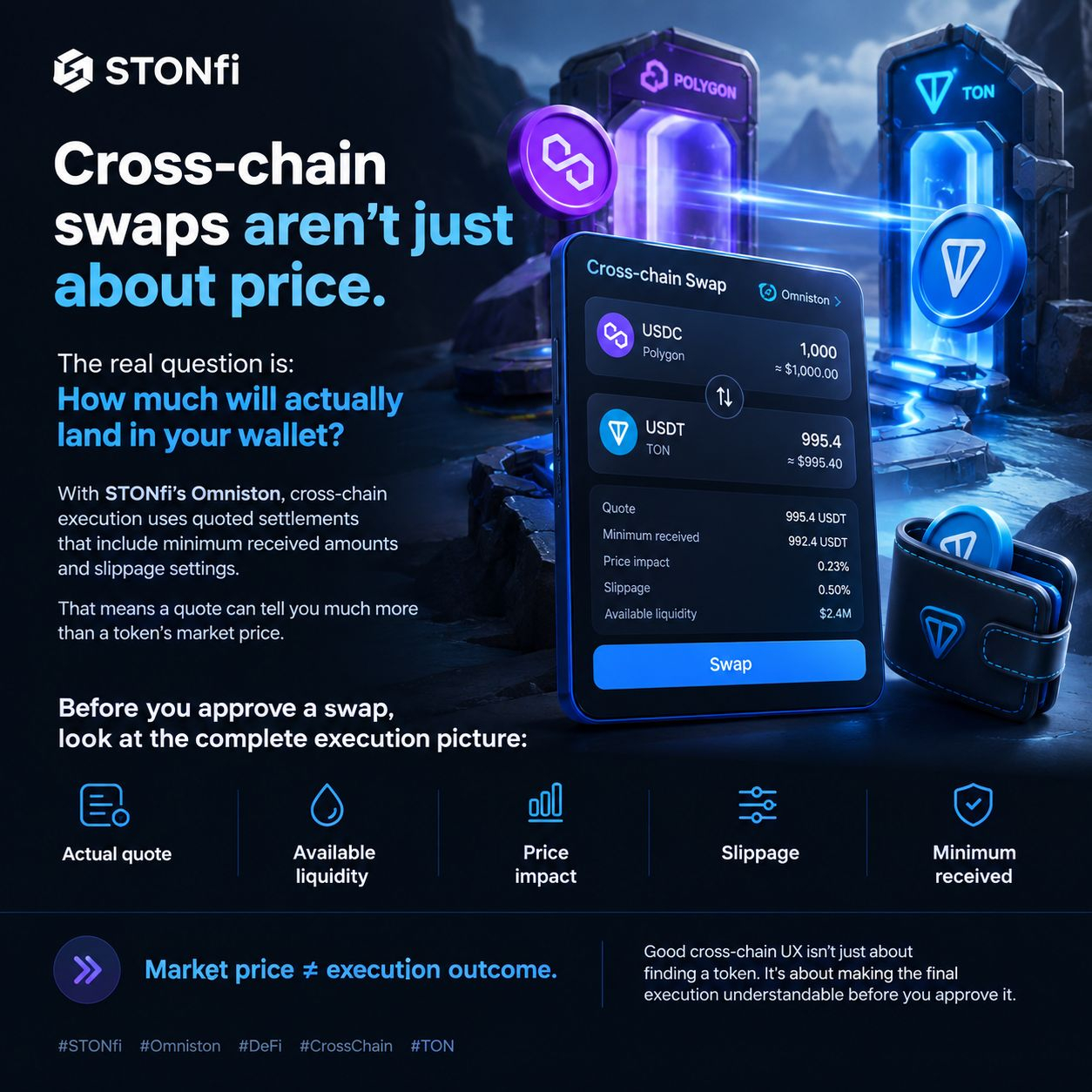
Cross-chain swaps aren’t only about price.
What matters is how much actually reaches your wallet.
With STONfi’s Omniston, quotes include minimum received amounts and slippage settings, so you can see more than a token’s market price before approving a swap.
Check:
• Actual quote
• Liquidity
• Price impact
• Slippage
• Minimum received
Your final result depends on order size, liquidity, and execution conditions—and cross-chain swaps add even more variables.
Market price ≠ execution outcome.
Don’t ask only, “What is this token worth?”
Ask, “How much will I receive, and what protects that amount?”
Good cross-chain UX makes the final result clear before you approve the swap.
#STONfi #Omniston #CrossChain #TON
$Q
{future}(QUSDT)
Cross-chain swaps aren’t only about price.
What matters is how much actually reaches your wallet.
With STONfi’s Omniston, quotes include minimum received amounts and slippage settings, so you can see more than a token’s market price before approving a swap.
Check:
• Actual quote
• Liquidity
• Price impact
• Slippage
• Minimum received
Your final result depends on order size, liquidity, and execution conditions—and cross-chain swaps add even more variables.
Market price ≠ execution outcome.
Don’t ask only, “What is this token worth?”
Ask, “How much will I receive, and what protects that amount?”
Good cross-chain UX makes the final result clear before you approve the swap.
#STONfi #Omniston #CrossChain #TON
$Q
What matters is how much actually reaches your wallet.
With STONfi’s Omniston, quotes include minimum received amounts and slippage settings, so you can see more than a token’s market price before approving a swap.
Check:
• Actual quote
• Liquidity
• Price impact
• Slippage
• Minimum received
Your final result depends on order size, liquidity, and execution conditions—and cross-chain swaps add even more variables.
Market price ≠ execution outcome.
Don’t ask only, “What is this token worth?”
Ask, “How much will I receive, and what protects that amount?”
Good cross-chain UX makes the final result clear before you approve the swap.
#STONfi #Omniston #CrossChain #TON
$Q
2
608
·
--
Bullish
What happens when you set up a cross.chain swap expecting USDT on both sides, but the destination turns out to be something else entirely?
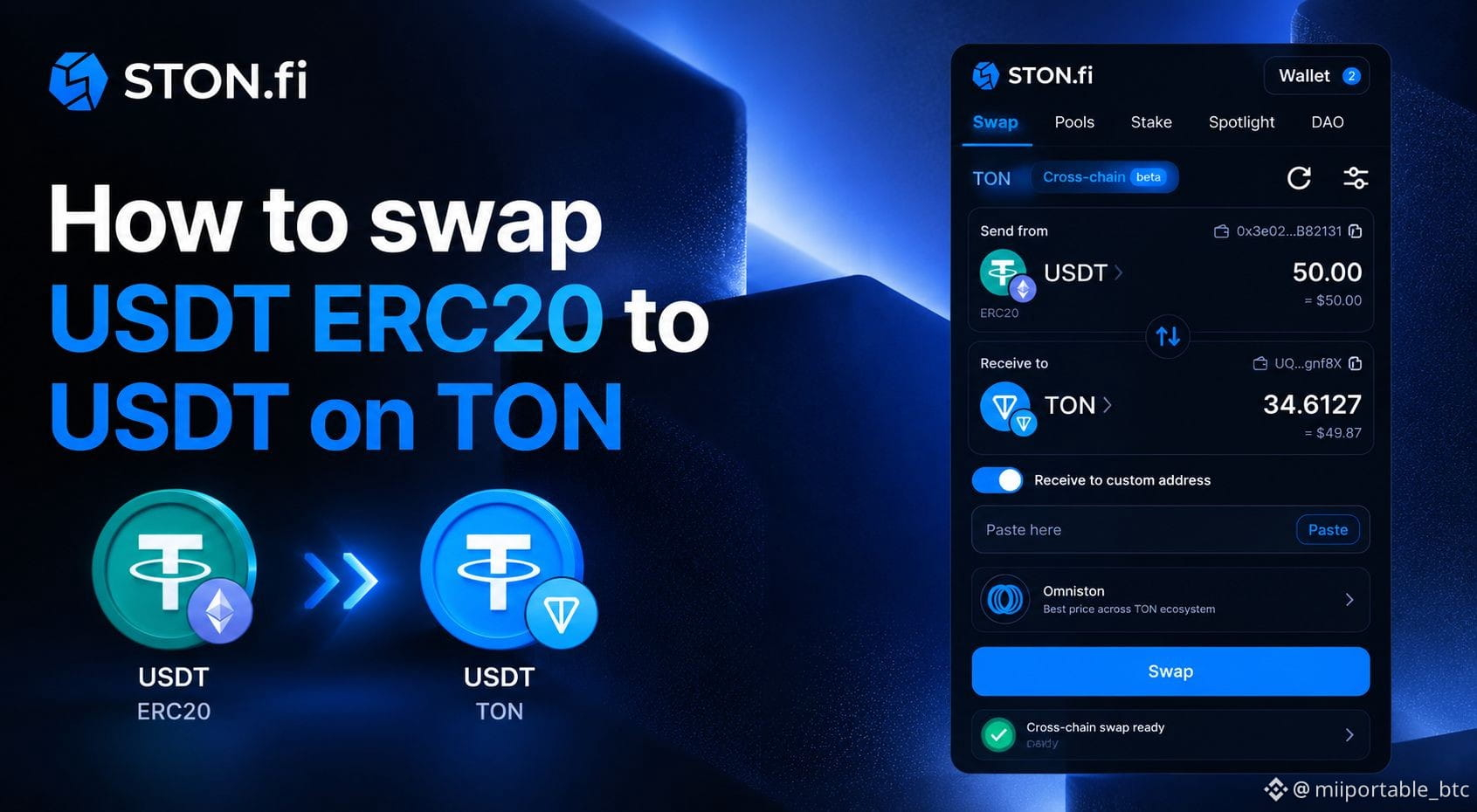
Testing an EVM to TON cross chain swap directly on STON.fi: 50 USDT sent from a connected EVM wallet, quoted against 34.6127 TON, valued at $49.87 on a $50 send. The setup began as USDT to USDT, but the actual quote settled on native TON as the destination asset rather than TON-native USDT.
This isn't a platform inconsistency, STON.fi's cross-chain interface allows either native TON or TON native USDT to be selected as the destination for an incoming EVM USDT swap, so the outcome depends entirely on which specific asset gets chosen during setup.
The Omniston line on this quote read best price across TON ecosystem, different phrasing from a live listening for updates status seen on a separate same network quote tested earlier. That distinction suggests Omniston actively compares available routes on the TON side to find the better outcome, rather than executing one fixed path regardless of conditions.
$TON continues to be worth watching for interface details like this, since assuming a like-for-like conversion without verifying the actual destination asset selected is an easy, avoidable mistake, especially for anyone newer to cross-chain swapping.
↪️Ston.fi: https://ston.fi/
↪️Cross-chain: https://app.ston.fi/swap
$GRAM
{future}(GRAMUSDT)
@stonfi @ton_blockchain
#TON #defi #Omniston
What happens when you set up a cross.chain swap expecting USDT on both sides, but the destination turns out to be something else entirely?
Testing an EVM to TON cross chain swap directly on STON.fi: 50 USDT sent from a connected EVM wallet, quoted against 34.6127 TON, valued at $49.87 on a $50 send. The setup began as USDT to USDT, but the actual quote settled on native TON as the destination asset rather than TON-native USDT.
This isn't a platform inconsistency, STON.fi's cross-chain interface allows either native TON or TON native USDT to be selected as the destination for an incoming EVM USDT swap, so the outcome depends entirely on which specific asset gets chosen during setup.
The Omniston line on this quote read best price across TON ecosystem, different phrasing from a live listening for updates status seen on a separate same network quote tested earlier. That distinction suggests Omniston actively compares available routes on the TON side to find the better outcome, rather than executing one fixed path regardless of conditions.
$TON continues to be worth watching for interface details like this, since assuming a like-for-like conversion without verifying the actual destination asset selected is an easy, avoidable mistake, especially for anyone newer to cross-chain swapping.
↪️Ston.fi: https://ston.fi/
↪️Cross-chain: https://app.ston.fi/swap
$GRAM
@STONfi DEX @Ton Network
#TON #defi #Omniston
Testing an EVM to TON cross chain swap directly on STON.fi: 50 USDT sent from a connected EVM wallet, quoted against 34.6127 TON, valued at $49.87 on a $50 send. The setup began as USDT to USDT, but the actual quote settled on native TON as the destination asset rather than TON-native USDT.
This isn't a platform inconsistency, STON.fi's cross-chain interface allows either native TON or TON native USDT to be selected as the destination for an incoming EVM USDT swap, so the outcome depends entirely on which specific asset gets chosen during setup.
The Omniston line on this quote read best price across TON ecosystem, different phrasing from a live listening for updates status seen on a separate same network quote tested earlier. That distinction suggests Omniston actively compares available routes on the TON side to find the better outcome, rather than executing one fixed path regardless of conditions.
$TON continues to be worth watching for interface details like this, since assuming a like-for-like conversion without verifying the actual destination asset selected is an easy, avoidable mistake, especially for anyone newer to cross-chain swapping.
↪️Ston.fi: https://ston.fi/
↪️Cross-chain: https://app.ston.fi/swap
$GRAM
@STONfi DEX @Ton Network
#TON #defi #Omniston
Kato Crypto:
the detail worth underlining is that the router isn't only picking a rate, it's picking what you end up holding 👀 a chain's own unit and an issuer's token can quote as the same number and still be two different claims — one settles against the network, the other against a company. so "best price across the ecosystem" is only like-for-like when both outputs are the same kind of claim. nice catch checking the destination asset and not just the figure 🙌
1
2
504
·
--
Article
TON Access Is Expanding Beyond the TON EcosystemOne of the major problems in crypto is not necessarily a lack of liquidity. It is the difficulty of getting to that liquidity in the first place.
A user may want to buy, sell, or swap a TON asset, but that can involve knowing which network to use, finding a compatible wallet, locating the right liquidity source, understanding fees, and navigating an interface they may have never used before.
The integration of STON.fi’s Omniston with MoonPay Trade represents something more interesting: TON liquidity is becoming accessible through infrastructure that users may not even realize is powered by TON-native liquidity.
MoonPay Trade is designed as a unified API for onchain execution, settlement, asset conversion, and payments across more than 200 chains and protocols.
Omniston is now integrated into that infrastructure to provide intrachain TON trading.
Omniston does not need to make every user consciously choose TON. Instead, the infrastructure can allow applications and wallets connected to MoonPay Trade to offer TON asset trading as part of their existing experience.
For the average user, the experience could simply look like:
Choose an asset → enter an amount → review the quote → confirm.
The underlying infrastructure can become almost invisible. And I think that is where the real significance lies.
Crypto Adoption Often Fails at the Interface Layer
People frequently talk about adoption as if the main challenge is convincing someone to use blockchain technology.
I think the problem is often much simpler:
People do not want to learn the architecture before using the product.
A normal user does not necessarily care whether liquidity comes from a DEX, an aggregator, a resolver, a routing system, or another settlement mechanism.
They care about a few practical questions:
How much am I sending?
How much will I receive?
What will it cost?
How long will it take?
Is the transaction actually going to work?
Can I do it from the wallet or application I already use?
Integrations like MoonPay Trade can be important. They move blockchain infrastructure one step further away from the user interface.
MoonPay Trade provides distribution, while Omniston provides access to TON's trading infrastructure.
$BTC $ETH #Omniston #MoonPay #STONfi #TrendingTopic
TON Access Is Expanding Beyond the TON Ecosystem
One of the major problems in crypto is not necessarily a lack of liquidity. It is the difficulty of getting to that liquidity in the first place.
A user may want to buy, sell, or swap a TON asset, but that can involve knowing which network to use, finding a compatible wallet, locating the right liquidity source, understanding fees, and navigating an interface they may have never used before.
The integration of STON.fi’s Omniston with MoonPay Trade represents something more interesting: TON liquidity is becoming accessible through infrastructure that users may not even realize is powered by TON-native liquidity.
MoonPay Trade is designed as a unified API for onchain execution, settlement, asset conversion, and payments across more than 200 chains and protocols.
Omniston is now integrated into that infrastructure to provide intrachain TON trading.
Omniston does not need to make every user consciously choose TON. Instead, the infrastructure can allow applications and wallets connected to MoonPay Trade to offer TON asset trading as part of their existing experience.
For the average user, the experience could simply look like:
Choose an asset → enter an amount → review the quote → confirm.
The underlying infrastructure can become almost invisible. And I think that is where the real significance lies.
Crypto Adoption Often Fails at the Interface Layer
People frequently talk about adoption as if the main challenge is convincing someone to use blockchain technology.
I think the problem is often much simpler:
People do not want to learn the architecture before using the product.
A normal user does not necessarily care whether liquidity comes from a DEX, an aggregator, a resolver, a routing system, or another settlement mechanism.
They care about a few practical questions:
How much am I sending?
How much will I receive?
What will it cost?
How long will it take?
Is the transaction actually going to work?
Can I do it from the wallet or application I already use?
Integrations like MoonPay Trade can be important. They move blockchain infrastructure one step further away from the user interface.
MoonPay Trade provides distribution, while Omniston provides access to TON's trading infrastructure.
$BTC $ETH #Omniston #MoonPay #STONfi #TrendingTopic
A user may want to buy, sell, or swap a TON asset, but that can involve knowing which network to use, finding a compatible wallet, locating the right liquidity source, understanding fees, and navigating an interface they may have never used before.
The integration of STON.fi’s Omniston with MoonPay Trade represents something more interesting: TON liquidity is becoming accessible through infrastructure that users may not even realize is powered by TON-native liquidity.
MoonPay Trade is designed as a unified API for onchain execution, settlement, asset conversion, and payments across more than 200 chains and protocols.
Omniston is now integrated into that infrastructure to provide intrachain TON trading.
Omniston does not need to make every user consciously choose TON. Instead, the infrastructure can allow applications and wallets connected to MoonPay Trade to offer TON asset trading as part of their existing experience.
For the average user, the experience could simply look like:
Choose an asset → enter an amount → review the quote → confirm.
The underlying infrastructure can become almost invisible. And I think that is where the real significance lies.
Crypto Adoption Often Fails at the Interface Layer
People frequently talk about adoption as if the main challenge is convincing someone to use blockchain technology.
I think the problem is often much simpler:
People do not want to learn the architecture before using the product.
A normal user does not necessarily care whether liquidity comes from a DEX, an aggregator, a resolver, a routing system, or another settlement mechanism.
They care about a few practical questions:
How much am I sending?
How much will I receive?
What will it cost?
How long will it take?
Is the transaction actually going to work?
Can I do it from the wallet or application I already use?
Integrations like MoonPay Trade can be important. They move blockchain infrastructure one step further away from the user interface.
MoonPay Trade provides distribution, while Omniston provides access to TON's trading infrastructure.
$BTC $ETH #Omniston #MoonPay #STONfi #TrendingTopic
1
171
·
--
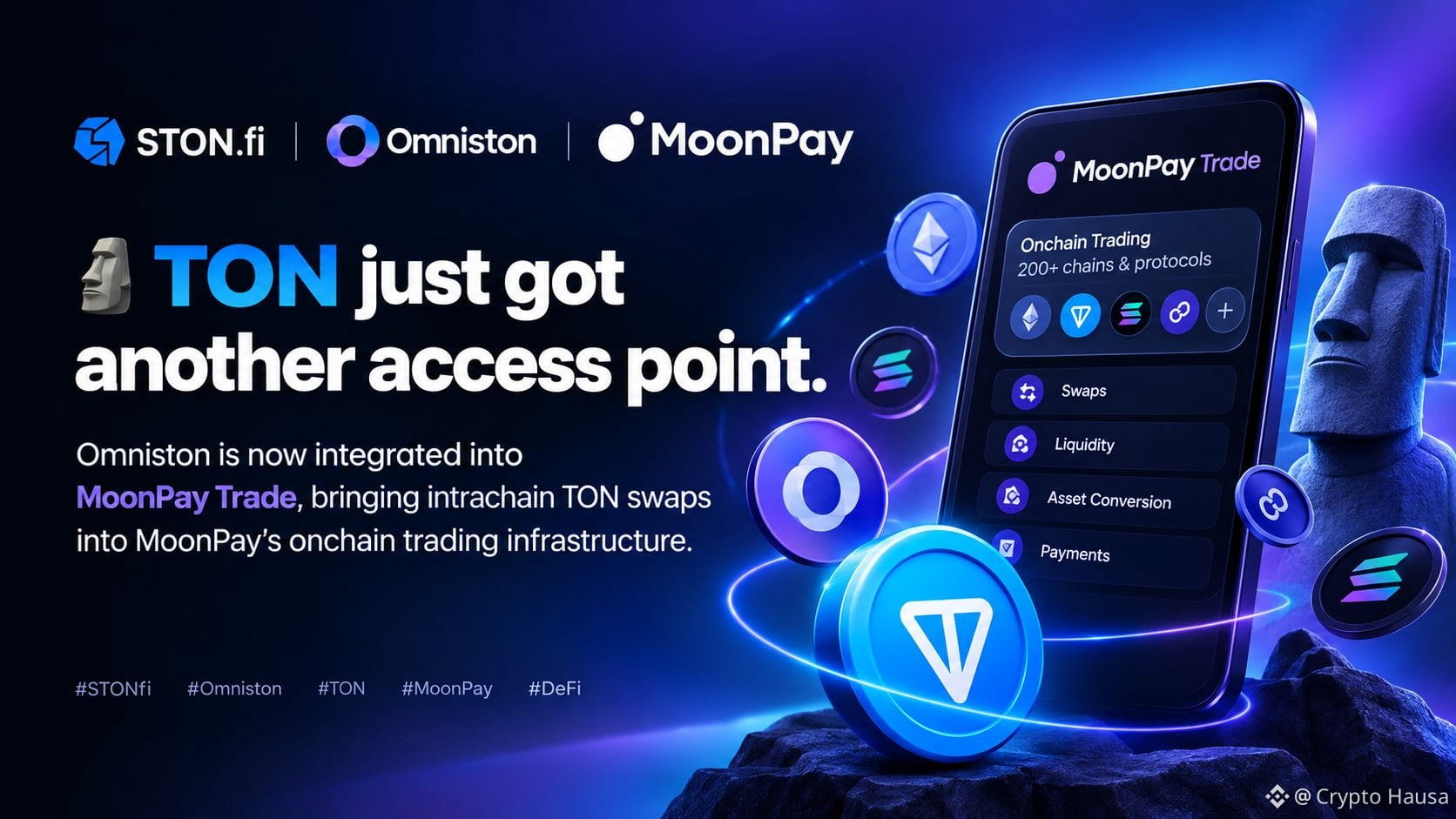
“🗿 TON just got another access point.”
📢 Announcement
“Omniston is now integrated into MoonPay Trade, bringing intrachain TON swaps into MoonPay’s onchain trading infrastructure
❓ Why it matters
Why does this matter?
“MoonPay Trade gives wallets and apps access to onchain execution, liquidity, asset conversion and payments across 200+ chains and protocols through one integration.”
“Now, TON is part of that experience.”
💎 Omniston’s role
“💎 Where Omniston fits in”
“With Omniston powering intrachain TON trades, MoonPay Trade partners can give their users access to TON assets without building separate TON liquidity infrastructure from scratch.”
🧩 Real-world example
“Think wallets and apps like Keeper.”
“A user can discover and trade TON assets directly through the experience they already use.”
🌐 Bigger picture
“This is bigger than just another integration.”
“It means TON liquidity is becoming easier to reach from outside the TON ecosystem.”
STON.fi angle
And for STON.fi, it’s another step toward making TON assets more accessible across the wider crypto landscape.”
👀 CTA / Teaser
More is coming with MoonPay Trade
Stay tuned. 🗿
#STONfi #Omniston #TON #MoonPay #DeFi
“🗿 TON just got another access point.”
📢 Announcement
“Omniston is now integrated into MoonPay Trade, bringing intrachain TON swaps into MoonPay’s onchain trading infrastructure
❓ Why it matters
Why does this matter?
“MoonPay Trade gives wallets and apps access to onchain execution, liquidity, asset conversion and payments across 200+ chains and protocols through one integration.”
“Now, TON is part of that experience.”
💎 Omniston’s role
“💎 Where Omniston fits in”
“With Omniston powering intrachain TON trades, MoonPay Trade partners can give their users access to TON assets without building separate TON liquidity infrastructure from scratch.”
🧩 Real-world example
“Think wallets and apps like Keeper.”
“A user can discover and trade TON assets directly through the experience they already use.”
🌐 Bigger picture
“This is bigger than just another integration.”
“It means TON liquidity is becoming easier to reach from outside the TON ecosystem.”
STON.fi angle
And for STON.fi, it’s another step toward making TON assets more accessible across the wider crypto landscape.”
👀 CTA / Teaser
More is coming with MoonPay Trade
Stay tuned. 🗿
#STONfi #Omniston #TON #MoonPay #DeFi
📢 Announcement
“Omniston is now integrated into MoonPay Trade, bringing intrachain TON swaps into MoonPay’s onchain trading infrastructure
❓ Why it matters
Why does this matter?
“MoonPay Trade gives wallets and apps access to onchain execution, liquidity, asset conversion and payments across 200+ chains and protocols through one integration.”
“Now, TON is part of that experience.”
💎 Omniston’s role
“💎 Where Omniston fits in”
“With Omniston powering intrachain TON trades, MoonPay Trade partners can give their users access to TON assets without building separate TON liquidity infrastructure from scratch.”
🧩 Real-world example
“Think wallets and apps like Keeper.”
“A user can discover and trade TON assets directly through the experience they already use.”
🌐 Bigger picture
“This is bigger than just another integration.”
“It means TON liquidity is becoming easier to reach from outside the TON ecosystem.”
STON.fi angle
And for STON.fi, it’s another step toward making TON assets more accessible across the wider crypto landscape.”
👀 CTA / Teaser
More is coming with MoonPay Trade
Stay tuned. 🗿
#STONfi #Omniston #TON #MoonPay #DeFi
70
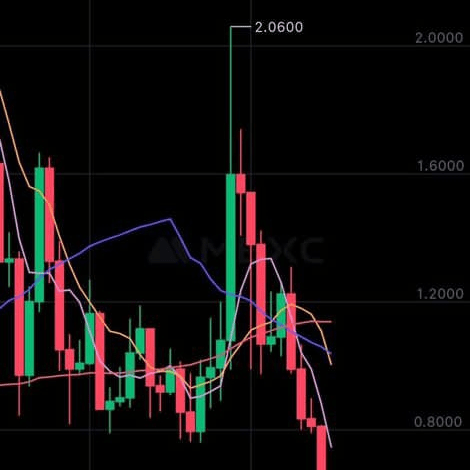
·
--
🛠️ New Omniston Integration Example: TON <> EVM in a Telegram Mini App
STON.fi has released a new open-source integration example showing how builders can bring EVM-based products closer to TON users through Telegram Mini Apps.
The concept is simple: reduce cross-chain complexity for users while keeping the integration flexible for builders.
🔹 How it works
Users connect their TON wallet through TonConnect, while a Dynamic embedded EVM wallet is created behind the scenes. Omniston handles the cross-chain execution.
The example demonstrates:
TON USDT ↔ Arbitrum USDT0
This approach allows EVM-native protocols to make their products accessible to TON users without becoming fully TON-native.
👀 Already shipping similar experiences:
• Polymarket via Predict — users can deposit USDT on TON and access Polymarket markets without manually bridging to Polygon.
• WenLong — users can deposit from TON and access Hyperliquid on Arbitrum through a simplified cross-chain flow.
For builders working on TON <> EVM experiences, Telegram Mini Apps, or EVM-native products, this open-source reference integration provides a practical starting point.
🔗 Explore the GitHub repository and start building.
The bigger idea: cross-chain infrastructure should feel invisible to the user.
#TON #Omniston
@ummujaapar
🛠️ New Omniston Integration Example: TON <> EVM in a Telegram Mini App
STON.fi has released a new open-source integration example showing how builders can bring EVM-based products closer to TON users through Telegram Mini Apps.
The concept is simple: reduce cross-chain complexity for users while keeping the integration flexible for builders.
🔹 How it works
Users connect their TON wallet through TonConnect, while a Dynamic embedded EVM wallet is created behind the scenes. Omniston handles the cross-chain execution.
The example demonstrates:
TON USDT ↔ Arbitrum USDT0
This approach allows EVM-native protocols to make their products accessible to TON users without becoming fully TON-native.
👀 Already shipping similar experiences:
• Polymarket via Predict — users can deposit USDT on TON and access Polymarket markets without manually bridging to Polygon.
• WenLong — users can deposit from TON and access Hyperliquid on Arbitrum through a simplified cross-chain flow.
For builders working on TON <> EVM experiences, Telegram Mini Apps, or EVM-native products, this open-source reference integration provides a practical starting point.
🔗 Explore the GitHub repository and start building.
The bigger idea: cross-chain infrastructure should feel invisible to the user.
#TON #Omniston
@ummujaapar
STON.fi has released a new open-source integration example showing how builders can bring EVM-based products closer to TON users through Telegram Mini Apps.
The concept is simple: reduce cross-chain complexity for users while keeping the integration flexible for builders.
🔹 How it works
Users connect their TON wallet through TonConnect, while a Dynamic embedded EVM wallet is created behind the scenes. Omniston handles the cross-chain execution.
The example demonstrates:
TON USDT ↔ Arbitrum USDT0
This approach allows EVM-native protocols to make their products accessible to TON users without becoming fully TON-native.
👀 Already shipping similar experiences:
• Polymarket via Predict — users can deposit USDT on TON and access Polymarket markets without manually bridging to Polygon.
• WenLong — users can deposit from TON and access Hyperliquid on Arbitrum through a simplified cross-chain flow.
For builders working on TON <> EVM experiences, Telegram Mini Apps, or EVM-native products, this open-source reference integration provides a practical starting point.
🔗 Explore the GitHub repository and start building.
The bigger idea: cross-chain infrastructure should feel invisible to the user.
#TON #Omniston
@ummujaapar
1
76
·
--
Article
TONCO’s Cross-Chain LeapTON DeFi is gradually moving beyond isolated applications. The more interesting development is not simply that another DEX now supports cross-chain swaps, but that cross-chain execution is becoming something TON applications can plug into rather than build from scratch. TONCO’s integration of Omniston is a good example of that. $GRAM
TONCO Adds Another Layer to the TON DeFi Experience
TONCO is a decentralized exchange on TON built around concentrated liquidity. The basic idea is familiar: liquidity can be allocated more efficiently around specific price ranges, potentially giving traders deeper liquidity and reducing slippage when markets are well supplied.
The Omniston integration adds something different. Rather than TONCO functioning primarily as a place to trade assets within TON, users can access cross-chain functionality without necessarily leaving the application.
From a user's perspective, I don't really care whether a transaction involves three protocols, two liquidity sources, or several execution steps behind the scenes.
What I care about is much simpler:
Can I get the asset I want, on the network where I need it, at a reasonable rate, without turning the process into a technical project?
The Real Product Is the Simplification
Historically, moving assets between networks could require several separate decisions.
You might need to:
Connect a wallet.Find a bridge.Select the correct network.Choose the correct token.Move the asset.Wait for confirmation.Switch networks.Find a DEX.Make another swap.
Every additional step creates another opportunity for confusion, mistakes, fees, or simply giving up.
Omniston changes the experience by pushing much of the complexity into the execution layer.
The user can think in terms of:
“I have this asset, and I want that asset.”
rather than:
“Which bridge should I use, which network should I move through, and where should I swap afterward?”
That is an important UX improvement because blockchain infrastructure tends to become more useful when users don't have to understand all of its infrastructure.
Liquidity Becomes More Networked
There is another interesting part of the TONCO relationship.
TONCO pools are already available on STON.fi, while TONCO is now integrating Omniston functionality.
This creates a more interconnected liquidity environment rather than two completely isolated applications.
For users, this can eventually mean that the distinction between individual DeFi interfaces becomes less important.
Imagine having several applications that provide different experiences but can access overlapping liquidity infrastructure underneath.
The front end might be TONCO.
Another user might interact through STON.fi.
Someone else might use a wallet or Telegram application.
But the underlying liquidity and execution infrastructure can connect these experiences.
That is one of the more interesting directions for TON DeFi.
$BTC $ETH #TONCO #STONfi #Omniston #TrendingTopic
TONCO’s Cross-Chain Leap
TON DeFi is gradually moving beyond isolated applications. The more interesting development is not simply that another DEX now supports cross-chain swaps, but that cross-chain execution is becoming something TON applications can plug into rather than build from scratch. TONCO’s integration of Omniston is a good example of that. $GRAM
TONCO Adds Another Layer to the TON DeFi Experience
TONCO is a decentralized exchange on TON built around concentrated liquidity. The basic idea is familiar: liquidity can be allocated more efficiently around specific price ranges, potentially giving traders deeper liquidity and reducing slippage when markets are well supplied.
The Omniston integration adds something different. Rather than TONCO functioning primarily as a place to trade assets within TON, users can access cross-chain functionality without necessarily leaving the application.
From a user's perspective, I don't really care whether a transaction involves three protocols, two liquidity sources, or several execution steps behind the scenes.
What I care about is much simpler:
Can I get the asset I want, on the network where I need it, at a reasonable rate, without turning the process into a technical project?
The Real Product Is the Simplification
Historically, moving assets between networks could require several separate decisions.
You might need to:
Connect a wallet.Find a bridge.Select the correct network.Choose the correct token.Move the asset.Wait for confirmation.Switch networks.Find a DEX.Make another swap.
Every additional step creates another opportunity for confusion, mistakes, fees, or simply giving up.
Omniston changes the experience by pushing much of the complexity into the execution layer.
The user can think in terms of:
“I have this asset, and I want that asset.”
rather than:
“Which bridge should I use, which network should I move through, and where should I swap afterward?”
That is an important UX improvement because blockchain infrastructure tends to become more useful when users don't have to understand all of its infrastructure.
Liquidity Becomes More Networked
There is another interesting part of the TONCO relationship.
TONCO pools are already available on STON.fi, while TONCO is now integrating Omniston functionality.
This creates a more interconnected liquidity environment rather than two completely isolated applications.
For users, this can eventually mean that the distinction between individual DeFi interfaces becomes less important.
Imagine having several applications that provide different experiences but can access overlapping liquidity infrastructure underneath.
The front end might be TONCO.
Another user might interact through STON.fi.
Someone else might use a wallet or Telegram application.
But the underlying liquidity and execution infrastructure can connect these experiences.
That is one of the more interesting directions for TON DeFi.
$BTC $ETH #TONCO #STONfi #Omniston #TrendingTopic
TONCO Adds Another Layer to the TON DeFi Experience
TONCO is a decentralized exchange on TON built around concentrated liquidity. The basic idea is familiar: liquidity can be allocated more efficiently around specific price ranges, potentially giving traders deeper liquidity and reducing slippage when markets are well supplied.
The Omniston integration adds something different. Rather than TONCO functioning primarily as a place to trade assets within TON, users can access cross-chain functionality without necessarily leaving the application.
From a user's perspective, I don't really care whether a transaction involves three protocols, two liquidity sources, or several execution steps behind the scenes.
What I care about is much simpler:
Can I get the asset I want, on the network where I need it, at a reasonable rate, without turning the process into a technical project?
The Real Product Is the Simplification
Historically, moving assets between networks could require several separate decisions.
You might need to:
Connect a wallet.Find a bridge.Select the correct network.Choose the correct token.Move the asset.Wait for confirmation.Switch networks.Find a DEX.Make another swap.
Every additional step creates another opportunity for confusion, mistakes, fees, or simply giving up.
Omniston changes the experience by pushing much of the complexity into the execution layer.
The user can think in terms of:
“I have this asset, and I want that asset.”
rather than:
“Which bridge should I use, which network should I move through, and where should I swap afterward?”
That is an important UX improvement because blockchain infrastructure tends to become more useful when users don't have to understand all of its infrastructure.
Liquidity Becomes More Networked
There is another interesting part of the TONCO relationship.
TONCO pools are already available on STON.fi, while TONCO is now integrating Omniston functionality.
This creates a more interconnected liquidity environment rather than two completely isolated applications.
For users, this can eventually mean that the distinction between individual DeFi interfaces becomes less important.
Imagine having several applications that provide different experiences but can access overlapping liquidity infrastructure underneath.
The front end might be TONCO.
Another user might interact through STON.fi.
Someone else might use a wallet or Telegram application.
But the underlying liquidity and execution infrastructure can connect these experiences.
That is one of the more interesting directions for TON DeFi.
$BTC $ETH #TONCO #STONfi #Omniston #TrendingTopic
1
133

·
--
Cross-chain trading on TON just became more accessible.
TONCO has integrated Omniston, allowing users to access cross-chain swap functionality directly through its interface. Instead of developing an entire cross-chain execution system independently, TONCO can leverage Omniston’s infrastructure to connect users with liquidity across networks.
TONCO is a decentralized exchange on TON that uses concentrated liquidity. Its design aims to make liquidity more capital-efficient while helping traders access deeper pools and potentially reduce slippage.
The integration also strengthens the connection between the two ecosystems. TONCO liquidity is already available through STON.fi, while TONCO now gives its own users access to Omniston-powered cross-chain swaps.
That’s one of the key ideas behind Omniston: providing TON wallets, DEXs, and other DeFi applications with the infrastructure needed to support cross-chain trading without having to build every component from the ground up.
For developers building on TON, the STON.fi SDK and Omniston documentation provide a starting point for integrating TON liquidity and cross chain functionality into their own products.
Explore TONCO’s swap interface and see how cross chain trading works through the integration.
#STONfi #Omniston #TON #DeFi
Cross-chain trading on TON just became more accessible.
TONCO has integrated Omniston, allowing users to access cross-chain swap functionality directly through its interface. Instead of developing an entire cross-chain execution system independently, TONCO can leverage Omniston’s infrastructure to connect users with liquidity across networks.
TONCO is a decentralized exchange on TON that uses concentrated liquidity. Its design aims to make liquidity more capital-efficient while helping traders access deeper pools and potentially reduce slippage.
The integration also strengthens the connection between the two ecosystems. TONCO liquidity is already available through STON.fi, while TONCO now gives its own users access to Omniston-powered cross-chain swaps.
That’s one of the key ideas behind Omniston: providing TON wallets, DEXs, and other DeFi applications with the infrastructure needed to support cross-chain trading without having to build every component from the ground up.
For developers building on TON, the STON.fi SDK and Omniston documentation provide a starting point for integrating TON liquidity and cross chain functionality into their own products.
Explore TONCO’s swap interface and see how cross chain trading works through the integration.
#STONfi #Omniston #TON #DeFi
TONCO has integrated Omniston, allowing users to access cross-chain swap functionality directly through its interface. Instead of developing an entire cross-chain execution system independently, TONCO can leverage Omniston’s infrastructure to connect users with liquidity across networks.
TONCO is a decentralized exchange on TON that uses concentrated liquidity. Its design aims to make liquidity more capital-efficient while helping traders access deeper pools and potentially reduce slippage.
The integration also strengthens the connection between the two ecosystems. TONCO liquidity is already available through STON.fi, while TONCO now gives its own users access to Omniston-powered cross-chain swaps.
That’s one of the key ideas behind Omniston: providing TON wallets, DEXs, and other DeFi applications with the infrastructure needed to support cross-chain trading without having to build every component from the ground up.
For developers building on TON, the STON.fi SDK and Omniston documentation provide a starting point for integrating TON liquidity and cross chain functionality into their own products.
Explore TONCO’s swap interface and see how cross chain trading works through the integration.
#STONfi #Omniston #TON #DeFi

1
64


·
--
Why Cross-Chain Liquidity Needs Good Routing
As more blockchains develop their own liquidity, fragmentation becomes a bigger challenge.
A token may have liquidity on TON, TRON, Ethereum, Base, Polygon, or another network.
The user doesn't necessarily care where that liquidity sits.
They care about one thing:
“How much will I actually receive?”
That's where routing infrastructure becomes important.
With Omniston, STON.fi can coordinate available liquidity and routes across supported networks rather than making users manually search through different ecosystems.
The process can look simple from the user's side:
Choose what you have → choose what you need → review the route → confirm.
But underneath, there can be a lot more happening:
🔹 Finding available liquidity
🔹 Comparing possible routes
🔹 Considering execution conditions
🔹 Coordinating the swap
🔹 Completing the transaction across networks
This is an important part of cross-chain DeFi that users don't always see.
Connecting blockchains is one challenge.
Connecting their liquidity efficiently is another.
As more ecosystems grow independently, infrastructure that can help bring fragmented liquidity together becomes increasingly important.
The future of cross-chain DeFi isn't only about more chains. It's about making those chains easier to navigate.
#STONfi #Omniston #TON @stonfi $TON
Why Cross-Chain Liquidity Needs Good Routing
As more blockchains develop their own liquidity, fragmentation becomes a bigger challenge.
A token may have liquidity on TON, TRON, Ethereum, Base, Polygon, or another network.
The user doesn't necessarily care where that liquidity sits.
They care about one thing:
“How much will I actually receive?”
That's where routing infrastructure becomes important.
With Omniston, STON.fi can coordinate available liquidity and routes across supported networks rather than making users manually search through different ecosystems.
The process can look simple from the user's side:
Choose what you have → choose what you need → review the route → confirm.
But underneath, there can be a lot more happening:
🔹 Finding available liquidity
🔹 Comparing possible routes
🔹 Considering execution conditions
🔹 Coordinating the swap
🔹 Completing the transaction across networks
This is an important part of cross-chain DeFi that users don't always see.
Connecting blockchains is one challenge.
Connecting their liquidity efficiently is another.
As more ecosystems grow independently, infrastructure that can help bring fragmented liquidity together becomes increasingly important.
The future of cross-chain DeFi isn't only about more chains. It's about making those chains easier to navigate.
#STONfi #Omniston #TON @STONfi DEX $TON
As more blockchains develop their own liquidity, fragmentation becomes a bigger challenge.
A token may have liquidity on TON, TRON, Ethereum, Base, Polygon, or another network.
The user doesn't necessarily care where that liquidity sits.
They care about one thing:
“How much will I actually receive?”
That's where routing infrastructure becomes important.
With Omniston, STON.fi can coordinate available liquidity and routes across supported networks rather than making users manually search through different ecosystems.
The process can look simple from the user's side:
Choose what you have → choose what you need → review the route → confirm.
But underneath, there can be a lot more happening:
🔹 Finding available liquidity
🔹 Comparing possible routes
🔹 Considering execution conditions
🔹 Coordinating the swap
🔹 Completing the transaction across networks
This is an important part of cross-chain DeFi that users don't always see.
Connecting blockchains is one challenge.
Connecting their liquidity efficiently is another.
As more ecosystems grow independently, infrastructure that can help bring fragmented liquidity together becomes increasingly important.
The future of cross-chain DeFi isn't only about more chains. It's about making those chains easier to navigate.
#STONfi #Omniston #TON @STONfi DEX $TON
58
·
--
The Builder Side of DeFi
What happens when DeFi infrastructure becomes something developers can build on?
STON.fi isn't only a place where users swap tokens.
Its SDK and Omniston infrastructure give builders tools to integrate swapping and liquidity into wallets, launchpads, Telegram applications, and other TON products.
That changes the user experience.
Instead of sending users to a separate DEX every time they need a swap, a project can build the swap experience directly into its own product.
Think about the possibilities:
🔹 Wallets with built-in swaps
🔹 Telegram-native trading experiences
🔹 Apps accessing multiple liquidity sources
🔹 Cross-chain swap functionality
🔹 Launchpads with easier token access
The important part is what happens under the hood.
Users may see a simple swap interface, while infrastructure handles the complicated routing and execution behind it.
This is why DeFi infrastructure matters.
The next stage of adoption may not come from users learning how to navigate more protocols.
It may come from DeFi becoming invisible inside the applications people already use.
And that's where infrastructure like STON.fi and Omniston becomes interesting for the TON ecosystem.
The best DeFi infrastructure may be the infrastructure users don't even notice.
#STONfi i #Omniston #TonChain #DeFiDominance #Web3 @stonfi $TON
The Builder Side of DeFi
What happens when DeFi infrastructure becomes something developers can build on?
STON.fi isn't only a place where users swap tokens.
Its SDK and Omniston infrastructure give builders tools to integrate swapping and liquidity into wallets, launchpads, Telegram applications, and other TON products.
That changes the user experience.
Instead of sending users to a separate DEX every time they need a swap, a project can build the swap experience directly into its own product.
Think about the possibilities:
🔹 Wallets with built-in swaps
🔹 Telegram-native trading experiences
🔹 Apps accessing multiple liquidity sources
🔹 Cross-chain swap functionality
🔹 Launchpads with easier token access
The important part is what happens under the hood.
Users may see a simple swap interface, while infrastructure handles the complicated routing and execution behind it.
This is why DeFi infrastructure matters.
The next stage of adoption may not come from users learning how to navigate more protocols.
It may come from DeFi becoming invisible inside the applications people already use.
And that's where infrastructure like STON.fi and Omniston becomes interesting for the TON ecosystem.
The best DeFi infrastructure may be the infrastructure users don't even notice.
#STONfi i #Omniston #TonChain #DeFiDominance #Web3 @STONfi DEX $TON
What happens when DeFi infrastructure becomes something developers can build on?
STON.fi isn't only a place where users swap tokens.
Its SDK and Omniston infrastructure give builders tools to integrate swapping and liquidity into wallets, launchpads, Telegram applications, and other TON products.
That changes the user experience.
Instead of sending users to a separate DEX every time they need a swap, a project can build the swap experience directly into its own product.
Think about the possibilities:
🔹 Wallets with built-in swaps
🔹 Telegram-native trading experiences
🔹 Apps accessing multiple liquidity sources
🔹 Cross-chain swap functionality
🔹 Launchpads with easier token access
The important part is what happens under the hood.
Users may see a simple swap interface, while infrastructure handles the complicated routing and execution behind it.
This is why DeFi infrastructure matters.
The next stage of adoption may not come from users learning how to navigate more protocols.
It may come from DeFi becoming invisible inside the applications people already use.
And that's where infrastructure like STON.fi and Omniston becomes interesting for the TON ecosystem.
The best DeFi infrastructure may be the infrastructure users don't even notice.
#STONfi i #Omniston #TonChain #DeFiDominance #Web3 @STONfi DEX $TON

89
·
--
$3M+ and Rising: Omniston Cross-Chain Hits New Heights
Omniston has now surpassed $3 million in cumulative cross-chain swap volume since launching its cross-chain feature in June.
For me, the interesting part isn't simply the $3M. It is what the number says about how users are starting to think about liquidity.
Cross-chain DeFi has always had a major weakness: liquidity is everywhere, but access to it is fragmented.
You may have USDT on TON, while the liquidity or opportunity you want exists on another network. Traditionally, that can mean bridges, multiple transactions, network switching, different wallets, extra fees, and more chances for something to go wrong. $GRAM
As a user, I don't really care which chain handles the transaction. I care about how much I receive, how much I pay, how quickly it settles, and whether the route works reliably. And that's where Omniston proves its importance .
$3M doesn't make Omniston the biggest cross-chain player in DeFi.
But it does provide something more important at this stage: evidence of real usage.
Every cross-chain swap is effectively a user making a decision:
• "This route is good enough for me to trust with my assets."
That matters because cross-chain infrastructure is ultimately built around confidence.
If users repeatedly get competitive execution without having to manually understand bridges, liquidity pools, and different networks, the technology starts becoming less important than the experience.
If Omniston can combine deeper liquidity, better routing, reliable settlement, competitive pricing, and a simpler user experience, then today's $3M could eventually look very small compared with what comes next.
$BTC $ETH #Omniston #MilestoneUnlocked #TrendingTopic #STONfi
$3M+ and Rising: Omniston Cross-Chain Hits New Heights
Omniston has now surpassed $3 million in cumulative cross-chain swap volume since launching its cross-chain feature in June.
For me, the interesting part isn't simply the $3M. It is what the number says about how users are starting to think about liquidity.
Cross-chain DeFi has always had a major weakness: liquidity is everywhere, but access to it is fragmented.
You may have USDT on TON, while the liquidity or opportunity you want exists on another network. Traditionally, that can mean bridges, multiple transactions, network switching, different wallets, extra fees, and more chances for something to go wrong. $GRAM
As a user, I don't really care which chain handles the transaction. I care about how much I receive, how much I pay, how quickly it settles, and whether the route works reliably. And that's where Omniston proves its importance .
$3M doesn't make Omniston the biggest cross-chain player in DeFi.
But it does provide something more important at this stage: evidence of real usage.
Every cross-chain swap is effectively a user making a decision:
• "This route is good enough for me to trust with my assets."
That matters because cross-chain infrastructure is ultimately built around confidence.
If users repeatedly get competitive execution without having to manually understand bridges, liquidity pools, and different networks, the technology starts becoming less important than the experience.
If Omniston can combine deeper liquidity, better routing, reliable settlement, competitive pricing, and a simpler user experience, then today's $3M could eventually look very small compared with what comes next.
$BTC $ETH #Omniston #MilestoneUnlocked #TrendingTopic #STONfi
Omniston has now surpassed $3 million in cumulative cross-chain swap volume since launching its cross-chain feature in June.
For me, the interesting part isn't simply the $3M. It is what the number says about how users are starting to think about liquidity.
Cross-chain DeFi has always had a major weakness: liquidity is everywhere, but access to it is fragmented.
You may have USDT on TON, while the liquidity or opportunity you want exists on another network. Traditionally, that can mean bridges, multiple transactions, network switching, different wallets, extra fees, and more chances for something to go wrong. $GRAM
As a user, I don't really care which chain handles the transaction. I care about how much I receive, how much I pay, how quickly it settles, and whether the route works reliably. And that's where Omniston proves its importance .
$3M doesn't make Omniston the biggest cross-chain player in DeFi.
But it does provide something more important at this stage: evidence of real usage.
Every cross-chain swap is effectively a user making a decision:
• "This route is good enough for me to trust with my assets."
That matters because cross-chain infrastructure is ultimately built around confidence.
If users repeatedly get competitive execution without having to manually understand bridges, liquidity pools, and different networks, the technology starts becoming less important than the experience.
If Omniston can combine deeper liquidity, better routing, reliable settlement, competitive pricing, and a simpler user experience, then today's $3M could eventually look very small compared with what comes next.
$BTC $ETH #Omniston #MilestoneUnlocked #TrendingTopic #STONfi

1
225
·
--
Why Liquidity Routing Matters
Finding liquidity is only half the challenge. Getting there efficiently is the other half.
In DeFi, the same asset can have liquidity spread across different pools and networks. This creates multiple possible routes for a single swap.
A smart routing system can evaluate available options and coordinate a route based on factors such as:
🔹 Available liquidity
🔹 Expected execution
🔹 Price impact
🔹 Trading conditions
🔹 Network requirements
This is where infrastructure like Omniston becomes interesting.
Instead of making users manually search through different routes, the infrastructure works behind the scenes to connect available liquidity and simplify the swap experience.
But routing doesn't remove risk. Users should still review the final amount, fees, slippage, and price impact before confirming a transaction.
The bigger lesson:
As DeFi grows, liquidity becomes increasingly fragmented.
The challenge isn't only creating more liquidity.
It's building better infrastructure to connect users with the liquidity that already exists.
Better routing can turn a complicated multi-chain journey into a simpler swap experience.
#STONfi #Omniston #TON #Liquidity #DEX @stonfi $TON
Why Liquidity Routing Matters
Finding liquidity is only half the challenge. Getting there efficiently is the other half.
In DeFi, the same asset can have liquidity spread across different pools and networks. This creates multiple possible routes for a single swap.
A smart routing system can evaluate available options and coordinate a route based on factors such as:
🔹 Available liquidity
🔹 Expected execution
🔹 Price impact
🔹 Trading conditions
🔹 Network requirements
This is where infrastructure like Omniston becomes interesting.
Instead of making users manually search through different routes, the infrastructure works behind the scenes to connect available liquidity and simplify the swap experience.
But routing doesn't remove risk. Users should still review the final amount, fees, slippage, and price impact before confirming a transaction.
The bigger lesson:
As DeFi grows, liquidity becomes increasingly fragmented.
The challenge isn't only creating more liquidity.
It's building better infrastructure to connect users with the liquidity that already exists.
Better routing can turn a complicated multi-chain journey into a simpler swap experience.
#STONfi #Omniston #TON #Liquidity #DEX @STONfi DEX $TON
Finding liquidity is only half the challenge. Getting there efficiently is the other half.
In DeFi, the same asset can have liquidity spread across different pools and networks. This creates multiple possible routes for a single swap.
A smart routing system can evaluate available options and coordinate a route based on factors such as:
🔹 Available liquidity
🔹 Expected execution
🔹 Price impact
🔹 Trading conditions
🔹 Network requirements
This is where infrastructure like Omniston becomes interesting.
Instead of making users manually search through different routes, the infrastructure works behind the scenes to connect available liquidity and simplify the swap experience.
But routing doesn't remove risk. Users should still review the final amount, fees, slippage, and price impact before confirming a transaction.
The bigger lesson:
As DeFi grows, liquidity becomes increasingly fragmented.
The challenge isn't only creating more liquidity.
It's building better infrastructure to connect users with the liquidity that already exists.
Better routing can turn a complicated multi-chain journey into a simpler swap experience.
#STONfi #Omniston #TON #Liquidity #DEX @STONfi DEX $TON

81

·
--
Bullish
Verified
🔥 $150,000 in 24 hours: Omniston is changing the cross-chain game
The volume of cross-chain swaps on STON.fi has hit a new milestone. Why are users moving away from traditional bridges in droves?
✈️ Cross-chain to someone else’s wallet (Custom Address)
No more sending assets to your own address first and then forwarding them. Now you pay directly from your wallet, and the tokens arrive straight to the recipient’s address on another network. No double fees and no extra transactions.
It’s like a direct flight with no stops and no lost luggage. You just choose the direction, and the protocol handles all the technical work in 15–40 seconds.
🎁 Bonus for early users:
The team is hinting that rewards are coming for the “first passengers” of this cross-chain route. Now is the time to test the feature while the initial limit of $1,000 per transaction is still in effect.
Under the hood: seamless routing between TON, TRON, Ethereum, Base, Arbitrum, Polygon, and the new Robinhood Chain.
While others are waiting, the infrastructure is already live.
🔗 Try the direct cross-chain:
app.ston.fi/swap?mode=cross-chain&referral_address=UQBDMz8eAC1_CVxEn6JjNOdWEvppQXXybxIdKm-GiXEL4yiQ
Where would you send assets over cross-chain right now? Comment below 👇
$TON $GRAM $USDT
#DeFi #CrossChain #Omniston #TONBlockchain
🔥 $150,000 in 24 hours: Omniston is changing the cross-chain game
The volume of cross-chain swaps on STON.fi has hit a new milestone. Why are users moving away from traditional bridges in droves?
✈️ Cross-chain to someone else’s wallet (Custom Address)
No more sending assets to your own address first and then forwarding them. Now you pay directly from your wallet, and the tokens arrive straight to the recipient’s address on another network. No double fees and no extra transactions.
It’s like a direct flight with no stops and no lost luggage. You just choose the direction, and the protocol handles all the technical work in 15–40 seconds.
🎁 Bonus for early users:
The team is hinting that rewards are coming for the “first passengers” of this cross-chain route. Now is the time to test the feature while the initial limit of $1,000 per transaction is still in effect.
Under the hood: seamless routing between TON, TRON, Ethereum, Base, Arbitrum, Polygon, and the new Robinhood Chain.
While others are waiting, the infrastructure is already live.
🔗 Try the direct cross-chain:
app.ston.fi/swap?mode=cross-chain&referral_address=UQBDMz8eAC1_CVxEn6JjNOdWEvppQXXybxIdKm-GiXEL4yiQ
Where would you send assets over cross-chain right now? Comment below 👇
$TON $GRAM $USDT
#DeFi #CrossChain #Omniston #TONBlockchain
The volume of cross-chain swaps on STON.fi has hit a new milestone. Why are users moving away from traditional bridges in droves?
✈️ Cross-chain to someone else’s wallet (Custom Address)
No more sending assets to your own address first and then forwarding them. Now you pay directly from your wallet, and the tokens arrive straight to the recipient’s address on another network. No double fees and no extra transactions.
It’s like a direct flight with no stops and no lost luggage. You just choose the direction, and the protocol handles all the technical work in 15–40 seconds.
🎁 Bonus for early users:
The team is hinting that rewards are coming for the “first passengers” of this cross-chain route. Now is the time to test the feature while the initial limit of $1,000 per transaction is still in effect.
Under the hood: seamless routing between TON, TRON, Ethereum, Base, Arbitrum, Polygon, and the new Robinhood Chain.
While others are waiting, the infrastructure is already live.
🔗 Try the direct cross-chain:
app.ston.fi/swap?mode=cross-chain&referral_address=UQBDMz8eAC1_CVxEn6JjNOdWEvppQXXybxIdKm-GiXEL4yiQ
Where would you send assets over cross-chain right now? Comment below 👇
$TON $GRAM $USDT
#DeFi #CrossChain #Omniston #TONBlockchain

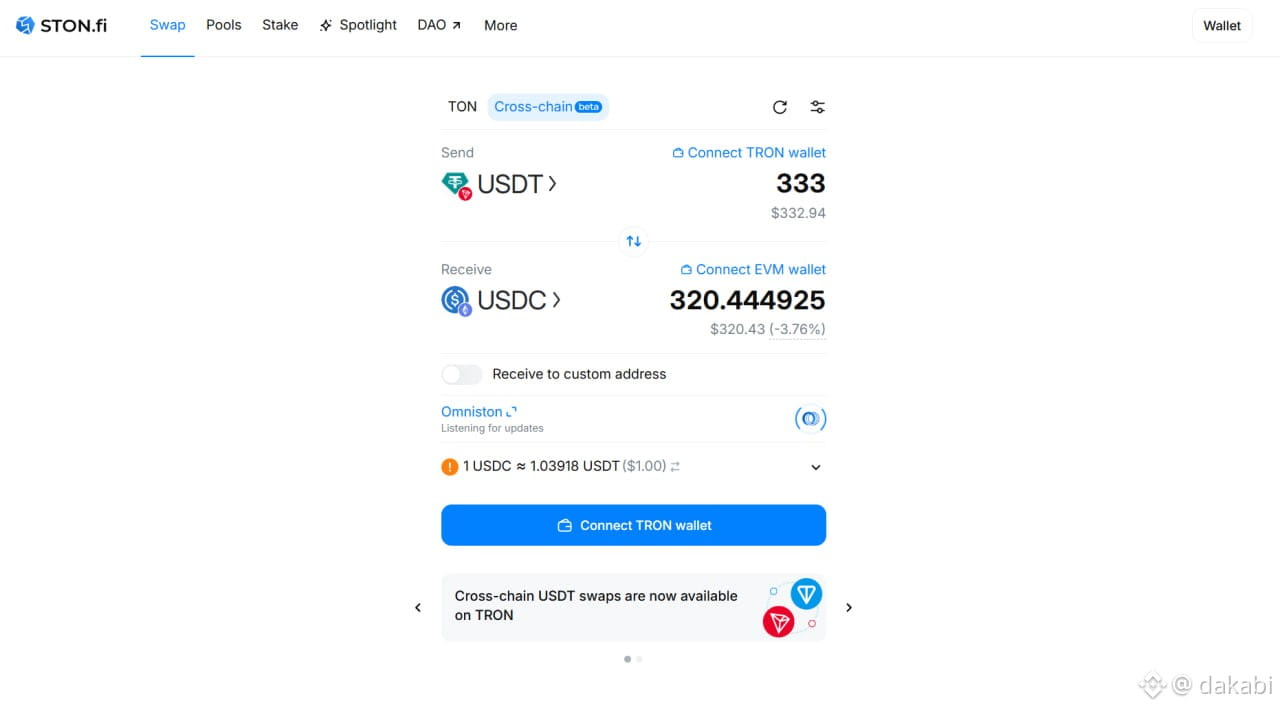
2
740

Why builders should care about Omniston
Imagine you're building a wallet.
You want users to swap assets across different ecosystems.
Now you need to think about liquidity, routing, quotes, cross chain execution and settlement.
That's a lot to build and maintain.
Infrastructure like Omniston can reduce that burden by giving builders access to an existing execution layer.
This changes the equation.
Instead of every wallet or dApp reinventing the same infrastructure, builders can focus more of their time on the product itself.
That's how ecosystems mature.
Not every team needs to rebuild the same piece of plumbing.
#Omniston #STON.fi
Why builders should care about Omniston
Imagine you're building a wallet.
You want users to swap assets across different ecosystems.
Now you need to think about liquidity, routing, quotes, cross chain execution and settlement.
That's a lot to build and maintain.
Infrastructure like Omniston can reduce that burden by giving builders access to an existing execution layer.
This changes the equation.
Instead of every wallet or dApp reinventing the same infrastructure, builders can focus more of their time on the product itself.
That's how ecosystems mature.
Not every team needs to rebuild the same piece of plumbing.
#Omniston #STON.fi
Imagine you're building a wallet.
You want users to swap assets across different ecosystems.
Now you need to think about liquidity, routing, quotes, cross chain execution and settlement.
That's a lot to build and maintain.
Infrastructure like Omniston can reduce that burden by giving builders access to an existing execution layer.
This changes the equation.
Instead of every wallet or dApp reinventing the same infrastructure, builders can focus more of their time on the product itself.
That's how ecosystems mature.
Not every team needs to rebuild the same piece of plumbing.
#Omniston #STON.fi
17

$150K in Cross-Chain Swap Volume in One Day. Here’s Why It Matters.
Cross-chain liquidity is no longer just a narrative.
On August 25, Omniston, the cross-chain liquidity protocol in the STON.fi ecosystem, processed approximately $150,000 in swap volume in a single day.
That volume came from real users swapping assets, testing routes, and putting cross-chain infrastructure to work.
And while $150K may look like just another number, the bigger story is what happens behind it.
Cross-chain DeFi has a fragmentation problem.
Liquidity is spread across different networks.
Users often have to deal with multiple steps just to move assets and access opportunities.
Protocols like Omniston are built around a different vision:
Make liquidity more accessible across ecosystems.
Every swap helps test execution.
Every route adds activity.
Every user pushes the infrastructure closer to becoming more efficient and widely adopted.
For the STON.fi ecosystem, this milestone represents growing engagement with its cross-chain liquidity infrastructure.
From $150K in volume to the next milestone, the real question is:
How fast can cross-chain liquidity grow when users no longer have to think about the chains behind the transaction?
The future of DeFi won't be built around isolated ecosystems.
It will be built around liquidity that can move.
And on August 25, Omniston moved approximately $150K worth in a single day.
#TON #DeFi #Web3 #STONfi #Omniston
$150K in Cross-Chain Swap Volume in One Day. Here’s Why It Matters.
Cross-chain liquidity is no longer just a narrative.
On August 25, Omniston, the cross-chain liquidity protocol in the STON.fi ecosystem, processed approximately $150,000 in swap volume in a single day.
That volume came from real users swapping assets, testing routes, and putting cross-chain infrastructure to work.
And while $150K may look like just another number, the bigger story is what happens behind it.
Cross-chain DeFi has a fragmentation problem.
Liquidity is spread across different networks.
Users often have to deal with multiple steps just to move assets and access opportunities.
Protocols like Omniston are built around a different vision:
Make liquidity more accessible across ecosystems.
Every swap helps test execution.
Every route adds activity.
Every user pushes the infrastructure closer to becoming more efficient and widely adopted.
For the STON.fi ecosystem, this milestone represents growing engagement with its cross-chain liquidity infrastructure.
From $150K in volume to the next milestone, the real question is:
How fast can cross-chain liquidity grow when users no longer have to think about the chains behind the transaction?
The future of DeFi won't be built around isolated ecosystems.
It will be built around liquidity that can move.
And on August 25, Omniston moved approximately $150K worth in a single day.
#TON #DeFi #Web3 #STONfi #Omniston
Cross-chain liquidity is no longer just a narrative.
On August 25, Omniston, the cross-chain liquidity protocol in the STON.fi ecosystem, processed approximately $150,000 in swap volume in a single day.
That volume came from real users swapping assets, testing routes, and putting cross-chain infrastructure to work.
And while $150K may look like just another number, the bigger story is what happens behind it.
Cross-chain DeFi has a fragmentation problem.
Liquidity is spread across different networks.
Users often have to deal with multiple steps just to move assets and access opportunities.
Protocols like Omniston are built around a different vision:
Make liquidity more accessible across ecosystems.
Every swap helps test execution.
Every route adds activity.
Every user pushes the infrastructure closer to becoming more efficient and widely adopted.
For the STON.fi ecosystem, this milestone represents growing engagement with its cross-chain liquidity infrastructure.
From $150K in volume to the next milestone, the real question is:
How fast can cross-chain liquidity grow when users no longer have to think about the chains behind the transaction?
The future of DeFi won't be built around isolated ecosystems.
It will be built around liquidity that can move.
And on August 25, Omniston moved approximately $150K worth in a single day.
#TON #DeFi #Web3 #STONfi #Omniston
96

𝗢𝗺𝗻𝗶𝘀𝘁𝗼𝗻 𝗛𝗶𝘁𝘀 ~$𝟭𝟱𝟬𝗞 𝗶𝗻 𝗖𝗿𝗼𝘀𝘀-𝗖𝗵𝗮𝗶𝗻 𝗦𝘄𝗮𝗽 𝗩𝗼𝗹𝘂𝗺𝗲 — 𝗜𝗻 𝗢𝗻𝗲 𝗗𝗮𝘆
Stonfiers, let's put this number in perspective.
150,000 kilometers is roughly 3.5 trips around the entire Earth. That's the same scale of distance our community helped Omniston cover in swap volume on a single day
August 25.
In just 24 hours, our cross-chain protocol Omniston processed approximately $150,000 in swap volume, a milestone that reflects growing trust and increasing activity across the routes we support.
this isn't just a number on a dashboard
its proof that the infrastructure we've built is being used, tested, and stress-tested by a real, engaged community, and it's holding up.
Every swap that contributed to this total came from someone in this community:
swapping between chains, testing new routes, exploring liquidity paths, and helping us understand where Omniston performs best and where we can keep improving.
that kind of organic, hands on engagement is exactly what drives a protocol forward, and it's exactly what we saw on August 25.
To everyone who swapped, tested, shared feedback, or simply kept an eye on the numbers: thank you.
Growth like this doesn't happen in a vacuum. It happens because people believe in what we're building and choose to be part of it early.
This is just one data point on a longer trajectory.
We're continuing to expand Omniston's capabilities, deepen liquidity across supported chains, and make cross-chain swaps faster and more reliable for everyone using the protocol.
More volume, more routes, and more milestones are ahead.
Stay tuned, this is only the beginning at ston.fi
#STONfi #Omniston
𝗢𝗺𝗻𝗶𝘀𝘁𝗼𝗻 𝗛𝗶𝘁𝘀 ~$𝟭𝟱𝟬𝗞 𝗶𝗻 𝗖𝗿𝗼𝘀𝘀-𝗖𝗵𝗮𝗶𝗻 𝗦𝘄𝗮𝗽 𝗩𝗼𝗹𝘂𝗺𝗲 — 𝗜𝗻 𝗢𝗻𝗲 𝗗𝗮𝘆
Stonfiers, let's put this number in perspective.
150,000 kilometers is roughly 3.5 trips around the entire Earth. That's the same scale of distance our community helped Omniston cover in swap volume on a single day
August 25.
In just 24 hours, our cross-chain protocol Omniston processed approximately $150,000 in swap volume, a milestone that reflects growing trust and increasing activity across the routes we support.
this isn't just a number on a dashboard
its proof that the infrastructure we've built is being used, tested, and stress-tested by a real, engaged community, and it's holding up.
Every swap that contributed to this total came from someone in this community:
swapping between chains, testing new routes, exploring liquidity paths, and helping us understand where Omniston performs best and where we can keep improving.
that kind of organic, hands on engagement is exactly what drives a protocol forward, and it's exactly what we saw on August 25.
To everyone who swapped, tested, shared feedback, or simply kept an eye on the numbers: thank you.
Growth like this doesn't happen in a vacuum. It happens because people believe in what we're building and choose to be part of it early.
This is just one data point on a longer trajectory.
We're continuing to expand Omniston's capabilities, deepen liquidity across supported chains, and make cross-chain swaps faster and more reliable for everyone using the protocol.
More volume, more routes, and more milestones are ahead.
Stay tuned, this is only the beginning at ston.fi
#STONfi #Omniston
Stonfiers, let's put this number in perspective.
150,000 kilometers is roughly 3.5 trips around the entire Earth. That's the same scale of distance our community helped Omniston cover in swap volume on a single day
August 25.
In just 24 hours, our cross-chain protocol Omniston processed approximately $150,000 in swap volume, a milestone that reflects growing trust and increasing activity across the routes we support.
this isn't just a number on a dashboard
its proof that the infrastructure we've built is being used, tested, and stress-tested by a real, engaged community, and it's holding up.
Every swap that contributed to this total came from someone in this community:
swapping between chains, testing new routes, exploring liquidity paths, and helping us understand where Omniston performs best and where we can keep improving.
that kind of organic, hands on engagement is exactly what drives a protocol forward, and it's exactly what we saw on August 25.
To everyone who swapped, tested, shared feedback, or simply kept an eye on the numbers: thank you.
Growth like this doesn't happen in a vacuum. It happens because people believe in what we're building and choose to be part of it early.
This is just one data point on a longer trajectory.
We're continuing to expand Omniston's capabilities, deepen liquidity across supported chains, and make cross-chain swaps faster and more reliable for everyone using the protocol.
More volume, more routes, and more milestones are ahead.
Stay tuned, this is only the beginning at ston.fi
#STONfi #Omniston
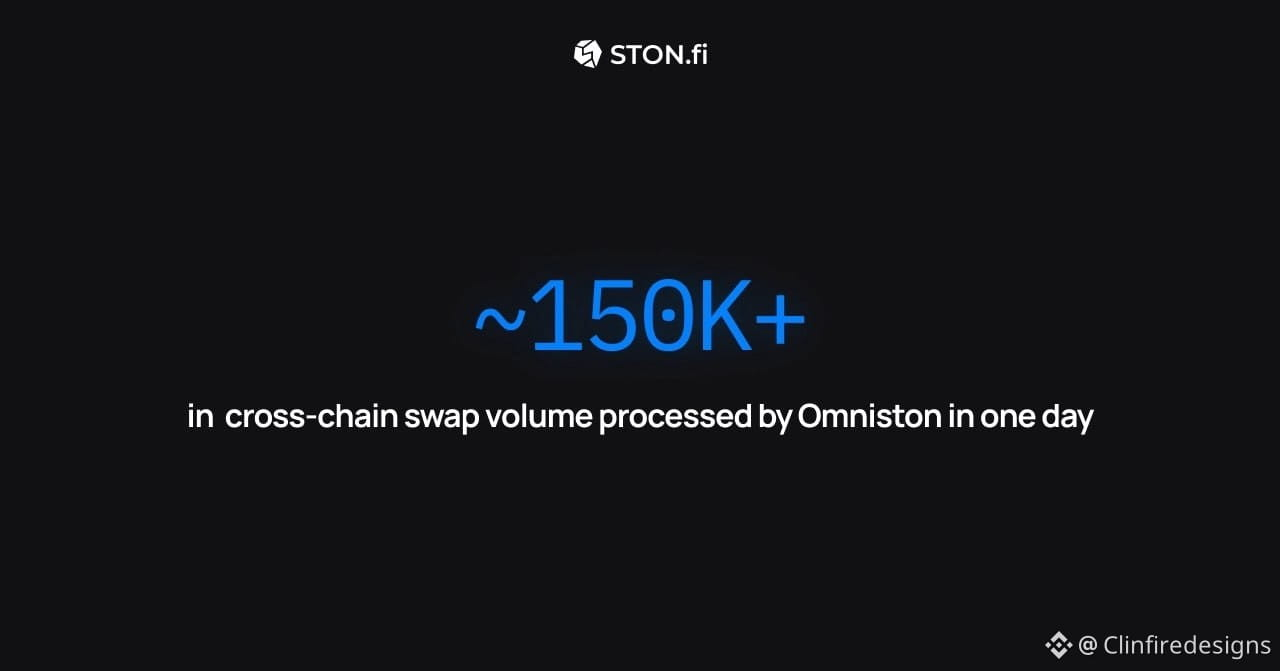
84
Log in to explore more content
Join global crypto users on Binance Square
⚡️ Get latest and useful information about crypto.
💬 Trusted by the world’s largest crypto exchange.
👍 Discover real insights from verified creators.
Email / Phone number
Trending Topics
1
#AnthropicIPOProspectusCouldValueItOver$2T
201 views
23 Discussing
2
#HackersDrainOver12.4MXRPFromDCENTWallets
2,121 views
92 Discussing
3
#SECSaysDecentralizedTokenBuybacksNotInvestmentContracts
44 views
4 Discussing
4
#UKFCAWinsCourtOrderToRecover851400Pounds
56,617 views
1,002 Discussing
5
#ChainlinkLaunchesCCIP2WithEnterpriseVerification
66,289 views
1,141 Discussing
6
#GoldFallsTo$4144
21,863 views
180 Discussing
7
#QNTFallsOver40%FromMorningHigh
115,926 views
1,521 Discussing
8
#USDTAdds845900HoldersInPast7Days
32,824 views
577 Discussing
9
#KospiFalls2.7%SamsungSKHynixDropOver5%
43,258 views
681 Discussing
10
#BitgetCEOConfirms$388MStolenInHack
6,176 views
45 Discussing