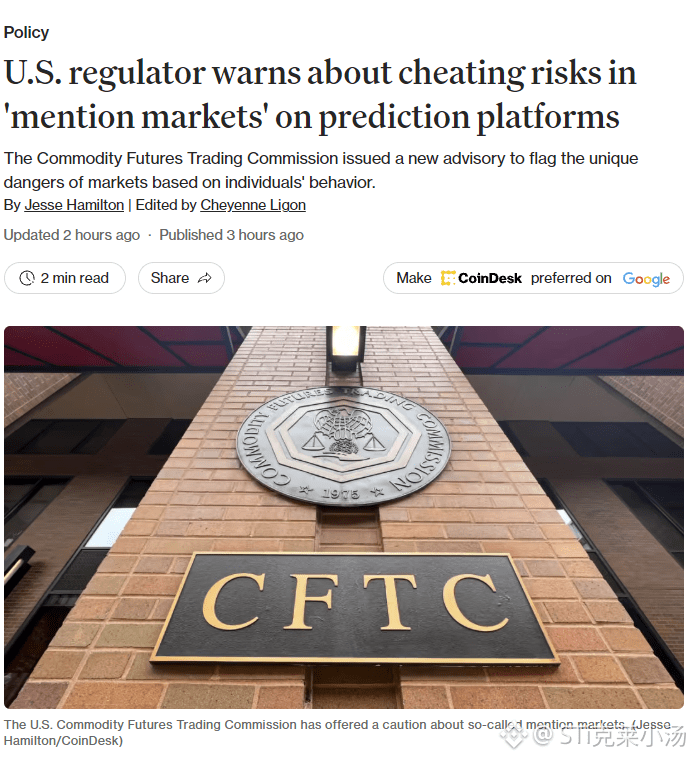
The U.S. Commodity Futures Trading Commission (CFTC) issues a new reminder, warning that prediction markets based on individuals’ behavior, what they mention, or social interactions (Mention Markets) carry unique cheating risks.
The key in this news isn’t the four words “prediction market,” but “individuals' behavior.”
In the past, many prediction market underlying events were relatively exogenous: election results, macroeconomic data, sports scores, weather, interest-rate decisions, and so on. Participants can place bets, but it’s difficult to directly change the outcome itself.
But “mention markets” are different: if the market predicts whether a particular person will speak, mention something, interact with someone, or carry out some public action, then participants themselves may be able to influence the outcome through tactics such as boosting volume, using bots, bribery/inducements, social attacks, or coordinated shout-calling.
This means regulators’ focus is shifting from whether “the outcome is verifiable” to whether “the market process can be manipulated.”
The CFTC isn’t targeting prediction markets—it’s warning about “markets that can be influenced by participants.”
The core risks in this CFTC warning can be broken down into three layers:
1. Behavioral targets are inherently easier to manipulate
If the predicted subject is an individual’s public actions, then the line between “bettors” and “behavior influencers” can blur.
Funds can end up influencing the event itself, forming a closed loop of “prediction—manipulation—settlement.”
2. Social markets are more prone to witchcraft and volume-spamming
Behaviors such as personal mentions, interactions, reposts, comments, and similar actions are naturally well-suited for large-scale bot generation.
If there’s no identity verification, anti-sybil protection, detection of abnormal behavior, and order-flow monitoring, the market can easily turn into a volume-spam game.
3. Oracle and settlement risks rise
Traditional financial events can rely on more authoritative data sources, but for targets like “whether someone mentions a certain piece of content,” they often depend on social media platform APIs, on-chain events, manual review, or third-party data.
Once a data source is delayed, distorted, polluted, or disputed, settlement becomes a new attack surface.
So, the essence of the CFTC’s warning is that it is drawing a finer red line for prediction markets:
You can predict the world, but the market itself can’t be rewritten at will by participants
$BNB $BTC $ETH #Polymarket #Prediction