
#etf
etf
1G views
5.7M Discussing
Hot
Latest

#etf
🚀 Massive capital inflow into spot ETFs: Institutions are back!
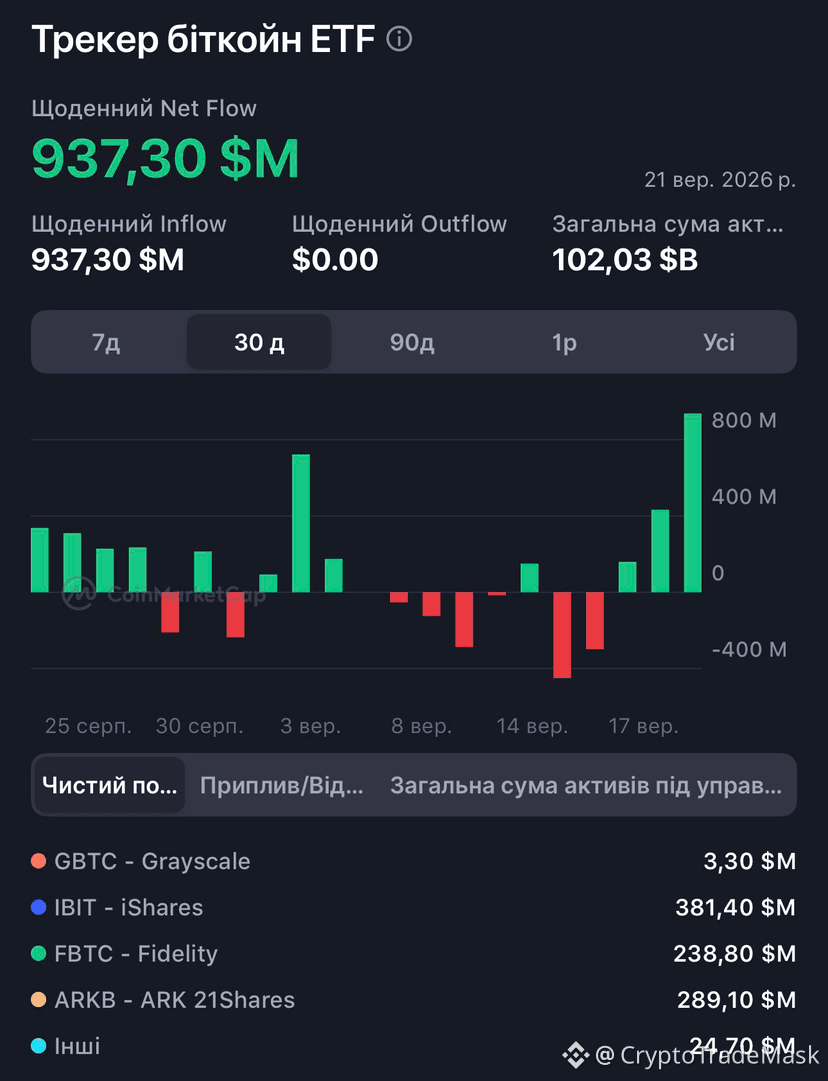
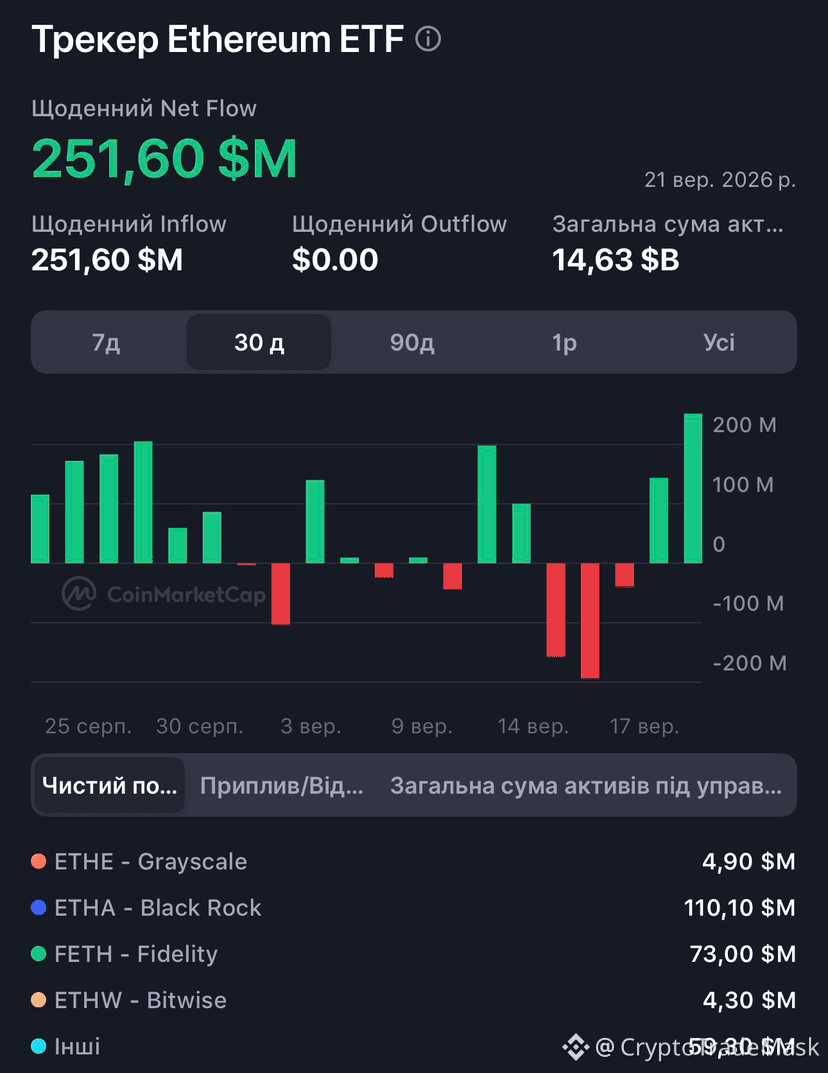
September 21 marked one of the strongest days for crypto ETF inflows: total net inflows for Bitcoin and Ethereum exceeded $1.18 billion, with outflows for both categories at exactly zero ($0.00).
{future}(BTCUSDT)
➡️ $BTC ETFs: +$937.30 million for the day
Total assets under management reached $102.03 billion.
IBIT (BlackRock / iShares): +$381.40 million
ARKB (ARK 21Shares): +$289.10 million
FBTC (Fidelity): +$238.80 million
GBTC (Grayscale): +$3.30 million
Other funds: +$24.70 million
{future}(ETHUSDT)
➡️ $ETH ETFs: +$251.60 million for the day
Total assets under management reached $14.63 billion.
ETHA (BlackRock): +$110.10 million
FETH (Fidelity): +$73.00 million
ETHE (Grayscale): +$4.90 million
ETHW (Bitwise): +$4.30 million
Other funds: +$59.30 million
⚠️ Key takeaway: The complete absence of outflows, combined with strong buying from BlackRock, ARK, and Fidelity, signals a powerful bullish sentiment among major investors.
#etf
🚀 Massive capital inflow into spot ETFs: Institutions are back!
September 21 marked one of the strongest days for crypto ETF inflows: total net inflows for Bitcoin and Ethereum exceeded $1.18 billion, with outflows for both categories at exactly zero ($0.00).
➡️ $BTC ETFs: +$937.30 million for the day
Total assets under management reached $102.03 billion.
IBIT (BlackRock / iShares): +$381.40 million
ARKB (ARK 21Shares): +$289.10 million
FBTC (Fidelity): +$238.80 million
GBTC (Grayscale): +$3.30 million
Other funds: +$24.70 million
➡️ $ETH ETFs: +$251.60 million for the day
Total assets under management reached $14.63 billion.
ETHA (BlackRock): +$110.10 million
FETH (Fidelity): +$73.00 million
ETHE (Grayscale): +$4.90 million
ETHW (Bitwise): +$4.30 million
Other funds: +$59.30 million
⚠️ Key takeaway: The complete absence of outflows, combined with strong buying from BlackRock, ARK, and Fidelity, signals a powerful bullish sentiment among major investors.
🚀 Massive capital inflow into spot ETFs: Institutions are back!
September 21 marked one of the strongest days for crypto ETF inflows: total net inflows for Bitcoin and Ethereum exceeded $1.18 billion, with outflows for both categories at exactly zero ($0.00).
➡️ $BTC ETFs: +$937.30 million for the day
Total assets under management reached $102.03 billion.
IBIT (BlackRock / iShares): +$381.40 million
ARKB (ARK 21Shares): +$289.10 million
FBTC (Fidelity): +$238.80 million
GBTC (Grayscale): +$3.30 million
Other funds: +$24.70 million
➡️ $ETH ETFs: +$251.60 million for the day
Total assets under management reached $14.63 billion.
ETHA (BlackRock): +$110.10 million
FETH (Fidelity): +$73.00 million
ETHE (Grayscale): +$4.90 million
ETHW (Bitwise): +$4.30 million
Other funds: +$59.30 million
⚠️ Key takeaway: The complete absence of outflows, combined with strong buying from BlackRock, ARK, and Fidelity, signals a powerful bullish sentiment among major investors.
1
29

·
--
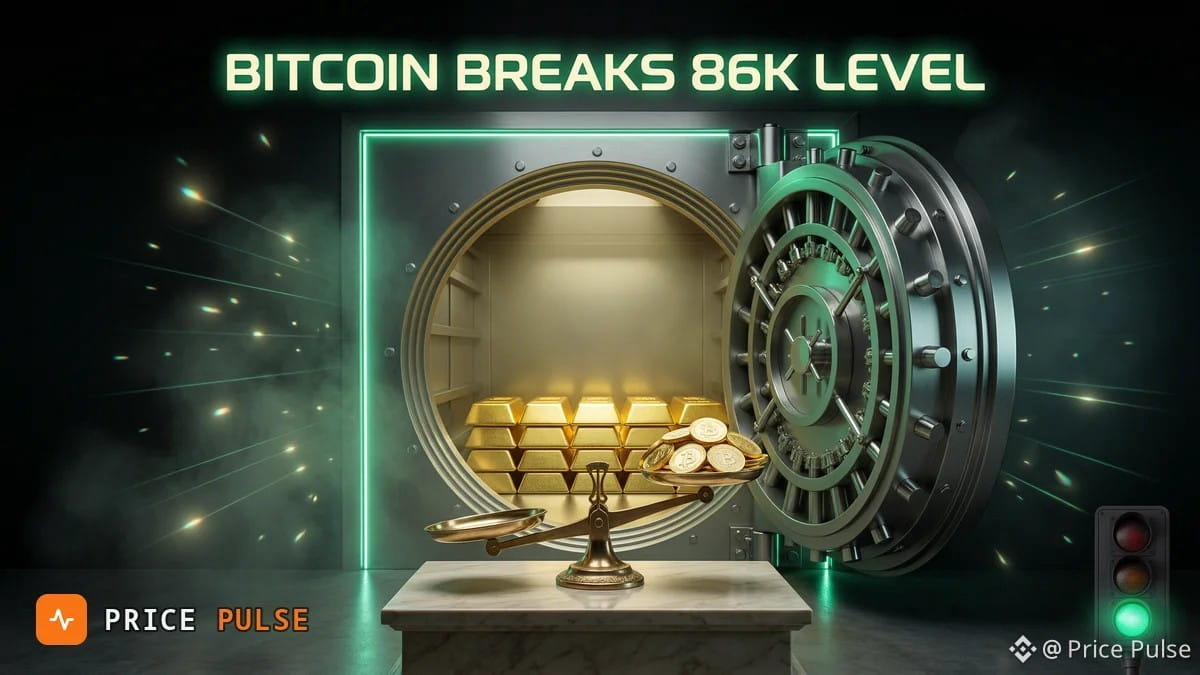
🟢 Bitcoin broke past $86,000 as returning U.S. spot ETF demand collided with a massive short squeeze above $82,000. Easing Treasury yields and falling energy prices provided the macro fuel 🚀 for institutional buyers to absorb sell pressure. If ETF inflows maintain this pace, spot liquidity depth 📈 supports a continued drive toward higher all-time levels while $82,000 holds as key baseline support.
Will sustained ETF inflows push Bitcoin past $90K before macro yield volatility returns? 👇
#bitcoin #etf #macro #yields #derivatives
🟢 Bitcoin broke past $86,000 as returning U.S. spot ETF demand collided with a massive short squeeze above $82,000. Easing Treasury yields and falling energy prices provided the macro fuel 🚀 for institutional buyers to absorb sell pressure. If ETF inflows maintain this pace, spot liquidity depth 📈 supports a continued drive toward higher all-time levels while $82,000 holds as key baseline support.
Will sustained ETF inflows push Bitcoin past $90K before macro yield volatility returns? 👇
#bitcoin #etf #macro #yields #derivatives
Will sustained ETF inflows push Bitcoin past $90K before macro yield volatility returns? 👇
#bitcoin #etf #macro #yields #derivatives
11

·
--
#BitcoinETFs #blakrock #etf
Bitcoin ETF & Institutional Inflows
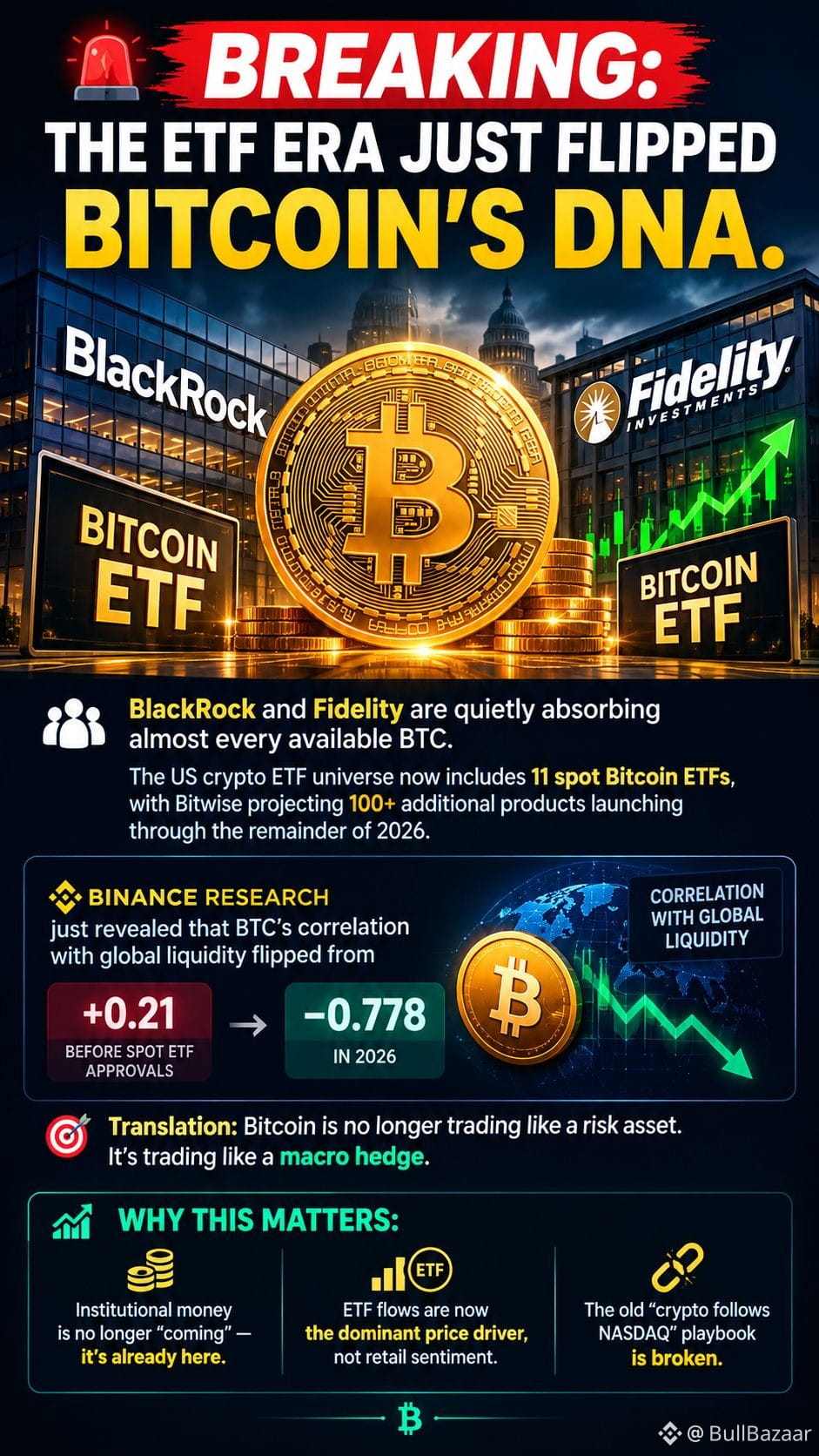
Hook: 🚨 BREAKING: The ETF Era Just Flipped Bitcoin's DNA.
Body:
BlackRock and Fidelity are quietly absorbing almost every available BTC. The US crypto ETF universe now includes 11 spot Bitcoin ETFs, with Bitwise projecting 100+ additional products launching through the remainder of 2026 .
Here's the critical data point:
Binance Research just revealed that BTC's correlation with global liquidity flipped from +0.21 before spot ETF approvals to −0.778 in 2026 . Translation: Bitcoin is no longer trading like a risk asset. It's trading like a macro hedge.
Why this matters:
• Institutional money is no longer "coming" — it's already here.
• ETF flows are now the dominant price driver, not retail sentiment.
• The old "crypto follows NASDAQ" playbook is broken.
Are you positioning for a decoupled BTC, or still watching the NASDAQ chart?
#BitcoinETF #BTC #InstitutionalAdoption #BinanceSquare
#BitcoinETFs #blakrock #etf
Bitcoin ETF & Institutional Inflows
Hook: 🚨 BREAKING: The ETF Era Just Flipped Bitcoin's DNA.
Body:
BlackRock and Fidelity are quietly absorbing almost every available BTC. The US crypto ETF universe now includes 11 spot Bitcoin ETFs, with Bitwise projecting 100+ additional products launching through the remainder of 2026 .
Here's the critical data point:
Binance Research just revealed that BTC's correlation with global liquidity flipped from +0.21 before spot ETF approvals to −0.778 in 2026 . Translation: Bitcoin is no longer trading like a risk asset. It's trading like a macro hedge.
Why this matters:
• Institutional money is no longer "coming" — it's already here.
• ETF flows are now the dominant price driver, not retail sentiment.
• The old "crypto follows NASDAQ" playbook is broken.
Are you positioning for a decoupled BTC, or still watching the NASDAQ chart?
#BitcoinETF #BTC #InstitutionalAdoption #BinanceSquare
Bitcoin ETF & Institutional Inflows
Hook: 🚨 BREAKING: The ETF Era Just Flipped Bitcoin's DNA.
Body:
BlackRock and Fidelity are quietly absorbing almost every available BTC. The US crypto ETF universe now includes 11 spot Bitcoin ETFs, with Bitwise projecting 100+ additional products launching through the remainder of 2026 .
Here's the critical data point:
Binance Research just revealed that BTC's correlation with global liquidity flipped from +0.21 before spot ETF approvals to −0.778 in 2026 . Translation: Bitcoin is no longer trading like a risk asset. It's trading like a macro hedge.
Why this matters:
• Institutional money is no longer "coming" — it's already here.
• ETF flows are now the dominant price driver, not retail sentiment.
• The old "crypto follows NASDAQ" playbook is broken.
Are you positioning for a decoupled BTC, or still watching the NASDAQ chart?
#BitcoinETF #BTC #InstitutionalAdoption #BinanceSquare
22

Bitcoin ($BTC) ETFs recorded a Monday inflow that topped the total net inflow of the previous week, which had been the weakest on record.
This abrupt change underscores how quickly capital can move into crypto‑linked products.
Investors saw more money enter in a single day than in the entire low‑inflow week before. What do you think drives such rapid swings in ETF funding? Bitcoin exchange‑traded funds saw a sharp inflow on Monday that exceeded the total net inflow recorded for the entire previous week. That prior week had posted the weakest net inflow in the funds' history.
#Bitcoin #Etf #Crypto #Investment #Marketflows
Bitcoin ($BTC ) ETFs recorded a Monday inflow that topped the total net inflow of the previous week, which had been the weakest on record.
This abrupt change underscores how quickly capital can move into crypto‑linked products.
Investors saw more money enter in a single day than in the entire low‑inflow week before. What do you think drives such rapid swings in ETF funding? Bitcoin exchange‑traded funds saw a sharp inflow on Monday that exceeded the total net inflow recorded for the entire previous week. That prior week had posted the weakest net inflow in the funds' history.
#Bitcoin #Etf #Crypto #Investment #Marketflows
This abrupt change underscores how quickly capital can move into crypto‑linked products.
Investors saw more money enter in a single day than in the entire low‑inflow week before. What do you think drives such rapid swings in ETF funding? Bitcoin exchange‑traded funds saw a sharp inflow on Monday that exceeded the total net inflow recorded for the entire previous week. That prior week had posted the weakest net inflow in the funds' history.
#Bitcoin #Etf #Crypto #Investment #Marketflows

82

🔥 CRYPTO HOURLY — BREAKING UPDATES 🔥
━━━━━━━━━━━━━━━━━━━━
🔴 Bearish - ETF Capital Exits Jeopardize Bitcoin's $86K Surge
• Massive ETF outflows and rising futures exposure signal profit-taking, risking Bitcoin's recent price momentum above $86,000.
━━━━━━━━━━━━━━━━━━━━
📈 Market Sentiment: 78 (Extreme Greed)
📊 Stay ahead. Think smart. Trade safe.
#cryptonews #BTC #ETF $BTC
Disclaimer: Includes third-party opinions. No advice.
BTC: +0.92% (H: 87395.7 L: 85114) | ETH: +0.91% (H: 2807.34 L: 2715.91) | SOL: -0.57% (H: 119.99 L: 115.54)
🔥 CRYPTO HOURLY — BREAKING UPDATES 🔥
━━━━━━━━━━━━━━━━━━━━
🔴 Bearish - ETF Capital Exits Jeopardize Bitcoin's $86K Surge
• Massive ETF outflows and rising futures exposure signal profit-taking, risking Bitcoin's recent price momentum above $86,000.
━━━━━━━━━━━━━━━━━━━━
📈 Market Sentiment: 78 (Extreme Greed)
📊 Stay ahead. Think smart. Trade safe.
#cryptonews #BTC #ETF $BTC
Disclaimer: Includes third-party opinions. No advice.
BTC: +0.92% (H: 87395.7 L: 85114) | ETH: +0.91% (H: 2807.34 L: 2715.91) | SOL: -0.57% (H: 119.99 L: 115.54)
━━━━━━━━━━━━━━━━━━━━
🔴 Bearish - ETF Capital Exits Jeopardize Bitcoin's $86K Surge
• Massive ETF outflows and rising futures exposure signal profit-taking, risking Bitcoin's recent price momentum above $86,000.
━━━━━━━━━━━━━━━━━━━━
📈 Market Sentiment: 78 (Extreme Greed)
📊 Stay ahead. Think smart. Trade safe.
#cryptonews #BTC #ETF $BTC
Disclaimer: Includes third-party opinions. No advice.
BTC: +0.92% (H: 87395.7 L: 85114) | ETH: +0.91% (H: 2807.34 L: 2715.91) | SOL: -0.57% (H: 119.99 L: 115.54)
10

·
--
Verified
Bitcoin broke out on Monday. The ETF money showed up the same day, not before it.
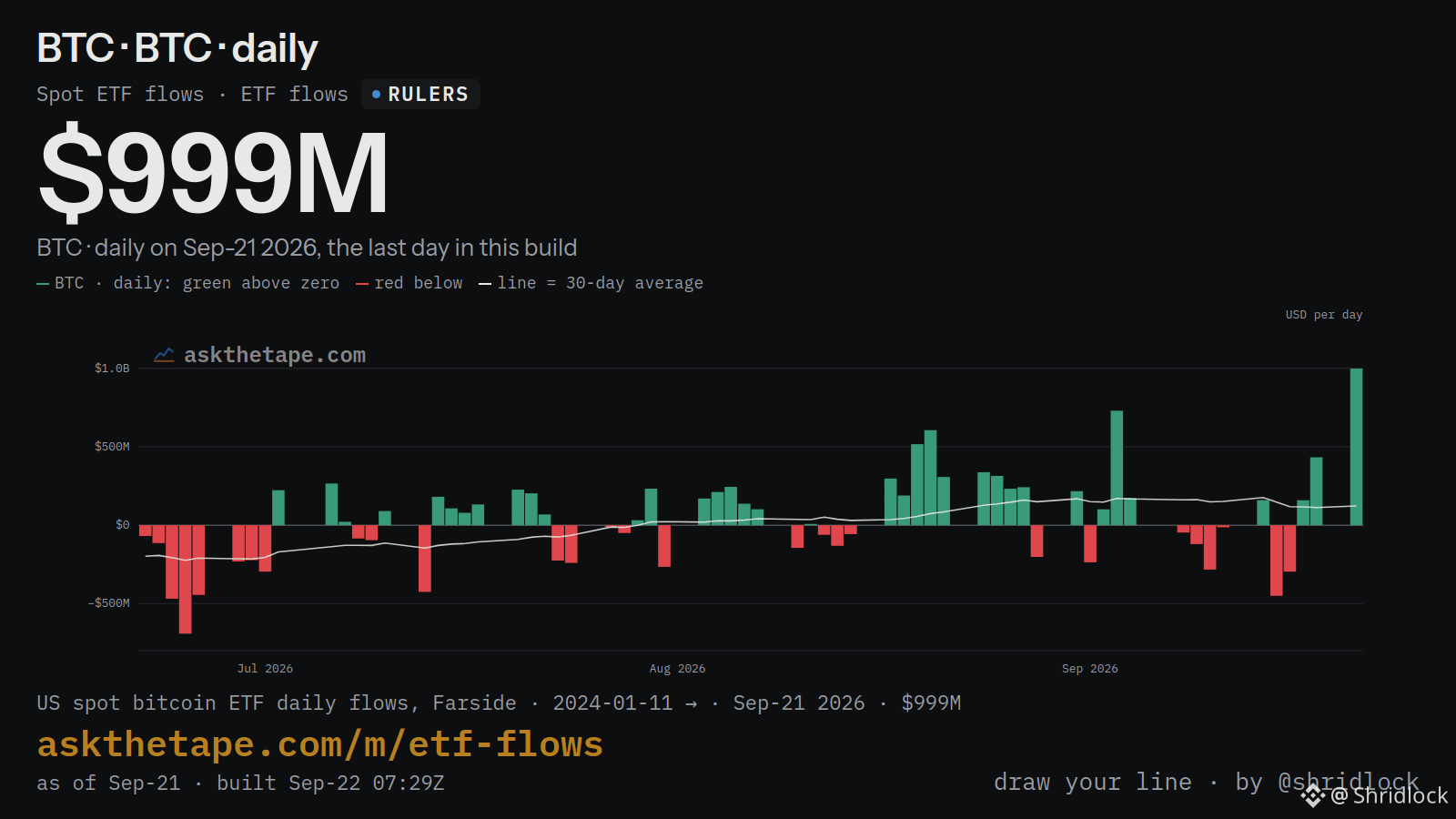
The two weeks into the breakout, the bitcoin ETFs paid out $457M net. Monday alone took in $999M: the biggest day since Oct-6 2025, the 9th biggest since they opened in 2024.
Eight bigger days before this one, all above $1B. A week later bitcoin was higher after five, lower after three, anywhere from -13% to +15%. Eight is a handful, not a law.
Tuesday's number lands tonight. Every fund, every day: askthetape.com/m/etf-flows
$BTC #Bitcoin #ETF
Bitcoin broke out on Monday. The ETF money showed up the same day, not before it.
The two weeks into the breakout, the bitcoin ETFs paid out $457M net. Monday alone took in $999M: the biggest day since Oct-6 2025, the 9th biggest since they opened in 2024.
Eight bigger days before this one, all above $1B. A week later bitcoin was higher after five, lower after three, anywhere from -13% to +15%. Eight is a handful, not a law.
Tuesday's number lands tonight. Every fund, every day: askthetape.com/m/etf-flows
$BTC #Bitcoin #ETF
The two weeks into the breakout, the bitcoin ETFs paid out $457M net. Monday alone took in $999M: the biggest day since Oct-6 2025, the 9th biggest since they opened in 2024.
Eight bigger days before this one, all above $1B. A week later bitcoin was higher after five, lower after three, anywhere from -13% to +15%. Eight is a handful, not a law.
Tuesday's number lands tonight. Every fund, every day: askthetape.com/m/etf-flows
$BTC #Bitcoin #ETF
1
1
4k


·
--
Bullish
🚨 Bitcoin Spot ETFs Add $999M — Can the Inflows Continue?
Nearly $ 1 billion in fresh net inflows puts Bitcoin ETF demand back in focus.
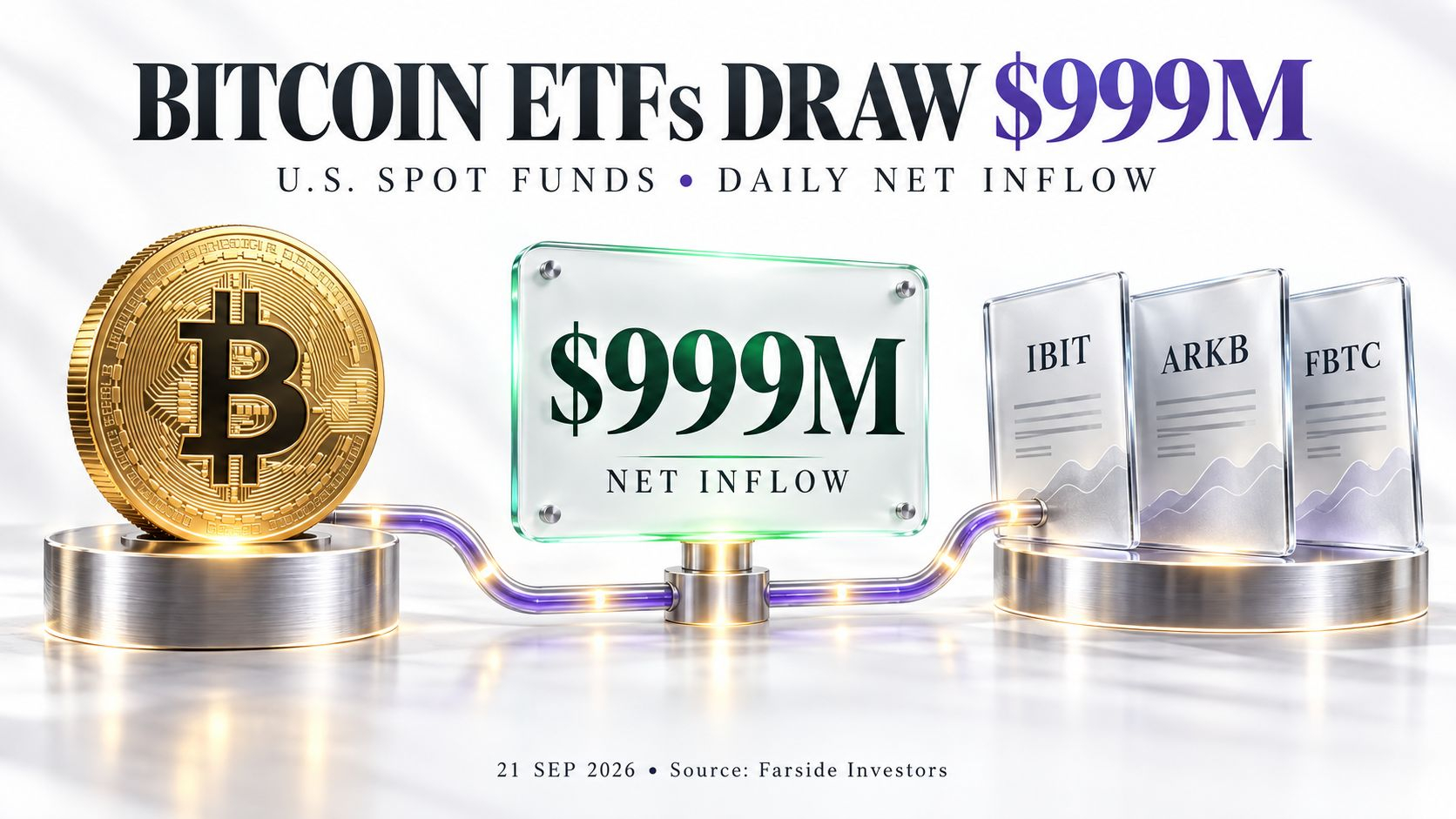
U.S. spot Bitcoin ETFs recorded $999 million in net inflows on September 21, 2026, according to Farside Investors.
The biggest contributors:
BlackRock’s IBIT: $381.4 million
ARK/21Shares’ ARKB: $289.1 million
Fidelity’s FBTC: $238.8 million
Together, those three funds contributed approximately 91% of the daily total.
This marked the third consecutive positive trading session, bringing combined net inflows across September 17, 18 and 21 to approximately $1.59 billion.
My take: The strongest part of this headline is the continuation of positive flows. Repeated net subscriptions provide more evidence of sustained demand than a single unusually strong session.
But concentration matters. With three products dominating the total, broader participation would strengthen the picture. ETF flows also cannot tell us every buyer’s identity, intended holding period or positions elsewhere.
The next useful signals are whether inflows persist, whether more funds contribute meaningfully, and how Bitcoin responds if subscriptions slow. Strong demand can support the market, but one day’s flow does not establish a price target.
Will ETF demand keep building—or does Bitcoin need another catalyst?
#bitcoin #etf #BitcoinSpotETFs$999MNetInflow
$MUBARAK $BTC $AKE
{future}(AKEUSDT)
{future}(BTCUSDT)
{future}(MUBARAKUSDT)
🚨 Bitcoin Spot ETFs Add $999M — Can the Inflows Continue?
Nearly $ 1 billion in fresh net inflows puts Bitcoin ETF demand back in focus.
U.S. spot Bitcoin ETFs recorded $999 million in net inflows on September 21, 2026, according to Farside Investors.
The biggest contributors:
BlackRock’s IBIT: $381.4 million
ARK/21Shares’ ARKB: $289.1 million
Fidelity’s FBTC: $238.8 million
Together, those three funds contributed approximately 91% of the daily total.
This marked the third consecutive positive trading session, bringing combined net inflows across September 17, 18 and 21 to approximately $1.59 billion.
My take: The strongest part of this headline is the continuation of positive flows. Repeated net subscriptions provide more evidence of sustained demand than a single unusually strong session.
But concentration matters. With three products dominating the total, broader participation would strengthen the picture. ETF flows also cannot tell us every buyer’s identity, intended holding period or positions elsewhere.
The next useful signals are whether inflows persist, whether more funds contribute meaningfully, and how Bitcoin responds if subscriptions slow. Strong demand can support the market, but one day’s flow does not establish a price target.
Will ETF demand keep building—or does Bitcoin need another catalyst?
#bitcoin #etf #BitcoinSpotETFs$999MNetInflow
$MUBARAK $BTC $AKE
Nearly $ 1 billion in fresh net inflows puts Bitcoin ETF demand back in focus.
U.S. spot Bitcoin ETFs recorded $999 million in net inflows on September 21, 2026, according to Farside Investors.
The biggest contributors:
BlackRock’s IBIT: $381.4 million
ARK/21Shares’ ARKB: $289.1 million
Fidelity’s FBTC: $238.8 million
Together, those three funds contributed approximately 91% of the daily total.
This marked the third consecutive positive trading session, bringing combined net inflows across September 17, 18 and 21 to approximately $1.59 billion.
My take: The strongest part of this headline is the continuation of positive flows. Repeated net subscriptions provide more evidence of sustained demand than a single unusually strong session.
But concentration matters. With three products dominating the total, broader participation would strengthen the picture. ETF flows also cannot tell us every buyer’s identity, intended holding period or positions elsewhere.
The next useful signals are whether inflows persist, whether more funds contribute meaningfully, and how Bitcoin responds if subscriptions slow. Strong demand can support the market, but one day’s flow does not establish a price target.
Will ETF demand keep building—or does Bitcoin need another catalyst?
#bitcoin #etf #BitcoinSpotETFs$999MNetInflow
$MUBARAK $BTC $AKE
1
64

·
--
$TRX ETF Goes Live on SoFi
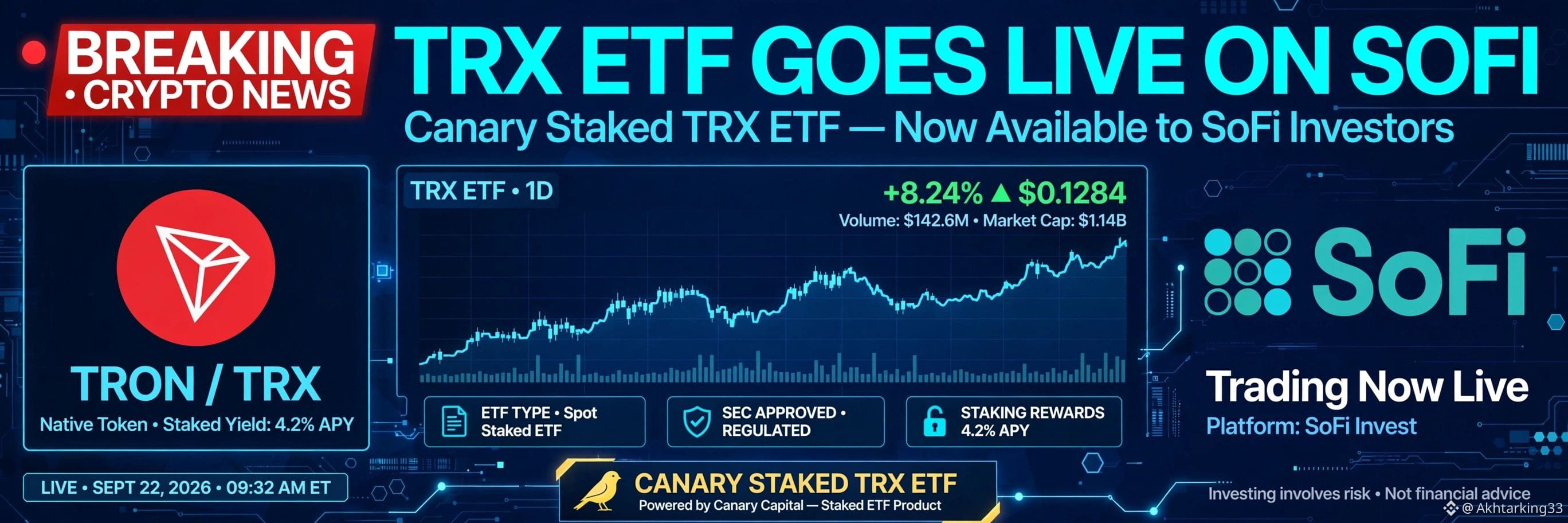
The Canary Staked TRX ETF is now live on SoFi, giving investors traditional-market access to $TRON.US (TRX) exposure through an ETF structure.
📈 Why it matters: • Expands TRX access beyond crypto-native platforms
• Brings staked TRX exposure into traditional finance
• Could increase institutional visibility for the $TROY ecosystem
TRX is stepping further into traditional markets. 🚀
#TRX #TRON #ETF #crypto
{stock_us}(TRON.US)
$TRX ETF Goes Live on SoFi
The Canary Staked TRX ETF is now live on SoFi, giving investors traditional-market access to $TRON.US (TRX) exposure through an ETF structure.
📈 Why it matters: • Expands TRX access beyond crypto-native platforms
• Brings staked TRX exposure into traditional finance
• Could increase institutional visibility for the $TROY ecosystem
TRX is stepping further into traditional markets. 🚀
#TRX #TRON #ETF #crypto
The Canary Staked TRX ETF is now live on SoFi, giving investors traditional-market access to $TRON.US (TRX) exposure through an ETF structure.
📈 Why it matters: • Expands TRX access beyond crypto-native platforms
• Brings staked TRX exposure into traditional finance
• Could increase institutional visibility for the $TROY ecosystem
TRX is stepping further into traditional markets. 🚀
#TRX #TRON #ETF #crypto
38

·
--
Bullish
$SOL Solana ETFs just posted their 12th straight week of inflows, while $BTC Bitcoin ETFs had their quietest week since launch.
Solana funds have pulled in more than $1.4B total and held steady through both a failed Senate crypto bill and a Fed rate hike, two events that hurt Bitcoin funds badly the same week. $SOL is trading near $116-127 depending on the source, up double digits this week.
Steady ETF demand through bad news is a stronger signal than one big green day.
Are ETF flows more convincing to you than price charts?
#solana #sol #etf #CryptoNews #BinanceSquare
{future}(SOLUSDT)
{future}(BTCUSDT)
$SOL Solana ETFs just posted their 12th straight week of inflows, while $BTC Bitcoin ETFs had their quietest week since launch.
Solana funds have pulled in more than $1.4B total and held steady through both a failed Senate crypto bill and a Fed rate hike, two events that hurt Bitcoin funds badly the same week. $SOL is trading near $116-127 depending on the source, up double digits this week.
Steady ETF demand through bad news is a stronger signal than one big green day.
Are ETF flows more convincing to you than price charts?
#solana #sol #etf #CryptoNews #BinanceSquare
Solana funds have pulled in more than $1.4B total and held steady through both a failed Senate crypto bill and a Fed rate hike, two events that hurt Bitcoin funds badly the same week. $SOL is trading near $116-127 depending on the source, up double digits this week.
Steady ETF demand through bad news is a stronger signal than one big green day.
Are ETF flows more convincing to you than price charts?
#solana #sol #etf #CryptoNews #BinanceSquare

42

·
--
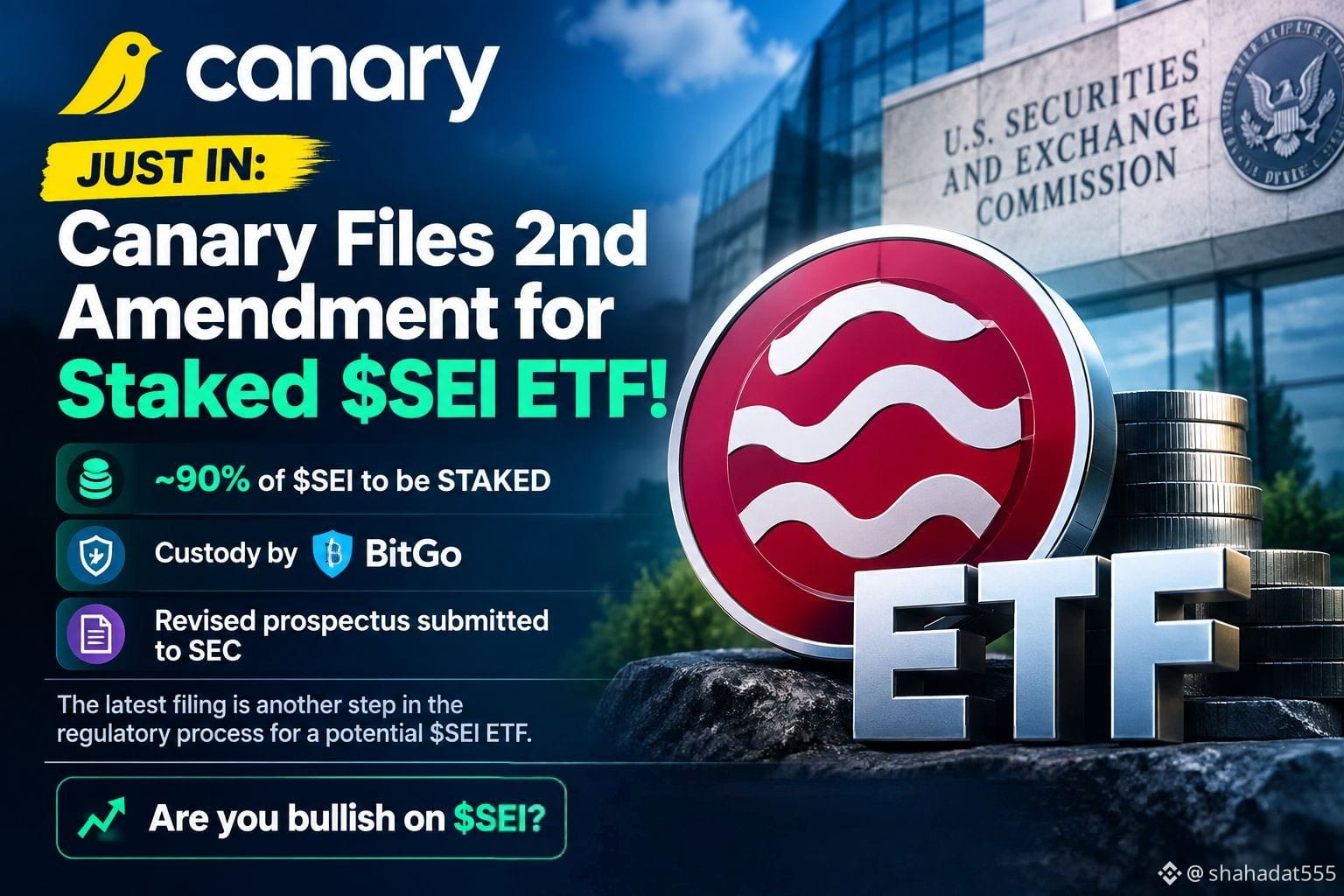
JUST IN: Canary has moved forward with another SEC filing for its proposed Staked ETF.
The latest amendment includes plans for approximately 90% of the fund’s $SEI holdings to be staked, while BitGo is expected to provide custody services.
The revised prospectus has now been submitted to the SEC, adding another development to the ongoing $SEI ETF process.
$SEI I #SEI #etf #CryptoNews #Canary
JUST IN: Canary has moved forward with another SEC filing for its proposed Staked ETF.
The latest amendment includes plans for approximately 90% of the fund’s $SEI holdings to be staked, while BitGo is expected to provide custody services.
The revised prospectus has now been submitted to the SEC, adding another development to the ongoing $SEI ETF process.
$SEI I #SEI #etf #CryptoNews #Canary
The latest amendment includes plans for approximately 90% of the fund’s $SEI holdings to be staked, while BitGo is expected to provide custody services.
The revised prospectus has now been submitted to the SEC, adding another development to the ongoing $SEI ETF process.
$SEI I #SEI #etf #CryptoNews #Canary
139

·
--
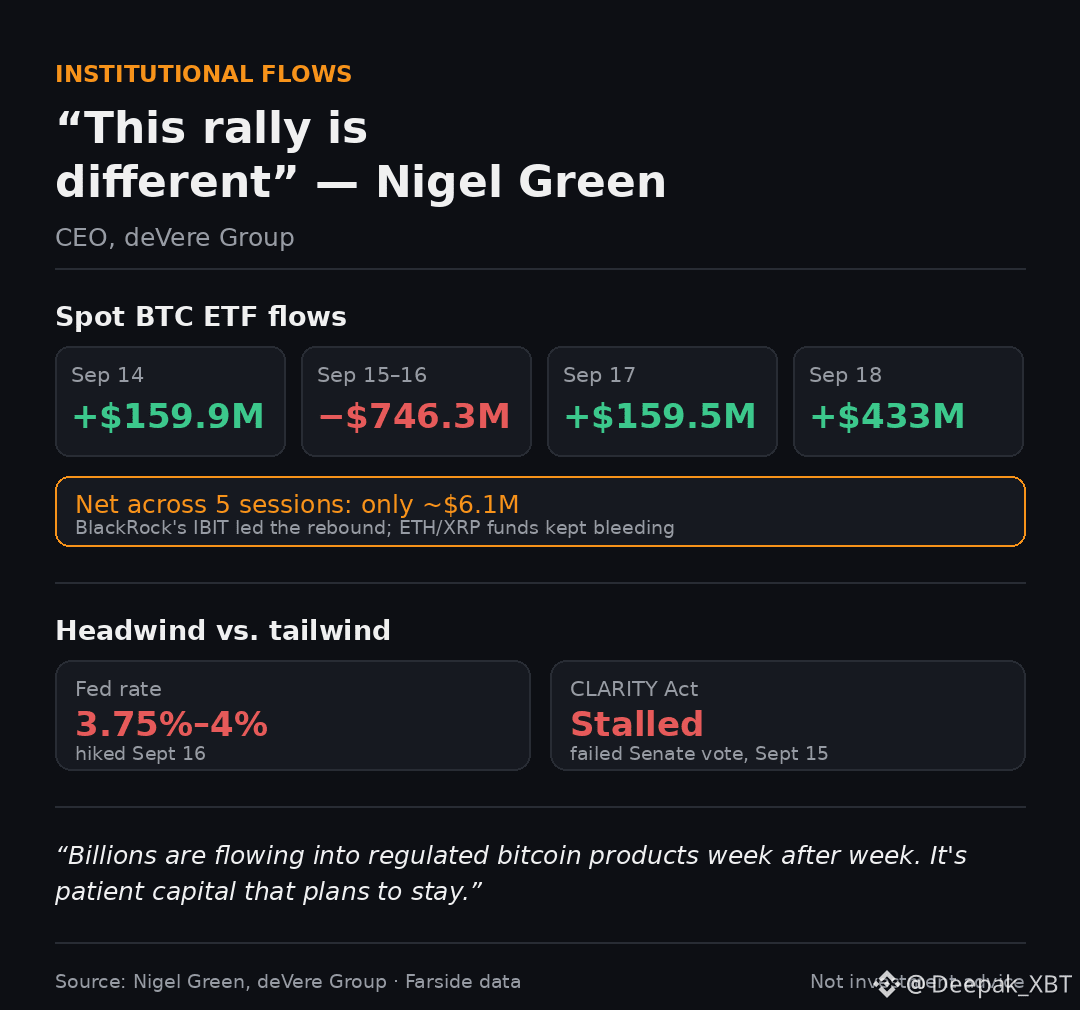
**Nigel Green: Institutional money is what makes this BTC rally different**
deVere Group CEO Nigel Green says Bitcoin's recovery has real staying power this time — because it's institutional, not leveraged speculation. "Patient capital that plans to stay," he called it.
📊 **The flows:**
• $433M net inflows into spot BTC ETFs on Sept 18
• $159.5M (Sept 17) + $159.9M (Sept 14)
• But $746.3M in outflows on Sept 15-16 nearly wiped it out
• Net across 5 days: only ~$6.1M (Farside data)
BlackRock's IBIT led the rebound, but ETH/XRP funds kept bleeding — so demand hasn't broadened across crypto yet.
⚖️ **Headwind:** Fed just hiked to 3.75%-4% on Sept 16, raising the opportunity cost of holding non-yielding BTC. Grayscale calls it a "limited adjustment," not a return to 2022-style tightening.
🏛️ **Green's bigger bet:** if the CLARITY Act (stalled in the Senate on Sept 15) eventually passes, it could unlock a much larger wave of institutional allocation — "the next wave could dwarf this one."
His view: "Bitcoin is a permanent fixture in the global portfolio conversation."
*NFA — DYOR* 🧠
#bitcoin #ETF #Institutional
**Nigel Green: Institutional money is what makes this BTC rally different**
deVere Group CEO Nigel Green says Bitcoin's recovery has real staying power this time — because it's institutional, not leveraged speculation. "Patient capital that plans to stay," he called it.
📊 **The flows:**
• $433M net inflows into spot BTC ETFs on Sept 18
• $159.5M (Sept 17) + $159.9M (Sept 14)
• But $746.3M in outflows on Sept 15-16 nearly wiped it out
• Net across 5 days: only ~$6.1M (Farside data)
BlackRock's IBIT led the rebound, but ETH/XRP funds kept bleeding — so demand hasn't broadened across crypto yet.
⚖️ **Headwind:** Fed just hiked to 3.75%-4% on Sept 16, raising the opportunity cost of holding non-yielding BTC. Grayscale calls it a "limited adjustment," not a return to 2022-style tightening.
🏛️ **Green's bigger bet:** if the CLARITY Act (stalled in the Senate on Sept 15) eventually passes, it could unlock a much larger wave of institutional allocation — "the next wave could dwarf this one."
His view: "Bitcoin is a permanent fixture in the global portfolio conversation."
*NFA — DYOR* 🧠
#bitcoin #ETF #Institutional
deVere Group CEO Nigel Green says Bitcoin's recovery has real staying power this time — because it's institutional, not leveraged speculation. "Patient capital that plans to stay," he called it.
📊 **The flows:**
• $433M net inflows into spot BTC ETFs on Sept 18
• $159.5M (Sept 17) + $159.9M (Sept 14)
• But $746.3M in outflows on Sept 15-16 nearly wiped it out
• Net across 5 days: only ~$6.1M (Farside data)
BlackRock's IBIT led the rebound, but ETH/XRP funds kept bleeding — so demand hasn't broadened across crypto yet.
⚖️ **Headwind:** Fed just hiked to 3.75%-4% on Sept 16, raising the opportunity cost of holding non-yielding BTC. Grayscale calls it a "limited adjustment," not a return to 2022-style tightening.
🏛️ **Green's bigger bet:** if the CLARITY Act (stalled in the Senate on Sept 15) eventually passes, it could unlock a much larger wave of institutional allocation — "the next wave could dwarf this one."
His view: "Bitcoin is a permanent fixture in the global portfolio conversation."
*NFA — DYOR* 🧠
#bitcoin #ETF #Institutional
1
242

#CanaryFilesSecondAmendmentForStakedSEIETF #StakedSEIETF
A new chapter for the staked SEI ETF story. 🚀
The focus now is on clarity, structure, and what the latest amendment could mean for investors and the broader SEI ecosystem.
As the filing process develops, the key things to watch are the official updates, regulatory decisions, staking framework, and potential market implications.
Stay informed. Stay balanced. DYOR. 📊 #crypto #etf #defi $SOL
{future}(SOLUSDT)
$BNB
{future}(BNBUSDT)
$XRP
{future}(XRPUSDT)
#CanaryFilesSecondAmendmentForStakedSEIETF #StakedSEIETF
A new chapter for the staked SEI ETF story. 🚀
The focus now is on clarity, structure, and what the latest amendment could mean for investors and the broader SEI ecosystem.
As the filing process develops, the key things to watch are the official updates, regulatory decisions, staking framework, and potential market implications.
Stay informed. Stay balanced. DYOR. 📊 #crypto #etf #defi $SOL
$BNB
$XRP
A new chapter for the staked SEI ETF story. 🚀
The focus now is on clarity, structure, and what the latest amendment could mean for investors and the broader SEI ecosystem.
As the filing process develops, the key things to watch are the official updates, regulatory decisions, staking framework, and potential market implications.
Stay informed. Stay balanced. DYOR. 📊 #crypto #etf #defi $SOL
$BNB
$XRP

76

·
--
Bullish
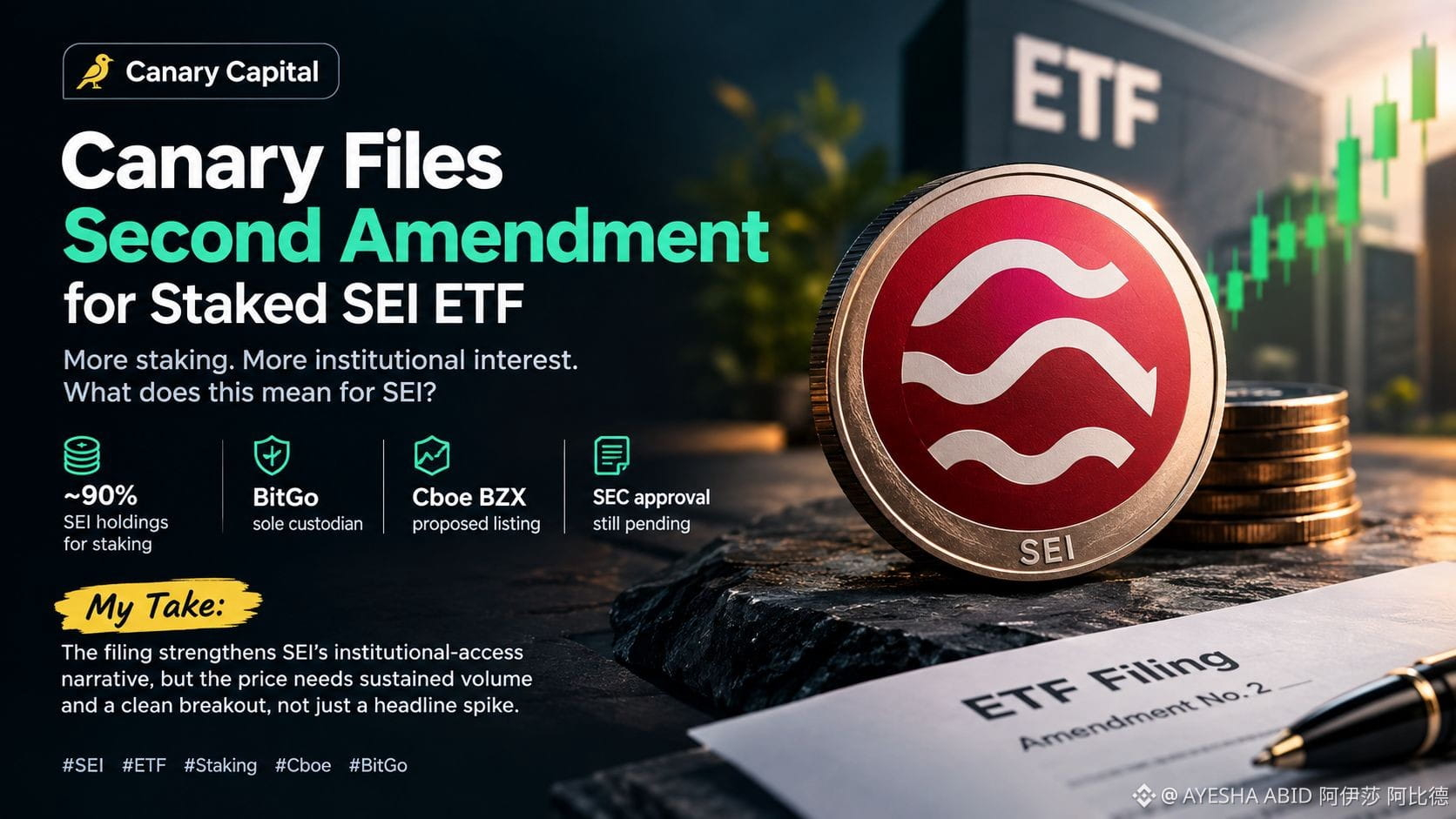
🚨 SEI JUST GOT A NEW ETF CATALYST — AND THE STAKING DETAIL MATTERS
Canary Capital has filed Amendment No. 2 for its Canary Staked SEI ETF, with the latest structure targeting roughly 90% of the fund’s SEI holdings for staking. The filing also specifies BitGo as the sole custodian. The ETF is proposed to trade on Cboe BZX, but SEC approval and a launch date are still pending.
The market reacted quickly. SEI jumped around 16.5%, while reported 24H volume reached roughly $105M, showing that traders are actively repricing the ETF narrative.
From a technical angle, SEI recently traded around $0.0558. Earlier data showed open interest near $58M, with derivatives volume significantly above spot, so leverage and positioning remain important for the next move.
My take: the filing strengthens SEI’s institutional access narrative, but the price needs sustained volume and a clean breakout rather than one headline-driven spike.
SEI + ETF + Staking + Cboe + BitGo are now the key themes to watch.
Do you think the staking structure can create stronger demand for SEI if the ETF gets approved?
#SEI #ETF #Write2Earn $SEI
{future}(SEIUSDT)
#CanaryFilesSecondAmendmentForStakedSEIETF
🚨 SEI JUST GOT A NEW ETF CATALYST — AND THE STAKING DETAIL MATTERS
Canary Capital has filed Amendment No. 2 for its Canary Staked SEI ETF, with the latest structure targeting roughly 90% of the fund’s SEI holdings for staking. The filing also specifies BitGo as the sole custodian. The ETF is proposed to trade on Cboe BZX, but SEC approval and a launch date are still pending.
The market reacted quickly. SEI jumped around 16.5%, while reported 24H volume reached roughly $105M, showing that traders are actively repricing the ETF narrative.
From a technical angle, SEI recently traded around $0.0558. Earlier data showed open interest near $58M, with derivatives volume significantly above spot, so leverage and positioning remain important for the next move.
My take: the filing strengthens SEI’s institutional access narrative, but the price needs sustained volume and a clean breakout rather than one headline-driven spike.
SEI + ETF + Staking + Cboe + BitGo are now the key themes to watch.
Do you think the staking structure can create stronger demand for SEI if the ETF gets approved?
#SEI #ETF #Write2Earn $SEI
#CanaryFilesSecondAmendmentForStakedSEIETF
Canary Capital has filed Amendment No. 2 for its Canary Staked SEI ETF, with the latest structure targeting roughly 90% of the fund’s SEI holdings for staking. The filing also specifies BitGo as the sole custodian. The ETF is proposed to trade on Cboe BZX, but SEC approval and a launch date are still pending.
The market reacted quickly. SEI jumped around 16.5%, while reported 24H volume reached roughly $105M, showing that traders are actively repricing the ETF narrative.
From a technical angle, SEI recently traded around $0.0558. Earlier data showed open interest near $58M, with derivatives volume significantly above spot, so leverage and positioning remain important for the next move.
My take: the filing strengthens SEI’s institutional access narrative, but the price needs sustained volume and a clean breakout rather than one headline-driven spike.
SEI + ETF + Staking + Cboe + BitGo are now the key themes to watch.
Do you think the staking structure can create stronger demand for SEI if the ETF gets approved?
#SEI #ETF #Write2Earn $SEI
#CanaryFilesSecondAmendmentForStakedSEIETF
4
342

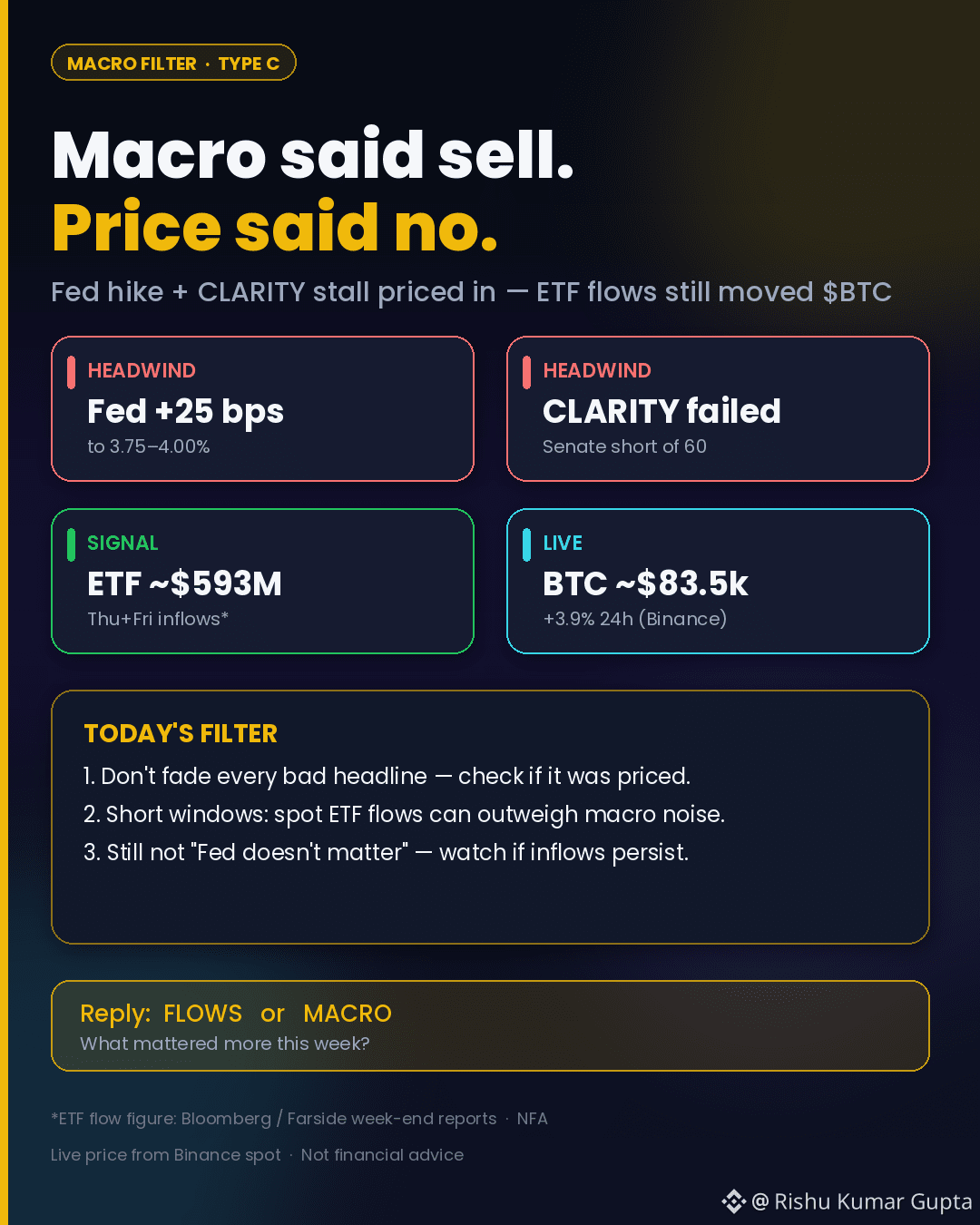
Macro said sell. Price said no.
Fed +25 bps + CLARITY stall = two classic headwinds. $BTC still reclaimed and is ~$83.5k (+3.9% 24h on Binance).
What actually helped: US spot Bitcoin ETFs pulled in ~$593M across Thu+Fri (Bloomberg / Farside week-end reports) — enough to flip the prior midweek outflows and leave the week roughly flat on net.
Today's filter (not a call):
1) Check if the headline was already priced
2) Short windows: ETF flows can outweigh macro noise
3) Still watch whether those inflows persist — Fed isn't "irrelevant"
NFA — study the chart + flows before you size.
Reply FLOWS or MACRO — what mattered more this week?
$BTC #Bitcoin #ETF #Macro
Macro said sell. Price said no.
Fed +25 bps + CLARITY stall = two classic headwinds. $BTC still reclaimed and is ~$83.5k (+3.9% 24h on Binance).
What actually helped: US spot Bitcoin ETFs pulled in ~$593M across Thu+Fri (Bloomberg / Farside week-end reports) — enough to flip the prior midweek outflows and leave the week roughly flat on net.
Today's filter (not a call):
1) Check if the headline was already priced
2) Short windows: ETF flows can outweigh macro noise
3) Still watch whether those inflows persist — Fed isn't "irrelevant"
NFA — study the chart + flows before you size.
Reply FLOWS or MACRO — what mattered more this week?
$BTC #Bitcoin #ETF #Macro
Fed +25 bps + CLARITY stall = two classic headwinds. $BTC still reclaimed and is ~$83.5k (+3.9% 24h on Binance).
What actually helped: US spot Bitcoin ETFs pulled in ~$593M across Thu+Fri (Bloomberg / Farside week-end reports) — enough to flip the prior midweek outflows and leave the week roughly flat on net.
Today's filter (not a call):
1) Check if the headline was already priced
2) Short windows: ETF flows can outweigh macro noise
3) Still watch whether those inflows persist — Fed isn't "irrelevant"
NFA — study the chart + flows before you size.
Reply FLOWS or MACRO — what mattered more this week?
$BTC #Bitcoin #ETF #Macro
52

$SEI #CanaryFilesSecondAmendmentForStakedSEIETF
Canary Capital moves SEI closer to institutional status
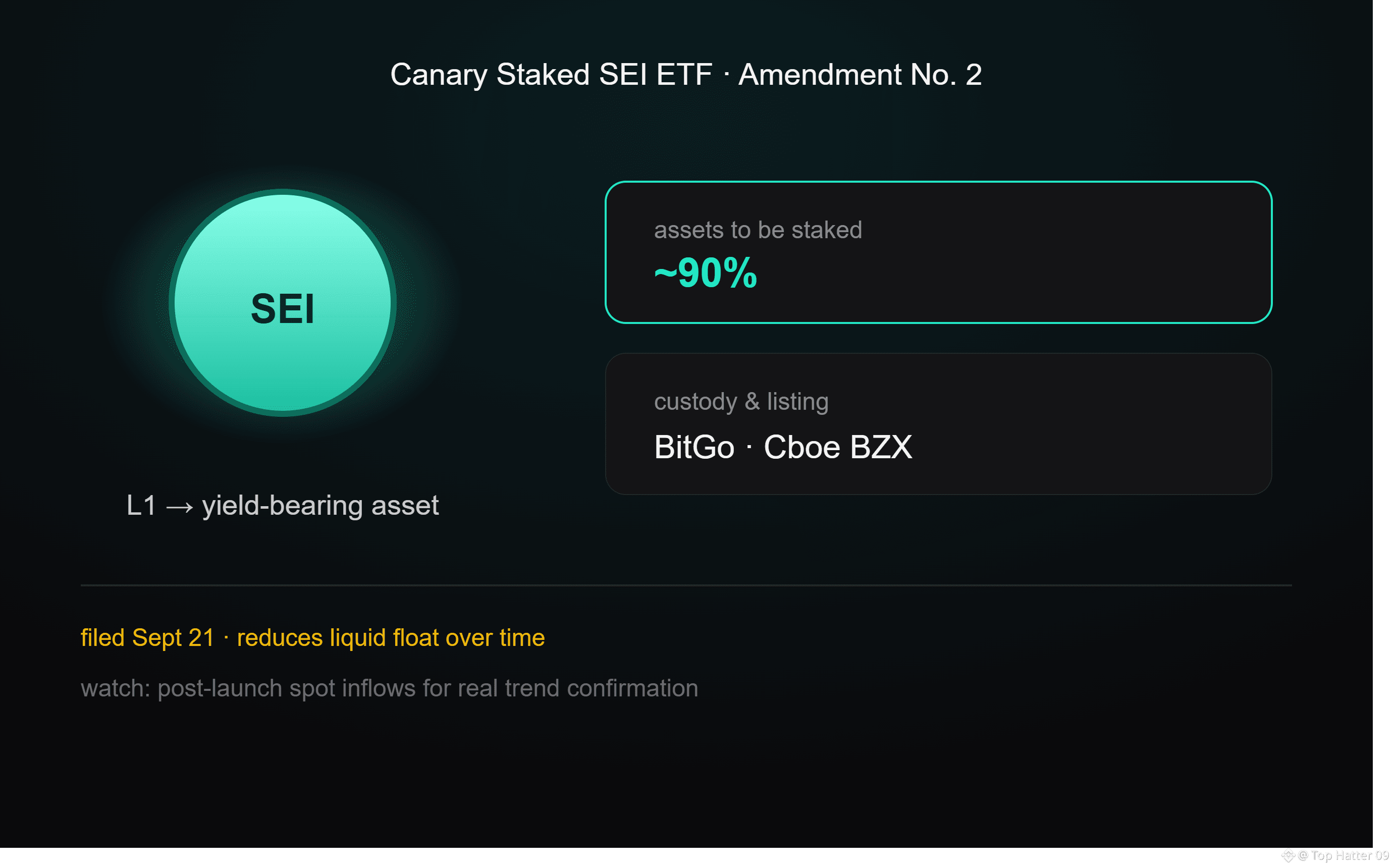
Canary Capital filed its second S-1 amendment for a Staked SEI ETF on September 21, revising the staking mechanism to stake roughly 90% of SEI assets, custodied by BitGo, with a planned listing on Cboe BZX.
This shifts SEI's narrative from a purely speculative L1 token toward a yield-bearing, regulated product — the kind of structural demand shift that tends to reduce liquid float over time as ETF-held assets get staked rather than traded.
Worth watching: SEI's short-term price reaction has been volatile around this news, with funding rates and leveraged positioning already crowded. A real trend shift would need sustained spot inflows post-launch, not just headline reaction.
$SEI #SEI #ETF #InstitutionalCrypto
{future}(SEIUSDT)
$SEI #CanaryFilesSecondAmendmentForStakedSEIETF
Canary Capital moves SEI closer to institutional status
Canary Capital filed its second S-1 amendment for a Staked SEI ETF on September 21, revising the staking mechanism to stake roughly 90% of SEI assets, custodied by BitGo, with a planned listing on Cboe BZX.
This shifts SEI's narrative from a purely speculative L1 token toward a yield-bearing, regulated product — the kind of structural demand shift that tends to reduce liquid float over time as ETF-held assets get staked rather than traded.
Worth watching: SEI's short-term price reaction has been volatile around this news, with funding rates and leveraged positioning already crowded. A real trend shift would need sustained spot inflows post-launch, not just headline reaction.
$SEI #SEI #ETF #InstitutionalCrypto
Canary Capital moves SEI closer to institutional status
Canary Capital filed its second S-1 amendment for a Staked SEI ETF on September 21, revising the staking mechanism to stake roughly 90% of SEI assets, custodied by BitGo, with a planned listing on Cboe BZX.
This shifts SEI's narrative from a purely speculative L1 token toward a yield-bearing, regulated product — the kind of structural demand shift that tends to reduce liquid float over time as ETF-held assets get staked rather than traded.
Worth watching: SEI's short-term price reaction has been volatile around this news, with funding rates and leveraged positioning already crowded. A real trend shift would need sustained spot inflows post-launch, not just headline reaction.
$SEI #SEI #ETF #InstitutionalCrypto
90

·
--
REX launched the 2X Long Strive ETF (ASSX) on Cboe, offering leveraged exposure to Bitcoin treasury firm Strive.
Key Numbers:
📈 2X daily leveraged exposure
₿ 25,000 BTC held by Strive
💰 $30.09 closing share price
🚀 6.4% gain on launch day
💼 1.5% expense ratio
The ETF gives investors a leveraged way to gain exposure to a major Bitcoin treasury company through a regulated U.S. exchange.
#Bitcoin #ETF #Crypto #BinanceSquare
REX launched the 2X Long Strive ETF (ASSX) on Cboe, offering leveraged exposure to Bitcoin treasury firm Strive.
Key Numbers:
📈 2X daily leveraged exposure
₿ 25,000 BTC held by Strive
💰 $30.09 closing share price
🚀 6.4% gain on launch day
💼 1.5% expense ratio
The ETF gives investors a leveraged way to gain exposure to a major Bitcoin treasury company through a regulated U.S. exchange.
#Bitcoin #ETF #Crypto #BinanceSquare
Key Numbers:
📈 2X daily leveraged exposure
₿ 25,000 BTC held by Strive
💰 $30.09 closing share price
🚀 6.4% gain on launch day
💼 1.5% expense ratio
The ETF gives investors a leveraged way to gain exposure to a major Bitcoin treasury company through a regulated U.S. exchange.
#Bitcoin #ETF #Crypto #BinanceSquare
76

·
--
Verified
January 10, 2024. The SEC approved spot Bitcoin ETFs.
For ten years people said it'd never happen. Applications got rejected over and over. Then it did, and within months the biggest of those funds was holding hundreds of thousands of BTC for people who'd never touch a wallet.
Bitcoin was around $46,000 that week. Two weeks later it was lower, not higher. It's at $81,241 now.
Big news and big price moves rarely show up on the same day. The crowd that waited a decade for the headline often wasn't there for what came after.
What's the headline you're waiting for, and what will you actually do when it comes?
Personal view, not advice. Do your own research.
#Bitcoin #ETF
January 10, 2024. The SEC approved spot Bitcoin ETFs.
For ten years people said it'd never happen. Applications got rejected over and over. Then it did, and within months the biggest of those funds was holding hundreds of thousands of BTC for people who'd never touch a wallet.
Bitcoin was around $46,000 that week. Two weeks later it was lower, not higher. It's at $81,241 now.
Big news and big price moves rarely show up on the same day. The crowd that waited a decade for the headline often wasn't there for what came after.
What's the headline you're waiting for, and what will you actually do when it comes?
Personal view, not advice. Do your own research.
#Bitcoin #ETF
For ten years people said it'd never happen. Applications got rejected over and over. Then it did, and within months the biggest of those funds was holding hundreds of thousands of BTC for people who'd never touch a wallet.
Bitcoin was around $46,000 that week. Two weeks later it was lower, not higher. It's at $81,241 now.
Big news and big price moves rarely show up on the same day. The crowd that waited a decade for the headline often wasn't there for what came after.
What's the headline you're waiting for, and what will you actually do when it comes?
Personal view, not advice. Do your own research.
#Bitcoin #ETF
441

·
--
Bullish
🚨 Institutional Buyers Return: Spot ETF Inflows Spark Bitcoin Stability! 🚀
Good morning traders! Over the past 12 hours, Bitcoin ($BTC ) has successfully held its ground above the key $80,000 level as institutional spot ETF inflows officially turned net-positive once again.
This revival in spot demand is effectively absorbing short-term selling pressure from derivatives traders hedging key resistance near $81,500. With broader financial markets stabilizing, institutional accumulation is reinforcing $80K as a solid higher-low structural support. As long as ETF inflows remain consistent through the week, analysts are eyeing a potential breakout push toward upper liquidity pools. Are you accumulating spot $BTC on this consolidation, or waiting for a breakout confirmation? Drop your targets below! 👇
{future}(BTCUSDT)
{future}(ETHUSDT)
#bitcoin #BTC #CryptoNews #BinanceSquare #etf
🚨 Institutional Buyers Return: Spot ETF Inflows Spark Bitcoin Stability! 🚀
Good morning traders! Over the past 12 hours, Bitcoin ($BTC ) has successfully held its ground above the key $80,000 level as institutional spot ETF inflows officially turned net-positive once again.
This revival in spot demand is effectively absorbing short-term selling pressure from derivatives traders hedging key resistance near $81,500. With broader financial markets stabilizing, institutional accumulation is reinforcing $80K as a solid higher-low structural support. As long as ETF inflows remain consistent through the week, analysts are eyeing a potential breakout push toward upper liquidity pools. Are you accumulating spot $BTC on this consolidation, or waiting for a breakout confirmation? Drop your targets below! 👇
#bitcoin #BTC #CryptoNews #BinanceSquare #etf
Good morning traders! Over the past 12 hours, Bitcoin ($BTC ) has successfully held its ground above the key $80,000 level as institutional spot ETF inflows officially turned net-positive once again.
This revival in spot demand is effectively absorbing short-term selling pressure from derivatives traders hedging key resistance near $81,500. With broader financial markets stabilizing, institutional accumulation is reinforcing $80K as a solid higher-low structural support. As long as ETF inflows remain consistent through the week, analysts are eyeing a potential breakout push toward upper liquidity pools. Are you accumulating spot $BTC on this consolidation, or waiting for a breakout confirmation? Drop your targets below! 👇
#bitcoin #BTC #CryptoNews #BinanceSquare #etf
93
·
--
Bullish
$INJ jumped around 20% over the weekend and is trading near $7.
Two things landed together: INJ went live natively on $SOL Solana, and 21Shares amended its spot Injective ETF filing (proposed Nasdaq ticker TINJ, with 40–60% staking). Worth remembering that a filing is not an approval, and the SEC review is still ongoing.
The number I'd watch is whether volume holds once the ETF headlines cool off.
Are you holding $INJ or waiting for approval news first? 👇
#injective #INJ #etf #CryptoNews #BinanceSquare
{future}(INJUSDT)
{future}(SOLUSDT)
$INJ jumped around 20% over the weekend and is trading near $7.
Two things landed together: INJ went live natively on $SOL Solana, and 21Shares amended its spot Injective ETF filing (proposed Nasdaq ticker TINJ, with 40–60% staking). Worth remembering that a filing is not an approval, and the SEC review is still ongoing.
The number I'd watch is whether volume holds once the ETF headlines cool off.
Are you holding $INJ or waiting for approval news first? 👇
#injective #INJ #etf #CryptoNews #BinanceSquare
Two things landed together: INJ went live natively on $SOL Solana, and 21Shares amended its spot Injective ETF filing (proposed Nasdaq ticker TINJ, with 40–60% staking). Worth remembering that a filing is not an approval, and the SEC review is still ongoing.
The number I'd watch is whether volume holds once the ETF headlines cool off.
Are you holding $INJ or waiting for approval news first? 👇
#injective #INJ #etf #CryptoNews #BinanceSquare

239

BTC ETF Update
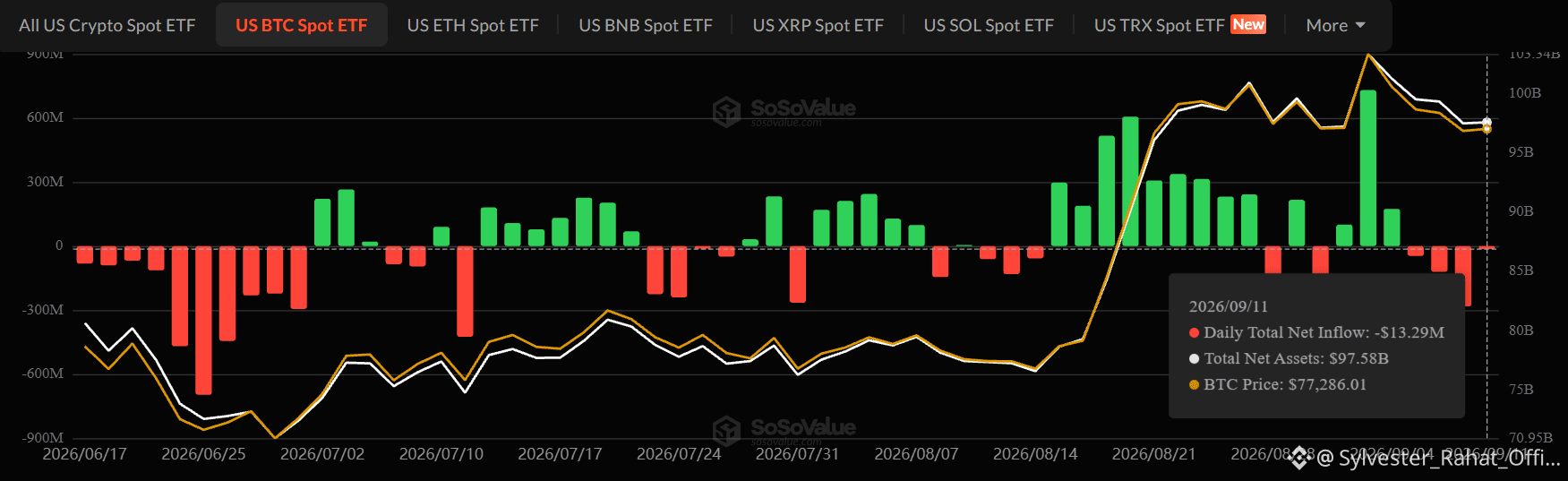
U.S. spot Bitcoin ETFs recorded around $433M in net inflows on Friday. Fidelity’s FBTC accounted for approximately $310.7M of the inflows.$BTC
#bitcoin #BTC #etf #CryptoNews
BTC ETF Update
U.S. spot Bitcoin ETFs recorded around $433M in net inflows on Friday. Fidelity’s FBTC accounted for approximately $310.7M of the inflows.$BTC
#bitcoin #BTC #etf #CryptoNews
U.S. spot Bitcoin ETFs recorded around $433M in net inflows on Friday. Fidelity’s FBTC accounted for approximately $310.7M of the inflows.$BTC
#bitcoin #BTC #etf #CryptoNews
44
Log in to explore more content
Join global crypto users on Binance Square
⚡️ Get latest and useful information about crypto.
💬 Trusted by the world’s largest crypto exchange.
👍 Discover real insights from verified creators.
Email / Phone number
Trending Topics
1
#AIStocksWhatNext
313,961 views
2,774 Discussing
2
#BitcoinBreaksAboveMayHighNears$86K
11,816 views
173 Discussing
3
#DogecoinRises15%
35,680 views
898 Discussing
4
#$14BBitcoinOptionsExpireFriday
2,860 views
78 Discussing
5
#BNBMarketCapPassesBNYMellon
24,505 views
664 Discussing
6
#CryptoMarketCapReclaims$3Trillion
3,581 views
72 Discussing
7
#MuseOvertakesChatGPTAsTopFreeIOSApp
14,499 views
502 Discussing
8
#TokenizedStockPlatformsCouldLaunchNextQuarter
23,138 views
559 Discussing
9
#StrategyAdds950Bitcoin
28,659 views
636 Discussing
10
#CardanoAddedToX402KitForADAPayments
26,868 views
632 Discussing