
#goldtrading
goldtrading
209,340 views
1,700 Discussing
Hot
Latest

📈 XAUUSDT Market Update
Gold (XAUUSDT) is showing bullish momentum.
If the current momentum continues and price holds above the key support area, XAUUSDT could move higher from here. 🚀
Keep an eye on price action and important resistance levels before entering a trade.
$
Are you expecting Gold to go UP? 📈
#XAUUSDT #XAU #Gold #GoldTrading #Binance #Trading #CryptoTrading
📈 XAUUSDT Market Update
Gold (XAUUSDT) is showing bullish momentum.
If the current momentum continues and price holds above the key support area, XAUUSDT could move higher from here. 🚀
Keep an eye on price action and important resistance levels before entering a trade.
$
Are you expecting Gold to go UP? 📈
#XAUUSDT #XAU #Gold #GoldTrading #Binance #Trading #CryptoTrading
Gold (XAUUSDT) is showing bullish momentum.
If the current momentum continues and price holds above the key support area, XAUUSDT could move higher from here. 🚀
Keep an eye on price action and important resistance levels before entering a trade.
$
Are you expecting Gold to go UP? 📈
#XAUUSDT #XAU #Gold #GoldTrading #Binance #Trading #CryptoTrading
270

·
--
Bearish
$XAU — $4,050 IS THE LEVEL TO WATCH 👀
Gold is under heavy pressure after a sharp selloff, with $XAU USD trading near $4,130.
📉 BEARISH STRUCTURE:
• Price remains below recent key resistance
• Strong USD + elevated Treasury yields are pressuring gold
• $4,100 is the immediate zone to watch
• $4,050 becomes a key downside level if selling continues
⚠️ If $4,050 breaks decisively, the next area traders may watch is around $4,000 and below.
But if gold reclaims $4,200+, the bearish setup could weaken.
Are you watching #XAU for a SHORT or a possible REBOUND? 👇
#XAU #Gold #GoldTrading #Forex
{future}(XAUUSDT)
$XAU — $4,050 IS THE LEVEL TO WATCH 👀
Gold is under heavy pressure after a sharp selloff, with $XAU USD trading near $4,130.
📉 BEARISH STRUCTURE:
• Price remains below recent key resistance
• Strong USD + elevated Treasury yields are pressuring gold
• $4,100 is the immediate zone to watch
• $4,050 becomes a key downside level if selling continues
⚠️ If $4,050 breaks decisively, the next area traders may watch is around $4,000 and below.
But if gold reclaims $4,200+, the bearish setup could weaken.
Are you watching #XAU for a SHORT or a possible REBOUND? 👇
#XAU #Gold #GoldTrading #Forex
Gold is under heavy pressure after a sharp selloff, with $XAU USD trading near $4,130.
📉 BEARISH STRUCTURE:
• Price remains below recent key resistance
• Strong USD + elevated Treasury yields are pressuring gold
• $4,100 is the immediate zone to watch
• $4,050 becomes a key downside level if selling continues
⚠️ If $4,050 breaks decisively, the next area traders may watch is around $4,000 and below.
But if gold reclaims $4,200+, the bearish setup could weaken.
Are you watching #XAU for a SHORT or a possible REBOUND? 👇
#XAU #Gold #GoldTrading #Forex
105

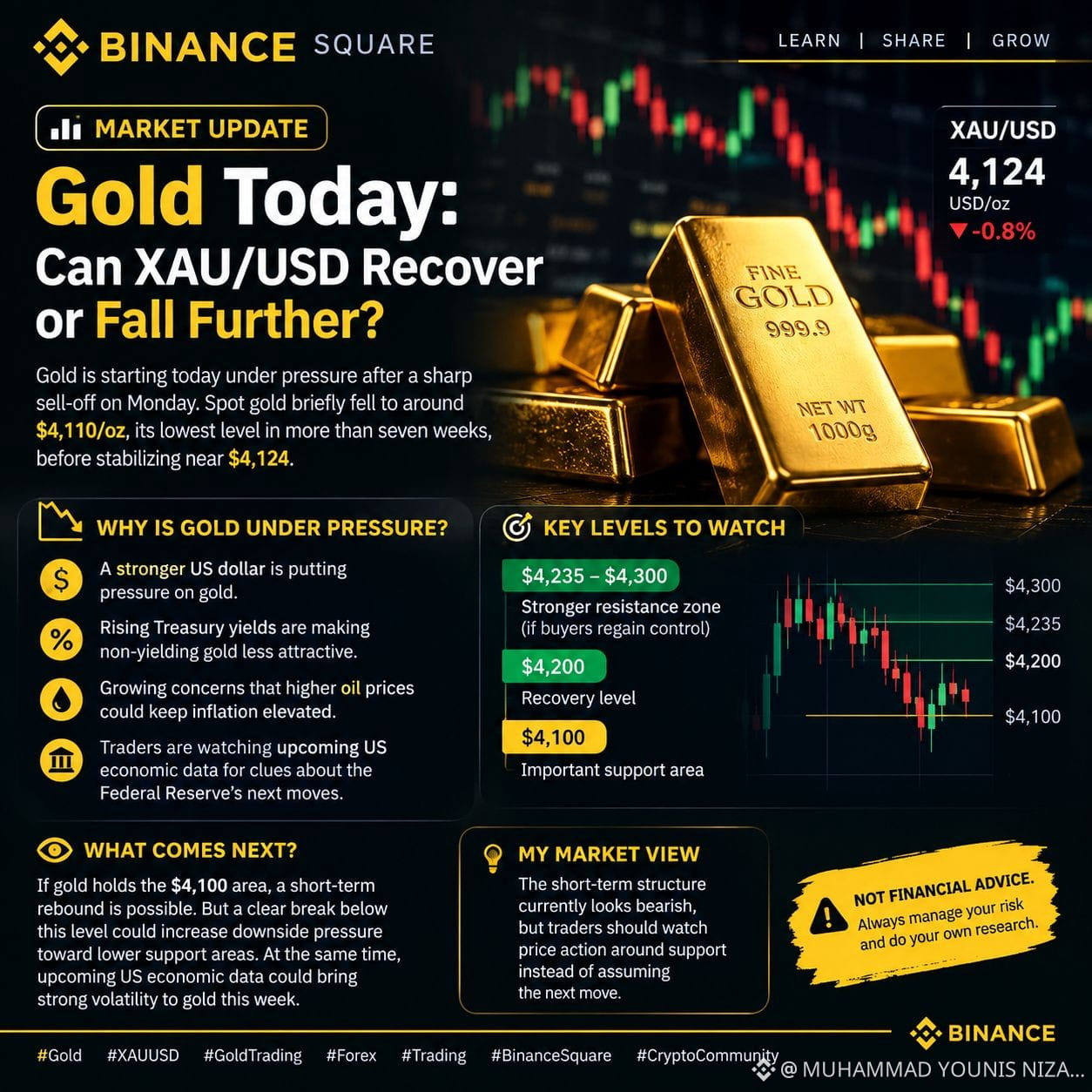
🥇 Gold Today: Can XAU/USD Recover or Fall Further?
Gold is starting today under pressure after a sharp sell-off on Monday. Spot gold briefly fell to around $4,110/oz, its lowest level in more than seven weeks, before stabilizing near $4,124.
📉 Why is gold under pressure?
The main factors are a stronger US dollar, rising Treasury yields and growing concerns that higher oil prices could keep inflation elevated. These factors can reduce demand for non-yielding gold.
📊 Key levels to watch
🔸 $4,100: Important support area.
🔸 $4,200: Important level for a potential recovery.
🔸 $4,235–$4,300: A stronger resistance zone if buyers regain control. Technical analysis published this week also identifies the $4,100 area as a key downside support.
👀 What comes next?
If gold holds the $4,100 area, a short-term rebound is possible. But a clear break below this level could increase downside pressure toward lower support areas. At the same time, upcoming US economic data could bring strong volatility to gold this week.
💡 My market view: The short-term structure currently looks bearish, but traders should watch price action around support instead of assuming the next move.
⚠️ Not financial advice. Always manage your risk and do your own research.
#Gold #XAUUSD #GoldTrading #Trading #BinanceSquare #CryptoCommunity
🥇 Gold Today: Can XAU/USD Recover or Fall Further?
Gold is starting today under pressure after a sharp sell-off on Monday. Spot gold briefly fell to around $4,110/oz, its lowest level in more than seven weeks, before stabilizing near $4,124.
📉 Why is gold under pressure?
The main factors are a stronger US dollar, rising Treasury yields and growing concerns that higher oil prices could keep inflation elevated. These factors can reduce demand for non-yielding gold.
📊 Key levels to watch
🔸 $4,100: Important support area.
🔸 $4,200: Important level for a potential recovery.
🔸 $4,235–$4,300: A stronger resistance zone if buyers regain control. Technical analysis published this week also identifies the $4,100 area as a key downside support.
👀 What comes next?
If gold holds the $4,100 area, a short-term rebound is possible. But a clear break below this level could increase downside pressure toward lower support areas. At the same time, upcoming US economic data could bring strong volatility to gold this week.
💡 My market view: The short-term structure currently looks bearish, but traders should watch price action around support instead of assuming the next move.
⚠️ Not financial advice. Always manage your risk and do your own research.
#Gold #XAUUSD #GoldTrading #Trading #BinanceSquare #CryptoCommunity
Gold is starting today under pressure after a sharp sell-off on Monday. Spot gold briefly fell to around $4,110/oz, its lowest level in more than seven weeks, before stabilizing near $4,124.
📉 Why is gold under pressure?
The main factors are a stronger US dollar, rising Treasury yields and growing concerns that higher oil prices could keep inflation elevated. These factors can reduce demand for non-yielding gold.
📊 Key levels to watch
🔸 $4,100: Important support area.
🔸 $4,200: Important level for a potential recovery.
🔸 $4,235–$4,300: A stronger resistance zone if buyers regain control. Technical analysis published this week also identifies the $4,100 area as a key downside support.
👀 What comes next?
If gold holds the $4,100 area, a short-term rebound is possible. But a clear break below this level could increase downside pressure toward lower support areas. At the same time, upcoming US economic data could bring strong volatility to gold this week.
💡 My market view: The short-term structure currently looks bearish, but traders should watch price action around support instead of assuming the next move.
⚠️ Not financial advice. Always manage your risk and do your own research.
#Gold #XAUUSD #GoldTrading #Trading #BinanceSquare #CryptoCommunity
169

$XAU | GOLD TRADING RULE
Your stop-loss is part of the trade plan not a suggestion.
If XAUUSD reaches your invalidation level, accept that the setup failed.
Moving the stop only to avoid taking a loss can turn a small mistake into a major one. Protect your capital. Respect your plan.
#xauusdweeklyanalysis #goldtrading #RiskManagement #TradingDiscipline #BinanceSquare
{future}(XAUUSDT)
$XAU | GOLD TRADING RULE
Your stop-loss is part of the trade plan not a suggestion.
If XAUUSD reaches your invalidation level, accept that the setup failed.
Moving the stop only to avoid taking a loss can turn a small mistake into a major one. Protect your capital. Respect your plan.
#xauusdweeklyanalysis #goldtrading #RiskManagement #TradingDiscipline #BinanceSquare
Your stop-loss is part of the trade plan not a suggestion.
If XAUUSD reaches your invalidation level, accept that the setup failed.
Moving the stop only to avoid taking a loss can turn a small mistake into a major one. Protect your capital. Respect your plan.
#xauusdweeklyanalysis #goldtrading #RiskManagement #TradingDiscipline #BinanceSquare
229

🔥 XAUUSDT TRADE UPDATE 🔥
Gold made its move, and I took the trade. 📊
Not every trade ends green — this one was a lesson. 💯
Entry: 4,184.58
Close: 4,209.25
PNL: -0.05 USDT
Still learning. Still trading. 🚀📈
#XAUUSDT #GoldTrading #Trading #tradingjourney $XAU #followmeformore
🔥 XAUUSDT TRADE UPDATE 🔥
Gold made its move, and I took the trade. 📊
Not every trade ends green — this one was a lesson. 💯
Entry: 4,184.58
Close: 4,209.25
PNL: -0.05 USDT
Still learning. Still trading. 🚀📈
#XAUUSDT #GoldTrading #Trading #tradingjourney $XAU #followmeformore
Gold made its move, and I took the trade. 📊
Not every trade ends green — this one was a lesson. 💯
Entry: 4,184.58
Close: 4,209.25
PNL: -0.05 USDT
Still learning. Still trading. 🚀📈
#XAUUSDT #GoldTrading #Trading #tradingjourney $XAU #followmeformore
289

·
--
🚨 $XAU ALERT! 🥇
Gold is at a critical zone! 📊
Will we see a breakout or another drop? 👀
📉 Below $4,245 → downside risk
📈 Above $4,304 → recovery potential
🔥 Core PCE + NFP = key catalysts this week.
Follow for Gold news + technical analysis 📈
⚠️ Educational purposes only. Not financial advice or a buy/sell signal. Trade with proper risk management.
#Gold #XAUUSD #GoldTrading #forextrader
{future}(XAUUSDT)
🚨 $XAU ALERT! 🥇
Gold is at a critical zone! 📊
Will we see a breakout or another drop? 👀
📉 Below $4,245 → downside risk
📈 Above $4,304 → recovery potential
🔥 Core PCE + NFP = key catalysts this week.
Follow for Gold news + technical analysis 📈
⚠️ Educational purposes only. Not financial advice or a buy/sell signal. Trade with proper risk management.
#Gold #XAUUSD #GoldTrading #forextrader
Gold is at a critical zone! 📊
Will we see a breakout or another drop? 👀
📉 Below $4,245 → downside risk
📈 Above $4,304 → recovery potential
🔥 Core PCE + NFP = key catalysts this week.
Follow for Gold news + technical analysis 📈
⚠️ Educational purposes only. Not financial advice or a buy/sell signal. Trade with proper risk management.
#Gold #XAUUSD #GoldTrading #forextrader
241


Article
"It's raining gold". GOLD ISN’T JUST A GOLD BAR: THE COMPLETE GUIDE TO TRADING GOLDWhen most people hear “gold,” they picture a physical bar, a coin, or jewelry sitting in a safe. But the modern gold market is much bigger than that. Gold can be accessed through physical bullion, spot markets, ETFs, mining stocks, futures, options, forwards, and perpetual contracts. Each method gives you a different type of exposure, with different costs, mechanics, risks, and ownership rights. Understanding those differences is what turns “I trade gold” into actually understanding the gold market.
Why Is Gold Such a Big Market?
Gold is unusual because it sits at the intersection of commodities, currencies, central-bank reserves, investment and financial markets. According to the World Gold Council, the global gold market averaged roughly $361 billion in daily trading volume during 2025, across OTC, exchange-traded and other markets. The market includes physical gold, ETFs, derivatives and institutional OTC trading, making gold one of the world's deepest and most actively traded markets.
Gold also behaves differently from many other commodities. Unlike oil or wheat, most of the gold ever mined still exists in some form because gold is highly durable and can be recycled. That means today's market is influenced not only by new mine production, but also by the enormous amount of gold already held by investors, central banks, companies and consumers.
First: Understand the Gold Price
Before looking at different trading methods, it helps to understand what you are actually trading. Gold is commonly quoted in U.S. dollars per troy ounce. If gold is quoted at $3,500 per ounce, that means one troy ounce of gold is priced at $3,500.
But the gold price is constantly influenced by changing market conditions. Interest rates, inflation expectations, the U.S. dollar, geopolitical events, central-bank activity, investment demand, mine supply, recycling and broader economic conditions can all affect the balance between buyers and sellers.
For example, if investors become concerned about economic or geopolitical conditions, demand for gold may change. If real interest rates or the dollar move significantly, the opportunity cost of holding a non-income-producing asset such as gold can also change. There is therefore no single factor that determines the gold price.
1. Physical Gold: The Original Method
The most straightforward form of gold exposure is physical ownership: bars and coins.
If you buy a one-ounce gold bar, you own a physical piece of gold. Your return depends primarily on the difference between the price you paid and the price at which you eventually sell it, after accounting for costs.
For example, imagine buying a one-ounce bar for $3,500. If you later sell it for $3,800, the gross price difference is $300. But the real result also depends on the purchase premium, dealer spread, storage, insurance and selling costs.
Physical gold therefore provides something many financial products do not: direct possession of the metal. But that comes with practical considerations such as storage, security, insurance and potentially wider buying and selling spreads.
2. Spot Gold: Trading the Current Market Price
The word “spot” refers to transactions based around the current market price, rather than a standardized future delivery contract.
The global gold spot market is particularly important in the OTC market, where professional participants trade directly with one another. London remains a major center for OTC gold trading, while exchanges such as COMEX and the Shanghai markets are important parts of the broader gold ecosystem.
A simplified example is:
Gold spot price = $3,500 per ounce.
If the market moves to $3,550, someone with direct exposure to the gold price has gained $50 per ounce before costs.
The important point is that spot exposure is about the current gold price. It should not automatically be confused with owning a physical bar. Depending on the product and provider, you may have exposure to the spot price without taking physical delivery.
3. Gold ETFs: Gold Exposure Through the Stock Market
You don't necessarily need to buy a bar to gain exposure to gold. Gold-backed exchange-traded funds can provide another route.
A physically backed gold ETF generally holds gold bullion while investors buy and sell shares of the fund on an exchange. The share price typically tracks the underlying gold price, although fees, market conditions and tracking differences can affect the result.
Imagine a gold ETF share trading at $350. If gold rises, the ETF may also rise, broadly reflecting the performance of the underlying gold holdings.
The important distinction is that buying the ETF share is not the same as taking a one-ounce bar home. You own a share of the investment vehicle, while the fund structure determines how the underlying gold is held and what rights investors have.
4. Gold Mining Stocks: Buying the Companies Behind the Gold
Here is where gold becomes a stock-market story.
Instead of trading gold itself, you can buy shares in companies that explore for, mine and produce gold.
This creates a very different exposure.
Imagine a mining company produces gold at an average cost of $2,000 per ounce. If gold trades at $3,000, the difference between the selling price and production cost contributes to the company's economics. If gold rises to $3,500, that margin can potentially expand significantly.
But the company's share price is not simply “gold with a ticker.”
Mining companies have their own risks: operating costs, energy prices, labor, management decisions, mine quality, production levels, political conditions in mining jurisdictions, financing and exploration results.
So gold can rise while a particular mining stock performs differently.
5. Gold Futures: Trading a Contract, Not a Gold Bar
Futures take gold trading into the derivatives world.
A gold futures contract is a standardized agreement traded on an exchange, specifying terms such as the quantity and price of gold associated with the contract. Futures can be used for hedging or for taking a directional position on gold prices, and traders can take long or short positions.
For example, suppose a trader enters a gold futures position when gold is $3,500. If the relevant futures price later rises to $3,600, the position has gained based on the contract's specifications. If the market moves in the opposite direction, the position loses.
Futures also involve margin. You do not necessarily put up the full notional value of the gold represented by the contract, which is why futures can provide substantial exposure relative to the amount of capital posted as margin.
That also means losses can accumulate quickly. Futures are therefore fundamentally different from simply buying physical gold.
6. Gold Options: Trading the Right, Not the Obligation
Options add another layer.
A gold call option generally gives the buyer the right, but not the obligation, to buy gold at a specified price under defined terms. A put option gives the right to sell.
Suppose gold is trading at $3,500 and a trader buys a call option with a $3,600 strike price. If gold rises significantly above $3,600 before the relevant expiration or exercise conditions, the option may become valuable. If gold never reaches the required level, the option can expire worthless, depending on its structure.
The buyer pays a premium for the option. The seller takes on an obligation if the option is exercised.
Options therefore introduce additional concepts such as strike price, expiration, premium, implied volatility and time decay. They are not simply another version of spot gold.
7. Gold Forwards: Customized OTC Contracts
Forwards are similar in concept to futures but are generally privately negotiated OTC agreements rather than standardized exchange-traded contracts.
Two counterparties can agree today on terms for a gold transaction that will take place in the future.
The flexibility can be useful for institutions that need customized quantities, dates or settlement arrangements. But because the agreement is bilateral rather than centrally cleared in the same way as an exchange-traded futures contract, counterparty and settlement considerations become particularly important.
8. Gold Perpetual Contracts: Gold Meets the Crypto Trading Model
This is one of the newer ways Binance users can encounter gold.
Binance launched XAUUSDT, a gold TradFi perpetual contract, in January 2026. It tracks the price of gold and is settled in USDT. Unlike a traditional futures contract with a fixed expiration date, a perpetual contract has no expiry and uses funding mechanisms to help keep the contract aligned with the underlying market.
The key distinction is extremely important:
Trading XAUUSDT does not mean buying physical gold.
It means trading a derivative whose value is linked to the price of gold.
For example, if XAUUSDT is trading around $3,500 and the gold price rises, a long position can gain; if gold falls, the position can lose. The actual profit or loss depends on position size, entry and exit prices, fees, funding and whether leverage is used.
Binance states that TradFi perpetuals are available 24/7, are USDT-settled and do not represent ownership of the underlying asset. Availability and contract parameters can vary by jurisdiction and may change over time.
One Gold Market, Many Different Products
This is where many beginners make the mistake of treating every gold product as interchangeable.
They are not.
Physical gold can mean owning the metal. A gold ETF means owning shares in a fund. A mining stock means owning an interest in a company. A futures contract creates a derivatives position. An option gives specific rights under defined conditions. A forward is a customized bilateral contract. A perpetual contract provides price exposure without ownership of the underlying metal.
The underlying reference may be the same gold market, but the product structure can be completely different.
A Simple Example
Imagine gold is trading at $3,500 per ounce.
A person buying a physical one-ounce bar is acquiring physical gold.
Another investor buys shares of a physically backed gold ETF and gains exposure through the fund.
A third buys shares of a gold-mining company and becomes exposed to both gold prices and the company's business performance.
A futures trader takes a position on a standardized gold contract.
An options trader buys a call with a specific strike and expiration.
A Binance user trading XAUUSDT takes a USDT-settled perpetual position linked to gold's price.
Six people can all say, “I'm trading gold,” while holding six completely different financial products.
That distinction is the real lesson.
What Actually Moves Gold?
Gold is influenced by a combination of forces rather than one simple formula.
Interest rates matter because gold does not generate a regular coupon or dividend. The opportunity cost of holding it can change as interest rates and real yields change.
The U.S. dollar matters because gold is widely priced in dollars. Changes in the dollar can affect the purchasing power and attractiveness of gold for international market participants.
Central-bank activity can also matter. Central banks hold gold as part of their reserves, and changes in official-sector demand can influence the market.
Investment flows are another major factor. Money entering or leaving gold ETFs, futures markets and OTC markets can affect demand and liquidity.
Then there are geopolitical events, inflation expectations, economic uncertainty, mine production, recycling and physical demand from consumers and industry.
The result is a market where macroeconomics, financial markets and physical supply-and-demand all meet.
The Opportunity Is Not One Trade - It Is Understanding the Whole Market
Gold is sometimes presented as a simple “buy gold” decision.
It is much more interesting than that.
The real opportunity for a market participant is understanding that gold exists across an entire financial ecosystem. You can study the physical market, follow spot prices, analyze ETF flows, research mining companies, understand futures curves, learn options, examine central-bank demand or explore derivative products such as Binance's XAUUSDT.
Different products can be appropriate for different objectives and risk profiles. Some involve ownership; others provide only price exposure. Some have leverage. Some have expiration dates. Some have funding costs. Some involve storage. Some expose you to an entire company rather than gold itself.
Learning these differences is more important than simply knowing the gold ticker.
Gold Is Not “Just Gold”
The next time you see gold move on your screen, don't only ask whether the price is going up or down. Ask what market you are looking at. Is it spot gold? A physical bar? An ETF? A mining stock? A futures contract? An option? A forward?
Or a perpetual contract such as XAUUSDT?
The $XAU market is one of the world's largest and most diverse financial markets, and there is far more to it than buying a gold bar and putting it in a safe. Understanding the different ways gold can be accessed is the first step toward understanding what you are actually trading.
{future}(XAUUSDT)
Educational note: $GOLD.US products can involve materially different risks, costs, leverage, liquidity, ownership rights and settlement mechanisms. Derivatives can magnify losses, and product availability varies by jurisdiction. This article is for educational purposes only and is not financial advice.
#goldtrading #XAU #XAUUSD #GoldMarket #binnacetrade
"It's raining gold". GOLD ISN’T JUST A GOLD BAR: THE COMPLETE GUIDE TO TRADING GOLD
When most people hear “gold,” they picture a physical bar, a coin, or jewelry sitting in a safe. But the modern gold market is much bigger than that. Gold can be accessed through physical bullion, spot markets, ETFs, mining stocks, futures, options, forwards, and perpetual contracts. Each method gives you a different type of exposure, with different costs, mechanics, risks, and ownership rights. Understanding those differences is what turns “I trade gold” into actually understanding the gold market.
Why Is Gold Such a Big Market?
Gold is unusual because it sits at the intersection of commodities, currencies, central-bank reserves, investment and financial markets. According to the World Gold Council, the global gold market averaged roughly $361 billion in daily trading volume during 2025, across OTC, exchange-traded and other markets. The market includes physical gold, ETFs, derivatives and institutional OTC trading, making gold one of the world's deepest and most actively traded markets.
Gold also behaves differently from many other commodities. Unlike oil or wheat, most of the gold ever mined still exists in some form because gold is highly durable and can be recycled. That means today's market is influenced not only by new mine production, but also by the enormous amount of gold already held by investors, central banks, companies and consumers.
First: Understand the Gold Price
Before looking at different trading methods, it helps to understand what you are actually trading. Gold is commonly quoted in U.S. dollars per troy ounce. If gold is quoted at $3,500 per ounce, that means one troy ounce of gold is priced at $3,500.
But the gold price is constantly influenced by changing market conditions. Interest rates, inflation expectations, the U.S. dollar, geopolitical events, central-bank activity, investment demand, mine supply, recycling and broader economic conditions can all affect the balance between buyers and sellers.
For example, if investors become concerned about economic or geopolitical conditions, demand for gold may change. If real interest rates or the dollar move significantly, the opportunity cost of holding a non-income-producing asset such as gold can also change. There is therefore no single factor that determines the gold price.
1. Physical Gold: The Original Method
The most straightforward form of gold exposure is physical ownership: bars and coins.
If you buy a one-ounce gold bar, you own a physical piece of gold. Your return depends primarily on the difference between the price you paid and the price at which you eventually sell it, after accounting for costs.
For example, imagine buying a one-ounce bar for $3,500. If you later sell it for $3,800, the gross price difference is $300. But the real result also depends on the purchase premium, dealer spread, storage, insurance and selling costs.
Physical gold therefore provides something many financial products do not: direct possession of the metal. But that comes with practical considerations such as storage, security, insurance and potentially wider buying and selling spreads.
2. Spot Gold: Trading the Current Market Price
The word “spot” refers to transactions based around the current market price, rather than a standardized future delivery contract.
The global gold spot market is particularly important in the OTC market, where professional participants trade directly with one another. London remains a major center for OTC gold trading, while exchanges such as COMEX and the Shanghai markets are important parts of the broader gold ecosystem.
A simplified example is:
Gold spot price = $3,500 per ounce.
If the market moves to $3,550, someone with direct exposure to the gold price has gained $50 per ounce before costs.
The important point is that spot exposure is about the current gold price. It should not automatically be confused with owning a physical bar. Depending on the product and provider, you may have exposure to the spot price without taking physical delivery.
3. Gold ETFs: Gold Exposure Through the Stock Market
You don't necessarily need to buy a bar to gain exposure to gold. Gold-backed exchange-traded funds can provide another route.
A physically backed gold ETF generally holds gold bullion while investors buy and sell shares of the fund on an exchange. The share price typically tracks the underlying gold price, although fees, market conditions and tracking differences can affect the result.
Imagine a gold ETF share trading at $350. If gold rises, the ETF may also rise, broadly reflecting the performance of the underlying gold holdings.
The important distinction is that buying the ETF share is not the same as taking a one-ounce bar home. You own a share of the investment vehicle, while the fund structure determines how the underlying gold is held and what rights investors have.
4. Gold Mining Stocks: Buying the Companies Behind the Gold
Here is where gold becomes a stock-market story.
Instead of trading gold itself, you can buy shares in companies that explore for, mine and produce gold.
This creates a very different exposure.
Imagine a mining company produces gold at an average cost of $2,000 per ounce. If gold trades at $3,000, the difference between the selling price and production cost contributes to the company's economics. If gold rises to $3,500, that margin can potentially expand significantly.
But the company's share price is not simply “gold with a ticker.”
Mining companies have their own risks: operating costs, energy prices, labor, management decisions, mine quality, production levels, political conditions in mining jurisdictions, financing and exploration results.
So gold can rise while a particular mining stock performs differently.
5. Gold Futures: Trading a Contract, Not a Gold Bar
Futures take gold trading into the derivatives world.
A gold futures contract is a standardized agreement traded on an exchange, specifying terms such as the quantity and price of gold associated with the contract. Futures can be used for hedging or for taking a directional position on gold prices, and traders can take long or short positions.
For example, suppose a trader enters a gold futures position when gold is $3,500. If the relevant futures price later rises to $3,600, the position has gained based on the contract's specifications. If the market moves in the opposite direction, the position loses.
Futures also involve margin. You do not necessarily put up the full notional value of the gold represented by the contract, which is why futures can provide substantial exposure relative to the amount of capital posted as margin.
That also means losses can accumulate quickly. Futures are therefore fundamentally different from simply buying physical gold.
6. Gold Options: Trading the Right, Not the Obligation
Options add another layer.
A gold call option generally gives the buyer the right, but not the obligation, to buy gold at a specified price under defined terms. A put option gives the right to sell.
Suppose gold is trading at $3,500 and a trader buys a call option with a $3,600 strike price. If gold rises significantly above $3,600 before the relevant expiration or exercise conditions, the option may become valuable. If gold never reaches the required level, the option can expire worthless, depending on its structure.
The buyer pays a premium for the option. The seller takes on an obligation if the option is exercised.
Options therefore introduce additional concepts such as strike price, expiration, premium, implied volatility and time decay. They are not simply another version of spot gold.
7. Gold Forwards: Customized OTC Contracts
Forwards are similar in concept to futures but are generally privately negotiated OTC agreements rather than standardized exchange-traded contracts.
Two counterparties can agree today on terms for a gold transaction that will take place in the future.
The flexibility can be useful for institutions that need customized quantities, dates or settlement arrangements. But because the agreement is bilateral rather than centrally cleared in the same way as an exchange-traded futures contract, counterparty and settlement considerations become particularly important.
8. Gold Perpetual Contracts: Gold Meets the Crypto Trading Model
This is one of the newer ways Binance users can encounter gold.
Binance launched XAUUSDT, a gold TradFi perpetual contract, in January 2026. It tracks the price of gold and is settled in USDT. Unlike a traditional futures contract with a fixed expiration date, a perpetual contract has no expiry and uses funding mechanisms to help keep the contract aligned with the underlying market.
The key distinction is extremely important:
Trading XAUUSDT does not mean buying physical gold.
It means trading a derivative whose value is linked to the price of gold.
For example, if XAUUSDT is trading around $3,500 and the gold price rises, a long position can gain; if gold falls, the position can lose. The actual profit or loss depends on position size, entry and exit prices, fees, funding and whether leverage is used.
Binance states that TradFi perpetuals are available 24/7, are USDT-settled and do not represent ownership of the underlying asset. Availability and contract parameters can vary by jurisdiction and may change over time.
One Gold Market, Many Different Products
This is where many beginners make the mistake of treating every gold product as interchangeable.
They are not.
Physical gold can mean owning the metal. A gold ETF means owning shares in a fund. A mining stock means owning an interest in a company. A futures contract creates a derivatives position. An option gives specific rights under defined conditions. A forward is a customized bilateral contract. A perpetual contract provides price exposure without ownership of the underlying metal.
The underlying reference may be the same gold market, but the product structure can be completely different.
A Simple Example
Imagine gold is trading at $3,500 per ounce.
A person buying a physical one-ounce bar is acquiring physical gold.
Another investor buys shares of a physically backed gold ETF and gains exposure through the fund.
A third buys shares of a gold-mining company and becomes exposed to both gold prices and the company's business performance.
A futures trader takes a position on a standardized gold contract.
An options trader buys a call with a specific strike and expiration.
A Binance user trading XAUUSDT takes a USDT-settled perpetual position linked to gold's price.
Six people can all say, “I'm trading gold,” while holding six completely different financial products.
That distinction is the real lesson.
What Actually Moves Gold?
Gold is influenced by a combination of forces rather than one simple formula.
Interest rates matter because gold does not generate a regular coupon or dividend. The opportunity cost of holding it can change as interest rates and real yields change.
The U.S. dollar matters because gold is widely priced in dollars. Changes in the dollar can affect the purchasing power and attractiveness of gold for international market participants.
Central-bank activity can also matter. Central banks hold gold as part of their reserves, and changes in official-sector demand can influence the market.
Investment flows are another major factor. Money entering or leaving gold ETFs, futures markets and OTC markets can affect demand and liquidity.
Then there are geopolitical events, inflation expectations, economic uncertainty, mine production, recycling and physical demand from consumers and industry.
The result is a market where macroeconomics, financial markets and physical supply-and-demand all meet.
The Opportunity Is Not One Trade - It Is Understanding the Whole Market
Gold is sometimes presented as a simple “buy gold” decision.
It is much more interesting than that.
The real opportunity for a market participant is understanding that gold exists across an entire financial ecosystem. You can study the physical market, follow spot prices, analyze ETF flows, research mining companies, understand futures curves, learn options, examine central-bank demand or explore derivative products such as Binance's XAUUSDT.
Different products can be appropriate for different objectives and risk profiles. Some involve ownership; others provide only price exposure. Some have leverage. Some have expiration dates. Some have funding costs. Some involve storage. Some expose you to an entire company rather than gold itself.
Learning these differences is more important than simply knowing the gold ticker.
Gold Is Not “Just Gold”
The next time you see gold move on your screen, don't only ask whether the price is going up or down. Ask what market you are looking at. Is it spot gold? A physical bar? An ETF? A mining stock? A futures contract? An option? A forward?
Or a perpetual contract such as XAUUSDT?
The $XAU market is one of the world's largest and most diverse financial markets, and there is far more to it than buying a gold bar and putting it in a safe. Understanding the different ways gold can be accessed is the first step toward understanding what you are actually trading.
Educational note: $GOLD.US products can involve materially different risks, costs, leverage, liquidity, ownership rights and settlement mechanisms. Derivatives can magnify losses, and product availability varies by jurisdiction. This article is for educational purposes only and is not financial advice.
#goldtrading #XAU #XAUUSD #GoldMarket #binnacetrade
Why Is Gold Such a Big Market?
Gold is unusual because it sits at the intersection of commodities, currencies, central-bank reserves, investment and financial markets. According to the World Gold Council, the global gold market averaged roughly $361 billion in daily trading volume during 2025, across OTC, exchange-traded and other markets. The market includes physical gold, ETFs, derivatives and institutional OTC trading, making gold one of the world's deepest and most actively traded markets.
Gold also behaves differently from many other commodities. Unlike oil or wheat, most of the gold ever mined still exists in some form because gold is highly durable and can be recycled. That means today's market is influenced not only by new mine production, but also by the enormous amount of gold already held by investors, central banks, companies and consumers.
First: Understand the Gold Price
Before looking at different trading methods, it helps to understand what you are actually trading. Gold is commonly quoted in U.S. dollars per troy ounce. If gold is quoted at $3,500 per ounce, that means one troy ounce of gold is priced at $3,500.
But the gold price is constantly influenced by changing market conditions. Interest rates, inflation expectations, the U.S. dollar, geopolitical events, central-bank activity, investment demand, mine supply, recycling and broader economic conditions can all affect the balance between buyers and sellers.
For example, if investors become concerned about economic or geopolitical conditions, demand for gold may change. If real interest rates or the dollar move significantly, the opportunity cost of holding a non-income-producing asset such as gold can also change. There is therefore no single factor that determines the gold price.
1. Physical Gold: The Original Method
The most straightforward form of gold exposure is physical ownership: bars and coins.
If you buy a one-ounce gold bar, you own a physical piece of gold. Your return depends primarily on the difference between the price you paid and the price at which you eventually sell it, after accounting for costs.
For example, imagine buying a one-ounce bar for $3,500. If you later sell it for $3,800, the gross price difference is $300. But the real result also depends on the purchase premium, dealer spread, storage, insurance and selling costs.
Physical gold therefore provides something many financial products do not: direct possession of the metal. But that comes with practical considerations such as storage, security, insurance and potentially wider buying and selling spreads.
2. Spot Gold: Trading the Current Market Price
The word “spot” refers to transactions based around the current market price, rather than a standardized future delivery contract.
The global gold spot market is particularly important in the OTC market, where professional participants trade directly with one another. London remains a major center for OTC gold trading, while exchanges such as COMEX and the Shanghai markets are important parts of the broader gold ecosystem.
A simplified example is:
Gold spot price = $3,500 per ounce.
If the market moves to $3,550, someone with direct exposure to the gold price has gained $50 per ounce before costs.
The important point is that spot exposure is about the current gold price. It should not automatically be confused with owning a physical bar. Depending on the product and provider, you may have exposure to the spot price without taking physical delivery.
3. Gold ETFs: Gold Exposure Through the Stock Market
You don't necessarily need to buy a bar to gain exposure to gold. Gold-backed exchange-traded funds can provide another route.
A physically backed gold ETF generally holds gold bullion while investors buy and sell shares of the fund on an exchange. The share price typically tracks the underlying gold price, although fees, market conditions and tracking differences can affect the result.
Imagine a gold ETF share trading at $350. If gold rises, the ETF may also rise, broadly reflecting the performance of the underlying gold holdings.
The important distinction is that buying the ETF share is not the same as taking a one-ounce bar home. You own a share of the investment vehicle, while the fund structure determines how the underlying gold is held and what rights investors have.
4. Gold Mining Stocks: Buying the Companies Behind the Gold
Here is where gold becomes a stock-market story.
Instead of trading gold itself, you can buy shares in companies that explore for, mine and produce gold.
This creates a very different exposure.
Imagine a mining company produces gold at an average cost of $2,000 per ounce. If gold trades at $3,000, the difference between the selling price and production cost contributes to the company's economics. If gold rises to $3,500, that margin can potentially expand significantly.
But the company's share price is not simply “gold with a ticker.”
Mining companies have their own risks: operating costs, energy prices, labor, management decisions, mine quality, production levels, political conditions in mining jurisdictions, financing and exploration results.
So gold can rise while a particular mining stock performs differently.
5. Gold Futures: Trading a Contract, Not a Gold Bar
Futures take gold trading into the derivatives world.
A gold futures contract is a standardized agreement traded on an exchange, specifying terms such as the quantity and price of gold associated with the contract. Futures can be used for hedging or for taking a directional position on gold prices, and traders can take long or short positions.
For example, suppose a trader enters a gold futures position when gold is $3,500. If the relevant futures price later rises to $3,600, the position has gained based on the contract's specifications. If the market moves in the opposite direction, the position loses.
Futures also involve margin. You do not necessarily put up the full notional value of the gold represented by the contract, which is why futures can provide substantial exposure relative to the amount of capital posted as margin.
That also means losses can accumulate quickly. Futures are therefore fundamentally different from simply buying physical gold.
6. Gold Options: Trading the Right, Not the Obligation
Options add another layer.
A gold call option generally gives the buyer the right, but not the obligation, to buy gold at a specified price under defined terms. A put option gives the right to sell.
Suppose gold is trading at $3,500 and a trader buys a call option with a $3,600 strike price. If gold rises significantly above $3,600 before the relevant expiration or exercise conditions, the option may become valuable. If gold never reaches the required level, the option can expire worthless, depending on its structure.
The buyer pays a premium for the option. The seller takes on an obligation if the option is exercised.
Options therefore introduce additional concepts such as strike price, expiration, premium, implied volatility and time decay. They are not simply another version of spot gold.
7. Gold Forwards: Customized OTC Contracts
Forwards are similar in concept to futures but are generally privately negotiated OTC agreements rather than standardized exchange-traded contracts.
Two counterparties can agree today on terms for a gold transaction that will take place in the future.
The flexibility can be useful for institutions that need customized quantities, dates or settlement arrangements. But because the agreement is bilateral rather than centrally cleared in the same way as an exchange-traded futures contract, counterparty and settlement considerations become particularly important.
8. Gold Perpetual Contracts: Gold Meets the Crypto Trading Model
This is one of the newer ways Binance users can encounter gold.
Binance launched XAUUSDT, a gold TradFi perpetual contract, in January 2026. It tracks the price of gold and is settled in USDT. Unlike a traditional futures contract with a fixed expiration date, a perpetual contract has no expiry and uses funding mechanisms to help keep the contract aligned with the underlying market.
The key distinction is extremely important:
Trading XAUUSDT does not mean buying physical gold.
It means trading a derivative whose value is linked to the price of gold.
For example, if XAUUSDT is trading around $3,500 and the gold price rises, a long position can gain; if gold falls, the position can lose. The actual profit or loss depends on position size, entry and exit prices, fees, funding and whether leverage is used.
Binance states that TradFi perpetuals are available 24/7, are USDT-settled and do not represent ownership of the underlying asset. Availability and contract parameters can vary by jurisdiction and may change over time.
One Gold Market, Many Different Products
This is where many beginners make the mistake of treating every gold product as interchangeable.
They are not.
Physical gold can mean owning the metal. A gold ETF means owning shares in a fund. A mining stock means owning an interest in a company. A futures contract creates a derivatives position. An option gives specific rights under defined conditions. A forward is a customized bilateral contract. A perpetual contract provides price exposure without ownership of the underlying metal.
The underlying reference may be the same gold market, but the product structure can be completely different.
A Simple Example
Imagine gold is trading at $3,500 per ounce.
A person buying a physical one-ounce bar is acquiring physical gold.
Another investor buys shares of a physically backed gold ETF and gains exposure through the fund.
A third buys shares of a gold-mining company and becomes exposed to both gold prices and the company's business performance.
A futures trader takes a position on a standardized gold contract.
An options trader buys a call with a specific strike and expiration.
A Binance user trading XAUUSDT takes a USDT-settled perpetual position linked to gold's price.
Six people can all say, “I'm trading gold,” while holding six completely different financial products.
That distinction is the real lesson.
What Actually Moves Gold?
Gold is influenced by a combination of forces rather than one simple formula.
Interest rates matter because gold does not generate a regular coupon or dividend. The opportunity cost of holding it can change as interest rates and real yields change.
The U.S. dollar matters because gold is widely priced in dollars. Changes in the dollar can affect the purchasing power and attractiveness of gold for international market participants.
Central-bank activity can also matter. Central banks hold gold as part of their reserves, and changes in official-sector demand can influence the market.
Investment flows are another major factor. Money entering or leaving gold ETFs, futures markets and OTC markets can affect demand and liquidity.
Then there are geopolitical events, inflation expectations, economic uncertainty, mine production, recycling and physical demand from consumers and industry.
The result is a market where macroeconomics, financial markets and physical supply-and-demand all meet.
The Opportunity Is Not One Trade - It Is Understanding the Whole Market
Gold is sometimes presented as a simple “buy gold” decision.
It is much more interesting than that.
The real opportunity for a market participant is understanding that gold exists across an entire financial ecosystem. You can study the physical market, follow spot prices, analyze ETF flows, research mining companies, understand futures curves, learn options, examine central-bank demand or explore derivative products such as Binance's XAUUSDT.
Different products can be appropriate for different objectives and risk profiles. Some involve ownership; others provide only price exposure. Some have leverage. Some have expiration dates. Some have funding costs. Some involve storage. Some expose you to an entire company rather than gold itself.
Learning these differences is more important than simply knowing the gold ticker.
Gold Is Not “Just Gold”
The next time you see gold move on your screen, don't only ask whether the price is going up or down. Ask what market you are looking at. Is it spot gold? A physical bar? An ETF? A mining stock? A futures contract? An option? A forward?
Or a perpetual contract such as XAUUSDT?
The $XAU market is one of the world's largest and most diverse financial markets, and there is far more to it than buying a gold bar and putting it in a safe. Understanding the different ways gold can be accessed is the first step toward understanding what you are actually trading.
Educational note: $GOLD.US products can involve materially different risks, costs, leverage, liquidity, ownership rights and settlement mechanisms. Derivatives can magnify losses, and product availability varies by jurisdiction. This article is for educational purposes only and is not financial advice.
#goldtrading #XAU #XAUUSD #GoldMarket #binnacetrade
XAU+1.37%
GOLDUS-0.48%
AngelOfCrypto_-:
nice
1
3
290
🥇 THE GOLD PARADOX
Gold is one of the oldest assets humans trade.
Yet its modern market looks nothing like the gold market of the past.
Here are 6 facts that make gold trading fascinating:
1️⃣ ALMOST ALL THE GOLD EVER MINED IS STILL HERE
Gold is incredibly durable. Around 222,600 tonnes have been mined throughout history, and almost all of it still exists in some form: jewelry, bars, coins, reserves, technology and investments.
2️⃣ GOLD IS A $300B+ DAILY MARKET
Global gold trading averaged roughly $361 billion per day in 2025.
That's not just people buying and selling coins.
It's OTC markets, exchanges, futures, ETFs and other financial products operating across the globe.
3️⃣ YOU DON'T HAVE TO TOUCH GOLD TO TRADE GOLD
You can interact with gold through completely different structures:
Physical bullion
Spot markets
ETFs
Mining stocks
Futures
Options
Tokenized gold
Perpetual contracts
Same commodity.
Completely different products.
4️⃣ GOLD DOESN'T REALLY “CLOSE”
Gold markets operate across global time zones, with major trading centres including London, the US and Shanghai.
And that's why the price can react to events happening on the other side of the world while your local market is asleep.
5️⃣ GOLD HAS TWO LIVES
It's both a physical commodity and a financial asset.
It's used in jewelry and technology, while also being held by investors and central banks.
That means gold doesn't have just one source of demand.
6️⃣ THE GOLD BAR DIDN'T DISAPPEAR. THE TECHNOLOGY AROUND IT CHANGED.
Today, you can have physical gold sitting in a vault, an ETF representing gold exposure, a token representing allocated gold, or a derivative tracking gold's price. The underlying commodity can be the same. The ownership, settlement, custody and risks can be completely different. And that's probably the most important lesson in gold trading:
Don't just ask, “Am I trading gold?”
Ask: “WHAT KIND OF GOLD PRODUCT AM I ACTUALLY TRADING?”
Because the word gold tells you the asset. It doesn't tell you the structure.
#Binance #GOLD #goldtrading
🥇 THE GOLD PARADOX
Gold is one of the oldest assets humans trade.
Yet its modern market looks nothing like the gold market of the past.
Here are 6 facts that make gold trading fascinating:
1️⃣ ALMOST ALL THE GOLD EVER MINED IS STILL HERE
Gold is incredibly durable. Around 222,600 tonnes have been mined throughout history, and almost all of it still exists in some form: jewelry, bars, coins, reserves, technology and investments.
2️⃣ GOLD IS A $300B+ DAILY MARKET
Global gold trading averaged roughly $361 billion per day in 2025.
That's not just people buying and selling coins.
It's OTC markets, exchanges, futures, ETFs and other financial products operating across the globe.
3️⃣ YOU DON'T HAVE TO TOUCH GOLD TO TRADE GOLD
You can interact with gold through completely different structures:
Physical bullion
Spot markets
ETFs
Mining stocks
Futures
Options
Tokenized gold
Perpetual contracts
Same commodity.
Completely different products.
4️⃣ GOLD DOESN'T REALLY “CLOSE”
Gold markets operate across global time zones, with major trading centres including London, the US and Shanghai.
And that's why the price can react to events happening on the other side of the world while your local market is asleep.
5️⃣ GOLD HAS TWO LIVES
It's both a physical commodity and a financial asset.
It's used in jewelry and technology, while also being held by investors and central banks.
That means gold doesn't have just one source of demand.
6️⃣ THE GOLD BAR DIDN'T DISAPPEAR. THE TECHNOLOGY AROUND IT CHANGED.
Today, you can have physical gold sitting in a vault, an ETF representing gold exposure, a token representing allocated gold, or a derivative tracking gold's price. The underlying commodity can be the same. The ownership, settlement, custody and risks can be completely different. And that's probably the most important lesson in gold trading:
Don't just ask, “Am I trading gold?”
Ask: “WHAT KIND OF GOLD PRODUCT AM I ACTUALLY TRADING?”
Because the word gold tells you the asset. It doesn't tell you the structure.
#Binance #GOLD #goldtrading
Gold is one of the oldest assets humans trade.
Yet its modern market looks nothing like the gold market of the past.
Here are 6 facts that make gold trading fascinating:
1️⃣ ALMOST ALL THE GOLD EVER MINED IS STILL HERE
Gold is incredibly durable. Around 222,600 tonnes have been mined throughout history, and almost all of it still exists in some form: jewelry, bars, coins, reserves, technology and investments.
2️⃣ GOLD IS A $300B+ DAILY MARKET
Global gold trading averaged roughly $361 billion per day in 2025.
That's not just people buying and selling coins.
It's OTC markets, exchanges, futures, ETFs and other financial products operating across the globe.
3️⃣ YOU DON'T HAVE TO TOUCH GOLD TO TRADE GOLD
You can interact with gold through completely different structures:
Physical bullion
Spot markets
ETFs
Mining stocks
Futures
Options
Tokenized gold
Perpetual contracts
Same commodity.
Completely different products.
4️⃣ GOLD DOESN'T REALLY “CLOSE”
Gold markets operate across global time zones, with major trading centres including London, the US and Shanghai.
And that's why the price can react to events happening on the other side of the world while your local market is asleep.
5️⃣ GOLD HAS TWO LIVES
It's both a physical commodity and a financial asset.
It's used in jewelry and technology, while also being held by investors and central banks.
That means gold doesn't have just one source of demand.
6️⃣ THE GOLD BAR DIDN'T DISAPPEAR. THE TECHNOLOGY AROUND IT CHANGED.
Today, you can have physical gold sitting in a vault, an ETF representing gold exposure, a token representing allocated gold, or a derivative tracking gold's price. The underlying commodity can be the same. The ownership, settlement, custody and risks can be completely different. And that's probably the most important lesson in gold trading:
Don't just ask, “Am I trading gold?”
Ask: “WHAT KIND OF GOLD PRODUCT AM I ACTUALLY TRADING?”
Because the word gold tells you the asset. It doesn't tell you the structure.
#Binance #GOLD #goldtrading
3
245
🥇 GOLD TRADING: FACTS YOU SHOULD KNOW
Think you know gold? Here are some facts that put the market into perspective.
1️⃣ GOLD IS MUCH BIGGER THAN PHYSICAL BARS
More than 220,000 tonnes of gold have been mined throughout history, with the above-ground stock valued at around $31 trillion at the end of 2025.
2️⃣ GOLD IS TRADED AROUND THE WORLD
Gold trading happens through multiple channels, including OTC markets, futures exchanges, ETFs and physical markets.
In 2025, global gold trading averaged approximately $361 billion per day.
3️⃣ OTC IS A HUGE PART OF THE MARKET
London is one of the world's major gold trading hubs. In 2025, London OTC trading averaged more than $160 billion per day, primarily through spot contracts.
4️⃣ FUTURES AREN'T THE SAME AS BUYING GOLD
Gold futures and other derivatives allow market participants to trade gold prices without necessarily moving physical gold.
At the end of 2025, gold futures and options open interest was around $1.5 trillion.
5️⃣ ETFs CREATED ANOTHER WAY TO ACCESS GOLD
Physically backed gold ETFs allow exposure to gold without personally storing bars or coins. Global gold ETF trading averaged about $7 billion per day in 2025.
6️⃣ GOLD CAN BE TOKENIZED
Tokenized gold represents physical gold through blockchain-based tokens. Products such as XAUT and PAXG show how a traditional commodity can be represented in a digital environment.
But tokenized gold, physical gold, ETFs and derivatives are different products with different structures.
7️⃣ GOLD DOESN'T ONLY TRADE DURING STOCK-MARKET HOURS
Different gold products operate on different schedules. Some crypto-native gold products can trade around the clock, while traditional exchanges and markets have their own trading hours.
8️⃣ BINANCE ADDED ANOTHER LAYER
Binance brought gold exposure into its TradFi ecosystem through products such as XAUUSDT, a USDT-settled perpetual contract that tracks gold prices.
That does not mean owning physical gold. It is a derivative designed to track gold price movements.
#Binance #goldtrading
🥇 GOLD TRADING: FACTS YOU SHOULD KNOW
Think you know gold? Here are some facts that put the market into perspective.
1️⃣ GOLD IS MUCH BIGGER THAN PHYSICAL BARS
More than 220,000 tonnes of gold have been mined throughout history, with the above-ground stock valued at around $31 trillion at the end of 2025.
2️⃣ GOLD IS TRADED AROUND THE WORLD
Gold trading happens through multiple channels, including OTC markets, futures exchanges, ETFs and physical markets.
In 2025, global gold trading averaged approximately $361 billion per day.
3️⃣ OTC IS A HUGE PART OF THE MARKET
London is one of the world's major gold trading hubs. In 2025, London OTC trading averaged more than $160 billion per day, primarily through spot contracts.
4️⃣ FUTURES AREN'T THE SAME AS BUYING GOLD
Gold futures and other derivatives allow market participants to trade gold prices without necessarily moving physical gold.
At the end of 2025, gold futures and options open interest was around $1.5 trillion.
5️⃣ ETFs CREATED ANOTHER WAY TO ACCESS GOLD
Physically backed gold ETFs allow exposure to gold without personally storing bars or coins. Global gold ETF trading averaged about $7 billion per day in 2025.
6️⃣ GOLD CAN BE TOKENIZED
Tokenized gold represents physical gold through blockchain-based tokens. Products such as XAUT and PAXG show how a traditional commodity can be represented in a digital environment.
But tokenized gold, physical gold, ETFs and derivatives are different products with different structures.
7️⃣ GOLD DOESN'T ONLY TRADE DURING STOCK-MARKET HOURS
Different gold products operate on different schedules. Some crypto-native gold products can trade around the clock, while traditional exchanges and markets have their own trading hours.
8️⃣ BINANCE ADDED ANOTHER LAYER
Binance brought gold exposure into its TradFi ecosystem through products such as XAUUSDT, a USDT-settled perpetual contract that tracks gold prices.
That does not mean owning physical gold. It is a derivative designed to track gold price movements.
#Binance #goldtrading
Think you know gold? Here are some facts that put the market into perspective.
1️⃣ GOLD IS MUCH BIGGER THAN PHYSICAL BARS
More than 220,000 tonnes of gold have been mined throughout history, with the above-ground stock valued at around $31 trillion at the end of 2025.
2️⃣ GOLD IS TRADED AROUND THE WORLD
Gold trading happens through multiple channels, including OTC markets, futures exchanges, ETFs and physical markets.
In 2025, global gold trading averaged approximately $361 billion per day.
3️⃣ OTC IS A HUGE PART OF THE MARKET
London is one of the world's major gold trading hubs. In 2025, London OTC trading averaged more than $160 billion per day, primarily through spot contracts.
4️⃣ FUTURES AREN'T THE SAME AS BUYING GOLD
Gold futures and other derivatives allow market participants to trade gold prices without necessarily moving physical gold.
At the end of 2025, gold futures and options open interest was around $1.5 trillion.
5️⃣ ETFs CREATED ANOTHER WAY TO ACCESS GOLD
Physically backed gold ETFs allow exposure to gold without personally storing bars or coins. Global gold ETF trading averaged about $7 billion per day in 2025.
6️⃣ GOLD CAN BE TOKENIZED
Tokenized gold represents physical gold through blockchain-based tokens. Products such as XAUT and PAXG show how a traditional commodity can be represented in a digital environment.
But tokenized gold, physical gold, ETFs and derivatives are different products with different structures.
7️⃣ GOLD DOESN'T ONLY TRADE DURING STOCK-MARKET HOURS
Different gold products operate on different schedules. Some crypto-native gold products can trade around the clock, while traditional exchanges and markets have their own trading hours.
8️⃣ BINANCE ADDED ANOTHER LAYER
Binance brought gold exposure into its TradFi ecosystem through products such as XAUUSDT, a USDT-settled perpetual contract that tracks gold prices.
That does not mean owning physical gold. It is a derivative designed to track gold price movements.
#Binance #goldtrading
3
341

$XAUT XAUUSDT — GOLD MARKET SUMMARY
💰 Price: ~$4,287
📊 Short-term trend: Bearish / corrective
🔻 Support: $4,255 → $4,230
🔺 Resistance: $4,315 → $4,350 → $4,400
Gold recently faced rejection around the $4,400 area, while short-term technical indicators remain under pressure.
📌 Key level: Holding $4,230 could support a recovery; a break below it may increase downside pressure. A reclaim of $4,350–$4,400 would improve the short-term structure.
⚠️ High volatility + leverage = high risk. Manage position size carefully.
#XAUUSDT #GOLD #GoldTrading #TradingCommunity
$XAUT XAUUSDT — GOLD MARKET SUMMARY
💰 Price: ~$4,287
📊 Short-term trend: Bearish / corrective
🔻 Support: $4,255 → $4,230
🔺 Resistance: $4,315 → $4,350 → $4,400
Gold recently faced rejection around the $4,400 area, while short-term technical indicators remain under pressure.
📌 Key level: Holding $4,230 could support a recovery; a break below it may increase downside pressure. A reclaim of $4,350–$4,400 would improve the short-term structure.
⚠️ High volatility + leverage = high risk. Manage position size carefully.
#XAUUSDT #GOLD #GoldTrading #TradingCommunity
💰 Price: ~$4,287
📊 Short-term trend: Bearish / corrective
🔻 Support: $4,255 → $4,230
🔺 Resistance: $4,315 → $4,350 → $4,400
Gold recently faced rejection around the $4,400 area, while short-term technical indicators remain under pressure.
📌 Key level: Holding $4,230 could support a recovery; a break below it may increase downside pressure. A reclaim of $4,350–$4,400 would improve the short-term structure.
⚠️ High volatility + leverage = high risk. Manage position size carefully.
#XAUUSDT #GOLD #GoldTrading #TradingCommunity
247

·
--
🚨 **XAU/USD TODAY: GOLD IS AT A DECISION ZONE** 🥇
$XAUT
{spot}(XAUTUSDT)
Gold closed around **$4,287** on Sept. 25 after rebounding from the **$4,235–$4,255** area. Bulls are trying to recover, but price remains below key moving averages.
📈 **Bull scenario:** Break and hold above **$4,300–$4,317** → next focus **$4,369–$4,400**.
📉 **Bear scenario:** Lose **$4,235** → downside opens toward **$4,203**, with **$4,117** as a deeper level.
🔥 The key catalyst now: **Fed rate expectations, US yields and next week’s PCE + NFP data.**
**$4,235–$4,317 is the zone I’m watching. 👀**
#XAUUSD #Gold #TradingTales #Forex #GoldTrading
🚨 **XAU/USD TODAY: GOLD IS AT A DECISION ZONE** 🥇
$XAUT
Gold closed around **$4,287** on Sept. 25 after rebounding from the **$4,235–$4,255** area. Bulls are trying to recover, but price remains below key moving averages.
📈 **Bull scenario:** Break and hold above **$4,300–$4,317** → next focus **$4,369–$4,400**.
📉 **Bear scenario:** Lose **$4,235** → downside opens toward **$4,203**, with **$4,117** as a deeper level.
🔥 The key catalyst now: **Fed rate expectations, US yields and next week’s PCE + NFP data.**
**$4,235–$4,317 is the zone I’m watching. 👀**
#XAUUSD #Gold #TradingTales #Forex #GoldTrading
$XAUT
Gold closed around **$4,287** on Sept. 25 after rebounding from the **$4,235–$4,255** area. Bulls are trying to recover, but price remains below key moving averages.
📈 **Bull scenario:** Break and hold above **$4,300–$4,317** → next focus **$4,369–$4,400**.
📉 **Bear scenario:** Lose **$4,235** → downside opens toward **$4,203**, with **$4,117** as a deeper level.
🔥 The key catalyst now: **Fed rate expectations, US yields and next week’s PCE + NFP data.**
**$4,235–$4,317 is the zone I’m watching. 👀**
#XAUUSD #Gold #TradingTales #Forex #GoldTrading

166

Today's Gold scalp didn't go as planned! 👺
Took a Buy on *$XAUUSDT Perp 20X* at 4289.61 but Gold showed heavy volatility. I followed my discipline and closed at 4289.6 with a very small loss of *-0.05 USDT (-1.60%)*.
For me, protecting capital is more important than holding a losing trade. Small SL hit is part of the game. No revenge trading today. Will wait for a clean setup at NY session.
Remember: One loss doesn't define you. Risk management is the real profit. 💪
What do you guys think, will Gold pump again from here or more correction coming? Comment your view!
#XAUUSDT #GOLD #XAU #Binance #CryptoTrading #FuturesTrading #goldtrading #TradingJournal #RiskManagement
Today's Gold scalp didn't go as planned! 👺
Took a Buy on *$XAUUSDT Perp 20X* at 4289.61 but Gold showed heavy volatility. I followed my discipline and closed at 4289.6 with a very small loss of *-0.05 USDT (-1.60%)*.
For me, protecting capital is more important than holding a losing trade. Small SL hit is part of the game. No revenge trading today. Will wait for a clean setup at NY session.
Remember: One loss doesn't define you. Risk management is the real profit. 💪
What do you guys think, will Gold pump again from here or more correction coming? Comment your view!
#XAUUSDT #GOLD #XAU #Binance #CryptoTrading #FuturesTrading #goldtrading #TradingJournal #RiskManagement
Took a Buy on *$XAUUSDT Perp 20X* at 4289.61 but Gold showed heavy volatility. I followed my discipline and closed at 4289.6 with a very small loss of *-0.05 USDT (-1.60%)*.
For me, protecting capital is more important than holding a losing trade. Small SL hit is part of the game. No revenge trading today. Will wait for a clean setup at NY session.
Remember: One loss doesn't define you. Risk management is the real profit. 💪
What do you guys think, will Gold pump again from here or more correction coming? Comment your view!
#XAUUSDT #GOLD #XAU #Binance #CryptoTrading #FuturesTrading #goldtrading #TradingJournal #RiskManagement
126

·
--
⏰ 2:00 AM… Gold is moving strongly.
In the past, for many people, the answer used to be:
“Let’s check the market tomorrow.” 😴
But the trading world has changed.
On Binance, it’s no longer just about crypto; TradFi products let you gain exposure to price movements in markets like gold, silver, and stocks from the same environment you use for crypto. 📱
And that raises an interesting question 👇
Which market do you watch most when it starts moving strongly?
₿ Bitcoin
🥇 Gold
📈 Stocks
🥈 Silver
⚠️ Educational content, not financial advice. TradFi products are derivatives that provide exposure to price movements and do not mean you own the underlying asset. Availability depends on your country of residence and eligibility, and derivatives involve risks.
#Binance #TradFi #Bitcoin #Crypto #goldtrading
⏰ 2:00 AM… Gold is moving strongly.
In the past, for many people, the answer used to be:
“Let’s check the market tomorrow.” 😴
But the trading world has changed.
On Binance, it’s no longer just about crypto; TradFi products let you gain exposure to price movements in markets like gold, silver, and stocks from the same environment you use for crypto. 📱
And that raises an interesting question 👇
Which market do you watch most when it starts moving strongly?
₿ Bitcoin
🥇 Gold
📈 Stocks
🥈 Silver
⚠️ Educational content, not financial advice. TradFi products are derivatives that provide exposure to price movements and do not mean you own the underlying asset. Availability depends on your country of residence and eligibility, and derivatives involve risks.
#Binance #TradFi #Bitcoin #Crypto #goldtrading
In the past, for many people, the answer used to be:
“Let’s check the market tomorrow.” 😴
But the trading world has changed.
On Binance, it’s no longer just about crypto; TradFi products let you gain exposure to price movements in markets like gold, silver, and stocks from the same environment you use for crypto. 📱
And that raises an interesting question 👇
Which market do you watch most when it starts moving strongly?
₿ Bitcoin
🥇 Gold
📈 Stocks
🥈 Silver
⚠️ Educational content, not financial advice. TradFi products are derivatives that provide exposure to price movements and do not mean you own the underlying asset. Availability depends on your country of residence and eligibility, and derivatives involve risks.
#Binance #TradFi #Bitcoin #Crypto #goldtrading

4
223

·
--
📊 XAUUSDT Trading Setup — 25 Sept 2026
XAUUSDT is currently around 4,295.47.
The market is sitting near the 4,295 MA60 level, so I’m waiting for confirmation rather than entering blindly.
🔴 SHORT setup:
Entry: 4,293–4,295 after confirmation below 4,294
SL: 4,299
TP1: 4,289
TP2: 4,284
TP3: 4,278
🟢 LONG setup:
Entry: 4,301–4,304 after a confirmed breakout above 4,300
SL: 4,296
TP1: 4,310
TP2: 4,318
⚠️ Risk management: Don't chase the move. Wait for confirmation and risk only a small portion of your account.
Trade the setup, not the emotion. 📈💰
#XAUUSDTll #RiskManagementRocks #forex #goldtrading
📊 XAUUSDT Trading Setup — 25 Sept 2026
XAUUSDT is currently around 4,295.47.
The market is sitting near the 4,295 MA60 level, so I’m waiting for confirmation rather than entering blindly.
🔴 SHORT setup:
Entry: 4,293–4,295 after confirmation below 4,294
SL: 4,299
TP1: 4,289
TP2: 4,284
TP3: 4,278
🟢 LONG setup:
Entry: 4,301–4,304 after a confirmed breakout above 4,300
SL: 4,296
TP1: 4,310
TP2: 4,318
⚠️ Risk management: Don't chase the move. Wait for confirmation and risk only a small portion of your account.
Trade the setup, not the emotion. 📈💰
#XAUUSDTll #RiskManagementRocks #forex #goldtrading
XAUUSDT is currently around 4,295.47.
The market is sitting near the 4,295 MA60 level, so I’m waiting for confirmation rather than entering blindly.
🔴 SHORT setup:
Entry: 4,293–4,295 after confirmation below 4,294
SL: 4,299
TP1: 4,289
TP2: 4,284
TP3: 4,278
🟢 LONG setup:
Entry: 4,301–4,304 after a confirmed breakout above 4,300
SL: 4,296
TP1: 4,310
TP2: 4,318
⚠️ Risk management: Don't chase the move. Wait for confirmation and risk only a small portion of your account.
Trade the setup, not the emotion. 📈💰
#XAUUSDTll #RiskManagementRocks #forex #goldtrading
169

·
--
Bullish
$NVDAB XAUUSDT Analysis | Gold Buy Trade
I entered a LONG trade on Gold XAUUSDT from the 4,287.14 area with 20× leverage.
🔎 Trade Idea:
Gold is trying to stabilize after a previous down wave, and the 4,270–4,290 zone is an important area to watch.
🎯 Levels I’m watching:
TP1: 4,315
TP2: 4,350
TP3: 4,380
🛑 Scenario Invalidation Zone:
A clear break below the 4,255 zone may mean the buyers have lost control.
📌 Risk management is very important, especially with 20× leverage. These levels are personal analysis and not a guarantee of profit.
Do you think gold will break 4,315 or return to test 4,270? 👇
#XAUUSDT #GOLD #BTC #Binance #Trading #goldtrading $AAPLB
$NVDAB XAUUSDT Analysis | Gold Buy Trade
I entered a LONG trade on Gold XAUUSDT from the 4,287.14 area with 20× leverage.
🔎 Trade Idea:
Gold is trying to stabilize after a previous down wave, and the 4,270–4,290 zone is an important area to watch.
🎯 Levels I’m watching:
TP1: 4,315
TP2: 4,350
TP3: 4,380
🛑 Scenario Invalidation Zone:
A clear break below the 4,255 zone may mean the buyers have lost control.
📌 Risk management is very important, especially with 20× leverage. These levels are personal analysis and not a guarantee of profit.
Do you think gold will break 4,315 or return to test 4,270? 👇
#XAUUSDT #GOLD #BTC #Binance #Trading #goldtrading $AAPLB
I entered a LONG trade on Gold XAUUSDT from the 4,287.14 area with 20× leverage.
🔎 Trade Idea:
Gold is trying to stabilize after a previous down wave, and the 4,270–4,290 zone is an important area to watch.
🎯 Levels I’m watching:
TP1: 4,315
TP2: 4,350
TP3: 4,380
🛑 Scenario Invalidation Zone:
A clear break below the 4,255 zone may mean the buyers have lost control.
📌 Risk management is very important, especially with 20× leverage. These levels are personal analysis and not a guarantee of profit.
Do you think gold will break 4,315 or return to test 4,270? 👇
#XAUUSDT #GOLD #BTC #Binance #Trading #goldtrading $AAPLB

أطيب التمنيات!
From Ibrahim Al-Omari
61


·
--
Partly True

Article
Navigating the Bearish Tide: Complete New York Session Gold Analysis📈 Gold (XAU/USD) New York Session Market Analysis
Market Overview & Fundamental Context
🌐 Current Price Action: Gold (XAU/USD) trades near $4,268 – $4,284 / oz, tracking lower toward a sharp weekly correction.💵 The Drivers: The New York open faces pressure from strong US Treasury yields and a resilient US Dollar Index (DXY) sitting near a two-month peak.📊 Data Watch: High-impact market focus centers on consumer sentiment and inflation expectations data driving final end-of-week positioning.
Technical Breakdown & Candlestick Perspective
📉 Higher Timeframe Structure: The 4-hour chart displays continuous bearish continuation candles under the local ceiling, signaling active institutional supply.📉 Momentum Indicators: Price action remains capped beneath short-term moving averages, while the Relative Strength Index (RSI) hovers in weak bearish territory around 38, reflecting persistent downward pressure.
Key Intraday Levels for the New York Session:
🛑 Resistance Levels:$4,302.90 (Immediate intraday ceiling / Pivot)$4,331.65 (Strong structural resistance zone)🛡️ Support Levels:$4,245.30 (Critical near-term downside floor)$4,216.45 (Extended target on heavy volume breakdown)
Visual Representation: New York Session Price Structure
How to Prepare for Today’s New York Session
⚠️ Manage Position Sizing for Volatility: Anticipate erratic spread widening and algorithmic sweeps during Friday afternoon position-squaring ahead of the weekend close.📈 Monitor the Dollar and Yields Real-Time: Track US Treasury yields right at the New York bell; any extension higher will challenge the $4,245.30 support floor.🛡️ Execute Disciplined Risk Management: Maintain strict stop-loss orders above the $4,302.90 pivot if trading short-term momentum, and avoid holding unhedged exposure over the weekend.
Disclaimer: This market analysis is for educational and informational purposes only and does not constitute formal financial, investment, or trading advice. Trading spot metals and leveraged financial instruments carries a high level of risk and may not be suitable for all investors. Always perform your own due diligence and manage your risk carefully before executing trades.
#GoldTrading #XAUUSD #NewYorkSession #DayTradingStrategies #TechnicalAnalysis
$XAU
{future}(XAUUSDT)
Navigating the Bearish Tide: Complete New York Session Gold Analysis
📈 Gold (XAU/USD) New York Session Market Analysis
Market Overview & Fundamental Context
🌐 Current Price Action: Gold (XAU/USD) trades near $4,268 – $4,284 / oz, tracking lower toward a sharp weekly correction.💵 The Drivers: The New York open faces pressure from strong US Treasury yields and a resilient US Dollar Index (DXY) sitting near a two-month peak.📊 Data Watch: High-impact market focus centers on consumer sentiment and inflation expectations data driving final end-of-week positioning.
Technical Breakdown & Candlestick Perspective
📉 Higher Timeframe Structure: The 4-hour chart displays continuous bearish continuation candles under the local ceiling, signaling active institutional supply.📉 Momentum Indicators: Price action remains capped beneath short-term moving averages, while the Relative Strength Index (RSI) hovers in weak bearish territory around 38, reflecting persistent downward pressure.
Key Intraday Levels for the New York Session:
🛑 Resistance Levels:$4,302.90 (Immediate intraday ceiling / Pivot)$4,331.65 (Strong structural resistance zone)🛡️ Support Levels:$4,245.30 (Critical near-term downside floor)$4,216.45 (Extended target on heavy volume breakdown)
Visual Representation: New York Session Price Structure
How to Prepare for Today’s New York Session
⚠️ Manage Position Sizing for Volatility: Anticipate erratic spread widening and algorithmic sweeps during Friday afternoon position-squaring ahead of the weekend close.📈 Monitor the Dollar and Yields Real-Time: Track US Treasury yields right at the New York bell; any extension higher will challenge the $4,245.30 support floor.🛡️ Execute Disciplined Risk Management: Maintain strict stop-loss orders above the $4,302.90 pivot if trading short-term momentum, and avoid holding unhedged exposure over the weekend.
Disclaimer: This market analysis is for educational and informational purposes only and does not constitute formal financial, investment, or trading advice. Trading spot metals and leveraged financial instruments carries a high level of risk and may not be suitable for all investors. Always perform your own due diligence and manage your risk carefully before executing trades.
#GoldTrading #XAUUSD #NewYorkSession #DayTradingStrategies #TechnicalAnalysis
$XAU
Market Overview & Fundamental Context
🌐 Current Price Action: Gold (XAU/USD) trades near $4,268 – $4,284 / oz, tracking lower toward a sharp weekly correction.💵 The Drivers: The New York open faces pressure from strong US Treasury yields and a resilient US Dollar Index (DXY) sitting near a two-month peak.📊 Data Watch: High-impact market focus centers on consumer sentiment and inflation expectations data driving final end-of-week positioning.
Technical Breakdown & Candlestick Perspective
📉 Higher Timeframe Structure: The 4-hour chart displays continuous bearish continuation candles under the local ceiling, signaling active institutional supply.📉 Momentum Indicators: Price action remains capped beneath short-term moving averages, while the Relative Strength Index (RSI) hovers in weak bearish territory around 38, reflecting persistent downward pressure.
Key Intraday Levels for the New York Session:
🛑 Resistance Levels:$4,302.90 (Immediate intraday ceiling / Pivot)$4,331.65 (Strong structural resistance zone)🛡️ Support Levels:$4,245.30 (Critical near-term downside floor)$4,216.45 (Extended target on heavy volume breakdown)
Visual Representation: New York Session Price Structure
How to Prepare for Today’s New York Session
⚠️ Manage Position Sizing for Volatility: Anticipate erratic spread widening and algorithmic sweeps during Friday afternoon position-squaring ahead of the weekend close.📈 Monitor the Dollar and Yields Real-Time: Track US Treasury yields right at the New York bell; any extension higher will challenge the $4,245.30 support floor.🛡️ Execute Disciplined Risk Management: Maintain strict stop-loss orders above the $4,302.90 pivot if trading short-term momentum, and avoid holding unhedged exposure over the weekend.
Disclaimer: This market analysis is for educational and informational purposes only and does not constitute formal financial, investment, or trading advice. Trading spot metals and leveraged financial instruments carries a high level of risk and may not be suitable for all investors. Always perform your own due diligence and manage your risk carefully before executing trades.
#GoldTrading #XAUUSD #NewYorkSession #DayTradingStrategies #TechnicalAnalysis
$XAU
2
7
1.3k

·
--
🔥 $XAU BUY SETUP 📈
🟢 Entry: 4272–4280
🛑 SL: 4264
🎯 TP1: 4290
🎯 TP2: 4300
🎯 TP3: 4310
⚠️ Confirmation required — no chasing.
#Gold #XAUUSD #Write2Earn #GoldTrading
{future}(XAUUSDT)
$BNB
🔥 $XAU BUY SETUP 📈
🟢 Entry: 4272–4280
🛑 SL: 4264
🎯 TP1: 4290
🎯 TP2: 4300
🎯 TP3: 4310
⚠️ Confirmation required — no chasing.
#Gold #XAUUSD #Write2Earn #GoldTrading
$BNB
🟢 Entry: 4272–4280
🛑 SL: 4264
🎯 TP1: 4290
🎯 TP2: 4300
🎯 TP3: 4310
⚠️ Confirmation required — no chasing.
#Gold #XAUUSD #Write2Earn #GoldTrading
$BNB
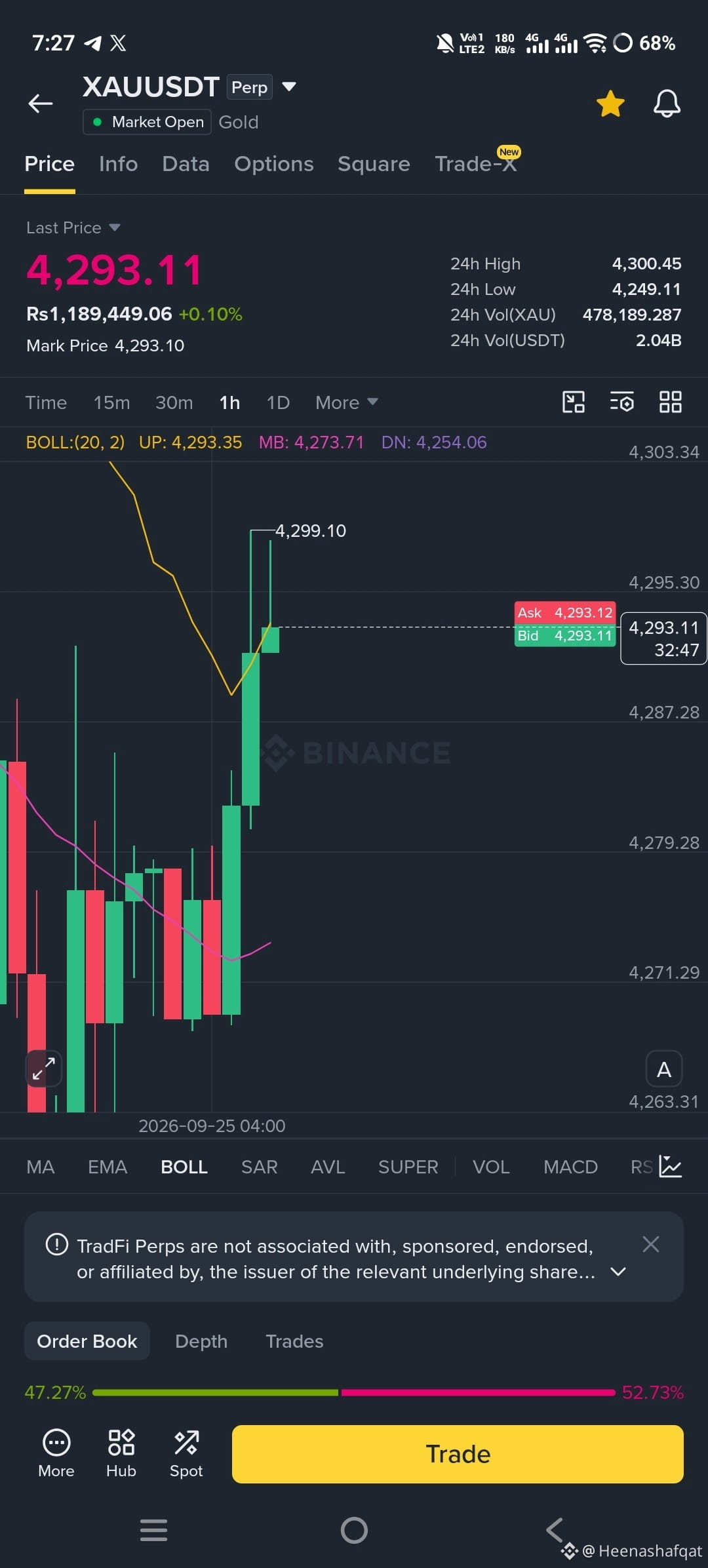
CryptopkaTrader:
Your post got me 19 views yesterday, thanks for support!
1
3
260

·
--
🔥 Follow for daily crypto updates!
🟡 $PAXG Gold Outlook: 2026 → 2031
$PAXG is currently trading around $4,254, after pulling back from recent highs. The short-term chart shows selling pressure, but the bigger picture remains tied to the long-term strength of gold. �
Reuters +1
📊 My long-term market map:
2026: Volatility & correction 🔄
2027: Potential recovery & new highs 📈
2028: Stronger institutional/central-bank demand could support Gold
2029: Tokenized Gold adoption may continue expanding 🌍
2030: PAXG could trade significantly higher if Gold remains structurally strong
2031: Long-term Gold demand may continue supporting higher PAXG valuations
Gold's long-term drivers include central-bank buying, geopolitical uncertainty, inflation concerns and investment demand. However, higher interest rates and a stronger USD can create significant downside pressure. �
World Gold Council +1
🔥 PAXG = Digital Gold backed by physical Gold.
Long-term trend matters more than short-term noise.
DYOR • NFA
#PAXG #GOLD #PAXGold #XAUUSD #goldtrading #Crypto #BinanceSquare
🔥 Follow for daily crypto updates!
🟡 $PAXG Gold Outlook: 2026 → 2031
$PAXG is currently trading around $4,254, after pulling back from recent highs. The short-term chart shows selling pressure, but the bigger picture remains tied to the long-term strength of gold. �
Reuters +1
📊 My long-term market map:
2026: Volatility & correction 🔄
2027: Potential recovery & new highs 📈
2028: Stronger institutional/central-bank demand could support Gold
2029: Tokenized Gold adoption may continue expanding 🌍
2030: PAXG could trade significantly higher if Gold remains structurally strong
2031: Long-term Gold demand may continue supporting higher PAXG valuations
Gold's long-term drivers include central-bank buying, geopolitical uncertainty, inflation concerns and investment demand. However, higher interest rates and a stronger USD can create significant downside pressure. �
World Gold Council +1
🔥 PAXG = Digital Gold backed by physical Gold.
Long-term trend matters more than short-term noise.
DYOR • NFA
#PAXG #GOLD #PAXGold #XAUUSD #goldtrading #Crypto #BinanceSquare
🟡 $PAXG Gold Outlook: 2026 → 2031
$PAXG is currently trading around $4,254, after pulling back from recent highs. The short-term chart shows selling pressure, but the bigger picture remains tied to the long-term strength of gold. �
Reuters +1
📊 My long-term market map:
2026: Volatility & correction 🔄
2027: Potential recovery & new highs 📈
2028: Stronger institutional/central-bank demand could support Gold
2029: Tokenized Gold adoption may continue expanding 🌍
2030: PAXG could trade significantly higher if Gold remains structurally strong
2031: Long-term Gold demand may continue supporting higher PAXG valuations
Gold's long-term drivers include central-bank buying, geopolitical uncertainty, inflation concerns and investment demand. However, higher interest rates and a stronger USD can create significant downside pressure. �
World Gold Council +1
🔥 PAXG = Digital Gold backed by physical Gold.
Long-term trend matters more than short-term noise.
DYOR • NFA
#PAXG #GOLD #PAXGold #XAUUSD #goldtrading #Crypto #BinanceSquare
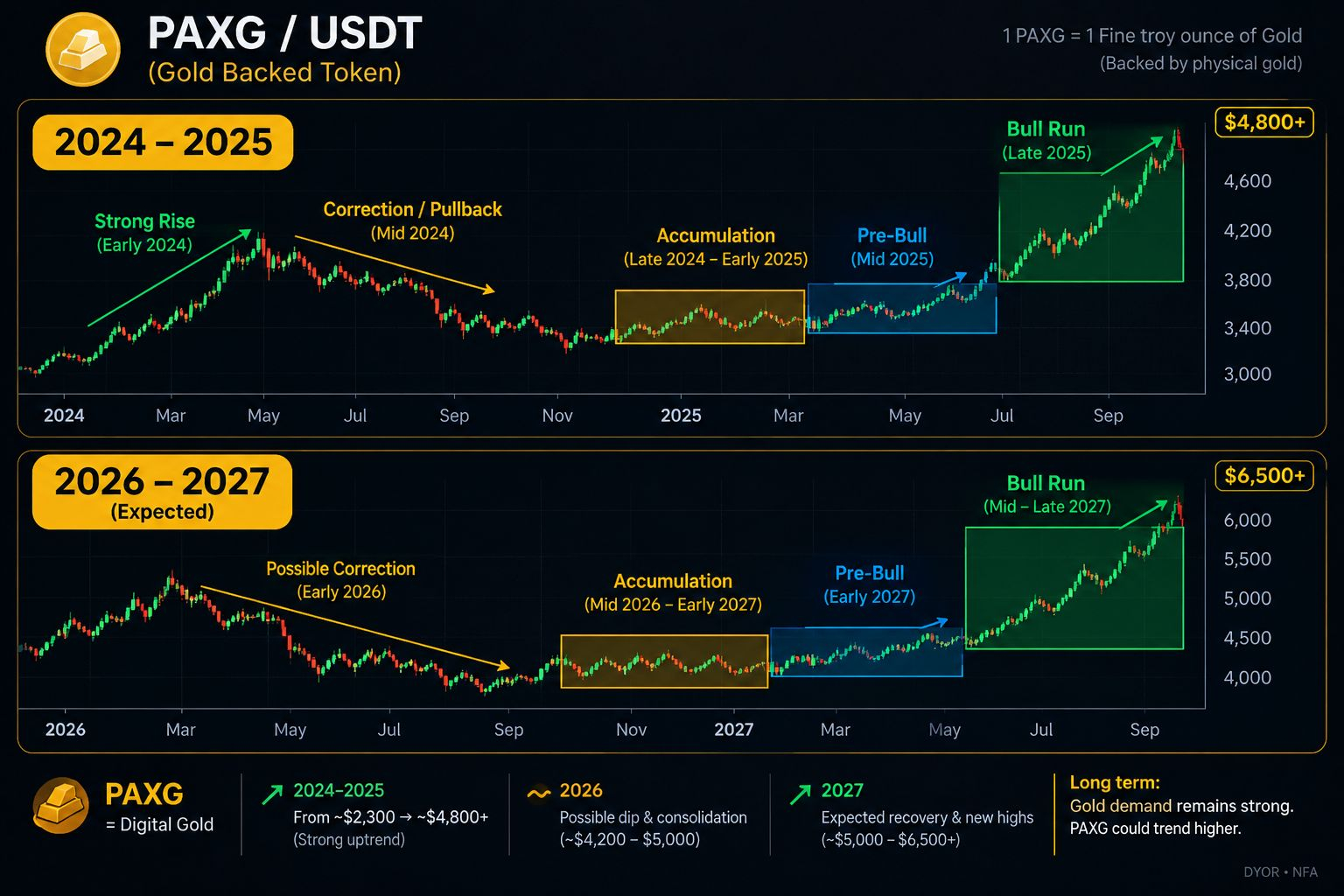
3
192
·
--
XAUUSD 5M Analysis 🎯
My previous setup played out as expected
Price rejected the resistance/supply zone and moved down toward the marked target area.
Key level: 4275
📉 Bearish setup: Rejection + downside move
🎯 Target zone: 4254 area
This is technical analysis for educational purposes. Always manage your risk and confirm the setup before entering a trade.
#XAUUSD #GoldTrading #TechnicalAnalysis #Binance #TradingSetup
XAUUSD 5M Analysis 🎯
My previous setup played out as expected
Price rejected the resistance/supply zone and moved down toward the marked target area.
Key level: 4275
📉 Bearish setup: Rejection + downside move
🎯 Target zone: 4254 area
This is technical analysis for educational purposes. Always manage your risk and confirm the setup before entering a trade.
#XAUUSD #GoldTrading #TechnicalAnalysis #Binance #TradingSetup
My previous setup played out as expected
Price rejected the resistance/supply zone and moved down toward the marked target area.
Key level: 4275
📉 Bearish setup: Rejection + downside move
🎯 Target zone: 4254 area
This is technical analysis for educational purposes. Always manage your risk and confirm the setup before entering a trade.
#XAUUSD #GoldTrading #TechnicalAnalysis #Binance #TradingSetup
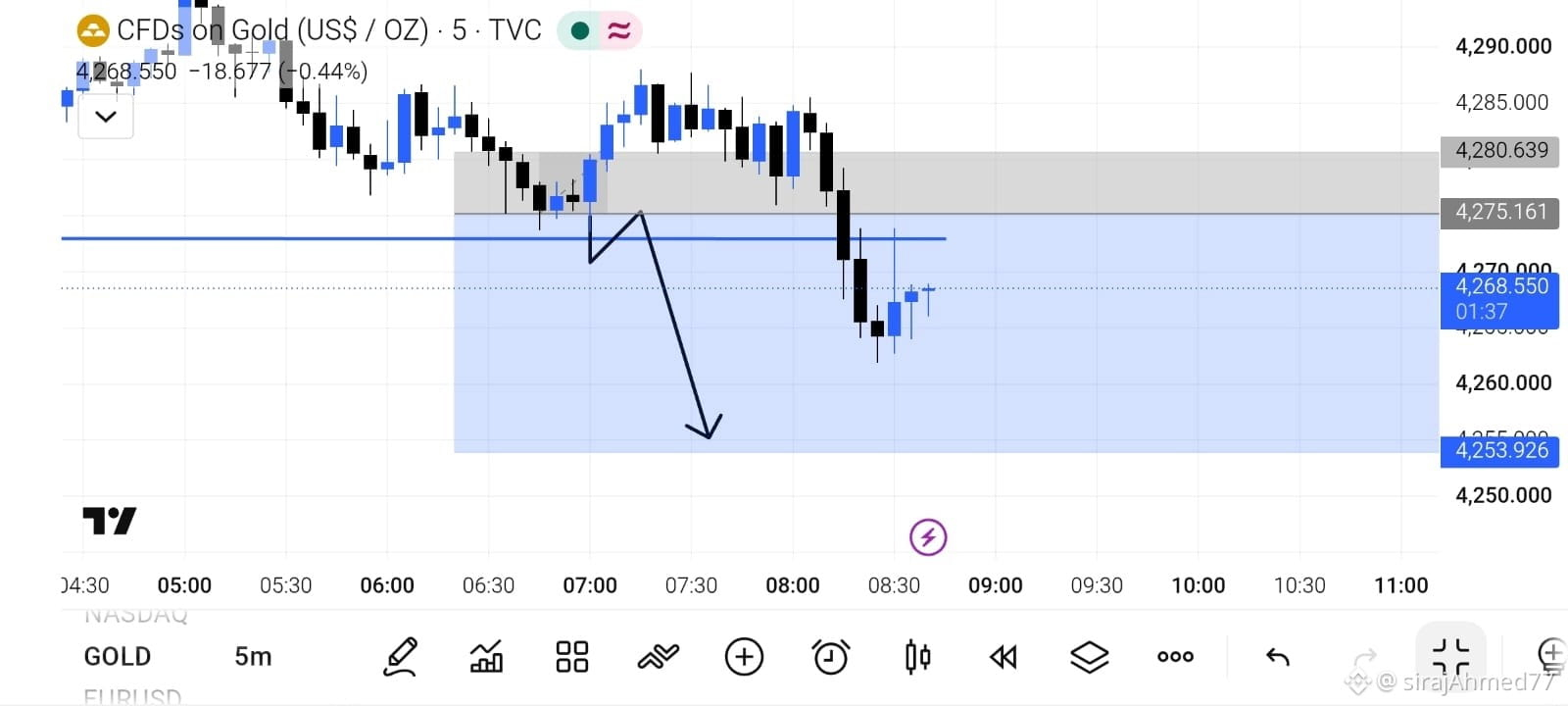
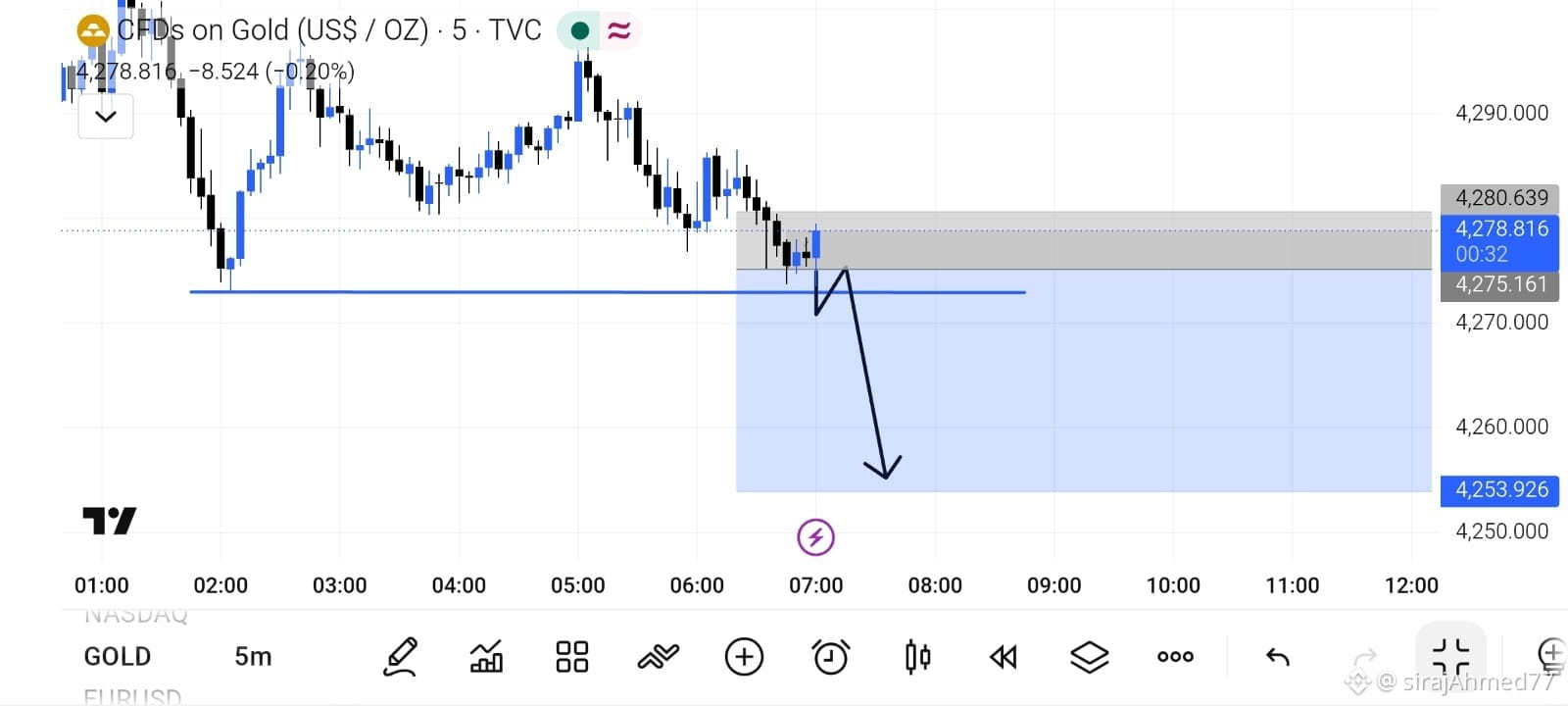
3
385
$XAUT | GOLD TRADING LESSON
A losing trade is not always a bad trade.
If your setup was valid, risk was controlled, and your stop-loss was respected the loss is simply part of trading.
Don’t change your strategy because of one result.
Judge the process, not one trade.
#BinanceSquare #goldtrading #TradingPsychologyChallenge #RiskManagement"
{future}(XAUUSDT)
$XAUT | GOLD TRADING LESSON
A losing trade is not always a bad trade.
If your setup was valid, risk was controlled, and your stop-loss was respected the loss is simply part of trading.
Don’t change your strategy because of one result.
Judge the process, not one trade.
#BinanceSquare #goldtrading #TradingPsychologyChallenge #RiskManagement"
A losing trade is not always a bad trade.
If your setup was valid, risk was controlled, and your stop-loss was respected the loss is simply part of trading.
Don’t change your strategy because of one result.
Judge the process, not one trade.
#BinanceSquare #goldtrading #TradingPsychologyChallenge #RiskManagement"
262
Log in to explore more content
Join global crypto users on Binance Square
⚡️ Get latest and useful information about crypto.
💬 Trusted by the world’s largest crypto exchange.
👍 Discover real insights from verified creators.
Email / Phone number
Trending Topics
1
#QNTRises287%
5,134 views
194 Discussing
2
#HSBCNamesStablecoinRedCoinForPhasedLaunch
23 views
23 Discussing
3
#TrumpRejectsAIRulesForVoluntaryAudits
9,239 views
317 Discussing
4
#BitgetHotWalletBreachTiedToThirdPartySecurityFlaw
4,639 views
236 Discussing
5
#OpenAIUnveilsAlwaysOnAgentDots
4,852 views
269 Discussing
6
#ChainlinkLaunchesBankSWIFTLedgerFramework
6,142 views
223 Discussing
7
#EarningsSeason
482,854 views
3,608 Discussing
8
#SECChairWantsStockMarketsOnChain
10,275 views
225 Discussing
9
#MulticoinInvestsInGrass
6,380 views
149 Discussing
10
#CEARenamesToBNBStandardUnderBNC
6,854 views
155 Discussing