
#cryptoregulation
cryptoregulation
17.2M views
49,532 Discussing
Hot
Latest
🚨 $BTC NAVIGATING THE SHIFT FROM WILD WEST LIQUIDITY TO STRICT COMPLIANCE 🛡️
The era of unchecked market gray zones is rapidly closing as global regulators enforce strict compliance frameworks across major venues. 📊 Institutional participants now demand pristine order flow clarity, leaving unstructured platforms behind.
This regulatory friction forces a structural cleanup, separating speculative noise from genuine liquidity architecture. 💡 Navigating today's markets requires respecting compliance milestones just as much as key order blocks.
💬 Are you adjusting your operational risk management to align with this maturing institutional landscape? 👇
⚠️ Not financial advice. Always manage your risk. 🛡️
🏷️ #BTC #MarketStructure #InstitutionalFlow #CryptoRegulation
🔥 💎
154

🚨 South Korea’s Bold Crypto Move: What the 15-20% Shareholder Cap Means for You 🚨
South Korea is shaking up the digital asset landscape with its upcoming Digital Asset Framework Act. The biggest headline? A proposed 15% to 20% cap on major shareholder stakes for cryptocurrency exchanges.
As a trader, here is why this matters:
📉 Decentralizing Power: The core goal is to prevent market dominance and curb centralized control over trading platforms. By forcing equity distribution, the law promotes fairer corporate governance and drastically reduces single-entity risks.
⏳ Market Stability: Existing platforms won’t be disrupted overnight. The draft includes a 1- to 2-year grace period for compliance, allowing the market to adjust smoothly.
🏦 Licensing & Stablecoins: The law will shift exchanges from a simple registration model to a strict licensing system. Additionally, won-pegged stablecoin issuance is expected to be restricted to bank-led consortiums, creating a much safer fiat-to-crypto bridge.
The Trader's Takeaway:
Tighter regulations build a safer, institutional-grade market. While this cap limits founder control, it massively boosts investor protection and trust. If you are trading Korean volume, expect a more mature and transparent ecosystem ahead.
What are your thoughts on governments capping exchange ownership? Is it a win for decentralization or an overreach? Drop your takes below! 👇
$BTC
{future}(BTCUSDT)
$ONE
{future}(ONEUSDT)
$BMT
{future}(BMTUSDT)
#southkoreadraftlawtargets15to20%shareholdercap #CryptoRegulation #Trading #SouthKorea
🚨 South Korea’s Bold Crypto Move: What the 15-20% Shareholder Cap Means for You 🚨
South Korea is shaking up the digital asset landscape with its upcoming Digital Asset Framework Act. The biggest headline? A proposed 15% to 20% cap on major shareholder stakes for cryptocurrency exchanges.
As a trader, here is why this matters:
📉 Decentralizing Power: The core goal is to prevent market dominance and curb centralized control over trading platforms. By forcing equity distribution, the law promotes fairer corporate governance and drastically reduces single-entity risks.
⏳ Market Stability: Existing platforms won’t be disrupted overnight. The draft includes a 1- to 2-year grace period for compliance, allowing the market to adjust smoothly.
🏦 Licensing & Stablecoins: The law will shift exchanges from a simple registration model to a strict licensing system. Additionally, won-pegged stablecoin issuance is expected to be restricted to bank-led consortiums, creating a much safer fiat-to-crypto bridge.
The Trader's Takeaway:
Tighter regulations build a safer, institutional-grade market. While this cap limits founder control, it massively boosts investor protection and trust. If you are trading Korean volume, expect a more mature and transparent ecosystem ahead.
What are your thoughts on governments capping exchange ownership? Is it a win for decentralization or an overreach? Drop your takes below! 👇
$BTC
$ONE
$BMT
#southkoreadraftlawtargets15to20%shareholdercap #CryptoRegulation #Trading #SouthKorea

3
1.4k

·
--
Bearish
#SouthKoreaDraftLawTargets15To20%ShareholderCap
🚨 SOUTH KOREA EYES 15–20% OWNERSHIP CAP ON CRYPTO EXCHANGES — A MAJOR REGULATORY SHIFT! 🇰🇷
South Korea is preparing a new Digital Asset Basic Act that could limit major shareholders' ownership in cryptocurrency exchanges to 15–20%.
📊 Why Does This Matter?
The proposal aims to reduce concentrated control over crypto exchanges, strengthen corporate governance, and improve investor protection.
Existing exchanges could receive a 1–2 year transition period to restructure their ownership. Regulators are also considering limiting voting rights instead of forcing shareholders to sell their stakes.
📈 What Could This Mean for Crypto?
Greater regulatory oversight of major exchanges.
Potential ownership restructuring for platforms like Upbit and Bithumb.
Improved governance and accountability.
Possible short-term uncertainty for exchange investors and the wider industry.
🧠 Trader's Perspective
This development is bigger than a simple ownership restriction. It reflects South Korea's effort to treat crypto exchanges more like regulated financial institutions.
Stronger oversight could improve long-term market confidence, but sudden regulatory changes may also create operational challenges for existing platforms.
One important point: this is still a proposed regulatory framework, not an implemented law. The final rules and transition arrangements remain subject to change.
Bottom Line: South Korea is moving toward stricter crypto exchange governance. The real impact will depend on how regulators balance investor protection with industry competition and innovation.
#SouthKorea #CryptoRegulation #Bitcoin
$BTC $ETH $SOL
{future}(SOLUSDT)
{future}(ETHUSDT)
{future}(BTCUSDT)
#SouthKoreaDraftLawTargets15To20%ShareholderCap
🚨 SOUTH KOREA EYES 15–20% OWNERSHIP CAP ON CRYPTO EXCHANGES — A MAJOR REGULATORY SHIFT! 🇰🇷
South Korea is preparing a new Digital Asset Basic Act that could limit major shareholders' ownership in cryptocurrency exchanges to 15–20%.
📊 Why Does This Matter?
The proposal aims to reduce concentrated control over crypto exchanges, strengthen corporate governance, and improve investor protection.
Existing exchanges could receive a 1–2 year transition period to restructure their ownership. Regulators are also considering limiting voting rights instead of forcing shareholders to sell their stakes.
📈 What Could This Mean for Crypto?
Greater regulatory oversight of major exchanges.
Potential ownership restructuring for platforms like Upbit and Bithumb.
Improved governance and accountability.
Possible short-term uncertainty for exchange investors and the wider industry.
🧠 Trader's Perspective
This development is bigger than a simple ownership restriction. It reflects South Korea's effort to treat crypto exchanges more like regulated financial institutions.
Stronger oversight could improve long-term market confidence, but sudden regulatory changes may also create operational challenges for existing platforms.
One important point: this is still a proposed regulatory framework, not an implemented law. The final rules and transition arrangements remain subject to change.
Bottom Line: South Korea is moving toward stricter crypto exchange governance. The real impact will depend on how regulators balance investor protection with industry competition and innovation.
#SouthKorea #CryptoRegulation #Bitcoin
$BTC $ETH $SOL

145

·
--
South Korea Draft Law Targets 15 To 20 % Shareholder Cap.
South Korea is preparing to submit its Digital Asset Basic Act this month.
The draft law proposes a cap of 15 to 20 percent on the stake a single shareholder can hold in a cryptocurrency exchange.
The Financial Services Commission says the goal is to reduce excessive control by a small number of founders and major shareholders. Exchanges are now being treated as core financial infrastructure, similar to alternative trading systems in the stock market.
The impact would be large:
Upbit chairman holds around 25.52 percent and would need to sell 5 to 10 percent.
Bithumb Holdings owns around 73.56 percent and would need to sell more than half its stake.
Coinone chairman holds around 53.44 percent.
Binance owns around 67.45 percent of GOPAX.
The draft also proposes a 1 to 2 year transition period for existing exchanges. Regulators are also considering limiting voting rights instead of ownership, due to concerns about property rights.
The law would also change exchange registration to a full licensing system. Stablecoin issuers are expected to be bank centered consortiums. The draft also includes no fault liability for losses caused by hacking or system failures.
At the same time, South Korea is planning to delay its crypto income tax by two years, originally scheduled for next year.
This law could reshape the entire Korean crypto market. If it passes, founders will lose control, banks will gain power, and exchanges will look more like traditional financial institutions.
The question is simple. Will this protect users, or will it push innovation out of Korea.
What do you think. Is a 15 to 20 percent cap fair or too much government control.
#SouthKoreaDraftLawTargets15To20%ShareholderCap #SouthKorea #CryptoRegulation #BinanceSquare
#SouthKoreaDraftLawTargets15To20%ShareholderCap
1
59

·
--
Crypto just lost its political tailwind in Washington.
Democrats are set to control Congress after the midterms (Japan Times/Bloomberg).
• Two years of friendly regulators and a Republican Congress, now ending
• Comprehensive market-structure legislation may get harder on the industry's terms
• Congressional scrutiny of Trump's crypto ties is now on the table
Meanwhile $BTC sits near $75.8K, still under $80K, with volume down sharply.
My take: policy risk is back in the pricing conversation, and CPI on Tuesday adds more. Watch how $ETH and alts react Monday.
Does a Democratic Congress make crypto rules clearer or tougher? Pick one.
Not financial advice.
#Bitcoin #CryptoRegulation #Midterms #CPI
3

🚨 SOUTH KOREA CONSIDERS 15%–20% OWNERSHIP CAP ON CRYPTO EXCHANGES!
South Korea is preparing its Digital Asset Basic Act, with a proposal that could reshape the country's crypto industry.
Key highlights:
🔹 Ownership Limits: Major shareholders could face a 15%–20% ownership cap.
🔹 Restructuring Period: Existing exchanges may receive 1–2 years to adjust their ownership structures.
🔹 Stablecoins: Won-backed stablecoin issuance could favor bank-led consortiums.
🔹 Investor Protection: New rules aim to strengthen corporate governance and exchange licensing.
South Korea is moving toward a more regulated crypto market, potentially increasing institutional involvement.
What do you think? Will stricter regulations help South Korea's crypto industry or create challenges for exchanges?
#SouthKoreaDraftLawTargets15To20%ShareholderCap #SouthKorea #CryptoRegulation #Bitcoin $ETH $BTC $ONE
{spot}(ONEUSDT)
{spot}(BTCUSDT)
{spot}(ETHUSDT)
🚨 SOUTH KOREA CONSIDERS 15%–20% OWNERSHIP CAP ON CRYPTO EXCHANGES!
South Korea is preparing its Digital Asset Basic Act, with a proposal that could reshape the country's crypto industry.
Key highlights:
🔹 Ownership Limits: Major shareholders could face a 15%–20% ownership cap.
🔹 Restructuring Period: Existing exchanges may receive 1–2 years to adjust their ownership structures.
🔹 Stablecoins: Won-backed stablecoin issuance could favor bank-led consortiums.
🔹 Investor Protection: New rules aim to strengthen corporate governance and exchange licensing.
South Korea is moving toward a more regulated crypto market, potentially increasing institutional involvement.
What do you think? Will stricter regulations help South Korea's crypto industry or create challenges for exchanges?
#SouthKoreaDraftLawTargets15To20%ShareholderCap #SouthKorea #CryptoRegulation #Bitcoin $ETH $BTC $ONE

419

·
--
#SouthKoreaDraftLawTargets15To20%ShareholderCap
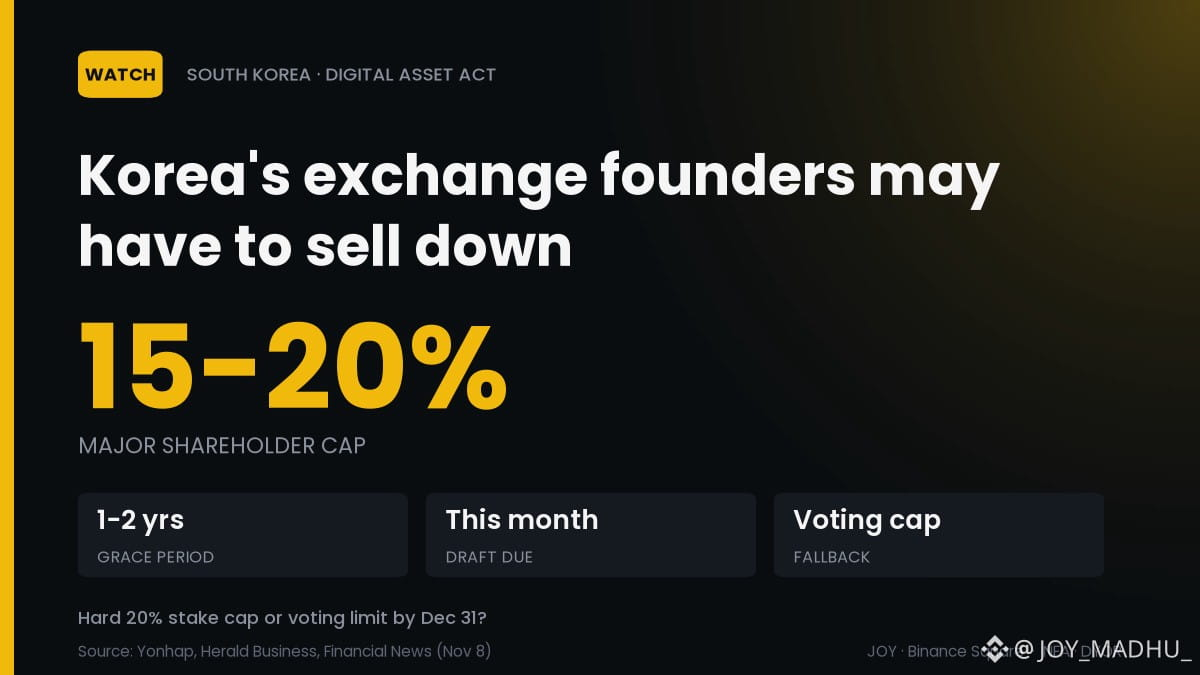
🇰🇷 Korea's Exchange Founders May Have to Sell Down to 20%
Seoul's crypto framework bill is due this month, and the fight is how much of an exchange one owner may keep.
📊 Likely cap: 15-20% per major shareholder
📅 Existing exchanges may get 1-2 years to comply
🏦 Registration would become a full license
⚠️ Industry cites property rights; a voting cap is the fallback
The catch: nothing is final, and lawmakers can rewrite the cap.
Hard 20% stake cap or voting limit by Dec 31? 👇
$BTC
#SouthKoreaDraftLawTargets15To20%ShareholderCap #Korea #CryptoRegulation
7
·
--
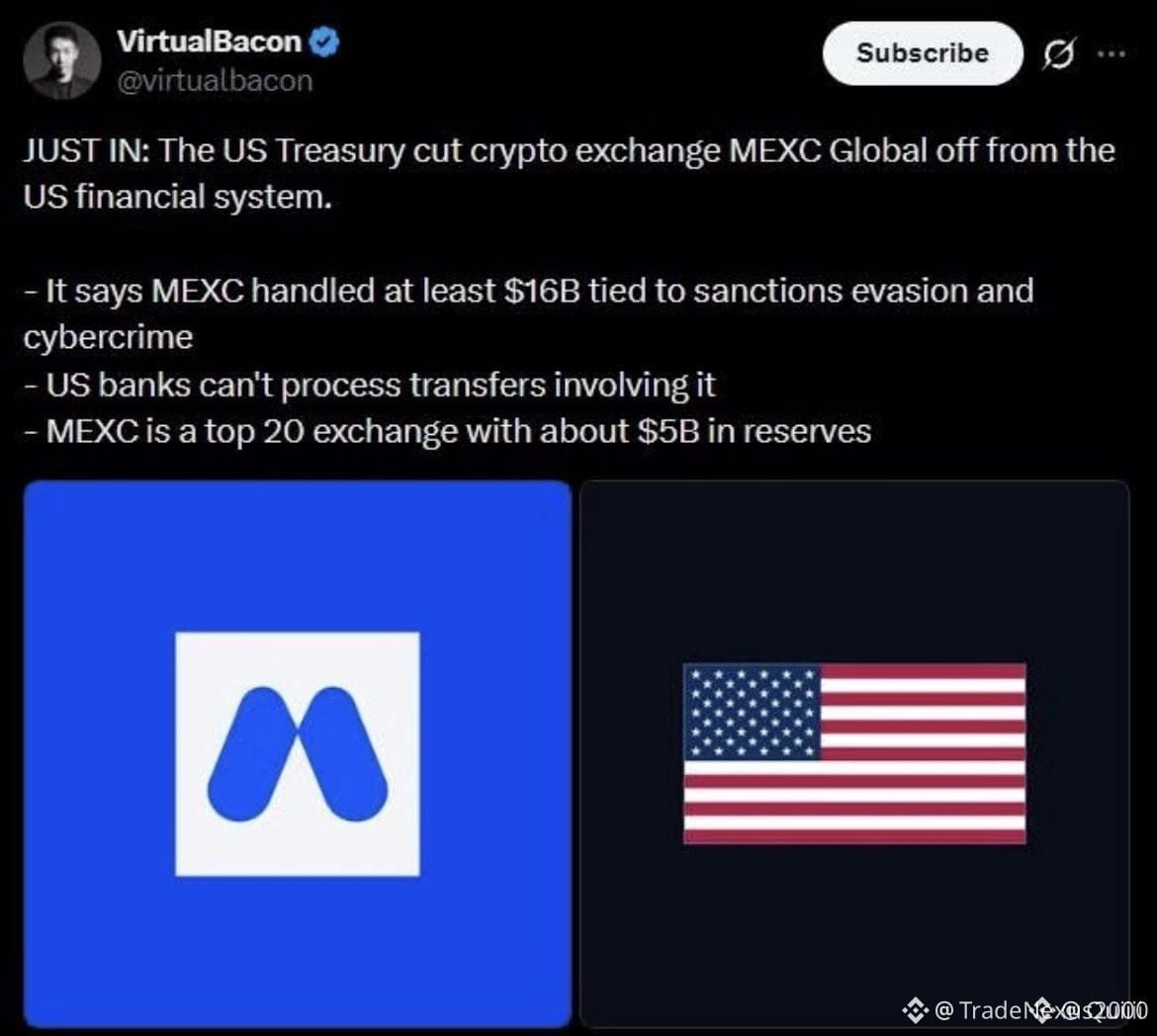
US Treasury just moved to cut off MEXC over $16 billion in alleged illicit flows.
What's reported (CoinDesk):
• FinCEN alleges at least $16B tied to Iranian, North Korean and Russian sanctions evasion and cybercrime
• Order rests formally on alleged Russian dealings
• Takes effect 30 days after Federal Register publication
• MEXC says it's reviewing and operating normally
It's the largest exchange ever targeted under this provision. Compliance risk is now a real factor in where traders keep funds, with $BTC stuck near $75.7K and sentiment fragile.
Will more offshore exchanges face similar orders in 2027: yes or no?
#FinCEN #MEXC #CryptoRegulation $BNB
9

·
--
🚨 SOUTH KOREA’S 20% EXCHANGE CAP IS REDRAWING THE MAP FOR $BTC ! ⚡
Regulatory iron fists are cleaning up the order books as South Korea rolls out its Digital Asset Framework Act. Capping major exchange stakeholders at twenty percent dismantles centralized bottlenecks and flattens single-entity risk across the board. 📊
With a structured grace period and strict banking-led stablecoin conduits taking shape, institutional-grade maturity is finally replacing wild-west mechanics. 💡 Transparency acts as a powerful catalyst for long-term liquidity expansion in top-tier markets.
💬 Does forcing equity dilution across trading platforms genuinely empower decentralization, or is it government overreach? 👇
⚠️ Not financial advice. Always manage your risk. 🛡️
🏷️ #BTC #CryptoRegulation #Trading #SouthKorea
🔥 💎

4

·
--
#southkoreadraftlawtargets15to20%shareholdercap
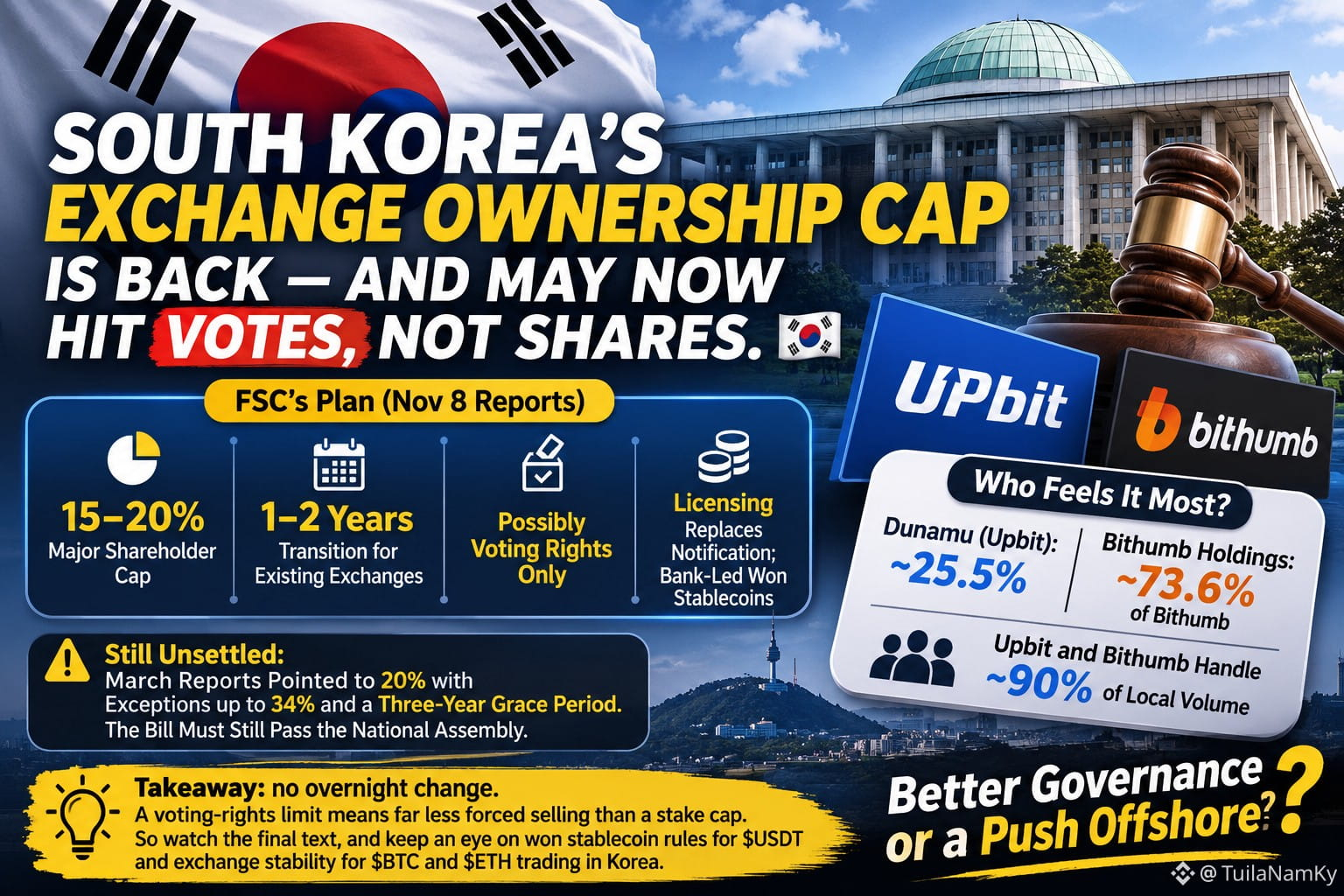
South Korea’s exchange ownership cap is back, and may now hit votes, not shares. 🇰🇷
Per Nov 8 reports, the FSC aims to submit the Digital Asset Basic Act this month:
Major shareholder cap: 15–20% 1–2 year transition for existing exchanges Possibly limiting voting rights only (property-rights concerns) Licensing replaces notification; bank-led won stablecoins
Who feels it most?
Dunamu (Upbit): chairman holds ~25.5%
Bithumb Holdings: ~73.6% of Bithumb
Upbit and Bithumb handle ~90% of local volume.
Still unsettled: March reports pointed to 20% with exceptions up to 34% and a three-year grace period. The bill must still pass the National Assembly.
Takeaway: no overnight change. A voting-rights limit means far less forced selling than a stake cap, so watch the final text. Won stablecoin rules matter for $USDT; exchange stability matters for BTC and ETH trading in Korea.
Better governance or a push offshore? 👇
#CryptoRegulation #Upbit #Bithumb
$BTC $ETH $USDT
{future}(ETHUSDT)
{future}(BTCUSDT)
#southkoreadraftlawtargets15to20%shareholdercap
South Korea’s exchange ownership cap is back, and may now hit votes, not shares. 🇰🇷
Per Nov 8 reports, the FSC aims to submit the Digital Asset Basic Act this month:
Major shareholder cap: 15–20% 1–2 year transition for existing exchanges Possibly limiting voting rights only (property-rights concerns) Licensing replaces notification; bank-led won stablecoins
Who feels it most?
Dunamu (Upbit): chairman holds ~25.5%
Bithumb Holdings: ~73.6% of Bithumb
Upbit and Bithumb handle ~90% of local volume.
Still unsettled: March reports pointed to 20% with exceptions up to 34% and a three-year grace period. The bill must still pass the National Assembly.
Takeaway: no overnight change. A voting-rights limit means far less forced selling than a stake cap, so watch the final text. Won stablecoin rules matter for $USDT; exchange stability matters for BTC and ETH trading in Korea.
Better governance or a push offshore? 👇
#CryptoRegulation #Upbit #Bithumb
$BTC $ETH $USDT
594

·
--
Brussels is setting up a dedicated EU crypto oversight group for the next 12 months, aimed at cross-border digital-asset flows worth $100B+. $BTC flat near $75,813 — no panic. Stricter oversight could cool some flows; if it stays light-touch, the tape moves on. Hold $75K? #EUCreatesCryptoTaskForce #CryptoRegulation #CryptoContent
Brussels is setting up a dedicated EU crypto oversight group for the next 12 months, aimed at cross-border digital-asset flows worth $100B+. $BTC flat near $75,813 — no panic. Stricter oversight could cool some flows; if it stays light-touch, the tape moves on. Hold $75K? #EUCreatesCryptoTaskForce #CryptoRegulation #CryptoContent
1

🚨 REGULATORY WINDS SHIFT ACROSS EUROPE AS $BNB NAVIGATES NEW COMPLIANCE MILESTONES ⚠️
The evolving regulatory landscape in Europe is reshaping where capital flows, with recent MiCA framework adjustments triggering account wind-downs across specific jurisdictions. 📊 While withdrawal channels remain open, leftover balances face structural holding fees starting late November, making proactive wallet hygiene essential for regional participants.
This structural pivot isn't a direct hit on network utility, but rather a masterclass in how compliance dictates market geography. 💡 Smart money watches how infrastructure adapts to shifting legal borders long before price reflects the friction. 💬 How are you adjusting your operational setup to stay ahead of tightening global regulations? 👇
⚠️ Not financial advice. Always manage your risk. 🛡️
🏷️ #BNB #CryptoRegulation #MarketInsights #Compliance
🔥 💎
5
·
--
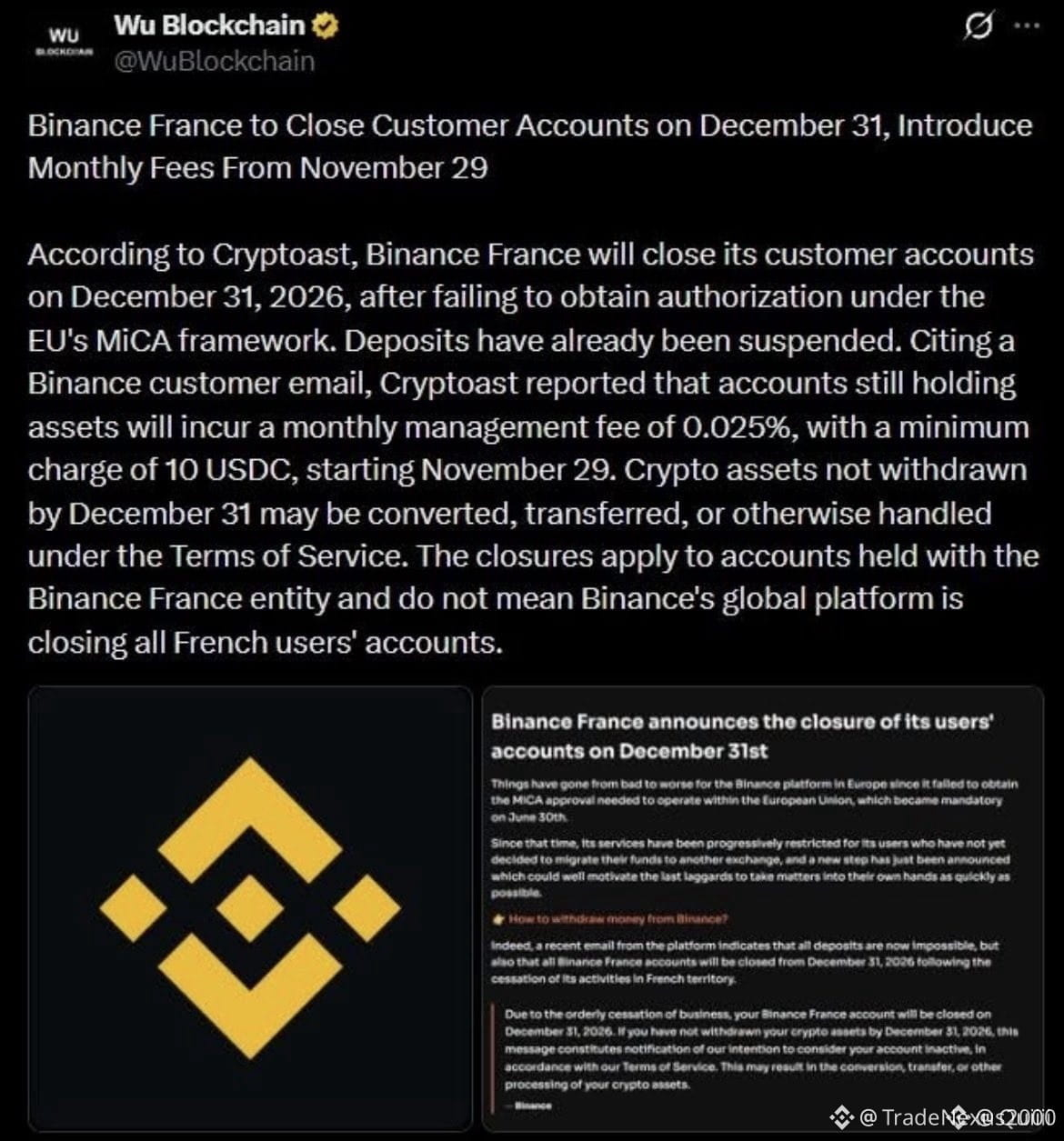
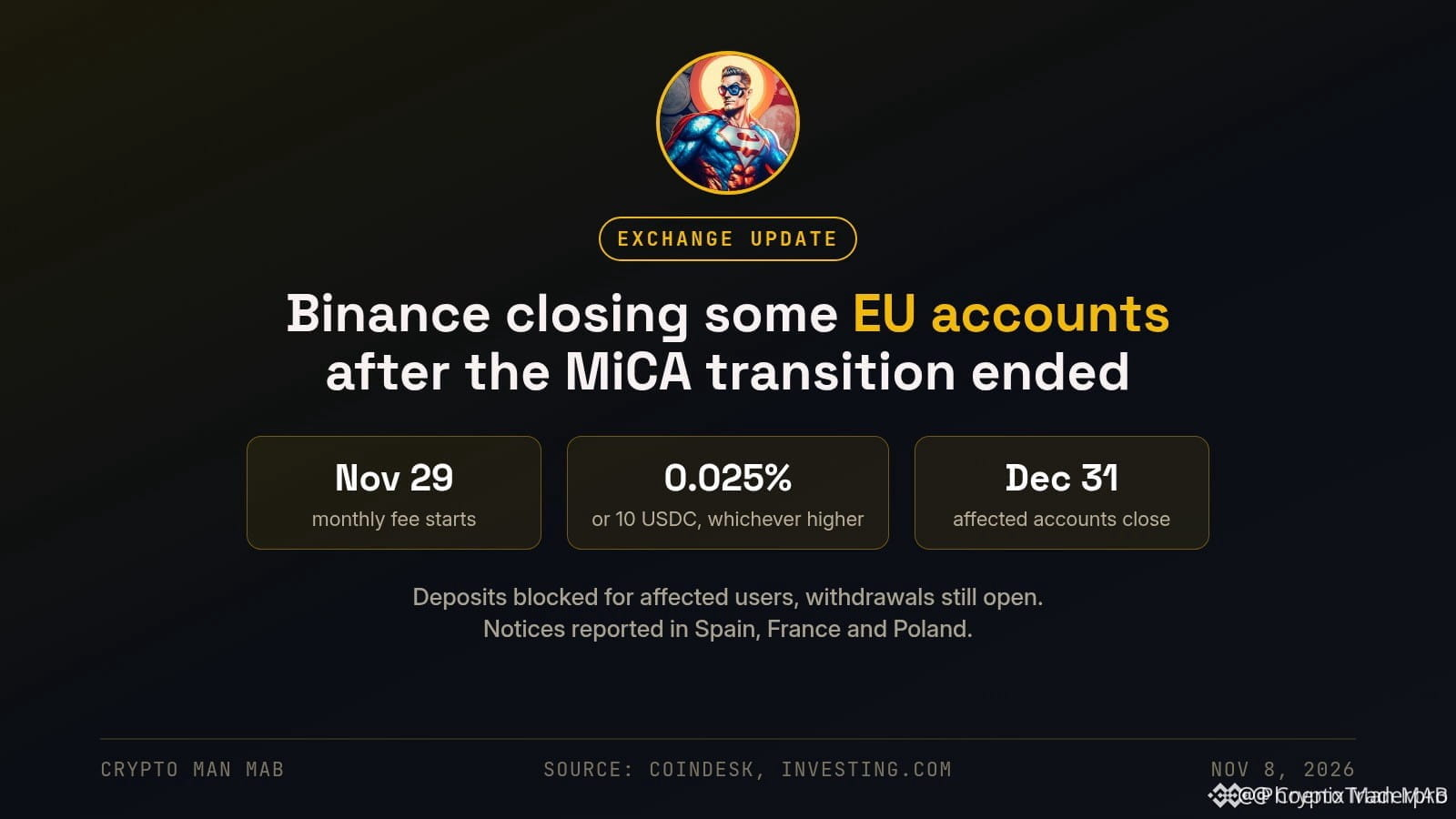
Binance is closing some EU accounts by December 31.
Per Investing.com:
• MiCA transition period has expired
• Users in France, Spain, Italy and Poland report withdrawal notices
• Deposits are blocked on affected accounts, withdrawals still work
• From Nov 29, remaining balances face a monthly fee
My take: this is a compliance reset, not a solvency story. But if you hold on any exchange, the lesson is the same: know your region's rules and keep your withdrawal path clear.
Did you get a notice? Or are you moving to self-custody anyway?
$BNB $BTC
#MiCA #Binance #CryptoRegulation
5

#HKSFCToExpandRestrictedTitlesList
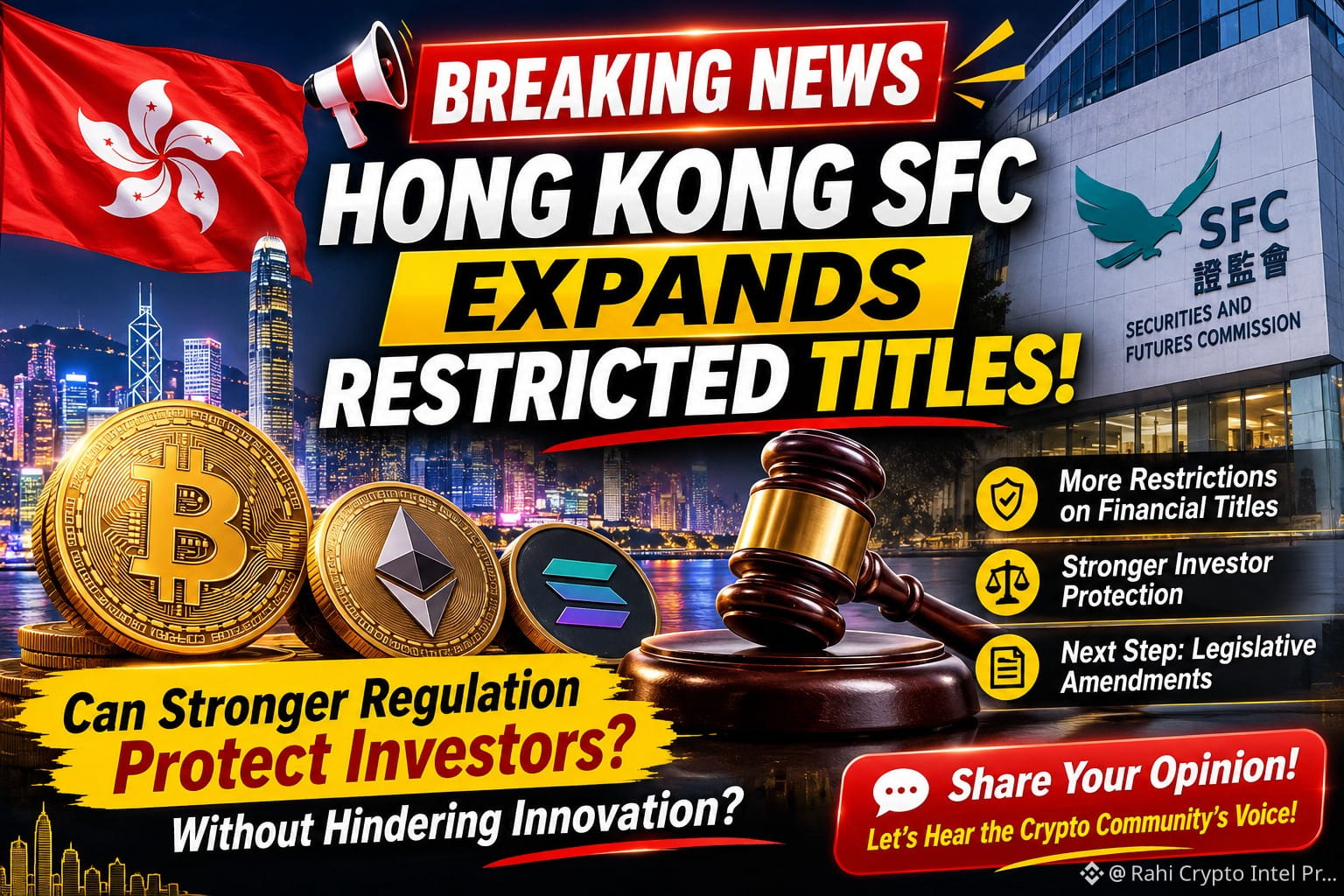
🚨 BREAKING NEWS: HONG KONG SFC MOVES FORWARD WITH EXPANDING RESTRICTED TITLES!
📢 A major regulatory development for the crypto and financial industry!
On November 6, 2026, Hong Kong's Securities and Futures Commission (SFC) announced the conclusion of its consultation on expanding restrictions against misleading financial and crypto-related business names.
🔥 What's happening?
🔹 More financial and crypto-related titles may face restrictions.
🔹 Terms such as Crypto Exchange, Digital Asset Market and Token Trading Platform could fall under the proposed restrictions when used in covered combinations.
🔹 Similar protections are proposed under both the Securities and Futures Ordinance (SFO) and AMLO.
🔹 The SFC is also planning a faster mechanism to update the restricted titles list.
🔹 The next step is to finalize legislative amendments and introduce a bill to the Legislative Council.
💡 WHY DOES THIS MATTER?
The crypto industry needs trust, transparency and investor protection.
But here's the BIG QUESTION:
Can stronger regulation protect investors without creating unnecessary barriers for legitimate crypto businesses?
👇 YOUR TURN!
1️⃣ Stronger regulation = More trust?
2️⃣ Could these restrictions affect crypto innovation?
3️⃣ Should other countries follow Hong Kong's approach?
Drop your opinion below! Let's hear the crypto community's voice. 🚀
#HongKong #CryptoRegulation #BinanceSquare
$XRP
{future}(XRPUSDT)
$BAT
{future}(BATUSDT)
$OPENAI
{future}(OPENAIUSDT)
#HKSFCToExpandRestrictedTitlesList
🚨 BREAKING NEWS: HONG KONG SFC MOVES FORWARD WITH EXPANDING RESTRICTED TITLES!
📢 A major regulatory development for the crypto and financial industry!
On November 6, 2026, Hong Kong's Securities and Futures Commission (SFC) announced the conclusion of its consultation on expanding restrictions against misleading financial and crypto-related business names.
🔥 What's happening?
🔹 More financial and crypto-related titles may face restrictions.
🔹 Terms such as Crypto Exchange, Digital Asset Market and Token Trading Platform could fall under the proposed restrictions when used in covered combinations.
🔹 Similar protections are proposed under both the Securities and Futures Ordinance (SFO) and AMLO.
🔹 The SFC is also planning a faster mechanism to update the restricted titles list.
🔹 The next step is to finalize legislative amendments and introduce a bill to the Legislative Council.
💡 WHY DOES THIS MATTER?
The crypto industry needs trust, transparency and investor protection.
But here's the BIG QUESTION:
Can stronger regulation protect investors without creating unnecessary barriers for legitimate crypto businesses?
👇 YOUR TURN!
1️⃣ Stronger regulation = More trust?
2️⃣ Could these restrictions affect crypto innovation?
3️⃣ Should other countries follow Hong Kong's approach?
Drop your opinion below! Let's hear the crypto community's voice. 🚀
#HongKong #CryptoRegulation #BinanceSquare
$XRP
$BAT
$OPENAI
270
·
--
Greece just priced crypto profits — 10% on gains from Jan 1, 15% on staking income. $BTC still sits near $75,650, so no panic yet. Hold $75,000 and it's local noise; lose it and tax headlines take the blame. Would a 10% tax change how you trade? #GreecePasses10CryptoTax #CryptoRegulation #Write2Earn
Greece just priced crypto profits — 10% on gains from Jan 1, 15% on staking income. $BTC still sits near $75,650, so no panic yet. Hold $75,000 and it's local noise; lose it and tax headlines take the blame. Would a 10% tax change how you trade? #GreecePasses10CryptoTax #CryptoRegulation #Write2Earn
30
🇺🇸 FinCEN & Fed Withdraw $250 Crypto Transfer ProposalA MAJOR REGULATORY U-TURN FOR CRYPTO!
The US Financial Crimes Enforcement Network (FinCEN) and Federal Reserve have withdrawn a controversial proposal that would have lowered the reporting threshold for certain international transfers from $3,000 to just $250.
📊 Key Highlights:
- Original proposal introduced in 2020.
- Proposed threshold reduction: $3,000 → $250.
- Would have expanded recordkeeping and information-sharing requirements.
- The proposal also sought to clarify coverage of cryptocurrency and certain digital asset transfers.
- On November 6, 2026, both agencies announced its withdrawal.
- Existing $3,000 threshold remains in place for covered transfers.
🔥 Why It Matters
The withdrawal removes a proposed expansion of financial monitoring requirements that could have affected smaller cross-border transfers.
For crypto, it signals a shift toward reconsidering outdated regulatory proposals in light of industry developments.
💬 Market Question:
Is this a positive step for crypto adoption and financial privacy, or should regulators prioritize stricter transaction monitoring?
#CryptoRegulation #FinCEN #FederalReserve #bitcoin
#FinCENAndFedWithdraw$250CryptoTransferProposal
$BTC $ETH $BNB
🇺🇸 FinCEN & Fed Withdraw $250 Crypto Transfer Proposal
A MAJOR REGULATORY U-TURN FOR CRYPTO!
The US Financial Crimes Enforcement Network (FinCEN) and Federal Reserve have withdrawn a controversial proposal that would have lowered the reporting threshold for certain international transfers from $3,000 to just $250.
📊 Key Highlights:
- Original proposal introduced in 2020.
- Proposed threshold reduction: $3,000 → $250.
- Would have expanded recordkeeping and information-sharing requirements.
- The proposal also sought to clarify coverage of cryptocurrency and certain digital asset transfers.
- On November 6, 2026, both agencies announced its withdrawal.
- Existing $3,000 threshold remains in place for covered transfers.
🔥 Why It Matters
The withdrawal removes a proposed expansion of financial monitoring requirements that could have affected smaller cross-border transfers.
For crypto, it signals a shift toward reconsidering outdated regulatory proposals in light of industry developments.
💬 Market Question:
Is this a positive step for crypto adoption and financial privacy, or should regulators prioritize stricter transaction monitoring?
#CryptoRegulation #FinCEN #FederalReserve #bitcoin
#FinCENAndFedWithdraw$250CryptoTransferProposal
$BTC $ETH $BNB
2
100

HONG KONG IS TIGHTENING ITS CRYPTO RULEBOOK! WILL NEW SFC REGULATIONS CHANGE THE GAME FOR EXCHANGESHong Kong is taking another major step toward building a more regulated digital asset industry, and crypto exchanges need to pay attention!
The Hong Kong Securities and Futures Commission (SFC), together with the Financial Services and the Treasury Bureau, is preparing to expand regulatory oversight across the digital asset sector.
📊 WHAT'S CHANGING?
According to the latest government update on November 4, Hong Kong plans to introduce legislation by the end of 2026 to expand its existing virtual asset regulatory framework.
The proposed framework will cover:
🔹 Crypto Dealing: Stronger licensing requirements for businesses providing virtual asset dealing services.
🔹 Advisory Services: Additional regulatory oversight for companies offering crypto investment advice.
🔹 Asset Management: New rules for businesses managing digital asset investments.
🔹 Custody Services: Stronger safeguards for companies responsible for holding customers' digital assets.
🛡️ WHY DOES THIS MATTER FOR CRYPTO?
The objective is to create a more transparent, secure, and accountable digital asset ecosystem while protecting investors.
🔥 POTENTIAL MARKET IMPACT
1️⃣ Exchanges: Platforms may face additional compliance responsibilities and operational costs.
2️⃣ Institutional Adoption: Clearer regulatory standards could encourage more traditional financial institutions to enter the market.
3️⃣ Investor Confidence: Stronger custody and licensing requirements could help reduce operational risks.
4️⃣ Global Competition: Hong Kong wants to strengthen its position as an international digital asset hub rather than push innovation away.
₿ THREE MAJOR CRYPTO ASSETS TO WATCH:
🟠 $BTC – Bitcoin remains a major focus for institutional investors.
🔵 $ETH – Ethereum's ecosystem could benefit from greater adoption of regulated digital asset services.
🟡 $BNB – Exchange-related developments and changing compliance requirements remain important market themes to monitor.
💡 MY TAKEAWAY:
Crypto regulation isn't necessarily the enemy of adoption.
Hong Kong appears to be pursuing a strategy of expanding oversight while creating more opportunities for regulated digital asset businesses.
The real challenge will be finding the right balance between investor protection and technological innovation.
💬 LET'S DISCUSS!
Will stricter crypto regulations make Hong Kong a stronger global crypto hub, or could additional compliance costs slow down innovation?
Is this bullish or bearish for the long-term crypto market?
Share your thoughts below! 👇
⚠️ Educational purposes only. Not financial advice (NFA). Always DYOR.
#hksfcplanstorestrictcryptoandexchangeterms #Bitcoin #CryptoRegulation #HongKong #SFC
{spot}(BNBUSDT)
{spot}(BTCUSDT)
{spot}(ETHUSDT)
HONG KONG IS TIGHTENING ITS CRYPTO RULEBOOK! WILL NEW SFC REGULATIONS CHANGE THE GAME FOR EXCHANGES
Hong Kong is taking another major step toward building a more regulated digital asset industry, and crypto exchanges need to pay attention!
The Hong Kong Securities and Futures Commission (SFC), together with the Financial Services and the Treasury Bureau, is preparing to expand regulatory oversight across the digital asset sector.
📊 WHAT'S CHANGING?
According to the latest government update on November 4, Hong Kong plans to introduce legislation by the end of 2026 to expand its existing virtual asset regulatory framework.
The proposed framework will cover:
🔹 Crypto Dealing: Stronger licensing requirements for businesses providing virtual asset dealing services.
🔹 Advisory Services: Additional regulatory oversight for companies offering crypto investment advice.
🔹 Asset Management: New rules for businesses managing digital asset investments.
🔹 Custody Services: Stronger safeguards for companies responsible for holding customers' digital assets.
🛡️ WHY DOES THIS MATTER FOR CRYPTO?
The objective is to create a more transparent, secure, and accountable digital asset ecosystem while protecting investors.
🔥 POTENTIAL MARKET IMPACT
1️⃣ Exchanges: Platforms may face additional compliance responsibilities and operational costs.
2️⃣ Institutional Adoption: Clearer regulatory standards could encourage more traditional financial institutions to enter the market.
3️⃣ Investor Confidence: Stronger custody and licensing requirements could help reduce operational risks.
4️⃣ Global Competition: Hong Kong wants to strengthen its position as an international digital asset hub rather than push innovation away.
₿ THREE MAJOR CRYPTO ASSETS TO WATCH:
🟠 $BTC – Bitcoin remains a major focus for institutional investors.
🔵 $ETH – Ethereum's ecosystem could benefit from greater adoption of regulated digital asset services.
🟡 $BNB – Exchange-related developments and changing compliance requirements remain important market themes to monitor.
💡 MY TAKEAWAY:
Crypto regulation isn't necessarily the enemy of adoption.
Hong Kong appears to be pursuing a strategy of expanding oversight while creating more opportunities for regulated digital asset businesses.
The real challenge will be finding the right balance between investor protection and technological innovation.
💬 LET'S DISCUSS!
Will stricter crypto regulations make Hong Kong a stronger global crypto hub, or could additional compliance costs slow down innovation?
Is this bullish or bearish for the long-term crypto market?
Share your thoughts below! 👇
⚠️ Educational purposes only. Not financial advice (NFA). Always DYOR.
#hksfcplanstorestrictcryptoandexchangeterms #Bitcoin #CryptoRegulation #HongKong #SFC
1
595
·
--
Did anyone else catch the Treasury move late Friday? FinCEN ordered MEXC cut off from the US financial system, alleging at least $16B in transactions tied to sanctions evasion and cybercrime from 2021 to 2026 — including about $1.5B linked to Russian sanctions evasion. US banks will be barred from processing MEXC transfers once the order takes effect 30 days after it is published, and the exchange still holds roughly $4.5B in assets. $BTC is barely reacting so far, flat near $75,814 while $ETH sits around $2,237, which tells me the market is treating this as MEXC's problem for now. Two ways it goes: traders rotate to bigger venues and it fades, or fear spreads to other offshore exchanges and $75,000 gets tested again. Would you pull funds off a smaller exchange after a move like this, or wait out the 30 days?
#TreasuryCutsOffMEXC #CryptoRegulation #CryptoContent
#TreasuryCutsOffMEXC #CryptoRegulation #CryptoContent
1

Article
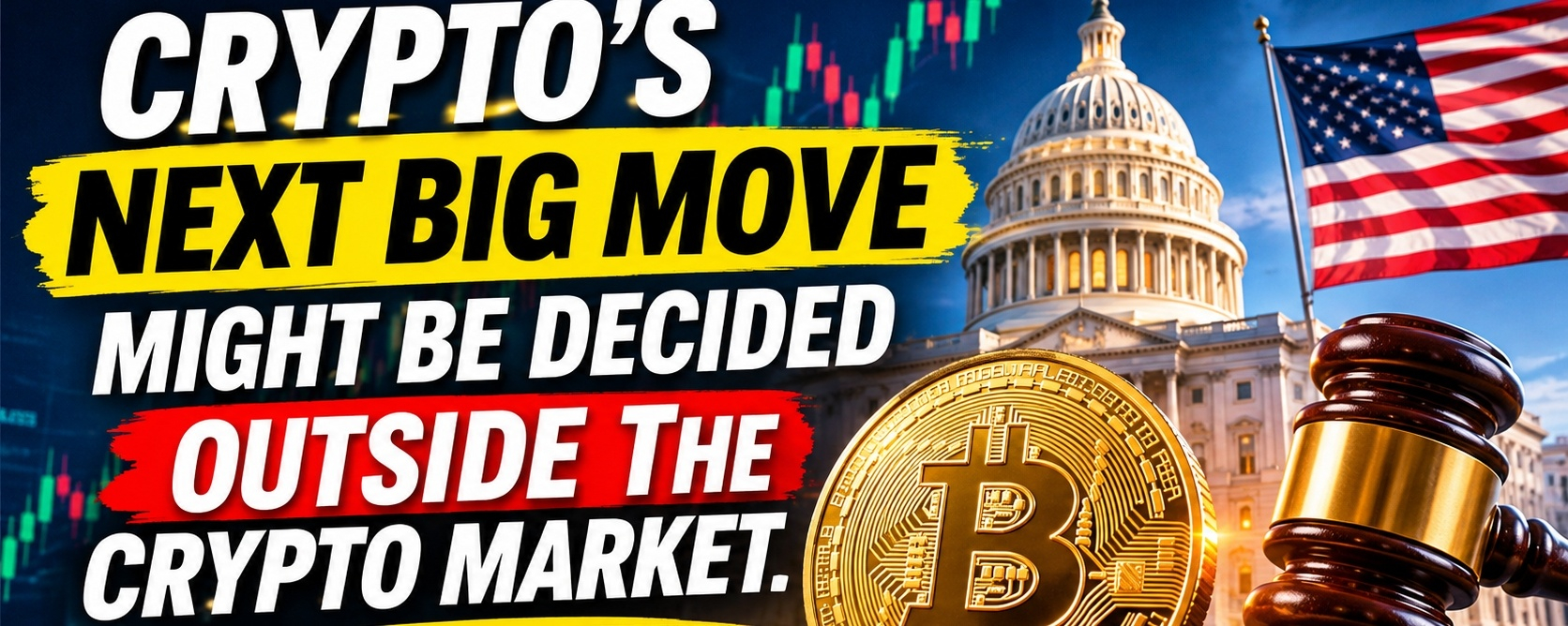
CRYPTO REGULATION — Politics Could Change EverythingCrypto's Next Big Move Might Be Decided Outside the Crypto Market.
Everyone watches Bitcoin charts, but there is another powerful factor investors shouldn't ignore: regulation.
Following the US midterm elections, attention is shifting toward the future of crypto legislation and market oversight.
Clear regulations could encourage more institutions to participate. On the other hand, uncertainty could delay investment decisions.
I think the next phase of crypto adoption won't depend only on technology. Government decisions will matter too.
Crypto is growing up, and its relationship with traditional finance is changing.
Will clearer regulations bring the next wave of institutional money into crypto?
#CryptoRegulation #Bitcoin #CryptoNews #InstitutionalAdoption #BinanceSquare
{future}(ONEUSDT)
{future}(ACTUSDT)
CRYPTO REGULATION — Politics Could Change Everything
Crypto's Next Big Move Might Be Decided Outside the Crypto Market.
Everyone watches Bitcoin charts, but there is another powerful factor investors shouldn't ignore: regulation.
Following the US midterm elections, attention is shifting toward the future of crypto legislation and market oversight.
Clear regulations could encourage more institutions to participate. On the other hand, uncertainty could delay investment decisions.
I think the next phase of crypto adoption won't depend only on technology. Government decisions will matter too.
Crypto is growing up, and its relationship with traditional finance is changing.
Will clearer regulations bring the next wave of institutional money into crypto?
#CryptoRegulation #Bitcoin #CryptoNews #InstitutionalAdoption #BinanceSquare
1
675

·
--
Article
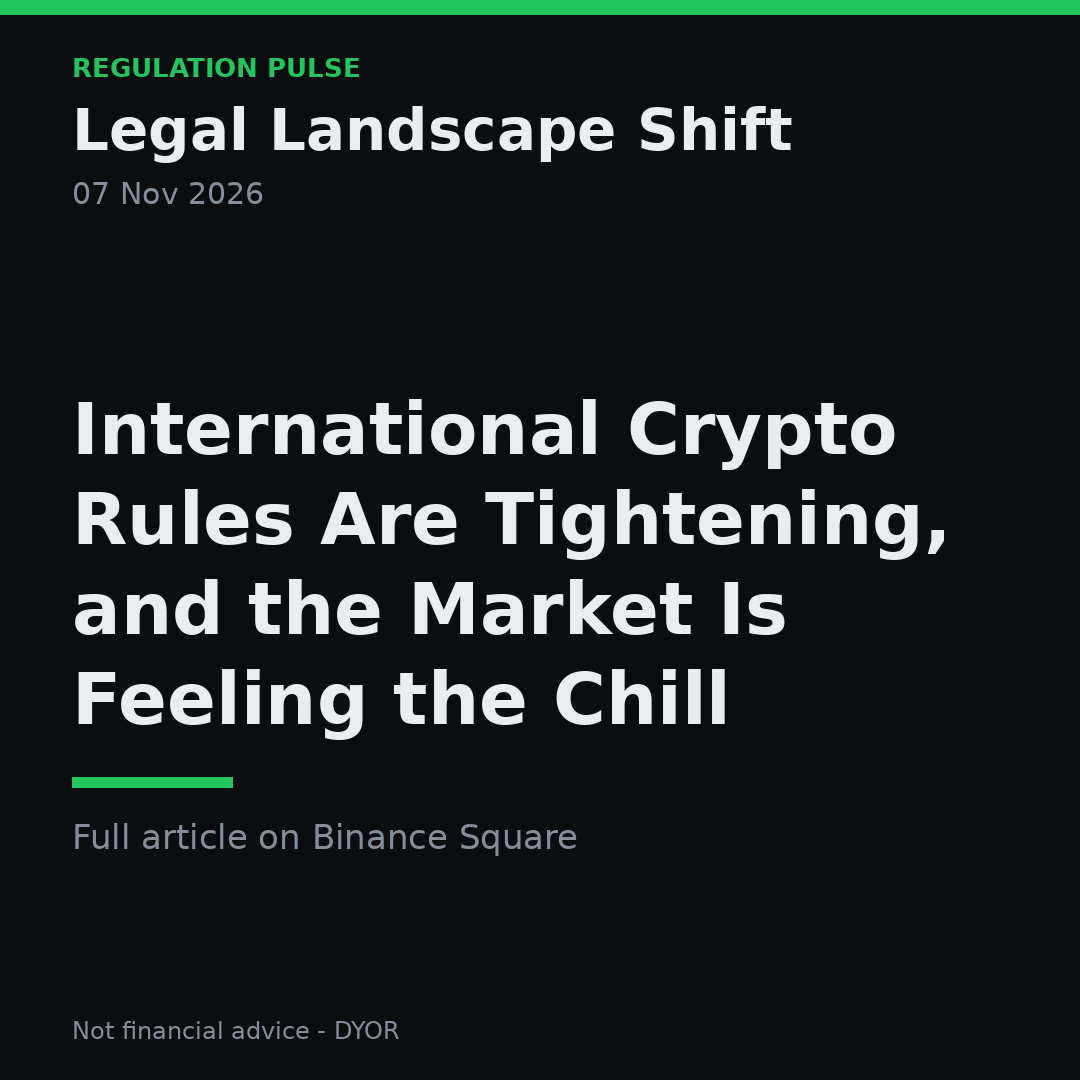
International Crypto Rules Are Tightening, and the Market Is Feeling the ChillThe past week has been a whirlwind of policy announcements from the EU, Singapore and the U.S., and the price charts are echoing that nervous energy. I've been tracking the numbers while parsing the legalese, and what I see is a subtle shift from hype to compliance-driven valuation.
Regulatory Pulse in Europe
The European Union's MiCA framework finally entered its enforcement phase, demanding clearer disclosures for stablecoins and tighter AML checks for DeFi platforms. Projects that can't prove robust governance are seeing their liquidity dip, a trend reflected in the modest 24-hour move of $BTC at -0.28% and $ETH barely up at +0.04%. The fear factor is evident in the Fear & Greed Index, now at 25, signaling extreme fear among investors.
Asia's New Token Rules
Singapore's MAS rolled out a licensing regime for token service providers, while Japan tightened its definition of "virtual assets." The immediate impact is a cautious stance from traders, which is why we're seeing $BNB slip -0.42% and SOL drop -1.08% over the last day. The broader 7-day declines, $BTC down -2.30% and SOL down -6.15%, suggest that market participants are still digesting the regulatory ripple.
How Valuations Are Reacting
Tokens with strong compliance roadmaps are holding steadier ground. $ETH's near-flat 24-hour change and UNI's modest +1.42% gain at $7.05 illustrate that utility-focused assets can weather the storm better than pure speculation. Meanwhile, the surprise rally of ONE, up +39.32% at $0.002225, shows that niche projects with clear regulatory positioning can still capture attention.
Practical Steps for Traders
1. Keep an eye on the Fear & Greed Index; extreme fear often precedes short-term volatility.
2. Prioritize assets with transparent KYC/AML processes, $BTC, $ETH and $BNB are still the most liquid.
3. Use volume cues; $BTC's 24-hour volume of $588M and $ETH's $186M can help gauge market depth before entering or exiting positions.
Guidance for Developers
If you're building on a public chain, embed compliance hooks early, on-chain identity verification, audit-ready smart contracts and clear tokenomics disclosures. Projects that align with MiCA or MAS guidelines will find it easier to list on major exchanges, which in turn sustains liquidity and user trust.
What regulatory shift do you think will have the biggest long-term impact on token valuations?
Not financial advice
#CryptoRegulation #TokenCompliance #MarketInsights #CryptoPolicy
International Crypto Rules Are Tightening, and the Market Is Feeling the Chill
The past week has been a whirlwind of policy announcements from the EU, Singapore and the U.S., and the price charts are echoing that nervous energy. I've been tracking the numbers while parsing the legalese, and what I see is a subtle shift from hype to compliance-driven valuation.
Regulatory Pulse in Europe
The European Union's MiCA framework finally entered its enforcement phase, demanding clearer disclosures for stablecoins and tighter AML checks for DeFi platforms. Projects that can't prove robust governance are seeing their liquidity dip, a trend reflected in the modest 24-hour move of $BTC at -0.28% and $ETH barely up at +0.04%. The fear factor is evident in the Fear & Greed Index, now at 25, signaling extreme fear among investors.
Asia's New Token Rules
Singapore's MAS rolled out a licensing regime for token service providers, while Japan tightened its definition of "virtual assets." The immediate impact is a cautious stance from traders, which is why we're seeing $BNB slip -0.42% and SOL drop -1.08% over the last day. The broader 7-day declines, $BTC down -2.30% and SOL down -6.15%, suggest that market participants are still digesting the regulatory ripple.
How Valuations Are Reacting
Tokens with strong compliance roadmaps are holding steadier ground. $ETH 's near-flat 24-hour change and UNI's modest +1.42% gain at $7.05 illustrate that utility-focused assets can weather the storm better than pure speculation. Meanwhile, the surprise rally of ONE, up +39.32% at $0.002225, shows that niche projects with clear regulatory positioning can still capture attention.
Practical Steps for Traders
1. Keep an eye on the Fear & Greed Index; extreme fear often precedes short-term volatility.
2. Prioritize assets with transparent KYC/AML processes, $BTC , $ETH and $BNB are still the most liquid.
3. Use volume cues; $BTC 's 24-hour volume of $588M and $ETH 's $186M can help gauge market depth before entering or exiting positions.
Guidance for Developers
If you're building on a public chain, embed compliance hooks early, on-chain identity verification, audit-ready smart contracts and clear tokenomics disclosures. Projects that align with MiCA or MAS guidelines will find it easier to list on major exchanges, which in turn sustains liquidity and user trust.
What regulatory shift do you think will have the biggest long-term impact on token valuations?
Not financial advice
#CryptoRegulation #TokenCompliance #MarketInsights #CryptoPolicy
111
Log in to explore more content
Join global crypto users on Binance Square
⚡️ Get latest and useful information about crypto.
💬 Trusted by the world’s largest crypto exchange.
👍 Discover real insights from verified creators.
Email / Phone number
Trending Topics
1
#BitcoinFiveWeeklyLosses
44 views
55 Discussing
2
#AIChipSlumpNasdaq
24 views
42 Discussing
3
#BinanceReopensWithdrawalsForHYPE&APT
135,297 views
1,107 Discussing
4
#SouthKoreaDraftLawTargets15To20%ShareholderCap
134,369 views
734 Discussing
5
#TradFiForBeginners
212,244 views
1,967 Discussing
6
#KeplrAdvisesSocialLoginUsersToTransferAssets
63,899 views
561 Discussing
7
#TetherPlans€28.8MForJuventusCapitalIncrease
49,370 views
425 Discussing
8
#JobsReportRaisesHikeOdds
943,062 views
4,515 Discussing
9
#CPITestsDecemberRateOutlook
410,195 views
1,942 Discussing
10
#US Data Center Rules May Constrain AI Expansion
144,369 views
260 Discussing