

#canmicrosoftdeliveronai
canmicrosoftdeliveronai
Microsoft continues to increase its AI investment, with Azure and its Copilot products in the spotlight. Will this quarter's earnings show revenue growth from its AI investment? Share your predictions and analysis of Microsoft's ($MSFT) quarterly earnings, show your Binance Pick prediction positions or your trades/positions, and join the discussion on whether Microsoft can deliver on AI.
Hot
Latest


Article
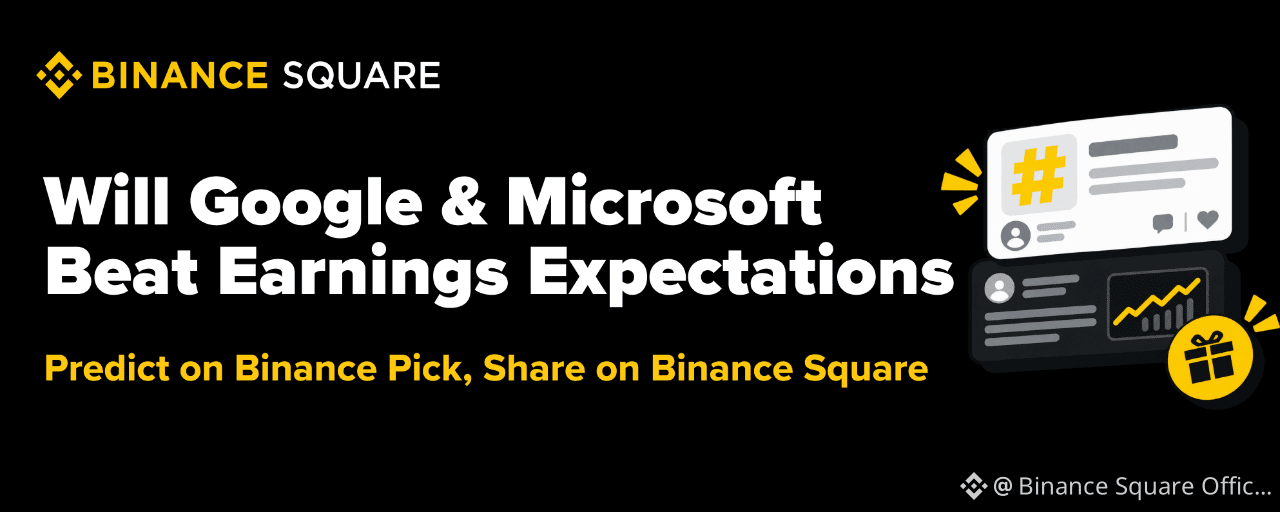
Earnings Season Session 3: Will Google & Microsoft Beat Earnings Expectations?Binance Square #EarningsSeason is updated with a new session. In this session, we focus on Google and Microsoft. Follow Google and Microsoft earnings on Square for the latest updates and data analysis, make your earnings predictions via [Binance Pick](https://app.binance.com/uni-qr/prophet?seasonId=prophet_1019_s1), and share your prediction takes to unlock Binance Pick points and traffic boost. Make the most of Earnings Season—all on Binance Square!
Here is your ultimate guide to #EarningsSeason on Binance Square.
Step 1: Stay Tuned to Key Data & Analysis of Google and Microsoft Earnings
Oct 26:[ Google & Microsoft earnings preview](https://www.binance.com/en/square/post/10-26-2026-alphabet-and-microsoft-earnings-preview-cloud-growth-meets-the-capex-bill-381383851799819)Oct 29: Google & Microsoft earnings recapOct 29:[ Post-earnings analyst livestream](https://www.binance.com/en/square/post/381427116820341) (12:00 UTC, Chinese)Oct 30: Post-earnings analyst livestream (14:00 UTC, English)
Step 2: Predict Google and Microsoft Earnings on Binance Pick
[Binance Pick](https://app.binance.com/uni-qr/prophet?seasonId=prophet_1019_s1) has launched a new [Finance Earnings] prediction section. Use points to predict how Google and Microsoft will perform in their upcoming earnings reports, which will earn you more points, and help you climb the leaderboard for a share of splitting up to 1,000,000 USDC.
Step 3: Share Your Earnings Views on Square to Earn Binance Pick Points and Traffic Boost
Share your Binance Pick earnings prediction positions on Binance Square and explain your calls on Google or Microsoft. You can also join Google or Microsoft topics discussion and analyze their earnings results.
Option 1: Share Your Prediction Positions to Earn Binance Pick Points
Post with #BinancePick (≥20 characters)Include a screenshot of your Google or Microsoft earnings prediction position from Binance Pick Pick any angle below and share your thoughts in the post.Angle 1: Will Google beat quarterly earnings expectations? Why do you think so?Angle 2: Will Microsoft beat quarterly earnings expectations? Why do you think so?You will earn 100 Binance Pick points per day.
Option 2: Join Google and Microsoft Topic Discussions & Earn Traffic Boost
#CanGoogleDefendItsCore?Post with #CanGoogleDefindItsCore Pick either angle and share your take in the post.Angle 1: How will you adjust your trades or positions before and after Google’s earnings report? Include a trade-sharing card to show your $GOOGL trade or position for a better chance of receiving traffic boost.Angle 2: More people are turning directly to AI for answers instead of using search engines. Do you think this will affect Google’s search advertising revenue and $GOOGL stock price?#CanMicrosoftDeliverOnAI?Post with #CanMicrosoftDeliverOnAI Pick either angle and share your take in the post.Angle 1: How will you adjust your trades or positions before and after Microsoft’s earnings report? Include a trade-sharing card to show your $MSFT trade or position for a better chance of receiving a traffic boost.Angle 2: Microsoft has launched Copilot Code, an AI tool that can handle tasks for you. If you had an AI coworker like this, what would you most want it to do?Submission window:2026-10-27 14:00 – 2026-10-29 10:00 (UTC)Quality posts meeting requirements may be selected for random traffic boosts. Posts featuring trade-sharing cards for GOOGL or MSFT trades or positions are more likely to be boosted.
Step 4: Explore Binance Square Earnings Season for More Earnings Data & Analysis
Session 1:[ Earnings Season: Micron Q4 Earnings — Bullish or Bearish?](https://www.binance.com/en/square/post/371847974675255)Session 2:[ Tesla & Meta Earnings — All Eyes on Magnificent 7](https://www.binance.com/en/square/post/379228984051459)
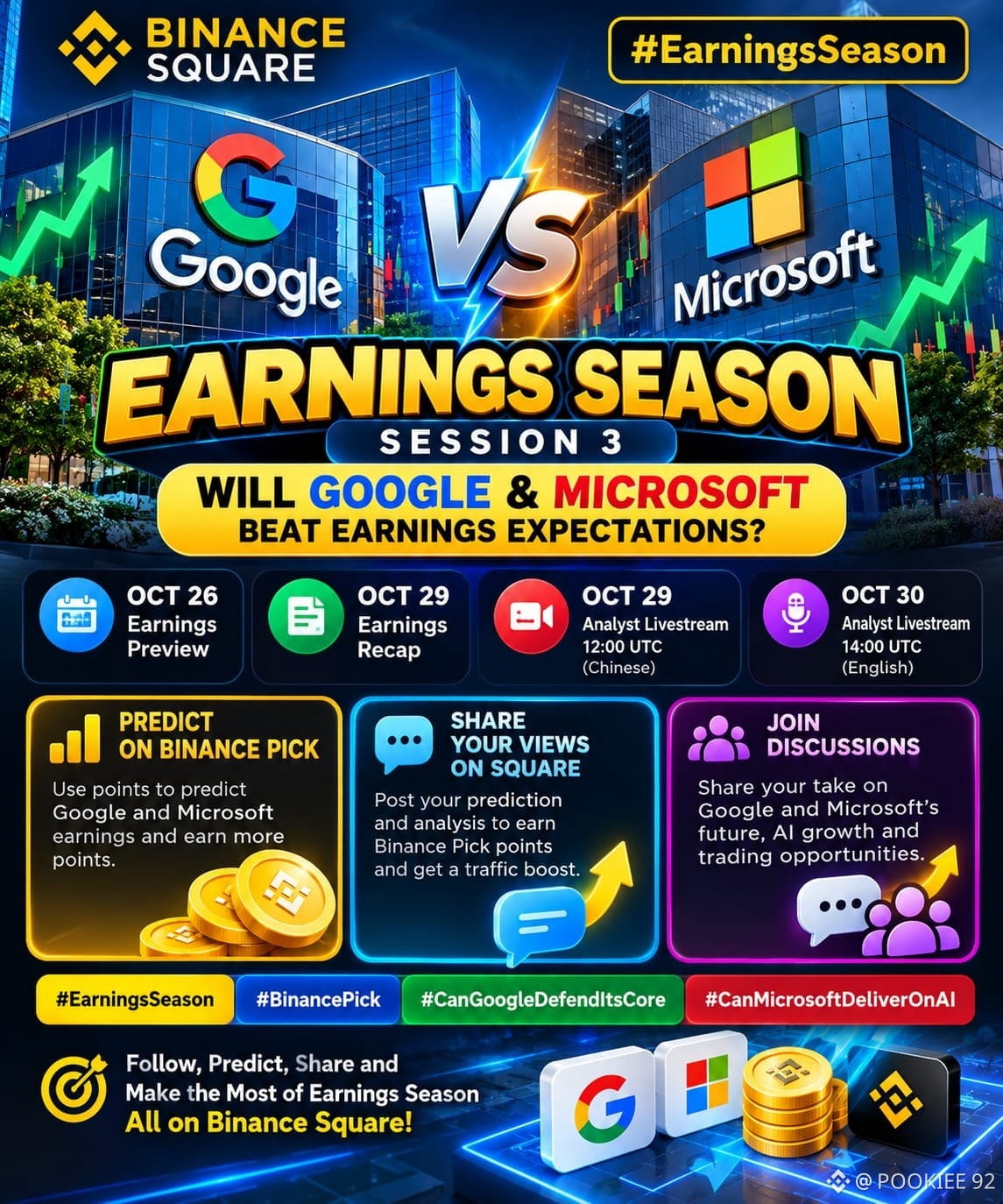
Earnings Season Session 3: Will Google & Microsoft Beat Earnings Expectations?
Binance Square #EarningsSeason is updated with a new session. In this session, we focus on Google and Microsoft. Follow Google and Microsoft earnings on Square for the latest updates and data analysis, make your earnings predictions via Binance Pick, and share your prediction takes to unlock Binance Pick points and traffic boost. Make the most of Earnings Season—all on Binance Square!
Here is your ultimate guide to #EarningsSeason on Binance Square.
Step 1: Stay Tuned to Key Data & Analysis of Google and Microsoft Earnings
Oct 26: Google & Microsoft earnings previewOct 29: Google & Microsoft earnings recapOct 29: Post-earnings analyst livestream (12:00 UTC, Chinese)Oct 30: Post-earnings analyst livestream (14:00 UTC, English)
Step 2: Predict Google and Microsoft Earnings on Binance Pick
Binance Pick has launched a new [Finance Earnings] prediction section. Use points to predict how Google and Microsoft will perform in their upcoming earnings reports, which will earn you more points, and help you climb the leaderboard for a share of splitting up to 1,000,000 USDC.
Step 3: Share Your Earnings Views on Square to Earn Binance Pick Points and Traffic Boost
Share your Binance Pick earnings prediction positions on Binance Square and explain your calls on Google or Microsoft. You can also join Google or Microsoft topics discussion and analyze their earnings results.
Option 1: Share Your Prediction Positions to Earn Binance Pick Points
Post with #BinancePick (≥20 characters)Include a screenshot of your Google or Microsoft earnings prediction position from Binance Pick Pick any angle below and share your thoughts in the post.Angle 1: Will Google beat quarterly earnings expectations? Why do you think so?Angle 2: Will Microsoft beat quarterly earnings expectations? Why do you think so?You will earn 100 Binance Pick points per day.
Option 2: Join Google and Microsoft Topic Discussions & Earn Traffic Boost
#CanGoogleDefendItsCore?Post with #CanGoogleDefindItsCore Pick either angle and share your take in the post.Angle 1: How will you adjust your trades or positions before and after Google’s earnings report? Include a trade-sharing card to show your $GOOGL trade or position for a better chance of receiving traffic boost.Angle 2: More people are turning directly to AI for answers instead of using search engines. Do you think this will affect Google’s search advertising revenue and $GOOGL stock price?#CanMicrosoftDeliverOnAI?Post with #CanMicrosoftDeliverOnAI Pick either angle and share your take in the post.Angle 1: How will you adjust your trades or positions before and after Microsoft’s earnings report? Include a trade-sharing card to show your $MSFT trade or position for a better chance of receiving a traffic boost.Angle 2: Microsoft has launched Copilot Code, an AI tool that can handle tasks for you. If you had an AI coworker like this, what would you most want it to do?Submission window:2026-10-27 14:00 – 2026-10-29 10:00 (UTC)Quality posts meeting requirements may be selected for random traffic boosts. Posts featuring trade-sharing cards for GOOGL or MSFT trades or positions are more likely to be boosted.
Step 4: Explore Binance Square Earnings Season for More Earnings Data & Analysis
Session 1: Earnings Season: Micron Q4 Earnings — Bullish or Bearish?Session 2: Tesla & Meta Earnings — All Eyes on Magnificent 7
قناص الفرصة الرقمية:
أتوقع أن تتجاوز أرباح جوجل ومايكروسوفت توقعات السوق هذا الموسم بفضل التطور الكبير في خدمات الذكاء الاصطناعي #BinancePick
29
8
135
64.7k


·
--
Article
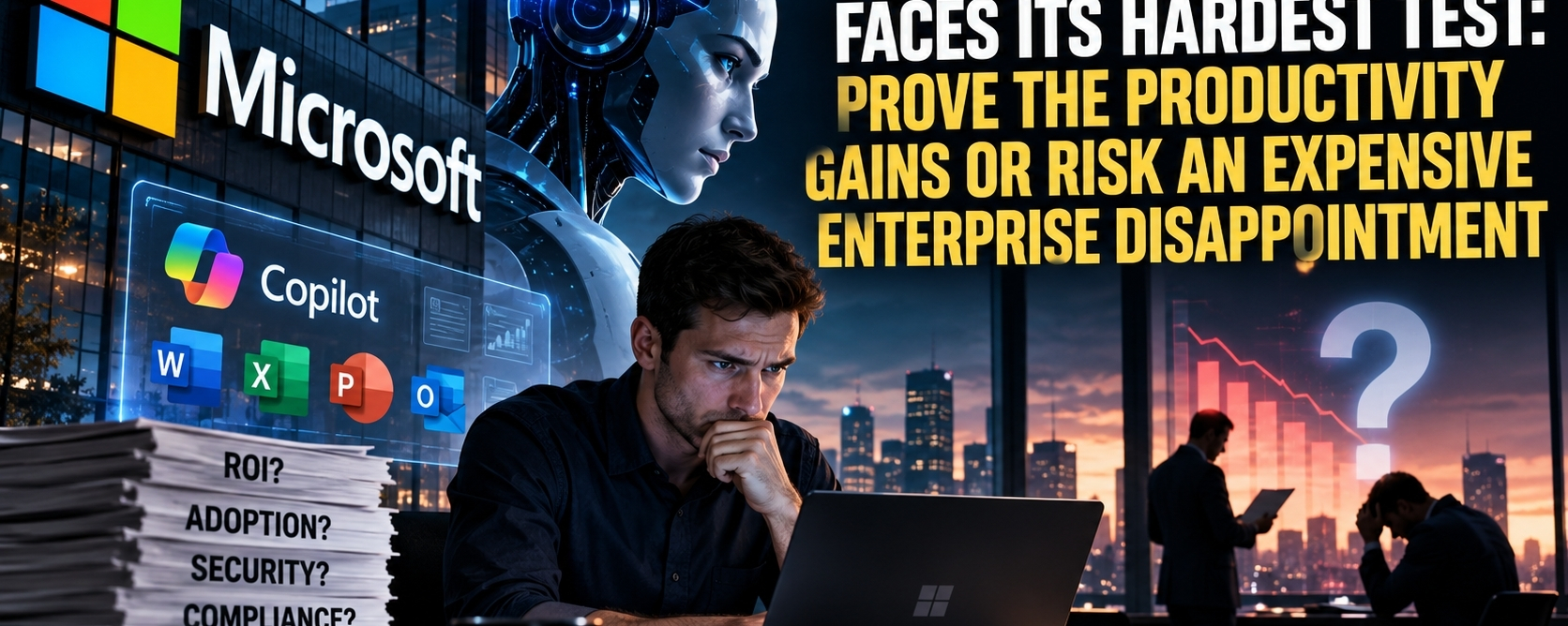
Microsoft’s AI Boom: Prove the ROI or Risk FailureEver tried explaining AI to someone who doesn't work in tech? Honestly, most people don't care which model has more parameters or wins another benchmark. They want something much simpler. Does it save time? Does it make their job easier? And is it worth paying for? That's where Microsoft's AI story gets interesting.
Look, getting people excited about AI isn't the same as getting them to use it every day. Microsoft has to turn impressive demonstrations into tools that work reliably inside real businesses. That's harder than it sounds. Microsoft 365 Copilot operates within an environment full of permissions, confidential documents, identity controls, and company-specific security rules. Its access to information through Microsoft Graph depends on those underlying controls. Retrieval-augmented generation, better known as RAG, adds another challenge: the system needs to check access rights before restricted documents enter the model's context. Get that wrong, and sensitive information could leak through summaries, tool calls, or prompt-injection attacks. There's also the messy stuff. Outdated indexes, inherited permissions, shared files, and delayed access revocation can all create problems.
A convincing AI demo proves very little if the system can't be trusted with real business data.
So, what happens when Microsoft moves beyond chatbots and into AI agents? The stakes change. An agent doesn't just answer questions. It can retrieve confidential information, modify records, call external tools, and trigger actions across connected systems. One mistake can travel further than a bad sentence on a screen. That's why production deployments need restricted permissions, validated tool arguments, clear authorization rules, and records showing what happened at each step. AI-generated instructions can't simply be trusted because they sound convincing. Security controls must operate independently of the model. Reliability is another headache. Imagine ten sequential steps, each with a 98% chance of success. Under a simplified assumption that failures are independent, the probability of all ten succeeding is roughly 81.7%. Not exactly reassuring. Real failures can also be correlated, making the situation worse. Retries, checkpoints, rollback mechanisms, and human intervention aren't fancy extras when an enterprise depends on the result.
The more decisions an AI agent makes, the more important it becomes to control what happens when something goes wrong.
Then there's the money. Every AI interaction consumes resources, and the final bill depends on much more than the model itself. Longer prompts, larger context windows, repeated tool calls, deeper reasoning, and extra validation all add cost and latency. Bigger models may handle difficult tasks better, but that performance can come at a price. Smaller models can be cheaper to run, yet they might need more retries or human corrections. So which option wins? It depends on the task. The real metric isn't cost per token; it's the total cost of completing a task correctly. That includes infrastructure, integration, monitoring, exception handling, and human review. A cheap answer that someone has to fix isn't much of a bargain. Microsoft needs to show that the work saved outweighs the cost of delivering the result.
But cost isn't the only obstacle. Compliance can slow adoption, especially in industries handling sensitive customer information. Companies need appropriate controls for data retention, regional processing where applicable, auditability, and the contractual terms governing customer data and model training. The details depend on the specific service, its configuration, and the organization's requirements. Regulated workflows may also need clear decision records and accountability for consequential outputs. In reality, cryptography can help with certain verification problems, but it can't solve everything. Zero-knowledge proofs, for example, can demonstrate that a computation satisfies a defined mathematical relationship without revealing all its inputs. Sounds powerful. And it is. But proving the execution of a large neural network can be computationally expensive. Quantization, circuit complexity, non-linear activation functions, and proof-generation delays all introduce trade-offs. There's another catch: proving that a computation followed specified rules doesn't prove that its answer is factually correct. It doesn't automatically establish that the source data is current or that the user had permission to access it, either. Those properties need their own explicit guarantees. For many enterprise applications, conventional access controls, encryption, signed audit records, and independent policy checks remain more practical than cryptographically proving every inference.
So how do we know whether Microsoft's AI strategy is actually working? Not by counting licenses alone. A company can buy Copilot seats without fundamentally changing how its employees work. That's the gap worth watching. Does AI reduce the time needed to complete recurring tasks? Does it improve quality without creating more correction work? Are employees using it consistently, and are businesses renewing subscriptions because the results justify the expense? Those answers matter more than a polished demonstration. Honestly, experimentation is easy when a tool is new. Paying for it year after year requires a stronger argument.
Microsoft already has an advantage: its AI services can connect with Azure, enterprise identity systems, business data, and productivity applications that organizations know. That's a powerful distribution channel. But distribution alone doesn't guarantee lasting value. Integrations bring security obligations, operational complexity, and costs of their own. If those burdens eat into the productivity gains, the business case gets weaker. If the workflows become dependable and the savings are measurable, the opposite could happen.
Microsoft can get AI into the workplace through distribution, but it has to earn its place through results.
That's the real question behind its AI opportunity. How many tasks can businesses complete securely, correctly, and economically with less human effort? If Microsoft can demonstrate that outcome consistently, AI becomes part of how companies operate. If it can't, even impressive technology may struggle to justify another recurring software bill.
#CanMicrosoftDeliverOnAI
Microsoft’s AI Boom: Prove the ROI or Risk Failure
Ever tried explaining AI to someone who doesn't work in tech? Honestly, most people don't care which model has more parameters or wins another benchmark. They want something much simpler. Does it save time? Does it make their job easier? And is it worth paying for? That's where Microsoft's AI story gets interesting.
Look, getting people excited about AI isn't the same as getting them to use it every day. Microsoft has to turn impressive demonstrations into tools that work reliably inside real businesses. That's harder than it sounds. Microsoft 365 Copilot operates within an environment full of permissions, confidential documents, identity controls, and company-specific security rules. Its access to information through Microsoft Graph depends on those underlying controls. Retrieval-augmented generation, better known as RAG, adds another challenge: the system needs to check access rights before restricted documents enter the model's context. Get that wrong, and sensitive information could leak through summaries, tool calls, or prompt-injection attacks. There's also the messy stuff. Outdated indexes, inherited permissions, shared files, and delayed access revocation can all create problems.
A convincing AI demo proves very little if the system can't be trusted with real business data.
So, what happens when Microsoft moves beyond chatbots and into AI agents? The stakes change. An agent doesn't just answer questions. It can retrieve confidential information, modify records, call external tools, and trigger actions across connected systems. One mistake can travel further than a bad sentence on a screen. That's why production deployments need restricted permissions, validated tool arguments, clear authorization rules, and records showing what happened at each step. AI-generated instructions can't simply be trusted because they sound convincing. Security controls must operate independently of the model. Reliability is another headache. Imagine ten sequential steps, each with a 98% chance of success. Under a simplified assumption that failures are independent, the probability of all ten succeeding is roughly 81.7%. Not exactly reassuring. Real failures can also be correlated, making the situation worse. Retries, checkpoints, rollback mechanisms, and human intervention aren't fancy extras when an enterprise depends on the result.
The more decisions an AI agent makes, the more important it becomes to control what happens when something goes wrong.
Then there's the money. Every AI interaction consumes resources, and the final bill depends on much more than the model itself. Longer prompts, larger context windows, repeated tool calls, deeper reasoning, and extra validation all add cost and latency. Bigger models may handle difficult tasks better, but that performance can come at a price. Smaller models can be cheaper to run, yet they might need more retries or human corrections. So which option wins? It depends on the task. The real metric isn't cost per token; it's the total cost of completing a task correctly. That includes infrastructure, integration, monitoring, exception handling, and human review. A cheap answer that someone has to fix isn't much of a bargain. Microsoft needs to show that the work saved outweighs the cost of delivering the result.
But cost isn't the only obstacle. Compliance can slow adoption, especially in industries handling sensitive customer information. Companies need appropriate controls for data retention, regional processing where applicable, auditability, and the contractual terms governing customer data and model training. The details depend on the specific service, its configuration, and the organization's requirements. Regulated workflows may also need clear decision records and accountability for consequential outputs. In reality, cryptography can help with certain verification problems, but it can't solve everything. Zero-knowledge proofs, for example, can demonstrate that a computation satisfies a defined mathematical relationship without revealing all its inputs. Sounds powerful. And it is. But proving the execution of a large neural network can be computationally expensive. Quantization, circuit complexity, non-linear activation functions, and proof-generation delays all introduce trade-offs. There's another catch: proving that a computation followed specified rules doesn't prove that its answer is factually correct. It doesn't automatically establish that the source data is current or that the user had permission to access it, either. Those properties need their own explicit guarantees. For many enterprise applications, conventional access controls, encryption, signed audit records, and independent policy checks remain more practical than cryptographically proving every inference.
So how do we know whether Microsoft's AI strategy is actually working? Not by counting licenses alone. A company can buy Copilot seats without fundamentally changing how its employees work. That's the gap worth watching. Does AI reduce the time needed to complete recurring tasks? Does it improve quality without creating more correction work? Are employees using it consistently, and are businesses renewing subscriptions because the results justify the expense? Those answers matter more than a polished demonstration. Honestly, experimentation is easy when a tool is new. Paying for it year after year requires a stronger argument.
Microsoft already has an advantage: its AI services can connect with Azure, enterprise identity systems, business data, and productivity applications that organizations know. That's a powerful distribution channel. But distribution alone doesn't guarantee lasting value. Integrations bring security obligations, operational complexity, and costs of their own. If those burdens eat into the productivity gains, the business case gets weaker. If the workflows become dependable and the savings are measurable, the opposite could happen.
Microsoft can get AI into the workplace through distribution, but it has to earn its place through results.
That's the real question behind its AI opportunity. How many tasks can businesses complete securely, correctly, and economically with less human effort? If Microsoft can demonstrate that outcome consistently, AI becomes part of how companies operate. If it can't, even impressive technology may struggle to justify another recurring software bill.
#CanMicrosoftDeliverOnAI
2
209

·
--
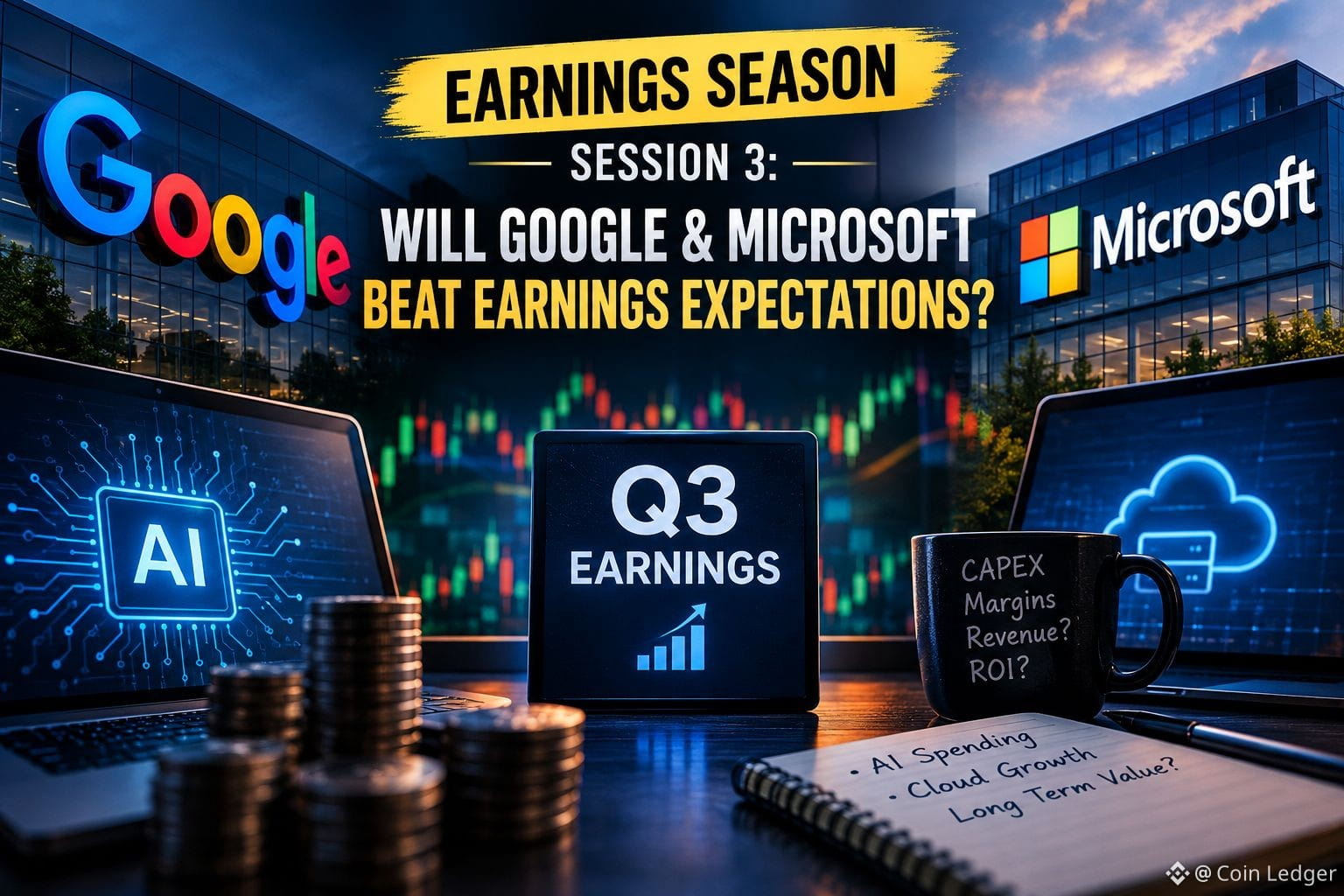
What interests me most about Google and Microsoft this earnings season is not simply whether they beat expectations. It’s how much they must spend to keep convincing the market that AI will eventually justify the cost.
Both companies have enormous advantages: cloud infrastructure, established customers, and AI products that can be integrated into tools people already use. But those advantages also create a difficult question. How much new revenue is AI actually generating, and how much investment is required just to stay competitive?
A strong earnings report could still leave investors debating margins, capital expenditure, and the time needed for returns to materialize. Missing expectations would raise a different question: whether spending is moving faster than monetization.
I’m watching the relationship between AI investment and cloud growth more closely than the headline EPS number. That relationship may reveal more about the long-term business than a single quarterly beat.
The interesting part is that both companies can report growth and still leave investors uncertain about what that growth is ultimately worth.
#CanMicrosoftDeliverOnAI #EarningsSeason #BinancePick $GOOGL
{future}(GOOGLUSDT)
What interests me most about Google and Microsoft this earnings season is not simply whether they beat expectations. It’s how much they must spend to keep convincing the market that AI will eventually justify the cost.
Both companies have enormous advantages: cloud infrastructure, established customers, and AI products that can be integrated into tools people already use. But those advantages also create a difficult question. How much new revenue is AI actually generating, and how much investment is required just to stay competitive?
A strong earnings report could still leave investors debating margins, capital expenditure, and the time needed for returns to materialize. Missing expectations would raise a different question: whether spending is moving faster than monetization.
I’m watching the relationship between AI investment and cloud growth more closely than the headline EPS number. That relationship may reveal more about the long-term business than a single quarterly beat.
The interesting part is that both companies can report growth and still leave investors uncertain about what that growth is ultimately worth.
#CanMicrosoftDeliverOnAI #EarningsSeason #BinancePick $GOOGL
1
419

·
--
Bullish
Earnings Season Session 3: Can Google and Microsoft Beat Expectations?
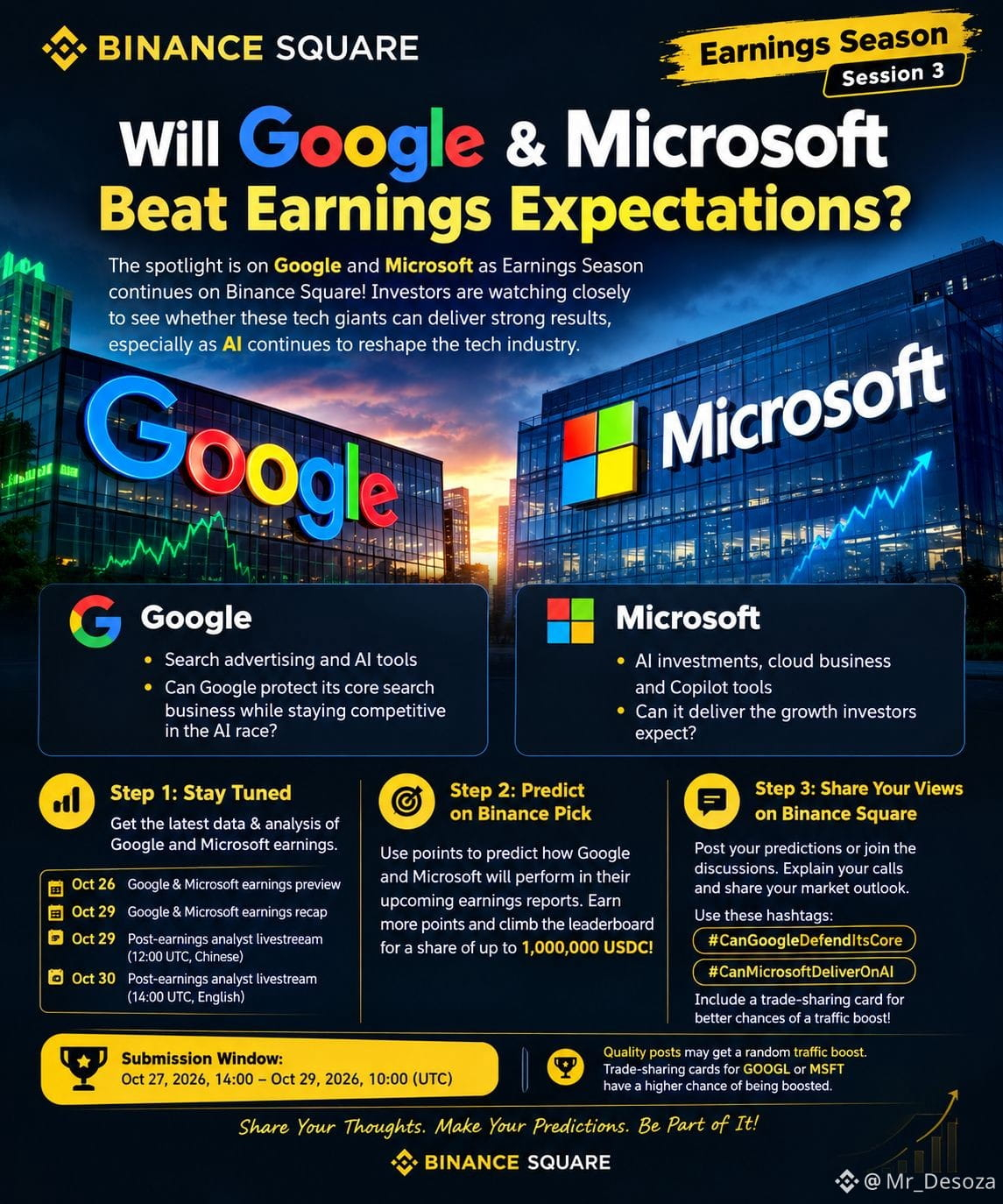
The spotlight is on Google and Microsoft as Earnings Season continues on Binance Square! Investors are watching closely to see whether these tech giants can deliver strong results, especially as AI continues to reshape the tech industry.
What Should You Watch?
Google’s earnings will bring attention to its search advertising business and the growing impact of AI tools. Can Google protect its core search business while staying competitive in the AI race?
Microsoft faces another big question: can its AI investments, cloud business, and Copilot tools deliver the growth investors expect? Its upcoming results could offer important clues about the future of AI-driven business.
🔥 Join the Discussion on Binance Square
You can share your earnings predictions through Binance Pick and earn points by posting your views with a screenshot of your prediction position.
You can also join the community discussions using:
Share your thoughts on earnings expectations, explain your market outlook, and discuss how these results could influence $GOOGL and $MSFT.
Eligible quality posts may receive a random traffic boost, and posts with relevant trade-sharing cards have a better chance of being boosted.
The big question is simple: Will Google and Microsoft beat expectations, or could the market see a surprise?
Share your analysis, make your predictions, and join the conversation on Binance Square!
#EarningsSeason #BinancePick #CanMicrosoftDeliverOnAI #CanGoogleDefindItsCore
$MSFT
{future}(MSFTUSDT)
$GOOGL
{future}(GOOGLUSDT)
Earnings Season Session 3: Can Google and Microsoft Beat Expectations?
The spotlight is on Google and Microsoft as Earnings Season continues on Binance Square! Investors are watching closely to see whether these tech giants can deliver strong results, especially as AI continues to reshape the tech industry.
What Should You Watch?
Google’s earnings will bring attention to its search advertising business and the growing impact of AI tools. Can Google protect its core search business while staying competitive in the AI race?
Microsoft faces another big question: can its AI investments, cloud business, and Copilot tools deliver the growth investors expect? Its upcoming results could offer important clues about the future of AI-driven business.
🔥 Join the Discussion on Binance Square
You can share your earnings predictions through Binance Pick and earn points by posting your views with a screenshot of your prediction position.
You can also join the community discussions using:
Share your thoughts on earnings expectations, explain your market outlook, and discuss how these results could influence $GOOGL and $MSFT .
Eligible quality posts may receive a random traffic boost, and posts with relevant trade-sharing cards have a better chance of being boosted.
The big question is simple: Will Google and Microsoft beat expectations, or could the market see a surprise?
Share your analysis, make your predictions, and join the conversation on Binance Square!
#EarningsSeason #BinancePick #CanMicrosoftDeliverOnAI #CanGoogleDefindItsCore
$MSFT
$GOOGL
Block_Baron:
Google's next earnings report could reveal more about its search advertising strength.
15
15
136

·
--
#CanMicrosoftDeliverOnAI
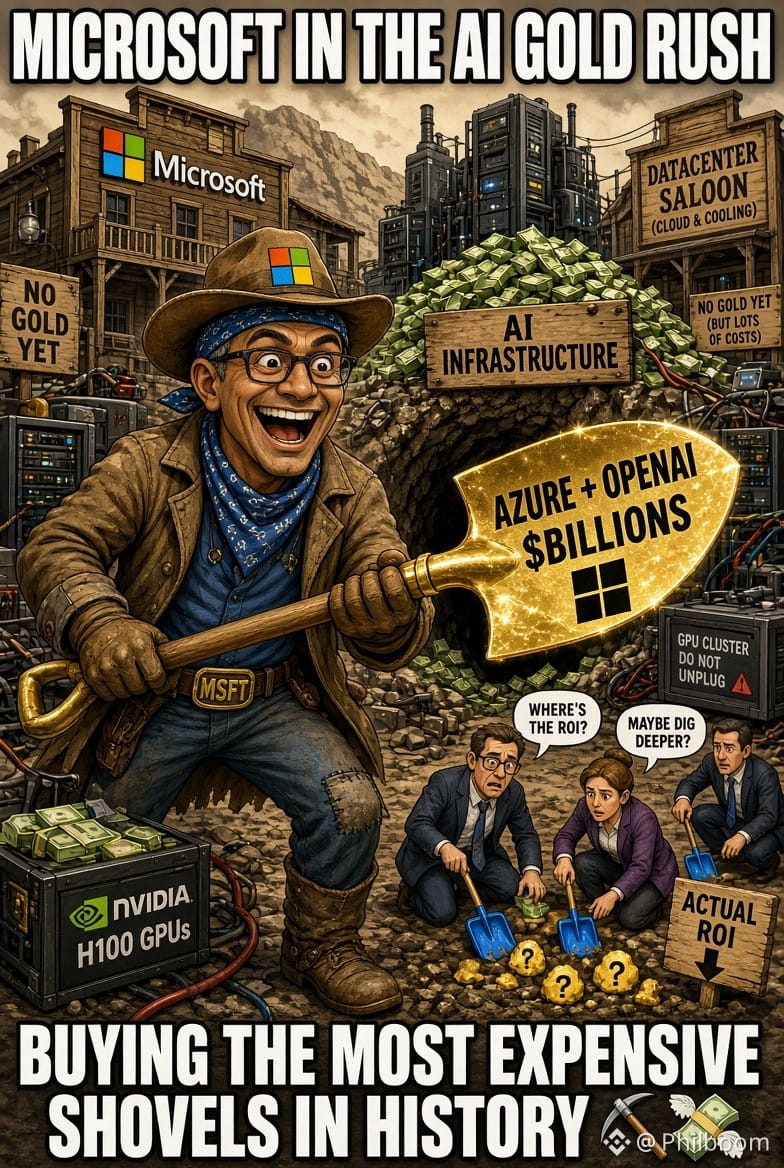
🤖💰 CAN MICROSOFT DELIVER ON AI? OR IS IT JUST BUYING THE MOST EXPENSIVE SHOVELS IN HISTORY? ⛏️😂
Microsoft is betting BIG on artificial intelligence, and we're talking billions upon billions of dollars! 💸🚀 But here's the million dollar question: Will this AI gold rush make Microsoft richer, or will the bills arrive before the gold? 🤔💀
☁️ FIRST, THE ADVANTAGE!
Microsoft owns Azure, a massive cloud computing platform powering AI services. It also integrates Copilot into products like Word, Excel, and Outlook. Imagine Excel doing your calculations while you sip coffee and pretend you're the company's smartest employee! ☕📊🤣
If businesses embrace these tools, Microsoft could generate recurring revenue from millions of customers. And with AI chips and data centres, it's positioning itself to control more of the technology powering this revolution. 🧠⚡
🔥 BUT THERE'S A CATCH!
Building AI infrastructure is ridiculously expensive. Data centres consume enormous amounts of electricity, advanced chips cost fortunes, and competition is fierce.
Google has Gemini, Anthropic has Claude, and Amazon is fighting for cloud dominance. Meanwhile, businesses aren't going to pay premium prices for AI that confidently produces nonsense! 😂🤦♂️
💡 HERE'S THE REAL INSIGHT!
Microsoft doesn't need to invent the world's smartest AI to win. It needs to make AI genuinely useful, integrate it into everyday business operations, and earn more from customers than it spends delivering the technology.
That's where the real money lies! 💰📈
🎯 THE FINAL VERDICT?
Microsoft has the infrastructure, customers, and financial muscle to become a major AI winner. But massive spending doesn't guarantee massive profits.
Remember, during a gold rush, selling shovels can be lucrative. Unless everyone discovers there's no gold! ⛏️🤣
🚀 The AI revolution is real. Microsoft's ultimate returns, however, remain to be proven. 🤖🔥
$MSFTB
{spot}(MSFTBUSDT)
#CanMicrosoftDeliverOnAI
🤖💰 CAN MICROSOFT DELIVER ON AI? OR IS IT JUST BUYING THE MOST EXPENSIVE SHOVELS IN HISTORY? ⛏️😂
Microsoft is betting BIG on artificial intelligence, and we're talking billions upon billions of dollars! 💸🚀 But here's the million dollar question: Will this AI gold rush make Microsoft richer, or will the bills arrive before the gold? 🤔💀
☁️ FIRST, THE ADVANTAGE!
Microsoft owns Azure, a massive cloud computing platform powering AI services. It also integrates Copilot into products like Word, Excel, and Outlook. Imagine Excel doing your calculations while you sip coffee and pretend you're the company's smartest employee! ☕📊🤣
If businesses embrace these tools, Microsoft could generate recurring revenue from millions of customers. And with AI chips and data centres, it's positioning itself to control more of the technology powering this revolution. 🧠⚡
🔥 BUT THERE'S A CATCH!
Building AI infrastructure is ridiculously expensive. Data centres consume enormous amounts of electricity, advanced chips cost fortunes, and competition is fierce.
Google has Gemini, Anthropic has Claude, and Amazon is fighting for cloud dominance. Meanwhile, businesses aren't going to pay premium prices for AI that confidently produces nonsense! 😂🤦♂️
💡 HERE'S THE REAL INSIGHT!
Microsoft doesn't need to invent the world's smartest AI to win. It needs to make AI genuinely useful, integrate it into everyday business operations, and earn more from customers than it spends delivering the technology.
That's where the real money lies! 💰📈
🎯 THE FINAL VERDICT?
Microsoft has the infrastructure, customers, and financial muscle to become a major AI winner. But massive spending doesn't guarantee massive profits.
Remember, during a gold rush, selling shovels can be lucrative. Unless everyone discovers there's no gold! ⛏️🤣
🚀 The AI revolution is real. Microsoft's ultimate returns, however, remain to be proven. 🤖🔥
$MSFTB
raju1324:
The shovel analogy fits the capex question. I’d compare incremental Azure growth and Copilot adoption with the extra infrastructure spend and depreciation; revenue growth alone won’t show whether the investment is earning an adequate return.
1
2
158

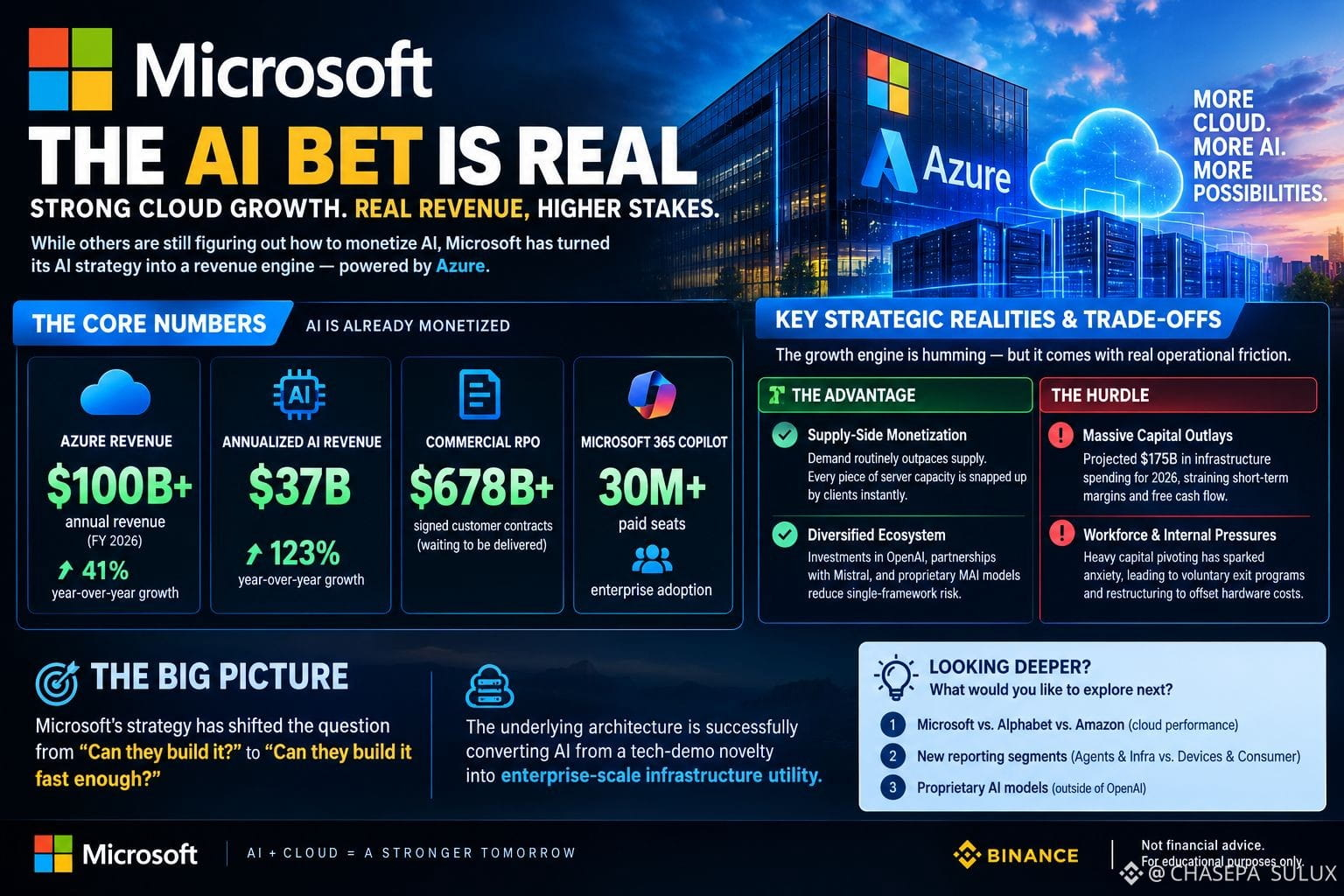
#CanMicrosoftDeliverOnAI Microsoft’s AI Bet: Real Revenue, Rising Costs 🚀
Microsoft is turning artificial intelligence into a major business opportunity through Azure, Copilot, and enterprise AI services. But can revenue growth keep pace with the enormous cost of building AI infrastructure?
📊 Key Figures Reported for FY2026
☁️ Azure: More than $100 billion in annual revenue.
🤖 AI Business: $37 billion in annualized revenue, reportedly up 123% year over year.
📈 Commercial RPO: More than $678 billion in contracted future business.
💼 Microsoft 365 Copilot: More than 30 million paid seats, according to the supplied figures.
🏗️ AI Infrastructure: Approximately $175 billion in projected 2026 spending.
🔍 What Investors Should Watch
Bullish factors
Strong enterprise demand for cloud and AI services.
Azure provides an established platform for AI monetization.
Microsoft’s AI ecosystem includes OpenAI partnerships and proprietary models.
Key risks
Heavy infrastructure spending could pressure free cash flow.
Computing capacity constraints may limit growth.
Investors will look for evidence that AI revenue can justify the rising costs.
🎯 The Big Question
Microsoft’s challenge is no longer just building AI technology. It is scaling that technology profitably while maintaining sustainable growth.
The next earnings report could provide important clues about Azure momentum, AI monetization, capital expenditure, and future guidance.
What do you think? Can Microsoft turn its massive AI investment into long-term profits?
Note: Figures are based on the supplied material and should be checked against Microsoft’s official earnings release before publication.
For educational purposes only. Not financial advice.
#Microsoft #Azure #ArtificialIntelligence #AI #CloudComputing #TechStocks #BinanceSquare
raju1324:
Good framing on ROI. I’d keep annualized AI revenue distinct from reported segment revenue, then compare incremental Azure growth and paid Copilot usage with capex, depreciation and free-cash-flow impact. That shows whether demand is becoming durable economics, not just a large spending cycle. Which metric would you prioritize in the next report?
1
86

·
--
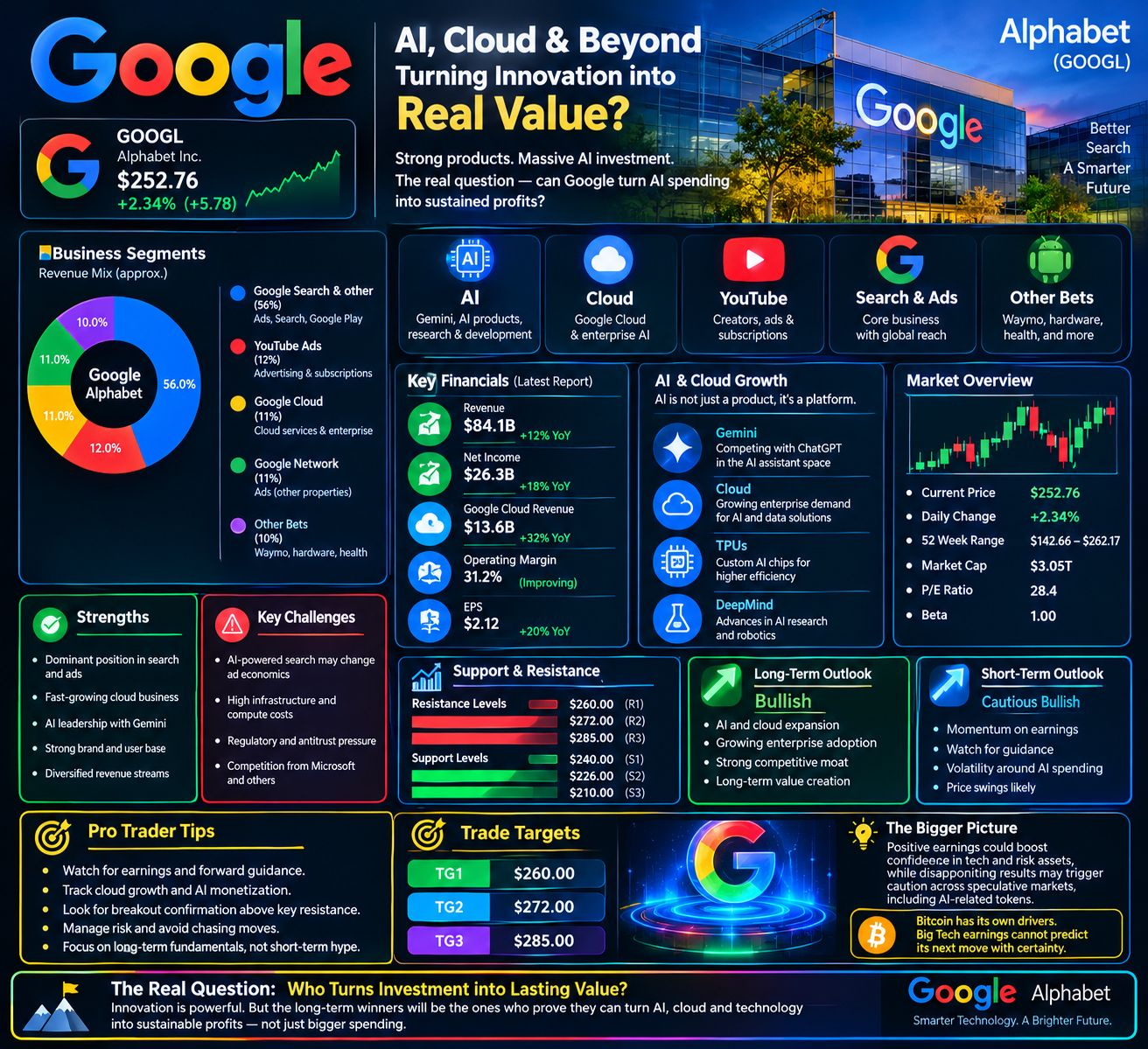
Google vs Microsoft: Is the AI Boom Delivering Real Results?
Sometimes, the biggest market opportunity is not in predicting who beats earnings, but in understanding what investors are already expecting.
This earnings season, Google and Microsoft face a critical test. Both companies are investing heavily in artificial intelligence, cloud infrastructure, and computing capacity. But spending billions is only half the story; generating sustainable returns is what matters.
Google’s advertising business remains a major strength, while its cloud division could benefit from growing enterprise AI demand. However, AI-powered search may change advertising economics, making profitability just as important as revenue growth.
Microsoft has a different advantage: its established enterprise ecosystem. Azure, Copilot, and business software provide multiple paths to AI monetization. Yet rising infrastructure costs could pressure margins if customer demand fails to keep pace.
What caught my attention is the gap between technological progress and financial returns. Investors may celebrate strong earnings, but forward guidance and capital expenditure could ultimately determine the market reaction.
For crypto, the implications are indirect but worth watching. Positive earnings could strengthen confidence in technology and risk assets, while disappointing results might trigger caution across speculative markets, including AI-related tokens.
Still, Bitcoin has its own drivers, and Big Tech earnings cannot predict its next move with certainty.
My biggest takeaway: follow the cash flows, not the excitement. AI adoption is growing, but the long-term winners will need to prove that innovation can produce lasting economic value.
The real question is not who spends more, but who earns more from every dollar invested.
Not financial advice.
@Google
#EarningsSeason #BinancePick #CanMicrosoftDeliverOnAI #CanGoogleDefindItsCore
$GOOGL
{future}(GOOGLUSDT)
$MSFT
{future}(MSFTUSDT)
$EVAA
{future}(EVAAUSDT)
Google vs Microsoft: Is the AI Boom Delivering Real Results?
Sometimes, the biggest market opportunity is not in predicting who beats earnings, but in understanding what investors are already expecting.
This earnings season, Google and Microsoft face a critical test. Both companies are investing heavily in artificial intelligence, cloud infrastructure, and computing capacity. But spending billions is only half the story; generating sustainable returns is what matters.
Google’s advertising business remains a major strength, while its cloud division could benefit from growing enterprise AI demand. However, AI-powered search may change advertising economics, making profitability just as important as revenue growth.
Microsoft has a different advantage: its established enterprise ecosystem. Azure, Copilot, and business software provide multiple paths to AI monetization. Yet rising infrastructure costs could pressure margins if customer demand fails to keep pace.
What caught my attention is the gap between technological progress and financial returns. Investors may celebrate strong earnings, but forward guidance and capital expenditure could ultimately determine the market reaction.
For crypto, the implications are indirect but worth watching. Positive earnings could strengthen confidence in technology and risk assets, while disappointing results might trigger caution across speculative markets, including AI-related tokens.
Still, Bitcoin has its own drivers, and Big Tech earnings cannot predict its next move with certainty.
My biggest takeaway: follow the cash flows, not the excitement. AI adoption is growing, but the long-term winners will need to prove that innovation can produce lasting economic value.
The real question is not who spends more, but who earns more from every dollar invested.
Not financial advice.
@Google
#EarningsSeason #BinancePick #CanMicrosoftDeliverOnAI #CanGoogleDefindItsCore
$GOOGL
$MSFT
$EVAA
Sometimes, the biggest market opportunity is not in predicting who beats earnings, but in understanding what investors are already expecting.
This earnings season, Google and Microsoft face a critical test. Both companies are investing heavily in artificial intelligence, cloud infrastructure, and computing capacity. But spending billions is only half the story; generating sustainable returns is what matters.
Google’s advertising business remains a major strength, while its cloud division could benefit from growing enterprise AI demand. However, AI-powered search may change advertising economics, making profitability just as important as revenue growth.
Microsoft has a different advantage: its established enterprise ecosystem. Azure, Copilot, and business software provide multiple paths to AI monetization. Yet rising infrastructure costs could pressure margins if customer demand fails to keep pace.
What caught my attention is the gap between technological progress and financial returns. Investors may celebrate strong earnings, but forward guidance and capital expenditure could ultimately determine the market reaction.
For crypto, the implications are indirect but worth watching. Positive earnings could strengthen confidence in technology and risk assets, while disappointing results might trigger caution across speculative markets, including AI-related tokens.
Still, Bitcoin has its own drivers, and Big Tech earnings cannot predict its next move with certainty.
My biggest takeaway: follow the cash flows, not the excitement. AI adoption is growing, but the long-term winners will need to prove that innovation can produce lasting economic value.
The real question is not who spends more, but who earns more from every dollar invested.
Not financial advice.
#EarningsSeason #BinancePick #CanMicrosoftDeliverOnAI #CanGoogleDefindItsCore
$GOOGL
$MSFT
$EVAA
1
397

·
--
#CanMicrosoftDeliverOnAI
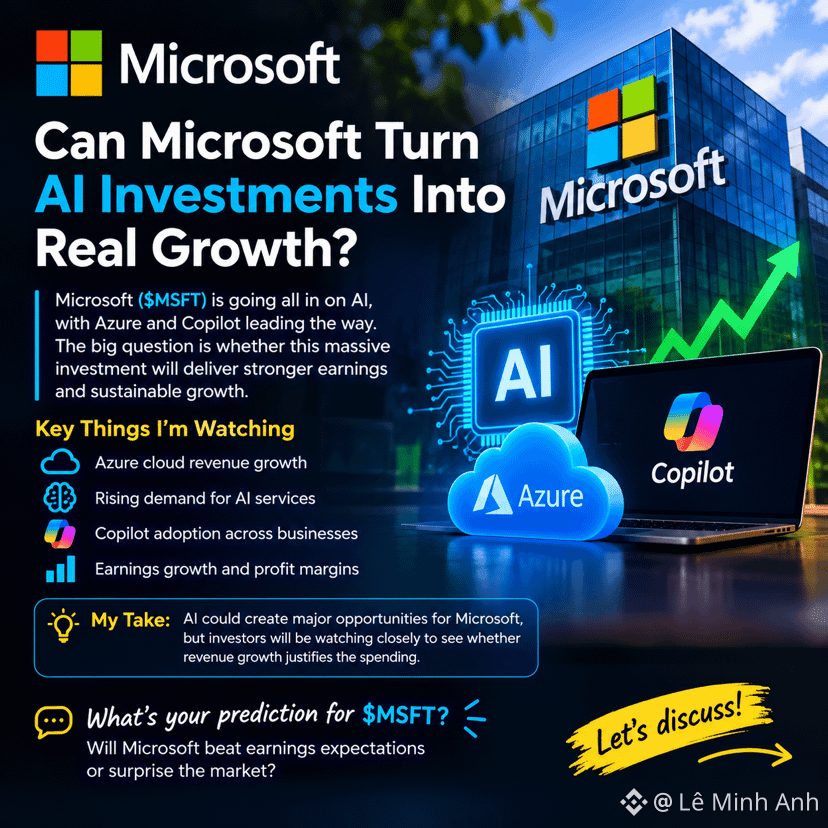
🚀 Microsoft AI: Is the Investment Finally Paying Off?
Microsoft is investing billions into Artificial Intelligence, with Azure and Copilot leading the way. 💻🤖
The big question is: Will these investments translate into stronger revenue growth and better earnings?
📊 Here’s what I’m watching:
🔹 Azure cloud growth and AI demand
🔹 Copilot adoption among businesses
🔹 Microsoft’s quarterly revenue and profit margins
🔹 Competition in the AI market
💡 My Take: Microsoft has strong potential in the AI space, but long-term success will depend on whether its massive AI investments generate sustainable profits.
🔥 What do you think? Will Microsoft beat earnings expectations, or will AI spending put pressure on its profits?
Share your predictions below! 👇
$MSFT $MSFTB $BTC
1
262

·
--
Bullish
Can Microsoft Deliver On AI? My answer: YES, and Q4 is proof.
The numbers don't lie:
Azure +29% YoY, $24.1B Cloud revenue — AI workloads scaling fast
Copilot 60M+ commercial users — Enterprise adoption exploding
M365 Integration — Copilot in Word, Excel, Teams, Outlook = $30/mo upsell machine
Earnings: Revenue $62B +15%, Margin 44% strong, CapEx $12B+ to expand AI data centers.
This is why MSFT is the AI infrastructure leader. Not just selling AI, but monetizing it daily via Azure + M365.
My Binance Pick: BULLISH on MSFT. This AI flywheel is just starting.
#CanMicrosoftDeliverOnAI $MSFT
{future}(MSFTUSDT)
#CanMicrosoftDeliverOnAI #EarningsSeason #BinanceSquareTalks #BinancePick
Can Microsoft Deliver On AI? My answer: YES, and Q4 is proof.
The numbers don't lie:
Azure +29% YoY, $24.1B Cloud revenue — AI workloads scaling fast
Copilot 60M+ commercial users — Enterprise adoption exploding
M365 Integration — Copilot in Word, Excel, Teams, Outlook = $30/mo upsell machine
Earnings: Revenue $62B +15%, Margin 44% strong, CapEx $12B+ to expand AI data centers.
This is why MSFT is the AI infrastructure leader. Not just selling AI, but monetizing it daily via Azure + M365.
My Binance Pick: BULLISH on MSFT. This AI flywheel is just starting.
#CanMicrosoftDeliverOnAI $MSFT
#CanMicrosoftDeliverOnAI #EarningsSeason #BinanceSquareTalks #BinancePick
23

#CanMicrosoftDeliverOnAI
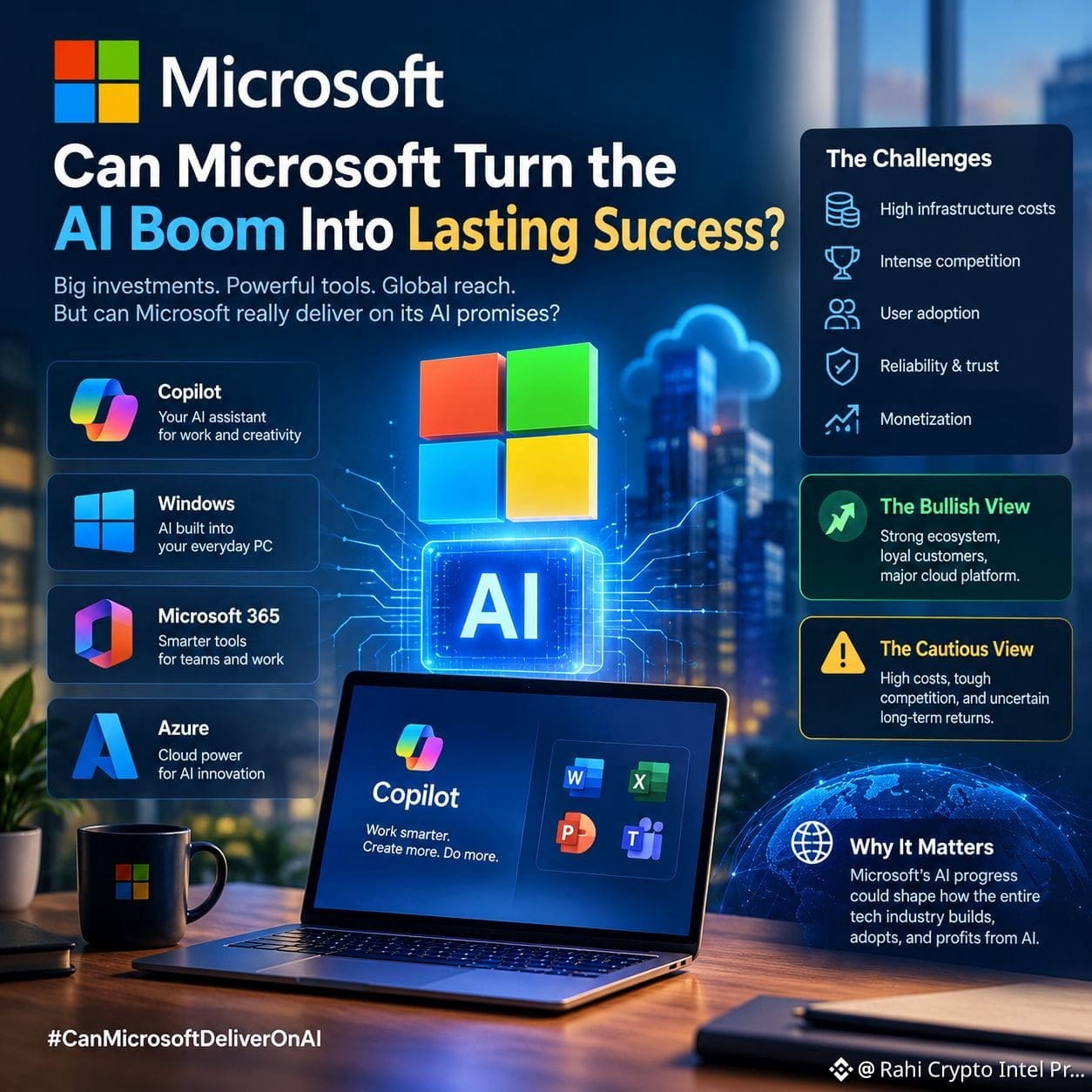
Can Microsoft Turn Its AI Investments Into Long-Term Growth?
Microsoft is investing heavily in AI, but the real challenge is turning that investment into lasting business success.
Its strategy goes beyond building smarter technology.
Copilot is designed to help people work faster, analyze information, and automate everyday tasks. AI features across Windows and Microsoft 365 could improve productivity, while Azure gives businesses the cloud infrastructure needed to build and run AI applications.
The opportunity is significant.
Microsoft already has millions of users, strong business relationships, and a powerful cloud platform. If AI delivers measurable productivity gains, more companies may be willing to pay for these tools.
But there are risks.
AI infrastructure requires enormous investment. Competition is growing, and businesses still need reliable results before fully trusting AI with important tasks. Microsoft must prove that its AI services can generate enough revenue to justify their costs.
The biggest question is simple: Can Microsoft turn AI hype into sustainable profits?
Its long-term success will depend on more than technological breakthroughs. It will require useful products, consistent adoption, satisfied customers, and a business model that delivers real value.
Microsoft's next chapter could offer important clues about the future of the entire AI industry.
What’s your view? Will Microsoft become one of AI’s biggest long-term winners, or will rising costs and competition limit its growth?
$GOOGL
{future}(GOOGLUSDT)
$MSFT
{future}(MSFTUSDT)
#CanMicrosoftDeliverOnAI
Can Microsoft Turn Its AI Investments Into Long-Term Growth?
Microsoft is investing heavily in AI, but the real challenge is turning that investment into lasting business success.
Its strategy goes beyond building smarter technology.
Copilot is designed to help people work faster, analyze information, and automate everyday tasks. AI features across Windows and Microsoft 365 could improve productivity, while Azure gives businesses the cloud infrastructure needed to build and run AI applications.
The opportunity is significant.
Microsoft already has millions of users, strong business relationships, and a powerful cloud platform. If AI delivers measurable productivity gains, more companies may be willing to pay for these tools.
But there are risks.
AI infrastructure requires enormous investment. Competition is growing, and businesses still need reliable results before fully trusting AI with important tasks. Microsoft must prove that its AI services can generate enough revenue to justify their costs.
The biggest question is simple: Can Microsoft turn AI hype into sustainable profits?
Its long-term success will depend on more than technological breakthroughs. It will require useful products, consistent adoption, satisfied customers, and a business model that delivers real value.
Microsoft's next chapter could offer important clues about the future of the entire AI industry.
What’s your view? Will Microsoft become one of AI’s biggest long-term winners, or will rising costs and competition limit its growth?
$GOOGL
$MSFT
7

·
--
#CanMicrosoftDeliverOnAI #EarningsSeason
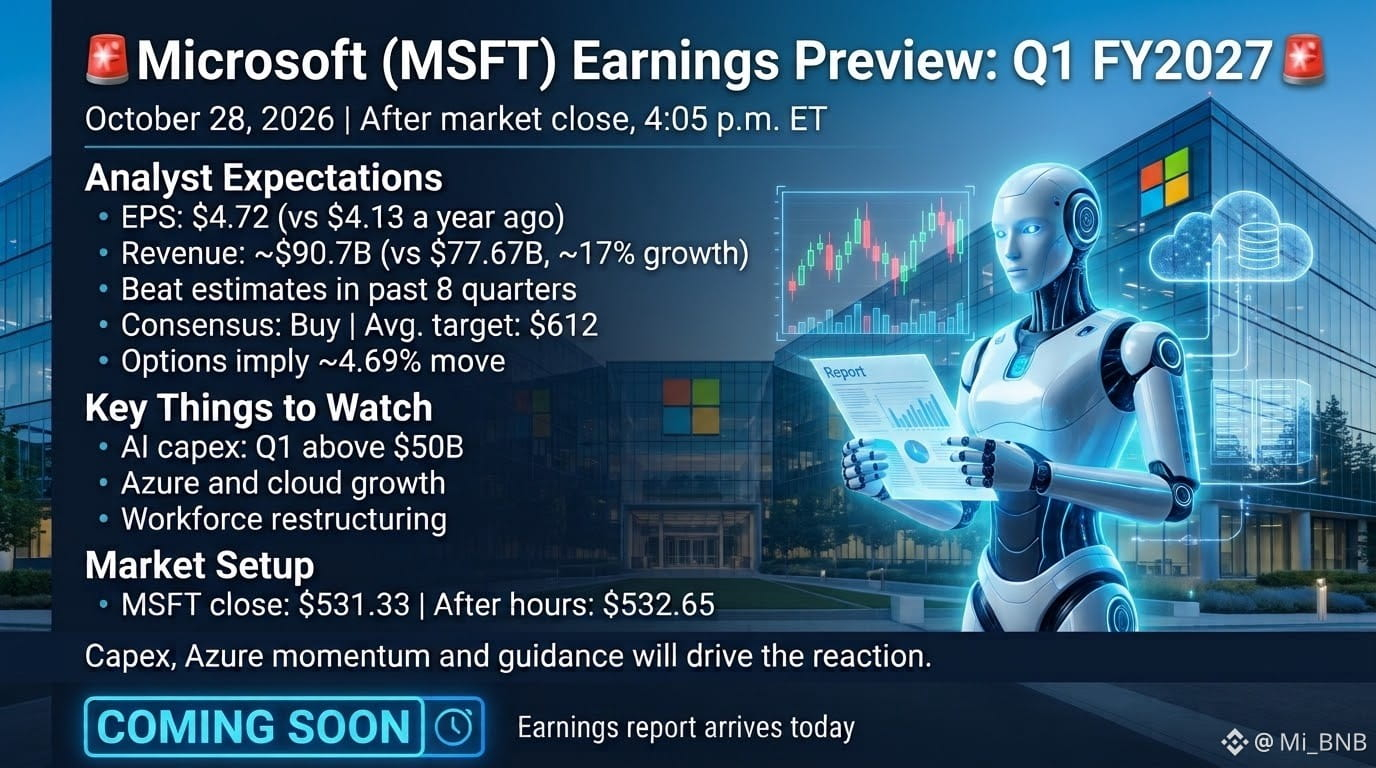
Microsoft💻 (MSFT) Earnings Preview: Q1 FY2027
Date: October 28, 2026
Will Microsoft's AI spending finally start paying off in today's earnings?
Microsoft reports first-quarter fiscal 2027 results today, October 28, after the market close (4:05 p.m. ET). Wall Street is focused on one question: when does Microsoft's heavy AI spending turn into returns?
✅️Analyst Expectations
EPS: $4.72, versus $4.13 a year ago.
Revenue: about $90.7 billion, versus $77.67 billion a year ago. That is roughly 17% growth.
Track record: Microsoft has beaten estimates in each of the past eight quarters.
Analyst view: The consensus rating from 25 analysts is "Buy," with an average price target of $612.
Options market: It implies a move of about 4.69% after the report.
✅️Key Things to Watch
AI capex: Microsoft guided Q1 capital expenditure above $50 billion. It kept its calendar 2026 outlook at about $175 billion.
Azure and cloud growth: Investors want to see whether data-center expansion is producing lasting revenue.
Workforce restructuring: Bloomberg reported that Microsoft offered buyouts to roughly 60,000 employees in the U.S., Canada, India and the U.K.
✅️Market Setup
MSFT closed Tuesday at $531.33 and traded at $532.65 in extended hours. After the July report, the stock rose nearly 22% over the week. This time, options pricing points to a smaller move.
➡️Bottom Line
Whether the numbers beat or miss, the market reaction will likely hinge on capex, Azure momentum and forward guidance. Actual results will only be known after the release.
Your Take
What matters most for MSFT after this report: Azure growth, AI capex, or forward guidance?
$MSFT
{stock_us}(MSFT.US)
$GOOGL
{stock_us}(GOOGL.US)
#CanMicrosoftDeliverOnAI #EarningsSeason
Microsoft💻 (MSFT) Earnings Preview: Q1 FY2027
Date: October 28, 2026
Will Microsoft's AI spending finally start paying off in today's earnings?
Microsoft reports first-quarter fiscal 2027 results today, October 28, after the market close (4:05 p.m. ET). Wall Street is focused on one question: when does Microsoft's heavy AI spending turn into returns?
✅️Analyst Expectations
EPS: $4.72, versus $4.13 a year ago.
Revenue: about $90.7 billion, versus $77.67 billion a year ago. That is roughly 17% growth.
Track record: Microsoft has beaten estimates in each of the past eight quarters.
Analyst view: The consensus rating from 25 analysts is "Buy," with an average price target of $612.
Options market: It implies a move of about 4.69% after the report.
✅️Key Things to Watch
AI capex: Microsoft guided Q1 capital expenditure above $50 billion. It kept its calendar 2026 outlook at about $175 billion.
Azure and cloud growth: Investors want to see whether data-center expansion is producing lasting revenue.
Workforce restructuring: Bloomberg reported that Microsoft offered buyouts to roughly 60,000 employees in the U.S., Canada, India and the U.K.
✅️Market Setup
MSFT closed Tuesday at $531.33 and traded at $532.65 in extended hours. After the July report, the stock rose nearly 22% over the week. This time, options pricing points to a smaller move.
➡️Bottom Line
Whether the numbers beat or miss, the market reaction will likely hinge on capex, Azure momentum and forward guidance. Actual results will only be known after the release.
Your Take
What matters most for MSFT after this report: Azure growth, AI capex, or forward guidance?
$MSFT
$GOOGL
25

·
--
Google vs Microsoft: Who Will Win This Earnings Season?
Whenever Google and Microsoft prepare to release their earnings, I always look beyond the numbers. I want to understand how their AI growth, business performance, and future plans could affect the market.
This time EarningsSeason on Binance Square brings an interesting question: Can Google and Microsoft beat market expectations?
Google ($GOOGL)
Google has a strong position in search advertising, YouTube, and AI. But as more people turn to AI tools for answers, one big question remains: Can Google protect its search business while growing its AI services? Its earnings could give us a better idea of what comes next.
Microsoft ($MSFT)
Microsoft is investing heavily in AI and expanding its Copilot tools. Investors will be watching closely to see whether AI growth, cloud services, and business software can deliver strong results. The key is whether this investment can turn into real revenue and long-term growth.
My focus this earnings season
I will be watching revenue growth, AI adoption, cloud performance, and company guidance before making any decisions. Strong earnings can create excitement, but even good results may disappoint if expectations are too high.
Binance Pick also gives users a chance to predict earnings outcomes and share their views on Binance Square.
What do you think? Will Google beat expectations, or will Microsoft take the lead? Share your prediction below!
#EarningsSeason #BinancePick #CanMicrosoftDeliverOnAI #CanGoogleDefindItsCore
$MSFT
$GOOGL
Google vs Microsoft: Who Will Win This Earnings Season?
Whenever Google and Microsoft prepare to release their earnings, I always look beyond the numbers. I want to understand how their AI growth, business performance, and future plans could affect the market.
This time EarningsSeason on Binance Square brings an interesting question: Can Google and Microsoft beat market expectations?
Google ($GOOGL )
Google has a strong position in search advertising, YouTube, and AI. But as more people turn to AI tools for answers, one big question remains: Can Google protect its search business while growing its AI services? Its earnings could give us a better idea of what comes next.
Microsoft ($MSFT )
Microsoft is investing heavily in AI and expanding its Copilot tools. Investors will be watching closely to see whether AI growth, cloud services, and business software can deliver strong results. The key is whether this investment can turn into real revenue and long-term growth.
My focus this earnings season
I will be watching revenue growth, AI adoption, cloud performance, and company guidance before making any decisions. Strong earnings can create excitement, but even good results may disappoint if expectations are too high.
Binance Pick also gives users a chance to predict earnings outcomes and share their views on Binance Square.
What do you think? Will Google beat expectations, or will Microsoft take the lead? Share your prediction below!
#EarningsSeason #BinancePick #CanMicrosoftDeliverOnAI #CanGoogleDefindItsCore
$MSFT
$GOOGL
167

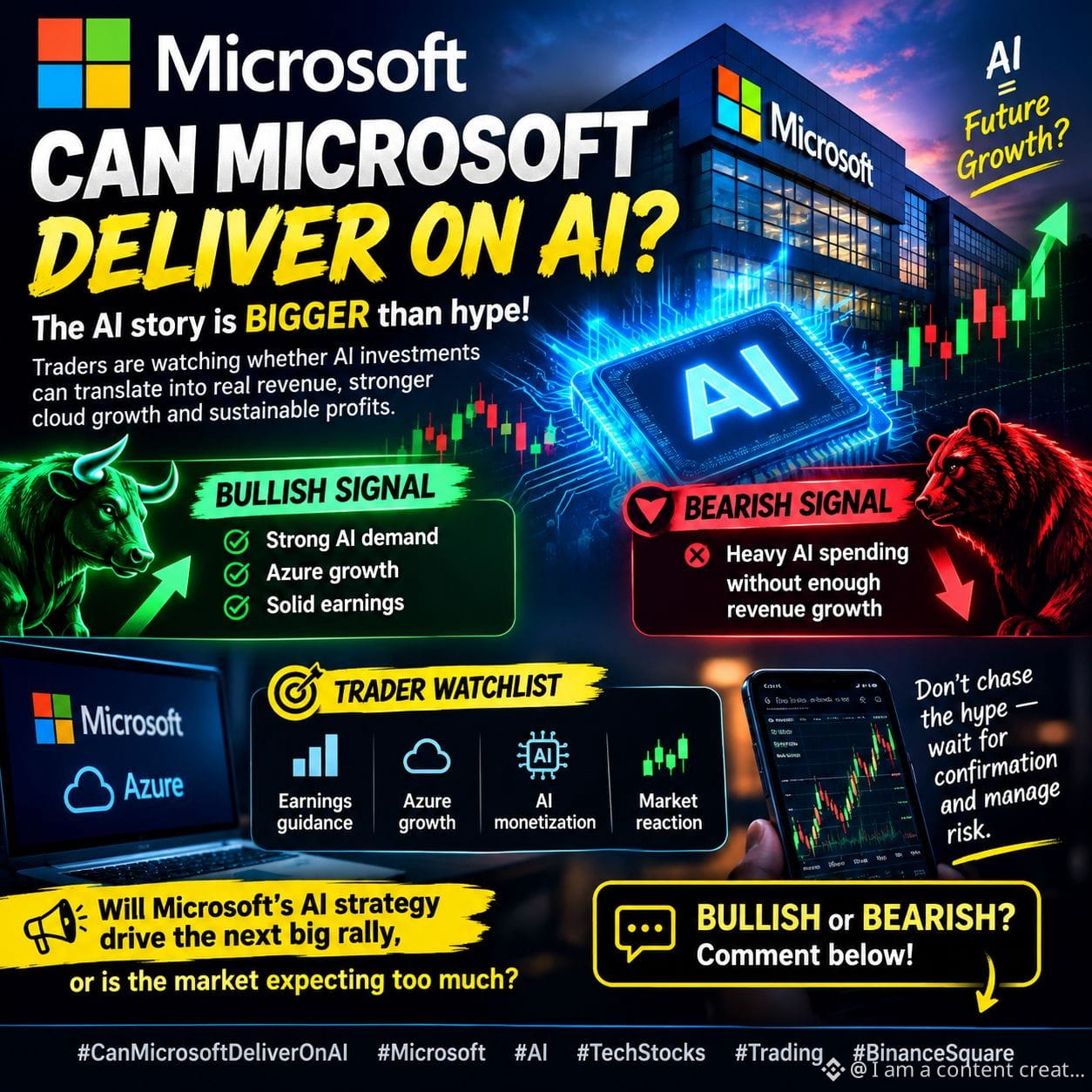
🚨 CAN MICROSOFT DELIVER ON AI?
Microsoft’s AI story is bigger than hype! 🤖📈 Traders are watching whether AI investments can translate into real revenue, stronger cloud growth, and sustainable profits.
🔥 Bullish signal: Strong AI demand + Azure growth + solid earnings.
⚠️ Bearish signal: Heavy AI spending without enough revenue growth.
🎯 Trader watchlist: Earnings guidance, Azure growth, AI monetization, and market reaction. Don’t chase the hype—wait for confirmation and manage risk.
Will Microsoft’s AI strategy drive the next big rally, or is the market expecting too much?
💬 BULLISH or BEARISH? Comment below!
#CanMicrosoftDeliverOnAI #Microsoft #AI #TechStocks #Trading #CanMicrosoftDeliverOnAI $NVDAB
{spot}(NVDABUSDT)
🚨 CAN MICROSOFT DELIVER ON AI?
Microsoft’s AI story is bigger than hype! 🤖📈 Traders are watching whether AI investments can translate into real revenue, stronger cloud growth, and sustainable profits.
🔥 Bullish signal: Strong AI demand + Azure growth + solid earnings.
⚠️ Bearish signal: Heavy AI spending without enough revenue growth.
🎯 Trader watchlist: Earnings guidance, Azure growth, AI monetization, and market reaction. Don’t chase the hype—wait for confirmation and manage risk.
Will Microsoft’s AI strategy drive the next big rally, or is the market expecting too much?
💬 BULLISH or BEARISH? Comment below!
#CanMicrosoftDeliverOnAI #Microsoft #AI #TechStocks #Trading #CanMicrosoftDeliverOnAI $NVDAB
45

·
--
🚀 #CanMicrosoftDeliverOnAI — BIG PROMISES, BIG EXPECTATIONS!
Microsoft is investing heavily in Artificial Intelligence. But here's the BIG question:
Can Microsoft turn its AI investments into real-world success? 👀
Let's look at 3 important areas:
🔹 Azure AI: Can Microsoft maintain its cloud and AI growth?
🔹 Microsoft Copilot: Will AI become an essential tool for everyday users?
🔹 AI Revenue: Can Microsoft turn massive AI spending into sustainable profits?
📊 Microsoft reported 43% Azure growth in its FY26 Q4 results, showing strong demand for its cloud services.
But growth is only one part of the story. Investors also want to see long-term returns from AI investments.
🔥 LET'S VOTE!
🟢 YES — Microsoft will dominate the AI era.
🔴 NO — AI expectations are getting too high.
💬 What's your biggest reason for choosing YES or NO?
👇 Drop your opinion. Let's discuss!
#artificialintelligence #Azure #Copilot #technews
53

·
--
#CanMicrosoftDeliverOnAI Microsoft reports earnings tonight after the US close. The bar is high: the stock is up roughly 45% since the end of June, mostly from a re-rated P/E multiple, not just earnings. (therighttrader) (trefis)
✅ The case for yes
Last quarter it beat on EPS ($4.74 vs $4.21) and revenue ($90B vs $87.5B). Copilot is past 20M paid seats. (therighttrader) (Yahoo Finance)
⚠️ The case for no
2026 capex guidance is $190B. It also lost exclusive access to OpenAI's models. If Azure growth doesn't justify that spend, the premium gets tested. (Yahoo Finance) (Yahoo Finance)
My take: delivering on AI isn't about beating estimates. It's about whether revenue grows faster than the capex bill. Watch Azure growth and the capex guide tonight.
Why it matters for crypto: AI-sector sentiment tends to spill into AI tokens. A big move in MSFT can shift risk appetite across the board.
Will Microsoft deliver? 👇 Vote and tell me why.
Not financial advice. DYOR.
[Certain] The date and figures above come from the searches. I couldn't confirm tonight's results, so check the numbers before you post.
[Guessing] The AI-token spillover line is my inference, not something I found evidence for. Cut it if you'd rather not claim it.
Add $MSFT or a Binance AI-token tag if you want to attach a chart. Posting after the results are out would give you a stronger, more specific take. Want me to write that version once the numbers land?
Sources: GeekWire, Yahoo Finance, Trefis, The Right Trader
1
125

·
--
Bullish
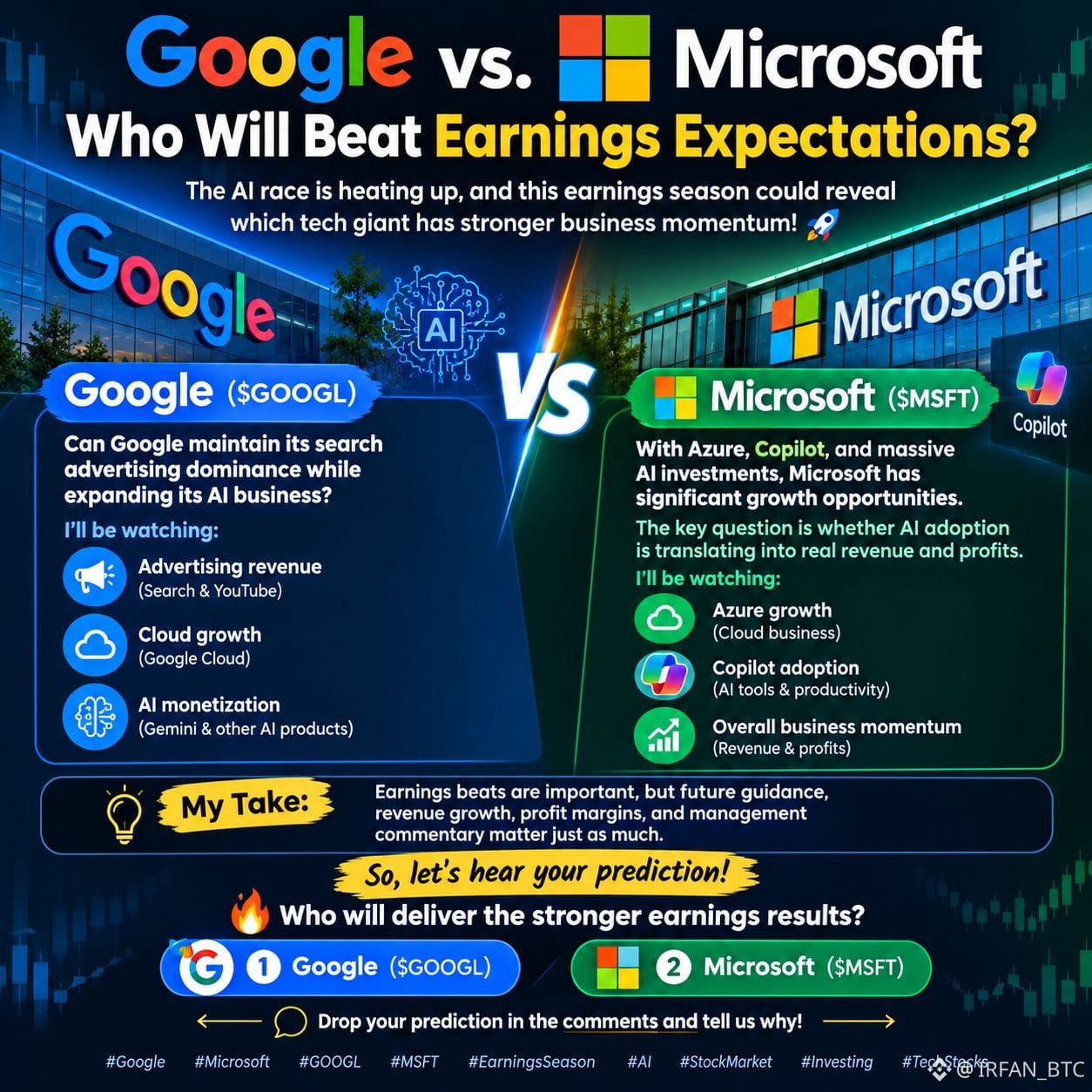
📊 Google vs. Microsoft: Who Will Beat Earnings Expectations?
The AI race is heating up, and this earnings season could reveal which tech giant has stronger business momentum! 🚀
🔵 Google ($GOOGL): Can Google maintain its search advertising dominance while expanding its AI business? I'll be watching advertising revenue, cloud growth, and AI monetization.
🟢 Microsoft ($MSFT): With Azure, Copilot, and massive AI investments, Microsoft has significant growth opportunities. The key question is whether AI adoption is translating into real revenue and profits.
📈 My Take: Earnings beats are important, but future guidance, revenue growth, profit margins, and management commentary matter just as much.
So, let's hear your prediction!
🔥 Who will deliver the stronger earnings results?
1️⃣ Google ($GOOGL )
2️⃣ Microsoft ($MSFT )
Drop your prediction in the comments and tell us why!
#EarningsSeason #BinancePick #CanMicrosoftDeliverOnAI #CanGoogleDefindItsCore
📊 Google vs. Microsoft: Who Will Beat Earnings Expectations?
The AI race is heating up, and this earnings season could reveal which tech giant has stronger business momentum! 🚀
🔵 Google ($GOOGL ): Can Google maintain its search advertising dominance while expanding its AI business? I'll be watching advertising revenue, cloud growth, and AI monetization.
🟢 Microsoft ($MSFT ): With Azure, Copilot, and massive AI investments, Microsoft has significant growth opportunities. The key question is whether AI adoption is translating into real revenue and profits.
📈 My Take: Earnings beats are important, but future guidance, revenue growth, profit margins, and management commentary matter just as much.
So, let's hear your prediction!
🔥 Who will deliver the stronger earnings results?
1️⃣ Google ($GOOGL )
2️⃣ Microsoft ($MSFT )
Drop your prediction in the comments and tell us why!
#EarningsSeason #BinancePick #CanMicrosoftDeliverOnAI #CanGoogleDefindItsCore
44

·
--
#canmicrosoftdeliveronai
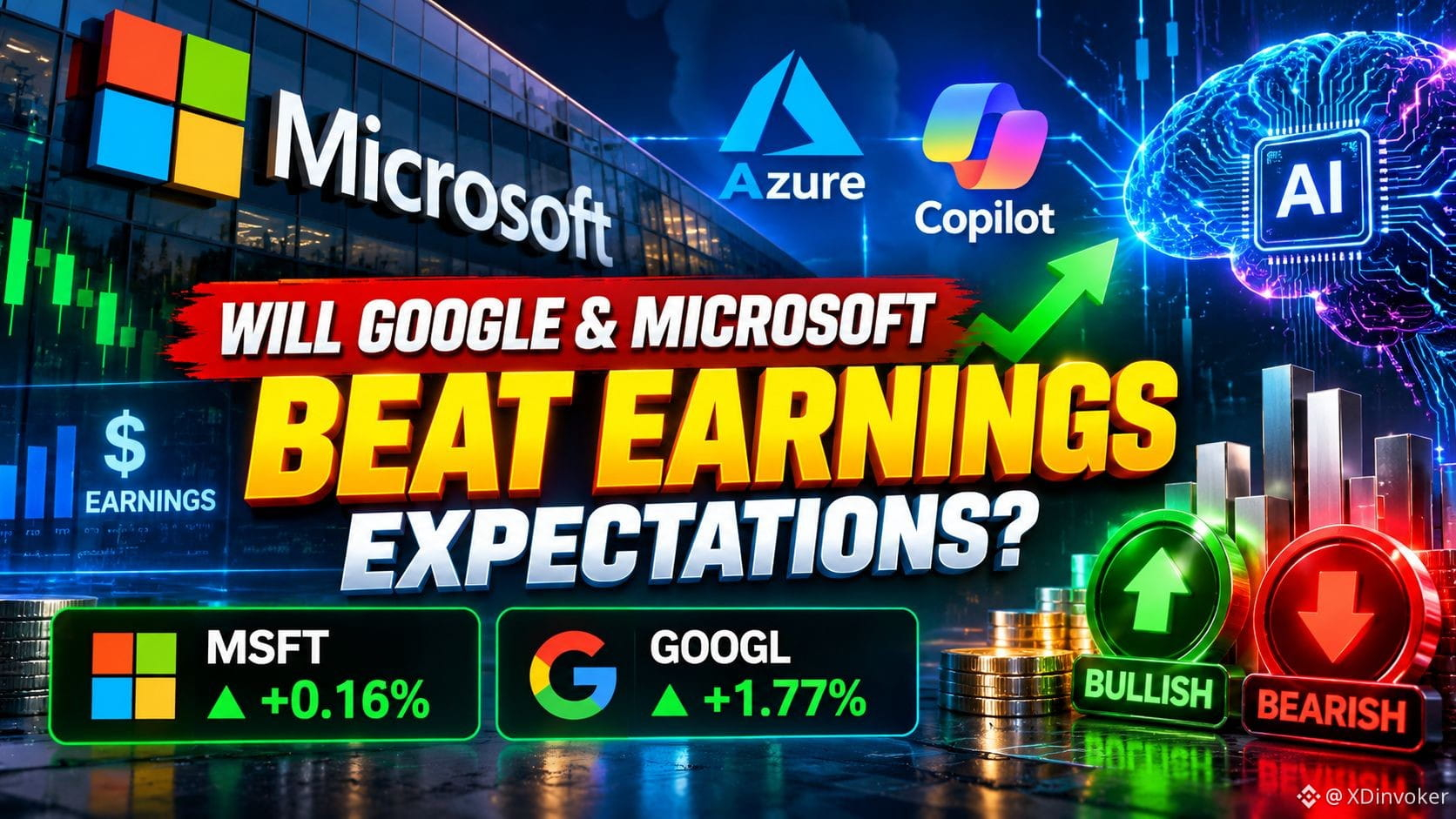
🚨 MICROSOFT'S AI BET: WILL IT PAY OFF? 🤖📈
🔥 Microsoft ($MSFT) is heading into a crucial earnings test, and AI could be the biggest factor!
Microsoft continues to invest billions in artificial intelligence, with Azure Cloud and Copilot at the center of its growth strategy.
💰 3 BIG QUESTIONS INVESTORS ARE ASKING:
🔹 Azure Growth: Can rising AI demand accelerate Microsoft's cloud revenue?
🔹 Copilot Revenue: Will Microsoft's AI-powered products turn massive investment into stronger profits?
🔹 AI Spending: Can Microsoft maintain healthy profit margins while expanding its AI infrastructure?
📊 MY PREDICTION:
I'm cautiously bullish on Microsoft's long-term AI potential. However, strong earnings alone may not be enough. Investors will be watching Azure growth, AI monetization, and future spending guidance.
⚡ THE BIGGER PICTURE:
Microsoft's earnings could influence sentiment across AI stocks and the broader technology sector, potentially affecting risk appetite in crypto markets as well.
💬 WHAT DO YOU THINK?
🚀 Will Microsoft beat Wall Street's earnings expectations?
🟢 BULLISH — AI investment will drive stronger growth!
🔴 BEARISH — Rising AI costs could pressure profits!
👇 Drop your prediction in the comments!
#CanGoogleDefindItsCore #CanMicrosoftDeliverOnAI #EarningsSeason
176

·
--
Bullish
Microsoft is under pressure to prove that its massive AI investments are actually paying off.
The company has poured tens of billions into data centers, custom chips, and models while pushing Copilot and AI agents hard. Copilot has crossed 30 million paid seats, and Azure continues to grow, but investors are watching one thing closely — whether the heavy spending is translating into strong enough revenue and margins.
With earnings around the corner, the market wants clearer proof that the AI bet is delivering real returns, not just higher costs.
Do you think Microsoft can convert this spending into sustainable growth, or is the bar getting too high?
$MSFT $BTC $MSFTB
#CanMicrosoftDeliverOnAI
123

#CanMicrosoftDeliverOnAI Can Microsoft Deliver on AI? 🚀
Artificial intelligence is changing the world, and Microsoft is determined to be one of its biggest winners.
With Microsoft Copilot, Azure cloud services, and its partnership with OpenAI, the company is bringing AI into everyday work, software development, and business operations.
But the real question is: Can Microsoft turn the AI hype into real results?
Microsoft has a strong advantage because millions of people and businesses already use its products. If its AI tools improve productivity and save time, the company could unlock significant long-term opportunities.
However, competition from Google, Amazon, and other AI companies is growing. High infrastructure costs, data security, and proving the value of AI subscriptions remain important challenges.
My take: Microsoft's AI future looks promising, but long-term success will depend on real-world results, customer adoption, and sustainable growth—not just hype.
What do you think? Will Microsoft lead the AI revolution, or will competitors take the advantage?
#CanMicrosoftDeliverOnAI #Microsoft #AI #ArtificialIntelligence #technews
63

·
--
CAN MICROSOFT DELIVER ON AI???Microsoft ($MSFTB ) is betting big on artificial intelligence. But the real question is whether its massive AI investments can translate into sustainable growth, stronger profits, and long-term shareholder value.
{spot}(MSFTBUSDT)
What I'm Watching👀
1. Azure Cloud Growth
Demand for AI infrastructure and cloud services will be a key indicator of Microsoft's business momentum.
2. Copilot Adoption
Can Microsoft turn AI-powered tools into a major source of recurring revenue across its products?
3. AI Investment vs. Returns
Building AI infrastructure requires significant spending. Investors will want evidence that revenue and profitability can justify those costs.
4. Earnings Guidance
Future growth expectations and management's comments could matter as much as the reported numbers.
Market Outlook
Strong AI demand could support Microsoft's growth story, but high expectations leave room for disappointment if results fall short. Revenue growth, profit margins, cloud performance, and forward guidance will be crucial signals.
The Big Question: Is Microsoft's AI strategy creating real business value, or is the market pricing in too much future growth?
What's your view — BULLISH or BEARISH on $MSFTB ?
Share your reasoning below..
#EarningsSeason #CanMicrosoftDeliverOnAI #Microsoft
CAN MICROSOFT DELIVER ON AI???
Microsoft ($MSFTB ) is betting big on artificial intelligence. But the real question is whether its massive AI investments can translate into sustainable growth, stronger profits, and long-term shareholder value.
What I'm Watching👀
1. Azure Cloud Growth
Demand for AI infrastructure and cloud services will be a key indicator of Microsoft's business momentum.
2. Copilot Adoption
Can Microsoft turn AI-powered tools into a major source of recurring revenue across its products?
3. AI Investment vs. Returns
Building AI infrastructure requires significant spending. Investors will want evidence that revenue and profitability can justify those costs.
4. Earnings Guidance
Future growth expectations and management's comments could matter as much as the reported numbers.
Market Outlook
Strong AI demand could support Microsoft's growth story, but high expectations leave room for disappointment if results fall short. Revenue growth, profit margins, cloud performance, and forward guidance will be crucial signals.
The Big Question: Is Microsoft's AI strategy creating real business value, or is the market pricing in too much future growth?
What's your view — BULLISH or BEARISH on $MSFTB ?
Share your reasoning below..
#EarningsSeason #CanMicrosoftDeliverOnAI #Microsoft
116

Partly True
#EarningsSeason
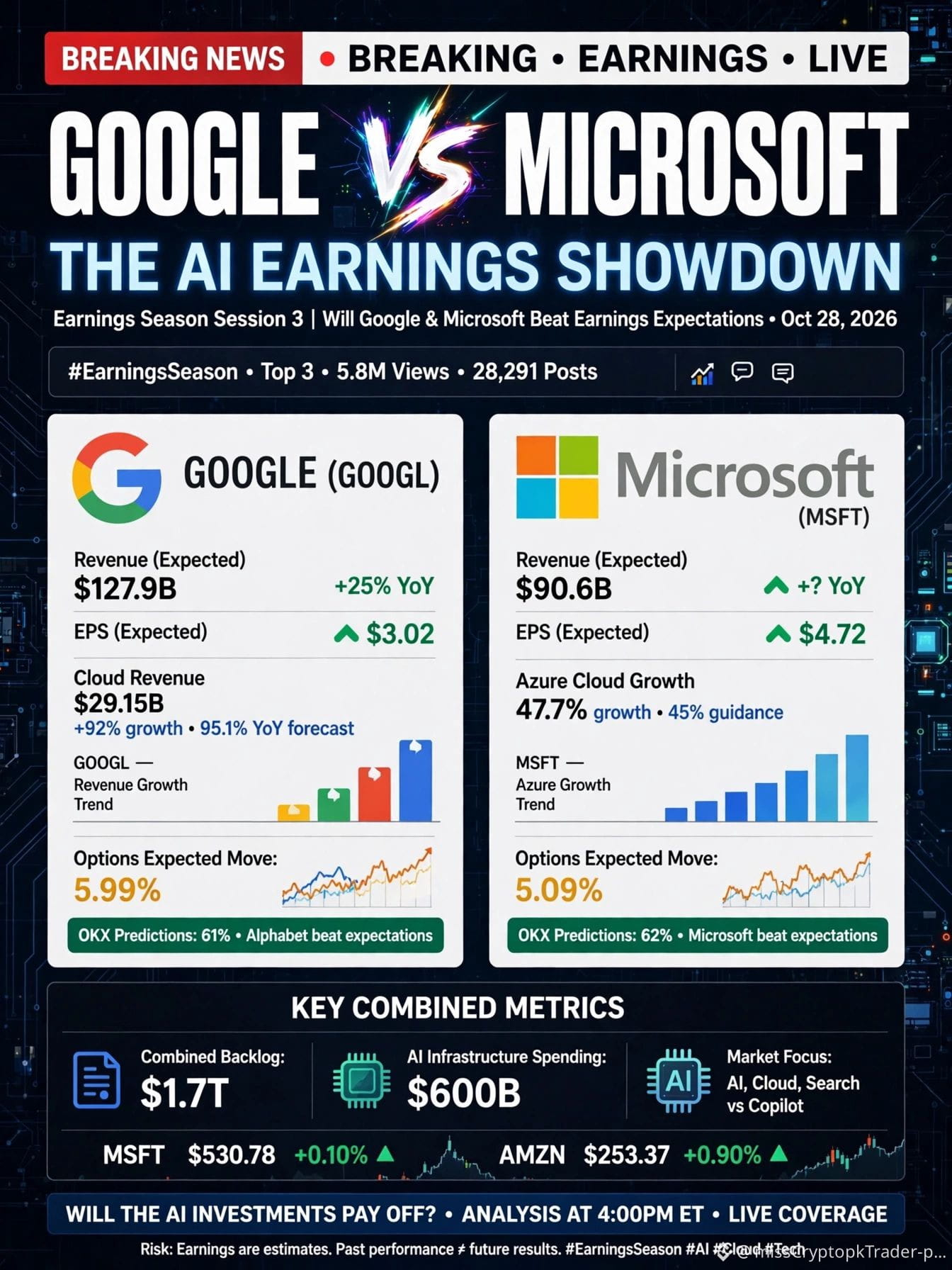
🔥 🔥 EARNINGS SEASON SESSION 3: GOOGLE VS MICROSOFT - THE AI SHOWDOWN! 🔥
#Earnings season Top 3.5.8M Views • 28,291 Posts
MSFT $530.78 +0.10% | AMZN $253.37 +0.90% | GOOGL +1.78%
Two tech giants, billions invested in AI, one big question: Who will turn spending into real growth?
🟢 GOOGLE (GOOGL)
Expected Revenue: $127.9B (+25% YoY) | EPS: $3.02
Cloud Revenue: $29.15B (+92% growth, 95.1% forecast)
Options Expected Move: 5.99%
OKX Prediction: 61% chance to beat expectations
🔵 MICROSOFT (MSFT)
Expected Revenue: $90.6B | EPS: $4.72
Azure Cloud Growth: 47.7% (45% guidance)
Options Expected Move: 5.09%
OKX Prediction: 62% chance to beat expectations
Combined Backlog: $1.7T | AI Infra Spending: $600B
Will the AI investments finally pay off? Earnings tonight after the close!
#EarningsSeason #BinancePick #CanMicrosoftDeliverOnAI #CanGoogleDefindItsCore $GOOGL $MSFT
raju1324:
AI spending is the headline; paid usage is the plot 😅 Cloud growth or margins—which is the better proof?
2
1
367
Log in to explore more content
Join global crypto users on Binance Square
⚡️ Get latest and useful information about crypto.
💬 Trusted by the world’s largest crypto exchange.
👍 Discover real insights from verified creators.
Email / Phone number
Related Coins
Trending Topics
1
#CanMicrosoftDeliverOnAI
337,898 views
2,662 Discussing
2
#CanGoogleDefindItsCore
198,593 views
1,878 Discussing
3
#EarningsSeason
5.9M views
28,697 Discussing
4
#$10.9BBitcoinOptionsExpireFriday
384 views
25 Discussing
5
#ThailandSupremeCourtRulesBitcoinIsProperty
578 views
62 Discussing
6
#BitcoinSurpasses$81K
17,894 views
77 Discussing
7
#RobinhoodFalls8.4%AfterItsResults
10,838 views
234 Discussing
8
#KOSPISurges6.63%BackAbove6000
11,227 views
232 Discussing
9
#DatavaultAICantWithdrawBitcoinFromBiconomy
12,207 views
209 Discussing
10
#FOMCWatch
9.3M views
29,506 Discussing