
#web3research
web3research
3,834 views
48 Discussing
Hot
Latest

·
--
EARTHSHATTERING
The flood has started: massive players in the Ethereum ecosystem are throwing their weight behind a new research hub, Ethlabs.
Supported by top corporate players like SharpLink, Bitmine, and backed by Consensys CEO Joe Lubin, this move signifies a historic shift in Ethereum's development, going beyond the Foundation's control for the first time. #EthereumDevelopment #ETHInnovation #Web3Research
The stakes are high as Ethereum's expansion into new corporate-backed research hubs signals a monumental turning point in the global adoption of blockchain technology, potentially rewriting the crypto landscape for the better. #Web3Evolution
Is it time for you to invest in the future of Ethereum? Get ready to ride the wave and join the ranks of early adopters who are making a killing in this uncharted territory.
EARTHSHATTERING
The flood has started: massive players in the Ethereum ecosystem are throwing their weight behind a new research hub, Ethlabs.
Supported by top corporate players like SharpLink, Bitmine, and backed by Consensys CEO Joe Lubin, this move signifies a historic shift in Ethereum's development, going beyond the Foundation's control for the first time. #EthereumDevelopment #ETHInnovation #Web3Research
The stakes are high as Ethereum's expansion into new corporate-backed research hubs signals a monumental turning point in the global adoption of blockchain technology, potentially rewriting the crypto landscape for the better. #Web3Evolution
Is it time for you to invest in the future of Ethereum? Get ready to ride the wave and join the ranks of early adopters who are making a killing in this uncharted territory.
The flood has started: massive players in the Ethereum ecosystem are throwing their weight behind a new research hub, Ethlabs.
Supported by top corporate players like SharpLink, Bitmine, and backed by Consensys CEO Joe Lubin, this move signifies a historic shift in Ethereum's development, going beyond the Foundation's control for the first time. #EthereumDevelopment #ETHInnovation #Web3Research
The stakes are high as Ethereum's expansion into new corporate-backed research hubs signals a monumental turning point in the global adoption of blockchain technology, potentially rewriting the crypto landscape for the better. #Web3Evolution
Is it time for you to invest in the future of Ethereum? Get ready to ride the wave and join the ranks of early adopters who are making a killing in this uncharted territory.
29

·
--
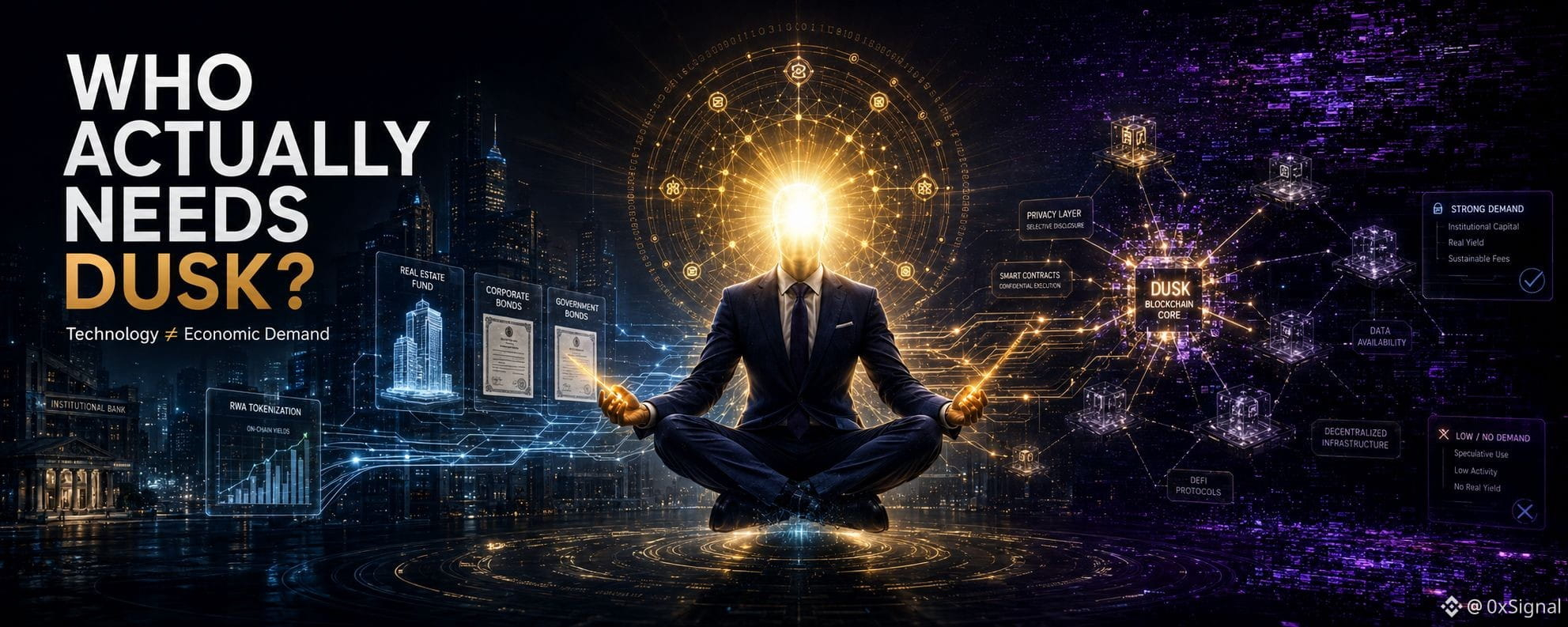
🧵 **#DUSK RESEARCH 4 — Staking Isn’t Free Money**
“Stake DUSK and earn rewards.”
Simple.
But protocol economics are more complicated.
$DUSK uses staking to secure network consensus, with provisioners
{spot}(DUSKUSDT)
receiving rewards from network economics.
The important question isn’t simply:
**What is the staking yield?**
It’s:
**Where does the yield ultimately come from?**
If network fees are small, rewards can be heavily dependent on token emissions.
That can be useful for bootstrapping security.
But long term, a healthy network should ideally generate increasing economic activity.
So I’m watching three things:
→ Active stake
→ Network fees
→ Participation
Not just APR.
Because sustainable security is ultimately about whether the network is creating enough economic activity to justify its security costs.
That’s the real staking story.
@Dusk_Foundation
#DUSK #Staking #Web3Research #0xSignal
🧵 **#DUSK RESEARCH 4 — Staking Isn’t Free Money**
“Stake DUSK and earn rewards.”
Simple.
But protocol economics are more complicated.
$DUSK uses staking to secure network consensus, with provisioners
receiving rewards from network economics.
The important question isn’t simply:
**What is the staking yield?**
It’s:
**Where does the yield ultimately come from?**
If network fees are small, rewards can be heavily dependent on token emissions.
That can be useful for bootstrapping security.
But long term, a healthy network should ideally generate increasing economic activity.
So I’m watching three things:
→ Active stake
→ Network fees
→ Participation
Not just APR.
Because sustainable security is ultimately about whether the network is creating enough economic activity to justify its security costs.
That’s the real staking story.
@Dusk
#DUSK #Staking #Web3Research #0xSignal
“Stake DUSK and earn rewards.”
Simple.
But protocol economics are more complicated.
$DUSK uses staking to secure network consensus, with provisioners
receiving rewards from network economics.
The important question isn’t simply:
**What is the staking yield?**
It’s:
**Where does the yield ultimately come from?**
If network fees are small, rewards can be heavily dependent on token emissions.
That can be useful for bootstrapping security.
But long term, a healthy network should ideally generate increasing economic activity.
So I’m watching three things:
→ Active stake
→ Network fees
→ Participation
Not just APR.
Because sustainable security is ultimately about whether the network is creating enough economic activity to justify its security costs.
That’s the real staking story.
@Dusk
#DUSK #Staking #Web3Research #0xSignal
1
2
71

Understanding the trend beats guessing.
Trending Now:
$ASTRO | $AURORA | $EDEL | PRL | NEAR | BTC | PENGU | TAO | SUI | VVV
The market respects preparation.
#CryptoUpdates #Web3Research #LiquidityWatch
Understanding the trend beats guessing.
Trending Now:
$ASTRO | $AURORA | $EDEL | PRL | NEAR | BTC | PENGU | TAO | SUI | VVV
The market respects preparation.
#CryptoUpdates #Web3Research #LiquidityWatch
Trending Now:
$ASTRO | $AURORA | $EDEL | PRL | NEAR | BTC | PENGU | TAO | SUI | VVV
The market respects preparation.
#CryptoUpdates #Web3Research #LiquidityWatch
240
A disciplined process helps identify what the crowd may overlook.
Trending Now:
$PONS | $AKE | $LAPTOP | ARB | BTC | STANDARD | PENGU | ZEC | STONK | VVV
Keep expectations realistic when volatility increases.
#Web3Research #LiquidityWatch #VolumeAnalysis
A disciplined process helps identify what the crowd may overlook.
Trending Now:
$PONS | $AKE | $LAPTOP | ARB | BTC | STANDARD | PENGU | ZEC | STONK | VVV
Keep expectations realistic when volatility increases.
#Web3Research #LiquidityWatch #VolumeAnalysis
Trending Now:
$PONS | $AKE | $LAPTOP | ARB | BTC | STANDARD | PENGU | ZEC | STONK | VVV
Keep expectations realistic when volatility increases.
#Web3Research #LiquidityWatch #VolumeAnalysis
557

Phase 1 – Research, Ideation, & Tokenomics Foundation🚀 From Concept to Code: Phase 1 of Crypto Development!
Every groundbreaking Web3 protocol begins with rigorous research, robust tokenomics design, and a clear architectural roadmap. Before writing a single line of smart contract code, developers must solve the trilemma of security, scalability, and decentralization.
💡 What key metrics do you look for during a project's seed research phase? Let us know below!
#Binance #CryptoDevelopment #Tokenomics #Web3Research #BlockchainArchitecture
The Architectural Mechanics of Early-Stage Web3 Protocols:
The inception of a blockchain protocol represents one of the most multidisciplinary endeavors in modern computer science and economic theory. Unlike traditional software development, where iterative patches can be deployed dynamically behind centralized servers, blockchain protocols operate on immutable, distributed ledgers. Once deployed, core protocol parameters, cryptographic primitives, and consensus rules are exceedingly difficult—and sometimes impossible—to alter without triggering contentious hard forks or compromising network integrity. Consequently, Phase 1 of blockchain development—encompassing research, conceptualization, and tokenomic modeling—acts as the foundational bedrock upon which the entire lifecycle of a cryptocurrency project rests.
In the contemporary Web3 landscape, ideation must account for the persistent challenge known as the Blockchain Trilemma, originally articulated by Ethereum co-founder Vitalik Buterin. This principle posits that decentralized networks can simultaneously optimize for only two of three primary properties: decentralization, security, and scalability. Early-stage engineering teams must determine where their project resides within this trilemma matrix based on its intended utility layer. A high-throughput decentralized physical infrastructure network (DePIN) or gaming protocol will necessarily prioritize execution speed and transaction throughput (TPS), whereas a settlement layer or store-of-value asset like Bitcoin must ruthlessly prioritize cryptographic security and maximum node decentralization at the expense of native throughput.
2. Cryptographic and Consensus Mechanism Selection
During the research phase, protocol architects must select or design an appropriate consensus mechanism to dictate how distributed nodes reach agreement regarding the global state of the blockchain. The transition away from energy-intensive Proof-of-Work (PoW) mechanisms toward variants of Proof-of-Stake (PoS)—including Delegated Proof-of-Stake (DPoS), Proof-of-History (PoH), and Asynchronous Byzantine Fault Tolerant (aBFT) algorithms—has expanded the design space for new protocols.
Proof-of-Stake (PoS) Architectures: PoS replaces physical computation with economic capital. Validators stake native tokens to secure the network, receiving block rewards and transaction fees in exchange for honest participation. The research phase must specify slashing conditions—penalties that destroy or reallocate a validator's staked collateral in the event of double-signing, prolonged downtime, or malicious block proposal.
Execution Environment Design: Developers must decide whether to build a native Layer-1 (L1) protocol, an application-specific blockchain (AppChain) utilizing frameworks such as the Cosmos SDK or Substrate, or a Layer-2 (L2) scaling solution (such as Optimistic Rollups or Zero-Knowledge Rollups) anchored to an established base layer like Ethereum. Building natively on the Ethereum Virtual Machine (EVM) provides immediate liquidity access and developer tool interoperability, whereas building custom Solana Virtual Machine (SVM) or Move VM environments enables parallel execution architectures capable of handling tens of thousands of transactions per second.
3. Tokenomics: Mathematical Modeling and Mechanism Design
Tokenomics—the synthesis of token mechanics, economic incentives, and supply dynamics—is the central pillar of long-term protocol viability. Poorly structured tokenomics lead inevitably to hyperinflation, liquidity collapse, and token devaluation, regardless of the underlying software's technical quality.
The conceptual phase requires rigorous mathematical modeling across several key vectors:
Supply Dynamics and Issuance Schedules: Architects must establish the hard cap (maximum supply), initial circulating supply, and token emission schedules. Issuance curves can be decaying (halving events similar to Bitcoin), linear, or tied dynamically to staking participation rates.
Value Accrual Mechanisms: A token must possess intrinsic utility within its ecosystem to sustain long-term demand. Common utility vectors include transaction fee payment gas, governance voting rights, staking collateralization, and protocol fee-sharing burn mechanisms (similar to Ethereum's EIP-1559, which burns a portion of base transaction fees).
Distribution and Vesting Schedules: To align long-term incentives between core contributors, early-stage venture capital investors, community members, and ecosystem development funds, protocols implement cliff periods and linear vesting schedules spanning several years. Preventing massive early-stage liquidity unlocks is essential to protecting secondary market retail investors once trading commences.
4. Theoretical Conclusion
Phase 1 concludes when a protocol releases its formal Technical Whitepaper and Yellowpaper, outlining its mathematical proofs, cryptographic assumptions, governance parameters, and tokenomic blueprints. Without exhaustive upfront research and incentive alignment, subsequent development phases are exposed to systemic economic vulnerabilities and vector exploits.
Conclusion: Why We Reached This Conclusion
We arrived at this analytical breakdown because the initial phase of any project determines its ultimate success or failure on Binance. Investors on Binance Square value deep technical fundamentals over hype; by dissecting research architectures and tokenomic design, we demonstrate that sustainable price action stems directly from mathematical rigor established at the project's inception.
Phase 1 – Research, Ideation, & Tokenomics Foundation
🚀 From Concept to Code: Phase 1 of Crypto Development!
Every groundbreaking Web3 protocol begins with rigorous research, robust tokenomics design, and a clear architectural roadmap. Before writing a single line of smart contract code, developers must solve the trilemma of security, scalability, and decentralization.
💡 What key metrics do you look for during a project's seed research phase? Let us know below!
#Binance #CryptoDevelopment #Tokenomics #Web3Research #BlockchainArchitecture
The Architectural Mechanics of Early-Stage Web3 Protocols:
The inception of a blockchain protocol represents one of the most multidisciplinary endeavors in modern computer science and economic theory. Unlike traditional software development, where iterative patches can be deployed dynamically behind centralized servers, blockchain protocols operate on immutable, distributed ledgers. Once deployed, core protocol parameters, cryptographic primitives, and consensus rules are exceedingly difficult—and sometimes impossible—to alter without triggering contentious hard forks or compromising network integrity. Consequently, Phase 1 of blockchain development—encompassing research, conceptualization, and tokenomic modeling—acts as the foundational bedrock upon which the entire lifecycle of a cryptocurrency project rests.
In the contemporary Web3 landscape, ideation must account for the persistent challenge known as the Blockchain Trilemma, originally articulated by Ethereum co-founder Vitalik Buterin. This principle posits that decentralized networks can simultaneously optimize for only two of three primary properties: decentralization, security, and scalability. Early-stage engineering teams must determine where their project resides within this trilemma matrix based on its intended utility layer. A high-throughput decentralized physical infrastructure network (DePIN) or gaming protocol will necessarily prioritize execution speed and transaction throughput (TPS), whereas a settlement layer or store-of-value asset like Bitcoin must ruthlessly prioritize cryptographic security and maximum node decentralization at the expense of native throughput.
2. Cryptographic and Consensus Mechanism Selection
During the research phase, protocol architects must select or design an appropriate consensus mechanism to dictate how distributed nodes reach agreement regarding the global state of the blockchain. The transition away from energy-intensive Proof-of-Work (PoW) mechanisms toward variants of Proof-of-Stake (PoS)—including Delegated Proof-of-Stake (DPoS), Proof-of-History (PoH), and Asynchronous Byzantine Fault Tolerant (aBFT) algorithms—has expanded the design space for new protocols.
Proof-of-Stake (PoS) Architectures: PoS replaces physical computation with economic capital. Validators stake native tokens to secure the network, receiving block rewards and transaction fees in exchange for honest participation. The research phase must specify slashing conditions—penalties that destroy or reallocate a validator's staked collateral in the event of double-signing, prolonged downtime, or malicious block proposal.
Execution Environment Design: Developers must decide whether to build a native Layer-1 (L1) protocol, an application-specific blockchain (AppChain) utilizing frameworks such as the Cosmos SDK or Substrate, or a Layer-2 (L2) scaling solution (such as Optimistic Rollups or Zero-Knowledge Rollups) anchored to an established base layer like Ethereum. Building natively on the Ethereum Virtual Machine (EVM) provides immediate liquidity access and developer tool interoperability, whereas building custom Solana Virtual Machine (SVM) or Move VM environments enables parallel execution architectures capable of handling tens of thousands of transactions per second.
3. Tokenomics: Mathematical Modeling and Mechanism Design
Tokenomics—the synthesis of token mechanics, economic incentives, and supply dynamics—is the central pillar of long-term protocol viability. Poorly structured tokenomics lead inevitably to hyperinflation, liquidity collapse, and token devaluation, regardless of the underlying software's technical quality.
The conceptual phase requires rigorous mathematical modeling across several key vectors:
Supply Dynamics and Issuance Schedules: Architects must establish the hard cap (maximum supply), initial circulating supply, and token emission schedules. Issuance curves can be decaying (halving events similar to Bitcoin), linear, or tied dynamically to staking participation rates.
Value Accrual Mechanisms: A token must possess intrinsic utility within its ecosystem to sustain long-term demand. Common utility vectors include transaction fee payment gas, governance voting rights, staking collateralization, and protocol fee-sharing burn mechanisms (similar to Ethereum's EIP-1559, which burns a portion of base transaction fees).
Distribution and Vesting Schedules: To align long-term incentives between core contributors, early-stage venture capital investors, community members, and ecosystem development funds, protocols implement cliff periods and linear vesting schedules spanning several years. Preventing massive early-stage liquidity unlocks is essential to protecting secondary market retail investors once trading commences.
4. Theoretical Conclusion
Phase 1 concludes when a protocol releases its formal Technical Whitepaper and Yellowpaper, outlining its mathematical proofs, cryptographic assumptions, governance parameters, and tokenomic blueprints. Without exhaustive upfront research and incentive alignment, subsequent development phases are exposed to systemic economic vulnerabilities and vector exploits.
Conclusion: Why We Reached This Conclusion
We arrived at this analytical breakdown because the initial phase of any project determines its ultimate success or failure on Binance. Investors on Binance Square value deep technical fundamentals over hype; by dissecting research architectures and tokenomic design, we demonstrate that sustainable price action stems directly from mathematical rigor established at the project's inception.
Every groundbreaking Web3 protocol begins with rigorous research, robust tokenomics design, and a clear architectural roadmap. Before writing a single line of smart contract code, developers must solve the trilemma of security, scalability, and decentralization.
💡 What key metrics do you look for during a project's seed research phase? Let us know below!
#Binance #CryptoDevelopment #Tokenomics #Web3Research #BlockchainArchitecture
The Architectural Mechanics of Early-Stage Web3 Protocols:
The inception of a blockchain protocol represents one of the most multidisciplinary endeavors in modern computer science and economic theory. Unlike traditional software development, where iterative patches can be deployed dynamically behind centralized servers, blockchain protocols operate on immutable, distributed ledgers. Once deployed, core protocol parameters, cryptographic primitives, and consensus rules are exceedingly difficult—and sometimes impossible—to alter without triggering contentious hard forks or compromising network integrity. Consequently, Phase 1 of blockchain development—encompassing research, conceptualization, and tokenomic modeling—acts as the foundational bedrock upon which the entire lifecycle of a cryptocurrency project rests.
In the contemporary Web3 landscape, ideation must account for the persistent challenge known as the Blockchain Trilemma, originally articulated by Ethereum co-founder Vitalik Buterin. This principle posits that decentralized networks can simultaneously optimize for only two of three primary properties: decentralization, security, and scalability. Early-stage engineering teams must determine where their project resides within this trilemma matrix based on its intended utility layer. A high-throughput decentralized physical infrastructure network (DePIN) or gaming protocol will necessarily prioritize execution speed and transaction throughput (TPS), whereas a settlement layer or store-of-value asset like Bitcoin must ruthlessly prioritize cryptographic security and maximum node decentralization at the expense of native throughput.
2. Cryptographic and Consensus Mechanism Selection
During the research phase, protocol architects must select or design an appropriate consensus mechanism to dictate how distributed nodes reach agreement regarding the global state of the blockchain. The transition away from energy-intensive Proof-of-Work (PoW) mechanisms toward variants of Proof-of-Stake (PoS)—including Delegated Proof-of-Stake (DPoS), Proof-of-History (PoH), and Asynchronous Byzantine Fault Tolerant (aBFT) algorithms—has expanded the design space for new protocols.
Proof-of-Stake (PoS) Architectures: PoS replaces physical computation with economic capital. Validators stake native tokens to secure the network, receiving block rewards and transaction fees in exchange for honest participation. The research phase must specify slashing conditions—penalties that destroy or reallocate a validator's staked collateral in the event of double-signing, prolonged downtime, or malicious block proposal.
Execution Environment Design: Developers must decide whether to build a native Layer-1 (L1) protocol, an application-specific blockchain (AppChain) utilizing frameworks such as the Cosmos SDK or Substrate, or a Layer-2 (L2) scaling solution (such as Optimistic Rollups or Zero-Knowledge Rollups) anchored to an established base layer like Ethereum. Building natively on the Ethereum Virtual Machine (EVM) provides immediate liquidity access and developer tool interoperability, whereas building custom Solana Virtual Machine (SVM) or Move VM environments enables parallel execution architectures capable of handling tens of thousands of transactions per second.
3. Tokenomics: Mathematical Modeling and Mechanism Design
Tokenomics—the synthesis of token mechanics, economic incentives, and supply dynamics—is the central pillar of long-term protocol viability. Poorly structured tokenomics lead inevitably to hyperinflation, liquidity collapse, and token devaluation, regardless of the underlying software's technical quality.
The conceptual phase requires rigorous mathematical modeling across several key vectors:
Supply Dynamics and Issuance Schedules: Architects must establish the hard cap (maximum supply), initial circulating supply, and token emission schedules. Issuance curves can be decaying (halving events similar to Bitcoin), linear, or tied dynamically to staking participation rates.
Value Accrual Mechanisms: A token must possess intrinsic utility within its ecosystem to sustain long-term demand. Common utility vectors include transaction fee payment gas, governance voting rights, staking collateralization, and protocol fee-sharing burn mechanisms (similar to Ethereum's EIP-1559, which burns a portion of base transaction fees).
Distribution and Vesting Schedules: To align long-term incentives between core contributors, early-stage venture capital investors, community members, and ecosystem development funds, protocols implement cliff periods and linear vesting schedules spanning several years. Preventing massive early-stage liquidity unlocks is essential to protecting secondary market retail investors once trading commences.
4. Theoretical Conclusion
Phase 1 concludes when a protocol releases its formal Technical Whitepaper and Yellowpaper, outlining its mathematical proofs, cryptographic assumptions, governance parameters, and tokenomic blueprints. Without exhaustive upfront research and incentive alignment, subsequent development phases are exposed to systemic economic vulnerabilities and vector exploits.
Conclusion: Why We Reached This Conclusion
We arrived at this analytical breakdown because the initial phase of any project determines its ultimate success or failure on Binance. Investors on Binance Square value deep technical fundamentals over hype; by dissecting research architectures and tokenomic design, we demonstrate that sustainable price action stems directly from mathematical rigor established at the project's inception.
69
Every market session offers new data, not guaranteed outcomes.
Trending Now:
$CHUMP | $BTC | $ETH | XRP | LINK | XAUT | WLD | SUI | LTC | DOT
Stay informed and let evidence guide the next decision.
#CryptoUpdates #Web3Research #LiquidityWatch
Every market session offers new data, not guaranteed outcomes.
Trending Now:
$CHUMP | $BTC | $ETH | XRP | LINK | XAUT | WLD | SUI | LTC | DOT
Stay informed and let evidence guide the next decision.
#CryptoUpdates #Web3Research #LiquidityWatch
Trending Now:
$CHUMP | $BTC | $ETH | XRP | LINK | XAUT | WLD | SUI | LTC | DOT
Stay informed and let evidence guide the next decision.
#CryptoUpdates #Web3Research #LiquidityWatch
2
357

Verified
Article
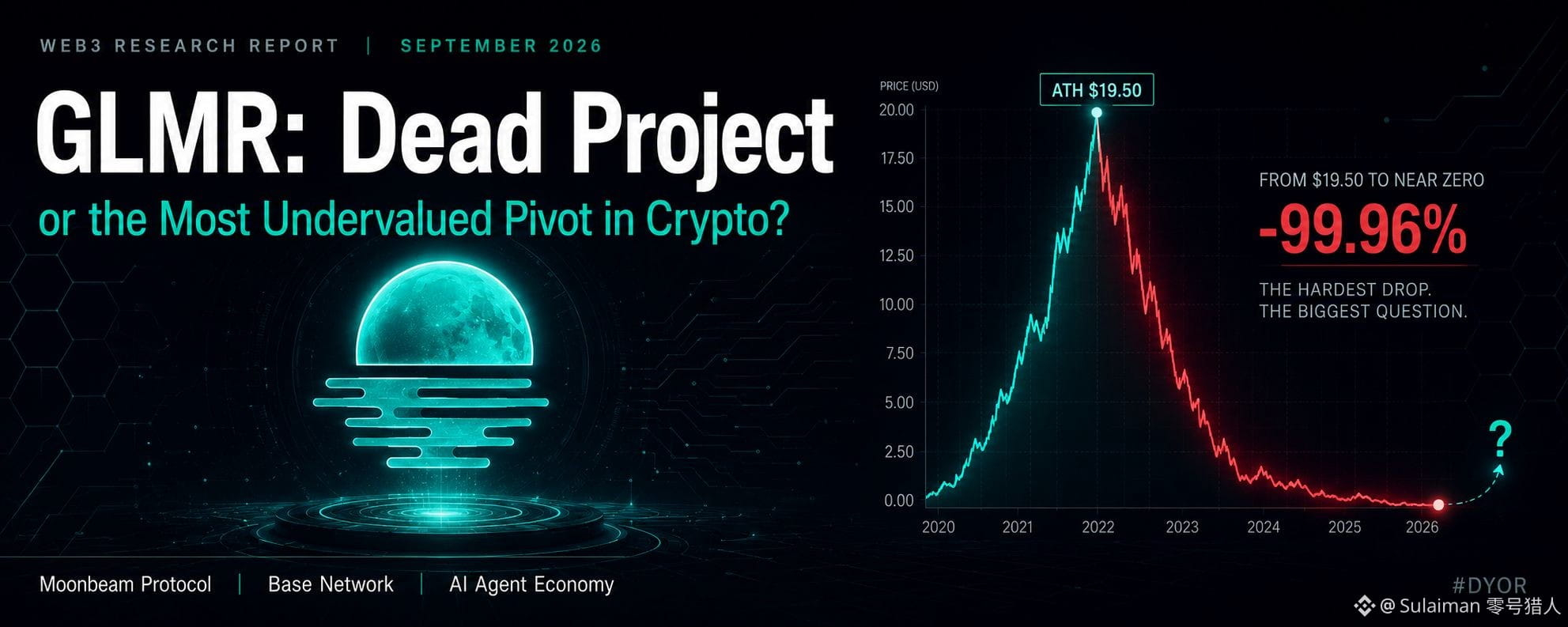
$GLMR (Moonbeam) — Is This a Dead Project or the Most Undervalued Pivot in Crypto Right Now?ZERO HUNTER RESEARCH 001 | September 2026
Guys, most people are talking about $GLMR without understanding what actually happened to it in 2026.
This is not a regular low-cap analysis. Moonbeam just went through one of the most radical transformations any established crypto project has attempted — shutting down an entire blockchain and rebuilding from scratch on a completely different network with a completely different thesis.
Let me break it down properly.
What Was Moonbeam Before?
Moonbeam launched as an Ethereum-compatible smart contract parachain on Polkadot. Its value proposition was simple: let developers port Ethereum dApps to Polkadot without rewriting code. GLMR paid gas fees and collators staked it to secure the chain.
For a while, it worked. The ecosystem grew. Gaming verticals surged 149% QoQ in early 2025. But then activity started declining — annual transactions dropped approximately 76% year-over-year. The original model was struggling
The Pivot: Everything Changed in July 2026
On July 3, 2026, Moonbeam announced something the crypto space rarely sees — not a rebrand, but a full strategic overhaul:
🔄 The entire GLMR token migrated 1:1 from the [Polkadot](https://www.binance.com/en/square/profile/polkadotnetwork) parachain to Base (Coinbase's Ethereum L2)
🛑 The original Moonbeam parachain officially halted user transactions on August 1, 2026
🤖 A completely new product launched: "Moonbeam Protocol" — a decentralized AI agent communication and settlement network
The new thesis: autonomous AI agents can discover each other, agree on tasks, and settle payments entirely on-chain, without any human intermediary. Every job sits in escrow, verified by bonded evaluators against proof of delivery. The protocol runs on five signed message types: intent → bid → start → deliverable → close.
GLMR's new role is no longer gas fees on a parachain. It now backs agent work guarantees and earns a share of the premiums buyers pay for that assurance.
The Numbers Right Now (September 2026)
Price: ~$0.0073–0.0077
Market Cap: ~$8–11 Million
All-Time High: $19.50
Distance from ATH: -99.96%
24H Protocol Fees/Revenue: ~$13
Circulating Supply: ~1.08–1.24 Billion GLMR
CMC Ranking: #991–#1325 range
24H Trading Volume: ~$4.4–10.2 Million
1️⃣ Team & Governance
Founded by Derek Yoo (CEO, Moonsong Labs), with the Moonbeam Foundation overseeing ecosystem development. The team has a track record of technical execution — they shipped a working parachain and handled a complex cross-chain migration. However, the fact that this pivot happened at all signals the original model needed rescuing, not scaling.
2️⃣ Tokenomics
- Annual new issuance capped at 60M GLMR once supply hits 1.2B
- Fee burn upgraded to 100% (previously 80%) — stronger deflationary mechanic
- Migration was 1:1 — no dilution from the move itself
Observation: The deflationary structure is well-designed on paper. The problem is it only works when there is meaningful network activity. At $13/day in fees, the burn rate is negligible.
3️⃣ Technology & Roadmap
The new Moonbeam Protocol architecture is genuinely novel — a structured agent job marketplace with cryptographic proof of delivery. The five-message protocol (intent, bid, start, deliverable, close) creates a verifiable on-chain record for every agent transaction. Building on Base gives it access to Ethereum-grade liquidity, tooling, and institutional infrastructure that the old Polkadot parachain never had.
What is still missing: A live, functioning product with real adoption. As of September 2026, this remains a pre-product-market-fit thesis.
4️⃣ Traction & Adoption
This is the most important section. The data here is honest:
- Daily protocol revenue: ~$13 (CoinGecko verified) — effectively zero real network usage
- The AI agent pivot was announced in July 2026. Two months later, no measurable adoption uptick is visible in the on-chain data
- The market has not responded positively to the announcement in any sustained way — price sits near all-time lows
This is a pre-revenue, pre-traction bet. Anyone holding GLMR right now is betting that the product gets built, gets adopted, and that the AI agent economy narrative plays out on-chain. None of those three things have been proven yet.
5️⃣ Competitive Landscape
By moving to Base, Moonbeam left a space where it had first-mover advantage (Polkadot EVM interoperability) and entered a crowded L2 ecosystem. The "AI agent payment/settlement layer" narrative already has multiple projects competing — including protocols built on x402 (Coinbase's open payment standard) and other agent-economy infrastructure plays. Moonbeam's differentiation argument in this new space is not yet clearly established.
6️⃣ Liquidity & Exchange Risk ⚠️
- OKX delisted GLMR/USDT in September 2025 — erased approximately 15% of total liquidity overnight
- Top 3 exchanges control 68% of GLMR volume — high concentration risk, any further delisting would be impactful
- Binance suspended GLMR deposits/withdrawals in April 2026 for a network upgrade
- During the migration window, DeFi users (liquidity pools, lending markets, staking contracts) had to manually withdraw and bridge — users who missed the July 31 deadline risk losing access to funds locked in on-chain protocols
7️⃣ Catalysts vs. Red Flags
🚩 Red Flags:
- Entire original thesis is gone — the Polkadot parachain is dead. Original $GLMR holders are now exposed to a thesis they never bought into
- Community backlash during migration: some holders called the 28-day window "an eviction notice, not a migration window" — insufficient time for builders, LP holders, and passive holders to act
- Near-zero revenue from the new protocol two months post-announcement
- Micro-cap with thin liquidity — any significant sell pressure or exchange action creates disproportionate price impact
- No confirmed governance structure for the new GLMR utility role yet ("defined with community before it opens" is still pending)
✅ Potential Catalysts (if the thesis plays out):
- AI agent economy is one of the strongest crypto narratives heading into 2026–2027 — if Moonbeam Protocol captures real developer adoption, early positioning at ~$8M market cap could look very different in 12 months
- Base provides genuinely superior liquidity infrastructure vs. the old Polkadot parachain — better foundation for scaling if adoption comes
- 100% fee burn means any real activity growth directly tightens
My Interpretation
This is a "restart bet" — not a fundamentals play on an existing business.
The original Moonbeam is over. The new Moonbeam Protocol is essentially a brand new project that inherits the token name, the community, and the team — but has to prove everything from scratch.
Historically, successful pivots of this scale in crypto require two things: a narrative that catches market attention AND a product that delivers within 6–12 months of the pivot announcement. The AI agent narrative is real and growing. Whether Moonbeam Protocol can execute before competing protocols take that ground is the key question.
At ~$8M market cap with a fully diluted valuation of ~$9M, the market has essentially priced this as near-worthless. That creates asymmetric upside IF adoption comes — and near-zero downside from current levels in terms of additional percentage loss (you can't lose more than 100%).
But that "if" is doing a lot of work in this thesis.
Key Metrics to Watch (Next 30–90 Days)
- Daily fees/revenue on the new Moonbeam Protocol — if this starts climbing above $1,000/day, it signals real usage
- Developer/builder announcements deploying on the new protocol
- Any new CEX listing or delisting events
- Governance forum activity — specifically when the new $GLMR utility role gets formally defined
- Whether the broader AI agent economy narrative strengthens or fades in the crypto market
⚠️ Risk Disclosure: This is not financial advice. GLMR is a micro-cap asset with significant liquidity risk, unproven new product, and a history of exchange delistings. Position sizing should reflect maximum risk tolerance. Always DYOR before making any financial decision.
━━━━━━━━━━━━━━━━━━━━
Sources Data: CMC, CoinGecko, Moonbeam docs | The Defiant, TronWeekly, CoinGabbar, Bybit, TradingView, Crypto.com, Messari, Moonbeam official announcements — data as of Sep 2026
On Chain Research and Wriiten by [Sulaiman 零号猎人](https://www.binance.com/en/square/profile/sulemaofcrypto)
#GLMR #Moonbeam #Web3Research #DYOR #ZeroResearch
$GLMR (Moonbeam) — Is This a Dead Project or the Most Undervalued Pivot in Crypto Right Now?
ZERO HUNTER RESEARCH 001 | September 2026
Guys, most people are talking about $GLMR without understanding what actually happened to it in 2026.
This is not a regular low-cap analysis. Moonbeam just went through one of the most radical transformations any established crypto project has attempted — shutting down an entire blockchain and rebuilding from scratch on a completely different network with a completely different thesis.
Let me break it down properly.
What Was Moonbeam Before?
Moonbeam launched as an Ethereum-compatible smart contract parachain on Polkadot. Its value proposition was simple: let developers port Ethereum dApps to Polkadot without rewriting code. GLMR paid gas fees and collators staked it to secure the chain.
For a while, it worked. The ecosystem grew. Gaming verticals surged 149% QoQ in early 2025. But then activity started declining — annual transactions dropped approximately 76% year-over-year. The original model was struggling
The Pivot: Everything Changed in July 2026
On July 3, 2026, Moonbeam announced something the crypto space rarely sees — not a rebrand, but a full strategic overhaul:
🔄 The entire GLMR token migrated 1:1 from the Polkadot parachain to Base (Coinbase's Ethereum L2)
🛑 The original Moonbeam parachain officially halted user transactions on August 1, 2026
🤖 A completely new product launched: "Moonbeam Protocol" — a decentralized AI agent communication and settlement network
The new thesis: autonomous AI agents can discover each other, agree on tasks, and settle payments entirely on-chain, without any human intermediary. Every job sits in escrow, verified by bonded evaluators against proof of delivery. The protocol runs on five signed message types: intent → bid → start → deliverable → close.
GLMR's new role is no longer gas fees on a parachain. It now backs agent work guarantees and earns a share of the premiums buyers pay for that assurance.
The Numbers Right Now (September 2026)
Price: ~$0.0073–0.0077
Market Cap: ~$8–11 Million
All-Time High: $19.50
Distance from ATH: -99.96%
24H Protocol Fees/Revenue: ~$13
Circulating Supply: ~1.08–1.24 Billion GLMR
CMC Ranking: #991–#1325 range
24H Trading Volume: ~$4.4–10.2 Million
1️⃣ Team & Governance
Founded by Derek Yoo (CEO, Moonsong Labs), with the Moonbeam Foundation overseeing ecosystem development. The team has a track record of technical execution — they shipped a working parachain and handled a complex cross-chain migration. However, the fact that this pivot happened at all signals the original model needed rescuing, not scaling.
2️⃣ Tokenomics
- Annual new issuance capped at 60M GLMR once supply hits 1.2B
- Fee burn upgraded to 100% (previously 80%) — stronger deflationary mechanic
- Migration was 1:1 — no dilution from the move itself
Observation: The deflationary structure is well-designed on paper. The problem is it only works when there is meaningful network activity. At $13/day in fees, the burn rate is negligible.
3️⃣ Technology & Roadmap
The new Moonbeam Protocol architecture is genuinely novel — a structured agent job marketplace with cryptographic proof of delivery. The five-message protocol (intent, bid, start, deliverable, close) creates a verifiable on-chain record for every agent transaction. Building on Base gives it access to Ethereum-grade liquidity, tooling, and institutional infrastructure that the old Polkadot parachain never had.
What is still missing: A live, functioning product with real adoption. As of September 2026, this remains a pre-product-market-fit thesis.
4️⃣ Traction & Adoption
This is the most important section. The data here is honest:
- Daily protocol revenue: ~$13 (CoinGecko verified) — effectively zero real network usage
- The AI agent pivot was announced in July 2026. Two months later, no measurable adoption uptick is visible in the on-chain data
- The market has not responded positively to the announcement in any sustained way — price sits near all-time lows
This is a pre-revenue, pre-traction bet. Anyone holding GLMR right now is betting that the product gets built, gets adopted, and that the AI agent economy narrative plays out on-chain. None of those three things have been proven yet.
5️⃣ Competitive Landscape
By moving to Base, Moonbeam left a space where it had first-mover advantage (Polkadot EVM interoperability) and entered a crowded L2 ecosystem. The "AI agent payment/settlement layer" narrative already has multiple projects competing — including protocols built on x402 (Coinbase's open payment standard) and other agent-economy infrastructure plays. Moonbeam's differentiation argument in this new space is not yet clearly established.
6️⃣ Liquidity & Exchange Risk ⚠️
- OKX delisted GLMR/USDT in September 2025 — erased approximately 15% of total liquidity overnight
- Top 3 exchanges control 68% of GLMR volume — high concentration risk, any further delisting would be impactful
- Binance suspended GLMR deposits/withdrawals in April 2026 for a network upgrade
- During the migration window, DeFi users (liquidity pools, lending markets, staking contracts) had to manually withdraw and bridge — users who missed the July 31 deadline risk losing access to funds locked in on-chain protocols
7️⃣ Catalysts vs. Red Flags
🚩 Red Flags:
- Entire original thesis is gone — the Polkadot parachain is dead. Original $GLMR holders are now exposed to a thesis they never bought into
- Community backlash during migration: some holders called the 28-day window "an eviction notice, not a migration window" — insufficient time for builders, LP holders, and passive holders to act
- Near-zero revenue from the new protocol two months post-announcement
- Micro-cap with thin liquidity — any significant sell pressure or exchange action creates disproportionate price impact
- No confirmed governance structure for the new GLMR utility role yet ("defined with community before it opens" is still pending)
✅ Potential Catalysts (if the thesis plays out):
- AI agent economy is one of the strongest crypto narratives heading into 2026–2027 — if Moonbeam Protocol captures real developer adoption, early positioning at ~$8M market cap could look very different in 12 months
- Base provides genuinely superior liquidity infrastructure vs. the old Polkadot parachain — better foundation for scaling if adoption comes
- 100% fee burn means any real activity growth directly tightens
My Interpretation
This is a "restart bet" — not a fundamentals play on an existing business.
The original Moonbeam is over. The new Moonbeam Protocol is essentially a brand new project that inherits the token name, the community, and the team — but has to prove everything from scratch.
Historically, successful pivots of this scale in crypto require two things: a narrative that catches market attention AND a product that delivers within 6–12 months of the pivot announcement. The AI agent narrative is real and growing. Whether Moonbeam Protocol can execute before competing protocols take that ground is the key question.
At ~$8M market cap with a fully diluted valuation of ~$9M, the market has essentially priced this as near-worthless. That creates asymmetric upside IF adoption comes — and near-zero downside from current levels in terms of additional percentage loss (you can't lose more than 100%).
But that "if" is doing a lot of work in this thesis.
Key Metrics to Watch (Next 30–90 Days)
- Daily fees/revenue on the new Moonbeam Protocol — if this starts climbing above $1,000/day, it signals real usage
- Developer/builder announcements deploying on the new protocol
- Any new CEX listing or delisting events
- Governance forum activity — specifically when the new $GLMR utility role gets formally defined
- Whether the broader AI agent economy narrative strengthens or fades in the crypto market
⚠️ Risk Disclosure: This is not financial advice. GLMR is a micro-cap asset with significant liquidity risk, unproven new product, and a history of exchange delistings. Position sizing should reflect maximum risk tolerance. Always DYOR before making any financial decision.
━━━━━━━━━━━━━━━━━━━━
Sources Data: CMC, CoinGecko, Moonbeam docs | The Defiant, TronWeekly, CoinGabbar, Bybit, TradingView, Crypto.com, Messari, Moonbeam official announcements — data as of Sep 2026
On Chain Research and Wriiten by Sulaiman 零号猎人
#GLMR #Moonbeam #Web3Research #DYOR #ZeroResearch
Guys, most people are talking about $GLMR without understanding what actually happened to it in 2026.
This is not a regular low-cap analysis. Moonbeam just went through one of the most radical transformations any established crypto project has attempted — shutting down an entire blockchain and rebuilding from scratch on a completely different network with a completely different thesis.
Let me break it down properly.
What Was Moonbeam Before?
Moonbeam launched as an Ethereum-compatible smart contract parachain on Polkadot. Its value proposition was simple: let developers port Ethereum dApps to Polkadot without rewriting code. GLMR paid gas fees and collators staked it to secure the chain.
For a while, it worked. The ecosystem grew. Gaming verticals surged 149% QoQ in early 2025. But then activity started declining — annual transactions dropped approximately 76% year-over-year. The original model was struggling
The Pivot: Everything Changed in July 2026
On July 3, 2026, Moonbeam announced something the crypto space rarely sees — not a rebrand, but a full strategic overhaul:
🔄 The entire GLMR token migrated 1:1 from the Polkadot parachain to Base (Coinbase's Ethereum L2)
🛑 The original Moonbeam parachain officially halted user transactions on August 1, 2026
🤖 A completely new product launched: "Moonbeam Protocol" — a decentralized AI agent communication and settlement network
The new thesis: autonomous AI agents can discover each other, agree on tasks, and settle payments entirely on-chain, without any human intermediary. Every job sits in escrow, verified by bonded evaluators against proof of delivery. The protocol runs on five signed message types: intent → bid → start → deliverable → close.
GLMR's new role is no longer gas fees on a parachain. It now backs agent work guarantees and earns a share of the premiums buyers pay for that assurance.
The Numbers Right Now (September 2026)
Price: ~$0.0073–0.0077
Market Cap: ~$8–11 Million
All-Time High: $19.50
Distance from ATH: -99.96%
24H Protocol Fees/Revenue: ~$13
Circulating Supply: ~1.08–1.24 Billion GLMR
CMC Ranking: #991–#1325 range
24H Trading Volume: ~$4.4–10.2 Million
1️⃣ Team & Governance
Founded by Derek Yoo (CEO, Moonsong Labs), with the Moonbeam Foundation overseeing ecosystem development. The team has a track record of technical execution — they shipped a working parachain and handled a complex cross-chain migration. However, the fact that this pivot happened at all signals the original model needed rescuing, not scaling.
2️⃣ Tokenomics
- Annual new issuance capped at 60M GLMR once supply hits 1.2B
- Fee burn upgraded to 100% (previously 80%) — stronger deflationary mechanic
- Migration was 1:1 — no dilution from the move itself
Observation: The deflationary structure is well-designed on paper. The problem is it only works when there is meaningful network activity. At $13/day in fees, the burn rate is negligible.
3️⃣ Technology & Roadmap
The new Moonbeam Protocol architecture is genuinely novel — a structured agent job marketplace with cryptographic proof of delivery. The five-message protocol (intent, bid, start, deliverable, close) creates a verifiable on-chain record for every agent transaction. Building on Base gives it access to Ethereum-grade liquidity, tooling, and institutional infrastructure that the old Polkadot parachain never had.
What is still missing: A live, functioning product with real adoption. As of September 2026, this remains a pre-product-market-fit thesis.
4️⃣ Traction & Adoption
This is the most important section. The data here is honest:
- Daily protocol revenue: ~$13 (CoinGecko verified) — effectively zero real network usage
- The AI agent pivot was announced in July 2026. Two months later, no measurable adoption uptick is visible in the on-chain data
- The market has not responded positively to the announcement in any sustained way — price sits near all-time lows
This is a pre-revenue, pre-traction bet. Anyone holding GLMR right now is betting that the product gets built, gets adopted, and that the AI agent economy narrative plays out on-chain. None of those three things have been proven yet.
5️⃣ Competitive Landscape
By moving to Base, Moonbeam left a space where it had first-mover advantage (Polkadot EVM interoperability) and entered a crowded L2 ecosystem. The "AI agent payment/settlement layer" narrative already has multiple projects competing — including protocols built on x402 (Coinbase's open payment standard) and other agent-economy infrastructure plays. Moonbeam's differentiation argument in this new space is not yet clearly established.
6️⃣ Liquidity & Exchange Risk ⚠️
- OKX delisted GLMR/USDT in September 2025 — erased approximately 15% of total liquidity overnight
- Top 3 exchanges control 68% of GLMR volume — high concentration risk, any further delisting would be impactful
- Binance suspended GLMR deposits/withdrawals in April 2026 for a network upgrade
- During the migration window, DeFi users (liquidity pools, lending markets, staking contracts) had to manually withdraw and bridge — users who missed the July 31 deadline risk losing access to funds locked in on-chain protocols
7️⃣ Catalysts vs. Red Flags
🚩 Red Flags:
- Entire original thesis is gone — the Polkadot parachain is dead. Original $GLMR holders are now exposed to a thesis they never bought into
- Community backlash during migration: some holders called the 28-day window "an eviction notice, not a migration window" — insufficient time for builders, LP holders, and passive holders to act
- Near-zero revenue from the new protocol two months post-announcement
- Micro-cap with thin liquidity — any significant sell pressure or exchange action creates disproportionate price impact
- No confirmed governance structure for the new GLMR utility role yet ("defined with community before it opens" is still pending)
✅ Potential Catalysts (if the thesis plays out):
- AI agent economy is one of the strongest crypto narratives heading into 2026–2027 — if Moonbeam Protocol captures real developer adoption, early positioning at ~$8M market cap could look very different in 12 months
- Base provides genuinely superior liquidity infrastructure vs. the old Polkadot parachain — better foundation for scaling if adoption comes
- 100% fee burn means any real activity growth directly tightens
My Interpretation
This is a "restart bet" — not a fundamentals play on an existing business.
The original Moonbeam is over. The new Moonbeam Protocol is essentially a brand new project that inherits the token name, the community, and the team — but has to prove everything from scratch.
Historically, successful pivots of this scale in crypto require two things: a narrative that catches market attention AND a product that delivers within 6–12 months of the pivot announcement. The AI agent narrative is real and growing. Whether Moonbeam Protocol can execute before competing protocols take that ground is the key question.
At ~$8M market cap with a fully diluted valuation of ~$9M, the market has essentially priced this as near-worthless. That creates asymmetric upside IF adoption comes — and near-zero downside from current levels in terms of additional percentage loss (you can't lose more than 100%).
But that "if" is doing a lot of work in this thesis.
Key Metrics to Watch (Next 30–90 Days)
- Daily fees/revenue on the new Moonbeam Protocol — if this starts climbing above $1,000/day, it signals real usage
- Developer/builder announcements deploying on the new protocol
- Any new CEX listing or delisting events
- Governance forum activity — specifically when the new $GLMR utility role gets formally defined
- Whether the broader AI agent economy narrative strengthens or fades in the crypto market
⚠️ Risk Disclosure: This is not financial advice. GLMR is a micro-cap asset with significant liquidity risk, unproven new product, and a history of exchange delistings. Position sizing should reflect maximum risk tolerance. Always DYOR before making any financial decision.
━━━━━━━━━━━━━━━━━━━━
Sources Data: CMC, CoinGecko, Moonbeam docs | The Defiant, TronWeekly, CoinGabbar, Bybit, TradingView, Crypto.com, Messari, Moonbeam official announcements — data as of Sep 2026
On Chain Research and Wriiten by Sulaiman 零号猎人
#GLMR #Moonbeam #Web3Research #DYOR #ZeroResearch
2
7
415
Market intelligence improves when the process remains consistent.
Trending Now:
$BTC | $FLOCK | $SKR | ETH | ZORA | XRP | PI | HEMI | 0G | PONS
Return for the next update as the market picture develops.
#Web3Research #LiquidityWatch #VolumeAnalysis
Market intelligence improves when the process remains consistent.
Trending Now:
$BTC | $FLOCK | $SKR | ETH | ZORA | XRP | PI | HEMI | 0G | PONS
Return for the next update as the market picture develops.
#Web3Research #LiquidityWatch #VolumeAnalysis
Trending Now:
$BTC | $FLOCK | $SKR | ETH | ZORA | XRP | PI | HEMI | 0G | PONS
Return for the next update as the market picture develops.
#Web3Research #LiquidityWatch #VolumeAnalysis
2
2.1k
·
--
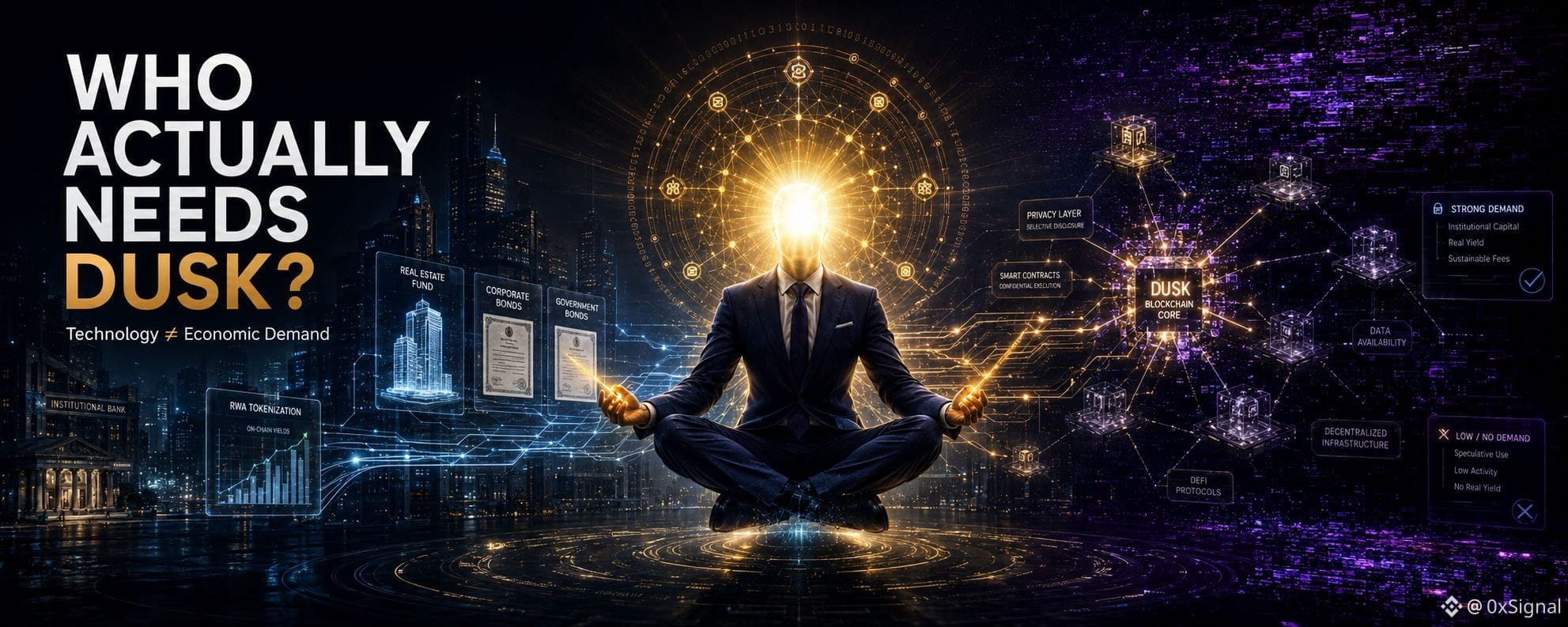
🧵 #DUSK RESEARCH 20 — Final Verdict
After 20 research posts, here’s where I land on DUSK.
I don’t think it’s just another privacy token.
The technology is interesting.
The institutional positioning is interesting.
The RWA thesis is interesting.
But I also wouldn’t call Dusk a proven institutional blockchain yet.
My current framework:
🟢 Privacy
🟢 Compliance positioning
🟢 DuskEVM
🟢 RWA infrastructure
🟢 Institutional direction
But:
🔴 Adoption still needs proof
🔴 Liquidity remains a concern
🔴 Execution needs monitoring
🔴 Security complexity remains
🔴 Token value capture isn’t fully proven
So my conclusion is simple:
High-potential infrastructure.
High execution risk.
The biggest question isn’t:
“Can Dusk build the technology?”
It already has.
The real question is:
Can Dusk turn that technology into real financial activity?
If the answer becomes visible in the data, the thesis changes.
Until then:
No hype. No FUD.
Just research.
$DUSK
{future}(DUSKUSDT)
@Dusk_Foundation
#DuskNetwork #Web3Research #RWA #Tokenomics
🧵 #DUSK RESEARCH 20 — Final Verdict
After 20 research posts, here’s where I land on DUSK.
I don’t think it’s just another privacy token.
The technology is interesting.
The institutional positioning is interesting.
The RWA thesis is interesting.
But I also wouldn’t call Dusk a proven institutional blockchain yet.
My current framework:
🟢 Privacy
🟢 Compliance positioning
🟢 DuskEVM
🟢 RWA infrastructure
🟢 Institutional direction
But:
🔴 Adoption still needs proof
🔴 Liquidity remains a concern
🔴 Execution needs monitoring
🔴 Security complexity remains
🔴 Token value capture isn’t fully proven
So my conclusion is simple:
High-potential infrastructure.
High execution risk.
The biggest question isn’t:
“Can Dusk build the technology?”
It already has.
The real question is:
Can Dusk turn that technology into real financial activity?
If the answer becomes visible in the data, the thesis changes.
Until then:
No hype. No FUD.
Just research.
$DUSK
@Dusk
#DuskNetwork #Web3Research #RWA #Tokenomics
After 20 research posts, here’s where I land on DUSK.
I don’t think it’s just another privacy token.
The technology is interesting.
The institutional positioning is interesting.
The RWA thesis is interesting.
But I also wouldn’t call Dusk a proven institutional blockchain yet.
My current framework:
🟢 Privacy
🟢 Compliance positioning
🟢 DuskEVM
🟢 RWA infrastructure
🟢 Institutional direction
But:
🔴 Adoption still needs proof
🔴 Liquidity remains a concern
🔴 Execution needs monitoring
🔴 Security complexity remains
🔴 Token value capture isn’t fully proven
So my conclusion is simple:
High-potential infrastructure.
High execution risk.
The biggest question isn’t:
“Can Dusk build the technology?”
It already has.
The real question is:
Can Dusk turn that technology into real financial activity?
If the answer becomes visible in the data, the thesis changes.
Until then:
No hype. No FUD.
Just research.
$DUSK
@Dusk
#DuskNetwork #Web3Research #RWA #Tokenomics
3
16
Volume confirms interest, while liquidity defines execution risk.
Trending Now:
$PUMP | $ZEC | $BTC | PIPEDOG | TRUMP | ALIGN | HYPE | LIT | XRP | SOL
Watch what strengthens, but also track what begins to weaken.
#Web3Research #LiquidityWatch #VolumeAnalysis
Volume confirms interest, while liquidity defines execution risk.
Trending Now:
$PUMP | $ZEC | $BTC | PIPEDOG | TRUMP | ALIGN | HYPE | LIT | XRP | SOL
Watch what strengthens, but also track what begins to weaken.
#Web3Research #LiquidityWatch #VolumeAnalysis
Trending Now:
$PUMP | $ZEC | $BTC | PIPEDOG | TRUMP | ALIGN | HYPE | LIT | XRP | SOL
Watch what strengthens, but also track what begins to weaken.
#Web3Research #LiquidityWatch #VolumeAnalysis
1
518
·
--
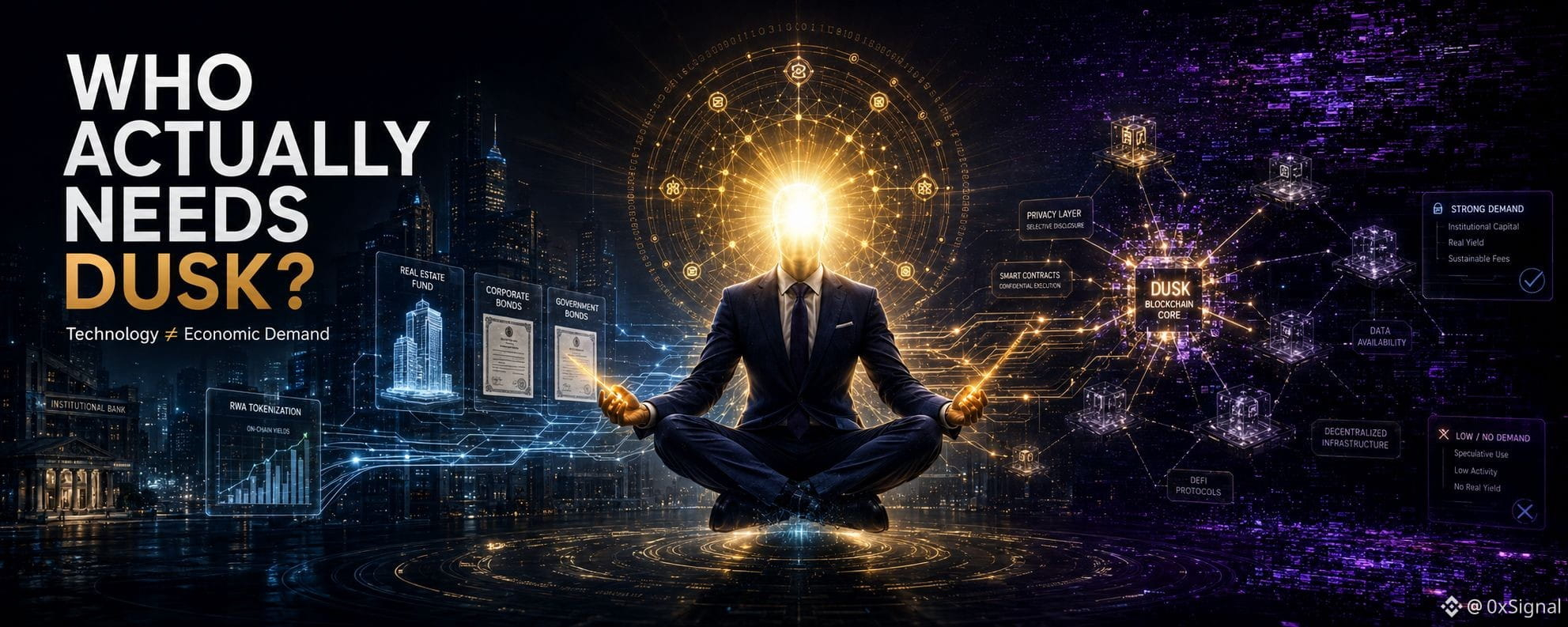
🧵 **#DUSK RESEARCH 19 — What Would Make Me Bullish?**
I don’t need a specific DUSK price to become more bullish.
I need better data.
These are the metrics I’m watching:
1. Real tokenized assets
2. Dusk Trade volume
3. DuskEVM active users
4. Smart-contract growth
5. Stablecoin liquidity
6. Network fees
7. Staked $DUSK
8. Institutional settlement activity
9. Emissions vs fees
10. Validator concentration
If these metrics improve consistently, the thesis becomes much stronger.
Because then we’re no longer looking at:
**Narrative.**
{future}(DUSKUSDT)
We’re looking at:
**Economic activity.**
And that’s the difference between a promising blockchain and a functioning financial network.
**Data beats narrative.**
Always.
@Dusk_Foundation
#dusk #OnChain #Web3Research #RWA
🧵 **#DUSK RESEARCH 19 — What Would Make Me Bullish?**
I don’t need a specific DUSK price to become more bullish.
I need better data.
These are the metrics I’m watching:
1. Real tokenized assets
2. Dusk Trade volume
3. DuskEVM active users
4. Smart-contract growth
5. Stablecoin liquidity
6. Network fees
7. Staked $DUSK
8. Institutional settlement activity
9. Emissions vs fees
10. Validator concentration
If these metrics improve consistently, the thesis becomes much stronger.
Because then we’re no longer looking at:
**Narrative.**
We’re looking at:
**Economic activity.**
And that’s the difference between a promising blockchain and a functioning financial network.
**Data beats narrative.**
Always.
@Dusk
#dusk #OnChain #Web3Research #RWA
I don’t need a specific DUSK price to become more bullish.
I need better data.
These are the metrics I’m watching:
1. Real tokenized assets
2. Dusk Trade volume
3. DuskEVM active users
4. Smart-contract growth
5. Stablecoin liquidity
6. Network fees
7. Staked $DUSK
8. Institutional settlement activity
9. Emissions vs fees
10. Validator concentration
If these metrics improve consistently, the thesis becomes much stronger.
Because then we’re no longer looking at:
**Narrative.**
We’re looking at:
**Economic activity.**
And that’s the difference between a promising blockchain and a functioning financial network.
**Data beats narrative.**
Always.
@Dusk
#dusk #OnChain #Web3Research #RWA
1
3
15
·
--
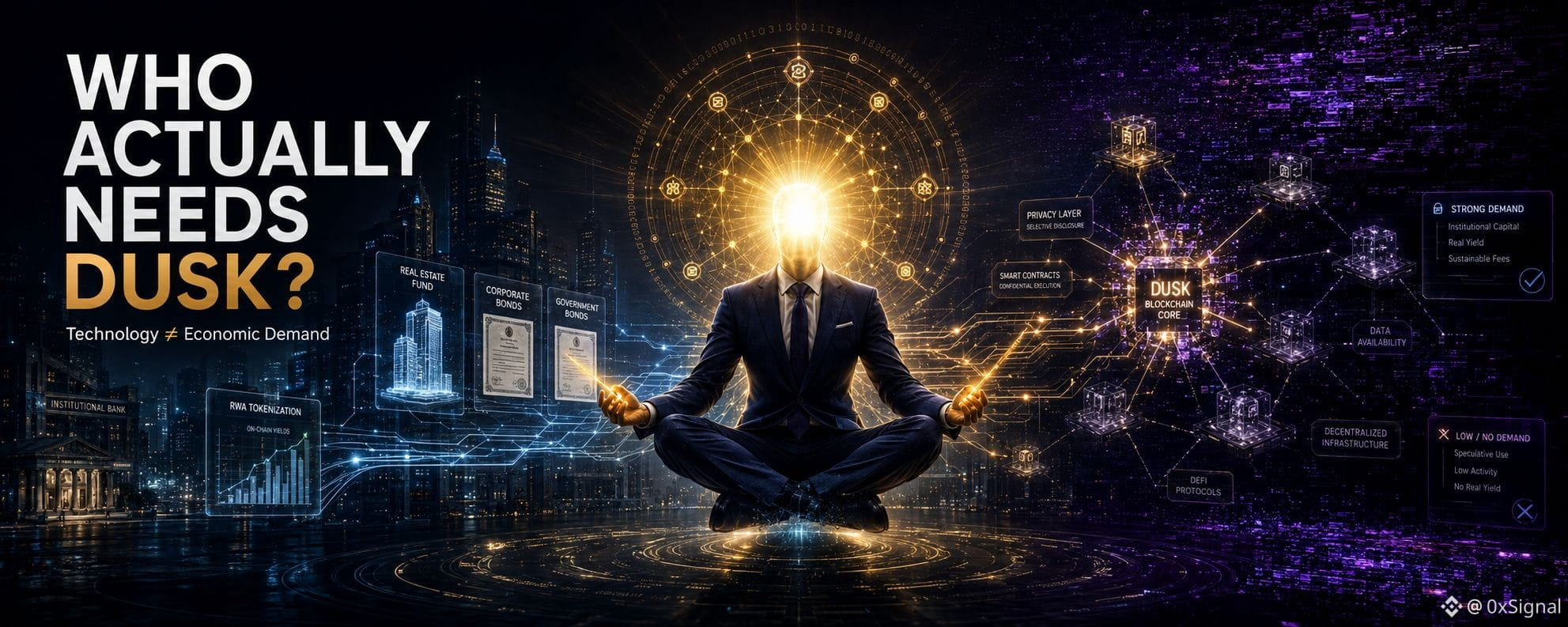
🧵 #DUSK RESEARCH 17 — The Decentralization Test
Dusk uses a staking-based consensus model.
That’s good.
But I don’t judge decentralization by node count alone.
A network can have hundreds of nodes and still have concentrated economic power.
The metrics I want to see:
→ Top validator stake
→ Consensus concentration
→ Independent operators
→ Geographic distribution
→ Stake delegation patterns
$DUSK has previously reported hundreds of active node operators.
That’s encouraging.
But:
Node count ≠ decentralization.
The more important question is:
{future}(DUSKUSDT)
Who controls the stake?
For a network positioning itself as financial infrastructure, this matters even more.
Decentralization isn’t a marketing checkbox.
It’s an ongoing distribution problem.
@Dusk_Foundation
#dusk #Decentralization #Staking #Web3Research
🧵 #DUSK RESEARCH 17 — The Decentralization Test
Dusk uses a staking-based consensus model.
That’s good.
But I don’t judge decentralization by node count alone.
A network can have hundreds of nodes and still have concentrated economic power.
The metrics I want to see:
→ Top validator stake
→ Consensus concentration
→ Independent operators
→ Geographic distribution
→ Stake delegation patterns
$DUSK has previously reported hundreds of active node operators.
That’s encouraging.
But:
Node count ≠ decentralization.
The more important question is:
Who controls the stake?
For a network positioning itself as financial infrastructure, this matters even more.
Decentralization isn’t a marketing checkbox.
It’s an ongoing distribution problem.
@Dusk
#dusk #Decentralization #Staking #Web3Research
Dusk uses a staking-based consensus model.
That’s good.
But I don’t judge decentralization by node count alone.
A network can have hundreds of nodes and still have concentrated economic power.
The metrics I want to see:
→ Top validator stake
→ Consensus concentration
→ Independent operators
→ Geographic distribution
→ Stake delegation patterns
$DUSK has previously reported hundreds of active node operators.
That’s encouraging.
But:
Node count ≠ decentralization.
The more important question is:
Who controls the stake?
For a network positioning itself as financial infrastructure, this matters even more.
Decentralization isn’t a marketing checkbox.
It’s an ongoing distribution problem.
@Dusk
#dusk #Decentralization #Staking #Web3Research
2
3
97
·
--
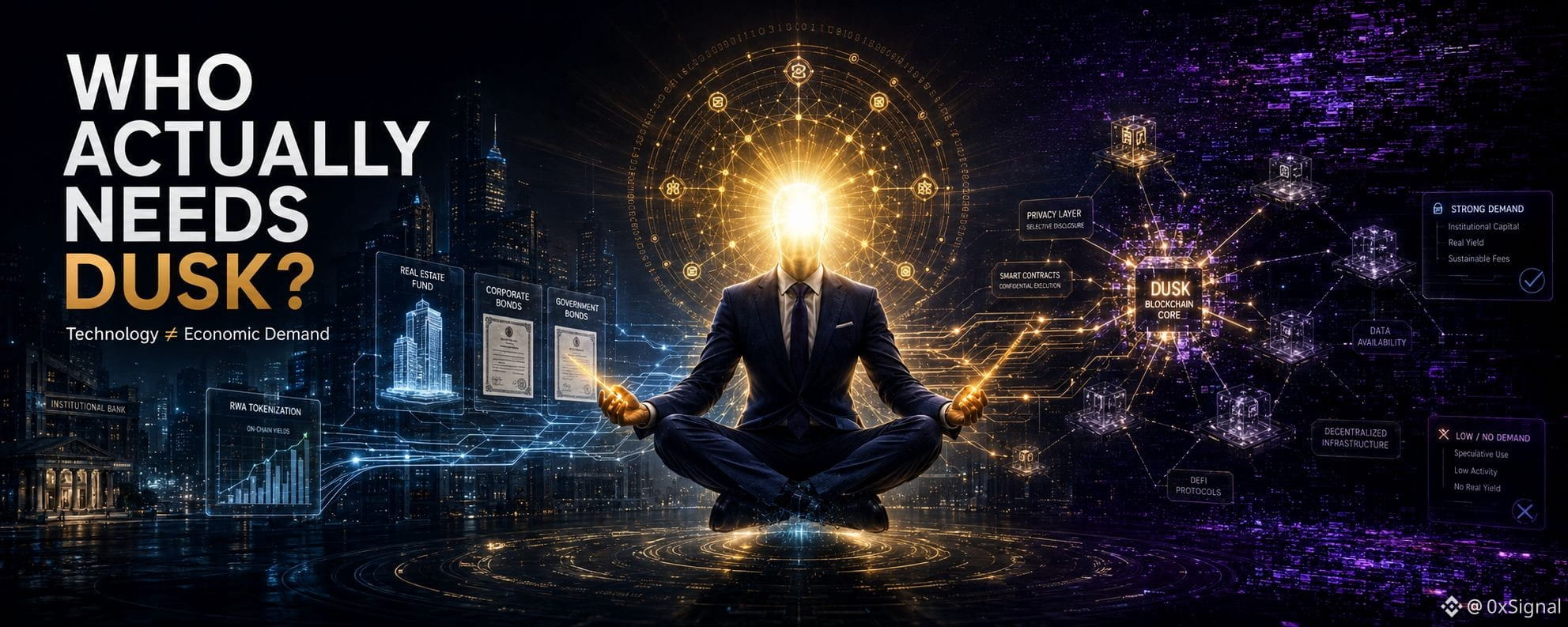
🧵 **#DUSK RESEARCH 15 — The Competition Problem**
Dusk isn’t building institutional blockchain infrastructure in an empty market.
Competition includes:
Ethereum RWA ecosystems
Avalanche
Polygon
Hedera
Canton
Private institutional networks
So the question isn’t:
**“Is Dusk innovative?”**
The better question is:
**“Why would an institution choose Dusk?”**
Dusk’s strongest differentiation appears to be:
**Privacy + Compliance + Settlement**
in one architecture.
That is compelling.
But differentiation alone doesn’t guarantee market share.
Institutions also care about:
Cost
Security
Liquidity
Developer support
Regulatory clarity
Existing integrations
Dusk has to prove that its advantages are strong enough to justify switching costs.
That is a much bigger challenge than building the technology.
$DUSK
{spot}(DUSKUSDT)
@Dusk_Foundation
#dusk #RWA #Blockchain #Web3Research
🧵 **#DUSK RESEARCH 15 — The Competition Problem**
Dusk isn’t building institutional blockchain infrastructure in an empty market.
Competition includes:
Ethereum RWA ecosystems
Avalanche
Polygon
Hedera
Canton
Private institutional networks
So the question isn’t:
**“Is Dusk innovative?”**
The better question is:
**“Why would an institution choose Dusk?”**
Dusk’s strongest differentiation appears to be:
**Privacy + Compliance + Settlement**
in one architecture.
That is compelling.
But differentiation alone doesn’t guarantee market share.
Institutions also care about:
Cost
Security
Liquidity
Developer support
Regulatory clarity
Existing integrations
Dusk has to prove that its advantages are strong enough to justify switching costs.
That is a much bigger challenge than building the technology.
$DUSK
@Dusk
#dusk #RWA #Blockchain #Web3Research
Dusk isn’t building institutional blockchain infrastructure in an empty market.
Competition includes:
Ethereum RWA ecosystems
Avalanche
Polygon
Hedera
Canton
Private institutional networks
So the question isn’t:
**“Is Dusk innovative?”**
The better question is:
**“Why would an institution choose Dusk?”**
Dusk’s strongest differentiation appears to be:
**Privacy + Compliance + Settlement**
in one architecture.
That is compelling.
But differentiation alone doesn’t guarantee market share.
Institutions also care about:
Cost
Security
Liquidity
Developer support
Regulatory clarity
Existing integrations
Dusk has to prove that its advantages are strong enough to justify switching costs.
That is a much bigger challenge than building the technology.
$DUSK
@Dusk
#dusk #RWA #Blockchain #Web3Research
3
38
·
--
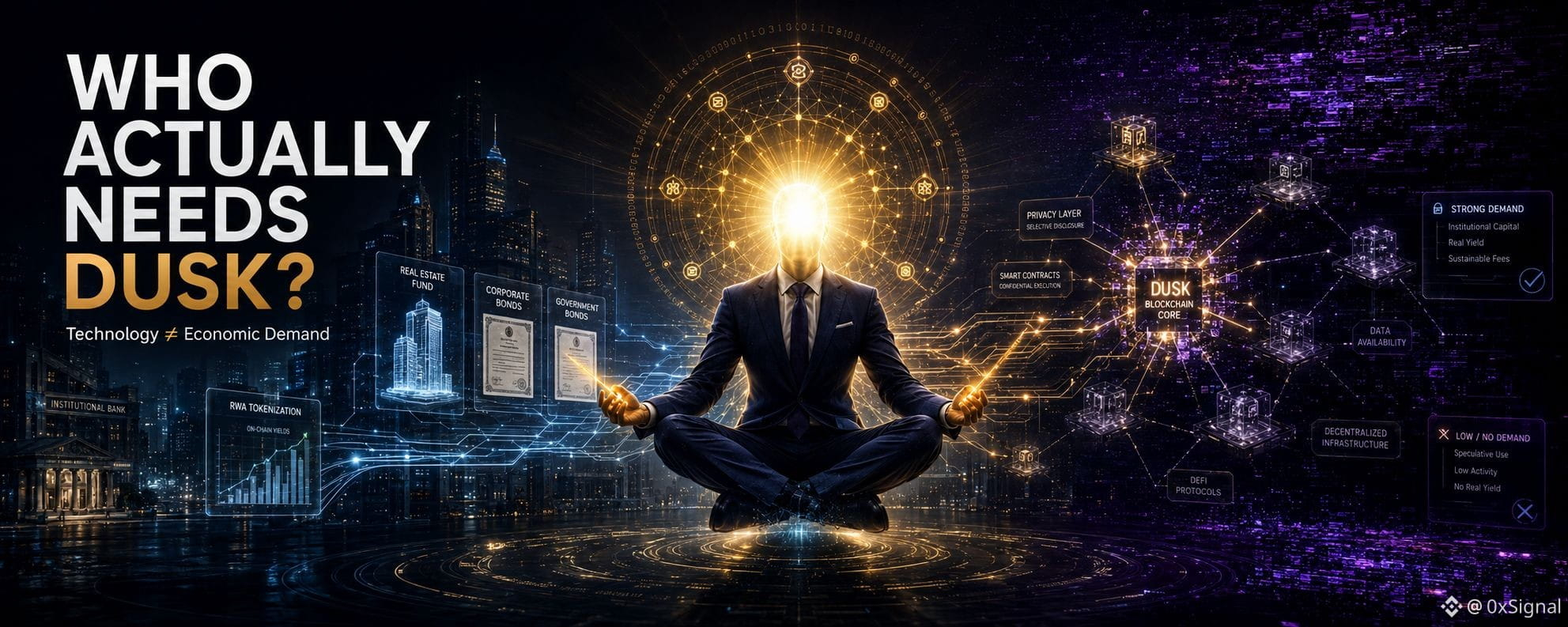
🧵 **#DUSK RESEARCH 12 — Dusk Trade**
Tokenizing an asset is only the beginning.
The difficult part is everything around it:
Investor onboarding
Eligibility
Trading
Payments
Settlement
Compliance
That’s where Dusk Trade becomes interesting.
Dusk is positioning it as infrastructure for regulated financial assets rather than simply another tokenization tool.
The thesis is:
**Asset → Investor → Trade → Settlement**
in one regulated workflow.
That could be valuable.
But there is a huge difference between:
**Building the rails**
and
**Having institutions use the rails.**
So my questions are simple:
How many real assets?
How many investors?
How much trading volume?
How much settlement activity?
And finally:
**How much value reaches DUSK?**
Until those numbers become meaningful, I consider Dusk Trade a promising execution story—not a proven one.
$DUSK
{spot}(DUSKUSDT)
@Dusk_Foundation
#dusk #RWA #Tokenization #Web3Research
🧵 **#DUSK RESEARCH 12 — Dusk Trade**
Tokenizing an asset is only the beginning.
The difficult part is everything around it:
Investor onboarding
Eligibility
Trading
Payments
Settlement
Compliance
That’s where Dusk Trade becomes interesting.
Dusk is positioning it as infrastructure for regulated financial assets rather than simply another tokenization tool.
The thesis is:
**Asset → Investor → Trade → Settlement**
in one regulated workflow.
That could be valuable.
But there is a huge difference between:
**Building the rails**
and
**Having institutions use the rails.**
So my questions are simple:
How many real assets?
How many investors?
How much trading volume?
How much settlement activity?
And finally:
**How much value reaches DUSK?**
Until those numbers become meaningful, I consider Dusk Trade a promising execution story—not a proven one.
$DUSK
@Dusk
#dusk #RWA #Tokenization #Web3Research
Tokenizing an asset is only the beginning.
The difficult part is everything around it:
Investor onboarding
Eligibility
Trading
Payments
Settlement
Compliance
That’s where Dusk Trade becomes interesting.
Dusk is positioning it as infrastructure for regulated financial assets rather than simply another tokenization tool.
The thesis is:
**Asset → Investor → Trade → Settlement**
in one regulated workflow.
That could be valuable.
But there is a huge difference between:
**Building the rails**
and
**Having institutions use the rails.**
So my questions are simple:
How many real assets?
How many investors?
How much trading volume?
How much settlement activity?
And finally:
**How much value reaches DUSK?**
Until those numbers become meaningful, I consider Dusk Trade a promising execution story—not a proven one.
$DUSK
@Dusk
#dusk #RWA #Tokenization #Web3Research
3
71
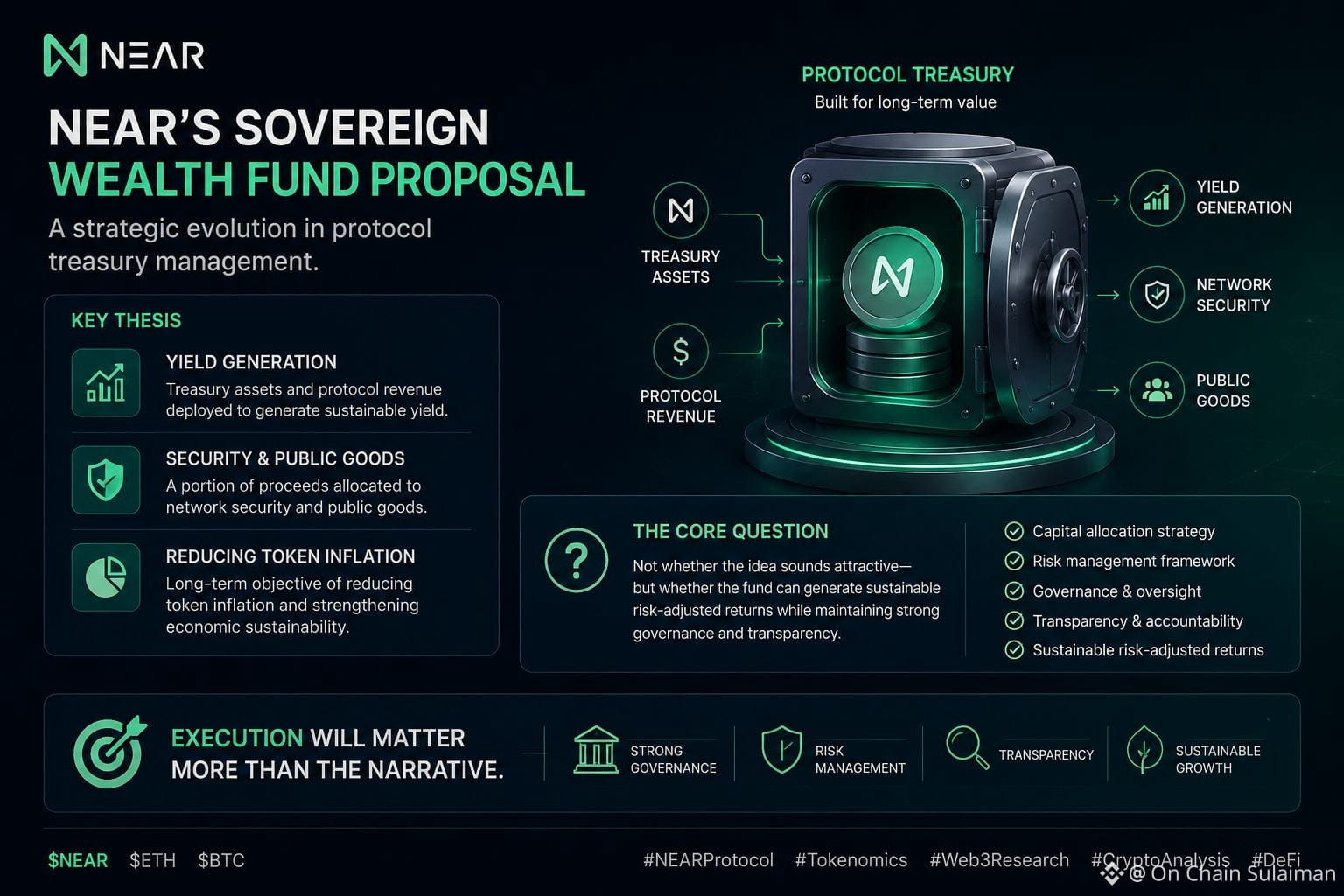
NEAR's sovereign wealth fund proposal signals a potential shift toward a more capital-efficient treasury model.
By deploying treasury assets and protocol revenue to generate yield, the framework aims to support network security, fund public goods, and potentially reduce long-term inflationary pressures.
The investment case will depend less on the headline and more on the underlying mechanics: capital allocation strategy, risk management, governance design, transparency standards, and the ability to generate sustainable risk-adjusted returns.
If executed effectively, the proposal could strengthen the long-term sustainability of NEAR's economic model.
$NEAR $ETH
#NEARProtocol #Tokenomics #Web3Research #CryptoAnalysis #DeFi
NEAR's sovereign wealth fund proposal signals a potential shift toward a more capital-efficient treasury model.
By deploying treasury assets and protocol revenue to generate yield, the framework aims to support network security, fund public goods, and potentially reduce long-term inflationary pressures.
The investment case will depend less on the headline and more on the underlying mechanics: capital allocation strategy, risk management, governance design, transparency standards, and the ability to generate sustainable risk-adjusted returns.
If executed effectively, the proposal could strengthen the long-term sustainability of NEAR's economic model.
$NEAR $ETH
#NEARProtocol #Tokenomics #Web3Research #CryptoAnalysis #DeFi
By deploying treasury assets and protocol revenue to generate yield, the framework aims to support network security, fund public goods, and potentially reduce long-term inflationary pressures.
The investment case will depend less on the headline and more on the underlying mechanics: capital allocation strategy, risk management, governance design, transparency standards, and the ability to generate sustainable risk-adjusted returns.
If executed effectively, the proposal could strengthen the long-term sustainability of NEAR's economic model.
$NEAR $ETH
#NEARProtocol #Tokenomics #Web3Research #CryptoAnalysis #DeFi
3
137
·
--
🧵 **#DUSK RESEARCH 11 — Roadmap vs Reality**
Roadmaps show the future.
Researchers also look backward.
**What was promised?
What shipped?
What changed?**
Dusk’s strategy has evolved over time.
The ecosystem has increasingly focused on:
→ DuskEVM
→ Regulated trading
→ RWA infrastructure
→ Institutional markets
Strategy changes are not automatically bad.
Protocols need to adapt.
But from an investor perspective, there is another metric:
**Execution consistency.**
A roadmap is useful only when we compare expectations with delivery.
That’s why I’m not treating every announced feature as a completed product.
I want to separate:
**Planned**
from
**Built**
from
**Used**
That distinction becomes extremely important when evaluating Dusk.
Next:
**Dusk Trade.**
Is it just another RWA narrative?
Or something more?
$DUSK
{spot}(DUSKUSDT)
@Dusk_Foundation
#dusk #Web3Research #crypto #0xSignal
🧵 **#DUSK RESEARCH 11 — Roadmap vs Reality**
Roadmaps show the future.
Researchers also look backward.
**What was promised?
What shipped?
What changed?**
Dusk’s strategy has evolved over time.
The ecosystem has increasingly focused on:
→ DuskEVM
→ Regulated trading
→ RWA infrastructure
→ Institutional markets
Strategy changes are not automatically bad.
Protocols need to adapt.
But from an investor perspective, there is another metric:
**Execution consistency.**
A roadmap is useful only when we compare expectations with delivery.
That’s why I’m not treating every announced feature as a completed product.
I want to separate:
**Planned**
from
**Built**
from
**Used**
That distinction becomes extremely important when evaluating Dusk.
Next:
**Dusk Trade.**
Is it just another RWA narrative?
Or something more?
$DUSK
@Dusk
#dusk #Web3Research #crypto #0xSignal
Roadmaps show the future.
Researchers also look backward.
**What was promised?
What shipped?
What changed?**
Dusk’s strategy has evolved over time.
The ecosystem has increasingly focused on:
→ DuskEVM
→ Regulated trading
→ RWA infrastructure
→ Institutional markets
Strategy changes are not automatically bad.
Protocols need to adapt.
But from an investor perspective, there is another metric:
**Execution consistency.**
A roadmap is useful only when we compare expectations with delivery.
That’s why I’m not treating every announced feature as a completed product.
I want to separate:
**Planned**
from
**Built**
from
**Used**
That distinction becomes extremely important when evaluating Dusk.
Next:
**Dusk Trade.**
Is it just another RWA narrative?
Or something more?
$DUSK
@Dusk
#dusk #Web3Research #crypto #0xSignal
2
4
83
·
--
🧵 **#DUSK RESEARCH 7 — Privacy Isn’t the Whole Story**
Most people describe Dusk as a privacy blockchain.
But institutional finance needs something more complicated:
**Privacy + Compliance.**
Dusk’s architecture is built around the idea of keeping information private while allowing authorized disclosure when required.
That is a much more interesting proposition for regulated assets.
Public blockchain:
**Everything visible.**
Pure privacy:
**Everything hidden.**
Institutional model:
**Private by default + disclosure when required.**
But this creates another question.
**Who controls the disclosure process?**
Cryptography can protect information.
Governance determines who can access it.
That distinction matters.
Dusk may have a strong technical answer to privacy.
The governance and compliance layer deserves just as much scrutiny.
That’s where institutional privacy becomes complicated.
@Dusk_Foundation
#dusk #Privacy #0xSignal #Web3Research
🧵 **#DUSK RESEARCH 7 — Privacy Isn’t the Whole Story**
Most people describe Dusk as a privacy blockchain.
But institutional finance needs something more complicated:
**Privacy + Compliance.**
Dusk’s architecture is built around the idea of keeping information private while allowing authorized disclosure when required.
That is a much more interesting proposition for regulated assets.
Public blockchain:
**Everything visible.**
Pure privacy:
**Everything hidden.**
Institutional model:
**Private by default + disclosure when required.**
But this creates another question.
**Who controls the disclosure process?**
Cryptography can protect information.
Governance determines who can access it.
That distinction matters.
Dusk may have a strong technical answer to privacy.
The governance and compliance layer deserves just as much scrutiny.
That’s where institutional privacy becomes complicated.
@Dusk
#dusk #Privacy #0xSignal #Web3Research
Most people describe Dusk as a privacy blockchain.
But institutional finance needs something more complicated:
**Privacy + Compliance.**
Dusk’s architecture is built around the idea of keeping information private while allowing authorized disclosure when required.
That is a much more interesting proposition for regulated assets.
Public blockchain:
**Everything visible.**
Pure privacy:
**Everything hidden.**
Institutional model:
**Private by default + disclosure when required.**
But this creates another question.
**Who controls the disclosure process?**
Cryptography can protect information.
Governance determines who can access it.
That distinction matters.
Dusk may have a strong technical answer to privacy.
The governance and compliance layer deserves just as much scrutiny.
That’s where institutional privacy becomes complicated.
@Dusk
#dusk #Privacy #0xSignal #Web3Research
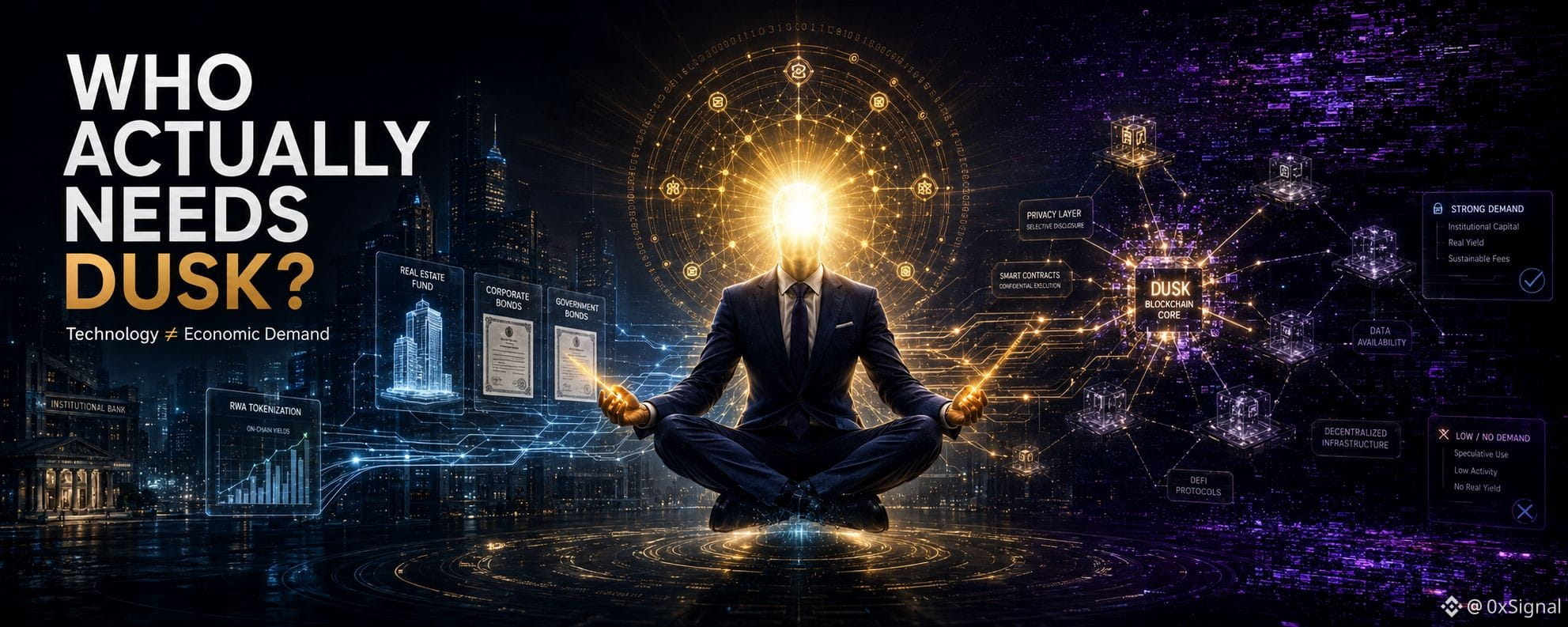
1
2
51
Article
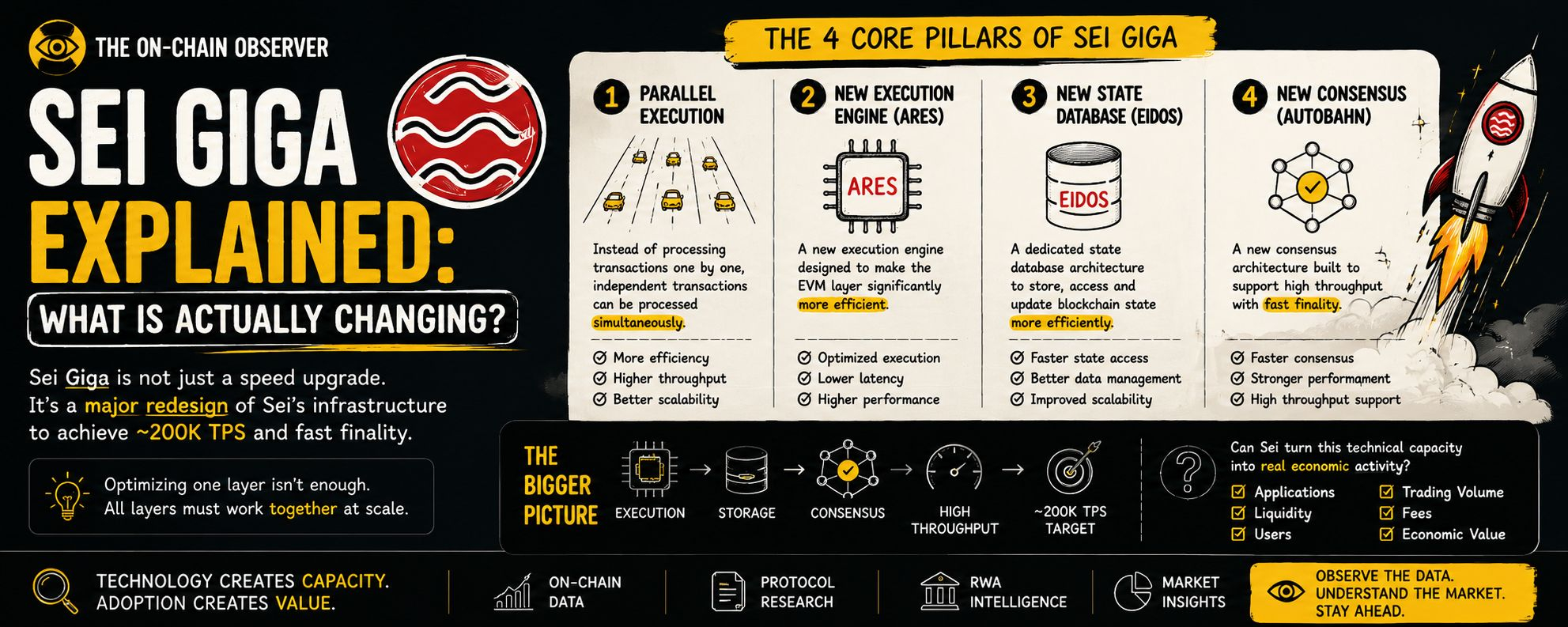
🚀 SEI Giga Explained: What Is Actually Changing?Yesterday, I asked a simple question:
SEI's 200K TPS sounds impressive—but what does it actually mean?
The important part is this:
200K TPS is a target for technical capacity.
So naturally, the next question is:
How is Sei trying to get there?
This is where Sei Giga becomes important. 👇
⚙️ What Is Sei Giga?
Giga is not simply a “speed upgrade.”
It represents a major redesign of the infrastructure underneath Sei, with the goal of making the network capable of handling much higher transaction throughput and very fast finality.
The architecture focuses on several key areas:
1️⃣ Parallel Execution
Instead of processing every transaction strictly one after another, independent transactions can be processed simultaneously.
Think of it like:
1 checkout counter ❌
vs.
Multiple checkout counters working together ✅
The goal:
More efficient execution → higher throughput.
2️⃣ A New Execution Engine
Giga introduces Ares, a new execution engine designed to improve how transactions are processed.
The objective is simple:
Make the EVM execution layer significantly more efficient.
3️⃣ A New State Database
Giga also introduces Eidos, a separate state database architecture.
Why does that matter?
Because blockchain performance isn't only about processing transactions.
The network also needs to efficiently store, access and update its state.
So Sei is looking beyond just “more TPS.”
It's optimizing the underlying infrastructure.
4️⃣ New Consensus Architecture
Giga also introduces Autobahn, part of Sei's planned consensus architecture.
The goal is to improve how the network reaches consensus while supporting much higher throughput.
In simple terms:
Execution + Storage + Consensus
all need to work efficiently.
Optimizing only one layer isn't enough if the entire system needs to operate at extreme scale.
🧠 Here's the Important Research Point
When you hear:
“SEI is targeting ~200K TPS.”
Don't immediately translate that into:
“SEI will have massive adoption.”
That's not what the number tells us.
It tells us about potential infrastructure capacity.
The bigger question remains:
Can Sei turn that technical capacity into real economic activity?
That means watching:
Applications
↓
Liquidity
↓
Users
↓
Trading Volume
↓
Fees
↓
Economic Value
🔎 This Is How I Look At Giga
I don't see Giga simply as:
“SEI wants to be faster.”
I see the thesis as:
“SEI is redesigning its infrastructure to support extremely high-performance, EVM-compatible financial applications.”
But the technology still needs to prove itself under real-world usage and economic demand.
That's where the next stage of the research gets interesting.
Technology can create capacity.
Adoption creates value.
And I'm watching the gap between the two.
👁️ Follow @SulemaOFCrypto
For more Web3 education, protocol research, on-chain data analysis, RWA intelligence and evidence-based crypto research.
Don't just follow the narrative. Observe the data.
$SUI
$SOL
#TheOnChainObserver #SEİ #Web3Research #CryptoEducation💡🚀 #Write2Earn
🚀 SEI Giga Explained: What Is Actually Changing?
Yesterday, I asked a simple question:
SEI's 200K TPS sounds impressive—but what does it actually mean?
The important part is this:
200K TPS is a target for technical capacity.
So naturally, the next question is:
How is Sei trying to get there?
This is where Sei Giga becomes important. 👇
⚙️ What Is Sei Giga?
Giga is not simply a “speed upgrade.”
It represents a major redesign of the infrastructure underneath Sei, with the goal of making the network capable of handling much higher transaction throughput and very fast finality.
The architecture focuses on several key areas:
1️⃣ Parallel Execution
Instead of processing every transaction strictly one after another, independent transactions can be processed simultaneously.
Think of it like:
1 checkout counter ❌
vs.
Multiple checkout counters working together ✅
The goal:
More efficient execution → higher throughput.
2️⃣ A New Execution Engine
Giga introduces Ares, a new execution engine designed to improve how transactions are processed.
The objective is simple:
Make the EVM execution layer significantly more efficient.
3️⃣ A New State Database
Giga also introduces Eidos, a separate state database architecture.
Why does that matter?
Because blockchain performance isn't only about processing transactions.
The network also needs to efficiently store, access and update its state.
So Sei is looking beyond just “more TPS.”
It's optimizing the underlying infrastructure.
4️⃣ New Consensus Architecture
Giga also introduces Autobahn, part of Sei's planned consensus architecture.
The goal is to improve how the network reaches consensus while supporting much higher throughput.
In simple terms:
Execution + Storage + Consensus
all need to work efficiently.
Optimizing only one layer isn't enough if the entire system needs to operate at extreme scale.
🧠 Here's the Important Research Point
When you hear:
“SEI is targeting ~200K TPS.”
Don't immediately translate that into:
“SEI will have massive adoption.”
That's not what the number tells us.
It tells us about potential infrastructure capacity.
The bigger question remains:
Can Sei turn that technical capacity into real economic activity?
That means watching:
Applications
↓
Liquidity
↓
Users
↓
Trading Volume
↓
Fees
↓
Economic Value
🔎 This Is How I Look At Giga
I don't see Giga simply as:
“SEI wants to be faster.”
I see the thesis as:
“SEI is redesigning its infrastructure to support extremely high-performance, EVM-compatible financial applications.”
But the technology still needs to prove itself under real-world usage and economic demand.
That's where the next stage of the research gets interesting.
Technology can create capacity.
Adoption creates value.
And I'm watching the gap between the two.
👁️ Follow @Sulaiman 零号猎人
For more Web3 education, protocol research, on-chain data analysis, RWA intelligence and evidence-based crypto research.
Don't just follow the narrative. Observe the data.
$SUI
$SOL
#TheOnChainObserver #SEİ #Web3Research #CryptoEducation💡🚀 #Write2Earn
SEI's 200K TPS sounds impressive—but what does it actually mean?
The important part is this:
200K TPS is a target for technical capacity.
So naturally, the next question is:
How is Sei trying to get there?
This is where Sei Giga becomes important. 👇
⚙️ What Is Sei Giga?
Giga is not simply a “speed upgrade.”
It represents a major redesign of the infrastructure underneath Sei, with the goal of making the network capable of handling much higher transaction throughput and very fast finality.
The architecture focuses on several key areas:
1️⃣ Parallel Execution
Instead of processing every transaction strictly one after another, independent transactions can be processed simultaneously.
Think of it like:
1 checkout counter ❌
vs.
Multiple checkout counters working together ✅
The goal:
More efficient execution → higher throughput.
2️⃣ A New Execution Engine
Giga introduces Ares, a new execution engine designed to improve how transactions are processed.
The objective is simple:
Make the EVM execution layer significantly more efficient.
3️⃣ A New State Database
Giga also introduces Eidos, a separate state database architecture.
Why does that matter?
Because blockchain performance isn't only about processing transactions.
The network also needs to efficiently store, access and update its state.
So Sei is looking beyond just “more TPS.”
It's optimizing the underlying infrastructure.
4️⃣ New Consensus Architecture
Giga also introduces Autobahn, part of Sei's planned consensus architecture.
The goal is to improve how the network reaches consensus while supporting much higher throughput.
In simple terms:
Execution + Storage + Consensus
all need to work efficiently.
Optimizing only one layer isn't enough if the entire system needs to operate at extreme scale.
🧠 Here's the Important Research Point
When you hear:
“SEI is targeting ~200K TPS.”
Don't immediately translate that into:
“SEI will have massive adoption.”
That's not what the number tells us.
It tells us about potential infrastructure capacity.
The bigger question remains:
Can Sei turn that technical capacity into real economic activity?
That means watching:
Applications
↓
Liquidity
↓
Users
↓
Trading Volume
↓
Fees
↓
Economic Value
🔎 This Is How I Look At Giga
I don't see Giga simply as:
“SEI wants to be faster.”
I see the thesis as:
“SEI is redesigning its infrastructure to support extremely high-performance, EVM-compatible financial applications.”
But the technology still needs to prove itself under real-world usage and economic demand.
That's where the next stage of the research gets interesting.
Technology can create capacity.
Adoption creates value.
And I'm watching the gap between the two.
👁️ Follow @Sulaiman 零号猎人
For more Web3 education, protocol research, on-chain data analysis, RWA intelligence and evidence-based crypto research.
Don't just follow the narrative. Observe the data.
$SUI
$SOL
#TheOnChainObserver #SEİ #Web3Research #CryptoEducation💡🚀 #Write2Earn
2
102
·
--
🧵 **#DUSK RESEARCH 8 — The Security Reality Check**
I don’t judge blockchain security by the number of audits alone.
I look at what happens when something actually goes wrong.
In January 2026, Dusk disclosed a compromise involving a bridge signing wallet.
Important distinction:
**It was not a Dusk consensus failure.**
It was a bridge operational security incident.
But that distinction doesn’t make the risk irrelevant.
If users move assets through a bridge, bridge security becomes part of the ecosystem’s security.
Dusk responded by redesigning and hardening parts of its bridge architecture.
That response matters.
My takeaway:
**Protocol security ≠ ecosystem security.**
For institutional finance, the attack surface includes:
→ Smart contracts
→ Bridges
→ Wallets
→ Signing infrastructure
→ Key management
The bigger the capital base becomes, the more important these layers become.
$DUSK
{future}(DUSKUSDT)
@Dusk_Foundation
#dusk #CryptoSecurity #Web3Research #0xSignal
🧵 **#DUSK RESEARCH 8 — The Security Reality Check**
I don’t judge blockchain security by the number of audits alone.
I look at what happens when something actually goes wrong.
In January 2026, Dusk disclosed a compromise involving a bridge signing wallet.
Important distinction:
**It was not a Dusk consensus failure.**
It was a bridge operational security incident.
But that distinction doesn’t make the risk irrelevant.
If users move assets through a bridge, bridge security becomes part of the ecosystem’s security.
Dusk responded by redesigning and hardening parts of its bridge architecture.
That response matters.
My takeaway:
**Protocol security ≠ ecosystem security.**
For institutional finance, the attack surface includes:
→ Smart contracts
→ Bridges
→ Wallets
→ Signing infrastructure
→ Key management
The bigger the capital base becomes, the more important these layers become.
$DUSK
@Dusk
#dusk #CryptoSecurity #Web3Research #0xSignal
I don’t judge blockchain security by the number of audits alone.
I look at what happens when something actually goes wrong.
In January 2026, Dusk disclosed a compromise involving a bridge signing wallet.
Important distinction:
**It was not a Dusk consensus failure.**
It was a bridge operational security incident.
But that distinction doesn’t make the risk irrelevant.
If users move assets through a bridge, bridge security becomes part of the ecosystem’s security.
Dusk responded by redesigning and hardening parts of its bridge architecture.
That response matters.
My takeaway:
**Protocol security ≠ ecosystem security.**
For institutional finance, the attack surface includes:
→ Smart contracts
→ Bridges
→ Wallets
→ Signing infrastructure
→ Key management
The bigger the capital base becomes, the more important these layers become.
$DUSK
@Dusk
#dusk #CryptoSecurity #Web3Research #0xSignal
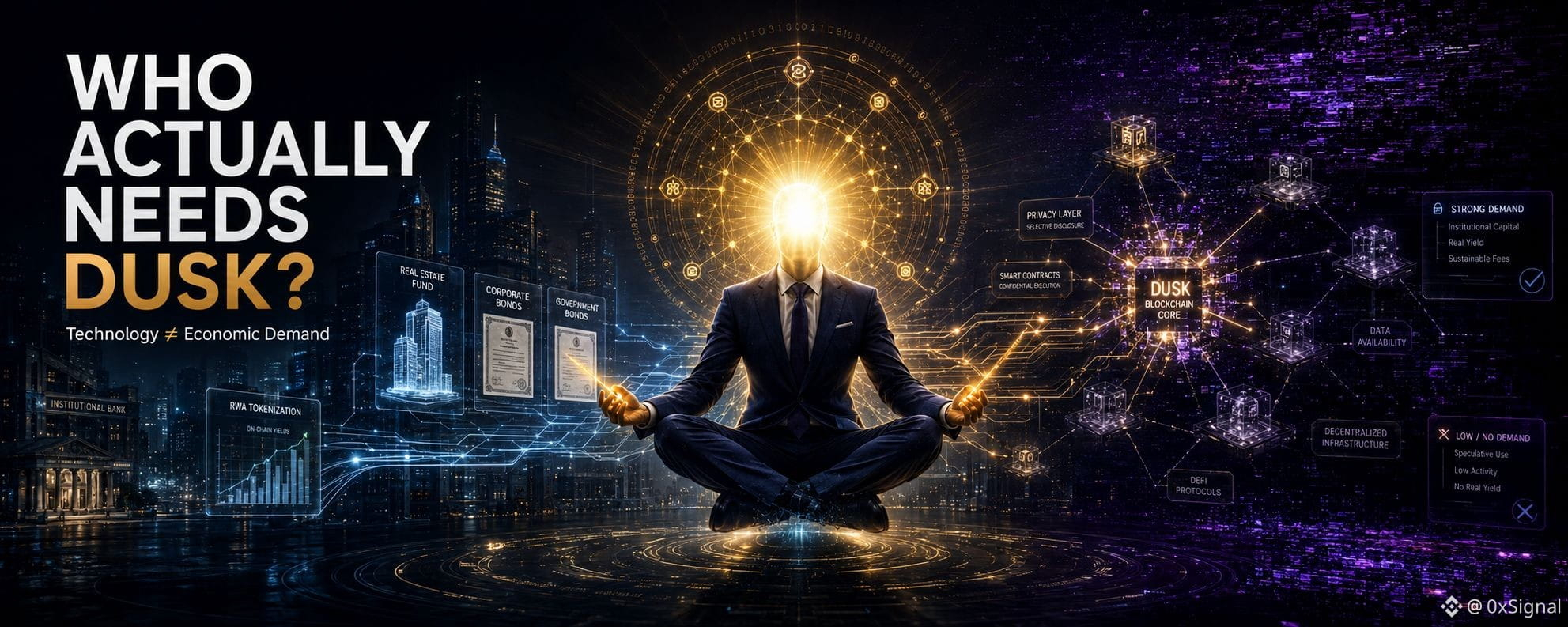
2
4
⚠️ SEI's Biggest Risk Isn't Speed. It's Adoption.
We've talked about SEI's ~200K TPS ambition and the technology behind Giga.
But here's the bigger question:
Can SEI turn technical capacity into real economic activity?
Because:
200K TPS ≠ 200K users
Fast infrastructure ≠ deep liquidity
High throughput ≠ high revenue
As a Web3 Research Analyst, I'd watch:
👥 Users
💧 Liquidity
📈 DEX Volume
💰 Fees
🏗️ Applications
The real test is simple:
Can SEI attract and sustain real users, liquidity and economic activity?
Technology creates capacity.
Adoption creates value.
👁️ Follow @SulemaOFCrypto for more educational Web3 research, on-chain data & protocol analysis.
Don't just follow the narrative. Observe the data.
#TheOnChainObserver #SEI #Web3Research #OnChainData #writetoearn
⚠️ SEI's Biggest Risk Isn't Speed. It's Adoption.
We've talked about SEI's ~200K TPS ambition and the technology behind Giga.
But here's the bigger question:
Can SEI turn technical capacity into real economic activity?
Because:
200K TPS ≠ 200K users
Fast infrastructure ≠ deep liquidity
High throughput ≠ high revenue
As a Web3 Research Analyst, I'd watch:
👥 Users
💧 Liquidity
📈 DEX Volume
💰 Fees
🏗️ Applications
The real test is simple:
Can SEI attract and sustain real users, liquidity and economic activity?
Technology creates capacity.
Adoption creates value.
👁️ Follow @Sulaiman 零号猎人 for more educational Web3 research, on-chain data & protocol analysis.
Don't just follow the narrative. Observe the data.
#TheOnChainObserver #SEI #Web3Research #OnChainData #writetoearn
We've talked about SEI's ~200K TPS ambition and the technology behind Giga.
But here's the bigger question:
Can SEI turn technical capacity into real economic activity?
Because:
200K TPS ≠ 200K users
Fast infrastructure ≠ deep liquidity
High throughput ≠ high revenue
As a Web3 Research Analyst, I'd watch:
👥 Users
💧 Liquidity
📈 DEX Volume
💰 Fees
🏗️ Applications
The real test is simple:
Can SEI attract and sustain real users, liquidity and economic activity?
Technology creates capacity.
Adoption creates value.
👁️ Follow @Sulaiman 零号猎人 for more educational Web3 research, on-chain data & protocol analysis.
Don't just follow the narrative. Observe the data.
#TheOnChainObserver #SEI #Web3Research #OnChainData #writetoearn
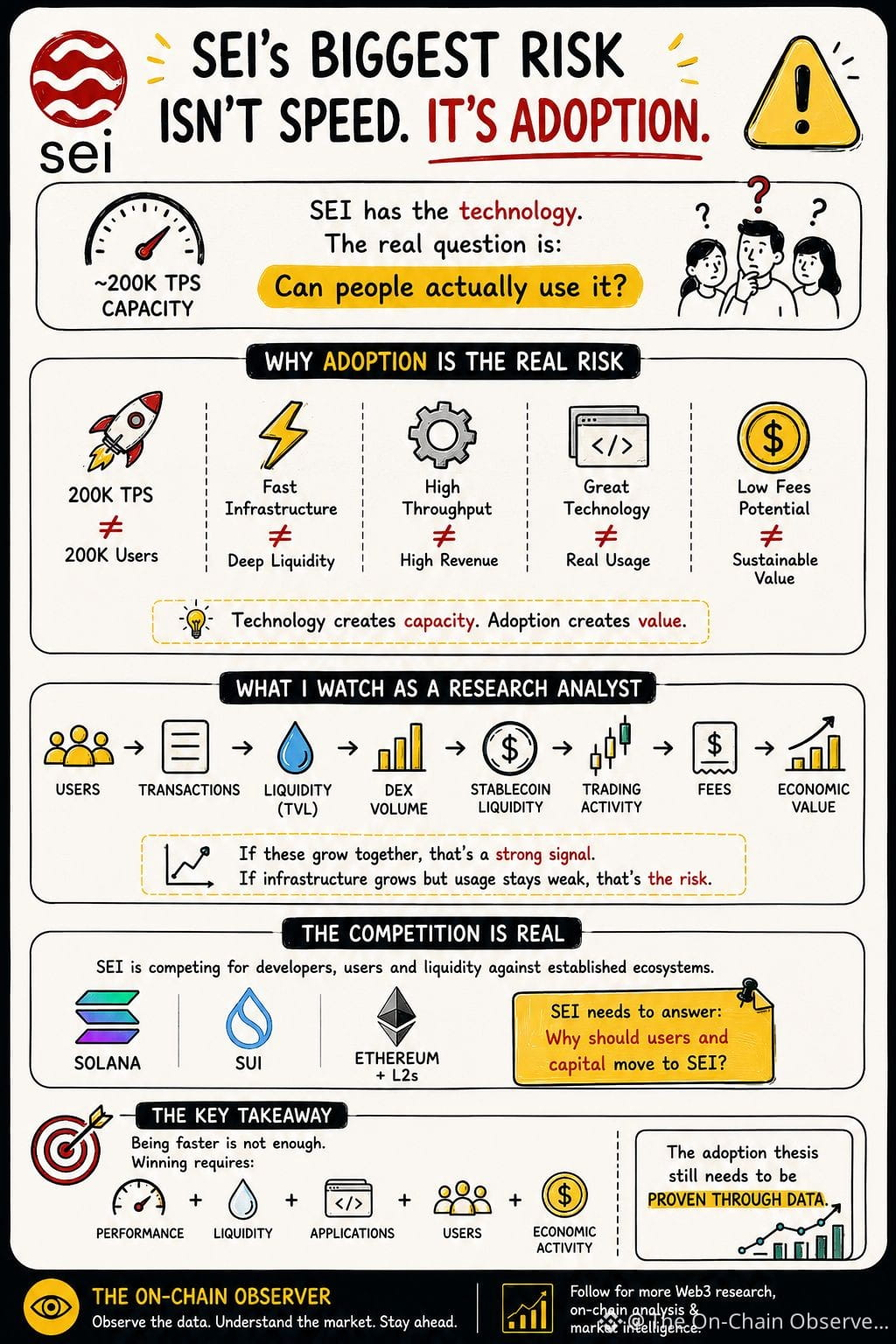
3
193
Log in to explore more content
Join global crypto users on Binance Square
⚡️ Get latest and useful information about crypto.
💬 Trusted by the world’s largest crypto exchange.
👍 Discover real insights from verified creators.
Email / Phone number
Trending Topics
1
#AIStocksWhatNext
296,926 views
2,715 Discussing
2
#BitcoinBreaksAboveMayHighNears$86K
10,984 views
164 Discussing
3
#DogecoinRises15%
33,111 views
875 Discussing
4
#$14BBitcoinOptionsExpireFriday
2,524 views
75 Discussing
5
#BNBMarketCapPassesBNYMellon
22,782 views
647 Discussing
6
#CryptoMarketCapReclaims$3Trillion
3,178 views
70 Discussing
7
#MuseOvertakesChatGPTAsTopFreeIOSApp
13,537 views
493 Discussing
8
#TokenizedStockPlatformsCouldLaunchNextQuarter
21,559 views
551 Discussing
9
#StrategyAdds950Bitcoin
26,967 views
621 Discussing
10
#CardanoAddedToX402KitForADAPayments
25,936 views
629 Discussing