

#dusk
dusk
22.5M views
426,892 Discussing
Hot
Latest

·
--
Bullish
$DUSK
{spot}(DUSKUSDT)
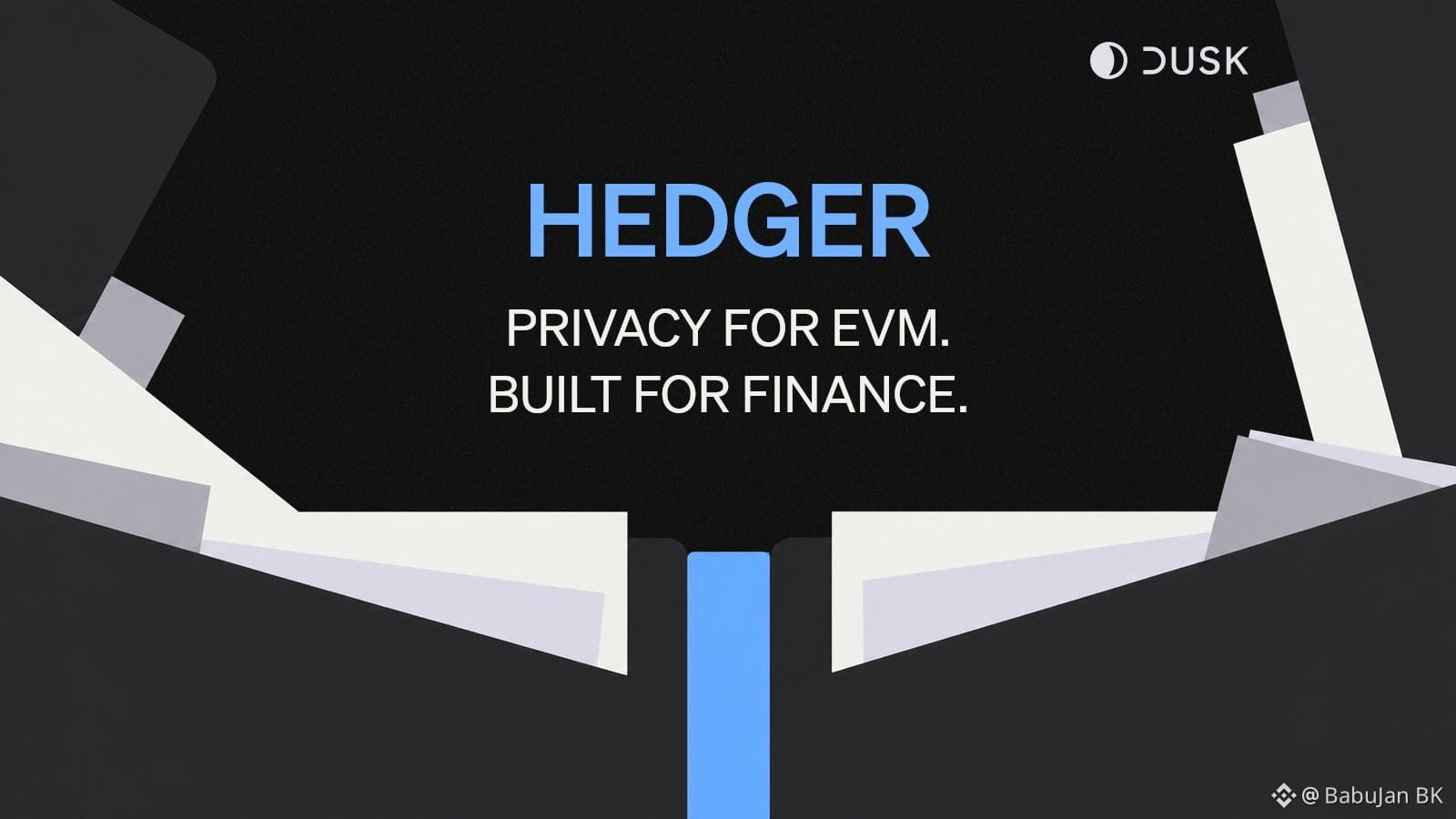
Privacy meets DeFi!
Moving assets on-chain shouldn’t mean exposing every balance to everyone.
Hedger aims to bring confidential transfers to DuskEVM keeping balances and transfer amounts encrypted while transactions remain verifiable.
Privacy + transparency, without sacrificing verification.
Could this be a major step for private on-chain finance?
What do you think about Hedger
#dusk #DuskEVM #crypto
$DUSK
Privacy meets DeFi!
Moving assets on-chain shouldn’t mean exposing every balance to everyone.
Hedger aims to bring confidential transfers to DuskEVM keeping balances and transfer amounts encrypted while transactions remain verifiable.
Privacy + transparency, without sacrificing verification.
Could this be a major step for private on-chain finance?
What do you think about Hedger
#dusk #DuskEVM #crypto
Privacy meets DeFi!
Moving assets on-chain shouldn’t mean exposing every balance to everyone.
Hedger aims to bring confidential transfers to DuskEVM keeping balances and transfer amounts encrypted while transactions remain verifiable.
Privacy + transparency, without sacrificing verification.
Could this be a major step for private on-chain finance?
What do you think about Hedger
#dusk #DuskEVM #crypto
1
109
·
--
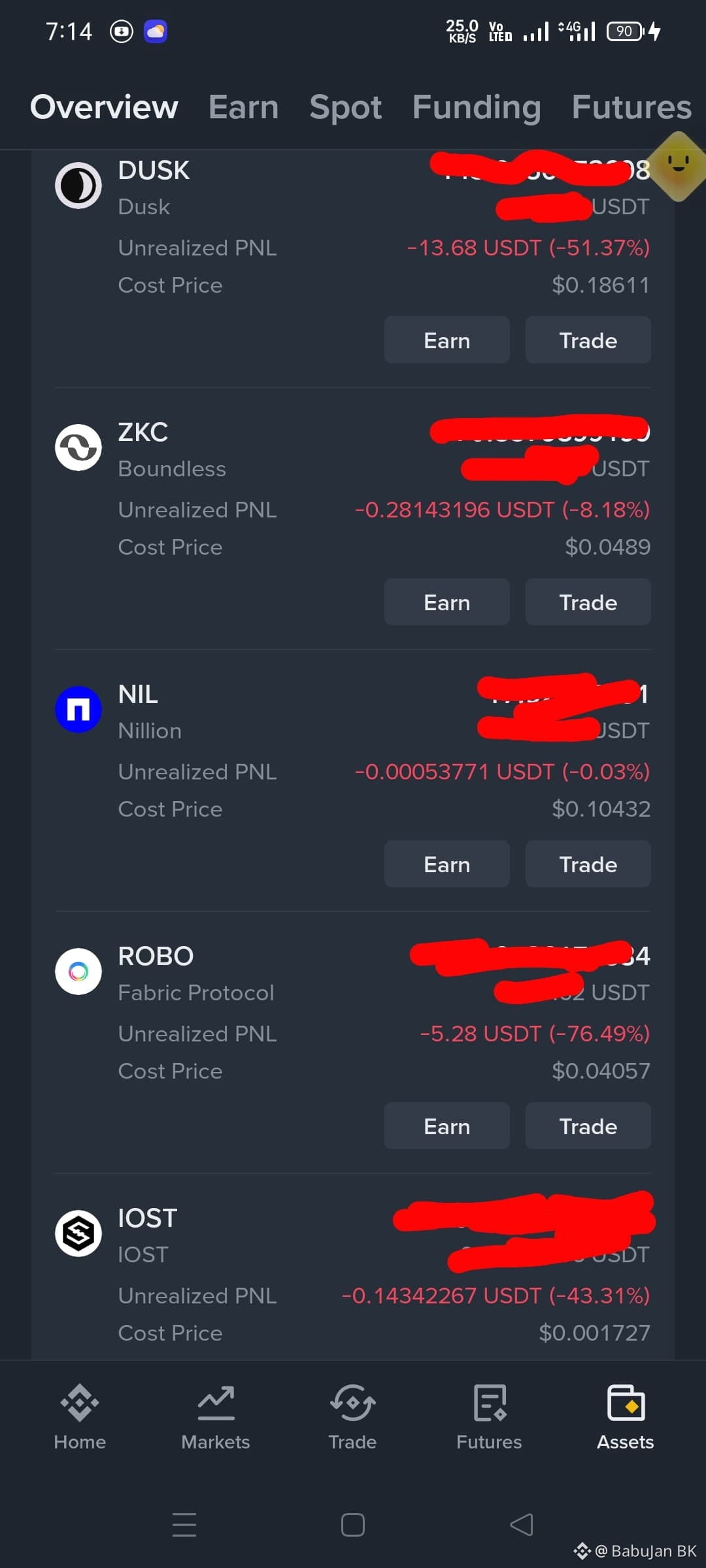
😭 My Spot Portfolio Right Now…
Sometimes crypto teaches you patience the hard way. 💔
🔴 DUSK: -51.37%
🔴 ROBO: -76.49%
🔴 IOST: -43.31%
🔴 ZKC: -8.18%
🟢 NIL: Almost Break-Even
No Futures, No Leverage — Spot only.
I’m holding with patience and managing my risk. 📊💪
Anyone else holding coins in the red? 😭
#SpotTrading #crypto #dusk #ZKC #NIL
$DUSK
{spot}(DUSKUSDT)
$ROBO
{spot}(ROBOUSDT)
$ZKC
{spot}(ZKCUSDT)
😭 My Spot Portfolio Right Now…
Sometimes crypto teaches you patience the hard way. 💔
🔴 DUSK: -51.37%
🔴 ROBO: -76.49%
🔴 IOST: -43.31%
🔴 ZKC: -8.18%
🟢 NIL: Almost Break-Even
No Futures, No Leverage — Spot only.
I’m holding with patience and managing my risk. 📊💪
Anyone else holding coins in the red? 😭
#SpotTrading #crypto #dusk #ZKC #NIL
$DUSK
$ROBO
$ZKC
Sometimes crypto teaches you patience the hard way. 💔
🔴 DUSK: -51.37%
🔴 ROBO: -76.49%
🔴 IOST: -43.31%
🔴 ZKC: -8.18%
🟢 NIL: Almost Break-Even
No Futures, No Leverage — Spot only.
I’m holding with patience and managing my risk. 📊💪
Anyone else holding coins in the red? 😭
#SpotTrading #crypto #dusk #ZKC #NIL
$DUSK
$ROBO
$ZKC
1
10

👑 EXCLUSIVE MASTER SIGNAL 👑
Thousands trust this system for a reason. Follow the exact levels and protect your bag.
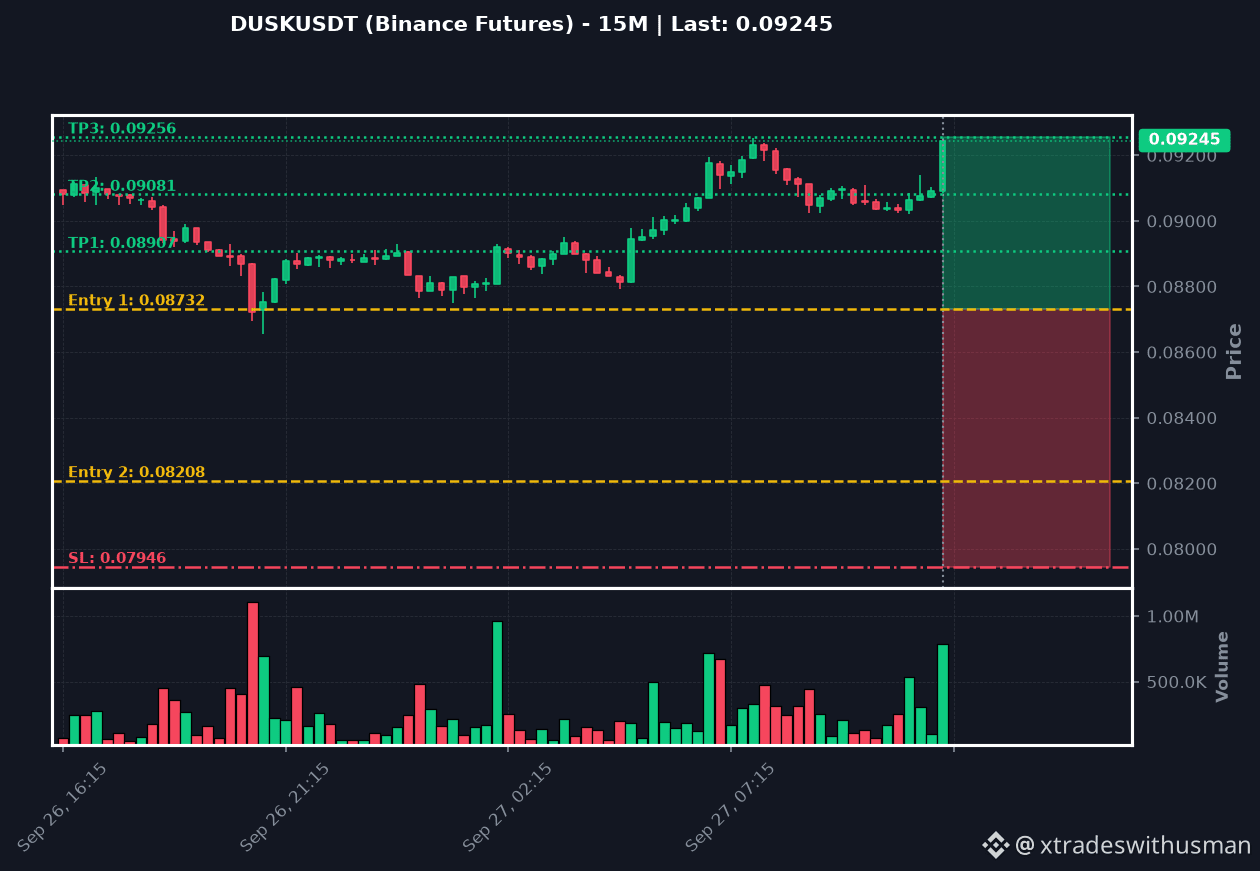
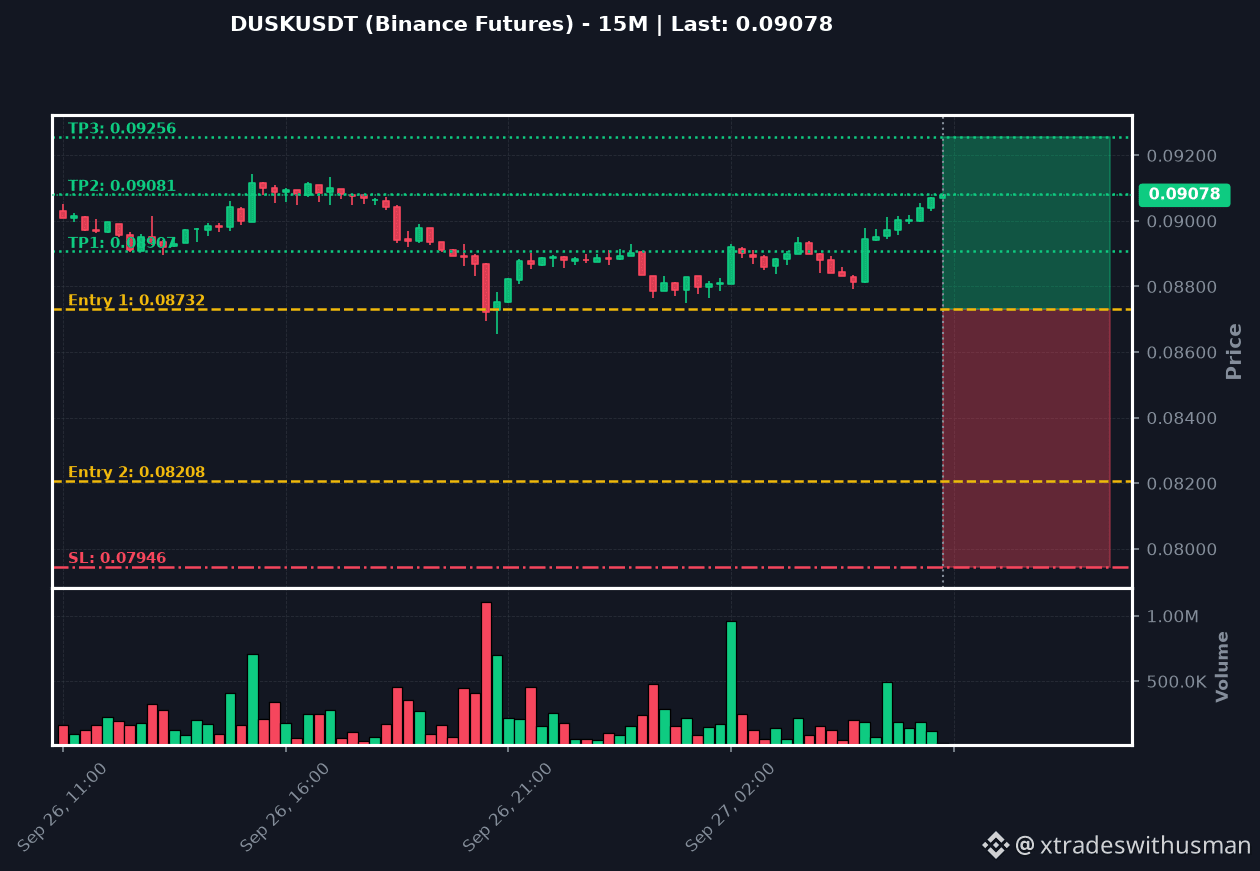
$DUSK (15m)
📌 STATUS: LONG 🚀
👉 Entry 1: 0.08732
👉 Entry 2: 0.08208
🎯 TP 1: 0.08907
🎯 TP 2: 0.09081
🎯 TP 3: 0.09256
⛔ Stop Loss: 0.0794612
⚡ Leverage: Cross 20x
👇 Set your orders now and stay patient!
🧠 Smart traders control risk; greedy traders blow accounts. Stick to our rules and we win together.
#Write2Earn #Binance #BTC #TrendingTopic #DUSK
👑 EXCLUSIVE MASTER SIGNAL 👑
Thousands trust this system for a reason. Follow the exact levels and protect your bag.
$DUSK (15m)
📌 STATUS: LONG 🚀
👉 Entry 1: 0.08732
👉 Entry 2: 0.08208
🎯 TP 1: 0.08907
🎯 TP 2: 0.09081
🎯 TP 3: 0.09256
⛔ Stop Loss: 0.0794612
⚡ Leverage: Cross 20x
👇 Set your orders now and stay patient!
🧠 Smart traders control risk; greedy traders blow accounts. Stick to our rules and we win together.
#Write2Earn #Binance #BTC #TrendingTopic #DUSK
Thousands trust this system for a reason. Follow the exact levels and protect your bag.
$DUSK (15m)
📌 STATUS: LONG 🚀
👉 Entry 1: 0.08732
👉 Entry 2: 0.08208
🎯 TP 1: 0.08907
🎯 TP 2: 0.09081
🎯 TP 3: 0.09256
⛔ Stop Loss: 0.0794612
⚡ Leverage: Cross 20x
👇 Set your orders now and stay patient!
🧠 Smart traders control risk; greedy traders blow accounts. Stick to our rules and we win together.
#Write2Earn #Binance #BTC #TrendingTopic #DUSK

·
--
Web3 needs more than speed. It needs privacy people can trust. 🔐
@Dusk is working on a blockchain environment where confidential transactions and compliance can coexist. That combination could make privacy-focused digital assets much more practical for real-world use.
Watching $DUSK closely. 👀
#dusk
Web3 needs more than speed. It needs privacy people can trust. 🔐
@Dusk is working on a blockchain environment where confidential transactions and compliance can coexist. That combination could make privacy-focused digital assets much more practical for real-world use.
Watching $DUSK closely. 👀
#dusk
@Dusk is working on a blockchain environment where confidential transactions and compliance can coexist. That combination could make privacy-focused digital assets much more practical for real-world use.
Watching $DUSK closely. 👀
#dusk
136
#dusk
💎 **VIP LONG-TERM SIGNAL — DUSK/USDT** 💎
🟢 **Action:** BUY / ACCUMULATE DUSK
⏳ **Holding Period:** ~2 Months
🎯 **Strategy:** Spot Hold
📈 **Bias:** Long-Term Bullish
⚠️ **Risk Management:** Avoid overexposure and be prepared for short-term volatility and pullbacks during the holding period.
🔥 **VIP CALL:** Accumulate patiently — **don’t chase sudden pumps.**
**Trade with a plan. Hold with discipline.** 💎📊
#dusk
💎 **VIP LONG-TERM SIGNAL — DUSK/USDT** 💎
🟢 **Action:** BUY / ACCUMULATE DUSK
⏳ **Holding Period:** ~2 Months
🎯 **Strategy:** Spot Hold
📈 **Bias:** Long-Term Bullish
⚠️ **Risk Management:** Avoid overexposure and be prepared for short-term volatility and pullbacks during the holding period.
🔥 **VIP CALL:** Accumulate patiently — **don’t chase sudden pumps.**
**Trade with a plan. Hold with discipline.** 💎📊
💎 **VIP LONG-TERM SIGNAL — DUSK/USDT** 💎
🟢 **Action:** BUY / ACCUMULATE DUSK
⏳ **Holding Period:** ~2 Months
🎯 **Strategy:** Spot Hold
📈 **Bias:** Long-Term Bullish
⚠️ **Risk Management:** Avoid overexposure and be prepared for short-term volatility and pullbacks during the holding period.
🔥 **VIP CALL:** Accumulate patiently — **don’t chase sudden pumps.**
**Trade with a plan. Hold with discipline.** 💎📊
130
🚀 FAMILY WEALTH BUILDER 🚀
Another clean chart, another high-reward opportunity. Trust the algorithm and execute.
$DUSK (15m)
📌 STATUS: LONG 🚀
👉 Entry 1: 0.08732
👉 Entry 2: 0.08208
🎯 TP 1: 0.08907
🎯 TP 2: 0.09081
🎯 TP 3: 0.09256
⛔ Stop Loss: 0.0794612
⚡ Leverage: Cross 20x
👇 Set your orders now and stay patient!
🤝 Your trust is our greatest asset. Always respect the Stop Loss to protect our community capital.
#Write2Earn #Binance #BTC #TrendingTopic #DUSK
🚀 FAMILY WEALTH BUILDER 🚀
Another clean chart, another high-reward opportunity. Trust the algorithm and execute.
$DUSK (15m)
📌 STATUS: LONG 🚀
👉 Entry 1: 0.08732
👉 Entry 2: 0.08208
🎯 TP 1: 0.08907
🎯 TP 2: 0.09081
🎯 TP 3: 0.09256
⛔ Stop Loss: 0.0794612
⚡ Leverage: Cross 20x
👇 Set your orders now and stay patient!
🤝 Your trust is our greatest asset. Always respect the Stop Loss to protect our community capital.
#Write2Earn #Binance #BTC #TrendingTopic #DUSK
Another clean chart, another high-reward opportunity. Trust the algorithm and execute.
$DUSK (15m)
📌 STATUS: LONG 🚀
👉 Entry 1: 0.08732
👉 Entry 2: 0.08208
🎯 TP 1: 0.08907
🎯 TP 2: 0.09081
🎯 TP 3: 0.09256
⛔ Stop Loss: 0.0794612
⚡ Leverage: Cross 20x
👇 Set your orders now and stay patient!
🤝 Your trust is our greatest asset. Always respect the Stop Loss to protect our community capital.
#Write2Earn #Binance #BTC #TrendingTopic #DUSK

·
--
Bullish
Ever heard of $DUSK
{spot}(DUSKUSDT)
?
It’s a blockchain project focused on privacy and financial-market infrastructure, particularly around real-world assets.
While major cryptocurrencies dominate social media, smaller infrastructure projects are quietly building different pieces of the blockchain economy.
But remember: low visibility doesn’t mean low risk. DYOR before investing. 🔎
#CryptoNews #dusk #blockchain #RWA #altcoins
Ever heard of $DUSK
?
It’s a blockchain project focused on privacy and financial-market infrastructure, particularly around real-world assets.
While major cryptocurrencies dominate social media, smaller infrastructure projects are quietly building different pieces of the blockchain economy.
But remember: low visibility doesn’t mean low risk. DYOR before investing. 🔎
#CryptoNews #dusk #blockchain #RWA #altcoins
?
It’s a blockchain project focused on privacy and financial-market infrastructure, particularly around real-world assets.
While major cryptocurrencies dominate social media, smaller infrastructure projects are quietly building different pieces of the blockchain economy.
But remember: low visibility doesn’t mean low risk. DYOR before investing. 🔎
#CryptoNews #dusk #blockchain #RWA #altcoins
1
233
·
--
🚨 $DUSK REJECTED AT CRITICAL RESISTANCE AS SELLERS CAPTURE CONTROL FOR A DEEP PULLBACK! 📉
Entry: 0.0888 - 0.0915 ⚡
Target: 0.0835 🚀
Stop Loss: 0.0935 ⚠️
📌 Sellers just slammed the door hard at the 0.0910 - 0.0920 resistance belt, leaving a heavy upper wick that signals exhausted buyer momentum. 📊 A clean break below the 0.0885 pivot line opens up a smooth slide directly into the lower support pocket down at 0.0835.
💡 Order flow is tilting heavy to the downside as momentum shifts into a clear distribution phase. 💬 Are you positioning short on this rejection or waiting for 0.0885 to crack first? 👇
⚠️ Not financial advice. Always manage your risk. 🛡️
🏷️ #DUSK #ShortSetup #Crypto #Bearish #Trading
🚨 🐻
🚨 $DUSK REJECTED AT CRITICAL RESISTANCE AS SELLERS CAPTURE CONTROL FOR A DEEP PULLBACK! 📉
Entry: 0.0888 - 0.0915 ⚡
Target: 0.0835 🚀
Stop Loss: 0.0935 ⚠️
📌 Sellers just slammed the door hard at the 0.0910 - 0.0920 resistance belt, leaving a heavy upper wick that signals exhausted buyer momentum. 📊 A clean break below the 0.0885 pivot line opens up a smooth slide directly into the lower support pocket down at 0.0835.
💡 Order flow is tilting heavy to the downside as momentum shifts into a clear distribution phase. 💬 Are you positioning short on this rejection or waiting for 0.0885 to crack first? 👇
⚠️ Not financial advice. Always manage your risk. 🛡️
🏷️ #DUSK #ShortSetup #Crypto #Bearish #Trading
🚨 🐻
Entry: 0.0888 - 0.0915 ⚡
Target: 0.0835 🚀
Stop Loss: 0.0935 ⚠️
📌 Sellers just slammed the door hard at the 0.0910 - 0.0920 resistance belt, leaving a heavy upper wick that signals exhausted buyer momentum. 📊 A clean break below the 0.0885 pivot line opens up a smooth slide directly into the lower support pocket down at 0.0835.
💡 Order flow is tilting heavy to the downside as momentum shifts into a clear distribution phase. 💬 Are you positioning short on this rejection or waiting for 0.0885 to crack first? 👇
⚠️ Not financial advice. Always manage your risk. 🛡️
🏷️ #DUSK #ShortSetup #Crypto #Bearish #Trading
🚨 🐻
7
·
--
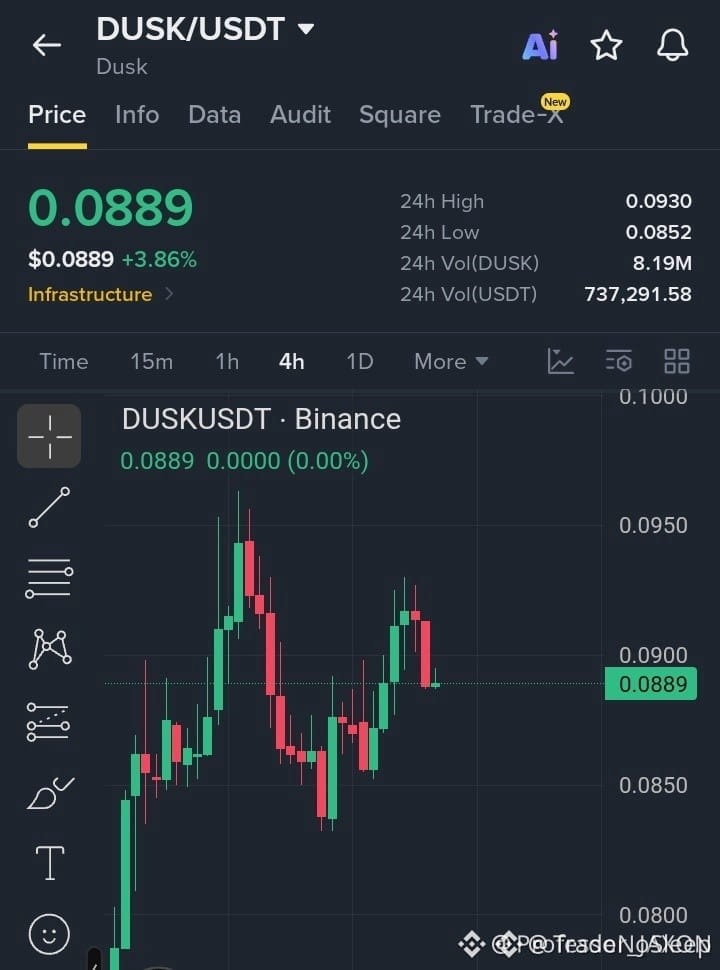
🚨 $DUSK REJECTION AT HEAVY SUPPLY ZONE SIGNALING POTENTIAL BEARISH PULLBACK 🔻
Entry: $0.0888 - $0.0915 ⚡
Target: $0.0870 - $0.0835 🎯
Stop Loss: $0.0935 ⚠️
The $0.0910–$0.0920 resistance cluster executed a clear structural rejection, signaling strong selling interest following the recent upside expansion. 📊 Price action is displaying upside exhaustion as institutional supply absorbs lingering buyer momentum.
📌 A clean drop beneath the $0.0885 pivot level will confirm market structure breakdown, opening a direct trajectory down toward lower support liquidity pool targets. 🔍 Risk remains strictly bounded above key swing high resistance to preserve strong asymmetry. 💬 Are you positioning for the breakdown now or awaiting structural confirmation below support? 👇
⚠️ Not financial advice. Always manage your risk. 🛡️
🏷️ #DUSK #ShortSetup #Crypto #Trading #MarketStructure
🎯 📉
🚨 $DUSK REJECTION AT HEAVY SUPPLY ZONE SIGNALING POTENTIAL BEARISH PULLBACK 🔻
Entry: $0.0888 - $0.0915 ⚡
Target: $0.0870 - $0.0835 🎯
Stop Loss: $0.0935 ⚠️
The $0.0910–$0.0920 resistance cluster executed a clear structural rejection, signaling strong selling interest following the recent upside expansion. 📊 Price action is displaying upside exhaustion as institutional supply absorbs lingering buyer momentum.
📌 A clean drop beneath the $0.0885 pivot level will confirm market structure breakdown, opening a direct trajectory down toward lower support liquidity pool targets. 🔍 Risk remains strictly bounded above key swing high resistance to preserve strong asymmetry. 💬 Are you positioning for the breakdown now or awaiting structural confirmation below support? 👇
⚠️ Not financial advice. Always manage your risk. 🛡️
🏷️ #DUSK #ShortSetup #Crypto #Trading #MarketStructure
🎯 📉
Entry: $0.0888 - $0.0915 ⚡
Target: $0.0870 - $0.0835 🎯
Stop Loss: $0.0935 ⚠️
The $0.0910–$0.0920 resistance cluster executed a clear structural rejection, signaling strong selling interest following the recent upside expansion. 📊 Price action is displaying upside exhaustion as institutional supply absorbs lingering buyer momentum.
📌 A clean drop beneath the $0.0885 pivot level will confirm market structure breakdown, opening a direct trajectory down toward lower support liquidity pool targets. 🔍 Risk remains strictly bounded above key swing high resistance to preserve strong asymmetry. 💬 Are you positioning for the breakdown now or awaiting structural confirmation below support? 👇
⚠️ Not financial advice. Always manage your risk. 🛡️
🏷️ #DUSK #ShortSetup #Crypto #Trading #MarketStructure
🎯 📉
1

·
--
$DUSK is at *$0.0921, up +5.50% in 24h* with ∼$55.5M market cap and ∼$6.3M volume, trading near $0.09 with 605M circulating supply.
#dusk
{spot}(DUSKUSDT)
$DUSK is at *$0.0921, up +5.50% in 24h* with ∼$55.5M market cap and ∼$6.3M volume, trading near $0.09 with 605M circulating supply.
#dusk
#dusk
84

$DUSK — KEEP THIS ONE ON YOUR RADAR
$DUSK is a privacy-focused project that I believe could deliver a $ZEC -style pump in the next major cycle. 🚀
Privacy coins are getting more attention, and #DUSK is one of the names I’m keeping on my radar.
📈 My view: #DUSK has serious upside potential and could go much higher if privacy narratives gain momentum.
Will #DUSK surprise the market next year? 👀🔥
Not financial advice. DYOR & always manage your risk. ⚠️
#DUSK #ZEC #Crypto #Privacy #Altcoins #BinanceSquare #DYOR
$DUSK — KEEP THIS ONE ON YOUR RADAR
$DUSK is a privacy-focused project that I believe could deliver a $ZEC -style pump in the next major cycle. 🚀
Privacy coins are getting more attention, and #DUSK is one of the names I’m keeping on my radar.
📈 My view: #DUSK has serious upside potential and could go much higher if privacy narratives gain momentum.
Will #DUSK surprise the market next year? 👀🔥
Not financial advice. DYOR & always manage your risk. ⚠️
#DUSK #ZEC #Crypto #Privacy #Altcoins #BinanceSquare #DYOR
$DUSK is a privacy-focused project that I believe could deliver a $ZEC -style pump in the next major cycle. 🚀
Privacy coins are getting more attention, and #DUSK is one of the names I’m keeping on my radar.
📈 My view: #DUSK has serious upside potential and could go much higher if privacy narratives gain momentum.
Will #DUSK surprise the market next year? 👀🔥
Not financial advice. DYOR & always manage your risk. ⚠️
#DUSK #ZEC #Crypto #Privacy #Altcoins #BinanceSquare #DYOR
1
57
·
--
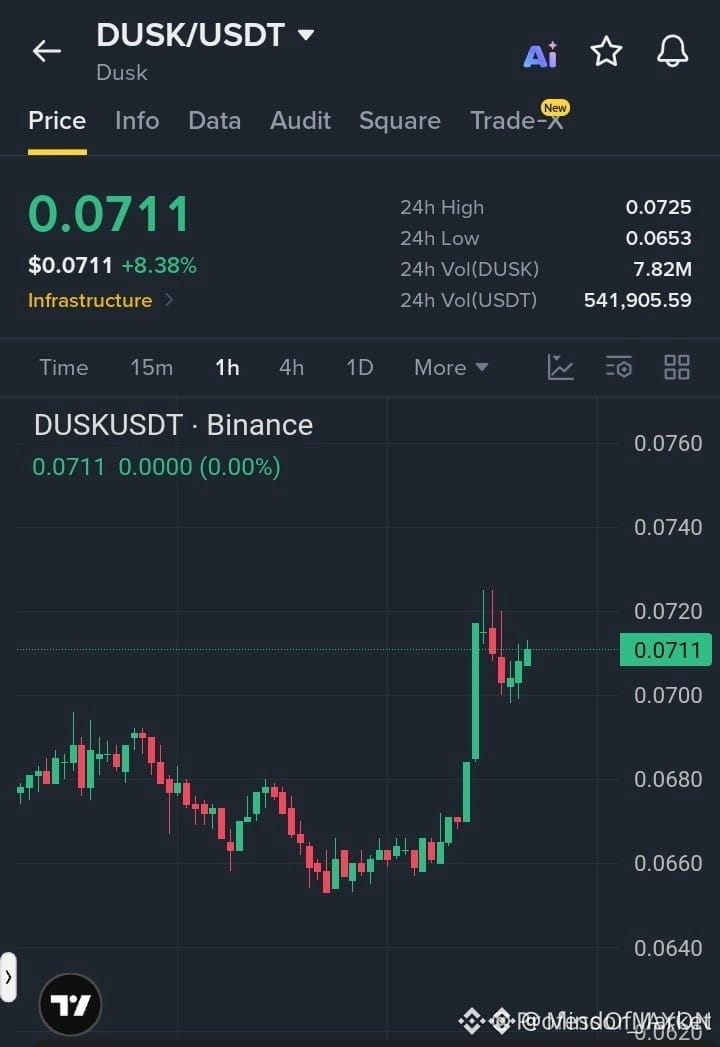
🚨 $DUSK RECLAIMS RANGE HIGH AS INSTITUTIONAL DEMAND BUILDS ABOVE KEY SUPPORT ⚡
Entry: 0.0705 - 0.0715 ⚡
Target: 0.0725 / 0.0740 / 0.0760 🚀
Stop Loss: 0.0690 ⚠️
📌 Smart money has successfully absorbed sell-side liquidity, pushing $DUSK cleanly out of its prior accumulation range. The structural pullback into the 0.0700 demand block is holding firm, confirming strong buyer defense. 📊
⚡ A decisive 4H candle close above the 0.0725 liquidity pivot will trigger a rapid inefficiency fill toward higher order blocks. Market structure heavily favors upside expansion while support remains intact. 💡
💬 Are you scaling in on this demand retest or waiting for 0.0725 to clear first? 👇
⚠️ Not financial advice. Always manage your risk. 🛡️
🏷️ #DUSK #LongSetup #MarketStructure #Breakout #Crypto
🎯 🦈
🚨 $DUSK RECLAIMS RANGE HIGH AS INSTITUTIONAL DEMAND BUILDS ABOVE KEY SUPPORT ⚡
Entry: 0.0705 - 0.0715 ⚡
Target: 0.0725 / 0.0740 / 0.0760 🚀
Stop Loss: 0.0690 ⚠️
📌 Smart money has successfully absorbed sell-side liquidity, pushing $DUSK cleanly out of its prior accumulation range. The structural pullback into the 0.0700 demand block is holding firm, confirming strong buyer defense. 📊
⚡ A decisive 4H candle close above the 0.0725 liquidity pivot will trigger a rapid inefficiency fill toward higher order blocks. Market structure heavily favors upside expansion while support remains intact. 💡
💬 Are you scaling in on this demand retest or waiting for 0.0725 to clear first? 👇
⚠️ Not financial advice. Always manage your risk. 🛡️
🏷️ #DUSK #LongSetup #MarketStructure #Breakout #Crypto
🎯 🦈
Entry: 0.0705 - 0.0715 ⚡
Target: 0.0725 / 0.0740 / 0.0760 🚀
Stop Loss: 0.0690 ⚠️
📌 Smart money has successfully absorbed sell-side liquidity, pushing $DUSK cleanly out of its prior accumulation range. The structural pullback into the 0.0700 demand block is holding firm, confirming strong buyer defense. 📊
⚡ A decisive 4H candle close above the 0.0725 liquidity pivot will trigger a rapid inefficiency fill toward higher order blocks. Market structure heavily favors upside expansion while support remains intact. 💡
💬 Are you scaling in on this demand retest or waiting for 0.0725 to clear first? 👇
⚠️ Not financial advice. Always manage your risk. 🛡️
🏷️ #DUSK #LongSetup #MarketStructure #Breakout #Crypto
🎯 🦈
4
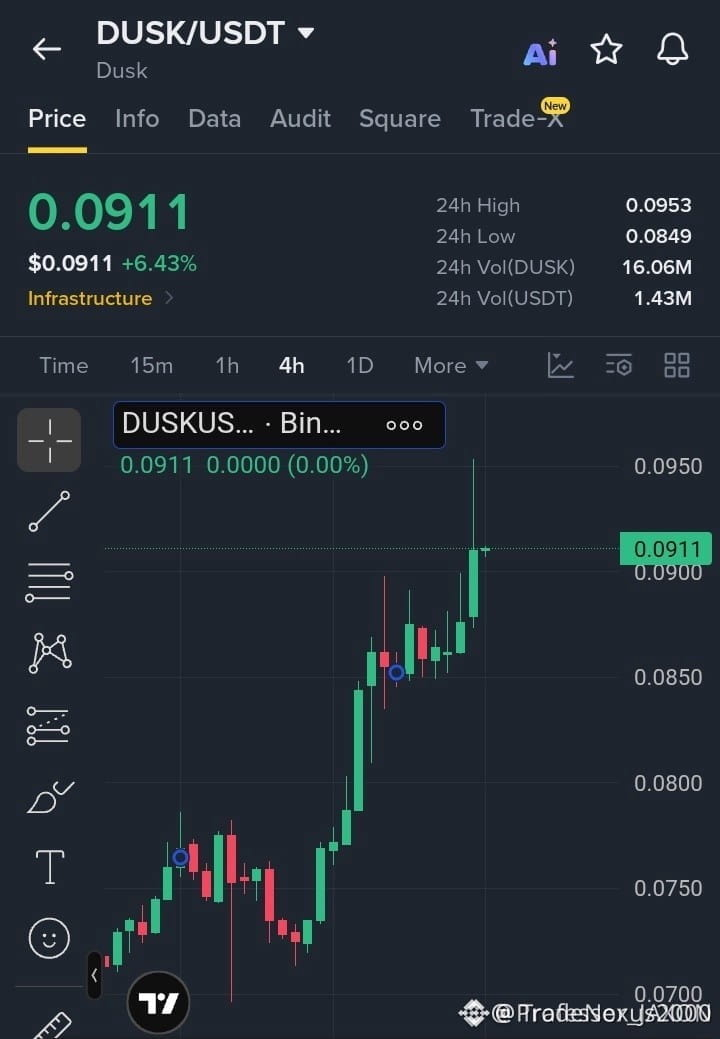
🚀 $DUSK SURGES THROUGH BREAKOUT ZONE, EYES ON 0.10+ 💥
Entry: 0.0895-0.0912 ⚡
Target: 0.0945/0.0980/0.1020 🚀
Stop Loss: 0.0868 ⚠️
The 4H chart is painting a clean higher‑high structure, with the bullish order block anchored around $0.0890‑$0.0900 acting as a springboard. 📊 Volume has been expanding as price punched through the consolidation, indicating smart‑money absorption.
Liquidity pools sit just above the $0.0950 ceiling; a decisive break will force a sweep, feeding the next thrust toward the $0.10‑$0.1020 corridor. 🌊 The current pull‑back respects the entry band, keeping risk tightly capped. 💬 Are you ready to ride this institutional push or waiting for the next liquidity hunt? 👇
⚠️ Not financial advice. Always manage your risk. 🛡️
🏷️ #DUSK #LongSetup #Breakout #Crypto
🔥 💎
🚀 $DUSK SURGES THROUGH BREAKOUT ZONE, EYES ON 0.10+ 💥
Entry: 0.0895-0.0912 ⚡
Target: 0.0945/0.0980/0.1020 🚀
Stop Loss: 0.0868 ⚠️
The 4H chart is painting a clean higher‑high structure, with the bullish order block anchored around $0.0890‑$0.0900 acting as a springboard. 📊 Volume has been expanding as price punched through the consolidation, indicating smart‑money absorption.
Liquidity pools sit just above the $0.0950 ceiling; a decisive break will force a sweep, feeding the next thrust toward the $0.10‑$0.1020 corridor. 🌊 The current pull‑back respects the entry band, keeping risk tightly capped. 💬 Are you ready to ride this institutional push or waiting for the next liquidity hunt? 👇
⚠️ Not financial advice. Always manage your risk. 🛡️
🏷️ #DUSK #LongSetup #Breakout #Crypto
🔥 💎
Entry: 0.0895-0.0912 ⚡
Target: 0.0945/0.0980/0.1020 🚀
Stop Loss: 0.0868 ⚠️
The 4H chart is painting a clean higher‑high structure, with the bullish order block anchored around $0.0890‑$0.0900 acting as a springboard. 📊 Volume has been expanding as price punched through the consolidation, indicating smart‑money absorption.
Liquidity pools sit just above the $0.0950 ceiling; a decisive break will force a sweep, feeding the next thrust toward the $0.10‑$0.1020 corridor. 🌊 The current pull‑back respects the entry band, keeping risk tightly capped. 💬 Are you ready to ride this institutional push or waiting for the next liquidity hunt? 👇
⚠️ Not financial advice. Always manage your risk. 🛡️
🏷️ #DUSK #LongSetup #Breakout #Crypto
🔥 💎
9


·
--
Partly True
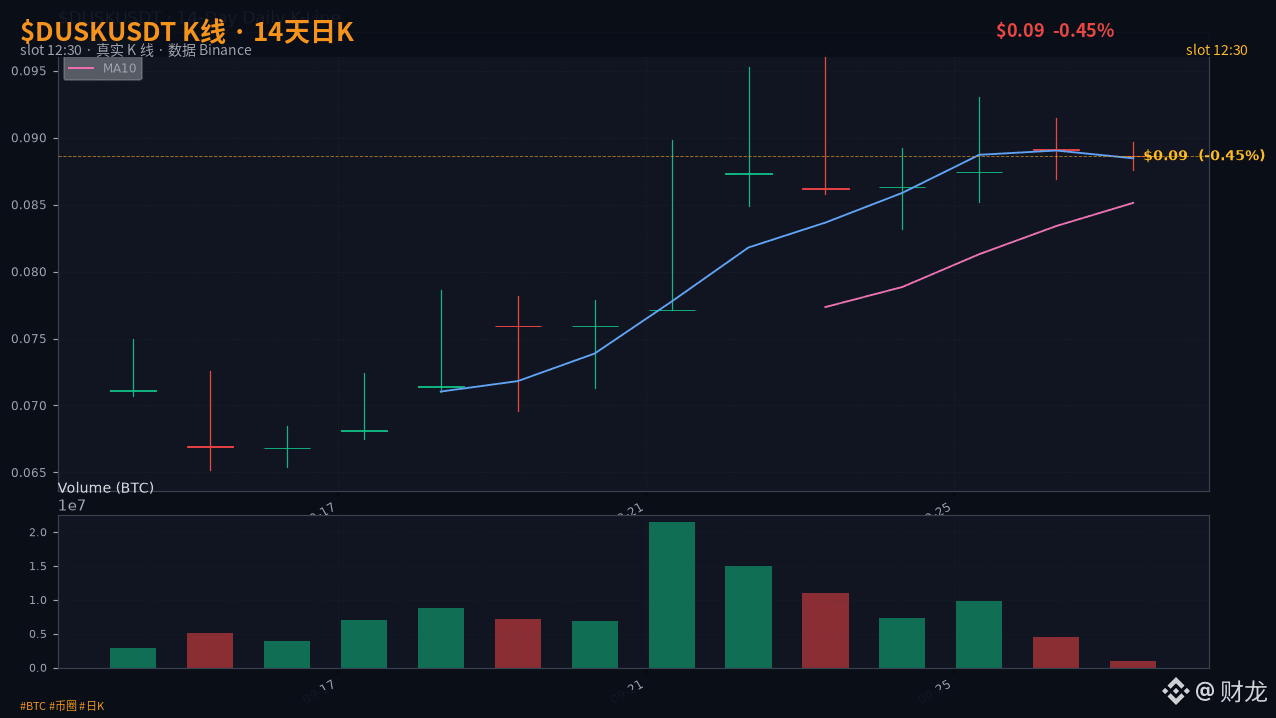
$DUSK 24 hours slight dip 0.34%, from 0.0891 down to 0.0887, the intraday high-low range is less than 5 basis points, and it’s just going sideways. But when @Dusk hasn’t had any news this week, the official documentation quietly changed the structure of the Dusk Trade chart.
In the earlier rounds, it was describing the side facing users: 6 categories of assets shown together, KYC/AML, €300M, and a simulator. However, on the official doc page, that setup buried in the lower layer is broken into 4 parts—only those 4 survive, and only then can the top-level application run.
The settlement and endgame layer feeds data availability + a public account model + a transfer-obfuscation model; nodes are written in Rust and run committee-style proof-of-stake. The Solidity execution layer feeds the application + a full EVM toolchain, and the mainnet Chain 744 has been live for 1 year. The identity layer feeds credentials + disclosure on demand. The wallet integration layer feeds account discovery + wallet connection.
Only when these four are stacked together does the whole user entry chain work: discover assets → connect wallet → eligibility verification → buy/sell → settle both the asset leg and the payment leg at the same time → report disclosure. If the bottom piece gets stuck, the top-level application shuts down immediately.
@Dusk hasn’t been featured prominently this week. In the documentation, of the 4 items in the status bar, 3 are Live + 1 is in build—that’s the answer.
#dusk #合规券商 #application layer deployment
$DUSK 24 hours slight dip 0.34%, from 0.0891 down to 0.0887, the intraday high-low range is less than 5 basis points, and it’s just going sideways. But when @Dusk hasn’t had any news this week, the official documentation quietly changed the structure of the Dusk Trade chart.
In the earlier rounds, it was describing the side facing users: 6 categories of assets shown together, KYC/AML, €300M, and a simulator. However, on the official doc page, that setup buried in the lower layer is broken into 4 parts—only those 4 survive, and only then can the top-level application run.
The settlement and endgame layer feeds data availability + a public account model + a transfer-obfuscation model; nodes are written in Rust and run committee-style proof-of-stake. The Solidity execution layer feeds the application + a full EVM toolchain, and the mainnet Chain 744 has been live for 1 year. The identity layer feeds credentials + disclosure on demand. The wallet integration layer feeds account discovery + wallet connection.
Only when these four are stacked together does the whole user entry chain work: discover assets → connect wallet → eligibility verification → buy/sell → settle both the asset leg and the payment leg at the same time → report disclosure. If the bottom piece gets stuck, the top-level application shuts down immediately.
@Dusk hasn’t been featured prominently this week. In the documentation, of the 4 items in the status bar, 3 are Live + 1 is in build—that’s the answer.
#dusk #合规券商 #application layer deployment
In the earlier rounds, it was describing the side facing users: 6 categories of assets shown together, KYC/AML, €300M, and a simulator. However, on the official doc page, that setup buried in the lower layer is broken into 4 parts—only those 4 survive, and only then can the top-level application run.
The settlement and endgame layer feeds data availability + a public account model + a transfer-obfuscation model; nodes are written in Rust and run committee-style proof-of-stake. The Solidity execution layer feeds the application + a full EVM toolchain, and the mainnet Chain 744 has been live for 1 year. The identity layer feeds credentials + disclosure on demand. The wallet integration layer feeds account discovery + wallet connection.
Only when these four are stacked together does the whole user entry chain work: discover assets → connect wallet → eligibility verification → buy/sell → settle both the asset leg and the payment leg at the same time → report disclosure. If the bottom piece gets stuck, the top-level application shuts down immediately.
@Dusk hasn’t been featured prominently this week. In the documentation, of the 4 items in the status bar, 3 are Live + 1 is in build—that’s the answer.
#dusk #合规券商 #application layer deployment
1
441
·
--
Protecting the privacy of smart contracts on public networks is essential to attract the traditional banking sector. @Dusk’s infrastructure combines zero-knowledge proofs with integrated regulatory compliance, enabling the execution of confidential and fully auditable operations. The growth of $DUSK drives the transformation of the Web3 ecosystem. #dusk
Protecting the privacy of smart contracts on public networks is essential to attract the traditional banking sector. @Dusk’s infrastructure combines zero-knowledge proofs with integrated regulatory compliance, enabling the execution of confidential and fully auditable operations. The growth of $DUSK drives the transformation of the Web3 ecosystem. #dusk
1
133
·
--
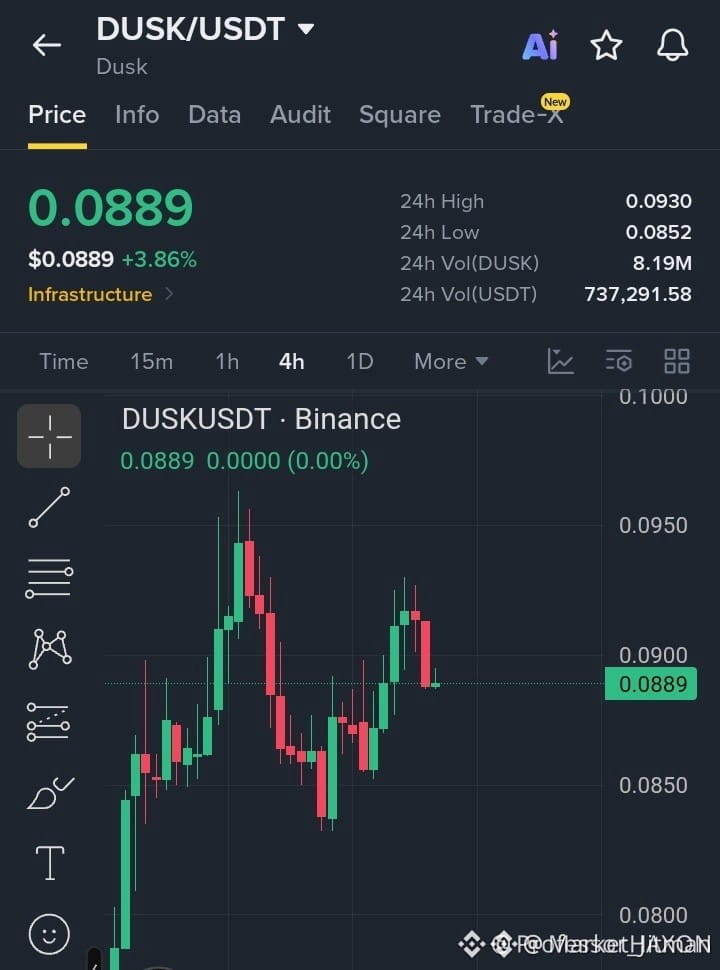
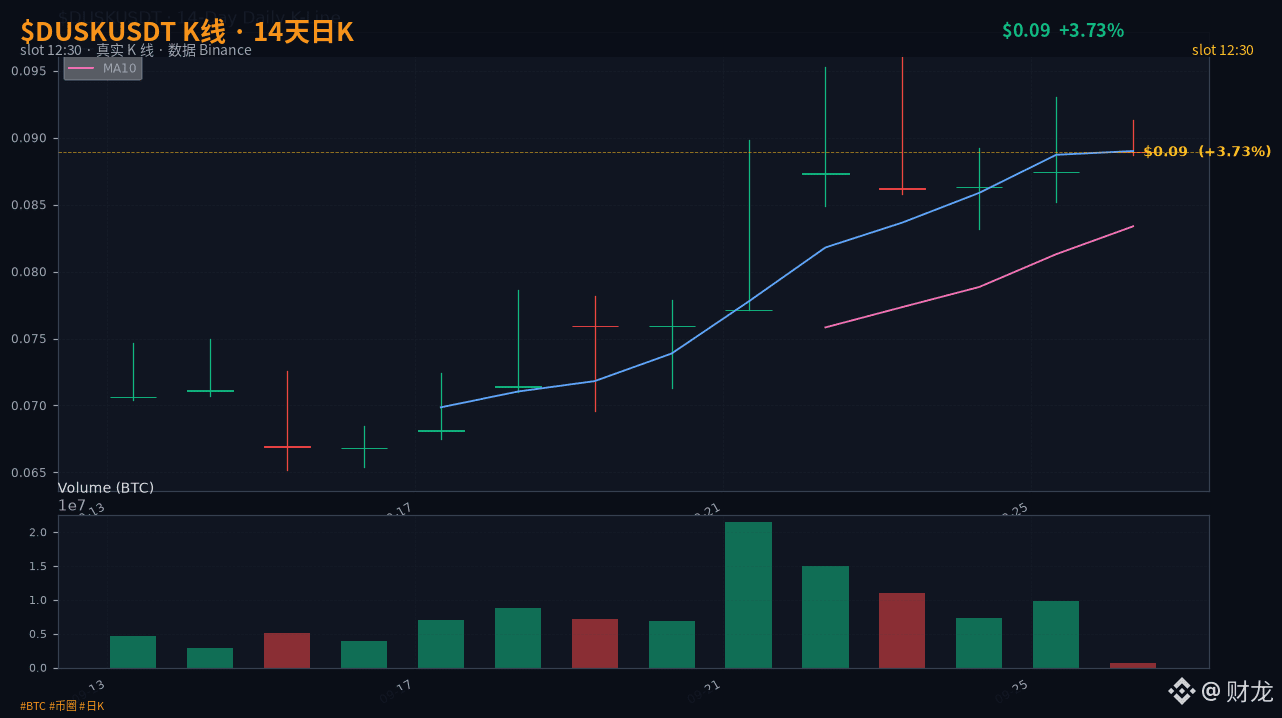
$DUSK 24 Hours surged 3.7%, moving from 0.0857 to 0.0889 USD. It also spiked intraday past 0.093 and pulled back to 0.0852—an amplitude of 9 percentage points. Not exactly calm.
But @Dusk has recently filled in both the front-end and back-end of this chain’s application stack. The front end is the new Dusk wallet plus the connection tool; keys are locally encrypted and never leave; the full suite—browser, desktop, and mobile—is released at once. The back end is a privacy engine that outputs a three-layer combo: homomorphic encryption + zero-knowledge + dual accounts. Browser proofs are compressed into 2 seconds, and the compliance side can also be opened on demand.
With the front and back end both taken care of, the question of how to write the middle contract in a compliant and secure way becomes what developers should be asking themselves.
When you make your first entry, do you prioritize privacy first, or compliance first?
#dusk #应用层落地 #Contract compliant writing
$DUSK 24 Hours surged 3.7%, moving from 0.0857 to 0.0889 USD. It also spiked intraday past 0.093 and pulled back to 0.0852—an amplitude of 9 percentage points. Not exactly calm.
But @Dusk has recently filled in both the front-end and back-end of this chain’s application stack. The front end is the new Dusk wallet plus the connection tool; keys are locally encrypted and never leave; the full suite—browser, desktop, and mobile—is released at once. The back end is a privacy engine that outputs a three-layer combo: homomorphic encryption + zero-knowledge + dual accounts. Browser proofs are compressed into 2 seconds, and the compliance side can also be opened on demand.
With the front and back end both taken care of, the question of how to write the middle contract in a compliant and secure way becomes what developers should be asking themselves.
When you make your first entry, do you prioritize privacy first, or compliance first?
#dusk #应用层落地 #Contract compliant writing
But @Dusk has recently filled in both the front-end and back-end of this chain’s application stack. The front end is the new Dusk wallet plus the connection tool; keys are locally encrypted and never leave; the full suite—browser, desktop, and mobile—is released at once. The back end is a privacy engine that outputs a three-layer combo: homomorphic encryption + zero-knowledge + dual accounts. Browser proofs are compressed into 2 seconds, and the compliance side can also be opened on demand.
With the front and back end both taken care of, the question of how to write the middle contract in a compliant and secure way becomes what developers should be asking themselves.
When you make your first entry, do you prioritize privacy first, or compliance first?
#dusk #应用层落地 #Contract compliant writing
2
317
·
--
Optimizing privacy in real asset (RWA) transactions requires protocols designed from the outset to balance anonymity with institutional transparency. ZK technology from @Dusk enables verification of the validity of financial data without exposing the underlying operational information. The role of $DUSK is key to consolidating efficient, secure decentralized markets. #dusk
Optimizing privacy in real asset (RWA) transactions requires protocols designed from the outset to balance anonymity with institutional transparency. ZK technology from @Dusk enables verification of the validity of financial data without exposing the underlying operational information. The role of $DUSK is key to consolidating efficient, secure decentralized markets. #dusk
2
195

·
--
Bullish
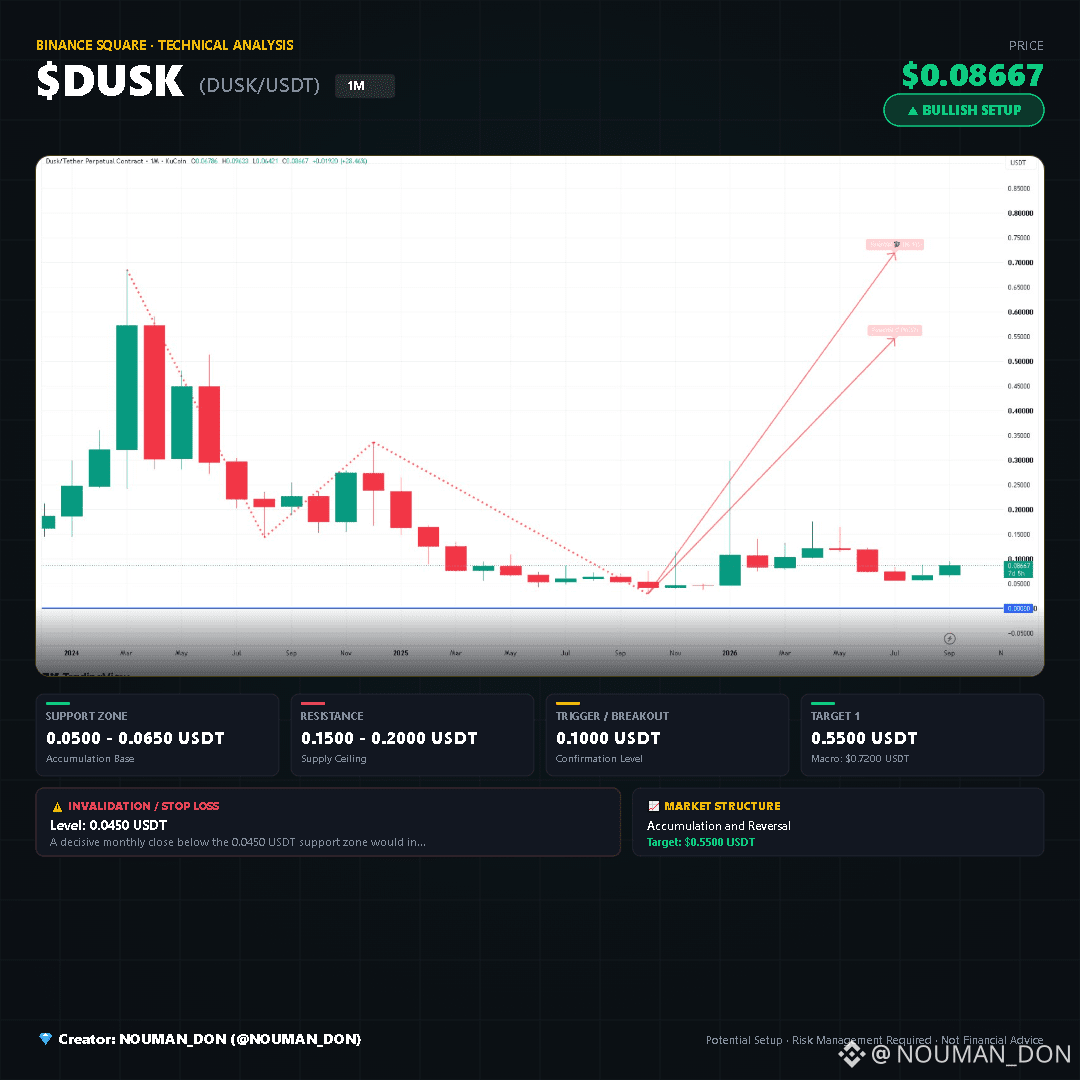
🚀 $DUSK is showing a potential technical setup!
The 1M chart for DUSK/USDT on KuCoin illustrates a prolonged downtrend followed by an extended accumulation base near historical lows, with a sharp upward projection toward higher targets.
📈 The Technical Setup:
• The Pattern: Macro Base Formation & Potential Breakout
• Short-term Target: 0.5500 USDT
• Macro Objective: 0.7200 USDT
• Market Structure: Accumulation and Reversal
🎯 Key Levels to Watch:
• Support / Accumulation Zone: 0.0500 - 0.0650 USDT
• Resistance: 0.1500 - 0.2000 USDT
• Breakout Level: 0.1000 USDT
• Stop Loss / Invalidation: 0.0450 USDT
📊 Confirmation:
• Volume: Neutral/standard volume on macro timeframe
• Momentum: Stabilizing candle structure after long downtrend
• Trend: Macro consolidation forming a potential bottom
⚠️ Invalidation:
A decisive monthly close below the 0.0450 USDT support zone would invalidate the bullish macro setup.
DUSK is forming a macro accumulation base on the 1M chart, hinting at a potential explosive recovery if key resistance and breakout levels are cleared.
💎 Creator: NOUMAN_DON (@NOUMAN_DON)
#dusk #crypto #BinanceSquare #tradingview #TechnicalAnalysis
{spot}(DUSKUSDT)
{future}(DUSKUSDT)
🚀 $DUSK is showing a potential technical setup!
The 1M chart for DUSK/USDT on KuCoin illustrates a prolonged downtrend followed by an extended accumulation base near historical lows, with a sharp upward projection toward higher targets.
📈 The Technical Setup:
• The Pattern: Macro Base Formation & Potential Breakout
• Short-term Target: 0.5500 USDT
• Macro Objective: 0.7200 USDT
• Market Structure: Accumulation and Reversal
🎯 Key Levels to Watch:
• Support / Accumulation Zone: 0.0500 - 0.0650 USDT
• Resistance: 0.1500 - 0.2000 USDT
• Breakout Level: 0.1000 USDT
• Stop Loss / Invalidation: 0.0450 USDT
📊 Confirmation:
• Volume: Neutral/standard volume on macro timeframe
• Momentum: Stabilizing candle structure after long downtrend
• Trend: Macro consolidation forming a potential bottom
⚠️ Invalidation:
A decisive monthly close below the 0.0450 USDT support zone would invalidate the bullish macro setup.
DUSK is forming a macro accumulation base on the 1M chart, hinting at a potential explosive recovery if key resistance and breakout levels are cleared.
💎 Creator: NOUMAN_DON (@NOUMAN_DON)
#dusk #crypto #BinanceSquare #tradingview #TechnicalAnalysis
The 1M chart for DUSK/USDT on KuCoin illustrates a prolonged downtrend followed by an extended accumulation base near historical lows, with a sharp upward projection toward higher targets.
📈 The Technical Setup:
• The Pattern: Macro Base Formation & Potential Breakout
• Short-term Target: 0.5500 USDT
• Macro Objective: 0.7200 USDT
• Market Structure: Accumulation and Reversal
🎯 Key Levels to Watch:
• Support / Accumulation Zone: 0.0500 - 0.0650 USDT
• Resistance: 0.1500 - 0.2000 USDT
• Breakout Level: 0.1000 USDT
• Stop Loss / Invalidation: 0.0450 USDT
📊 Confirmation:
• Volume: Neutral/standard volume on macro timeframe
• Momentum: Stabilizing candle structure after long downtrend
• Trend: Macro consolidation forming a potential bottom
⚠️ Invalidation:
A decisive monthly close below the 0.0450 USDT support zone would invalidate the bullish macro setup.
DUSK is forming a macro accumulation base on the 1M chart, hinting at a potential explosive recovery if key resistance and breakout levels are cleared.
💎 Creator: NOUMAN_DON (@NOUMAN_DON)
#dusk #crypto #BinanceSquare #tradingview #TechnicalAnalysis
1
34
·
--
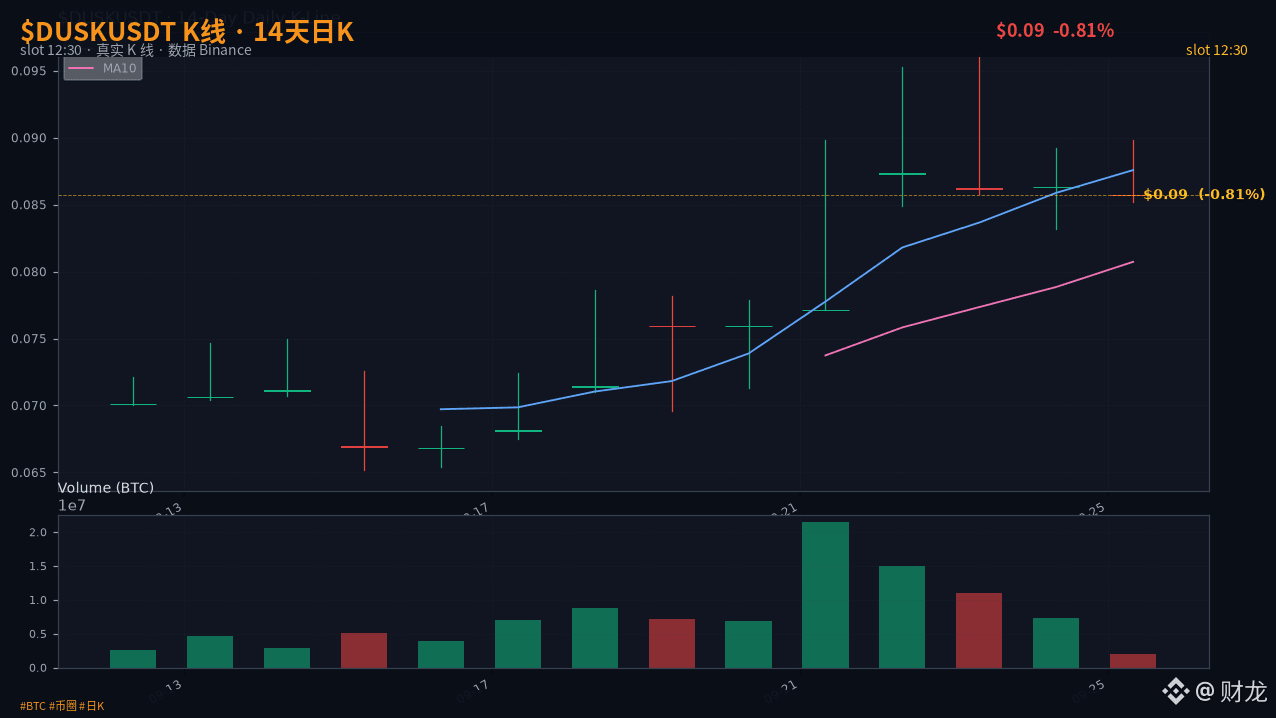
$DUSK 24 Hourly Slight Dip 1.04%, down from 0.0861 to 0.0855 over the day; the intraday high-low spread is less than 7 basis points. The K-line looks like it’s going nowhere. But @Dusk’s document portal quietly added a page last month, explaining exactly how RWA work gets done—an six-step pipeline, and not a single step can be skipped.
Step one is called “Asset Onboarding.” Issuers must clearly write the asset itself on-chain, who is allowed to buy it, and how the entire lifecycle will proceed. Step two is “Investor Entry.” The wallet must be firmly bound to a real identity—compliance KYC is directly baked into the address. Step three is “Transfer Control.” Not everyone can hold the asset; the flow of assets is locked by rules. Step four is “Matched Trading.” Orders, transfers, and settlement conditions run within the same atomic action. Step five is “True Settlement.” The cash leg and the asset leg land at the same time—no reconciliation tricks. Step six is “Services and Disclosure.” Financial reporting disclosures and regulatory checks must be shown to the right parties; with selective disclosure, you open what needs to be opened to whom it should go.
Where does traditional RWA get stuck? Each step lives in a different system: exchanges, then clearinghouses, then custodians, and then yet another layer for regulatory reporting. In the middle it all relies on an Excel bridge. What @Dusk is doing is compressing these six steps onto a single chain—asset data, investor identities, transfer rules, and compliant reporting all synchronize on DuskDS. Solidity apps run on DuskEVM; contracts that require deeper protocol-level control (like Rust/WASM) run on DuskVM. The cryptographic interfaces for identity and selective disclosure are left to Citadel. And Dusk Trade turns the six steps into three product-level actions on the interface: “Investor entry, place order, and settlement.”
Compared with earlier generations of RWA, this chain isn’t about a “tokenized wrapper.” It’s “native issuance”: from day one, the asset lives on-chain—no step of “existing off-chain first, then wrapping it with a token.” Put it into practice: T+0 settlement, a 24/7 secondary market, and MiFID II + MiCA compliance are encoded into the protocol layer. Issuers no longer need to build separate engineering for every single rule.
That 8–15 SME article already explains why even small and medium-sized enterprises must be able to use this chain. The 9–15 interoperability article spells out the cross-chain RWA seams. Today’s docs page gives you the exact six-step method—“how it works.” Next time an institution says “we’re on-chain,” you can simply ask: For your six steps, which layer does each step land in?
#dusk #原生发行 #RWA六步流水线 #Compliance on-chain chain
$DUSK 24 Hourly Slight Dip 1.04%, down from 0.0861 to 0.0855 over the day; the intraday high-low spread is less than 7 basis points. The K-line looks like it’s going nowhere. But @Dusk’s document portal quietly added a page last month, explaining exactly how RWA work gets done—an six-step pipeline, and not a single step can be skipped.
Step one is called “Asset Onboarding.” Issuers must clearly write the asset itself on-chain, who is allowed to buy it, and how the entire lifecycle will proceed. Step two is “Investor Entry.” The wallet must be firmly bound to a real identity—compliance KYC is directly baked into the address. Step three is “Transfer Control.” Not everyone can hold the asset; the flow of assets is locked by rules. Step four is “Matched Trading.” Orders, transfers, and settlement conditions run within the same atomic action. Step five is “True Settlement.” The cash leg and the asset leg land at the same time—no reconciliation tricks. Step six is “Services and Disclosure.” Financial reporting disclosures and regulatory checks must be shown to the right parties; with selective disclosure, you open what needs to be opened to whom it should go.
Where does traditional RWA get stuck? Each step lives in a different system: exchanges, then clearinghouses, then custodians, and then yet another layer for regulatory reporting. In the middle it all relies on an Excel bridge. What @Dusk is doing is compressing these six steps onto a single chain—asset data, investor identities, transfer rules, and compliant reporting all synchronize on DuskDS. Solidity apps run on DuskEVM; contracts that require deeper protocol-level control (like Rust/WASM) run on DuskVM. The cryptographic interfaces for identity and selective disclosure are left to Citadel. And Dusk Trade turns the six steps into three product-level actions on the interface: “Investor entry, place order, and settlement.”
Compared with earlier generations of RWA, this chain isn’t about a “tokenized wrapper.” It’s “native issuance”: from day one, the asset lives on-chain—no step of “existing off-chain first, then wrapping it with a token.” Put it into practice: T+0 settlement, a 24/7 secondary market, and MiFID II + MiCA compliance are encoded into the protocol layer. Issuers no longer need to build separate engineering for every single rule.
That 8–15 SME article already explains why even small and medium-sized enterprises must be able to use this chain. The 9–15 interoperability article spells out the cross-chain RWA seams. Today’s docs page gives you the exact six-step method—“how it works.” Next time an institution says “we’re on-chain,” you can simply ask: For your six steps, which layer does each step land in?
#dusk #原生发行 #RWA六步流水线 #Compliance on-chain chain
Step one is called “Asset Onboarding.” Issuers must clearly write the asset itself on-chain, who is allowed to buy it, and how the entire lifecycle will proceed. Step two is “Investor Entry.” The wallet must be firmly bound to a real identity—compliance KYC is directly baked into the address. Step three is “Transfer Control.” Not everyone can hold the asset; the flow of assets is locked by rules. Step four is “Matched Trading.” Orders, transfers, and settlement conditions run within the same atomic action. Step five is “True Settlement.” The cash leg and the asset leg land at the same time—no reconciliation tricks. Step six is “Services and Disclosure.” Financial reporting disclosures and regulatory checks must be shown to the right parties; with selective disclosure, you open what needs to be opened to whom it should go.
Where does traditional RWA get stuck? Each step lives in a different system: exchanges, then clearinghouses, then custodians, and then yet another layer for regulatory reporting. In the middle it all relies on an Excel bridge. What @Dusk is doing is compressing these six steps onto a single chain—asset data, investor identities, transfer rules, and compliant reporting all synchronize on DuskDS. Solidity apps run on DuskEVM; contracts that require deeper protocol-level control (like Rust/WASM) run on DuskVM. The cryptographic interfaces for identity and selective disclosure are left to Citadel. And Dusk Trade turns the six steps into three product-level actions on the interface: “Investor entry, place order, and settlement.”
Compared with earlier generations of RWA, this chain isn’t about a “tokenized wrapper.” It’s “native issuance”: from day one, the asset lives on-chain—no step of “existing off-chain first, then wrapping it with a token.” Put it into practice: T+0 settlement, a 24/7 secondary market, and MiFID II + MiCA compliance are encoded into the protocol layer. Issuers no longer need to build separate engineering for every single rule.
That 8–15 SME article already explains why even small and medium-sized enterprises must be able to use this chain. The 9–15 interoperability article spells out the cross-chain RWA seams. Today’s docs page gives you the exact six-step method—“how it works.” Next time an institution says “we’re on-chain,” you can simply ask: For your six steps, which layer does each step land in?
#dusk #原生发行 #RWA六步流水线 #Compliance on-chain chain
1
711

·
--
Bullish
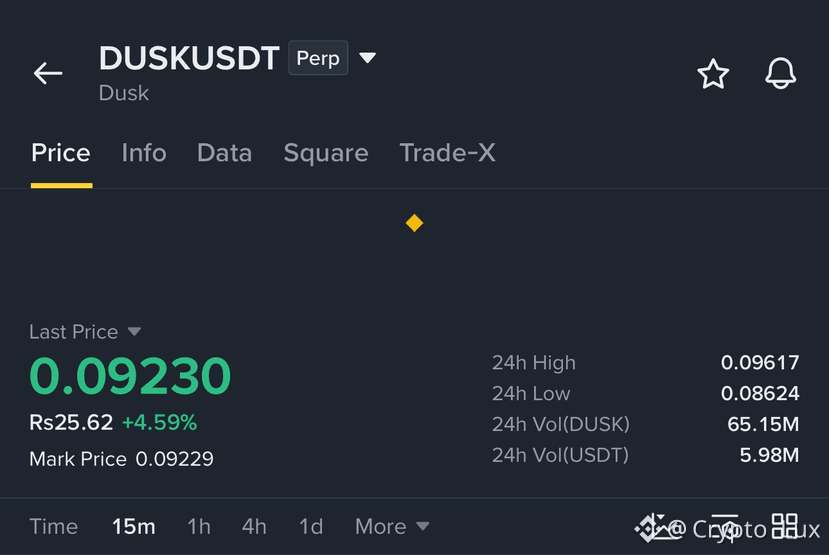
Everyone watching $DUSK again hit the $0.099
$DUSK USDT/ — LONG
ENTRY: 0.09230
TP1: 0.09400
TP2: 0.09800
TP3: 0.09900
SL: 0.09000
Buyers are stepping in again. A fresh rally may begin.
{future}(DUSKUSDT)
#DUSK
Everyone watching $DUSK again hit the $0.099
$DUSK USDT/ — LONG
ENTRY: 0.09230
TP1: 0.09400
TP2: 0.09800
TP3: 0.09900
SL: 0.09000
Buyers are stepping in again. A fresh rally may begin.
#DUSK
$DUSK USDT/ — LONG
ENTRY: 0.09230
TP1: 0.09400
TP2: 0.09800
TP3: 0.09900
SL: 0.09000
Buyers are stepping in again. A fresh rally may begin.
#DUSK
156
Log in to explore more content
Join global crypto users on Binance Square
⚡️ Get latest and useful information about crypto.
💬 Trusted by the world’s largest crypto exchange.
👍 Discover real insights from verified creators.
Email / Phone number
Trending Topics
1
#BitwiseFilesFinalNEARSpotETFProspectus
2,318 views
171 Discussing
2
#BitgetHackerMoves$83MStolenXRP
10,311 views
73 Discussing
3
#SOLSpotETFWeeklyInflow$188M
4,033 views
60 Discussing
4
#DogecoinETFsPostBiggestWeekSinceLaunch
7,267 views
260 Discussing
5
#StrategyStriveAdd2305BitcoinThisWeek
59,280 views
1,323 Discussing
6
#TrumpRejectsIranHormuzReopening
57,051 views
1,037 Discussing
7
#CircleTetherFreezeBitgetHackerWallet
67,238 views
1,040 Discussing
8
#SECSaysTokenBuybacksNotAutoSecurities
36,125 views
611 Discussing
9
#ChinaUSAgreeOn$30BTariffCut
3,112 views
36 Discussing
10
#CoinMarketCapCompletesCoinglassAcquisition
50,371 views
725 Discussing