
#web3compliance
web3compliance
25,687 views
56 Discussing
Hot
Latest

·
--
🔴 Is $NEWT the Ultimate "AI + Compliance" Sleeper, or a Giant Unlock Trap? Let’s Talk Reality. 👇
The market is flooded with generic AI tokens, but Newton Protocol ($NEWT) is doing something fundamentally different—and the smart money is quietly watching. It is building the invisible rules for autonomous AI agents. If AI agents can't transact compliantly onchain, the entire Web3 AI narrative dies. NEWT solves this.
But why isn't the price pumping to the moon right now? Let's break down the raw, unfiltered truth that ordinary influencers won't tell you.
1️⃣ The Elephant in the Room: The June Unlock 🐘
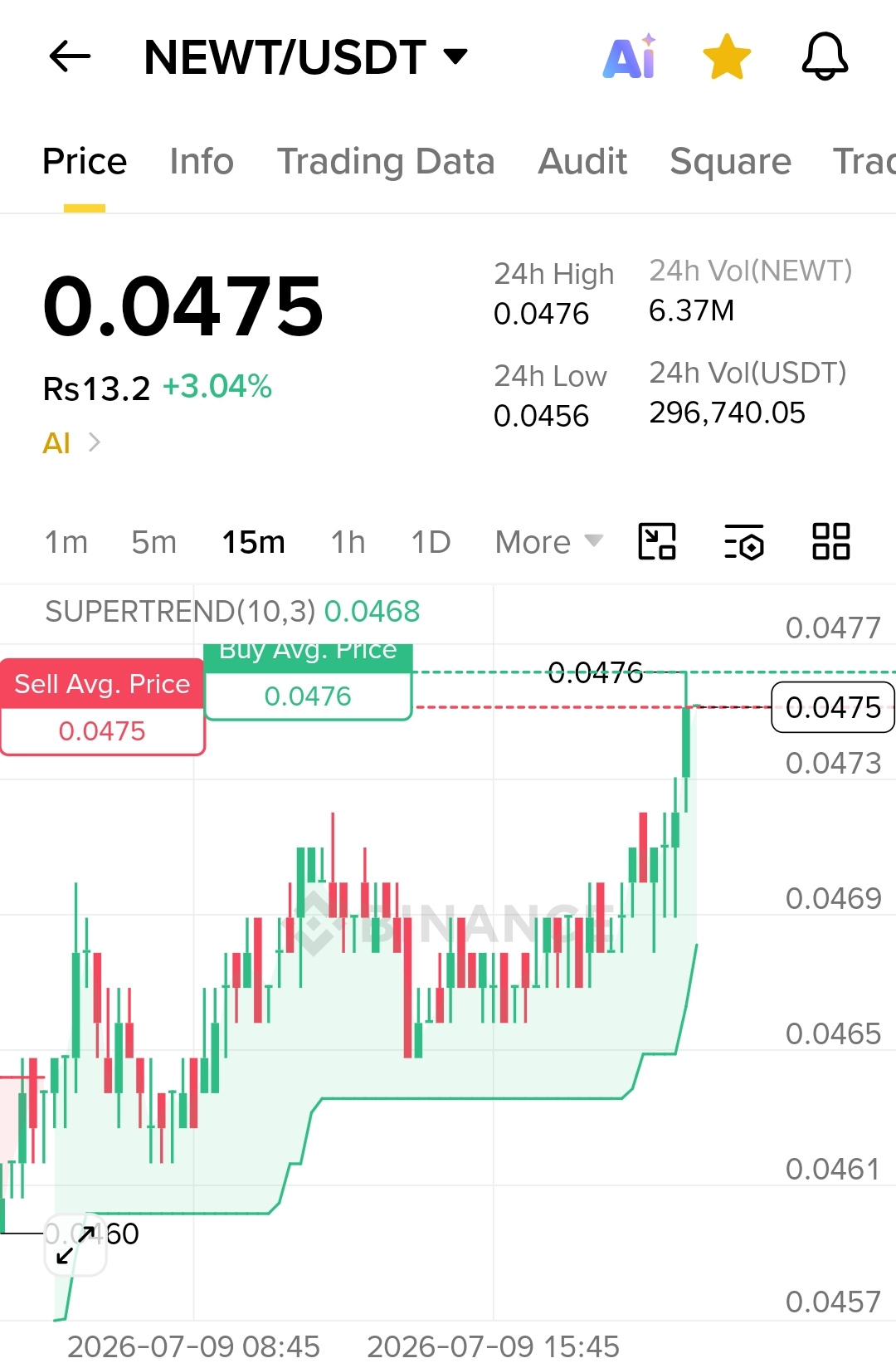
We just witnessed a massive structural token unlock—roughly 139 Million NEWT ($7.55M+) flooded the ecosystem. Standard retail investors panicked, causing the price to correct to its current $0.046 zone.
The Alpha Angle: This is a classic "distribution phase." The short-term speculative hands are folding, while institutional accumulators are soaking up the liquidity. The market cap is hovering at a tiny $9.8M - $13.8M, meaning the upside potential from this floor is mathematically massive compared to overvalued multi-billion dollar ghost chains.
2️⃣ The Real Moat: TEEs & Real-Time Guardrails 🛡️
NEWT isn't just a meme. It’s executing decentralized policy checks inside Trusted Execution Environments (TEEs) and zero-knowledge architectures.
Before an AI bot or a stablecoin smart contract routes a transaction, NEWT’s infrastructure checks compliance, risk parameters, and sanction lists in milliseconds without exposing user privacy. This is a non-negotiable infrastructure requirement for institutional adoption.
3️⃣
What’s your move? Are you accumulation-layer staking at ~30% APR, or are you waiting for the post-unlock volume to fully stabilize? Let me know in the replies! 💬👇
#NEWT #CryptoInfrastructure #AIAgents #BinanceEarn #Web3Compliance
🔴 Is $NEWT the Ultimate "AI + Compliance" Sleeper, or a Giant Unlock Trap? Let’s Talk Reality. 👇
The market is flooded with generic AI tokens, but Newton Protocol ($NEWT) is doing something fundamentally different—and the smart money is quietly watching. It is building the invisible rules for autonomous AI agents. If AI agents can't transact compliantly onchain, the entire Web3 AI narrative dies. NEWT solves this.
But why isn't the price pumping to the moon right now? Let's break down the raw, unfiltered truth that ordinary influencers won't tell you.
1️⃣ The Elephant in the Room: The June Unlock 🐘
We just witnessed a massive structural token unlock—roughly 139 Million NEWT ($7.55M+) flooded the ecosystem. Standard retail investors panicked, causing the price to correct to its current $0.046 zone.
The Alpha Angle: This is a classic "distribution phase." The short-term speculative hands are folding, while institutional accumulators are soaking up the liquidity. The market cap is hovering at a tiny $9.8M - $13.8M, meaning the upside potential from this floor is mathematically massive compared to overvalued multi-billion dollar ghost chains.
2️⃣ The Real Moat: TEEs & Real-Time Guardrails 🛡️
NEWT isn't just a meme. It’s executing decentralized policy checks inside Trusted Execution Environments (TEEs) and zero-knowledge architectures.
Before an AI bot or a stablecoin smart contract routes a transaction, NEWT’s infrastructure checks compliance, risk parameters, and sanction lists in milliseconds without exposing user privacy. This is a non-negotiable infrastructure requirement for institutional adoption.
3️⃣
What’s your move? Are you accumulation-layer staking at ~30% APR, or are you waiting for the post-unlock volume to fully stabilize? Let me know in the replies! 💬👇
#NEWT #CryptoInfrastructure #AIAgents #BinanceEarn #Web3Compliance
The market is flooded with generic AI tokens, but Newton Protocol ($NEWT) is doing something fundamentally different—and the smart money is quietly watching. It is building the invisible rules for autonomous AI agents. If AI agents can't transact compliantly onchain, the entire Web3 AI narrative dies. NEWT solves this.
But why isn't the price pumping to the moon right now? Let's break down the raw, unfiltered truth that ordinary influencers won't tell you.
1️⃣ The Elephant in the Room: The June Unlock 🐘
We just witnessed a massive structural token unlock—roughly 139 Million NEWT ($7.55M+) flooded the ecosystem. Standard retail investors panicked, causing the price to correct to its current $0.046 zone.
The Alpha Angle: This is a classic "distribution phase." The short-term speculative hands are folding, while institutional accumulators are soaking up the liquidity. The market cap is hovering at a tiny $9.8M - $13.8M, meaning the upside potential from this floor is mathematically massive compared to overvalued multi-billion dollar ghost chains.
2️⃣ The Real Moat: TEEs & Real-Time Guardrails 🛡️
NEWT isn't just a meme. It’s executing decentralized policy checks inside Trusted Execution Environments (TEEs) and zero-knowledge architectures.
Before an AI bot or a stablecoin smart contract routes a transaction, NEWT’s infrastructure checks compliance, risk parameters, and sanction lists in milliseconds without exposing user privacy. This is a non-negotiable infrastructure requirement for institutional adoption.
3️⃣
What’s your move? Are you accumulation-layer staking at ~30% APR, or are you waiting for the post-unlock volume to fully stabilize? Let me know in the replies! 💬👇
#NEWT #CryptoInfrastructure #AIAgents #BinanceEarn #Web3Compliance
GM CRYPTO 07:
Like comment bike Karen my pin POS please comment Karen mujhe bike Karen
2
1
81

·
--
# CLARITY Act Tracker — Entry #1# CLARITY Act Tracker — Entry #1
*A running log on the crypto industry's top legislative priority*
---
**Where things stand (as of late June 2026):**
The Digital Asset Market Clarity Act cleared its biggest hurdle yet on May 14, advancing through the Senate Banking Committee 15-9, with two Democrats crossing the aisle. That's a real signal — but not a green light. Both senators who voted yes were explicit that their committee vote doesn't guarantee floor support without further movement on outstanding issues.
**The core mechanics, in plain terms:**
The bill would split crypto oversight between two regulators instead of leaving it ambiguous:
- CFTC gets exclusive jurisdiction over "digital commodity" spot markets
- SEC keeps jurisdiction over assets that function as investment contracts
For exchanges and trading platforms, this isn't abstract — it determines which regulator you register with, what disclosure regime applies, and how your DeFi-adjacent products get classified going forward.
**Why it's stuck:**
Two things are slowing this down:
1. An ethics provision aimed at limiting government officials' crypto holdings — genuinely complicated by the fact that the current administration has extensive personal crypto interests. Democrats say no bill passes without it; the White House says it won't accept anything that singles out specific officials.
2. A brutally tight Senate calendar — roughly eight weeks of floor time left before midterm politics take over, and Clarity is competing with several other priority bills for that time.
**My read:**
The White House wanted this signed by July 4. Senator Gillibrand's own estimate is closer to early August. Either way, the bill needs 60 votes on the floor — meaning a real bipartisan coalition, not just a party-line committee win. The ethics provision is the actual bottleneck here, not the technical market-structure provisions, which seem to have broad industry support already (Coinbase's Brian Armstrong has publicly backed the bill).
Worth watching: if the ethics language gets resolved, this could move fast. If it doesn't, the bill risks running out of Senate floor time before the summer recess.
*Will keep tracking as this develops.*
---
*#CLARITYAct #CryptoRegulations #DigitalAssets #Web3Compliance *
{spot}(ETHUSDT)
{spot}(XRPUSDT)
{spot}(BTCUSDT)
# CLARITY Act Tracker — Entry #1
# CLARITY Act Tracker — Entry #1
*A running log on the crypto industry's top legislative priority*
---
**Where things stand (as of late June 2026):**
The Digital Asset Market Clarity Act cleared its biggest hurdle yet on May 14, advancing through the Senate Banking Committee 15-9, with two Democrats crossing the aisle. That's a real signal — but not a green light. Both senators who voted yes were explicit that their committee vote doesn't guarantee floor support without further movement on outstanding issues.
**The core mechanics, in plain terms:**
The bill would split crypto oversight between two regulators instead of leaving it ambiguous:
- CFTC gets exclusive jurisdiction over "digital commodity" spot markets
- SEC keeps jurisdiction over assets that function as investment contracts
For exchanges and trading platforms, this isn't abstract — it determines which regulator you register with, what disclosure regime applies, and how your DeFi-adjacent products get classified going forward.
**Why it's stuck:**
Two things are slowing this down:
1. An ethics provision aimed at limiting government officials' crypto holdings — genuinely complicated by the fact that the current administration has extensive personal crypto interests. Democrats say no bill passes without it; the White House says it won't accept anything that singles out specific officials.
2. A brutally tight Senate calendar — roughly eight weeks of floor time left before midterm politics take over, and Clarity is competing with several other priority bills for that time.
**My read:**
The White House wanted this signed by July 4. Senator Gillibrand's own estimate is closer to early August. Either way, the bill needs 60 votes on the floor — meaning a real bipartisan coalition, not just a party-line committee win. The ethics provision is the actual bottleneck here, not the technical market-structure provisions, which seem to have broad industry support already (Coinbase's Brian Armstrong has publicly backed the bill).
Worth watching: if the ethics language gets resolved, this could move fast. If it doesn't, the bill risks running out of Senate floor time before the summer recess.
*Will keep tracking as this develops.*
---
*#CLARITYAct #CryptoRegulations #DigitalAssets #Web3Compliance *
*A running log on the crypto industry's top legislative priority*
---
**Where things stand (as of late June 2026):**
The Digital Asset Market Clarity Act cleared its biggest hurdle yet on May 14, advancing through the Senate Banking Committee 15-9, with two Democrats crossing the aisle. That's a real signal — but not a green light. Both senators who voted yes were explicit that their committee vote doesn't guarantee floor support without further movement on outstanding issues.
**The core mechanics, in plain terms:**
The bill would split crypto oversight between two regulators instead of leaving it ambiguous:
- CFTC gets exclusive jurisdiction over "digital commodity" spot markets
- SEC keeps jurisdiction over assets that function as investment contracts
For exchanges and trading platforms, this isn't abstract — it determines which regulator you register with, what disclosure regime applies, and how your DeFi-adjacent products get classified going forward.
**Why it's stuck:**
Two things are slowing this down:
1. An ethics provision aimed at limiting government officials' crypto holdings — genuinely complicated by the fact that the current administration has extensive personal crypto interests. Democrats say no bill passes without it; the White House says it won't accept anything that singles out specific officials.
2. A brutally tight Senate calendar — roughly eight weeks of floor time left before midterm politics take over, and Clarity is competing with several other priority bills for that time.
**My read:**
The White House wanted this signed by July 4. Senator Gillibrand's own estimate is closer to early August. Either way, the bill needs 60 votes on the floor — meaning a real bipartisan coalition, not just a party-line committee win. The ethics provision is the actual bottleneck here, not the technical market-structure provisions, which seem to have broad industry support already (Coinbase's Brian Armstrong has publicly backed the bill).
Worth watching: if the ethics language gets resolved, this could move fast. If it doesn't, the bill risks running out of Senate floor time before the summer recess.
*Will keep tracking as this develops.*
---
*#CLARITYAct #CryptoRegulations #DigitalAssets #Web3Compliance *
171

·
--
The most fascinating thing about blockchain is its “permissionless” nature, but the core bottom line for licensed financial services is “knowing the boundaries.”
Many people look at RWA protocols and always chase the thrill of “one-click trading.” But if a product that carries securities assets never tells you “no,” it’s likely still just an on-chain game.
Real financial infrastructure doesn’t only write “refusal” into smart contracts—it also turns “refusal” into a clear user experience. It’s not a cold, lifeless pop-up of an Unknown error; instead, it clearly tells you: is it a nationality restriction, a professional investor eligibility threshold, or an unexpired lock-up period?
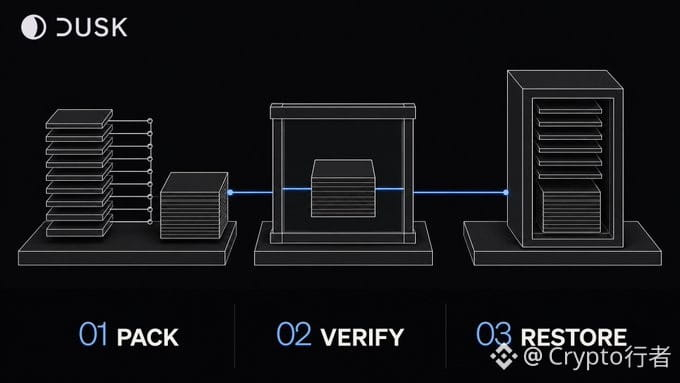
In the workflow of @Dusk_Foundation —from KYC verification, to wallet binding, to real-time eligibility checks when transferring assets—these seemingly tedious steps essentially clarify “no” before the trade ever occurs.
Native token $DUSK can be held by anyone, but securities tools on NPEX must precisely match the compliance list.
While others are still using the token narrative of “everyone can participate” to grab attention, Dusk has already won over compliance audits and regulators’ drawers with “suitability management.” A product that can say “no” is the true clearing-grade infrastructure that allows institutions to enter with confidence.
Only by understanding the refusal path can you truly understand the compliance barriers of $DUSK .
#dusk #RWA #Web3Compliance
The most fascinating thing about blockchain is its “permissionless” nature, but the core bottom line for licensed financial services is “knowing the boundaries.”
Many people look at RWA protocols and always chase the thrill of “one-click trading.” But if a product that carries securities assets never tells you “no,” it’s likely still just an on-chain game.
Real financial infrastructure doesn’t only write “refusal” into smart contracts—it also turns “refusal” into a clear user experience. It’s not a cold, lifeless pop-up of an Unknown error; instead, it clearly tells you: is it a nationality restriction, a professional investor eligibility threshold, or an unexpired lock-up period?
In the workflow of @Dusk —from KYC verification, to wallet binding, to real-time eligibility checks when transferring assets—these seemingly tedious steps essentially clarify “no” before the trade ever occurs.
Native token $DUSK can be held by anyone, but securities tools on NPEX must precisely match the compliance list.
While others are still using the token narrative of “everyone can participate” to grab attention, Dusk has already won over compliance audits and regulators’ drawers with “suitability management.” A product that can say “no” is the true clearing-grade infrastructure that allows institutions to enter with confidence.
Only by understanding the refusal path can you truly understand the compliance barriers of $DUSK .
#dusk #RWA #Web3Compliance
Many people look at RWA protocols and always chase the thrill of “one-click trading.” But if a product that carries securities assets never tells you “no,” it’s likely still just an on-chain game.
Real financial infrastructure doesn’t only write “refusal” into smart contracts—it also turns “refusal” into a clear user experience. It’s not a cold, lifeless pop-up of an Unknown error; instead, it clearly tells you: is it a nationality restriction, a professional investor eligibility threshold, or an unexpired lock-up period?
In the workflow of @Dusk —from KYC verification, to wallet binding, to real-time eligibility checks when transferring assets—these seemingly tedious steps essentially clarify “no” before the trade ever occurs.
Native token $DUSK can be held by anyone, but securities tools on NPEX must precisely match the compliance list.
While others are still using the token narrative of “everyone can participate” to grab attention, Dusk has already won over compliance audits and regulators’ drawers with “suitability management.” A product that can say “no” is the true clearing-grade infrastructure that allows institutions to enter with confidence.
Only by understanding the refusal path can you truly understand the compliance barriers of $DUSK .
#dusk #RWA #Web3Compliance
93

Article
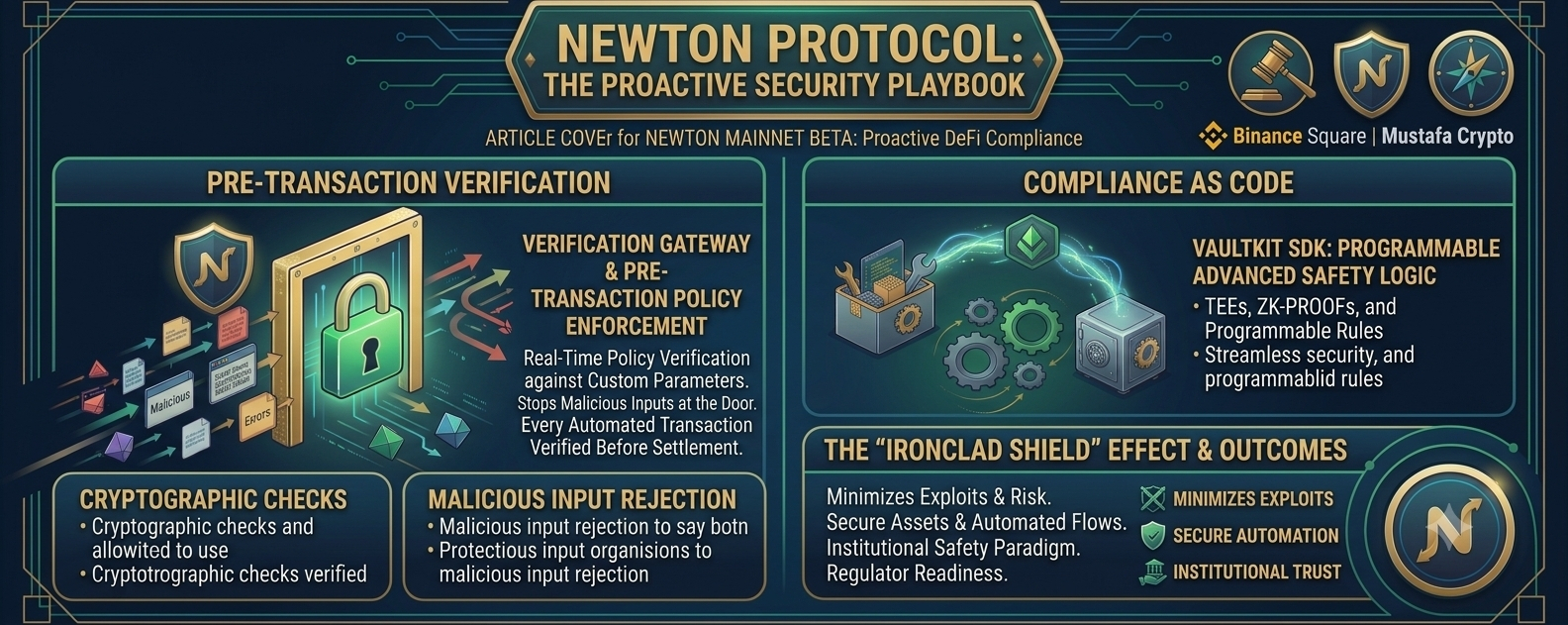
Real-Time Risk Prevention: Why Newton’s 'Compliance as Code' is the New Institutional StandardThe rapid evolution of decentralized finance (DeFi) has exposed a critical structural flaw in traditional blockchain security: a heavy reliance on reactive measures. For too long, protocols have treated security as a post-execution process—relying on third-party audits, code reviews, and bounty programs after smart contracts are already live. However, once an exploit occurs on-chain, the damage is often irreversible.@NewtonProtocol is fundamentally shifting this paradigm with its Mainnet Beta, introducing a proactive security architecture that stops malicious activity at the doorstep. By integrating "Compliance as Code," Newton ensures that security parameters are baked directly into the protocol's transactional lifecycle. The Architecture of Proactive Security Rather than analyzing an exploit after assets have left a pool, Newton Protocol’s framework introduces an unyielding digital layer that requires compliance checks to clear before any state changes are finalized on the ledger. This model relies on two core pillars to enforce safety without sacrificing flexibility.
1 Pre-Transaction Verification
Every automated inbound transaction is cryptographically reviewed in real time. If a transaction deviates from pre-defined risk boundaries, attempts to interact with unauthorized smart contracts, or displays signs of an exploit, it is immediately flagged and rejected. This creates a structural firewall that keeps assets secure by default.
2 Modular Framework via VaultKit SDK
To make this granular enforcement accessible for developers, Newton introduces the VaultKit SDK. This toolkit abstracts the immense cryptographic complexity required for real-time compliance, allowing builders to program custom safety logic and risk-management parameters directly into their application layers. VaultKit seamlessly unifies two privacy-preserving technologies: Trusted Execution Environments (TEEs): For highly confidential, tamper-proof off-chain computation.
Zero-Knowledge Proofs (ZK-Proofs): To verify complex data boundaries and regulatory alignment without exposing private, proprietary institutional records.
Driving Institutional Confidence
For mainstream enterprises and large-scale liquidity providers, absolute asset safety and regulatory readiness are mandatory prerequisites for entering Web3. By turning rigid compliance frameworks into fluid, programmable code, Newton Protocol removes the operational risk associated with high-value automated workflows.
As the $NEWT ecosystem continues to expand its Mainnet Beta infrastructure, its circular paradigm of real-time verification, modular safety logic, and cryptographic privacy is setting the blueprint for a more resilient, institutional-ready DeFi landscape.
#Newt #binancesquaretask #Web3Compliance #cryptouniverseofficial #BTCExchangeSupplyFallsTo9YearLow
$NEWT
{future}(NEWTUSDT)
Real-Time Risk Prevention: Why Newton’s 'Compliance as Code' is the New Institutional Standard
The rapid evolution of decentralized finance (DeFi) has exposed a critical structural flaw in traditional blockchain security: a heavy reliance on reactive measures. For too long, protocols have treated security as a post-execution process—relying on third-party audits, code reviews, and bounty programs after smart contracts are already live. However, once an exploit occurs on-chain, the damage is often irreversible.@NewtonProtocol is fundamentally shifting this paradigm with its Mainnet Beta, introducing a proactive security architecture that stops malicious activity at the doorstep. By integrating "Compliance as Code," Newton ensures that security parameters are baked directly into the protocol's transactional lifecycle. The Architecture of Proactive Security Rather than analyzing an exploit after assets have left a pool, Newton Protocol’s framework introduces an unyielding digital layer that requires compliance checks to clear before any state changes are finalized on the ledger. This model relies on two core pillars to enforce safety without sacrificing flexibility.
1 Pre-Transaction Verification
Every automated inbound transaction is cryptographically reviewed in real time. If a transaction deviates from pre-defined risk boundaries, attempts to interact with unauthorized smart contracts, or displays signs of an exploit, it is immediately flagged and rejected. This creates a structural firewall that keeps assets secure by default.
2 Modular Framework via VaultKit SDK
To make this granular enforcement accessible for developers, Newton introduces the VaultKit SDK. This toolkit abstracts the immense cryptographic complexity required for real-time compliance, allowing builders to program custom safety logic and risk-management parameters directly into their application layers. VaultKit seamlessly unifies two privacy-preserving technologies: Trusted Execution Environments (TEEs): For highly confidential, tamper-proof off-chain computation.
Zero-Knowledge Proofs (ZK-Proofs): To verify complex data boundaries and regulatory alignment without exposing private, proprietary institutional records.
Driving Institutional Confidence
For mainstream enterprises and large-scale liquidity providers, absolute asset safety and regulatory readiness are mandatory prerequisites for entering Web3. By turning rigid compliance frameworks into fluid, programmable code, Newton Protocol removes the operational risk associated with high-value automated workflows.
As the $NEWT ecosystem continues to expand its Mainnet Beta infrastructure, its circular paradigm of real-time verification, modular safety logic, and cryptographic privacy is setting the blueprint for a more resilient, institutional-ready DeFi landscape.
#Newt #binancesquaretask #Web3Compliance #cryptouniverseofficial #BTCExchangeSupplyFallsTo9YearLow
$NEWT
1 Pre-Transaction Verification
Every automated inbound transaction is cryptographically reviewed in real time. If a transaction deviates from pre-defined risk boundaries, attempts to interact with unauthorized smart contracts, or displays signs of an exploit, it is immediately flagged and rejected. This creates a structural firewall that keeps assets secure by default.
2 Modular Framework via VaultKit SDK
To make this granular enforcement accessible for developers, Newton introduces the VaultKit SDK. This toolkit abstracts the immense cryptographic complexity required for real-time compliance, allowing builders to program custom safety logic and risk-management parameters directly into their application layers. VaultKit seamlessly unifies two privacy-preserving technologies: Trusted Execution Environments (TEEs): For highly confidential, tamper-proof off-chain computation.
Zero-Knowledge Proofs (ZK-Proofs): To verify complex data boundaries and regulatory alignment without exposing private, proprietary institutional records.
Driving Institutional Confidence
For mainstream enterprises and large-scale liquidity providers, absolute asset safety and regulatory readiness are mandatory prerequisites for entering Web3. By turning rigid compliance frameworks into fluid, programmable code, Newton Protocol removes the operational risk associated with high-value automated workflows.
As the $NEWT ecosystem continues to expand its Mainnet Beta infrastructure, its circular paradigm of real-time verification, modular safety logic, and cryptographic privacy is setting the blueprint for a more resilient, institutional-ready DeFi landscape.
#Newt #binancesquaretask #Web3Compliance #cryptouniverseofficial #BTCExchangeSupplyFallsTo9YearLow
$NEWT
2
1
78
#newt $NEWT
{future}(NEWTUSDT)
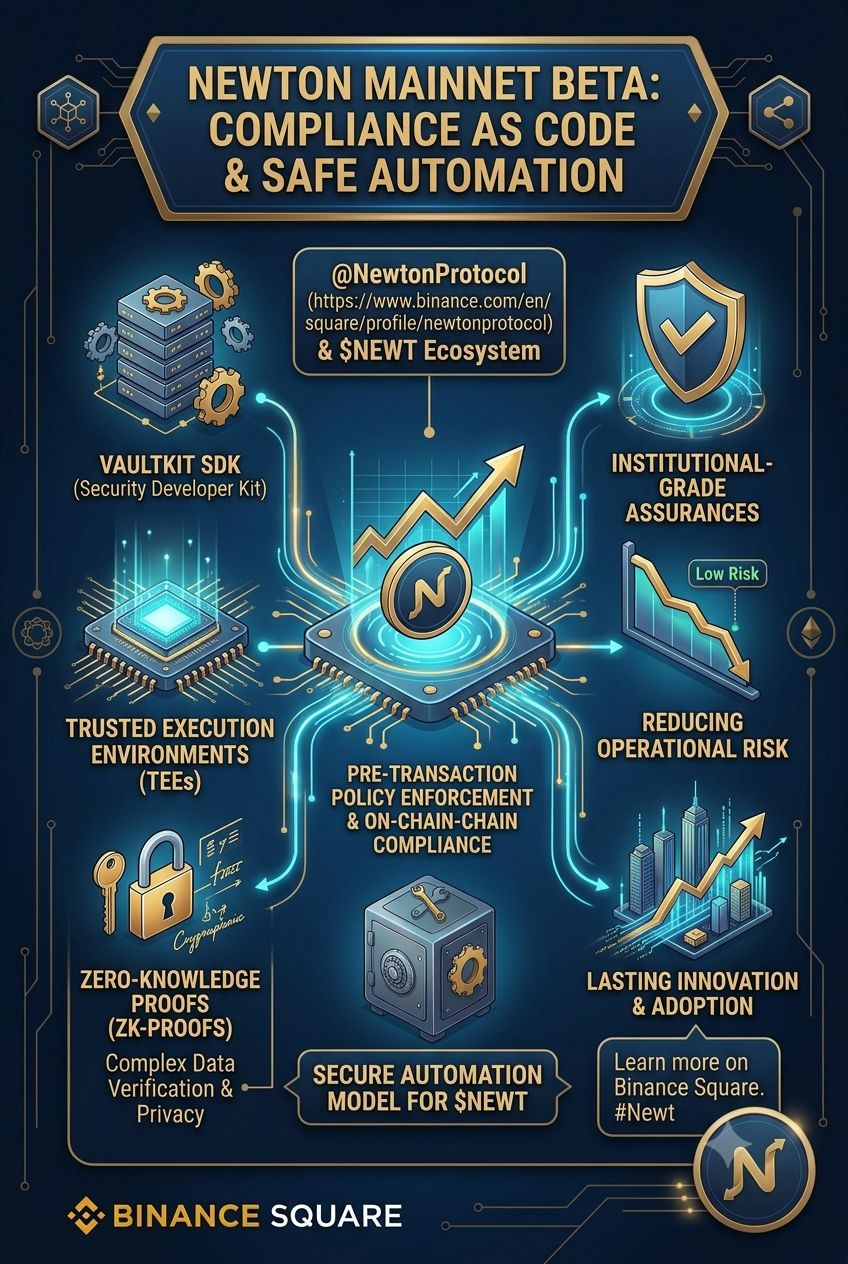
Looking into the Newton Mainnet Beta. It seems @NewtonProtocol is introducing true 'Compliance as Code' with their VaultKit SDK. Developers can program security rules directly into the chain, allowing TEEs/ZK-Proofs to run complex, private data verification before any automated transaction settles. Very bullish on this safe automation model for $NEWT long term. #Newt #Web3Compliance #DeFiSecurity #zkProofs
#newt $NEWT
Looking into the Newton Mainnet Beta. It seems @NewtonProtocol is introducing true 'Compliance as Code' with their VaultKit SDK. Developers can program security rules directly into the chain, allowing TEEs/ZK-Proofs to run complex, private data verification before any automated transaction settles. Very bullish on this safe automation model for $NEWT long term. #Newt #Web3Compliance #DeFiSecurity #zkProofs
Looking into the Newton Mainnet Beta. It seems @NewtonProtocol is introducing true 'Compliance as Code' with their VaultKit SDK. Developers can program security rules directly into the chain, allowing TEEs/ZK-Proofs to run complex, private data verification before any automated transaction settles. Very bullish on this safe automation model for $NEWT long term. #Newt #Web3Compliance #DeFiSecurity #zkProofs
70
#newt $NEWT
{future}(NEWTUSDT)
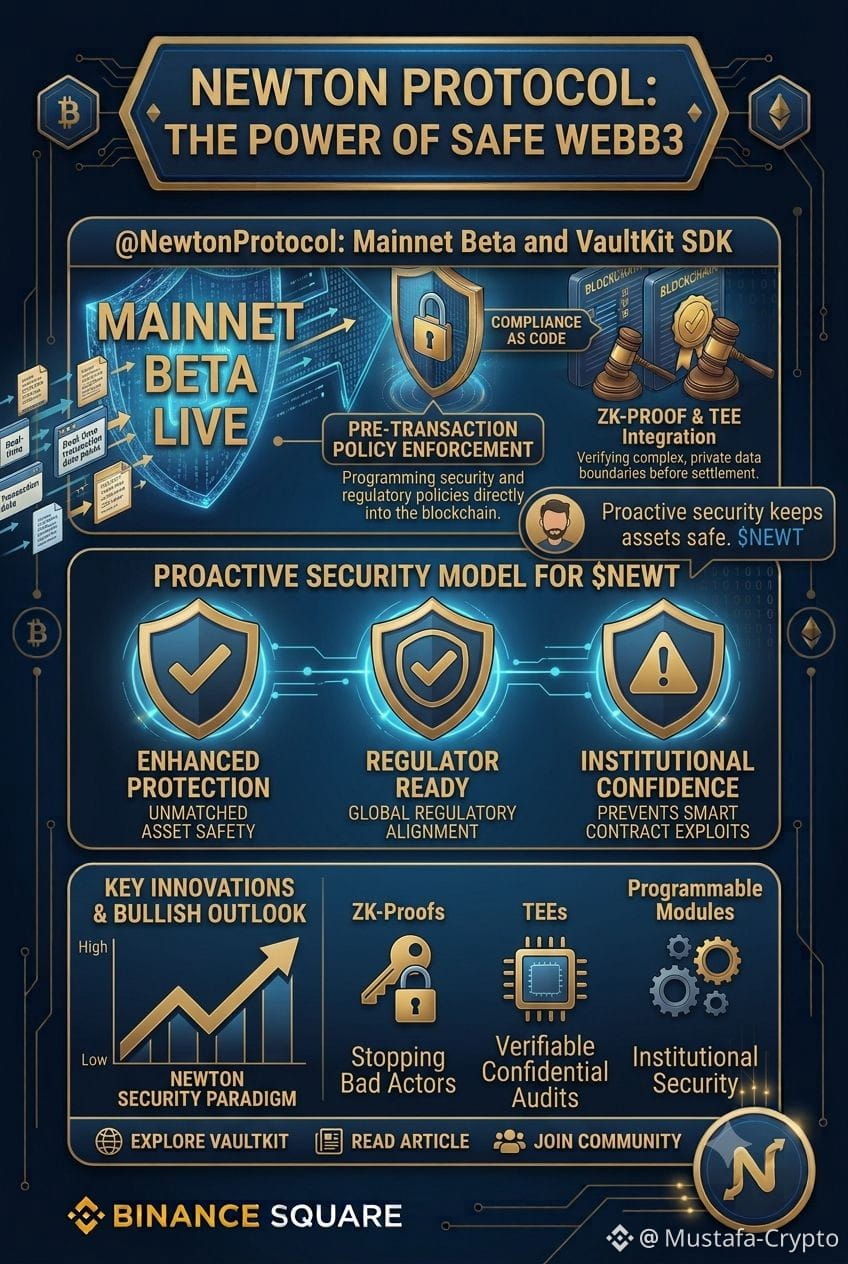
Looking into @NewtonProtocol 's Mainnet Beta and their VaultKit SDK. The core idea of 'Compliance as Code' is fascinating—programming security and regulatory policies directly into the blockchain, rather than auditing them after the fact.
They are using TEEs and ZK-Proofs to enable pre-transaction policy enforcement, which means the network can verify complex, private data boundaries before a single automated transaction settles on the ledger. This proactively stops bad actors and prevents the smart contract exploits we see too often. Very bullish on this proactive security model for $NEWT long term.
#Newt #Web3Compliance #CryptoSecurity #MainnetBeta
#newt $NEWT
Looking into @NewtonProtocol 's Mainnet Beta and their VaultKit SDK. The core idea of 'Compliance as Code' is fascinating—programming security and regulatory policies directly into the blockchain, rather than auditing them after the fact.
They are using TEEs and ZK-Proofs to enable pre-transaction policy enforcement, which means the network can verify complex, private data boundaries before a single automated transaction settles on the ledger. This proactively stops bad actors and prevents the smart contract exploits we see too often. Very bullish on this proactive security model for $NEWT long term.
#Newt #Web3Compliance #CryptoSecurity #MainnetBeta
Looking into @NewtonProtocol 's Mainnet Beta and their VaultKit SDK. The core idea of 'Compliance as Code' is fascinating—programming security and regulatory policies directly into the blockchain, rather than auditing them after the fact.
They are using TEEs and ZK-Proofs to enable pre-transaction policy enforcement, which means the network can verify complex, private data boundaries before a single automated transaction settles on the ledger. This proactively stops bad actors and prevents the smart contract exploits we see too often. Very bullish on this proactive security model for $NEWT long term.
#Newt #Web3Compliance #CryptoSecurity #MainnetBeta
5
1
91

·
--
#newt $NEWT @NewtonProtocol
🛡️ Protocol Breakdown: Newton Protocol ($NEWT$) and On-Chain Compliance-as-Code
As decentralized autonomous agents and institutional capital scale cross-chain, regulatory framework integration has become a major architectural bottleneck. Traditional smart contracts execute blindly, unable to parse dynamic legal or compliance parameters without relying on central, web2-style gatekeepers.
Newton Protocol ($NEWT$) systematically answers this by deploying a specialized, decentralized policy layer designed to turn on-chain compliance into an automatic, programmable primitive.
Here is a technical overview of the system:
1️⃣ Compliance-as-Code Execution
Instead of evaluating rules off-chain via manual legal pipelines, Newton translates regulatory guidelines directly into verifiable code using Rego. Operating off-destination chain, the infrastructure evaluates transaction payloads asynchronously inside hardware-isolated Trusted Execution Environments (TEEs), generating cryptographic proofs that show compliance checks ran securely and unaltered.
2️⃣ Trust-Minimized Agent Finance
By integrating Account Abstraction primitives (ERC-4337 / EIP-7702), the architecture enables users to securely delegate complex, multi-step financial actions to autonomous AI agents. The network ensures that every outsourced action strictly conforms to pre-defined user and jurisdictional constraints before settlement.
3️⃣ Utility Mechanics of the $NEWT$ Token
The network operates on a fixed 1,000,000,000 maximum supply cap, where the native utility token serves distinct functional purposes:
• Compute Settlement: Native network gas used to power off-chain compliance evaluations.
• Node Securitization: Collateral staked by operator networks via restaking mechanisms to guarantee execution integrity.
How do you view the impact of programmatic compliance on institutional Web3 liquidity? 👇
#Newt #DeAI #Web3Compliance #BlockchainArchitecture #NewtonProtocol #BinanceSquare
#newt $NEWT @NewtonProtocol
🛡️ Protocol Breakdown: Newton Protocol ($NEWT $) and On-Chain Compliance-as-Code
As decentralized autonomous agents and institutional capital scale cross-chain, regulatory framework integration has become a major architectural bottleneck. Traditional smart contracts execute blindly, unable to parse dynamic legal or compliance parameters without relying on central, web2-style gatekeepers.
Newton Protocol ($NEWT $) systematically answers this by deploying a specialized, decentralized policy layer designed to turn on-chain compliance into an automatic, programmable primitive.
Here is a technical overview of the system:
1️⃣ Compliance-as-Code Execution
Instead of evaluating rules off-chain via manual legal pipelines, Newton translates regulatory guidelines directly into verifiable code using Rego. Operating off-destination chain, the infrastructure evaluates transaction payloads asynchronously inside hardware-isolated Trusted Execution Environments (TEEs), generating cryptographic proofs that show compliance checks ran securely and unaltered.
2️⃣ Trust-Minimized Agent Finance
By integrating Account Abstraction primitives (ERC-4337 / EIP-7702), the architecture enables users to securely delegate complex, multi-step financial actions to autonomous AI agents. The network ensures that every outsourced action strictly conforms to pre-defined user and jurisdictional constraints before settlement.
3️⃣ Utility Mechanics of the $NEWT $ Token
The network operates on a fixed 1,000,000,000 maximum supply cap, where the native utility token serves distinct functional purposes:
• Compute Settlement: Native network gas used to power off-chain compliance evaluations.
• Node Securitization: Collateral staked by operator networks via restaking mechanisms to guarantee execution integrity.
How do you view the impact of programmatic compliance on institutional Web3 liquidity? 👇
#Newt #DeAI #Web3Compliance #BlockchainArchitecture #NewtonProtocol #BinanceSquare
🛡️ Protocol Breakdown: Newton Protocol ($NEWT $) and On-Chain Compliance-as-Code
As decentralized autonomous agents and institutional capital scale cross-chain, regulatory framework integration has become a major architectural bottleneck. Traditional smart contracts execute blindly, unable to parse dynamic legal or compliance parameters without relying on central, web2-style gatekeepers.
Newton Protocol ($NEWT $) systematically answers this by deploying a specialized, decentralized policy layer designed to turn on-chain compliance into an automatic, programmable primitive.
Here is a technical overview of the system:
1️⃣ Compliance-as-Code Execution
Instead of evaluating rules off-chain via manual legal pipelines, Newton translates regulatory guidelines directly into verifiable code using Rego. Operating off-destination chain, the infrastructure evaluates transaction payloads asynchronously inside hardware-isolated Trusted Execution Environments (TEEs), generating cryptographic proofs that show compliance checks ran securely and unaltered.
2️⃣ Trust-Minimized Agent Finance
By integrating Account Abstraction primitives (ERC-4337 / EIP-7702), the architecture enables users to securely delegate complex, multi-step financial actions to autonomous AI agents. The network ensures that every outsourced action strictly conforms to pre-defined user and jurisdictional constraints before settlement.
3️⃣ Utility Mechanics of the $NEWT $ Token
The network operates on a fixed 1,000,000,000 maximum supply cap, where the native utility token serves distinct functional purposes:
• Compute Settlement: Native network gas used to power off-chain compliance evaluations.
• Node Securitization: Collateral staked by operator networks via restaking mechanisms to guarantee execution integrity.
How do you view the impact of programmatic compliance on institutional Web3 liquidity? 👇
#Newt #DeAI #Web3Compliance #BlockchainArchitecture #NewtonProtocol #BinanceSquare
64
#newt $NEWT
{future}(NEWTUSDT)
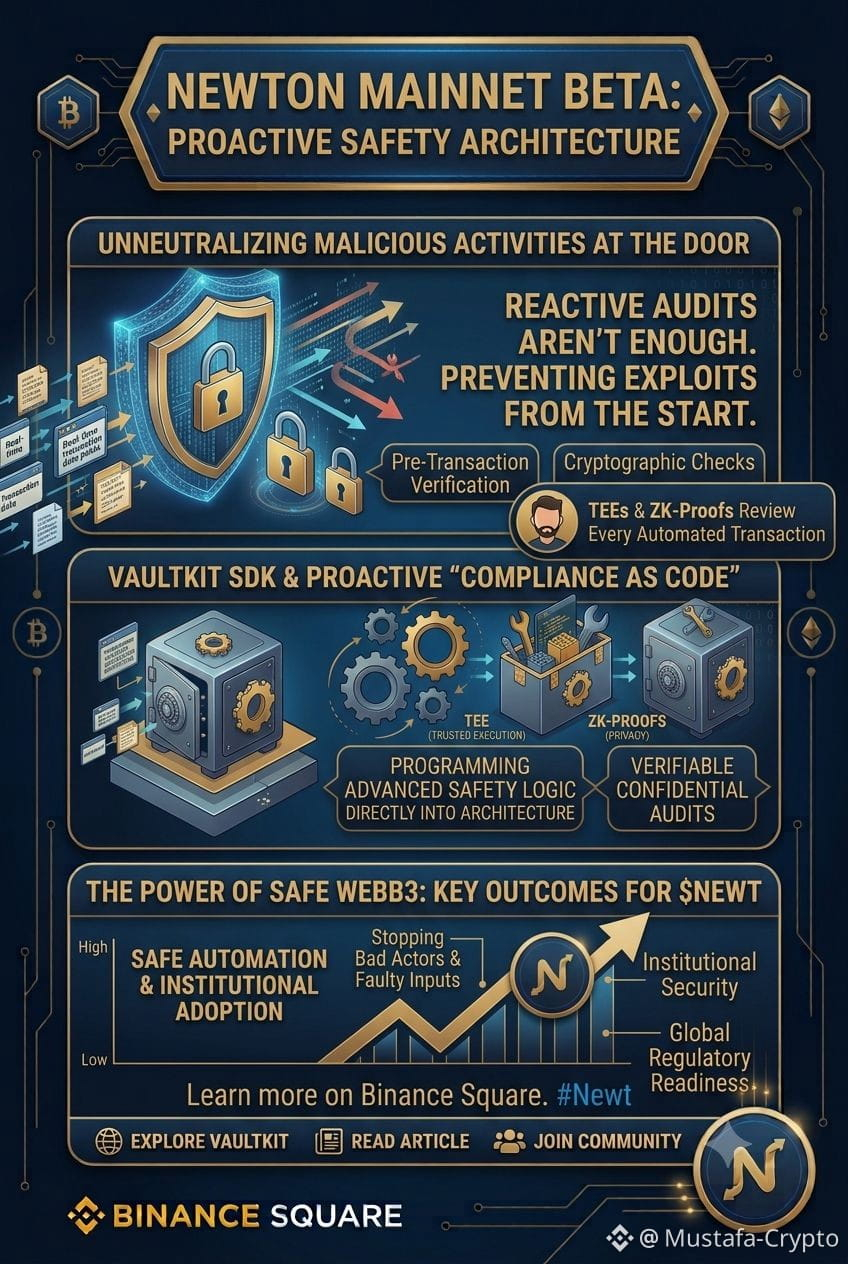
Real-time, automatic risk enforcement is the future of institutional DeFi. Rather than relying on retroactive audits after an exploit has occurred, @NewtonProtocol is introducing proactive 'Compliance as Code' with its Newton Mainnet Beta.
By leveraging the VaultKit SDK alongside TEEs and ZK-Proofs, developers can now program advanced safety logic directly into the protocol's architecture. Every automated transaction is cryptographically reviewed and verified before it can settle on the ledger, entirely neutralizing malicious activities or faulty inputs at the door. Exciting milestones ahead for the $NEWT ecosystem!
#Newt #Web3Compliance #CryptoSecurity #DeFiInfrastructure
#newt $NEWT
Real-time, automatic risk enforcement is the future of institutional DeFi. Rather than relying on retroactive audits after an exploit has occurred, @NewtonProtocol is introducing proactive 'Compliance as Code' with its Newton Mainnet Beta.
By leveraging the VaultKit SDK alongside TEEs and ZK-Proofs, developers can now program advanced safety logic directly into the protocol's architecture. Every automated transaction is cryptographically reviewed and verified before it can settle on the ledger, entirely neutralizing malicious activities or faulty inputs at the door. Exciting milestones ahead for the $NEWT ecosystem!
#Newt #Web3Compliance #CryptoSecurity #DeFiInfrastructure
Real-time, automatic risk enforcement is the future of institutional DeFi. Rather than relying on retroactive audits after an exploit has occurred, @NewtonProtocol is introducing proactive 'Compliance as Code' with its Newton Mainnet Beta.
By leveraging the VaultKit SDK alongside TEEs and ZK-Proofs, developers can now program advanced safety logic directly into the protocol's architecture. Every automated transaction is cryptographically reviewed and verified before it can settle on the ledger, entirely neutralizing malicious activities or faulty inputs at the door. Exciting milestones ahead for the $NEWT ecosystem!
#Newt #Web3Compliance #CryptoSecurity #DeFiInfrastructure
1
95
#newt $NEWT
{future}(NEWTUSDT)
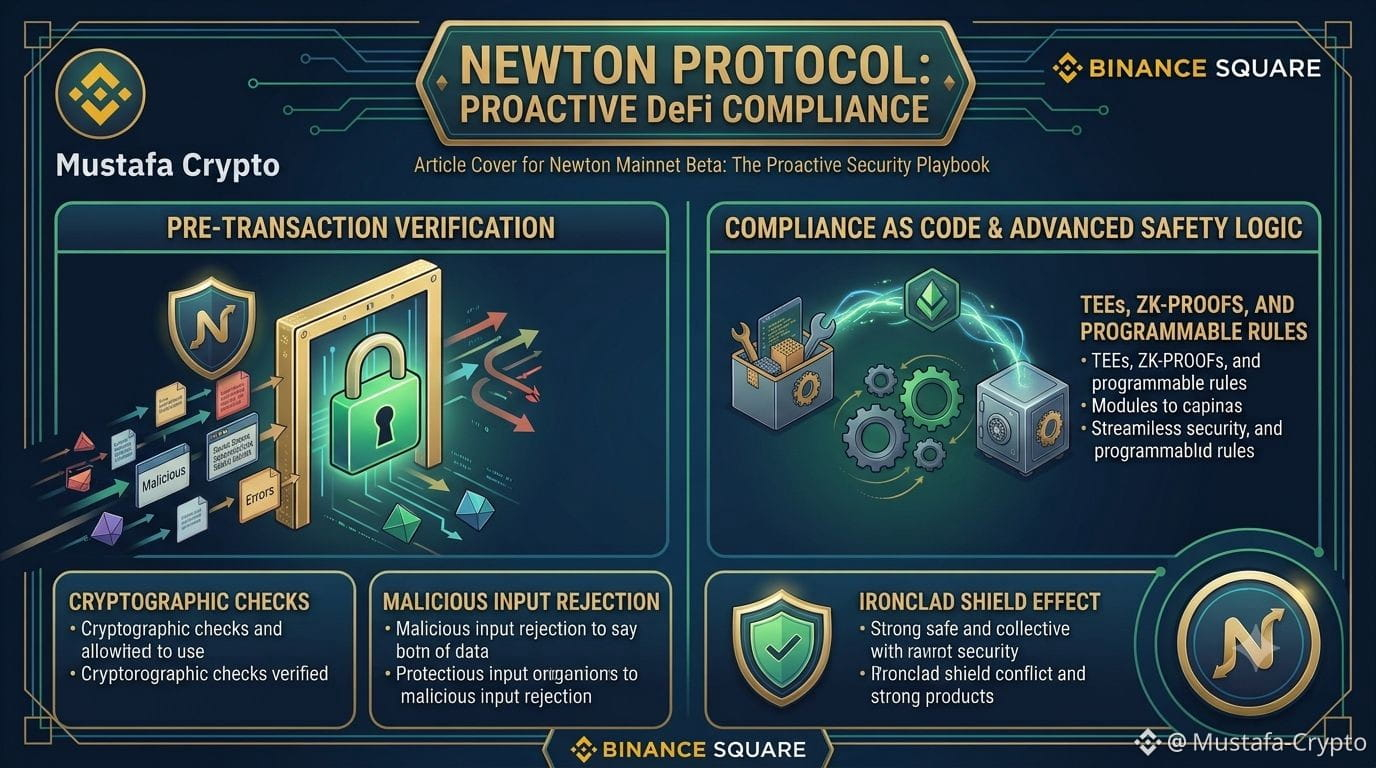
The landscape of Web3 security is experiencing a structural shift. Relying on post-execution audits to catch vulnerabilities after a state change has occurred is a massive operational risk for institutional platforms. @NewtonProtocol is solving this natively with the Newton Mainnet Beta.
Through a powerful combination of the VaultKit SDK, TEEs, and ZK-Proofs, the network implements a strict, pre-transaction verification model. This "Compliance as Code" framework acts as an ironclad digital shield—cryptographically verifying every single automated flow and rejecting malicious inputs or exploits before they can ever touch the blockchain ledger. Proactive safety is the new standard.
#Newt #Web3Compliance
#CryptoSecurity #USLaunchesNewStrikesAgainstIran
#newt $NEWT
The landscape of Web3 security is experiencing a structural shift. Relying on post-execution audits to catch vulnerabilities after a state change has occurred is a massive operational risk for institutional platforms. @NewtonProtocol is solving this natively with the Newton Mainnet Beta.
Through a powerful combination of the VaultKit SDK, TEEs, and ZK-Proofs, the network implements a strict, pre-transaction verification model. This "Compliance as Code" framework acts as an ironclad digital shield—cryptographically verifying every single automated flow and rejecting malicious inputs or exploits before they can ever touch the blockchain ledger. Proactive safety is the new standard.
#Newt #Web3Compliance
#CryptoSecurity #USLaunchesNewStrikesAgainstIran
The landscape of Web3 security is experiencing a structural shift. Relying on post-execution audits to catch vulnerabilities after a state change has occurred is a massive operational risk for institutional platforms. @NewtonProtocol is solving this natively with the Newton Mainnet Beta.
Through a powerful combination of the VaultKit SDK, TEEs, and ZK-Proofs, the network implements a strict, pre-transaction verification model. This "Compliance as Code" framework acts as an ironclad digital shield—cryptographically verifying every single automated flow and rejecting malicious inputs or exploits before they can ever touch the blockchain ledger. Proactive safety is the new standard.
#Newt #Web3Compliance
#CryptoSecurity #USLaunchesNewStrikesAgainstIran
3
83
Article
Breaking Down the Triad: How Newton Mainnet Beta Rewrites the Web3 Security Playbook$NEWT The decentralized frontier has arrived at an undeniable consensus: reliance on reactive security is a structural vulnerability. Traditional blockchain architectures prioritize post-execution tracking, analyzing malicious exploits only after state transitions have settled on-chain. Newton Protocol breaks away from this legacy model with its Mainnet Beta, introducing a cyclical, multi-layered "Compliance as Code" infrastructure engineered to neutralize threats before they pierce the ledger.
The Three Pillars of Pre-Transaction Protection
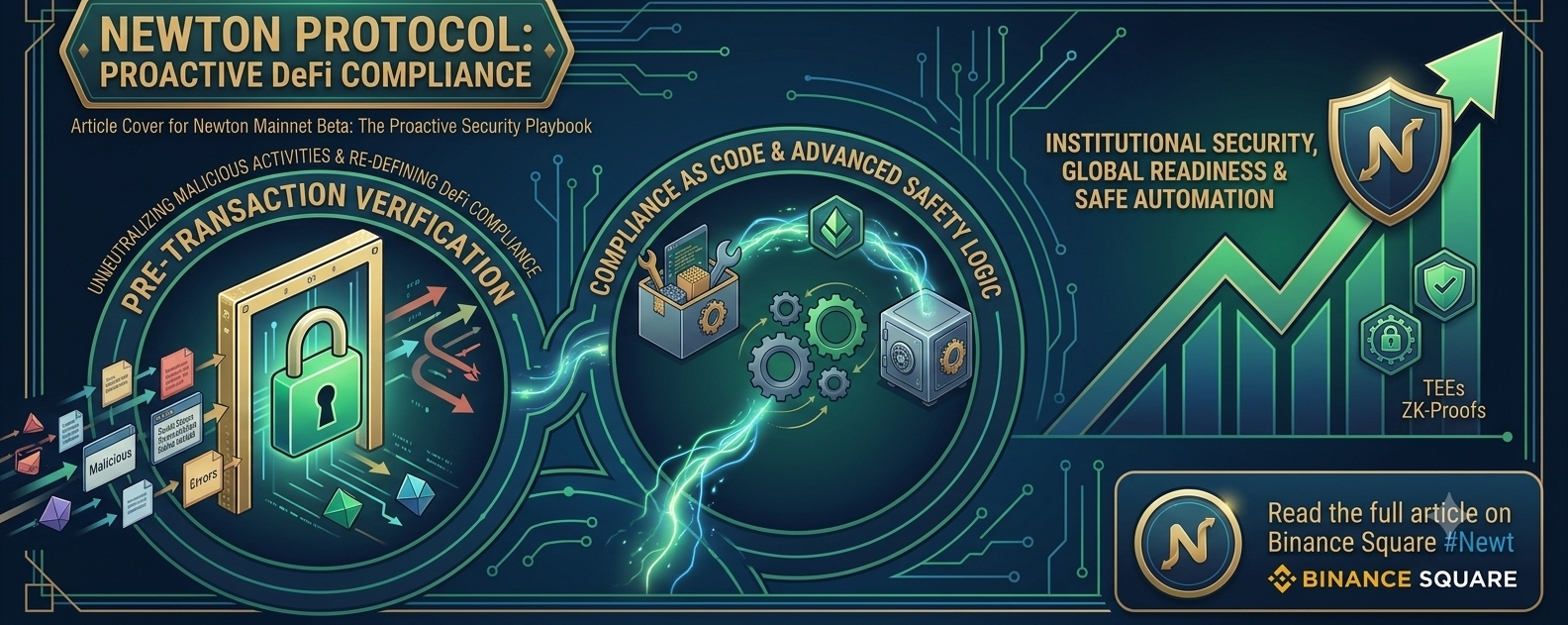
Newton’s architecture splits complex operational security into three interconnected, visible domains that continually feed into one another:
1. Pre-Transaction Verification (The Gateway Shield)
At the point of entry, @NewtonProtocol implements an unyielding digital firewall. Every inbound transaction undergoes rigorous cryptographic checks against predefined policy constraints before achieving finality. If an automated script or a malicious actor attempts to bypass protocol limits, execute unaligned logic, or drain assets, the transaction is immediately rejected at the door.
2. VaultKit SDK & Advanced Safety Logic (The Programmable Core)
To make this granular level of protection accessible, the VaultKit SDK allows builders to program custom safety logic straight into their application layers. Developers leverage a modular toolkit to craft sophisticated parameters without rebuilding base cryptography. This environment seamlessly incorporates two vital privacy-preserving technologies:
Trusted Execution Environments (TEEs): Ensuring highly confidential, off-chain computation.
Zero-Knowledge Proofs (ZK-Proofs): Verifying the legitimacy of complex private data without ever exposing sensitive institutional variables or raw records.
3. Absolute Web3 Finality (The Growth Catalyst)
Security without scalability cannot foster mainstream adoption. By validating its engine through top-tier economic consensus networks and anchoring immutable proof metrics, Newton bridges the gap between decentralized innovation and institutional readiness. The outcome is a safe automation environment that actively minimizes operational risks, halts bad actors, and fosters long-term network adoption.
Pioneering a Compliant Future
By converting rigid regulatory and security frameworks into fluid, programmable code, Newton Protocol ensures that dApps no longer have to choose between full automation and absolute asset protection. As the ecosystem scales, this circular triad of verification, modular logic, and institutional-grade safety will serve as the blueprint for the next generation of secure DeFi infrastructure.
#Newt #Web3Compliance #DeFiSecurity #VaultKit #MainnetBeta
$NEWT
{future}(NEWTUSDT)
Breaking Down the Triad: How Newton Mainnet Beta Rewrites the Web3 Security Playbook
$NEWT The decentralized frontier has arrived at an undeniable consensus: reliance on reactive security is a structural vulnerability. Traditional blockchain architectures prioritize post-execution tracking, analyzing malicious exploits only after state transitions have settled on-chain. Newton Protocol breaks away from this legacy model with its Mainnet Beta, introducing a cyclical, multi-layered "Compliance as Code" infrastructure engineered to neutralize threats before they pierce the ledger.
The Three Pillars of Pre-Transaction Protection
Newton’s architecture splits complex operational security into three interconnected, visible domains that continually feed into one another:
1. Pre-Transaction Verification (The Gateway Shield)
At the point of entry, @NewtonProtocol implements an unyielding digital firewall. Every inbound transaction undergoes rigorous cryptographic checks against predefined policy constraints before achieving finality. If an automated script or a malicious actor attempts to bypass protocol limits, execute unaligned logic, or drain assets, the transaction is immediately rejected at the door.
2. VaultKit SDK & Advanced Safety Logic (The Programmable Core)
To make this granular level of protection accessible, the VaultKit SDK allows builders to program custom safety logic straight into their application layers. Developers leverage a modular toolkit to craft sophisticated parameters without rebuilding base cryptography. This environment seamlessly incorporates two vital privacy-preserving technologies:
Trusted Execution Environments (TEEs): Ensuring highly confidential, off-chain computation.
Zero-Knowledge Proofs (ZK-Proofs): Verifying the legitimacy of complex private data without ever exposing sensitive institutional variables or raw records.
3. Absolute Web3 Finality (The Growth Catalyst)
Security without scalability cannot foster mainstream adoption. By validating its engine through top-tier economic consensus networks and anchoring immutable proof metrics, Newton bridges the gap between decentralized innovation and institutional readiness. The outcome is a safe automation environment that actively minimizes operational risks, halts bad actors, and fosters long-term network adoption.
Pioneering a Compliant Future
By converting rigid regulatory and security frameworks into fluid, programmable code, Newton Protocol ensures that dApps no longer have to choose between full automation and absolute asset protection. As the ecosystem scales, this circular triad of verification, modular logic, and institutional-grade safety will serve as the blueprint for the next generation of secure DeFi infrastructure.
#Newt #Web3Compliance #DeFiSecurity #VaultKit #MainnetBeta
$NEWT
The Three Pillars of Pre-Transaction Protection
Newton’s architecture splits complex operational security into three interconnected, visible domains that continually feed into one another:
1. Pre-Transaction Verification (The Gateway Shield)
At the point of entry, @NewtonProtocol implements an unyielding digital firewall. Every inbound transaction undergoes rigorous cryptographic checks against predefined policy constraints before achieving finality. If an automated script or a malicious actor attempts to bypass protocol limits, execute unaligned logic, or drain assets, the transaction is immediately rejected at the door.
2. VaultKit SDK & Advanced Safety Logic (The Programmable Core)
To make this granular level of protection accessible, the VaultKit SDK allows builders to program custom safety logic straight into their application layers. Developers leverage a modular toolkit to craft sophisticated parameters without rebuilding base cryptography. This environment seamlessly incorporates two vital privacy-preserving technologies:
Trusted Execution Environments (TEEs): Ensuring highly confidential, off-chain computation.
Zero-Knowledge Proofs (ZK-Proofs): Verifying the legitimacy of complex private data without ever exposing sensitive institutional variables or raw records.
3. Absolute Web3 Finality (The Growth Catalyst)
Security without scalability cannot foster mainstream adoption. By validating its engine through top-tier economic consensus networks and anchoring immutable proof metrics, Newton bridges the gap between decentralized innovation and institutional readiness. The outcome is a safe automation environment that actively minimizes operational risks, halts bad actors, and fosters long-term network adoption.
Pioneering a Compliant Future
By converting rigid regulatory and security frameworks into fluid, programmable code, Newton Protocol ensures that dApps no longer have to choose between full automation and absolute asset protection. As the ecosystem scales, this circular triad of verification, modular logic, and institutional-grade safety will serve as the blueprint for the next generation of secure DeFi infrastructure.
#Newt #Web3Compliance #DeFiSecurity #VaultKit #MainnetBeta
$NEWT
2
1
72

·
--
Article
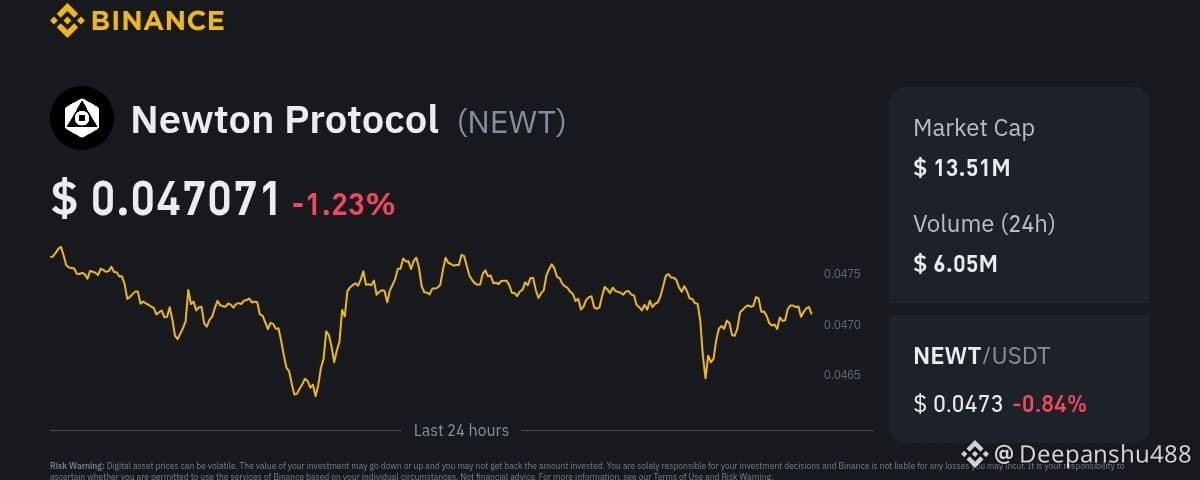
Newton Protocol ($NEWT)Newton Protocol ($NEWT ): The Compliance & RWA Architecture
While Binance opens up trading corridors, Newton Protocol ($NEWT) builds the security and compliance pipeline necessary for institutional capital and Real-World Assets (RWA) to safely migrate on-chain.
Use Case: Built by the engineering minds behind Magic Labs, $NEWT introduces "compliance-as-code." It automates regulatory screening directly at the point of transaction using decentralized network operators and Trusted Execution Environments (TEEs).
Ecosystem: Focuses heavily on enabling stablecoin issuers, financial institutions, and autonomous AI agents to legally interact with Web3 protocols while protecting user data privacy.
Market Status: A highly specialized infrastructure utility token with a fixed 1 billion supply, positioned perfectly for the upcoming institutional RWA narrative.
The Verdict: How Do They Co-exist?
$BNB is where the global market goes to trade, launch, and scale retail Web3 projects.
NEWT is the underlying compliance shield that allows institutional giants to safely utilize the blockchain space without breaking global regulations.
Having both utilities in the crypto space ensures a healthy balance between mainstream freedom and institutional safety!
Which narrative are you more bullish on? Let’s talk in the comments! 👇
#NewtonProtocol #NEWT #CryptoInfrastructu #RWA #Web3Compliance
Newton Protocol ($NEWT)
Newton Protocol ($NEWT ): The Compliance & RWA Architecture
While Binance opens up trading corridors, Newton Protocol ($NEWT ) builds the security and compliance pipeline necessary for institutional capital and Real-World Assets (RWA) to safely migrate on-chain.
Use Case: Built by the engineering minds behind Magic Labs, $NEWT introduces "compliance-as-code." It automates regulatory screening directly at the point of transaction using decentralized network operators and Trusted Execution Environments (TEEs).
Ecosystem: Focuses heavily on enabling stablecoin issuers, financial institutions, and autonomous AI agents to legally interact with Web3 protocols while protecting user data privacy.
Market Status: A highly specialized infrastructure utility token with a fixed 1 billion supply, positioned perfectly for the upcoming institutional RWA narrative.
The Verdict: How Do They Co-exist?
$BNB is where the global market goes to trade, launch, and scale retail Web3 projects.
NEWT is the underlying compliance shield that allows institutional giants to safely utilize the blockchain space without breaking global regulations.
Having both utilities in the crypto space ensures a healthy balance between mainstream freedom and institutional safety!
Which narrative are you more bullish on? Let’s talk in the comments! 👇
#NewtonProtocol #NEWT #CryptoInfrastructu #RWA #Web3Compliance
While Binance opens up trading corridors, Newton Protocol ($NEWT ) builds the security and compliance pipeline necessary for institutional capital and Real-World Assets (RWA) to safely migrate on-chain.
Use Case: Built by the engineering minds behind Magic Labs, $NEWT introduces "compliance-as-code." It automates regulatory screening directly at the point of transaction using decentralized network operators and Trusted Execution Environments (TEEs).
Ecosystem: Focuses heavily on enabling stablecoin issuers, financial institutions, and autonomous AI agents to legally interact with Web3 protocols while protecting user data privacy.
Market Status: A highly specialized infrastructure utility token with a fixed 1 billion supply, positioned perfectly for the upcoming institutional RWA narrative.
The Verdict: How Do They Co-exist?
$BNB is where the global market goes to trade, launch, and scale retail Web3 projects.
NEWT is the underlying compliance shield that allows institutional giants to safely utilize the blockchain space without breaking global regulations.
Having both utilities in the crypto space ensures a healthy balance between mainstream freedom and institutional safety!
Which narrative are you more bullish on? Let’s talk in the comments! 👇
#NewtonProtocol #NEWT #CryptoInfrastructu #RWA #Web3Compliance
2
32

Article
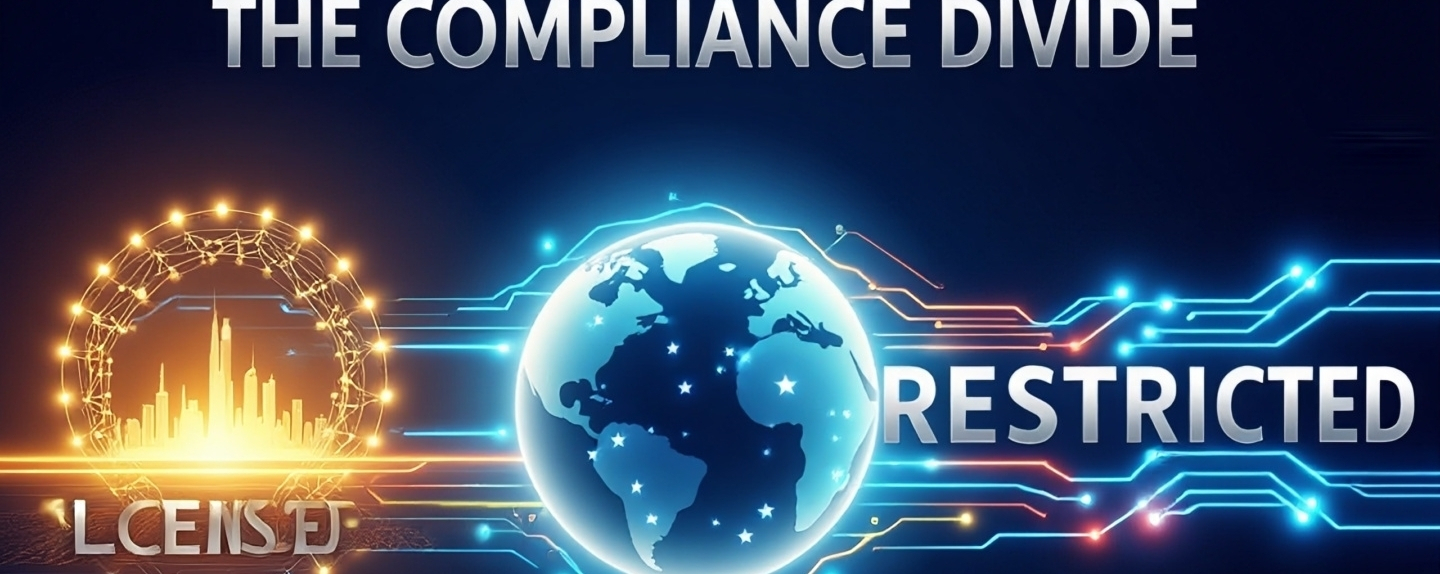
Regulatory Lines Are Being Redrawn Across Global Crypto — And Not Every Exchange Made The CutRegulatory Lines Are Being Redrawn Across Global Crypto — And Not Every Exchange Made The Cut
Compliance just became the biggest competitive battlefield in digital assets — and the numbers reveal exactly who is winning and who got left behind.
A major shift in global crypto oversight unfolded this week as the European Union's Markets in Crypto-Assets (MiCA) framework moved into full enforcement mode, separating licensed operators from unlicensed ones across all 30 countries in the European Economic Area.
◆ A leading payments-focused blockchain network secured full MiCA passport authorization, allowing it to legally scale regulated crypto payment services across the entire EEA
◆ That same network now holds over 75 regulatory licenses globally, expanding an already substantial compliance portfolio
◆ According to the European Securities and Markets Authority, only 280 firms successfully obtained CASP (Crypto-Asset Service Provider) authorization — out of more than 3,000 companies that were previously operating under fragmented national frameworks
◆ One of the world's largest exchanges failed to secure MiCA clearance and entered the new regulatory era with no EEA license, after withdrawing its own national application
◆ In the United States, a separate stablecoin oversight proposal under the GENIUS Act introduced new KYC requirements, currently in a 60-day public comment period
◆ Stablecoin total market capitalization fell to $312 billion in June — its steepest monthly decline since the TerraUSD collapse — while total crypto market capitalization still holds near $2.28 trillion today
◆ One major USD-pegged stablecoin issuer holds roughly $73.8 billion in market cap and is gaining ground in regulated institutional settlement channels, while the larger incumbent issuer retains dominant offshore and OTC liquidity
◆ A separate market clarity bill in the U.S. Congress faces a symbolic July 4 target deadline, with Senate cloture math still short of the 60 votes required
The pattern emerging across two continents is clear: regulators are no longer asking whether crypto firms will comply — they're separating the market into those who did and those who didn't. For payment networks, stablecoin issuers, and exchanges alike, licensing is becoming the new form of market access.
With institutional-grade compliance now separating winners from laggards in real time, do you think regulation will end up strengthening the crypto industry's credibility — or slowing its innovation down?
#CryptoRegulation #MiCA #StablecoinNews #Web3Compliance #DigitalAssetPolicy
Regulatory Lines Are Being Redrawn Across Global Crypto — And Not Every Exchange Made The Cut
Regulatory Lines Are Being Redrawn Across Global Crypto — And Not Every Exchange Made The Cut
Compliance just became the biggest competitive battlefield in digital assets — and the numbers reveal exactly who is winning and who got left behind.
A major shift in global crypto oversight unfolded this week as the European Union's Markets in Crypto-Assets (MiCA) framework moved into full enforcement mode, separating licensed operators from unlicensed ones across all 30 countries in the European Economic Area.
◆ A leading payments-focused blockchain network secured full MiCA passport authorization, allowing it to legally scale regulated crypto payment services across the entire EEA
◆ That same network now holds over 75 regulatory licenses globally, expanding an already substantial compliance portfolio
◆ According to the European Securities and Markets Authority, only 280 firms successfully obtained CASP (Crypto-Asset Service Provider) authorization — out of more than 3,000 companies that were previously operating under fragmented national frameworks
◆ One of the world's largest exchanges failed to secure MiCA clearance and entered the new regulatory era with no EEA license, after withdrawing its own national application
◆ In the United States, a separate stablecoin oversight proposal under the GENIUS Act introduced new KYC requirements, currently in a 60-day public comment period
◆ Stablecoin total market capitalization fell to $312 billion in June — its steepest monthly decline since the TerraUSD collapse — while total crypto market capitalization still holds near $2.28 trillion today
◆ One major USD-pegged stablecoin issuer holds roughly $73.8 billion in market cap and is gaining ground in regulated institutional settlement channels, while the larger incumbent issuer retains dominant offshore and OTC liquidity
◆ A separate market clarity bill in the U.S. Congress faces a symbolic July 4 target deadline, with Senate cloture math still short of the 60 votes required
The pattern emerging across two continents is clear: regulators are no longer asking whether crypto firms will comply — they're separating the market into those who did and those who didn't. For payment networks, stablecoin issuers, and exchanges alike, licensing is becoming the new form of market access.
With institutional-grade compliance now separating winners from laggards in real time, do you think regulation will end up strengthening the crypto industry's credibility — or slowing its innovation down?
#CryptoRegulation #MiCA #StablecoinNews #Web3Compliance #DigitalAssetPolicy
Compliance just became the biggest competitive battlefield in digital assets — and the numbers reveal exactly who is winning and who got left behind.
A major shift in global crypto oversight unfolded this week as the European Union's Markets in Crypto-Assets (MiCA) framework moved into full enforcement mode, separating licensed operators from unlicensed ones across all 30 countries in the European Economic Area.
◆ A leading payments-focused blockchain network secured full MiCA passport authorization, allowing it to legally scale regulated crypto payment services across the entire EEA
◆ That same network now holds over 75 regulatory licenses globally, expanding an already substantial compliance portfolio
◆ According to the European Securities and Markets Authority, only 280 firms successfully obtained CASP (Crypto-Asset Service Provider) authorization — out of more than 3,000 companies that were previously operating under fragmented national frameworks
◆ One of the world's largest exchanges failed to secure MiCA clearance and entered the new regulatory era with no EEA license, after withdrawing its own national application
◆ In the United States, a separate stablecoin oversight proposal under the GENIUS Act introduced new KYC requirements, currently in a 60-day public comment period
◆ Stablecoin total market capitalization fell to $312 billion in June — its steepest monthly decline since the TerraUSD collapse — while total crypto market capitalization still holds near $2.28 trillion today
◆ One major USD-pegged stablecoin issuer holds roughly $73.8 billion in market cap and is gaining ground in regulated institutional settlement channels, while the larger incumbent issuer retains dominant offshore and OTC liquidity
◆ A separate market clarity bill in the U.S. Congress faces a symbolic July 4 target deadline, with Senate cloture math still short of the 60 votes required
The pattern emerging across two continents is clear: regulators are no longer asking whether crypto firms will comply — they're separating the market into those who did and those who didn't. For payment networks, stablecoin issuers, and exchanges alike, licensing is becoming the new form of market access.
With institutional-grade compliance now separating winners from laggards in real time, do you think regulation will end up strengthening the crypto industry's credibility — or slowing its innovation down?
#CryptoRegulation #MiCA #StablecoinNews #Web3Compliance #DigitalAssetPolicy
93
Log in to explore more content
Join global crypto users on Binance Square
⚡️ Get latest and useful information about crypto.
💬 Trusted by the world’s largest crypto exchange.
👍 Discover real insights from verified creators.
Email / Phone number
Trending Topics
1
#BOJRaisesRatesTo31YearHigh
149,596 views
2,337 Discussing
2
#BuffettStepsDownAsBerkshireChairman
70,939 views
1,193 Discussing
3
#XRPExchangeReservesHitSevenYearLow
78,050 views
1,078 Discussing
4
#HKCompletesFirstHKDStablecoinUseCase
112,402 views
1,482 Discussing
5
#VietnamPlansFirstCryptoLicensesIn2026
69,187 views
1,033 Discussing
6
#BTCBreaks80K
439,796 views
5,161 Discussing
7
#BitcoinMarketCapTopsTesla
102,273 views
1,244 Discussing
8
#SOLJumpsAbout10%
104,269 views
1,139 Discussing
9
#EthereumReclaims$2600
9,028 views
125 Discussing
10
#LineraShutsDownAfterFundraisingFallsShort
31,080 views
337 Discussing