
#usaugadpjobssmallestgainsincejan
usaugadpjobssmallestgainsincejan
101,036 views
818 Discussing
Hot
Latest

If you are still ignoring macro employment data while trading crypto, you need to rethink your strategy before the market forces you to.
Too many traders keep blowing up their accounts because they enter high-risk positions blindly, assuming crypto moves in total isolation from macroeconomic shifts.
The latest ADP jobs report just flashed the smallest employment gain since January, and the debate is already heating up. One camp sees this cooling labor market as clear confirmation that rate cuts are imminent, which could unlock fresh liquidity for risk assets. The opposing view argues that weakening employment signals deeper economic slowdown fears, prompting capital to seek safety in stablecoins like $USDT rather than rotating into high-beta plays.
Between those two sides, the liquidity argument carries more weight right now. Even with the Greed index sitting high, institutional players look at labor weakness as the exact pressure point that forces central banks into easing mode. When systemic liquidity returns, blue-chip infrastructure tokens like $ICP and real-world asset protocols like $ONDO tend to benefit first as smart money positions ahead of rate adjustments.
Do you see weakening labor data as an immediate bullish catalyst for rate cuts, or the first sign of a broader macro risk-off move?
#USAugADPJobsSmallestGainSinceJan #US10YearTreasuryYieldHitsHighestSinceNov2023
If you are still ignoring macro employment data while trading crypto, you need to rethink your strategy before the market forces you to.
Too many traders keep blowing up their accounts because they enter high-risk positions blindly, assuming crypto moves in total isolation from macroeconomic shifts.
The latest ADP jobs report just flashed the smallest employment gain since January, and the debate is already heating up. One camp sees this cooling labor market as clear confirmation that rate cuts are imminent, which could unlock fresh liquidity for risk assets. The opposing view argues that weakening employment signals deeper economic slowdown fears, prompting capital to seek safety in stablecoins like $USDT rather than rotating into high-beta plays.
Between those two sides, the liquidity argument carries more weight right now. Even with the Greed index sitting high, institutional players look at labor weakness as the exact pressure point that forces central banks into easing mode. When systemic liquidity returns, blue-chip infrastructure tokens like $ICP and real-world asset protocols like $ONDO tend to benefit first as smart money positions ahead of rate adjustments.
Do you see weakening labor data as an immediate bullish catalyst for rate cuts, or the first sign of a broader macro risk-off move?
#USAugADPJobsSmallestGainSinceJan #US10YearTreasuryYieldHitsHighestSinceNov2023
Too many traders keep blowing up their accounts because they enter high-risk positions blindly, assuming crypto moves in total isolation from macroeconomic shifts.
The latest ADP jobs report just flashed the smallest employment gain since January, and the debate is already heating up. One camp sees this cooling labor market as clear confirmation that rate cuts are imminent, which could unlock fresh liquidity for risk assets. The opposing view argues that weakening employment signals deeper economic slowdown fears, prompting capital to seek safety in stablecoins like $USDT rather than rotating into high-beta plays.
Between those two sides, the liquidity argument carries more weight right now. Even with the Greed index sitting high, institutional players look at labor weakness as the exact pressure point that forces central banks into easing mode. When systemic liquidity returns, blue-chip infrastructure tokens like $ICP and real-world asset protocols like $ONDO tend to benefit first as smart money positions ahead of rate adjustments.
Do you see weakening labor data as an immediate bullish catalyst for rate cuts, or the first sign of a broader macro risk-off move?
#USAugADPJobsSmallestGainSinceJan #US10YearTreasuryYieldHitsHighestSinceNov2023

116

Picture this: macro data prints soft, the room immediately cheers for aggressive rate cuts, and traders rush to front-run the liquidity wave before checking the structural damage.
Most participants treat weak labor figures as an automatic green light to enter leverage, only to realize too late that economic deceleration often triggers a violent derisking phase first.
The August ADP jobs report showed the smallest private payroll gain since January, highlighting a distinct cooling trend across the broader economy. While capital initially shifted out of stable reserves like $USDT to chase sudden momentum, treating labor contraction purely as a dovish monetary catalyst overlooks the immediate threat of a recessionary squeeze.
Institutional positioning behaves much more defensively in these environments. Rather than blindly accumulating growth assets like $ICP or real-world asset protocols like $ONDO, smart money tends to de-risk until sovereign yields and policy clarity stabilize. Weak employment numbers might pave the way for easier liquidity down the line, but surviving the intermediate demand shock is where most portfolios fail.
Are we positioned for a soft-landing expansion, or are markets ignoring the reality of economic slowdown?
#USAugADPJobsSmallestGainSinceJan #US10YearTreasuryYieldHitsHighestSinceNov2023
Picture this: macro data prints soft, the room immediately cheers for aggressive rate cuts, and traders rush to front-run the liquidity wave before checking the structural damage.
Most participants treat weak labor figures as an automatic green light to enter leverage, only to realize too late that economic deceleration often triggers a violent derisking phase first.
The August ADP jobs report showed the smallest private payroll gain since January, highlighting a distinct cooling trend across the broader economy. While capital initially shifted out of stable reserves like $USDT to chase sudden momentum, treating labor contraction purely as a dovish monetary catalyst overlooks the immediate threat of a recessionary squeeze.
Institutional positioning behaves much more defensively in these environments. Rather than blindly accumulating growth assets like $ICP or real-world asset protocols like $ONDO , smart money tends to de-risk until sovereign yields and policy clarity stabilize. Weak employment numbers might pave the way for easier liquidity down the line, but surviving the intermediate demand shock is where most portfolios fail.
Are we positioned for a soft-landing expansion, or are markets ignoring the reality of economic slowdown?
#USAugADPJobsSmallestGainSinceJan #US10YearTreasuryYieldHitsHighestSinceNov2023
Most participants treat weak labor figures as an automatic green light to enter leverage, only to realize too late that economic deceleration often triggers a violent derisking phase first.
The August ADP jobs report showed the smallest private payroll gain since January, highlighting a distinct cooling trend across the broader economy. While capital initially shifted out of stable reserves like $USDT to chase sudden momentum, treating labor contraction purely as a dovish monetary catalyst overlooks the immediate threat of a recessionary squeeze.
Institutional positioning behaves much more defensively in these environments. Rather than blindly accumulating growth assets like $ICP or real-world asset protocols like $ONDO , smart money tends to de-risk until sovereign yields and policy clarity stabilize. Weak employment numbers might pave the way for easier liquidity down the line, but surviving the intermediate demand shock is where most portfolios fail.
Are we positioned for a soft-landing expansion, or are markets ignoring the reality of economic slowdown?
#USAugADPJobsSmallestGainSinceJan #US10YearTreasuryYieldHitsHighestSinceNov2023

98

·
--
Why is everyone treating weak private payroll data like an automatic green light for risk assets?
Traders keep getting chopped up trying to front-run rate cuts every single time labor numbers come in soft. They immediately rotate dry powder out of $USDT into speculative plays, only to get caught off guard when market makers price in recession risk instead of an effortless liquidity injection.
Look at how capital actually behaves during these macro shifts. When the ADP report showed its smallest gain since January, we did not see a broad market surge; instead, high-beta infrastructure tokens like $ICP faced hesitation while yield-backed plays like $ONDO held steady. Weak hiring figures might force the central bank's hand, but they also signal tighter retail budgets and slowing capital rotation into digital assets.
Smart money treats labor slowdowns as a warning of fragile economic momentum rather than a signal to blindly ape into leverage.
Where do you think liquidity heads next if economic data keeps cooling down?
#USAugADPJobsSmallestGainSinceJan #US10YearTreasuryYieldHitsHighestSinceNov2023 #SolanaFallsOver3
Why is everyone treating weak private payroll data like an automatic green light for risk assets?
Traders keep getting chopped up trying to front-run rate cuts every single time labor numbers come in soft. They immediately rotate dry powder out of $USDT into speculative plays, only to get caught off guard when market makers price in recession risk instead of an effortless liquidity injection.
Look at how capital actually behaves during these macro shifts. When the ADP report showed its smallest gain since January, we did not see a broad market surge; instead, high-beta infrastructure tokens like $ICP faced hesitation while yield-backed plays like $ONDO held steady. Weak hiring figures might force the central bank's hand, but they also signal tighter retail budgets and slowing capital rotation into digital assets.
Smart money treats labor slowdowns as a warning of fragile economic momentum rather than a signal to blindly ape into leverage.
Where do you think liquidity heads next if economic data keeps cooling down?
#USAugADPJobsSmallestGainSinceJan #US10YearTreasuryYieldHitsHighestSinceNov2023 #SolanaFallsOver3
Traders keep getting chopped up trying to front-run rate cuts every single time labor numbers come in soft. They immediately rotate dry powder out of $USDT into speculative plays, only to get caught off guard when market makers price in recession risk instead of an effortless liquidity injection.
Look at how capital actually behaves during these macro shifts. When the ADP report showed its smallest gain since January, we did not see a broad market surge; instead, high-beta infrastructure tokens like $ICP faced hesitation while yield-backed plays like $ONDO held steady. Weak hiring figures might force the central bank's hand, but they also signal tighter retail budgets and slowing capital rotation into digital assets.
Smart money treats labor slowdowns as a warning of fragile economic momentum rather than a signal to blindly ape into leverage.
Where do you think liquidity heads next if economic data keeps cooling down?
#USAugADPJobsSmallestGainSinceJan #US10YearTreasuryYieldHitsHighestSinceNov2023 #SolanaFallsOver3

103
Everyone thinks weak US jobs data is automatically bullish for crypto, but actually it can be a liquidity trap.
The smallest ADP gain since January is exactly the kind of headline that makes traders FOMO into $BTC and $ETH before the market has even priced in the full macro picture. Then yields move, the dollar reacts, and late buyers become exit liquidity.
We saw this movie before: soft data sparks “rate cuts are coming” posts, majors pump briefly, and leverage piles in. But if traders start front-running the headline while Fear & Greed is already at 72, one ugly reaction in the 10-year yield can erase the move fast.
The mistake isn’t buying the narrative. It’s treating one jobs print as confirmation instead of waiting to see whether price holds after the first volatility spike. $SOL can look strong in the headline pump and still punish anyone entering with a tight liquidation buffer.
are you trading the macro reaction or waiting for confirmation after the noise fades? #USAugADPJobsSmallestGainSinceJan #US10YearTreasuryYieldHitsHighestSinceNov2023 #SolanaFallsOver3
Everyone thinks weak US jobs data is automatically bullish for crypto, but actually it can be a liquidity trap.
The smallest ADP gain since January is exactly the kind of headline that makes traders FOMO into $BTC and $ETH before the market has even priced in the full macro picture. Then yields move, the dollar reacts, and late buyers become exit liquidity.
We saw this movie before: soft data sparks “rate cuts are coming” posts, majors pump briefly, and leverage piles in. But if traders start front-running the headline while Fear & Greed is already at 72, one ugly reaction in the 10-year yield can erase the move fast.
The mistake isn’t buying the narrative. It’s treating one jobs print as confirmation instead of waiting to see whether price holds after the first volatility spike. $SOL can look strong in the headline pump and still punish anyone entering with a tight liquidation buffer.
are you trading the macro reaction or waiting for confirmation after the noise fades? #USAugADPJobsSmallestGainSinceJan #US10YearTreasuryYieldHitsHighestSinceNov2023 #SolanaFallsOver3
The smallest ADP gain since January is exactly the kind of headline that makes traders FOMO into $BTC and $ETH before the market has even priced in the full macro picture. Then yields move, the dollar reacts, and late buyers become exit liquidity.
We saw this movie before: soft data sparks “rate cuts are coming” posts, majors pump briefly, and leverage piles in. But if traders start front-running the headline while Fear & Greed is already at 72, one ugly reaction in the 10-year yield can erase the move fast.
The mistake isn’t buying the narrative. It’s treating one jobs print as confirmation instead of waiting to see whether price holds after the first volatility spike. $SOL can look strong in the headline pump and still punish anyone entering with a tight liquidation buffer.
are you trading the macro reaction or waiting for confirmation after the noise fades? #USAugADPJobsSmallestGainSinceJan #US10YearTreasuryYieldHitsHighestSinceNov2023 #SolanaFallsOver3
82
·
--
A weaker jobs report can trigger a crypto selloff before markets even start pricing in rate cuts.
The smallest ADP gain since January may look bullish for risk assets, but traders often forget that weak labor data can also signal a slowing economy. That uncertainty can punish late FOMO buyers in $BTC and $ETH, especially with the Fear & Greed Index already at 72.
ADP measures private payrolls, not the full US jobs picture, so one soft reading is not a confirmed trend. The bigger risk is a messy mix of slowing hiring, sticky inflation, and Treasury yields staying elevated. In that setup, liquidity can leave crypto even if rate-cut expectations rise.
Watch how price reacts after the headline, not just the headline itself. If $SOL rallies briefly but fails to hold support while yields push higher, that can be a warning that traders are selling strength rather than building conviction.
Do you see this jobs data as a path toward easier policy, or an early warning for risk assets?
#USAugADPJobsSmallestGainSinceJan #US10YearTreasuryYieldHitsHighestSinceNov2023 #SolanaFallsOver3
A weaker jobs report can trigger a crypto selloff before markets even start pricing in rate cuts.
The smallest ADP gain since January may look bullish for risk assets, but traders often forget that weak labor data can also signal a slowing economy. That uncertainty can punish late FOMO buyers in $BTC and $ETH , especially with the Fear & Greed Index already at 72.
ADP measures private payrolls, not the full US jobs picture, so one soft reading is not a confirmed trend. The bigger risk is a messy mix of slowing hiring, sticky inflation, and Treasury yields staying elevated. In that setup, liquidity can leave crypto even if rate-cut expectations rise.
Watch how price reacts after the headline, not just the headline itself. If $SOL rallies briefly but fails to hold support while yields push higher, that can be a warning that traders are selling strength rather than building conviction.
Do you see this jobs data as a path toward easier policy, or an early warning for risk assets?
#USAugADPJobsSmallestGainSinceJan #US10YearTreasuryYieldHitsHighestSinceNov2023 #SolanaFallsOver3
The smallest ADP gain since January may look bullish for risk assets, but traders often forget that weak labor data can also signal a slowing economy. That uncertainty can punish late FOMO buyers in $BTC and $ETH , especially with the Fear & Greed Index already at 72.
ADP measures private payrolls, not the full US jobs picture, so one soft reading is not a confirmed trend. The bigger risk is a messy mix of slowing hiring, sticky inflation, and Treasury yields staying elevated. In that setup, liquidity can leave crypto even if rate-cut expectations rise.
Watch how price reacts after the headline, not just the headline itself. If $SOL rallies briefly but fails to hold support while yields push higher, that can be a warning that traders are selling strength rather than building conviction.
Do you see this jobs data as a path toward easier policy, or an early warning for risk assets?
#USAugADPJobsSmallestGainSinceJan #US10YearTreasuryYieldHitsHighestSinceNov2023 #SolanaFallsOver3
64

·
--
Picture this: a jobs report looks weak enough to revive rate-cut hopes, and crypto traders rush to buy the dip before checking what the data actually says.
That is how FOMO turns a macro headline into a bad entry. A softer labor signal can lift risk assets, but it can also expose how quickly traders are pricing in policy relief that may never arrive.
The latest ADP report showed the smallest private payroll gain since January. That matters because weaker hiring can pressure yields and support liquidity-sensitive assets, including $BTC and $ONDO. But ADP is not the official jobs report, and one soft reading does not confirm a broader labor-market breakdown.
The risk is positioning. With the Fear and Greed Index at 72, traders may interpret any weak number as bullish and ignore the possibility of a short-lived relief rally followed by stronger volatility. If yields stay elevated, leveraged longs in $SOL and other high-beta tokens could become the real story.
Are traders reading this as a genuine macro shift, or simply using a weak data point to justify buying risk? #USAugADPJobsSmallestGainSinceJan #US10YearTreasuryYieldHitsHighestSinceNov2023 #SolanaFallsOver3
Picture this: a jobs report looks weak enough to revive rate-cut hopes, and crypto traders rush to buy the dip before checking what the data actually says.
That is how FOMO turns a macro headline into a bad entry. A softer labor signal can lift risk assets, but it can also expose how quickly traders are pricing in policy relief that may never arrive.
The latest ADP report showed the smallest private payroll gain since January. That matters because weaker hiring can pressure yields and support liquidity-sensitive assets, including $BTC and $ONDO . But ADP is not the official jobs report, and one soft reading does not confirm a broader labor-market breakdown.
The risk is positioning. With the Fear and Greed Index at 72, traders may interpret any weak number as bullish and ignore the possibility of a short-lived relief rally followed by stronger volatility. If yields stay elevated, leveraged longs in $SOL and other high-beta tokens could become the real story.
Are traders reading this as a genuine macro shift, or simply using a weak data point to justify buying risk? #USAugADPJobsSmallestGainSinceJan #US10YearTreasuryYieldHitsHighestSinceNov2023 #SolanaFallsOver3
That is how FOMO turns a macro headline into a bad entry. A softer labor signal can lift risk assets, but it can also expose how quickly traders are pricing in policy relief that may never arrive.
The latest ADP report showed the smallest private payroll gain since January. That matters because weaker hiring can pressure yields and support liquidity-sensitive assets, including $BTC and $ONDO . But ADP is not the official jobs report, and one soft reading does not confirm a broader labor-market breakdown.
The risk is positioning. With the Fear and Greed Index at 72, traders may interpret any weak number as bullish and ignore the possibility of a short-lived relief rally followed by stronger volatility. If yields stay elevated, leveraged longs in $SOL and other high-beta tokens could become the real story.
Are traders reading this as a genuine macro shift, or simply using a weak data point to justify buying risk? #USAugADPJobsSmallestGainSinceJan #US10YearTreasuryYieldHitsHighestSinceNov2023 #SolanaFallsOver3
110

·
--
Verified
#usaugadpjobssmallestgainsincejan
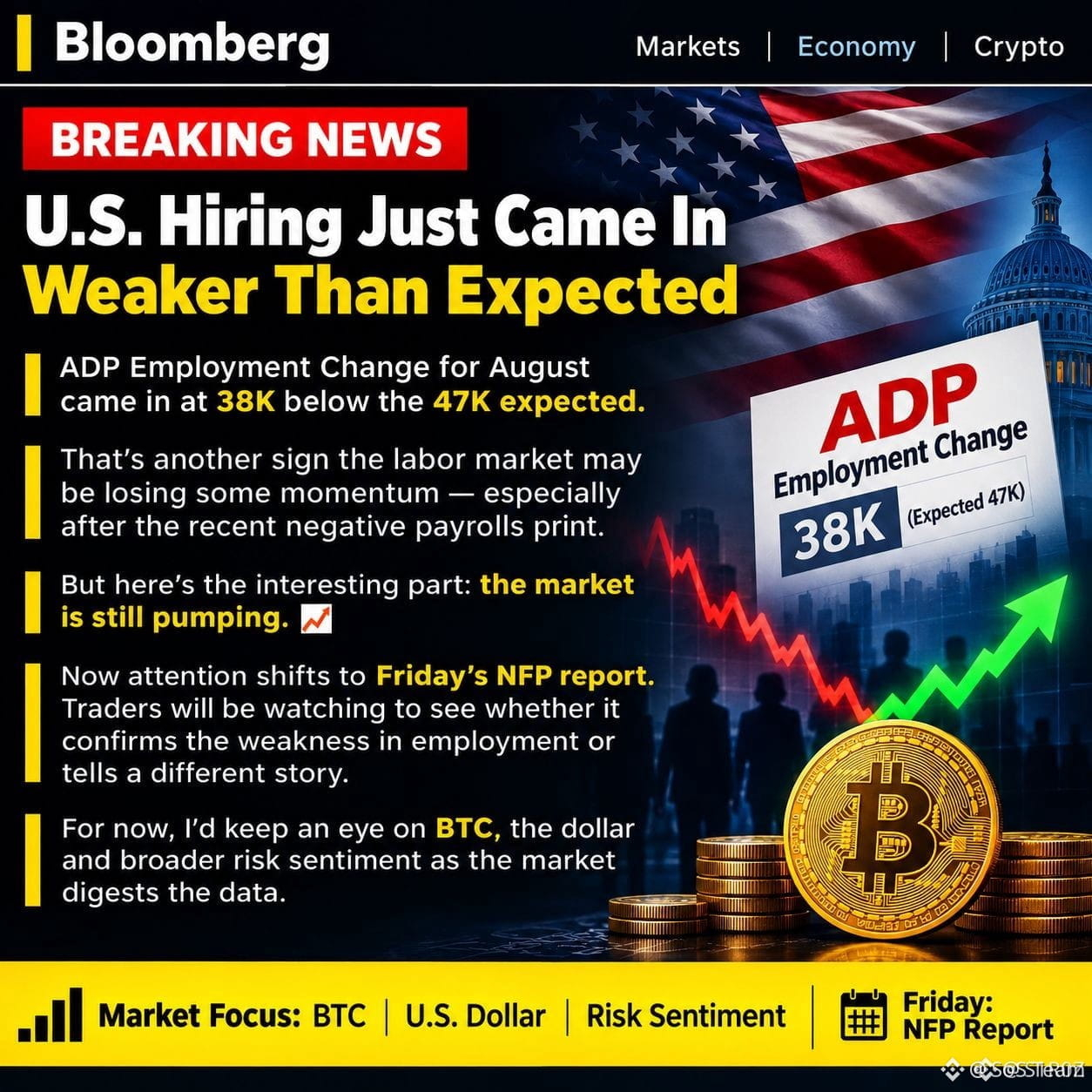
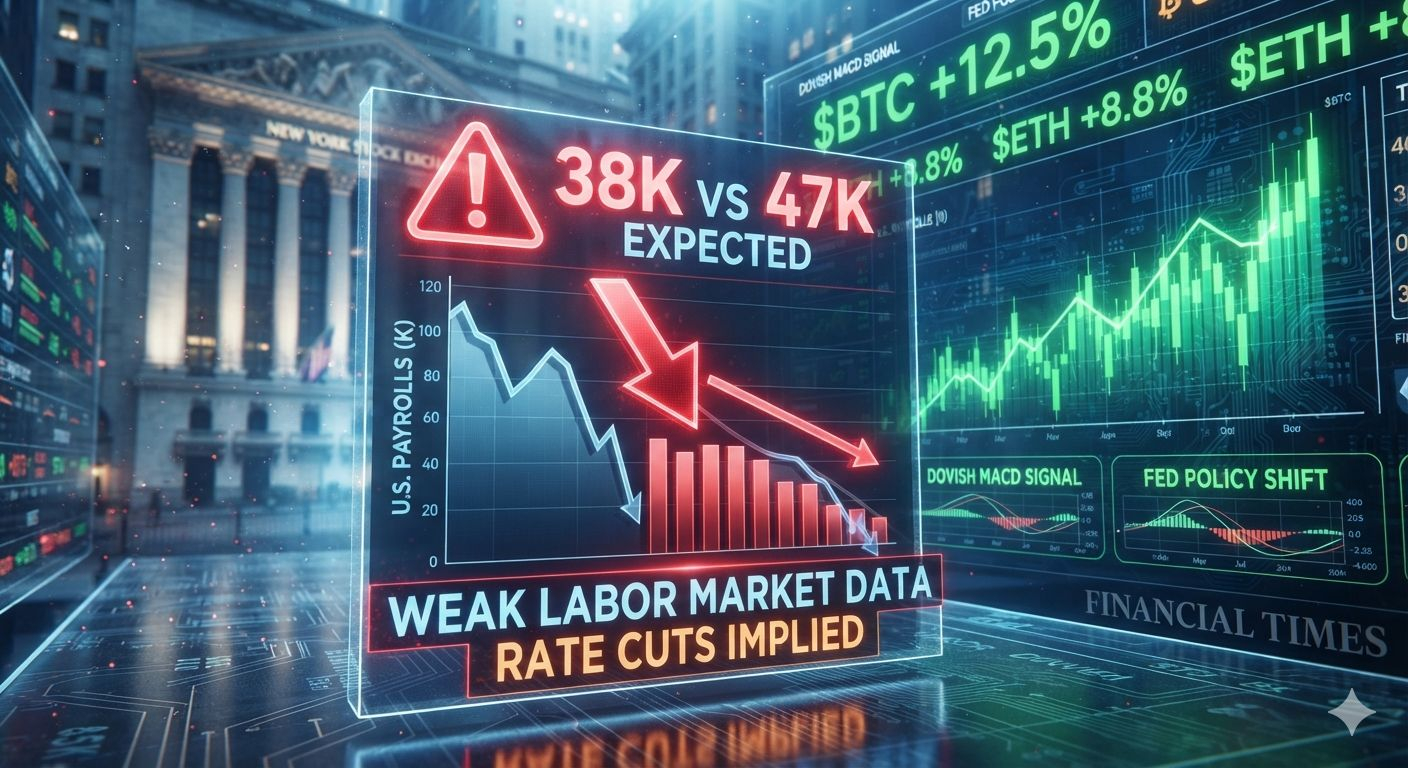
🚨 ADP EMPLOYMENT COMES IN COOL: 38K vs 47K EXPECTED
U.S. private payrolls added just 38,000 jobs in August according to ADP data, missing forecasts of 47,000 and marking the slowest pace of private-sector hiring since January.
The sharp slowdown in job creation signals a clear cooling in the labor market. While manufacturing (-17k) and professional services (-16k) shed roles, persistent wage inflation continues to complicate the economic picture.
This labor weakness adds directly to stagflation concerns while cementing expectations for aggressive rate cuts by the Federal Reserve. As macro traders anticipate easier financial conditions ahead, risk assets including Bitcoin ($BTC) and equities are catching an immediate liquidity pump! 💼🚀
Is this soft labor data the exact green light the Fed needs to trigger a full rate-cut cycle? Sound off below! 👇
#ADP #Macro
#usaugadpjobssmallestgainsincejan
🚨 ADP EMPLOYMENT COMES IN COOL: 38K vs 47K EXPECTED
U.S. private payrolls added just 38,000 jobs in August according to ADP data, missing forecasts of 47,000 and marking the slowest pace of private-sector hiring since January.
The sharp slowdown in job creation signals a clear cooling in the labor market. While manufacturing (-17k) and professional services (-16k) shed roles, persistent wage inflation continues to complicate the economic picture.
This labor weakness adds directly to stagflation concerns while cementing expectations for aggressive rate cuts by the Federal Reserve. As macro traders anticipate easier financial conditions ahead, risk assets including Bitcoin ($BTC) and equities are catching an immediate liquidity pump! 💼🚀
Is this soft labor data the exact green light the Fed needs to trigger a full rate-cut cycle? Sound off below! 👇
#ADP #Macro
🚨 ADP EMPLOYMENT COMES IN COOL: 38K vs 47K EXPECTED
U.S. private payrolls added just 38,000 jobs in August according to ADP data, missing forecasts of 47,000 and marking the slowest pace of private-sector hiring since January.
The sharp slowdown in job creation signals a clear cooling in the labor market. While manufacturing (-17k) and professional services (-16k) shed roles, persistent wage inflation continues to complicate the economic picture.
This labor weakness adds directly to stagflation concerns while cementing expectations for aggressive rate cuts by the Federal Reserve. As macro traders anticipate easier financial conditions ahead, risk assets including Bitcoin ($BTC) and equities are catching an immediate liquidity pump! 💼🚀
Is this soft labor data the exact green light the Fed needs to trigger a full rate-cut cycle? Sound off below! 👇
#ADP #Macro
1
46

#USAugADPJobsSmallestGainSinceJan
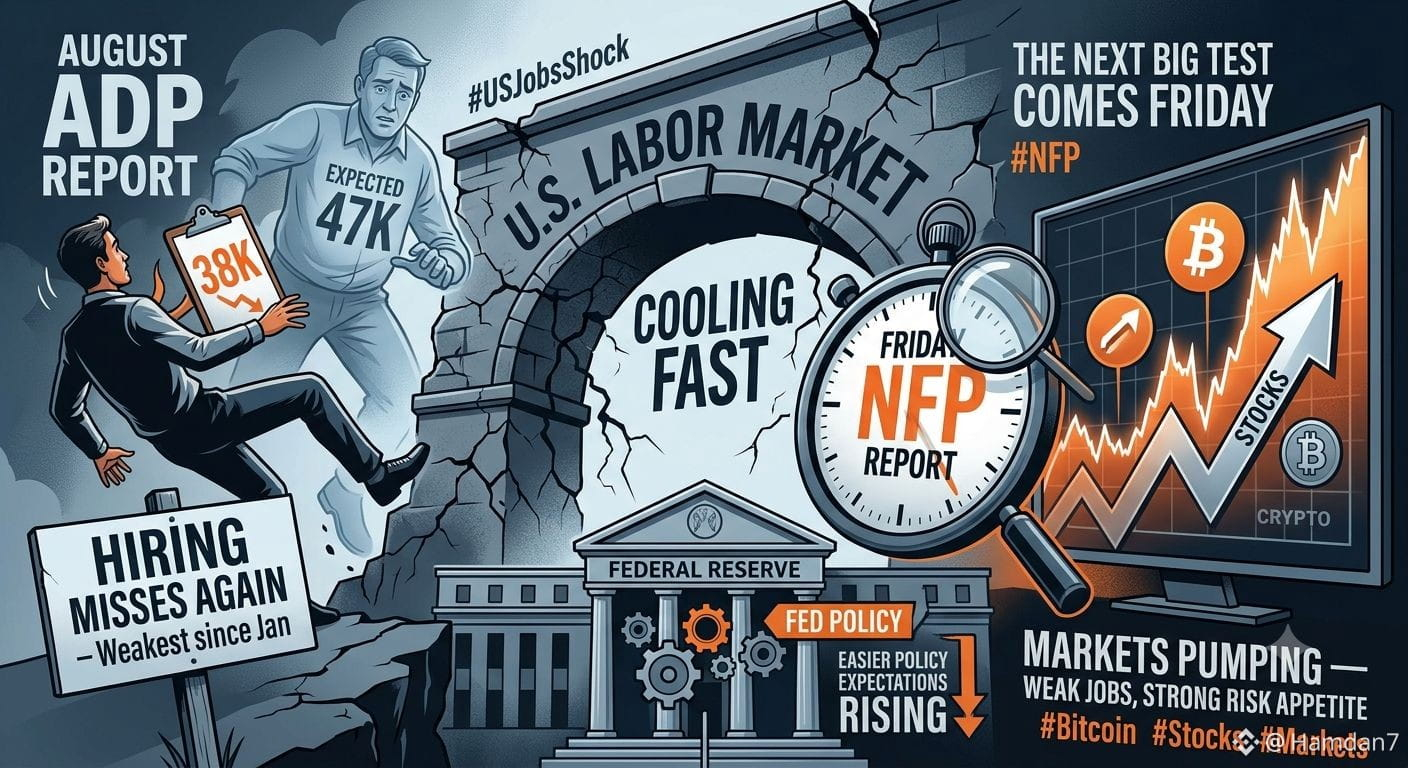
#USJobsShock — Hiring Cools Fast 🚨
38K vs 47K Expected — U.S. Hiring Misses Again
August ADP employment growth came in at just 38K, the weakest increase since January.
The labor market is showing clear signs of cooling, while Friday’s NFP report now becomes even more important.
If NFP also disappoints, expectations for easier Fed policy could rise sharply.
Yet markets are pumping — weak jobs data, strong risk appetite.
The next big test comes Friday. 👀
#ADP #NFP #USJobs #Fed #FederalReserve #Bitcoin #Crypto #Stocks #Markets
$BTC $ADP.US $BNB
#USAugADPJobsSmallestGainSinceJan
#USJobsShock — Hiring Cools Fast 🚨
38K vs 47K Expected — U.S. Hiring Misses Again
August ADP employment growth came in at just 38K, the weakest increase since January.
The labor market is showing clear signs of cooling, while Friday’s NFP report now becomes even more important.
If NFP also disappoints, expectations for easier Fed policy could rise sharply.
Yet markets are pumping — weak jobs data, strong risk appetite.
The next big test comes Friday. 👀
#ADP #NFP #USJobs #Fed #FederalReserve #Bitcoin #Crypto #Stocks #Markets
$BTC $ADP.US $BNB
#USJobsShock — Hiring Cools Fast 🚨
38K vs 47K Expected — U.S. Hiring Misses Again
August ADP employment growth came in at just 38K, the weakest increase since January.
The labor market is showing clear signs of cooling, while Friday’s NFP report now becomes even more important.
If NFP also disappoints, expectations for easier Fed policy could rise sharply.
Yet markets are pumping — weak jobs data, strong risk appetite.
The next big test comes Friday. 👀
#ADP #NFP #USJobs #Fed #FederalReserve #Bitcoin #Crypto #Stocks #Markets
$BTC $ADP.US $BNB
2
125

#usaugadpjobssmallestgainsincejan
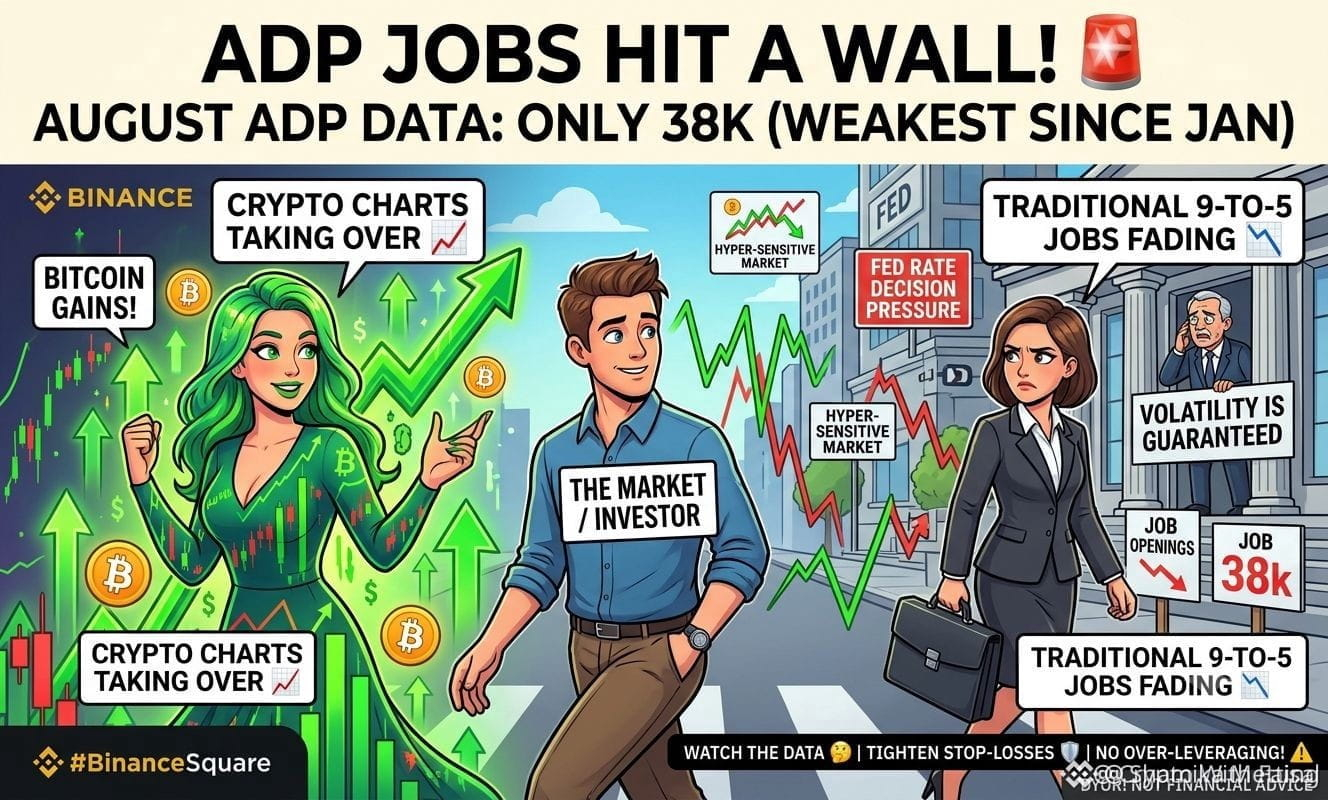
Job growth in the U.S. private sector has just hit a wall! 🚨
ADP data for August shows only 38,000 jobs added—which is the weakest absolute figure we've seen since January, and far below market expectations. Have the traditional 9-to-5 jobs started to fade away while crypto schemes take over? 📉📈
Putting jokes aside, these weak labor-market numbers are heavily influencing the Fed’s next rate decision. The market is extremely sensitive right now, and volatility has become undeniable.
Your action plan:
Monitor the data: Keep your eyes on the official NFP report on Friday.
Manage risk: Tighten your stop-loss orders.
Stay safe: Don’t over-leverage in this data-packed, highly volatile environment.
⚠️ Warning: Not financial advice. Always protect your capital and do your own research (DYOR)!
Please continue
#ADPJobs #FedRateDecision #CryptoNews
$BTC $ETH $BNB
#usaugadpjobssmallestgainsincejan
Job growth in the U.S. private sector has just hit a wall! 🚨
ADP data for August shows only 38,000 jobs added—which is the weakest absolute figure we've seen since January, and far below market expectations. Have the traditional 9-to-5 jobs started to fade away while crypto schemes take over? 📉📈
Putting jokes aside, these weak labor-market numbers are heavily influencing the Fed’s next rate decision. The market is extremely sensitive right now, and volatility has become undeniable.
Your action plan:
Monitor the data: Keep your eyes on the official NFP report on Friday.
Manage risk: Tighten your stop-loss orders.
Stay safe: Don’t over-leverage in this data-packed, highly volatile environment.
⚠️ Warning: Not financial advice. Always protect your capital and do your own research (DYOR)!
Please continue
#ADPJobs #FedRateDecision #CryptoNews
$BTC $ETH $BNB
Job growth in the U.S. private sector has just hit a wall! 🚨
ADP data for August shows only 38,000 jobs added—which is the weakest absolute figure we've seen since January, and far below market expectations. Have the traditional 9-to-5 jobs started to fade away while crypto schemes take over? 📉📈
Putting jokes aside, these weak labor-market numbers are heavily influencing the Fed’s next rate decision. The market is extremely sensitive right now, and volatility has become undeniable.
Your action plan:
Monitor the data: Keep your eyes on the official NFP report on Friday.
Manage risk: Tighten your stop-loss orders.
Stay safe: Don’t over-leverage in this data-packed, highly volatile environment.
⚠️ Warning: Not financial advice. Always protect your capital and do your own research (DYOR)!
Please continue
#ADPJobs #FedRateDecision #CryptoNews
$BTC $ETH $BNB
1
42

·
--
Verified
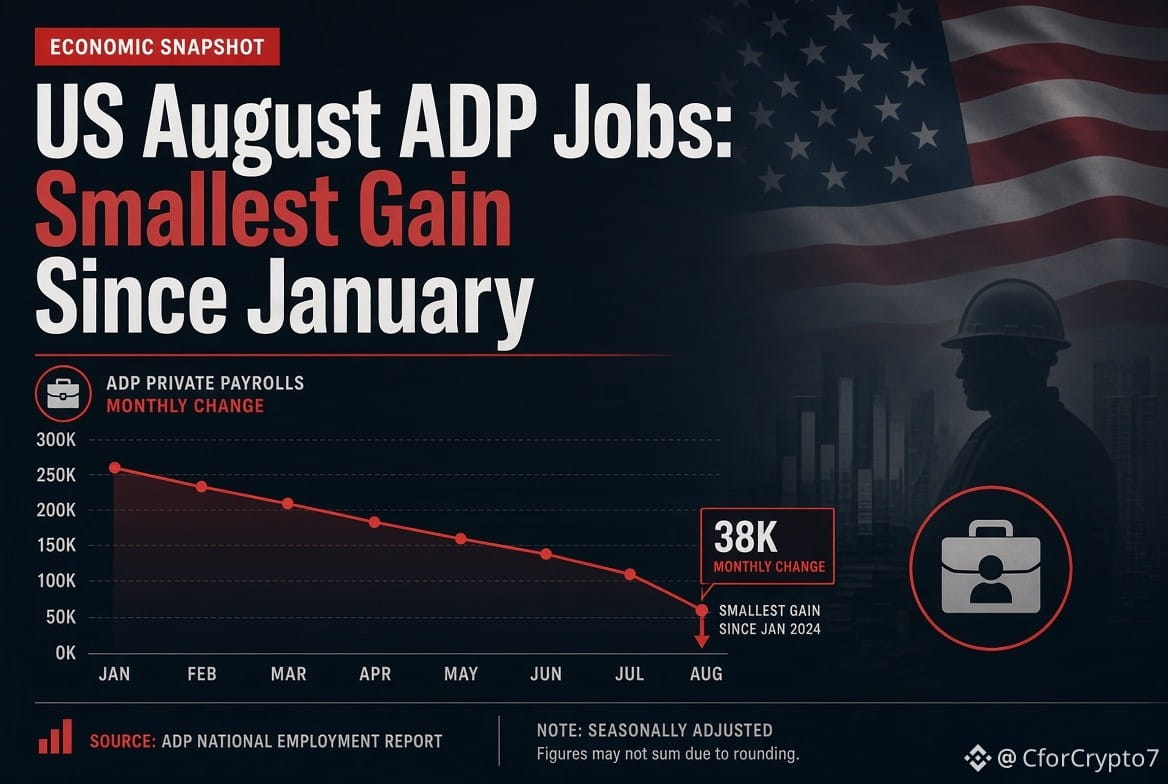
U.S. private employers add just 38,000 jobs in August.
ADP reports the smallest gain since January.
The figure falls short of the 47,000 expected by economists. July’s number is revised to 46,000.
Education and health services lead with 45,000 new positions. Leisure and hospitality add 16,000. Construction gains 12,000.
Manufacturing loses 17,000 jobs. Professional and business services drop 16,000. Large companies drive most of the hiring.
Wage growth holds steady.
Economists see the soft print as another sign of a cooling labor market.
Markets now turn attention to the official jobs report.
$ETH
{future}(ETHUSDT)
$SNDK
{future}(SNDKUSDT)
$BNB
{future}(BNBUSDT)
#USjobs #USJobData
#usaugadpjobssmallestgainsincejan
U.S. private employers add just 38,000 jobs in August.
ADP reports the smallest gain since January.
The figure falls short of the 47,000 expected by economists. July’s number is revised to 46,000.
Education and health services lead with 45,000 new positions. Leisure and hospitality add 16,000. Construction gains 12,000.
Manufacturing loses 17,000 jobs. Professional and business services drop 16,000. Large companies drive most of the hiring.
Wage growth holds steady.
Economists see the soft print as another sign of a cooling labor market.
Markets now turn attention to the official jobs report.
$ETH
$SNDK
$BNB
#USjobs #USJobData
#usaugadpjobssmallestgainsincejan
ADP reports the smallest gain since January.
The figure falls short of the 47,000 expected by economists. July’s number is revised to 46,000.
Education and health services lead with 45,000 new positions. Leisure and hospitality add 16,000. Construction gains 12,000.
Manufacturing loses 17,000 jobs. Professional and business services drop 16,000. Large companies drive most of the hiring.
Wage growth holds steady.
Economists see the soft print as another sign of a cooling labor market.
Markets now turn attention to the official jobs report.
$ETH
$SNDK
$BNB
#USjobs #USJobData
#usaugadpjobssmallestgainsincejan
2
2.6k

#USAugADPJobsSmallestGainSinceJan 🚨 **🇺🇸📉**
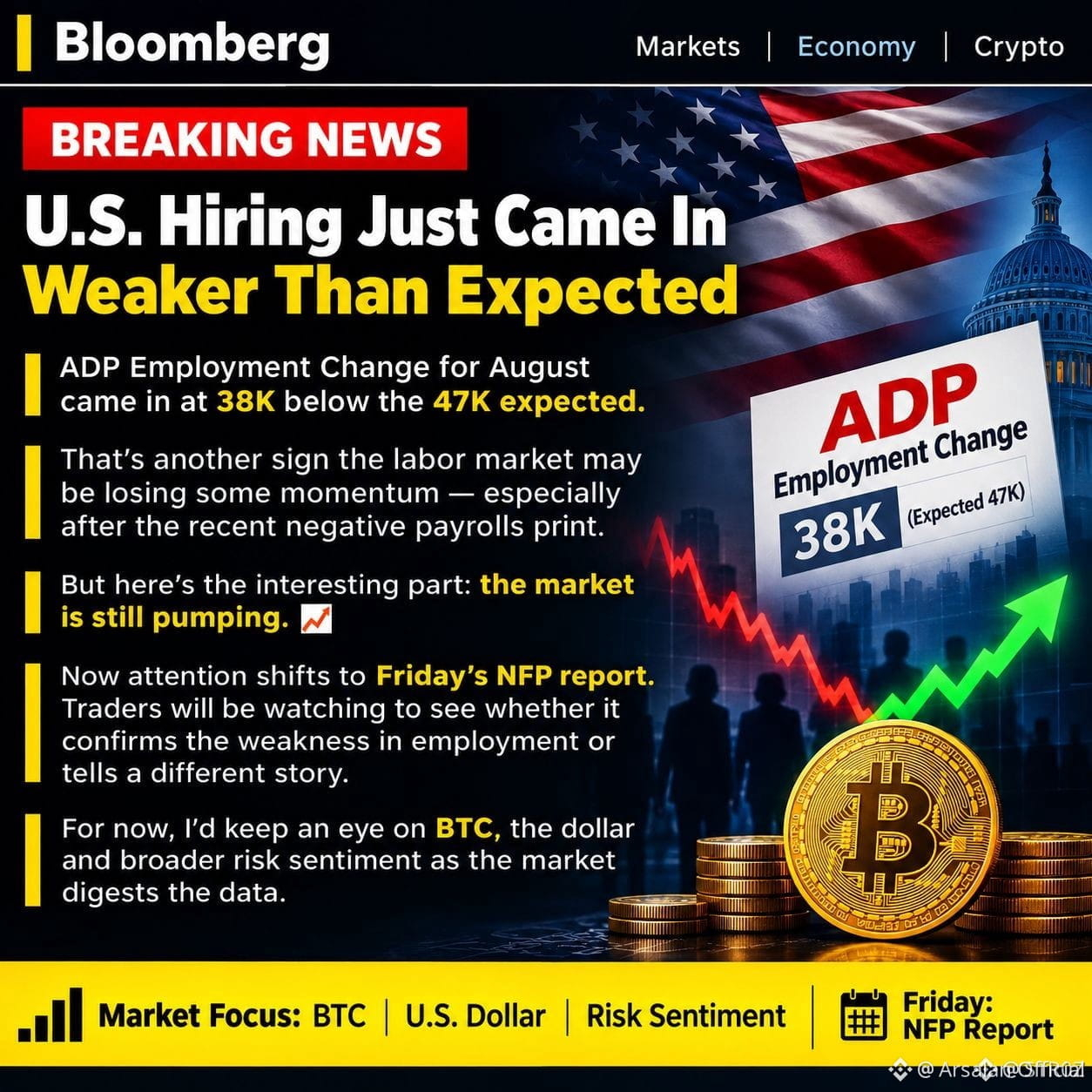
U.S. private employers added just **38,000 jobs in August**, the **smallest monthly gain since January**, missing expectations of around 47,000–48,000. ([ADP Media Center][1])
📌 **Key points:**
* 💼 Private payrolls: **+38K**
* 📉 Lowest gain since January
* 📊 July revised to **+46K**
* 🏥 Education & health: **+45K**
* 🏭 Manufacturing: **-17K**
* 💻 Professional & business services: **-16K**
⚠️ **Bottom line:** A softer labor market could influence expectations for the Federal Reserve and potentially impact stocks, the dollar and crypto.
#ADP #USJobs #JobsReport #FederalReserve #Fed #Bitcoin #Crypto #Markets #Trading #Finance #Binance #EconomicData
$BNB
{spot}(BNBUSDT)
[1]: $BTC
{spot}(BTCUSDT)
$ADP.US
{stock_us}(ADP.US)
#USAugADPJobsSmallestGainSinceJan 🚨 **🇺🇸📉**
U.S. private employers added just **38,000 jobs in August**, the **smallest monthly gain since January**, missing expectations of around 47,000–48,000. ([ADP Media Center][1])
📌 **Key points:**
* 💼 Private payrolls: **+38K**
* 📉 Lowest gain since January
* 📊 July revised to **+46K**
* 🏥 Education & health: **+45K**
* 🏭 Manufacturing: **-17K**
* 💻 Professional & business services: **-16K**
⚠️ **Bottom line:** A softer labor market could influence expectations for the Federal Reserve and potentially impact stocks, the dollar and crypto.
#ADP #USJobs #JobsReport #FederalReserve #Fed #Bitcoin #Crypto #Markets #Trading #Finance #Binance #EconomicData
$BNB
[1]: $BTC
$ADP.US
U.S. private employers added just **38,000 jobs in August**, the **smallest monthly gain since January**, missing expectations of around 47,000–48,000. ([ADP Media Center][1])
📌 **Key points:**
* 💼 Private payrolls: **+38K**
* 📉 Lowest gain since January
* 📊 July revised to **+46K**
* 🏥 Education & health: **+45K**
* 🏭 Manufacturing: **-17K**
* 💻 Professional & business services: **-16K**
⚠️ **Bottom line:** A softer labor market could influence expectations for the Federal Reserve and potentially impact stocks, the dollar and crypto.
#ADP #USJobs #JobsReport #FederalReserve #Fed #Bitcoin #Crypto #Markets #Trading #Finance #Binance #EconomicData
$BNB
[1]: $BTC
$ADP.US
1
104

·
--
Bullish
#USAugADPJobsSmallestGainSinceJan 🇺🇸 US JOB MARKET SHOWS SIGNS OF COOLING
The latest US ADP employment data is sending an important signal: private-sector job growth in August recorded its smallest gain since January. 📉
This suggests that the US labor market may be losing some of its previous momentum. While a slowdown in hiring does not automatically mean the economy is heading toward a recession, it does increase attention on upcoming employment and economic data.
For financial markets, weaker job growth could have significant implications. Investors are now watching closely for signs that labor-market weakness may influence the Federal Reserve’s future interest-rate decisions. 👀
📊 A softer employment picture could potentially strengthen expectations for easier monetary policy if inflation continues moving toward the Fed’s target. Lower-rate expectations can support risk assets such as technology stocks and cryptocurrencies, although market reactions will depend on the broader economic picture.
The key focus now shifts toward the official US jobs report, wage growth, unemployment data, and other labor-market indicators.
🔥 If hiring continues to slow, markets may increasingly price in a more dovish Fed.#USAugADPJobsSmallestGainSinceJan $AKE
{future}(AKEUSDT)
$BULLA
{alpha}(560x595e21b20e78674f8a64c1566a20b2b316bc3511)
$BTC
{future}(BTCUSDT)
#USAugADPJobsSmallestGainSinceJan 🇺🇸 US JOB MARKET SHOWS SIGNS OF COOLING
The latest US ADP employment data is sending an important signal: private-sector job growth in August recorded its smallest gain since January. 📉
This suggests that the US labor market may be losing some of its previous momentum. While a slowdown in hiring does not automatically mean the economy is heading toward a recession, it does increase attention on upcoming employment and economic data.
For financial markets, weaker job growth could have significant implications. Investors are now watching closely for signs that labor-market weakness may influence the Federal Reserve’s future interest-rate decisions. 👀
📊 A softer employment picture could potentially strengthen expectations for easier monetary policy if inflation continues moving toward the Fed’s target. Lower-rate expectations can support risk assets such as technology stocks and cryptocurrencies, although market reactions will depend on the broader economic picture.
The key focus now shifts toward the official US jobs report, wage growth, unemployment data, and other labor-market indicators.
🔥 If hiring continues to slow, markets may increasingly price in a more dovish Fed.#USAugADPJobsSmallestGainSinceJan $AKE
$BULLA
$BTC
The latest US ADP employment data is sending an important signal: private-sector job growth in August recorded its smallest gain since January. 📉
This suggests that the US labor market may be losing some of its previous momentum. While a slowdown in hiring does not automatically mean the economy is heading toward a recession, it does increase attention on upcoming employment and economic data.
For financial markets, weaker job growth could have significant implications. Investors are now watching closely for signs that labor-market weakness may influence the Federal Reserve’s future interest-rate decisions. 👀
📊 A softer employment picture could potentially strengthen expectations for easier monetary policy if inflation continues moving toward the Fed’s target. Lower-rate expectations can support risk assets such as technology stocks and cryptocurrencies, although market reactions will depend on the broader economic picture.
The key focus now shifts toward the official US jobs report, wage growth, unemployment data, and other labor-market indicators.
🔥 If hiring continues to slow, markets may increasingly price in a more dovish Fed.#USAugADPJobsSmallestGainSinceJan $AKE
$BULLA
$BTC

1
309

·
--
#USAugADPJobsSmallestGainSinceJan
Market SignalJobs Watch 📊
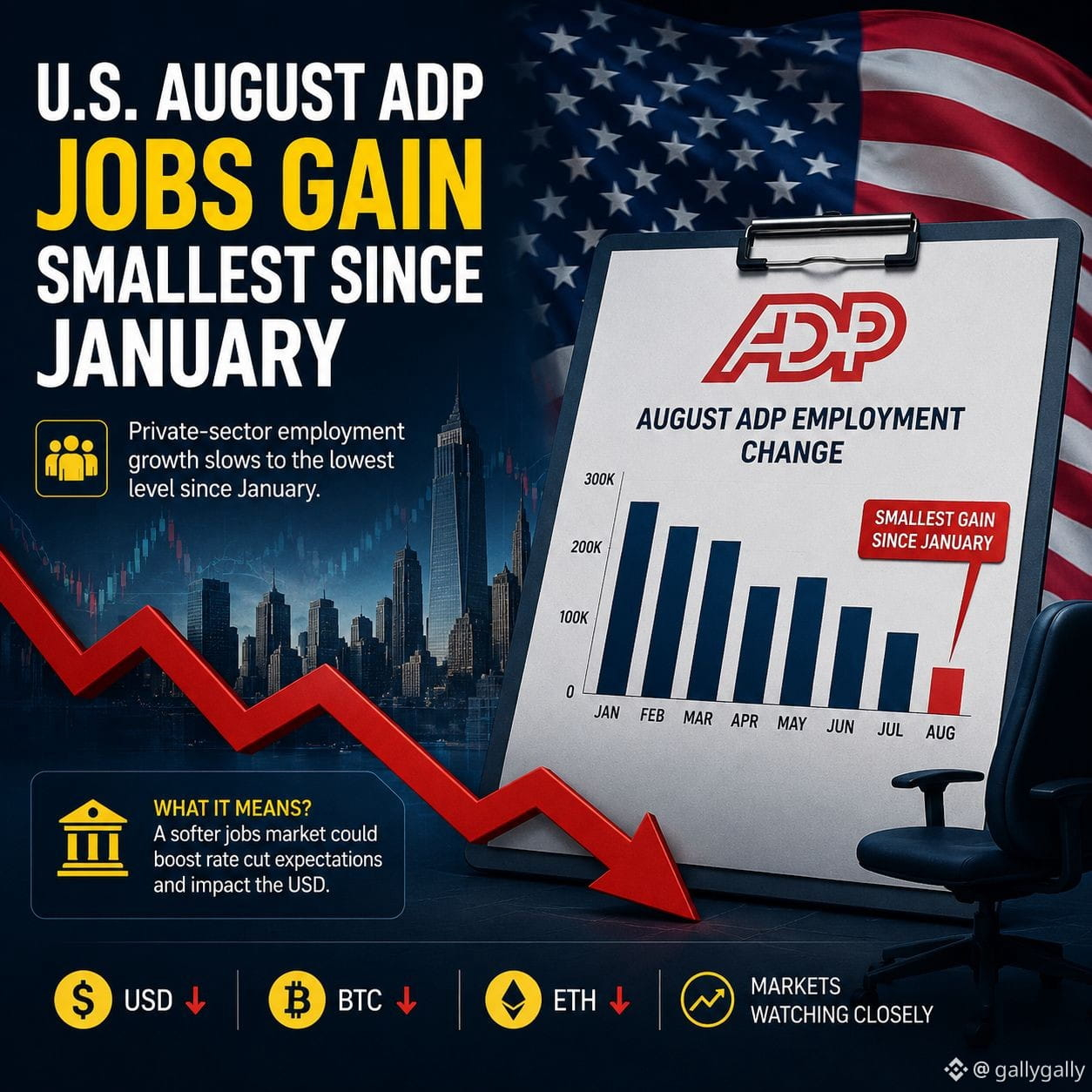
🇺🇸 U.S. August ADP employment growth came in as the smallest gain since January, pointing to a softer private-sector labor market. This could add pressure to expectations around future Fed policy and keep traders focused on upcoming jobs and inflation data. 📉
U.S. labor momentum appears to be losing strength. 🇺🇸 August ADP job growth posted its weakest gain since January, giving markets another reason to watch economic data closely. A softer jobs picture may reshape expectations for interest rates and liquidity.
$USD $BTC $SPX
#ADP #JobsData #FedPolicy #USMarkets #Bitcoin #BİNANCE
#USAugADPJobsSmallestGainSinceJan
Market SignalJobs Watch 📊
🇺🇸 U.S. August ADP employment growth came in as the smallest gain since January, pointing to a softer private-sector labor market. This could add pressure to expectations around future Fed policy and keep traders focused on upcoming jobs and inflation data. 📉
U.S. labor momentum appears to be losing strength. 🇺🇸 August ADP job growth posted its weakest gain since January, giving markets another reason to watch economic data closely. A softer jobs picture may reshape expectations for interest rates and liquidity.
$USD $BTC $SPX
#ADP #JobsData #FedPolicy #USMarkets #Bitcoin #BİNANCE
Market SignalJobs Watch 📊
🇺🇸 U.S. August ADP employment growth came in as the smallest gain since January, pointing to a softer private-sector labor market. This could add pressure to expectations around future Fed policy and keep traders focused on upcoming jobs and inflation data. 📉
U.S. labor momentum appears to be losing strength. 🇺🇸 August ADP job growth posted its weakest gain since January, giving markets another reason to watch economic data closely. A softer jobs picture may reshape expectations for interest rates and liquidity.
$USD $BTC $SPX
#ADP #JobsData #FedPolicy #USMarkets #Bitcoin #BİNANCE
44

·
--
#USAugADPJobsSmallestGainSinceJan
U.S. private sector added only 38,000 jobs in August, a figure below expectations and marking the weakest monthly gain since January.
Key points:
Net slowdown: job creation is slowing, in contrast with the revised July figure, which was 46,000.
Sector disparities: most hiring was concentrated in education and health, while the manufacturing sector destroyed 17,000 jobs.
#USAugADPJobsSmallestGainSinceJan
U.S. private sector added only 38,000 jobs in August, a figure below expectations and marking the weakest monthly gain since January.
Key points:
Net slowdown: job creation is slowing, in contrast with the revised July figure, which was 46,000.
Sector disparities: most hiring was concentrated in education and health, while the manufacturing sector destroyed 17,000 jobs.
U.S. private sector added only 38,000 jobs in August, a figure below expectations and marking the weakest monthly gain since January.
Key points:
Net slowdown: job creation is slowing, in contrast with the revised July figure, which was 46,000.
Sector disparities: most hiring was concentrated in education and health, while the manufacturing sector destroyed 17,000 jobs.
1
130

·
--
#USAugADPJobsSmallestGainSinceJan the Post with hashtag #USAugADPJobsSmallestGainSinceJan:
U.S. private-sector hiring slowed sharply in August, with employers adding just 38,000 jobs, according to ADP. The increase was the smallest since January and missed economists’ expectations of roughly 47,000, following a revised 46,000 gain in July.
Education and health services led hiring with 45,000 positions, while manufacturing lost 17,000 and professional and business services shed 16,000. The data point to a cooling labor market and could influence Federal Reserve rate expectations ahead of Friday’s official employment report.
#USAugADPJobsSmallestGainSinceJan the Post with hashtag #USAugADPJobsSmallestGainSinceJan:
U.S. private-sector hiring slowed sharply in August, with employers adding just 38,000 jobs, according to ADP. The increase was the smallest since January and missed economists’ expectations of roughly 47,000, following a revised 46,000 gain in July.
Education and health services led hiring with 45,000 positions, while manufacturing lost 17,000 and professional and business services shed 16,000. The data point to a cooling labor market and could influence Federal Reserve rate expectations ahead of Friday’s official employment report.
U.S. private-sector hiring slowed sharply in August, with employers adding just 38,000 jobs, according to ADP. The increase was the smallest since January and missed economists’ expectations of roughly 47,000, following a revised 46,000 gain in July.
Education and health services led hiring with 45,000 positions, while manufacturing lost 17,000 and professional and business services shed 16,000. The data point to a cooling labor market and could influence Federal Reserve rate expectations ahead of Friday’s official employment report.
78


Verified
#usaugadpjobssmallestgainsincejan
🔥 US AUG ADP JOBS SLUMP: SMALLEST GAIN SINCE JANUARY 🔥
When hiring loses its rhythm, markets start listening closer.
Sometimes the quietest number creates the loudest question.
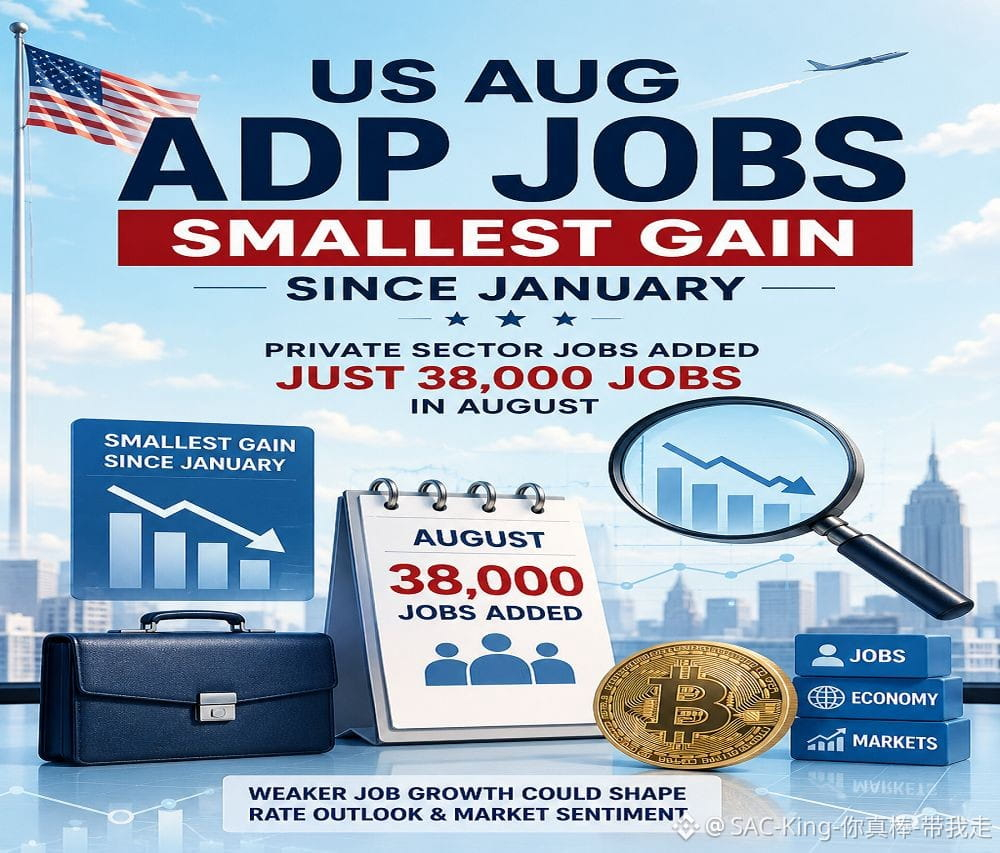
U.S. private employers added just 38,000 jobs in August, the smallest monthly gain since January and below the 47,000 consensus expectation. July was revised higher to 46,000.
The weakness was uneven. Education and health services added 45,000 jobs, while manufacturing lost 17,000 and professional and business services dropped 16,000.
Wage growth also matters. Base pay increased 3.2% year over year across private-sector workers, while gross pay rose 4.7%.
For the Federal Reserve, this creates a delicate balance: cooling employment can support expectations for easier policy, but persistent inflation can limit that flexibility.
And that is where crypto traders should pay attention. Softer labor data can reshape expectations around rates, liquidity and the dollar, all of which can influence Bitcoin’s risk appetite.
But ADP is not the final verdict. Friday’s official U.S. jobs report will provide a broader picture.
One weak jobs number does not define the economy, but it can change the market’s narrative.
❓Do you think Friday’s jobs report will confirm this cooling trend or surprise markets?
Disclaimer: This is market analysis for informational purposes only, not financial advice.
#USJobs #FederalReserve #GrowWithSAC
#USAugADPJobsSmallestGainSinceJan
#usaugadpjobssmallestgainsincejan
🔥 US AUG ADP JOBS SLUMP: SMALLEST GAIN SINCE JANUARY 🔥
When hiring loses its rhythm, markets start listening closer.
Sometimes the quietest number creates the loudest question.
U.S. private employers added just 38,000 jobs in August, the smallest monthly gain since January and below the 47,000 consensus expectation. July was revised higher to 46,000.
The weakness was uneven. Education and health services added 45,000 jobs, while manufacturing lost 17,000 and professional and business services dropped 16,000.
Wage growth also matters. Base pay increased 3.2% year over year across private-sector workers, while gross pay rose 4.7%.
For the Federal Reserve, this creates a delicate balance: cooling employment can support expectations for easier policy, but persistent inflation can limit that flexibility.
And that is where crypto traders should pay attention. Softer labor data can reshape expectations around rates, liquidity and the dollar, all of which can influence Bitcoin’s risk appetite.
But ADP is not the final verdict. Friday’s official U.S. jobs report will provide a broader picture.
One weak jobs number does not define the economy, but it can change the market’s narrative.
❓Do you think Friday’s jobs report will confirm this cooling trend or surprise markets?
Disclaimer: This is market analysis for informational purposes only, not financial advice.
#USJobs #FederalReserve #GrowWithSAC
#USAugADPJobsSmallestGainSinceJan
🔥 US AUG ADP JOBS SLUMP: SMALLEST GAIN SINCE JANUARY 🔥
When hiring loses its rhythm, markets start listening closer.
Sometimes the quietest number creates the loudest question.
U.S. private employers added just 38,000 jobs in August, the smallest monthly gain since January and below the 47,000 consensus expectation. July was revised higher to 46,000.
The weakness was uneven. Education and health services added 45,000 jobs, while manufacturing lost 17,000 and professional and business services dropped 16,000.
Wage growth also matters. Base pay increased 3.2% year over year across private-sector workers, while gross pay rose 4.7%.
For the Federal Reserve, this creates a delicate balance: cooling employment can support expectations for easier policy, but persistent inflation can limit that flexibility.
And that is where crypto traders should pay attention. Softer labor data can reshape expectations around rates, liquidity and the dollar, all of which can influence Bitcoin’s risk appetite.
But ADP is not the final verdict. Friday’s official U.S. jobs report will provide a broader picture.
One weak jobs number does not define the economy, but it can change the market’s narrative.
❓Do you think Friday’s jobs report will confirm this cooling trend or surprise markets?
Disclaimer: This is market analysis for informational purposes only, not financial advice.
#USJobs #FederalReserve #GrowWithSAC
#USAugADPJobsSmallestGainSinceJan
857

·
--
#usaugadpjobssmallestgainsincejan
⚠️ ADP SHOCKER: 38K vs 47K EXPECTED ⚠️
US LABOR MARKET COOLING DOWN
Smallest job gains since January
WHY CRYPTO LOVES BAD NEWS:
1. Weak economy = Fed forced to CUT rates
2. Rate cuts = Money printer ON = BTC pumps
3. "Bad news is good news" narrative back
COIN BREAKDOWN:
$BTC - Best performer on rate cut bets
$ETH - ETH/BTC ratio may rise
$SOL - High risk, high reward on liquidity
$BNB - Exchange volumes up on volatility
DXY IMPACT:
Dollar dropping = Bitcoin getting stronger
KEY DATE: FRIDAY NFP REPORT
If NFP also misses = 90% chance of rate cut
Target: BTC $68K-$72K zone
STRATEGY:
Buy weakness or wait for NFP? 👇
#ADP #NFP #Fed #BTC #ETH #SOL #crypto #RateCuts
#usaugadpjobssmallestgainsincejan
⚠️ ADP SHOCKER: 38K vs 47K EXPECTED ⚠️
US LABOR MARKET COOLING DOWN
Smallest job gains since January
WHY CRYPTO LOVES BAD NEWS:
1. Weak economy = Fed forced to CUT rates
2. Rate cuts = Money printer ON = BTC pumps
3. "Bad news is good news" narrative back
COIN BREAKDOWN:
$BTC - Best performer on rate cut bets
$ETH - ETH/BTC ratio may rise
$SOL - High risk, high reward on liquidity
$BNB - Exchange volumes up on volatility
DXY IMPACT:
Dollar dropping = Bitcoin getting stronger
KEY DATE: FRIDAY NFP REPORT
If NFP also misses = 90% chance of rate cut
Target: BTC $68K-$72K zone
STRATEGY:
Buy weakness or wait for NFP? 👇
#ADP #NFP #Fed #BTC #ETH #SOL #crypto #RateCuts
⚠️ ADP SHOCKER: 38K vs 47K EXPECTED ⚠️
US LABOR MARKET COOLING DOWN
Smallest job gains since January
WHY CRYPTO LOVES BAD NEWS:
1. Weak economy = Fed forced to CUT rates
2. Rate cuts = Money printer ON = BTC pumps
3. "Bad news is good news" narrative back
COIN BREAKDOWN:
$BTC - Best performer on rate cut bets
$ETH - ETH/BTC ratio may rise
$SOL - High risk, high reward on liquidity
$BNB - Exchange volumes up on volatility
DXY IMPACT:
Dollar dropping = Bitcoin getting stronger
KEY DATE: FRIDAY NFP REPORT
If NFP also misses = 90% chance of rate cut
Target: BTC $68K-$72K zone
STRATEGY:
Buy weakness or wait for NFP? 👇
#ADP #NFP #Fed #BTC #ETH #SOL #crypto #RateCuts
1
3
1k

·
--
🔴 The headline looks simple: U.S. private employers added only 38K jobs in August.
But the deeper signal is harder to ignore.
ADP’s latest report shows hiring fell short of the 48K expectation and slowed from July’s revised 46K gain, making August the weakest month since January. Even more interesting, manufacturing lost 17K jobs and professional/business services dropped 16K, while education and healthcare carried the gains with 45K.
To me, this looks less like a collapse and more like a labor market losing momentum.
Now the real test comes Friday with the official U.S. jobs report.
If that data confirms the slowdown, markets may start pricing the Fed differently — and that could become a major catalyst for BTC, gold and risk assets.
The jobs market just gave investors another reason to pay attention.
#USAugADPJobsSmallestGainSinceJan
🔴 The headline looks simple: U.S. private employers added only 38K jobs in August.
But the deeper signal is harder to ignore.
ADP’s latest report shows hiring fell short of the 48K expectation and slowed from July’s revised 46K gain, making August the weakest month since January. Even more interesting, manufacturing lost 17K jobs and professional/business services dropped 16K, while education and healthcare carried the gains with 45K.
To me, this looks less like a collapse and more like a labor market losing momentum.
Now the real test comes Friday with the official U.S. jobs report.
If that data confirms the slowdown, markets may start pricing the Fed differently — and that could become a major catalyst for BTC, gold and risk assets.
The jobs market just gave investors another reason to pay attention.
#USAugADPJobsSmallestGainSinceJan
But the deeper signal is harder to ignore.
ADP’s latest report shows hiring fell short of the 48K expectation and slowed from July’s revised 46K gain, making August the weakest month since January. Even more interesting, manufacturing lost 17K jobs and professional/business services dropped 16K, while education and healthcare carried the gains with 45K.
To me, this looks less like a collapse and more like a labor market losing momentum.
Now the real test comes Friday with the official U.S. jobs report.
If that data confirms the slowdown, markets may start pricing the Fed differently — and that could become a major catalyst for BTC, gold and risk assets.
The jobs market just gave investors another reason to pay attention.
#USAugADPJobsSmallestGainSinceJan
188

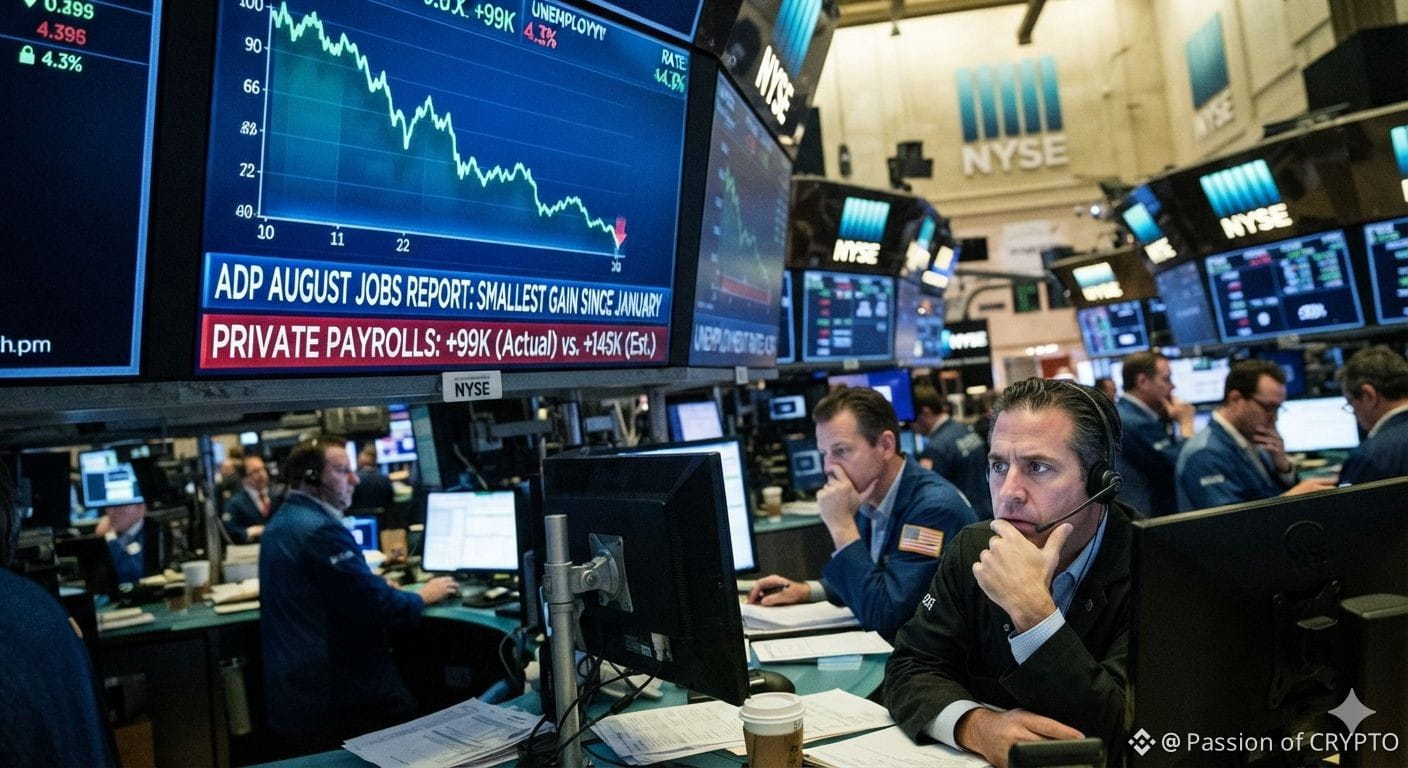
#USAugADPJobsSmallestGainSinceJan The US labor market is cooling down faster than expected. 🚨 #USAugADPJobsSmallestGainSinceJan is officially the big talking point today as private payroll numbers signal a significant deceleration in economic momentum.
📉 What Happened?
The latest ADP National Employment Report reveals that private sector job growth has hit its lowest pace since January.
The Core Data: Private employers added significantly fewer jobs than Wall Street economists anticipated.
The Trend: This marks a multi-month cooling trend, proving that aggressive interest rate hikes are finally chilling the hot labor market.
Pay Growth: Wage growth for both job-stayers and job-changers is also continuing to ease up.
🔍 Why It Matters
This isn't just a data point—it changes the game for the entire financial market:
Fed Interest Rate Cuts: A cooling job market gives the Federal Reserve the ultimate green light to confidently cut interest rates at their next meeting to prevent a harder economic landing.
Market Sentiment: Wall Street is tracking this closely. While a slower economy sounds bad, stock investors often welcome it if it means borrowing money will become cheaper soon.
The Big Picture: All eyes now turn to the upcoming official government Non-Farm Payrolls (NFP) report to see if it confirms this macro slowdown.
What’s your move? Is a cooling labor market exactly what the Fed needs, or are we heading toward a deeper slowdown?
Drop your thoughts below! 👇
#USAugADPJobsSmallestGainSinceJan The US labor market is cooling down faster than expected. 🚨 #USAugADPJobsSmallestGainSinceJan is officially the big talking point today as private payroll numbers signal a significant deceleration in economic momentum.
📉 What Happened?
The latest ADP National Employment Report reveals that private sector job growth has hit its lowest pace since January.
The Core Data: Private employers added significantly fewer jobs than Wall Street economists anticipated.
The Trend: This marks a multi-month cooling trend, proving that aggressive interest rate hikes are finally chilling the hot labor market.
Pay Growth: Wage growth for both job-stayers and job-changers is also continuing to ease up.
🔍 Why It Matters
This isn't just a data point—it changes the game for the entire financial market:
Fed Interest Rate Cuts: A cooling job market gives the Federal Reserve the ultimate green light to confidently cut interest rates at their next meeting to prevent a harder economic landing.
Market Sentiment: Wall Street is tracking this closely. While a slower economy sounds bad, stock investors often welcome it if it means borrowing money will become cheaper soon.
The Big Picture: All eyes now turn to the upcoming official government Non-Farm Payrolls (NFP) report to see if it confirms this macro slowdown.
What’s your move? Is a cooling labor market exactly what the Fed needs, or are we heading toward a deeper slowdown?
Drop your thoughts below! 👇
📉 What Happened?
The latest ADP National Employment Report reveals that private sector job growth has hit its lowest pace since January.
The Core Data: Private employers added significantly fewer jobs than Wall Street economists anticipated.
The Trend: This marks a multi-month cooling trend, proving that aggressive interest rate hikes are finally chilling the hot labor market.
Pay Growth: Wage growth for both job-stayers and job-changers is also continuing to ease up.
🔍 Why It Matters
This isn't just a data point—it changes the game for the entire financial market:
Fed Interest Rate Cuts: A cooling job market gives the Federal Reserve the ultimate green light to confidently cut interest rates at their next meeting to prevent a harder economic landing.
Market Sentiment: Wall Street is tracking this closely. While a slower economy sounds bad, stock investors often welcome it if it means borrowing money will become cheaper soon.
The Big Picture: All eyes now turn to the upcoming official government Non-Farm Payrolls (NFP) report to see if it confirms this macro slowdown.
What’s your move? Is a cooling labor market exactly what the Fed needs, or are we heading toward a deeper slowdown?
Drop your thoughts below! 👇
34

·
--
US private hiring just posted its smallest gain since January. Why should crypto care?
Because the labor market is becoming part of the Fed conversation again.
Weak hiring can mean cooling economic activity. That can increase expectations for easier monetary policy.
$TRX
{future}(TRXUSDT)
Sounds bullish for risk assets, right?
Not automatically.
The market has to decide whether weaker jobs mean “Fed can cut” or “recession risk is rising.”
That distinction is everything.
Crypto traders should watch the reaction in Treasury yields, DXY and BTC, not just the jobs headline.
$T
{future}(TUSDT)
Bull case: softer labor data → lower yields → more liquidity expectations → risk assets benefit.
Bear case: labor weakness accelerates → recession fears overwhelm rate-cut optimism.
Don’t trade one ADP number in isolation.
The same weak data can be bullish liquidity news today and recession news tomorrow.
#USJobs #FederalReserve #Macro
$SOL
#usaugadpjobssmallestgainsincejan
US private hiring just posted its smallest gain since January. Why should crypto care?
Because the labor market is becoming part of the Fed conversation again.
Weak hiring can mean cooling economic activity. That can increase expectations for easier monetary policy.
$TRX
Sounds bullish for risk assets, right?
Not automatically.
The market has to decide whether weaker jobs mean “Fed can cut” or “recession risk is rising.”
That distinction is everything.
Crypto traders should watch the reaction in Treasury yields, DXY and BTC, not just the jobs headline.
$T
Bull case: softer labor data → lower yields → more liquidity expectations → risk assets benefit.
Bear case: labor weakness accelerates → recession fears overwhelm rate-cut optimism.
Don’t trade one ADP number in isolation.
The same weak data can be bullish liquidity news today and recession news tomorrow.
#USJobs #FederalReserve #Macro
$SOL
#usaugadpjobssmallestgainsincejan
Because the labor market is becoming part of the Fed conversation again.
Weak hiring can mean cooling economic activity. That can increase expectations for easier monetary policy.
$TRX
Sounds bullish for risk assets, right?
Not automatically.
The market has to decide whether weaker jobs mean “Fed can cut” or “recession risk is rising.”
That distinction is everything.
Crypto traders should watch the reaction in Treasury yields, DXY and BTC, not just the jobs headline.
$T
Bull case: softer labor data → lower yields → more liquidity expectations → risk assets benefit.
Bear case: labor weakness accelerates → recession fears overwhelm rate-cut optimism.
Don’t trade one ADP number in isolation.
The same weak data can be bullish liquidity news today and recession news tomorrow.
#USJobs #FederalReserve #Macro
$SOL
#usaugadpjobssmallestgainsincejan
2
424
Log in to explore more content
Join global crypto users on Binance Square
⚡️ Get latest and useful information about crypto.
💬 Trusted by the world’s largest crypto exchange.
👍 Discover real insights from verified creators.
Email / Phone number
Trending Topics
1
#AIStocksWhatNext
78,556 views
877 Discussing
2
#BitcoinBreaksAboveMayHighNears$86K
209 views
11 Discussing
3
#DogecoinRises15%
1,078 views
68 Discussing
4
#$14BBitcoinOptionsExpireFriday
107 views
7 Discussing
5
#BNBMarketCapPassesBNYMellon
599 views
54 Discussing
6
#CryptoMarketCapReclaims$3Trillion
145 views
9 Discussing
7
#MuseOvertakesChatGPTAsTopFreeIOSApp
1,759 views
104 Discussing
8
#TokenizedStockPlatformsCouldLaunchNextQuarter
3,614 views
140 Discussing
9
#StrategyAdds950Bitcoin
6,388 views
210 Discussing
10
#CardanoAddedToX402KitForADAPayments
11,795 views
370 Discussing