
#trumppolicy
trumppolicy
38,310 views
84 Discussing
Hot
Latest

According to Politico, a US political news website, the Trump administration is currently planning a 90-day diesel export ban aimed at tackling recent high oil prices driven by heightened geopolitical tensions in the Middle East and damage to overseas refineries, with the goal of easing inflation pressure on domestic voters. Although the plan has sparked intense divisions within the White House, with multiple senior officials—including the Secretary of Energy and the Secretary of the Treasury—opposed due to concerns that refiners will cut production, farm-state lawmakers led by Senator Chuck Grassley are applying strong pressure, and it is expected that the administration may finalize the relevant measures by the end of this weekend.
From a macro and supply-demand structure perspective, this standoff reflects the balancing act policymakers are trying to strike between suppressing inflation and maintaining energy free trade. In recent times, as geopolitical conflicts have widened diesel crack spreads, the White House is considering using administrative intervention to directly cut off exports. The core logic is to quickly lower energy costs by locking refined products into the domestic market. While industry concerns remain about long-term supply distortions, this move clearly signals the authorities’ determination to keep short-term price surges in check at any cost.
For commodities and traditional macro markets, expectations of this intervention are being rapidly priced into asset valuations. If an increase in US diesel inventories passively pushes down domestic energy prices, it would significantly weaken commodities’ upward pressure on CPI data, causing inflation expectation indicators to show a technical “top-back” divergence. With the marginal risk of inflation rising easing, yields on 10-year US Treasuries and the US dollar index are likely to come under downward pressure at key resistance levels, thereby creating a more accommodative macro environment for the release of global liquidity.
For crypto assets, an easing in expected energy-related inflation pressure is an highly constructive positive signal. As concerns about macro tightening cool off, risk appetite for capital within the market is likely to increase directly (Risk-on), creating conditions for Bitcoin $BTC to build upward momentum above key moving-average support levels. When real yields fall and USD liquidity pressure eases, crypto markets often break out of range-bound upward moves first, with the potential to kick off a new liquidity-driven volume rebound.🚀
#EnergyMarkets #TrumpPolicy #MacroEconomics
According to Politico, a US political news website, the Trump administration is currently planning a 90-day diesel export ban aimed at tackling recent high oil prices driven by heightened geopolitical tensions in the Middle East and damage to overseas refineries, with the goal of easing inflation pressure on domestic voters. Although the plan has sparked intense divisions within the White House, with multiple senior officials—including the Secretary of Energy and the Secretary of the Treasury—opposed due to concerns that refiners will cut production, farm-state lawmakers led by Senator Chuck Grassley are applying strong pressure, and it is expected that the administration may finalize the relevant measures by the end of this weekend.
From a macro and supply-demand structure perspective, this standoff reflects the balancing act policymakers are trying to strike between suppressing inflation and maintaining energy free trade. In recent times, as geopolitical conflicts have widened diesel crack spreads, the White House is considering using administrative intervention to directly cut off exports. The core logic is to quickly lower energy costs by locking refined products into the domestic market. While industry concerns remain about long-term supply distortions, this move clearly signals the authorities’ determination to keep short-term price surges in check at any cost.
For commodities and traditional macro markets, expectations of this intervention are being rapidly priced into asset valuations. If an increase in US diesel inventories passively pushes down domestic energy prices, it would significantly weaken commodities’ upward pressure on CPI data, causing inflation expectation indicators to show a technical “top-back” divergence. With the marginal risk of inflation rising easing, yields on 10-year US Treasuries and the US dollar index are likely to come under downward pressure at key resistance levels, thereby creating a more accommodative macro environment for the release of global liquidity.
For crypto assets, an easing in expected energy-related inflation pressure is an highly constructive positive signal. As concerns about macro tightening cool off, risk appetite for capital within the market is likely to increase directly (Risk-on), creating conditions for Bitcoin $BTC to build upward momentum above key moving-average support levels. When real yields fall and USD liquidity pressure eases, crypto markets often break out of range-bound upward moves first, with the potential to kick off a new liquidity-driven volume rebound.🚀
#EnergyMarkets #TrumpPolicy #MacroEconomics
From a macro and supply-demand structure perspective, this standoff reflects the balancing act policymakers are trying to strike between suppressing inflation and maintaining energy free trade. In recent times, as geopolitical conflicts have widened diesel crack spreads, the White House is considering using administrative intervention to directly cut off exports. The core logic is to quickly lower energy costs by locking refined products into the domestic market. While industry concerns remain about long-term supply distortions, this move clearly signals the authorities’ determination to keep short-term price surges in check at any cost.
For commodities and traditional macro markets, expectations of this intervention are being rapidly priced into asset valuations. If an increase in US diesel inventories passively pushes down domestic energy prices, it would significantly weaken commodities’ upward pressure on CPI data, causing inflation expectation indicators to show a technical “top-back” divergence. With the marginal risk of inflation rising easing, yields on 10-year US Treasuries and the US dollar index are likely to come under downward pressure at key resistance levels, thereby creating a more accommodative macro environment for the release of global liquidity.
For crypto assets, an easing in expected energy-related inflation pressure is an highly constructive positive signal. As concerns about macro tightening cool off, risk appetite for capital within the market is likely to increase directly (Risk-on), creating conditions for Bitcoin $BTC to build upward momentum above key moving-average support levels. When real yields fall and USD liquidity pressure eases, crypto markets often break out of range-bound upward moves first, with the potential to kick off a new liquidity-driven volume rebound.🚀
#EnergyMarkets #TrumpPolicy #MacroEconomics
9

Former U.S. President Donald J. Trump recently posted on Truth Social, saying he plans to provide up to $5,000 in a “Trump Dividend” to every adult in the United States. He claimed the funding would come from tens of trillions of dollars in gains generated by economic growth, external investment, and national prosperity, and urged voters to support the Republican Party.
From a macro-policy perspective, this aggressive fiscal commitment must be viewed with extreme caution by rigorous economic analysts. Direct, indiscriminate cash payments on a massive scale are, in essence, an ultra-expansionary form of fiscal stimulus similar to the bailout payments used to address the pandemic. Against the backdrop of the U.S. government’s persistently high deficit ratio and a heavy burden of national debt, the assumption that “economic growth will naturally cover the costs” is highly fragile. If implemented, it would deal a devastating blow to long-term fiscal discipline.
For traditional financial markets, such promises of large-scale direct subsidies would significantly raise forward inflation expectations. Injecting tens of trillions of dollars in liquidity directly into the consumer side will inevitably spark a rebound in demand, forcing the Federal Reserve to keep the terminal interest rate at a high level for a longer period—and potentially triggering expectations of a new round of tightening. Treasury yields, especially on the long end, would face upward repricing risk, and the dollar liquidity environment would become highly uncertain.
For risk assets such as cryptocurrencies, $BTC may see speculative volatility in the short term due to expectations of potential liquidity overheating. But from a prudent standpoint, the biggest medium- to long-term obstacle is the pressure created by high interest rates driven by the risk of re-acceleration in inflation. Blindly expecting a bull market fueled by “helicopter money” is not rational. If this leads to further erosion of fiat purchasing power and a broad contraction in liquidity due to regulation, risk assets ultimately will have to absorb larger volatility and discounting.#TrumpPolicy #USMacro #Inflation
Former U.S. President Donald J. Trump recently posted on Truth Social, saying he plans to provide up to $5,000 in a “Trump Dividend” to every adult in the United States. He claimed the funding would come from tens of trillions of dollars in gains generated by economic growth, external investment, and national prosperity, and urged voters to support the Republican Party.
From a macro-policy perspective, this aggressive fiscal commitment must be viewed with extreme caution by rigorous economic analysts. Direct, indiscriminate cash payments on a massive scale are, in essence, an ultra-expansionary form of fiscal stimulus similar to the bailout payments used to address the pandemic. Against the backdrop of the U.S. government’s persistently high deficit ratio and a heavy burden of national debt, the assumption that “economic growth will naturally cover the costs” is highly fragile. If implemented, it would deal a devastating blow to long-term fiscal discipline.
For traditional financial markets, such promises of large-scale direct subsidies would significantly raise forward inflation expectations. Injecting tens of trillions of dollars in liquidity directly into the consumer side will inevitably spark a rebound in demand, forcing the Federal Reserve to keep the terminal interest rate at a high level for a longer period—and potentially triggering expectations of a new round of tightening. Treasury yields, especially on the long end, would face upward repricing risk, and the dollar liquidity environment would become highly uncertain.
For risk assets such as cryptocurrencies, $BTC may see speculative volatility in the short term due to expectations of potential liquidity overheating. But from a prudent standpoint, the biggest medium- to long-term obstacle is the pressure created by high interest rates driven by the risk of re-acceleration in inflation. Blindly expecting a bull market fueled by “helicopter money” is not rational. If this leads to further erosion of fiat purchasing power and a broad contraction in liquidity due to regulation, risk assets ultimately will have to absorb larger volatility and discounting.#TrumpPolicy #USMacro #Inflation
From a macro-policy perspective, this aggressive fiscal commitment must be viewed with extreme caution by rigorous economic analysts. Direct, indiscriminate cash payments on a massive scale are, in essence, an ultra-expansionary form of fiscal stimulus similar to the bailout payments used to address the pandemic. Against the backdrop of the U.S. government’s persistently high deficit ratio and a heavy burden of national debt, the assumption that “economic growth will naturally cover the costs” is highly fragile. If implemented, it would deal a devastating blow to long-term fiscal discipline.
For traditional financial markets, such promises of large-scale direct subsidies would significantly raise forward inflation expectations. Injecting tens of trillions of dollars in liquidity directly into the consumer side will inevitably spark a rebound in demand, forcing the Federal Reserve to keep the terminal interest rate at a high level for a longer period—and potentially triggering expectations of a new round of tightening. Treasury yields, especially on the long end, would face upward repricing risk, and the dollar liquidity environment would become highly uncertain.
For risk assets such as cryptocurrencies, $BTC may see speculative volatility in the short term due to expectations of potential liquidity overheating. But from a prudent standpoint, the biggest medium- to long-term obstacle is the pressure created by high interest rates driven by the risk of re-acceleration in inflation. Blindly expecting a bull market fueled by “helicopter money” is not rational. If this leads to further erosion of fiat purchasing power and a broad contraction in liquidity due to regulation, risk assets ultimately will have to absorb larger volatility and discounting.#TrumpPolicy #USMacro #Inflation
2

·
--
$AIGENSYN IS REACTING TO TRUMP'S ENERGY POLICY SHIFT 🔥
No specific price levels provided.
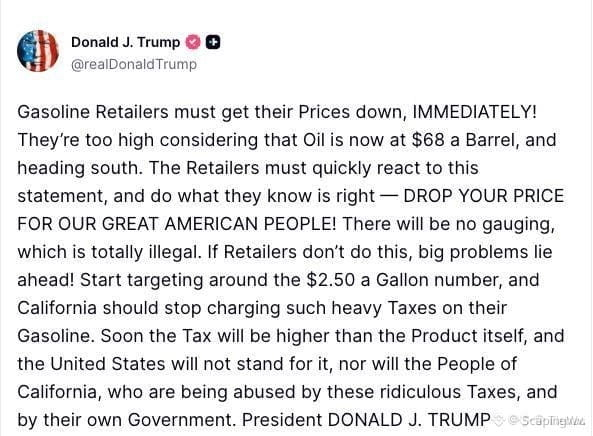
The latest call for lower gas prices at $2.50 a gallon with oil at $68 could shift consumer spending patterns—and that often flows into risk assets like crypto. $AIGENSYN saw a volume spike on the news, signaling early positioning by smart money.
When macro catalysts like this hit, altcoins tied to AI and energy efficiency tend to catch momentum first. Are you watching $AIGENSYN for a potential bid here?
Not financial advice. Always manage your risk.
#AIGENSYN #EnergyCrypto #TrumpPolicy #AltcoinWatch
🔥
$AIGENSYN IS REACTING TO TRUMP'S ENERGY POLICY SHIFT 🔥
No specific price levels provided.
The latest call for lower gas prices at $2.50 a gallon with oil at $68 could shift consumer spending patterns—and that often flows into risk assets like crypto. $AIGENSYN saw a volume spike on the news, signaling early positioning by smart money.
When macro catalysts like this hit, altcoins tied to AI and energy efficiency tend to catch momentum first. Are you watching $AIGENSYN for a potential bid here?
Not financial advice. Always manage your risk.
#AIGENSYN #EnergyCrypto #TrumpPolicy #AltcoinWatch
🔥
No specific price levels provided.
The latest call for lower gas prices at $2.50 a gallon with oil at $68 could shift consumer spending patterns—and that often flows into risk assets like crypto. $AIGENSYN saw a volume spike on the news, signaling early positioning by smart money.
When macro catalysts like this hit, altcoins tied to AI and energy efficiency tend to catch momentum first. Are you watching $AIGENSYN for a potential bid here?
Not financial advice. Always manage your risk.
#AIGENSYN #EnergyCrypto #TrumpPolicy #AltcoinWatch
🔥
75

geopolitics 🇺🇸 The impact of Trump’s shift on Iran on global crypto markets
Donald Trump said that the United States will end its efforts to prevent Iran from developing nuclear missile capabilities, causing a major shift in U.S. foreign policy. This change could shake geopolitical calculations, affecting macroeconomic markets and crypto investments in particular, and creating a state of uncertainty and new risks.
━━━━━━━━━━━━━━
📊 Impact: 📈 High
🏷️ OTHER
#Geopolitics #MarketImpact #Crypto反应 #IranNuclearDeal #TrumpPolicy
🔗 Source: https://cryptobriefing.com/trump-shifts-iran-nuclear-policy-market-impact/
geopolitics 🇺🇸 The impact of Trump’s shift on Iran on global crypto markets
Donald Trump said that the United States will end its efforts to prevent Iran from developing nuclear missile capabilities, causing a major shift in U.S. foreign policy. This change could shake geopolitical calculations, affecting macroeconomic markets and crypto investments in particular, and creating a state of uncertainty and new risks.
━━━━━━━━━━━━━━
📊 Impact: 📈 High
🏷️ OTHER
#Geopolitics #MarketImpact #Crypto反应 #IranNuclearDeal #TrumpPolicy
🔗 Source: https://cryptobriefing.com/trump-shifts-iran-nuclear-policy-market-impact/
Donald Trump said that the United States will end its efforts to prevent Iran from developing nuclear missile capabilities, causing a major shift in U.S. foreign policy. This change could shake geopolitical calculations, affecting macroeconomic markets and crypto investments in particular, and creating a state of uncertainty and new risks.
━━━━━━━━━━━━━━
📊 Impact: 📈 High
🏷️ OTHER
#Geopolitics #MarketImpact #Crypto反应 #IranNuclearDeal #TrumpPolicy
🔗 Source: https://cryptobriefing.com/trump-shifts-iran-nuclear-policy-market-impact/
13


Article
Trump's Immigration Policy at a Crossroads: Between Quiet Tactics and Mass Deportation PromisesThe Trump administration finds itself caught in a genuinely difficult position right now, and it is worth taking a moment to understand exactly what is happening on the immigration front.
On one side, you have DHS Secretary Markwayne Mullin quietly trying to reshape the department's image. He has paused warehouse detention center conversions, instructed agents to stop entering homes without judicial warrants, and even attempted to rebrand ICE officers as "NICE" officers. The strategy appears deliberate. With midterm elections on the horizon, Republican leadership is clearly nervous about overplaying their hand with the broader American electorate.
On the other side, you have immigration hardliners who are growing increasingly frustrated. White House border czar Tom Homan has been unequivocal this week, stating bluntly that "mass deportations are coming" and pushing back hard against anyone suggesting the administration is going soft.
The Numbers Tell an Interesting Story:
Daily ICE arrests have dipped from a peak of roughly 1,500 in January to around 1,000 currently
Despite that dip, that figure is still nearly four times higher than during the final year of the Biden administration
In the first year of Trump's second term, approximately 230,000 people were deported from interior arrests alone, surpassing the entire four-year Biden total
Yet conservatives like Mike Howell of the Oversight Project argue that rhetoric without escalating numbers is simply not enough. There are also growing calls from within conservative circles to dramatically expand workplace enforcement, viewing it as the most effective pathway to identifying undocumented immigrants who have no serious criminal record.
What makes this situation particularly complex is the political balancing act at play. Most Americans, according to recent polling, feel the administration has already gone too far. But a growing portion of Republican voters feel the opposite. Navigating that divide while delivering on a signature campaign promise is proving to be far more complicated than the campaign trail suggested.
The direction of US immigration policy in the coming months will be worth watching very closely. The gap between the administration's public promises and the actual enforcement numbers is something that both supporters and critics will continue to scrutinize.
#USImmigration #TrumpPolicy #ICE #BorderSecurity #AmericanPolitics
$NIL
{spot}(NILUSDT)
$LTC
{spot}(LTCUSDT)
$LUNC
{spot}(LUNCUSDT)
Trump's Immigration Policy at a Crossroads: Between Quiet Tactics and Mass Deportation Promises
The Trump administration finds itself caught in a genuinely difficult position right now, and it is worth taking a moment to understand exactly what is happening on the immigration front.
On one side, you have DHS Secretary Markwayne Mullin quietly trying to reshape the department's image. He has paused warehouse detention center conversions, instructed agents to stop entering homes without judicial warrants, and even attempted to rebrand ICE officers as "NICE" officers. The strategy appears deliberate. With midterm elections on the horizon, Republican leadership is clearly nervous about overplaying their hand with the broader American electorate.
On the other side, you have immigration hardliners who are growing increasingly frustrated. White House border czar Tom Homan has been unequivocal this week, stating bluntly that "mass deportations are coming" and pushing back hard against anyone suggesting the administration is going soft.
The Numbers Tell an Interesting Story:
Daily ICE arrests have dipped from a peak of roughly 1,500 in January to around 1,000 currently
Despite that dip, that figure is still nearly four times higher than during the final year of the Biden administration
In the first year of Trump's second term, approximately 230,000 people were deported from interior arrests alone, surpassing the entire four-year Biden total
Yet conservatives like Mike Howell of the Oversight Project argue that rhetoric without escalating numbers is simply not enough. There are also growing calls from within conservative circles to dramatically expand workplace enforcement, viewing it as the most effective pathway to identifying undocumented immigrants who have no serious criminal record.
What makes this situation particularly complex is the political balancing act at play. Most Americans, according to recent polling, feel the administration has already gone too far. But a growing portion of Republican voters feel the opposite. Navigating that divide while delivering on a signature campaign promise is proving to be far more complicated than the campaign trail suggested.
The direction of US immigration policy in the coming months will be worth watching very closely. The gap between the administration's public promises and the actual enforcement numbers is something that both supporters and critics will continue to scrutinize.
#USImmigration #TrumpPolicy #ICE #BorderSecurity #AmericanPolitics
$NIL
$LTC
$LUNC
On one side, you have DHS Secretary Markwayne Mullin quietly trying to reshape the department's image. He has paused warehouse detention center conversions, instructed agents to stop entering homes without judicial warrants, and even attempted to rebrand ICE officers as "NICE" officers. The strategy appears deliberate. With midterm elections on the horizon, Republican leadership is clearly nervous about overplaying their hand with the broader American electorate.
On the other side, you have immigration hardliners who are growing increasingly frustrated. White House border czar Tom Homan has been unequivocal this week, stating bluntly that "mass deportations are coming" and pushing back hard against anyone suggesting the administration is going soft.
The Numbers Tell an Interesting Story:
Daily ICE arrests have dipped from a peak of roughly 1,500 in January to around 1,000 currently
Despite that dip, that figure is still nearly four times higher than during the final year of the Biden administration
In the first year of Trump's second term, approximately 230,000 people were deported from interior arrests alone, surpassing the entire four-year Biden total
Yet conservatives like Mike Howell of the Oversight Project argue that rhetoric without escalating numbers is simply not enough. There are also growing calls from within conservative circles to dramatically expand workplace enforcement, viewing it as the most effective pathway to identifying undocumented immigrants who have no serious criminal record.
What makes this situation particularly complex is the political balancing act at play. Most Americans, according to recent polling, feel the administration has already gone too far. But a growing portion of Republican voters feel the opposite. Navigating that divide while delivering on a signature campaign promise is proving to be far more complicated than the campaign trail suggested.
The direction of US immigration policy in the coming months will be worth watching very closely. The gap between the administration's public promises and the actual enforcement numbers is something that both supporters and critics will continue to scrutinize.
#USImmigration #TrumpPolicy #ICE #BorderSecurity #AmericanPolitics
$NIL
$LTC
$LUNC
1
302
Log in to explore more content
Join global crypto users on Binance Square
⚡️ Get latest and useful information about crypto.
💬 Trusted by the world’s largest crypto exchange.
👍 Discover real insights from verified creators.
Email / Phone number
Trending Topics
1
#AIStocksWhatNext
820,838 views
6,302 Discussing
2
#BitcoinRejectedAt$87,300Twice
0 views
0 Discussing
3
#BCHJumps28%OnCMEFuturesListing
4,945 views
382 Discussing
4
#WallStreetEarningsRevisionsTurnBearish
3,578 views
272 Discussing
5
#DollarIndexReclaims101
2,859 views
232 Discussing
6
#21SharesLaunchesEuropesFirstZcashETP
34,127 views
1,013 Discussing
7
#CardanoJoinsX402PaymentStandard
22,107 views
733 Discussing
8
#BitcoinTops$87KAtEightMonthHigh
11,601 views
128 Discussing
9
#ZECBreaksAbove$1600AtRecordHigh
8,075 views
105 Discussing
10
#BitwiseNEARStakingETPAssetsTop$100M
37,369 views
105 Discussing