
#tsll
tsll
2,386 views
46 Discussing
Hot
Latest

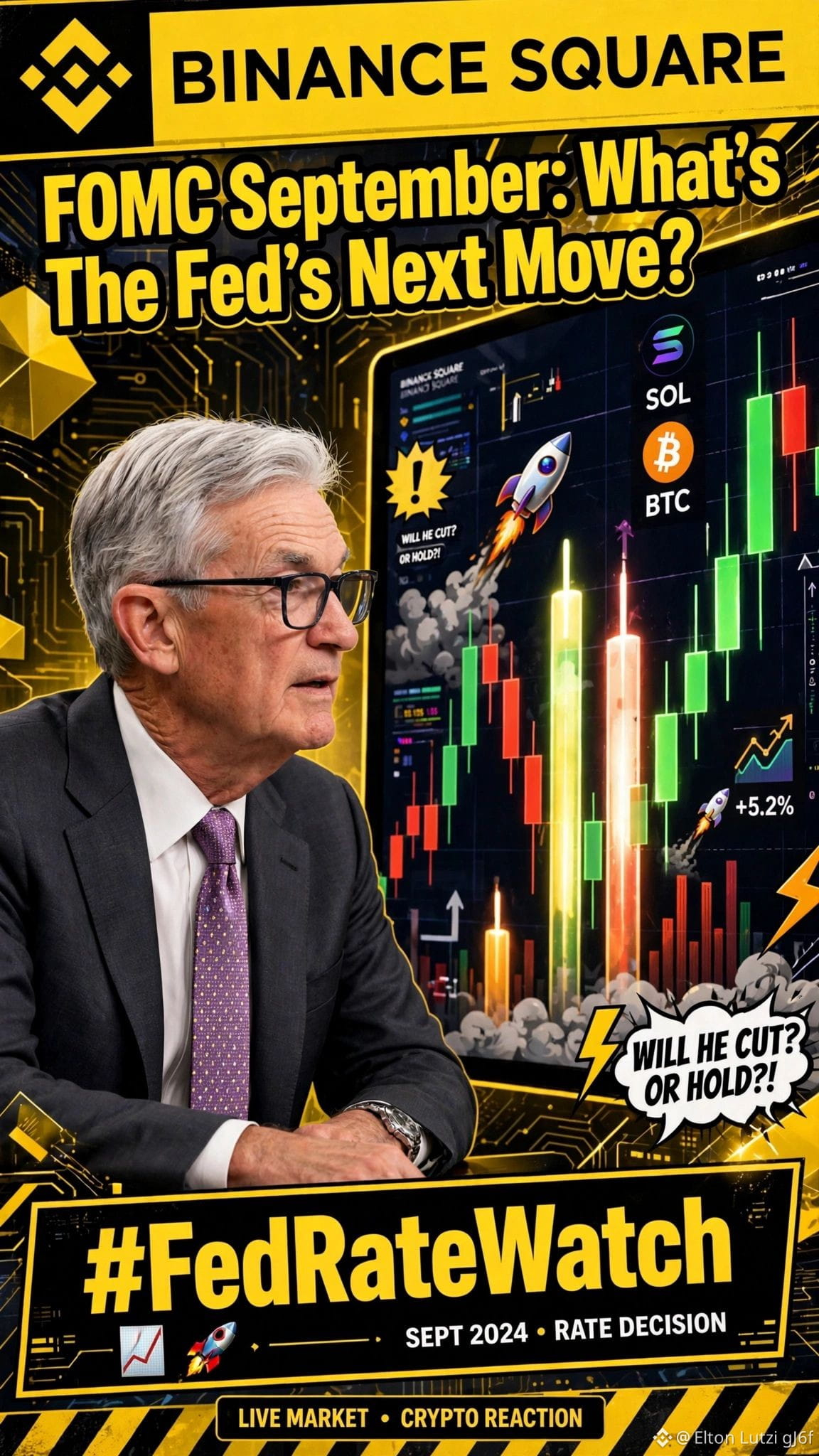
FOMC September - What's The Fed's Next Move? 🚨 My small account take 📈
August CPI 2.9% is close to 3.00%. Job market is cooling. The odds of a 25bps hike this week are now close to 90%.
If Fed cuts 25bps, risk assets like $SOL and $TSLL will pump. My KSh 2,592 small account is ready - HOLD when RED, SELL when GREEN.
Is it a one-off, or start of a longer hiking cycle?
If hike lands, does it play out to BTC, tech stocks, and gold? Bullish or bearish?
I'm holding SOL 0.11 and TSLL 0.72 with TradingView widget. Sharing my trade!
What is your plan for FOMC week? Are you buying the dip or selling the news?
#FedRateWatch #FOMC #SOL #TSLL
{future}(TSLLUSDT)
FOMC September - What's The Fed's Next Move? 🚨 My small account take 📈
August CPI 2.9% is close to 3.00%. Job market is cooling. The odds of a 25bps hike this week are now close to 90%.
If Fed cuts 25bps, risk assets like $SOL and $TSLL will pump. My KSh 2,592 small account is ready - HOLD when RED, SELL when GREEN.
Is it a one-off, or start of a longer hiking cycle?
If hike lands, does it play out to BTC, tech stocks, and gold? Bullish or bearish?
I'm holding SOL 0.11 and TSLL 0.72 with TradingView widget. Sharing my trade!
What is your plan for FOMC week? Are you buying the dip or selling the news?
#FedRateWatch #FOMC #SOL #TSLL
August CPI 2.9% is close to 3.00%. Job market is cooling. The odds of a 25bps hike this week are now close to 90%.
If Fed cuts 25bps, risk assets like $SOL and $TSLL will pump. My KSh 2,592 small account is ready - HOLD when RED, SELL when GREEN.
Is it a one-off, or start of a longer hiking cycle?
If hike lands, does it play out to BTC, tech stocks, and gold? Bullish or bearish?
I'm holding SOL 0.11 and TSLL 0.72 with TradingView widget. Sharing my trade!
What is your plan for FOMC week? Are you buying the dip or selling the news?
#FedRateWatch #FOMC #SOL #TSLL
1
2
135

Trading volume has been shrinking continuously; the short position should be held. Watch for a move toward 0.
During these past few days’ rebound, be careful not to get stuck in a position.
💥 $TSLL #TSLL 【Main】
Take the short entry at $11.5080; if it breaks through $12.6588, exit immediately
Current price: $9.5900, 24h change +0.00%
24h trading volume value is only $560k, lowest in the whole market
→ Continuous contraction of volume by 25.9%; funds are withdrawing—continue holding the short until it reaches 0
The rebound is weak; the bears have the advantage
These are also good opportunities to go short:
····
$MTL
Current: $0.315900, 24h change +14.91%
Entry timing: place a short order at $0.379080; set stop loss at 10% ($0.416988)
····
$UNI
Current: $6.3910, 24h change +0.74%
Entry timing: place a short order at $7.6692; set stop loss at 10% ($8.4361)
····
⚠️ Small-cap trial and error—strictly set stop losses; do not trade without risk control
#RiskControl
Trading volume has been shrinking continuously; the short position should be held. Watch for a move toward 0.
During these past few days’ rebound, be careful not to get stuck in a position.
💥 $TSLL #TSLL 【Main】
Take the short entry at $11.5080; if it breaks through $12.6588, exit immediately
Current price: $9.5900, 24h change +0.00%
24h trading volume value is only $560k, lowest in the whole market
→ Continuous contraction of volume by 25.9%; funds are withdrawing—continue holding the short until it reaches 0
The rebound is weak; the bears have the advantage
These are also good opportunities to go short:
····
$MTL
Current: $0.315900, 24h change +14.91%
Entry timing: place a short order at $0.379080; set stop loss at 10% ($0.416988)
····
$UNI
Current: $6.3910, 24h change +0.74%
Entry timing: place a short order at $7.6692; set stop loss at 10% ($8.4361)
····
⚠️ Small-cap trial and error—strictly set stop losses; do not trade without risk control
#RiskControl
During these past few days’ rebound, be careful not to get stuck in a position.
💥 $TSLL #TSLL 【Main】
Take the short entry at $11.5080; if it breaks through $12.6588, exit immediately
Current price: $9.5900, 24h change +0.00%
24h trading volume value is only $560k, lowest in the whole market
→ Continuous contraction of volume by 25.9%; funds are withdrawing—continue holding the short until it reaches 0
The rebound is weak; the bears have the advantage
These are also good opportunities to go short:
····
$MTL
Current: $0.315900, 24h change +14.91%
Entry timing: place a short order at $0.379080; set stop loss at 10% ($0.416988)
····
$UNI
Current: $6.3910, 24h change +0.74%
Entry timing: place a short order at $7.6692; set stop loss at 10% ($8.4361)
····
⚠️ Small-cap trial and error—strictly set stop losses; do not trade without risk control
#RiskControl
258
TSLL saw a volume contraction of 48.5%, still bearish
The data is here—take a look yourself.
🔻 $TSLL #TSLL 【Main】
Current position $9.4700, 24h change -2.17%
24h trading volume only $0.306M, bottom of the whole market
→ Volume contraction of 48.5%; the fuel for the rebound is running out—keep shorting until it reaches 0
If it just stays flat without rising, that’s weak
You can place a short order at $11.3640, with a stop loss at $12.5004
These are also good opportunities to short:
---
$COTI
Current $0.016001, 24h change -1.09%
Entry: set a short order at $0.019201, stop loss 10% ($0.021121)
---
$IOST
Current $0.000781, 24h change -5.04%
Entry: set a short order at $0.000938, stop loss 10% ($0.001031)
---
⚠️ Test with small capital, use strict stop losses, and don’t do trades without risk control
#Crypto
TSLL saw a volume contraction of 48.5%, still bearish
The data is here—take a look yourself.
🔻 $TSLL #TSLL 【Main】
Current position $9.4700, 24h change -2.17%
24h trading volume only $0.306M, bottom of the whole market
→ Volume contraction of 48.5%; the fuel for the rebound is running out—keep shorting until it reaches 0
If it just stays flat without rising, that’s weak
You can place a short order at $11.3640, with a stop loss at $12.5004
These are also good opportunities to short:
---
$COTI
Current $0.016001, 24h change -1.09%
Entry: set a short order at $0.019201, stop loss 10% ($0.021121)
---
$IOST
Current $0.000781, 24h change -5.04%
Entry: set a short order at $0.000938, stop loss 10% ($0.001031)
---
⚠️ Test with small capital, use strict stop losses, and don’t do trades without risk control
#Crypto
The data is here—take a look yourself.
🔻 $TSLL #TSLL 【Main】
Current position $9.4700, 24h change -2.17%
24h trading volume only $0.306M, bottom of the whole market
→ Volume contraction of 48.5%; the fuel for the rebound is running out—keep shorting until it reaches 0
If it just stays flat without rising, that’s weak
You can place a short order at $11.3640, with a stop loss at $12.5004
These are also good opportunities to short:
---
$COTI
Current $0.016001, 24h change -1.09%
Entry: set a short order at $0.019201, stop loss 10% ($0.021121)
---
$IOST
Current $0.000781, 24h change -5.04%
Entry: set a short order at $0.000938, stop loss 10% ($0.001031)
---
⚠️ Test with small capital, use strict stop losses, and don’t do trades without risk control
#Crypto
34

·
--
$TSLL 24 hours saw a drop of 3.56%, with a quote of 9.47. Meanwhile, the funding rate on the perpetual contract is zero. A zero funding rate means there is no payment from longs to shorts, and no payment in the reverse direction either—the market’s leveraged positions are in a neutral balance.
Old dog took a look at the data: this zero funding rate shows up alongside a price drop, suggesting that the sell pressure is likely coming mainly from the spot market or the liquidation/forced selling of very low-leverage contracts, rather than high-leverage longs being forced out. The perpetual contract open interest is 24,013 contracts; combined with a price of over 9, the total notional value isn’t that large, which further supports the idea that there aren’t many leveraged participants, and the order book is relatively “light.” In the TradFi-style concept sector where crypto markets are linked, a decline without leverage crowding is often questionable in terms of its durability.
I think this is not the start of a trend reversal; it’s more like a natural, unleveraged pullback. The current strategy is to observe with a light position and wait for signals. If the funding rate turns negative later (shorts paying longs) and open interest increases significantly, it would indicate that capital is starting to bet on the decline, and I would consider shorting on the contracts. Conversely, if the price holds around 9.4 and the funding rate remains zero, the rebound could happen almost immediately—but it still requires volume expansion to confirm. A breakdown below the 9.0 psychological level is a clear risk signal; at that point, I will close all long positions.
Trading tag: #BinanceFutures #TradFi #USDⓈM #TSLL #TSLLUSDT $TSLL
$TSLL 24 hours saw a drop of 3.56%, with a quote of 9.47. Meanwhile, the funding rate on the perpetual contract is zero. A zero funding rate means there is no payment from longs to shorts, and no payment in the reverse direction either—the market’s leveraged positions are in a neutral balance.
Old dog took a look at the data: this zero funding rate shows up alongside a price drop, suggesting that the sell pressure is likely coming mainly from the spot market or the liquidation/forced selling of very low-leverage contracts, rather than high-leverage longs being forced out. The perpetual contract open interest is 24,013 contracts; combined with a price of over 9, the total notional value isn’t that large, which further supports the idea that there aren’t many leveraged participants, and the order book is relatively “light.” In the TradFi-style concept sector where crypto markets are linked, a decline without leverage crowding is often questionable in terms of its durability.
I think this is not the start of a trend reversal; it’s more like a natural, unleveraged pullback. The current strategy is to observe with a light position and wait for signals. If the funding rate turns negative later (shorts paying longs) and open interest increases significantly, it would indicate that capital is starting to bet on the decline, and I would consider shorting on the contracts. Conversely, if the price holds around 9.4 and the funding rate remains zero, the rebound could happen almost immediately—but it still requires volume expansion to confirm. A breakdown below the 9.0 psychological level is a clear risk signal; at that point, I will close all long positions.
Trading tag: #BinanceFutures #TradFi #USDⓈM #TSLL #TSLLUSDT $TSLL
Old dog took a look at the data: this zero funding rate shows up alongside a price drop, suggesting that the sell pressure is likely coming mainly from the spot market or the liquidation/forced selling of very low-leverage contracts, rather than high-leverage longs being forced out. The perpetual contract open interest is 24,013 contracts; combined with a price of over 9, the total notional value isn’t that large, which further supports the idea that there aren’t many leveraged participants, and the order book is relatively “light.” In the TradFi-style concept sector where crypto markets are linked, a decline without leverage crowding is often questionable in terms of its durability.
I think this is not the start of a trend reversal; it’s more like a natural, unleveraged pullback. The current strategy is to observe with a light position and wait for signals. If the funding rate turns negative later (shorts paying longs) and open interest increases significantly, it would indicate that capital is starting to bet on the decline, and I would consider shorting on the contracts. Conversely, if the price holds around 9.4 and the funding rate remains zero, the rebound could happen almost immediately—but it still requires volume expansion to confirm. A breakdown below the 9.0 psychological level is a clear risk signal; at that point, I will close all long positions.
Trading tag: #BinanceFutures #TradFi #USDⓈM #TSLL #TSLLUSDT $TSLL
63
·
--
[M1_mag7]
$TSLL over the past 24 hours moved 1.342% higher; the price is stuck at 9.82, while the funding rate stays completely unchanged at zero. With these data laid out, the short-term state of the on-chain US stock (equity) futures contract is clear: a small uptick without any funding movement suggests neither side has placed heavy bets.
Having the funding rate at zero is the key point. Per the funding-rate law, a zero funding rate means the long and short sides are paying each other evenly—there’s no pressure from one side squeezing the other. OI is 28288.48 paired with vol 160182.7052, and liquidity is still acceptable, but without real-time reference data from SPY or QQQ, any inference about sector correlation must be drawn indirectly from the funding structure. With the funding rate parked at zero, it’s likely related to the broader market index acting as an anchor. In TradFi-style contracts on-chain often track the index closely; a frozen funding rate indicates the market has no consensus on the near-term direction for $TSLL . The forces of follower orders and hedging orders cancel each other out.
Old Dog’s take: at this level, with a zero funding rate plus a small rise and no crowding signal, it’s suitable to observe with less than a half position. If the price pulls back and breaks below 9.8, I’ll cut three tenths of the position to lower my cost. The point of disagreement is that many people think a zero funding rate and no movement means they should step away—but I think that’s actually a safety cushion: without leverage piling up, it’s hard to trigger a liquidation cascade.
Trading tag: #BinanceFutures #TradFi #USDⓈM #TSLL #TSLLUSDT $TSLL
[M1_mag7]
$TSLL over the past 24 hours moved 1.342% higher; the price is stuck at 9.82, while the funding rate stays completely unchanged at zero. With these data laid out, the short-term state of the on-chain US stock (equity) futures contract is clear: a small uptick without any funding movement suggests neither side has placed heavy bets.
Having the funding rate at zero is the key point. Per the funding-rate law, a zero funding rate means the long and short sides are paying each other evenly—there’s no pressure from one side squeezing the other. OI is 28288.48 paired with vol 160182.7052, and liquidity is still acceptable, but without real-time reference data from SPY or QQQ, any inference about sector correlation must be drawn indirectly from the funding structure. With the funding rate parked at zero, it’s likely related to the broader market index acting as an anchor. In TradFi-style contracts on-chain often track the index closely; a frozen funding rate indicates the market has no consensus on the near-term direction for $TSLL . The forces of follower orders and hedging orders cancel each other out.
Old Dog’s take: at this level, with a zero funding rate plus a small rise and no crowding signal, it’s suitable to observe with less than a half position. If the price pulls back and breaks below 9.8, I’ll cut three tenths of the position to lower my cost. The point of disagreement is that many people think a zero funding rate and no movement means they should step away—but I think that’s actually a safety cushion: without leverage piling up, it’s hard to trigger a liquidation cascade.
Trading tag: #BinanceFutures #TradFi #USDⓈM #TSLL #TSLLUSDT $TSLL
$TSLL over the past 24 hours moved 1.342% higher; the price is stuck at 9.82, while the funding rate stays completely unchanged at zero. With these data laid out, the short-term state of the on-chain US stock (equity) futures contract is clear: a small uptick without any funding movement suggests neither side has placed heavy bets.
Having the funding rate at zero is the key point. Per the funding-rate law, a zero funding rate means the long and short sides are paying each other evenly—there’s no pressure from one side squeezing the other. OI is 28288.48 paired with vol 160182.7052, and liquidity is still acceptable, but without real-time reference data from SPY or QQQ, any inference about sector correlation must be drawn indirectly from the funding structure. With the funding rate parked at zero, it’s likely related to the broader market index acting as an anchor. In TradFi-style contracts on-chain often track the index closely; a frozen funding rate indicates the market has no consensus on the near-term direction for $TSLL . The forces of follower orders and hedging orders cancel each other out.
Old Dog’s take: at this level, with a zero funding rate plus a small rise and no crowding signal, it’s suitable to observe with less than a half position. If the price pulls back and breaks below 9.8, I’ll cut three tenths of the position to lower my cost. The point of disagreement is that many people think a zero funding rate and no movement means they should step away—but I think that’s actually a safety cushion: without leverage piling up, it’s hard to trigger a liquidation cascade.
Trading tag: #BinanceFutures #TradFi #USDⓈM #TSLL #TSLLUSDT $TSLL
28
When you tell your family you are a full-time crypto trader 😂
Reality:
Morning: Check TSLL chart
Afternoon: Cook chapati with baby on back
Evening: Check TSLL chart again, still $9.90
My boss (my wife): "Have you bought TSLL? Why are you still in the kitchen?"
TSLL didn't pump, but chapati pumped to the plate. 7 USDT challenge still alive, baby fed, wife happy.
Who else is trading from the kitchen? 😅
$TSLL $TSLA #FunnyCrypto #KenyaTrader #BinanceSquare #DadTrader #TSLL
When you tell your family you are a full-time crypto trader 😂
Reality:
Morning: Check TSLL chart
Afternoon: Cook chapati with baby on back
Evening: Check TSLL chart again, still $9.90
My boss (my wife): "Have you bought TSLL? Why are you still in the kitchen?"
TSLL didn't pump, but chapati pumped to the plate. 7 USDT challenge still alive, baby fed, wife happy.
Who else is trading from the kitchen? 😅
$TSLL $TSLA #FunnyCrypto #KenyaTrader #BinanceSquare #DadTrader #TSLL
Reality:
Morning: Check TSLL chart
Afternoon: Cook chapati with baby on back
Evening: Check TSLL chart again, still $9.90
My boss (my wife): "Have you bought TSLL? Why are you still in the kitchen?"
TSLL didn't pump, but chapati pumped to the plate. 7 USDT challenge still alive, baby fed, wife happy.
Who else is trading from the kitchen? 😅
$TSLL $TSLA #FunnyCrypto #KenyaTrader #BinanceSquare #DadTrader #TSLL
1
3
466
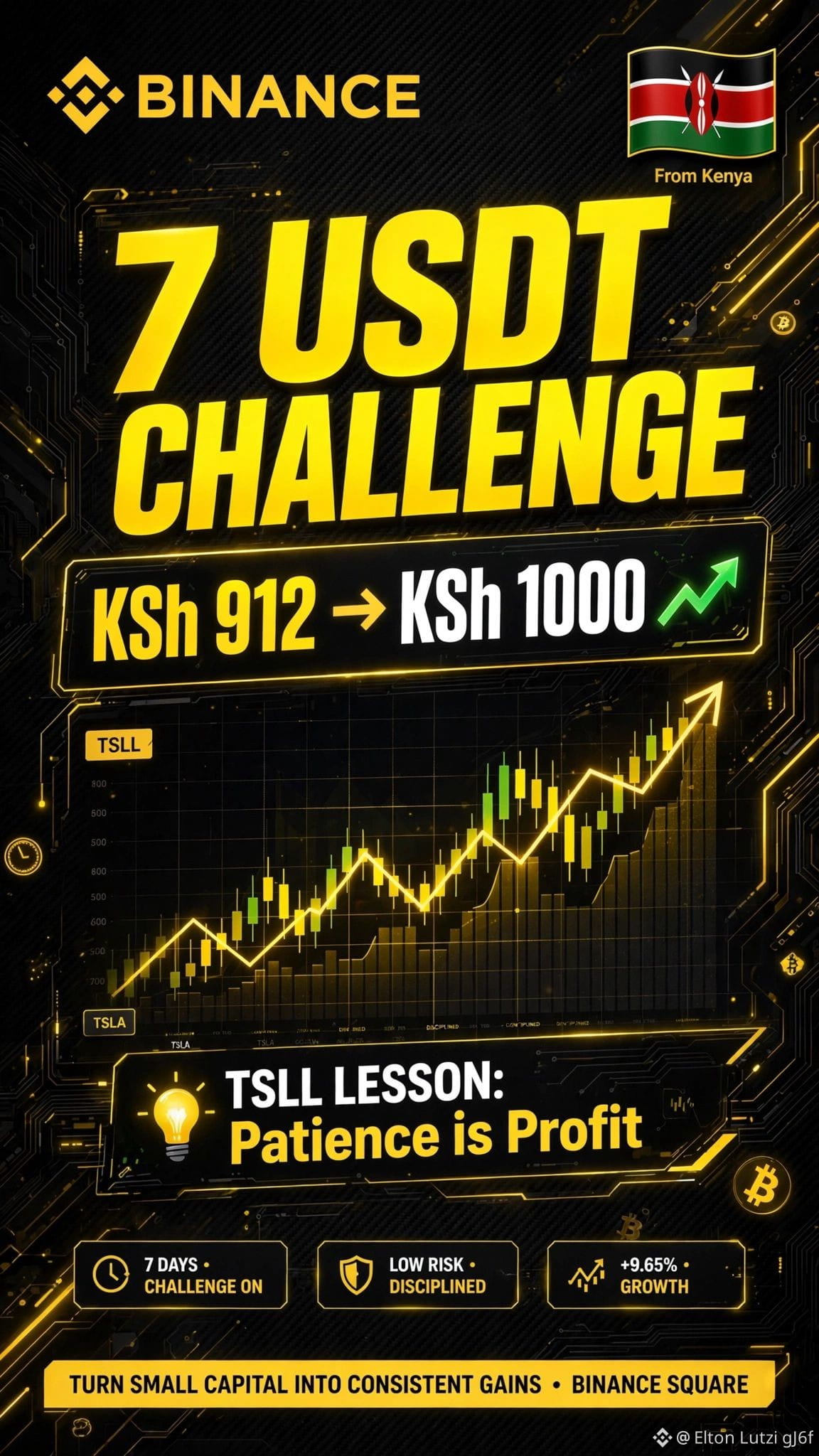
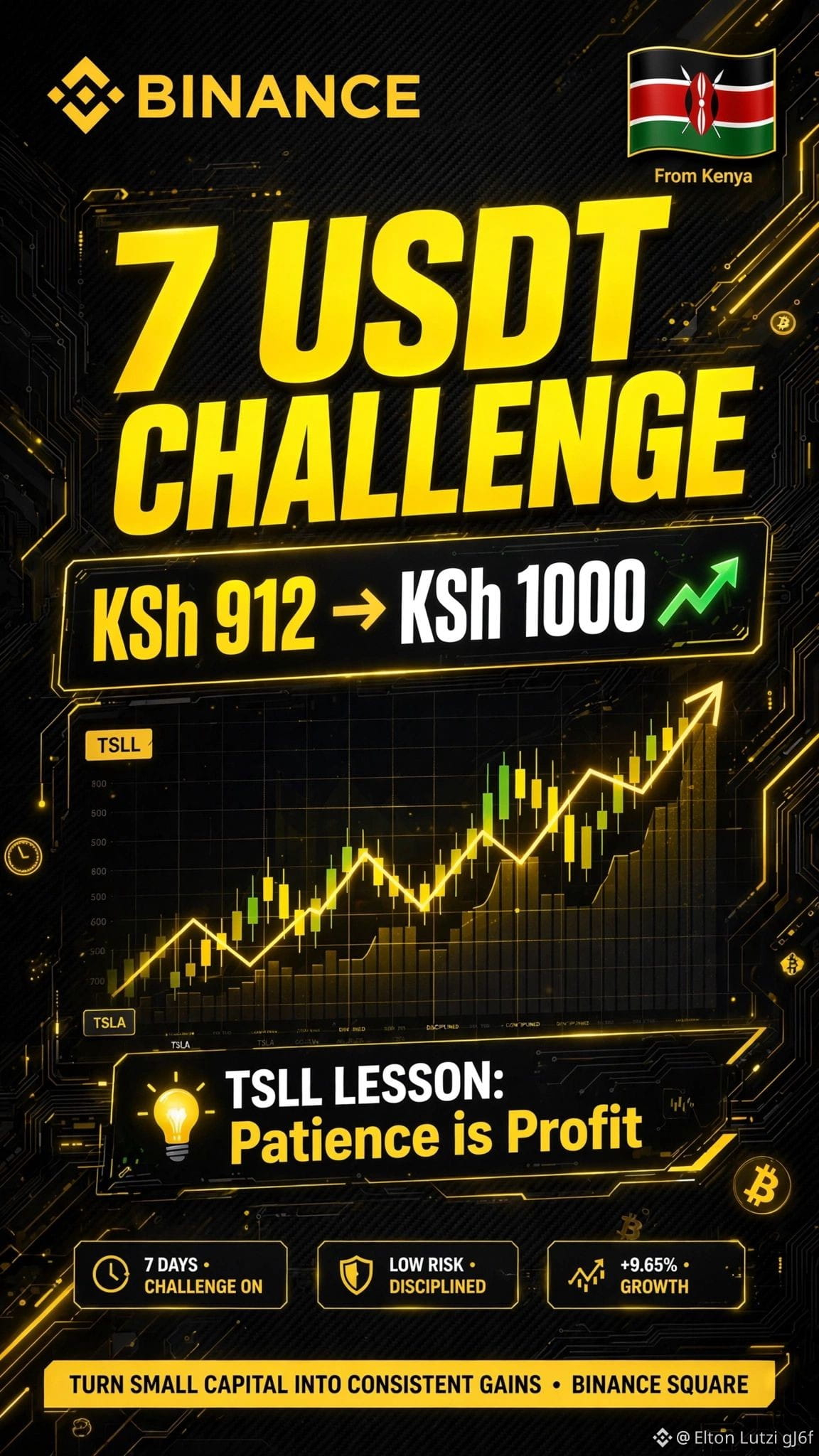
7 USDT CHALLENGE Day 3: KSh 912 → KSh 1000
I started with only 7 USDT on Binance.
Not $700. Just 7.
My lesson with TSLL: I sold at $9.90 for small profit, it pumped to $10.50 same day.
TSLL = 2x TSLA. When Tesla +2%, TSLL +4%. Risk is real.
My new rule: Limit buy $9.05, sell $9.90, WAIT. Patience is profit.
Goal: KSh 50/day from small capital. Documenting, not flexing.
Follow if you started with less than $10. Let's grow together.
$TSLL $TSLA #BİNANCESQUARE #CryptoKenya #SmallCapitalChallenge #TSLL
7 USDT CHALLENGE Day 3: KSh 912 → KSh 1000
I started with only 7 USDT on Binance.
Not $700. Just 7.
My lesson with TSLL: I sold at $9.90 for small profit, it pumped to $10.50 same day.
TSLL = 2x TSLA. When Tesla +2%, TSLL +4%. Risk is real.
My new rule: Limit buy $9.05, sell $9.90, WAIT. Patience is profit.
Goal: KSh 50/day from small capital. Documenting, not flexing.
Follow if you started with less than $10. Let's grow together.
$TSLL $TSLA #BİNANCESQUARE #CryptoKenya #SmallCapitalChallenge #TSLL
I started with only 7 USDT on Binance.
Not $700. Just 7.
My lesson with TSLL: I sold at $9.90 for small profit, it pumped to $10.50 same day.
TSLL = 2x TSLA. When Tesla +2%, TSLL +4%. Risk is real.
My new rule: Limit buy $9.05, sell $9.90, WAIT. Patience is profit.
Goal: KSh 50/day from small capital. Documenting, not flexing.
Follow if you started with less than $10. Let's grow together.
$TSLL $TSLA #BİNANCESQUARE #CryptoKenya #SmallCapitalChallenge #TSLL
1
116

·
--
$TSLL rose 5.9% in a single day. The price pushed up to 9.69, yet the funding rate stays completely still, nailed at 0.0000. This combo is very rare.
As price moves higher, the longs don’t need to pay the shorts, and the shorts don’t have to pay either. That implies two things: first, long leverage positions haven’t piled up to the point where they need to pay high funding fees to keep running; second, the shorts haven’t built a massive short position near the bottom and been forced to bleed continuously. This upswing may be closer to a spot-like or low-leverage, funding-driven impulse rather than the kind of one-sided crushing that typically follows a short squeeze. Open interest is 31,900 contracts, and when compared with the magnitude of price swings, there’s no synchronized explosive spike in OI as the price surges—also supporting that the leverage battle hasn’t heated into a frenzy.
But that’s only half the story. $TSLL is essentially a 2x leveraged Tesla ETF. Its price movement directly maps to two things: Tesla’s stock price, and the implied financing-cost expectations embedded in holding this leveraged product. The funding rate has been anchored near zero for a long time, meaning that in Binance’s futures market, betting on the direction of Tesla on both the long and short sides is almost “free” in terms of financing costs. This likely reflects the market’s expectations for the near-term macro interest-rate environment (the Fed’s rate-cut timing) entering a quiet stretch—without any surprise data to tip the balance. As a result, leverage itself becomes cheap: volatility in either direction gets amplified, but the cost friction is minimal.
So, the current price rally has a clear transmission mechanism behind it: macro rate expectations remain stable → leveraged financing costs are low → more capital is willing to use leverage to trade Tesla (and thus the Nasdaq tech sector’s) short-term beta. The cost of the rallying capital is extremely low—good news. But here’s the counterpoint: once macro data—like next week’s CPI—comes in higher than expected, it will instantly shatter this calm of low financing costs. At that time, the funding rate will be forced to jump rapidly, and those longs that have been “free-holding” positions will suddenly face cost pressure, while shorts may also seize the moment to push harder. Today’s near-zero funding rate is both the lubricant for the rise and its most fragile part, because it depends entirely on macro data staying uneventful.
If CPI comes in flat versus expectations or lower, the 9.69 level could become a relay station for a stretch of low-leverage upside momentum. Conversely, any inflation data that surprises to the upside will be the braking system that abruptly ends this move.
Trading tag: #TradFi #链上美股 #TSLL
Where do you think this thesis is most likely to be wrong?
$TSLL rose 5.9% in a single day. The price pushed up to 9.69, yet the funding rate stays completely still, nailed at 0.0000. This combo is very rare.
As price moves higher, the longs don’t need to pay the shorts, and the shorts don’t have to pay either. That implies two things: first, long leverage positions haven’t piled up to the point where they need to pay high funding fees to keep running; second, the shorts haven’t built a massive short position near the bottom and been forced to bleed continuously. This upswing may be closer to a spot-like or low-leverage, funding-driven impulse rather than the kind of one-sided crushing that typically follows a short squeeze. Open interest is 31,900 contracts, and when compared with the magnitude of price swings, there’s no synchronized explosive spike in OI as the price surges—also supporting that the leverage battle hasn’t heated into a frenzy.
But that’s only half the story. $TSLL is essentially a 2x leveraged Tesla ETF. Its price movement directly maps to two things: Tesla’s stock price, and the implied financing-cost expectations embedded in holding this leveraged product. The funding rate has been anchored near zero for a long time, meaning that in Binance’s futures market, betting on the direction of Tesla on both the long and short sides is almost “free” in terms of financing costs. This likely reflects the market’s expectations for the near-term macro interest-rate environment (the Fed’s rate-cut timing) entering a quiet stretch—without any surprise data to tip the balance. As a result, leverage itself becomes cheap: volatility in either direction gets amplified, but the cost friction is minimal.
So, the current price rally has a clear transmission mechanism behind it: macro rate expectations remain stable → leveraged financing costs are low → more capital is willing to use leverage to trade Tesla (and thus the Nasdaq tech sector’s) short-term beta. The cost of the rallying capital is extremely low—good news. But here’s the counterpoint: once macro data—like next week’s CPI—comes in higher than expected, it will instantly shatter this calm of low financing costs. At that time, the funding rate will be forced to jump rapidly, and those longs that have been “free-holding” positions will suddenly face cost pressure, while shorts may also seize the moment to push harder. Today’s near-zero funding rate is both the lubricant for the rise and its most fragile part, because it depends entirely on macro data staying uneventful.
If CPI comes in flat versus expectations or lower, the 9.69 level could become a relay station for a stretch of low-leverage upside momentum. Conversely, any inflation data that surprises to the upside will be the braking system that abruptly ends this move.
Trading tag: #TradFi #链上美股 #TSLL
Where do you think this thesis is most likely to be wrong?
As price moves higher, the longs don’t need to pay the shorts, and the shorts don’t have to pay either. That implies two things: first, long leverage positions haven’t piled up to the point where they need to pay high funding fees to keep running; second, the shorts haven’t built a massive short position near the bottom and been forced to bleed continuously. This upswing may be closer to a spot-like or low-leverage, funding-driven impulse rather than the kind of one-sided crushing that typically follows a short squeeze. Open interest is 31,900 contracts, and when compared with the magnitude of price swings, there’s no synchronized explosive spike in OI as the price surges—also supporting that the leverage battle hasn’t heated into a frenzy.
But that’s only half the story. $TSLL is essentially a 2x leveraged Tesla ETF. Its price movement directly maps to two things: Tesla’s stock price, and the implied financing-cost expectations embedded in holding this leveraged product. The funding rate has been anchored near zero for a long time, meaning that in Binance’s futures market, betting on the direction of Tesla on both the long and short sides is almost “free” in terms of financing costs. This likely reflects the market’s expectations for the near-term macro interest-rate environment (the Fed’s rate-cut timing) entering a quiet stretch—without any surprise data to tip the balance. As a result, leverage itself becomes cheap: volatility in either direction gets amplified, but the cost friction is minimal.
So, the current price rally has a clear transmission mechanism behind it: macro rate expectations remain stable → leveraged financing costs are low → more capital is willing to use leverage to trade Tesla (and thus the Nasdaq tech sector’s) short-term beta. The cost of the rallying capital is extremely low—good news. But here’s the counterpoint: once macro data—like next week’s CPI—comes in higher than expected, it will instantly shatter this calm of low financing costs. At that time, the funding rate will be forced to jump rapidly, and those longs that have been “free-holding” positions will suddenly face cost pressure, while shorts may also seize the moment to push harder. Today’s near-zero funding rate is both the lubricant for the rise and its most fragile part, because it depends entirely on macro data staying uneventful.
If CPI comes in flat versus expectations or lower, the 9.69 level could become a relay station for a stretch of low-leverage upside momentum. Conversely, any inflation data that surprises to the upside will be the braking system that abruptly ends this move.
Trading tag: #TradFi #链上美股 #TSLL
Where do you think this thesis is most likely to be wrong?
111
·
--
$TSLL 24 In 24 hours the price surged 5.9%, and it’s stopped at 9.69. The funding rate is completely flat at zero, with open interest at 31,923.77. Putting these data together: yes, it’s up—but the market hasn’t paid a single additional cent in costs for it.
A funding rate at zero means long and short sides owe each other nothing right now; nobody is holding the bag. As the price moves upward by 5.9%, the financing cost stays neutral—this combination is rare in the futures market. The usual situation is that when price rises, longs pay a positive funding rate, because long demand pushes up the funding cost. Now the funding is flat. That means either shorts are closing positions and pushing the price up without triggering a long squeeze, or large capital is buying steadily but leveraged longs haven’t kept up.
Trading volume is around $1.27 million. Relative to this move up, it’s not explosive, further supporting the view that the rally is gentle and steady.
The strongest counter-evidence is: if the price reverses and breaks below the current 9.69 level, and simultaneously the funding rate turns negative, then it would indicate shorts are starting to gain strength, longs lack support, and the whole logic behind the rally would be overturned. Conversely, if the funding rate suddenly flips positive and open interest increases, that would be the real signal that long sentiment is heating up. With the current zero-rate state, it’s as if both sides are warming up on the sidelines—nobody has really stepped onto the field to fight.
The second-order effect is this: if the price continues to chop around 9.69, those holding long positions with a zero funding rate incur no carrying cost, while shorts also haven’t been forced to stop-loss near the wall. Nobody is compelled to rebalance; liquidity will temporarily settle. Only when the funding rate changes direction, or when open interest suddenly expands, will one side be triggered into stop-lossing or adding.
Invalidation conditions are very specific: if the funding rate moves away from zero—whether to +0.01% or -0.01%—it will immediately change the position cost structure and the current assessment must be revised. On the price side, 9.69 is the current anchor; if it breaks, you need to reassess whether it has turned weak.
For action, I choose to wait and watch.
Aggressive approach: if price can hold steady at 9.69 and the funding rate remains zero through the next trading day, you could try a small long position—but you must place the stop-loss one “body” below 9.69.
Conservative approach: wait until the funding rate clearly turns positive or negative before deciding on direction.
Avoidance approach: in a zero-funding, no-trend phase, doing nothing is the best strategy.
The market always emphasizes that an up move needs both capital support and sentiment resonance. But I think this round of $TSLL is more like a forgotten asset in the corner that suddenly got noticed—no big effort, yet it just rose.
Trading tag: #TradFi #链上美股 #TSLL
Where do you think this set of assumptions is most likely to be wrong?
$TSLL 24 In 24 hours the price surged 5.9%, and it’s stopped at 9.69. The funding rate is completely flat at zero, with open interest at 31,923.77. Putting these data together: yes, it’s up—but the market hasn’t paid a single additional cent in costs for it.
A funding rate at zero means long and short sides owe each other nothing right now; nobody is holding the bag. As the price moves upward by 5.9%, the financing cost stays neutral—this combination is rare in the futures market. The usual situation is that when price rises, longs pay a positive funding rate, because long demand pushes up the funding cost. Now the funding is flat. That means either shorts are closing positions and pushing the price up without triggering a long squeeze, or large capital is buying steadily but leveraged longs haven’t kept up.
Trading volume is around $1.27 million. Relative to this move up, it’s not explosive, further supporting the view that the rally is gentle and steady.
The strongest counter-evidence is: if the price reverses and breaks below the current 9.69 level, and simultaneously the funding rate turns negative, then it would indicate shorts are starting to gain strength, longs lack support, and the whole logic behind the rally would be overturned. Conversely, if the funding rate suddenly flips positive and open interest increases, that would be the real signal that long sentiment is heating up. With the current zero-rate state, it’s as if both sides are warming up on the sidelines—nobody has really stepped onto the field to fight.
The second-order effect is this: if the price continues to chop around 9.69, those holding long positions with a zero funding rate incur no carrying cost, while shorts also haven’t been forced to stop-loss near the wall. Nobody is compelled to rebalance; liquidity will temporarily settle. Only when the funding rate changes direction, or when open interest suddenly expands, will one side be triggered into stop-lossing or adding.
Invalidation conditions are very specific: if the funding rate moves away from zero—whether to +0.01% or -0.01%—it will immediately change the position cost structure and the current assessment must be revised. On the price side, 9.69 is the current anchor; if it breaks, you need to reassess whether it has turned weak.
For action, I choose to wait and watch.
Aggressive approach: if price can hold steady at 9.69 and the funding rate remains zero through the next trading day, you could try a small long position—but you must place the stop-loss one “body” below 9.69.
Conservative approach: wait until the funding rate clearly turns positive or negative before deciding on direction.
Avoidance approach: in a zero-funding, no-trend phase, doing nothing is the best strategy.
The market always emphasizes that an up move needs both capital support and sentiment resonance. But I think this round of $TSLL is more like a forgotten asset in the corner that suddenly got noticed—no big effort, yet it just rose.
Trading tag: #TradFi #链上美股 #TSLL
Where do you think this set of assumptions is most likely to be wrong?
A funding rate at zero means long and short sides owe each other nothing right now; nobody is holding the bag. As the price moves upward by 5.9%, the financing cost stays neutral—this combination is rare in the futures market. The usual situation is that when price rises, longs pay a positive funding rate, because long demand pushes up the funding cost. Now the funding is flat. That means either shorts are closing positions and pushing the price up without triggering a long squeeze, or large capital is buying steadily but leveraged longs haven’t kept up.
Trading volume is around $1.27 million. Relative to this move up, it’s not explosive, further supporting the view that the rally is gentle and steady.
The strongest counter-evidence is: if the price reverses and breaks below the current 9.69 level, and simultaneously the funding rate turns negative, then it would indicate shorts are starting to gain strength, longs lack support, and the whole logic behind the rally would be overturned. Conversely, if the funding rate suddenly flips positive and open interest increases, that would be the real signal that long sentiment is heating up. With the current zero-rate state, it’s as if both sides are warming up on the sidelines—nobody has really stepped onto the field to fight.
The second-order effect is this: if the price continues to chop around 9.69, those holding long positions with a zero funding rate incur no carrying cost, while shorts also haven’t been forced to stop-loss near the wall. Nobody is compelled to rebalance; liquidity will temporarily settle. Only when the funding rate changes direction, or when open interest suddenly expands, will one side be triggered into stop-lossing or adding.
Invalidation conditions are very specific: if the funding rate moves away from zero—whether to +0.01% or -0.01%—it will immediately change the position cost structure and the current assessment must be revised. On the price side, 9.69 is the current anchor; if it breaks, you need to reassess whether it has turned weak.
For action, I choose to wait and watch.
Aggressive approach: if price can hold steady at 9.69 and the funding rate remains zero through the next trading day, you could try a small long position—but you must place the stop-loss one “body” below 9.69.
Conservative approach: wait until the funding rate clearly turns positive or negative before deciding on direction.
Avoidance approach: in a zero-funding, no-trend phase, doing nothing is the best strategy.
The market always emphasizes that an up move needs both capital support and sentiment resonance. But I think this round of $TSLL is more like a forgotten asset in the corner that suddenly got noticed—no big effort, yet it just rose.
Trading tag: #TradFi #链上美股 #TSLL
Where do you think this set of assumptions is most likely to be wrong?
14
·
--
[M1_mag7]
$TSLL saw a 6.14% gain over the past 24 hours. The price tagged 9.85, and trading volume surged to 1.22 million contracts. But the old dog glanced at the funding rate—it’s steady at 0. Price is moving, but the funding doesn’t. That’s a single signal: the rally hasn’t yet pulled in long-side leverage for a fresh bet.
The liquidity logic of on-chain U.S. stock futures differs from native crypto. $TSLL is benchmarked against Tesla; its price anchor ultimately still comes from the U.S. stock pre-market and the night session. Today’s 6-point move looks more like a beta-following trend with SPY/QQQ than a gamma breakout driven by autonomous on-chain pricing. A zero funding rate means both long and short sides have reached a temporary equilibrium at the current position—neither side is willing to pay in order to maintain their exposure. Volume has expanded, but open interest (OI) hasn’t followed—only drifting up slowly from a low level to about 32,000 contracts. That suggests short-term liquidity is entering to bet on a breakout, not long-term capital building a position. Without any comparable secondary meme in the same sector, I can’t tell whether $TSLL is leading or just following—I can only say its internal leverage structure looks fairly neutral.
The old dog’s take: we’re in a consolidation and watch phase with long/short balance. Prices are up, but leverage sentiment hasn’t caught up. That implies the market doubts the durability of this move. Market makers and arbitrage desks are most comfortable when funding is 0—they provide liquidity, but they don’t express a directional view. My action is **to wait**. Wait for what? Wait for either the funding rate or open interest to move first. If price goes sideways or dips slightly, but the funding rate suddenly turns positive, that would suggest longs have started adding leverage and rushing in—there may still be upside before the move fades. Conversely, if price rises further but OI stalls or even declines, that’s the classic pattern of shorts liquidating to push the market up; in that case, follow-through momentum is questionable. I won’t add to the position because there’s no leverage consensus; and I won’t rush to withdraw because the underlying trading volume is still there.
The strongest counterpoint is: $TSLL ’s rise has already happened in one step—it fully absorbed the SPY/QQQ upside. After that, there’s a lack of independent catalysts. If the U.S. stock pre-market turns bearish, the on-chain contracts may sell off first, because liquidity here is thinner. The second-order effect is simple: if price keeps rising but the funding rate stays at zero, early shorts may be forced to stop out and exit, pushing up both OI and price, creating positive feedback. But if price rises and OI doesn’t move, then the rally is purely driven by spot or short-term demand—once demand dries up, the pullback will be quick.
Trading tag: #BinanceFutures #TradFi #USDⓈM #TSLL #TSLLUSDT $TSLL
[M1_mag7]
$TSLL saw a 6.14% gain over the past 24 hours. The price tagged 9.85, and trading volume surged to 1.22 million contracts. But the old dog glanced at the funding rate—it’s steady at 0. Price is moving, but the funding doesn’t. That’s a single signal: the rally hasn’t yet pulled in long-side leverage for a fresh bet.
The liquidity logic of on-chain U.S. stock futures differs from native crypto. $TSLL is benchmarked against Tesla; its price anchor ultimately still comes from the U.S. stock pre-market and the night session. Today’s 6-point move looks more like a beta-following trend with SPY/QQQ than a gamma breakout driven by autonomous on-chain pricing. A zero funding rate means both long and short sides have reached a temporary equilibrium at the current position—neither side is willing to pay in order to maintain their exposure. Volume has expanded, but open interest (OI) hasn’t followed—only drifting up slowly from a low level to about 32,000 contracts. That suggests short-term liquidity is entering to bet on a breakout, not long-term capital building a position. Without any comparable secondary meme in the same sector, I can’t tell whether $TSLL is leading or just following—I can only say its internal leverage structure looks fairly neutral.
The old dog’s take: we’re in a consolidation and watch phase with long/short balance. Prices are up, but leverage sentiment hasn’t caught up. That implies the market doubts the durability of this move. Market makers and arbitrage desks are most comfortable when funding is 0—they provide liquidity, but they don’t express a directional view. My action is **to wait**. Wait for what? Wait for either the funding rate or open interest to move first. If price goes sideways or dips slightly, but the funding rate suddenly turns positive, that would suggest longs have started adding leverage and rushing in—there may still be upside before the move fades. Conversely, if price rises further but OI stalls or even declines, that’s the classic pattern of shorts liquidating to push the market up; in that case, follow-through momentum is questionable. I won’t add to the position because there’s no leverage consensus; and I won’t rush to withdraw because the underlying trading volume is still there.
The strongest counterpoint is: $TSLL ’s rise has already happened in one step—it fully absorbed the SPY/QQQ upside. After that, there’s a lack of independent catalysts. If the U.S. stock pre-market turns bearish, the on-chain contracts may sell off first, because liquidity here is thinner. The second-order effect is simple: if price keeps rising but the funding rate stays at zero, early shorts may be forced to stop out and exit, pushing up both OI and price, creating positive feedback. But if price rises and OI doesn’t move, then the rally is purely driven by spot or short-term demand—once demand dries up, the pullback will be quick.
Trading tag: #BinanceFutures #TradFi #USDⓈM #TSLL #TSLLUSDT $TSLL
$TSLL saw a 6.14% gain over the past 24 hours. The price tagged 9.85, and trading volume surged to 1.22 million contracts. But the old dog glanced at the funding rate—it’s steady at 0. Price is moving, but the funding doesn’t. That’s a single signal: the rally hasn’t yet pulled in long-side leverage for a fresh bet.
The liquidity logic of on-chain U.S. stock futures differs from native crypto. $TSLL is benchmarked against Tesla; its price anchor ultimately still comes from the U.S. stock pre-market and the night session. Today’s 6-point move looks more like a beta-following trend with SPY/QQQ than a gamma breakout driven by autonomous on-chain pricing. A zero funding rate means both long and short sides have reached a temporary equilibrium at the current position—neither side is willing to pay in order to maintain their exposure. Volume has expanded, but open interest (OI) hasn’t followed—only drifting up slowly from a low level to about 32,000 contracts. That suggests short-term liquidity is entering to bet on a breakout, not long-term capital building a position. Without any comparable secondary meme in the same sector, I can’t tell whether $TSLL is leading or just following—I can only say its internal leverage structure looks fairly neutral.
The old dog’s take: we’re in a consolidation and watch phase with long/short balance. Prices are up, but leverage sentiment hasn’t caught up. That implies the market doubts the durability of this move. Market makers and arbitrage desks are most comfortable when funding is 0—they provide liquidity, but they don’t express a directional view. My action is **to wait**. Wait for what? Wait for either the funding rate or open interest to move first. If price goes sideways or dips slightly, but the funding rate suddenly turns positive, that would suggest longs have started adding leverage and rushing in—there may still be upside before the move fades. Conversely, if price rises further but OI stalls or even declines, that’s the classic pattern of shorts liquidating to push the market up; in that case, follow-through momentum is questionable. I won’t add to the position because there’s no leverage consensus; and I won’t rush to withdraw because the underlying trading volume is still there.
The strongest counterpoint is: $TSLL ’s rise has already happened in one step—it fully absorbed the SPY/QQQ upside. After that, there’s a lack of independent catalysts. If the U.S. stock pre-market turns bearish, the on-chain contracts may sell off first, because liquidity here is thinner. The second-order effect is simple: if price keeps rising but the funding rate stays at zero, early shorts may be forced to stop out and exit, pushing up both OI and price, creating positive feedback. But if price rises and OI doesn’t move, then the rally is purely driven by spot or short-term demand—once demand dries up, the pullback will be quick.
Trading tag: #BinanceFutures #TradFi #USDⓈM #TSLL #TSLLUSDT $TSLL
28
·
--
The old dog glanced at the order book data for $TSLL : over the past 24 hours it’s risen 5.717%, the price is 9.80000 USD, the funding rate is at zero, and the position size is 33046.55. From this angle, I want to see a resonance between Crypto and TradFi, but the signal from $TSLL is currently very quiet.
A funding rate of zero indicates that the leveraged book has no clear direction—neither longs nor shorts are paying each other, and market sentiment is in balance. The price is up 5.717% while funding doesn’t move; this may mean spot buyers are pushing the price, or derivatives traders are still waiting and haven’t added leverage to chase the move. With a position size of 33046.55: without historical data for comparison, the old dog doesn’t dare say whether it’s heavy or light—only that it’s stable for now.
My take is that $TSLL is currently a neutral instrument. It’s risen, but it hasn’t triggered leverage overcrowding. In the funding-rate rules, “zero fee” means no side is being forced to pay—so short-term liquidation risk is low. But it also means there’s a lack of catalysts; price moves may just be random fluctuations or driven by external news. Action-wise, I choose to observe, not touch my position, and wait for the funding rate to show a direction.
Trading tag: #BinanceFutures #TradFi #USDⓈM #TSLL #TSLLUSDT $TSLL
The old dog glanced at the order book data for $TSLL : over the past 24 hours it’s risen 5.717%, the price is 9.80000 USD, the funding rate is at zero, and the position size is 33046.55. From this angle, I want to see a resonance between Crypto and TradFi, but the signal from $TSLL is currently very quiet.
A funding rate of zero indicates that the leveraged book has no clear direction—neither longs nor shorts are paying each other, and market sentiment is in balance. The price is up 5.717% while funding doesn’t move; this may mean spot buyers are pushing the price, or derivatives traders are still waiting and haven’t added leverage to chase the move. With a position size of 33046.55: without historical data for comparison, the old dog doesn’t dare say whether it’s heavy or light—only that it’s stable for now.
My take is that $TSLL is currently a neutral instrument. It’s risen, but it hasn’t triggered leverage overcrowding. In the funding-rate rules, “zero fee” means no side is being forced to pay—so short-term liquidation risk is low. But it also means there’s a lack of catalysts; price moves may just be random fluctuations or driven by external news. Action-wise, I choose to observe, not touch my position, and wait for the funding rate to show a direction.
Trading tag: #BinanceFutures #TradFi #USDⓈM #TSLL #TSLLUSDT $TSLL
A funding rate of zero indicates that the leveraged book has no clear direction—neither longs nor shorts are paying each other, and market sentiment is in balance. The price is up 5.717% while funding doesn’t move; this may mean spot buyers are pushing the price, or derivatives traders are still waiting and haven’t added leverage to chase the move. With a position size of 33046.55: without historical data for comparison, the old dog doesn’t dare say whether it’s heavy or light—only that it’s stable for now.
My take is that $TSLL is currently a neutral instrument. It’s risen, but it hasn’t triggered leverage overcrowding. In the funding-rate rules, “zero fee” means no side is being forced to pay—so short-term liquidation risk is low. But it also means there’s a lack of catalysts; price moves may just be random fluctuations or driven by external news. Action-wise, I choose to observe, not touch my position, and wait for the funding rate to show a direction.
Trading tag: #BinanceFutures #TradFi #USDⓈM #TSLL #TSLLUSDT $TSLL
110
·
--
The old dog glanced at the order book: in the past 24 hours, $TSLL has risen 5.309%, with the price reaching 9.72, but the funding rate is zero. This combination is kind of interesting. It went up without the longs paying the shorts a positive funding rate, which suggests this push didn’t rely much on derivatives leverage.
Next, looking at open interest, it’s around 43k contracts. The price rising alongside a fairly mild change in OI is usually interpreted as spot buying taking the lead, or shorts quietly closing positions. Since the funding rate is zero, there’s no typical sign of longs being crowded or shorts getting squeezed. The structure is pretty clean, with less overhead pressure from the move. From the perspective of on-chain US stock sector comparisons, there aren’t other obvious benchmark assets—this $TSLL leg appears to be walking independently.
I think this is a spot-driven technical rebound, not an emotion-fueled breakout. If you believe it can continue, you can follow with a small position, but set your stop-loss immediately below 9. Because a zero funding rate means there’s no funding cost anchoring positions; once the spot buying stops, the pullback could be quite straightforward.
The most likely way this call could be wrong is if a negative funding rate suddenly appears (shorts start getting paid). That would mean counterparties are absorbing pressure, which could evolve into a more aggressive short squeeze, making my cautious small-follow position look overly conservative. Another invalidation case is if the price breaks below 9 with volume expansion—that would also damage the technical structure, and then you’d have to撤 out unconditionally.
Trading tag: #BinanceFutures #TradFi #USDⓈM #TSLL #TSLLUSDT $TSLL
The old dog glanced at the order book: in the past 24 hours, $TSLL has risen 5.309%, with the price reaching 9.72, but the funding rate is zero. This combination is kind of interesting. It went up without the longs paying the shorts a positive funding rate, which suggests this push didn’t rely much on derivatives leverage.
Next, looking at open interest, it’s around 43k contracts. The price rising alongside a fairly mild change in OI is usually interpreted as spot buying taking the lead, or shorts quietly closing positions. Since the funding rate is zero, there’s no typical sign of longs being crowded or shorts getting squeezed. The structure is pretty clean, with less overhead pressure from the move. From the perspective of on-chain US stock sector comparisons, there aren’t other obvious benchmark assets—this $TSLL leg appears to be walking independently.
I think this is a spot-driven technical rebound, not an emotion-fueled breakout. If you believe it can continue, you can follow with a small position, but set your stop-loss immediately below 9. Because a zero funding rate means there’s no funding cost anchoring positions; once the spot buying stops, the pullback could be quite straightforward.
The most likely way this call could be wrong is if a negative funding rate suddenly appears (shorts start getting paid). That would mean counterparties are absorbing pressure, which could evolve into a more aggressive short squeeze, making my cautious small-follow position look overly conservative. Another invalidation case is if the price breaks below 9 with volume expansion—that would also damage the technical structure, and then you’d have to撤 out unconditionally.
Trading tag: #BinanceFutures #TradFi #USDⓈM #TSLL #TSLLUSDT $TSLL
Next, looking at open interest, it’s around 43k contracts. The price rising alongside a fairly mild change in OI is usually interpreted as spot buying taking the lead, or shorts quietly closing positions. Since the funding rate is zero, there’s no typical sign of longs being crowded or shorts getting squeezed. The structure is pretty clean, with less overhead pressure from the move. From the perspective of on-chain US stock sector comparisons, there aren’t other obvious benchmark assets—this $TSLL leg appears to be walking independently.
I think this is a spot-driven technical rebound, not an emotion-fueled breakout. If you believe it can continue, you can follow with a small position, but set your stop-loss immediately below 9. Because a zero funding rate means there’s no funding cost anchoring positions; once the spot buying stops, the pullback could be quite straightforward.
The most likely way this call could be wrong is if a negative funding rate suddenly appears (shorts start getting paid). That would mean counterparties are absorbing pressure, which could evolve into a more aggressive short squeeze, making my cautious small-follow position look overly conservative. Another invalidation case is if the price breaks below 9 with volume expansion—that would also damage the technical structure, and then you’d have to撤 out unconditionally.
Trading tag: #BinanceFutures #TradFi #USDⓈM #TSLL #TSLLUSDT $TSLL
22
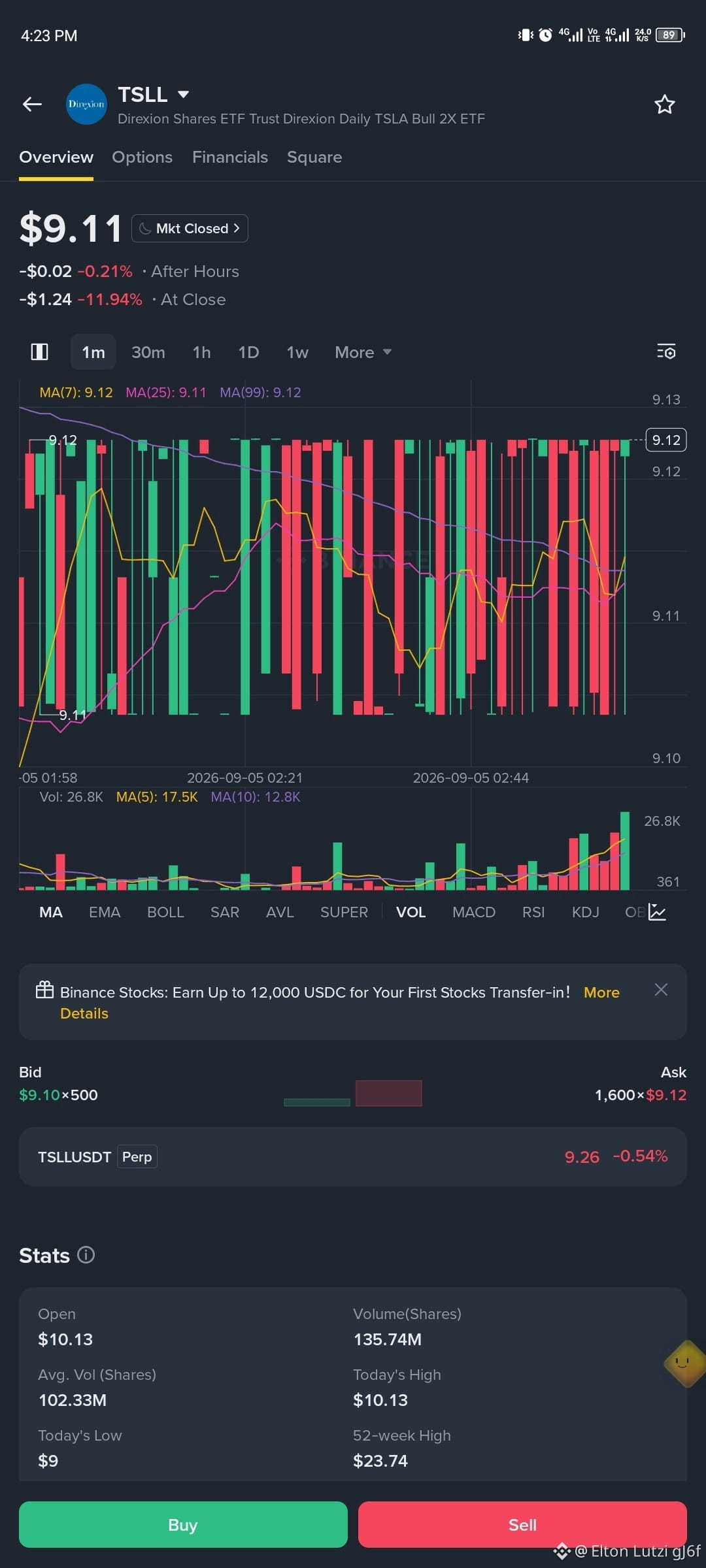
I Sold My $TSLL Too Early - Lesson from 7 USDT to 900 KES
I started with only 7 USDT on Binance.
My mistake? I sold at $9.90 for small profit and it pumped to $10.50 same day. I lost extra KES 40.
Lesson I learned:
1. TSLL is 2x TSLA - it moves FAST
2. Don't sell all at once. Sell 50% at 8% profit, leave 50% runner
3. Set limit buy at -5% dip, not market buy
Now my plan: Buy $TSLL at $9.05, Sell at $9.90, repeat. Daily target KES 50, not KES 500.
Small capital needs patience, not greed.
Are you also trading $TSLL or TSLA on Binance? What is your sell rule?
#TSLL #TSLA #BinanceSquare
I Sold My $TSLL Too Early - Lesson from 7 USDT to 900 KES
I started with only 7 USDT on Binance.
My mistake? I sold at $9.90 for small profit and it pumped to $10.50 same day. I lost extra KES 40.
Lesson I learned:
1. TSLL is 2x TSLA - it moves FAST
2. Don't sell all at once. Sell 50% at 8% profit, leave 50% runner
3. Set limit buy at -5% dip, not market buy
Now my plan: Buy $TSLL at $9.05, Sell at $9.90, repeat. Daily target KES 50, not KES 500.
Small capital needs patience, not greed.
Are you also trading $TSLL or TSLA on Binance? What is your sell rule?
#TSLL #TSLA #BinanceSquare
I started with only 7 USDT on Binance.
My mistake? I sold at $9.90 for small profit and it pumped to $10.50 same day. I lost extra KES 40.
Lesson I learned:
1. TSLL is 2x TSLA - it moves FAST
2. Don't sell all at once. Sell 50% at 8% profit, leave 50% runner
3. Set limit buy at -5% dip, not market buy
Now my plan: Buy $TSLL at $9.05, Sell at $9.90, repeat. Daily target KES 50, not KES 500.
Small capital needs patience, not greed.
Are you also trading $TSLL or TSLA on Binance? What is your sell rule?
#TSLL #TSLA #BinanceSquare
1
172
·
--
$TSLL is currently at 9.28, down 0.961% over the past 24 hours, with the funding rate pinned at zero. It is a calm tape with a slight price decline and neutral funding, which suggests the market is waiting.
A funding rate at zero is the clearest signal: neither longs nor shorts are willing to pay the other side, and leveraged positions have fallen into a stalemate. The slight decline in price did not push the funding rate negative, which means bears have not aggressively built paid positions, and there is no clear consensus on further downside or panic selling. This structure is common before key data releases or during a vacuum in macro expectations, when capital reduces the intensity of the battle and waits for a new driver.
But zero funding combined with a drifting price points to another possibility: holders are being worn down by time. Longs with no funding are not paying extra costs, but they also have no profit momentum; shorts are likewise free, yet unable to drive price much lower. Open interest of 34003.42 looks awkward in this kind of stalemate: it is neither an extreme low-liquidity dead zone nor a buildup before high volatility. The current market state is directional exhaustion through internal friction.
The strongest counterargument is that if a clear macro tailwind appears later, such as rising expectations of a Fed rate cut or stronger-than-expected tech earnings, $TSLL as a leveraged product could rally quickly and push funding back above zero, triggering a short-covering-driven move up. The condition under which my view fails is straightforward: if price closes below 9.00 for two consecutive trading days and funding turns negative over the same period, that would mean shorts are starting to pay to build trend positions, and the bearish case would be confirmed.
The stalemate will eventually break. The next forced actors are traders holding longs and waiting for a breakout; time is their biggest cost. Liquidity is currently stalled, and any breakout in either direction will attract incremental capital. My move is to wait. I would only consider a long if price clearly reclaims 9.50 and funding turns positive; conversely, if it drifts toward 9.00 and funding turns negative, I would try a small short. Right now, the most rational strategy is not to participate in this grinding decay.
The consensus view is that $TSLL needs a macro catalyst to get going, but I disagree. The real catalyst may come from a collective clearing of sentiment inside the market; a sharp downside wick or a fast upside squeeze often breaks the stalemate much faster than slow macro transmission.
Trading tag: #TradFi #链上美股 #TSLL
Where do you think this whole judgment is most likely wrong?
$TSLL is currently at 9.28, down 0.961% over the past 24 hours, with the funding rate pinned at zero. It is a calm tape with a slight price decline and neutral funding, which suggests the market is waiting.
A funding rate at zero is the clearest signal: neither longs nor shorts are willing to pay the other side, and leveraged positions have fallen into a stalemate. The slight decline in price did not push the funding rate negative, which means bears have not aggressively built paid positions, and there is no clear consensus on further downside or panic selling. This structure is common before key data releases or during a vacuum in macro expectations, when capital reduces the intensity of the battle and waits for a new driver.
But zero funding combined with a drifting price points to another possibility: holders are being worn down by time. Longs with no funding are not paying extra costs, but they also have no profit momentum; shorts are likewise free, yet unable to drive price much lower. Open interest of 34003.42 looks awkward in this kind of stalemate: it is neither an extreme low-liquidity dead zone nor a buildup before high volatility. The current market state is directional exhaustion through internal friction.
The strongest counterargument is that if a clear macro tailwind appears later, such as rising expectations of a Fed rate cut or stronger-than-expected tech earnings, $TSLL as a leveraged product could rally quickly and push funding back above zero, triggering a short-covering-driven move up. The condition under which my view fails is straightforward: if price closes below 9.00 for two consecutive trading days and funding turns negative over the same period, that would mean shorts are starting to pay to build trend positions, and the bearish case would be confirmed.
The stalemate will eventually break. The next forced actors are traders holding longs and waiting for a breakout; time is their biggest cost. Liquidity is currently stalled, and any breakout in either direction will attract incremental capital. My move is to wait. I would only consider a long if price clearly reclaims 9.50 and funding turns positive; conversely, if it drifts toward 9.00 and funding turns negative, I would try a small short. Right now, the most rational strategy is not to participate in this grinding decay.
The consensus view is that $TSLL needs a macro catalyst to get going, but I disagree. The real catalyst may come from a collective clearing of sentiment inside the market; a sharp downside wick or a fast upside squeeze often breaks the stalemate much faster than slow macro transmission.
Trading tag: #TradFi #链上美股 #TSLL
Where do you think this whole judgment is most likely wrong?
A funding rate at zero is the clearest signal: neither longs nor shorts are willing to pay the other side, and leveraged positions have fallen into a stalemate. The slight decline in price did not push the funding rate negative, which means bears have not aggressively built paid positions, and there is no clear consensus on further downside or panic selling. This structure is common before key data releases or during a vacuum in macro expectations, when capital reduces the intensity of the battle and waits for a new driver.
But zero funding combined with a drifting price points to another possibility: holders are being worn down by time. Longs with no funding are not paying extra costs, but they also have no profit momentum; shorts are likewise free, yet unable to drive price much lower. Open interest of 34003.42 looks awkward in this kind of stalemate: it is neither an extreme low-liquidity dead zone nor a buildup before high volatility. The current market state is directional exhaustion through internal friction.
The strongest counterargument is that if a clear macro tailwind appears later, such as rising expectations of a Fed rate cut or stronger-than-expected tech earnings, $TSLL as a leveraged product could rally quickly and push funding back above zero, triggering a short-covering-driven move up. The condition under which my view fails is straightforward: if price closes below 9.00 for two consecutive trading days and funding turns negative over the same period, that would mean shorts are starting to pay to build trend positions, and the bearish case would be confirmed.
The stalemate will eventually break. The next forced actors are traders holding longs and waiting for a breakout; time is their biggest cost. Liquidity is currently stalled, and any breakout in either direction will attract incremental capital. My move is to wait. I would only consider a long if price clearly reclaims 9.50 and funding turns positive; conversely, if it drifts toward 9.00 and funding turns negative, I would try a small short. Right now, the most rational strategy is not to participate in this grinding decay.
The consensus view is that $TSLL needs a macro catalyst to get going, but I disagree. The real catalyst may come from a collective clearing of sentiment inside the market; a sharp downside wick or a fast upside squeeze often breaks the stalemate much faster than slow macro transmission.
Trading tag: #TradFi #链上美股 #TSLL
Where do you think this whole judgment is most likely wrong?
65
·
--
$TSLL, Tesla 2x long ETF, was down 0.961% over the past 24 hours on Binance U.S. perpetual contracts, with the current price at 9.28. The funding rate has gone to zero, and open interest is 34,003.42. This is a rare, calm structure.
The slight pullback in price and the funding rate sitting on the zero axis mean that neither side is paying the other. This usually happens when the market loses a clear short-term direction. There is no extra cost for longs chasing the move, and no ongoing bleed for shorts betting on further declines. Open interest has not changed dramatically; combined with the slight drop in price, this suggests some positions may be quietly stepping aside, but there is no sign of panic liquidation.
The core signal here is simple: funding rate at zero is itself a signal. It shows market sentiment has entered a brief period of balance or confusion. For an ETF tracking 2x leveraged Tesla exposure, this calm may reflect a lack of consensus on Tesla’s near-term direction, with investors waiting for the next catalyst—perhaps quarterly earnings, perhaps more clarity on macro interest-rate policy. In the current structure, any one-sided bet lacks the push of financing costs.
The strongest counterpoint is that if Tesla suddenly releases major product progress or delivery data, this balance could be broken instantly. If price surges sharply and trading volume spikes, the funding rate will likely quickly turn positive, reigniting the chain of longs chasing higher prices and shorts being forced to cover. The invalidation condition is simple: if $TSLL stays range-bound near the current price for more than a week and volume shrinks, then the cautious-waiting state described here will persist, though the judgment that the market is waiting for a catalyst still holds.
Operationally, I would choose to wait. A funding rate of zero is not an entry signal; it only tells you there is no clear cost advantage or disadvantage right now. The aggressive approach would be to take a small long around 9.28, betting on Tesla fundamentals or macro tailwinds, but you must accept the risk of having no funding-rate cushion. The prudent approach is to observe and wait for the funding rate to turn clearly positive (>0.0005) and for price to hold above the level before considering trend-following. The avoid approach is to stay out, because with no direction and no catalyst, capital efficiency is low.
The market is overlooking the meaning of a zero funding rate on a leveraged ETF: it is neither long-dominant nor short-dominant, but rather a state where both sides are present yet neither has the momentum to add, all holding their breath and waiting.
Trading tag: #TradFi #链上美股 #TSLL
Where do you think this analysis is most likely wrong?
$TSLL , Tesla 2x long ETF, was down 0.961% over the past 24 hours on Binance U.S. perpetual contracts, with the current price at 9.28. The funding rate has gone to zero, and open interest is 34,003.42. This is a rare, calm structure.
The slight pullback in price and the funding rate sitting on the zero axis mean that neither side is paying the other. This usually happens when the market loses a clear short-term direction. There is no extra cost for longs chasing the move, and no ongoing bleed for shorts betting on further declines. Open interest has not changed dramatically; combined with the slight drop in price, this suggests some positions may be quietly stepping aside, but there is no sign of panic liquidation.
The core signal here is simple: funding rate at zero is itself a signal. It shows market sentiment has entered a brief period of balance or confusion. For an ETF tracking 2x leveraged Tesla exposure, this calm may reflect a lack of consensus on Tesla’s near-term direction, with investors waiting for the next catalyst—perhaps quarterly earnings, perhaps more clarity on macro interest-rate policy. In the current structure, any one-sided bet lacks the push of financing costs.
The strongest counterpoint is that if Tesla suddenly releases major product progress or delivery data, this balance could be broken instantly. If price surges sharply and trading volume spikes, the funding rate will likely quickly turn positive, reigniting the chain of longs chasing higher prices and shorts being forced to cover. The invalidation condition is simple: if $TSLL stays range-bound near the current price for more than a week and volume shrinks, then the cautious-waiting state described here will persist, though the judgment that the market is waiting for a catalyst still holds.
Operationally, I would choose to wait. A funding rate of zero is not an entry signal; it only tells you there is no clear cost advantage or disadvantage right now. The aggressive approach would be to take a small long around 9.28, betting on Tesla fundamentals or macro tailwinds, but you must accept the risk of having no funding-rate cushion. The prudent approach is to observe and wait for the funding rate to turn clearly positive (>0.0005) and for price to hold above the level before considering trend-following. The avoid approach is to stay out, because with no direction and no catalyst, capital efficiency is low.
The market is overlooking the meaning of a zero funding rate on a leveraged ETF: it is neither long-dominant nor short-dominant, but rather a state where both sides are present yet neither has the momentum to add, all holding their breath and waiting.
Trading tag: #TradFi #链上美股 #TSLL
Where do you think this analysis is most likely wrong?
The slight pullback in price and the funding rate sitting on the zero axis mean that neither side is paying the other. This usually happens when the market loses a clear short-term direction. There is no extra cost for longs chasing the move, and no ongoing bleed for shorts betting on further declines. Open interest has not changed dramatically; combined with the slight drop in price, this suggests some positions may be quietly stepping aside, but there is no sign of panic liquidation.
The core signal here is simple: funding rate at zero is itself a signal. It shows market sentiment has entered a brief period of balance or confusion. For an ETF tracking 2x leveraged Tesla exposure, this calm may reflect a lack of consensus on Tesla’s near-term direction, with investors waiting for the next catalyst—perhaps quarterly earnings, perhaps more clarity on macro interest-rate policy. In the current structure, any one-sided bet lacks the push of financing costs.
The strongest counterpoint is that if Tesla suddenly releases major product progress or delivery data, this balance could be broken instantly. If price surges sharply and trading volume spikes, the funding rate will likely quickly turn positive, reigniting the chain of longs chasing higher prices and shorts being forced to cover. The invalidation condition is simple: if $TSLL stays range-bound near the current price for more than a week and volume shrinks, then the cautious-waiting state described here will persist, though the judgment that the market is waiting for a catalyst still holds.
Operationally, I would choose to wait. A funding rate of zero is not an entry signal; it only tells you there is no clear cost advantage or disadvantage right now. The aggressive approach would be to take a small long around 9.28, betting on Tesla fundamentals or macro tailwinds, but you must accept the risk of having no funding-rate cushion. The prudent approach is to observe and wait for the funding rate to turn clearly positive (>0.0005) and for price to hold above the level before considering trend-following. The avoid approach is to stay out, because with no direction and no catalyst, capital efficiency is low.
The market is overlooking the meaning of a zero funding rate on a leveraged ETF: it is neither long-dominant nor short-dominant, but rather a state where both sides are present yet neither has the momentum to add, all holding their breath and waiting.
Trading tag: #TradFi #链上美股 #TSLL
Where do you think this analysis is most likely wrong?
35
·
--
$TSLL 24 hours rose 2.077% to 9.34, but the funding rate is 0.00000000, so neither longs nor shorts are paying. I checked the open interest at 35357.12; without historical data there’s no way to compare changes. With price up and funding neutral, it suggests this rally was not driven by capital, and may have just been driven by spot sentiment. My view is that this is not a chase-higher opportunity. If it falls below 9.00, I’ll reduce my position; if it breaks above 9.50, I’ll try a small long. Counter-consensus point: the market may be ignoring that a rise with a zero funding rate lacks fuel, and I oppose adding here.
Trading tags: #BinanceFutures #TradFi #USDⓈM #TSLL #TSLLUSDT $TSLL
$TSLL 24 hours rose 2.077% to 9.34, but the funding rate is 0.00000000, so neither longs nor shorts are paying. I checked the open interest at 35357.12; without historical data there’s no way to compare changes. With price up and funding neutral, it suggests this rally was not driven by capital, and may have just been driven by spot sentiment. My view is that this is not a chase-higher opportunity. If it falls below 9.00, I’ll reduce my position; if it breaks above 9.50, I’ll try a small long. Counter-consensus point: the market may be ignoring that a rise with a zero funding rate lacks fuel, and I oppose adding here.
Trading tags: #BinanceFutures #TradFi #USDⓈM #TSLL #TSLLUSDT $TSLL
Trading tags: #BinanceFutures #TradFi #USDⓈM #TSLL #TSLLUSDT $TSLL
80

·
--
$TSLL has fallen nearly 9% over the past 24 hours, with the price hitting 9.16. Funding rates are flat at zero, and open interest is around 37,000 contracts. That’s all the trading desk data, with no extra news push. But from a broader angle, Trump’s tariff threats toward global trading partners change by the day. Tesla, as a company deeply embedded in the global supply chain, is a classic punching bag. When the stock wobbles, a leveraged shadow contract like $TSLL will inevitably react even more violently.
My view is that Trump’s trade-war narrative is the biggest source of short-term risk premium for Tesla, and this uncertainty will continue to cap $TSLL’s rebound potential.
There are two pieces of evidence. First is price action: an 8.8% one-day drop is severe volatility in TradFi perps, suggesting sustained selling pressure rather than a single bad print. Second is the funding rate being flat at zero, which is a key signal. When price falls, funding is either negative, meaning shorts are crowded, or like now, zero, meaning longs and shorts are in a stalemate. A zero funding rate means neither side is paying extra to hold positions; neither has the upper hand, yet the price is still falling. That points to one conclusion: shorts currently have the advantage at this price level, and longs lack both the strength and the willingness to push funding negative to absorb the selling pressure. The market is in a weak equilibrium.
The strongest counterargument is that Trump’s policy of bringing manufacturing back to the U.S. could ultimately benefit Tesla’s domestic production capacity. But that is a long-term story. What the market is trading now is the short-term shock. Every time policy rhetoric changes, expectations of soaring supply-chain costs and blocked exports hit Tesla’s stock first, and that reaction path has not changed.
The second-order effects are clear. In a zero-funding environment, if price keeps drifting lower, longs’ patience will run out and a batch of stop-loss orders may get triggered. Meanwhile, because shorts are not earning funding income, their positions still carry time costs; if Trump softens his tone or Tesla gets some other positive catalyst, they may also cover quickly. Liquidity will partially shift away from assets with this kind of high uncertainty toward more defensive assets or tech stocks with a simpler narrative.
My move is to wait and see. The key level is the current price at 9.16. If price can hold above 9.20 with volume, that would suggest short pressure is easing, and I’d consider a small long for a rebound trade. If it breaks below 9.10 and funding turns negative, that would confirm short dominance, and I’d follow through with a short, with a stop above 9.16. Right now, at this in-between level, neither side has a safe margin.
Trade tag: #TradFi #链上美股 #TSLL
Where do you think this entire thesis is most likely wrong?
$TSLL has fallen nearly 9% over the past 24 hours, with the price hitting 9.16. Funding rates are flat at zero, and open interest is around 37,000 contracts. That’s all the trading desk data, with no extra news push. But from a broader angle, Trump’s tariff threats toward global trading partners change by the day. Tesla, as a company deeply embedded in the global supply chain, is a classic punching bag. When the stock wobbles, a leveraged shadow contract like $TSLL will inevitably react even more violently.
My view is that Trump’s trade-war narrative is the biggest source of short-term risk premium for Tesla, and this uncertainty will continue to cap $TSLL ’s rebound potential.
There are two pieces of evidence. First is price action: an 8.8% one-day drop is severe volatility in TradFi perps, suggesting sustained selling pressure rather than a single bad print. Second is the funding rate being flat at zero, which is a key signal. When price falls, funding is either negative, meaning shorts are crowded, or like now, zero, meaning longs and shorts are in a stalemate. A zero funding rate means neither side is paying extra to hold positions; neither has the upper hand, yet the price is still falling. That points to one conclusion: shorts currently have the advantage at this price level, and longs lack both the strength and the willingness to push funding negative to absorb the selling pressure. The market is in a weak equilibrium.
The strongest counterargument is that Trump’s policy of bringing manufacturing back to the U.S. could ultimately benefit Tesla’s domestic production capacity. But that is a long-term story. What the market is trading now is the short-term shock. Every time policy rhetoric changes, expectations of soaring supply-chain costs and blocked exports hit Tesla’s stock first, and that reaction path has not changed.
The second-order effects are clear. In a zero-funding environment, if price keeps drifting lower, longs’ patience will run out and a batch of stop-loss orders may get triggered. Meanwhile, because shorts are not earning funding income, their positions still carry time costs; if Trump softens his tone or Tesla gets some other positive catalyst, they may also cover quickly. Liquidity will partially shift away from assets with this kind of high uncertainty toward more defensive assets or tech stocks with a simpler narrative.
My move is to wait and see. The key level is the current price at 9.16. If price can hold above 9.20 with volume, that would suggest short pressure is easing, and I’d consider a small long for a rebound trade. If it breaks below 9.10 and funding turns negative, that would confirm short dominance, and I’d follow through with a short, with a stop above 9.16. Right now, at this in-between level, neither side has a safe margin.
Trade tag: #TradFi #链上美股 #TSLL
Where do you think this entire thesis is most likely wrong?
My view is that Trump’s trade-war narrative is the biggest source of short-term risk premium for Tesla, and this uncertainty will continue to cap $TSLL ’s rebound potential.
There are two pieces of evidence. First is price action: an 8.8% one-day drop is severe volatility in TradFi perps, suggesting sustained selling pressure rather than a single bad print. Second is the funding rate being flat at zero, which is a key signal. When price falls, funding is either negative, meaning shorts are crowded, or like now, zero, meaning longs and shorts are in a stalemate. A zero funding rate means neither side is paying extra to hold positions; neither has the upper hand, yet the price is still falling. That points to one conclusion: shorts currently have the advantage at this price level, and longs lack both the strength and the willingness to push funding negative to absorb the selling pressure. The market is in a weak equilibrium.
The strongest counterargument is that Trump’s policy of bringing manufacturing back to the U.S. could ultimately benefit Tesla’s domestic production capacity. But that is a long-term story. What the market is trading now is the short-term shock. Every time policy rhetoric changes, expectations of soaring supply-chain costs and blocked exports hit Tesla’s stock first, and that reaction path has not changed.
The second-order effects are clear. In a zero-funding environment, if price keeps drifting lower, longs’ patience will run out and a batch of stop-loss orders may get triggered. Meanwhile, because shorts are not earning funding income, their positions still carry time costs; if Trump softens his tone or Tesla gets some other positive catalyst, they may also cover quickly. Liquidity will partially shift away from assets with this kind of high uncertainty toward more defensive assets or tech stocks with a simpler narrative.
My move is to wait and see. The key level is the current price at 9.16. If price can hold above 9.20 with volume, that would suggest short pressure is easing, and I’d consider a small long for a rebound trade. If it breaks below 9.10 and funding turns negative, that would confirm short dominance, and I’d follow through with a short, with a stop above 9.16. Right now, at this in-between level, neither side has a safe margin.
Trade tag: #TradFi #链上美股 #TSLL
Where do you think this entire thesis is most likely wrong?
156
·
--
It fell 8.856% in 24 hours, and $TSLL is now at 9.16. This is a typical Trump-trade proxy in on-chain U.S. equity contracts: the price moves with political expectations, and volatility is its essence.
Every time Trump’s name appears in the headlines, whether it’s tariff threats or policy rhetoric, U.S. equity index contracts and instruments like TSLL tend to twitch. A drop of 8.8 points with funding rate at 0 sends a very clean signal: neither side is willing to pay the other right now, but the price is still falling, which means the selling pressure is coming from real spot or one-sided contract selling, not a cascade squeeze caused by accumulated funding costs. This is the classic structure of a one-sided selloff, not the prelude to a short squeeze.
The strongest counterargument is that the market may have already priced in the worst-case Trump trade expectations, and the decline to this level may simply be the emotional release running its course. If even a tiny easing signal about trade or tech policy suddenly appears, short covering could be extremely violent. But the condition that would invalidate my view is this: the price holds above 9.5 accompanied by a surge in volume, which would mean the short-term selling pressure has been absorbed, and I’d be wrong.
Who is being forced to act? Earlier long positions entered at higher levels are now underwater. They will either stop out or hold on and wait for a rebound, and both behaviors will consume market liquidity. If the price keeps drifting lower, they will become a new source of selling pressure. The second-order effect is that liquidity will shift from highly leveraged contracts into more stable instruments, or exit the market altogether.
As for action, I’m not touching this here. I’m waiting for two signals: either the price keeps grinding lower on shrinking volume and falls below 8.8, which would mark the tail end of panic and allow a small long with a stop at 8.5; or it snaps back above 9.5 on expanding volume, which would mean the sell orders have been exhausted and you can follow the move long. In the current setup of slow decline plus zero funding, entering here is just bottom-fishing, and the risk-reward is poor.
Contrarian view: everyone says the Trump trade is bullish for U.S. domestic stocks, but the contract market is voting with its feet, and the liquidity in instruments like TSLL is being steadily drained by political noise. A real reversal won’t come until the noise becomes policy text.
Trading tag: #TradFi #链上美股 #TSLL
Where do you think this whole thesis is most likely wrong?
It fell 8.856% in 24 hours, and $TSLL is now at 9.16. This is a typical Trump-trade proxy in on-chain U.S. equity contracts: the price moves with political expectations, and volatility is its essence.
Every time Trump’s name appears in the headlines, whether it’s tariff threats or policy rhetoric, U.S. equity index contracts and instruments like TSLL tend to twitch. A drop of 8.8 points with funding rate at 0 sends a very clean signal: neither side is willing to pay the other right now, but the price is still falling, which means the selling pressure is coming from real spot or one-sided contract selling, not a cascade squeeze caused by accumulated funding costs. This is the classic structure of a one-sided selloff, not the prelude to a short squeeze.
The strongest counterargument is that the market may have already priced in the worst-case Trump trade expectations, and the decline to this level may simply be the emotional release running its course. If even a tiny easing signal about trade or tech policy suddenly appears, short covering could be extremely violent. But the condition that would invalidate my view is this: the price holds above 9.5 accompanied by a surge in volume, which would mean the short-term selling pressure has been absorbed, and I’d be wrong.
Who is being forced to act? Earlier long positions entered at higher levels are now underwater. They will either stop out or hold on and wait for a rebound, and both behaviors will consume market liquidity. If the price keeps drifting lower, they will become a new source of selling pressure. The second-order effect is that liquidity will shift from highly leveraged contracts into more stable instruments, or exit the market altogether.
As for action, I’m not touching this here. I’m waiting for two signals: either the price keeps grinding lower on shrinking volume and falls below 8.8, which would mark the tail end of panic and allow a small long with a stop at 8.5; or it snaps back above 9.5 on expanding volume, which would mean the sell orders have been exhausted and you can follow the move long. In the current setup of slow decline plus zero funding, entering here is just bottom-fishing, and the risk-reward is poor.
Contrarian view: everyone says the Trump trade is bullish for U.S. domestic stocks, but the contract market is voting with its feet, and the liquidity in instruments like TSLL is being steadily drained by political noise. A real reversal won’t come until the noise becomes policy text.
Trading tag: #TradFi #链上美股 #TSLL
Where do you think this whole thesis is most likely wrong?
Every time Trump’s name appears in the headlines, whether it’s tariff threats or policy rhetoric, U.S. equity index contracts and instruments like TSLL tend to twitch. A drop of 8.8 points with funding rate at 0 sends a very clean signal: neither side is willing to pay the other right now, but the price is still falling, which means the selling pressure is coming from real spot or one-sided contract selling, not a cascade squeeze caused by accumulated funding costs. This is the classic structure of a one-sided selloff, not the prelude to a short squeeze.
The strongest counterargument is that the market may have already priced in the worst-case Trump trade expectations, and the decline to this level may simply be the emotional release running its course. If even a tiny easing signal about trade or tech policy suddenly appears, short covering could be extremely violent. But the condition that would invalidate my view is this: the price holds above 9.5 accompanied by a surge in volume, which would mean the short-term selling pressure has been absorbed, and I’d be wrong.
Who is being forced to act? Earlier long positions entered at higher levels are now underwater. They will either stop out or hold on and wait for a rebound, and both behaviors will consume market liquidity. If the price keeps drifting lower, they will become a new source of selling pressure. The second-order effect is that liquidity will shift from highly leveraged contracts into more stable instruments, or exit the market altogether.
As for action, I’m not touching this here. I’m waiting for two signals: either the price keeps grinding lower on shrinking volume and falls below 8.8, which would mark the tail end of panic and allow a small long with a stop at 8.5; or it snaps back above 9.5 on expanding volume, which would mean the sell orders have been exhausted and you can follow the move long. In the current setup of slow decline plus zero funding, entering here is just bottom-fishing, and the risk-reward is poor.
Contrarian view: everyone says the Trump trade is bullish for U.S. domestic stocks, but the contract market is voting with its feet, and the liquidity in instruments like TSLL is being steadily drained by political noise. A real reversal won’t come until the noise becomes policy text.
Trading tag: #TradFi #链上美股 #TSLL
Where do you think this whole thesis is most likely wrong?
76
·
--
[M1_mag7]
Old Dog scanned the on-chain U.S. stock contract pool. $TSLL took a -12.139% hit over the past 24 hours, with the price dumped to $9.12, while the funding rate stayed at a positive 0.00064329. A sharp price drop combined with a positive funding rate is a classic setup for trapped longs.
Shifting the angle to the Mag7 / broad-market anchor. $TSLL is classified as EQUITY, the sector field says Other, and there are no other comparable symbols today for direct comparison, so we can’t say it’s leading its sector outright. But looking at its own contract structure: the funding rate remains positive, which means longs are continuously paying shorts. By the rule of funding rates, a positive rate points to crowded long positioning. Combine that with a drop of more than 12% in a single day, and you get a situation where longs are stuck underwater, still trying to hold on, or even averaging down. Open interest is 39064.28, and so far there hasn’t been any massive reduction in positions accompanying the price collapse, which suggests longs have not surrendered on a large scale yet — but that is exactly where the risk lies.
My view is that $TSLL is currently facing long squeeze risk, with the trend pointing downward. Crowded longs plus a breakdown in price can easily trigger a chain reaction of liquidations and liquidity slippage. This is not just a single-name issue; in the context of the broad-market anchor, if $TSLL continues to weaken as a related symbol, it will suppress the beta of other names in the same group, and capital will flow toward more resilient areas. Put simply, the carrying cost here is higher than you think, and the positive funding rate is steadily eating away at long capital every day.
As for execution, if price breaks below $9, I will reduce my position; I will reassess the long thesis only when the funding rate quickly flips negative. At this level, reducing exposure or staying out is the clear stance. If the market thinks it is oversold and should rebound, I’ll take the opposite side, because the crowded-long structure has not yet been fully worked off by price weakness and time decay.
Finally, on invalidation. The two most likely ways this call could be wrong are: first, OI increases against the trend, meaning large players are accumulating below; second, the funding rate turns negative quickly and squeezes the shorts. If, over the next 24 hours, the funding rate flips negative, or the price holds above $9.12 and recovers the losses, I will reassess. Until then, I remain cautious.
Trading tags: #BinanceFutures #TradFi #USDⓈM #TSLL #TSLLUSDT $TSLL
[M1_mag7]
Old Dog scanned the on-chain U.S. stock contract pool. $TSLL took a -12.139% hit over the past 24 hours, with the price dumped to $9.12, while the funding rate stayed at a positive 0.00064329. A sharp price drop combined with a positive funding rate is a classic setup for trapped longs.
Shifting the angle to the Mag7 / broad-market anchor. $TSLL is classified as EQUITY, the sector field says Other, and there are no other comparable symbols today for direct comparison, so we can’t say it’s leading its sector outright. But looking at its own contract structure: the funding rate remains positive, which means longs are continuously paying shorts. By the rule of funding rates, a positive rate points to crowded long positioning. Combine that with a drop of more than 12% in a single day, and you get a situation where longs are stuck underwater, still trying to hold on, or even averaging down. Open interest is 39064.28, and so far there hasn’t been any massive reduction in positions accompanying the price collapse, which suggests longs have not surrendered on a large scale yet — but that is exactly where the risk lies.
My view is that $TSLL is currently facing long squeeze risk, with the trend pointing downward. Crowded longs plus a breakdown in price can easily trigger a chain reaction of liquidations and liquidity slippage. This is not just a single-name issue; in the context of the broad-market anchor, if $TSLL continues to weaken as a related symbol, it will suppress the beta of other names in the same group, and capital will flow toward more resilient areas. Put simply, the carrying cost here is higher than you think, and the positive funding rate is steadily eating away at long capital every day.
As for execution, if price breaks below $9, I will reduce my position; I will reassess the long thesis only when the funding rate quickly flips negative. At this level, reducing exposure or staying out is the clear stance. If the market thinks it is oversold and should rebound, I’ll take the opposite side, because the crowded-long structure has not yet been fully worked off by price weakness and time decay.
Finally, on invalidation. The two most likely ways this call could be wrong are: first, OI increases against the trend, meaning large players are accumulating below; second, the funding rate turns negative quickly and squeezes the shorts. If, over the next 24 hours, the funding rate flips negative, or the price holds above $9.12 and recovers the losses, I will reassess. Until then, I remain cautious.
Trading tags: #BinanceFutures #TradFi #USDⓈM #TSLL #TSLLUSDT $TSLL
Old Dog scanned the on-chain U.S. stock contract pool. $TSLL took a -12.139% hit over the past 24 hours, with the price dumped to $9.12, while the funding rate stayed at a positive 0.00064329. A sharp price drop combined with a positive funding rate is a classic setup for trapped longs.
Shifting the angle to the Mag7 / broad-market anchor. $TSLL is classified as EQUITY, the sector field says Other, and there are no other comparable symbols today for direct comparison, so we can’t say it’s leading its sector outright. But looking at its own contract structure: the funding rate remains positive, which means longs are continuously paying shorts. By the rule of funding rates, a positive rate points to crowded long positioning. Combine that with a drop of more than 12% in a single day, and you get a situation where longs are stuck underwater, still trying to hold on, or even averaging down. Open interest is 39064.28, and so far there hasn’t been any massive reduction in positions accompanying the price collapse, which suggests longs have not surrendered on a large scale yet — but that is exactly where the risk lies.
My view is that $TSLL is currently facing long squeeze risk, with the trend pointing downward. Crowded longs plus a breakdown in price can easily trigger a chain reaction of liquidations and liquidity slippage. This is not just a single-name issue; in the context of the broad-market anchor, if $TSLL continues to weaken as a related symbol, it will suppress the beta of other names in the same group, and capital will flow toward more resilient areas. Put simply, the carrying cost here is higher than you think, and the positive funding rate is steadily eating away at long capital every day.
As for execution, if price breaks below $9, I will reduce my position; I will reassess the long thesis only when the funding rate quickly flips negative. At this level, reducing exposure or staying out is the clear stance. If the market thinks it is oversold and should rebound, I’ll take the opposite side, because the crowded-long structure has not yet been fully worked off by price weakness and time decay.
Finally, on invalidation. The two most likely ways this call could be wrong are: first, OI increases against the trend, meaning large players are accumulating below; second, the funding rate turns negative quickly and squeezes the shorts. If, over the next 24 hours, the funding rate flips negative, or the price holds above $9.12 and recovers the losses, I will reassess. Until then, I remain cautious.
Trading tags: #BinanceFutures #TradFi #USDⓈM #TSLL #TSLLUSDT $TSLL
170
·
--
I took a quick look at the 24-hour chart of $TSLL, and the single-day drop has reached -14.474%, which is quite eye-catching in on-chain U.S. stock futures. The price is now 9.1, while the funding rate over the same period is positive at 0.00166931. The price is plunging, yet longs are still paying funding. This combination is rare and points to a clear structure: a large number of long positions are trapped, but they are still holding on, and may even be adding.
Why do I say this is a structural risk? According to the iron law of funding-rate direction, a funding rate above zero means longs are continuously paying shorts, which usually happens during crowded long phases in an uptrend. But now the situation has reversed: price is falling, yet longs are still paying. That means market bullish sentiment and actual price action have seriously diverged. This is usually not a healthy pullback, but a slow drain of long-side liquidity. Combined with the open interest figure of 37561.66, although we can’t directly calculate the leverage ratio, the combination of violent price swings and crowded-long funding rates means the risk of liquidation cascades is rising exponentially. Compared with other names in the sector, there is no comparable secondary meme this time, which means this round of selling in $TSLL may not be driven by sector correlation; rather, it may be a concentrated exposure of its own position structure problem.
My view is straightforward: the current price is not the bottom, and the behavior of longs paying to hold is unlikely to last much longer. If the price rebounds above 9.5 at any point, that will be a window for trapped longs to relieve pressure, and also a resistance level for trend confirmation. On the other hand, if the price directly breaks below 8.5, that could mark the start of a chain liquidation, which would bring a much sharper downward wick. So my move is to stay out. I will neither chase shorts to avoid getting squeezed by a sudden switch to negative funding, nor try to catch a falling knife in such a crowded long structure. For anyone looking to go long, wait for at least two signals: either price breaks above 9.5 on volume and holds there, or the funding rate turns fully negative, showing that shorts are beginning to retake control.
Where is this judgment most likely wrong? If a wave of strong spot buying suddenly comes in and quickly pushes the price back above 9.5, while OI also surges, that would mean new money is stepping in against the trend and could reverse the short-term structure. Or, if the funding rate turns negative within the next few hours, short sentiment would take over and the bearish logic would change.
Trading tag: #BinanceFutures #TradFi #USDⓈM #TSLL #TSLLUSDT $TSLL
I took a quick look at the 24-hour chart of $TSLL , and the single-day drop has reached -14.474%, which is quite eye-catching in on-chain U.S. stock futures. The price is now 9.1, while the funding rate over the same period is positive at 0.00166931. The price is plunging, yet longs are still paying funding. This combination is rare and points to a clear structure: a large number of long positions are trapped, but they are still holding on, and may even be adding.
Why do I say this is a structural risk? According to the iron law of funding-rate direction, a funding rate above zero means longs are continuously paying shorts, which usually happens during crowded long phases in an uptrend. But now the situation has reversed: price is falling, yet longs are still paying. That means market bullish sentiment and actual price action have seriously diverged. This is usually not a healthy pullback, but a slow drain of long-side liquidity. Combined with the open interest figure of 37561.66, although we can’t directly calculate the leverage ratio, the combination of violent price swings and crowded-long funding rates means the risk of liquidation cascades is rising exponentially. Compared with other names in the sector, there is no comparable secondary meme this time, which means this round of selling in $TSLL may not be driven by sector correlation; rather, it may be a concentrated exposure of its own position structure problem.
My view is straightforward: the current price is not the bottom, and the behavior of longs paying to hold is unlikely to last much longer. If the price rebounds above 9.5 at any point, that will be a window for trapped longs to relieve pressure, and also a resistance level for trend confirmation. On the other hand, if the price directly breaks below 8.5, that could mark the start of a chain liquidation, which would bring a much sharper downward wick. So my move is to stay out. I will neither chase shorts to avoid getting squeezed by a sudden switch to negative funding, nor try to catch a falling knife in such a crowded long structure. For anyone looking to go long, wait for at least two signals: either price breaks above 9.5 on volume and holds there, or the funding rate turns fully negative, showing that shorts are beginning to retake control.
Where is this judgment most likely wrong? If a wave of strong spot buying suddenly comes in and quickly pushes the price back above 9.5, while OI also surges, that would mean new money is stepping in against the trend and could reverse the short-term structure. Or, if the funding rate turns negative within the next few hours, short sentiment would take over and the bearish logic would change.
Trading tag: #BinanceFutures #TradFi #USDⓈM #TSLL #TSLLUSDT $TSLL
Why do I say this is a structural risk? According to the iron law of funding-rate direction, a funding rate above zero means longs are continuously paying shorts, which usually happens during crowded long phases in an uptrend. But now the situation has reversed: price is falling, yet longs are still paying. That means market bullish sentiment and actual price action have seriously diverged. This is usually not a healthy pullback, but a slow drain of long-side liquidity. Combined with the open interest figure of 37561.66, although we can’t directly calculate the leverage ratio, the combination of violent price swings and crowded-long funding rates means the risk of liquidation cascades is rising exponentially. Compared with other names in the sector, there is no comparable secondary meme this time, which means this round of selling in $TSLL may not be driven by sector correlation; rather, it may be a concentrated exposure of its own position structure problem.
My view is straightforward: the current price is not the bottom, and the behavior of longs paying to hold is unlikely to last much longer. If the price rebounds above 9.5 at any point, that will be a window for trapped longs to relieve pressure, and also a resistance level for trend confirmation. On the other hand, if the price directly breaks below 8.5, that could mark the start of a chain liquidation, which would bring a much sharper downward wick. So my move is to stay out. I will neither chase shorts to avoid getting squeezed by a sudden switch to negative funding, nor try to catch a falling knife in such a crowded long structure. For anyone looking to go long, wait for at least two signals: either price breaks above 9.5 on volume and holds there, or the funding rate turns fully negative, showing that shorts are beginning to retake control.
Where is this judgment most likely wrong? If a wave of strong spot buying suddenly comes in and quickly pushes the price back above 9.5, while OI also surges, that would mean new money is stepping in against the trend and could reverse the short-term structure. Or, if the funding rate turns negative within the next few hours, short sentiment would take over and the bearish logic would change.
Trading tag: #BinanceFutures #TradFi #USDⓈM #TSLL #TSLLUSDT $TSLL
92
Log in to explore more content
Join global crypto users on Binance Square
⚡️ Get latest and useful information about crypto.
💬 Trusted by the world’s largest crypto exchange.
👍 Discover real insights from verified creators.
Email / Phone number
Trending Topics
1
#CircleLaunchesInstitutionalBTCBackedBorrowing
0 views
5 Discussing
2
#BitcoinHits$85K
2,574 views
126 Discussing
3
#ZetaChainVotesToMigrateZETAToSolana
0 views
3 Discussing
4
#ECBStartsBlockchainEuroSettlement
3,828 views
306 Discussing
5
#SouthAfricaProposesCryptoExchangeControls
14,214 views
501 Discussing
6
#SolanaCutsTargetSlotTimeTo250ms
16,860 views
438 Discussing
7
#EthereumSurpasses$2700
15,516 views
197 Discussing
8
#CanaryFilesSecondAmendmentForStakedSEIETF
36,679 views
790 Discussing
9
#SaylorHintsStrategyBitcoinBuy
2.4M views
13,717 Discussing
10
#BOJRaisesRatesTo31YearHigh
351,878 views
3,996 Discussing