
#projectfaro
projectfaro
204 views
15 Discussing
Hot
Latest

·
--
🏦 WALL STREET JUST DECLARED WAR ON TETHER
21 banks — Goldman Sachs, Citi, Santander, Deutsche Bank — just committed $270 MILLION to launch their own dollar stablecoin, codenamed Project Faro. 👀
The target: a US-regulated launch in the first half of 2027, built under the GENIUS Act. And the timing is wild — USDT's market cap just shrank $6.6 BILLION in 60 days as crypto liquidity tightens.
Can the banks take on USDT and USDC — or is this too little, too late? 👇
#Stablecoin #Crypto #ProjectFaro
32

·
--
21 banks pool $270 million: no coin launch yet—they’re paying five years’ rent firstThis time, Wall Street isn’t here to make slogans—it’s here to put money down.
According to Bloomberg, citing people familiar with the matter (November 10), a consortium of institutions including Goldman Sachs, Citi, Santander and Deutsche Bank has committed about $270 million to cover the operating expenses of a new stablecoin issuer for the next five years. The project’s internal codename is Project Faro; its official name has yet to be decided, and it is still looking for a CEO.
A few key facts:
First, this $270 million is for operating expenses, not reserves. The stablecoin itself is planned to be backed 1:1 by eligible assets, with the two pools of money kept separate.
Second, the issuer is expected to be registered in the United States. It will launch a U.S. dollar stablecoin first, with commercial launch targeted for the first half of 2027. Other G7 currencies may follow, with the euro first in line.
21 banks pool $270 million: no coin launch yet—they’re paying five years’ rent first
This time, Wall Street isn’t here to make slogans—it’s here to put money down.
According to Bloomberg, citing people familiar with the matter (November 10), a consortium of institutions including Goldman Sachs, Citi, Santander and Deutsche Bank has committed about $270 million to cover the operating expenses of a new stablecoin issuer for the next five years. The project’s internal codename is Project Faro; its official name has yet to be decided, and it is still looking for a CEO.
A few key facts:
First, this $270 million is for operating expenses, not reserves. The stablecoin itself is planned to be backed 1:1 by eligible assets, with the two pools of money kept separate.
Second, the issuer is expected to be registered in the United States. It will launch a U.S. dollar stablecoin first, with commercial launch targeted for the first half of 2027. Other G7 currencies may follow, with the euro first in line.
密讯:
围观学习一下
1
1
174

·
--
Goldman Sachs and Citi Invest $270 Million, Stablecoin Challenging USDC Set to Launch in 2027
Traditional financial giants are making their first major, direct investment in the stablecoin sector. According to reports by Cointelegraph and Decrypt, “Project Faro,” backed by Goldman Sachs, Citi, and BBVA, has raised $270 million and plans to launch a U.S. dollar stablecoin in 2027, directly challenging current market leader USDC.
Decrypt reports that the funding will cover the project’s five-year operating cycle. The issuer is a U.S.-registered entity operating under the internal codename “Project Faro.” This means leading Wall Street institutions are no longer content to participate in stablecoins indirectly through products or investments. Instead, they have chosen to enter the market as issuers themselves—a move with clear symbolic significance.
Why is this worth watching? For the past few years, the stablecoin ecosystem has been largely dominated by crypto-native players, with USDC and USDT holding the vast majority of market share. Now, traditional banks are entering the space with institutional-scale capital, and are explicitly targeting USDC’s dominant position. This may signal a shift in the stablecoin landscape from crypto-native players toward Wall Street.
Still, several facts call for a measured perspective. According to both media reports, the project is not scheduled to officially launch until 2027 and remains at a very early stage. Meanwhile, established players such as USDC and USDT already have strong distribution channels, trust, and network effects. Whether a newcomer can break through remains to be seen. The $270 million is intended to cover five years of operations, so it is also fair to ask whether the issuer has enough ammunition to challenge the existing duopoly.
How might the market react? In the short term, there are few directly tradable assets in the stablecoin sector, so the impact on prices is likely to be limited. What’s more worth watching is whether more traditional institutions follow suit and whether regulatory frameworks create room for issuers with banking backgrounds.
The countervailing factors are equally clear: the launch is still a long way off, the competitive landscape is entrenched, and the funding is relatively modest given the scale of the ambition. None of these factors alone is enough to dismiss the project’s symbolic significance, but together they suggest this is more like an “entry ticket” than an immediate threat.
What to watch next: first, Project Faro’s regulatory progress and specific launch timeline; second, whether USDC and USDT’s market shares begin to shift; and third, whether a second or third bank joins in. From a trading perspective, stablecoins themselves currently offer no direct tradable asset. If you’re looking at related assets, it may be wiser to wait for the market to confirm a direction rather than positioning yourself early.
#Stablecoin #ProjectFaro #InvestmentBanking
The above is a compilation of information and personal analysis, and does not constitute investment advice.
30

·
--
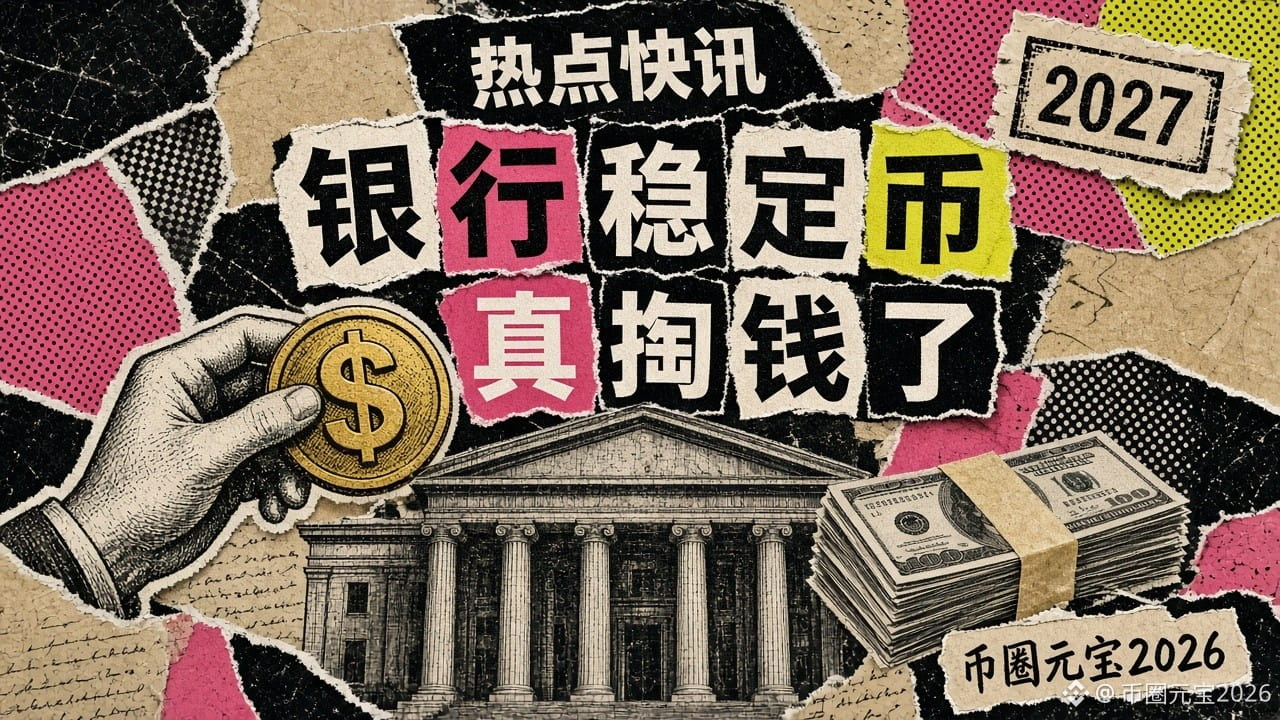
The bank stablecoin alliance involving Goldman Sachs and Citi—is it finally putting its money where its mouth is? According to Bloomberg, yes: about $270 million.
Bloomberg reported on November 10, citing people familiar with the matter, with Decrypt and CoinDesk relaying the news: Goldman Sachs, Citi, Santander, Deutsche Bank and other institutions have committed about $270 million to a joint dollar stablecoin project. Its internal codename is Project Faro.
Three key points:
1) The money is to fund the company’s operations for its first five years—not to back the stablecoin reserves.
2) The company plans to register in the US and launch a dollar stablecoin first, followed by currencies such as the euro. It is targeting a launch in the first half of 2027.
3) There is no CEO yet, the official name hasn’t been decided, and no tokens have been issued. A spokesperson for the project declined to comment.
Background: According to Decrypt, the 21-institution alliance publicly announced plans to form a company in September. USDT and USDC currently account for about 85% of the stablecoin market combined.
Let’s be real: putting money in is better than just holding meetings, but there’s still a long way from “putting money in” to “people using it”—a CEO, a name, regulatory approval, and all of 2027 lie in between. Until it actually launches, you can pretty much blacklist anyone asking you to top up or subscribe in advance under the banner of “bank stablecoins.”
How much market share do you think bank-issued stablecoins can take?
#稳定币 #银行 #ProjectFaro #Wall Street
1
·
--
Goldman Sachs and Citi invest $270 million in stablecoins, targeting USDC in 2027
Traditional financial giants are redefining the competitive boundaries of stablecoins. According to reports by Cointelegraph and Decrypt, “Project Faro,” backed jointly by Goldman Sachs, Citi, and BBVA, has raised $270 million. It aims to launch a dollar-backed stablecoin in 2027, with operating funds sufficient to cover five years. This marks the first time that top-tier Wall Street investment banks have made a major capital commitment to issuing a dollar-backed stablecoin.
The key signal here is not the launch of another new coin, but a shift in the focus of competition. Over the past two years, the stablecoin narrative has centered on payment and transfer efficiency. But Project Faro’s approach—a U.S.-registered issuer and multi-year operating reserves—shifts the competition back to the contest over reserve assets and institutional credibility. The players that can manage dollar reserves effectively and have the edge in compliance and capital may gain the upper hand in the next phase.
From a fundamental perspective, the $270 million raise, intended to cover a five-year operating period, shows that participants are taking a long-term approach rather than pursuing short-term arbitrage. The greatest value of traditional banks entering the market lies in their existing compliance systems, institutional client networks, and asset-liability management capabilities—precisely the areas where crypto-native stablecoin issuers have long been vulnerable due to their reliance on external custodians.
However, the market reaction should be viewed rationally. With launch not expected until 2027, the project is still at a very early stage and is unlikely to have any material short-term impact on USDC’s market share. For now, it is more a signal at the narrative level. The compliance costs and business models of traditional banks also remain unproven, making the narrative value greater than the immediate impact.
For the broader market, the entry of institutional-grade players is itself a sign of the stablecoin sector’s growing maturity and may help strengthen credibility across the sector. Still, it remains to be seen whether issuers led by traditional banks can find a sustainable balance between decentralized ecosystems and regulatory frameworks.
What to watch next: Project Faro’s specific reserve management plan, its regulatory approval progress, and whether more traditional financial institutions follow suit around 2027. For trading, it is more important to wait for market confirmation than to bet on the narrative in advance.
#Stablecoin #ProjectFaro #CryptoMarket
The above is a compilation of information and personal analysis, and does not constitute investment advice.
Follow me for ongoing coverage of key market developments and data.
33
·
--
Goldman Sachs, Citi and other banks invest $270 million in Project Faro stablecoin, set to launch in 2027 to challenge USDC
Traditional finance giants are making a major move in the stablecoin market. According to reports by Cointelegraph and Decrypt, the stablecoin project codenamed “Project Faro,” backed jointly by Goldman Sachs, Citi and BBVA, has secured more than $270 million in funding and aims to launch officially in 2027.
The significance of this move is that top Wall Street investment banks are, for the first time, collectively betting capital on stablecoin issuance at this scale. Decrypt reports that the funding will cover the project’s five-year operating period, and that the issuer will be a US-registered entity. This suggests that traditional banks are no longer content with their previous model of partnering with stablecoin companies; instead, they are seeking to enter the market directly and take control of issuing dollar-backed stablecoins.
Why is this worth paying attention to? Over the past few years, the stablecoin market has largely been dominated by the duopoly of USDC and USDT, which together account for the vast majority of market share. If Project Faro launches as planned, it could disrupt this landscape and introduce a third heavyweight player to the market. The institutions behind it, including Goldman Sachs and Citi, are central participants in the traditional dollar system, so their entry carries a strong signal in itself.
However, it is important to take a measured view: there is still a long road from funding to launch. The project is targeting a 2027 launch, which is still some time away. The process will involve multiple steps, including regulatory approvals, reserve custody and compliance structures, so the outcome remains uncertain. According to Decrypt, the regulatory path for traditional stablecoins is still not entirely clear, a variable the entire industry faces.
As for the current landscape, even if Project Faro launches successfully, its near-term impact on USDC and USDT may be limited. Both have already built deep liquidity networks and user trust, and it will be difficult for a new entrant to make up ground overnight. In the medium to long term, however, the direct entry of traditional finance could further accelerate the stablecoin sector’s progress in compliance and institutional adoption.
One countervailing factor is that a 2027 launch leaves plenty of room for uncertainty. Regulatory attitudes, market conditions and even strategic shifts among participants could all affect the final outcome. In the stablecoin market, having ample capital has never guaranteed success.
What should we watch next? Whether the project stays on schedule, how the regulatory framework takes shape, and the compliance signal sent by traditional banks entering the market will be key to determining whether the stablecoin landscape is truly changing.
#Stablecoin #ProjectFaro #USDC
The above is a summary of information and personal analysis, and does not constitute investment advice.
Follow me for continued coverage of key market developments and data.
70

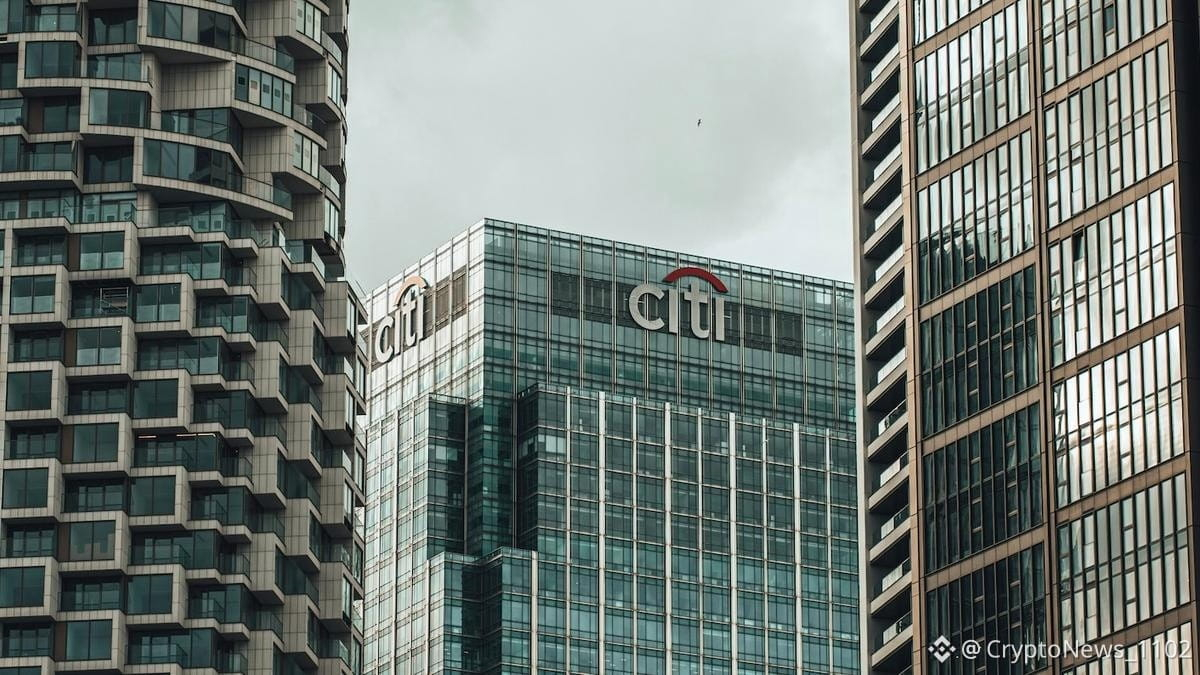
🏦 Goldman Sachs, Citi and other banks reportedly invest $270 million to jointly develop a dollar stablecoin
According to Bloomberg, financial giants including Goldman Sachs, Citi, Santander and Deutsche Bank have invested about $270 million in the joint stablecoin project Project Faro to cover the new company’s operating costs for the next five years. Wells Fargo, Fidelity, MUFG and Standard Bank are also involved. The project plans to incorporate in the United States and issue a dollar stablecoin, while also developing stablecoins pegged to other G7 currencies, with a euro stablecoin being the top priority.
⭐ Major global banks are putting real money behind stablecoins, accelerating the convergence of traditional finance and crypto payments and intensifying competition in the stablecoin sector.
#稳定币 #高盛 #花旗 #ProjectFaro
40

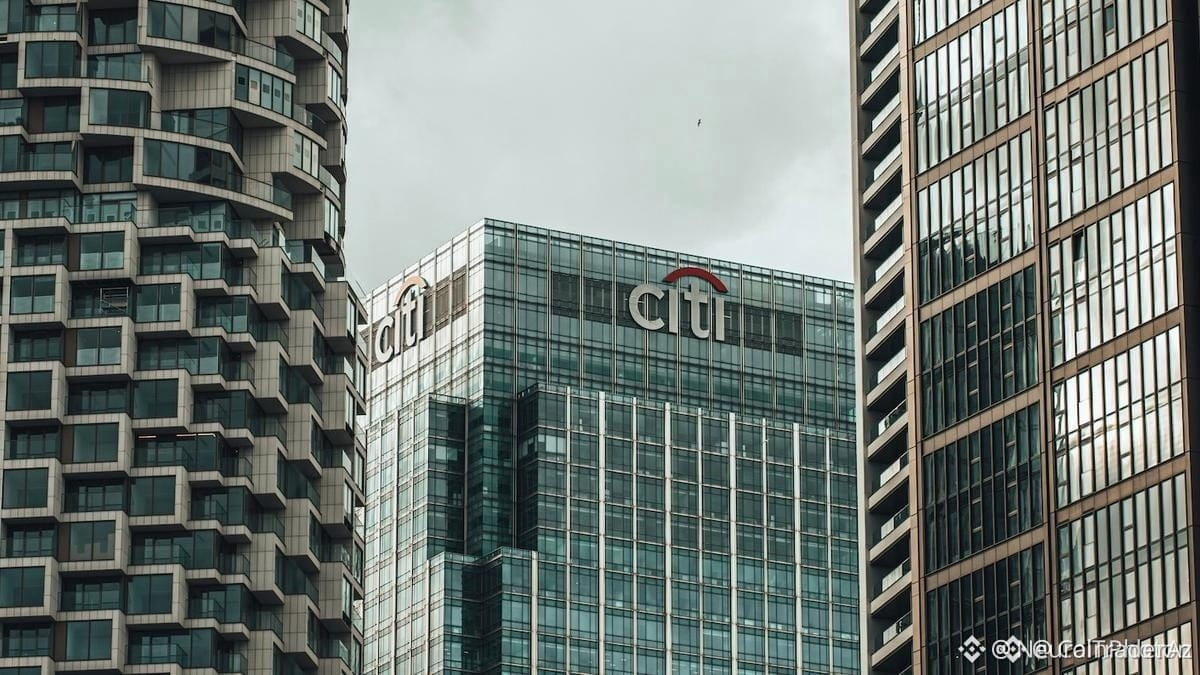
🚨 $USDC FACES INSTITUTIONAL TITANS AS WALL STREET POURS 270M INTO STABLECOIN INFRASTRUCTURE 💥
🦈 When traditional banking heavyweights like Goldman Sachs and Citigroup allocate two hundred seventy million across a five-year horizon, smart money is engineering a structural shift in liquidity routing. 📊 Project Faro represents a calculated institutional footprint designed to capture sovereign-grade settlement flows.
💡 By prioritizing dollar and euro-denominated rails, these financial giants are validating on-chain settlement infrastructure at an enterprise scale. 🌊 The battle for digital liquidity is moving from retail experimentation to corporate balance sheets.
🤔 How will decentralized settlement layers adapt as Wall Street embeds its own compliant liquidity pools directly into the architecture? 💬
⚠️ Not financial advice. Always manage your risk. 🛡️
🏷️ #USDC #ProjectFaro #Stablecoin #Banks #Crypto
🔥 🦈
20

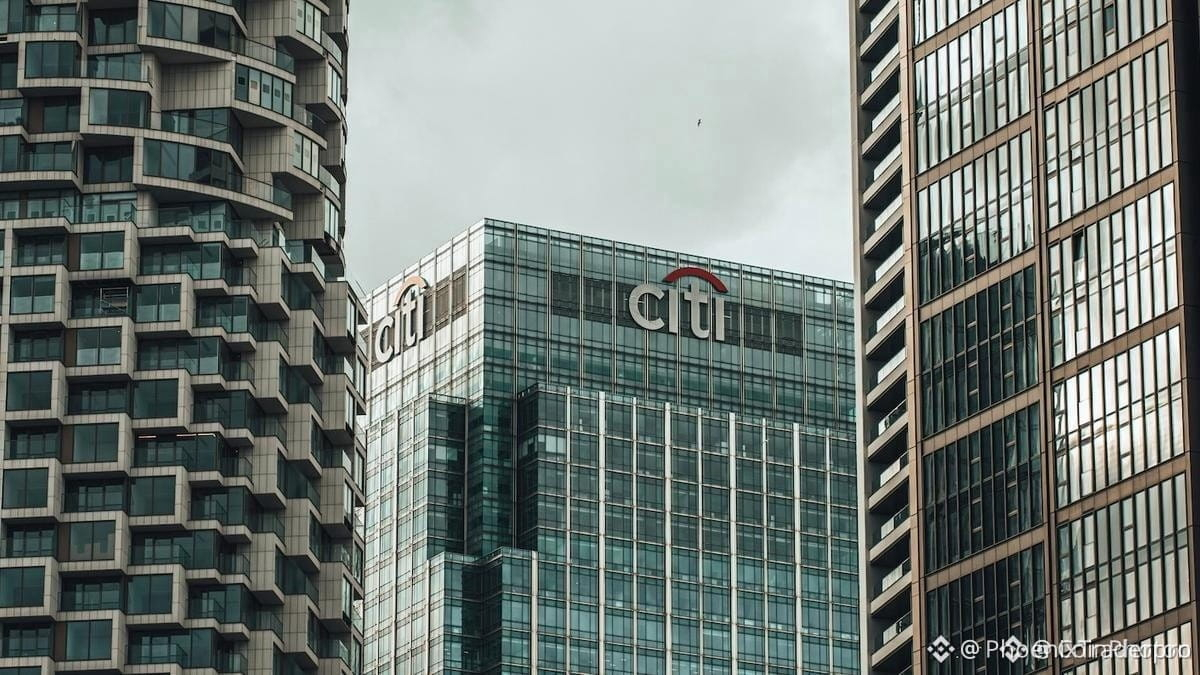
WALL STREET GIANTS PUMP $270M INTO $USDT COMPETITOR AS INSTITUTIONAL LIQUIDITY EXPANDS! 🏦⚡
Traditional finance is bypassing external rails to build proprietary liquidity pipelines, proving that tokenized settlement is the ultimate destination for global capital. 📊
When banking behemoths lock in multi-year funding, they are laying the bedrock for massive on-chain volume expansion across the board. 💡
How will decentralized issuers defend their market share once traditional banking giants flood the rails with fully compliant digital cash? 🤔
⚠️ Not financial advice. Always manage your risk. 🛡️
🏷️ #USDT #Stablecoins #Institutional #Crypto #ProjectFaro
🔥 💎
14

·
--
How much does a stablecoin cost before it has issued its first token?
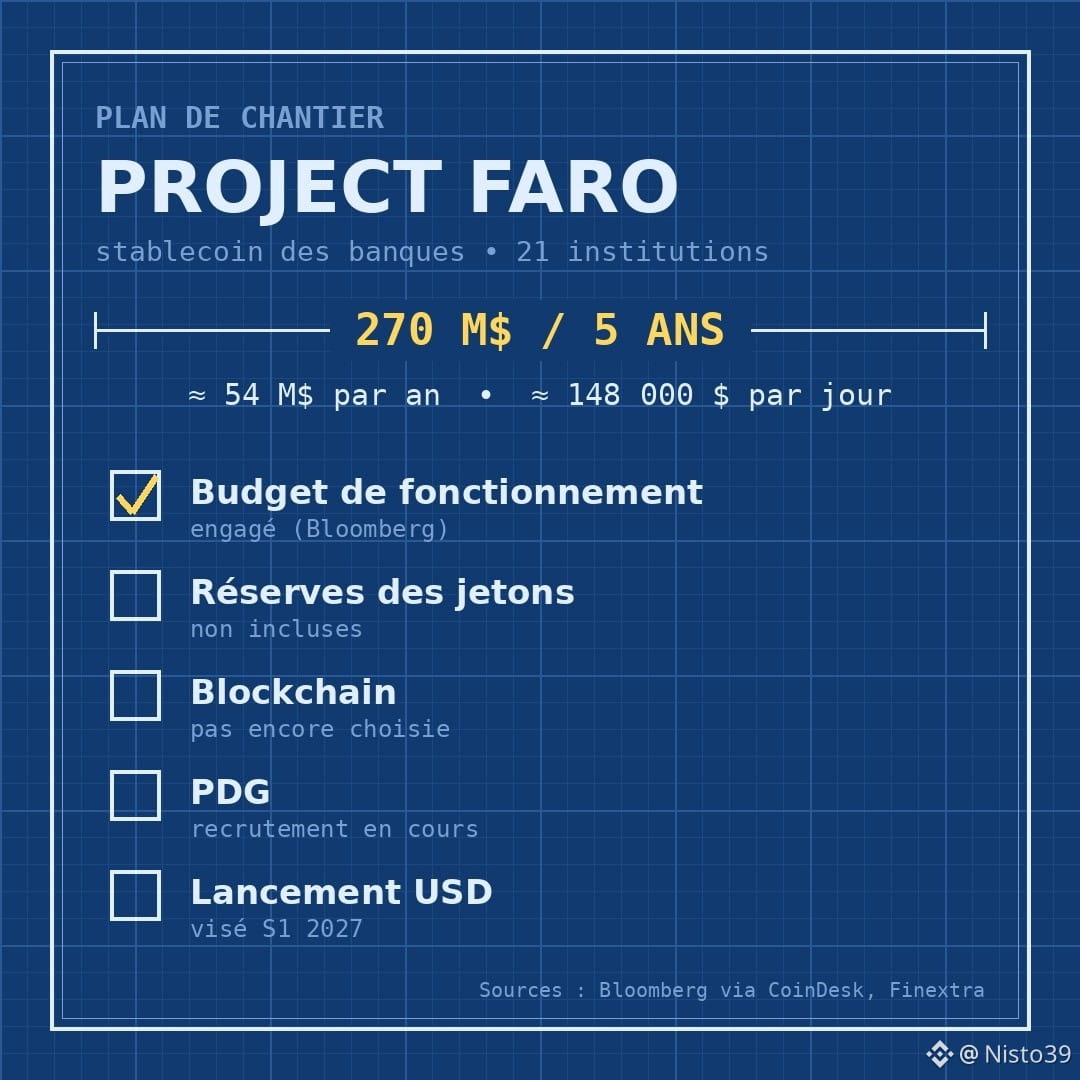
Goldman Sachs, Citi, Santander, Deutsche Bank and the rest have an answer: around $270 million. That’s the amount committed to Project Faro, their planned shared digital dollar, according to Bloomberg (November 10).
I did the math. That $270M has to cover five years of operations. That’s $54M a year, or about $148,000 a day. The reserves that will back each token aren’t even included.
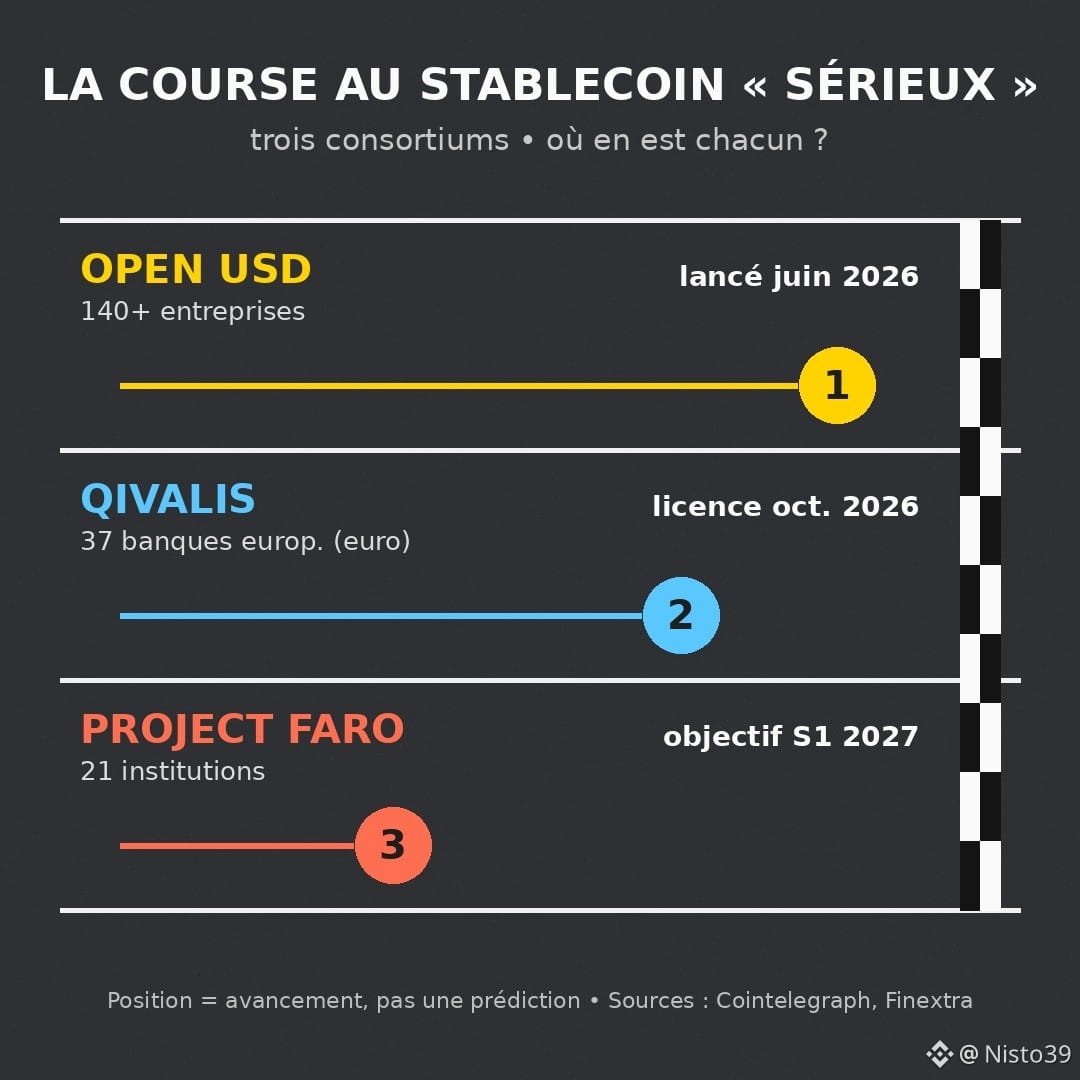
And for now, the future company has no official name, no chosen blockchain, and no CEO (recruitment is underway, according to Finextra). Its stated goal: a dollar stablecoin in the first half of 2027, followed by the euro, then the other G7 currencies.
The timing is curious. The total stablecoin supply just fell 1.4% in a week, its biggest drop since early 2023, and $USDT as well as $USDC have been losing ground since January (The Block). The banks are arriving just as money is flowing out.
My take: this isn’t a bet on crypto; it’s insurance. When 21 institutions are paying $148,000 a day to avoid missing the train, they’re afraid of losing their grip on international payments. Faro even cites cross-border transfers as its primary use case.
One name on the list interests me more than the others: Standard Bank, the South African giant. If banks’ tokenized dollar ever reaches African accounts, the cost of a transfer to Dakar or Lagos could really change. For now, it’s a promise, not a service.
Between a bank stablecoin and one born in crypto, which would you trust more to hold your dollars? And why?
#Stablecoin #Banques #ProjectFaro #Afrique #Crypto
134
Log in to explore more content
Join global crypto users on Binance Square
⚡️ Get latest and useful information about crypto.
💬 Trusted by the world’s largest crypto exchange.
👍 Discover real insights from verified creators.
Email / Phone number
Trending Topics
1
#HuangRisksOusterOverReportedAffairWithSubordinate
2,605 views
48 Discussing
2
#AnthropicRejectsIPODelayValuationinQuestion
422,023 views
3,597 Discussing
3
#CoreWeaveJumps10%On168%RevenueGrowth
43,952 views
670 Discussing
4
#ZcashFallsBelow$1000ForFirstTimeSinceSeptember
21,917 views
131 Discussing
5
#CanNvidiaEarningsEaseMarketConcerns?
143,649 views
1,605 Discussing
6
#StrategyMetaplanetLoseMSCIIndexMembership
274 views
17 Discussing
7
#tZEROWinsCFTCApprovalForRegulatedDerivativesExchange
77 views
6 Discussing
8
#HotCPIDecemberHikePriced
444,897 views
3,626 Discussing
9
#StablecoinSupplyDrops$14.2BIn30Days
306 views
8 Discussing
10
#TradFiForBeginners
476,537 views
3,190 Discussing