
#openlora
openlora
3,174 views
26 Discussing
Hot
Latest

·
--
Verified
Article
The Problem Was Never Intelligence It Was Deployment Economics#OpenLedger
I was assumed running more models meant spending more money . $OPEN just proved that wrong.
When I looked at projects building intelligent systems in crypto the same problem kept showing up.
The ideas were interesting. The technology sounded promising. But the moment you started asking real questions about cost and scale the answers became much less convincing.
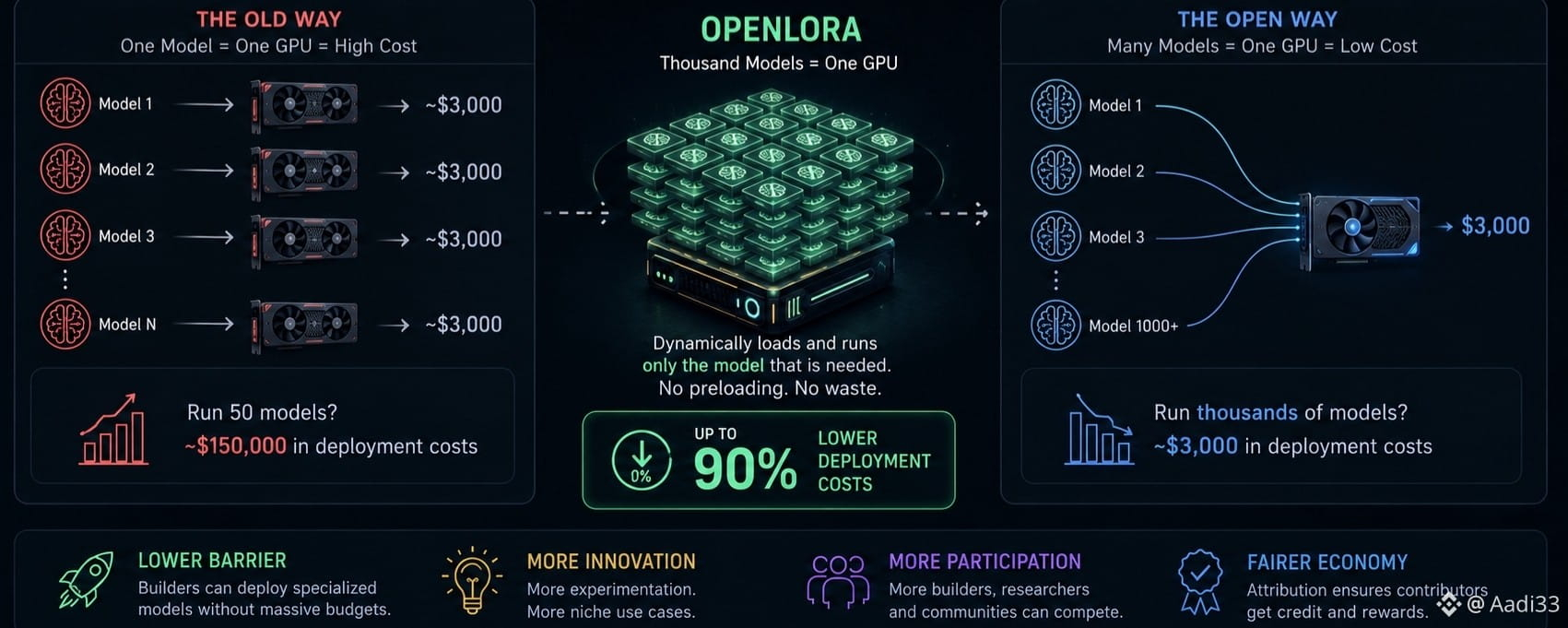
Deploying a fine tuned model traditionally meant spinning up an entire GPU instance for that single model. One use case. One GPU. Around $3000 just to get started. Want to run fifty specialized models? Multiply that cost by fifty.
That math never made sense to me.
You cannot build an open economy around intelligence if only well funded teams can afford to deploy anything.
Then I came across OpenLoRA from @Openledger and the whole picture shifted.
The concept sounds simple once you understand it. Instead of every model needing its own dedicated GPU OpenLoRA lets thousands of fine tuned models run on a single GPU. It dynamically loads whichever model is needed at that moment instead of keeping everything active all the time.
The result is up to 90% lower deployment costs.
What caught my attention was not the number itself. It was what that number changes.
If deployment becomes dramatically cheaper the bottleneck shifts. The challenge is no longer getting access to hardware. The challenge becomes building something useful enough to be used.
A developer who could never justify deploying specialized models suddenly has a path to d0 it. More experimentation becomes possible. More niche use cases . become viable. More builders can participate.
That feels like a bigger shift than most people realize.
OpenLoRA sits inside a broader system. Datanets organize and verify datasets with attribution. ModelFactory helps create and test models without complex workflows. OpenLoRA handles the serving layer and makes large scale deployment economically realistic.
Everything connects back to the same idea.
The people contributing data training models and building tools should not disappear once the final output is created.
That is where Proof of Attribution comes in. Contributions can be tracked back to their source and value can flow toward the people who helped create it.
I have held $OPEN since the September listing. I watched it reach $1.85 on day one and drift down toward $0.17. The chart has been quiet for a long time.
But every now and then I come across a feature that solves a real problem rather than creating a new story.
OpenLoRA is one of those examples.
The biggest obstacle to intelligent systems might not be data. It might not even be compute.
It might be deployment economics. And lowering that barrier changes who gets to build.
#OpenLoRA #ProofOfAttribution $LAB
{future}(OPENUSDT)
The Problem Was Never Intelligence It Was Deployment Economics
#OpenLedger
I was assumed running more models meant spending more money . $OPEN just proved that wrong.
When I looked at projects building intelligent systems in crypto the same problem kept showing up.
The ideas were interesting. The technology sounded promising. But the moment you started asking real questions about cost and scale the answers became much less convincing.
Deploying a fine tuned model traditionally meant spinning up an entire GPU instance for that single model. One use case. One GPU. Around $3000 just to get started. Want to run fifty specialized models? Multiply that cost by fifty.
That math never made sense to me.
You cannot build an open economy around intelligence if only well funded teams can afford to deploy anything.
Then I came across OpenLoRA from @OpenLedger and the whole picture shifted.
The concept sounds simple once you understand it. Instead of every model needing its own dedicated GPU OpenLoRA lets thousands of fine tuned models run on a single GPU. It dynamically loads whichever model is needed at that moment instead of keeping everything active all the time.
The result is up to 90% lower deployment costs.
What caught my attention was not the number itself. It was what that number changes.
If deployment becomes dramatically cheaper the bottleneck shifts. The challenge is no longer getting access to hardware. The challenge becomes building something useful enough to be used.
A developer who could never justify deploying specialized models suddenly has a path to d0 it. More experimentation becomes possible. More niche use cases . become viable. More builders can participate.
That feels like a bigger shift than most people realize.
OpenLoRA sits inside a broader system. Datanets organize and verify datasets with attribution. ModelFactory helps create and test models without complex workflows. OpenLoRA handles the serving layer and makes large scale deployment economically realistic.
Everything connects back to the same idea.
The people contributing data training models and building tools should not disappear once the final output is created.
That is where Proof of Attribution comes in. Contributions can be tracked back to their source and value can flow toward the people who helped create it.
I have held $OPEN since the September listing. I watched it reach $1.85 on day one and drift down toward $0.17. The chart has been quiet for a long time.
But every now and then I come across a feature that solves a real problem rather than creating a new story.
OpenLoRA is one of those examples.
The biggest obstacle to intelligent systems might not be data. It might not even be compute.
It might be deployment economics. And lowering that barrier changes who gets to build.
#OpenLoRA #ProofOfAttribution $LAB
I was assumed running more models meant spending more money . $OPEN just proved that wrong.
When I looked at projects building intelligent systems in crypto the same problem kept showing up.
The ideas were interesting. The technology sounded promising. But the moment you started asking real questions about cost and scale the answers became much less convincing.
Deploying a fine tuned model traditionally meant spinning up an entire GPU instance for that single model. One use case. One GPU. Around $3000 just to get started. Want to run fifty specialized models? Multiply that cost by fifty.
That math never made sense to me.
You cannot build an open economy around intelligence if only well funded teams can afford to deploy anything.
Then I came across OpenLoRA from @OpenLedger and the whole picture shifted.
The concept sounds simple once you understand it. Instead of every model needing its own dedicated GPU OpenLoRA lets thousands of fine tuned models run on a single GPU. It dynamically loads whichever model is needed at that moment instead of keeping everything active all the time.
The result is up to 90% lower deployment costs.
What caught my attention was not the number itself. It was what that number changes.
If deployment becomes dramatically cheaper the bottleneck shifts. The challenge is no longer getting access to hardware. The challenge becomes building something useful enough to be used.
A developer who could never justify deploying specialized models suddenly has a path to d0 it. More experimentation becomes possible. More niche use cases . become viable. More builders can participate.
That feels like a bigger shift than most people realize.
OpenLoRA sits inside a broader system. Datanets organize and verify datasets with attribution. ModelFactory helps create and test models without complex workflows. OpenLoRA handles the serving layer and makes large scale deployment economically realistic.
Everything connects back to the same idea.
The people contributing data training models and building tools should not disappear once the final output is created.
That is where Proof of Attribution comes in. Contributions can be tracked back to their source and value can flow toward the people who helped create it.
I have held $OPEN since the September listing. I watched it reach $1.85 on day one and drift down toward $0.17. The chart has been quiet for a long time.
But every now and then I come across a feature that solves a real problem rather than creating a new story.
OpenLoRA is one of those examples.
The biggest obstacle to intelligent systems might not be data. It might not even be compute.
It might be deployment economics. And lowering that barrier changes who gets to build.
#OpenLoRA #ProofOfAttribution $LAB
N O V A X:
OpenLedger looks like it's asking a different question
17
17
648

Article
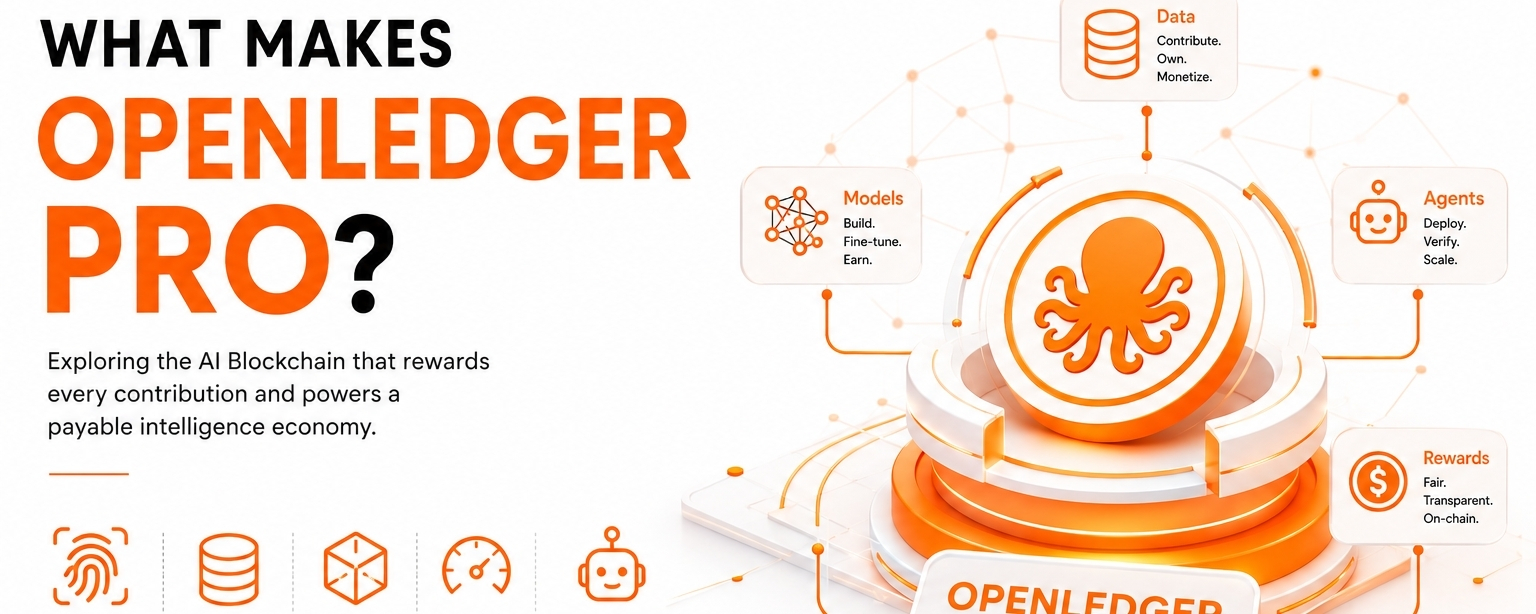
What Makes OpenLedger PRO?I used to think most “AI blockchain” projects were just different packaging for the same idea. New name, same promise. Decentralization here, smart contracts there, and somewhere in between a narrative about ownership that never really felt complete.
But recently, while reading about OpenLedger again, I caught myself slowing down. Not because it was exciting in a loud way, but because something in its structure felt… unusually intentional. Like it wasn’t trying to add another layer to AI, but quietly rethinking what AI even is in economic terms.
And that thought didn’t leave easily.At first, I didn’t really understand why people were calling it “pro.” The word felt too casual for something that claims to sit between AI infrastructure and blockchain systems. But then I started noticing what it was actually trying to touch. Not performance. Not hype. But attribution.
And that changes everything.
In most AI systems today, we interact with something that feels finished. A model gives an output, and we accept it as a product of some invisible training process. We don’t see the data contributors. We don’t see the fine-tuning steps. We don’t see the economic layers underneath.It feels clean on the surface, but almost too clean.
That was my first assumption: AI is just intelligence delivered as a service. Simple enough.
But OpenLedger seems to start from a different assumption entirely. It treats AI not as a static product, but as a system built from many invisible contributions that should not stay invisible forever.That’s where my thinking started to shift.Because once you accept that AI output is not created in isolation, the next question becomes uncomfortable.
Who actually owns it?
Not legally, but structurally. Not in theory, but in traceable contribution.
And that’s where OpenLedger introduces its core idea: Proof of Attribution.At first, I thought it was just another verification mechanism. But the deeper I looked, the more it felt like something else entirely. Proof of Attribution is not just tracking usage—it’s attempting to trace influence.It tries to answer a subtle but important question: which datasets, which inputs, and which contributions actually shaped this model’s response?And if that can be done reliably, then AI stops being a black box of value extraction and starts becoming a system where contribution can be measured in real time.
That made me pause.
Because if attribution becomes precise enough, then reward systems in AI don’t have to be indirect anymore. They can become immediate, almost continuous. Every time a model is used, the system could, in theory, distribute value back to the sources that made that output possible.I might be wrong, but that feels like a quiet shift in how digital labor is defined.
Then I moved deeper into how OpenLedger structures its data, and I came across something that felt more grounded: Datanets.
The idea sounds simple at first—crowdsourced, domain-specific datasets. Finance, healthcare, research, and more. But the implication is more interesting than the definition.Instead of relying on massive centralized datasets owned by a few institutions, Datanets allow smaller, purpose-driven datasets to exist with provenance attached. Anyone can contribute, but more importantly, anyone can prove what they contributed.It feels like data stops being a silent resource and becomes something closer to a living market.And markets, by nature, require rules of ownership and exchange.That’s where the system starts to feel less like an AI project and more like an economic structure built around intelligence itself.
Then I noticed another layer: EVM compatibility.
At first glance, this seems technical, almost standard in modern blockchain design. But in context, it matters more than it looks.#OpenLedger being built with EVM standards and OP Stack means it doesn’t isolate itself from the existing Ethereum ecosystem. It plugs into it. Wallets, smart contracts, and existing developer infrastructure can connect without friction.But the deeper meaning is not compatibility—it’s accessibility of participation.
Because if attribution, data contribution, and model usage are all tied into an EVM-compatible system, then AI activity becomes something that can be tracked and interacted with using tools developers already understand.It reduces the barrier between blockchain logic and AI systems. And that matters more than it seems at first.
Then comes something that feels more operational: OpenLoRA.This is where the system starts to feel less theoretical and more practical.
#OpenLoRA allows efficient deployment of fine-tuned AI models by letting multiple specialized models share GPU resources. Instead of every model requiring heavy, isolated compute infrastructure, the system optimizes how these models coexist.
What stood out to me here wasn’t just efficiency. It was scalability of specialization.If thousands of niche models can exist without expensive overhead, then AI stops being dominated by a few generalized giants. It becomes fragmented into many smaller, purpose-built systems.
And fragmentation changes power distribution.Because now, value is no longer concentrated only in large foundation models, but also in small, fine-tuned systems built by smaller contributors.Then I came across something even more interesting: Verifiable AI Agents.This is where things start to feel slightly futuristic, but in a grounded way.OpenLedger allows autonomous agents to operate in an environment where their logic and data flows are recorded on-chain. That means their behavior is not just executed—it is observable.And if something is observable, it can be evaluated.That introduces a strange possibility: agents that behave inefficiently or incorrectly don’t just fail internally—they become identifiable as part of a networked system.It’s not just about building agents. It’s about creating accountability for autonomous behavior.That made me realize something subtle. Most AI systems optimize for output quality. OpenLedger seems to also care about behavioral traceability.Those are not the same thing.Then there’s the Model Factory, which almost feels like the entry point for non-technical users. A no-code environment where users can upload data, select base models, and fine-tune them for specific use cases.
At first, I thought this was just a usability feature. But in context, it’s more like an economic gateway.Because if anyone can create a model, then model creation itself becomes distributed labor. Not limited to researchers or large companies.And if those models are tied into attribution and reward systems, then model building becomes a form of monetizable contribution.That’s where the $OPEN token enters the system—not as a speculative element, but as a coordination layer.It’s used for governance, staking, usage fees, and reward distribution. But more importantly, it becomes the medium through which different types of contributions—data, compute, model usage—are aligned into one economic flow.And I started noticing a pattern here.OpenLedger isn’t just building tools. It’s building a way to measure participation in AI systems.That might sound simple, but it isn’t.Because measurement is what turns participation into economics.Still, there’s a tension I can’t ignore.The more you try to make AI attribution precise, the more complex the system becomes. And complexity has its own cost. It can reduce accessibility. It can slow adoption. It can create gaps between what is technically possible and what is practically usable.
There is also a deeper question about accuracy. Can attribution in AI ever be fully fair? When a model produces an output, how do you quantify influence across millions of training interactions?Even if the system is cryptographically sound, interpretation might still be imperfect.That contradiction feels important. Because it suggests that decentralization in AI is not just a technical problem—it is also a philosophical one.And yet, despite these uncertainties, the broader direction feels hard to ignore.If AI systems continue evolving into infrastructures where data, models, and agents interact economically, then the idea of “payable intelligence” doesn’t sound abstract anymore. It sounds like a logical extension of what is already happening.
Data becomes capital. Models become economic actors. Usage becomes a transaction between contributors who may never meet each other.OpenLedger seems to sit directly in that transition zone.But I still find myself unsure about how this settles in the long run.Maybe attribution will become precise enough to redefine ownership in AI systems. Or maybe it will always remain an approximation layered over complexity we can’t fully simplify.Or maybe this is still the early shape of something we don’t fully understand yet.
@Openledger #OpenLedger $OPEN
{future}(OPENUSDT)
What Makes OpenLedger PRO?
I used to think most “AI blockchain” projects were just different packaging for the same idea. New name, same promise. Decentralization here, smart contracts there, and somewhere in between a narrative about ownership that never really felt complete.
But recently, while reading about OpenLedger again, I caught myself slowing down. Not because it was exciting in a loud way, but because something in its structure felt… unusually intentional. Like it wasn’t trying to add another layer to AI, but quietly rethinking what AI even is in economic terms.
And that thought didn’t leave easily.At first, I didn’t really understand why people were calling it “pro.” The word felt too casual for something that claims to sit between AI infrastructure and blockchain systems. But then I started noticing what it was actually trying to touch. Not performance. Not hype. But attribution.
And that changes everything.
In most AI systems today, we interact with something that feels finished. A model gives an output, and we accept it as a product of some invisible training process. We don’t see the data contributors. We don’t see the fine-tuning steps. We don’t see the economic layers underneath.It feels clean on the surface, but almost too clean.
That was my first assumption: AI is just intelligence delivered as a service. Simple enough.
But OpenLedger seems to start from a different assumption entirely. It treats AI not as a static product, but as a system built from many invisible contributions that should not stay invisible forever.That’s where my thinking started to shift.Because once you accept that AI output is not created in isolation, the next question becomes uncomfortable.
Who actually owns it?
Not legally, but structurally. Not in theory, but in traceable contribution.
And that’s where OpenLedger introduces its core idea: Proof of Attribution.At first, I thought it was just another verification mechanism. But the deeper I looked, the more it felt like something else entirely. Proof of Attribution is not just tracking usage—it’s attempting to trace influence.It tries to answer a subtle but important question: which datasets, which inputs, and which contributions actually shaped this model’s response?And if that can be done reliably, then AI stops being a black box of value extraction and starts becoming a system where contribution can be measured in real time.
That made me pause.
Because if attribution becomes precise enough, then reward systems in AI don’t have to be indirect anymore. They can become immediate, almost continuous. Every time a model is used, the system could, in theory, distribute value back to the sources that made that output possible.I might be wrong, but that feels like a quiet shift in how digital labor is defined.
Then I moved deeper into how OpenLedger structures its data, and I came across something that felt more grounded: Datanets.
The idea sounds simple at first—crowdsourced, domain-specific datasets. Finance, healthcare, research, and more. But the implication is more interesting than the definition.Instead of relying on massive centralized datasets owned by a few institutions, Datanets allow smaller, purpose-driven datasets to exist with provenance attached. Anyone can contribute, but more importantly, anyone can prove what they contributed.It feels like data stops being a silent resource and becomes something closer to a living market.And markets, by nature, require rules of ownership and exchange.That’s where the system starts to feel less like an AI project and more like an economic structure built around intelligence itself.
Then I noticed another layer: EVM compatibility.
At first glance, this seems technical, almost standard in modern blockchain design. But in context, it matters more than it looks.#OpenLedger being built with EVM standards and OP Stack means it doesn’t isolate itself from the existing Ethereum ecosystem. It plugs into it. Wallets, smart contracts, and existing developer infrastructure can connect without friction.But the deeper meaning is not compatibility—it’s accessibility of participation.
Because if attribution, data contribution, and model usage are all tied into an EVM-compatible system, then AI activity becomes something that can be tracked and interacted with using tools developers already understand.It reduces the barrier between blockchain logic and AI systems. And that matters more than it seems at first.
Then comes something that feels more operational: OpenLoRA.This is where the system starts to feel less theoretical and more practical.
#OpenLoRA allows efficient deployment of fine-tuned AI models by letting multiple specialized models share GPU resources. Instead of every model requiring heavy, isolated compute infrastructure, the system optimizes how these models coexist.
What stood out to me here wasn’t just efficiency. It was scalability of specialization.If thousands of niche models can exist without expensive overhead, then AI stops being dominated by a few generalized giants. It becomes fragmented into many smaller, purpose-built systems.
And fragmentation changes power distribution.Because now, value is no longer concentrated only in large foundation models, but also in small, fine-tuned systems built by smaller contributors.Then I came across something even more interesting: Verifiable AI Agents.This is where things start to feel slightly futuristic, but in a grounded way.OpenLedger allows autonomous agents to operate in an environment where their logic and data flows are recorded on-chain. That means their behavior is not just executed—it is observable.And if something is observable, it can be evaluated.That introduces a strange possibility: agents that behave inefficiently or incorrectly don’t just fail internally—they become identifiable as part of a networked system.It’s not just about building agents. It’s about creating accountability for autonomous behavior.That made me realize something subtle. Most AI systems optimize for output quality. OpenLedger seems to also care about behavioral traceability.Those are not the same thing.Then there’s the Model Factory, which almost feels like the entry point for non-technical users. A no-code environment where users can upload data, select base models, and fine-tune them for specific use cases.
At first, I thought this was just a usability feature. But in context, it’s more like an economic gateway.Because if anyone can create a model, then model creation itself becomes distributed labor. Not limited to researchers or large companies.And if those models are tied into attribution and reward systems, then model building becomes a form of monetizable contribution.That’s where the $OPEN token enters the system—not as a speculative element, but as a coordination layer.It’s used for governance, staking, usage fees, and reward distribution. But more importantly, it becomes the medium through which different types of contributions—data, compute, model usage—are aligned into one economic flow.And I started noticing a pattern here.OpenLedger isn’t just building tools. It’s building a way to measure participation in AI systems.That might sound simple, but it isn’t.Because measurement is what turns participation into economics.Still, there’s a tension I can’t ignore.The more you try to make AI attribution precise, the more complex the system becomes. And complexity has its own cost. It can reduce accessibility. It can slow adoption. It can create gaps between what is technically possible and what is practically usable.
There is also a deeper question about accuracy. Can attribution in AI ever be fully fair? When a model produces an output, how do you quantify influence across millions of training interactions?Even if the system is cryptographically sound, interpretation might still be imperfect.That contradiction feels important. Because it suggests that decentralization in AI is not just a technical problem—it is also a philosophical one.And yet, despite these uncertainties, the broader direction feels hard to ignore.If AI systems continue evolving into infrastructures where data, models, and agents interact economically, then the idea of “payable intelligence” doesn’t sound abstract anymore. It sounds like a logical extension of what is already happening.
Data becomes capital. Models become economic actors. Usage becomes a transaction between contributors who may never meet each other.OpenLedger seems to sit directly in that transition zone.But I still find myself unsure about how this settles in the long run.Maybe attribution will become precise enough to redefine ownership in AI systems. Or maybe it will always remain an approximation layered over complexity we can’t fully simplify.Or maybe this is still the early shape of something we don’t fully understand yet.
@OpenLedger #OpenLedger $OPEN
But recently, while reading about OpenLedger again, I caught myself slowing down. Not because it was exciting in a loud way, but because something in its structure felt… unusually intentional. Like it wasn’t trying to add another layer to AI, but quietly rethinking what AI even is in economic terms.
And that thought didn’t leave easily.At first, I didn’t really understand why people were calling it “pro.” The word felt too casual for something that claims to sit between AI infrastructure and blockchain systems. But then I started noticing what it was actually trying to touch. Not performance. Not hype. But attribution.
And that changes everything.
In most AI systems today, we interact with something that feels finished. A model gives an output, and we accept it as a product of some invisible training process. We don’t see the data contributors. We don’t see the fine-tuning steps. We don’t see the economic layers underneath.It feels clean on the surface, but almost too clean.
That was my first assumption: AI is just intelligence delivered as a service. Simple enough.
But OpenLedger seems to start from a different assumption entirely. It treats AI not as a static product, but as a system built from many invisible contributions that should not stay invisible forever.That’s where my thinking started to shift.Because once you accept that AI output is not created in isolation, the next question becomes uncomfortable.
Who actually owns it?
Not legally, but structurally. Not in theory, but in traceable contribution.
And that’s where OpenLedger introduces its core idea: Proof of Attribution.At first, I thought it was just another verification mechanism. But the deeper I looked, the more it felt like something else entirely. Proof of Attribution is not just tracking usage—it’s attempting to trace influence.It tries to answer a subtle but important question: which datasets, which inputs, and which contributions actually shaped this model’s response?And if that can be done reliably, then AI stops being a black box of value extraction and starts becoming a system where contribution can be measured in real time.
That made me pause.
Because if attribution becomes precise enough, then reward systems in AI don’t have to be indirect anymore. They can become immediate, almost continuous. Every time a model is used, the system could, in theory, distribute value back to the sources that made that output possible.I might be wrong, but that feels like a quiet shift in how digital labor is defined.
Then I moved deeper into how OpenLedger structures its data, and I came across something that felt more grounded: Datanets.
The idea sounds simple at first—crowdsourced, domain-specific datasets. Finance, healthcare, research, and more. But the implication is more interesting than the definition.Instead of relying on massive centralized datasets owned by a few institutions, Datanets allow smaller, purpose-driven datasets to exist with provenance attached. Anyone can contribute, but more importantly, anyone can prove what they contributed.It feels like data stops being a silent resource and becomes something closer to a living market.And markets, by nature, require rules of ownership and exchange.That’s where the system starts to feel less like an AI project and more like an economic structure built around intelligence itself.
Then I noticed another layer: EVM compatibility.
At first glance, this seems technical, almost standard in modern blockchain design. But in context, it matters more than it looks.#OpenLedger being built with EVM standards and OP Stack means it doesn’t isolate itself from the existing Ethereum ecosystem. It plugs into it. Wallets, smart contracts, and existing developer infrastructure can connect without friction.But the deeper meaning is not compatibility—it’s accessibility of participation.
Because if attribution, data contribution, and model usage are all tied into an EVM-compatible system, then AI activity becomes something that can be tracked and interacted with using tools developers already understand.It reduces the barrier between blockchain logic and AI systems. And that matters more than it seems at first.
Then comes something that feels more operational: OpenLoRA.This is where the system starts to feel less theoretical and more practical.
#OpenLoRA allows efficient deployment of fine-tuned AI models by letting multiple specialized models share GPU resources. Instead of every model requiring heavy, isolated compute infrastructure, the system optimizes how these models coexist.
What stood out to me here wasn’t just efficiency. It was scalability of specialization.If thousands of niche models can exist without expensive overhead, then AI stops being dominated by a few generalized giants. It becomes fragmented into many smaller, purpose-built systems.
And fragmentation changes power distribution.Because now, value is no longer concentrated only in large foundation models, but also in small, fine-tuned systems built by smaller contributors.Then I came across something even more interesting: Verifiable AI Agents.This is where things start to feel slightly futuristic, but in a grounded way.OpenLedger allows autonomous agents to operate in an environment where their logic and data flows are recorded on-chain. That means their behavior is not just executed—it is observable.And if something is observable, it can be evaluated.That introduces a strange possibility: agents that behave inefficiently or incorrectly don’t just fail internally—they become identifiable as part of a networked system.It’s not just about building agents. It’s about creating accountability for autonomous behavior.That made me realize something subtle. Most AI systems optimize for output quality. OpenLedger seems to also care about behavioral traceability.Those are not the same thing.Then there’s the Model Factory, which almost feels like the entry point for non-technical users. A no-code environment where users can upload data, select base models, and fine-tune them for specific use cases.
At first, I thought this was just a usability feature. But in context, it’s more like an economic gateway.Because if anyone can create a model, then model creation itself becomes distributed labor. Not limited to researchers or large companies.And if those models are tied into attribution and reward systems, then model building becomes a form of monetizable contribution.That’s where the $OPEN token enters the system—not as a speculative element, but as a coordination layer.It’s used for governance, staking, usage fees, and reward distribution. But more importantly, it becomes the medium through which different types of contributions—data, compute, model usage—are aligned into one economic flow.And I started noticing a pattern here.OpenLedger isn’t just building tools. It’s building a way to measure participation in AI systems.That might sound simple, but it isn’t.Because measurement is what turns participation into economics.Still, there’s a tension I can’t ignore.The more you try to make AI attribution precise, the more complex the system becomes. And complexity has its own cost. It can reduce accessibility. It can slow adoption. It can create gaps between what is technically possible and what is practically usable.
There is also a deeper question about accuracy. Can attribution in AI ever be fully fair? When a model produces an output, how do you quantify influence across millions of training interactions?Even if the system is cryptographically sound, interpretation might still be imperfect.That contradiction feels important. Because it suggests that decentralization in AI is not just a technical problem—it is also a philosophical one.And yet, despite these uncertainties, the broader direction feels hard to ignore.If AI systems continue evolving into infrastructures where data, models, and agents interact economically, then the idea of “payable intelligence” doesn’t sound abstract anymore. It sounds like a logical extension of what is already happening.
Data becomes capital. Models become economic actors. Usage becomes a transaction between contributors who may never meet each other.OpenLedger seems to sit directly in that transition zone.But I still find myself unsure about how this settles in the long run.Maybe attribution will become precise enough to redefine ownership in AI systems. Or maybe it will always remain an approximation layered over complexity we can’t fully simplify.Or maybe this is still the early shape of something we don’t fully understand yet.
@OpenLedger #OpenLedger $OPEN
11
11
194

·
--
#openledger $OPEN
{spot}(OPENUSDT)
The longer I stare at @Openledger , the less I see it as just another “AI token.” I'm more intrigued by the model itself.
Right now, the AI market is structured oddly: a massive number of people are generating data, content, and interactions - but a few big platforms are siphoning off most of the value.
And it seems like OpenLedger is trying to change that.
Not just launching AI on the blockchain, but building a system where you can track: who provided the data, who trained the model, who maintained the infrastructure, and who truly created value within the process. #OpenLoRA looks particularly interesting. Because it’s starting to resemble an attempt to make AI development less reliant on the big centralized computing giants.
And so... the main question here isn't even the technology.
Can decentralized AI scale fast enough when the real demand kicks in?
#openledger $OPEN
The longer I stare at @OpenLedger , the less I see it as just another “AI token.” I'm more intrigued by the model itself.
Right now, the AI market is structured oddly: a massive number of people are generating data, content, and interactions - but a few big platforms are siphoning off most of the value.
And it seems like OpenLedger is trying to change that.
Not just launching AI on the blockchain, but building a system where you can track: who provided the data, who trained the model, who maintained the infrastructure, and who truly created value within the process. #OpenLoRA looks particularly interesting. Because it’s starting to resemble an attempt to make AI development less reliant on the big centralized computing giants.
And so... the main question here isn't even the technology.
Can decentralized AI scale fast enough when the real demand kicks in?
The longer I stare at @OpenLedger , the less I see it as just another “AI token.” I'm more intrigued by the model itself.
Right now, the AI market is structured oddly: a massive number of people are generating data, content, and interactions - but a few big platforms are siphoning off most of the value.
And it seems like OpenLedger is trying to change that.
Not just launching AI on the blockchain, but building a system where you can track: who provided the data, who trained the model, who maintained the infrastructure, and who truly created value within the process. #OpenLoRA looks particularly interesting. Because it’s starting to resemble an attempt to make AI development less reliant on the big centralized computing giants.
And so... the main question here isn't even the technology.
Can decentralized AI scale fast enough when the real demand kicks in?

2
155


·
--
Today I looked into the tokenomics structure of @Openledger in a bit more detail, and I gotta say, I used to think it was just another governance token, but digging deeper, I realized it’s actually the economic backbone of the whole platform.
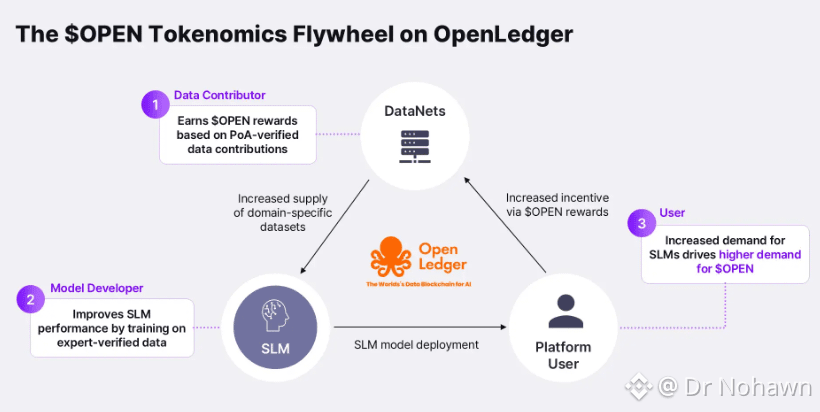
The first thing that caught my interest is that $OPEN is not just a means of exchange; it’s also the native gas token of OpenLedger’s Layer 2 blockchain. This means we don’t have to rely on Ethereum anymore, and we get an optimized transaction environment for #AITokenomics . Plus, #ProofOfAttribution plays a central role in the system, where data providers, model builders, and validators all get rewarded based on their actual contributions.
The magnum opus is its #DataEconomy model. The old way was that companies would buy data once or scrape it and then forget about the contributors. Here, OpenLedger flipped that, so now every time your data is used in model training or inference, you get rewarded. This is the first time "data labor" is being recognized as a proper economic activity; that’s a key change.
On the staking side, there are some important updates too. To run AI models on the platform, you have to stake #OpenLedger , and the model providing more critical services gets more stake, but if the model produces wrong or harmful output, there’s also an economic penalty. This means instead of a centralized authority, the market is doing its own quality control. Now, whether this concept actually works or not, time will tell, but the idea is solid.
When we talk about long-term sustainability, OpenLedger will have to overcome some hurdles. Creating quality validators, proving a direct link between data and model performance, and keeping the transition from testnet to mainnet rewards smooth are all early-stage challenges. The #OpenLoRA technology drastically reduces compute costs, making specialized AI development accessible, which is a positive sign.
My personal view is that the utility case of OPEN looks very strong, but it still needs to be practically validated and not just a concept.
Today I looked into the tokenomics structure of @OpenLedger in a bit more detail, and I gotta say, I used to think it was just another governance token, but digging deeper, I realized it’s actually the economic backbone of the whole platform.
The first thing that caught my interest is that $OPEN is not just a means of exchange; it’s also the native gas token of OpenLedger’s Layer 2 blockchain. This means we don’t have to rely on Ethereum anymore, and we get an optimized transaction environment for #AITokenomics . Plus, #ProofOfAttribution plays a central role in the system, where data providers, model builders, and validators all get rewarded based on their actual contributions.
The magnum opus is its #DataEconomy model. The old way was that companies would buy data once or scrape it and then forget about the contributors. Here, OpenLedger flipped that, so now every time your data is used in model training or inference, you get rewarded. This is the first time "data labor" is being recognized as a proper economic activity; that’s a key change.
On the staking side, there are some important updates too. To run AI models on the platform, you have to stake #OpenLedger , and the model providing more critical services gets more stake, but if the model produces wrong or harmful output, there’s also an economic penalty. This means instead of a centralized authority, the market is doing its own quality control. Now, whether this concept actually works or not, time will tell, but the idea is solid.
When we talk about long-term sustainability, OpenLedger will have to overcome some hurdles. Creating quality validators, proving a direct link between data and model performance, and keeping the transition from testnet to mainnet rewards smooth are all early-stage challenges. The #OpenLoRA technology drastically reduces compute costs, making specialized AI development accessible, which is a positive sign.
My personal view is that the utility case of OPEN looks very strong, but it still needs to be practically validated and not just a concept.
The first thing that caught my interest is that $OPEN is not just a means of exchange; it’s also the native gas token of OpenLedger’s Layer 2 blockchain. This means we don’t have to rely on Ethereum anymore, and we get an optimized transaction environment for #AITokenomics . Plus, #ProofOfAttribution plays a central role in the system, where data providers, model builders, and validators all get rewarded based on their actual contributions.
The magnum opus is its #DataEconomy model. The old way was that companies would buy data once or scrape it and then forget about the contributors. Here, OpenLedger flipped that, so now every time your data is used in model training or inference, you get rewarded. This is the first time "data labor" is being recognized as a proper economic activity; that’s a key change.
On the staking side, there are some important updates too. To run AI models on the platform, you have to stake #OpenLedger , and the model providing more critical services gets more stake, but if the model produces wrong or harmful output, there’s also an economic penalty. This means instead of a centralized authority, the market is doing its own quality control. Now, whether this concept actually works or not, time will tell, but the idea is solid.
When we talk about long-term sustainability, OpenLedger will have to overcome some hurdles. Creating quality validators, proving a direct link between data and model performance, and keeping the transition from testnet to mainnet rewards smooth are all early-stage challenges. The #OpenLoRA technology drastically reduces compute costs, making specialized AI development accessible, which is a positive sign.
My personal view is that the utility case of OPEN looks very strong, but it still needs to be practically validated and not just a concept.
BlockchainCreator:
OpenLedger offers a compelling vision for future AI markets.
17
11
470
Log in to explore more content
Join global crypto users on Binance Square
⚡️ Get latest and useful information about crypto.
💬 Trusted by the world’s largest crypto exchange.
👍 Discover real insights from verified creators.
Email / Phone number
Trending Topics
1
#BOJRaisesRatesTo31YearHigh
68,087 views
1,116 Discussing
2
#BuffettStepsDownAsBerkshireChairman
29,992 views
524 Discussing
3
#XRPExchangeReservesHitSevenYearLow
35,657 views
490 Discussing
4
#HKCompletesFirstHKDStablecoinUseCase
70,315 views
1,015 Discussing
5
#VietnamPlansFirstCryptoLicensesIn2026
46,155 views
693 Discussing
6
#BTCBreaks80K
354,862 views
4,459 Discussing
7
#BitcoinMarketCapTopsTesla
71,909 views
995 Discussing
8
#SOLJumpsAbout10%
80,239 views
999 Discussing
9
#EthereumReclaims$2600
7,381 views
113 Discussing
10
#LineraShutsDownAfterFundraisingFallsShort
22,771 views
277 Discussing