
#openledger
openledger
17.3M views
202,831 Discussing
Hot
Latest

$OPEN Update 🔎 Can OPEN push through its recent high?
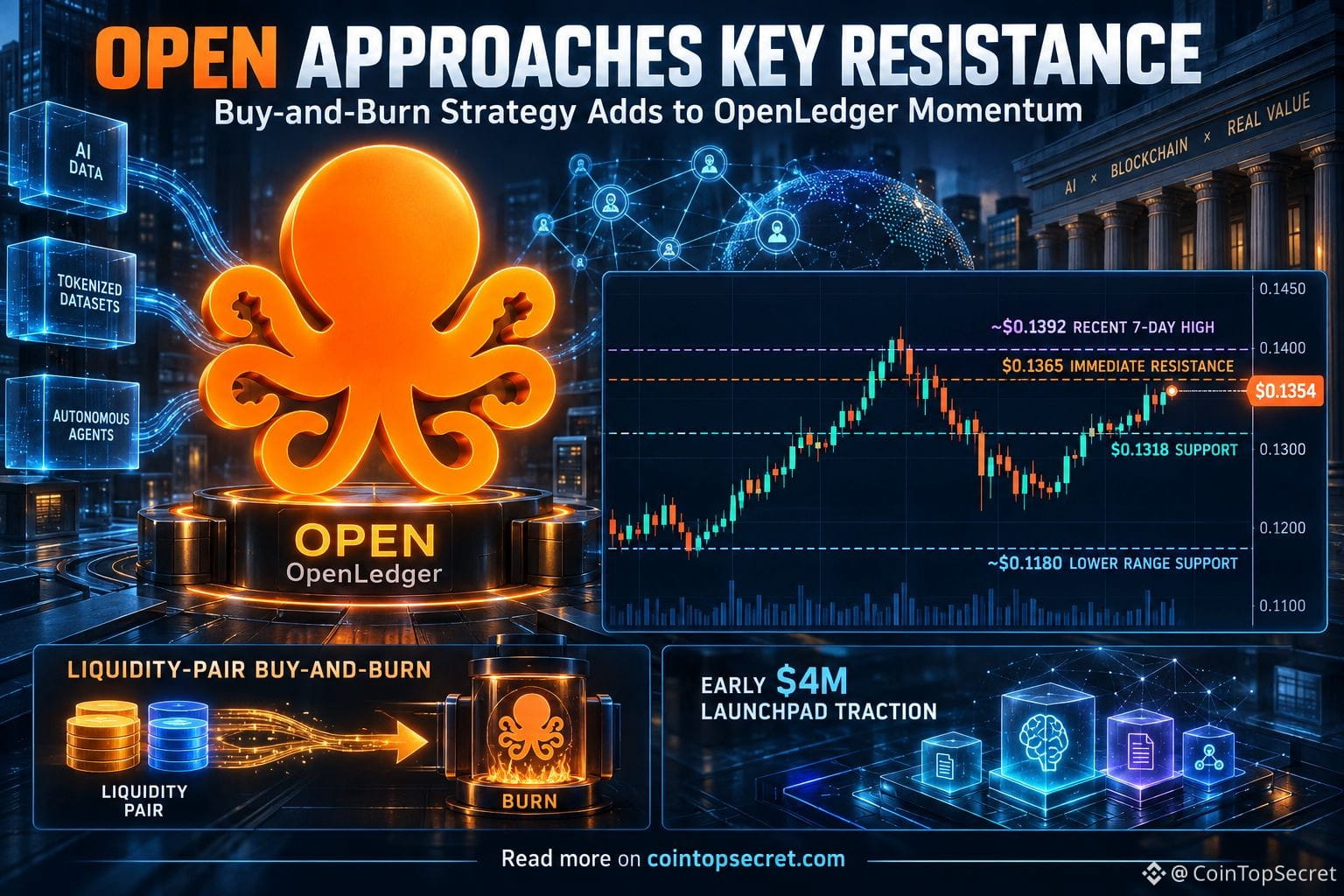
💰 Price now: $0.1354 | 24h: +0.6%
📊 Market cap: $29.18M | Rank: #675
📈 24h range: $0.1318 – $0.1365
📰 What's happening:
OPEN is holding above $0.13 after a stronger move from its September low. shows a 7-day gain of 5.3%, while 24h volume is about $4.29M.
🔥 Key catalyst:
OpenLedger recently outlined a liquidity-pair buy-and-burn strategy and reported early $4M launchpad traction.
👀 Next step to watch:
🔴 Bearish case: Below $0.1318 could expose the ~$0.1180 area.
🟢 Bullish case: Above $0.1365 could put ~$0.1392 into focus.
📝 My take: OPEN has improved short-term momentum, but the $0.1365–$0.1392 zone remains an important test.
Not financial advice, DYOR ⚠️
#OpenLedger #OPEN #CryptoAnalysis $OPEN
$OPEN Update 🔎 Can OPEN push through its recent high?
💰 Price now: $0.1354 | 24h: +0.6%
📊 Market cap: $29.18M | Rank: #675
📈 24h range: $0.1318 – $0.1365
📰 What's happening:
OPEN is holding above $0.13 after a stronger move from its September low. shows a 7-day gain of 5.3%, while 24h volume is about $4.29M.
🔥 Key catalyst:
OpenLedger recently outlined a liquidity-pair buy-and-burn strategy and reported early $4M launchpad traction.
👀 Next step to watch:
🔴 Bearish case: Below $0.1318 could expose the ~$0.1180 area.
🟢 Bullish case: Above $0.1365 could put ~$0.1392 into focus.
📝 My take: OPEN has improved short-term momentum, but the $0.1365–$0.1392 zone remains an important test.
Not financial advice, DYOR ⚠️
#OpenLedger #OPEN #CryptoAnalysis $OPEN
💰 Price now: $0.1354 | 24h: +0.6%
📊 Market cap: $29.18M | Rank: #675
📈 24h range: $0.1318 – $0.1365
📰 What's happening:
OPEN is holding above $0.13 after a stronger move from its September low. shows a 7-day gain of 5.3%, while 24h volume is about $4.29M.
🔥 Key catalyst:
OpenLedger recently outlined a liquidity-pair buy-and-burn strategy and reported early $4M launchpad traction.
👀 Next step to watch:
🔴 Bearish case: Below $0.1318 could expose the ~$0.1180 area.
🟢 Bullish case: Above $0.1365 could put ~$0.1392 into focus.
📝 My take: OPEN has improved short-term momentum, but the $0.1365–$0.1392 zone remains an important test.
Not financial advice, DYOR ⚠️
#OpenLedger #OPEN #CryptoAnalysis $OPEN
145

·
--
🎯 OpenLedger-Phase 1 and Reward Pool:
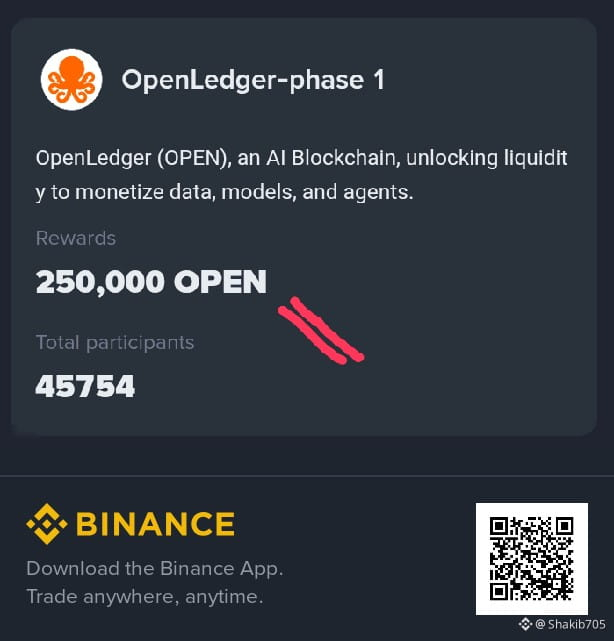
Currently its first step or the OpenLedger-phase 1 campaign is running, where a massive reward pool has been set up. Already, thousands of users (as shown in the image with 45,754+) are participating in this airdrop and booster program, earning FREE OPEN tokens!#OpenLedger #Phase1 $OPEN
{spot}(OPENUSDT)
🎯 OpenLedger-Phase 1 and Reward Pool:
Currently its first step or the OpenLedger-phase 1 campaign is running, where a massive reward pool has been set up. Already, thousands of users (as shown in the image with 45,754+) are participating in this airdrop and booster program, earning FREE OPEN tokens!#OpenLedger #Phase1 $OPEN
Currently its first step or the OpenLedger-phase 1 campaign is running, where a massive reward pool has been set up. Already, thousands of users (as shown in the image with 45,754+) are participating in this airdrop and booster program, earning FREE OPEN tokens!#OpenLedger #Phase1 $OPEN
264

$OPEN — First Target HIT ✅
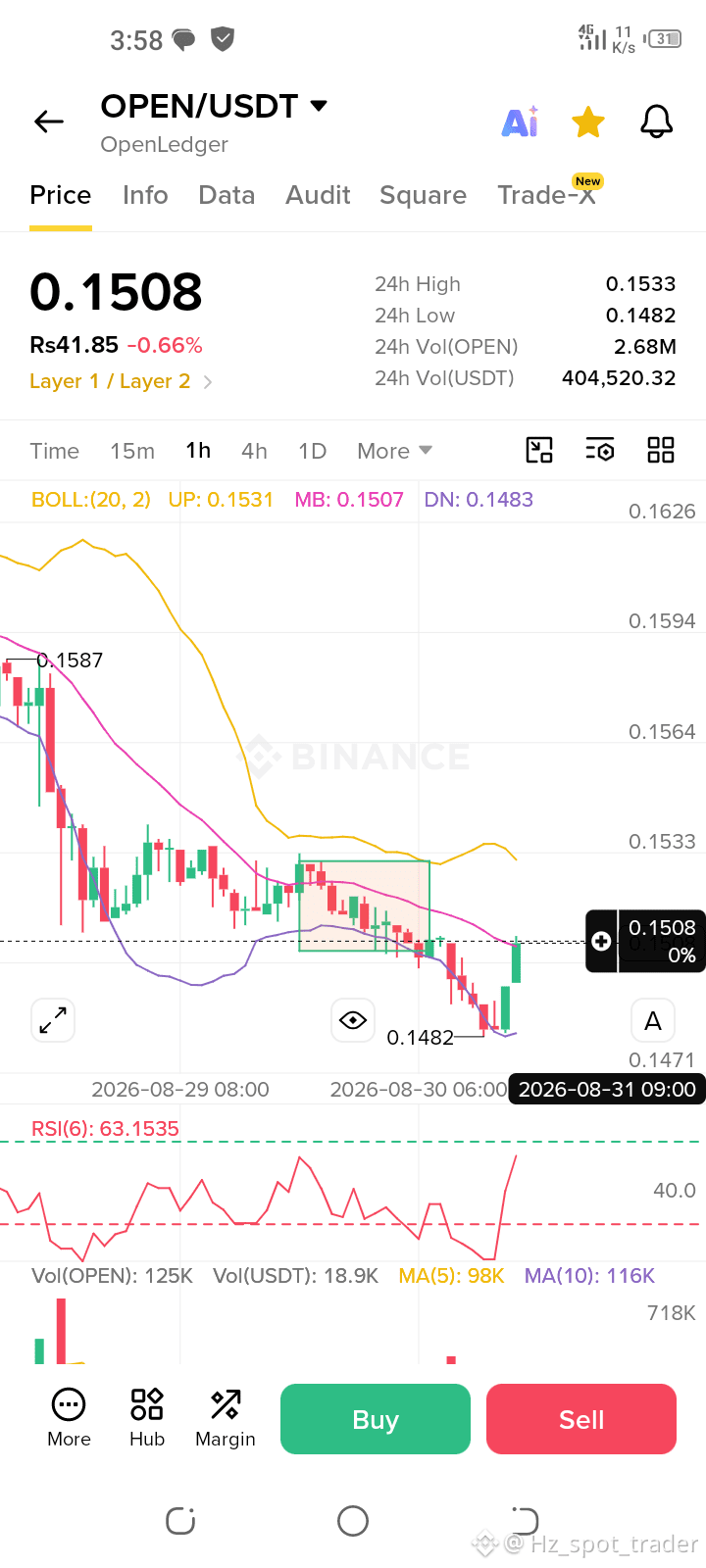
The first level I shared on open was around $0.1508.
Price reached it. 🎯
That was roughly +1.2% from the area I was watching.
I also shared a similar short-term setup on $HOME earlier, with the $0.00622 area as the level to watch.
I’m not claiming every target will work.
The important thing is to plan the level BEFORE the move and respect the risk.
Did anyone here take the open SPOT setup?
If you did, tell me your entry and result 👇
SPOT only. No futures. No leverage.
my first target / level to watch was $0.1508 — and price reached it
$OPEN
{spot}(OPENUSDT)
#OPEN #OpenLedger #SpotTrading
$OPEN — First Target HIT ✅
The first level I shared on open was around $0.1508.
Price reached it. 🎯
That was roughly +1.2% from the area I was watching.
I also shared a similar short-term setup on $HOME earlier, with the $0.00622 area as the level to watch.
I’m not claiming every target will work.
The important thing is to plan the level BEFORE the move and respect the risk.
Did anyone here take the open SPOT setup?
If you did, tell me your entry and result 👇
SPOT only. No futures. No leverage.
my first target / level to watch was $0.1508 — and price reached it
$OPEN
#OPEN #OpenLedger #SpotTrading
The first level I shared on open was around $0.1508.
Price reached it. 🎯
That was roughly +1.2% from the area I was watching.
I also shared a similar short-term setup on $HOME earlier, with the $0.00622 area as the level to watch.
I’m not claiming every target will work.
The important thing is to plan the level BEFORE the move and respect the risk.
Did anyone here take the open SPOT setup?
If you did, tell me your entry and result 👇
SPOT only. No futures. No leverage.
my first target / level to watch was $0.1508 — and price reached it
$OPEN
#OPEN #OpenLedger #SpotTrading
1
246
$OPEN — Bounce Setup or Just a Dead Cat Bounce? 👀
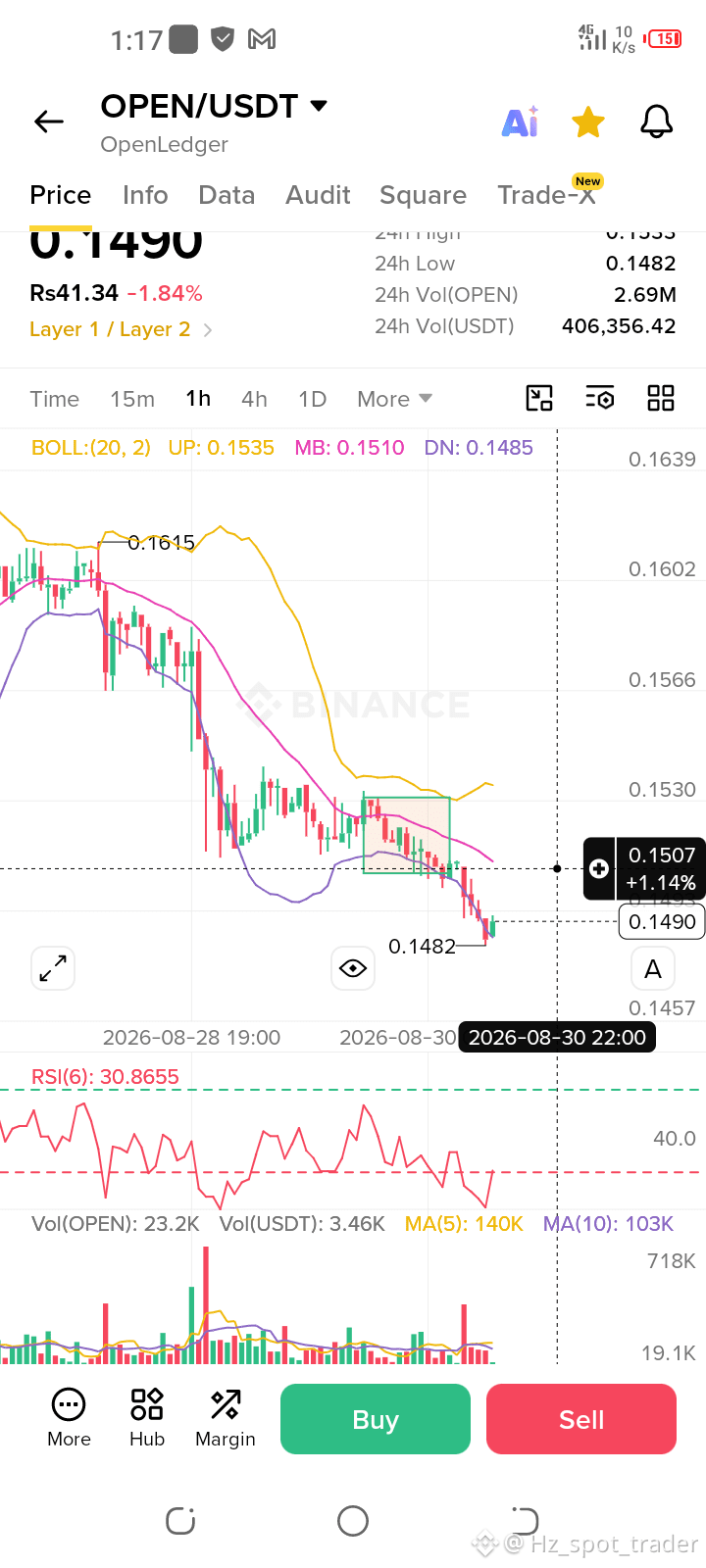
OPEN is trading around $0.1490 after the recent sell-off.
On the 1H chart:
• RSI(6) ≈ 30.9 — oversold area
• Lower Bollinger Band ≈ $0.1485
• Middle Band ≈ $0.1510
• My first level to watch: $0.1508
A move to $0.1508 would be around +1.2% from the current area.
If momentum returns, I’ll be watching the $0.1510–$0.1530 zone next.
But no guarantee — if $0.1482 breaks, the setup becomes weaker.
Would you take the SPOT bounce or wait for confirmation?
$OPEN
{spot}(OPENUSDT)
#OPEN #OpenLedger #SpotTrading
$OPEN — Bounce Setup or Just a Dead Cat Bounce? 👀
OPEN is trading around $0.1490 after the recent sell-off.
On the 1H chart:
• RSI(6) ≈ 30.9 — oversold area
• Lower Bollinger Band ≈ $0.1485
• Middle Band ≈ $0.1510
• My first level to watch: $0.1508
A move to $0.1508 would be around +1.2% from the current area.
If momentum returns, I’ll be watching the $0.1510–$0.1530 zone next.
But no guarantee — if $0.1482 breaks, the setup becomes weaker.
Would you take the SPOT bounce or wait for confirmation?
$OPEN
#OPEN #OpenLedger #SpotTrading
OPEN is trading around $0.1490 after the recent sell-off.
On the 1H chart:
• RSI(6) ≈ 30.9 — oversold area
• Lower Bollinger Band ≈ $0.1485
• Middle Band ≈ $0.1510
• My first level to watch: $0.1508
A move to $0.1508 would be around +1.2% from the current area.
If momentum returns, I’ll be watching the $0.1510–$0.1530 zone next.
But no guarantee — if $0.1482 breaks, the setup becomes weaker.
Would you take the SPOT bounce or wait for confirmation?
$OPEN
#OPEN #OpenLedger #SpotTrading
1
210

·
--
The rise of DePIN networks is crucial for decentralizing the tech market and preventing absolute control by large corporations. The approach of @Openledger in securely managing data for artificial intelligence showcases the potential of this narrative. I'm keeping an eye on the growth and utility of the token $OPEN . #OpenLedger
The rise of DePIN networks is crucial for decentralizing the tech market and preventing absolute control by large corporations. The approach of @OpenLedger in securely managing data for artificial intelligence showcases the potential of this narrative. I'm keeping an eye on the growth and utility of the token $OPEN . #OpenLedger
99

·
--
Bullish
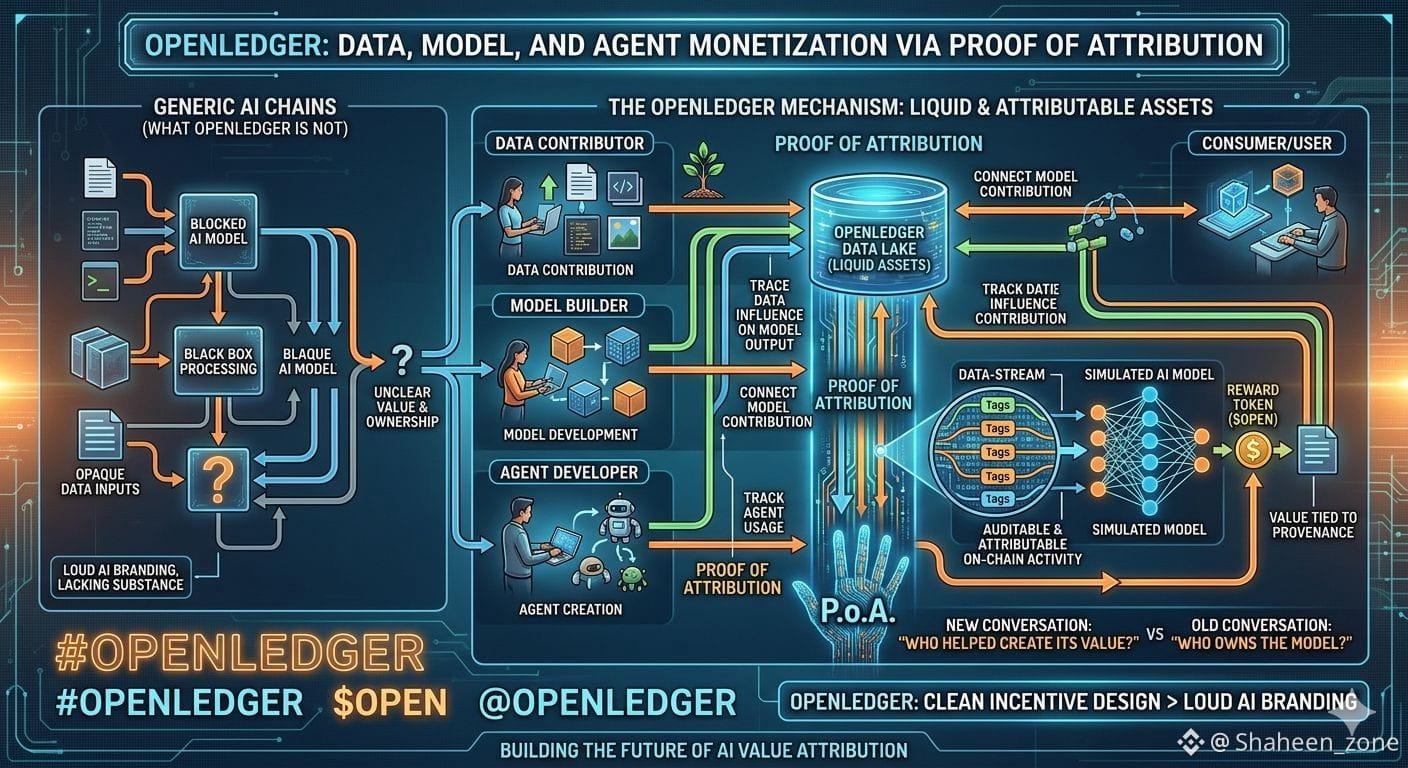
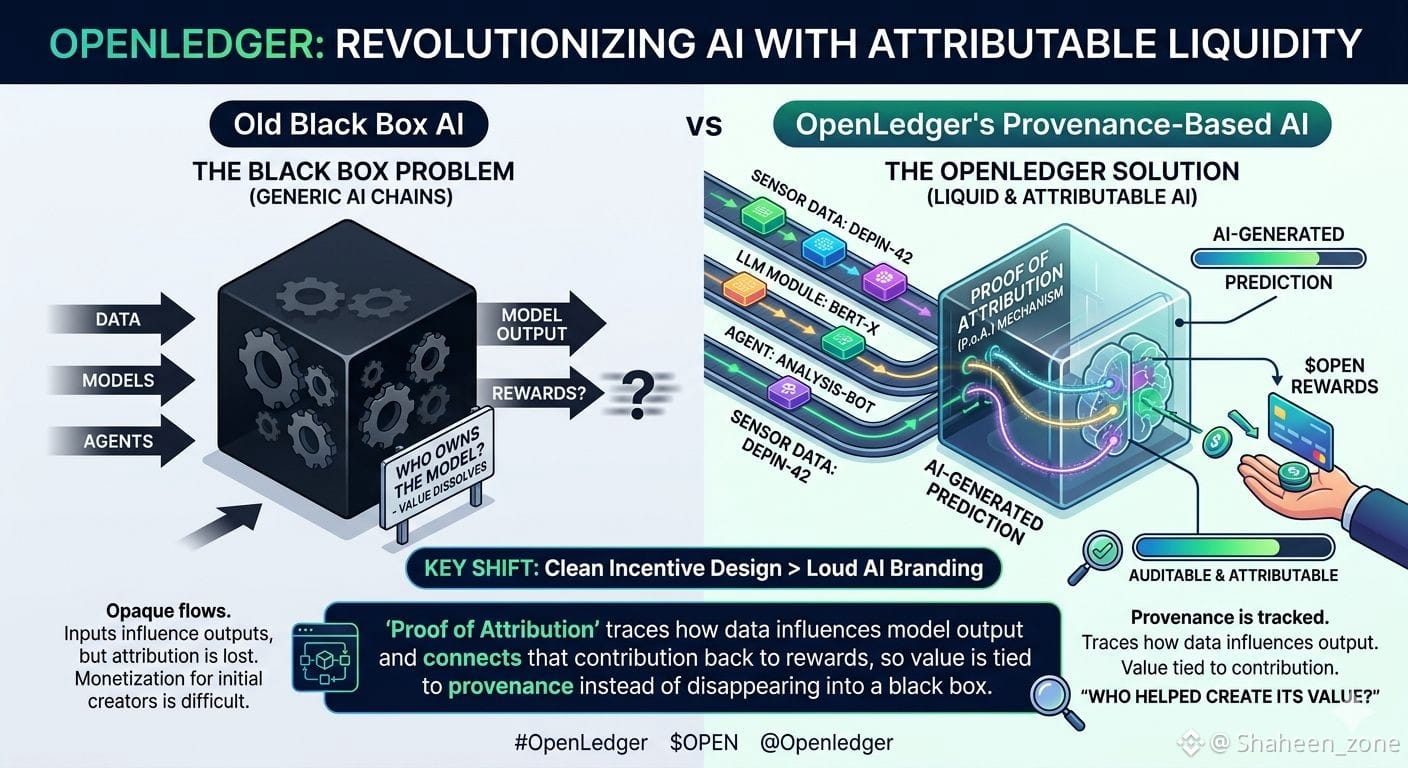
OpenLedger is not trying to be another generic AI chain; its pitch is narrower and more interesting: make data, models, and agents liquid enough to monetize.
What stands out is the mechanism underneath. Proof of Attribution is designed to trace how data influences model output and connect that contribution back to rewards, so value is tied to provenance instead of disappearing into a black box.
That is the part worth watching for serious builders: when AI activity becomes auditable and attributable on-chain, the conversation shifts from “who owns the model?” to “who helped create its value?” Clean incentive design matters more than loud AI branding.
#OpenLedger $OPEN @Openledger
OpenLedger is not trying to be another generic AI chain; its pitch is narrower and more interesting: make data, models, and agents liquid enough to monetize.
What stands out is the mechanism underneath. Proof of Attribution is designed to trace how data influences model output and connect that contribution back to rewards, so value is tied to provenance instead of disappearing into a black box.
That is the part worth watching for serious builders: when AI activity becomes auditable and attributable on-chain, the conversation shifts from “who owns the model?” to “who helped create its value?” Clean incentive design matters more than loud AI branding.
#OpenLedger $OPEN @OpenLedger
What stands out is the mechanism underneath. Proof of Attribution is designed to trace how data influences model output and connect that contribution back to rewards, so value is tied to provenance instead of disappearing into a black box.
That is the part worth watching for serious builders: when AI activity becomes auditable and attributable on-chain, the conversation shifts from “who owns the model?” to “who helped create its value?” Clean incentive design matters more than loud AI branding.
#OpenLedger $OPEN @OpenLedger
1
103


·
--
Bullish
@Openledger #Openledger $OPEN
OpenLedger Is Chasing the Mess Nobody Wants to Talk About
OpenLedger caught my attention because it is not just another AI crypto name trying to sound important.
The problem it is touching is real.
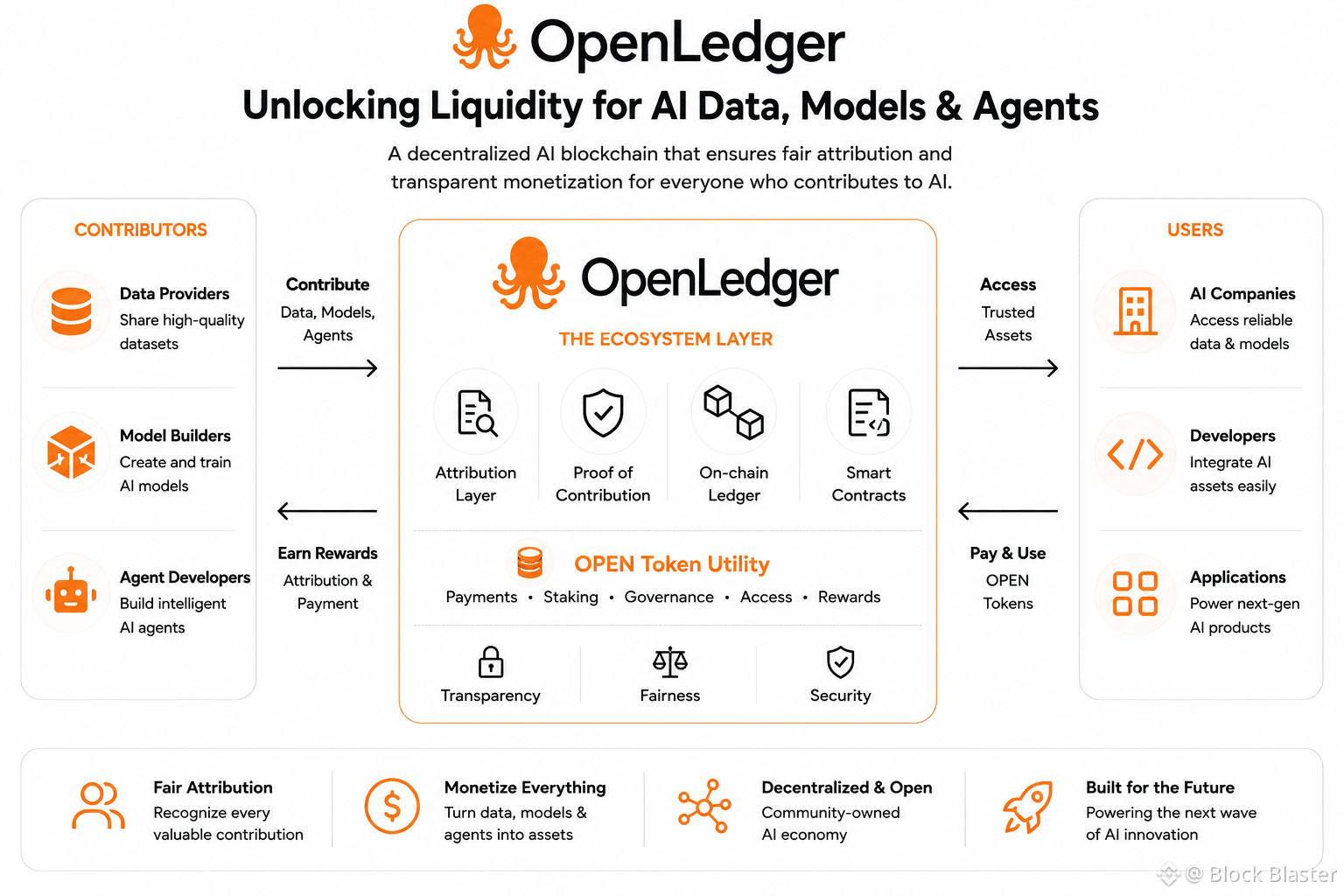
AI runs on data, models, and agents, but the people behind that value often disappear from the story. Data gets used. Models get trained. Platforms grow. Money moves upward.
And the contributors?
Most of the time, they get nothing.
That is the uncomfortable part OpenLedger is trying to address. It wants to make AI contribution more traceable, more visible, and potentially more payable.
Sounds simple.
It is not.
Crypto has already shown us how messy incentives can become. Bad airdrops, fake users, farming loops, spam activity, and projects where the token became louder than the actual product. So yes, OpenLedger has a real idea, but it also has a hard road.
Attribution is difficult.
Quality control is difficult.
Stopping bad data is difficult.
Making OPEN useful beyond speculation is difficult.
But honestly, that is what makes it worth watching. Not because it is perfect. Not because every AI blockchain deserves attention. Most do not.
OpenLedger matters only if it can turn this messy AI data economy into infrastructure that actually works under the hood.
No hype.
No blind belief.
Just a real question:
If AI keeps using human-created value, who actually gets paid for feeding the machine?
@OpenLedger #Openledger $OPEN
OpenLedger Is Chasing the Mess Nobody Wants to Talk About
OpenLedger caught my attention because it is not just another AI crypto name trying to sound important.
The problem it is touching is real.
AI runs on data, models, and agents, but the people behind that value often disappear from the story. Data gets used. Models get trained. Platforms grow. Money moves upward.
And the contributors?
Most of the time, they get nothing.
That is the uncomfortable part OpenLedger is trying to address. It wants to make AI contribution more traceable, more visible, and potentially more payable.
Sounds simple.
It is not.
Crypto has already shown us how messy incentives can become. Bad airdrops, fake users, farming loops, spam activity, and projects where the token became louder than the actual product. So yes, OpenLedger has a real idea, but it also has a hard road.
Attribution is difficult.
Quality control is difficult.
Stopping bad data is difficult.
Making OPEN useful beyond speculation is difficult.
But honestly, that is what makes it worth watching. Not because it is perfect. Not because every AI blockchain deserves attention. Most do not.
OpenLedger matters only if it can turn this messy AI data economy into infrastructure that actually works under the hood.
No hype.
No blind belief.
Just a real question:
If AI keeps using human-created value, who actually gets paid for feeding the machine?
OpenLedger Is Chasing the Mess Nobody Wants to Talk About
OpenLedger caught my attention because it is not just another AI crypto name trying to sound important.
The problem it is touching is real.
AI runs on data, models, and agents, but the people behind that value often disappear from the story. Data gets used. Models get trained. Platforms grow. Money moves upward.
And the contributors?
Most of the time, they get nothing.
That is the uncomfortable part OpenLedger is trying to address. It wants to make AI contribution more traceable, more visible, and potentially more payable.
Sounds simple.
It is not.
Crypto has already shown us how messy incentives can become. Bad airdrops, fake users, farming loops, spam activity, and projects where the token became louder than the actual product. So yes, OpenLedger has a real idea, but it also has a hard road.
Attribution is difficult.
Quality control is difficult.
Stopping bad data is difficult.
Making OPEN useful beyond speculation is difficult.
But honestly, that is what makes it worth watching. Not because it is perfect. Not because every AI blockchain deserves attention. Most do not.
OpenLedger matters only if it can turn this messy AI data economy into infrastructure that actually works under the hood.
No hype.
No blind belief.
Just a real question:
If AI keeps using human-created value, who actually gets paid for feeding the machine?
273

·
--
Let's chat about the recent AI narrative I've been working on, and how OpenLedger and Solana are getting in the game together.I've been glued to the charts these past few days, watching the market while tinkering with those AI agents running on Solana. As we all know, Solana's TPS is pretty sweet; high-frequency trading or having the agent execute real-time tasks is smooth as butter. But if you’ve ever coded or set up a node, you know that while this chain is fast, it really lacks native support for calculating contributions and distributing profits. For instance, if the data I feed to the model generates profits, figuring out how to accurately distribute that money to me is something Solana can't handle on its own.
I have to mention a new direction I've been focusing on these past couple of days. I've noticed that @Openledger the collaboration strategies with other AI chains have completely changed lately. Earlier, everyone was just interfacing at the data level, trying to ride each other's hype. But now, look at them—they're diving deep into protocol synergy. This perfectly addresses the pain points I mentioned earlier. OpenLedger has rolled out this thing called Proof of Attribution. To put it simply, it's about putting a blockchain stamp on the model training, data sources, and inference processes. This way, the entire economic model aligns; whoever contributes data gets paid, and it’s all verifiable on-chain.
Let's chat about the recent AI narrative I've been working on, and how OpenLedger and Solana are getting in the game together.
I've been glued to the charts these past few days, watching the market while tinkering with those AI agents running on Solana. As we all know, Solana's TPS is pretty sweet; high-frequency trading or having the agent execute real-time tasks is smooth as butter. But if you’ve ever coded or set up a node, you know that while this chain is fast, it really lacks native support for calculating contributions and distributing profits. For instance, if the data I feed to the model generates profits, figuring out how to accurately distribute that money to me is something Solana can't handle on its own.
I have to mention a new direction I've been focusing on these past couple of days. I've noticed that @OpenLedger the collaboration strategies with other AI chains have completely changed lately. Earlier, everyone was just interfacing at the data level, trying to ride each other's hype. But now, look at them—they're diving deep into protocol synergy. This perfectly addresses the pain points I mentioned earlier. OpenLedger has rolled out this thing called Proof of Attribution. To put it simply, it's about putting a blockchain stamp on the model training, data sources, and inference processes. This way, the entire economic model aligns; whoever contributes data gets paid, and it’s all verifiable on-chain.
I have to mention a new direction I've been focusing on these past couple of days. I've noticed that @OpenLedger the collaboration strategies with other AI chains have completely changed lately. Earlier, everyone was just interfacing at the data level, trying to ride each other's hype. But now, look at them—they're diving deep into protocol synergy. This perfectly addresses the pain points I mentioned earlier. OpenLedger has rolled out this thing called Proof of Attribution. To put it simply, it's about putting a blockchain stamp on the model training, data sources, and inference processes. This way, the entire economic model aligns; whoever contributes data gets paid, and it’s all verifiable on-chain.
442

·
--
Bullish
Verified
The AI economy is shifting toward ownership, attribution, and autonomous agents.
With OctoClaw, AI Studio, EVM connectivity, and a growing ecosystem for monetizing data and intelligence, @Openledger is building more than an AI narrative. $OPEN is focused on creating real infrastructure where contributors, models, and agents can generate value on-chain.
#OpenLedger $OPEN
{future}(OPENUSDT)
The AI economy is shifting toward ownership, attribution, and autonomous agents.
With OctoClaw, AI Studio, EVM connectivity, and a growing ecosystem for monetizing data and intelligence, @OpenLedger is building more than an AI narrative. $OPEN is focused on creating real infrastructure where contributors, models, and agents can generate value on-chain.
#OpenLedger $OPEN
With OctoClaw, AI Studio, EVM connectivity, and a growing ecosystem for monetizing data and intelligence, @OpenLedger is building more than an AI narrative. $OPEN is focused on creating real infrastructure where contributors, models, and agents can generate value on-chain.
#OpenLedger $OPEN

1
2
691

·
--
The market is flooded with useless meme coins, but real value in 2026 is seen in infrastructure projects at the intersection of AI and Web3. Team @Openledger is tackling a fundamental issue — data transparency for AI training through a Proof of Attribution mechanism. The entire ecosystem's economy revolves around token $OPEN , which is used as gas and rewards for data nodes. This isn't just a speculative asset; it's the fuel for the decentralized intelligence of the future. Do you think this sector can outpace DeFi in market cap this quarter? Share your thoughts below! 👇 #OpenLedger
The market is flooded with useless meme coins, but real value in 2026 is seen in infrastructure projects at the intersection of AI and Web3. Team @OpenLedger is tackling a fundamental issue — data transparency for AI training through a Proof of Attribution mechanism. The entire ecosystem's economy revolves around token $OPEN , which is used as gas and rewards for data nodes. This isn't just a speculative asset; it's the fuel for the decentralized intelligence of the future. Do you think this sector can outpace DeFi in market cap this quarter? Share your thoughts below! 👇 #OpenLedger
17

·
--
Article
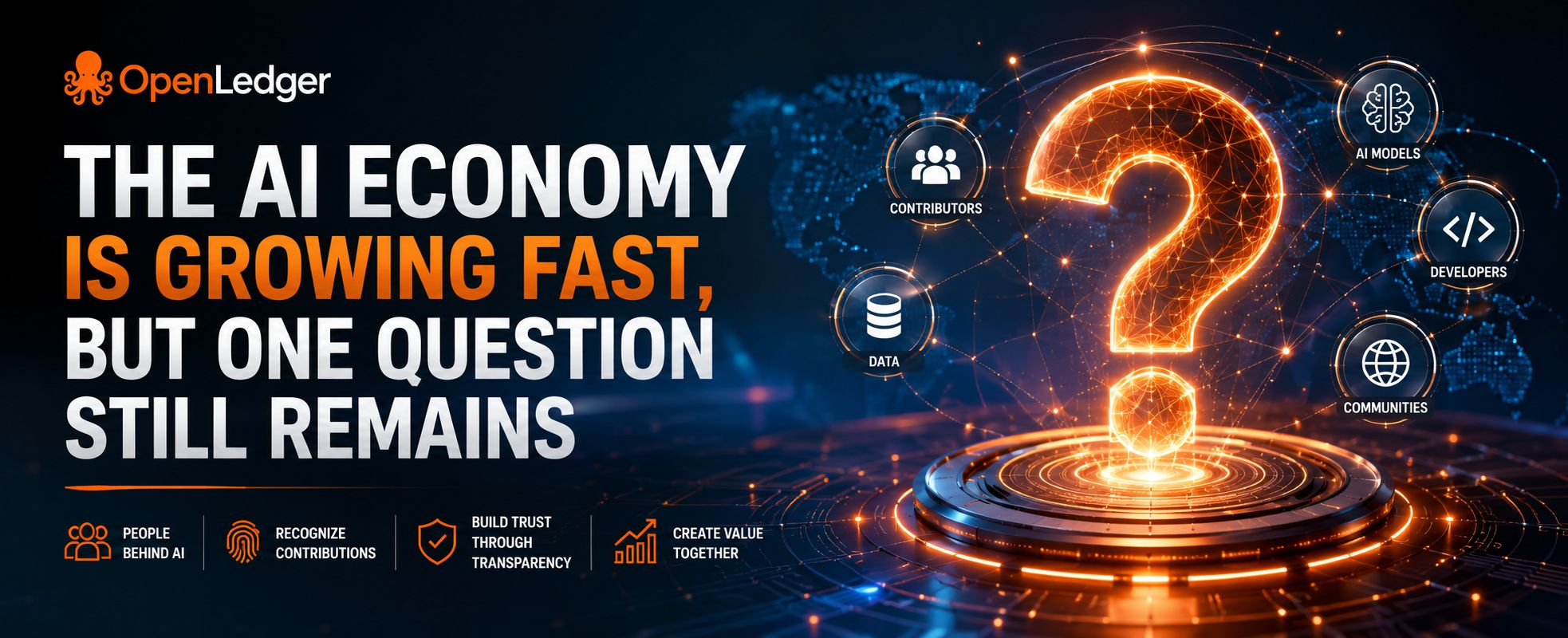
The AI Economy Is Growing Fast, But One Question Still RemainsThe AI industry has made incredible progress over the past few years.
Models are becoming smarter. Applications are becoming more accessible. New use cases are appearing almost every week. From the outside, it looks like the future is arriving faster than anyone expected.
But the deeper I look into the AI ecosystem, the more I find myself asking a simple question:
Who benefits from all of this growth?
Behind every intelligent system are thousands of contributions. Researchers improve algorithms. Developers build infrastructure. Communities generate feedback. Data contributors provide knowledge and context that help models become more useful.
Yet most discussions focus almost entirely on the final product.
Very little attention is given to the people and contributions that make these systems possible in the first place.
That’s one reason why OpenLedger has continued to stand out to me.
The project approaches AI from a different perspective. Instead of looking only at intelligence itself, it explores how contribution, attribution, and value can remain connected as ecosystems grow.
And that idea feels increasingly relevant.
As AI adoption accelerates, trust will become just as important as performance. People will want transparency. They will want accountability. They will want systems that recognize meaningful participation rather than treating it as invisible background activity.
Strong ecosystems are rarely built on technology alone.
They are built when contributors, builders, and users all have a reason to stay engaged over the long term.
That’s what makes the conversation around attribution so important.
When participation is visible, incentives improve.
When incentives improve, quality improves.
And when quality improves, ecosystems become stronger.
Whether OpenLedger ultimately succeeds will depend on execution adoption, and community growth. But the broader idea behind it reflects a shift that seems impossible to ignore.
The future of AI may not be defined only by who creates the smartest models.
It may also be defined by who creates the fairest systems around them.
And that is a conversation worth paying attention to.
@Openledger | #OpenLedger
$OPEN
{future}(OPENUSDT)
$LAB
{future}(LABUSDT)
The AI Economy Is Growing Fast, But One Question Still Remains
The AI industry has made incredible progress over the past few years.
Models are becoming smarter. Applications are becoming more accessible. New use cases are appearing almost every week. From the outside, it looks like the future is arriving faster than anyone expected.
But the deeper I look into the AI ecosystem, the more I find myself asking a simple question:
Who benefits from all of this growth?
Behind every intelligent system are thousands of contributions. Researchers improve algorithms. Developers build infrastructure. Communities generate feedback. Data contributors provide knowledge and context that help models become more useful.
Yet most discussions focus almost entirely on the final product.
Very little attention is given to the people and contributions that make these systems possible in the first place.
That’s one reason why OpenLedger has continued to stand out to me.
The project approaches AI from a different perspective. Instead of looking only at intelligence itself, it explores how contribution, attribution, and value can remain connected as ecosystems grow.
And that idea feels increasingly relevant.
As AI adoption accelerates, trust will become just as important as performance. People will want transparency. They will want accountability. They will want systems that recognize meaningful participation rather than treating it as invisible background activity.
Strong ecosystems are rarely built on technology alone.
They are built when contributors, builders, and users all have a reason to stay engaged over the long term.
That’s what makes the conversation around attribution so important.
When participation is visible, incentives improve.
When incentives improve, quality improves.
And when quality improves, ecosystems become stronger.
Whether OpenLedger ultimately succeeds will depend on execution adoption, and community growth. But the broader idea behind it reflects a shift that seems impossible to ignore.
The future of AI may not be defined only by who creates the smartest models.
It may also be defined by who creates the fairest systems around them.
And that is a conversation worth paying attention to.
@OpenLedger | #OpenLedger
$OPEN
$LAB
Models are becoming smarter. Applications are becoming more accessible. New use cases are appearing almost every week. From the outside, it looks like the future is arriving faster than anyone expected.
But the deeper I look into the AI ecosystem, the more I find myself asking a simple question:
Who benefits from all of this growth?
Behind every intelligent system are thousands of contributions. Researchers improve algorithms. Developers build infrastructure. Communities generate feedback. Data contributors provide knowledge and context that help models become more useful.
Yet most discussions focus almost entirely on the final product.
Very little attention is given to the people and contributions that make these systems possible in the first place.
That’s one reason why OpenLedger has continued to stand out to me.
The project approaches AI from a different perspective. Instead of looking only at intelligence itself, it explores how contribution, attribution, and value can remain connected as ecosystems grow.
And that idea feels increasingly relevant.
As AI adoption accelerates, trust will become just as important as performance. People will want transparency. They will want accountability. They will want systems that recognize meaningful participation rather than treating it as invisible background activity.
Strong ecosystems are rarely built on technology alone.
They are built when contributors, builders, and users all have a reason to stay engaged over the long term.
That’s what makes the conversation around attribution so important.
When participation is visible, incentives improve.
When incentives improve, quality improves.
And when quality improves, ecosystems become stronger.
Whether OpenLedger ultimately succeeds will depend on execution adoption, and community growth. But the broader idea behind it reflects a shift that seems impossible to ignore.
The future of AI may not be defined only by who creates the smartest models.
It may also be defined by who creates the fairest systems around them.
And that is a conversation worth paying attention to.
@OpenLedger | #OpenLedger
$OPEN
$LAB
2
3
511

·
--
been poking around OpenLedger's studio interface again. $OPEN , #OpenLedger @Openledger — there's something worth sitting with here.
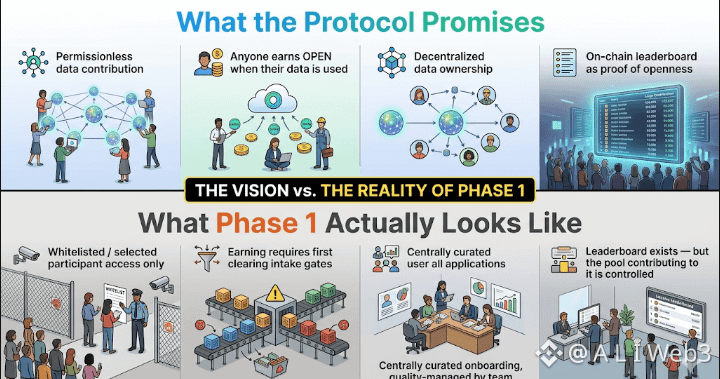
the pitch is essentially: data contributors own their work, get paid when AI models use it, everything on-chain and transparent. and technically that's accurate. Proof of Attribution logs which dataset influenced which model output, then routes OPEN rewards accordingly. the mainnet's been live since November, the attribution engine got updated in January to survive model fine-tuning without losing the provenance trail. that part works.
but the thing that caught me — when Datanets actually launched into Phase 1 contribution mode, access was restricted to whitelisted participants. selected, curated, managed intake. so the "anyone can contribute data and earn" story hits a wall the moment you try to walk through the door. not unusual for a controlled rollout, fine. but it's a quiet contradiction when "decentralized data ownership" is the headline you're leading with.
the on-chain leaderboard is live, ranked by contribution quality and activity. real data, real structure. you can see the rails working. what you can't see yet is whether those rails stay open once the controlled phase wraps and volume pressure shows up.
hmm… does a decentralized data protocol that controls who contributes data still count as decentralized data ownership, or just decentralized storage?
been poking around OpenLedger's studio interface again. $OPEN , #OpenLedger @OpenLedger — there's something worth sitting with here.
the pitch is essentially: data contributors own their work, get paid when AI models use it, everything on-chain and transparent. and technically that's accurate. Proof of Attribution logs which dataset influenced which model output, then routes OPEN rewards accordingly. the mainnet's been live since November, the attribution engine got updated in January to survive model fine-tuning without losing the provenance trail. that part works.
but the thing that caught me — when Datanets actually launched into Phase 1 contribution mode, access was restricted to whitelisted participants. selected, curated, managed intake. so the "anyone can contribute data and earn" story hits a wall the moment you try to walk through the door. not unusual for a controlled rollout, fine. but it's a quiet contradiction when "decentralized data ownership" is the headline you're leading with.
the on-chain leaderboard is live, ranked by contribution quality and activity. real data, real structure. you can see the rails working. what you can't see yet is whether those rails stay open once the controlled phase wraps and volume pressure shows up.
hmm… does a decentralized data protocol that controls who contributes data still count as decentralized data ownership, or just decentralized storage?
the pitch is essentially: data contributors own their work, get paid when AI models use it, everything on-chain and transparent. and technically that's accurate. Proof of Attribution logs which dataset influenced which model output, then routes OPEN rewards accordingly. the mainnet's been live since November, the attribution engine got updated in January to survive model fine-tuning without losing the provenance trail. that part works.
but the thing that caught me — when Datanets actually launched into Phase 1 contribution mode, access was restricted to whitelisted participants. selected, curated, managed intake. so the "anyone can contribute data and earn" story hits a wall the moment you try to walk through the door. not unusual for a controlled rollout, fine. but it's a quiet contradiction when "decentralized data ownership" is the headline you're leading with.
the on-chain leaderboard is live, ranked by contribution quality and activity. real data, real structure. you can see the rails working. what you can't see yet is whether those rails stay open once the controlled phase wraps and volume pressure shows up.
hmm… does a decentralized data protocol that controls who contributes data still count as decentralized data ownership, or just decentralized storage?
5
147

·
--
Why OpenLedger matters in conversations about digital ownershipI was going through old wallet activity last week — nothing urgent, just trying to trace when I first interacted with a specific protocol. Took me longer than it should've. Three different explorers. Manual timestamp cross-referencing. The transaction was on-chain, publicly there, technically verifiable. But actually using it felt like trying to read a library where someone had scattered all the books across different buildings.
That's when I started looking at OpenLedger differently. I'd mentally filed $OPEN under "data indexing layer" months ago and kind of stopped there. Most people do. And I think that categorization is quietly killing the real conversation.
Here's what I think most people in the digital ownership debate have completely missed.
Everyone's been asking: do you actually own your on-chain assets? And the honest answer is yes-ish. You hold the keys, the token lives in your wallet, the chain confirms it's yours. That argument is mostly settled.
But nobody's seriously asking who owns the record of you holding it.
The transaction happened on-chain. But the indexed, queryable, actually usable version of that transaction — the thing DeFi protocols read when evaluating your history, the thing risk models pull, the thing airdrop eligibility runs against — that's not coming from the chain directly. That's coming from indexing infrastructure. Alchemy. Infura. Centralized reads sitting on top of decentralized writes.
You own the coin. You don't own the data story of the coin.
I thought that was a semantic distinction at first. Then I started connecting the dots. Every DeFi risk model evaluating your wallet is reading indexed data. Every AI agent interacting with on-chain history is querying an index. Any protocol building intelligent behavior around users is downstream of this layer. The ownership narrative has been sitting one abstraction too high the entire time. The question was never really about the asset. It was about who controls the infrastructure that makes the asset readable.
OpenLedger's angle is essentially: that gap is the actual digital ownership problem. Not custody. Not keys. The data layer — the part nobody's looking at.
But here's the part that keeps bothering me.
This framing assumes people actually want decentralized data infrastructure. And I'm honestly not sure they do. Most users want things to work. If Alchemy is fast and reliable and queries clear without friction, there's no felt problem. The "you don't own your data layer" argument is philosophically interesting but doesn't obviously translate into user demand. I've watched plenty of correct ideas underperform because the urgency wasn't there yet.
There's also a forcing function problem I can't get around. What makes a developer or protocol switch from infrastructure that already works? The decentralization angle resonates inside the worldview, but it's a harder sell when the alternative is basically invisible and frictionless. I haven't seen a clean answer to that. Maybe I'm missing something.
What might change the calculus is AI. On-chain agents aren't theoretical anymore — they're live and multiplying. Each one needs reliable, queryable, structured transaction history to do anything useful. The data layer isn't background infrastructure; it's in the critical path of whatever on-chain intelligence is being built right now. If that demand scales, the question of who owns the indexing layer stops being philosophical. It becomes something builders have to actually answer.
Maybe the ownership framing was always the wrong entry point. Maybe the real argument was always about AI pipelines.
Anyway. Market's doing that sideways thing where I end up reading more than trading. I'll probably just watch how the AI agent narrative develops over the next few months and whether infrastructure plays start pulling into focus. This might be early. Or the window might already be closing.
Haven't fully landed on it yet.
#OpenLedger $OPEN @Openledger
Why OpenLedger matters in conversations about digital ownership
I was going through old wallet activity last week — nothing urgent, just trying to trace when I first interacted with a specific protocol. Took me longer than it should've. Three different explorers. Manual timestamp cross-referencing. The transaction was on-chain, publicly there, technically verifiable. But actually using it felt like trying to read a library where someone had scattered all the books across different buildings.
That's when I started looking at OpenLedger differently. I'd mentally filed $OPEN under "data indexing layer" months ago and kind of stopped there. Most people do. And I think that categorization is quietly killing the real conversation.
Here's what I think most people in the digital ownership debate have completely missed.
Everyone's been asking: do you actually own your on-chain assets? And the honest answer is yes-ish. You hold the keys, the token lives in your wallet, the chain confirms it's yours. That argument is mostly settled.
But nobody's seriously asking who owns the record of you holding it.
The transaction happened on-chain. But the indexed, queryable, actually usable version of that transaction — the thing DeFi protocols read when evaluating your history, the thing risk models pull, the thing airdrop eligibility runs against — that's not coming from the chain directly. That's coming from indexing infrastructure. Alchemy. Infura. Centralized reads sitting on top of decentralized writes.
You own the coin. You don't own the data story of the coin.
I thought that was a semantic distinction at first. Then I started connecting the dots. Every DeFi risk model evaluating your wallet is reading indexed data. Every AI agent interacting with on-chain history is querying an index. Any protocol building intelligent behavior around users is downstream of this layer. The ownership narrative has been sitting one abstraction too high the entire time. The question was never really about the asset. It was about who controls the infrastructure that makes the asset readable.
OpenLedger's angle is essentially: that gap is the actual digital ownership problem. Not custody. Not keys. The data layer — the part nobody's looking at.
But here's the part that keeps bothering me.
This framing assumes people actually want decentralized data infrastructure. And I'm honestly not sure they do. Most users want things to work. If Alchemy is fast and reliable and queries clear without friction, there's no felt problem. The "you don't own your data layer" argument is philosophically interesting but doesn't obviously translate into user demand. I've watched plenty of correct ideas underperform because the urgency wasn't there yet.
There's also a forcing function problem I can't get around. What makes a developer or protocol switch from infrastructure that already works? The decentralization angle resonates inside the worldview, but it's a harder sell when the alternative is basically invisible and frictionless. I haven't seen a clean answer to that. Maybe I'm missing something.
What might change the calculus is AI. On-chain agents aren't theoretical anymore — they're live and multiplying. Each one needs reliable, queryable, structured transaction history to do anything useful. The data layer isn't background infrastructure; it's in the critical path of whatever on-chain intelligence is being built right now. If that demand scales, the question of who owns the indexing layer stops being philosophical. It becomes something builders have to actually answer.
Maybe the ownership framing was always the wrong entry point. Maybe the real argument was always about AI pipelines.
Anyway. Market's doing that sideways thing where I end up reading more than trading. I'll probably just watch how the AI agent narrative develops over the next few months and whether infrastructure plays start pulling into focus. This might be early. Or the window might already be closing.
Haven't fully landed on it yet.
#OpenLedger $OPEN @Openledger
That's when I started looking at OpenLedger differently. I'd mentally filed $OPEN under "data indexing layer" months ago and kind of stopped there. Most people do. And I think that categorization is quietly killing the real conversation.
Here's what I think most people in the digital ownership debate have completely missed.
Everyone's been asking: do you actually own your on-chain assets? And the honest answer is yes-ish. You hold the keys, the token lives in your wallet, the chain confirms it's yours. That argument is mostly settled.
But nobody's seriously asking who owns the record of you holding it.
The transaction happened on-chain. But the indexed, queryable, actually usable version of that transaction — the thing DeFi protocols read when evaluating your history, the thing risk models pull, the thing airdrop eligibility runs against — that's not coming from the chain directly. That's coming from indexing infrastructure. Alchemy. Infura. Centralized reads sitting on top of decentralized writes.
You own the coin. You don't own the data story of the coin.
I thought that was a semantic distinction at first. Then I started connecting the dots. Every DeFi risk model evaluating your wallet is reading indexed data. Every AI agent interacting with on-chain history is querying an index. Any protocol building intelligent behavior around users is downstream of this layer. The ownership narrative has been sitting one abstraction too high the entire time. The question was never really about the asset. It was about who controls the infrastructure that makes the asset readable.
OpenLedger's angle is essentially: that gap is the actual digital ownership problem. Not custody. Not keys. The data layer — the part nobody's looking at.
But here's the part that keeps bothering me.
This framing assumes people actually want decentralized data infrastructure. And I'm honestly not sure they do. Most users want things to work. If Alchemy is fast and reliable and queries clear without friction, there's no felt problem. The "you don't own your data layer" argument is philosophically interesting but doesn't obviously translate into user demand. I've watched plenty of correct ideas underperform because the urgency wasn't there yet.
There's also a forcing function problem I can't get around. What makes a developer or protocol switch from infrastructure that already works? The decentralization angle resonates inside the worldview, but it's a harder sell when the alternative is basically invisible and frictionless. I haven't seen a clean answer to that. Maybe I'm missing something.
What might change the calculus is AI. On-chain agents aren't theoretical anymore — they're live and multiplying. Each one needs reliable, queryable, structured transaction history to do anything useful. The data layer isn't background infrastructure; it's in the critical path of whatever on-chain intelligence is being built right now. If that demand scales, the question of who owns the indexing layer stops being philosophical. It becomes something builders have to actually answer.
Maybe the ownership framing was always the wrong entry point. Maybe the real argument was always about AI pipelines.
Anyway. Market's doing that sideways thing where I end up reading more than trading. I'll probably just watch how the AI agent narrative develops over the next few months and whether infrastructure plays start pulling into focus. This might be early. Or the window might already be closing.
Haven't fully landed on it yet.
#OpenLedger $OPEN @Openledger
9
9
73

·
--

Article
Those datasets already claimed by others won't be covered by the new ledger. I've always had an issue with the saying – 'putting it on-chain will bring the data back to you.'This conversation misses the most critical premise: time. Blockchain accounting starts from a certain point, but reality has already surged ahead. The vast majority of data that's been 'eaten by AI' occurred before any rights verification mechanisms were in place. Who's going to claim that ledger?
I used to help someone with data labeling for a while, doing the most low-skill work: framing, tagging, and text cleaning. By the end of the day, my eyes were dry, and my hands were numb. The craziest part is, you have no clue who you're working for. Payment is settled in one go, relationships cut off in an instant, and you have no idea which model that batch of data ended up in, how many hands it changed, or how much it sold for. It’s like being a ghost in the machine.
Those datasets already claimed by others won't be covered by the new ledger. I've always had an issue with the saying – 'putting it on-chain will bring the data back to you.'
This conversation misses the most critical premise: time. Blockchain accounting starts from a certain point, but reality has already surged ahead. The vast majority of data that's been 'eaten by AI' occurred before any rights verification mechanisms were in place. Who's going to claim that ledger?
I used to help someone with data labeling for a while, doing the most low-skill work: framing, tagging, and text cleaning. By the end of the day, my eyes were dry, and my hands were numb. The craziest part is, you have no clue who you're working for. Payment is settled in one go, relationships cut off in an instant, and you have no idea which model that batch of data ended up in, how many hands it changed, or how much it sold for. It’s like being a ghost in the machine.
I used to help someone with data labeling for a while, doing the most low-skill work: framing, tagging, and text cleaning. By the end of the day, my eyes were dry, and my hands were numb. The craziest part is, you have no clue who you're working for. Payment is settled in one go, relationships cut off in an instant, and you have no idea which model that batch of data ended up in, how many hands it changed, or how much it sold for. It’s like being a ghost in the machine.
2
1
430

·
--

Article
What can decentralized AI use to take on OpenAI? The answer isn't in performance, but in what it can't provide.Every now and then, there's a wave in the community shouting "decentralized AI is going to take down OpenAI." Honestly, after hearing it so much, I feel like I'm getting calluses on my ears. Because if you calmly lay out the cards from both sides and compare, you'll realize: if decentralized AI wants to beat OpenAI on the battlefield where OpenAI excels, it's basically a guaranteed loss.
Let's face the reality, the harsher the better.
The moat of centralized giants is built with cash, time, and scale. They have top-tier GPU clusters, optimized inference architectures, the lowest marginal costs, the smoothest user experience, and an iteration flywheel fed by a massive amount of genuine user feedback. You have a distributed network with nodes scattered all over; just the communication latency between nodes is enough to sink a ship, not to mention the coordination costs skyrocket as decentralization increases.
What can decentralized AI use to take on OpenAI? The answer isn't in performance, but in what it can't provide.
Every now and then, there's a wave in the community shouting "decentralized AI is going to take down OpenAI." Honestly, after hearing it so much, I feel like I'm getting calluses on my ears. Because if you calmly lay out the cards from both sides and compare, you'll realize: if decentralized AI wants to beat OpenAI on the battlefield where OpenAI excels, it's basically a guaranteed loss.
Let's face the reality, the harsher the better.
The moat of centralized giants is built with cash, time, and scale. They have top-tier GPU clusters, optimized inference architectures, the lowest marginal costs, the smoothest user experience, and an iteration flywheel fed by a massive amount of genuine user feedback. You have a distributed network with nodes scattered all over; just the communication latency between nodes is enough to sink a ship, not to mention the coordination costs skyrocket as decentralization increases.
Let's face the reality, the harsher the better.
The moat of centralized giants is built with cash, time, and scale. They have top-tier GPU clusters, optimized inference architectures, the lowest marginal costs, the smoothest user experience, and an iteration flywheel fed by a massive amount of genuine user feedback. You have a distributed network with nodes scattered all over; just the communication latency between nodes is enough to sink a ship, not to mention the coordination costs skyrocket as decentralization increases.
2
2
375

·
--

Article
Stop Blowing the AGI Myth, AI is Just a Cash Register for Data FarmersI've been grinding in Web3 for over a decade, witnessing too many game-changing "epoch-making technologies" and thrilling narratives. Every time the tide rolls in, the geeks on stage are always excitedly sketching out the future, while the funds in the crowd are frantically searching for the next miracle. In the last two years, AI has undoubtedly taken the baton. From stunning exchanges in chat boxes to various claims of world-changing superintelligences, the big players and startups have been hyping up “silicon life” and “AGI” to the moon. But every time I sit in the audience listening to these grand narratives, I can't help but stifle a yawn.
Stop Blowing the AGI Myth, AI is Just a Cash Register for Data Farmers
I've been grinding in Web3 for over a decade, witnessing too many game-changing "epoch-making technologies" and thrilling narratives. Every time the tide rolls in, the geeks on stage are always excitedly sketching out the future, while the funds in the crowd are frantically searching for the next miracle. In the last two years, AI has undoubtedly taken the baton. From stunning exchanges in chat boxes to various claims of world-changing superintelligences, the big players and startups have been hyping up “silicon life” and “AGI” to the moon. But every time I sit in the audience listening to these grand narratives, I can't help but stifle a yawn.
6
1
514

·
--
#open $OPEN
🚀❤️ THE OPENLEDGER CREATOR CAMPAIGN IS WRAPPING UP, AND IT HAS BEEN AN INCREDIBLE JOURNEY FOR THE COMMUNITY! ❤️🚀
OVER THE COURSE OF THIS CAMPAIGN, THOUSANDS OF CRYPTO ENTHUSIASTS, BUILDERS, AND CONTENT CREATORS CAME TOGETHER TO EXPLORE THE VISION OF @Openledger AND THE POTENTIAL OF $OPEN. 💎✨
🔥 FROM LEARNING ABOUT DECENTRALIZED AI TO DISCUSSING THE FUTURE OF DATA OWNERSHIP AND BLOCKCHAIN INNOVATION, THIS CAMPAIGN HAS HELPED SPREAD AWARENESS ABOUT HOW OPENLEDGER IS BUILDING A MORE OPEN AND COMMUNITY-DRIVEN AI ECOSYSTEM. EVERY POST, COMMENT, AND DISCUSSION ADDED VALUE TO THE GROWING NETWORK. 🔥
❤️ AS THE CREATOR CAMPAIGN COMES TO AN END, THE MISSION OF OPENLEDGER CONTINUES. THE FUTURE OF AI AND WEB3 IS STILL BEING WRITTEN, AND PROJECTS LIKE OPENLEDGER ARE HELPING SHAPE WHAT COMES NEXT. THANK YOU TO EVERYONE WHO SHARED IDEAS, CREATED CONTENT, AND SUPPORTED THE COMMUNITY ALONG THE WAY. ❤️
🔗 https://www.binance.com/en/square/profile/openledger
💎 $OPEN 💎
#OpenLedger #Aİ #Web3 #Crypto #Blockchain #DecentralizedAI ❤️🚀✨
{future}(OPENUSDT)
#open $OPEN
🚀❤️ THE OPENLEDGER CREATOR CAMPAIGN IS WRAPPING UP, AND IT HAS BEEN AN INCREDIBLE JOURNEY FOR THE COMMUNITY! ❤️🚀
OVER THE COURSE OF THIS CAMPAIGN, THOUSANDS OF CRYPTO ENTHUSIASTS, BUILDERS, AND CONTENT CREATORS CAME TOGETHER TO EXPLORE THE VISION OF @OpenLedger AND THE POTENTIAL OF $OPEN . 💎✨
🔥 FROM LEARNING ABOUT DECENTRALIZED AI TO DISCUSSING THE FUTURE OF DATA OWNERSHIP AND BLOCKCHAIN INNOVATION, THIS CAMPAIGN HAS HELPED SPREAD AWARENESS ABOUT HOW OPENLEDGER IS BUILDING A MORE OPEN AND COMMUNITY-DRIVEN AI ECOSYSTEM. EVERY POST, COMMENT, AND DISCUSSION ADDED VALUE TO THE GROWING NETWORK. 🔥
❤️ AS THE CREATOR CAMPAIGN COMES TO AN END, THE MISSION OF OPENLEDGER CONTINUES. THE FUTURE OF AI AND WEB3 IS STILL BEING WRITTEN, AND PROJECTS LIKE OPENLEDGER ARE HELPING SHAPE WHAT COMES NEXT. THANK YOU TO EVERYONE WHO SHARED IDEAS, CREATED CONTENT, AND SUPPORTED THE COMMUNITY ALONG THE WAY. ❤️
🔗 https://www.binance.com/en/square/profile/openledger
💎 $OPEN 💎
#OpenLedger #Aİ #Web3 #Crypto #Blockchain #DecentralizedAI ❤️🚀✨
🚀❤️ THE OPENLEDGER CREATOR CAMPAIGN IS WRAPPING UP, AND IT HAS BEEN AN INCREDIBLE JOURNEY FOR THE COMMUNITY! ❤️🚀
OVER THE COURSE OF THIS CAMPAIGN, THOUSANDS OF CRYPTO ENTHUSIASTS, BUILDERS, AND CONTENT CREATORS CAME TOGETHER TO EXPLORE THE VISION OF @OpenLedger AND THE POTENTIAL OF $OPEN . 💎✨
🔥 FROM LEARNING ABOUT DECENTRALIZED AI TO DISCUSSING THE FUTURE OF DATA OWNERSHIP AND BLOCKCHAIN INNOVATION, THIS CAMPAIGN HAS HELPED SPREAD AWARENESS ABOUT HOW OPENLEDGER IS BUILDING A MORE OPEN AND COMMUNITY-DRIVEN AI ECOSYSTEM. EVERY POST, COMMENT, AND DISCUSSION ADDED VALUE TO THE GROWING NETWORK. 🔥
❤️ AS THE CREATOR CAMPAIGN COMES TO AN END, THE MISSION OF OPENLEDGER CONTINUES. THE FUTURE OF AI AND WEB3 IS STILL BEING WRITTEN, AND PROJECTS LIKE OPENLEDGER ARE HELPING SHAPE WHAT COMES NEXT. THANK YOU TO EVERYONE WHO SHARED IDEAS, CREATED CONTENT, AND SUPPORTED THE COMMUNITY ALONG THE WAY. ❤️
🔗 https://www.binance.com/en/square/profile/openledger
💎 $OPEN 💎
#OpenLedger #Aİ #Web3 #Crypto #Blockchain #DecentralizedAI ❤️🚀✨
1
2
100

·
--
Innovation never stops in the Web3 world, and project @Openledger proves this by developing a secure, decentralized data environment tailored for AI models. A smart move that boosts the value and trust of the community in token $OPEN . Follow the official account for more promising developments! #OpenLedger #openledger $OPEN
Innovation never stops in the Web3 world, and project @OpenLedger proves this by developing a secure, decentralized data environment tailored for AI models. A smart move that boosts the value and trust of the community in token $OPEN . Follow the official account for more promising developments! #OpenLedger #openledger $OPEN
54

·
--
Verified
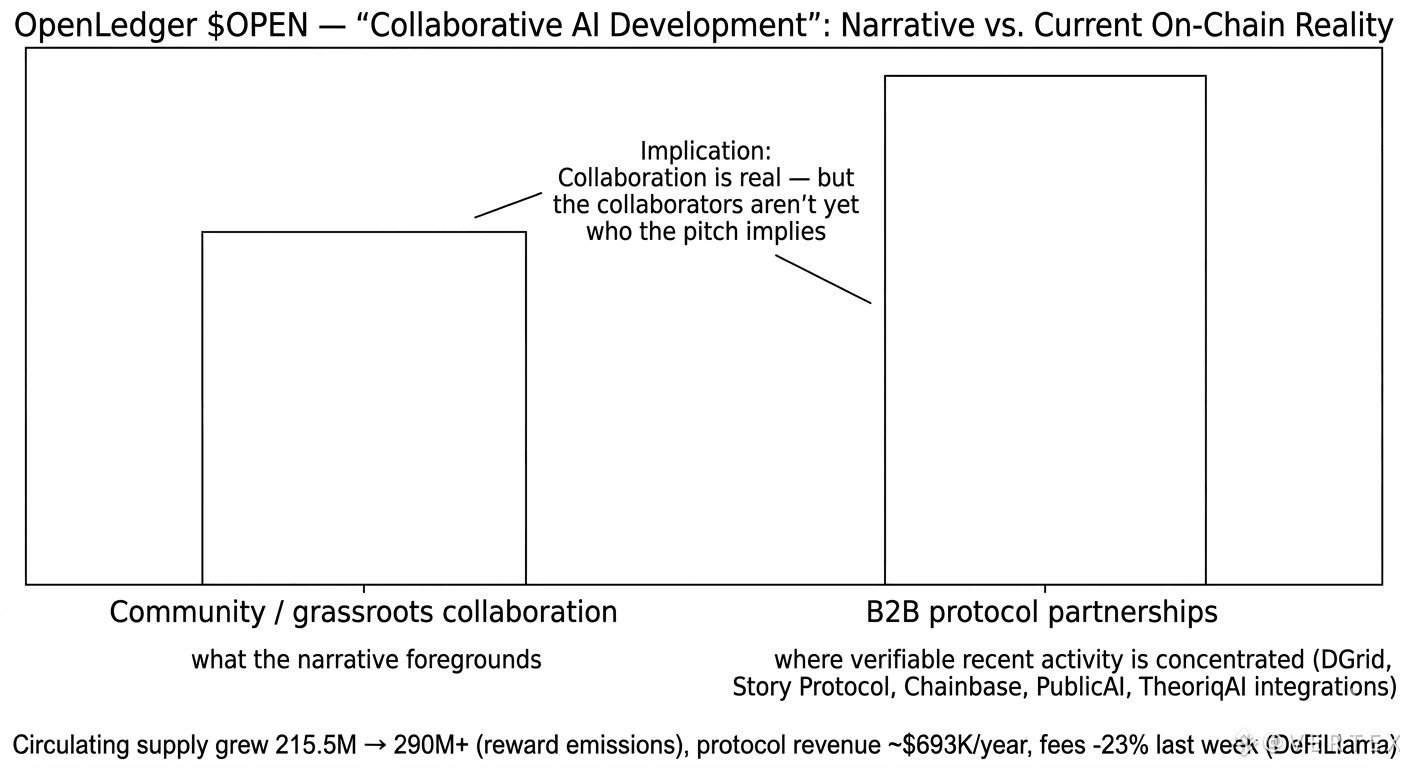
The thing that nagged at me halfway through the OpenLedger $OPEN #OpenLedger @Openledger task was the word "collaborative." It's everywhere in the framing — collaborative datasets, collaborative model training, community-owned intelligence. And then you look at what's actually being built right now and it's a different shape entirely.
The recent activity is almost entirely bilateral protocol partnerships: DGrid for compute, Story Protocol for rights licensing, Chainbase for Web3 data, PublicAI for labeling, TheoriqAI for agents. Each one is a handshake between two teams, not open contributor activity. Meanwhile CoinMarketCap shows circulating supply has grown from 215.5M to over 290M OPEN, mostly through community reward emissions — yet annual protocol revenue sits around $693K with fees down 23% last week per DeFiLlama. Tokens out, usage not yet following.
I thought about this for a bit after finishing the task. The B2B partnership model might actually be the faster path to a real working AI pipeline. Maybe grassroots data collaboration needs enterprise scaffolding before it can function at scale. That's a reasonable design choice. But it does mean the "collaborative" in collaborative AI development is currently pointing at a very specific group.
Who actually shows up in the Datanets once the partnership infrastructure is in place… that part is still to be written.
The thing that nagged at me halfway through the OpenLedger $OPEN #OpenLedger @OpenLedger task was the word "collaborative." It's everywhere in the framing — collaborative datasets, collaborative model training, community-owned intelligence. And then you look at what's actually being built right now and it's a different shape entirely.
The recent activity is almost entirely bilateral protocol partnerships: DGrid for compute, Story Protocol for rights licensing, Chainbase for Web3 data, PublicAI for labeling, TheoriqAI for agents. Each one is a handshake between two teams, not open contributor activity. Meanwhile CoinMarketCap shows circulating supply has grown from 215.5M to over 290M OPEN, mostly through community reward emissions — yet annual protocol revenue sits around $693K with fees down 23% last week per DeFiLlama. Tokens out, usage not yet following.
I thought about this for a bit after finishing the task. The B2B partnership model might actually be the faster path to a real working AI pipeline. Maybe grassroots data collaboration needs enterprise scaffolding before it can function at scale. That's a reasonable design choice. But it does mean the "collaborative" in collaborative AI development is currently pointing at a very specific group.
Who actually shows up in the Datanets once the partnership infrastructure is in place… that part is still to be written.
The recent activity is almost entirely bilateral protocol partnerships: DGrid for compute, Story Protocol for rights licensing, Chainbase for Web3 data, PublicAI for labeling, TheoriqAI for agents. Each one is a handshake between two teams, not open contributor activity. Meanwhile CoinMarketCap shows circulating supply has grown from 215.5M to over 290M OPEN, mostly through community reward emissions — yet annual protocol revenue sits around $693K with fees down 23% last week per DeFiLlama. Tokens out, usage not yet following.
I thought about this for a bit after finishing the task. The B2B partnership model might actually be the faster path to a real working AI pipeline. Maybe grassroots data collaboration needs enterprise scaffolding before it can function at scale. That's a reasonable design choice. But it does mean the "collaborative" in collaborative AI development is currently pointing at a very specific group.
Who actually shows up in the Datanets once the partnership infrastructure is in place… that part is still to be written.
2
6
1.3k

·
--
Verified
Article
The Frontier Moved. Nobody Told The Experts Holding The Key.Everyone is racing to build bigger models.
The actual frontier moved somewhere else entirely.
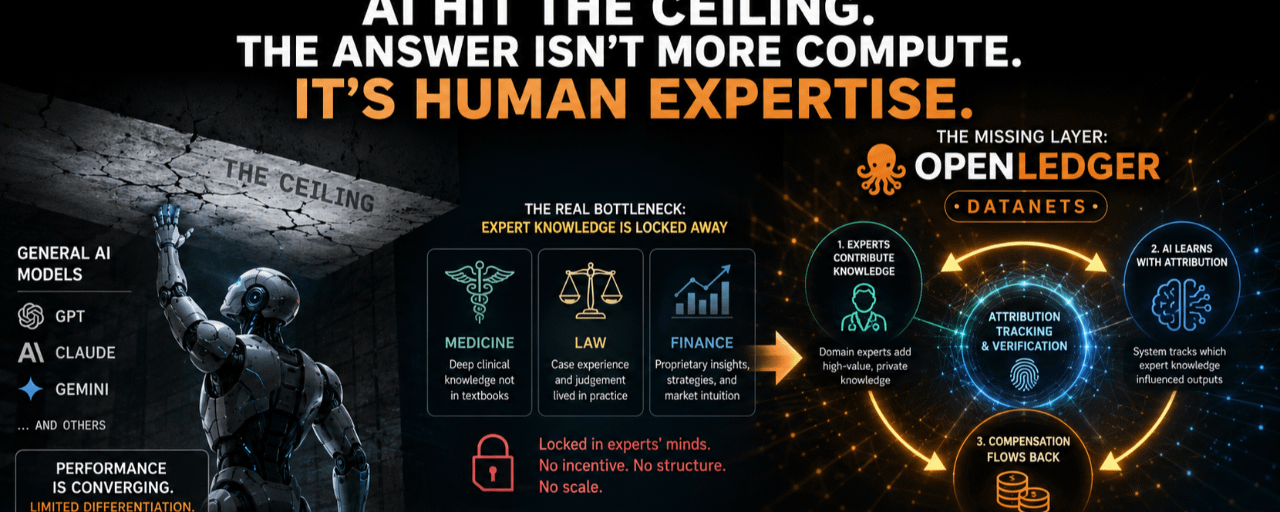
GPT. Claude. Gemini. The gap between them is closing faster than anyone publicly admits. General AI — trained on the entire internet, capable of everything, specialized in nothing — is commoditizing. The compute advantage is narrowing. The benchmark scores are converging. The moat that felt enormous eighteen months ago is starting to look like a temporary lead in a race where everyone eventually catches up.
The real frontier is specialized.
Medical AI that reasons like a cardiologist. Legal AI trained on decades of case strategy. Financial AI built on the actual decision logic of people who have moved markets. Scientific AI shaped by researchers who spent careers developing knowledge that exists nowhere on the public internet.
And here is the part nobody is pricing correctly.
specialized AI needs something that general AI already exhausted.
actual human depth.
the knowledge exists.
the model can't reach it.
Because here is what specialized AI development actually looks like right now.
the cardiologist who spent thirty years developing clinical intuition that saved lives in ways no textbook captured. the lawyer whose pattern recognition across thousands of cases contains strategic wisdom that no published opinion explains. the quant whose market understanding comes from a decade of watching things break in ways that never made it into any dataset.
that knowledge is the frontier.
and there is no infrastructure to capture it.
no economic incentive for these people to contribute what they know. no system that tracks which expert's insight shaped which model output. no mechanism that routes compensation back to the human whose depth made the intelligence possible.
so the model stalls at the ceiling of what public data can teach.
and the expert walks past without knowing they were holding the key.
the knowledge exists.
the model can't reach it.
and somewhere between those two facts.
a $500 billion infrastructure problem sits completely unaddressed.
This was never really about compute.
It was about whether the humans carrying irreplaceable domain knowledge would ever have a reason to share it.
That is the uncomfortable center of this. The thing nobody wants to say directly because saying it clearly makes the entire specialized AI roadmap look like it was built on an assumption nobody validated — that experts would contribute their most valuable knowledge for free.
they didn't.
they won't.
not without infrastructure that makes contribution economically rational.
This is where @Openledger keeps pulling my attention in a way I can't easily dismiss.
not because the technology is interesting. the technology matters but that's not the point.
the point is what DataNets actually are underneath the technical language.
wait. let me actually sit with that.
community-owned domain intelligence.
not a dataset marketplace. not a data lake. not another repository.
domain-specific knowledge networks where specialists contribute expertise, the Proof of Attribution mechanism tracks exactly which contribution shaped which model output, and compensation flows automatically back to the human whose depth made the intelligence possible.
we built general AI on public internet data and called it a knowledge economy.
specialized AI needs something the internet never had.
fast.
when a cardiologist knows their clinical reasoning keeps paying them every time a medical AI model uses the pattern they contributed.
when a lawyer knows their strategic insight generates royalties every time a legal AI references the framework they taught it.
when the expert knows their depth is a tracked asset not a donated resource.
the whole incentive to contribute shifts.
you stop treating your specialized knowledge as professional currency spent only inside your field.
you start seeing it as capital that can flow into systems that need it most.
for the specific gaps only your depth can fill.
for the domain expertise that frontier AI is genuinely starving for right now.
because that expertise is now attributable. compensable. economically real.
the knowledge doesn't disappear into a black box anymore.
the expert gets remembered.
and the quality of specialized AI changes underneath everything else. slowly. quietly. not because of a bigger parameter count. because the humans holding irreplaceable knowledge finally have a reason to share it.
I want to be honest about what I don't know.
getting specialists to change their relationship with knowledge contribution is one of the hardest behavioral shifts imaginable. the gap between a working attribution mechanism and a genuine economy where cardiologists and lawyers and quants regularly contribute domain expertise for ongoing compensation.....
real. I don't want to pretend otherwise.
the gaming problem exists here too. once compensation is visible, low-quality contributors flood the system claiming expertise they don't have. attribution systems that can't distinguish genuine depth from synthetic noise don't solve the problem. they just create a new one.
maybe this doesn't work at scale. maybe behavioral change is too slow. maybe specialists never trust a blockchain-based compensation system enough to contribute what they actually know.
maybe.
but here's the contradiction I can't resolve.
we spent centuries building institutions specifically designed to develop and protect specialized human knowledge.
universities. professional guilds. research institutions. peer review systems.
all of them built on one foundational assumption.
expertise has value. and the people who carry it deserve to be compensated for it.
and then we built the most knowledge-hungry technology in human history.
gave it everything the public internet contained.
watched it hit the ceiling of what general data can teach.
and forgot to build the infrastructure that could reach the knowledge sitting beyond that ceiling.
the knowledge exists.
the model can't reach it.
and we keep calling that the frontier 🚀
$OPEN #OpenLedger @Openledger
The Frontier Moved. Nobody Told The Experts Holding The Key.
Everyone is racing to build bigger models.
The actual frontier moved somewhere else entirely.
GPT. Claude. Gemini. The gap between them is closing faster than anyone publicly admits. General AI — trained on the entire internet, capable of everything, specialized in nothing — is commoditizing. The compute advantage is narrowing. The benchmark scores are converging. The moat that felt enormous eighteen months ago is starting to look like a temporary lead in a race where everyone eventually catches up.
The real frontier is specialized.
Medical AI that reasons like a cardiologist. Legal AI trained on decades of case strategy. Financial AI built on the actual decision logic of people who have moved markets. Scientific AI shaped by researchers who spent careers developing knowledge that exists nowhere on the public internet.
And here is the part nobody is pricing correctly.
specialized AI needs something that general AI already exhausted.
actual human depth.
the knowledge exists.
the model can't reach it.
Because here is what specialized AI development actually looks like right now.
the cardiologist who spent thirty years developing clinical intuition that saved lives in ways no textbook captured. the lawyer whose pattern recognition across thousands of cases contains strategic wisdom that no published opinion explains. the quant whose market understanding comes from a decade of watching things break in ways that never made it into any dataset.
that knowledge is the frontier.
and there is no infrastructure to capture it.
no economic incentive for these people to contribute what they know. no system that tracks which expert's insight shaped which model output. no mechanism that routes compensation back to the human whose depth made the intelligence possible.
so the model stalls at the ceiling of what public data can teach.
and the expert walks past without knowing they were holding the key.
the knowledge exists.
the model can't reach it.
and somewhere between those two facts.
a $500 billion infrastructure problem sits completely unaddressed.
This was never really about compute.
It was about whether the humans carrying irreplaceable domain knowledge would ever have a reason to share it.
That is the uncomfortable center of this. The thing nobody wants to say directly because saying it clearly makes the entire specialized AI roadmap look like it was built on an assumption nobody validated — that experts would contribute their most valuable knowledge for free.
they didn't.
they won't.
not without infrastructure that makes contribution economically rational.
This is where @OpenLedger keeps pulling my attention in a way I can't easily dismiss.
not because the technology is interesting. the technology matters but that's not the point.
the point is what DataNets actually are underneath the technical language.
wait. let me actually sit with that.
community-owned domain intelligence.
not a dataset marketplace. not a data lake. not another repository.
domain-specific knowledge networks where specialists contribute expertise, the Proof of Attribution mechanism tracks exactly which contribution shaped which model output, and compensation flows automatically back to the human whose depth made the intelligence possible.
we built general AI on public internet data and called it a knowledge economy.
specialized AI needs something the internet never had.
fast.
when a cardiologist knows their clinical reasoning keeps paying them every time a medical AI model uses the pattern they contributed.
when a lawyer knows their strategic insight generates royalties every time a legal AI references the framework they taught it.
when the expert knows their depth is a tracked asset not a donated resource.
the whole incentive to contribute shifts.
you stop treating your specialized knowledge as professional currency spent only inside your field.
you start seeing it as capital that can flow into systems that need it most.
for the specific gaps only your depth can fill.
for the domain expertise that frontier AI is genuinely starving for right now.
because that expertise is now attributable. compensable. economically real.
the knowledge doesn't disappear into a black box anymore.
the expert gets remembered.
and the quality of specialized AI changes underneath everything else. slowly. quietly. not because of a bigger parameter count. because the humans holding irreplaceable knowledge finally have a reason to share it.
I want to be honest about what I don't know.
getting specialists to change their relationship with knowledge contribution is one of the hardest behavioral shifts imaginable. the gap between a working attribution mechanism and a genuine economy where cardiologists and lawyers and quants regularly contribute domain expertise for ongoing compensation.....
real. I don't want to pretend otherwise.
the gaming problem exists here too. once compensation is visible, low-quality contributors flood the system claiming expertise they don't have. attribution systems that can't distinguish genuine depth from synthetic noise don't solve the problem. they just create a new one.
maybe this doesn't work at scale. maybe behavioral change is too slow. maybe specialists never trust a blockchain-based compensation system enough to contribute what they actually know.
maybe.
but here's the contradiction I can't resolve.
we spent centuries building institutions specifically designed to develop and protect specialized human knowledge.
universities. professional guilds. research institutions. peer review systems.
all of them built on one foundational assumption.
expertise has value. and the people who carry it deserve to be compensated for it.
and then we built the most knowledge-hungry technology in human history.
gave it everything the public internet contained.
watched it hit the ceiling of what general data can teach.
and forgot to build the infrastructure that could reach the knowledge sitting beyond that ceiling.
the knowledge exists.
the model can't reach it.
and we keep calling that the frontier 🚀
$OPEN #OpenLedger @Openledger
The actual frontier moved somewhere else entirely.
GPT. Claude. Gemini. The gap between them is closing faster than anyone publicly admits. General AI — trained on the entire internet, capable of everything, specialized in nothing — is commoditizing. The compute advantage is narrowing. The benchmark scores are converging. The moat that felt enormous eighteen months ago is starting to look like a temporary lead in a race where everyone eventually catches up.
The real frontier is specialized.
Medical AI that reasons like a cardiologist. Legal AI trained on decades of case strategy. Financial AI built on the actual decision logic of people who have moved markets. Scientific AI shaped by researchers who spent careers developing knowledge that exists nowhere on the public internet.
And here is the part nobody is pricing correctly.
specialized AI needs something that general AI already exhausted.
actual human depth.
the knowledge exists.
the model can't reach it.
Because here is what specialized AI development actually looks like right now.
the cardiologist who spent thirty years developing clinical intuition that saved lives in ways no textbook captured. the lawyer whose pattern recognition across thousands of cases contains strategic wisdom that no published opinion explains. the quant whose market understanding comes from a decade of watching things break in ways that never made it into any dataset.
that knowledge is the frontier.
and there is no infrastructure to capture it.
no economic incentive for these people to contribute what they know. no system that tracks which expert's insight shaped which model output. no mechanism that routes compensation back to the human whose depth made the intelligence possible.
so the model stalls at the ceiling of what public data can teach.
and the expert walks past without knowing they were holding the key.
the knowledge exists.
the model can't reach it.
and somewhere between those two facts.
a $500 billion infrastructure problem sits completely unaddressed.
This was never really about compute.
It was about whether the humans carrying irreplaceable domain knowledge would ever have a reason to share it.
That is the uncomfortable center of this. The thing nobody wants to say directly because saying it clearly makes the entire specialized AI roadmap look like it was built on an assumption nobody validated — that experts would contribute their most valuable knowledge for free.
they didn't.
they won't.
not without infrastructure that makes contribution economically rational.
This is where @OpenLedger keeps pulling my attention in a way I can't easily dismiss.
not because the technology is interesting. the technology matters but that's not the point.
the point is what DataNets actually are underneath the technical language.
wait. let me actually sit with that.
community-owned domain intelligence.
not a dataset marketplace. not a data lake. not another repository.
domain-specific knowledge networks where specialists contribute expertise, the Proof of Attribution mechanism tracks exactly which contribution shaped which model output, and compensation flows automatically back to the human whose depth made the intelligence possible.
we built general AI on public internet data and called it a knowledge economy.
specialized AI needs something the internet never had.
fast.
when a cardiologist knows their clinical reasoning keeps paying them every time a medical AI model uses the pattern they contributed.
when a lawyer knows their strategic insight generates royalties every time a legal AI references the framework they taught it.
when the expert knows their depth is a tracked asset not a donated resource.
the whole incentive to contribute shifts.
you stop treating your specialized knowledge as professional currency spent only inside your field.
you start seeing it as capital that can flow into systems that need it most.
for the specific gaps only your depth can fill.
for the domain expertise that frontier AI is genuinely starving for right now.
because that expertise is now attributable. compensable. economically real.
the knowledge doesn't disappear into a black box anymore.
the expert gets remembered.
and the quality of specialized AI changes underneath everything else. slowly. quietly. not because of a bigger parameter count. because the humans holding irreplaceable knowledge finally have a reason to share it.
I want to be honest about what I don't know.
getting specialists to change their relationship with knowledge contribution is one of the hardest behavioral shifts imaginable. the gap between a working attribution mechanism and a genuine economy where cardiologists and lawyers and quants regularly contribute domain expertise for ongoing compensation.....
real. I don't want to pretend otherwise.
the gaming problem exists here too. once compensation is visible, low-quality contributors flood the system claiming expertise they don't have. attribution systems that can't distinguish genuine depth from synthetic noise don't solve the problem. they just create a new one.
maybe this doesn't work at scale. maybe behavioral change is too slow. maybe specialists never trust a blockchain-based compensation system enough to contribute what they actually know.
maybe.
but here's the contradiction I can't resolve.
we spent centuries building institutions specifically designed to develop and protect specialized human knowledge.
universities. professional guilds. research institutions. peer review systems.
all of them built on one foundational assumption.
expertise has value. and the people who carry it deserve to be compensated for it.
and then we built the most knowledge-hungry technology in human history.
gave it everything the public internet contained.
watched it hit the ceiling of what general data can teach.
and forgot to build the infrastructure that could reach the knowledge sitting beyond that ceiling.
the knowledge exists.
the model can't reach it.
and we keep calling that the frontier 🚀
$OPEN #OpenLedger @Openledger
70
19
1.1k
Log in to explore more content
Join global crypto users on Binance Square
⚡️ Get latest and useful information about crypto.
💬 Trusted by the world’s largest crypto exchange.
👍 Discover real insights from verified creators.
Email / Phone number
Trending Topics
1
#AIStocksWhatNext
18,883 views
37 Discussing
2
#StrategyAdds950Bitcoin
81 views
0 Discussing
3
#CardanoAddedToX402KitForADAPayments
4,587 views
175 Discussing
4
#XRPRises8%
13,614 views
505 Discussing
5
#AMDHits$1TrillionMarketCap
429 views
24 Discussing
6
#BitcoinSpotETFs$999MNetInflow
969 views
40 Discussing
7
#AppleGoogleSeekStablecoinTokenizedDepositTalent
8,250 views
371 Discussing
8
#NvidiaToBuyAnother$1.5BSBEnergySharesPreIPO
1,502 views
33 Discussing
9
#AgoraGetsPreliminaryOCCApprovalForTrustBank
5,333 views
188 Discussing
10
#NEARRisesNearly80%InAWeek
81,015 views
1,337 Discussing