

#aitokenomics
aitokenomics
259 views
4 Discussing
Hot
Latest


·
--
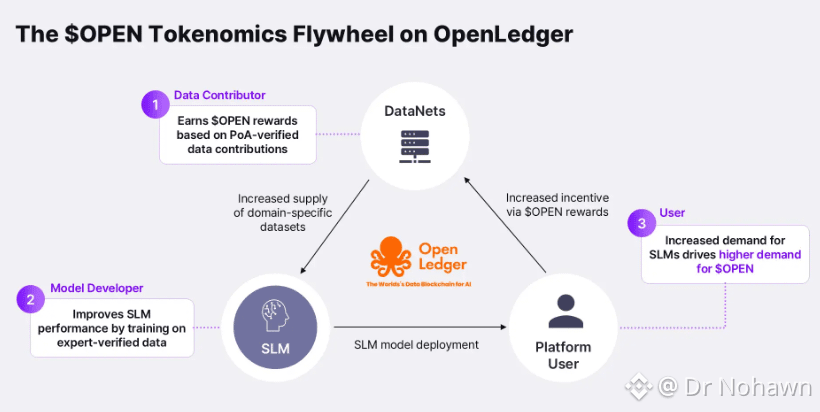
Today I looked into the tokenomics structure of @Openledger in a bit more detail, and I gotta say, I used to think it was just another governance token, but digging deeper, I realized it’s actually the economic backbone of the whole platform.
The first thing that caught my interest is that $OPEN is not just a means of exchange; it’s also the native gas token of OpenLedger’s Layer 2 blockchain. This means we don’t have to rely on Ethereum anymore, and we get an optimized transaction environment for #AITokenomics . Plus, #ProofOfAttribution plays a central role in the system, where data providers, model builders, and validators all get rewarded based on their actual contributions.
The magnum opus is its #DataEconomy model. The old way was that companies would buy data once or scrape it and then forget about the contributors. Here, OpenLedger flipped that, so now every time your data is used in model training or inference, you get rewarded. This is the first time "data labor" is being recognized as a proper economic activity; that’s a key change.
On the staking side, there are some important updates too. To run AI models on the platform, you have to stake #OpenLedger , and the model providing more critical services gets more stake, but if the model produces wrong or harmful output, there’s also an economic penalty. This means instead of a centralized authority, the market is doing its own quality control. Now, whether this concept actually works or not, time will tell, but the idea is solid.
When we talk about long-term sustainability, OpenLedger will have to overcome some hurdles. Creating quality validators, proving a direct link between data and model performance, and keeping the transition from testnet to mainnet rewards smooth are all early-stage challenges. The #OpenLoRA technology drastically reduces compute costs, making specialized AI development accessible, which is a positive sign.
My personal view is that the utility case of OPEN looks very strong, but it still needs to be practically validated and not just a concept.
Today I looked into the tokenomics structure of @OpenLedger in a bit more detail, and I gotta say, I used to think it was just another governance token, but digging deeper, I realized it’s actually the economic backbone of the whole platform.
The first thing that caught my interest is that $OPEN is not just a means of exchange; it’s also the native gas token of OpenLedger’s Layer 2 blockchain. This means we don’t have to rely on Ethereum anymore, and we get an optimized transaction environment for #AITokenomics . Plus, #ProofOfAttribution plays a central role in the system, where data providers, model builders, and validators all get rewarded based on their actual contributions.
The magnum opus is its #DataEconomy model. The old way was that companies would buy data once or scrape it and then forget about the contributors. Here, OpenLedger flipped that, so now every time your data is used in model training or inference, you get rewarded. This is the first time "data labor" is being recognized as a proper economic activity; that’s a key change.
On the staking side, there are some important updates too. To run AI models on the platform, you have to stake #OpenLedger , and the model providing more critical services gets more stake, but if the model produces wrong or harmful output, there’s also an economic penalty. This means instead of a centralized authority, the market is doing its own quality control. Now, whether this concept actually works or not, time will tell, but the idea is solid.
When we talk about long-term sustainability, OpenLedger will have to overcome some hurdles. Creating quality validators, proving a direct link between data and model performance, and keeping the transition from testnet to mainnet rewards smooth are all early-stage challenges. The #OpenLoRA technology drastically reduces compute costs, making specialized AI development accessible, which is a positive sign.
My personal view is that the utility case of OPEN looks very strong, but it still needs to be practically validated and not just a concept.
The first thing that caught my interest is that $OPEN is not just a means of exchange; it’s also the native gas token of OpenLedger’s Layer 2 blockchain. This means we don’t have to rely on Ethereum anymore, and we get an optimized transaction environment for #AITokenomics . Plus, #ProofOfAttribution plays a central role in the system, where data providers, model builders, and validators all get rewarded based on their actual contributions.
The magnum opus is its #DataEconomy model. The old way was that companies would buy data once or scrape it and then forget about the contributors. Here, OpenLedger flipped that, so now every time your data is used in model training or inference, you get rewarded. This is the first time "data labor" is being recognized as a proper economic activity; that’s a key change.
On the staking side, there are some important updates too. To run AI models on the platform, you have to stake #OpenLedger , and the model providing more critical services gets more stake, but if the model produces wrong or harmful output, there’s also an economic penalty. This means instead of a centralized authority, the market is doing its own quality control. Now, whether this concept actually works or not, time will tell, but the idea is solid.
When we talk about long-term sustainability, OpenLedger will have to overcome some hurdles. Creating quality validators, proving a direct link between data and model performance, and keeping the transition from testnet to mainnet rewards smooth are all early-stage challenges. The #OpenLoRA technology drastically reduces compute costs, making specialized AI development accessible, which is a positive sign.
My personal view is that the utility case of OPEN looks very strong, but it still needs to be practically validated and not just a concept.
17
11
470

⚡ $AVGO SHOCKS AI SECTOR WITH VMWARE FACTORY LAUNCH TO DOMINATE AI TOKENOMICS! 🚀
Tech heavyweights are quietly building the architecture for the next massive expansion cycle. Broadcom just rolled out its VMware AI Factory, targeting streamlined deployment and tighter enterprise grip on AI Tokenomics. 💡 Institutional players aren't just watching decentralized compute unfold—they are actively engineering the pipes.
When legacy tech juggernauts begin optimizing token models and execution speed, smart money takes notice. 📊 This move signals a structural pivot where traditional enterprise infrastructure converges directly with crypto token economic design.
As institutional money aligns with tokenized incentive structures, positioning across decentralized AI networks is quietly heating up. 💬 Will corporate entry into AI tokenomics trigger the next major wave of institutional capital inflows? 👇
⚠️ Not financial advice. Always manage your risk. 🛡️
🏷️ #AVGO #AITokenomics #CryptoAI #TechTrends #Crypto
⚡ 💎
⚡ $AVGO SHOCKS AI SECTOR WITH VMWARE FACTORY LAUNCH TO DOMINATE AI TOKENOMICS! 🚀
Tech heavyweights are quietly building the architecture for the next massive expansion cycle. Broadcom just rolled out its VMware AI Factory, targeting streamlined deployment and tighter enterprise grip on AI Tokenomics. 💡 Institutional players aren't just watching decentralized compute unfold—they are actively engineering the pipes.
When legacy tech juggernauts begin optimizing token models and execution speed, smart money takes notice. 📊 This move signals a structural pivot where traditional enterprise infrastructure converges directly with crypto token economic design.
As institutional money aligns with tokenized incentive structures, positioning across decentralized AI networks is quietly heating up. 💬 Will corporate entry into AI tokenomics trigger the next major wave of institutional capital inflows? 👇
⚠️ Not financial advice. Always manage your risk. 🛡️
🏷️ #AVGO #AITokenomics #CryptoAI #TechTrends #Crypto
⚡ 💎
Tech heavyweights are quietly building the architecture for the next massive expansion cycle. Broadcom just rolled out its VMware AI Factory, targeting streamlined deployment and tighter enterprise grip on AI Tokenomics. 💡 Institutional players aren't just watching decentralized compute unfold—they are actively engineering the pipes.
When legacy tech juggernauts begin optimizing token models and execution speed, smart money takes notice. 📊 This move signals a structural pivot where traditional enterprise infrastructure converges directly with crypto token economic design.
As institutional money aligns with tokenized incentive structures, positioning across decentralized AI networks is quietly heating up. 💬 Will corporate entry into AI tokenomics trigger the next major wave of institutional capital inflows? 👇
⚠️ Not financial advice. Always manage your risk. 🛡️
🏷️ #AVGO #AITokenomics #CryptoAI #TechTrends #Crypto
⚡ 💎
64

·
--
🚨 $AVGO UNVEILS VMWARE AI FACTORY TO OPTIMIZE INFRASTRUCTURE AND STREAMLINE AI TOKENOMICS ⚡
Broadcom ($AVGO ) has officially unveiled the VMware AI Factory, a strategically engineered move designed to accelerate enterprise AI deployment cycles. 🔍 This institutional shift directly targets structural inefficiency by offering refined governance over AI computing workloads and tokenomics integration.
As infrastructure giants expand their footprint into tokenized ecosystem management, smart money is closely tracking how enterprise-grade compute efficiency impacts broader market liquidity. 📊 Controlling tokenomics at the architectural layer marks a critical pivot toward sustainable institutional adoption.
💡 Early positioning often unfolds during quiet accumulation phases before retail catches on to these structural enterprise catalysts. 🤔 How do you see enterprise AI integration impacting decentralized AI sector valuations moving forward? 👇
⚠️ Not financial advice. Always manage your risk. 🛡️
🏷️ #AVGO #AITokenomics #ArtificialIntelligence #Institutional #CryptoTech
🎯 🦈
🚨 $AVGO UNVEILS VMWARE AI FACTORY TO OPTIMIZE INFRASTRUCTURE AND STREAMLINE AI TOKENOMICS ⚡
Broadcom ($AVGO ) has officially unveiled the VMware AI Factory, a strategically engineered move designed to accelerate enterprise AI deployment cycles. 🔍 This institutional shift directly targets structural inefficiency by offering refined governance over AI computing workloads and tokenomics integration.
As infrastructure giants expand their footprint into tokenized ecosystem management, smart money is closely tracking how enterprise-grade compute efficiency impacts broader market liquidity. 📊 Controlling tokenomics at the architectural layer marks a critical pivot toward sustainable institutional adoption.
💡 Early positioning often unfolds during quiet accumulation phases before retail catches on to these structural enterprise catalysts. 🤔 How do you see enterprise AI integration impacting decentralized AI sector valuations moving forward? 👇
⚠️ Not financial advice. Always manage your risk. 🛡️
🏷️ #AVGO #AITokenomics #ArtificialIntelligence #Institutional #CryptoTech
🎯 🦈
Broadcom ($AVGO ) has officially unveiled the VMware AI Factory, a strategically engineered move designed to accelerate enterprise AI deployment cycles. 🔍 This institutional shift directly targets structural inefficiency by offering refined governance over AI computing workloads and tokenomics integration.
As infrastructure giants expand their footprint into tokenized ecosystem management, smart money is closely tracking how enterprise-grade compute efficiency impacts broader market liquidity. 📊 Controlling tokenomics at the architectural layer marks a critical pivot toward sustainable institutional adoption.
💡 Early positioning often unfolds during quiet accumulation phases before retail catches on to these structural enterprise catalysts. 🤔 How do you see enterprise AI integration impacting decentralized AI sector valuations moving forward? 👇
⚠️ Not financial advice. Always manage your risk. 🛡️
🏷️ #AVGO #AITokenomics #ArtificialIntelligence #Institutional #CryptoTech
🎯 🦈
82
Log in to explore more content
Join global crypto users on Binance Square
⚡️ Get latest and useful information about crypto.
💬 Trusted by the world’s largest crypto exchange.
👍 Discover real insights from verified creators.
Email / Phone number
Trending Topics
1
#QNTRises39%
25,956 views
970 Discussing
2
#EthereumBreaksAbove$2700
2,499 views
98 Discussing
3
#BitgetBreachForgedRequestsNotStolenKeys
22,800 views
754 Discussing
4
#BitcoinSpotETFsTurnNetPositiveYTD
15,129 views
611 Discussing
5
#GrayscaleZcashETFHits$1BNetAssets
1,644 views
44 Discussing
6
#BitcoinSpotETFsNetInflow$191M
7,663 views
182 Discussing
7
#CFTCUpdatesGuidanceOnTokenizedAssets
55,058 views
1,543 Discussing
8
#BitgetSays$352MAffectedInHack
19,448 views
96 Discussing
9
#BinanceWillListHyperliquid(HYPE)
284,899 views
4,112 Discussing
10
#BrazilOrdersReportingOf$10KSelfCustodyTransfers
7,163 views
55 Discussing