
#north
north
669 views
10 Discussing
Hot
Latest

NK$IDOL
{future}(IDOLUSDT)
$ONE
{future}(ONEUSDT)
$ARIA
{future}(ARIAUSDT)
How can North Korea, a country struggling with unreliable electricity, develop one of the world’s most formidable cyberwarfare forces? The answer is both surprising and deeply unsettling. ⚠️
Cyberwarfare is one of the few domains in which North Korea can challenge major global powers. Groups such as Bureau 121 and Lazarus have become notorious within the international cybersecurity community for their precision, sophistication, and ruthlessness.
The secret lies in a state-sponsored system designed to identify and cultivate talent from an early age.
Children as young as 11 or 12, particularly those demonstrating exceptional mathematical ability and analytical skills, are reportedly selected for specialized training. They attend elite institutions in Pyongyang, eventually progressing to universities such as Kim Il Sung University or Pyongyang University of Automation. According to defectors, their education involves up to nine hours of intensive daily study, with little room for entertainment.
Their training reportedly extends beyond theory, involving practical exercises targeting networks in South Korea, Europe, and the United States.
After graduation, many are deployed overseas, particularly to China, Russia, and Southeast Asia, where more reliable electricity and internet infrastructure are available. Operating under the cover of freelance programmers, they secure contracts with Western companies and contribute to Web3 projects.
However, these seemingly legitimate professional relationships can serve another purpose: gathering intelligence, identifying vulnerabilities, and infiltrating critical systems. Some reportedly impersonate recruiters, approaching technical employees at cryptocurrency exchanges with lucrative job offers.
The recent Binance security incident has once again drawn attention to these sophisticated infiltration techniques.
But why is the cryptocurrency industry such an attractive target?
International sanctions have severely restricted North Korea’s access to conventional financial networks. Cryptocurrency, however, offers an alternative channel for moving funds across borders, often through complex transactions that are difficult to trace and recover.
Consider the economics: developing missiles requires industrial infrastructure, expensive materials, and foreign currency. Building a highly skilled cyber operative requires comparatively little—computers, connectivity, specialized training, and state support.
Yet the potential returns are enormous. International estimates have attributed billions of dollars in cryptocurrency theft to North Korean-linked operations, making cybercrime a significant source of foreign currency for the isolated regime.
For North Korea, cyberwarfare is not merely a military capability. It has evolved into a strategic economic weapon—and potentially one of the country’s most profitable industries.#North
NK
$IDOL
$ONE
$ARIA
How can North Korea, a country struggling with unreliable electricity, develop one of the world’s most formidable cyberwarfare forces? The answer is both surprising and deeply unsettling. ⚠️
Cyberwarfare is one of the few domains in which North Korea can challenge major global powers. Groups such as Bureau 121 and Lazarus have become notorious within the international cybersecurity community for their precision, sophistication, and ruthlessness.
The secret lies in a state-sponsored system designed to identify and cultivate talent from an early age.
Children as young as 11 or 12, particularly those demonstrating exceptional mathematical ability and analytical skills, are reportedly selected for specialized training. They attend elite institutions in Pyongyang, eventually progressing to universities such as Kim Il Sung University or Pyongyang University of Automation. According to defectors, their education involves up to nine hours of intensive daily study, with little room for entertainment.
Their training reportedly extends beyond theory, involving practical exercises targeting networks in South Korea, Europe, and the United States.
After graduation, many are deployed overseas, particularly to China, Russia, and Southeast Asia, where more reliable electricity and internet infrastructure are available. Operating under the cover of freelance programmers, they secure contracts with Western companies and contribute to Web3 projects.
However, these seemingly legitimate professional relationships can serve another purpose: gathering intelligence, identifying vulnerabilities, and infiltrating critical systems. Some reportedly impersonate recruiters, approaching technical employees at cryptocurrency exchanges with lucrative job offers.
The recent Binance security incident has once again drawn attention to these sophisticated infiltration techniques.
But why is the cryptocurrency industry such an attractive target?
International sanctions have severely restricted North Korea’s access to conventional financial networks. Cryptocurrency, however, offers an alternative channel for moving funds across borders, often through complex transactions that are difficult to trace and recover.
Consider the economics: developing missiles requires industrial infrastructure, expensive materials, and foreign currency. Building a highly skilled cyber operative requires comparatively little—computers, connectivity, specialized training, and state support.
Yet the potential returns are enormous. International estimates have attributed billions of dollars in cryptocurrency theft to North Korean-linked operations, making cybercrime a significant source of foreign currency for the isolated regime.
For North Korea, cyberwarfare is not merely a military capability. It has evolved into a strategic economic weapon—and potentially one of the country’s most profitable industries.#North
1
1.1k

·
--
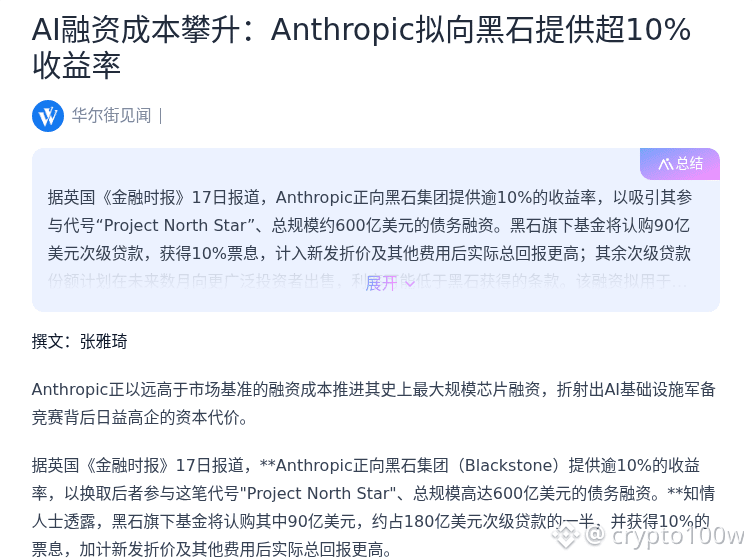
Rising financing costs: Anthropic plans to offer Blackstone a yield of over 10%
Anthropic is moving forward with a record-breaking $60 billion chip debt financing deal, codenamed “Project North Star.”
Source: PANews
#ANTHROPIC #PROJECT #NORTH #STAR
Image 1: Rising financing costs: Anthropic plans to offer Blackstone a yield of over 10% · Partial screenshot of the source page
Image source: https://www.panewslab.com/zh/articles/01a14c96-7f5a-765a-a8c8-17c3f92fa385
24

·
--
North Carolina Bill Recognizes CFTC's ‘Federal Regulatory Authority’...
The state's budget law leaves oversight of Kalshi and Polymarket to the CFTC and taxes them at 6%, far below what other states are pursuing. The development arrives as market participants track the broader implications for the digital asset sector and adjoining financial infrastructure.
The move underscores a wider shift across the crypto industry, where institutional adoption and regulatory clarity are reshaping how capital flows into on-chain markets. Analysts note that momentum is increasingly driven by fundamentals rather than speculative cycles.
For builders and investors alike, the signal is that maturity is accelerating: projects with real utility and transparent governance are gaining ground, while short-term noise loses influence. Liquidity conditions and macro policy remain the key variables to watch.
What's your take - is this a turning point or just another market ripple? 👇
#Polymarket #CryptoRegulation #North
2
Log in to explore more content
Join global crypto users on Binance Square
⚡️ Get latest and useful information about crypto.
💬 Trusted by the world’s largest crypto exchange.
👍 Discover real insights from verified creators.
Email / Phone number
Trending Topics
1
#BinanceReopensWithdrawalsForHYPE&APT
9,217 views
254 Discussing
2
#SouthKoreaDraftLawTargets15To20%ShareholderCap
14,806 views
194 Discussing
3
#TradFiForBeginners
122,913 views
1,292 Discussing
4
#KeplrAdvisesSocialLoginUsersToTransferAssets
15,499 views
265 Discussing
5
#TetherPlans€28.8MForJuventusCapitalIncrease
8,317 views
204 Discussing
6
#JobsReportRaisesHikeOdds
716,342 views
4,150 Discussing
7
#CPITestsDecemberRateOutlook
264,090 views
1,683 Discussing
8
#US Data Center Rules May Constrain AI Expansion
104,102 views
253 Discussing
9
#ARKPlans14ThematicETFsCoveringAIAndTokenizedMarkets
6,898 views
86 Discussing
10
#WillAnthropicListOnTime
232,188 views
1,789 Discussing