

crypto100w
3.8k Posts

crypto100w
Report
Block User
同名加密分析网站,免费使用.

ENA Holder
High-Frequency Trader
5.6 Years
26 Following
139 Followers
169 Liked
Posts
All
Quotes
Videos
PINNED
·
--
If you've been trading recently, you must have this feeling:
There is more and more information, but it's getting harder to make judgments.
There are opinions every day in the group, and social media has daily "opportunities",
but at the moment you actually place an order, you still ask yourself:
Is this noise or signal?
We created this crypto100w platform to solve this issue.
It's not about giving you a bunch of analyses that "look impressive",
but rather providing you with three core functions that can directly improve decision quality.
If you've been trading recently, you must have this feeling:
There is more and more information, but it's getting harder to make judgments.
There are opinions every day in the group, and social media has daily "opportunities",
but at the moment you actually place an order, you still ask yourself:
Is this noise or signal?
We created this crypto100w platform to solve this issue.
It's not about giving you a bunch of analyses that "look impressive",
but rather providing you with three core functions that can directly improve decision quality.
There is more and more information, but it's getting harder to make judgments.
There are opinions every day in the group, and social media has daily "opportunities",
but at the moment you actually place an order, you still ask yourself:
Is this noise or signal?
We created this crypto100w platform to solve this issue.
It's not about giving you a bunch of analyses that "look impressive",
but rather providing you with three core functions that can directly improve decision quality.
4
39
PINNED
·
--
When market information is overwhelming and opportunities are fleeting, what you need is not just more data, but faster, more stable, and more interpretable decision-making basis. Welcome to Crypto 100W, a brand new platform that helps you capture market signals faster and make trading decisions more steadily.
Now, register immediately and enter the dashboard, add your watchlist, set alerts, and experience AI one-click interpretation. In the complex crypto market, use more professional tools to make more robust decisions. Thank you for watching. This platform is for research and education purposes only and does not constitute investment advice, please assess risks carefully.
When market information is overwhelming and opportunities are fleeting, what you need is not just more data, but faster, more stable, and more interpretable decision-making basis. Welcome to Crypto 100W, a brand new platform that helps you capture market signals faster and make trading decisions more steadily.
Now, register immediately and enter the dashboard, add your watchlist, set alerts, and experience AI one-click interpretation. In the complex crypto market, use more professional tools to make more robust decisions. Thank you for watching. This platform is for research and education purposes only and does not constitute investment advice, please assess risks carefully.
Now, register immediately and enter the dashboard, add your watchlist, set alerts, and experience AI one-click interpretation. In the complex crypto market, use more professional tools to make more robust decisions. Thank you for watching. This platform is for research and education purposes only and does not constitute investment advice, please assess risks carefully.
1
7
670
·
--
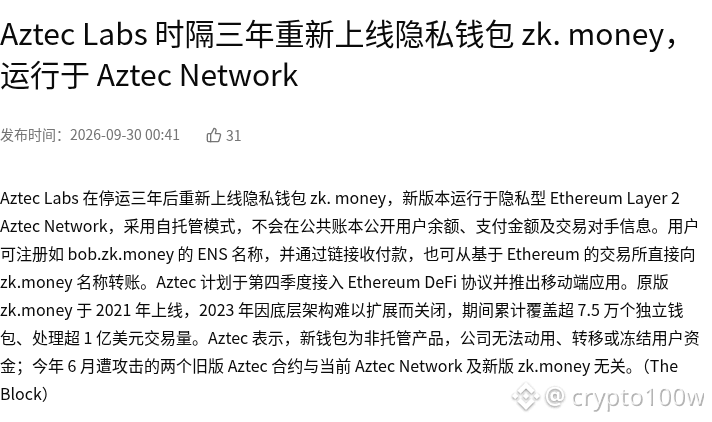
Aztec Labs relaunches its privacy wallet zk.money after three years, bringing back privacy-focused Ethereum Layer 2 on the Aztec Network.
The new version uses a self-custody model, meaning it does not publicly reveal users’ balances, payment amounts, or counterparty information on the public ledger. Users can register ENS names such as bob.zk.money, send and receive payments via links, and also transfer funds directly from Ethereum-based exchanges to the zk.money name. Aztec also plans to integrate with Ethereum DeFi protocols in Q4 and launch a mobile app.
The highlights of this kind of product are clear: on one side, the narrative of privacy payments and zero-knowledge applications finally has a viable platform; on the other, the product is still in its early stage—whether it can retain user migration and ecosystem attention is the real thing to watch. Aztec says the new wallet is a non-custodial product: the company cannot access, move, or freeze users’ funds. The two old Aztec contracts that were attacked in June this year are not related to the current Aztec Network or the new version of zk.money.
The market read is generally bullish for ETH privacy infrastructure and the zero-knowledge application narrative. It’s not a direct exchange listing or a token catalyst, but it does indicate that privacy payment products in the Ethereum ecosystem have returned to a usable phase—benefiting attention and capital toward Aztec, ZK applications, and on-chain stablecoin payment scenarios. In the short term, it’s more suitable to track ecosystem hype and user migration; since the product is still early, those following related concepts should pay attention to how and when expectations are realized.
Would you rather first see its privacy payment experience, or the ecosystem link-ups after its Q4 integration with Ethereum DeFi protocols?
Source: Wu Shuo
#ETH
Figure 1: Aztec restarts the zk.money privacy wallet · Source page partial screenshot
Image source: https://www.wublock123.com/news/aztec-labs-relaunches-zk-money-privacy-wallet-on-aztec-network-69231
Aztec Labs relaunches its privacy wallet zk.money after three years, bringing back privacy-focused Ethereum Layer 2 on the Aztec Network.
The new version uses a self-custody model, meaning it does not publicly reveal users’ balances, payment amounts, or counterparty information on the public ledger. Users can register ENS names such as bob.zk.money, send and receive payments via links, and also transfer funds directly from Ethereum-based exchanges to the zk.money name. Aztec also plans to integrate with Ethereum DeFi protocols in Q4 and launch a mobile app.
The highlights of this kind of product are clear: on one side, the narrative of privacy payments and zero-knowledge applications finally has a viable platform; on the other, the product is still in its early stage—whether it can retain user migration and ecosystem attention is the real thing to watch. Aztec says the new wallet is a non-custodial product: the company cannot access, move, or freeze users’ funds. The two old Aztec contracts that were attacked in June this year are not related to the current Aztec Network or the new version of zk.money.
The market read is generally bullish for ETH privacy infrastructure and the zero-knowledge application narrative. It’s not a direct exchange listing or a token catalyst, but it does indicate that privacy payment products in the Ethereum ecosystem have returned to a usable phase—benefiting attention and capital toward Aztec, ZK applications, and on-chain stablecoin payment scenarios. In the short term, it’s more suitable to track ecosystem hype and user migration; since the product is still early, those following related concepts should pay attention to how and when expectations are realized.
Would you rather first see its privacy payment experience, or the ecosystem link-ups after its Q4 integration with Ethereum DeFi protocols?
Source: Wu Shuo
#ETH
Figure 1: Aztec restarts the zk.money privacy wallet · Source page partial screenshot
Image source: https://www.wublock123.com/news/aztec-labs-relaunches-zk-money-privacy-wallet-on-aztec-network-69231
The new version uses a self-custody model, meaning it does not publicly reveal users’ balances, payment amounts, or counterparty information on the public ledger. Users can register ENS names such as bob.zk.money, send and receive payments via links, and also transfer funds directly from Ethereum-based exchanges to the zk.money name. Aztec also plans to integrate with Ethereum DeFi protocols in Q4 and launch a mobile app.
The highlights of this kind of product are clear: on one side, the narrative of privacy payments and zero-knowledge applications finally has a viable platform; on the other, the product is still in its early stage—whether it can retain user migration and ecosystem attention is the real thing to watch. Aztec says the new wallet is a non-custodial product: the company cannot access, move, or freeze users’ funds. The two old Aztec contracts that were attacked in June this year are not related to the current Aztec Network or the new version of zk.money.
The market read is generally bullish for ETH privacy infrastructure and the zero-knowledge application narrative. It’s not a direct exchange listing or a token catalyst, but it does indicate that privacy payment products in the Ethereum ecosystem have returned to a usable phase—benefiting attention and capital toward Aztec, ZK applications, and on-chain stablecoin payment scenarios. In the short term, it’s more suitable to track ecosystem hype and user migration; since the product is still early, those following related concepts should pay attention to how and when expectations are realized.
Would you rather first see its privacy payment experience, or the ecosystem link-ups after its Q4 integration with Ethereum DeFi protocols?
Source: Wu Shuo
#ETH
Figure 1: Aztec restarts the zk.money privacy wallet · Source page partial screenshot
Image source: https://www.wublock123.com/news/aztec-labs-relaunches-zk-money-privacy-wallet-on-aztec-network-69231
14
·
--
Barrels again letting in hawks, the market will have to settle the interest-rate ledger once more.
BlockBeats news: On September 30, Federal Reserve Governor Bahl said that further rate hikes may be necessary. He also noted that the trend of inflation returning to 2% in a timely manner is not clearly visible, and the risks to achieving the inflation target have increased.
The immediate impact of such remarks is that expectations for higher interest rates will continue to raise the attractiveness of the U.S. dollar and U.S. Treasury yields. This makes it even harder to relax valuation levels and leverage preferences for risk assets. If yields and the U.S. Dollar Index continue to strengthen afterward, sentiment pressure on assets like BTC and ETH will be more evident. However, if it’s only the officer’s verbal hawkishness, the market typically first looks at how quickly it gets digested.
Are you more focused on the U.S. Dollar Index surging higher, or on U.S. Treasury yields setting the tone for the market first?
Figure 1: Bahl turns hawkish: rate-hike expectations suppress risk assets · Source: partial screenshot of the page
Image source: https://www.theblockbeats.info/flash/369627
Barrels again letting in hawks, the market will have to settle the interest-rate ledger once more.
BlockBeats news: On September 30, Federal Reserve Governor Bahl said that further rate hikes may be necessary. He also noted that the trend of inflation returning to 2% in a timely manner is not clearly visible, and the risks to achieving the inflation target have increased.
The immediate impact of such remarks is that expectations for higher interest rates will continue to raise the attractiveness of the U.S. dollar and U.S. Treasury yields. This makes it even harder to relax valuation levels and leverage preferences for risk assets. If yields and the U.S. Dollar Index continue to strengthen afterward, sentiment pressure on assets like BTC and ETH will be more evident. However, if it’s only the officer’s verbal hawkishness, the market typically first looks at how quickly it gets digested.
Are you more focused on the U.S. Dollar Index surging higher, or on U.S. Treasury yields setting the tone for the market first?
Figure 1: Bahl turns hawkish: rate-hike expectations suppress risk assets · Source: partial screenshot of the page
Image source: https://www.theblockbeats.info/flash/369627
BlockBeats news: On September 30, Federal Reserve Governor Bahl said that further rate hikes may be necessary. He also noted that the trend of inflation returning to 2% in a timely manner is not clearly visible, and the risks to achieving the inflation target have increased.
The immediate impact of such remarks is that expectations for higher interest rates will continue to raise the attractiveness of the U.S. dollar and U.S. Treasury yields. This makes it even harder to relax valuation levels and leverage preferences for risk assets. If yields and the U.S. Dollar Index continue to strengthen afterward, sentiment pressure on assets like BTC and ETH will be more evident. However, if it’s only the officer’s verbal hawkishness, the market typically first looks at how quickly it gets digested.
Are you more focused on the U.S. Dollar Index surging higher, or on U.S. Treasury yields setting the tone for the market first?
Figure 1: Bahl turns hawkish: rate-hike expectations suppress risk assets · Source: partial screenshot of the page
Image source: https://www.theblockbeats.info/flash/369627

176
·
--
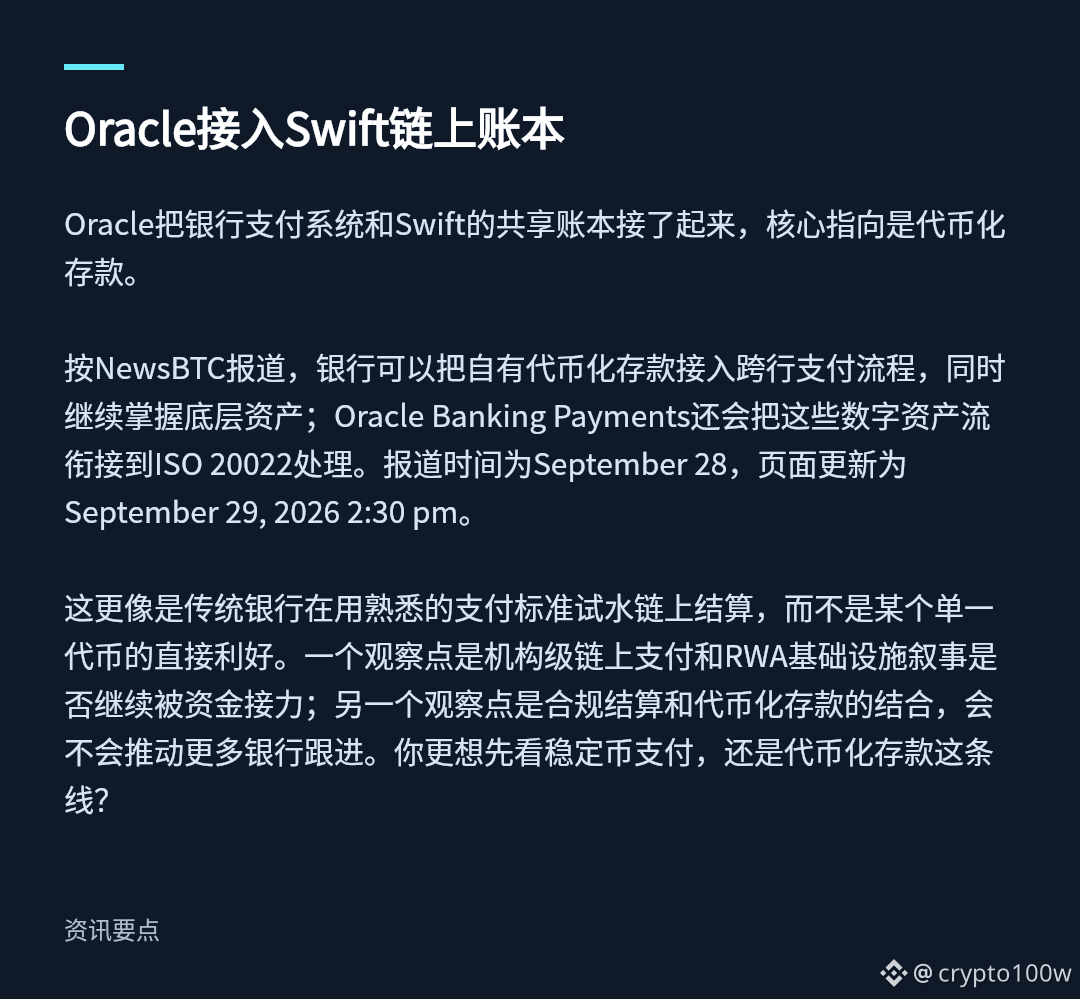
Oracle connected a bank payment system with Swift’s shared ledger, with the core focus being tokenized deposits.
According to a report by NewsBTC, banks can plug their own tokenized deposits into interbank payment processes, while still retaining control of the underlying assets. Oracle Banking Payments will also route these digital assets into ISO 20022 processing. The report date is September 28, and the page was updated on September 29, 2026 at 2:30 pm.
This looks more like traditional banks testing blockchain settlement using familiar payment standards, rather than a direct positive for a single token. One point to watch is whether the institutional on-chain payment and RWA infrastructure narrative will continue to be carried forward by funding. Another point to watch is whether the combination of compliant settlement and tokenized deposits will spur more banks to follow suit. Would you rather first look at stablecoin payments, or the tokenized deposits track?
Figure 1: Oracle integrates the Swift on-chain ledger · Key information
Image source: https://www.newsbtc.com/technology/oracle-connects-bank-payment-systems-to-swift-s-blockchain-ledger/
Oracle connected a bank payment system with Swift’s shared ledger, with the core focus being tokenized deposits.
According to a report by NewsBTC, banks can plug their own tokenized deposits into interbank payment processes, while still retaining control of the underlying assets. Oracle Banking Payments will also route these digital assets into ISO 20022 processing. The report date is September 28, and the page was updated on September 29, 2026 at 2:30 pm.
This looks more like traditional banks testing blockchain settlement using familiar payment standards, rather than a direct positive for a single token. One point to watch is whether the institutional on-chain payment and RWA infrastructure narrative will continue to be carried forward by funding. Another point to watch is whether the combination of compliant settlement and tokenized deposits will spur more banks to follow suit. Would you rather first look at stablecoin payments, or the tokenized deposits track?
Figure 1: Oracle integrates the Swift on-chain ledger · Key information
Image source: https://www.newsbtc.com/technology/oracle-connects-bank-payment-systems-to-swift-s-blockchain-ledger/
According to a report by NewsBTC, banks can plug their own tokenized deposits into interbank payment processes, while still retaining control of the underlying assets. Oracle Banking Payments will also route these digital assets into ISO 20022 processing. The report date is September 28, and the page was updated on September 29, 2026 at 2:30 pm.
This looks more like traditional banks testing blockchain settlement using familiar payment standards, rather than a direct positive for a single token. One point to watch is whether the institutional on-chain payment and RWA infrastructure narrative will continue to be carried forward by funding. Another point to watch is whether the combination of compliant settlement and tokenized deposits will spur more banks to follow suit. Would you rather first look at stablecoin payments, or the tokenized deposits track?
Figure 1: Oracle integrates the Swift on-chain ledger · Key information
Image source: https://www.newsbtc.com/technology/oracle-connects-bank-payment-systems-to-swift-s-blockchain-ledger/
75
·
--
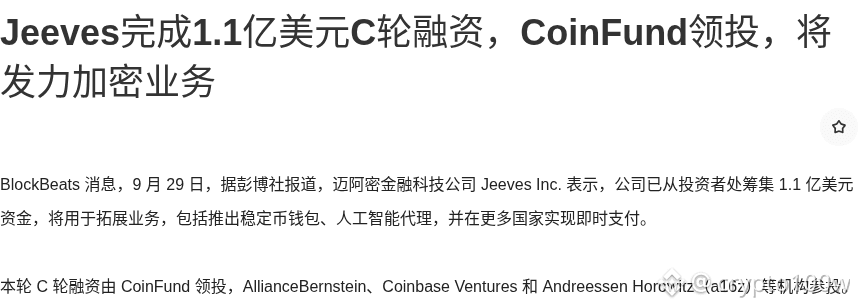
Jeeves secures $110 million in Series C funding and continues to focus its firepower on the stablecoin business.
According to a report by Bloomberg, the Miami fintech company Jeeves Inc. said the funding will be used to launch a stablecoin wallet, AI agents, and to enable instant payments in more countries. The round was led by CoinFund, with participation from AllianceBernstein, Coinbase Ventures, and Andreessen Horowitz (a16z).
The appeal of this kind of news is pretty straightforward: on one side are corporate spending and payment scenarios; on the other, stablecoins as an extension of settlement infrastructure. If the subsequent rollout goes smoothly, the market will continue to watch the stablecoin payments track, as well as RWA, enterprise crypto banks, and compliant on-chain financial infrastructure. Would you rather first see its instant-payment deployment, or the push for a stablecoin wallet?
Source: BlockBeats
Figure 1: Jeeves adds $110 million to expand its stablecoin business · Source page partial screenshot
Image source: https://www.theblockbeats.info/flash/369614
Jeeves secures $110 million in Series C funding and continues to focus its firepower on the stablecoin business.
According to a report by Bloomberg, the Miami fintech company Jeeves Inc. said the funding will be used to launch a stablecoin wallet, AI agents, and to enable instant payments in more countries. The round was led by CoinFund, with participation from AllianceBernstein, Coinbase Ventures, and Andreessen Horowitz (a16z).
The appeal of this kind of news is pretty straightforward: on one side are corporate spending and payment scenarios; on the other, stablecoins as an extension of settlement infrastructure. If the subsequent rollout goes smoothly, the market will continue to watch the stablecoin payments track, as well as RWA, enterprise crypto banks, and compliant on-chain financial infrastructure. Would you rather first see its instant-payment deployment, or the push for a stablecoin wallet?
Source: BlockBeats
Figure 1: Jeeves adds $110 million to expand its stablecoin business · Source page partial screenshot
Image source: https://www.theblockbeats.info/flash/369614
According to a report by Bloomberg, the Miami fintech company Jeeves Inc. said the funding will be used to launch a stablecoin wallet, AI agents, and to enable instant payments in more countries. The round was led by CoinFund, with participation from AllianceBernstein, Coinbase Ventures, and Andreessen Horowitz (a16z).
The appeal of this kind of news is pretty straightforward: on one side are corporate spending and payment scenarios; on the other, stablecoins as an extension of settlement infrastructure. If the subsequent rollout goes smoothly, the market will continue to watch the stablecoin payments track, as well as RWA, enterprise crypto banks, and compliant on-chain financial infrastructure. Would you rather first see its instant-payment deployment, or the push for a stablecoin wallet?
Source: BlockBeats
Figure 1: Jeeves adds $110 million to expand its stablecoin business · Source page partial screenshot
Image source: https://www.theblockbeats.info/flash/369614
2
·
--
What the CFTC is targeting this time isn’t just the “fanfare”—it’s the portion of prediction markets most likely to be amplified: incentive programs.
According to a BlockBeats report, on September 29 the U.S. Commodity Futures Trading Commission (CFTC) is investigating incentive programs in prediction markets and is concerned about potentially misleading promotions. Specifically, it has pointed to areas including market-making, trading incentives, and new-user acquisition incentives, with the core focus on opaque reward mechanisms.
From the facts, this will make the market more cautious first; from the scenarios, one side is platforms that rely on high-frequency trading volume and social-media user acquisition, while the other side is platforms that have solid incentive rules, risk control, and market monitoring. Are you more concerned about acquisition pressure from the former, or compliance capability from the latter?
Figure 1: CFTC sweep of incentive programs in prediction markets · Source page partial screenshot
Image source: https://www.theblockbeats.info/flash/369612
What the CFTC is targeting this time isn’t just the “fanfare”—it’s the portion of prediction markets most likely to be amplified: incentive programs.
According to a BlockBeats report, on September 29 the U.S. Commodity Futures Trading Commission (CFTC) is investigating incentive programs in prediction markets and is concerned about potentially misleading promotions. Specifically, it has pointed to areas including market-making, trading incentives, and new-user acquisition incentives, with the core focus on opaque reward mechanisms.
From the facts, this will make the market more cautious first; from the scenarios, one side is platforms that rely on high-frequency trading volume and social-media user acquisition, while the other side is platforms that have solid incentive rules, risk control, and market monitoring. Are you more concerned about acquisition pressure from the former, or compliance capability from the latter?
Figure 1: CFTC sweep of incentive programs in prediction markets · Source page partial screenshot
Image source: https://www.theblockbeats.info/flash/369612
According to a BlockBeats report, on September 29 the U.S. Commodity Futures Trading Commission (CFTC) is investigating incentive programs in prediction markets and is concerned about potentially misleading promotions. Specifically, it has pointed to areas including market-making, trading incentives, and new-user acquisition incentives, with the core focus on opaque reward mechanisms.
From the facts, this will make the market more cautious first; from the scenarios, one side is platforms that rely on high-frequency trading volume and social-media user acquisition, while the other side is platforms that have solid incentive rules, risk control, and market monitoring. Are you more concerned about acquisition pressure from the former, or compliance capability from the latter?
Figure 1: CFTC sweep of incentive programs in prediction markets · Source page partial screenshot
Image source: https://www.theblockbeats.info/flash/369612
12
·
--
US long-end yields hit a 24-year high
The 30-year U.S. Treasury yield has once again tightened the screws on risk assets.
The yield on the 30-year U.S. Treasury rose to 5.595%, the highest since 2002. With long-end rates continuing to climb, the opportunity cost of capital is getting higher, and high-volatility assets will feel the pressure first. For crypto assets like BTC and ETH, the market’s read is more bearish, and near-term sentiment is more likely to be suppressed.
If long-end yields keep surging, whether U.S. stocks and Bitcoin can hold key support will be the first thing to watch. Another scenario is that yields pull back temporarily, and risk appetite can breathe a little again. Are you more focused on $BTC holding support first, or are you more worried that altcoins will come under pressure first?
Source: BlockBeats
Chart 1: U.S. Treasury long-end yields hit a 24-year high · Source page partial screenshot
Image source: https://www.theblockbeats.info/flash/369610
US long-end yields hit a 24-year high
The 30-year U.S. Treasury yield has once again tightened the screws on risk assets.
The yield on the 30-year U.S. Treasury rose to 5.595%, the highest since 2002. With long-end rates continuing to climb, the opportunity cost of capital is getting higher, and high-volatility assets will feel the pressure first. For crypto assets like BTC and ETH, the market’s read is more bearish, and near-term sentiment is more likely to be suppressed.
If long-end yields keep surging, whether U.S. stocks and Bitcoin can hold key support will be the first thing to watch. Another scenario is that yields pull back temporarily, and risk appetite can breathe a little again. Are you more focused on $BTC holding support first, or are you more worried that altcoins will come under pressure first?
Source: BlockBeats
Chart 1: U.S. Treasury long-end yields hit a 24-year high · Source page partial screenshot
Image source: https://www.theblockbeats.info/flash/369610
The 30-year U.S. Treasury yield has once again tightened the screws on risk assets.
The yield on the 30-year U.S. Treasury rose to 5.595%, the highest since 2002. With long-end rates continuing to climb, the opportunity cost of capital is getting higher, and high-volatility assets will feel the pressure first. For crypto assets like BTC and ETH, the market’s read is more bearish, and near-term sentiment is more likely to be suppressed.
If long-end yields keep surging, whether U.S. stocks and Bitcoin can hold key support will be the first thing to watch. Another scenario is that yields pull back temporarily, and risk appetite can breathe a little again. Are you more focused on $BTC holding support first, or are you more worried that altcoins will come under pressure first?
Source: BlockBeats
Chart 1: U.S. Treasury long-end yields hit a 24-year high · Source page partial screenshot
Image source: https://www.theblockbeats.info/flash/369610

7
·
--
The eurozone wants to allocate to Bitcoin, but it also needs to hedge the impact of exchange-rate fluctuations first—this is very realistic.
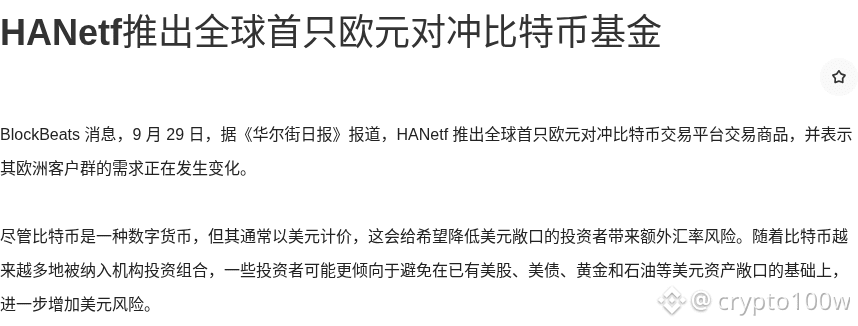
HANetf has launched the Arrow Bitcoin EUR Hedged ETC (EBTC), aiming to give European investors Bitcoin exposure while hedging the EUR–USD exchange-rate volatility. It’s said to be the world’s first euro-hedged Bitcoin ETC. Market interpretation is largely bullish on BTC and Europe’s demand for crypto ETPs: it reduces the exchange-rate noise when eurozone funds allocate to Bitcoin, making it more suitable for inclusion in traditional portfolios. In the short term, the price impact won’t be as directly tied to spot ETF net inflows—what matters most is EBTC’s subsequent trading activity, its asset size, and whether European institutions continue to buy. Are you more focused on the “reduction of exchange-rate fluctuations,” or more on how it could change European institutions’ allocation habits?
Source: BlockBeats
#BTC
Figure 1: HANetf launches a euro-hedged Bitcoin ETC · Source: partial screenshot of the page
Image source: https://www.theblockbeats.info/flash/369609
The eurozone wants to allocate to Bitcoin, but it also needs to hedge the impact of exchange-rate fluctuations first—this is very realistic.
HANetf has launched the Arrow Bitcoin EUR Hedged ETC (EBTC), aiming to give European investors Bitcoin exposure while hedging the EUR–USD exchange-rate volatility. It’s said to be the world’s first euro-hedged Bitcoin ETC. Market interpretation is largely bullish on BTC and Europe’s demand for crypto ETPs: it reduces the exchange-rate noise when eurozone funds allocate to Bitcoin, making it more suitable for inclusion in traditional portfolios. In the short term, the price impact won’t be as directly tied to spot ETF net inflows—what matters most is EBTC’s subsequent trading activity, its asset size, and whether European institutions continue to buy. Are you more focused on the “reduction of exchange-rate fluctuations,” or more on how it could change European institutions’ allocation habits?
Source: BlockBeats
#BTC
Figure 1: HANetf launches a euro-hedged Bitcoin ETC · Source: partial screenshot of the page
Image source: https://www.theblockbeats.info/flash/369609
HANetf has launched the Arrow Bitcoin EUR Hedged ETC (EBTC), aiming to give European investors Bitcoin exposure while hedging the EUR–USD exchange-rate volatility. It’s said to be the world’s first euro-hedged Bitcoin ETC. Market interpretation is largely bullish on BTC and Europe’s demand for crypto ETPs: it reduces the exchange-rate noise when eurozone funds allocate to Bitcoin, making it more suitable for inclusion in traditional portfolios. In the short term, the price impact won’t be as directly tied to spot ETF net inflows—what matters most is EBTC’s subsequent trading activity, its asset size, and whether European institutions continue to buy. Are you more focused on the “reduction of exchange-rate fluctuations,” or more on how it could change European institutions’ allocation habits?
Source: BlockBeats
#BTC
Figure 1: HANetf launches a euro-hedged Bitcoin ETC · Source: partial screenshot of the page
Image source: https://www.theblockbeats.info/flash/369609
4
·
--
SEC is moving forward with on-chain financing and tokenized securities regulation, and has already rolled out an Innovation Exemption. This isn’t flashy, but the direction is clear: the regulator’s interpretation is starting to shift from “restriction” toward “providing a path.”
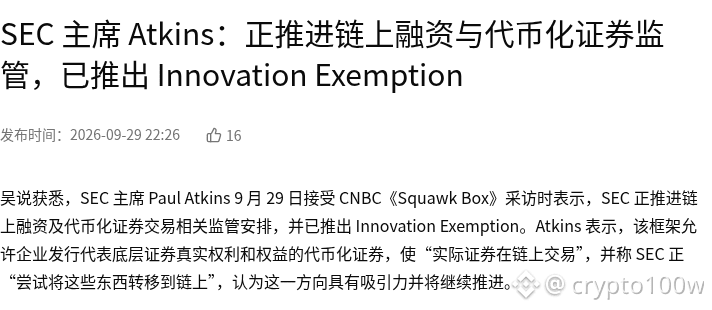
According to Wu, Paul Atkins said in an interview with CNBC’s “Squawk Box” on September 29 that this framework allows companies to issue tokenized securities—tokens that represent the real rights and interests of underlying securities—so that the “actual securities trade on-chain,” and the SEC is continuing to advance the related arrangements.
If this momentum keeps playing out, RWA, compliant stablecoins, and institutional-grade on-chain trading infrastructure may be repriced by the market sooner; but in the short term, everything still depends on platform applications, trading volumes, and the details of the rules. Are you more focused on this benefiting the RWA narrative first, or benefiting compliant trading infrastructure first?
Figure 1: SEC advances on-chain financing and tokenized securities regulation · Source page partial screenshot
Image source: https://www.wublock123.com/news/sec-chairman-atkins-advancing-on-chain-financing-and-tokenized-securities-regulation-has-launched-innovation-exertion-69221
SEC is moving forward with on-chain financing and tokenized securities regulation, and has already rolled out an Innovation Exemption. This isn’t flashy, but the direction is clear: the regulator’s interpretation is starting to shift from “restriction” toward “providing a path.”
According to Wu, Paul Atkins said in an interview with CNBC’s “Squawk Box” on September 29 that this framework allows companies to issue tokenized securities—tokens that represent the real rights and interests of underlying securities—so that the “actual securities trade on-chain,” and the SEC is continuing to advance the related arrangements.
If this momentum keeps playing out, RWA, compliant stablecoins, and institutional-grade on-chain trading infrastructure may be repriced by the market sooner; but in the short term, everything still depends on platform applications, trading volumes, and the details of the rules. Are you more focused on this benefiting the RWA narrative first, or benefiting compliant trading infrastructure first?
Figure 1: SEC advances on-chain financing and tokenized securities regulation · Source page partial screenshot
Image source: https://www.wublock123.com/news/sec-chairman-atkins-advancing-on-chain-financing-and-tokenized-securities-regulation-has-launched-innovation-exertion-69221
According to Wu, Paul Atkins said in an interview with CNBC’s “Squawk Box” on September 29 that this framework allows companies to issue tokenized securities—tokens that represent the real rights and interests of underlying securities—so that the “actual securities trade on-chain,” and the SEC is continuing to advance the related arrangements.
If this momentum keeps playing out, RWA, compliant stablecoins, and institutional-grade on-chain trading infrastructure may be repriced by the market sooner; but in the short term, everything still depends on platform applications, trading volumes, and the details of the rules. Are you more focused on this benefiting the RWA narrative first, or benefiting compliant trading infrastructure first?
Figure 1: SEC advances on-chain financing and tokenized securities regulation · Source page partial screenshot
Image source: https://www.wublock123.com/news/sec-chairman-atkins-advancing-on-chain-financing-and-tokenized-securities-regulation-has-launched-innovation-exertion-69221
26
·
--
Bitwise brings NEAR to the U.S. equity trading floor.
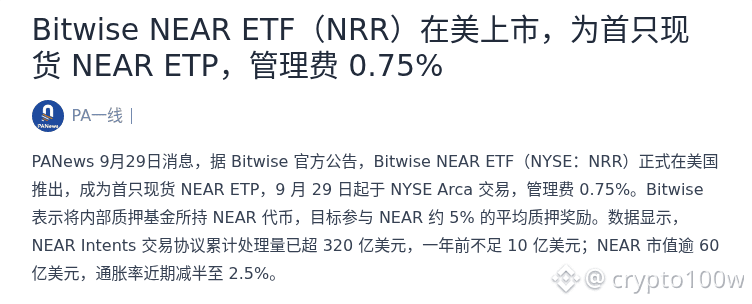
Bitwise’s NEAR ETF (NRR) began trading on NYSE Arca on September 29, becoming the first U.S. spot NEAR ETP. The management fee is 0.75%. Even more notably, the fund will pledge the NEAR tokens it holds internally, targeting participation in staking rewards averaging around 5%. For a spot ETP, this kind of design is uncommon.
The data is also moving in a favorable direction: the NEAR Intents trading protocol has cumulatively processed more than $32 billion, compared with less than $1 billion a year ago. NEAR’s market cap is over $6 billion, and its inflation rate has recently been cut in half to 2.5%.
The key highlights of this news are very clear. One is whether traditional capital can allocate NEAR more smoothly through the New York exchange. The other is whether internal staking and the halving of inflation can continue to improve the holding experience. In the short term, you also need to watch the sentiment volatility of “unlocking upon listing.” The real weight, however, will come down to NRR’s initial capital inflows, NEAR’s on-chain activity, and the staking participation rate. Are you more focused on the capital inflow after the market opens, or on the continuity of on-chain data?
Figure 1: Bitwise launches its first spot NEAR ETP with built-in staking and inflation halving · Source: a partial screenshot from the page
Image source: https://www.panewslab.com/zh/articles/01a0ed70-128c-7633-9bd7-9c16fb19d267
Bitwise brings NEAR to the U.S. equity trading floor.
Bitwise’s NEAR ETF (NRR) began trading on NYSE Arca on September 29, becoming the first U.S. spot NEAR ETP. The management fee is 0.75%. Even more notably, the fund will pledge the NEAR tokens it holds internally, targeting participation in staking rewards averaging around 5%. For a spot ETP, this kind of design is uncommon.
The data is also moving in a favorable direction: the NEAR Intents trading protocol has cumulatively processed more than $32 billion, compared with less than $1 billion a year ago. NEAR’s market cap is over $6 billion, and its inflation rate has recently been cut in half to 2.5%.
The key highlights of this news are very clear. One is whether traditional capital can allocate NEAR more smoothly through the New York exchange. The other is whether internal staking and the halving of inflation can continue to improve the holding experience. In the short term, you also need to watch the sentiment volatility of “unlocking upon listing.” The real weight, however, will come down to NRR’s initial capital inflows, NEAR’s on-chain activity, and the staking participation rate. Are you more focused on the capital inflow after the market opens, or on the continuity of on-chain data?
Figure 1: Bitwise launches its first spot NEAR ETP with built-in staking and inflation halving · Source: a partial screenshot from the page
Image source: https://www.panewslab.com/zh/articles/01a0ed70-128c-7633-9bd7-9c16fb19d267
Bitwise’s NEAR ETF (NRR) began trading on NYSE Arca on September 29, becoming the first U.S. spot NEAR ETP. The management fee is 0.75%. Even more notably, the fund will pledge the NEAR tokens it holds internally, targeting participation in staking rewards averaging around 5%. For a spot ETP, this kind of design is uncommon.
The data is also moving in a favorable direction: the NEAR Intents trading protocol has cumulatively processed more than $32 billion, compared with less than $1 billion a year ago. NEAR’s market cap is over $6 billion, and its inflation rate has recently been cut in half to 2.5%.
The key highlights of this news are very clear. One is whether traditional capital can allocate NEAR more smoothly through the New York exchange. The other is whether internal staking and the halving of inflation can continue to improve the holding experience. In the short term, you also need to watch the sentiment volatility of “unlocking upon listing.” The real weight, however, will come down to NRR’s initial capital inflows, NEAR’s on-chain activity, and the staking participation rate. Are you more focused on the capital inflow after the market opens, or on the continuity of on-chain data?
Figure 1: Bitwise launches its first spot NEAR ETP with built-in staking and inflation halving · Source: a partial screenshot from the page
Image source: https://www.panewslab.com/zh/articles/01a0ed70-128c-7633-9bd7-9c16fb19d267
152
·
--
Saylor has clarified Strategy’s “digital credit” logic.
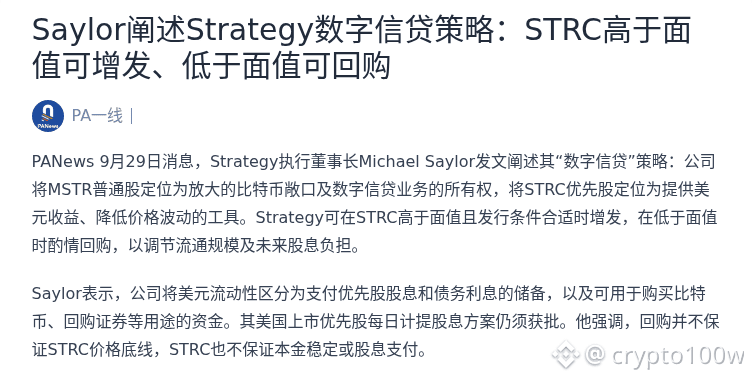
According to PANews, Michael Saylor, Executive Chairman of Strategy, said that MSTR common stock is positioned as ownership of a leveraged Bitcoin exposure and the digital credit business; while STRC preferred stock plays a role as an instrument to provide dollar returns and reduce price volatility. If STRC is issued above par with suitable terms, the company may issue additional shares; if issued below par, it may optionally repurchase.
He also mentioned that dollar liquidity would be allocated into a reserve for paying preferred stock dividends and debt interest, as well as funds that can be used for buying Bitcoin and repurchasing securities, etc. The daily accrual dividend scheme for the U.S.-listed preferred stock still requires approval. Saylor also made it clear that repurchases do not guarantee a floor price for STRC, and STRC also does not guarantee stable principal or dividend payments.
On one side, the company continues to build a financing framework to leave room for subsequent BTC purchases and the management of its capital structure; on the other, repurchases, additional share issuance, and their relationship to par value will directly affect how the market understands STRC. Which matters more to you: MSTR’s premium, or STRC’s performance relative to its par value?
Figure 1: Saylor explains Strategy’s digital credit strategy in detail · Source page partial screenshot
Image source: https://www.panewslab.com/zh/articles/01a0ed75-ef91-7506-b424-342788152101
Saylor has clarified Strategy’s “digital credit” logic.
According to PANews, Michael Saylor, Executive Chairman of Strategy, said that MSTR common stock is positioned as ownership of a leveraged Bitcoin exposure and the digital credit business; while STRC preferred stock plays a role as an instrument to provide dollar returns and reduce price volatility. If STRC is issued above par with suitable terms, the company may issue additional shares; if issued below par, it may optionally repurchase.
He also mentioned that dollar liquidity would be allocated into a reserve for paying preferred stock dividends and debt interest, as well as funds that can be used for buying Bitcoin and repurchasing securities, etc. The daily accrual dividend scheme for the U.S.-listed preferred stock still requires approval. Saylor also made it clear that repurchases do not guarantee a floor price for STRC, and STRC also does not guarantee stable principal or dividend payments.
On one side, the company continues to build a financing framework to leave room for subsequent BTC purchases and the management of its capital structure; on the other, repurchases, additional share issuance, and their relationship to par value will directly affect how the market understands STRC. Which matters more to you: MSTR’s premium, or STRC’s performance relative to its par value?
Figure 1: Saylor explains Strategy’s digital credit strategy in detail · Source page partial screenshot
Image source: https://www.panewslab.com/zh/articles/01a0ed75-ef91-7506-b424-342788152101
According to PANews, Michael Saylor, Executive Chairman of Strategy, said that MSTR common stock is positioned as ownership of a leveraged Bitcoin exposure and the digital credit business; while STRC preferred stock plays a role as an instrument to provide dollar returns and reduce price volatility. If STRC is issued above par with suitable terms, the company may issue additional shares; if issued below par, it may optionally repurchase.
He also mentioned that dollar liquidity would be allocated into a reserve for paying preferred stock dividends and debt interest, as well as funds that can be used for buying Bitcoin and repurchasing securities, etc. The daily accrual dividend scheme for the U.S.-listed preferred stock still requires approval. Saylor also made it clear that repurchases do not guarantee a floor price for STRC, and STRC also does not guarantee stable principal or dividend payments.
On one side, the company continues to build a financing framework to leave room for subsequent BTC purchases and the management of its capital structure; on the other, repurchases, additional share issuance, and their relationship to par value will directly affect how the market understands STRC. Which matters more to you: MSTR’s premium, or STRC’s performance relative to its par value?
Figure 1: Saylor explains Strategy’s digital credit strategy in detail · Source page partial screenshot
Image source: https://www.panewslab.com/zh/articles/01a0ed75-ef91-7506-b424-342788152101
61
·
--
US bond long-end yields continue to push against market expectations.
The yield on US 30-year Treasury bonds rose to 5.587%, reaching its highest level since May 2004. For risk assets like BTC and ETH, rising long-end rates increase the appeal of risk-free returns, and they also make valuation and discounting pressure heavier at the same time. Source: BlockBeats.
One thing to watch is that if yields stay elevated, it’s usually harder for capital to return to favoring overvalued assets. Another thing to watch is that if yields subsequently pull back, crypto assets will be more likely to regain momentum and see renewed sentiment. Which are you more focused on: whether BTC can first stabilize, or which way the US dollar and real yields are moving?
Figure 1: Long-end Treasury yields keep setting new highs · Source: partial screenshot of the page
Image source: https://www.theblockbeats.info/flash/369595
US bond long-end yields continue to push against market expectations.
The yield on US 30-year Treasury bonds rose to 5.587%, reaching its highest level since May 2004. For risk assets like BTC and ETH, rising long-end rates increase the appeal of risk-free returns, and they also make valuation and discounting pressure heavier at the same time. Source: BlockBeats.
One thing to watch is that if yields stay elevated, it’s usually harder for capital to return to favoring overvalued assets. Another thing to watch is that if yields subsequently pull back, crypto assets will be more likely to regain momentum and see renewed sentiment. Which are you more focused on: whether BTC can first stabilize, or which way the US dollar and real yields are moving?
Figure 1: Long-end Treasury yields keep setting new highs · Source: partial screenshot of the page
Image source: https://www.theblockbeats.info/flash/369595
The yield on US 30-year Treasury bonds rose to 5.587%, reaching its highest level since May 2004. For risk assets like BTC and ETH, rising long-end rates increase the appeal of risk-free returns, and they also make valuation and discounting pressure heavier at the same time. Source: BlockBeats.
One thing to watch is that if yields stay elevated, it’s usually harder for capital to return to favoring overvalued assets. Another thing to watch is that if yields subsequently pull back, crypto assets will be more likely to regain momentum and see renewed sentiment. Which are you more focused on: whether BTC can first stabilize, or which way the US dollar and real yields are moving?
Figure 1: Long-end Treasury yields keep setting new highs · Source: partial screenshot of the page
Image source: https://www.theblockbeats.info/flash/369595

31
·
--
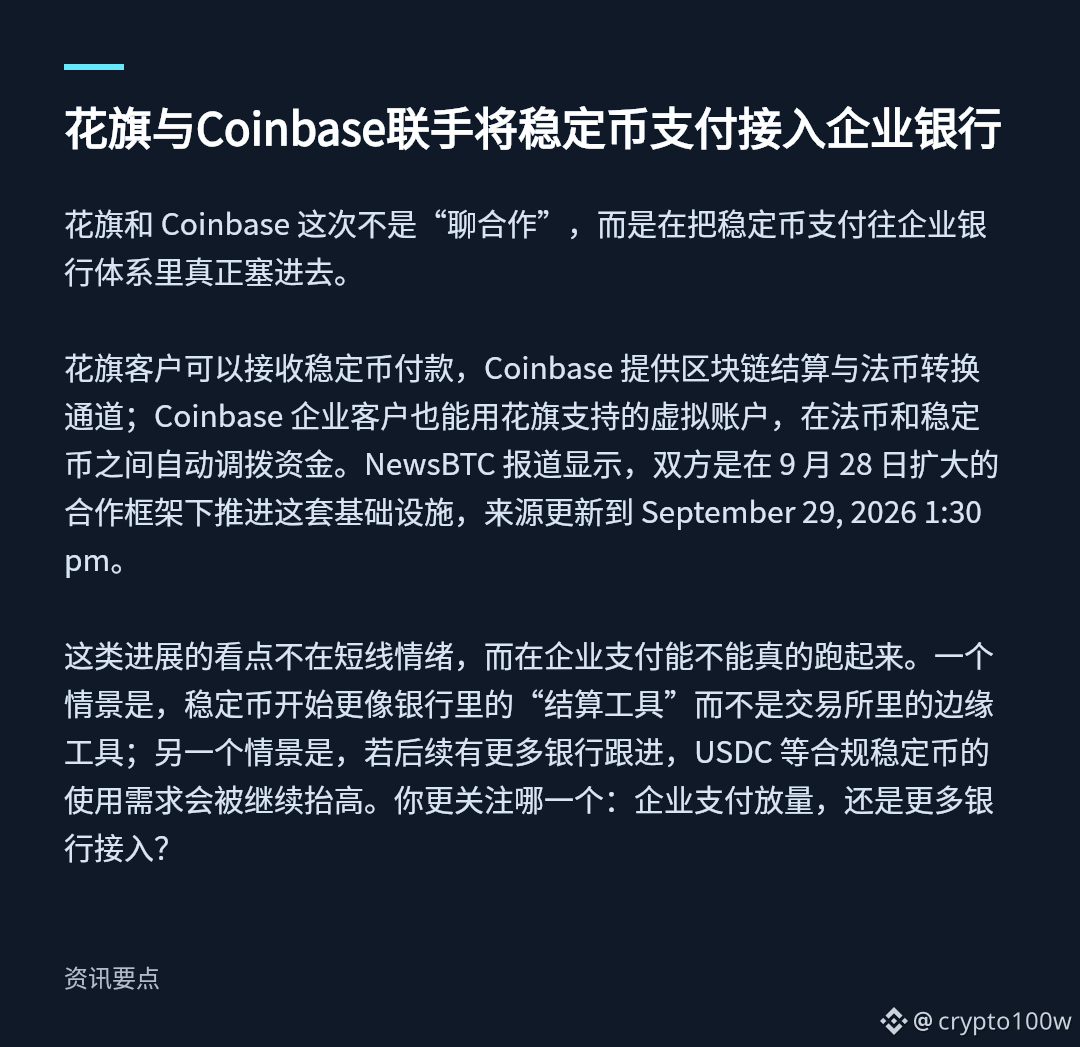
This time, Citigroup and Coinbase aren’t just “talking cooperation”—they’re actually putting stablecoin payments into corporate banking systems.
Citigroup customers can receive stablecoin payments, while Coinbase provides blockchain settlement and a fiat conversion channel; Coinbase’s corporate clients can also use virtual accounts supported by Citigroup to automatically transfer funds between fiat and stablecoins. According to NewsBTC, the two sides are moving forward with this infrastructure under an expanded cooperation framework dated September 28, and the source was updated to September 29, 2026 at 1:30 pm.
The appeal of these developments isn’t about short-term market sentiment—it’s whether corporate payments can truly get off the ground. One scenario is that stablecoins start to function more like a “settlement tool” inside banks rather than a peripheral tool on exchanges; another scenario is that if more banks follow suit, demand for compliant stablecoins like USDC will be further boosted. Which are you more interested in: corporate payments scaling up, or more banks integrating?
Figure 1: Citi and Coinbase team up to bring stablecoin payments into corporate banking · Key information
Image source: https://www.newsbtc.com/technology/citi-and-coinbase-bring-stablecoin-payments-into-corporate-banking/
This time, Citigroup and Coinbase aren’t just “talking cooperation”—they’re actually putting stablecoin payments into corporate banking systems.
Citigroup customers can receive stablecoin payments, while Coinbase provides blockchain settlement and a fiat conversion channel; Coinbase’s corporate clients can also use virtual accounts supported by Citigroup to automatically transfer funds between fiat and stablecoins. According to NewsBTC, the two sides are moving forward with this infrastructure under an expanded cooperation framework dated September 28, and the source was updated to September 29, 2026 at 1:30 pm.
The appeal of these developments isn’t about short-term market sentiment—it’s whether corporate payments can truly get off the ground. One scenario is that stablecoins start to function more like a “settlement tool” inside banks rather than a peripheral tool on exchanges; another scenario is that if more banks follow suit, demand for compliant stablecoins like USDC will be further boosted. Which are you more interested in: corporate payments scaling up, or more banks integrating?
Figure 1: Citi and Coinbase team up to bring stablecoin payments into corporate banking · Key information
Image source: https://www.newsbtc.com/technology/citi-and-coinbase-bring-stablecoin-payments-into-corporate-banking/
Citigroup customers can receive stablecoin payments, while Coinbase provides blockchain settlement and a fiat conversion channel; Coinbase’s corporate clients can also use virtual accounts supported by Citigroup to automatically transfer funds between fiat and stablecoins. According to NewsBTC, the two sides are moving forward with this infrastructure under an expanded cooperation framework dated September 28, and the source was updated to September 29, 2026 at 1:30 pm.
The appeal of these developments isn’t about short-term market sentiment—it’s whether corporate payments can truly get off the ground. One scenario is that stablecoins start to function more like a “settlement tool” inside banks rather than a peripheral tool on exchanges; another scenario is that if more banks follow suit, demand for compliant stablecoins like USDC will be further boosted. Which are you more interested in: corporate payments scaling up, or more banks integrating?
Figure 1: Citi and Coinbase team up to bring stablecoin payments into corporate banking · Key information
Image source: https://www.newsbtc.com/technology/citi-and-coinbase-bring-stablecoin-payments-into-corporate-banking/
222
·
--
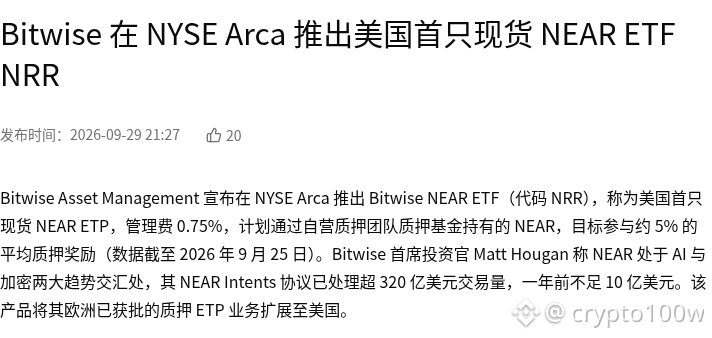
Bitwise directly pushes the U.S.’s first spot NEAR ETF onto the NYSE Arca, named the Bitwise NEAR ETF (NRR). The management fee is 0.75%. It positions itself as the first U.S. spot NEAR ETP and plans to reflect returns into the fund’s NAV through staking.
For NEAR, the significance is quite straightforward: the compliant buying channels have gained one more path, and NEAR’s “cross-chain transaction infrastructure” narrative is now being pushed to more institutions and broker accounts. If the market trades first on sentiment, chasing highs and premiums are more likely in the short term; if trading volume and subscription/redemption scale can’t keep up, the hype may also cool off, and there’s still uncertainty about whether post-listing profit-taking can be absorbed.
Matt Hougan says NEAR sits at the intersection of two big trends—AI and crypto. The NEAR Intents protocol has handled over $32 billion in transaction volume, whereas a year ago it was under $1 billion. Do you care more about the emotional boost this product brings, or about the subsequent NRR trading volume, subscription/redemption scale, and NEAR spot absorption strength?
Figure 1: Bitwise launches the U.S.’s first spot NEAR ETF · Source page partial screenshot
Image source: https://www.wublock123.com/news/bitwise-launches-us-first-spot-near-etf-nyse-arca-69216
Bitwise directly pushes the U.S.’s first spot NEAR ETF onto the NYSE Arca, named the Bitwise NEAR ETF (NRR). The management fee is 0.75%. It positions itself as the first U.S. spot NEAR ETP and plans to reflect returns into the fund’s NAV through staking.
For NEAR, the significance is quite straightforward: the compliant buying channels have gained one more path, and NEAR’s “cross-chain transaction infrastructure” narrative is now being pushed to more institutions and broker accounts. If the market trades first on sentiment, chasing highs and premiums are more likely in the short term; if trading volume and subscription/redemption scale can’t keep up, the hype may also cool off, and there’s still uncertainty about whether post-listing profit-taking can be absorbed.
Matt Hougan says NEAR sits at the intersection of two big trends—AI and crypto. The NEAR Intents protocol has handled over $32 billion in transaction volume, whereas a year ago it was under $1 billion. Do you care more about the emotional boost this product brings, or about the subsequent NRR trading volume, subscription/redemption scale, and NEAR spot absorption strength?
Figure 1: Bitwise launches the U.S.’s first spot NEAR ETF · Source page partial screenshot
Image source: https://www.wublock123.com/news/bitwise-launches-us-first-spot-near-etf-nyse-arca-69216
For NEAR, the significance is quite straightforward: the compliant buying channels have gained one more path, and NEAR’s “cross-chain transaction infrastructure” narrative is now being pushed to more institutions and broker accounts. If the market trades first on sentiment, chasing highs and premiums are more likely in the short term; if trading volume and subscription/redemption scale can’t keep up, the hype may also cool off, and there’s still uncertainty about whether post-listing profit-taking can be absorbed.
Matt Hougan says NEAR sits at the intersection of two big trends—AI and crypto. The NEAR Intents protocol has handled over $32 billion in transaction volume, whereas a year ago it was under $1 billion. Do you care more about the emotional boost this product brings, or about the subsequent NRR trading volume, subscription/redemption scale, and NEAR spot absorption strength?
Figure 1: Bitwise launches the U.S.’s first spot NEAR ETF · Source page partial screenshot
Image source: https://www.wublock123.com/news/bitwise-launches-us-first-spot-near-etf-nyse-arca-69216
86
·
--
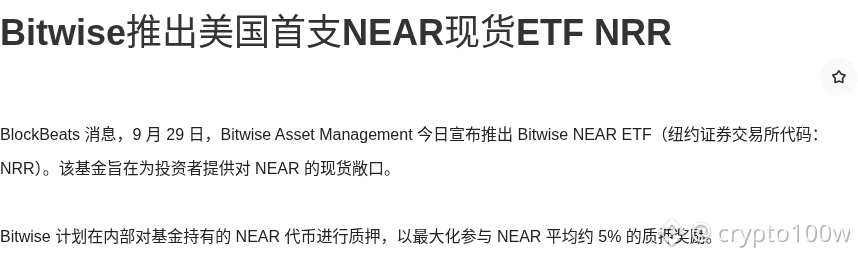
Bitwise directly pushed NEAR into the U.S. spot ETF track—the ticker is NRR, trading on NYSE Arca.
BlockBeats message, September 29: Bitwise Asset Management today announced the launch of the Bitwise NEAR ETF. The fund is designed to give investors spot exposure to NEAR, and it plans to internally stake the NEAR tokens held by the fund in order to maximize participation in NEAR’s average staking rewards of around 5%.
For the market, this is a signal that NEAR is being moved from simply trading and buying/selling to a compliant capital entry point; however, the attention brought by the ETF listing ultimately depends on whether NRR can continue to attract net inflows going forward. If there isn’t enough capital taking the baton, once the short-term hype cools off, the pullback pressure will be even more noticeable. Are you more focused on the institutional allocation imagination it brings, or more concerned about whether it can hold up net inflows?
Figure 1: Bitwise launches the first U.S. spot NEAR ETF · Source page partial screenshot
Image source: https://www.theblockbeats.info/flash/369593
Bitwise directly pushed NEAR into the U.S. spot ETF track—the ticker is NRR, trading on NYSE Arca.
BlockBeats message, September 29: Bitwise Asset Management today announced the launch of the Bitwise NEAR ETF. The fund is designed to give investors spot exposure to NEAR, and it plans to internally stake the NEAR tokens held by the fund in order to maximize participation in NEAR’s average staking rewards of around 5%.
For the market, this is a signal that NEAR is being moved from simply trading and buying/selling to a compliant capital entry point; however, the attention brought by the ETF listing ultimately depends on whether NRR can continue to attract net inflows going forward. If there isn’t enough capital taking the baton, once the short-term hype cools off, the pullback pressure will be even more noticeable. Are you more focused on the institutional allocation imagination it brings, or more concerned about whether it can hold up net inflows?
Figure 1: Bitwise launches the first U.S. spot NEAR ETF · Source page partial screenshot
Image source: https://www.theblockbeats.info/flash/369593
BlockBeats message, September 29: Bitwise Asset Management today announced the launch of the Bitwise NEAR ETF. The fund is designed to give investors spot exposure to NEAR, and it plans to internally stake the NEAR tokens held by the fund in order to maximize participation in NEAR’s average staking rewards of around 5%.
For the market, this is a signal that NEAR is being moved from simply trading and buying/selling to a compliant capital entry point; however, the attention brought by the ETF listing ultimately depends on whether NRR can continue to attract net inflows going forward. If there isn’t enough capital taking the baton, once the short-term hype cools off, the pullback pressure will be even more noticeable. Are you more focused on the institutional allocation imagination it brings, or more concerned about whether it can hold up net inflows?
Figure 1: Bitwise launches the first U.S. spot NEAR ETF · Source page partial screenshot
Image source: https://www.theblockbeats.info/flash/369593
170
·
--
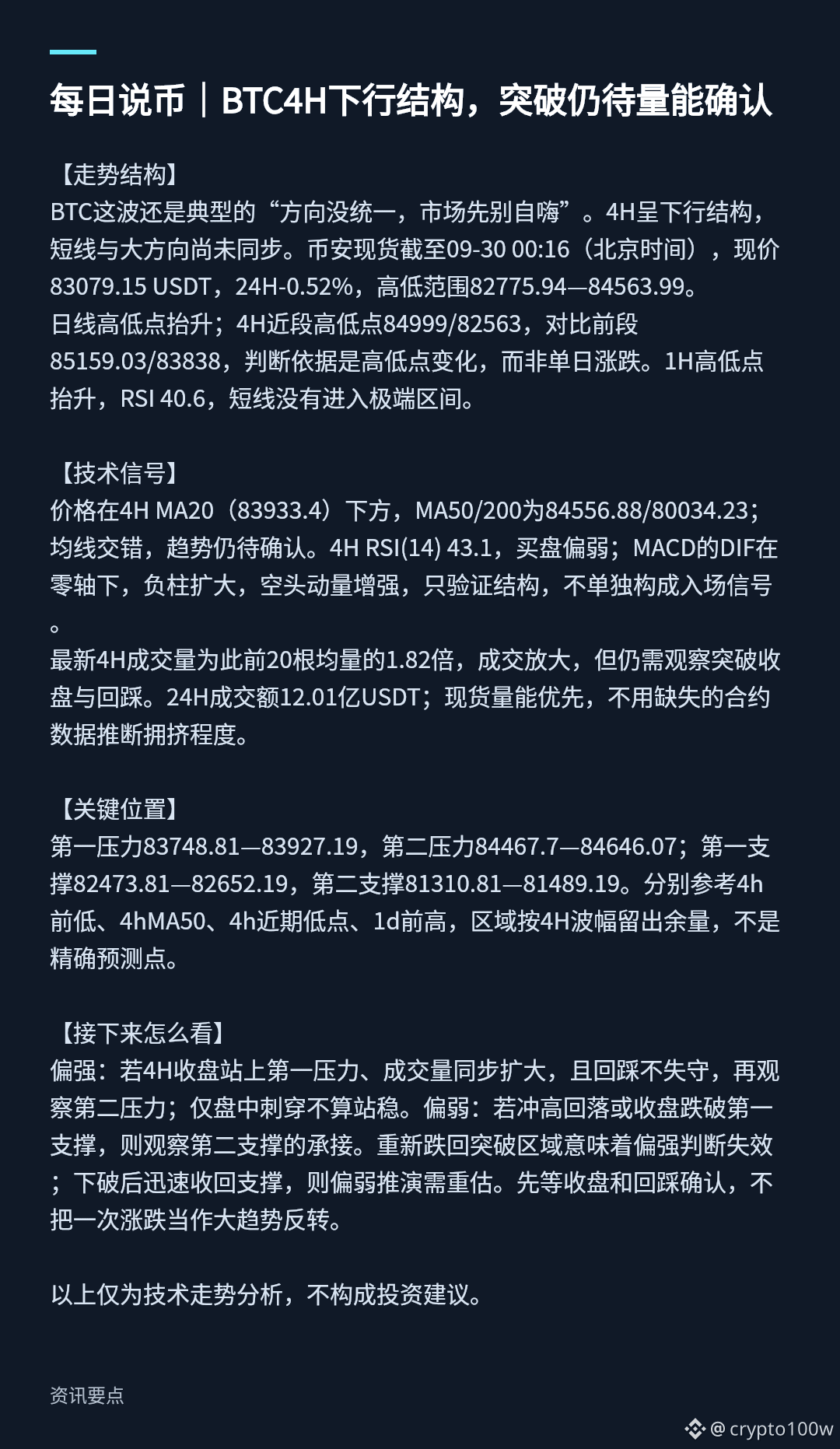
【Market Structure】
This BTC move is still a typical case of “directions not unified—don’t get too excited about the market first.” The 4H is in a downward structure, and the short-term and the bigger trend are not yet aligned. As of Binance Spot 09-30 00:16 (Beijing time), the current price is 83,079.15 USDT, down 0.52% over 24H, with a high-low range of 82,775.94—84,563.99.
On the daily chart, the high and low points are rising; on the 4H chart, the recent high/low points are 84,999/82,563. Compared with the prior segment’s 85,159.03/83,838, the judgment is based on changes in the highs/lows rather than a single day’s rise or fall. On the 1H chart, the high/low points are rising; RSI is 40.6, and the short term has not entered an extreme zone.
【Technical Signals】
Price is below the 4H MA20 (83,933.4). MA50/200 are 84,556.88/80,034.23; the moving averages are intertwined, and the trend still needs confirmation. 4H RSI(14) is 43.1, indicating the bid is weak. MACD’s DIF is below the zero axis, the negative histogram bars are expanding, and bearish momentum is increasing—this only validates the structure and does not, by itself, form an entry signal.
The latest 4H成交量 is 1.82 times the average volume of the previous 20 candles. Volume has expanded, but it still needs observation of a confirmed close and a successful retest. 24H trading value is 1.201 billion USDT; spot volume should be prioritized. Don’t infer crowding based on missing futures contract data.
【Key Levels】
First resistance: 83,748.81—83,927.19; second resistance: 84,467.7—84,646.07. First support: 82,473.81—82,652.19; second support: 81,310.81—81,489.19. Refer to the 4H prior low, 4H MA50, the recent 4H low, and the 1D prior high respectively. The zones allow some buffer based on the 4H swing range and are not precise prediction points.
【What to Watch Next】
Bullish: If the 4H closes above the first resistance with synchronized volume expansion, and the retest does not break down, then watch the second resistance. Piercing intraday alone does not count as holding.
Bearish: If the price spikes and then falls back, or if the close breaks below the first support, then watch how the second support holds. If price falls back into the breakout zone, the bullish view is invalid. After the breakdown, if support is quickly reclaimed, the bearish scenario needs to be reassessed. Wait first for the close and the retest confirmation—don’t treat a single rise/fall as a full trend reversal.
The above is only technical trend analysis and does not constitute investment advice.
【Market Structure】
This BTC move is still a typical case of “directions not unified—don’t get too excited about the market first.” The 4H is in a downward structure, and the short-term and the bigger trend are not yet aligned. As of Binance Spot 09-30 00:16 (Beijing time), the current price is 83,079.15 USDT, down 0.52% over 24H, with a high-low range of 82,775.94—84,563.99.
On the daily chart, the high and low points are rising; on the 4H chart, the recent high/low points are 84,999/82,563. Compared with the prior segment’s 85,159.03/83,838, the judgment is based on changes in the highs/lows rather than a single day’s rise or fall. On the 1H chart, the high/low points are rising; RSI is 40.6, and the short term has not entered an extreme zone.
【Technical Signals】
Price is below the 4H MA20 (83,933.4). MA50/200 are 84,556.88/80,034.23; the moving averages are intertwined, and the trend still needs confirmation. 4H RSI(14) is 43.1, indicating the bid is weak. MACD’s DIF is below the zero axis, the negative histogram bars are expanding, and bearish momentum is increasing—this only validates the structure and does not, by itself, form an entry signal.
The latest 4H成交量 is 1.82 times the average volume of the previous 20 candles. Volume has expanded, but it still needs observation of a confirmed close and a successful retest. 24H trading value is 1.201 billion USDT; spot volume should be prioritized. Don’t infer crowding based on missing futures contract data.
【Key Levels】
First resistance: 83,748.81—83,927.19; second resistance: 84,467.7—84,646.07. First support: 82,473.81—82,652.19; second support: 81,310.81—81,489.19. Refer to the 4H prior low, 4H MA50, the recent 4H low, and the 1D prior high respectively. The zones allow some buffer based on the 4H swing range and are not precise prediction points.
【What to Watch Next】
Bullish: If the 4H closes above the first resistance with synchronized volume expansion, and the retest does not break down, then watch the second resistance. Piercing intraday alone does not count as holding.
Bearish: If the price spikes and then falls back, or if the close breaks below the first support, then watch how the second support holds. If price falls back into the breakout zone, the bullish view is invalid. After the breakdown, if support is quickly reclaimed, the bearish scenario needs to be reassessed. Wait first for the close and the retest confirmation—don’t treat a single rise/fall as a full trend reversal.
The above is only technical trend analysis and does not constitute investment advice.
This BTC move is still a typical case of “directions not unified—don’t get too excited about the market first.” The 4H is in a downward structure, and the short-term and the bigger trend are not yet aligned. As of Binance Spot 09-30 00:16 (Beijing time), the current price is 83,079.15 USDT, down 0.52% over 24H, with a high-low range of 82,775.94—84,563.99.
On the daily chart, the high and low points are rising; on the 4H chart, the recent high/low points are 84,999/82,563. Compared with the prior segment’s 85,159.03/83,838, the judgment is based on changes in the highs/lows rather than a single day’s rise or fall. On the 1H chart, the high/low points are rising; RSI is 40.6, and the short term has not entered an extreme zone.
【Technical Signals】
Price is below the 4H MA20 (83,933.4). MA50/200 are 84,556.88/80,034.23; the moving averages are intertwined, and the trend still needs confirmation. 4H RSI(14) is 43.1, indicating the bid is weak. MACD’s DIF is below the zero axis, the negative histogram bars are expanding, and bearish momentum is increasing—this only validates the structure and does not, by itself, form an entry signal.
The latest 4H成交量 is 1.82 times the average volume of the previous 20 candles. Volume has expanded, but it still needs observation of a confirmed close and a successful retest. 24H trading value is 1.201 billion USDT; spot volume should be prioritized. Don’t infer crowding based on missing futures contract data.
【Key Levels】
First resistance: 83,748.81—83,927.19; second resistance: 84,467.7—84,646.07. First support: 82,473.81—82,652.19; second support: 81,310.81—81,489.19. Refer to the 4H prior low, 4H MA50, the recent 4H low, and the 1D prior high respectively. The zones allow some buffer based on the 4H swing range and are not precise prediction points.
【What to Watch Next】
Bullish: If the 4H closes above the first resistance with synchronized volume expansion, and the retest does not break down, then watch the second resistance. Piercing intraday alone does not count as holding.
Bearish: If the price spikes and then falls back, or if the close breaks below the first support, then watch how the second support holds. If price falls back into the breakout zone, the bullish view is invalid. After the breakdown, if support is quickly reclaimed, the bearish scenario needs to be reassessed. Wait first for the close and the retest confirmation—don’t treat a single rise/fall as a full trend reversal.
The above is only technical trend analysis and does not constitute investment advice.
106
·
--
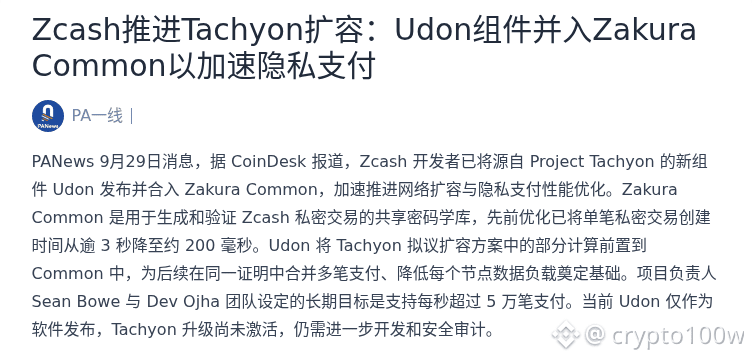
Zcash Advances Tachyon Scaling Component Udon
Zcash developers have integrated a new Tachyon-related component, Udon, into the Zakura Common, continuing to optimize the performance of private transaction generation and verification. They are also paving the way for future efforts to merge multiple payments into a single proof and reduce node data load. The market’s read leans bullish on ZEC: this is not merely a promotional update, but an engineering milestone in the privacy-payment scaling roadmap, strengthening Zcash’s position in the narrative of privacy coins and high-performance payments. On the trading front, if ZEC rides higher on the technology narrative, the key thing to watch is whether capital is willing to price “development progress” as an expectation for mainnet upgrades. In the short term, chasing rallies should still be cautious about the possibility that the upgrade rollout takes longer than expected, and that the Tachyon upgrade has not yet been activated and still requires further development and security audits, which could lead to pullbacks.
Source: PANews
#ZEC
Figure 1: Zcash advances the Tachyon scaling component Udon · Source page partial screenshot
Image source: https://www.panewslab.com/zh/articles/01a0ed36-913b-704c-bd09-79de7e4583ec
Zcash Advances Tachyon Scaling Component Udon
Zcash developers have integrated a new Tachyon-related component, Udon, into the Zakura Common, continuing to optimize the performance of private transaction generation and verification. They are also paving the way for future efforts to merge multiple payments into a single proof and reduce node data load. The market’s read leans bullish on ZEC: this is not merely a promotional update, but an engineering milestone in the privacy-payment scaling roadmap, strengthening Zcash’s position in the narrative of privacy coins and high-performance payments. On the trading front, if ZEC rides higher on the technology narrative, the key thing to watch is whether capital is willing to price “development progress” as an expectation for mainnet upgrades. In the short term, chasing rallies should still be cautious about the possibility that the upgrade rollout takes longer than expected, and that the Tachyon upgrade has not yet been activated and still requires further development and security audits, which could lead to pullbacks.
Source: PANews
#ZEC
Figure 1: Zcash advances the Tachyon scaling component Udon · Source page partial screenshot
Image source: https://www.panewslab.com/zh/articles/01a0ed36-913b-704c-bd09-79de7e4583ec
Zcash developers have integrated a new Tachyon-related component, Udon, into the Zakura Common, continuing to optimize the performance of private transaction generation and verification. They are also paving the way for future efforts to merge multiple payments into a single proof and reduce node data load. The market’s read leans bullish on ZEC: this is not merely a promotional update, but an engineering milestone in the privacy-payment scaling roadmap, strengthening Zcash’s position in the narrative of privacy coins and high-performance payments. On the trading front, if ZEC rides higher on the technology narrative, the key thing to watch is whether capital is willing to price “development progress” as an expectation for mainnet upgrades. In the short term, chasing rallies should still be cautious about the possibility that the upgrade rollout takes longer than expected, and that the Tachyon upgrade has not yet been activated and still requires further development and security audits, which could lead to pullbacks.
Source: PANews
#ZEC
Figure 1: Zcash advances the Tachyon scaling component Udon · Source page partial screenshot
Image source: https://www.panewslab.com/zh/articles/01a0ed36-913b-704c-bd09-79de7e4583ec
388
·
--
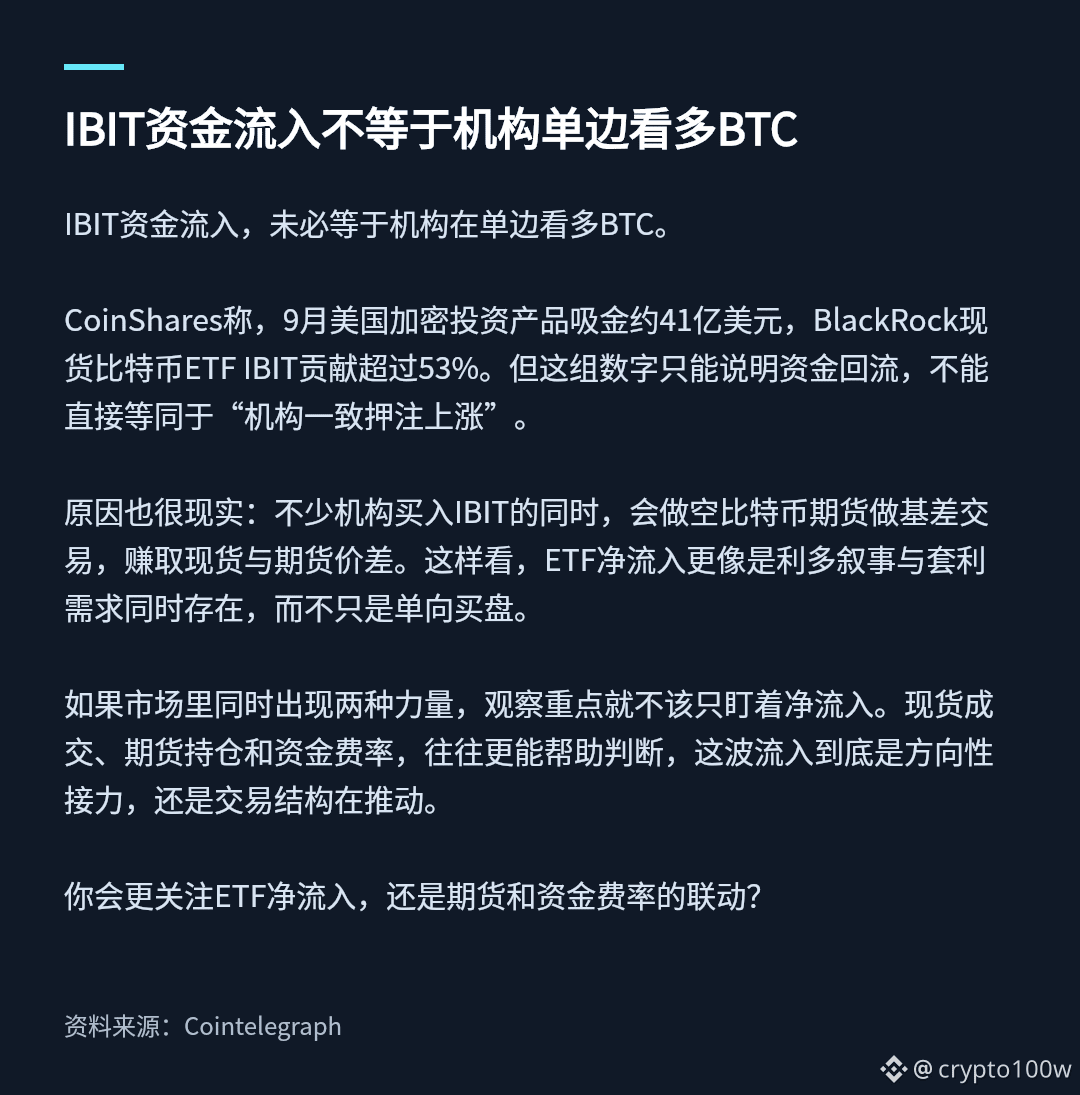
IBIT inflows don’t necessarily mean institutions are unanimously bullish on BTC in one direction.
CoinShares said that in September, U.S. crypto investment products attracted about $4.1 billion, with BlackRock’s spot Bitcoin ETF IBIT contributing more than 53%. But this set of numbers only indicates capital flowing back; it cannot directly be equated with “institutions all betting on an upside move.”
The reason is also straightforward: while some institutions buy IBIT, they may simultaneously short Bitcoin futures to run a basis trade and profit from the price difference between spot and futures. In that light, ETF net inflows look more like the coexistence of a bullish narrative and arbitrage demand—not just one-way buying.
If two forces are present in the market at the same time, what you should focus on shouldn’t be solely net inflows. Spot trading, futures positions, and funding rates often help you better judge whether this inflow is acting as directional momentum—or whether market structure and trading strategies are driving it.
Which would you pay more attention to: ETF net inflows, or the linkage between futures and funding rates?
Figure 1: IBIT inflows ≠ institutions going long BTC in one direction · Key news points
Image source: https://cointelegraph.com/markets/bitcoin-etf-mixed-read-institutional-demand-coinshares?utm_source=rss_feed&utm_medium=rss&utm_campaign=rss_partner_inbound
IBIT inflows don’t necessarily mean institutions are unanimously bullish on BTC in one direction.
CoinShares said that in September, U.S. crypto investment products attracted about $4.1 billion, with BlackRock’s spot Bitcoin ETF IBIT contributing more than 53%. But this set of numbers only indicates capital flowing back; it cannot directly be equated with “institutions all betting on an upside move.”
The reason is also straightforward: while some institutions buy IBIT, they may simultaneously short Bitcoin futures to run a basis trade and profit from the price difference between spot and futures. In that light, ETF net inflows look more like the coexistence of a bullish narrative and arbitrage demand—not just one-way buying.
If two forces are present in the market at the same time, what you should focus on shouldn’t be solely net inflows. Spot trading, futures positions, and funding rates often help you better judge whether this inflow is acting as directional momentum—or whether market structure and trading strategies are driving it.
Which would you pay more attention to: ETF net inflows, or the linkage between futures and funding rates?
Figure 1: IBIT inflows ≠ institutions going long BTC in one direction · Key news points
Image source: https://cointelegraph.com/markets/bitcoin-etf-mixed-read-institutional-demand-coinshares?utm_source=rss_feed&utm_medium=rss&utm_campaign=rss_partner_inbound
CoinShares said that in September, U.S. crypto investment products attracted about $4.1 billion, with BlackRock’s spot Bitcoin ETF IBIT contributing more than 53%. But this set of numbers only indicates capital flowing back; it cannot directly be equated with “institutions all betting on an upside move.”
The reason is also straightforward: while some institutions buy IBIT, they may simultaneously short Bitcoin futures to run a basis trade and profit from the price difference between spot and futures. In that light, ETF net inflows look more like the coexistence of a bullish narrative and arbitrage demand—not just one-way buying.
If two forces are present in the market at the same time, what you should focus on shouldn’t be solely net inflows. Spot trading, futures positions, and funding rates often help you better judge whether this inflow is acting as directional momentum—or whether market structure and trading strategies are driving it.
Which would you pay more attention to: ETF net inflows, or the linkage between futures and funding rates?
Figure 1: IBIT inflows ≠ institutions going long BTC in one direction · Key news points
Image source: https://cointelegraph.com/markets/bitcoin-etf-mixed-read-institutional-demand-coinshares?utm_source=rss_feed&utm_medium=rss&utm_campaign=rss_partner_inbound
BTC+0.28%
IBITETF-0.31%
158
·
--
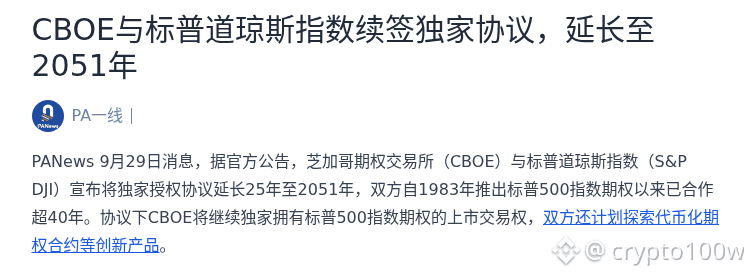
CBOE Renews Partnership and Explores Tokenized Options
CBOE and S&P Dow Jones Indices have extended their exclusive licensing agreement by 25 years, to 2051. CBOE will continue to exclusively list and trade S&P 500 index options, and both sides also plan to explore new products such as tokenized options contracts. The market narrative is largely bullish toward institutional-grade on-chain finance and tokenized derivatives, but there is no directly corresponding tradable crypto token. SPX options are among the most important traditional derivatives in the world; if a tokenized version emerges in the future, the key impacts would likely be on settlement efficiency, collateral usage, and 24/7 trading environments. Another highlight is that compliant RWA, on-chain derivatives, and institutional trading infrastructure may be more worth tracking than “coin-price catalysts.” Are you more interested in the settlement efficiency of tokenized options, or the 24/7 trading scenario?
Source: PANews
Figure 1: CBOE Renews Partnership and Explores Tokenized Options · Partial screenshot of the source page
Image source: https://www.panewslab.com/zh/articles/01a0ed1f-2a93-7742-a7d2-db8ef875ce6b
CBOE Renews Partnership and Explores Tokenized Options
CBOE and S&P Dow Jones Indices have extended their exclusive licensing agreement by 25 years, to 2051. CBOE will continue to exclusively list and trade S&P 500 index options, and both sides also plan to explore new products such as tokenized options contracts. The market narrative is largely bullish toward institutional-grade on-chain finance and tokenized derivatives, but there is no directly corresponding tradable crypto token. SPX options are among the most important traditional derivatives in the world; if a tokenized version emerges in the future, the key impacts would likely be on settlement efficiency, collateral usage, and 24/7 trading environments. Another highlight is that compliant RWA, on-chain derivatives, and institutional trading infrastructure may be more worth tracking than “coin-price catalysts.” Are you more interested in the settlement efficiency of tokenized options, or the 24/7 trading scenario?
Source: PANews
Figure 1: CBOE Renews Partnership and Explores Tokenized Options · Partial screenshot of the source page
Image source: https://www.panewslab.com/zh/articles/01a0ed1f-2a93-7742-a7d2-db8ef875ce6b
CBOE and S&P Dow Jones Indices have extended their exclusive licensing agreement by 25 years, to 2051. CBOE will continue to exclusively list and trade S&P 500 index options, and both sides also plan to explore new products such as tokenized options contracts. The market narrative is largely bullish toward institutional-grade on-chain finance and tokenized derivatives, but there is no directly corresponding tradable crypto token. SPX options are among the most important traditional derivatives in the world; if a tokenized version emerges in the future, the key impacts would likely be on settlement efficiency, collateral usage, and 24/7 trading environments. Another highlight is that compliant RWA, on-chain derivatives, and institutional trading infrastructure may be more worth tracking than “coin-price catalysts.” Are you more interested in the settlement efficiency of tokenized options, or the 24/7 trading scenario?
Source: PANews
Figure 1: CBOE Renews Partnership and Explores Tokenized Options · Partial screenshot of the source page
Image source: https://www.panewslab.com/zh/articles/01a0ed1f-2a93-7742-a7d2-db8ef875ce6b
288
Log in to explore more content
Join global crypto users on Binance Square
⚡️ Get latest and useful information about crypto.
💬 Trusted by the world’s largest crypto exchange.
👍 Discover real insights from verified creators.
Email / Phone number
Trending Topics
ChainlinkLaunchesBankSWIFTLedgerFramework
74 views
15 Discussing
🚨 BREAKING: Chainlink x SWIFT — Bank Ledger Framework Launched!
Massive step for tokenized banking!
Chainlink announced on Sept 28 that it will connect bank systems and signing infrastructure to SWIFT's blockchain ledger through its platform.
Key Points:
CRE lets institutions retain transaction signing keys while orchestrating workflows that access SWIFT's shared ledger SWIFT's ledger supports 24/7 tokenized deposit payments while final settlement continues through existing mechanisms Seventeen banks across six continents are preparing live pilots using tokenized deposits Banks include ANZ, HSBC, Citibank, Standard Chartered, and UBS Framework uses self-signing model — keys stay with bank, Chainlink Runtime Environment (CRE) coordinates workflowSWIFT connects more than 11,500 financial institutions across 200 marketsAnnounced at Sibos 2026 alongside CCIP 2.0
This positions Chainlink as the bridge between traditional banks and on-chain payments.
$LINK $XRP $HBAR $ONDO
#Chainlink #SWIFT #LINK #Tokenization #RWA #Banking #earningseason #chainlinklaunchesbankswiftledgerframework
True News
·0 Likes
·2 views
EarningsSeason
406,148 views
3,088 Discussing
SECChairWantsStockMarketsOnChain
2,930 views
120 Discussing