

#goatflow
goatflow
305 views
6 Discussing
Hot
Latest

·
--
Recently, banks have made it clear: AI has already started placing orders and paying on someone’s behalf—but if the purchase is wrong, the current payment systems can’t correctly match responsibility. A person might click the wrong thing and still know who to argue with; an agent completes the deal within its budget—yet the user never confirmed at the time, and the merchant can’t produce any proof of intent at that moment. The money is paid, but the books can’t explain it. After the fact, refunds rely on memory and logs; that’s where things stop working.
@GOATNetwork is aiming to fix exactly this. It isn’t just adding another layer of customer support—it embeds evidence, identity, authorization, and settlement for the whole aftercare process directly into the act of payment.
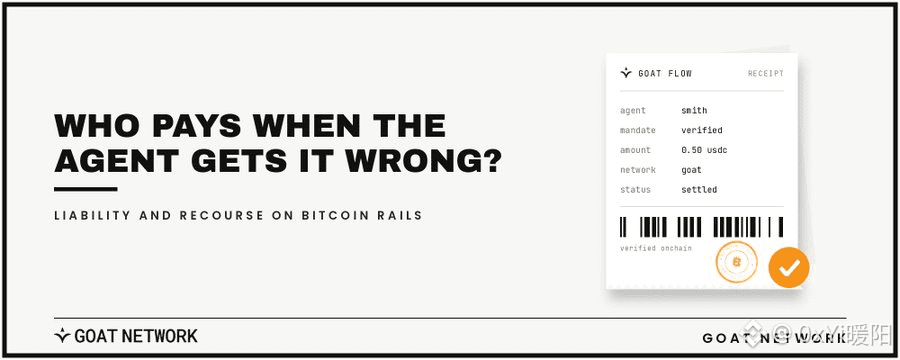
Every GOAT Flow leaves an on-chain receipt: what was authorized at the time, what the agent did, who received the payment, and when settlement occurred. If something goes wrong, you check the record—you don’t have to reconstruct everything later.
Agents also have on-chain identity and a track record. When paying, they will indicate who they are. If they can be identified and verified, responsibility can actually be pinned down. The user’s budget and boundaries are written into rules first, and before any money moves, it’s verified whether the agent is acting within authority.
Even the closing of the case follows the rules. It’s not a hard rollback of the original transaction. You can escrow first, verify, then release funds. If you need a refund, you do it through another receipt-backed payment. Settlement lands on Bitcoin, so the ledger can’t be changed; what’s truly used to resolve things is the agreement written in advance.
This is crucial for agents. If a person gets scammed, they can still call and pressure someone. Agents don’t have that luxury—what they can rely on are the identity, permissions, receipts, and rules written into the workflow. When banks ask, “If the agent bought the wrong thing, who should pay?”, GOAT Network’s answer is straightforward: evidence points to whoever, and that party is responsible. The key is that the evidence exists from the start, not something added later.
This system is already running now. Merchants can do business with agents this way, and teams that handle identity, escrow, and verification can also plug in. What GOAT Network wants to say isn’t to add yet another set of principles—it’s that responsibility must be written into the payment itself, or the whole thing won’t hold up.
#GOATNetwork #GOATFlow #BTC #AI #AIAgents
Recently, banks have made it clear: AI has already started placing orders and paying on someone’s behalf—but if the purchase is wrong, the current payment systems can’t correctly match responsibility. A person might click the wrong thing and still know who to argue with; an agent completes the deal within its budget—yet the user never confirmed at the time, and the merchant can’t produce any proof of intent at that moment. The money is paid, but the books can’t explain it. After the fact, refunds rely on memory and logs; that’s where things stop working.
@GOATNetwork is aiming to fix exactly this. It isn’t just adding another layer of customer support—it embeds evidence, identity, authorization, and settlement for the whole aftercare process directly into the act of payment.
Every GOAT Flow leaves an on-chain receipt: what was authorized at the time, what the agent did, who received the payment, and when settlement occurred. If something goes wrong, you check the record—you don’t have to reconstruct everything later.
Agents also have on-chain identity and a track record. When paying, they will indicate who they are. If they can be identified and verified, responsibility can actually be pinned down. The user’s budget and boundaries are written into rules first, and before any money moves, it’s verified whether the agent is acting within authority.
Even the closing of the case follows the rules. It’s not a hard rollback of the original transaction. You can escrow first, verify, then release funds. If you need a refund, you do it through another receipt-backed payment. Settlement lands on Bitcoin, so the ledger can’t be changed; what’s truly used to resolve things is the agreement written in advance.
This is crucial for agents. If a person gets scammed, they can still call and pressure someone. Agents don’t have that luxury—what they can rely on are the identity, permissions, receipts, and rules written into the workflow. When banks ask, “If the agent bought the wrong thing, who should pay?”, GOAT Network’s answer is straightforward: evidence points to whoever, and that party is responsible. The key is that the evidence exists from the start, not something added later.
This system is already running now. Merchants can do business with agents this way, and teams that handle identity, escrow, and verification can also plug in. What GOAT Network wants to say isn’t to add yet another set of principles—it’s that responsibility must be written into the payment itself, or the whole thing won’t hold up.
#GOATNetwork #GOATFlow #BTC #AI #AIAgents
@GOATNetwork is aiming to fix exactly this. It isn’t just adding another layer of customer support—it embeds evidence, identity, authorization, and settlement for the whole aftercare process directly into the act of payment.
Every GOAT Flow leaves an on-chain receipt: what was authorized at the time, what the agent did, who received the payment, and when settlement occurred. If something goes wrong, you check the record—you don’t have to reconstruct everything later.
Agents also have on-chain identity and a track record. When paying, they will indicate who they are. If they can be identified and verified, responsibility can actually be pinned down. The user’s budget and boundaries are written into rules first, and before any money moves, it’s verified whether the agent is acting within authority.
Even the closing of the case follows the rules. It’s not a hard rollback of the original transaction. You can escrow first, verify, then release funds. If you need a refund, you do it through another receipt-backed payment. Settlement lands on Bitcoin, so the ledger can’t be changed; what’s truly used to resolve things is the agreement written in advance.
This is crucial for agents. If a person gets scammed, they can still call and pressure someone. Agents don’t have that luxury—what they can rely on are the identity, permissions, receipts, and rules written into the workflow. When banks ask, “If the agent bought the wrong thing, who should pay?”, GOAT Network’s answer is straightforward: evidence points to whoever, and that party is responsible. The key is that the evidence exists from the start, not something added later.
This system is already running now. Merchants can do business with agents this way, and teams that handle identity, escrow, and verification can also plug in. What GOAT Network wants to say isn’t to add yet another set of principles—it’s that responsibility must be written into the payment itself, or the whole thing won’t hold up.
#GOATNetwork #GOATFlow #BTC #AI #AIAgents
173
·
--
Agent-based commerce has been brought up frequently lately: in the future, shopping may not be about people personally browsing and clicking, but about handing their needs and wallets to AI—so it can compare prices, place orders, and pay. It sounds far off, but GOAT Network’s messaging these days is very direct: while others are still talking about the future, they’ve already built the checkout counter.
✨@GOATNetwork is building an infrastructure layer backed by Bitcoin settlement. What it focuses on right now is GOAT Flow. The core idea is simple: open a door for merchants. Stores don’t need major changes—within minutes, they can sell to both humans and agents. For agents to shop, they first need to understand the shelves, and then be able to afford the bill.
GOAT Flow does these two things: it makes the store machine-readable, and it connects both bank cards and cryptocurrencies. Funds go directly into the merchant’s wallet; the platform doesn’t hold or intermediate the money. Orders include receipts, making them harder to cancel arbitrarily. Settlement is built on top of a Bitcoin-based system that’s harder to be rewritten unilaterally for security reasons—this is especially crucial for high-frequency, agent-to-agent transactions where the parties never meet.
So GOAT Network isn’t just saying “AI will shop.” Instead, it’s addressing a gap that exists right now: agents have already started helping people buy things, but most merchants can’t be understood by them, and they can’t be paid by them. GOAT Flow turns stores into places that agents can enter and check out. The gift card platform is an extension of the same concept—giving agents an entry point to buy real-world goods.
🎉Congratulations to GOAT Network for becoming a KBW2026 diamond sponsor.
KBW is a conference in Asia that is quite representative of industry trends. This means Bitcoin settlement—selling inventory to AI agents—has been placed on the main stage for both payments and on-chain applications. They’re no longer just discussing concepts; they’re being treated as deployable digital-economy infrastructure.
Looking one step further, GOAT Network isn’t only thinking about humans letting agents place orders. In the future, payments between agents will also need to involve identity and reputation, with API, data, and service purchased on a per-use basis. That layer is closer to future internet payment protocols. For now, GOAT Network is first laying the most practical one: stores can be seen, money can be collected, and the coverage gradually expands.
⭐️When everyone is talking about the future of agent-based commerce, @GOATNetwork has already built the usable part.
#GOATNetwork #GOATFlow #BTC #Aİ #AIAgents
Agent-based commerce has been brought up frequently lately: in the future, shopping may not be about people personally browsing and clicking, but about handing their needs and wallets to AI—so it can compare prices, place orders, and pay. It sounds far off, but GOAT Network’s messaging these days is very direct: while others are still talking about the future, they’ve already built the checkout counter.
✨@GOATNetwork is building an infrastructure layer backed by Bitcoin settlement. What it focuses on right now is GOAT Flow. The core idea is simple: open a door for merchants. Stores don’t need major changes—within minutes, they can sell to both humans and agents. For agents to shop, they first need to understand the shelves, and then be able to afford the bill.
GOAT Flow does these two things: it makes the store machine-readable, and it connects both bank cards and cryptocurrencies. Funds go directly into the merchant’s wallet; the platform doesn’t hold or intermediate the money. Orders include receipts, making them harder to cancel arbitrarily. Settlement is built on top of a Bitcoin-based system that’s harder to be rewritten unilaterally for security reasons—this is especially crucial for high-frequency, agent-to-agent transactions where the parties never meet.
So GOAT Network isn’t just saying “AI will shop.” Instead, it’s addressing a gap that exists right now: agents have already started helping people buy things, but most merchants can’t be understood by them, and they can’t be paid by them. GOAT Flow turns stores into places that agents can enter and check out. The gift card platform is an extension of the same concept—giving agents an entry point to buy real-world goods.
🎉Congratulations to GOAT Network for becoming a KBW2026 diamond sponsor.
KBW is a conference in Asia that is quite representative of industry trends. This means Bitcoin settlement—selling inventory to AI agents—has been placed on the main stage for both payments and on-chain applications. They’re no longer just discussing concepts; they’re being treated as deployable digital-economy infrastructure.
Looking one step further, GOAT Network isn’t only thinking about humans letting agents place orders. In the future, payments between agents will also need to involve identity and reputation, with API, data, and service purchased on a per-use basis. That layer is closer to future internet payment protocols. For now, GOAT Network is first laying the most practical one: stores can be seen, money can be collected, and the coverage gradually expands.
⭐️When everyone is talking about the future of agent-based commerce, @GOATNetwork has already built the usable part.
#GOATNetwork #GOATFlow #BTC #Aİ #AIAgents
✨@GOATNetwork is building an infrastructure layer backed by Bitcoin settlement. What it focuses on right now is GOAT Flow. The core idea is simple: open a door for merchants. Stores don’t need major changes—within minutes, they can sell to both humans and agents. For agents to shop, they first need to understand the shelves, and then be able to afford the bill.
GOAT Flow does these two things: it makes the store machine-readable, and it connects both bank cards and cryptocurrencies. Funds go directly into the merchant’s wallet; the platform doesn’t hold or intermediate the money. Orders include receipts, making them harder to cancel arbitrarily. Settlement is built on top of a Bitcoin-based system that’s harder to be rewritten unilaterally for security reasons—this is especially crucial for high-frequency, agent-to-agent transactions where the parties never meet.
So GOAT Network isn’t just saying “AI will shop.” Instead, it’s addressing a gap that exists right now: agents have already started helping people buy things, but most merchants can’t be understood by them, and they can’t be paid by them. GOAT Flow turns stores into places that agents can enter and check out. The gift card platform is an extension of the same concept—giving agents an entry point to buy real-world goods.
🎉Congratulations to GOAT Network for becoming a KBW2026 diamond sponsor.
KBW is a conference in Asia that is quite representative of industry trends. This means Bitcoin settlement—selling inventory to AI agents—has been placed on the main stage for both payments and on-chain applications. They’re no longer just discussing concepts; they’re being treated as deployable digital-economy infrastructure.
Looking one step further, GOAT Network isn’t only thinking about humans letting agents place orders. In the future, payments between agents will also need to involve identity and reputation, with API, data, and service purchased on a per-use basis. That layer is closer to future internet payment protocols. For now, GOAT Network is first laying the most practical one: stores can be seen, money can be collected, and the coverage gradually expands.
⭐️When everyone is talking about the future of agent-based commerce, @GOATNetwork has already built the usable part.
#GOATNetwork #GOATFlow #BTC #Aİ #AIAgents

222
·
--
AI Agents are already starting to find products and pay on their own, and what merchants lack is a payment channel that can be discovered by machines and send money directly to a wallet. @GOATNetwork has recently been pushing this hard, while also advancing the security of Bitcoin at the base layer.
🔶The product focus is GOAT Flow.
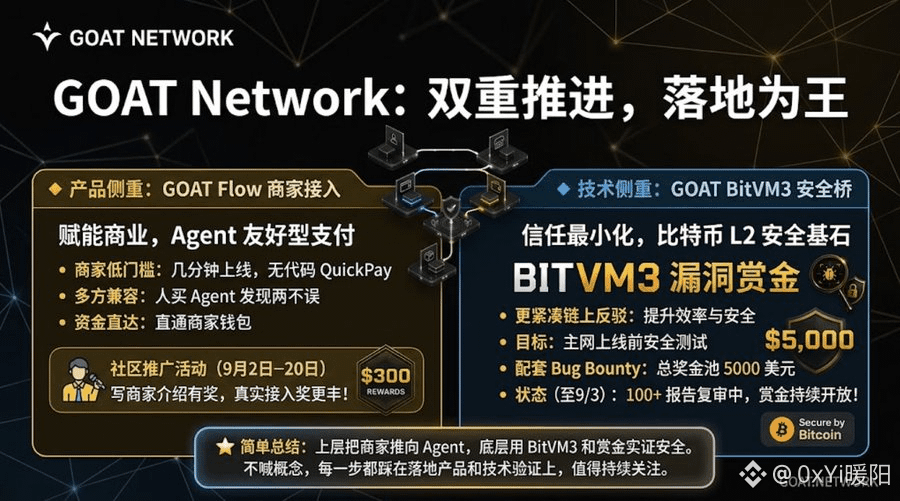
It keeps the onboarding barrier for merchants very low: with QuickPay, basically no coding is needed, and you can go live in minutes. The product and payment page can simultaneously let people buy, and also let AI Agents discover and pay, with funds going directly to the merchant's wallet.
To bring real businesses on board, they also launched a community promotion campaign (Sep 2–20): write original introductions for real merchants, and quality content earns a small reward; if the merchant actually integrates, there is an even higher-tier reward.
🔶The technical focus is GOAT BitVM3.
This is a trust-minimized bridge connecting Bitcoin and the GOAT network: disputes try to avoid full verification on Bitcoin script, instead settling through more compact on-chain refutations, with the goal of strengthening security before mainnet launch.
The accompanying BitVM3 Bug Bounty has a total prize pool of $5,000, with rewards based on severity and reproducibility.
The campaign started around August 18 and lasts one month.
By September 3, the first batch had already received more than 100 reports. The team is in final review, and the exact number, discovery categories, and this round's prize breakdown have not yet been announced; the bounty is still open, and people in security, cryptography, and smart contracts can continue submitting.
🔶In addition, they also released a plain-language explanation of SHRINCS, a post-quantum Bitcoin signature scheme, as a research-oriented supplement.
⭐️Simple summary: at the application layer, they are genuinely pushing merchant payments toward Agents; at the infrastructure layer, they are using BitVM3 and a public bounty to expose the security of the Bitcoin bridge to community scrutiny. GOAT Network is not just talking about concepts—it is grounding every step in live products and technical validation, and it is worth continuing to watch.
LFGoat 🚀
#GOATNetwork #GOATFlow #BitVM3 #AI #AIAgents
AI Agents are already starting to find products and pay on their own, and what merchants lack is a payment channel that can be discovered by machines and send money directly to a wallet. @GOATNetwork has recently been pushing this hard, while also advancing the security of Bitcoin at the base layer.
🔶The product focus is GOAT Flow.
It keeps the onboarding barrier for merchants very low: with QuickPay, basically no coding is needed, and you can go live in minutes. The product and payment page can simultaneously let people buy, and also let AI Agents discover and pay, with funds going directly to the merchant's wallet.
To bring real businesses on board, they also launched a community promotion campaign (Sep 2–20): write original introductions for real merchants, and quality content earns a small reward; if the merchant actually integrates, there is an even higher-tier reward.
🔶The technical focus is GOAT BitVM3.
This is a trust-minimized bridge connecting Bitcoin and the GOAT network: disputes try to avoid full verification on Bitcoin script, instead settling through more compact on-chain refutations, with the goal of strengthening security before mainnet launch.
The accompanying BitVM3 Bug Bounty has a total prize pool of $5,000, with rewards based on severity and reproducibility.
The campaign started around August 18 and lasts one month.
By September 3, the first batch had already received more than 100 reports. The team is in final review, and the exact number, discovery categories, and this round's prize breakdown have not yet been announced; the bounty is still open, and people in security, cryptography, and smart contracts can continue submitting.
🔶In addition, they also released a plain-language explanation of SHRINCS, a post-quantum Bitcoin signature scheme, as a research-oriented supplement.
⭐️Simple summary: at the application layer, they are genuinely pushing merchant payments toward Agents; at the infrastructure layer, they are using BitVM3 and a public bounty to expose the security of the Bitcoin bridge to community scrutiny. GOAT Network is not just talking about concepts—it is grounding every step in live products and technical validation, and it is worth continuing to watch.
LFGoat 🚀
#GOATNetwork #GOATFlow #BitVM3 #AI #AIAgents
🔶The product focus is GOAT Flow.
It keeps the onboarding barrier for merchants very low: with QuickPay, basically no coding is needed, and you can go live in minutes. The product and payment page can simultaneously let people buy, and also let AI Agents discover and pay, with funds going directly to the merchant's wallet.
To bring real businesses on board, they also launched a community promotion campaign (Sep 2–20): write original introductions for real merchants, and quality content earns a small reward; if the merchant actually integrates, there is an even higher-tier reward.
🔶The technical focus is GOAT BitVM3.
This is a trust-minimized bridge connecting Bitcoin and the GOAT network: disputes try to avoid full verification on Bitcoin script, instead settling through more compact on-chain refutations, with the goal of strengthening security before mainnet launch.
The accompanying BitVM3 Bug Bounty has a total prize pool of $5,000, with rewards based on severity and reproducibility.
The campaign started around August 18 and lasts one month.
By September 3, the first batch had already received more than 100 reports. The team is in final review, and the exact number, discovery categories, and this round's prize breakdown have not yet been announced; the bounty is still open, and people in security, cryptography, and smart contracts can continue submitting.
🔶In addition, they also released a plain-language explanation of SHRINCS, a post-quantum Bitcoin signature scheme, as a research-oriented supplement.
⭐️Simple summary: at the application layer, they are genuinely pushing merchant payments toward Agents; at the infrastructure layer, they are using BitVM3 and a public bounty to expose the security of the Bitcoin bridge to community scrutiny. GOAT Network is not just talking about concepts—it is grounding every step in live products and technical validation, and it is worth continuing to watch.
LFGoat 🚀
#GOATNetwork #GOATFlow #BitVM3 #AI #AIAgents
180
·
--
On the eve of the “Golden Nine, Silver Ten” season, today we officially enter September. Let’s see what GOAT Network did in August. The core idea is simple: they took the concept of “using AI to help people buy things and pay,” and turned it into a product that merchants can use directly.
🤖 Now AI is no longer just for chatting or writing code. Many people are starting to have AI help them compare prices, book hotels, shop, and even pay. The problem is that most checkout pages today are built for humans—forms to fill in, cards to select, and a confirmation button to click. AI robots can’t use them.
✨ GOAT Flow is designed to solve this pain point. Merchants don’t need to write code. They can connect it in a few minutes. After that, whether real people buy or AI agents buy, payment is supported. It supports bank cards via Stripe, and also supports cryptocurrencies—funds are sent directly from the buyer’s wallet to the merchant’s wallet. Only once the money arrives will the order be confirmed. GOAT itself doesn’t handle funds; it only verifies details and issues receipts.
@GOATNetwork has also expanded this payment capability to 10 chains. An AI agent can pay from whichever chain it has funds on.
💫 At the same time, they’re working on deeper, foundational improvements: making security stronger. BitVM3 has opened public bounties to invite outsiders to find issues; the signatures from verification nodes are starting to migrate toward a post-quantum direction. In other words, they believe that in the future, transactions between AI agents will grow in volume and speed, and settlement needs to be anchored on the most stable base—so they chose #BTC.
⭐️ As AI gets better at handling tasks on its own, the next step is “spending money on its own.” Whoever first makes receiving payments simple and reliable will be the first to benefit from this wave. What GOAT Network is doing now is paving the way for ordinary merchants: no need to understand AI, and no need to understand chains— you can do business with these “money-spending robots” anyway.
LFGoat 🚀
#GOATNetwork #GOATFlow #BitVM3 #AI #AIAgents
On the eve of the “Golden Nine, Silver Ten” season, today we officially enter September. Let’s see what GOAT Network did in August. The core idea is simple: they took the concept of “using AI to help people buy things and pay,” and turned it into a product that merchants can use directly.
🤖 Now AI is no longer just for chatting or writing code. Many people are starting to have AI help them compare prices, book hotels, shop, and even pay. The problem is that most checkout pages today are built for humans—forms to fill in, cards to select, and a confirmation button to click. AI robots can’t use them.
✨ GOAT Flow is designed to solve this pain point. Merchants don’t need to write code. They can connect it in a few minutes. After that, whether real people buy or AI agents buy, payment is supported. It supports bank cards via Stripe, and also supports cryptocurrencies—funds are sent directly from the buyer’s wallet to the merchant’s wallet. Only once the money arrives will the order be confirmed. GOAT itself doesn’t handle funds; it only verifies details and issues receipts.
@GOATNetwork has also expanded this payment capability to 10 chains. An AI agent can pay from whichever chain it has funds on.
💫 At the same time, they’re working on deeper, foundational improvements: making security stronger. BitVM3 has opened public bounties to invite outsiders to find issues; the signatures from verification nodes are starting to migrate toward a post-quantum direction. In other words, they believe that in the future, transactions between AI agents will grow in volume and speed, and settlement needs to be anchored on the most stable base—so they chose #BTC.
⭐️ As AI gets better at handling tasks on its own, the next step is “spending money on its own.” Whoever first makes receiving payments simple and reliable will be the first to benefit from this wave. What GOAT Network is doing now is paving the way for ordinary merchants: no need to understand AI, and no need to understand chains— you can do business with these “money-spending robots” anyway.
LFGoat 🚀
#GOATNetwork #GOATFlow #BitVM3 #AI #AIAgents
🤖 Now AI is no longer just for chatting or writing code. Many people are starting to have AI help them compare prices, book hotels, shop, and even pay. The problem is that most checkout pages today are built for humans—forms to fill in, cards to select, and a confirmation button to click. AI robots can’t use them.
✨ GOAT Flow is designed to solve this pain point. Merchants don’t need to write code. They can connect it in a few minutes. After that, whether real people buy or AI agents buy, payment is supported. It supports bank cards via Stripe, and also supports cryptocurrencies—funds are sent directly from the buyer’s wallet to the merchant’s wallet. Only once the money arrives will the order be confirmed. GOAT itself doesn’t handle funds; it only verifies details and issues receipts.
@GOATNetwork has also expanded this payment capability to 10 chains. An AI agent can pay from whichever chain it has funds on.
💫 At the same time, they’re working on deeper, foundational improvements: making security stronger. BitVM3 has opened public bounties to invite outsiders to find issues; the signatures from verification nodes are starting to migrate toward a post-quantum direction. In other words, they believe that in the future, transactions between AI agents will grow in volume and speed, and settlement needs to be anchored on the most stable base—so they chose #BTC.
⭐️ As AI gets better at handling tasks on its own, the next step is “spending money on its own.” Whoever first makes receiving payments simple and reliable will be the first to benefit from this wave. What GOAT Network is doing now is paving the way for ordinary merchants: no need to understand AI, and no need to understand chains— you can do business with these “money-spending robots” anyway.
LFGoat 🚀
#GOATNetwork #GOATFlow #BitVM3 #AI #AIAgents

274
·
--
Article
AI replaces humans when it comes to spending: why the next e-commerce boom is in GOAT FlowLately, everyone’s been talking about AI, and it’s no longer just stuck at “can write copy, can generate art.” What’s getting lively is that AI assistants are starting to handle tasks for people: price comparisons, booking hotels, buying software, integrating APIs, paying memberships. Some say the next wave of e-commerce growth won’t come from opening more online stores—it’ll come from “machines placing orders for you.” Sounds a bit mystical, but in reality the bottlenecks are pretty mundane: the shop still requires people to click with a mouse, fill out forms, and handle card payments. AI can’t get in, and it can’t pay.
What @GOATNetwork has to say is precisely this.
They didn’t suddenly jump on the “AI checkout counter” trend. These past few years, @GOATNetwork has been building Bitcoin-backed infrastructure: fast execution on top, smart contracts that can be written, and usability for both people and machines; meanwhile, settlement at the bottom is pushed as much as possible onto ledgers that are harder to tamper with. Their logic is very straightforward: as time goes on, transactions will be faster and fewer people will be watching. Checkout can’t be about convenience only—you have to confirm everything before it counts.
AI replaces humans when it comes to spending: why the next e-commerce boom is in GOAT Flow
Lately, everyone’s been talking about AI, and it’s no longer just stuck at “can write copy, can generate art.” What’s getting lively is that AI assistants are starting to handle tasks for people: price comparisons, booking hotels, buying software, integrating APIs, paying memberships. Some say the next wave of e-commerce growth won’t come from opening more online stores—it’ll come from “machines placing orders for you.” Sounds a bit mystical, but in reality the bottlenecks are pretty mundane: the shop still requires people to click with a mouse, fill out forms, and handle card payments. AI can’t get in, and it can’t pay.
What @GOATNetwork has to say is precisely this.
They didn’t suddenly jump on the “AI checkout counter” trend. These past few years, @GOATNetwork has been building Bitcoin-backed infrastructure: fast execution on top, smart contracts that can be written, and usability for both people and machines; meanwhile, settlement at the bottom is pushed as much as possible onto ledgers that are harder to tamper with. Their logic is very straightforward: as time goes on, transactions will be faster and fewer people will be watching. Checkout can’t be about convenience only—you have to confirm everything before it counts.
What @GOATNetwork has to say is precisely this.
They didn’t suddenly jump on the “AI checkout counter” trend. These past few years, @GOATNetwork has been building Bitcoin-backed infrastructure: fast execution on top, smart contracts that can be written, and usability for both people and machines; meanwhile, settlement at the bottom is pushed as much as possible onto ledgers that are harder to tamper with. Their logic is very straightforward: as time goes on, transactions will be faster and fewer people will be watching. Checkout can’t be about convenience only—you have to confirm everything before it counts.
174
Log in to explore more content
Join global crypto users on Binance Square
⚡️ Get latest and useful information about crypto.
💬 Trusted by the world’s largest crypto exchange.
👍 Discover real insights from verified creators.
Email / Phone number
Trending Topics
1
#BinanceWillListHyperliquid(HYPE)
1,308 views
93 Discussing
2
#ETHBreaksAbove$2,700
219 views
20 Discussing
3
#USWeighsPromotingDollarStablecoinsAbroad
12,404 views
597 Discussing
4
#US10YTreasuryYieldHits19YearHigh
10,534 views
475 Discussing
5
#SpotBitcoinETFsInflow$2.31BInFourDays
1,095 views
41 Discussing
6
#BitcoinRejectedAt$87,300Twice
0 views
0 Discussing
7
#BCHJumps28%OnCMEFuturesListing
54,314 views
1,149 Discussing
8
#WallStreetEarningsRevisionsTurnBearish
37,975 views
869 Discussing
9
#DollarIndexReclaims101
35,076 views
839 Discussing
10
#21SharesLaunchesEuropesFirstZcashETP
81,955 views
1,597 Discussing