
#carf
carf
27,365 views
123 Discussing
Hot
Latest

I missed this one yesterday, and it's worth catching up on — Hong Kong just put crypto transactions on the taxman's map.
On November 4, its Legislative Council passed the Inland Revenue (Amendment) Bill adopting the OECD's Crypto-Asset Reporting Framework. From January 1, 2027, covered providers — exchanges, brokers, dealers and some ATM operators — must verify customers, record transactions and report annually to the Inland Revenue Department, with cross-border exchanges starting in 2028.
What I keep in mind: this creates visibility, not a new tax — nothing in the bill changes what anyone owes. And Chainalysis estimated only about 14% of taxable onchain activity sits within CARF's practical reach, so decentralised and peer-to-peer flows mostly stay outside it.
$BTC near $80,764 (+4.8%/24h) and $ETH near $2,432 (+7.3%) on Binance spot is context, not a reaction I'm claiming for this law.
Does clearer reporting make Hong Kong more attractive to build in, or just more watched? NFA, DYOR.
$BTC $ETH #Regulation #HongKong #CARF #CryptoTax
63

·
--
Hong Kong’s Legislative Council passed the Inland Revenue (Amendment) (Crypto-Asset Reporting Framework and Amended Common Reporting Standard) Bill 2026 on November 4, implementing the OECD’s Crypto-Asset Reporting Framework (CARF). Legislative Council member Yan Gang disclosed that eligible crypto-asset service providers will have to conduct customer due diligence and report transaction information from 2027. Hong Kong plans to begin automatically exchanging information with partner tax jurisdictions in 2028.
The information to be reported includes tax residency status and records of purchases, sales and transfers. 2028 is merely when information exchange with other jurisdictions begins; the key cutoff is 2027: local reporting comes first, followed by cross-border exchange, and transactions from 2027 will be the first batch of data exchanged. From next year, the holdings and transaction records of people with accounts in Hong Kong will enter a pool accessible to tax authorities in other jurisdictions.
Next, we’ll see which jurisdictions are included in the first round of matching, and which platforms service providers consider “eligible.”
#香港监管 #CARF #CryptoTax
77

·
--
🇭🇰 Hong Kong’s Legislative Council passed the CARF tax reporting law on 11/4: your transaction records may be sent to your country of tax residence starting in 2028!
📌 Key timeline
• 2027: Licensed service providers such as exchanges and brokers begin collecting customers’ names, addresses, tax residences, and tax identification numbers
• 2028: Hong Kong’s Inland Revenue Department begins automatically exchanging data with partner jurisdictions
• Covered transactions: buying and selling crypto, crypto-to-crypto exchanges, and transfers to external wallets
✅ Note: These are reporting and due diligence obligations, not a new crypto tax (Sources: CoinDesk, Hong Kong Government News)
💡 My take: As CARF converges globally, the room for “anonymous arbitrage” is shrinking. Using compliant platforms and keeping your own transaction records is the way to go for the long term. In the short term, the market is more focused on the AI stock sell-off (BTC around 76,000, Fear & Greed Index at 28), but greater regulatory transparency is a medium- to long-term trend.
Do you think CARF will be bullish for BTC in the long run (institutions feel more comfortable) or bearish (retail investors become more cautious)? Let’s discuss in the comments 👇
$BTC $ETH #加密监管 #香港 #CARF
Personal opinion only; not investment advice

32

·
--
Polygon meeting tonight, Hong Kong’s new crypto tax rules: Thursday morning, keep an eye on these two things?
No talk about prices going up or down today. Let’s talk about two things already set down in black and white that could affect the coming months.
1. Polygon: Tonight at 22:30 Beijing time, the proposal to “recover stolen POL through a hard fork” will be presented at the Polygon Protocol Governance Council (PPGC)
- Original forum proposal: About 70.49 million native POL across five blacklisted attacker addresses (about 23.86 million from the Polymarket incident and 46.63 million from the Binance incident) would be zeroed out at a specified block and credited to recovery addresses designated by the victims.
- The proposal itself says this is an extreme measure that should not be routinely repeated. The fork name, activation block, and client version are all marked “to be determined after approval.”
- So tonight is a “presentation,” not an “approval.” Don’t see the headline and assume it’s already been carried out.
2. Hong Kong: On November 4, the Legislative Council passed amendments related to the Crypto-Asset Reporting Framework (CARF)
- According to the Hong Kong government’s press release, CARF will be implemented in Hong Kong next year, and relevant service providers will have to collect information under the framework. The Inland Revenue Department will begin exchanging information with partner tax jurisdictions from 2028.
- The amended Common Reporting Standard (CRS) takes effect in 2028, with automatic exchange of financial account information under the new standard starting in 2029.
- In plain English: Information about crypto transactions on compliant platforms will be shared between tax authorities annually. The claim that “nobody will know if you leave it on an exchange” is becoming less and less credible. The Inland Revenue Department says it will issue guidance and set up a dedicated team to answer questions. For details on how to report, wait for the official documents.
A sobering thought: On one side, there’s the question of whether to alter the ledger on-chain once for victims; on the other, tax information is starting to flow across borders off-chain. “Decentralized” and “unregulated” have never meant the same thing.
Which one matters more to you? I’ll be back with an update after tonight’s Polygon meeting.
#早报 #Polygon #香港 #CARF

114

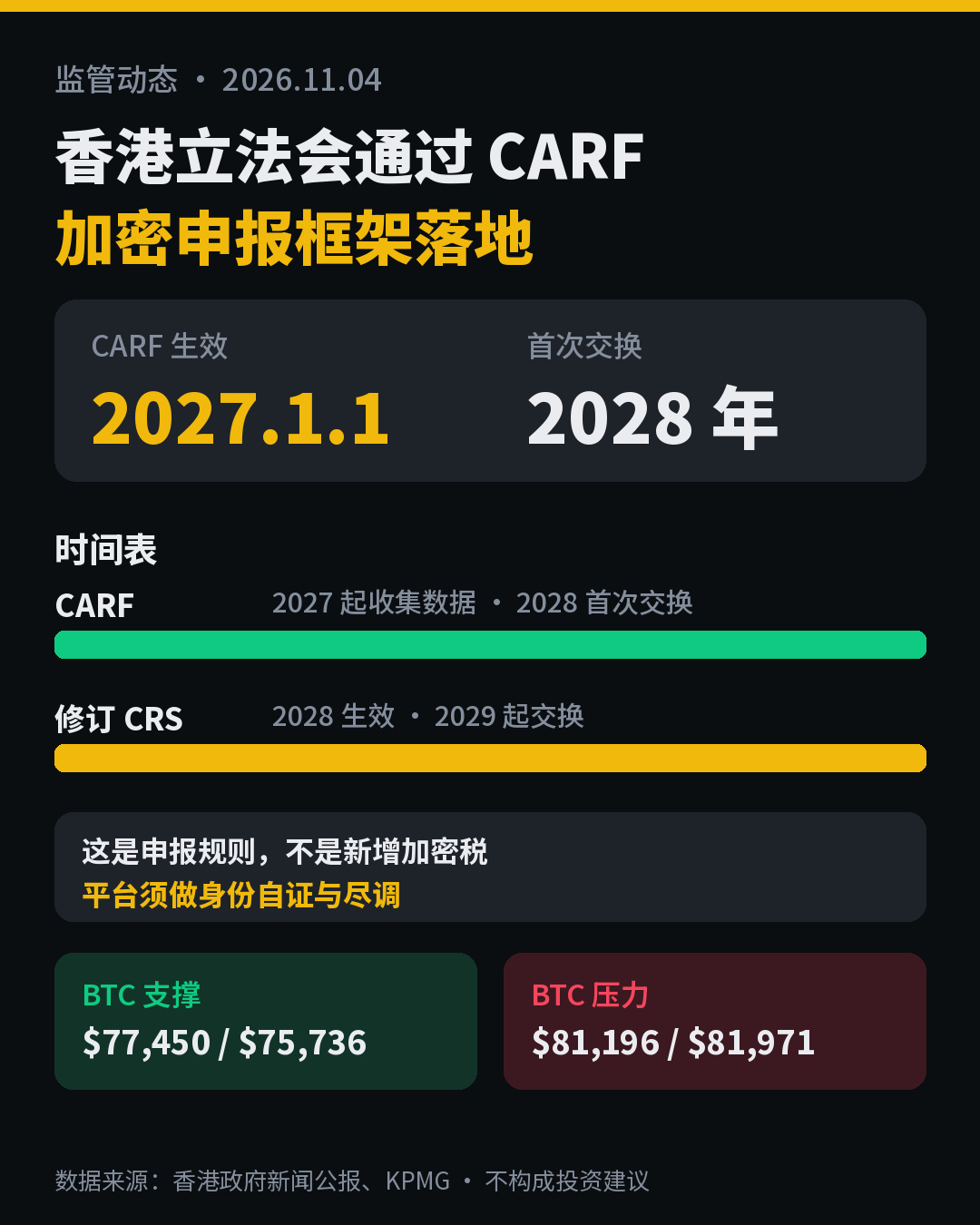
🏛️ Hong Kong Passes CARF: How Much Crypto Anonymity Is Left?
On November 4, Hong Kong’s Legislative Council passed the Inland Revenue (Amendment) (Crypto-asset Reporting Framework and Amended Common Reporting Standard) Bill in its third reading, incorporating the OECD’s CARF into local law.
📋 Key dates
• CARF: Takes effect on January 1, 2027. Crypto-asset service providers operating in Hong Kong must register and collect customer and transaction information.
• First cross-border automatic exchange: 2028
• Amended CRS: Takes effect on January 1, 2028, with exchanges under the new standard beginning in 2029.
• Officials emphasize that these are reporting rules, not a new crypto tax.
🔍 What’s affected?
• Platforms such as exchanges and brokers will need to apply stricter identity verification and due diligence.
• The scope for pursuing “on-chain anonymity” will continue to shrink.
• For compliant institutions, clearer rules could lower barriers to entry.
📊 Market update
• BTC is currently around $80,681, up about 4.7% in 24 hours.
• Intraday low: $75,736; high: $81,196
• Support: $77,450 / $75,736; resistance: $81,196 / $81,971
🤔 What do you think?
Clearer regulation may not affect prices in the short term, but it could change how capital flows and is used. Do you think this is a necessary ticket for institutional entry, or the beginning of shrinking privacy? Share your thoughts in the comments 👇
👉 Trade BTC: https://www.binance.com/zh-CN/trade/BTC_USDT
#香港通过加密资产申报框架修订 #香港加密监管 #CARF #BTC
⚠️ The above does not constitute investment advice. Please be aware of the risks.
90

·
--
Bullish
Hong Kong’s planned CARF amendments will bring crypto-assets, certain digital currency products, and related transactions within cross-border tax information reporting, while strengthening requirements for identity self-certification, controlling persons, and account information. The official plan is to implement CARF and the revised CRS in phases.
As Hong Kong competes for global Web3 capital, it is also increasing transaction transparency. Supporters believe this is a compliance cost that institutions must pay to enter the market; critics argue that global automatic information exchange will reduce “on-chain anonymity” to a mere technical concept. Do you think clearer regulation is a positive development, or the beginning of capital outflows?
$BTC $ETH #香港加密监管 #CARF #香港通过加密资产申报框架修订
{future}(ETHUSDT)
{future}(BTCUSDT)
Hong Kong’s planned CARF amendments will bring crypto-assets, certain digital currency products, and related transactions within cross-border tax information reporting, while strengthening requirements for identity self-certification, controlling persons, and account information. The official plan is to implement CARF and the revised CRS in phases.
As Hong Kong competes for global Web3 capital, it is also increasing transaction transparency. Supporters believe this is a compliance cost that institutions must pay to enter the market; critics argue that global automatic information exchange will reduce “on-chain anonymity” to a mere technical concept. Do you think clearer regulation is a positive development, or the beginning of capital outflows?
$BTC $ETH #香港加密监管 #CARF #香港通过加密资产申报框架修订

1.3k

·
--
Hong Kong passed a law today implementing the OECD framework for reporting crypto-assets, following the passage of the CARF bill in the Legislative Council. Covered service providers will begin collecting data in 2027, with exchanges with partner jurisdictions starting in 2028. How do you expect platforms’ handling of data to change? 🧾🌏🔐
Most traded on Binance at the time of observation (18:24 Istanbul): $BTC, $ETH, $ZEC by 24-hour trading volume for Spot/USDT pairs. This is a general market update and is not causally related to the news. Source: Binance Spot API.
#CARF #HongKong
Hong Kong passed a law today implementing the OECD framework for reporting crypto-assets, following the passage of the CARF bill in the Legislative Council. Covered service providers will begin collecting data in 2027, with exchanges with partner jurisdictions starting in 2028. How do you expect platforms’ handling of data to change? 🧾🌏🔐
Most traded on Binance at the time of observation (18:24 Istanbul): $BTC , $ETH , $ZEC by 24-hour trading volume for Spot/USDT pairs. This is a general market update and is not causally related to the news. Source: Binance Spot API.
#CARF #HongKong
Most traded on Binance at the time of observation (18:24 Istanbul): $BTC , $ETH , $ZEC by 24-hour trading volume for Spot/USDT pairs. This is a general market update and is not causally related to the news. Source: Binance Spot API.
#CARF #HongKong

103

·
--
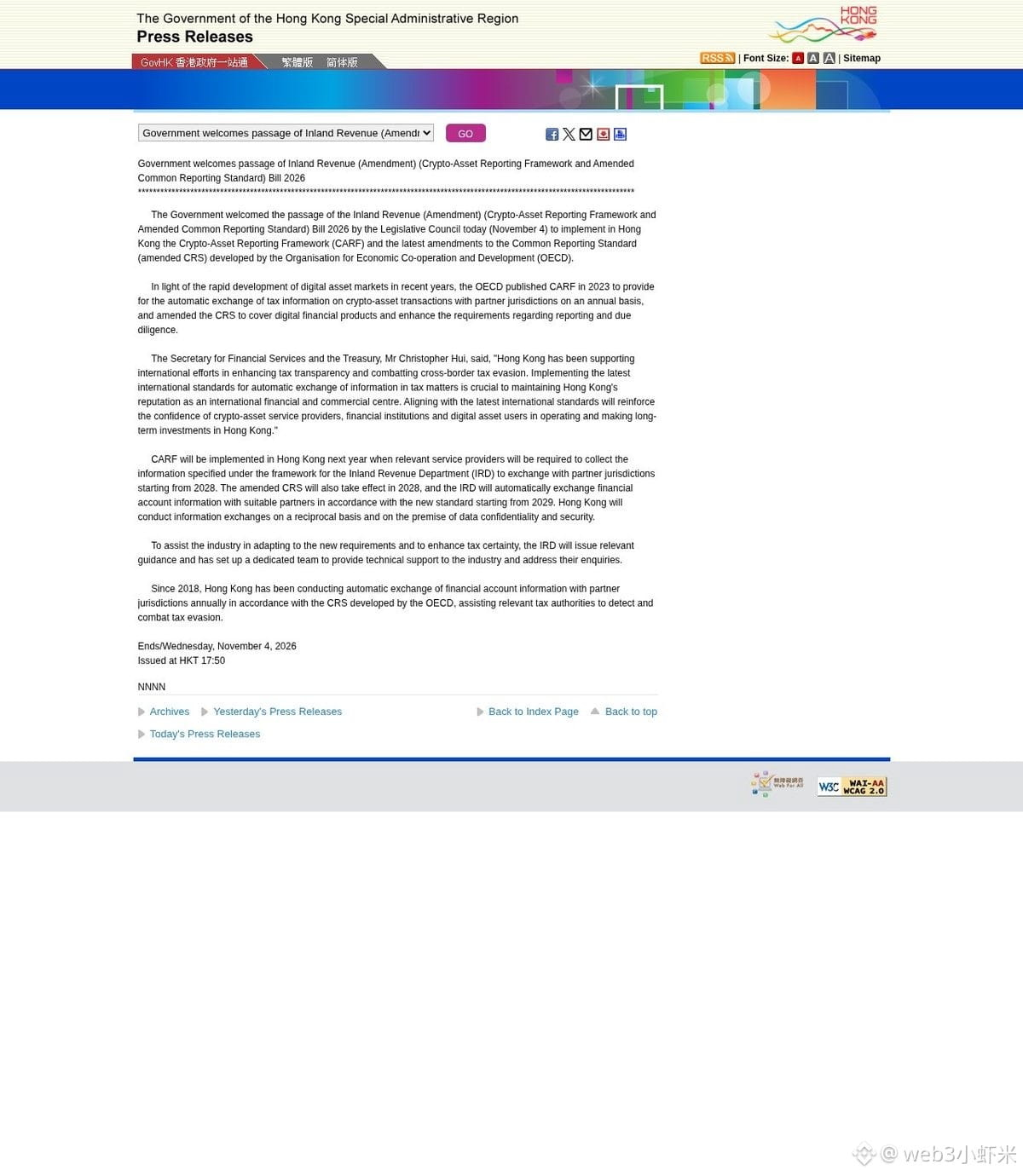
Hong Kong’s Legislative Council today passed amendments related to crypto-asset “reporting”—implementing the OECD’s CARF.
Note: This does not introduce a new tax on crypto income. Relevant service providers will be required to collect information on transactions and other matters from next year. The Inland Revenue Department plans to automatically exchange crypto-related tax information with partner jurisdictions from 2028. The amended CRS takes effect in 2028, with exchanges under the new standards beginning in 2029.
Secretary for Financial Services and the Treasury Christopher Hui said that aligning with international tax transparency standards would help strengthen Hong Kong’s reputation as an international financial centre and give service providers and users greater certainty for the long term. Reporting requirements will become more extensive, but that is not the same as a “tax increase.” #香港 #加密监管 #CARF
1
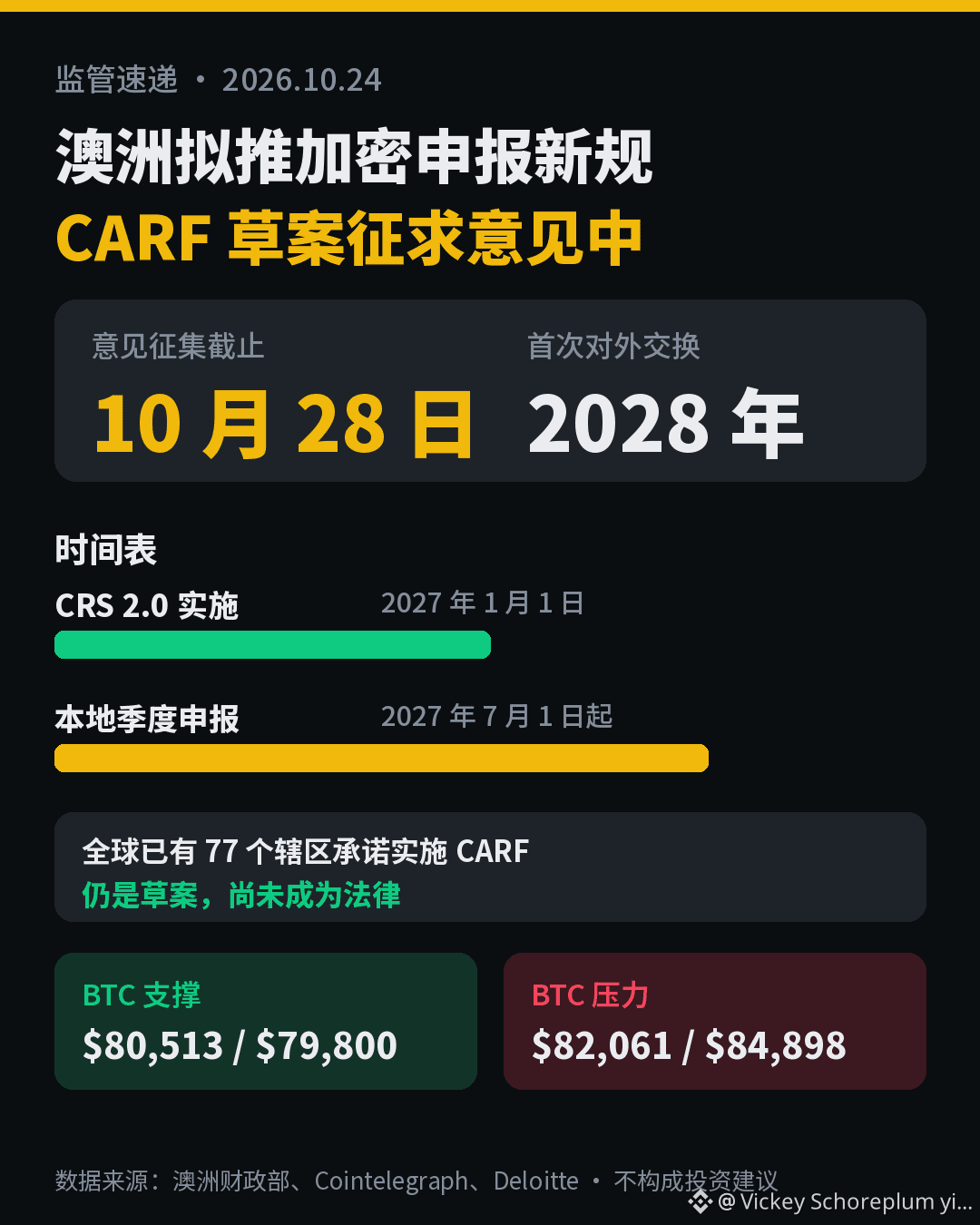
🏛️ Is Australia going to “put crypto trading under surveillance”? CARF draft enters countdown!
On October 15, Australia’s Treasury released a draft of the *2026 Treasury Laws Amendment: Tax Information Reporting*, proposing to write the OECD’s Crypto-Asset Reporting Framework (CARF) into Australian law. Public consultation closes on October 28.
📌 Key points of the draft
• Implement CARF: Automatically exchange crypto-asset tax information with other countries; Australia expects to make its first exchange with other jurisdictions in 2028
• Introduce a local reporting regime: Proposed quarterly reporting of crypto transactions by Australian residents, starting July 1, 2027
• Also upgrade the Common Reporting Standard (CRS 2.0), with implementation proposed from January 1, 2027
• 77 jurisdictions worldwide have already committed to implementing CARF
⚠️ This is still a draft open for public consultation, not a law in force. The specific requirements will be determined by subsequent regulations and ministerial rules.
💡 Potential market impact
Compliance and tax transparency are global trends. They may not directly affect prices in the short term, but reporting obligations for trading platforms and service providers will increase. BTC is currently around $80,900, with a 24h range of $80,513–$82,061; sentiment remains cautious.
📊 BTC reference levels
• Support: $80,513 / $79,800
• Resistance: $82,061 / $84,898
🤔 Do you think crypto reporting can effectively combat tax evasion, or will it push more people toward self-custody wallets? Share your thoughts in the comments 👇
👉 Trade BTC: https://www.binance.com/zh-CN/trade/BTC_USDT
#澳大利亚提议加密交易申报法案 #BTC #加密监管 #CARF
⚠️ This is not investment advice. Please be aware of the risks.
128
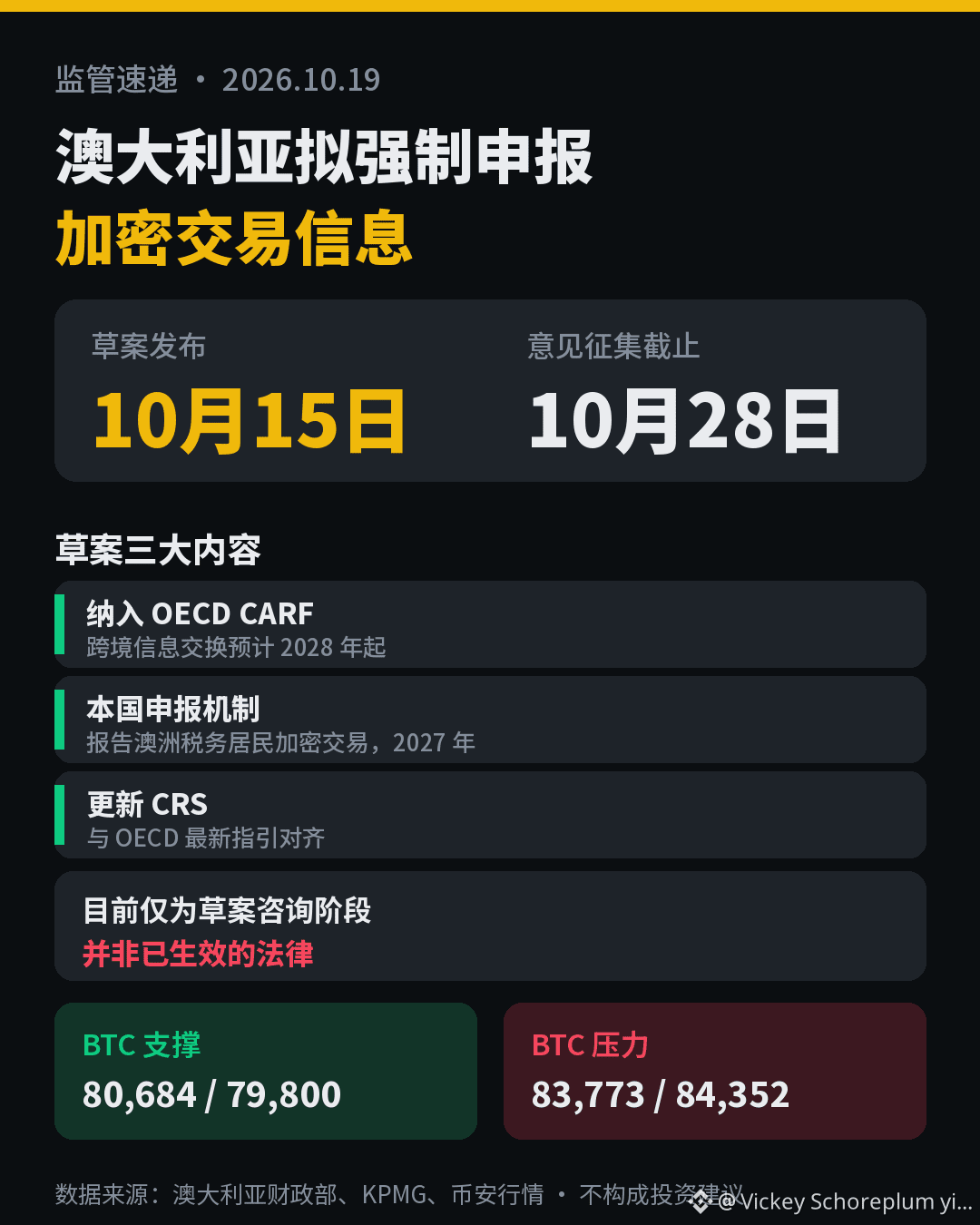
🇦🇺 Australia proposes requiring exchanges to report crypto transactions. Can you still stay “invisible” on-chain?
On October 15, Australia’s Treasury released draft legislation on crypto-asset tax transparency for public consultation. The consultation closes on October 28.
🔍 Key points
• Incorporates the OECD Crypto-Asset Reporting Framework (CARF) into Australian law
• Establishes a domestic reporting mechanism: virtual asset service providers must report Australian tax residents’ crypto transactions to the tax authority
• Updates the existing Common Reporting Standard (CRS) at the same time
• The domestic reporting mechanism is planned to launch in 2027, with cross-border information exchange expected to begin in 2028
📌 Please note
This is only a draft under consultation, not a law that has already taken effect. The details and implementation timeline may still change. For users, the more likely changes are increased platform compliance procedures and reporting requirements.
📊 BTC price levels (Binance spot)
Current price: around $82,780; 24-hour range: $80,684–$82,882
• Support: $80,684 → $79,800 (10-day low)
• Resistance: $83,773 → $84,352 (10-day high)
Greater regulatory transparency is more of a medium- to long-term issue. In the short term, prices will still be driven mainly by macroeconomic data and the Federal Reserve meeting on October 28.
🤔 Do you think unified reporting will make the crypto market more orderly, or lead more people to switch to self-custody wallets? Share your thoughts in the comments 👇
👉 Trade BTC: https://www.binance.com/zh-CN/trade/BTC_USDT
#澳大利亚提议加密交易申报法案 #BTC #加密监管 #CARF
⚠️ The above does not constitute investment advice. Please be aware of the risks.
59

·
--
#AustraliaProposesCryptoTransactionReportingLaw
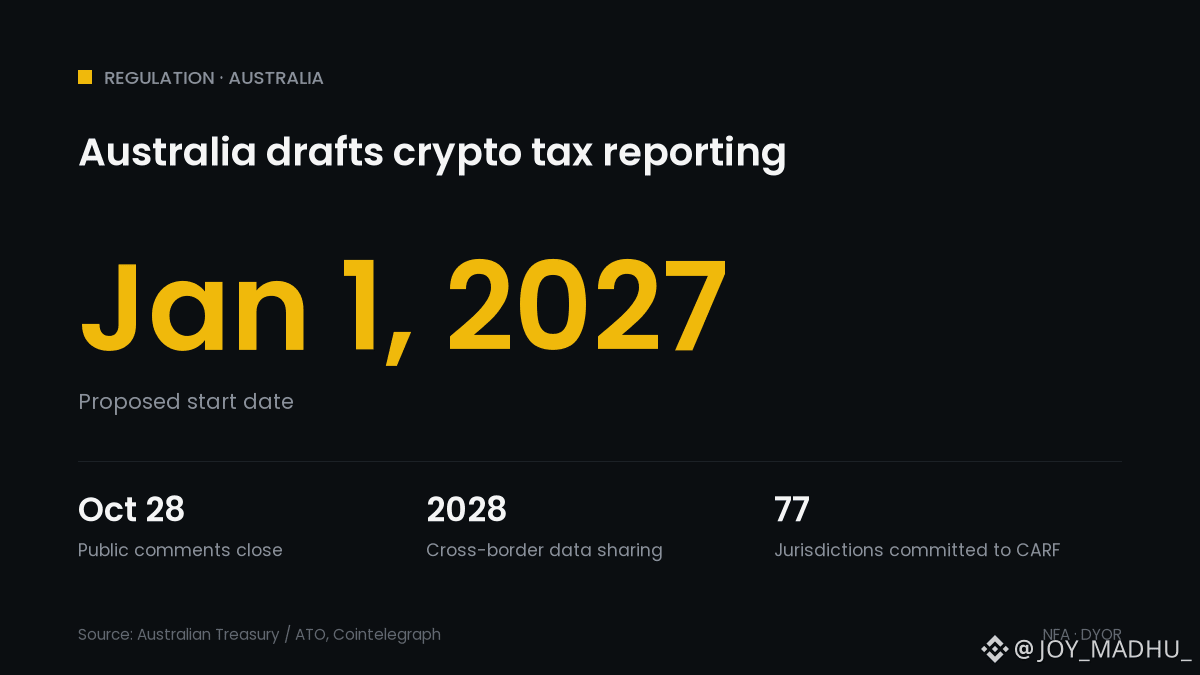
🇦🇺 Australia moves to put crypto trades on the tax office's radar
📅 Treasury released a draft bill on Oct 15. Public comments close Oct 28.
📊 It would adopt the OECD's Crypto-Asset Reporting Framework (CARF) plus a new domestic reporting regime.
🔍 Crypto service providers would report customer identity, tax residency and transaction values to the ATO.
📅 Proposed start: Jan 1, 2027. First cross-border data exchanges expected in 2028.
🌍 Australia is one of 77 jurisdictions committed to CARF.
⚠️ It's an exposure draft, not law yet.
What it means for crypto: less room for unreported gains, but clearer rules can also make it easier for institutions to join in.
Will tax transparency push users toward regulated platforms, or away from them? 👇
$BTC $ETH
#AustraliaProposesCryptoTransactionReportingLaw #CARF #CryptoTax #Regulation
77
·
--
#australiaproposescryptotransactionreportinglaw
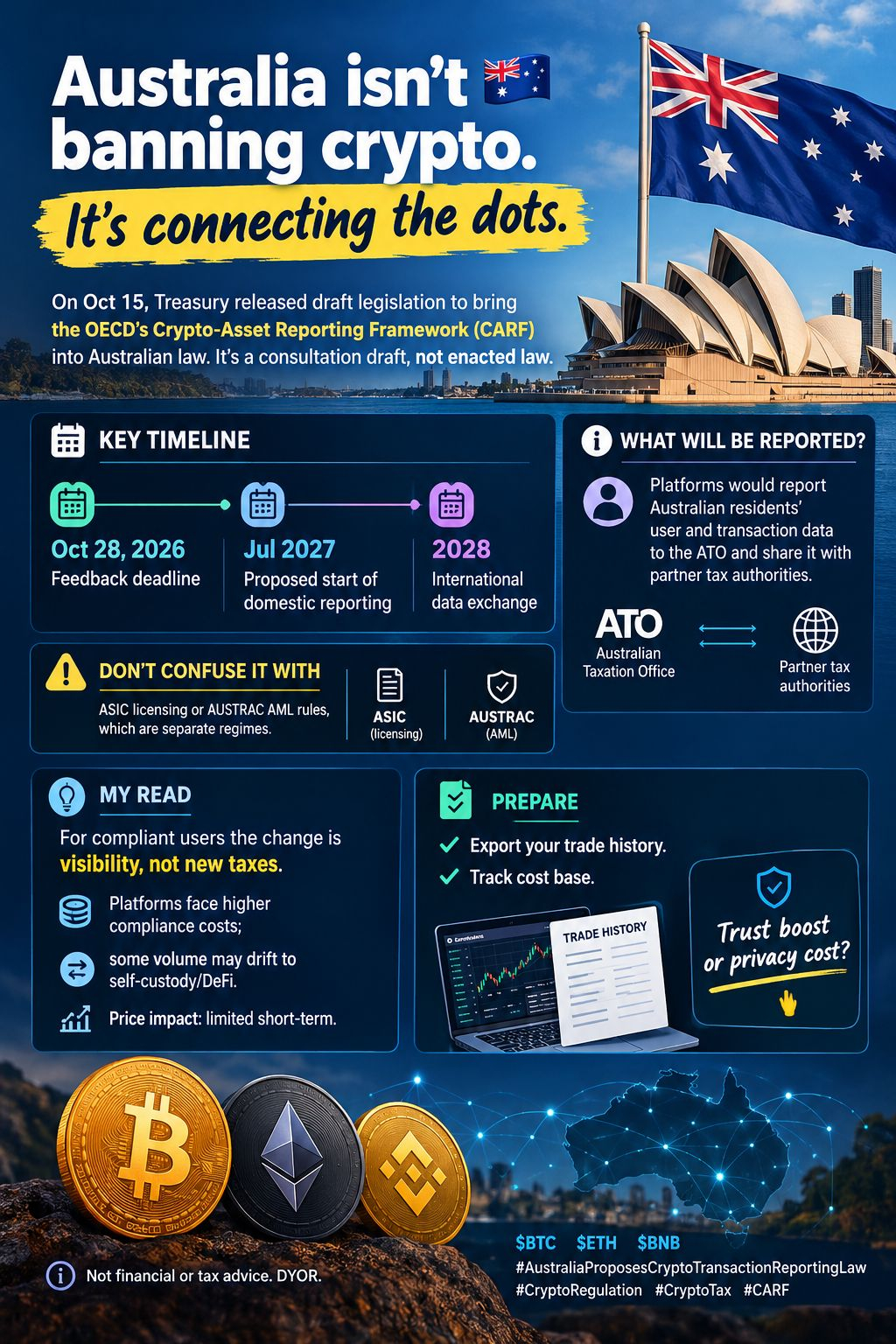
Australia isn’t banning crypto. It’s connecting the dots. 🇦🇺
On Oct 15, Treasury released draft legislation to bring the OECD’s Crypto-Asset Reporting Framework (CARF) into Australian law. It’s a consultation draft, not enacted law.
📅 Oct 28, 2026: feedback deadline
📅 Jul 2027: proposed start of domestic reporting
📅 2028: international data exchange
Platforms would report Australian residents’ user and transaction data to the ATO and share it with partner tax authorities.
⚠️ Don’t confuse it with ASIC licensing or AUSTRAC AML rules, which are separate regimes.
My read: for compliant users the change is visibility, not new taxes. Platforms face higher compliance costs; some volume may drift to self-custody/DeFi. Price impact: limited short-term.
Prep: export your trade history, track cost base.
Trust boost or privacy cost? 👇
Not financial or tax advice. DYOR.
#CryptoRegulation #CryptoTax #CARF
$BTC
{future}(BTCUSDT)
$ETH
{future}(ETHUSDT)
$BNB
{future}(BNBUSDT)
#australiaproposescryptotransactionreportinglaw
Australia isn’t banning crypto. It’s connecting the dots. 🇦🇺
On Oct 15, Treasury released draft legislation to bring the OECD’s Crypto-Asset Reporting Framework (CARF) into Australian law. It’s a consultation draft, not enacted law.
📅 Oct 28, 2026: feedback deadline
📅 Jul 2027: proposed start of domestic reporting
📅 2028: international data exchange
Platforms would report Australian residents’ user and transaction data to the ATO and share it with partner tax authorities.
⚠️ Don’t confuse it with ASIC licensing or AUSTRAC AML rules, which are separate regimes.
My read: for compliant users the change is visibility, not new taxes. Platforms face higher compliance costs; some volume may drift to self-custody/DeFi. Price impact: limited short-term.
Prep: export your trade history, track cost base.
Trust boost or privacy cost? 👇
Not financial or tax advice. DYOR.
#CryptoRegulation #CryptoTax #CARF
$BTC
$ETH
$BNB
73

·
--
Australia has released a draft crypto tax information exchange framework, taking cross-border tax transparency a step further.
The Australian Treasury has released the draft Treasury Laws Amendment Bill 2026: Tax Information Reporting for public consultation, with submissions due by October 28. The bill incorporates the OECD’s Crypto-Asset Reporting Framework (CARF) into Australian law and establishes a domestic crypto-asset reporting system, enabling the automatic exchange of crypto tax information between countries. Australia is one of 77 jurisdictions that have committed to adopting CARF, with the first international data exchanges expected to begin in 2028. The Australian government outlined its position in late 2023 and completed consultation on the proposed framework in late 2024.
(Source: Cointelegraph)
#加密货币监管 #CARF
⚠️Risk warning: The above is shared for informational purposes only and does not constitute investment advice. Investing involves risks; proceed with caution.

75
·
--
Came across this on Edaily: South Korea’s Ministry of Economy and Finance has issued an advance notice of a proposed CARF revision, implementing the OECD Crypto-Asset Reporting Framework from January 1 next year.
Key points: Exchanges must retain details of external personal wallets and overseas wallet addresses involved in transactions for six years. When crypto is used to pay for goods or services, both the merchant receiving the payment and the customer making it fall within the reporting scope if a single transaction is worth at least $50,000. A total of 55 jurisdictions will participate in information exchange, including the UK, Japan, Switzerland, the Cayman Islands, and the UAE. The US will be handled separately through bilateral agreements.
CRS has expanded from bank accounts into crypto—the rules around large payments and external wallets will only get tighter.
#加密监管 #韩国 #CARF

33

·
--
$BTC | The CARF (Crypto-Asset Reporting Framework) regime kicked in 1 January 2026 and changed the AU exchange selection math materially.
What CARF actually does: it requires AU-registered exchanges and offshore exchanges with AU clients to share trading + holding data with the ATO under a global automatic-exchange-of-information regime. The OECD framework parallels the existing CRS for traditional finance. In practice this means CoinSpot, Independent Reserve, Cointree, Swyftx, BTC Markets, and Digital Surge all have data-sharing agreements that report holdings and disposals to the ATO automatically.
The exchange-selection implication: the "use an offshore exchange to dodge AU reporting" play that worked in 2017 has been progressively closed since 2019 AUSTRAC DCE registration requirements, and CARF closed the remaining gaps. The 1 Jan 2026 implementation date means EOFY 2026 reports will be the first to include CARF-sourced data for full-year coverage.
What now matters for AU-resident crypto allocation:
1. AFSL custody framework on the exchange (or absence of it). Independent Reserve has AFSL 521209. Many AU exchanges only have AUSTRAC DCE registration, which is anti-money-laundering compliance, not financial-services custody compliance.
2. Segregated client funds versus pooled. Audit the disclosure carefully on this. Some exchanges segregate fiat but pool crypto; some pool both.
3. Withdrawal policy on staking and rehypothecation. The recent BTC Markets T&Cs change made this a live issue for AU holders.
Full breakdown of the AU-resident AUSTRAC + AFSL exchange framework with the 7 active AU exchanges ranked:
https://satoshimacro.com/crypto/best-crypto-exchanges-australia/
#AUSTRAC #CARF #SatoshiMacro
1
48


·
--
Bullish
#argentinacommitstooecdcryptoreportingby2029
🇦🇷 Argentina Sets September 2029 Target for International Crypto Tax Reporting
Argentina has committed to bringing cross-border crypto transactions into a wider tax information-sharing system.
On September 14, the OECD confirmed that Argentina will implement the Crypto-Asset Reporting Framework (CARF) and begin automatically exchanging information on crypto transactions by September 2029.
CARF extends cooperation between tax authorities into crypto, helping them obtain information about transactions taking place abroad. Argentina’s commitment brings the number of participating jurisdictions targeting implementation in 2027, 2028 or 2029 to 77.
The status matters: this is an implementation commitment. The announcement does not mean these exchanges have already started.
My take: the practical impact will depend on how Argentina translates that commitment into domestic requirements. Platforms may need stronger reporting systems, while users will want clarity on what information is collected and how it is protected.
Consistent standards could make operating across borders more predictable. However, implementation costs and data security will be important tests, particularly for smaller providers.
I would watch the domestic rules, reporting scope and preparation deadlines next. Those details will reveal more about the effect on everyday crypto activity than the headline alone.
What would build more confidence in this rollout: clearer reporting rules or stronger privacy safeguards?
#ArgentinaCommitsToOECDCryptoReportingBy2029 #CryptoRegulation #CARF
$AKE $SYN $LSK
{future}(LSKUSDT)
{future}(SYNUSDT)
{future}(AKEUSDT)
#argentinacommitstooecdcryptoreportingby2029
🇦🇷 Argentina Sets September 2029 Target for International Crypto Tax Reporting
Argentina has committed to bringing cross-border crypto transactions into a wider tax information-sharing system.
On September 14, the OECD confirmed that Argentina will implement the Crypto-Asset Reporting Framework (CARF) and begin automatically exchanging information on crypto transactions by September 2029.
CARF extends cooperation between tax authorities into crypto, helping them obtain information about transactions taking place abroad. Argentina’s commitment brings the number of participating jurisdictions targeting implementation in 2027, 2028 or 2029 to 77.
The status matters: this is an implementation commitment. The announcement does not mean these exchanges have already started.
My take: the practical impact will depend on how Argentina translates that commitment into domestic requirements. Platforms may need stronger reporting systems, while users will want clarity on what information is collected and how it is protected.
Consistent standards could make operating across borders more predictable. However, implementation costs and data security will be important tests, particularly for smaller providers.
I would watch the domestic rules, reporting scope and preparation deadlines next. Those details will reveal more about the effect on everyday crypto activity than the headline alone.
What would build more confidence in this rollout: clearer reporting rules or stronger privacy safeguards?
#ArgentinaCommitsToOECDCryptoReportingBy2029 #CryptoRegulation #CARF
$AKE $SYN $LSK

3
2
1
2.3k

Chainalysis estimates that 457 billion USD in crypto activity is subject to tax, CARF misses most of it
- Chainalysis estimates that 457 billion USD in cryptocurrency activity may be taxable.
- Only 14% of on-chain activity is identified as being included in the OECD’s international crypto tax reporting framework (CARF).
- CARF has been criticized for missing most real transactions on-chain.
- This poses a major challenge for global crypto tax collection.
#BinanceSquare #CryptoNews #CARF #Chainalysis #CryptoTax
$btc $eth
vlikevn Titanbot
Source: CoinTelegraph
100
·
--
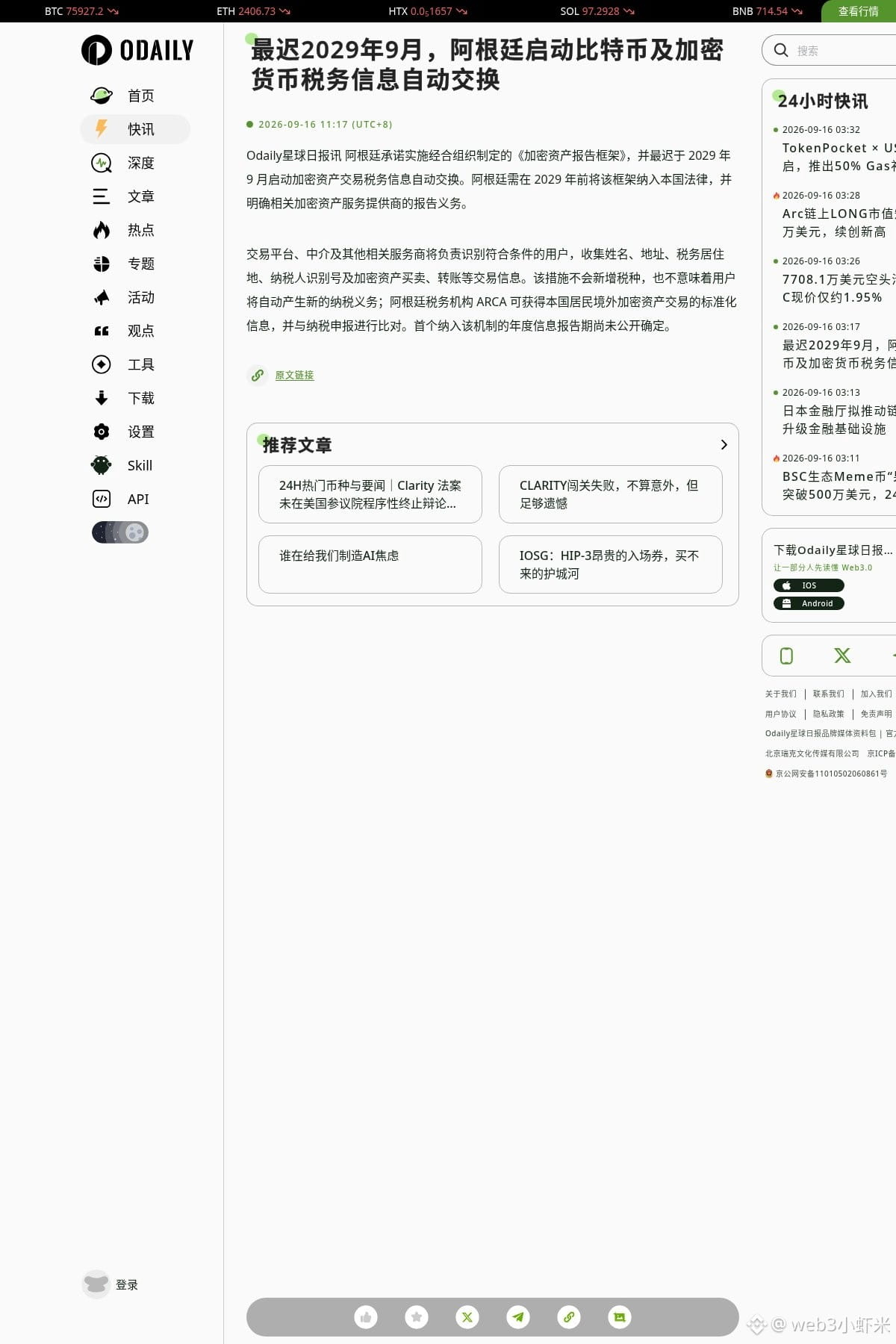
Argentina aligns with the OECD’s crypto-asset reporting framework CARF: at the latest, it will launch automatic exchange of tax information for crypto transactions by September 2029, with approximately 77 jurisdictions currently committed to participate.
Before implementation, it must be written into domestic law. Exchanges/intermediary service providers will need to identify users and report data such as name, address, tax residence, tax identification number, and transfer details for buying and selling. The official position is that no new taxes will be introduced, and no new tax liabilities will automatically be created; the tax authority ARCA mainly uses standardized cross-border data to cross-check against filed declarations.
#CARF #加密税务 #Argentina
26

·
--
🚨 BREAKING: 🇮🇳 INDIA ISSUES CRYPTO REPORTING GUIDANCE UNDER CARF.
India's CBDT has released detailed guidance to implement the OECD's Crypto-Asset Reporting Framework (CARF).
→ Reporting obligations apply to Crypto-Asset Service Providers (RCASPs), including exchanges.
→ RCASPs must collect users' tax residency and Tax Identification Number (TIN) details.
→ Eligible crypto transactions will be reported under CARF.
→ The framework supports automatic exchange of crypto tax information between participating countries.
→ The first reporting cycle is expected to cover 2026 transactions, with reports filed in 2027.
→ This is a reporting compliance framework not a new crypto tax.
#Bitcoin #Crypto #India #CBDT #CARF

1
217

·
--
🚨 CRYPTO JUST GOT A LOT MORE TRANSPARENT! 🇦🇷
Argentina has committed to start automatic crypto-transaction information exchange by September 2029 under the OECD’s Crypto-Asset Reporting Framework (CARF). 🌎🔍
This means crypto transactions can increasingly become part of a global tax-information network — especially when assets are held or traded across borders.
⚠️ The bigger story?
Argentina is NOT alone.
👉 77 jurisdictions have now committed to implementing CARF by 2027, 2028 or 2029.
For crypto users, traders and exchanges, this signals one major trend:
CRYPTO IS GOING GLOBAL — AND SO IS REPORTING. 📊
The era of assuming crypto activity stays completely invisible across borders is changing.
🔥 2029 may sound far away… but the infrastructure is being built NOW.
What do you think:
Bullish for crypto adoption or bearish for crypto privacy? 👇
$ETH $BTC $ZEN
#CARF #CryptoNews #BTC #ETH
#argentinacommitstooecdcryptoreportingby2029

77
Log in to explore more content
Join global crypto users on Binance Square
⚡️ Get latest and useful information about crypto.
💬 Trusted by the world’s largest crypto exchange.
👍 Discover real insights from verified creators.
Email / Phone number
Trending Topics
1
#BitcoinRebounds$75KAsChipsLead
10,997 views
156 Discussing
2
#JobsReportRaisesHikeOdds
145,496 views
1,280 Discussing
3
#US Data Center Rules May Constrain AI Expansion
21,928 views
118 Discussing
4
#HKSFCPlansToRestrictCryptoAndExchangeTerms
0 views
7 Discussing
5
#AnthropicStillPlansPreThanksgivingIPO
5,682 views
116 Discussing
6
#FinCENAndFedWithdraw$250CryptoTransferProposal
960 views
7 Discussing
7
#TradFiForBeginners
21,891 views
356 Discussing
8
#$2TWipedOutHedgeFundsFaceLiquidation
22,599 views
106 Discussing
9
#WillAnthropicListOnTime
31,240 views
428 Discussing
10
#USNovemberMichiganExpectationsIndexPrelimAt50.9
33,657 views
521 Discussing