
#bitfinex
bitfinex
228,946 views
387 Discussing
Hot
Latest


·
--
Hackers Stole 119,756 Bitcoin In 2016. It Took The DOJ Six Years To Trace It.On August 2, 2016, someone drained 119,756 Bitcoin out of Bitfinex, one of the largest exchanges in the world at the time. At the price that day, the loss came to roughly $72 million. Today that same pile of coins is worth many times more.
Bitfinex didn't quietly stick a handful of unlucky users with the loss. Every account on the platform took the same haircut, about 36% of whatever balance sat there that morning, whether those funds were anywhere near the hacked wallet or not. In exchange, the company issued a new token called BFX, one BFX for every dollar lost, redeemable later at a fixed dollar price or convertible into shares of Bitfinex's parent company, iFinex. Within eight months, every BFX token had been made whole, either bought back at full value or swapped for equity.
That part of the story usually gets forgotten. What people remember is that the stolen coins vanished into the blockchain and nobody expected to see them again.
They sat mostly untouched for over five years, moving in small amounts here and there, enough to keep investigators watching but not enough to break the trail. Then in February 2022, the Department of Justice announced it had traced a huge share of the stolen funds to a New York couple and seized Bitcoin worth close to $3.6 billion at the time, the largest financial seizure in the agency's history at that point. One of the suspects had built a strange public trail of rap videos and posts online for years while allegedly sitting on a fortune stolen from an exchange hack. Both pleaded guilty to money laundering conspiracy in 2023.
The gap between the theft and the seizure says something worth sitting with. Six years is a long time to hide anything on a ledger where every transaction stays permanently visible to anyone who wants to look. Blockchain forensics firms and government investigators spent that entire stretch mapping wallet clusters, watching exchange deposits, and waiting for a mistake. Eventually one came.
Even after the seizure, the story hasn't fully closed. As of early 2025, Bitfinex and individual account holders were fighting in court over whether the recovered coins should go back to the exchange in-kind, meaning the actual Bitcoin itself, or get shared with the customers who took the original 36% haircut, while the government itself had asked the court to approve in-kind restitution to Bitfinex. That distinction is worth billions given how far Bitcoin has moved since the seizure. Bitfinex has argued it's owed the coins themselves as the original victim, and courts have been sorting through exactly who counts as a victim in a hack that technically hit every user's balance at once.
Bitcoin sits at $76,426 today. The 2016 hack is a reminder that exchange security failures don't disappear once the immediate panic fades. They turn into multi-year investigations, legal fights over what a victim is owed, and a permanent case study in how visible a blockchain really is once someone with enough resources decides to follow it.
It also raises a question that never fully goes away for anyone holding funds on a centralized exchange. The coins are recoverable in theory, eventually, if investigators get lucky and have years to spend. That's a very different thing from your funds being safe today.
Would you have kept trading on an exchange right after a hack like that, waiting years for a resolution most users never got to see up close?
Personal view, not advice. Do your own research.
#Bitcoin #Bitfinex
Hackers Stole 119,756 Bitcoin In 2016. It Took The DOJ Six Years To Trace It.
On August 2, 2016, someone drained 119,756 Bitcoin out of Bitfinex, one of the largest exchanges in the world at the time. At the price that day, the loss came to roughly $72 million. Today that same pile of coins is worth many times more.
Bitfinex didn't quietly stick a handful of unlucky users with the loss. Every account on the platform took the same haircut, about 36% of whatever balance sat there that morning, whether those funds were anywhere near the hacked wallet or not. In exchange, the company issued a new token called BFX, one BFX for every dollar lost, redeemable later at a fixed dollar price or convertible into shares of Bitfinex's parent company, iFinex. Within eight months, every BFX token had been made whole, either bought back at full value or swapped for equity.
That part of the story usually gets forgotten. What people remember is that the stolen coins vanished into the blockchain and nobody expected to see them again.
They sat mostly untouched for over five years, moving in small amounts here and there, enough to keep investigators watching but not enough to break the trail. Then in February 2022, the Department of Justice announced it had traced a huge share of the stolen funds to a New York couple and seized Bitcoin worth close to $3.6 billion at the time, the largest financial seizure in the agency's history at that point. One of the suspects had built a strange public trail of rap videos and posts online for years while allegedly sitting on a fortune stolen from an exchange hack. Both pleaded guilty to money laundering conspiracy in 2023.
The gap between the theft and the seizure says something worth sitting with. Six years is a long time to hide anything on a ledger where every transaction stays permanently visible to anyone who wants to look. Blockchain forensics firms and government investigators spent that entire stretch mapping wallet clusters, watching exchange deposits, and waiting for a mistake. Eventually one came.
Even after the seizure, the story hasn't fully closed. As of early 2025, Bitfinex and individual account holders were fighting in court over whether the recovered coins should go back to the exchange in-kind, meaning the actual Bitcoin itself, or get shared with the customers who took the original 36% haircut, while the government itself had asked the court to approve in-kind restitution to Bitfinex. That distinction is worth billions given how far Bitcoin has moved since the seizure. Bitfinex has argued it's owed the coins themselves as the original victim, and courts have been sorting through exactly who counts as a victim in a hack that technically hit every user's balance at once.
Bitcoin sits at $76,426 today. The 2016 hack is a reminder that exchange security failures don't disappear once the immediate panic fades. They turn into multi-year investigations, legal fights over what a victim is owed, and a permanent case study in how visible a blockchain really is once someone with enough resources decides to follow it.
It also raises a question that never fully goes away for anyone holding funds on a centralized exchange. The coins are recoverable in theory, eventually, if investigators get lucky and have years to spend. That's a very different thing from your funds being safe today.
Would you have kept trading on an exchange right after a hack like that, waiting years for a resolution most users never got to see up close?
Personal view, not advice. Do your own research.
#Bitcoin #Bitfinex
Bitfinex didn't quietly stick a handful of unlucky users with the loss. Every account on the platform took the same haircut, about 36% of whatever balance sat there that morning, whether those funds were anywhere near the hacked wallet or not. In exchange, the company issued a new token called BFX, one BFX for every dollar lost, redeemable later at a fixed dollar price or convertible into shares of Bitfinex's parent company, iFinex. Within eight months, every BFX token had been made whole, either bought back at full value or swapped for equity.
That part of the story usually gets forgotten. What people remember is that the stolen coins vanished into the blockchain and nobody expected to see them again.
They sat mostly untouched for over five years, moving in small amounts here and there, enough to keep investigators watching but not enough to break the trail. Then in February 2022, the Department of Justice announced it had traced a huge share of the stolen funds to a New York couple and seized Bitcoin worth close to $3.6 billion at the time, the largest financial seizure in the agency's history at that point. One of the suspects had built a strange public trail of rap videos and posts online for years while allegedly sitting on a fortune stolen from an exchange hack. Both pleaded guilty to money laundering conspiracy in 2023.
The gap between the theft and the seizure says something worth sitting with. Six years is a long time to hide anything on a ledger where every transaction stays permanently visible to anyone who wants to look. Blockchain forensics firms and government investigators spent that entire stretch mapping wallet clusters, watching exchange deposits, and waiting for a mistake. Eventually one came.
Even after the seizure, the story hasn't fully closed. As of early 2025, Bitfinex and individual account holders were fighting in court over whether the recovered coins should go back to the exchange in-kind, meaning the actual Bitcoin itself, or get shared with the customers who took the original 36% haircut, while the government itself had asked the court to approve in-kind restitution to Bitfinex. That distinction is worth billions given how far Bitcoin has moved since the seizure. Bitfinex has argued it's owed the coins themselves as the original victim, and courts have been sorting through exactly who counts as a victim in a hack that technically hit every user's balance at once.
Bitcoin sits at $76,426 today. The 2016 hack is a reminder that exchange security failures don't disappear once the immediate panic fades. They turn into multi-year investigations, legal fights over what a victim is owed, and a permanent case study in how visible a blockchain really is once someone with enough resources decides to follow it.
It also raises a question that never fully goes away for anyone holding funds on a centralized exchange. The coins are recoverable in theory, eventually, if investigators get lucky and have years to spend. That's a very different thing from your funds being safe today.
Would you have kept trading on an exchange right after a hack like that, waiting years for a resolution most users never got to see up close?
Personal view, not advice. Do your own research.
#Bitcoin #Bitfinex
1k

💰 Bitfinex Securities Lists Tokenized Bitcoin-Backed Treasury Bonds Products
Bitfinex Securities announced the listing of five tokenized U.S. Treasury bond products, backed by Bitcoin, on the Liquid network. This move aims to provide new investment opportunities for institutional investors and eligible individuals by combining traditional assets with blockchain technology to increase accessibility.
━━━━━━━━━━━━━━
📊 Impact: 📈 High
🏷️ DEFI
#Bitfinex #Tokenization #Bitcoin #TreasuryBonds #DigitalAssets
📰 Source: cryptobriefing.com
💰 Bitfinex Securities Lists Tokenized Bitcoin-Backed Treasury Bonds Products
Bitfinex Securities announced the listing of five tokenized U.S. Treasury bond products, backed by Bitcoin, on the Liquid network. This move aims to provide new investment opportunities for institutional investors and eligible individuals by combining traditional assets with blockchain technology to increase accessibility.
━━━━━━━━━━━━━━
📊 Impact: 📈 High
🏷️ DEFI
#Bitfinex #Tokenization #Bitcoin #TreasuryBonds #DigitalAssets
📰 Source: cryptobriefing.com
Bitfinex Securities announced the listing of five tokenized U.S. Treasury bond products, backed by Bitcoin, on the Liquid network. This move aims to provide new investment opportunities for institutional investors and eligible individuals by combining traditional assets with blockchain technology to increase accessibility.
━━━━━━━━━━━━━━
📊 Impact: 📈 High
🏷️ DEFI
#Bitfinex #Tokenization #Bitcoin #TreasuryBonds #DigitalAssets
📰 Source: cryptobriefing.com
97
💡 Bitfinex Securities lists premium notes linked to Strategy and Metaplanet
Bitfinex Securities announced the listing of five premium notes backed by equities, issued through the ORO II fund in Luxembourg. These notes will be available for trading against the US dollar, USDT, and bitcoin for eligible non-US investors, representing a development in the securitization of traditional assets on the blockchain.
━━━━━━━━━━━━━━
📊 Impact: 📈 High
🏷️ OTHER
#Bitfinex #Tokenization #Strategy #Metaplanet #DigitalAssets
📰 Source: cointelegraph.com
💡 Bitfinex Securities lists premium notes linked to Strategy and Metaplanet
Bitfinex Securities announced the listing of five premium notes backed by equities, issued through the ORO II fund in Luxembourg. These notes will be available for trading against the US dollar, USDT, and bitcoin for eligible non-US investors, representing a development in the securitization of traditional assets on the blockchain.
━━━━━━━━━━━━━━
📊 Impact: 📈 High
🏷️ OTHER
#Bitfinex #Tokenization #Strategy #Metaplanet #DigitalAssets
📰 Source: cointelegraph.com
Bitfinex Securities announced the listing of five premium notes backed by equities, issued through the ORO II fund in Luxembourg. These notes will be available for trading against the US dollar, USDT, and bitcoin for eligible non-US investors, representing a development in the securitization of traditional assets on the blockchain.
━━━━━━━━━━━━━━
📊 Impact: 📈 High
🏷️ OTHER
#Bitfinex #Tokenization #Strategy #Metaplanet #DigitalAssets
📰 Source: cointelegraph.com
13

·
--
Bullish
{spot}(BTCUSDT)
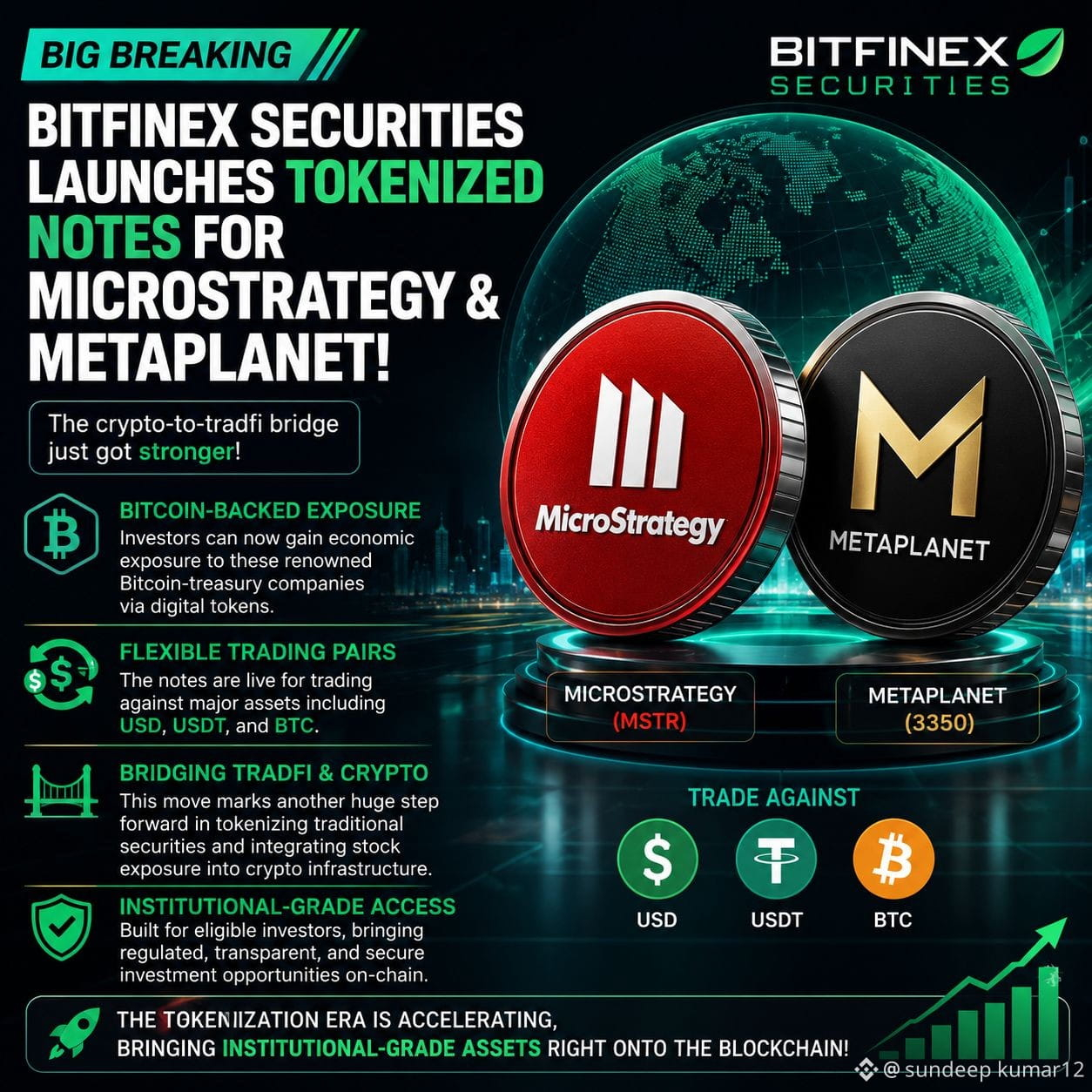
🚨 BIG BREAKING: BITCOIN TREASURY STOCKS ARE GOING ON-CHAIN! 🔥
Bitfinex Securities has listed tokenized notes linked to Strategy (MSTR) and Metaplanet (3350) — two of the most aggressive corporate Bitcoin treasury players. ₿🌐
Why this matters:
🔹 Tokenized Bitcoin-Treasury Exposure — Eligible investors can gain economic exposure to these companies through blockchain-based securities.
🔹 Trade Against USD, USDT & BTC — The notes can be traded against major fiat and crypto assets, expanding flexibility.
🔹 TradFi Meets Crypto — Traditional equity exposure is moving deeper into blockchain infrastructure.
🔹 Fractional Access — The Metaplanet note, CMPTL, supports fractional trading, lowering the barrier for eligible investors.
🔹 Built on Liquid Network — The securities operate on Bitcoin’s Liquid Network, combining traditional financial assets with blockchain settlement.
This is bigger than just another listing.
The tokenization of real-world financial assets is accelerating — and Bitcoin is increasingly becoming the bridge between traditional finance and the digital economy. 🚀₿
The next phase of crypto may not just be about tokens representing crypto…
It could be about stocks, funds and real-world assets becoming tradable on blockchain rails. 🔥
#Bitcoin #BTC #MSTR #MicroStrategy #Metaplanet #Crypto #RWA #Tokenization #Bitfinex #bitcoin #MSTRstock #MicroStrategy
🚨 BIG BREAKING: BITCOIN TREASURY STOCKS ARE GOING ON-CHAIN! 🔥
Bitfinex Securities has listed tokenized notes linked to Strategy (MSTR) and Metaplanet (3350) — two of the most aggressive corporate Bitcoin treasury players. ₿🌐
Why this matters:
🔹 Tokenized Bitcoin-Treasury Exposure — Eligible investors can gain economic exposure to these companies through blockchain-based securities.
🔹 Trade Against USD, USDT & BTC — The notes can be traded against major fiat and crypto assets, expanding flexibility.
🔹 TradFi Meets Crypto — Traditional equity exposure is moving deeper into blockchain infrastructure.
🔹 Fractional Access — The Metaplanet note, CMPTL, supports fractional trading, lowering the barrier for eligible investors.
🔹 Built on Liquid Network — The securities operate on Bitcoin’s Liquid Network, combining traditional financial assets with blockchain settlement.
This is bigger than just another listing.
The tokenization of real-world financial assets is accelerating — and Bitcoin is increasingly becoming the bridge between traditional finance and the digital economy. 🚀₿
The next phase of crypto may not just be about tokens representing crypto…
It could be about stocks, funds and real-world assets becoming tradable on blockchain rails. 🔥
#Bitcoin #BTC #MSTR #MicroStrategy #Metaplanet #Crypto #RWA #Tokenization #Bitfinex #bitcoin #MSTRstock #MicroStrategy
Bitfinex Securities has listed tokenized notes linked to Strategy (MSTR) and Metaplanet (3350) — two of the most aggressive corporate Bitcoin treasury players. ₿🌐
Why this matters:
🔹 Tokenized Bitcoin-Treasury Exposure — Eligible investors can gain economic exposure to these companies through blockchain-based securities.
🔹 Trade Against USD, USDT & BTC — The notes can be traded against major fiat and crypto assets, expanding flexibility.
🔹 TradFi Meets Crypto — Traditional equity exposure is moving deeper into blockchain infrastructure.
🔹 Fractional Access — The Metaplanet note, CMPTL, supports fractional trading, lowering the barrier for eligible investors.
🔹 Built on Liquid Network — The securities operate on Bitcoin’s Liquid Network, combining traditional financial assets with blockchain settlement.
This is bigger than just another listing.
The tokenization of real-world financial assets is accelerating — and Bitcoin is increasingly becoming the bridge between traditional finance and the digital economy. 🚀₿
The next phase of crypto may not just be about tokens representing crypto…
It could be about stocks, funds and real-world assets becoming tradable on blockchain rails. 🔥
#Bitcoin #BTC #MSTR #MicroStrategy #Metaplanet #Crypto #RWA #Tokenization #Bitfinex #bitcoin #MSTRstock #MicroStrategy
1
45

·
--
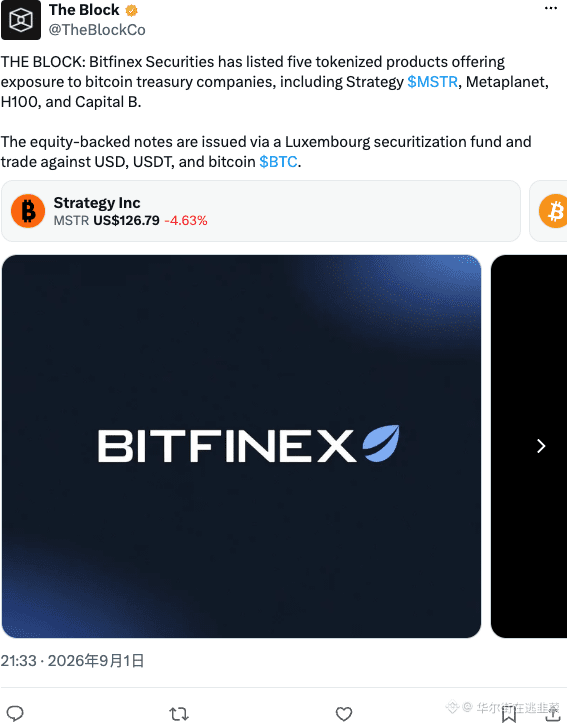
Bitfinex has listed tokenized products for Bitcoin holdings stocks like MSTR and Metaplanet, and even wrapped them in a Luxembourg securitization fund package—traded directly using USD and USDT.
Put simply, this turns the traditional stock chain into something tokenized, allowing non-US users to bypass the hurdle of opening accounts for US stocks and buy exposure directly. Liquidity can’t compare to native stocks, but it’s convenient. And it adds yet another channel for extracting funds: when people buy these tokens, fewer people are directly buying BTC spot. In the short term, it doesn’t seem to have much impact; in the medium term, it looks like institutions are paving the way for a “low-key long” on Bitcoin through indirect routes.
BTC itself hasn’t firmly held its ground yet—don’t rush.
$BTC #Bitfinex #Tokenized
Bitfinex has listed tokenized products for Bitcoin holdings stocks like MSTR and Metaplanet, and even wrapped them in a Luxembourg securitization fund package—traded directly using USD and USDT.
Put simply, this turns the traditional stock chain into something tokenized, allowing non-US users to bypass the hurdle of opening accounts for US stocks and buy exposure directly. Liquidity can’t compare to native stocks, but it’s convenient. And it adds yet another channel for extracting funds: when people buy these tokens, fewer people are directly buying BTC spot. In the short term, it doesn’t seem to have much impact; in the medium term, it looks like institutions are paving the way for a “low-key long” on Bitcoin through indirect routes.
BTC itself hasn’t firmly held its ground yet—don’t rush.
$BTC #Bitfinex #Tokenized
Put simply, this turns the traditional stock chain into something tokenized, allowing non-US users to bypass the hurdle of opening accounts for US stocks and buy exposure directly. Liquidity can’t compare to native stocks, but it’s convenient. And it adds yet another channel for extracting funds: when people buy these tokens, fewer people are directly buying BTC spot. In the short term, it doesn’t seem to have much impact; in the medium term, it looks like institutions are paving the way for a “low-key long” on Bitcoin through indirect routes.
BTC itself hasn’t firmly held its ground yet—don’t rush.
$BTC #Bitfinex #Tokenized
119

·
--
Bitfinex Securities launched tokenized notes linked to companies that are strongly betting on $BTC.
These are five instruments backed by shares from the ORO II fund.
They are available to non-U.S. investors.
The interesting part is that you can trade them using dollars, $USDT, or directly with $BTC.
It’s another step toward integrating traditional assets with the crypto market.
What do you think of this investment format?
#Bitcoin #RWA #Bitfinex
Bitfinex Securities launched tokenized notes linked to companies that are strongly betting on $BTC .
These are five instruments backed by shares from the ORO II fund.
They are available to non-U.S. investors.
The interesting part is that you can trade them using dollars, $USDT, or directly with $BTC .
It’s another step toward integrating traditional assets with the crypto market.
What do you think of this investment format?
#Bitcoin #RWA #Bitfinex
These are five instruments backed by shares from the ORO II fund.
They are available to non-U.S. investors.
The interesting part is that you can trade them using dollars, $USDT, or directly with $BTC .
It’s another step toward integrating traditional assets with the crypto market.
What do you think of this investment format?
#Bitcoin #RWA #Bitfinex

105

·
--
U.S. government-related addresses have taken another new step.
According to Onchain Lens monitoring, an address labeled by Nansen as “storing U.S. government-seized Bitfinex hacker funds” has just transferred approximately 296,700 USDT to Coinbase Prime.
The amount isn’t particularly large, but the signal is worth noting:
- Addresses like this are generally viewed as “government wallets.” When funds flow to Coinbase Prime, it typically suggests use of institutional-level channels—possibly liquidation, custody adjustments, or preparation for subsequent actions;
- In the Bitfinex hacker case, recovered assets have historically been moved out in multiple batches, and each transfer tends to spark market speculation about potential sell pressure;
- Compared with BTC, the move of USDT directly into an exchange leaves less room for interpretation. It looks more like fund operations or counterparty settlement.
In the short term, there’s no need to over-interpret this single transfer of 300,000. However, it’s recommended to continue monitoring the subsequent activities of the same cluster of addresses—especially whether any BTC outflows accompany it. Every movement from a government address is an amplifier of on-chain sentiment.
#USDT #Bitfinex #on-chain tracking
U.S. government-related addresses have taken another new step.
According to Onchain Lens monitoring, an address labeled by Nansen as “storing U.S. government-seized Bitfinex hacker funds” has just transferred approximately 296,700 USDT to Coinbase Prime.
The amount isn’t particularly large, but the signal is worth noting:
- Addresses like this are generally viewed as “government wallets.” When funds flow to Coinbase Prime, it typically suggests use of institutional-level channels—possibly liquidation, custody adjustments, or preparation for subsequent actions;
- In the Bitfinex hacker case, recovered assets have historically been moved out in multiple batches, and each transfer tends to spark market speculation about potential sell pressure;
- Compared with BTC, the move of USDT directly into an exchange leaves less room for interpretation. It looks more like fund operations or counterparty settlement.
In the short term, there’s no need to over-interpret this single transfer of 300,000. However, it’s recommended to continue monitoring the subsequent activities of the same cluster of addresses—especially whether any BTC outflows accompany it. Every movement from a government address is an amplifier of on-chain sentiment.
#USDT #Bitfinex #on-chain tracking
According to Onchain Lens monitoring, an address labeled by Nansen as “storing U.S. government-seized Bitfinex hacker funds” has just transferred approximately 296,700 USDT to Coinbase Prime.
The amount isn’t particularly large, but the signal is worth noting:
- Addresses like this are generally viewed as “government wallets.” When funds flow to Coinbase Prime, it typically suggests use of institutional-level channels—possibly liquidation, custody adjustments, or preparation for subsequent actions;
- In the Bitfinex hacker case, recovered assets have historically been moved out in multiple batches, and each transfer tends to spark market speculation about potential sell pressure;
- Compared with BTC, the move of USDT directly into an exchange leaves less room for interpretation. It looks more like fund operations or counterparty settlement.
In the short term, there’s no need to over-interpret this single transfer of 300,000. However, it’s recommended to continue monitoring the subsequent activities of the same cluster of addresses—especially whether any BTC outflows accompany it. Every movement from a government address is an amplifier of on-chain sentiment.
#USDT #Bitfinex #on-chain tracking
13

New on-chain investigation findings: an address marked by Nansen as “US government-held Bitfinex hacker confiscated funds” has just transferred approximately 296,700 USDT to Coinbase Prime.
The amount isn’t particularly astonishing, but the signal is worth watching—transfers from addresses like this in the past often correspond to over-the-counter liquidation or the progression of judicial proceedings. Coinbase Prime, as a compliant large-transaction channel, typically implies institutional settlement rather than an immediate sell-off that would hit the market.
Key observation points:
1. A single transfer of nearly 300,000 USDT looks like a probing move—watch whether there are subsequent, consecutive disbursements
2. Government-side funds flowing to the Prime platform likely have limited impact on spot prices in the short term, but it may affect market sentiment and expectations
3. The Bitfinex hacker case involves assets on a massive scale; any on-chain activity could be amplified and interpreted by algorithms and traders
For holders, the focus isn’t just on this one transfer, but whether this address enters a “continuous moving” phase. It’s recommended to monitor the subsequent transfer frequency of addresses from the same source and to cluster their destination addresses.
#USDT #链上追踪 #Bitfinex
New on-chain investigation findings: an address marked by Nansen as “US government-held Bitfinex hacker confiscated funds” has just transferred approximately 296,700 USDT to Coinbase Prime.
The amount isn’t particularly astonishing, but the signal is worth watching—transfers from addresses like this in the past often correspond to over-the-counter liquidation or the progression of judicial proceedings. Coinbase Prime, as a compliant large-transaction channel, typically implies institutional settlement rather than an immediate sell-off that would hit the market.
Key observation points:
1. A single transfer of nearly 300,000 USDT looks like a probing move—watch whether there are subsequent, consecutive disbursements
2. Government-side funds flowing to the Prime platform likely have limited impact on spot prices in the short term, but it may affect market sentiment and expectations
3. The Bitfinex hacker case involves assets on a massive scale; any on-chain activity could be amplified and interpreted by algorithms and traders
For holders, the focus isn’t just on this one transfer, but whether this address enters a “continuous moving” phase. It’s recommended to monitor the subsequent transfer frequency of addresses from the same source and to cluster their destination addresses.
#USDT #链上追踪 #Bitfinex
The amount isn’t particularly astonishing, but the signal is worth watching—transfers from addresses like this in the past often correspond to over-the-counter liquidation or the progression of judicial proceedings. Coinbase Prime, as a compliant large-transaction channel, typically implies institutional settlement rather than an immediate sell-off that would hit the market.
Key observation points:
1. A single transfer of nearly 300,000 USDT looks like a probing move—watch whether there are subsequent, consecutive disbursements
2. Government-side funds flowing to the Prime platform likely have limited impact on spot prices in the short term, but it may affect market sentiment and expectations
3. The Bitfinex hacker case involves assets on a massive scale; any on-chain activity could be amplified and interpreted by algorithms and traders
For holders, the focus isn’t just on this one transfer, but whether this address enters a “continuous moving” phase. It’s recommended to monitor the subsequent transfer frequency of addresses from the same source and to cluster their destination addresses.
#USDT #链上追踪 #Bitfinex
22

·
--
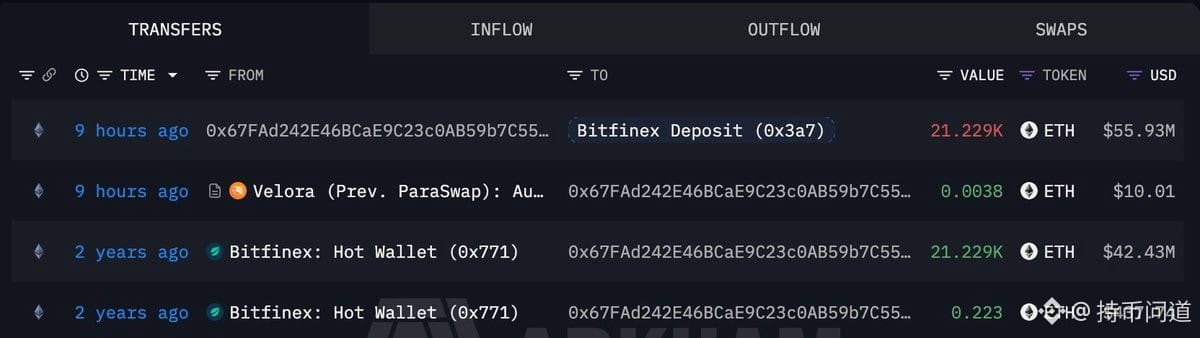
🚨 WHALE ETH MOVES $171 MILLION TO BITFINEX AFTER 5 YEARS
An Ethereum wallet that had been inactive for over five years suddenly came back to life, transferring 86,481 ETH worth about $171.57 million to Bitfinex.
This massive movement has caught the attention of traders and on-chain analysts, as transfers from old wallets are often monitored for potential signals of significant market activity.
#ETH #Ethereum #Bitfinex #crypto #BlackRockCryptoDown17PctYTD $BTC $ETH
🚨 WHALE ETH MOVES $171 MILLION TO BITFINEX AFTER 5 YEARS
An Ethereum wallet that had been inactive for over five years suddenly came back to life, transferring 86,481 ETH worth about $171.57 million to Bitfinex.
This massive movement has caught the attention of traders and on-chain analysts, as transfers from old wallets are often monitored for potential signals of significant market activity.
#ETH #Ethereum #Bitfinex #crypto #BlackRockCryptoDown17PctYTD $BTC $ETH
An Ethereum wallet that had been inactive for over five years suddenly came back to life, transferring 86,481 ETH worth about $171.57 million to Bitfinex.
This massive movement has caught the attention of traders and on-chain analysts, as transfers from old wallets are often monitored for potential signals of significant market activity.
#ETH #Ethereum #Bitfinex #crypto #BlackRockCryptoDown17PctYTD $BTC $ETH


134
·
--
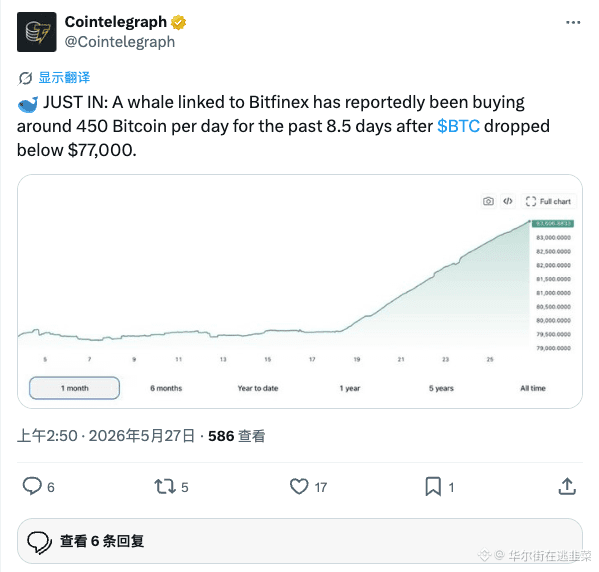
There's an address tied to Bitfinex that has been stacking for 8.5 days since BTC dipped below 77000, averaging about 450 each day.
This volume isn't something retail traders can churn out; it feels more like someone is prepping for a move. Historically, this kind of stealth accumulation has been followed by some solid price action. #Bitfinex $BTC
{future}(BTCUSDT)
There's an address tied to Bitfinex that has been stacking for 8.5 days since BTC dipped below 77000, averaging about 450 each day.
This volume isn't something retail traders can churn out; it feels more like someone is prepping for a move. Historically, this kind of stealth accumulation has been followed by some solid price action. #Bitfinex $BTC
This volume isn't something retail traders can churn out; it feels more like someone is prepping for a move. Historically, this kind of stealth accumulation has been followed by some solid price action. #Bitfinex $BTC
198


·
--
US government-related addresses have moved again.
According to Onchain Lens monitoring, an address labeled by Nansen as “storing US government-seized Bitfinex hacker funds” has just transferred approximately 296,700 USDT to Coinbase Prime.
The amount isn’t large, but the implication is worth considering: using Coinbase Prime typically corresponds to an institutional custody or OTC disposal route, rather than directly dumping into the secondary market. Historically, the movements of addresses like this are often part of the seized-assets handling workflow, with a pace slower than the market might imagine.
In the short term, there’s no need to overinterpret this as a sell-pressure signal, but this on-chain “hidden thread” is worth ongoing tracking—especially whether subsequent BTC-related addresses will follow with transfers out.
#美国政府 #Bitfinex #链上监测 $BTC
US government-related addresses have moved again.
According to Onchain Lens monitoring, an address labeled by Nansen as “storing US government-seized Bitfinex hacker funds” has just transferred approximately 296,700 USDT to Coinbase Prime.
The amount isn’t large, but the implication is worth considering: using Coinbase Prime typically corresponds to an institutional custody or OTC disposal route, rather than directly dumping into the secondary market. Historically, the movements of addresses like this are often part of the seized-assets handling workflow, with a pace slower than the market might imagine.
In the short term, there’s no need to overinterpret this as a sell-pressure signal, but this on-chain “hidden thread” is worth ongoing tracking—especially whether subsequent BTC-related addresses will follow with transfers out.
#美国政府 #Bitfinex #链上监测 $BTC
According to Onchain Lens monitoring, an address labeled by Nansen as “storing US government-seized Bitfinex hacker funds” has just transferred approximately 296,700 USDT to Coinbase Prime.
The amount isn’t large, but the implication is worth considering: using Coinbase Prime typically corresponds to an institutional custody or OTC disposal route, rather than directly dumping into the secondary market. Historically, the movements of addresses like this are often part of the seized-assets handling workflow, with a pace slower than the market might imagine.
In the short term, there’s no need to overinterpret this as a sell-pressure signal, but this on-chain “hidden thread” is worth ongoing tracking—especially whether subsequent BTC-related addresses will follow with transfers out.
#美国政府 #Bitfinex #链上监测 $BTC
10

·
--
LEO is quite interesting, isn't it? While the market's taking a nosedive, this one’s holding strong like a champ.
Honestly, this coin is the platform token from Bitfinex, an old-timer in the game. Typically, platform tokens ride the waves of their exchanges, so you'd expect more volatility, right?
Look at it now, priced at $9.9600, only down 1.0% in 24 hours, and just a 0.9% dip over the last week. The market cap is pretty insane at $9.165 billion. But the bizarre part? The 24-hour trading volume is a measly $0.01 billion. This market cap with such low volume feels like a stagnant pond, it’s odd for sure.
I really can’t wrap my head around this move; any of you seasoned traders got insights? Drop a comment.
https://www.coingecko.com/en/coins/leo-token
#币圈 #LEO #平台币 #Bitfinex
LEO is quite interesting, isn't it? While the market's taking a nosedive, this one’s holding strong like a champ.
Honestly, this coin is the platform token from Bitfinex, an old-timer in the game. Typically, platform tokens ride the waves of their exchanges, so you'd expect more volatility, right?
Look at it now, priced at $9.9600, only down 1.0% in 24 hours, and just a 0.9% dip over the last week. The market cap is pretty insane at $9.165 billion. But the bizarre part? The 24-hour trading volume is a measly $0.01 billion. This market cap with such low volume feels like a stagnant pond, it’s odd for sure.
I really can’t wrap my head around this move; any of you seasoned traders got insights? Drop a comment.
https://www.coingecko.com/en/coins/leo-token
#币圈 #LEO #平台币 #Bitfinex
Honestly, this coin is the platform token from Bitfinex, an old-timer in the game. Typically, platform tokens ride the waves of their exchanges, so you'd expect more volatility, right?
Look at it now, priced at $9.9600, only down 1.0% in 24 hours, and just a 0.9% dip over the last week. The market cap is pretty insane at $9.165 billion. But the bizarre part? The 24-hour trading volume is a measly $0.01 billion. This market cap with such low volume feels like a stagnant pond, it’s odd for sure.
I really can’t wrap my head around this move; any of you seasoned traders got insights? Drop a comment.
https://www.coingecko.com/en/coins/leo-token
#币圈 #LEO #平台币 #Bitfinex
1
164

·
--
On-Chain Latest Intelligence
Four dormant wallets have just moved $ETH.
After more than two years of inactivity, these wallets collectively deposited 48,047 $ETH into #Bitfinex (equivalent to 700,000 coins worth $130).
48,047 $ETH
700,000 coins worth $130
Dormant for more than two years
The question now is: why move these tokens?
On-Chain Latest Intelligence
Four dormant wallets have just moved $ETH .
After more than two years of inactivity, these wallets collectively deposited 48,047 $ETH into #Bitfinex (equivalent to 700,000 coins worth $130).
48,047 $ETH
700,000 coins worth $130
Dormant for more than two years
The question now is: why move these tokens?
Four dormant wallets have just moved $ETH .
After more than two years of inactivity, these wallets collectively deposited 48,047 $ETH into #Bitfinex (equivalent to 700,000 coins worth $130).
48,047 $ETH
700,000 coins worth $130
Dormant for more than two years
The question now is: why move these tokens?
69
·
--
Giant Whale Data Monitoring
Two wallets (likely belonging to the same whale) after more than two years of inactivity deposited 33,180 $ETH (worth $930,000 $86) into #Bitfinex , making a profit of $480,000 $20!
Giant Whale Data Monitoring
Two wallets (likely belonging to the same whale) after more than two years of inactivity deposited 33,180 $ETH (worth $930,000 $86) into #Bitfinex , making a profit of $480,000 $20!
Two wallets (likely belonging to the same whale) after more than two years of inactivity deposited 33,180 $ETH (worth $930,000 $86) into #Bitfinex , making a profit of $480,000 $20!

137

Tether and Bitfinex just lost a big fight in court
What’s the lawsuit actually about? Investors claim that between 2017 and 2019, Tether printed massive amounts of USDT that weren’t fully backed by real dollars, then used that stablecoin to buy up BTC and ETH across exchanges. The theory is this pumped prices artificially, and when the truth came out, regular investors were left holding the bag. We’re talking claims of hundreds of billions in alleged losses.
Tether and Bitfinex tried to get the Second Circuit to step in and kill the class certification before things went any further. The court said no. So now the case heads into the next phase, where both sides will fight over whether unbacked stablecoin issuance actually caused prices to move the way plaintiffs claim.
This case has been dragging on since 2019, and it’s finally reaching a stage where real evidence and real experts get tested in front of a judge. Win or lose, it’s a reminder that stablecoin backing claims aren’t just PR talk, they can end up as the central question in a multibillion dollar lawsuit.
Definitely one to keep an eye on if you hold USDT or trade on platforms tied to Tether liquidity.
#Tether #Bitfinex #crypto #USDT #Binance
Tether and Bitfinex just lost a big fight in court
What’s the lawsuit actually about? Investors claim that between 2017 and 2019, Tether printed massive amounts of USDT that weren’t fully backed by real dollars, then used that stablecoin to buy up BTC and ETH across exchanges. The theory is this pumped prices artificially, and when the truth came out, regular investors were left holding the bag. We’re talking claims of hundreds of billions in alleged losses.
Tether and Bitfinex tried to get the Second Circuit to step in and kill the class certification before things went any further. The court said no. So now the case heads into the next phase, where both sides will fight over whether unbacked stablecoin issuance actually caused prices to move the way plaintiffs claim.
This case has been dragging on since 2019, and it’s finally reaching a stage where real evidence and real experts get tested in front of a judge. Win or lose, it’s a reminder that stablecoin backing claims aren’t just PR talk, they can end up as the central question in a multibillion dollar lawsuit.
Definitely one to keep an eye on if you hold USDT or trade on platforms tied to Tether liquidity.
#Tether #Bitfinex #crypto #USDT #Binance
What’s the lawsuit actually about? Investors claim that between 2017 and 2019, Tether printed massive amounts of USDT that weren’t fully backed by real dollars, then used that stablecoin to buy up BTC and ETH across exchanges. The theory is this pumped prices artificially, and when the truth came out, regular investors were left holding the bag. We’re talking claims of hundreds of billions in alleged losses.
Tether and Bitfinex tried to get the Second Circuit to step in and kill the class certification before things went any further. The court said no. So now the case heads into the next phase, where both sides will fight over whether unbacked stablecoin issuance actually caused prices to move the way plaintiffs claim.
This case has been dragging on since 2019, and it’s finally reaching a stage where real evidence and real experts get tested in front of a judge. Win or lose, it’s a reminder that stablecoin backing claims aren’t just PR talk, they can end up as the central question in a multibillion dollar lawsuit.
Definitely one to keep an eye on if you hold USDT or trade on platforms tied to Tether liquidity.
#Tether #Bitfinex #crypto #USDT #Binance
1
74

·
--
📊 Recently, Bitcoin long positions have remained stable, while shorts continue to reduce their holdings.
#BTC #Hyperliquid #Bitfinex
📊 Recently, Bitcoin long positions have remained stable, while shorts continue to reduce their holdings.
#BTC #Hyperliquid #Bitfinex
#BTC #Hyperliquid #Bitfinex
63
Log in to explore more content
Join global crypto users on Binance Square
⚡️ Get latest and useful information about crypto.
💬 Trusted by the world’s largest crypto exchange.
👍 Discover real insights from verified creators.
Email / Phone number
Trending Topics
1
#AIStocksWhatNext
962,762 views
6,902 Discussing
2
#BitcoinRejectedAt$87,300Twice
0 views
0 Discussing
3
#BCHJumps28%OnCMEFuturesListing
19,507 views
620 Discussing
4
#WallStreetEarningsRevisionsTurnBearish
13,848 views
461 Discussing
5
#DollarIndexReclaims101
11,432 views
395 Discussing
6
#21SharesLaunchesEuropesFirstZcashETP
50,369 views
1,188 Discussing
7
#CardanoJoinsX402PaymentStandard
30,568 views
834 Discussing
8
#BitcoinTops$87KAtEightMonthHigh
13,785 views
135 Discussing
9
#ZECBreaksAbove$1600AtRecordHigh
9,623 views
108 Discussing
10
#BitwiseNEARStakingETPAssetsTop$100M
47,955 views
111 Discussing