
#bitgo
bitgo
159,314 views
480 Discussing
Hot
Latest

·
--
Verified
Article
WALL STREET-LEVEL CONFIDENCE IN APTOS!A major institutional player is making moves into the Aptos ecosystem!
BitGo, one of the industry's leading qualified crypto custodians, has announced a strategic position in $APT . While the investment amount remains undisclosed, the move sends a strong signal of institutional interest.
But that's not all! BitGo is also enabling institutions to:
🔹 Stake $APT directly through its platform.
🔹 Access DecibelTrade, the perpetual trading platform built on Aptos.
Why does this matter?
Institutional investment, staking infrastructure, and access to on-chain trading could bring more capital, liquidity, and credibility to Aptos.
The bigger question is: Is institutional adoption of $APT just getting started? 👀
#BitGo #crypto #defi
WALL STREET-LEVEL CONFIDENCE IN APTOS!
A major institutional player is making moves into the Aptos ecosystem!
BitGo, one of the industry's leading qualified crypto custodians, has announced a strategic position in $APT . While the investment amount remains undisclosed, the move sends a strong signal of institutional interest.
But that's not all! BitGo is also enabling institutions to:
🔹 Stake $APT directly through its platform.
🔹 Access DecibelTrade, the perpetual trading platform built on Aptos.
Why does this matter?
Institutional investment, staking infrastructure, and access to on-chain trading could bring more capital, liquidity, and credibility to Aptos.
The bigger question is: Is institutional adoption of $APT just getting started? 👀
#BitGo #crypto #defi
Crypto Anik BD:
Wow Aptos getting Wall Street confidence? 😳🔥
This is HUGE for $APT!
Do you think this will pump APT to new high? I'm holding a small bag!
Thanks for sharing this article bro 🙏
2
4
1.6k

·
--
When BitGo launched Mint in April, it initially supported USD1 and SoFiUSD, and only added $USDC on November 12. The new feature is available only to eligible customers of OCC-regulated BitGo Bank & Trust. Orders are processed through BitGo’s Circle Mint account, with fixed fees disclosed before customers confirm. It supports nine networks, including Ethereum, Solana, and Base.
Institutions previously had to open accounts with each issuer separately. Now, a single BitGo account lets them subscribe to and redeem multiple stablecoins. Competition in stablecoins is shifting from who issues the coins to whose platform can manage several of them at once—and the platform being built this time belongs to a regulated trust bank.
The on-chain portion operates 24/7, but fiat deposits and withdrawals still depend on banking hours and settlement schedules. Even the stable part of stablecoins remains tied to the bank’s timetable.
#稳定币 #BitGo #InstitutionalAdoption

Institutional adoption isn’t built on slogans—it takes infrastructure. BitGo announced today that its institutional platform, BitGo Link, has expanded to connect with 10 exchanges: Binance, Bybit, Deribit, and Bitstamp, joining Coinbase, Kraken, OKX, Crypto.com, Gate, and Bitget. That’s nearly every major exchange covered. Link only launched this August, and the idea is simple: institutions keep their funds in qualified custody with BitGo, while managing balances, transfers, and approvals across exchanges from a single dashboard—without having to risk moving coins onto an exchange. In the same week, BitGo also launched Global Markets for execution, financing, derivatives, and settlement. A reality check, though: since going public this January, BitGo’s stock is down 63%. Institutional infrastructure keeps expanding, but Bitcoin is still bottoming out around $74,000. The pipes are ready—when will the water come? #BitGo #Institutions
Institutional adoption isn’t built on slogans—it takes infrastructure. BitGo announced today that its institutional platform, BitGo Link, has expanded to connect with 10 exchanges: Binance, Bybit, Deribit, and Bitstamp, joining Coinbase, Kraken, OKX, Crypto.com, Gate, and Bitget. That’s nearly every major exchange covered. Link only launched this August, and the idea is simple: institutions keep their funds in qualified custody with BitGo, while managing balances, transfers, and approvals across exchanges from a single dashboard—without having to risk moving coins onto an exchange. In the same week, BitGo also launched Global Markets for execution, financing, derivatives, and settlement. A reality check, though: since going public this January, BitGo’s stock is down 63%. Institutional infrastructure keeps expanding, but Bitcoin is still bottoming out around $74,000. The pipes are ready—when will the water come? #BitGo #Institutions

42

📉 BitGo's Q3 revenue fell 51%, but net income rose on reserve gains
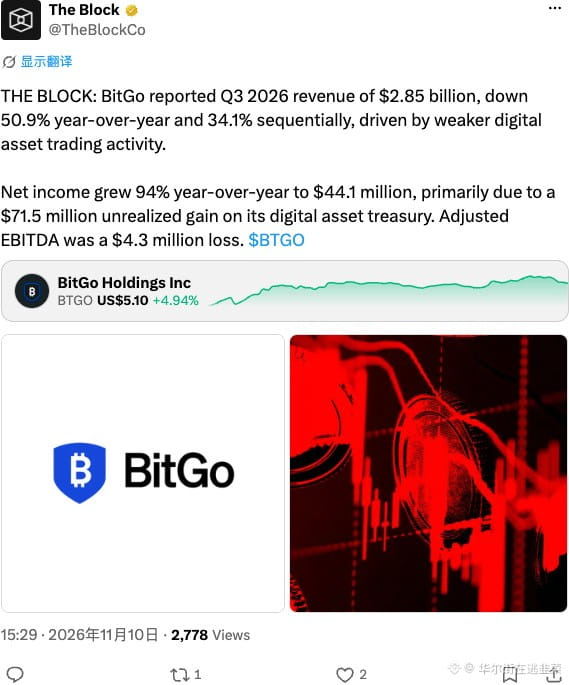
BitGo reported third-quarter revenue of $2.85 billion, down 50.9% year over year and 34.1% quarter over quarter. The company attributed the decline mainly to weaker digital asset sales and a higher share of lower-margin stablecoin transactions. Revenue after direct costs was $37.3 million, down 32.1% year over year.
Meanwhile, net income rose to $44.1 million from $22.7 million in the same period last year, primarily due to $71.5 million in unrealized gains on digital asset reserves. As of September 30, the company held 2,399 BTC of its own, worth $200.4 million. It posted an operating loss of $19.2 million and an adjusted EBITDA loss of $4.3 million for the quarter. The company also completed its acquisition of NYDIG's institutional trading business and repurchased $24.7 million of common stock under a $50 million authorization.
⭐ Sluggish trading weighed on revenue measured by transaction volume, while reported profits depended much more on price fluctuations in the company's own Bitcoin reserves.
#BitGo #财报 #Bitcoin


·
--
Behind BitGo’s Q3 doubling of unrealized gains: Revenue halves, down 51%, while earnings quality warrants caution
BitGo’s third-quarter earnings figures look impressive on the surface. But a closer look shows that what really propped up profits was not its core business, but unrealized gains on its crypto holdings. This structure may be more noteworthy than the results themselves.
According to Cointelegraph, BitGo’s net income nearly doubled this quarter, but the main driver of that growth was $71 million in unrealized gains on its crypto assets. Meanwhile, the company’s revenue fell 51% year over year. In other words, profits are up, but cash coming in is down sharply.
This combination deserves closer examination. A doubling of net income is usually taken as a sign of improving operations, but here the increase came mainly from higher asset valuations on paper, rather than actual revenue inflows. Unrealized gains mean the assets are still being held, and if prices reverse, those profits could evaporate quickly. The halving of revenue, meanwhile, suggests that the company’s core businesses—custody, trading commissions, and the like—are contracting significantly.
From a financial perspective, this exposes a weak point in institutional proprietary exposure: when profits depend heavily on appreciation in holdings, earnings quality becomes fragile. It reflects market beta, not operational alpha. In other words, the “good” in these results is largely built on asset prices, rather than an improvement in business capabilities.
It should be emphasized that this is not a crisis unique to BitGo. Profit driven by unrealized gains is a cyclical phenomenon in the crypto asset management industry, and is widespread in bull markets. Appreciation in holdings is a positive in itself, indicating that the company’s earlier allocation decisions were sound. So calling this a “crisis” outright may be overly pessimistic. More accurately, the health of its earnings structure is open to question.
The counterargument is also valid: falling revenue may reflect the broader industry cycle rather than a company-specific problem, while unrealized gains are proof that its assets are still appreciating. What really needs watching is whether these profits, which rely on unrealized gains, can be underpinned by actual revenue next quarter.
Looking ahead, what matters is not the earnings report itself, but the sustainability of its earnings structure. If the crypto market enters a period of volatility or a correction, profit volatility without revenue support could become the company’s largest risk exposure.
From a trading perspective, it is more important to watch whether this “profit driven by unrealized gains” model can continue than to simply chase earnings figures.
#BitGo #CryptoMarket
The above is a summary of information and personal analysis, and does not constitute investment advice.
Follow me for ongoing coverage of key market developments and data.
8

BitGo Q3 profits doubled thanks to crypto gains, revenue fell 51%
- BitGo Q3 net income almost doubled thanks to $71 million unrealized gain from crypto holdings.
- Revenue fell 51% and missed analyst expectations.
- Earnings also fell short of preliminary analyst forecasts. #BinanceSquare #CryptoNews #BitGo #BTC
$btc $eth
#vlikevn Titanbot
Source: CoinTelegraph
- BitGo Q3 net income almost doubled thanks to $71 million unrealized gain from crypto holdings.
- Revenue fell 51% and missed analyst expectations.
- Earnings also fell short of preliminary analyst forecasts. #BinanceSquare #CryptoNews #BitGo #BTC
$btc $eth
#vlikevn Titanbot
Source: CoinTelegraph

·
--
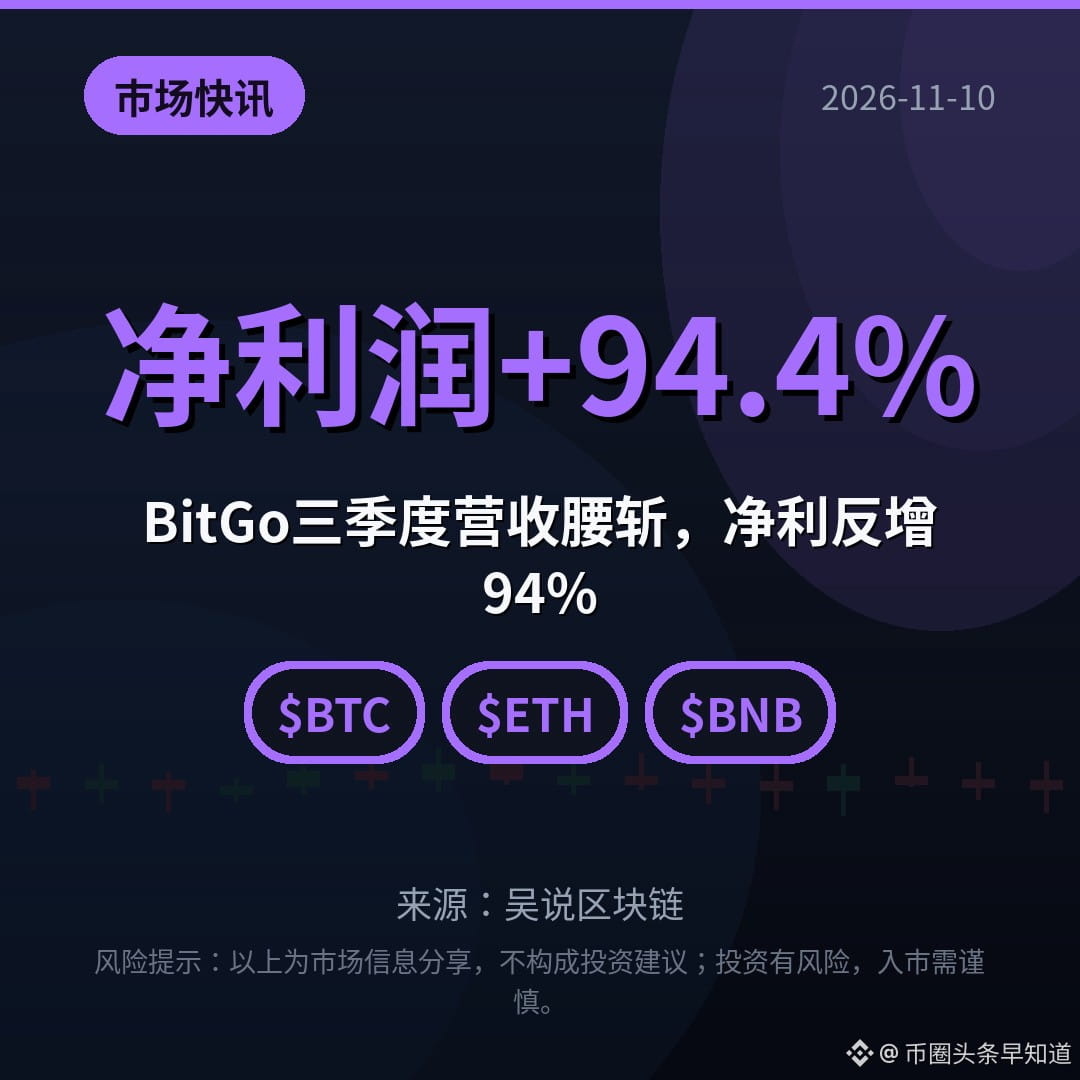
【Market Brief】BitGo’s Q3 revenue halves, while net income jumps 94%
Digital asset custodian BitGo’s Q3 earnings report was a tale of two extremes: revenue was $2.852 billion, down 50.9% year over year and 34.1% quarter over quarter; net income, however, rose 94.4% to $44.1 million, helped by $71.5 million in unrealized treasury gains. Adjusted EBITDA posted a loss of $4.3 million, compared with a profit of $13.5 million in the same period last year. Are you bullish on these results?
$BTC $ETH $BNB
#比特币 #BitGo #Earnings
(Source: Wu Shuo Blockchain)
⚠️Risk warning: The above is shared for market information purposes only and does not constitute investment advice. Investing involves risks; please exercise caution when entering the market.
3
BitGo revenue fell 51% in Q3 amid slower trading; net income rose on treasury gains
- Revenue fell 51% due to a weak crypto trading environment and a higher share of stablecoins.
- Net income rose on treasury gains.
- The soft crypto environment continues to weigh on revenue.
#BinanceSquare #CryptoNews #BitGo #BTC #ETH
$btc $eth
vlikevn Titanbot
Source: The Block
- Revenue fell 51% due to a weak crypto trading environment and a higher share of stablecoins.
- Net income rose on treasury gains.
- The soft crypto environment continues to weigh on revenue.
#BinanceSquare #CryptoNews #BitGo #BTC #ETH
$btc $eth
vlikevn Titanbot
Source: The Block
188

·
--
BitGo’s Q3 revenue halved year over year, mainly due to sluggish trading volume. Yet net income surged 94%, thanks entirely to $7.15 billion in unrealized gains on assets. Adjusted EBITDA was still negative—a classic case of “paper wealth.” Asset appreciation alone can’t sustain long-term value; weak trading is the fatal flaw.
#BitGo #MoneyInFlow #CryptoNews
#BitGo #MoneyInFlow #CryptoNews
BTGOUS+0.24%
18

·
--
📰 BitGo Folds NYDIG's Team and Prime Into a Global Markets Business Led by Pete Janney
The new division combines spot and block execution, financing against crypto collateral, derivatives and structured products, with clearing on BitGo's Go Net...
Source : Coingecko
Time : 2026-11-06 06:40:00
Credit : blockhead
#institutional #bitgo #derivatives
$JUP $STX $BTC
Share your opinion in the comment section below
98

·
--
📰 BitGo Folds NYDIG's Team and Prime Into a Global Markets Business Led by Pete Janney
The new division combines spot and block execution, financing against crypto collateral, derivatives and structured products, with clearing on BitGo's Go Net...
Source : Coingecko
Time : 2026-11-06 06:40:00
Credit : blockhead
#institutional #bitgo #derivatives
$JUP $STX $BTC
Share your opinion in the comment section below
📰 BitGo Folds NYDIG's Team and Prime Into a Global Markets Business Led by Pete Janney
The new division combines spot and block execution, financing against crypto collateral, derivatives and structured products, with clearing on BitGo's Go Net...
Source : Coingecko
Time : 2026-11-06 06:40:00
Credit : blockhead
#institutional #bitgo #derivatives
$JUP $STX $BTC
Share your opinion in the comment section below
The new division combines spot and block execution, financing against crypto collateral, derivatives and structured products, with clearing on BitGo's Go Net...
Source : Coingecko
Time : 2026-11-06 06:40:00
Credit : blockhead
#institutional #bitgo #derivatives
$JUP $STX $BTC
Share your opinion in the comment section below
104

BitGo Expands Into Institutional Trading
BitGo is expanding its footprint into the institutional sector with the launch of Global Markets. Led by former NYDIG executive Pete Janney the new division aims to provide institutional trading and financial solutions.
#BitGo #InstitutionalInfrastructure
BitGo Expands Into Institutional Trading
BitGo is expanding its footprint into the institutional sector with the launch of Global Markets. Led by former NYDIG executive Pete Janney the new division aims to provide institutional trading and financial solutions.
#BitGo #InstitutionalInfrastructure
BitGo is expanding its footprint into the institutional sector with the launch of Global Markets. Led by former NYDIG executive Pete Janney the new division aims to provide institutional trading and financial solutions.
#BitGo #InstitutionalInfrastructure

11
BitGo launches Global Markets, an institutional trading unit led by a former NYDIG executive
- BitGo launches Global Markets, a trading and finance solution for institutions
- Pete Janney, a former NYDIG employee, will lead the unit
- The RSS source has not provided further details on its scale or specific products
#BinanceSquare #CryptoNews #BitGo #Institutional
$btc $eth
#vlikevn Titanbot
Source: The Block
279
·
--
BitGo announces the launch of an institutional trading and financial services business led by former NYDIG executives, with a focus on professional-grade compliance.
This is an absolute game-changer. The arrival of NYDIG’s former core team takes compliance and product depth to the next level. The institutional wave is only just beginning, and this powerful combination of core infrastructure has far more long-term value than simply launching a token.
#BitGo #InstitutionalCrypto

2

·
--
On 2026-10-27, BitGo announced: eligible institutional clients will be able to subscribe to and redeem WisdomTree's tokenized treasury money market fund WTGXX directly through BitGo Mint within BitGo Bank & Trust's custody and settlement environment, and convert between U.S. dollars, supported stablecoins, and fund shares without separate integration with WisdomTree. WTGXX will join BitGo Mint's existing asset lineup (the announcement specifically mentions USD1 and SoFiUSD); peer-to-peer transfers and certain stablecoin-related capabilities may still be unavailable at launch, subject to official rollout.$USD1 #RWA #Tokenization #BitGo
On 2026-10-27, BitGo announced: eligible institutional clients will be able to subscribe to and redeem WisdomTree's tokenized treasury money market fund WTGXX directly through BitGo Mint within BitGo Bank & Trust's custody and settlement environment, and convert between U.S. dollars, supported stablecoins, and fund shares without separate integration with WisdomTree. WTGXX will join BitGo Mint's existing asset lineup (the announcement specifically mentions USD1 and SoFiUSD); peer-to-peer transfers and certain stablecoin-related capabilities may still be unavailable at launch, subject to official rollout.$USD1 #RWA #Tokenization #BitGo
118

·
--
Leverage without selling your coins: BitGo Bank & Trust has become the first custodian in Kalshi Prime’s HODL margin network. Eligible clients can pledge BTC, ETH, or certain stablecoins to borrow USD for margin on perpetual futures, while their assets remain in segregated qualified custody and cold storage at BitGo, with legal ownership unchanged. Bringing custody and collateral financing together further improves the capital efficiency of institutional holdings. Do you think this type of collateral financing will amplify volatility or deepen liquidity? Share your thoughts in the comments.
$BTC $ETH $SOL
#BitGo #Kalshi #CryptoCustody
(Source: Coinfomania)
⚠️Risk warning: The above is shared for market information only and does not constitute investment advice. Investing involves risk; please exercise caution.
$BTC $ETH $SOL
#BitGo #Kalshi #CryptoCustody
(Source: Coinfomania)
⚠️Risk warning: The above is shared for market information only and does not constitute investment advice. Investing involves risk; please exercise caution.

494

·
--
Kalshi partners with BitGo: Borrow against $BTC to trade perpetualsWant to use crypto as collateral to trade perpetuals without selling first? Kalshi and BitGo have made that possible.
Bloomberg reported on October 21 that prediction-market platform Kalshi and custodian BitGo have established a triparty collateral arrangement. Customers of Kalshi Prime, Kalshi’s U.S.-registered futures commission merchant, can pledge digital assets held at BitGo Bank & Trust to Kalshi Katalyst, an affiliated lending firm, and use the borrowed funds as margin for perpetual futures on Kalshi’s main exchange.
Eligible collateral initially includes three categories: $BTC, $ETH, and stablecoins deemed compliant with the GENIUS Act. More custodians may be added later. Kalshi Prime CEO Jeff Bandman put it plainly: people who don’t want to sell their Bitcoin, and Latin American businesses holding only dollar-pegged stablecoins, can keep their assets while opening positions.
Kalshi partners with BitGo: Borrow against $BTC to trade perpetuals
Want to use crypto as collateral to trade perpetuals without selling first? Kalshi and BitGo have made that possible.
Bloomberg reported on October 21 that prediction-market platform Kalshi and custodian BitGo have established a triparty collateral arrangement. Customers of Kalshi Prime, Kalshi’s U.S.-registered futures commission merchant, can pledge digital assets held at BitGo Bank & Trust to Kalshi Katalyst, an affiliated lending firm, and use the borrowed funds as margin for perpetual futures on Kalshi’s main exchange.
Eligible collateral initially includes three categories: $BTC , $ETH , and stablecoins deemed compliant with the GENIUS Act. More custodians may be added later. Kalshi Prime CEO Jeff Bandman put it plainly: people who don’t want to sell their Bitcoin, and Latin American businesses holding only dollar-pegged stablecoins, can keep their assets while opening positions.
81

·
--
🎯Prediction markets are starting to play with leverage
📰Kalshi has teamed up with BitGo, letting customers borrow against Bitcoin to trade perpetual futures. The casino and the bank are coming through the same door.
💬Using crypto as margin to bet on events means leverage adds a second layer of risk. Regulation is real progress, but liquidations can happen even faster. I was stunned for a couple of seconds after reading this.
🏷️#预测市场 #Kalshi #BitGo #LeverageRisk
254
·
--
BitGo launches Labs: the custody firm starts building “swipe-to-pay” infrastructure for AIBitGo has opened another “lab” in the custody business.
On October 21, BitGo officially announced the launch of BitGo Labs, a research and innovation unit. Its first focus is AI × crypto: micropayments, instant settlement, and asset custody. In the company’s words, the AI economy still lacks crypto financial infrastructure.
The first product to launch is Gokubu: an AI-powered spending card that runs on the Visa network, paired with a personal finance assistant designed to help you maximize rewards and get more value from your spending. Sign-ups are open—it’s not just a slide deck.
One more thing: BitGo listed on the NYSE earlier this year under the ticker $BTGO. Labs says it will also publish research, build prototypes, and find partners to develop with—but the “next killer app” is still just a vision, with no results to show yet.
BitGo launches Labs: the custody firm starts building “swipe-to-pay” infrastructure for AI
BitGo has opened another “lab” in the custody business.
On October 21, BitGo officially announced the launch of BitGo Labs, a research and innovation unit. Its first focus is AI × crypto: micropayments, instant settlement, and asset custody. In the company’s words, the AI economy still lacks crypto financial infrastructure.
The first product to launch is Gokubu: an AI-powered spending card that runs on the Visa network, paired with a personal finance assistant designed to help you maximize rewards and get more value from your spending. Sign-ups are open—it’s not just a slide deck.
One more thing: BitGo listed on the NYSE earlier this year under the ticker $BTGO. Labs says it will also publish research, build prototypes, and find partners to develop with—but the “next killer app” is still just a vision, with no results to show yet.
15

$BTC BITGO CUTS 15% STAFF – A SIGN OF MARKET MATURATION 🔥
BitGo just announced a 15% workforce reduction, calling it a one-time adjustment. CEO Belshe says the crypto ecosystem has evolved and they're refocusing on security, stablecoins, and AI infrastructure.
This is a big player trimming fat to stay sharp — not a panic move. The institutional side is cleaning up for the next leg. That 15% number tells me the industry is getting leaner, not weaker.
Are you reading this as a bullish signal for the long haul or a short-term headwind?
Not financial advice. Always manage your risk.
#BTC #CryptoNews #BitGo #InstitutionalAdoption #MarketMaturity
🔥
535
Log in to explore more content
Join global crypto users on Binance Square
⚡️ Get latest and useful information about crypto.
💬 Trusted by the world’s largest crypto exchange.
👍 Discover real insights from verified creators.
Email / Phone number
Trending Topics
1
#HuangExitNvidiaStrategyInFocus
62,474 views
797 Discussing
2
#AnthropicRejectsIPODelayValuationinQuestion
649,911 views
5,076 Discussing
3
#BitMineReports$6.3BNetLossForFiscal2026
7,309 views
97 Discussing
4
#ChipStocksExtendLossesAfterNvidiaCEOChange
22,432 views
347 Discussing
5
#ThailandProposes$148KDailyStablecoinDepositWithdrawalCaps
1,975 views
30 Discussing
6
#CoreWeaveJumps10%On168%RevenueGrowth
165,795 views
1,583 Discussing
7
#ZcashFallsBelow$1000ForFirstTimeSinceSeptember
80,184 views
258 Discussing
8
#MSCIRemovalMayCurbStrategy’sBitcoinBuying
43,599 views
535 Discussing
9
#TradFiForBeginners
521,468 views
3,632 Discussing
10
#USJoblessClaimsRise
19.1M views
7,749 Discussing