

#0pg
0pg
86,404 views
50 Discussing
Hot
Latest

#opg $OPG Artificial intelligence continues to revolutionize the crypto system, and projects like @OpenGradient demonstrate the enormous potential of decentralized infrastructure to verify AI models at scale. I'm closely following the development of $OPG and its campaign on Binance Square! A great proposal for the future of Web3!#0PG
#opg $OPG Artificial intelligence continues to revolutionize the crypto system, and projects like @OpenGradient demonstrate the enormous potential of decentralized infrastructure to verify AI models at scale. I'm closely following the development of $OPG and its campaign on Binance Square! A great proposal for the future of Web3!#0PG
95

·
--
I never understood why a chain of AI models scared me until last month. A single model error felt manageable, like a typo in a long email. But when I watched three models feed into each other one summarizing data, another analyzing patterns, a third making a recommendation I realized a small glitch in the first step could silently corrupt the entire decision. And nobody would know.
Most of the time, I trust AI pipelines. But that afternoon, I didn't. I was looking at a financial workflow where each model's output became the next model's input. If the first summary hallucinated a number, the analysis model wouldn't catch it. It would just do its math on bad data and pass confident lies downstream. The final recommendation would look polished, but it would be built on sand.
@OpenGradient verifiable inference solves this with a concept I hadn't appreciated before: chained cryptographic proofs. Every inference in the pipeline generates its own proof of correct execution. The second model doesn't just accept the first model's output it inherits its proof. And the third model generates a final proof that covers the entire chain. You don't have to trust each step. You can verify the whole sequence, from raw data to final answer.
$OPG powers this chain. Validators stake it to secure each inference step, and developers use it to run multi-model workflows that leave a trail of receipts. Without the token, the proofs don't happen. The chain becomes just another black box.
I still use AI pipelines. But now, I demand the proofs. Because in a world of complex AI systems, a single unchecked output isn't just a mistake it's an infection that spreads. And only a chain of proofs can keep it contained.$OPG #0PG #OPG #opg
I never understood why a chain of AI models scared me until last month. A single model error felt manageable, like a typo in a long email. But when I watched three models feed into each other one summarizing data, another analyzing patterns, a third making a recommendation I realized a small glitch in the first step could silently corrupt the entire decision. And nobody would know.
Most of the time, I trust AI pipelines. But that afternoon, I didn't. I was looking at a financial workflow where each model's output became the next model's input. If the first summary hallucinated a number, the analysis model wouldn't catch it. It would just do its math on bad data and pass confident lies downstream. The final recommendation would look polished, but it would be built on sand.
@OpenGradient verifiable inference solves this with a concept I hadn't appreciated before: chained cryptographic proofs. Every inference in the pipeline generates its own proof of correct execution. The second model doesn't just accept the first model's output it inherits its proof. And the third model generates a final proof that covers the entire chain. You don't have to trust each step. You can verify the whole sequence, from raw data to final answer.
$OPG powers this chain. Validators stake it to secure each inference step, and developers use it to run multi-model workflows that leave a trail of receipts. Without the token, the proofs don't happen. The chain becomes just another black box.
I still use AI pipelines. But now, I demand the proofs. Because in a world of complex AI systems, a single unchecked output isn't just a mistake it's an infection that spreads. And only a chain of proofs can keep it contained.$OPG #0PG #OPG #opg
Most of the time, I trust AI pipelines. But that afternoon, I didn't. I was looking at a financial workflow where each model's output became the next model's input. If the first summary hallucinated a number, the analysis model wouldn't catch it. It would just do its math on bad data and pass confident lies downstream. The final recommendation would look polished, but it would be built on sand.
@OpenGradient verifiable inference solves this with a concept I hadn't appreciated before: chained cryptographic proofs. Every inference in the pipeline generates its own proof of correct execution. The second model doesn't just accept the first model's output it inherits its proof. And the third model generates a final proof that covers the entire chain. You don't have to trust each step. You can verify the whole sequence, from raw data to final answer.
$OPG powers this chain. Validators stake it to secure each inference step, and developers use it to run multi-model workflows that leave a trail of receipts. Without the token, the proofs don't happen. The chain becomes just another black box.
I still use AI pipelines. But now, I demand the proofs. Because in a world of complex AI systems, a single unchecked output isn't just a mistake it's an infection that spreads. And only a chain of proofs can keep it contained.$OPG #0PG #OPG #opg
🔐 Proof at every step
0%
⚡ Faster inference
0%
🧠 More AI models
0%
0 votes • Voting closed
234
82
5.9k

I've noticed something that feels easy to miss.
When people talk about AI, they usually ask whether the answer is correct.
I think a better question is whether the answer can be trusted.
Those two questions aren't always the same.
An AI model can produce something that looks convincing, but if there's no clear way to verify where it came from or how it was generated, confidence quickly turns into assumption. That might be acceptable for small tasks, but it becomes much harder when AI starts influencing important decisions.
That's why @OpenGradient keeps staying on my radar.
What I find interesting is its focus on building infrastructure where AI models can be hosted, executed, and verified at scale. The goal isn't only to make intelligence available. It's to make that intelligence easier to trust without depending entirely on reputation.
I don't think verification removes every uncertainty. People will always question systems, and that's probably a good thing. But having evidence is still better than having only promises.
That's where OPG makes sense to me. If AI continues becoming part of everyday life, then the ability to verify outputs could become just as valuable as the ability to generate them. In that kind of future, OPG isn't just connected to AI growth. It's connected to AI credibility.
The more I think about it, the more I believe the future of AI won't be built on intelligence alone.
It will be built on intelligence that people can trust without guessing.
#0PG $OPG @OpenGradient $PUNDIX $PIVX
{future}(SYNUSDT)
{future}(FOGOUSDT)
What gives you the most confidence in an AI system?
I've noticed something that feels easy to miss.
When people talk about AI, they usually ask whether the answer is correct.
I think a better question is whether the answer can be trusted.
Those two questions aren't always the same.
An AI model can produce something that looks convincing, but if there's no clear way to verify where it came from or how it was generated, confidence quickly turns into assumption. That might be acceptable for small tasks, but it becomes much harder when AI starts influencing important decisions.
That's why @OpenGradient keeps staying on my radar.
What I find interesting is its focus on building infrastructure where AI models can be hosted, executed, and verified at scale. The goal isn't only to make intelligence available. It's to make that intelligence easier to trust without depending entirely on reputation.
I don't think verification removes every uncertainty. People will always question systems, and that's probably a good thing. But having evidence is still better than having only promises.
That's where OPG makes sense to me. If AI continues becoming part of everyday life, then the ability to verify outputs could become just as valuable as the ability to generate them. In that kind of future, OPG isn't just connected to AI growth. It's connected to AI credibility.
The more I think about it, the more I believe the future of AI won't be built on intelligence alone.
It will be built on intelligence that people can trust without guessing.
#0PG $OPG @OpenGradient $PUNDIX $PIVX
What gives you the most confidence in an AI system?
When people talk about AI, they usually ask whether the answer is correct.
I think a better question is whether the answer can be trusted.
Those two questions aren't always the same.
An AI model can produce something that looks convincing, but if there's no clear way to verify where it came from or how it was generated, confidence quickly turns into assumption. That might be acceptable for small tasks, but it becomes much harder when AI starts influencing important decisions.
That's why @OpenGradient keeps staying on my radar.
What I find interesting is its focus on building infrastructure where AI models can be hosted, executed, and verified at scale. The goal isn't only to make intelligence available. It's to make that intelligence easier to trust without depending entirely on reputation.
I don't think verification removes every uncertainty. People will always question systems, and that's probably a good thing. But having evidence is still better than having only promises.
That's where OPG makes sense to me. If AI continues becoming part of everyday life, then the ability to verify outputs could become just as valuable as the ability to generate them. In that kind of future, OPG isn't just connected to AI growth. It's connected to AI credibility.
The more I think about it, the more I believe the future of AI won't be built on intelligence alone.
It will be built on intelligence that people can trust without guessing.
#0PG $OPG @OpenGradient $PUNDIX $PIVX
What gives you the most confidence in an AI system?
🔹 A Combination of Both
0%
🔹 Verifiable Outputs
100%
🔹 A Combination of Both
0%
1 votes • Voting closed
21
18
4.1k

#0PG #
As artificial intelligence becomes more deeply integrated into everyday life, trust will become just as important as intelligence itself. OpenGradient recognizes that powerful AI alone is not enough. Users also need confidence that their data remains private, models execute exactly as intended, and every inference can be verified. By integrating Trusted Execution Environments with decentralized infrastructure, the project is laying the foundation for a more secure, transparent, and trustworthy AI ecosystem. Combined with recent advancements such as the Model Hub, MemSync, improved Python and TypeScript SDKs, x402 payment integration, and the growing utility of the OPG token, OpenGradient is steadily transforming its vision of Open Intelligence into reality. As the network continues to evolve, TEE technology will remain a core pillar, ensuring that the future of AI is not only smarter, but also verifiable, secure, and open for everyone.
#0PG #
As artificial intelligence becomes more deeply integrated into everyday life, trust will become just as important as intelligence itself. OpenGradient recognizes that powerful AI alone is not enough. Users also need confidence that their data remains private, models execute exactly as intended, and every inference can be verified. By integrating Trusted Execution Environments with decentralized infrastructure, the project is laying the foundation for a more secure, transparent, and trustworthy AI ecosystem. Combined with recent advancements such as the Model Hub, MemSync, improved Python and TypeScript SDKs, x402 payment integration, and the growing utility of the OPG token, OpenGradient is steadily transforming its vision of Open Intelligence into reality. As the network continues to evolve, TEE technology will remain a core pillar, ensuring that the future of AI is not only smarter, but also verifiable, secure, and open for everyone.
As artificial intelligence becomes more deeply integrated into everyday life, trust will become just as important as intelligence itself. OpenGradient recognizes that powerful AI alone is not enough. Users also need confidence that their data remains private, models execute exactly as intended, and every inference can be verified. By integrating Trusted Execution Environments with decentralized infrastructure, the project is laying the foundation for a more secure, transparent, and trustworthy AI ecosystem. Combined with recent advancements such as the Model Hub, MemSync, improved Python and TypeScript SDKs, x402 payment integration, and the growing utility of the OPG token, OpenGradient is steadily transforming its vision of Open Intelligence into reality. As the network continues to evolve, TEE technology will remain a core pillar, ensuring that the future of AI is not only smarter, but also verifiable, secure, and open for everyone.
1
1
95


I don’t see the @OpenGradient testnet-to-mainnet move as just a launch step.
For me, this is where the real pressure starts.
A testnet can look clean because people are testing inside a softer environment. The traffic is controlled. The mistakes are cheaper. The emotions are lower. But mainnet is different. Mainnet is where users expect things to work, nodes behave with real incentives, developers stop forgiving small breaks, and every delay starts feeling heavier.
That is why this scaling equation matters to me.
It is not only about more users or more transactions. It is about whether OpenGradient can keep inference fast, verification believable, settlement stable, and model access reliable when everything becomes more serious.
I think many people underestimate this part. They look at activity and think activity means readiness. But I don’t fully agree. Some testnet activity is just motion. Real readiness is when the same system can repeat under stress without losing trust.
That is where OPG Token becomes important. If OPG Token is going to support real usage, then the network has to prove that demand is not just temporary noise. It has to show that payments, incentives, and execution can hold together when the easy testing phase is gone.
For me, OpenGradient’s biggest test is not whether it can reach mainnet.
The real test is whether it can carry its promises into mainnet without becoming fragile.
Because once OPG Token starts moving through real demand, every weak layer becomes visible.
And honestly, that is the part I respect most about this topic.
A serious network is not proven when everything looks smooth; it is proven when pressure arrives and the system still remembers why it was built.
$OPG #0PG
I don’t see the @OpenGradient testnet-to-mainnet move as just a launch step.
For me, this is where the real pressure starts.
A testnet can look clean because people are testing inside a softer environment. The traffic is controlled. The mistakes are cheaper. The emotions are lower. But mainnet is different. Mainnet is where users expect things to work, nodes behave with real incentives, developers stop forgiving small breaks, and every delay starts feeling heavier.
That is why this scaling equation matters to me.
It is not only about more users or more transactions. It is about whether OpenGradient can keep inference fast, verification believable, settlement stable, and model access reliable when everything becomes more serious.
I think many people underestimate this part. They look at activity and think activity means readiness. But I don’t fully agree. Some testnet activity is just motion. Real readiness is when the same system can repeat under stress without losing trust.
That is where OPG Token becomes important. If OPG Token is going to support real usage, then the network has to prove that demand is not just temporary noise. It has to show that payments, incentives, and execution can hold together when the easy testing phase is gone.
For me, OpenGradient’s biggest test is not whether it can reach mainnet.
The real test is whether it can carry its promises into mainnet without becoming fragile.
Because once OPG Token starts moving through real demand, every weak layer becomes visible.
And honestly, that is the part I respect most about this topic.
A serious network is not proven when everything looks smooth; it is proven when pressure arrives and the system still remembers why it was built.
$OPG #0PG
For me, this is where the real pressure starts.
A testnet can look clean because people are testing inside a softer environment. The traffic is controlled. The mistakes are cheaper. The emotions are lower. But mainnet is different. Mainnet is where users expect things to work, nodes behave with real incentives, developers stop forgiving small breaks, and every delay starts feeling heavier.
That is why this scaling equation matters to me.
It is not only about more users or more transactions. It is about whether OpenGradient can keep inference fast, verification believable, settlement stable, and model access reliable when everything becomes more serious.
I think many people underestimate this part. They look at activity and think activity means readiness. But I don’t fully agree. Some testnet activity is just motion. Real readiness is when the same system can repeat under stress without losing trust.
That is where OPG Token becomes important. If OPG Token is going to support real usage, then the network has to prove that demand is not just temporary noise. It has to show that payments, incentives, and execution can hold together when the easy testing phase is gone.
For me, OpenGradient’s biggest test is not whether it can reach mainnet.
The real test is whether it can carry its promises into mainnet without becoming fragile.
Because once OPG Token starts moving through real demand, every weak layer becomes visible.
And honestly, that is the part I respect most about this topic.
A serious network is not proven when everything looks smooth; it is proven when pressure arrives and the system still remembers why it was built.
$OPG #0PG
Pressure
67%
Speed
0%
Trust
33%
Demand
0%
6 votes • Voting closed
33
19
446

·
--
Imagine relying on a flaky ex for your AI compute needs every single time—keeps you waiting, overcharges, ghosts coldly.
Centralized AI burns tokens, costs a fortune, and forces you into the same expensive, limited queue. It’s exhausting and unreliable.
@OpenGradient flips this by building a decentralized network—like a community kitchen pooling everyone’s stoves, ovens, smart scheduling and verification layer.
No more begging one chef—idle hardware runs inference, training, verification via smart scheduling, stitching resources seamlessly into compute kitchen.$OPG
You pay per use, providers earn for work done—no begging, no token burn, just a fair potluck of compute style.
Right now we’re in early deployment—like just moving into a new shared kitchen space, utilities on, cookware ready, first tests.
Trial users run lightweight models on testnet, feedback warm; shared compute already feels more reliable than that flaky ex, honestly.#0PG
Large-scale model running still needs time—like waiting for the oven to preheat, but burners lit, early dishes already taste promising.#OPG
Early feedback proves the concept; the community of cooks is growing daily, bringing new recipes and spare ovens all excitedly.
OpenGradient turns AI compute from a few huge, exclusive canteens into a self-serve community restaurant, accessible anytime, resources flow freely. #OPG🔥🔥🔥
No bottlenecks, no gatekeepers—a fluid permissionless compute kitchen, you bring appetite, network lifts heavy, always open, never ghosting, everyone cooks.
And yes, Pantera Capital’s golden hand backs this kitchen—serious chefs trust the recipe; it’s a strong signal, not a pop-up.
We’re swapping centralized cold shoulders for a warm, shared compute hearth—come cook with us, bring models, pay fair, earn, skip wait.
$CAP
{alpha}(560x99991c6aabba5a096f24f250b73580f5179b9999)
$VELVET
{future}(VELVETUSDT)
Imagine relying on a flaky ex for your AI compute needs every single time—keeps you waiting, overcharges, ghosts coldly.
Centralized AI burns tokens, costs a fortune, and forces you into the same expensive, limited queue. It’s exhausting and unreliable.
@OpenGradient flips this by building a decentralized network—like a community kitchen pooling everyone’s stoves, ovens, smart scheduling and verification layer.
No more begging one chef—idle hardware runs inference, training, verification via smart scheduling, stitching resources seamlessly into compute kitchen.$OPG
You pay per use, providers earn for work done—no begging, no token burn, just a fair potluck of compute style.
Right now we’re in early deployment—like just moving into a new shared kitchen space, utilities on, cookware ready, first tests.
Trial users run lightweight models on testnet, feedback warm; shared compute already feels more reliable than that flaky ex, honestly.#0PG
Large-scale model running still needs time—like waiting for the oven to preheat, but burners lit, early dishes already taste promising.#OPG
Early feedback proves the concept; the community of cooks is growing daily, bringing new recipes and spare ovens all excitedly.
OpenGradient turns AI compute from a few huge, exclusive canteens into a self-serve community restaurant, accessible anytime, resources flow freely. #OPG🔥🔥🔥
No bottlenecks, no gatekeepers—a fluid permissionless compute kitchen, you bring appetite, network lifts heavy, always open, never ghosting, everyone cooks.
And yes, Pantera Capital’s golden hand backs this kitchen—serious chefs trust the recipe; it’s a strong signal, not a pop-up.
We’re swapping centralized cold shoulders for a warm, shared compute hearth—come cook with us, bring models, pay fair, earn, skip wait.
$CAP
$VELVET
Centralized AI burns tokens, costs a fortune, and forces you into the same expensive, limited queue. It’s exhausting and unreliable.
@OpenGradient flips this by building a decentralized network—like a community kitchen pooling everyone’s stoves, ovens, smart scheduling and verification layer.
No more begging one chef—idle hardware runs inference, training, verification via smart scheduling, stitching resources seamlessly into compute kitchen.$OPG
You pay per use, providers earn for work done—no begging, no token burn, just a fair potluck of compute style.
Right now we’re in early deployment—like just moving into a new shared kitchen space, utilities on, cookware ready, first tests.
Trial users run lightweight models on testnet, feedback warm; shared compute already feels more reliable than that flaky ex, honestly.#0PG
Large-scale model running still needs time—like waiting for the oven to preheat, but burners lit, early dishes already taste promising.#OPG
Early feedback proves the concept; the community of cooks is growing daily, bringing new recipes and spare ovens all excitedly.
OpenGradient turns AI compute from a few huge, exclusive canteens into a self-serve community restaurant, accessible anytime, resources flow freely. #OPG🔥🔥🔥
No bottlenecks, no gatekeepers—a fluid permissionless compute kitchen, you bring appetite, network lifts heavy, always open, never ghosting, everyone cooks.
And yes, Pantera Capital’s golden hand backs this kitchen—serious chefs trust the recipe; it’s a strong signal, not a pop-up.
We’re swapping centralized cold shoulders for a warm, shared compute hearth—come cook with us, bring models, pay fair, earn, skip wait.
$CAP
$VELVET
GOING UP 😏
100%
GOING DOWN 😒
0%
3 votes • Voting closed
100
59
10.3k

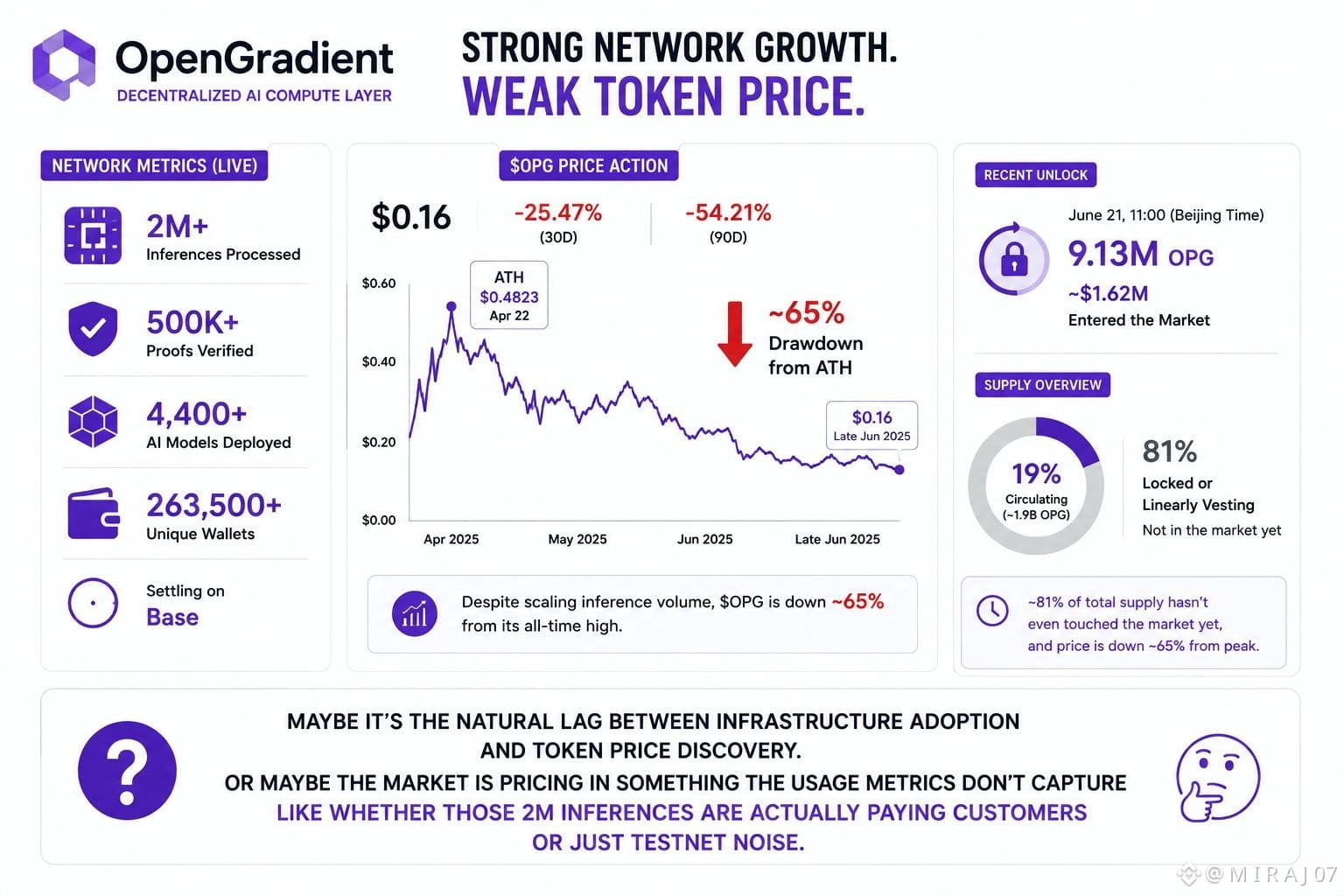
#OPG @OpenGradient Spent the evening digging through OpenGradient's on-chain metrics against its price action, and one divergence kept pulling me back to the same question.
The network reports over 2 million inferences processed and 500,000+ proofs verified. Over 4,400 AI models deployed. 263,500+ unique wallets. All live, all settling on Base. Those are genuinely solid adoption metrics for a protocol that launched its token just two months ago.
Now look at the chart.
As of late June, $OPG is trading at approximately $0.16, down 25.47% over the last 30 days and 54.21% over the past 90 days. The all-time high hit $0.4823 on April 22 that's a ~65% drawdown from peak while the network was scaling inference volume.
Then there's the unlock. On June 21 at 11:00 Beijing time, approximately 9.13 million OPG tokens worth about $1.62 million hit the market. Fresh supply entering a market already bleeding value.
Here's the part that made me reread the numbers twice: the circulating supply sits at roughly 1.9 billion OPG about 19% of total supply. The rest is locked or linearly vesting. That means ~81% of supply hasn't even touched the market yet, and the token is already down 65% from its peak.
Maybe that's just the natural lag between infrastructure adoption and token price discovery. Or maybe the market is pricing in something the usage metrics don't capture like whether those 2M inferences are actually paying customers or just testnet noise.
Still chewing on which one it actually is.
Hmm.
$VELVET $MYX #0PG #opg
#OPG @OpenGradient Spent the evening digging through OpenGradient's on-chain metrics against its price action, and one divergence kept pulling me back to the same question.
The network reports over 2 million inferences processed and 500,000+ proofs verified. Over 4,400 AI models deployed. 263,500+ unique wallets. All live, all settling on Base. Those are genuinely solid adoption metrics for a protocol that launched its token just two months ago.
Now look at the chart.
As of late June, $OPG is trading at approximately $0.16, down 25.47% over the last 30 days and 54.21% over the past 90 days. The all-time high hit $0.4823 on April 22 that's a ~65% drawdown from peak while the network was scaling inference volume.
Then there's the unlock. On June 21 at 11:00 Beijing time, approximately 9.13 million OPG tokens worth about $1.62 million hit the market. Fresh supply entering a market already bleeding value.
Here's the part that made me reread the numbers twice: the circulating supply sits at roughly 1.9 billion OPG about 19% of total supply. The rest is locked or linearly vesting. That means ~81% of supply hasn't even touched the market yet, and the token is already down 65% from its peak.
Maybe that's just the natural lag between infrastructure adoption and token price discovery. Or maybe the market is pricing in something the usage metrics don't capture like whether those 2M inferences are actually paying customers or just testnet noise.
Still chewing on which one it actually is.
Hmm.
$VELVET $MYX #0PG #opg
The network reports over 2 million inferences processed and 500,000+ proofs verified. Over 4,400 AI models deployed. 263,500+ unique wallets. All live, all settling on Base. Those are genuinely solid adoption metrics for a protocol that launched its token just two months ago.
Now look at the chart.
As of late June, $OPG is trading at approximately $0.16, down 25.47% over the last 30 days and 54.21% over the past 90 days. The all-time high hit $0.4823 on April 22 that's a ~65% drawdown from peak while the network was scaling inference volume.
Then there's the unlock. On June 21 at 11:00 Beijing time, approximately 9.13 million OPG tokens worth about $1.62 million hit the market. Fresh supply entering a market already bleeding value.
Here's the part that made me reread the numbers twice: the circulating supply sits at roughly 1.9 billion OPG about 19% of total supply. The rest is locked or linearly vesting. That means ~81% of supply hasn't even touched the market yet, and the token is already down 65% from its peak.
Maybe that's just the natural lag between infrastructure adoption and token price discovery. Or maybe the market is pricing in something the usage metrics don't capture like whether those 2M inferences are actually paying customers or just testnet noise.
Still chewing on which one it actually is.
Hmm.
$VELVET $MYX #0PG #opg
80
38
707
·
--
Running bigger AI models on your own PC has always been kind of miserable. The fans sound like a jet taking off, your power bill jumps, and actually getting hardware that can handle serious stuff costs tens of thousands. Most people just can’t swing that.
OpenGradient is doing something really smart about it. They’ve built a decentralized network where regular people with spare high-end GPUs can turn them into inference nodes. Basically a gig economy for AI compute. You contribute your GPU and it can either run the work itself or act as a secure gateway to big models from OpenAI and others.
#0PG
The part I like most is how they keep everyone honest. Cryptographic proofs get generated straight from the hardware, other nodes audit them, and only then do you get paid in OPG tokens. No faking results or cutting corners to save electricity.
It actually lets you make money off hardware that would otherwise just sit there. And when you use the network yourself, you get real proof that the computation happened the way it was supposed to. Feels way more trustworthy than handing everything over to a few big tech data centers that you can’t see inside.
This is the kind of thing that could actually spread powerful AI out to normal people instead of keeping it locked behind corporate walls. If you’ve got a decent GPU with some spare cycles, it seems like a no-brainer way to put it to work and earn something while you’re at it.
I’m pretty bullish on where this is headed. Decentralized inference just makes too much sense. #Opg
@OpenGradient $OPG
$SLX $RESOLV
{future}(RESOLVUSDT)
{future}(SLXUSDT)
{spot}(SYNUSDT)
Running bigger AI models on your own PC has always been kind of miserable. The fans sound like a jet taking off, your power bill jumps, and actually getting hardware that can handle serious stuff costs tens of thousands. Most people just can’t swing that.
OpenGradient is doing something really smart about it. They’ve built a decentralized network where regular people with spare high-end GPUs can turn them into inference nodes. Basically a gig economy for AI compute. You contribute your GPU and it can either run the work itself or act as a secure gateway to big models from OpenAI and others.
#0PG
The part I like most is how they keep everyone honest. Cryptographic proofs get generated straight from the hardware, other nodes audit them, and only then do you get paid in OPG tokens. No faking results or cutting corners to save electricity.
It actually lets you make money off hardware that would otherwise just sit there. And when you use the network yourself, you get real proof that the computation happened the way it was supposed to. Feels way more trustworthy than handing everything over to a few big tech data centers that you can’t see inside.
This is the kind of thing that could actually spread powerful AI out to normal people instead of keeping it locked behind corporate walls. If you’ve got a decent GPU with some spare cycles, it seems like a no-brainer way to put it to work and earn something while you’re at it.
I’m pretty bullish on where this is headed. Decentralized inference just makes too much sense. #Opg
@OpenGradient $OPG
$SLX $RESOLV
OpenGradient is doing something really smart about it. They’ve built a decentralized network where regular people with spare high-end GPUs can turn them into inference nodes. Basically a gig economy for AI compute. You contribute your GPU and it can either run the work itself or act as a secure gateway to big models from OpenAI and others.
#0PG
The part I like most is how they keep everyone honest. Cryptographic proofs get generated straight from the hardware, other nodes audit them, and only then do you get paid in OPG tokens. No faking results or cutting corners to save electricity.
It actually lets you make money off hardware that would otherwise just sit there. And when you use the network yourself, you get real proof that the computation happened the way it was supposed to. Feels way more trustworthy than handing everything over to a few big tech data centers that you can’t see inside.
This is the kind of thing that could actually spread powerful AI out to normal people instead of keeping it locked behind corporate walls. If you’ve got a decent GPU with some spare cycles, it seems like a no-brainer way to put it to work and earn something while you’re at it.
I’m pretty bullish on where this is headed. Decentralized inference just makes too much sense. #Opg
@OpenGradient $OPG
$SLX $RESOLV
Bullish
67%
Bearish
33%
6 votes • Voting closed
106
58
11.7k
#opg $OPG Decentralization is key for progress in technology and @OpenGradient is paving a very interesting path in this sector. Combining the power of artificial intelligence with the transparency of blockchain opens up a huge range of solutions for developers. I will be very attentive to the upcoming updates of the #OPG ecosystem! Much potential!#0PG .
#opg $OPG Decentralization is key for progress in technology and @OpenGradient is paving a very interesting path in this sector. Combining the power of artificial intelligence with the transparency of blockchain opens up a huge range of solutions for developers. I will be very attentive to the upcoming updates of the #OPG ecosystem! Much potential!#0PG .
104

·
--
$OPG LONG
{future}(OPGUSDT)
Long
#OPG LONG
Entry: $0.1328
SL: $0.1062
TP1: $0.1390
TP2: $0.146p
TP3: $0.1592
TP4: $0.1858
TP5: $0.2124
TP6: $0.2655
#0PG #OPG @OpenGradient
$OPG LONG
Long
#OPG LONG
Entry: $0.1328
SL: $0.1062
TP1: $0.1390
TP2: $0.146p
TP3: $0.1592
TP4: $0.1858
TP5: $0.2124
TP6: $0.2655
#0PG #OPG @OpenGradient
Long
#OPG LONG
Entry: $0.1328
SL: $0.1062
TP1: $0.1390
TP2: $0.146p
TP3: $0.1592
TP4: $0.1858
TP5: $0.2124
TP6: $0.2655
#0PG #OPG @OpenGradient
4
252
Article
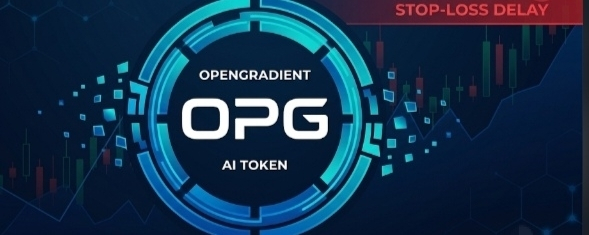
OPG MY RESPECT, FEAR JUSTIFIED$OPG My fear is 100% justified. What happened to this trader is the perfect example of a classic mistake in financial markets: over-engineering risk.
When the chips are down and the market crashes in seconds, simplicity and execution speed are everything. Delegating something as critical as your lifeline (the Stop Loss) to a hyper-complex AI structure running on a decentralized network is, unfortunately, playing Russian roulette.
Why did this trader's AI system fail?
OPG MY RESPECT, FEAR JUSTIFIED
$OPG My fear is 100% justified. What happened to this trader is the perfect example of a classic mistake in financial markets: over-engineering risk.
When the chips are down and the market crashes in seconds, simplicity and execution speed are everything. Delegating something as critical as your lifeline (the Stop Loss) to a hyper-complex AI structure running on a decentralized network is, unfortunately, playing Russian roulette.
Why did this trader's AI system fail?
When the chips are down and the market crashes in seconds, simplicity and execution speed are everything. Delegating something as critical as your lifeline (the Stop Loss) to a hyper-complex AI structure running on a decentralized network is, unfortunately, playing Russian roulette.
Why did this trader's AI system fail?
1
3
116

·
--
@OpenGradient I never used to think about what happened to my data after I sent a message to an AI.
Maybe that’s because I was only looking for answers. I would ask a question, get a reply, close the app, and move on. End of story.
Lately, though, I’ve caught myself thinking about it a bit more.
The more useful AI becomes, the more personal the conversations become too. People aren’t just asking for recipes anymore. They’re sharing work ideas, rough plans, private notes, and things they probably wouldn’t post anywhere else.
That changes the conversation.
For me, a good AI tool isn’t only about giving the best answer. I also want to know whether my information is being treated with care. I don’t expect every platform to solve this perfectly, but I do think it’s becoming something users actually notice.
That’s partly why OpenGradient ended up on my radar. I spent some time reading about OpenGradient Chat, and I liked that privacy isn’t presented as an afterthought. It feels like something the team decided to build around from the beginning. You can check it out at chat.opengradient.ai.
Of course, privacy doesn’t replace a good product. If an AI is slow or difficult to use, people won’t stick with it. The experience still has to be smooth. I think the sweet spot is having both: something that’s genuinely useful without making you wonder where your conversations end up.
Maybe that’s where AI is heading.
People still care about speed. They still want better models. But I don’t think those are the only questions anymore.
I’m curious… when you try a new AI tool, what’s the first thing you care about?@OpenGradient
$OPG #opg #0PG
$CAP $SYN
Would stronger privacy make you switch to a different AI assistant?
chat.opengradient.ai
{future}(SYNUSDT)
{future}(CAPUSDT)
{future}(OPGUSDT)
@OpenGradient I never used to think about what happened to my data after I sent a message to an AI.
Maybe that’s because I was only looking for answers. I would ask a question, get a reply, close the app, and move on. End of story.
Lately, though, I’ve caught myself thinking about it a bit more.
The more useful AI becomes, the more personal the conversations become too. People aren’t just asking for recipes anymore. They’re sharing work ideas, rough plans, private notes, and things they probably wouldn’t post anywhere else.
That changes the conversation.
For me, a good AI tool isn’t only about giving the best answer. I also want to know whether my information is being treated with care. I don’t expect every platform to solve this perfectly, but I do think it’s becoming something users actually notice.
That’s partly why OpenGradient ended up on my radar. I spent some time reading about OpenGradient Chat, and I liked that privacy isn’t presented as an afterthought. It feels like something the team decided to build around from the beginning. You can check it out at chat.opengradient.ai.
Of course, privacy doesn’t replace a good product. If an AI is slow or difficult to use, people won’t stick with it. The experience still has to be smooth. I think the sweet spot is having both: something that’s genuinely useful without making you wonder where your conversations end up.
Maybe that’s where AI is heading.
People still care about speed. They still want better models. But I don’t think those are the only questions anymore.
I’m curious… when you try a new AI tool, what’s the first thing you care about?@OpenGradient
$OPG #opg #0PG
$CAP $SYN
Would stronger privacy make you switch to a different AI assistant?
chat.opengradient.ai
Maybe that’s because I was only looking for answers. I would ask a question, get a reply, close the app, and move on. End of story.
Lately, though, I’ve caught myself thinking about it a bit more.
The more useful AI becomes, the more personal the conversations become too. People aren’t just asking for recipes anymore. They’re sharing work ideas, rough plans, private notes, and things they probably wouldn’t post anywhere else.
That changes the conversation.
For me, a good AI tool isn’t only about giving the best answer. I also want to know whether my information is being treated with care. I don’t expect every platform to solve this perfectly, but I do think it’s becoming something users actually notice.
That’s partly why OpenGradient ended up on my radar. I spent some time reading about OpenGradient Chat, and I liked that privacy isn’t presented as an afterthought. It feels like something the team decided to build around from the beginning. You can check it out at chat.opengradient.ai.
Of course, privacy doesn’t replace a good product. If an AI is slow or difficult to use, people won’t stick with it. The experience still has to be smooth. I think the sweet spot is having both: something that’s genuinely useful without making you wonder where your conversations end up.
Maybe that’s where AI is heading.
People still care about speed. They still want better models. But I don’t think those are the only questions anymore.
I’m curious… when you try a new AI tool, what’s the first thing you care about?@OpenGradient
$OPG #opg #0PG
$CAP $SYN
Would stronger privacy make you switch to a different AI assistant?
chat.opengradient.ai
Yes, definitely
100%
Maybe
0%
Only if it’s just as good
0%
No, privacy isn’t my priority
0%
1 votes • Voting closed
4
2
577

·
--
@OpenGradient
At first, I thought choosing the nearest node would always deliver the best AI experience.
The more I explored decentralized AI, the more I realized that distance is only one part of the equation.
A fast response means little if the result can't be trusted.
A nearby node means little if the network can't deliver consistent results.
For me, the future of AI infrastructure isn't about being the fastest.
It's about being dependable when it matters most.
$OPG
{spot}(OPGUSDT)
#Crypto
#USStocksFirstOutflowSinceMarch #USStocksFirstOutflowSinceMarch #MicronRevenueJumps346%To$41.5B
#0PG
Which factor should matter most when AI networks scale globally?
@OpenGradient
At first, I thought choosing the nearest node would always deliver the best AI experience.
The more I explored decentralized AI, the more I realized that distance is only one part of the equation.
A fast response means little if the result can't be trusted.
A nearby node means little if the network can't deliver consistent results.
For me, the future of AI infrastructure isn't about being the fastest.
It's about being dependable when it matters most.
$OPG
#Crypto
#USStocksFirstOutflowSinceMarch #USStocksFirstOutflowSinceMarch #MicronRevenueJumps346%To$41.5B
#0PG
Which factor should matter most when AI networks scale globally?
At first, I thought choosing the nearest node would always deliver the best AI experience.
The more I explored decentralized AI, the more I realized that distance is only one part of the equation.
A fast response means little if the result can't be trusted.
A nearby node means little if the network can't deliver consistent results.
For me, the future of AI infrastructure isn't about being the fastest.
It's about being dependable when it matters most.
$OPG
#Crypto
#USStocksFirstOutflowSinceMarch #USStocksFirstOutflowSinceMarch #MicronRevenueJumps346%To$41.5B
#0PG
Which factor should matter most when AI networks scale globally?
🔹 Verification
0%
🔹 Reliability
0%
🔹 Low Latency
0%
🔹 Scalability
0%
0 votes • Voting closed
OPG+4.15%
MUUS+0.09%
14
1
8
94

·
--
Verified
Yo guys i wanna tell you something about OpenGradient today.
It is from the a16z Crypto 2024 Fall CSX program.
They are building really foundational networks or something like that.
The project raised like 9.5 million dollars in April 2026.
The lead investor was a16z Crypto which is very cool.
Others like Coinbase Ventures and SV Angel also joined too.
Yeah Foresight Ventures also put some money in the project.
Some big angels joined like Balaji Srinivasan you know bro.
Illia Polosukhin and Sandeep Nailwal also invested in this too.
Paul Taylor was another angel that joined i think yeah.
Now let me tell you about the founder Matthew Wang.
He went to Northwestern and studied electrical and computer engineering.
He did internships at NASA and Meta and Google bro.
That is so cool right like three big companies man.
Then he worked as a research engineer at Two Sigma.
Two Sigma is a big hedge fund place i heard.
He started OpenGradient in 2024 in New York City man. #0PG
The project seems so very promising with all these credentials.
The team is strong and the backers are top tier.
I think OpenGradient will do big things in the future.
It could become a foundational network like they all say.
With the 9.5 million funding they can build a lot.
The founder has experience from many top places i mean.
So I am super bullish on OpenGradient no cap fr.
This is not financial advice just my own thoughts okay.
@OpenGradient $OPG
#Opg
$RAVE
{future}(RAVEUSDT)
$VELVET
{future}(VELVETUSDT)
What do you think about OpenGradient?
Yo guys i wanna tell you something about OpenGradient today.
It is from the a16z Crypto 2024 Fall CSX program.
They are building really foundational networks or something like that.
The project raised like 9.5 million dollars in April 2026.
The lead investor was a16z Crypto which is very cool.
Others like Coinbase Ventures and SV Angel also joined too.
Yeah Foresight Ventures also put some money in the project.
Some big angels joined like Balaji Srinivasan you know bro.
Illia Polosukhin and Sandeep Nailwal also invested in this too.
Paul Taylor was another angel that joined i think yeah.
Now let me tell you about the founder Matthew Wang.
He went to Northwestern and studied electrical and computer engineering.
He did internships at NASA and Meta and Google bro.
That is so cool right like three big companies man.
Then he worked as a research engineer at Two Sigma.
Two Sigma is a big hedge fund place i heard.
He started OpenGradient in 2024 in New York City man. #0PG
The project seems so very promising with all these credentials.
The team is strong and the backers are top tier.
I think OpenGradient will do big things in the future.
It could become a foundational network like they all say.
With the 9.5 million funding they can build a lot.
The founder has experience from many top places i mean.
So I am super bullish on OpenGradient no cap fr.
This is not financial advice just my own thoughts okay.
@OpenGradient $OPG
#Opg
$RAVE
$VELVET
What do you think about OpenGradient?
It is from the a16z Crypto 2024 Fall CSX program.
They are building really foundational networks or something like that.
The project raised like 9.5 million dollars in April 2026.
The lead investor was a16z Crypto which is very cool.
Others like Coinbase Ventures and SV Angel also joined too.
Yeah Foresight Ventures also put some money in the project.
Some big angels joined like Balaji Srinivasan you know bro.
Illia Polosukhin and Sandeep Nailwal also invested in this too.
Paul Taylor was another angel that joined i think yeah.
Now let me tell you about the founder Matthew Wang.
He went to Northwestern and studied electrical and computer engineering.
He did internships at NASA and Meta and Google bro.
That is so cool right like three big companies man.
Then he worked as a research engineer at Two Sigma.
Two Sigma is a big hedge fund place i heard.
He started OpenGradient in 2024 in New York City man. #0PG
The project seems so very promising with all these credentials.
The team is strong and the backers are top tier.
I think OpenGradient will do big things in the future.
It could become a foundational network like they all say.
With the 9.5 million funding they can build a lot.
The founder has experience from many top places i mean.
So I am super bullish on OpenGradient no cap fr.
This is not financial advice just my own thoughts okay.
@OpenGradient $OPG
#Opg
$RAVE
$VELVET
What do you think about OpenGradient?
🔘 Super bullish on it
0%
🔘 Looks decent tbh
0%
🔘 Need to research more
0%
🔘 Just here for vibes
100%
1 votes • Voting closed
238
130
11.7k

·
--
Imagine using AI where your data stays yours your prompts stay private and every computation can be trusted.
That’s the vision behind OpenGradient bringing privacy + verification + decentralized AI infrastructure together.
The future of AI needs more than intelligence.
It needs integrity.
the biggest AI breakthrough won’t only be smarter models.
It will be models we can actually trust.
OpenGradient is creating infrastructure where AI execution becomes transparent, secure, and verifiable.
A new era of AI is loading. 🚀$OPG #0PG @OpenGradient
Imagine using AI where your data stays yours your prompts stay private and every computation can be trusted.
That’s the vision behind OpenGradient bringing privacy + verification + decentralized AI infrastructure together.
The future of AI needs more than intelligence.
It needs integrity.
the biggest AI breakthrough won’t only be smarter models.
It will be models we can actually trust.
OpenGradient is creating infrastructure where AI execution becomes transparent, secure, and verifiable.
A new era of AI is loading. 🚀$OPG #0PG @OpenGradient
That’s the vision behind OpenGradient bringing privacy + verification + decentralized AI infrastructure together.
The future of AI needs more than intelligence.
It needs integrity.
the biggest AI breakthrough won’t only be smarter models.
It will be models we can actually trust.
OpenGradient is creating infrastructure where AI execution becomes transparent, secure, and verifiable.
A new era of AI is loading. 🚀$OPG #0PG @OpenGradient

3
2
128

·
--
OpenGradient Project presents an innovative concept that blends AI with blockchain. Using OpenGradient Chat and earning their points is an experience you can’t miss. Follow the @OpenGradient account continuously to keep up with the $OPG code’s developments; this project represents a promising opportunity for everyone looking for value in the crypto world.
#0PG #opengradientchat #Crypto_Al #Binance
OpenGradient Project presents an innovative concept that blends AI with blockchain. Using OpenGradient Chat and earning their points is an experience you can’t miss. Follow the @OpenGradient account continuously to keep up with the $OPG code’s developments; this project represents a promising opportunity for everyone looking for value in the crypto world.
#0PG #opengradientchat #Crypto_Al #Binance
#0PG #opengradientchat #Crypto_Al #Binance
6
1
67
·
--
Verified
I always think of the inference request which had already completed but the wallet balance check failed on the second pass.
The AI stack is consolidating around a handful of closed providers and the applications being built on top have no way to audit what's running underneath said Matthew Wang co founder and CEO of OpenGradient. We're building the open alternative infrastructure where models are inspectable execution is provable and developers own the intelligence their products depend on.
Nothing dramatic happened the job simply became technically useful but economically unfinished.
That is where the MiCAR label starts matter.
$OPG can sit inside the Other Crypto Asset category while still carrying real functions payment staking governance and settlement.
But a label alone does no’t create value.
An application needs OPG
A payment needs to clear.
The cycle has to repeat often enough that tokens remain economIcally active not just briefly moved through a wallEt and forgotten.ReGulatory clarity can improve visibility and market access, but it cannot manufacture protocol demand. The network still has to prove dependency through real usage. HolDing OPG is nOt equity revenUe rights or a claim on an issuer. The deMand story comes from actual service dependency. metric I watch next inference payment activity after access expands. oracle
Another feature i explore while studying @OpenGradient Two new Seedream models 5.0 Lite and 4.5.
Also BiDAF is a neural network model built for one simple.
Good feature of @OpenGradient buildin infrastructure layer for decentralized AI.A platform where AI models can be hosted executed and deployed across a decentralized network.
With NeuroML developers can bring AI inference directly into smart contracts through a Solidity framework. Python SDK gives easy access to the Model Hub and decentralized AI tools
A transaction needs fast confirmation. An AI inference needs powerful computE often taking seconds and relying on GPUs instead of traditional CPUs. datA is also much larger and more complex.
#0PG #OPG
#OpenGradient $EVAA $SYN
I always think of the inference request which had already completed but the wallet balance check failed on the second pass.
The AI stack is consolidating around a handful of closed providers and the applications being built on top have no way to audit what's running underneath said Matthew Wang co founder and CEO of OpenGradient. We're building the open alternative infrastructure where models are inspectable execution is provable and developers own the intelligence their products depend on.
Nothing dramatic happened the job simply became technically useful but economically unfinished.
That is where the MiCAR label starts matter.
$OPG can sit inside the Other Crypto Asset category while still carrying real functions payment staking governance and settlement.
But a label alone does no’t create value.
An application needs OPG
A payment needs to clear.
The cycle has to repeat often enough that tokens remain economIcally active not just briefly moved through a wallEt and forgotten.ReGulatory clarity can improve visibility and market access, but it cannot manufacture protocol demand. The network still has to prove dependency through real usage. HolDing OPG is nOt equity revenUe rights or a claim on an issuer. The deMand story comes from actual service dependency. metric I watch next inference payment activity after access expands. oracle
Another feature i explore while studying @OpenGradient Two new Seedream models 5.0 Lite and 4.5.
Also BiDAF is a neural network model built for one simple.
Good feature of @OpenGradient buildin infrastructure layer for decentralized AI.A platform where AI models can be hosted executed and deployed across a decentralized network.
With NeuroML developers can bring AI inference directly into smart contracts through a Solidity framework. Python SDK gives easy access to the Model Hub and decentralized AI tools
A transaction needs fast confirmation. An AI inference needs powerful computE often taking seconds and relying on GPUs instead of traditional CPUs. datA is also much larger and more complex.
#0PG #OPG
#OpenGradient $EVAA $SYN
The AI stack is consolidating around a handful of closed providers and the applications being built on top have no way to audit what's running underneath said Matthew Wang co founder and CEO of OpenGradient. We're building the open alternative infrastructure where models are inspectable execution is provable and developers own the intelligence their products depend on.
Nothing dramatic happened the job simply became technically useful but economically unfinished.
That is where the MiCAR label starts matter.
$OPG can sit inside the Other Crypto Asset category while still carrying real functions payment staking governance and settlement.
But a label alone does no’t create value.
An application needs OPG
A payment needs to clear.
The cycle has to repeat often enough that tokens remain economIcally active not just briefly moved through a wallEt and forgotten.ReGulatory clarity can improve visibility and market access, but it cannot manufacture protocol demand. The network still has to prove dependency through real usage. HolDing OPG is nOt equity revenUe rights or a claim on an issuer. The deMand story comes from actual service dependency. metric I watch next inference payment activity after access expands. oracle
Another feature i explore while studying @OpenGradient Two new Seedream models 5.0 Lite and 4.5.
Also BiDAF is a neural network model built for one simple.
Good feature of @OpenGradient buildin infrastructure layer for decentralized AI.A platform where AI models can be hosted executed and deployed across a decentralized network.
With NeuroML developers can bring AI inference directly into smart contracts through a Solidity framework. Python SDK gives easy access to the Model Hub and decentralized AI tools
A transaction needs fast confirmation. An AI inference needs powerful computE often taking seconds and relying on GPUs instead of traditional CPUs. datA is also much larger and more complex.
#0PG #OPG
#OpenGradient $EVAA $SYN

116
50
307

·
--
#OpenGradient s building a new AI infrastructure where inference is transparent, verifiable, and community-driven.
OPG powers payments, rewards node operators, and enables governance — making every model call accountable on-chain.
The system uses a Hybrid AI Compute Architecture (HACA), where:
> GPU handles fast AI execution
> Cryptographic proofs verify results on-chain
This means you can check:
> which model ran
> what prompt was used
> whether output was altered
For developers, OpenGradient provides a model hub + gated inference APIs to monetize AI models per call.
For users, it enables direct AI access using OPG with verifiable audit trails.
A step toward truly trustworthy AI infrastructure
#0pg
#PBOCSetsOvernightLiquidityRateBelowForecasts
$SYN
SYN
0.52389
+34.73%
$TAC
TACUSDT
Perp
0.058654
+168.45%
$OPG
OPG
0.1297
+0.62%
#OpenGradient s building a new AI infrastructure where inference is transparent, verifiable, and community-driven.
OPG powers payments, rewards node operators, and enables governance — making every model call accountable on-chain.
The system uses a Hybrid AI Compute Architecture (HACA), where:
> GPU handles fast AI execution
> Cryptographic proofs verify results on-chain
This means you can check:
> which model ran
> what prompt was used
> whether output was altered
For developers, OpenGradient provides a model hub + gated inference APIs to monetize AI models per call.
For users, it enables direct AI access using OPG with verifiable audit trails.
A step toward truly trustworthy AI infrastructure
#0pg
#PBOCSetsOvernightLiquidityRateBelowForecasts
$SYN
SYN
0.52389
+34.73%
$TAC
TACUSDT
Perp
0.058654
+168.45%
$OPG
OPG
0.1297
+0.62%
OPG powers payments, rewards node operators, and enables governance — making every model call accountable on-chain.
The system uses a Hybrid AI Compute Architecture (HACA), where:
> GPU handles fast AI execution
> Cryptographic proofs verify results on-chain
This means you can check:
> which model ran
> what prompt was used
> whether output was altered
For developers, OpenGradient provides a model hub + gated inference APIs to monetize AI models per call.
For users, it enables direct AI access using OPG with verifiable audit trails.
A step toward truly trustworthy AI infrastructure
#0pg
#PBOCSetsOvernightLiquidityRateBelowForecasts
$SYN
SYN
0.52389
+34.73%
$TAC
TACUSDT
Perp
0.058654
+168.45%
$OPG
OPG
0.1297
+0.62%
1
32
·
--
Honestly, the best way I can explain OpenGradient’s security model is like a house party where nobody’s watching the door. There’s no bouncer, no cameras, no host peeking over your shoulder—just a rule: you have to Venmo a $200 deposit to get in, and before you step through, you walk into this little glass phone booth. That’s the trusted execution environment. Inside, it checks you aren’t hiding spray paint or a messed-up idea in your code, and it generates a cryptographic receipt that you’re clean. If later you still do something stupid, the booth already saw it happen—not through surveillance but through math—and the receipt is unforgeable. Boom, your deposit gets slashed and your name hits an on-chain blacklist. It’s not about catching hackers in the act; it’s about making sure any act leaves a financial scar. I actually like that model.
#0pg
But here’s where I can’t stop thinking it falls short, and I’m not trying to be negative, just real. Hackers don’t care about their reputation. They’ll just change hoodies, throw on a fake mustache, send another $200 from a burner wallet, and walk right back in. That blacklist bans an identity, not a person. If you can respawn for pocket change, a post-hoc label doesn’t mean much. What I wish OpenGradient would build more loudly is the source-code-level defense. I’m talking about traps baked into the logic itself—honeypots, dye packs, routines that blow up the moment someone tampers, not just punish them afterwards. You can’t rely on blacklisting in a world where anyone can become anyone else with a fresh key. You need the environment to be hostile to bad behavior in real time, not just a court that bans ghosts. That’s the conversation I want us to have.
@OpenGradient $OPG #Opg
#Opg
$QUICK
{spot}(QUICKUSDT)
$KORU
{future}(KORUUSDT)
Honestly, the best way I can explain OpenGradient’s security model is like a house party where nobody’s watching the door. There’s no bouncer, no cameras, no host peeking over your shoulder—just a rule: you have to Venmo a $200 deposit to get in, and before you step through, you walk into this little glass phone booth. That’s the trusted execution environment. Inside, it checks you aren’t hiding spray paint or a messed-up idea in your code, and it generates a cryptographic receipt that you’re clean. If later you still do something stupid, the booth already saw it happen—not through surveillance but through math—and the receipt is unforgeable. Boom, your deposit gets slashed and your name hits an on-chain blacklist. It’s not about catching hackers in the act; it’s about making sure any act leaves a financial scar. I actually like that model.
#0pg
But here’s where I can’t stop thinking it falls short, and I’m not trying to be negative, just real. Hackers don’t care about their reputation. They’ll just change hoodies, throw on a fake mustache, send another $200 from a burner wallet, and walk right back in. That blacklist bans an identity, not a person. If you can respawn for pocket change, a post-hoc label doesn’t mean much. What I wish OpenGradient would build more loudly is the source-code-level defense. I’m talking about traps baked into the logic itself—honeypots, dye packs, routines that blow up the moment someone tampers, not just punish them afterwards. You can’t rely on blacklisting in a world where anyone can become anyone else with a fresh key. You need the environment to be hostile to bad behavior in real time, not just a court that bans ghosts. That’s the conversation I want us to have.
@OpenGradient $OPG #Opg
#Opg
$QUICK
$KORU
#0pg
But here’s where I can’t stop thinking it falls short, and I’m not trying to be negative, just real. Hackers don’t care about their reputation. They’ll just change hoodies, throw on a fake mustache, send another $200 from a burner wallet, and walk right back in. That blacklist bans an identity, not a person. If you can respawn for pocket change, a post-hoc label doesn’t mean much. What I wish OpenGradient would build more loudly is the source-code-level defense. I’m talking about traps baked into the logic itself—honeypots, dye packs, routines that blow up the moment someone tampers, not just punish them afterwards. You can’t rely on blacklisting in a world where anyone can become anyone else with a fresh key. You need the environment to be hostile to bad behavior in real time, not just a court that bans ghosts. That’s the conversation I want us to have.
@OpenGradient $OPG #Opg
#Opg
$QUICK
$KORU
Going Up
100%
Going Down
0%
3 votes • Voting closed
126
1
65
6.1k

#opg $OPG :-Just tested Opengradient chat and i am impressed @OpenGradient is building decentralized AI infrastructure On-Chain.
The future of AI should be open,not closed.
Excited for $OPG
{spot}(OPGUSDT)
and what they're building with Opengradient chat.
The multi-asset supper app era needs tools like this!
#0PG
#opg $OPG :-Just tested Opengradient chat and i am impressed @OpenGradient is building decentralized AI infrastructure On-Chain.
The future of AI should be open,not closed.
Excited for $OPG
and what they're building with Opengradient chat.
The multi-asset supper app era needs tools like this!
#0PG
The future of AI should be open,not closed.
Excited for $OPG
and what they're building with Opengradient chat.
The multi-asset supper app era needs tools like this!
#0PG
1
102
Log in to explore more content
Join global crypto users on Binance Square
⚡️ Get latest and useful information about crypto.
💬 Trusted by the world’s largest crypto exchange.
👍 Discover real insights from verified creators.
Email / Phone number
Trending Topics
1
#StrategyStriveAdd2305BitcoinThisWeek
6,193 views
279 Discussing
2
#TrumpRejectsIranHormuzReopening
11,492 views
348 Discussing
3
#CircleTetherFreezeBitgetHackerWallet
33,547 views
502 Discussing
4
#SECSaysTokenBuybacksNotAutoSecurities
13,822 views
237 Discussing
5
#ChinaUSAgreeOn$30BTariffCut
530 views
14 Discussing
6
#CoinMarketCapCompletesCoinglassAcquisition
30,547 views
392 Discussing
7
#CircleMints500MUSDCOnSolana
188,649 views
2,962 Discussing
8
#PolymarketBankFailureBetsDrawFDICConcern
164,096 views
2,311 Discussing
9
#BlackRockBuildsTokenizedPortfoliosForOndo
154,486 views
1,661 Discussing
10
#BitwiseFilesToListNEARETFOnNYSEArca
106,953 views
1,293 Discussing