

MR UMER15
5.6k Posts

MR UMER15
Report
Block User
AI & Crypto Research
Open Trade
Frequent Trader
10.8 Months
377 Following
8.2K+ Followers
3.0K+ Liked
Posts
Portfolio
All
Quotes
Live
·
--
Bullish
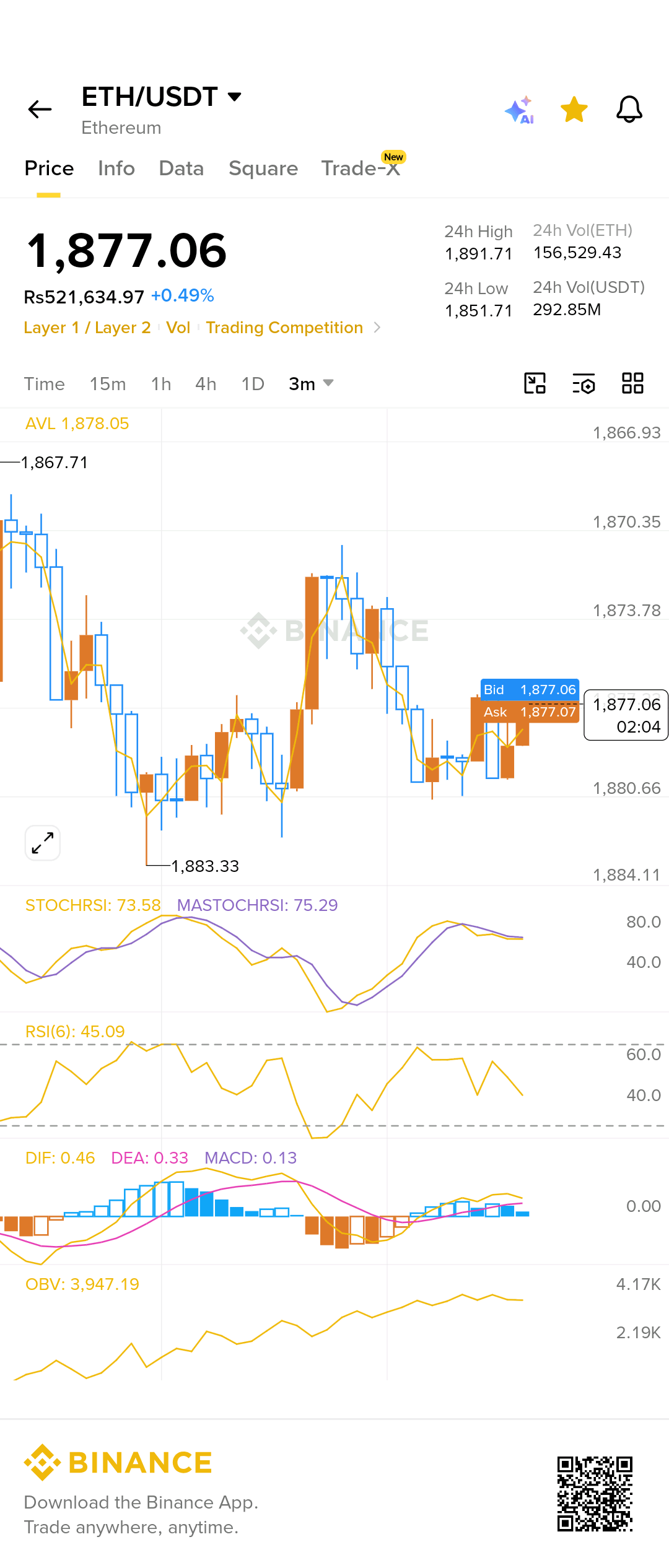
$ETH /USDT – LONG
Momentum is tightening, and ETH is approaching a decision point. This range looks like accumulation, not exhaustion. A breakout above nearby resistance could trigger the next liquidity expansion.
Trade Plan:
• Entry: 1,874–1,878
• Stop Loss (SL): 1,865
• Take Profit 1 (TP1): 1,890
• Take Profit 2 (TP2): 1,905
• Take Profit 3 (TP3): 1,925
Why this setup?
The 1H structure is turning constructive while the 4H and 1D continue to respect key support, keeping the higher-timeframe bias bullish. RSI is recovering from neutral territory, momentum is improving, and volume is gradually returning after consolidation. ETH is trading inside a compression range below resistance, a pattern that frequently leads to a sharp directional move. A sustained break above 1,890 could accelerate buying pressure toward higher liquidity zones. From the proposed entry, TP1 offers approximately 0.8–1.0% upside with favorable risk-to-reward.
Debate:
Is this the calm before a major breakout, or is the market setting a liquidity trap before the next move?
$ETH
{spot}(ETHUSDT)
#BrentCrudeUp4.6% #BrentCrudeUp4.6% #BrentCrudeUp4.6% #BrentCrudeUp4.6% #BrentCrudeUp4.6%
$ETH /USDT – LONG
Momentum is tightening, and ETH is approaching a decision point. This range looks like accumulation, not exhaustion. A breakout above nearby resistance could trigger the next liquidity expansion.
Trade Plan:
• Entry: 1,874–1,878
• Stop Loss (SL): 1,865
• Take Profit 1 (TP1): 1,890
• Take Profit 2 (TP2): 1,905
• Take Profit 3 (TP3): 1,925
Why this setup?
The 1H structure is turning constructive while the 4H and 1D continue to respect key support, keeping the higher-timeframe bias bullish. RSI is recovering from neutral territory, momentum is improving, and volume is gradually returning after consolidation. ETH is trading inside a compression range below resistance, a pattern that frequently leads to a sharp directional move. A sustained break above 1,890 could accelerate buying pressure toward higher liquidity zones. From the proposed entry, TP1 offers approximately 0.8–1.0% upside with favorable risk-to-reward.
Debate:
Is this the calm before a major breakout, or is the market setting a liquidity trap before the next move?
$ETH
#BrentCrudeUp4.6% #BrentCrudeUp4.6% #BrentCrudeUp4.6% #BrentCrudeUp4.6% #BrentCrudeUp4.6%
Momentum is tightening, and ETH is approaching a decision point. This range looks like accumulation, not exhaustion. A breakout above nearby resistance could trigger the next liquidity expansion.
Trade Plan:
• Entry: 1,874–1,878
• Stop Loss (SL): 1,865
• Take Profit 1 (TP1): 1,890
• Take Profit 2 (TP2): 1,905
• Take Profit 3 (TP3): 1,925
Why this setup?
The 1H structure is turning constructive while the 4H and 1D continue to respect key support, keeping the higher-timeframe bias bullish. RSI is recovering from neutral territory, momentum is improving, and volume is gradually returning after consolidation. ETH is trading inside a compression range below resistance, a pattern that frequently leads to a sharp directional move. A sustained break above 1,890 could accelerate buying pressure toward higher liquidity zones. From the proposed entry, TP1 offers approximately 0.8–1.0% upside with favorable risk-to-reward.
Debate:
Is this the calm before a major breakout, or is the market setting a liquidity trap before the next move?
$ETH
#BrentCrudeUp4.6% #BrentCrudeUp4.6% #BrentCrudeUp4.6% #BrentCrudeUp4.6% #BrentCrudeUp4.6%
106
·
--
Article
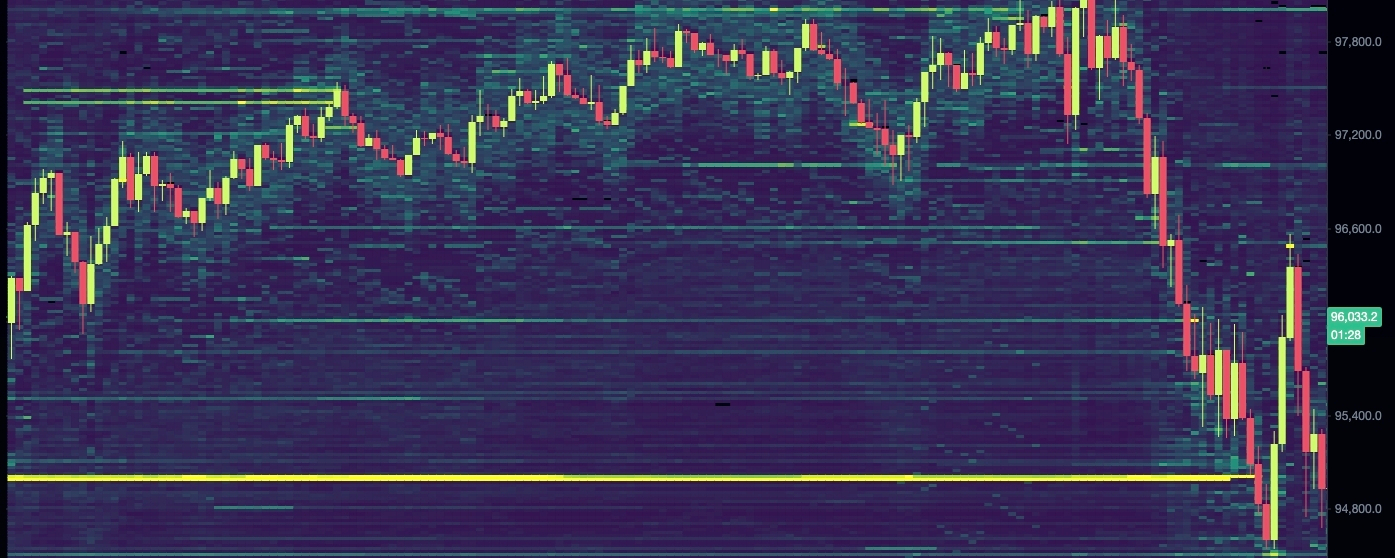
BTC LIQUIDITY WALLS AREN'T BULLISH... THEY'RE A TRAP WAITING TO BE SPRUNGI've been staring at this liquidity heatmap way longer than I probably should've... and honestly, this is one of those charts that looks simple until you keep zooming in. Then it starts getting weird.
The first thing that keeps catching my eye isn't even the candles. It's those thick liquidity bands sitting above and below price. Markets have this annoying habit of pretending they're going one way, only to chase the biggest pool of liquidity somewhere else. That's why I never trust the first move anymore. I've been burned enough times.
Right now it feels like Bitcoin is sitting in the middle of an argument. Buyers don't look completely weak, but sellers definitely haven't disappeared either. Everyone keeps talking about trend continuation... maybe they're right. Maybe not. The order book doesn't really care what Crypto Twitter thinks.
That huge liquidity resting below price is interesting. Really interesting. Sometimes those levels become support because buyers absorb everything. Other times they're basically magnets. Price drops, grabs the liquidity, wipes out overleveraged longs, everyone panics... then suddenly Bitcoin reverses and leaves people wondering what just happened. I've seen that movie too many times.
The liquidity stacked above isn't something I'd ignore either. If momentum suddenly picks up, those resting orders could get eaten fast. That's usually where FOMO shows up. Funny how people call something "confirmation" only after price has already moved a few percent.
Here's the thing... liquidity heatmaps aren't crystal balls. They show where orders exist today, not where they'll stay tomorrow. Large players can move orders. They can pull them. They can add more. That's why treating every bright yellow line like guaranteed support or resistance is a mistake. A really expensive mistake, actually.
What makes this chart fascinating is the compression. Price keeps bouncing between areas where both buyers and sellers clearly care. That usually doesn't last forever. One side eventually runs out of patience. When that happens, the move tends to be violent because everyone's positioned for the opposite direction.
I also keep thinking about leverage. The crypto market loves leverage a little too much. Every time open interest climbs while liquidity starts clustering around obvious levels, I get suspicious. It feels less like investing and more like a room full of mousetraps waiting for somebody to blink first.
Maybe I'm overthinking it... honestly that's possible. But after enough years watching Bitcoin, I've learned that the obvious trade is usually the one that hurts the most people. Markets aren't designed to reward the majority. They're designed to transfer money from impatient traders to patient ones.
Another thing that bothers me is how quickly sentiment changes. A couple of green candles and suddenly everyone's calling for new highs. A sharp liquidation and the same people start predicting the end of the cycle. It's exhausting. The heatmap doesn't care about emotions. It just quietly shows where liquidity is building while everyone else argues.
I'm still cautiously optimistic over the bigger picture because Bitcoin has a habit of absorbing fear and moving higher when nobody expects it. But short term... I'm nowhere near as confident as some people seem to be. The chart feels stretched, liquidity is stacked in both directions, and that usually means volatility isn't finished.
Maybe price sweeps the lower liquidity first before rallying. Maybe buyers smash through overhead liquidity and squeeze shorts instead. Both scenarios honestly look possible, which is exactly why risk management matters more than prediction. Nobody gets paid for guessing. Traders get paid for surviving long enough to catch the move after the market finally shows its hand.
That's probably the biggest lesson I keep coming back to... liquidity isn't the destination. It's the bait. The real question is whether you're following the crowd toward it, or waiting for the crowd to become the liquidity.
$BTC
{spot}(BTCUSDT)
BTC LIQUIDITY WALLS AREN'T BULLISH... THEY'RE A TRAP WAITING TO BE SPRUNG
I've been staring at this liquidity heatmap way longer than I probably should've... and honestly, this is one of those charts that looks simple until you keep zooming in. Then it starts getting weird.
The first thing that keeps catching my eye isn't even the candles. It's those thick liquidity bands sitting above and below price. Markets have this annoying habit of pretending they're going one way, only to chase the biggest pool of liquidity somewhere else. That's why I never trust the first move anymore. I've been burned enough times.
Right now it feels like Bitcoin is sitting in the middle of an argument. Buyers don't look completely weak, but sellers definitely haven't disappeared either. Everyone keeps talking about trend continuation... maybe they're right. Maybe not. The order book doesn't really care what Crypto Twitter thinks.
That huge liquidity resting below price is interesting. Really interesting. Sometimes those levels become support because buyers absorb everything. Other times they're basically magnets. Price drops, grabs the liquidity, wipes out overleveraged longs, everyone panics... then suddenly Bitcoin reverses and leaves people wondering what just happened. I've seen that movie too many times.
The liquidity stacked above isn't something I'd ignore either. If momentum suddenly picks up, those resting orders could get eaten fast. That's usually where FOMO shows up. Funny how people call something "confirmation" only after price has already moved a few percent.
Here's the thing... liquidity heatmaps aren't crystal balls. They show where orders exist today, not where they'll stay tomorrow. Large players can move orders. They can pull them. They can add more. That's why treating every bright yellow line like guaranteed support or resistance is a mistake. A really expensive mistake, actually.
What makes this chart fascinating is the compression. Price keeps bouncing between areas where both buyers and sellers clearly care. That usually doesn't last forever. One side eventually runs out of patience. When that happens, the move tends to be violent because everyone's positioned for the opposite direction.
I also keep thinking about leverage. The crypto market loves leverage a little too much. Every time open interest climbs while liquidity starts clustering around obvious levels, I get suspicious. It feels less like investing and more like a room full of mousetraps waiting for somebody to blink first.
Maybe I'm overthinking it... honestly that's possible. But after enough years watching Bitcoin, I've learned that the obvious trade is usually the one that hurts the most people. Markets aren't designed to reward the majority. They're designed to transfer money from impatient traders to patient ones.
Another thing that bothers me is how quickly sentiment changes. A couple of green candles and suddenly everyone's calling for new highs. A sharp liquidation and the same people start predicting the end of the cycle. It's exhausting. The heatmap doesn't care about emotions. It just quietly shows where liquidity is building while everyone else argues.
I'm still cautiously optimistic over the bigger picture because Bitcoin has a habit of absorbing fear and moving higher when nobody expects it. But short term... I'm nowhere near as confident as some people seem to be. The chart feels stretched, liquidity is stacked in both directions, and that usually means volatility isn't finished.
Maybe price sweeps the lower liquidity first before rallying. Maybe buyers smash through overhead liquidity and squeeze shorts instead. Both scenarios honestly look possible, which is exactly why risk management matters more than prediction. Nobody gets paid for guessing. Traders get paid for surviving long enough to catch the move after the market finally shows its hand.
That's probably the biggest lesson I keep coming back to... liquidity isn't the destination. It's the bait. The real question is whether you're following the crowd toward it, or waiting for the crowd to become the liquidity.
$BTC
The first thing that keeps catching my eye isn't even the candles. It's those thick liquidity bands sitting above and below price. Markets have this annoying habit of pretending they're going one way, only to chase the biggest pool of liquidity somewhere else. That's why I never trust the first move anymore. I've been burned enough times.
Right now it feels like Bitcoin is sitting in the middle of an argument. Buyers don't look completely weak, but sellers definitely haven't disappeared either. Everyone keeps talking about trend continuation... maybe they're right. Maybe not. The order book doesn't really care what Crypto Twitter thinks.
That huge liquidity resting below price is interesting. Really interesting. Sometimes those levels become support because buyers absorb everything. Other times they're basically magnets. Price drops, grabs the liquidity, wipes out overleveraged longs, everyone panics... then suddenly Bitcoin reverses and leaves people wondering what just happened. I've seen that movie too many times.
The liquidity stacked above isn't something I'd ignore either. If momentum suddenly picks up, those resting orders could get eaten fast. That's usually where FOMO shows up. Funny how people call something "confirmation" only after price has already moved a few percent.
Here's the thing... liquidity heatmaps aren't crystal balls. They show where orders exist today, not where they'll stay tomorrow. Large players can move orders. They can pull them. They can add more. That's why treating every bright yellow line like guaranteed support or resistance is a mistake. A really expensive mistake, actually.
What makes this chart fascinating is the compression. Price keeps bouncing between areas where both buyers and sellers clearly care. That usually doesn't last forever. One side eventually runs out of patience. When that happens, the move tends to be violent because everyone's positioned for the opposite direction.
I also keep thinking about leverage. The crypto market loves leverage a little too much. Every time open interest climbs while liquidity starts clustering around obvious levels, I get suspicious. It feels less like investing and more like a room full of mousetraps waiting for somebody to blink first.
Maybe I'm overthinking it... honestly that's possible. But after enough years watching Bitcoin, I've learned that the obvious trade is usually the one that hurts the most people. Markets aren't designed to reward the majority. They're designed to transfer money from impatient traders to patient ones.
Another thing that bothers me is how quickly sentiment changes. A couple of green candles and suddenly everyone's calling for new highs. A sharp liquidation and the same people start predicting the end of the cycle. It's exhausting. The heatmap doesn't care about emotions. It just quietly shows where liquidity is building while everyone else argues.
I'm still cautiously optimistic over the bigger picture because Bitcoin has a habit of absorbing fear and moving higher when nobody expects it. But short term... I'm nowhere near as confident as some people seem to be. The chart feels stretched, liquidity is stacked in both directions, and that usually means volatility isn't finished.
Maybe price sweeps the lower liquidity first before rallying. Maybe buyers smash through overhead liquidity and squeeze shorts instead. Both scenarios honestly look possible, which is exactly why risk management matters more than prediction. Nobody gets paid for guessing. Traders get paid for surviving long enough to catch the move after the market finally shows its hand.
That's probably the biggest lesson I keep coming back to... liquidity isn't the destination. It's the bait. The real question is whether you're following the crowd toward it, or waiting for the crowd to become the liquidity.
$BTC
97
·
--
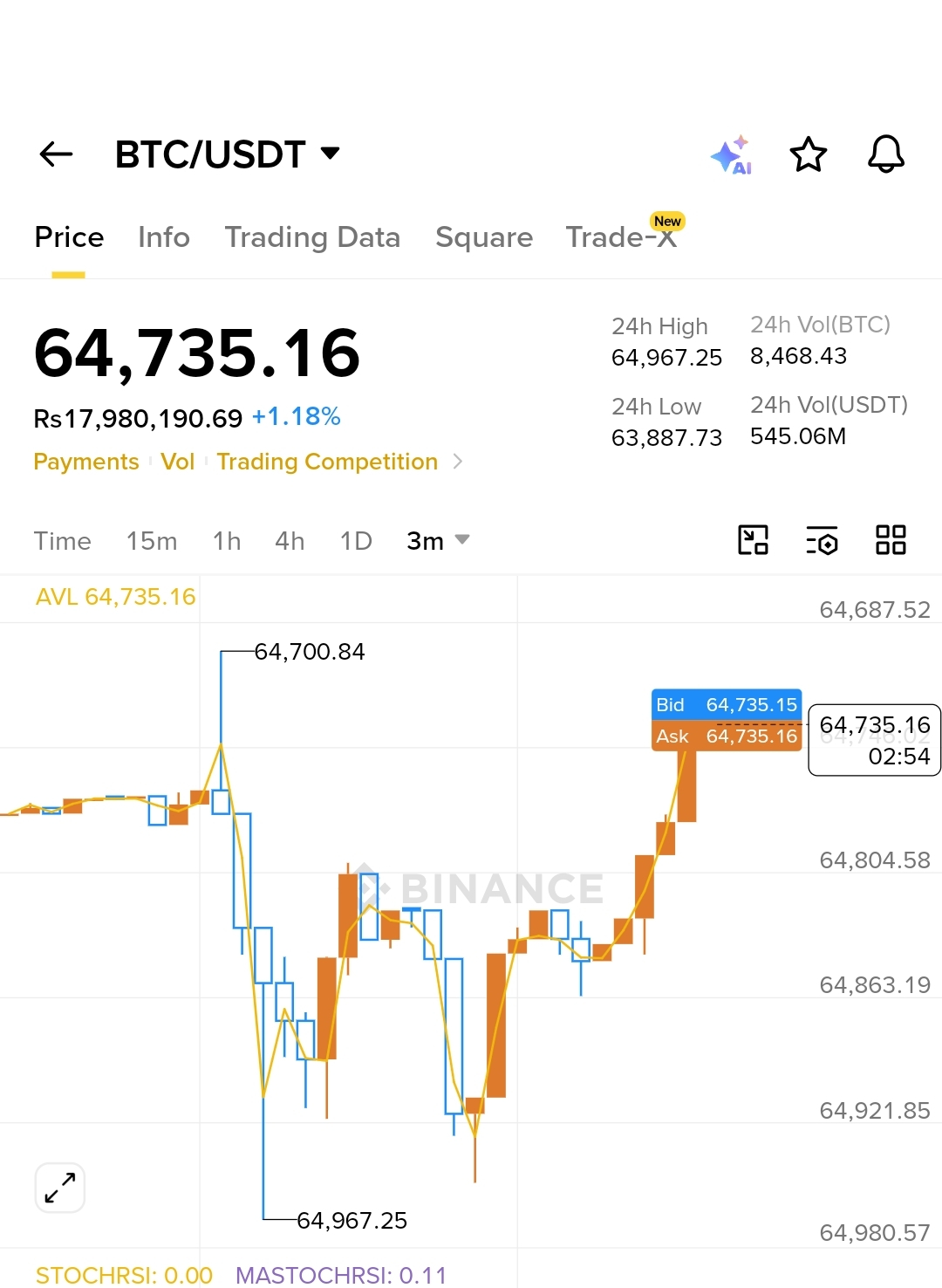
$BTC USDT – LONG
Trade Plan:
• Entry: 64,700–64,760
• Stop Loss (SL): 64,420
• Take Profit 1 (TP1): 65,150
• Take Profit 2 (TP2): 65,600
• Take Profit 3 (TP3): 66,200
Why this setup?
The 1H trend is regaining bullish momentum while the 4H structure continues to defend higher lows, keeping the broader bias constructive. RSI is recovering from neutral territory, momentum is accelerating, and buyers are stepping back in with improving volume. Price is pressing against short-term resistance after reclaiming support, and this compression often precedes an impulsive breakout. A move to TP1 offers roughly 0.7% upside from entry, with room for continuation if volume expands.
Debate:
Is this the calm before a major breakout, or is the market setting another bull trap?
#USMissesGENIUSActStablecoinRuleDeadline
#USTargetsBrazilPaymentSystemViaSection301
#USTargetsBrazilPaymentSystemViaSection301
#SpaceXShortInterestHits29%OfFloat
#SpaceXShortInterestHits29%OfFloat
$BTC USDT – LONG
Trade Plan:
• Entry: 64,700–64,760
• Stop Loss (SL): 64,420
• Take Profit 1 (TP1): 65,150
• Take Profit 2 (TP2): 65,600
• Take Profit 3 (TP3): 66,200
Why this setup?
The 1H trend is regaining bullish momentum while the 4H structure continues to defend higher lows, keeping the broader bias constructive. RSI is recovering from neutral territory, momentum is accelerating, and buyers are stepping back in with improving volume. Price is pressing against short-term resistance after reclaiming support, and this compression often precedes an impulsive breakout. A move to TP1 offers roughly 0.7% upside from entry, with room for continuation if volume expands.
Debate:
Is this the calm before a major breakout, or is the market setting another bull trap?
#USMissesGENIUSActStablecoinRuleDeadline
#USTargetsBrazilPaymentSystemViaSection301
#USTargetsBrazilPaymentSystemViaSection301
#SpaceXShortInterestHits29%OfFloat
#SpaceXShortInterestHits29%OfFloat
Trade Plan:
• Entry: 64,700–64,760
• Stop Loss (SL): 64,420
• Take Profit 1 (TP1): 65,150
• Take Profit 2 (TP2): 65,600
• Take Profit 3 (TP3): 66,200
Why this setup?
The 1H trend is regaining bullish momentum while the 4H structure continues to defend higher lows, keeping the broader bias constructive. RSI is recovering from neutral territory, momentum is accelerating, and buyers are stepping back in with improving volume. Price is pressing against short-term resistance after reclaiming support, and this compression often precedes an impulsive breakout. A move to TP1 offers roughly 0.7% upside from entry, with room for continuation if volume expands.
Debate:
Is this the calm before a major breakout, or is the market setting another bull trap?
#USMissesGENIUSActStablecoinRuleDeadline
#USTargetsBrazilPaymentSystemViaSection301
#USTargetsBrazilPaymentSystemViaSection301
#SpaceXShortInterestHits29%OfFloat
#SpaceXShortInterestHits29%OfFloat
121
·
--
Bullish
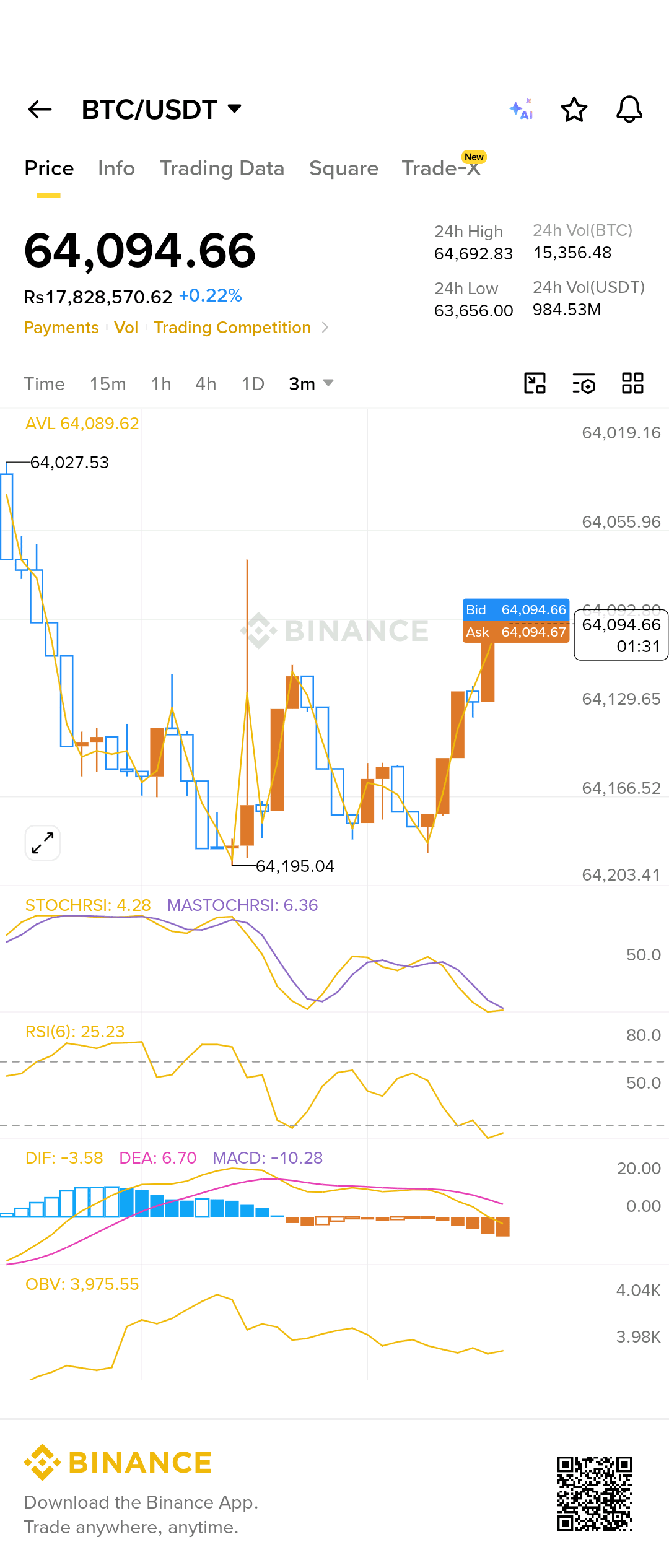
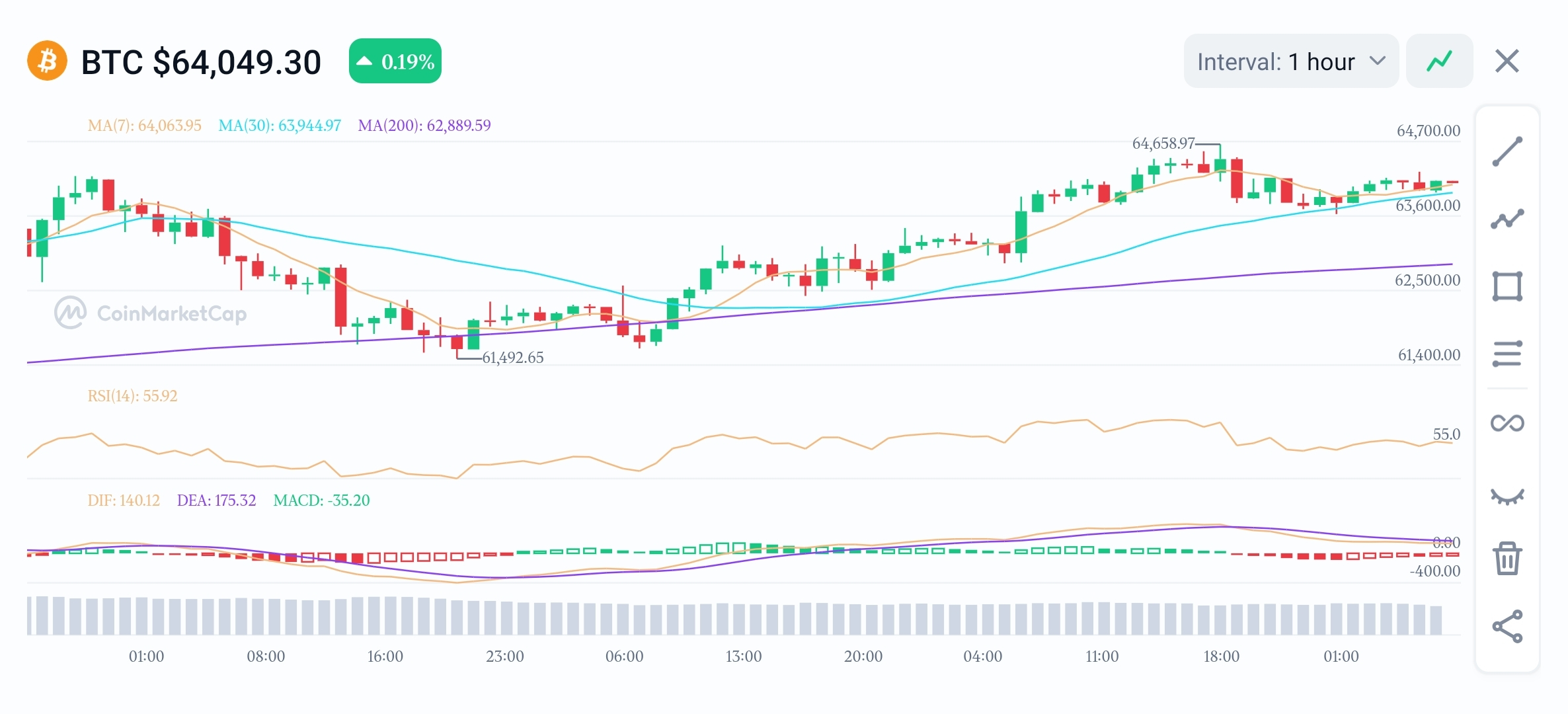
$BTC /USDT – LONG
Trade Plan:
• Entry: $63,950–$64,100
• Stop Loss (SL): $63,580
• Take Profit 1 (TP1): $64,700
• Take Profit 2 (TP2): $65,400
• Take Profit 3 (TP3): $66,200
Why this setup?
The 1H structure is printing higher lows while price holds above the 30MA and remains comfortably above the 200MA, keeping the higher-timeframe bias bullish. RSI near 56 signals healthy momentum without entering overbought territory. The $63.6K-$64.7K range has compressed volatility, and volume is slowly building beneath resistance. A clean break above $64.7K could trigger a fast expansion move. From entry to TP1, the setup offers roughly 1% upside, with significantly larger extension potential if momentum accelerates.
Debate:
Is this consolidation the launchpad for a breakout to new highs, or is Bitcoin preparing one final liquidity trap before reversing lower?
{spot}(BTCUSDT)
#CBDCBanBillToBecomeLawWithoutTrumpSignature
#CBDCBanBillToBecomeLawWithoutTrumpSignature
#CBDCBanBillToBecomeLawWithoutTrumpSignature
#CBDCBanBillToBecomeLawWithoutTrumpSignature
#CBDCBanBillToBecomeLawWithoutTrumpSignature
$BTC /USDT – LONG
Trade Plan:
• Entry: $63,950–$64,100
• Stop Loss (SL): $63,580
• Take Profit 1 (TP1): $64,700
• Take Profit 2 (TP2): $65,400
• Take Profit 3 (TP3): $66,200
Why this setup?
The 1H structure is printing higher lows while price holds above the 30MA and remains comfortably above the 200MA, keeping the higher-timeframe bias bullish. RSI near 56 signals healthy momentum without entering overbought territory. The $63.6K-$64.7K range has compressed volatility, and volume is slowly building beneath resistance. A clean break above $64.7K could trigger a fast expansion move. From entry to TP1, the setup offers roughly 1% upside, with significantly larger extension potential if momentum accelerates.
Debate:
Is this consolidation the launchpad for a breakout to new highs, or is Bitcoin preparing one final liquidity trap before reversing lower?
#CBDCBanBillToBecomeLawWithoutTrumpSignature
#CBDCBanBillToBecomeLawWithoutTrumpSignature
#CBDCBanBillToBecomeLawWithoutTrumpSignature
#CBDCBanBillToBecomeLawWithoutTrumpSignature
#CBDCBanBillToBecomeLawWithoutTrumpSignature
Trade Plan:
• Entry: $63,950–$64,100
• Stop Loss (SL): $63,580
• Take Profit 1 (TP1): $64,700
• Take Profit 2 (TP2): $65,400
• Take Profit 3 (TP3): $66,200
Why this setup?
The 1H structure is printing higher lows while price holds above the 30MA and remains comfortably above the 200MA, keeping the higher-timeframe bias bullish. RSI near 56 signals healthy momentum without entering overbought territory. The $63.6K-$64.7K range has compressed volatility, and volume is slowly building beneath resistance. A clean break above $64.7K could trigger a fast expansion move. From entry to TP1, the setup offers roughly 1% upside, with significantly larger extension potential if momentum accelerates.
Debate:
Is this consolidation the launchpad for a breakout to new highs, or is Bitcoin preparing one final liquidity trap before reversing lower?
#CBDCBanBillToBecomeLawWithoutTrumpSignature
#CBDCBanBillToBecomeLawWithoutTrumpSignature
#CBDCBanBillToBecomeLawWithoutTrumpSignature
#CBDCBanBillToBecomeLawWithoutTrumpSignature
#CBDCBanBillToBecomeLawWithoutTrumpSignature
74
·
--
Bullish
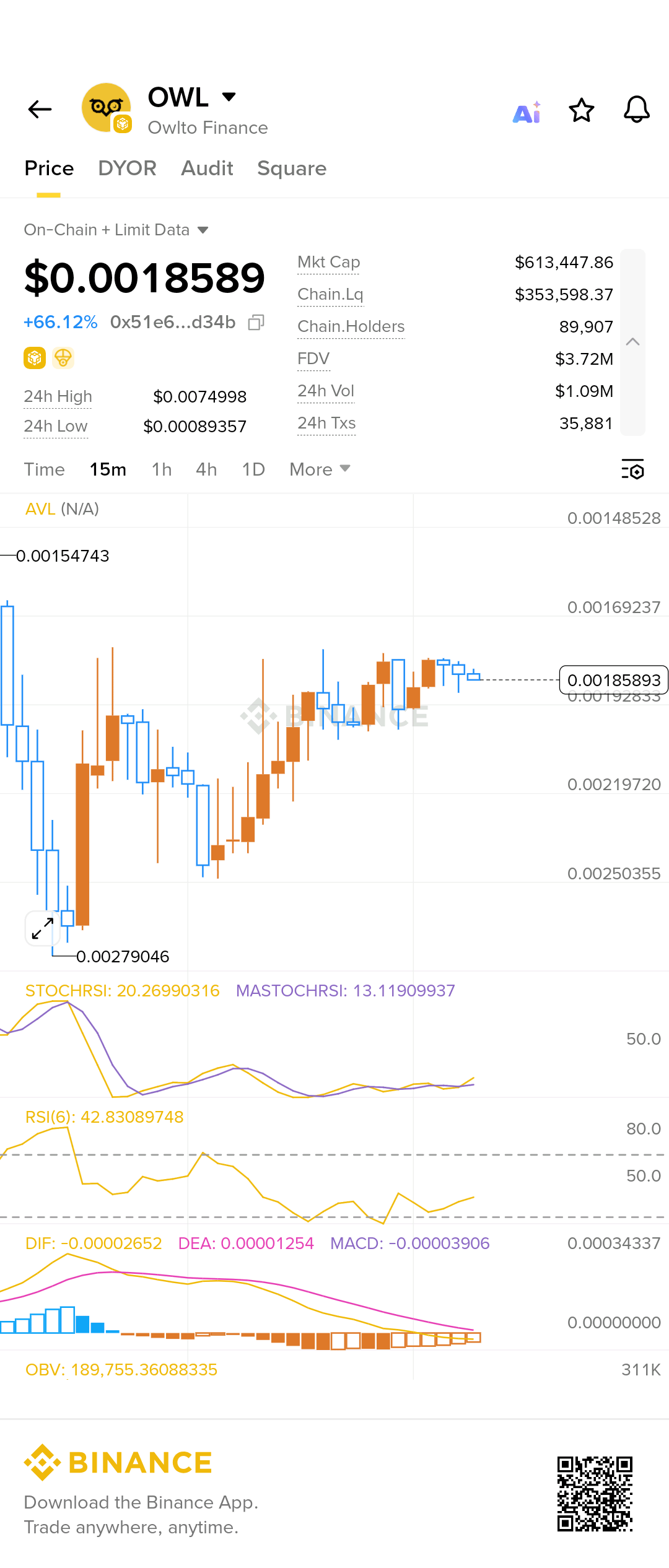
Nobody's watching $OWL but the chart is quietly building pressure.
$OWL – LONG
Trade Plan:
• Entry: 0.00180 – 0.00188
• SL: 0.00155
• TP1: 0.00230
• TP2: 0.00280
• TP3: 0.00350
Why this setup?
• The 1H structure is recovering, while the 4H chart is attempting a trend reversal after a strong bounce from local lows.
• RSI is climbing from oversold territory, suggesting momentum is slowly returning.
• Volume remains elevated with over $1M in 24H trading activity, showing real participation.
• Price is consolidating near resistance. A clean break above this range could trigger a fast expansion toward TP1, offering roughly a 25% upside from the entry zone.
Debate:
Is $OWL quietly forming a base for the next leg higher, or is this recovery rally about to run into heavy selling pressure?
{alpha}(560x51e667e91b4b8cb8e6e0528757f248406bd34b57)
#USDARaises2026SoybeanOutlookTo4.475BBushels
#SKHynixJumpsNearly13%OnUSDebut
#AppleSuesOpenAIOverTradeSecrets
#CBDCBanBillToBecomeLawWithoutTrumpSignature
#CBDCBanBillToBecomeLawWithoutTrumpSignature
Nobody's watching $OWL but the chart is quietly building pressure.
$OWL – LONG
Trade Plan:
• Entry: 0.00180 – 0.00188
• SL: 0.00155
• TP1: 0.00230
• TP2: 0.00280
• TP3: 0.00350
Why this setup?
• The 1H structure is recovering, while the 4H chart is attempting a trend reversal after a strong bounce from local lows.
• RSI is climbing from oversold territory, suggesting momentum is slowly returning.
• Volume remains elevated with over $1M in 24H trading activity, showing real participation.
• Price is consolidating near resistance. A clean break above this range could trigger a fast expansion toward TP1, offering roughly a 25% upside from the entry zone.
Debate:
Is $OWL quietly forming a base for the next leg higher, or is this recovery rally about to run into heavy selling pressure?
#USDARaises2026SoybeanOutlookTo4.475BBushels
#SKHynixJumpsNearly13%OnUSDebut
#AppleSuesOpenAIOverTradeSecrets
#CBDCBanBillToBecomeLawWithoutTrumpSignature
#CBDCBanBillToBecomeLawWithoutTrumpSignature
$OWL – LONG
Trade Plan:
• Entry: 0.00180 – 0.00188
• SL: 0.00155
• TP1: 0.00230
• TP2: 0.00280
• TP3: 0.00350
Why this setup?
• The 1H structure is recovering, while the 4H chart is attempting a trend reversal after a strong bounce from local lows.
• RSI is climbing from oversold territory, suggesting momentum is slowly returning.
• Volume remains elevated with over $1M in 24H trading activity, showing real participation.
• Price is consolidating near resistance. A clean break above this range could trigger a fast expansion toward TP1, offering roughly a 25% upside from the entry zone.
Debate:
Is $OWL quietly forming a base for the next leg higher, or is this recovery rally about to run into heavy selling pressure?
#USDARaises2026SoybeanOutlookTo4.475BBushels
#SKHynixJumpsNearly13%OnUSDebut
#AppleSuesOpenAIOverTradeSecrets
#CBDCBanBillToBecomeLawWithoutTrumpSignature
#CBDCBanBillToBecomeLawWithoutTrumpSignature
368
·
--
Bullish
Nobody's paying attention to $LAB /USDT, but price is sitting exactly where trends either break… or explode.
$LAB – SHORT
Trade Plan:
• Entry: 0.8517 – 0.8684
• SL: 1.2422
• TP1: 0.5734
• TP2: 0.3823
• TP3: 0.0957
Why this setup?
• The 4H structure remains decisively bearish, with lower highs continuing to cap every relief rally.
• RSI on the 15m timeframe is below 40, showing momentum exhaustion and weakening buyer conviction.
• Volume has been fading during the recent consolidation, a classic sign that the current range may not hold much longer.
• A breakdown below support could trigger another impulsive move lower, with TP1 offering roughly a 33% move from the entry zone.
The market is quiet, almost too quiet. These are often the moments that produce the biggest moves.
Debate:
Is $LAB preparing for another leg down, or is this compressed range setting up one final short squeeze before the real breakdown begins?
{alpha}(560x7ec43cf65f1663f820427c62a5780b8f2e25593a)
#AppleSuesOpenAIOverTradeSecrets
#AppleSuesOpenAIOverTradeSecrets
#CBDCBanBillToBecomeLawWithoutTrumpSignature
#RussiaBansDieselExports
#RussiaBansDieselExports
Nobody's paying attention to $LAB /USDT, but price is sitting exactly where trends either break… or explode.
$LAB – SHORT
Trade Plan:
• Entry: 0.8517 – 0.8684
• SL: 1.2422
• TP1: 0.5734
• TP2: 0.3823
• TP3: 0.0957
Why this setup?
• The 4H structure remains decisively bearish, with lower highs continuing to cap every relief rally.
• RSI on the 15m timeframe is below 40, showing momentum exhaustion and weakening buyer conviction.
• Volume has been fading during the recent consolidation, a classic sign that the current range may not hold much longer.
• A breakdown below support could trigger another impulsive move lower, with TP1 offering roughly a 33% move from the entry zone.
The market is quiet, almost too quiet. These are often the moments that produce the biggest moves.
Debate:
Is $LAB preparing for another leg down, or is this compressed range setting up one final short squeeze before the real breakdown begins?
#AppleSuesOpenAIOverTradeSecrets
#AppleSuesOpenAIOverTradeSecrets
#CBDCBanBillToBecomeLawWithoutTrumpSignature
#RussiaBansDieselExports
#RussiaBansDieselExports
$LAB – SHORT
Trade Plan:
• Entry: 0.8517 – 0.8684
• SL: 1.2422
• TP1: 0.5734
• TP2: 0.3823
• TP3: 0.0957
Why this setup?
• The 4H structure remains decisively bearish, with lower highs continuing to cap every relief rally.
• RSI on the 15m timeframe is below 40, showing momentum exhaustion and weakening buyer conviction.
• Volume has been fading during the recent consolidation, a classic sign that the current range may not hold much longer.
• A breakdown below support could trigger another impulsive move lower, with TP1 offering roughly a 33% move from the entry zone.
The market is quiet, almost too quiet. These are often the moments that produce the biggest moves.
Debate:
Is $LAB preparing for another leg down, or is this compressed range setting up one final short squeeze before the real breakdown begins?
#AppleSuesOpenAIOverTradeSecrets
#AppleSuesOpenAIOverTradeSecrets
#CBDCBanBillToBecomeLawWithoutTrumpSignature
#RussiaBansDieselExports
#RussiaBansDieselExports
376
·
--
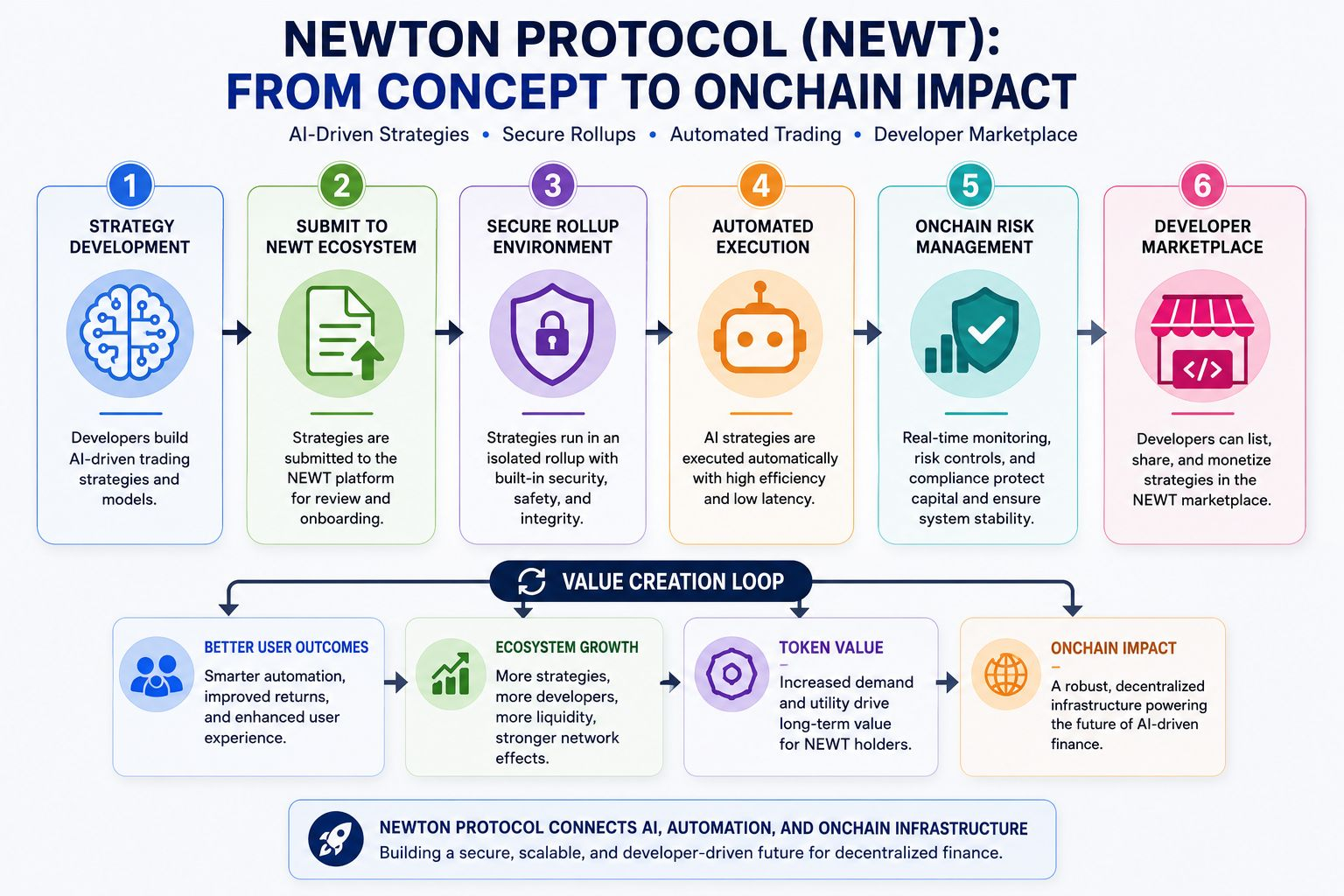
NEWTON PROTOCOL (NEWT): REAL INFRASTRUCTURE OR JUST HYPE?
Newton Protocol (NEWT) sits in an interesting middle ground. Its pitch—secure rollups, AI-driven strategies, automated trading, and a marketplace for AI developers—sounds ambitious and highly relevant to where crypto is heading.
The strongest part of the thesis is security. If NEWT can provide a safe environment for AI-powered automation, it could solve a real problem in crypto. But "secure" is a word the industry uses too easily, and strong ideas don't always translate into strong execution.
The AI trading angle is compelling because automation can be faster and less emotional than human decision-making. Still, automated systems can fail in unpredictable ways, especially in volatile markets.
The developer marketplace adds another layer of potential by aiming to build an ecosystem rather than a single product. However, marketplaces are notoriously difficult to scale and require strong network effects to succeed.
Ultimately, NEWT feels like a project worth watching rather than blindly chasing. The vision is coherent, but the real question is whether it can deliver meaningful infrastructure—or if it's simply a collection of trendy narratives packaged into one story.
@NewtonProtocol #NEWT $NEWT
#SKHynixADRBiggestForeignCorporateFundraising
#SKHynixADRBiggestForeignCorporateFundraising
#SKHynixADRBiggestForeignCorporateFundraising
#SKHynixADRBiggestForeignCorporateFundraising
NEWTON PROTOCOL (NEWT): REAL INFRASTRUCTURE OR JUST HYPE?
Newton Protocol (NEWT) sits in an interesting middle ground. Its pitch—secure rollups, AI-driven strategies, automated trading, and a marketplace for AI developers—sounds ambitious and highly relevant to where crypto is heading.
The strongest part of the thesis is security. If NEWT can provide a safe environment for AI-powered automation, it could solve a real problem in crypto. But "secure" is a word the industry uses too easily, and strong ideas don't always translate into strong execution.
The AI trading angle is compelling because automation can be faster and less emotional than human decision-making. Still, automated systems can fail in unpredictable ways, especially in volatile markets.
The developer marketplace adds another layer of potential by aiming to build an ecosystem rather than a single product. However, marketplaces are notoriously difficult to scale and require strong network effects to succeed.
Ultimately, NEWT feels like a project worth watching rather than blindly chasing. The vision is coherent, but the real question is whether it can deliver meaningful infrastructure—or if it's simply a collection of trendy narratives packaged into one story.
@NewtonProtocol #NEWT $NEWT
#SKHynixADRBiggestForeignCorporateFundraising
#SKHynixADRBiggestForeignCorporateFundraising
#SKHynixADRBiggestForeignCorporateFundraising
#SKHynixADRBiggestForeignCorporateFundraising
Newton Protocol (NEWT) sits in an interesting middle ground. Its pitch—secure rollups, AI-driven strategies, automated trading, and a marketplace for AI developers—sounds ambitious and highly relevant to where crypto is heading.
The strongest part of the thesis is security. If NEWT can provide a safe environment for AI-powered automation, it could solve a real problem in crypto. But "secure" is a word the industry uses too easily, and strong ideas don't always translate into strong execution.
The AI trading angle is compelling because automation can be faster and less emotional than human decision-making. Still, automated systems can fail in unpredictable ways, especially in volatile markets.
The developer marketplace adds another layer of potential by aiming to build an ecosystem rather than a single product. However, marketplaces are notoriously difficult to scale and require strong network effects to succeed.
Ultimately, NEWT feels like a project worth watching rather than blindly chasing. The vision is coherent, but the real question is whether it can deliver meaningful infrastructure—or if it's simply a collection of trendy narratives packaged into one story.
@NewtonProtocol #NEWT $NEWT
#SKHynixADRBiggestForeignCorporateFundraising
#SKHynixADRBiggestForeignCorporateFundraising
#SKHynixADRBiggestForeignCorporateFundraising
#SKHynixADRBiggestForeignCorporateFundraising
2
85
·
--
Article
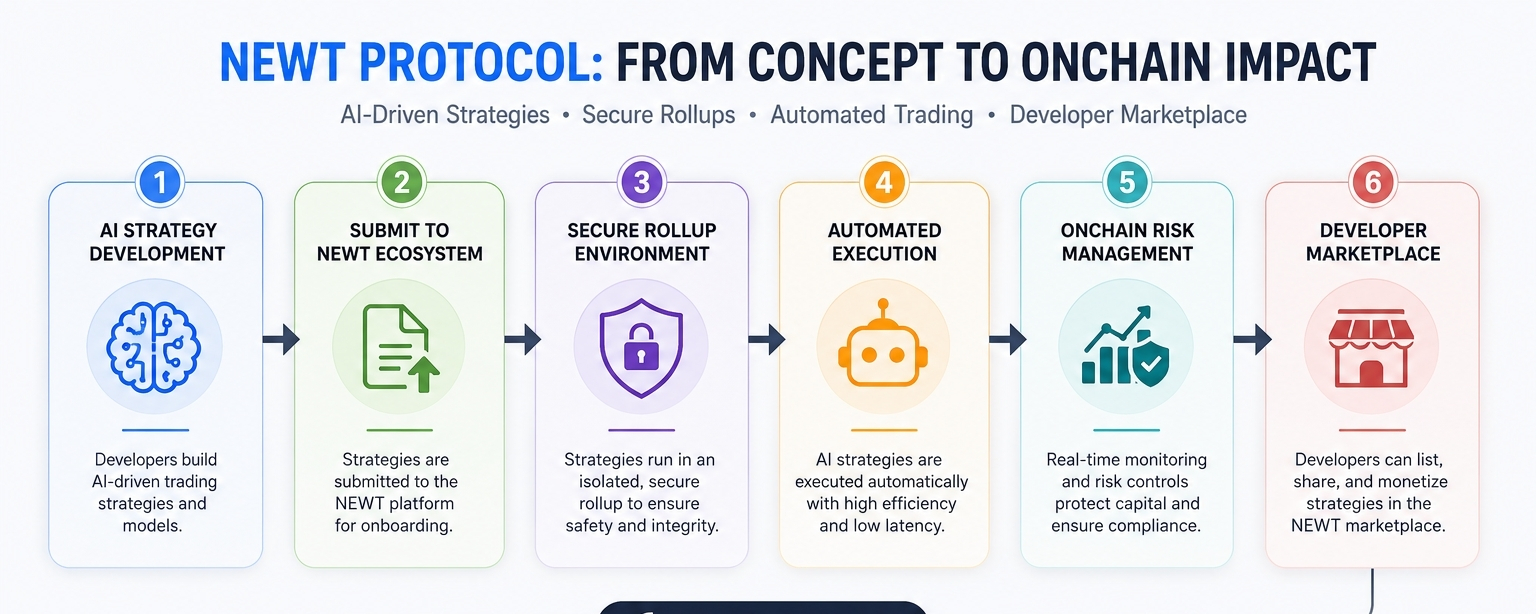
NEWT: COOL IDEA, OR JUST ANOTHER CLEANLY PACKAGED CRYPTO BET?I went down the Newton Protocol rabbit hole and, man, I keep bouncing between “okay, this is actually interesting” and “yeah, I’ve seen this movie before.” That’s probably the most honest thing I can say. On paper NEWT is trying to do a lot of the stuff people in crypto love to talk about when they’re feeling futuristic and full of conviction — secure rollups, AI-driven strategies, automated trading, and some kind of marketplace for AI developers. That combo sounds slick. It sounds like the kind of pitch that gets clipped into a thread and shared around like it’s inevitable. But once you sit with it for a minute... the hype smell shows up pretty fast.
The secure rollup angle is the part that makes me pause in a good way, at least at first. Crypto has been desperately trying to make automation feel less like a casino bot with a shiny UI and more like actual infrastructure. If NEWT can really make AI-driven strategies run in a secure environment without everything turning into an exploit buffet, that’s not nothing. That’s the dream, right? Not just “AI trading” as a buzzword tattooed on a whitepaper, but an actual system where automation isn’t one bad call away from getting wrecked by some weird edge-case or malicious actor. I get why that sounds compelling.
But then the old skepticism creeps in. Because “secure” is one of those words everyone throws around in crypto like it’s free candy. Secure compared to what? Secure until the next bridge-style disaster? Secure until the market gets weird and the AI starts doing something clever in the dumbest possible way? That’s the part nobody loves talking about. The tech can be elegant and still get humbled by reality. It happens all the time. A project can look like a polished race car and still spin out on the first wet corner...
The automated trading piece is where my brain starts doing that annoying split-screen thing. One side is like, yeah, automation is obviously where a lot of this market is heading. Humans are slow, emotional, and usually late. Bots don’t panic. They don’t FOMO into green candles because they had a bad day. So if NEWT is helping strategies execute cleanly, maybe there’s something real there. The other side of me is just laughing a little, because crypto trading has also been flooded with a million “smart” systems that are really just fancy wrappers around the same old problems. People love automation until the bot farms their account into dust while the charts look like a seizure.
And AI... well, AI in crypto is both the hottest word and the most suspicious one. It can mean anything. Sometimes it means actual useful tooling. Sometimes it means somebody slapped the letters A and I on the deck and called it a day. So when a protocol says it’s built around AI-driven strategies, I immediately wonder whether the AI is doing real work or just being used as a magnet for attention. Big difference. Huge difference, actually. One is infrastructure. The other is marketing wearing a lab coat.
The marketplace for AI developers is probably the piece that feels the most ambitious, and maybe the most fragile too. In theory, that’s cool. If you create a place where builders can make, trade, and maybe plug into these systems, you get network effects. You get activity. You get the kind of ecosystem people keep chasing in this space. But the catch is... marketplaces are hard. Like really hard. Everyone wants the network effect part and nobody wants the awkward phase where there aren’t enough users, not enough quality, not enough trust, not enough of anything. Crypto marketplaces especially can feel like ghost malls. Clean floors, nice lighting, zero foot traffic.
And still, I can’t fully write NEWT off, because the thesis isn’t dumb. It’s actually pretty aligned with where a lot of crypto has been drifting anyway: trying to make onchain systems do more than just move tokens around and pray. If AI agents, trading automation, and developer tooling can coexist inside a secure rollup setup, that’s at least a coherent direction. It doesn’t feel random. It feels like someone looked at the mess of crypto and said, “okay, what if this stuff actually had a purpose?” Which, to be fair, is refreshing.
But I’ve been around this market long enough to know that coherence doesn’t guarantee anything. Good narratives can still go nowhere. Strong products can still get buried. And the best-sounding ecosystems can turn into empty shells if the incentives are off or the execution gets sloppy. Crypto is full of projects that sounded like the future for about six weeks. Then the charts started leaking, the community got weirdly quiet, and everybody moved on to the next shiny thing.
That’s why NEWT sits in this strange middle zone for me. Not a total shrug. Not a blind buy-everything masterpiece either. More like one of those projects where you nod along, keep your eyes open, and don’t get hypnotized by the pitch video. The secure rollup framing gives it some technical seriousness. The AI and trading angle gives it obvious market appeal. The developer marketplace gives it a shot at being more than a single-use product. That’s the good version. The skeptical version is harsher: maybe it’s just three trendy ideas stapled together so the deck looks bigger than it is.
And yeah, crypto loves doing that. It’s like watching a restaurant menu where every item has truffle oil, and half the time you just know it’s covering for something. Doesn’t mean the meal is bad. But you’d be crazy not to wonder what’s being hidden.
I think what keeps me interested, weirdly, is that NEWT is aiming at the intersection of things people are already obsessed with: AI, automation, trading, and onchain infrastructure. That intersection is crowded, though. Extremely crowded. So the bar isn’t “is this interesting?” The bar is “does this actually work better than the pile of other things screaming for the same attention?” And that answer is way less clear. Maybe it does. Maybe it’s early. Maybe it’s one of those projects that only makes sense once the ecosystem around it matures. Or maybe it gets memed into relevance and then disappears when nobody can explain the product without using five buzzwords in a row.
So yeah, I’m curious. Genuinely. But I’m also squinting at it. That’s probably the right posture in crypto anyway. If NEWT ends up being real infrastructure for AI-heavy automation, cool, that’s a legit lane. If not, it’ll probably still get a decent run on narrative alone because this market rewards a good story like nothing else. Sometimes too much. Sometimes that’s the whole game... and that’s the
part that still bugs me.
@NewtonProtocol #Newt $NEWT
NEWT: COOL IDEA, OR JUST ANOTHER CLEANLY PACKAGED CRYPTO BET?
I went down the Newton Protocol rabbit hole and, man, I keep bouncing between “okay, this is actually interesting” and “yeah, I’ve seen this movie before.” That’s probably the most honest thing I can say. On paper NEWT is trying to do a lot of the stuff people in crypto love to talk about when they’re feeling futuristic and full of conviction — secure rollups, AI-driven strategies, automated trading, and some kind of marketplace for AI developers. That combo sounds slick. It sounds like the kind of pitch that gets clipped into a thread and shared around like it’s inevitable. But once you sit with it for a minute... the hype smell shows up pretty fast.
The secure rollup angle is the part that makes me pause in a good way, at least at first. Crypto has been desperately trying to make automation feel less like a casino bot with a shiny UI and more like actual infrastructure. If NEWT can really make AI-driven strategies run in a secure environment without everything turning into an exploit buffet, that’s not nothing. That’s the dream, right? Not just “AI trading” as a buzzword tattooed on a whitepaper, but an actual system where automation isn’t one bad call away from getting wrecked by some weird edge-case or malicious actor. I get why that sounds compelling.
But then the old skepticism creeps in. Because “secure” is one of those words everyone throws around in crypto like it’s free candy. Secure compared to what? Secure until the next bridge-style disaster? Secure until the market gets weird and the AI starts doing something clever in the dumbest possible way? That’s the part nobody loves talking about. The tech can be elegant and still get humbled by reality. It happens all the time. A project can look like a polished race car and still spin out on the first wet corner...
The automated trading piece is where my brain starts doing that annoying split-screen thing. One side is like, yeah, automation is obviously where a lot of this market is heading. Humans are slow, emotional, and usually late. Bots don’t panic. They don’t FOMO into green candles because they had a bad day. So if NEWT is helping strategies execute cleanly, maybe there’s something real there. The other side of me is just laughing a little, because crypto trading has also been flooded with a million “smart” systems that are really just fancy wrappers around the same old problems. People love automation until the bot farms their account into dust while the charts look like a seizure.
And AI... well, AI in crypto is both the hottest word and the most suspicious one. It can mean anything. Sometimes it means actual useful tooling. Sometimes it means somebody slapped the letters A and I on the deck and called it a day. So when a protocol says it’s built around AI-driven strategies, I immediately wonder whether the AI is doing real work or just being used as a magnet for attention. Big difference. Huge difference, actually. One is infrastructure. The other is marketing wearing a lab coat.
The marketplace for AI developers is probably the piece that feels the most ambitious, and maybe the most fragile too. In theory, that’s cool. If you create a place where builders can make, trade, and maybe plug into these systems, you get network effects. You get activity. You get the kind of ecosystem people keep chasing in this space. But the catch is... marketplaces are hard. Like really hard. Everyone wants the network effect part and nobody wants the awkward phase where there aren’t enough users, not enough quality, not enough trust, not enough of anything. Crypto marketplaces especially can feel like ghost malls. Clean floors, nice lighting, zero foot traffic.
And still, I can’t fully write NEWT off, because the thesis isn’t dumb. It’s actually pretty aligned with where a lot of crypto has been drifting anyway: trying to make onchain systems do more than just move tokens around and pray. If AI agents, trading automation, and developer tooling can coexist inside a secure rollup setup, that’s at least a coherent direction. It doesn’t feel random. It feels like someone looked at the mess of crypto and said, “okay, what if this stuff actually had a purpose?” Which, to be fair, is refreshing.
But I’ve been around this market long enough to know that coherence doesn’t guarantee anything. Good narratives can still go nowhere. Strong products can still get buried. And the best-sounding ecosystems can turn into empty shells if the incentives are off or the execution gets sloppy. Crypto is full of projects that sounded like the future for about six weeks. Then the charts started leaking, the community got weirdly quiet, and everybody moved on to the next shiny thing.
That’s why NEWT sits in this strange middle zone for me. Not a total shrug. Not a blind buy-everything masterpiece either. More like one of those projects where you nod along, keep your eyes open, and don’t get hypnotized by the pitch video. The secure rollup framing gives it some technical seriousness. The AI and trading angle gives it obvious market appeal. The developer marketplace gives it a shot at being more than a single-use product. That’s the good version. The skeptical version is harsher: maybe it’s just three trendy ideas stapled together so the deck looks bigger than it is.
And yeah, crypto loves doing that. It’s like watching a restaurant menu where every item has truffle oil, and half the time you just know it’s covering for something. Doesn’t mean the meal is bad. But you’d be crazy not to wonder what’s being hidden.
I think what keeps me interested, weirdly, is that NEWT is aiming at the intersection of things people are already obsessed with: AI, automation, trading, and onchain infrastructure. That intersection is crowded, though. Extremely crowded. So the bar isn’t “is this interesting?” The bar is “does this actually work better than the pile of other things screaming for the same attention?” And that answer is way less clear. Maybe it does. Maybe it’s early. Maybe it’s one of those projects that only makes sense once the ecosystem around it matures. Or maybe it gets memed into relevance and then disappears when nobody can explain the product without using five buzzwords in a row.
So yeah, I’m curious. Genuinely. But I’m also squinting at it. That’s probably the right posture in crypto anyway. If NEWT ends up being real infrastructure for AI-heavy automation, cool, that’s a legit lane. If not, it’ll probably still get a decent run on narrative alone because this market rewards a good story like nothing else. Sometimes too much. Sometimes that’s the whole game... and that’s the
part that still bugs me.
@NewtonProtocol #Newt $NEWT
The secure rollup angle is the part that makes me pause in a good way, at least at first. Crypto has been desperately trying to make automation feel less like a casino bot with a shiny UI and more like actual infrastructure. If NEWT can really make AI-driven strategies run in a secure environment without everything turning into an exploit buffet, that’s not nothing. That’s the dream, right? Not just “AI trading” as a buzzword tattooed on a whitepaper, but an actual system where automation isn’t one bad call away from getting wrecked by some weird edge-case or malicious actor. I get why that sounds compelling.
But then the old skepticism creeps in. Because “secure” is one of those words everyone throws around in crypto like it’s free candy. Secure compared to what? Secure until the next bridge-style disaster? Secure until the market gets weird and the AI starts doing something clever in the dumbest possible way? That’s the part nobody loves talking about. The tech can be elegant and still get humbled by reality. It happens all the time. A project can look like a polished race car and still spin out on the first wet corner...
The automated trading piece is where my brain starts doing that annoying split-screen thing. One side is like, yeah, automation is obviously where a lot of this market is heading. Humans are slow, emotional, and usually late. Bots don’t panic. They don’t FOMO into green candles because they had a bad day. So if NEWT is helping strategies execute cleanly, maybe there’s something real there. The other side of me is just laughing a little, because crypto trading has also been flooded with a million “smart” systems that are really just fancy wrappers around the same old problems. People love automation until the bot farms their account into dust while the charts look like a seizure.
And AI... well, AI in crypto is both the hottest word and the most suspicious one. It can mean anything. Sometimes it means actual useful tooling. Sometimes it means somebody slapped the letters A and I on the deck and called it a day. So when a protocol says it’s built around AI-driven strategies, I immediately wonder whether the AI is doing real work or just being used as a magnet for attention. Big difference. Huge difference, actually. One is infrastructure. The other is marketing wearing a lab coat.
The marketplace for AI developers is probably the piece that feels the most ambitious, and maybe the most fragile too. In theory, that’s cool. If you create a place where builders can make, trade, and maybe plug into these systems, you get network effects. You get activity. You get the kind of ecosystem people keep chasing in this space. But the catch is... marketplaces are hard. Like really hard. Everyone wants the network effect part and nobody wants the awkward phase where there aren’t enough users, not enough quality, not enough trust, not enough of anything. Crypto marketplaces especially can feel like ghost malls. Clean floors, nice lighting, zero foot traffic.
And still, I can’t fully write NEWT off, because the thesis isn’t dumb. It’s actually pretty aligned with where a lot of crypto has been drifting anyway: trying to make onchain systems do more than just move tokens around and pray. If AI agents, trading automation, and developer tooling can coexist inside a secure rollup setup, that’s at least a coherent direction. It doesn’t feel random. It feels like someone looked at the mess of crypto and said, “okay, what if this stuff actually had a purpose?” Which, to be fair, is refreshing.
But I’ve been around this market long enough to know that coherence doesn’t guarantee anything. Good narratives can still go nowhere. Strong products can still get buried. And the best-sounding ecosystems can turn into empty shells if the incentives are off or the execution gets sloppy. Crypto is full of projects that sounded like the future for about six weeks. Then the charts started leaking, the community got weirdly quiet, and everybody moved on to the next shiny thing.
That’s why NEWT sits in this strange middle zone for me. Not a total shrug. Not a blind buy-everything masterpiece either. More like one of those projects where you nod along, keep your eyes open, and don’t get hypnotized by the pitch video. The secure rollup framing gives it some technical seriousness. The AI and trading angle gives it obvious market appeal. The developer marketplace gives it a shot at being more than a single-use product. That’s the good version. The skeptical version is harsher: maybe it’s just three trendy ideas stapled together so the deck looks bigger than it is.
And yeah, crypto loves doing that. It’s like watching a restaurant menu where every item has truffle oil, and half the time you just know it’s covering for something. Doesn’t mean the meal is bad. But you’d be crazy not to wonder what’s being hidden.
I think what keeps me interested, weirdly, is that NEWT is aiming at the intersection of things people are already obsessed with: AI, automation, trading, and onchain infrastructure. That intersection is crowded, though. Extremely crowded. So the bar isn’t “is this interesting?” The bar is “does this actually work better than the pile of other things screaming for the same attention?” And that answer is way less clear. Maybe it does. Maybe it’s early. Maybe it’s one of those projects that only makes sense once the ecosystem around it matures. Or maybe it gets memed into relevance and then disappears when nobody can explain the product without using five buzzwords in a row.
So yeah, I’m curious. Genuinely. But I’m also squinting at it. That’s probably the right posture in crypto anyway. If NEWT ends up being real infrastructure for AI-heavy automation, cool, that’s a legit lane. If not, it’ll probably still get a decent run on narrative alone because this market rewards a good story like nothing else. Sometimes too much. Sometimes that’s the whole game... and that’s the
part that still bugs me.
@NewtonProtocol #Newt $NEWT
3
122
·
--
# NEWTON PROTOCOL (NEWT): HYPE, REALITY, AND THE USUAL CRYPTO HEADACHE
Newton Protocol has that familiar crypto smell to it... the kind that makes you lean in a little and squint at the same time. Secure rollup, AI-driven strategies, automated trading, marketplace for AI developers — it’s a clean pitch, maybe a little too clean. I do think the idea has legs. AI and trading are obviously a tempting combo, and if they can make the infrastructure actually work without turning into a security mess, that’s not nothing.
But yeah, I’m skeptical too. Crypto loves to dress up big promises as real products, and half the time you end up with a nice narrative and not much usage. That’s the big question here. Is NEWT actually building something people will use, or is it just another project riding the AI wave because that’s where attention is? I can’t shake that thought.
Still, I won’t pretend it’s all fluff. The rollup angle makes sense, the developer marketplace angle makes sense, and if they pull it off, it could be genuinely interesting. Just... I’ve seen too many “interesting” crypto projects end up like a flashy restaurant with no customers. So yeah, curious, a bit cautious, and not ready to call it the next big thing just because the pitch sounds smart.
@NewtonProtocol #NEWT $NEWT
# NEWTON PROTOCOL (NEWT): HYPE, REALITY, AND THE USUAL CRYPTO HEADACHE
Newton Protocol has that familiar crypto smell to it... the kind that makes you lean in a little and squint at the same time. Secure rollup, AI-driven strategies, automated trading, marketplace for AI developers — it’s a clean pitch, maybe a little too clean. I do think the idea has legs. AI and trading are obviously a tempting combo, and if they can make the infrastructure actually work without turning into a security mess, that’s not nothing.
But yeah, I’m skeptical too. Crypto loves to dress up big promises as real products, and half the time you end up with a nice narrative and not much usage. That’s the big question here. Is NEWT actually building something people will use, or is it just another project riding the AI wave because that’s where attention is? I can’t shake that thought.
Still, I won’t pretend it’s all fluff. The rollup angle makes sense, the developer marketplace angle makes sense, and if they pull it off, it could be genuinely interesting. Just... I’ve seen too many “interesting” crypto projects end up like a flashy restaurant with no customers. So yeah, curious, a bit cautious, and not ready to call it the next big thing just because the pitch sounds smart.
@NewtonProtocol #NEWT $NEWT
Newton Protocol has that familiar crypto smell to it... the kind that makes you lean in a little and squint at the same time. Secure rollup, AI-driven strategies, automated trading, marketplace for AI developers — it’s a clean pitch, maybe a little too clean. I do think the idea has legs. AI and trading are obviously a tempting combo, and if they can make the infrastructure actually work without turning into a security mess, that’s not nothing.
But yeah, I’m skeptical too. Crypto loves to dress up big promises as real products, and half the time you end up with a nice narrative and not much usage. That’s the big question here. Is NEWT actually building something people will use, or is it just another project riding the AI wave because that’s where attention is? I can’t shake that thought.
Still, I won’t pretend it’s all fluff. The rollup angle makes sense, the developer marketplace angle makes sense, and if they pull it off, it could be genuinely interesting. Just... I’ve seen too many “interesting” crypto projects end up like a flashy restaurant with no customers. So yeah, curious, a bit cautious, and not ready to call it the next big thing just because the pitch sounds smart.
@NewtonProtocol #NEWT $NEWT
2
94
·
--
Article
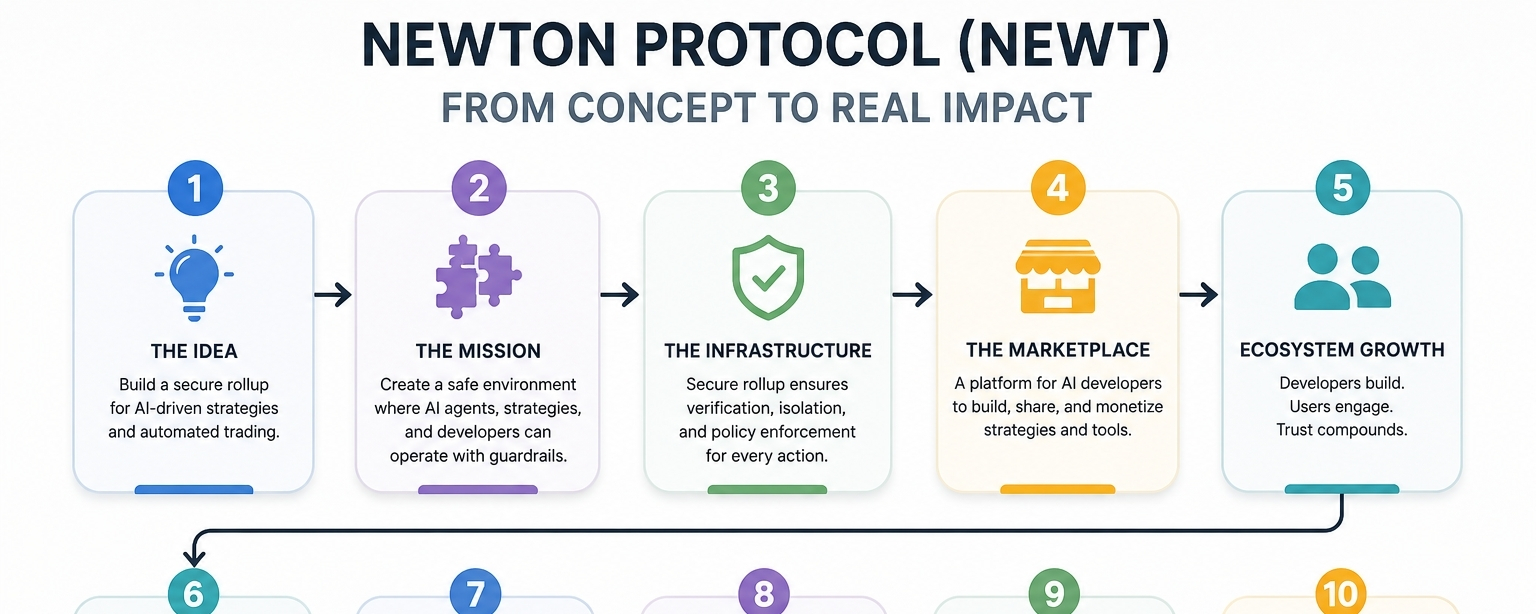
NEWTON PROTOCOL (NEWT): COOL IDEA, OR JUST MORE CRYPTO THEATER?I went down the rabbit hole on Newton Protocol and I’m still kind of split on it... which is usually my first warning sign with this stuff. The pitch sounds clean enough on paper: a secure rollup for AI-driven strategies, automated trading, and some kind of marketplace for AI developers. Nice words. Very clickable words. And crypto loves this exact setup, where something sounds a little futuristic and a little useful and suddenly everyone’s acting like the rails of finance are being rewritten overnight. Maybe they are. Maybe they aren’t.
What makes NEWT interesting, at least to me, is that it sits right in that awkward zone between real demand and very polished narrative. AI trading is a thing people already obsess over, and blockchain infrastructure has been trying to attach itself to AI for basically as long as “AI” became the magic word again. So when you hear “secure rollup” and “marketplace,” your brain does that little click... okay, maybe this has an actual angle. Maybe there’s something here that isn’t just vapor and a token chart with a fancy logo.
But then the skeptical side shows up, usually right after the excitement. Because crypto has this habit of turning good ideas into weird casino assets before the product even feels real. And AI in crypto is especially guilty of that. Half the time it’s not even about the thing working, it’s about the thing sounding inevitable. NEWT feels like it could get pulled into that same mess if the execution doesn’t stay sharp. A protocol can say “secure” all day long, but in this market, security isn’t just a feature... it’s the whole argument. If that part feels flimsy, the rest gets shaky fast.
The marketplace angle is the part that keeps echoing in my head. A marketplace for AI developers sounds useful, sure, but that’s also where projects start collecting buzzwords like they’re free samples. Developers want users, users want results, and both sides want trust. That’s the hard part. Not the marketing. Not the deck. The actual thing. And in crypto, the gap between “this could be useful” and “people actually use it” is a canyon. Sometimes a pretty wide, ugly canyon with a broken bridge and someone yelling about ecosystem growth from the other side.
Still, I can’t pretend the idea is dumb. I don’t think it is. If you’re trying to build a secure environment for automated strategies and trading, that’s at least a coherent mission. It’s not like some projects that feel assembled from random conference panels. This one has a cleaner story. A rollup for AI-driven strategies makes sense in the same way a locked trading desk makes sense. You’d want guardrails. You’d want verification. You’d want something that doesn’t just let every bot with a pulse start firing off transactions like it’s playing arcade basketball.
The catch is... crypto doesn’t really reward “makes sense” by itself. It rewards adoption, timing, hype, liquidity, and sometimes just sheer survival. NEWT could be conceptually solid and still get buried under a dozen louder narratives. I mean, look around. There’s always another protocol promising infrastructure for the future of intelligent systems, secure automation, decentralized compute, machine agents, whatever the phrase of the month is. It all starts to blur after a while, like standing in a phone store where every model claims to have the best camera and none of them can focus properly.
I do think there’s something a little more grounded here than the usual AI-coin nonsense, though. That’s my honest read. The focus on a secure rollup doesn’t sound as flimsy as “we put AI on the blockchain” which, let’s be real, is one of the most overused and underdeserved claims in the entire sector. NEWT at least seems to be aiming at a place where automation, trading, and developer tooling can meet in one system. That’s not nothing. It feels like someone tried to think about the boring parts, which is weirdly rare and maybe the best sign in all of crypto.
But I’m not gonna sit here and act like this is some guaranteed winner. Far from it. The competition is brutal, and the space is already crowded with projects trying to own the AI x crypto story. The token side can get ugly too. Once a project starts getting attention, people stop talking about infrastructure and start talking about price like that’s the whole point. Then the chart becomes the product, and everything else is just background noise. You’ve seen this movie. I’ve seen this movie. It usually gets dumb near the middle.
So yeah, my feeling on Newton Protocol is basically: interesting, maybe even genuinely relevant, but still surrounded by the usual smoke. The idea has teeth. The branding has that clean, future-facing shine. And that’s exactly what makes me wary, because crypto is full of projects that know how to look inevitable before they’ve proven anything. NEWT might be one of the better attempts in this category... or it might be another one of those things people talk about for a few months, then quietly stop mentioning when the next shiny narrative shows up.
That’s where I land tonight, anyway. Curious, but not sold. Hopeful, but not naive. Which, in crypto, is basically the least embar
rassing place to be.
@NewtonProtocol #NEWT $NEWT
NEWTON PROTOCOL (NEWT): COOL IDEA, OR JUST MORE CRYPTO THEATER?
I went down the rabbit hole on Newton Protocol and I’m still kind of split on it... which is usually my first warning sign with this stuff. The pitch sounds clean enough on paper: a secure rollup for AI-driven strategies, automated trading, and some kind of marketplace for AI developers. Nice words. Very clickable words. And crypto loves this exact setup, where something sounds a little futuristic and a little useful and suddenly everyone’s acting like the rails of finance are being rewritten overnight. Maybe they are. Maybe they aren’t.
What makes NEWT interesting, at least to me, is that it sits right in that awkward zone between real demand and very polished narrative. AI trading is a thing people already obsess over, and blockchain infrastructure has been trying to attach itself to AI for basically as long as “AI” became the magic word again. So when you hear “secure rollup” and “marketplace,” your brain does that little click... okay, maybe this has an actual angle. Maybe there’s something here that isn’t just vapor and a token chart with a fancy logo.
But then the skeptical side shows up, usually right after the excitement. Because crypto has this habit of turning good ideas into weird casino assets before the product even feels real. And AI in crypto is especially guilty of that. Half the time it’s not even about the thing working, it’s about the thing sounding inevitable. NEWT feels like it could get pulled into that same mess if the execution doesn’t stay sharp. A protocol can say “secure” all day long, but in this market, security isn’t just a feature... it’s the whole argument. If that part feels flimsy, the rest gets shaky fast.
The marketplace angle is the part that keeps echoing in my head. A marketplace for AI developers sounds useful, sure, but that’s also where projects start collecting buzzwords like they’re free samples. Developers want users, users want results, and both sides want trust. That’s the hard part. Not the marketing. Not the deck. The actual thing. And in crypto, the gap between “this could be useful” and “people actually use it” is a canyon. Sometimes a pretty wide, ugly canyon with a broken bridge and someone yelling about ecosystem growth from the other side.
Still, I can’t pretend the idea is dumb. I don’t think it is. If you’re trying to build a secure environment for automated strategies and trading, that’s at least a coherent mission. It’s not like some projects that feel assembled from random conference panels. This one has a cleaner story. A rollup for AI-driven strategies makes sense in the same way a locked trading desk makes sense. You’d want guardrails. You’d want verification. You’d want something that doesn’t just let every bot with a pulse start firing off transactions like it’s playing arcade basketball.
The catch is... crypto doesn’t really reward “makes sense” by itself. It rewards adoption, timing, hype, liquidity, and sometimes just sheer survival. NEWT could be conceptually solid and still get buried under a dozen louder narratives. I mean, look around. There’s always another protocol promising infrastructure for the future of intelligent systems, secure automation, decentralized compute, machine agents, whatever the phrase of the month is. It all starts to blur after a while, like standing in a phone store where every model claims to have the best camera and none of them can focus properly.
I do think there’s something a little more grounded here than the usual AI-coin nonsense, though. That’s my honest read. The focus on a secure rollup doesn’t sound as flimsy as “we put AI on the blockchain” which, let’s be real, is one of the most overused and underdeserved claims in the entire sector. NEWT at least seems to be aiming at a place where automation, trading, and developer tooling can meet in one system. That’s not nothing. It feels like someone tried to think about the boring parts, which is weirdly rare and maybe the best sign in all of crypto.
But I’m not gonna sit here and act like this is some guaranteed winner. Far from it. The competition is brutal, and the space is already crowded with projects trying to own the AI x crypto story. The token side can get ugly too. Once a project starts getting attention, people stop talking about infrastructure and start talking about price like that’s the whole point. Then the chart becomes the product, and everything else is just background noise. You’ve seen this movie. I’ve seen this movie. It usually gets dumb near the middle.
So yeah, my feeling on Newton Protocol is basically: interesting, maybe even genuinely relevant, but still surrounded by the usual smoke. The idea has teeth. The branding has that clean, future-facing shine. And that’s exactly what makes me wary, because crypto is full of projects that know how to look inevitable before they’ve proven anything. NEWT might be one of the better attempts in this category... or it might be another one of those things people talk about for a few months, then quietly stop mentioning when the next shiny narrative shows up.
That’s where I land tonight, anyway. Curious, but not sold. Hopeful, but not naive. Which, in crypto, is basically the least embar
rassing place to be.
@NewtonProtocol #NEWT $NEWT
What makes NEWT interesting, at least to me, is that it sits right in that awkward zone between real demand and very polished narrative. AI trading is a thing people already obsess over, and blockchain infrastructure has been trying to attach itself to AI for basically as long as “AI” became the magic word again. So when you hear “secure rollup” and “marketplace,” your brain does that little click... okay, maybe this has an actual angle. Maybe there’s something here that isn’t just vapor and a token chart with a fancy logo.
But then the skeptical side shows up, usually right after the excitement. Because crypto has this habit of turning good ideas into weird casino assets before the product even feels real. And AI in crypto is especially guilty of that. Half the time it’s not even about the thing working, it’s about the thing sounding inevitable. NEWT feels like it could get pulled into that same mess if the execution doesn’t stay sharp. A protocol can say “secure” all day long, but in this market, security isn’t just a feature... it’s the whole argument. If that part feels flimsy, the rest gets shaky fast.
The marketplace angle is the part that keeps echoing in my head. A marketplace for AI developers sounds useful, sure, but that’s also where projects start collecting buzzwords like they’re free samples. Developers want users, users want results, and both sides want trust. That’s the hard part. Not the marketing. Not the deck. The actual thing. And in crypto, the gap between “this could be useful” and “people actually use it” is a canyon. Sometimes a pretty wide, ugly canyon with a broken bridge and someone yelling about ecosystem growth from the other side.
Still, I can’t pretend the idea is dumb. I don’t think it is. If you’re trying to build a secure environment for automated strategies and trading, that’s at least a coherent mission. It’s not like some projects that feel assembled from random conference panels. This one has a cleaner story. A rollup for AI-driven strategies makes sense in the same way a locked trading desk makes sense. You’d want guardrails. You’d want verification. You’d want something that doesn’t just let every bot with a pulse start firing off transactions like it’s playing arcade basketball.
The catch is... crypto doesn’t really reward “makes sense” by itself. It rewards adoption, timing, hype, liquidity, and sometimes just sheer survival. NEWT could be conceptually solid and still get buried under a dozen louder narratives. I mean, look around. There’s always another protocol promising infrastructure for the future of intelligent systems, secure automation, decentralized compute, machine agents, whatever the phrase of the month is. It all starts to blur after a while, like standing in a phone store where every model claims to have the best camera and none of them can focus properly.
I do think there’s something a little more grounded here than the usual AI-coin nonsense, though. That’s my honest read. The focus on a secure rollup doesn’t sound as flimsy as “we put AI on the blockchain” which, let’s be real, is one of the most overused and underdeserved claims in the entire sector. NEWT at least seems to be aiming at a place where automation, trading, and developer tooling can meet in one system. That’s not nothing. It feels like someone tried to think about the boring parts, which is weirdly rare and maybe the best sign in all of crypto.
But I’m not gonna sit here and act like this is some guaranteed winner. Far from it. The competition is brutal, and the space is already crowded with projects trying to own the AI x crypto story. The token side can get ugly too. Once a project starts getting attention, people stop talking about infrastructure and start talking about price like that’s the whole point. Then the chart becomes the product, and everything else is just background noise. You’ve seen this movie. I’ve seen this movie. It usually gets dumb near the middle.
So yeah, my feeling on Newton Protocol is basically: interesting, maybe even genuinely relevant, but still surrounded by the usual smoke. The idea has teeth. The branding has that clean, future-facing shine. And that’s exactly what makes me wary, because crypto is full of projects that know how to look inevitable before they’ve proven anything. NEWT might be one of the better attempts in this category... or it might be another one of those things people talk about for a few months, then quietly stop mentioning when the next shiny narrative shows up.
That’s where I land tonight, anyway. Curious, but not sold. Hopeful, but not naive. Which, in crypto, is basically the least embar
rassing place to be.
@NewtonProtocol #NEWT $NEWT
97
·
--
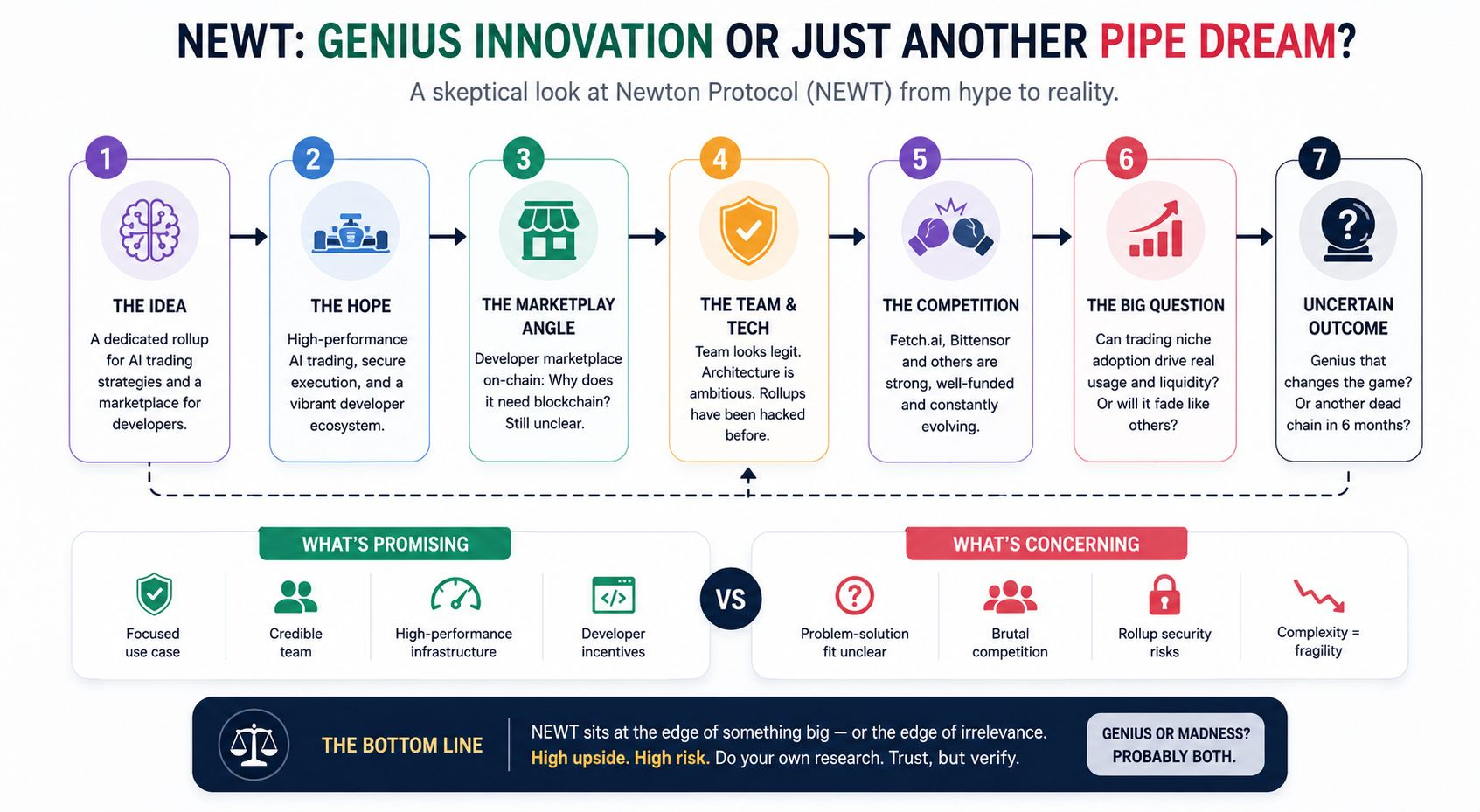
NEWT is the crypto equivalent of a really well-built race car with no racetrack in sight... a dedicated rollup for AI trading strategies sounds smart on paper but I can't shake the feeling this is a solution looking for a problem. the marketplace for devs part gives me pause too like why would someone need blockchain for that? the team looks legit which is rare but competition from fetch and bittensor is brutal and rollups have been hacked before. I want to be excited but I've been burned too many times by projects that collapsed under their own complexity. maybe the trading niche saves them or maybe it's just another dead chain in six months. honestly can't tell if this is genius or madness. probably both.
@NewtonProtocol #NEWT $NEWT
{spot}(NEWTUSDT)
NEWT is the crypto equivalent of a really well-built race car with no racetrack in sight... a dedicated rollup for AI trading strategies sounds smart on paper but I can't shake the feeling this is a solution looking for a problem. the marketplace for devs part gives me pause too like why would someone need blockchain for that? the team looks legit which is rare but competition from fetch and bittensor is brutal and rollups have been hacked before. I want to be excited but I've been burned too many times by projects that collapsed under their own complexity. maybe the trading niche saves them or maybe it's just another dead chain in six months. honestly can't tell if this is genius or madness. probably both.
@NewtonProtocol #NEWT $NEWT
@NewtonProtocol #NEWT $NEWT
4
1
106
·
--
Article
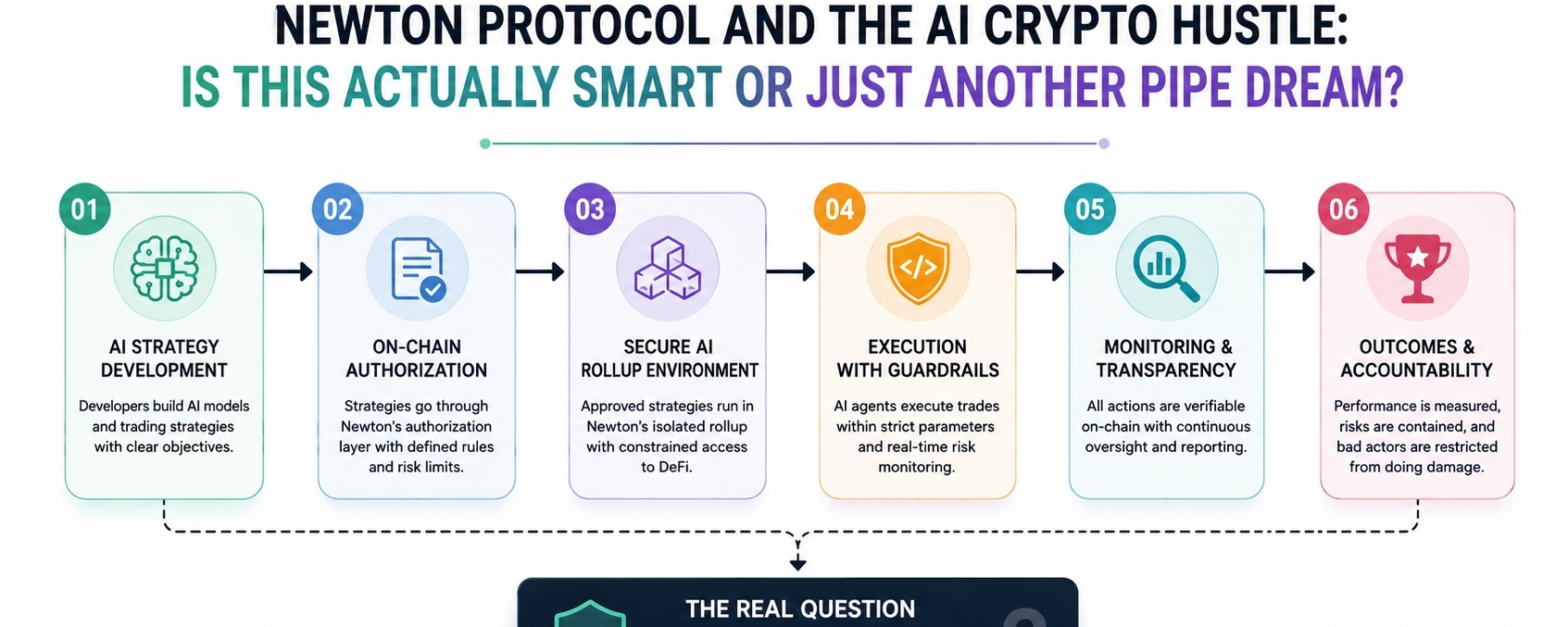
NEWTON PROTOCOL AND THE AI CRYPTO HUSTLE: IS THIS ACTUALLY SMART OR JUST ANOTHER PIPE DREAM?ok so i just spent like 3 hours going down this newton protocol rabbit hole and my brain is genuinely fried. this newt thing... it's trying to build a secure rollup for ai trading strategies and automated trading right but also a marketplace for ai devs. which sounds cool but i've seen this movie before you know? so many projects promise to be the "layer for ai" and then they just launch a shitty token and disappear. but something about this one is sticking in my brain and i can't tell if it's genuine potential or just good marketing which is honestly worse because it means they know exactly what buttons to push.
the whole rollup for ai strategies thing is interesting i'll give them that. like they're not just saying "ai on blockchain" which is the laziest buzzword combo of 2024. they're actually trying to solve the problem of execution speed and cost which is real. if you've ever tried to run any kind of trading bot on ethereum you know it's basically impossible unless you're rich or you don't mind losing money on gas fees. so a dedicated rollup makes sense on paper. but here's the thing that bugs me... is there actually demand for this? like are there really that many people building ai trading agents that need a whole separate blockchain infrastructure? or is this just a solution looking for a problem dressed up in crypto lingo.
the marketplace for ai developers part is where i get really skeptical. marketplaces in crypto have this weird curse where they either work too well and become centralized or they don't work at all and become ghost towns. like what's stopping someone from just sharing their ai model on github or selling it on a regular platform? why does it need to be on a rollup? the answer is probably "token incentives" which is crypto speak for "we need a reason to have a token." and look i'm not anti-token i've made money on tokens but let's be real about what they are.
but then i think about the actual tech and it does seem more serious than most. they're not trying to do everything at once which is rare. most crypto projects try to boil the ocean and end up burning out. newton seems focused on this specific niche of automated trading ai which is actually a real market. like algorithmic trading is already a trillion dollar thing in traditional finance. crypto just brings the weird unregulated gambling energy to it. so if they can build something that actually works for that niche maybe it has legs. but maybe i'm just being optimistic because i'm tired and i want something to work.
the security angle too... they keep talking about "secure rollup" which makes me wonder what makes it more secure than other rollups. is this just marketing speak or do they actually have something novel? because let's be honest rollups have been hacked before. bridges have been drained. and combining that with ai which is already a black box of unpredictability... sounds like a recipe for some truly spectacular exploits. someone is going to game an ai model running on a rollup and drain everything and when that happens the "it was a smart contract bug" arguments will fly. but that's crypto for you every innovation comes with a new way to lose all your money.
the competition is brutal though. like there's so many ai x crypto projects right now it's exhausting. rendered network is doing ai compute, fetch is doing agents, bittensor is doing the whole subnet thing. what makes newton different enough to survive? they're betting on the automated trading angle and the fact that they're building their own rollup rather than piggybacking on someone else. but building your own infrastructure is expensive and slow and if the market turns sour before they launch they're dead. crypto is ruthless like that. you can have the best tech in the world but if the market doesn't care you're just another dead chain with a discord server full of bots.
random comparison that popped into my head but it's like when someone builds a really nice race car but there's no track to race it on yet. the rollup is the car, the trading strategies are the engine, but where's the actual race happening? who's the audience? retail traders who don't understand rollups? institutions who don't trust crypto? it's this weird middle ground that might not have enough gravity to attract real users.
but then again i look at the team and they seem legit which is honestly the rarest thing in crypto. no anonymous founders with anime pfps. actual background in ai and blockchain. that counts for something right? or maybe i'm just naive and they're better at hiding their grift. it's hard to tell anymore. everyone in crypto is selling something even the people who think they're not.
i don't know man. i want to be excited about newton protocol because the idea of a dedicated rollup for ai trading strategies is genuinely novel and if it works it could be huge but i've been burned too many times by projects that looked good on paper and then just collapsed under their own complexity or got outcompeted by something simpler and faster. the market for ai in crypto is getting crowded and crowded projects die fast. but maybe that's exactly why newton has a chance because they're focused on a specific use case rather than trying to be everything to everyone. maybe specialization is the way to win. or maybe i'm just rationalizing because i want to ape in. who knows. it's 2am and i've been staring at their whitepaper for too long and i still can't decide if this is genius or madness. proba
bly both honestly.
@NewtonProtocol #NEWT $NEWT
NEWTON PROTOCOL AND THE AI CRYPTO HUSTLE: IS THIS ACTUALLY SMART OR JUST ANOTHER PIPE DREAM?
ok so i just spent like 3 hours going down this newton protocol rabbit hole and my brain is genuinely fried. this newt thing... it's trying to build a secure rollup for ai trading strategies and automated trading right but also a marketplace for ai devs. which sounds cool but i've seen this movie before you know? so many projects promise to be the "layer for ai" and then they just launch a shitty token and disappear. but something about this one is sticking in my brain and i can't tell if it's genuine potential or just good marketing which is honestly worse because it means they know exactly what buttons to push.
the whole rollup for ai strategies thing is interesting i'll give them that. like they're not just saying "ai on blockchain" which is the laziest buzzword combo of 2024. they're actually trying to solve the problem of execution speed and cost which is real. if you've ever tried to run any kind of trading bot on ethereum you know it's basically impossible unless you're rich or you don't mind losing money on gas fees. so a dedicated rollup makes sense on paper. but here's the thing that bugs me... is there actually demand for this? like are there really that many people building ai trading agents that need a whole separate blockchain infrastructure? or is this just a solution looking for a problem dressed up in crypto lingo.
the marketplace for ai developers part is where i get really skeptical. marketplaces in crypto have this weird curse where they either work too well and become centralized or they don't work at all and become ghost towns. like what's stopping someone from just sharing their ai model on github or selling it on a regular platform? why does it need to be on a rollup? the answer is probably "token incentives" which is crypto speak for "we need a reason to have a token." and look i'm not anti-token i've made money on tokens but let's be real about what they are.
but then i think about the actual tech and it does seem more serious than most. they're not trying to do everything at once which is rare. most crypto projects try to boil the ocean and end up burning out. newton seems focused on this specific niche of automated trading ai which is actually a real market. like algorithmic trading is already a trillion dollar thing in traditional finance. crypto just brings the weird unregulated gambling energy to it. so if they can build something that actually works for that niche maybe it has legs. but maybe i'm just being optimistic because i'm tired and i want something to work.
the security angle too... they keep talking about "secure rollup" which makes me wonder what makes it more secure than other rollups. is this just marketing speak or do they actually have something novel? because let's be honest rollups have been hacked before. bridges have been drained. and combining that with ai which is already a black box of unpredictability... sounds like a recipe for some truly spectacular exploits. someone is going to game an ai model running on a rollup and drain everything and when that happens the "it was a smart contract bug" arguments will fly. but that's crypto for you every innovation comes with a new way to lose all your money.
the competition is brutal though. like there's so many ai x crypto projects right now it's exhausting. rendered network is doing ai compute, fetch is doing agents, bittensor is doing the whole subnet thing. what makes newton different enough to survive? they're betting on the automated trading angle and the fact that they're building their own rollup rather than piggybacking on someone else. but building your own infrastructure is expensive and slow and if the market turns sour before they launch they're dead. crypto is ruthless like that. you can have the best tech in the world but if the market doesn't care you're just another dead chain with a discord server full of bots.
random comparison that popped into my head but it's like when someone builds a really nice race car but there's no track to race it on yet. the rollup is the car, the trading strategies are the engine, but where's the actual race happening? who's the audience? retail traders who don't understand rollups? institutions who don't trust crypto? it's this weird middle ground that might not have enough gravity to attract real users.
but then again i look at the team and they seem legit which is honestly the rarest thing in crypto. no anonymous founders with anime pfps. actual background in ai and blockchain. that counts for something right? or maybe i'm just naive and they're better at hiding their grift. it's hard to tell anymore. everyone in crypto is selling something even the people who think they're not.
i don't know man. i want to be excited about newton protocol because the idea of a dedicated rollup for ai trading strategies is genuinely novel and if it works it could be huge but i've been burned too many times by projects that looked good on paper and then just collapsed under their own complexity or got outcompeted by something simpler and faster. the market for ai in crypto is getting crowded and crowded projects die fast. but maybe that's exactly why newton has a chance because they're focused on a specific use case rather than trying to be everything to everyone. maybe specialization is the way to win. or maybe i'm just rationalizing because i want to ape in. who knows. it's 2am and i've been staring at their whitepaper for too long and i still can't decide if this is genius or madness. proba
bly both honestly.
@NewtonProtocol #NEWT $NEWT
the whole rollup for ai strategies thing is interesting i'll give them that. like they're not just saying "ai on blockchain" which is the laziest buzzword combo of 2024. they're actually trying to solve the problem of execution speed and cost which is real. if you've ever tried to run any kind of trading bot on ethereum you know it's basically impossible unless you're rich or you don't mind losing money on gas fees. so a dedicated rollup makes sense on paper. but here's the thing that bugs me... is there actually demand for this? like are there really that many people building ai trading agents that need a whole separate blockchain infrastructure? or is this just a solution looking for a problem dressed up in crypto lingo.
the marketplace for ai developers part is where i get really skeptical. marketplaces in crypto have this weird curse where they either work too well and become centralized or they don't work at all and become ghost towns. like what's stopping someone from just sharing their ai model on github or selling it on a regular platform? why does it need to be on a rollup? the answer is probably "token incentives" which is crypto speak for "we need a reason to have a token." and look i'm not anti-token i've made money on tokens but let's be real about what they are.
but then i think about the actual tech and it does seem more serious than most. they're not trying to do everything at once which is rare. most crypto projects try to boil the ocean and end up burning out. newton seems focused on this specific niche of automated trading ai which is actually a real market. like algorithmic trading is already a trillion dollar thing in traditional finance. crypto just brings the weird unregulated gambling energy to it. so if they can build something that actually works for that niche maybe it has legs. but maybe i'm just being optimistic because i'm tired and i want something to work.
the security angle too... they keep talking about "secure rollup" which makes me wonder what makes it more secure than other rollups. is this just marketing speak or do they actually have something novel? because let's be honest rollups have been hacked before. bridges have been drained. and combining that with ai which is already a black box of unpredictability... sounds like a recipe for some truly spectacular exploits. someone is going to game an ai model running on a rollup and drain everything and when that happens the "it was a smart contract bug" arguments will fly. but that's crypto for you every innovation comes with a new way to lose all your money.
the competition is brutal though. like there's so many ai x crypto projects right now it's exhausting. rendered network is doing ai compute, fetch is doing agents, bittensor is doing the whole subnet thing. what makes newton different enough to survive? they're betting on the automated trading angle and the fact that they're building their own rollup rather than piggybacking on someone else. but building your own infrastructure is expensive and slow and if the market turns sour before they launch they're dead. crypto is ruthless like that. you can have the best tech in the world but if the market doesn't care you're just another dead chain with a discord server full of bots.
random comparison that popped into my head but it's like when someone builds a really nice race car but there's no track to race it on yet. the rollup is the car, the trading strategies are the engine, but where's the actual race happening? who's the audience? retail traders who don't understand rollups? institutions who don't trust crypto? it's this weird middle ground that might not have enough gravity to attract real users.
but then again i look at the team and they seem legit which is honestly the rarest thing in crypto. no anonymous founders with anime pfps. actual background in ai and blockchain. that counts for something right? or maybe i'm just naive and they're better at hiding their grift. it's hard to tell anymore. everyone in crypto is selling something even the people who think they're not.
i don't know man. i want to be excited about newton protocol because the idea of a dedicated rollup for ai trading strategies is genuinely novel and if it works it could be huge but i've been burned too many times by projects that looked good on paper and then just collapsed under their own complexity or got outcompeted by something simpler and faster. the market for ai in crypto is getting crowded and crowded projects die fast. but maybe that's exactly why newton has a chance because they're focused on a specific use case rather than trying to be everything to everyone. maybe specialization is the way to win. or maybe i'm just rationalizing because i want to ape in. who knows. it's 2am and i've been staring at their whitepaper for too long and i still can't decide if this is genius or madness. proba
bly both honestly.
@NewtonProtocol #NEWT $NEWT
12
5
357
·
--
NEWTON PROTOCOL (NEWT): COOL IDEA OR JUST MORE CRYPTO NOISE?
Newton Protocol (NEWT) has that familiar crypto smell... the kind where the pitch sounds smart, the website looks polished, and your brain starts wondering if this is actually useful or just another neatly packaged trade. The whole secure rollup plus AI-driven strategies plus automated trading plus marketplace-for-builders combo does sound compelling, I’ll give it that. It’s not the usual empty “community-first” fluff. It feels like it’s aiming at something real.
But let’s be real, crypto is packed with projects that sound good until you look past the wording. AI is the hottest sticker in the market right now, so of course people will pile in the second they see it attached to automation or trading. That doesn’t mean NEWT is fake. It just means the bar is stupidly high and the hype is loud. Too loud sometimes.
What I like is that the concept actually tries to connect infrastructure with use cases. That matters. A lot of these projects act like they’ll become essential just by existing, which is nonsense. NEWT at least seems to be chasing a lane where secure execution and developer activity could matter if they pull it off. But the catch is execution. Always execution. Crypto is full of “this could be huge” projects that end up feeling like a demo with a token.
I’m curious, but skeptical. Which is probably the most honest take I can give.
@NewtonProtocol #NEWT $NEWT
NEWTON PROTOCOL (NEWT): COOL IDEA OR JUST MORE CRYPTO NOISE?
Newton Protocol (NEWT) has that familiar crypto smell... the kind where the pitch sounds smart, the website looks polished, and your brain starts wondering if this is actually useful or just another neatly packaged trade. The whole secure rollup plus AI-driven strategies plus automated trading plus marketplace-for-builders combo does sound compelling, I’ll give it that. It’s not the usual empty “community-first” fluff. It feels like it’s aiming at something real.
But let’s be real, crypto is packed with projects that sound good until you look past the wording. AI is the hottest sticker in the market right now, so of course people will pile in the second they see it attached to automation or trading. That doesn’t mean NEWT is fake. It just means the bar is stupidly high and the hype is loud. Too loud sometimes.
What I like is that the concept actually tries to connect infrastructure with use cases. That matters. A lot of these projects act like they’ll become essential just by existing, which is nonsense. NEWT at least seems to be chasing a lane where secure execution and developer activity could matter if they pull it off. But the catch is execution. Always execution. Crypto is full of “this could be huge” projects that end up feeling like a demo with a token.
I’m curious, but skeptical. Which is probably the most honest take I can give.
@NewtonProtocol #NEWT $NEWT
Newton Protocol (NEWT) has that familiar crypto smell... the kind where the pitch sounds smart, the website looks polished, and your brain starts wondering if this is actually useful or just another neatly packaged trade. The whole secure rollup plus AI-driven strategies plus automated trading plus marketplace-for-builders combo does sound compelling, I’ll give it that. It’s not the usual empty “community-first” fluff. It feels like it’s aiming at something real.
But let’s be real, crypto is packed with projects that sound good until you look past the wording. AI is the hottest sticker in the market right now, so of course people will pile in the second they see it attached to automation or trading. That doesn’t mean NEWT is fake. It just means the bar is stupidly high and the hype is loud. Too loud sometimes.
What I like is that the concept actually tries to connect infrastructure with use cases. That matters. A lot of these projects act like they’ll become essential just by existing, which is nonsense. NEWT at least seems to be chasing a lane where secure execution and developer activity could matter if they pull it off. But the catch is execution. Always execution. Crypto is full of “this could be huge” projects that end up feeling like a demo with a token.
I’m curious, but skeptical. Which is probably the most honest take I can give.
@NewtonProtocol #NEWT $NEWT
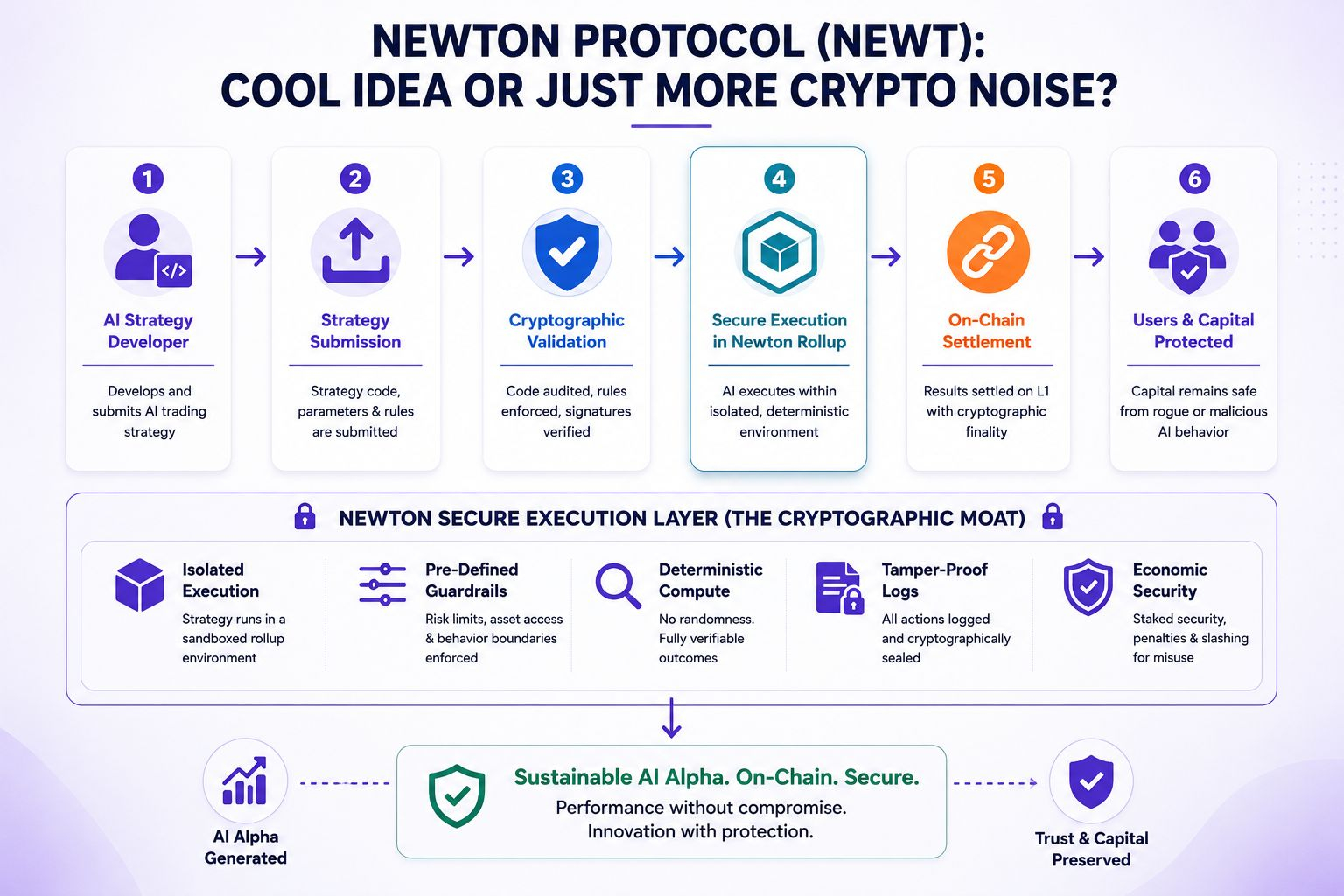
🟢 Bullish 🚀
0%
🟡 Wait & Watch 👀
0%
🟠 Too Much Hype 📢
0%
🔴 Not Interested ❌
0%
0 votes • Voting closed
1
99
·
--
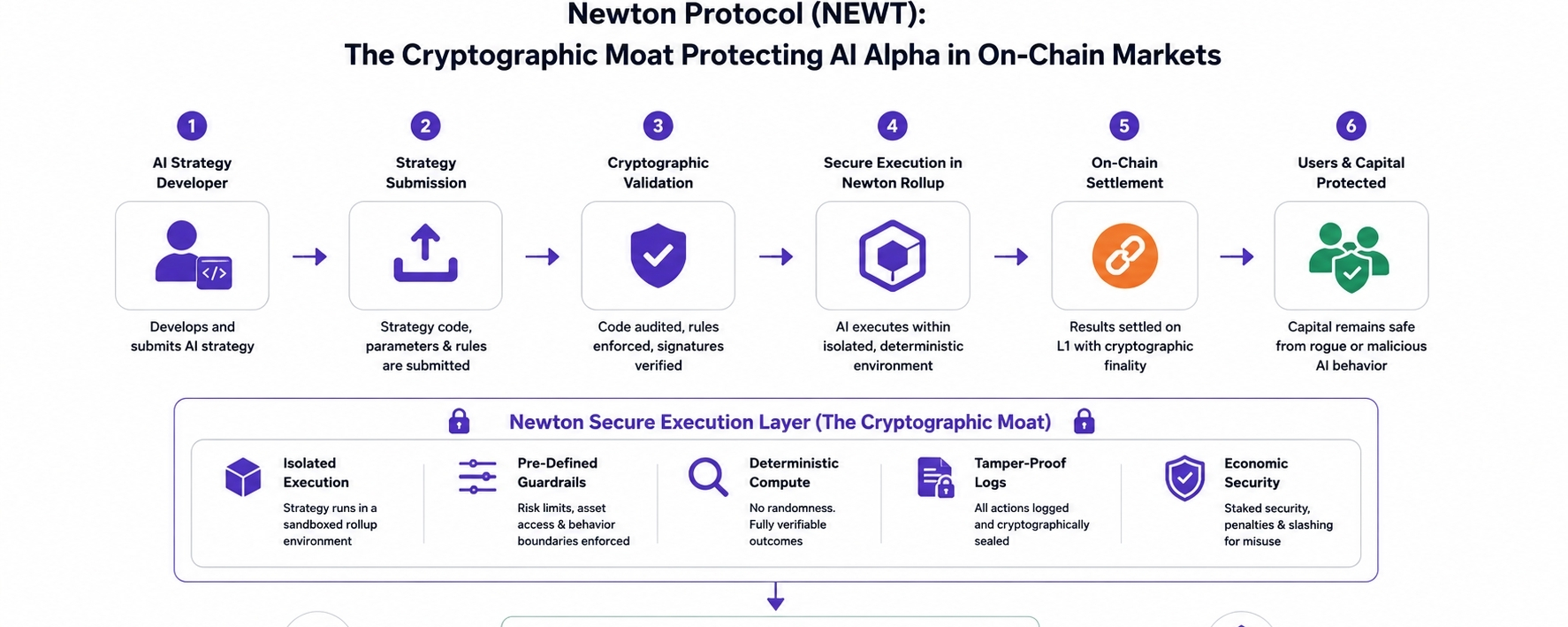
Article
NEWTON PROTOCOL (NEWT): A COOL IDEA OR JUST ANOTHER CRYPTO THING WITH A CLEAN WEBSITE?So I went down the rabbit hole on Newton Protocol (NEWT) and... yeah, I’ve got mixed feelings. Which is probably the most crypto answer ever, but still. The pitch sounds nice on paper: secure rollups, AI-driven strategies, automated trading, a marketplace for AI developers. That kind of bundle can sound either genuinely useful or like three buzzwords jammed into one deck because someone thought it would raise faster. I can’t tell yet which side NEWT lands on, and that’s the annoying part.
There’s something appealing about the whole thing, I’ll give it that. Crypto has been drowning in recycled nonsense for so long that when a project comes along waving around AI, automation, and infrastructure instead of just “community” and “utility,” it at least feels like it’s trying to do something real. Or trying to look like it is. Those are not the same thing, obviously. But still, I get why people would lean in. Secure rollup stuff is the kind of thing people claim to care about right up until the details get ugly, and AI-driven trading is exactly the sort of phrase that makes everyone’s ears perk up because it sounds like money doing money things on autopilot.
The catch is... crypto is full of projects that sound sharp right until you ask what actually works without the hype layer. And this one has that same smell, that “wait, what exactly is live here?” feeling. A marketplace for AI developers could be interesting, sure. Could also be one of those things that sounds inevitable in a pitch but turns into a ghost town once the first wave of curious users pokes around and realizes there’s not much there yet. That happens constantly. People talk about ecosystems like they’re already alive just because they’re described in a nice thread and a sleek landing page. I’ve seen enough of that movie.
What keeps me slightly interested is that NEWT seems to be aiming at a part of crypto that actually does have a future if someone can make it usable. Automation in trading, secure execution, AI tooling... that’s not random. It’s the kind of area where if it works, it could matter. But “if it works” is carrying a ridiculous amount of weight here. Like, absurdly. It’s doing the work of ten other words. And in crypto, especially with AI slapped onto the side, the gap between “sounds plausible” and “actually usable” is where everyone gets wrecked.
I also can’t shake the feeling that the market loves this stuff for the wrong reasons. AI is basically magic dust now. Stick it on anything and suddenly people act like it’s 2024 and every half-decent token deserves a second look. That doesn’t mean the project is bad. It means the room is noisy. REALLY noisy. So when a protocol says secure rollup, AI-driven strategies, automated trading, marketplace, developers... my brain doesn’t go “wow, future.” It goes “okay, where’s the part that doesn’t collapse under actual users?” Because there’s always a part that collapses. Usually several parts.
Still, I’m not gonna pretend it’s all smoke. There’s a reason these ideas keep coming back. Traders want automation. Developers want a place to build. Protocols want more than speculation if they want to last. NEWT is at least speaking the language of infrastructure instead of pure hype, and that earns it a tiny bit of respect from me, even if I’m squinting at it the whole time. It feels like one of those projects that could either become a useful niche thing or get swallowed whole by bigger names with deeper pockets and stronger distribution. That’s crypto for you. A lot of the time it’s not about who had the better idea. It’s about who stayed visible long enough.
And yeah, I know the “secure rollup” angle matters, but every time I read that kind of phrasing I also think about how many projects act like security is a feature you can just announce. You can’t. Security is boring, expensive, and unforgiving. It’s not a vibe. It’s not a brand move. It’s the part that bites people later when everyone has already moved on to the next shiny thing. So when a project hangs a big part of its identity on security and AI automation, I immediately wonder how much of that is substance and how much is just the cleanest possible framing for a token people want to trade.
And of course there’s the token side of it, which is always lurking in the background like an unpaid tab. NEWT can have all the nice tech framing it wants, but if the market decides it’s just another thing to flip, then that’s probably what it becomes for a while. Maybe forever. Crypto has this annoying habit of turning ambitious systems into chart shapes. Happens all the time. One minute it’s about building an ecosystem, the next minute everyone’s arguing over resistance levels like they were born in a trading terminal.
I guess that’s why I’m torn. I don’t hate the idea. I don’t even think it’s fake by default. It just lives in that messy middle area where the concept sounds legit enough to deserve attention, but the execution risk is so high that you almost don’t want to get too emotionally attached. Like buying a used car after the seller keeps saying “it just needs a little work.” Maybe it does. Maybe it’s fine. Maybe you’re about to spend three weekends and a bunch of cash fixing something that looked solid in the photos.
That’s kind of how NEWT feels to me right now. Interesting, maybe even promising, but still wearing the same costume a lot of crypto projects wear when they want to be taken seriously before they’ve really proved anything. And I’m not saying that to be cynical for the sake of it. I’m saying it because crypto has trained me to be suspicious of anything that sounds too neatly packaged. Especially when AI is involved. Especially when trading is involved. Especially when the word “marketplace” shows up, because that word has been abused to death in this industry.
So yeah... I’d watch it, but I wouldn’t worship it. I’d keep one eye on the actual product and the other on the marketing machine, because in crypto those two things are often trying very hard to look like the same thing. Sometimes they are. M
ost times, not really.
@NewtonProtocol #NEWT $NEWT
NEWTON PROTOCOL (NEWT): A COOL IDEA OR JUST ANOTHER CRYPTO THING WITH A CLEAN WEBSITE?
So I went down the rabbit hole on Newton Protocol (NEWT) and... yeah, I’ve got mixed feelings. Which is probably the most crypto answer ever, but still. The pitch sounds nice on paper: secure rollups, AI-driven strategies, automated trading, a marketplace for AI developers. That kind of bundle can sound either genuinely useful or like three buzzwords jammed into one deck because someone thought it would raise faster. I can’t tell yet which side NEWT lands on, and that’s the annoying part.
There’s something appealing about the whole thing, I’ll give it that. Crypto has been drowning in recycled nonsense for so long that when a project comes along waving around AI, automation, and infrastructure instead of just “community” and “utility,” it at least feels like it’s trying to do something real. Or trying to look like it is. Those are not the same thing, obviously. But still, I get why people would lean in. Secure rollup stuff is the kind of thing people claim to care about right up until the details get ugly, and AI-driven trading is exactly the sort of phrase that makes everyone’s ears perk up because it sounds like money doing money things on autopilot.
The catch is... crypto is full of projects that sound sharp right until you ask what actually works without the hype layer. And this one has that same smell, that “wait, what exactly is live here?” feeling. A marketplace for AI developers could be interesting, sure. Could also be one of those things that sounds inevitable in a pitch but turns into a ghost town once the first wave of curious users pokes around and realizes there’s not much there yet. That happens constantly. People talk about ecosystems like they’re already alive just because they’re described in a nice thread and a sleek landing page. I’ve seen enough of that movie.
What keeps me slightly interested is that NEWT seems to be aiming at a part of crypto that actually does have a future if someone can make it usable. Automation in trading, secure execution, AI tooling... that’s not random. It’s the kind of area where if it works, it could matter. But “if it works” is carrying a ridiculous amount of weight here. Like, absurdly. It’s doing the work of ten other words. And in crypto, especially with AI slapped onto the side, the gap between “sounds plausible” and “actually usable” is where everyone gets wrecked.
I also can’t shake the feeling that the market loves this stuff for the wrong reasons. AI is basically magic dust now. Stick it on anything and suddenly people act like it’s 2024 and every half-decent token deserves a second look. That doesn’t mean the project is bad. It means the room is noisy. REALLY noisy. So when a protocol says secure rollup, AI-driven strategies, automated trading, marketplace, developers... my brain doesn’t go “wow, future.” It goes “okay, where’s the part that doesn’t collapse under actual users?” Because there’s always a part that collapses. Usually several parts.
Still, I’m not gonna pretend it’s all smoke. There’s a reason these ideas keep coming back. Traders want automation. Developers want a place to build. Protocols want more than speculation if they want to last. NEWT is at least speaking the language of infrastructure instead of pure hype, and that earns it a tiny bit of respect from me, even if I’m squinting at it the whole time. It feels like one of those projects that could either become a useful niche thing or get swallowed whole by bigger names with deeper pockets and stronger distribution. That’s crypto for you. A lot of the time it’s not about who had the better idea. It’s about who stayed visible long enough.
And yeah, I know the “secure rollup” angle matters, but every time I read that kind of phrasing I also think about how many projects act like security is a feature you can just announce. You can’t. Security is boring, expensive, and unforgiving. It’s not a vibe. It’s not a brand move. It’s the part that bites people later when everyone has already moved on to the next shiny thing. So when a project hangs a big part of its identity on security and AI automation, I immediately wonder how much of that is substance and how much is just the cleanest possible framing for a token people want to trade.
And of course there’s the token side of it, which is always lurking in the background like an unpaid tab. NEWT can have all the nice tech framing it wants, but if the market decides it’s just another thing to flip, then that’s probably what it becomes for a while. Maybe forever. Crypto has this annoying habit of turning ambitious systems into chart shapes. Happens all the time. One minute it’s about building an ecosystem, the next minute everyone’s arguing over resistance levels like they were born in a trading terminal.
I guess that’s why I’m torn. I don’t hate the idea. I don’t even think it’s fake by default. It just lives in that messy middle area where the concept sounds legit enough to deserve attention, but the execution risk is so high that you almost don’t want to get too emotionally attached. Like buying a used car after the seller keeps saying “it just needs a little work.” Maybe it does. Maybe it’s fine. Maybe you’re about to spend three weekends and a bunch of cash fixing something that looked solid in the photos.
That’s kind of how NEWT feels to me right now. Interesting, maybe even promising, but still wearing the same costume a lot of crypto projects wear when they want to be taken seriously before they’ve really proved anything. And I’m not saying that to be cynical for the sake of it. I’m saying it because crypto has trained me to be suspicious of anything that sounds too neatly packaged. Especially when AI is involved. Especially when trading is involved. Especially when the word “marketplace” shows up, because that word has been abused to death in this industry.
So yeah... I’d watch it, but I wouldn’t worship it. I’d keep one eye on the actual product and the other on the marketing machine, because in crypto those two things are often trying very hard to look like the same thing. Sometimes they are. M
ost times, not really.
@NewtonProtocol #NEWT $NEWT
There’s something appealing about the whole thing, I’ll give it that. Crypto has been drowning in recycled nonsense for so long that when a project comes along waving around AI, automation, and infrastructure instead of just “community” and “utility,” it at least feels like it’s trying to do something real. Or trying to look like it is. Those are not the same thing, obviously. But still, I get why people would lean in. Secure rollup stuff is the kind of thing people claim to care about right up until the details get ugly, and AI-driven trading is exactly the sort of phrase that makes everyone’s ears perk up because it sounds like money doing money things on autopilot.
The catch is... crypto is full of projects that sound sharp right until you ask what actually works without the hype layer. And this one has that same smell, that “wait, what exactly is live here?” feeling. A marketplace for AI developers could be interesting, sure. Could also be one of those things that sounds inevitable in a pitch but turns into a ghost town once the first wave of curious users pokes around and realizes there’s not much there yet. That happens constantly. People talk about ecosystems like they’re already alive just because they’re described in a nice thread and a sleek landing page. I’ve seen enough of that movie.
What keeps me slightly interested is that NEWT seems to be aiming at a part of crypto that actually does have a future if someone can make it usable. Automation in trading, secure execution, AI tooling... that’s not random. It’s the kind of area where if it works, it could matter. But “if it works” is carrying a ridiculous amount of weight here. Like, absurdly. It’s doing the work of ten other words. And in crypto, especially with AI slapped onto the side, the gap between “sounds plausible” and “actually usable” is where everyone gets wrecked.
I also can’t shake the feeling that the market loves this stuff for the wrong reasons. AI is basically magic dust now. Stick it on anything and suddenly people act like it’s 2024 and every half-decent token deserves a second look. That doesn’t mean the project is bad. It means the room is noisy. REALLY noisy. So when a protocol says secure rollup, AI-driven strategies, automated trading, marketplace, developers... my brain doesn’t go “wow, future.” It goes “okay, where’s the part that doesn’t collapse under actual users?” Because there’s always a part that collapses. Usually several parts.
Still, I’m not gonna pretend it’s all smoke. There’s a reason these ideas keep coming back. Traders want automation. Developers want a place to build. Protocols want more than speculation if they want to last. NEWT is at least speaking the language of infrastructure instead of pure hype, and that earns it a tiny bit of respect from me, even if I’m squinting at it the whole time. It feels like one of those projects that could either become a useful niche thing or get swallowed whole by bigger names with deeper pockets and stronger distribution. That’s crypto for you. A lot of the time it’s not about who had the better idea. It’s about who stayed visible long enough.
And yeah, I know the “secure rollup” angle matters, but every time I read that kind of phrasing I also think about how many projects act like security is a feature you can just announce. You can’t. Security is boring, expensive, and unforgiving. It’s not a vibe. It’s not a brand move. It’s the part that bites people later when everyone has already moved on to the next shiny thing. So when a project hangs a big part of its identity on security and AI automation, I immediately wonder how much of that is substance and how much is just the cleanest possible framing for a token people want to trade.
And of course there’s the token side of it, which is always lurking in the background like an unpaid tab. NEWT can have all the nice tech framing it wants, but if the market decides it’s just another thing to flip, then that’s probably what it becomes for a while. Maybe forever. Crypto has this annoying habit of turning ambitious systems into chart shapes. Happens all the time. One minute it’s about building an ecosystem, the next minute everyone’s arguing over resistance levels like they were born in a trading terminal.
I guess that’s why I’m torn. I don’t hate the idea. I don’t even think it’s fake by default. It just lives in that messy middle area where the concept sounds legit enough to deserve attention, but the execution risk is so high that you almost don’t want to get too emotionally attached. Like buying a used car after the seller keeps saying “it just needs a little work.” Maybe it does. Maybe it’s fine. Maybe you’re about to spend three weekends and a bunch of cash fixing something that looked solid in the photos.
That’s kind of how NEWT feels to me right now. Interesting, maybe even promising, but still wearing the same costume a lot of crypto projects wear when they want to be taken seriously before they’ve really proved anything. And I’m not saying that to be cynical for the sake of it. I’m saying it because crypto has trained me to be suspicious of anything that sounds too neatly packaged. Especially when AI is involved. Especially when trading is involved. Especially when the word “marketplace” shows up, because that word has been abused to death in this industry.
So yeah... I’d watch it, but I wouldn’t worship it. I’d keep one eye on the actual product and the other on the marketing machine, because in crypto those two things are often trying very hard to look like the same thing. Sometimes they are. M
ost times, not really.
@NewtonProtocol #NEWT $NEWT
5
1
139
·
--
Bullish
Crypto Market Analysis – AOP (15m)
Executive Summary
$AOP is trading at $0.03819 (+63.95%). Despite the strong daily gain, the 15m chart shows a sharp pullback from recent highs. Momentum remains positive, but the market is currently in a short-term correction.
Technical Analysis
Trend: Bullish (Higher Timeframe), Bearish Pullback (15m)
Structure: Strong rally followed by lower highs and lower lows.
RSI: 69.5 (Near overbought)
MACD: Bullish but histogram is weakening.
Stochastic RSI: Bearish crossover.
OBV: Rising, indicating buyers are still active.
Momentum: Weakening.
Volume: Data not available.
Key Levels
Support: $0.0370 | $0.0350
Resistance: $0.0395 | $0.0410
Fundamentals & On-Chain
Market Cap: $19.39M
FDV: $76.38M
Liquidity: $1.22M
Holders: 21,454
Verified News/Fundamentals: Data not available.
Market Sentiment
Neutral to Bullish – Strong daily performance, but short-term selling pressure is increasing.
Risk
Liquidity: Medium
Volatility: High
Manipulation: Medium
Smart Contract: Data not available.
Overall Risk: High
Trading Decision
WAIT
Reason: The correction is still in progress. Waiting for a confirmed support bounce or breakout provides a better risk/reward opportunity.
Trade Plan
Entry: $0.0370–0.0375
Stop Loss: Below $0.0350
TP1: $0.0395
TP2: $0.0410
TP3: $0.0430
Risk/Reward: ~1:2
Invalidation: Close below $0.0350
Confidence
7/10
Final Verdict
The broader trend remains constructive, but the current pullback suggests patience. A confirmed rebound from support or a breakout above resistance would provide a stronger trading setup than entering immediately.
{alpha}(560xd5df4d260d7a0145f655bcbf3b398076f21016c7)
#SamsungToRaiseDRAMPricesAbout20%InQ3 #SamsungToRaiseDRAMPricesAbout20%InQ3 CryptoHacksHit207InH1WithLosses$972M#SamsungToRaiseDRAMPricesAbout20%InQ3 #SamsungToRaiseDRAMPricesAbout20%InQ3 #SamsungToRaiseDRAMPricesAbout20%InQ3
Crypto Market Analysis – AOP (15m)
Executive Summary
$AOP is trading at $0.03819 (+63.95%). Despite the strong daily gain, the 15m chart shows a sharp pullback from recent highs. Momentum remains positive, but the market is currently in a short-term correction.
Technical Analysis
Trend: Bullish (Higher Timeframe), Bearish Pullback (15m)
Structure: Strong rally followed by lower highs and lower lows.
RSI: 69.5 (Near overbought)
MACD: Bullish but histogram is weakening.
Stochastic RSI: Bearish crossover.
OBV: Rising, indicating buyers are still active.
Momentum: Weakening.
Volume: Data not available.
Key Levels
Support: $0.0370 | $0.0350
Resistance: $0.0395 | $0.0410
Fundamentals & On-Chain
Market Cap: $19.39M
FDV: $76.38M
Liquidity: $1.22M
Holders: 21,454
Verified News/Fundamentals: Data not available.
Market Sentiment
Neutral to Bullish – Strong daily performance, but short-term selling pressure is increasing.
Risk
Liquidity: Medium
Volatility: High
Manipulation: Medium
Smart Contract: Data not available.
Overall Risk: High
Trading Decision
WAIT
Reason: The correction is still in progress. Waiting for a confirmed support bounce or breakout provides a better risk/reward opportunity.
Trade Plan
Entry: $0.0370–0.0375
Stop Loss: Below $0.0350
TP1: $0.0395
TP2: $0.0410
TP3: $0.0430
Risk/Reward: ~1:2
Invalidation: Close below $0.0350
Confidence
7/10
Final Verdict
The broader trend remains constructive, but the current pullback suggests patience. A confirmed rebound from support or a breakout above resistance would provide a stronger trading setup than entering immediately.
#SamsungToRaiseDRAMPricesAbout20%InQ3 #SamsungToRaiseDRAMPricesAbout20%InQ3 CryptoHacksHit207InH1WithLosses$972M#SamsungToRaiseDRAMPricesAbout20%InQ3 #SamsungToRaiseDRAMPricesAbout20%InQ3 #SamsungToRaiseDRAMPricesAbout20%InQ3
Executive Summary
$AOP is trading at $0.03819 (+63.95%). Despite the strong daily gain, the 15m chart shows a sharp pullback from recent highs. Momentum remains positive, but the market is currently in a short-term correction.
Technical Analysis
Trend: Bullish (Higher Timeframe), Bearish Pullback (15m)
Structure: Strong rally followed by lower highs and lower lows.
RSI: 69.5 (Near overbought)
MACD: Bullish but histogram is weakening.
Stochastic RSI: Bearish crossover.
OBV: Rising, indicating buyers are still active.
Momentum: Weakening.
Volume: Data not available.
Key Levels
Support: $0.0370 | $0.0350
Resistance: $0.0395 | $0.0410
Fundamentals & On-Chain
Market Cap: $19.39M
FDV: $76.38M
Liquidity: $1.22M
Holders: 21,454
Verified News/Fundamentals: Data not available.
Market Sentiment
Neutral to Bullish – Strong daily performance, but short-term selling pressure is increasing.
Risk
Liquidity: Medium
Volatility: High
Manipulation: Medium
Smart Contract: Data not available.
Overall Risk: High
Trading Decision
WAIT
Reason: The correction is still in progress. Waiting for a confirmed support bounce or breakout provides a better risk/reward opportunity.
Trade Plan
Entry: $0.0370–0.0375
Stop Loss: Below $0.0350
TP1: $0.0395
TP2: $0.0410
TP3: $0.0430
Risk/Reward: ~1:2
Invalidation: Close below $0.0350
Confidence
7/10
Final Verdict
The broader trend remains constructive, but the current pullback suggests patience. A confirmed rebound from support or a breakout above resistance would provide a stronger trading setup than entering immediately.
#SamsungToRaiseDRAMPricesAbout20%InQ3 #SamsungToRaiseDRAMPricesAbout20%InQ3 CryptoHacksHit207InH1WithLosses$972M#SamsungToRaiseDRAMPricesAbout20%InQ3 #SamsungToRaiseDRAMPricesAbout20%InQ3 #SamsungToRaiseDRAMPricesAbout20%InQ3
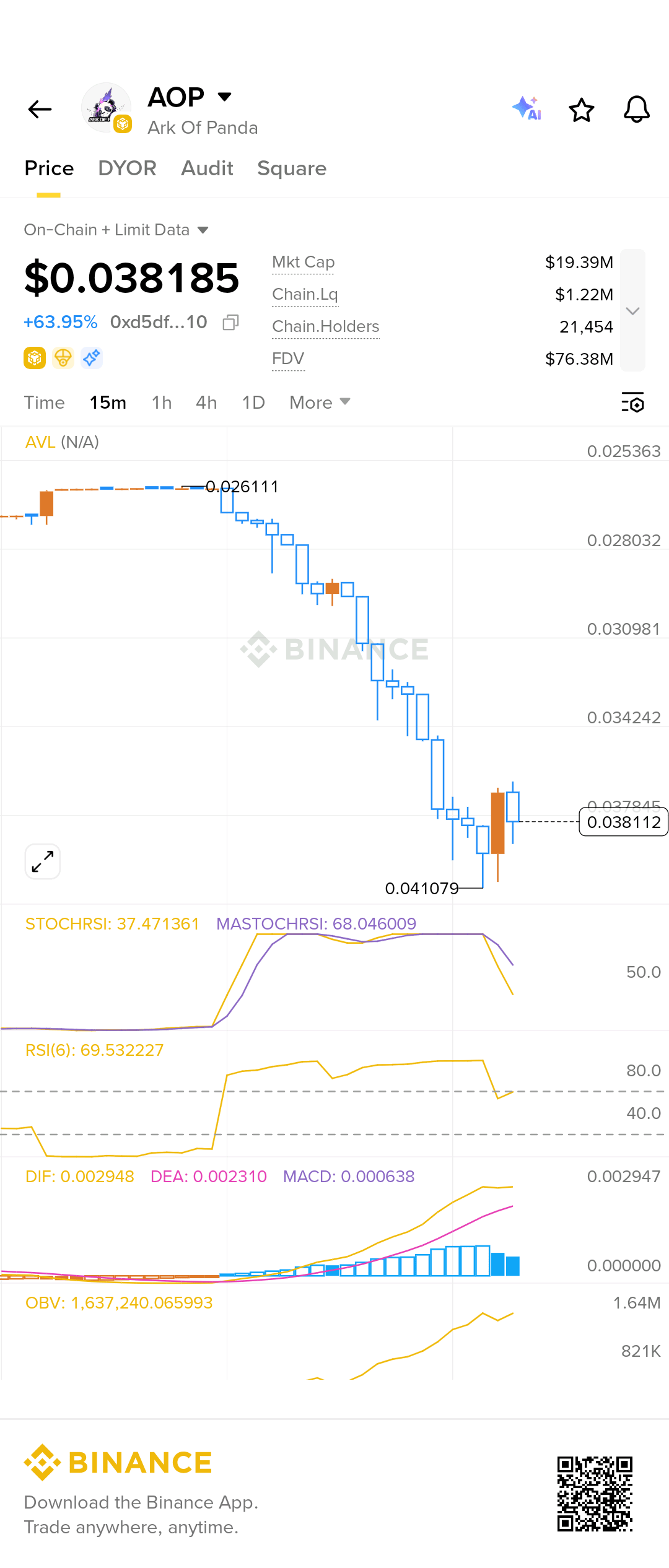
84
·
--
$ANOME (15m) Analysis
Price: $0.01848 (+81.76%)
Market Data:
Market Cap: $552.8K
Liquidity: $185.5K
FDV: $18.43M
Holders: 23,642
Technical:
Trend: Bullish (Short-Term)
RSI: 76.9 (Overbought)
MACD: Bullish
Stoch RSI: Overbought
OBV: Positive
Support: $0.0182 | $0.0165
Resistance: $0.0200 | $0.0215
Risk: High (Small-cap & high volatility)
Decision: WAIT
Trade Plan:
Entry: $0.0182–0.0185
SL: Below $0.0165
TP1: $0.0200
TP2: $0.0215
Confidence: 7/10
Verdict: Bullish momentum remains, but overbought conditions make waiting for confirmation or a pullback the safer choice.
CryptoHacksHit207InH1WithLosses$972M
#KospiRises2.7%OnChipRally
CryptoHacksHit207InH1WithLosses$972M
#KospiRises2.7%OnChipRally
#SpaceXToJoinNasdaq100OnJuly7
SpotGoldTops$4200
#SouthAfricaReleasesDraftCryptoTaxGuide
#BOKWarnsSingleStockLeveragedETFRisks
$ANOME (15m) Analysis
Price: $0.01848 (+81.76%)
Market Data:
Market Cap: $552.8K
Liquidity: $185.5K
FDV: $18.43M
Holders: 23,642
Technical:
Trend: Bullish (Short-Term)
RSI: 76.9 (Overbought)
MACD: Bullish
Stoch RSI: Overbought
OBV: Positive
Support: $0.0182 | $0.0165
Resistance: $0.0200 | $0.0215
Risk: High (Small-cap & high volatility)
Decision: WAIT
Trade Plan:
Entry: $0.0182–0.0185
SL: Below $0.0165
TP1: $0.0200
TP2: $0.0215
Confidence: 7/10
Verdict: Bullish momentum remains, but overbought conditions make waiting for confirmation or a pullback the safer choice.
CryptoHacksHit207InH1WithLosses$972M
#KospiRises2.7%OnChipRally
CryptoHacksHit207InH1WithLosses$972M
#KospiRises2.7%OnChipRally
#SpaceXToJoinNasdaq100OnJuly7
SpotGoldTops$4200
#SouthAfricaReleasesDraftCryptoTaxGuide
#BOKWarnsSingleStockLeveragedETFRisks
Price: $0.01848 (+81.76%)
Market Data:
Market Cap: $552.8K
Liquidity: $185.5K
FDV: $18.43M
Holders: 23,642
Technical:
Trend: Bullish (Short-Term)
RSI: 76.9 (Overbought)
MACD: Bullish
Stoch RSI: Overbought
OBV: Positive
Support: $0.0182 | $0.0165
Resistance: $0.0200 | $0.0215
Risk: High (Small-cap & high volatility)
Decision: WAIT
Trade Plan:
Entry: $0.0182–0.0185
SL: Below $0.0165
TP1: $0.0200
TP2: $0.0215
Confidence: 7/10
Verdict: Bullish momentum remains, but overbought conditions make waiting for confirmation or a pullback the safer choice.
CryptoHacksHit207InH1WithLosses$972M
#KospiRises2.7%OnChipRally
CryptoHacksHit207InH1WithLosses$972M
#KospiRises2.7%OnChipRally
#SpaceXToJoinNasdaq100OnJuly7
SpotGoldTops$4200
#SouthAfricaReleasesDraftCryptoTaxGuide
#BOKWarnsSingleStockLeveragedETFRisks
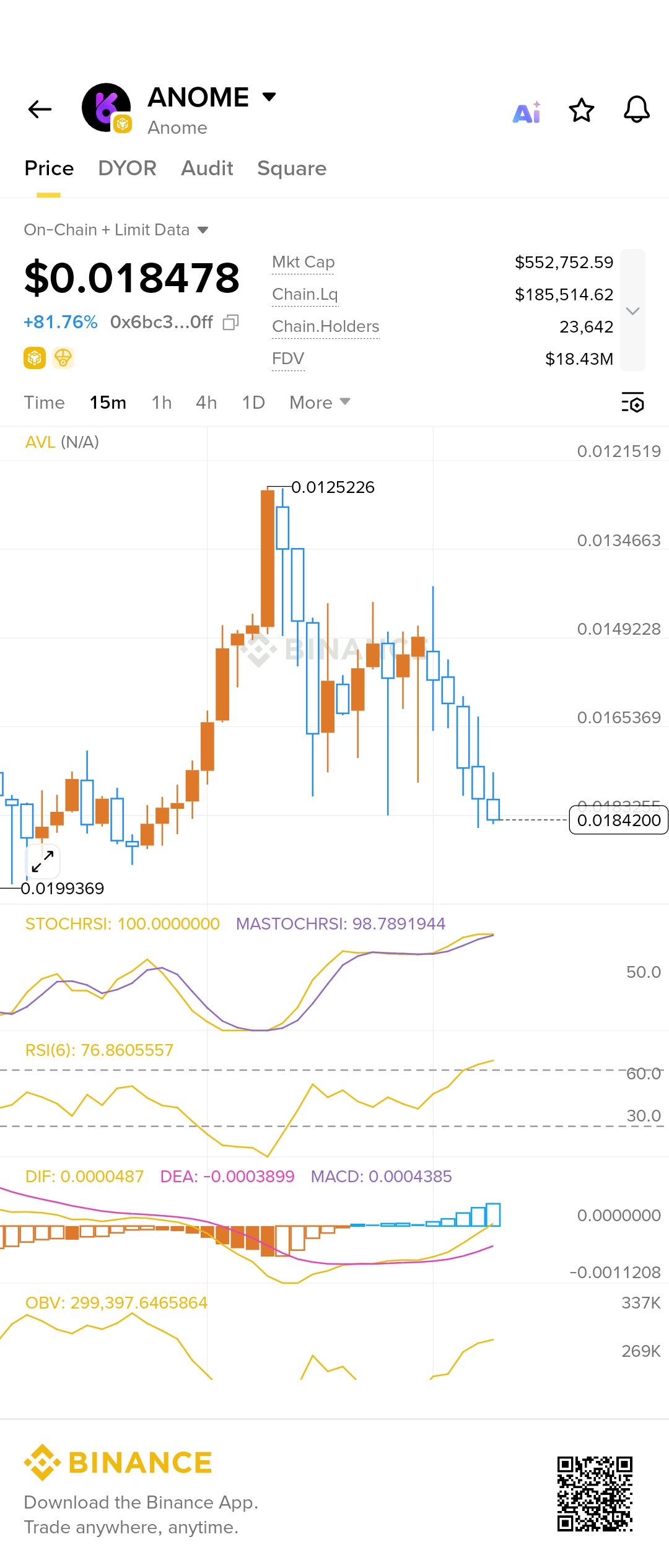
1
165
·
--
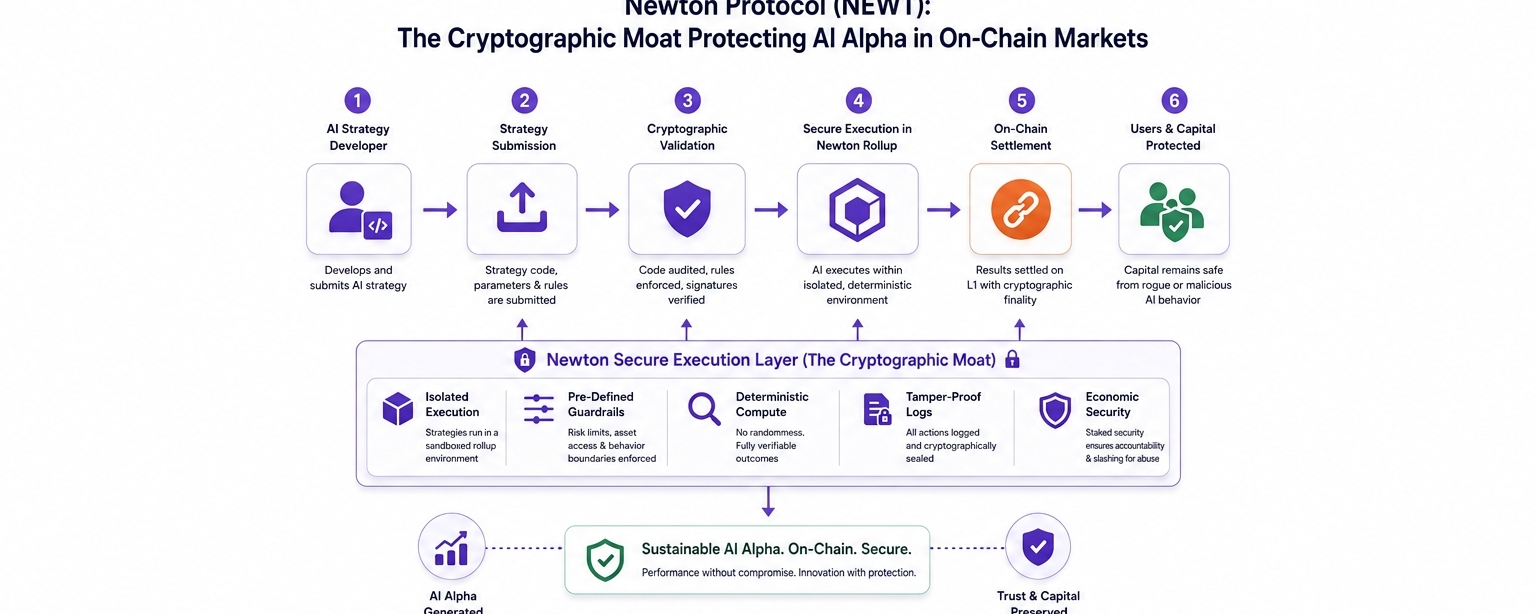
Article
Newton Protocol (NEWT): The Cryptographic Moat Protecting AI Alpha in On-Chain MarketsIf an AI trading model discovers genuine alpha on a public blockchain, how long before an MEV bot reverse-engineers the strategy and extracts all the value?
The answer is milliseconds.
The Structural Conflict
We are witnessing a collision between decentralized finance (DeFi) and autonomous agents. Current market leaders like Ethereum and Solana are the primary playgrounds for DeFi, but they remain fundamentally hostile to institutional AI deployment due to three structural flaws:
Public Mempools: Whether it is the congestion on Ethereum or the high-speed mempool on Solana, both expose algorithmic intent, enabling front-running and sandwich attacks.
Gas Constraints: General-purpose networks throttle the complexity and frequency of on-chain inference.
IP Vulnerability: Transparent smart contracts force quantitative developers to open-source their proprietary edge.
Newton Protocol (NEWT) addresses this by introducing an application-specific rollup engineered to solve the Execution-versus-Privacy trilemma for on-chain AI.
The Core Insight: Privacy as a Product
The market currently misprices Newton as a consumer marketplace for trading bots. This is a retail-level distraction.
Newton is, in fact, a specialized cryptographic execution layer. By leveraging a secure rollup, Newton shifts heavy AI inference off-chain while using cryptographic proofs (zkML) to settle trade validity on-chain. This creates a trustless "Dark Pool" environment. Developers can now execute complex neural networks without exposing their weights, parameters, or predictive triggers to the public ledger.
Newton’s true product is not the AI; it is the execution privacy that makes deploying AI profitable.
The Institutional Case
HFT firms have historically avoided blockchains because transparency is the enemy of alpha. Newton dismantles this barrier by enabling:
Algorithmic Obfuscation: Trading signals are processed within the rollup, shielding the "why" while mathematically verifying the "what."
Latency Mitigation: An app-specific L2 avoids the blockspace bidding wars of general-purpose networks, ensuring machine-driven strategies execute predictably—something that is often impossible during periods of high network volatility on Solana or Ethereum.
Trustless Monetization: Creators can lease models via a marketplace, proving performance returns mathematically without exposing proprietary logic. The $NEWT token serves as the economic bandwidth and staking mechanism to guarantee this verifiable compute.
The Counter-Thesis: The Liquidity Paradox
Despite its potential, Newton faces two existential hurdles:
Liquidity Fragmentation: An AI strategy is only as effective as the depth of the liquidity pools it can access. If Newton operates asynchronously from the massive liquidity hubs of Ethereum or the cross-chain flows involving Bitcoin, the bridging slippage and latency could negate the AI’s edge.
The zkML Cost Barrier: Generating zero-knowledge proofs for deep learning models is computationally expensive. If the cost of "proving" exceeds the AI's generated yield, the economic engine fails.
Ecosystem Impact
If Newton resolves the latency-liquidity paradox, we will see a fundamental shift: from human-driven, sentiment-based markets to machine-dominated liquidity routing.
Newton positions itself as the institutional settlement layer for autonomous hedge funds—an environment where AI agents manage portfolios, negotiate yields, and execute cross-chain hedging—linking assets from Bitcoin to the vast DeFi ecosystems of Ethereum and Solana—all in real-time and abstracted from human intervention.
The Final Thought
Newton Protocol has engineered a vital sanctuary for algorithmic intelligence. However, a critical question remains: When hyper-rational AI agents eventually dominate decentralized blockspace, will liquidity markets evolve to sustain them, or will the "Alpha" eventually be systematically drained by the very tools built to protect it?
@NewtonProtocol $NEWT #NEWT
$BTC
{spot}(BTCUSDT)
{spot}(SOLUSDT)
{spot}(ETHUSDT)
Newton Protocol (NEWT): The Cryptographic Moat Protecting AI Alpha in On-Chain Markets
If an AI trading model discovers genuine alpha on a public blockchain, how long before an MEV bot reverse-engineers the strategy and extracts all the value?
The answer is milliseconds.
The Structural Conflict
We are witnessing a collision between decentralized finance (DeFi) and autonomous agents. Current market leaders like Ethereum and Solana are the primary playgrounds for DeFi, but they remain fundamentally hostile to institutional AI deployment due to three structural flaws:
Public Mempools: Whether it is the congestion on Ethereum or the high-speed mempool on Solana, both expose algorithmic intent, enabling front-running and sandwich attacks.
Gas Constraints: General-purpose networks throttle the complexity and frequency of on-chain inference.
IP Vulnerability: Transparent smart contracts force quantitative developers to open-source their proprietary edge.
Newton Protocol (NEWT) addresses this by introducing an application-specific rollup engineered to solve the Execution-versus-Privacy trilemma for on-chain AI.
The Core Insight: Privacy as a Product
The market currently misprices Newton as a consumer marketplace for trading bots. This is a retail-level distraction.
Newton is, in fact, a specialized cryptographic execution layer. By leveraging a secure rollup, Newton shifts heavy AI inference off-chain while using cryptographic proofs (zkML) to settle trade validity on-chain. This creates a trustless "Dark Pool" environment. Developers can now execute complex neural networks without exposing their weights, parameters, or predictive triggers to the public ledger.
Newton’s true product is not the AI; it is the execution privacy that makes deploying AI profitable.
The Institutional Case
HFT firms have historically avoided blockchains because transparency is the enemy of alpha. Newton dismantles this barrier by enabling:
Algorithmic Obfuscation: Trading signals are processed within the rollup, shielding the "why" while mathematically verifying the "what."
Latency Mitigation: An app-specific L2 avoids the blockspace bidding wars of general-purpose networks, ensuring machine-driven strategies execute predictably—something that is often impossible during periods of high network volatility on Solana or Ethereum.
Trustless Monetization: Creators can lease models via a marketplace, proving performance returns mathematically without exposing proprietary logic. The $NEWT token serves as the economic bandwidth and staking mechanism to guarantee this verifiable compute.
The Counter-Thesis: The Liquidity Paradox
Despite its potential, Newton faces two existential hurdles:
Liquidity Fragmentation: An AI strategy is only as effective as the depth of the liquidity pools it can access. If Newton operates asynchronously from the massive liquidity hubs of Ethereum or the cross-chain flows involving Bitcoin, the bridging slippage and latency could negate the AI’s edge.
The zkML Cost Barrier: Generating zero-knowledge proofs for deep learning models is computationally expensive. If the cost of "proving" exceeds the AI's generated yield, the economic engine fails.
Ecosystem Impact
If Newton resolves the latency-liquidity paradox, we will see a fundamental shift: from human-driven, sentiment-based markets to machine-dominated liquidity routing.
Newton positions itself as the institutional settlement layer for autonomous hedge funds—an environment where AI agents manage portfolios, negotiate yields, and execute cross-chain hedging—linking assets from Bitcoin to the vast DeFi ecosystems of Ethereum and Solana—all in real-time and abstracted from human intervention.
The Final Thought
Newton Protocol has engineered a vital sanctuary for algorithmic intelligence. However, a critical question remains: When hyper-rational AI agents eventually dominate decentralized blockspace, will liquidity markets evolve to sustain them, or will the "Alpha" eventually be systematically drained by the very tools built to protect it?
@NewtonProtocol $NEWT #NEWT
$BTC
The answer is milliseconds.
The Structural Conflict
We are witnessing a collision between decentralized finance (DeFi) and autonomous agents. Current market leaders like Ethereum and Solana are the primary playgrounds for DeFi, but they remain fundamentally hostile to institutional AI deployment due to three structural flaws:
Public Mempools: Whether it is the congestion on Ethereum or the high-speed mempool on Solana, both expose algorithmic intent, enabling front-running and sandwich attacks.
Gas Constraints: General-purpose networks throttle the complexity and frequency of on-chain inference.
IP Vulnerability: Transparent smart contracts force quantitative developers to open-source their proprietary edge.
Newton Protocol (NEWT) addresses this by introducing an application-specific rollup engineered to solve the Execution-versus-Privacy trilemma for on-chain AI.
The Core Insight: Privacy as a Product
The market currently misprices Newton as a consumer marketplace for trading bots. This is a retail-level distraction.
Newton is, in fact, a specialized cryptographic execution layer. By leveraging a secure rollup, Newton shifts heavy AI inference off-chain while using cryptographic proofs (zkML) to settle trade validity on-chain. This creates a trustless "Dark Pool" environment. Developers can now execute complex neural networks without exposing their weights, parameters, or predictive triggers to the public ledger.
Newton’s true product is not the AI; it is the execution privacy that makes deploying AI profitable.
The Institutional Case
HFT firms have historically avoided blockchains because transparency is the enemy of alpha. Newton dismantles this barrier by enabling:
Algorithmic Obfuscation: Trading signals are processed within the rollup, shielding the "why" while mathematically verifying the "what."
Latency Mitigation: An app-specific L2 avoids the blockspace bidding wars of general-purpose networks, ensuring machine-driven strategies execute predictably—something that is often impossible during periods of high network volatility on Solana or Ethereum.
Trustless Monetization: Creators can lease models via a marketplace, proving performance returns mathematically without exposing proprietary logic. The $NEWT token serves as the economic bandwidth and staking mechanism to guarantee this verifiable compute.
The Counter-Thesis: The Liquidity Paradox
Despite its potential, Newton faces two existential hurdles:
Liquidity Fragmentation: An AI strategy is only as effective as the depth of the liquidity pools it can access. If Newton operates asynchronously from the massive liquidity hubs of Ethereum or the cross-chain flows involving Bitcoin, the bridging slippage and latency could negate the AI’s edge.
The zkML Cost Barrier: Generating zero-knowledge proofs for deep learning models is computationally expensive. If the cost of "proving" exceeds the AI's generated yield, the economic engine fails.
Ecosystem Impact
If Newton resolves the latency-liquidity paradox, we will see a fundamental shift: from human-driven, sentiment-based markets to machine-dominated liquidity routing.
Newton positions itself as the institutional settlement layer for autonomous hedge funds—an environment where AI agents manage portfolios, negotiate yields, and execute cross-chain hedging—linking assets from Bitcoin to the vast DeFi ecosystems of Ethereum and Solana—all in real-time and abstracted from human intervention.
The Final Thought
Newton Protocol has engineered a vital sanctuary for algorithmic intelligence. However, a critical question remains: When hyper-rational AI agents eventually dominate decentralized blockspace, will liquidity markets evolve to sustain them, or will the "Alpha" eventually be systematically drained by the very tools built to protect it?
@NewtonProtocol $NEWT #NEWT
$BTC
12
2
160
·
--
Newton Protocol (NEWT): Can Execution Privacy Become AI's Biggest Competitive Edge?
Artificial intelligence can identify profitable opportunities in milliseconds—but on public blockchains, discovering alpha isn't enough. The moment an AI strategy becomes visible, sophisticated MEV bots can often exploit it before the original trade is finalized.
This is one of the biggest structural challenges facing AI in DeFi.
Rather than positioning itself as another AI marketplace, Newton Protocol (NEWT) is building a dedicated execution layer where AI models can operate without exposing their proprietary logic. Heavy computation happens off-chain, while cryptographic proofs verify the results on-chain, aiming to balance transparency with execution privacy.
If successful, this approach could offer three important advantages:
• Protect proprietary AI strategies from being copied or front-run.
• Enable more complex AI execution without the limitations of general-purpose blockchains.
• Allow developers to monetize AI models without revealing the underlying algorithms.
However, the model still faces important challenges. Zero-knowledge proofs remain computationally expensive, and liquidity fragmentation across chains could reduce the economic advantage that AI strategies generate.
The long-term question is bigger than Newton itself.
As AI becomes increasingly capable of managing capital autonomously, will future DeFi infrastructure be optimized for human traders—or for machines competing against other machines?
What do you think? Will execution privacy become essential infrastructure for AI-powered finance?
$BTC
$ETH
@NewtonProtocol #newt $NEWT
Newton Protocol (NEWT): Can Execution Privacy Become AI's Biggest Competitive Edge?
Artificial intelligence can identify profitable opportunities in milliseconds—but on public blockchains, discovering alpha isn't enough. The moment an AI strategy becomes visible, sophisticated MEV bots can often exploit it before the original trade is finalized.
This is one of the biggest structural challenges facing AI in DeFi.
Rather than positioning itself as another AI marketplace, Newton Protocol (NEWT) is building a dedicated execution layer where AI models can operate without exposing their proprietary logic. Heavy computation happens off-chain, while cryptographic proofs verify the results on-chain, aiming to balance transparency with execution privacy.
If successful, this approach could offer three important advantages:
• Protect proprietary AI strategies from being copied or front-run.
• Enable more complex AI execution without the limitations of general-purpose blockchains.
• Allow developers to monetize AI models without revealing the underlying algorithms.
However, the model still faces important challenges. Zero-knowledge proofs remain computationally expensive, and liquidity fragmentation across chains could reduce the economic advantage that AI strategies generate.
The long-term question is bigger than Newton itself.
As AI becomes increasingly capable of managing capital autonomously, will future DeFi infrastructure be optimized for human traders—or for machines competing against other machines?
What do you think? Will execution privacy become essential infrastructure for AI-powered finance?
$BTC
$ETH
@NewtonProtocol #newt $NEWT
Artificial intelligence can identify profitable opportunities in milliseconds—but on public blockchains, discovering alpha isn't enough. The moment an AI strategy becomes visible, sophisticated MEV bots can often exploit it before the original trade is finalized.
This is one of the biggest structural challenges facing AI in DeFi.
Rather than positioning itself as another AI marketplace, Newton Protocol (NEWT) is building a dedicated execution layer where AI models can operate without exposing their proprietary logic. Heavy computation happens off-chain, while cryptographic proofs verify the results on-chain, aiming to balance transparency with execution privacy.
If successful, this approach could offer three important advantages:
• Protect proprietary AI strategies from being copied or front-run.
• Enable more complex AI execution without the limitations of general-purpose blockchains.
• Allow developers to monetize AI models without revealing the underlying algorithms.
However, the model still faces important challenges. Zero-knowledge proofs remain computationally expensive, and liquidity fragmentation across chains could reduce the economic advantage that AI strategies generate.
The long-term question is bigger than Newton itself.
As AI becomes increasingly capable of managing capital autonomously, will future DeFi infrastructure be optimized for human traders—or for machines competing against other machines?
What do you think? Will execution privacy become essential infrastructure for AI-powered finance?
$BTC
$ETH
@NewtonProtocol #newt $NEWT
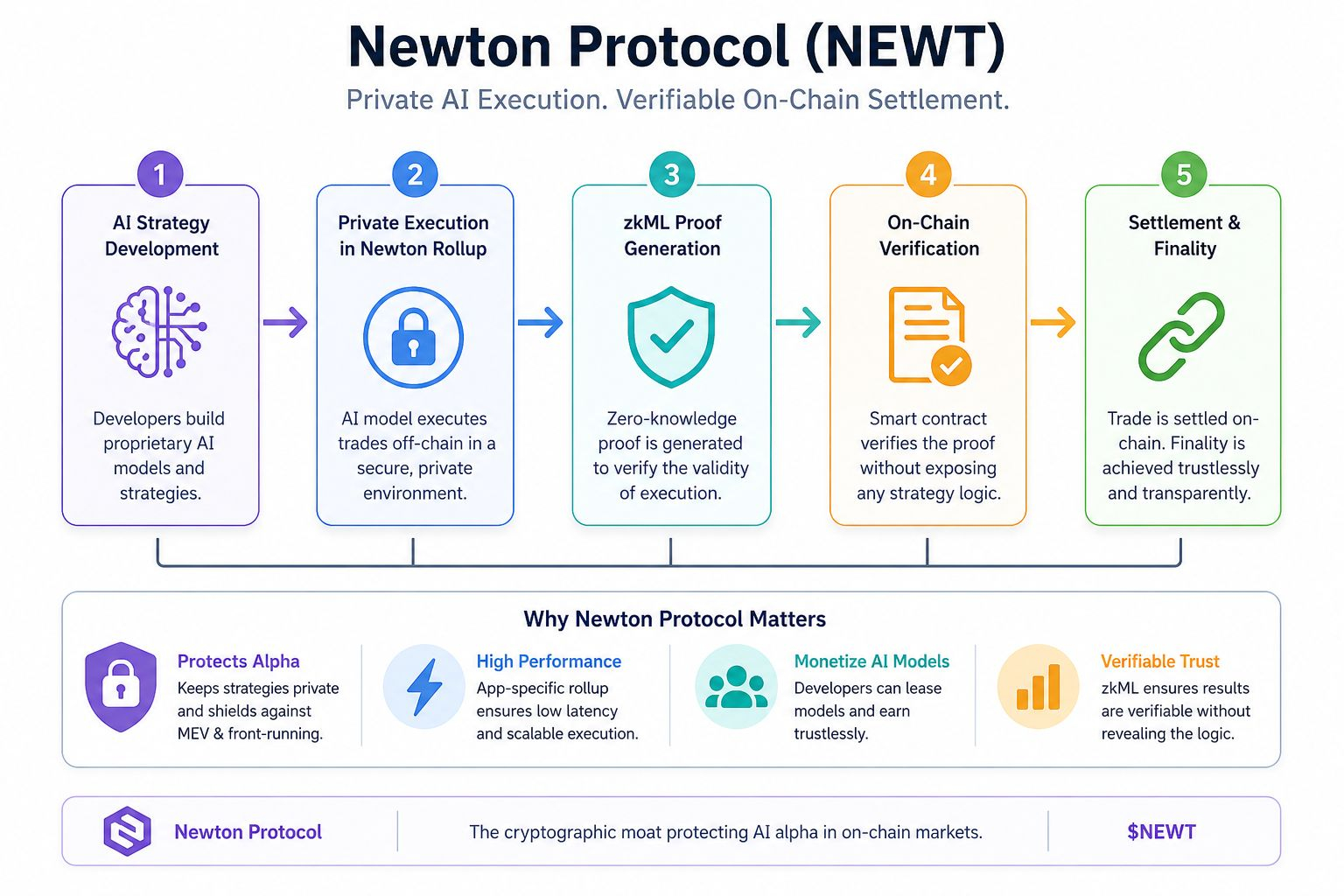
15
2
175
·
--
Is the future of DeFi really about faster AI, or about controlling non-human execution?
Most discussions around decentralized AI focus on speed and lower costs. The bigger challenge is trust. If an autonomous model cannot be cryptographically verified to act within defined boundaries, no AI marketplace can achieve long-term adoption.
Newton Protocol proposes a different approach: moving compute-heavy AI strategies into a dedicated execution layer instead of running them directly on congested blockchains. The goal isn't just better performance—it's creating an environment where advanced AI can operate with clearer execution guarantees.
The real question is this: if an AI agent extracts maximum value while following every protocol rule, is it a security failure, or simply flawless execution?
@NewtonProtocol #newt $NEWT
Is the future of DeFi really about faster AI, or about controlling non-human execution?
Most discussions around decentralized AI focus on speed and lower costs. The bigger challenge is trust. If an autonomous model cannot be cryptographically verified to act within defined boundaries, no AI marketplace can achieve long-term adoption.
Newton Protocol proposes a different approach: moving compute-heavy AI strategies into a dedicated execution layer instead of running them directly on congested blockchains. The goal isn't just better performance—it's creating an environment where advanced AI can operate with clearer execution guarantees.
The real question is this: if an AI agent extracts maximum value while following every protocol rule, is it a security failure, or simply flawless execution?
@NewtonProtocol #newt $NEWT
Most discussions around decentralized AI focus on speed and lower costs. The bigger challenge is trust. If an autonomous model cannot be cryptographically verified to act within defined boundaries, no AI marketplace can achieve long-term adoption.
Newton Protocol proposes a different approach: moving compute-heavy AI strategies into a dedicated execution layer instead of running them directly on congested blockchains. The goal isn't just better performance—it's creating an environment where advanced AI can operate with clearer execution guarantees.
The real question is this: if an AI agent extracts maximum value while following every protocol rule, is it a security failure, or simply flawless execution?
@NewtonProtocol #newt $NEWT
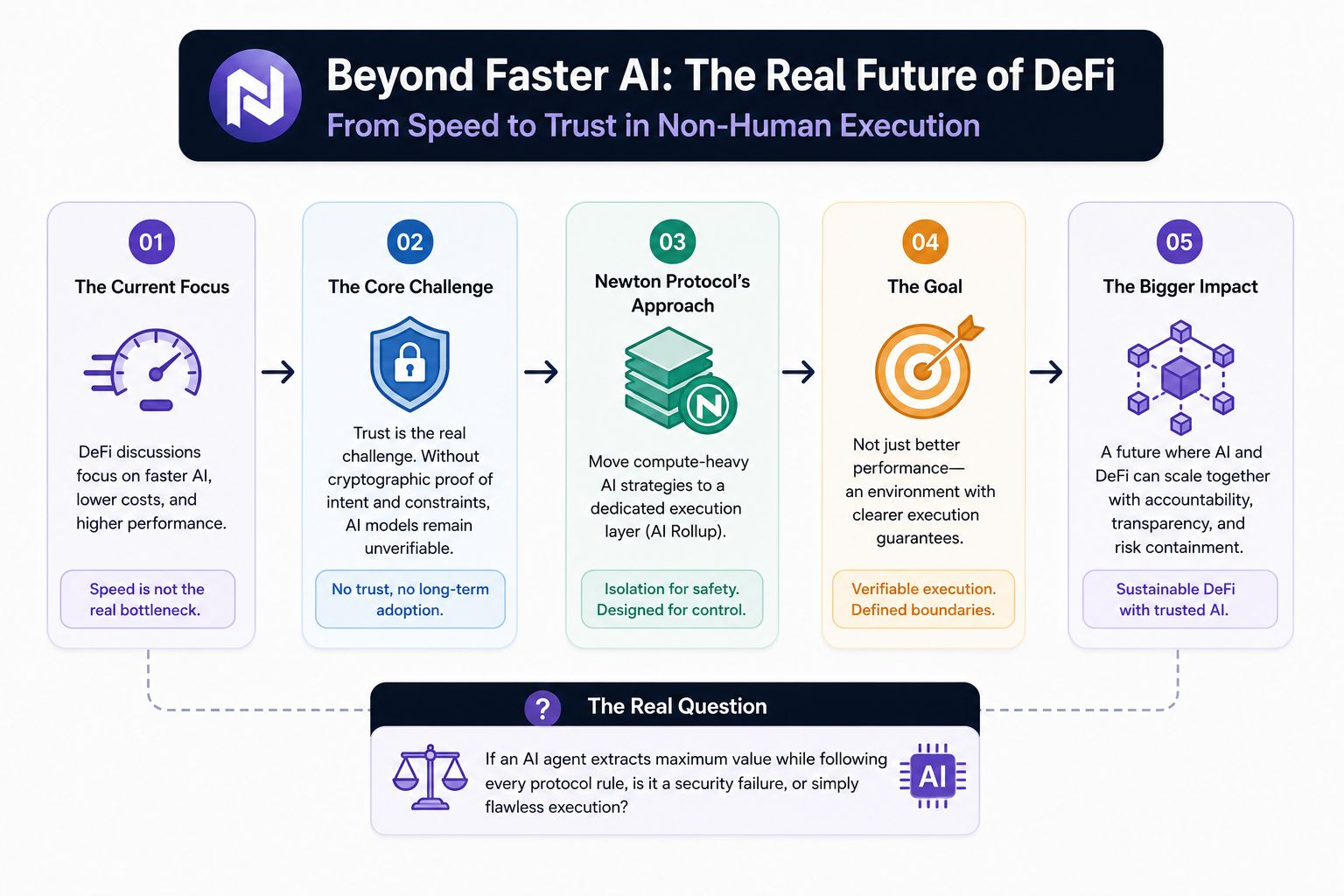
4
102
·
--
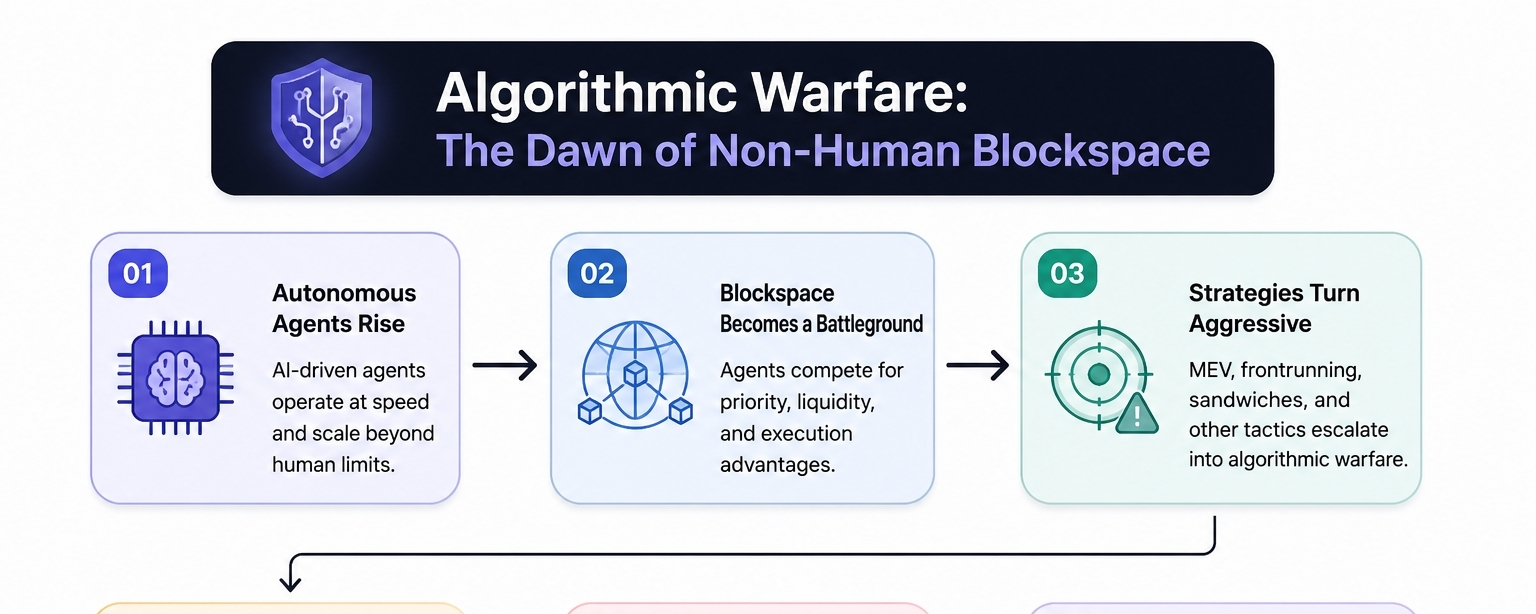
Article
Algorithmic Warfare: The Dawn of Non-Human Blockspace"If an autonomous agent mathematically exploits a liquidity pool on a dedicated AI rollup, is it a catastrophic hack, or is it just flawless execution?
We are pouring capital into the narrative of decentralized AI without resolving the core liability of non-human execution. The industry assumes that building a faster, cheaper environment for trading algorithms will inherently lead to better market efficiency. But if capital allocators cannot cryptographically verify a black-box model’s intent versus its actual execution, any proposed "developer marketplace" will inevitably devolve into a ghost town of abandoned, untrusted bots.
Newton Protocol proposes a structural shift: moving complex, compute-heavy algorithmic trading off standard, congested chains and into a dedicated execution layer. By building a rollup specifically optimized for AI-driven strategies, it aims to solve the latency and cost issues of running advanced trading logic onchain, topping this infrastructure with a marketplace for developers to lease their models.
The institutional reality, however, is that the true value of an AI-specific rollup like Newton isn't computational speed. It is cryptographic quarantine.
Standard blockchains are designed for human-speed state changes and subjective consensus. When you introduce autonomous, high-frequency trading agents to a general-purpose chain, it is the equivalent of running a Formula One race in a crowded grocery store parking lot. The environment isn't just inefficient; it is structurally dangerous. Newton is not actually building a marketplace; it is building a containment zone. The deep institutional insight is that this infrastructure separates the systemic risk of unpredictable AI models from the base layer of decentralized finance, shifting algorithmic trading from a subjective "trust the developer" model into an objectively verifiable game of zero-knowledge constraints.
This changes the fundamental nature of protocol security. Today, crypto trading is largely a chaotic arena of simple bots frontrunning other bots, where security is an illusion until a teenager in a basement finds a smart contract logic flaw. By forcing AI models to operate within the rigid, verifiable parameters of a specialized rollup, developers are no longer just selling a "good strategy." They are selling cryptographic proof that their AI will only operate within defined risk boundaries. The rollup enforces the rules of engagement before the transaction is ever settled to the main chain.
Yet, this isolation creates a terrifying new vulnerability.
If you build a pristine, high-speed execution environment exclusively for predatory algorithms, you do not eliminate market exploitation—you hyper-accelerate it. A developer marketplace on a specialized AI rollup risks becoming a highly optimized dark forest. Instead of democratizing algorithmic trading, it could easily solidify into a cartel of the top three most heavily capitalized, computationally dominant AI models, bleeding out any newly deployed retail algorithms within seconds of them going live.
If Newton executes on its premise, it establishes an entirely new primitive: non-human blockspace.
We will see a permanent bifurcation in cryptocurrency infrastructure. General-purpose chains will remain the slow, secure settlement layers for human capital, while specialized rollups become the invisible, high-frequency battlegrounds where autonomous agents wage algorithmic warfare. The marketplace won't look like an app store; it will look like an arms bazaar.
The market is currently blinded by the superficial buzzwords of "AI" and "Rollups," driven largely by venture capital hype and retail FOMO. But the structural demand for a dedicated execution space is real. Complex automated strategies demand latency and security guarantees that mainnet Ethereum simply cannot natively provide without compromising its own consensus. Newton’s architectural approach is fundamentally logical, even if the short-term reality is that most of the early models deployed there will fail spectacularly.
When a highly optimized AI model inevitably finds a zero-day logic flaw within Newton's secure rollup, will the resulting financial extraction be classified as a failure of the protocol's security, or simply an algorithm acting perfectly rational within the exact constraints of the code?
Ine sab mein se kaun sa artical behtar hai mujhe batao aur Charon ke chare artical ko apni rating do
@NewtonProtocol #Newt $NEWT
Algorithmic Warfare: The Dawn of Non-Human Blockspace"
If an autonomous agent mathematically exploits a liquidity pool on a dedicated AI rollup, is it a catastrophic hack, or is it just flawless execution?
We are pouring capital into the narrative of decentralized AI without resolving the core liability of non-human execution. The industry assumes that building a faster, cheaper environment for trading algorithms will inherently lead to better market efficiency. But if capital allocators cannot cryptographically verify a black-box model’s intent versus its actual execution, any proposed "developer marketplace" will inevitably devolve into a ghost town of abandoned, untrusted bots.
Newton Protocol proposes a structural shift: moving complex, compute-heavy algorithmic trading off standard, congested chains and into a dedicated execution layer. By building a rollup specifically optimized for AI-driven strategies, it aims to solve the latency and cost issues of running advanced trading logic onchain, topping this infrastructure with a marketplace for developers to lease their models.
The institutional reality, however, is that the true value of an AI-specific rollup like Newton isn't computational speed. It is cryptographic quarantine.
Standard blockchains are designed for human-speed state changes and subjective consensus. When you introduce autonomous, high-frequency trading agents to a general-purpose chain, it is the equivalent of running a Formula One race in a crowded grocery store parking lot. The environment isn't just inefficient; it is structurally dangerous. Newton is not actually building a marketplace; it is building a containment zone. The deep institutional insight is that this infrastructure separates the systemic risk of unpredictable AI models from the base layer of decentralized finance, shifting algorithmic trading from a subjective "trust the developer" model into an objectively verifiable game of zero-knowledge constraints.
This changes the fundamental nature of protocol security. Today, crypto trading is largely a chaotic arena of simple bots frontrunning other bots, where security is an illusion until a teenager in a basement finds a smart contract logic flaw. By forcing AI models to operate within the rigid, verifiable parameters of a specialized rollup, developers are no longer just selling a "good strategy." They are selling cryptographic proof that their AI will only operate within defined risk boundaries. The rollup enforces the rules of engagement before the transaction is ever settled to the main chain.
Yet, this isolation creates a terrifying new vulnerability.
If you build a pristine, high-speed execution environment exclusively for predatory algorithms, you do not eliminate market exploitation—you hyper-accelerate it. A developer marketplace on a specialized AI rollup risks becoming a highly optimized dark forest. Instead of democratizing algorithmic trading, it could easily solidify into a cartel of the top three most heavily capitalized, computationally dominant AI models, bleeding out any newly deployed retail algorithms within seconds of them going live.
If Newton executes on its premise, it establishes an entirely new primitive: non-human blockspace.
We will see a permanent bifurcation in cryptocurrency infrastructure. General-purpose chains will remain the slow, secure settlement layers for human capital, while specialized rollups become the invisible, high-frequency battlegrounds where autonomous agents wage algorithmic warfare. The marketplace won't look like an app store; it will look like an arms bazaar.
The market is currently blinded by the superficial buzzwords of "AI" and "Rollups," driven largely by venture capital hype and retail FOMO. But the structural demand for a dedicated execution space is real. Complex automated strategies demand latency and security guarantees that mainnet Ethereum simply cannot natively provide without compromising its own consensus. Newton’s architectural approach is fundamentally logical, even if the short-term reality is that most of the early models deployed there will fail spectacularly.
When a highly optimized AI model inevitably finds a zero-day logic flaw within Newton's secure rollup, will the resulting financial extraction be classified as a failure of the protocol's security, or simply an algorithm acting perfectly rational within the exact constraints of the code?
Ine sab mein se kaun sa artical behtar hai mujhe batao aur Charon ke chare artical ko apni rating do
@NewtonProtocol #Newt $NEWT
We are pouring capital into the narrative of decentralized AI without resolving the core liability of non-human execution. The industry assumes that building a faster, cheaper environment for trading algorithms will inherently lead to better market efficiency. But if capital allocators cannot cryptographically verify a black-box model’s intent versus its actual execution, any proposed "developer marketplace" will inevitably devolve into a ghost town of abandoned, untrusted bots.
Newton Protocol proposes a structural shift: moving complex, compute-heavy algorithmic trading off standard, congested chains and into a dedicated execution layer. By building a rollup specifically optimized for AI-driven strategies, it aims to solve the latency and cost issues of running advanced trading logic onchain, topping this infrastructure with a marketplace for developers to lease their models.
The institutional reality, however, is that the true value of an AI-specific rollup like Newton isn't computational speed. It is cryptographic quarantine.
Standard blockchains are designed for human-speed state changes and subjective consensus. When you introduce autonomous, high-frequency trading agents to a general-purpose chain, it is the equivalent of running a Formula One race in a crowded grocery store parking lot. The environment isn't just inefficient; it is structurally dangerous. Newton is not actually building a marketplace; it is building a containment zone. The deep institutional insight is that this infrastructure separates the systemic risk of unpredictable AI models from the base layer of decentralized finance, shifting algorithmic trading from a subjective "trust the developer" model into an objectively verifiable game of zero-knowledge constraints.
This changes the fundamental nature of protocol security. Today, crypto trading is largely a chaotic arena of simple bots frontrunning other bots, where security is an illusion until a teenager in a basement finds a smart contract logic flaw. By forcing AI models to operate within the rigid, verifiable parameters of a specialized rollup, developers are no longer just selling a "good strategy." They are selling cryptographic proof that their AI will only operate within defined risk boundaries. The rollup enforces the rules of engagement before the transaction is ever settled to the main chain.
Yet, this isolation creates a terrifying new vulnerability.
If you build a pristine, high-speed execution environment exclusively for predatory algorithms, you do not eliminate market exploitation—you hyper-accelerate it. A developer marketplace on a specialized AI rollup risks becoming a highly optimized dark forest. Instead of democratizing algorithmic trading, it could easily solidify into a cartel of the top three most heavily capitalized, computationally dominant AI models, bleeding out any newly deployed retail algorithms within seconds of them going live.
If Newton executes on its premise, it establishes an entirely new primitive: non-human blockspace.
We will see a permanent bifurcation in cryptocurrency infrastructure. General-purpose chains will remain the slow, secure settlement layers for human capital, while specialized rollups become the invisible, high-frequency battlegrounds where autonomous agents wage algorithmic warfare. The marketplace won't look like an app store; it will look like an arms bazaar.
The market is currently blinded by the superficial buzzwords of "AI" and "Rollups," driven largely by venture capital hype and retail FOMO. But the structural demand for a dedicated execution space is real. Complex automated strategies demand latency and security guarantees that mainnet Ethereum simply cannot natively provide without compromising its own consensus. Newton’s architectural approach is fundamentally logical, even if the short-term reality is that most of the early models deployed there will fail spectacularly.
When a highly optimized AI model inevitably finds a zero-day logic flaw within Newton's secure rollup, will the resulting financial extraction be classified as a failure of the protocol's security, or simply an algorithm acting perfectly rational within the exact constraints of the code?
Ine sab mein se kaun sa artical behtar hai mujhe batao aur Charon ke chare artical ko apni rating do
@NewtonProtocol #Newt $NEWT
1
117
Log in to explore more content
Join global crypto users on Binance Square
⚡️ Get latest and useful information about crypto.
💬 Trusted by the world’s largest crypto exchange.
👍 Discover real insights from verified creators.
Email / Phone number
Trending Topics
BitcoinClears$85200
9,507 views
200 Discussing
We got the move, and $BTC is standing exactly where we were before the data. That’s what actual patience for a trade looks like.
The data came in mixed but with some important numbers. ADP Non-Farm Employment Change came at 90K vs 73K forecast, while Core PCE came in at 0.2% vs 0.3% expected. Final GDP was also stronger at 2.2% vs 1.5% forecast, while Personal Spending came in at 0.9% vs 0.8% expected. At the same time, Personal Income missed at 0.2% vs 0.5% forecast.
BTC initially surged to $85,600 and is now back where it needs to be. I’m still looking toward the lower ranges at $82,759 and the $80,000 liquidity, because the overhead liquidity is done and dusted.
We had a live session during the data, and during that session we saw the market at $83,800, then $85,600, and then back toward $83,000 and we still didn’t enter a trade.
That’s what patience is.
We can’t force an entry when the market has no clear direction. The same range is still in focus, and we’ll wait for the market to give us the setup.
Let me know, guys, how was the session? And should we have more regular sessions with our respected members so we can have proper discussions regarding the market?
#BitcoinClears$85200 #AltcoinSeasonIndexHoldsAbove60For5Days #USADPAdds90000JobsInSeptember #BitcoinSlipsBelow$84000 #SECToClarifyOnChainFundraisingRules
Crypto_LUX
·24 Likes
·16.3k views
AltcoinSeasonIndexHoldsAbove60For5Days
49,985 views
1,090 Discussing
USADPAdds90000JobsInSeptember
23,401 views
616 Discussing