

Sahil_crypto1
297 Posts

Sahil_crypto1
Report
Block User
Open Trade
Frequent Trader
2 Years
24 Following
120 Followers
455 Liked
Posts
Portfolio
All
Live
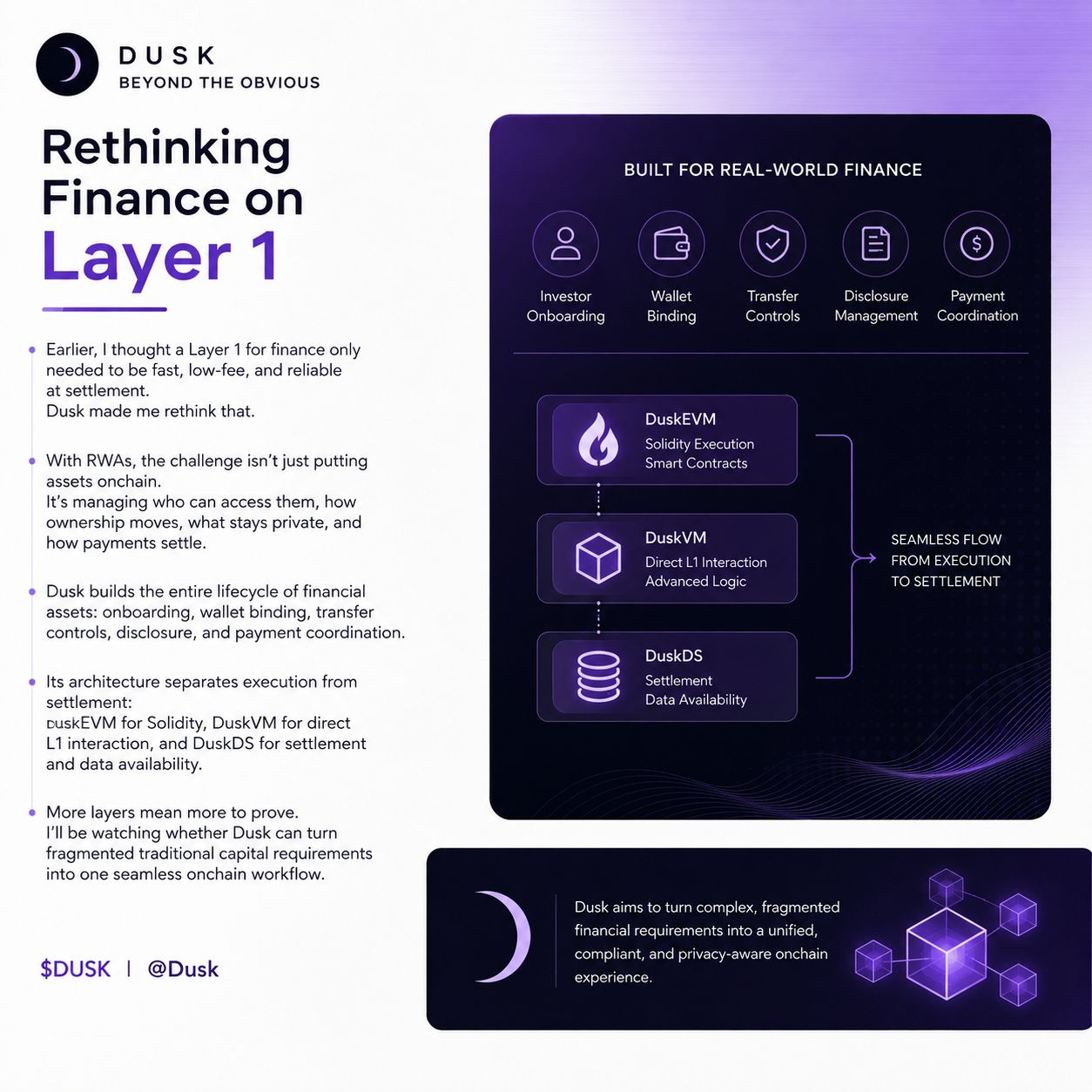
#dusk $DUSK @Dusk_Foundation Earlier, I thought a financial Layer 1 mainly needed speed, low fees, and reliable settlement. Dusk made me rethink that.
With RWAs, the hard part isn’t simply putting assets onchain. It’s managing who can access them, how ownership moves, what stays private, and how payments settle.
That’s why I find Dusk interesting. Its architecture connects DuskEVM, DuskVM, and DuskDS around execution, applications, settlement, and data availability.
I’m still watching whether this complexity translates into real adoption, but the bigger question is compelling:
Can Dusk turn fragmented traditional financial requirements into one seamless onchain workflow?
$DUSK @Dusk_Foundation
{spot}(DUSKUSDT)
#dusk $DUSK @Dusk Earlier, I thought a financial Layer 1 mainly needed speed, low fees, and reliable settlement. Dusk made me rethink that.
With RWAs, the hard part isn’t simply putting assets onchain. It’s managing who can access them, how ownership moves, what stays private, and how payments settle.
That’s why I find Dusk interesting. Its architecture connects DuskEVM, DuskVM, and DuskDS around execution, applications, settlement, and data availability.
I’m still watching whether this complexity translates into real adoption, but the bigger question is compelling:
Can Dusk turn fragmented traditional financial requirements into one seamless onchain workflow?
$DUSK @Dusk
With RWAs, the hard part isn’t simply putting assets onchain. It’s managing who can access them, how ownership moves, what stays private, and how payments settle.
That’s why I find Dusk interesting. Its architecture connects DuskEVM, DuskVM, and DuskDS around execution, applications, settlement, and data availability.
I’m still watching whether this complexity translates into real adoption, but the bigger question is compelling:
Can Dusk turn fragmented traditional financial requirements into one seamless onchain workflow?
$DUSK @Dusk
69
$BTC Bitcoin is starting to look interesting again as bullish momentum builds across the market. If buyers continue defending the current levels and resistance gets cleared, I’m watching the $73,000 zone as a potential next target.
A move toward $73K could bring fresh attention to BTC and potentially strengthen overall market sentiment. Of course, Bitcoin can move quickly in both directions, so confirmation and risk management still matter.
For now, I’m watching volume, momentum, and how BTC reacts around key resistance before getting too aggressive.
Bitcoin remains one of the charts I’m watching closely. 🚀
#Bitcoin #BTC #Crypto $BTC
{spot}(BTCUSDT)
$BTC Bitcoin is starting to look interesting again as bullish momentum builds across the market. If buyers continue defending the current levels and resistance gets cleared, I’m watching the $73,000 zone as a potential next target.
A move toward $73K could bring fresh attention to BTC and potentially strengthen overall market sentiment. Of course, Bitcoin can move quickly in both directions, so confirmation and risk management still matter.
For now, I’m watching volume, momentum, and how BTC reacts around key resistance before getting too aggressive.
Bitcoin remains one of the charts I’m watching closely. 🚀
#Bitcoin #BTC #Crypto $BTC
A move toward $73K could bring fresh attention to BTC and potentially strengthen overall market sentiment. Of course, Bitcoin can move quickly in both directions, so confirmation and risk management still matter.
For now, I’m watching volume, momentum, and how BTC reacts around key resistance before getting too aggressive.
Bitcoin remains one of the charts I’m watching closely. 🚀
#Bitcoin #BTC #Crypto $BTC
1
66
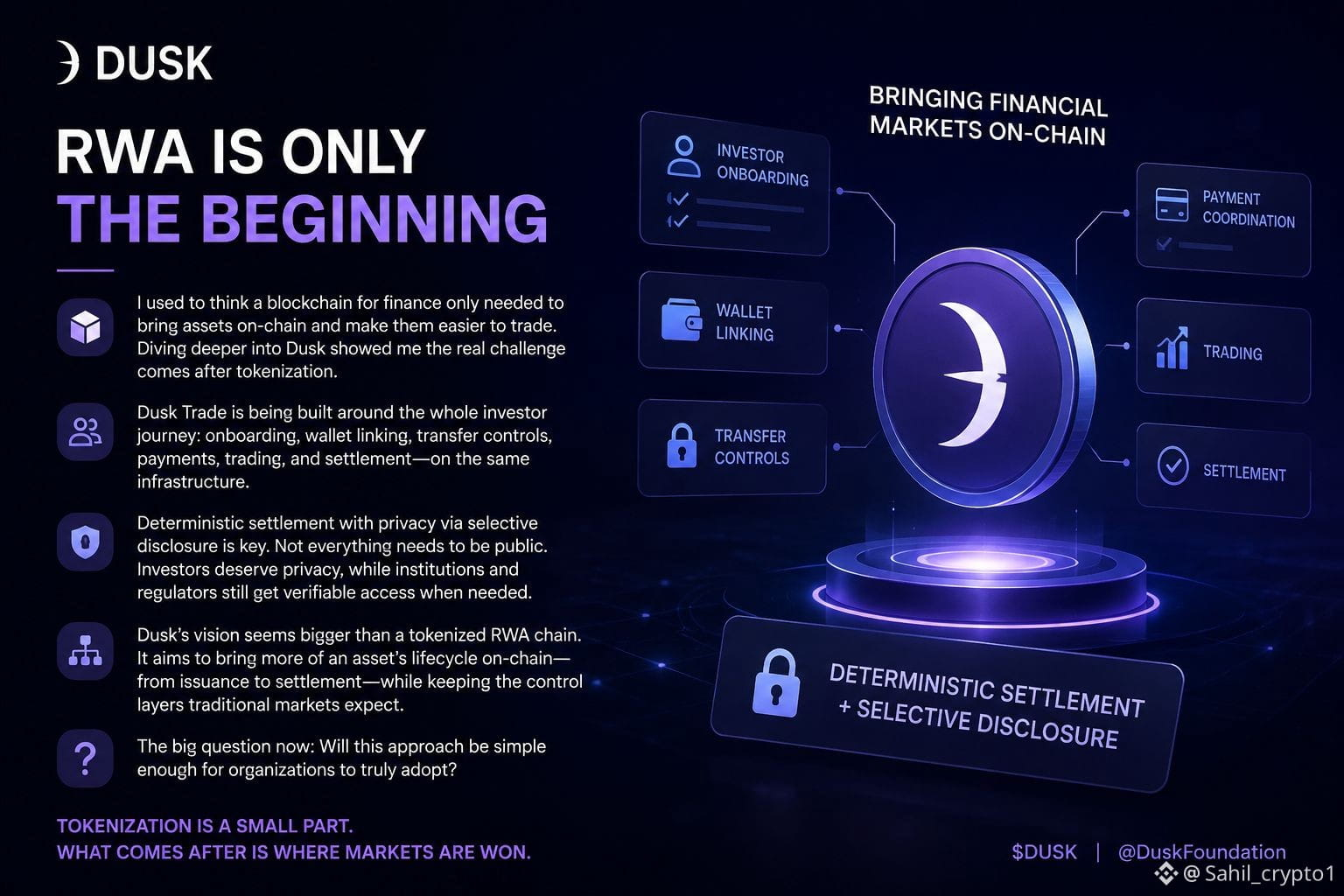
#dusk $DUSK @Dusk_Foundation I used to think a blockchain for finance only needed to do two things well: bring real-world assets on-chain and make them easier to trade.
But digging deeper into Dusk changed how I look at the RWA narrative.
Tokenization is only the beginning. The bigger challenge comes after the asset exists on-chain: investor onboarding, wallet linking, transfer controls, payment coordination, trading, and settlement all need to work together.
That’s what makes Dusk Trade interesting to me. The ambition seems broader than simply creating another marketplace for tokenized assets. Dusk is trying to build infrastructure around more of the asset lifecycle, while combining deterministic settlement with selective disclosure.
I used to assume that more blockchain transparency was always better. But financial markets showed me why that isn’t necessarily true. Investors may need privacy, while institutions and regulators still need a reliable way to verify information when required.
So I’m starting to see Dusk less as another “tokenized RWA chain” and more as an attempt to bring traditional financial workflows on-chain without removing the controls those markets depend on.
The real question for me now isn’t whether the technology sounds good.
It’s whether organizations will find the whole system simple enough to actually use.
{spot}(DUSKUSDT)
#dusk $DUSK @Dusk I used to think a blockchain for finance only needed to do two things well: bring real-world assets on-chain and make them easier to trade.
But digging deeper into Dusk changed how I look at the RWA narrative.
Tokenization is only the beginning. The bigger challenge comes after the asset exists on-chain: investor onboarding, wallet linking, transfer controls, payment coordination, trading, and settlement all need to work together.
That’s what makes Dusk Trade interesting to me. The ambition seems broader than simply creating another marketplace for tokenized assets. Dusk is trying to build infrastructure around more of the asset lifecycle, while combining deterministic settlement with selective disclosure.
I used to assume that more blockchain transparency was always better. But financial markets showed me why that isn’t necessarily true. Investors may need privacy, while institutions and regulators still need a reliable way to verify information when required.
So I’m starting to see Dusk less as another “tokenized RWA chain” and more as an attempt to bring traditional financial workflows on-chain without removing the controls those markets depend on.
The real question for me now isn’t whether the technology sounds good.
It’s whether organizations will find the whole system simple enough to actually use.
But digging deeper into Dusk changed how I look at the RWA narrative.
Tokenization is only the beginning. The bigger challenge comes after the asset exists on-chain: investor onboarding, wallet linking, transfer controls, payment coordination, trading, and settlement all need to work together.
That’s what makes Dusk Trade interesting to me. The ambition seems broader than simply creating another marketplace for tokenized assets. Dusk is trying to build infrastructure around more of the asset lifecycle, while combining deterministic settlement with selective disclosure.
I used to assume that more blockchain transparency was always better. But financial markets showed me why that isn’t necessarily true. Investors may need privacy, while institutions and regulators still need a reliable way to verify information when required.
So I’m starting to see Dusk less as another “tokenized RWA chain” and more as an attempt to bring traditional financial workflows on-chain without removing the controls those markets depend on.
The real question for me now isn’t whether the technology sounds good.
It’s whether organizations will find the whole system simple enough to actually use.
1
64
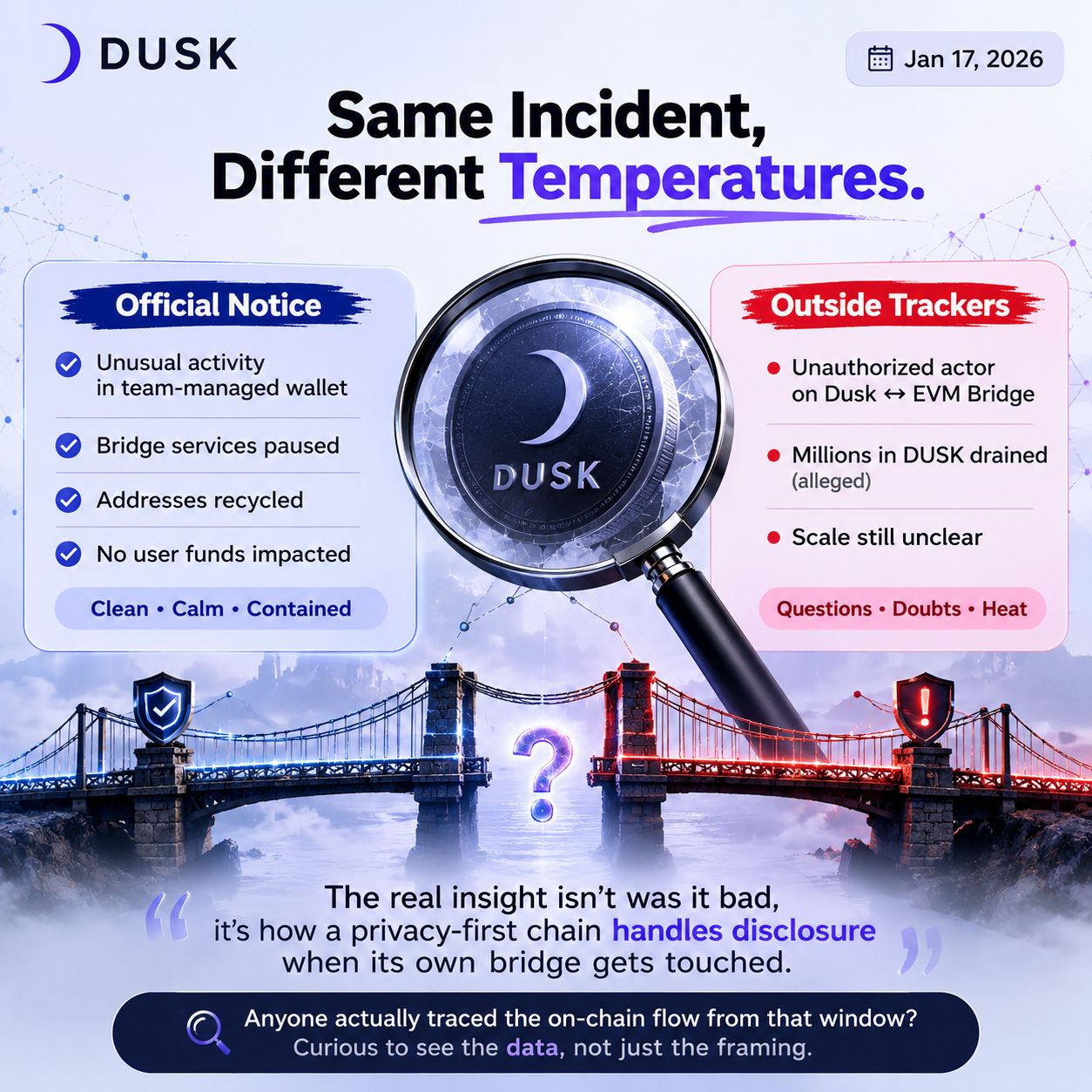
#dusk $DUSK @Dusk_Foundation I kept circling back to Dusk’s January incident notice, and the wording stood out more than the exploit.
Officially: unusual activity, a team-managed wallet, bridge services paused, addresses recycled, no user funds impacted.
But outside trackers described millions in DUSK drained through the Dusk-to-EVM bridge.
Same incident, very different temperatures.
That gap matters. Not because I know the final number—I don’t—but because disclosure is part of security too.
If anyone actually traced the on-chain flow from that window, I’d genuinely like to see what you found.
{spot}(DUSKUSDT)
#dusk $DUSK @Dusk I kept circling back to Dusk’s January incident notice, and the wording stood out more than the exploit.
Officially: unusual activity, a team-managed wallet, bridge services paused, addresses recycled, no user funds impacted.
But outside trackers described millions in DUSK drained through the Dusk-to-EVM bridge.
Same incident, very different temperatures.
That gap matters. Not because I know the final number—I don’t—but because disclosure is part of security too.
If anyone actually traced the on-chain flow from that window, I’d genuinely like to see what you found.
Officially: unusual activity, a team-managed wallet, bridge services paused, addresses recycled, no user funds impacted.
But outside trackers described millions in DUSK drained through the Dusk-to-EVM bridge.
Same incident, very different temperatures.
That gap matters. Not because I know the final number—I don’t—but because disclosure is part of security too.
If anyone actually traced the on-chain flow from that window, I’d genuinely like to see what you found.
1
79
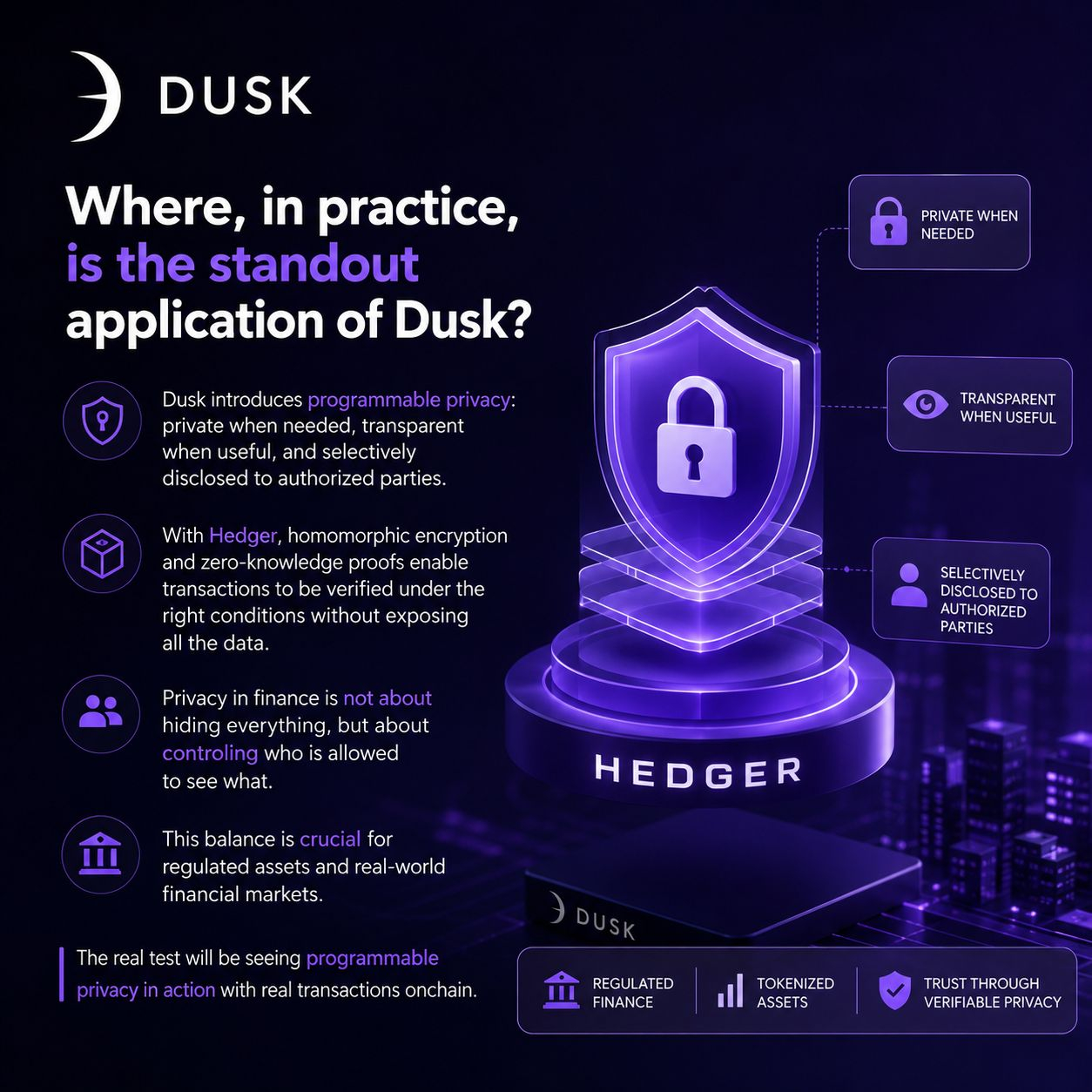
Spent more time with Dusk and one question kept coming back: where does its privacy model actually become useful?
I used to associate financial transparency with trust. If everyone can see the data, I assumed verification becomes easier. But regulated finance changes that equation.
Dusk’s idea of programmable privacy feels more practical: keep sensitive information private, while allowing authorized parties to verify what matters.
That’s where Hedger caught my attention. Homomorphic encryption and zero-knowledge proofs aren’t simply about hiding transactions. The bigger idea is creating a system where financial activity can remain confidential while still being verifiable under the right conditions.
That makes privacy feel less like “hide everything” and more like “control who can see what.”
For tokenized assets and regulated markets, that distinction could matter a lot.
I’m still watching closely, though. The real test will be seeing how Dusk handles actual financial activity onchain, not just how convincing the architecture sounds on paper.
#dusk @Dusk_Foundation $DUSK
{spot}(DUSKUSDT)
Spent more time with Dusk and one question kept coming back: where does its privacy model actually become useful?
I used to associate financial transparency with trust. If everyone can see the data, I assumed verification becomes easier. But regulated finance changes that equation.
Dusk’s idea of programmable privacy feels more practical: keep sensitive information private, while allowing authorized parties to verify what matters.
That’s where Hedger caught my attention. Homomorphic encryption and zero-knowledge proofs aren’t simply about hiding transactions. The bigger idea is creating a system where financial activity can remain confidential while still being verifiable under the right conditions.
That makes privacy feel less like “hide everything” and more like “control who can see what.”
For tokenized assets and regulated markets, that distinction could matter a lot.
I’m still watching closely, though. The real test will be seeing how Dusk handles actual financial activity onchain, not just how convincing the architecture sounds on paper.
#dusk @Dusk $DUSK
I used to associate financial transparency with trust. If everyone can see the data, I assumed verification becomes easier. But regulated finance changes that equation.
Dusk’s idea of programmable privacy feels more practical: keep sensitive information private, while allowing authorized parties to verify what matters.
That’s where Hedger caught my attention. Homomorphic encryption and zero-knowledge proofs aren’t simply about hiding transactions. The bigger idea is creating a system where financial activity can remain confidential while still being verifiable under the right conditions.
That makes privacy feel less like “hide everything” and more like “control who can see what.”
For tokenized assets and regulated markets, that distinction could matter a lot.
I’m still watching closely, though. The real test will be seeing how Dusk handles actual financial activity onchain, not just how convincing the architecture sounds on paper.
#dusk @Dusk $DUSK
1
74
#dusk $DUSK The more I dig into DUSK, the more its privacy model makes sense to me.
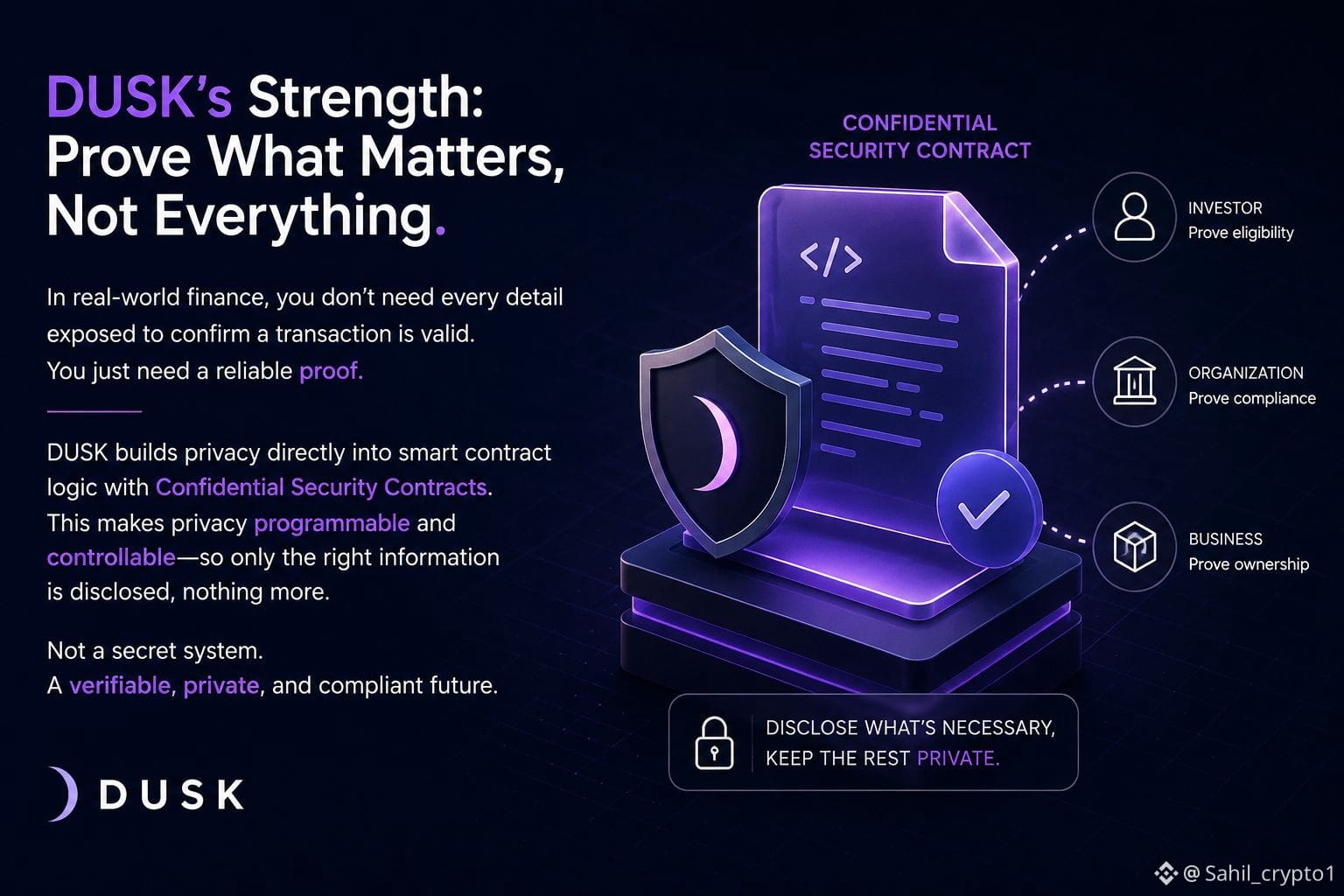
Real-world finance doesn’t need every detail exposed just to prove that a transaction is valid. An investor may need to prove eligibility, a company may need to verify ownership, and institutions may need to demonstrate regulatory compliance.
That’s where DUSK caught my attention. Its approach treats privacy as part of the smart contract logic rather than something added afterward.
Maybe the future of blockchain privacy isn’t making everything invisible. It’s making disclosure programmable — proving exactly what needs to be proven while keeping unnecessary information private.
That could be a much more practical path toward bringing regulated financial activity onchain.@Dusk_Foundation $DUSK
{spot}(DUSKUSDT)
#dusk $DUSK The more I dig into DUSK, the more its privacy model makes sense to me.
Real-world finance doesn’t need every detail exposed just to prove that a transaction is valid. An investor may need to prove eligibility, a company may need to verify ownership, and institutions may need to demonstrate regulatory compliance.
That’s where DUSK caught my attention. Its approach treats privacy as part of the smart contract logic rather than something added afterward.
Maybe the future of blockchain privacy isn’t making everything invisible. It’s making disclosure programmable — proving exactly what needs to be proven while keeping unnecessary information private.
That could be a much more practical path toward bringing regulated financial activity onchain.@Dusk $DUSK
Real-world finance doesn’t need every detail exposed just to prove that a transaction is valid. An investor may need to prove eligibility, a company may need to verify ownership, and institutions may need to demonstrate regulatory compliance.
That’s where DUSK caught my attention. Its approach treats privacy as part of the smart contract logic rather than something added afterward.
Maybe the future of blockchain privacy isn’t making everything invisible. It’s making disclosure programmable — proving exactly what needs to be proven while keeping unnecessary information private.
That could be a much more practical path toward bringing regulated financial activity onchain.@Dusk $DUSK
2
75
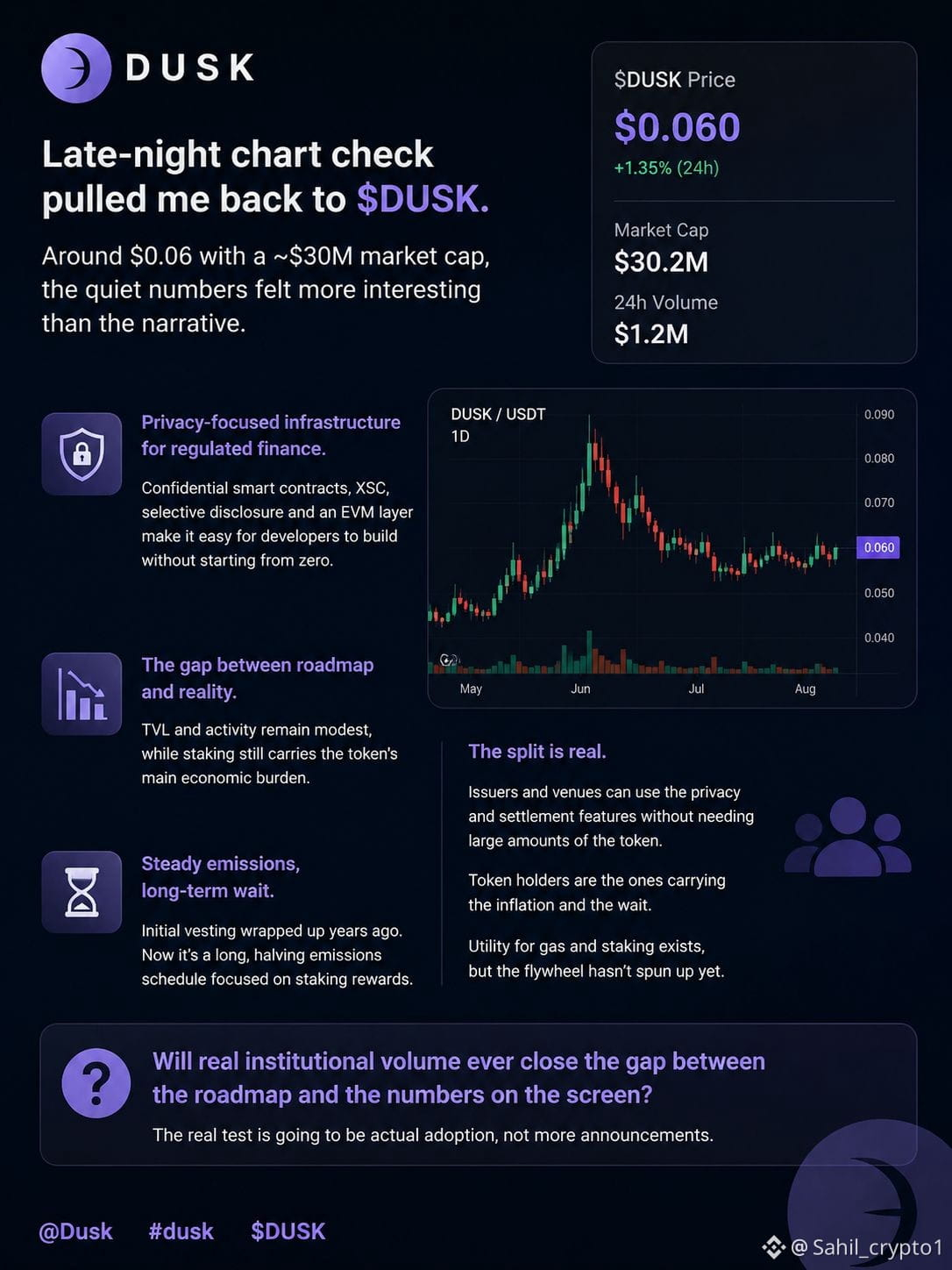
Late-night chart check pulled me back to $DUSK. Around $0.06 with a ~$30M market cap, the quiet numbers felt more interesting than the narrative.
@Dusk_Foundation is building privacy-focused infrastructure for regulated finance, with confidential smart contracts, XSC, selective disclosure and an EVM layer.
The tech story makes sense. What I’m watching now is the gap between the roadmap and actual usage. TVL and activity remain modest, while staking still carries the token’s main economic burden.
Real institutional volume is the part that matters. Until that shows up, $DUSK still feels like a story waiting for its numbers to catch up.
#dusk $ACE
{spot}(ACEUSDT)
$CYS
{future}(CYSUSDT)
{spot}(DUSKUSDT)
Late-night chart check pulled me back to $DUSK . Around $0.06 with a ~$30M market cap, the quiet numbers felt more interesting than the narrative.
@Dusk is building privacy-focused infrastructure for regulated finance, with confidential smart contracts, XSC, selective disclosure and an EVM layer.
The tech story makes sense. What I’m watching now is the gap between the roadmap and actual usage. TVL and activity remain modest, while staking still carries the token’s main economic burden.
Real institutional volume is the part that matters. Until that shows up, $DUSK still feels like a story waiting for its numbers to catch up.
#dusk $ACE
$CYS
@Dusk is building privacy-focused infrastructure for regulated finance, with confidential smart contracts, XSC, selective disclosure and an EVM layer.
The tech story makes sense. What I’m watching now is the gap between the roadmap and actual usage. TVL and activity remain modest, while staking still carries the token’s main economic burden.
Real institutional volume is the part that matters. Until that shows up, $DUSK still feels like a story waiting for its numbers to catch up.
#dusk $ACE
$CYS
1
1
81
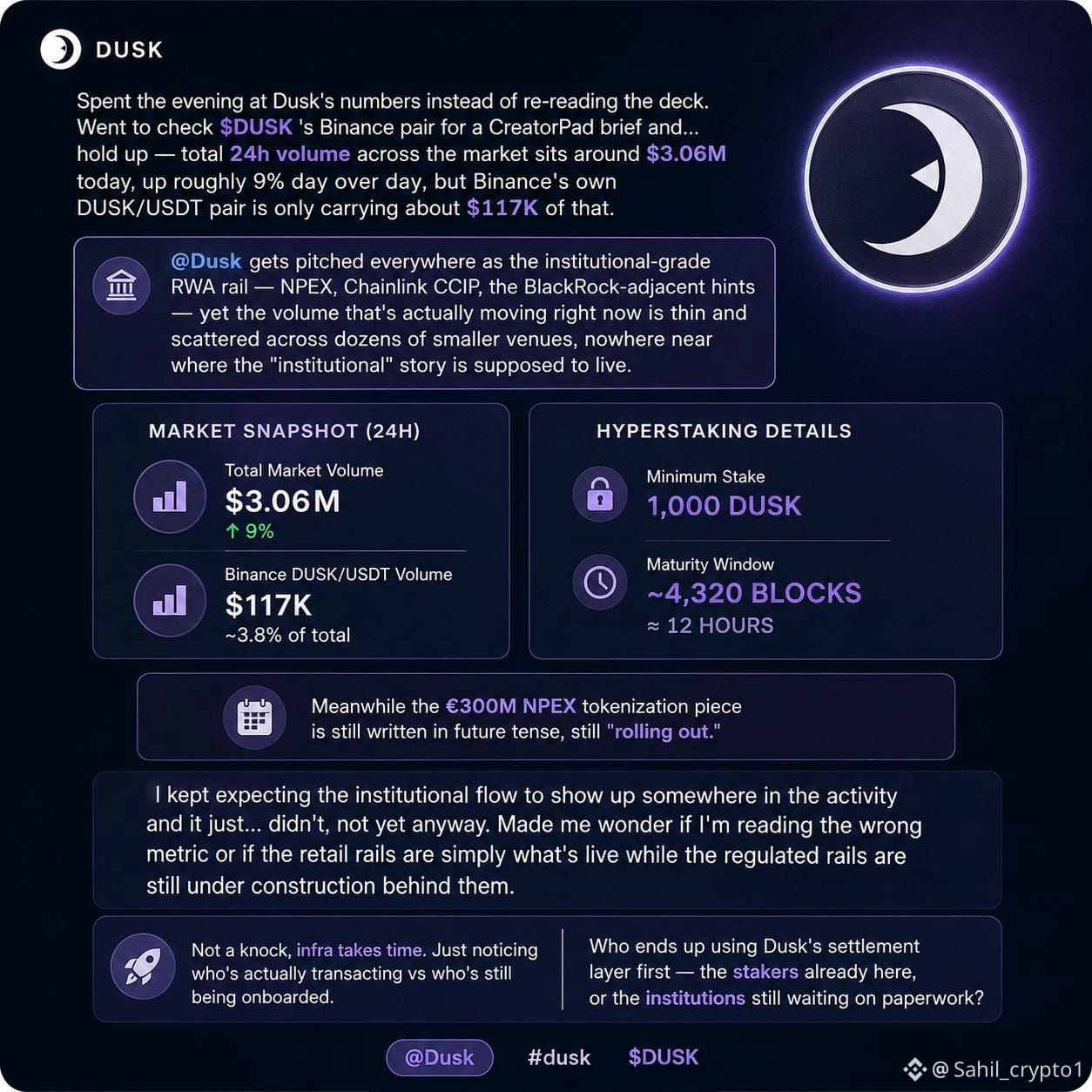
Spent some time digging through $DUSK numbers instead of the usual roadmap headlines.
24h market volume is around $3M, yet Binance’s DUSK/USDT pair is only a small slice of that flow. For a project positioned around institutional RWA infrastructure, that gap caught my attention.
Even Hyperstaking feels very accessible: 1,000 DUSK minimum and roughly a 12-hour maturity window.
So I’m left with one question: is Dusk’s retail activity simply the part that’s live today, while the bigger institutional rails are still being built?
Not bearish — just watching where the actual activity shows up.
Who gets there first: existing stakers or institutions?
@Dusk_Foundation #dusk $DUSK
{spot}(DUSKUSDT)
Spent some time digging through $DUSK numbers instead of the usual roadmap headlines.
24h market volume is around $3M, yet Binance’s DUSK/USDT pair is only a small slice of that flow. For a project positioned around institutional RWA infrastructure, that gap caught my attention.
Even Hyperstaking feels very accessible: 1,000 DUSK minimum and roughly a 12-hour maturity window.
So I’m left with one question: is Dusk’s retail activity simply the part that’s live today, while the bigger institutional rails are still being built?
Not bearish — just watching where the actual activity shows up.
Who gets there first: existing stakers or institutions?
@Dusk #dusk $DUSK
24h market volume is around $3M, yet Binance’s DUSK/USDT pair is only a small slice of that flow. For a project positioned around institutional RWA infrastructure, that gap caught my attention.
Even Hyperstaking feels very accessible: 1,000 DUSK minimum and roughly a 12-hour maturity window.
So I’m left with one question: is Dusk’s retail activity simply the part that’s live today, while the bigger institutional rails are still being built?
Not bearish — just watching where the actual activity shows up.
Who gets there first: existing stakers or institutions?
@Dusk #dusk $DUSK
1
69
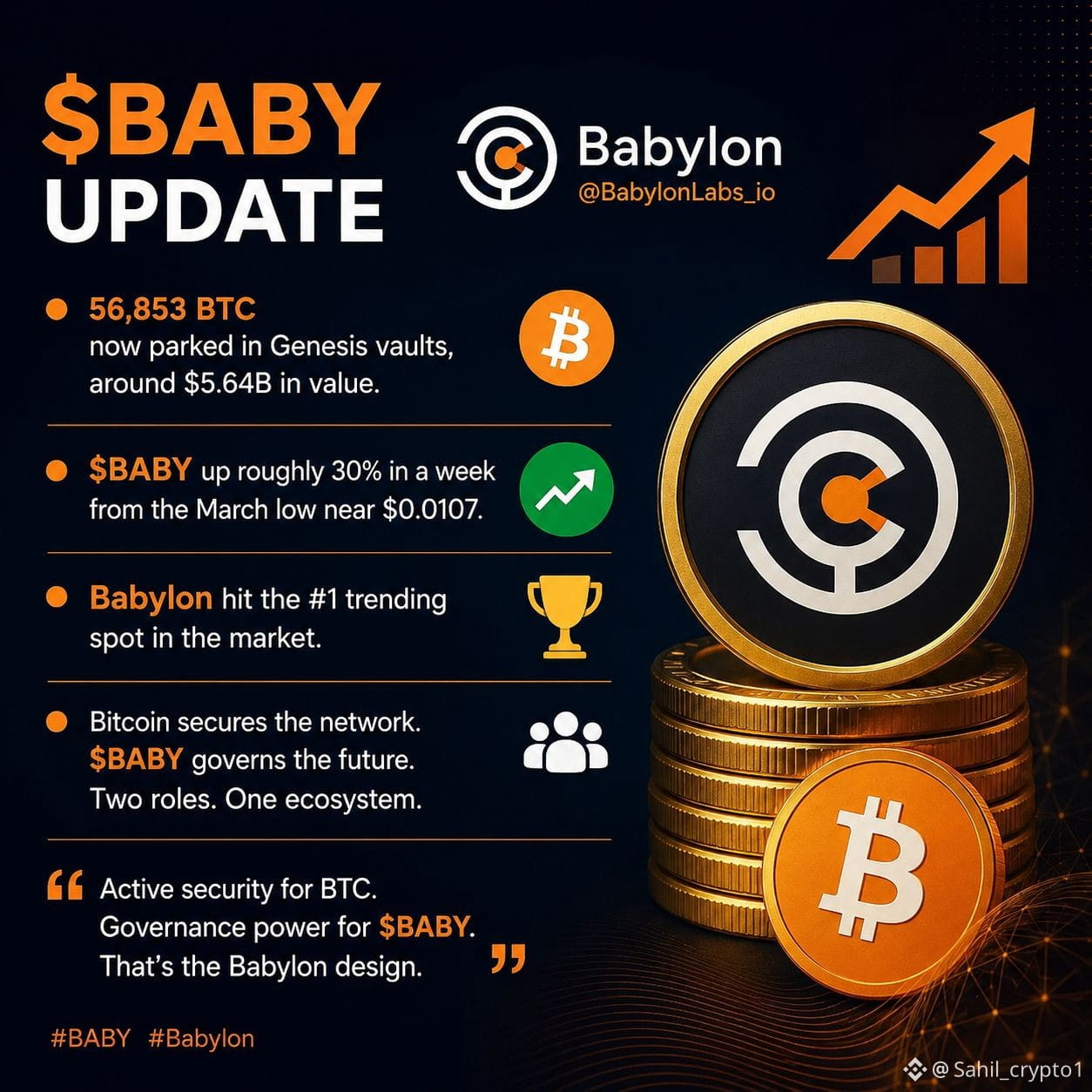
Been following @babylonlabs_io today and one detail stood out beyond the price charts. Around 56,853 BTC is now staked in Genesis vaults, while $BABY has recovered strongly from recent lows.
The more I read, the more I realized Bitcoin's role is security, not governance. BTC holders help secure the network and earn rewards, but protocol upgrades, parameter changes, and governance decisions remain in the hands of $BABY holders through delegation.
It's an interesting separation of responsibilities. Bitcoin supplies the economic security, while BABY supplies the decision-making power. That design may keep governance efficient, but it also means the asset providing the security doesn't directly shape the protocol's future.
Curious to see whether BTC stakers ever gain a stronger governance role, or if this two-layer model is meant to stay permanent.
#Baby $BTC
{spot}(BTCUSDT)
{spot}(BABYUSDT)
Been following @BabylonLabs_io today and one detail stood out beyond the price charts. Around 56,853 BTC is now staked in Genesis vaults, while $BABY has recovered strongly from recent lows.
The more I read, the more I realized Bitcoin's role is security, not governance. BTC holders help secure the network and earn rewards, but protocol upgrades, parameter changes, and governance decisions remain in the hands of $BABY holders through delegation.
It's an interesting separation of responsibilities. Bitcoin supplies the economic security, while BABY supplies the decision-making power. That design may keep governance efficient, but it also means the asset providing the security doesn't directly shape the protocol's future.
Curious to see whether BTC stakers ever gain a stronger governance role, or if this two-layer model is meant to stay permanent.
#Baby $BTC
The more I read, the more I realized Bitcoin's role is security, not governance. BTC holders help secure the network and earn rewards, but protocol upgrades, parameter changes, and governance decisions remain in the hands of $BABY holders through delegation.
It's an interesting separation of responsibilities. Bitcoin supplies the economic security, while BABY supplies the decision-making power. That design may keep governance efficient, but it also means the asset providing the security doesn't directly shape the protocol's future.
Curious to see whether BTC stakers ever gain a stronger governance role, or if this two-layer model is meant to stay permanent.
#Baby $BTC
2
99
Spent some time comparing what was happening around @babylonlabs_io with what was actually happening inside the protocol, and the contrast was interesting.
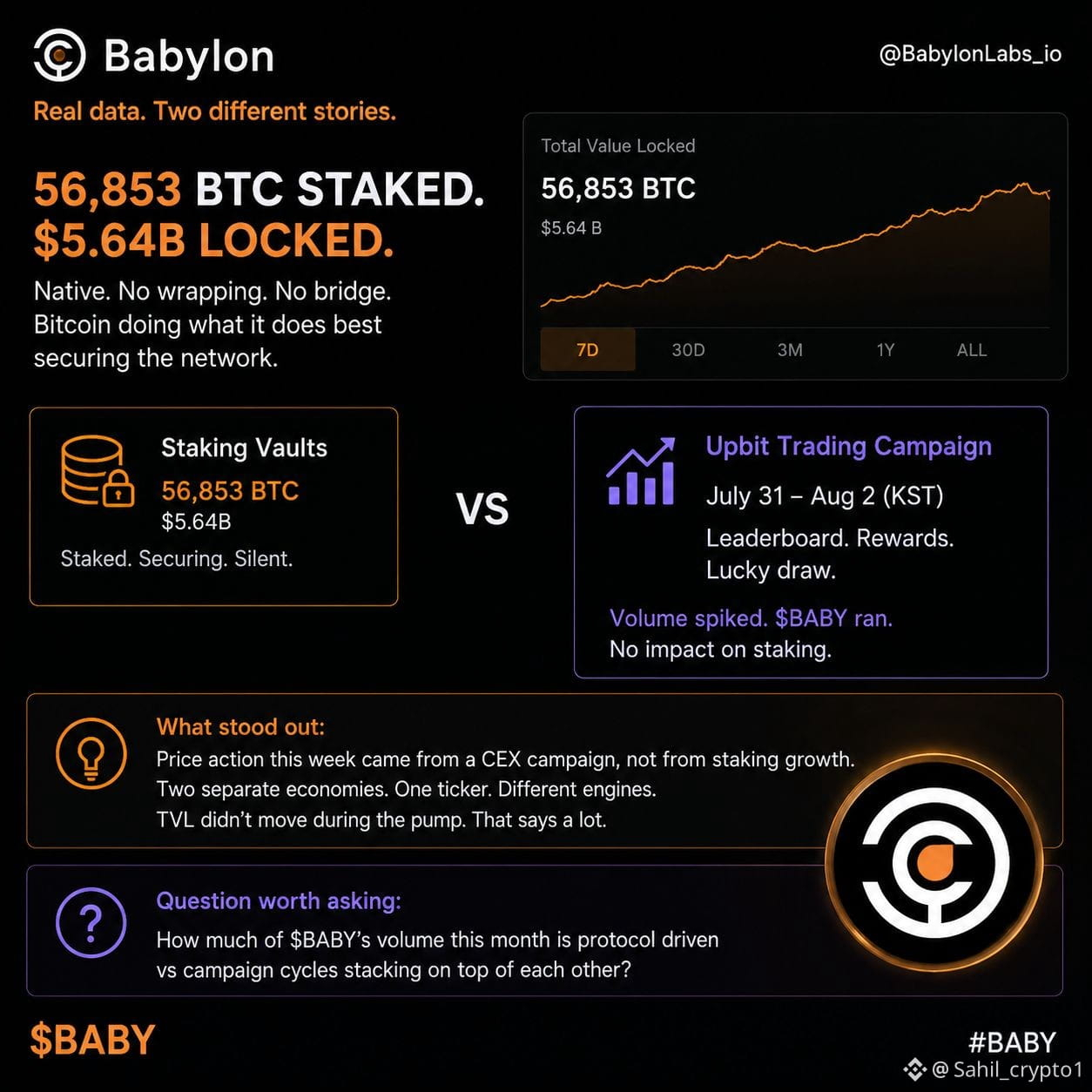
On one side, Bitcoin staking remained remarkably stable. More than 56K BTC stayed locked in Babylon's native staking system, showing that long-term participants weren't rushing to move their capital.
On the other side, most of this week's excitement seemed to come from the Upbit trading campaign. Higher trading activity, leaderboard competition, and reward incentives pushed attention toward $BABY without meaningfully changing on-chain staking activity.
It reminded me that price momentum and protocol adoption don't always move together. Sometimes the market reacts to exchange incentives while the underlying network quietly keeps doing its job in the background.
Watching both metrics side by side probably tells a more complete story than following price alone.
#BABY $BTC $BABY
{future}(BABYUSDT)
{spot}(BTCUSDT)
Spent some time comparing what was happening around @BabylonLabs_io with what was actually happening inside the protocol, and the contrast was interesting.
On one side, Bitcoin staking remained remarkably stable. More than 56K BTC stayed locked in Babylon's native staking system, showing that long-term participants weren't rushing to move their capital.
On the other side, most of this week's excitement seemed to come from the Upbit trading campaign. Higher trading activity, leaderboard competition, and reward incentives pushed attention toward $BABY without meaningfully changing on-chain staking activity.
It reminded me that price momentum and protocol adoption don't always move together. Sometimes the market reacts to exchange incentives while the underlying network quietly keeps doing its job in the background.
Watching both metrics side by side probably tells a more complete story than following price alone.
#BABY $BTC $BABY
On one side, Bitcoin staking remained remarkably stable. More than 56K BTC stayed locked in Babylon's native staking system, showing that long-term participants weren't rushing to move their capital.
On the other side, most of this week's excitement seemed to come from the Upbit trading campaign. Higher trading activity, leaderboard competition, and reward incentives pushed attention toward $BABY without meaningfully changing on-chain staking activity.
It reminded me that price momentum and protocol adoption don't always move together. Sometimes the market reacts to exchange incentives while the underlying network quietly keeps doing its job in the background.
Watching both metrics side by side probably tells a more complete story than following price alone.
#BABY $BTC $BABY
5
2
95
🚨Opened the charts for $BABY after seeing the recent campaign buzz around @babylonlabs_io and decided to dig deeper instead of stopping at the price action.
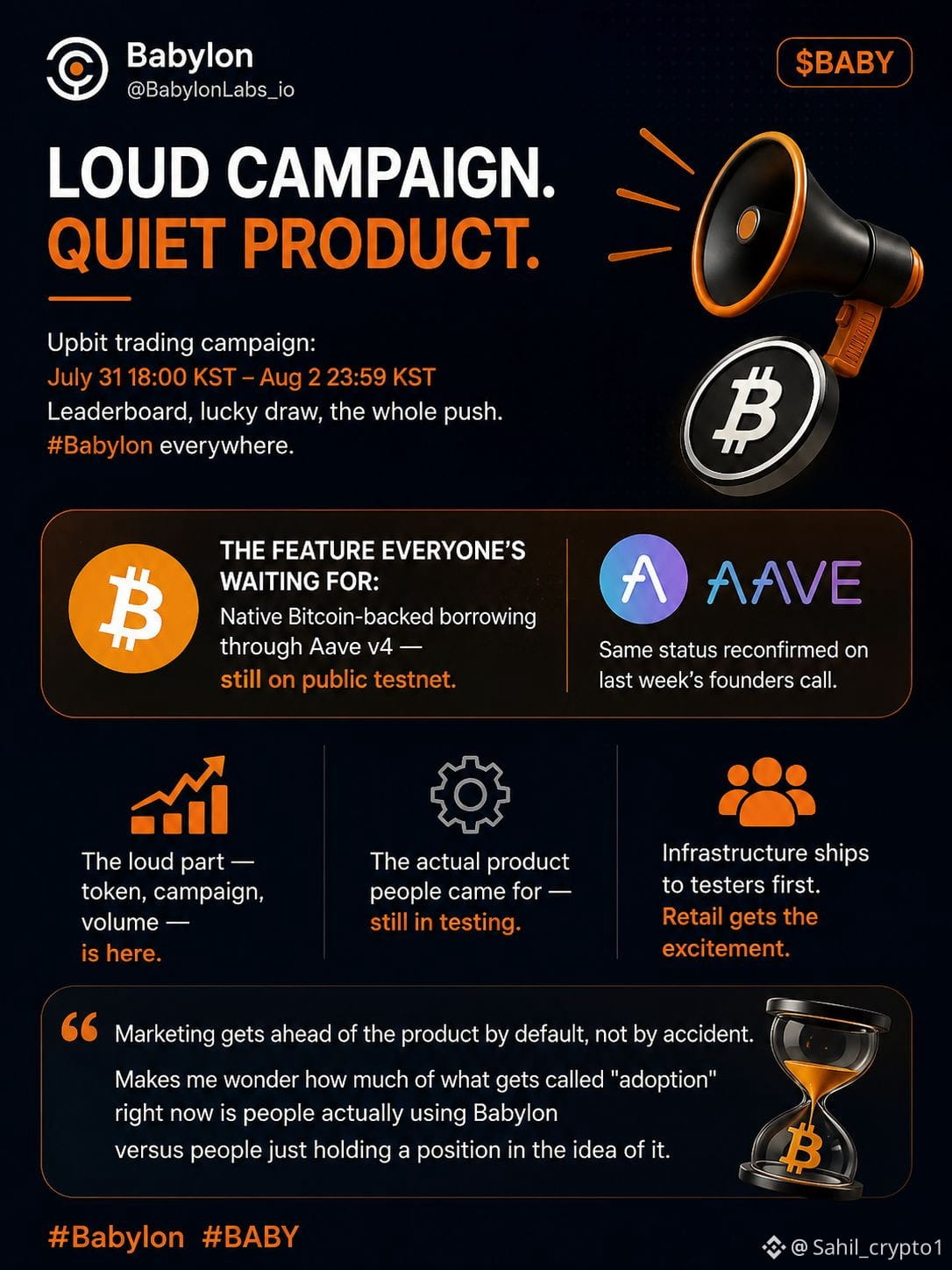
The trading campaign brought plenty of attention, but I was more interested in the feature Babylon keeps highlighting: using native Bitcoin as collateral without giving up custody. After checking the latest updates, that borrowing flow through the Aave v4 integration is still available on public testnet rather than mainnet.
That wasn't disappointing—it was a reminder of how crypto projects usually evolve. Community campaigns, exchange activity, and token trading often arrive before the flagship product reaches everyday users. Builders gather feedback, fix edge cases, and harden the infrastructure while the market trades the future potential.
It creates an interesting gap. Price reflects expectations, while adoption depends on people using the product once it's live. Those two don't always move together.
I'll be watching less for campaign numbers and more for the moment native Bitcoin-backed borrowing reaches production. That's when we'll get a clearer picture of how much demand exists beyond the excitement.
#Babylon #BABY $BTC
{spot}(BABYUSDT)
{spot}(BTCUSDT)
🚨Opened the charts for $BABY after seeing the recent campaign buzz around @BabylonLabs_io and decided to dig deeper instead of stopping at the price action.
The trading campaign brought plenty of attention, but I was more interested in the feature Babylon keeps highlighting: using native Bitcoin as collateral without giving up custody. After checking the latest updates, that borrowing flow through the Aave v4 integration is still available on public testnet rather than mainnet.
That wasn't disappointing—it was a reminder of how crypto projects usually evolve. Community campaigns, exchange activity, and token trading often arrive before the flagship product reaches everyday users. Builders gather feedback, fix edge cases, and harden the infrastructure while the market trades the future potential.
It creates an interesting gap. Price reflects expectations, while adoption depends on people using the product once it's live. Those two don't always move together.
I'll be watching less for campaign numbers and more for the moment native Bitcoin-backed borrowing reaches production. That's when we'll get a clearer picture of how much demand exists beyond the excitement.
#Babylon #BABY $BTC
The trading campaign brought plenty of attention, but I was more interested in the feature Babylon keeps highlighting: using native Bitcoin as collateral without giving up custody. After checking the latest updates, that borrowing flow through the Aave v4 integration is still available on public testnet rather than mainnet.
That wasn't disappointing—it was a reminder of how crypto projects usually evolve. Community campaigns, exchange activity, and token trading often arrive before the flagship product reaches everyday users. Builders gather feedback, fix edge cases, and harden the infrastructure while the market trades the future potential.
It creates an interesting gap. Price reflects expectations, while adoption depends on people using the product once it's live. Those two don't always move together.
I'll be watching less for campaign numbers and more for the moment native Bitcoin-backed borrowing reaches production. That's when we'll get a clearer picture of how much demand exists beyond the excitement.
#Babylon #BABY $BTC
2
1
114
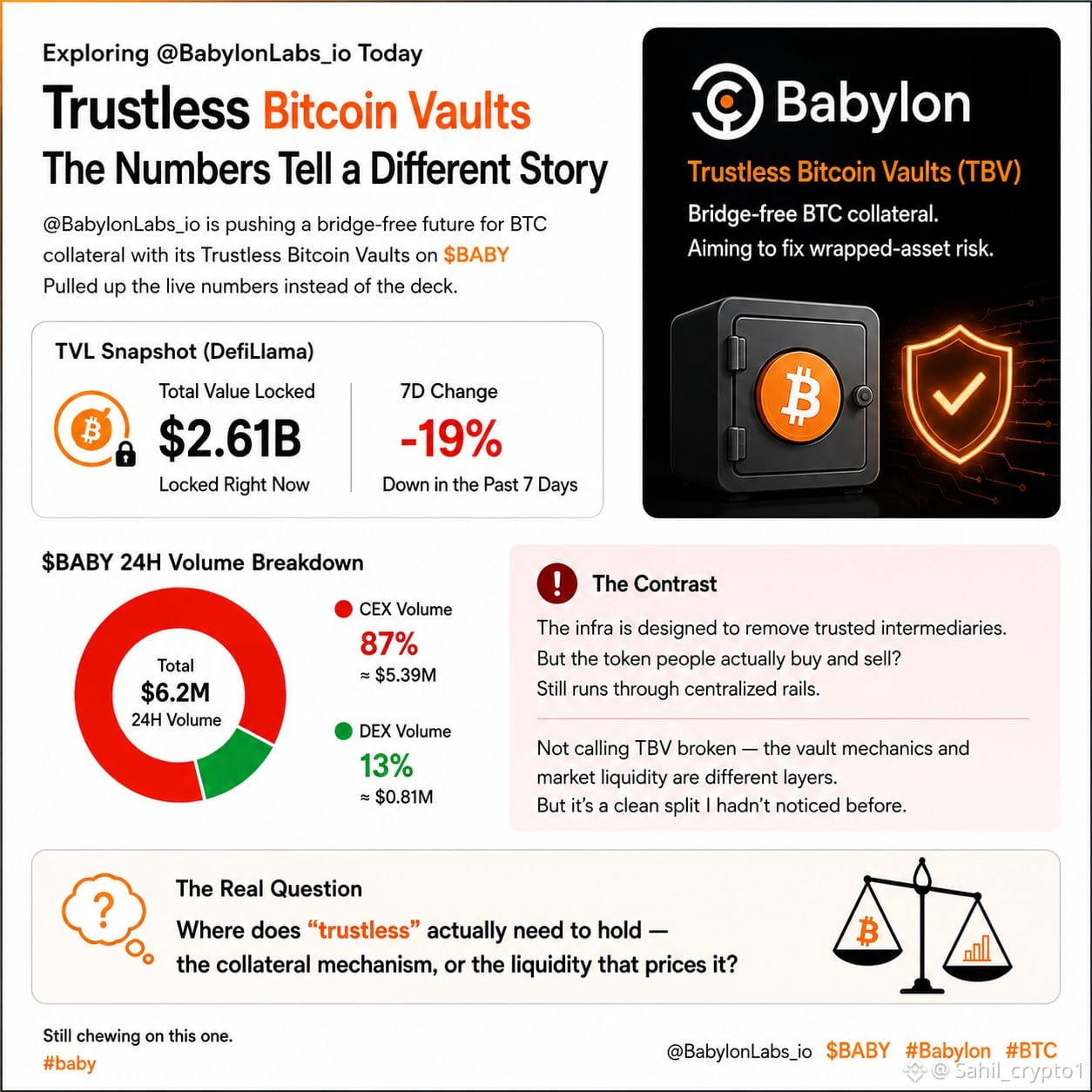
Spent some time exploring @babylonlabs_io today and one thing kept pulling me back. Everyone talks about Trustless Bitcoin Vaults because they let BTC stay native instead of relying on wrapped assets, but the market tells a different story.
The protocol is pushing Bitcoin toward a bridge-free future while most $BABY trading still happens through centralized venues. That contrast is interesting. Decentralized infrastructure doesn't automatically create decentralized liquidity.
It made me realize that "trustless" isn't a single checkbox. The collateral can be trust-minimized, yet the token's price discovery can still depend on traditional exchange flow. Maybe that's just where the ecosystem is today—or maybe it's the next challenge Babylon has to solve.
Curious to see how this balance changes as the ecosystem grows.
#Baby #Babylon $BTC
{future}(BABYUSDT)
{spot}(BTCUSDT)
Spent some time exploring @BabylonLabs_io today and one thing kept pulling me back. Everyone talks about Trustless Bitcoin Vaults because they let BTC stay native instead of relying on wrapped assets, but the market tells a different story.
The protocol is pushing Bitcoin toward a bridge-free future while most $BABY trading still happens through centralized venues. That contrast is interesting. Decentralized infrastructure doesn't automatically create decentralized liquidity.
It made me realize that "trustless" isn't a single checkbox. The collateral can be trust-minimized, yet the token's price discovery can still depend on traditional exchange flow. Maybe that's just where the ecosystem is today—or maybe it's the next challenge Babylon has to solve.
Curious to see how this balance changes as the ecosystem grows.
#Baby #Babylon $BTC
The protocol is pushing Bitcoin toward a bridge-free future while most $BABY trading still happens through centralized venues. That contrast is interesting. Decentralized infrastructure doesn't automatically create decentralized liquidity.
It made me realize that "trustless" isn't a single checkbox. The collateral can be trust-minimized, yet the token's price discovery can still depend on traditional exchange flow. Maybe that's just where the ecosystem is today—or maybe it's the next challenge Babylon has to solve.
Curious to see how this balance changes as the ecosystem grows.
#Baby #Babylon $BTC
2
1
81
Spent some time digging through @babylonlabs_io documentation today and one detail kept pulling me back. Bitcoin locked through the Trustless Vault remains native on the Bitcoin network while being used as productive collateral elsewhere. That part is technically elegant.
Then I checked the market. $BABY is still trading around a relatively small valuation compared with the billions of dollars in BTC the ecosystem helps secure. The contrast is hard to ignore.
Infrastructure can be operating exactly as intended while the market takes much longer to recognize its value. Whether that gap narrows will likely depend on adoption, borrowing demand, and real protocol activity—not just narratives.
For now, I'm watching the fundamentals more than the price.
#BABY #Bitcoin $BTC
{spot}(BTCUSDT)
{spot}(BABYUSDT)
Spent some time digging through @BabylonLabs_io documentation today and one detail kept pulling me back. Bitcoin locked through the Trustless Vault remains native on the Bitcoin network while being used as productive collateral elsewhere. That part is technically elegant.
Then I checked the market. $BABY is still trading around a relatively small valuation compared with the billions of dollars in BTC the ecosystem helps secure. The contrast is hard to ignore.
Infrastructure can be operating exactly as intended while the market takes much longer to recognize its value. Whether that gap narrows will likely depend on adoption, borrowing demand, and real protocol activity—not just narratives.
For now, I'm watching the fundamentals more than the price.
#BABY #Bitcoin $BTC
Then I checked the market. $BABY is still trading around a relatively small valuation compared with the billions of dollars in BTC the ecosystem helps secure. The contrast is hard to ignore.
Infrastructure can be operating exactly as intended while the market takes much longer to recognize its value. Whether that gap narrows will likely depend on adoption, borrowing demand, and real protocol activity—not just narratives.
For now, I'm watching the fundamentals more than the price.
#BABY #Bitcoin $BTC

3
1
112
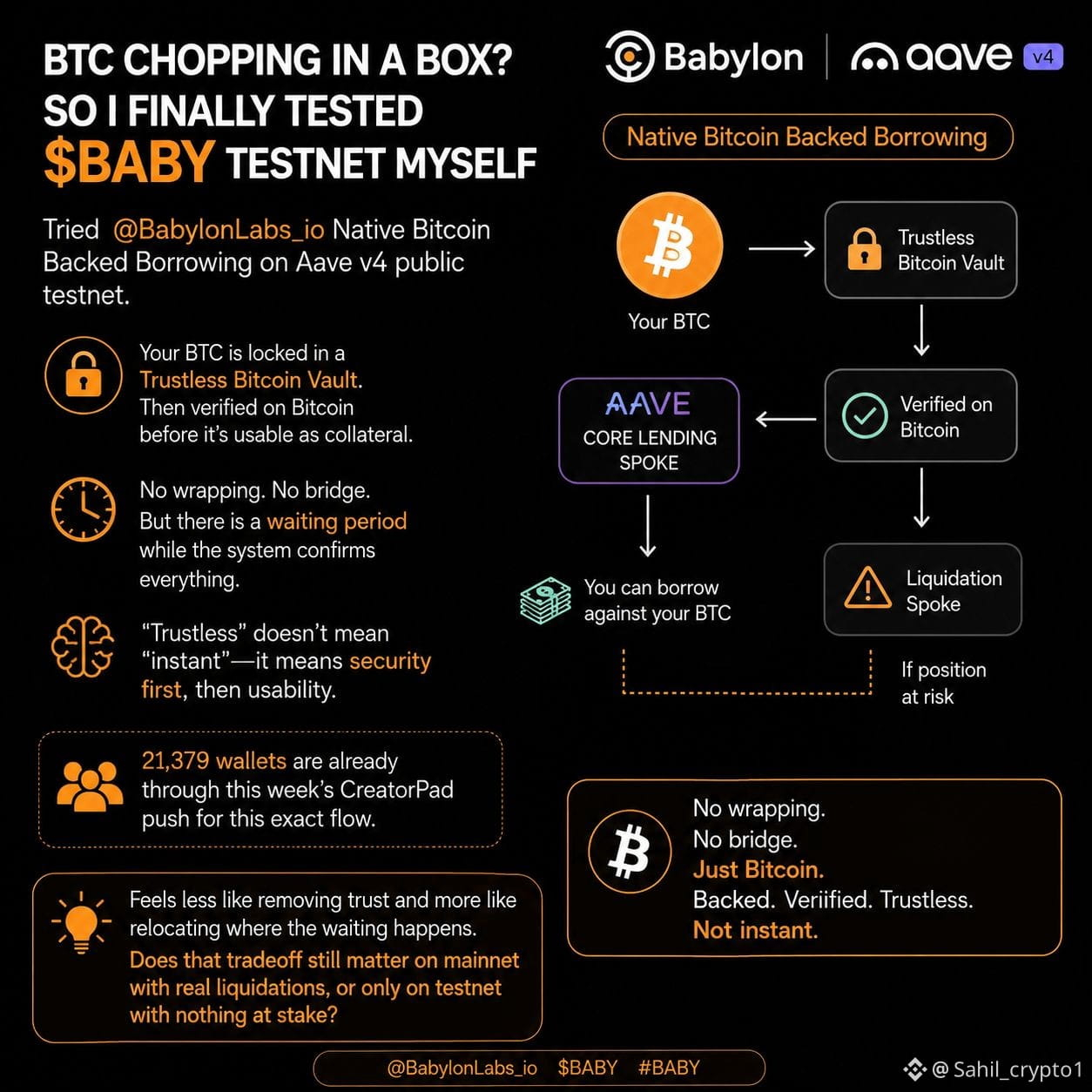
BTC has barely moved for days, so I finally stopped watching charts and tested Babylon's Native Bitcoin Backed Borrowing flow myself.
One thing stood out: "trustless" doesn't mean "instant."
Your BTC is locked inside a Trustless Bitcoin Vault, then verified on Bitcoin before it becomes usable as collateral. No wrapping, no bridge—but there is still a waiting period while the protocol confirms everything.
That delay actually made me think. Maybe the goal isn't eliminating friction, but shifting it toward stronger security.
Curious to see how this feels once mainnet liquidity, borrowing limits, and real liquidations are live.
@babylonlabs_io o #BABY $BABY
{spot}(BABYUSDT)
$BTC
{spot}(BTCUSDT)
BTC has barely moved for days, so I finally stopped watching charts and tested Babylon's Native Bitcoin Backed Borrowing flow myself.
One thing stood out: "trustless" doesn't mean "instant."
Your BTC is locked inside a Trustless Bitcoin Vault, then verified on Bitcoin before it becomes usable as collateral. No wrapping, no bridge—but there is still a waiting period while the protocol confirms everything.
That delay actually made me think. Maybe the goal isn't eliminating friction, but shifting it toward stronger security.
Curious to see how this feels once mainnet liquidity, borrowing limits, and real liquidations are live.
@BabylonLabs_io o #BABY $BABY
$BTC
One thing stood out: "trustless" doesn't mean "instant."
Your BTC is locked inside a Trustless Bitcoin Vault, then verified on Bitcoin before it becomes usable as collateral. No wrapping, no bridge—but there is still a waiting period while the protocol confirms everything.
That delay actually made me think. Maybe the goal isn't eliminating friction, but shifting it toward stronger security.
Curious to see how this feels once mainnet liquidity, borrowing limits, and real liquidations are live.
@BabylonLabs_io o #BABY $BABY
$BTC
5
1
77
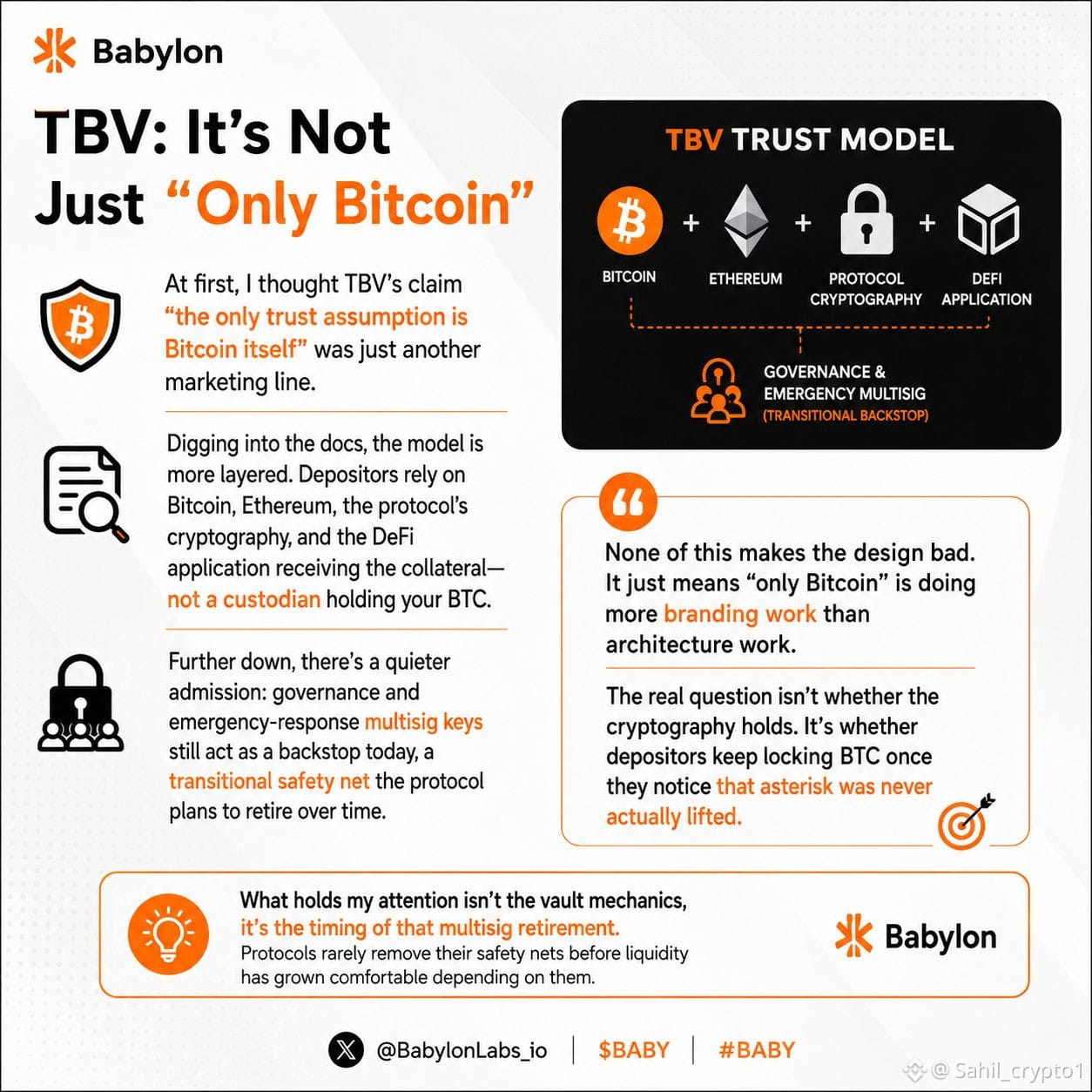
I went into TBV thinking the headline was simple: trust Bitcoin and nothing else. After reading deeper, the model is more nuanced. Depositors rely on Bitcoin, Ethereum, protocol cryptography, and the destination DeFi application—not a custodian. That's a meaningful shift, but it's not the whole story.
The detail that caught my attention was the governance and emergency multisig. The docs present it as a temporary safeguard that will eventually be removed as the system matures. That feels less like a flaw and more like an important milestone to watch.
For me, the biggest signal won't be TVL alone. It'll be the moment those fallback controls disappear and the protocol operates exactly as its long-term design intends. That's when the trust model will really be tested.
@babylonlabs_io $BABY #BABY $BTC $ETH
I went into TBV thinking the headline was simple: trust Bitcoin and nothing else. After reading deeper, the model is more nuanced. Depositors rely on Bitcoin, Ethereum, protocol cryptography, and the destination DeFi application—not a custodian. That's a meaningful shift, but it's not the whole story.
The detail that caught my attention was the governance and emergency multisig. The docs present it as a temporary safeguard that will eventually be removed as the system matures. That feels less like a flaw and more like an important milestone to watch.
For me, the biggest signal won't be TVL alone. It'll be the moment those fallback controls disappear and the protocol operates exactly as its long-term design intends. That's when the trust model will really be tested.
@BabylonLabs_io $BABY #BABY $BTC $ETH
The detail that caught my attention was the governance and emergency multisig. The docs present it as a temporary safeguard that will eventually be removed as the system matures. That feels less like a flaw and more like an important milestone to watch.
For me, the biggest signal won't be TVL alone. It'll be the moment those fallback controls disappear and the protocol operates exactly as its long-term design intends. That's when the trust model will really be tested.
@BabylonLabs_io $BABY #BABY $BTC $ETH
4
1
112
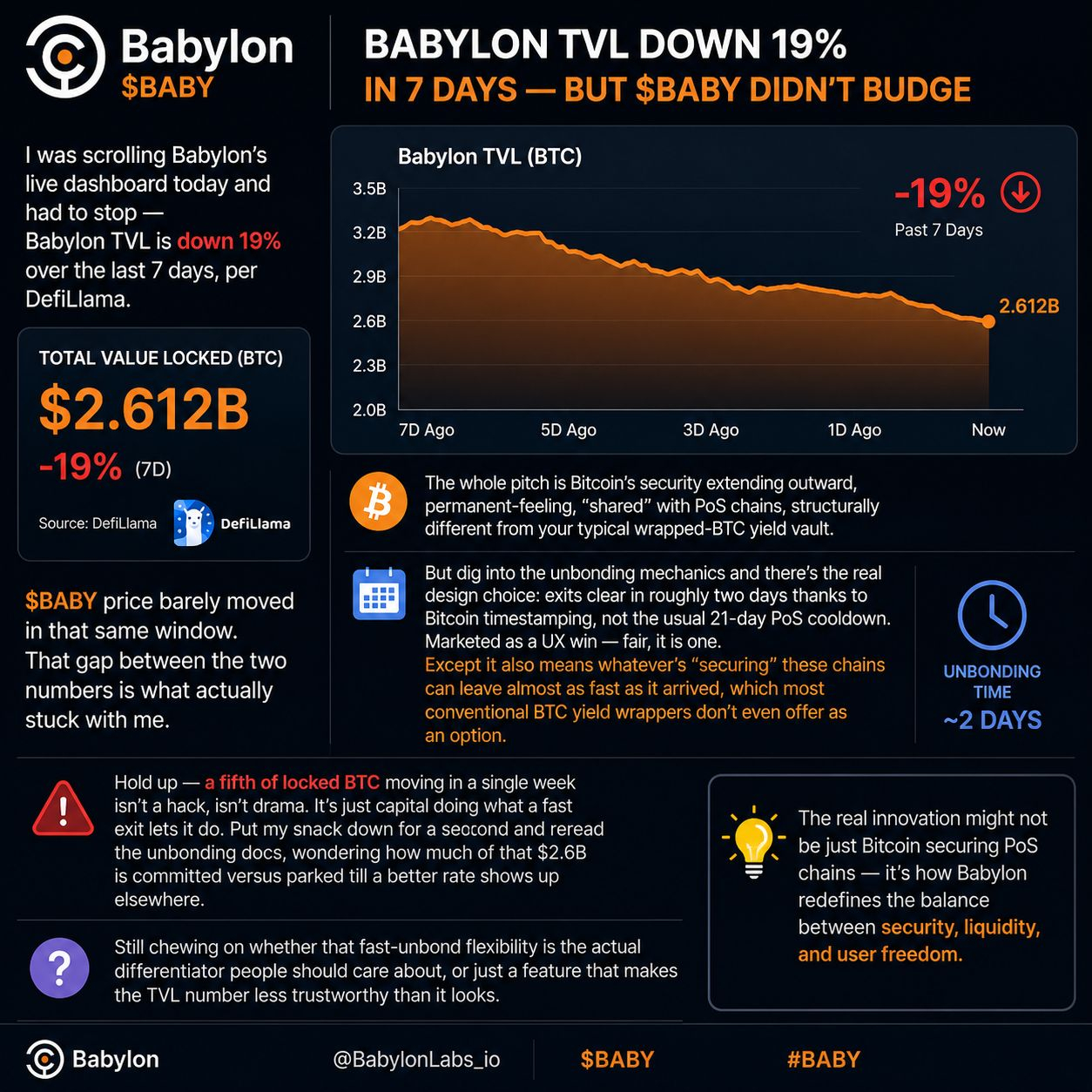
I opened the Babylon dashboard expecting the usual steady numbers, but one metric made me pause. Over the past week, Babylon's BTC TVL has dropped sharply while $BABY barely reacted. That disconnect feels more interesting than the price itself.
The more I read, the more I realized Babylon's fast unbonding changes how TVL should be interpreted. With exits taking around two days instead of the long waiting periods common on many PoS networks, capital can rotate much faster. That's great for flexibility, but it also means TVL may reflect short-term opportunity more than long-term conviction.
A falling TVL doesn't automatically signal weakness. Sometimes it's simply liquidity moving where yields or incentives look better. The bigger question is whether Bitcoin security remains resilient when participants have such a low-friction exit.
I'm starting to think the real innovation isn't just Bitcoin securing PoS chains—it's how Babylon redefines the balance between security, liquidity, and user freedom.
@babylonlabs_io #Baby $BABY
{spot}(BABYUSDT)
I opened the Babylon dashboard expecting the usual steady numbers, but one metric made me pause. Over the past week, Babylon's BTC TVL has dropped sharply while $BABY barely reacted. That disconnect feels more interesting than the price itself.
The more I read, the more I realized Babylon's fast unbonding changes how TVL should be interpreted. With exits taking around two days instead of the long waiting periods common on many PoS networks, capital can rotate much faster. That's great for flexibility, but it also means TVL may reflect short-term opportunity more than long-term conviction.
A falling TVL doesn't automatically signal weakness. Sometimes it's simply liquidity moving where yields or incentives look better. The bigger question is whether Bitcoin security remains resilient when participants have such a low-friction exit.
I'm starting to think the real innovation isn't just Bitcoin securing PoS chains—it's how Babylon redefines the balance between security, liquidity, and user freedom.
@BabylonLabs_io #Baby $BABY
The more I read, the more I realized Babylon's fast unbonding changes how TVL should be interpreted. With exits taking around two days instead of the long waiting periods common on many PoS networks, capital can rotate much faster. That's great for flexibility, but it also means TVL may reflect short-term opportunity more than long-term conviction.
A falling TVL doesn't automatically signal weakness. Sometimes it's simply liquidity moving where yields or incentives look better. The bigger question is whether Bitcoin security remains resilient when participants have such a low-friction exit.
I'm starting to think the real innovation isn't just Bitcoin securing PoS chains—it's how Babylon redefines the balance between security, liquidity, and user freedom.
@BabylonLabs_io #Baby $BABY
1
2
82
🚀I kept asking myself what @BabylonLabs_io was really about.
At first I thought it was just another staking ecosystem. More TVL, more rewards, more numbers to compare.
Then I spent time inside the community.
What stood out wasn't the charts or the market talk. It was how people showed up for each other. Conversations drifted from Bitcoin to everyday life, from technical questions to random moments that somehow made everyone smile.
Crypto can feel noisy. Prices move, sentiment flips, timelines chase the next trend. But a strong community gives you a reason to stay when the excitement fades.
That's what I see in Babylon. A place where people learn together, celebrate small wins, and remind each other there's more to this space than green candles.
Sometimes the biggest value isn't the token in your wallet.
It's the people standing beside you through every cycle.
💚 @babylonlabs_io #BABY $BABY $VANRY $DEXE
{future}(DEXEUSDT)
{spot}(VANRYUSDT)
{spot}(BABYUSDT)
🚀I kept asking myself what @BabylonLabs_io was really about.
At first I thought it was just another staking ecosystem. More TVL, more rewards, more numbers to compare.
Then I spent time inside the community.
What stood out wasn't the charts or the market talk. It was how people showed up for each other. Conversations drifted from Bitcoin to everyday life, from technical questions to random moments that somehow made everyone smile.
Crypto can feel noisy. Prices move, sentiment flips, timelines chase the next trend. But a strong community gives you a reason to stay when the excitement fades.
That's what I see in Babylon. A place where people learn together, celebrate small wins, and remind each other there's more to this space than green candles.
Sometimes the biggest value isn't the token in your wallet.
It's the people standing beside you through every cycle.
💚 @BabylonLabs_io #BABY $BABY $VANRY $DEXE
At first I thought it was just another staking ecosystem. More TVL, more rewards, more numbers to compare.
Then I spent time inside the community.
What stood out wasn't the charts or the market talk. It was how people showed up for each other. Conversations drifted from Bitcoin to everyday life, from technical questions to random moments that somehow made everyone smile.
Crypto can feel noisy. Prices move, sentiment flips, timelines chase the next trend. But a strong community gives you a reason to stay when the excitement fades.
That's what I see in Babylon. A place where people learn together, celebrate small wins, and remind each other there's more to this space than green candles.
Sometimes the biggest value isn't the token in your wallet.
It's the people standing beside you through every cycle.
💚 @BabylonLabs_io #BABY $BABY $VANRY $DEXE
1
2
298
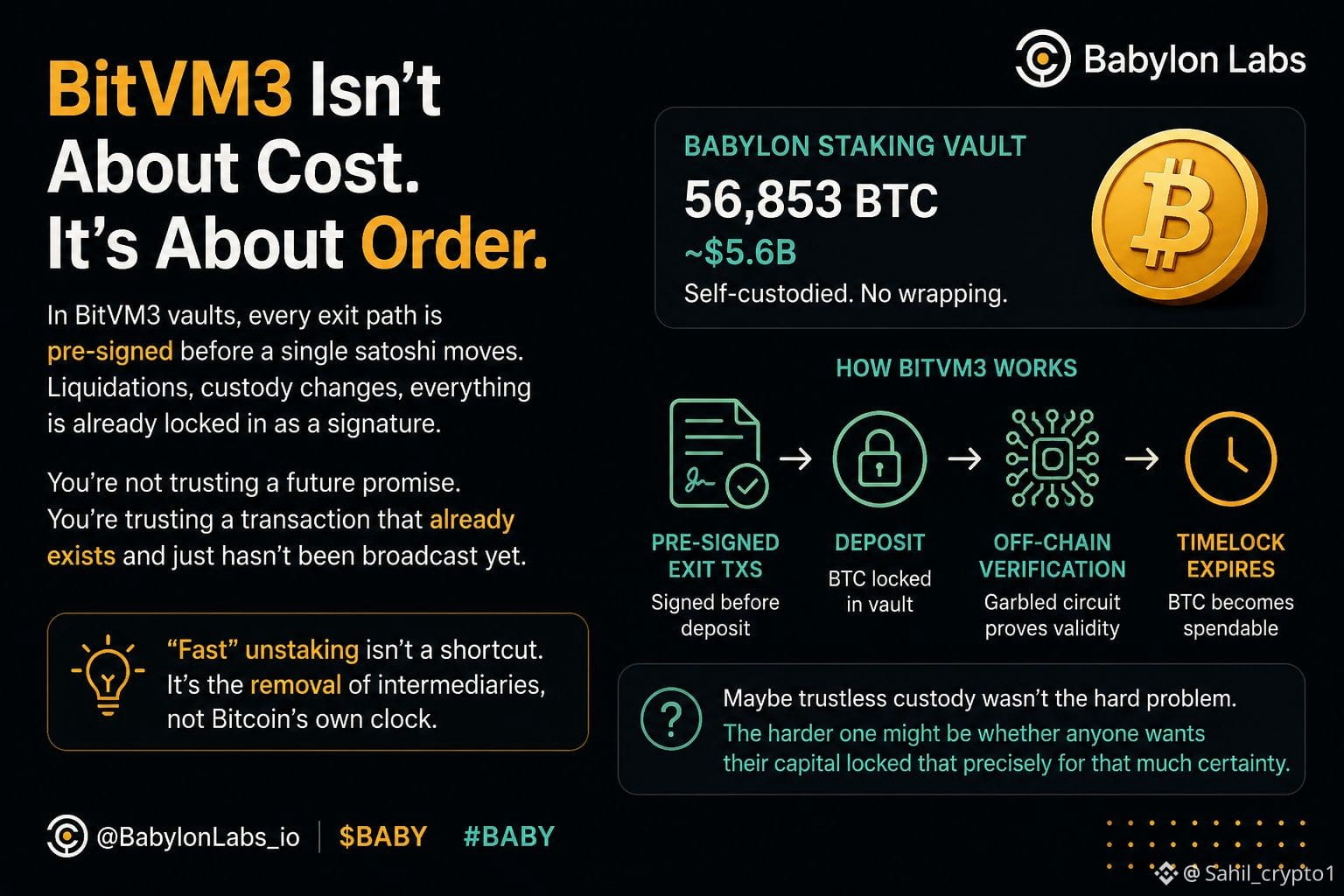
@babylonlabs_io I originally thought Babylon's "fast unstaking" meant BTC became available much sooner. After looking closer, the interesting part isn't a shorter waiting period—it's the removal of unnecessary trust.
Babylon still follows Bitcoin's native unbonding timeline. What changes is what happens afterward. There isn't an extra claim transaction, custodian approval, or intermediary required before you regain control. Once the unbonding period ends, your BTC is simply spendable again.
That distinction matters. "Fast" doesn't mean bypassing Bitcoin's security model. It means eliminating additional layers that many BTC wrappers introduce after unbonding. With over 56,853 BTC secured in Babylon's staking system, that design choice feels more important than the headline itself.
#baby $BTC $BABY
{future}(BABYUSDT)
{spot}(BTCUSDT)
@BabylonLabs_io I originally thought Babylon's "fast unstaking" meant BTC became available much sooner. After looking closer, the interesting part isn't a shorter waiting period—it's the removal of unnecessary trust.
Babylon still follows Bitcoin's native unbonding timeline. What changes is what happens afterward. There isn't an extra claim transaction, custodian approval, or intermediary required before you regain control. Once the unbonding period ends, your BTC is simply spendable again.
That distinction matters. "Fast" doesn't mean bypassing Bitcoin's security model. It means eliminating additional layers that many BTC wrappers introduce after unbonding. With over 56,853 BTC secured in Babylon's staking system, that design choice feels more important than the headline itself.
#baby $BTC $BABY
Babylon still follows Bitcoin's native unbonding timeline. What changes is what happens afterward. There isn't an extra claim transaction, custodian approval, or intermediary required before you regain control. Once the unbonding period ends, your BTC is simply spendable again.
That distinction matters. "Fast" doesn't mean bypassing Bitcoin's security model. It means eliminating additional layers that many BTC wrappers introduce after unbonding. With over 56,853 BTC secured in Babylon's staking system, that design choice feels more important than the headline itself.
#baby $BTC $BABY
4
2
101
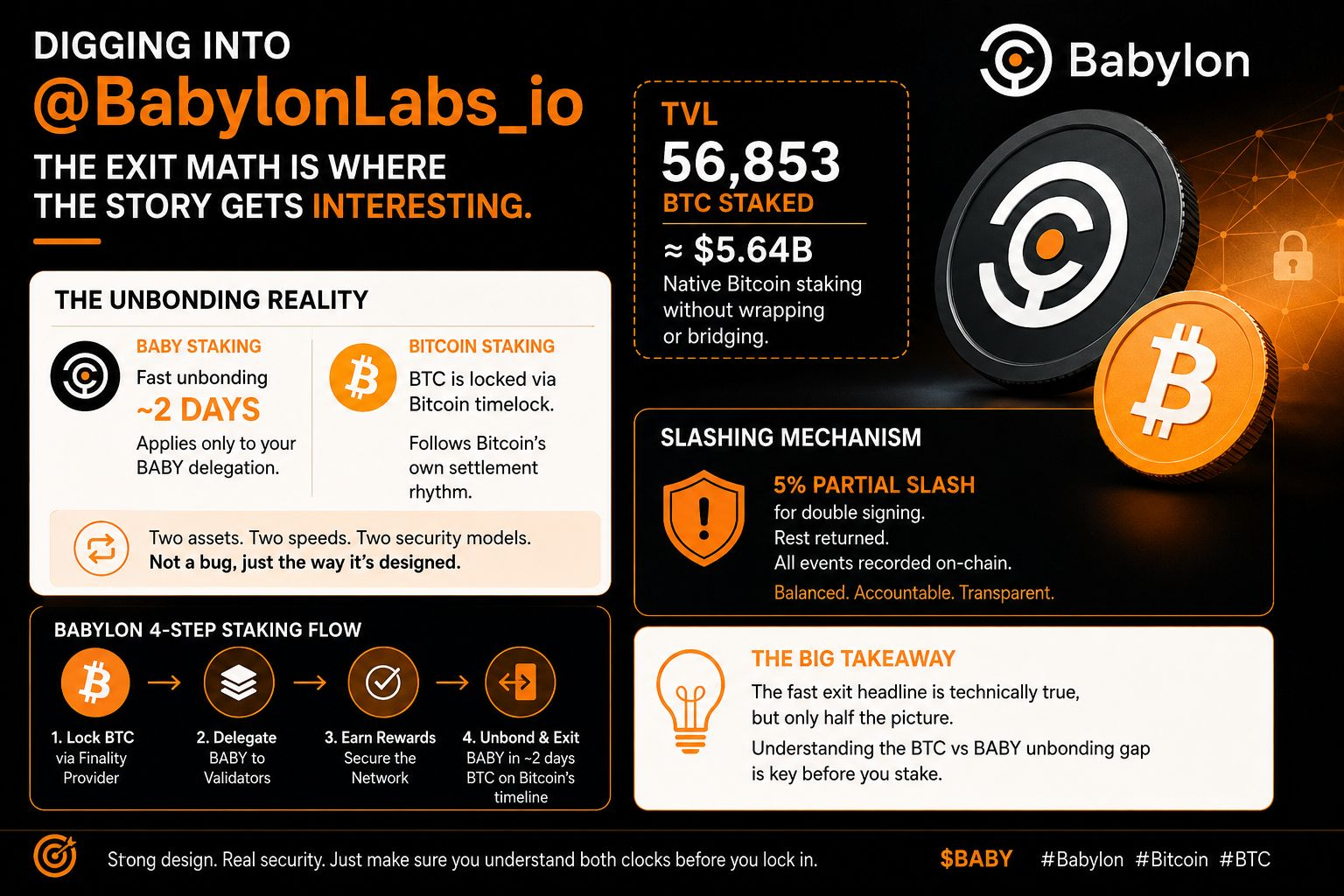
🚀Spent some time digging into @BabylonLabs_io and one detail stood out more than the headline numbers.
With over 56,853 BTC staked, Babylon has proven there's strong demand for native Bitcoin staking without wrapping or bridging assets. But the more interesting part is how the protocol handles exits.
BABY staking offers fast unbonding, around 2 days, which sounds impressive at first glance. The catch is that this only applies to your BABY delegation. The BTC secured through Bitcoin timelocks follows its own settlement process, operating independently from Babylon's validator epochs.
That distinction matters because two assets are moving under two different security models. It's not misleading, but it's an important nuance that many people may overlook when comparing staking experiences.
I also spent time reading through the slashing design. Double-signing results in a 5% partial slash, with the remaining stake returned and every event recorded on-chain. The mechanism feels balanced, prioritizing accountability without being overly punitive.
The biggest takeaway wasn't the TVL or the fast unbonding claim. It was realizing that understanding Babylon means understanding the separation between Bitcoin's security guarantees and BABY's staking mechanics.
That's where the real design trade-offs become clear.
$BABY #Baby #Bitcoin $BTC @babylonlabs_io
{spot}(BTCUSDT)
{spot}(BABYUSDT)
🚀Spent some time digging into @BabylonLabs_io and one detail stood out more than the headline numbers.
With over 56,853 BTC staked, Babylon has proven there's strong demand for native Bitcoin staking without wrapping or bridging assets. But the more interesting part is how the protocol handles exits.
BABY staking offers fast unbonding, around 2 days, which sounds impressive at first glance. The catch is that this only applies to your BABY delegation. The BTC secured through Bitcoin timelocks follows its own settlement process, operating independently from Babylon's validator epochs.
That distinction matters because two assets are moving under two different security models. It's not misleading, but it's an important nuance that many people may overlook when comparing staking experiences.
I also spent time reading through the slashing design. Double-signing results in a 5% partial slash, with the remaining stake returned and every event recorded on-chain. The mechanism feels balanced, prioritizing accountability without being overly punitive.
The biggest takeaway wasn't the TVL or the fast unbonding claim. It was realizing that understanding Babylon means understanding the separation between Bitcoin's security guarantees and BABY's staking mechanics.
That's where the real design trade-offs become clear.
$BABY #Baby #Bitcoin $BTC @BabylonLabs_io
With over 56,853 BTC staked, Babylon has proven there's strong demand for native Bitcoin staking without wrapping or bridging assets. But the more interesting part is how the protocol handles exits.
BABY staking offers fast unbonding, around 2 days, which sounds impressive at first glance. The catch is that this only applies to your BABY delegation. The BTC secured through Bitcoin timelocks follows its own settlement process, operating independently from Babylon's validator epochs.
That distinction matters because two assets are moving under two different security models. It's not misleading, but it's an important nuance that many people may overlook when comparing staking experiences.
I also spent time reading through the slashing design. Double-signing results in a 5% partial slash, with the remaining stake returned and every event recorded on-chain. The mechanism feels balanced, prioritizing accountability without being overly punitive.
The biggest takeaway wasn't the TVL or the fast unbonding claim. It was realizing that understanding Babylon means understanding the separation between Bitcoin's security guarantees and BABY's staking mechanics.
That's where the real design trade-offs become clear.
$BABY #Baby #Bitcoin $BTC @BabylonLabs_io
2
1
89
Log in to explore more content
Join global crypto users on Binance Square
⚡️ Get latest and useful information about crypto.
💬 Trusted by the world’s largest crypto exchange.
👍 Discover real insights from verified creators.
Email / Phone number
Trending Topics
BitwiseFilesFinalNEARSpotETFProspectus
86,112 views
1,421 Discussing
#bitwisefilesfinalnearspotetfprospectus
Can $NEAR REALLY reach $562 with an ETF approval? 🚀
The crypto market is buzzing as Bitwise files its final prospectus for a Spot NEAR ETF (Ticker: NRR on NYSE Arca)! 📊🔥
Is institutional money about to unleash the biggest pump in NEAR’s history? Analysts are throwing around mind-blowing price targets:
🎯 Intermediate Target: $155
🎯 2030 Long-Term Target: $562
💡 Let's do the math:
At $562, $NEAR would sit at roughly a $680 Billion market cap—putting it right up there with Ethereum's potential valuation. With NEAR leading the Chain Abstraction & AI crypto narrative, this might not be as crazy as it sounds!
With SEC regulations turning more crypto-friendly and Wall Street knocking on the door, are you Accumulating or Holding?
👇 Drop your realistic price prediction for $NEAR in the comments! 👇
#BitwiseFilesFinalNEARSpotETFProspectus #Altcoins #CryptoNews #ETF
Doomsday-Trader
·6 Likes
·3.7k views
BitgetHackerMoves$83MStolenXRP
32,646 views
162 Discussing
SOLSpotETFWeeklyInflow$188M
21,508 views
132 Discussing