
sajjad Ahmed 804 trading BNB
4.9k Posts

sajjad Ahmed 804 trading BNB
Report
Block User
trading Sajjad Hammad 804bullish Bearish $OPG $BR $OPEN
3 Following
28.0K+ Followers
9.2K+ Liked
Posts
All
Live
·
--
Bullish
Looking at $COW 's chart, noise is loud. Big green day, volume up. Market treats this like just another aggregator chasing order flow.
That misses the real layer. CoW is not primarily a trading front-end. It is an intent settlement engine. Users sign what they want; solvers compete in batch auctions to deliver it. They hunt coincidences of wants so trades clear peer-to-peer without pools. Then private inventory. Then every public source. Winner maximizes surplus across the batch.
This changes execution and coordination in ways volume never captures. When the team cut unprofitable flow to improve margins, volume dropped while fees and users held up. Market priced it as weakness. In practice it was tightening its role as infrastructure. As more wallets, protocols and Bitcoin flows lean on that solver competition, value sits less in the interface and more in the invisible layer unifying fragmented liquidity.
Most price COW like a venue. Deeper bet is the execution fabric underneath.
$COW
{spot}(COWUSDT)
$HOME
{spot}(HOMEUSDT)
Looking at $COW 's chart, noise is loud. Big green day, volume up. Market treats this like just another aggregator chasing order flow.
That misses the real layer. CoW is not primarily a trading front-end. It is an intent settlement engine. Users sign what they want; solvers compete in batch auctions to deliver it. They hunt coincidences of wants so trades clear peer-to-peer without pools. Then private inventory. Then every public source. Winner maximizes surplus across the batch.
This changes execution and coordination in ways volume never captures. When the team cut unprofitable flow to improve margins, volume dropped while fees and users held up. Market priced it as weakness. In practice it was tightening its role as infrastructure. As more wallets, protocols and Bitcoin flows lean on that solver competition, value sits less in the interface and more in the invisible layer unifying fragmented liquidity.
Most price COW like a venue. Deeper bet is the execution fabric underneath.
$COW
$HOME
That misses the real layer. CoW is not primarily a trading front-end. It is an intent settlement engine. Users sign what they want; solvers compete in batch auctions to deliver it. They hunt coincidences of wants so trades clear peer-to-peer without pools. Then private inventory. Then every public source. Winner maximizes surplus across the batch.
This changes execution and coordination in ways volume never captures. When the team cut unprofitable flow to improve margins, volume dropped while fees and users held up. Market priced it as weakness. In practice it was tightening its role as infrastructure. As more wallets, protocols and Bitcoin flows lean on that solver competition, value sits less in the interface and more in the invisible layer unifying fragmented liquidity.
Most price COW like a venue. Deeper bet is the execution fabric underneath.
$COW
$HOME
That misses the real layer
0%
This changes execution
0%
the interface and more in the
0%
while fees and users held
0%
0 votes • Voting closed
3
6
201
·
--
Bullish
Most still read Hyperliquid as just another high-volume perp BICO. Volume, open interest, the usual surface metrics. That misses the real shift.
By designing a purpose-built L1 around a fully on-chain order book, it internalizes market microstructure. Liquidity no longer scatters across bridges or off-chain matchers. It compounds where depth, execution quality and capital efficiency reinforce each other without external market makers or paid incentives.
This rewires the coordination layer. Professional flow, builders and permissionless market deployers via HIP-3 settle into the same liquidity base. Spreads tighten to pull real size, fees feed direct buybacks, and the system functions less like a trading app and more like native financial infrastructure.
The market prices the exchange. It underweights the infrastructure that makes durable on-chain liquidity and execution possible at scale.
When liquidity becomes structural rather than rented, the moat stops being temporary volume.
$BICO
{spot}(BICOUSDT)
$LAB
{alpha}(560x7ec43cf65f1663f820427c62a5780b8f2e25593a)
$ESP
{spot}(ESPUSDT)
Most still read Hyperliquid as just another high-volume perp BICO. Volume, open interest, the usual surface metrics. That misses the real shift.
By designing a purpose-built L1 around a fully on-chain order book, it internalizes market microstructure. Liquidity no longer scatters across bridges or off-chain matchers. It compounds where depth, execution quality and capital efficiency reinforce each other without external market makers or paid incentives.
This rewires the coordination layer. Professional flow, builders and permissionless market deployers via HIP-3 settle into the same liquidity base. Spreads tighten to pull real size, fees feed direct buybacks, and the system functions less like a trading app and more like native financial infrastructure.
The market prices the exchange. It underweights the infrastructure that makes durable on-chain liquidity and execution possible at scale.
When liquidity becomes structural rather than rented, the moat stops being temporary volume.
$BICO
$LAB
$ESP
By designing a purpose-built L1 around a fully on-chain order book, it internalizes market microstructure. Liquidity no longer scatters across bridges or off-chain matchers. It compounds where depth, execution quality and capital efficiency reinforce each other without external market makers or paid incentives.
This rewires the coordination layer. Professional flow, builders and permissionless market deployers via HIP-3 settle into the same liquidity base. Spreads tighten to pull real size, fees feed direct buybacks, and the system functions less like a trading app and more like native financial infrastructure.
The market prices the exchange. It underweights the infrastructure that makes durable on-chain liquidity and execution possible at scale.
When liquidity becomes structural rather than rented, the moat stops being temporary volume.
$BICO
$LAB
$ESP
Token buybacks alone
17%
execution infrastructure
0%
Its role as structural on
33%
Trading volume and open
50%
6 votes • Voting closed
5
2k
Article
What Newton Protocol Made Me Think About TrustI’ve spent time thinking about how quietly the foundations of technology reveal themselves. The loudest ideas almost always arrive wrapped in certainty, accompanied by predictions about revolutions that supposedly begin the moment a protocol goes live. What stays with me, though, is rarely the promise. I keep returning to the structures that exist underneath the promise—the assumptions people make about trust before they ever notice them. Reading through Newton’s whitepaper, I found myself paying less attention to the language of infrastructure and more attention to the psychology that infrastructure quietly shapes. I wasn't asking whether the architecture was ambitious. I was asking what kind of human behavior it expects, what kind of uncertainty it accepts, and whether it understands that systems eventually inherit the emotional habits of the people who depend on them.
I sometimes think blockchain discussions have spent years confusing visibility with understanding. We celebrate transparency because transactions are public, balances are visible, and rules appear immutable. Yet most meaningful decisions still happen outside the chain itself. Identity exists somewhere else. Reputation exists somewhere else. Legal obligations exist somewhere else. Human judgment has always existed somewhere else. The ledger records outcomes with extraordinary precision while remaining almost indifferent to the circumstances that produced them. That separation has never felt like a technical limitation alone. It feels like an expression of how engineering often prefers certainty over context, even when human life rarely offers either.
Newton seems to begin from a different discomfort. I don't read it as an attempt to make blockchains more complicated. I read it as an admission that transactions are rarely isolated mathematical events. Every transfer carries invisible conditions that people have been enforcing through institutions long before digital assets existed. Banks never simply moved money. Employers never simply approved expenses. Families never simply shared resources. Behind almost every action sits an unwritten conversation about permission, responsibility, expectation, and consequence. The protocol's emphasis on policy evaluation before execution feels less like adding friction and more like acknowledging that invisible conversations have always been there.
What I found myself reflecting on wasn't compliance itself, because compliance has become an emotionally loaded word. People often hear it as surrender to authority, while others hear it as necessary protection. Neither interpretation feels complete. The deeper question is who gets to define acceptable behavior inside systems that increasingly operate without direct human supervision. Once software begins acting autonomously—whether through financial automation or AI agents—the conversation quietly shifts. It stops being about whether humans trust code. It becomes whether code can represent the kinds of judgment humans take for granted every day. That feels far more difficult than simply executing transactions faster.
There is something strangely revealing about Newton's focus on authorization instead of settlement. Settlement has always been the visible moment. Authorization is invisible almost by definition. Most people never think about the checks that happen before a payment succeeds because successful authorization disappears from memory the instant it works. Failures become stories. Quiet correctness becomes background. I find myself wondering whether the future of digital finance will increasingly depend on technologies whose greatest achievement is remaining unnoticed. If every legitimate action simply proceeds while questionable ones quietly fail according to transparent policies, perhaps the infrastructure succeeds precisely because it attracts less attention rather than more.
The privacy architecture pulled me into an entirely different line of thought. Technical descriptions of threshold encryption, distributed key generation, and multi-party computation can easily become abstract diagrams disconnected from ordinary experience. Yet underneath them sits an unusually human concern. We constantly ask institutions to know enough about us to make decisions while simultaneously wishing they knew less about us personally. Those desires have always existed in tension. Reading about architectures designed to evaluate rules without unnecessarily exposing underlying information made me think less about cryptography and more about boundaries. Trust has never meant unlimited access. Mature relationships, whether between people or institutions, depend on knowing where observation should stop.
I notice that many blockchain conversations still treat decentralization as though distributing control automatically distributes wisdom. Experience keeps suggesting otherwise. A decentralized network can still encode poor assumptions. A transparent protocol can still encourage shallow incentives. Open participation does not eliminate flawed judgment. It simply changes where responsibility lives. That realization has gradually made me less interested in slogans about decentralization and more interested in governance as an evolving expression of collective psychology. Systems rarely fail because mathematics collapses. They fail because the assumptions embedded inside mathematics eventually collide with reality.
Newton's decision to lean on externally verifiable policy evaluation rather than invisible centralized enforcement made me pause longer than I expected. I wasn't impressed because verification exists. Cryptography has offered verification for years. What stayed with me was the subtle acknowledgment that authority itself increasingly requires evidence instead of reputation. Institutions once expected belief. Digital systems increasingly require proof. That shift feels cultural before it feels technical. We are slowly moving from trusting organizations because they occupy familiar positions toward trusting processes because their behavior remains independently observable.
I also kept noticing how much modern infrastructure seems designed around reducing uncertainty without pretending uncertainty disappears. That distinction matters more than I once appreciated. Good systems rarely eliminate risk. They clarify where risk exists and distribute it in understandable ways. Reading through the protocol, I found myself less interested in individual mechanisms than in the philosophy underneath them. Every architectural decision quietly asks what kinds of mistakes deserve prevention, which assumptions deserve verification, and which responsibilities should remain irreducibly human. Those are design questions, but they are also ethical questions wearing technical language.
Perhaps that is why I finished the whitepaper feeling more contemplative than convinced. Conviction usually arrives when complexity appears resolved. Reflection arrives when complexity becomes more visible than before. I don't think the most important contribution of projects like this lies in whether every implementation detail succeeds exactly as intended. I think their value may come from forcing a more honest conversation about the invisible structures every digital economy eventually requires. Ownership without responsibility has always been incomplete. Privacy without accountability has always been fragile. Automation without judgment has always carried hidden costs.
I'm left watching something that feels less like the arrival of another protocol and more like the gradual reshaping of assumptions that many people never realized they were carrying. Perhaps the most significant infrastructure is not the one that processes the greatest number of transactions, but the one that quietly changes how people think about permission, trust, and responsibility long before they notice their expectations have changed. I still don't know whether that transformation is inevitable, or whether it merely reflects a particular moment in the evolution of digital systems. What I keep wondering is whether the next generation of trust will be defined less by what we can verify, and more by what we choose to leave unseen while still believing the system deserves our confidence.
@NewtonProtocol #Newt $NEWT
{spot}(NEWTUSDT)
What Newton Protocol Made Me Think About Trust
I’ve spent time thinking about how quietly the foundations of technology reveal themselves. The loudest ideas almost always arrive wrapped in certainty, accompanied by predictions about revolutions that supposedly begin the moment a protocol goes live. What stays with me, though, is rarely the promise. I keep returning to the structures that exist underneath the promise—the assumptions people make about trust before they ever notice them. Reading through Newton’s whitepaper, I found myself paying less attention to the language of infrastructure and more attention to the psychology that infrastructure quietly shapes. I wasn't asking whether the architecture was ambitious. I was asking what kind of human behavior it expects, what kind of uncertainty it accepts, and whether it understands that systems eventually inherit the emotional habits of the people who depend on them.
I sometimes think blockchain discussions have spent years confusing visibility with understanding. We celebrate transparency because transactions are public, balances are visible, and rules appear immutable. Yet most meaningful decisions still happen outside the chain itself. Identity exists somewhere else. Reputation exists somewhere else. Legal obligations exist somewhere else. Human judgment has always existed somewhere else. The ledger records outcomes with extraordinary precision while remaining almost indifferent to the circumstances that produced them. That separation has never felt like a technical limitation alone. It feels like an expression of how engineering often prefers certainty over context, even when human life rarely offers either.
Newton seems to begin from a different discomfort. I don't read it as an attempt to make blockchains more complicated. I read it as an admission that transactions are rarely isolated mathematical events. Every transfer carries invisible conditions that people have been enforcing through institutions long before digital assets existed. Banks never simply moved money. Employers never simply approved expenses. Families never simply shared resources. Behind almost every action sits an unwritten conversation about permission, responsibility, expectation, and consequence. The protocol's emphasis on policy evaluation before execution feels less like adding friction and more like acknowledging that invisible conversations have always been there.
What I found myself reflecting on wasn't compliance itself, because compliance has become an emotionally loaded word. People often hear it as surrender to authority, while others hear it as necessary protection. Neither interpretation feels complete. The deeper question is who gets to define acceptable behavior inside systems that increasingly operate without direct human supervision. Once software begins acting autonomously—whether through financial automation or AI agents—the conversation quietly shifts. It stops being about whether humans trust code. It becomes whether code can represent the kinds of judgment humans take for granted every day. That feels far more difficult than simply executing transactions faster.
There is something strangely revealing about Newton's focus on authorization instead of settlement. Settlement has always been the visible moment. Authorization is invisible almost by definition. Most people never think about the checks that happen before a payment succeeds because successful authorization disappears from memory the instant it works. Failures become stories. Quiet correctness becomes background. I find myself wondering whether the future of digital finance will increasingly depend on technologies whose greatest achievement is remaining unnoticed. If every legitimate action simply proceeds while questionable ones quietly fail according to transparent policies, perhaps the infrastructure succeeds precisely because it attracts less attention rather than more.
The privacy architecture pulled me into an entirely different line of thought. Technical descriptions of threshold encryption, distributed key generation, and multi-party computation can easily become abstract diagrams disconnected from ordinary experience. Yet underneath them sits an unusually human concern. We constantly ask institutions to know enough about us to make decisions while simultaneously wishing they knew less about us personally. Those desires have always existed in tension. Reading about architectures designed to evaluate rules without unnecessarily exposing underlying information made me think less about cryptography and more about boundaries. Trust has never meant unlimited access. Mature relationships, whether between people or institutions, depend on knowing where observation should stop.
I notice that many blockchain conversations still treat decentralization as though distributing control automatically distributes wisdom. Experience keeps suggesting otherwise. A decentralized network can still encode poor assumptions. A transparent protocol can still encourage shallow incentives. Open participation does not eliminate flawed judgment. It simply changes where responsibility lives. That realization has gradually made me less interested in slogans about decentralization and more interested in governance as an evolving expression of collective psychology. Systems rarely fail because mathematics collapses. They fail because the assumptions embedded inside mathematics eventually collide with reality.
Newton's decision to lean on externally verifiable policy evaluation rather than invisible centralized enforcement made me pause longer than I expected. I wasn't impressed because verification exists. Cryptography has offered verification for years. What stayed with me was the subtle acknowledgment that authority itself increasingly requires evidence instead of reputation. Institutions once expected belief. Digital systems increasingly require proof. That shift feels cultural before it feels technical. We are slowly moving from trusting organizations because they occupy familiar positions toward trusting processes because their behavior remains independently observable.
I also kept noticing how much modern infrastructure seems designed around reducing uncertainty without pretending uncertainty disappears. That distinction matters more than I once appreciated. Good systems rarely eliminate risk. They clarify where risk exists and distribute it in understandable ways. Reading through the protocol, I found myself less interested in individual mechanisms than in the philosophy underneath them. Every architectural decision quietly asks what kinds of mistakes deserve prevention, which assumptions deserve verification, and which responsibilities should remain irreducibly human. Those are design questions, but they are also ethical questions wearing technical language.
Perhaps that is why I finished the whitepaper feeling more contemplative than convinced. Conviction usually arrives when complexity appears resolved. Reflection arrives when complexity becomes more visible than before. I don't think the most important contribution of projects like this lies in whether every implementation detail succeeds exactly as intended. I think their value may come from forcing a more honest conversation about the invisible structures every digital economy eventually requires. Ownership without responsibility has always been incomplete. Privacy without accountability has always been fragile. Automation without judgment has always carried hidden costs.
I'm left watching something that feels less like the arrival of another protocol and more like the gradual reshaping of assumptions that many people never realized they were carrying. Perhaps the most significant infrastructure is not the one that processes the greatest number of transactions, but the one that quietly changes how people think about permission, trust, and responsibility long before they notice their expectations have changed. I still don't know whether that transformation is inevitable, or whether it merely reflects a particular moment in the evolution of digital systems. What I keep wondering is whether the next generation of trust will be defined less by what we can verify, and more by what we choose to leave unseen while still believing the system deserves our confidence.
@NewtonProtocol #Newt $NEWT
I sometimes think blockchain discussions have spent years confusing visibility with understanding. We celebrate transparency because transactions are public, balances are visible, and rules appear immutable. Yet most meaningful decisions still happen outside the chain itself. Identity exists somewhere else. Reputation exists somewhere else. Legal obligations exist somewhere else. Human judgment has always existed somewhere else. The ledger records outcomes with extraordinary precision while remaining almost indifferent to the circumstances that produced them. That separation has never felt like a technical limitation alone. It feels like an expression of how engineering often prefers certainty over context, even when human life rarely offers either.
Newton seems to begin from a different discomfort. I don't read it as an attempt to make blockchains more complicated. I read it as an admission that transactions are rarely isolated mathematical events. Every transfer carries invisible conditions that people have been enforcing through institutions long before digital assets existed. Banks never simply moved money. Employers never simply approved expenses. Families never simply shared resources. Behind almost every action sits an unwritten conversation about permission, responsibility, expectation, and consequence. The protocol's emphasis on policy evaluation before execution feels less like adding friction and more like acknowledging that invisible conversations have always been there.
What I found myself reflecting on wasn't compliance itself, because compliance has become an emotionally loaded word. People often hear it as surrender to authority, while others hear it as necessary protection. Neither interpretation feels complete. The deeper question is who gets to define acceptable behavior inside systems that increasingly operate without direct human supervision. Once software begins acting autonomously—whether through financial automation or AI agents—the conversation quietly shifts. It stops being about whether humans trust code. It becomes whether code can represent the kinds of judgment humans take for granted every day. That feels far more difficult than simply executing transactions faster.
There is something strangely revealing about Newton's focus on authorization instead of settlement. Settlement has always been the visible moment. Authorization is invisible almost by definition. Most people never think about the checks that happen before a payment succeeds because successful authorization disappears from memory the instant it works. Failures become stories. Quiet correctness becomes background. I find myself wondering whether the future of digital finance will increasingly depend on technologies whose greatest achievement is remaining unnoticed. If every legitimate action simply proceeds while questionable ones quietly fail according to transparent policies, perhaps the infrastructure succeeds precisely because it attracts less attention rather than more.
The privacy architecture pulled me into an entirely different line of thought. Technical descriptions of threshold encryption, distributed key generation, and multi-party computation can easily become abstract diagrams disconnected from ordinary experience. Yet underneath them sits an unusually human concern. We constantly ask institutions to know enough about us to make decisions while simultaneously wishing they knew less about us personally. Those desires have always existed in tension. Reading about architectures designed to evaluate rules without unnecessarily exposing underlying information made me think less about cryptography and more about boundaries. Trust has never meant unlimited access. Mature relationships, whether between people or institutions, depend on knowing where observation should stop.
I notice that many blockchain conversations still treat decentralization as though distributing control automatically distributes wisdom. Experience keeps suggesting otherwise. A decentralized network can still encode poor assumptions. A transparent protocol can still encourage shallow incentives. Open participation does not eliminate flawed judgment. It simply changes where responsibility lives. That realization has gradually made me less interested in slogans about decentralization and more interested in governance as an evolving expression of collective psychology. Systems rarely fail because mathematics collapses. They fail because the assumptions embedded inside mathematics eventually collide with reality.
Newton's decision to lean on externally verifiable policy evaluation rather than invisible centralized enforcement made me pause longer than I expected. I wasn't impressed because verification exists. Cryptography has offered verification for years. What stayed with me was the subtle acknowledgment that authority itself increasingly requires evidence instead of reputation. Institutions once expected belief. Digital systems increasingly require proof. That shift feels cultural before it feels technical. We are slowly moving from trusting organizations because they occupy familiar positions toward trusting processes because their behavior remains independently observable.
I also kept noticing how much modern infrastructure seems designed around reducing uncertainty without pretending uncertainty disappears. That distinction matters more than I once appreciated. Good systems rarely eliminate risk. They clarify where risk exists and distribute it in understandable ways. Reading through the protocol, I found myself less interested in individual mechanisms than in the philosophy underneath them. Every architectural decision quietly asks what kinds of mistakes deserve prevention, which assumptions deserve verification, and which responsibilities should remain irreducibly human. Those are design questions, but they are also ethical questions wearing technical language.
Perhaps that is why I finished the whitepaper feeling more contemplative than convinced. Conviction usually arrives when complexity appears resolved. Reflection arrives when complexity becomes more visible than before. I don't think the most important contribution of projects like this lies in whether every implementation detail succeeds exactly as intended. I think their value may come from forcing a more honest conversation about the invisible structures every digital economy eventually requires. Ownership without responsibility has always been incomplete. Privacy without accountability has always been fragile. Automation without judgment has always carried hidden costs.
I'm left watching something that feels less like the arrival of another protocol and more like the gradual reshaping of assumptions that many people never realized they were carrying. Perhaps the most significant infrastructure is not the one that processes the greatest number of transactions, but the one that quietly changes how people think about permission, trust, and responsibility long before they notice their expectations have changed. I still don't know whether that transformation is inevitable, or whether it merely reflects a particular moment in the evolution of digital systems. What I keep wondering is whether the next generation of trust will be defined less by what we can verify, and more by what we choose to leave unseen while still believing the system deserves our confidence.
@NewtonProtocol #Newt $NEWT
2
4
153
·
--
Bullish
Verified
Everyone is racing to make crypto faster. Very few are asking who should be allowed to transact in the first place.
That may be where the next infrastructure battle is won.
Instead of treating compliance as something that happens off-chain, Newton turns authorization into programmable infrastructure. Transactions can include cryptographic proof that predefined rules were satisfied before execution, enabling decentralized systems to enforce policies without relying on a central gatekeeper.
Why does this matter? Because tokenized real-world assets, institutional capital, and AI-driven finance won't scale on speed alone. They need verifiable trust that works across chains.
The market rewards visible metrics like TPS and liquidity. Authorization is harder to see, but it quietly determines who can participate, where capital flows, and which ecosystems institutions can confidently build on.
If that thesis holds, Newton may become more than another protocolit could become a foundational coordination layer for compliant onchain finance.
Everyone is racing to make crypto faster. Very few are asking who should be allowed to transact in the first place.
That may be where the next infrastructure battle is won.
Instead of treating compliance as something that happens off-chain, Newton turns authorization into programmable infrastructure. Transactions can include cryptographic proof that predefined rules were satisfied before execution, enabling decentralized systems to enforce policies without relying on a central gatekeeper.
Why does this matter? Because tokenized real-world assets, institutional capital, and AI-driven finance won't scale on speed alone. They need verifiable trust that works across chains.
The market rewards visible metrics like TPS and liquidity. Authorization is harder to see, but it quietly determines who can participate, where capital flows, and which ecosystems institutions can confidently build on.
If that thesis holds, Newton may become more than another protocolit could become a foundational coordination layer for compliant onchain finance.
That may be where the next infrastructure battle is won.
Instead of treating compliance as something that happens off-chain, Newton turns authorization into programmable infrastructure. Transactions can include cryptographic proof that predefined rules were satisfied before execution, enabling decentralized systems to enforce policies without relying on a central gatekeeper.
Why does this matter? Because tokenized real-world assets, institutional capital, and AI-driven finance won't scale on speed alone. They need verifiable trust that works across chains.
The market rewards visible metrics like TPS and liquidity. Authorization is harder to see, but it quietly determines who can participate, where capital flows, and which ecosystems institutions can confidently build on.
If that thesis holds, Newton may become more than another protocolit could become a foundational coordination layer for compliant onchain finance.
1
3
1.2k
Article
Newton Protocol Is Asking a Different QuestionI’ve spent time thinking about how quickly conversations around AI and crypto drift toward visible outcomes while quietly ignoring the systems that determine whether those outcomes can ever be trusted. I find myself paying less attention to promises and more to the invisible agreements hidden beneath them. Every automated action, every delegated decision, every piece of software acting on behalf of a person eventually reaches the same uncomfortable question: who actually controls the moment when something irreversible happens? That question has stayed with me far longer than any headline, and it is probably why I keep returning to Newton Protocol instead of simply moving on to the next narrative.
What interests me is not the idea of AI executing trades or coordinating strategies. Those ideas have existed in different forms for years. What feels more significant is the growing realization that intelligence without boundaries eventually becomes another source of uncertainty. Human beings rarely hesitate because they lack information. They hesitate because they lack confidence that the surrounding system will behave predictably when unexpected situations appear. I think that emotional hesitation is often underestimated by people designing decentralized systems. We assume efficiency creates trust, when in reality trust usually emerges from carefully designed limitations rather than unlimited capability.
The more I observe how people interact with automated systems, the more I notice that ownership is becoming psychological before it is technical. People do not simply want assets protected; they want intentions protected. There is a quiet difference between giving software permission to perform a task and surrendering the ability to understand what happens after that permission is granted. Most users will never inspect smart contracts or audit execution environments, yet they instinctively recognize when a system asks for more confidence than it has earned. That instinct shapes adoption far more than many technical discussions acknowledge.
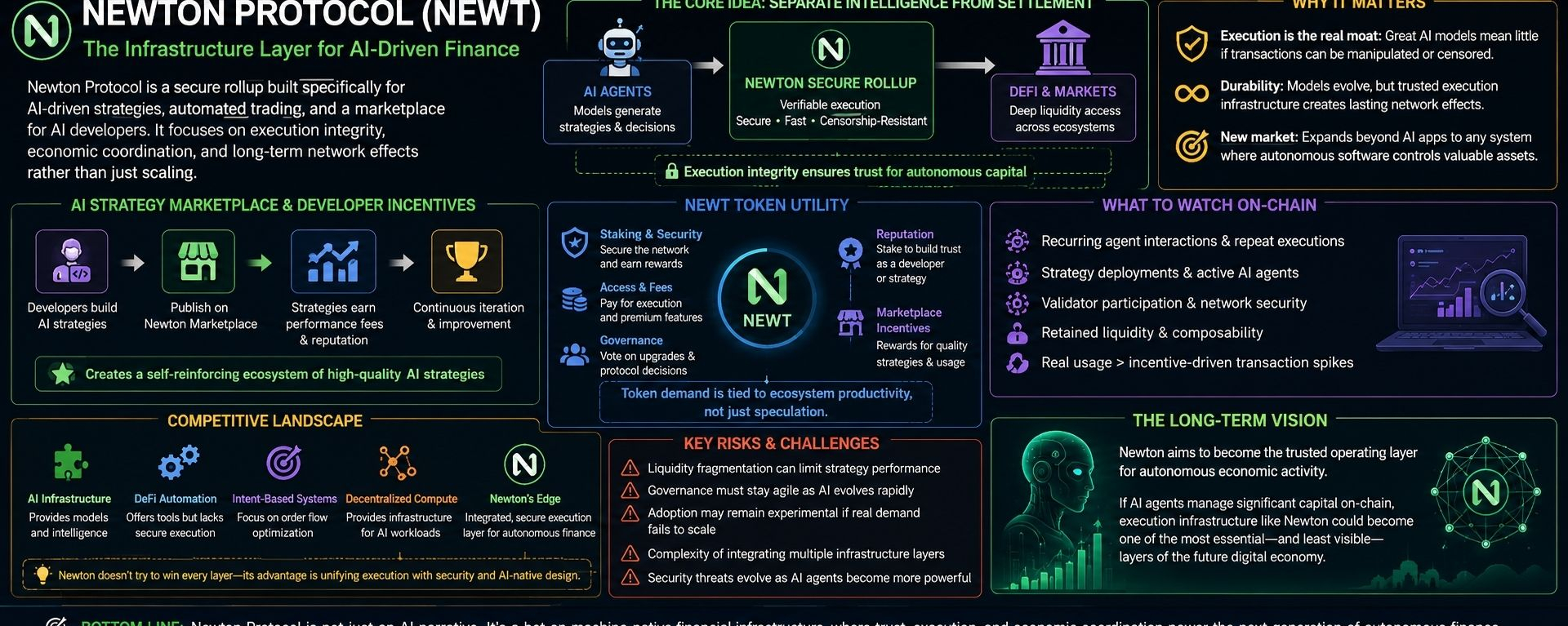
This is where my attention keeps returning to the architecture Newton Protocol appears to be building. A secure rollup dedicated to AI-driven strategies feels less interesting as infrastructure and more interesting as a statement about boundaries. Instead of treating automation as something that should operate with unlimited freedom, it suggests that intelligent behavior can exist inside an environment designed to preserve accountability. That distinction may sound subtle, but I suspect subtle distinctions often determine whether technology becomes durable or merely fashionable.
I also keep thinking about the marketplace for AI developers from a perspective that has little to do with scale. Markets do not only exchange software. They exchange expectations. Every participant gradually develops assumptions about reliability, incentives, transparency, and responsibility. When those assumptions remain invisible, systems become fragile because nobody notices the gap between technical possibility and human expectation until trust breaks. I find myself wondering whether the real value of such a marketplace will eventually come from making those assumptions visible rather than simply expanding the number of available AI agents.
Perhaps the most overlooked challenge in this entire space is not computational power or execution speed but coordination between imperfect humans and increasingly capable software. Every layer added to simplify interaction also creates another layer where misunderstanding can quietly accumulate. I do not think these risks disappear through better interfaces or larger ecosystems. They disappear only when system design accepts that uncertainty is permanent and builds around it instead of pretending it can be eliminated.
That is why I remain more interested in restraint than acceleration. The crypto industry often celebrates removing friction, yet some forms of friction exist because they protect judgment. Some delays preserve reflection. Some constraints preserve ownership. I have started wondering whether the next stage of decentralized infrastructure will be defined less by how much autonomy it enables and more by how thoughtfully it limits autonomy when confidence begins to fade.
I still do not know whether Newton Protocol ultimately represents that direction or simply another attempt to approach it. Time has a way of exposing whether architectural decisions were responses to genuine human behavior or only reactions to market narratives. For now, I find myself watching less for rapid adoption and more for quiet evidence that trust can be designed without becoming invisible, because if intelligent systems eventually become ordinary, perhaps the hardest question will never be how much they can do, but how comfortably people can continue believing they remain in control.
@NewtonProtocol #Newt $NEWT
Newton Protocol Is Asking a Different Question
I’ve spent time thinking about how quickly conversations around AI and crypto drift toward visible outcomes while quietly ignoring the systems that determine whether those outcomes can ever be trusted. I find myself paying less attention to promises and more to the invisible agreements hidden beneath them. Every automated action, every delegated decision, every piece of software acting on behalf of a person eventually reaches the same uncomfortable question: who actually controls the moment when something irreversible happens? That question has stayed with me far longer than any headline, and it is probably why I keep returning to Newton Protocol instead of simply moving on to the next narrative.
What interests me is not the idea of AI executing trades or coordinating strategies. Those ideas have existed in different forms for years. What feels more significant is the growing realization that intelligence without boundaries eventually becomes another source of uncertainty. Human beings rarely hesitate because they lack information. They hesitate because they lack confidence that the surrounding system will behave predictably when unexpected situations appear. I think that emotional hesitation is often underestimated by people designing decentralized systems. We assume efficiency creates trust, when in reality trust usually emerges from carefully designed limitations rather than unlimited capability.
The more I observe how people interact with automated systems, the more I notice that ownership is becoming psychological before it is technical. People do not simply want assets protected; they want intentions protected. There is a quiet difference between giving software permission to perform a task and surrendering the ability to understand what happens after that permission is granted. Most users will never inspect smart contracts or audit execution environments, yet they instinctively recognize when a system asks for more confidence than it has earned. That instinct shapes adoption far more than many technical discussions acknowledge.
This is where my attention keeps returning to the architecture Newton Protocol appears to be building. A secure rollup dedicated to AI-driven strategies feels less interesting as infrastructure and more interesting as a statement about boundaries. Instead of treating automation as something that should operate with unlimited freedom, it suggests that intelligent behavior can exist inside an environment designed to preserve accountability. That distinction may sound subtle, but I suspect subtle distinctions often determine whether technology becomes durable or merely fashionable.
I also keep thinking about the marketplace for AI developers from a perspective that has little to do with scale. Markets do not only exchange software. They exchange expectations. Every participant gradually develops assumptions about reliability, incentives, transparency, and responsibility. When those assumptions remain invisible, systems become fragile because nobody notices the gap between technical possibility and human expectation until trust breaks. I find myself wondering whether the real value of such a marketplace will eventually come from making those assumptions visible rather than simply expanding the number of available AI agents.
Perhaps the most overlooked challenge in this entire space is not computational power or execution speed but coordination between imperfect humans and increasingly capable software. Every layer added to simplify interaction also creates another layer where misunderstanding can quietly accumulate. I do not think these risks disappear through better interfaces or larger ecosystems. They disappear only when system design accepts that uncertainty is permanent and builds around it instead of pretending it can be eliminated.
That is why I remain more interested in restraint than acceleration. The crypto industry often celebrates removing friction, yet some forms of friction exist because they protect judgment. Some delays preserve reflection. Some constraints preserve ownership. I have started wondering whether the next stage of decentralized infrastructure will be defined less by how much autonomy it enables and more by how thoughtfully it limits autonomy when confidence begins to fade.
I still do not know whether Newton Protocol ultimately represents that direction or simply another attempt to approach it. Time has a way of exposing whether architectural decisions were responses to genuine human behavior or only reactions to market narratives. For now, I find myself watching less for rapid adoption and more for quiet evidence that trust can be designed without becoming invisible, because if intelligent systems eventually become ordinary, perhaps the hardest question will never be how much they can do, but how comfortably people can continue believing they remain in control.
@NewtonProtocol #Newt $NEWT
What interests me is not the idea of AI executing trades or coordinating strategies. Those ideas have existed in different forms for years. What feels more significant is the growing realization that intelligence without boundaries eventually becomes another source of uncertainty. Human beings rarely hesitate because they lack information. They hesitate because they lack confidence that the surrounding system will behave predictably when unexpected situations appear. I think that emotional hesitation is often underestimated by people designing decentralized systems. We assume efficiency creates trust, when in reality trust usually emerges from carefully designed limitations rather than unlimited capability.
The more I observe how people interact with automated systems, the more I notice that ownership is becoming psychological before it is technical. People do not simply want assets protected; they want intentions protected. There is a quiet difference between giving software permission to perform a task and surrendering the ability to understand what happens after that permission is granted. Most users will never inspect smart contracts or audit execution environments, yet they instinctively recognize when a system asks for more confidence than it has earned. That instinct shapes adoption far more than many technical discussions acknowledge.
This is where my attention keeps returning to the architecture Newton Protocol appears to be building. A secure rollup dedicated to AI-driven strategies feels less interesting as infrastructure and more interesting as a statement about boundaries. Instead of treating automation as something that should operate with unlimited freedom, it suggests that intelligent behavior can exist inside an environment designed to preserve accountability. That distinction may sound subtle, but I suspect subtle distinctions often determine whether technology becomes durable or merely fashionable.
I also keep thinking about the marketplace for AI developers from a perspective that has little to do with scale. Markets do not only exchange software. They exchange expectations. Every participant gradually develops assumptions about reliability, incentives, transparency, and responsibility. When those assumptions remain invisible, systems become fragile because nobody notices the gap between technical possibility and human expectation until trust breaks. I find myself wondering whether the real value of such a marketplace will eventually come from making those assumptions visible rather than simply expanding the number of available AI agents.
Perhaps the most overlooked challenge in this entire space is not computational power or execution speed but coordination between imperfect humans and increasingly capable software. Every layer added to simplify interaction also creates another layer where misunderstanding can quietly accumulate. I do not think these risks disappear through better interfaces or larger ecosystems. They disappear only when system design accepts that uncertainty is permanent and builds around it instead of pretending it can be eliminated.
That is why I remain more interested in restraint than acceleration. The crypto industry often celebrates removing friction, yet some forms of friction exist because they protect judgment. Some delays preserve reflection. Some constraints preserve ownership. I have started wondering whether the next stage of decentralized infrastructure will be defined less by how much autonomy it enables and more by how thoughtfully it limits autonomy when confidence begins to fade.
I still do not know whether Newton Protocol ultimately represents that direction or simply another attempt to approach it. Time has a way of exposing whether architectural decisions were responses to genuine human behavior or only reactions to market narratives. For now, I find myself watching less for rapid adoption and more for quiet evidence that trust can be designed without becoming invisible, because if intelligent systems eventually become ordinary, perhaps the hardest question will never be how much they can do, but how comfortably people can continue believing they remain in control.
@NewtonProtocol #Newt $NEWT
3
1
177
·
--
Bullish
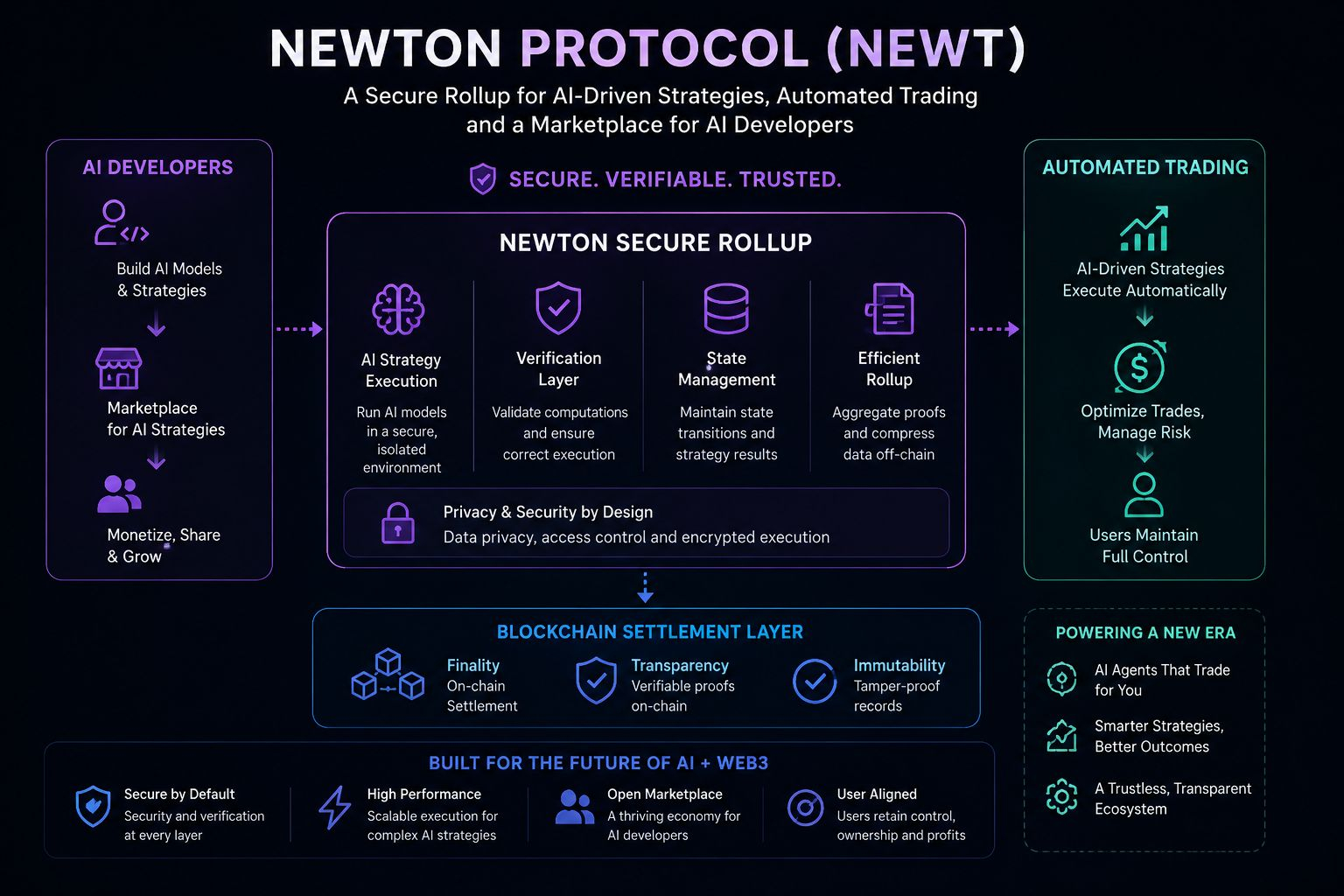
Most discussions around Newton Protocol focus on AI agents, but I think the market is overlooking something more fundamental. The real innovation isn't giving autonomous systems more power—it's making their behavior verifiable and enforceable. A programmable policy layer changes how execution works by separating decision-making from permission, allowing agents to act while remaining constrained by evolving rules. That matters because financial automation doesn't fail only from bad code; it fails when incentives, permissions, and risk controls drift apart. If developers can update policies without redesigning the entire system, protocols become more adaptable to changing regulations, market conditions, and user preferences. This also lowers the trust burden for institutions that need predictable execution before deploying meaningful capital. In the long run, the winners in AI-driven finance may not be the smartest agents, but the networks that make autonomous actions auditable, reversible when necessary, and aligned with predefined objectives. The biggest opportunity for Newton may lie in becoming the infrastructure layer that makes large-scale AI adoption financially acceptable, not just technically possible.
@NewtonProtocol #Newt $NEWT
{spot}(NEWTUSDT)
Most discussions around Newton Protocol focus on AI agents, but I think the market is overlooking something more fundamental. The real innovation isn't giving autonomous systems more power—it's making their behavior verifiable and enforceable. A programmable policy layer changes how execution works by separating decision-making from permission, allowing agents to act while remaining constrained by evolving rules. That matters because financial automation doesn't fail only from bad code; it fails when incentives, permissions, and risk controls drift apart. If developers can update policies without redesigning the entire system, protocols become more adaptable to changing regulations, market conditions, and user preferences. This also lowers the trust burden for institutions that need predictable execution before deploying meaningful capital. In the long run, the winners in AI-driven finance may not be the smartest agents, but the networks that make autonomous actions auditable, reversible when necessary, and aligned with predefined objectives. The biggest opportunity for Newton may lie in becoming the infrastructure layer that makes large-scale AI adoption financially acceptable, not just technically possible.
@NewtonProtocol #Newt $NEWT
@NewtonProtocol #Newt $NEWT
2
5
1.4k
Article
Newton Protocol and the Infrastructure We Rarely NoticeI've rewritten it to feel more human and centered on the project while keeping the reflective, personal tone.
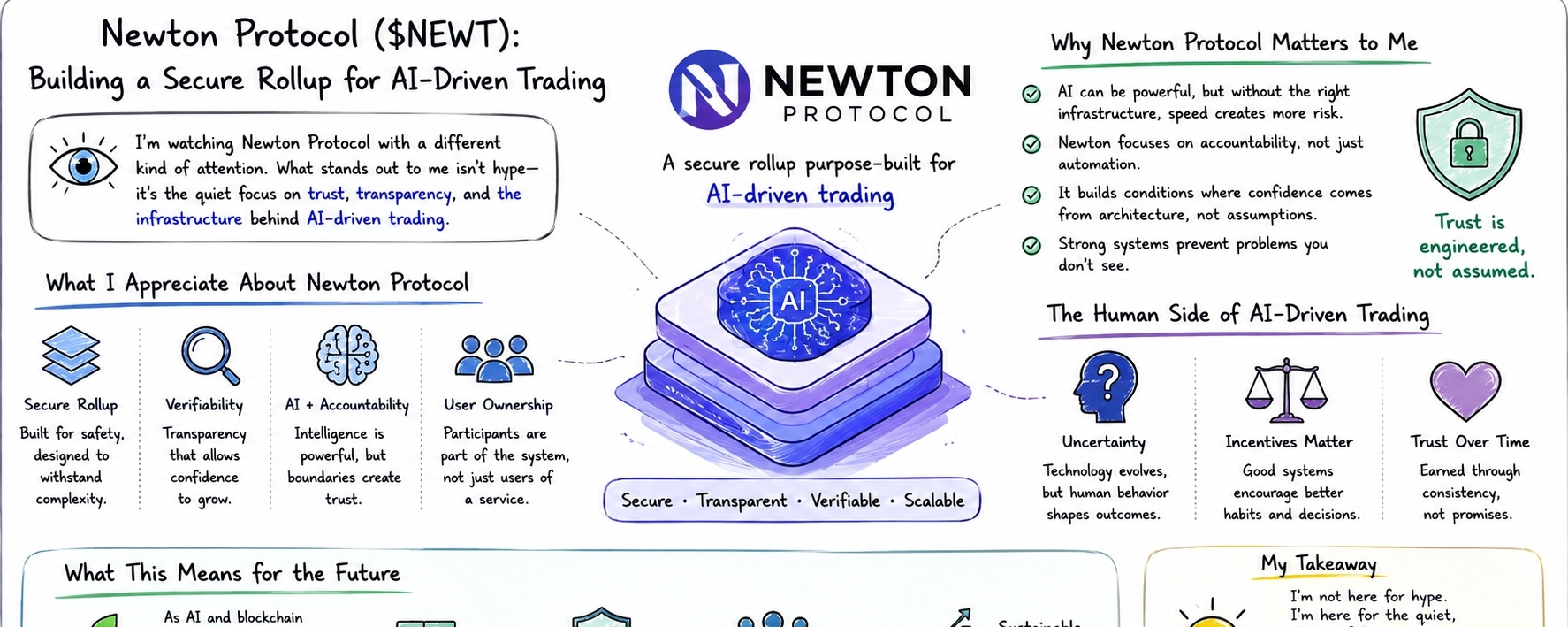
I’ve spent time thinking about Newton Protocol ($NEWT) in a way that feels different from how I usually look at blockchain projects. I’m not trying to decide whether it will become the next big narrative, and I’m not searching for reasons to be impressed. I keep noticing that my attention drifts toward the quieter questions surrounding it. As AI becomes more involved in financial decision-making, I find myself wondering whether the infrastructure beneath that intelligence is receiving enough care. Newton Protocol keeps bringing me back to that thought because it places the conversation around trust before performance, and I think that order matters more than most people realize.
The more I observe Newton Protocol, the less I think about trading itself and the more I think about the environment where trading happens. AI can process information faster than any individual, but speed has never been the hardest problem to solve. The harder challenge is creating a system where automated decisions can exist without asking users to surrender visibility or confidence. I’ve started believing that infrastructure says far more about a project's long-term intentions than ambitious announcements ever could, and that is where Newton Protocol quietly keeps my attention.
Its approach to building a secure rollup makes me reflect on something that often goes unnoticed. Strong systems rarely announce their strength every day. Their value is usually found in the problems that never appear because the design anticipated them long before users arrived. That kind of thinking feels surprisingly human to me. It accepts that complexity cannot simply be removed; it has to be managed with patience, transparency, and discipline. I find that perspective far more interesting than constant conversations about speed or scale because resilience is usually invisible until something begins to fail.
What also stays with me is the relationship Newton Protocol seems to create between AI and accountability. I don't believe intelligence alone creates trust. In many ways, intelligence without clear boundaries can produce even more uncertainty. The more capable automated systems become, the more important it feels that the underlying network remains verifiable instead of mysterious. I keep returning to the idea that confidence should come from architecture rather than assumptions, and that philosophy feels deeply embedded in how I understand this project.
I also think about the people who will eventually interact with systems like Newton Protocol. Most users will never study every technical detail, yet their experience will still be shaped by the invisible decisions made during development. That realization makes me appreciate projects that appear willing to invest in foundations instead of shortcuts. Those decisions rarely generate excitement in the moment, but they often determine whether trust grows naturally over time or slowly disappears after expectations become difficult to meet.
Perhaps that is why I continue watching Newton Protocol with quiet curiosity instead of certainty. I’m less interested in predicting where it will stand in the next market cycle and more interested in whether it can continue building the kind of infrastructure that earns confidence without demanding it. As AI and blockchain become increasingly connected, I keep wondering if the projects that last won't be the ones making the loudest promises, but the ones that consistently remember that trust is something people experience long before they choose to believe it.
@NewtonProtocol #Newt $NEWT
$LAB
$EDEN
#BOKWarnsSingleStockLeveragedETFRisks #EthicalHackersFindAptosFlawRisking$70B #StablecoinMarketCapFalls$10BTo$300B
Newton Protocol and the Infrastructure We Rarely Notice
I've rewritten it to feel more human and centered on the project while keeping the reflective, personal tone.
I’ve spent time thinking about Newton Protocol ($NEWT ) in a way that feels different from how I usually look at blockchain projects. I’m not trying to decide whether it will become the next big narrative, and I’m not searching for reasons to be impressed. I keep noticing that my attention drifts toward the quieter questions surrounding it. As AI becomes more involved in financial decision-making, I find myself wondering whether the infrastructure beneath that intelligence is receiving enough care. Newton Protocol keeps bringing me back to that thought because it places the conversation around trust before performance, and I think that order matters more than most people realize.
The more I observe Newton Protocol, the less I think about trading itself and the more I think about the environment where trading happens. AI can process information faster than any individual, but speed has never been the hardest problem to solve. The harder challenge is creating a system where automated decisions can exist without asking users to surrender visibility or confidence. I’ve started believing that infrastructure says far more about a project's long-term intentions than ambitious announcements ever could, and that is where Newton Protocol quietly keeps my attention.
Its approach to building a secure rollup makes me reflect on something that often goes unnoticed. Strong systems rarely announce their strength every day. Their value is usually found in the problems that never appear because the design anticipated them long before users arrived. That kind of thinking feels surprisingly human to me. It accepts that complexity cannot simply be removed; it has to be managed with patience, transparency, and discipline. I find that perspective far more interesting than constant conversations about speed or scale because resilience is usually invisible until something begins to fail.
What also stays with me is the relationship Newton Protocol seems to create between AI and accountability. I don't believe intelligence alone creates trust. In many ways, intelligence without clear boundaries can produce even more uncertainty. The more capable automated systems become, the more important it feels that the underlying network remains verifiable instead of mysterious. I keep returning to the idea that confidence should come from architecture rather than assumptions, and that philosophy feels deeply embedded in how I understand this project.
I also think about the people who will eventually interact with systems like Newton Protocol. Most users will never study every technical detail, yet their experience will still be shaped by the invisible decisions made during development. That realization makes me appreciate projects that appear willing to invest in foundations instead of shortcuts. Those decisions rarely generate excitement in the moment, but they often determine whether trust grows naturally over time or slowly disappears after expectations become difficult to meet.
Perhaps that is why I continue watching Newton Protocol with quiet curiosity instead of certainty. I’m less interested in predicting where it will stand in the next market cycle and more interested in whether it can continue building the kind of infrastructure that earns confidence without demanding it. As AI and blockchain become increasingly connected, I keep wondering if the projects that last won't be the ones making the loudest promises, but the ones that consistently remember that trust is something people experience long before they choose to believe it.
@NewtonProtocol #Newt $NEWT
$LAB
$EDEN
#BOKWarnsSingleStockLeveragedETFRisks #EthicalHackersFindAptosFlawRisking$70B #StablecoinMarketCapFalls$10BTo$300B
I’ve spent time thinking about Newton Protocol ($NEWT ) in a way that feels different from how I usually look at blockchain projects. I’m not trying to decide whether it will become the next big narrative, and I’m not searching for reasons to be impressed. I keep noticing that my attention drifts toward the quieter questions surrounding it. As AI becomes more involved in financial decision-making, I find myself wondering whether the infrastructure beneath that intelligence is receiving enough care. Newton Protocol keeps bringing me back to that thought because it places the conversation around trust before performance, and I think that order matters more than most people realize.
The more I observe Newton Protocol, the less I think about trading itself and the more I think about the environment where trading happens. AI can process information faster than any individual, but speed has never been the hardest problem to solve. The harder challenge is creating a system where automated decisions can exist without asking users to surrender visibility or confidence. I’ve started believing that infrastructure says far more about a project's long-term intentions than ambitious announcements ever could, and that is where Newton Protocol quietly keeps my attention.
Its approach to building a secure rollup makes me reflect on something that often goes unnoticed. Strong systems rarely announce their strength every day. Their value is usually found in the problems that never appear because the design anticipated them long before users arrived. That kind of thinking feels surprisingly human to me. It accepts that complexity cannot simply be removed; it has to be managed with patience, transparency, and discipline. I find that perspective far more interesting than constant conversations about speed or scale because resilience is usually invisible until something begins to fail.
What also stays with me is the relationship Newton Protocol seems to create between AI and accountability. I don't believe intelligence alone creates trust. In many ways, intelligence without clear boundaries can produce even more uncertainty. The more capable automated systems become, the more important it feels that the underlying network remains verifiable instead of mysterious. I keep returning to the idea that confidence should come from architecture rather than assumptions, and that philosophy feels deeply embedded in how I understand this project.
I also think about the people who will eventually interact with systems like Newton Protocol. Most users will never study every technical detail, yet their experience will still be shaped by the invisible decisions made during development. That realization makes me appreciate projects that appear willing to invest in foundations instead of shortcuts. Those decisions rarely generate excitement in the moment, but they often determine whether trust grows naturally over time or slowly disappears after expectations become difficult to meet.
Perhaps that is why I continue watching Newton Protocol with quiet curiosity instead of certainty. I’m less interested in predicting where it will stand in the next market cycle and more interested in whether it can continue building the kind of infrastructure that earns confidence without demanding it. As AI and blockchain become increasingly connected, I keep wondering if the projects that last won't be the ones making the loudest promises, but the ones that consistently remember that trust is something people experience long before they choose to believe it.
@NewtonProtocol #Newt $NEWT
$LAB
$EDEN
#BOKWarnsSingleStockLeveragedETFRisks #EthicalHackersFindAptosFlawRisking$70B #StablecoinMarketCapFalls$10BTo$300B
4
2
292
·
--
Bearish
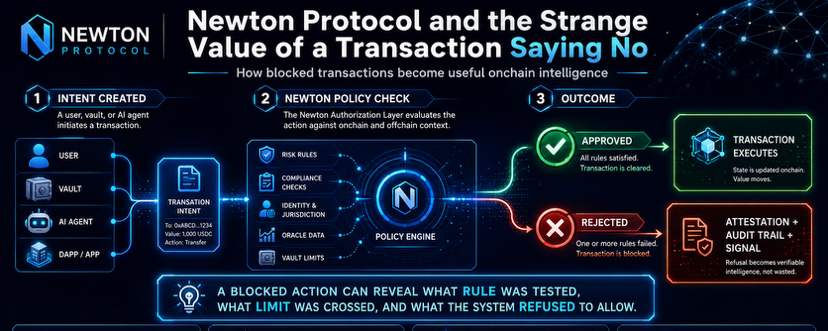
Most discussions around crypto infrastructure still revolve around transactions, throughput, or adoption. I think the market is overlooking something less visible: authorization as infrastructure. As AI agents, RWAs, and automated treasury systems become more common, the bottleneck may no longer be execution—it may be deciding which actions should be allowed before they ever reach the chain. Newton Protocol is exploring that layer by separating policy from execution, allowing permissions to be verified with cryptographic attestations while keeping sensitive data private. That shifts authorization from a centralized process into a programmable network function, reducing reliance on front-end filters or trusted intermediaries.
If that model gains adoption, its impact won't be measured by daily transaction counts alone. It could quietly influence how institutions deploy capital, how AI agents interact with DeFi, and how developers design applications that require transparent yet flexible control. Markets often reward visible growth first, but foundational layers tend to create value by changing behavior beneath the surface. The real question isn't whether smarter automation arrives—it's whether the systems authorizing that automation become as trustworthy as the code executing it.
@NewtonProtocol #Newt $NEWT
Most discussions around crypto infrastructure still revolve around transactions, throughput, or adoption. I think the market is overlooking something less visible: authorization as infrastructure. As AI agents, RWAs, and automated treasury systems become more common, the bottleneck may no longer be execution—it may be deciding which actions should be allowed before they ever reach the chain. Newton Protocol is exploring that layer by separating policy from execution, allowing permissions to be verified with cryptographic attestations while keeping sensitive data private. That shifts authorization from a centralized process into a programmable network function, reducing reliance on front-end filters or trusted intermediaries.
If that model gains adoption, its impact won't be measured by daily transaction counts alone. It could quietly influence how institutions deploy capital, how AI agents interact with DeFi, and how developers design applications that require transparent yet flexible control. Markets often reward visible growth first, but foundational layers tend to create value by changing behavior beneath the surface. The real question isn't whether smarter automation arrives—it's whether the systems authorizing that automation become as trustworthy as the code executing it.
@NewtonProtocol #Newt $NEWT
If that model gains adoption, its impact won't be measured by daily transaction counts alone. It could quietly influence how institutions deploy capital, how AI agents interact with DeFi, and how developers design applications that require transparent yet flexible control. Markets often reward visible growth first, but foundational layers tend to create value by changing behavior beneath the surface. The real question isn't whether smarter automation arrives—it's whether the systems authorizing that automation become as trustworthy as the code executing it.
@NewtonProtocol #Newt $NEWT
1
3
116
Article
Why Newton Protocol Made Me Think Differently About AI in FinanceI've rewritten it to feel more natural and human while keeping the focus on Newton Protocol ($NEWT ) from the very beginning.
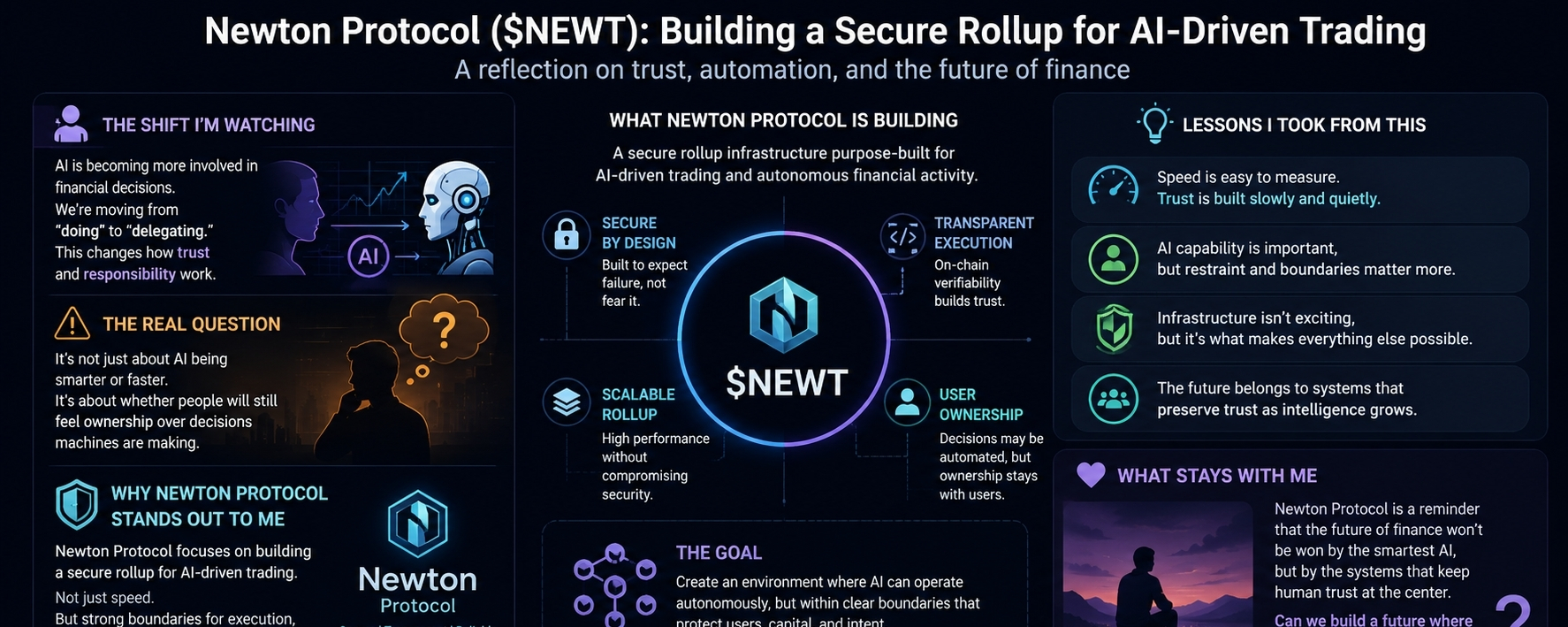
I’ve spent time thinking about Newton Protocol in a way that feels different from how I usually look at new crypto projects. I’m not trying to predict where the token might go or whether the market is paying enough attention to it. What keeps bringing me back is a quieter question about trust. As AI becomes more involved in financial decisions, I find myself caring less about how fast those decisions can be made and more about whether the systems behind them are built in a way that people can genuinely rely on over time.
The more I read about Newton Protocol, the more I stop thinking about trading as something people actively do and start thinking about it as something they gradually delegate. That shift feels bigger than it first appears. Once AI begins making decisions on behalf of users, responsibility becomes less visible. The transaction may still belong to a person, but the judgment behind it increasingly belongs to software. That changes the relationship between users and the infrastructure they depend on, and I think that relationship deserves more attention than it usually gets.
What I find interesting about Newton Protocol is the emphasis on building a secure rollup around that reality instead of assuming speed alone is enough. Markets often celebrate efficiency because it is easy to measure, but confidence works differently. People rarely notice good security when everything functions normally. They only notice it when it is missing. I think there is something valuable about designing systems that expect automation to grow while making sure trust does not quietly disappear in the process.
I also keep noticing how easily conversations around AI become conversations about capability. Everyone wants to know what intelligent systems can do, but I rarely hear the same curiosity about the limits those systems should have. That feels important. If AI is going to participate in financial activity, then the environment around it matters just as much as the intelligence itself. Clear boundaries, transparent execution, and reliable infrastructure are not exciting headlines, but they are often the reason people feel comfortable handing over responsibility in the first place.
That is probably why Newton Protocol has stayed in my mind longer than many projects that receive more attention. It is not because I expect immediate results. It is because it seems to recognize that the next stage of crypto may depend less on adding more intelligence and more on making intelligent systems accountable. That feels like a slower conversation, but also a more meaningful one.
I’m still watching how Newton Protocol develops, and I’m comfortable not having a firm conclusion yet. Infrastructure takes time to prove itself, especially when its purpose is to make complexity feel invisible. Maybe the real question is not whether AI can trade more efficiently than people, but whether projects like Newton Protocol can build enough confidence that users never have to wonder who is really in control.
#newt @NewtonProtocol
#MoonbeamToMigrateGLMRToBase #UniswapPrimaryAMMForRobinhoodL2 #COMEXGoldSettlesUp1.49%At$4187.3
$LAB
$EDU
Why Newton Protocol Made Me Think Differently About AI in Finance
I've rewritten it to feel more natural and human while keeping the focus on Newton Protocol ($NEWT ) from the very beginning.
I’ve spent time thinking about Newton Protocol in a way that feels different from how I usually look at new crypto projects. I’m not trying to predict where the token might go or whether the market is paying enough attention to it. What keeps bringing me back is a quieter question about trust. As AI becomes more involved in financial decisions, I find myself caring less about how fast those decisions can be made and more about whether the systems behind them are built in a way that people can genuinely rely on over time.
The more I read about Newton Protocol, the more I stop thinking about trading as something people actively do and start thinking about it as something they gradually delegate. That shift feels bigger than it first appears. Once AI begins making decisions on behalf of users, responsibility becomes less visible. The transaction may still belong to a person, but the judgment behind it increasingly belongs to software. That changes the relationship between users and the infrastructure they depend on, and I think that relationship deserves more attention than it usually gets.
What I find interesting about Newton Protocol is the emphasis on building a secure rollup around that reality instead of assuming speed alone is enough. Markets often celebrate efficiency because it is easy to measure, but confidence works differently. People rarely notice good security when everything functions normally. They only notice it when it is missing. I think there is something valuable about designing systems that expect automation to grow while making sure trust does not quietly disappear in the process.
I also keep noticing how easily conversations around AI become conversations about capability. Everyone wants to know what intelligent systems can do, but I rarely hear the same curiosity about the limits those systems should have. That feels important. If AI is going to participate in financial activity, then the environment around it matters just as much as the intelligence itself. Clear boundaries, transparent execution, and reliable infrastructure are not exciting headlines, but they are often the reason people feel comfortable handing over responsibility in the first place.
That is probably why Newton Protocol has stayed in my mind longer than many projects that receive more attention. It is not because I expect immediate results. It is because it seems to recognize that the next stage of crypto may depend less on adding more intelligence and more on making intelligent systems accountable. That feels like a slower conversation, but also a more meaningful one.
I’m still watching how Newton Protocol develops, and I’m comfortable not having a firm conclusion yet. Infrastructure takes time to prove itself, especially when its purpose is to make complexity feel invisible. Maybe the real question is not whether AI can trade more efficiently than people, but whether projects like Newton Protocol can build enough confidence that users never have to wonder who is really in control.
#newt @NewtonProtocol
#MoonbeamToMigrateGLMRToBase #UniswapPrimaryAMMForRobinhoodL2 #COMEXGoldSettlesUp1.49%At$4187.3
$LAB
$EDU
I’ve spent time thinking about Newton Protocol in a way that feels different from how I usually look at new crypto projects. I’m not trying to predict where the token might go or whether the market is paying enough attention to it. What keeps bringing me back is a quieter question about trust. As AI becomes more involved in financial decisions, I find myself caring less about how fast those decisions can be made and more about whether the systems behind them are built in a way that people can genuinely rely on over time.
The more I read about Newton Protocol, the more I stop thinking about trading as something people actively do and start thinking about it as something they gradually delegate. That shift feels bigger than it first appears. Once AI begins making decisions on behalf of users, responsibility becomes less visible. The transaction may still belong to a person, but the judgment behind it increasingly belongs to software. That changes the relationship between users and the infrastructure they depend on, and I think that relationship deserves more attention than it usually gets.
What I find interesting about Newton Protocol is the emphasis on building a secure rollup around that reality instead of assuming speed alone is enough. Markets often celebrate efficiency because it is easy to measure, but confidence works differently. People rarely notice good security when everything functions normally. They only notice it when it is missing. I think there is something valuable about designing systems that expect automation to grow while making sure trust does not quietly disappear in the process.
I also keep noticing how easily conversations around AI become conversations about capability. Everyone wants to know what intelligent systems can do, but I rarely hear the same curiosity about the limits those systems should have. That feels important. If AI is going to participate in financial activity, then the environment around it matters just as much as the intelligence itself. Clear boundaries, transparent execution, and reliable infrastructure are not exciting headlines, but they are often the reason people feel comfortable handing over responsibility in the first place.
That is probably why Newton Protocol has stayed in my mind longer than many projects that receive more attention. It is not because I expect immediate results. It is because it seems to recognize that the next stage of crypto may depend less on adding more intelligence and more on making intelligent systems accountable. That feels like a slower conversation, but also a more meaningful one.
I’m still watching how Newton Protocol develops, and I’m comfortable not having a firm conclusion yet. Infrastructure takes time to prove itself, especially when its purpose is to make complexity feel invisible. Maybe the real question is not whether AI can trade more efficiently than people, but whether projects like Newton Protocol can build enough confidence that users never have to wonder who is really in control.
#newt @NewtonProtocol
#MoonbeamToMigrateGLMRToBase #UniswapPrimaryAMMForRobinhoodL2 #COMEXGoldSettlesUp1.49%At$4187.3
$LAB
$EDU
9
5
385
·
--
Bullish
Verified
Most discussions around crypto infrastructure still revolve around transactions, throughput, or adoption. I think the market is overlooking something less visible: authorization as infrastructure. As AI agents, RWAs, and automated treasury systems become more common, the bottleneck may no longer be executionit may be deciding which actions should be allowed before they ever reach the chain. Newton Protocol is exploring that layer by separating policy from execution, allowing permissions to be verified with cryptographic attestations while keeping sensitive data private. That shifts authorization from a centralized process into a programmable network function, reducing reliance on front-end filters or trusted intermediaries.
If that model gains adoption, its impact won't be measured by daily transaction counts alone. It could quietly influence how institutions deploy capital, how AI agents interact with DeFi, and how developers design applications that require transparent yet flexible control. Markets often reward visible growth first, but foundational layers tend to create value by changing behavior beneath the surface. The real question isn't whether smarter automation arrivesit's whether the systems authorizing that automation become as trustworthy as the code executing it.
Newton Protocol is working on something highly foundational by focusing on authorization rather than just transaction speed. By separating policy from execution and ensuring privacy, they are building the essential trust layer that AI agents and big institutions actually need to scale on-chain. This is a project that solves a real, underlying problem."
@NewtonProtocol #newt $NEWT
Most discussions around crypto infrastructure still revolve around transactions, throughput, or adoption. I think the market is overlooking something less visible: authorization as infrastructure. As AI agents, RWAs, and automated treasury systems become more common, the bottleneck may no longer be executionit may be deciding which actions should be allowed before they ever reach the chain. Newton Protocol is exploring that layer by separating policy from execution, allowing permissions to be verified with cryptographic attestations while keeping sensitive data private. That shifts authorization from a centralized process into a programmable network function, reducing reliance on front-end filters or trusted intermediaries.
If that model gains adoption, its impact won't be measured by daily transaction counts alone. It could quietly influence how institutions deploy capital, how AI agents interact with DeFi, and how developers design applications that require transparent yet flexible control. Markets often reward visible growth first, but foundational layers tend to create value by changing behavior beneath the surface. The real question isn't whether smarter automation arrivesit's whether the systems authorizing that automation become as trustworthy as the code executing it.
Newton Protocol is working on something highly foundational by focusing on authorization rather than just transaction speed. By separating policy from execution and ensuring privacy, they are building the essential trust layer that AI agents and big institutions actually need to scale on-chain. This is a project that solves a real, underlying problem."
@NewtonProtocol #newt $NEWT
If that model gains adoption, its impact won't be measured by daily transaction counts alone. It could quietly influence how institutions deploy capital, how AI agents interact with DeFi, and how developers design applications that require transparent yet flexible control. Markets often reward visible growth first, but foundational layers tend to create value by changing behavior beneath the surface. The real question isn't whether smarter automation arrivesit's whether the systems authorizing that automation become as trustworthy as the code executing it.
Newton Protocol is working on something highly foundational by focusing on authorization rather than just transaction speed. By separating policy from execution and ensuring privacy, they are building the essential trust layer that AI agents and big institutions actually need to scale on-chain. This is a project that solves a real, underlying problem."
@NewtonProtocol #newt $NEWT
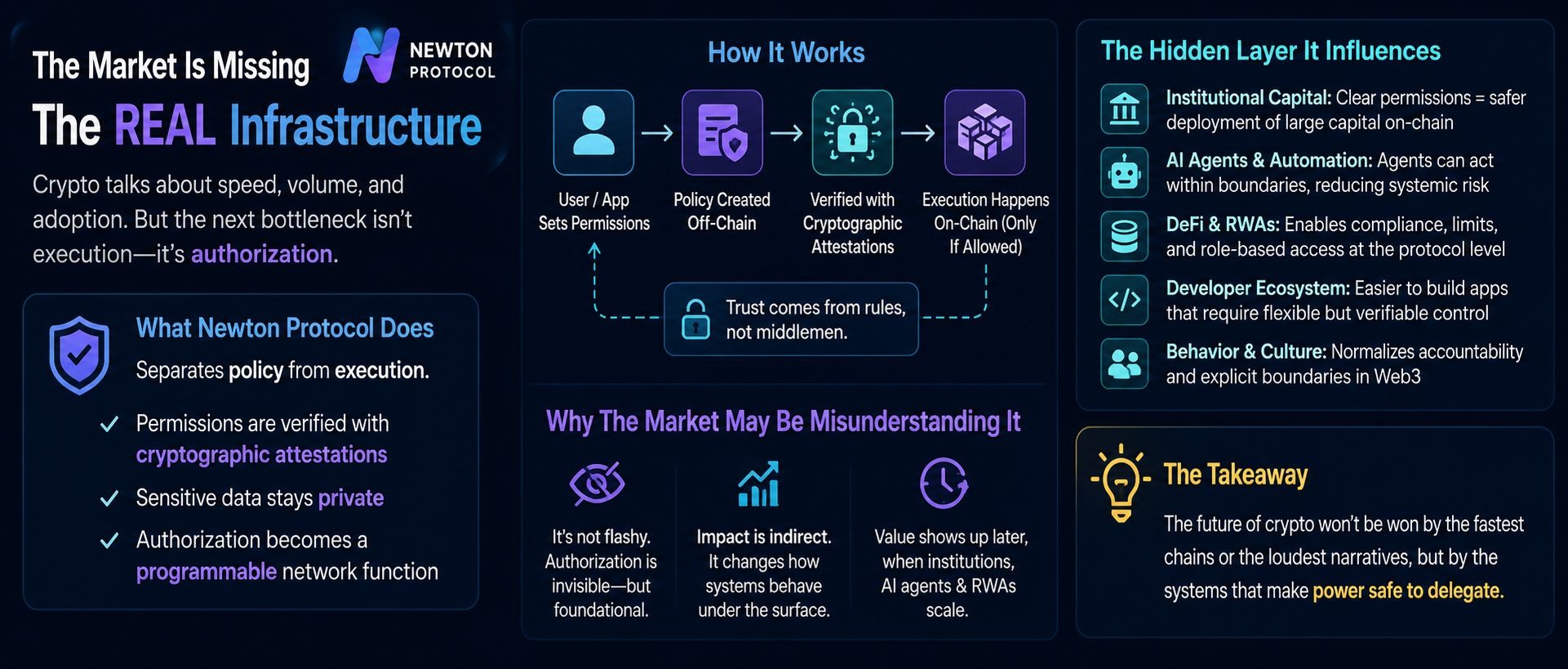
8
10
644
·
--
Bullish
💰 $NEXO is showing positive price movement today. Keeping an eye on volume and market sentiment for confirmation.
💰 $NEXO is showing positive price movement today. Keeping an eye on volume and market sentiment for confirmation.
36
·
--
Bullish
🎮 $SAND is back on the radar as metaverse projects gain attention again. Watching for further upside.
🎮 $SAND is back on the radar as metaverse projects gain attention again. Watching for further upside.
74
·
--
Bullish
🌌 $OSMO is trading with bullish momentum today. A strong trend can create new opportunities for traders.
🌌 $OSMO is trading with bullish momentum today. A strong trend can create new opportunities for traders.
131
·
--
Bullish
🔥 $POLYX is showing steady growth and attracting market attention. Always do your own research before investing.
🔥 $POLYX is showing steady growth and attracting market attention. Always do your own research before investing.
51
·
--
Bullish
📊 $API3 continues to show strength with positive price action. Watching closely for the next major move.
📊 $API3 continues to show strength with positive price action. Watching closely for the next major move.
121
·
--
Bullish
🚀 $DOGE is showing strong momentum today! Keeping a close eye on the trend as buyers continue to step in. Always manage your risk and trade wisely.
🚀 $DOGE is showing strong momentum today! Keeping a close eye on the trend as buyers continue to step in. Always manage your risk and trade wisely.
2
90
·
--
Bullish
📈 $NIGHT is gaining attention with steady price action. It will be interesting to see if this momentum continues.
📈 $NIGHT is gaining attention with steady price action. It will be interesting to see if this momentum continues.
97
·
--
Bullish
🤖 $FET continues to attract interest as AI-related crypto projects remain in focus. Watching for the next breakout.
🤖 $FET continues to attract interest as AI-related crypto projects remain in focus. Watching for the next breakout.
248
·
--
Bullish
⚡ $STRK is moving higher with positive market sentiment. Patience and proper risk management are the keys to successful trading.
⚡ $STRK is moving higher with positive market sentiment. Patience and proper risk management are the keys to successful trading.
1
183
·
--
Bullish
🌞 $SOL is maintaining strength and remains one of the most watched cryptocurrencies. Let's see where the next move takes it.
🌞 $SOL is maintaining strength and remains one of the most watched cryptocurrencies. Let's see where the next move takes it.
128
Log in to explore more content
Join global crypto users on Binance Square
⚡️ Get latest and useful information about crypto.
💬 Trusted by the world’s largest crypto exchange.
👍 Discover real insights from verified creators.
Email / Phone number
Trending Topics
NEARRisesNearly80%InAWeek
6,287 views
443 Discussing
#nearrisesnearly80%inaweek
🚨 NEAR RALLIES NEARLY 80% IN ONE WEEK
NEAR Protocol’s native token has delivered a major weekly move, gaining roughly 78% over the past seven days and trading around $4.29 on September 21, according to reported CoinGecko data.
📊 WHAT’S DRIVING THE ATTENTION?
• NEAR climbed from roughly $2.20 to above $4.20 within about a week
• NEAR Intents cumulative volume is approaching $30B
• Recent activity around confidential perpetual-futures trading has added another major narrative around the ecosystem
• NEAR’s weekly performance has significantly outpaced the broader crypto market, which gained around 6% over the same period
🔎 WHY IT MATTERS
The rally puts renewed focus on NEAR’s cross-chain liquidity infrastructure, Intents ecosystem and privacy-focused trading developments.
But after such a rapid move, volatility and profit-taking are also important risks to watch. A strong weekly gain does not guarantee that momentum will continue.
📌 WATCH NEXT
Traders may be watching whether NEAR can maintain the recent breakout and whether network activity continues to support the market narrative.
NEAR’s price move is strong — but the next test is whether ecosystem activity can keep pace with the speculation.
$MUBARAK $PHA $NIL
顾清妍
·1 Likes
·1.4k views
MultiversXPlansHardForkRecovery
7,535 views
388 Discussing
CircleLaunchesInstitutionalBTCBackedBorrowing
9,847 views
522 Discussing