

N O R A 莉莎
3.5k Posts

N O R A 莉莎
Report
Block User
76 Following
21.7K+ Followers
9.5K+ Liked
Posts
All
Quotes
Videos
Live
·
--
$ETH Breakdown Setup on Watch 👀
{spot}(ETHUSDT)
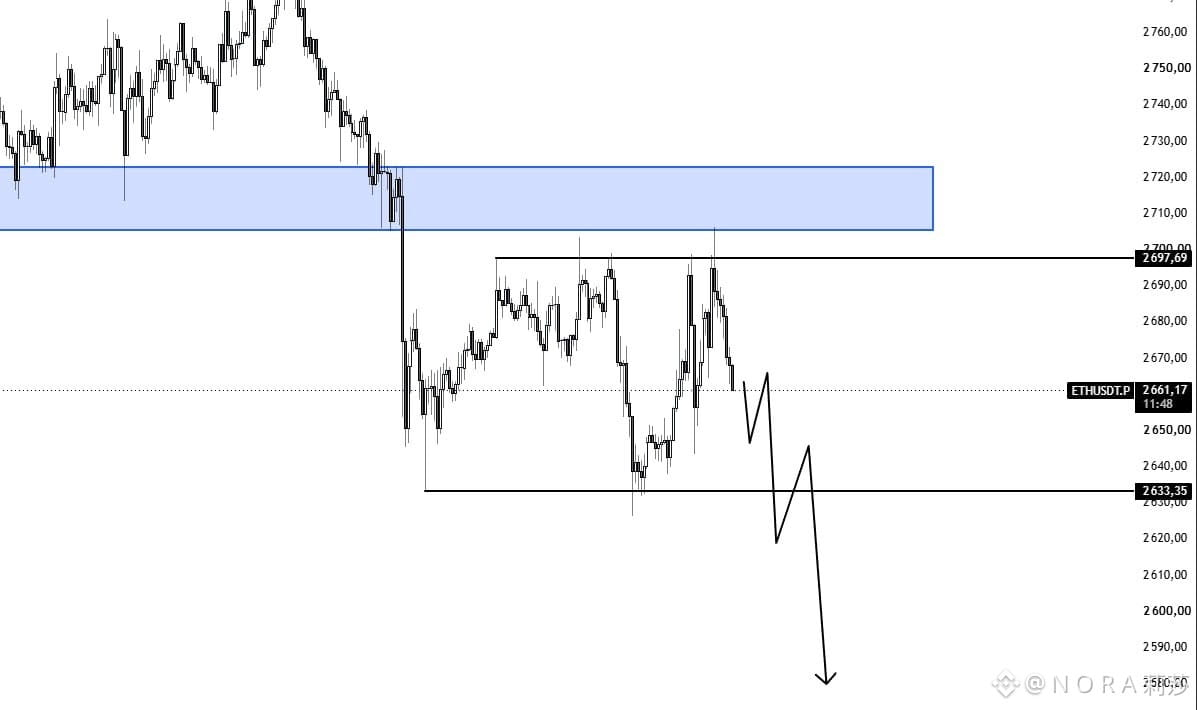
$ETH is compressing below resistance, and the structure is starting to look vulnerable.
Price has repeatedly struggled to reclaim the upper range. For me, $2,633 is the key level a clean breakdown and failed reclaim could open the door for a deeper move.
📍 Entry: $2,661
🎯 Targets: $2,634 → $2,576 → $2,478
🛑 Stop Loss: $2,751
No need to force the trade. I’m watching for confirmation first breakdown, retest, then continuation.
#ETH #cryptotrading #BinanceSquare
#Ethereum✅
$ETH Breakdown Setup on Watch 👀
$ETH is compressing below resistance, and the structure is starting to look vulnerable.
Price has repeatedly struggled to reclaim the upper range. For me, $2,633 is the key level a clean breakdown and failed reclaim could open the door for a deeper move.
📍 Entry: $2,661
🎯 Targets: $2,634 → $2,576 → $2,478
🛑 Stop Loss: $2,751
No need to force the trade. I’m watching for confirmation first breakdown, retest, then continuation.
#ETH #cryptotrading #BinanceSquare
#Ethereum✅
$ETH is compressing below resistance, and the structure is starting to look vulnerable.
Price has repeatedly struggled to reclaim the upper range. For me, $2,633 is the key level a clean breakdown and failed reclaim could open the door for a deeper move.
📍 Entry: $2,661
🎯 Targets: $2,634 → $2,576 → $2,478
🛑 Stop Loss: $2,751
No need to force the trade. I’m watching for confirmation first breakdown, retest, then continuation.
#ETH #cryptotrading #BinanceSquare
#Ethereum✅
112
·
--
Bullish
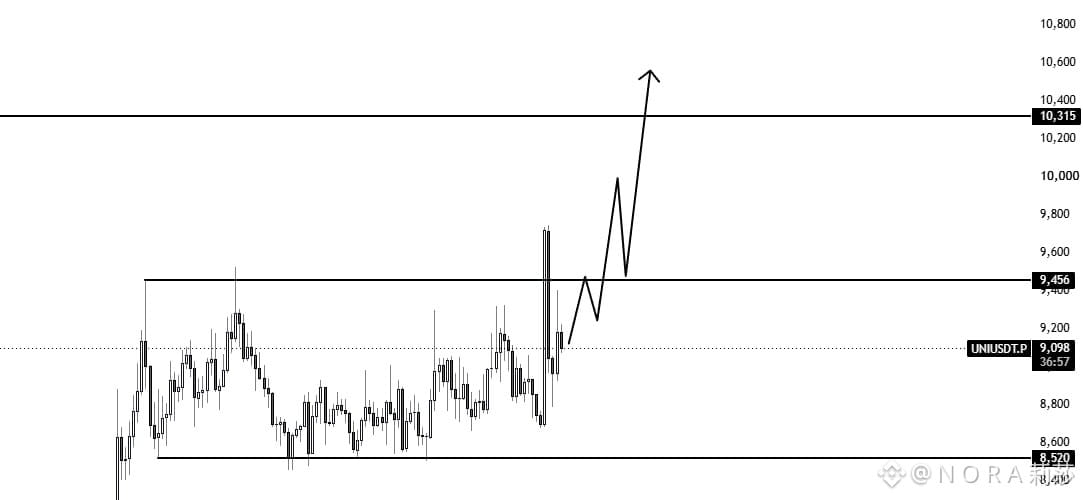
$UNI is setting up at an interesting level.
Price is still moving within a broader uptrend, while the current structure looks more like accumulation than weakness.
My setup:
📍 Entry: $9.097
🎯 Targets: $9.189 / $9.543 / $10.122
🛑 Stop Loss: $8.672
The key level for me is around $9.45–$9.54. A clean break and hold above this zone could open the path toward $10+ and potentially sweep liquidity higher.
Until then, I’m watching the structure and letting price confirm the move.
#UNI #Crypto #BinanceSquare
$UNI is setting up at an interesting level.
Price is still moving within a broader uptrend, while the current structure looks more like accumulation than weakness.
My setup:
📍 Entry: $9.097
🎯 Targets: $9.189 / $9.543 / $10.122
🛑 Stop Loss: $8.672
The key level for me is around $9.45–$9.54. A clean break and hold above this zone could open the path toward $10+ and potentially sweep liquidity higher.
Until then, I’m watching the structure and letting price confirm the move.
#UNI #Crypto #BinanceSquare
Price is still moving within a broader uptrend, while the current structure looks more like accumulation than weakness.
My setup:
📍 Entry: $9.097
🎯 Targets: $9.189 / $9.543 / $10.122
🛑 Stop Loss: $8.672
The key level for me is around $9.45–$9.54. A clean break and hold above this zone could open the path toward $10+ and potentially sweep liquidity higher.
Until then, I’m watching the structure and letting price confirm the move.
#UNI #Crypto #BinanceSquare
10
12
628
·
--
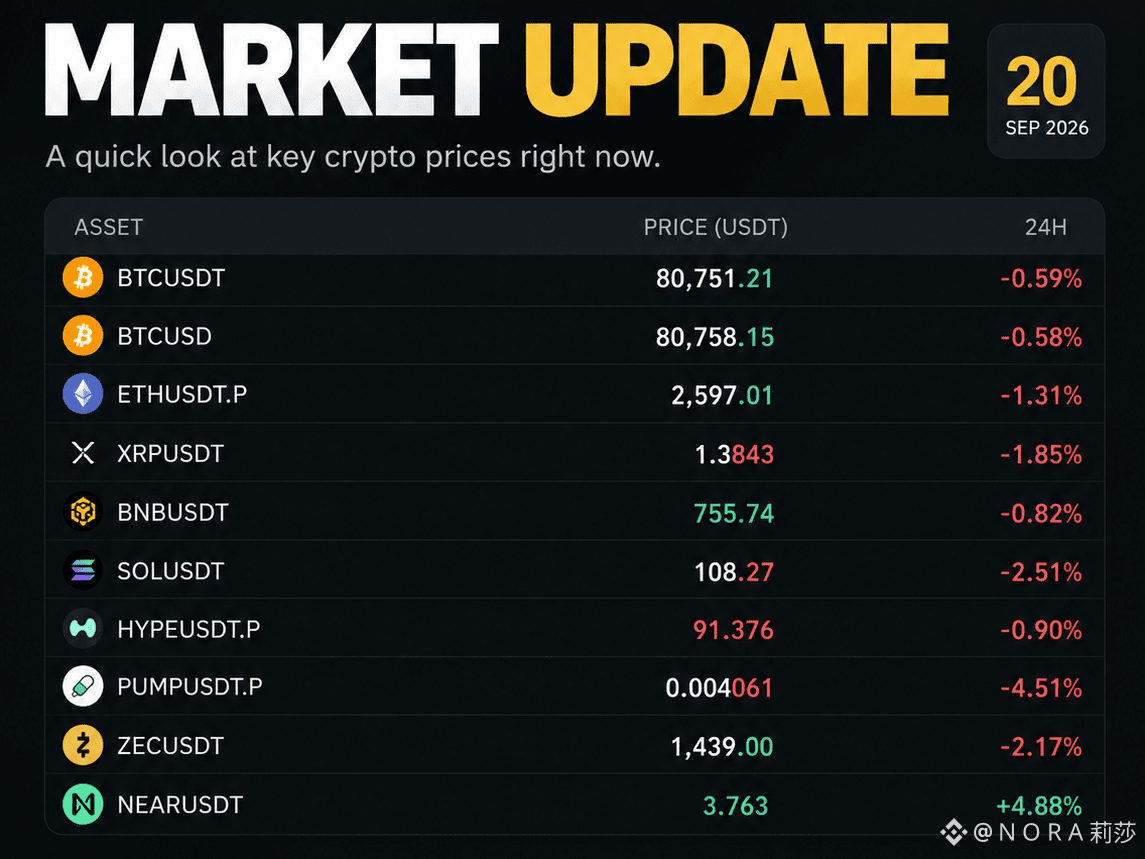
Market is red, but not everything is weak. 👀
$BTC is holding around $80.7K, while $ETH , XRP, BNB and SOL are all trading lower.
But $NEAR is going against the flow, up 4.88% while most of the watchlist sits in red.
{spot}(NEARUSDT)
{spot}(BTCUSDT)
That relative strength is what I’m watching.
Red days aren’t just about dips they show you which assets buyers are still willing to defend.
For now, BTC holding the $80K area matters. If that level stays intact, the broader structure remains worth watching closely.
Volatility is high. Manage risk and wait for confirmation rather than chasing moves.
#BinanceSquare #XRPExchangeReservesHitSevenYearLow #BTC☀ #BNB走势 #SolanaStrong
Market is red, but not everything is weak. 👀
$BTC is holding around $80.7K, while $ETH , XRP, BNB and SOL are all trading lower.
But $NEAR is going against the flow, up 4.88% while most of the watchlist sits in red.
That relative strength is what I’m watching.
Red days aren’t just about dips they show you which assets buyers are still willing to defend.
For now, BTC holding the $80K area matters. If that level stays intact, the broader structure remains worth watching closely.
Volatility is high. Manage risk and wait for confirmation rather than chasing moves.
#BinanceSquare #XRPExchangeReservesHitSevenYearLow #BTC☀ #BNB走势 #SolanaStrong
$BTC is holding around $80.7K, while $ETH , XRP, BNB and SOL are all trading lower.
But $NEAR is going against the flow, up 4.88% while most of the watchlist sits in red.
That relative strength is what I’m watching.
Red days aren’t just about dips they show you which assets buyers are still willing to defend.
For now, BTC holding the $80K area matters. If that level stays intact, the broader structure remains worth watching closely.
Volatility is high. Manage risk and wait for confirmation rather than chasing moves.
#BinanceSquare #XRPExchangeReservesHitSevenYearLow #BTC☀ #BNB走势 #SolanaStrong
12
12
424
·
--
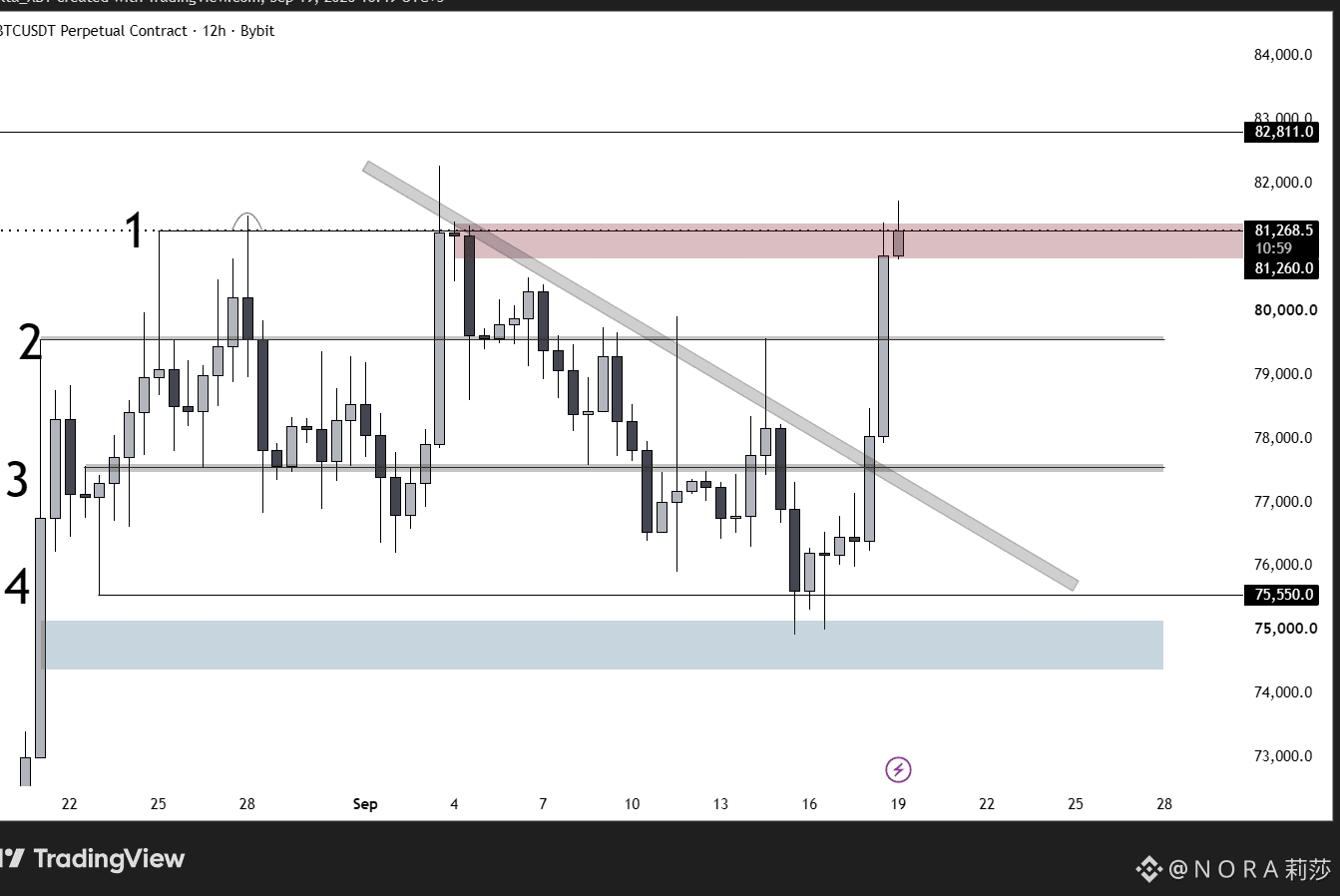
$BTC just made a move worth paying attention to.
After spending days compressed beneath a descending trendline, Bitcoin finally broke through with a strong impulsive candle and pushed straight into the $81K resistance zone.
What stands out on the 12H chart:
→ Descending trendline has been broken
→ ~$79.5K resistance was reclaimed during the move
→ Price is now testing the major $81.0K–$81.3K supply area
→ Next major level above sits around $82.8K
→ If rejected, ~$79.5K becomes an important area to watch for a retest
The breakout itself looks strong, but this is exactly where confirmation matters.
A clean hold above $81.3K would strengthen the breakout structure and put the $82.8K region back in focus.
But if BTC fails to establish acceptance here, a pullback toward $79.5K wouldn't automatically invalidate the move it could simply be the market testing the breakout.
For now, the structure has clearly improved.
Breakout happened. Resistance is being tested. Now I’m watching whether buyers can turn $81K from a ceiling into support.
$BTC is getting interesting again.
{spot}(BTCUSDT)
Not financial advice. Always manage risk.
#BTC走势分析 #BTCBreaks80K #BitcoinMarketCapTopsTesla
$BTC just made a move worth paying attention to.
After spending days compressed beneath a descending trendline, Bitcoin finally broke through with a strong impulsive candle and pushed straight into the $81K resistance zone.
What stands out on the 12H chart:
→ Descending trendline has been broken
→ ~$79.5K resistance was reclaimed during the move
→ Price is now testing the major $81.0K–$81.3K supply area
→ Next major level above sits around $82.8K
→ If rejected, ~$79.5K becomes an important area to watch for a retest
The breakout itself looks strong, but this is exactly where confirmation matters.
A clean hold above $81.3K would strengthen the breakout structure and put the $82.8K region back in focus.
But if BTC fails to establish acceptance here, a pullback toward $79.5K wouldn't automatically invalidate the move it could simply be the market testing the breakout.
For now, the structure has clearly improved.
Breakout happened. Resistance is being tested. Now I’m watching whether buyers can turn $81K from a ceiling into support.
$BTC is getting interesting again.
Not financial advice. Always manage risk.
#BTC走势分析 #BTCBreaks80K #BitcoinMarketCapTopsTesla
After spending days compressed beneath a descending trendline, Bitcoin finally broke through with a strong impulsive candle and pushed straight into the $81K resistance zone.
What stands out on the 12H chart:
→ Descending trendline has been broken
→ ~$79.5K resistance was reclaimed during the move
→ Price is now testing the major $81.0K–$81.3K supply area
→ Next major level above sits around $82.8K
→ If rejected, ~$79.5K becomes an important area to watch for a retest
The breakout itself looks strong, but this is exactly where confirmation matters.
A clean hold above $81.3K would strengthen the breakout structure and put the $82.8K region back in focus.
But if BTC fails to establish acceptance here, a pullback toward $79.5K wouldn't automatically invalidate the move it could simply be the market testing the breakout.
For now, the structure has clearly improved.
Breakout happened. Resistance is being tested. Now I’m watching whether buyers can turn $81K from a ceiling into support.
$BTC is getting interesting again.
Not financial advice. Always manage risk.
#BTC走势分析 #BTCBreaks80K #BitcoinMarketCapTopsTesla
9
12
780
·
--
Bullish
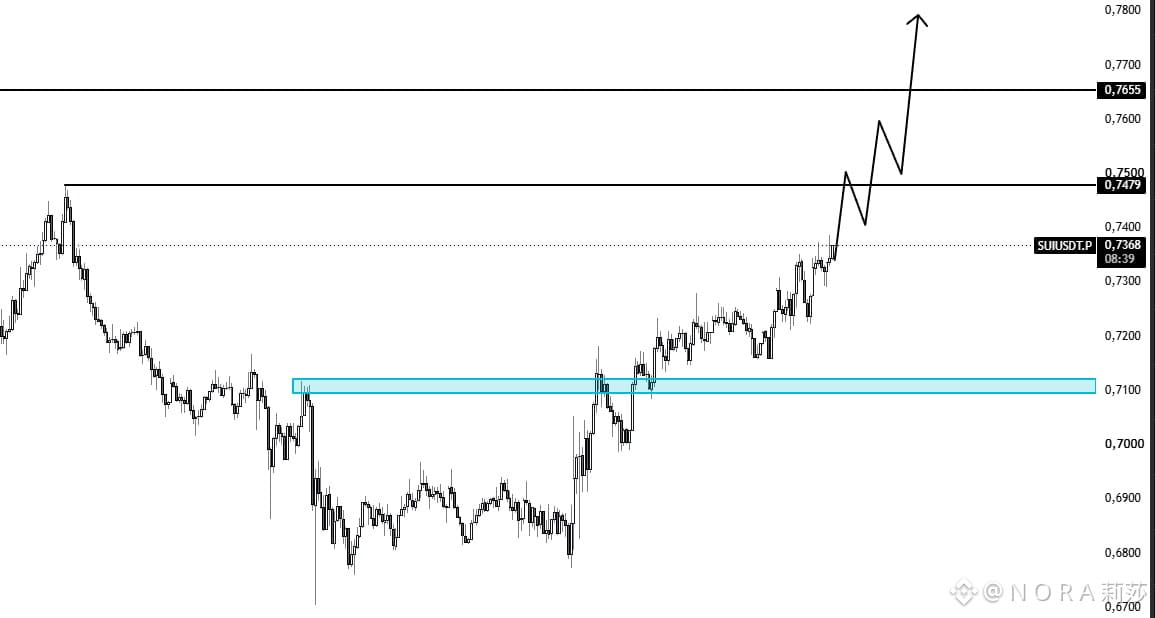
$SUI is starting to look interesting here. 👀
The structure has shifted bullish, price has reclaimed the key $0.71 support zone, and buyers are continuing to push higher.
Right now, SUI is trading around $0.7368, sitting just below the first major liquidity area.
My levels:
📍 Entry: $0.7368
🎯 Target 1: $0.7442
🎯 Target 2: $0.7655
🎯 Target 3: $0.7929
🛑 Invalidation: $0.7093
The important part for me is $0.744–$0.748.
A clean breakout and hold above this area could open the path toward $0.7655, while continued momentum could bring the higher target around $0.7929 into focus.
But I’m not ignoring the downside. If SUI loses the $0.71 support region, this bullish setup weakens significantly.
For now: bullish structure, support reclaimed, liquidity sitting above.
Watching how price reacts at that first resistance before getting too aggressive.
Would you take the breakout or wait for the retest? 👀
#sui #SUIUSDT #BinanceSquare
$SUI is starting to look interesting here. 👀
The structure has shifted bullish, price has reclaimed the key $0.71 support zone, and buyers are continuing to push higher.
Right now, SUI is trading around $0.7368, sitting just below the first major liquidity area.
My levels:
📍 Entry: $0.7368
🎯 Target 1: $0.7442
🎯 Target 2: $0.7655
🎯 Target 3: $0.7929
🛑 Invalidation: $0.7093
The important part for me is $0.744–$0.748.
A clean breakout and hold above this area could open the path toward $0.7655, while continued momentum could bring the higher target around $0.7929 into focus.
But I’m not ignoring the downside. If SUI loses the $0.71 support region, this bullish setup weakens significantly.
For now: bullish structure, support reclaimed, liquidity sitting above.
Watching how price reacts at that first resistance before getting too aggressive.
Would you take the breakout or wait for the retest? 👀
#sui #SUIUSDT #BinanceSquare
The structure has shifted bullish, price has reclaimed the key $0.71 support zone, and buyers are continuing to push higher.
Right now, SUI is trading around $0.7368, sitting just below the first major liquidity area.
My levels:
📍 Entry: $0.7368
🎯 Target 1: $0.7442
🎯 Target 2: $0.7655
🎯 Target 3: $0.7929
🛑 Invalidation: $0.7093
The important part for me is $0.744–$0.748.
A clean breakout and hold above this area could open the path toward $0.7655, while continued momentum could bring the higher target around $0.7929 into focus.
But I’m not ignoring the downside. If SUI loses the $0.71 support region, this bullish setup weakens significantly.
For now: bullish structure, support reclaimed, liquidity sitting above.
Watching how price reacts at that first resistance before getting too aggressive.
Would you take the breakout or wait for the retest? 👀
#sui #SUIUSDT #BinanceSquare
11
15
2k
·
--
One of the earliest lessons crypto taught me was that identity alone doesn't create trust.
In the early days, wallets were anonymous, profiles were disposable, and reputation had to emerge from behavior. The people who consistently shipped, communicated, and honored commitments accumulated something more valuable than tokens: credibility.
I think AI is entering a similar phase.
Today, most discussions focus on model intelligence. Which system is smarter? Which benchmark is higher? Which agent can perform more tasks? But history suggests that intelligence is only part of the equation.
As AI agents become participants in financial systems, marketplaces, research networks, and digital economies, the harder problem may be attribution. Not what an agent knows, but whether it can be trusted. Did it complete tasks reliably? Did it provide accurate information over time? Can its decisions be verified and linked to a persistent history?
This is why reputation infrastructure increasingly feels like a missing layer.
In the same way crypto evolved from anonymous transactions toward verifiable onchain histories, AI may evolve from isolated intelligence toward persistent reputation. Behavior becomes data. Reliability becomes measurable. Trust becomes portable.
That is one reason I keep paying attention to $GENIUS.
The long-term opportunity may not be creating the smartest agents. It may be creating systems that help identify which agents deserve trust in the first place.
If AI becomes abundant, reputation could become scarce.
And scarce layers tend to become foundational.
$GENIUS #genius @GeniusOfficial
One of the earliest lessons crypto taught me was that identity alone doesn't create trust.
In the early days, wallets were anonymous, profiles were disposable, and reputation had to emerge from behavior. The people who consistently shipped, communicated, and honored commitments accumulated something more valuable than tokens: credibility.
I think AI is entering a similar phase.
Today, most discussions focus on model intelligence. Which system is smarter? Which benchmark is higher? Which agent can perform more tasks? But history suggests that intelligence is only part of the equation.
As AI agents become participants in financial systems, marketplaces, research networks, and digital economies, the harder problem may be attribution. Not what an agent knows, but whether it can be trusted. Did it complete tasks reliably? Did it provide accurate information over time? Can its decisions be verified and linked to a persistent history?
This is why reputation infrastructure increasingly feels like a missing layer.
In the same way crypto evolved from anonymous transactions toward verifiable onchain histories, AI may evolve from isolated intelligence toward persistent reputation. Behavior becomes data. Reliability becomes measurable. Trust becomes portable.
That is one reason I keep paying attention to $GENIUS .
The long-term opportunity may not be creating the smartest agents. It may be creating systems that help identify which agents deserve trust in the first place.
If AI becomes abundant, reputation could become scarce.
And scarce layers tend to become foundational.
$GENIUS #genius @GeniusOfficial
In the early days, wallets were anonymous, profiles were disposable, and reputation had to emerge from behavior. The people who consistently shipped, communicated, and honored commitments accumulated something more valuable than tokens: credibility.
I think AI is entering a similar phase.
Today, most discussions focus on model intelligence. Which system is smarter? Which benchmark is higher? Which agent can perform more tasks? But history suggests that intelligence is only part of the equation.
As AI agents become participants in financial systems, marketplaces, research networks, and digital economies, the harder problem may be attribution. Not what an agent knows, but whether it can be trusted. Did it complete tasks reliably? Did it provide accurate information over time? Can its decisions be verified and linked to a persistent history?
This is why reputation infrastructure increasingly feels like a missing layer.
In the same way crypto evolved from anonymous transactions toward verifiable onchain histories, AI may evolve from isolated intelligence toward persistent reputation. Behavior becomes data. Reliability becomes measurable. Trust becomes portable.
That is one reason I keep paying attention to $GENIUS .
The long-term opportunity may not be creating the smartest agents. It may be creating systems that help identify which agents deserve trust in the first place.
If AI becomes abundant, reputation could become scarce.
And scarce layers tend to become foundational.
$GENIUS #genius @GeniusOfficial

6
170
·
--
Verified
One thing crypto taught me early is that trust rarely comes from identity.
It comes from history.
Before DeFi had institutions, ratings, or formal guarantees, people learned to trust wallets, builders, and protocols based on observable behavior. Who delivered consistently? Who showed up during difficult market conditions? Who built a track record that could be independently verified?
I think AI is moving toward a similar realization.
Right now, the conversation is dominated by intelligence. Bigger models. Better reasoning. Higher benchmark scores.
But in a world where intelligence becomes increasingly abundant, the real bottleneck may become trust.
Can an AI agent be held accountable for its actions? Can its decisions be traced? Can reliability be measured over months instead of minutes? Can attribution persist across networks and applications?
These questions feel more important than another incremental improvement in model performance.
That's why I find the reputation layer increasingly interesting.
Just as blockchains created immutable histories for transactions, emerging AI infrastructure is starting to explore persistent histories for agents. Behavior becomes reputation. Reputation becomes a signal. And over time, that signal may become more valuable than raw intelligence itself.
This is one reason I keep watching $BR.
The next phase of AI may not be defined by who builds the smartest agents, but by who builds the systems that help us determine which agents deserve trust.
History suggests that when information becomes abundant, credibility becomes the scarce resource.
$BR #bedrock @Bedrock
One thing crypto taught me early is that trust rarely comes from identity.
It comes from history.
Before DeFi had institutions, ratings, or formal guarantees, people learned to trust wallets, builders, and protocols based on observable behavior. Who delivered consistently? Who showed up during difficult market conditions? Who built a track record that could be independently verified?
I think AI is moving toward a similar realization.
Right now, the conversation is dominated by intelligence. Bigger models. Better reasoning. Higher benchmark scores.
But in a world where intelligence becomes increasingly abundant, the real bottleneck may become trust.
Can an AI agent be held accountable for its actions? Can its decisions be traced? Can reliability be measured over months instead of minutes? Can attribution persist across networks and applications?
These questions feel more important than another incremental improvement in model performance.
That's why I find the reputation layer increasingly interesting.
Just as blockchains created immutable histories for transactions, emerging AI infrastructure is starting to explore persistent histories for agents. Behavior becomes reputation. Reputation becomes a signal. And over time, that signal may become more valuable than raw intelligence itself.
This is one reason I keep watching $BR .
The next phase of AI may not be defined by who builds the smartest agents, but by who builds the systems that help us determine which agents deserve trust.
History suggests that when information becomes abundant, credibility becomes the scarce resource.
$BR #bedrock @Bedrock
It comes from history.
Before DeFi had institutions, ratings, or formal guarantees, people learned to trust wallets, builders, and protocols based on observable behavior. Who delivered consistently? Who showed up during difficult market conditions? Who built a track record that could be independently verified?
I think AI is moving toward a similar realization.
Right now, the conversation is dominated by intelligence. Bigger models. Better reasoning. Higher benchmark scores.
But in a world where intelligence becomes increasingly abundant, the real bottleneck may become trust.
Can an AI agent be held accountable for its actions? Can its decisions be traced? Can reliability be measured over months instead of minutes? Can attribution persist across networks and applications?
These questions feel more important than another incremental improvement in model performance.
That's why I find the reputation layer increasingly interesting.
Just as blockchains created immutable histories for transactions, emerging AI infrastructure is starting to explore persistent histories for agents. Behavior becomes reputation. Reputation becomes a signal. And over time, that signal may become more valuable than raw intelligence itself.
This is one reason I keep watching $BR .
The next phase of AI may not be defined by who builds the smartest agents, but by who builds the systems that help us determine which agents deserve trust.
History suggests that when information becomes abundant, credibility becomes the scarce resource.
$BR #bedrock @Bedrock

10
131
·
--
I keep thinking about how early crypto didn’t fail on technology it failed on trust.
Back in the BTC and early DeFi era, we had perfectly functional systems that still required users to constantly ask the same question: can this be trusted, right now, in this context? Eventually, the market solved it with layer proof mechanisms, audits, on-chain history, and eventually reputation built from behavior rather than promises.
What I’m seeing emerging around $BR and similar AI reputation primitives feels like a similar inflection point, but for intelligence systems instead of financial ones.
We are quietly moving from “how smart is this model?” to “how consistently does it behave, attribute, and remain reliable across time and interaction contexts.”
That shift matters more than it looks.
Because intelligence is cheap now. Attribution isn’t. Consistency isn’t. Verifiable behavior across environments definitely isn’t.
If crypto taught us anything, it’s that raw capability gets commoditized fast but trust layers become the real infrastructure. In DeFi, liquidity didn’t matter without credibility. In AI systems, output quality won’t matter without reputation scaffolding around how that output is produced and traced.
I suspect we’re early in a phase where reputation becomes a first-class compute layer built on behavioral history, failure rates, and attribution integrity.
And if that plays out, intelligence stops being the differentiator.
Reputation becomes the bottleneck.
#bedrock @Bedrock
I keep thinking about how early crypto didn’t fail on technology it failed on trust.
Back in the BTC and early DeFi era, we had perfectly functional systems that still required users to constantly ask the same question: can this be trusted, right now, in this context? Eventually, the market solved it with layer proof mechanisms, audits, on-chain history, and eventually reputation built from behavior rather than promises.
What I’m seeing emerging around $BR and similar AI reputation primitives feels like a similar inflection point, but for intelligence systems instead of financial ones.
We are quietly moving from “how smart is this model?” to “how consistently does it behave, attribute, and remain reliable across time and interaction contexts.”
That shift matters more than it looks.
Because intelligence is cheap now. Attribution isn’t. Consistency isn’t. Verifiable behavior across environments definitely isn’t.
If crypto taught us anything, it’s that raw capability gets commoditized fast but trust layers become the real infrastructure. In DeFi, liquidity didn’t matter without credibility. In AI systems, output quality won’t matter without reputation scaffolding around how that output is produced and traced.
I suspect we’re early in a phase where reputation becomes a first-class compute layer built on behavioral history, failure rates, and attribution integrity.
And if that plays out, intelligence stops being the differentiator.
Reputation becomes the bottleneck.
#bedrock @Bedrock
Back in the BTC and early DeFi era, we had perfectly functional systems that still required users to constantly ask the same question: can this be trusted, right now, in this context? Eventually, the market solved it with layer proof mechanisms, audits, on-chain history, and eventually reputation built from behavior rather than promises.
What I’m seeing emerging around $BR and similar AI reputation primitives feels like a similar inflection point, but for intelligence systems instead of financial ones.
We are quietly moving from “how smart is this model?” to “how consistently does it behave, attribute, and remain reliable across time and interaction contexts.”
That shift matters more than it looks.
Because intelligence is cheap now. Attribution isn’t. Consistency isn’t. Verifiable behavior across environments definitely isn’t.
If crypto taught us anything, it’s that raw capability gets commoditized fast but trust layers become the real infrastructure. In DeFi, liquidity didn’t matter without credibility. In AI systems, output quality won’t matter without reputation scaffolding around how that output is produced and traced.
I suspect we’re early in a phase where reputation becomes a first-class compute layer built on behavioral history, failure rates, and attribution integrity.
And if that plays out, intelligence stops being the differentiator.
Reputation becomes the bottleneck.
#bedrock @Bedrock
1
6
131
·
--
I remember when early crypto focused almost entirely on consensus. The assumption was simple: if the network could agree on truth, everything else would follow.
What emerged later was reputation. Wallet history, onchain behavior, contribution records, and social trust became just as valuable as the protocol itself.
AI may be heading down a similar path.
As models become increasingly capable, the harder problem may not be intelligence but attribution. Which agent can be trusted? Which outputs are consistently reliable? Which decisions have a verifiable history behind them?
That's why projects like $GENIUS catch my attention. The next layer of AI infrastructure may not be another leap in model performance, but systems that track behavior, establish accountability, and make reputation portable.
In the long run, intelligence can be replicated. Reputation has to be earned.
#genius @GeniusOfficial
I remember when early crypto focused almost entirely on consensus. The assumption was simple: if the network could agree on truth, everything else would follow.
What emerged later was reputation. Wallet history, onchain behavior, contribution records, and social trust became just as valuable as the protocol itself.
AI may be heading down a similar path.
As models become increasingly capable, the harder problem may not be intelligence but attribution. Which agent can be trusted? Which outputs are consistently reliable? Which decisions have a verifiable history behind them?
That's why projects like $GENIUS catch my attention. The next layer of AI infrastructure may not be another leap in model performance, but systems that track behavior, establish accountability, and make reputation portable.
In the long run, intelligence can be replicated. Reputation has to be earned.
#genius @GeniusOfficial
What emerged later was reputation. Wallet history, onchain behavior, contribution records, and social trust became just as valuable as the protocol itself.
AI may be heading down a similar path.
As models become increasingly capable, the harder problem may not be intelligence but attribution. Which agent can be trusted? Which outputs are consistently reliable? Which decisions have a verifiable history behind them?
That's why projects like $GENIUS catch my attention. The next layer of AI infrastructure may not be another leap in model performance, but systems that track behavior, establish accountability, and make reputation portable.
In the long run, intelligence can be replicated. Reputation has to be earned.
#genius @GeniusOfficial

1
5
140
·
--
One thing early crypto taught me is that consensus mattered more than raw computation.
Bitcoin didn’t win because it was the most powerful machine. It won because people could agree on who did what, when, and under what rules.
AI may be approaching a similar moment.
Today, most attention goes to model intelligence. But as autonomous agents begin interacting with each other, reliability, attribution, and behavioral history could become far more important than output quality alone.
That’s why I keep watching $GENIUS .
The long-term challenge may not be creating smarter AI. It may be creating systems that can consistently identify which intelligence deserves trust.
In that world, reputation becomes infrastructure, not a feature.
#genius @GeniusOfficial
One thing early crypto taught me is that consensus mattered more than raw computation.
Bitcoin didn’t win because it was the most powerful machine. It won because people could agree on who did what, when, and under what rules.
AI may be approaching a similar moment.
Today, most attention goes to model intelligence. But as autonomous agents begin interacting with each other, reliability, attribution, and behavioral history could become far more important than output quality alone.
That’s why I keep watching $GENIUS .
The long-term challenge may not be creating smarter AI. It may be creating systems that can consistently identify which intelligence deserves trust.
In that world, reputation becomes infrastructure, not a feature.
#genius @GeniusOfficial
Bitcoin didn’t win because it was the most powerful machine. It won because people could agree on who did what, when, and under what rules.
AI may be approaching a similar moment.
Today, most attention goes to model intelligence. But as autonomous agents begin interacting with each other, reliability, attribution, and behavioral history could become far more important than output quality alone.
That’s why I keep watching $GENIUS .
The long-term challenge may not be creating smarter AI. It may be creating systems that can consistently identify which intelligence deserves trust.
In that world, reputation becomes infrastructure, not a feature.
#genius @GeniusOfficial

1
140
·
--
The Next AI Arms Race Might Be About Reputation, Not IntelligenceI keep thinking about an old problem from crypto that, in hindsight, was never really about money.
In the early years of blockchain networks, one of the biggest challenges wasn't creating digital assets. It was creating trust between strangers. Bitcoin solved part of that problem through consensus. Ethereum expanded it through programmable coordination. Entire ecosystems emerged around proving ownership, verifying transactions, and establishing reliable records without centralized intermediaries.
Yet even as crypto became better at tracking value, it remained surprisingly weak at tracking reputation.
Wallet addresses could hold millions of dollars and still tell you almost nothing about the behavior behind them. An account could interact with protocols, move assets, participate in governance, and build years of history, yet most systems still struggled to distinguish meaningful contribution from simple activity.
For a long time, that limitation seemed manageable.
Now AI is forcing the issue.
As AI systems become more capable, a different question is emerging beneath the constant discussion about model performance, reasoning benchmarks, and intelligence improvements.
How do we know which outputs deserve trust?
The challenge isn't necessarily producing information anymore. Increasingly, the challenge is evaluating the reliability of information, understanding where it came from, and determining whether the source has earned credibility over time.
That feels remarkably similar to problems crypto encountered years ago.
When decentralized finance first began scaling, users quickly discovered that transparency alone wasn't enough. Every transaction was visible, but visibility did not automatically create confidence. Market participants needed ways to understand behavior patterns, historical reliability, and long-term consistency.
The same dynamic may be developing in AI.
As models become abundant, intelligence starts looking less like a scarce resource and more like a commodity. Multiple systems can answer questions, generate code, analyze data, and produce content. The differences between them may continue to narrow over time.
What remains difficult is attribution.
Who contributed the knowledge?
Which sources consistently produce useful outcomes?
Which datasets demonstrate reliability over years rather than weeks?
Which agents can be trusted when incentives become complex?
These questions point toward something that feels increasingly important: reputation infrastructure.
Historically, reputation has often emerged as a secondary layer after technological capability. The internet first solved communication before solving identity. E-commerce first enabled transactions before building sophisticated trust systems. Open-source software first enabled collaboration before establishing contributor credibility mechanisms.
AI may be following a similar path.
The first generation of AI infrastructure focused on intelligence itself. Better models, larger datasets, increased computational power, and improved reasoning capabilities dominated discussion. The objective was straightforward: make machines more capable.
The next phase may focus on making intelligence accountable.
That distinction matters.
A highly capable system that cannot explain its origins, demonstrate reliability, or establish attribution creates uncertainty. A slightly less capable system with transparent provenance and measurable trust signals may ultimately prove more valuable in real-world environments.
This is where projects exploring reputation layers become interesting to me.
Not because they are attempting to build smarter models, but because they are asking a different question entirely.
What if the missing infrastructure is not intelligence generation but trust verification?
The idea reminds me of how blockchain eventually evolved beyond simple transactions. Over time, entire ecosystems formed around identity, governance, staking history, contribution records, and behavioral signals. The most important data often wasn't what users owned but how they acted.
Behavior became information.
Consistency became information.
Participation became information.
Those signals frequently carried more predictive value than raw balances.
AI systems may eventually require similar mechanisms.
Imagine an environment where models, agents, datasets, contributors, and applications continuously interact. Intelligence flows everywhere. Content becomes abundant. Automation becomes ubiquitous.
In that environment, the scarce resource may not be knowledge generation.
It may be credibility.
The ability to determine which outputs consistently create value, which contributors have demonstrated expertise, and which systems have earned trust through observable behavior could become increasingly important infrastructure.
That possibility is one reason I continue paying attention to projects like OpenLedger and the broader conversation around decentralized attribution.
The most interesting aspect is not necessarily the technology itself. It is the underlying assumption.
The assumption that intelligence alone may not be sufficient.
For decades, technology development has largely focused on increasing capability. Faster processors, larger networks, better algorithms, and more sophisticated models all followed the same trajectory. Progress was measured through performance.
But human systems rarely operate on performance alone.
Markets depend on reputation.
Institutions depend on reputation.
Communities depend on reputation.
Even scientific progress depends heavily on reputation and attribution mechanisms that help participants evaluate trustworthiness over time.
AI may eventually need similar foundations.
Not because intelligence stops improving, but because intelligence without accountability creates new forms of uncertainty.
The more capable AI becomes, the more valuable reliable attribution may become.
From that perspective, reputation systems begin to look less like optional features and more like foundational infrastructure.
Perhaps that is the lesson crypto has been quietly teaching for years.
The hardest challenge was never creating digital value. It was creating systems that allowed strangers to trust the behavior behind that value.
AI now appears to be approaching a similar crossroads.
And if that comparison proves accurate, the next major layer of AI infrastructure may not be the system that thinks the fastest.
It may be the system that remembers who can be trusted.
$OPEN @Openledger #OpenLedger
The Next AI Arms Race Might Be About Reputation, Not Intelligence
I keep thinking about an old problem from crypto that, in hindsight, was never really about money.
In the early years of blockchain networks, one of the biggest challenges wasn't creating digital assets. It was creating trust between strangers. Bitcoin solved part of that problem through consensus. Ethereum expanded it through programmable coordination. Entire ecosystems emerged around proving ownership, verifying transactions, and establishing reliable records without centralized intermediaries.
Yet even as crypto became better at tracking value, it remained surprisingly weak at tracking reputation.
Wallet addresses could hold millions of dollars and still tell you almost nothing about the behavior behind them. An account could interact with protocols, move assets, participate in governance, and build years of history, yet most systems still struggled to distinguish meaningful contribution from simple activity.
For a long time, that limitation seemed manageable.
Now AI is forcing the issue.
As AI systems become more capable, a different question is emerging beneath the constant discussion about model performance, reasoning benchmarks, and intelligence improvements.
How do we know which outputs deserve trust?
The challenge isn't necessarily producing information anymore. Increasingly, the challenge is evaluating the reliability of information, understanding where it came from, and determining whether the source has earned credibility over time.
That feels remarkably similar to problems crypto encountered years ago.
When decentralized finance first began scaling, users quickly discovered that transparency alone wasn't enough. Every transaction was visible, but visibility did not automatically create confidence. Market participants needed ways to understand behavior patterns, historical reliability, and long-term consistency.
The same dynamic may be developing in AI.
As models become abundant, intelligence starts looking less like a scarce resource and more like a commodity. Multiple systems can answer questions, generate code, analyze data, and produce content. The differences between them may continue to narrow over time.
What remains difficult is attribution.
Who contributed the knowledge?
Which sources consistently produce useful outcomes?
Which datasets demonstrate reliability over years rather than weeks?
Which agents can be trusted when incentives become complex?
These questions point toward something that feels increasingly important: reputation infrastructure.
Historically, reputation has often emerged as a secondary layer after technological capability. The internet first solved communication before solving identity. E-commerce first enabled transactions before building sophisticated trust systems. Open-source software first enabled collaboration before establishing contributor credibility mechanisms.
AI may be following a similar path.
The first generation of AI infrastructure focused on intelligence itself. Better models, larger datasets, increased computational power, and improved reasoning capabilities dominated discussion. The objective was straightforward: make machines more capable.
The next phase may focus on making intelligence accountable.
That distinction matters.
A highly capable system that cannot explain its origins, demonstrate reliability, or establish attribution creates uncertainty. A slightly less capable system with transparent provenance and measurable trust signals may ultimately prove more valuable in real-world environments.
This is where projects exploring reputation layers become interesting to me.
Not because they are attempting to build smarter models, but because they are asking a different question entirely.
What if the missing infrastructure is not intelligence generation but trust verification?
The idea reminds me of how blockchain eventually evolved beyond simple transactions. Over time, entire ecosystems formed around identity, governance, staking history, contribution records, and behavioral signals. The most important data often wasn't what users owned but how they acted.
Behavior became information.
Consistency became information.
Participation became information.
Those signals frequently carried more predictive value than raw balances.
AI systems may eventually require similar mechanisms.
Imagine an environment where models, agents, datasets, contributors, and applications continuously interact. Intelligence flows everywhere. Content becomes abundant. Automation becomes ubiquitous.
In that environment, the scarce resource may not be knowledge generation.
It may be credibility.
The ability to determine which outputs consistently create value, which contributors have demonstrated expertise, and which systems have earned trust through observable behavior could become increasingly important infrastructure.
That possibility is one reason I continue paying attention to projects like OpenLedger and the broader conversation around decentralized attribution.
The most interesting aspect is not necessarily the technology itself. It is the underlying assumption.
The assumption that intelligence alone may not be sufficient.
For decades, technology development has largely focused on increasing capability. Faster processors, larger networks, better algorithms, and more sophisticated models all followed the same trajectory. Progress was measured through performance.
But human systems rarely operate on performance alone.
Markets depend on reputation.
Institutions depend on reputation.
Communities depend on reputation.
Even scientific progress depends heavily on reputation and attribution mechanisms that help participants evaluate trustworthiness over time.
AI may eventually need similar foundations.
Not because intelligence stops improving, but because intelligence without accountability creates new forms of uncertainty.
The more capable AI becomes, the more valuable reliable attribution may become.
From that perspective, reputation systems begin to look less like optional features and more like foundational infrastructure.
Perhaps that is the lesson crypto has been quietly teaching for years.
The hardest challenge was never creating digital value. It was creating systems that allowed strangers to trust the behavior behind that value.
AI now appears to be approaching a similar crossroads.
And if that comparison proves accurate, the next major layer of AI infrastructure may not be the system that thinks the fastest.
It may be the system that remembers who can be trusted.
$OPEN @OpenLedger #OpenLedger
In the early years of blockchain networks, one of the biggest challenges wasn't creating digital assets. It was creating trust between strangers. Bitcoin solved part of that problem through consensus. Ethereum expanded it through programmable coordination. Entire ecosystems emerged around proving ownership, verifying transactions, and establishing reliable records without centralized intermediaries.
Yet even as crypto became better at tracking value, it remained surprisingly weak at tracking reputation.
Wallet addresses could hold millions of dollars and still tell you almost nothing about the behavior behind them. An account could interact with protocols, move assets, participate in governance, and build years of history, yet most systems still struggled to distinguish meaningful contribution from simple activity.
For a long time, that limitation seemed manageable.
Now AI is forcing the issue.
As AI systems become more capable, a different question is emerging beneath the constant discussion about model performance, reasoning benchmarks, and intelligence improvements.
How do we know which outputs deserve trust?
The challenge isn't necessarily producing information anymore. Increasingly, the challenge is evaluating the reliability of information, understanding where it came from, and determining whether the source has earned credibility over time.
That feels remarkably similar to problems crypto encountered years ago.
When decentralized finance first began scaling, users quickly discovered that transparency alone wasn't enough. Every transaction was visible, but visibility did not automatically create confidence. Market participants needed ways to understand behavior patterns, historical reliability, and long-term consistency.
The same dynamic may be developing in AI.
As models become abundant, intelligence starts looking less like a scarce resource and more like a commodity. Multiple systems can answer questions, generate code, analyze data, and produce content. The differences between them may continue to narrow over time.
What remains difficult is attribution.
Who contributed the knowledge?
Which sources consistently produce useful outcomes?
Which datasets demonstrate reliability over years rather than weeks?
Which agents can be trusted when incentives become complex?
These questions point toward something that feels increasingly important: reputation infrastructure.
Historically, reputation has often emerged as a secondary layer after technological capability. The internet first solved communication before solving identity. E-commerce first enabled transactions before building sophisticated trust systems. Open-source software first enabled collaboration before establishing contributor credibility mechanisms.
AI may be following a similar path.
The first generation of AI infrastructure focused on intelligence itself. Better models, larger datasets, increased computational power, and improved reasoning capabilities dominated discussion. The objective was straightforward: make machines more capable.
The next phase may focus on making intelligence accountable.
That distinction matters.
A highly capable system that cannot explain its origins, demonstrate reliability, or establish attribution creates uncertainty. A slightly less capable system with transparent provenance and measurable trust signals may ultimately prove more valuable in real-world environments.
This is where projects exploring reputation layers become interesting to me.
Not because they are attempting to build smarter models, but because they are asking a different question entirely.
What if the missing infrastructure is not intelligence generation but trust verification?
The idea reminds me of how blockchain eventually evolved beyond simple transactions. Over time, entire ecosystems formed around identity, governance, staking history, contribution records, and behavioral signals. The most important data often wasn't what users owned but how they acted.
Behavior became information.
Consistency became information.
Participation became information.
Those signals frequently carried more predictive value than raw balances.
AI systems may eventually require similar mechanisms.
Imagine an environment where models, agents, datasets, contributors, and applications continuously interact. Intelligence flows everywhere. Content becomes abundant. Automation becomes ubiquitous.
In that environment, the scarce resource may not be knowledge generation.
It may be credibility.
The ability to determine which outputs consistently create value, which contributors have demonstrated expertise, and which systems have earned trust through observable behavior could become increasingly important infrastructure.
That possibility is one reason I continue paying attention to projects like OpenLedger and the broader conversation around decentralized attribution.
The most interesting aspect is not necessarily the technology itself. It is the underlying assumption.
The assumption that intelligence alone may not be sufficient.
For decades, technology development has largely focused on increasing capability. Faster processors, larger networks, better algorithms, and more sophisticated models all followed the same trajectory. Progress was measured through performance.
But human systems rarely operate on performance alone.
Markets depend on reputation.
Institutions depend on reputation.
Communities depend on reputation.
Even scientific progress depends heavily on reputation and attribution mechanisms that help participants evaluate trustworthiness over time.
AI may eventually need similar foundations.
Not because intelligence stops improving, but because intelligence without accountability creates new forms of uncertainty.
The more capable AI becomes, the more valuable reliable attribution may become.
From that perspective, reputation systems begin to look less like optional features and more like foundational infrastructure.
Perhaps that is the lesson crypto has been quietly teaching for years.
The hardest challenge was never creating digital value. It was creating systems that allowed strangers to trust the behavior behind that value.
AI now appears to be approaching a similar crossroads.
And if that comparison proves accurate, the next major layer of AI infrastructure may not be the system that thinks the fastest.
It may be the system that remembers who can be trusted.
$OPEN @OpenLedger #OpenLedger
2
5
176
·
--
Most people remember when smartphones became everywhere.
What they forget is how awkward the transition looked beforehand.
Battery life was poor.
Apps were limited.
Networks were inconsistent.
And many people questioned why anyone needed a computer in their pocket.
The technology existed long before the behavior became normal.
That pattern shows up repeatedly across major technological shifts.
The first version rarely looks like the final outcome.
The same thought comes to mind when I look at $GENIUS .
What interests me isn't whether today's tools are perfect. It's the gradual shift in how people interact with information itself.
For years, the default approach was simple:
Find information.
Analyze it manually.
Make decisions alone.
Now we're seeing the early stages of something different.
People are beginning to delegate parts of research, filtering, organization, and execution to systems that improve alongside them.
From the outside, the ecosystem still feels fragmented.
Different tools.
Different approaches.
Different assumptions about where the market is headed.
But fragmentation often appears before standardization.
The internet looked fragmented.
Mobile computing looked fragmented.
Cloud software looked fragmented.
Then one day the new behavior became the default.
I don't think we're at that point yet.
But I do think the behavioral shift underneath the surface is becoming harder to ignore.
And when behavior changes at scale, infrastructure tends to follow.
@GeniusOfficial #genius
Most people remember when smartphones became everywhere.
What they forget is how awkward the transition looked beforehand.
Battery life was poor.
Apps were limited.
Networks were inconsistent.
And many people questioned why anyone needed a computer in their pocket.
The technology existed long before the behavior became normal.
That pattern shows up repeatedly across major technological shifts.
The first version rarely looks like the final outcome.
The same thought comes to mind when I look at $GENIUS .
What interests me isn't whether today's tools are perfect. It's the gradual shift in how people interact with information itself.
For years, the default approach was simple:
Find information.
Analyze it manually.
Make decisions alone.
Now we're seeing the early stages of something different.
People are beginning to delegate parts of research, filtering, organization, and execution to systems that improve alongside them.
From the outside, the ecosystem still feels fragmented.
Different tools.
Different approaches.
Different assumptions about where the market is headed.
But fragmentation often appears before standardization.
The internet looked fragmented.
Mobile computing looked fragmented.
Cloud software looked fragmented.
Then one day the new behavior became the default.
I don't think we're at that point yet.
But I do think the behavioral shift underneath the surface is becoming harder to ignore.
And when behavior changes at scale, infrastructure tends to follow.
@GeniusOfficial #genius
What they forget is how awkward the transition looked beforehand.
Battery life was poor.
Apps were limited.
Networks were inconsistent.
And many people questioned why anyone needed a computer in their pocket.
The technology existed long before the behavior became normal.
That pattern shows up repeatedly across major technological shifts.
The first version rarely looks like the final outcome.
The same thought comes to mind when I look at $GENIUS .
What interests me isn't whether today's tools are perfect. It's the gradual shift in how people interact with information itself.
For years, the default approach was simple:
Find information.
Analyze it manually.
Make decisions alone.
Now we're seeing the early stages of something different.
People are beginning to delegate parts of research, filtering, organization, and execution to systems that improve alongside them.
From the outside, the ecosystem still feels fragmented.
Different tools.
Different approaches.
Different assumptions about where the market is headed.
But fragmentation often appears before standardization.
The internet looked fragmented.
Mobile computing looked fragmented.
Cloud software looked fragmented.
Then one day the new behavior became the default.
I don't think we're at that point yet.
But I do think the behavioral shift underneath the surface is becoming harder to ignore.
And when behavior changes at scale, infrastructure tends to follow.
@GeniusOfficial #genius


2
4
242
·
--
In AI systems, intelligence fades behavioral reputation becomes the real infrastructureI keep circling back to how early crypto systems resolved uncertainty, because it feels increasingly relevant to how AI systems are starting to evolve.
In Bitcoin, trust wasn’t eliminated—it was displaced. Instead of trusting institutions or identities, the system anchored trust in verifiable behavior over time: validated blocks, consistent consensus, and an immutable record of what actually happened. Ethereum extended this into programmable execution, but the deeper shift remained the same—state and history became more reliable than intent or reputation in the human sense.
When I look at $OPEN through that lens, I don’t see it as an AI product layer. I see it as a potential attempt to formalize something crypto never fully needed to solve at scale: behavioral reputation for non-human systems.
AI systems are already producing outputs at scale, but what’s still missing is a durable structure for answering questions like: has this model, agent, or pipeline behaved reliably across contexts? Can its outputs be attributed cleanly over time? And critically, how does it behave under distribution shift, not just in benchmark conditions?
This is where the analogy to early blockchain becomes useful but incomplete. Blockchains proved correctness at a transaction level. AI systems require something closer to longitudinal credibility $USDC an accumulation of observed behavior, weighted reliability, and traceable attribution across interactions. Not just “is this output correct,” but “is this system consistently correct under pressure, drift, or adversarial conditions.”
If that abstraction holds, then reputation stops being a social overlay and becomes infrastructure. A persistent layer that sits above raw model intelligence, continuously updated by performance history rather than claims.
The more I think about it, the more it feels like intelligence itself may become commoditized faster than we expect. What will likely remain scarce is structured trust systems that can reliably explain not just what they produced, but how consistently they can be expected to produce it again.
In that framing, reputation is no longer secondary to intelligence. It becomes the interface through which intelligence is actually consumed.
And that shift, if it fully materializes, would quietly redefine what we consider valuable in AI systems altogether.
$OPEN #OpenLedger @Openledger
In AI systems, intelligence fades behavioral reputation becomes the real infrastructure
I keep circling back to how early crypto systems resolved uncertainty, because it feels increasingly relevant to how AI systems are starting to evolve.
In Bitcoin, trust wasn’t eliminated—it was displaced. Instead of trusting institutions or identities, the system anchored trust in verifiable behavior over time: validated blocks, consistent consensus, and an immutable record of what actually happened. Ethereum extended this into programmable execution, but the deeper shift remained the same—state and history became more reliable than intent or reputation in the human sense.
When I look at $OPEN through that lens, I don’t see it as an AI product layer. I see it as a potential attempt to formalize something crypto never fully needed to solve at scale: behavioral reputation for non-human systems.
AI systems are already producing outputs at scale, but what’s still missing is a durable structure for answering questions like: has this model, agent, or pipeline behaved reliably across contexts? Can its outputs be attributed cleanly over time? And critically, how does it behave under distribution shift, not just in benchmark conditions?
This is where the analogy to early blockchain becomes useful but incomplete. Blockchains proved correctness at a transaction level. AI systems require something closer to longitudinal credibility $USDC an accumulation of observed behavior, weighted reliability, and traceable attribution across interactions. Not just “is this output correct,” but “is this system consistently correct under pressure, drift, or adversarial conditions.”
If that abstraction holds, then reputation stops being a social overlay and becomes infrastructure. A persistent layer that sits above raw model intelligence, continuously updated by performance history rather than claims.
The more I think about it, the more it feels like intelligence itself may become commoditized faster than we expect. What will likely remain scarce is structured trust systems that can reliably explain not just what they produced, but how consistently they can be expected to produce it again.
In that framing, reputation is no longer secondary to intelligence. It becomes the interface through which intelligence is actually consumed.
And that shift, if it fully materializes, would quietly redefine what we consider valuable in AI systems altogether.
$OPEN #OpenLedger @Openledger
In Bitcoin, trust wasn’t eliminated—it was displaced. Instead of trusting institutions or identities, the system anchored trust in verifiable behavior over time: validated blocks, consistent consensus, and an immutable record of what actually happened. Ethereum extended this into programmable execution, but the deeper shift remained the same—state and history became more reliable than intent or reputation in the human sense.
When I look at $OPEN through that lens, I don’t see it as an AI product layer. I see it as a potential attempt to formalize something crypto never fully needed to solve at scale: behavioral reputation for non-human systems.
AI systems are already producing outputs at scale, but what’s still missing is a durable structure for answering questions like: has this model, agent, or pipeline behaved reliably across contexts? Can its outputs be attributed cleanly over time? And critically, how does it behave under distribution shift, not just in benchmark conditions?
This is where the analogy to early blockchain becomes useful but incomplete. Blockchains proved correctness at a transaction level. AI systems require something closer to longitudinal credibility $USDC an accumulation of observed behavior, weighted reliability, and traceable attribution across interactions. Not just “is this output correct,” but “is this system consistently correct under pressure, drift, or adversarial conditions.”
If that abstraction holds, then reputation stops being a social overlay and becomes infrastructure. A persistent layer that sits above raw model intelligence, continuously updated by performance history rather than claims.
The more I think about it, the more it feels like intelligence itself may become commoditized faster than we expect. What will likely remain scarce is structured trust systems that can reliably explain not just what they produced, but how consistently they can be expected to produce it again.
In that framing, reputation is no longer secondary to intelligence. It becomes the interface through which intelligence is actually consumed.
And that shift, if it fully materializes, would quietly redefine what we consider valuable in AI systems altogether.
$OPEN #OpenLedger @Openledger
2
4
146
·
--
I keep thinking about AI reputation systems through the lens of early crypto infrastructure.
In Bitcoin, the breakthrough wasn't intelligence. It was verifiability. The network didn't need to trust who made a claim because it could verify the history behind it.
AI feels like it's approaching a similar transition.
Today, most attention is focused on model capability: bigger context windows, better reasoning, faster outputs. But as autonomous agents become more common, a different question starts to matter:
Can this system be trusted over time?
That's where projects like $GENIUS become interesting.
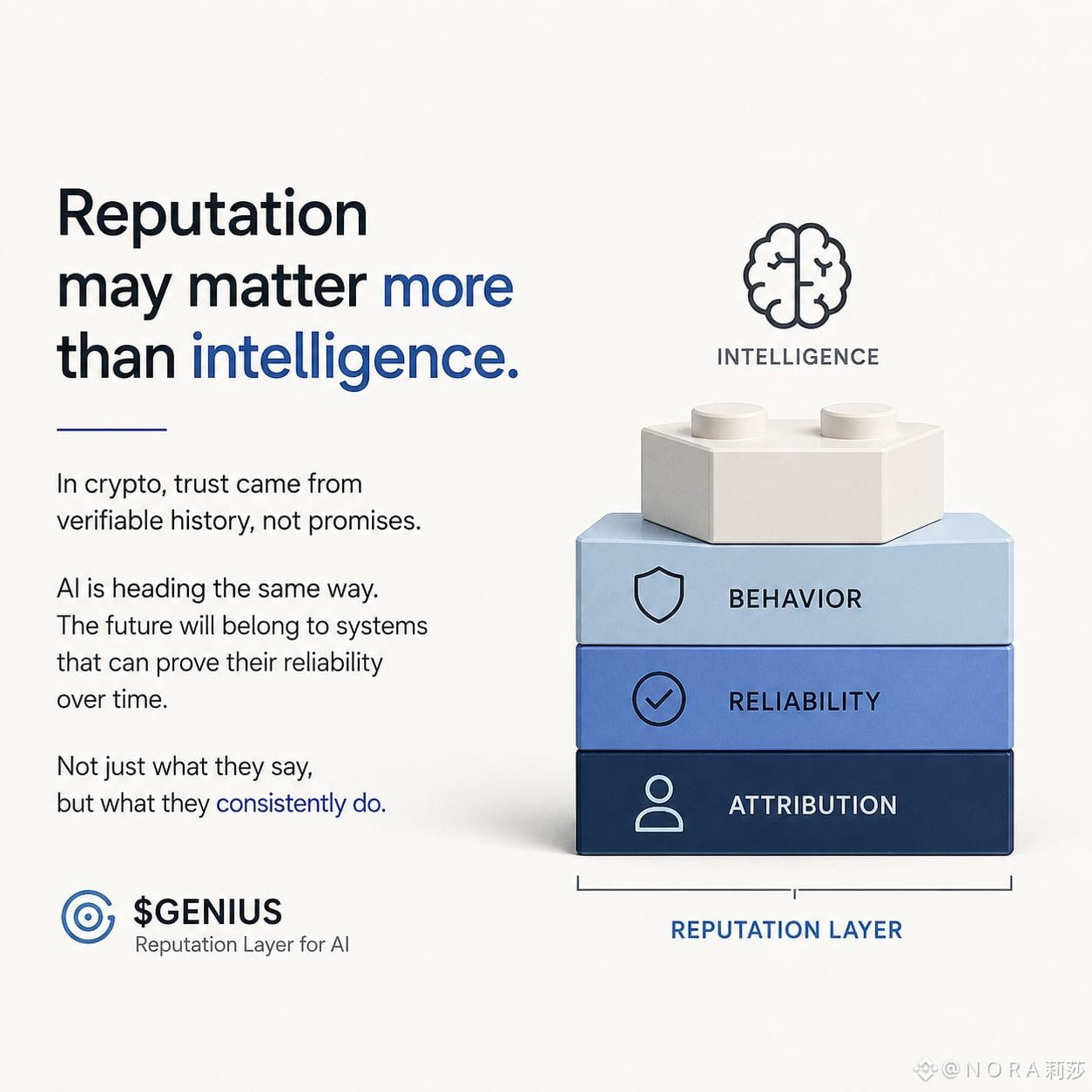
The next generation of AI may not be judged solely by intelligence, but by reputation built from behavior, reliability, attribution, and historical performance. Not what an agent says it can do, but what it has consistently done.
Crypto taught us that transparent history often matters more than promises.
If that lesson carries into AI, reputation could become a foundational layer of the stack one that ultimately proves more valuable than raw intelligence itself.
#genius @GeniusOfficial
I keep thinking about AI reputation systems through the lens of early crypto infrastructure.
In Bitcoin, the breakthrough wasn't intelligence. It was verifiability. The network didn't need to trust who made a claim because it could verify the history behind it.
AI feels like it's approaching a similar transition.
Today, most attention is focused on model capability: bigger context windows, better reasoning, faster outputs. But as autonomous agents become more common, a different question starts to matter:
Can this system be trusted over time?
That's where projects like $GENIUS become interesting.
The next generation of AI may not be judged solely by intelligence, but by reputation built from behavior, reliability, attribution, and historical performance. Not what an agent says it can do, but what it has consistently done.
Crypto taught us that transparent history often matters more than promises.
If that lesson carries into AI, reputation could become a foundational layer of the stack one that ultimately proves more valuable than raw intelligence itself.
#genius @GeniusOfficial
In Bitcoin, the breakthrough wasn't intelligence. It was verifiability. The network didn't need to trust who made a claim because it could verify the history behind it.
AI feels like it's approaching a similar transition.
Today, most attention is focused on model capability: bigger context windows, better reasoning, faster outputs. But as autonomous agents become more common, a different question starts to matter:
Can this system be trusted over time?
That's where projects like $GENIUS become interesting.
The next generation of AI may not be judged solely by intelligence, but by reputation built from behavior, reliability, attribution, and historical performance. Not what an agent says it can do, but what it has consistently done.
Crypto taught us that transparent history often matters more than promises.
If that lesson carries into AI, reputation could become a foundational layer of the stack one that ultimately proves more valuable than raw intelligence itself.
#genius @GeniusOfficial
2
4
144
·
--
I keep thinking about $OPEN less as a product and more as a coordination problem.
Crypto already showed this pattern: Bitcoin didn’t win on speed or flexibility, it won on verifiable history. Ethereum extended that into composable execution. But both quietly introduced something deeper systems where behavior becomes permanently legible.
AI feels like it’s hitting the same boundary now.
We still evaluate models like isolated outputs: correct or incorrect, useful or not. But once AI agents start interacting, delegating, and building on each other’s work, that framing stops working.
That’s where a reputation layer starts to matter behavior, reliability, and attribution carried across time and systems, not just single responses.
In that sense, $OPEN is pointing at something closer to infrastructure than application: how do you make AI trust accumulative instead of episodic?
And increasingly, it feels like intelligence won’t be the bottleneck anymore. Reputation will.
#OpenLedger @Openledger
I keep thinking about $OPEN less as a product and more as a coordination problem.
Crypto already showed this pattern: Bitcoin didn’t win on speed or flexibility, it won on verifiable history. Ethereum extended that into composable execution. But both quietly introduced something deeper systems where behavior becomes permanently legible.
AI feels like it’s hitting the same boundary now.
We still evaluate models like isolated outputs: correct or incorrect, useful or not. But once AI agents start interacting, delegating, and building on each other’s work, that framing stops working.
That’s where a reputation layer starts to matter behavior, reliability, and attribution carried across time and systems, not just single responses.
In that sense, $OPEN is pointing at something closer to infrastructure than application: how do you make AI trust accumulative instead of episodic?
And increasingly, it feels like intelligence won’t be the bottleneck anymore. Reputation will.
#OpenLedger @OpenLedger
Crypto already showed this pattern: Bitcoin didn’t win on speed or flexibility, it won on verifiable history. Ethereum extended that into composable execution. But both quietly introduced something deeper systems where behavior becomes permanently legible.
AI feels like it’s hitting the same boundary now.
We still evaluate models like isolated outputs: correct or incorrect, useful or not. But once AI agents start interacting, delegating, and building on each other’s work, that framing stops working.
That’s where a reputation layer starts to matter behavior, reliability, and attribution carried across time and systems, not just single responses.
In that sense, $OPEN is pointing at something closer to infrastructure than application: how do you make AI trust accumulative instead of episodic?
And increasingly, it feels like intelligence won’t be the bottleneck anymore. Reputation will.
#OpenLedger @OpenLedger
2
146
·
--
When Intelligence Becomes Cheap, Reputation Becomes the Real Infrastructure LayerI keep circling back to a simple observation: in crypto, we spent years optimizing for verification of state, and we’re now starting to face a different problem verification of behavior over time.
If Bitcoin solved “what is true right now?” and Ethereum expanded that into “what can be executed trustlessly?”, then the emerging AI systems and protocols like $OPEN positioned around them are increasingly pointing toward a harder question: “what has consistently been reliable, attributable, and accountable?”
That shift sounds subtle, but structurally it changes everything.
In early crypto, reputation was mostly externalized or ignored. A protocol either worked or it didn’t. Trust was replaced by consensus. But even in that system, patterns emerged: which validators behaved predictably, which bridges failed under stress, which protocols survived multiple cycles of volatility without governance breakdowns. None of that was fully formalized, but it was always informally tracked by the market.
AI systems are now forcing that informal layer into something explicit.
A model’s output is no longer just evaluated for correctness in isolation. It is increasingly being evaluated across dimensions like behavioral consistency, source attribution, and downstream reliability. In other words, not just what did it say, but how did it tend to behave across contexts, and can we trace why it produced a given outcome?
That is where reputation systems begin to matter more than raw intelligence.
With $OPEN-style infrastructure framing, what feels important is not the “smartness” of an agent or model, but the accumulation of verifiable behavioral history. Did it hallucinate under pressure conditions? Did it degrade when context length increased? Did it properly attribute sources or silently interpolate missing information? These are not one-off questions they are longitudinal signals.
It reminds me of early staking systems in crypto.
At first, staking was just economic alignment. Lock tokens, secure the network, earn yield. But over time, it evolved into something closer to behavioral scoring under economic constraint. Validators weren’t just rewarded for participation they were implicitly ranked by uptime, latency, slashing history, and consistency across network upgrades.
AI reputation layers feel like that same transition, but inverted: instead of economic stake enforcing behavior, behavioral history may begin to determine access.
There is a quiet but important inversion happening here.
In traditional ML systems, intelligence is treated as the primary variable and everything else is downstream: deployment, scaling, safety layers, monitoring. But in distributed AI ecosystems, intelligence becomes abundant—and what becomes scarce is trustworthy attribution of output under uncertainty.
At that point, reputation is no longer a secondary metadata layer. It becomes a routing mechanism.
An agent with higher reliability history may be preferentially selected over a more “intelligent” but less predictable one. A model with clean attribution trails may be weighted more heavily in multi-agent systems than a larger model with opaque reasoning traces. Over time, this creates a market where behavioral consistency compounds in value the way liquidity depth compounds in DeFi.
That’s the analogy I keep returning to: early liquidity pools.
In the beginning, capital efficiency was not the main concern. The main concern was whether pools could be trusted not to break, drain, or behave unpredictably under stress. Once reliability stabilized, everything else composability, leverage, structured products became possible on top of it.
AI reputation layers are still at the “can we trust this pool not to disappear under stress?” stage.
What $OPEN represents in that framing is less about a single system and more about a coordination layer for recording, verifying, and propagating behavioral history across AI outputs and agents. If that works, intelligence stops being evaluated in isolation and starts being evaluated as a function of track record under real-world conditions.
And that leads to a more uncomfortable implication.
We may be entering a phase where intelligence itself is commoditized faster than reliability.
Because generating plausible answers is becoming cheap. Generating consistently correct, attributable, and context-stable behavior is not.
In that world, reputation becomes the binding constraint. Not compute. Not model size. Not even raw capability but the accumulated proof that a system behaves within acceptable bounds across time, environments, and adversarial pressure.
It’s similar to what happened in credit markets.
Yield didn’t go to the most aggressive borrower. It went to the most predictable one over time. The system didn’t reward brilliance in isolation; it rewarded stability under repeated observation.
AI systems are slowly drifting into that same structure.
And if that drift continues, then the most important infrastructure layer won’t be the model itself. It will be the ledger of behavior that sits beneath it tracking reliability, attribution, and degradation patterns across every interaction.
That is the real shift I see emerging.
Not smarter AI.
But AI whose value is increasingly determined by how much the system can trust what it has done before.
#OpenLedger @Openledger
When Intelligence Becomes Cheap, Reputation Becomes the Real Infrastructure Layer
I keep circling back to a simple observation: in crypto, we spent years optimizing for verification of state, and we’re now starting to face a different problem verification of behavior over time.
If Bitcoin solved “what is true right now?” and Ethereum expanded that into “what can be executed trustlessly?”, then the emerging AI systems and protocols like $OPEN positioned around them are increasingly pointing toward a harder question: “what has consistently been reliable, attributable, and accountable?”
That shift sounds subtle, but structurally it changes everything.
In early crypto, reputation was mostly externalized or ignored. A protocol either worked or it didn’t. Trust was replaced by consensus. But even in that system, patterns emerged: which validators behaved predictably, which bridges failed under stress, which protocols survived multiple cycles of volatility without governance breakdowns. None of that was fully formalized, but it was always informally tracked by the market.
AI systems are now forcing that informal layer into something explicit.
A model’s output is no longer just evaluated for correctness in isolation. It is increasingly being evaluated across dimensions like behavioral consistency, source attribution, and downstream reliability. In other words, not just what did it say, but how did it tend to behave across contexts, and can we trace why it produced a given outcome?
That is where reputation systems begin to matter more than raw intelligence.
With $OPEN -style infrastructure framing, what feels important is not the “smartness” of an agent or model, but the accumulation of verifiable behavioral history. Did it hallucinate under pressure conditions? Did it degrade when context length increased? Did it properly attribute sources or silently interpolate missing information? These are not one-off questions they are longitudinal signals.
It reminds me of early staking systems in crypto.
At first, staking was just economic alignment. Lock tokens, secure the network, earn yield. But over time, it evolved into something closer to behavioral scoring under economic constraint. Validators weren’t just rewarded for participation they were implicitly ranked by uptime, latency, slashing history, and consistency across network upgrades.
AI reputation layers feel like that same transition, but inverted: instead of economic stake enforcing behavior, behavioral history may begin to determine access.
There is a quiet but important inversion happening here.
In traditional ML systems, intelligence is treated as the primary variable and everything else is downstream: deployment, scaling, safety layers, monitoring. But in distributed AI ecosystems, intelligence becomes abundant—and what becomes scarce is trustworthy attribution of output under uncertainty.
At that point, reputation is no longer a secondary metadata layer. It becomes a routing mechanism.
An agent with higher reliability history may be preferentially selected over a more “intelligent” but less predictable one. A model with clean attribution trails may be weighted more heavily in multi-agent systems than a larger model with opaque reasoning traces. Over time, this creates a market where behavioral consistency compounds in value the way liquidity depth compounds in DeFi.
That’s the analogy I keep returning to: early liquidity pools.
In the beginning, capital efficiency was not the main concern. The main concern was whether pools could be trusted not to break, drain, or behave unpredictably under stress. Once reliability stabilized, everything else composability, leverage, structured products became possible on top of it.
AI reputation layers are still at the “can we trust this pool not to disappear under stress?” stage.
What $OPEN represents in that framing is less about a single system and more about a coordination layer for recording, verifying, and propagating behavioral history across AI outputs and agents. If that works, intelligence stops being evaluated in isolation and starts being evaluated as a function of track record under real-world conditions.
And that leads to a more uncomfortable implication.
We may be entering a phase where intelligence itself is commoditized faster than reliability.
Because generating plausible answers is becoming cheap. Generating consistently correct, attributable, and context-stable behavior is not.
In that world, reputation becomes the binding constraint. Not compute. Not model size. Not even raw capability but the accumulated proof that a system behaves within acceptable bounds across time, environments, and adversarial pressure.
It’s similar to what happened in credit markets.
Yield didn’t go to the most aggressive borrower. It went to the most predictable one over time. The system didn’t reward brilliance in isolation; it rewarded stability under repeated observation.
AI systems are slowly drifting into that same structure.
And if that drift continues, then the most important infrastructure layer won’t be the model itself. It will be the ledger of behavior that sits beneath it tracking reliability, attribution, and degradation patterns across every interaction.
That is the real shift I see emerging.
Not smarter AI.
But AI whose value is increasingly determined by how much the system can trust what it has done before.
#OpenLedger @Openledger
If Bitcoin solved “what is true right now?” and Ethereum expanded that into “what can be executed trustlessly?”, then the emerging AI systems and protocols like $OPEN positioned around them are increasingly pointing toward a harder question: “what has consistently been reliable, attributable, and accountable?”
That shift sounds subtle, but structurally it changes everything.
In early crypto, reputation was mostly externalized or ignored. A protocol either worked or it didn’t. Trust was replaced by consensus. But even in that system, patterns emerged: which validators behaved predictably, which bridges failed under stress, which protocols survived multiple cycles of volatility without governance breakdowns. None of that was fully formalized, but it was always informally tracked by the market.
AI systems are now forcing that informal layer into something explicit.
A model’s output is no longer just evaluated for correctness in isolation. It is increasingly being evaluated across dimensions like behavioral consistency, source attribution, and downstream reliability. In other words, not just what did it say, but how did it tend to behave across contexts, and can we trace why it produced a given outcome?
That is where reputation systems begin to matter more than raw intelligence.
With $OPEN -style infrastructure framing, what feels important is not the “smartness” of an agent or model, but the accumulation of verifiable behavioral history. Did it hallucinate under pressure conditions? Did it degrade when context length increased? Did it properly attribute sources or silently interpolate missing information? These are not one-off questions they are longitudinal signals.
It reminds me of early staking systems in crypto.
At first, staking was just economic alignment. Lock tokens, secure the network, earn yield. But over time, it evolved into something closer to behavioral scoring under economic constraint. Validators weren’t just rewarded for participation they were implicitly ranked by uptime, latency, slashing history, and consistency across network upgrades.
AI reputation layers feel like that same transition, but inverted: instead of economic stake enforcing behavior, behavioral history may begin to determine access.
There is a quiet but important inversion happening here.
In traditional ML systems, intelligence is treated as the primary variable and everything else is downstream: deployment, scaling, safety layers, monitoring. But in distributed AI ecosystems, intelligence becomes abundant—and what becomes scarce is trustworthy attribution of output under uncertainty.
At that point, reputation is no longer a secondary metadata layer. It becomes a routing mechanism.
An agent with higher reliability history may be preferentially selected over a more “intelligent” but less predictable one. A model with clean attribution trails may be weighted more heavily in multi-agent systems than a larger model with opaque reasoning traces. Over time, this creates a market where behavioral consistency compounds in value the way liquidity depth compounds in DeFi.
That’s the analogy I keep returning to: early liquidity pools.
In the beginning, capital efficiency was not the main concern. The main concern was whether pools could be trusted not to break, drain, or behave unpredictably under stress. Once reliability stabilized, everything else composability, leverage, structured products became possible on top of it.
AI reputation layers are still at the “can we trust this pool not to disappear under stress?” stage.
What $OPEN represents in that framing is less about a single system and more about a coordination layer for recording, verifying, and propagating behavioral history across AI outputs and agents. If that works, intelligence stops being evaluated in isolation and starts being evaluated as a function of track record under real-world conditions.
And that leads to a more uncomfortable implication.
We may be entering a phase where intelligence itself is commoditized faster than reliability.
Because generating plausible answers is becoming cheap. Generating consistently correct, attributable, and context-stable behavior is not.
In that world, reputation becomes the binding constraint. Not compute. Not model size. Not even raw capability but the accumulated proof that a system behaves within acceptable bounds across time, environments, and adversarial pressure.
It’s similar to what happened in credit markets.
Yield didn’t go to the most aggressive borrower. It went to the most predictable one over time. The system didn’t reward brilliance in isolation; it rewarded stability under repeated observation.
AI systems are slowly drifting into that same structure.
And if that drift continues, then the most important infrastructure layer won’t be the model itself. It will be the ledger of behavior that sits beneath it tracking reliability, attribution, and degradation patterns across every interaction.
That is the real shift I see emerging.
Not smarter AI.
But AI whose value is increasingly determined by how much the system can trust what it has done before.
#OpenLedger @Openledger
1
3
138
·
--
I keep thinking about how crypto quietly shifted from “who can compute the most” to “who can be trusted over time.”
Bitcoin started as pure proof-of-work truth emerging from energy and verification, not identity. But once we moved into staking systems, the center of gravity changed. Suddenly, history mattered: uptime, behavior, penalties, consistency. Trust became something accumulated, not assumed.
What I’m seeing with $GENIUS feels like that same transition, but inside AI systems.
We’re no longer in a phase where raw intelligence is the bottleneck. Models can already generate competent outputs. The real gap is: can we track reliability across time, context, and correction cycles?
That’s a reputation problem, not a model problem.
In crypto terms, it looks closer to validator scoring than computation. Not just what you produce, but how you behave when conditions change when you’re wrong, when data shifts, when ambiguity increases.
So AI starts to look less like a single intelligence layer and more like a stacked system: generation, evaluation, attribution, and then a persistent reputation record sitting above it all.
And that changes the hierarchy.
Because once behavior is measurable and persistent, intelligence alone stops being the scarce asset.
Reputation becomes the real infrastructure layer.
#genius @GeniusOfficial
I keep thinking about how crypto quietly shifted from “who can compute the most” to “who can be trusted over time.”
Bitcoin started as pure proof-of-work truth emerging from energy and verification, not identity. But once we moved into staking systems, the center of gravity changed. Suddenly, history mattered: uptime, behavior, penalties, consistency. Trust became something accumulated, not assumed.
What I’m seeing with $GENIUS feels like that same transition, but inside AI systems.
We’re no longer in a phase where raw intelligence is the bottleneck. Models can already generate competent outputs. The real gap is: can we track reliability across time, context, and correction cycles?
That’s a reputation problem, not a model problem.
In crypto terms, it looks closer to validator scoring than computation. Not just what you produce, but how you behave when conditions change when you’re wrong, when data shifts, when ambiguity increases.
So AI starts to look less like a single intelligence layer and more like a stacked system: generation, evaluation, attribution, and then a persistent reputation record sitting above it all.
And that changes the hierarchy.
Because once behavior is measurable and persistent, intelligence alone stops being the scarce asset.
Reputation becomes the real infrastructure layer.
#genius @GeniusOfficial
Bitcoin started as pure proof-of-work truth emerging from energy and verification, not identity. But once we moved into staking systems, the center of gravity changed. Suddenly, history mattered: uptime, behavior, penalties, consistency. Trust became something accumulated, not assumed.
What I’m seeing with $GENIUS feels like that same transition, but inside AI systems.
We’re no longer in a phase where raw intelligence is the bottleneck. Models can already generate competent outputs. The real gap is: can we track reliability across time, context, and correction cycles?
That’s a reputation problem, not a model problem.
In crypto terms, it looks closer to validator scoring than computation. Not just what you produce, but how you behave when conditions change when you’re wrong, when data shifts, when ambiguity increases.
So AI starts to look less like a single intelligence layer and more like a stacked system: generation, evaluation, attribution, and then a persistent reputation record sitting above it all.
And that changes the hierarchy.
Because once behavior is measurable and persistent, intelligence alone stops being the scarce asset.
Reputation becomes the real infrastructure layer.
#genius @GeniusOfficial

1
1
4
163
·
--
I keep comparing AI right now to early crypto not in terms of technology, but in terms of what actually breaks systems.
In both cases, it was never just about capability. Bitcoin didn’t fail because hashing was weak. DeFi didn’t fail because smart contracts were slow. Systems failed when behavior under stress wasn’t measurable or accountable.
AI is hitting that same boundary.
With $OPEN , what stands out is the shift away from evaluating models as static intelligence and toward treating them as persistent actors with histories. Not “what can it do?” but “how does it behave over time, across changing context and incentives?”
That distinction matters more as AI moves into agentic environments trading, automation, decision pipelines where one unreliable output doesn’t stay isolated; it propagates.
Benchmarks are already compressing. Model intelligence is becoming less differentiating. What doesn’t compress is behavior: consistency, attribution integrity, failure patterns under drift.
That’s where reputation starts to matter more than raw intelligence.
Not reputation as branding, but as an accumulated, auditable trace of behavior that can be priced, ranked, and routed around.
If crypto taught anything, it’s this: coordination doesn’t scale on capability it scales on trust under uncertainty.
AI is now entering that exact problem space.
#OpenLedger @Openledger
I keep comparing AI right now to early crypto not in terms of technology, but in terms of what actually breaks systems.
In both cases, it was never just about capability. Bitcoin didn’t fail because hashing was weak. DeFi didn’t fail because smart contracts were slow. Systems failed when behavior under stress wasn’t measurable or accountable.
AI is hitting that same boundary.
With $OPEN , what stands out is the shift away from evaluating models as static intelligence and toward treating them as persistent actors with histories. Not “what can it do?” but “how does it behave over time, across changing context and incentives?”
That distinction matters more as AI moves into agentic environments trading, automation, decision pipelines where one unreliable output doesn’t stay isolated; it propagates.
Benchmarks are already compressing. Model intelligence is becoming less differentiating. What doesn’t compress is behavior: consistency, attribution integrity, failure patterns under drift.
That’s where reputation starts to matter more than raw intelligence.
Not reputation as branding, but as an accumulated, auditable trace of behavior that can be priced, ranked, and routed around.
If crypto taught anything, it’s this: coordination doesn’t scale on capability it scales on trust under uncertainty.
AI is now entering that exact problem space.
#OpenLedger @OpenLedger
In both cases, it was never just about capability. Bitcoin didn’t fail because hashing was weak. DeFi didn’t fail because smart contracts were slow. Systems failed when behavior under stress wasn’t measurable or accountable.
AI is hitting that same boundary.
With $OPEN , what stands out is the shift away from evaluating models as static intelligence and toward treating them as persistent actors with histories. Not “what can it do?” but “how does it behave over time, across changing context and incentives?”
That distinction matters more as AI moves into agentic environments trading, automation, decision pipelines where one unreliable output doesn’t stay isolated; it propagates.
Benchmarks are already compressing. Model intelligence is becoming less differentiating. What doesn’t compress is behavior: consistency, attribution integrity, failure patterns under drift.
That’s where reputation starts to matter more than raw intelligence.
Not reputation as branding, but as an accumulated, auditable trace of behavior that can be priced, ranked, and routed around.
If crypto taught anything, it’s this: coordination doesn’t scale on capability it scales on trust under uncertainty.
AI is now entering that exact problem space.
#OpenLedger @OpenLedger
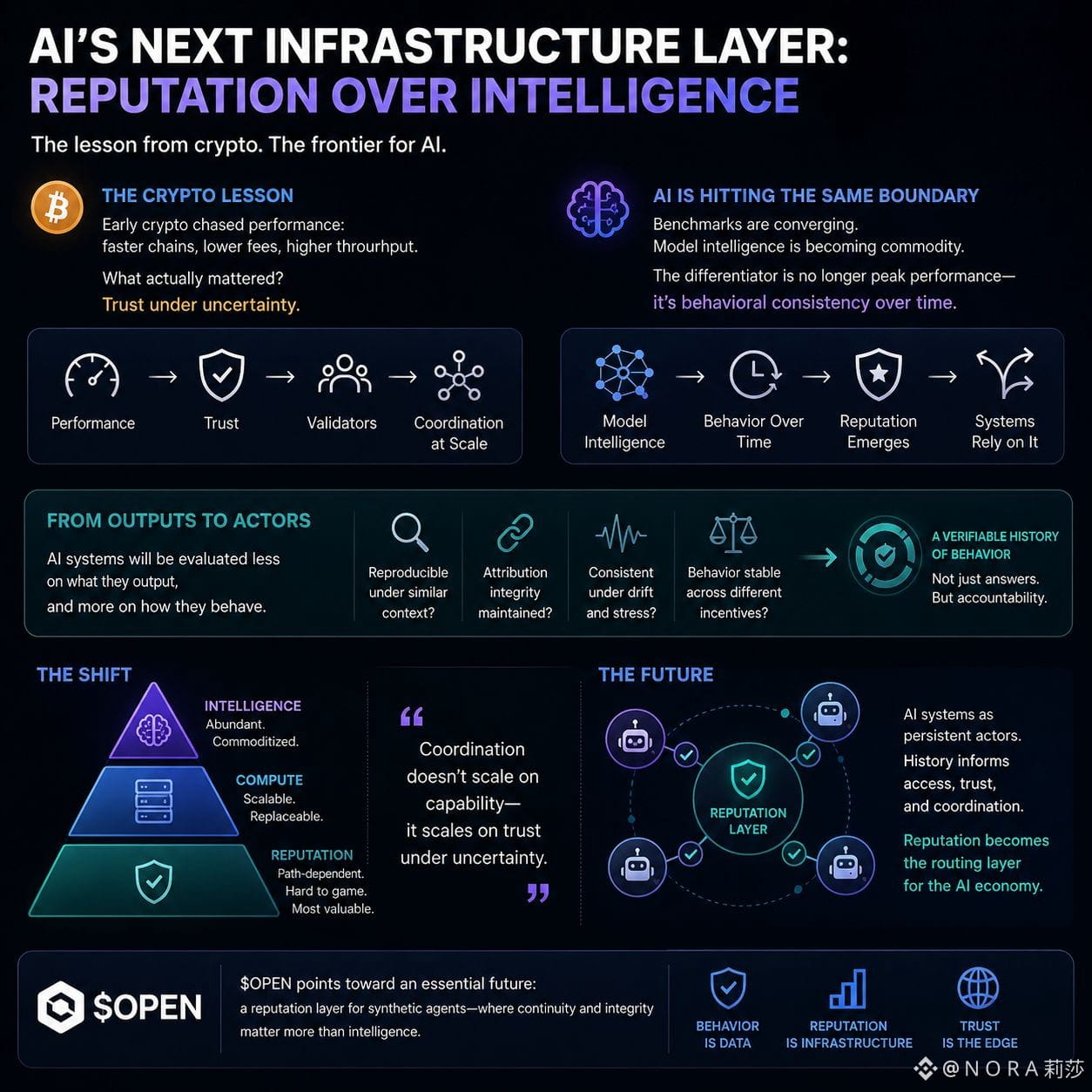
3
5
126
·
--
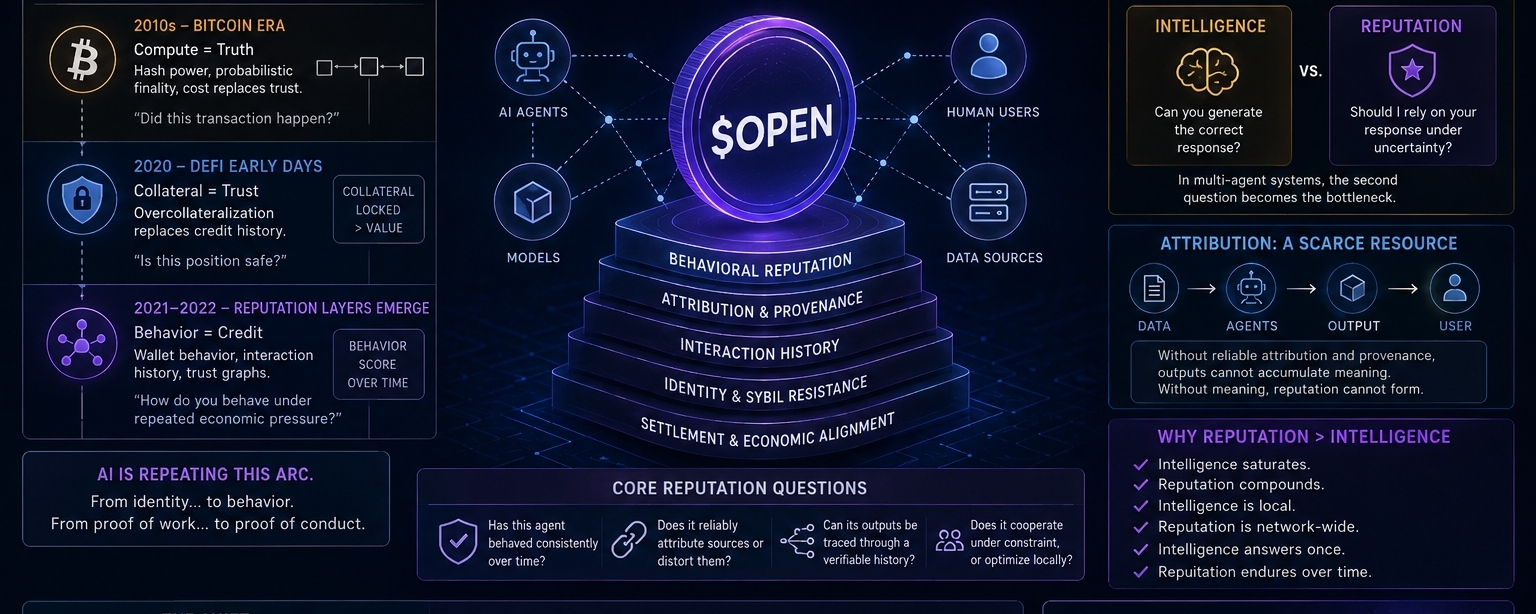
Article
Reputation > Intelligence: The Hidden Infrastructure Powering AI SystemsI keep circling back to a simple mismatch in how we currently evaluate intelligence systems: we still tend to reward output quality, while the systems themselves are quietly shifting toward something more fundamental—behavioral reliability over time.
$OPEN, in that sense, is better read as an infrastructure signal than a token narrative. Not because it represents a finished system, but because it sits inside a broader direction the AI stack is moving toward: reputation as a first-class primitive.
From compute to conduct
In early crypto, the dominant abstraction was straightforward: compute equals truth. Bitcoin made that explicit—hash power, probabilistic finality, and the assumption that economic cost could substitute for trust. The system didn’t need to “know” who you were; it only needed to verify what you did.
But that model, while elegant, was narrow. It worked because the question was narrow: did this transaction happen or not?
AI systems don’t operate in that kind of binary space. Their outputs are probabilistic, contextual, and deeply dependent on prior behavior. A model that is “correct” once is less useful than an agent that is consistently correct across conditions, datasets, and incentives.
This is where reputation starts to matter more than raw intelligence.
The crypto analogy that actually fits
If I map this to something familiar, it’s less Bitcoin and more early DeFi credit layers forming around primitive liquidity markets.
In the 2020–2022 cycle, DeFi tried to price risk without identity. Collateral replaced trust. Overcollateralization replaced credit history. It worked, but only up to a point. Eventually, protocols began quietly reintroducing reputation-like signals: wallet behavior scoring, liquidity consistency, interaction history, and protocol-native “trust graphs.”
We saw early versions of this in systems like Gitcoin Passport and various Sybil-resistance frameworks, where identity wasn’t a single credential but an accumulation of behavioral proofs across time.
That shift is important: it marked the transition from “who are you?” to “how do you behave under repeated economic pressure?”
AI reputation systems are now repeating that same arc.
$OPEN as a coordination layer, not a product
In that framing, OPEN sits closer to a coordination primitive than an application token. The interesting question is not what it “does” in isolation, but what kind of behavioral graph it enables across agents, models, and human participants.
Because once AI agents start interacting economically—trading signals, sharing inference tasks, delegating computation—you immediately run into a problem crypto already knows well:
Sybil resistance becomes everything.
An agent that can spin up infinite identities breaks not just markets, but learning systems themselves. If every interaction can be reset, then no interaction accumulates meaning. And without accumulated meaning, you cannot form reputation.
So the design pressure shifts toward systems that can answer:
Has this agent behaved consistently over time?
Does it reliably attribute sources or distort them?
Can its outputs be traced through a verifiable interaction history?
Does it cooperate under constraint, or only optimize locally?
These are not intelligence questions. They are behavioral ones.
The hidden layer: attribution as a scarce resource
One under-discussed dimension here is attribution.
In current AI workflows, attribution is almost disposable. Outputs are generated, consumed, and detached from their provenance. But as AI begins to participate in economic systems especially research, trading, and automation attribution becomes a scarce resource.
Not in the legal sense, but in the coordination sense.
If I cannot reliably trace how an output was formed what data it depended on, what intermediate agents touched it, what prior signals shaped it then I cannot assign weight to it in a system that evolves over time.
This is where reputation layers start to resemble something closer to “liquidity history” in DeFi.
In DeFi, liquidity depth matters more than price. Price without depth is noise. Similarly, intelligence without behavioral depth is just output.
Why intelligence stops being the bottleneck
There’s a subtle inversion happening here.
We used to assume the bottleneck in AI systems would be intelligence: better models, larger parameter counts, more data.
But in multi-agent environments, intelligence quickly saturates. Once models reach a certain threshold of capability, differentiation shifts away from “can it solve the problem?” toward “can it be trusted to behave consistently in a network of other agents?”
At that point, reputation becomes the dominant constraint.
You can think of it like this:
Intelligence answers: Can you generate the correct response?
Reputation answers: Should I rely on your response under uncertainty?
In real-world systems, the second question increasingly dominates.
The ghost of early crypto cycles
There’s a familiar pattern here from early crypto markets.
In 2017, the dominant narrative was throughput and decentralization. In 2020, it became composability and liquidity. By 2022, it shifted toward risk management, identity, and survivability under stress.
Each cycle quietly reduced the importance of raw technical capability and increased the importance of system-level trust signals.
AI is now going through a compressed version of that same transition.
We are moving from:
> “What can the model do?”
to
> “What has this agent proven it does reliably across time, under pressure, and in interaction with others?”
That is a reputation problem, not an intelligence problem.
The uncomfortable implication
If this trajectory holds, then the most important AI systems in the next cycle may not be the most intelligent ones.
They may be the most legible over time.
That is a different optimization target entirely.
Legibility here means:
Stable behavioral signatures
Traceable decision pathways
Consistent attribution patterns
Resistance to identity fragmentation
Predictable responses under adversarial conditions
These properties don’t improve raw intelligence. They improve trust density.
And trust density is what allows systems to scale beyond isolated use cases into economic infrastructure.
Where OPEN fits in this shift
I don’t see OPEN resolving any of this. It sits earlier in the stack closer to experimentation around how reputation might be tokenized, shared, or made portable across AI systems.
But the direction it points to is consistent with a broader pattern already visible in crypto: every scalable system eventually reintroduces memory.
Memory in this case is not storage. It’s accountability across time.
And accountability is what turns intelligence from a momentary output into an infrastructure component.
Closing thought
We tend to over-index on intelligence because it is visible. You can benchmark it, compare it, rank it.
Reputation is less visible. It accumulates quietly, like liquidity depth or validator history, until suddenly it becomes the only thing that matters when conditions are uncertain.
If AI systems continue merging with economic systems, then intelligence will increasingly become a baseline assumption.
Reputation will become the differentiator.
And OPEN whether it succeeds or not as a protocol, sits inside that larger transition: from systems that answer questions correctly, to systems that can be trusted to remain consistent long enough for those answers to matter.
#OpenLedger @Openledger
Reputation > Intelligence: The Hidden Infrastructure Powering AI Systems
I keep circling back to a simple mismatch in how we currently evaluate intelligence systems: we still tend to reward output quality, while the systems themselves are quietly shifting toward something more fundamental—behavioral reliability over time.
$OPEN , in that sense, is better read as an infrastructure signal than a token narrative. Not because it represents a finished system, but because it sits inside a broader direction the AI stack is moving toward: reputation as a first-class primitive.
From compute to conduct
In early crypto, the dominant abstraction was straightforward: compute equals truth. Bitcoin made that explicit—hash power, probabilistic finality, and the assumption that economic cost could substitute for trust. The system didn’t need to “know” who you were; it only needed to verify what you did.
But that model, while elegant, was narrow. It worked because the question was narrow: did this transaction happen or not?
AI systems don’t operate in that kind of binary space. Their outputs are probabilistic, contextual, and deeply dependent on prior behavior. A model that is “correct” once is less useful than an agent that is consistently correct across conditions, datasets, and incentives.
This is where reputation starts to matter more than raw intelligence.
The crypto analogy that actually fits
If I map this to something familiar, it’s less Bitcoin and more early DeFi credit layers forming around primitive liquidity markets.
In the 2020–2022 cycle, DeFi tried to price risk without identity. Collateral replaced trust. Overcollateralization replaced credit history. It worked, but only up to a point. Eventually, protocols began quietly reintroducing reputation-like signals: wallet behavior scoring, liquidity consistency, interaction history, and protocol-native “trust graphs.”
We saw early versions of this in systems like Gitcoin Passport and various Sybil-resistance frameworks, where identity wasn’t a single credential but an accumulation of behavioral proofs across time.
That shift is important: it marked the transition from “who are you?” to “how do you behave under repeated economic pressure?”
AI reputation systems are now repeating that same arc.
$OPEN as a coordination layer, not a product
In that framing, OPEN sits closer to a coordination primitive than an application token. The interesting question is not what it “does” in isolation, but what kind of behavioral graph it enables across agents, models, and human participants.
Because once AI agents start interacting economically—trading signals, sharing inference tasks, delegating computation—you immediately run into a problem crypto already knows well:
Sybil resistance becomes everything.
An agent that can spin up infinite identities breaks not just markets, but learning systems themselves. If every interaction can be reset, then no interaction accumulates meaning. And without accumulated meaning, you cannot form reputation.
So the design pressure shifts toward systems that can answer:
Has this agent behaved consistently over time?
Does it reliably attribute sources or distort them?
Can its outputs be traced through a verifiable interaction history?
Does it cooperate under constraint, or only optimize locally?
These are not intelligence questions. They are behavioral ones.
The hidden layer: attribution as a scarce resource
One under-discussed dimension here is attribution.
In current AI workflows, attribution is almost disposable. Outputs are generated, consumed, and detached from their provenance. But as AI begins to participate in economic systems especially research, trading, and automation attribution becomes a scarce resource.
Not in the legal sense, but in the coordination sense.
If I cannot reliably trace how an output was formed what data it depended on, what intermediate agents touched it, what prior signals shaped it then I cannot assign weight to it in a system that evolves over time.
This is where reputation layers start to resemble something closer to “liquidity history” in DeFi.
In DeFi, liquidity depth matters more than price. Price without depth is noise. Similarly, intelligence without behavioral depth is just output.
Why intelligence stops being the bottleneck
There’s a subtle inversion happening here.
We used to assume the bottleneck in AI systems would be intelligence: better models, larger parameter counts, more data.
But in multi-agent environments, intelligence quickly saturates. Once models reach a certain threshold of capability, differentiation shifts away from “can it solve the problem?” toward “can it be trusted to behave consistently in a network of other agents?”
At that point, reputation becomes the dominant constraint.
You can think of it like this:
Intelligence answers: Can you generate the correct response?
Reputation answers: Should I rely on your response under uncertainty?
In real-world systems, the second question increasingly dominates.
The ghost of early crypto cycles
There’s a familiar pattern here from early crypto markets.
In 2017, the dominant narrative was throughput and decentralization. In 2020, it became composability and liquidity. By 2022, it shifted toward risk management, identity, and survivability under stress.
Each cycle quietly reduced the importance of raw technical capability and increased the importance of system-level trust signals.
AI is now going through a compressed version of that same transition.
We are moving from:
> “What can the model do?”
to
> “What has this agent proven it does reliably across time, under pressure, and in interaction with others?”
That is a reputation problem, not an intelligence problem.
The uncomfortable implication
If this trajectory holds, then the most important AI systems in the next cycle may not be the most intelligent ones.
They may be the most legible over time.
That is a different optimization target entirely.
Legibility here means:
Stable behavioral signatures
Traceable decision pathways
Consistent attribution patterns
Resistance to identity fragmentation
Predictable responses under adversarial conditions
These properties don’t improve raw intelligence. They improve trust density.
And trust density is what allows systems to scale beyond isolated use cases into economic infrastructure.
Where OPEN fits in this shift
I don’t see OPEN resolving any of this. It sits earlier in the stack closer to experimentation around how reputation might be tokenized, shared, or made portable across AI systems.
But the direction it points to is consistent with a broader pattern already visible in crypto: every scalable system eventually reintroduces memory.
Memory in this case is not storage. It’s accountability across time.
And accountability is what turns intelligence from a momentary output into an infrastructure component.
Closing thought
We tend to over-index on intelligence because it is visible. You can benchmark it, compare it, rank it.
Reputation is less visible. It accumulates quietly, like liquidity depth or validator history, until suddenly it becomes the only thing that matters when conditions are uncertain.
If AI systems continue merging with economic systems, then intelligence will increasingly become a baseline assumption.
Reputation will become the differentiator.
And OPEN whether it succeeds or not as a protocol, sits inside that larger transition: from systems that answer questions correctly, to systems that can be trusted to remain consistent long enough for those answers to matter.
#OpenLedger @Openledger
$OPEN , in that sense, is better read as an infrastructure signal than a token narrative. Not because it represents a finished system, but because it sits inside a broader direction the AI stack is moving toward: reputation as a first-class primitive.
From compute to conduct
In early crypto, the dominant abstraction was straightforward: compute equals truth. Bitcoin made that explicit—hash power, probabilistic finality, and the assumption that economic cost could substitute for trust. The system didn’t need to “know” who you were; it only needed to verify what you did.
But that model, while elegant, was narrow. It worked because the question was narrow: did this transaction happen or not?
AI systems don’t operate in that kind of binary space. Their outputs are probabilistic, contextual, and deeply dependent on prior behavior. A model that is “correct” once is less useful than an agent that is consistently correct across conditions, datasets, and incentives.
This is where reputation starts to matter more than raw intelligence.
The crypto analogy that actually fits
If I map this to something familiar, it’s less Bitcoin and more early DeFi credit layers forming around primitive liquidity markets.
In the 2020–2022 cycle, DeFi tried to price risk without identity. Collateral replaced trust. Overcollateralization replaced credit history. It worked, but only up to a point. Eventually, protocols began quietly reintroducing reputation-like signals: wallet behavior scoring, liquidity consistency, interaction history, and protocol-native “trust graphs.”
We saw early versions of this in systems like Gitcoin Passport and various Sybil-resistance frameworks, where identity wasn’t a single credential but an accumulation of behavioral proofs across time.
That shift is important: it marked the transition from “who are you?” to “how do you behave under repeated economic pressure?”
AI reputation systems are now repeating that same arc.
$OPEN as a coordination layer, not a product
In that framing, OPEN sits closer to a coordination primitive than an application token. The interesting question is not what it “does” in isolation, but what kind of behavioral graph it enables across agents, models, and human participants.
Because once AI agents start interacting economically—trading signals, sharing inference tasks, delegating computation—you immediately run into a problem crypto already knows well:
Sybil resistance becomes everything.
An agent that can spin up infinite identities breaks not just markets, but learning systems themselves. If every interaction can be reset, then no interaction accumulates meaning. And without accumulated meaning, you cannot form reputation.
So the design pressure shifts toward systems that can answer:
Has this agent behaved consistently over time?
Does it reliably attribute sources or distort them?
Can its outputs be traced through a verifiable interaction history?
Does it cooperate under constraint, or only optimize locally?
These are not intelligence questions. They are behavioral ones.
The hidden layer: attribution as a scarce resource
One under-discussed dimension here is attribution.
In current AI workflows, attribution is almost disposable. Outputs are generated, consumed, and detached from their provenance. But as AI begins to participate in economic systems especially research, trading, and automation attribution becomes a scarce resource.
Not in the legal sense, but in the coordination sense.
If I cannot reliably trace how an output was formed what data it depended on, what intermediate agents touched it, what prior signals shaped it then I cannot assign weight to it in a system that evolves over time.
This is where reputation layers start to resemble something closer to “liquidity history” in DeFi.
In DeFi, liquidity depth matters more than price. Price without depth is noise. Similarly, intelligence without behavioral depth is just output.
Why intelligence stops being the bottleneck
There’s a subtle inversion happening here.
We used to assume the bottleneck in AI systems would be intelligence: better models, larger parameter counts, more data.
But in multi-agent environments, intelligence quickly saturates. Once models reach a certain threshold of capability, differentiation shifts away from “can it solve the problem?” toward “can it be trusted to behave consistently in a network of other agents?”
At that point, reputation becomes the dominant constraint.
You can think of it like this:
Intelligence answers: Can you generate the correct response?
Reputation answers: Should I rely on your response under uncertainty?
In real-world systems, the second question increasingly dominates.
The ghost of early crypto cycles
There’s a familiar pattern here from early crypto markets.
In 2017, the dominant narrative was throughput and decentralization. In 2020, it became composability and liquidity. By 2022, it shifted toward risk management, identity, and survivability under stress.
Each cycle quietly reduced the importance of raw technical capability and increased the importance of system-level trust signals.
AI is now going through a compressed version of that same transition.
We are moving from:
> “What can the model do?”
to
> “What has this agent proven it does reliably across time, under pressure, and in interaction with others?”
That is a reputation problem, not an intelligence problem.
The uncomfortable implication
If this trajectory holds, then the most important AI systems in the next cycle may not be the most intelligent ones.
They may be the most legible over time.
That is a different optimization target entirely.
Legibility here means:
Stable behavioral signatures
Traceable decision pathways
Consistent attribution patterns
Resistance to identity fragmentation
Predictable responses under adversarial conditions
These properties don’t improve raw intelligence. They improve trust density.
And trust density is what allows systems to scale beyond isolated use cases into economic infrastructure.
Where OPEN fits in this shift
I don’t see OPEN resolving any of this. It sits earlier in the stack closer to experimentation around how reputation might be tokenized, shared, or made portable across AI systems.
But the direction it points to is consistent with a broader pattern already visible in crypto: every scalable system eventually reintroduces memory.
Memory in this case is not storage. It’s accountability across time.
And accountability is what turns intelligence from a momentary output into an infrastructure component.
Closing thought
We tend to over-index on intelligence because it is visible. You can benchmark it, compare it, rank it.
Reputation is less visible. It accumulates quietly, like liquidity depth or validator history, until suddenly it becomes the only thing that matters when conditions are uncertain.
If AI systems continue merging with economic systems, then intelligence will increasingly become a baseline assumption.
Reputation will become the differentiator.
And OPEN whether it succeeds or not as a protocol, sits inside that larger transition: from systems that answer questions correctly, to systems that can be trusted to remain consistent long enough for those answers to matter.
#OpenLedger @Openledger
3
5
130
·
--
I keep thinking about how the internet looked before broadband became normal.
The infrastructure existed.
The use cases were still messy.
Most people couldn’t fully explain why it mattered yet.
But behavior was already changing underneath the noise.
That’s partly how I look at $GENIUS right now.
Not as a finished product category, but as an early behavioral shift. People are slowly moving from manually processing information to delegating parts of decision-making, filtering, and execution to systems that learn alongside them.
What makes this phase confusing is that the ecosystem still looks fragmented from the outside. Too many tools. Too many narratives. Too much experimentation pretending to be certainty.
But early technological transitions almost always feel inefficient before they feel inevitable.
Search engines looked chaotic before they became default behavior.
Cloud software looked unreliable before companies built entire operations around it.
Even algorithmic feeds once felt unnatural before they quietly reshaped attention itself.
I’m not fully convinced anyone understands what the mature version of this market looks like yet. But I do think the underlying behavior change is real.
And once behavior changes at scale, infrastructure usually follows.
#genius @GeniusOfficial
I keep thinking about how the internet looked before broadband became normal.
The infrastructure existed.
The use cases were still messy.
Most people couldn’t fully explain why it mattered yet.
But behavior was already changing underneath the noise.
That’s partly how I look at $GENIUS right now.
Not as a finished product category, but as an early behavioral shift. People are slowly moving from manually processing information to delegating parts of decision-making, filtering, and execution to systems that learn alongside them.
What makes this phase confusing is that the ecosystem still looks fragmented from the outside. Too many tools. Too many narratives. Too much experimentation pretending to be certainty.
But early technological transitions almost always feel inefficient before they feel inevitable.
Search engines looked chaotic before they became default behavior.
Cloud software looked unreliable before companies built entire operations around it.
Even algorithmic feeds once felt unnatural before they quietly reshaped attention itself.
I’m not fully convinced anyone understands what the mature version of this market looks like yet. But I do think the underlying behavior change is real.
And once behavior changes at scale, infrastructure usually follows.
#genius @GeniusOfficial
The infrastructure existed.
The use cases were still messy.
Most people couldn’t fully explain why it mattered yet.
But behavior was already changing underneath the noise.
That’s partly how I look at $GENIUS right now.
Not as a finished product category, but as an early behavioral shift. People are slowly moving from manually processing information to delegating parts of decision-making, filtering, and execution to systems that learn alongside them.
What makes this phase confusing is that the ecosystem still looks fragmented from the outside. Too many tools. Too many narratives. Too much experimentation pretending to be certainty.
But early technological transitions almost always feel inefficient before they feel inevitable.
Search engines looked chaotic before they became default behavior.
Cloud software looked unreliable before companies built entire operations around it.
Even algorithmic feeds once felt unnatural before they quietly reshaped attention itself.
I’m not fully convinced anyone understands what the mature version of this market looks like yet. But I do think the underlying behavior change is real.
And once behavior changes at scale, infrastructure usually follows.
#genius @GeniusOfficial

2
8
194
Log in to explore more content
Join global crypto users on Binance Square
⚡️ Get latest and useful information about crypto.
💬 Trusted by the world’s largest crypto exchange.
👍 Discover real insights from verified creators.
Email / Phone number
Trending Topics
BinanceLaunchesBinanceIntelligence
107,346 views
1,161 Discussing
🚨 BINANCE JUST PUT AI DIRECTLY INSIDE THE EXCHANGE — AND THIS COULD CHANGE HOW RETAIL TRADES.
Binance has officially launched Binance Intelligence, a new AI layer built into the Binance ecosystem. It combines three products:
Binance AI for everyday users,
Binance AI Pro for automated trading workflows,
and Agent OS for developers building financial agents.
The part traders should care about?
Binance AI can surface market briefs, smart alerts, PnL recaps and personalized information, while AI Pro is designed to turn a plain-English trading idea into a visual strategy workflow.
That means the next phase of exchange competition may not be:
lowest fees vs deepest liquidity.
It could be:
who gives traders the best AI execution layer.
If Binance Intelligence actually drives heavier user activity, automated strategies and higher trading frequency, watch $BNB first.
AI adoption ↑
→ Binance engagement ↑
→ trading activity ↑
→ ecosystem narrative strengthens.
The catalyst I’d watch now:
global rollout + AI Pro launch + measurable user adoption.
Because once AI stops just telling you what the market is doing…
…and starts helping build the trade itself?
That’s when this gets much bigger than another chatbot. 👀
#binancelaunchesbinanceintelligence #EvernorthXRPTreasuryCompletesSPACMerger #ADAGains10%Above$0.27 #ETHUp70%InQ3ButLiquidityFalls #EthStakingExitQueueHits2026High
KimHotbae
·32 Likes
·38.3k views
StriveBuys2000BTCFor$169M
3,479 views
50 Discussing
EvernorthXRPTreasuryCompletesSPACMerger
71,268 views
767 Discussing