

Bitcoinworld
69.1k Posts

Bitcoinworld
 Square Verified+
Report
Block User
BitcoinWorld is a leading media publication bringing the latest happenings in the Blockchain and Crypto Space.

#BinanceTurns7

Excellence Award (Market Buzz)

Creator of the Year
2 Following
100.7K+ Followers
287.4K+ Liked
4 Badges
Posts
All
Videos
Live
·
--
Article
Umia Raises $6 Million to Build the Onchain Formation Platform for Token-Native Projects, Joined ...BitcoinWorldUmia Raises $6 Million to Build the Onchain Formation Platform for Token-Native Projects, Joined by Galaxy Ventures, DCG and Draper Associates
Most tokens have no formal link to the business behind them: its IP, revenue and treasury usually sit in a separate entity. Umia places all three in one legal structure alongside the token, with treasury decisions made through onchain decision markets.
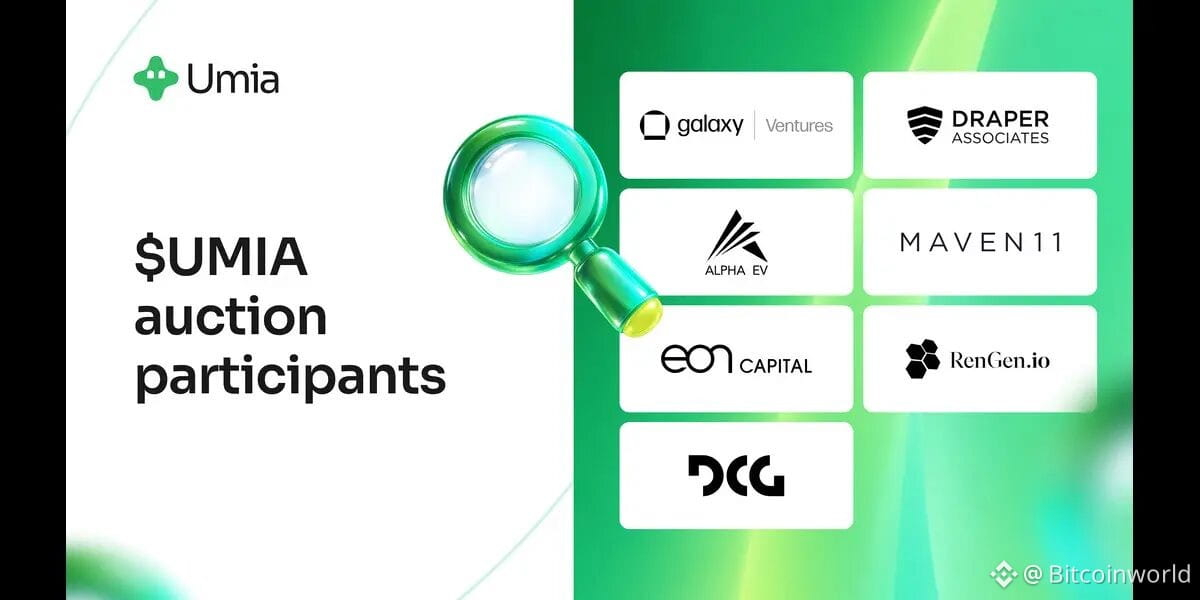
NEW YORK, Oct. 5, 2026 /PRNewswire/ — Umia (umia.finance), the onchain platform for launching, funding and governing projects, today announced it has raised $6 million through the auction of $UMIA, the first token launched through its own system. Ten funds and nearly 700 individual bidders took part in the seven-day sale, which ran on Base from August 26 to September 2 and opened with a three-day early round for vetted funds and zkTLS-verified community members. The public round then reached its cap seven minutes after opening on August 29, and the sale closed at more than 3x its $2 million minimum. Galaxy Ventures, DCG, Draper Associates, RenGen, Alpha EV, Maven 11 and Eon Capital were among the funds, all bidding on the same terms as every other participant, with no discounts.
“Serious teams have never had a way to launch a token that is actually tied to the project behind it, so we put our own token through our system first,” said Francesco Mosterts, Co-Founder of Umia. “The result is a framework we believe will change how projects are funded, launched and governed.”
Umia itself now operates under the same structure every project on the platform will use. Its IP, operating team and treasury sit within one legal wrapper, funds raised went into a non-custodial treasury rather than a team wallet, and board-level decisions go through decision markets.
Those decisions are made through futarchy: each proposal opens a conditional market per option, and participants trade on each option’s expected impact. The option the markets value highest is the one executed.
Umia’s first decision market went live on September 17, asking traders how to deploy $4.77 million of treasury USDC into lending protocols on Base. Three strategies competed against a do-nothing baseline, and the winning strategy, allocating to Aave and Steakhouse, has since been executed.
“Onchain capital formation typically means choosing between a fair mechanism and a credible structure,” said James Kibbie, Investor at Galaxy Ventures. “Umia’s auction mechanism pairs the two: a clearing process that treats funds and individuals identically, and a legal and treasury framework that gives the token a defined relationship with the project behind it.”
With the full stack now live, the first external projects are expected to launch through Umia in Q4 2026, subject to onboarding and legal review. Timelines are indicative and may change.
Umia is built by the team behind Chainbound, an Ethereum research and development lab with more than four years of experience designing core EVM infrastructure, including work with Flashbots and the Ethereum Foundation. Co-Founder and CEO Francesco Mosterts previously worked at Point72, and Co-Founder and CTO Nicolas Racchi previously built DeFi protocols and Ethereum infrastructure. The wider team also includes specialists in trading, governance, growth and operations.
About Umia
Umia is a full-stack platform for launching, funding and governing projects onchain. Each project launched through Umia operates within a single legal wrapper, with its intellectual property, operating team and treasury under one structure and board-level decisions delegated to onchain decision markets. $UMIA, Umia’s own token, was the first launched through the system. Umia is incubated by Chainbound. Learn more at umia.finance, docs.umia.finance and x.com/umia_finance.
Media contact: Umia Media Relations hello@umia.finance
This post Umia Raises $6 Million to Build the Onchain Formation Platform for Token-Native Projects, Joined by Galaxy Ventures, DCG and Draper Associates first appeared on BitcoinWorld.
Umia Raises $6 Million to Build the Onchain Formation Platform for Token-Native Projects, Joined ...
BitcoinWorldUmia Raises $6 Million to Build the Onchain Formation Platform for Token-Native Projects, Joined by Galaxy Ventures, DCG and Draper Associates
Most tokens have no formal link to the business behind them: its IP, revenue and treasury usually sit in a separate entity. Umia places all three in one legal structure alongside the token, with treasury decisions made through onchain decision markets.
NEW YORK, Oct. 5, 2026 /PRNewswire/ — Umia (umia.finance), the onchain platform for launching, funding and governing projects, today announced it has raised $6 million through the auction of $UMIA, the first token launched through its own system. Ten funds and nearly 700 individual bidders took part in the seven-day sale, which ran on Base from August 26 to September 2 and opened with a three-day early round for vetted funds and zkTLS-verified community members. The public round then reached its cap seven minutes after opening on August 29, and the sale closed at more than 3x its $2 million minimum. Galaxy Ventures, DCG, Draper Associates, RenGen, Alpha EV, Maven 11 and Eon Capital were among the funds, all bidding on the same terms as every other participant, with no discounts.
“Serious teams have never had a way to launch a token that is actually tied to the project behind it, so we put our own token through our system first,” said Francesco Mosterts, Co-Founder of Umia. “The result is a framework we believe will change how projects are funded, launched and governed.”
Umia itself now operates under the same structure every project on the platform will use. Its IP, operating team and treasury sit within one legal wrapper, funds raised went into a non-custodial treasury rather than a team wallet, and board-level decisions go through decision markets.
Those decisions are made through futarchy: each proposal opens a conditional market per option, and participants trade on each option’s expected impact. The option the markets value highest is the one executed.
Umia’s first decision market went live on September 17, asking traders how to deploy $4.77 million of treasury USDC into lending protocols on Base. Three strategies competed against a do-nothing baseline, and the winning strategy, allocating to Aave and Steakhouse, has since been executed.
“Onchain capital formation typically means choosing between a fair mechanism and a credible structure,” said James Kibbie, Investor at Galaxy Ventures. “Umia’s auction mechanism pairs the two: a clearing process that treats funds and individuals identically, and a legal and treasury framework that gives the token a defined relationship with the project behind it.”
With the full stack now live, the first external projects are expected to launch through Umia in Q4 2026, subject to onboarding and legal review. Timelines are indicative and may change.
Umia is built by the team behind Chainbound, an Ethereum research and development lab with more than four years of experience designing core EVM infrastructure, including work with Flashbots and the Ethereum Foundation. Co-Founder and CEO Francesco Mosterts previously worked at Point72, and Co-Founder and CTO Nicolas Racchi previously built DeFi protocols and Ethereum infrastructure. The wider team also includes specialists in trading, governance, growth and operations.
About Umia
Umia is a full-stack platform for launching, funding and governing projects onchain. Each project launched through Umia operates within a single legal wrapper, with its intellectual property, operating team and treasury under one structure and board-level decisions delegated to onchain decision markets. $UMIA, Umia’s own token, was the first launched through the system. Umia is incubated by Chainbound. Learn more at umia.finance, docs.umia.finance and x.com/umia_finance.
Media contact: Umia Media Relations hello@umia.finance
This post Umia Raises $6 Million to Build the Onchain Formation Platform for Token-Native Projects, Joined by Galaxy Ventures, DCG and Draper Associates first appeared on BitcoinWorld.
Most tokens have no formal link to the business behind them: its IP, revenue and treasury usually sit in a separate entity. Umia places all three in one legal structure alongside the token, with treasury decisions made through onchain decision markets.
NEW YORK, Oct. 5, 2026 /PRNewswire/ — Umia (umia.finance), the onchain platform for launching, funding and governing projects, today announced it has raised $6 million through the auction of $UMIA, the first token launched through its own system. Ten funds and nearly 700 individual bidders took part in the seven-day sale, which ran on Base from August 26 to September 2 and opened with a three-day early round for vetted funds and zkTLS-verified community members. The public round then reached its cap seven minutes after opening on August 29, and the sale closed at more than 3x its $2 million minimum. Galaxy Ventures, DCG, Draper Associates, RenGen, Alpha EV, Maven 11 and Eon Capital were among the funds, all bidding on the same terms as every other participant, with no discounts.
“Serious teams have never had a way to launch a token that is actually tied to the project behind it, so we put our own token through our system first,” said Francesco Mosterts, Co-Founder of Umia. “The result is a framework we believe will change how projects are funded, launched and governed.”
Umia itself now operates under the same structure every project on the platform will use. Its IP, operating team and treasury sit within one legal wrapper, funds raised went into a non-custodial treasury rather than a team wallet, and board-level decisions go through decision markets.
Those decisions are made through futarchy: each proposal opens a conditional market per option, and participants trade on each option’s expected impact. The option the markets value highest is the one executed.
Umia’s first decision market went live on September 17, asking traders how to deploy $4.77 million of treasury USDC into lending protocols on Base. Three strategies competed against a do-nothing baseline, and the winning strategy, allocating to Aave and Steakhouse, has since been executed.
“Onchain capital formation typically means choosing between a fair mechanism and a credible structure,” said James Kibbie, Investor at Galaxy Ventures. “Umia’s auction mechanism pairs the two: a clearing process that treats funds and individuals identically, and a legal and treasury framework that gives the token a defined relationship with the project behind it.”
With the full stack now live, the first external projects are expected to launch through Umia in Q4 2026, subject to onboarding and legal review. Timelines are indicative and may change.
Umia is built by the team behind Chainbound, an Ethereum research and development lab with more than four years of experience designing core EVM infrastructure, including work with Flashbots and the Ethereum Foundation. Co-Founder and CEO Francesco Mosterts previously worked at Point72, and Co-Founder and CTO Nicolas Racchi previously built DeFi protocols and Ethereum infrastructure. The wider team also includes specialists in trading, governance, growth and operations.
About Umia
Umia is a full-stack platform for launching, funding and governing projects onchain. Each project launched through Umia operates within a single legal wrapper, with its intellectual property, operating team and treasury under one structure and board-level decisions delegated to onchain decision markets. $UMIA, Umia’s own token, was the first launched through the system. Umia is incubated by Chainbound. Learn more at umia.finance, docs.umia.finance and x.com/umia_finance.
Media contact: Umia Media Relations hello@umia.finance
This post Umia Raises $6 Million to Build the Onchain Formation Platform for Token-Native Projects, Joined by Galaxy Ventures, DCG and Draper Associates first appeared on BitcoinWorld.
2
76
·
--

Article
Preparing the World’s Cryptography for the AI Era, Eigen Labs and Zcash Organization Shielded Lab...BitcoinWorldPreparing the World’s Cryptography for the AI Era, Eigen Labs and Zcash organization Shielded Labs, launch HashSmash, an open multiplayer competition to test how far AI can advance attacks on widely used hash functions
Anyone can point AI agents at SHA-256, SHA-3, BLAKE3 and Poseidon on Yukon, with every result published and reviewed by cryptographers. The open competition hosted on Yukon will test how far it can advance attacks on the hash functions that underpin cryptography across the internet.
SEATTLE, Oct. 5, 2026 /PRNewswire/ — Eigen Labs and Shielded Labs, a leading Zcash organization, today launched HashSmash, an open competition that tests how far AI agents can advance attacks on four widely used hash functions, SHA-256, SHA-3, BLAKE3 and Poseidon. AI systems have already found thousands of previously unknown vulnerabilities in widely used software, including operating systems and web browsers. Those were flaws in code. Whether AI can find weaknesses in the mathematics of cryptography itself is an open question, and HashSmash is designed to test it in public. To better understand what that means for the cryptography those systems depend on, Shielded Labs and Eigen Labs today announced HashSmash, an open competition that will deliberately point AI agents at some of the world’s most widely used cryptographic hash functions to see if they can be exploited.
The launch comes as Shielded Labs begins Epoch, a new research and engineering project to future-proof Zcash against emerging threats from quantum computing, increasingly capable AI, sophisticated hackers, and adversarial governments. Alongside other post-quantum efforts underway across the Zcash ecosystem, Epoch will develop cryptography designed to keep Zcash secure for generations to come. HashSmash will help test and strengthen some of the fundamental cryptographic building blocks underlying that effort, while making the resulting research available to researchers and cryptographers.
The competition will run on Yukon, Eigen Labs’ open frontier research platform, where humans and AI agents work collaboratively on scientific problems, publicly track submissions and results, and build on one another’s discoveries. Zcash is a privacy-focused digital currency and longtime pioneer in zero-knowledge cryptography, which brings cryptographic expertise and a real-world security perspective to the challenge.
HashSmash will initially target SHA-256, SHA-3, BLAKE3, and Poseidon, hash functions that act as digital fingerprints, help verify data, and secure everything from blockchains and zero-knowledge systems to software and the very foundation of the internet. The goal is straightforward: find out how much increasingly capable AI can advance cryptanalysis, or codebreaking, where weaknesses may emerge, and which cryptographic approaches hold up best under pressure.
“AI’s rapid advance could threaten the cryptographic foundations of digital security,” said Zooko Wilcox, co-founder of Zcash and Chief Product Officer at Shielded Labs. “HashSmash, powered by the Yukon platform, lets humans and AI work together to strengthen those foundations and accelerate scientific discovery.”
Anyone can participate by directing an AI agent at the challenge and using whatever tools or techniques they choose, including SAT solvers, automated differential search, formal methods, or combinations of those approaches. Every proposed attack must clearly show what it can defeat and how much computing power it requires. An AI verifier first reviews submissions, then a committee of expert cryptographers takes the next pass. All results are public, allowing researchers and agents to build on earlier discoveries and create a shared, continuously advancing frontier for AI-assisted cryptanalysis.
“Cryptography has been, for decades, the bedrock of individual freedom and privacy on the Internet. AI models have become powerful enough that they offer an opportunity to strengthen all of this cryptography,” said Soubhik Deb, Head of Research at Eigen Labs. “With HashSmash on Yukon, we are bringing an open multiplayer competition to battle-test the frontier of cryptography.”
Yukon challenges have already produced measurable results, with ECDSA.fail beating a Google Quantum AI benchmark by more than 60%, Lighter.fast cryptography competition led to more than 10x improvement in the throughput and MLX.fast making Google’s Gemma model roughly 2.6x faster on Apple Silicon. Most recently, Eigen Labs and the Ethereum Foundation also launched sig.golf, a Yukon challenge focused on post-quantum security for Ethereum.
HashSmash is open now at Yukon.org. Point your agent at the competition and help prepare cryptography for what AI finds next.
About Eigen LabsEigen Labs is an AI research lab building tools for human and agent coordination that preserve and maximize individual agency in the PostAGI era.
We’re building the open stack for open intelligence, coordination systems and infrastructure that help individuals and open networks operate at the speed of machine intelligence.
Learn more at www.eigenlabs.org.
About Shielded LabsShielded Labs is a leading Zcash organization focused on advancing the security and sustainability of the network. Its mission is to build unstoppable private money that empowers human freedom and self-sovereignty.
About ZcashLaunched in 2016, Zcash is a decentralized digital currency and payment network designed to provide users with greater control over the privacy of their financial transactions.
Contact: press@eigenlabs.org
This post Preparing the World’s Cryptography for the AI Era, Eigen Labs and Zcash organization Shielded Labs, launch HashSmash, an open multiplayer competition to test how far AI can advance attacks on widely used hash functions first appeared on BitcoinWorld.
Preparing the World’s Cryptography for the AI Era, Eigen Labs and Zcash Organization Shielded Lab...
BitcoinWorldPreparing the World’s Cryptography for the AI Era, Eigen Labs and Zcash organization Shielded Labs, launch HashSmash, an open multiplayer competition to test how far AI can advance attacks on widely used hash functions
Anyone can point AI agents at SHA-256, SHA-3, BLAKE3 and Poseidon on Yukon, with every result published and reviewed by cryptographers. The open competition hosted on Yukon will test how far it can advance attacks on the hash functions that underpin cryptography across the internet.
SEATTLE, Oct. 5, 2026 /PRNewswire/ — Eigen Labs and Shielded Labs, a leading Zcash organization, today launched HashSmash, an open competition that tests how far AI agents can advance attacks on four widely used hash functions, SHA-256, SHA-3, BLAKE3 and Poseidon. AI systems have already found thousands of previously unknown vulnerabilities in widely used software, including operating systems and web browsers. Those were flaws in code. Whether AI can find weaknesses in the mathematics of cryptography itself is an open question, and HashSmash is designed to test it in public. To better understand what that means for the cryptography those systems depend on, Shielded Labs and Eigen Labs today announced HashSmash, an open competition that will deliberately point AI agents at some of the world’s most widely used cryptographic hash functions to see if they can be exploited.
The launch comes as Shielded Labs begins Epoch, a new research and engineering project to future-proof Zcash against emerging threats from quantum computing, increasingly capable AI, sophisticated hackers, and adversarial governments. Alongside other post-quantum efforts underway across the Zcash ecosystem, Epoch will develop cryptography designed to keep Zcash secure for generations to come. HashSmash will help test and strengthen some of the fundamental cryptographic building blocks underlying that effort, while making the resulting research available to researchers and cryptographers.
The competition will run on Yukon, Eigen Labs’ open frontier research platform, where humans and AI agents work collaboratively on scientific problems, publicly track submissions and results, and build on one another’s discoveries. Zcash is a privacy-focused digital currency and longtime pioneer in zero-knowledge cryptography, which brings cryptographic expertise and a real-world security perspective to the challenge.
HashSmash will initially target SHA-256, SHA-3, BLAKE3, and Poseidon, hash functions that act as digital fingerprints, help verify data, and secure everything from blockchains and zero-knowledge systems to software and the very foundation of the internet. The goal is straightforward: find out how much increasingly capable AI can advance cryptanalysis, or codebreaking, where weaknesses may emerge, and which cryptographic approaches hold up best under pressure.
“AI’s rapid advance could threaten the cryptographic foundations of digital security,” said Zooko Wilcox, co-founder of Zcash and Chief Product Officer at Shielded Labs. “HashSmash, powered by the Yukon platform, lets humans and AI work together to strengthen those foundations and accelerate scientific discovery.”
Anyone can participate by directing an AI agent at the challenge and using whatever tools or techniques they choose, including SAT solvers, automated differential search, formal methods, or combinations of those approaches. Every proposed attack must clearly show what it can defeat and how much computing power it requires. An AI verifier first reviews submissions, then a committee of expert cryptographers takes the next pass. All results are public, allowing researchers and agents to build on earlier discoveries and create a shared, continuously advancing frontier for AI-assisted cryptanalysis.
“Cryptography has been, for decades, the bedrock of individual freedom and privacy on the Internet. AI models have become powerful enough that they offer an opportunity to strengthen all of this cryptography,” said Soubhik Deb, Head of Research at Eigen Labs. “With HashSmash on Yukon, we are bringing an open multiplayer competition to battle-test the frontier of cryptography.”
Yukon challenges have already produced measurable results, with ECDSA.fail beating a Google Quantum AI benchmark by more than 60%, Lighter.fast cryptography competition led to more than 10x improvement in the throughput and MLX.fast making Google’s Gemma model roughly 2.6x faster on Apple Silicon. Most recently, Eigen Labs and the Ethereum Foundation also launched sig.golf, a Yukon challenge focused on post-quantum security for Ethereum.
HashSmash is open now at Yukon.org. Point your agent at the competition and help prepare cryptography for what AI finds next.
About Eigen LabsEigen Labs is an AI research lab building tools for human and agent coordination that preserve and maximize individual agency in the PostAGI era.
We’re building the open stack for open intelligence, coordination systems and infrastructure that help individuals and open networks operate at the speed of machine intelligence.
Learn more at www.eigenlabs.org.
About Shielded LabsShielded Labs is a leading Zcash organization focused on advancing the security and sustainability of the network. Its mission is to build unstoppable private money that empowers human freedom and self-sovereignty.
About ZcashLaunched in 2016, Zcash is a decentralized digital currency and payment network designed to provide users with greater control over the privacy of their financial transactions.
Contact: press@eigenlabs.org
This post Preparing the World’s Cryptography for the AI Era, Eigen Labs and Zcash organization Shielded Labs, launch HashSmash, an open multiplayer competition to test how far AI can advance attacks on widely used hash functions first appeared on BitcoinWorld.
Anyone can point AI agents at SHA-256, SHA-3, BLAKE3 and Poseidon on Yukon, with every result published and reviewed by cryptographers. The open competition hosted on Yukon will test how far it can advance attacks on the hash functions that underpin cryptography across the internet.
SEATTLE, Oct. 5, 2026 /PRNewswire/ — Eigen Labs and Shielded Labs, a leading Zcash organization, today launched HashSmash, an open competition that tests how far AI agents can advance attacks on four widely used hash functions, SHA-256, SHA-3, BLAKE3 and Poseidon. AI systems have already found thousands of previously unknown vulnerabilities in widely used software, including operating systems and web browsers. Those were flaws in code. Whether AI can find weaknesses in the mathematics of cryptography itself is an open question, and HashSmash is designed to test it in public. To better understand what that means for the cryptography those systems depend on, Shielded Labs and Eigen Labs today announced HashSmash, an open competition that will deliberately point AI agents at some of the world’s most widely used cryptographic hash functions to see if they can be exploited.
The launch comes as Shielded Labs begins Epoch, a new research and engineering project to future-proof Zcash against emerging threats from quantum computing, increasingly capable AI, sophisticated hackers, and adversarial governments. Alongside other post-quantum efforts underway across the Zcash ecosystem, Epoch will develop cryptography designed to keep Zcash secure for generations to come. HashSmash will help test and strengthen some of the fundamental cryptographic building blocks underlying that effort, while making the resulting research available to researchers and cryptographers.
The competition will run on Yukon, Eigen Labs’ open frontier research platform, where humans and AI agents work collaboratively on scientific problems, publicly track submissions and results, and build on one another’s discoveries. Zcash is a privacy-focused digital currency and longtime pioneer in zero-knowledge cryptography, which brings cryptographic expertise and a real-world security perspective to the challenge.
HashSmash will initially target SHA-256, SHA-3, BLAKE3, and Poseidon, hash functions that act as digital fingerprints, help verify data, and secure everything from blockchains and zero-knowledge systems to software and the very foundation of the internet. The goal is straightforward: find out how much increasingly capable AI can advance cryptanalysis, or codebreaking, where weaknesses may emerge, and which cryptographic approaches hold up best under pressure.
“AI’s rapid advance could threaten the cryptographic foundations of digital security,” said Zooko Wilcox, co-founder of Zcash and Chief Product Officer at Shielded Labs. “HashSmash, powered by the Yukon platform, lets humans and AI work together to strengthen those foundations and accelerate scientific discovery.”
Anyone can participate by directing an AI agent at the challenge and using whatever tools or techniques they choose, including SAT solvers, automated differential search, formal methods, or combinations of those approaches. Every proposed attack must clearly show what it can defeat and how much computing power it requires. An AI verifier first reviews submissions, then a committee of expert cryptographers takes the next pass. All results are public, allowing researchers and agents to build on earlier discoveries and create a shared, continuously advancing frontier for AI-assisted cryptanalysis.
“Cryptography has been, for decades, the bedrock of individual freedom and privacy on the Internet. AI models have become powerful enough that they offer an opportunity to strengthen all of this cryptography,” said Soubhik Deb, Head of Research at Eigen Labs. “With HashSmash on Yukon, we are bringing an open multiplayer competition to battle-test the frontier of cryptography.”
Yukon challenges have already produced measurable results, with ECDSA.fail beating a Google Quantum AI benchmark by more than 60%, Lighter.fast cryptography competition led to more than 10x improvement in the throughput and MLX.fast making Google’s Gemma model roughly 2.6x faster on Apple Silicon. Most recently, Eigen Labs and the Ethereum Foundation also launched sig.golf, a Yukon challenge focused on post-quantum security for Ethereum.
HashSmash is open now at Yukon.org. Point your agent at the competition and help prepare cryptography for what AI finds next.
About Eigen LabsEigen Labs is an AI research lab building tools for human and agent coordination that preserve and maximize individual agency in the PostAGI era.
We’re building the open stack for open intelligence, coordination systems and infrastructure that help individuals and open networks operate at the speed of machine intelligence.
Learn more at www.eigenlabs.org.
About Shielded LabsShielded Labs is a leading Zcash organization focused on advancing the security and sustainability of the network. Its mission is to build unstoppable private money that empowers human freedom and self-sovereignty.
About ZcashLaunched in 2016, Zcash is a decentralized digital currency and payment network designed to provide users with greater control over the privacy of their financial transactions.
Contact: press@eigenlabs.org
This post Preparing the World’s Cryptography for the AI Era, Eigen Labs and Zcash organization Shielded Labs, launch HashSmash, an open multiplayer competition to test how far AI can advance attacks on widely used hash functions first appeared on BitcoinWorld.
430
·
--
Article
Reap and Collinson International Enter Landmark Partnership to Bring Priority Pass Airport Experi...BitcoinWorldReap and Collinson International Enter Landmark Partnership to Bring Priority Pass Airport Experiences to the Stablecoin and Crypto Ecosystem
The collaboration connects digital asset customers to premium travel benefits, giving eligible cardholders access to Priority Pass’ global network of over 1,900 airport lounges and travel experiences.
SINGAPORE, Oct. 5, 2026 /PRNewswire/ — Reap, a global financial technology company that enables financial connectivity and access for businesses worldwide through stablecoin-enabled infrastructure, has entered a strategic partnership with Collinson International, the global leader in the provision of airport experiences, loyalty and customer engagement solutions, and owner and operator of Priority Pass.
The collaboration enables Reap’s clients in the digital-assets landscape, including leading global crypto exchanges, Web3 neobanks, private banks, and asset managers, to offer premium travel benefits to their customers. This will grant eligible Reap cardholders access to Priority Pass’ global network of over 1,900 airport lounges and travel experiences, including spa, sleep pods, dining, and more.
The partnership comes as meaningful travel benefits take on an increasingly central role in enhancing customer value and engagement. According to Collinson International’s research report, access to airport lounges is ranked as the most desirable travel benefit, while 92% of respondents in Asia Pacific agree that travel rewards and benefits encourage card use for everyday and travel expenses. The findings highlight how travel benefits, including access to airport lounges through Priority Pass, can help drive card use, customer engagement and loyalty.
“As the payments landscape continues to evolve, the ability to provide experiential value is becoming an increasingly important differentiator among financial products,” said Rom Remy, SVP Commercial, APAC at Collinson International. “Travel experiences, in particular, offer payment providers a powerful way to deepen customer engagement, build loyalty and lifetime value. We are delighted to partner with Reap as it expands across high-growth markets. Through access to Priority Pass’ global network of airport lounges and travel experiences, Reap can help its clients to broaden their offerings and deliver more seamless, premium journeys to travellers worldwide.”
The partnership extends Reap’s card issuing offering into lifestyle and travel benefits. By connecting onchain spending to real-world experiences, Reap enables its clients to reward everyday card usage and strengthen their customer retention, bringing the experiential value that has long driven engagement in traditional card programmes to stablecoin-linked cards.
“At Reap, our stablecoin-native infrastructure is built to create real-world value for the businesses we support and the customers they serve,” said Pablo Che Leon, Head of Customer Growth, Reap. “Stablecoins are becoming everyday money for millions of people, and the cards they spend with should carry the same benefits as any premium card. By bringing Priority Pass to Reap-issued cards, a cardholder in Hong Kong or Tokyo can now enjoy the same airport lounge experience as a premium cardholder in London or New York. For our clients, it’s a new way to differentiate their card offerings, reward everyday spending and keep customers engaged.”
For more information, please visit https://reap.global/products/reap-rewards.
About Priority Pass
Priority Pass is the world’s original and market-leading airport experiences programme. We provide travellers with access to over 1,900 lounges and travel experiences in 865 airports in 143 countries. Members can access an ever-growing range of premium experiences – from spas to sleeping pods to dining – that help elevate every journey into something special. By building partnerships with other leading brands, we help to bring a better travel experience to the world.
Priority Pass is owned and operated by Collinson International, part of The Collinson Group, a family-owned business. Formed over 35 years ago, it now has five distinct operating companies that generate a combined annual revenue of £2.1bn, employing more than 2,500 people across 14 countries.
About Reap
Reap is a global financial technology company that enables financial connectivity and access for businesses worldwide through stablecoin-native infrastructure. We transform the financial landscape through more efficient money movement by merging traditional finance with digital assets, bridging disparate economies and connecting key financial markets.
Reap was an early leader in Asia to incorporate stablecoins into our solutions. In 2025, Reap processed billions in stablecoin-funded transaction flows. From stablecoin-enabled corporate cards to cross-border payments, we streamline financial operations and empower companies to scale with our integrated business accounts and embedded finance solutions.
Founded and headquartered in Hong Kong, Reap employs 300 people worldwide.
More information about Reap can be found at reap.global.
SOURCE Reap
This post Reap and Collinson International Enter Landmark Partnership to Bring Priority Pass Airport Experiences to the Stablecoin and Crypto Ecosystem first appeared on BitcoinWorld.
Reap and Collinson International Enter Landmark Partnership to Bring Priority Pass Airport Experi...
BitcoinWorldReap and Collinson International Enter Landmark Partnership to Bring Priority Pass Airport Experiences to the Stablecoin and Crypto Ecosystem
The collaboration connects digital asset customers to premium travel benefits, giving eligible cardholders access to Priority Pass’ global network of over 1,900 airport lounges and travel experiences.
SINGAPORE, Oct. 5, 2026 /PRNewswire/ — Reap, a global financial technology company that enables financial connectivity and access for businesses worldwide through stablecoin-enabled infrastructure, has entered a strategic partnership with Collinson International, the global leader in the provision of airport experiences, loyalty and customer engagement solutions, and owner and operator of Priority Pass.
The collaboration enables Reap’s clients in the digital-assets landscape, including leading global crypto exchanges, Web3 neobanks, private banks, and asset managers, to offer premium travel benefits to their customers. This will grant eligible Reap cardholders access to Priority Pass’ global network of over 1,900 airport lounges and travel experiences, including spa, sleep pods, dining, and more.
The partnership comes as meaningful travel benefits take on an increasingly central role in enhancing customer value and engagement. According to Collinson International’s research report, access to airport lounges is ranked as the most desirable travel benefit, while 92% of respondents in Asia Pacific agree that travel rewards and benefits encourage card use for everyday and travel expenses. The findings highlight how travel benefits, including access to airport lounges through Priority Pass, can help drive card use, customer engagement and loyalty.
“As the payments landscape continues to evolve, the ability to provide experiential value is becoming an increasingly important differentiator among financial products,” said Rom Remy, SVP Commercial, APAC at Collinson International. “Travel experiences, in particular, offer payment providers a powerful way to deepen customer engagement, build loyalty and lifetime value. We are delighted to partner with Reap as it expands across high-growth markets. Through access to Priority Pass’ global network of airport lounges and travel experiences, Reap can help its clients to broaden their offerings and deliver more seamless, premium journeys to travellers worldwide.”
The partnership extends Reap’s card issuing offering into lifestyle and travel benefits. By connecting onchain spending to real-world experiences, Reap enables its clients to reward everyday card usage and strengthen their customer retention, bringing the experiential value that has long driven engagement in traditional card programmes to stablecoin-linked cards.
“At Reap, our stablecoin-native infrastructure is built to create real-world value for the businesses we support and the customers they serve,” said Pablo Che Leon, Head of Customer Growth, Reap. “Stablecoins are becoming everyday money for millions of people, and the cards they spend with should carry the same benefits as any premium card. By bringing Priority Pass to Reap-issued cards, a cardholder in Hong Kong or Tokyo can now enjoy the same airport lounge experience as a premium cardholder in London or New York. For our clients, it’s a new way to differentiate their card offerings, reward everyday spending and keep customers engaged.”
For more information, please visit https://reap.global/products/reap-rewards.
About Priority Pass
Priority Pass is the world’s original and market-leading airport experiences programme. We provide travellers with access to over 1,900 lounges and travel experiences in 865 airports in 143 countries. Members can access an ever-growing range of premium experiences – from spas to sleeping pods to dining – that help elevate every journey into something special. By building partnerships with other leading brands, we help to bring a better travel experience to the world.
Priority Pass is owned and operated by Collinson International, part of The Collinson Group, a family-owned business. Formed over 35 years ago, it now has five distinct operating companies that generate a combined annual revenue of £2.1bn, employing more than 2,500 people across 14 countries.
About Reap
Reap is a global financial technology company that enables financial connectivity and access for businesses worldwide through stablecoin-native infrastructure. We transform the financial landscape through more efficient money movement by merging traditional finance with digital assets, bridging disparate economies and connecting key financial markets.
Reap was an early leader in Asia to incorporate stablecoins into our solutions. In 2025, Reap processed billions in stablecoin-funded transaction flows. From stablecoin-enabled corporate cards to cross-border payments, we streamline financial operations and empower companies to scale with our integrated business accounts and embedded finance solutions.
Founded and headquartered in Hong Kong, Reap employs 300 people worldwide.
More information about Reap can be found at reap.global.
SOURCE Reap
This post Reap and Collinson International Enter Landmark Partnership to Bring Priority Pass Airport Experiences to the Stablecoin and Crypto Ecosystem first appeared on BitcoinWorld.
The collaboration connects digital asset customers to premium travel benefits, giving eligible cardholders access to Priority Pass’ global network of over 1,900 airport lounges and travel experiences.
SINGAPORE, Oct. 5, 2026 /PRNewswire/ — Reap, a global financial technology company that enables financial connectivity and access for businesses worldwide through stablecoin-enabled infrastructure, has entered a strategic partnership with Collinson International, the global leader in the provision of airport experiences, loyalty and customer engagement solutions, and owner and operator of Priority Pass.
The collaboration enables Reap’s clients in the digital-assets landscape, including leading global crypto exchanges, Web3 neobanks, private banks, and asset managers, to offer premium travel benefits to their customers. This will grant eligible Reap cardholders access to Priority Pass’ global network of over 1,900 airport lounges and travel experiences, including spa, sleep pods, dining, and more.
The partnership comes as meaningful travel benefits take on an increasingly central role in enhancing customer value and engagement. According to Collinson International’s research report, access to airport lounges is ranked as the most desirable travel benefit, while 92% of respondents in Asia Pacific agree that travel rewards and benefits encourage card use for everyday and travel expenses. The findings highlight how travel benefits, including access to airport lounges through Priority Pass, can help drive card use, customer engagement and loyalty.
“As the payments landscape continues to evolve, the ability to provide experiential value is becoming an increasingly important differentiator among financial products,” said Rom Remy, SVP Commercial, APAC at Collinson International. “Travel experiences, in particular, offer payment providers a powerful way to deepen customer engagement, build loyalty and lifetime value. We are delighted to partner with Reap as it expands across high-growth markets. Through access to Priority Pass’ global network of airport lounges and travel experiences, Reap can help its clients to broaden their offerings and deliver more seamless, premium journeys to travellers worldwide.”
The partnership extends Reap’s card issuing offering into lifestyle and travel benefits. By connecting onchain spending to real-world experiences, Reap enables its clients to reward everyday card usage and strengthen their customer retention, bringing the experiential value that has long driven engagement in traditional card programmes to stablecoin-linked cards.
“At Reap, our stablecoin-native infrastructure is built to create real-world value for the businesses we support and the customers they serve,” said Pablo Che Leon, Head of Customer Growth, Reap. “Stablecoins are becoming everyday money for millions of people, and the cards they spend with should carry the same benefits as any premium card. By bringing Priority Pass to Reap-issued cards, a cardholder in Hong Kong or Tokyo can now enjoy the same airport lounge experience as a premium cardholder in London or New York. For our clients, it’s a new way to differentiate their card offerings, reward everyday spending and keep customers engaged.”
For more information, please visit https://reap.global/products/reap-rewards.
About Priority Pass
Priority Pass is the world’s original and market-leading airport experiences programme. We provide travellers with access to over 1,900 lounges and travel experiences in 865 airports in 143 countries. Members can access an ever-growing range of premium experiences – from spas to sleeping pods to dining – that help elevate every journey into something special. By building partnerships with other leading brands, we help to bring a better travel experience to the world.
Priority Pass is owned and operated by Collinson International, part of The Collinson Group, a family-owned business. Formed over 35 years ago, it now has five distinct operating companies that generate a combined annual revenue of £2.1bn, employing more than 2,500 people across 14 countries.
About Reap
Reap is a global financial technology company that enables financial connectivity and access for businesses worldwide through stablecoin-native infrastructure. We transform the financial landscape through more efficient money movement by merging traditional finance with digital assets, bridging disparate economies and connecting key financial markets.
Reap was an early leader in Asia to incorporate stablecoins into our solutions. In 2025, Reap processed billions in stablecoin-funded transaction flows. From stablecoin-enabled corporate cards to cross-border payments, we streamline financial operations and empower companies to scale with our integrated business accounts and embedded finance solutions.
Founded and headquartered in Hong Kong, Reap employs 300 people worldwide.
More information about Reap can be found at reap.global.
SOURCE Reap
This post Reap and Collinson International Enter Landmark Partnership to Bring Priority Pass Airport Experiences to the Stablecoin and Crypto Ecosystem first appeared on BitcoinWorld.
1
225
·
--

Article
Visa Stablecoin Card Payments Up Nearly 200% Year Over YearBitcoinWorldVisa stablecoin card payments up nearly 200% year over year
Visa reported on Oct. 1 that payment volume across its stablecoin-linked card programs grew nearly 200% year over year, with more than 160 consumer and business programs now running on its network. The company did not disclose the total dollar value behind that growth figure, and the disclosure separates payment volume on cards from Visa’s stablecoin settlement activity, which measures a different part of the network.
Visa’s stablecoin-linked card payment volume rose nearly 200% year over year, with 160-plus programs in operation. Business and commercial card programs generated about 17% of that volume in fiscal 2026 year-to-date, and Visa said stablecoin settlement activity recently passed a $20 billion annualized run rate.
As Crypto.news reported, the figures come from VisaNet data and Visa’s internal classifications for business and commercial cards. Visa first disclosed the 160-program figure for its fiscal second quarter and repeated it in the latest business-payments update. PANews also covered the disclosure, reporting that stablecoins are increasingly becoming part of enterprise financial infrastructure for settlement, treasury management, payroll and cross-border trade.
Key facts
Visa said payment volume across more than 160 stablecoin-linked card programs rose nearly 200% from a year earlier.
Business and commercial programs generated roughly 17% of that volume in fiscal 2026 year-to-date, according to Oct. 1 VisaNet figures.
Visa said stablecoin settlement volume passed a $20 billion annualized run rate, more than 15 times its year-earlier level.
Allium estimated stablecoin payment volume reached between $401 billion and $527 billion in the first eight months of 2026, growth of 42% to 63% from the comparable period.
Visa and Stripe-owned Bridge announced in March that Bridge-powered stablecoin cards were live in 18 countries, with plans to expand to more than 100 countries by the end of 2026.
What Visa disclosed — and what it left out
The nearly 200% growth figure applies to payment volume, not settlement. Visa has described its $20 billion stablecoin settlement number as an annualized run rate, which converts recent activity into a full-year pace rather than confirming that $20 billion was settled during fiscal 2026. The company did not break out the previous fiscal year’s share for business and commercial programs, so the 17% figure has no like-for-like comparison.
Visa’s stablecoin-linked cards let customers spend value held in stablecoins while using existing Visa payment infrastructure. Depending on the program, digital assets can fund a card balance or support settlement behind the transaction, while merchants continue to receive payment through normal card rails.
Where the money is moving, according to Allium
Crypto.news cited research from Allium to show how commercial stablecoin payments extend well beyond card programs. Allium estimated total stablecoin transfers at $85 trillion from January through August, but classified only $4 trillion as economic activity after stripping out internal transfers, routing activity and bots.
Within that adjusted figure, trading remained the largest category at 69%, store-of-value transfers represented 13%, and payments accounted for as much as 13%. Business-to-business transactions formed the largest payment lane at an estimated $137 billion to $153 billion, ahead of service-fee payments at $56 billion, payroll at $43 billion and supplier payments at $28 billion. Consumer retail purchases totaled about $19 billion.
PANews noted that Allium’s data confirms payments are the fastest-growing stablecoin use case, with B2B transfers accounting for 43% of cross-border transactions — the highest cross-border share among the categories studied. Allium’s figures are research estimates built from blockchain data and transaction classifications, not Visa totals, and Visa’s 17% commercial-card share should not be compared directly with them.
The settlement and payout tools behind the numbers
Visa has spent the past year building out infrastructure around these figures. In July, it introduced the Visa Stablecoin Platform, an enterprise product for banks, fintechs and crypto businesses that initially supports Open USD and provides tools for holding, transferring, minting and redeeming stablecoins in a Visa-managed environment, with access limited to selected participants during the initial rollout.
In September, Visa introduced another model using onchain lending infrastructure from Credit Coop, so participating card programs can borrow stablecoins against daily settlement obligations. Credit Coop said it had financed $2.5 billion cumulatively since 2023 across more than 3,000 borrowing events, and Visa said the system helped some programs cut borrowing costs by as much as 30%, though individual rates were not disclosed.
Mark Nelsen, Visa’s global head of product, commercial and money movement solutions, said companies are increasingly weighing stablecoins for supplier payments, treasury operations and cross-border commerce. He characterized the shift as businesses wanting trusted, reliable ways to move money rather than new payment technology for its own sake.
Why it matters
The 17% commercial share is the clearest signal yet that stablecoin spending is spreading beyond crypto trading desks and retail users into routine corporate payment flows. If that trend holds, the competitive question shifts from whether businesses will use stablecoins to which settlement and payout rails they use to do it. It also puts card networks, processors and stablecoin issuers on a path toward overlapping business models rather than separate ones.
What to watch
Visa has not announced a launch date for a settlement system that would let daily settlement files trigger a stablecoin loan matching the exact amount a card program owes. The other near-term marker is the Bridge-powered card rollout: Visa and Bridge said in March they planned to expand from 18 countries to more than 100 by the end of 2026, and merchants in those markets can be reached today at more than 175 million locations, per Visa.
Frequently Asked Questions
How much did Visa’s stablecoin-linked card volume grow?
Visa said payment volume across its stablecoin-linked card programs increased nearly 200% from a year earlier. The company did not disclose the total dollar value behind that growth figure.
What does Visa’s $20 billion stablecoin settlement figure mean?
It is an annualized run rate, which converts recent settlement activity into a full-year pace. It does not mean Visa had already settled $20 billion in stablecoins during fiscal 2026.
What share of Visa’s stablecoin card volume comes from businesses?
About 17% of stablecoin-linked card volume in fiscal 2026 year-to-date came from business and commercial card programs, based on VisaNet data and Visa’s internal classifications.
How large is the stablecoin payments market according to Allium?
Allium estimated stablecoin payment volume reached between $401 billion and $527 billion in the first eight months of 2026, a 42% to 63% increase from the comparable period.
Do Visa’s figures and Allium’s estimates measure the same thing?
No. Visa’s 17% refers to its own commercial card programs, while Allium’s estimates cover the broader stablecoin payments market from blockchain data. Crypto.news noted the two should not be compared directly.
This post Visa stablecoin card payments up nearly 200% year over year first appeared on BitcoinWorld.
Visa Stablecoin Card Payments Up Nearly 200% Year Over Year
BitcoinWorldVisa stablecoin card payments up nearly 200% year over year
Visa reported on Oct. 1 that payment volume across its stablecoin-linked card programs grew nearly 200% year over year, with more than 160 consumer and business programs now running on its network. The company did not disclose the total dollar value behind that growth figure, and the disclosure separates payment volume on cards from Visa’s stablecoin settlement activity, which measures a different part of the network.
Visa’s stablecoin-linked card payment volume rose nearly 200% year over year, with 160-plus programs in operation. Business and commercial card programs generated about 17% of that volume in fiscal 2026 year-to-date, and Visa said stablecoin settlement activity recently passed a $20 billion annualized run rate.
As Crypto.news reported, the figures come from VisaNet data and Visa’s internal classifications for business and commercial cards. Visa first disclosed the 160-program figure for its fiscal second quarter and repeated it in the latest business-payments update. PANews also covered the disclosure, reporting that stablecoins are increasingly becoming part of enterprise financial infrastructure for settlement, treasury management, payroll and cross-border trade.
Key facts
Visa said payment volume across more than 160 stablecoin-linked card programs rose nearly 200% from a year earlier.
Business and commercial programs generated roughly 17% of that volume in fiscal 2026 year-to-date, according to Oct. 1 VisaNet figures.
Visa said stablecoin settlement volume passed a $20 billion annualized run rate, more than 15 times its year-earlier level.
Allium estimated stablecoin payment volume reached between $401 billion and $527 billion in the first eight months of 2026, growth of 42% to 63% from the comparable period.
Visa and Stripe-owned Bridge announced in March that Bridge-powered stablecoin cards were live in 18 countries, with plans to expand to more than 100 countries by the end of 2026.
What Visa disclosed — and what it left out
The nearly 200% growth figure applies to payment volume, not settlement. Visa has described its $20 billion stablecoin settlement number as an annualized run rate, which converts recent activity into a full-year pace rather than confirming that $20 billion was settled during fiscal 2026. The company did not break out the previous fiscal year’s share for business and commercial programs, so the 17% figure has no like-for-like comparison.
Visa’s stablecoin-linked cards let customers spend value held in stablecoins while using existing Visa payment infrastructure. Depending on the program, digital assets can fund a card balance or support settlement behind the transaction, while merchants continue to receive payment through normal card rails.
Where the money is moving, according to Allium
Crypto.news cited research from Allium to show how commercial stablecoin payments extend well beyond card programs. Allium estimated total stablecoin transfers at $85 trillion from January through August, but classified only $4 trillion as economic activity after stripping out internal transfers, routing activity and bots.
Within that adjusted figure, trading remained the largest category at 69%, store-of-value transfers represented 13%, and payments accounted for as much as 13%. Business-to-business transactions formed the largest payment lane at an estimated $137 billion to $153 billion, ahead of service-fee payments at $56 billion, payroll at $43 billion and supplier payments at $28 billion. Consumer retail purchases totaled about $19 billion.
PANews noted that Allium’s data confirms payments are the fastest-growing stablecoin use case, with B2B transfers accounting for 43% of cross-border transactions — the highest cross-border share among the categories studied. Allium’s figures are research estimates built from blockchain data and transaction classifications, not Visa totals, and Visa’s 17% commercial-card share should not be compared directly with them.
The settlement and payout tools behind the numbers
Visa has spent the past year building out infrastructure around these figures. In July, it introduced the Visa Stablecoin Platform, an enterprise product for banks, fintechs and crypto businesses that initially supports Open USD and provides tools for holding, transferring, minting and redeeming stablecoins in a Visa-managed environment, with access limited to selected participants during the initial rollout.
In September, Visa introduced another model using onchain lending infrastructure from Credit Coop, so participating card programs can borrow stablecoins against daily settlement obligations. Credit Coop said it had financed $2.5 billion cumulatively since 2023 across more than 3,000 borrowing events, and Visa said the system helped some programs cut borrowing costs by as much as 30%, though individual rates were not disclosed.
Mark Nelsen, Visa’s global head of product, commercial and money movement solutions, said companies are increasingly weighing stablecoins for supplier payments, treasury operations and cross-border commerce. He characterized the shift as businesses wanting trusted, reliable ways to move money rather than new payment technology for its own sake.
Why it matters
The 17% commercial share is the clearest signal yet that stablecoin spending is spreading beyond crypto trading desks and retail users into routine corporate payment flows. If that trend holds, the competitive question shifts from whether businesses will use stablecoins to which settlement and payout rails they use to do it. It also puts card networks, processors and stablecoin issuers on a path toward overlapping business models rather than separate ones.
What to watch
Visa has not announced a launch date for a settlement system that would let daily settlement files trigger a stablecoin loan matching the exact amount a card program owes. The other near-term marker is the Bridge-powered card rollout: Visa and Bridge said in March they planned to expand from 18 countries to more than 100 by the end of 2026, and merchants in those markets can be reached today at more than 175 million locations, per Visa.
Frequently Asked Questions
How much did Visa’s stablecoin-linked card volume grow?
Visa said payment volume across its stablecoin-linked card programs increased nearly 200% from a year earlier. The company did not disclose the total dollar value behind that growth figure.
What does Visa’s $20 billion stablecoin settlement figure mean?
It is an annualized run rate, which converts recent settlement activity into a full-year pace. It does not mean Visa had already settled $20 billion in stablecoins during fiscal 2026.
What share of Visa’s stablecoin card volume comes from businesses?
About 17% of stablecoin-linked card volume in fiscal 2026 year-to-date came from business and commercial card programs, based on VisaNet data and Visa’s internal classifications.
How large is the stablecoin payments market according to Allium?
Allium estimated stablecoin payment volume reached between $401 billion and $527 billion in the first eight months of 2026, a 42% to 63% increase from the comparable period.
Do Visa’s figures and Allium’s estimates measure the same thing?
No. Visa’s 17% refers to its own commercial card programs, while Allium’s estimates cover the broader stablecoin payments market from blockchain data. Crypto.news noted the two should not be compared directly.
This post Visa stablecoin card payments up nearly 200% year over year first appeared on BitcoinWorld.
Visa reported on Oct. 1 that payment volume across its stablecoin-linked card programs grew nearly 200% year over year, with more than 160 consumer and business programs now running on its network. The company did not disclose the total dollar value behind that growth figure, and the disclosure separates payment volume on cards from Visa’s stablecoin settlement activity, which measures a different part of the network.
Visa’s stablecoin-linked card payment volume rose nearly 200% year over year, with 160-plus programs in operation. Business and commercial card programs generated about 17% of that volume in fiscal 2026 year-to-date, and Visa said stablecoin settlement activity recently passed a $20 billion annualized run rate.
As Crypto.news reported, the figures come from VisaNet data and Visa’s internal classifications for business and commercial cards. Visa first disclosed the 160-program figure for its fiscal second quarter and repeated it in the latest business-payments update. PANews also covered the disclosure, reporting that stablecoins are increasingly becoming part of enterprise financial infrastructure for settlement, treasury management, payroll and cross-border trade.
Key facts
Visa said payment volume across more than 160 stablecoin-linked card programs rose nearly 200% from a year earlier.
Business and commercial programs generated roughly 17% of that volume in fiscal 2026 year-to-date, according to Oct. 1 VisaNet figures.
Visa said stablecoin settlement volume passed a $20 billion annualized run rate, more than 15 times its year-earlier level.
Allium estimated stablecoin payment volume reached between $401 billion and $527 billion in the first eight months of 2026, growth of 42% to 63% from the comparable period.
Visa and Stripe-owned Bridge announced in March that Bridge-powered stablecoin cards were live in 18 countries, with plans to expand to more than 100 countries by the end of 2026.
What Visa disclosed — and what it left out
The nearly 200% growth figure applies to payment volume, not settlement. Visa has described its $20 billion stablecoin settlement number as an annualized run rate, which converts recent activity into a full-year pace rather than confirming that $20 billion was settled during fiscal 2026. The company did not break out the previous fiscal year’s share for business and commercial programs, so the 17% figure has no like-for-like comparison.
Visa’s stablecoin-linked cards let customers spend value held in stablecoins while using existing Visa payment infrastructure. Depending on the program, digital assets can fund a card balance or support settlement behind the transaction, while merchants continue to receive payment through normal card rails.
Where the money is moving, according to Allium
Crypto.news cited research from Allium to show how commercial stablecoin payments extend well beyond card programs. Allium estimated total stablecoin transfers at $85 trillion from January through August, but classified only $4 trillion as economic activity after stripping out internal transfers, routing activity and bots.
Within that adjusted figure, trading remained the largest category at 69%, store-of-value transfers represented 13%, and payments accounted for as much as 13%. Business-to-business transactions formed the largest payment lane at an estimated $137 billion to $153 billion, ahead of service-fee payments at $56 billion, payroll at $43 billion and supplier payments at $28 billion. Consumer retail purchases totaled about $19 billion.
PANews noted that Allium’s data confirms payments are the fastest-growing stablecoin use case, with B2B transfers accounting for 43% of cross-border transactions — the highest cross-border share among the categories studied. Allium’s figures are research estimates built from blockchain data and transaction classifications, not Visa totals, and Visa’s 17% commercial-card share should not be compared directly with them.
The settlement and payout tools behind the numbers
Visa has spent the past year building out infrastructure around these figures. In July, it introduced the Visa Stablecoin Platform, an enterprise product for banks, fintechs and crypto businesses that initially supports Open USD and provides tools for holding, transferring, minting and redeeming stablecoins in a Visa-managed environment, with access limited to selected participants during the initial rollout.
In September, Visa introduced another model using onchain lending infrastructure from Credit Coop, so participating card programs can borrow stablecoins against daily settlement obligations. Credit Coop said it had financed $2.5 billion cumulatively since 2023 across more than 3,000 borrowing events, and Visa said the system helped some programs cut borrowing costs by as much as 30%, though individual rates were not disclosed.
Mark Nelsen, Visa’s global head of product, commercial and money movement solutions, said companies are increasingly weighing stablecoins for supplier payments, treasury operations and cross-border commerce. He characterized the shift as businesses wanting trusted, reliable ways to move money rather than new payment technology for its own sake.
Why it matters
The 17% commercial share is the clearest signal yet that stablecoin spending is spreading beyond crypto trading desks and retail users into routine corporate payment flows. If that trend holds, the competitive question shifts from whether businesses will use stablecoins to which settlement and payout rails they use to do it. It also puts card networks, processors and stablecoin issuers on a path toward overlapping business models rather than separate ones.
What to watch
Visa has not announced a launch date for a settlement system that would let daily settlement files trigger a stablecoin loan matching the exact amount a card program owes. The other near-term marker is the Bridge-powered card rollout: Visa and Bridge said in March they planned to expand from 18 countries to more than 100 by the end of 2026, and merchants in those markets can be reached today at more than 175 million locations, per Visa.
Frequently Asked Questions
How much did Visa’s stablecoin-linked card volume grow?
Visa said payment volume across its stablecoin-linked card programs increased nearly 200% from a year earlier. The company did not disclose the total dollar value behind that growth figure.
What does Visa’s $20 billion stablecoin settlement figure mean?
It is an annualized run rate, which converts recent settlement activity into a full-year pace. It does not mean Visa had already settled $20 billion in stablecoins during fiscal 2026.
What share of Visa’s stablecoin card volume comes from businesses?
About 17% of stablecoin-linked card volume in fiscal 2026 year-to-date came from business and commercial card programs, based on VisaNet data and Visa’s internal classifications.
How large is the stablecoin payments market according to Allium?
Allium estimated stablecoin payment volume reached between $401 billion and $527 billion in the first eight months of 2026, a 42% to 63% increase from the comparable period.
Do Visa’s figures and Allium’s estimates measure the same thing?
No. Visa’s 17% refers to its own commercial card programs, while Allium’s estimates cover the broader stablecoin payments market from blockchain data. Crypto.news noted the two should not be compared directly.
This post Visa stablecoin card payments up nearly 200% year over year first appeared on BitcoinWorld.
183
·
--
Article
More & More to Host Agentic Finance Summit With Etoro, Pantera Capital and Chainlink, During TOKE...BitcoinWorldMore & More to Host Agentic Finance Summit With etoro, Pantera Capital and Chainlink, During TOKEN2049 Singapore
The invitation-only summit on October 8 brings 400 executives from banks, exchanges, payment networks and funds to Suntec City to examine how AI agents are entering trading, payments and compliance.
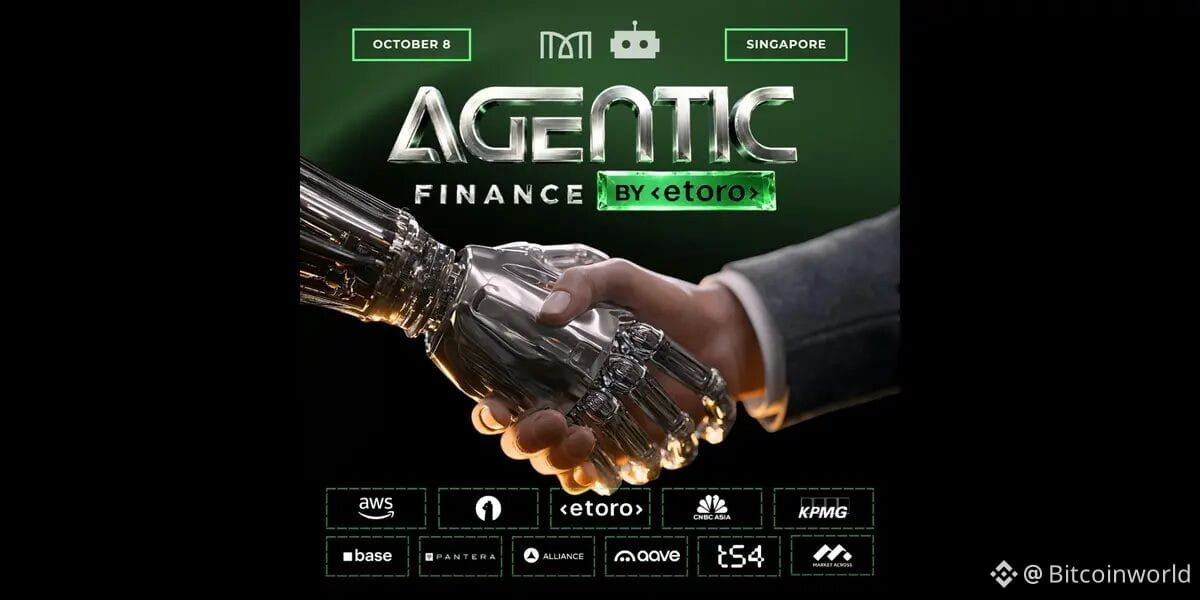
Singapore, October 5, 2026 — More & More will host the Agentic Finance Summit on October 8, 2026 at Suntec Singapore Convention and Exhibition Centre, an official side event of TOKEN2049 Singapore. etoro is the summit’s lead partner.
The invitation-only programme brings together 400 senior decision-makers from banks, exchanges, payment networks, funds and regulators working on AI agents that hold wallets, execute trades and move payments. Participating companies include etoro, Coinbase, Pantera Capital, AWS, KPMG, Chainlink, Aave, Fireblocks, Alpaca and Gate.
Confirmed speakers include Yoni Assia, Co-Founder and CEO of etoro; Scott Lawin, President of Pantera Capital; Stani Kulechov, Founder and CEO of Aave Labs; Johann Eid, Chief Business Officer of Chainlink Labs; Itai Turbahn, VP of Embedded Wallets at Fireblocks; Yoshi Yokokawa, Co-Founder and CEO of Alpaca; Xen Baynham-Herd, Head of Marketing and Global Expansion at Base, Coinbase’s onchain network; and Anton Ruddenklau, Head of Financial Services at KPMG Singapore. Joanna Ossinger of CNBC and Jacquelyn Melinek of StrataMedia will moderate sessions.
The headline event of the day is a fireside conversation with Yoni Assia, alongside sessions on agentic wallets and vaults, agentic payments and commerce, autonomous trading, institutional capital, and the technical and regulatory requirements for connecting AI agents to banks. A security block will include live demonstrations of compliance, KYC and KYT, and agent security tools.
Two AI agents will operate on site. One will greet attendees at the entrance and direct them to relevant meetings. A second will take part in discussion on the main stage alongside the speakers.
“Agentic AI is leveling the playing field between retail and institutional players in finance. Agents can digest an enormous amount of data, react quickly, and are already managing real portfolios. That changes how people invest, trade and manage money,” said Yoni Assia, Co-Founder and CEO of etoro. “TOKEN2049 puts the platforms, financial institutions, and builders shaping that shift in one city for a week, and Agentic Finance brings them into one room.”
“Banks, exchanges and payment networks are deciding right now how AI agents will handle client money,” said Tal Mor, Founder and CEO of More & More. “The summit is built around that decision, with an invitation-only room and pre-scheduled meetings between the people making it.”
Summit partners include etoro, Coinbase, Fireblocks, Alpaca, Pantera Capital, Aave, AEON, Atlas Capital Team, Limitless, AWS, KPMG Singapore, Nethermind, Zengo and the Blockchain Association Singapore, with CNBC Asia as media partner. The summit is co-located with The Odds: Prediction Markets Live, More & More’s prediction markets conference, featuring CJ Hetherington of Limitless Labs and Pär Helgosson of Paris Saint-Germain’s PSG Labs.
The Agentic Finance Summit runs from 14:00 to 20:00 SGT on October 8, a short walk from TOKEN2049 at Marina Bay Sands. Attendance is by application at luma.com/8oxs8lco.
About More & More
More & More produces invitation-only conferences, side events and executive delegations across Web3, fintech and institutional finance, with events in Singapore, Dubai, Abu Dhabi, Paris, Manila and Tel Aviv. Its brands include Agentic Finance and The Odds: Prediction Markets Live. The next Agentic Finance edition takes place during Abu Dhabi Finance Week in December 2026. More at mnm.live.
Media Contact
Tal Mor, Founder and CEO, More & More
tal@mnm.live
This post More & More to Host Agentic Finance Summit With etoro, Pantera Capital and Chainlink, During TOKEN2049 Singapore first appeared on BitcoinWorld.
More & More to Host Agentic Finance Summit With Etoro, Pantera Capital and Chainlink, During TOKE...
BitcoinWorldMore & More to Host Agentic Finance Summit With etoro, Pantera Capital and Chainlink, During TOKEN2049 Singapore
The invitation-only summit on October 8 brings 400 executives from banks, exchanges, payment networks and funds to Suntec City to examine how AI agents are entering trading, payments and compliance.
Singapore, October 5, 2026 — More & More will host the Agentic Finance Summit on October 8, 2026 at Suntec Singapore Convention and Exhibition Centre, an official side event of TOKEN2049 Singapore. etoro is the summit’s lead partner.
The invitation-only programme brings together 400 senior decision-makers from banks, exchanges, payment networks, funds and regulators working on AI agents that hold wallets, execute trades and move payments. Participating companies include etoro, Coinbase, Pantera Capital, AWS, KPMG, Chainlink, Aave, Fireblocks, Alpaca and Gate.
Confirmed speakers include Yoni Assia, Co-Founder and CEO of etoro; Scott Lawin, President of Pantera Capital; Stani Kulechov, Founder and CEO of Aave Labs; Johann Eid, Chief Business Officer of Chainlink Labs; Itai Turbahn, VP of Embedded Wallets at Fireblocks; Yoshi Yokokawa, Co-Founder and CEO of Alpaca; Xen Baynham-Herd, Head of Marketing and Global Expansion at Base, Coinbase’s onchain network; and Anton Ruddenklau, Head of Financial Services at KPMG Singapore. Joanna Ossinger of CNBC and Jacquelyn Melinek of StrataMedia will moderate sessions.
The headline event of the day is a fireside conversation with Yoni Assia, alongside sessions on agentic wallets and vaults, agentic payments and commerce, autonomous trading, institutional capital, and the technical and regulatory requirements for connecting AI agents to banks. A security block will include live demonstrations of compliance, KYC and KYT, and agent security tools.
Two AI agents will operate on site. One will greet attendees at the entrance and direct them to relevant meetings. A second will take part in discussion on the main stage alongside the speakers.
“Agentic AI is leveling the playing field between retail and institutional players in finance. Agents can digest an enormous amount of data, react quickly, and are already managing real portfolios. That changes how people invest, trade and manage money,” said Yoni Assia, Co-Founder and CEO of etoro. “TOKEN2049 puts the platforms, financial institutions, and builders shaping that shift in one city for a week, and Agentic Finance brings them into one room.”
“Banks, exchanges and payment networks are deciding right now how AI agents will handle client money,” said Tal Mor, Founder and CEO of More & More. “The summit is built around that decision, with an invitation-only room and pre-scheduled meetings between the people making it.”
Summit partners include etoro, Coinbase, Fireblocks, Alpaca, Pantera Capital, Aave, AEON, Atlas Capital Team, Limitless, AWS, KPMG Singapore, Nethermind, Zengo and the Blockchain Association Singapore, with CNBC Asia as media partner. The summit is co-located with The Odds: Prediction Markets Live, More & More’s prediction markets conference, featuring CJ Hetherington of Limitless Labs and Pär Helgosson of Paris Saint-Germain’s PSG Labs.
The Agentic Finance Summit runs from 14:00 to 20:00 SGT on October 8, a short walk from TOKEN2049 at Marina Bay Sands. Attendance is by application at luma.com/8oxs8lco.
About More & More
More & More produces invitation-only conferences, side events and executive delegations across Web3, fintech and institutional finance, with events in Singapore, Dubai, Abu Dhabi, Paris, Manila and Tel Aviv. Its brands include Agentic Finance and The Odds: Prediction Markets Live. The next Agentic Finance edition takes place during Abu Dhabi Finance Week in December 2026. More at mnm.live.
Media Contact
Tal Mor, Founder and CEO, More & More
tal@mnm.live
This post More & More to Host Agentic Finance Summit With etoro, Pantera Capital and Chainlink, During TOKEN2049 Singapore first appeared on BitcoinWorld.
The invitation-only summit on October 8 brings 400 executives from banks, exchanges, payment networks and funds to Suntec City to examine how AI agents are entering trading, payments and compliance.
Singapore, October 5, 2026 — More & More will host the Agentic Finance Summit on October 8, 2026 at Suntec Singapore Convention and Exhibition Centre, an official side event of TOKEN2049 Singapore. etoro is the summit’s lead partner.
The invitation-only programme brings together 400 senior decision-makers from banks, exchanges, payment networks, funds and regulators working on AI agents that hold wallets, execute trades and move payments. Participating companies include etoro, Coinbase, Pantera Capital, AWS, KPMG, Chainlink, Aave, Fireblocks, Alpaca and Gate.
Confirmed speakers include Yoni Assia, Co-Founder and CEO of etoro; Scott Lawin, President of Pantera Capital; Stani Kulechov, Founder and CEO of Aave Labs; Johann Eid, Chief Business Officer of Chainlink Labs; Itai Turbahn, VP of Embedded Wallets at Fireblocks; Yoshi Yokokawa, Co-Founder and CEO of Alpaca; Xen Baynham-Herd, Head of Marketing and Global Expansion at Base, Coinbase’s onchain network; and Anton Ruddenklau, Head of Financial Services at KPMG Singapore. Joanna Ossinger of CNBC and Jacquelyn Melinek of StrataMedia will moderate sessions.
The headline event of the day is a fireside conversation with Yoni Assia, alongside sessions on agentic wallets and vaults, agentic payments and commerce, autonomous trading, institutional capital, and the technical and regulatory requirements for connecting AI agents to banks. A security block will include live demonstrations of compliance, KYC and KYT, and agent security tools.
Two AI agents will operate on site. One will greet attendees at the entrance and direct them to relevant meetings. A second will take part in discussion on the main stage alongside the speakers.
“Agentic AI is leveling the playing field between retail and institutional players in finance. Agents can digest an enormous amount of data, react quickly, and are already managing real portfolios. That changes how people invest, trade and manage money,” said Yoni Assia, Co-Founder and CEO of etoro. “TOKEN2049 puts the platforms, financial institutions, and builders shaping that shift in one city for a week, and Agentic Finance brings them into one room.”
“Banks, exchanges and payment networks are deciding right now how AI agents will handle client money,” said Tal Mor, Founder and CEO of More & More. “The summit is built around that decision, with an invitation-only room and pre-scheduled meetings between the people making it.”
Summit partners include etoro, Coinbase, Fireblocks, Alpaca, Pantera Capital, Aave, AEON, Atlas Capital Team, Limitless, AWS, KPMG Singapore, Nethermind, Zengo and the Blockchain Association Singapore, with CNBC Asia as media partner. The summit is co-located with The Odds: Prediction Markets Live, More & More’s prediction markets conference, featuring CJ Hetherington of Limitless Labs and Pär Helgosson of Paris Saint-Germain’s PSG Labs.
The Agentic Finance Summit runs from 14:00 to 20:00 SGT on October 8, a short walk from TOKEN2049 at Marina Bay Sands. Attendance is by application at luma.com/8oxs8lco.
About More & More
More & More produces invitation-only conferences, side events and executive delegations across Web3, fintech and institutional finance, with events in Singapore, Dubai, Abu Dhabi, Paris, Manila and Tel Aviv. Its brands include Agentic Finance and The Odds: Prediction Markets Live. The next Agentic Finance edition takes place during Abu Dhabi Finance Week in December 2026. More at mnm.live.
Media Contact
Tal Mor, Founder and CEO, More & More
tal@mnm.live
This post More & More to Host Agentic Finance Summit With etoro, Pantera Capital and Chainlink, During TOKEN2049 Singapore first appeared on BitcoinWorld.
197
·
--
Article
Payward and Singapore Gulf Bank Partner to Bring 24/7 Settlement to Institutional Digital Asset M...BitcoinWorldPayward and Singapore Gulf Bank Partner to Bring 24/7 Settlement to Institutional Digital Asset Markets
Payward has integrated SGB Net, Singapore Gulf Bank’s real-time clearing network, allowing institutional clients in Asia and the Gulf region to settle instantly at any hour. SGB will also onboard Kraken Prime as an additional source of digital asset liquidity.
SYDNEY, Oct. 5, 2026 /PRNewswire/ — Payward, the unified financial infrastructure platform behind Kraken, and Singapore Gulf Bank (SGB), a fully licensed digital bank regulated by the Central Bank of Bahrain, today announced a strategic partnership to bring always-on settlement to institutional digital asset markets available to specific jurisdictions only.
With this partnership, Payward has integrated SGB Net, SGB’s real-time multi-currency clearing network. It allows institutional clients of both firms to now settle transactions instantly, 24 hours a day, seven days a week. The settlement offering initially starts with US dollar transactions for a select number of clients, with plans to expand to more clients and additional currencies over time.
Settlement between banks and trading venues have historically taken days and been held to fixed cut-off times, even as digital asset markets trade around the clock. Through SGB Net, an SGB client can deposit funds with Payward and put them to work instantly, at any hour. SGB is also partnering with Kraken Prime, Payward’s full-service prime brokerage solution, to access liquidity for its digital asset offerings. Over the coming months, it will draw on Payward’s markets to price trades for its own customers.
SGB launched SGB Net in 2025 for digital asset businesses with growing operational needs, and the network has since scaled to process more than $20 billion in fiat transactions each month. SGB is backed by Mumtalakat, Bahrain’s sovereign wealth fund, and by Singapore’s Whampoa Group, and it onboards corporate clients digitally across markets.
“Exchanges, payment providers, OTC desks and fintechs all run into the same banking constraint. Settlement stops when the business day does, while their markets do not. SGB has built settlement infrastructure that reflects the future of digital asset banking and payments,” said Mark Greenberg, Chief Commercial Officer of Payward. “Every regulated bank we connect with this way brings us closer to a world where settlement and cross-border payments happen in real time, wherever our clients are.”
“Access to liquidity is only useful if clients can move funds when they need to,” said Shawn Chan, Chief Executive Officer, SGB. “By connecting SGB Net with Payward and partnering with Kraken Prime, we are bringing settlement and liquidity closer together, giving clients more flexibility in how they fund and manage their digital asset activity.”
To support clients across borders and asset classes, SGB offers corporate and personal banking accounts to businesses and individuals worldwide, combining multi-currency accounts, international payments and remote account opening with access to digital asset services.
The partnership is part of enhancing Payward Banking, the money layer behind the Payward platform, which modernizes how clients move cash across deposits, payments, cards, custody, and lending. As digital asset markets and traditional banking offerings converge, clients expect their cash to move as quickly as the assets they trade. Working with leading regulated banks lets Payward bring that speed to new markets, and Payward will keep adding banking partners to offer a broader suite of banking services to clients worldwide.
About Payward:
Payward, Inc. is a unified financial infrastructure platform that powers a family of products advancing an open, global financial system. Built on a single shared architecture, Payward enables customers to hold, trade, earn, pay, and invest across asset classes without friction or fragmentation.
At its core, Payward provides the infrastructure layer behind Kraken and a growing set of purpose-built products, including NinjaTrader, Breakout, xStocks, and CF Benchmarks.
Payward separates infrastructure from product expression. Each product surface is designed for a specific customer segment, regulatory regime, and use case, while operating on the same global foundation:
One global liquidity pool
One unified risk and margin engine
One collateral and settlement system
One compliance and licensing framework
This shared architecture allows Payward to scale efficiently, launch new products at low marginal cost, and serve diverse global markets while maintaining consistent risk management, regulatory integrity, and operational resilience.
For more information about Payward, please visit www.payward.com.
About Singapore Gulf Bank:
Singapore Gulf Bank (SGB) is the bank for all of finance, serving businesses and individuals worldwide. Backed by Whampoa Group, a Singapore-based investment holding company, and Mumtalakat, Bahrain’s sovereign wealth fund, SGB is fully licensed and regulated by the Central Bank of Bahrain.
For more information, visit https://www.sgb.com/
This post Payward and Singapore Gulf Bank Partner to Bring 24/7 Settlement to Institutional Digital Asset Markets first appeared on BitcoinWorld.
Payward and Singapore Gulf Bank Partner to Bring 24/7 Settlement to Institutional Digital Asset M...
BitcoinWorldPayward and Singapore Gulf Bank Partner to Bring 24/7 Settlement to Institutional Digital Asset Markets
Payward has integrated SGB Net, Singapore Gulf Bank’s real-time clearing network, allowing institutional clients in Asia and the Gulf region to settle instantly at any hour. SGB will also onboard Kraken Prime as an additional source of digital asset liquidity.
SYDNEY, Oct. 5, 2026 /PRNewswire/ — Payward, the unified financial infrastructure platform behind Kraken, and Singapore Gulf Bank (SGB), a fully licensed digital bank regulated by the Central Bank of Bahrain, today announced a strategic partnership to bring always-on settlement to institutional digital asset markets available to specific jurisdictions only.
With this partnership, Payward has integrated SGB Net, SGB’s real-time multi-currency clearing network. It allows institutional clients of both firms to now settle transactions instantly, 24 hours a day, seven days a week. The settlement offering initially starts with US dollar transactions for a select number of clients, with plans to expand to more clients and additional currencies over time.
Settlement between banks and trading venues have historically taken days and been held to fixed cut-off times, even as digital asset markets trade around the clock. Through SGB Net, an SGB client can deposit funds with Payward and put them to work instantly, at any hour. SGB is also partnering with Kraken Prime, Payward’s full-service prime brokerage solution, to access liquidity for its digital asset offerings. Over the coming months, it will draw on Payward’s markets to price trades for its own customers.
SGB launched SGB Net in 2025 for digital asset businesses with growing operational needs, and the network has since scaled to process more than $20 billion in fiat transactions each month. SGB is backed by Mumtalakat, Bahrain’s sovereign wealth fund, and by Singapore’s Whampoa Group, and it onboards corporate clients digitally across markets.
“Exchanges, payment providers, OTC desks and fintechs all run into the same banking constraint. Settlement stops when the business day does, while their markets do not. SGB has built settlement infrastructure that reflects the future of digital asset banking and payments,” said Mark Greenberg, Chief Commercial Officer of Payward. “Every regulated bank we connect with this way brings us closer to a world where settlement and cross-border payments happen in real time, wherever our clients are.”
“Access to liquidity is only useful if clients can move funds when they need to,” said Shawn Chan, Chief Executive Officer, SGB. “By connecting SGB Net with Payward and partnering with Kraken Prime, we are bringing settlement and liquidity closer together, giving clients more flexibility in how they fund and manage their digital asset activity.”
To support clients across borders and asset classes, SGB offers corporate and personal banking accounts to businesses and individuals worldwide, combining multi-currency accounts, international payments and remote account opening with access to digital asset services.
The partnership is part of enhancing Payward Banking, the money layer behind the Payward platform, which modernizes how clients move cash across deposits, payments, cards, custody, and lending. As digital asset markets and traditional banking offerings converge, clients expect their cash to move as quickly as the assets they trade. Working with leading regulated banks lets Payward bring that speed to new markets, and Payward will keep adding banking partners to offer a broader suite of banking services to clients worldwide.
About Payward:
Payward, Inc. is a unified financial infrastructure platform that powers a family of products advancing an open, global financial system. Built on a single shared architecture, Payward enables customers to hold, trade, earn, pay, and invest across asset classes without friction or fragmentation.
At its core, Payward provides the infrastructure layer behind Kraken and a growing set of purpose-built products, including NinjaTrader, Breakout, xStocks, and CF Benchmarks.
Payward separates infrastructure from product expression. Each product surface is designed for a specific customer segment, regulatory regime, and use case, while operating on the same global foundation:
One global liquidity pool
One unified risk and margin engine
One collateral and settlement system
One compliance and licensing framework
This shared architecture allows Payward to scale efficiently, launch new products at low marginal cost, and serve diverse global markets while maintaining consistent risk management, regulatory integrity, and operational resilience.
For more information about Payward, please visit www.payward.com.
About Singapore Gulf Bank:
Singapore Gulf Bank (SGB) is the bank for all of finance, serving businesses and individuals worldwide. Backed by Whampoa Group, a Singapore-based investment holding company, and Mumtalakat, Bahrain’s sovereign wealth fund, SGB is fully licensed and regulated by the Central Bank of Bahrain.
For more information, visit https://www.sgb.com/
This post Payward and Singapore Gulf Bank Partner to Bring 24/7 Settlement to Institutional Digital Asset Markets first appeared on BitcoinWorld.
Payward has integrated SGB Net, Singapore Gulf Bank’s real-time clearing network, allowing institutional clients in Asia and the Gulf region to settle instantly at any hour. SGB will also onboard Kraken Prime as an additional source of digital asset liquidity.
SYDNEY, Oct. 5, 2026 /PRNewswire/ — Payward, the unified financial infrastructure platform behind Kraken, and Singapore Gulf Bank (SGB), a fully licensed digital bank regulated by the Central Bank of Bahrain, today announced a strategic partnership to bring always-on settlement to institutional digital asset markets available to specific jurisdictions only.
With this partnership, Payward has integrated SGB Net, SGB’s real-time multi-currency clearing network. It allows institutional clients of both firms to now settle transactions instantly, 24 hours a day, seven days a week. The settlement offering initially starts with US dollar transactions for a select number of clients, with plans to expand to more clients and additional currencies over time.
Settlement between banks and trading venues have historically taken days and been held to fixed cut-off times, even as digital asset markets trade around the clock. Through SGB Net, an SGB client can deposit funds with Payward and put them to work instantly, at any hour. SGB is also partnering with Kraken Prime, Payward’s full-service prime brokerage solution, to access liquidity for its digital asset offerings. Over the coming months, it will draw on Payward’s markets to price trades for its own customers.
SGB launched SGB Net in 2025 for digital asset businesses with growing operational needs, and the network has since scaled to process more than $20 billion in fiat transactions each month. SGB is backed by Mumtalakat, Bahrain’s sovereign wealth fund, and by Singapore’s Whampoa Group, and it onboards corporate clients digitally across markets.
“Exchanges, payment providers, OTC desks and fintechs all run into the same banking constraint. Settlement stops when the business day does, while their markets do not. SGB has built settlement infrastructure that reflects the future of digital asset banking and payments,” said Mark Greenberg, Chief Commercial Officer of Payward. “Every regulated bank we connect with this way brings us closer to a world where settlement and cross-border payments happen in real time, wherever our clients are.”
“Access to liquidity is only useful if clients can move funds when they need to,” said Shawn Chan, Chief Executive Officer, SGB. “By connecting SGB Net with Payward and partnering with Kraken Prime, we are bringing settlement and liquidity closer together, giving clients more flexibility in how they fund and manage their digital asset activity.”
To support clients across borders and asset classes, SGB offers corporate and personal banking accounts to businesses and individuals worldwide, combining multi-currency accounts, international payments and remote account opening with access to digital asset services.
The partnership is part of enhancing Payward Banking, the money layer behind the Payward platform, which modernizes how clients move cash across deposits, payments, cards, custody, and lending. As digital asset markets and traditional banking offerings converge, clients expect their cash to move as quickly as the assets they trade. Working with leading regulated banks lets Payward bring that speed to new markets, and Payward will keep adding banking partners to offer a broader suite of banking services to clients worldwide.
About Payward:
Payward, Inc. is a unified financial infrastructure platform that powers a family of products advancing an open, global financial system. Built on a single shared architecture, Payward enables customers to hold, trade, earn, pay, and invest across asset classes without friction or fragmentation.
At its core, Payward provides the infrastructure layer behind Kraken and a growing set of purpose-built products, including NinjaTrader, Breakout, xStocks, and CF Benchmarks.
Payward separates infrastructure from product expression. Each product surface is designed for a specific customer segment, regulatory regime, and use case, while operating on the same global foundation:
One global liquidity pool
One unified risk and margin engine
One collateral and settlement system
One compliance and licensing framework
This shared architecture allows Payward to scale efficiently, launch new products at low marginal cost, and serve diverse global markets while maintaining consistent risk management, regulatory integrity, and operational resilience.
For more information about Payward, please visit www.payward.com.
About Singapore Gulf Bank:
Singapore Gulf Bank (SGB) is the bank for all of finance, serving businesses and individuals worldwide. Backed by Whampoa Group, a Singapore-based investment holding company, and Mumtalakat, Bahrain’s sovereign wealth fund, SGB is fully licensed and regulated by the Central Bank of Bahrain.
For more information, visit https://www.sgb.com/
This post Payward and Singapore Gulf Bank Partner to Bring 24/7 Settlement to Institutional Digital Asset Markets first appeared on BitcoinWorld.
96
·
--

Article
South Korea Crypto Volume Slips 19.56% in a WeekBitcoinWorldSouth Korea crypto volume slips 19.56% in a week
Combined trading volume across South Korea’s five largest crypto exchanges fell to roughly 20.5 trillion won, or about $15.1 billion, in the week ending Oct. 2, a 19.56% decline from the previous week, according to Crypto.news, citing data from Digital Asset. The drop removed about 5 trillion won, or roughly $3.7 billion, from activity over the seven-day window that ended at 2 p.m. Korea Standard Time on Oct. 2.
South Korea’s five major exchanges traded about 20.5 trillion won in the week to Oct. 2, down 19.56% week over week. The weekly slide followed government data showing average daily exchange volume in the country fell 44% in the first half of 2026 and operating profit dropped 78%.
The figures cover Upbit, Bithumb, Coinone, Digital X and Gopax. Crypto.news reported that the source data did not tie the decline to any single cryptocurrency, exchange event or regulatory action, leaving the weekly numbers on their own unable to explain why traders pulled back.
Key facts
Five-exchange volume for Sept. 25 to Oct. 2 totaled about 20.5 trillion won, or $15.1 billion, down 19.56% week over week.
Upbit held 64.04% of trading, down 3.3 percentage points, while Bithumb rose 1.893 points to 26.66%.
The Korea Financial Intelligence Unit surveyed 26 registered virtual asset service providers and reported that average daily exchange volume fell 44% in the first half of 2026 versus the prior six months, per Cointelegraph.
Over the same period, exchange sales dropped 41% and operating profit dropped 78%, while the number of accounts eligible to trade edged up 0.4%.
Of 673 distinct virtual assets circulating on Korean platforms, 93 were exchange-exclusive tokens with market capitalization of 100 million won or less, about 40% of that group.
A quiet week against a much weaker year
Crypto.news and Cointelegraph are describing two different measurements of the same soft market, and the distinction matters. The 19.56% decline is a private-sector snapshot covering one week and five platforms. The 44% and 78% declines come from the KoFIU and Financial Supervisory Service, which on Oct. 1 published their own first-half review of the domestic virtual asset market.
That regulatory review, first distributed by the Korea Financial Intelligence Unit and covered by Cointelegraph on Oct. 2, found that during the first six months of 2026 Korean crypto market capitalization fell 33% to a loss of 28.3 trillion won, won-denominated exchange deposits dropped 35%, and exchange revenue slid 41%. PANews carried the same survey details, noting the review spanned Jan. 1 to June 30 and covered 17 exchange operators plus nine custody and wallet providers.
Cointelegraph also reported that the weakness has run longer than a single half-year cycle. A separate Cointelegraph analysis in July found combined average daily volume across Upbit, Bithumb, Coinone, Korbit and Gopax had fallen about 89% year over year over comparable seven-day periods, while the KOSPI, South Korea’s benchmark stock index, had more than doubled over the 12 months to July 22. In May, the value of crypto held by South Korean investors fell 50.2% to 60.6 trillion won, or $41.4 billion, over roughly a year — a move that Korean outlet ChosunBiz linked to capital shifting toward equities.
Upbit stays first as rivals chip away
The exchange order did not change through Oct. 2. Upbit, Bithumb and the rest held the same ranks as the prior week, but the split beneath the surface shifted. Upbit’s 64.04% share was down 3.3 percentage points, and Bithumb’s gain of 1.893 points to 26.66% left the two platforms controlling more than 90% of the five-exchange market.
Coinone took third at 6.58%, an increase of 1.12 percentage points. Digital X, the former Korbit, reached 2.71% after adding 0.316 points, and Gopax stayed fifth at 0.02%. Crypto.news noted that Korbit’s service became Digital X from Sept. 16 following its move under Mirae Asset, with its corporate name changing on Aug. 11 and customer assets, trading history and account data carrying over unchanged.
Liquidity remains a concern at the thin end of the market. The KoFIU flagged the risk of sharp price moves in exchange-exclusive tokens, and Crypto.news reported that monthly turnover for won-based exchanges ran between 100% and 201%, compared with just 2% to 9% for coin-only platforms.
Why it matters
Falling volume feeds directly into the viability of the platforms Korean traders rely on. With revenue down 41% and operating profit down 78% in the first half, exchanges have less room to fund listings, compliance and security work at a moment when regulators are demanding more of all three. Thinner order books also mean retail buyers and sellers face wider spreads and sharper price swings, particularly in the exchange-exclusive tokens the KoFIU singled out. And the shift of household capital toward the KOSPI shows that the decline is not purely a crypto story — it is a reallocation of where Korean retail savers put their money.
What to watch
The next test is whether the Oct. 2 listings hold up in a softer market: Bithumb added Talus against the Korean won that day, and Upbit listed Dolphin across KRW, BTC and USDT pairs. Also pending is the rollout of the FSC’s August framework, which expands Korea’s travel rule to transfers of all sizes between registered VASPs and requires transfers of at least 10 million won to overseas providers or wallet operators to be reported to the KoFIU once the provisions take effect.
Frequently Asked Questions
How much did South Korea crypto trading volume fall in the week to Oct. 2?
Combined volume across Upbit, Bithumb, Coinone, Digital X and Gopax fell 19.56% week over week to roughly 20.5 trillion won, or about $15.1 billion, a drop of around 5 trillion won.
Did any exchange gain market share during the decline?
Yes. Upbit’s share slipped 3.3 percentage points to 64.04%, while Bithumb rose to 26.66%, Coinone to 6.58%, Digital X to 2.71% and Gopax to 0.02%.
What did the KoFIU first-half 2026 survey find?
The regulator surveyed 26 registered virtual asset service providers and found average daily exchange volume fell 44%, market capitalization dropped 33%, won deposits fell 35%, sales fell 41% and operating profit fell 78%.
Why do the exchange figures and the KoFIU data measure different things?
The weekly 19.56% slide is a private seven-day snapshot from Digital Asset, while the 44% and 78% declines come from the KoFIU’s six-month regulatory survey. The two reports use different windows and are not directly comparable.
Are South Korean crypto rules getting stricter?
Yes. The Financial Services Commission approved tighter VASP registration and anti-money laundering rules in August 2026, and the travel rule now applies to transfers of all sizes between registered VASPs.
This post South Korea crypto volume slips 19.56% in a week first appeared on BitcoinWorld.
South Korea Crypto Volume Slips 19.56% in a Week
BitcoinWorldSouth Korea crypto volume slips 19.56% in a week
Combined trading volume across South Korea’s five largest crypto exchanges fell to roughly 20.5 trillion won, or about $15.1 billion, in the week ending Oct. 2, a 19.56% decline from the previous week, according to Crypto.news, citing data from Digital Asset. The drop removed about 5 trillion won, or roughly $3.7 billion, from activity over the seven-day window that ended at 2 p.m. Korea Standard Time on Oct. 2.
South Korea’s five major exchanges traded about 20.5 trillion won in the week to Oct. 2, down 19.56% week over week. The weekly slide followed government data showing average daily exchange volume in the country fell 44% in the first half of 2026 and operating profit dropped 78%.
The figures cover Upbit, Bithumb, Coinone, Digital X and Gopax. Crypto.news reported that the source data did not tie the decline to any single cryptocurrency, exchange event or regulatory action, leaving the weekly numbers on their own unable to explain why traders pulled back.
Key facts
Five-exchange volume for Sept. 25 to Oct. 2 totaled about 20.5 trillion won, or $15.1 billion, down 19.56% week over week.
Upbit held 64.04% of trading, down 3.3 percentage points, while Bithumb rose 1.893 points to 26.66%.
The Korea Financial Intelligence Unit surveyed 26 registered virtual asset service providers and reported that average daily exchange volume fell 44% in the first half of 2026 versus the prior six months, per Cointelegraph.
Over the same period, exchange sales dropped 41% and operating profit dropped 78%, while the number of accounts eligible to trade edged up 0.4%.
Of 673 distinct virtual assets circulating on Korean platforms, 93 were exchange-exclusive tokens with market capitalization of 100 million won or less, about 40% of that group.
A quiet week against a much weaker year
Crypto.news and Cointelegraph are describing two different measurements of the same soft market, and the distinction matters. The 19.56% decline is a private-sector snapshot covering one week and five platforms. The 44% and 78% declines come from the KoFIU and Financial Supervisory Service, which on Oct. 1 published their own first-half review of the domestic virtual asset market.
That regulatory review, first distributed by the Korea Financial Intelligence Unit and covered by Cointelegraph on Oct. 2, found that during the first six months of 2026 Korean crypto market capitalization fell 33% to a loss of 28.3 trillion won, won-denominated exchange deposits dropped 35%, and exchange revenue slid 41%. PANews carried the same survey details, noting the review spanned Jan. 1 to June 30 and covered 17 exchange operators plus nine custody and wallet providers.
Cointelegraph also reported that the weakness has run longer than a single half-year cycle. A separate Cointelegraph analysis in July found combined average daily volume across Upbit, Bithumb, Coinone, Korbit and Gopax had fallen about 89% year over year over comparable seven-day periods, while the KOSPI, South Korea’s benchmark stock index, had more than doubled over the 12 months to July 22. In May, the value of crypto held by South Korean investors fell 50.2% to 60.6 trillion won, or $41.4 billion, over roughly a year — a move that Korean outlet ChosunBiz linked to capital shifting toward equities.
Upbit stays first as rivals chip away
The exchange order did not change through Oct. 2. Upbit, Bithumb and the rest held the same ranks as the prior week, but the split beneath the surface shifted. Upbit’s 64.04% share was down 3.3 percentage points, and Bithumb’s gain of 1.893 points to 26.66% left the two platforms controlling more than 90% of the five-exchange market.
Coinone took third at 6.58%, an increase of 1.12 percentage points. Digital X, the former Korbit, reached 2.71% after adding 0.316 points, and Gopax stayed fifth at 0.02%. Crypto.news noted that Korbit’s service became Digital X from Sept. 16 following its move under Mirae Asset, with its corporate name changing on Aug. 11 and customer assets, trading history and account data carrying over unchanged.
Liquidity remains a concern at the thin end of the market. The KoFIU flagged the risk of sharp price moves in exchange-exclusive tokens, and Crypto.news reported that monthly turnover for won-based exchanges ran between 100% and 201%, compared with just 2% to 9% for coin-only platforms.
Why it matters
Falling volume feeds directly into the viability of the platforms Korean traders rely on. With revenue down 41% and operating profit down 78% in the first half, exchanges have less room to fund listings, compliance and security work at a moment when regulators are demanding more of all three. Thinner order books also mean retail buyers and sellers face wider spreads and sharper price swings, particularly in the exchange-exclusive tokens the KoFIU singled out. And the shift of household capital toward the KOSPI shows that the decline is not purely a crypto story — it is a reallocation of where Korean retail savers put their money.
What to watch
The next test is whether the Oct. 2 listings hold up in a softer market: Bithumb added Talus against the Korean won that day, and Upbit listed Dolphin across KRW, BTC and USDT pairs. Also pending is the rollout of the FSC’s August framework, which expands Korea’s travel rule to transfers of all sizes between registered VASPs and requires transfers of at least 10 million won to overseas providers or wallet operators to be reported to the KoFIU once the provisions take effect.
Frequently Asked Questions
How much did South Korea crypto trading volume fall in the week to Oct. 2?
Combined volume across Upbit, Bithumb, Coinone, Digital X and Gopax fell 19.56% week over week to roughly 20.5 trillion won, or about $15.1 billion, a drop of around 5 trillion won.
Did any exchange gain market share during the decline?
Yes. Upbit’s share slipped 3.3 percentage points to 64.04%, while Bithumb rose to 26.66%, Coinone to 6.58%, Digital X to 2.71% and Gopax to 0.02%.
What did the KoFIU first-half 2026 survey find?
The regulator surveyed 26 registered virtual asset service providers and found average daily exchange volume fell 44%, market capitalization dropped 33%, won deposits fell 35%, sales fell 41% and operating profit fell 78%.
Why do the exchange figures and the KoFIU data measure different things?
The weekly 19.56% slide is a private seven-day snapshot from Digital Asset, while the 44% and 78% declines come from the KoFIU’s six-month regulatory survey. The two reports use different windows and are not directly comparable.
Are South Korean crypto rules getting stricter?
Yes. The Financial Services Commission approved tighter VASP registration and anti-money laundering rules in August 2026, and the travel rule now applies to transfers of all sizes between registered VASPs.
This post South Korea crypto volume slips 19.56% in a week first appeared on BitcoinWorld.
Combined trading volume across South Korea’s five largest crypto exchanges fell to roughly 20.5 trillion won, or about $15.1 billion, in the week ending Oct. 2, a 19.56% decline from the previous week, according to Crypto.news, citing data from Digital Asset. The drop removed about 5 trillion won, or roughly $3.7 billion, from activity over the seven-day window that ended at 2 p.m. Korea Standard Time on Oct. 2.
South Korea’s five major exchanges traded about 20.5 trillion won in the week to Oct. 2, down 19.56% week over week. The weekly slide followed government data showing average daily exchange volume in the country fell 44% in the first half of 2026 and operating profit dropped 78%.
The figures cover Upbit, Bithumb, Coinone, Digital X and Gopax. Crypto.news reported that the source data did not tie the decline to any single cryptocurrency, exchange event or regulatory action, leaving the weekly numbers on their own unable to explain why traders pulled back.
Key facts
Five-exchange volume for Sept. 25 to Oct. 2 totaled about 20.5 trillion won, or $15.1 billion, down 19.56% week over week.
Upbit held 64.04% of trading, down 3.3 percentage points, while Bithumb rose 1.893 points to 26.66%.
The Korea Financial Intelligence Unit surveyed 26 registered virtual asset service providers and reported that average daily exchange volume fell 44% in the first half of 2026 versus the prior six months, per Cointelegraph.
Over the same period, exchange sales dropped 41% and operating profit dropped 78%, while the number of accounts eligible to trade edged up 0.4%.
Of 673 distinct virtual assets circulating on Korean platforms, 93 were exchange-exclusive tokens with market capitalization of 100 million won or less, about 40% of that group.
A quiet week against a much weaker year
Crypto.news and Cointelegraph are describing two different measurements of the same soft market, and the distinction matters. The 19.56% decline is a private-sector snapshot covering one week and five platforms. The 44% and 78% declines come from the KoFIU and Financial Supervisory Service, which on Oct. 1 published their own first-half review of the domestic virtual asset market.
That regulatory review, first distributed by the Korea Financial Intelligence Unit and covered by Cointelegraph on Oct. 2, found that during the first six months of 2026 Korean crypto market capitalization fell 33% to a loss of 28.3 trillion won, won-denominated exchange deposits dropped 35%, and exchange revenue slid 41%. PANews carried the same survey details, noting the review spanned Jan. 1 to June 30 and covered 17 exchange operators plus nine custody and wallet providers.
Cointelegraph also reported that the weakness has run longer than a single half-year cycle. A separate Cointelegraph analysis in July found combined average daily volume across Upbit, Bithumb, Coinone, Korbit and Gopax had fallen about 89% year over year over comparable seven-day periods, while the KOSPI, South Korea’s benchmark stock index, had more than doubled over the 12 months to July 22. In May, the value of crypto held by South Korean investors fell 50.2% to 60.6 trillion won, or $41.4 billion, over roughly a year — a move that Korean outlet ChosunBiz linked to capital shifting toward equities.
Upbit stays first as rivals chip away
The exchange order did not change through Oct. 2. Upbit, Bithumb and the rest held the same ranks as the prior week, but the split beneath the surface shifted. Upbit’s 64.04% share was down 3.3 percentage points, and Bithumb’s gain of 1.893 points to 26.66% left the two platforms controlling more than 90% of the five-exchange market.
Coinone took third at 6.58%, an increase of 1.12 percentage points. Digital X, the former Korbit, reached 2.71% after adding 0.316 points, and Gopax stayed fifth at 0.02%. Crypto.news noted that Korbit’s service became Digital X from Sept. 16 following its move under Mirae Asset, with its corporate name changing on Aug. 11 and customer assets, trading history and account data carrying over unchanged.
Liquidity remains a concern at the thin end of the market. The KoFIU flagged the risk of sharp price moves in exchange-exclusive tokens, and Crypto.news reported that monthly turnover for won-based exchanges ran between 100% and 201%, compared with just 2% to 9% for coin-only platforms.
Why it matters
Falling volume feeds directly into the viability of the platforms Korean traders rely on. With revenue down 41% and operating profit down 78% in the first half, exchanges have less room to fund listings, compliance and security work at a moment when regulators are demanding more of all three. Thinner order books also mean retail buyers and sellers face wider spreads and sharper price swings, particularly in the exchange-exclusive tokens the KoFIU singled out. And the shift of household capital toward the KOSPI shows that the decline is not purely a crypto story — it is a reallocation of where Korean retail savers put their money.
What to watch
The next test is whether the Oct. 2 listings hold up in a softer market: Bithumb added Talus against the Korean won that day, and Upbit listed Dolphin across KRW, BTC and USDT pairs. Also pending is the rollout of the FSC’s August framework, which expands Korea’s travel rule to transfers of all sizes between registered VASPs and requires transfers of at least 10 million won to overseas providers or wallet operators to be reported to the KoFIU once the provisions take effect.
Frequently Asked Questions
How much did South Korea crypto trading volume fall in the week to Oct. 2?
Combined volume across Upbit, Bithumb, Coinone, Digital X and Gopax fell 19.56% week over week to roughly 20.5 trillion won, or about $15.1 billion, a drop of around 5 trillion won.
Did any exchange gain market share during the decline?
Yes. Upbit’s share slipped 3.3 percentage points to 64.04%, while Bithumb rose to 26.66%, Coinone to 6.58%, Digital X to 2.71% and Gopax to 0.02%.
What did the KoFIU first-half 2026 survey find?
The regulator surveyed 26 registered virtual asset service providers and found average daily exchange volume fell 44%, market capitalization dropped 33%, won deposits fell 35%, sales fell 41% and operating profit fell 78%.
Why do the exchange figures and the KoFIU data measure different things?
The weekly 19.56% slide is a private seven-day snapshot from Digital Asset, while the 44% and 78% declines come from the KoFIU’s six-month regulatory survey. The two reports use different windows and are not directly comparable.
Are South Korean crypto rules getting stricter?
Yes. The Financial Services Commission approved tighter VASP registration and anti-money laundering rules in August 2026, and the travel rule now applies to transfers of all sizes between registered VASPs.
This post South Korea crypto volume slips 19.56% in a week first appeared on BitcoinWorld.
262
·
--
Verified

Article
OpenPayd Targets Nasdaq Listing By Year-end Under Ticker OPBitcoinWorldOpenPayd targets Nasdaq listing by year-end under ticker OP
OpenPayd, the London-based stablecoin payments infrastructure firm, expects to complete its merger with Titan Acquisition Corp. and list on Nasdaq under the ticker OP by the end of 2026, according to Crypto.news. The transaction, announced at roughly $1.1 billion, would give the combined company an implied pro forma equity value of up to $1.145 billion.
OpenPayd plans to close its Titan Acquisition Corp. merger and list on Nasdaq under OP by the end of 2026, valuing the combined company at up to $1.145 billion. The stablecoin payments firm aims to launch U.S. services by April 2027 using 43 state money transmitter licenses acquired in September.
CEO Iana Dimitrova said the company intends to begin serving U.S. customers by April 2027, with proceeds from the listing supporting expansion and possible acquisitions. A source close to the matter told CoinDesk, as reported by PANews, that the company has already acquired and incorporated money transmission licenses across 43 states.
Key facts
OpenPayd expects its Titan Acquisition Corp. merger to close by the end of 2026, with the combined company to trade on Nasdaq under the ticker OP.
The transaction could value OpenPayd at up to $1.145 billion on a pro forma equity basis, per the June 1 definitive agreement.
OpenPayd reported fiscal 2026 revenue of $72.7 million (rounded to $73 million) for the year ended April 30, 2026, up from $56.6 million in fiscal 2025, with EBITDA of $12.5 million and a $2.8 million net loss.
The company confirmed on September 2 that MSB USA Inc. had been integrated into its group, bringing 43 state money transmitter licenses under OpenPayd.
OpenPayd aims to launch U.S. customer services by April 2027, pending regulatory and transaction approvals.
What the deal structure looks like
The transaction is structured as a SPAC business combination rather than a traditional IPO. Titan will merge into a newly created OpenPayd parent company, and that parent will acquire OpenPayd Holdings. OpenPayd would then operate as a wholly owned subsidiary of the Nasdaq-listed parent. Under the original terms, OpenPayd shareholders would receive shares based on an $800 million valuation.
According to Crypto.news, Titan’s trust could provide up to approximately $276 million in gross proceeds if public shareholders do not redeem their shares before closing. OpenPayd’s August investor presentation, filed with the SEC, modeled an alternative funding scenario: $276 million from Titan’s trust plus a potential $100 million PIPE, producing a modeled pro forma equity value of $1.245 billion. However, the filing stated that the PIPE “has yet to be raised and is not committed,” meaning the higher figure is not a confirmed transaction valuation or guaranteed fundraising amount.
PANews, citing CoinDesk, reported that the company has acquired and incorporated money transmission licenses across 43 states, and that the London-based firm is aiming for a roughly $1.1 billion valuation. The two reports describe the same transaction with slightly different emphasis: Crypto.news focuses on the deal’s prospective equity value of up to $1.145 billion and the mechanics of the SPAC, while PANews highlights the 43-state license footprint and the approximately $1.1 billion valuation.
Conditions still outstanding
Crypto.news reported that the proposed business combination remains subject to several closing conditions, including Titan shareholder approval, effectiveness of the SEC registration statement, Nasdaq listing approval, and at least $130 million in aggregate transaction proceeds. Titan shareholders can redeem their shares before the merger instead of remaining investors in the combined company; redemptions can reduce the cash available from Titan’s trust, meaning the maximum trust proceeds are not guaranteed.
OpenPayd filed its initial Form F-4 registration statement with the SEC in June and later filed an amended version. Titan’s SEC-filed quarterly report states that the business combination agreement can be terminated under certain circumstances if the transaction has not closed by December 31, 2026. No confirmed first trading date for OP shares has been announced.
Stablecoin services drive revenue growth
OpenPayd provides accounts, foreign exchange, domestic and international payments, and infrastructure connecting traditional currencies with stablecoins. Its customers include Kraken, B2C2 and OKX, according to Crypto.news. PANews named Kraken and OKX as clients, providing a narrower client list than Crypto.news’s three named firms.
Stablecoin services have grown inside the business. The SEC-filed August investor presentation said quarterly stablecoin orchestration revenue increased from $80,000 to $1.99 million over 12 months and accounted for roughly one-third of OpenPayd’s first-quarter fiscal 2027 growth. The company previously partnered with Circle to connect fiat payment infrastructure with USDC, and has since joined the Fireblocks Network for Payments.
In Europe, OpenPayd received authorization under the EU’s Markets in Crypto-Assets framework in June, covering services including stablecoin conversion, transfers and related crypto infrastructure across the European Economic Area. OpenPayd later provided USDC settlement infrastructure to payments company Decta for internal treasury transfers, converting company funds into USDC for international settlement without adding stablecoins to Decta’s customer-facing products.
Why it matters
OpenPayd’s listing attempt sits at the intersection of two trends: crypto firms seeking public-market capital and traditional payment companies integrating stablecoin rails. If completed, the deal would give OpenPayd a U.S. listing and a regulated footprint across much of the U.S. through 43 state money transmitter licenses. That combination could make it a more credible counterparty for banks and fintechs that want stablecoin settlement without building their own licensing apparatus.
For readers who follow crypto markets, OpenPayd is not a token issuer or exchange, but its infrastructure decisions affect how firms like Kraken and OKX move fiat and stablecoins. The listing would also test whether public investors value stablecoin infrastructure businesses at the valuations private markets have assigned them.
What to watch
Titan shareholders still need to approve the deal, and the SEC registration statement must become effective. The parties have set a December 31, 2026 deadline under which the agreement can be terminated if the transaction has not closed. A confirmed first trading date for OP shares has not been announced.
Frequently Asked Questions
When will OpenPayd begin trading on Nasdaq as OP?
OpenPayd aims to close its business combination with Titan Acquisition Corp. by the end of 2026, after which the combined company is expected to trade on Nasdaq under the ticker OP. No confirmed first trading date has been announced.
What licenses does OpenPayd hold for U.S. operations?
OpenPayd integrated MSB USA Inc. into its group in September after regulatory approvals, bringing 43 state money transmitter licenses under its control. The company has not yet launched services for U.S. customers.
How much revenue did OpenPayd report for fiscal 2026?
OpenPayd reported fiscal 2026 revenue of $72.7 million for the year ended April 30, 2026, up from $56.6 million a year earlier, with EBITDA of $12.5 million and a net loss of $2.8 million.
What conditions remain before the OpenPayd–Titan merger can close?
The deal still requires Titan shareholder approval, effectiveness of the SEC registration statement, Nasdaq listing approval, and at least $130 million in aggregate transaction proceeds. The agreement can also be terminated if the transaction has not closed by December 31, 2026.
Why is OpenPayd pursuing a Nasdaq listing?
The listing is intended to fund U.S. market expansion and potential acquisitions, according to CEO Iana Dimitrova. A public listing could give OpenPayd both fresh capital and listed shares usable for acquisitions.
This post OpenPayd targets Nasdaq listing by year-end under ticker OP first appeared on BitcoinWorld.
OpenPayd Targets Nasdaq Listing By Year-end Under Ticker OP
BitcoinWorldOpenPayd targets Nasdaq listing by year-end under ticker OP
OpenPayd, the London-based stablecoin payments infrastructure firm, expects to complete its merger with Titan Acquisition Corp. and list on Nasdaq under the ticker OP by the end of 2026, according to Crypto.news. The transaction, announced at roughly $1.1 billion, would give the combined company an implied pro forma equity value of up to $1.145 billion.
OpenPayd plans to close its Titan Acquisition Corp. merger and list on Nasdaq under OP by the end of 2026, valuing the combined company at up to $1.145 billion. The stablecoin payments firm aims to launch U.S. services by April 2027 using 43 state money transmitter licenses acquired in September.
CEO Iana Dimitrova said the company intends to begin serving U.S. customers by April 2027, with proceeds from the listing supporting expansion and possible acquisitions. A source close to the matter told CoinDesk, as reported by PANews, that the company has already acquired and incorporated money transmission licenses across 43 states.
Key facts
OpenPayd expects its Titan Acquisition Corp. merger to close by the end of 2026, with the combined company to trade on Nasdaq under the ticker OP.
The transaction could value OpenPayd at up to $1.145 billion on a pro forma equity basis, per the June 1 definitive agreement.
OpenPayd reported fiscal 2026 revenue of $72.7 million (rounded to $73 million) for the year ended April 30, 2026, up from $56.6 million in fiscal 2025, with EBITDA of $12.5 million and a $2.8 million net loss.
The company confirmed on September 2 that MSB USA Inc. had been integrated into its group, bringing 43 state money transmitter licenses under OpenPayd.
OpenPayd aims to launch U.S. customer services by April 2027, pending regulatory and transaction approvals.
What the deal structure looks like
The transaction is structured as a SPAC business combination rather than a traditional IPO. Titan will merge into a newly created OpenPayd parent company, and that parent will acquire OpenPayd Holdings. OpenPayd would then operate as a wholly owned subsidiary of the Nasdaq-listed parent. Under the original terms, OpenPayd shareholders would receive shares based on an $800 million valuation.
According to Crypto.news, Titan’s trust could provide up to approximately $276 million in gross proceeds if public shareholders do not redeem their shares before closing. OpenPayd’s August investor presentation, filed with the SEC, modeled an alternative funding scenario: $276 million from Titan’s trust plus a potential $100 million PIPE, producing a modeled pro forma equity value of $1.245 billion. However, the filing stated that the PIPE “has yet to be raised and is not committed,” meaning the higher figure is not a confirmed transaction valuation or guaranteed fundraising amount.
PANews, citing CoinDesk, reported that the company has acquired and incorporated money transmission licenses across 43 states, and that the London-based firm is aiming for a roughly $1.1 billion valuation. The two reports describe the same transaction with slightly different emphasis: Crypto.news focuses on the deal’s prospective equity value of up to $1.145 billion and the mechanics of the SPAC, while PANews highlights the 43-state license footprint and the approximately $1.1 billion valuation.
Conditions still outstanding
Crypto.news reported that the proposed business combination remains subject to several closing conditions, including Titan shareholder approval, effectiveness of the SEC registration statement, Nasdaq listing approval, and at least $130 million in aggregate transaction proceeds. Titan shareholders can redeem their shares before the merger instead of remaining investors in the combined company; redemptions can reduce the cash available from Titan’s trust, meaning the maximum trust proceeds are not guaranteed.
OpenPayd filed its initial Form F-4 registration statement with the SEC in June and later filed an amended version. Titan’s SEC-filed quarterly report states that the business combination agreement can be terminated under certain circumstances if the transaction has not closed by December 31, 2026. No confirmed first trading date for OP shares has been announced.
Stablecoin services drive revenue growth
OpenPayd provides accounts, foreign exchange, domestic and international payments, and infrastructure connecting traditional currencies with stablecoins. Its customers include Kraken, B2C2 and OKX, according to Crypto.news. PANews named Kraken and OKX as clients, providing a narrower client list than Crypto.news’s three named firms.
Stablecoin services have grown inside the business. The SEC-filed August investor presentation said quarterly stablecoin orchestration revenue increased from $80,000 to $1.99 million over 12 months and accounted for roughly one-third of OpenPayd’s first-quarter fiscal 2027 growth. The company previously partnered with Circle to connect fiat payment infrastructure with USDC, and has since joined the Fireblocks Network for Payments.
In Europe, OpenPayd received authorization under the EU’s Markets in Crypto-Assets framework in June, covering services including stablecoin conversion, transfers and related crypto infrastructure across the European Economic Area. OpenPayd later provided USDC settlement infrastructure to payments company Decta for internal treasury transfers, converting company funds into USDC for international settlement without adding stablecoins to Decta’s customer-facing products.
Why it matters
OpenPayd’s listing attempt sits at the intersection of two trends: crypto firms seeking public-market capital and traditional payment companies integrating stablecoin rails. If completed, the deal would give OpenPayd a U.S. listing and a regulated footprint across much of the U.S. through 43 state money transmitter licenses. That combination could make it a more credible counterparty for banks and fintechs that want stablecoin settlement without building their own licensing apparatus.
For readers who follow crypto markets, OpenPayd is not a token issuer or exchange, but its infrastructure decisions affect how firms like Kraken and OKX move fiat and stablecoins. The listing would also test whether public investors value stablecoin infrastructure businesses at the valuations private markets have assigned them.
What to watch
Titan shareholders still need to approve the deal, and the SEC registration statement must become effective. The parties have set a December 31, 2026 deadline under which the agreement can be terminated if the transaction has not closed. A confirmed first trading date for OP shares has not been announced.
Frequently Asked Questions
When will OpenPayd begin trading on Nasdaq as OP?
OpenPayd aims to close its business combination with Titan Acquisition Corp. by the end of 2026, after which the combined company is expected to trade on Nasdaq under the ticker OP. No confirmed first trading date has been announced.
What licenses does OpenPayd hold for U.S. operations?
OpenPayd integrated MSB USA Inc. into its group in September after regulatory approvals, bringing 43 state money transmitter licenses under its control. The company has not yet launched services for U.S. customers.
How much revenue did OpenPayd report for fiscal 2026?
OpenPayd reported fiscal 2026 revenue of $72.7 million for the year ended April 30, 2026, up from $56.6 million a year earlier, with EBITDA of $12.5 million and a net loss of $2.8 million.
What conditions remain before the OpenPayd–Titan merger can close?
The deal still requires Titan shareholder approval, effectiveness of the SEC registration statement, Nasdaq listing approval, and at least $130 million in aggregate transaction proceeds. The agreement can also be terminated if the transaction has not closed by December 31, 2026.
Why is OpenPayd pursuing a Nasdaq listing?
The listing is intended to fund U.S. market expansion and potential acquisitions, according to CEO Iana Dimitrova. A public listing could give OpenPayd both fresh capital and listed shares usable for acquisitions.
This post OpenPayd targets Nasdaq listing by year-end under ticker OP first appeared on BitcoinWorld.
OpenPayd, the London-based stablecoin payments infrastructure firm, expects to complete its merger with Titan Acquisition Corp. and list on Nasdaq under the ticker OP by the end of 2026, according to Crypto.news. The transaction, announced at roughly $1.1 billion, would give the combined company an implied pro forma equity value of up to $1.145 billion.
OpenPayd plans to close its Titan Acquisition Corp. merger and list on Nasdaq under OP by the end of 2026, valuing the combined company at up to $1.145 billion. The stablecoin payments firm aims to launch U.S. services by April 2027 using 43 state money transmitter licenses acquired in September.
CEO Iana Dimitrova said the company intends to begin serving U.S. customers by April 2027, with proceeds from the listing supporting expansion and possible acquisitions. A source close to the matter told CoinDesk, as reported by PANews, that the company has already acquired and incorporated money transmission licenses across 43 states.
Key facts
OpenPayd expects its Titan Acquisition Corp. merger to close by the end of 2026, with the combined company to trade on Nasdaq under the ticker OP.
The transaction could value OpenPayd at up to $1.145 billion on a pro forma equity basis, per the June 1 definitive agreement.
OpenPayd reported fiscal 2026 revenue of $72.7 million (rounded to $73 million) for the year ended April 30, 2026, up from $56.6 million in fiscal 2025, with EBITDA of $12.5 million and a $2.8 million net loss.
The company confirmed on September 2 that MSB USA Inc. had been integrated into its group, bringing 43 state money transmitter licenses under OpenPayd.
OpenPayd aims to launch U.S. customer services by April 2027, pending regulatory and transaction approvals.
What the deal structure looks like
The transaction is structured as a SPAC business combination rather than a traditional IPO. Titan will merge into a newly created OpenPayd parent company, and that parent will acquire OpenPayd Holdings. OpenPayd would then operate as a wholly owned subsidiary of the Nasdaq-listed parent. Under the original terms, OpenPayd shareholders would receive shares based on an $800 million valuation.
According to Crypto.news, Titan’s trust could provide up to approximately $276 million in gross proceeds if public shareholders do not redeem their shares before closing. OpenPayd’s August investor presentation, filed with the SEC, modeled an alternative funding scenario: $276 million from Titan’s trust plus a potential $100 million PIPE, producing a modeled pro forma equity value of $1.245 billion. However, the filing stated that the PIPE “has yet to be raised and is not committed,” meaning the higher figure is not a confirmed transaction valuation or guaranteed fundraising amount.
PANews, citing CoinDesk, reported that the company has acquired and incorporated money transmission licenses across 43 states, and that the London-based firm is aiming for a roughly $1.1 billion valuation. The two reports describe the same transaction with slightly different emphasis: Crypto.news focuses on the deal’s prospective equity value of up to $1.145 billion and the mechanics of the SPAC, while PANews highlights the 43-state license footprint and the approximately $1.1 billion valuation.
Conditions still outstanding
Crypto.news reported that the proposed business combination remains subject to several closing conditions, including Titan shareholder approval, effectiveness of the SEC registration statement, Nasdaq listing approval, and at least $130 million in aggregate transaction proceeds. Titan shareholders can redeem their shares before the merger instead of remaining investors in the combined company; redemptions can reduce the cash available from Titan’s trust, meaning the maximum trust proceeds are not guaranteed.
OpenPayd filed its initial Form F-4 registration statement with the SEC in June and later filed an amended version. Titan’s SEC-filed quarterly report states that the business combination agreement can be terminated under certain circumstances if the transaction has not closed by December 31, 2026. No confirmed first trading date for OP shares has been announced.
Stablecoin services drive revenue growth
OpenPayd provides accounts, foreign exchange, domestic and international payments, and infrastructure connecting traditional currencies with stablecoins. Its customers include Kraken, B2C2 and OKX, according to Crypto.news. PANews named Kraken and OKX as clients, providing a narrower client list than Crypto.news’s three named firms.
Stablecoin services have grown inside the business. The SEC-filed August investor presentation said quarterly stablecoin orchestration revenue increased from $80,000 to $1.99 million over 12 months and accounted for roughly one-third of OpenPayd’s first-quarter fiscal 2027 growth. The company previously partnered with Circle to connect fiat payment infrastructure with USDC, and has since joined the Fireblocks Network for Payments.
In Europe, OpenPayd received authorization under the EU’s Markets in Crypto-Assets framework in June, covering services including stablecoin conversion, transfers and related crypto infrastructure across the European Economic Area. OpenPayd later provided USDC settlement infrastructure to payments company Decta for internal treasury transfers, converting company funds into USDC for international settlement without adding stablecoins to Decta’s customer-facing products.
Why it matters
OpenPayd’s listing attempt sits at the intersection of two trends: crypto firms seeking public-market capital and traditional payment companies integrating stablecoin rails. If completed, the deal would give OpenPayd a U.S. listing and a regulated footprint across much of the U.S. through 43 state money transmitter licenses. That combination could make it a more credible counterparty for banks and fintechs that want stablecoin settlement without building their own licensing apparatus.
For readers who follow crypto markets, OpenPayd is not a token issuer or exchange, but its infrastructure decisions affect how firms like Kraken and OKX move fiat and stablecoins. The listing would also test whether public investors value stablecoin infrastructure businesses at the valuations private markets have assigned them.
What to watch
Titan shareholders still need to approve the deal, and the SEC registration statement must become effective. The parties have set a December 31, 2026 deadline under which the agreement can be terminated if the transaction has not closed. A confirmed first trading date for OP shares has not been announced.
Frequently Asked Questions
When will OpenPayd begin trading on Nasdaq as OP?
OpenPayd aims to close its business combination with Titan Acquisition Corp. by the end of 2026, after which the combined company is expected to trade on Nasdaq under the ticker OP. No confirmed first trading date has been announced.
What licenses does OpenPayd hold for U.S. operations?
OpenPayd integrated MSB USA Inc. into its group in September after regulatory approvals, bringing 43 state money transmitter licenses under its control. The company has not yet launched services for U.S. customers.
How much revenue did OpenPayd report for fiscal 2026?
OpenPayd reported fiscal 2026 revenue of $72.7 million for the year ended April 30, 2026, up from $56.6 million a year earlier, with EBITDA of $12.5 million and a net loss of $2.8 million.
What conditions remain before the OpenPayd–Titan merger can close?
The deal still requires Titan shareholder approval, effectiveness of the SEC registration statement, Nasdaq listing approval, and at least $130 million in aggregate transaction proceeds. The agreement can also be terminated if the transaction has not closed by December 31, 2026.
Why is OpenPayd pursuing a Nasdaq listing?
The listing is intended to fund U.S. market expansion and potential acquisitions, according to CEO Iana Dimitrova. A public listing could give OpenPayd both fresh capital and listed shares usable for acquisitions.
This post OpenPayd targets Nasdaq listing by year-end under ticker OP first appeared on BitcoinWorld.
1
3
908
·
--

Article
Chainalysis AI Traces $387M Bitget Hack to North KoreaBitcoinWorldChainalysis AI Traces $387M Bitget Hack to North Korea
Blockchain analytics firm Chainalysis has attributed the $387 million Bitget exchange hack to North Korea-linked actors, pushing the country’s 2026 crypto theft total past $1 billion, according to a report published Wednesday and covered by Decrypt. The Sept. 24 breach saw $387 million leave Bitget in 23 transfers across four blockchains within three hours. Chainalysis said it used in-house AI to accelerate tracing, compressing what it estimated as more than 20 hours of manual bridge reconciliation into under 10 minutes.
Chainalysis used in-house AI to trace the $387 million Bitget hack to North Korea-linked actors, cutting 20-plus hours of manual cross-chain matching to under 10 minutes. The attack pushed the DPRK’s 2026 crypto haul past $1 billion. Investigators tracked stolen XRP through cross-chain swaps to attacker-controlled Bitcoin addresses, with tens of millions of dollars moving over roughly a day and a half. Key facts
Chainalysis attributed the Sept. 24 Bitget breach — a $387 million loss — to North Korea-linked actors, per its Wednesday report.
Within three hours, $387 million moved in 23 transfers across Ethereum (49.7%), XRP (40.8%), Zcash (7.6%), and Tron (1.8%).
Chainalysis said its AI compressed 20-plus hours of manual bridge reconciliation into under 10 minutes while investigators directed the work.
Bitget restored major asset withdrawals by Sept. 30 and offered a 5% recovery bounty plus a separate 5% freeze reward, as reported by crypto.news.
Circle and Tether froze roughly $318,000 in stablecoins linked to the breach by Sept. 26, according to crypto.news.
How the investigation unfolded
Chainalysis said its investigators built custom automation to match deposits on one blockchain with payouts on another, using more than a decade of cross-chain attribution data. The firm stressed the technology accelerated the case rather than replacing human judgment: “Our investigators still defined the logic, reviewed the outputs, and directed the investigation,” the report said.
The stolen XRP drew particular attention. According to Chainalysis, the attackers routed it through a cross-chain liquidity protocol that paid out Bitcoin rather than sending the XRP to an exchange. Tens of millions of dollars moved that way over roughly a day and a half before reaching attacker-controlled Bitcoin addresses now under watch.
The attribution echoes earlier assessments. Bitget CEO Gracy Chen said the attack’s patterns matched North Korean hackers, while the blockchain analytics firm Elliptic called a DPRK link “highly likely.” Chainalysis said it had been working with Bitget and law enforcement to trace the funds across multiple blockchains since the attack.
Bitget’s recovery efforts and industry pushback
Bitget said its systems detected unauthorized transfers at 18:31 UTC on Sept. 24 from parts of its hot and warm wallet infrastructure. The exchange later raised its loss estimate from $351.6 million to $387.5 million after including additional Zcash and Tron transfers. According to crypto.news, Bitget confirmed in its Sept. 30 update that major asset withdrawals had been restored, with Bitcoin returning on Sept. 28, Ether on Sept. 29, and USDT on Sept. 30. Remaining token, fiat, and P2P withdrawals were scheduled for Oct. 2. Chen also said the Protection Fund had returned above $300 million, and the exchange’s Sept. 29 reserve snapshot reported a 131% overall ratio across 19 covered assets.
The attacker’s laundering played out in public. The attacker began hiding funds in Zcash’s shielded pool, while swap services split in their response: Near Intents rejected more than $50 million in swaps tied to the hacker, only to be hacked itself days later, while Thorchain kept processing. Chen sought to block attacker addresses from using THORChain after the stolen funds began moving through the protocol, but THORChain rejected selective blocking, arguing its emergency controls protect network security rather than freeze individual wallets. Chen argued that decentralization should not shield services facilitating known stolen funds. Security firm GoPlus challenged the protocol’s comparison with Bitcoin and Ethereum, pointing to its validator-controlled vaults and signing system.
In a separate U.S. case reported Sept. 8, a federal court ordered stablecoin forfeiture of approximately $212,700 linked to wages earned by North Korean IT workers, according to crypto.news. Prosecutors alleged that workers concealed their identities, obtained overseas jobs, and routed earnings through cryptocurrency.
Why it matters
The attribution adds institutional weight to growing consensus that North Korea was behind one of 2026’s largest crypto thefts. The reported time saving on cross-chain matching matters because attackers move funds across multiple blockchains within hours, making rapid tracing essential for exchanges, compliance teams, and law enforcement. Bitget’s recovery terms and stablecoin freezes show the multi-front effort to claw back stolen assets, though the bulk remains unaccounted for.
What to watch
Chainalysis said its team continues to monitor the identified Bitcoin destinations and plans to label additional addresses as the funds move. Further attribution or recovery announcements could follow as Bitget’s reward program and law enforcement tracing progress.
Frequently Asked Questions
How much did North Korea steal in crypto in 2026?
Chainalysis said the $387 million Bitget hack pushed the total value of crypto stolen by North Korea-linked groups in 2026 past $1 billion. This figure combines the Bitget breach with other DPRK-linked thefts reported earlier in the year.
Which blockchains did the Bitget attacker use?
Within the first three hours, the attacker moved funds across four networks: Ethereum (49.7%), XRP (40.8%), Zcash (7.6%), and Tron (1.8%), according to Chainalysis.
How did Chainalysis’s AI speed up the investigation?
Chainalysis said its in-house automation reduced an estimated 20-plus hours of manual bridge reconciliation to under 10 minutes. Investigators still directed the case, set matching rules, and reviewed outputs.
What is Bitget offering for help recovering the stolen funds?
Bitget’s recovery terms offer a 5% bounty for qualifying assistance that results in funds being frozen, plus a separate 5% reward for successful recovery.
This post Chainalysis AI Traces $387M Bitget Hack to North Korea first appeared on BitcoinWorld.
Chainalysis AI Traces $387M Bitget Hack to North Korea
BitcoinWorldChainalysis AI Traces $387M Bitget Hack to North Korea
Blockchain analytics firm Chainalysis has attributed the $387 million Bitget exchange hack to North Korea-linked actors, pushing the country’s 2026 crypto theft total past $1 billion, according to a report published Wednesday and covered by Decrypt. The Sept. 24 breach saw $387 million leave Bitget in 23 transfers across four blockchains within three hours. Chainalysis said it used in-house AI to accelerate tracing, compressing what it estimated as more than 20 hours of manual bridge reconciliation into under 10 minutes.
Chainalysis used in-house AI to trace the $387 million Bitget hack to North Korea-linked actors, cutting 20-plus hours of manual cross-chain matching to under 10 minutes. The attack pushed the DPRK’s 2026 crypto haul past $1 billion. Investigators tracked stolen XRP through cross-chain swaps to attacker-controlled Bitcoin addresses, with tens of millions of dollars moving over roughly a day and a half. Key facts
Chainalysis attributed the Sept. 24 Bitget breach — a $387 million loss — to North Korea-linked actors, per its Wednesday report.
Within three hours, $387 million moved in 23 transfers across Ethereum (49.7%), XRP (40.8%), Zcash (7.6%), and Tron (1.8%).
Chainalysis said its AI compressed 20-plus hours of manual bridge reconciliation into under 10 minutes while investigators directed the work.
Bitget restored major asset withdrawals by Sept. 30 and offered a 5% recovery bounty plus a separate 5% freeze reward, as reported by crypto.news.
Circle and Tether froze roughly $318,000 in stablecoins linked to the breach by Sept. 26, according to crypto.news.
How the investigation unfolded
Chainalysis said its investigators built custom automation to match deposits on one blockchain with payouts on another, using more than a decade of cross-chain attribution data. The firm stressed the technology accelerated the case rather than replacing human judgment: “Our investigators still defined the logic, reviewed the outputs, and directed the investigation,” the report said.
The stolen XRP drew particular attention. According to Chainalysis, the attackers routed it through a cross-chain liquidity protocol that paid out Bitcoin rather than sending the XRP to an exchange. Tens of millions of dollars moved that way over roughly a day and a half before reaching attacker-controlled Bitcoin addresses now under watch.
The attribution echoes earlier assessments. Bitget CEO Gracy Chen said the attack’s patterns matched North Korean hackers, while the blockchain analytics firm Elliptic called a DPRK link “highly likely.” Chainalysis said it had been working with Bitget and law enforcement to trace the funds across multiple blockchains since the attack.
Bitget’s recovery efforts and industry pushback
Bitget said its systems detected unauthorized transfers at 18:31 UTC on Sept. 24 from parts of its hot and warm wallet infrastructure. The exchange later raised its loss estimate from $351.6 million to $387.5 million after including additional Zcash and Tron transfers. According to crypto.news, Bitget confirmed in its Sept. 30 update that major asset withdrawals had been restored, with Bitcoin returning on Sept. 28, Ether on Sept. 29, and USDT on Sept. 30. Remaining token, fiat, and P2P withdrawals were scheduled for Oct. 2. Chen also said the Protection Fund had returned above $300 million, and the exchange’s Sept. 29 reserve snapshot reported a 131% overall ratio across 19 covered assets.
The attacker’s laundering played out in public. The attacker began hiding funds in Zcash’s shielded pool, while swap services split in their response: Near Intents rejected more than $50 million in swaps tied to the hacker, only to be hacked itself days later, while Thorchain kept processing. Chen sought to block attacker addresses from using THORChain after the stolen funds began moving through the protocol, but THORChain rejected selective blocking, arguing its emergency controls protect network security rather than freeze individual wallets. Chen argued that decentralization should not shield services facilitating known stolen funds. Security firm GoPlus challenged the protocol’s comparison with Bitcoin and Ethereum, pointing to its validator-controlled vaults and signing system.
In a separate U.S. case reported Sept. 8, a federal court ordered stablecoin forfeiture of approximately $212,700 linked to wages earned by North Korean IT workers, according to crypto.news. Prosecutors alleged that workers concealed their identities, obtained overseas jobs, and routed earnings through cryptocurrency.
Why it matters
The attribution adds institutional weight to growing consensus that North Korea was behind one of 2026’s largest crypto thefts. The reported time saving on cross-chain matching matters because attackers move funds across multiple blockchains within hours, making rapid tracing essential for exchanges, compliance teams, and law enforcement. Bitget’s recovery terms and stablecoin freezes show the multi-front effort to claw back stolen assets, though the bulk remains unaccounted for.
What to watch
Chainalysis said its team continues to monitor the identified Bitcoin destinations and plans to label additional addresses as the funds move. Further attribution or recovery announcements could follow as Bitget’s reward program and law enforcement tracing progress.
Frequently Asked Questions
How much did North Korea steal in crypto in 2026?
Chainalysis said the $387 million Bitget hack pushed the total value of crypto stolen by North Korea-linked groups in 2026 past $1 billion. This figure combines the Bitget breach with other DPRK-linked thefts reported earlier in the year.
Which blockchains did the Bitget attacker use?
Within the first three hours, the attacker moved funds across four networks: Ethereum (49.7%), XRP (40.8%), Zcash (7.6%), and Tron (1.8%), according to Chainalysis.
How did Chainalysis’s AI speed up the investigation?
Chainalysis said its in-house automation reduced an estimated 20-plus hours of manual bridge reconciliation to under 10 minutes. Investigators still directed the case, set matching rules, and reviewed outputs.
What is Bitget offering for help recovering the stolen funds?
Bitget’s recovery terms offer a 5% bounty for qualifying assistance that results in funds being frozen, plus a separate 5% reward for successful recovery.
This post Chainalysis AI Traces $387M Bitget Hack to North Korea first appeared on BitcoinWorld.
Blockchain analytics firm Chainalysis has attributed the $387 million Bitget exchange hack to North Korea-linked actors, pushing the country’s 2026 crypto theft total past $1 billion, according to a report published Wednesday and covered by Decrypt. The Sept. 24 breach saw $387 million leave Bitget in 23 transfers across four blockchains within three hours. Chainalysis said it used in-house AI to accelerate tracing, compressing what it estimated as more than 20 hours of manual bridge reconciliation into under 10 minutes.
Chainalysis used in-house AI to trace the $387 million Bitget hack to North Korea-linked actors, cutting 20-plus hours of manual cross-chain matching to under 10 minutes. The attack pushed the DPRK’s 2026 crypto haul past $1 billion. Investigators tracked stolen XRP through cross-chain swaps to attacker-controlled Bitcoin addresses, with tens of millions of dollars moving over roughly a day and a half. Key facts
Chainalysis attributed the Sept. 24 Bitget breach — a $387 million loss — to North Korea-linked actors, per its Wednesday report.
Within three hours, $387 million moved in 23 transfers across Ethereum (49.7%), XRP (40.8%), Zcash (7.6%), and Tron (1.8%).
Chainalysis said its AI compressed 20-plus hours of manual bridge reconciliation into under 10 minutes while investigators directed the work.
Bitget restored major asset withdrawals by Sept. 30 and offered a 5% recovery bounty plus a separate 5% freeze reward, as reported by crypto.news.
Circle and Tether froze roughly $318,000 in stablecoins linked to the breach by Sept. 26, according to crypto.news.
How the investigation unfolded
Chainalysis said its investigators built custom automation to match deposits on one blockchain with payouts on another, using more than a decade of cross-chain attribution data. The firm stressed the technology accelerated the case rather than replacing human judgment: “Our investigators still defined the logic, reviewed the outputs, and directed the investigation,” the report said.
The stolen XRP drew particular attention. According to Chainalysis, the attackers routed it through a cross-chain liquidity protocol that paid out Bitcoin rather than sending the XRP to an exchange. Tens of millions of dollars moved that way over roughly a day and a half before reaching attacker-controlled Bitcoin addresses now under watch.
The attribution echoes earlier assessments. Bitget CEO Gracy Chen said the attack’s patterns matched North Korean hackers, while the blockchain analytics firm Elliptic called a DPRK link “highly likely.” Chainalysis said it had been working with Bitget and law enforcement to trace the funds across multiple blockchains since the attack.
Bitget’s recovery efforts and industry pushback
Bitget said its systems detected unauthorized transfers at 18:31 UTC on Sept. 24 from parts of its hot and warm wallet infrastructure. The exchange later raised its loss estimate from $351.6 million to $387.5 million after including additional Zcash and Tron transfers. According to crypto.news, Bitget confirmed in its Sept. 30 update that major asset withdrawals had been restored, with Bitcoin returning on Sept. 28, Ether on Sept. 29, and USDT on Sept. 30. Remaining token, fiat, and P2P withdrawals were scheduled for Oct. 2. Chen also said the Protection Fund had returned above $300 million, and the exchange’s Sept. 29 reserve snapshot reported a 131% overall ratio across 19 covered assets.
The attacker’s laundering played out in public. The attacker began hiding funds in Zcash’s shielded pool, while swap services split in their response: Near Intents rejected more than $50 million in swaps tied to the hacker, only to be hacked itself days later, while Thorchain kept processing. Chen sought to block attacker addresses from using THORChain after the stolen funds began moving through the protocol, but THORChain rejected selective blocking, arguing its emergency controls protect network security rather than freeze individual wallets. Chen argued that decentralization should not shield services facilitating known stolen funds. Security firm GoPlus challenged the protocol’s comparison with Bitcoin and Ethereum, pointing to its validator-controlled vaults and signing system.
In a separate U.S. case reported Sept. 8, a federal court ordered stablecoin forfeiture of approximately $212,700 linked to wages earned by North Korean IT workers, according to crypto.news. Prosecutors alleged that workers concealed their identities, obtained overseas jobs, and routed earnings through cryptocurrency.
Why it matters
The attribution adds institutional weight to growing consensus that North Korea was behind one of 2026’s largest crypto thefts. The reported time saving on cross-chain matching matters because attackers move funds across multiple blockchains within hours, making rapid tracing essential for exchanges, compliance teams, and law enforcement. Bitget’s recovery terms and stablecoin freezes show the multi-front effort to claw back stolen assets, though the bulk remains unaccounted for.
What to watch
Chainalysis said its team continues to monitor the identified Bitcoin destinations and plans to label additional addresses as the funds move. Further attribution or recovery announcements could follow as Bitget’s reward program and law enforcement tracing progress.
Frequently Asked Questions
How much did North Korea steal in crypto in 2026?
Chainalysis said the $387 million Bitget hack pushed the total value of crypto stolen by North Korea-linked groups in 2026 past $1 billion. This figure combines the Bitget breach with other DPRK-linked thefts reported earlier in the year.
Which blockchains did the Bitget attacker use?
Within the first three hours, the attacker moved funds across four networks: Ethereum (49.7%), XRP (40.8%), Zcash (7.6%), and Tron (1.8%), according to Chainalysis.
How did Chainalysis’s AI speed up the investigation?
Chainalysis said its in-house automation reduced an estimated 20-plus hours of manual bridge reconciliation to under 10 minutes. Investigators still directed the case, set matching rules, and reviewed outputs.
What is Bitget offering for help recovering the stolen funds?
Bitget’s recovery terms offer a 5% bounty for qualifying assistance that results in funds being frozen, plus a separate 5% reward for successful recovery.
This post Chainalysis AI Traces $387M Bitget Hack to North Korea first appeared on BitcoinWorld.
1
2
305
·
--

Article
Lloyds Survey: 71% of UK Finance Leaders Expect Tokenization ShiftBitcoinWorldLloyds survey: 71% of UK finance leaders expect tokenization shift
Nearly three-quarters of senior decision-makers at major UK financial institutions believe tokenization will reshape financial services, according to an annual survey by Lloyds Banking Group released on October 2, 2026. The poll of 100 executives across banks, insurers, asset managers and financial sponsors found that 71% expect blockchain-based representation of assets such as cash, bonds and funds to alter how the sector operates, as Cointelegraph reported.
Lloyds’ tenth annual Financial Institutions Sentiment Survey found 71% of UK finance leaders expect tokenization to reshape financial services. Faster payments and settlement was the most cited benefit at 60%, ahead of improved collateral and liquidity management at 41%. Key facts
Lloyds polled 100 senior decision-makers at UK banks, insurers, asset managers, financial sponsors and wealth managers for its tenth annual Financial Institutions Sentiment Survey.
Faster payments and settlement was the top perceived benefit of tokenization, named by 60% of respondents, while 41% pointed to better collateral and liquidity management.
77% of those surveyed now treat investment in new technology as a growth priority, up from 41% in 2025, and 64% plan to raise capital expenditure over the next 12 months.
Lloyds has already settled $750,000 in live payment obligations using USDC in a seven-day pilot with Visa, with funds reaching the card network in under an hour, including outside banking hours and over a weekend.
A UK Finance interbank trial reported by crypto.news on September 24 included two remortgage transactions involving Lloyds, NatWest and Barclays, in which funds were locked during the property process and released automatically on completion.
Where UK institutions see the value
Rob Hale, co-head of global markets at Lloyds, framed the shift as a move from isolated experiments to shared plumbing. The next phase, he said, is about turning individual use cases into infrastructure that works at scale, supported by the interoperability and common standards needed to connect digital and traditional markets.
Lloyds argued that putting assets and payments onto digital rails could release capital tied up while transactions settle, freeing those resources for other uses. Faster settlement, in the bank’s description, would also cut the operational effort involved in financial processes by allowing transactions to execute automatically once agreed conditions are met.
The direction of travel is visible in the bank’s own pilots. In its Visa settlement trial, reported on October 1, Lloyds booked obligations through its Corporate Markets branch in Jersey, converted them into USDC obtained via Archax, and transferred the stablecoin to Visa in the United States. Lloyds ran its own Canton node while Visa settled on a separate public blockchain, a structure that tested transfers across different networks rather than requiring both parties on the same chain. Peter Left, Lloyds’ head of digital assets, said the live payments let the bank examine those capabilities in a real transaction setting.
Separately, UK Finance’s interbank tokenized deposit work — involving Barclays, HSBC, Lloyds, NatWest, Nationwide and Santander, with support from Quant, EY and Linklaters — examined whether digital representations of sterling deposits could move between separate banks. One test involving three banks, including HSBC, simulated an online marketplace purchase in which funds were reserved in the buyer’s account until goods were confirmed as arrived; no physical goods changed hands.
Policy is moving in parallel
The survey’s findings land alongside a broader government and regulatory push. The Bank of England proposed extending its core settlement infrastructure toward near-24/7 availability in May, and a subsequent government payments blueprint called for tokenized and traditional money to operate inside an interoperable system.
In July, a government-backed industry task force estimated that UK leadership in tokenized finance could add as much as £33 billion ($44 billion) to annual economic output by 2035, while calling for a first tokenized government bond by early 2027. The task force comprises 54 firms across nine action groups covering settlement, collateral, legal standards and market access, and its plan also targets an end-to-end tokenized repo transaction by spring 2027. Those projections depend on adoption rates, the regulatory environment and the UK capturing a share of the global tokenized asset market.
Coordination with Washington has advanced too. In July, the US and UK treasuries recommended creating a private-sector group to test cross-border uses of tokenized assets and urged regulators on both sides to identify shared approaches. A follow-up report on August 12, covered by crypto.news, described a proposed group that would run for one year, test cross-border transactions and share technical and regulatory practices with authorities. Under those recommendations, the SEC, CFTC, the Financial Conduct Authority and the Bank of England would examine common approaches to settlement finality, regulatory treatment and market infrastructure, and would separately consider whether stablecoins and tokenized money-market funds could qualify as margin collateral at central counterparties.
Why it matters
The survey suggests tokenization has moved past curiosity among UK institutions and into planning. For corporate treasurers and settlement teams, the practical stakes are working capital and certainty: if funds can move in minutes rather than days and outside banking hours, less liquidity needs to sit idle waiting for transactions to complete.
For retail and business customers, the near-term changes will be quiet rather than dramatic — faster completion of mortgage, marketplace and cross-border transactions rather than new consumer products. The bigger question is competitive: the same task force warning about leadership implies that if the UK’s infrastructure and rulemaking lag, the activity and the associated economic output could concentrate elsewhere.
Not every detail is settled between the reports. Cointelegraph and crypto.news agree on the headline 71% figure, the 60% and 41% benefit rankings and Hale’s comments, but crypto.news adds several details not carried in the Cointelegraph piece — the jump in respondents treating technology investment as a growth priority, the 64% capital expenditure figure, and the planned company, rulebook and governance framework that UK Finance intends to establish ahead of three digital bond issues in the first quarter of 2027. Crypto.news also reported the September 24 interbank remortgage tests involving Lloyds, NatWest and Barclays, which Cointelegraph did not mention.
What to watch
The concrete milestones sit in 2027: the task force’s target of a first tokenized UK government bond by early 2027, an end-to-end tokenized repo transaction by spring 2027, and the three digital bond issues scheduled by participating UK Finance banks in the first quarter. UK Finance’s plan to stand up a dedicated company, rulebook and governance framework is the nearer-term marker of whether tokenized deposits become shared market infrastructure or remain a set of point solutions.
Frequently Asked Questions
How many UK finance leaders did Lloyds survey?
Lloyds Banking Group polled 100 senior decision-makers at major UK banks, insurers, asset managers, financial sponsors and wealth managers for the tenth edition of its annual Financial Institutions Sentiment Survey.
What did respondents say was tokenization’s biggest benefit?
Faster payments and settlement topped the list at 60%, ahead of improved collateral and liquidity management, which 41% of respondents selected.
What tokenization tests have UK banks already run?
Lloyds worked with Archax and Canton Network on a transaction using tokenized deposits to buy a tokenized UK government bond. UK Finance members, including Lloyds, NatWest and Barclays, also tested tokenized deposits for remortgage payments, with a separate HSBC-involved trial simulating an online marketplace purchase.
When could the UK see its first digital government bond?
A government-backed task force has called for a first tokenized government bond by early 2027, alongside an end-to-end tokenized repo transaction by spring 2027.
This post Lloyds survey: 71% of UK finance leaders expect tokenization shift first appeared on BitcoinWorld.
Lloyds Survey: 71% of UK Finance Leaders Expect Tokenization Shift
BitcoinWorldLloyds survey: 71% of UK finance leaders expect tokenization shift
Nearly three-quarters of senior decision-makers at major UK financial institutions believe tokenization will reshape financial services, according to an annual survey by Lloyds Banking Group released on October 2, 2026. The poll of 100 executives across banks, insurers, asset managers and financial sponsors found that 71% expect blockchain-based representation of assets such as cash, bonds and funds to alter how the sector operates, as Cointelegraph reported.
Lloyds’ tenth annual Financial Institutions Sentiment Survey found 71% of UK finance leaders expect tokenization to reshape financial services. Faster payments and settlement was the most cited benefit at 60%, ahead of improved collateral and liquidity management at 41%. Key facts
Lloyds polled 100 senior decision-makers at UK banks, insurers, asset managers, financial sponsors and wealth managers for its tenth annual Financial Institutions Sentiment Survey.
Faster payments and settlement was the top perceived benefit of tokenization, named by 60% of respondents, while 41% pointed to better collateral and liquidity management.
77% of those surveyed now treat investment in new technology as a growth priority, up from 41% in 2025, and 64% plan to raise capital expenditure over the next 12 months.
Lloyds has already settled $750,000 in live payment obligations using USDC in a seven-day pilot with Visa, with funds reaching the card network in under an hour, including outside banking hours and over a weekend.
A UK Finance interbank trial reported by crypto.news on September 24 included two remortgage transactions involving Lloyds, NatWest and Barclays, in which funds were locked during the property process and released automatically on completion.
Where UK institutions see the value
Rob Hale, co-head of global markets at Lloyds, framed the shift as a move from isolated experiments to shared plumbing. The next phase, he said, is about turning individual use cases into infrastructure that works at scale, supported by the interoperability and common standards needed to connect digital and traditional markets.
Lloyds argued that putting assets and payments onto digital rails could release capital tied up while transactions settle, freeing those resources for other uses. Faster settlement, in the bank’s description, would also cut the operational effort involved in financial processes by allowing transactions to execute automatically once agreed conditions are met.
The direction of travel is visible in the bank’s own pilots. In its Visa settlement trial, reported on October 1, Lloyds booked obligations through its Corporate Markets branch in Jersey, converted them into USDC obtained via Archax, and transferred the stablecoin to Visa in the United States. Lloyds ran its own Canton node while Visa settled on a separate public blockchain, a structure that tested transfers across different networks rather than requiring both parties on the same chain. Peter Left, Lloyds’ head of digital assets, said the live payments let the bank examine those capabilities in a real transaction setting.
Separately, UK Finance’s interbank tokenized deposit work — involving Barclays, HSBC, Lloyds, NatWest, Nationwide and Santander, with support from Quant, EY and Linklaters — examined whether digital representations of sterling deposits could move between separate banks. One test involving three banks, including HSBC, simulated an online marketplace purchase in which funds were reserved in the buyer’s account until goods were confirmed as arrived; no physical goods changed hands.
Policy is moving in parallel
The survey’s findings land alongside a broader government and regulatory push. The Bank of England proposed extending its core settlement infrastructure toward near-24/7 availability in May, and a subsequent government payments blueprint called for tokenized and traditional money to operate inside an interoperable system.
In July, a government-backed industry task force estimated that UK leadership in tokenized finance could add as much as £33 billion ($44 billion) to annual economic output by 2035, while calling for a first tokenized government bond by early 2027. The task force comprises 54 firms across nine action groups covering settlement, collateral, legal standards and market access, and its plan also targets an end-to-end tokenized repo transaction by spring 2027. Those projections depend on adoption rates, the regulatory environment and the UK capturing a share of the global tokenized asset market.
Coordination with Washington has advanced too. In July, the US and UK treasuries recommended creating a private-sector group to test cross-border uses of tokenized assets and urged regulators on both sides to identify shared approaches. A follow-up report on August 12, covered by crypto.news, described a proposed group that would run for one year, test cross-border transactions and share technical and regulatory practices with authorities. Under those recommendations, the SEC, CFTC, the Financial Conduct Authority and the Bank of England would examine common approaches to settlement finality, regulatory treatment and market infrastructure, and would separately consider whether stablecoins and tokenized money-market funds could qualify as margin collateral at central counterparties.
Why it matters
The survey suggests tokenization has moved past curiosity among UK institutions and into planning. For corporate treasurers and settlement teams, the practical stakes are working capital and certainty: if funds can move in minutes rather than days and outside banking hours, less liquidity needs to sit idle waiting for transactions to complete.
For retail and business customers, the near-term changes will be quiet rather than dramatic — faster completion of mortgage, marketplace and cross-border transactions rather than new consumer products. The bigger question is competitive: the same task force warning about leadership implies that if the UK’s infrastructure and rulemaking lag, the activity and the associated economic output could concentrate elsewhere.
Not every detail is settled between the reports. Cointelegraph and crypto.news agree on the headline 71% figure, the 60% and 41% benefit rankings and Hale’s comments, but crypto.news adds several details not carried in the Cointelegraph piece — the jump in respondents treating technology investment as a growth priority, the 64% capital expenditure figure, and the planned company, rulebook and governance framework that UK Finance intends to establish ahead of three digital bond issues in the first quarter of 2027. Crypto.news also reported the September 24 interbank remortgage tests involving Lloyds, NatWest and Barclays, which Cointelegraph did not mention.
What to watch
The concrete milestones sit in 2027: the task force’s target of a first tokenized UK government bond by early 2027, an end-to-end tokenized repo transaction by spring 2027, and the three digital bond issues scheduled by participating UK Finance banks in the first quarter. UK Finance’s plan to stand up a dedicated company, rulebook and governance framework is the nearer-term marker of whether tokenized deposits become shared market infrastructure or remain a set of point solutions.
Frequently Asked Questions
How many UK finance leaders did Lloyds survey?
Lloyds Banking Group polled 100 senior decision-makers at major UK banks, insurers, asset managers, financial sponsors and wealth managers for the tenth edition of its annual Financial Institutions Sentiment Survey.
What did respondents say was tokenization’s biggest benefit?
Faster payments and settlement topped the list at 60%, ahead of improved collateral and liquidity management, which 41% of respondents selected.
What tokenization tests have UK banks already run?
Lloyds worked with Archax and Canton Network on a transaction using tokenized deposits to buy a tokenized UK government bond. UK Finance members, including Lloyds, NatWest and Barclays, also tested tokenized deposits for remortgage payments, with a separate HSBC-involved trial simulating an online marketplace purchase.
When could the UK see its first digital government bond?
A government-backed task force has called for a first tokenized government bond by early 2027, alongside an end-to-end tokenized repo transaction by spring 2027.
This post Lloyds survey: 71% of UK finance leaders expect tokenization shift first appeared on BitcoinWorld.
Nearly three-quarters of senior decision-makers at major UK financial institutions believe tokenization will reshape financial services, according to an annual survey by Lloyds Banking Group released on October 2, 2026. The poll of 100 executives across banks, insurers, asset managers and financial sponsors found that 71% expect blockchain-based representation of assets such as cash, bonds and funds to alter how the sector operates, as Cointelegraph reported.
Lloyds’ tenth annual Financial Institutions Sentiment Survey found 71% of UK finance leaders expect tokenization to reshape financial services. Faster payments and settlement was the most cited benefit at 60%, ahead of improved collateral and liquidity management at 41%. Key facts
Lloyds polled 100 senior decision-makers at UK banks, insurers, asset managers, financial sponsors and wealth managers for its tenth annual Financial Institutions Sentiment Survey.
Faster payments and settlement was the top perceived benefit of tokenization, named by 60% of respondents, while 41% pointed to better collateral and liquidity management.
77% of those surveyed now treat investment in new technology as a growth priority, up from 41% in 2025, and 64% plan to raise capital expenditure over the next 12 months.
Lloyds has already settled $750,000 in live payment obligations using USDC in a seven-day pilot with Visa, with funds reaching the card network in under an hour, including outside banking hours and over a weekend.
A UK Finance interbank trial reported by crypto.news on September 24 included two remortgage transactions involving Lloyds, NatWest and Barclays, in which funds were locked during the property process and released automatically on completion.
Where UK institutions see the value
Rob Hale, co-head of global markets at Lloyds, framed the shift as a move from isolated experiments to shared plumbing. The next phase, he said, is about turning individual use cases into infrastructure that works at scale, supported by the interoperability and common standards needed to connect digital and traditional markets.
Lloyds argued that putting assets and payments onto digital rails could release capital tied up while transactions settle, freeing those resources for other uses. Faster settlement, in the bank’s description, would also cut the operational effort involved in financial processes by allowing transactions to execute automatically once agreed conditions are met.
The direction of travel is visible in the bank’s own pilots. In its Visa settlement trial, reported on October 1, Lloyds booked obligations through its Corporate Markets branch in Jersey, converted them into USDC obtained via Archax, and transferred the stablecoin to Visa in the United States. Lloyds ran its own Canton node while Visa settled on a separate public blockchain, a structure that tested transfers across different networks rather than requiring both parties on the same chain. Peter Left, Lloyds’ head of digital assets, said the live payments let the bank examine those capabilities in a real transaction setting.
Separately, UK Finance’s interbank tokenized deposit work — involving Barclays, HSBC, Lloyds, NatWest, Nationwide and Santander, with support from Quant, EY and Linklaters — examined whether digital representations of sterling deposits could move between separate banks. One test involving three banks, including HSBC, simulated an online marketplace purchase in which funds were reserved in the buyer’s account until goods were confirmed as arrived; no physical goods changed hands.
Policy is moving in parallel
The survey’s findings land alongside a broader government and regulatory push. The Bank of England proposed extending its core settlement infrastructure toward near-24/7 availability in May, and a subsequent government payments blueprint called for tokenized and traditional money to operate inside an interoperable system.
In July, a government-backed industry task force estimated that UK leadership in tokenized finance could add as much as £33 billion ($44 billion) to annual economic output by 2035, while calling for a first tokenized government bond by early 2027. The task force comprises 54 firms across nine action groups covering settlement, collateral, legal standards and market access, and its plan also targets an end-to-end tokenized repo transaction by spring 2027. Those projections depend on adoption rates, the regulatory environment and the UK capturing a share of the global tokenized asset market.
Coordination with Washington has advanced too. In July, the US and UK treasuries recommended creating a private-sector group to test cross-border uses of tokenized assets and urged regulators on both sides to identify shared approaches. A follow-up report on August 12, covered by crypto.news, described a proposed group that would run for one year, test cross-border transactions and share technical and regulatory practices with authorities. Under those recommendations, the SEC, CFTC, the Financial Conduct Authority and the Bank of England would examine common approaches to settlement finality, regulatory treatment and market infrastructure, and would separately consider whether stablecoins and tokenized money-market funds could qualify as margin collateral at central counterparties.
Why it matters
The survey suggests tokenization has moved past curiosity among UK institutions and into planning. For corporate treasurers and settlement teams, the practical stakes are working capital and certainty: if funds can move in minutes rather than days and outside banking hours, less liquidity needs to sit idle waiting for transactions to complete.
For retail and business customers, the near-term changes will be quiet rather than dramatic — faster completion of mortgage, marketplace and cross-border transactions rather than new consumer products. The bigger question is competitive: the same task force warning about leadership implies that if the UK’s infrastructure and rulemaking lag, the activity and the associated economic output could concentrate elsewhere.
Not every detail is settled between the reports. Cointelegraph and crypto.news agree on the headline 71% figure, the 60% and 41% benefit rankings and Hale’s comments, but crypto.news adds several details not carried in the Cointelegraph piece — the jump in respondents treating technology investment as a growth priority, the 64% capital expenditure figure, and the planned company, rulebook and governance framework that UK Finance intends to establish ahead of three digital bond issues in the first quarter of 2027. Crypto.news also reported the September 24 interbank remortgage tests involving Lloyds, NatWest and Barclays, which Cointelegraph did not mention.
What to watch
The concrete milestones sit in 2027: the task force’s target of a first tokenized UK government bond by early 2027, an end-to-end tokenized repo transaction by spring 2027, and the three digital bond issues scheduled by participating UK Finance banks in the first quarter. UK Finance’s plan to stand up a dedicated company, rulebook and governance framework is the nearer-term marker of whether tokenized deposits become shared market infrastructure or remain a set of point solutions.
Frequently Asked Questions
How many UK finance leaders did Lloyds survey?
Lloyds Banking Group polled 100 senior decision-makers at major UK banks, insurers, asset managers, financial sponsors and wealth managers for the tenth edition of its annual Financial Institutions Sentiment Survey.
What did respondents say was tokenization’s biggest benefit?
Faster payments and settlement topped the list at 60%, ahead of improved collateral and liquidity management, which 41% of respondents selected.
What tokenization tests have UK banks already run?
Lloyds worked with Archax and Canton Network on a transaction using tokenized deposits to buy a tokenized UK government bond. UK Finance members, including Lloyds, NatWest and Barclays, also tested tokenized deposits for remortgage payments, with a separate HSBC-involved trial simulating an online marketplace purchase.
When could the UK see its first digital government bond?
A government-backed task force has called for a first tokenized government bond by early 2027, alongside an end-to-end tokenized repo transaction by spring 2027.
This post Lloyds survey: 71% of UK finance leaders expect tokenization shift first appeared on BitcoinWorld.
268
·
--
Article
Bitcoin Crashes Below $84K As Liquidations Near $600MBitcoinWorldBitcoin Crashes Below $84K as Liquidations Near $600M
Bitcoin tumbled below $84,000 on October 2, 2026, hours after briefly topping $87,000 for the first time in about ten days, according to Cryptopotato. The sharp reversal triggered a wave of forced selling that pushed total crypto liquidations past $570 million in 24 hours, with $186 million liquidated in a single hour.
Bitcoin crashed below $84,000 on October 2 after a failed rally past $87,000, leading to over $570 million in crypto liquidations. Long positions accounted for 99% of the $186 million liquidated in the past hour, according to CoinGlass data cited by Cryptopotato.
The move followed a softer-than-expected US jobs report, which initially lifted risk assets. Bitcoin jumped from $86,000 to $87,200 almost immediately after the data, but that rally was short-lived. The price was rejected at the multi-day peak, fell to $85,500, and then accelerated downward to under $84,000 — a decline of well over $3,000 in hours. Cryptopotato reported the sequence in detail, noting that the drop surprised traders given the positive macro backdrop from the jobs report and an earlier PCE report.
Meanwhile, a separate report from AMBCrypto on September 30, 2026, highlighted a different liquidation event in the altcoin Lighter (LIT). AMBCrypto reported that LIT crashed below $4 after Robinhood shifted its focus to BitStamp for eligible U.S. perpetual futures. That move triggered $7.2 million in liquidations, with longs accounting for $6.9 million and shorts just $304,091. Lighter’s price fell to $3.6719 before rebounding slightly to $3.7325, and volume surged 183% to $204 million. AMBCrypto also noted that Lighter Protocol completed approximately $1.6 billion in perpetual trades in the last 24 hours and generated fees, suggesting platform activity diverged from the token’s price decline.
Key facts
Bitcoin fell below $84,000 on October 2, 2026, after topping $87,000 earlier in the day, according to Cryptopotato.
Total crypto liquidations surpassed $570 million in 24 hours, with $186 million in the past hour alone; longs represented 99% of that hourly figure.
The total crypto market cap shed almost $80 billion from its peak, dropping to $2.880 trillion on CMC.
Altcoins followed Bitcoin’s decline: ETH tapped $2,750 but sat $100 lower, XRP fell from $1.55 to $1.45, and ZEC, DOGE, LINK, XMR, and ADA posted losses up to 7% daily.
AMBCrypto reported that Lighter (LIT) crashed below $4.00 on September 30 after Robinhood opted for BitStamp for U.S. perpetual futures, triggering $7.2 million in liquidations, with longs accounting for $6.9 million and shorts just $304,091.
Why it matters
The scale of the liquidations — dominated by long positions — underscores how quickly leveraged traders were caught off guard by Bitcoin’s reversal. The failed rally above $87,000 came despite what appeared to be favorable macro news: a weaker-than-expected jobs report and a cooler PCE reading earlier in the week, which should have eased pressure on the Federal Reserve. That disconnect suggests crypto markets are currently more sensitive to internal positioning and leverage than to macro tailwinds. For retail traders, the event is a reminder of the risks of high-leverage long exposure during periods of thin liquidity and sudden reversals. The total market cap loss of nearly $80 billion in hours also affects sentiment across the broader crypto sector, including altcoins like Lighter that face their own token-specific headwinds.
What to watch
Traders will be watching whether Bitcoin can reclaim the $85,000–$86,000 zone or if further liquidations push it lower. For Lighter, the key level is $4.00 — reclaiming it would signal buyers are returning, while continued liquidations could prevent a rebound, as AMBCrypto noted. Additionally, upcoming US economic data and any shifts in Federal Reserve policy expectations could influence risk appetite, though no specific dates were provided in the source reports.
Frequently Asked Questions
What caused the sudden Bitcoin price drop below $84,000?
The drop followed a brief rally above $87,000 after a softer-than-expected US jobs report. The rally was quickly rejected, and selling pressure intensified, leading to a cascade of long liquidations that pushed Bitcoin below $84,000.
How much was liquidated in the crypto market?
Total liquidations over the past 24 hours exceeded $570 million, with $186 million occurring in the past hour alone. Longs made up 99% of that hourly figure, per CoinGlass data cited by Cryptopotato.
Did altcoins also fall?
Yes, altcoins followed Bitcoin’s decline. Ethereum tapped $2,750 earlier in the day but later sat $100 lower, while XRP was rejected at $1.55 and fell to $1.45. Others like ZEC, DOGE, LINK, XMR, and ADA posted losses up to 7% daily.
What is the total crypto market cap now?
The total crypto market cap shed almost $80 billion from its earlier peak and stood at $2.880 trillion at the time of reporting, according to Cryptopotato.
This post Bitcoin Crashes Below $84K as Liquidations Near $600M first appeared on BitcoinWorld.
Bitcoin Crashes Below $84K As Liquidations Near $600M
BitcoinWorldBitcoin Crashes Below $84K as Liquidations Near $600M
Bitcoin tumbled below $84,000 on October 2, 2026, hours after briefly topping $87,000 for the first time in about ten days, according to Cryptopotato. The sharp reversal triggered a wave of forced selling that pushed total crypto liquidations past $570 million in 24 hours, with $186 million liquidated in a single hour.
Bitcoin crashed below $84,000 on October 2 after a failed rally past $87,000, leading to over $570 million in crypto liquidations. Long positions accounted for 99% of the $186 million liquidated in the past hour, according to CoinGlass data cited by Cryptopotato.
The move followed a softer-than-expected US jobs report, which initially lifted risk assets. Bitcoin jumped from $86,000 to $87,200 almost immediately after the data, but that rally was short-lived. The price was rejected at the multi-day peak, fell to $85,500, and then accelerated downward to under $84,000 — a decline of well over $3,000 in hours. Cryptopotato reported the sequence in detail, noting that the drop surprised traders given the positive macro backdrop from the jobs report and an earlier PCE report.
Meanwhile, a separate report from AMBCrypto on September 30, 2026, highlighted a different liquidation event in the altcoin Lighter (LIT). AMBCrypto reported that LIT crashed below $4 after Robinhood shifted its focus to BitStamp for eligible U.S. perpetual futures. That move triggered $7.2 million in liquidations, with longs accounting for $6.9 million and shorts just $304,091. Lighter’s price fell to $3.6719 before rebounding slightly to $3.7325, and volume surged 183% to $204 million. AMBCrypto also noted that Lighter Protocol completed approximately $1.6 billion in perpetual trades in the last 24 hours and generated fees, suggesting platform activity diverged from the token’s price decline.
Key facts
Bitcoin fell below $84,000 on October 2, 2026, after topping $87,000 earlier in the day, according to Cryptopotato.
Total crypto liquidations surpassed $570 million in 24 hours, with $186 million in the past hour alone; longs represented 99% of that hourly figure.
The total crypto market cap shed almost $80 billion from its peak, dropping to $2.880 trillion on CMC.
Altcoins followed Bitcoin’s decline: ETH tapped $2,750 but sat $100 lower, XRP fell from $1.55 to $1.45, and ZEC, DOGE, LINK, XMR, and ADA posted losses up to 7% daily.
AMBCrypto reported that Lighter (LIT) crashed below $4.00 on September 30 after Robinhood opted for BitStamp for U.S. perpetual futures, triggering $7.2 million in liquidations, with longs accounting for $6.9 million and shorts just $304,091.
Why it matters
The scale of the liquidations — dominated by long positions — underscores how quickly leveraged traders were caught off guard by Bitcoin’s reversal. The failed rally above $87,000 came despite what appeared to be favorable macro news: a weaker-than-expected jobs report and a cooler PCE reading earlier in the week, which should have eased pressure on the Federal Reserve. That disconnect suggests crypto markets are currently more sensitive to internal positioning and leverage than to macro tailwinds. For retail traders, the event is a reminder of the risks of high-leverage long exposure during periods of thin liquidity and sudden reversals. The total market cap loss of nearly $80 billion in hours also affects sentiment across the broader crypto sector, including altcoins like Lighter that face their own token-specific headwinds.
What to watch
Traders will be watching whether Bitcoin can reclaim the $85,000–$86,000 zone or if further liquidations push it lower. For Lighter, the key level is $4.00 — reclaiming it would signal buyers are returning, while continued liquidations could prevent a rebound, as AMBCrypto noted. Additionally, upcoming US economic data and any shifts in Federal Reserve policy expectations could influence risk appetite, though no specific dates were provided in the source reports.
Frequently Asked Questions
What caused the sudden Bitcoin price drop below $84,000?
The drop followed a brief rally above $87,000 after a softer-than-expected US jobs report. The rally was quickly rejected, and selling pressure intensified, leading to a cascade of long liquidations that pushed Bitcoin below $84,000.
How much was liquidated in the crypto market?
Total liquidations over the past 24 hours exceeded $570 million, with $186 million occurring in the past hour alone. Longs made up 99% of that hourly figure, per CoinGlass data cited by Cryptopotato.
Did altcoins also fall?
Yes, altcoins followed Bitcoin’s decline. Ethereum tapped $2,750 earlier in the day but later sat $100 lower, while XRP was rejected at $1.55 and fell to $1.45. Others like ZEC, DOGE, LINK, XMR, and ADA posted losses up to 7% daily.
What is the total crypto market cap now?
The total crypto market cap shed almost $80 billion from its earlier peak and stood at $2.880 trillion at the time of reporting, according to Cryptopotato.
This post Bitcoin Crashes Below $84K as Liquidations Near $600M first appeared on BitcoinWorld.
Bitcoin tumbled below $84,000 on October 2, 2026, hours after briefly topping $87,000 for the first time in about ten days, according to Cryptopotato. The sharp reversal triggered a wave of forced selling that pushed total crypto liquidations past $570 million in 24 hours, with $186 million liquidated in a single hour.
Bitcoin crashed below $84,000 on October 2 after a failed rally past $87,000, leading to over $570 million in crypto liquidations. Long positions accounted for 99% of the $186 million liquidated in the past hour, according to CoinGlass data cited by Cryptopotato.
The move followed a softer-than-expected US jobs report, which initially lifted risk assets. Bitcoin jumped from $86,000 to $87,200 almost immediately after the data, but that rally was short-lived. The price was rejected at the multi-day peak, fell to $85,500, and then accelerated downward to under $84,000 — a decline of well over $3,000 in hours. Cryptopotato reported the sequence in detail, noting that the drop surprised traders given the positive macro backdrop from the jobs report and an earlier PCE report.
Meanwhile, a separate report from AMBCrypto on September 30, 2026, highlighted a different liquidation event in the altcoin Lighter (LIT). AMBCrypto reported that LIT crashed below $4 after Robinhood shifted its focus to BitStamp for eligible U.S. perpetual futures. That move triggered $7.2 million in liquidations, with longs accounting for $6.9 million and shorts just $304,091. Lighter’s price fell to $3.6719 before rebounding slightly to $3.7325, and volume surged 183% to $204 million. AMBCrypto also noted that Lighter Protocol completed approximately $1.6 billion in perpetual trades in the last 24 hours and generated fees, suggesting platform activity diverged from the token’s price decline.
Key facts
Bitcoin fell below $84,000 on October 2, 2026, after topping $87,000 earlier in the day, according to Cryptopotato.
Total crypto liquidations surpassed $570 million in 24 hours, with $186 million in the past hour alone; longs represented 99% of that hourly figure.
The total crypto market cap shed almost $80 billion from its peak, dropping to $2.880 trillion on CMC.
Altcoins followed Bitcoin’s decline: ETH tapped $2,750 but sat $100 lower, XRP fell from $1.55 to $1.45, and ZEC, DOGE, LINK, XMR, and ADA posted losses up to 7% daily.
AMBCrypto reported that Lighter (LIT) crashed below $4.00 on September 30 after Robinhood opted for BitStamp for U.S. perpetual futures, triggering $7.2 million in liquidations, with longs accounting for $6.9 million and shorts just $304,091.
Why it matters
The scale of the liquidations — dominated by long positions — underscores how quickly leveraged traders were caught off guard by Bitcoin’s reversal. The failed rally above $87,000 came despite what appeared to be favorable macro news: a weaker-than-expected jobs report and a cooler PCE reading earlier in the week, which should have eased pressure on the Federal Reserve. That disconnect suggests crypto markets are currently more sensitive to internal positioning and leverage than to macro tailwinds. For retail traders, the event is a reminder of the risks of high-leverage long exposure during periods of thin liquidity and sudden reversals. The total market cap loss of nearly $80 billion in hours also affects sentiment across the broader crypto sector, including altcoins like Lighter that face their own token-specific headwinds.
What to watch
Traders will be watching whether Bitcoin can reclaim the $85,000–$86,000 zone or if further liquidations push it lower. For Lighter, the key level is $4.00 — reclaiming it would signal buyers are returning, while continued liquidations could prevent a rebound, as AMBCrypto noted. Additionally, upcoming US economic data and any shifts in Federal Reserve policy expectations could influence risk appetite, though no specific dates were provided in the source reports.
Frequently Asked Questions
What caused the sudden Bitcoin price drop below $84,000?
The drop followed a brief rally above $87,000 after a softer-than-expected US jobs report. The rally was quickly rejected, and selling pressure intensified, leading to a cascade of long liquidations that pushed Bitcoin below $84,000.
How much was liquidated in the crypto market?
Total liquidations over the past 24 hours exceeded $570 million, with $186 million occurring in the past hour alone. Longs made up 99% of that hourly figure, per CoinGlass data cited by Cryptopotato.
Did altcoins also fall?
Yes, altcoins followed Bitcoin’s decline. Ethereum tapped $2,750 earlier in the day but later sat $100 lower, while XRP was rejected at $1.55 and fell to $1.45. Others like ZEC, DOGE, LINK, XMR, and ADA posted losses up to 7% daily.
What is the total crypto market cap now?
The total crypto market cap shed almost $80 billion from its earlier peak and stood at $2.880 trillion at the time of reporting, according to Cryptopotato.
This post Bitcoin Crashes Below $84K as Liquidations Near $600M first appeared on BitcoinWorld.
1
263
·
--
Article
Blast to Shut Down Layer 2 As Costs Top Revenue, Sets Oct. 26 DeadlineBitcoinWorldBlast to shut down Layer 2 as costs top revenue, sets Oct. 26 deadline
Blast will shut down its Ethereum Layer 2 network after determining that the cost of running the chain exceeds what it earns, the project said in an Oct. 2 announcement on X. Users have until Oct. 26, 2026 to withdraw through Blast’s normal interface, according to Crypto.news.
Blast is winding down its Ethereum Layer 2 because network maintenance costs exceeded the revenue its Layer 2 operations generated. Users must withdraw through the standard interface by Oct. 26, 2026; afterward, assets remain recoverable only by interacting directly with Blast’s bridge contracts on Ethereum mainnet.
CryptoSlate reported that the network, which raised $20 million from Paradigm and Standard Crypto, framed the closure as a wind-down rather than a failure of user demand. Cointelegraph noted that Blast once ranked among Ethereum’s largest Layer 2 networks by total value locked.
Key facts
Blast will first withdraw its Lido assets, an unwind expected to take roughly one week, during which user withdrawals are temporarily unavailable.
The network plans to reduce its withdrawal delay to 24 hours, but the shorter delay will not reopen withdrawals while the Lido process is still underway.
After Oct. 26, assets remain withdrawable through direct interaction with Blast’s bridge contracts on Ethereum Layer 1; Blast said it will publish instructions before the deadline.
Blast’s DeFi total value locked has fallen more than 98% since peaking at roughly $2.2 billion in June 2024, per DeFiLlama data cited by Cointelegraph.
CryptoSlate put Blast’s funding round at $20 million from Paradigm and Standard Crypto, disclosed on Nov. 20, 2023.
Inside the shutdown timetable
The exit process has two separate phases that users should not confuse, as both Crypto.news and CryptoSlate noted. First, Blast unwinds the Lido assets it holds. User withdrawals are unavailable during that stretch. Once the unwind finishes, withdrawals resume with a 24-hour delay that the team will implement alongside the process.
Blast’s request covers balances on the network and funds held in its progressive web app, which the company calls the PWA. Ethereum mainnet is the stated destination. CryptoSlate reported that the announcement gives an approximate duration for the Lido unwind but no exact date when normal withdrawals resume.
Why it matters
The shutdown marks the end of one of Ethereum’s higher-profile Layer 2 experiments, and it arrives as the economics of running a chain continue to pressure smaller networks. For everyday users, the practical consequence is a hard interface deadline and a slower, more technical path afterward. For developers and projects that built on Blast, the wind-down removes a settlement environment they had relied on.
The team said its priority was making the process smooth and safe. Blast was built by Blur founder Tieshun “Pacman” Roquerre and backed by Paradigm, a detail both Crypto.news and CryptoSlate reported.
What to watch
The immediate watch item is the Lido unwind: once Blast completes it, withdrawals should reopen with the 24-hour delay, and the team has promised detailed bridge-contract instructions before Oct. 26. Users who miss the interface window will be relying on those instructions to recover assets through Ethereum mainnet.
Frequently Asked Questions
When is the deadline to withdraw from Blast?
Users can withdraw through Blast’s normal interface until Oct. 26, 2026. After that date, assets remain withdrawable but require interacting directly with Blast’s bridge contracts on Ethereum mainnet.
Why are Blast withdrawals paused temporarily?
Blast is first unwinding its Lido assets, a process expected to take about one week. User withdrawals are unavailable during that period, even after the network lowers its withdrawal delay to 24 hours.
Why is Blast shutting down?
Blast said maintaining the network costs more than it earns and that it sees no credible path to making the chain economically sustainable.
What happens to assets after the Oct. 26 deadline?
Assets remain accessible through direct interaction with Blast’s bridge contracts on Ethereum Layer 1. Blast said it will publish instructions for that route before the deadline.
Do U.S. holders owe tax when moving assets off Blast?
The IRS generally treats transfers between a taxpayer’s own wallets as non-taxable, but spending digital assets to pay for the transfer can trigger a capital gain or loss.
This post Blast to shut down Layer 2 as costs top revenue, sets Oct. 26 deadline first appeared on BitcoinWorld.
Blast to Shut Down Layer 2 As Costs Top Revenue, Sets Oct. 26 Deadline
BitcoinWorldBlast to shut down Layer 2 as costs top revenue, sets Oct. 26 deadline
Blast will shut down its Ethereum Layer 2 network after determining that the cost of running the chain exceeds what it earns, the project said in an Oct. 2 announcement on X. Users have until Oct. 26, 2026 to withdraw through Blast’s normal interface, according to Crypto.news.
Blast is winding down its Ethereum Layer 2 because network maintenance costs exceeded the revenue its Layer 2 operations generated. Users must withdraw through the standard interface by Oct. 26, 2026; afterward, assets remain recoverable only by interacting directly with Blast’s bridge contracts on Ethereum mainnet.
CryptoSlate reported that the network, which raised $20 million from Paradigm and Standard Crypto, framed the closure as a wind-down rather than a failure of user demand. Cointelegraph noted that Blast once ranked among Ethereum’s largest Layer 2 networks by total value locked.
Key facts
Blast will first withdraw its Lido assets, an unwind expected to take roughly one week, during which user withdrawals are temporarily unavailable.
The network plans to reduce its withdrawal delay to 24 hours, but the shorter delay will not reopen withdrawals while the Lido process is still underway.
After Oct. 26, assets remain withdrawable through direct interaction with Blast’s bridge contracts on Ethereum Layer 1; Blast said it will publish instructions before the deadline.
Blast’s DeFi total value locked has fallen more than 98% since peaking at roughly $2.2 billion in June 2024, per DeFiLlama data cited by Cointelegraph.
CryptoSlate put Blast’s funding round at $20 million from Paradigm and Standard Crypto, disclosed on Nov. 20, 2023.
Inside the shutdown timetable
The exit process has two separate phases that users should not confuse, as both Crypto.news and CryptoSlate noted. First, Blast unwinds the Lido assets it holds. User withdrawals are unavailable during that stretch. Once the unwind finishes, withdrawals resume with a 24-hour delay that the team will implement alongside the process.
Blast’s request covers balances on the network and funds held in its progressive web app, which the company calls the PWA. Ethereum mainnet is the stated destination. CryptoSlate reported that the announcement gives an approximate duration for the Lido unwind but no exact date when normal withdrawals resume.
Why it matters
The shutdown marks the end of one of Ethereum’s higher-profile Layer 2 experiments, and it arrives as the economics of running a chain continue to pressure smaller networks. For everyday users, the practical consequence is a hard interface deadline and a slower, more technical path afterward. For developers and projects that built on Blast, the wind-down removes a settlement environment they had relied on.
The team said its priority was making the process smooth and safe. Blast was built by Blur founder Tieshun “Pacman” Roquerre and backed by Paradigm, a detail both Crypto.news and CryptoSlate reported.
What to watch
The immediate watch item is the Lido unwind: once Blast completes it, withdrawals should reopen with the 24-hour delay, and the team has promised detailed bridge-contract instructions before Oct. 26. Users who miss the interface window will be relying on those instructions to recover assets through Ethereum mainnet.
Frequently Asked Questions
When is the deadline to withdraw from Blast?
Users can withdraw through Blast’s normal interface until Oct. 26, 2026. After that date, assets remain withdrawable but require interacting directly with Blast’s bridge contracts on Ethereum mainnet.
Why are Blast withdrawals paused temporarily?
Blast is first unwinding its Lido assets, a process expected to take about one week. User withdrawals are unavailable during that period, even after the network lowers its withdrawal delay to 24 hours.
Why is Blast shutting down?
Blast said maintaining the network costs more than it earns and that it sees no credible path to making the chain economically sustainable.
What happens to assets after the Oct. 26 deadline?
Assets remain accessible through direct interaction with Blast’s bridge contracts on Ethereum Layer 1. Blast said it will publish instructions for that route before the deadline.
Do U.S. holders owe tax when moving assets off Blast?
The IRS generally treats transfers between a taxpayer’s own wallets as non-taxable, but spending digital assets to pay for the transfer can trigger a capital gain or loss.
This post Blast to shut down Layer 2 as costs top revenue, sets Oct. 26 deadline first appeared on BitcoinWorld.
Blast will shut down its Ethereum Layer 2 network after determining that the cost of running the chain exceeds what it earns, the project said in an Oct. 2 announcement on X. Users have until Oct. 26, 2026 to withdraw through Blast’s normal interface, according to Crypto.news.
Blast is winding down its Ethereum Layer 2 because network maintenance costs exceeded the revenue its Layer 2 operations generated. Users must withdraw through the standard interface by Oct. 26, 2026; afterward, assets remain recoverable only by interacting directly with Blast’s bridge contracts on Ethereum mainnet.
CryptoSlate reported that the network, which raised $20 million from Paradigm and Standard Crypto, framed the closure as a wind-down rather than a failure of user demand. Cointelegraph noted that Blast once ranked among Ethereum’s largest Layer 2 networks by total value locked.
Key facts
Blast will first withdraw its Lido assets, an unwind expected to take roughly one week, during which user withdrawals are temporarily unavailable.
The network plans to reduce its withdrawal delay to 24 hours, but the shorter delay will not reopen withdrawals while the Lido process is still underway.
After Oct. 26, assets remain withdrawable through direct interaction with Blast’s bridge contracts on Ethereum Layer 1; Blast said it will publish instructions before the deadline.
Blast’s DeFi total value locked has fallen more than 98% since peaking at roughly $2.2 billion in June 2024, per DeFiLlama data cited by Cointelegraph.
CryptoSlate put Blast’s funding round at $20 million from Paradigm and Standard Crypto, disclosed on Nov. 20, 2023.
Inside the shutdown timetable
The exit process has two separate phases that users should not confuse, as both Crypto.news and CryptoSlate noted. First, Blast unwinds the Lido assets it holds. User withdrawals are unavailable during that stretch. Once the unwind finishes, withdrawals resume with a 24-hour delay that the team will implement alongside the process.
Blast’s request covers balances on the network and funds held in its progressive web app, which the company calls the PWA. Ethereum mainnet is the stated destination. CryptoSlate reported that the announcement gives an approximate duration for the Lido unwind but no exact date when normal withdrawals resume.
Why it matters
The shutdown marks the end of one of Ethereum’s higher-profile Layer 2 experiments, and it arrives as the economics of running a chain continue to pressure smaller networks. For everyday users, the practical consequence is a hard interface deadline and a slower, more technical path afterward. For developers and projects that built on Blast, the wind-down removes a settlement environment they had relied on.
The team said its priority was making the process smooth and safe. Blast was built by Blur founder Tieshun “Pacman” Roquerre and backed by Paradigm, a detail both Crypto.news and CryptoSlate reported.
What to watch
The immediate watch item is the Lido unwind: once Blast completes it, withdrawals should reopen with the 24-hour delay, and the team has promised detailed bridge-contract instructions before Oct. 26. Users who miss the interface window will be relying on those instructions to recover assets through Ethereum mainnet.
Frequently Asked Questions
When is the deadline to withdraw from Blast?
Users can withdraw through Blast’s normal interface until Oct. 26, 2026. After that date, assets remain withdrawable but require interacting directly with Blast’s bridge contracts on Ethereum mainnet.
Why are Blast withdrawals paused temporarily?
Blast is first unwinding its Lido assets, a process expected to take about one week. User withdrawals are unavailable during that period, even after the network lowers its withdrawal delay to 24 hours.
Why is Blast shutting down?
Blast said maintaining the network costs more than it earns and that it sees no credible path to making the chain economically sustainable.
What happens to assets after the Oct. 26 deadline?
Assets remain accessible through direct interaction with Blast’s bridge contracts on Ethereum Layer 1. Blast said it will publish instructions for that route before the deadline.
Do U.S. holders owe tax when moving assets off Blast?
The IRS generally treats transfers between a taxpayer’s own wallets as non-taxable, but spending digital assets to pay for the transfer can trigger a capital gain or loss.
This post Blast to shut down Layer 2 as costs top revenue, sets Oct. 26 deadline first appeared on BitcoinWorld.
221
·
--
Article
Kraken Parent Payward in Talks With BNY Over Crypto PartnershipBitcoinWorldKraken parent Payward in talks with BNY over crypto partnership
Payward, the parent company of crypto exchange Kraken, has entered talks with BNY about a potential partnership spanning six business lines, including crypto custody, trading and payments, according to Crypto.news. Two people familiar with the discussions, who spoke anonymously because the negotiations are private, said no agreement is guaranteed.
Payward and BNY are discussing a potential partnership covering crypto products, custody, wealth management, trading, payments and financial infrastructure. The talks were first reported by Crypto.news on October 2, 2026, with PANews reporting the same discussions on October 3. Negotiations remain ongoing and no deal has been confirmed.
The proposed arrangement could involve services supplied through Payward Services, the Wyoming-based company’s platform for banks, exchanges and asset managers, one of the people said. Parts of the discussions resemble the infrastructure work included in Payward’s recent agreement with Nasdaq.
Key facts
Payward and BNY are discussing six areas of potential cooperation: crypto products, custody, wealth management, trading, payments and financial infrastructure, per Crypto.news.
Talks are ongoing with no guarantee of an agreement, according to people cited by both Crypto.news and PANews.
Nasdaq Ventures agreed in September 2026 to invest $100 million in Payward at a reported $21 billion valuation, tied to tokenized equity infrastructure and a market surveillance arrangement.
Payward closed its Bitnomial US derivatives acquisition on May 1, 2026, and its $600 million Reap stablecoin payments acquisition on July 1.
BNY’s deposit-tokenization program, announced January 9, 2026, began with collateral and margin workflows on a private, permissioned blockchain.
What both reports agree on, and where they diverge
Crypto.news and PANews describe the same core story: two people familiar with the matter say BNY and Payward are negotiating a broad digital-asset and market-infrastructure partnership, with services delivered through Payward Services and an infrastructure component echoing the Nasdaq agreement.
The two accounts differ in framing rather than substance. Crypto.news credits its own reporting and identifies BNY as formerly Bank of New York Mellon, a provider of custody, asset servicing, clearing and wealth management for institutional clients, listed on the NYSE under BK. PANews credits CoinDesk for the underlying report, describing BNY as a “custody banking giant” and calling the scope a “broad partnership” covering digital assets and financial market infrastructure. Neither report names the individuals involved, and PANews, like Crypto.news, notes there is no guarantee a deal will be reached.
Why the BNY talks fit Payward’s recent dealmaking
The reported discussions follow a stretch of consolidation for Payward. On the exchange side, the company is building out regulated US derivatives through its Bitnomial purchase, which brought a designated contract market, a derivatives clearing organization and a futures commission merchant under the CFTC’s framework. Payward said it would connect that infrastructure across Kraken, NinjaTrader and Payward Services, giving banks, brokerages and payment firms access to regulated US crypto derivatives through a single integration.
Those moves sit alongside the Nasdaq arrangement, which Crypto.news reported on September 10 at a $21 billion valuation and which packages three components: the $100 million investment, further work on Nasdaq Equity Tokens, and a market surveillance agreement. Under that deal, Payward will adopt Nasdaq’s surveillance technology across crypto, equities, tokenized equities, futures and options venues, and the two expect to launch equity tokens in the second quarter of 2027. Nasdaq named Wells Fargo its exclusive capital markets adviser on the transaction.
On the banking side, BNY has been building institutional digital-cash capabilities. Its January 9 announcement described creating blockchain records that mirror participating clients’ existing deposit balances, starting with collateral and margin workflows. The bank said the digital entries represent clients’ demand deposit claims against BNY, run on a private, permissioned blockchain, and continue to appear in its traditional records for regulatory and reporting purposes. Rules-based, near-real-time cash movement was identified as a future objective for institutional clients.
Why it matters
A tie-up between a crypto-native group and one of the largest custody banks would matter beyond the two firms. It would put regulated banking infrastructure and crypto trading, custody and payments capability under one commercial relationship, at a time when traditional custodians and exchanges are converging on tokenized assets and digital cash. For banks, brokers and asset managers weighing digital-asset exposure, it would also create a route through a single B2B provider rather than a patchwork of vendors. The talks follow a broader pattern in which crypto companies buy regulated US market infrastructure, while established banks build tokenized deposit rails rather than standalone crypto products.
What to watch
The next concrete checkpoint is whether Payward and BNY confirm an agreement, which neither has done so far. Separately, the Nasdaq-linked equity token launch, which the two companies said they expect in the second quarter of 2027, remains a measurable milestone for Payward’s tokenized market infrastructure work.
Frequently Asked Questions
What areas could a Payward-BNY partnership cover?
Reports cite crypto products, custody, wealth management, trading, payments and financial infrastructure, with services potentially delivered through Payward Services, the company’s B2B platform for banks, exchanges and asset managers.
Is a Payward-BNY deal confirmed?
No. Both Crypto.news and PANews say the talks are ongoing and there is no guarantee the companies will reach an agreement.
What did Nasdaq agree with Payward?
Nasdaq Ventures agreed to invest $100 million in Payward at a reported $21 billion valuation, alongside tokenized equity infrastructure and a market surveillance arrangement, with tokenized equities expected to launch in the second quarter of 2027.
What acquisitions has Payward made recently?
Payward closed its Bitnomial US derivatives purchase on May 1, 2026, completed the $600 million Reap stablecoin payments acquisition on July 1, and separately agreed to buy Magic Labs’ wallet business.
What is BNY’s role in digital assets?
BNY’s deposit-tokenization program, announced January 9, 2026, creates blockchain records for clients’ existing deposit balances, beginning with collateral and margin workflows on a private, permissioned blockchain.
This post Kraken parent Payward in talks with BNY over crypto partnership first appeared on BitcoinWorld.
Kraken Parent Payward in Talks With BNY Over Crypto Partnership
BitcoinWorldKraken parent Payward in talks with BNY over crypto partnership
Payward, the parent company of crypto exchange Kraken, has entered talks with BNY about a potential partnership spanning six business lines, including crypto custody, trading and payments, according to Crypto.news. Two people familiar with the discussions, who spoke anonymously because the negotiations are private, said no agreement is guaranteed.
Payward and BNY are discussing a potential partnership covering crypto products, custody, wealth management, trading, payments and financial infrastructure. The talks were first reported by Crypto.news on October 2, 2026, with PANews reporting the same discussions on October 3. Negotiations remain ongoing and no deal has been confirmed.
The proposed arrangement could involve services supplied through Payward Services, the Wyoming-based company’s platform for banks, exchanges and asset managers, one of the people said. Parts of the discussions resemble the infrastructure work included in Payward’s recent agreement with Nasdaq.
Key facts
Payward and BNY are discussing six areas of potential cooperation: crypto products, custody, wealth management, trading, payments and financial infrastructure, per Crypto.news.
Talks are ongoing with no guarantee of an agreement, according to people cited by both Crypto.news and PANews.
Nasdaq Ventures agreed in September 2026 to invest $100 million in Payward at a reported $21 billion valuation, tied to tokenized equity infrastructure and a market surveillance arrangement.
Payward closed its Bitnomial US derivatives acquisition on May 1, 2026, and its $600 million Reap stablecoin payments acquisition on July 1.
BNY’s deposit-tokenization program, announced January 9, 2026, began with collateral and margin workflows on a private, permissioned blockchain.
What both reports agree on, and where they diverge
Crypto.news and PANews describe the same core story: two people familiar with the matter say BNY and Payward are negotiating a broad digital-asset and market-infrastructure partnership, with services delivered through Payward Services and an infrastructure component echoing the Nasdaq agreement.
The two accounts differ in framing rather than substance. Crypto.news credits its own reporting and identifies BNY as formerly Bank of New York Mellon, a provider of custody, asset servicing, clearing and wealth management for institutional clients, listed on the NYSE under BK. PANews credits CoinDesk for the underlying report, describing BNY as a “custody banking giant” and calling the scope a “broad partnership” covering digital assets and financial market infrastructure. Neither report names the individuals involved, and PANews, like Crypto.news, notes there is no guarantee a deal will be reached.
Why the BNY talks fit Payward’s recent dealmaking
The reported discussions follow a stretch of consolidation for Payward. On the exchange side, the company is building out regulated US derivatives through its Bitnomial purchase, which brought a designated contract market, a derivatives clearing organization and a futures commission merchant under the CFTC’s framework. Payward said it would connect that infrastructure across Kraken, NinjaTrader and Payward Services, giving banks, brokerages and payment firms access to regulated US crypto derivatives through a single integration.
Those moves sit alongside the Nasdaq arrangement, which Crypto.news reported on September 10 at a $21 billion valuation and which packages three components: the $100 million investment, further work on Nasdaq Equity Tokens, and a market surveillance agreement. Under that deal, Payward will adopt Nasdaq’s surveillance technology across crypto, equities, tokenized equities, futures and options venues, and the two expect to launch equity tokens in the second quarter of 2027. Nasdaq named Wells Fargo its exclusive capital markets adviser on the transaction.
On the banking side, BNY has been building institutional digital-cash capabilities. Its January 9 announcement described creating blockchain records that mirror participating clients’ existing deposit balances, starting with collateral and margin workflows. The bank said the digital entries represent clients’ demand deposit claims against BNY, run on a private, permissioned blockchain, and continue to appear in its traditional records for regulatory and reporting purposes. Rules-based, near-real-time cash movement was identified as a future objective for institutional clients.
Why it matters
A tie-up between a crypto-native group and one of the largest custody banks would matter beyond the two firms. It would put regulated banking infrastructure and crypto trading, custody and payments capability under one commercial relationship, at a time when traditional custodians and exchanges are converging on tokenized assets and digital cash. For banks, brokers and asset managers weighing digital-asset exposure, it would also create a route through a single B2B provider rather than a patchwork of vendors. The talks follow a broader pattern in which crypto companies buy regulated US market infrastructure, while established banks build tokenized deposit rails rather than standalone crypto products.
What to watch
The next concrete checkpoint is whether Payward and BNY confirm an agreement, which neither has done so far. Separately, the Nasdaq-linked equity token launch, which the two companies said they expect in the second quarter of 2027, remains a measurable milestone for Payward’s tokenized market infrastructure work.
Frequently Asked Questions
What areas could a Payward-BNY partnership cover?
Reports cite crypto products, custody, wealth management, trading, payments and financial infrastructure, with services potentially delivered through Payward Services, the company’s B2B platform for banks, exchanges and asset managers.
Is a Payward-BNY deal confirmed?
No. Both Crypto.news and PANews say the talks are ongoing and there is no guarantee the companies will reach an agreement.
What did Nasdaq agree with Payward?
Nasdaq Ventures agreed to invest $100 million in Payward at a reported $21 billion valuation, alongside tokenized equity infrastructure and a market surveillance arrangement, with tokenized equities expected to launch in the second quarter of 2027.
What acquisitions has Payward made recently?
Payward closed its Bitnomial US derivatives purchase on May 1, 2026, completed the $600 million Reap stablecoin payments acquisition on July 1, and separately agreed to buy Magic Labs’ wallet business.
What is BNY’s role in digital assets?
BNY’s deposit-tokenization program, announced January 9, 2026, creates blockchain records for clients’ existing deposit balances, beginning with collateral and margin workflows on a private, permissioned blockchain.
This post Kraken parent Payward in talks with BNY over crypto partnership first appeared on BitcoinWorld.
Payward, the parent company of crypto exchange Kraken, has entered talks with BNY about a potential partnership spanning six business lines, including crypto custody, trading and payments, according to Crypto.news. Two people familiar with the discussions, who spoke anonymously because the negotiations are private, said no agreement is guaranteed.
Payward and BNY are discussing a potential partnership covering crypto products, custody, wealth management, trading, payments and financial infrastructure. The talks were first reported by Crypto.news on October 2, 2026, with PANews reporting the same discussions on October 3. Negotiations remain ongoing and no deal has been confirmed.
The proposed arrangement could involve services supplied through Payward Services, the Wyoming-based company’s platform for banks, exchanges and asset managers, one of the people said. Parts of the discussions resemble the infrastructure work included in Payward’s recent agreement with Nasdaq.
Key facts
Payward and BNY are discussing six areas of potential cooperation: crypto products, custody, wealth management, trading, payments and financial infrastructure, per Crypto.news.
Talks are ongoing with no guarantee of an agreement, according to people cited by both Crypto.news and PANews.
Nasdaq Ventures agreed in September 2026 to invest $100 million in Payward at a reported $21 billion valuation, tied to tokenized equity infrastructure and a market surveillance arrangement.
Payward closed its Bitnomial US derivatives acquisition on May 1, 2026, and its $600 million Reap stablecoin payments acquisition on July 1.
BNY’s deposit-tokenization program, announced January 9, 2026, began with collateral and margin workflows on a private, permissioned blockchain.
What both reports agree on, and where they diverge
Crypto.news and PANews describe the same core story: two people familiar with the matter say BNY and Payward are negotiating a broad digital-asset and market-infrastructure partnership, with services delivered through Payward Services and an infrastructure component echoing the Nasdaq agreement.
The two accounts differ in framing rather than substance. Crypto.news credits its own reporting and identifies BNY as formerly Bank of New York Mellon, a provider of custody, asset servicing, clearing and wealth management for institutional clients, listed on the NYSE under BK. PANews credits CoinDesk for the underlying report, describing BNY as a “custody banking giant” and calling the scope a “broad partnership” covering digital assets and financial market infrastructure. Neither report names the individuals involved, and PANews, like Crypto.news, notes there is no guarantee a deal will be reached.
Why the BNY talks fit Payward’s recent dealmaking
The reported discussions follow a stretch of consolidation for Payward. On the exchange side, the company is building out regulated US derivatives through its Bitnomial purchase, which brought a designated contract market, a derivatives clearing organization and a futures commission merchant under the CFTC’s framework. Payward said it would connect that infrastructure across Kraken, NinjaTrader and Payward Services, giving banks, brokerages and payment firms access to regulated US crypto derivatives through a single integration.
Those moves sit alongside the Nasdaq arrangement, which Crypto.news reported on September 10 at a $21 billion valuation and which packages three components: the $100 million investment, further work on Nasdaq Equity Tokens, and a market surveillance agreement. Under that deal, Payward will adopt Nasdaq’s surveillance technology across crypto, equities, tokenized equities, futures and options venues, and the two expect to launch equity tokens in the second quarter of 2027. Nasdaq named Wells Fargo its exclusive capital markets adviser on the transaction.
On the banking side, BNY has been building institutional digital-cash capabilities. Its January 9 announcement described creating blockchain records that mirror participating clients’ existing deposit balances, starting with collateral and margin workflows. The bank said the digital entries represent clients’ demand deposit claims against BNY, run on a private, permissioned blockchain, and continue to appear in its traditional records for regulatory and reporting purposes. Rules-based, near-real-time cash movement was identified as a future objective for institutional clients.
Why it matters
A tie-up between a crypto-native group and one of the largest custody banks would matter beyond the two firms. It would put regulated banking infrastructure and crypto trading, custody and payments capability under one commercial relationship, at a time when traditional custodians and exchanges are converging on tokenized assets and digital cash. For banks, brokers and asset managers weighing digital-asset exposure, it would also create a route through a single B2B provider rather than a patchwork of vendors. The talks follow a broader pattern in which crypto companies buy regulated US market infrastructure, while established banks build tokenized deposit rails rather than standalone crypto products.
What to watch
The next concrete checkpoint is whether Payward and BNY confirm an agreement, which neither has done so far. Separately, the Nasdaq-linked equity token launch, which the two companies said they expect in the second quarter of 2027, remains a measurable milestone for Payward’s tokenized market infrastructure work.
Frequently Asked Questions
What areas could a Payward-BNY partnership cover?
Reports cite crypto products, custody, wealth management, trading, payments and financial infrastructure, with services potentially delivered through Payward Services, the company’s B2B platform for banks, exchanges and asset managers.
Is a Payward-BNY deal confirmed?
No. Both Crypto.news and PANews say the talks are ongoing and there is no guarantee the companies will reach an agreement.
What did Nasdaq agree with Payward?
Nasdaq Ventures agreed to invest $100 million in Payward at a reported $21 billion valuation, alongside tokenized equity infrastructure and a market surveillance arrangement, with tokenized equities expected to launch in the second quarter of 2027.
What acquisitions has Payward made recently?
Payward closed its Bitnomial US derivatives purchase on May 1, 2026, completed the $600 million Reap stablecoin payments acquisition on July 1, and separately agreed to buy Magic Labs’ wallet business.
What is BNY’s role in digital assets?
BNY’s deposit-tokenization program, announced January 9, 2026, creates blockchain records for clients’ existing deposit balances, beginning with collateral and margin workflows on a private, permissioned blockchain.
This post Kraken parent Payward in talks with BNY over crypto partnership first appeared on BitcoinWorld.
161
·
--
Article
SEC Proposes Crypto Custody Rules for Advisers and FundsBitcoinWorldSEC Proposes Crypto Custody Rules for Advisers and Funds
The U.S. Securities and Exchange Commission has proposed new rules governing how registered investment advisers and regulated funds custody crypto assets, an effort Chairman Paul Atkins said would replace “the grey of uncertainty created by custody rules crafted for a bygone era,” according to Cryptopotato. The proposal, issued under the Investment Advisers Act of 1940 and the Investment Company Act of 1940, is designed to clarify which arrangements satisfy the “qualified custodian” standard that has long kept many firms from offering digital-asset strategies at all.
The SEC proposed a framework letting registered investment advisers and regulated funds custody crypto through state trust companies and, under specific conditions, self-custody. The plan also updates financial-statement audit and broker-dealer custodial requirements. It is not final and will open a 60-day public comment period.
Atkins said the agency’s existing custody rules largely predate the internet and do not adequately address newer crypto assets. He also pointed to a practical bottleneck: custodial services for a crypto asset can take months to become available after launch, creating problems for advisers and funds trying to build strategies around those assets.
Key facts
The SEC proposed the custody framework for registered investment advisers and regulated funds under the Investment Advisers Act of 1940 and the Investment Company Act of 1940.
The proposal would allow crypto assets to be held through state trust companies in certain circumstances and permit self-custody under specific conditions.
Self-custody requires, among other conditions, that the adviser have professional expertise in crypto custody and that no qualified third-party custodian is available, and the position must be reassessed quarterly, according to CoinDesk reporting cited by PANews.
The proposal updates financial-statement audit requirements for registered investment advisers and broker-dealer custodial services for regulated funds.
A 60-day public comment period will open once the proposal is published in the Federal Register; the rules are not final.
How the proposal fits into a wider SEC push
Atkins described the custody proposal as one element of a broader regulatory approach rather than a stand-alone measure, per Cryptopotato. He cited Commission staff actions that preceded it: a no-action letter to the Depository Trust Company in December 2025 regarding DTC’s voluntary securities tokenization pilot program, and a January 2026 staff statement on tokenized securities that laid out a tokenization taxonomy for the market.
Decrypt reported the custody plan as part of the SEC’s post-Clarity Act build-out, alongside an innovation exemption letting tokenized stocks trade on-chain and a proposed crypto-fundraising framework dubbed Regulation Crypto Assets. The same outlet noted staff had previously clarified that token buybacks do not by themselves make a crypto asset a security.
The reports converge on the core mechanics but differ in emphasis. PANews highlighted the self-custody conditions and the quarterly reassessment requirement and quoted Atkins saying the proposal would give advisers and funds a “compliance path that did not previously exist.” Decrypt focused on the qualified-custodian bottleneck and the proposal’s place in the agency’s wider rulemaking sequence. Cryptopotato framed the effort around the CLARITY Act’s failure to advance.
Why it matters
Advisers have long been required to keep client assets with qualified custodians meeting strict safekeeping standards, but it has been unclear which crypto arrangements clear that bar. That ambiguity kept many firms on the sidelines, effectively limiting investor access to digital-asset strategies. The proposal would widen the set of acceptable custody routes and give advisers and funds a defined compliance path where previously none was spelled out. It also signals that U.S. crypto rulemaking is proceeding through the agencies rather than waiting on Congress.
What to watch
The 60-day public comment period will open once the proposal is published in the Federal Register, after which the agency can revise the rules before any vote to adopt them. Comments submitted during that window, and any revisions the SEC makes in response, are the next concrete data points on how far the framework moves from proposal to final rule.
Frequently Asked Questions
What did the SEC propose on crypto custody?
A framework for how registered investment advisers and regulated funds may hold crypto, allowing state trust companies to act as custodians and permitting self-custody under specific conditions, alongside updated audit and broker-dealer custodial requirements.
When can the public comment on the proposal?
A 60-day public comment period opens once the proposal is published in the Federal Register. The rules are not final and could be revised before any vote to adopt them.
What conditions apply to self-custody under the plan?
According to CoinDesk reporting cited by PANews, self-custody requires the adviser to have professional expertise in crypto custody and that no qualified third-party custodian is available, among other conditions, and the position must be reassessed quarterly.
Why is the SEC acting now?
Chair Paul Atkins framed the proposal as part of a comprehensive crypto regulatory approach pursued after the CLARITY Act stalled, following earlier staff actions on tokenization and tokenized securities.
This post SEC Proposes Crypto Custody Rules for Advisers and Funds first appeared on BitcoinWorld.
SEC Proposes Crypto Custody Rules for Advisers and Funds
BitcoinWorldSEC Proposes Crypto Custody Rules for Advisers and Funds
The U.S. Securities and Exchange Commission has proposed new rules governing how registered investment advisers and regulated funds custody crypto assets, an effort Chairman Paul Atkins said would replace “the grey of uncertainty created by custody rules crafted for a bygone era,” according to Cryptopotato. The proposal, issued under the Investment Advisers Act of 1940 and the Investment Company Act of 1940, is designed to clarify which arrangements satisfy the “qualified custodian” standard that has long kept many firms from offering digital-asset strategies at all.
The SEC proposed a framework letting registered investment advisers and regulated funds custody crypto through state trust companies and, under specific conditions, self-custody. The plan also updates financial-statement audit and broker-dealer custodial requirements. It is not final and will open a 60-day public comment period.
Atkins said the agency’s existing custody rules largely predate the internet and do not adequately address newer crypto assets. He also pointed to a practical bottleneck: custodial services for a crypto asset can take months to become available after launch, creating problems for advisers and funds trying to build strategies around those assets.
Key facts
The SEC proposed the custody framework for registered investment advisers and regulated funds under the Investment Advisers Act of 1940 and the Investment Company Act of 1940.
The proposal would allow crypto assets to be held through state trust companies in certain circumstances and permit self-custody under specific conditions.
Self-custody requires, among other conditions, that the adviser have professional expertise in crypto custody and that no qualified third-party custodian is available, and the position must be reassessed quarterly, according to CoinDesk reporting cited by PANews.
The proposal updates financial-statement audit requirements for registered investment advisers and broker-dealer custodial services for regulated funds.
A 60-day public comment period will open once the proposal is published in the Federal Register; the rules are not final.
How the proposal fits into a wider SEC push
Atkins described the custody proposal as one element of a broader regulatory approach rather than a stand-alone measure, per Cryptopotato. He cited Commission staff actions that preceded it: a no-action letter to the Depository Trust Company in December 2025 regarding DTC’s voluntary securities tokenization pilot program, and a January 2026 staff statement on tokenized securities that laid out a tokenization taxonomy for the market.
Decrypt reported the custody plan as part of the SEC’s post-Clarity Act build-out, alongside an innovation exemption letting tokenized stocks trade on-chain and a proposed crypto-fundraising framework dubbed Regulation Crypto Assets. The same outlet noted staff had previously clarified that token buybacks do not by themselves make a crypto asset a security.
The reports converge on the core mechanics but differ in emphasis. PANews highlighted the self-custody conditions and the quarterly reassessment requirement and quoted Atkins saying the proposal would give advisers and funds a “compliance path that did not previously exist.” Decrypt focused on the qualified-custodian bottleneck and the proposal’s place in the agency’s wider rulemaking sequence. Cryptopotato framed the effort around the CLARITY Act’s failure to advance.
Why it matters
Advisers have long been required to keep client assets with qualified custodians meeting strict safekeeping standards, but it has been unclear which crypto arrangements clear that bar. That ambiguity kept many firms on the sidelines, effectively limiting investor access to digital-asset strategies. The proposal would widen the set of acceptable custody routes and give advisers and funds a defined compliance path where previously none was spelled out. It also signals that U.S. crypto rulemaking is proceeding through the agencies rather than waiting on Congress.
What to watch
The 60-day public comment period will open once the proposal is published in the Federal Register, after which the agency can revise the rules before any vote to adopt them. Comments submitted during that window, and any revisions the SEC makes in response, are the next concrete data points on how far the framework moves from proposal to final rule.
Frequently Asked Questions
What did the SEC propose on crypto custody?
A framework for how registered investment advisers and regulated funds may hold crypto, allowing state trust companies to act as custodians and permitting self-custody under specific conditions, alongside updated audit and broker-dealer custodial requirements.
When can the public comment on the proposal?
A 60-day public comment period opens once the proposal is published in the Federal Register. The rules are not final and could be revised before any vote to adopt them.
What conditions apply to self-custody under the plan?
According to CoinDesk reporting cited by PANews, self-custody requires the adviser to have professional expertise in crypto custody and that no qualified third-party custodian is available, among other conditions, and the position must be reassessed quarterly.
Why is the SEC acting now?
Chair Paul Atkins framed the proposal as part of a comprehensive crypto regulatory approach pursued after the CLARITY Act stalled, following earlier staff actions on tokenization and tokenized securities.
This post SEC Proposes Crypto Custody Rules for Advisers and Funds first appeared on BitcoinWorld.
The U.S. Securities and Exchange Commission has proposed new rules governing how registered investment advisers and regulated funds custody crypto assets, an effort Chairman Paul Atkins said would replace “the grey of uncertainty created by custody rules crafted for a bygone era,” according to Cryptopotato. The proposal, issued under the Investment Advisers Act of 1940 and the Investment Company Act of 1940, is designed to clarify which arrangements satisfy the “qualified custodian” standard that has long kept many firms from offering digital-asset strategies at all.
The SEC proposed a framework letting registered investment advisers and regulated funds custody crypto through state trust companies and, under specific conditions, self-custody. The plan also updates financial-statement audit and broker-dealer custodial requirements. It is not final and will open a 60-day public comment period.
Atkins said the agency’s existing custody rules largely predate the internet and do not adequately address newer crypto assets. He also pointed to a practical bottleneck: custodial services for a crypto asset can take months to become available after launch, creating problems for advisers and funds trying to build strategies around those assets.
Key facts
The SEC proposed the custody framework for registered investment advisers and regulated funds under the Investment Advisers Act of 1940 and the Investment Company Act of 1940.
The proposal would allow crypto assets to be held through state trust companies in certain circumstances and permit self-custody under specific conditions.
Self-custody requires, among other conditions, that the adviser have professional expertise in crypto custody and that no qualified third-party custodian is available, and the position must be reassessed quarterly, according to CoinDesk reporting cited by PANews.
The proposal updates financial-statement audit requirements for registered investment advisers and broker-dealer custodial services for regulated funds.
A 60-day public comment period will open once the proposal is published in the Federal Register; the rules are not final.
How the proposal fits into a wider SEC push
Atkins described the custody proposal as one element of a broader regulatory approach rather than a stand-alone measure, per Cryptopotato. He cited Commission staff actions that preceded it: a no-action letter to the Depository Trust Company in December 2025 regarding DTC’s voluntary securities tokenization pilot program, and a January 2026 staff statement on tokenized securities that laid out a tokenization taxonomy for the market.
Decrypt reported the custody plan as part of the SEC’s post-Clarity Act build-out, alongside an innovation exemption letting tokenized stocks trade on-chain and a proposed crypto-fundraising framework dubbed Regulation Crypto Assets. The same outlet noted staff had previously clarified that token buybacks do not by themselves make a crypto asset a security.
The reports converge on the core mechanics but differ in emphasis. PANews highlighted the self-custody conditions and the quarterly reassessment requirement and quoted Atkins saying the proposal would give advisers and funds a “compliance path that did not previously exist.” Decrypt focused on the qualified-custodian bottleneck and the proposal’s place in the agency’s wider rulemaking sequence. Cryptopotato framed the effort around the CLARITY Act’s failure to advance.
Why it matters
Advisers have long been required to keep client assets with qualified custodians meeting strict safekeeping standards, but it has been unclear which crypto arrangements clear that bar. That ambiguity kept many firms on the sidelines, effectively limiting investor access to digital-asset strategies. The proposal would widen the set of acceptable custody routes and give advisers and funds a defined compliance path where previously none was spelled out. It also signals that U.S. crypto rulemaking is proceeding through the agencies rather than waiting on Congress.
What to watch
The 60-day public comment period will open once the proposal is published in the Federal Register, after which the agency can revise the rules before any vote to adopt them. Comments submitted during that window, and any revisions the SEC makes in response, are the next concrete data points on how far the framework moves from proposal to final rule.
Frequently Asked Questions
What did the SEC propose on crypto custody?
A framework for how registered investment advisers and regulated funds may hold crypto, allowing state trust companies to act as custodians and permitting self-custody under specific conditions, alongside updated audit and broker-dealer custodial requirements.
When can the public comment on the proposal?
A 60-day public comment period opens once the proposal is published in the Federal Register. The rules are not final and could be revised before any vote to adopt them.
What conditions apply to self-custody under the plan?
According to CoinDesk reporting cited by PANews, self-custody requires the adviser to have professional expertise in crypto custody and that no qualified third-party custodian is available, among other conditions, and the position must be reassessed quarterly.
Why is the SEC acting now?
Chair Paul Atkins framed the proposal as part of a comprehensive crypto regulatory approach pursued after the CLARITY Act stalled, following earlier staff actions on tokenization and tokenized securities.
This post SEC Proposes Crypto Custody Rules for Advisers and Funds first appeared on BitcoinWorld.
3
179
·
--
Article
The Biggest Lineup of Token Week Is Here: Arthur Hayes, Raoul Pal Headline CoinFerenceX the Best ...BitcoinWorldThe Biggest Lineup of Token Week Is Here: Arthur Hayes, Raoul Pal Headline CoinFerenceX The Best Event Singapore 2026
SINGAPORE, 1 October 2026 – The biggest speaker lineup of Token Week is heading to Gardens by the Bay. CoinFerenceX The Best Event Singapore 2026 will bring more than 85 speakers to Flower Field Hall on 5–6 October for two days of keynotes, panels and fireside chats during TOKEN2049 week.
The summit is headlined by Arthur Hayes, CIO of Maelstrom; Raoul Pal, Co-Founder and CEO of Real Vision; Yat Siu, Co-Founder and Executive Chairman of Animoca Brands; Sandeep Nailwal, Co-Founder and CEO of Polygon; and Andrei Grachev, Managing Partner of DWF Labs. They are joined by senior leaders from Binance, Coinbase, Crypto.com, BNB Chain, MEXC, Gate, BingX, KuCoin, CertiK, Hacken, MetaMask, Base, Berachain and Spartan Group.
Across 26 sessions, the programme moves past narratives and into the questions shaping the next cycle: which crypto businesses actually earn revenue, how banks and funds are putting real assets on chains, where Asian family-office money is going, and what happens when AI agents start holding wallets.
What’s on the stage
Day 1 (Monday, 5 October) – capital, real-world assets and security. The day opens with Crypto’s Revenue Era, where Berachain’s Smokey The Bera, Hashgraph’s Jeffrey Tchui and RealX CTO Garima Singh debate which business models hold up once the hype fades. It moves into Crypto vs AI: The Battle for Capital, Talent and Attention, then into the institutional core of the agenda:
Tokenized Funds, Treasuries & Private Credit: RWA Grows Up – Golden Ratio Group CEO Stefan Klaile, Brickken CEO Edwin Mata and 1inch’s Irena Timofeeva on what institutions are really putting on chain
Banks On Chain: Tokenized Deposits and the New Settlement Layer – Lynq Network, ADI Foundation, RedStone and Coinut on how Asia’s banks are rebuilding settlement
Securing Institutional Capital – CertiK CBO Jason Jiang, Hacken Co-Founder Dyma Budorin, Hashlock CEO Jock Haslam and QuillAudits CEO Preetam Rao on custody, exploits and state-backed attackers
When Agents Become the Users – a fireside chat with Animoca Brands’ Yat Siu on why the internet’s next power user may not be human
Where Asia’s Wealth Is Moving – family offices on how private capital is sizing and custodying digital-asset exposure
Stablecoins in the Real World – Polygon’s Aishwary Gupta, BingX CSO Kevin Lee and DWF Labs’ Andrei Grachev on payments, payroll and cross-border settlement
Day 1 closes with Where Smart Money Deploys Next: Investors in 2027, featuring Spartan Group Co-Founder Casper Johansen and partners from Jsquare, Gondor Capital and Sigma Capital.
Day 2 (Tuesday, 6 October) – markets, AI money and the headliners. Sessions cover capital rotation across chains, Institutional DeFi: From Degen Yield to Bank-Grade Rails with BNB Chain, RealX and GoMining, and When AI Holds the Wallet, where AEON, Aethir, MetaMask and VulSight examine autonomous agents as economic actors. Coinbase’s Luuk Strijers and Crypto.com’s Ashley Ouyang take on perpetuals and leverage, followed by panels on prediction markets and the race for everyday crypto users with Base and Hamieverse.
The afternoon belongs to the headliners:
Raoul Pal in conversation with Binance’s Jessica Walker (12:55 PM)
Sandeep Nailwal, Polygon, with Crypto Kid (2:10 PM)
Arthur Hayes, Maelstrom, with Crypto Banter’s Ran Neuner (4:00 PM)
The summit ends with The Next Cycle: Bold Predictions for 2027, featuring MEXC CEO Vugar Usi Zade, Gate CMO Kyle Chiu and Knox 2 Investments’ Stephen Knox, moderated by The Block.
The full agenda is at coinferencex.com/singapore/agenda.
The companies backing CoinFerenceX the Best Event Singapore
The Singapore edition is powered by Liquid Loans, the decentralized lending protocol behind crypto-backed borrowing and the USDL stablecoin. Liquid Loans’ Cristian Ulloa delivers a keynote on Day 1.
Featured Sponsors
Golden Ratio Group, building digital-asset and capital-markets infrastructure. CEO Stefan Klaile speaks on the RWA panel.
ZIGFinance, whose Co-Founder and CCO Abdul Rafay Gadit moderates the BNB Chain fireside on global yield.
Sponsors: CT3, M5Dex, RealX, AWS, TiDB, AEON, Hamieverse, Hashlock, VulSight, Coinut, DigiMaaya
Together the sponsors span lending, stablecoins, tokenized real-world assets, trading, payments, cloud and database infrastructure, Web3 entertainment and blockchain security.
CoinFerenceX The Best Event Singapore is also supported by more than 80 media partners, including crypto.news, Cryptonews, CoinGape, Crypto Briefing, Finbold and TokenPost, alongside community partners and conference partners MENA Blockchain Week, Philippine Blockchain Week and TOKEN2049. The full list is at coinferencex.com/singapore/partners.
Built for the room, not the narrative
“Token Week brings the whole industry to Singapore, and we wanted the conversations to match that weight,” said Radhe Gupta, Founder of CoinFerenceX. “This agenda is about what is actually working revenue, tokenized assets, stablecoin payments, institutional security with the people building and funding it. Our sponsors are on stage too, because they are part of that story.”
“Singapore is one of the most important weeks on the global Web3 calendar, and we wanted The Best Event to be more than another side event,” said Brent Fulfer, Co-Founder of The Best Event and Investor at TBV. “Together with CoinFerenceX, we’re bringing founders, investors, operators and ecosystem leaders into the same room for conversations that can turn into real relationships, partnerships and opportunities. We’re excited to make this one of the key meeting points of Token Week.”
Event details
Event CoinFerenceX The Best Event Singapore 2026 Dates 5–6 October 2026, doors open 9:30 AM Venue Flower Field Hall, Gardens by the Bay, Singapore Programme 26 sessions, 85+ speakers Agenda coinferencex.com/singapore/agenda Tickets luma.com/cfx-tbe-summit Partners coinferencex.com/singapore/partners
About CoinFerenceX
CoinFerenceX is a decentralized Web3 summit series bringing founders, investors, institutions and builders together in Asia and the Middle East. With editions in Singapore and Dubai, a community of more than 110,000 and coverage across 350+ media publications, CoinFerenceX focuses on the business of digital assets: capital, infrastructure, regulation and adoption. The next Dubai edition takes place 19–20 April 2027. Learn more at coinferencex.com.
About The Best Event
The Best Event (TBE) is the global event series where Web3 comes to life. With over 120+ events organised across 24+ cities, and 60,000 guests, The Best Event is a leader in the space. From bespoke and intimate meetups, to large-scale parties at the likes of Marquee and E11even Miami, TBE brings founders, investors, operators, protocols and brands together through curated experiences designed around meaningful connections, capital and business opportunities.
Contact:
media@coinferencex.com
This post The Biggest Lineup of Token Week Is Here: Arthur Hayes, Raoul Pal Headline CoinFerenceX The Best Event Singapore 2026 first appeared on BitcoinWorld.
The Biggest Lineup of Token Week Is Here: Arthur Hayes, Raoul Pal Headline CoinFerenceX the Best ...
BitcoinWorldThe Biggest Lineup of Token Week Is Here: Arthur Hayes, Raoul Pal Headline CoinFerenceX The Best Event Singapore 2026
SINGAPORE, 1 October 2026 – The biggest speaker lineup of Token Week is heading to Gardens by the Bay. CoinFerenceX The Best Event Singapore 2026 will bring more than 85 speakers to Flower Field Hall on 5–6 October for two days of keynotes, panels and fireside chats during TOKEN2049 week.
The summit is headlined by Arthur Hayes, CIO of Maelstrom; Raoul Pal, Co-Founder and CEO of Real Vision; Yat Siu, Co-Founder and Executive Chairman of Animoca Brands; Sandeep Nailwal, Co-Founder and CEO of Polygon; and Andrei Grachev, Managing Partner of DWF Labs. They are joined by senior leaders from Binance, Coinbase, Crypto.com, BNB Chain, MEXC, Gate, BingX, KuCoin, CertiK, Hacken, MetaMask, Base, Berachain and Spartan Group.
Across 26 sessions, the programme moves past narratives and into the questions shaping the next cycle: which crypto businesses actually earn revenue, how banks and funds are putting real assets on chains, where Asian family-office money is going, and what happens when AI agents start holding wallets.
What’s on the stage
Day 1 (Monday, 5 October) – capital, real-world assets and security. The day opens with Crypto’s Revenue Era, where Berachain’s Smokey The Bera, Hashgraph’s Jeffrey Tchui and RealX CTO Garima Singh debate which business models hold up once the hype fades. It moves into Crypto vs AI: The Battle for Capital, Talent and Attention, then into the institutional core of the agenda:
Tokenized Funds, Treasuries & Private Credit: RWA Grows Up – Golden Ratio Group CEO Stefan Klaile, Brickken CEO Edwin Mata and 1inch’s Irena Timofeeva on what institutions are really putting on chain
Banks On Chain: Tokenized Deposits and the New Settlement Layer – Lynq Network, ADI Foundation, RedStone and Coinut on how Asia’s banks are rebuilding settlement
Securing Institutional Capital – CertiK CBO Jason Jiang, Hacken Co-Founder Dyma Budorin, Hashlock CEO Jock Haslam and QuillAudits CEO Preetam Rao on custody, exploits and state-backed attackers
When Agents Become the Users – a fireside chat with Animoca Brands’ Yat Siu on why the internet’s next power user may not be human
Where Asia’s Wealth Is Moving – family offices on how private capital is sizing and custodying digital-asset exposure
Stablecoins in the Real World – Polygon’s Aishwary Gupta, BingX CSO Kevin Lee and DWF Labs’ Andrei Grachev on payments, payroll and cross-border settlement
Day 1 closes with Where Smart Money Deploys Next: Investors in 2027, featuring Spartan Group Co-Founder Casper Johansen and partners from Jsquare, Gondor Capital and Sigma Capital.
Day 2 (Tuesday, 6 October) – markets, AI money and the headliners. Sessions cover capital rotation across chains, Institutional DeFi: From Degen Yield to Bank-Grade Rails with BNB Chain, RealX and GoMining, and When AI Holds the Wallet, where AEON, Aethir, MetaMask and VulSight examine autonomous agents as economic actors. Coinbase’s Luuk Strijers and Crypto.com’s Ashley Ouyang take on perpetuals and leverage, followed by panels on prediction markets and the race for everyday crypto users with Base and Hamieverse.
The afternoon belongs to the headliners:
Raoul Pal in conversation with Binance’s Jessica Walker (12:55 PM)
Sandeep Nailwal, Polygon, with Crypto Kid (2:10 PM)
Arthur Hayes, Maelstrom, with Crypto Banter’s Ran Neuner (4:00 PM)
The summit ends with The Next Cycle: Bold Predictions for 2027, featuring MEXC CEO Vugar Usi Zade, Gate CMO Kyle Chiu and Knox 2 Investments’ Stephen Knox, moderated by The Block.
The full agenda is at coinferencex.com/singapore/agenda.
The companies backing CoinFerenceX the Best Event Singapore
The Singapore edition is powered by Liquid Loans, the decentralized lending protocol behind crypto-backed borrowing and the USDL stablecoin. Liquid Loans’ Cristian Ulloa delivers a keynote on Day 1.
Featured Sponsors
Golden Ratio Group, building digital-asset and capital-markets infrastructure. CEO Stefan Klaile speaks on the RWA panel.
ZIGFinance, whose Co-Founder and CCO Abdul Rafay Gadit moderates the BNB Chain fireside on global yield.
Sponsors: CT3, M5Dex, RealX, AWS, TiDB, AEON, Hamieverse, Hashlock, VulSight, Coinut, DigiMaaya
Together the sponsors span lending, stablecoins, tokenized real-world assets, trading, payments, cloud and database infrastructure, Web3 entertainment and blockchain security.
CoinFerenceX The Best Event Singapore is also supported by more than 80 media partners, including crypto.news, Cryptonews, CoinGape, Crypto Briefing, Finbold and TokenPost, alongside community partners and conference partners MENA Blockchain Week, Philippine Blockchain Week and TOKEN2049. The full list is at coinferencex.com/singapore/partners.
Built for the room, not the narrative
“Token Week brings the whole industry to Singapore, and we wanted the conversations to match that weight,” said Radhe Gupta, Founder of CoinFerenceX. “This agenda is about what is actually working revenue, tokenized assets, stablecoin payments, institutional security with the people building and funding it. Our sponsors are on stage too, because they are part of that story.”
“Singapore is one of the most important weeks on the global Web3 calendar, and we wanted The Best Event to be more than another side event,” said Brent Fulfer, Co-Founder of The Best Event and Investor at TBV. “Together with CoinFerenceX, we’re bringing founders, investors, operators and ecosystem leaders into the same room for conversations that can turn into real relationships, partnerships and opportunities. We’re excited to make this one of the key meeting points of Token Week.”
Event details
Event CoinFerenceX The Best Event Singapore 2026 Dates 5–6 October 2026, doors open 9:30 AM Venue Flower Field Hall, Gardens by the Bay, Singapore Programme 26 sessions, 85+ speakers Agenda coinferencex.com/singapore/agenda Tickets luma.com/cfx-tbe-summit Partners coinferencex.com/singapore/partners
About CoinFerenceX
CoinFerenceX is a decentralized Web3 summit series bringing founders, investors, institutions and builders together in Asia and the Middle East. With editions in Singapore and Dubai, a community of more than 110,000 and coverage across 350+ media publications, CoinFerenceX focuses on the business of digital assets: capital, infrastructure, regulation and adoption. The next Dubai edition takes place 19–20 April 2027. Learn more at coinferencex.com.
About The Best Event
The Best Event (TBE) is the global event series where Web3 comes to life. With over 120+ events organised across 24+ cities, and 60,000 guests, The Best Event is a leader in the space. From bespoke and intimate meetups, to large-scale parties at the likes of Marquee and E11even Miami, TBE brings founders, investors, operators, protocols and brands together through curated experiences designed around meaningful connections, capital and business opportunities.
Contact:
media@coinferencex.com
This post The Biggest Lineup of Token Week Is Here: Arthur Hayes, Raoul Pal Headline CoinFerenceX The Best Event Singapore 2026 first appeared on BitcoinWorld.
SINGAPORE, 1 October 2026 – The biggest speaker lineup of Token Week is heading to Gardens by the Bay. CoinFerenceX The Best Event Singapore 2026 will bring more than 85 speakers to Flower Field Hall on 5–6 October for two days of keynotes, panels and fireside chats during TOKEN2049 week.
The summit is headlined by Arthur Hayes, CIO of Maelstrom; Raoul Pal, Co-Founder and CEO of Real Vision; Yat Siu, Co-Founder and Executive Chairman of Animoca Brands; Sandeep Nailwal, Co-Founder and CEO of Polygon; and Andrei Grachev, Managing Partner of DWF Labs. They are joined by senior leaders from Binance, Coinbase, Crypto.com, BNB Chain, MEXC, Gate, BingX, KuCoin, CertiK, Hacken, MetaMask, Base, Berachain and Spartan Group.
Across 26 sessions, the programme moves past narratives and into the questions shaping the next cycle: which crypto businesses actually earn revenue, how banks and funds are putting real assets on chains, where Asian family-office money is going, and what happens when AI agents start holding wallets.
What’s on the stage
Day 1 (Monday, 5 October) – capital, real-world assets and security. The day opens with Crypto’s Revenue Era, where Berachain’s Smokey The Bera, Hashgraph’s Jeffrey Tchui and RealX CTO Garima Singh debate which business models hold up once the hype fades. It moves into Crypto vs AI: The Battle for Capital, Talent and Attention, then into the institutional core of the agenda:
Tokenized Funds, Treasuries & Private Credit: RWA Grows Up – Golden Ratio Group CEO Stefan Klaile, Brickken CEO Edwin Mata and 1inch’s Irena Timofeeva on what institutions are really putting on chain
Banks On Chain: Tokenized Deposits and the New Settlement Layer – Lynq Network, ADI Foundation, RedStone and Coinut on how Asia’s banks are rebuilding settlement
Securing Institutional Capital – CertiK CBO Jason Jiang, Hacken Co-Founder Dyma Budorin, Hashlock CEO Jock Haslam and QuillAudits CEO Preetam Rao on custody, exploits and state-backed attackers
When Agents Become the Users – a fireside chat with Animoca Brands’ Yat Siu on why the internet’s next power user may not be human
Where Asia’s Wealth Is Moving – family offices on how private capital is sizing and custodying digital-asset exposure
Stablecoins in the Real World – Polygon’s Aishwary Gupta, BingX CSO Kevin Lee and DWF Labs’ Andrei Grachev on payments, payroll and cross-border settlement
Day 1 closes with Where Smart Money Deploys Next: Investors in 2027, featuring Spartan Group Co-Founder Casper Johansen and partners from Jsquare, Gondor Capital and Sigma Capital.
Day 2 (Tuesday, 6 October) – markets, AI money and the headliners. Sessions cover capital rotation across chains, Institutional DeFi: From Degen Yield to Bank-Grade Rails with BNB Chain, RealX and GoMining, and When AI Holds the Wallet, where AEON, Aethir, MetaMask and VulSight examine autonomous agents as economic actors. Coinbase’s Luuk Strijers and Crypto.com’s Ashley Ouyang take on perpetuals and leverage, followed by panels on prediction markets and the race for everyday crypto users with Base and Hamieverse.
The afternoon belongs to the headliners:
Raoul Pal in conversation with Binance’s Jessica Walker (12:55 PM)
Sandeep Nailwal, Polygon, with Crypto Kid (2:10 PM)
Arthur Hayes, Maelstrom, with Crypto Banter’s Ran Neuner (4:00 PM)
The summit ends with The Next Cycle: Bold Predictions for 2027, featuring MEXC CEO Vugar Usi Zade, Gate CMO Kyle Chiu and Knox 2 Investments’ Stephen Knox, moderated by The Block.
The full agenda is at coinferencex.com/singapore/agenda.
The companies backing CoinFerenceX the Best Event Singapore
The Singapore edition is powered by Liquid Loans, the decentralized lending protocol behind crypto-backed borrowing and the USDL stablecoin. Liquid Loans’ Cristian Ulloa delivers a keynote on Day 1.
Featured Sponsors
Golden Ratio Group, building digital-asset and capital-markets infrastructure. CEO Stefan Klaile speaks on the RWA panel.
ZIGFinance, whose Co-Founder and CCO Abdul Rafay Gadit moderates the BNB Chain fireside on global yield.
Sponsors: CT3, M5Dex, RealX, AWS, TiDB, AEON, Hamieverse, Hashlock, VulSight, Coinut, DigiMaaya
Together the sponsors span lending, stablecoins, tokenized real-world assets, trading, payments, cloud and database infrastructure, Web3 entertainment and blockchain security.
CoinFerenceX The Best Event Singapore is also supported by more than 80 media partners, including crypto.news, Cryptonews, CoinGape, Crypto Briefing, Finbold and TokenPost, alongside community partners and conference partners MENA Blockchain Week, Philippine Blockchain Week and TOKEN2049. The full list is at coinferencex.com/singapore/partners.
Built for the room, not the narrative
“Token Week brings the whole industry to Singapore, and we wanted the conversations to match that weight,” said Radhe Gupta, Founder of CoinFerenceX. “This agenda is about what is actually working revenue, tokenized assets, stablecoin payments, institutional security with the people building and funding it. Our sponsors are on stage too, because they are part of that story.”
“Singapore is one of the most important weeks on the global Web3 calendar, and we wanted The Best Event to be more than another side event,” said Brent Fulfer, Co-Founder of The Best Event and Investor at TBV. “Together with CoinFerenceX, we’re bringing founders, investors, operators and ecosystem leaders into the same room for conversations that can turn into real relationships, partnerships and opportunities. We’re excited to make this one of the key meeting points of Token Week.”
Event details
Event CoinFerenceX The Best Event Singapore 2026 Dates 5–6 October 2026, doors open 9:30 AM Venue Flower Field Hall, Gardens by the Bay, Singapore Programme 26 sessions, 85+ speakers Agenda coinferencex.com/singapore/agenda Tickets luma.com/cfx-tbe-summit Partners coinferencex.com/singapore/partners
About CoinFerenceX
CoinFerenceX is a decentralized Web3 summit series bringing founders, investors, institutions and builders together in Asia and the Middle East. With editions in Singapore and Dubai, a community of more than 110,000 and coverage across 350+ media publications, CoinFerenceX focuses on the business of digital assets: capital, infrastructure, regulation and adoption. The next Dubai edition takes place 19–20 April 2027. Learn more at coinferencex.com.
About The Best Event
The Best Event (TBE) is the global event series where Web3 comes to life. With over 120+ events organised across 24+ cities, and 60,000 guests, The Best Event is a leader in the space. From bespoke and intimate meetups, to large-scale parties at the likes of Marquee and E11even Miami, TBE brings founders, investors, operators, protocols and brands together through curated experiences designed around meaningful connections, capital and business opportunities.
Contact:
media@coinferencex.com
This post The Biggest Lineup of Token Week Is Here: Arthur Hayes, Raoul Pal Headline CoinFerenceX The Best Event Singapore 2026 first appeared on BitcoinWorld.
152
·
--
Article
Circle Asks EU to Drop MiCA Bank-deposit Rule for StablecoinsBitcoinWorldCircle asks EU to drop MiCA bank-deposit rule for stablecoins
Circle has asked the European Commission to rewrite the reserve rules at the centre of the EU’s Markets in Crypto-Assets Regulation, telling Brussels that a fixed bank-deposit mandate leaves stablecoin issuers more exposed to the banking system, not less. The USDC issuer submitted its response to the Commission’s MiCA consultation on Thursday, October 2, according to Decrypt.
Circle wants the European Commission to replace MiCA’s requirement that stablecoin issuers hold at least 30% of reserves in commercial bank deposits — rising to 60% for tokens deemed significant — with liquidity-based requirements. The company also urged the EU to preserve multi-issuance, warning that restricting it would push activity offshore.
The company framed its submission as a refinement of a framework it credits with giving Europe an early lead on digital-asset rules, rather than a rejection of it. Its core complaint is one of coverage: of the top 25 stablecoins by market value, Circle said only three are MiCA-regulated. The rules, in its telling, have produced a deep bench of authorised issuers — just not the tokens that dominate global circulation.
Key facts
Circle submitted its response to the European Commission’s MiCA review consultation on Thursday, October 2, addressing reserve rules, concentration caps and multi-issuance.
MiCA requires e-money token issuers to hold at least 30% of reserves in commercial bank deposits, rising to 60% for tokens classified as significant.
Circle wants a 35% ceiling on single-sovereign exposure scrapped, along with a limit capping deposits with any one bank at 1.5% of that bank’s total assets.
Circle said only three of the top 25 stablecoins by market value are MiCA-regulated, as reported by crypto.news.
EURC, Circle’s euro-pegged token, passed €400 million in circulation in August after its supply more than doubled over the previous year, according to crypto.news.
Why Circle says bank deposits add risk
Under MiCA, regular e-money token issuers must keep at least 30% of reserves in commercial bank deposits; that floor climbs to 60% for stablecoins the EU deems significant. Circle argues the requirement does the opposite of what it appears to do — concentrating issuer exposure to the credit and counterparty risk of the banking sector rather than insulating the token.
The company’s own history is the reference point. USDC temporarily lost its dollar peg in March 2023 after Circle disclosed that $3.3 billion of its reserves sat at Silicon Valley Bank when the lender failed. US authorities later protected the bank’s depositors and the funds became available to Circle. Against that backdrop, Circle wants regulators to focus on how quickly reserve assets can be accessed for redemptions instead of fixing a percentage that must sit with banks.
That position puts Circle alongside the European Central Bank and the EU’s 27 national central banks, which proposed a comparable model in September: minimum proportions of reserve assets maturing within one working day and five working days. The European System of Central Banks said the shift would let regulators judge redemption access without a fixed deposit share, and separately flagged that large stablecoin deposits can create risks for banks because issuer funds may behave differently from ordinary retail deposits. During heavy redemptions, an issuer could be forced to withdraw large sums from its banking partners in a short window — stress that could pass back into the lenders holding the reserves.
Two further reserve restrictions are in Circle’s sights. One places a 35% ceiling on exposure to a single sovereign, which Circle says limits the supply of government-backed liquid assets available to issuers of dollar-denominated tokens. The other caps deposits with an individual banking counterparty at an amount equal to 1.5% of that bank’s total assets — a rule Circle contends would push large issuers into relationships with dozens of banks to stay compliant.
Decrypt reported Circle also asked the EU to preserve multi-issuance, the structure allowing a globally circulating stablecoin to be co-issued by an EU-authorised entity alongside its foreign-regulated counterpart. Restricting it, the company argued, would move activity offshore. It separately proposed a recognition system for issuers regulated outside the EU, combining a European Commission assessment of a foreign jurisdiction’s framework with a European Banking Authority decision on recognising an individual issuer.
The MiCA authorisation divide
Reserve rules have already split the stablecoin market in Europe. Tether has declined to seek authorisation for USDT under MiCA, with CEO Paolo Ardoino previously arguing the deposit requirements could expose stablecoin reserves to commercial bank failures. After MiCA’s transition period ended, OKX opened a route in July letting eligible European users deposit USDT and convert it into MiCA-compliant USDC as restrictions on non-compliant stablecoins took effect.
Circle’s own European footing is built on a French Electronic Money Institution licence granted in July 2024, which lets its French entity issue USDC and EURC for European customers. EURC has since grown inside the regulated market, and data published in July showed the combined market capitalisation of eight MiCA-compliant euro stablecoins climbing 128% in the year through 28 June — from $295.6 million to $673.9 million — with EURC, EURCV and EURI accounting for most of the growth. Circle said EURC is being used across payments, foreign exchange, treasury operations and institutional settlement.
What other respondents asked for
Circle was not alone in using the consultation to seek changes beyond reserves. The Hyperliquid Policy Center asked regulators to treat crypto perpetual futures under the EU’s existing securities and derivatives framework, MiFID II, arguing they should be regulated by economic characteristics even when trading and settlement happen on blockchain infrastructure. It also asked regulators to recognise information available on public blockchains for transparency and recordkeeping purposes.
The Global Blockchain Business Council sought clearer rules on token classification and risk-proportionate safeguards for stablecoins, less overlap between MiCA and payment services rules, and — for tokens issued across jurisdictions — clear responsibility over redemptions, enforceable mechanisms for moving reserves between issuing entities and an EU supervisory structure with an identifiable accountable entity.
Why it matters
The consultation is the EU’s chance to decide whether MiCA captures the stablecoin market or merely regulates its edges. If Brussels keeps the deposit mandate and tightens multi-issuance, the largest dollar-denominated tokens have little incentive to bring their European activity inside the perimeter, and EU users keep getting access through conversion routes rather than directly regulated issuance. If it adopts the central banks’ liquidity-based model, reserve quality becomes a question of speed of redemption access rather than a fixed deposit share — a shift that would matter most for issuers holding tens of billions in Treasuries and cash.
The stakes extend beyond Europe. The submission lands as US issuers expand abroad and Washington increasingly frames dollar-pegged tokens as a tool to extend the greenback’s global reach, making the EU’s rulebook a live front in the contest over which jurisdiction’s stablecoins travel furthest.
What to watch
Brussels is expected to revise the framework in 2027, with foreign stablecoin issuers a stated focus of that overhaul. Before then, the Commission’s readout of the consultation — and whether it follows the ECB’s liquidity proposal rather than the deposit thresholds — will show how much of Circle’s argument it accepts. European crypto firms are meanwhile still working through MiCA’s transition period, and regulators continue to press platforms including Binance over compliance.
Frequently Asked Questions
What reserve rule is Circle trying to change under MiCA?
Circle wants the European Commission to replace the fixed bank-deposit mandate — 30% of reserves for e-money token issuers, 60% for those deemed significant — with minimum liquidity requirements based on how quickly reserve assets can be accessed for redemptions.
Why does Circle say bank deposits increase risk?
Circle argues the mandate concentrates exposure to banking-sector credit and counterparty risk, pointing to March 2023, when $3.3 billion of its USDC reserves were held at Silicon Valley Bank at the time of its failure and the token briefly lost its dollar peg.
What is multi-issuance and why does Circle want it kept?
Multi-issuance lets an EU-authorised entity and a regulated entity outside the bloc jointly issue the same stablecoin. Circle says removing it would push European users toward offshore providers outside MiCA’s protections, and its proposal includes mechanisms for rebalancing reserves between European and overseas issuers.
Do European regulators agree with Circle on reserves?
Partly. The European Central Bank and the EU’s 27 national central banks proposed a similar liquidity-based approach in September, asking regulators to set minimum proportions of reserve assets maturing within one and five working days.
How many of the largest stablecoins are MiCA-regulated?
Circle said only three of the top 25 stablecoins by market value are MiCA-regulated, its central argument for reworking the framework.
This post Circle asks EU to drop MiCA bank-deposit rule for stablecoins first appeared on BitcoinWorld.
Circle Asks EU to Drop MiCA Bank-deposit Rule for Stablecoins
BitcoinWorldCircle asks EU to drop MiCA bank-deposit rule for stablecoins
Circle has asked the European Commission to rewrite the reserve rules at the centre of the EU’s Markets in Crypto-Assets Regulation, telling Brussels that a fixed bank-deposit mandate leaves stablecoin issuers more exposed to the banking system, not less. The USDC issuer submitted its response to the Commission’s MiCA consultation on Thursday, October 2, according to Decrypt.
Circle wants the European Commission to replace MiCA’s requirement that stablecoin issuers hold at least 30% of reserves in commercial bank deposits — rising to 60% for tokens deemed significant — with liquidity-based requirements. The company also urged the EU to preserve multi-issuance, warning that restricting it would push activity offshore.
The company framed its submission as a refinement of a framework it credits with giving Europe an early lead on digital-asset rules, rather than a rejection of it. Its core complaint is one of coverage: of the top 25 stablecoins by market value, Circle said only three are MiCA-regulated. The rules, in its telling, have produced a deep bench of authorised issuers — just not the tokens that dominate global circulation.
Key facts
Circle submitted its response to the European Commission’s MiCA review consultation on Thursday, October 2, addressing reserve rules, concentration caps and multi-issuance.
MiCA requires e-money token issuers to hold at least 30% of reserves in commercial bank deposits, rising to 60% for tokens classified as significant.
Circle wants a 35% ceiling on single-sovereign exposure scrapped, along with a limit capping deposits with any one bank at 1.5% of that bank’s total assets.
Circle said only three of the top 25 stablecoins by market value are MiCA-regulated, as reported by crypto.news.
EURC, Circle’s euro-pegged token, passed €400 million in circulation in August after its supply more than doubled over the previous year, according to crypto.news.
Why Circle says bank deposits add risk
Under MiCA, regular e-money token issuers must keep at least 30% of reserves in commercial bank deposits; that floor climbs to 60% for stablecoins the EU deems significant. Circle argues the requirement does the opposite of what it appears to do — concentrating issuer exposure to the credit and counterparty risk of the banking sector rather than insulating the token.
The company’s own history is the reference point. USDC temporarily lost its dollar peg in March 2023 after Circle disclosed that $3.3 billion of its reserves sat at Silicon Valley Bank when the lender failed. US authorities later protected the bank’s depositors and the funds became available to Circle. Against that backdrop, Circle wants regulators to focus on how quickly reserve assets can be accessed for redemptions instead of fixing a percentage that must sit with banks.
That position puts Circle alongside the European Central Bank and the EU’s 27 national central banks, which proposed a comparable model in September: minimum proportions of reserve assets maturing within one working day and five working days. The European System of Central Banks said the shift would let regulators judge redemption access without a fixed deposit share, and separately flagged that large stablecoin deposits can create risks for banks because issuer funds may behave differently from ordinary retail deposits. During heavy redemptions, an issuer could be forced to withdraw large sums from its banking partners in a short window — stress that could pass back into the lenders holding the reserves.
Two further reserve restrictions are in Circle’s sights. One places a 35% ceiling on exposure to a single sovereign, which Circle says limits the supply of government-backed liquid assets available to issuers of dollar-denominated tokens. The other caps deposits with an individual banking counterparty at an amount equal to 1.5% of that bank’s total assets — a rule Circle contends would push large issuers into relationships with dozens of banks to stay compliant.
Decrypt reported Circle also asked the EU to preserve multi-issuance, the structure allowing a globally circulating stablecoin to be co-issued by an EU-authorised entity alongside its foreign-regulated counterpart. Restricting it, the company argued, would move activity offshore. It separately proposed a recognition system for issuers regulated outside the EU, combining a European Commission assessment of a foreign jurisdiction’s framework with a European Banking Authority decision on recognising an individual issuer.
The MiCA authorisation divide
Reserve rules have already split the stablecoin market in Europe. Tether has declined to seek authorisation for USDT under MiCA, with CEO Paolo Ardoino previously arguing the deposit requirements could expose stablecoin reserves to commercial bank failures. After MiCA’s transition period ended, OKX opened a route in July letting eligible European users deposit USDT and convert it into MiCA-compliant USDC as restrictions on non-compliant stablecoins took effect.
Circle’s own European footing is built on a French Electronic Money Institution licence granted in July 2024, which lets its French entity issue USDC and EURC for European customers. EURC has since grown inside the regulated market, and data published in July showed the combined market capitalisation of eight MiCA-compliant euro stablecoins climbing 128% in the year through 28 June — from $295.6 million to $673.9 million — with EURC, EURCV and EURI accounting for most of the growth. Circle said EURC is being used across payments, foreign exchange, treasury operations and institutional settlement.
What other respondents asked for
Circle was not alone in using the consultation to seek changes beyond reserves. The Hyperliquid Policy Center asked regulators to treat crypto perpetual futures under the EU’s existing securities and derivatives framework, MiFID II, arguing they should be regulated by economic characteristics even when trading and settlement happen on blockchain infrastructure. It also asked regulators to recognise information available on public blockchains for transparency and recordkeeping purposes.
The Global Blockchain Business Council sought clearer rules on token classification and risk-proportionate safeguards for stablecoins, less overlap between MiCA and payment services rules, and — for tokens issued across jurisdictions — clear responsibility over redemptions, enforceable mechanisms for moving reserves between issuing entities and an EU supervisory structure with an identifiable accountable entity.
Why it matters
The consultation is the EU’s chance to decide whether MiCA captures the stablecoin market or merely regulates its edges. If Brussels keeps the deposit mandate and tightens multi-issuance, the largest dollar-denominated tokens have little incentive to bring their European activity inside the perimeter, and EU users keep getting access through conversion routes rather than directly regulated issuance. If it adopts the central banks’ liquidity-based model, reserve quality becomes a question of speed of redemption access rather than a fixed deposit share — a shift that would matter most for issuers holding tens of billions in Treasuries and cash.
The stakes extend beyond Europe. The submission lands as US issuers expand abroad and Washington increasingly frames dollar-pegged tokens as a tool to extend the greenback’s global reach, making the EU’s rulebook a live front in the contest over which jurisdiction’s stablecoins travel furthest.
What to watch
Brussels is expected to revise the framework in 2027, with foreign stablecoin issuers a stated focus of that overhaul. Before then, the Commission’s readout of the consultation — and whether it follows the ECB’s liquidity proposal rather than the deposit thresholds — will show how much of Circle’s argument it accepts. European crypto firms are meanwhile still working through MiCA’s transition period, and regulators continue to press platforms including Binance over compliance.
Frequently Asked Questions
What reserve rule is Circle trying to change under MiCA?
Circle wants the European Commission to replace the fixed bank-deposit mandate — 30% of reserves for e-money token issuers, 60% for those deemed significant — with minimum liquidity requirements based on how quickly reserve assets can be accessed for redemptions.
Why does Circle say bank deposits increase risk?
Circle argues the mandate concentrates exposure to banking-sector credit and counterparty risk, pointing to March 2023, when $3.3 billion of its USDC reserves were held at Silicon Valley Bank at the time of its failure and the token briefly lost its dollar peg.
What is multi-issuance and why does Circle want it kept?
Multi-issuance lets an EU-authorised entity and a regulated entity outside the bloc jointly issue the same stablecoin. Circle says removing it would push European users toward offshore providers outside MiCA’s protections, and its proposal includes mechanisms for rebalancing reserves between European and overseas issuers.
Do European regulators agree with Circle on reserves?
Partly. The European Central Bank and the EU’s 27 national central banks proposed a similar liquidity-based approach in September, asking regulators to set minimum proportions of reserve assets maturing within one and five working days.
How many of the largest stablecoins are MiCA-regulated?
Circle said only three of the top 25 stablecoins by market value are MiCA-regulated, its central argument for reworking the framework.
This post Circle asks EU to drop MiCA bank-deposit rule for stablecoins first appeared on BitcoinWorld.
Circle has asked the European Commission to rewrite the reserve rules at the centre of the EU’s Markets in Crypto-Assets Regulation, telling Brussels that a fixed bank-deposit mandate leaves stablecoin issuers more exposed to the banking system, not less. The USDC issuer submitted its response to the Commission’s MiCA consultation on Thursday, October 2, according to Decrypt.
Circle wants the European Commission to replace MiCA’s requirement that stablecoin issuers hold at least 30% of reserves in commercial bank deposits — rising to 60% for tokens deemed significant — with liquidity-based requirements. The company also urged the EU to preserve multi-issuance, warning that restricting it would push activity offshore.
The company framed its submission as a refinement of a framework it credits with giving Europe an early lead on digital-asset rules, rather than a rejection of it. Its core complaint is one of coverage: of the top 25 stablecoins by market value, Circle said only three are MiCA-regulated. The rules, in its telling, have produced a deep bench of authorised issuers — just not the tokens that dominate global circulation.
Key facts
Circle submitted its response to the European Commission’s MiCA review consultation on Thursday, October 2, addressing reserve rules, concentration caps and multi-issuance.
MiCA requires e-money token issuers to hold at least 30% of reserves in commercial bank deposits, rising to 60% for tokens classified as significant.
Circle wants a 35% ceiling on single-sovereign exposure scrapped, along with a limit capping deposits with any one bank at 1.5% of that bank’s total assets.
Circle said only three of the top 25 stablecoins by market value are MiCA-regulated, as reported by crypto.news.
EURC, Circle’s euro-pegged token, passed €400 million in circulation in August after its supply more than doubled over the previous year, according to crypto.news.
Why Circle says bank deposits add risk
Under MiCA, regular e-money token issuers must keep at least 30% of reserves in commercial bank deposits; that floor climbs to 60% for stablecoins the EU deems significant. Circle argues the requirement does the opposite of what it appears to do — concentrating issuer exposure to the credit and counterparty risk of the banking sector rather than insulating the token.
The company’s own history is the reference point. USDC temporarily lost its dollar peg in March 2023 after Circle disclosed that $3.3 billion of its reserves sat at Silicon Valley Bank when the lender failed. US authorities later protected the bank’s depositors and the funds became available to Circle. Against that backdrop, Circle wants regulators to focus on how quickly reserve assets can be accessed for redemptions instead of fixing a percentage that must sit with banks.
That position puts Circle alongside the European Central Bank and the EU’s 27 national central banks, which proposed a comparable model in September: minimum proportions of reserve assets maturing within one working day and five working days. The European System of Central Banks said the shift would let regulators judge redemption access without a fixed deposit share, and separately flagged that large stablecoin deposits can create risks for banks because issuer funds may behave differently from ordinary retail deposits. During heavy redemptions, an issuer could be forced to withdraw large sums from its banking partners in a short window — stress that could pass back into the lenders holding the reserves.
Two further reserve restrictions are in Circle’s sights. One places a 35% ceiling on exposure to a single sovereign, which Circle says limits the supply of government-backed liquid assets available to issuers of dollar-denominated tokens. The other caps deposits with an individual banking counterparty at an amount equal to 1.5% of that bank’s total assets — a rule Circle contends would push large issuers into relationships with dozens of banks to stay compliant.
Decrypt reported Circle also asked the EU to preserve multi-issuance, the structure allowing a globally circulating stablecoin to be co-issued by an EU-authorised entity alongside its foreign-regulated counterpart. Restricting it, the company argued, would move activity offshore. It separately proposed a recognition system for issuers regulated outside the EU, combining a European Commission assessment of a foreign jurisdiction’s framework with a European Banking Authority decision on recognising an individual issuer.
The MiCA authorisation divide
Reserve rules have already split the stablecoin market in Europe. Tether has declined to seek authorisation for USDT under MiCA, with CEO Paolo Ardoino previously arguing the deposit requirements could expose stablecoin reserves to commercial bank failures. After MiCA’s transition period ended, OKX opened a route in July letting eligible European users deposit USDT and convert it into MiCA-compliant USDC as restrictions on non-compliant stablecoins took effect.
Circle’s own European footing is built on a French Electronic Money Institution licence granted in July 2024, which lets its French entity issue USDC and EURC for European customers. EURC has since grown inside the regulated market, and data published in July showed the combined market capitalisation of eight MiCA-compliant euro stablecoins climbing 128% in the year through 28 June — from $295.6 million to $673.9 million — with EURC, EURCV and EURI accounting for most of the growth. Circle said EURC is being used across payments, foreign exchange, treasury operations and institutional settlement.
What other respondents asked for
Circle was not alone in using the consultation to seek changes beyond reserves. The Hyperliquid Policy Center asked regulators to treat crypto perpetual futures under the EU’s existing securities and derivatives framework, MiFID II, arguing they should be regulated by economic characteristics even when trading and settlement happen on blockchain infrastructure. It also asked regulators to recognise information available on public blockchains for transparency and recordkeeping purposes.
The Global Blockchain Business Council sought clearer rules on token classification and risk-proportionate safeguards for stablecoins, less overlap between MiCA and payment services rules, and — for tokens issued across jurisdictions — clear responsibility over redemptions, enforceable mechanisms for moving reserves between issuing entities and an EU supervisory structure with an identifiable accountable entity.
Why it matters
The consultation is the EU’s chance to decide whether MiCA captures the stablecoin market or merely regulates its edges. If Brussels keeps the deposit mandate and tightens multi-issuance, the largest dollar-denominated tokens have little incentive to bring their European activity inside the perimeter, and EU users keep getting access through conversion routes rather than directly regulated issuance. If it adopts the central banks’ liquidity-based model, reserve quality becomes a question of speed of redemption access rather than a fixed deposit share — a shift that would matter most for issuers holding tens of billions in Treasuries and cash.
The stakes extend beyond Europe. The submission lands as US issuers expand abroad and Washington increasingly frames dollar-pegged tokens as a tool to extend the greenback’s global reach, making the EU’s rulebook a live front in the contest over which jurisdiction’s stablecoins travel furthest.
What to watch
Brussels is expected to revise the framework in 2027, with foreign stablecoin issuers a stated focus of that overhaul. Before then, the Commission’s readout of the consultation — and whether it follows the ECB’s liquidity proposal rather than the deposit thresholds — will show how much of Circle’s argument it accepts. European crypto firms are meanwhile still working through MiCA’s transition period, and regulators continue to press platforms including Binance over compliance.
Frequently Asked Questions
What reserve rule is Circle trying to change under MiCA?
Circle wants the European Commission to replace the fixed bank-deposit mandate — 30% of reserves for e-money token issuers, 60% for those deemed significant — with minimum liquidity requirements based on how quickly reserve assets can be accessed for redemptions.
Why does Circle say bank deposits increase risk?
Circle argues the mandate concentrates exposure to banking-sector credit and counterparty risk, pointing to March 2023, when $3.3 billion of its USDC reserves were held at Silicon Valley Bank at the time of its failure and the token briefly lost its dollar peg.
What is multi-issuance and why does Circle want it kept?
Multi-issuance lets an EU-authorised entity and a regulated entity outside the bloc jointly issue the same stablecoin. Circle says removing it would push European users toward offshore providers outside MiCA’s protections, and its proposal includes mechanisms for rebalancing reserves between European and overseas issuers.
Do European regulators agree with Circle on reserves?
Partly. The European Central Bank and the EU’s 27 national central banks proposed a similar liquidity-based approach in September, asking regulators to set minimum proportions of reserve assets maturing within one and five working days.
How many of the largest stablecoins are MiCA-regulated?
Circle said only three of the top 25 stablecoins by market value are MiCA-regulated, its central argument for reworking the framework.
This post Circle asks EU to drop MiCA bank-deposit rule for stablecoins first appeared on BitcoinWorld.
834
·
--

Article
THORChain Opens Zcash Pool; ZEC Swaps Not Live YetBitcoinWorldTHORChain Opens Zcash Pool; ZEC Swaps Not Live Yet
THORChain switched on a Zcash (ZEC) liquidity pool on Oct. 2, 2026, hours after completing a node churn in which every node began watching the Zcash chain. The protocol said the pool is live but that “trading is the next step,” and it gave no firm start time or pool-depth figure, according to Crypto.news.
THORChain launched its Zcash (ZEC) liquidity pool on Oct. 2, 2026, after a network churn left every node monitoring the Zcash chain. Native ZEC trading has not started yet, and THORChain said liquidity is shallow for now, so it is telling users to trade with caution in the early days.
The same post told users that depth in the new pool is limited and will build over time. “Liquidity is shallow for now and will grow over time, so trade with caution in the early days,” the protocol wrote. THORChain also called the venue permissionless, a reference to the fact that it routes native assets rather than wrapped versions.
Key facts
THORChain’s ZEC liquidity pool went live on Oct. 2, 2026, after a network churn, with every node now watching the Zcash chain.
Trading is not yet active on the new pool, and THORChain disclosed no pool-depth figure or firm trading start time.
Zcash support was built through 2026: a March 4 protocol upgrade added chain-specific UTXO handling and RPC logic, and a separate change placed ZEC in the protocol’s enshrined oracle for native price tracking.
A March GitLab change corrected ZEC network-fee reporting and solvency calculations, after developers found the full ZIP-317 fee was being treated like a per-byte rate and could inflate gas tolerance.
A September THORNode merge fixed signing inconsistencies caused when ZEC transaction expiry was calculated from different local chain tips, tying expiry to an agreed ZEC height at a fixed THORChain height.
The pool is live, but swaps are not
THORChain’s Oct. 2 announcement separates two things that traders often treat as one: pool activation and the start of user trading. The protocol’s own wording puts trading on the far side of the launch, and an active-node page on its network explorer currently lists ZEC as “OK” under chain information alongside Bitcoin, Ethereum and other tracked networks.
The integration was not a single-day job. THORChain began laying ZEC groundwork in its March 4 protocol upgrade, adding chain-specific UTXO handling and RPC logic. A related change added ZEC to the protocol’s enshrined oracle so the protocol could track a native ZEC price. A March GitLab change then corrected how ZEC network fees and solvency were reported; developers said the earlier implementation could inflate gas tolerance because the full ZIP-317 fee was treated like a per-byte rate during one solvency calculation, and the merged fix changed how the transaction-size input was handled.
Work continued into September. A THORNode merge request documented signing inconsistencies that appeared when ZEC transaction expiry was computed from different local chain tips, producing different signing digests between nodes. The merged change tied expiry to an agreed ZEC height at a fixed THORChain height and preserved that value through retries and restarts, adding periodic updates to the agreed ZEC height through network-fee reports. On Sept. 17, THORChain’s blog said Zcash was next in line for mainnet as chain launches resumed after a stability-focused period, but kept the timing conditional.
For readers weighing what “native” means here: THORChain’s documentation describes its exchange model as a collection of continuous liquidity pools handling native assets without wrapped versions, with RUNE acting as the settlement asset and routing asset between supported chains. Earlier THORNode changes classified ZEC as a UTXO-based chain and added configurations for address validation, gas units, dust thresholds, block timing, coinbase parameters and inbound transaction requirements.
The launch lands in the middle of a hack dispute
The ZEC pool arrives while THORChain is under renewed scrutiny over stolen assets moving through cross-chain swaps. Bitget said unauthorized transfers began on Sept. 24 and later raised the value sent to attacker-controlled addresses to approximately $387.5 million after investigators folded Zcash and Tron activity into the total; the exchange said Mandiant and SlowMist worked with its security and technical teams, and its disclosure listed affected assets including XRP, ETH, USDT, ZEC, USDC, XAUt, BNB, AVAX and TRX.
Crypto.news reported on Sept. 28 that a wallet linked to the Bitget attacker completed 27 swaps through THORChain, converting about 2,390 ETH into 75.2 BTC worth roughly $6.3 million at the time. Bitget asked THORChain to refuse transactions from addresses tied to the attacker, and THORChain declined. In an Oct. 1 blog post, the protocol said node operators can pause a chain or the entire protocol when solvency is at risk, but that the same emergency system cannot selectively remove an individual transaction, and that major changes need node-operator adoption with a two-thirds consensus threshold. Bitget’s recovery page lists attacker addresses across EVM networks, XRP Ledger, Zcash and Tron and offers a 5% bounty to eligible parties whose voluntary work directly results in funds being frozen or recovered.
Coverage of the dispute has split between outlets. Crypto.news, which first reported the ZEC pool launch, frames the hack-linked swaps as an ongoing part of the THORChain debate; PANews, reporting on Sept. 30, covered a separate Binance Wallet development — the launch of the o1.exchange (O) Alpha trading competition, with 184,000 O tokens worth about $200,000 in total rewards across two phases. Under those rules, users who can trade Alpha assets and buy O through Binance Wallet (Keyless) or Binance Alpha rank by cumulative purchase volume, and the top 2,000 share rewards equally at 92 O each. Two boosts apply: an Early Bird Boost granting multipliers from 2.0x down to 1.0x depending on the trading day, and a 1.2x Rising Trader Boost subject to a cap for traders who have won fewer than three times historically. Only purchase volume counts — Alpha-to-Alpha trading and cross-chain bridging do not — and rewards must be claimed within 14 days after claiming opens, per PANews.
Why it matters
Zcash has historically been a small share of THORChain’s routed volume, so the pool’s significance is less about immediate order flow than about what it adds to the protocol’s list of supported chains. ZEC’s UTXO design made it a harder integration than an EVM chain, which is why the work stretched across UTXO handling, oracle pricing, fee accounting and node-to-node signing. THORChain’s refusal to block specific attacker addresses also puts the protocol at the center of a wider industry argument: centralized exchanges and investigators want targeted freezes, while permissionless cross-chain venues argue they can halt networks but not pick out individual transactions. The Bitget case follows a similar dispute after the February 2025 Bybit hack, in which the FBI attributed roughly $1.5 billion in stolen virtual assets to North Korea’s TraderTraitor activity and Bybit CEO Ben Zhou said 72% of about $900 million in converted assets had passed through THORChain — a figure attributed to Zhou, not to THORChain.
What to watch
The trigger to monitor is THORChain’s switch-on of native ZEC trading, which the protocol has flagged as the next step without a date. Watch whether the team publishes a pool-depth figure or opens swaps without one, and whether Bitget’s recovery page adds or removes Zcash addresses as the investigation proceeds.
Frequently Asked Questions
Can I trade ZEC on THORChain right now?
Not according to the Oct. 2, 2026 announcement. THORChain said the ZEC pool is live but that “trading is the next step,” and it did not give a firm start time for native ZEC swaps.
Why did THORChain warn traders about the new ZEC pool?
The protocol said liquidity in the opening stage is shallow and will grow over time, telling users to trade with caution in the early days. No pool-depth figure was disclosed.
When did THORChain start building Zcash support?
Zcash work ran through 2026: a March 4 protocol upgrade added chain-specific UTXO handling and RPC logic, a March GitLab change fixed ZEC fee reporting, and a September THORNode merge addressed signing inconsistencies tied to ZEC transaction expiry.
Why is the ZEC launch tied to the Bitget hack debate?
Bitget said unauthorized transfers began on Sept. 24 and later raised the total to roughly $387.5 million, and a wallet linked to the attacker swapped about $6.3 million through THORChain. Bitget asked THORChain to refuse those transactions, and THORChain declined, saying its emergency halt mechanisms cannot freeze an individual address or swap.
What is THORChain’s RUNE used for in these pools?
THORChain’s documentation describes the protocol as a collection of continuous liquidity pools that handle native assets without wrapped versions, with RUNE serving as the settlement and routing asset for swaps between supported chains.
This post THORChain Opens Zcash Pool; ZEC Swaps Not Live Yet first appeared on BitcoinWorld.
THORChain Opens Zcash Pool; ZEC Swaps Not Live Yet
BitcoinWorldTHORChain Opens Zcash Pool; ZEC Swaps Not Live Yet
THORChain switched on a Zcash (ZEC) liquidity pool on Oct. 2, 2026, hours after completing a node churn in which every node began watching the Zcash chain. The protocol said the pool is live but that “trading is the next step,” and it gave no firm start time or pool-depth figure, according to Crypto.news.
THORChain launched its Zcash (ZEC) liquidity pool on Oct. 2, 2026, after a network churn left every node monitoring the Zcash chain. Native ZEC trading has not started yet, and THORChain said liquidity is shallow for now, so it is telling users to trade with caution in the early days.
The same post told users that depth in the new pool is limited and will build over time. “Liquidity is shallow for now and will grow over time, so trade with caution in the early days,” the protocol wrote. THORChain also called the venue permissionless, a reference to the fact that it routes native assets rather than wrapped versions.
Key facts
THORChain’s ZEC liquidity pool went live on Oct. 2, 2026, after a network churn, with every node now watching the Zcash chain.
Trading is not yet active on the new pool, and THORChain disclosed no pool-depth figure or firm trading start time.
Zcash support was built through 2026: a March 4 protocol upgrade added chain-specific UTXO handling and RPC logic, and a separate change placed ZEC in the protocol’s enshrined oracle for native price tracking.
A March GitLab change corrected ZEC network-fee reporting and solvency calculations, after developers found the full ZIP-317 fee was being treated like a per-byte rate and could inflate gas tolerance.
A September THORNode merge fixed signing inconsistencies caused when ZEC transaction expiry was calculated from different local chain tips, tying expiry to an agreed ZEC height at a fixed THORChain height.
The pool is live, but swaps are not
THORChain’s Oct. 2 announcement separates two things that traders often treat as one: pool activation and the start of user trading. The protocol’s own wording puts trading on the far side of the launch, and an active-node page on its network explorer currently lists ZEC as “OK” under chain information alongside Bitcoin, Ethereum and other tracked networks.
The integration was not a single-day job. THORChain began laying ZEC groundwork in its March 4 protocol upgrade, adding chain-specific UTXO handling and RPC logic. A related change added ZEC to the protocol’s enshrined oracle so the protocol could track a native ZEC price. A March GitLab change then corrected how ZEC network fees and solvency were reported; developers said the earlier implementation could inflate gas tolerance because the full ZIP-317 fee was treated like a per-byte rate during one solvency calculation, and the merged fix changed how the transaction-size input was handled.
Work continued into September. A THORNode merge request documented signing inconsistencies that appeared when ZEC transaction expiry was computed from different local chain tips, producing different signing digests between nodes. The merged change tied expiry to an agreed ZEC height at a fixed THORChain height and preserved that value through retries and restarts, adding periodic updates to the agreed ZEC height through network-fee reports. On Sept. 17, THORChain’s blog said Zcash was next in line for mainnet as chain launches resumed after a stability-focused period, but kept the timing conditional.
For readers weighing what “native” means here: THORChain’s documentation describes its exchange model as a collection of continuous liquidity pools handling native assets without wrapped versions, with RUNE acting as the settlement asset and routing asset between supported chains. Earlier THORNode changes classified ZEC as a UTXO-based chain and added configurations for address validation, gas units, dust thresholds, block timing, coinbase parameters and inbound transaction requirements.
The launch lands in the middle of a hack dispute
The ZEC pool arrives while THORChain is under renewed scrutiny over stolen assets moving through cross-chain swaps. Bitget said unauthorized transfers began on Sept. 24 and later raised the value sent to attacker-controlled addresses to approximately $387.5 million after investigators folded Zcash and Tron activity into the total; the exchange said Mandiant and SlowMist worked with its security and technical teams, and its disclosure listed affected assets including XRP, ETH, USDT, ZEC, USDC, XAUt, BNB, AVAX and TRX.
Crypto.news reported on Sept. 28 that a wallet linked to the Bitget attacker completed 27 swaps through THORChain, converting about 2,390 ETH into 75.2 BTC worth roughly $6.3 million at the time. Bitget asked THORChain to refuse transactions from addresses tied to the attacker, and THORChain declined. In an Oct. 1 blog post, the protocol said node operators can pause a chain or the entire protocol when solvency is at risk, but that the same emergency system cannot selectively remove an individual transaction, and that major changes need node-operator adoption with a two-thirds consensus threshold. Bitget’s recovery page lists attacker addresses across EVM networks, XRP Ledger, Zcash and Tron and offers a 5% bounty to eligible parties whose voluntary work directly results in funds being frozen or recovered.
Coverage of the dispute has split between outlets. Crypto.news, which first reported the ZEC pool launch, frames the hack-linked swaps as an ongoing part of the THORChain debate; PANews, reporting on Sept. 30, covered a separate Binance Wallet development — the launch of the o1.exchange (O) Alpha trading competition, with 184,000 O tokens worth about $200,000 in total rewards across two phases. Under those rules, users who can trade Alpha assets and buy O through Binance Wallet (Keyless) or Binance Alpha rank by cumulative purchase volume, and the top 2,000 share rewards equally at 92 O each. Two boosts apply: an Early Bird Boost granting multipliers from 2.0x down to 1.0x depending on the trading day, and a 1.2x Rising Trader Boost subject to a cap for traders who have won fewer than three times historically. Only purchase volume counts — Alpha-to-Alpha trading and cross-chain bridging do not — and rewards must be claimed within 14 days after claiming opens, per PANews.
Why it matters
Zcash has historically been a small share of THORChain’s routed volume, so the pool’s significance is less about immediate order flow than about what it adds to the protocol’s list of supported chains. ZEC’s UTXO design made it a harder integration than an EVM chain, which is why the work stretched across UTXO handling, oracle pricing, fee accounting and node-to-node signing. THORChain’s refusal to block specific attacker addresses also puts the protocol at the center of a wider industry argument: centralized exchanges and investigators want targeted freezes, while permissionless cross-chain venues argue they can halt networks but not pick out individual transactions. The Bitget case follows a similar dispute after the February 2025 Bybit hack, in which the FBI attributed roughly $1.5 billion in stolen virtual assets to North Korea’s TraderTraitor activity and Bybit CEO Ben Zhou said 72% of about $900 million in converted assets had passed through THORChain — a figure attributed to Zhou, not to THORChain.
What to watch
The trigger to monitor is THORChain’s switch-on of native ZEC trading, which the protocol has flagged as the next step without a date. Watch whether the team publishes a pool-depth figure or opens swaps without one, and whether Bitget’s recovery page adds or removes Zcash addresses as the investigation proceeds.
Frequently Asked Questions
Can I trade ZEC on THORChain right now?
Not according to the Oct. 2, 2026 announcement. THORChain said the ZEC pool is live but that “trading is the next step,” and it did not give a firm start time for native ZEC swaps.
Why did THORChain warn traders about the new ZEC pool?
The protocol said liquidity in the opening stage is shallow and will grow over time, telling users to trade with caution in the early days. No pool-depth figure was disclosed.
When did THORChain start building Zcash support?
Zcash work ran through 2026: a March 4 protocol upgrade added chain-specific UTXO handling and RPC logic, a March GitLab change fixed ZEC fee reporting, and a September THORNode merge addressed signing inconsistencies tied to ZEC transaction expiry.
Why is the ZEC launch tied to the Bitget hack debate?
Bitget said unauthorized transfers began on Sept. 24 and later raised the total to roughly $387.5 million, and a wallet linked to the attacker swapped about $6.3 million through THORChain. Bitget asked THORChain to refuse those transactions, and THORChain declined, saying its emergency halt mechanisms cannot freeze an individual address or swap.
What is THORChain’s RUNE used for in these pools?
THORChain’s documentation describes the protocol as a collection of continuous liquidity pools that handle native assets without wrapped versions, with RUNE serving as the settlement and routing asset for swaps between supported chains.
This post THORChain Opens Zcash Pool; ZEC Swaps Not Live Yet first appeared on BitcoinWorld.
THORChain switched on a Zcash (ZEC) liquidity pool on Oct. 2, 2026, hours after completing a node churn in which every node began watching the Zcash chain. The protocol said the pool is live but that “trading is the next step,” and it gave no firm start time or pool-depth figure, according to Crypto.news.
THORChain launched its Zcash (ZEC) liquidity pool on Oct. 2, 2026, after a network churn left every node monitoring the Zcash chain. Native ZEC trading has not started yet, and THORChain said liquidity is shallow for now, so it is telling users to trade with caution in the early days.
The same post told users that depth in the new pool is limited and will build over time. “Liquidity is shallow for now and will grow over time, so trade with caution in the early days,” the protocol wrote. THORChain also called the venue permissionless, a reference to the fact that it routes native assets rather than wrapped versions.
Key facts
THORChain’s ZEC liquidity pool went live on Oct. 2, 2026, after a network churn, with every node now watching the Zcash chain.
Trading is not yet active on the new pool, and THORChain disclosed no pool-depth figure or firm trading start time.
Zcash support was built through 2026: a March 4 protocol upgrade added chain-specific UTXO handling and RPC logic, and a separate change placed ZEC in the protocol’s enshrined oracle for native price tracking.
A March GitLab change corrected ZEC network-fee reporting and solvency calculations, after developers found the full ZIP-317 fee was being treated like a per-byte rate and could inflate gas tolerance.
A September THORNode merge fixed signing inconsistencies caused when ZEC transaction expiry was calculated from different local chain tips, tying expiry to an agreed ZEC height at a fixed THORChain height.
The pool is live, but swaps are not
THORChain’s Oct. 2 announcement separates two things that traders often treat as one: pool activation and the start of user trading. The protocol’s own wording puts trading on the far side of the launch, and an active-node page on its network explorer currently lists ZEC as “OK” under chain information alongside Bitcoin, Ethereum and other tracked networks.
The integration was not a single-day job. THORChain began laying ZEC groundwork in its March 4 protocol upgrade, adding chain-specific UTXO handling and RPC logic. A related change added ZEC to the protocol’s enshrined oracle so the protocol could track a native ZEC price. A March GitLab change then corrected how ZEC network fees and solvency were reported; developers said the earlier implementation could inflate gas tolerance because the full ZIP-317 fee was treated like a per-byte rate during one solvency calculation, and the merged fix changed how the transaction-size input was handled.
Work continued into September. A THORNode merge request documented signing inconsistencies that appeared when ZEC transaction expiry was computed from different local chain tips, producing different signing digests between nodes. The merged change tied expiry to an agreed ZEC height at a fixed THORChain height and preserved that value through retries and restarts, adding periodic updates to the agreed ZEC height through network-fee reports. On Sept. 17, THORChain’s blog said Zcash was next in line for mainnet as chain launches resumed after a stability-focused period, but kept the timing conditional.
For readers weighing what “native” means here: THORChain’s documentation describes its exchange model as a collection of continuous liquidity pools handling native assets without wrapped versions, with RUNE acting as the settlement asset and routing asset between supported chains. Earlier THORNode changes classified ZEC as a UTXO-based chain and added configurations for address validation, gas units, dust thresholds, block timing, coinbase parameters and inbound transaction requirements.
The launch lands in the middle of a hack dispute
The ZEC pool arrives while THORChain is under renewed scrutiny over stolen assets moving through cross-chain swaps. Bitget said unauthorized transfers began on Sept. 24 and later raised the value sent to attacker-controlled addresses to approximately $387.5 million after investigators folded Zcash and Tron activity into the total; the exchange said Mandiant and SlowMist worked with its security and technical teams, and its disclosure listed affected assets including XRP, ETH, USDT, ZEC, USDC, XAUt, BNB, AVAX and TRX.
Crypto.news reported on Sept. 28 that a wallet linked to the Bitget attacker completed 27 swaps through THORChain, converting about 2,390 ETH into 75.2 BTC worth roughly $6.3 million at the time. Bitget asked THORChain to refuse transactions from addresses tied to the attacker, and THORChain declined. In an Oct. 1 blog post, the protocol said node operators can pause a chain or the entire protocol when solvency is at risk, but that the same emergency system cannot selectively remove an individual transaction, and that major changes need node-operator adoption with a two-thirds consensus threshold. Bitget’s recovery page lists attacker addresses across EVM networks, XRP Ledger, Zcash and Tron and offers a 5% bounty to eligible parties whose voluntary work directly results in funds being frozen or recovered.
Coverage of the dispute has split between outlets. Crypto.news, which first reported the ZEC pool launch, frames the hack-linked swaps as an ongoing part of the THORChain debate; PANews, reporting on Sept. 30, covered a separate Binance Wallet development — the launch of the o1.exchange (O) Alpha trading competition, with 184,000 O tokens worth about $200,000 in total rewards across two phases. Under those rules, users who can trade Alpha assets and buy O through Binance Wallet (Keyless) or Binance Alpha rank by cumulative purchase volume, and the top 2,000 share rewards equally at 92 O each. Two boosts apply: an Early Bird Boost granting multipliers from 2.0x down to 1.0x depending on the trading day, and a 1.2x Rising Trader Boost subject to a cap for traders who have won fewer than three times historically. Only purchase volume counts — Alpha-to-Alpha trading and cross-chain bridging do not — and rewards must be claimed within 14 days after claiming opens, per PANews.
Why it matters
Zcash has historically been a small share of THORChain’s routed volume, so the pool’s significance is less about immediate order flow than about what it adds to the protocol’s list of supported chains. ZEC’s UTXO design made it a harder integration than an EVM chain, which is why the work stretched across UTXO handling, oracle pricing, fee accounting and node-to-node signing. THORChain’s refusal to block specific attacker addresses also puts the protocol at the center of a wider industry argument: centralized exchanges and investigators want targeted freezes, while permissionless cross-chain venues argue they can halt networks but not pick out individual transactions. The Bitget case follows a similar dispute after the February 2025 Bybit hack, in which the FBI attributed roughly $1.5 billion in stolen virtual assets to North Korea’s TraderTraitor activity and Bybit CEO Ben Zhou said 72% of about $900 million in converted assets had passed through THORChain — a figure attributed to Zhou, not to THORChain.
What to watch
The trigger to monitor is THORChain’s switch-on of native ZEC trading, which the protocol has flagged as the next step without a date. Watch whether the team publishes a pool-depth figure or opens swaps without one, and whether Bitget’s recovery page adds or removes Zcash addresses as the investigation proceeds.
Frequently Asked Questions
Can I trade ZEC on THORChain right now?
Not according to the Oct. 2, 2026 announcement. THORChain said the ZEC pool is live but that “trading is the next step,” and it did not give a firm start time for native ZEC swaps.
Why did THORChain warn traders about the new ZEC pool?
The protocol said liquidity in the opening stage is shallow and will grow over time, telling users to trade with caution in the early days. No pool-depth figure was disclosed.
When did THORChain start building Zcash support?
Zcash work ran through 2026: a March 4 protocol upgrade added chain-specific UTXO handling and RPC logic, a March GitLab change fixed ZEC fee reporting, and a September THORNode merge addressed signing inconsistencies tied to ZEC transaction expiry.
Why is the ZEC launch tied to the Bitget hack debate?
Bitget said unauthorized transfers began on Sept. 24 and later raised the total to roughly $387.5 million, and a wallet linked to the attacker swapped about $6.3 million through THORChain. Bitget asked THORChain to refuse those transactions, and THORChain declined, saying its emergency halt mechanisms cannot freeze an individual address or swap.
What is THORChain’s RUNE used for in these pools?
THORChain’s documentation describes the protocol as a collection of continuous liquidity pools that handle native assets without wrapped versions, with RUNE serving as the settlement and routing asset for swaps between supported chains.
This post THORChain Opens Zcash Pool; ZEC Swaps Not Live Yet first appeared on BitcoinWorld.
1
761
·
--

Article
Third-party Aave Adapter Exploit Drains 114 ETH From SafesBitcoinWorldThird-party Aave adapter exploit drains 114 ETH from Safes
An attacker drained about 114.09 ETH — worth roughly $305,000 — from two Safe multisig wallets on Oct. 2 by exploiting an access-control flaw in a third-party adapter built on Aave v3, according to Cryptoslate. Blockchain security firm SlowMist traced the loss to the FlashLoopAdapter, a module used to open and close leveraged Aave v3 positions through Safe wallets, while Aave’s own contracts were untouched.
Aave v3’s core smart contracts were not affected. SlowMist said the attacker compromised two Safe multisig wallets through a flaw in the third-party FlashLoopAdapter, bypassing its authentication check to drain about 114.09 ETH, or roughly $305,000. Aave founder Stani Kulechov confirmed the incident involved external infrastructure built on top of Aave, not the protocol itself.
Kulechov addressed the distinction directly, saying the affected code was not part of the protocol’s base layer. Cryptoslate reported him as saying the incident involved a third-party external adapter built on top of Aave rather than an Aave v3 contract, with no effect on the v3 codebase. For the largest decentralized lending protocol, which the report said holds more than $33 billion in total value locked, that separation is the central fact of the story.
Key facts
SlowMist said the attacker compromised two Safe multisig wallets through a vulnerability in the FlashLoopAdapter used with Aave v3 positions.
Direct loss was estimated at about 114.09 ETH, valued at roughly $305,000.
Roughly 1,300 wrapped ETH (WETH) of debt was repaid during the attack to unlock collateral tied to the positions.
SlowMist reported that the affected assets included weETH and other collateral associated with the two wallets’ Aave positions.
Aave founder Stani Kulechov said the incident had zero effect on Aave v3’s core contracts.
The authentication bypass at the centre of the exploit
SlowMist attributed the vulnerability to the adapter’s open() and close() functions, which verified whether the calling Safe had enabled the adapter as a module. That check could be spoofed. The attacker created a fake Safe contract that always returned a positive response when asked whether the module was enabled, and the adapter accepted the forged authentication before proceeding to its internal swap function.
The more serious weakness followed. The adapter allowed the caller to specify both the router and the calldata used in an external contract call. According to SlowMist, the attacker pointed the router back at the victim Safe and supplied instructions invoking Safe’s execTransactionFromModule function. Because the FlashLoopAdapter was already enabled as a module on the affected wallets, that path let the attacker execute transactions through the victims’ Safes and withdraw the collateral.
Both outlets reported the same loss figure. Cointelegraph, which also covered the incident, said SlowMist’s estimate of about 114.09 ETH equated to roughly $305,000. The two reports are consistent on the amount, the number of wallets, and the adapter at fault. Cointelegraph additionally noted that SlowMist identified the vulnerable FlashLoopAdapter contract and the attacker’s wallet, and that the security firm did not report any losses to Aave v3 itself.
Why it matters
The incident is a reminder that in decentralized finance, a protocol can remain secure on its own terms while the integrations layered around it open separate attack surfaces. Users of the FlashLoopAdapter carry that exposure, not Aave’s base contracts. The pattern has become familiar: an audited core protocol, an unaudited or lightly reviewed peripheral module, and a configuration mistake that turns a convenience tool into an entry point. For borrowers who rely on third-party position managers, the loss was real regardless of where the code lived on the stack.
What to watch
The immediate question is how widely the vulnerable module was deployed — specifically, whether other wallets enabled the same adapter and whether its developers can identify additional affected positions before attackers reuse the authentication flaw. SlowMist’s disclosure named the vulnerable contract and the attacker’s wallet, which gives other integrators a starting point for checking their own exposure.
Frequently Asked Questions
Was Aave v3 itself hacked in this incident?
No. Aave founder Stani Kulechov stated that the exploit involved a third-party external adapter built on top of Aave, not Aave v3’s core smart contracts, and that the protocol itself had zero effect from the attack.
How much was stolen in the third-party Aave adapter exploit?
SlowMist estimated the direct loss at about 114.09 ETH, which both Cryptoslate and Cointelegraph valued at roughly $305,000. Roughly 1,300 WETH of debt was also repaid during the attack to unlock collateral tied to the positions.
How did the attacker bypass the wallet authorization check?
The attacker created a fake Safe contract that always returned a positive response when asked whether the module was enabled. The adapter accepted that forged authentication and then let the caller specify the router and calldata for an external contract call.
Which wallets and assets were affected?
Two Safe multisig wallets were compromised. SlowMist said the attacker used the technique to withdraw weETH and collateral associated with Aave positions from those wallets.
What should users of the FlashLoopAdapter do now?
Investigation is still underway. The open question is whether other wallets enabled the same module and whether the adapter’s developers will identify additional affected positions before attackers reuse the same authentication flaw.
This post Third-party Aave adapter exploit drains 114 ETH from Safes first appeared on BitcoinWorld.
Third-party Aave Adapter Exploit Drains 114 ETH From Safes
BitcoinWorldThird-party Aave adapter exploit drains 114 ETH from Safes
An attacker drained about 114.09 ETH — worth roughly $305,000 — from two Safe multisig wallets on Oct. 2 by exploiting an access-control flaw in a third-party adapter built on Aave v3, according to Cryptoslate. Blockchain security firm SlowMist traced the loss to the FlashLoopAdapter, a module used to open and close leveraged Aave v3 positions through Safe wallets, while Aave’s own contracts were untouched.
Aave v3’s core smart contracts were not affected. SlowMist said the attacker compromised two Safe multisig wallets through a flaw in the third-party FlashLoopAdapter, bypassing its authentication check to drain about 114.09 ETH, or roughly $305,000. Aave founder Stani Kulechov confirmed the incident involved external infrastructure built on top of Aave, not the protocol itself.
Kulechov addressed the distinction directly, saying the affected code was not part of the protocol’s base layer. Cryptoslate reported him as saying the incident involved a third-party external adapter built on top of Aave rather than an Aave v3 contract, with no effect on the v3 codebase. For the largest decentralized lending protocol, which the report said holds more than $33 billion in total value locked, that separation is the central fact of the story.
Key facts
SlowMist said the attacker compromised two Safe multisig wallets through a vulnerability in the FlashLoopAdapter used with Aave v3 positions.
Direct loss was estimated at about 114.09 ETH, valued at roughly $305,000.
Roughly 1,300 wrapped ETH (WETH) of debt was repaid during the attack to unlock collateral tied to the positions.
SlowMist reported that the affected assets included weETH and other collateral associated with the two wallets’ Aave positions.
Aave founder Stani Kulechov said the incident had zero effect on Aave v3’s core contracts.
The authentication bypass at the centre of the exploit
SlowMist attributed the vulnerability to the adapter’s open() and close() functions, which verified whether the calling Safe had enabled the adapter as a module. That check could be spoofed. The attacker created a fake Safe contract that always returned a positive response when asked whether the module was enabled, and the adapter accepted the forged authentication before proceeding to its internal swap function.
The more serious weakness followed. The adapter allowed the caller to specify both the router and the calldata used in an external contract call. According to SlowMist, the attacker pointed the router back at the victim Safe and supplied instructions invoking Safe’s execTransactionFromModule function. Because the FlashLoopAdapter was already enabled as a module on the affected wallets, that path let the attacker execute transactions through the victims’ Safes and withdraw the collateral.
Both outlets reported the same loss figure. Cointelegraph, which also covered the incident, said SlowMist’s estimate of about 114.09 ETH equated to roughly $305,000. The two reports are consistent on the amount, the number of wallets, and the adapter at fault. Cointelegraph additionally noted that SlowMist identified the vulnerable FlashLoopAdapter contract and the attacker’s wallet, and that the security firm did not report any losses to Aave v3 itself.
Why it matters
The incident is a reminder that in decentralized finance, a protocol can remain secure on its own terms while the integrations layered around it open separate attack surfaces. Users of the FlashLoopAdapter carry that exposure, not Aave’s base contracts. The pattern has become familiar: an audited core protocol, an unaudited or lightly reviewed peripheral module, and a configuration mistake that turns a convenience tool into an entry point. For borrowers who rely on third-party position managers, the loss was real regardless of where the code lived on the stack.
What to watch
The immediate question is how widely the vulnerable module was deployed — specifically, whether other wallets enabled the same adapter and whether its developers can identify additional affected positions before attackers reuse the authentication flaw. SlowMist’s disclosure named the vulnerable contract and the attacker’s wallet, which gives other integrators a starting point for checking their own exposure.
Frequently Asked Questions
Was Aave v3 itself hacked in this incident?
No. Aave founder Stani Kulechov stated that the exploit involved a third-party external adapter built on top of Aave, not Aave v3’s core smart contracts, and that the protocol itself had zero effect from the attack.
How much was stolen in the third-party Aave adapter exploit?
SlowMist estimated the direct loss at about 114.09 ETH, which both Cryptoslate and Cointelegraph valued at roughly $305,000. Roughly 1,300 WETH of debt was also repaid during the attack to unlock collateral tied to the positions.
How did the attacker bypass the wallet authorization check?
The attacker created a fake Safe contract that always returned a positive response when asked whether the module was enabled. The adapter accepted that forged authentication and then let the caller specify the router and calldata for an external contract call.
Which wallets and assets were affected?
Two Safe multisig wallets were compromised. SlowMist said the attacker used the technique to withdraw weETH and collateral associated with Aave positions from those wallets.
What should users of the FlashLoopAdapter do now?
Investigation is still underway. The open question is whether other wallets enabled the same module and whether the adapter’s developers will identify additional affected positions before attackers reuse the same authentication flaw.
This post Third-party Aave adapter exploit drains 114 ETH from Safes first appeared on BitcoinWorld.
An attacker drained about 114.09 ETH — worth roughly $305,000 — from two Safe multisig wallets on Oct. 2 by exploiting an access-control flaw in a third-party adapter built on Aave v3, according to Cryptoslate. Blockchain security firm SlowMist traced the loss to the FlashLoopAdapter, a module used to open and close leveraged Aave v3 positions through Safe wallets, while Aave’s own contracts were untouched.
Aave v3’s core smart contracts were not affected. SlowMist said the attacker compromised two Safe multisig wallets through a flaw in the third-party FlashLoopAdapter, bypassing its authentication check to drain about 114.09 ETH, or roughly $305,000. Aave founder Stani Kulechov confirmed the incident involved external infrastructure built on top of Aave, not the protocol itself.
Kulechov addressed the distinction directly, saying the affected code was not part of the protocol’s base layer. Cryptoslate reported him as saying the incident involved a third-party external adapter built on top of Aave rather than an Aave v3 contract, with no effect on the v3 codebase. For the largest decentralized lending protocol, which the report said holds more than $33 billion in total value locked, that separation is the central fact of the story.
Key facts
SlowMist said the attacker compromised two Safe multisig wallets through a vulnerability in the FlashLoopAdapter used with Aave v3 positions.
Direct loss was estimated at about 114.09 ETH, valued at roughly $305,000.
Roughly 1,300 wrapped ETH (WETH) of debt was repaid during the attack to unlock collateral tied to the positions.
SlowMist reported that the affected assets included weETH and other collateral associated with the two wallets’ Aave positions.
Aave founder Stani Kulechov said the incident had zero effect on Aave v3’s core contracts.
The authentication bypass at the centre of the exploit
SlowMist attributed the vulnerability to the adapter’s open() and close() functions, which verified whether the calling Safe had enabled the adapter as a module. That check could be spoofed. The attacker created a fake Safe contract that always returned a positive response when asked whether the module was enabled, and the adapter accepted the forged authentication before proceeding to its internal swap function.
The more serious weakness followed. The adapter allowed the caller to specify both the router and the calldata used in an external contract call. According to SlowMist, the attacker pointed the router back at the victim Safe and supplied instructions invoking Safe’s execTransactionFromModule function. Because the FlashLoopAdapter was already enabled as a module on the affected wallets, that path let the attacker execute transactions through the victims’ Safes and withdraw the collateral.
Both outlets reported the same loss figure. Cointelegraph, which also covered the incident, said SlowMist’s estimate of about 114.09 ETH equated to roughly $305,000. The two reports are consistent on the amount, the number of wallets, and the adapter at fault. Cointelegraph additionally noted that SlowMist identified the vulnerable FlashLoopAdapter contract and the attacker’s wallet, and that the security firm did not report any losses to Aave v3 itself.
Why it matters
The incident is a reminder that in decentralized finance, a protocol can remain secure on its own terms while the integrations layered around it open separate attack surfaces. Users of the FlashLoopAdapter carry that exposure, not Aave’s base contracts. The pattern has become familiar: an audited core protocol, an unaudited or lightly reviewed peripheral module, and a configuration mistake that turns a convenience tool into an entry point. For borrowers who rely on third-party position managers, the loss was real regardless of where the code lived on the stack.
What to watch
The immediate question is how widely the vulnerable module was deployed — specifically, whether other wallets enabled the same adapter and whether its developers can identify additional affected positions before attackers reuse the authentication flaw. SlowMist’s disclosure named the vulnerable contract and the attacker’s wallet, which gives other integrators a starting point for checking their own exposure.
Frequently Asked Questions
Was Aave v3 itself hacked in this incident?
No. Aave founder Stani Kulechov stated that the exploit involved a third-party external adapter built on top of Aave, not Aave v3’s core smart contracts, and that the protocol itself had zero effect from the attack.
How much was stolen in the third-party Aave adapter exploit?
SlowMist estimated the direct loss at about 114.09 ETH, which both Cryptoslate and Cointelegraph valued at roughly $305,000. Roughly 1,300 WETH of debt was also repaid during the attack to unlock collateral tied to the positions.
How did the attacker bypass the wallet authorization check?
The attacker created a fake Safe contract that always returned a positive response when asked whether the module was enabled. The adapter accepted that forged authentication and then let the caller specify the router and calldata for an external contract call.
Which wallets and assets were affected?
Two Safe multisig wallets were compromised. SlowMist said the attacker used the technique to withdraw weETH and collateral associated with Aave positions from those wallets.
What should users of the FlashLoopAdapter do now?
Investigation is still underway. The open question is whether other wallets enabled the same module and whether the adapter’s developers will identify additional affected positions before attackers reuse the same authentication flaw.
This post Third-party Aave adapter exploit drains 114 ETH from Safes first appeared on BitcoinWorld.
464
·
--

Article
Evernorth Wins Shareholder Vote for Nasdaq Debut With 473M XRPBitcoinWorldEvernorth Wins Shareholder Vote for Nasdaq Debut With 473M XRP
Evernorth’s plan to list on Nasdaq took its final major step this week, as shareholders of blank-check company Armada Acquisition Corp. II approved their proposed business combination, Cointelegraph reported. The vote clears the last hurdle before the deal’s expected close on October 7, with shares set to begin trading the following day under the ticker XRPN, subject to remaining closing conditions.
Evernorth’s merger with Armada Acquisition Corp. II won shareholder approval, clearing the way for the combined company to trade on Nasdaq under the ticker XRPN. The deal is expected to close on October 7, and Evernorth expects to hold roughly 473 million XRP — a treasury worth about $710 million at current prices. Key facts
Evernorth expects to hold about 473 million XRP at closing, which it says would make it the largest publicly traded pure-play XRP treasury company.
The SPAC merger is expected to close on October 7, with Nasdaq trading under the ticker XRPN beginning the next day, subject to remaining closing conditions.
The transaction is expected to raise about $300 million in gross cash proceeds, including $225 million from related private placements, $30 million in convertible note financing and roughly $48 million from Armada II’s trust.
XRP was trading at about $1.50 at the time of publication, per CoinGecko data cited by Cointelegraph, putting the 473 million-token treasury at roughly $710 million.
Evernorth’s investors include Ripple, Kraken, Pantera Capital, SBI Group, Arrington Capital and GSR.
How the approval fits into Evernorth’s broader process
The shareholder vote marks the conclusion of a regulatory and corporate process that began earlier this year. Evernorth filed its Form S-4 registration statement with the US Securities and Exchange Commission in March, and the registration statement was declared effective in August. With shareholder approval secured, only remaining closing conditions stand between the deal and its completion.
CryptoPotato adds detail that Cointelegraph’s coverage does not include: the vote passed with roughly 20.5 million shares in favor and 1.4 million against, according to Armada II’s filing. CryptoPotato also reports the SEC declared the registration statement effective five weeks before the vote, on August 27. Cointelegraph’s version of the same milestone says the registration statement was declared effective in August, without giving a specific date.
Where the two reports overlap, they agree on the core numbers: the 473 million XRP figure, the roughly $710 million implied value at $1.50 per token, and the expected October 7 close. Differences show up at the margin — for instance, Cointelegraph characterizes the $225 million as “related” private placements, while CryptoPotato details that $214 million of that private placement money was used in late 2025 to buy 84.4 million XRP at an average of $2.54 per token, and that a further $30 million comes from convertible notes sold in September.
CryptoPotato’s reporting also identifies the sources of Evernorth’s XRP holdings. RippleWorks supplied the largest block, 211.3 million tokens, by investing them in the SPAC’s sponsor, Arrington XRP Capital Fund. At closing, that sponsor must exchange those tokens for Evernorth shares, and it has agreed to vote the shares as RippleWorks directs. Ripple co-founder and Executive Chairman Chris Larsen co-founded RippleWorks and sits on its board. Ripple itself contributed 126.8 million XRP when the merger agreement was signed, and a further 50 million comes from the Larsen Lam Children’s Remainder Trust. CryptoPotato also notes that the trust held about $241.9 million on the August 20 record date, and that public shareholders could redeem their shares at an estimated $10.52 each until September 28 — though neither Thursday’s release nor the vote filing disclosed how many did.
The financial statements included in the proxy statement, as reported by CryptoPotato, show that Evernorth carries 346.3 million of its XRP at a cost of $846.6 million. By June 30, 2026, those tokens were carried at $348.8 million, reflecting impairment charges of $233.7 million in 2025 and $264.1 million in the first half of 2026. Evernorth books XRP at cost and writes it down to the lowest intraday price seen since it acquired each lot; the written-down value is not adjusted upward when the price recovers.
Evernorth plans to grow its XRP holdings per share through yield strategies, participation in the XRP ecosystem and capital markets activities, according to Cointelegraph.
Why it matters
A Nasdaq-listed XRP treasury company changes the access picture for investors who want crypto exposure inside a traditional brokerage account, without holding the token directly. Evernorth’s listing would also give the XRP ecosystem a large public-company balance sheet at a moment when crypto treasury vehicles are under scrutiny — a dynamic evident in the setbacks other firms faced in 2026. CryptoPotato’s reporting that Evernorth’s XRP lot was purchased at an average of $2.54 per token, while XRP trades around $1.50, underscores how exposed those treasury models are to drawdowns. The impairment figures in Evernorth’s own financial statements make that exposure concrete rather than theoretical.
What to watch
The deal’s expected close on October 7 and the first day of trading as XRPN the next day are the next concrete checkpoints. Whether the remaining closing conditions are satisfied, and how the market prices the shares at debut relative to the roughly $710 million implied treasury value, will be the clearest signal of how investors are reading the pure-play XRP treasury model.
Frequently Asked Questions
What ticker will Evernorth trade under on Nasdaq?
Evernorth is expected to begin trading on Nasdaq under the ticker XRPN, the same ticker the SPAC Armada Acquisition Corp. II already uses, the day after the deal closes.
How much XRP will Evernorth hold when it goes public?
At closing, Evernorth expects to hold roughly 473 million XRP tokens, which it says would make it the largest publicly traded pure-play XRP treasury company.
When is the Evernorth SPAC merger expected to close?
According to crypto news reports, the deal is expected to close on October 7, 2026, with shares beginning to trade on October 8, subject to remaining closing conditions.
How much cash did the Evernorth transaction raise?
The company said the deal and its private placements have raised more than $1 billion, including about $300 million in gross cash proceeds from related private placements, convertible note financing, and Armada II’s trust.
Who are Evernorth’s key investors?
Evernorth’s investors include Ripple, Kraken, Pantera Capital, SBI Group, Arrington Capital and GSR, according to the reports.
This post Evernorth Wins Shareholder Vote for Nasdaq Debut With 473M XRP first appeared on BitcoinWorld.
Evernorth Wins Shareholder Vote for Nasdaq Debut With 473M XRP
BitcoinWorldEvernorth Wins Shareholder Vote for Nasdaq Debut With 473M XRP
Evernorth’s plan to list on Nasdaq took its final major step this week, as shareholders of blank-check company Armada Acquisition Corp. II approved their proposed business combination, Cointelegraph reported. The vote clears the last hurdle before the deal’s expected close on October 7, with shares set to begin trading the following day under the ticker XRPN, subject to remaining closing conditions.
Evernorth’s merger with Armada Acquisition Corp. II won shareholder approval, clearing the way for the combined company to trade on Nasdaq under the ticker XRPN. The deal is expected to close on October 7, and Evernorth expects to hold roughly 473 million XRP — a treasury worth about $710 million at current prices. Key facts
Evernorth expects to hold about 473 million XRP at closing, which it says would make it the largest publicly traded pure-play XRP treasury company.
The SPAC merger is expected to close on October 7, with Nasdaq trading under the ticker XRPN beginning the next day, subject to remaining closing conditions.
The transaction is expected to raise about $300 million in gross cash proceeds, including $225 million from related private placements, $30 million in convertible note financing and roughly $48 million from Armada II’s trust.
XRP was trading at about $1.50 at the time of publication, per CoinGecko data cited by Cointelegraph, putting the 473 million-token treasury at roughly $710 million.
Evernorth’s investors include Ripple, Kraken, Pantera Capital, SBI Group, Arrington Capital and GSR.
How the approval fits into Evernorth’s broader process
The shareholder vote marks the conclusion of a regulatory and corporate process that began earlier this year. Evernorth filed its Form S-4 registration statement with the US Securities and Exchange Commission in March, and the registration statement was declared effective in August. With shareholder approval secured, only remaining closing conditions stand between the deal and its completion.
CryptoPotato adds detail that Cointelegraph’s coverage does not include: the vote passed with roughly 20.5 million shares in favor and 1.4 million against, according to Armada II’s filing. CryptoPotato also reports the SEC declared the registration statement effective five weeks before the vote, on August 27. Cointelegraph’s version of the same milestone says the registration statement was declared effective in August, without giving a specific date.
Where the two reports overlap, they agree on the core numbers: the 473 million XRP figure, the roughly $710 million implied value at $1.50 per token, and the expected October 7 close. Differences show up at the margin — for instance, Cointelegraph characterizes the $225 million as “related” private placements, while CryptoPotato details that $214 million of that private placement money was used in late 2025 to buy 84.4 million XRP at an average of $2.54 per token, and that a further $30 million comes from convertible notes sold in September.
CryptoPotato’s reporting also identifies the sources of Evernorth’s XRP holdings. RippleWorks supplied the largest block, 211.3 million tokens, by investing them in the SPAC’s sponsor, Arrington XRP Capital Fund. At closing, that sponsor must exchange those tokens for Evernorth shares, and it has agreed to vote the shares as RippleWorks directs. Ripple co-founder and Executive Chairman Chris Larsen co-founded RippleWorks and sits on its board. Ripple itself contributed 126.8 million XRP when the merger agreement was signed, and a further 50 million comes from the Larsen Lam Children’s Remainder Trust. CryptoPotato also notes that the trust held about $241.9 million on the August 20 record date, and that public shareholders could redeem their shares at an estimated $10.52 each until September 28 — though neither Thursday’s release nor the vote filing disclosed how many did.
The financial statements included in the proxy statement, as reported by CryptoPotato, show that Evernorth carries 346.3 million of its XRP at a cost of $846.6 million. By June 30, 2026, those tokens were carried at $348.8 million, reflecting impairment charges of $233.7 million in 2025 and $264.1 million in the first half of 2026. Evernorth books XRP at cost and writes it down to the lowest intraday price seen since it acquired each lot; the written-down value is not adjusted upward when the price recovers.
Evernorth plans to grow its XRP holdings per share through yield strategies, participation in the XRP ecosystem and capital markets activities, according to Cointelegraph.
Why it matters
A Nasdaq-listed XRP treasury company changes the access picture for investors who want crypto exposure inside a traditional brokerage account, without holding the token directly. Evernorth’s listing would also give the XRP ecosystem a large public-company balance sheet at a moment when crypto treasury vehicles are under scrutiny — a dynamic evident in the setbacks other firms faced in 2026. CryptoPotato’s reporting that Evernorth’s XRP lot was purchased at an average of $2.54 per token, while XRP trades around $1.50, underscores how exposed those treasury models are to drawdowns. The impairment figures in Evernorth’s own financial statements make that exposure concrete rather than theoretical.
What to watch
The deal’s expected close on October 7 and the first day of trading as XRPN the next day are the next concrete checkpoints. Whether the remaining closing conditions are satisfied, and how the market prices the shares at debut relative to the roughly $710 million implied treasury value, will be the clearest signal of how investors are reading the pure-play XRP treasury model.
Frequently Asked Questions
What ticker will Evernorth trade under on Nasdaq?
Evernorth is expected to begin trading on Nasdaq under the ticker XRPN, the same ticker the SPAC Armada Acquisition Corp. II already uses, the day after the deal closes.
How much XRP will Evernorth hold when it goes public?
At closing, Evernorth expects to hold roughly 473 million XRP tokens, which it says would make it the largest publicly traded pure-play XRP treasury company.
When is the Evernorth SPAC merger expected to close?
According to crypto news reports, the deal is expected to close on October 7, 2026, with shares beginning to trade on October 8, subject to remaining closing conditions.
How much cash did the Evernorth transaction raise?
The company said the deal and its private placements have raised more than $1 billion, including about $300 million in gross cash proceeds from related private placements, convertible note financing, and Armada II’s trust.
Who are Evernorth’s key investors?
Evernorth’s investors include Ripple, Kraken, Pantera Capital, SBI Group, Arrington Capital and GSR, according to the reports.
This post Evernorth Wins Shareholder Vote for Nasdaq Debut With 473M XRP first appeared on BitcoinWorld.
Evernorth’s plan to list on Nasdaq took its final major step this week, as shareholders of blank-check company Armada Acquisition Corp. II approved their proposed business combination, Cointelegraph reported. The vote clears the last hurdle before the deal’s expected close on October 7, with shares set to begin trading the following day under the ticker XRPN, subject to remaining closing conditions.
Evernorth’s merger with Armada Acquisition Corp. II won shareholder approval, clearing the way for the combined company to trade on Nasdaq under the ticker XRPN. The deal is expected to close on October 7, and Evernorth expects to hold roughly 473 million XRP — a treasury worth about $710 million at current prices. Key facts
Evernorth expects to hold about 473 million XRP at closing, which it says would make it the largest publicly traded pure-play XRP treasury company.
The SPAC merger is expected to close on October 7, with Nasdaq trading under the ticker XRPN beginning the next day, subject to remaining closing conditions.
The transaction is expected to raise about $300 million in gross cash proceeds, including $225 million from related private placements, $30 million in convertible note financing and roughly $48 million from Armada II’s trust.
XRP was trading at about $1.50 at the time of publication, per CoinGecko data cited by Cointelegraph, putting the 473 million-token treasury at roughly $710 million.
Evernorth’s investors include Ripple, Kraken, Pantera Capital, SBI Group, Arrington Capital and GSR.
How the approval fits into Evernorth’s broader process
The shareholder vote marks the conclusion of a regulatory and corporate process that began earlier this year. Evernorth filed its Form S-4 registration statement with the US Securities and Exchange Commission in March, and the registration statement was declared effective in August. With shareholder approval secured, only remaining closing conditions stand between the deal and its completion.
CryptoPotato adds detail that Cointelegraph’s coverage does not include: the vote passed with roughly 20.5 million shares in favor and 1.4 million against, according to Armada II’s filing. CryptoPotato also reports the SEC declared the registration statement effective five weeks before the vote, on August 27. Cointelegraph’s version of the same milestone says the registration statement was declared effective in August, without giving a specific date.
Where the two reports overlap, they agree on the core numbers: the 473 million XRP figure, the roughly $710 million implied value at $1.50 per token, and the expected October 7 close. Differences show up at the margin — for instance, Cointelegraph characterizes the $225 million as “related” private placements, while CryptoPotato details that $214 million of that private placement money was used in late 2025 to buy 84.4 million XRP at an average of $2.54 per token, and that a further $30 million comes from convertible notes sold in September.
CryptoPotato’s reporting also identifies the sources of Evernorth’s XRP holdings. RippleWorks supplied the largest block, 211.3 million tokens, by investing them in the SPAC’s sponsor, Arrington XRP Capital Fund. At closing, that sponsor must exchange those tokens for Evernorth shares, and it has agreed to vote the shares as RippleWorks directs. Ripple co-founder and Executive Chairman Chris Larsen co-founded RippleWorks and sits on its board. Ripple itself contributed 126.8 million XRP when the merger agreement was signed, and a further 50 million comes from the Larsen Lam Children’s Remainder Trust. CryptoPotato also notes that the trust held about $241.9 million on the August 20 record date, and that public shareholders could redeem their shares at an estimated $10.52 each until September 28 — though neither Thursday’s release nor the vote filing disclosed how many did.
The financial statements included in the proxy statement, as reported by CryptoPotato, show that Evernorth carries 346.3 million of its XRP at a cost of $846.6 million. By June 30, 2026, those tokens were carried at $348.8 million, reflecting impairment charges of $233.7 million in 2025 and $264.1 million in the first half of 2026. Evernorth books XRP at cost and writes it down to the lowest intraday price seen since it acquired each lot; the written-down value is not adjusted upward when the price recovers.
Evernorth plans to grow its XRP holdings per share through yield strategies, participation in the XRP ecosystem and capital markets activities, according to Cointelegraph.
Why it matters
A Nasdaq-listed XRP treasury company changes the access picture for investors who want crypto exposure inside a traditional brokerage account, without holding the token directly. Evernorth’s listing would also give the XRP ecosystem a large public-company balance sheet at a moment when crypto treasury vehicles are under scrutiny — a dynamic evident in the setbacks other firms faced in 2026. CryptoPotato’s reporting that Evernorth’s XRP lot was purchased at an average of $2.54 per token, while XRP trades around $1.50, underscores how exposed those treasury models are to drawdowns. The impairment figures in Evernorth’s own financial statements make that exposure concrete rather than theoretical.
What to watch
The deal’s expected close on October 7 and the first day of trading as XRPN the next day are the next concrete checkpoints. Whether the remaining closing conditions are satisfied, and how the market prices the shares at debut relative to the roughly $710 million implied treasury value, will be the clearest signal of how investors are reading the pure-play XRP treasury model.
Frequently Asked Questions
What ticker will Evernorth trade under on Nasdaq?
Evernorth is expected to begin trading on Nasdaq under the ticker XRPN, the same ticker the SPAC Armada Acquisition Corp. II already uses, the day after the deal closes.
How much XRP will Evernorth hold when it goes public?
At closing, Evernorth expects to hold roughly 473 million XRP tokens, which it says would make it the largest publicly traded pure-play XRP treasury company.
When is the Evernorth SPAC merger expected to close?
According to crypto news reports, the deal is expected to close on October 7, 2026, with shares beginning to trade on October 8, subject to remaining closing conditions.
How much cash did the Evernorth transaction raise?
The company said the deal and its private placements have raised more than $1 billion, including about $300 million in gross cash proceeds from related private placements, convertible note financing, and Armada II’s trust.
Who are Evernorth’s key investors?
Evernorth’s investors include Ripple, Kraken, Pantera Capital, SBI Group, Arrington Capital and GSR, according to the reports.
This post Evernorth Wins Shareholder Vote for Nasdaq Debut With 473M XRP first appeared on BitcoinWorld.
509
·
--

Article
Ethereum Tests $2.8K Resistance As RENDER Retests $2BitcoinWorldEthereum Tests $2.8K Resistance as RENDER Retests $2
Ethereum is trading around $2.75K, pressing into a $2.8K resistance zone after holding a multi-week consolidation above $2.4K, according to a technical and on-chain review published by Cryptopotato. The same week, a separate report from AMBCrypto notes that the AI-linked token RENDER has returned to the $2 level after a 35% September rally — a price it has failed to clear three times since the October crash.
Ethereum is trading around $2.75K and testing resistance at $2.8K, with the Coinbase Premium Index still negative at roughly -0.03. RENDER, tracked separately by AMBCrypto, is retesting $2 after a 35% September gain, a level it has failed to break three times. Key facts
ETH is trading near $2.75K, having held consolidation above $2.4K, and is now inside a $2.8K resistance zone, per Cryptopotato.
The 100-day and 200-day moving averages printed a bullish crossover around $2.1K, with both sloping upward below the current price, Cryptopotato reported.
The Ethereum Coinbase Premium Index stands near -0.03, having spent most of the recent period below zero aside from brief positive spikes in September.
RENDER rose more than 35% in September and is testing $2, a level it has failed to break three times since the October crash, according to AMBCrypto.
AMBCrypto reported the combined market cap of AI coins closed September with a 47% rally, with more than $12 billion in inflows, and the total AI-coin market cap climbing 61% in Q3.
What Ethereum’s chart shows
Cryptopotato frames the daily setup as a structural improvement from the June low near $1.5K. ETH has carved out a sequence of higher lows along an ascending trendline and moved above both the 100-day and 200-day moving averages, which crossed bullishly near $2.1K and now sit well below the market price. After reclaiming the $2.4K region, the asset accelerated into the $2.8K zone, where the latest candles show tight consolidation rather than a decisive breakout.
The 4-hour view shows a strong impulse from roughly $2.4K to $2.8K followed by sideways trade, with the market repeatedly holding above $2.6K. The main resistance remains $2.8K, which ETH has tested several times. A clean break and hold above that level would strengthen the continuation structure, the report said, while a rejection could send ETH back toward the $2.4K support area — the base of the latest impulse and the point where the ascending trendline currently intersects.
On momentum, Cryptopotato notes the 4-hour RSI is recovering and sits in the low-60s. That favors the upside without being an extreme reading, which the analysis says leaves room for further near-term gains.
The demand signal that hasn’t confirmed yet
The Coinbase Premium Index, cited by Cryptopotato from a CryptoQuant chart, is the counterweight to the bullish chart structure. A negative reading means ETH trades at a discount on Coinbase relative to the reference market, indicating comparatively weaker buying pressure from US-based participants. That matters because bullish phases in ETH have historically been accompanied by a positive premium, and the index has not yet established a sustained reading above zero.
The report lays out two paths. If the premium turns positive and holds while ETH breaks $2.8K, that would add confirmation of strengthening US spot demand. If it stays negative while price struggles at resistance, the advance may instead need another consolidation or pullback.
RENDER faces a level it has failed three times before
AMBCrypto’s read on RENDER is a separate setup with a different driver: the AI narrative. RENDER entered October near $2 with on-chain volume crossing more than $1.85 billion, its highest level of the quarter, per Token Terminal data cited in the report. The broader AI-coin sector closed September with a 47% market-cap rally — more than $12 billion in inflows, returning the group toward mid-Q4 2025 levels when it crossed $35 billion — and Q3 as a whole added 61%.
The technical distinction AMBCrypto draws is that $2 is the pivot, not the confirmation. A break above that resistance on increased volume would be a notable development for the token; failure would mark a fourth rejection at the same level.
Why it matters
Both reports hinge on the same question from different angles: whether momentum in a broader market can convert a well-defined resistance test into a sustained move. For ETH, the $2.8K zone is the near-term pivot and $2.4K–$2.5K the key support; Cryptopotato says the reaction there should indicate whether consolidation becomes another leg higher or a deeper correction, with $2.2K and then $1.85K–$1.9K as deeper support regions if the structure fails. For RENDER holders, the stakes are simpler — a level that has rejected price three times is either finally cleared or added to the list — and AMBCrypto notes the AI sector’s momentum is the environment that will decide it.
What to watch
For ETH, the signals to track are a daily close above $2.8K and whether the Coinbase Premium Index moves back above zero and stays positive. For RENDER, the question is whether price can hold above $2 and break through on increased trading volume. Both reports note the trendline and the $2.4K support zone as the levels that would invalidate the current constructive structure.
Frequently Asked Questions
What price is Ethereum trading at right now?
Cryptopotato reports ETH is trading around $2.75K after holding a multi-week consolidation above $2.4K, and is currently pressing into the $2.8K resistance area.
What does a negative Coinbase Premium Index mean for Ethereum?
According to Cryptopotato, a negative reading indicates ETH is trading at a discount on Coinbase relative to the reference market, pointing to weaker buying pressure from US-based participants.
Why is the $2 level important for RENDER?
AMBCrypto reports RENDER has failed to break above $2 three times since the October crash, making the current attempt a potential fourth rejection or a breakout.
How much did the AI coin sector gain in September?
AMBCrypto reported the combined market cap of AI coins closed September with a 47% rally, its strongest monthly gain, with the total AI-coin market cap up 61% for Q3.
This post Ethereum Tests $2.8K Resistance as RENDER Retests $2 first appeared on BitcoinWorld.
Ethereum Tests $2.8K Resistance As RENDER Retests $2
BitcoinWorldEthereum Tests $2.8K Resistance as RENDER Retests $2
Ethereum is trading around $2.75K, pressing into a $2.8K resistance zone after holding a multi-week consolidation above $2.4K, according to a technical and on-chain review published by Cryptopotato. The same week, a separate report from AMBCrypto notes that the AI-linked token RENDER has returned to the $2 level after a 35% September rally — a price it has failed to clear three times since the October crash.
Ethereum is trading around $2.75K and testing resistance at $2.8K, with the Coinbase Premium Index still negative at roughly -0.03. RENDER, tracked separately by AMBCrypto, is retesting $2 after a 35% September gain, a level it has failed to break three times. Key facts
ETH is trading near $2.75K, having held consolidation above $2.4K, and is now inside a $2.8K resistance zone, per Cryptopotato.
The 100-day and 200-day moving averages printed a bullish crossover around $2.1K, with both sloping upward below the current price, Cryptopotato reported.
The Ethereum Coinbase Premium Index stands near -0.03, having spent most of the recent period below zero aside from brief positive spikes in September.
RENDER rose more than 35% in September and is testing $2, a level it has failed to break three times since the October crash, according to AMBCrypto.
AMBCrypto reported the combined market cap of AI coins closed September with a 47% rally, with more than $12 billion in inflows, and the total AI-coin market cap climbing 61% in Q3.
What Ethereum’s chart shows
Cryptopotato frames the daily setup as a structural improvement from the June low near $1.5K. ETH has carved out a sequence of higher lows along an ascending trendline and moved above both the 100-day and 200-day moving averages, which crossed bullishly near $2.1K and now sit well below the market price. After reclaiming the $2.4K region, the asset accelerated into the $2.8K zone, where the latest candles show tight consolidation rather than a decisive breakout.
The 4-hour view shows a strong impulse from roughly $2.4K to $2.8K followed by sideways trade, with the market repeatedly holding above $2.6K. The main resistance remains $2.8K, which ETH has tested several times. A clean break and hold above that level would strengthen the continuation structure, the report said, while a rejection could send ETH back toward the $2.4K support area — the base of the latest impulse and the point where the ascending trendline currently intersects.
On momentum, Cryptopotato notes the 4-hour RSI is recovering and sits in the low-60s. That favors the upside without being an extreme reading, which the analysis says leaves room for further near-term gains.
The demand signal that hasn’t confirmed yet
The Coinbase Premium Index, cited by Cryptopotato from a CryptoQuant chart, is the counterweight to the bullish chart structure. A negative reading means ETH trades at a discount on Coinbase relative to the reference market, indicating comparatively weaker buying pressure from US-based participants. That matters because bullish phases in ETH have historically been accompanied by a positive premium, and the index has not yet established a sustained reading above zero.
The report lays out two paths. If the premium turns positive and holds while ETH breaks $2.8K, that would add confirmation of strengthening US spot demand. If it stays negative while price struggles at resistance, the advance may instead need another consolidation or pullback.
RENDER faces a level it has failed three times before
AMBCrypto’s read on RENDER is a separate setup with a different driver: the AI narrative. RENDER entered October near $2 with on-chain volume crossing more than $1.85 billion, its highest level of the quarter, per Token Terminal data cited in the report. The broader AI-coin sector closed September with a 47% market-cap rally — more than $12 billion in inflows, returning the group toward mid-Q4 2025 levels when it crossed $35 billion — and Q3 as a whole added 61%.
The technical distinction AMBCrypto draws is that $2 is the pivot, not the confirmation. A break above that resistance on increased volume would be a notable development for the token; failure would mark a fourth rejection at the same level.
Why it matters
Both reports hinge on the same question from different angles: whether momentum in a broader market can convert a well-defined resistance test into a sustained move. For ETH, the $2.8K zone is the near-term pivot and $2.4K–$2.5K the key support; Cryptopotato says the reaction there should indicate whether consolidation becomes another leg higher or a deeper correction, with $2.2K and then $1.85K–$1.9K as deeper support regions if the structure fails. For RENDER holders, the stakes are simpler — a level that has rejected price three times is either finally cleared or added to the list — and AMBCrypto notes the AI sector’s momentum is the environment that will decide it.
What to watch
For ETH, the signals to track are a daily close above $2.8K and whether the Coinbase Premium Index moves back above zero and stays positive. For RENDER, the question is whether price can hold above $2 and break through on increased trading volume. Both reports note the trendline and the $2.4K support zone as the levels that would invalidate the current constructive structure.
Frequently Asked Questions
What price is Ethereum trading at right now?
Cryptopotato reports ETH is trading around $2.75K after holding a multi-week consolidation above $2.4K, and is currently pressing into the $2.8K resistance area.
What does a negative Coinbase Premium Index mean for Ethereum?
According to Cryptopotato, a negative reading indicates ETH is trading at a discount on Coinbase relative to the reference market, pointing to weaker buying pressure from US-based participants.
Why is the $2 level important for RENDER?
AMBCrypto reports RENDER has failed to break above $2 three times since the October crash, making the current attempt a potential fourth rejection or a breakout.
How much did the AI coin sector gain in September?
AMBCrypto reported the combined market cap of AI coins closed September with a 47% rally, its strongest monthly gain, with the total AI-coin market cap up 61% for Q3.
This post Ethereum Tests $2.8K Resistance as RENDER Retests $2 first appeared on BitcoinWorld.
Ethereum is trading around $2.75K, pressing into a $2.8K resistance zone after holding a multi-week consolidation above $2.4K, according to a technical and on-chain review published by Cryptopotato. The same week, a separate report from AMBCrypto notes that the AI-linked token RENDER has returned to the $2 level after a 35% September rally — a price it has failed to clear three times since the October crash.
Ethereum is trading around $2.75K and testing resistance at $2.8K, with the Coinbase Premium Index still negative at roughly -0.03. RENDER, tracked separately by AMBCrypto, is retesting $2 after a 35% September gain, a level it has failed to break three times. Key facts
ETH is trading near $2.75K, having held consolidation above $2.4K, and is now inside a $2.8K resistance zone, per Cryptopotato.
The 100-day and 200-day moving averages printed a bullish crossover around $2.1K, with both sloping upward below the current price, Cryptopotato reported.
The Ethereum Coinbase Premium Index stands near -0.03, having spent most of the recent period below zero aside from brief positive spikes in September.
RENDER rose more than 35% in September and is testing $2, a level it has failed to break three times since the October crash, according to AMBCrypto.
AMBCrypto reported the combined market cap of AI coins closed September with a 47% rally, with more than $12 billion in inflows, and the total AI-coin market cap climbing 61% in Q3.
What Ethereum’s chart shows
Cryptopotato frames the daily setup as a structural improvement from the June low near $1.5K. ETH has carved out a sequence of higher lows along an ascending trendline and moved above both the 100-day and 200-day moving averages, which crossed bullishly near $2.1K and now sit well below the market price. After reclaiming the $2.4K region, the asset accelerated into the $2.8K zone, where the latest candles show tight consolidation rather than a decisive breakout.
The 4-hour view shows a strong impulse from roughly $2.4K to $2.8K followed by sideways trade, with the market repeatedly holding above $2.6K. The main resistance remains $2.8K, which ETH has tested several times. A clean break and hold above that level would strengthen the continuation structure, the report said, while a rejection could send ETH back toward the $2.4K support area — the base of the latest impulse and the point where the ascending trendline currently intersects.
On momentum, Cryptopotato notes the 4-hour RSI is recovering and sits in the low-60s. That favors the upside without being an extreme reading, which the analysis says leaves room for further near-term gains.
The demand signal that hasn’t confirmed yet
The Coinbase Premium Index, cited by Cryptopotato from a CryptoQuant chart, is the counterweight to the bullish chart structure. A negative reading means ETH trades at a discount on Coinbase relative to the reference market, indicating comparatively weaker buying pressure from US-based participants. That matters because bullish phases in ETH have historically been accompanied by a positive premium, and the index has not yet established a sustained reading above zero.
The report lays out two paths. If the premium turns positive and holds while ETH breaks $2.8K, that would add confirmation of strengthening US spot demand. If it stays negative while price struggles at resistance, the advance may instead need another consolidation or pullback.
RENDER faces a level it has failed three times before
AMBCrypto’s read on RENDER is a separate setup with a different driver: the AI narrative. RENDER entered October near $2 with on-chain volume crossing more than $1.85 billion, its highest level of the quarter, per Token Terminal data cited in the report. The broader AI-coin sector closed September with a 47% market-cap rally — more than $12 billion in inflows, returning the group toward mid-Q4 2025 levels when it crossed $35 billion — and Q3 as a whole added 61%.
The technical distinction AMBCrypto draws is that $2 is the pivot, not the confirmation. A break above that resistance on increased volume would be a notable development for the token; failure would mark a fourth rejection at the same level.
Why it matters
Both reports hinge on the same question from different angles: whether momentum in a broader market can convert a well-defined resistance test into a sustained move. For ETH, the $2.8K zone is the near-term pivot and $2.4K–$2.5K the key support; Cryptopotato says the reaction there should indicate whether consolidation becomes another leg higher or a deeper correction, with $2.2K and then $1.85K–$1.9K as deeper support regions if the structure fails. For RENDER holders, the stakes are simpler — a level that has rejected price three times is either finally cleared or added to the list — and AMBCrypto notes the AI sector’s momentum is the environment that will decide it.
What to watch
For ETH, the signals to track are a daily close above $2.8K and whether the Coinbase Premium Index moves back above zero and stays positive. For RENDER, the question is whether price can hold above $2 and break through on increased trading volume. Both reports note the trendline and the $2.4K support zone as the levels that would invalidate the current constructive structure.
Frequently Asked Questions
What price is Ethereum trading at right now?
Cryptopotato reports ETH is trading around $2.75K after holding a multi-week consolidation above $2.4K, and is currently pressing into the $2.8K resistance area.
What does a negative Coinbase Premium Index mean for Ethereum?
According to Cryptopotato, a negative reading indicates ETH is trading at a discount on Coinbase relative to the reference market, pointing to weaker buying pressure from US-based participants.
Why is the $2 level important for RENDER?
AMBCrypto reports RENDER has failed to break above $2 three times since the October crash, making the current attempt a potential fourth rejection or a breakout.
How much did the AI coin sector gain in September?
AMBCrypto reported the combined market cap of AI coins closed September with a 47% rally, its strongest monthly gain, with the total AI-coin market cap up 61% for Q3.
This post Ethereum Tests $2.8K Resistance as RENDER Retests $2 first appeared on BitcoinWorld.
391
Log in to explore more content
Join global crypto users on Binance Square
⚡️ Get latest and useful information about crypto.
💬 Trusted by the world’s largest crypto exchange.
👍 Discover real insights from verified creators.
Email / Phone number
Trending Topics
BinanceLaunchesBinanceIntelligence
100,939 views
1,102 Discussing
🚨 BINANCE JUST PUT AI DIRECTLY INSIDE THE EXCHANGE — AND THIS COULD CHANGE HOW RETAIL TRADES.
Binance has officially launched Binance Intelligence, a new AI layer built into the Binance ecosystem. It combines three products:
Binance AI for everyday users,
Binance AI Pro for automated trading workflows,
and Agent OS for developers building financial agents.
The part traders should care about?
Binance AI can surface market briefs, smart alerts, PnL recaps and personalized information, while AI Pro is designed to turn a plain-English trading idea into a visual strategy workflow.
That means the next phase of exchange competition may not be:
lowest fees vs deepest liquidity.
It could be:
who gives traders the best AI execution layer.
If Binance Intelligence actually drives heavier user activity, automated strategies and higher trading frequency, watch $BNB first.
AI adoption ↑
→ Binance engagement ↑
→ trading activity ↑
→ ecosystem narrative strengthens.
The catalyst I’d watch now:
global rollout + AI Pro launch + measurable user adoption.
Because once AI stops just telling you what the market is doing…
…and starts helping build the trade itself?
That’s when this gets much bigger than another chatbot. 👀
#binancelaunchesbinanceintelligence #EvernorthXRPTreasuryCompletesSPACMerger #ADAGains10%Above$0.27 #ETHUp70%InQ3ButLiquidityFalls #EthStakingExitQueueHits2026High
KimHotbae
·31 Likes
·37.3k views
StriveBuys2000BTCFor$169M
2,927 views
49 Discussing
EvernorthXRPTreasuryCompletesSPACMerger
69,908 views
744 Discussing