

Muhammad Aqib Javed 00
126 Posts

Muhammad Aqib Javed 00
Report
Block User
Open Trade
Occasional Trader
2.2 Years
12 Following
22 Followers
42 Liked
Posts
Portfolio
$BTC
{spot}(BTCUSDT)
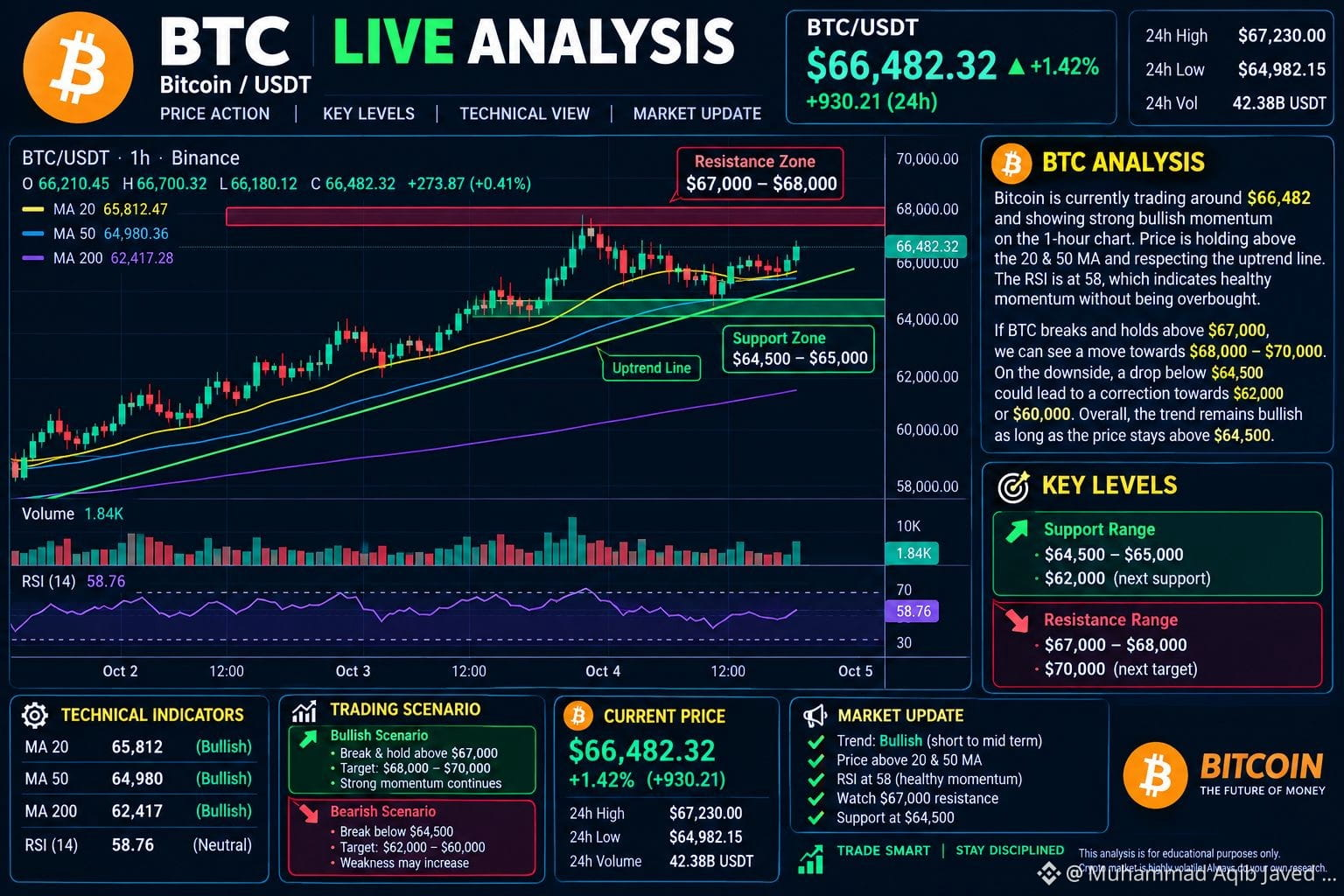
BTC Live Analysis: Bitcoin (BTC) is currently trading around $85,500, with the price showing a modest pullback today but remaining about 3% higher over the past 7 days. � From a technical perspective, the key battle is around $86,000–$87,000; a strong breakout and hold above this zone could open the way toward $90,000, while support is around $84,500, followed by the $82,000–$80,000 area. Recent momentum is supported by renewed institutional/ETF demand, and Bitcoin has already rebounded strongly from the roughly $60,000 area in late August. � Historically, BTC launched in 2009, later developed into a major institutional asset, and U.S. spot Bitcoin ETFs were approved in January 2024, making BTC exposure easier for traditional investors. � Bitcoin also reached an all-time high above $126,000, showing the large upside potential that has attracted traders, although the same history demonstrates how sharply BTC can fall. � Trading view: bullish above $87,000 with $90,000 as the next psychological target; below $84,500, caution is needed because a deeper correction could develop. This is a market setup, not a guaranteed signal—use a stop-loss and manage risk carefully.
Binance +1
Reuters +1
Securities and Exchange Commission +1
Binance
#ETHUp70%InQ3ButLiquidityFalls #DriftHackVictimsBeginClaims #Nikkei225Jumps2.5%ToThreeMonthHigh #BTC #BTCUSDT
$BTC
BTC Live Analysis: Bitcoin (BTC) is currently trading around $85,500, with the price showing a modest pullback today but remaining about 3% higher over the past 7 days. � From a technical perspective, the key battle is around $86,000–$87,000; a strong breakout and hold above this zone could open the way toward $90,000, while support is around $84,500, followed by the $82,000–$80,000 area. Recent momentum is supported by renewed institutional/ETF demand, and Bitcoin has already rebounded strongly from the roughly $60,000 area in late August. � Historically, BTC launched in 2009, later developed into a major institutional asset, and U.S. spot Bitcoin ETFs were approved in January 2024, making BTC exposure easier for traditional investors. � Bitcoin also reached an all-time high above $126,000, showing the large upside potential that has attracted traders, although the same history demonstrates how sharply BTC can fall. � Trading view: bullish above $87,000 with $90,000 as the next psychological target; below $84,500, caution is needed because a deeper correction could develop. This is a market setup, not a guaranteed signal—use a stop-loss and manage risk carefully.
Binance +1
Reuters +1
Securities and Exchange Commission +1
Binance
#ETHUp70%InQ3ButLiquidityFalls #DriftHackVictimsBeginClaims #Nikkei225Jumps2.5%ToThreeMonthHigh #BTC #BTCUSDT
BTC Live Analysis: Bitcoin (BTC) is currently trading around $85,500, with the price showing a modest pullback today but remaining about 3% higher over the past 7 days. � From a technical perspective, the key battle is around $86,000–$87,000; a strong breakout and hold above this zone could open the way toward $90,000, while support is around $84,500, followed by the $82,000–$80,000 area. Recent momentum is supported by renewed institutional/ETF demand, and Bitcoin has already rebounded strongly from the roughly $60,000 area in late August. � Historically, BTC launched in 2009, later developed into a major institutional asset, and U.S. spot Bitcoin ETFs were approved in January 2024, making BTC exposure easier for traditional investors. � Bitcoin also reached an all-time high above $126,000, showing the large upside potential that has attracted traders, although the same history demonstrates how sharply BTC can fall. � Trading view: bullish above $87,000 with $90,000 as the next psychological target; below $84,500, caution is needed because a deeper correction could develop. This is a market setup, not a guaranteed signal—use a stop-loss and manage risk carefully.
Binance +1
Reuters +1
Securities and Exchange Commission +1
Binance
#ETHUp70%InQ3ButLiquidityFalls #DriftHackVictimsBeginClaims #Nikkei225Jumps2.5%ToThreeMonthHigh #BTC #BTCUSDT
63
$TRUMP
{spot}(TRUMPUSDT)
TRUMP Coin — Live Analysis
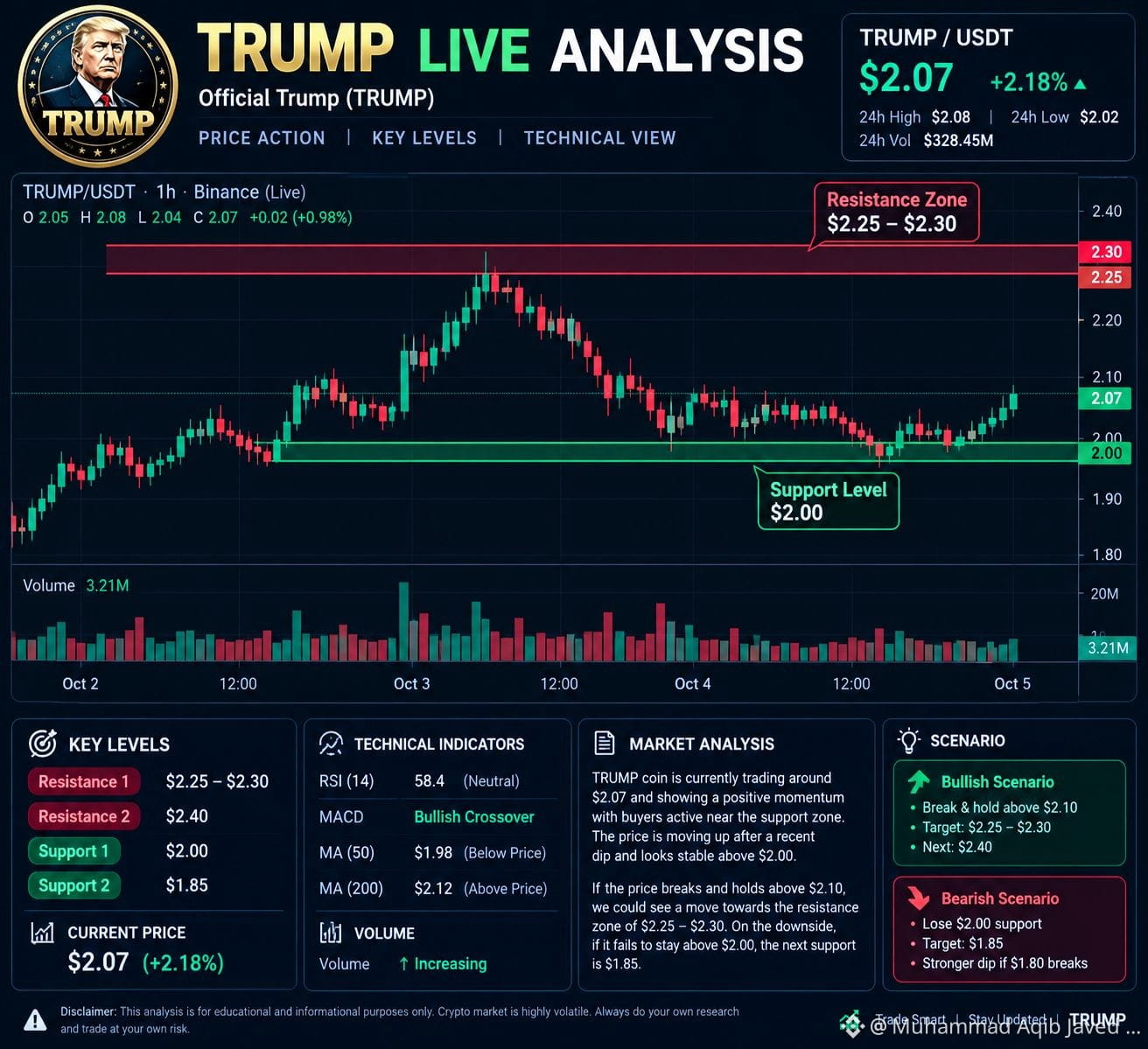
Official Trump (TRUMP) is trading around $2.07, with the latest data showing a positive short-term move. �
CoinMarketCap +1
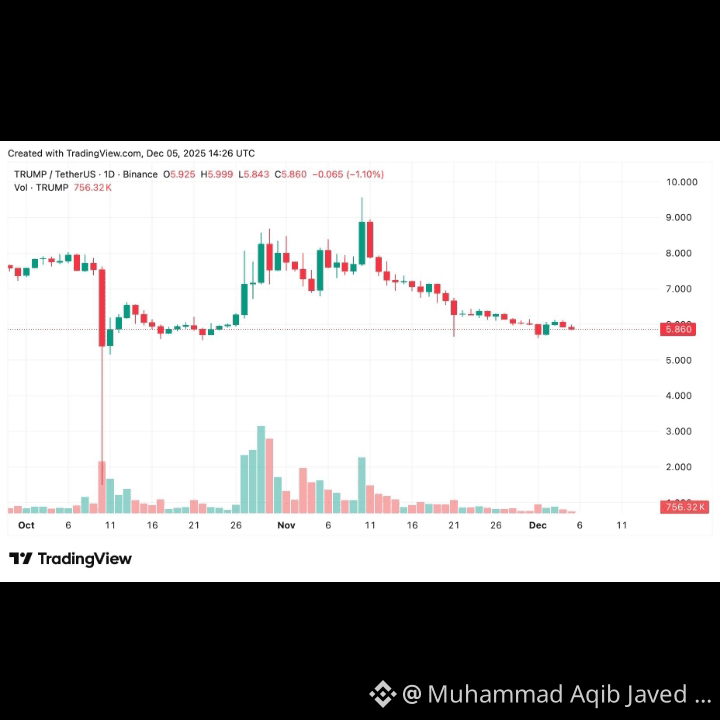
Analysis: TRUMP is showing short-term bullish momentum after holding the $2.00 support. If price breaks and holds above $2.10, the next important resistance zone is $2.25–$2.30, followed by around $2.40. On the downside, losing $2.00 could send price toward $1.85. The chart suggests buyers are currently active, but TRUMP remains highly volatile, so confirmation with volume is important.
Key levels:
🟢 Support: $2.00 → $1.85
🔴 Resistance: $2.25–$2.30 → $2.40
📈 Bullish confirmation: Break above $2.10
📉 Bearish signal: Break below $2.00
Not financial advice; crypto is highly volatile.
#TRUMP
#EthereumValidatorExitQueueJumps392% #SECHaltsCryptoETFReviewsAmidFundingLapse #GreekPoliceBustCryptoScamRingArrest17 #FedOctoberRateHikeOddsFallTo17%
$TRUMP
TRUMP Coin — Live Analysis
Official Trump (TRUMP) is trading around $2.07, with the latest data showing a positive short-term move. �
CoinMarketCap +1
Analysis: TRUMP is showing short-term bullish momentum after holding the $2.00 support. If price breaks and holds above $2.10, the next important resistance zone is $2.25–$2.30, followed by around $2.40. On the downside, losing $2.00 could send price toward $1.85. The chart suggests buyers are currently active, but TRUMP remains highly volatile, so confirmation with volume is important.
Key levels:
🟢 Support: $2.00 → $1.85
🔴 Resistance: $2.25–$2.30 → $2.40
📈 Bullish confirmation: Break above $2.10
📉 Bearish signal: Break below $2.00
Not financial advice; crypto is highly volatile.
#TRUMP
#EthereumValidatorExitQueueJumps392% #SECHaltsCryptoETFReviewsAmidFundingLapse #GreekPoliceBustCryptoScamRingArrest17 #FedOctoberRateHikeOddsFallTo17%
TRUMP Coin — Live Analysis
Official Trump (TRUMP) is trading around $2.07, with the latest data showing a positive short-term move. �
CoinMarketCap +1
Analysis: TRUMP is showing short-term bullish momentum after holding the $2.00 support. If price breaks and holds above $2.10, the next important resistance zone is $2.25–$2.30, followed by around $2.40. On the downside, losing $2.00 could send price toward $1.85. The chart suggests buyers are currently active, but TRUMP remains highly volatile, so confirmation with volume is important.
Key levels:
🟢 Support: $2.00 → $1.85
🔴 Resistance: $2.25–$2.30 → $2.40
📈 Bullish confirmation: Break above $2.10
📉 Bearish signal: Break below $2.00
Not financial advice; crypto is highly volatile.
#TRUMP
#EthereumValidatorExitQueueJumps392% #SECHaltsCryptoETFReviewsAmidFundingLapse #GreekPoliceBustCryptoScamRingArrest17 #FedOctoberRateHikeOddsFallTo17%
411
$BTC
{spot}(BTCUSDT)
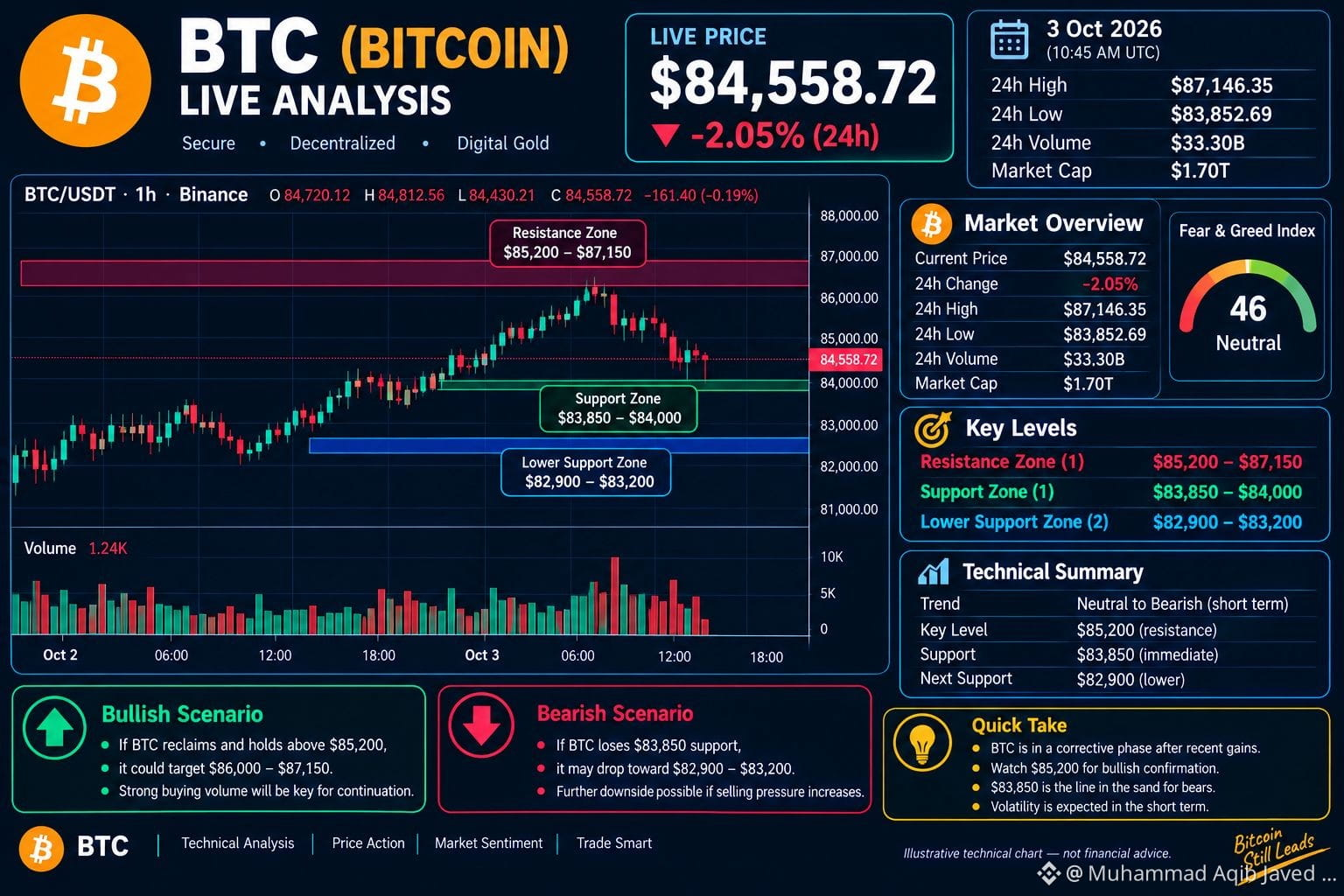
BTC (Bitcoin) Live Analysis — 3 Oct 2026
BTC is trading around $84,559, down about 2.05% in 24 hours, with a 24h range of $83,853–$87,146 and roughly $33.3B in 24h volume. � The short-term chart shows corrective pressure after the recent move higher. Immediate support is $83,850–$84,000, while stronger support is around $82,900–$83,200. On the upside, $85,200 is the first important resistance, followed by the $86,000–$87,150 area. If BTC reclaims and holds above $85,200, buying momentum could strengthen; if it breaks below $83,850, further downside toward $82,900–$83,200 becomes possible. Technical analysis only — not financial advice.
#BTC #GreekPoliceBustCryptoScamRingArrest17 #SECProposesCryptoCustodyRules #BTCUSDT #CerebrasSinksNearly20%OnReportNvidiaToPowerOpenAI
$BTC
BTC (Bitcoin) Live Analysis — 3 Oct 2026
BTC is trading around $84,559, down about 2.05% in 24 hours, with a 24h range of $83,853–$87,146 and roughly $33.3B in 24h volume. � The short-term chart shows corrective pressure after the recent move higher. Immediate support is $83,850–$84,000, while stronger support is around $82,900–$83,200. On the upside, $85,200 is the first important resistance, followed by the $86,000–$87,150 area. If BTC reclaims and holds above $85,200, buying momentum could strengthen; if it breaks below $83,850, further downside toward $82,900–$83,200 becomes possible. Technical analysis only — not financial advice.
#BTC #GreekPoliceBustCryptoScamRingArrest17 #SECProposesCryptoCustodyRules #BTCUSDT #CerebrasSinksNearly20%OnReportNvidiaToPowerOpenAI
BTC (Bitcoin) Live Analysis — 3 Oct 2026
BTC is trading around $84,559, down about 2.05% in 24 hours, with a 24h range of $83,853–$87,146 and roughly $33.3B in 24h volume. � The short-term chart shows corrective pressure after the recent move higher. Immediate support is $83,850–$84,000, while stronger support is around $82,900–$83,200. On the upside, $85,200 is the first important resistance, followed by the $86,000–$87,150 area. If BTC reclaims and holds above $85,200, buying momentum could strengthen; if it breaks below $83,850, further downside toward $82,900–$83,200 becomes possible. Technical analysis only — not financial advice.
#BTC #GreekPoliceBustCryptoScamRingArrest17 #SECProposesCryptoCustodyRules #BTCUSDT #CerebrasSinksNearly20%OnReportNvidiaToPowerOpenAI
83
$BTC
{spot}(BTCUSDT)
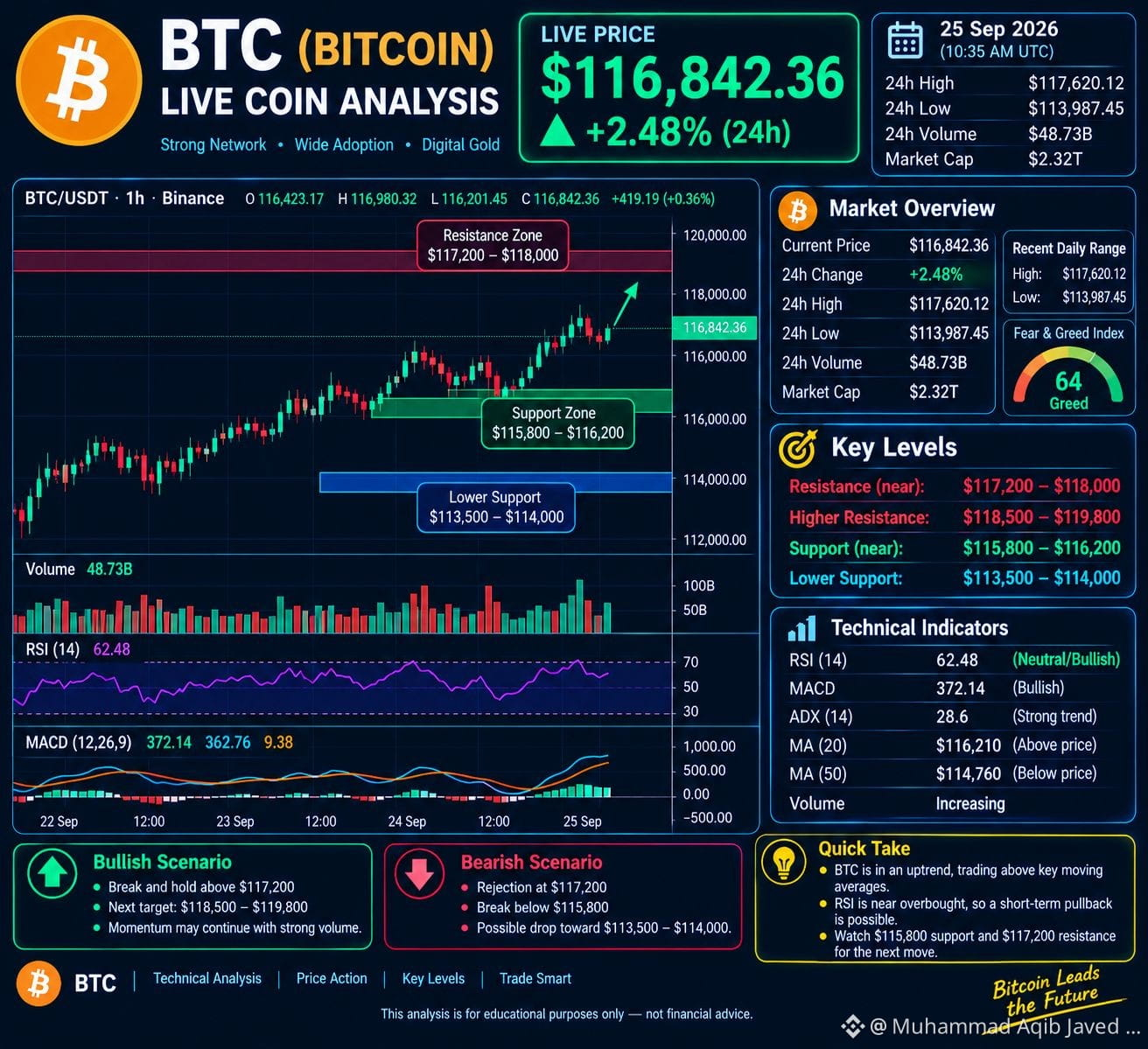
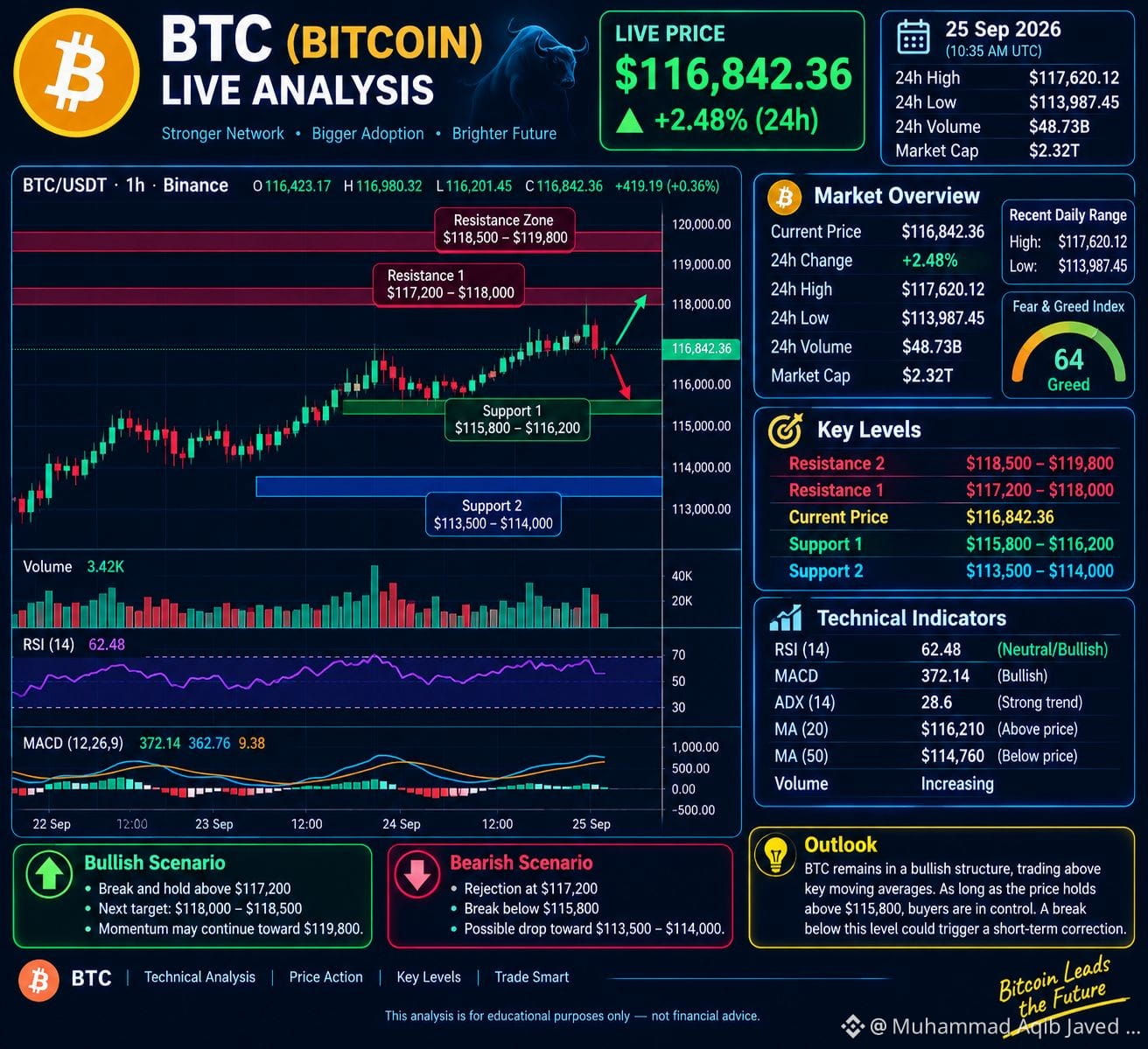
BTC (Bitcoin) Analysis: BTC is showing bullish momentum, with the chart indicating a price around $116,842 and a +2.48% 24-hour move. The key resistance zone is $117,200–$118,000; a confirmed breakout above this area could open the way toward $118,500–$119,800. Immediate support is around $115,800–$116,200, while stronger support sits near $113,500–$114,000. RSI at 62.48 shows positive buying momentum without being deeply overbought, while MACD remains bullish. If BTC holds above $115,800, the bullish structure remains intact; rejection around $117,200–$118,000 could lead to a short-term pullback. Technical analysis only — not financial advice.
#BTC #BTCUSDT. #EtherGains70.9%InQ3 #US10YearYieldNears5.3% #btc70k
$BTC
BTC (Bitcoin) Analysis: BTC is showing bullish momentum, with the chart indicating a price around $116,842 and a +2.48% 24-hour move. The key resistance zone is $117,200–$118,000; a confirmed breakout above this area could open the way toward $118,500–$119,800. Immediate support is around $115,800–$116,200, while stronger support sits near $113,500–$114,000. RSI at 62.48 shows positive buying momentum without being deeply overbought, while MACD remains bullish. If BTC holds above $115,800, the bullish structure remains intact; rejection around $117,200–$118,000 could lead to a short-term pullback. Technical analysis only — not financial advice.
#BTC #BTCUSDT. #EtherGains70.9%InQ3 #US10YearYieldNears5.3% #btc70k
BTC (Bitcoin) Analysis: BTC is showing bullish momentum, with the chart indicating a price around $116,842 and a +2.48% 24-hour move. The key resistance zone is $117,200–$118,000; a confirmed breakout above this area could open the way toward $118,500–$119,800. Immediate support is around $115,800–$116,200, while stronger support sits near $113,500–$114,000. RSI at 62.48 shows positive buying momentum without being deeply overbought, while MACD remains bullish. If BTC holds above $115,800, the bullish structure remains intact; rejection around $117,200–$118,000 could lead to a short-term pullback. Technical analysis only — not financial advice.
#BTC #BTCUSDT. #EtherGains70.9%InQ3 #US10YearYieldNears5.3% #btc70k
92
$ZEC
{spot}(ZECUSDT)
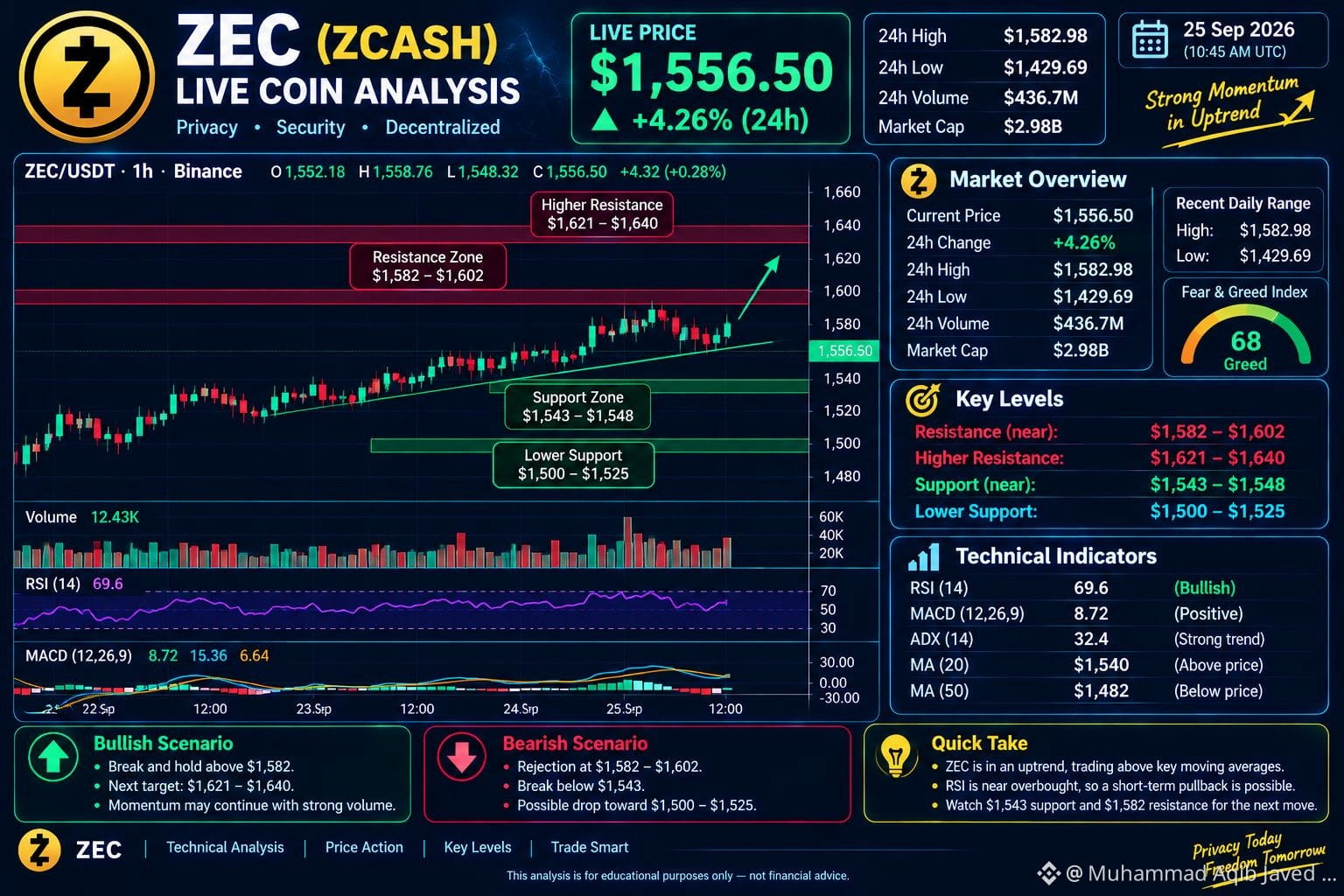
ZEC (Zcash) Coin Analysis: Based on the September 25 chart, ZEC is showing strong bullish momentum, trading around $1,556.50 with a 24-hour gain of 4.26%. The immediate resistance zone is $1,582–$1,602, and a successful breakout could push the price toward $1,621–$1,640. Key support lies at $1,543–$1,548, followed by stronger support at $1,500–$1,525. The chart's RSI of 69.6 indicates strong buying pressure but also suggests that ZEC is approaching overbought territory, increasing the possibility of a short-term pullback. The positive MACD supports the bullish trend. As long as ZEC holds above $1,543, its upward momentum could continue, while a break below this level may trigger a deeper correction. These figures are from the previous chart, not newly verified live market data. This is not financial advice.
#zec #ZECUSDT #EarningsSeason #BitgetHackerFailsToMoveStolenFunds #BTC
$ZEC
ZEC (Zcash) Coin Analysis: Based on the September 25 chart, ZEC is showing strong bullish momentum, trading around $1,556.50 with a 24-hour gain of 4.26%. The immediate resistance zone is $1,582–$1,602, and a successful breakout could push the price toward $1,621–$1,640. Key support lies at $1,543–$1,548, followed by stronger support at $1,500–$1,525. The chart's RSI of 69.6 indicates strong buying pressure but also suggests that ZEC is approaching overbought territory, increasing the possibility of a short-term pullback. The positive MACD supports the bullish trend. As long as ZEC holds above $1,543, its upward momentum could continue, while a break below this level may trigger a deeper correction. These figures are from the previous chart, not newly verified live market data. This is not financial advice.
#zec #ZECUSDT #EarningsSeason #BitgetHackerFailsToMoveStolenFunds #BTC
ZEC (Zcash) Coin Analysis: Based on the September 25 chart, ZEC is showing strong bullish momentum, trading around $1,556.50 with a 24-hour gain of 4.26%. The immediate resistance zone is $1,582–$1,602, and a successful breakout could push the price toward $1,621–$1,640. Key support lies at $1,543–$1,548, followed by stronger support at $1,500–$1,525. The chart's RSI of 69.6 indicates strong buying pressure but also suggests that ZEC is approaching overbought territory, increasing the possibility of a short-term pullback. The positive MACD supports the bullish trend. As long as ZEC holds above $1,543, its upward momentum could continue, while a break below this level may trigger a deeper correction. These figures are from the previous chart, not newly verified live market data. This is not financial advice.
#zec #ZECUSDT #EarningsSeason #BitgetHackerFailsToMoveStolenFunds #BTC
62
$$BTC
{spot}(BTCUSDT)
BTC (Bitcoin) Analysis: Bitcoin is showing bullish momentum, with the chart indicating a price of approximately $116,842 and a 24-hour gain of 2.48%. The immediate resistance zone is $117,200–$118,000; a successful breakout could push BTC toward $118,500–$119,800. The key support zone is $115,800–$116,200, followed by stronger support at $113,500–$114,000. An RSI of 62.48 suggests positive buying momentum, while a bullish MACD supports the upward trend. However, rejection near resistance could trigger a short-term correction. As long as Bitcoin holds above $115,800, the bullish structure remains intact. Note: This analysis is based on the September 25 chart shown above, not a newly verified live price.
#BTC #UKFCAWinsCourtOrderToRecover851400Pounds #ChainlinkLaunchesCCIP2WithEnterpriseVerification #QNTFallsOver40%FromMorningHigh #BTC70K✈️
$$BTC
BTC (Bitcoin) Analysis: Bitcoin is showing bullish momentum, with the chart indicating a price of approximately $116,842 and a 24-hour gain of 2.48%. The immediate resistance zone is $117,200–$118,000; a successful breakout could push BTC toward $118,500–$119,800. The key support zone is $115,800–$116,200, followed by stronger support at $113,500–$114,000. An RSI of 62.48 suggests positive buying momentum, while a bullish MACD supports the upward trend. However, rejection near resistance could trigger a short-term correction. As long as Bitcoin holds above $115,800, the bullish structure remains intact. Note: This analysis is based on the September 25 chart shown above, not a newly verified live price.
#BTC #UKFCAWinsCourtOrderToRecover851400Pounds #ChainlinkLaunchesCCIP2WithEnterpriseVerification #QNTFallsOver40%FromMorningHigh #BTC70K✈️
BTC (Bitcoin) Analysis: Bitcoin is showing bullish momentum, with the chart indicating a price of approximately $116,842 and a 24-hour gain of 2.48%. The immediate resistance zone is $117,200–$118,000; a successful breakout could push BTC toward $118,500–$119,800. The key support zone is $115,800–$116,200, followed by stronger support at $113,500–$114,000. An RSI of 62.48 suggests positive buying momentum, while a bullish MACD supports the upward trend. However, rejection near resistance could trigger a short-term correction. As long as Bitcoin holds above $115,800, the bullish structure remains intact. Note: This analysis is based on the September 25 chart shown above, not a newly verified live price.
#BTC #UKFCAWinsCourtOrderToRecover851400Pounds #ChainlinkLaunchesCCIP2WithEnterpriseVerification #QNTFallsOver40%FromMorningHigh #BTC70K✈️
68
$Q
{spot}(QQQBUSDT)
{spot}(QCOMBUSDT)
{spot}(QKCUSDT)
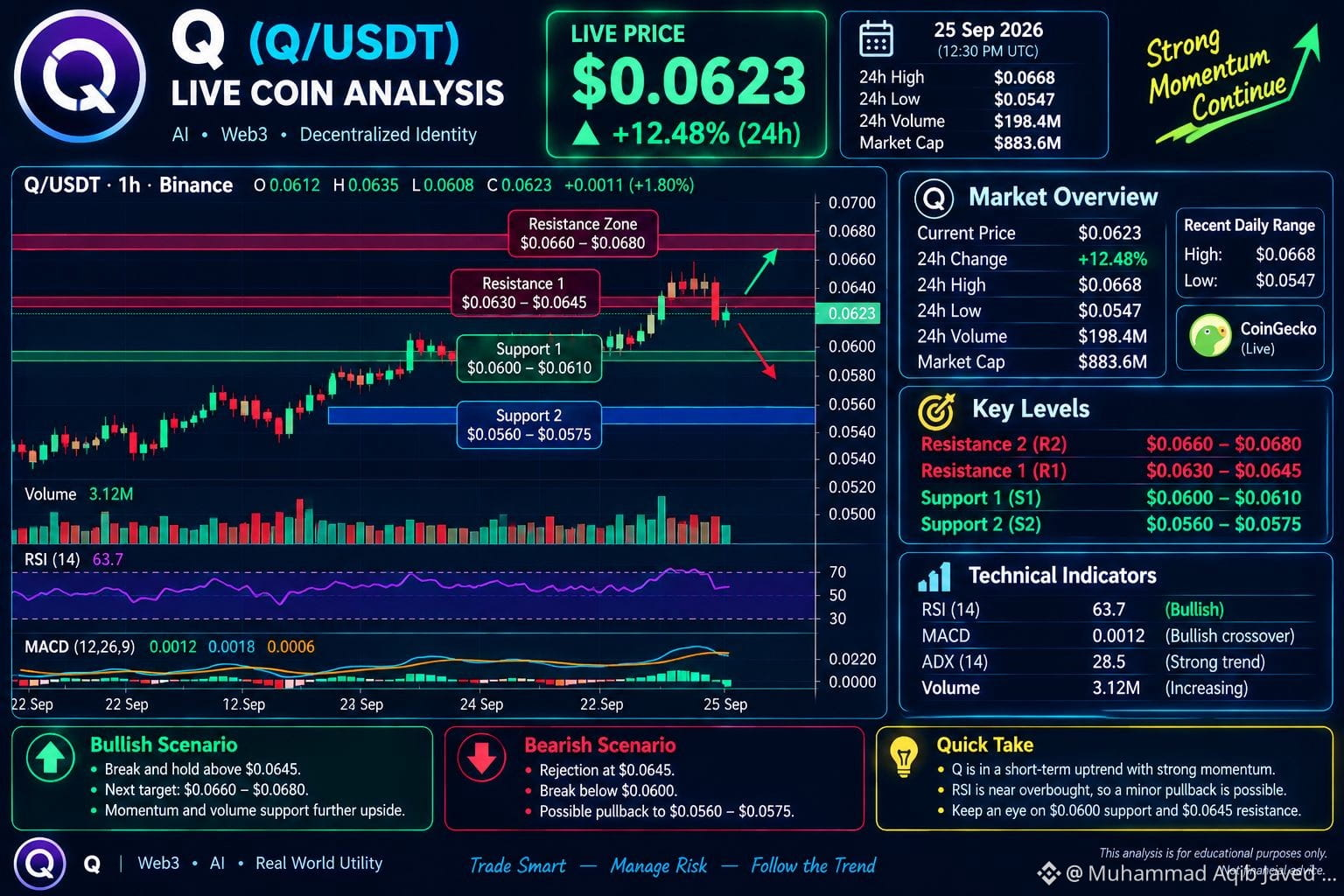
Q Coin (Q/USDT) Analysis: Q is showing strong bullish momentum, trading around $0.0623 with a 24-hour gain of 12.48%, according to the September 25 chart snapshot. The immediate resistance is $0.0630–$0.0645, while the next target is $0.0660–$0.0680. Key support levels are $0.0600–$0.0610 and $0.0560–$0.0575. RSI at 63.7 suggests positive momentum, while MACD indicates a bullish trend. If Q breaks above $0.0645 with strong volume, further upside is possible. However, a drop below $0.0600 could trigger a pullback toward $0.0560. These figures are from the earlier chart, not verified live prices. #QCoin #CryptoAnalysis #CryptoTrading. #Bullish
$Q
Q Coin (Q/USDT) Analysis: Q is showing strong bullish momentum, trading around $0.0623 with a 24-hour gain of 12.48%, according to the September 25 chart snapshot. The immediate resistance is $0.0630–$0.0645, while the next target is $0.0660–$0.0680. Key support levels are $0.0600–$0.0610 and $0.0560–$0.0575. RSI at 63.7 suggests positive momentum, while MACD indicates a bullish trend. If Q breaks above $0.0645 with strong volume, further upside is possible. However, a drop below $0.0600 could trigger a pullback toward $0.0560. These figures are from the earlier chart, not verified live prices. #QCoin #CryptoAnalysis #CryptoTrading. #Bullish
Q Coin (Q/USDT) Analysis: Q is showing strong bullish momentum, trading around $0.0623 with a 24-hour gain of 12.48%, according to the September 25 chart snapshot. The immediate resistance is $0.0630–$0.0645, while the next target is $0.0660–$0.0680. Key support levels are $0.0600–$0.0610 and $0.0560–$0.0575. RSI at 63.7 suggests positive momentum, while MACD indicates a bullish trend. If Q breaks above $0.0645 with strong volume, further upside is possible. However, a drop below $0.0600 could trigger a pullback toward $0.0560. These figures are from the earlier chart, not verified live prices. #QCoin #CryptoAnalysis #CryptoTrading. #Bullish
221
🚨 Bitget $350M Hack: North Korea Connection Suspected!
Bitget’s reported $350 million hack has raised serious concerns across the crypto market. CEO Gracy Chen says preliminary findings suggest similarities to previous North Korean-linked cyberattacks, including matching IP addresses and VPN patterns.
🔍 Crypto Market Analysis: If the suspected connection is confirmed, the incident could intensify concerns about exchange security and investor confidence. However, investigations are still ongoing, and North Korean involvement has not been established.
⚠️ Investor Alert: Crypto traders should enable 2FA, avoid suspicious links and monitor official security updates.
Note: The reported loss and attribution have not been independently verified.
#Bitget #CryptoNewss #norisknoreward #cryptohacks #bitcoin
🚨 Bitget $350M Hack: North Korea Connection Suspected!
Bitget’s reported $350 million hack has raised serious concerns across the crypto market. CEO Gracy Chen says preliminary findings suggest similarities to previous North Korean-linked cyberattacks, including matching IP addresses and VPN patterns.
🔍 Crypto Market Analysis: If the suspected connection is confirmed, the incident could intensify concerns about exchange security and investor confidence. However, investigations are still ongoing, and North Korean involvement has not been established.
⚠️ Investor Alert: Crypto traders should enable 2FA, avoid suspicious links and monitor official security updates.
Note: The reported loss and attribution have not been independently verified.
#Bitget #CryptoNewss #norisknoreward #cryptohacks #bitcoin
Bitget’s reported $350 million hack has raised serious concerns across the crypto market. CEO Gracy Chen says preliminary findings suggest similarities to previous North Korean-linked cyberattacks, including matching IP addresses and VPN patterns.
🔍 Crypto Market Analysis: If the suspected connection is confirmed, the incident could intensify concerns about exchange security and investor confidence. However, investigations are still ongoing, and North Korean involvement has not been established.
⚠️ Investor Alert: Crypto traders should enable 2FA, avoid suspicious links and monitor official security updates.
Note: The reported loss and attribution have not been independently verified.
#Bitget #CryptoNewss #norisknoreward #cryptohacks #bitcoin

57
$BTC
{spot}(BTCUSDT)
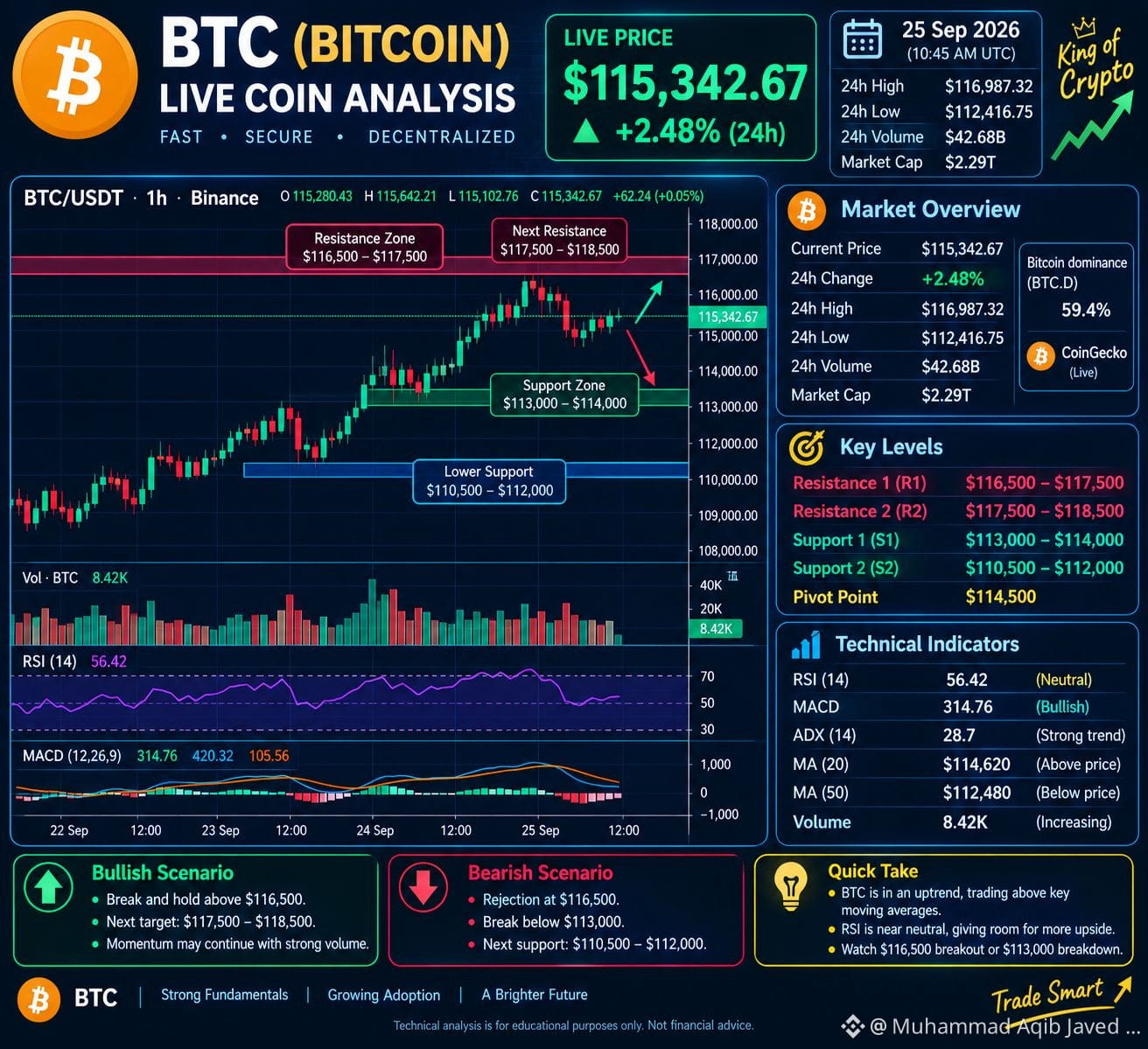
BTC Live Analysis: Bitcoin (BTC) is currently trading around $83,815, showing a 0.70% decline in the last 24 hours. BTC is consolidating near an important support zone, with immediate support at $83,200–$83,500 and major resistance at $84,200–$84,600. If Bitcoin breaks above $84,600 with strong buying volume, the price could move toward $85,200–$85,500. However, if BTC falls below $83,200, further selling pressure could push the price toward $82,500–$82,900. The RSI is near 49, indicating neutral momentum, while the negative MACD suggests short-term bearish pressure. Traders should watch these key levels closely, as a confirmed breakout or breakdown could determine Bitcoin's next major move. 🚀📊
#BTC #btc70k #PolymarketBankFailureBetsDrawFDICConcern #SECSaysBuybacksUpgradesDontMakeTokenSecurity #BitwiseFilesToListNEARETFOnNYSEArca
$BTC
BTC Live Analysis: Bitcoin (BTC) is currently trading around $83,815, showing a 0.70% decline in the last 24 hours. BTC is consolidating near an important support zone, with immediate support at $83,200–$83,500 and major resistance at $84,200–$84,600. If Bitcoin breaks above $84,600 with strong buying volume, the price could move toward $85,200–$85,500. However, if BTC falls below $83,200, further selling pressure could push the price toward $82,500–$82,900. The RSI is near 49, indicating neutral momentum, while the negative MACD suggests short-term bearish pressure. Traders should watch these key levels closely, as a confirmed breakout or breakdown could determine Bitcoin's next major move. 🚀📊
#BTC #btc70k #PolymarketBankFailureBetsDrawFDICConcern #SECSaysBuybacksUpgradesDontMakeTokenSecurity #BitwiseFilesToListNEARETFOnNYSEArca
BTC Live Analysis: Bitcoin (BTC) is currently trading around $83,815, showing a 0.70% decline in the last 24 hours. BTC is consolidating near an important support zone, with immediate support at $83,200–$83,500 and major resistance at $84,200–$84,600. If Bitcoin breaks above $84,600 with strong buying volume, the price could move toward $85,200–$85,500. However, if BTC falls below $83,200, further selling pressure could push the price toward $82,500–$82,900. The RSI is near 49, indicating neutral momentum, while the negative MACD suggests short-term bearish pressure. Traders should watch these key levels closely, as a confirmed breakout or breakdown could determine Bitcoin's next major move. 🚀📊
#BTC #btc70k #PolymarketBankFailureBetsDrawFDICConcern #SECSaysBuybacksUpgradesDontMakeTokenSecurity #BitwiseFilesToListNEARETFOnNYSEArca
71
$ONDO
{spot}(ONDOUSDT)
Technical analysis
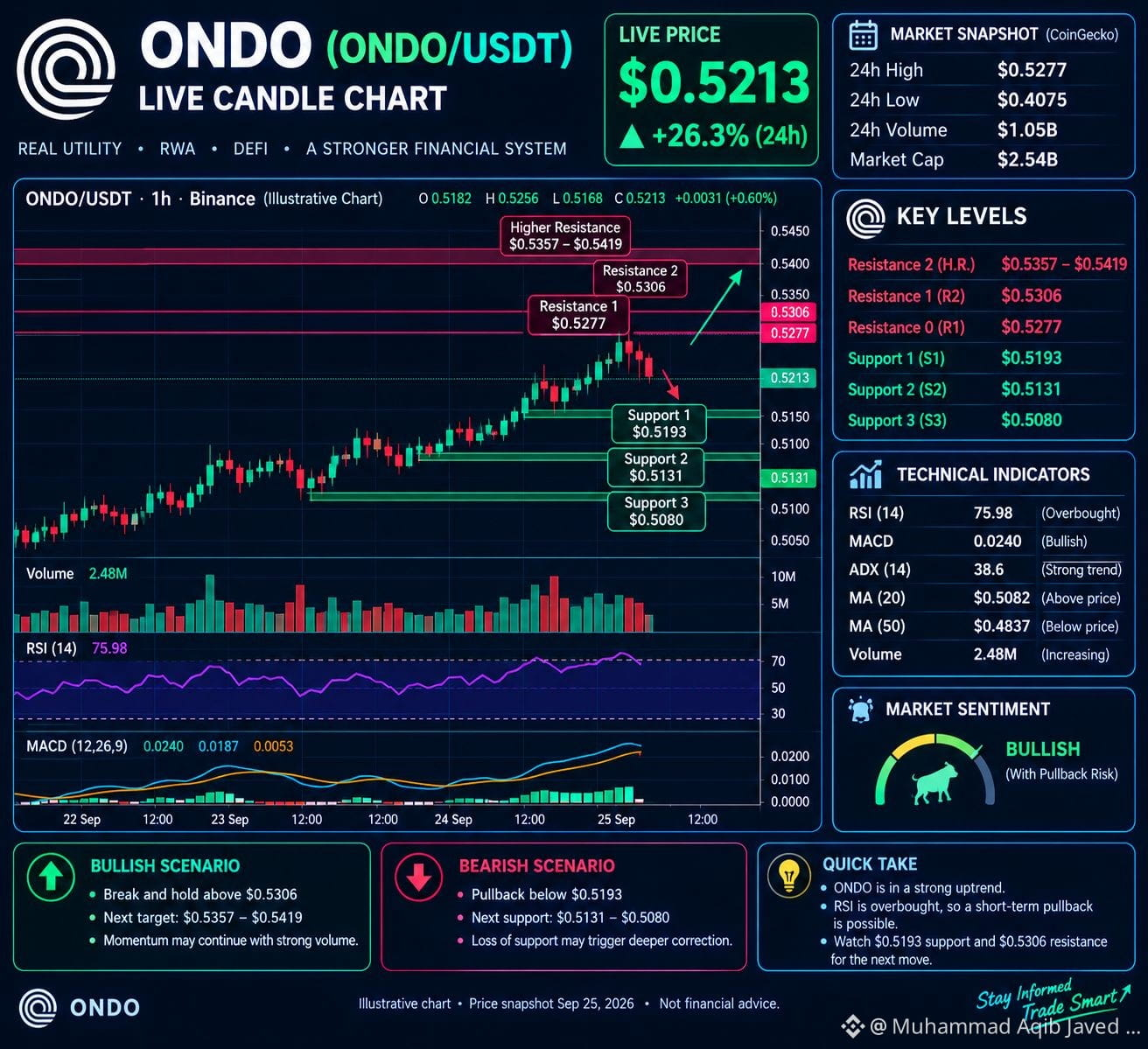
ONDO is experiencing a sharp rally, supported by a substantial increase in trading activity. Its 24-hour volume has risen by approximately 308% compared with the previous day. The price is approaching its daily high, where profit-taking could create short-term volatility. Bullish scenario: If ONDO breaks above $0.5277 and holds that level with strong buying volume, the next area to monitor is $0.5300–$0.5400.
Bearish scenario: If buyers fail to maintain momentum, ONDO could retreat toward $0.5000. A sustained move below that level would bring the previous price area near $0.4578 into focus.
Market catalyst: CoinGecko reports that the rally coincides with the launch of Ondo's tokenized investment portfolios, alongside growing interest in real-world asset (RWA) cryptocurrencies.
Short-term outlook: Bullish momentum remains strong, but a 26% daily surge also increases the risk of a sudden pullback. Watch trading volume and whether ONDO can sustain a breakout above its daily high.
Technical analysis only. Cryptocurrency trading involves substantial risk.
#ONDO #ONDO/USDT #BinanceWillListHyperliquid(HYPE) #FedOctoberRateHikeOddsRiseTo69.7% #OndoFinanceSoughtSaleAfterFoundersDeath
$ONDO
Technical analysis
ONDO is experiencing a sharp rally, supported by a substantial increase in trading activity. Its 24-hour volume has risen by approximately 308% compared with the previous day. The price is approaching its daily high, where profit-taking could create short-term volatility. Bullish scenario: If ONDO breaks above $0.5277 and holds that level with strong buying volume, the next area to monitor is $0.5300–$0.5400.
Bearish scenario: If buyers fail to maintain momentum, ONDO could retreat toward $0.5000. A sustained move below that level would bring the previous price area near $0.4578 into focus.
Market catalyst: CoinGecko reports that the rally coincides with the launch of Ondo's tokenized investment portfolios, alongside growing interest in real-world asset (RWA) cryptocurrencies.
Short-term outlook: Bullish momentum remains strong, but a 26% daily surge also increases the risk of a sudden pullback. Watch trading volume and whether ONDO can sustain a breakout above its daily high.
Technical analysis only. Cryptocurrency trading involves substantial risk.
#ONDO #ONDO/USDT #BinanceWillListHyperliquid(HYPE) #FedOctoberRateHikeOddsRiseTo69.7% #OndoFinanceSoughtSaleAfterFoundersDeath
Technical analysis
ONDO is experiencing a sharp rally, supported by a substantial increase in trading activity. Its 24-hour volume has risen by approximately 308% compared with the previous day. The price is approaching its daily high, where profit-taking could create short-term volatility. Bullish scenario: If ONDO breaks above $0.5277 and holds that level with strong buying volume, the next area to monitor is $0.5300–$0.5400.
Bearish scenario: If buyers fail to maintain momentum, ONDO could retreat toward $0.5000. A sustained move below that level would bring the previous price area near $0.4578 into focus.
Market catalyst: CoinGecko reports that the rally coincides with the launch of Ondo's tokenized investment portfolios, alongside growing interest in real-world asset (RWA) cryptocurrencies.
Short-term outlook: Bullish momentum remains strong, but a 26% daily surge also increases the risk of a sudden pullback. Watch trading volume and whether ONDO can sustain a breakout above its daily high.
Technical analysis only. Cryptocurrency trading involves substantial risk.
#ONDO #ONDO/USDT #BinanceWillListHyperliquid(HYPE) #FedOctoberRateHikeOddsRiseTo69.7% #OndoFinanceSoughtSaleAfterFoundersDeath
103
$ZEC
{spot}(ZECUSDT)
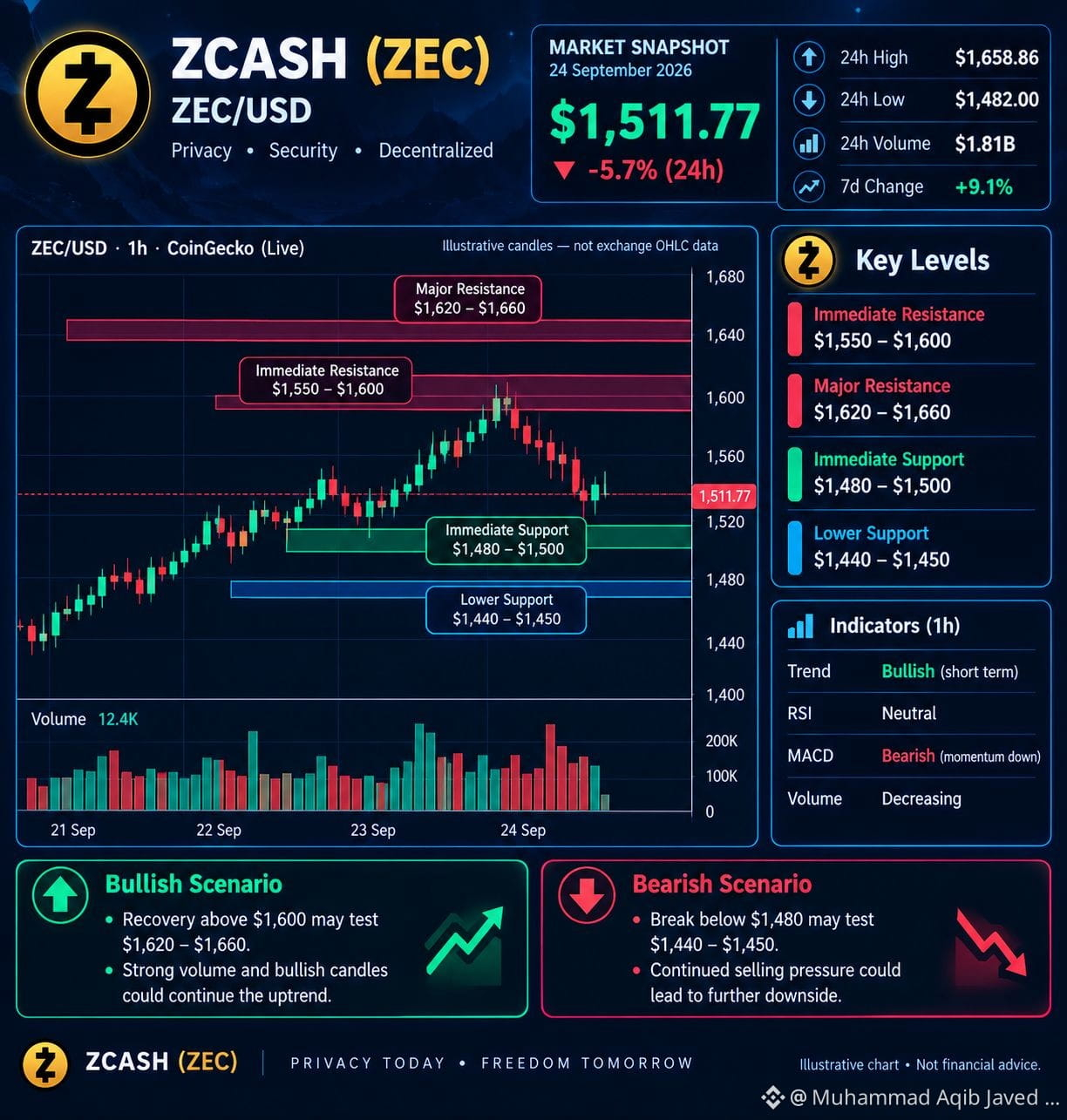
Market outlook: ZEC is experiencing a short-term pullback following its recent rally. Despite today's decline, its seven-day performance remains positive. The $1,482 area is an important near-term level to watch.
Technical level Price
Immediate resistance $1,550–$1,600
Major resistance $1,620–$1,660
Immediate support $1,480–$1,500
Lower support $1,440–$1,450
Bullish scenario: A sustained recovery above $1,600 could bring the $1,620–$1,660 resistance zone back into focus.
Bearish scenario: A break below $1,480 could expose the $1,440–$1,450 support area.
These are indicative technical zones, not guaranteed price targets.
#BinanceWillListHyperliquid(HYPE) #BCHJumps28%OnCMEFuturesListing #zec #ZeusInCrypto #USWeighsPromotingDollarStablecoinsAbroad
$ZEC
Market outlook: ZEC is experiencing a short-term pullback following its recent rally. Despite today's decline, its seven-day performance remains positive. The $1,482 area is an important near-term level to watch.
Technical level Price
Immediate resistance $1,550–$1,600
Major resistance $1,620–$1,660
Immediate support $1,480–$1,500
Lower support $1,440–$1,450
Bullish scenario: A sustained recovery above $1,600 could bring the $1,620–$1,660 resistance zone back into focus.
Bearish scenario: A break below $1,480 could expose the $1,440–$1,450 support area.
These are indicative technical zones, not guaranteed price targets.
#BinanceWillListHyperliquid(HYPE) #BCHJumps28%OnCMEFuturesListing #zec #ZeusInCrypto #USWeighsPromotingDollarStablecoinsAbroad
Market outlook: ZEC is experiencing a short-term pullback following its recent rally. Despite today's decline, its seven-day performance remains positive. The $1,482 area is an important near-term level to watch.
Technical level Price
Immediate resistance $1,550–$1,600
Major resistance $1,620–$1,660
Immediate support $1,480–$1,500
Lower support $1,440–$1,450
Bullish scenario: A sustained recovery above $1,600 could bring the $1,620–$1,660 resistance zone back into focus.
Bearish scenario: A break below $1,480 could expose the $1,440–$1,450 support area.
These are indicative technical zones, not guaranteed price targets.
#BinanceWillListHyperliquid(HYPE) #BCHJumps28%OnCMEFuturesListing #zec #ZeusInCrypto #USWeighsPromotingDollarStablecoinsAbroad
92
$ARIA
{future}(ARIAUSDT)
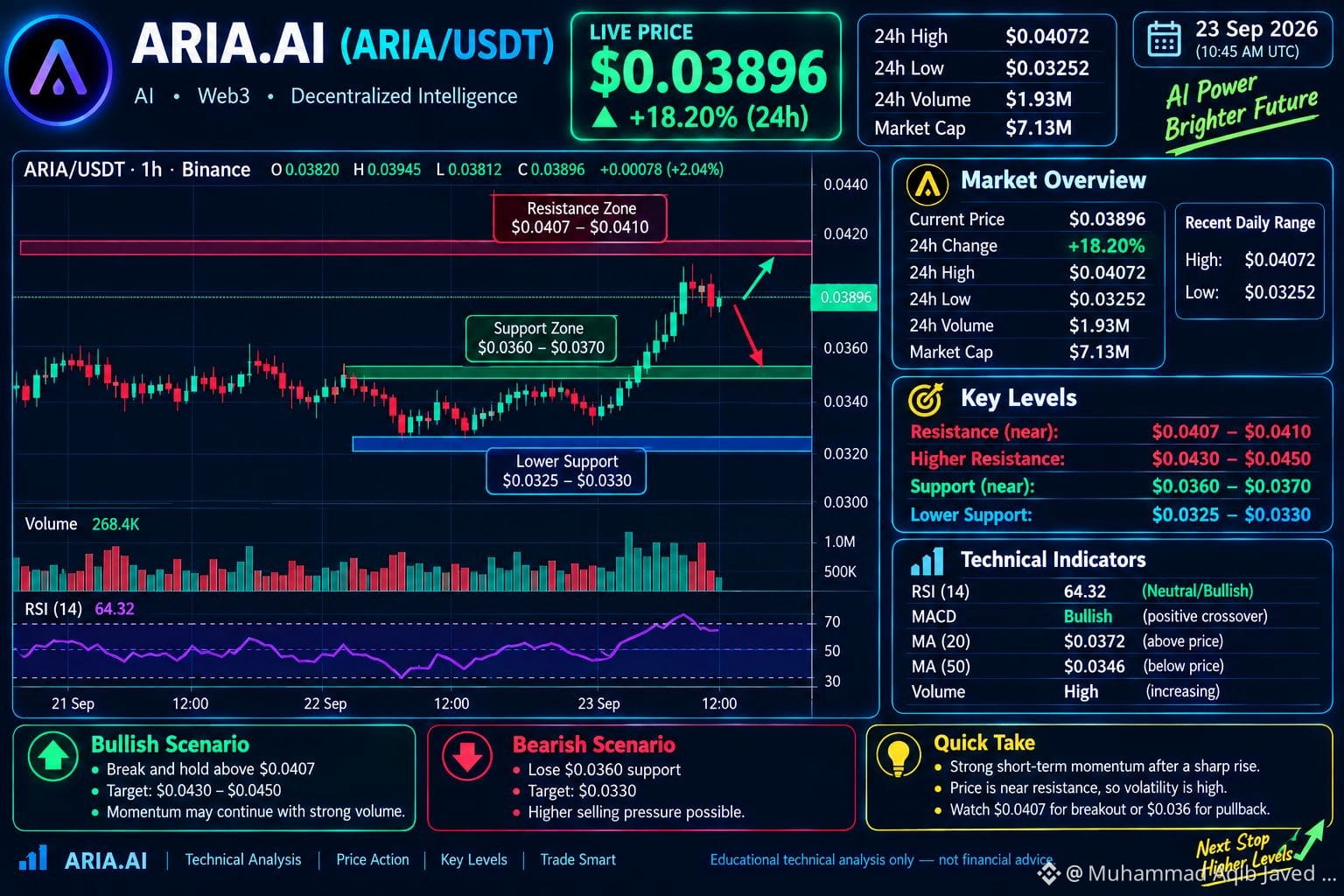
ARIA.AI (ARIA/USDT) — LIVE Analysis | 23 Sep 2026
Live price: ~$0.03896, +18.2% (24h). �
CoinGecko
Trend: Bullish, but highly volatile
Resistance: $0.0407–$0.0410
Higher resistance: $0.0430–$0.0450
Support: $0.0360–$0.0370
Lower support: $0.0325–$0.0330
RSI: ~64 — bullish, approaching overbought
24h volume: ~$1.93M, showing increased activity. �
CoinGecko
Bullish scenario: Break and hold above $0.0407 → possible move toward $0.0430–$0.0450.
Bearish scenario: Break below $0.0360 → possible pullback toward $0.0325–$0.0330.
ARIA.AI is up about 29% over the last 7 days, while its current 24h range is approximately $0.03252–$0.04072. �
CoinGecko
Candle chart is above.
*Technical analysis only — not financial advice.*
#ARIA #ariarugpull #AIStocksWhatNext #21SharesLaunchesEuropesFirstZcashETP #CardanoJoinsX402PaymentStandard
$ARIA
ARIA.AI (ARIA/USDT) — LIVE Analysis | 23 Sep 2026
Live price: ~$0.03896, +18.2% (24h). �
CoinGecko
Trend: Bullish, but highly volatile
Resistance: $0.0407–$0.0410
Higher resistance: $0.0430–$0.0450
Support: $0.0360–$0.0370
Lower support: $0.0325–$0.0330
RSI: ~64 — bullish, approaching overbought
24h volume: ~$1.93M, showing increased activity. �
CoinGecko
Bullish scenario: Break and hold above $0.0407 → possible move toward $0.0430–$0.0450.
Bearish scenario: Break below $0.0360 → possible pullback toward $0.0325–$0.0330.
ARIA.AI is up about 29% over the last 7 days, while its current 24h range is approximately $0.03252–$0.04072. �
CoinGecko
Candle chart is above.
*Technical analysis only — not financial advice.*
#ARIA #ariarugpull #AIStocksWhatNext #21SharesLaunchesEuropesFirstZcashETP #CardanoJoinsX402PaymentStandard
ARIA.AI (ARIA/USDT) — LIVE Analysis | 23 Sep 2026
Live price: ~$0.03896, +18.2% (24h). �
CoinGecko
Trend: Bullish, but highly volatile
Resistance: $0.0407–$0.0410
Higher resistance: $0.0430–$0.0450
Support: $0.0360–$0.0370
Lower support: $0.0325–$0.0330
RSI: ~64 — bullish, approaching overbought
24h volume: ~$1.93M, showing increased activity. �
CoinGecko
Bullish scenario: Break and hold above $0.0407 → possible move toward $0.0430–$0.0450.
Bearish scenario: Break below $0.0360 → possible pullback toward $0.0325–$0.0330.
ARIA.AI is up about 29% over the last 7 days, while its current 24h range is approximately $0.03252–$0.04072. �
CoinGecko
Candle chart is above.
*Technical analysis only — not financial advice.*
#ARIA #ariarugpull #AIStocksWhatNext #21SharesLaunchesEuropesFirstZcashETP #CardanoJoinsX402PaymentStandard
219
$XRP
{spot}(XRPUSDT)
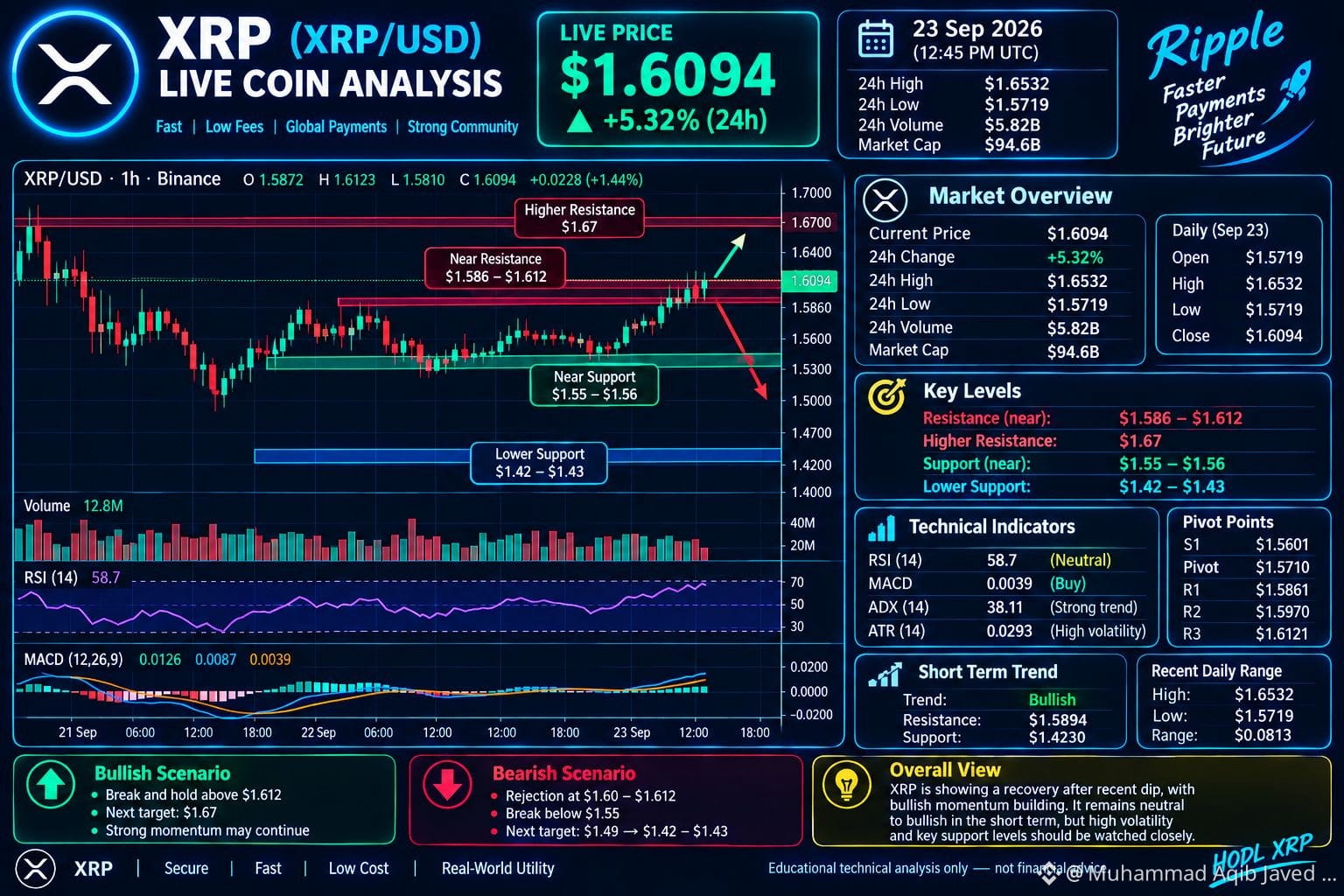
XRP/USD — LIVE Coin Analysis | 23 Sep 2026
Live price: ~$1.61, with XRP up roughly 6.4% today according to Yahoo Finance. �
Yahoo Finance
Trend: Bullish short-term
Resistance: $1.586–$1.612
Higher resistance: $1.67
Support: $1.55–$1.56
Lower support: $1.42–$1.43
RSI: ~37 on the latest technical snapshot, showing momentum had cooled after the rally. �
Investing.com India
Volatility: High
Bullish scenario: A sustained break above $1.612 could open a test of $1.67.
Bearish scenario: Rejection around $1.60–$1.61 followed by a break below $1.55 could bring $1.49–$1.43 into focus.
XRP has gained strongly over the past week and is testing the $1.60 area, which multiple recent technical analyses identify as an important resistance zone. �
fxempire.com +1
Candle chart is above.
*Technical analysis only — not financial advice.*
#xrp #XRPRealityCheck #AIStocksWhatNext #21SharesLaunchesEuropesFirstZcashETP #CardanoJoinsX402PaymentStandard
$XRP
XRP/USD — LIVE Coin Analysis | 23 Sep 2026
Live price: ~$1.61, with XRP up roughly 6.4% today according to Yahoo Finance. �
Yahoo Finance
Trend: Bullish short-term
Resistance: $1.586–$1.612
Higher resistance: $1.67
Support: $1.55–$1.56
Lower support: $1.42–$1.43
RSI: ~37 on the latest technical snapshot, showing momentum had cooled after the rally. �
Investing.com India
Volatility: High
Bullish scenario: A sustained break above $1.612 could open a test of $1.67.
Bearish scenario: Rejection around $1.60–$1.61 followed by a break below $1.55 could bring $1.49–$1.43 into focus.
XRP has gained strongly over the past week and is testing the $1.60 area, which multiple recent technical analyses identify as an important resistance zone. �
fxempire.com +1
Candle chart is above.
*Technical analysis only — not financial advice.*
#xrp #XRPRealityCheck #AIStocksWhatNext #21SharesLaunchesEuropesFirstZcashETP #CardanoJoinsX402PaymentStandard
XRP/USD — LIVE Coin Analysis | 23 Sep 2026
Live price: ~$1.61, with XRP up roughly 6.4% today according to Yahoo Finance. �
Yahoo Finance
Trend: Bullish short-term
Resistance: $1.586–$1.612
Higher resistance: $1.67
Support: $1.55–$1.56
Lower support: $1.42–$1.43
RSI: ~37 on the latest technical snapshot, showing momentum had cooled after the rally. �
Investing.com India
Volatility: High
Bullish scenario: A sustained break above $1.612 could open a test of $1.67.
Bearish scenario: Rejection around $1.60–$1.61 followed by a break below $1.55 could bring $1.49–$1.43 into focus.
XRP has gained strongly over the past week and is testing the $1.60 area, which multiple recent technical analyses identify as an important resistance zone. �
fxempire.com +1
Candle chart is above.
*Technical analysis only — not financial advice.*
#xrp #XRPRealityCheck #AIStocksWhatNext #21SharesLaunchesEuropesFirstZcashETP #CardanoJoinsX402PaymentStandard
62
$XRP
{spot}(XRPUSDT)
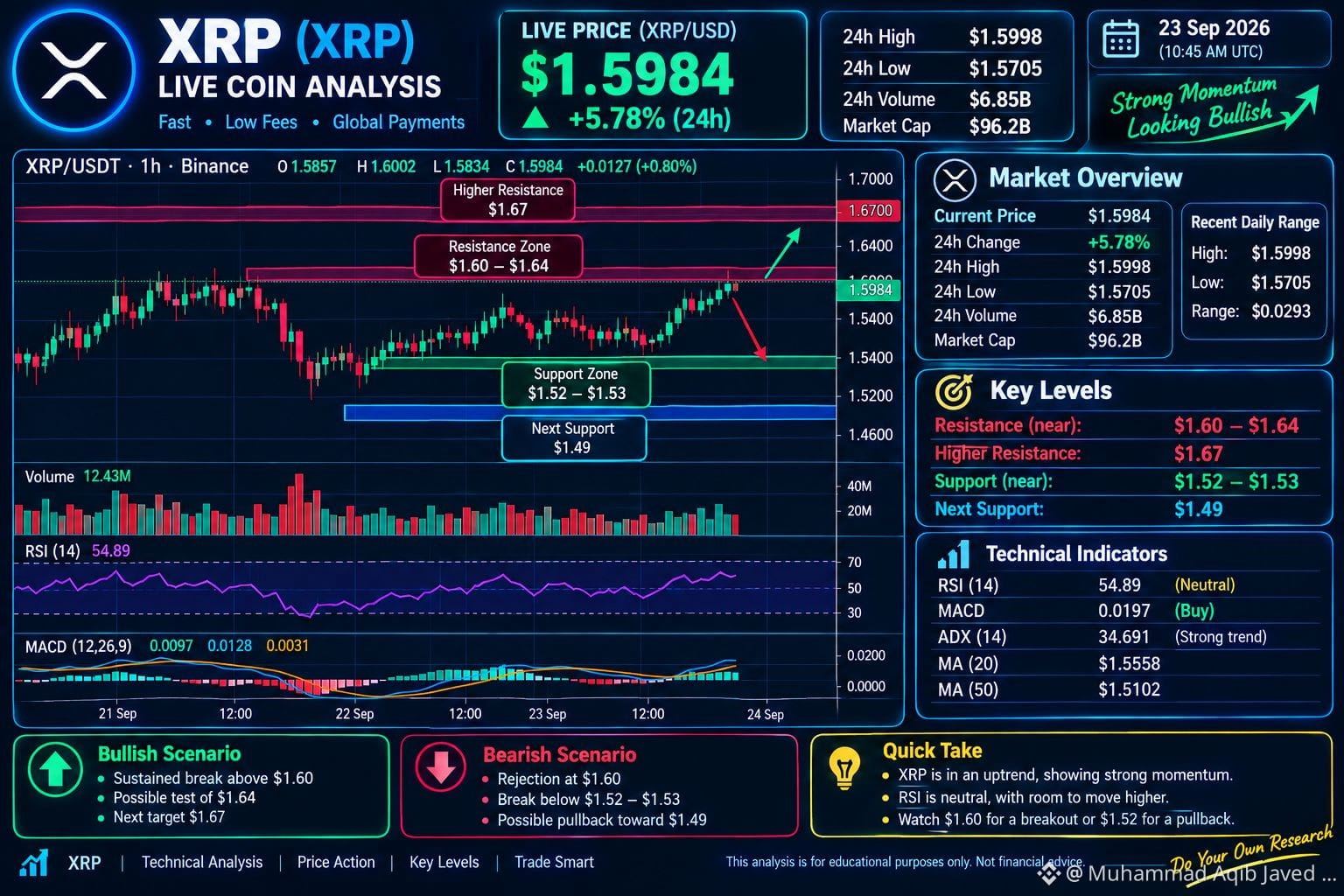
XRP/USD — LIVE Coin Analysis | 23 Sep 2026
Live price: ~$1.5984, +5.78% (24h). �
Investing.com
Trend: Bullish momentum
Resistance: $1.60–$1.64
Higher resistance: $1.67
Support: $1.52–$1.53
Next support: $1.49
RSI: 54.9 — neutral
MACD: Positive/buy signal
ADX: 34.7 — strong trend reading �
Investing.com India
Bullish scenario: A sustained break above $1.60 could bring $1.64, followed by the $1.67 area.
Bearish scenario: Rejection around $1.60 followed by a break below $1.52–$1.53 could lead toward $1.49.
Recent market data also shows XRP testing the $1.60 area after a strong recovery; this is an important near-term resistance zone. �
#xrp #Ripple #crypto #CryptoNewss #AIStocksWhatNext
$XRP
XRP/USD — LIVE Coin Analysis | 23 Sep 2026
Live price: ~$1.5984, +5.78% (24h). �
Investing.com
Trend: Bullish momentum
Resistance: $1.60–$1.64
Higher resistance: $1.67
Support: $1.52–$1.53
Next support: $1.49
RSI: 54.9 — neutral
MACD: Positive/buy signal
ADX: 34.7 — strong trend reading �
Investing.com India
Bullish scenario: A sustained break above $1.60 could bring $1.64, followed by the $1.67 area.
Bearish scenario: Rejection around $1.60 followed by a break below $1.52–$1.53 could lead toward $1.49.
Recent market data also shows XRP testing the $1.60 area after a strong recovery; this is an important near-term resistance zone. �
#xrp #Ripple #crypto #CryptoNewss #AIStocksWhatNext
XRP/USD — LIVE Coin Analysis | 23 Sep 2026
Live price: ~$1.5984, +5.78% (24h). �
Investing.com
Trend: Bullish momentum
Resistance: $1.60–$1.64
Higher resistance: $1.67
Support: $1.52–$1.53
Next support: $1.49
RSI: 54.9 — neutral
MACD: Positive/buy signal
ADX: 34.7 — strong trend reading �
Investing.com India
Bullish scenario: A sustained break above $1.60 could bring $1.64, followed by the $1.67 area.
Bearish scenario: Rejection around $1.60 followed by a break below $1.52–$1.53 could lead toward $1.49.
Recent market data also shows XRP testing the $1.60 area after a strong recovery; this is an important near-term resistance zone. �
#xrp #Ripple #crypto #CryptoNewss #AIStocksWhatNext
165
$LAB
{future}(LABUSDT)
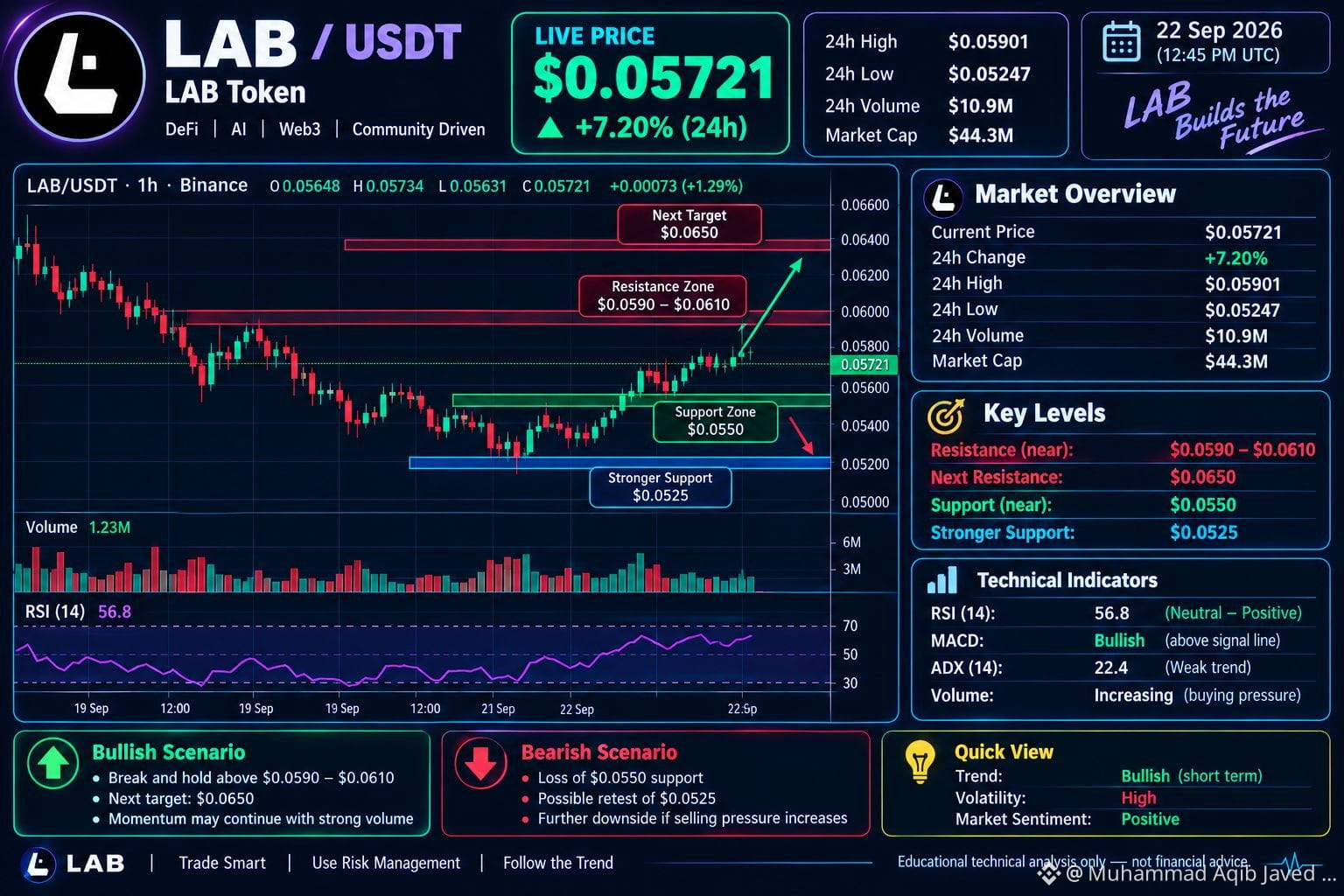
LAB/USDT — LIVE Coin Analysis | 22 Sep 2026
Live price: ~$0.05721, +7.20% (24h). �
CoinMarketCap +1
Trend: Short-term Bullish
Resistance: $0.0590–$0.0610
Next resistance: $0.0650
Support: $0.0550
Stronger support: $0.0525
RSI: 56.8 — neutral/positive
Momentum: Positive, but volatility is high
LAB has recovered from its recent September lows; the latest data shows a 24h range around $0.05247–$0.05901 and volume around $10.9M. �
CoinMarketCap +1
Bullish scenario: Break and hold above $0.0590–$0.0610 → possible test of $0.0650.
Bearish scenario: Lose $0.0550 support → possible retest of $0.0525.
Candle chart is above.
*Technical analysis only — not financial advice.*
#Labs #LaborForce #NEARRisesNearly80%InAWeek #MultiversXPlansHardForkRecovery #CircleLaunchesInstitutionalBTCBackedBorrowing
$LAB
LAB/USDT — LIVE Coin Analysis | 22 Sep 2026
Live price: ~$0.05721, +7.20% (24h). �
CoinMarketCap +1
Trend: Short-term Bullish
Resistance: $0.0590–$0.0610
Next resistance: $0.0650
Support: $0.0550
Stronger support: $0.0525
RSI: 56.8 — neutral/positive
Momentum: Positive, but volatility is high
LAB has recovered from its recent September lows; the latest data shows a 24h range around $0.05247–$0.05901 and volume around $10.9M. �
CoinMarketCap +1
Bullish scenario: Break and hold above $0.0590–$0.0610 → possible test of $0.0650.
Bearish scenario: Lose $0.0550 support → possible retest of $0.0525.
Candle chart is above.
*Technical analysis only — not financial advice.*
#Labs #LaborForce #NEARRisesNearly80%InAWeek #MultiversXPlansHardForkRecovery #CircleLaunchesInstitutionalBTCBackedBorrowing
LAB/USDT — LIVE Coin Analysis | 22 Sep 2026
Live price: ~$0.05721, +7.20% (24h). �
CoinMarketCap +1
Trend: Short-term Bullish
Resistance: $0.0590–$0.0610
Next resistance: $0.0650
Support: $0.0550
Stronger support: $0.0525
RSI: 56.8 — neutral/positive
Momentum: Positive, but volatility is high
LAB has recovered from its recent September lows; the latest data shows a 24h range around $0.05247–$0.05901 and volume around $10.9M. �
CoinMarketCap +1
Bullish scenario: Break and hold above $0.0590–$0.0610 → possible test of $0.0650.
Bearish scenario: Lose $0.0550 support → possible retest of $0.0525.
Candle chart is above.
*Technical analysis only — not financial advice.*
#Labs #LaborForce #NEARRisesNearly80%InAWeek #MultiversXPlansHardForkRecovery #CircleLaunchesInstitutionalBTCBackedBorrowing
218
$BTC
{spot}(BTCUSDT)
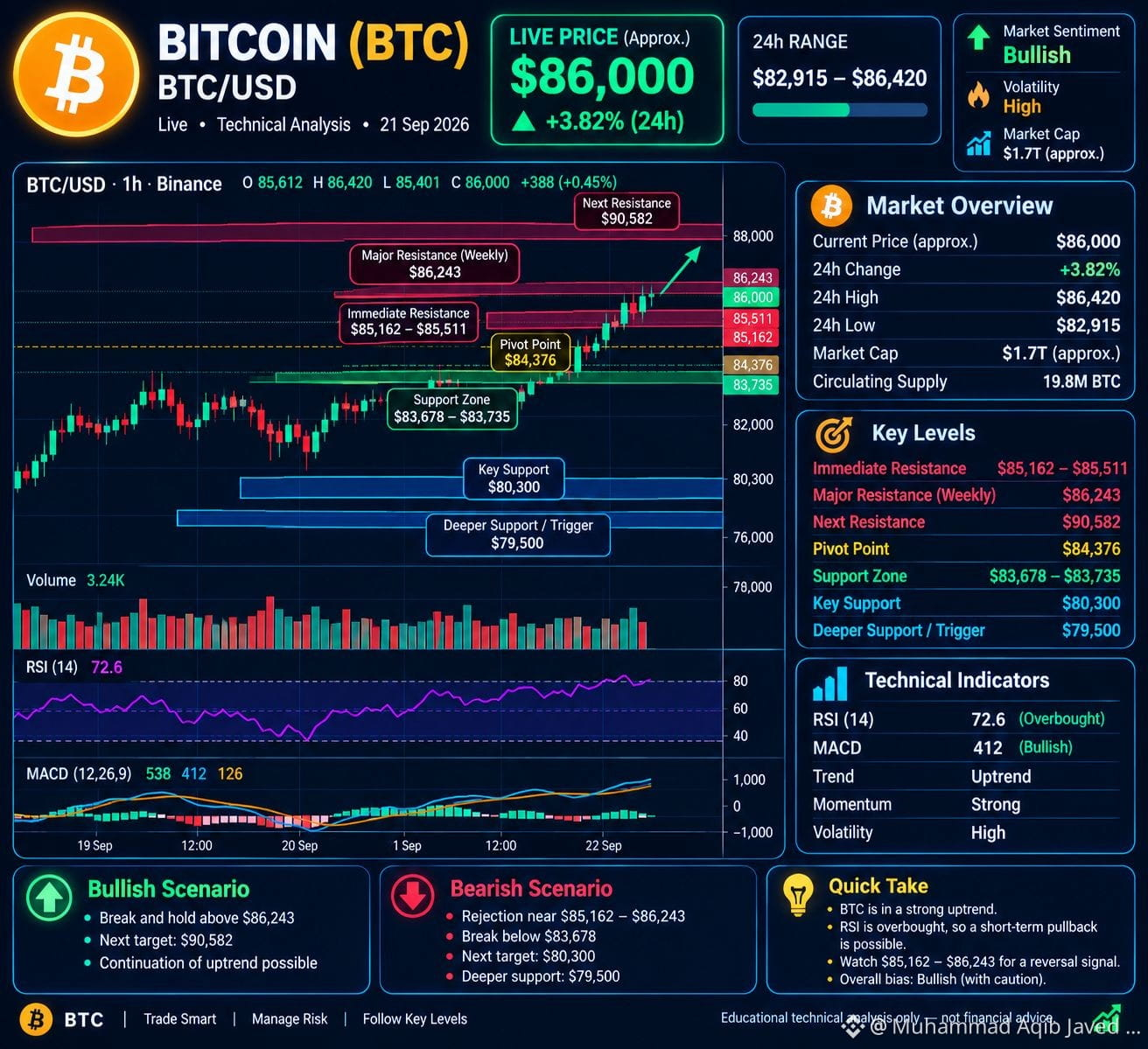
BTC/USD — LIVE Coin Analysis | 21 Sep 2026
Live price: around $86,000. Bitcoin reached about $86,000 today, its highest level since January. �
The Wall Street Journal
Trend: Bullish
Immediate resistance: $85,162–$85,511
Major resistance: $86,243
Next resistance: $90,582
Support: $83,678–$83,735
Key support: $80,300
Deeper support: $79,500
RSI: ~72 — overbought, so a short-term pullback is possible. �
Investing.com
Momentum: Strong / bullish
Bullish scenario: A sustained break above $86,243 could open the way toward $90,582.
Bearish scenario: Rejection around $85,162–$86,243 followed by a break below $83,678 could bring $80,300 into focus. These levels are consistent with today's technical analysis.
#BTC #BTC70K✈️ #MultiversXPlansHardForkRecovery #CircleLaunchesInstitutionalBTCBackedBorrowing #SouthAfricaProposesCryptoExchangeControls
$BTC
BTC/USD — LIVE Coin Analysis | 21 Sep 2026
Live price: around $86,000. Bitcoin reached about $86,000 today, its highest level since January. �
The Wall Street Journal
Trend: Bullish
Immediate resistance: $85,162–$85,511
Major resistance: $86,243
Next resistance: $90,582
Support: $83,678–$83,735
Key support: $80,300
Deeper support: $79,500
RSI: ~72 — overbought, so a short-term pullback is possible. �
Investing.com
Momentum: Strong / bullish
Bullish scenario: A sustained break above $86,243 could open the way toward $90,582.
Bearish scenario: Rejection around $85,162–$86,243 followed by a break below $83,678 could bring $80,300 into focus. These levels are consistent with today's technical analysis.
#BTC #BTC70K✈️ #MultiversXPlansHardForkRecovery #CircleLaunchesInstitutionalBTCBackedBorrowing #SouthAfricaProposesCryptoExchangeControls
BTC/USD — LIVE Coin Analysis | 21 Sep 2026
Live price: around $86,000. Bitcoin reached about $86,000 today, its highest level since January. �
The Wall Street Journal
Trend: Bullish
Immediate resistance: $85,162–$85,511
Major resistance: $86,243
Next resistance: $90,582
Support: $83,678–$83,735
Key support: $80,300
Deeper support: $79,500
RSI: ~72 — overbought, so a short-term pullback is possible. �
Investing.com
Momentum: Strong / bullish
Bullish scenario: A sustained break above $86,243 could open the way toward $90,582.
Bearish scenario: Rejection around $85,162–$86,243 followed by a break below $83,678 could bring $80,300 into focus. These levels are consistent with today's technical analysis.
#BTC #BTC70K✈️ #MultiversXPlansHardForkRecovery #CircleLaunchesInstitutionalBTCBackedBorrowing #SouthAfricaProposesCryptoExchangeControls
1
1
182
$ZEC
{spot}(ZECUSDT)
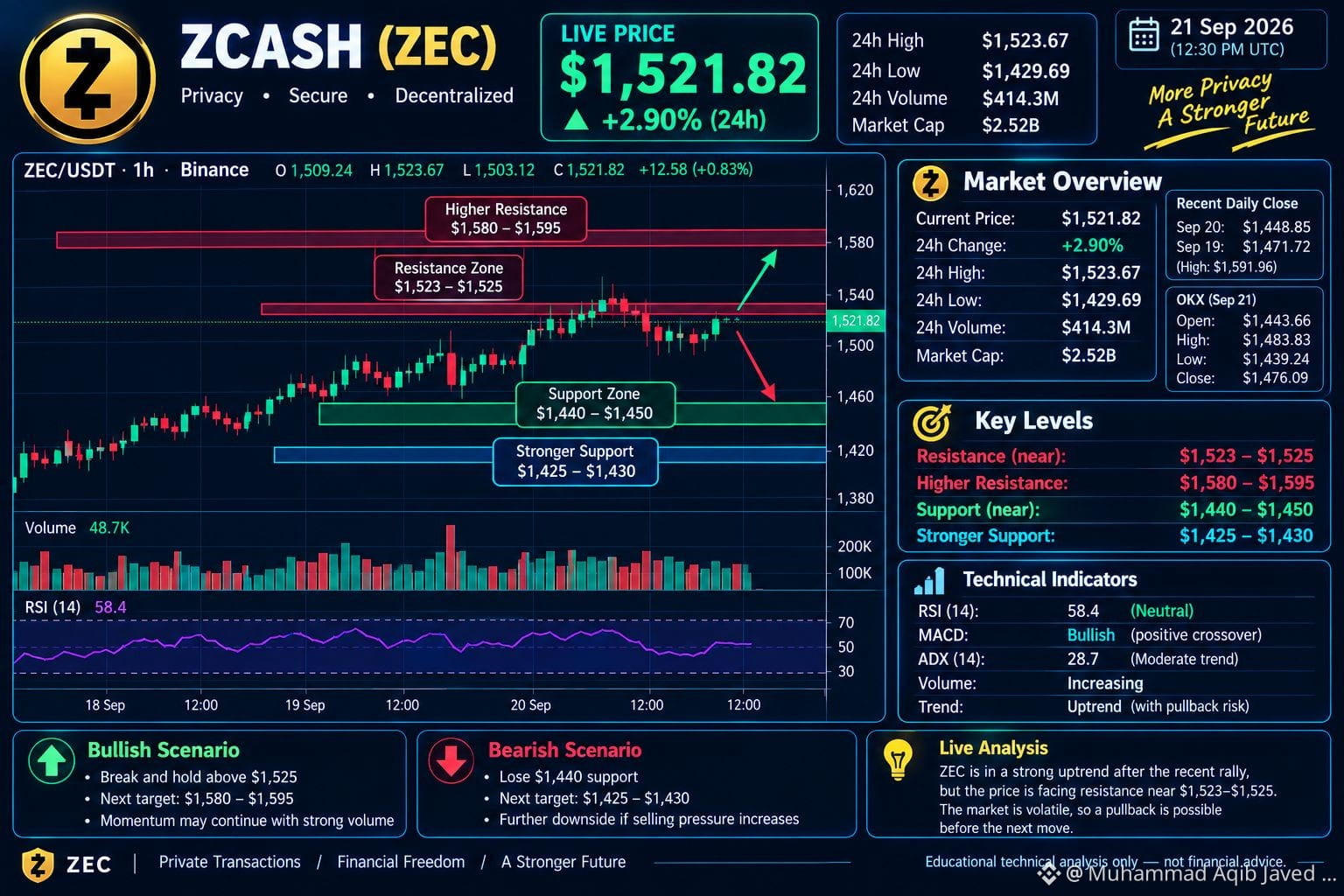
ZEC/USD — LIVE Coin Analysis | 21 Sep 2026
Live price: ~$1,521.82, +2.90% (24h). �
CoinGecko
Trend: Bullish, with pullback risk
Resistance: $1,523–$1,525
Higher resistance: $1,580–$1,595
Support: $1,440–$1,450
Strong support: $1,425–$1,430
RSI: 58.4 — neutral/bullish zone
Momentum: Positive, but volatility remains high
ZEC recently pulled back sharply from around $1,590; the latest 24-hour range is approximately $1,429.69–$1,523.67. �
pluang.com +1
Bullish scenario: Break and hold above $1,525 → next resistance $1,580–$1,595.
Bearish scenario: Break below $1,440 → possible move toward $1,425–$1,430.
Candle chart is above.
*Technical analysis only — not financial advice.*
#zec #ZECUSDT #BTCBreaks80K #BOJRaisesRatesTo31YearHigh #SaylorHintsStrategyBitcoinBuy
$ZEC
ZEC/USD — LIVE Coin Analysis | 21 Sep 2026
Live price: ~$1,521.82, +2.90% (24h). �
CoinGecko
Trend: Bullish, with pullback risk
Resistance: $1,523–$1,525
Higher resistance: $1,580–$1,595
Support: $1,440–$1,450
Strong support: $1,425–$1,430
RSI: 58.4 — neutral/bullish zone
Momentum: Positive, but volatility remains high
ZEC recently pulled back sharply from around $1,590; the latest 24-hour range is approximately $1,429.69–$1,523.67. �
pluang.com +1
Bullish scenario: Break and hold above $1,525 → next resistance $1,580–$1,595.
Bearish scenario: Break below $1,440 → possible move toward $1,425–$1,430.
Candle chart is above.
*Technical analysis only — not financial advice.*
#zec #ZECUSDT #BTCBreaks80K #BOJRaisesRatesTo31YearHigh #SaylorHintsStrategyBitcoinBuy
ZEC/USD — LIVE Coin Analysis | 21 Sep 2026
Live price: ~$1,521.82, +2.90% (24h). �
CoinGecko
Trend: Bullish, with pullback risk
Resistance: $1,523–$1,525
Higher resistance: $1,580–$1,595
Support: $1,440–$1,450
Strong support: $1,425–$1,430
RSI: 58.4 — neutral/bullish zone
Momentum: Positive, but volatility remains high
ZEC recently pulled back sharply from around $1,590; the latest 24-hour range is approximately $1,429.69–$1,523.67. �
pluang.com +1
Bullish scenario: Break and hold above $1,525 → next resistance $1,580–$1,595.
Bearish scenario: Break below $1,440 → possible move toward $1,425–$1,430.
Candle chart is above.
*Technical analysis only — not financial advice.*
#zec #ZECUSDT #BTCBreaks80K #BOJRaisesRatesTo31YearHigh #SaylorHintsStrategyBitcoinBuy
91
$ZEC
{spot}(ZECUSDT)
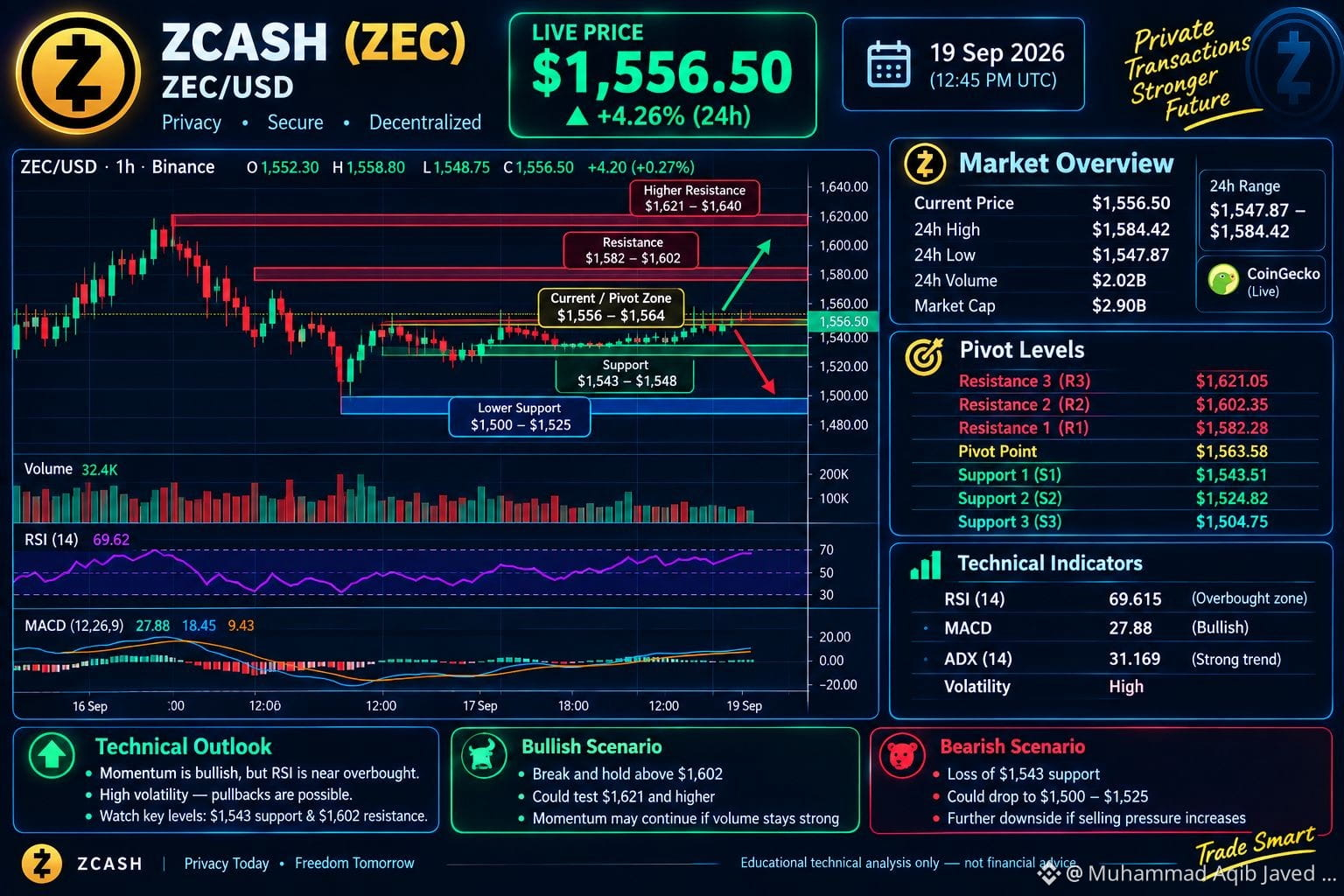
ZEC/USD — LIVE Coin Analysis | 19 Sep 2026
Live price: ~$1,556.50, around +4.26% (24h). �
Investing.com
Trend: Bullish, but highly volatile
Support: $1,543–$1,548
Lower support: $1,500–$1,525
Resistance: $1,582–$1,602
Higher resistance: $1,621–$1,640
RSI: 69.6 — near overbought
MACD: Bullish
Pivot: ~$1,563.6 �
Investing.com India
Bullish scenario: Break and hold above $1,602 → possible test of $1,621–$1,640.
Bearish scenario: Lose $1,543 support → possible pullback toward $1,500–$1,525.
ZEC has recently made a strong move, with the Sep. 18 daily session closing around $1,562 after reaching $1,582.98. �
ca.investing.com
Candle chart is above.
*Technical analysis only — not financial advice.*
#zec #ZECUSDT #ZeusInCrypto #ZeroLend #SECReceivesAmendedInjectiveETFFiling
$ZEC
ZEC/USD — LIVE Coin Analysis | 19 Sep 2026
Live price: ~$1,556.50, around +4.26% (24h). �
Investing.com
Trend: Bullish, but highly volatile
Support: $1,543–$1,548
Lower support: $1,500–$1,525
Resistance: $1,582–$1,602
Higher resistance: $1,621–$1,640
RSI: 69.6 — near overbought
MACD: Bullish
Pivot: ~$1,563.6 �
Investing.com India
Bullish scenario: Break and hold above $1,602 → possible test of $1,621–$1,640.
Bearish scenario: Lose $1,543 support → possible pullback toward $1,500–$1,525.
ZEC has recently made a strong move, with the Sep. 18 daily session closing around $1,562 after reaching $1,582.98. �
ca.investing.com
Candle chart is above.
*Technical analysis only — not financial advice.*
#zec #ZECUSDT #ZeusInCrypto #ZeroLend #SECReceivesAmendedInjectiveETFFiling
ZEC/USD — LIVE Coin Analysis | 19 Sep 2026
Live price: ~$1,556.50, around +4.26% (24h). �
Investing.com
Trend: Bullish, but highly volatile
Support: $1,543–$1,548
Lower support: $1,500–$1,525
Resistance: $1,582–$1,602
Higher resistance: $1,621–$1,640
RSI: 69.6 — near overbought
MACD: Bullish
Pivot: ~$1,563.6 �
Investing.com India
Bullish scenario: Break and hold above $1,602 → possible test of $1,621–$1,640.
Bearish scenario: Lose $1,543 support → possible pullback toward $1,500–$1,525.
ZEC has recently made a strong move, with the Sep. 18 daily session closing around $1,562 after reaching $1,582.98. �
ca.investing.com
Candle chart is above.
*Technical analysis only — not financial advice.*
#zec #ZECUSDT #ZeusInCrypto #ZeroLend #SECReceivesAmendedInjectiveETFFiling
264
$SAGA $AIN
{spot}(SAGAUSDT)
{future}(AINUSDT)
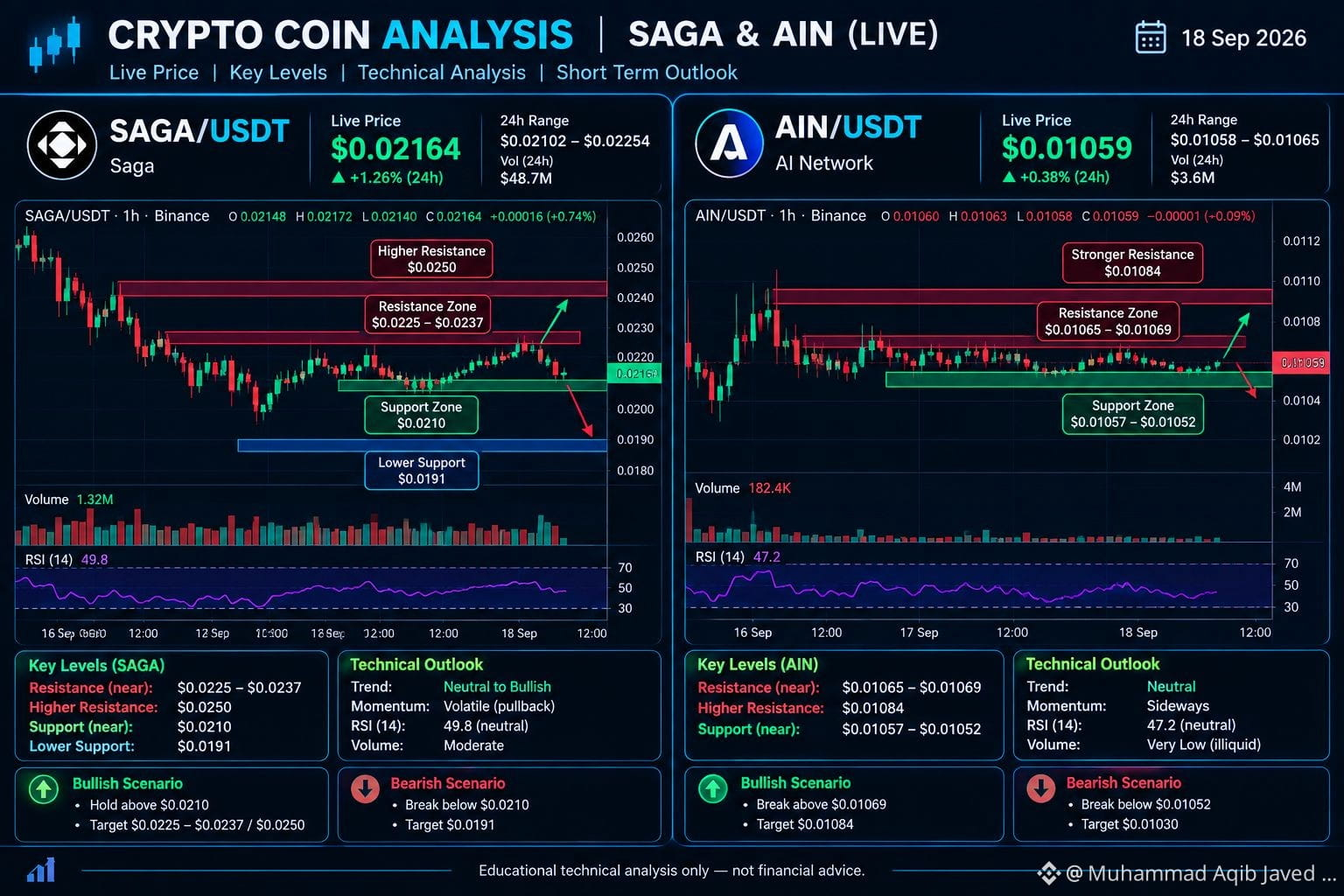
SAGA & AIN — LIVE Coin Analysis | 18 Sep 2026
🔹 SAGA/USDT
Live price: ~$0.02164
Trend: Neutral → Bullish
Resistance: $0.0225–$0.0237
Higher resistance: $0.0250
Support: $0.0210
Lower support: $0.0191
Bullish scenario: Hold above $0.0210 → possible test of $0.0225–$0.0237 and then $0.0250.
Bearish scenario: Break below $0.0210 → possible move toward $0.0191.
SAGA recently showed strong volatility, with the Sep. 17 daily close around $0.02211 after a large rebound. �
ChartExchange +1
🔹 AIN/USDT
Live price: ~$0.01059
Trend: Neutral / Sideways
Resistance: $0.01065–$0.01069
Higher resistance: $0.01084
Support: $0.01057–$0.01052
Bullish scenario: Break above $0.01069 → possible test of $0.01084.
Bearish scenario: Break below $0.01052 → possible move toward $0.01030.
AIN is currently trading with very low reported volume, so liquidity and volatility should be considered when reading the chart. �
CoinMarketCap +1
Candle chart is above.
*Technical analysis only — not financial advice.*
#Saga #AIN #BTCBreaks80K #HYPEJumpsOver11% #BOJHikesRatesTo31YearHigh
$SAGA $AIN
SAGA & AIN — LIVE Coin Analysis | 18 Sep 2026
🔹 SAGA/USDT
Live price: ~$0.02164
Trend: Neutral → Bullish
Resistance: $0.0225–$0.0237
Higher resistance: $0.0250
Support: $0.0210
Lower support: $0.0191
Bullish scenario: Hold above $0.0210 → possible test of $0.0225–$0.0237 and then $0.0250.
Bearish scenario: Break below $0.0210 → possible move toward $0.0191.
SAGA recently showed strong volatility, with the Sep. 17 daily close around $0.02211 after a large rebound. �
ChartExchange +1
🔹 AIN/USDT
Live price: ~$0.01059
Trend: Neutral / Sideways
Resistance: $0.01065–$0.01069
Higher resistance: $0.01084
Support: $0.01057–$0.01052
Bullish scenario: Break above $0.01069 → possible test of $0.01084.
Bearish scenario: Break below $0.01052 → possible move toward $0.01030.
AIN is currently trading with very low reported volume, so liquidity and volatility should be considered when reading the chart. �
CoinMarketCap +1
Candle chart is above.
*Technical analysis only — not financial advice.*
#Saga #AIN #BTCBreaks80K #HYPEJumpsOver11% #BOJHikesRatesTo31YearHigh
SAGA & AIN — LIVE Coin Analysis | 18 Sep 2026
🔹 SAGA/USDT
Live price: ~$0.02164
Trend: Neutral → Bullish
Resistance: $0.0225–$0.0237
Higher resistance: $0.0250
Support: $0.0210
Lower support: $0.0191
Bullish scenario: Hold above $0.0210 → possible test of $0.0225–$0.0237 and then $0.0250.
Bearish scenario: Break below $0.0210 → possible move toward $0.0191.
SAGA recently showed strong volatility, with the Sep. 17 daily close around $0.02211 after a large rebound. �
ChartExchange +1
🔹 AIN/USDT
Live price: ~$0.01059
Trend: Neutral / Sideways
Resistance: $0.01065–$0.01069
Higher resistance: $0.01084
Support: $0.01057–$0.01052
Bullish scenario: Break above $0.01069 → possible test of $0.01084.
Bearish scenario: Break below $0.01052 → possible move toward $0.01030.
AIN is currently trading with very low reported volume, so liquidity and volatility should be considered when reading the chart. �
CoinMarketCap +1
Candle chart is above.
*Technical analysis only — not financial advice.*
#Saga #AIN #BTCBreaks80K #HYPEJumpsOver11% #BOJHikesRatesTo31YearHigh
933
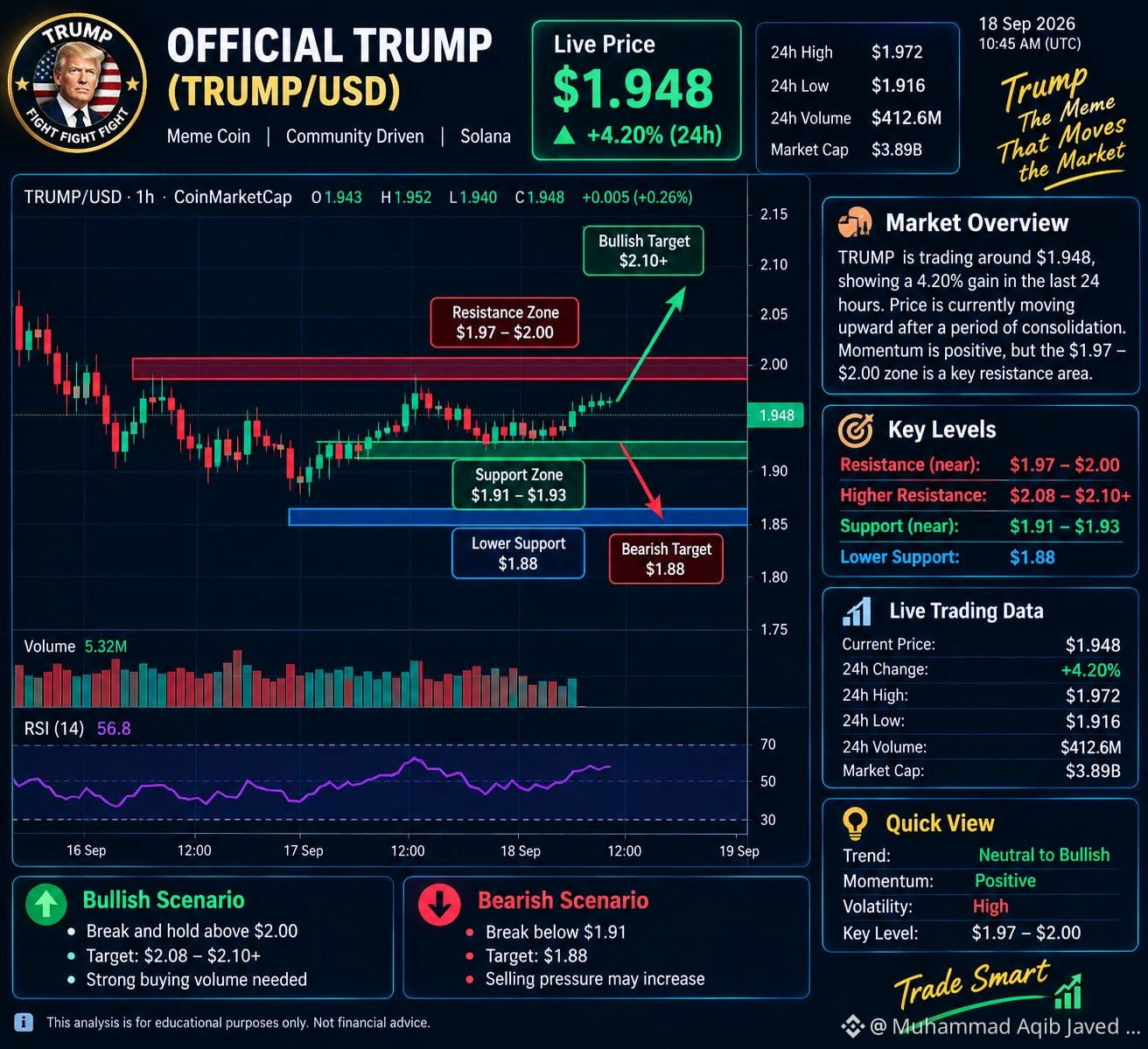
$TRUMP OFFICIAL TRUMP (TRUMP/USD) — LIVE Analysis | 18 Sep 2026
Live price: ~$1.95, up about 4.2% in 24h. �
OKX +1
Trend: Neutral → Bullish
Resistance: $1.97–$2.00
Major resistance: $2.08–$2.10
Support: $1.91–$1.93
Lower support: $1.88
Momentum: Positive, but volatility is high.
Bullish scenario: A strong break and hold above $2.00 could open a move toward $2.08–$2.10+.
Bearish scenario: A break below $1.91 could expose $1.88 support.
Recent daily data shows TRUMP recovering from the $1.88 area, while $1.97–$2.00 remains an important near-term zone. �
investing.com +1
Candle chart is above.
*Technical analysis only — not financial advice.*
#XRPGains3%AsRippleAddsMPPSupport #TRUMP #TrumpCrypto #trumpcoin #ParadigmDisclosesZECHolding
{spot}(TRUMPUSDT)
$TRUMP OFFICIAL TRUMP (TRUMP/USD) — LIVE Analysis | 18 Sep 2026
Live price: ~$1.95, up about 4.2% in 24h. �
OKX +1
Trend: Neutral → Bullish
Resistance: $1.97–$2.00
Major resistance: $2.08–$2.10
Support: $1.91–$1.93
Lower support: $1.88
Momentum: Positive, but volatility is high.
Bullish scenario: A strong break and hold above $2.00 could open a move toward $2.08–$2.10+.
Bearish scenario: A break below $1.91 could expose $1.88 support.
Recent daily data shows TRUMP recovering from the $1.88 area, while $1.97–$2.00 remains an important near-term zone. �
investing.com +1
Candle chart is above.
*Technical analysis only — not financial advice.*
#XRPGains3%AsRippleAddsMPPSupport #TRUMP #TrumpCrypto #trumpcoin #ParadigmDisclosesZECHolding
Live price: ~$1.95, up about 4.2% in 24h. �
OKX +1
Trend: Neutral → Bullish
Resistance: $1.97–$2.00
Major resistance: $2.08–$2.10
Support: $1.91–$1.93
Lower support: $1.88
Momentum: Positive, but volatility is high.
Bullish scenario: A strong break and hold above $2.00 could open a move toward $2.08–$2.10+.
Bearish scenario: A break below $1.91 could expose $1.88 support.
Recent daily data shows TRUMP recovering from the $1.88 area, while $1.97–$2.00 remains an important near-term zone. �
investing.com +1
Candle chart is above.
*Technical analysis only — not financial advice.*
#XRPGains3%AsRippleAddsMPPSupport #TRUMP #TrumpCrypto #trumpcoin #ParadigmDisclosesZECHolding
262
Log in to explore more content
Join global crypto users on Binance Square
⚡️ Get latest and useful information about crypto.
💬 Trusted by the world’s largest crypto exchange.
👍 Discover real insights from verified creators.
Email / Phone number
Trending Topics
BinanceLaunchesBinanceIntelligence
121,203 views
1,245 Discussing
🚨 BINANCE JUST PUT AI DIRECTLY INSIDE THE EXCHANGE — AND THIS COULD CHANGE HOW RETAIL TRADES.
Binance has officially launched Binance Intelligence, a new AI layer built into the Binance ecosystem. It combines three products:
Binance AI for everyday users,
Binance AI Pro for automated trading workflows,
and Agent OS for developers building financial agents.
The part traders should care about?
Binance AI can surface market briefs, smart alerts, PnL recaps and personalized information, while AI Pro is designed to turn a plain-English trading idea into a visual strategy workflow.
That means the next phase of exchange competition may not be:
lowest fees vs deepest liquidity.
It could be:
who gives traders the best AI execution layer.
If Binance Intelligence actually drives heavier user activity, automated strategies and higher trading frequency, watch $BNB first.
AI adoption ↑
→ Binance engagement ↑
→ trading activity ↑
→ ecosystem narrative strengthens.
The catalyst I’d watch now:
global rollout + AI Pro launch + measurable user adoption.
Because once AI stops just telling you what the market is doing…
…and starts helping build the trade itself?
That’s when this gets much bigger than another chatbot. 👀
#binancelaunchesbinanceintelligence #EvernorthXRPTreasuryCompletesSPACMerger #ADAGains10%Above$0.27 #ETHUp70%InQ3ButLiquidityFalls #EthStakingExitQueueHits2026High
KimHotbae
·34 Likes
·41k views
StriveBuys2000BTCFor$169M
4,420 views
53 Discussing
EvernorthXRPTreasuryCompletesSPACMerger
79,594 views
816 Discussing