

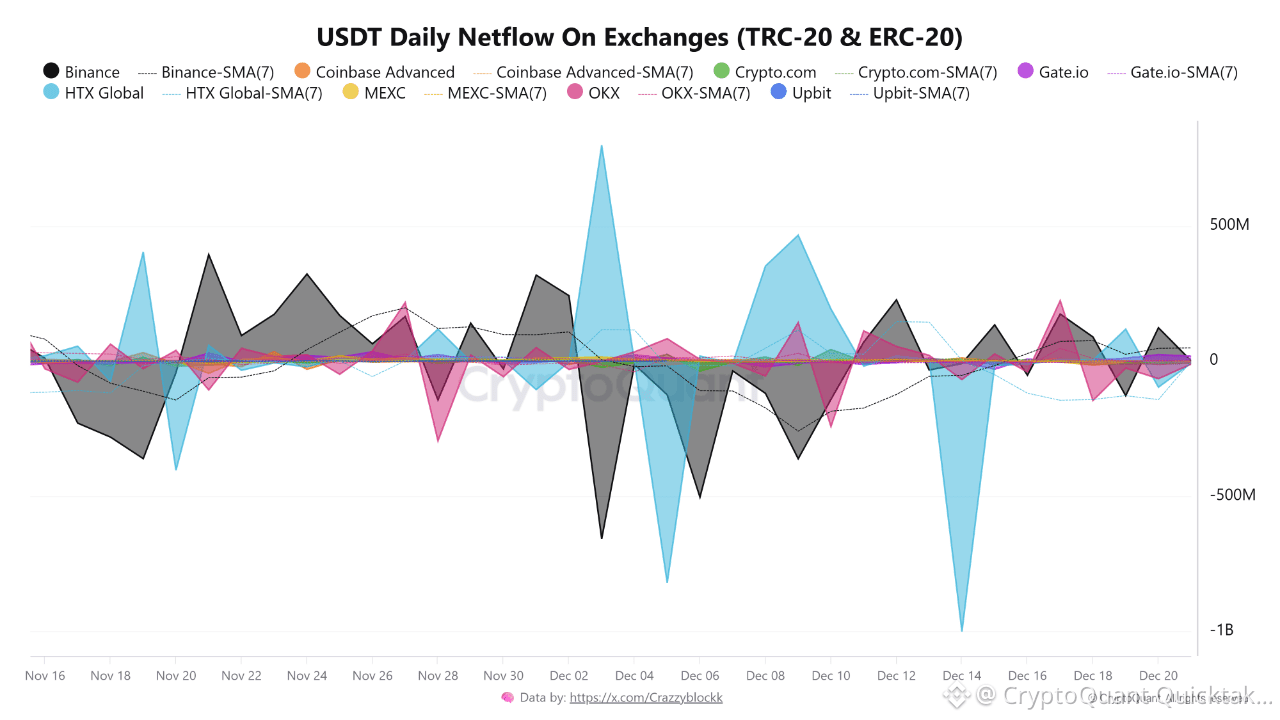
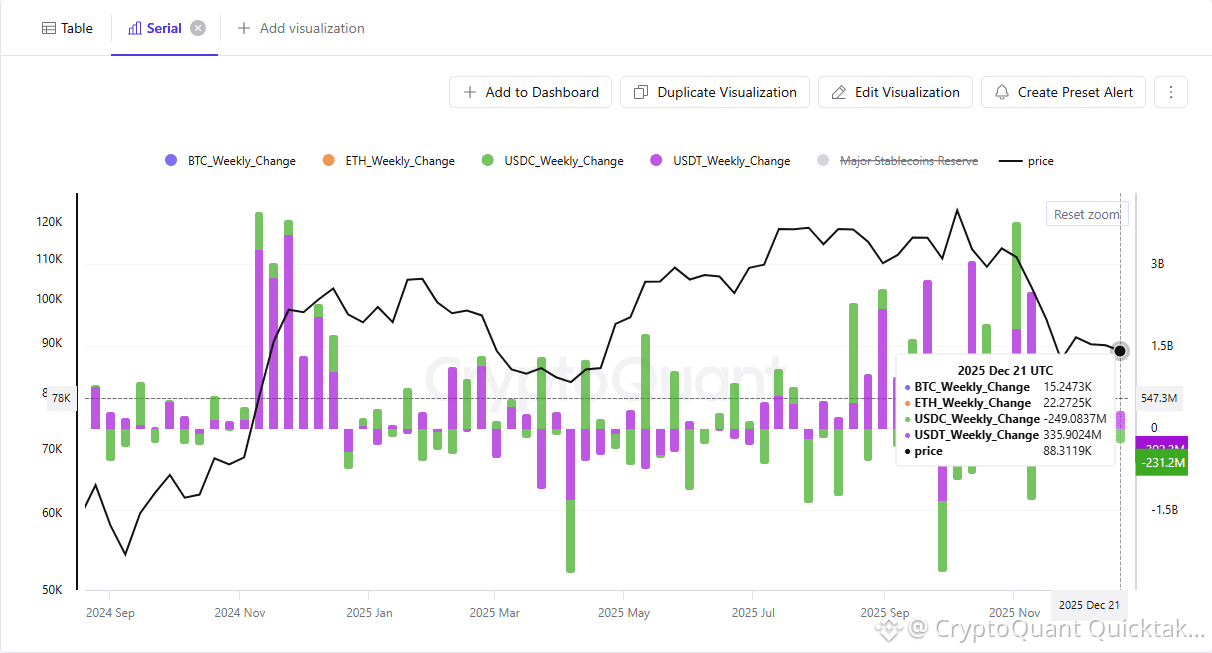
The platform swung from +$688 million in USDT inflows during November 24th's week to -$774 million the next week, then back to +$342 million most recently. That's a 1,462-point swing across three weeks with zero directional consistency. Daily movements exceeding $100 million, once rare, are now routine. December 9th saw $361 million exit, only to have $227 million return three days later.
Statistical analysis reveals a coefficient of variation above 40, meaning volatility is forty times the average flow. In traditional finance, anything above 1.0 signals instability. At 41.98, these movements aren't accumulation or distribution patterns—they're reactive chaos.
Compare this to reserve data. While USDT swings wildly daily, Binance lost $157 billion in total stablecoins during one week—capital that didn't return. The USDT chaos happens WITHIN broader de-risking, not against it. Traders move USDT tactically while systematically withdrawing USDC, BUSD, and other stables permanently.
Markets search for conviction signals in exchange flows, assuming large movements indicate smart money positioning. But when flows reverse every few days at this magnitude, they're not leading indicators anymore.
Binance absorbed 133% of market USDT inflows this week, but that's consolidation during chaos, not dominance. Other exchanges bleed liquidity to Binance not because it's winning, but because it's the last venue with depth.
Until flows stabilize or reserves stop declining, this volatility is noise, not signal.
Written by Crazzyblockk
