

The euphoria in U.S. stocks from slowing inflation data failed to prevent Bitcoin from falling below the $86,000 mark, causing the entire crypto market's value to evaporate again in overnight trading.
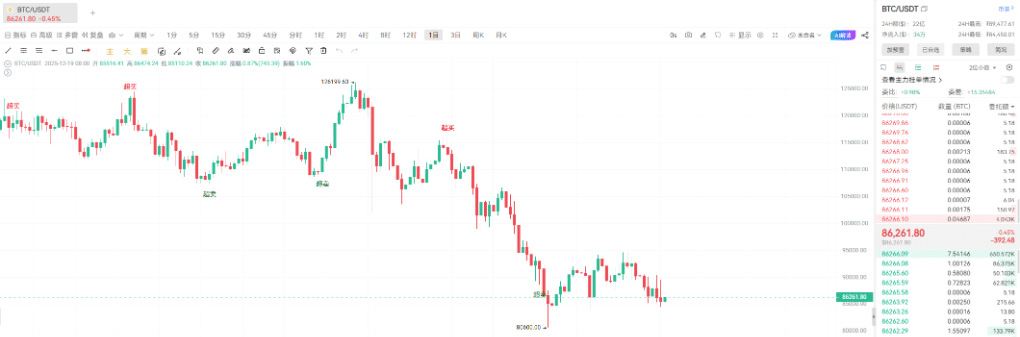
At 12:00 AM on December 19th, Bitcoin fell below $86,000 in the overnight market, reaching a low of $85,450.
Ethereum briefly fell below $2,800, while SOL dropped below $120. The total market capitalization of cryptocurrencies fell below the $3 trillion mark during the overnight plunge, currently reported at about $2.96 trillion.
 I. Market Overview
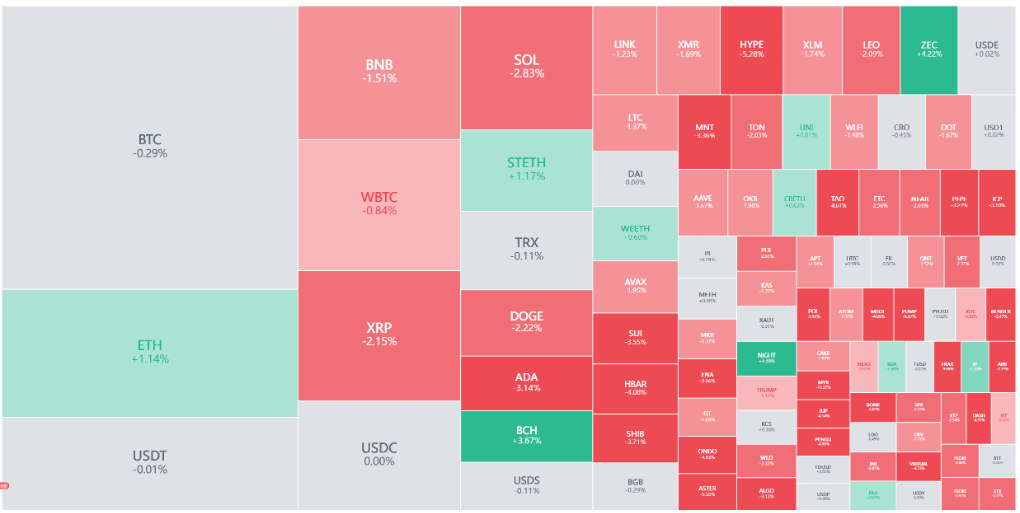
● The overnight crypto market saw a widespread decline again. Bitcoin is currently reported at $85,382, with a 24-hour decline of 0.68%. Previously, Bitcoin had fallen below the key support level of $86,000. Ethereum is currently priced at $2,825, with a slight 24-hour decline of 0.02%. More altcoins have seen more significant declines.
● Some altcoins have become the main forces in the decline: PUMP and GIGGLE both plummeted 11.41%, AXL fell 9.3%, DOLO dropped 8.7%, and VELODROME decreased by 8.8%.
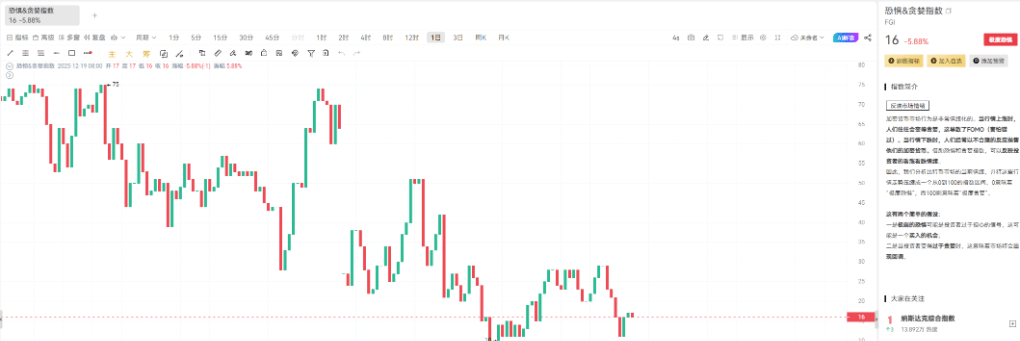
Market panic is spreading. The cryptocurrency fear and greed index has dropped to 16, indicating an "extreme fear" region.
 II. Market Structure
● This round of correction shows a clear structural divergence. High-risk sectors and altcoins have faced greater pressure. Among various sub-sectors, the AI concept sector led the decline by 5.34%, with Fartcoin (FARTCOIN) dropping 19.81%. The meme coin sector overall fell by 4.76%.
● Meanwhile, Bitcoin has shown relatively strong resilience against declines. Although the price has dropped, its decline is much smaller than that of many altcoins. This differentiation indicates that, as risk aversion in the market increases, funds are shifting from high-risk assets to relatively stable assets.
III. Reasons for the Decline
This decline is not caused by a single factor but is the result of multiple pressures acting together.
● The primary pressure comes from changes in the macro monetary policy environment. The market widely expects that the Bank of Japan may raise interest rates to the highest level in thirty years, and this expectation is driving the loosening of global yen arbitrage trading. Historical data shows that Bitcoin has dropped between 20% to 30% within 4 to 6 weeks after the last three rate hikes by the Bank of Japan.
● Meanwhile, after completing the first interest rate cut, the Federal Reserve's subsequent path remains unclear, and the market is beginning to actively lower liquidity expectations for 2026.
● On-chain data also reveals direct pressure. On December 18th, net inflows to Bitcoin exchanges reached 3,764 BTC, setting a new peak, clearly pointing to large holders concentrating on deposits and preparing for sales.
● Signs of selling have also emerged at the miner level. The overall network hash rate of Bitcoin has seen a significant decline. According to F2pool data, as of December 15th, Bitcoin's overall network hash rate is temporarily reported at 988.49 EH/s, a decrease of 17.25% from the previous week.
Market analysis suggests that a significant number of Bitcoin miners may shut down soon, forcing miners to sell Bitcoin during the liquidity tightening period.
IV. Divergence with U.S. Stocks
In stark contrast to the weakness in the crypto market, U.S. stocks collectively rose overnight.
● The Dow Jones Industrial Average closed up 0.14%, the S&P 500 index rose 0.79%, and the Nasdaq Composite Index performed particularly strongly, surging 1.38%. Major tech stocks saw broad gains, with Tesla up over 3% and Nvidia up nearly 2%. This rally was mainly bolstered by slowing inflation data. The U.S. core CPI in November increased by 2.6% year-on-year, the lowest growth rate in four years, which is favorable for the Federal Reserve's rate cuts next year.
● However, cryptocurrencies did not follow the U.S. stock rebound, but rather fell back after a brief surge. Bitcoin once broke $89,400 in pre-market trading, but declined towards the end of the U.S. market's morning session, dropping below $85,500 during the midday session.
This divergence highlights the current liquidity pressure and risk aversion the cryptocurrency market faces independently.
V. Divergence in Concept Stocks
U.S. crypto concept stocks showed mixed performance, failing to form a unified trend.
● Strategy (MSTR) fell 1.33%, Coinbase (COIN) fell 2.04%, and MARA Holdings (MARA) fell 2.4%. However, Riot Platforms (RIOT) rose counter to the trend, up 3.24%, and Circle (CRCL) also rose 2.38%.
● Notably, shares of Trump Media Technology Group (DJT) surged 41.9% on news of a merger. The company announced it would merge with TAE Technologies, a fusion energy company backed by Alphabet, in an all-stock transaction valued at over $6 billion.
● The merged company plans to site and begin construction on the world's first utility-scale fusion power plant by 2026. This news has spurred market enthusiasm for disruptive energy technologies, but has not benefited the cryptocurrency sector.
VI. Outlook
Technical analysis shows that Bitcoin currently has key support in the $85,800 to $86,000 range, which is an important psychological barrier.
● If this support zone is effectively broken, Bitcoin may further probe the range of $82,000 to $84,000, or even test the historical demand zone of $78,000 to $80,000. Momentum indicators show that the market is nearing oversold territory, and a technical rebound may occur in the short term.
● For the entire cryptocurrency market, the $2.87 trillion market capitalization level constitutes a short-term support. The market needs to stabilize above $2.93 trillion to start the path back to the $3 trillion mark.
● On a macro level, the next steps for the market will heavily depend on policy coordination among major global central banks. Analysts point out that the current global monetary policy is in a stage of "high divergence, difficult to form a joint force," and this "non-unified liquidity environment" is often more lethal than clear tightening.
The price of Bitcoin is closely hovering around $85,000, as traders hold their breath waiting for the next directional breakthrough. The correlation between cryptocurrencies and U.S. tech stocks has risen to a high of nearly 0.9, but last night the two had completely opposite movements.
Market expectations for interest rate hikes by the Bank of Japan hang like a sword over the market, while the fog surrounding the Federal Reserve's rate cut path has yet to lift. Amid rumors of shutdowns at Xinjiang mines and the shadow of large on-chain transfers, the crypto world is experiencing a liquidity tightening test.
Join our community to discuss and become stronger together!
Official Telegram community: https://t.me/aicoincn
AiCoin Chinese Twitter: https://x.com/AiCoinzh
OKX welfare group: https://aicoin.com/link/chat?cid=l61eM4owQ
Binance welfare group: https://aicoin.com/link/chat?cid=ynr7d1P6Z


