

#xrp
xrp
1.6G views
5.8M Discussing
Hot
Latest

·
--
Verified
🚨 XRP JUST GOT A NEW DATE TO WATCH
The XRP Ledger’s Batch V1.1 upgrade is no longer expected to activate on September 29.
After validator support changed, the activation countdown restarted — making October 9 the earliest possible activation date.
What does Batch bring?
It can bundle up to eight linked transactions into one operation, allowing them to succeed together or fail together.
That could be useful for payments, token swaps, platform fees and delivery-versus-payment transactions.
Meanwhile, U.S. XRP ETFs have continued attracting capital, with cumulative net inflows now around $1.79B.
So XRP has both a protocol catalyst and continued institutional attention in focus.
🚨 XRP UPDATE: Batch V1.1 now has October 9 as the earliest activation date. Click the $XRP setup below 🫵🏻 to review the structure and watch the next reaction.
$XRP
{future}(XRPUSDT)
.
.
#xrp #XRPL #Write2Earn
🚨 XRP JUST GOT A NEW DATE TO WATCH
The XRP Ledger’s Batch V1.1 upgrade is no longer expected to activate on September 29.
After validator support changed, the activation countdown restarted — making October 9 the earliest possible activation date.
What does Batch bring?
It can bundle up to eight linked transactions into one operation, allowing them to succeed together or fail together.
That could be useful for payments, token swaps, platform fees and delivery-versus-payment transactions.
Meanwhile, U.S. XRP ETFs have continued attracting capital, with cumulative net inflows now around $1.79B.
So XRP has both a protocol catalyst and continued institutional attention in focus.
🚨 XRP UPDATE: Batch V1.1 now has October 9 as the earliest activation date. Click the $XRP setup below 🫵🏻 to review the structure and watch the next reaction.
$XRP
.
.
#xrp #XRPL #Write2Earn
The XRP Ledger’s Batch V1.1 upgrade is no longer expected to activate on September 29.
After validator support changed, the activation countdown restarted — making October 9 the earliest possible activation date.
What does Batch bring?
It can bundle up to eight linked transactions into one operation, allowing them to succeed together or fail together.
That could be useful for payments, token swaps, platform fees and delivery-versus-payment transactions.
Meanwhile, U.S. XRP ETFs have continued attracting capital, with cumulative net inflows now around $1.79B.
So XRP has both a protocol catalyst and continued institutional attention in focus.
🚨 XRP UPDATE: Batch V1.1 now has October 9 as the earliest activation date. Click the $XRP setup below 🫵🏻 to review the structure and watch the next reaction.
$XRP
.
.
#xrp #XRPL #Write2Earn
4
3.7k

Verified
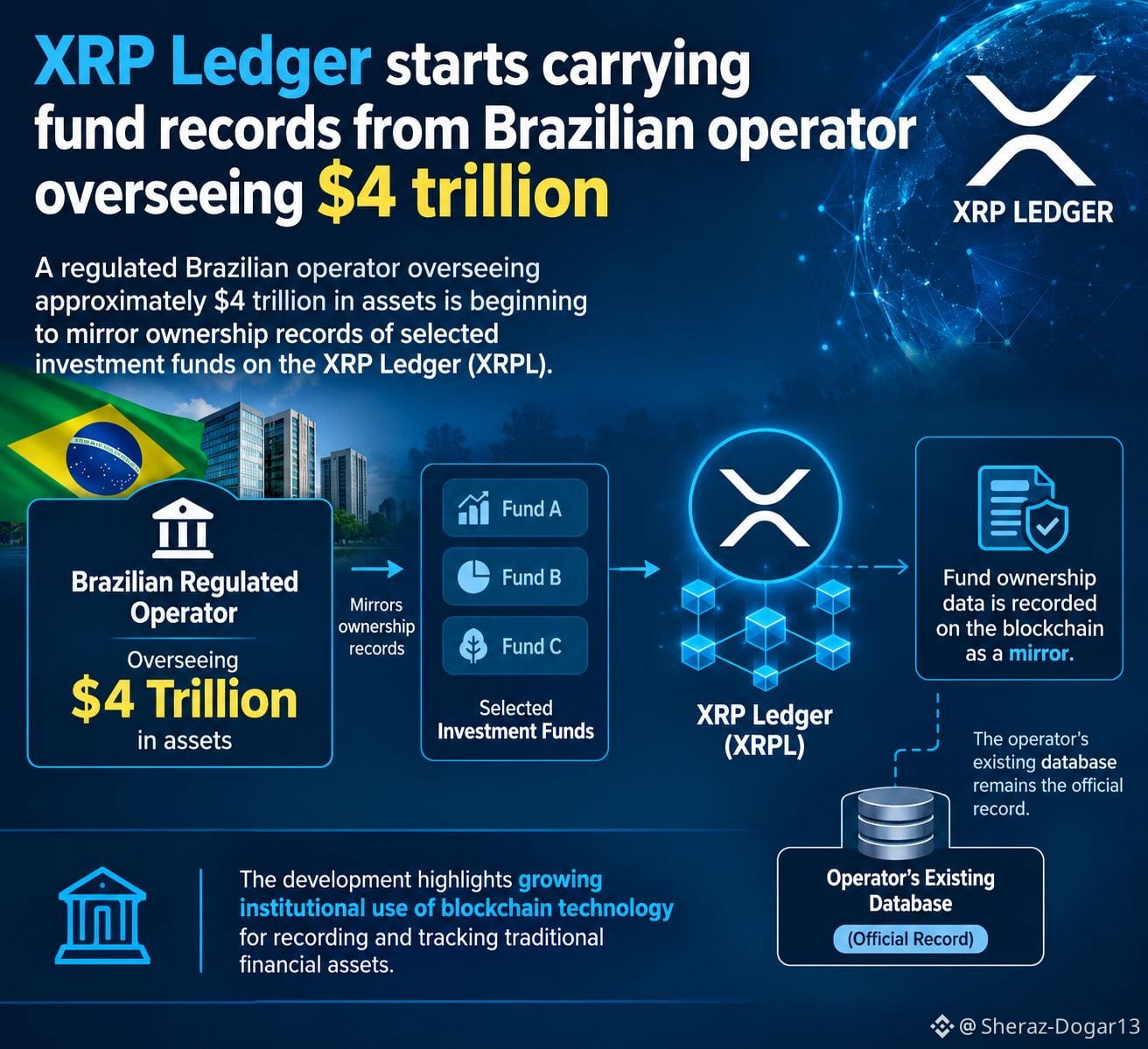
#XRP Ledger starts carrying fund records from Brazilian operator overseeing $4 trillion
A regulated Brazilian operator overseeing approximately $4 trillion in assets is beginning to mirror ownership records of selected investment funds on the XRP Ledger (XRPL).
The move allows fund ownership data to be represented on the blockchain while the operator’s existing database remains the official record. This means the XRPL will serve as a transparent and blockchain-based mirror of selected fund records rather than replacing the operator’s existing record-keeping system.
The development highlights growing institutional use of blockchain technology for recording and tracking traditional financial assets.
#XRP Ledger starts carrying fund records from Brazilian operator overseeing $4 trillion
A regulated Brazilian operator overseeing approximately $4 trillion in assets is beginning to mirror ownership records of selected investment funds on the XRP Ledger (XRPL).
The move allows fund ownership data to be represented on the blockchain while the operator’s existing database remains the official record. This means the XRPL will serve as a transparent and blockchain-based mirror of selected fund records rather than replacing the operator’s existing record-keeping system.
The development highlights growing institutional use of blockchain technology for recording and tracking traditional financial assets.
A regulated Brazilian operator overseeing approximately $4 trillion in assets is beginning to mirror ownership records of selected investment funds on the XRP Ledger (XRPL).
The move allows fund ownership data to be represented on the blockchain while the operator’s existing database remains the official record. This means the XRPL will serve as a transparent and blockchain-based mirror of selected fund records rather than replacing the operator’s existing record-keeping system.
The development highlights growing institutional use of blockchain technology for recording and tracking traditional financial assets.
206 Atlas:
Mirroring records adds transparency but doesn't change XRP's utility or demand. This is a weak fundamental driver for price action.
1
2
1.2k


Article
"XRP Sellers Face Liquidation Risk Up to $158M at Just a 3% Price Rise"#XRP sees cumulative short liquidation leverage of more than $158 million all the way to $1.55, just a 3% increase from current prices.
After rising to a local top above $1.65 on Sept. 23, XRP faced a pullback along with the rest of the crypto market. A rebound followed immediately, pushing prices above $1.60 before XRP retreated again to $1.50 at press time.
XRP Sellers Face $158M Liquidation Leverage at $1.55
Amid the latest price retreat, market data shows that most investors have turned to opening shorts in anticipation of further declines. XRP had dropped to $1.46 earlier today before rebounding to $1.50, yet market participants believe steeper declines may be on the horizon.
According to derivatives data provided by Coinglass, a leading market analytics platform, XRP sellers have ramped up cumulative short liquidation leverage of up to $158.82 million from the current price of $1.50 to the $1.553 high on the 7-day timeline.
This indicates that if the XRP price recovers just 3% from the current $1.50 level to $1.553, traders with XRP short positions could witness cumulative liquidation of nearly $159 million at different price levels up until the $1.553 area.
Further data shows that, exactly at the $1.553 mark, traders on Binance, the world’s largest crypto exchange by trade volume, could face liquidations to the tune of $6.03 million, while liquidations impacting OKX traders may reach $2.37 million. Meanwhile, Bybit leads with about $8.04 million in liquidation leverage at $1.553.
Short Liquidation Leverage Exceeds Longs by $200M
This confirms the high concentration of short positions stacked above the current XRP price. More importantly, Coinglass reveals that from the current price to $1.639, the XRP derivatives market features cumulative short liquidation leverage up to $392.83 million. For context, this is just a price difference of 8.6%.
Meanwhile, at the other end of the spectrum, from the current price to $1.373, an 8.46% drop, the cumulative long liquidation leverage sits at $193 million. This means the cumulative short liquidation exposure surpasses long liquidation exposure by a whopping $200 million at the same price spread.
Such situations can put pressure on bulls, especially if buying pressure starts to disappear from the market. However, if buyers return and the price recovers rapidly, it would create the perfect condition for a potential short squeeze, where the concentration of shorts could be forced to buy XRP to maintain their positions or face massive liquidations.
#CryptonewswithJack
"XRP Sellers Face Liquidation Risk Up to $158M at Just a 3% Price Rise"
#XRP sees cumulative short liquidation leverage of more than $158 million all the way to $1.55, just a 3% increase from current prices.
After rising to a local top above $1.65 on Sept. 23, XRP faced a pullback along with the rest of the crypto market. A rebound followed immediately, pushing prices above $1.60 before XRP retreated again to $1.50 at press time.
XRP Sellers Face $158M Liquidation Leverage at $1.55
Amid the latest price retreat, market data shows that most investors have turned to opening shorts in anticipation of further declines. XRP had dropped to $1.46 earlier today before rebounding to $1.50, yet market participants believe steeper declines may be on the horizon.
According to derivatives data provided by Coinglass, a leading market analytics platform, XRP sellers have ramped up cumulative short liquidation leverage of up to $158.82 million from the current price of $1.50 to the $1.553 high on the 7-day timeline.
This indicates that if the XRP price recovers just 3% from the current $1.50 level to $1.553, traders with XRP short positions could witness cumulative liquidation of nearly $159 million at different price levels up until the $1.553 area.
Further data shows that, exactly at the $1.553 mark, traders on Binance, the world’s largest crypto exchange by trade volume, could face liquidations to the tune of $6.03 million, while liquidations impacting OKX traders may reach $2.37 million. Meanwhile, Bybit leads with about $8.04 million in liquidation leverage at $1.553.
Short Liquidation Leverage Exceeds Longs by $200M
This confirms the high concentration of short positions stacked above the current XRP price. More importantly, Coinglass reveals that from the current price to $1.639, the XRP derivatives market features cumulative short liquidation leverage up to $392.83 million. For context, this is just a price difference of 8.6%.
Meanwhile, at the other end of the spectrum, from the current price to $1.373, an 8.46% drop, the cumulative long liquidation leverage sits at $193 million. This means the cumulative short liquidation exposure surpasses long liquidation exposure by a whopping $200 million at the same price spread.
Such situations can put pressure on bulls, especially if buying pressure starts to disappear from the market. However, if buyers return and the price recovers rapidly, it would create the perfect condition for a potential short squeeze, where the concentration of shorts could be forced to buy XRP to maintain their positions or face massive liquidations.
#CryptonewswithJack
After rising to a local top above $1.65 on Sept. 23, XRP faced a pullback along with the rest of the crypto market. A rebound followed immediately, pushing prices above $1.60 before XRP retreated again to $1.50 at press time.
XRP Sellers Face $158M Liquidation Leverage at $1.55
Amid the latest price retreat, market data shows that most investors have turned to opening shorts in anticipation of further declines. XRP had dropped to $1.46 earlier today before rebounding to $1.50, yet market participants believe steeper declines may be on the horizon.
According to derivatives data provided by Coinglass, a leading market analytics platform, XRP sellers have ramped up cumulative short liquidation leverage of up to $158.82 million from the current price of $1.50 to the $1.553 high on the 7-day timeline.
This indicates that if the XRP price recovers just 3% from the current $1.50 level to $1.553, traders with XRP short positions could witness cumulative liquidation of nearly $159 million at different price levels up until the $1.553 area.
Further data shows that, exactly at the $1.553 mark, traders on Binance, the world’s largest crypto exchange by trade volume, could face liquidations to the tune of $6.03 million, while liquidations impacting OKX traders may reach $2.37 million. Meanwhile, Bybit leads with about $8.04 million in liquidation leverage at $1.553.
Short Liquidation Leverage Exceeds Longs by $200M
This confirms the high concentration of short positions stacked above the current XRP price. More importantly, Coinglass reveals that from the current price to $1.639, the XRP derivatives market features cumulative short liquidation leverage up to $392.83 million. For context, this is just a price difference of 8.6%.
Meanwhile, at the other end of the spectrum, from the current price to $1.373, an 8.46% drop, the cumulative long liquidation leverage sits at $193 million. This means the cumulative short liquidation exposure surpasses long liquidation exposure by a whopping $200 million at the same price spread.
Such situations can put pressure on bulls, especially if buying pressure starts to disappear from the market. However, if buyers return and the price recovers rapidly, it would create the perfect condition for a potential short squeeze, where the concentration of shorts could be forced to buy XRP to maintain their positions or face massive liquidations.
#CryptonewswithJack
AngelOfCrypto_-:
nice
1
1
963

Verified
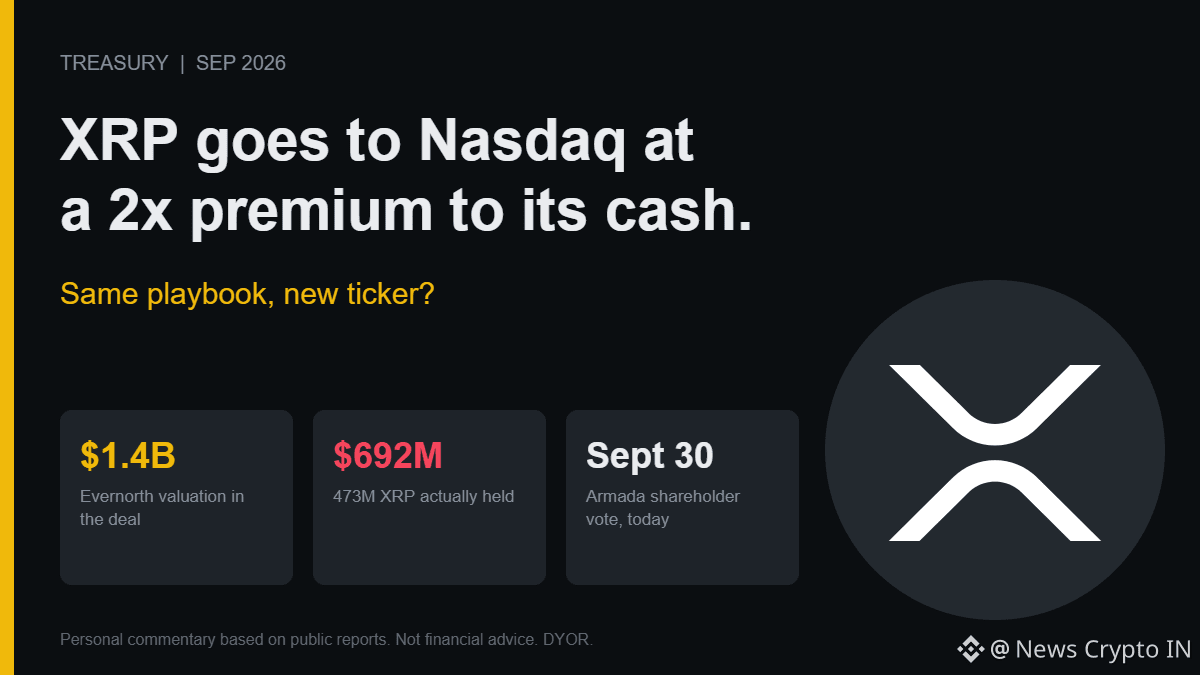
$XRP just got a very MSTR-style Nasdaq entry. Armada Acquisition Corp. II shareholders vote today (Sept 30) on merging with Evernorth, the XRP treasury company, to list as XRPN. The deal values Evernorth at $1.4B. Its actual holdings: 473M XRP, worth about $692M.
That's roughly a 2x premium to the XRP sitting on the balance sheet, the same treasury-premium playbook we just watched compress to 0.85x for Strategy and Bitcoin. Investors here include Ripple, Pantera, SBI Group, Arrington Capital, Kraken and GSR, so this isn't a fringe vehicle.
The pitch: XRPN gives US investors regulated equity exposure to XRP without touching an exchange. The catch: you're paying nearly double for that convenience, and premiums like this only hold up while retail keeps buying the wrapper faster than the underlying asset.
We already have the case study for what happens when that stops. Will XRPN's premium survive its first bad quarter, or follow Strategy's path toward 1x?
#XRP #Nasdaq
$XRP just got a very MSTR-style Nasdaq entry. Armada Acquisition Corp. II shareholders vote today (Sept 30) on merging with Evernorth, the XRP treasury company, to list as XRPN. The deal values Evernorth at $1.4B. Its actual holdings: 473M XRP, worth about $692M.
That's roughly a 2x premium to the XRP sitting on the balance sheet, the same treasury-premium playbook we just watched compress to 0.85x for Strategy and Bitcoin. Investors here include Ripple, Pantera, SBI Group, Arrington Capital, Kraken and GSR, so this isn't a fringe vehicle.
The pitch: XRPN gives US investors regulated equity exposure to XRP without touching an exchange. The catch: you're paying nearly double for that convenience, and premiums like this only hold up while retail keeps buying the wrapper faster than the underlying asset.
We already have the case study for what happens when that stops. Will XRPN's premium survive its first bad quarter, or follow Strategy's path toward 1x?
#XRP #Nasdaq
That's roughly a 2x premium to the XRP sitting on the balance sheet, the same treasury-premium playbook we just watched compress to 0.85x for Strategy and Bitcoin. Investors here include Ripple, Pantera, SBI Group, Arrington Capital, Kraken and GSR, so this isn't a fringe vehicle.
The pitch: XRPN gives US investors regulated equity exposure to XRP without touching an exchange. The catch: you're paying nearly double for that convenience, and premiums like this only hold up while retail keeps buying the wrapper faster than the underlying asset.
We already have the case study for what happens when that stops. Will XRPN's premium survive its first bad quarter, or follow Strategy's path toward 1x?
#XRP #Nasdaq
AngelOfCrypto_-:
nice
3
5
2.7k

Article
XRP Seoul Event Unites Tokenization, Yield and Privacy CompaniesXRP Seoul 2026 is bringing together companies working across several of the financial technology areas now shaping blockchain markets, including tokenized bank deposits, digital-asset protection, and lending products linked to XRP.
The event’s expanded speaker lineup is intended to show how these applications fit into a broader digital-asset infrastructure. Alongside firms developing financial products, the program includes providers of blockchain data, cross-chain transfer systems, and privacy technology. The result is a gathering focused not only on the XRP asset itself, but also on the tools needed to support institutions and users operating in increasingly connected digital markets.
Tokenization is expected to be one of the central themes. In financial markets, tokenization refers to representing assets or claims on a blockchain. The approach can be applied to securities, deposits, funds, real-world assets and other financial instruments. Supporters argue that blockchain-based representations may make certain transactions easier to track, transfer or settle, although the practical benefits depend on legal recognition, market infrastructure and the institutions involved.
Tokenized bank deposits are a particularly important part of that discussion. Unlike privately issued stablecoins, tokenized deposits are generally associated with balances held through banking institutions. Their development has attracted attention because they could allow traditional forms of money to move through digital networks while remaining connected to existing banking relationships. Questions around redemption, custody, settlement and regulation remain central to their adoption.
The presence of companies working in this area places XRP Seoul within a wider debate over how banks and financial firms might use blockchain technology. The discussion is no longer limited to whether digital assets can be traded. It increasingly concerns how payment rails, deposits and financial claims could operate across different networks, and what controls are required before those systems can be used at scale.
Lending is another major application represented at the Seoul event. Digital-asset lending platforms can provide ways for holders to borrow against crypto assets or for market participants to access liquidity through blockchain-based arrangements. Such products also introduce risks involving collateral valuation, liquidation, counterparty exposure and market volatility. For that reason, lending firms are part of a broader infrastructure conversation involving custody, risk management and transparent data.
The connection between lending and XRP is significant because the usefulness of any collateral-based product depends on reliable pricing and dependable settlement. A lending platform needs access to accurate information about asset values and transactions, while users need clarity about how collateral is held and what happens if markets move sharply. Blockchain data providers can help supply the information required for those processes, although the quality and interpretation of data remain important considerations.
Digital-asset protection forms a third part of the program. Security services in this sector can include custody arrangements, key management, transaction controls and systems designed to limit unauthorized access. These functions are particularly relevant as financial firms examine whether digital assets can be incorporated into regulated or institutionally managed products. Holding an asset securely is only one part of the challenge; organizations must also be able to approve transactions, monitor activity and demonstrate appropriate oversight.
Cross-chain technology adds another layer to the event’s agenda. Digital assets are issued and used across multiple blockchain networks, each with its own technical structure and operating rules. Systems that facilitate transfers between networks are designed to reduce the isolation of individual ecosystems. They can potentially make liquidity and applications more accessible, but they also create technical and security challenges. A failure in a bridge or transfer mechanism can affect assets moving between otherwise separate networks.
Privacy technology is similarly relevant to the institutional adoption debate. Public blockchains can provide visible transaction records, but financial institutions may not want every detail of a transaction exposed to the public. Privacy tools seek to balance confidentiality with the need for compliance, auditing and accountability. That balance is especially important for banks and other regulated participants, which must protect customer and commercial information while meeting legal obligations.
By placing tokenization, lending, custody, data, interoperability and privacy in the same program, XRP Seoul 2026 reflects the increasingly interconnected nature of the digital-asset industry. A financial product cannot operate in isolation from the systems that verify transactions, safeguard assets, move value between networks and manage sensitive information.
The event also offers a setting for developers and investors to examine how XRP-related applications might evolve beyond trading. The source material does not identify individual speakers or provide specific product launches, investment figures or partnership announcements. Its emphasis is instead on the range of financial applications and supporting technologies represented at the gathering.
That breadth gives the conference a focus broader than a single use case. XRP lending and tokenized deposits address the movement and deployment of capital, while custody and privacy systems address the conditions required for users and institutions to participate with greater control. Data infrastructure and cross-chain tools provide the connective tissue between those services.
As financial companies continue to assess blockchain-based systems, events such as XRP Seoul provide a forum for comparing different approaches to digital money and asset management. The long-term role of these technologies will depend on more than technical capability. Adoption will also be shaped by regulation, operational resilience, security standards, liquidity and the willingness of banks, developers and investors to use common infrastructure.
#xrp
XRP Seoul Event Unites Tokenization, Yield and Privacy Companies
XRP Seoul 2026 is bringing together companies working across several of the financial technology areas now shaping blockchain markets, including tokenized bank deposits, digital-asset protection, and lending products linked to XRP.
The event’s expanded speaker lineup is intended to show how these applications fit into a broader digital-asset infrastructure. Alongside firms developing financial products, the program includes providers of blockchain data, cross-chain transfer systems, and privacy technology. The result is a gathering focused not only on the XRP asset itself, but also on the tools needed to support institutions and users operating in increasingly connected digital markets.
Tokenization is expected to be one of the central themes. In financial markets, tokenization refers to representing assets or claims on a blockchain. The approach can be applied to securities, deposits, funds, real-world assets and other financial instruments. Supporters argue that blockchain-based representations may make certain transactions easier to track, transfer or settle, although the practical benefits depend on legal recognition, market infrastructure and the institutions involved.
Tokenized bank deposits are a particularly important part of that discussion. Unlike privately issued stablecoins, tokenized deposits are generally associated with balances held through banking institutions. Their development has attracted attention because they could allow traditional forms of money to move through digital networks while remaining connected to existing banking relationships. Questions around redemption, custody, settlement and regulation remain central to their adoption.
The presence of companies working in this area places XRP Seoul within a wider debate over how banks and financial firms might use blockchain technology. The discussion is no longer limited to whether digital assets can be traded. It increasingly concerns how payment rails, deposits and financial claims could operate across different networks, and what controls are required before those systems can be used at scale.
Lending is another major application represented at the Seoul event. Digital-asset lending platforms can provide ways for holders to borrow against crypto assets or for market participants to access liquidity through blockchain-based arrangements. Such products also introduce risks involving collateral valuation, liquidation, counterparty exposure and market volatility. For that reason, lending firms are part of a broader infrastructure conversation involving custody, risk management and transparent data.
The connection between lending and XRP is significant because the usefulness of any collateral-based product depends on reliable pricing and dependable settlement. A lending platform needs access to accurate information about asset values and transactions, while users need clarity about how collateral is held and what happens if markets move sharply. Blockchain data providers can help supply the information required for those processes, although the quality and interpretation of data remain important considerations.
Digital-asset protection forms a third part of the program. Security services in this sector can include custody arrangements, key management, transaction controls and systems designed to limit unauthorized access. These functions are particularly relevant as financial firms examine whether digital assets can be incorporated into regulated or institutionally managed products. Holding an asset securely is only one part of the challenge; organizations must also be able to approve transactions, monitor activity and demonstrate appropriate oversight.
Cross-chain technology adds another layer to the event’s agenda. Digital assets are issued and used across multiple blockchain networks, each with its own technical structure and operating rules. Systems that facilitate transfers between networks are designed to reduce the isolation of individual ecosystems. They can potentially make liquidity and applications more accessible, but they also create technical and security challenges. A failure in a bridge or transfer mechanism can affect assets moving between otherwise separate networks.
Privacy technology is similarly relevant to the institutional adoption debate. Public blockchains can provide visible transaction records, but financial institutions may not want every detail of a transaction exposed to the public. Privacy tools seek to balance confidentiality with the need for compliance, auditing and accountability. That balance is especially important for banks and other regulated participants, which must protect customer and commercial information while meeting legal obligations.
By placing tokenization, lending, custody, data, interoperability and privacy in the same program, XRP Seoul 2026 reflects the increasingly interconnected nature of the digital-asset industry. A financial product cannot operate in isolation from the systems that verify transactions, safeguard assets, move value between networks and manage sensitive information.
The event also offers a setting for developers and investors to examine how XRP-related applications might evolve beyond trading. The source material does not identify individual speakers or provide specific product launches, investment figures or partnership announcements. Its emphasis is instead on the range of financial applications and supporting technologies represented at the gathering.
That breadth gives the conference a focus broader than a single use case. XRP lending and tokenized deposits address the movement and deployment of capital, while custody and privacy systems address the conditions required for users and institutions to participate with greater control. Data infrastructure and cross-chain tools provide the connective tissue between those services.
As financial companies continue to assess blockchain-based systems, events such as XRP Seoul provide a forum for comparing different approaches to digital money and asset management. The long-term role of these technologies will depend on more than technical capability. Adoption will also be shaped by regulation, operational resilience, security standards, liquidity and the willingness of banks, developers and investors to use common infrastructure.
#xrp
The event’s expanded speaker lineup is intended to show how these applications fit into a broader digital-asset infrastructure. Alongside firms developing financial products, the program includes providers of blockchain data, cross-chain transfer systems, and privacy technology. The result is a gathering focused not only on the XRP asset itself, but also on the tools needed to support institutions and users operating in increasingly connected digital markets.
Tokenization is expected to be one of the central themes. In financial markets, tokenization refers to representing assets or claims on a blockchain. The approach can be applied to securities, deposits, funds, real-world assets and other financial instruments. Supporters argue that blockchain-based representations may make certain transactions easier to track, transfer or settle, although the practical benefits depend on legal recognition, market infrastructure and the institutions involved.
Tokenized bank deposits are a particularly important part of that discussion. Unlike privately issued stablecoins, tokenized deposits are generally associated with balances held through banking institutions. Their development has attracted attention because they could allow traditional forms of money to move through digital networks while remaining connected to existing banking relationships. Questions around redemption, custody, settlement and regulation remain central to their adoption.
The presence of companies working in this area places XRP Seoul within a wider debate over how banks and financial firms might use blockchain technology. The discussion is no longer limited to whether digital assets can be traded. It increasingly concerns how payment rails, deposits and financial claims could operate across different networks, and what controls are required before those systems can be used at scale.
Lending is another major application represented at the Seoul event. Digital-asset lending platforms can provide ways for holders to borrow against crypto assets or for market participants to access liquidity through blockchain-based arrangements. Such products also introduce risks involving collateral valuation, liquidation, counterparty exposure and market volatility. For that reason, lending firms are part of a broader infrastructure conversation involving custody, risk management and transparent data.
The connection between lending and XRP is significant because the usefulness of any collateral-based product depends on reliable pricing and dependable settlement. A lending platform needs access to accurate information about asset values and transactions, while users need clarity about how collateral is held and what happens if markets move sharply. Blockchain data providers can help supply the information required for those processes, although the quality and interpretation of data remain important considerations.
Digital-asset protection forms a third part of the program. Security services in this sector can include custody arrangements, key management, transaction controls and systems designed to limit unauthorized access. These functions are particularly relevant as financial firms examine whether digital assets can be incorporated into regulated or institutionally managed products. Holding an asset securely is only one part of the challenge; organizations must also be able to approve transactions, monitor activity and demonstrate appropriate oversight.
Cross-chain technology adds another layer to the event’s agenda. Digital assets are issued and used across multiple blockchain networks, each with its own technical structure and operating rules. Systems that facilitate transfers between networks are designed to reduce the isolation of individual ecosystems. They can potentially make liquidity and applications more accessible, but they also create technical and security challenges. A failure in a bridge or transfer mechanism can affect assets moving between otherwise separate networks.
Privacy technology is similarly relevant to the institutional adoption debate. Public blockchains can provide visible transaction records, but financial institutions may not want every detail of a transaction exposed to the public. Privacy tools seek to balance confidentiality with the need for compliance, auditing and accountability. That balance is especially important for banks and other regulated participants, which must protect customer and commercial information while meeting legal obligations.
By placing tokenization, lending, custody, data, interoperability and privacy in the same program, XRP Seoul 2026 reflects the increasingly interconnected nature of the digital-asset industry. A financial product cannot operate in isolation from the systems that verify transactions, safeguard assets, move value between networks and manage sensitive information.
The event also offers a setting for developers and investors to examine how XRP-related applications might evolve beyond trading. The source material does not identify individual speakers or provide specific product launches, investment figures or partnership announcements. Its emphasis is instead on the range of financial applications and supporting technologies represented at the gathering.
That breadth gives the conference a focus broader than a single use case. XRP lending and tokenized deposits address the movement and deployment of capital, while custody and privacy systems address the conditions required for users and institutions to participate with greater control. Data infrastructure and cross-chain tools provide the connective tissue between those services.
As financial companies continue to assess blockchain-based systems, events such as XRP Seoul provide a forum for comparing different approaches to digital money and asset management. The long-term role of these technologies will depend on more than technical capability. Adoption will also be shaped by regulation, operational resilience, security standards, liquidity and the willingness of banks, developers and investors to use common infrastructure.
#xrp
1
167

·
--
Bullish
TradeWithYota #1
$XRP — SWING LONG 📈
Direction: LONG
Leverage: 4–5x
Entry Zone: 1.4950 – 1.5000 ( limit order now )
Stop Loss: 1.3500
🎯 Take Profit Targets
* TP1: 1.5750
* TP2: 1.6500
* TP3: 1.7500
* TP4: 1.8750
* TP5: 2.0000
📊 Trade Setup
XRP is approaching a key 8H Fair Value Gap (FVG) that aligns with a horizontal support level, creating a strong confluence zone.
Price is also building toward a trendline confluence from below. A successful reclaim and breakout could provide room for a broader swing move toward the listed targets.
⚠️ Risk Management
Use controlled position sizing and avoid over-leveraging.
Do not chase the entry outside the designated zone.
TradeWithYota
Patience • Structure • Risk Management
{future}(XRPUSDT)
#xrp #FutureTradingSignals #BitcoinClears$85200
TradeWithYota #1
$XRP — SWING LONG 📈
Direction: LONG
Leverage: 4–5x
Entry Zone: 1.4950 – 1.5000 ( limit order now )
Stop Loss: 1.3500
🎯 Take Profit Targets
* TP1: 1.5750
* TP2: 1.6500
* TP3: 1.7500
* TP4: 1.8750
* TP5: 2.0000
📊 Trade Setup
XRP is approaching a key 8H Fair Value Gap (FVG) that aligns with a horizontal support level, creating a strong confluence zone.
Price is also building toward a trendline confluence from below. A successful reclaim and breakout could provide room for a broader swing move toward the listed targets.
⚠️ Risk Management
Use controlled position sizing and avoid over-leveraging.
Do not chase the entry outside the designated zone.
TradeWithYota
Patience • Structure • Risk Management
#xrp #FutureTradingSignals #BitcoinClears$85200
$XRP — SWING LONG 📈
Direction: LONG
Leverage: 4–5x
Entry Zone: 1.4950 – 1.5000 ( limit order now )
Stop Loss: 1.3500
🎯 Take Profit Targets
* TP1: 1.5750
* TP2: 1.6500
* TP3: 1.7500
* TP4: 1.8750
* TP5: 2.0000
📊 Trade Setup
XRP is approaching a key 8H Fair Value Gap (FVG) that aligns with a horizontal support level, creating a strong confluence zone.
Price is also building toward a trendline confluence from below. A successful reclaim and breakout could provide room for a broader swing move toward the listed targets.
⚠️ Risk Management
Use controlled position sizing and avoid over-leveraging.
Do not chase the entry outside the designated zone.
TradeWithYota
Patience • Structure • Risk Management
#xrp #FutureTradingSignals #BitcoinClears$85200
68
Article
"XRP Between $1.45 and $1.65: Everything Else Is Noise"#XRP is at an important point, and analyst EGRAG says traders are focusing too much on small price movements instead of the bigger picture.
He says XRP is currently trading between $1.45 and $1.65. Until the price clearly breaks above or below this range, these smaller movements are mostly noise.
“Everything Else Is Noise”
In a post on X, EGRAG said XRP is stuck in a narrow range within a larger market trend. He identifies $1.45 as support and $1.65 as resistance. A clear move beyond either level will signal XRP’s next major direction.
XRP is currently trading around $1.50, putting it near the lower end of this range. The coin briefly soared to $1.70 last month before quickly dipping below $1.30. Meanwhile, in September, it surged to $1.68 before falling back to around $1.50.
As this price action frustrates holders expecting explosive moves, EGRAG urged them to focus on XRP’s broader price trend instead of reacting to every small movement.
As long as XRP remains between $1.45 and $1.65, he sees no major reason to change his overall view.
Above $1.65: A breakout would signal a stronger recovery and weaken the bearish outlook.
Below $1.45: A breakdown would increase the risk of a deeper price drop.
For long-term holders, EGRAG sees the current price area as an opportunity to accumulate XRP. However, he says this does not mean a new bullish trend has started.
XRP Chart Shows Possible Downside Targets
Meanwhile, the accompanying chart shows XRP trading inside a larger downward channel. XRP is around $1.5062 and is testing several important price levels.
Key levels to watch include $1.4997, which currently acts as support. XRP would need to break above $1.5545 and $1.5952 to strengthen its recovery. The key level is $1.6583, which closely matches EGRAG’s $1.65 upper range boundary.
The chart also shows two sharp price spikes near $1.65. These show that XRP has moved higher into this area before but failed to sustain a breakout.
EGRAG’s chart follows an ABC correction pattern:
A: The first drop.
B: The recovery.
C: The second drop.
If the C-wave develops, EGRAG points to downside levels around $1.40, $1.37, $1.32, $1.28, and $1.22.
EGRAG Plans to Buy More XRP Below $1.30
Even though EGRAG sees further downside for XRP, he has not changed his long-term strategy. He said he would consider buying more XRP if the price falls to $1.30 or lower. This means he views a deeper decline as a buying opportunity, as he believes XRP’s long-term prospects remain promising.
EGRAG is a well-known XRP bull who has previously projected several double-digit price targets for XRP, making the $1 range an opportunity, in his view, to accumulate more of the coin.
In sum, EGRAG believes traders should avoid overreacting to small price movements and instead focus on the larger market structure.
#CryptoNewss
"XRP Between $1.45 and $1.65: Everything Else Is Noise"
#XRP is at an important point, and analyst EGRAG says traders are focusing too much on small price movements instead of the bigger picture.
He says XRP is currently trading between $1.45 and $1.65. Until the price clearly breaks above or below this range, these smaller movements are mostly noise.
“Everything Else Is Noise”
In a post on X, EGRAG said XRP is stuck in a narrow range within a larger market trend. He identifies $1.45 as support and $1.65 as resistance. A clear move beyond either level will signal XRP’s next major direction.
XRP is currently trading around $1.50, putting it near the lower end of this range. The coin briefly soared to $1.70 last month before quickly dipping below $1.30. Meanwhile, in September, it surged to $1.68 before falling back to around $1.50.
As this price action frustrates holders expecting explosive moves, EGRAG urged them to focus on XRP’s broader price trend instead of reacting to every small movement.
As long as XRP remains between $1.45 and $1.65, he sees no major reason to change his overall view.
Above $1.65: A breakout would signal a stronger recovery and weaken the bearish outlook.
Below $1.45: A breakdown would increase the risk of a deeper price drop.
For long-term holders, EGRAG sees the current price area as an opportunity to accumulate XRP. However, he says this does not mean a new bullish trend has started.
XRP Chart Shows Possible Downside Targets
Meanwhile, the accompanying chart shows XRP trading inside a larger downward channel. XRP is around $1.5062 and is testing several important price levels.
Key levels to watch include $1.4997, which currently acts as support. XRP would need to break above $1.5545 and $1.5952 to strengthen its recovery. The key level is $1.6583, which closely matches EGRAG’s $1.65 upper range boundary.
The chart also shows two sharp price spikes near $1.65. These show that XRP has moved higher into this area before but failed to sustain a breakout.
EGRAG’s chart follows an ABC correction pattern:
A: The first drop.
B: The recovery.
C: The second drop.
If the C-wave develops, EGRAG points to downside levels around $1.40, $1.37, $1.32, $1.28, and $1.22.
EGRAG Plans to Buy More XRP Below $1.30
Even though EGRAG sees further downside for XRP, he has not changed his long-term strategy. He said he would consider buying more XRP if the price falls to $1.30 or lower. This means he views a deeper decline as a buying opportunity, as he believes XRP’s long-term prospects remain promising.
EGRAG is a well-known XRP bull who has previously projected several double-digit price targets for XRP, making the $1 range an opportunity, in his view, to accumulate more of the coin.
In sum, EGRAG believes traders should avoid overreacting to small price movements and instead focus on the larger market structure.
#CryptoNewss
He says XRP is currently trading between $1.45 and $1.65. Until the price clearly breaks above or below this range, these smaller movements are mostly noise.
“Everything Else Is Noise”
In a post on X, EGRAG said XRP is stuck in a narrow range within a larger market trend. He identifies $1.45 as support and $1.65 as resistance. A clear move beyond either level will signal XRP’s next major direction.
XRP is currently trading around $1.50, putting it near the lower end of this range. The coin briefly soared to $1.70 last month before quickly dipping below $1.30. Meanwhile, in September, it surged to $1.68 before falling back to around $1.50.
As this price action frustrates holders expecting explosive moves, EGRAG urged them to focus on XRP’s broader price trend instead of reacting to every small movement.
As long as XRP remains between $1.45 and $1.65, he sees no major reason to change his overall view.
Above $1.65: A breakout would signal a stronger recovery and weaken the bearish outlook.
Below $1.45: A breakdown would increase the risk of a deeper price drop.
For long-term holders, EGRAG sees the current price area as an opportunity to accumulate XRP. However, he says this does not mean a new bullish trend has started.
XRP Chart Shows Possible Downside Targets
Meanwhile, the accompanying chart shows XRP trading inside a larger downward channel. XRP is around $1.5062 and is testing several important price levels.
Key levels to watch include $1.4997, which currently acts as support. XRP would need to break above $1.5545 and $1.5952 to strengthen its recovery. The key level is $1.6583, which closely matches EGRAG’s $1.65 upper range boundary.
The chart also shows two sharp price spikes near $1.65. These show that XRP has moved higher into this area before but failed to sustain a breakout.
EGRAG’s chart follows an ABC correction pattern:
A: The first drop.
B: The recovery.
C: The second drop.
If the C-wave develops, EGRAG points to downside levels around $1.40, $1.37, $1.32, $1.28, and $1.22.
EGRAG Plans to Buy More XRP Below $1.30
Even though EGRAG sees further downside for XRP, he has not changed his long-term strategy. He said he would consider buying more XRP if the price falls to $1.30 or lower. This means he views a deeper decline as a buying opportunity, as he believes XRP’s long-term prospects remain promising.
EGRAG is a well-known XRP bull who has previously projected several double-digit price targets for XRP, making the $1 range an opportunity, in his view, to accumulate more of the coin.
In sum, EGRAG believes traders should avoid overreacting to small price movements and instead focus on the larger market structure.
#CryptoNewss
1
1
2.1k

·
--
🎷 One thing I’m learning from trading $XRP :
You don’t have to catch every move.
Sometimes I watch the price move without me and immediately think, “I should’ve bought there” or “I should’ve sold there.” 😅
But chasing usually turns a missed opportunity into a bad trade.
There will always be another setup.
Still learning. Still trading. Just trying to get a little better each time. 🎷
#xrp #XRPL
🎷 One thing I’m learning from trading $XRP :
You don’t have to catch every move.
Sometimes I watch the price move without me and immediately think, “I should’ve bought there” or “I should’ve sold there.” 😅
But chasing usually turns a missed opportunity into a bad trade.
There will always be another setup.
Still learning. Still trading. Just trying to get a little better each time. 🎷
#xrp #XRPL
You don’t have to catch every move.
Sometimes I watch the price move without me and immediately think, “I should’ve bought there” or “I should’ve sold there.” 😅
But chasing usually turns a missed opportunity into a bad trade.
There will always be another setup.
Still learning. Still trading. Just trying to get a little better each time. 🎷
#xrp #XRPL
1
271

🎮 Crypto Gaming Challenge: Dogecoin 🐕 vs XRP ⚖️ – Who Will Level Up in 2026? 🚀
Let's look at the ultimate retail favorite battle between Dogecoin ($DOGE) and XRP ($XRP) as a massive gaming match! Both coins are entering the next stage with completely different stats, strategies, and major structural headwinds. 🌟
📊 The Current Leaderboard Breakdown:
• Dogecoin ($DOGE): Holding a solid base level with a Market Capitalization of over $15 Billion. Retail momentum is trying to break out, but the recovery map remains challenging.
• XRP ($XRP): Institutional demand is skyrocketing with over $1.77 Billion locked inside spot XRP ETFs. However, the major boss fight is their Escrow Account, which still locks up roughly 37 Billion tokens valued at $55 Billion!
⚔️ Stuck Between Levels?
• XRP surged 46% over the past 90 days but is currently trapped in a tight consolidation triangle, battling heavy resistance between the $1.59 and $1.70 zone.
• DOGE has a massive quest ahead—it needs an 11x explosive jump from current levels to finally reach the legendary $1 mark!
👇 Match Prediction: Who is your Player 1?
1️⃣ #DOGE – Driven by massive retail hype and meme community power?
2️⃣ #XRP – Backed by institutional cash flow and growing ETF demand?
Drop your portfolio setup and vote in the comments below! ⬇️
#BinanceSquare #XRP
🎮 Crypto Gaming Challenge: Dogecoin 🐕 vs XRP ⚖️ – Who Will Level Up in 2026? 🚀
Let's look at the ultimate retail favorite battle between Dogecoin ($DOGE) and XRP ($XRP) as a massive gaming match! Both coins are entering the next stage with completely different stats, strategies, and major structural headwinds. 🌟
📊 The Current Leaderboard Breakdown:
• Dogecoin ($DOGE): Holding a solid base level with a Market Capitalization of over $15 Billion. Retail momentum is trying to break out, but the recovery map remains challenging.
• XRP ($XRP): Institutional demand is skyrocketing with over $1.77 Billion locked inside spot XRP ETFs. However, the major boss fight is their Escrow Account, which still locks up roughly 37 Billion tokens valued at $55 Billion!
⚔️ Stuck Between Levels?
• XRP surged 46% over the past 90 days but is currently trapped in a tight consolidation triangle, battling heavy resistance between the $1.59 and $1.70 zone.
• DOGE has a massive quest ahead—it needs an 11x explosive jump from current levels to finally reach the legendary $1 mark!
👇 Match Prediction: Who is your Player 1?
1️⃣ #DOGE – Driven by massive retail hype and meme community power?
2️⃣ #XRP – Backed by institutional cash flow and growing ETF demand?
Drop your portfolio setup and vote in the comments below! ⬇️
#BinanceSquare #XRP
Let's look at the ultimate retail favorite battle between Dogecoin ($DOGE) and XRP ($XRP) as a massive gaming match! Both coins are entering the next stage with completely different stats, strategies, and major structural headwinds. 🌟
📊 The Current Leaderboard Breakdown:
• Dogecoin ($DOGE): Holding a solid base level with a Market Capitalization of over $15 Billion. Retail momentum is trying to break out, but the recovery map remains challenging.
• XRP ($XRP): Institutional demand is skyrocketing with over $1.77 Billion locked inside spot XRP ETFs. However, the major boss fight is their Escrow Account, which still locks up roughly 37 Billion tokens valued at $55 Billion!
⚔️ Stuck Between Levels?
• XRP surged 46% over the past 90 days but is currently trapped in a tight consolidation triangle, battling heavy resistance between the $1.59 and $1.70 zone.
• DOGE has a massive quest ahead—it needs an 11x explosive jump from current levels to finally reach the legendary $1 mark!
👇 Match Prediction: Who is your Player 1?
1️⃣ #DOGE – Driven by massive retail hype and meme community power?
2️⃣ #XRP – Backed by institutional cash flow and growing ETF demand?
Drop your portfolio setup and vote in the comments below! ⬇️
#BinanceSquare #XRP
1
51

·
--
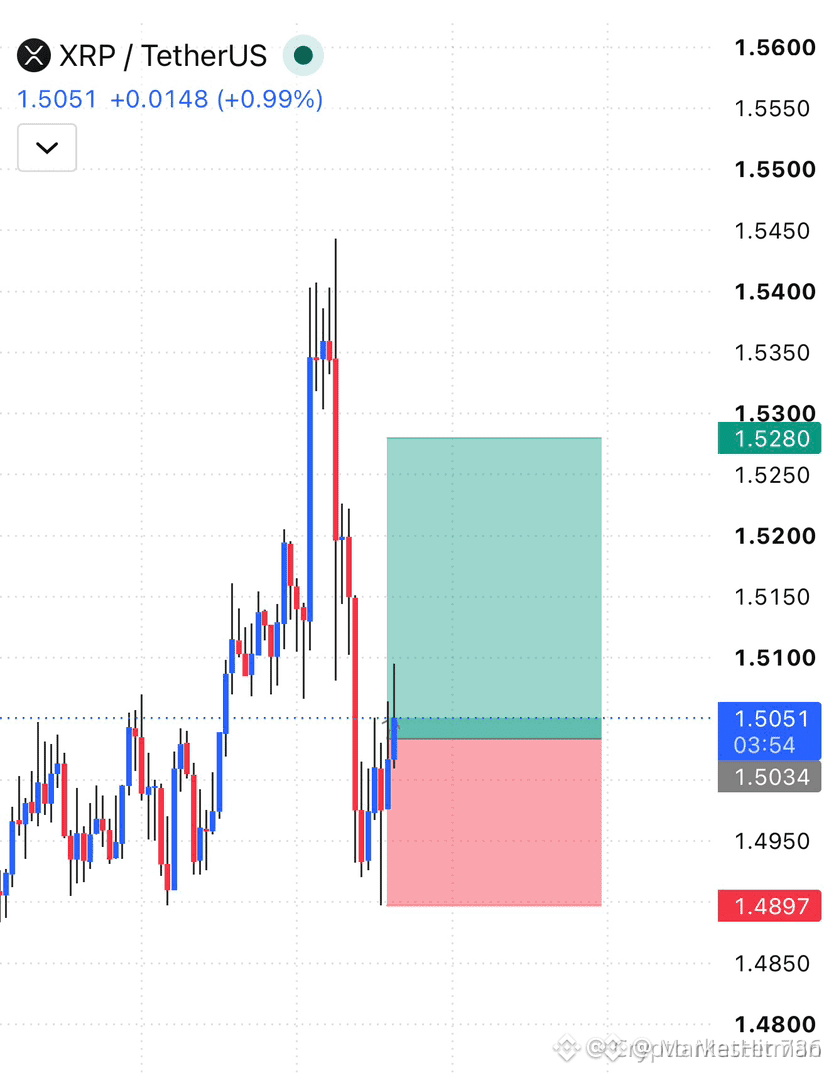
⚡ $XRP RECLAIMS KEY DEMAND ZONE AS BUYERS STEP IN FOR A MOMENTUM RUN! 💥
Entry: 1.5030 - 1.5060 ⚡
Target: 1.5120 - 1.5280 🚀
Stop Loss: 1.4897 ⚠️
After a swift market flush, $XRP is mounting a decisive recovery and stepping right back over key intraday support. 📌 Sellers failed to generate follow-through below the swing lows, opening up a sharp long window toward upper liquidity targets. 📊
Order flow indicates strong absorption at these levels as buyers defend the flip zone with renewed vigor. 🌊 With downside pressure exhausted, the momentum favors a clean push higher. 💡 Are you riding this recovery flip or waiting for a clean breakout confirmation above resistance? 👇
⚠️ Not financial advice. Always manage your risk. 🛡️
🏷️ #XRP #LongSetup #Crypto #Breakout #Trading
🔥 💎
⚡ $XRP RECLAIMS KEY DEMAND ZONE AS BUYERS STEP IN FOR A MOMENTUM RUN! 💥
Entry: 1.5030 - 1.5060 ⚡
Target: 1.5120 - 1.5280 🚀
Stop Loss: 1.4897 ⚠️
After a swift market flush, $XRP is mounting a decisive recovery and stepping right back over key intraday support. 📌 Sellers failed to generate follow-through below the swing lows, opening up a sharp long window toward upper liquidity targets. 📊
Order flow indicates strong absorption at these levels as buyers defend the flip zone with renewed vigor. 🌊 With downside pressure exhausted, the momentum favors a clean push higher. 💡 Are you riding this recovery flip or waiting for a clean breakout confirmation above resistance? 👇
⚠️ Not financial advice. Always manage your risk. 🛡️
🏷️ #XRP #LongSetup #Crypto #Breakout #Trading
🔥 💎
Entry: 1.5030 - 1.5060 ⚡
Target: 1.5120 - 1.5280 🚀
Stop Loss: 1.4897 ⚠️
After a swift market flush, $XRP is mounting a decisive recovery and stepping right back over key intraday support. 📌 Sellers failed to generate follow-through below the swing lows, opening up a sharp long window toward upper liquidity targets. 📊
Order flow indicates strong absorption at these levels as buyers defend the flip zone with renewed vigor. 🌊 With downside pressure exhausted, the momentum favors a clean push higher. 💡 Are you riding this recovery flip or waiting for a clean breakout confirmation above resistance? 👇
⚠️ Not financial advice. Always manage your risk. 🛡️
🏷️ #XRP #LongSetup #Crypto #Breakout #Trading
🔥 💎
16

·
--
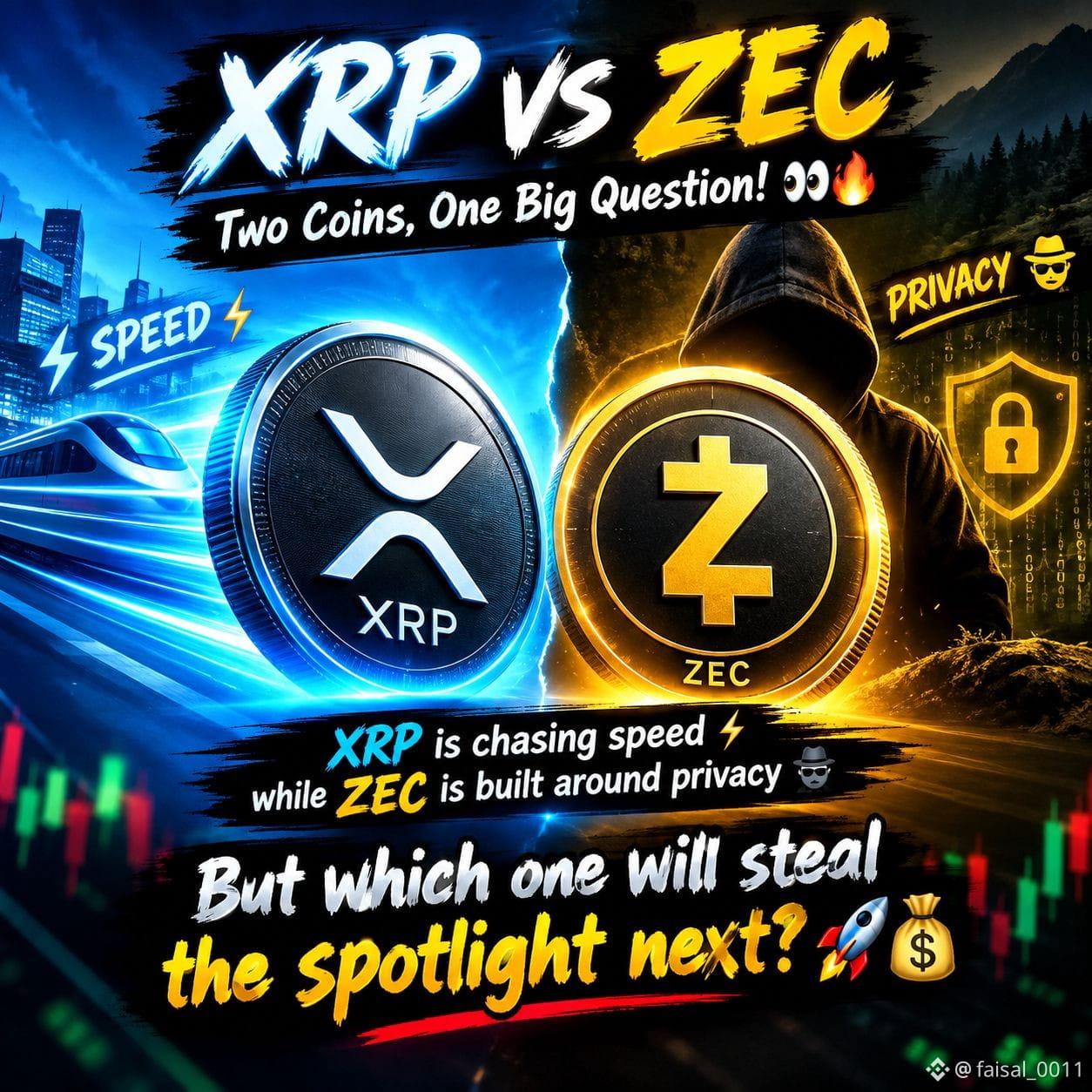
🚨 XRP vs ZEC — Two Coins, One Big Question! 👀🔥
$XRP is chasing speed ⚡ while $ZEC is built around privacy 🕵️♂️
But which one will steal the spotlight next? 🚀💰
#xrp #zec #crypto #BinanceSquare #Altcoins
{future}(XRPUSDT)
{future}(ZECUSDT)
🚨 XRP vs ZEC — Two Coins, One Big Question! 👀🔥
$XRP is chasing speed ⚡ while $ZEC is built around privacy 🕵️♂️
But which one will steal the spotlight next? 🚀💰
#xrp #zec #crypto #BinanceSquare #Altcoins
$XRP is chasing speed ⚡ while $ZEC is built around privacy 🕵️♂️
But which one will steal the spotlight next? 🚀💰
#xrp #zec #crypto #BinanceSquare #Altcoins
227
·
--
Bullish
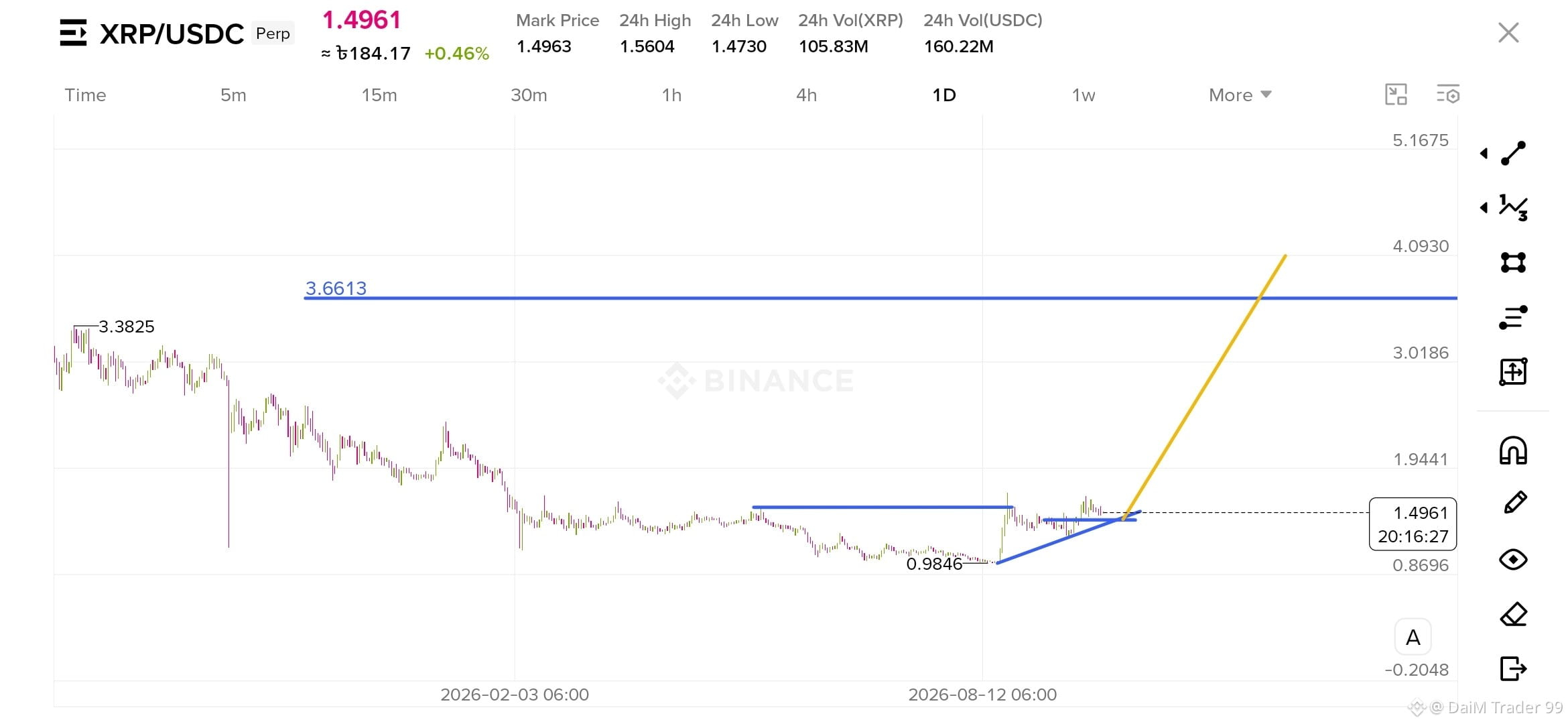
💎 XRP → $4?
Maybe $4 feels like a distant dream today.
But every big dream starts with a small step. 🌱
I don’t know when XRP will reach $4—
maybe it will take time, and maybe the journey won’t be easy.
But I believe that
Patience + Time + Conviction can change the story. ⏳
Today’s small investment
could become a big memory someday. ❤️
XRP — Let’s see what the future brings. 🚀
#XRP #Ripple #CryptoPatience #Patience #Binance
$XRP
{spot}(XRPUSDT)
💎 XRP → $4?
Maybe $4 feels like a distant dream today.
But every big dream starts with a small step. 🌱
I don’t know when XRP will reach $4—
maybe it will take time, and maybe the journey won’t be easy.
But I believe that
Patience + Time + Conviction can change the story. ⏳
Today’s small investment
could become a big memory someday. ❤️
XRP — Let’s see what the future brings. 🚀
#XRP #Ripple #CryptoPatience #Patience #Binance
$XRP
Maybe $4 feels like a distant dream today.
But every big dream starts with a small step. 🌱
I don’t know when XRP will reach $4—
maybe it will take time, and maybe the journey won’t be easy.
But I believe that
Patience + Time + Conviction can change the story. ⏳
Today’s small investment
could become a big memory someday. ❤️
XRP — Let’s see what the future brings. 🚀
#XRP #Ripple #CryptoPatience #Patience #Binance
$XRP
1
241

·
--
🚨 XRP HOLDING MA(25) SUPPORT! ARE YOU BUYING THIS DIP OR WAITING FOR $1.60 BREAKOUT? 🚀
XRP is currently retesting the $1.51 level after hitting a 24h high of $1.56! Looking at the daily chart, price action is holding strongly above key moving averages while RSI sits at a healthy 56.9—giving bulls plenty of room for another leg up! 📈
🔥 Why Traders Are Watching XRP Right Now:
• Dynamic Support: Strong bounce potential off MA(25) at $1.43 - $1.47 zone!
• RSI Strength: 56.98 level signals steady accumulation without being overbought yet!
• Breakout Target: A daily candle close above $1.56 can trigger a swift rally toward $1.70+!
💡 Trade Setup & Strategy:
Dips near $1.47 - $1.50 are acting as strong buy-the-dip liquidity zones! Always set your Stop Loss below $1.42 for safety.
👇 Will XRP hit $1.80 before this week ends? Share your targets in the comments!
#XRP #CryptoAnalysis #Ripple $XRP
{spot}(XRPUSDT)
🚨 XRP HOLDING MA(25) SUPPORT! ARE YOU BUYING THIS DIP OR WAITING FOR $1.60 BREAKOUT? 🚀
XRP is currently retesting the $1.51 level after hitting a 24h high of $1.56! Looking at the daily chart, price action is holding strongly above key moving averages while RSI sits at a healthy 56.9—giving bulls plenty of room for another leg up! 📈
🔥 Why Traders Are Watching XRP Right Now:
• Dynamic Support: Strong bounce potential off MA(25) at $1.43 - $1.47 zone!
• RSI Strength: 56.98 level signals steady accumulation without being overbought yet!
• Breakout Target: A daily candle close above $1.56 can trigger a swift rally toward $1.70+!
💡 Trade Setup & Strategy:
Dips near $1.47 - $1.50 are acting as strong buy-the-dip liquidity zones! Always set your Stop Loss below $1.42 for safety.
👇 Will XRP hit $1.80 before this week ends? Share your targets in the comments!
#XRP #CryptoAnalysis #Ripple $XRP
XRP is currently retesting the $1.51 level after hitting a 24h high of $1.56! Looking at the daily chart, price action is holding strongly above key moving averages while RSI sits at a healthy 56.9—giving bulls plenty of room for another leg up! 📈
🔥 Why Traders Are Watching XRP Right Now:
• Dynamic Support: Strong bounce potential off MA(25) at $1.43 - $1.47 zone!
• RSI Strength: 56.98 level signals steady accumulation without being overbought yet!
• Breakout Target: A daily candle close above $1.56 can trigger a swift rally toward $1.70+!
💡 Trade Setup & Strategy:
Dips near $1.47 - $1.50 are acting as strong buy-the-dip liquidity zones! Always set your Stop Loss below $1.42 for safety.
👇 Will XRP hit $1.80 before this week ends? Share your targets in the comments!
#XRP #CryptoAnalysis #Ripple $XRP
157

·
--
Bullish
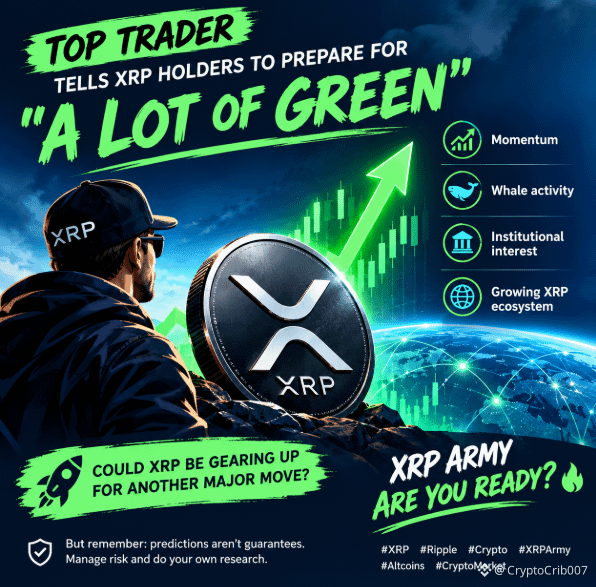
🚀 XRP: “A Lot of Green” Ahead?
A top trader is telling XRP holders to prepare for “a lot of green.” 🟢
Could $XRP be gearing up for another major move? 👀
📈 Momentum
🐋 Whale activity
💰 Institutional interest
🌐 Growing XRP ecosystem
But remember: predictions aren’t guarantees. Manage risk and do your own research.
$XRP Army — are you ready? 🔥
$XRP
{spot}(XRPUSDT)
#xrp #Ripple #Write2Earn #DYOR🟢 and #NFA✅
🚀 XRP: “A Lot of Green” Ahead?
A top trader is telling XRP holders to prepare for “a lot of green.” 🟢
Could $XRP be gearing up for another major move? 👀
📈 Momentum
🐋 Whale activity
💰 Institutional interest
🌐 Growing XRP ecosystem
But remember: predictions aren’t guarantees. Manage risk and do your own research.
$XRP Army — are you ready? 🔥
$XRP
#xrp #Ripple #Write2Earn #DYOR🟢 and #NFA✅
A top trader is telling XRP holders to prepare for “a lot of green.” 🟢
Could $XRP be gearing up for another major move? 👀
📈 Momentum
🐋 Whale activity
💰 Institutional interest
🌐 Growing XRP ecosystem
But remember: predictions aren’t guarantees. Manage risk and do your own research.
$XRP Army — are you ready? 🔥
$XRP
#xrp #Ripple #Write2Earn #DYOR🟢 and #NFA✅
167


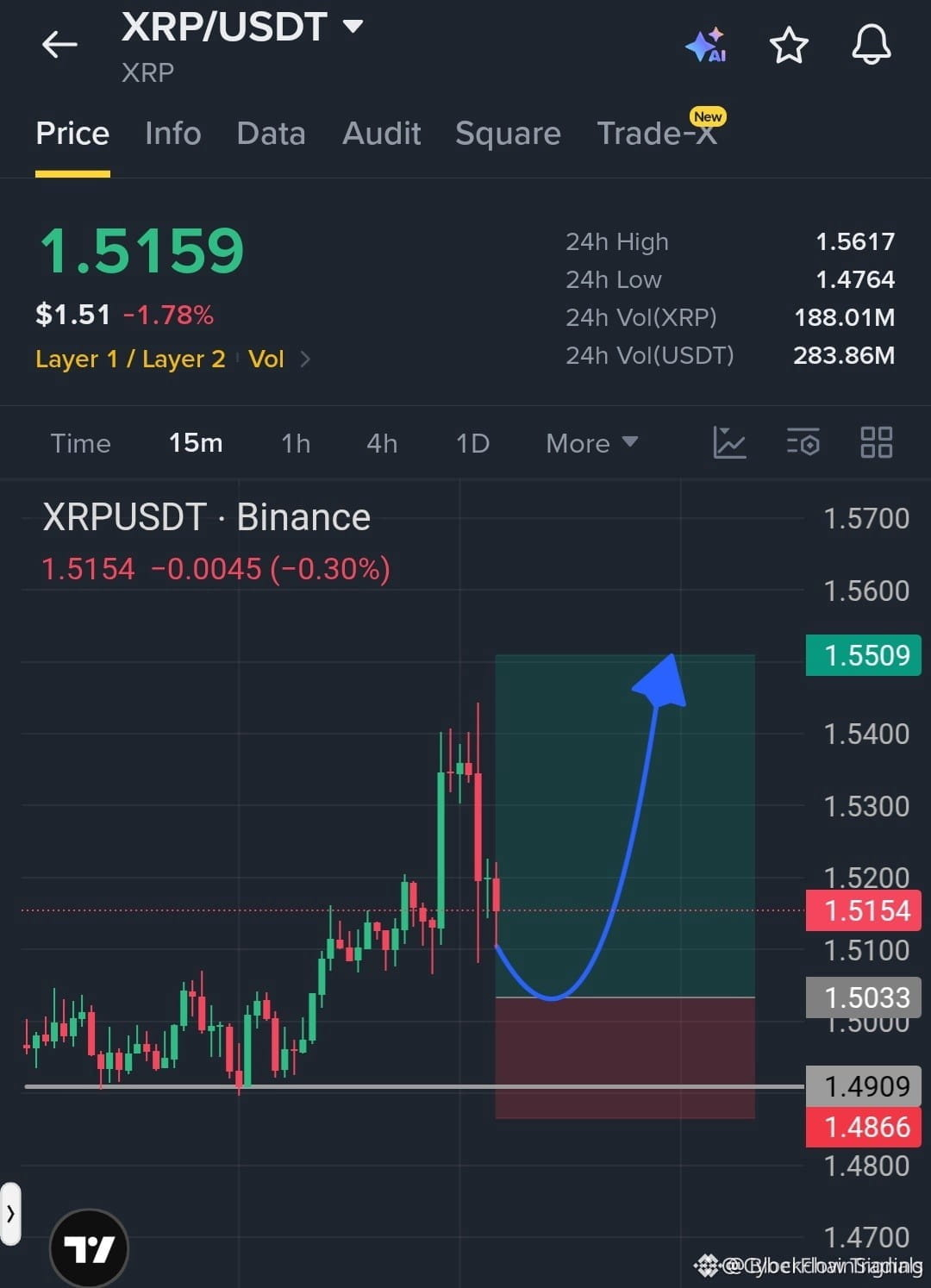
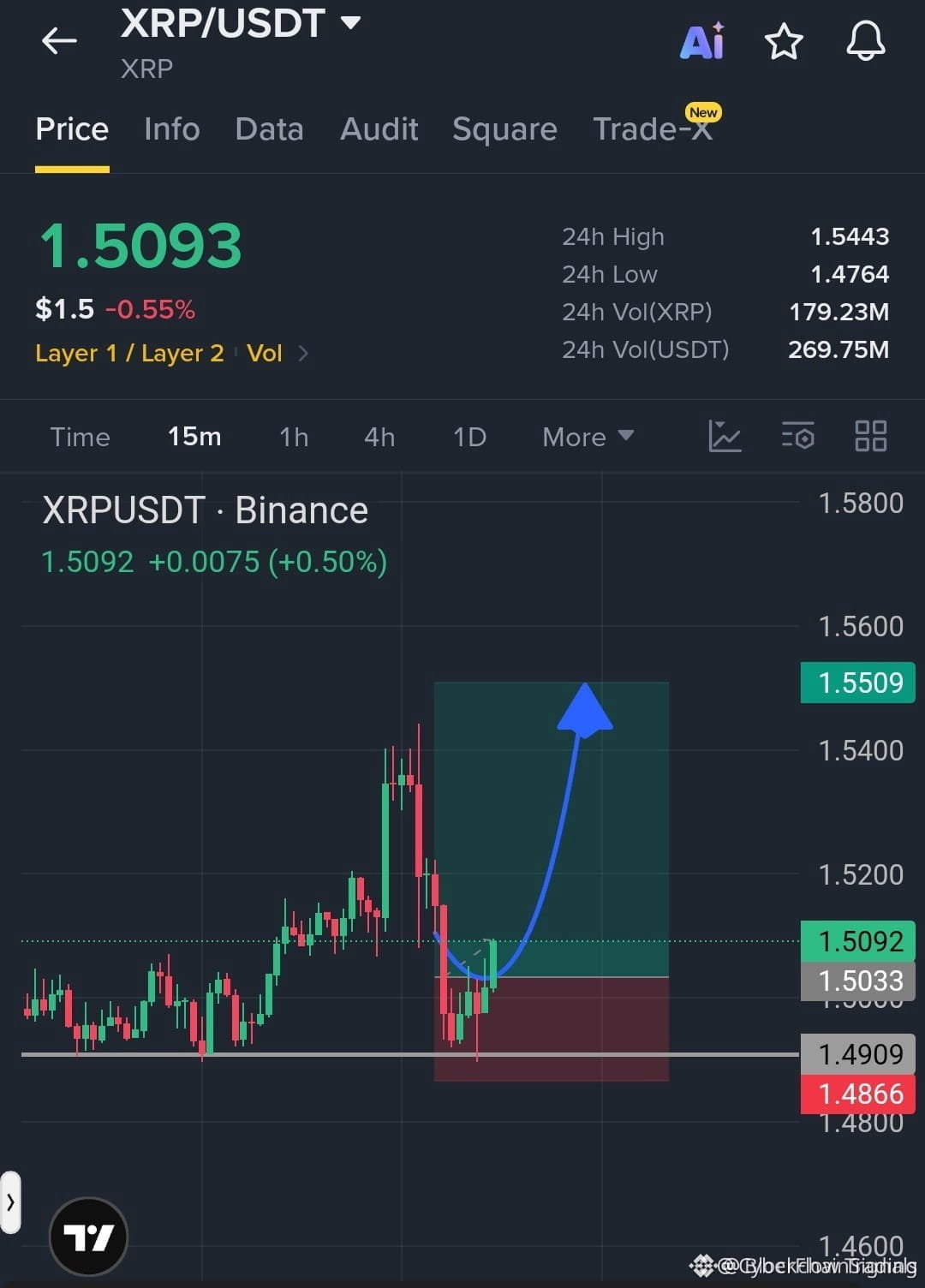
💥 $XRP PREPARES FOR NEXT EXPANSION LEG AS BUYERS DEFEND CRITICAL DEMAND! 🚀
Entry: 1.5033 ⚡
Target: 1.5509 🎯
Price action on $XRP is carving out a clean higher-low structure around 1.5033 as aggressive sellers run out of ammo. 📌 The order flow absorption here suggests smart money is quietly building a launchpad rather than letting price slide back into previous ranges. 📊
With bid side momentum steadily building, a clean push through local resistance clears a smooth runway toward our 1.5509 target. ⚡ Patience remains key while the setup finishes confirming its trajectory. 💬 Are you bidding this retest or waiting for the breakout confirmation? 👇
⚠️ Not financial advice. Always manage your risk. 🛡️
🏷️ #XRP #Bullish #Ripple #Crypto #Breakout
🔥 💎
💥 $XRP PREPARES FOR NEXT EXPANSION LEG AS BUYERS DEFEND CRITICAL DEMAND! 🚀
Entry: 1.5033 ⚡
Target: 1.5509 🎯
Price action on $XRP is carving out a clean higher-low structure around 1.5033 as aggressive sellers run out of ammo. 📌 The order flow absorption here suggests smart money is quietly building a launchpad rather than letting price slide back into previous ranges. 📊
With bid side momentum steadily building, a clean push through local resistance clears a smooth runway toward our 1.5509 target. ⚡ Patience remains key while the setup finishes confirming its trajectory. 💬 Are you bidding this retest or waiting for the breakout confirmation? 👇
⚠️ Not financial advice. Always manage your risk. 🛡️
🏷️ #XRP #Bullish #Ripple #Crypto #Breakout
🔥 💎
Entry: 1.5033 ⚡
Target: 1.5509 🎯
Price action on $XRP is carving out a clean higher-low structure around 1.5033 as aggressive sellers run out of ammo. 📌 The order flow absorption here suggests smart money is quietly building a launchpad rather than letting price slide back into previous ranges. 📊
With bid side momentum steadily building, a clean push through local resistance clears a smooth runway toward our 1.5509 target. ⚡ Patience remains key while the setup finishes confirming its trajectory. 💬 Are you bidding this retest or waiting for the breakout confirmation? 👇
⚠️ Not financial advice. Always manage your risk. 🛡️
🏷️ #XRP #Bullish #Ripple #Crypto #Breakout
🔥 💎
18
·
--
⚡ $XRP AND $SOL ARE COILING FOR A SYNCHRONIZED LIQUIDITY EXPANSION! 💥
Order flow across $XRP and $SOL is showing heavy spot absorption while leverage flushes out weak hands near key compression zones. 📊 Sellers are exhausting their ammunition, setting up a textbook volatility compression flip before the next leg up.
When two major layer-one titans coil simultaneously at key market structures, smart money usually front-runs the breakout. 🌊 Keep your eyes on volume expansion—once these ranges snap open, the upside momentum could escalate quickly. 💬 Which runner are you backing for the bigger percentage move on this upcoming leg? 👇
⚠️ Not financial advice. Always manage your risk. 🛡️
🏷️ #XRP #SOL #Altcoins #Crypto #Breakout
🔥 🚀
⚡ $XRP AND $SOL ARE COILING FOR A SYNCHRONIZED LIQUIDITY EXPANSION! 💥
Order flow across $XRP and $SOL is showing heavy spot absorption while leverage flushes out weak hands near key compression zones. 📊 Sellers are exhausting their ammunition, setting up a textbook volatility compression flip before the next leg up.
When two major layer-one titans coil simultaneously at key market structures, smart money usually front-runs the breakout. 🌊 Keep your eyes on volume expansion—once these ranges snap open, the upside momentum could escalate quickly. 💬 Which runner are you backing for the bigger percentage move on this upcoming leg? 👇
⚠️ Not financial advice. Always manage your risk. 🛡️
🏷️ #XRP #SOL #Altcoins #Crypto #Breakout
🔥 🚀
Order flow across $XRP and $SOL is showing heavy spot absorption while leverage flushes out weak hands near key compression zones. 📊 Sellers are exhausting their ammunition, setting up a textbook volatility compression flip before the next leg up.
When two major layer-one titans coil simultaneously at key market structures, smart money usually front-runs the breakout. 🌊 Keep your eyes on volume expansion—once these ranges snap open, the upside momentum could escalate quickly. 💬 Which runner are you backing for the bigger percentage move on this upcoming leg? 👇
⚠️ Not financial advice. Always manage your risk. 🛡️
🏷️ #XRP #SOL #Altcoins #Crypto #Breakout
🔥 🚀

17
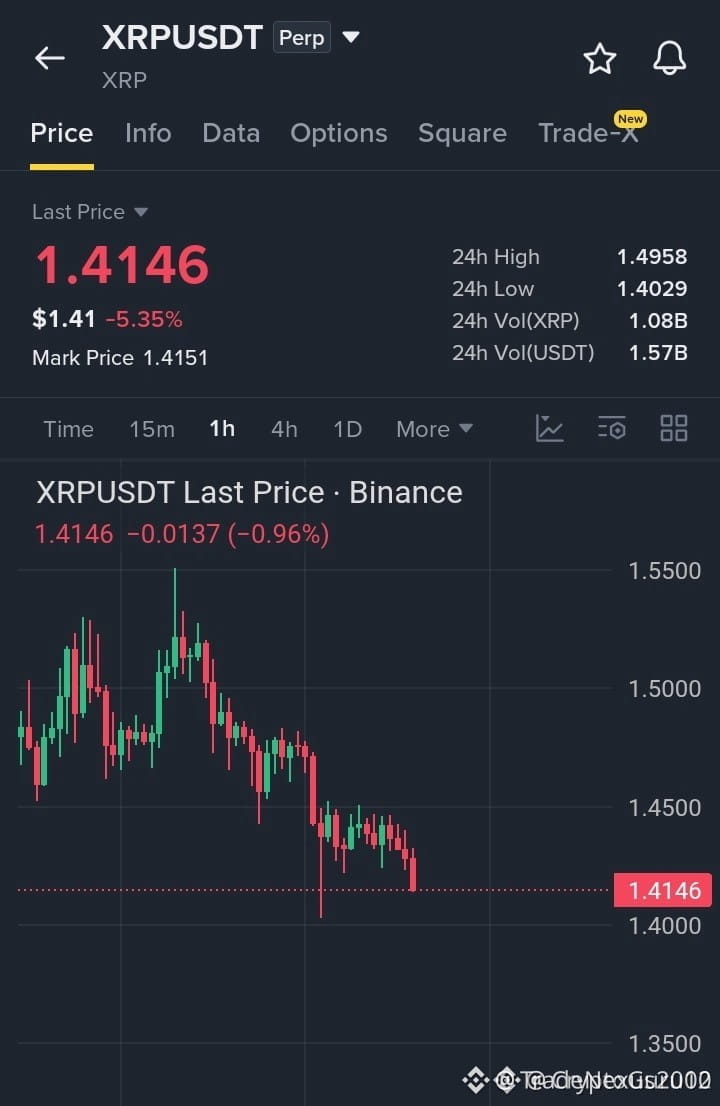
🚨 $XRP TESTING CRITICAL 1.40 DEMAND ZONE FOR POTENTIAL RELIEF RECLAIM! 💥
Entry: 1.405 - 1.425 ⚡
Target: 1.450 - 1.520 🚀
Stop Loss: 1.385 ⚠️
📌 Institutional bids are clustering right around the $1.40 structural shelf following a prolonged hourly drain. While immediate momentum remains muted, smart money is watching this inefficiency for absorption and a high-probability liquidity reaction. 🌊
💡 A decisive reclaim of the $1.45 overhead level would confirm buyers back in control and open expansion pathways toward upper liquidity pools. However, if $1.40 breaks cleanly, discipline requires stepping aside until fresh structure forms. 🔍 Are you front-running this demand bounce or waiting for structural confirmation above 1.45? 👇
⚠️ Not financial advice. Always manage your risk. 🛡️
🏷️ #XRP #Crypto #TradeSetup #Liquidity #TechnicalAnalysis
🦈 ⚡
🚨 $XRP TESTING CRITICAL 1.40 DEMAND ZONE FOR POTENTIAL RELIEF RECLAIM! 💥
Entry: 1.405 - 1.425 ⚡
Target: 1.450 - 1.520 🚀
Stop Loss: 1.385 ⚠️
📌 Institutional bids are clustering right around the $1.40 structural shelf following a prolonged hourly drain. While immediate momentum remains muted, smart money is watching this inefficiency for absorption and a high-probability liquidity reaction. 🌊
💡 A decisive reclaim of the $1.45 overhead level would confirm buyers back in control and open expansion pathways toward upper liquidity pools. However, if $1.40 breaks cleanly, discipline requires stepping aside until fresh structure forms. 🔍 Are you front-running this demand bounce or waiting for structural confirmation above 1.45? 👇
⚠️ Not financial advice. Always manage your risk. 🛡️
🏷️ #XRP #Crypto #TradeSetup #Liquidity #TechnicalAnalysis
🦈 ⚡
Entry: 1.405 - 1.425 ⚡
Target: 1.450 - 1.520 🚀
Stop Loss: 1.385 ⚠️
📌 Institutional bids are clustering right around the $1.40 structural shelf following a prolonged hourly drain. While immediate momentum remains muted, smart money is watching this inefficiency for absorption and a high-probability liquidity reaction. 🌊
💡 A decisive reclaim of the $1.45 overhead level would confirm buyers back in control and open expansion pathways toward upper liquidity pools. However, if $1.40 breaks cleanly, discipline requires stepping aside until fresh structure forms. 🔍 Are you front-running this demand bounce or waiting for structural confirmation above 1.45? 👇
⚠️ Not financial advice. Always manage your risk. 🛡️
🏷️ #XRP #Crypto #TradeSetup #Liquidity #TechnicalAnalysis
🦈 ⚡
15

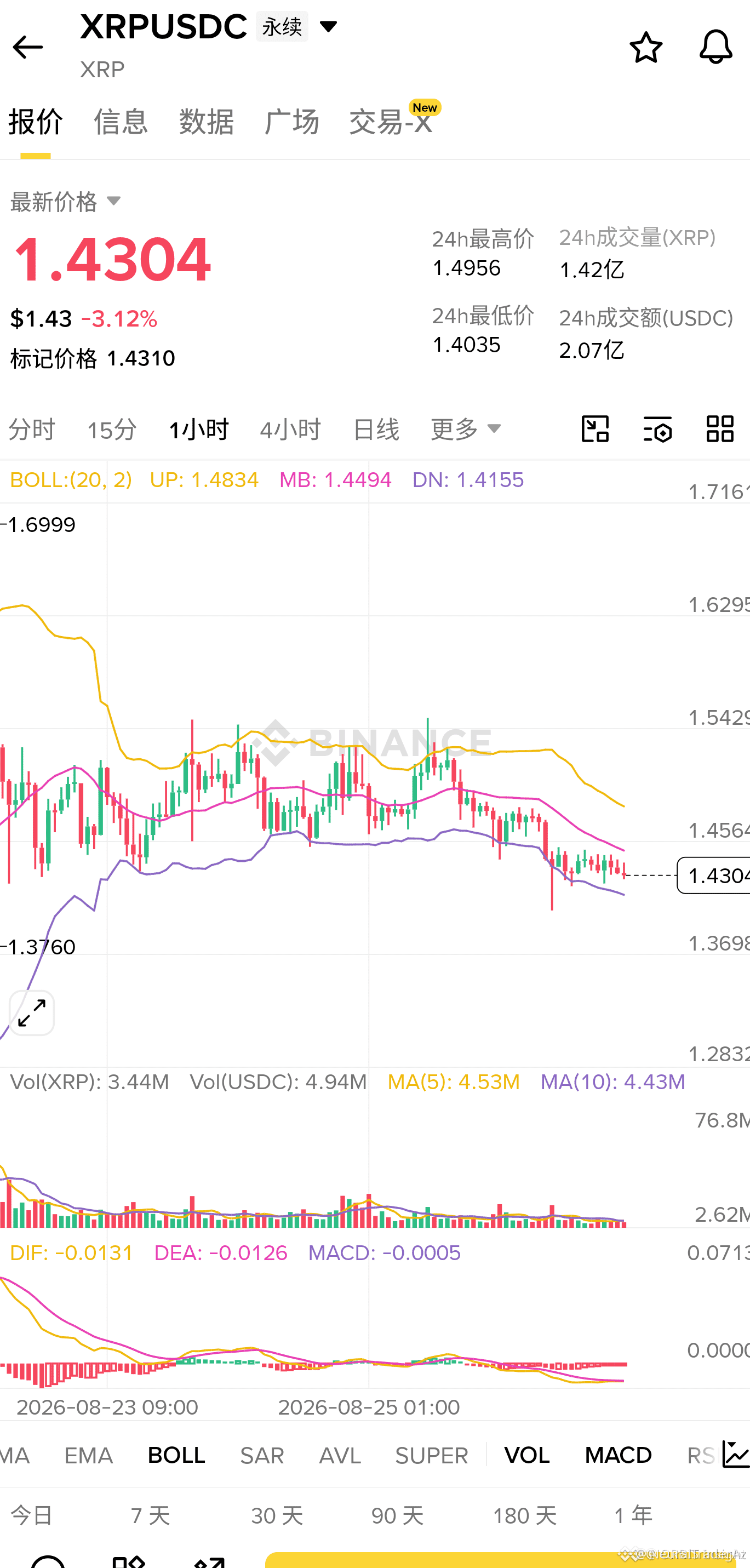
🚨 $XRP STRUCTURE COLLAPSES AS HEAVY INSTITUTIONAL DISTRIBUTION FUELS DOWNSIDE EXPANSION 📉
Entry: 1.4304 ⚡
Target: 1.4000 🎯
Stop Loss: 1.4550 ⚠️
Market structure on $XRP has fractured following a clean breakdown below key dynamic moving averages. 📊 Smart money distribution is evident as momentum indicators confirm a high-confluence bearish MACD cross, pointing to accelerating downside pressure toward lower efficiency voids.
Any temporary pullbacks into the overhead supply zone represent liquidity grabs for institutional short positioning rather than structural strength. 🔍 As lower timeframes print lower lows, sellers remain in complete control of local order flow. 💬 Are you shorting this structural breakdown or waiting for a deeper sweep of liquidations below support? 👇
⚠️ Not financial advice. Always manage your risk. 🛡️
🏷️ #XRP #ShortSetup #MarketStructure #Crypto
📉 🐻
🚨 $XRP STRUCTURE COLLAPSES AS HEAVY INSTITUTIONAL DISTRIBUTION FUELS DOWNSIDE EXPANSION 📉
Entry: 1.4304 ⚡
Target: 1.4000 🎯
Stop Loss: 1.4550 ⚠️
Market structure on $XRP has fractured following a clean breakdown below key dynamic moving averages. 📊 Smart money distribution is evident as momentum indicators confirm a high-confluence bearish MACD cross, pointing to accelerating downside pressure toward lower efficiency voids.
Any temporary pullbacks into the overhead supply zone represent liquidity grabs for institutional short positioning rather than structural strength. 🔍 As lower timeframes print lower lows, sellers remain in complete control of local order flow. 💬 Are you shorting this structural breakdown or waiting for a deeper sweep of liquidations below support? 👇
⚠️ Not financial advice. Always manage your risk. 🛡️
🏷️ #XRP #ShortSetup #MarketStructure #Crypto
📉 🐻
Entry: 1.4304 ⚡
Target: 1.4000 🎯
Stop Loss: 1.4550 ⚠️
Market structure on $XRP has fractured following a clean breakdown below key dynamic moving averages. 📊 Smart money distribution is evident as momentum indicators confirm a high-confluence bearish MACD cross, pointing to accelerating downside pressure toward lower efficiency voids.
Any temporary pullbacks into the overhead supply zone represent liquidity grabs for institutional short positioning rather than structural strength. 🔍 As lower timeframes print lower lows, sellers remain in complete control of local order flow. 💬 Are you shorting this structural breakdown or waiting for a deeper sweep of liquidations below support? 👇
⚠️ Not financial advice. Always manage your risk. 🛡️
🏷️ #XRP #ShortSetup #MarketStructure #Crypto
📉 🐻
20
Log in to explore more content
Join global crypto users on Binance Square
⚡️ Get latest and useful information about crypto.
💬 Trusted by the world’s largest crypto exchange.
👍 Discover real insights from verified creators.
Email / Phone number
Trending Topics
1
#BitcoinClears$85200
11,290 views
207 Discussing
2
#AltcoinSeasonIndexHoldsAbove60For5Days
56,523 views
1,149 Discussing
3
#USADPAdds90000JobsInSeptember
26,649 views
646 Discussing
4
#USCorePCEEasesTo3%InAugust
19,541 views
492 Discussing
5
#KospiPostsWorstQuarterSince2020
13,694 views
480 Discussing
6
#SECToClarifyOnChainFundraisingRules
32,923 views
654 Discussing
7
#UKFCAOpensCryptoFirmAuthorization
32,281 views
546 Discussing
8
#JapanMOFStudyGroupOnTokenizedGovtBonds
20,870 views
418 Discussing
9
#QNTRises287%
95,856 views
907 Discussing
10
#TrumpRejectsAIRulesForVoluntaryAudits
56,020 views
791 Discussing