

TIS_Square
5.2k Posts

TIS_Square
Report
Block User
Official Crypto Market Updates | Trading Knowledge & Psychology | In depth Analysis. Follow TIS_SQUARE to stay ahead of the market and never miss an opportunity
23 Following
2.7K+ Followers
8.5K+ Liked
Posts
All
Quotes
Live
PINNED
·
--
Have you known how to receive "Lifetime Refund" of up to 20-30% yet? Don't let your money slip away!
The transaction fees may seem small at first glance, but when summed up each month, it amounts to a huge sum. Instead of losing it all to the exchange, Trading Insight has worked to help you recover some of this money. "Many ants make a mound", optimizing the costs is already half the victory.
Below is a detailed guide for you to receive lifetime refunds:
🔶 Receive 20% Refund on Futures & SPOT Transaction Fees
This is the best offer that the team can support you with.
Method 1, click directly on this "sacred" link to connect: [https://www.binance.com/join?ref=HOANPHITIS](https://www.binance.com/join?ref=HOANPHITIS)
Method 2, go to the Referral section and enter the Code: HOANPHITIS
Small tip: If the old account cannot be linked, you can create a new account using the KYC of a relative to enjoy the offer. The fees are no joke!
🔷 Receive 30% Automatic Refund at Web3/Wallet
Don't overlook the Web3 aspect, the fees here can also be quite steep if not optimized.
Method 1, Click this link to link your wallet immediately: [https://web3.binance.com/referral?ref=BSQ3495A](https://web3.binance.com/referral?ref=BSQ3495A)
Method 2, Access Web3 👉 Select the "Referral" section 👉 Enter the code: BSQ3495A and you're done.
Note, Any old or new account can link to this Web3 code.
🔶 Important note for the old team:
All accounts that have been referred under Trading Insight until now have already been auto-refunded 20% of both Futures and Spot fees. You can trade with peace of mind.
Don't overlook this fee amount, TIS_Square is always there to help you optimize every penny!
Have you known how to receive "Lifetime Refund" of up to 20-30% yet? Don't let your money slip away!
The transaction fees may seem small at first glance, but when summed up each month, it amounts to a huge sum. Instead of losing it all to the exchange, Trading Insight has worked to help you recover some of this money. "Many ants make a mound", optimizing the costs is already half the victory.
Below is a detailed guide for you to receive lifetime refunds:
🔶 Receive 20% Refund on Futures & SPOT Transaction Fees
This is the best offer that the team can support you with.
Method 1, click directly on this "sacred" link to connect: https://www.binance.com/join?ref=HOANPHITIS
Method 2, go to the Referral section and enter the Code: HOANPHITIS
Small tip: If the old account cannot be linked, you can create a new account using the KYC of a relative to enjoy the offer. The fees are no joke!
🔷 Receive 30% Automatic Refund at Web3/Wallet
Don't overlook the Web3 aspect, the fees here can also be quite steep if not optimized.
Method 1, Click this link to link your wallet immediately: https://web3.binance.com/referral?ref=BSQ3495A
Method 2, Access Web3 👉 Select the "Referral" section 👉 Enter the code: BSQ3495A and you're done.
Note, Any old or new account can link to this Web3 code.
🔶 Important note for the old team:
All accounts that have been referred under Trading Insight until now have already been auto-refunded 20% of both Futures and Spot fees. You can trade with peace of mind.
Don't overlook this fee amount, TIS_Square is always there to help you optimize every penny!
The transaction fees may seem small at first glance, but when summed up each month, it amounts to a huge sum. Instead of losing it all to the exchange, Trading Insight has worked to help you recover some of this money. "Many ants make a mound", optimizing the costs is already half the victory.
Below is a detailed guide for you to receive lifetime refunds:
🔶 Receive 20% Refund on Futures & SPOT Transaction Fees
This is the best offer that the team can support you with.
Method 1, click directly on this "sacred" link to connect: https://www.binance.com/join?ref=HOANPHITIS
Method 2, go to the Referral section and enter the Code: HOANPHITIS
Small tip: If the old account cannot be linked, you can create a new account using the KYC of a relative to enjoy the offer. The fees are no joke!
🔷 Receive 30% Automatic Refund at Web3/Wallet
Don't overlook the Web3 aspect, the fees here can also be quite steep if not optimized.
Method 1, Click this link to link your wallet immediately: https://web3.binance.com/referral?ref=BSQ3495A
Method 2, Access Web3 👉 Select the "Referral" section 👉 Enter the code: BSQ3495A and you're done.
Note, Any old or new account can link to this Web3 code.
🔶 Important note for the old team:
All accounts that have been referred under Trading Insight until now have already been auto-refunded 20% of both Futures and Spot fees. You can trade with peace of mind.
Don't overlook this fee amount, TIS_Square is always there to help you optimize every penny!

10
5
12
8.6k
·
--
Quiet Accumulation Beneath the Correction
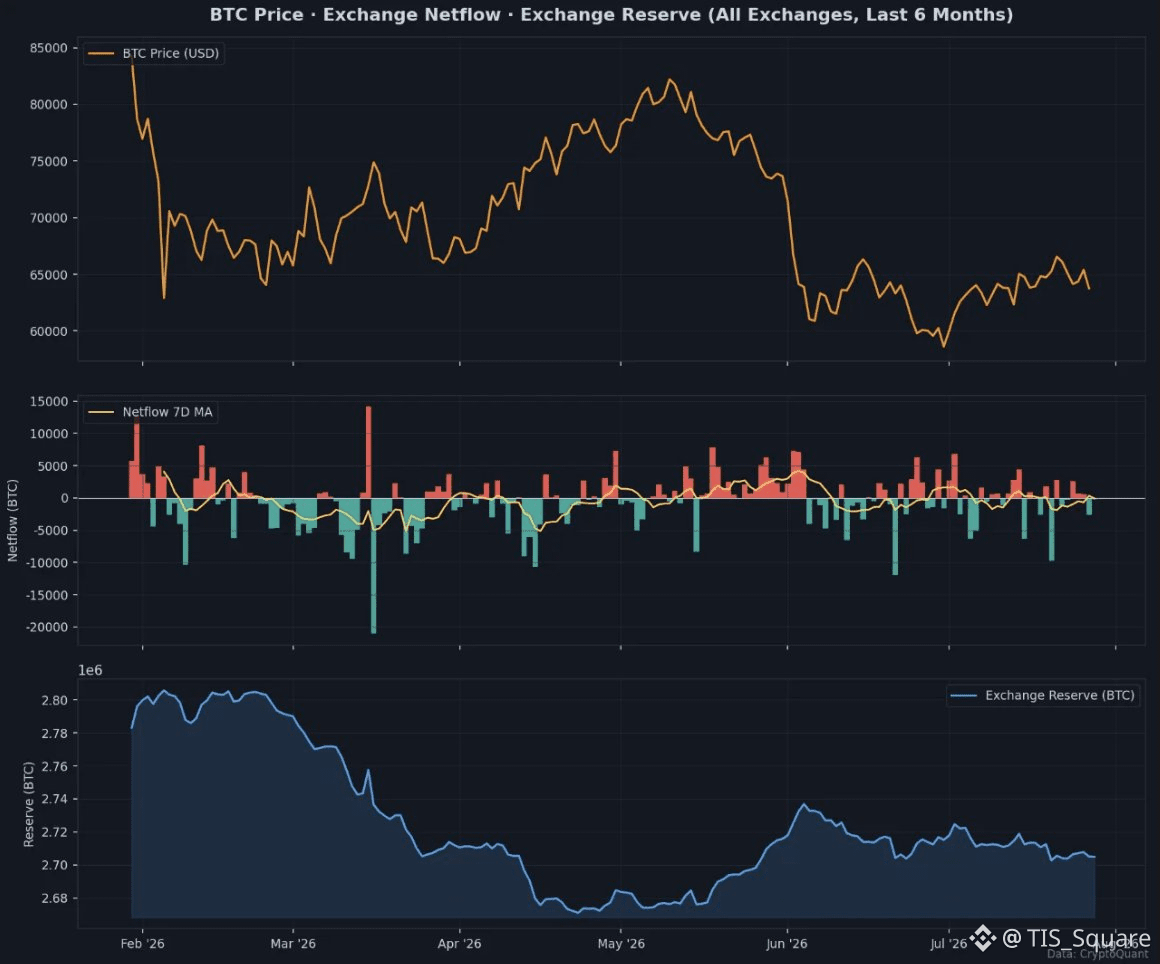
While Bitcoin has experienced a notable correction over the past several months, on-chain data suggests that investor behavior tells a different story from previous bear market sell-offs.
Instead of rushing to sell into exchanges, market participants have continued to withdraw $BTC into self-custody, signaling a preference for long-term holding rather than distribution.
{future}(BTCUSDT)
📊 Exchange Reserves Continue to Decline
- One of the clearest trends is the steady decline in exchange reserves, which have fallen from roughly 2.80 million BTC to around 2.70 million BTC over the past six months.
- A shrinking exchange balance generally indicates that investors are moving coins into private wallets, reducing the amount of Bitcoin readily available for sale.
📉 Corrections Without Heavy Distribution
- During a typical capitulation event, exchange inflows usually surge as investors transfer BTC to exchanges to liquidate their holdings.
This correction has looked different.
- Although exchange netflows have fluctuated between inflows and outflows, large and persistent selling pressure has not emerged. Instead, withdrawals have remained a recurring pattern, suggesting that many investors view the current weakness as an opportunity to hold rather than exit.
🔍 Long-Term Conviction Remains Intact
- The combination of declining exchange reserves and continued self-custody withdrawals points to underlying confidence among long-term holders.
- Rather than signaling widespread panic, the current correction appears to reflect a period of quiet accumulation, where investors continue reducing liquid supply despite short-term price volatility.
📈 Outlook
- The latest on-chain data suggests that this correction has been driven more by temporary market weakness than by aggressive distribution.
- As long as exchange reserves continue to trend lower and large-scale exchange inflows fail to materialize, the broader market structure remains supportive of long-term accumulation rather than capitulation.
Quiet Accumulation Beneath the Correction
While Bitcoin has experienced a notable correction over the past several months, on-chain data suggests that investor behavior tells a different story from previous bear market sell-offs.
Instead of rushing to sell into exchanges, market participants have continued to withdraw $BTC into self-custody, signaling a preference for long-term holding rather than distribution.
📊 Exchange Reserves Continue to Decline
- One of the clearest trends is the steady decline in exchange reserves, which have fallen from roughly 2.80 million BTC to around 2.70 million BTC over the past six months.
- A shrinking exchange balance generally indicates that investors are moving coins into private wallets, reducing the amount of Bitcoin readily available for sale.
📉 Corrections Without Heavy Distribution
- During a typical capitulation event, exchange inflows usually surge as investors transfer BTC to exchanges to liquidate their holdings.
This correction has looked different.
- Although exchange netflows have fluctuated between inflows and outflows, large and persistent selling pressure has not emerged. Instead, withdrawals have remained a recurring pattern, suggesting that many investors view the current weakness as an opportunity to hold rather than exit.
🔍 Long-Term Conviction Remains Intact
- The combination of declining exchange reserves and continued self-custody withdrawals points to underlying confidence among long-term holders.
- Rather than signaling widespread panic, the current correction appears to reflect a period of quiet accumulation, where investors continue reducing liquid supply despite short-term price volatility.
📈 Outlook
- The latest on-chain data suggests that this correction has been driven more by temporary market weakness than by aggressive distribution.
- As long as exchange reserves continue to trend lower and large-scale exchange inflows fail to materialize, the broader market structure remains supportive of long-term accumulation rather than capitulation.
While Bitcoin has experienced a notable correction over the past several months, on-chain data suggests that investor behavior tells a different story from previous bear market sell-offs.
Instead of rushing to sell into exchanges, market participants have continued to withdraw $BTC into self-custody, signaling a preference for long-term holding rather than distribution.
📊 Exchange Reserves Continue to Decline
- One of the clearest trends is the steady decline in exchange reserves, which have fallen from roughly 2.80 million BTC to around 2.70 million BTC over the past six months.
- A shrinking exchange balance generally indicates that investors are moving coins into private wallets, reducing the amount of Bitcoin readily available for sale.
📉 Corrections Without Heavy Distribution
- During a typical capitulation event, exchange inflows usually surge as investors transfer BTC to exchanges to liquidate their holdings.
This correction has looked different.
- Although exchange netflows have fluctuated between inflows and outflows, large and persistent selling pressure has not emerged. Instead, withdrawals have remained a recurring pattern, suggesting that many investors view the current weakness as an opportunity to hold rather than exit.
🔍 Long-Term Conviction Remains Intact
- The combination of declining exchange reserves and continued self-custody withdrawals points to underlying confidence among long-term holders.
- Rather than signaling widespread panic, the current correction appears to reflect a period of quiet accumulation, where investors continue reducing liquid supply despite short-term price volatility.
📈 Outlook
- The latest on-chain data suggests that this correction has been driven more by temporary market weakness than by aggressive distribution.
- As long as exchange reserves continue to trend lower and large-scale exchange inflows fail to materialize, the broader market structure remains supportive of long-term accumulation rather than capitulation.
1
2
440
·
--
RWA Leads July Performance Across Crypto Narratives
The Real-World Assets (RWA) sector has emerged as the strongest-performing crypto narrative in July, reinforcing investor confidence in the tokenization of traditional financial assets.
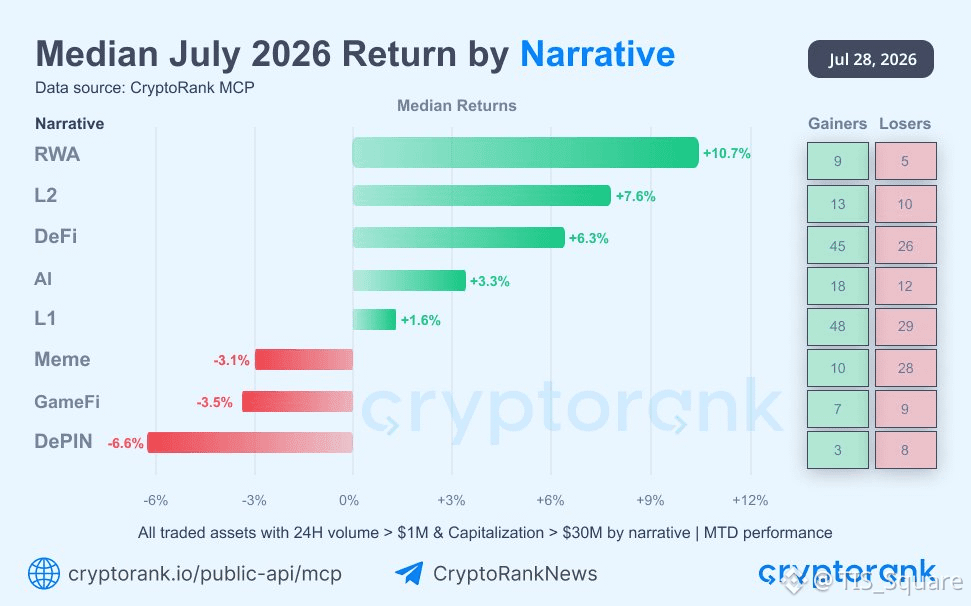
With a median return of 10.7%, RWA outperformed every other major narrative, including Layer 2 (+7.6%), DeFi (+6.3%), AI (+3.3%), and Layer 1 (+1.6%). In contrast, Meme (-3.1%), GameFi (-3.5%), and DePIN (-6.6%) ended the month in negative territory.
📈 RWA Continues to Gain Momentum
- The strong price performance has been accompanied by rapid growth in the sector's market value. On July 24, the total on-chain RWA market capitalization reached $32.2 billion, representing a 12.3% increase since the beginning of July and surpassing its previous all-time high recorded in April.
- This combination of price appreciation and expanding market capitalization suggests that capital continues to flow into the RWA ecosystem rather than being driven solely by short-term speculation.
📊 Capital Rotation Favors Utility Narratives
- The performance across narratives indicates that investors are rotating capital toward sectors with stronger real-world use cases.
- While Layer 2 and DeFi also posted solid gains, speculative sectors such as Meme and GameFi underperformed, highlighting a preference for projects with sustainable adoption and tangible economic value.
🔍 Outlook
- RWA's leadership throughout July reinforces the view that tokenization remains one of the dominant themes of the current crypto market cycle.
- As institutional participation in tokenized assets continues to expand, the sector could remain a focal point for investors if adoption and on-chain capital growth continue in the months ahead.
RWA Leads July Performance Across Crypto Narratives
The Real-World Assets (RWA) sector has emerged as the strongest-performing crypto narrative in July, reinforcing investor confidence in the tokenization of traditional financial assets.
With a median return of 10.7%, RWA outperformed every other major narrative, including Layer 2 (+7.6%), DeFi (+6.3%), AI (+3.3%), and Layer 1 (+1.6%). In contrast, Meme (-3.1%), GameFi (-3.5%), and DePIN (-6.6%) ended the month in negative territory.
📈 RWA Continues to Gain Momentum
- The strong price performance has been accompanied by rapid growth in the sector's market value. On July 24, the total on-chain RWA market capitalization reached $32.2 billion, representing a 12.3% increase since the beginning of July and surpassing its previous all-time high recorded in April.
- This combination of price appreciation and expanding market capitalization suggests that capital continues to flow into the RWA ecosystem rather than being driven solely by short-term speculation.
📊 Capital Rotation Favors Utility Narratives
- The performance across narratives indicates that investors are rotating capital toward sectors with stronger real-world use cases.
- While Layer 2 and DeFi also posted solid gains, speculative sectors such as Meme and GameFi underperformed, highlighting a preference for projects with sustainable adoption and tangible economic value.
🔍 Outlook
- RWA's leadership throughout July reinforces the view that tokenization remains one of the dominant themes of the current crypto market cycle.
- As institutional participation in tokenized assets continues to expand, the sector could remain a focal point for investors if adoption and on-chain capital growth continue in the months ahead.
The Real-World Assets (RWA) sector has emerged as the strongest-performing crypto narrative in July, reinforcing investor confidence in the tokenization of traditional financial assets.
With a median return of 10.7%, RWA outperformed every other major narrative, including Layer 2 (+7.6%), DeFi (+6.3%), AI (+3.3%), and Layer 1 (+1.6%). In contrast, Meme (-3.1%), GameFi (-3.5%), and DePIN (-6.6%) ended the month in negative territory.
📈 RWA Continues to Gain Momentum
- The strong price performance has been accompanied by rapid growth in the sector's market value. On July 24, the total on-chain RWA market capitalization reached $32.2 billion, representing a 12.3% increase since the beginning of July and surpassing its previous all-time high recorded in April.
- This combination of price appreciation and expanding market capitalization suggests that capital continues to flow into the RWA ecosystem rather than being driven solely by short-term speculation.
📊 Capital Rotation Favors Utility Narratives
- The performance across narratives indicates that investors are rotating capital toward sectors with stronger real-world use cases.
- While Layer 2 and DeFi also posted solid gains, speculative sectors such as Meme and GameFi underperformed, highlighting a preference for projects with sustainable adoption and tangible economic value.
🔍 Outlook
- RWA's leadership throughout July reinforces the view that tokenization remains one of the dominant themes of the current crypto market cycle.
- As institutional participation in tokenized assets continues to expand, the sector could remain a focal point for investors if adoption and on-chain capital growth continue in the months ahead.
1
410
·
--
$XRP Has the Selling Pressure Gone Away? Derivatives Data Shows the Market Is Balanced
{future}(XRPUSDT)
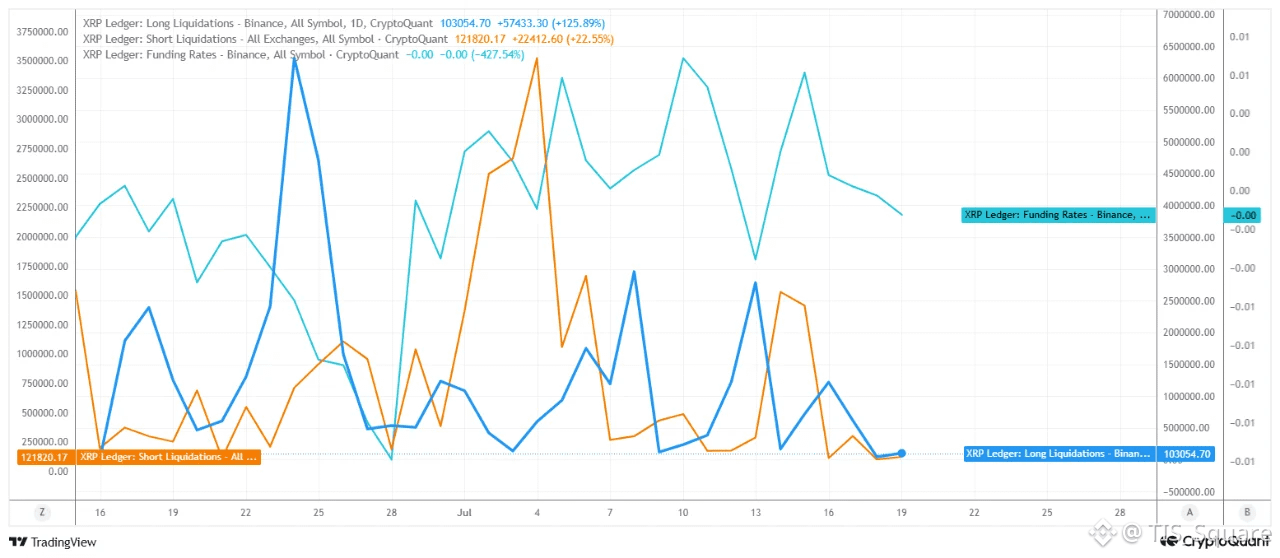
The latest data from the derivatives market shows that XRP has shifted to a neutral state, with neither the Long nor the Short side gaining a clear advantage.
Currently, Long Liquidations on Binance are at about 103,000 XRP, while Short Liquidations across the entire market total roughly 122,000 XRP. The gap between these two indicators is quite small, and the Funding Rate remains around 0, reflecting investors’ cautious sentiment.
🔶 What is happening?
- No overwhelming selling or buying pressure: The similar liquidation levels for Long and Short indicate that both sides are facing pressure, rather than only one side being wiped out from the market.
- Leverage is in balance: Long and Short positions are distributed fairly evenly, causing frequent short-term liquidations on both sides without establishing a clear trend.
- Funding Rate is close to 0: This suggests the market is not overly crowded with Longs or Shorts, reinforcing the view that investors are still waiting for confirmation signals for the next direction.
- The likelihood of a major "Long Squeeze" or "Short Squeeze" is low: When there is no significant imbalance in positions, the probability of large-scale liquidation cascades also decreases.
In the short term, XRP is likely to continue trading within a narrow range until there is a clear increase in the Funding Rate or a large discrepancy between Long and Short liquidations—factors that may signal a new trend beginning to form.
$XRP Has the Selling Pressure Gone Away? Derivatives Data Shows the Market Is Balanced
The latest data from the derivatives market shows that XRP has shifted to a neutral state, with neither the Long nor the Short side gaining a clear advantage.
Currently, Long Liquidations on Binance are at about 103,000 XRP, while Short Liquidations across the entire market total roughly 122,000 XRP. The gap between these two indicators is quite small, and the Funding Rate remains around 0, reflecting investors’ cautious sentiment.
🔶 What is happening?
- No overwhelming selling or buying pressure: The similar liquidation levels for Long and Short indicate that both sides are facing pressure, rather than only one side being wiped out from the market.
- Leverage is in balance: Long and Short positions are distributed fairly evenly, causing frequent short-term liquidations on both sides without establishing a clear trend.
- Funding Rate is close to 0: This suggests the market is not overly crowded with Longs or Shorts, reinforcing the view that investors are still waiting for confirmation signals for the next direction.
- The likelihood of a major "Long Squeeze" or "Short Squeeze" is low: When there is no significant imbalance in positions, the probability of large-scale liquidation cascades also decreases.
In the short term, XRP is likely to continue trading within a narrow range until there is a clear increase in the Funding Rate or a large discrepancy between Long and Short liquidations—factors that may signal a new trend beginning to form.
The latest data from the derivatives market shows that XRP has shifted to a neutral state, with neither the Long nor the Short side gaining a clear advantage.
Currently, Long Liquidations on Binance are at about 103,000 XRP, while Short Liquidations across the entire market total roughly 122,000 XRP. The gap between these two indicators is quite small, and the Funding Rate remains around 0, reflecting investors’ cautious sentiment.
🔶 What is happening?
- No overwhelming selling or buying pressure: The similar liquidation levels for Long and Short indicate that both sides are facing pressure, rather than only one side being wiped out from the market.
- Leverage is in balance: Long and Short positions are distributed fairly evenly, causing frequent short-term liquidations on both sides without establishing a clear trend.
- Funding Rate is close to 0: This suggests the market is not overly crowded with Longs or Shorts, reinforcing the view that investors are still waiting for confirmation signals for the next direction.
- The likelihood of a major "Long Squeeze" or "Short Squeeze" is low: When there is no significant imbalance in positions, the probability of large-scale liquidation cascades also decreases.
In the short term, XRP is likely to continue trading within a narrow range until there is a clear increase in the Funding Rate or a large discrepancy between Long and Short liquidations—factors that may signal a new trend beginning to form.
2
461
·
--
$BTC Has Built a Bottom? On-Chain Data Shows the 59,000–70,000 USD Range Is Becoming the Market’s “Fortress”
{future}(BTCUSDT)
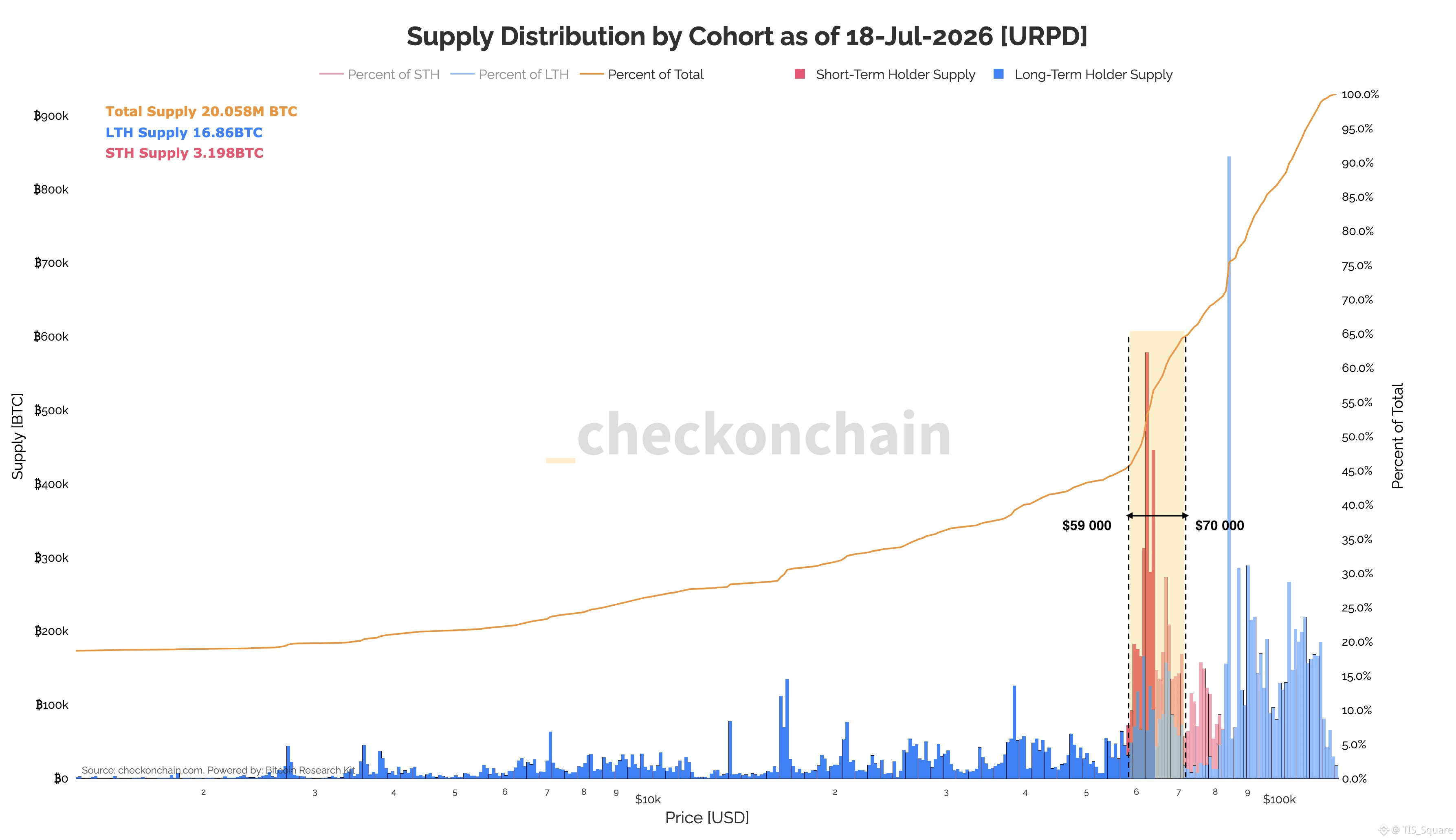
On-chain data shows that the 59,000–70,000 USD price range is becoming Bitcoin’s most important defensive area, as the amount of BTC changing hands in this zone is surging.
Notably, 50% of Bitcoin’s total supply has already been traded at prices above 59,000 USD, reflecting a significant shift in capital flows during the current cycle. If you exclude the BTC that has been lost forever, this figure is even higher.
Trading activity is mainly driven by short-term holders (STHs), indicating that the market is witnessing a clear divide between those selling in panic and those taking advantage of pullbacks to accumulate.
Many on-chain metrics and market sentiment indicators are currently in bearish or oversold territory, making the 59,000–70,000 USD area a meaningful support zone.
However, this does not mean Bitcoin has already formed a bottom. Instead, the data suggests that bottom formation is underway, as the market absorbs supply and builds a solid price base before establishing a new trend.
$BTC Has Built a Bottom? On-Chain Data Shows the 59,000–70,000 USD Range Is Becoming the Market’s “Fortress”
On-chain data shows that the 59,000–70,000 USD price range is becoming Bitcoin’s most important defensive area, as the amount of BTC changing hands in this zone is surging.
Notably, 50% of Bitcoin’s total supply has already been traded at prices above 59,000 USD, reflecting a significant shift in capital flows during the current cycle. If you exclude the BTC that has been lost forever, this figure is even higher.
Trading activity is mainly driven by short-term holders (STHs), indicating that the market is witnessing a clear divide between those selling in panic and those taking advantage of pullbacks to accumulate.
Many on-chain metrics and market sentiment indicators are currently in bearish or oversold territory, making the 59,000–70,000 USD area a meaningful support zone.
However, this does not mean Bitcoin has already formed a bottom. Instead, the data suggests that bottom formation is underway, as the market absorbs supply and builds a solid price base before establishing a new trend.
On-chain data shows that the 59,000–70,000 USD price range is becoming Bitcoin’s most important defensive area, as the amount of BTC changing hands in this zone is surging.
Notably, 50% of Bitcoin’s total supply has already been traded at prices above 59,000 USD, reflecting a significant shift in capital flows during the current cycle. If you exclude the BTC that has been lost forever, this figure is even higher.
Trading activity is mainly driven by short-term holders (STHs), indicating that the market is witnessing a clear divide between those selling in panic and those taking advantage of pullbacks to accumulate.
Many on-chain metrics and market sentiment indicators are currently in bearish or oversold territory, making the 59,000–70,000 USD area a meaningful support zone.
However, this does not mean Bitcoin has already formed a bottom. Instead, the data suggests that bottom formation is underway, as the market absorbs supply and builds a solid price base before establishing a new trend.
2
505
·
--
Whales Continue Increasing Bets at $BTC , Long Position Has Surpassed $107 Million
{future}(BTCUSDT)
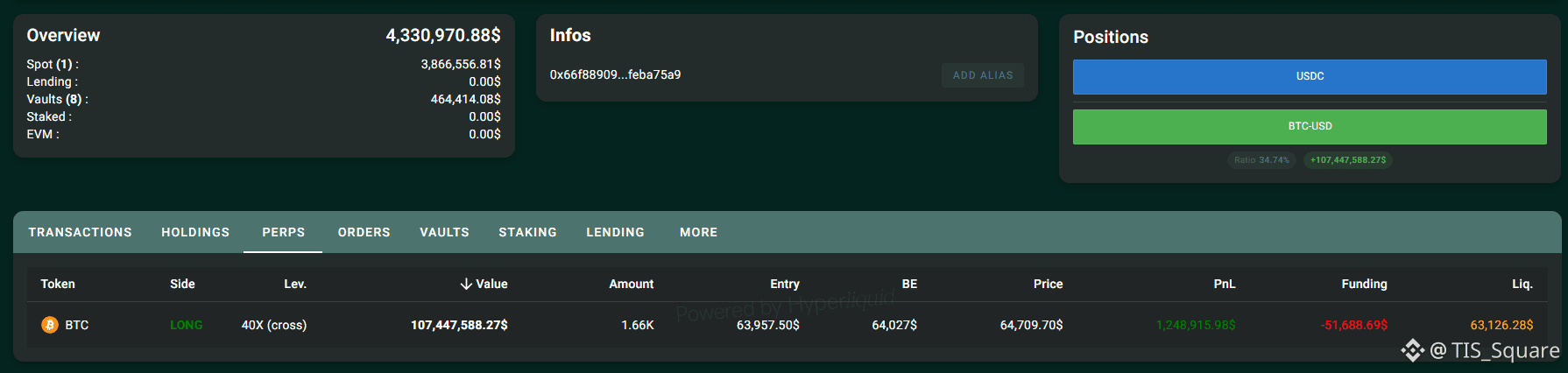
On-chain data shows whale 0x66f8 continues to grow its BTC Long position, increasing the total size to 1,660 BTC, equivalent to approximately $107.36 million.
Currently, the liquidation price for this position is around $63,123 per BTC.
The continuous expansion of the Long position indicates that the whale remains optimistic about Bitcoin’s trend.
However, with a large leverage size, the $63,123 level will be an important price zone, because if BTC falls below this threshold, the position faces the risk of being liquidated.
Whales Continue Increasing Bets at $BTC , Long Position Has Surpassed $107 Million
On-chain data shows whale 0x66f8 continues to grow its BTC Long position, increasing the total size to 1,660 BTC, equivalent to approximately $107.36 million.
Currently, the liquidation price for this position is around $63,123 per BTC.
The continuous expansion of the Long position indicates that the whale remains optimistic about Bitcoin’s trend.
However, with a large leverage size, the $63,123 level will be an important price zone, because if BTC falls below this threshold, the position faces the risk of being liquidated.
On-chain data shows whale 0x66f8 continues to grow its BTC Long position, increasing the total size to 1,660 BTC, equivalent to approximately $107.36 million.
Currently, the liquidation price for this position is around $63,123 per BTC.
The continuous expansion of the Long position indicates that the whale remains optimistic about Bitcoin’s trend.
However, with a large leverage size, the $63,123 level will be an important price zone, because if BTC falls below this threshold, the position faces the risk of being liquidated.
260
·
--
Is the Whale Betting Big on $ETH ?
{future}(ETHUSDT)
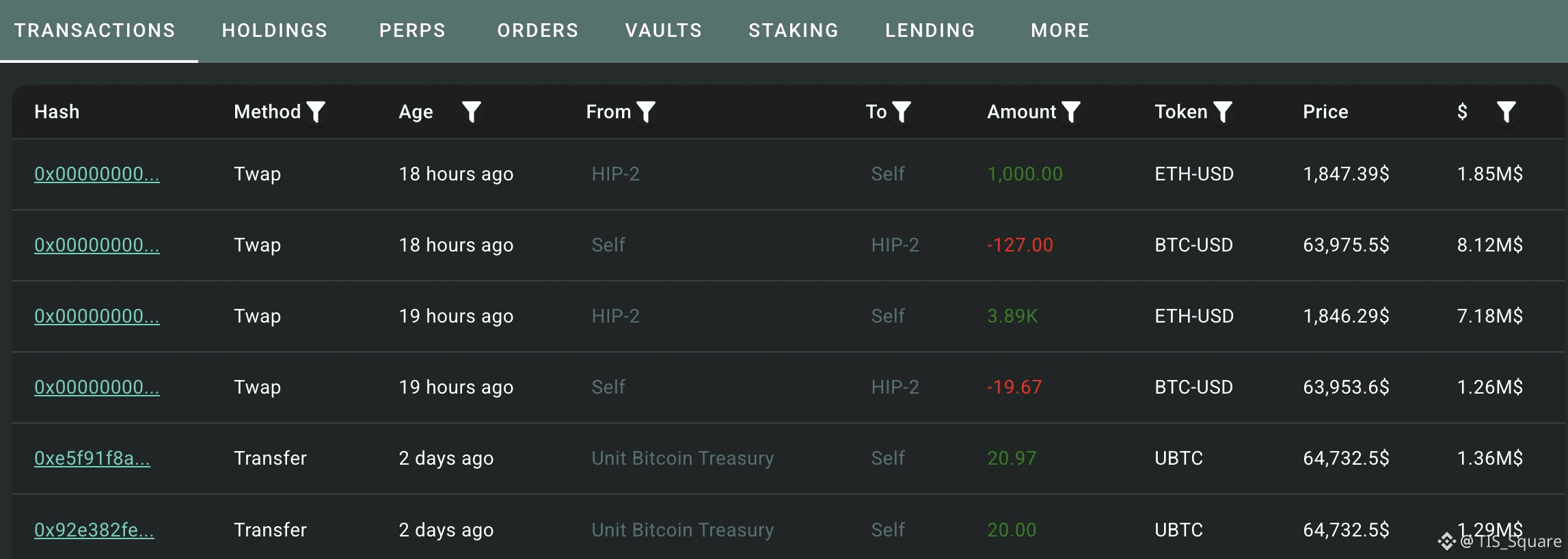
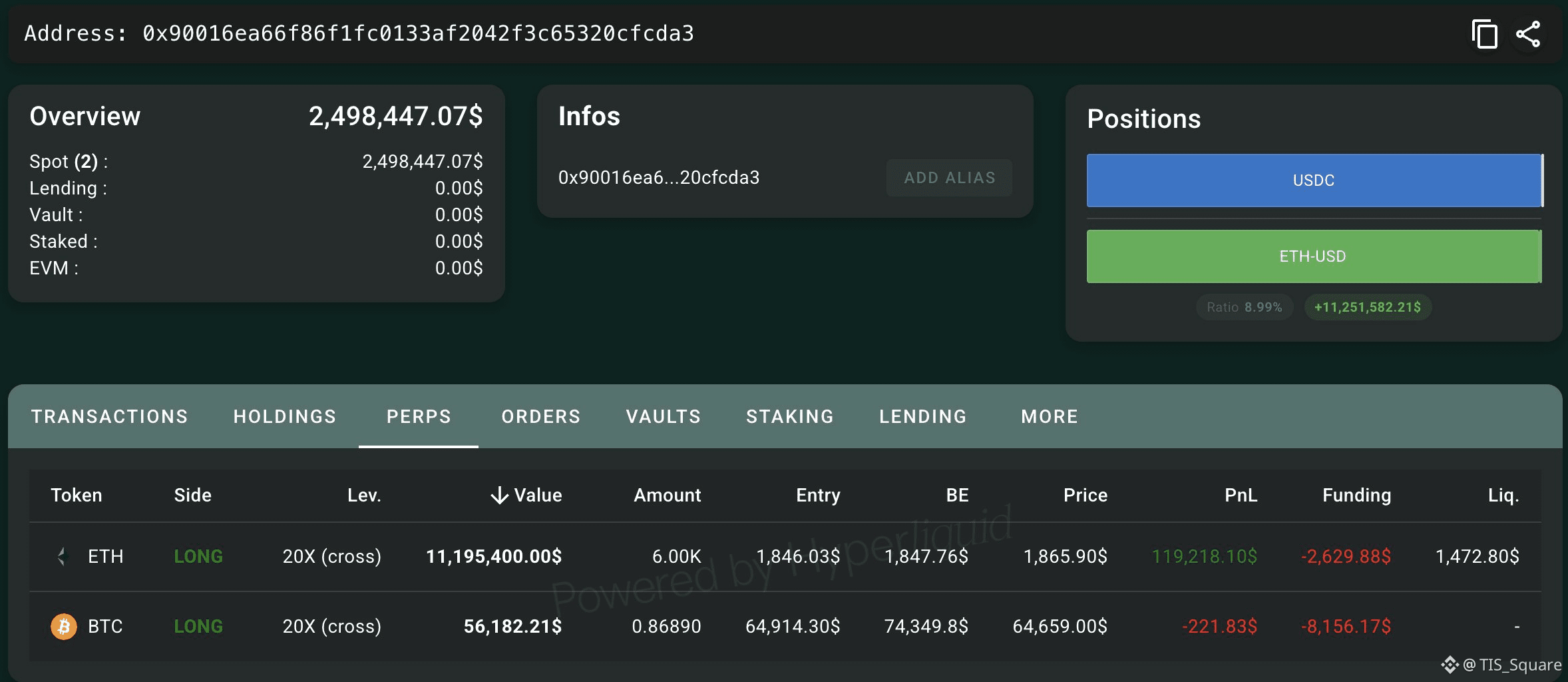
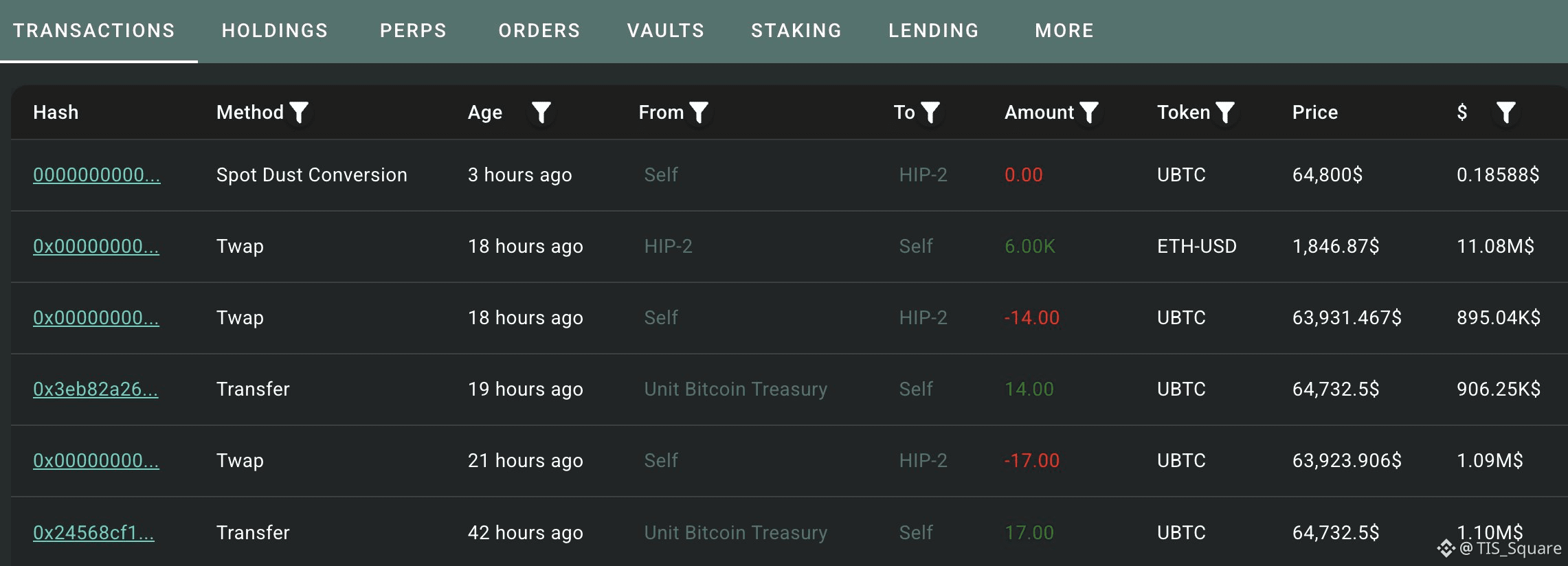
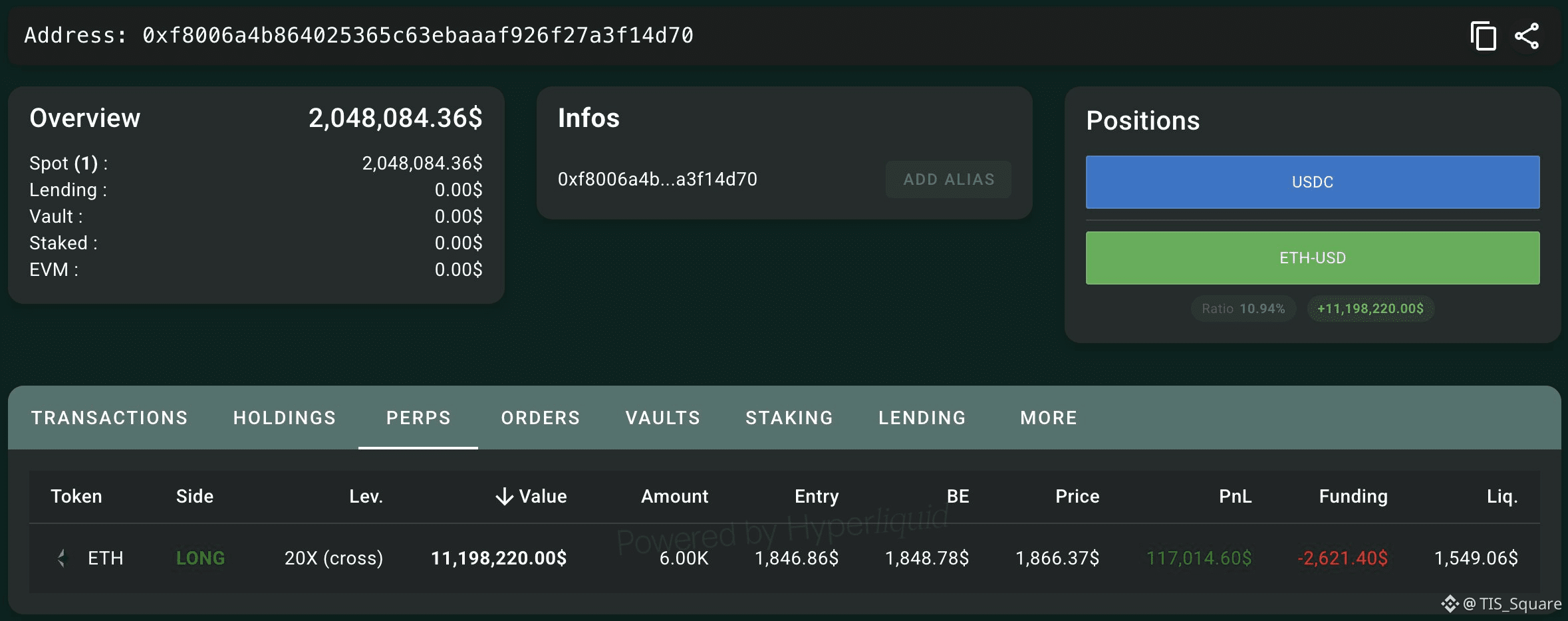
On-chain data shows that two newly created wallets have sold 72 $BTC (about $4.66 million) before opening a 20x Long position with 12,000 ETH, worth approximately $22.4 million.
{future}(BTCUSDT)
This move suggests that some large investors expect ETH to continue rising in the short term. However, using 20x leverage also means the risk level is very high, making the position easily liquidated if the market swings sharply.
Is the Whale Betting Big on $ETH ?
On-chain data shows that two newly created wallets have sold 72 $BTC (about $4.66 million) before opening a 20x Long position with 12,000 ETH, worth approximately $22.4 million.
This move suggests that some large investors expect ETH to continue rising in the short term. However, using 20x leverage also means the risk level is very high, making the position easily liquidated if the market swings sharply.
On-chain data shows that two newly created wallets have sold 72 $BTC (about $4.66 million) before opening a 20x Long position with 12,000 ETH, worth approximately $22.4 million.
This move suggests that some large investors expect ETH to continue rising in the short term. However, using 20x leverage also means the risk level is very high, making the position easily liquidated if the market swings sharply.
280
·
--
$BTC Are We Accumulating Before a New Upswing? On-chain Data Slightly Favors the Bull Side?
{future}(BTCUSDT)
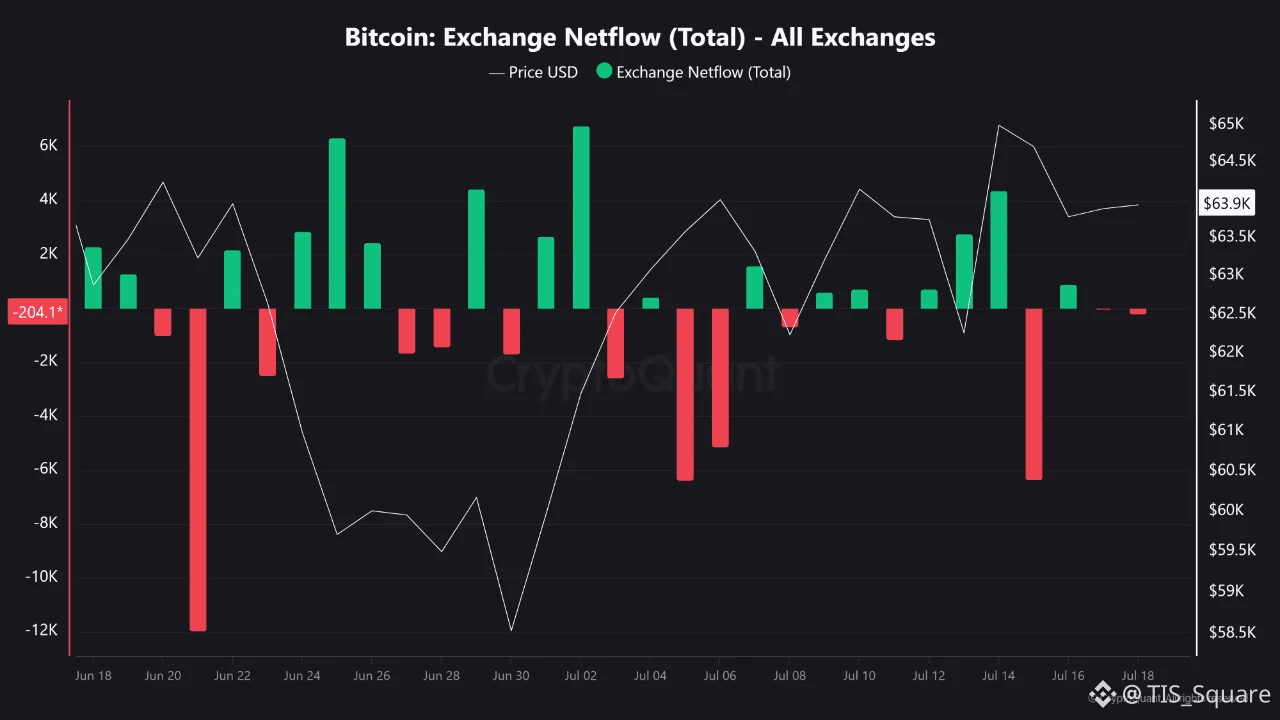
The latest on-chain data suggests Bitcoin is in a neutral to mildly positive state, as leverage pressure has dropped significantly while short-term selling pressure has not yet increased.
The Exchange Netflow chart also recorded a second consecutive day of capital flowing out of exchanges, with net withdrawals of roughly 204 BTC over the past 24 hours.
However, the total amount of BTC withdrawn over the two days is only about 225 BTC, indicating a positive signal, but not strong enough to confirm a large-scale accumulation wave.
🔶 Notable signals
- The Funding Rate has fallen to 0.00225, down 52.8% from the previous day and below the 7-day average (0.00520).
- This suggests the market has cooled off, and the situation of overcrowded Long positions is no longer as obvious.
- Open Interest stands at around $21.3 billion, up slightly 0.24% on the day, but still lower than one and two weeks ago.
- This reflects that new capital is returning quite cautiously; there has been no surge in the use of leverage.
- Meanwhile, the 7-day flow still shows about 2,196 BTC being deposited to exchanges, but the 14-day window remains 8,197 BTC net withdrawn, indicating the market is still in a liquidity adjustment phase rather than forming a clear trend.
A declining Funding Rate alongside Open Interest not yet returning to high levels helps reduce the risk of the market being "overheated," and provides a healthier base if capital inflows continue to improve.
However, for the uptrend to be strengthened, investors need to watch whether BTC withdrawals from exchanges continue to expand, while Open Interest rises gradually without a strong increase in the Funding Rate.
$BTC Are We Accumulating Before a New Upswing? On-chain Data Slightly Favors the Bull Side?
The latest on-chain data suggests Bitcoin is in a neutral to mildly positive state, as leverage pressure has dropped significantly while short-term selling pressure has not yet increased.
The Exchange Netflow chart also recorded a second consecutive day of capital flowing out of exchanges, with net withdrawals of roughly 204 BTC over the past 24 hours.
However, the total amount of BTC withdrawn over the two days is only about 225 BTC, indicating a positive signal, but not strong enough to confirm a large-scale accumulation wave.
🔶 Notable signals
- The Funding Rate has fallen to 0.00225, down 52.8% from the previous day and below the 7-day average (0.00520).
- This suggests the market has cooled off, and the situation of overcrowded Long positions is no longer as obvious.
- Open Interest stands at around $21.3 billion, up slightly 0.24% on the day, but still lower than one and two weeks ago.
- This reflects that new capital is returning quite cautiously; there has been no surge in the use of leverage.
- Meanwhile, the 7-day flow still shows about 2,196 BTC being deposited to exchanges, but the 14-day window remains 8,197 BTC net withdrawn, indicating the market is still in a liquidity adjustment phase rather than forming a clear trend.
A declining Funding Rate alongside Open Interest not yet returning to high levels helps reduce the risk of the market being "overheated," and provides a healthier base if capital inflows continue to improve.
However, for the uptrend to be strengthened, investors need to watch whether BTC withdrawals from exchanges continue to expand, while Open Interest rises gradually without a strong increase in the Funding Rate.
The latest on-chain data suggests Bitcoin is in a neutral to mildly positive state, as leverage pressure has dropped significantly while short-term selling pressure has not yet increased.
The Exchange Netflow chart also recorded a second consecutive day of capital flowing out of exchanges, with net withdrawals of roughly 204 BTC over the past 24 hours.
However, the total amount of BTC withdrawn over the two days is only about 225 BTC, indicating a positive signal, but not strong enough to confirm a large-scale accumulation wave.
🔶 Notable signals
- The Funding Rate has fallen to 0.00225, down 52.8% from the previous day and below the 7-day average (0.00520).
- This suggests the market has cooled off, and the situation of overcrowded Long positions is no longer as obvious.
- Open Interest stands at around $21.3 billion, up slightly 0.24% on the day, but still lower than one and two weeks ago.
- This reflects that new capital is returning quite cautiously; there has been no surge in the use of leverage.
- Meanwhile, the 7-day flow still shows about 2,196 BTC being deposited to exchanges, but the 14-day window remains 8,197 BTC net withdrawn, indicating the market is still in a liquidity adjustment phase rather than forming a clear trend.
A declining Funding Rate alongside Open Interest not yet returning to high levels helps reduce the risk of the market being "overheated," and provides a healthier base if capital inflows continue to improve.
However, for the uptrend to be strengthened, investors need to watch whether BTC withdrawals from exchanges continue to expand, while Open Interest rises gradually without a strong increase in the Funding Rate.
202
·
--
Has the Bear Phase Ended? What Signals Is On-chain Data Sending?
After about 9 months of the downtrend phase, the latest on-chain data suggests that the market $BTC c may be moving closer to the final stage of the bear cycle, although it is still too early to confirm that a bull run has started.
{future}(BTCUSDT)
🔶 Notable Signal
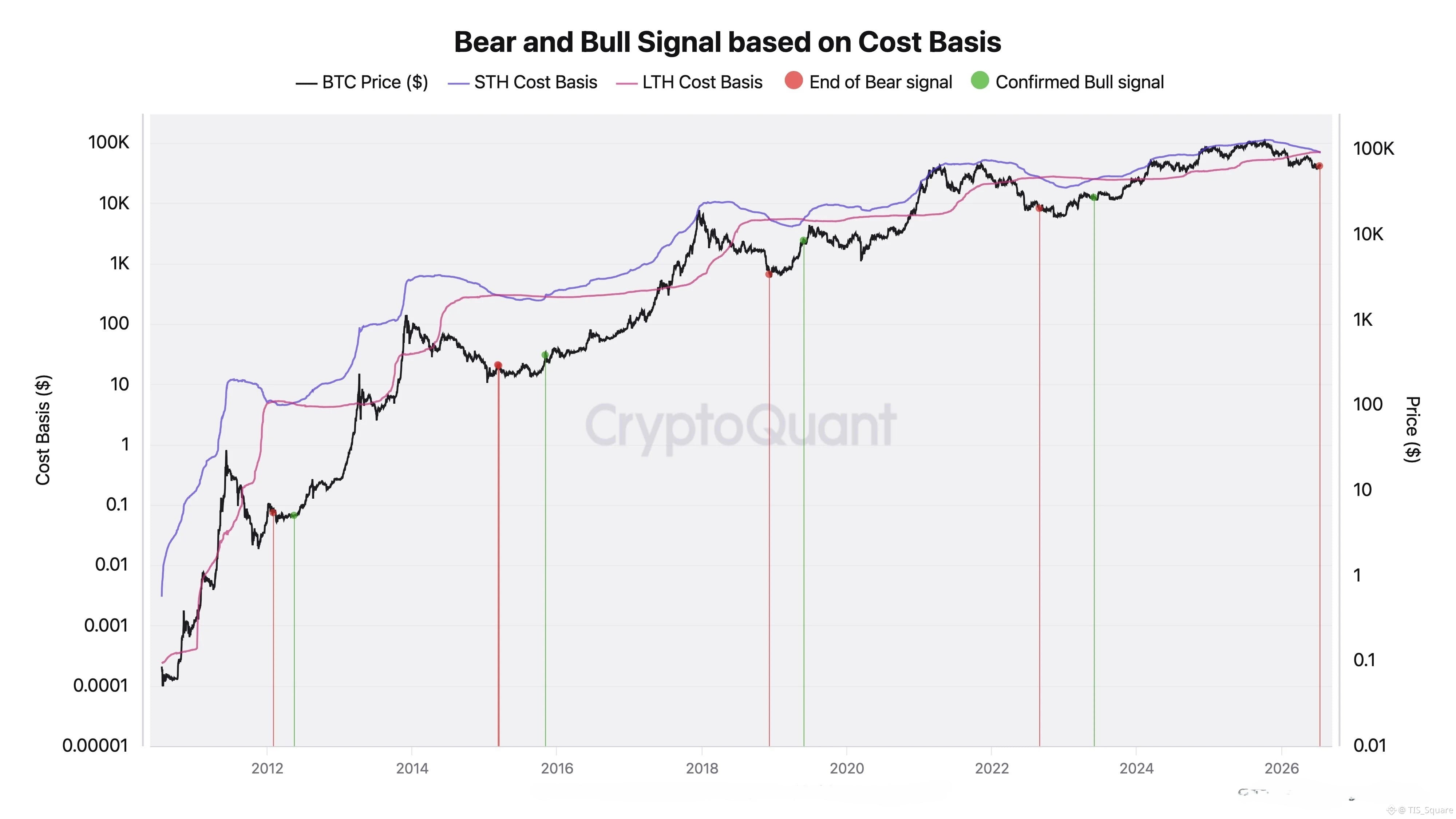
A historical signal has just appeared: the cost basis of short-term investors (STH) has crossed below the cost basis of long-term investors who are actively holding (LTH).
This is considered a signal marking the end of the bear market’s late phase, and it has appeared in previous cycles.
Notably, the STH cost basis has fallen from $112,500 to around $69,000, reflecting that newer investors have continued buying during pullbacks while lowering their average cost basis.
🔶 What Does This Mean?
The signal above does not mean Bitcoin has already formed a bottom, nor that the bull market has started immediately.
Instead, it indicates the market may be entering the late accumulation phase of the declining cycle—where selling pressure gradually weakens and accumulation activity begins to take the lead.
Based on historical data, a bull market is only confirmed when the STH cost basis crosses back above the LTH cost basis, indicating that new capital is willing to buy at higher prices and that an uptrend has been established.
Has the Bear Phase Ended? What Signals Is On-chain Data Sending?
After about 9 months of the downtrend phase, the latest on-chain data suggests that the market $BTC c may be moving closer to the final stage of the bear cycle, although it is still too early to confirm that a bull run has started.
🔶 Notable Signal
A historical signal has just appeared: the cost basis of short-term investors (STH) has crossed below the cost basis of long-term investors who are actively holding (LTH).
This is considered a signal marking the end of the bear market’s late phase, and it has appeared in previous cycles.
Notably, the STH cost basis has fallen from $112,500 to around $69,000, reflecting that newer investors have continued buying during pullbacks while lowering their average cost basis.
🔶 What Does This Mean?
The signal above does not mean Bitcoin has already formed a bottom, nor that the bull market has started immediately.
Instead, it indicates the market may be entering the late accumulation phase of the declining cycle—where selling pressure gradually weakens and accumulation activity begins to take the lead.
Based on historical data, a bull market is only confirmed when the STH cost basis crosses back above the LTH cost basis, indicating that new capital is willing to buy at higher prices and that an uptrend has been established.
After about 9 months of the downtrend phase, the latest on-chain data suggests that the market $BTC c may be moving closer to the final stage of the bear cycle, although it is still too early to confirm that a bull run has started.
🔶 Notable Signal
A historical signal has just appeared: the cost basis of short-term investors (STH) has crossed below the cost basis of long-term investors who are actively holding (LTH).
This is considered a signal marking the end of the bear market’s late phase, and it has appeared in previous cycles.
Notably, the STH cost basis has fallen from $112,500 to around $69,000, reflecting that newer investors have continued buying during pullbacks while lowering their average cost basis.
🔶 What Does This Mean?
The signal above does not mean Bitcoin has already formed a bottom, nor that the bull market has started immediately.
Instead, it indicates the market may be entering the late accumulation phase of the declining cycle—where selling pressure gradually weakens and accumulation activity begins to take the lead.
Based on historical data, a bull market is only confirmed when the STH cost basis crosses back above the LTH cost basis, indicating that new capital is willing to buy at higher prices and that an uptrend has been established.
177
·
--
Partly True
$PUMP Continue selling more than 81,700 SOL, total amount sold already exceeds $800 million
{future}(PUMPUSDT)
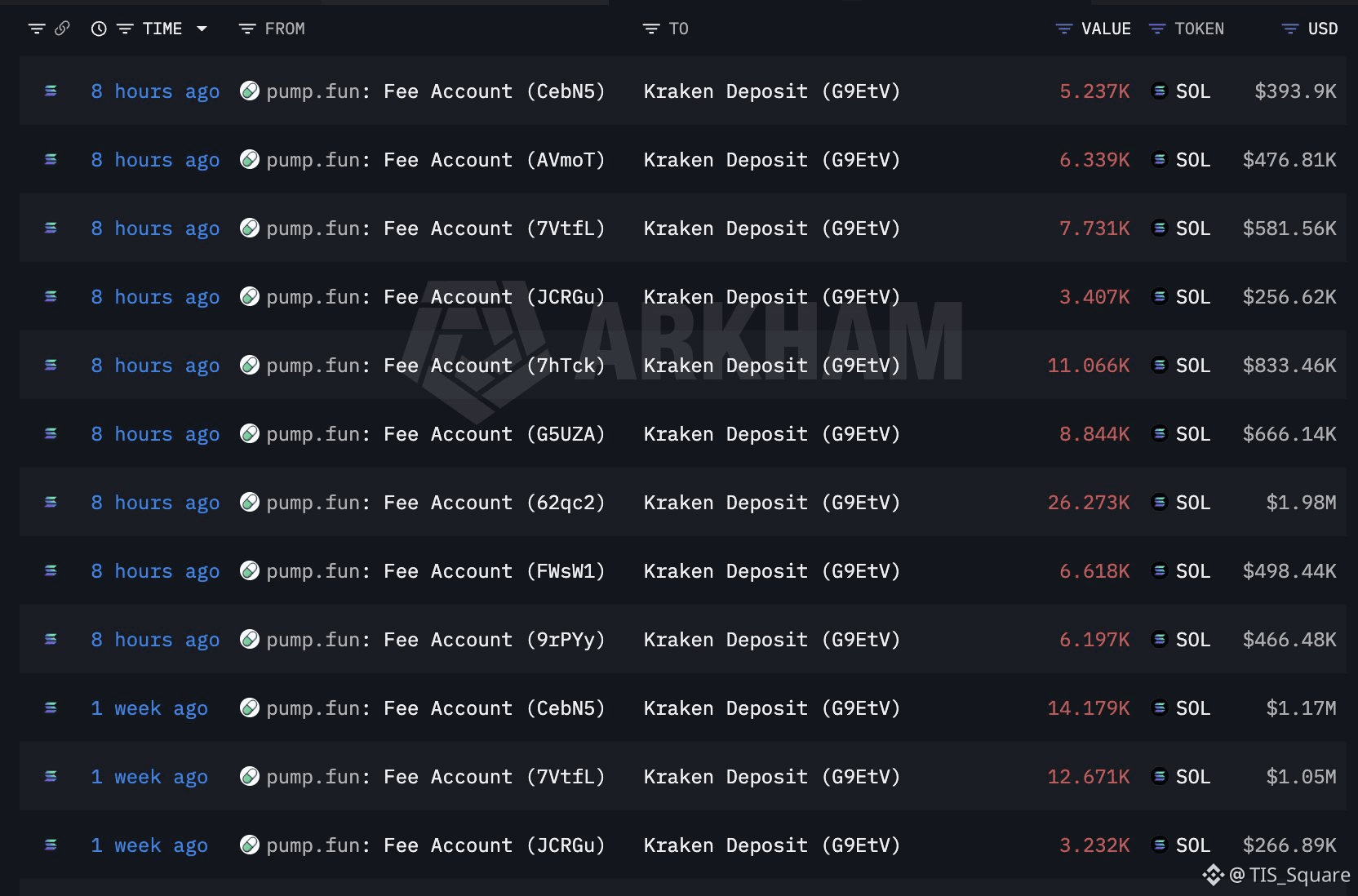
Pump.fun continues to record a batch of sales of 81,711 $SOL , worth about $6.15 million today.
{future}(SOLUSDT)
As of now, the project has sold a total of 4,738,536 SOL, equivalent to approximately $800.96 million, with an average selling price of $169 per SOL.
Pump’s continuous realization of profits through SOL selling rounds shows that the project’s supply is still being released to the market in phases.
Although these sell-offs are closely monitored, the actual impact on the SOL price will depend on market liquidity and the ability of buying demand to absorb the supply.
$PUMP Continue selling more than 81,700 SOL, total amount sold already exceeds $800 million
Pump.fun continues to record a batch of sales of 81,711 $SOL , worth about $6.15 million today.
As of now, the project has sold a total of 4,738,536 SOL, equivalent to approximately $800.96 million, with an average selling price of $169 per SOL.
Pump’s continuous realization of profits through SOL selling rounds shows that the project’s supply is still being released to the market in phases.
Although these sell-offs are closely monitored, the actual impact on the SOL price will depend on market liquidity and the ability of buying demand to absorb the supply.
Pump.fun continues to record a batch of sales of 81,711 $SOL , worth about $6.15 million today.
As of now, the project has sold a total of 4,738,536 SOL, equivalent to approximately $800.96 million, with an average selling price of $169 per SOL.
Pump’s continuous realization of profits through SOL selling rounds shows that the project’s supply is still being released to the market in phases.
Although these sell-offs are closely monitored, the actual impact on the SOL price will depend on market liquidity and the ability of buying demand to absorb the supply.
893
·
--
Whale Sells 30,000 ETH via OTC Trade Worth 55 Million USD
{future}(ETHUSDT)
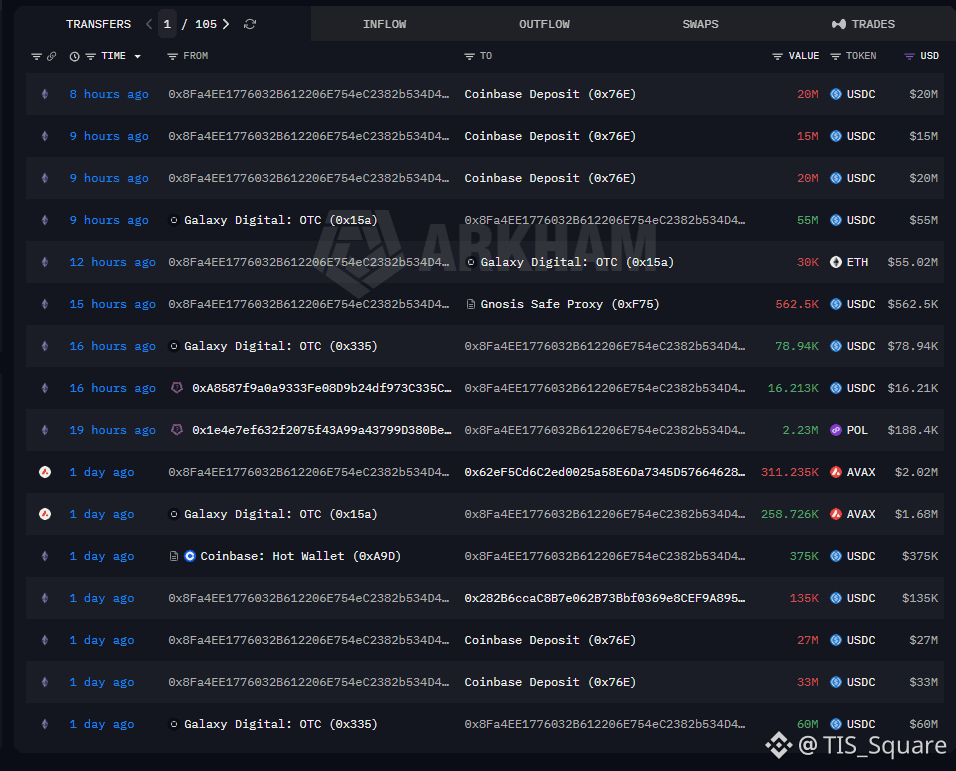
A whale wallet at 0x8Fa4 has sold 30,000 $ETH in exchange for 55 million USDC, equivalent to an average price of about 1,833.33 USD/ETH through an OTC transaction.
Executing via OTC indicates that the trade was conducted outside the public order book, helping to limit direct impact on market prices.
This is a notable activity by the whale; however, it does not necessarily mean that sell pressure will immediately appear on the spot market.
Investors should continue to monitor whether this USDC will be used to rebalance their portfolios or shifted to other assets in the coming period.
Whale Sells 30,000 ETH via OTC Trade Worth 55 Million USD
A whale wallet at 0x8Fa4 has sold 30,000 $ETH in exchange for 55 million USDC, equivalent to an average price of about 1,833.33 USD/ETH through an OTC transaction.
Executing via OTC indicates that the trade was conducted outside the public order book, helping to limit direct impact on market prices.
This is a notable activity by the whale; however, it does not necessarily mean that sell pressure will immediately appear on the spot market.
Investors should continue to monitor whether this USDC will be used to rebalance their portfolios or shifted to other assets in the coming period.
A whale wallet at 0x8Fa4 has sold 30,000 $ETH in exchange for 55 million USDC, equivalent to an average price of about 1,833.33 USD/ETH through an OTC transaction.
Executing via OTC indicates that the trade was conducted outside the public order book, helping to limit direct impact on market prices.
This is a notable activity by the whale; however, it does not necessarily mean that sell pressure will immediately appear on the spot market.
Investors should continue to monitor whether this USDC will be used to rebalance their portfolios or shifted to other assets in the coming period.
776
·
--
Crypto Investor in the U.S. Prosecuted for Alleged Ponzi Scheme Fraud of $20 Million
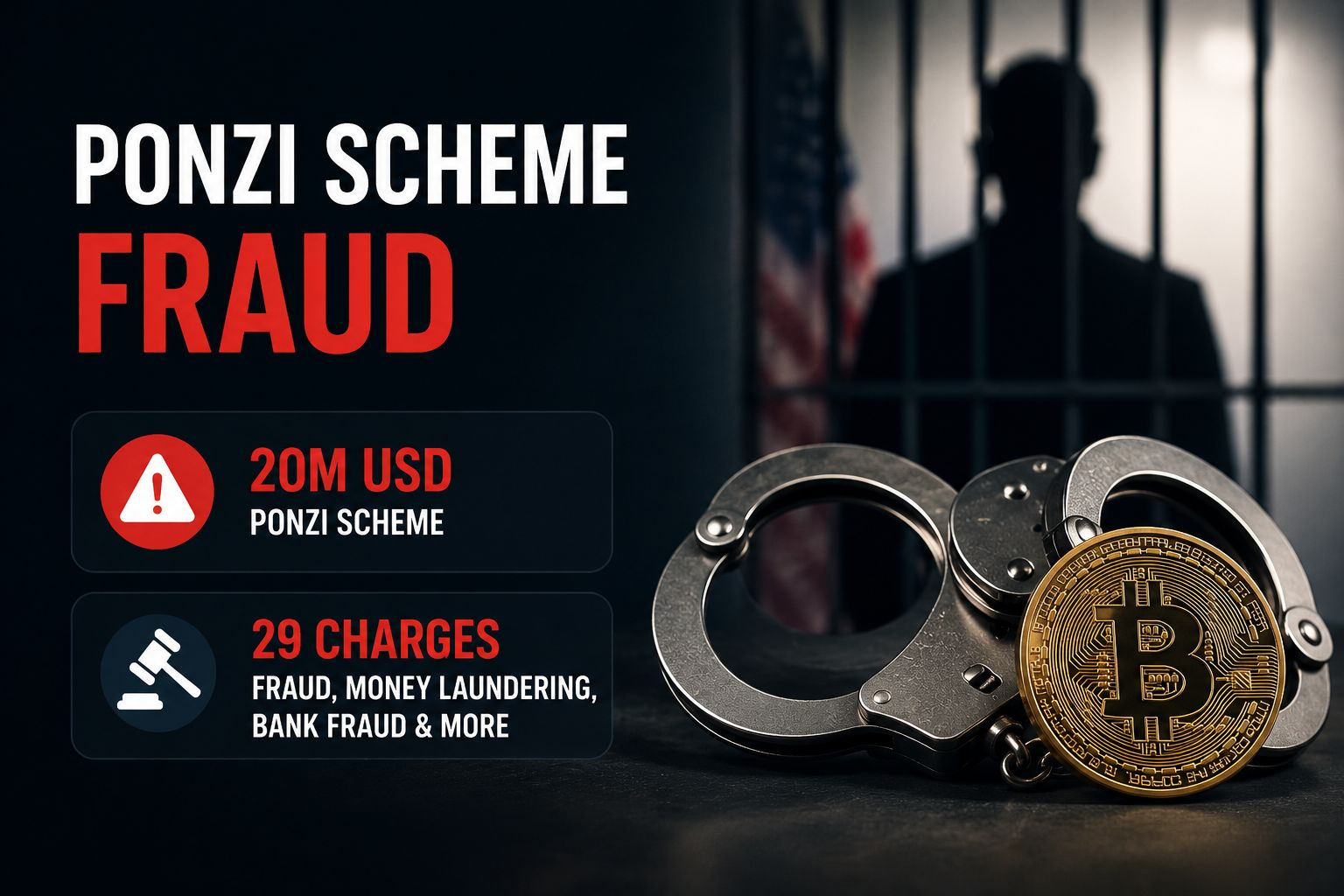
A U.S. federal grand jury has indicted Benjamin Paul Wiener (43) on 29 counts, including wire fraud, money laundering, bank fraud, and serious identity theft.
According to the indictment, Wiener is accused of operating a Ponzi scheme worth about $20 million, raising funds through multiple entities, then using new investors’ money to pay off earlier investors and for personal purposes. He is also accused of falsifying documents to seize a $1 million credit from a bank.
Wiener has pleaded not guilty, is out on bail, and the trial is expected to take place on September 15. These allegations are not yet a final ruling by the court.
🔶 Key Takeaways
Do not trust projects or individuals that promise high, stable returns with low risk.
Always verify the transparency of the investment model, the development team, and how cash flow is generated.
Avoid investing solely based on referrals or FOMO effects without conducting thorough research.
In the crypto market, risk management and due diligence are always more important than expectations of profit.
Crypto Investor in the U.S. Prosecuted for Alleged Ponzi Scheme Fraud of $20 Million
A U.S. federal grand jury has indicted Benjamin Paul Wiener (43) on 29 counts, including wire fraud, money laundering, bank fraud, and serious identity theft.
According to the indictment, Wiener is accused of operating a Ponzi scheme worth about $20 million, raising funds through multiple entities, then using new investors’ money to pay off earlier investors and for personal purposes. He is also accused of falsifying documents to seize a $1 million credit from a bank.
Wiener has pleaded not guilty, is out on bail, and the trial is expected to take place on September 15. These allegations are not yet a final ruling by the court.
🔶 Key Takeaways
Do not trust projects or individuals that promise high, stable returns with low risk.
Always verify the transparency of the investment model, the development team, and how cash flow is generated.
Avoid investing solely based on referrals or FOMO effects without conducting thorough research.
In the crypto market, risk management and due diligence are always more important than expectations of profit.
A U.S. federal grand jury has indicted Benjamin Paul Wiener (43) on 29 counts, including wire fraud, money laundering, bank fraud, and serious identity theft.
According to the indictment, Wiener is accused of operating a Ponzi scheme worth about $20 million, raising funds through multiple entities, then using new investors’ money to pay off earlier investors and for personal purposes. He is also accused of falsifying documents to seize a $1 million credit from a bank.
Wiener has pleaded not guilty, is out on bail, and the trial is expected to take place on September 15. These allegations are not yet a final ruling by the court.
🔶 Key Takeaways
Do not trust projects or individuals that promise high, stable returns with low risk.
Always verify the transparency of the investment model, the development team, and how cash flow is generated.
Avoid investing solely based on referrals or FOMO effects without conducting thorough research.
In the crypto market, risk management and due diligence are always more important than expectations of profit.
158
·
--
Bitcoin ETF Funds Lure Capital Back In, Ethereum ETF Pauses After a Strong Week
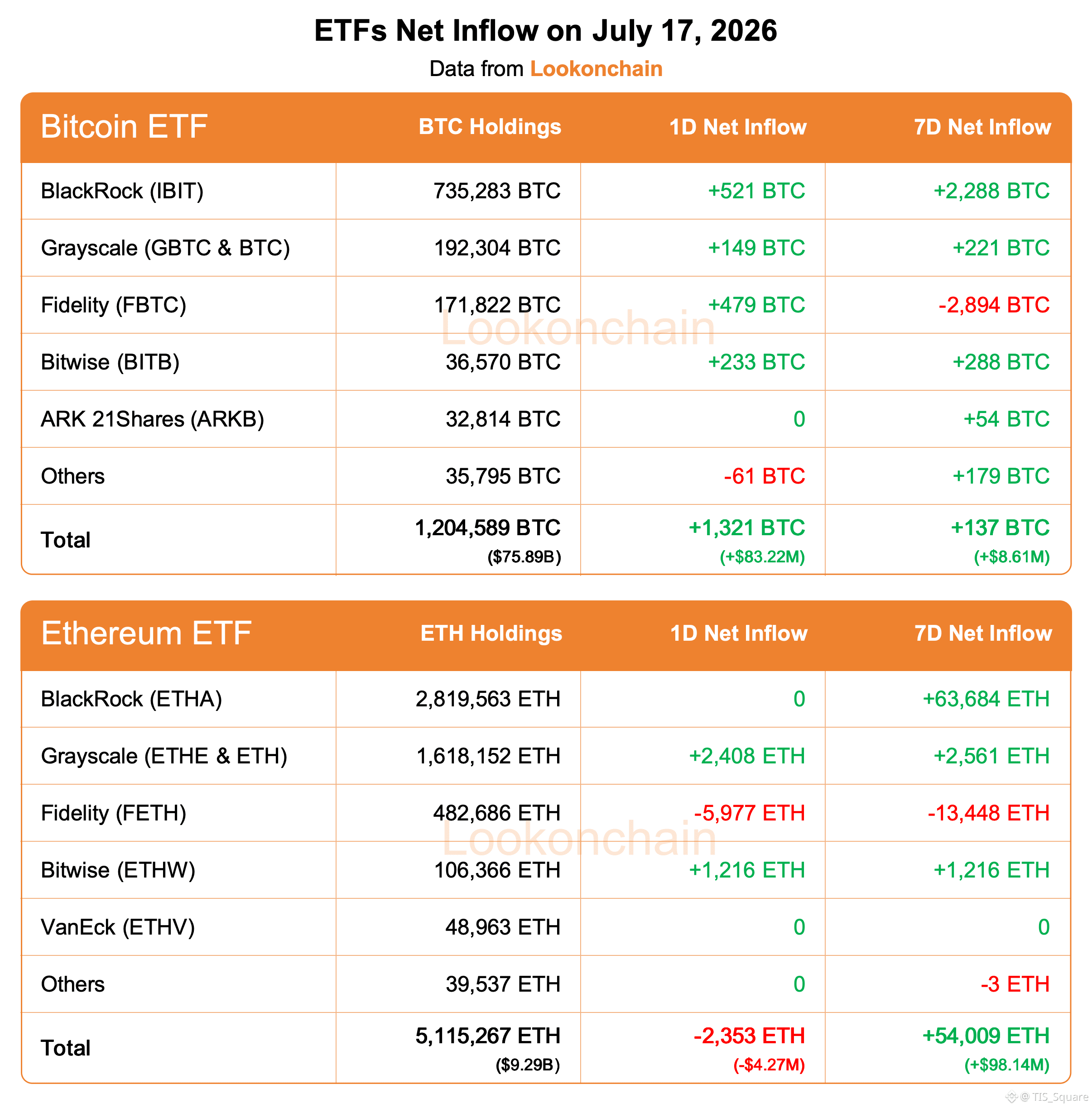
According to data from July 17, ETF fund flows continue to show a split between Bitcoin and Ethereum.
📊 Key Highlights
$BTC ETFs
- 24h net flow: +1.321 BTC (+US$83.22 million) 🟢
- 7-day net flow: +137 BTC (+US$8.61 million) 🟢
{future}(BTCUSDT)
$ETH ETFs
- 24h net flow: -2.353 ETH (-US$4.27 million) 🔴
- 7-day net flow: +54.009 ETH (+US$98.14 million) 🟢
{future}(ETHUSDT)
The Bitcoin ETF recorded positive inflows across both the 1-day and 7-day timeframes, indicating that demand from institutional investors remains intact despite market volatility.
Meanwhile, the Ethereum ETF saw a slight outflow over the past 24 hours, but for the full week it still recorded very strong inflows, suggesting this may only be short-term adjustment activity after a period of significant accumulation.
Overall, institutional capital has not yet left the crypto market. Bitcoin is showing more stability in the short term, while Ethereum still maintains a positive trend when viewed over a longer horizon.
Bitcoin ETF Funds Lure Capital Back In, Ethereum ETF Pauses After a Strong Week
According to data from July 17, ETF fund flows continue to show a split between Bitcoin and Ethereum.
📊 Key Highlights
$BTC ETFs
- 24h net flow: +1.321 BTC (+US$83.22 million) 🟢
- 7-day net flow: +137 BTC (+US$8.61 million) 🟢
$ETH ETFs
- 24h net flow: -2.353 ETH (-US$4.27 million) 🔴
- 7-day net flow: +54.009 ETH (+US$98.14 million) 🟢
The Bitcoin ETF recorded positive inflows across both the 1-day and 7-day timeframes, indicating that demand from institutional investors remains intact despite market volatility.
Meanwhile, the Ethereum ETF saw a slight outflow over the past 24 hours, but for the full week it still recorded very strong inflows, suggesting this may only be short-term adjustment activity after a period of significant accumulation.
Overall, institutional capital has not yet left the crypto market. Bitcoin is showing more stability in the short term, while Ethereum still maintains a positive trend when viewed over a longer horizon.
According to data from July 17, ETF fund flows continue to show a split between Bitcoin and Ethereum.
📊 Key Highlights
$BTC ETFs
- 24h net flow: +1.321 BTC (+US$83.22 million) 🟢
- 7-day net flow: +137 BTC (+US$8.61 million) 🟢
$ETH ETFs
- 24h net flow: -2.353 ETH (-US$4.27 million) 🔴
- 7-day net flow: +54.009 ETH (+US$98.14 million) 🟢
The Bitcoin ETF recorded positive inflows across both the 1-day and 7-day timeframes, indicating that demand from institutional investors remains intact despite market volatility.
Meanwhile, the Ethereum ETF saw a slight outflow over the past 24 hours, but for the full week it still recorded very strong inflows, suggesting this may only be short-term adjustment activity after a period of significant accumulation.
Overall, institutional capital has not yet left the crypto market. Bitcoin is showing more stability in the short term, while Ethereum still maintains a positive trend when viewed over a longer horizon.
103
·
--
Venice Updates Tokenomics: Expanding the Buyback & Burn Mechanism for $VVV , Increasing the DIEM Supply Cap
{future}(VVVUSDT)
Venice has just announced an important update to the economic model of two tokens, VVV and DIEM, with a focus on expanding the buyback and burn mechanism to increase value for the ecosystem.
🔶 Notable changes
- Added a VVV buyback and burn mechanism using API revenue, alongside the revenue source from previously available pre-subscription services.
- All token burning activities funded by API revenue will be tracked separately on the official statistics page to improve transparency.
- The DIEM supply cap will be gradually increased from 38,000 to 40,000 tokens.
According to Venice, VVV remains the core token of the ecosystem. Users can stake VVV to receive rewards, unlock Venice Pro benefits, and use VVV to mint DIEM.
🔶 Commentary
- Adding an additional revenue stream to carry out buyback & burn may help increase pressure to reduce the circulating supply of VVV if API activity continues to expand.
- At the same time, publishing token burn data also helps enhance the project’s transparency.
- Meanwhile, the slight increase in the DIEM supply cap shows that Venice is adjusting its tokenomics to meet the ecosystem’s development needs, while still maintaining a clear supply management mechanism.
Venice Updates Tokenomics: Expanding the Buyback & Burn Mechanism for $VVV , Increasing the DIEM Supply Cap
Venice has just announced an important update to the economic model of two tokens, VVV and DIEM, with a focus on expanding the buyback and burn mechanism to increase value for the ecosystem.
🔶 Notable changes
- Added a VVV buyback and burn mechanism using API revenue, alongside the revenue source from previously available pre-subscription services.
- All token burning activities funded by API revenue will be tracked separately on the official statistics page to improve transparency.
- The DIEM supply cap will be gradually increased from 38,000 to 40,000 tokens.
According to Venice, VVV remains the core token of the ecosystem. Users can stake VVV to receive rewards, unlock Venice Pro benefits, and use VVV to mint DIEM.
🔶 Commentary
- Adding an additional revenue stream to carry out buyback & burn may help increase pressure to reduce the circulating supply of VVV if API activity continues to expand.
- At the same time, publishing token burn data also helps enhance the project’s transparency.
- Meanwhile, the slight increase in the DIEM supply cap shows that Venice is adjusting its tokenomics to meet the ecosystem’s development needs, while still maintaining a clear supply management mechanism.
Venice has just announced an important update to the economic model of two tokens, VVV and DIEM, with a focus on expanding the buyback and burn mechanism to increase value for the ecosystem.
🔶 Notable changes
- Added a VVV buyback and burn mechanism using API revenue, alongside the revenue source from previously available pre-subscription services.
- All token burning activities funded by API revenue will be tracked separately on the official statistics page to improve transparency.
- The DIEM supply cap will be gradually increased from 38,000 to 40,000 tokens.
According to Venice, VVV remains the core token of the ecosystem. Users can stake VVV to receive rewards, unlock Venice Pro benefits, and use VVV to mint DIEM.
🔶 Commentary
- Adding an additional revenue stream to carry out buyback & burn may help increase pressure to reduce the circulating supply of VVV if API activity continues to expand.
- At the same time, publishing token burn data also helps enhance the project’s transparency.
- Meanwhile, the slight increase in the DIEM supply cap shows that Venice is adjusting its tokenomics to meet the ecosystem’s development needs, while still maintaining a clear supply management mechanism.

266
·
--
$DOGE Standing at a Key Support Zone – Can the Buying Faction Protect the 0.071 USD Mark?
{future}(DOGEUSDT)
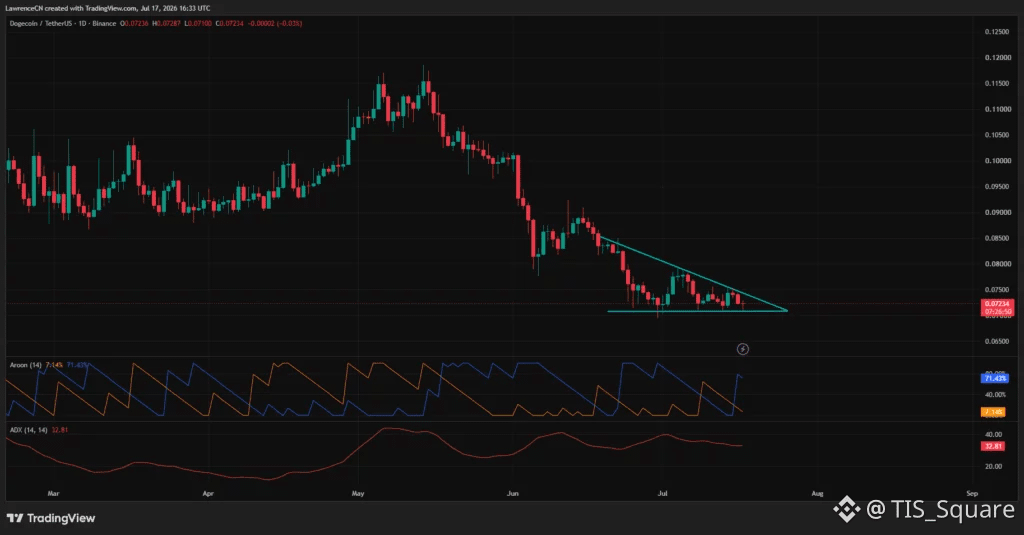
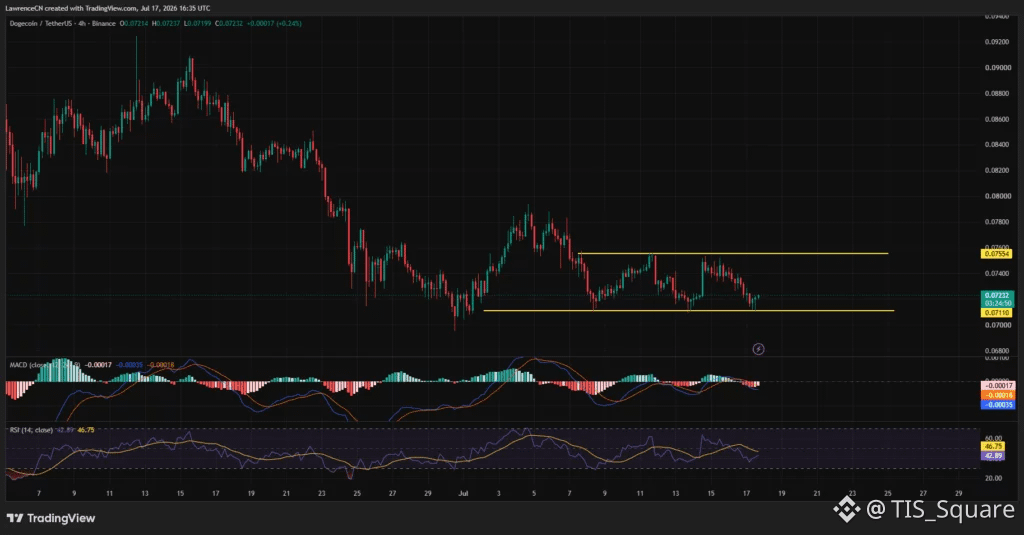
DOGE is under pressure as it drops by about 3.17%, retreating to the 0.071 USD area—an important support zone that has been defended multiple times since the end of June.
Notably, the DOGE-related ETF funds have not recorded any new inflows over the past month, while the entire meme-coin group has seen roughly $1.2 billion withdrawn from the market.
Even though DOGE was just added to a new crypto fund by T. Rowe Price, its weight is only about 1.28%, suggesting the allocation remains quite limited.
🔶 Technical perspective
The daily chart shows DOGE is still forming a falling triangle (Descending Triangle) pattern, with:
- Key support: 0.0711 USD
- Nearest resistance: 0.0755 USD
Technical indicators remain tilted toward the sell side:
- Aroon Down: 71.43%
- Aroon Up: 7.14%
- ADX: 32.81 (the declining trend is still strong enough)
- MACD continues to show a negative signal.
- RSI: 42.89, indicating buying momentum is still weak.
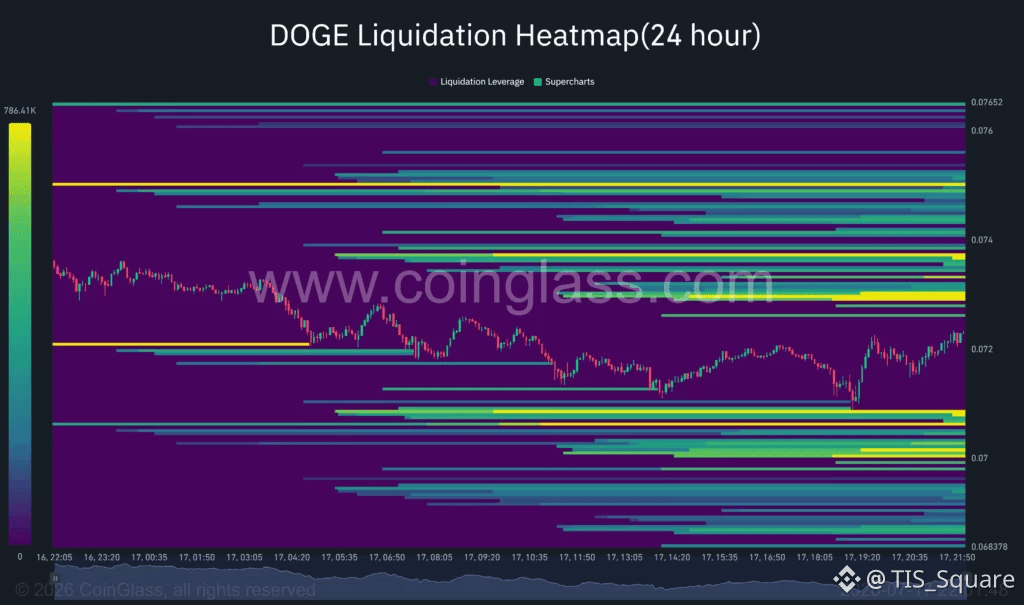
Liquidation heatmap data also suggests leverage is concentrated around 0.073 USD and 0.075 USD on the upside, while the 0.0705–0.070 USD zone is a notable liquidity cluster if the current support is broken.
🔶 Outlook
DOGE is at a critical moment when both technical factors and capital flows have not yet genuinely supported an upward trend.
If 0.0711 USD holds, DOGE has the chance to rebound and test the 0.0755 USD region.
On the other hand, if this support level is breached, the price could continue moving toward 0.070 USD, 0.068 USD, and further down to 0.065 USD, where additional liquidity clusters appear.
$DOGE Standing at a Key Support Zone – Can the Buying Faction Protect the 0.071 USD Mark?
DOGE is under pressure as it drops by about 3.17%, retreating to the 0.071 USD area—an important support zone that has been defended multiple times since the end of June.
Notably, the DOGE-related ETF funds have not recorded any new inflows over the past month, while the entire meme-coin group has seen roughly $1.2 billion withdrawn from the market.
Even though DOGE was just added to a new crypto fund by T. Rowe Price, its weight is only about 1.28%, suggesting the allocation remains quite limited.
🔶 Technical perspective
The daily chart shows DOGE is still forming a falling triangle (Descending Triangle) pattern, with:
- Key support: 0.0711 USD
- Nearest resistance: 0.0755 USD
Technical indicators remain tilted toward the sell side:
- Aroon Down: 71.43%
- Aroon Up: 7.14%
- ADX: 32.81 (the declining trend is still strong enough)
- MACD continues to show a negative signal.
- RSI: 42.89, indicating buying momentum is still weak.
Liquidation heatmap data also suggests leverage is concentrated around 0.073 USD and 0.075 USD on the upside, while the 0.0705–0.070 USD zone is a notable liquidity cluster if the current support is broken.
🔶 Outlook
DOGE is at a critical moment when both technical factors and capital flows have not yet genuinely supported an upward trend.
If 0.0711 USD holds, DOGE has the chance to rebound and test the 0.0755 USD region.
On the other hand, if this support level is breached, the price could continue moving toward 0.070 USD, 0.068 USD, and further down to 0.065 USD, where additional liquidity clusters appear.
DOGE is under pressure as it drops by about 3.17%, retreating to the 0.071 USD area—an important support zone that has been defended multiple times since the end of June.
Notably, the DOGE-related ETF funds have not recorded any new inflows over the past month, while the entire meme-coin group has seen roughly $1.2 billion withdrawn from the market.
Even though DOGE was just added to a new crypto fund by T. Rowe Price, its weight is only about 1.28%, suggesting the allocation remains quite limited.
🔶 Technical perspective
The daily chart shows DOGE is still forming a falling triangle (Descending Triangle) pattern, with:
- Key support: 0.0711 USD
- Nearest resistance: 0.0755 USD
Technical indicators remain tilted toward the sell side:
- Aroon Down: 71.43%
- Aroon Up: 7.14%
- ADX: 32.81 (the declining trend is still strong enough)
- MACD continues to show a negative signal.
- RSI: 42.89, indicating buying momentum is still weak.
Liquidation heatmap data also suggests leverage is concentrated around 0.073 USD and 0.075 USD on the upside, while the 0.0705–0.070 USD zone is a notable liquidity cluster if the current support is broken.
🔶 Outlook
DOGE is at a critical moment when both technical factors and capital flows have not yet genuinely supported an upward trend.
If 0.0711 USD holds, DOGE has the chance to rebound and test the 0.0755 USD region.
On the other hand, if this support level is breached, the price could continue moving toward 0.070 USD, 0.068 USD, and further down to 0.065 USD, where additional liquidity clusters appear.
107
·
--
Vietnamese Link With Lombard Finance Transfers 750 $BTC , Related to OTC Trading
{future}(BTCUSDT)
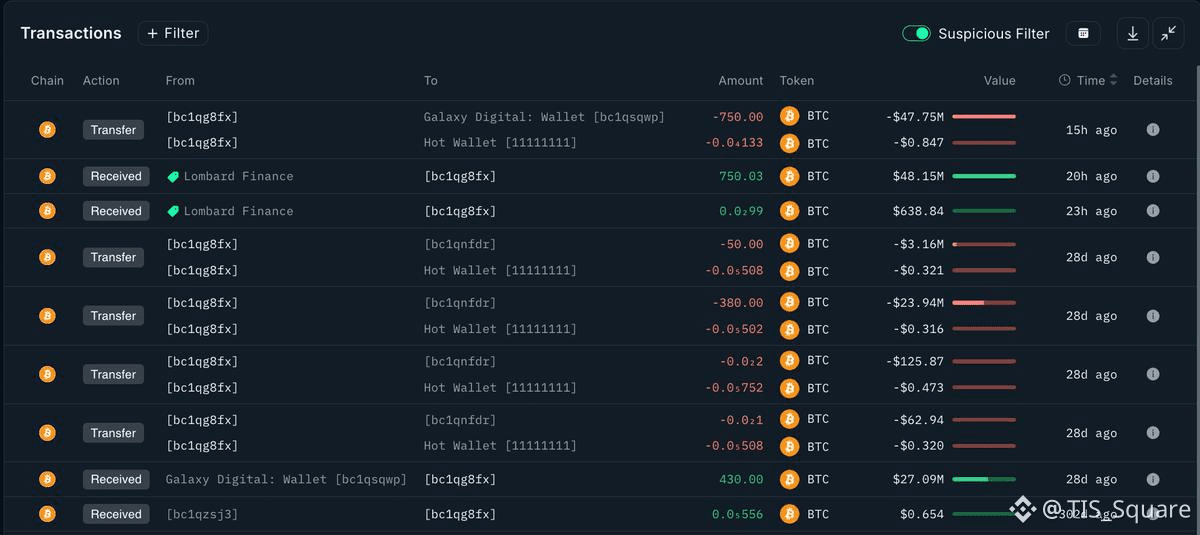
A wallet believed to be associated with Lombard Finance transferred 750 BTC, valued at about $47.8 million, to Galaxy Digital.
According to on-chain data, this transaction is most likely related to an OTC deal (off-exchange, decentralized trading outside the order book).
OTC transactions are often used by institutions or large investors to buy and sell large volumes without causing significant fluctuations in the spot market.
Therefore, transferring a large amount of BTC in this case does not necessarily mean immediate sell pressure; it may only reflect allocation or asset transfers between institutions.
Vietnamese Link With Lombard Finance Transfers 750 $BTC , Related to OTC Trading
A wallet believed to be associated with Lombard Finance transferred 750 BTC, valued at about $47.8 million, to Galaxy Digital.
According to on-chain data, this transaction is most likely related to an OTC deal (off-exchange, decentralized trading outside the order book).
OTC transactions are often used by institutions or large investors to buy and sell large volumes without causing significant fluctuations in the spot market.
Therefore, transferring a large amount of BTC in this case does not necessarily mean immediate sell pressure; it may only reflect allocation or asset transfers between institutions.
A wallet believed to be associated with Lombard Finance transferred 750 BTC, valued at about $47.8 million, to Galaxy Digital.
According to on-chain data, this transaction is most likely related to an OTC deal (off-exchange, decentralized trading outside the order book).
OTC transactions are often used by institutions or large investors to buy and sell large volumes without causing significant fluctuations in the spot market.
Therefore, transferring a large amount of BTC in this case does not necessarily mean immediate sell pressure; it may only reflect allocation or asset transfers between institutions.
76
·
--
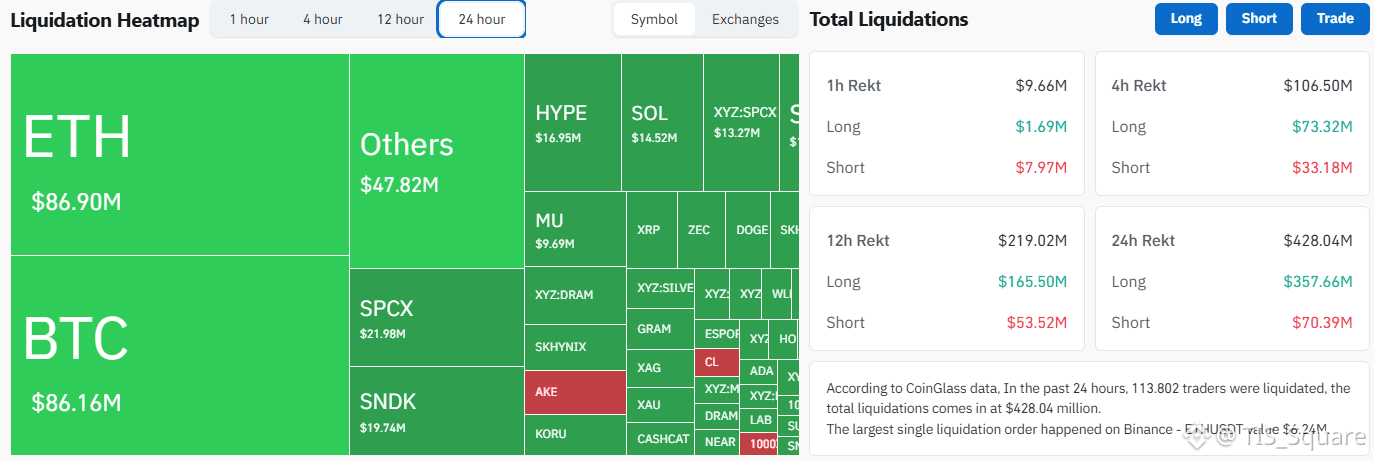
Crypto Market Liquidation Hits $428 Million in 24 Hours – Long Positions Suffer the Biggest Loss
Over the past 24 hours, the crypto market recorded approximately $428.04 million in liquidation value, affecting more than 113,800 traders.
📊 Highlights
- Total liquidations: $428.04 million Long orders: $357.66 million (≈83.6%) Short orders: $70.39 million (≈16.4%)
- $ETH và $BTC led in liquidation value with roughly $86.9 million and $86.2 million, followed by many altcoins such as $HYPE , SOL, and other tokens.
{future}(HYPEUSDT)
{future}(BTCUSDT)
{future}(ETHUSDT)
The fact that Long orders account for most of the liquidation value indicates that the market has experienced a correction wave that forced leveraged investors following the uptrend to close their positions.
However, once most Long leverage has been flushed out, selling pressure from liquidation events may ease. The market will need to monitor whether new capital flows return to support prices, or whether the correction trend will continue in the short term.
Crypto Market Liquidation Hits $428 Million in 24 Hours – Long Positions Suffer the Biggest Loss
Over the past 24 hours, the crypto market recorded approximately $428.04 million in liquidation value, affecting more than 113,800 traders.
📊 Highlights
- Total liquidations: $428.04 million Long orders: $357.66 million (≈83.6%) Short orders: $70.39 million (≈16.4%)
- $ETH và $BTC led in liquidation value with roughly $86.9 million and $86.2 million, followed by many altcoins such as $HYPE , SOL, and other tokens.
The fact that Long orders account for most of the liquidation value indicates that the market has experienced a correction wave that forced leveraged investors following the uptrend to close their positions.
However, once most Long leverage has been flushed out, selling pressure from liquidation events may ease. The market will need to monitor whether new capital flows return to support prices, or whether the correction trend will continue in the short term.
Over the past 24 hours, the crypto market recorded approximately $428.04 million in liquidation value, affecting more than 113,800 traders.
📊 Highlights
- Total liquidations: $428.04 million Long orders: $357.66 million (≈83.6%) Short orders: $70.39 million (≈16.4%)
- $ETH và $BTC led in liquidation value with roughly $86.9 million and $86.2 million, followed by many altcoins such as $HYPE , SOL, and other tokens.
The fact that Long orders account for most of the liquidation value indicates that the market has experienced a correction wave that forced leveraged investors following the uptrend to close their positions.
However, once most Long leverage has been flushed out, selling pressure from liquidation events may ease. The market will need to monitor whether new capital flows return to support prices, or whether the correction trend will continue in the short term.
237
·
--
Abraxas Capital Continues to Accumulate ETH, Injecting More Than 82,000 $ETH V into DeFi
{future}(ETHUSDT)
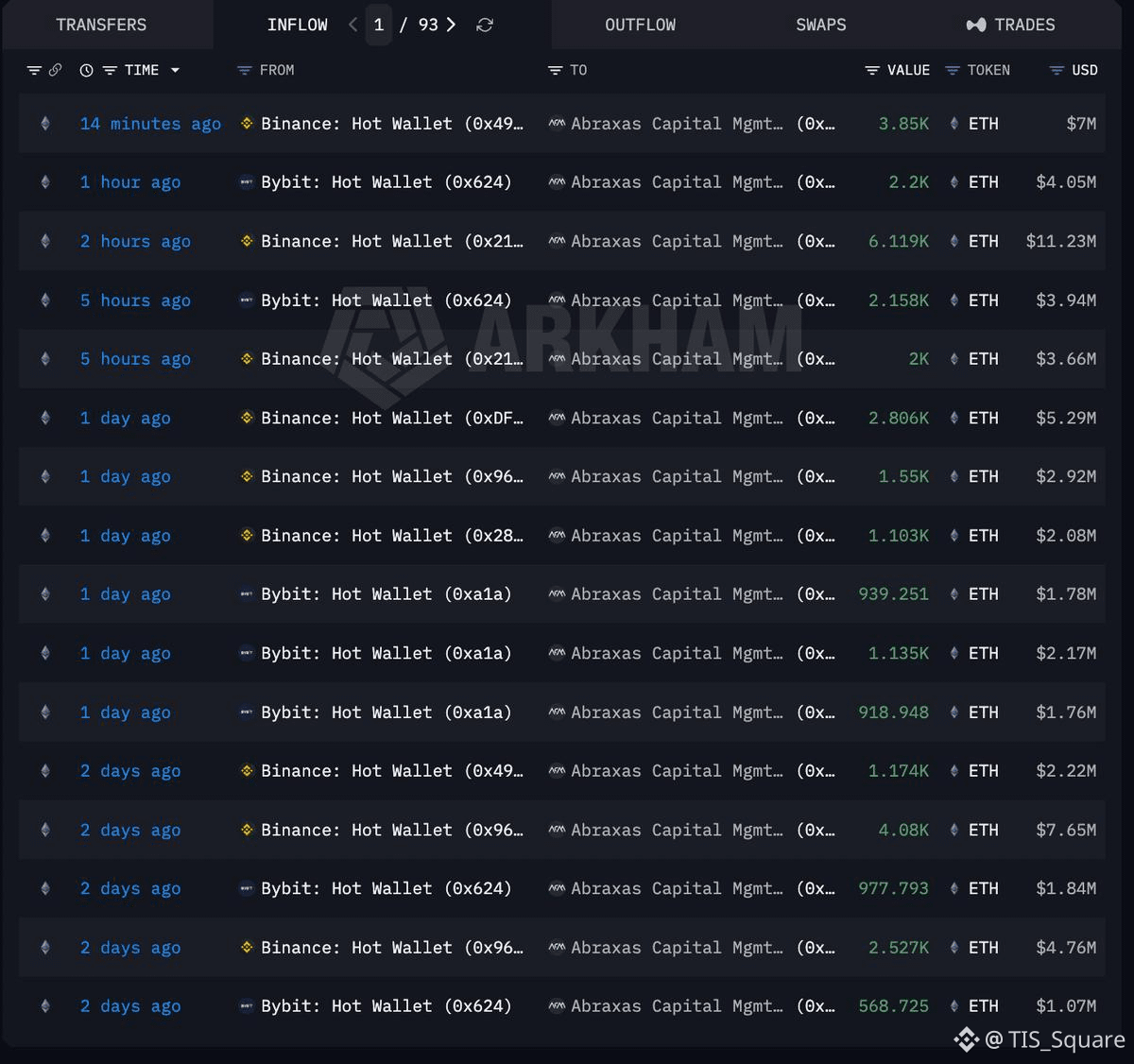
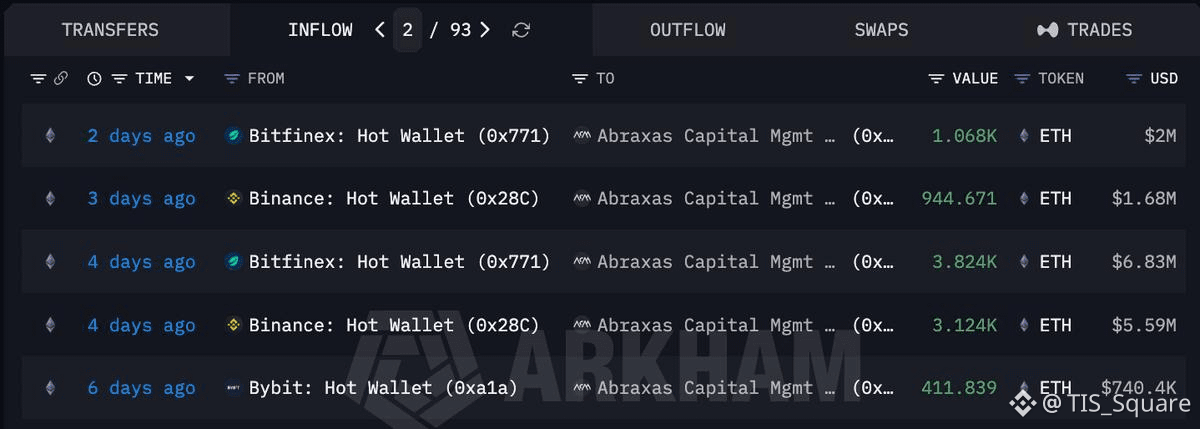
Abraxas Capital investment fund continues to increase its position in Ethereum (ETH).
Over the past 7 days, the fund withdrew 43,500 ETH, worth approximately 80 million USD, from multiple liquidity sources. Then, together with the amount of ETH accumulated earlier, Abraxas allocated a total of 82,300 ETH to DeFi protocols such as Spark and Aave.
Moving a large amount of ETH into DeFi protocols instead of keeping it in locations with higher liquidity often indicates a trend of long-term holding or optimizing returns on assets, rather than preparing to sell right away.
This move reflects the confidence of a large institution in the Ethereum ecosystem, while also showing that institutional capital flows are still seeking opportunities for profit in the DeFi space rather than simply holding ETH passively.
Abraxas Capital Continues to Accumulate ETH, Injecting More Than 82,000 $ETH V into DeFi
Abraxas Capital investment fund continues to increase its position in Ethereum (ETH).
Over the past 7 days, the fund withdrew 43,500 ETH, worth approximately 80 million USD, from multiple liquidity sources. Then, together with the amount of ETH accumulated earlier, Abraxas allocated a total of 82,300 ETH to DeFi protocols such as Spark and Aave.
Moving a large amount of ETH into DeFi protocols instead of keeping it in locations with higher liquidity often indicates a trend of long-term holding or optimizing returns on assets, rather than preparing to sell right away.
This move reflects the confidence of a large institution in the Ethereum ecosystem, while also showing that institutional capital flows are still seeking opportunities for profit in the DeFi space rather than simply holding ETH passively.
Abraxas Capital investment fund continues to increase its position in Ethereum (ETH).
Over the past 7 days, the fund withdrew 43,500 ETH, worth approximately 80 million USD, from multiple liquidity sources. Then, together with the amount of ETH accumulated earlier, Abraxas allocated a total of 82,300 ETH to DeFi protocols such as Spark and Aave.
Moving a large amount of ETH into DeFi protocols instead of keeping it in locations with higher liquidity often indicates a trend of long-term holding or optimizing returns on assets, rather than preparing to sell right away.
This move reflects the confidence of a large institution in the Ethereum ecosystem, while also showing that institutional capital flows are still seeking opportunities for profit in the DeFi space rather than simply holding ETH passively.
116
·
--
China’s gold and silver prices fall, but silver inventories continue to rise
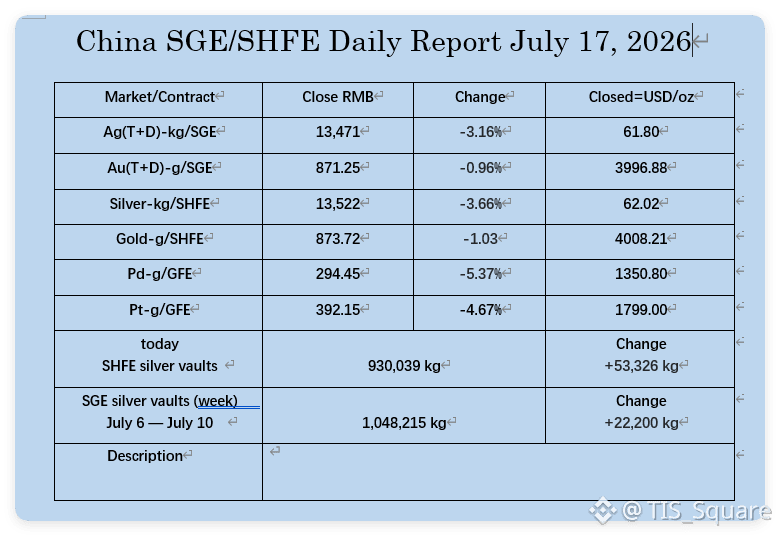
A China market report dated 17/07 shows that gold and silver prices were adjusted across the board:
Silver $XAG SGE: -3.16% Silver SHFE: -3.66%
Gold $XAUT $XAU SGE: -0.96% Gold SHFE: -1.03%
{future}(XAUUSDT)
{future}(XAUTUSDT)
{future}(XAGUSDT)
Notably, silver inventories continue to increase:
SHFE silver inventory rose by an additional 53,326 kg during the day. SGE silver inventory increased by 22,200 kg over the week, reaching more than 1.048 million kg.
Amid falling indices across many Asian stock markets such as South Korea, Japan, Mainland China, and Taiwan, cautious sentiment is growing in the regional financial market.
That said, the view that “a full-blown crisis is about to occur” or that “gold is the only choice” remains a forecast perspective and cannot yet be regarded as a conclusion drawn from current data.
At this point, developments in gold and silver indicate that investors are still in the portfolio re-positioning phase, while the continued rise in silver inventories reflects that physical supply is still being added.
The next fluctuations will depend on global liquidity, monetary policy, and the level of stress across financial markets in the coming period.
China’s gold and silver prices fall, but silver inventories continue to rise
A China market report dated 17/07 shows that gold and silver prices were adjusted across the board:
Silver $XAG SGE: -3.16% Silver SHFE: -3.66%
Gold $XAUT $XAU SGE: -0.96% Gold SHFE: -1.03%
Notably, silver inventories continue to increase:
SHFE silver inventory rose by an additional 53,326 kg during the day. SGE silver inventory increased by 22,200 kg over the week, reaching more than 1.048 million kg.
Amid falling indices across many Asian stock markets such as South Korea, Japan, Mainland China, and Taiwan, cautious sentiment is growing in the regional financial market.
That said, the view that “a full-blown crisis is about to occur” or that “gold is the only choice” remains a forecast perspective and cannot yet be regarded as a conclusion drawn from current data.
At this point, developments in gold and silver indicate that investors are still in the portfolio re-positioning phase, while the continued rise in silver inventories reflects that physical supply is still being added.
The next fluctuations will depend on global liquidity, monetary policy, and the level of stress across financial markets in the coming period.
A China market report dated 17/07 shows that gold and silver prices were adjusted across the board:
Silver $XAG SGE: -3.16% Silver SHFE: -3.66%
Gold $XAUT $XAU SGE: -0.96% Gold SHFE: -1.03%
Notably, silver inventories continue to increase:
SHFE silver inventory rose by an additional 53,326 kg during the day. SGE silver inventory increased by 22,200 kg over the week, reaching more than 1.048 million kg.
Amid falling indices across many Asian stock markets such as South Korea, Japan, Mainland China, and Taiwan, cautious sentiment is growing in the regional financial market.
That said, the view that “a full-blown crisis is about to occur” or that “gold is the only choice” remains a forecast perspective and cannot yet be regarded as a conclusion drawn from current data.
At this point, developments in gold and silver indicate that investors are still in the portfolio re-positioning phase, while the continued rise in silver inventories reflects that physical supply is still being added.
The next fluctuations will depend on global liquidity, monetary policy, and the level of stress across financial markets in the coming period.
1
1
1.1k
·
--
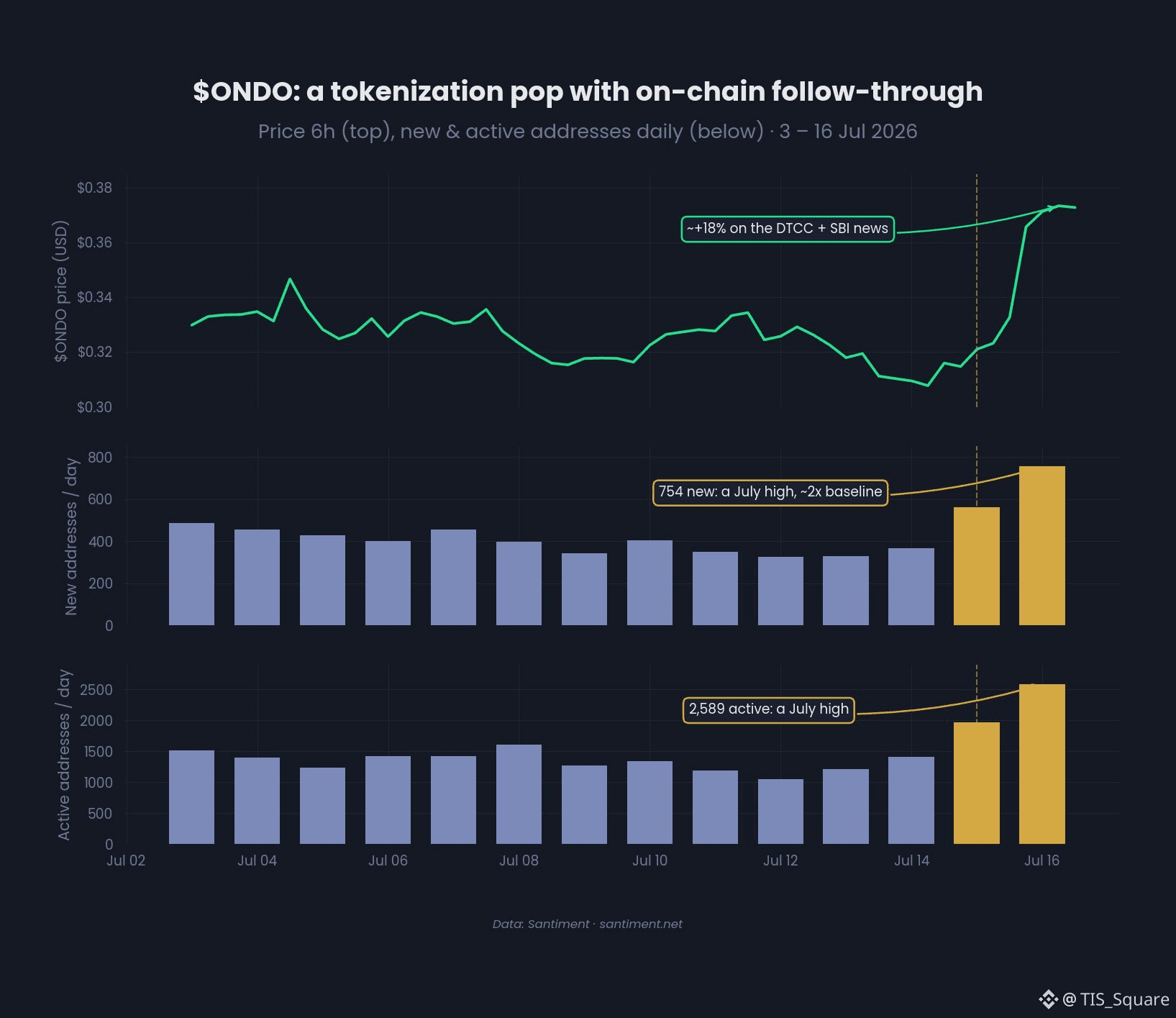
$ONDO Increase 18%: Is the Jump Driven by Good News or the Start of a New Trend?
{future}(ONDOUSDT)
ONDO rose by about 18% from $0.31 to $0.37 during 14–16/7, after it announced the launch of tokenized stock backed by DTCC infrastructure, along with a cooperation relationship with SBI Group to promote tokenized assets.
However, what’s notable is not only the price increase, but also the agreement across on-chain data.
🔶 New capital is truly joining in
According to the chart:
- New wallet addresses increased continuously from 367 → 562 → 754, marking the highest level in July and nearly double the pace from early month.
- Daily active addresses also surged from 1,410 → 1,971 → 2,589, the highest level since the end of June.
This indicates not only that existing ONDO holders are becoming more active, but also that additional new users are entering the ecosystem.
🔶 The price increase is supported by network activity
- Typically, rallies driven by positive news tend to weaken quickly once the media effect fades.
- However, with ONDO, the price rise coincided with the continued climb in both the number of new wallets and active addresses over multiple consecutive days.
- This difference gives the current rally a more solid foundation than spikes that rely solely on market sentiment.
News may be the initial catalyst, but new on-chain data is the confirmation factor.
If the number of new wallets and active addresses continues to stay high in the coming days, it will suggest that capital and new users are still flowing into the ecosystem (HST).
$ONDO Increase 18%: Is the Jump Driven by Good News or the Start of a New Trend?
ONDO rose by about 18% from $0.31 to $0.37 during 14–16/7, after it announced the launch of tokenized stock backed by DTCC infrastructure, along with a cooperation relationship with SBI Group to promote tokenized assets.
However, what’s notable is not only the price increase, but also the agreement across on-chain data.
🔶 New capital is truly joining in
According to the chart:
- New wallet addresses increased continuously from 367 → 562 → 754, marking the highest level in July and nearly double the pace from early month.
- Daily active addresses also surged from 1,410 → 1,971 → 2,589, the highest level since the end of June.
This indicates not only that existing ONDO holders are becoming more active, but also that additional new users are entering the ecosystem.
🔶 The price increase is supported by network activity
- Typically, rallies driven by positive news tend to weaken quickly once the media effect fades.
- However, with ONDO, the price rise coincided with the continued climb in both the number of new wallets and active addresses over multiple consecutive days.
- This difference gives the current rally a more solid foundation than spikes that rely solely on market sentiment.
News may be the initial catalyst, but new on-chain data is the confirmation factor.
If the number of new wallets and active addresses continues to stay high in the coming days, it will suggest that capital and new users are still flowing into the ecosystem (HST).
ONDO rose by about 18% from $0.31 to $0.37 during 14–16/7, after it announced the launch of tokenized stock backed by DTCC infrastructure, along with a cooperation relationship with SBI Group to promote tokenized assets.
However, what’s notable is not only the price increase, but also the agreement across on-chain data.
🔶 New capital is truly joining in
According to the chart:
- New wallet addresses increased continuously from 367 → 562 → 754, marking the highest level in July and nearly double the pace from early month.
- Daily active addresses also surged from 1,410 → 1,971 → 2,589, the highest level since the end of June.
This indicates not only that existing ONDO holders are becoming more active, but also that additional new users are entering the ecosystem.
🔶 The price increase is supported by network activity
- Typically, rallies driven by positive news tend to weaken quickly once the media effect fades.
- However, with ONDO, the price rise coincided with the continued climb in both the number of new wallets and active addresses over multiple consecutive days.
- This difference gives the current rally a more solid foundation than spikes that rely solely on market sentiment.
News may be the initial catalyst, but new on-chain data is the confirmation factor.
If the number of new wallets and active addresses continues to stay high in the coming days, it will suggest that capital and new users are still flowing into the ecosystem (HST).
405
Log in to explore more content
Join global crypto users on Binance Square
⚡️ Get latest and useful information about crypto.
💬 Trusted by the world’s largest crypto exchange.
👍 Discover real insights from verified creators.
Email / Phone number
Trending Topics
NEARFallsToAround$4.70Down14%
275 views
6 Discussing
🚨 $NEAR — FROM ETF HYPE TO A 14% SLAP IN THE FACE.
NEAR has dropped toward $4.70, giving back a big chunk of its recent run after briefly trading above $5.50. The selloff also came as NEAR Intents disclosed a security incident tied to its cross-chain infrastructure, with reported losses around $3.8M. The underlying NEAR blockchain itself was not reported as compromised.
Here’s the part traders should care about:
$4.69–$4.74 is now the key support zone.
Hold it, and this could simply be a violent retest after the September breakout.
Lose it?
The next downside references sit closer to $4.58, then ~$4.30.
And the irony?
The new Bitwise NEAR ETF was still seeing positive inflows around launch week.
So this isn’t a simple “nobody wants NEAR” story.
It’s a battle between:
fresh institutional access
vs.
post-rally profit-taking + security fear.
$NEAR doesn’t need hype right now. It needs $4.70 to hold. 👀
#NEARFallsToAround$4.70Down14% #EvernorthPlansNasdaqListingOct8 #SECProposesCryptoCustodyFramework #IMFApproves$139MDisbursementToElSalvador #AnthropicTargetsIPOAsSoonAsMidNovember
KimHotbae
·0 Likes
·187 views
EvernorthPlansNasdaqListingOct8
217 views
26 Discussing
SECProposesCryptoCustodyFramework
255 views
34 Discussing