

#walletsecurity
walletsecurity
169,494 views
373 Discussing
Hot
Latest

·
--
Hot and Cold Wallet RiskA private key is only one part of a wallet security system. Recent exchange incidents have reinforced a difficult lesson: funds can move even when attackers do not extract the private keys themselves. Credentials, withdrawal instructions, policy systems and backend access can all become part of the attack path.
That is why hot, warm, cold and custodial wallets should be treated as different exposure models.
A hot wallet is available for frequent activity. It supports fast transfers and daily operations, but its online services, credentials and signing workflow create a wider attack surface.
A cold wallet reduces online reachability and is better suited to long-term holdings or reserves. It still needs careful transaction review, secure recovery and strict procedures for moving funds into an active environment.
A custodial wallet adds another layer. The user has account access, but the platform controls the underlying signing infrastructure. Proof of reserves, protection funds and security controls can be useful evidence, but none removes counterparty or operational risk.
A safer design separates purpose and value. Keep only the required operating balance in active wallets, isolate reserves, limit withdrawal paths, verify instructions independently and rehearse recovery before an incident.
TokenToolHub explains how private keys, addresses, signatures and wallet types fit together:
https://tokentoolhub.com/public-private-keys-explained/
#crypto #bitcoin #Ethereum #WalletSecurity #Web3
Hot and Cold Wallet Risk
A private key is only one part of a wallet security system. Recent exchange incidents have reinforced a difficult lesson: funds can move even when attackers do not extract the private keys themselves. Credentials, withdrawal instructions, policy systems and backend access can all become part of the attack path.
That is why hot, warm, cold and custodial wallets should be treated as different exposure models.
A hot wallet is available for frequent activity. It supports fast transfers and daily operations, but its online services, credentials and signing workflow create a wider attack surface.
A cold wallet reduces online reachability and is better suited to long-term holdings or reserves. It still needs careful transaction review, secure recovery and strict procedures for moving funds into an active environment.
A custodial wallet adds another layer. The user has account access, but the platform controls the underlying signing infrastructure. Proof of reserves, protection funds and security controls can be useful evidence, but none removes counterparty or operational risk.
A safer design separates purpose and value. Keep only the required operating balance in active wallets, isolate reserves, limit withdrawal paths, verify instructions independently and rehearse recovery before an incident.
TokenToolHub explains how private keys, addresses, signatures and wallet types fit together:
https://tokentoolhub.com/public-private-keys-explained/
#crypto #bitcoin #Ethereum #WalletSecurity #Web3
That is why hot, warm, cold and custodial wallets should be treated as different exposure models.
A hot wallet is available for frequent activity. It supports fast transfers and daily operations, but its online services, credentials and signing workflow create a wider attack surface.
A cold wallet reduces online reachability and is better suited to long-term holdings or reserves. It still needs careful transaction review, secure recovery and strict procedures for moving funds into an active environment.
A custodial wallet adds another layer. The user has account access, but the platform controls the underlying signing infrastructure. Proof of reserves, protection funds and security controls can be useful evidence, but none removes counterparty or operational risk.
A safer design separates purpose and value. Keep only the required operating balance in active wallets, isolate reserves, limit withdrawal paths, verify instructions independently and rehearse recovery before an incident.
TokenToolHub explains how private keys, addresses, signatures and wallet types fit together:
https://tokentoolhub.com/public-private-keys-explained/
#crypto #bitcoin #Ethereum #WalletSecurity #Web3
60

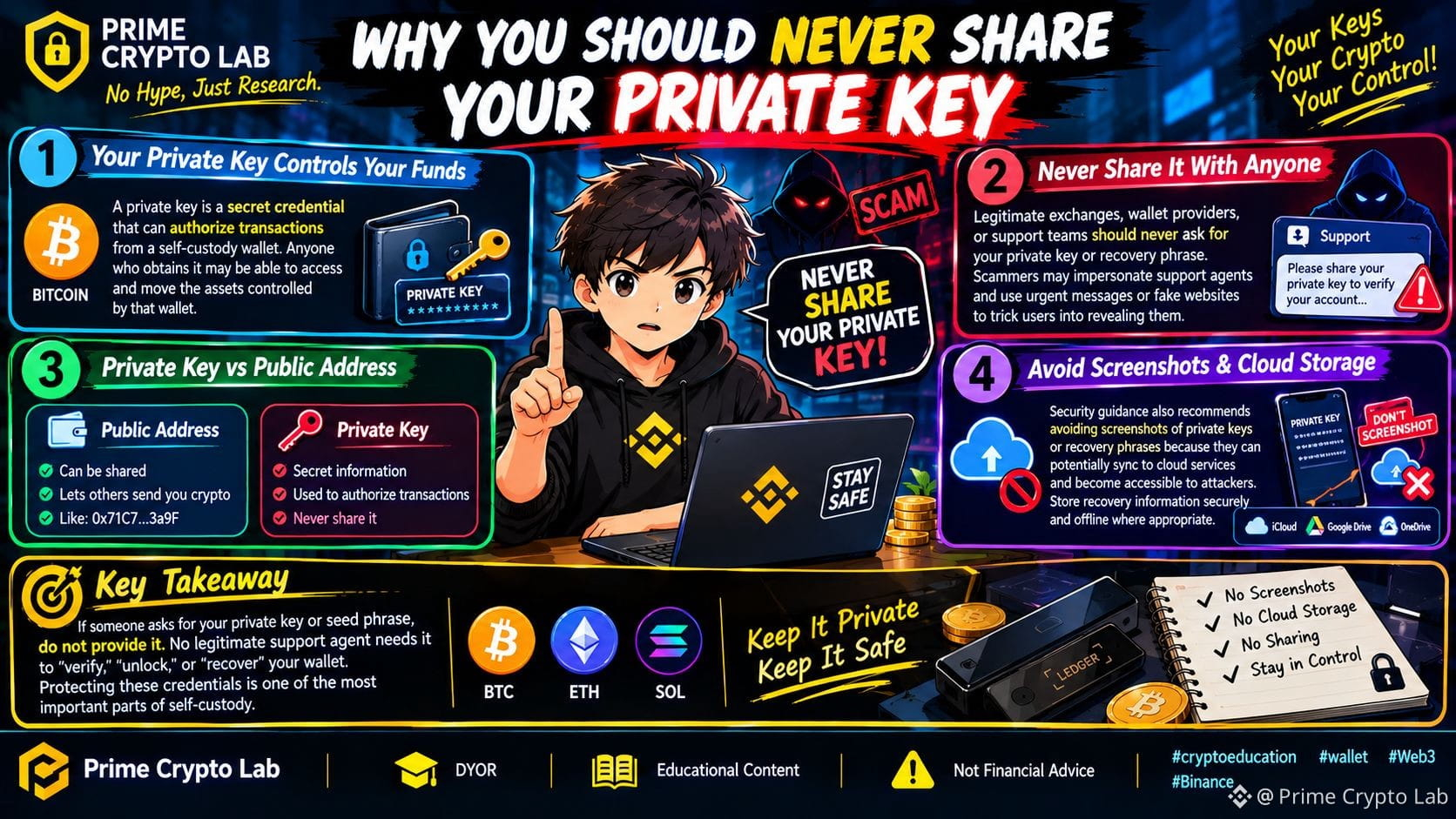
🔐 Why You Should Never Share Your Private Key
🛡️ 1. Your Private Key Controls Your Funds
Bitcoin $BTC — A private key is a secret credential that can authorize transactions from a self-custody wallet. Anyone who obtains it may be able to access and move the assets controlled by that wallet.
🚨 2. Never Share It With Anyone
Legitimate exchanges, wallet providers, or support teams should never ask for your private key or recovery phrase. Scammers may impersonate support agents and use urgent messages or fake websites to trick users into revealing them.
🔑 3. Private Key vs Public Address
A public wallet address can generally be shared so others can send you crypto. A private key is different: it is secret information used to authorize transactions. Keep it confidential at all times.
☁️ 4. Avoid Screenshots & Cloud Storage
Ethereum $ETH — Security guidance also recommends avoiding screenshots of private keys or recovery phrases because they can potentially sync to cloud services and become accessible to attackers. Store recovery information securely and offline where appropriate.
🎯 Key Takeaway
Solana $SOL — If someone asks for your private key or seed phrase, do not provide it. No legitimate support agent needs it to “verify,” “unlock,” or “recover” your wallet. Protecting these credentials is one of the most important parts of self-custody.
Prime Crypto Lab — No Hype, Just Research.
DYOR | Educational Content | Not Financial Advice
#cryptoeducation #WalletSecurity #Web3 #SelfCustody
🔐 Why You Should Never Share Your Private Key
🛡️ 1. Your Private Key Controls Your Funds
Bitcoin $BTC — A private key is a secret credential that can authorize transactions from a self-custody wallet. Anyone who obtains it may be able to access and move the assets controlled by that wallet.
🚨 2. Never Share It With Anyone
Legitimate exchanges, wallet providers, or support teams should never ask for your private key or recovery phrase. Scammers may impersonate support agents and use urgent messages or fake websites to trick users into revealing them.
🔑 3. Private Key vs Public Address
A public wallet address can generally be shared so others can send you crypto. A private key is different: it is secret information used to authorize transactions. Keep it confidential at all times.
☁️ 4. Avoid Screenshots & Cloud Storage
Ethereum $ETH — Security guidance also recommends avoiding screenshots of private keys or recovery phrases because they can potentially sync to cloud services and become accessible to attackers. Store recovery information securely and offline where appropriate.
🎯 Key Takeaway
Solana $SOL — If someone asks for your private key or seed phrase, do not provide it. No legitimate support agent needs it to “verify,” “unlock,” or “recover” your wallet. Protecting these credentials is one of the most important parts of self-custody.
Prime Crypto Lab — No Hype, Just Research.
DYOR | Educational Content | Not Financial Advice
#cryptoeducation #WalletSecurity #Web3 #SelfCustody
🛡️ 1. Your Private Key Controls Your Funds
Bitcoin $BTC — A private key is a secret credential that can authorize transactions from a self-custody wallet. Anyone who obtains it may be able to access and move the assets controlled by that wallet.
🚨 2. Never Share It With Anyone
Legitimate exchanges, wallet providers, or support teams should never ask for your private key or recovery phrase. Scammers may impersonate support agents and use urgent messages or fake websites to trick users into revealing them.
🔑 3. Private Key vs Public Address
A public wallet address can generally be shared so others can send you crypto. A private key is different: it is secret information used to authorize transactions. Keep it confidential at all times.
☁️ 4. Avoid Screenshots & Cloud Storage
Ethereum $ETH — Security guidance also recommends avoiding screenshots of private keys or recovery phrases because they can potentially sync to cloud services and become accessible to attackers. Store recovery information securely and offline where appropriate.
🎯 Key Takeaway
Solana $SOL — If someone asks for your private key or seed phrase, do not provide it. No legitimate support agent needs it to “verify,” “unlock,” or “recover” your wallet. Protecting these credentials is one of the most important parts of self-custody.
Prime Crypto Lab — No Hype, Just Research.
DYOR | Educational Content | Not Financial Advice
#cryptoeducation #WalletSecurity #Web3 #SelfCustody
90


·
--
Bullish
#hackersdrainover12.4mxrpfromdcentwallets
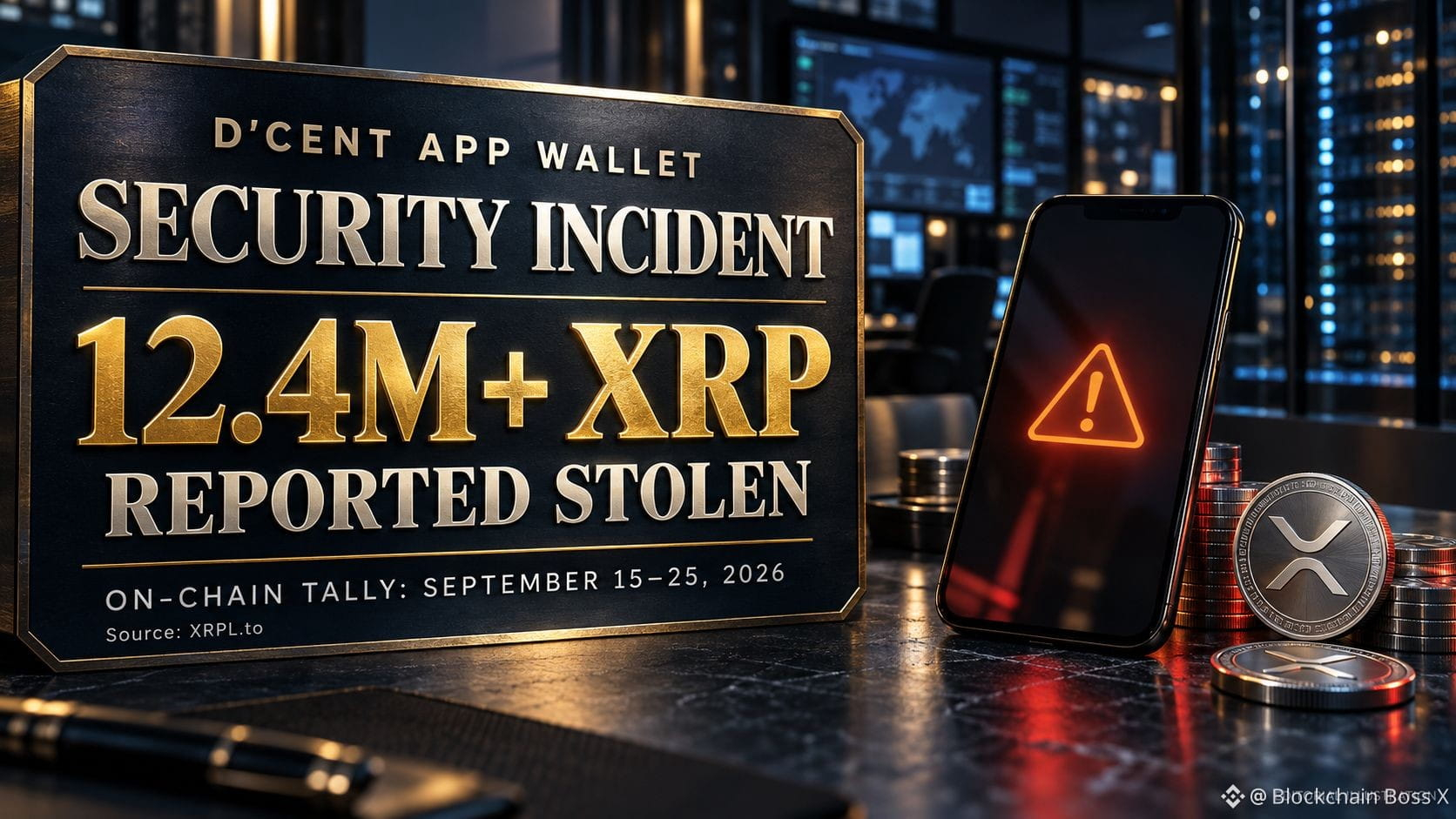
🔐 12.4M+ XRP Reported Stolen in D’CENT App Wallet Incident
XRPL.to’s on-chain investigation tracked 12,402,589 XRP taken from 7,393 wallets between September 15 and 25, 2026. The tally counts wallets, which may differ from the number of affected people.
DCENT’s official notices concern its App Wallet, including hardware wallets whose recovery phrase was also entered into the app. Hardware-generated phrases never entered into the App Wallet fall outside the notice’s direct scope, according to its FAQ.
For affected users, DCENT advises checking the recovery backup, updating through official app stores and transferring assets to a wallet created with an entirely new recovery phrase. Never share that phrase with anyone offering support or recovery.
My take: Wallet security depends on where the recovery phrase has been used, as well as the device holding it. Reusing an exposed phrase on new hardware leaves that exposure in place.
The most useful next disclosures would identify the initial compromise, affected versions and independently verifiable recovery progress. Those details would help users judge whether the fixes address the cause. On-chain transfers show where assets moved; they cannot establish how attackers initially obtained the keys.
Which security update would give affected users the most confidence? 👇
#HackersDrainOver12.4MXRPFromDCENTWallets #xrp #WalletSecurity
#hackersdrainover12.4mxrpfromdcentwallets
🔐 12.4M+ XRP Reported Stolen in D’CENT App Wallet Incident
XRPL.to’s on-chain investigation tracked 12,402,589 XRP taken from 7,393 wallets between September 15 and 25, 2026. The tally counts wallets, which may differ from the number of affected people.
DCENT’s official notices concern its App Wallet, including hardware wallets whose recovery phrase was also entered into the app. Hardware-generated phrases never entered into the App Wallet fall outside the notice’s direct scope, according to its FAQ.
For affected users, DCENT advises checking the recovery backup, updating through official app stores and transferring assets to a wallet created with an entirely new recovery phrase. Never share that phrase with anyone offering support or recovery.
My take: Wallet security depends on where the recovery phrase has been used, as well as the device holding it. Reusing an exposed phrase on new hardware leaves that exposure in place.
The most useful next disclosures would identify the initial compromise, affected versions and independently verifiable recovery progress. Those details would help users judge whether the fixes address the cause. On-chain transfers show where assets moved; they cannot establish how attackers initially obtained the keys.
Which security update would give affected users the most confidence? 👇
#HackersDrainOver12.4MXRPFromDCENTWallets #xrp #WalletSecurity
🔐 12.4M+ XRP Reported Stolen in D’CENT App Wallet Incident
XRPL.to’s on-chain investigation tracked 12,402,589 XRP taken from 7,393 wallets between September 15 and 25, 2026. The tally counts wallets, which may differ from the number of affected people.
DCENT’s official notices concern its App Wallet, including hardware wallets whose recovery phrase was also entered into the app. Hardware-generated phrases never entered into the App Wallet fall outside the notice’s direct scope, according to its FAQ.
For affected users, DCENT advises checking the recovery backup, updating through official app stores and transferring assets to a wallet created with an entirely new recovery phrase. Never share that phrase with anyone offering support or recovery.
My take: Wallet security depends on where the recovery phrase has been used, as well as the device holding it. Reusing an exposed phrase on new hardware leaves that exposure in place.
The most useful next disclosures would identify the initial compromise, affected versions and independently verifiable recovery progress. Those details would help users judge whether the fixes address the cause. On-chain transfers show where assets moved; they cannot establish how attackers initially obtained the keys.
Which security update would give affected users the most confidence? 👇
#HackersDrainOver12.4MXRPFromDCENTWallets #xrp #WalletSecurity
2
987
YOUR WALLET & SECURITY UPDATE NO.7
The Secondhand Hardware Wallet Trap:
Honestly, this one never crossed my mind until someone brought it up: buying a hardware wallet secondhand. Even the ones that show up "factory sealed."
Here's the part that got me. Someone could reseal the box with a seed phrase already loaded on the device, then just wait. You open it, set it up, fund it, feeling great about your new security upgrade... and they had the keys before you ever touched the box. Looks brand new. It isn't!
So now I'm curious...now that you know this can happen, would you still buy one secondhand if it looked sealed?
$USDC $BTC $BNB
#Cryptollegiate #WalletSecurity
{spot}(USDCUSDT)
{spot}(BTCUSDT)
{spot}(BNBUSDT)
Would you trust a hardware wallet you bought secondhand, even factory-sealed?
YOUR WALLET & SECURITY UPDATE NO.7
The Secondhand Hardware Wallet Trap:
Honestly, this one never crossed my mind until someone brought it up: buying a hardware wallet secondhand. Even the ones that show up "factory sealed."
Here's the part that got me. Someone could reseal the box with a seed phrase already loaded on the device, then just wait. You open it, set it up, fund it, feeling great about your new security upgrade... and they had the keys before you ever touched the box. Looks brand new. It isn't!
So now I'm curious...now that you know this can happen, would you still buy one secondhand if it looked sealed?
$USDC $BTC $BNB
#Cryptollegiate #WalletSecurity
Would you trust a hardware wallet you bought secondhand, even factory-sealed?
The Secondhand Hardware Wallet Trap:
Honestly, this one never crossed my mind until someone brought it up: buying a hardware wallet secondhand. Even the ones that show up "factory sealed."
Here's the part that got me. Someone could reseal the box with a seed phrase already loaded on the device, then just wait. You open it, set it up, fund it, feeling great about your new security upgrade... and they had the keys before you ever touched the box. Looks brand new. It isn't!
So now I'm curious...now that you know this can happen, would you still buy one secondhand if it looked sealed?
$USDC $BTC $BNB
#Cryptollegiate #WalletSecurity
Would you trust a hardware wallet you bought secondhand, even factory-sealed?
Sealed is sealed, I'd use it
100%
Never, buy new or not at all
0%
After a factory reset + verify
0%
Never thought bout it till now
0%
1 votes • Voting closed
1
233

Binance is sounding the alarm on address poisoning scams. Scammers are mimicking your past transaction history to bait you into sending funds to their fake addresses. Double check every single character before hitting send.
#AddressPoisoning #WalletSecurity
Binance is sounding the alarm on address poisoning scams. Scammers are mimicking your past transaction history to bait you into sending funds to their fake addresses. Double check every single character before hitting send.
#AddressPoisoning #WalletSecurity
#AddressPoisoning #WalletSecurity
2
·
--
Read Wallet Security BadgesAn EAL5+ or EAL6+ label can be a useful security signal, but it should start a due-diligence question rather than end one.
First identify the target of the evaluation. A wallet may use a secure element with a Common Criteria rating. That tells you something about the assessed chip and its resistance under a defined scope. It does not automatically certify the entire device, firmware, bootloader, companion app, transaction parser, recovery process, manufacturing controls and every future update.
Use four questions for every badge: who issued it, what exact component was evaluated, which model and version were covered, and when the evaluation happened? Look for a certificate identifier, security target, evaluation report or audit scope. If a vendor cites an independent audit, check whether the report is available, whether findings were fixed and whether remediation was verified.
Then review the layers outside the badge. Examine firmware transparency, signed-update controls, vulnerability disclosure, bug-bounty coverage, trusted-screen clarity, recovery architecture and official purchase channels. A strong physical security component cannot stop a user from approving a malicious request or exposing recovery material.
TokenToolHub’s guide shows how to separate useful assurance evidence from vague security marketing:
https://tokentoolhub.com/wallet-security-certifications/
#WalletSecurity #HardwareWallets #CryptoSecurity #SelfCustody #CyberSecurity
Read Wallet Security Badges
An EAL5+ or EAL6+ label can be a useful security signal, but it should start a due-diligence question rather than end one.
First identify the target of the evaluation. A wallet may use a secure element with a Common Criteria rating. That tells you something about the assessed chip and its resistance under a defined scope. It does not automatically certify the entire device, firmware, bootloader, companion app, transaction parser, recovery process, manufacturing controls and every future update.
Use four questions for every badge: who issued it, what exact component was evaluated, which model and version were covered, and when the evaluation happened? Look for a certificate identifier, security target, evaluation report or audit scope. If a vendor cites an independent audit, check whether the report is available, whether findings were fixed and whether remediation was verified.
Then review the layers outside the badge. Examine firmware transparency, signed-update controls, vulnerability disclosure, bug-bounty coverage, trusted-screen clarity, recovery architecture and official purchase channels. A strong physical security component cannot stop a user from approving a malicious request or exposing recovery material.
TokenToolHub’s guide shows how to separate useful assurance evidence from vague security marketing:
https://tokentoolhub.com/wallet-security-certifications/
#WalletSecurity #HardwareWallets #CryptoSecurity #SelfCustody #CyberSecurity
First identify the target of the evaluation. A wallet may use a secure element with a Common Criteria rating. That tells you something about the assessed chip and its resistance under a defined scope. It does not automatically certify the entire device, firmware, bootloader, companion app, transaction parser, recovery process, manufacturing controls and every future update.
Use four questions for every badge: who issued it, what exact component was evaluated, which model and version were covered, and when the evaluation happened? Look for a certificate identifier, security target, evaluation report or audit scope. If a vendor cites an independent audit, check whether the report is available, whether findings were fixed and whether remediation was verified.
Then review the layers outside the badge. Examine firmware transparency, signed-update controls, vulnerability disclosure, bug-bounty coverage, trusted-screen clarity, recovery architecture and official purchase channels. A strong physical security component cannot stop a user from approving a malicious request or exposing recovery material.
TokenToolHub’s guide shows how to separate useful assurance evidence from vague security marketing:
https://tokentoolhub.com/wallet-security-certifications/
#WalletSecurity #HardwareWallets #CryptoSecurity #SelfCustody #CyberSecurity
29
Duelbits crypto casino has gone offline following a $7 million hot wallet exploit. This massive security breach underscores the significant risks centralized crypto platforms face from targeted hacks.
#DuelbitsHack #WalletSecurity
Duelbits crypto casino has gone offline following a $7 million hot wallet exploit. This massive security breach underscores the significant risks centralized crypto platforms face from targeted hacks.
#DuelbitsHack #WalletSecurity
#DuelbitsHack #WalletSecurity
10

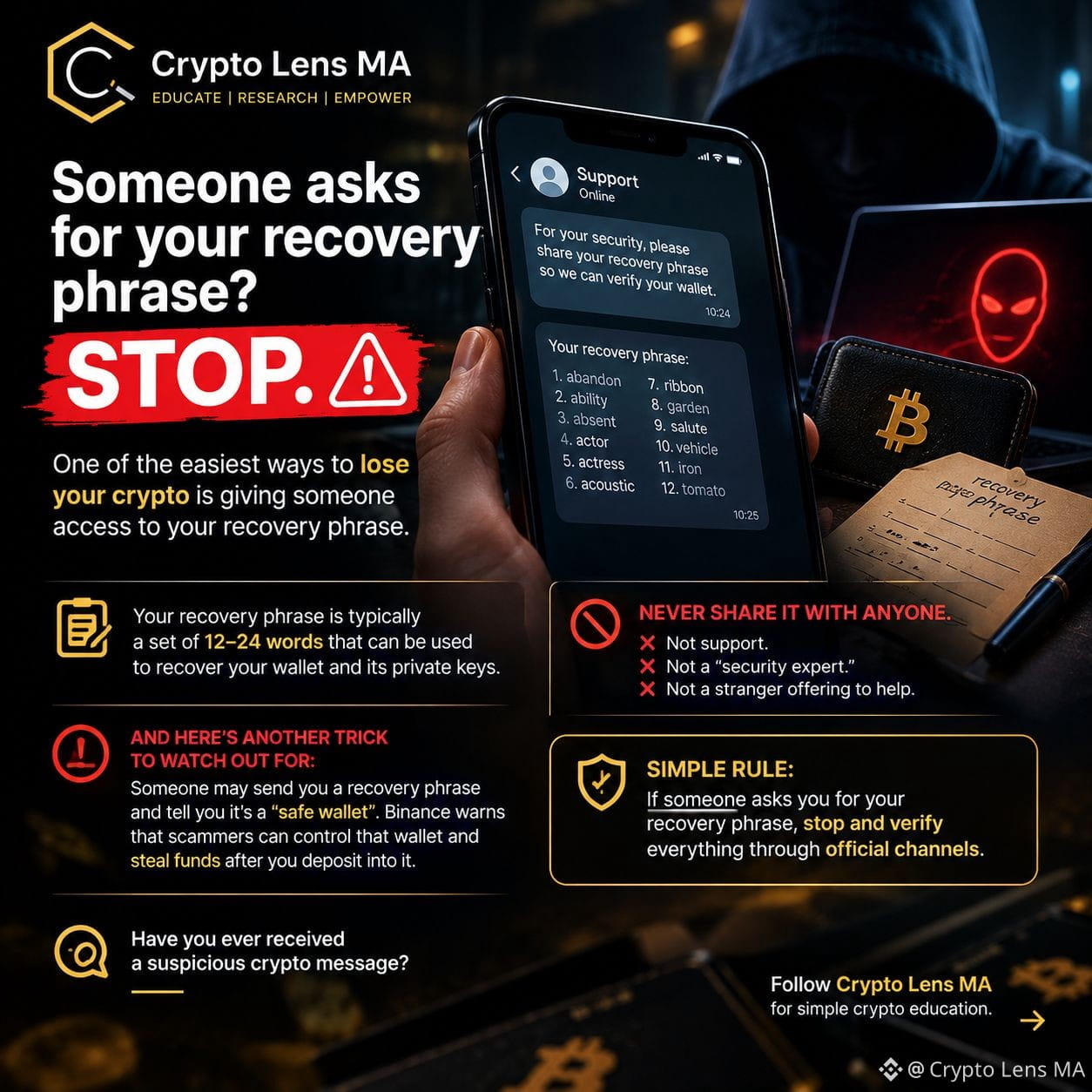
Someone asks for your recovery phrase? STOP. 🚨
One of the easiest ways to lose your crypto is giving someone access to your recovery phrase.
Your recovery phrase is typically a set of 12–24 words that can be used to recover your wallet and its private keys.
🔴 Never share it with anyone.
Not support.
Not a “security expert.”
Not a stranger offering to help.
And here's another trick to watch out for:
Someone may send you a recovery phrase and tell you it's a “safe wallet”. Binance warns that scammers can control that wallet and steal funds after you deposit into it.
Simple rule: If someone asks you for your recovery phrase, stop and verify everything through official channels. 🔐
Have you ever received a suspicious crypto message?
#CryptoSecurity #Cryptoscam #crypto #blockchain #WalletSecurity
Someone asks for your recovery phrase? STOP. 🚨
One of the easiest ways to lose your crypto is giving someone access to your recovery phrase.
Your recovery phrase is typically a set of 12–24 words that can be used to recover your wallet and its private keys.
🔴 Never share it with anyone.
Not support.
Not a “security expert.”
Not a stranger offering to help.
And here's another trick to watch out for:
Someone may send you a recovery phrase and tell you it's a “safe wallet”. Binance warns that scammers can control that wallet and steal funds after you deposit into it.
Simple rule: If someone asks you for your recovery phrase, stop and verify everything through official channels. 🔐
Have you ever received a suspicious crypto message?
#CryptoSecurity #Cryptoscam #crypto #blockchain #WalletSecurity
One of the easiest ways to lose your crypto is giving someone access to your recovery phrase.
Your recovery phrase is typically a set of 12–24 words that can be used to recover your wallet and its private keys.
🔴 Never share it with anyone.
Not support.
Not a “security expert.”
Not a stranger offering to help.
And here's another trick to watch out for:
Someone may send you a recovery phrase and tell you it's a “safe wallet”. Binance warns that scammers can control that wallet and steal funds after you deposit into it.
Simple rule: If someone asks you for your recovery phrase, stop and verify everything through official channels. 🔐
Have you ever received a suspicious crypto message?
#CryptoSecurity #Cryptoscam #crypto #blockchain #WalletSecurity
147
A Web3 wallet provider reported a security breach, warning the XRP community to move assets immediately. This exploit puts user funds at significant risk if they do not act quickly.
#XRP #WalletSecurity
A Web3 wallet provider reported a security breach, warning the XRP community to move assets immediately. This exploit puts user funds at significant risk if they do not act quickly.
#XRP #WalletSecurity
#XRP #WalletSecurity
16
A simple coding error allowed a hacker to drain $7.8 million from a crypto wallet. This catastrophic exploit highlights the extreme risks of even minor security oversights in digital asset management.
#SecurityVulnerability #WalletSecurity
A simple coding error allowed a hacker to drain $7.8 million from a crypto wallet. This catastrophic exploit highlights the extreme risks of even minor security oversights in digital asset management.
#SecurityVulnerability #WalletSecurity
#SecurityVulnerability #WalletSecurity
5

🚨 DID YOU KNOW THAT AN APPROVAL CAN REPRESENT A RISK?
When you interact with certain protocols, you can grant a contract permission to spend specific tokens from your wallet.
The problem arises when:
❌ You grant unlimited permissions.
❌ You leave old approvals you no longer use.
❌ You interact with compromised contracts.
That’s why a good practice is to periodically review the approvals of your wallets and revoke those you no longer need.
🔐 It’s not enough to protect your seed phrase.
You also have to control which contracts have permissions over your assets.
Before you sign:
👉 Read what you’re authorizing.
👉 Verify the contract.
👉 Don’t sign automatically.
A signature can be much more important than it seems.
#DeFi #Web3 #WalletSecurity #CryptoSecurity #BinanceSquare
🚨 DID YOU KNOW THAT AN APPROVAL CAN REPRESENT A RISK?
When you interact with certain protocols, you can grant a contract permission to spend specific tokens from your wallet.
The problem arises when:
❌ You grant unlimited permissions.
❌ You leave old approvals you no longer use.
❌ You interact with compromised contracts.
That’s why a good practice is to periodically review the approvals of your wallets and revoke those you no longer need.
🔐 It’s not enough to protect your seed phrase.
You also have to control which contracts have permissions over your assets.
Before you sign:
👉 Read what you’re authorizing.
👉 Verify the contract.
👉 Don’t sign automatically.
A signature can be much more important than it seems.
#DeFi #Web3 #WalletSecurity #CryptoSecurity #BinanceSquare
When you interact with certain protocols, you can grant a contract permission to spend specific tokens from your wallet.
The problem arises when:
❌ You grant unlimited permissions.
❌ You leave old approvals you no longer use.
❌ You interact with compromised contracts.
That’s why a good practice is to periodically review the approvals of your wallets and revoke those you no longer need.
🔐 It’s not enough to protect your seed phrase.
You also have to control which contracts have permissions over your assets.
Before you sign:
👉 Read what you’re authorizing.
👉 Verify the contract.
👉 Don’t sign automatically.
A signature can be much more important than it seems.
#DeFi #Web3 #WalletSecurity #CryptoSecurity #BinanceSquare
55

·
--
#hackersatack
#HackerStrategy
#Revolut
#WalletSecurity
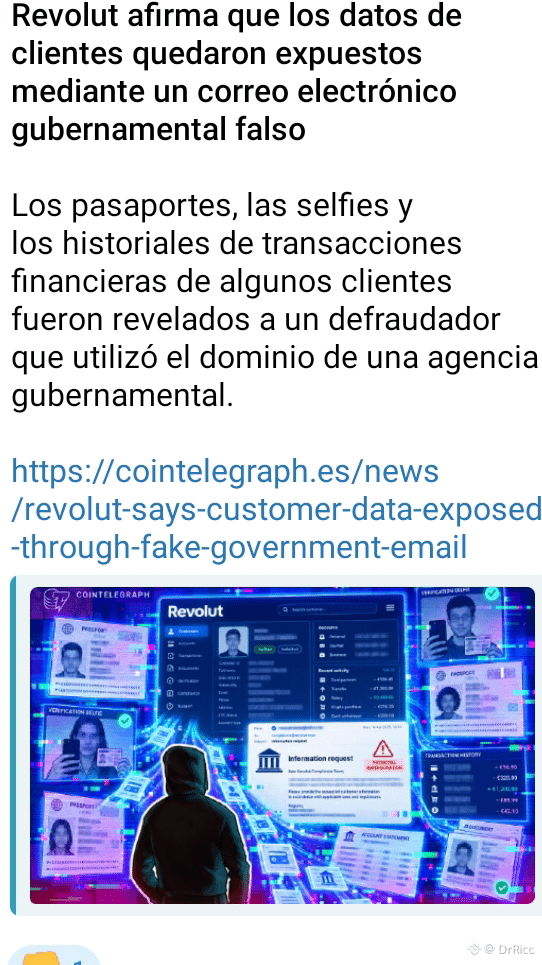
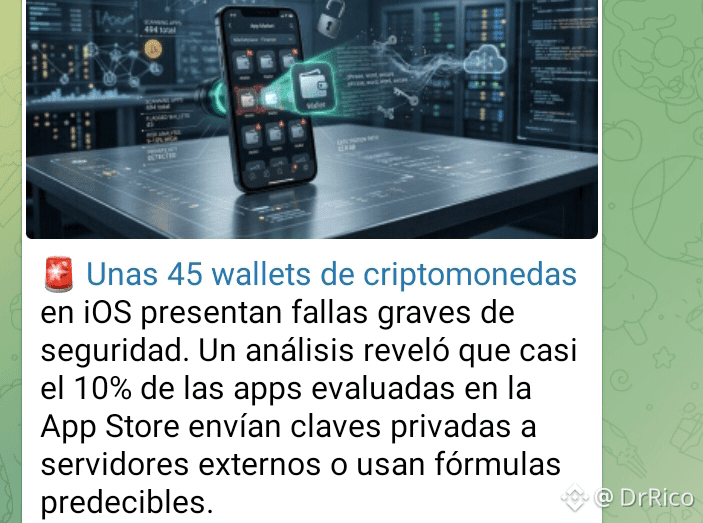
Failures and more failures, hacks and more hacks have been the news that have dominated this year in crypto news!! This time it was Revolut!! Also, the most curious fact: more than 45 Crypto wallets on iOS show serious security flaws!! 🤦🤦🤦🤦🤦🤦🤦🤦🤦🤦🤦🤦🤦🤦🤦🤦 the hackers are feasting!! 🤮🤮🤮🤮
$USD1
$USDC
$ETH
#hackersatack
#HackerStrategy
#Revolut
#WalletSecurity
Failures and more failures, hacks and more hacks have been the news that have dominated this year in crypto news!! This time it was Revolut!! Also, the most curious fact: more than 45 Crypto wallets on iOS show serious security flaws!! 🤦🤦🤦🤦🤦🤦🤦🤦🤦🤦🤦🤦🤦🤦🤦🤦 the hackers are feasting!! 🤮🤮🤮🤮
$USD1
$USDC
$ETH
#HackerStrategy
#Revolut
#WalletSecurity
Failures and more failures, hacks and more hacks have been the news that have dominated this year in crypto news!! This time it was Revolut!! Also, the most curious fact: more than 45 Crypto wallets on iOS show serious security flaws!! 🤦🤦🤦🤦🤦🤦🤦🤦🤦🤦🤦🤦🤦🤦🤦🤦 the hackers are feasting!! 🤮🤮🤮🤮
$USD1
$USDC
$ETH
162

·
--
Coldcard third-wave attack funds keep moving: what questions custody systems must answer2026-09-08
The Block, CoinDesk, Cointelegraph, and Decrypt all reported that the bitcoins obtained in Coldcard’s third wave of attacks recently saw large transfers. Citing tracking by Galaxy Research, the reports said that about 45% of the funds stolen in the third wave have already been moved.
From an industry perspective, the focus is not just on fund flows, but on whether the custody system can quickly respond after an anomaly occurs: which vaults are affected, which authorizations remain valid, whether remaining funds can be isolated, and which control paths are still trustworthy after recovery.
If a system can only trace addresses after a transaction occurs, it solves the forensics problem; a more complete control plane also needs to connect key generation, signing permissions, anomaly detection, and the pause-and-recovery workflows. After the Coldcard incident, whether subsequent updates can clarify if the attacker obtained a single key, batch authorizations, or even higher-level key management privileges is still worth watching.
Coldcard third-wave attack funds keep moving: what questions custody systems must answer
2026-09-08
The Block, CoinDesk, Cointelegraph, and Decrypt all reported that the bitcoins obtained in Coldcard’s third wave of attacks recently saw large transfers. Citing tracking by Galaxy Research, the reports said that about 45% of the funds stolen in the third wave have already been moved.
From an industry perspective, the focus is not just on fund flows, but on whether the custody system can quickly respond after an anomaly occurs: which vaults are affected, which authorizations remain valid, whether remaining funds can be isolated, and which control paths are still trustworthy after recovery.
If a system can only trace addresses after a transaction occurs, it solves the forensics problem; a more complete control plane also needs to connect key generation, signing permissions, anomaly detection, and the pause-and-recovery workflows. After the Coldcard incident, whether subsequent updates can clarify if the attacker obtained a single key, batch authorizations, or even higher-level key management privileges is still worth watching.
The Block, CoinDesk, Cointelegraph, and Decrypt all reported that the bitcoins obtained in Coldcard’s third wave of attacks recently saw large transfers. Citing tracking by Galaxy Research, the reports said that about 45% of the funds stolen in the third wave have already been moved.
From an industry perspective, the focus is not just on fund flows, but on whether the custody system can quickly respond after an anomaly occurs: which vaults are affected, which authorizations remain valid, whether remaining funds can be isolated, and which control paths are still trustworthy after recovery.
If a system can only trace addresses after a transaction occurs, it solves the forensics problem; a more complete control plane also needs to connect key generation, signing permissions, anomaly detection, and the pause-and-recovery workflows. After the Coldcard incident, whether subsequent updates can clarify if the attacker obtained a single key, batch authorizations, or even higher-level key management privileges is still worth watching.
49

·
--
Amazing! Let’s turn this news into a “sick” post on Binance Square!
---
**TOTAL SHOCK: Unlock a ‘1 billion USD’ wallet but only find $10! The harsh truth behind those “fake” crypto wallets has left the entire community stunned!** 😱
Brothers and sisters in the crypto space must have heard stories about “recovering a lost wallet” that sound almost too thrilling to be true. But the latest hot news revealed by asset recovery experts is a sharp warning for all of us!
Here are the key points you need to grasp right away:
* **Crypto “detectives” can help you regain access** to a lost wallet (forgot the password, seed phrase). This gives hope to anyone who accidentally “dropped” their digital treasure keys.
* **However, this effort becomes pointless** if the money in the wallet had already “evaporated” beforehand or was never deposited in the first place. No matter how top-tier the recovery skills are, you can’t create money out of thin air!
* **Major shock: A wallet reportedly worth billions of dollars—after its access was restored—only contained a paltry $10 inside!** This reveals a tragic reality: the illusions that can exist in the market.
**My personal take:**
The brutal lesson here is: Regaining access is only the first step. More important than anything is to make sure your *money actually really is in the wallet*—and to use a safe, transparent method to manage it. Don’t fall for the illusion of a “million-dollar wallet” when it’s actually empty. Always check your balance and proactively protect your assets BEFORE anything goes wrong. All recovery efforts are meaningless if your wallet is already empty! Stay sharp, everyone!
What do you think about this incident? Is this the necessary warning the crypto community needs? Leave a comment below! 👇
Don’t forget to hit **Follow** so you don’t miss the most in-depth analyses and hottest updates from me!
#CryptoNews #TrendingNews #WalletSecurity #Blockchain
Amazing! Let’s turn this news into a “sick” post on Binance Square!
---
**TOTAL SHOCK: Unlock a ‘1 billion USD’ wallet but only find $10! The harsh truth behind those “fake” crypto wallets has left the entire community stunned!** 😱
Brothers and sisters in the crypto space must have heard stories about “recovering a lost wallet” that sound almost too thrilling to be true. But the latest hot news revealed by asset recovery experts is a sharp warning for all of us!
Here are the key points you need to grasp right away:
* **Crypto “detectives” can help you regain access** to a lost wallet (forgot the password, seed phrase). This gives hope to anyone who accidentally “dropped” their digital treasure keys.
* **However, this effort becomes pointless** if the money in the wallet had already “evaporated” beforehand or was never deposited in the first place. No matter how top-tier the recovery skills are, you can’t create money out of thin air!
* **Major shock: A wallet reportedly worth billions of dollars—after its access was restored—only contained a paltry $10 inside!** This reveals a tragic reality: the illusions that can exist in the market.
**My personal take:**
The brutal lesson here is: Regaining access is only the first step. More important than anything is to make sure your *money actually really is in the wallet*—and to use a safe, transparent method to manage it. Don’t fall for the illusion of a “million-dollar wallet” when it’s actually empty. Always check your balance and proactively protect your assets BEFORE anything goes wrong. All recovery efforts are meaningless if your wallet is already empty! Stay sharp, everyone!
What do you think about this incident? Is this the necessary warning the crypto community needs? Leave a comment below! 👇
Don’t forget to hit **Follow** so you don’t miss the most in-depth analyses and hottest updates from me!
#CryptoNews #TrendingNews #WalletSecurity #Blockchain
---
**TOTAL SHOCK: Unlock a ‘1 billion USD’ wallet but only find $10! The harsh truth behind those “fake” crypto wallets has left the entire community stunned!** 😱
Brothers and sisters in the crypto space must have heard stories about “recovering a lost wallet” that sound almost too thrilling to be true. But the latest hot news revealed by asset recovery experts is a sharp warning for all of us!
Here are the key points you need to grasp right away:
* **Crypto “detectives” can help you regain access** to a lost wallet (forgot the password, seed phrase). This gives hope to anyone who accidentally “dropped” their digital treasure keys.
* **However, this effort becomes pointless** if the money in the wallet had already “evaporated” beforehand or was never deposited in the first place. No matter how top-tier the recovery skills are, you can’t create money out of thin air!
* **Major shock: A wallet reportedly worth billions of dollars—after its access was restored—only contained a paltry $10 inside!** This reveals a tragic reality: the illusions that can exist in the market.
**My personal take:**
The brutal lesson here is: Regaining access is only the first step. More important than anything is to make sure your *money actually really is in the wallet*—and to use a safe, transparent method to manage it. Don’t fall for the illusion of a “million-dollar wallet” when it’s actually empty. Always check your balance and proactively protect your assets BEFORE anything goes wrong. All recovery efforts are meaningless if your wallet is already empty! Stay sharp, everyone!
What do you think about this incident? Is this the necessary warning the crypto community needs? Leave a comment below! 👇
Don’t forget to hit **Follow** so you don’t miss the most in-depth analyses and hottest updates from me!
#CryptoNews #TrendingNews #WalletSecurity #Blockchain
9
Watch out for this new GTA 6 scam
Scammers are using fake Grand Theft Auto VI leak sites to deploy malicious wallet drainers. Be extremely careful with hype driven links and avoid connecting your wallet to unverified sources to prevent getting rekt.
#PhishingAlert #WalletSecurity
Watch out for this new GTA 6 scam
Scammers are using fake Grand Theft Auto VI leak sites to deploy malicious wallet drainers. Be extremely careful with hype driven links and avoid connecting your wallet to unverified sources to prevent getting rekt.
#PhishingAlert #WalletSecurity
Scammers are using fake Grand Theft Auto VI leak sites to deploy malicious wallet drainers. Be extremely careful with hype driven links and avoid connecting your wallet to unverified sources to prevent getting rekt.
#PhishingAlert #WalletSecurity
1
36
A malicious fake Claude desktop app is spreading RevStealer malware. It specifically targets over 50 crypto wallets alongside browser passwords and sensitive user data.
#RevStealer #WalletSecurity
A malicious fake Claude desktop app is spreading RevStealer malware. It specifically targets over 50 crypto wallets alongside browser passwords and sensitive user data.
#RevStealer #WalletSecurity
#RevStealer #WalletSecurity
1
7

$713M lost across 158,000+ wallet compromises in 2025.
Hackers shifted from exchanges to personal wallets. 📉
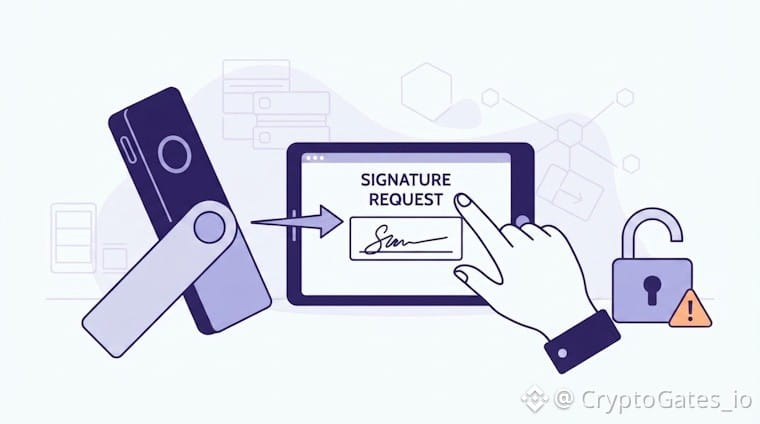
No fraud detection. No reversal. One bad approval is final.
Check every signature request before confirming.
#cryptogates #WalletSecurity #RiskManagement
$713M lost across 158,000+ wallet compromises in 2025.
Hackers shifted from exchanges to personal wallets. 📉
No fraud detection. No reversal. One bad approval is final.
Check every signature request before confirming.
#cryptogates #WalletSecurity #RiskManagement
Hackers shifted from exchanges to personal wallets. 📉
No fraud detection. No reversal. One bad approval is final.
Check every signature request before confirming.
#cryptogates #WalletSecurity #RiskManagement
93

Live stream “faceplant” and even exposed the seed phrase—this is really too much.
Robinhood founder Vlad Tenev accidentally revealed a seed phrase during a live stream. Hackers instantly got into the wallet, took over the address, and conveniently pulled a Meme coin from a $500,000 market cap to $14,000,000. In just two hours, trading volume hit $20,000,000. Thousands of retail traders rushed in, and then the coin price suddenly dumped—classic “celebrity halo + front-running to harvest” script.
The crazier part comes next: after the main address was frozen by Robinhood’s RPC and the nodes refused to package transactions, the hacker simply switched battlefields and moved to the BNB Chain. Using the same set of linked addresses, they issued a new token, bought and sold themselves to drive hype, and then distributed it at high levels to cash out. The whole process ran smoothly—pretty much confirms it was pre-planned.
A few reminders:
1. Keep the seed phrase far from the camera, far from your clipboard, and far from any networked device. Never touch a wallet during a live stream, screen recording, or remote meeting
2. Meme market moves triggered by celebrity address activity are, in 90% of cases, the next scene in someone else’s script—not your opportunity
3. RPC-layer freezes only block a single node. If on-chain assets are truly taken, you basically can’t get them back. Know the boundaries of self-custody
As for security, it’s always after you’ve been robbed once that you really remember. Hopefully this time it’s not you.
#WalletSecurity #MemeCoin #BNBChain
Live stream “faceplant” and even exposed the seed phrase—this is really too much.
Robinhood founder Vlad Tenev accidentally revealed a seed phrase during a live stream. Hackers instantly got into the wallet, took over the address, and conveniently pulled a Meme coin from a $500,000 market cap to $14,000,000. In just two hours, trading volume hit $20,000,000. Thousands of retail traders rushed in, and then the coin price suddenly dumped—classic “celebrity halo + front-running to harvest” script.
The crazier part comes next: after the main address was frozen by Robinhood’s RPC and the nodes refused to package transactions, the hacker simply switched battlefields and moved to the BNB Chain. Using the same set of linked addresses, they issued a new token, bought and sold themselves to drive hype, and then distributed it at high levels to cash out. The whole process ran smoothly—pretty much confirms it was pre-planned.
A few reminders:
1. Keep the seed phrase far from the camera, far from your clipboard, and far from any networked device. Never touch a wallet during a live stream, screen recording, or remote meeting
2. Meme market moves triggered by celebrity address activity are, in 90% of cases, the next scene in someone else’s script—not your opportunity
3. RPC-layer freezes only block a single node. If on-chain assets are truly taken, you basically can’t get them back. Know the boundaries of self-custody
As for security, it’s always after you’ve been robbed once that you really remember. Hopefully this time it’s not you.
#WalletSecurity #MemeCoin #BNBChain
Robinhood founder Vlad Tenev accidentally revealed a seed phrase during a live stream. Hackers instantly got into the wallet, took over the address, and conveniently pulled a Meme coin from a $500,000 market cap to $14,000,000. In just two hours, trading volume hit $20,000,000. Thousands of retail traders rushed in, and then the coin price suddenly dumped—classic “celebrity halo + front-running to harvest” script.
The crazier part comes next: after the main address was frozen by Robinhood’s RPC and the nodes refused to package transactions, the hacker simply switched battlefields and moved to the BNB Chain. Using the same set of linked addresses, they issued a new token, bought and sold themselves to drive hype, and then distributed it at high levels to cash out. The whole process ran smoothly—pretty much confirms it was pre-planned.
A few reminders:
1. Keep the seed phrase far from the camera, far from your clipboard, and far from any networked device. Never touch a wallet during a live stream, screen recording, or remote meeting
2. Meme market moves triggered by celebrity address activity are, in 90% of cases, the next scene in someone else’s script—not your opportunity
3. RPC-layer freezes only block a single node. If on-chain assets are truly taken, you basically can’t get them back. Know the boundaries of self-custody
As for security, it’s always after you’ve been robbed once that you really remember. Hopefully this time it’s not you.
#WalletSecurity #MemeCoin #BNBChain
55

·
--
Why is nobody talking about the “safe app store” myth after a fake iOS wallet allegedly drained $1.8M in Bitcoin?
Most crypto users are told security is their personal responsibility, and yes, it is. But when traders download what looks like a legit wallet and lose their $BTC, the damage is not just a bad trade or a missed exit. It is a full wipeout.
This federal lawsuit against Apple is a brutal case study in crypto’s biggest blind spot: trust. The mainstream narrative says scammers live on sketchy links and shady DMs, but here the alleged attack came through a fake iOS wallet, the exact place many users assume has already been vetted.
That matters for everyone holding $BTC, $ETH, or $BNB. If a platform can create the perception of safety without catching a fake wallet that allegedly drains $1.8M, then “just be careful” is not enough. Security has to include better app review, clearer wallet verification, and users treating every download like a transaction approval.
Where do you think responsibility should sit here: the user, the app gatekeeper, or both?
#Bitcoin #CryptoSecurity #WalletSecurity
Why is nobody talking about the “safe app store” myth after a fake iOS wallet allegedly drained $1.8M in Bitcoin?
Most crypto users are told security is their personal responsibility, and yes, it is. But when traders download what looks like a legit wallet and lose their $BTC , the damage is not just a bad trade or a missed exit. It is a full wipeout.
This federal lawsuit against Apple is a brutal case study in crypto’s biggest blind spot: trust. The mainstream narrative says scammers live on sketchy links and shady DMs, but here the alleged attack came through a fake iOS wallet, the exact place many users assume has already been vetted.
That matters for everyone holding $BTC , $ETH , or $BNB . If a platform can create the perception of safety without catching a fake wallet that allegedly drains $1.8M, then “just be careful” is not enough. Security has to include better app review, clearer wallet verification, and users treating every download like a transaction approval.
Where do you think responsibility should sit here: the user, the app gatekeeper, or both?
#Bitcoin #CryptoSecurity #WalletSecurity
Most crypto users are told security is their personal responsibility, and yes, it is. But when traders download what looks like a legit wallet and lose their $BTC , the damage is not just a bad trade or a missed exit. It is a full wipeout.
This federal lawsuit against Apple is a brutal case study in crypto’s biggest blind spot: trust. The mainstream narrative says scammers live on sketchy links and shady DMs, but here the alleged attack came through a fake iOS wallet, the exact place many users assume has already been vetted.
That matters for everyone holding $BTC , $ETH , or $BNB . If a platform can create the perception of safety without catching a fake wallet that allegedly drains $1.8M, then “just be careful” is not enough. Security has to include better app review, clearer wallet verification, and users treating every download like a transaction approval.
Where do you think responsibility should sit here: the user, the app gatekeeper, or both?
#Bitcoin #CryptoSecurity #WalletSecurity
48
·
--
High activity ≠ high risk.
We scanned this Solana address, publicly labeled by Solscan as a Kraken Hot Wallet:
6LY1JzAFVZsP2a2xKrtU6znQMQ5h4i7tocWdgrkZzkzF
TokenToolHub returned:
• Risk score: 22/100
• Risk band: Low
• Confidence: High
• High-priority signals: 0
• Medium-priority signals: 2
• Token accounts: 1,021
• Supported holdings: 1,013
• Recent signatures sampled: 200
• Active delegates: 0
• Recent approvals: 0
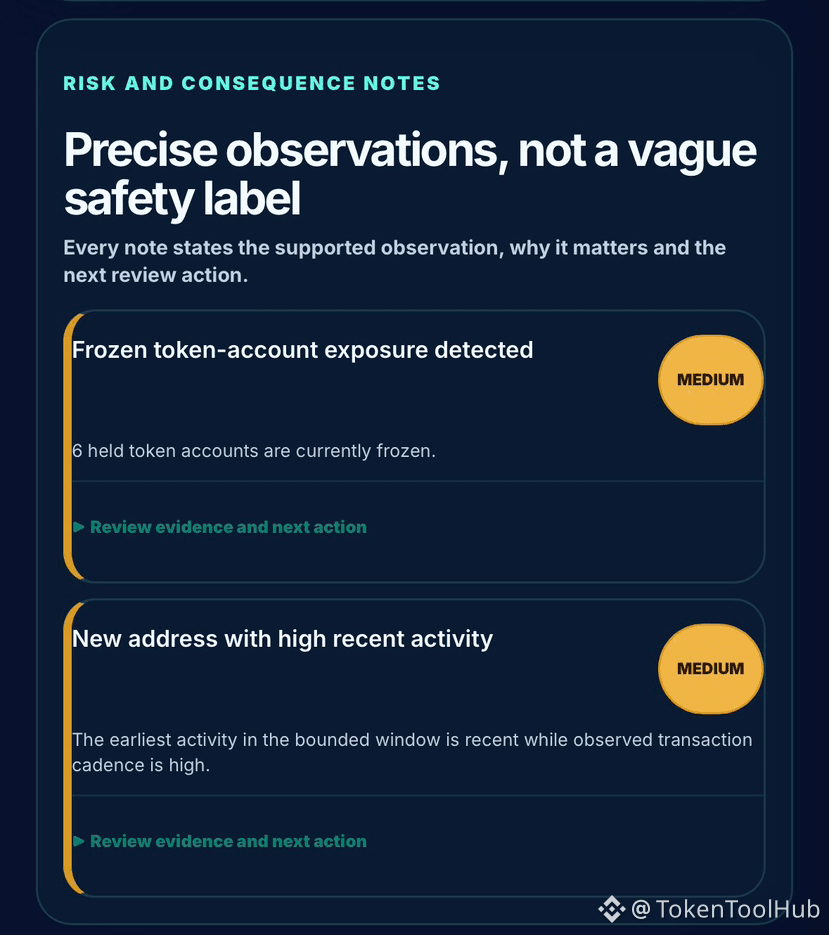
• Frozen token accounts: 6
The interesting part is transaction density.
Within the bounded history window, activity was estimated at roughly 23,967 signatures/day.
That sounds extreme, but volume alone is not evidence of malicious behavior.
All 28 deeply parsed transactions were signed by the wallet and used it as fee payer, consistent with a highly active operational address.
The two Medium findings were six frozen token accounts and unusually high recent transaction cadence.
Also important: the reported 0-day sampled age reflects the bounded retrieval window, not necessarily the wallet’s true creation date.
A useful wallet scanner needs to separate automation and exchange-scale activity from actual risk evidence.
Full scan:
https://tokentoolhub.com/solana-wallet-risk-scanner/?address=6LY1JzAFVZsP2a2xKrtU6znQMQ5h4i7tocWdgrkZzkzF
#solana #Onchain #WalletSecurity #CryptoSecurity
High activity ≠ high risk.
We scanned this Solana address, publicly labeled by Solscan as a Kraken Hot Wallet:
6LY1JzAFVZsP2a2xKrtU6znQMQ5h4i7tocWdgrkZzkzF
TokenToolHub returned:
• Risk score: 22/100
• Risk band: Low
• Confidence: High
• High-priority signals: 0
• Medium-priority signals: 2
• Token accounts: 1,021
• Supported holdings: 1,013
• Recent signatures sampled: 200
• Active delegates: 0
• Recent approvals: 0
• Frozen token accounts: 6
The interesting part is transaction density.
Within the bounded history window, activity was estimated at roughly 23,967 signatures/day.
That sounds extreme, but volume alone is not evidence of malicious behavior.
All 28 deeply parsed transactions were signed by the wallet and used it as fee payer, consistent with a highly active operational address.
The two Medium findings were six frozen token accounts and unusually high recent transaction cadence.
Also important: the reported 0-day sampled age reflects the bounded retrieval window, not necessarily the wallet’s true creation date.
A useful wallet scanner needs to separate automation and exchange-scale activity from actual risk evidence.
Full scan:
https://tokentoolhub.com/solana-wallet-risk-scanner/?address=6LY1JzAFVZsP2a2xKrtU6znQMQ5h4i7tocWdgrkZzkzF
#solana #Onchain #WalletSecurity #CryptoSecurity
We scanned this Solana address, publicly labeled by Solscan as a Kraken Hot Wallet:
6LY1JzAFVZsP2a2xKrtU6znQMQ5h4i7tocWdgrkZzkzF
TokenToolHub returned:
• Risk score: 22/100
• Risk band: Low
• Confidence: High
• High-priority signals: 0
• Medium-priority signals: 2
• Token accounts: 1,021
• Supported holdings: 1,013
• Recent signatures sampled: 200
• Active delegates: 0
• Recent approvals: 0
• Frozen token accounts: 6
The interesting part is transaction density.
Within the bounded history window, activity was estimated at roughly 23,967 signatures/day.
That sounds extreme, but volume alone is not evidence of malicious behavior.
All 28 deeply parsed transactions were signed by the wallet and used it as fee payer, consistent with a highly active operational address.
The two Medium findings were six frozen token accounts and unusually high recent transaction cadence.
Also important: the reported 0-day sampled age reflects the bounded retrieval window, not necessarily the wallet’s true creation date.
A useful wallet scanner needs to separate automation and exchange-scale activity from actual risk evidence.
Full scan:
https://tokentoolhub.com/solana-wallet-risk-scanner/?address=6LY1JzAFVZsP2a2xKrtU6znQMQ5h4i7tocWdgrkZzkzF
#solana #Onchain #WalletSecurity #CryptoSecurity
80
Log in to explore more content
Join global crypto users on Binance Square
⚡️ Get latest and useful information about crypto.
💬 Trusted by the world’s largest crypto exchange.
👍 Discover real insights from verified creators.
Email / Phone number
Trending Topics
1
#G7PlansToReleaseUpTo100MBarrelsOilDiesel
11 views
18 Discussing
2
#ICBASuesOCCOverCryptoBankCharters
11 views
14 Discussing
3
#USStocksCloseHigherOnWeakJobsData
15 views
8 Discussing
4
#NFPWatch
10.9M views
19,421 Discussing
5
#BlastToGraduallyShutDownItsL2Network
3 views
6 Discussing
6
#BitcoinFundingRateTriplesTo10%
190,970 views
1,300 Discussing
7
#BitcoinSurpasses$86KUp2.99%
62,960 views
120 Discussing
8
#ZcashFalls21%FromSeptemberPeak
100,961 views
909 Discussing
9
#USSeptemberPayrollsAdd29KUnemploymentRises4.2%
79,014 views
559 Discussing
10
#XRPPostsFirstThreeGreenMonthsInQ3
68,930 views
753 Discussing