

#p2pscam
p2pscam
12.2M views
2,496 Discussing
Hot
Latest

Article
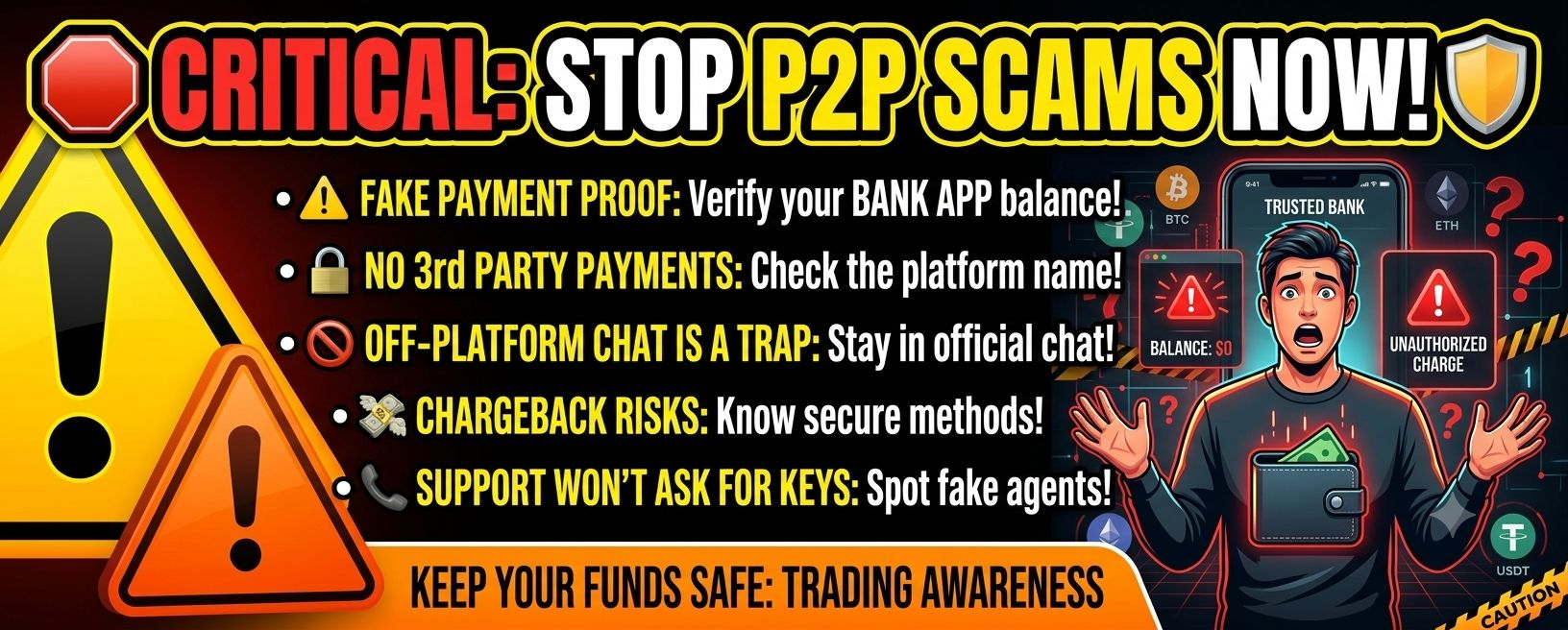
🛑 The Top 5 Most Common P2P Scams❌1. The Fake Payment Proof / Fake SMS Scam
How it works: A buyer marks the trade as "Paid" and attaches a convincing, edited payment receipt or sends a fake SMS text that looks like a bank/e-wallet alert.
The Trap: Unwary sellers assume funds have arrived and hit "Release Crypto".
Rule: Never rely on screenshots or SMS notifications. Always log into your mobile banking app or e-wallet directly to verify the real balance.
2. Third-Party Account Transfer (The Account Freeze Trap)
How it works: You receive funds from a bank account that does not match the buyer's verified exchange profile name.
The Danger: Scammers often use stolen bank credentials or trick an innocent third party into paying you. When the original bank account owner files a police complaint (e.g., cybercrime reporting), your bank account gets frozen along with all funds.
Rule: Reject any payment where the sender’s bank account name doesn't match the exchange KYC name 100%.
3. Payment Reversal & Chargeback Fraud
How it works: The scammer pays you, receives the crypto, and immediately contacts their bank claiming the payment was unauthorized or fraudulent.
The Result: The bank initiates a clawback or freezes your account, leaving you without your crypto or your fiat.
Rule: Avoid taking payments from payment methods known for easy chargebacks or unverified personal transfers.
4. Off-Platform / WhatsApp Lure
How it works: The scammer offers better rates or asks you to complete the trade off-exchange via WhatsApp, Telegram, or social media to "save fees".
The Catch: Once you transfer funds outside the platform, you lose exchange escrow protection entirely.
Rule: Never take a transaction off the platform. Keep all communications within the official chat box.
5. Fake Customer Support & Impersonation
How it works: Fraudsters contact you inside the chat or via external apps posing as platform customer service agents, claiming an escrow error or demanding immediate asset release.
Rule: Support personnel will never message you asking to release crypto or share passcodes.
🔒 Golden Rules for Secure P2P Trading
Verify Official KYC Names: Always match the buyer's/seller's name on the platform with the incoming bank account name.
Log In to Confirm Balances: Never release assets based on a receipt, email, or SMS notification alone.
Trade with Verified Merchants: Look for verified merchant badges with high order completion rates (>98%) and established trade histories.
Utilize Escrow Properly: Never mark an order as paid until funds are sent, and never release crypto until cash is in hand.
Keep Proof of Everything: Maintain clean transaction histories, bank statements, and chat logs.
🚨 What to Do If You've Been Targeted
Open an Appeal: Immediately file an official dispute on the platform before the order auto-completes.
Submit Documentation: Provide unedited screen recordings of your bank/e-wallet app history showing non-receipt or third-party details.
Contact Your Bank: If an unauthorized chargeback or account freeze occurs, notify your bank immediately with official P2P trade proofs.
$BR $AVA $NEAR
#P2PScam #P2PScamAwareness #P2PScamWarning
🛑 The Top 5 Most Common P2P Scams❌
1. The Fake Payment Proof / Fake SMS Scam
How it works: A buyer marks the trade as "Paid" and attaches a convincing, edited payment receipt or sends a fake SMS text that looks like a bank/e-wallet alert.
The Trap: Unwary sellers assume funds have arrived and hit "Release Crypto".
Rule: Never rely on screenshots or SMS notifications. Always log into your mobile banking app or e-wallet directly to verify the real balance.
2. Third-Party Account Transfer (The Account Freeze Trap)
How it works: You receive funds from a bank account that does not match the buyer's verified exchange profile name.
The Danger: Scammers often use stolen bank credentials or trick an innocent third party into paying you. When the original bank account owner files a police complaint (e.g., cybercrime reporting), your bank account gets frozen along with all funds.
Rule: Reject any payment where the sender’s bank account name doesn't match the exchange KYC name 100%.
3. Payment Reversal & Chargeback Fraud
How it works: The scammer pays you, receives the crypto, and immediately contacts their bank claiming the payment was unauthorized or fraudulent.
The Result: The bank initiates a clawback or freezes your account, leaving you without your crypto or your fiat.
Rule: Avoid taking payments from payment methods known for easy chargebacks or unverified personal transfers.
4. Off-Platform / WhatsApp Lure
How it works: The scammer offers better rates or asks you to complete the trade off-exchange via WhatsApp, Telegram, or social media to "save fees".
The Catch: Once you transfer funds outside the platform, you lose exchange escrow protection entirely.
Rule: Never take a transaction off the platform. Keep all communications within the official chat box.
5. Fake Customer Support & Impersonation
How it works: Fraudsters contact you inside the chat or via external apps posing as platform customer service agents, claiming an escrow error or demanding immediate asset release.
Rule: Support personnel will never message you asking to release crypto or share passcodes.
🔒 Golden Rules for Secure P2P Trading
Verify Official KYC Names: Always match the buyer's/seller's name on the platform with the incoming bank account name.
Log In to Confirm Balances: Never release assets based on a receipt, email, or SMS notification alone.
Trade with Verified Merchants: Look for verified merchant badges with high order completion rates (>98%) and established trade histories.
Utilize Escrow Properly: Never mark an order as paid until funds are sent, and never release crypto until cash is in hand.
Keep Proof of Everything: Maintain clean transaction histories, bank statements, and chat logs.
🚨 What to Do If You've Been Targeted
Open an Appeal: Immediately file an official dispute on the platform before the order auto-completes.
Submit Documentation: Provide unedited screen recordings of your bank/e-wallet app history showing non-receipt or third-party details.
Contact Your Bank: If an unauthorized chargeback or account freeze occurs, notify your bank immediately with official P2P trade proofs.
$BR $AVA $NEAR
#P2PScam #P2PScamAwareness #P2PScamWarning
How it works: A buyer marks the trade as "Paid" and attaches a convincing, edited payment receipt or sends a fake SMS text that looks like a bank/e-wallet alert.
The Trap: Unwary sellers assume funds have arrived and hit "Release Crypto".
Rule: Never rely on screenshots or SMS notifications. Always log into your mobile banking app or e-wallet directly to verify the real balance.
2. Third-Party Account Transfer (The Account Freeze Trap)
How it works: You receive funds from a bank account that does not match the buyer's verified exchange profile name.
The Danger: Scammers often use stolen bank credentials or trick an innocent third party into paying you. When the original bank account owner files a police complaint (e.g., cybercrime reporting), your bank account gets frozen along with all funds.
Rule: Reject any payment where the sender’s bank account name doesn't match the exchange KYC name 100%.
3. Payment Reversal & Chargeback Fraud
How it works: The scammer pays you, receives the crypto, and immediately contacts their bank claiming the payment was unauthorized or fraudulent.
The Result: The bank initiates a clawback or freezes your account, leaving you without your crypto or your fiat.
Rule: Avoid taking payments from payment methods known for easy chargebacks or unverified personal transfers.
4. Off-Platform / WhatsApp Lure
How it works: The scammer offers better rates or asks you to complete the trade off-exchange via WhatsApp, Telegram, or social media to "save fees".
The Catch: Once you transfer funds outside the platform, you lose exchange escrow protection entirely.
Rule: Never take a transaction off the platform. Keep all communications within the official chat box.
5. Fake Customer Support & Impersonation
How it works: Fraudsters contact you inside the chat or via external apps posing as platform customer service agents, claiming an escrow error or demanding immediate asset release.
Rule: Support personnel will never message you asking to release crypto or share passcodes.
🔒 Golden Rules for Secure P2P Trading
Verify Official KYC Names: Always match the buyer's/seller's name on the platform with the incoming bank account name.
Log In to Confirm Balances: Never release assets based on a receipt, email, or SMS notification alone.
Trade with Verified Merchants: Look for verified merchant badges with high order completion rates (>98%) and established trade histories.
Utilize Escrow Properly: Never mark an order as paid until funds are sent, and never release crypto until cash is in hand.
Keep Proof of Everything: Maintain clean transaction histories, bank statements, and chat logs.
🚨 What to Do If You've Been Targeted
Open an Appeal: Immediately file an official dispute on the platform before the order auto-completes.
Submit Documentation: Provide unedited screen recordings of your bank/e-wallet app history showing non-receipt or third-party details.
Contact Your Bank: If an unauthorized chargeback or account freeze occurs, notify your bank immediately with official P2P trade proofs.
$BR $AVA $NEAR
#P2PScam #P2PScamAwareness #P2PScamWarning
1
297
⚠️ P2P Scam Alert: Protect your hard-earned funds while trading! 🚨
Scammers are actively targeting P2P traders through fake payment proofs third-party transfers, and chargeback tricks. Always follow these rules to stay completely safe:
📲 Verify Real Payment: Never trust screenshots or SMS notifications. Open your bank app or wallet and confirm funds have actually landed before releasing crypto.
👤 Match Names strictly: Only accept payment from the verified account holder on Binance. Reject any third-party transfers immediately!
❌ No Off-Platform Chats: Keep all chat history inside the official app.
Stay vigilant and trade safe! 🛡️
$LAB $MET $RAYSOL
#P2PScam #P2PScamAwareness #P2PScamWarning
⚠️ P2P Scam Alert: Protect your hard-earned funds while trading! 🚨
Scammers are actively targeting P2P traders through fake payment proofs third-party transfers, and chargeback tricks. Always follow these rules to stay completely safe:
📲 Verify Real Payment: Never trust screenshots or SMS notifications. Open your bank app or wallet and confirm funds have actually landed before releasing crypto.
👤 Match Names strictly: Only accept payment from the verified account holder on Binance. Reject any third-party transfers immediately!
❌ No Off-Platform Chats: Keep all chat history inside the official app.
Stay vigilant and trade safe! 🛡️
$LAB $MET $RAYSOL
#P2PScam #P2PScamAwareness #P2PScamWarning
Scammers are actively targeting P2P traders through fake payment proofs third-party transfers, and chargeback tricks. Always follow these rules to stay completely safe:
📲 Verify Real Payment: Never trust screenshots or SMS notifications. Open your bank app or wallet and confirm funds have actually landed before releasing crypto.
👤 Match Names strictly: Only accept payment from the verified account holder on Binance. Reject any third-party transfers immediately!
❌ No Off-Platform Chats: Keep all chat history inside the official app.
Stay vigilant and trade safe! 🛡️
$LAB $MET $RAYSOL
#P2PScam #P2PScamAwareness #P2PScamWarning

295
·
--
Today I Was Scammed During a Crypto P2P Trade 😭Today I experienced a scam while trying to complete a crypto P2P transaction. I trusted the other party and expected the trade to be completed honestly, but unfortunately that did not happen.
As shown in the screenshot, I asked the seller to send the dollars after payment. However, the order timer expired, and Binance displayed the message that the order had been canceled. The notification also stated that if payment had already been made, I should contact the counterparty for a refund or reach out to customer support.
This incident is a reminder that online transactions require extreme caution. Before sending any payment, always make sure there is enough time left on the order, verify the seller's reputation, and never send money outside the platform's secure process. If any issue arises, immediately contact the platform's customer support and provide screenshots and payment proof.
Although losing money is frustrating, this experience taught me an important lesson: never rush into online financial transactions, always follow the platform's official guidelines, and keep complete records of every payment.
I hope that by sharing my experience, others will be more careful and avoid becoming victims of similar scams. Always stay alert, trade only with trusted users, and use the platform's dispute or appeal system whenever something seems suspicious.
#P2PScam #Crypto
Today I Was Scammed During a Crypto P2P Trade 😭
Today I experienced a scam while trying to complete a crypto P2P transaction. I trusted the other party and expected the trade to be completed honestly, but unfortunately that did not happen.
As shown in the screenshot, I asked the seller to send the dollars after payment. However, the order timer expired, and Binance displayed the message that the order had been canceled. The notification also stated that if payment had already been made, I should contact the counterparty for a refund or reach out to customer support.
This incident is a reminder that online transactions require extreme caution. Before sending any payment, always make sure there is enough time left on the order, verify the seller's reputation, and never send money outside the platform's secure process. If any issue arises, immediately contact the platform's customer support and provide screenshots and payment proof.
Although losing money is frustrating, this experience taught me an important lesson: never rush into online financial transactions, always follow the platform's official guidelines, and keep complete records of every payment.
I hope that by sharing my experience, others will be more careful and avoid becoming victims of similar scams. Always stay alert, trade only with trusted users, and use the platform's dispute or appeal system whenever something seems suspicious.
#P2PScam #Crypto
As shown in the screenshot, I asked the seller to send the dollars after payment. However, the order timer expired, and Binance displayed the message that the order had been canceled. The notification also stated that if payment had already been made, I should contact the counterparty for a refund or reach out to customer support.
This incident is a reminder that online transactions require extreme caution. Before sending any payment, always make sure there is enough time left on the order, verify the seller's reputation, and never send money outside the platform's secure process. If any issue arises, immediately contact the platform's customer support and provide screenshots and payment proof.
Although losing money is frustrating, this experience taught me an important lesson: never rush into online financial transactions, always follow the platform's official guidelines, and keep complete records of every payment.
I hope that by sharing my experience, others will be more careful and avoid becoming victims of similar scams. Always stay alert, trade only with trusted users, and use the platform's dispute or appeal system whenever something seems suspicious.
#P2PScam #Crypto
79

·
--
I am victim #P2PScam
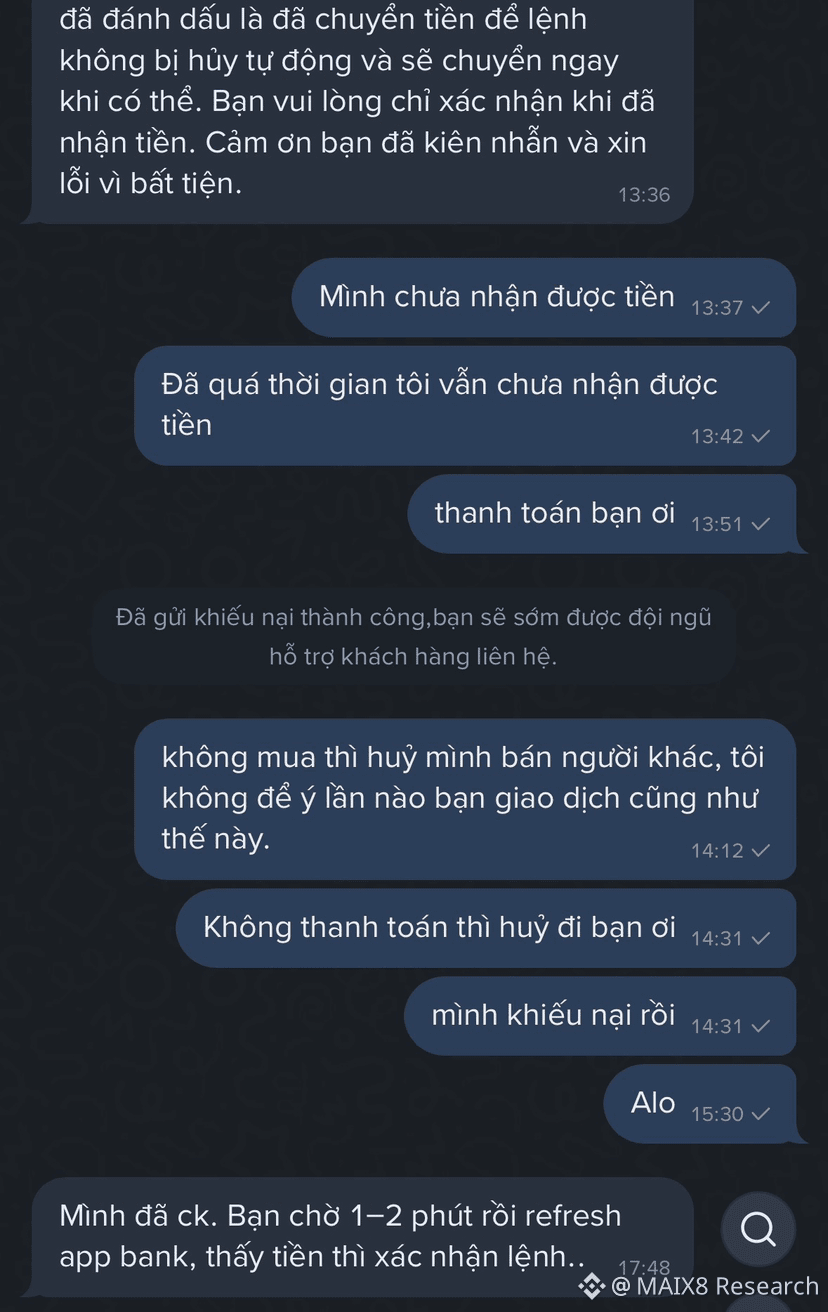
I used to be a victim of a P2P order.
After transferring the money, the other side kept messaging “processing,” “wait a little longer.” It went on and on. Only when I submitted a complaint did the other side start changing their attitude.
At that time, I was both angry and on edge, because the money had already left my account but the coins hadn’t come back yet.
Luckily, I didn’t send the transaction out of the app and I kept all the evidence, so in the end I was still able to get it back.
After that, I was never careless again.
Now before every order, I check carefully:
• Number of completed transactions
• Success rate
• Advertisement conditions
And absolutely do not handle anything outside the system.
P2P isn’t always smooth, but if you know how to protect yourself, the risk will be reduced by a lot.
If anyone has been through a similar case, leave a comment nhé.
@Binance_Vietnam
#BinanceP2PAnToan
I am victim #P2PScam
I used to be a victim of a P2P order.
After transferring the money, the other side kept messaging “processing,” “wait a little longer.” It went on and on. Only when I submitted a complaint did the other side start changing their attitude.
At that time, I was both angry and on edge, because the money had already left my account but the coins hadn’t come back yet.
Luckily, I didn’t send the transaction out of the app and I kept all the evidence, so in the end I was still able to get it back.
After that, I was never careless again.
Now before every order, I check carefully:
• Number of completed transactions
• Success rate
• Advertisement conditions
And absolutely do not handle anything outside the system.
P2P isn’t always smooth, but if you know how to protect yourself, the risk will be reduced by a lot.
If anyone has been through a similar case, leave a comment nhé.
@Binance Vietnam #BinanceP2PAnToan
I used to be a victim of a P2P order.
After transferring the money, the other side kept messaging “processing,” “wait a little longer.” It went on and on. Only when I submitted a complaint did the other side start changing their attitude.
At that time, I was both angry and on edge, because the money had already left my account but the coins hadn’t come back yet.
Luckily, I didn’t send the transaction out of the app and I kept all the evidence, so in the end I was still able to get it back.
After that, I was never careless again.
Now before every order, I check carefully:
• Number of completed transactions
• Success rate
• Advertisement conditions
And absolutely do not handle anything outside the system.
P2P isn’t always smooth, but if you know how to protect yourself, the risk will be reduced by a lot.
If anyone has been through a similar case, leave a comment nhé.
@Binance Vietnam #BinanceP2PAnToan
32

·
--
Bullish
🔍 BEFORE BUYING ON P2P, CHECK THESE 3 THINGS!
1️⃣ Completion rate – the higher, the more basis you have for evaluation.
2️⃣ Number of transactions – review the counterparty’s transaction history.
3️⃣ Payment account name – always cross-check with the order information.
⚠️ Anything unusual? Stop and check carefully before paying.
Safe P2P starts with one small verification. 🔐
@Binance_Vietnam
#BinanceP2PAnToan #BinanceP2P $BTC $ETH $BNB #P2PScam
🔍 BEFORE BUYING ON P2P, CHECK THESE 3 THINGS!
1️⃣ Completion rate – the higher, the more basis you have for evaluation.
2️⃣ Number of transactions – review the counterparty’s transaction history.
3️⃣ Payment account name – always cross-check with the order information.
⚠️ Anything unusual? Stop and check carefully before paying.
Safe P2P starts with one small verification. 🔐
@Binance Vietnam
#BinanceP2PAnToan #BinanceP2P $BTC $ETH $BNB #P2PScam
1️⃣ Completion rate – the higher, the more basis you have for evaluation.
2️⃣ Number of transactions – review the counterparty’s transaction history.
3️⃣ Payment account name – always cross-check with the order information.
⚠️ Anything unusual? Stop and check carefully before paying.
Safe P2P starts with one small verification. 🔐
@Binance Vietnam
#BinanceP2PAnToan #BinanceP2P $BTC $ETH $BNB #P2PScam
1
327

·
--
Bearish
There are a lot of scams happening in P2P these days. My buddy got hit with a scam of 235,000, and we're currently trying to recover that amount.
I urge you all to be super cautious with P2P trading. Always deal with verified traders who have good ranks/reputation. Don't trust unknown or suspicious individuals.
Stay safe from scammers and spread the word to others, so no one else falls victim. Always prioritize safety and verification.
$USDC $BTC $LAB
{future}(LABUSDT)
#P2PScam #Scam? #CryptoMarket #Pakistan #Binance
There are a lot of scams happening in P2P these days. My buddy got hit with a scam of 235,000, and we're currently trying to recover that amount.
I urge you all to be super cautious with P2P trading. Always deal with verified traders who have good ranks/reputation. Don't trust unknown or suspicious individuals.
Stay safe from scammers and spread the word to others, so no one else falls victim. Always prioritize safety and verification.
$USDC $BTC $LAB
#P2PScam #Scam? #CryptoMarket #Pakistan #Binance
I urge you all to be super cautious with P2P trading. Always deal with verified traders who have good ranks/reputation. Don't trust unknown or suspicious individuals.
Stay safe from scammers and spread the word to others, so no one else falls victim. Always prioritize safety and verification.
$USDC $BTC $LAB
#P2PScam #Scam? #CryptoMarket #Pakistan #Binance
1
131

#P2PScam I have buy usdt from red rose seller in Pakistan i have sent payment from upaisa bank app but seller is lying he has not received payment and he has Go for appeal now upaisa only offers one time transaction screen shot sellir knows it and binance cs wants it also pdf file is not going in appeal platform what should I do ?
#P2PScam I have buy usdt from red rose seller in Pakistan i have sent payment from upaisa bank app but seller is lying he has not received payment and he has Go for appeal now upaisa only offers one time transaction screen shot sellir knows it and binance cs wants it also pdf file is not going in appeal platform what should I do ?
81

·
--
How to Avoid P2P Scams on Binance 🔒
Peer-to-Peer (P2P) trading is incredibly convenient, but scammers are always looking for ways to exploit traders. Here are the golden rules to stay safe:
Never Release Crypto Early: Scammers will send fake SMS alerts or altered payment screenshots. Always log in directly to your bank or wallet app to manually verify that the cash has cleared before releasing assets.
Keep Chats on Binance: Never move communication to external chat apps.
Match Names: Only accept payments where the sender's bank account name perfectly matches their verified Binance name.
Stay vigilant and trade safe! 👇
#P2PScam #BinanceSquareFamily
How to Avoid P2P Scams on Binance 🔒
Peer-to-Peer (P2P) trading is incredibly convenient, but scammers are always looking for ways to exploit traders. Here are the golden rules to stay safe:
Never Release Crypto Early: Scammers will send fake SMS alerts or altered payment screenshots. Always log in directly to your bank or wallet app to manually verify that the cash has cleared before releasing assets.
Keep Chats on Binance: Never move communication to external chat apps.
Match Names: Only accept payments where the sender's bank account name perfectly matches their verified Binance name.
Stay vigilant and trade safe! 👇
#P2PScam #BinanceSquareFamily
Peer-to-Peer (P2P) trading is incredibly convenient, but scammers are always looking for ways to exploit traders. Here are the golden rules to stay safe:
Never Release Crypto Early: Scammers will send fake SMS alerts or altered payment screenshots. Always log in directly to your bank or wallet app to manually verify that the cash has cleared before releasing assets.
Keep Chats on Binance: Never move communication to external chat apps.
Match Names: Only accept payments where the sender's bank account name perfectly matches their verified Binance name.
Stay vigilant and trade safe! 👇
#P2PScam #BinanceSquareFamily
1
146


·
--
🔺🔺P2P Scam: My bank account freezed🔺🔺
Hi readers
today i would tell you how my Bank account got
freeze and How can u avoid it and safeguard your funds
So actually in Feb this year I was casually eating something and tried to pay through UPI but got error i took it normally then tried again but to no avail Sensing something wrong I contacted with my bank and they informed me that they have recieved orders to freeze my bank account due to non legal funds.
Then i got to know that somebody Who has paid me on P2P commited fraud and every account he transacted with was blocked
So never ever transact with anyone having less then 50% trades and less then 95% completion rate
And always pay on the same bank A/C holder name as name in binance account
#P2PScam #Safety
(PS: That bank ac is still blocked 😢)
🔺🔺P2P Scam: My bank account freezed🔺🔺
Hi readers
today i would tell you how my Bank account got
freeze and How can u avoid it and safeguard your funds
So actually in Feb this year I was casually eating something and tried to pay through UPI but got error i took it normally then tried again but to no avail Sensing something wrong I contacted with my bank and they informed me that they have recieved orders to freeze my bank account due to non legal funds.
Then i got to know that somebody Who has paid me on P2P commited fraud and every account he transacted with was blocked
So never ever transact with anyone having less then 50% trades and less then 95% completion rate
And always pay on the same bank A/C holder name as name in binance account
#P2PScam #Safety
(PS: That bank ac is still blocked 😢)
Hi readers
today i would tell you how my Bank account got
freeze and How can u avoid it and safeguard your funds
So actually in Feb this year I was casually eating something and tried to pay through UPI but got error i took it normally then tried again but to no avail Sensing something wrong I contacted with my bank and they informed me that they have recieved orders to freeze my bank account due to non legal funds.
Then i got to know that somebody Who has paid me on P2P commited fraud and every account he transacted with was blocked
So never ever transact with anyone having less then 50% trades and less then 95% completion rate
And always pay on the same bank A/C holder name as name in binance account
#P2PScam #Safety
(PS: That bank ac is still blocked 😢)

7
2
5
5.3k

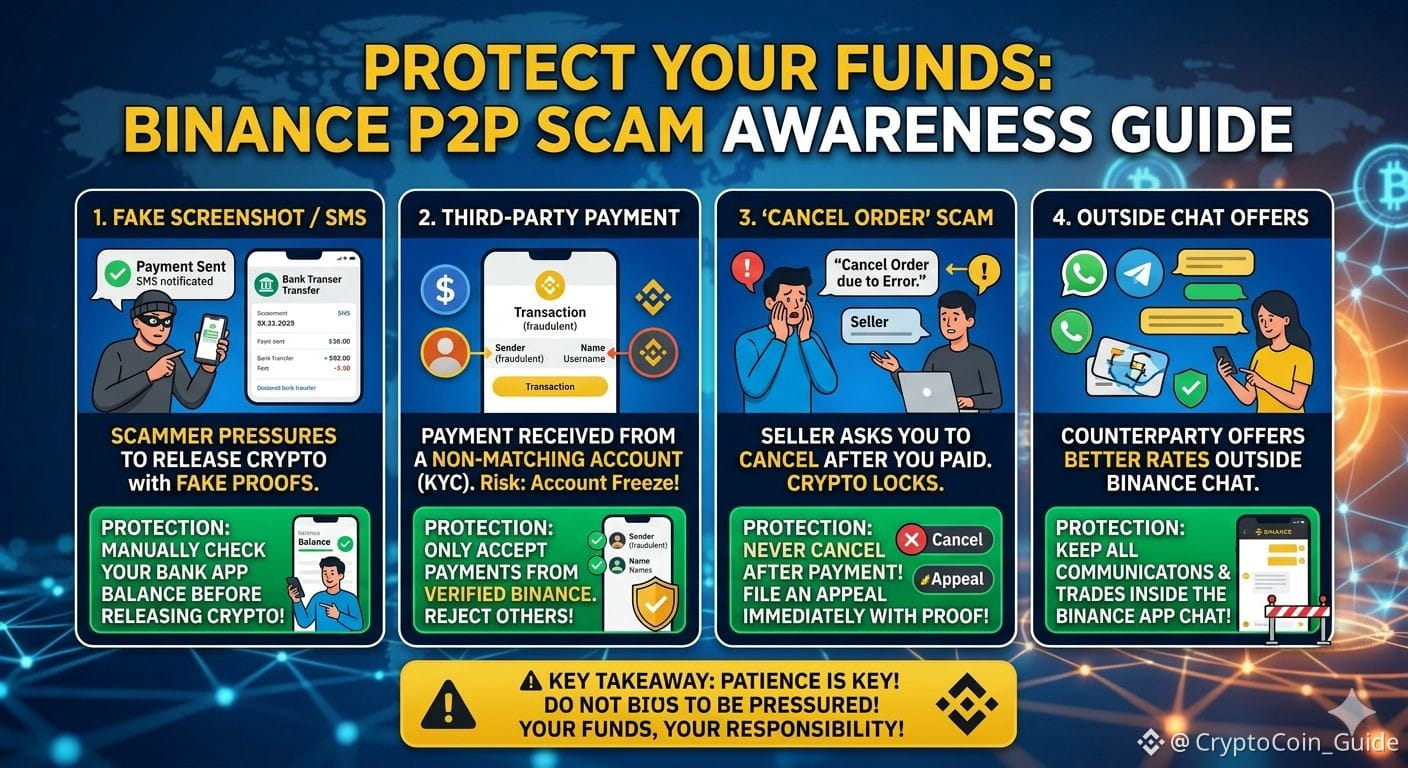
NEW SCAM ALERT 🔥
In P2P trading, rushing can lead to major losses. Protect yourself from these 4 common scams:
Fake Screenshot / SMS: The scammer sends a fake payment proof and pressures you to release the crypto.
Protection: Never release crypto until you manually open your bank or e-wallet app and verify the funds are in your Available Balance. Never trust screenshots.
Third-Party Payment: You receive money from an account that doesn't match the sender's Binance name. This can get your bank account frozen due to fraudulent funds.
Protection: Only accept payments where the bank account name exactly matches the verified Binance KYC name.
"Cancel Order" Scam: After you send the money, the seller claims a banking error occurred and asks you to cancel the order so they can refund you.
Protection: If you have already paid, never cancel the order. If you do, the crypto goes back to the seller. File an Appeal immediately.
Outside Chat (WhatsApp/Telegram): The counterparty asks to move the conversation off-platform for "better rates."
Protection: Keep all communications and transactions strictly inside the official Binance app to stay protected by the escrow system.
⚠️ Takeaway: Patience is key in P2P trading. Do not let anyone pressure you into acting quickly!
#P2PScamAwareness #P2PScam #ScamAwareness
NEW SCAM ALERT 🔥
In P2P trading, rushing can lead to major losses. Protect yourself from these 4 common scams:
Fake Screenshot / SMS: The scammer sends a fake payment proof and pressures you to release the crypto.
Protection: Never release crypto until you manually open your bank or e-wallet app and verify the funds are in your Available Balance. Never trust screenshots.
Third-Party Payment: You receive money from an account that doesn't match the sender's Binance name. This can get your bank account frozen due to fraudulent funds.
Protection: Only accept payments where the bank account name exactly matches the verified Binance KYC name.
"Cancel Order" Scam: After you send the money, the seller claims a banking error occurred and asks you to cancel the order so they can refund you.
Protection: If you have already paid, never cancel the order. If you do, the crypto goes back to the seller. File an Appeal immediately.
Outside Chat (WhatsApp/Telegram): The counterparty asks to move the conversation off-platform for "better rates."
Protection: Keep all communications and transactions strictly inside the official Binance app to stay protected by the escrow system.
⚠️ Takeaway: Patience is key in P2P trading. Do not let anyone pressure you into acting quickly!
#P2PScamAwareness #P2PScam #ScamAwareness
In P2P trading, rushing can lead to major losses. Protect yourself from these 4 common scams:
Fake Screenshot / SMS: The scammer sends a fake payment proof and pressures you to release the crypto.
Protection: Never release crypto until you manually open your bank or e-wallet app and verify the funds are in your Available Balance. Never trust screenshots.
Third-Party Payment: You receive money from an account that doesn't match the sender's Binance name. This can get your bank account frozen due to fraudulent funds.
Protection: Only accept payments where the bank account name exactly matches the verified Binance KYC name.
"Cancel Order" Scam: After you send the money, the seller claims a banking error occurred and asks you to cancel the order so they can refund you.
Protection: If you have already paid, never cancel the order. If you do, the crypto goes back to the seller. File an Appeal immediately.
Outside Chat (WhatsApp/Telegram): The counterparty asks to move the conversation off-platform for "better rates."
Protection: Keep all communications and transactions strictly inside the official Binance app to stay protected by the escrow system.
⚠️ Takeaway: Patience is key in P2P trading. Do not let anyone pressure you into acting quickly!
#P2PScamAwareness #P2PScam #ScamAwareness
381

Article
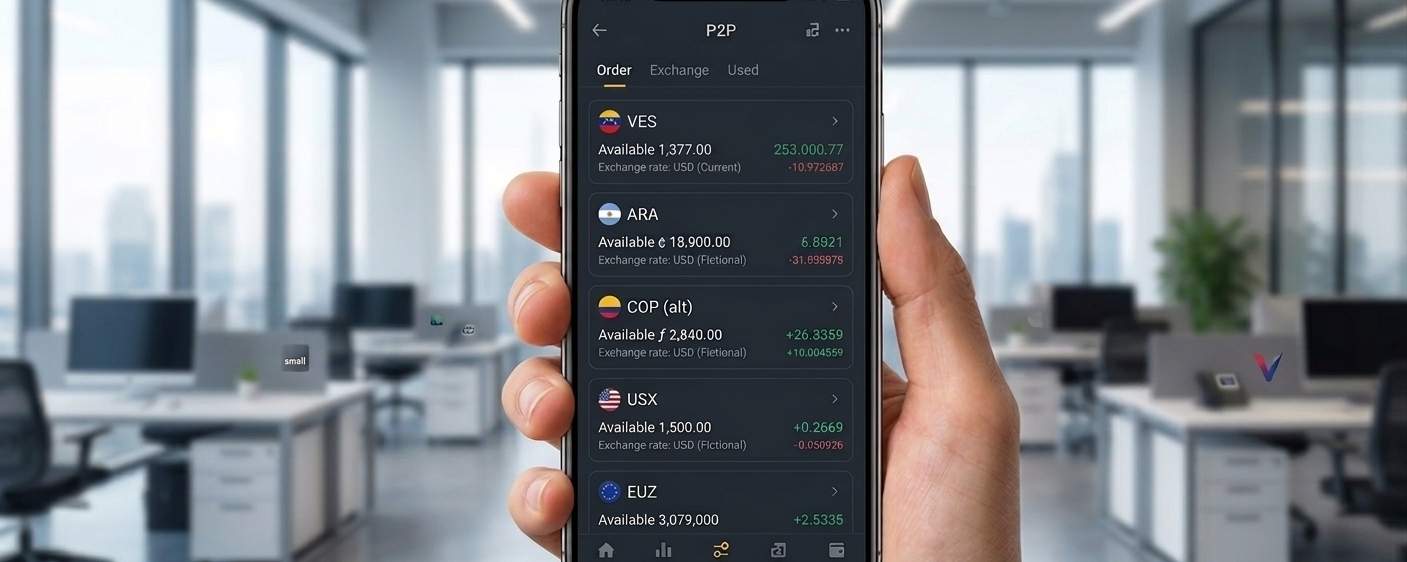
WHY BINANCE ALLOWS SCAMS IN P2PThe Binance Peer-to-Peer (P2P) market is the largest peer-to-peer trading platform in the world. It allows users to buy and sell cryptocurrencies directly with each other using their local currency.
On a global scale, the platform handles key numbers and structural features:
Figures and Global Reach
* **Fiat Currencies:** Supports over **100 local currencies** from around the world (including USD, EUR, VES, COP, ARS, etc.).
* **Payment Methods:** Offers over **800 to 1,000 active payment methods** globally, ranging from local bank transfers to international digital wallets (like Wise, Zinli, Revolut, or Zelle).
WHY BINANCE ALLOWS SCAMS IN P2P
The Binance Peer-to-Peer (P2P) market is the largest peer-to-peer trading platform in the world. It allows users to buy and sell cryptocurrencies directly with each other using their local currency.
On a global scale, the platform handles key numbers and structural features:
Figures and Global Reach
* **Fiat Currencies:** Supports over **100 local currencies** from around the world (including USD, EUR, VES, COP, ARS, etc.).
* **Payment Methods:** Offers over **800 to 1,000 active payment methods** globally, ranging from local bank transfers to international digital wallets (like Wise, Zinli, Revolut, or Zelle).
On a global scale, the platform handles key numbers and structural features:
Figures and Global Reach
* **Fiat Currencies:** Supports over **100 local currencies** from around the world (including USD, EUR, VES, COP, ARS, etc.).
* **Payment Methods:** Offers over **800 to 1,000 active payment methods** globally, ranging from local bank transfers to international digital wallets (like Wise, Zinli, Revolut, or Zelle).
3
143
Article
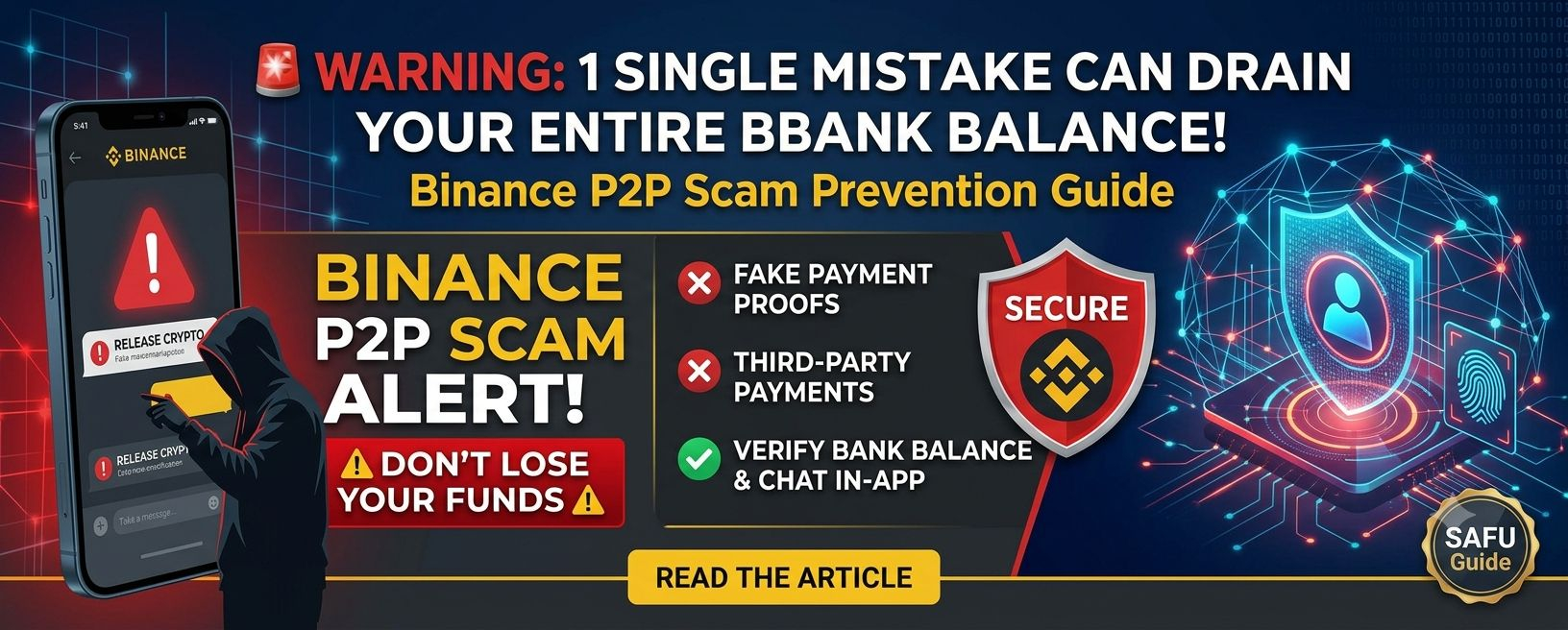
🚨 Warning: 1 Single Mistake Can Drain Your Entire Bank Balance! Binance P2P Scam Prevention Guide👇Peer-to-Peer (P2P) trading is the most popular method for buying and selling cryptocurrency. However, due to chargebacks, payment frauds, and fake transfer proofs, thousands of traders risk losing their hard-earned money every day.
This article outlines the most dangerous scams on Binance P2P and provides proven security rules to keep your funds safe.
1. Common Scams on P2P & Web3
Scammers constantly invent new tactics. Here are 4 major scams currently operating:
Fake Payment Screenshots & SMS: Scammers send realistic-looking fake bank transfer screenshots or fake SMS notifications without actually transferring any funds.
Third-Party Payment Scam: The buyer pays you from a bank account belonging to a third party. Later, the original account holder reports the unauthorized transaction to the bank, triggering a chargeback that freezes your bank account.
High-Pressure Release Tactics: The buyer insists they have sent the money and demands that you release the crypto immediately, even though the funds have not hit your bank balance.
Fake Binance Support Agents: Scammers impersonate customer support staff on Telegram or external chat apps to request your OTPs, passwords, or personal details.
2. P2P Security Checklist: Rules to Follow
Follow these strict rules to protect your bank account and digital assets:
Verify Your Bank Balance Directly: Never rely solely on SMS notifications or buyer screenshots. Always log into your official mobile banking app to verify that the funds are cleared and available.
Reject Third-Party Payments: The buyer’s Binance verified name must match the bank account holder's name exactly. If the names differ, refund the payment immediately and cancel the trade.
Never Release Crypto Early: Do not click "Payment Received" until the funds are fully reflected in your bank account, regardless of how much pressure the counterparty applies.
Keep All Communications On-Platform: Communicate strictly within the Binance P2P internal chat window. Never shift conversations to WhatsApp, Telegram, or external channels.
3. What to Do If You Encounter a Scam
If you suspect fraudulent activity during a trade:
File an Appeal Immediately: Click the "Appeal" button on the order page to prompt the Binance escrow team to freeze the trade assets.
Submit Clear Evidence: Upload your official bank statements, chat logs, and screen recordings as proof.
Contact Official Support: Reach out directly via the in-app Binance Live Support Center.
💬 What Has Your Experience Been?
Have you ever encountered a suspicious buyer or seller on P2P? Share your safety tips in the comments below to help keep our community safe!
$ONG $BTR
#P2PScam #Write2Earn #P2PScamAwareness
🚨 Warning: 1 Single Mistake Can Drain Your Entire Bank Balance! Binance P2P Scam Prevention Guide👇
Peer-to-Peer (P2P) trading is the most popular method for buying and selling cryptocurrency. However, due to chargebacks, payment frauds, and fake transfer proofs, thousands of traders risk losing their hard-earned money every day.
This article outlines the most dangerous scams on Binance P2P and provides proven security rules to keep your funds safe.
1. Common Scams on P2P & Web3
Scammers constantly invent new tactics. Here are 4 major scams currently operating:
Fake Payment Screenshots & SMS: Scammers send realistic-looking fake bank transfer screenshots or fake SMS notifications without actually transferring any funds.
Third-Party Payment Scam: The buyer pays you from a bank account belonging to a third party. Later, the original account holder reports the unauthorized transaction to the bank, triggering a chargeback that freezes your bank account.
High-Pressure Release Tactics: The buyer insists they have sent the money and demands that you release the crypto immediately, even though the funds have not hit your bank balance.
Fake Binance Support Agents: Scammers impersonate customer support staff on Telegram or external chat apps to request your OTPs, passwords, or personal details.
2. P2P Security Checklist: Rules to Follow
Follow these strict rules to protect your bank account and digital assets:
Verify Your Bank Balance Directly: Never rely solely on SMS notifications or buyer screenshots. Always log into your official mobile banking app to verify that the funds are cleared and available.
Reject Third-Party Payments: The buyer’s Binance verified name must match the bank account holder's name exactly. If the names differ, refund the payment immediately and cancel the trade.
Never Release Crypto Early: Do not click "Payment Received" until the funds are fully reflected in your bank account, regardless of how much pressure the counterparty applies.
Keep All Communications On-Platform: Communicate strictly within the Binance P2P internal chat window. Never shift conversations to WhatsApp, Telegram, or external channels.
3. What to Do If You Encounter a Scam
If you suspect fraudulent activity during a trade:
File an Appeal Immediately: Click the "Appeal" button on the order page to prompt the Binance escrow team to freeze the trade assets.
Submit Clear Evidence: Upload your official bank statements, chat logs, and screen recordings as proof.
Contact Official Support: Reach out directly via the in-app Binance Live Support Center.
💬 What Has Your Experience Been?
Have you ever encountered a suspicious buyer or seller on P2P? Share your safety tips in the comments below to help keep our community safe!
$ONG $BTR
#P2PScam #Write2Earn #P2PScamAwareness
This article outlines the most dangerous scams on Binance P2P and provides proven security rules to keep your funds safe.
1. Common Scams on P2P & Web3
Scammers constantly invent new tactics. Here are 4 major scams currently operating:
Fake Payment Screenshots & SMS: Scammers send realistic-looking fake bank transfer screenshots or fake SMS notifications without actually transferring any funds.
Third-Party Payment Scam: The buyer pays you from a bank account belonging to a third party. Later, the original account holder reports the unauthorized transaction to the bank, triggering a chargeback that freezes your bank account.
High-Pressure Release Tactics: The buyer insists they have sent the money and demands that you release the crypto immediately, even though the funds have not hit your bank balance.
Fake Binance Support Agents: Scammers impersonate customer support staff on Telegram or external chat apps to request your OTPs, passwords, or personal details.
2. P2P Security Checklist: Rules to Follow
Follow these strict rules to protect your bank account and digital assets:
Verify Your Bank Balance Directly: Never rely solely on SMS notifications or buyer screenshots. Always log into your official mobile banking app to verify that the funds are cleared and available.
Reject Third-Party Payments: The buyer’s Binance verified name must match the bank account holder's name exactly. If the names differ, refund the payment immediately and cancel the trade.
Never Release Crypto Early: Do not click "Payment Received" until the funds are fully reflected in your bank account, regardless of how much pressure the counterparty applies.
Keep All Communications On-Platform: Communicate strictly within the Binance P2P internal chat window. Never shift conversations to WhatsApp, Telegram, or external channels.
3. What to Do If You Encounter a Scam
If you suspect fraudulent activity during a trade:
File an Appeal Immediately: Click the "Appeal" button on the order page to prompt the Binance escrow team to freeze the trade assets.
Submit Clear Evidence: Upload your official bank statements, chat logs, and screen recordings as proof.
Contact Official Support: Reach out directly via the in-app Binance Live Support Center.
💬 What Has Your Experience Been?
Have you ever encountered a suspicious buyer or seller on P2P? Share your safety tips in the comments below to help keep our community safe!
$ONG $BTR
#P2PScam #Write2Earn #P2PScamAwareness
415
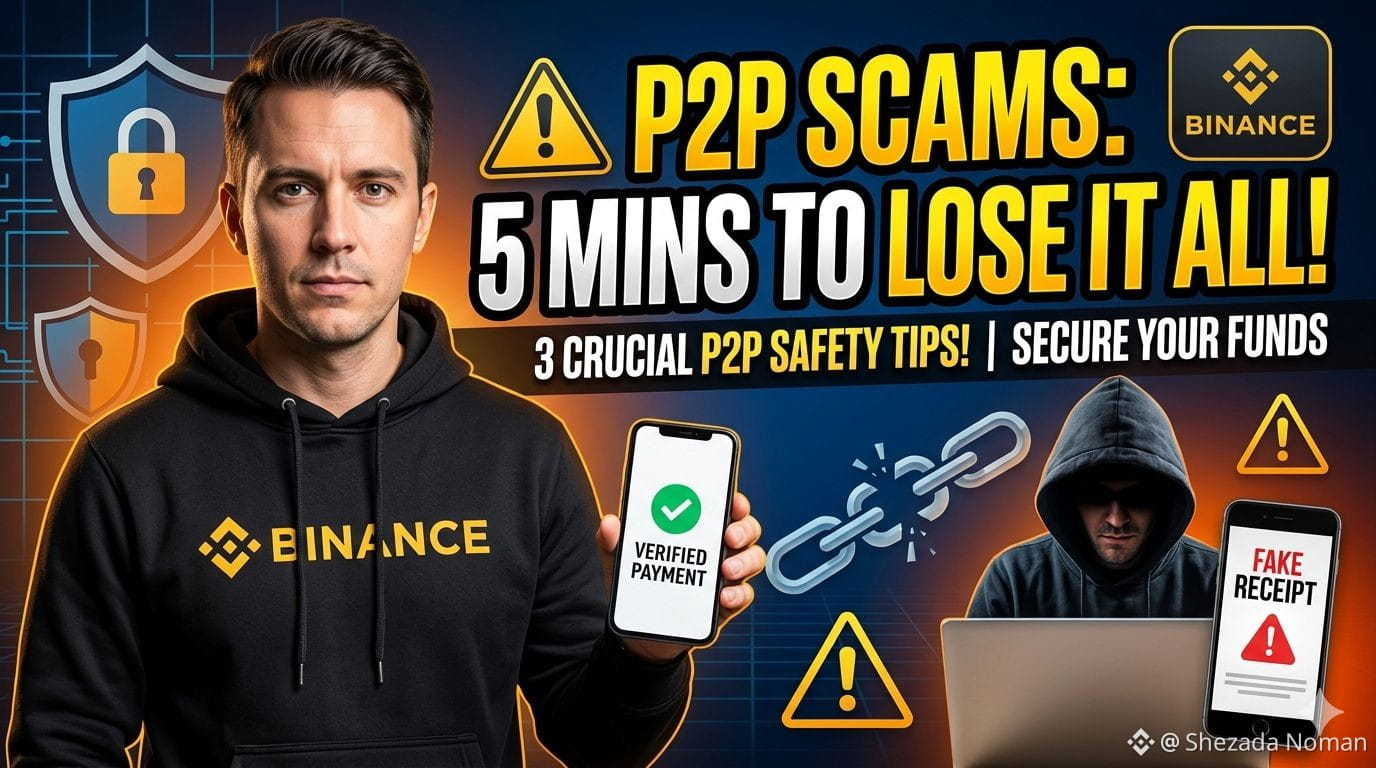
🛑 Don’t Let a 5-Minute Trade Cost You Your Entire Portfolio
The convenience of P2P (Peer-to-Peer) trading is undeniable, but it has also become a playground for sophisticated scammers. Every day, hundreds of traders lose funds not because the platform failed, but because they missed a red flag.
If you are trading on Binance P2P, here are the 3 Non-Negotiable Rules to keep your assets safe:
1. Trust Your Bank, Not a Screenshot 📸
Scammers are experts at creating pixel-perfect fake payment receipts. Never release your crypto just because a buyer sent a photo of a transfer. Always log in to your bank app and verify that the "Available Balance" has actually increased.
2. Beware of Third-Party Payments 👤
Only accept payments from an account that matches the verified name on the buyer's Binance profile. If User A is buying but User B sends the money, cancel the trade and report it. This is often a sign of a Triangular Scam or money laundering.
3. Stay Inside the Chat 💬
Never move your conversation to WhatsApp, Telegram, or Discord. If a dispute arises, Binance Support can only use the official P2P chat as evidence. If it’s not in the chat, it didn't happen.
💡 Pro Tip: If a buyer pressures you to Release Fast because of a "system glitch" or emergency, stay calm. That pressure is a psychological tactic. Take your time, verify the funds, and stay in control.
Security starts with you. Don't trade your safety for a slightly better exchange rate.
Watch closely $AGT $NEAR $GRASS
{future}(GRASSUSDT)
{future}(NEARUSDT)
{future}(AGTUSDT)
#P2PScam #P2PScamAwareness #P2PScamWarning
🛑 Don’t Let a 5-Minute Trade Cost You Your Entire Portfolio
The convenience of P2P (Peer-to-Peer) trading is undeniable, but it has also become a playground for sophisticated scammers. Every day, hundreds of traders lose funds not because the platform failed, but because they missed a red flag.
If you are trading on Binance P2P, here are the 3 Non-Negotiable Rules to keep your assets safe:
1. Trust Your Bank, Not a Screenshot 📸
Scammers are experts at creating pixel-perfect fake payment receipts. Never release your crypto just because a buyer sent a photo of a transfer. Always log in to your bank app and verify that the "Available Balance" has actually increased.
2. Beware of Third-Party Payments 👤
Only accept payments from an account that matches the verified name on the buyer's Binance profile. If User A is buying but User B sends the money, cancel the trade and report it. This is often a sign of a Triangular Scam or money laundering.
3. Stay Inside the Chat 💬
Never move your conversation to WhatsApp, Telegram, or Discord. If a dispute arises, Binance Support can only use the official P2P chat as evidence. If it’s not in the chat, it didn't happen.
💡 Pro Tip: If a buyer pressures you to Release Fast because of a "system glitch" or emergency, stay calm. That pressure is a psychological tactic. Take your time, verify the funds, and stay in control.
Security starts with you. Don't trade your safety for a slightly better exchange rate.
Watch closely $AGT $NEAR $GRASS
#P2PScam #P2PScamAwareness #P2PScamWarning
The convenience of P2P (Peer-to-Peer) trading is undeniable, but it has also become a playground for sophisticated scammers. Every day, hundreds of traders lose funds not because the platform failed, but because they missed a red flag.
If you are trading on Binance P2P, here are the 3 Non-Negotiable Rules to keep your assets safe:
1. Trust Your Bank, Not a Screenshot 📸
Scammers are experts at creating pixel-perfect fake payment receipts. Never release your crypto just because a buyer sent a photo of a transfer. Always log in to your bank app and verify that the "Available Balance" has actually increased.
2. Beware of Third-Party Payments 👤
Only accept payments from an account that matches the verified name on the buyer's Binance profile. If User A is buying but User B sends the money, cancel the trade and report it. This is often a sign of a Triangular Scam or money laundering.
3. Stay Inside the Chat 💬
Never move your conversation to WhatsApp, Telegram, or Discord. If a dispute arises, Binance Support can only use the official P2P chat as evidence. If it’s not in the chat, it didn't happen.
💡 Pro Tip: If a buyer pressures you to Release Fast because of a "system glitch" or emergency, stay calm. That pressure is a psychological tactic. Take your time, verify the funds, and stay in control.
Security starts with you. Don't trade your safety for a slightly better exchange rate.
Watch closely $AGT $NEAR $GRASS
#P2PScam #P2PScamAwareness #P2PScamWarning
242

·
--
Bullish
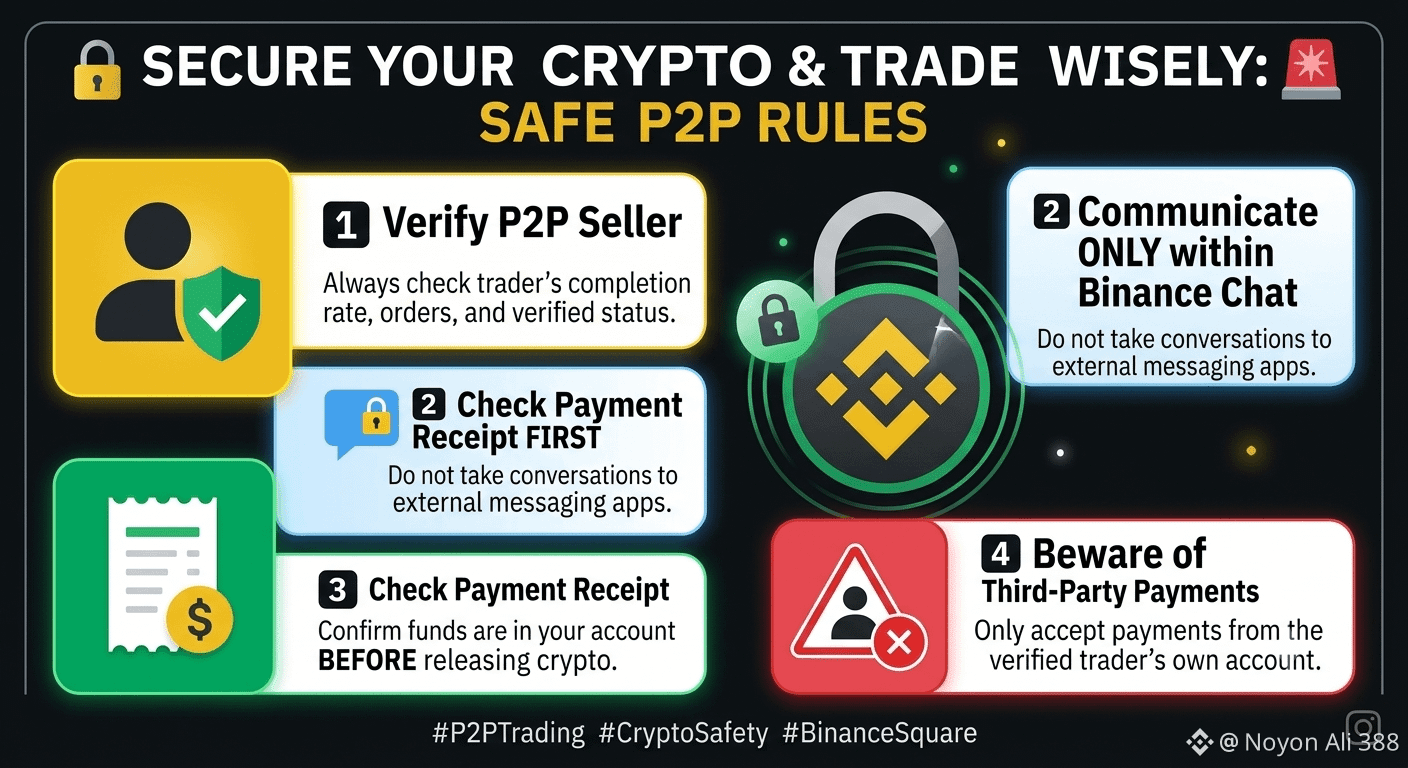
$BTC 🔒 P2P Trading Safety: 4 Golden Rules to Prevent Scams! 🚨
Peer-to-Peer (P2P) trading is convenient, but it's crucial to stay vigilant against scammers. Always prioritize your security with these essential rules:
📌 4 Crucial Security Rules:
1️⃣ Verify P2P Seller: Before initiating a trade, check the seller's completion rate and reputation. Trade with verified and established merchants.
2️⃣ Communicate ONLY within Binance Chat: Avoid taking conversations off-platform to external messaging apps. Scammers often use this tactic.
3️⃣ Check Payment Receipt FIRST: Ensure funds have actually landed in your account before releasing the crypto. Scammers might send fake receipts.
4️⃣ Beware of Third-Party Payments: Never accept payments from accounts with a name different from the verified trader's on the platform.
💡 Remember, your security is your own responsibility. If something feels off, cancel the trade and report suspicious activity. Trade smart and keep your crypto safe!
#P2PTrading #CryptoSafety #BinanceP2P #TradingSecurity #PreventScams #DYOR #CryptoEducation #P2PScam
{spot}(BTCUSDT)
$BTC 🔒 P2P Trading Safety: 4 Golden Rules to Prevent Scams! 🚨
Peer-to-Peer (P2P) trading is convenient, but it's crucial to stay vigilant against scammers. Always prioritize your security with these essential rules:
📌 4 Crucial Security Rules:
1️⃣ Verify P2P Seller: Before initiating a trade, check the seller's completion rate and reputation. Trade with verified and established merchants.
2️⃣ Communicate ONLY within Binance Chat: Avoid taking conversations off-platform to external messaging apps. Scammers often use this tactic.
3️⃣ Check Payment Receipt FIRST: Ensure funds have actually landed in your account before releasing the crypto. Scammers might send fake receipts.
4️⃣ Beware of Third-Party Payments: Never accept payments from accounts with a name different from the verified trader's on the platform.
💡 Remember, your security is your own responsibility. If something feels off, cancel the trade and report suspicious activity. Trade smart and keep your crypto safe!
#P2PTrading #CryptoSafety #BinanceP2P #TradingSecurity #PreventScams #DYOR #CryptoEducation #P2PScam
Peer-to-Peer (P2P) trading is convenient, but it's crucial to stay vigilant against scammers. Always prioritize your security with these essential rules:
📌 4 Crucial Security Rules:
1️⃣ Verify P2P Seller: Before initiating a trade, check the seller's completion rate and reputation. Trade with verified and established merchants.
2️⃣ Communicate ONLY within Binance Chat: Avoid taking conversations off-platform to external messaging apps. Scammers often use this tactic.
3️⃣ Check Payment Receipt FIRST: Ensure funds have actually landed in your account before releasing the crypto. Scammers might send fake receipts.
4️⃣ Beware of Third-Party Payments: Never accept payments from accounts with a name different from the verified trader's on the platform.
💡 Remember, your security is your own responsibility. If something feels off, cancel the trade and report suspicious activity. Trade smart and keep your crypto safe!
#P2PTrading #CryptoSafety #BinanceP2P #TradingSecurity #PreventScams #DYOR #CryptoEducation #P2PScam
57

·
--
A new scam is spreading across Binance P2P – stay vigilant!
How it works:
🛒 The scammer places a buy order and sends a fake payment.
💸 You receive an SMS or email — it looks legitimate.
🔄 After you release the cryptocurrency, the scammer cancels the bank transfer.
❌ Result: You lose both your money and your cryptocurrency.
Fake trading profiles ⚠️🎭
👤 They create fake accounts with fake reviews to earn your trust.
💬 Persuasive chats, quick deals, polite tone — it’s all a trap.
🕳️ Once you transfer the money, they disappear without sending the cryptocurrency.
Protect yourself 🔐:
1. 💬 Don’t chat outside Binance P2P — scammers avoid Binance monitoring.
2. ✔️ Trade only with verified users — look for the blue checkmark.
3. 🏦 Verify the payment only in your banking app — ignore SMS or email notifications.
4. ⛔️ If something seems suspicious — DO NOT release the cryptocurrency!
Press the “Appeal” button immediately.
Be smart. Stay safe.
Share this to help others avoid the trap!
#P2PScam #P2P #P2PTrading $BTC
A new scam is spreading across Binance P2P – stay vigilant!
How it works:
🛒 The scammer places a buy order and sends a fake payment.
💸 You receive an SMS or email — it looks legitimate.
🔄 After you release the cryptocurrency, the scammer cancels the bank transfer.
❌ Result: You lose both your money and your cryptocurrency.
Fake trading profiles ⚠️🎭
👤 They create fake accounts with fake reviews to earn your trust.
💬 Persuasive chats, quick deals, polite tone — it’s all a trap.
🕳️ Once you transfer the money, they disappear without sending the cryptocurrency.
Protect yourself 🔐:
1. 💬 Don’t chat outside Binance P2P — scammers avoid Binance monitoring.
2. ✔️ Trade only with verified users — look for the blue checkmark.
3. 🏦 Verify the payment only in your banking app — ignore SMS or email notifications.
4. ⛔️ If something seems suspicious — DO NOT release the cryptocurrency!
Press the “Appeal” button immediately.
Be smart. Stay safe.
Share this to help others avoid the trap!
#P2PScam #P2P #P2PTrading $BTC
How it works:
🛒 The scammer places a buy order and sends a fake payment.
💸 You receive an SMS or email — it looks legitimate.
🔄 After you release the cryptocurrency, the scammer cancels the bank transfer.
❌ Result: You lose both your money and your cryptocurrency.
Fake trading profiles ⚠️🎭
👤 They create fake accounts with fake reviews to earn your trust.
💬 Persuasive chats, quick deals, polite tone — it’s all a trap.
🕳️ Once you transfer the money, they disappear without sending the cryptocurrency.
Protect yourself 🔐:
1. 💬 Don’t chat outside Binance P2P — scammers avoid Binance monitoring.
2. ✔️ Trade only with verified users — look for the blue checkmark.
3. 🏦 Verify the payment only in your banking app — ignore SMS or email notifications.
4. ⛔️ If something seems suspicious — DO NOT release the cryptocurrency!
Press the “Appeal” button immediately.
Be smart. Stay safe.
Share this to help others avoid the trap!
#P2PScam #P2P #P2PTrading $BTC
1
1
3
465

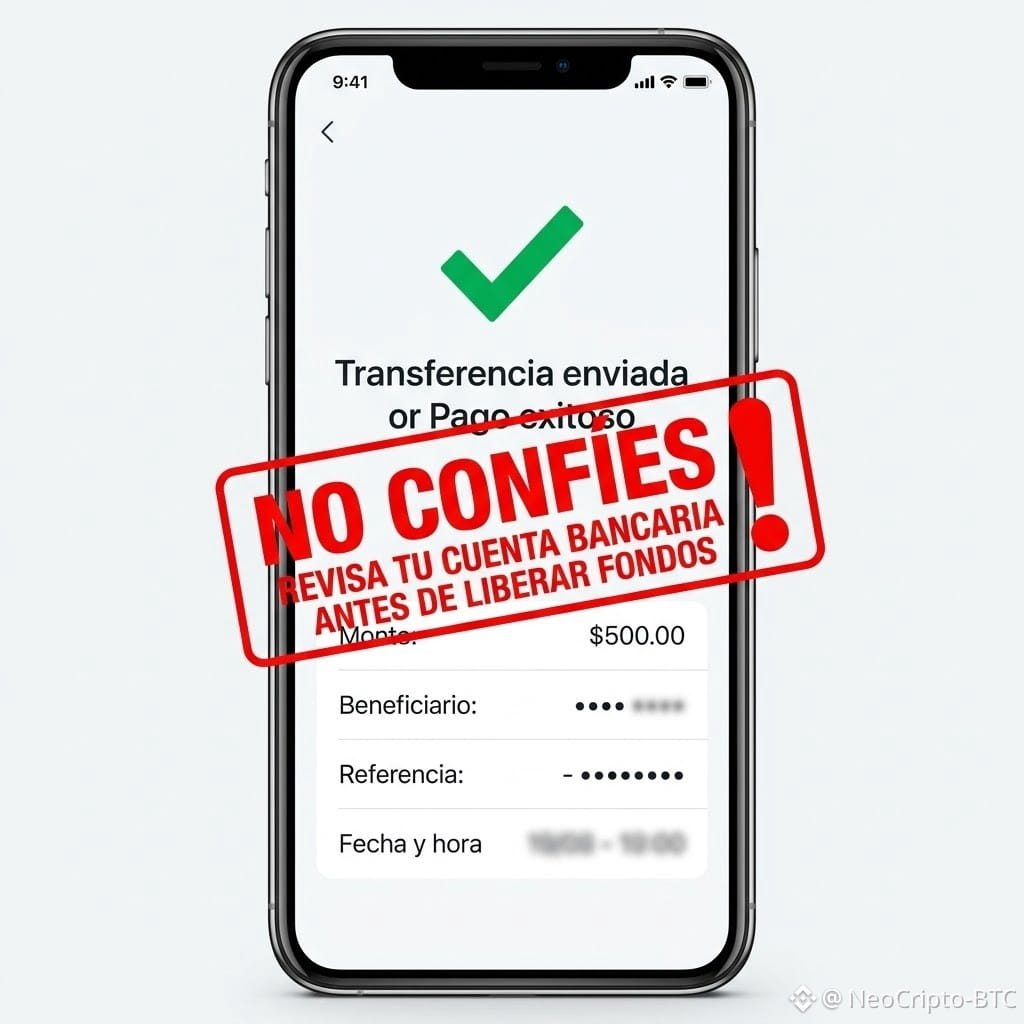
🚨 P2P ALERT, fam before they flip the cake on you 🚨
Look at what I received and it’s a textbook case of how NOT to operate in P2P 👇
A buyer sends a “confirmation” via chat, says they already paid, posts a screenshot of a transfer to Banesco... and the seller, all confident, releases the coins. Classic. This is how people get scammed in P2P every day.
What the seller did wrong (and you should not repeat):
🔴 Releasing crypto because “the message arrived” — a chat, an audio, or a “don’t worry bro” is NOT a confirmed payment.
🔴 Trusting a screenshot— it can be edited in 2 minutes with any app.
🔴 Not going directly into the bank app to verify the real deposit, with the exact amount and the reference.
🔴 Accepting pressure (“I’m waiting,” “okay, I’m in a rush”)— that’s a scammer tactic; they rush you so you don’t check properly.
🔴 Not trading only with verified merchants — the platform itself warns you, and many still ignore it.
What YOU SHOULD do:
✅ Verify the payment directly in your bank or wallet— never via screenshot or what they “tell” you.
✅ Confirm that the account holder’s name and the amount match exactly.
✅ Trade only with verified merchants / those with a good reputation and volume.
✅ If they rush you or pressure you, that’s a red flag— take your time.
✅ When in doubt, open a dispute with the platform before releasing the funds.$USDC
In P2P, the golden rule is still the same as always: don’t release anything until YOU personally see the money in your account. Not via chat, not via a screenshot, not based on trust.
#P2PScam
$BTC
{future}(BTCUSDT)
$ETH
{future}(ETHUSDT)
{future}(USDCUSDT)
🚨 P2P ALERT, fam before they flip the cake on you 🚨
Look at what I received and it’s a textbook case of how NOT to operate in P2P 👇
A buyer sends a “confirmation” via chat, says they already paid, posts a screenshot of a transfer to Banesco... and the seller, all confident, releases the coins. Classic. This is how people get scammed in P2P every day.
What the seller did wrong (and you should not repeat):
🔴 Releasing crypto because “the message arrived” — a chat, an audio, or a “don’t worry bro” is NOT a confirmed payment.
🔴 Trusting a screenshot— it can be edited in 2 minutes with any app.
🔴 Not going directly into the bank app to verify the real deposit, with the exact amount and the reference.
🔴 Accepting pressure (“I’m waiting,” “okay, I’m in a rush”)— that’s a scammer tactic; they rush you so you don’t check properly.
🔴 Not trading only with verified merchants — the platform itself warns you, and many still ignore it.
What YOU SHOULD do:
✅ Verify the payment directly in your bank or wallet— never via screenshot or what they “tell” you.
✅ Confirm that the account holder’s name and the amount match exactly.
✅ Trade only with verified merchants / those with a good reputation and volume.
✅ If they rush you or pressure you, that’s a red flag— take your time.
✅ When in doubt, open a dispute with the platform before releasing the funds.$USDC
In P2P, the golden rule is still the same as always: don’t release anything until YOU personally see the money in your account. Not via chat, not via a screenshot, not based on trust.
#P2PScam
$BTC
$ETH
Look at what I received and it’s a textbook case of how NOT to operate in P2P 👇
A buyer sends a “confirmation” via chat, says they already paid, posts a screenshot of a transfer to Banesco... and the seller, all confident, releases the coins. Classic. This is how people get scammed in P2P every day.
What the seller did wrong (and you should not repeat):
🔴 Releasing crypto because “the message arrived” — a chat, an audio, or a “don’t worry bro” is NOT a confirmed payment.
🔴 Trusting a screenshot— it can be edited in 2 minutes with any app.
🔴 Not going directly into the bank app to verify the real deposit, with the exact amount and the reference.
🔴 Accepting pressure (“I’m waiting,” “okay, I’m in a rush”)— that’s a scammer tactic; they rush you so you don’t check properly.
🔴 Not trading only with verified merchants — the platform itself warns you, and many still ignore it.
What YOU SHOULD do:
✅ Verify the payment directly in your bank or wallet— never via screenshot or what they “tell” you.
✅ Confirm that the account holder’s name and the amount match exactly.
✅ Trade only with verified merchants / those with a good reputation and volume.
✅ If they rush you or pressure you, that’s a red flag— take your time.
✅ When in doubt, open a dispute with the platform before releasing the funds.$USDC
In P2P, the golden rule is still the same as always: don’t release anything until YOU personally see the money in your account. Not via chat, not via a screenshot, not based on trust.
#P2PScam
$BTC
$ETH
5
1
8
3.3k

·
--
Bullish
#binancep2pantoan @Binance_Vietnam “Cancel the order first, and then I’ll unlock USDC for you.”
This is the most dangerous sentence I’ve ever seen in a P2P trade.
It happened to me yesterday. He bought about 2.5 million VND worth of USDC (nearly 100 USDC). After the bank transfer was completed, the counterparty didn’t release right away and instead messaged: “add Zalo to talk more nhé”. As soon as I added Zalo, I was asked to cancel the order first, and only then did they let the coins go.
Or there’s an even more sophisticated scam: they require the trade to be moved outside the platform to get a better exchange rate. It targets the new users’ greed for a bargain.
Luckily, I was alert enough not to click “cancel order.”
Because once you cancel the order, all transaction evidence on the platform disappears. The money has already been transferred, and Binance is also harder to intervene since the order no longer exists. This is exactly the point where many newcomers easily fall into scammers’ traps.
From that situation, I drew a few very clear rules:
⭐ If you’ve transferred money, absolutely never cancel the order—no matter what the counterparty says.
⭐ Never move the conversation to Zalo, Telegram, or any other channel.
⭐ All communication must stay within the order’s chat.
⭐ If there are any unusual signs, open an Appeal immediately, and at the same time keep the transfer receipt and the Order ID.
A legitimate trader will never ask you to cancel the order just so they can release it. Binance P2P has escrow and a complaint process specifically for situations like this—> the protection layer only works if you don’t dismantle it yourself.
Small trades of 100 USD or bigger ones—the rules are the same. Safety doesn’t come from luck; it comes from following the correct process.
What would you do if someone asks you to “cancel the order right away”? I would take screenshots and file a complaint.
#creatorpad #P2PScam $BTC $BNB
#binancep2pantoan @Binance Vietnam “Cancel the order first, and then I’ll unlock USDC for you.”
This is the most dangerous sentence I’ve ever seen in a P2P trade.
It happened to me yesterday. He bought about 2.5 million VND worth of USDC (nearly 100 USDC). After the bank transfer was completed, the counterparty didn’t release right away and instead messaged: “add Zalo to talk more nhé”. As soon as I added Zalo, I was asked to cancel the order first, and only then did they let the coins go.
Or there’s an even more sophisticated scam: they require the trade to be moved outside the platform to get a better exchange rate. It targets the new users’ greed for a bargain.
Luckily, I was alert enough not to click “cancel order.”
Because once you cancel the order, all transaction evidence on the platform disappears. The money has already been transferred, and Binance is also harder to intervene since the order no longer exists. This is exactly the point where many newcomers easily fall into scammers’ traps.
From that situation, I drew a few very clear rules:
⭐ If you’ve transferred money, absolutely never cancel the order—no matter what the counterparty says.
⭐ Never move the conversation to Zalo, Telegram, or any other channel.
⭐ All communication must stay within the order’s chat.
⭐ If there are any unusual signs, open an Appeal immediately, and at the same time keep the transfer receipt and the Order ID.
A legitimate trader will never ask you to cancel the order just so they can release it. Binance P2P has escrow and a complaint process specifically for situations like this—> the protection layer only works if you don’t dismantle it yourself.
Small trades of 100 USD or bigger ones—the rules are the same. Safety doesn’t come from luck; it comes from following the correct process.
What would you do if someone asks you to “cancel the order right away”? I would take screenshots and file a complaint.
#creatorpad #P2PScam $BTC $BNB
This is the most dangerous sentence I’ve ever seen in a P2P trade.
It happened to me yesterday. He bought about 2.5 million VND worth of USDC (nearly 100 USDC). After the bank transfer was completed, the counterparty didn’t release right away and instead messaged: “add Zalo to talk more nhé”. As soon as I added Zalo, I was asked to cancel the order first, and only then did they let the coins go.
Or there’s an even more sophisticated scam: they require the trade to be moved outside the platform to get a better exchange rate. It targets the new users’ greed for a bargain.
Luckily, I was alert enough not to click “cancel order.”
Because once you cancel the order, all transaction evidence on the platform disappears. The money has already been transferred, and Binance is also harder to intervene since the order no longer exists. This is exactly the point where many newcomers easily fall into scammers’ traps.
From that situation, I drew a few very clear rules:
⭐ If you’ve transferred money, absolutely never cancel the order—no matter what the counterparty says.
⭐ Never move the conversation to Zalo, Telegram, or any other channel.
⭐ All communication must stay within the order’s chat.
⭐ If there are any unusual signs, open an Appeal immediately, and at the same time keep the transfer receipt and the Order ID.
A legitimate trader will never ask you to cancel the order just so they can release it. Binance P2P has escrow and a complaint process specifically for situations like this—> the protection layer only works if you don’t dismantle it yourself.
Small trades of 100 USD or bigger ones—the rules are the same. Safety doesn’t come from luck; it comes from following the correct process.
What would you do if someone asks you to “cancel the order right away”? I would take screenshots and file a complaint.
#creatorpad #P2PScam $BTC $BNB

18
18
15.7k

·
--
Article
Binance P2P merchants are stealing from mobile money usersWhat is mobile money and how are merchants cheating P2P users on Binance?
Mobile money is used to transfer funds in local currency between two users with just the phone numbers which makes it useful for P2P on Binance. The networks used are mostly MTN and safaricom (also known as Mpesa) for Africa.
There are 2 ways to transfer money with mobile money:
Direct transfer from user to userMerchant withdrawal- after the user authorizes cashout
So apart from a user transfer another way to transfer uses this merchant cashout. This allows a user to authorize an agent to take money from his account, usually used for deposits or transactions with a mobile money agent.
The difference between the 2 methods
The difference between the method 1 and 2 is that:
for method 1 the sending P2P user enters the specific amount to send but for method 2 the receiving user(the P2P merchant) is the one who enters a requested amount for the user to approve. Note this difference.
How P2P merchants are abusing this:
Previously the first method was the default when sending.
* I send to a given number
* They confirm the amount
* They release the money on Binance
Network charges for sending are paid for by the sender
Now most of the merchants have switched to the second method.
When doing a P2P transaction for 100 USDT for instance let's say it's ¢1000 cedis . Now the merchant can input ¢1050 cedis about $5 more assuming the user won't mind or notice the increase . Instead of the requested ¢1000. (It could be Ugandan shillingsUGX, RWF, KES GHS used just for example)
If a user accepts this request for ¢1050, instead of the agreed amount of ¢1000 merchant make an extra ¢50 ($5). The sending user also pays for the network charges for sending which is usually higher with this cashout method. Sometimes the amount is deducted first before the user notices the amount is slightly higher than agreed. The merchant knows you won't complain about a small amount.
Not a big deal? A Little Math to see how much is lost
If he does this 100 times to 100 victims he makes $500 aside the commission on P2P. There are probably more than 1000 users using this method so you can calculate the loss.
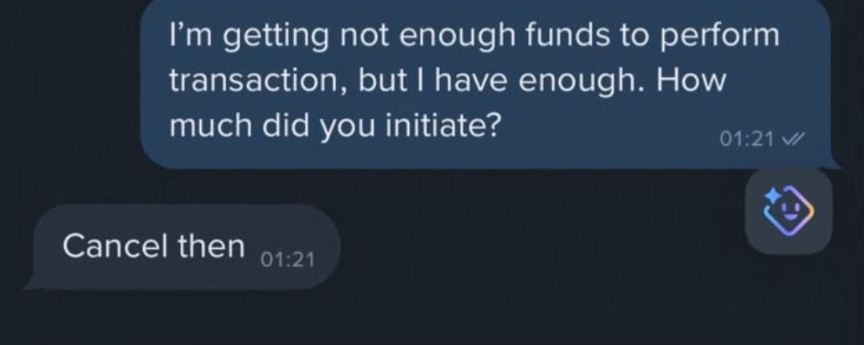
The wise option: Option to refuse
Of course some users refuse (see screenshot) and the P2P transaction is not accepted. Especially if the funds in the account are not enough. Then they can go to the merchant who uses the first method where only network charges apply. Binance actually insists on accepting only the exact amount.
Problem: Most P2P merchants have adopted cashout method instead of direct transfer
The problem is that now a lot of P2P merchants, even verified ones, are switching to the second method because of the extra money they make. Now it's difficult to find a merchant who does the first method of direct transfer especially when you need the USDT transfer urgently. Many users just accept their fate and pay the extra that is stolen.
The end result
1. Users pay higher fees than the regular direct transfer
2. Users pay more per withdrawal/deposit than therate agreed by on Binance
3. Merchants profit twice; from their rates advertised on binance and the difference they steal from p2P users
Now many users are discouraged because most of the merchants are using this method and prefer not to use P2P on Binance. If binance doesn't do something about this, many users will keep getting their money stolen and the wise ones will stop using P2P for deposits and withdrawal on Binance.
Please help stop this theft.
If you have a similar experience drop it in the comments or like and share this post so someone at Binance sees this.
#MobilePayments #P2PScam #P2P
@Binance_Labs @binance_south_africa
@BinanceAfrica
Binance P2P merchants are stealing from mobile money users
What is mobile money and how are merchants cheating P2P users on Binance?
Mobile money is used to transfer funds in local currency between two users with just the phone numbers which makes it useful for P2P on Binance. The networks used are mostly MTN and safaricom (also known as Mpesa) for Africa.
There are 2 ways to transfer money with mobile money:
Direct transfer from user to userMerchant withdrawal- after the user authorizes cashout
So apart from a user transfer another way to transfer uses this merchant cashout. This allows a user to authorize an agent to take money from his account, usually used for deposits or transactions with a mobile money agent.
The difference between the 2 methods
The difference between the method 1 and 2 is that:
for method 1 the sending P2P user enters the specific amount to send but for method 2 the receiving user(the P2P merchant) is the one who enters a requested amount for the user to approve. Note this difference.
How P2P merchants are abusing this:
Previously the first method was the default when sending.
* I send to a given number
* They confirm the amount
* They release the money on Binance
Network charges for sending are paid for by the sender
Now most of the merchants have switched to the second method.
When doing a P2P transaction for 100 USDT for instance let's say it's ¢1000 cedis . Now the merchant can input ¢1050 cedis about $5 more assuming the user won't mind or notice the increase . Instead of the requested ¢1000. (It could be Ugandan shillingsUGX, RWF, KES GHS used just for example)
If a user accepts this request for ¢1050, instead of the agreed amount of ¢1000 merchant make an extra ¢50 ($5). The sending user also pays for the network charges for sending which is usually higher with this cashout method. Sometimes the amount is deducted first before the user notices the amount is slightly higher than agreed. The merchant knows you won't complain about a small amount.
Not a big deal? A Little Math to see how much is lost
If he does this 100 times to 100 victims he makes $500 aside the commission on P2P. There are probably more than 1000 users using this method so you can calculate the loss.
The wise option: Option to refuse
Of course some users refuse (see screenshot) and the P2P transaction is not accepted. Especially if the funds in the account are not enough. Then they can go to the merchant who uses the first method where only network charges apply. Binance actually insists on accepting only the exact amount.
Problem: Most P2P merchants have adopted cashout method instead of direct transfer
The problem is that now a lot of P2P merchants, even verified ones, are switching to the second method because of the extra money they make. Now it's difficult to find a merchant who does the first method of direct transfer especially when you need the USDT transfer urgently. Many users just accept their fate and pay the extra that is stolen.
The end result
1. Users pay higher fees than the regular direct transfer
2. Users pay more per withdrawal/deposit than therate agreed by on Binance
3. Merchants profit twice; from their rates advertised on binance and the difference they steal from p2P users
Now many users are discouraged because most of the merchants are using this method and prefer not to use P2P on Binance. If binance doesn't do something about this, many users will keep getting their money stolen and the wise ones will stop using P2P for deposits and withdrawal on Binance.
Please help stop this theft.
If you have a similar experience drop it in the comments or like and share this post so someone at Binance sees this.
#MobilePayments #P2PScam #P2P
@Binance Labs @Binance South Africa Official
@BinanceAfrica
Mobile money is used to transfer funds in local currency between two users with just the phone numbers which makes it useful for P2P on Binance. The networks used are mostly MTN and safaricom (also known as Mpesa) for Africa.
There are 2 ways to transfer money with mobile money:
Direct transfer from user to userMerchant withdrawal- after the user authorizes cashout
So apart from a user transfer another way to transfer uses this merchant cashout. This allows a user to authorize an agent to take money from his account, usually used for deposits or transactions with a mobile money agent.
The difference between the 2 methods
The difference between the method 1 and 2 is that:
for method 1 the sending P2P user enters the specific amount to send but for method 2 the receiving user(the P2P merchant) is the one who enters a requested amount for the user to approve. Note this difference.
How P2P merchants are abusing this:
Previously the first method was the default when sending.
* I send to a given number
* They confirm the amount
* They release the money on Binance
Network charges for sending are paid for by the sender
Now most of the merchants have switched to the second method.
When doing a P2P transaction for 100 USDT for instance let's say it's ¢1000 cedis . Now the merchant can input ¢1050 cedis about $5 more assuming the user won't mind or notice the increase . Instead of the requested ¢1000. (It could be Ugandan shillingsUGX, RWF, KES GHS used just for example)
If a user accepts this request for ¢1050, instead of the agreed amount of ¢1000 merchant make an extra ¢50 ($5). The sending user also pays for the network charges for sending which is usually higher with this cashout method. Sometimes the amount is deducted first before the user notices the amount is slightly higher than agreed. The merchant knows you won't complain about a small amount.
Not a big deal? A Little Math to see how much is lost
If he does this 100 times to 100 victims he makes $500 aside the commission on P2P. There are probably more than 1000 users using this method so you can calculate the loss.
The wise option: Option to refuse
Of course some users refuse (see screenshot) and the P2P transaction is not accepted. Especially if the funds in the account are not enough. Then they can go to the merchant who uses the first method where only network charges apply. Binance actually insists on accepting only the exact amount.
Problem: Most P2P merchants have adopted cashout method instead of direct transfer
The problem is that now a lot of P2P merchants, even verified ones, are switching to the second method because of the extra money they make. Now it's difficult to find a merchant who does the first method of direct transfer especially when you need the USDT transfer urgently. Many users just accept their fate and pay the extra that is stolen.
The end result
1. Users pay higher fees than the regular direct transfer
2. Users pay more per withdrawal/deposit than therate agreed by on Binance
3. Merchants profit twice; from their rates advertised on binance and the difference they steal from p2P users
Now many users are discouraged because most of the merchants are using this method and prefer not to use P2P on Binance. If binance doesn't do something about this, many users will keep getting their money stolen and the wise ones will stop using P2P for deposits and withdrawal on Binance.
Please help stop this theft.
If you have a similar experience drop it in the comments or like and share this post so someone at Binance sees this.
#MobilePayments #P2PScam #P2P
@Binance Labs @Binance South Africa Official
@BinanceAfrica
5
234

P2P FREEZE ALERT: PROTECT YOUR $BNB FUNDS 🚨
A P2P counterparty linked to fraudulent funds can trigger bank account freezes across every account touched by that payment flow. This is a serious operational risk for crypto users moving through P2P rails.
Never treat P2P like a casual swap.
Check trade count.
Check completion rate.
Avoid weak profiles.
Match the payer’s bank name with the Top-tier exchange account name.
Do not accept third-party payments.
Keep records clean.
One bad counterparty can lock your money for months.
Not financial advice. Manage your risk.
#P2PScam #CryptoSafety #Binance #CryptoSecurity
⚡
{future}(BNBUSDT)
P2P FREEZE ALERT: PROTECT YOUR $BNB FUNDS 🚨
A P2P counterparty linked to fraudulent funds can trigger bank account freezes across every account touched by that payment flow. This is a serious operational risk for crypto users moving through P2P rails.
Never treat P2P like a casual swap.
Check trade count.
Check completion rate.
Avoid weak profiles.
Match the payer’s bank name with the Top-tier exchange account name.
Do not accept third-party payments.
Keep records clean.
One bad counterparty can lock your money for months.
Not financial advice. Manage your risk.
#P2PScam #CryptoSafety #Binance #CryptoSecurity
⚡
A P2P counterparty linked to fraudulent funds can trigger bank account freezes across every account touched by that payment flow. This is a serious operational risk for crypto users moving through P2P rails.
Never treat P2P like a casual swap.
Check trade count.
Check completion rate.
Avoid weak profiles.
Match the payer’s bank name with the Top-tier exchange account name.
Do not accept third-party payments.
Keep records clean.
One bad counterparty can lock your money for months.
Not financial advice. Manage your risk.
#P2PScam #CryptoSafety #Binance #CryptoSecurity
⚡

43

·
--
Bullish
How to Avoid P2P Scams
#P2P (Peer-to-Peer) trading is convenient, but scammers often target inexperienced traders. Here are the best ways to stay safe:
✅ Use Trusted Exchanges Only
Trade through reputable platforms with escrow protection, such as major crypto exchanges.
✅ Verify Payment Yourself
Never rely on screenshots or SMS notifications. Check your bank account or payment wallet directly before releasing crypto.
✅ Keep All Communication on the Platform
Avoid moving conversations to Telegram, WhatsApp, or other apps where scammers can operate without oversight.
✅ Trade with Verified Merchants
Choose users with high completion rates, positive reviews, and a long trading history.
✅ Beware of Fake Payment Proofs
Scammers often send edited screenshots showing a completed transfer. Always confirm funds have actually arrived.
✅ Reject Third-Party Payments
The sender's name should match the buyer's verified account. Be cautious if payment comes from someone else.
✅ Use the Dispute System
If anything looks suspicious, do not release the crypto. Open a dispute and let the platform's support team investigate.
Common P2P Scams
🔸 Fake bank transfer screenshots
🔸 Charge black or payment reversal fraud
🔸 Off-platform trading requests
🔸 Fake customer support accounts
🔸 Overpayment scams
Golden Rule
Never release your crypto until you have personally confirmed that the payment is fully received and settled in your account. #P2PScam #P2PScamAwareness #ECBExpectedToRaiseRates25Bps #ZcashUnlimitedMintingFlawFound
How to Avoid P2P Scams
#P2P (Peer-to-Peer) trading is convenient, but scammers often target inexperienced traders. Here are the best ways to stay safe:
✅ Use Trusted Exchanges Only
Trade through reputable platforms with escrow protection, such as major crypto exchanges.
✅ Verify Payment Yourself
Never rely on screenshots or SMS notifications. Check your bank account or payment wallet directly before releasing crypto.
✅ Keep All Communication on the Platform
Avoid moving conversations to Telegram, WhatsApp, or other apps where scammers can operate without oversight.
✅ Trade with Verified Merchants
Choose users with high completion rates, positive reviews, and a long trading history.
✅ Beware of Fake Payment Proofs
Scammers often send edited screenshots showing a completed transfer. Always confirm funds have actually arrived.
✅ Reject Third-Party Payments
The sender's name should match the buyer's verified account. Be cautious if payment comes from someone else.
✅ Use the Dispute System
If anything looks suspicious, do not release the crypto. Open a dispute and let the platform's support team investigate.
Common P2P Scams
🔸 Fake bank transfer screenshots
🔸 Charge black or payment reversal fraud
🔸 Off-platform trading requests
🔸 Fake customer support accounts
🔸 Overpayment scams
Golden Rule
Never release your crypto until you have personally confirmed that the payment is fully received and settled in your account. #P2PScam #P2PScamAwareness #ECBExpectedToRaiseRates25Bps #ZcashUnlimitedMintingFlawFound
#P2P (Peer-to-Peer) trading is convenient, but scammers often target inexperienced traders. Here are the best ways to stay safe:
✅ Use Trusted Exchanges Only
Trade through reputable platforms with escrow protection, such as major crypto exchanges.
✅ Verify Payment Yourself
Never rely on screenshots or SMS notifications. Check your bank account or payment wallet directly before releasing crypto.
✅ Keep All Communication on the Platform
Avoid moving conversations to Telegram, WhatsApp, or other apps where scammers can operate without oversight.
✅ Trade with Verified Merchants
Choose users with high completion rates, positive reviews, and a long trading history.
✅ Beware of Fake Payment Proofs
Scammers often send edited screenshots showing a completed transfer. Always confirm funds have actually arrived.
✅ Reject Third-Party Payments
The sender's name should match the buyer's verified account. Be cautious if payment comes from someone else.
✅ Use the Dispute System
If anything looks suspicious, do not release the crypto. Open a dispute and let the platform's support team investigate.
Common P2P Scams
🔸 Fake bank transfer screenshots
🔸 Charge black or payment reversal fraud
🔸 Off-platform trading requests
🔸 Fake customer support accounts
🔸 Overpayment scams
Golden Rule
Never release your crypto until you have personally confirmed that the payment is fully received and settled in your account. #P2PScam #P2PScamAwareness #ECBExpectedToRaiseRates25Bps #ZcashUnlimitedMintingFlawFound
175
Log in to explore more content
Join global crypto users on Binance Square
⚡️ Get latest and useful information about crypto.
💬 Trusted by the world’s largest crypto exchange.
👍 Discover real insights from verified creators.
Email / Phone number
Trending Topics
1
#Nikkei225Jumps2.5%ToThreeMonthHigh
17,403 views
356 Discussing
2
#DriftHackVictimsBeginClaims
93,671 views
1,034 Discussing
3
#SolanaTokenizedStockVolumeTops$4.4BInSeptember
8,834 views
98 Discussing
4
#BitcoinSpotETFsDraw$6.34BInflowsInQ3
31,006 views
213 Discussing
5
#EthereumValidatorExitQueueJumps392%
236,321 views
2,043 Discussing
6
#IMFApprovesElSalvador$138MWithBitcoinWaiver
21,965 views
124 Discussing
7
#SECHaltsCryptoETFReviewsAmidFundingLapse
356,313 views
2,725 Discussing
8
#ZcashETFPostsFirstWeeklyOutflow$93.6M
107,950 views
286 Discussing
9
#GreekPoliceBustCryptoScamRingArrest17
486,787 views
3,273 Discussing
10
#BitcoinRejectedAt$87K
246,563 views
369 Discussing