

#nasdaqworstdayinoverayear
nasdaqworstdayinoverayear
612,366 views
3,036 Discussing
Hot
Latest

#NasdaqWorstDayInOverAYear
*What happened*: A big red day like this means heavy selling, usually from rate fears, weak earnings, or risk-off sentiment. It breaks short-term support and shakes confidence.
* prediction*:
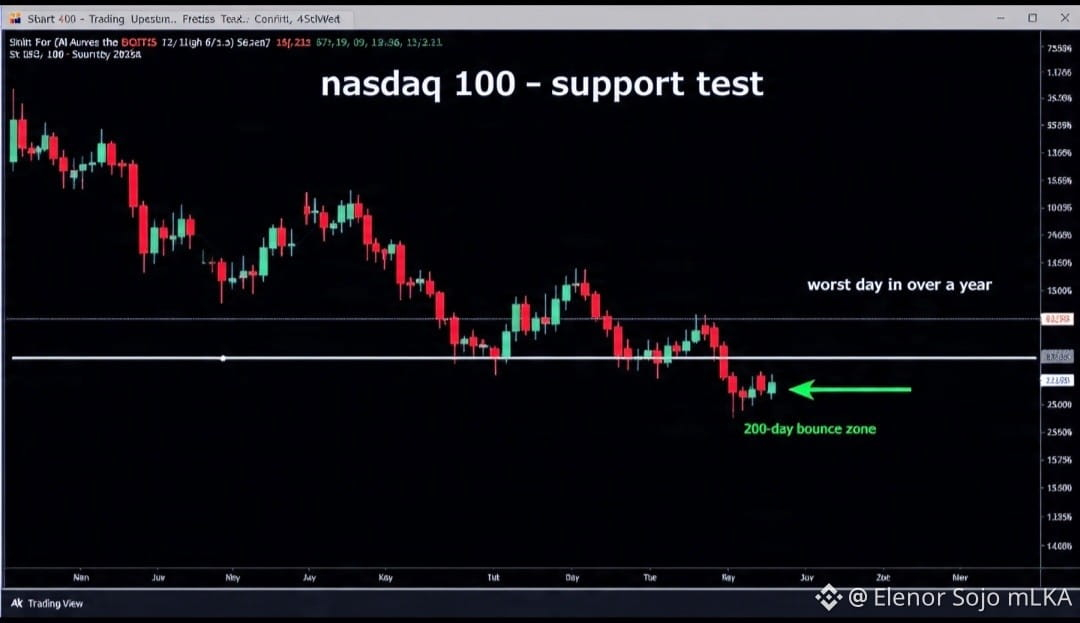
1. *Near term 1-2 weeks*: Expect volatility + possible bounce. After big drops, Nasdaq often retests the low or gets a relief rally if oversold. Watch the 200-day MA for support.
2. *If 200-day MA breaks*: More downside toward next major support. Fear increases.
3. *If it holds + closes back above*: That’s a sign sellers got exhausted and a recovery can start.
*Key level to watch*: 200-day moving average. Holds = buyers step in. Breaks = more pain.
This isn’t financial advice. Worst-day selloffs can reverse fast or keep dropping depending on news/Fed data.
Are you watching any specific Nasdaq Ordinals just the index?
#NasdaqWorstDayInOverAYear
*What happened*: A big red day like this means heavy selling, usually from rate fears, weak earnings, or risk-off sentiment. It breaks short-term support and shakes confidence.
* prediction*:
1. *Near term 1-2 weeks*: Expect volatility + possible bounce. After big drops, Nasdaq often retests the low or gets a relief rally if oversold. Watch the 200-day MA for support.
2. *If 200-day MA breaks*: More downside toward next major support. Fear increases.
3. *If it holds + closes back above*: That’s a sign sellers got exhausted and a recovery can start.
*Key level to watch*: 200-day moving average. Holds = buyers step in. Breaks = more pain.
This isn’t financial advice. Worst-day selloffs can reverse fast or keep dropping depending on news/Fed data.
Are you watching any specific Nasdaq Ordinals just the index?
*What happened*: A big red day like this means heavy selling, usually from rate fears, weak earnings, or risk-off sentiment. It breaks short-term support and shakes confidence.
* prediction*:
1. *Near term 1-2 weeks*: Expect volatility + possible bounce. After big drops, Nasdaq often retests the low or gets a relief rally if oversold. Watch the 200-day MA for support.
2. *If 200-day MA breaks*: More downside toward next major support. Fear increases.
3. *If it holds + closes back above*: That’s a sign sellers got exhausted and a recovery can start.
*Key level to watch*: 200-day moving average. Holds = buyers step in. Breaks = more pain.
This isn’t financial advice. Worst-day selloffs can reverse fast or keep dropping depending on news/Fed data.
Are you watching any specific Nasdaq Ordinals just the index?
1
2
310

The Nasdaq just posted its worst day in over a year, with tech stocks leading the decline. Strong U.S. jobs data sparked concerns that interest rates could stay higher for longer, putting pressure on growth and AI-related stocks. Markets will now be watching the Fed closely for its next move.#NasdaqWorstDayInOverAYear
The Nasdaq just posted its worst day in over a year, with tech stocks leading the decline. Strong U.S. jobs data sparked concerns that interest rates could stay higher for longer, putting pressure on growth and AI-related stocks. Markets will now be watching the Fed closely for its next move.#NasdaqWorstDayInOverAYear
231

#nasdaqworstdayinoverayear
🚨 Nasdaq just had its worst day in over a year…
But here’s what most traders are missing 👇
When traditional markets panic, smart money looks for new opportunities.
And where does it go? 👀
→ Crypto.
This kind of volatility often shifts attention & liquidity into high-risk assets.
Are we about to see a move in BTC and altcoins? 📈
Or is this just the beginning of a bigger drop? 📉
Smart traders don’t react… they prepare.
What’s your view? 👇
#Crypto #Nasdaq #Trading #BinanceSquare
#nasdaqworstdayinoverayear
🚨 Nasdaq just had its worst day in over a year…
But here’s what most traders are missing 👇
When traditional markets panic, smart money looks for new opportunities.
And where does it go? 👀
→ Crypto.
This kind of volatility often shifts attention & liquidity into high-risk assets.
Are we about to see a move in BTC and altcoins? 📈
Or is this just the beginning of a bigger drop? 📉
Smart traders don’t react… they prepare.
What’s your view? 👇
#Crypto #Nasdaq #Trading #BinanceSquare
🚨 Nasdaq just had its worst day in over a year…
But here’s what most traders are missing 👇
When traditional markets panic, smart money looks for new opportunities.
And where does it go? 👀
→ Crypto.
This kind of volatility often shifts attention & liquidity into high-risk assets.
Are we about to see a move in BTC and altcoins? 📈
Or is this just the beginning of a bigger drop? 📉
Smart traders don’t react… they prepare.
What’s your view? 👇
#Crypto #Nasdaq #Trading #BinanceSquare
1
156


·
--
Verified
#NasdaqWorstDayInOverAYear
Home Finance Stock MarketNasdaq 100 Index Unexpectedly Plunges 5% – Its Deepest Plunge Since April 2025
Nasdaq 100 Index Unexpectedly Plunges 5% – Its Deepest Plunge Since April 2025
The Nasdaq 100, a U.S. index comprising 100 of the largest non-financial companies, including Microsoft, Apple, Nvidia, Amazon, Alphabet, and Meta Platforms, unexpectedly plunged 5% on Friday, its deepest drop since April 2025, Bloomberg reports.
"Fears that the tech stock bubble could soon burst coincided with unexpectedly strong U.S. employment data. This has fueled suspicions that the Federal Reserve – even under the leadership of a new chairman appointed by Donald Trump – could raise rates. As a result, investors resorted to widespread profit-taking," the agency writes.
Chipmaker stocks suffered the biggest declines, but the exact catalyst for their reversal this week remains unclear, according to CNBC.
The fall was likely triggered by Broadcom's earnings release on Wednesday, which fell short of analysts' expectations for AI chip revenue. Following this, the sector began to decline on Thursday, and the selloff became much more aggressive on Friday.
"Investors had their fingers literally hovering over the sell button for some time. Not necessarily to exit the market entirely. But after the rapid rise in chipmaker stocks over the past two months, they have become significantly overweight in many portfolios. So, profit-taking was only a matter of time," said Mark Hackett, chief market strategist at Nationwide.
Importantly, the decline occurred ahead of the long-awaited IPO of Elon Musk's SpaceX, which is expected to be the largest IPO in history.
Startups OpenAI and Anthropic are also considering going public, with each potentially valued at around $1 trillion.
"If investors are negative on stocks, IPOs will only increase market turbulence," Christian Raute, head of market trading strategies at Citigroup, told the FT.
#Mask #SpaceX #Fed
$BNB
{future}(BNBUSDT)
#NasdaqWorstDayInOverAYear
Home Finance Stock MarketNasdaq 100 Index Unexpectedly Plunges 5% – Its Deepest Plunge Since April 2025
Nasdaq 100 Index Unexpectedly Plunges 5% – Its Deepest Plunge Since April 2025
The Nasdaq 100, a U.S. index comprising 100 of the largest non-financial companies, including Microsoft, Apple, Nvidia, Amazon, Alphabet, and Meta Platforms, unexpectedly plunged 5% on Friday, its deepest drop since April 2025, Bloomberg reports.
"Fears that the tech stock bubble could soon burst coincided with unexpectedly strong U.S. employment data. This has fueled suspicions that the Federal Reserve – even under the leadership of a new chairman appointed by Donald Trump – could raise rates. As a result, investors resorted to widespread profit-taking," the agency writes.
Chipmaker stocks suffered the biggest declines, but the exact catalyst for their reversal this week remains unclear, according to CNBC.
The fall was likely triggered by Broadcom's earnings release on Wednesday, which fell short of analysts' expectations for AI chip revenue. Following this, the sector began to decline on Thursday, and the selloff became much more aggressive on Friday.
"Investors had their fingers literally hovering over the sell button for some time. Not necessarily to exit the market entirely. But after the rapid rise in chipmaker stocks over the past two months, they have become significantly overweight in many portfolios. So, profit-taking was only a matter of time," said Mark Hackett, chief market strategist at Nationwide.
Importantly, the decline occurred ahead of the long-awaited IPO of Elon Musk's SpaceX, which is expected to be the largest IPO in history.
Startups OpenAI and Anthropic are also considering going public, with each potentially valued at around $1 trillion.
"If investors are negative on stocks, IPOs will only increase market turbulence," Christian Raute, head of market trading strategies at Citigroup, told the FT.
#Mask #SpaceX #Fed
$BNB
Home Finance Stock MarketNasdaq 100 Index Unexpectedly Plunges 5% – Its Deepest Plunge Since April 2025
Nasdaq 100 Index Unexpectedly Plunges 5% – Its Deepest Plunge Since April 2025
The Nasdaq 100, a U.S. index comprising 100 of the largest non-financial companies, including Microsoft, Apple, Nvidia, Amazon, Alphabet, and Meta Platforms, unexpectedly plunged 5% on Friday, its deepest drop since April 2025, Bloomberg reports.
"Fears that the tech stock bubble could soon burst coincided with unexpectedly strong U.S. employment data. This has fueled suspicions that the Federal Reserve – even under the leadership of a new chairman appointed by Donald Trump – could raise rates. As a result, investors resorted to widespread profit-taking," the agency writes.
Chipmaker stocks suffered the biggest declines, but the exact catalyst for their reversal this week remains unclear, according to CNBC.
The fall was likely triggered by Broadcom's earnings release on Wednesday, which fell short of analysts' expectations for AI chip revenue. Following this, the sector began to decline on Thursday, and the selloff became much more aggressive on Friday.
"Investors had their fingers literally hovering over the sell button for some time. Not necessarily to exit the market entirely. But after the rapid rise in chipmaker stocks over the past two months, they have become significantly overweight in many portfolios. So, profit-taking was only a matter of time," said Mark Hackett, chief market strategist at Nationwide.
Importantly, the decline occurred ahead of the long-awaited IPO of Elon Musk's SpaceX, which is expected to be the largest IPO in history.
Startups OpenAI and Anthropic are also considering going public, with each potentially valued at around $1 trillion.
"If investors are negative on stocks, IPOs will only increase market turbulence," Christian Raute, head of market trading strategies at Citigroup, told the FT.
#Mask #SpaceX #Fed
$BNB

1
8
866

·
--
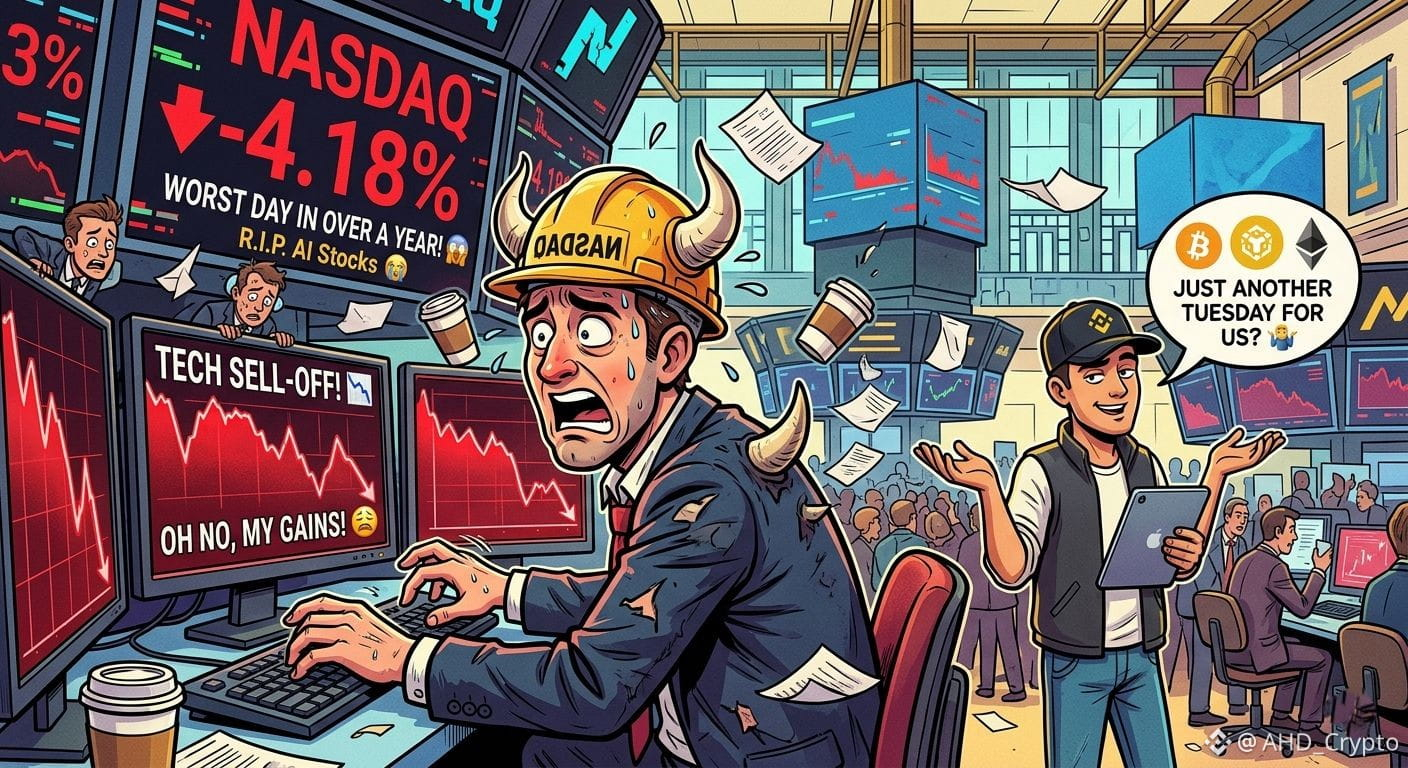
BREAKING: NASDAQ CRATERED 4.18% IN WORST DAY SINCE EARLY 2025! Is the Crypto Market Next? 📉
The traditional markets just suffered a massive shockwave. The tech-heavy Nasdaq plummeted over 1,121 points on Friday—marking its biggest single-day percentage drop in over a year.
What triggered this sudden bloodbath?
⚡ The Catalyst: A surprisingly hot May jobs report (172k jobs added vs 85k expected) completely shattered hopes of early interest rate cuts. Instead, traders are now actively pricing in potential interest rate hikes for later this year.
⚡ The Damage: High-flying AI and semiconductor stocks took the heaviest beating, with the chip sector sliding over 10% and wiping out billions in market value.
What does this mean for Crypto?
Historically, high correlation between traditional tech stocks and the digital asset market means pain on Wall Street often ripples into crypto.
BTC has already felt immediate pressure, sliding toward the crucial $60,000 support zone.
{future}(BTCUSDT)
If tech giants continue to bleed, we could see an aggressive wave of liquidations across major altcoins like $ETH , $SOL , and $BNB as investors rush to cash out into safer defensive assets.
{future}(SOLUSDT)
{future}(BNBUSDT)
Are we looking at a healthy market correction, or is the macro environment shifting toward a deeper bearish phase? Keep a close eye on your risk management.
#writetoearn #NASDAQ #crypto #bitcoin #NasdaqWorstDayInOverAYear
BREAKING: NASDAQ CRATERED 4.18% IN WORST DAY SINCE EARLY 2025! Is the Crypto Market Next? 📉
The traditional markets just suffered a massive shockwave. The tech-heavy Nasdaq plummeted over 1,121 points on Friday—marking its biggest single-day percentage drop in over a year.
What triggered this sudden bloodbath?
⚡ The Catalyst: A surprisingly hot May jobs report (172k jobs added vs 85k expected) completely shattered hopes of early interest rate cuts. Instead, traders are now actively pricing in potential interest rate hikes for later this year.
⚡ The Damage: High-flying AI and semiconductor stocks took the heaviest beating, with the chip sector sliding over 10% and wiping out billions in market value.
What does this mean for Crypto?
Historically, high correlation between traditional tech stocks and the digital asset market means pain on Wall Street often ripples into crypto.
BTC has already felt immediate pressure, sliding toward the crucial $60,000 support zone.
If tech giants continue to bleed, we could see an aggressive wave of liquidations across major altcoins like $ETH , $SOL , and $BNB as investors rush to cash out into safer defensive assets.
Are we looking at a healthy market correction, or is the macro environment shifting toward a deeper bearish phase? Keep a close eye on your risk management.
#writetoearn #NASDAQ #crypto #bitcoin #NasdaqWorstDayInOverAYear
The traditional markets just suffered a massive shockwave. The tech-heavy Nasdaq plummeted over 1,121 points on Friday—marking its biggest single-day percentage drop in over a year.
What triggered this sudden bloodbath?
⚡ The Catalyst: A surprisingly hot May jobs report (172k jobs added vs 85k expected) completely shattered hopes of early interest rate cuts. Instead, traders are now actively pricing in potential interest rate hikes for later this year.
⚡ The Damage: High-flying AI and semiconductor stocks took the heaviest beating, with the chip sector sliding over 10% and wiping out billions in market value.
What does this mean for Crypto?
Historically, high correlation between traditional tech stocks and the digital asset market means pain on Wall Street often ripples into crypto.
BTC has already felt immediate pressure, sliding toward the crucial $60,000 support zone.
If tech giants continue to bleed, we could see an aggressive wave of liquidations across major altcoins like $ETH , $SOL , and $BNB as investors rush to cash out into safer defensive assets.
Are we looking at a healthy market correction, or is the macro environment shifting toward a deeper bearish phase? Keep a close eye on your risk management.
#writetoearn #NASDAQ #crypto #bitcoin #NasdaqWorstDayInOverAYear
106

·
--
#NasdaqWorstDayInOverAYear
#NasdaqWorstDayInOverAYear
🚨 #NasdaqWorstDayInOverAYear
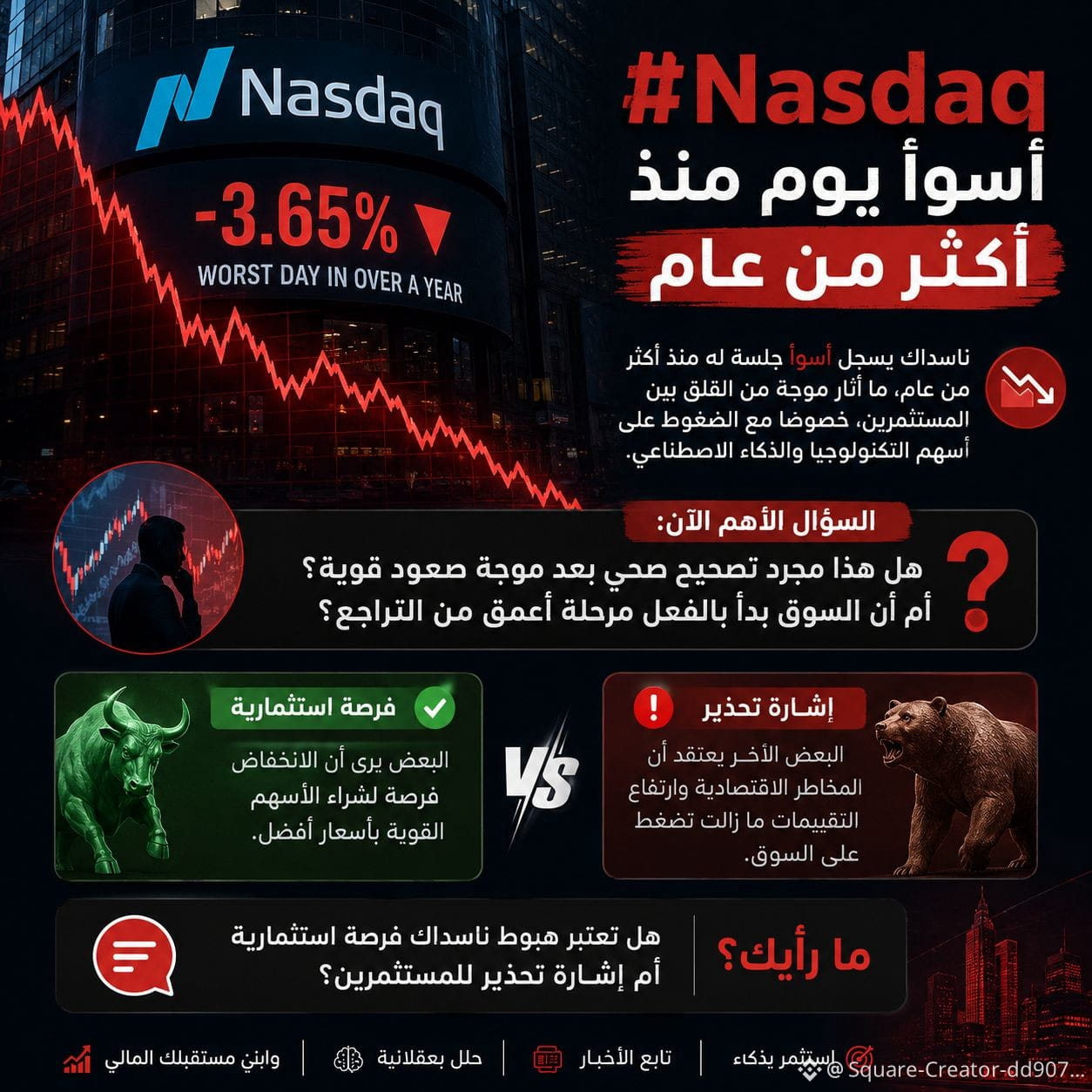
📉 Nasdaq just had its worst session in over a year, sparking waves of concern among traders, especially with the pressure on tech and AI stocks.
The big question now:
🤔 Is this just a healthy correction after a strong bull run? Or has the market actually entered a deeper phase of decline?
Some see the dip as a chance to scoop up solid stocks at better prices, while others believe that economic risks and high valuations are still weighing on the market.
💬 What’s your take? Do you see the Nasdaq drop as a buying opportunity or a warning sign for traders?
#NasdaqWorstDayInOverAYear #Nasdaq #StockMarket #Investing #TechStocks #AIStocks #MarketCrash #Trading #Finance #USMarkets #InvestSmart #MarketNews #Stocks #EconomicOutlook #Wallstreetjournal
#NasdaqWorstDayInOverAYear
#NasdaqWorstDayInOverAYear
🚨 #NasdaqWorstDayInOverAYear
📉 Nasdaq just had its worst session in over a year, sparking waves of concern among traders, especially with the pressure on tech and AI stocks.
The big question now:
🤔 Is this just a healthy correction after a strong bull run? Or has the market actually entered a deeper phase of decline?
Some see the dip as a chance to scoop up solid stocks at better prices, while others believe that economic risks and high valuations are still weighing on the market.
💬 What’s your take? Do you see the Nasdaq drop as a buying opportunity or a warning sign for traders?
#NasdaqWorstDayInOverAYear #Nasdaq #StockMarket #Investing #TechStocks #AIStocks #MarketCrash #Trading #Finance #USMarkets #InvestSmart #MarketNews #Stocks #EconomicOutlook #Wallstreetjournal
#NasdaqWorstDayInOverAYear
🚨 #NasdaqWorstDayInOverAYear
📉 Nasdaq just had its worst session in over a year, sparking waves of concern among traders, especially with the pressure on tech and AI stocks.
The big question now:
🤔 Is this just a healthy correction after a strong bull run? Or has the market actually entered a deeper phase of decline?
Some see the dip as a chance to scoop up solid stocks at better prices, while others believe that economic risks and high valuations are still weighing on the market.
💬 What’s your take? Do you see the Nasdaq drop as a buying opportunity or a warning sign for traders?
#NasdaqWorstDayInOverAYear #Nasdaq #StockMarket #Investing #TechStocks #AIStocks #MarketCrash #Trading #Finance #USMarkets #InvestSmart #MarketNews #Stocks #EconomicOutlook #Wallstreetjournal
197

·
--
Bearish
🛑 Wall Street's Bloodbath: Nasdaq Suffers Worst Day in Over a Year—Is Crypto Next? 📉
The financial landscape shifted violently this weekend. Traditional markets just took a massive hit, and the ripple effects are slamming right into the crypto ecosystem. The tech-heavy Nasdaq Composite plunged a staggering 4.18%, marking its absolute steepest single-day drop since April 2025.
This brutal sell-off snapped a massive nine-week winning streak on Wall Street and dragged the broader S&P 500 down by 2.64%. If you are wondering why your crypto portfolio suddenly turned red, look no further than the macro data.
🔍 What Triggered the Global Market Panic?
Two massive catalysts combined to create a perfect storm of volatility:
A "Red-Hot" Jobs Report Blocks Fed Rate Cuts: The U.S. economy added a surprising 172,000 jobs in May, completely smashing analyst expectations. Counterintuitively, "good news is bad news" for investors right now. This roaring labor market confirms that economic easing is off the table, forcing traders to price in higher interest rates for longer—with some fearing the Fed's next move could actually be a hike.
The AI Bubble Faces a Reality Check: Major AI-related semiconductor giants faced massive profit-taking after weeks of unsustainable, parabolic gains. Broadcom tanked nearly 8% following underwhelming revenue guidance, Nvidia slid 6.2%, and Micron Technology plummeted a brutal 13.3%.
📉 The Crypto Connection: Bitcoin Tests Key Support
When traditional institutional money enters a "risk-off" environment due to tightening liquidity, high-beta assets like crypto are the first to feel the squeeze.
Triggered by the stock market crash and a sharply rallying U.S. Dollar Index, Bitcoin tumbled over 5%, slicing straight through crucial support levels to dip below $60,000. Liquidations have spiked across the board as overleveraged traders get flushed out by the sudden correlation between tech stocks and digital assets.
#NasdaqWorstDayInOverAYear #MarketCorrection #bitcoin #NVIDIA
🛑 Wall Street's Bloodbath: Nasdaq Suffers Worst Day in Over a Year—Is Crypto Next? 📉
The financial landscape shifted violently this weekend. Traditional markets just took a massive hit, and the ripple effects are slamming right into the crypto ecosystem. The tech-heavy Nasdaq Composite plunged a staggering 4.18%, marking its absolute steepest single-day drop since April 2025.
This brutal sell-off snapped a massive nine-week winning streak on Wall Street and dragged the broader S&P 500 down by 2.64%. If you are wondering why your crypto portfolio suddenly turned red, look no further than the macro data.
🔍 What Triggered the Global Market Panic?
Two massive catalysts combined to create a perfect storm of volatility:
A "Red-Hot" Jobs Report Blocks Fed Rate Cuts: The U.S. economy added a surprising 172,000 jobs in May, completely smashing analyst expectations. Counterintuitively, "good news is bad news" for investors right now. This roaring labor market confirms that economic easing is off the table, forcing traders to price in higher interest rates for longer—with some fearing the Fed's next move could actually be a hike.
The AI Bubble Faces a Reality Check: Major AI-related semiconductor giants faced massive profit-taking after weeks of unsustainable, parabolic gains. Broadcom tanked nearly 8% following underwhelming revenue guidance, Nvidia slid 6.2%, and Micron Technology plummeted a brutal 13.3%.
📉 The Crypto Connection: Bitcoin Tests Key Support
When traditional institutional money enters a "risk-off" environment due to tightening liquidity, high-beta assets like crypto are the first to feel the squeeze.
Triggered by the stock market crash and a sharply rallying U.S. Dollar Index, Bitcoin tumbled over 5%, slicing straight through crucial support levels to dip below $60,000. Liquidations have spiked across the board as overleveraged traders get flushed out by the sudden correlation between tech stocks and digital assets.
#NasdaqWorstDayInOverAYear #MarketCorrection #bitcoin #NVIDIA
The financial landscape shifted violently this weekend. Traditional markets just took a massive hit, and the ripple effects are slamming right into the crypto ecosystem. The tech-heavy Nasdaq Composite plunged a staggering 4.18%, marking its absolute steepest single-day drop since April 2025.
This brutal sell-off snapped a massive nine-week winning streak on Wall Street and dragged the broader S&P 500 down by 2.64%. If you are wondering why your crypto portfolio suddenly turned red, look no further than the macro data.
🔍 What Triggered the Global Market Panic?
Two massive catalysts combined to create a perfect storm of volatility:
A "Red-Hot" Jobs Report Blocks Fed Rate Cuts: The U.S. economy added a surprising 172,000 jobs in May, completely smashing analyst expectations. Counterintuitively, "good news is bad news" for investors right now. This roaring labor market confirms that economic easing is off the table, forcing traders to price in higher interest rates for longer—with some fearing the Fed's next move could actually be a hike.
The AI Bubble Faces a Reality Check: Major AI-related semiconductor giants faced massive profit-taking after weeks of unsustainable, parabolic gains. Broadcom tanked nearly 8% following underwhelming revenue guidance, Nvidia slid 6.2%, and Micron Technology plummeted a brutal 13.3%.
📉 The Crypto Connection: Bitcoin Tests Key Support
When traditional institutional money enters a "risk-off" environment due to tightening liquidity, high-beta assets like crypto are the first to feel the squeeze.
Triggered by the stock market crash and a sharply rallying U.S. Dollar Index, Bitcoin tumbled over 5%, slicing straight through crucial support levels to dip below $60,000. Liquidations have spiked across the board as overleveraged traders get flushed out by the sudden correlation between tech stocks and digital assets.
#NasdaqWorstDayInOverAYear #MarketCorrection #bitcoin #NVIDIA
1
136

#NasdaqWorstDayInOverAYear 📉🔥
{future}(BTCUSDT)
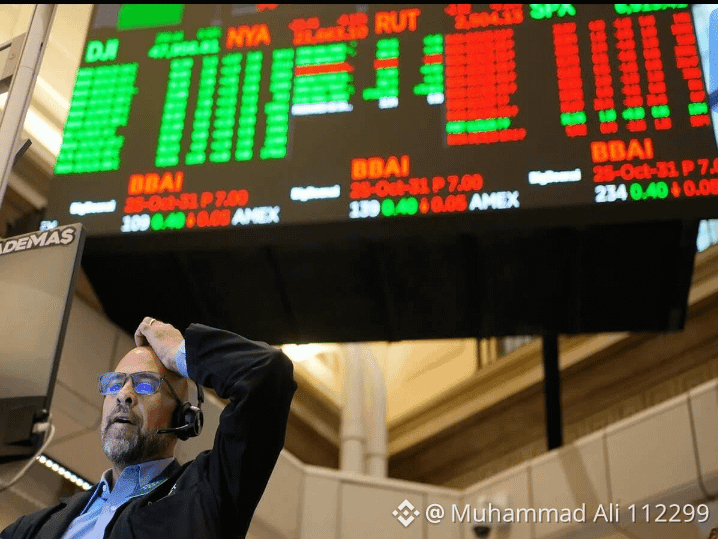
The Nasdaq just recorded its worst day in over a year — and the shockwaves are being felt across global markets.
Heavy selling in tech stocks signals that investor confidence is being tested, especially with ongoing concerns around interest rates, inflation, and economic slowdown.
💡 What’s driving the drop? → Rising bond yields putting pressure on growth stocks
→ Profit-taking after extended rallies
→ Macro uncertainty creeping back into the market
Historically, sharp single-day drops like this can either mark the beginning of a deeper correction… or create opportunities for strategic entries.
But here’s the real question: Is this the start of a broader market pullback — or just a temporary reset before the next move up?
Smart money watches reactions, not headlines.
Are you buying the dip… or staying cautious? 👇
#NasdaqWorstDayInOverAYear 📉🔥
The Nasdaq just recorded its worst day in over a year — and the shockwaves are being felt across global markets.
Heavy selling in tech stocks signals that investor confidence is being tested, especially with ongoing concerns around interest rates, inflation, and economic slowdown.
💡 What’s driving the drop? → Rising bond yields putting pressure on growth stocks
→ Profit-taking after extended rallies
→ Macro uncertainty creeping back into the market
Historically, sharp single-day drops like this can either mark the beginning of a deeper correction… or create opportunities for strategic entries.
But here’s the real question: Is this the start of a broader market pullback — or just a temporary reset before the next move up?
Smart money watches reactions, not headlines.
Are you buying the dip… or staying cautious? 👇
The Nasdaq just recorded its worst day in over a year — and the shockwaves are being felt across global markets.
Heavy selling in tech stocks signals that investor confidence is being tested, especially with ongoing concerns around interest rates, inflation, and economic slowdown.
💡 What’s driving the drop? → Rising bond yields putting pressure on growth stocks
→ Profit-taking after extended rallies
→ Macro uncertainty creeping back into the market
Historically, sharp single-day drops like this can either mark the beginning of a deeper correction… or create opportunities for strategic entries.
But here’s the real question: Is this the start of a broader market pullback — or just a temporary reset before the next move up?
Smart money watches reactions, not headlines.
Are you buying the dip… or staying cautious? 👇
2
168

·
--
#NasdaqWorstDayInOverAYear
The AI trade just hit a wall.
The Nasdaq plunged 4.2% in its worst day since April 2025 as investors dumped tech and semiconductor stocks.
What changed?
A stronger-than-expected jobs report reignited fears that the Fed could keep rates higher for longer.
Bond yields surged. AI stocks got hit. Chipmakers faced heavy profit-taking.
The result:
• S&P 500: -2.6% • Dow: -700 points • Semiconductors: Biggest drop since 2020
For months, AI could do no wrong.
Now the market is asking a different question:
Are AI valuations running too far ahead of reality?
$ALLO $VELVET $BLUAI
#NasdaqWorstDayInOverAYear
The AI trade just hit a wall.
The Nasdaq plunged 4.2% in its worst day since April 2025 as investors dumped tech and semiconductor stocks.
What changed?
A stronger-than-expected jobs report reignited fears that the Fed could keep rates higher for longer.
Bond yields surged. AI stocks got hit. Chipmakers faced heavy profit-taking.
The result:
• S&P 500: -2.6% • Dow: -700 points • Semiconductors: Biggest drop since 2020
For months, AI could do no wrong.
Now the market is asking a different question:
Are AI valuations running too far ahead of reality?
$ALLO $VELVET $BLUAI
The AI trade just hit a wall.
The Nasdaq plunged 4.2% in its worst day since April 2025 as investors dumped tech and semiconductor stocks.
What changed?
A stronger-than-expected jobs report reignited fears that the Fed could keep rates higher for longer.
Bond yields surged. AI stocks got hit. Chipmakers faced heavy profit-taking.
The result:
• S&P 500: -2.6% • Dow: -700 points • Semiconductors: Biggest drop since 2020
For months, AI could do no wrong.
Now the market is asking a different question:
Are AI valuations running too far ahead of reality?
$ALLO $VELVET $BLUAI
1
277

·
--
Verified
📉 THE WORST DAY FOR NASDAQ IN OVER A YEAR DRAGS DOWN THE MARKET!
Panic on Wall Street. The tech index Nasdaq plummeted by -4.18%, marking its worst daily drop in more than a year. The sell-off immediately pulled down the crypto sector, forcing general pullbacks across major coins.
The storm was triggered by three key factors:
📊 Strong employment: The U.S. surpassed job expectations, fueling fears that the Fed will keep rates high.
🚨 Chip slowdown: The semiconductor sector faced its worst decline since 2020 due to less aggressive AI projections.
💸 Flight to bonds: Investors fled from risk, pushing Treasury yields up to 4.54%.
🔥 When Wall Street liquidates tech to seek shelter, cryptocurrencies suffer a forced correction due to macro correlation.
#NasdaqWorstDayInOverAYear #Nasdaq #Macroeconomia #BinanceSquare
📊 WHERE WILL BITCOIN'S FALL STOP?
The tech crash forced the market to seek lower supports. However, this massive pullback is driving prices directly to institutional discount zones.
👇 Hit the charts down below to see the technical structure in real-time and spot the bounce point 👇
$BTC $LINK
{spot}(LINKUSDT)
{spot}(BTCUSDT)
📉 THE WORST DAY FOR NASDAQ IN OVER A YEAR DRAGS DOWN THE MARKET!
Panic on Wall Street. The tech index Nasdaq plummeted by -4.18%, marking its worst daily drop in more than a year. The sell-off immediately pulled down the crypto sector, forcing general pullbacks across major coins.
The storm was triggered by three key factors:
📊 Strong employment: The U.S. surpassed job expectations, fueling fears that the Fed will keep rates high.
🚨 Chip slowdown: The semiconductor sector faced its worst decline since 2020 due to less aggressive AI projections.
💸 Flight to bonds: Investors fled from risk, pushing Treasury yields up to 4.54%.
🔥 When Wall Street liquidates tech to seek shelter, cryptocurrencies suffer a forced correction due to macro correlation.
#NasdaqWorstDayInOverAYear #Nasdaq #Macroeconomia #BinanceSquare
📊 WHERE WILL BITCOIN'S FALL STOP?
The tech crash forced the market to seek lower supports. However, this massive pullback is driving prices directly to institutional discount zones.
👇 Hit the charts down below to see the technical structure in real-time and spot the bounce point 👇
$BTC $LINK
Panic on Wall Street. The tech index Nasdaq plummeted by -4.18%, marking its worst daily drop in more than a year. The sell-off immediately pulled down the crypto sector, forcing general pullbacks across major coins.
The storm was triggered by three key factors:
📊 Strong employment: The U.S. surpassed job expectations, fueling fears that the Fed will keep rates high.
🚨 Chip slowdown: The semiconductor sector faced its worst decline since 2020 due to less aggressive AI projections.
💸 Flight to bonds: Investors fled from risk, pushing Treasury yields up to 4.54%.
🔥 When Wall Street liquidates tech to seek shelter, cryptocurrencies suffer a forced correction due to macro correlation.
#NasdaqWorstDayInOverAYear #Nasdaq #Macroeconomia #BinanceSquare
📊 WHERE WILL BITCOIN'S FALL STOP?
The tech crash forced the market to seek lower supports. However, this massive pullback is driving prices directly to institutional discount zones.
👇 Hit the charts down below to see the technical structure in real-time and spot the bounce point 👇
$BTC $LINK

4
283

·
--
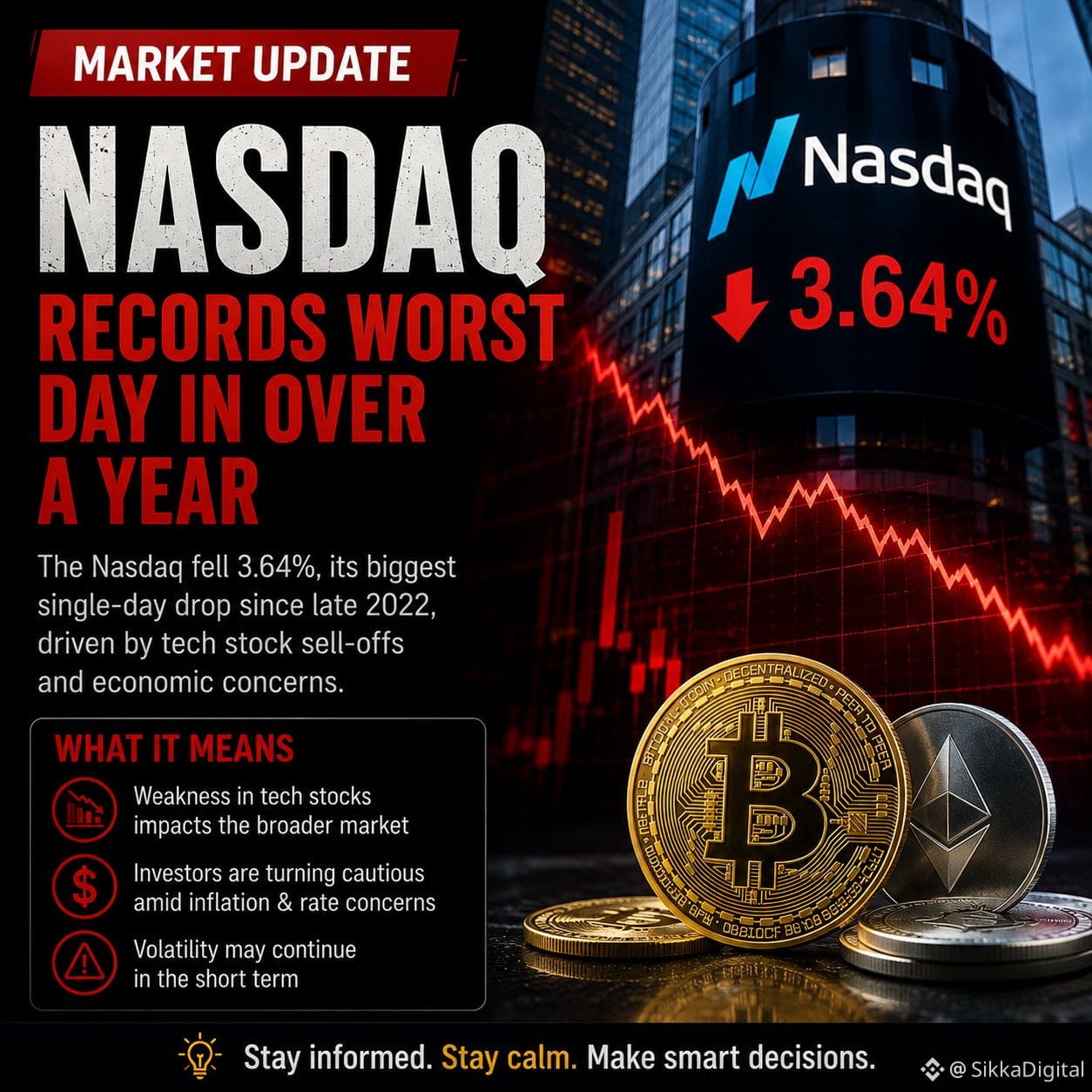
📉 Nasdaq records its worst day in over a year.
Fear is rising across the markets, but experienced investors know that volatility is part of the game.
The question is:
Will this weakness create opportunities in crypto?
👇 Bullish or Bearish?
#NasdaqWorstDayInOverAYear #Bitcoin #BTC #Crypto #BinanceSquare
📉 Nasdaq records its worst day in over a year.
Fear is rising across the markets, but experienced investors know that volatility is part of the game.
The question is:
Will this weakness create opportunities in crypto?
👇 Bullish or Bearish?
#NasdaqWorstDayInOverAYear #Bitcoin #BTC #Crypto #BinanceSquare
Fear is rising across the markets, but experienced investors know that volatility is part of the game.
The question is:
Will this weakness create opportunities in crypto?
👇 Bullish or Bearish?
#NasdaqWorstDayInOverAYear #Bitcoin #BTC #Crypto #BinanceSquare
3
181

·
--
#NasdaqWorstDayInOverAYear
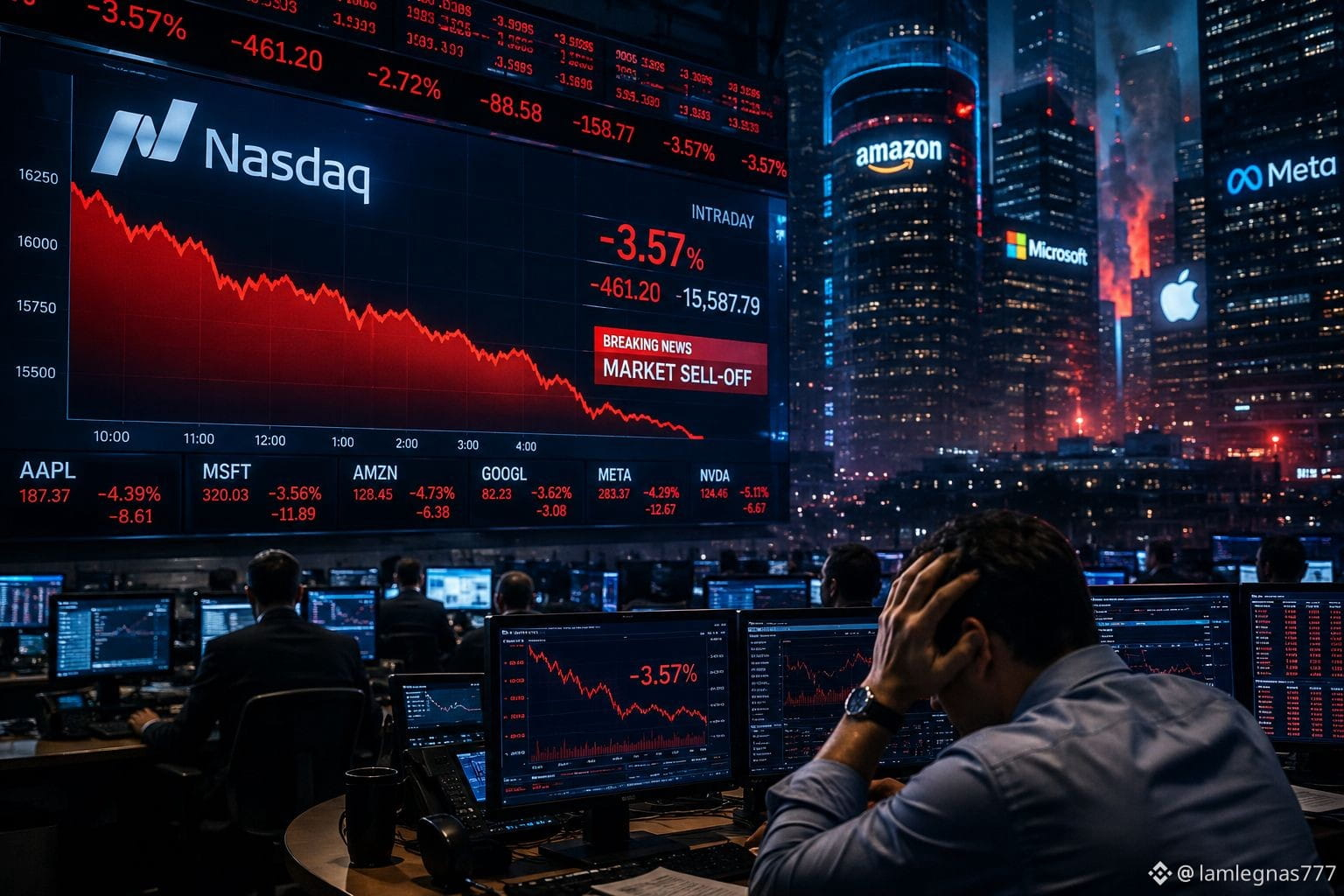
📉 Nasdaq Sees Biggest One-Day Drop in Over a Year
After months of gains, the Nasdaq recorded its sharpest daily decline in more than a year.
Concerns about interest rates, economic uncertainty, and high valuations sparked selling across major tech stocks, weighing on the broader market.
While declines like this can be unsettling, they are a normal part of market cycles. Some investors see the move as a warning sign, while others view it as a healthy pullback after a strong rally.
Was this a buying opportunity or a reason for caution?
#NasdaqWorstDayInOverAYear
📉 Nasdaq Sees Biggest One-Day Drop in Over a Year
After months of gains, the Nasdaq recorded its sharpest daily decline in more than a year.
Concerns about interest rates, economic uncertainty, and high valuations sparked selling across major tech stocks, weighing on the broader market.
While declines like this can be unsettling, they are a normal part of market cycles. Some investors see the move as a warning sign, while others view it as a healthy pullback after a strong rally.
Was this a buying opportunity or a reason for caution?
📉 Nasdaq Sees Biggest One-Day Drop in Over a Year
After months of gains, the Nasdaq recorded its sharpest daily decline in more than a year.
Concerns about interest rates, economic uncertainty, and high valuations sparked selling across major tech stocks, weighing on the broader market.
While declines like this can be unsettling, they are a normal part of market cycles. Some investors see the move as a warning sign, while others view it as a healthy pullback after a strong rally.
Was this a buying opportunity or a reason for caution?
259

#NasdaqWorstDayInOverAYear
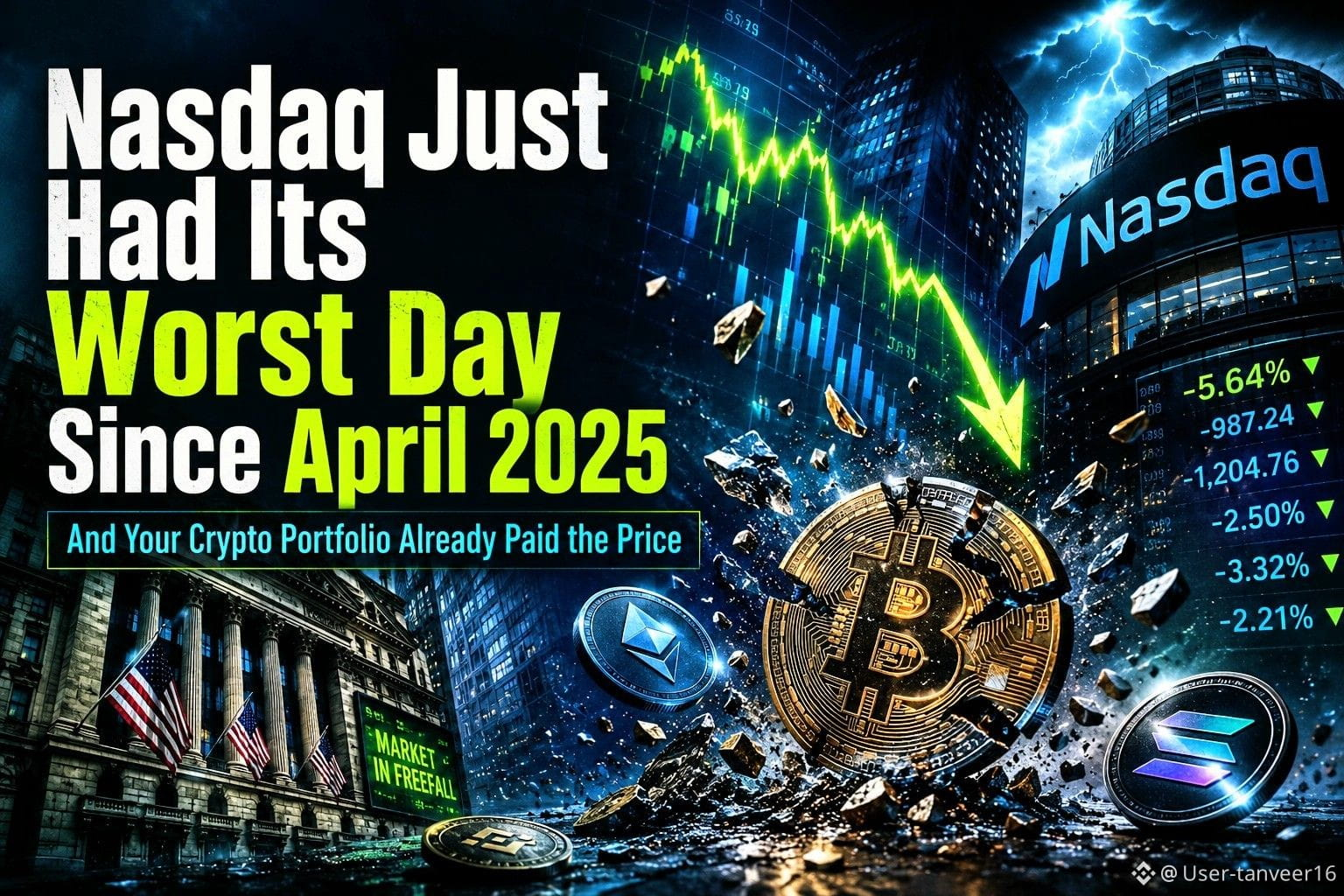
Nasdaq dropped 4.18% on June 5 — worst day since April 2025 AI stocks sold off hard and strong jobs data pushed Fed rate hike fears back on the table.
When Nasdaq falls this hard, crypto follows $BTC slipped below $60,000 & altcoins dumped as traders cut risk across the board.
Tech panic on Wall Street always spills into crypto this is not a coincidence this is the pattern every serious trader must know.
In 2026 crypto & stocks move together ignore Nasdaq and you are trading blind.
#bitcoin #CryptoNews #altcoins $BTC
{future}(BTCUSDT)
#NasdaqWorstDayInOverAYear
Nasdaq dropped 4.18% on June 5 — worst day since April 2025 AI stocks sold off hard and strong jobs data pushed Fed rate hike fears back on the table.
When Nasdaq falls this hard, crypto follows $BTC slipped below $60,000 & altcoins dumped as traders cut risk across the board.
Tech panic on Wall Street always spills into crypto this is not a coincidence this is the pattern every serious trader must know.
In 2026 crypto & stocks move together ignore Nasdaq and you are trading blind.
#bitcoin #CryptoNews #altcoins $BTC
Nasdaq dropped 4.18% on June 5 — worst day since April 2025 AI stocks sold off hard and strong jobs data pushed Fed rate hike fears back on the table.
When Nasdaq falls this hard, crypto follows $BTC slipped below $60,000 & altcoins dumped as traders cut risk across the board.
Tech panic on Wall Street always spills into crypto this is not a coincidence this is the pattern every serious trader must know.
In 2026 crypto & stocks move together ignore Nasdaq and you are trading blind.
#bitcoin #CryptoNews #altcoins $BTC
153

·
--
#NasdaqWorstDayInOverAYear
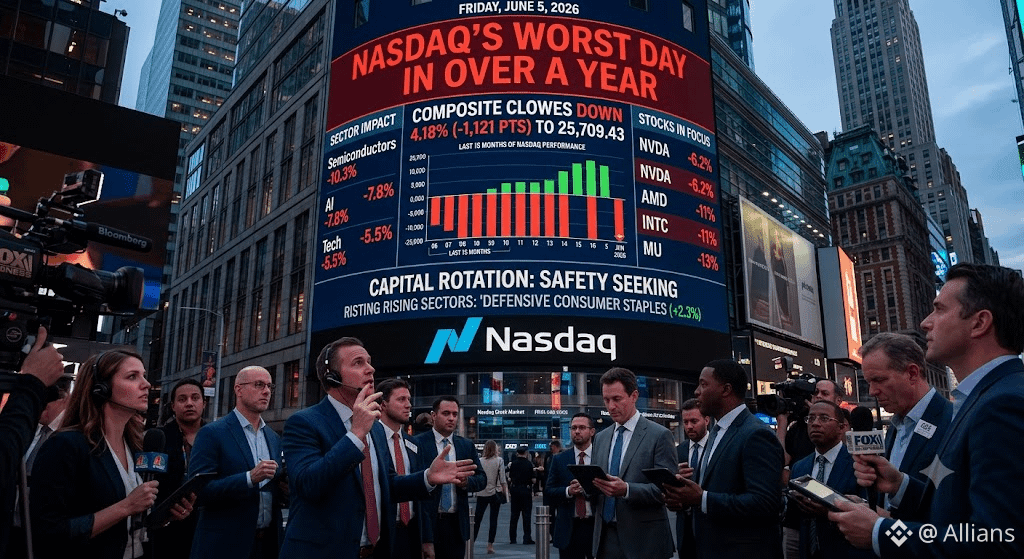
On Friday, June 5, 2026, the tech-heavy Nasdaq Composite plunged 4.18% (1,121 points) to close at 25,709.43, marking its worst single-day percentage decline in over a year. The aggressive liquidation snapped a nine-week winning streak and dragged down the broader market, with the S&P 500 falling 2.64% and erasing roughly $1.8 trillion in market capitalization.
Core Catalysts:
The Hot Jobs Report: A surprisingly robust U.S. non-farm payrolls report revealed the economy added 172,000 jobs in May. This triggered fears of sticky inflation and shattered expectations for near-term Federal Reserve interest rate cuts, with traders pivoting to price in potential future rate hikes.
Spiking Bond Yields: The 10-year Treasury yield surged to around 4.54%. Higher yields disproportionately compress the valuations of growth-dependent tech sectors.
Market Blowback & Capital Rotation:
The artificial intelligence and semiconductor sectors bore the brunt of the sell-off. The PHLX Semiconductor Index ($SOXL ) cratered 10.3%—its steepest drop since March 2020. Market leaders plummeted across the board: Marvell Technology dropped over 16%, Micron shed 13%, $AMD and Intel slid 11%, and $NVDA tumbled more than 6% (wiping out $300+ billion in value). Additional pressure came from portfolio rebalancing ahead of SpaceX's upcoming S&P 500 inclusion.
Conversely, this wasn't an all-out panic but a violent capital rotation. Institutional money fled risk assets like equities and crypto to seek refuge in defensive safe-havens, pushing the Consumer Staples sector up 2.3% on strong gains from Procter & Gamble and Colgate-Palmolive.
#BitcoinBounceBackAbove$61K
#TrumpSaysQuickEndToUSIranWar
#NasdaqWorstDayInOverAYear
On Friday, June 5, 2026, the tech-heavy Nasdaq Composite plunged 4.18% (1,121 points) to close at 25,709.43, marking its worst single-day percentage decline in over a year. The aggressive liquidation snapped a nine-week winning streak and dragged down the broader market, with the S&P 500 falling 2.64% and erasing roughly $1.8 trillion in market capitalization.
Core Catalysts:
The Hot Jobs Report: A surprisingly robust U.S. non-farm payrolls report revealed the economy added 172,000 jobs in May. This triggered fears of sticky inflation and shattered expectations for near-term Federal Reserve interest rate cuts, with traders pivoting to price in potential future rate hikes.
Spiking Bond Yields: The 10-year Treasury yield surged to around 4.54%. Higher yields disproportionately compress the valuations of growth-dependent tech sectors.
Market Blowback & Capital Rotation:
The artificial intelligence and semiconductor sectors bore the brunt of the sell-off. The PHLX Semiconductor Index ($SOXL ) cratered 10.3%—its steepest drop since March 2020. Market leaders plummeted across the board: Marvell Technology dropped over 16%, Micron shed 13%, $AMD and Intel slid 11%, and $NVDA tumbled more than 6% (wiping out $300+ billion in value). Additional pressure came from portfolio rebalancing ahead of SpaceX's upcoming S&P 500 inclusion.
Conversely, this wasn't an all-out panic but a violent capital rotation. Institutional money fled risk assets like equities and crypto to seek refuge in defensive safe-havens, pushing the Consumer Staples sector up 2.3% on strong gains from Procter & Gamble and Colgate-Palmolive.
#BitcoinBounceBackAbove$61K
#TrumpSaysQuickEndToUSIranWar
On Friday, June 5, 2026, the tech-heavy Nasdaq Composite plunged 4.18% (1,121 points) to close at 25,709.43, marking its worst single-day percentage decline in over a year. The aggressive liquidation snapped a nine-week winning streak and dragged down the broader market, with the S&P 500 falling 2.64% and erasing roughly $1.8 trillion in market capitalization.
Core Catalysts:
The Hot Jobs Report: A surprisingly robust U.S. non-farm payrolls report revealed the economy added 172,000 jobs in May. This triggered fears of sticky inflation and shattered expectations for near-term Federal Reserve interest rate cuts, with traders pivoting to price in potential future rate hikes.
Spiking Bond Yields: The 10-year Treasury yield surged to around 4.54%. Higher yields disproportionately compress the valuations of growth-dependent tech sectors.
Market Blowback & Capital Rotation:
The artificial intelligence and semiconductor sectors bore the brunt of the sell-off. The PHLX Semiconductor Index ($SOXL ) cratered 10.3%—its steepest drop since March 2020. Market leaders plummeted across the board: Marvell Technology dropped over 16%, Micron shed 13%, $AMD and Intel slid 11%, and $NVDA tumbled more than 6% (wiping out $300+ billion in value). Additional pressure came from portfolio rebalancing ahead of SpaceX's upcoming S&P 500 inclusion.
Conversely, this wasn't an all-out panic but a violent capital rotation. Institutional money fled risk assets like equities and crypto to seek refuge in defensive safe-havens, pushing the Consumer Staples sector up 2.3% on strong gains from Procter & Gamble and Colgate-Palmolive.
#BitcoinBounceBackAbove$61K
#TrumpSaysQuickEndToUSIranWar
236

·
--
Nasdaq Suffers Worst Day in Over a Year!🚨 BREAKING: Nasdaq Suffers Worst Day in Over a Year! What It Means for Crypto 📉
$BTC
The traditional financial markets just witnessed a massive bloodbath, and the ripples are being felt right here in the crypto space. The tech-heavy Nasdaq Composite just plummeted a staggering 4.18%—marking its WORST single-day drop since April 2025!
The S&P 500 also snapped its 9-week winning streak, shedding 2.64%.
🔥 What Triggered the Crash?
1️⃣ Strong US Jobs Data: The US economy added 172,000 jobs in May (smashing expectations of 89,000). While good for the economy, this sparked fears that the Federal Reserve will keep interest rates higher for longer—or even HIKE them again.
2️⃣ AI & Chip Stock Pullback: Mega-caps like Nvidia (-6%), Broadcom (-7.9%), and Micron (-13.3%) faced aggressive profit-taking, dragging the entire tech sector down.
3️⃣ Bond Yields Spike: The 10-year US Treasury yield surged past 4.5%, making safer bonds look more attractive than volatile assets like stocks and crypto.
⚡ The Crypto Connection: Why $BTC & $ALT
When Wall Street bleeds, liquidity shrinks. As a result, Bitcoin slid toward $60K, and Ethereum plunged nearly 10% in tandem with the global market panic.
Institutional traders are temporarily de-risking, but crypto veterans know this playbook: Macro shocks create short-term pain but long-term buying opportunities.
🔮 What's Next?
Keep a close eye on the FOMC meeting on June 16-17. Volatility is back, and the market is testing our diamond hands.
Are you buying this macro dip, or are you sitting on stablecoins? Let me know below! 👇
#NasdaqWorstDayInOverAYear #BTC #CryptoUpdate #macroeconomic #NVIDIA
Nasdaq Suffers Worst Day in Over a Year!
🚨 BREAKING: Nasdaq Suffers Worst Day in Over a Year! What It Means for Crypto 📉
$BTC
The traditional financial markets just witnessed a massive bloodbath, and the ripples are being felt right here in the crypto space. The tech-heavy Nasdaq Composite just plummeted a staggering 4.18%—marking its WORST single-day drop since April 2025!
The S&P 500 also snapped its 9-week winning streak, shedding 2.64%.
🔥 What Triggered the Crash?
1️⃣ Strong US Jobs Data: The US economy added 172,000 jobs in May (smashing expectations of 89,000). While good for the economy, this sparked fears that the Federal Reserve will keep interest rates higher for longer—or even HIKE them again.
2️⃣ AI & Chip Stock Pullback: Mega-caps like Nvidia (-6%), Broadcom (-7.9%), and Micron (-13.3%) faced aggressive profit-taking, dragging the entire tech sector down.
3️⃣ Bond Yields Spike: The 10-year US Treasury yield surged past 4.5%, making safer bonds look more attractive than volatile assets like stocks and crypto.
⚡ The Crypto Connection: Why $BTC & $ALT
When Wall Street bleeds, liquidity shrinks. As a result, Bitcoin slid toward $60K, and Ethereum plunged nearly 10% in tandem with the global market panic.
Institutional traders are temporarily de-risking, but crypto veterans know this playbook: Macro shocks create short-term pain but long-term buying opportunities.
🔮 What's Next?
Keep a close eye on the FOMC meeting on June 16-17. Volatility is back, and the market is testing our diamond hands.
Are you buying this macro dip, or are you sitting on stablecoins? Let me know below! 👇
#NasdaqWorstDayInOverAYear #BTC #CryptoUpdate #macroeconomic #NVIDIA
$BTC
The traditional financial markets just witnessed a massive bloodbath, and the ripples are being felt right here in the crypto space. The tech-heavy Nasdaq Composite just plummeted a staggering 4.18%—marking its WORST single-day drop since April 2025!
The S&P 500 also snapped its 9-week winning streak, shedding 2.64%.
🔥 What Triggered the Crash?
1️⃣ Strong US Jobs Data: The US economy added 172,000 jobs in May (smashing expectations of 89,000). While good for the economy, this sparked fears that the Federal Reserve will keep interest rates higher for longer—or even HIKE them again.
2️⃣ AI & Chip Stock Pullback: Mega-caps like Nvidia (-6%), Broadcom (-7.9%), and Micron (-13.3%) faced aggressive profit-taking, dragging the entire tech sector down.
3️⃣ Bond Yields Spike: The 10-year US Treasury yield surged past 4.5%, making safer bonds look more attractive than volatile assets like stocks and crypto.
⚡ The Crypto Connection: Why $BTC & $ALT
When Wall Street bleeds, liquidity shrinks. As a result, Bitcoin slid toward $60K, and Ethereum plunged nearly 10% in tandem with the global market panic.
Institutional traders are temporarily de-risking, but crypto veterans know this playbook: Macro shocks create short-term pain but long-term buying opportunities.
🔮 What's Next?
Keep a close eye on the FOMC meeting on June 16-17. Volatility is back, and the market is testing our diamond hands.
Are you buying this macro dip, or are you sitting on stablecoins? Let me know below! 👇
#NasdaqWorstDayInOverAYear #BTC #CryptoUpdate #macroeconomic #NVIDIA
1
143

·
--
Bullish
#NasdaqWorstDayInOverAYear $BTC
{spot}(BTCUSDT)
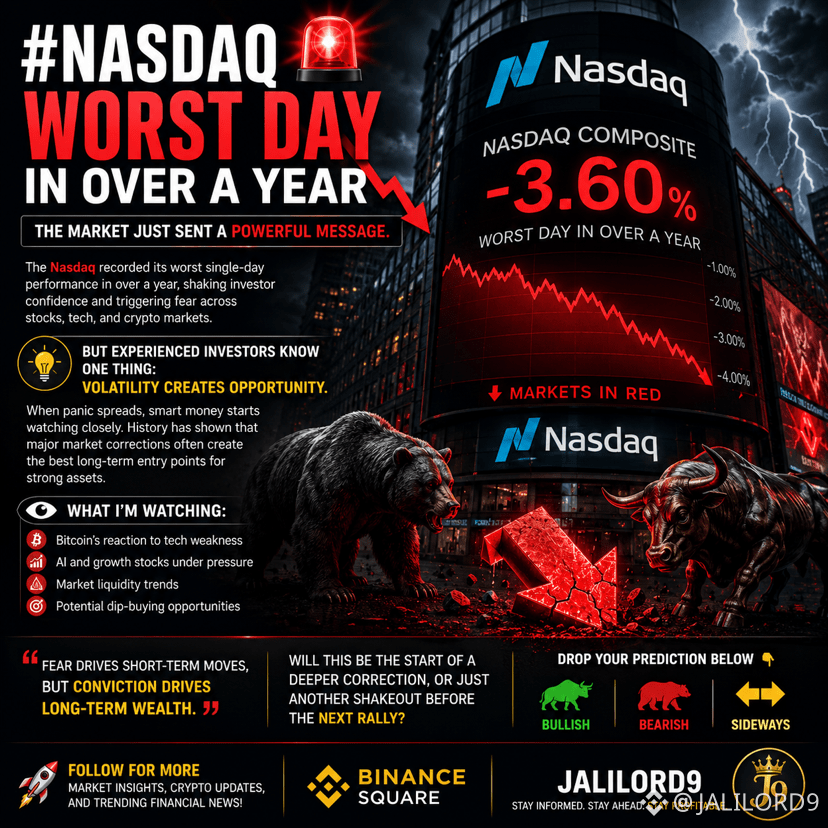
🚨 #NasdaqWorstDayInOverAYear 🚨
The market just sent a powerful message. 📉
The Nasdaq recorded its worst single-day performance in over a year, shaking investor confidence and triggering fear across stocks, tech, and crypto markets.
But experienced investors know one thing:
💡 Volatility creates opportunity.
When panic spreads, smart money starts watching closely. History has shown that major market corrections often create the best long-term entry points for strong assets.
🔍 What I’m watching:
✅ Bitcoin’s reaction to tech weakness
✅ AI and growth stocks under pressure
✅ Market liquidity trends
✅ Potential dip-buying opportunities
Remember: Fear drives short-term moves, but conviction drives long-term wealth.
Will this be the start of a deeper correction, or just another shakeout before the next rally? 🤔
Drop your prediction below 👇
🔥 Bullish
😨 Bearish
⚡ Sideways
Follow for more market insights, crypto updates, and trending financial news!
#NasdaqWorstDayInOverAYear #Bitcoin #BTC #Crypto #Stocks #Investing #Trading #MarketCrash #BinanceSquare #CryptoNews #Finance #JALILORD9
✍️ JALILORD9 🌍🚀
#NasdaqWorstDayInOverAYear $BTC
🚨 #NasdaqWorstDayInOverAYear 🚨
The market just sent a powerful message. 📉
The Nasdaq recorded its worst single-day performance in over a year, shaking investor confidence and triggering fear across stocks, tech, and crypto markets.
But experienced investors know one thing:
💡 Volatility creates opportunity.
When panic spreads, smart money starts watching closely. History has shown that major market corrections often create the best long-term entry points for strong assets.
🔍 What I’m watching:
✅ Bitcoin’s reaction to tech weakness
✅ AI and growth stocks under pressure
✅ Market liquidity trends
✅ Potential dip-buying opportunities
Remember: Fear drives short-term moves, but conviction drives long-term wealth.
Will this be the start of a deeper correction, or just another shakeout before the next rally? 🤔
Drop your prediction below 👇
🔥 Bullish
😨 Bearish
⚡ Sideways
Follow for more market insights, crypto updates, and trending financial news!
#NasdaqWorstDayInOverAYear #Bitcoin #BTC #Crypto #Stocks #Investing #Trading #MarketCrash #BinanceSquare #CryptoNews #Finance #JALILORD9
✍️ JALILORD9 🌍🚀
🚨 #NasdaqWorstDayInOverAYear 🚨
The market just sent a powerful message. 📉
The Nasdaq recorded its worst single-day performance in over a year, shaking investor confidence and triggering fear across stocks, tech, and crypto markets.
But experienced investors know one thing:
💡 Volatility creates opportunity.
When panic spreads, smart money starts watching closely. History has shown that major market corrections often create the best long-term entry points for strong assets.
🔍 What I’m watching:
✅ Bitcoin’s reaction to tech weakness
✅ AI and growth stocks under pressure
✅ Market liquidity trends
✅ Potential dip-buying opportunities
Remember: Fear drives short-term moves, but conviction drives long-term wealth.
Will this be the start of a deeper correction, or just another shakeout before the next rally? 🤔
Drop your prediction below 👇
🔥 Bullish
😨 Bearish
⚡ Sideways
Follow for more market insights, crypto updates, and trending financial news!
#NasdaqWorstDayInOverAYear #Bitcoin #BTC #Crypto #Stocks #Investing #Trading #MarketCrash #BinanceSquare #CryptoNews #Finance #JALILORD9
✍️ JALILORD9 🌍🚀
1
137

·
--
Bearish
#NasdaqWorstDayInOverAYear $
📉 Nasdaq records its biggest one-day drop in over a year.
Tech stocks faced heavy selling pressure across the market.
Investors remain cautious amid economic and earnings concerns.
All eyes are now on whether markets rebound or extend losses.
#NasdaqWorstDayInOverAYear $
📉 Nasdaq records its biggest one-day drop in over a year.
Tech stocks faced heavy selling pressure across the market.
Investors remain cautious amid economic and earnings concerns.
All eyes are now on whether markets rebound or extend losses.
📉 Nasdaq records its biggest one-day drop in over a year.
Tech stocks faced heavy selling pressure across the market.
Investors remain cautious amid economic and earnings concerns.
All eyes are now on whether markets rebound or extend losses.
1
167

·
--
#nasdaqworstdayinoverayear
📉 #NasdaqWorstDayInOverAYear
The Nasdaq suffered its biggest single-day decline in more than a year as stronger-than-expected economic data raised concerns that interest rates could remain higher for longer.
Tech stocks led the sell-off, while investors reassessed risk across the market. Increased volatility in traditional markets often impacts crypto sentiment as well, making risk management more important than ever.
Stay informed, stay disciplined, and always trade with a plan. 🚀📊
#NASDAQ #stocks #CryptoMarket #trading
#nasdaqworstdayinoverayear
📉 #NasdaqWorstDayInOverAYear
The Nasdaq suffered its biggest single-day decline in more than a year as stronger-than-expected economic data raised concerns that interest rates could remain higher for longer.
Tech stocks led the sell-off, while investors reassessed risk across the market. Increased volatility in traditional markets often impacts crypto sentiment as well, making risk management more important than ever.
Stay informed, stay disciplined, and always trade with a plan. 🚀📊
#NASDAQ #stocks #CryptoMarket #trading
📉 #NasdaqWorstDayInOverAYear
The Nasdaq suffered its biggest single-day decline in more than a year as stronger-than-expected economic data raised concerns that interest rates could remain higher for longer.
Tech stocks led the sell-off, while investors reassessed risk across the market. Increased volatility in traditional markets often impacts crypto sentiment as well, making risk management more important than ever.
Stay informed, stay disciplined, and always trade with a plan. 🚀📊
#NASDAQ #stocks #CryptoMarket #trading
1
281

·
--
Verified
#nasdaqworstdayinoverayear 🚨 Is the AI & Tech Bubble Bursting? Nasdaq Suffers Worst Day in Over a Year! 📉
The markets just witnessed a massive shift! The tech-heavy Nasdaq plummeted 4.18% (dropping over 1,121 points), wiping out trillions in market value. This marks its steepest single-day decline since April 2025.
What triggered this massive dump? 1️⃣ Strong Jobs Report: US nonfarm payrolls doubled expectations (172k vs 80k expected). "Good news is bad news" as this shatters Fed rate cut hopes and sparks fear of a December rate hike. 2️⃣ The AI & Chip Bloodbath: High-flying semiconductor stocks took a brutal hit. $NVDA slid 6%, while Broadcom and Micron collapsed heavily as investors locked in profits. 3️⃣ Macro Pressures: Rising geopolitical tensions pushed Brent crude over $93, spiking inflation fears and pushing Treasury yields higher.
$RNDR
$FET
{future}(FETUSDT)
Crypto Impact: As the VIX fear gauge surged 39%, the panic spilled into crypto, pulling #Bitcoin below the $60k psychological support level.
Are we looking at a healthy market correction and a "buy the dip" opportunity, or is this the start of a deeper macro downtrend? 🤔👇
#NASDAQ #MarketCrash #NVIDIA #Fed #MacroEconomy #CryptoMarket
Where is BTC going next?
#nasdaqworstdayinoverayear 🚨 Is the AI & Tech Bubble Bursting? Nasdaq Suffers Worst Day in Over a Year! 📉
The markets just witnessed a massive shift! The tech-heavy Nasdaq plummeted 4.18% (dropping over 1,121 points), wiping out trillions in market value. This marks its steepest single-day decline since April 2025.
What triggered this massive dump? 1️⃣ Strong Jobs Report: US nonfarm payrolls doubled expectations (172k vs 80k expected). "Good news is bad news" as this shatters Fed rate cut hopes and sparks fear of a December rate hike. 2️⃣ The AI & Chip Bloodbath: High-flying semiconductor stocks took a brutal hit. $NVDA slid 6%, while Broadcom and Micron collapsed heavily as investors locked in profits. 3️⃣ Macro Pressures: Rising geopolitical tensions pushed Brent crude over $93, spiking inflation fears and pushing Treasury yields higher.
$RNDR
$FET
Crypto Impact: As the VIX fear gauge surged 39%, the panic spilled into crypto, pulling #Bitcoin below the $60k psychological support level.
Are we looking at a healthy market correction and a "buy the dip" opportunity, or is this the start of a deeper macro downtrend? 🤔👇
#NASDAQ #MarketCrash #NVIDIA #Fed #MacroEconomy #CryptoMarket
Where is BTC going next?
The markets just witnessed a massive shift! The tech-heavy Nasdaq plummeted 4.18% (dropping over 1,121 points), wiping out trillions in market value. This marks its steepest single-day decline since April 2025.
What triggered this massive dump? 1️⃣ Strong Jobs Report: US nonfarm payrolls doubled expectations (172k vs 80k expected). "Good news is bad news" as this shatters Fed rate cut hopes and sparks fear of a December rate hike. 2️⃣ The AI & Chip Bloodbath: High-flying semiconductor stocks took a brutal hit. $NVDA slid 6%, while Broadcom and Micron collapsed heavily as investors locked in profits. 3️⃣ Macro Pressures: Rising geopolitical tensions pushed Brent crude over $93, spiking inflation fears and pushing Treasury yields higher.
$RNDR
$FET
Crypto Impact: As the VIX fear gauge surged 39%, the panic spilled into crypto, pulling #Bitcoin below the $60k psychological support level.
Are we looking at a healthy market correction and a "buy the dip" opportunity, or is this the start of a deeper macro downtrend? 🤔👇
#NASDAQ #MarketCrash #NVIDIA #Fed #MacroEconomy #CryptoMarket
Where is BTC going next?
Below $55k
46%
Rebounding to $65k
54%
13 votes • Voting closed
1.8k

#NasdaqWorstDayInOverAYear
#NasdaqWorstDayInOverAYear
The US stock market just faced a heavy sell-off, with the Nasdaq Composite plunging 4.18% (down 1,121 points), marking its worst day in over a year, since April 2025. �
Barron's +1
Main reasons: • AI and semiconductor stocks faced major profit-taking after a hot rally. �
• The US job report for May exceeded expectations, raising concerns that the Federal Reserve might keep interest rates high for longer or continue increasing rates. �
• Treasury bond yields surged, putting pressure on high-growth tech stocks. �
• Broadcom's earnings weren't enough to sustain the market's AI hype. �
Barron's +1
The Economic Times +1
Barron's +1
Barron's +1
Notably, the PHLX Semiconductor Index dropped over 10%, marking its worst session since 2020. Major chip stocks like NVIDIA, AMD, Micron Technology, and Intel all took a hit. �
International Market +1
Nevertheless, many analysts view this as a correction after the market and AI sector have surged too quickly for too long, rather than a sign of a new financial crisis. �
Barron's +1
#NasdaqWorstDayInOverAYear
#NasdaqWorstDayInOverAYear
The US stock market just faced a heavy sell-off, with the Nasdaq Composite plunging 4.18% (down 1,121 points), marking its worst day in over a year, since April 2025. �
Barron's +1
Main reasons: • AI and semiconductor stocks faced major profit-taking after a hot rally. �
• The US job report for May exceeded expectations, raising concerns that the Federal Reserve might keep interest rates high for longer or continue increasing rates. �
• Treasury bond yields surged, putting pressure on high-growth tech stocks. �
• Broadcom's earnings weren't enough to sustain the market's AI hype. �
Barron's +1
The Economic Times +1
Barron's +1
Barron's +1
Notably, the PHLX Semiconductor Index dropped over 10%, marking its worst session since 2020. Major chip stocks like NVIDIA, AMD, Micron Technology, and Intel all took a hit. �
International Market +1
Nevertheless, many analysts view this as a correction after the market and AI sector have surged too quickly for too long, rather than a sign of a new financial crisis. �
Barron's +1
#NasdaqWorstDayInOverAYear
The US stock market just faced a heavy sell-off, with the Nasdaq Composite plunging 4.18% (down 1,121 points), marking its worst day in over a year, since April 2025. �
Barron's +1
Main reasons: • AI and semiconductor stocks faced major profit-taking after a hot rally. �
• The US job report for May exceeded expectations, raising concerns that the Federal Reserve might keep interest rates high for longer or continue increasing rates. �
• Treasury bond yields surged, putting pressure on high-growth tech stocks. �
• Broadcom's earnings weren't enough to sustain the market's AI hype. �
Barron's +1
The Economic Times +1
Barron's +1
Barron's +1
Notably, the PHLX Semiconductor Index dropped over 10%, marking its worst session since 2020. Major chip stocks like NVIDIA, AMD, Micron Technology, and Intel all took a hit. �
International Market +1
Nevertheless, many analysts view this as a correction after the market and AI sector have surged too quickly for too long, rather than a sign of a new financial crisis. �
Barron's +1
116
Log in to explore more content
Join global crypto users on Binance Square
⚡️ Get latest and useful information about crypto.
💬 Trusted by the world’s largest crypto exchange.
👍 Discover real insights from verified creators.
Email / Phone number
Trending Topics
1
#SECToClarifyOnChainFundraisingRules
0 views
20 Discussing
2
#UKFCAOpensCryptoFirmAuthorization
600 views
75 Discussing
3
#JapanMOFStudyGroupOnTokenizedGovtBonds
1,061 views
113 Discussing
4
#QNTRises287%
22,468 views
400 Discussing
5
#TrumpRejectsAIRulesForVoluntaryAudits
18,575 views
487 Discussing
6
#BitgetHotWalletBreachTiedToThirdPartySecurityFlaw
9,614 views
336 Discussing
7
#OpenAIUnveilsAlwaysOnAgentDots
8,416 views
351 Discussing
8
#ChainlinkLaunchesBankSWIFTLedgerFramework
9,252 views
271 Discussing
9
#EarningsSeason
529,809 views
3,805 Discussing
10
#ZcashApproves$1.5MBugBounty
107 views
4 Discussing