
#nvdia
nvdia
103,242 views
427 Discussing
Hot
Latest

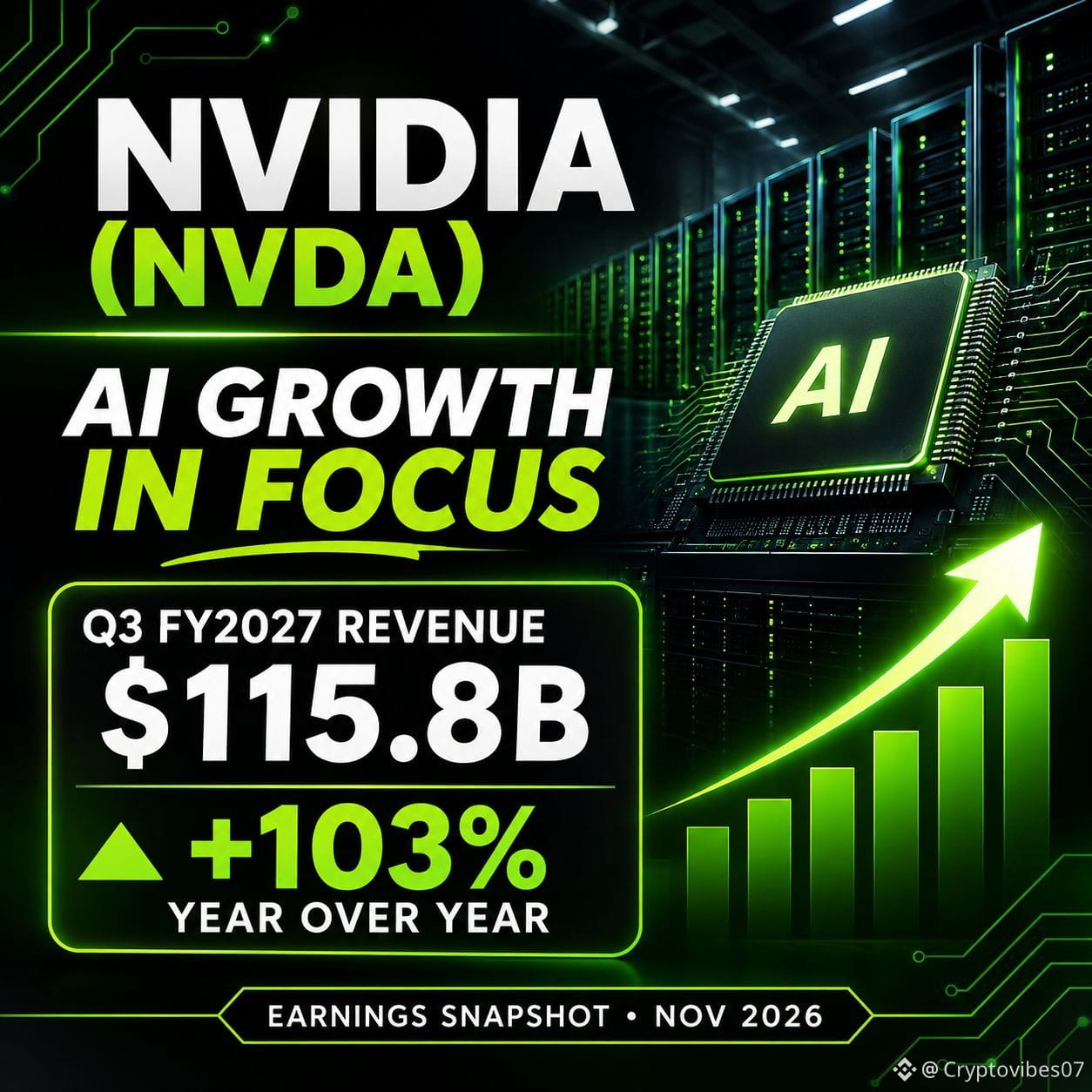
$NVDA.US is proving that AI is more than just a trend. 🚀
With $115.8B in quarterly revenue and 103% year-over-year growth, NVDA continues to show the strength of the AI industry.
But can this momentum last?
The next big test is sustaining growth while managing competition and market expectations.
What's your outlook on $NVDA.US ? Bullish or cautious? 📊
#NVDIA #NVIDIAGTC24 #StockMarketSuccess #AISTOCKTRADING #NASDAQ
NVDAUS-1.67%
145

·
--
Verified
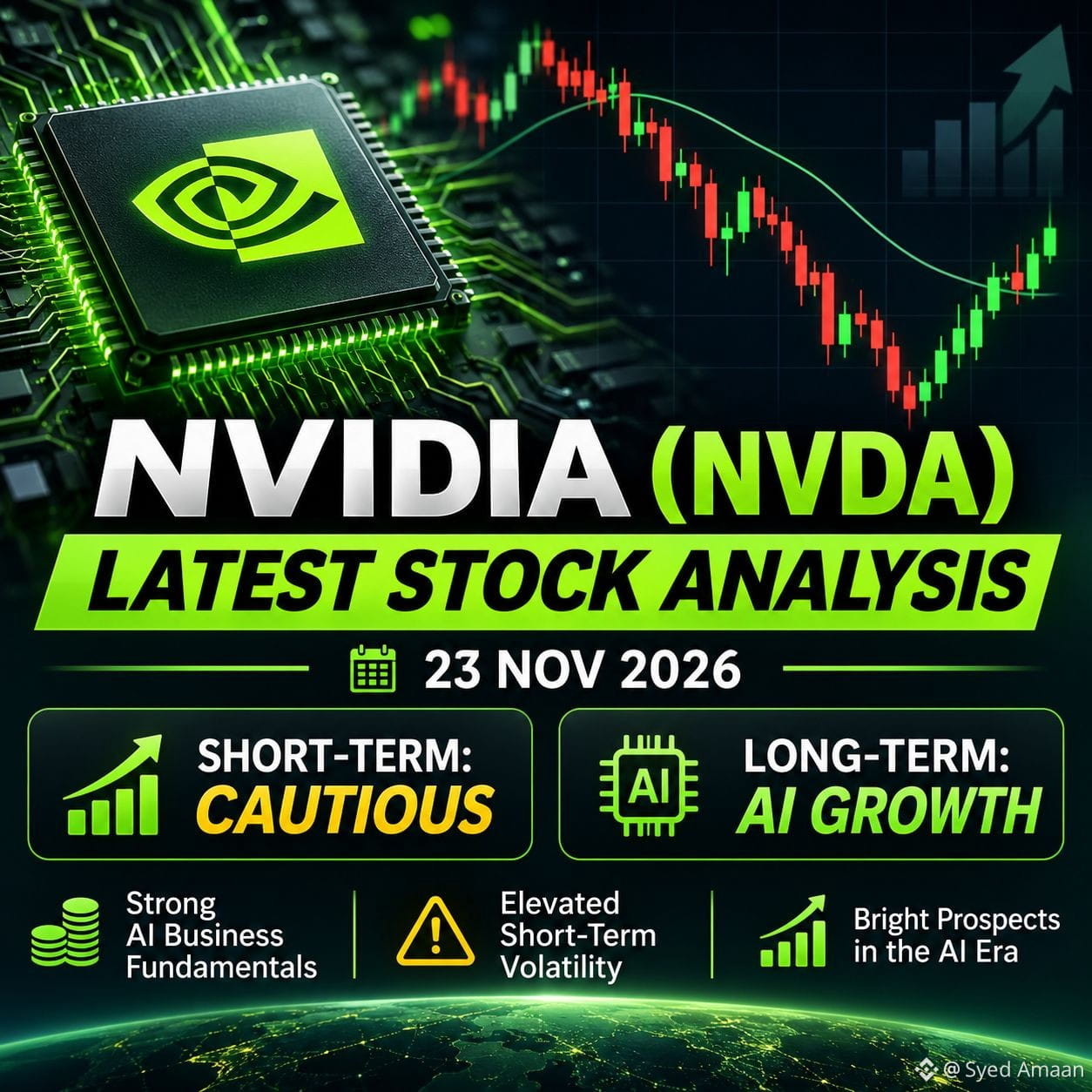
#🚨NVIDIA ($NVDA.US NVDA) – Latest Stock Analysis
23 November 2026 | US Stock Market
High volatility – Cautious outlook
Latest market update: $NVDA.US closed at $125.53 on November 20, down 14% in one session. It rebounded in Monday pre-market trading to around $135.76.
Fundamental analysis:
Q3 revenue reached $115.8 billion, up 103% year over year.
Q4 revenue guidance is approximately $130 billion.
AI chip demand remains a major growth driver.
Leadership uncertainty and reported SEC scrutiny are weighing on investor confidence.
My outlook: Long-term fundamentals remain strong, but short-term volatility is high. Watch for price stabilization before considering an entry.
Trading view: Cautious / Wait for confirmation.
Key takeaway: NVIDIA's AI business is strong, but short-term market sentiment is weak. Avoid chasing a sudden rebound
#WillMarketsStageAThanksgivingReliefRally? #WillOctCorePCEShiftFedHikeExpectations? #EvolveAtBinanceBlockchainWeek #NVDIA #BessentSoftensStanceOnHuang’sNvidiaReturn
{stock_us}(NVDA.US)
#🚨NVIDIA ($NVDA.US NVDA) – Latest Stock Analysis
23 November 2026 | US Stock Market
High volatility – Cautious outlook
Latest market update: $NVDA.US closed at $125.53 on November 20, down 14% in one session. It rebounded in Monday pre-market trading to around $135.76.
Fundamental analysis:
Q3 revenue reached $115.8 billion, up 103% year over year.
Q4 revenue guidance is approximately $130 billion.
AI chip demand remains a major growth driver.
Leadership uncertainty and reported SEC scrutiny are weighing on investor confidence.
My outlook: Long-term fundamentals remain strong, but short-term volatility is high. Watch for price stabilization before considering an entry.
Trading view: Cautious / Wait for confirmation.
Key takeaway: NVIDIA's AI business is strong, but short-term market sentiment is weak. Avoid chasing a sudden rebound
#WillMarketsStageAThanksgivingReliefRally? #WillOctCorePCEShiftFedHikeExpectations? #EvolveAtBinanceBlockchainWeek #NVDIA #BessentSoftensStanceOnHuang’sNvidiaReturn
NVDAUS-1.67%
1.1k
#realdonaldtrump
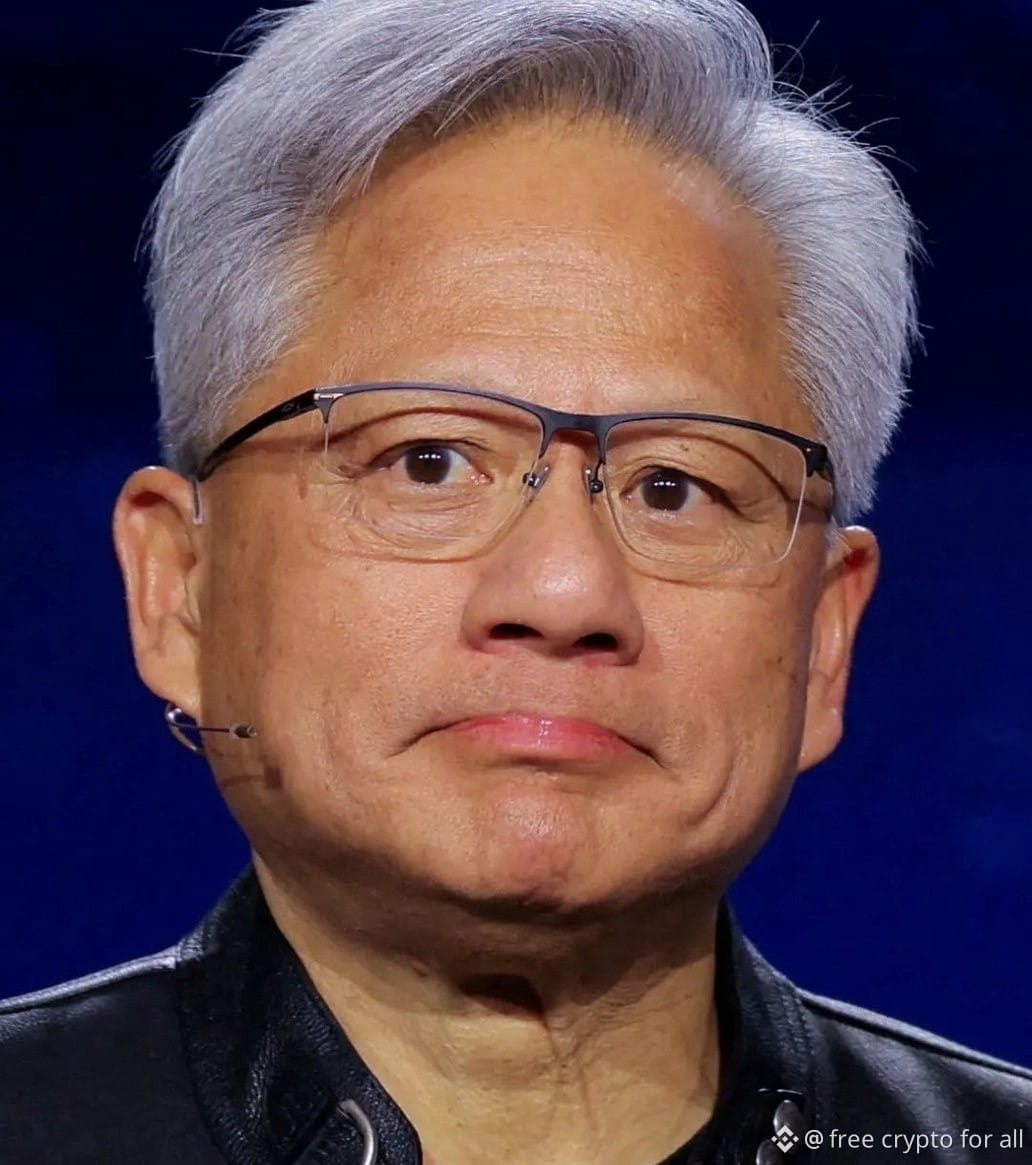
The NVIDIA Board of Directors has made the correct and proper decision to return Jensen Huang to the position of CEO. The Country needs Jensen’s leadership at NVIDIA in order to ensure the Success and Prosperity of not only the Company, but the American Economy. The United States Government has no reason to believe that Jensen’s return to NVIDIA poses any risk to National Security. The Attorney General of the United States has confirmed that the U.S. Government does not possess evidence that he has engaged in any unlawful conduct. On a personal note, I have gotten to know Jensen, and he is a Great Patriot and National Treasure. Separately, NVIDIA should continue its thorough internal investigation of the Company’s compliance with U.S. export controls in order to ensure that it is fulfilling its legal obligations and Patriotic Duty to protect U.S. National Security. Congratulations to Jensen, the NVIDIA Board, to the People of the United States — and, indeed, the World! Thank you for your attention to this matter. President DONALD J. TRUMP
$NVDL
{future}(NVDLUSDT)
$NVDA
{future}(NVDAUSDT)
#NVDIA #NVDL
#realdonaldtrump
The NVIDIA Board of Directors has made the correct and proper decision to return Jensen Huang to the position of CEO. The Country needs Jensen’s leadership at NVIDIA in order to ensure the Success and Prosperity of not only the Company, but the American Economy. The United States Government has no reason to believe that Jensen’s return to NVIDIA poses any risk to National Security. The Attorney General of the United States has confirmed that the U.S. Government does not possess evidence that he has engaged in any unlawful conduct. On a personal note, I have gotten to know Jensen, and he is a Great Patriot and National Treasure. Separately, NVIDIA should continue its thorough internal investigation of the Company’s compliance with U.S. export controls in order to ensure that it is fulfilling its legal obligations and Patriotic Duty to protect U.S. National Security. Congratulations to Jensen, the NVIDIA Board, to the People of the United States — and, indeed, the World! Thank you for your attention to this matter. President DONALD J. TRUMP
$NVDL
$NVDA
#NVDIA #NVDL
15

·
--
Article
NVIDIA Stock Crash: Is the AI Market Facing a Major Turning Point ?The global stock market is experiencing significant volatility, with NVIDIA (NVDA) attracting major attention following reports of a sharp decline in its share price.
According to the reported market figures, NVIDIA dropped nearly 14% in Friday's session, while the Nasdaq also experienced a substantial decline. This has raised concerns among investors about the future of AI-related stocks.
Why Is the Market Under Pressure?
Several factors may be contributing to the market uncertainty:
Concerns surrounding NVIDIA's reported leadership changes.
Growing uncertainty about future Federal Reserve interest rate decisions.
Increased regulatory concerns in the United States.
Profit-taking and changing investor sentiment toward AI stocks.
Interestingly, NVIDIA's reported quarterly performance remained strong, with revenue more than doubling and its forward guidance exceeding expectations. This highlights an important point: even strong companies can experience significant stock-price volatility.
What Could Happen Next?
Investors will be watching several developments closely:
Updates regarding NVIDIA's permanent leadership.
Future earnings and AI demand.
Federal Reserve monetary policy.
Regulatory developments in the US.
Overall recovery in technology stocks.
My Take
The recent volatility is a reminder that market sentiment can change quickly. NVIDIA remains an important company in the global AI ecosystem, but investors should avoid making emotional decisions during periods of uncertainty.
#MuskWarnsOfAICashCrunch
#NVDIA $NVDAB
{future}(NVDAUSDT)
NVIDIA Stock Crash: Is the AI Market Facing a Major Turning Point ?
The global stock market is experiencing significant volatility, with NVIDIA (NVDA) attracting major attention following reports of a sharp decline in its share price.
According to the reported market figures, NVIDIA dropped nearly 14% in Friday's session, while the Nasdaq also experienced a substantial decline. This has raised concerns among investors about the future of AI-related stocks.
Why Is the Market Under Pressure?
Several factors may be contributing to the market uncertainty:
Concerns surrounding NVIDIA's reported leadership changes.
Growing uncertainty about future Federal Reserve interest rate decisions.
Increased regulatory concerns in the United States.
Profit-taking and changing investor sentiment toward AI stocks.
Interestingly, NVIDIA's reported quarterly performance remained strong, with revenue more than doubling and its forward guidance exceeding expectations. This highlights an important point: even strong companies can experience significant stock-price volatility.
What Could Happen Next?
Investors will be watching several developments closely:
Updates regarding NVIDIA's permanent leadership.
Future earnings and AI demand.
Federal Reserve monetary policy.
Regulatory developments in the US.
Overall recovery in technology stocks.
My Take
The recent volatility is a reminder that market sentiment can change quickly. NVIDIA remains an important company in the global AI ecosystem, but investors should avoid making emotional decisions during periods of uncertainty.
#MuskWarnsOfAICashCrunch
#NVDIA $NVDAB
1
147

·
--
Article
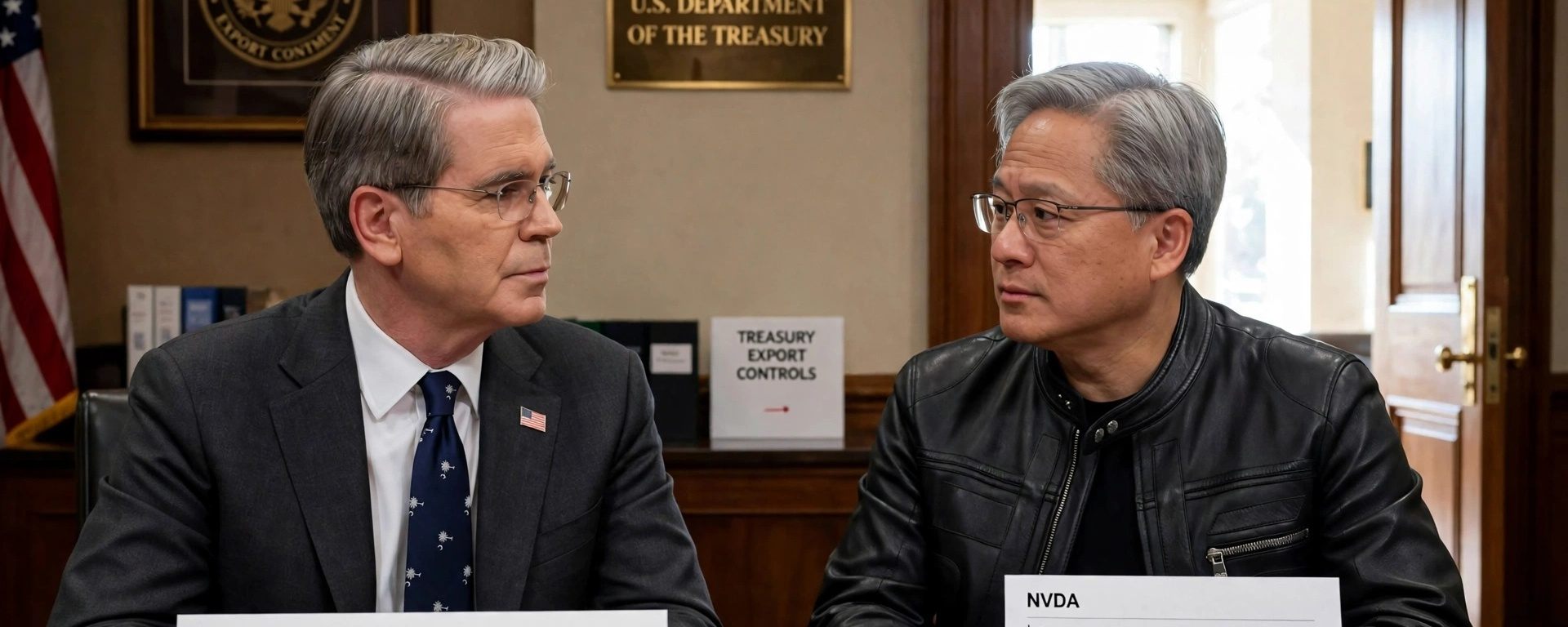
BESSENT JUST OPENED THE DOOR FOR HUANG. NOVEMBER 25 DECIDES IF IT STAYS OPEN.My read is Bessent just moved the goalposts, and the market is already running with it.
A week ago he was on Fox telling Nvidia to go find an outside CEO and giving the board 10 days to answer for shell companies. Sunday on CBS he flipped. 'I said they should go to the outside, but he's on the outside now.' He wouldn't rule out Huang coming back. All he wants to know now is where the buck stops.
That's not a clearance. That's a conditional opening. Bessent is saying the CEO question depends on the compliance answers, and the compliance answers are due tomorrow, November 25. Nvidia has to tell Treasury whether it set up shell companies to route restricted chips to China. That's the binary. Clean answers and Huang's path back gets wider. Bad answers and the probe deepens and this rally dies before it starts.
Here's the split that makes it interesting. Trump has already said Huang should get his job back. The board, chaired by Harvey Jones, has said it has no intention of rehiring him. Kress is interim CEO and the board is running an independent investigation with Wachtell. So you've got the White House on one side and the board on the other, and Bessent just stepped out of the middle and said show me the answers first.
The tape is already pricing the relief. NVDA is 48% off its 52-week high, $243.37 down to a $125.53 close Friday, sitting basically on its 52-week low of $124.50. The perp has bounced to $133.84 on the Bessent news. The AI tokens are running harder. BLESS is up 37% in a day, BULLA up 47%. And the prediction market noticed too. Kalshi odds of Huang returning jumped from 7% to 12% after Bessent spoke. That's a small number, but the direction is the tell. Nobody is pricing a done deal yet.
Options are pricing a move of about 12% either way by Nov 27, an 80% range of $110.86 to $140.72 from Friday's close. $140 is the first reclaim that matters, the level where the bounce thesis gets its legs back. And $124.50 is the 52-week low, a dollar below Friday's close. That's the line buyers are defending, because below it there's no tested floor left.
My take is the Bessent softening is real but it's not the trade. The trade is November 25. If Nvidia's answers point to a few bad actors at the bottom and the company cut them off, Huang's door swings open and AI gets its relief rally. If the answers show the board knew, or the shell network ran deeper than they're admitting, the probe becomes the story again and NVDA stays capped. Watch the answers tomorrow first. Then December 1, when Huang testifies behind closed doors. Those two dates decide whether this is a bottom or just a bounce inside a downtrend.
$NVDA
#bessentsoftensstanceonhuangsnvidiareturn #NVDIA
BESSENT JUST OPENED THE DOOR FOR HUANG. NOVEMBER 25 DECIDES IF IT STAYS OPEN.
My read is Bessent just moved the goalposts, and the market is already running with it.
A week ago he was on Fox telling Nvidia to go find an outside CEO and giving the board 10 days to answer for shell companies. Sunday on CBS he flipped. 'I said they should go to the outside, but he's on the outside now.' He wouldn't rule out Huang coming back. All he wants to know now is where the buck stops.
That's not a clearance. That's a conditional opening. Bessent is saying the CEO question depends on the compliance answers, and the compliance answers are due tomorrow, November 25. Nvidia has to tell Treasury whether it set up shell companies to route restricted chips to China. That's the binary. Clean answers and Huang's path back gets wider. Bad answers and the probe deepens and this rally dies before it starts.
Here's the split that makes it interesting. Trump has already said Huang should get his job back. The board, chaired by Harvey Jones, has said it has no intention of rehiring him. Kress is interim CEO and the board is running an independent investigation with Wachtell. So you've got the White House on one side and the board on the other, and Bessent just stepped out of the middle and said show me the answers first.
The tape is already pricing the relief. NVDA is 48% off its 52-week high, $243.37 down to a $125.53 close Friday, sitting basically on its 52-week low of $124.50. The perp has bounced to $133.84 on the Bessent news. The AI tokens are running harder. BLESS is up 37% in a day, BULLA up 47%. And the prediction market noticed too. Kalshi odds of Huang returning jumped from 7% to 12% after Bessent spoke. That's a small number, but the direction is the tell. Nobody is pricing a done deal yet.
Options are pricing a move of about 12% either way by Nov 27, an 80% range of $110.86 to $140.72 from Friday's close. $140 is the first reclaim that matters, the level where the bounce thesis gets its legs back. And $124.50 is the 52-week low, a dollar below Friday's close. That's the line buyers are defending, because below it there's no tested floor left.
My take is the Bessent softening is real but it's not the trade. The trade is November 25. If Nvidia's answers point to a few bad actors at the bottom and the company cut them off, Huang's door swings open and AI gets its relief rally. If the answers show the board knew, or the shell network ran deeper than they're admitting, the probe becomes the story again and NVDA stays capped. Watch the answers tomorrow first. Then December 1, when Huang testifies behind closed doors. Those two dates decide whether this is a bottom or just a bounce inside a downtrend.
$NVDA
#bessentsoftensstanceonhuangsnvidiareturn #NVDIA
110

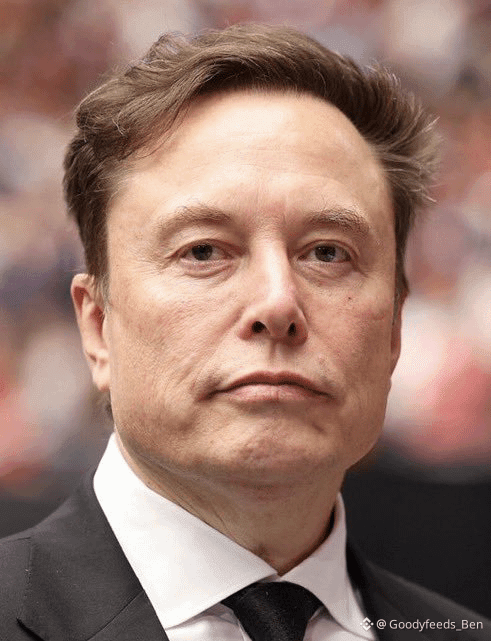
#ElonMusk. proposed acquisition of #NVDIA ?
Have u heard about this rumor? Whether it is rumor or real acquisition, lets see what happen:
NVIDIA's Board of Directors has unanimously rejected an unsolicited $20 billion acquisition proposal from Elon Musk, formally determining that the offer severely undervalues the company's proprietary AI architecture, global market dominance, and long-term growth trajectory. The decision followed a comprehensive review conducted with independent financial and legal advisors, who concluded that surrendering NVIDIA's independence at such a fraction of its intrinsic worth would be fundamentally contrary to the best interests of shareholders, customers, and partners worldwide.
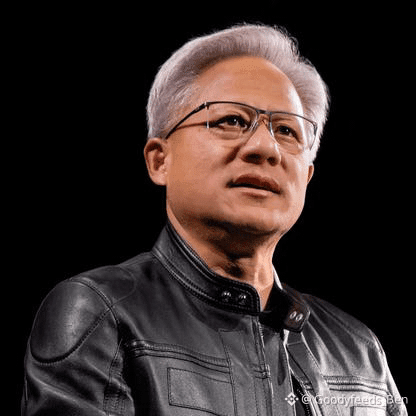
In parallel with the rejection, the board has initiated urgent discussions about potentially bringing back co-founder and former CEO Jensen Huang to guide the company through this pivotal era of heightened strategic interest and rapid AI expansion. Directors believe Huang's unmatched technical vision, deep institutional knowledge, and proven leadership remain critical assets as NVIDIA defends its autonomy and accelerates its next-generation semiconductor roadmap.
NVIDIA emphasized that it remains steadfast in its commitment to independent innovation and delivering industry-defining value without the distractions of opportunistic takeover attempts. The company confirmed that day-to-day operations, supply chain commitments, and research initiatives continue uninterrupted while leadership discussions proceed, with a focus on shaping the future of accelerated computing.
$NVDL #ElonMuskTalks
4
3.3k

·
--
Bullish
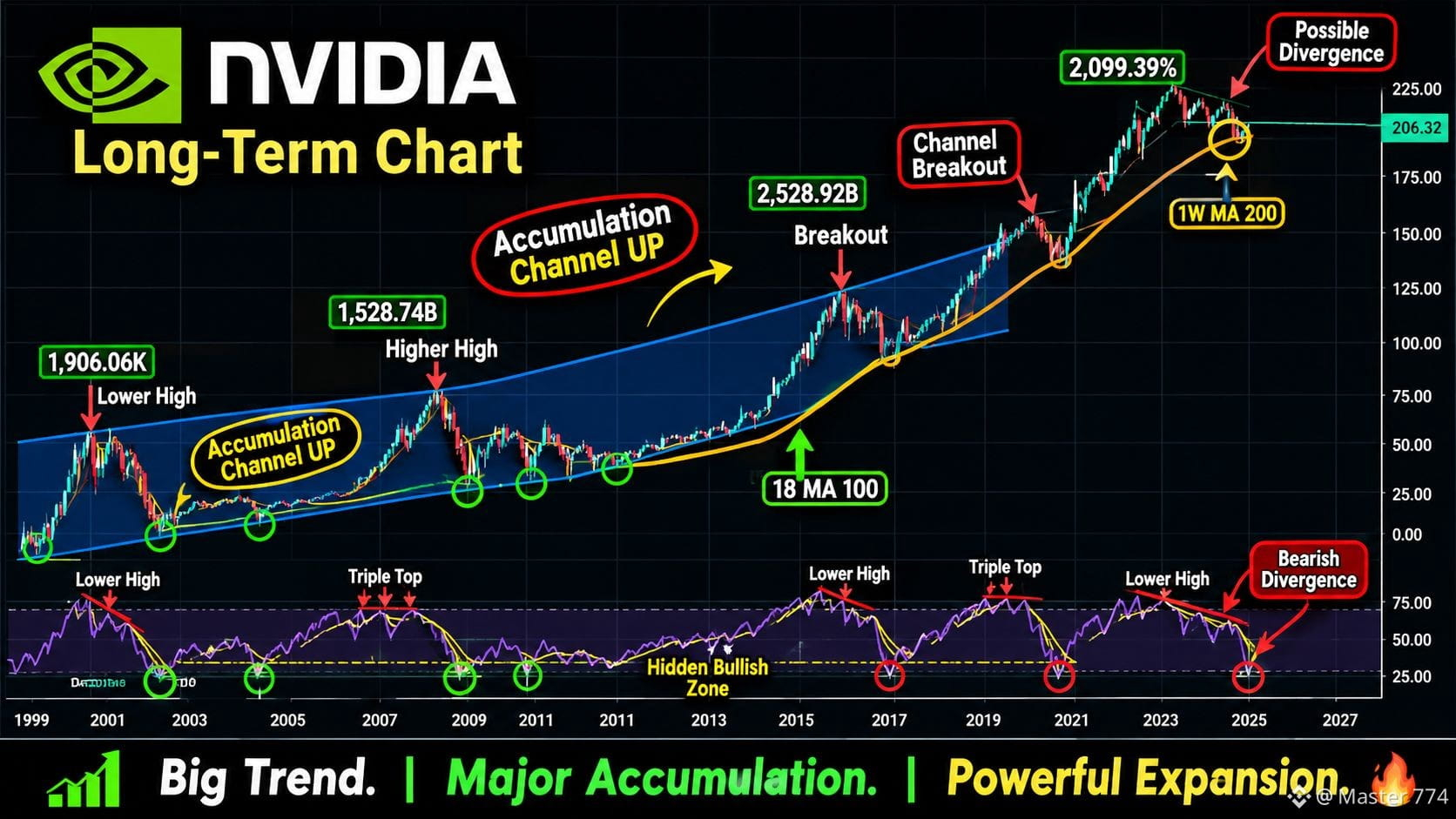
$NVDA is showing an interesting long-term setup as momentum approaches a historically important accumulation zone.
The 1W MA200 remains a key level to watch. If price holds above this support, the broader bullish structure could remain intact, potentially opening the door for another move toward previous highs.
Patience and confirmation matter here.
Trade on $NVDA
#NVDIA
{future}(NVDAUSDT)
$NVDA is showing an interesting long-term setup as momentum approaches a historically important accumulation zone.
The 1W MA200 remains a key level to watch. If price holds above this support, the broader bullish structure could remain intact, potentially opening the door for another move toward previous highs.
Patience and confirmation matter here.
Trade on $NVDA
#NVDIA
The 1W MA200 remains a key level to watch. If price holds above this support, the broader bullish structure could remain intact, potentially opening the door for another move toward previous highs.
Patience and confirmation matter here.
Trade on $NVDA
#NVDIA
Master 774
·
--
Bullish🇺🇸🇨🇳 A $3.2 BILLION NVIDIA-RELATED AI PIPELINE HAS BEEN UNCOVERED IN CHINA!!!
Despite U.S. export restrictions, Chinese companies, universities, and government-backed projects are still building AI infrastructure around restricted Nvidia chips.
More than 150 procurement notices, contracts, and corporate disclosures reveal projects worth over $3.2 BILLION.
Huang previously claimed Nvidia's market share in China had fallen from 95% to ZERO, yet Chinese projects are still planning around Nvidia's H100, H200, and H800 processors.
$NVDA
1
116

Build flags and calibration steps to enable FP8 and FP4 KV-cache alongside NVFP4 weights?Configuring FP8 or NVFP4 Key-Value (KV) cache quantization alongside NVFP4 model weights requires calibrating activation dynamic ranges during offline post-training quantization (PTQ) and enabling specific runtime plugins/flags during engine compilation or server execution.
Phase 1: Calibration & Checkpoint Export (NVIDIA ModelOpt)
Before building the engine, offline calibration using modelopt (NVIDIA Model Optimizer) is required to capture scaling parameters for weights and KV-cache layer matrices.
1. Quantization Config Script (quantize.py)
To export an NVFP4 weight model paired with either FP8 or NVFP4 KV cache, calibrate the attention key/value tensors against a calibration dataset (e.g., CNN-DailyMail or WikiText).
Phase 2: Engine Compilation via trtllm-build CLI
To compile the calibrated checkpoint into a runtime .engine, pass explicit build flags that register the FP4 weight matrix plugins and allocate the target KV cache data type.
CLI Command Execution
Mandatory Build Flags Reference
Phase 3: High-Level Python API Execution (LLM class)
When launching serving pipelines via the high-level TensorRT-LLM API, configure the KvCacheConfig programmatically:
#NVDIA #BTC #Binance
Build flags and calibration steps to enable FP8 and FP4 KV-cache alongside NVFP4 weights?
Configuring FP8 or NVFP4 Key-Value (KV) cache quantization alongside NVFP4 model weights requires calibrating activation dynamic ranges during offline post-training quantization (PTQ) and enabling specific runtime plugins/flags during engine compilation or server execution.
Phase 1: Calibration & Checkpoint Export (NVIDIA ModelOpt)
Before building the engine, offline calibration using modelopt (NVIDIA Model Optimizer) is required to capture scaling parameters for weights and KV-cache layer matrices.
1. Quantization Config Script (quantize.py)
To export an NVFP4 weight model paired with either FP8 or NVFP4 KV cache, calibrate the attention key/value tensors against a calibration dataset (e.g., CNN-DailyMail or WikiText).
Phase 2: Engine Compilation via trtllm-build CLI
To compile the calibrated checkpoint into a runtime .engine, pass explicit build flags that register the FP4 weight matrix plugins and allocate the target KV cache data type.
CLI Command Execution
Mandatory Build Flags Reference
Phase 3: High-Level Python API Execution (LLM class)
When launching serving pipelines via the high-level TensorRT-LLM API, configure the KvCacheConfig programmatically:
#NVDIA #BTC #Binance
101
Nvidia's NVFP4 precision units compare to AMD's OCP MXFP4 implementation for AI inference?
While Nvidia NVFP4 and AMD OCP MXFP4 both utilize 4-bit floating-point representation ($E2M1$: 1 sign bit, 2 exponent bits, 1 mantissa bit) to achieve up to double the compute throughput of FP8 during AI LLM inference, they differ fundamentally in microscaling block size, scaling precision, hardware lock-in, and accuracy retention.
Architectural & Specification Comparison
Technical Differences & Performance Trade-offs
1. Microblock Size & Outlier Sensitivity
Nvidia NVFP4 (16-Element Block): By grouping weights and activations into smaller 16-element blocks, NVFP4 isolates large activation outliers in LLMs (such as in attention projections). An outlier only impacts 15 neighboring weights within its block.AMD OCP MXFP4 (32-Element Block): Microscaling FP4 doubles the block size to 32 elements. While this halves the memory storage footprint of scale factors (saving 0.25 bits/weight), a single outlier in a transformer matrix dilutes the scaling resolution across 31 neighboring values, leading to heavier quantization rounding errors.
2. Scale Factor Precision (E4M3 vs. E8M0)
NVFP4's Dual-Layer Scaling: NVFP4 uses an FP8 (E4M3) scale factor per 16-element block combined with a global FP32 matrix-level scale factor. E4M3 provides mantissa precision in the scale factor itself, preserving fine-grained sub-distributions in large model weight weights without sacrificing accuracy.MXFP4's Exponent-Only Scaling: MXFP4 employs an E8M0 scale, meaning the scale factor can only shift the decimal point by powers of two ($2^n$). While E8M0 offers massive dynamic range, it lacks mantissa precision within the scale itself. To offset this gap, AMD relies on calibration methods like MR-GPTQ (applying block-wise Hadamard rotations to flatten outliers prior to quantization).
3. Cross-Platform Portability vs. Hardware Lock-In
NVFP4 (Nvidia Single-Vendor Optimization): Built exclusively for Nvidia's 5th and 6th Generation Tensor Cores. Models quantized to NVFP4 are optimized for TensorRT engines running on Blackwell and Vera Rubin platforms, but cannot run natively on AMD GPUs or open accelerators.OCP MXFP4 (The Portable Ecosystem): MXFP4 is an industry open standard supported across multi-vendor AI hardware ecosystems. AMD's Instinct MI350/MI400 series GPUs execute MXFP4 natively in hardware via Matrix Fused Multiply-Add (MFMA) instructions. Crucially, Nvidia Blackwell GPUs also support MXFP4 execution, making OCP MXFP4 the standard choice for multi-cloud, cross-vendor AI serving fleets seeking to avoid lock-in.
Key Takeaway for Deployment
Choose NVFP4 if you operate an all-Nvidia fleet (Blackwell / Rubin) and require the highest task accuracy retention without complex rotation re-calibration tricks during W4A4/W4A8 inference.Choose OCP MXFP4 if you require cross-hardware model portability across AMD Instinct and Nvidia accelerators, or want to reduce scale-storage overhead in multi-tenant cloud serving setups.
#Xrp🔥🔥 #NVDIA
Nvidia's NVFP4 precision units compare to AMD's OCP MXFP4 implementation for AI inference?
While Nvidia NVFP4 and AMD OCP MXFP4 both utilize 4-bit floating-point representation ($E2M1$: 1 sign bit, 2 exponent bits, 1 mantissa bit) to achieve up to double the compute throughput of FP8 during AI LLM inference, they differ fundamentally in microscaling block size, scaling precision, hardware lock-in, and accuracy retention.
Architectural & Specification Comparison
Technical Differences & Performance Trade-offs
1. Microblock Size & Outlier Sensitivity
Nvidia NVFP4 (16-Element Block): By grouping weights and activations into smaller 16-element blocks, NVFP4 isolates large activation outliers in LLMs (such as in attention projections). An outlier only impacts 15 neighboring weights within its block.AMD OCP MXFP4 (32-Element Block): Microscaling FP4 doubles the block size to 32 elements. While this halves the memory storage footprint of scale factors (saving 0.25 bits/weight), a single outlier in a transformer matrix dilutes the scaling resolution across 31 neighboring values, leading to heavier quantization rounding errors.
2. Scale Factor Precision (E4M3 vs. E8M0)
NVFP4's Dual-Layer Scaling: NVFP4 uses an FP8 (E4M3) scale factor per 16-element block combined with a global FP32 matrix-level scale factor. E4M3 provides mantissa precision in the scale factor itself, preserving fine-grained sub-distributions in large model weight weights without sacrificing accuracy.MXFP4's Exponent-Only Scaling: MXFP4 employs an E8M0 scale, meaning the scale factor can only shift the decimal point by powers of two ($2^n$). While E8M0 offers massive dynamic range, it lacks mantissa precision within the scale itself. To offset this gap, AMD relies on calibration methods like MR-GPTQ (applying block-wise Hadamard rotations to flatten outliers prior to quantization).
3. Cross-Platform Portability vs. Hardware Lock-In
NVFP4 (Nvidia Single-Vendor Optimization): Built exclusively for Nvidia's 5th and 6th Generation Tensor Cores. Models quantized to NVFP4 are optimized for TensorRT engines running on Blackwell and Vera Rubin platforms, but cannot run natively on AMD GPUs or open accelerators.OCP MXFP4 (The Portable Ecosystem): MXFP4 is an industry open standard supported across multi-vendor AI hardware ecosystems. AMD's Instinct MI350/MI400 series GPUs execute MXFP4 natively in hardware via Matrix Fused Multiply-Add (MFMA) instructions. Crucially, Nvidia Blackwell GPUs also support MXFP4 execution, making OCP MXFP4 the standard choice for multi-cloud, cross-vendor AI serving fleets seeking to avoid lock-in.
Key Takeaway for Deployment
Choose NVFP4 if you operate an all-Nvidia fleet (Blackwell / Rubin) and require the highest task accuracy retention without complex rotation re-calibration tricks during W4A4/W4A8 inference.Choose OCP MXFP4 if you require cross-hardware model portability across AMD Instinct and Nvidia accelerators, or want to reduce scale-storage overhead in multi-tenant cloud serving setups.
#Xrp🔥🔥 #NVDIA
79
Nvidia's Rubin platform versus AMD's Instinct series.Nvidia’s Vera Rubin platform (R200/VR200) and AMD’s Instinct MI400 series (MI455X/MI450X) represent fundamentally different architectural philosophies in ultra-high-density AI compute.
While Nvidia prioritizes a mixed-node approach paired with 3D vertical die-stacking to maximize raw matrix throughput per reticle area, AMD relies heavily on modular chiplet disaggregation and dense 3D hybrid bonding to maximize total HBM capacity and scale-up memory bandwidth.
Silicon Node & Packaging Comparison
Architectural & Packaging Differences
1. Silicon Node Selection: Mixed-Node vs. Pure Chiplet Disaggregation
Nvidia Rubin: Employs a split-node architecture. The compute dies leverage TSMC’s high-performance N3P node to maximize transistor density for NVFP4 Tensor Cores. To optimize overall cost and thermal constraints, less latency-critical I/O operations are offloaded to TSMC N5B.AMD Instinct (MI455X): Takes disaggregation a step further by breaking the GPU into smaller, highly yields-optimized 3N compute tiles sitting atop base I/O dies. This allows AMD to achieve high wafer yields even on larger silicon footprints.
2. Advanced 3D Packaging: SoIC vs. Direct Hybrid Bonding
TSMC SoIC (System-on-Integrated-Chips): Rubin integrates TSMC’s SoIC 3D vertical stacking. By stacking logic directly above memory controller and interface layers, Nvidia cuts inter-die wiring lengths. This dramatically lowers parasitic capacitance and reduces energy consumption during high-frequency data movement across the NV-HBI (High-Bandwidth Interface).AMD 3D Hybrid Bonding: AMD utilizes high-density copper-to-copper (Cu-Cu) direct hybrid bonding. This allows vertically stacked compute tiles to exchange data with underlying base dies at near-monolithic latency and massive inter-die bandwidth.
3. HBM4 Implementation & Substrate Reticle Sizes
2,048-Bit Memory Interfaces: Both architectures transition to HBM4, which doubles the memory interface width per stack from 1,024 bits to 2,048 bits compared to HBM3e.Interposer Footprint (CoWoS-L): Integrating massive HBM4 stacks around large logic dies pushes packaging requirements beyond 4x reticle size interposers.Capacity Edge: AMD allocates space for 12 HBM4 stacks (432 GB) compared to Nvidia’s 8 stacks (288 GB), giving the MI455X a 50% advantage in local GPU memory capacity for holding extra-large LLM KV-caches locally.
4. Interconnect Protocols: NVLink 6 vs. Infinity Fabric
Nvidia NVLink 6: Connects Rubin GPUs across a passive backplane with NVLink 6 switches delivering up to 3.6 TB/s per GPU of bi-directional scale-up bandwidth.AMD Infinity Fabric: Operates via high-speed physical links on the CoWoS package, delivering up to 3.6 TB/s per GPU of scale-up bandwidth directly connecting MI455X accelerators within the Helios rack architecture.
#NVDIA #cryptouniverseofficial #Binance
Nvidia's Rubin platform versus AMD's Instinct series.
Nvidia’s Vera Rubin platform (R200/VR200) and AMD’s Instinct MI400 series (MI455X/MI450X) represent fundamentally different architectural philosophies in ultra-high-density AI compute.
While Nvidia prioritizes a mixed-node approach paired with 3D vertical die-stacking to maximize raw matrix throughput per reticle area, AMD relies heavily on modular chiplet disaggregation and dense 3D hybrid bonding to maximize total HBM capacity and scale-up memory bandwidth.
Silicon Node & Packaging Comparison
Architectural & Packaging Differences
1. Silicon Node Selection: Mixed-Node vs. Pure Chiplet Disaggregation
Nvidia Rubin: Employs a split-node architecture. The compute dies leverage TSMC’s high-performance N3P node to maximize transistor density for NVFP4 Tensor Cores. To optimize overall cost and thermal constraints, less latency-critical I/O operations are offloaded to TSMC N5B.AMD Instinct (MI455X): Takes disaggregation a step further by breaking the GPU into smaller, highly yields-optimized 3N compute tiles sitting atop base I/O dies. This allows AMD to achieve high wafer yields even on larger silicon footprints.
2. Advanced 3D Packaging: SoIC vs. Direct Hybrid Bonding
TSMC SoIC (System-on-Integrated-Chips): Rubin integrates TSMC’s SoIC 3D vertical stacking. By stacking logic directly above memory controller and interface layers, Nvidia cuts inter-die wiring lengths. This dramatically lowers parasitic capacitance and reduces energy consumption during high-frequency data movement across the NV-HBI (High-Bandwidth Interface).AMD 3D Hybrid Bonding: AMD utilizes high-density copper-to-copper (Cu-Cu) direct hybrid bonding. This allows vertically stacked compute tiles to exchange data with underlying base dies at near-monolithic latency and massive inter-die bandwidth.
3. HBM4 Implementation & Substrate Reticle Sizes
2,048-Bit Memory Interfaces: Both architectures transition to HBM4, which doubles the memory interface width per stack from 1,024 bits to 2,048 bits compared to HBM3e.Interposer Footprint (CoWoS-L): Integrating massive HBM4 stacks around large logic dies pushes packaging requirements beyond 4x reticle size interposers.Capacity Edge: AMD allocates space for 12 HBM4 stacks (432 GB) compared to Nvidia’s 8 stacks (288 GB), giving the MI455X a 50% advantage in local GPU memory capacity for holding extra-large LLM KV-caches locally.
4. Interconnect Protocols: NVLink 6 vs. Infinity Fabric
Nvidia NVLink 6: Connects Rubin GPUs across a passive backplane with NVLink 6 switches delivering up to 3.6 TB/s per GPU of bi-directional scale-up bandwidth.AMD Infinity Fabric: Operates via high-speed physical links on the CoWoS package, delivering up to 3.6 TB/s per GPU of scale-up bandwidth directly connecting MI455X accelerators within the Helios rack architecture.
#NVDIA #cryptouniverseofficial #Binance
55

TRUMP JUST INTERVENED DIRECTLY AT NVIDIA AND DEMANDS THE REHIRING OF JENSEN HUANG
જ⁀➴
President Donald Trump publicly asked Nvidia to rehire Jensen Huang as CEO.
The justification was straightforward. According to Trump, it would be the best thing for the company and for the United States.
Political pressure on Nvidia’s board of directors has now reached its highest level. This direct intervention comes after a series of rumors, sharp drops in the share price, and internal investigations. The market will now price in the likelihood that the board will give in to this presidential demand.
The trader’s action plan is to closely monitor developments. Volatility surrounding Nvidia and AI tokens will remain high. Protect your capital, avoid excessive leverage, and wait for official confirmation before taking any directional position.
$NVDAB
$PIEVERSE
$BTC
#muskwarnsofaicashcrunch #NVDIA #TRUMP
Follow the page and turn on notifications. Don’t be late. Whatever the next update is, I’ll post it here first.
{spot}(NVDABUSDT)
{future}(PIEVERSEUSDT)
{spot}(BTCUSDT)
TRUMP JUST INTERVENED DIRECTLY AT NVIDIA AND DEMANDS THE REHIRING OF JENSEN HUANG
જ⁀➴
President Donald Trump publicly asked Nvidia to rehire Jensen Huang as CEO.
The justification was straightforward. According to Trump, it would be the best thing for the company and for the United States.
Political pressure on Nvidia’s board of directors has now reached its highest level. This direct intervention comes after a series of rumors, sharp drops in the share price, and internal investigations. The market will now price in the likelihood that the board will give in to this presidential demand.
The trader’s action plan is to closely monitor developments. Volatility surrounding Nvidia and AI tokens will remain high. Protect your capital, avoid excessive leverage, and wait for official confirmation before taking any directional position.
$NVDAB
$PIEVERSE
$BTC
#muskwarnsofaicashcrunch #NVDIA #TRUMP
Follow the page and turn on notifications. Don’t be late. Whatever the next update is, I’ll post it here first.

Messias Francisco Abílio :
Agora percebi
8
3
446

·
--
Bullish
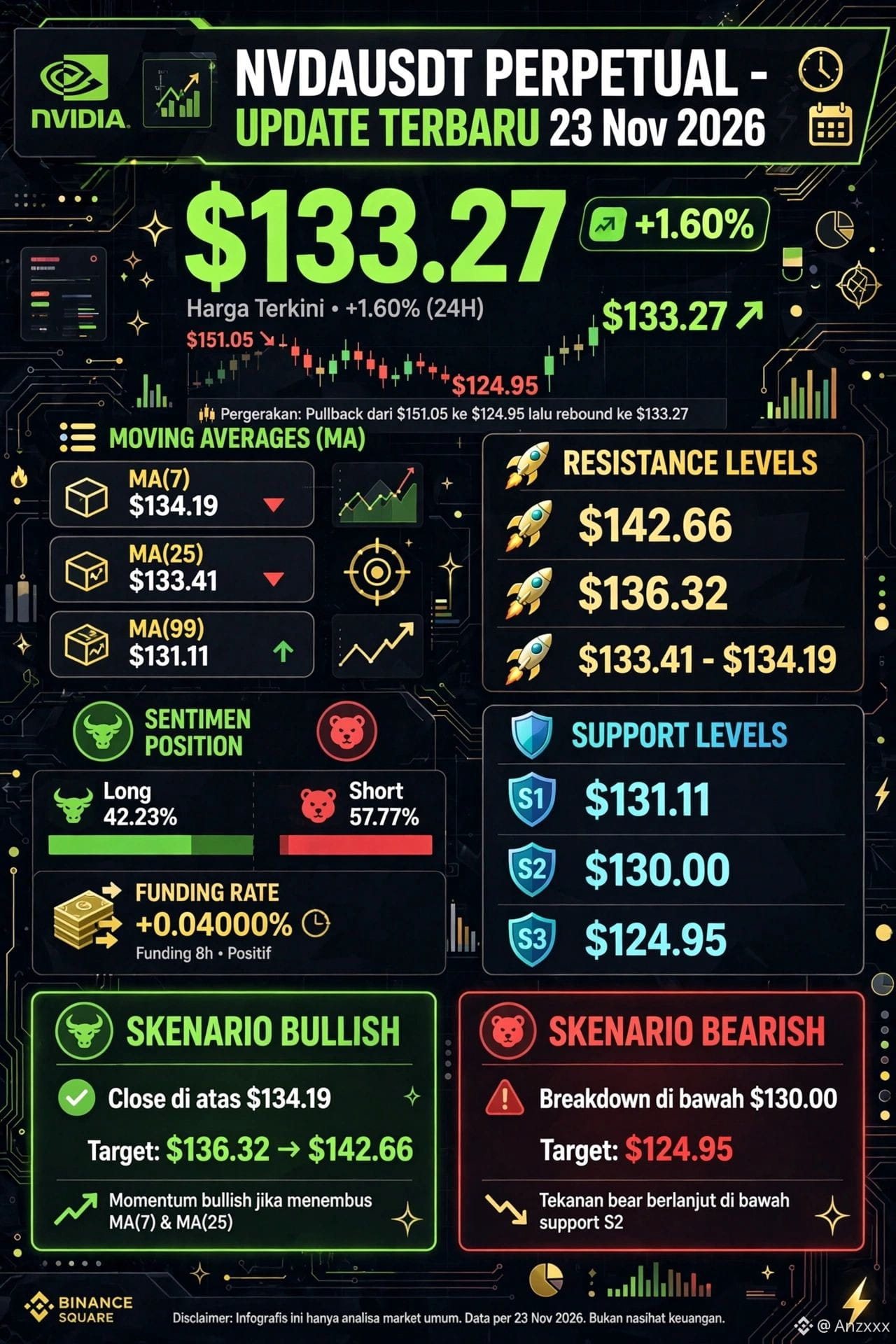
UPDATE NVDAUSDT PERPETUAL | $133.27 (+1.60%)
After briefly falling to $124.95 from $151.05, $NVDA finally rebounded and is now holding at $133.27.
But is this a reversal, or just a dead cat bounce?
1. MA STRUCTURE
- MA(7): $134.19
- MA(25): $133.41
- MA(99): $131.11
Price is still below MA7 & MA25, but remains above MA99. This means short-term momentum is still weak, but medium-term support is holding.
2. MARKET SENTIMENT
- Long: 42.23% vs Short: 57.77%
- Funding Rate: +0.04000%
The majority are still Short, but Longs are paying funding. This creates conditions for a squeeze in either direction.
3. KEY LEVELS
*Resistance:*
R1: $133.41 - $134.19
R2: $136.32
R3: $142.66
Support:
S1: $131.11
S2: $130.00
S3: $124.95
4. SCENARIOS
Bullish: Confirmed if it closes above $134.19 with volume. Target $136.32, then $142.66.
Bearish: Confirmed if it breaks down below $130.00. Target a retest of $124.95.
The key level is $134.19. Until it breaks above that level, don't FOMO. Until it breaks down below $130.00, don't panic.
What do you think—will NVDA break out to $136.32 first or retest $124.95 first? Comment below 👇
$NEAR
$TAO
*Disclaimer:* This content is for educational and analytical purposes only, and is not financial advice. Always DYOR and manage risk wisely.
1
142
#NVDIA 🚨 NVIDIA BOARD REPORTEDLY DIVIDED OVER JENSEN HUANG’S POTENTIAL RETURN
NVIDIA is facing a fresh wave of leadership uncertainty as reports suggest that the company’s board may be divided over the possibility of Jensen Huang returning to a leadership role.
Huang’s name remains deeply connected with NVIDIA’s incredible AI-driven growth. Under his leadership, NVIDIA transformed from a major chipmaker into one of the world’s most important players in the AI revolution.
But now, the reported internal debate is raising a bigger question:
👉 Could Jensen Huang actually make a comeback — or is NVIDIA preparing for a new leadership era?
🔥 Why This Matters for Investors
🔹 Leadership stability: Markets generally dislike uncertainty at the top.
🔹 AI dominance: NVIDIA’s future depends heavily on maintaining its advantage in AI chips, data centers and next-generation computing.
🔹 Investor sentiment: Any major leadership development involving Huang could create significant volatility around NVIDIA shares.
🔹 Boardroom decisions: If the board is genuinely divided, the situation could become an important story for investors and the broader tech market.
For now, investors should treat these reports as unconfirmed speculation, not a finalized leadership decision.
One thing is certain: Jensen Huang’s role at NVIDIA is far bigger than just a CEO title — his leadership has become closely associated with the company’s AI success story.
📌 Could Jensen Huang return, or is NVIDIA ready to move forward without him?
What do you think? 👇
Bullish on NVIDIA 🚀 or concerned about the leadership uncertainty?
⚠️ Do your own research (DYOR). This post is for informational purposes only and is not financial advice.
#NVIDIA #NVDA #JensenHuang #AI #ArtificialIntelligence #StockMarket #TechStocks #Investing #Nasdaq #BinanceSquare
63
BREAKING NEWS💥💥💥
#NVDIA might fall and encounter the strongest competitor they can ever imagine👽👽👽
#JensenHuang is reportedly considering starting a new semiconductor company—seen here as a serious threat.
Given his deep insider knowledge of Nvidia, CUDA, and its engineering teams, any venture he launches could quickly become Nvidia's biggest competitor. The piece compares this to #Anthropic : former #OpenAI core members left to found a rival that became OpenAI's fiercest competitor and successfully went public. Since Huang knows Nvidia even better, the threat is portrayed as even greater.
$NVDAB
5
321
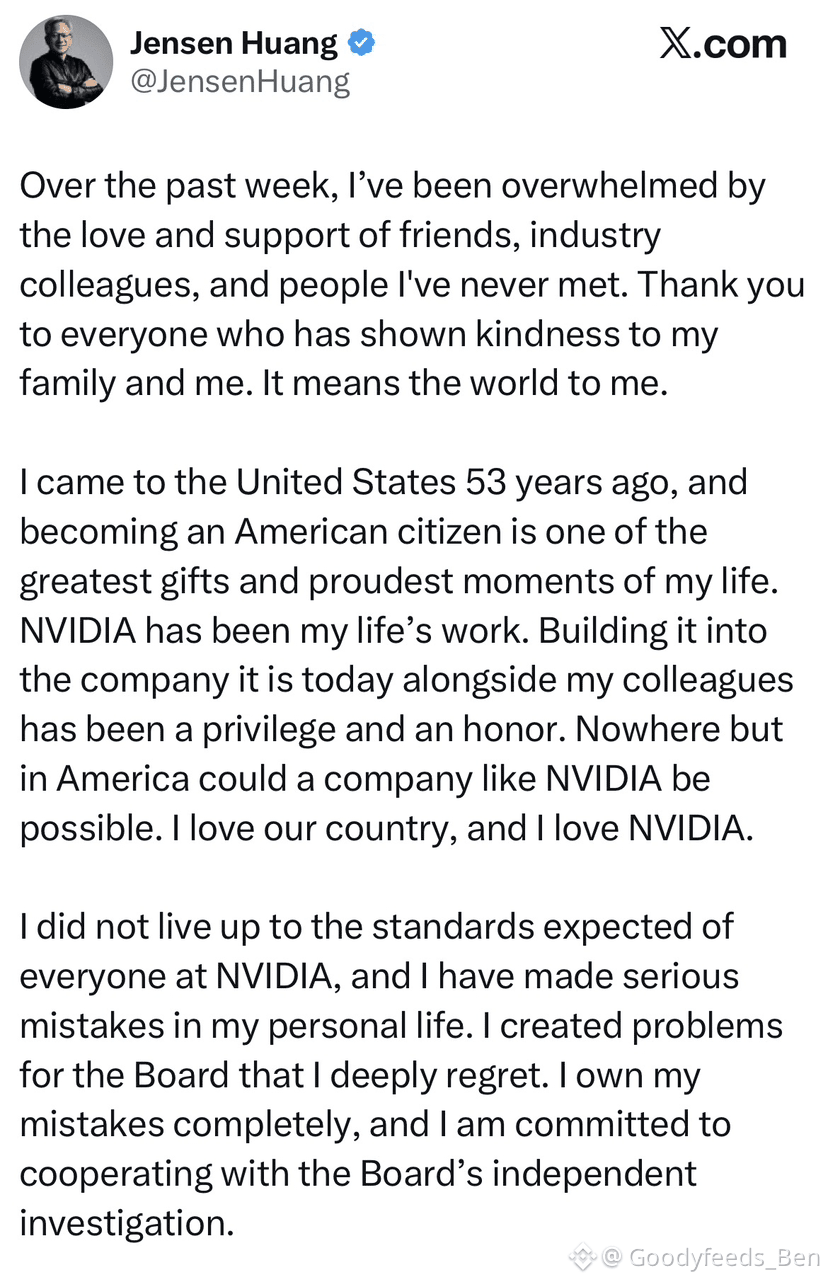
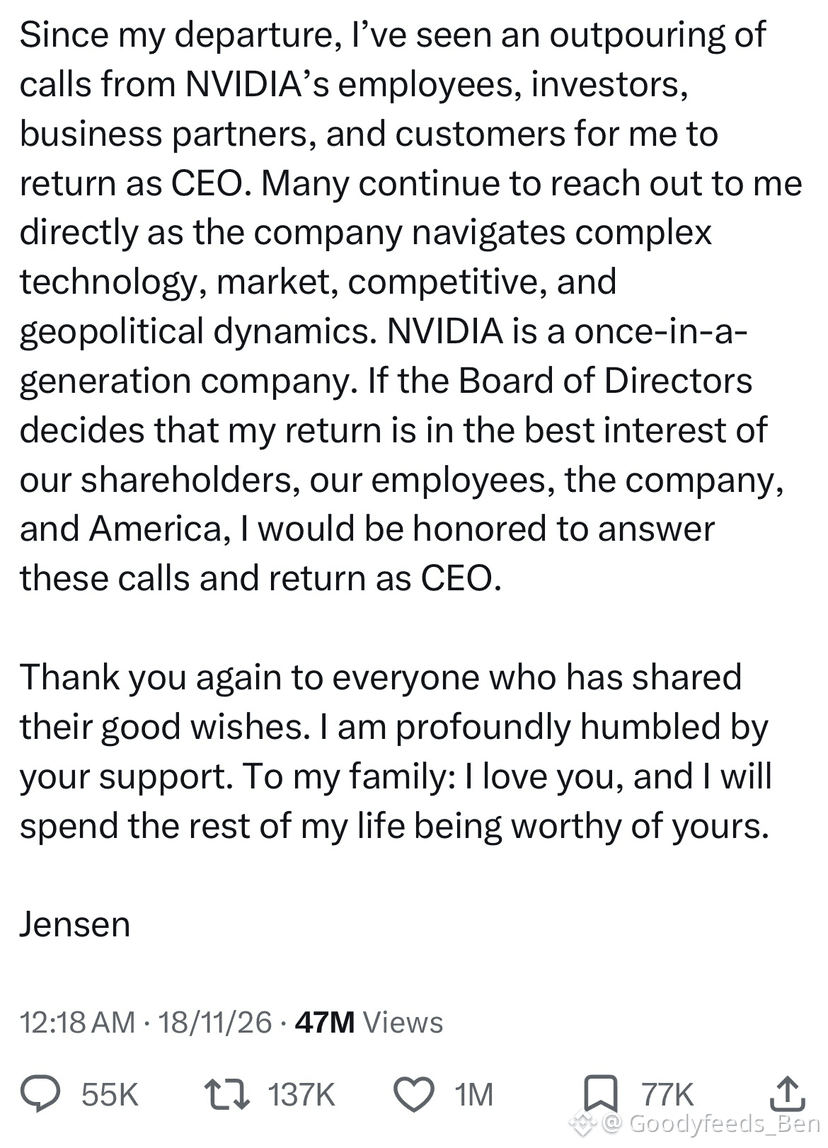
Great new!!☕️☕️☕️
$NVDA might pump back to where it is again!!!
#JensenHuang might be coming back as CEO of #NVDIA
Reading from his tweets, I can sense that there is a possibility that board of directors of nvdia had discussion with him regarding his return.
I guess that the purpose of his tweet is to see how the public react to when he says he wants to return.
There are a lot of supports from some investors and tech figures for his return, even #TRUMP said that Jensen is a great leader.
However, the decision-making authority still lies with the board, we need to see if they will change their decision based on the pressure from the supporters of Jensen.
So do u think that Jensen’s post is a hint that he will return? Or it is just Jensen’s own personal willingness?
5
420

So, come on, admit it: what hopes did you have that Huang would come back? 🤔 Honestly, I’m saying it like it is: I don’t care, and I think 99 percent of people here don’t care either. 1% don’t even know who he is 😁😁‼️‼️
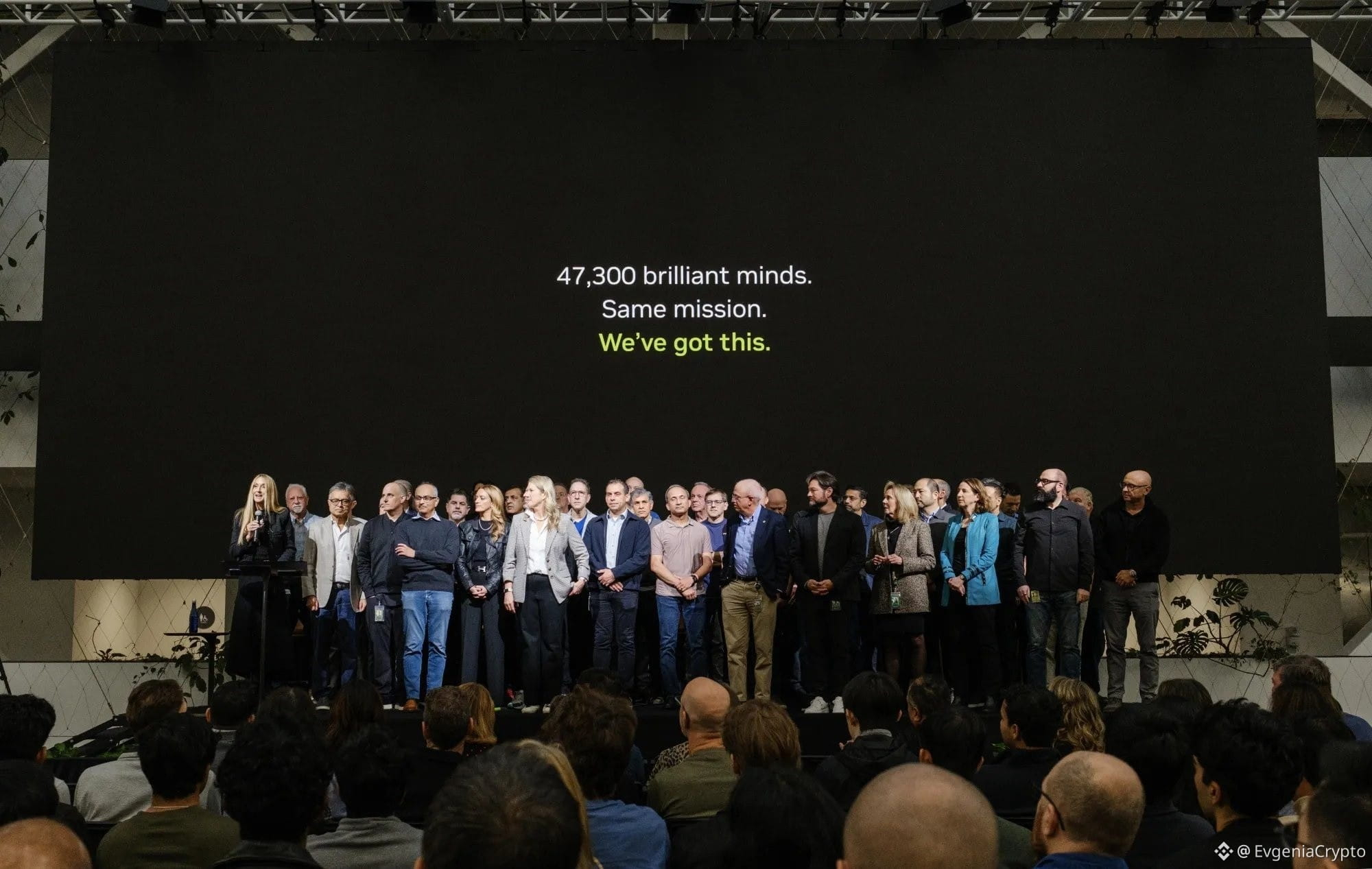
But if you’re an investor or a holder and you’re following the news in the hope that he’ll return, it’s not going to happen. In short, there was a meeting of minds $NVDA . Colette, the acting CEO, said, “We’ll manage. We don’t need a washed-up has-been; the corporation’s employees are brilliant minds.”
So here’s the conclusion: Huang screwed up his own creation. They don’t need him; everything’s already been developed, and they need new minds. Alain Delon can go rest 🤷♀️
$NVDAon
#NVDIA #NVDAUSDT
2
365

·
--
Bullish
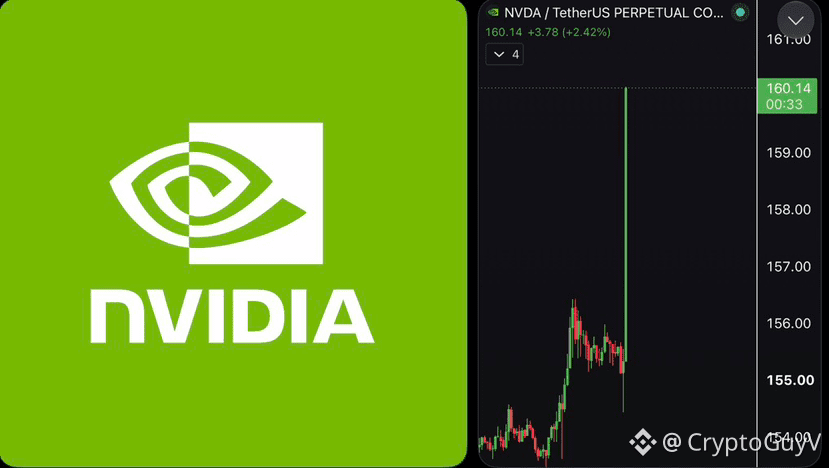
NVIDIA $NVDA Q3 EARNINGS CAME IN AT $155.84 BILLION BEATING EXPECTATIONS
THE STOCK JUST PUMPED OVER 4%
#NVDIA
NVIDIA $NVDA Q3 EARNINGS CAME IN AT $155.84 BILLION BEATING EXPECTATIONS
THE STOCK JUST PUMPED OVER 4%
#NVDIA
THE STOCK JUST PUMPED OVER 4%
#NVDIA
1
536

$NVDA
{future}(NVDAUSDT)
Reports earnings tonight, and I actually think people who are bullish on Nvidia should be more cautious.
Not because I'm bearish on $NVDA .
It's because a good company, good earnings, and a good stock price are completely different things.
Nvidia's earnings may continue to grow, but if the market has already priced in several years of future growth, the stock may not rise even if earnings beat expectations.
I think there's a question worth discussing.
Being equally bullish on Nvidia, buying the stock and opening a 10x perpetual contract are actually two completely different trades.
When you buy the stock, you own a beneficial interest in the company. As long as the company is still around and you don't actively sell, you can keep waiting for the fundamentals to play out—though of course, you also bear the risk of the stock price falling.
When you buy a stock perpetual contract, you don't own the stock or have any right to shareholder dividends.
What you're buying is exposure to its price.
10x leverage means that if the stock moves 5% against you, you theoretically lose half your margin.
At close to 10%, you may be liquidated before the price even falls that far.
On top of that, there are a few easily overlooked things about stock perpetual contracts:
① They trade 24/7, so prices can keep moving even when the U.S. stock market is closed.
② Funding fees are usually settled every 8 hours, so with a long-term position, it's not just about whether the stock price rises or falls.
③ Gaps after earnings, liquidity, and changes in mark price may make your actual liquidation risk greater than you expect.
I'm increasingly convinced that many people don't lose because they picked the wrong stock, but because they turned a long-term view into a short-term leveraged trade.
You believe $NVDA AI business will do well over the next three years, yet you use 10x leverage to bet on its share price at 1 a.m. tomorrow.
#NVDIA
$NVDA
Reports earnings tonight, and I actually think people who are bullish on Nvidia should be more cautious.
Not because I'm bearish on $NVDA .
It's because a good company, good earnings, and a good stock price are completely different things.
Nvidia's earnings may continue to grow, but if the market has already priced in several years of future growth, the stock may not rise even if earnings beat expectations.
I think there's a question worth discussing.
Being equally bullish on Nvidia, buying the stock and opening a 10x perpetual contract are actually two completely different trades.
When you buy the stock, you own a beneficial interest in the company. As long as the company is still around and you don't actively sell, you can keep waiting for the fundamentals to play out—though of course, you also bear the risk of the stock price falling.
When you buy a stock perpetual contract, you don't own the stock or have any right to shareholder dividends.
What you're buying is exposure to its price.
10x leverage means that if the stock moves 5% against you, you theoretically lose half your margin.
At close to 10%, you may be liquidated before the price even falls that far.
On top of that, there are a few easily overlooked things about stock perpetual contracts:
① They trade 24/7, so prices can keep moving even when the U.S. stock market is closed.
② Funding fees are usually settled every 8 hours, so with a long-term position, it's not just about whether the stock price rises or falls.
③ Gaps after earnings, liquidity, and changes in mark price may make your actual liquidation risk greater than you expect.
I'm increasingly convinced that many people don't lose because they picked the wrong stock, but because they turned a long-term view into a short-term leveraged trade.
You believe $NVDA AI business will do well over the next three years, yet you use 10x leverage to bet on its share price at 1 a.m. tomorrow.
#NVDIA
5
·
--
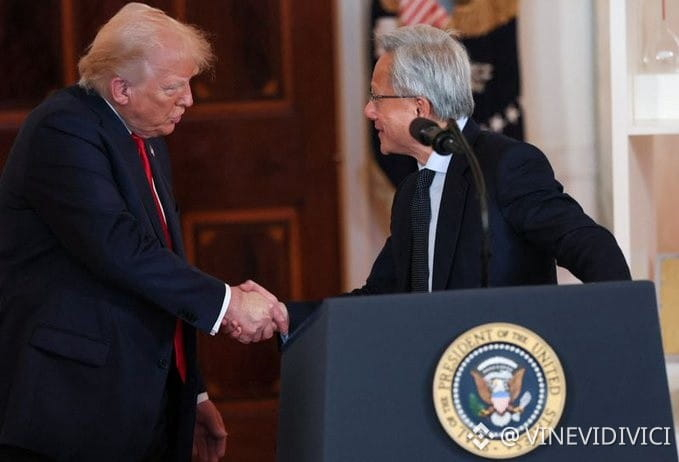
President Donald Trump said he would welcome Jensen Huang’s return as Nvidia’s
$NVDA
{future}(NVDAUSDT)
CEO, defending the former executive against national security concerns following his recent resignation over alleged personal relationships. Trump stated that Huang "didn't put national security at risk," though he criticized Huang's personal conduct regarding a reported relationship with a former Megaspeed International executive accused of having ties to Chinese intelligence.#JensenHuang #Trump #NVdia
President Donald Trump said he would welcome Jensen Huang’s return as Nvidia’s
$NVDA
CEO, defending the former executive against national security concerns following his recent resignation over alleged personal relationships. Trump stated that Huang "didn't put national security at risk," though he criticized Huang's personal conduct regarding a reported relationship with a former Megaspeed International executive accused of having ties to Chinese intelligence.#JensenHuang #Trump #NVdia
202
·
--
Bullish
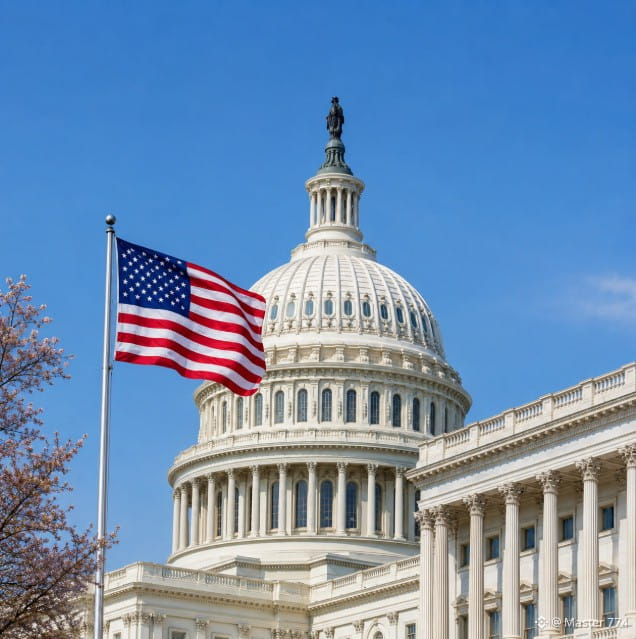
BREAKING: After the Nvidia scandal, Congress moves to pass 4 bills, one letting it BLOCK chip sales to China that Trump approved.
That means lawmakers could stop chip deals with China even after the White House signs off.
Both parties back the bills, which could ride on a must-pass defense bill Trump is unlikely to veto.
"Washington is not ready to move on," Beacon Research analyst Owen Tedford told the FT.
Separately, the WSJ says Alice Huang's former firm, Megaspeed, arranged nearly $12 BILLION of Nvidia chips for companies in China.
Lawmakers now want Commerce Secretary Howard Lutnick to explain how Nvidia was allowed to sell chips to Megaspeed.
$NVDA
#NVDIA
{future}(NVDAUSDT)
BREAKING: After the Nvidia scandal, Congress moves to pass 4 bills, one letting it BLOCK chip sales to China that Trump approved.
That means lawmakers could stop chip deals with China even after the White House signs off.
Both parties back the bills, which could ride on a must-pass defense bill Trump is unlikely to veto.
"Washington is not ready to move on," Beacon Research analyst Owen Tedford told the FT.
Separately, the WSJ says Alice Huang's former firm, Megaspeed, arranged nearly $12 BILLION of Nvidia chips for companies in China.
Lawmakers now want Commerce Secretary Howard Lutnick to explain how Nvidia was allowed to sell chips to Megaspeed.
$NVDA
#NVDIA
Master 774
·
--
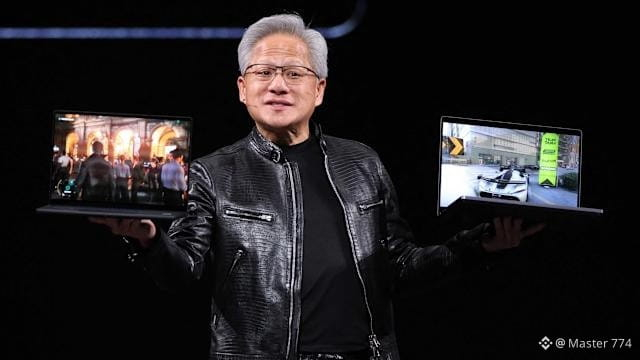
Bullish🇺🇸🇨🇳 A $3.2 BILLION NVIDIA-RELATED AI PIPELINE HAS BEEN UNCOVERED IN CHINA!!!
Despite U.S. export restrictions, Chinese companies, universities, and government-backed projects are still building AI infrastructure around restricted Nvidia chips.
More than 150 procurement notices, contracts, and corporate disclosures reveal projects worth over $3.2 BILLION.
Huang previously claimed Nvidia's market share in China had fallen from 95% to ZERO, yet Chinese projects are still planning around Nvidia's H100, H200, and H800 processors.
$NVDA
Despite U.S. export restrictions, Chinese companies, universities, and government-backed projects are still building AI infrastructure around restricted Nvidia chips.
More than 150 procurement notices, contracts, and corporate disclosures reveal projects worth over $3.2 BILLION.
Huang previously claimed Nvidia's market share in China had fallen from 95% to ZERO, yet Chinese projects are still planning around Nvidia's H100, H200, and H800 processors.
$NVDA
91
Log in to explore more content
Join global crypto users on Binance Square
⚡️ Get latest and useful information about crypto.
💬 Trusted by the world’s largest crypto exchange.
👍 Discover real insights from verified creators.
Email / Phone number
Trending Topics
1
#Bitcoin'sReboundFadesBelow$60K
6,840 views
142 Discussing
2
#NVIDIAReinstatesJensenHuangasCEO
254,620 views
1,705 Discussing
3
#WillMarketsStageAThanksgivingReliefRally?
331,556 views
2,451 Discussing
4
#WillOctCorePCEShiftFedHikeExpectations?
117,618 views
1,199 Discussing
5
#EvolveAtBinanceBlockchainWeek
238,825 views
1,505 Discussing
6
#SouthKoreaBeginsCryptoProviderShareholderReviews
4,818 views
111 Discussing
7
#USAddsMegaspeedToEntityList
9,632 views
185 Discussing
8
#GrayscaleLaunches2xLeveragedZcashETF
6,359 views
124 Discussing
9
#StrategyValueFallsBelowItsBitcoinHoldings
5,193 views
129 Discussing
10
#CFTCRequiresAtLeast20%HaircutsOnBTCAndETHReserves
2,678 views
89 Discussing