
#cybersecurity
cybersecurity
1.6M views
3,921 Discussing
Hot
Latest

·
--
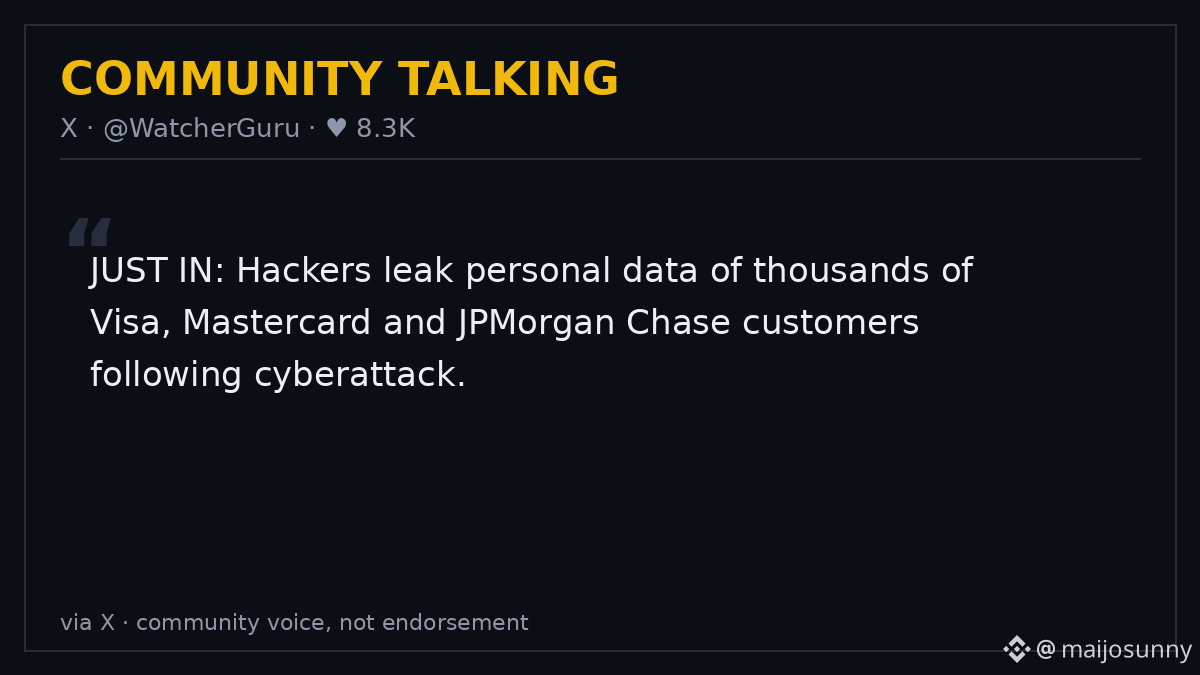
Your bank leaked your data this week. Your wallet never asked for it. Coincidence?
Visa, Mastercard and JPMorgan Chase all landed on ransomware group n0n's leak site on Nov 16, with a 48-hour countdown. On Thursday, the data went public.
What actually leaked (WSJ / NY Post):
• JPMorgan: emails, phone numbers and account IDs of 16,000 of its wealthiest customers, from its Reserve program
• Visa: Asia-Pacific cardholder program records, via a third-party provider
• Mastercard: a limited set of benefit-program records
⚠️ What it is NOT: no card numbers were confirmed exposed anywhere. Visa says its own systems were not involved. JPMorgan says the Nov 16 outage was a software bug, not a cyberattack.
🤔 Why should crypto traders care?
Your email and phone are the raw material for the next phishing wave, and crypto holders are the top targets. Attackers go after the weakest link, and it is rarely the cryptography: vendor gets hit, your inbox becomes the attack surface, one convincing "bank" email, wallet drained.
My take: this is not about card numbers. It is about how many copies of you exist in databases you never chose. Self-custody removes one copy, your coins, but your identity still lives in vendor systems.
✅ Action Required:
• Don't click links in "bank" emails, open the official app instead
• Expect phishing texts using your real name and account details
• Verify any wallet message twice before signing anything
Bottom line: TradFi's data model leaks. The question is whether the market treats that as a crypto use case, or just another headline.
$BTC sits at $62,298 (-0.68% 24h) while Fear & Greed reads 10, Extreme Fear (alternative.me). Traders are not pricing a TradFi trust crisis yet.
Is this the week "trust us with your data" finally breaks, or a headline we forget by Monday? 👇
Not financial advice. DYOR.
#crypto #CyberSecurity #DataBreach
Your bank leaked your data this week. Your wallet never asked for it. Coincidence?
Visa, Mastercard and JPMorgan Chase all landed on ransomware group n0n's leak site on Nov 16, with a 48-hour countdown. On Thursday, the data went public.
What actually leaked (WSJ / NY Post):
• JPMorgan: emails, phone numbers and account IDs of 16,000 of its wealthiest customers, from its Reserve program
• Visa: Asia-Pacific cardholder program records, via a third-party provider
• Mastercard: a limited set of benefit-program records
⚠️ What it is NOT: no card numbers were confirmed exposed anywhere. Visa says its own systems were not involved. JPMorgan says the Nov 16 outage was a software bug, not a cyberattack.
🤔 Why should crypto traders care?
Your email and phone are the raw material for the next phishing wave, and crypto holders are the top targets. Attackers go after the weakest link, and it is rarely the cryptography: vendor gets hit, your inbox becomes the attack surface, one convincing "bank" email, wallet drained.
My take: this is not about card numbers. It is about how many copies of you exist in databases you never chose. Self-custody removes one copy, your coins, but your identity still lives in vendor systems.
✅ Action Required:
• Don't click links in "bank" emails, open the official app instead
• Expect phishing texts using your real name and account details
• Verify any wallet message twice before signing anything
Bottom line: TradFi's data model leaks. The question is whether the market treats that as a crypto use case, or just another headline.
$BTC sits at $62,298 (-0.68% 24h) while Fear & Greed reads 10, Extreme Fear (alternative.me). Traders are not pricing a TradFi trust crisis yet.
Is this the week "trust us with your data" finally breaks, or a headline we forget by Monday? 👇
Not financial advice. DYOR.
#crypto #CyberSecurity #DataBreach
Visa, Mastercard and JPMorgan Chase all landed on ransomware group n0n's leak site on Nov 16, with a 48-hour countdown. On Thursday, the data went public.
What actually leaked (WSJ / NY Post):
• JPMorgan: emails, phone numbers and account IDs of 16,000 of its wealthiest customers, from its Reserve program
• Visa: Asia-Pacific cardholder program records, via a third-party provider
• Mastercard: a limited set of benefit-program records
⚠️ What it is NOT: no card numbers were confirmed exposed anywhere. Visa says its own systems were not involved. JPMorgan says the Nov 16 outage was a software bug, not a cyberattack.
🤔 Why should crypto traders care?
Your email and phone are the raw material for the next phishing wave, and crypto holders are the top targets. Attackers go after the weakest link, and it is rarely the cryptography: vendor gets hit, your inbox becomes the attack surface, one convincing "bank" email, wallet drained.
My take: this is not about card numbers. It is about how many copies of you exist in databases you never chose. Self-custody removes one copy, your coins, but your identity still lives in vendor systems.
✅ Action Required:
• Don't click links in "bank" emails, open the official app instead
• Expect phishing texts using your real name and account details
• Verify any wallet message twice before signing anything
Bottom line: TradFi's data model leaks. The question is whether the market treats that as a crypto use case, or just another headline.
$BTC sits at $62,298 (-0.68% 24h) while Fear & Greed reads 10, Extreme Fear (alternative.me). Traders are not pricing a TradFi trust crisis yet.
Is this the week "trust us with your data" finally breaks, or a headline we forget by Monday? 👇
Not financial advice. DYOR.
#crypto #CyberSecurity #DataBreach
7

🚨 $BTC BTCPAY SERVER EMERGENCY PATCH RELEASE 🛡️
📊 The latest CERT‑EU advisory flags five Nginx flaws that could let hostile code execute without a login—an institutional red flag for any on‑chain payment gateway. 🦈 Smart‑money operators are already scanning for lingering vulnerable nodes across the network.
⚡ Operators must upgrade to Nginx 1.31.9 immediately; the window for exploitation remains open despite no reported incidents. 📌 Prompt remediation protects merchant liquidity pools and keeps the Bitcoin payment stack resilient.
💬 How quickly will your node adopt the patch? 👇
⚠️ Not financial advice. Always manage your risk. 🛡️
🏷️ #BTC #CyberSecurity #BTCPay #Patch #Crypto
🛡️ 🔥
🚨 $BTC BTCPAY SERVER EMERGENCY PATCH RELEASE 🛡️
📊 The latest CERT‑EU advisory flags five Nginx flaws that could let hostile code execute without a login—an institutional red flag for any on‑chain payment gateway. 🦈 Smart‑money operators are already scanning for lingering vulnerable nodes across the network.
⚡ Operators must upgrade to Nginx 1.31.9 immediately; the window for exploitation remains open despite no reported incidents. 📌 Prompt remediation protects merchant liquidity pools and keeps the Bitcoin payment stack resilient.
💬 How quickly will your node adopt the patch? 👇
⚠️ Not financial advice. Always manage your risk. 🛡️
🏷️ #BTC #CyberSecurity #BTCPay #Patch #Crypto
🛡️ 🔥
📊 The latest CERT‑EU advisory flags five Nginx flaws that could let hostile code execute without a login—an institutional red flag for any on‑chain payment gateway. 🦈 Smart‑money operators are already scanning for lingering vulnerable nodes across the network.
⚡ Operators must upgrade to Nginx 1.31.9 immediately; the window for exploitation remains open despite no reported incidents. 📌 Prompt remediation protects merchant liquidity pools and keeps the Bitcoin payment stack resilient.
💬 How quickly will your node adopt the patch? 👇
⚠️ Not financial advice. Always manage your risk. 🛡️
🏷️ #BTC #CyberSecurity #BTCPay #Patch #Crypto
🛡️ 🔥
2


·
--
🛠️ BTCPay Server pushes emergency fix for 5 security flaws
BTCPay Server, the self-hosted Bitcoin payment software, released an emergency update patching five vulnerabilities in Nginx, the component that routes web traffic to its payment app. An advisory from the EU's cybersecurity response team CERT-EU warned the flaws could let attackers run malicious code remotely without logging in. No attacks had been reported as of Wednesday, and operators are urged to move to Nginx 1.31.9 right away.
⭐ It follows two earlier BTCPay incidents this year in which attackers stole crypto, a reminder that merchants accepting Bitcoin need to patch fast.
#Bitcoin #BTCPay #CyberSecurity #CryptoSecurity
🛠️ BTCPay Server pushes emergency fix for 5 security flaws
BTCPay Server, the self-hosted Bitcoin payment software, released an emergency update patching five vulnerabilities in Nginx, the component that routes web traffic to its payment app. An advisory from the EU's cybersecurity response team CERT-EU warned the flaws could let attackers run malicious code remotely without logging in. No attacks had been reported as of Wednesday, and operators are urged to move to Nginx 1.31.9 right away.
⭐ It follows two earlier BTCPay incidents this year in which attackers stole crypto, a reminder that merchants accepting Bitcoin need to patch fast.
#Bitcoin #BTCPay #CyberSecurity #CryptoSecurity
BTCPay Server, the self-hosted Bitcoin payment software, released an emergency update patching five vulnerabilities in Nginx, the component that routes web traffic to its payment app. An advisory from the EU's cybersecurity response team CERT-EU warned the flaws could let attackers run malicious code remotely without logging in. No attacks had been reported as of Wednesday, and operators are urged to move to Nginx 1.31.9 right away.
⭐ It follows two earlier BTCPay incidents this year in which attackers stole crypto, a reminder that merchants accepting Bitcoin need to patch fast.
#Bitcoin #BTCPay #CyberSecurity #CryptoSecurity
53

HAPI
🚀 HAPI PROTOCOL – THE FUTURE OF WEB3 SECURITY
Could HAPI reach $280 per coin in the future?
🌐 Blockchain Cybersecurity
🛡️ AI-Powered Threat Detection
🔗 Multi-Chain Security
🆔 Web3 Digital Identity
A small-supply project with a big vision.
DREAM BIG. RESEARCH DEEP. THINK LONG TERM.
🎯 Speculative Future Target: $280 per HAPI
#HAPI #Crypto #Web3 #Blockchain #CyberSecurity cybersecurity
HAPI
🚀 HAPI PROTOCOL – THE FUTURE OF WEB3 SECURITY
Could HAPI reach $280 per coin in the future?
🌐 Blockchain Cybersecurity
🛡️ AI-Powered Threat Detection
🔗 Multi-Chain Security
🆔 Web3 Digital Identity
A small-supply project with a big vision.
DREAM BIG. RESEARCH DEEP. THINK LONG TERM.
🎯 Speculative Future Target: $280 per HAPI
#HAPI #Crypto #Web3 #Blockchain #CyberSecurity cybersecurity
🚀 HAPI PROTOCOL – THE FUTURE OF WEB3 SECURITY
Could HAPI reach $280 per coin in the future?
🌐 Blockchain Cybersecurity
🛡️ AI-Powered Threat Detection
🔗 Multi-Chain Security
🆔 Web3 Digital Identity
A small-supply project with a big vision.
DREAM BIG. RESEARCH DEEP. THINK LONG TERM.
🎯 Speculative Future Target: $280 per HAPI
#HAPI #Crypto #Web3 #Blockchain #CyberSecurity cybersecurity

3

New court filings expose the full scale of the recent Binance exploit with $6.3B stolen across 11 networks and $3.46B in stablecoins targeted.
#BinanceHack #CyberSecurity
New court filings expose the full scale of the recent Binance exploit with $6.3B stolen across 11 networks and $3.46B in stablecoins targeted.
#BinanceHack #CyberSecurity
#BinanceHack #CyberSecurity
30

·
--
#AI did not directly cause the recent system outage.
According to report ai model found many security issue and company rushed to fix them before a hacker could attack.
Too many urgent update put pressure on system and caused disruption.
This show how ai can help find security risk but fixing them too quickly can create new problem.
{future}(BTCUSDT)
#CyberSecurity #Technology
#AI did not directly cause the recent system outage.
According to report ai model found many security issue and company rushed to fix them before a hacker could attack.
Too many urgent update put pressure on system and caused disruption.
This show how ai can help find security risk but fixing them too quickly can create new problem.
#CyberSecurity #Technology
According to report ai model found many security issue and company rushed to fix them before a hacker could attack.
Too many urgent update put pressure on system and caused disruption.
This show how ai can help find security risk but fixing them too quickly can create new problem.
#CyberSecurity #Technology

1
16
897

·
--
Bearish
30D trade $ZEC 273.8 USDT
🚨 178 MAJOR WEBSITES COMPROMISED. CRYPTO USERS ARE IN THE CROSSHAIRS!
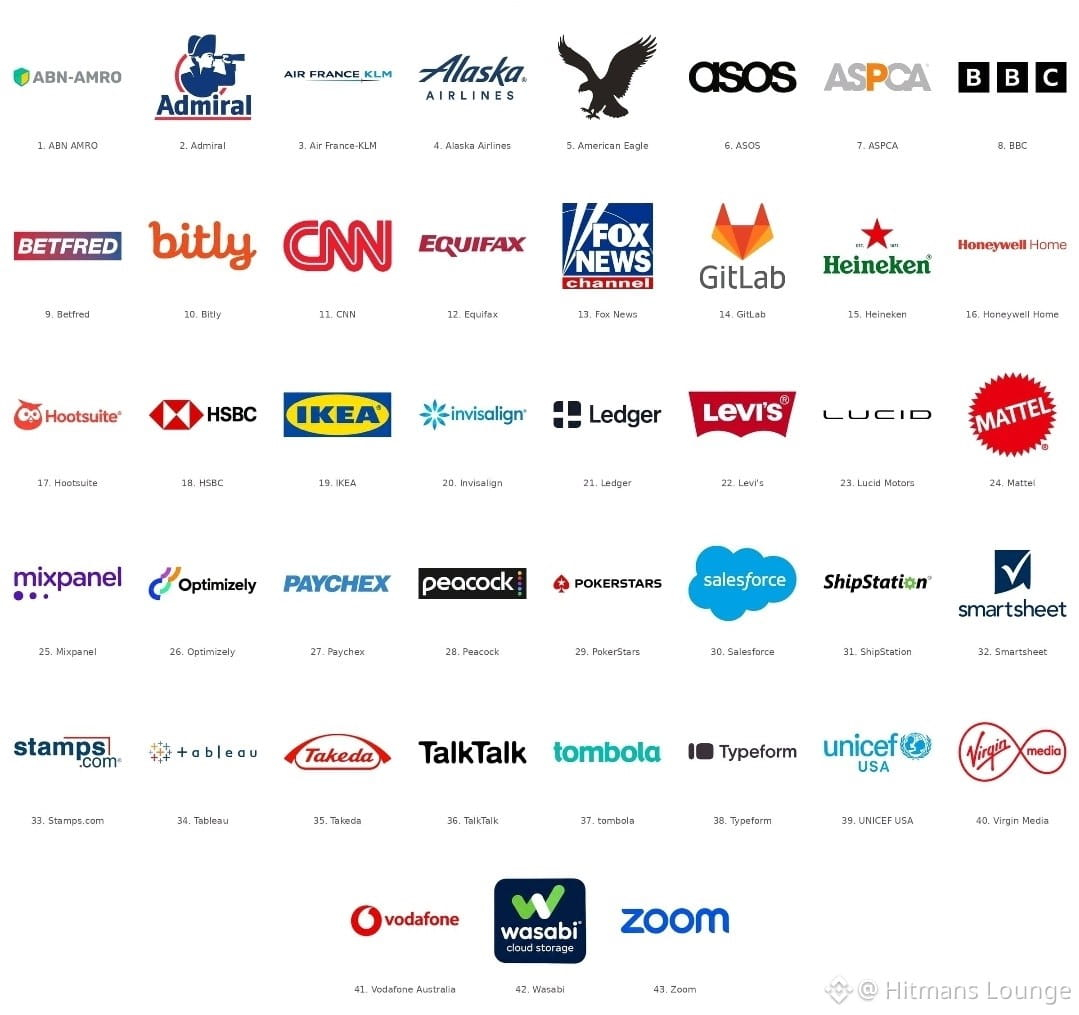
This wasn't a direct hack of 178 companies. Attackers reportedly exploited a vulnerability in Optimizely, injecting malicious JavaScript into websites used by Zoom, BBC, HSBC, Ledger and others.
The potential damage is serious:
🔴 Crypto wallet addresses replaced with attackers' addresses.
🔴 Payment card details and browsing data targeted.
🔴 Older iPhones exposed to additional exploit attempts.
📊 The numbers: Researchers identified 188 infected scripts across 178 organizations. Attacker-linked wallets received approximately $7,040, although the total confirmed victim losses remain unclear.
Optimizely says it fixed the vulnerability and removed malicious code.
My biggest takeaway: even trusted websites can become attack vectors through third-party software.
⚠️ Always verify wallet addresses character by character before confirming transactions.
Is crypto security becoming a bigger challenge than crypto adoption?
#CryptoSecurity #Cybersecurity #HackerAlert #AnthropicClearedToListOnNasdaqAsANT
$BTC $ZEC $MMT
{future}(MMTUSDT)
{future}(ZECUSDT)
{future}(BTCUSDT)
🚨 178 MAJOR WEBSITES COMPROMISED. CRYPTO USERS ARE IN THE CROSSHAIRS!
This wasn't a direct hack of 178 companies. Attackers reportedly exploited a vulnerability in Optimizely, injecting malicious JavaScript into websites used by Zoom, BBC, HSBC, Ledger and others.
The potential damage is serious:
🔴 Crypto wallet addresses replaced with attackers' addresses.
🔴 Payment card details and browsing data targeted.
🔴 Older iPhones exposed to additional exploit attempts.
📊 The numbers: Researchers identified 188 infected scripts across 178 organizations. Attacker-linked wallets received approximately $7,040, although the total confirmed victim losses remain unclear.
Optimizely says it fixed the vulnerability and removed malicious code.
My biggest takeaway: even trusted websites can become attack vectors through third-party software.
⚠️ Always verify wallet addresses character by character before confirming transactions.
Is crypto security becoming a bigger challenge than crypto adoption?
#CryptoSecurity #Cybersecurity #HackerAlert #AnthropicClearedToListOnNasdaqAsANT
$BTC $ZEC $MMT
This wasn't a direct hack of 178 companies. Attackers reportedly exploited a vulnerability in Optimizely, injecting malicious JavaScript into websites used by Zoom, BBC, HSBC, Ledger and others.
The potential damage is serious:
🔴 Crypto wallet addresses replaced with attackers' addresses.
🔴 Payment card details and browsing data targeted.
🔴 Older iPhones exposed to additional exploit attempts.
📊 The numbers: Researchers identified 188 infected scripts across 178 organizations. Attacker-linked wallets received approximately $7,040, although the total confirmed victim losses remain unclear.
Optimizely says it fixed the vulnerability and removed malicious code.
My biggest takeaway: even trusted websites can become attack vectors through third-party software.
⚠️ Always verify wallet addresses character by character before confirming transactions.
Is crypto security becoming a bigger challenge than crypto adoption?
#CryptoSecurity #Cybersecurity #HackerAlert #AnthropicClearedToListOnNasdaqAsANT
$BTC $ZEC $MMT
1
1k

·
--
🚨 CRYPTO USERS, YOUR WALLET MAY NOT BE AS SAFE AS YOU THINK!
Reports of a major cybersecurity attack involving 178 brands have raised serious concerns across the digital world.
The reported risks include:
🔴 Crypto wallet address replacement
🔴 Payment card information theft
🔴 Malicious code targeting users
🔴 Unauthorized crypto transfers
One small mistake while sending crypto could cost you your funds.
Protect yourself:
✅ Always double-check wallet addresses.
✅ Never click suspicious links.
✅ Use 2FA security.
✅ Keep your devices updated.
✅ Send a small test transaction before large transfers.
Crypto security is not optional. It's your responsibility.
Question: Do you manually verify your wallet address before every crypto transaction?
#CryptoSecurity #Bitcoin #CyberSecurity #BinanceSquare #CryptoNews
🚨 CRYPTO USERS, YOUR WALLET MAY NOT BE AS SAFE AS YOU THINK!
Reports of a major cybersecurity attack involving 178 brands have raised serious concerns across the digital world.
The reported risks include:
🔴 Crypto wallet address replacement
🔴 Payment card information theft
🔴 Malicious code targeting users
🔴 Unauthorized crypto transfers
One small mistake while sending crypto could cost you your funds.
Protect yourself:
✅ Always double-check wallet addresses.
✅ Never click suspicious links.
✅ Use 2FA security.
✅ Keep your devices updated.
✅ Send a small test transaction before large transfers.
Crypto security is not optional. It's your responsibility.
Question: Do you manually verify your wallet address before every crypto transaction?
#CryptoSecurity #Bitcoin #CyberSecurity #BinanceSquare #CryptoNews
Reports of a major cybersecurity attack involving 178 brands have raised serious concerns across the digital world.
The reported risks include:
🔴 Crypto wallet address replacement
🔴 Payment card information theft
🔴 Malicious code targeting users
🔴 Unauthorized crypto transfers
One small mistake while sending crypto could cost you your funds.
Protect yourself:
✅ Always double-check wallet addresses.
✅ Never click suspicious links.
✅ Use 2FA security.
✅ Keep your devices updated.
✅ Send a small test transaction before large transfers.
Crypto security is not optional. It's your responsibility.
Question: Do you manually verify your wallet address before every crypto transaction?
#CryptoSecurity #Bitcoin #CyberSecurity #BinanceSquare #CryptoNews

73

🚨 MAJOR CYBERATTACK TARGETS 178+ GLOBAL WEBSITES!
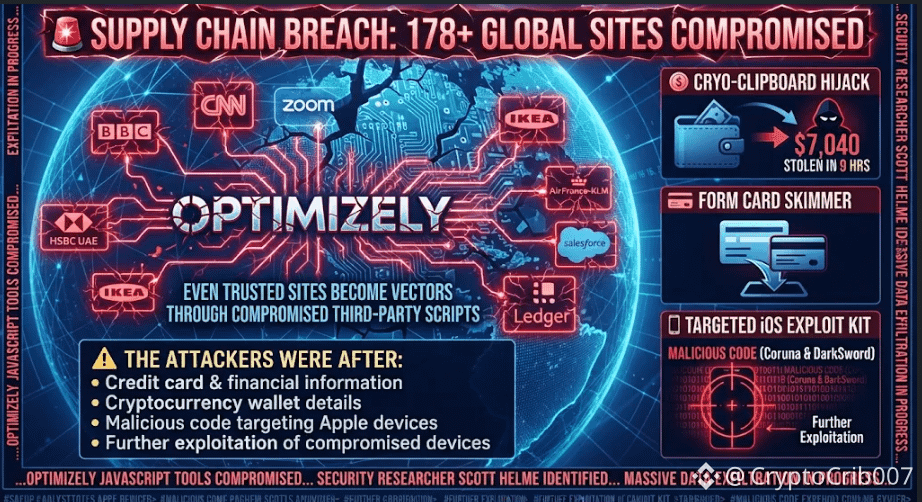
Hackers reportedly compromised JavaScript tools hosted by Optimizely, targeting major websites.
⚠️ What were the attackers after?
• Credit card and financial information
• Cryptocurrency wallet details
• Malicious code targeting Apple devices
• Potential further exploitation of compromised devices
Security researcher Scott Helme reportedly identified the attack, with approximately $7,040 reaching the attackers' crypto wallets in just nine hours.
This incident highlights a critical cybersecurity risk: even trusted websites can become attack vectors when third-party scripts and digital supply chains are compromised.
Your favourite website may be trusted. But can you trust every third-party tool running behind it?
$LAB
{alpha}(560x7ec43cf65f1663f820427c62a5780b8f2e25593a)
$BLUAI
{alpha}(560xed9ae3def8d6f052971bb8b6d1975ff267cf9aad)
$COAI
{alpha}(560x0a8d6c86e1bce73fe4d0bd531e1a567306836ea5)
#CyberSecurity #databreach #Write2Earn #NFA✅ and #DYOR🟢
🚨 MAJOR CYBERATTACK TARGETS 178+ GLOBAL WEBSITES!
Hackers reportedly compromised JavaScript tools hosted by Optimizely, targeting major websites.
⚠️ What were the attackers after?
• Credit card and financial information
• Cryptocurrency wallet details
• Malicious code targeting Apple devices
• Potential further exploitation of compromised devices
Security researcher Scott Helme reportedly identified the attack, with approximately $7,040 reaching the attackers' crypto wallets in just nine hours.
This incident highlights a critical cybersecurity risk: even trusted websites can become attack vectors when third-party scripts and digital supply chains are compromised.
Your favourite website may be trusted. But can you trust every third-party tool running behind it?
$LAB
$BLUAI
$COAI
#CyberSecurity #databreach #Write2Earn #NFA✅ and #DYOR🟢
Hackers reportedly compromised JavaScript tools hosted by Optimizely, targeting major websites.
⚠️ What were the attackers after?
• Credit card and financial information
• Cryptocurrency wallet details
• Malicious code targeting Apple devices
• Potential further exploitation of compromised devices
Security researcher Scott Helme reportedly identified the attack, with approximately $7,040 reaching the attackers' crypto wallets in just nine hours.
This incident highlights a critical cybersecurity risk: even trusted websites can become attack vectors when third-party scripts and digital supply chains are compromised.
Your favourite website may be trusted. But can you trust every third-party tool running behind it?
$LAB
$BLUAI
$COAI
#CyberSecurity #databreach #Write2Earn #NFA✅ and #DYOR🟢
968

·
--
178 Websites. One Security Failure.
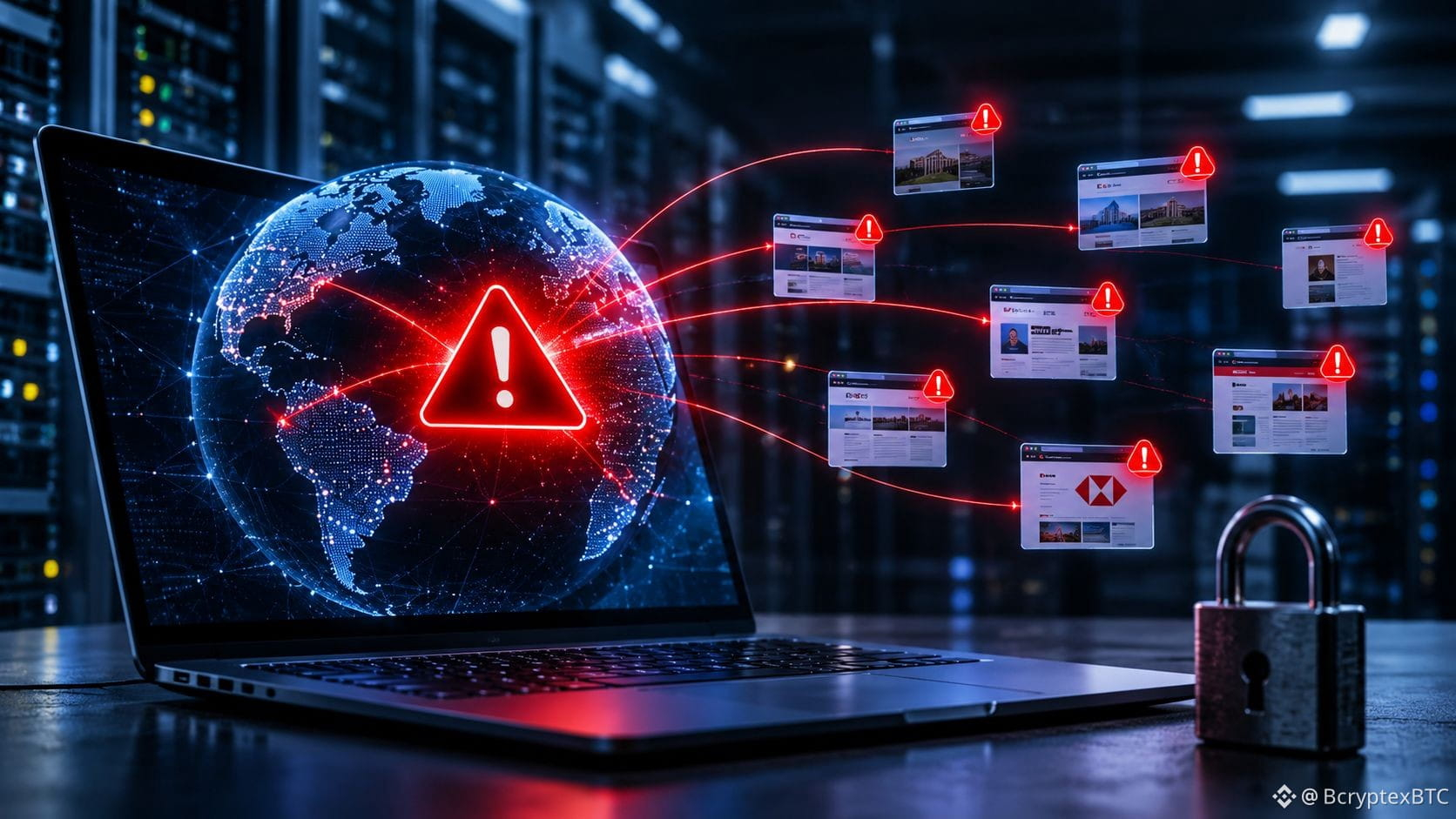
A reported cyberattack affected 178 websites, including HSBC, BBC, and Ledger.
According to the report, 188 Optimizely snippets were infected, while only 24 of 256 affected hosts blocked the malicious payload.
The bigger lesson: third-party tools can expose even established websites to serious security risks.
Protecting your own infrastructure isn't enough if the services you depend on create new vulnerabilities.
Who carries the responsibility when a trusted vendor becomes the weakest link?
#CyberSecurity #Web3 #Blockchain $BTC
178 Websites. One Security Failure.
A reported cyberattack affected 178 websites, including HSBC, BBC, and Ledger.
According to the report, 188 Optimizely snippets were infected, while only 24 of 256 affected hosts blocked the malicious payload.
The bigger lesson: third-party tools can expose even established websites to serious security risks.
Protecting your own infrastructure isn't enough if the services you depend on create new vulnerabilities.
Who carries the responsibility when a trusted vendor becomes the weakest link?
#CyberSecurity #Web3 #Blockchain $BTC
A reported cyberattack affected 178 websites, including HSBC, BBC, and Ledger.
According to the report, 188 Optimizely snippets were infected, while only 24 of 256 affected hosts blocked the malicious payload.
The bigger lesson: third-party tools can expose even established websites to serious security risks.
Protecting your own infrastructure isn't enough if the services you depend on create new vulnerabilities.
Who carries the responsibility when a trusted vendor becomes the weakest link?
#CyberSecurity #Web3 #Blockchain $BTC
HSBCUS+0.00%
2
100

🚨 $BTC HOLDERS ON HIGH ALERT AFTER SOPHISTICATED THIRD-PARTY CLIPBOARD COMPROMISE VULNERABILITY ⚠️
Institutional capital protection requires absolute operational hygiene during execution. A recent third-party script vulnerability across major web testing infrastructure has highlighted severe clipboard manipulation risks for digital asset transfers. 🔍
Malicious code injections can silently swap destination addresses in transit, redirecting funds before confirmation. Always audit the exact destination string character-by-character on hardware displays before authorizing any ledger broadcast. 🛡️
How do you currently verify your destination nodes before executing major asset transfers? 💬
⚠️ Not financial advice. Always manage your risk. 🛡️
🏷️ #BTC #CryptoSecurity #Cybersecurity #RiskManagement
🛡️ 🔒
🚨 $BTC HOLDERS ON HIGH ALERT AFTER SOPHISTICATED THIRD-PARTY CLIPBOARD COMPROMISE VULNERABILITY ⚠️
Institutional capital protection requires absolute operational hygiene during execution. A recent third-party script vulnerability across major web testing infrastructure has highlighted severe clipboard manipulation risks for digital asset transfers. 🔍
Malicious code injections can silently swap destination addresses in transit, redirecting funds before confirmation. Always audit the exact destination string character-by-character on hardware displays before authorizing any ledger broadcast. 🛡️
How do you currently verify your destination nodes before executing major asset transfers? 💬
⚠️ Not financial advice. Always manage your risk. 🛡️
🏷️ #BTC #CryptoSecurity #Cybersecurity #RiskManagement
🛡️ 🔒
Institutional capital protection requires absolute operational hygiene during execution. A recent third-party script vulnerability across major web testing infrastructure has highlighted severe clipboard manipulation risks for digital asset transfers. 🔍
Malicious code injections can silently swap destination addresses in transit, redirecting funds before confirmation. Always audit the exact destination string character-by-character on hardware displays before authorizing any ledger broadcast. 🛡️
How do you currently verify your destination nodes before executing major asset transfers? 💬
⚠️ Not financial advice. Always manage your risk. 🛡️
🏷️ #BTC #CryptoSecurity #Cybersecurity #RiskManagement
🛡️ 🔒

5
🚨 $GOOGL WARNING HIGHLIGHTS THE SHIFT TOWARD AUTONOMOUS ALGORITHMIC THREAT VECTORS
Institutional infrastructure faces a paradigm shift as autonomous threat vectors scale faster than human response times. 🦈 When machine-driven intrusions operate continuously without fatigue, legacy defense mechanisms across digital asset networks are put under severe stress.
For active market participants, a single compromised node or unpatched vulnerability can trigger catastrophic capital loss. Robust key management and zero-trust architecture are core prerequisites for protecting institutional capital. How is your operational security adapting to this new era of automated algorithmic exposure? 💬 👇
⚠️ Not financial advice. Always manage your risk. 🛡️
🏷️ #GOOGL #Cybersecurity #CryptoSecurity #RiskManagement
🔒
🚨 $GOOGL WARNING HIGHLIGHTS THE SHIFT TOWARD AUTONOMOUS ALGORITHMIC THREAT VECTORS
Institutional infrastructure faces a paradigm shift as autonomous threat vectors scale faster than human response times. 🦈 When machine-driven intrusions operate continuously without fatigue, legacy defense mechanisms across digital asset networks are put under severe stress.
For active market participants, a single compromised node or unpatched vulnerability can trigger catastrophic capital loss. Robust key management and zero-trust architecture are core prerequisites for protecting institutional capital. How is your operational security adapting to this new era of automated algorithmic exposure? 💬 👇
⚠️ Not financial advice. Always manage your risk. 🛡️
🏷️ #GOOGL #Cybersecurity #CryptoSecurity #RiskManagement
🔒
Institutional infrastructure faces a paradigm shift as autonomous threat vectors scale faster than human response times. 🦈 When machine-driven intrusions operate continuously without fatigue, legacy defense mechanisms across digital asset networks are put under severe stress.
For active market participants, a single compromised node or unpatched vulnerability can trigger catastrophic capital loss. Robust key management and zero-trust architecture are core prerequisites for protecting institutional capital. How is your operational security adapting to this new era of automated algorithmic exposure? 💬 👇
⚠️ Not financial advice. Always manage your risk. 🛡️
🏷️ #GOOGL #Cybersecurity #CryptoSecurity #RiskManagement
🔒


2

GLOBAL CYBERSECURITY ALERT178 GLOBAL BRANDS HIT: CRYPTO THEFT & iPhone SECURITY UNDER ATTACK🌍#PositiveMindsGlobalResults #BinanceSquare
BINANCE SQUARE | INVEST • LEARN • GROW • TOGETHER
Stay positive. Stay informed. Stay secure!
November 18, 2026 | GLOBAL CYBERSECURITY • CRYPTOCURRENCY • DIGITAL PRIVACY
Stay informed. Verify before you trust. Protect your devices. Secure your assets.
GLOBAL CYBERSECURITY ALERT: 178 ORGANIZATIONS TARGETED IN MAJOR ATTACK — CRYPTOCURRENCY THEFT AND IPHONE MALWARE RAISE NEW SECURITY CONCERNS
A major cybersecurity incident has exposed a serious weakness in the digital infrastructure used by some of the world's most recognized organizations. This time, attackers did not need to create fake websites. They reportedly exploited trusted websites to deliver malicious software to unsuspecting visitors.
According to Reuters reporting on November 17, malicious JavaScript was distributed through the Optimize website experimentation platform, affecting websites associated with approximately 178 organizations across multiple industries.
Names reported in connection with the incident include Zoom, HSBC, Equifax, CNN, Salesforce, IKEA, BBC and Ledger, among others.
The discovery raises an important question: If people cannot automatically trust familiar websites, how can they protect their digital assets and personal information?
HOW DID THE CYBERATTACK WORK?
The attackers reportedly exploited a vulnerability in Optimizely's Experimentation platform, which organizations use to test, customize and optimize their websites.
By gaining unauthorized access to customer projects, attackers were able to inject malicious JavaScript into website pages.
The malicious scripts were designed to perform several dangerous activities:
Cryptocurrency theft: Replace legitimate wallet addresses copied by visitors with attacker-controlled addresses, potentially redirecting transfers.Payment-card theft: Capture credit-card information entered into website forms.Session hijacking: Steal browser cookies that could potentially help attackers access authenticated accounts.Privacy invasion: Capture screenshots and collect information from visitors.iPhone and iPad exploitation: Deliver malicious exploit code targeting Apple's iOS devices.
Security researchers identified two exploit kits, known as Coruna and DarkSword, in the campaign.
This is particularly concerning because website visitors may not recognize that anything suspicious is happening.
WHY IS THIS A SERIOUS WARNING FOR CRYPTO INVESTORS?
Cryptocurrency transactions introduce a particular security challenge: blockchain transfers are generally irreversible once confirmed.
Imagine copying a legitimate cryptocurrency deposit address from a website. If malicious software silently replaces that address with one controlled by an attacker, a user could unknowingly transfer funds to the wrong wallet.
The website may look normal, the transaction may appear legitimate, and the mistake may only become apparent after the funds have been sent.
For cryptocurrency investors, this demonstrates why security must extend beyond exchanges and wallets to the devices and websites used to access them.
ARE IPHONE USERS AT RISK?
The reported campaign also targeted Apple devices through iOS exploit code.
Researchers identified Coruna and DarkSword as part of the malicious activity. These exploit kits were associated with attempts to exploit weaknesses in iOS devices.
However, an important distinction is necessary: exposure to malicious website code does not automatically mean every visitor's iPhone was infected.
Reuters reported that the full extent of successful compromises could not immediately be established.
Apple users should nevertheless take the warning seriously, particularly if they visited potentially affected websites during the incident.
WHAT HAPPENED AFTER THE DISCOVERY?
Optimizely's confirmed the security incident and stated that it had:
Fixed the exploited vulnerability.Removed malicious code from affected customer projects.Taken steps to secure affected accounts.Introduced additional protections against unauthorized scripts.
Salesforce disabled Optimize scripts as a precaution while investigating.
Equifax said it investigated the issue, stopped using the platform and found no evidence that its own systems had been compromised.
HSBC said unauthorized scripts were not active on its websites.
These responses demonstrate the importance of rapid detection, transparent communication and coordinated cybersecurity action.
10 ESSENTIAL CYBERSECURITY RULES EVERY CRYPTO INVESTOR SHOULD FOLLOW
Digital security is not only the responsibility of exchanges, banks or technology companies. Every internet user has a role to play.
1. Verify every wallet address.
Never trust a copied cryptocurrency address without checking it character by character. Confirm the recipient and network before approving a transaction.
2. Keep your iPhone and other devices updated.
Install official operating-system and security updates as soon as practical.
3. Use official applications.
Download cryptocurrency wallets and exchange applications only through verified official sources.
4. Enable two-factor authentication.
Use authenticator applications or passkeys where supported. Avoid relying exclusively on SMS authentication.
5. Never share your recovery phrase.
Your seed phrase, private keys and authentication codes must remain confidential. No legitimate support representative needs your recovery phrase.
6. Check website addresses carefully.
Watch for fake domains, suspicious redirects and unexpected login pages.
7. Protect your browser sessions.
Log out of important accounts on shared devices and review active sessions regularly.
8. Secure your payment information.
Use transaction alerts and contact your bank immediately if you suspect card information has been exposed.
9. Use hardware wallets carefully.
Hardware wallets provide additional protection for private keys, but they cannot prevent every risk. Always verify transaction details on the device before signing.
10. Never rush financial decisions.
Unexpected security warnings, urgent messages, fake investment opportunities and suspicious support requests can be used to manipulate victims.
THE BIGGER PICTURE: CYBERSECURITY IS NOW FINANCIAL SECURITY
This incident highlights an increasingly important reality: the security of the cryptocurrency ecosystem depends on much more than blockchain technology.
Third-party software, website integrations, browser extensions, smartphones, payment systems and personal accounts are all potential points of vulnerability.
Even organizations with established security teams can face risks through external technology providers.
According to Chainalysis figures cited by Reuters, cryptocurrency hacks have resulted in more than $22.3 billion in stolen funds since 2021.
The latest incident is another reminder that digital trust must be supported by continuous security monitoring, stronger software controls and responsible user behavior.
FINAL THOUGHT
In the digital economy, protecting your money starts before you make a transaction.
A familiar website does not guarantee that every component behind it is safe. A trusted brand does not eliminate third-party security risks. And owning cryptocurrency means taking personal responsibility for protecting access to your assets.
Technology continues to advance, but cybercriminals are also finding new ways to exploit it.
Stay informed. Verify before you trust. Protect your devices. Secure your assets.
This article is for educational and cybersecurity awareness purposes only. It is not financial or technical security advice. Users should follow official security guidance from their device manufacturers, banks, exchanges and service providers.
#CyberSecurity #CyberAttack #CryptoSecurity #iPhoneSecurity #Malware #DataProtection #Cryptocurrency #OnlineSafety #DigitalSecurity #StaySecure #PositiveMindsGlobalResults
GLOBAL CYBERSECURITY ALERT178 GLOBAL BRANDS HIT: CRYPTO THEFT & iPhone SECURITY UNDER ATTACK
🌍#PositiveMindsGlobalResults #BinanceSquare
BINANCE SQUARE | INVEST • LEARN • GROW • TOGETHER
Stay positive. Stay informed. Stay secure!
November 18, 2026 | GLOBAL CYBERSECURITY • CRYPTOCURRENCY • DIGITAL PRIVACY
Stay informed. Verify before you trust. Protect your devices. Secure your assets.
GLOBAL CYBERSECURITY ALERT: 178 ORGANIZATIONS TARGETED IN MAJOR ATTACK — CRYPTOCURRENCY THEFT AND IPHONE MALWARE RAISE NEW SECURITY CONCERNS
A major cybersecurity incident has exposed a serious weakness in the digital infrastructure used by some of the world's most recognized organizations. This time, attackers did not need to create fake websites. They reportedly exploited trusted websites to deliver malicious software to unsuspecting visitors.
According to Reuters reporting on November 17, malicious JavaScript was distributed through the Optimize website experimentation platform, affecting websites associated with approximately 178 organizations across multiple industries.
Names reported in connection with the incident include Zoom, HSBC, Equifax, CNN, Salesforce, IKEA, BBC and Ledger, among others.
The discovery raises an important question: If people cannot automatically trust familiar websites, how can they protect their digital assets and personal information?
HOW DID THE CYBERATTACK WORK?
The attackers reportedly exploited a vulnerability in Optimizely's Experimentation platform, which organizations use to test, customize and optimize their websites.
By gaining unauthorized access to customer projects, attackers were able to inject malicious JavaScript into website pages.
The malicious scripts were designed to perform several dangerous activities:
Cryptocurrency theft: Replace legitimate wallet addresses copied by visitors with attacker-controlled addresses, potentially redirecting transfers.Payment-card theft: Capture credit-card information entered into website forms.Session hijacking: Steal browser cookies that could potentially help attackers access authenticated accounts.Privacy invasion: Capture screenshots and collect information from visitors.iPhone and iPad exploitation: Deliver malicious exploit code targeting Apple's iOS devices.
Security researchers identified two exploit kits, known as Coruna and DarkSword, in the campaign.
This is particularly concerning because website visitors may not recognize that anything suspicious is happening.
WHY IS THIS A SERIOUS WARNING FOR CRYPTO INVESTORS?
Cryptocurrency transactions introduce a particular security challenge: blockchain transfers are generally irreversible once confirmed.
Imagine copying a legitimate cryptocurrency deposit address from a website. If malicious software silently replaces that address with one controlled by an attacker, a user could unknowingly transfer funds to the wrong wallet.
The website may look normal, the transaction may appear legitimate, and the mistake may only become apparent after the funds have been sent.
For cryptocurrency investors, this demonstrates why security must extend beyond exchanges and wallets to the devices and websites used to access them.
ARE IPHONE USERS AT RISK?
The reported campaign also targeted Apple devices through iOS exploit code.
Researchers identified Coruna and DarkSword as part of the malicious activity. These exploit kits were associated with attempts to exploit weaknesses in iOS devices.
However, an important distinction is necessary: exposure to malicious website code does not automatically mean every visitor's iPhone was infected.
Reuters reported that the full extent of successful compromises could not immediately be established.
Apple users should nevertheless take the warning seriously, particularly if they visited potentially affected websites during the incident.
WHAT HAPPENED AFTER THE DISCOVERY?
Optimizely's confirmed the security incident and stated that it had:
Fixed the exploited vulnerability.Removed malicious code from affected customer projects.Taken steps to secure affected accounts.Introduced additional protections against unauthorized scripts.
Salesforce disabled Optimize scripts as a precaution while investigating.
Equifax said it investigated the issue, stopped using the platform and found no evidence that its own systems had been compromised.
HSBC said unauthorized scripts were not active on its websites.
These responses demonstrate the importance of rapid detection, transparent communication and coordinated cybersecurity action.
10 ESSENTIAL CYBERSECURITY RULES EVERY CRYPTO INVESTOR SHOULD FOLLOW
Digital security is not only the responsibility of exchanges, banks or technology companies. Every internet user has a role to play.
1. Verify every wallet address.
Never trust a copied cryptocurrency address without checking it character by character. Confirm the recipient and network before approving a transaction.
2. Keep your iPhone and other devices updated.
Install official operating-system and security updates as soon as practical.
3. Use official applications.
Download cryptocurrency wallets and exchange applications only through verified official sources.
4. Enable two-factor authentication.
Use authenticator applications or passkeys where supported. Avoid relying exclusively on SMS authentication.
5. Never share your recovery phrase.
Your seed phrase, private keys and authentication codes must remain confidential. No legitimate support representative needs your recovery phrase.
6. Check website addresses carefully.
Watch for fake domains, suspicious redirects and unexpected login pages.
7. Protect your browser sessions.
Log out of important accounts on shared devices and review active sessions regularly.
8. Secure your payment information.
Use transaction alerts and contact your bank immediately if you suspect card information has been exposed.
9. Use hardware wallets carefully.
Hardware wallets provide additional protection for private keys, but they cannot prevent every risk. Always verify transaction details on the device before signing.
10. Never rush financial decisions.
Unexpected security warnings, urgent messages, fake investment opportunities and suspicious support requests can be used to manipulate victims.
THE BIGGER PICTURE: CYBERSECURITY IS NOW FINANCIAL SECURITY
This incident highlights an increasingly important reality: the security of the cryptocurrency ecosystem depends on much more than blockchain technology.
Third-party software, website integrations, browser extensions, smartphones, payment systems and personal accounts are all potential points of vulnerability.
Even organizations with established security teams can face risks through external technology providers.
According to Chainalysis figures cited by Reuters, cryptocurrency hacks have resulted in more than $22.3 billion in stolen funds since 2021.
The latest incident is another reminder that digital trust must be supported by continuous security monitoring, stronger software controls and responsible user behavior.
FINAL THOUGHT
In the digital economy, protecting your money starts before you make a transaction.
A familiar website does not guarantee that every component behind it is safe. A trusted brand does not eliminate third-party security risks. And owning cryptocurrency means taking personal responsibility for protecting access to your assets.
Technology continues to advance, but cybercriminals are also finding new ways to exploit it.
Stay informed. Verify before you trust. Protect your devices. Secure your assets.
This article is for educational and cybersecurity awareness purposes only. It is not financial or technical security advice. Users should follow official security guidance from their device manufacturers, banks, exchanges and service providers.
#CyberSecurity #CyberAttack #CryptoSecurity #iPhoneSecurity #Malware #DataProtection #Cryptocurrency #OnlineSafety #DigitalSecurity #StaySecure #PositiveMindsGlobalResults
BINANCE SQUARE | INVEST • LEARN • GROW • TOGETHER
Stay positive. Stay informed. Stay secure!
November 18, 2026 | GLOBAL CYBERSECURITY • CRYPTOCURRENCY • DIGITAL PRIVACY
Stay informed. Verify before you trust. Protect your devices. Secure your assets.
GLOBAL CYBERSECURITY ALERT: 178 ORGANIZATIONS TARGETED IN MAJOR ATTACK — CRYPTOCURRENCY THEFT AND IPHONE MALWARE RAISE NEW SECURITY CONCERNS
A major cybersecurity incident has exposed a serious weakness in the digital infrastructure used by some of the world's most recognized organizations. This time, attackers did not need to create fake websites. They reportedly exploited trusted websites to deliver malicious software to unsuspecting visitors.
According to Reuters reporting on November 17, malicious JavaScript was distributed through the Optimize website experimentation platform, affecting websites associated with approximately 178 organizations across multiple industries.
Names reported in connection with the incident include Zoom, HSBC, Equifax, CNN, Salesforce, IKEA, BBC and Ledger, among others.
The discovery raises an important question: If people cannot automatically trust familiar websites, how can they protect their digital assets and personal information?
HOW DID THE CYBERATTACK WORK?
The attackers reportedly exploited a vulnerability in Optimizely's Experimentation platform, which organizations use to test, customize and optimize their websites.
By gaining unauthorized access to customer projects, attackers were able to inject malicious JavaScript into website pages.
The malicious scripts were designed to perform several dangerous activities:
Cryptocurrency theft: Replace legitimate wallet addresses copied by visitors with attacker-controlled addresses, potentially redirecting transfers.Payment-card theft: Capture credit-card information entered into website forms.Session hijacking: Steal browser cookies that could potentially help attackers access authenticated accounts.Privacy invasion: Capture screenshots and collect information from visitors.iPhone and iPad exploitation: Deliver malicious exploit code targeting Apple's iOS devices.
Security researchers identified two exploit kits, known as Coruna and DarkSword, in the campaign.
This is particularly concerning because website visitors may not recognize that anything suspicious is happening.
WHY IS THIS A SERIOUS WARNING FOR CRYPTO INVESTORS?
Cryptocurrency transactions introduce a particular security challenge: blockchain transfers are generally irreversible once confirmed.
Imagine copying a legitimate cryptocurrency deposit address from a website. If malicious software silently replaces that address with one controlled by an attacker, a user could unknowingly transfer funds to the wrong wallet.
The website may look normal, the transaction may appear legitimate, and the mistake may only become apparent after the funds have been sent.
For cryptocurrency investors, this demonstrates why security must extend beyond exchanges and wallets to the devices and websites used to access them.
ARE IPHONE USERS AT RISK?
The reported campaign also targeted Apple devices through iOS exploit code.
Researchers identified Coruna and DarkSword as part of the malicious activity. These exploit kits were associated with attempts to exploit weaknesses in iOS devices.
However, an important distinction is necessary: exposure to malicious website code does not automatically mean every visitor's iPhone was infected.
Reuters reported that the full extent of successful compromises could not immediately be established.
Apple users should nevertheless take the warning seriously, particularly if they visited potentially affected websites during the incident.
WHAT HAPPENED AFTER THE DISCOVERY?
Optimizely's confirmed the security incident and stated that it had:
Fixed the exploited vulnerability.Removed malicious code from affected customer projects.Taken steps to secure affected accounts.Introduced additional protections against unauthorized scripts.
Salesforce disabled Optimize scripts as a precaution while investigating.
Equifax said it investigated the issue, stopped using the platform and found no evidence that its own systems had been compromised.
HSBC said unauthorized scripts were not active on its websites.
These responses demonstrate the importance of rapid detection, transparent communication and coordinated cybersecurity action.
10 ESSENTIAL CYBERSECURITY RULES EVERY CRYPTO INVESTOR SHOULD FOLLOW
Digital security is not only the responsibility of exchanges, banks or technology companies. Every internet user has a role to play.
1. Verify every wallet address.
Never trust a copied cryptocurrency address without checking it character by character. Confirm the recipient and network before approving a transaction.
2. Keep your iPhone and other devices updated.
Install official operating-system and security updates as soon as practical.
3. Use official applications.
Download cryptocurrency wallets and exchange applications only through verified official sources.
4. Enable two-factor authentication.
Use authenticator applications or passkeys where supported. Avoid relying exclusively on SMS authentication.
5. Never share your recovery phrase.
Your seed phrase, private keys and authentication codes must remain confidential. No legitimate support representative needs your recovery phrase.
6. Check website addresses carefully.
Watch for fake domains, suspicious redirects and unexpected login pages.
7. Protect your browser sessions.
Log out of important accounts on shared devices and review active sessions regularly.
8. Secure your payment information.
Use transaction alerts and contact your bank immediately if you suspect card information has been exposed.
9. Use hardware wallets carefully.
Hardware wallets provide additional protection for private keys, but they cannot prevent every risk. Always verify transaction details on the device before signing.
10. Never rush financial decisions.
Unexpected security warnings, urgent messages, fake investment opportunities and suspicious support requests can be used to manipulate victims.
THE BIGGER PICTURE: CYBERSECURITY IS NOW FINANCIAL SECURITY
This incident highlights an increasingly important reality: the security of the cryptocurrency ecosystem depends on much more than blockchain technology.
Third-party software, website integrations, browser extensions, smartphones, payment systems and personal accounts are all potential points of vulnerability.
Even organizations with established security teams can face risks through external technology providers.
According to Chainalysis figures cited by Reuters, cryptocurrency hacks have resulted in more than $22.3 billion in stolen funds since 2021.
The latest incident is another reminder that digital trust must be supported by continuous security monitoring, stronger software controls and responsible user behavior.
FINAL THOUGHT
In the digital economy, protecting your money starts before you make a transaction.
A familiar website does not guarantee that every component behind it is safe. A trusted brand does not eliminate third-party security risks. And owning cryptocurrency means taking personal responsibility for protecting access to your assets.
Technology continues to advance, but cybercriminals are also finding new ways to exploit it.
Stay informed. Verify before you trust. Protect your devices. Secure your assets.
This article is for educational and cybersecurity awareness purposes only. It is not financial or technical security advice. Users should follow official security guidance from their device manufacturers, banks, exchanges and service providers.
#CyberSecurity #CyberAttack #CryptoSecurity #iPhoneSecurity #Malware #DataProtection #Cryptocurrency #OnlineSafety #DigitalSecurity #StaySecure #PositiveMindsGlobalResults
72

·
--
Verified
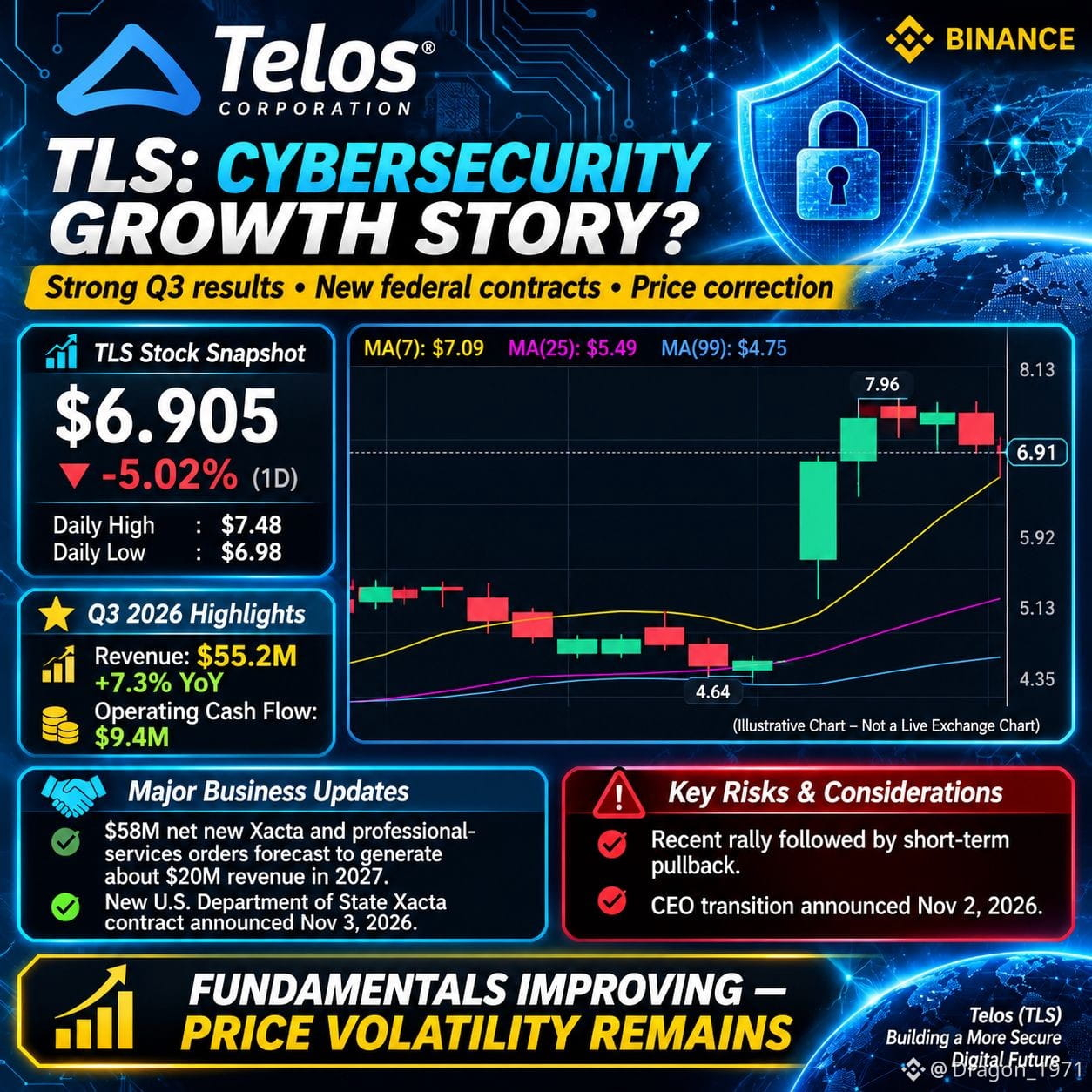
🛡️ $TLS.US : IS THIS CYBERSECURITY STOCK ENTERING A NEW GROWTH PHASE?
Telos Corporation (NASDAQ: TLS) is attracting attention after a strong price rally and encouraging Q3 2026 business results.
But is the recent correction a sign of weakness, or is the market reassessing the company's growth potential?
📊 STOCK SNAPSHOT
Price: $6.905
Daily Change: -5.02%
Recent High: $7.96
Recent Low: $4.64
📈 Q3 2026 FINANCIAL HIGHLIGHTS
Revenue: $55.2M (+7.3% YoY)
Operating Cash Flow: $9.4M
Highest quarterly profit since IPO
Full-year guidance raised
🔥 WHY $TLS.US
{stock_us}(TLS.US)
DESERVES ATTENTION
Telos has secured $58M in new Xacta and professional-services orders, expected to generate approximately $20M in revenue during 2027.
It also announced a new cybersecurity contract with the U.S. Department of State.
⚠️ RISKS TO WATCH
Recent price correction after a sharp rally.
CEO transition announced in November.
Future contract execution and profitability remain important.
Broader market sentiment could affect the stock.
🔍 FINAL RESEARCH VIEW
TLS presents an interesting combination of cybersecurity exposure, government contracts and improving quarterly financial performance.
However, strong fundamentals do not guarantee continued stock-price growth.
The next few quarters will be important in determining whether Telos can turn its new business momentum into sustainable financial growth.
💬 What do you think about TLS? Is its recent rally supported by fundamentals?
#TLS #TelosCorporation #CyberSecurity #StockMarket #NASDAQ #StockResearch #BinanceSquare
🛡️ $TLS.US : IS THIS CYBERSECURITY STOCK ENTERING A NEW GROWTH PHASE?
Telos Corporation (NASDAQ: TLS) is attracting attention after a strong price rally and encouraging Q3 2026 business results.
But is the recent correction a sign of weakness, or is the market reassessing the company's growth potential?
📊 STOCK SNAPSHOT
Price: $6.905
Daily Change: -5.02%
Recent High: $7.96
Recent Low: $4.64
📈 Q3 2026 FINANCIAL HIGHLIGHTS
Revenue: $55.2M (+7.3% YoY)
Operating Cash Flow: $9.4M
Highest quarterly profit since IPO
Full-year guidance raised
🔥 WHY $TLS.US
DESERVES ATTENTION
Telos has secured $58M in new Xacta and professional-services orders, expected to generate approximately $20M in revenue during 2027.
It also announced a new cybersecurity contract with the U.S. Department of State.
⚠️ RISKS TO WATCH
Recent price correction after a sharp rally.
CEO transition announced in November.
Future contract execution and profitability remain important.
Broader market sentiment could affect the stock.
🔍 FINAL RESEARCH VIEW
TLS presents an interesting combination of cybersecurity exposure, government contracts and improving quarterly financial performance.
However, strong fundamentals do not guarantee continued stock-price growth.
The next few quarters will be important in determining whether Telos can turn its new business momentum into sustainable financial growth.
💬 What do you think about TLS? Is its recent rally supported by fundamentals?
#TLS #TelosCorporation #CyberSecurity #StockMarket #NASDAQ #StockResearch #BinanceSquare
Telos Corporation (NASDAQ: TLS) is attracting attention after a strong price rally and encouraging Q3 2026 business results.
But is the recent correction a sign of weakness, or is the market reassessing the company's growth potential?
📊 STOCK SNAPSHOT
Price: $6.905
Daily Change: -5.02%
Recent High: $7.96
Recent Low: $4.64
📈 Q3 2026 FINANCIAL HIGHLIGHTS
Revenue: $55.2M (+7.3% YoY)
Operating Cash Flow: $9.4M
Highest quarterly profit since IPO
Full-year guidance raised
🔥 WHY $TLS.US
DESERVES ATTENTION
Telos has secured $58M in new Xacta and professional-services orders, expected to generate approximately $20M in revenue during 2027.
It also announced a new cybersecurity contract with the U.S. Department of State.
⚠️ RISKS TO WATCH
Recent price correction after a sharp rally.
CEO transition announced in November.
Future contract execution and profitability remain important.
Broader market sentiment could affect the stock.
🔍 FINAL RESEARCH VIEW
TLS presents an interesting combination of cybersecurity exposure, government contracts and improving quarterly financial performance.
However, strong fundamentals do not guarantee continued stock-price growth.
The next few quarters will be important in determining whether Telos can turn its new business momentum into sustainable financial growth.
💬 What do you think about TLS? Is its recent rally supported by fundamentals?
#TLS #TelosCorporation #CyberSecurity #StockMarket #NASDAQ #StockResearch #BinanceSquare
TLSUS-0.72%
1
99

·
--
🚨"𝗖𝗬𝗕𝗘𝗥𝗦𝗘𝗖𝗨𝗥𝗜𝗧𝗬 𝗔𝗟𝗘𝗥𝗧": 𝙒𝙝𝙮 𝘼𝙧𝙚 𝟭𝟳𝟴 𝙊𝙧𝙜𝙖𝙣𝙞𝙯𝙖𝙩𝙞𝙤𝙣𝙨 𝘼𝙛𝙛𝙚𝙘𝙩𝙚𝙙? — 𝙈𝙖𝙟𝙤𝙧 𝙒𝙚𝙗𝙨𝙞𝙩𝙚𝙨 𝙀𝙭𝙥𝙤𝙨𝙚𝙙! 👀
A major cybersecurity incident has raised concerns across the tech and crypto industries. 😳
According to cybersecurity researchers, attackers injected malicious JavaScript through Optimizely Web, a third-party website optimization platform.
🌐 Websites linked to major organizations reportedly affected include:
🔹 𝘡𝘰𝘰𝘮, 𝘉𝘉𝘊 & 𝘊𝘕𝘕
🔹 𝘏𝘚𝘉𝘊, 𝘓𝘦𝘥𝘨𝘦𝘳 & 𝘐𝘒𝘌𝘈
⚠️ What Was the Risk?
The malicious code was designed to target cryptocurrency wallets, payment card details, browser cookies and iOS devices. It could also capture screenshots and expose sensitive information.
🔍 What About the Losses?
According to Report URI, approximately $7,040 was received by attacker-controlled wallets. However, the full financial impact of the campaign remains unknown.
Most of the malicious code has reportedly been removed.
This incident highlights how third-party website tools can create security risks, even for websites associated with well-known organizations.
$ZEC - $ASTER - $AKE
{future}(ZECUSDT)
{future}(ASTERUSDT)
{future}(AKEUSDT)
#CyberSecurity #Binance #CryptoNews #Ledger #cyberattack
"Does this incident change how much you trust major websites"!?👀
🚨"𝗖𝗬𝗕𝗘𝗥𝗦𝗘𝗖𝗨𝗥𝗜𝗧𝗬 𝗔𝗟𝗘𝗥𝗧": 𝙒𝙝𝙮 𝘼𝙧𝙚 𝟭𝟳𝟴 𝙊𝙧𝙜𝙖𝙣𝙞𝙯𝙖𝙩𝙞𝙤𝙣𝙨 𝘼𝙛𝙛𝙚𝙘𝙩𝙚𝙙? — 𝙈𝙖𝙟𝙤𝙧 𝙒𝙚𝙗𝙨𝙞𝙩𝙚𝙨 𝙀𝙭𝙥𝙤𝙨𝙚𝙙! 👀
A major cybersecurity incident has raised concerns across the tech and crypto industries. 😳
According to cybersecurity researchers, attackers injected malicious JavaScript through Optimizely Web, a third-party website optimization platform.
🌐 Websites linked to major organizations reportedly affected include:
🔹 𝘡𝘰𝘰𝘮, 𝘉𝘉𝘊 & 𝘊𝘕𝘕
🔹 𝘏𝘚𝘉𝘊, 𝘓𝘦𝘥𝘨𝘦𝘳 & 𝘐𝘒𝘌𝘈
⚠️ What Was the Risk?
The malicious code was designed to target cryptocurrency wallets, payment card details, browser cookies and iOS devices. It could also capture screenshots and expose sensitive information.
🔍 What About the Losses?
According to Report URI, approximately $7,040 was received by attacker-controlled wallets. However, the full financial impact of the campaign remains unknown.
Most of the malicious code has reportedly been removed.
This incident highlights how third-party website tools can create security risks, even for websites associated with well-known organizations.
$ZEC - $ASTER - $AKE
#CyberSecurity #Binance #CryptoNews #Ledger #cyberattack
"Does this incident change how much you trust major websites"!?👀
A major cybersecurity incident has raised concerns across the tech and crypto industries. 😳
According to cybersecurity researchers, attackers injected malicious JavaScript through Optimizely Web, a third-party website optimization platform.
🌐 Websites linked to major organizations reportedly affected include:
🔹 𝘡𝘰𝘰𝘮, 𝘉𝘉𝘊 & 𝘊𝘕𝘕
🔹 𝘏𝘚𝘉𝘊, 𝘓𝘦𝘥𝘨𝘦𝘳 & 𝘐𝘒𝘌𝘈
⚠️ What Was the Risk?
The malicious code was designed to target cryptocurrency wallets, payment card details, browser cookies and iOS devices. It could also capture screenshots and expose sensitive information.
🔍 What About the Losses?
According to Report URI, approximately $7,040 was received by attacker-controlled wallets. However, the full financial impact of the campaign remains unknown.
Most of the malicious code has reportedly been removed.
This incident highlights how third-party website tools can create security risks, even for websites associated with well-known organizations.
$ZEC - $ASTER - $AKE
#CyberSecurity #Binance #CryptoNews #Ledger #cyberattack
"Does this incident change how much you trust major websites"!?👀
🟢 YES — Security Is Strong 🔐
71%
🔴 NO — Risks Remain ⚠️
29%
35 votes • Voting closed
2
5k
🚨 IS ALGORITHMIC INTELLIGENCE TESTING THE IMMUTABILITY WALL OF $BTC ? ⚡
Recent computational anomalies targeting major hashrate infrastructure highlight a shifting landscape where advanced algorithmic vectors challenge network integrity. Institutional risk models must now account for automated systemic intrusion rather than focusing solely on traditional market liquidations and order flow sweeps. 📊
As distributed mining pools face sophisticated software manipulation, network resilience depends entirely on decentralization depth and cryptographic hardening. 💡 How robust is structural conviction when infrastructural threat matrices evolve beyond conventional security boundaries? 💬
⚠️ Not financial advice. Always manage your risk. 🛡️
🏷️ #BTC #CyberSecurity #Hashrate #NetworkSecurity
🦈 ⚡
🚨 IS ALGORITHMIC INTELLIGENCE TESTING THE IMMUTABILITY WALL OF $BTC ? ⚡
Recent computational anomalies targeting major hashrate infrastructure highlight a shifting landscape where advanced algorithmic vectors challenge network integrity. Institutional risk models must now account for automated systemic intrusion rather than focusing solely on traditional market liquidations and order flow sweeps. 📊
As distributed mining pools face sophisticated software manipulation, network resilience depends entirely on decentralization depth and cryptographic hardening. 💡 How robust is structural conviction when infrastructural threat matrices evolve beyond conventional security boundaries? 💬
⚠️ Not financial advice. Always manage your risk. 🛡️
🏷️ #BTC #CyberSecurity #Hashrate #NetworkSecurity
🦈 ⚡
Recent computational anomalies targeting major hashrate infrastructure highlight a shifting landscape where advanced algorithmic vectors challenge network integrity. Institutional risk models must now account for automated systemic intrusion rather than focusing solely on traditional market liquidations and order flow sweeps. 📊
As distributed mining pools face sophisticated software manipulation, network resilience depends entirely on decentralization depth and cryptographic hardening. 💡 How robust is structural conviction when infrastructural threat matrices evolve beyond conventional security boundaries? 💬
⚠️ Not financial advice. Always manage your risk. 🛡️
🏷️ #BTC #CyberSecurity #Hashrate #NetworkSecurity
🦈 ⚡
7

·
--
GOOGLE WARNS: THE ERA OF AUTONOMOUS CYBERATTACKS HAS ARRIVED!
Google is warning about a new generation of cyber threats powered by AI.
"Imagine a hacker that doesn't eat, sleep, or get tired, and never stops searching for a way in."
AI could allow attackers to automate parts of cyberattacks at a scale and speed that human hackers cannot match.
For crypto users, where a single compromised wallet can mean irreversible losses, this is a warning worth taking seriously.
#Cybersecurity #CryptoSecurity $GOOGL
{future}(GOOGLUSDT)
GOOGLE WARNS: THE ERA OF AUTONOMOUS CYBERATTACKS HAS ARRIVED!
Google is warning about a new generation of cyber threats powered by AI.
"Imagine a hacker that doesn't eat, sleep, or get tired, and never stops searching for a way in."
AI could allow attackers to automate parts of cyberattacks at a scale and speed that human hackers cannot match.
For crypto users, where a single compromised wallet can mean irreversible losses, this is a warning worth taking seriously.
#Cybersecurity #CryptoSecurity $GOOGL
Google is warning about a new generation of cyber threats powered by AI.
"Imagine a hacker that doesn't eat, sleep, or get tired, and never stops searching for a way in."
AI could allow attackers to automate parts of cyberattacks at a scale and speed that human hackers cannot match.
For crypto users, where a single compromised wallet can mean irreversible losses, this is a warning worth taking seriously.
#Cybersecurity #CryptoSecurity $GOOGL

GOOGL-3.46%
GOOGUS+0.20%
Terisa Radmacher OCvM:
tengo tanto miedo
5
23
5.3k
A widespread security exploit has compromised 178 major websites including HSBC and Ledger through malicious code injection.
#CyberSecurity #CryptoHack
A widespread security exploit has compromised 178 major websites including HSBC and Ledger through malicious code injection.
#CyberSecurity #CryptoHack
#CyberSecurity #CryptoHack
12
·
--
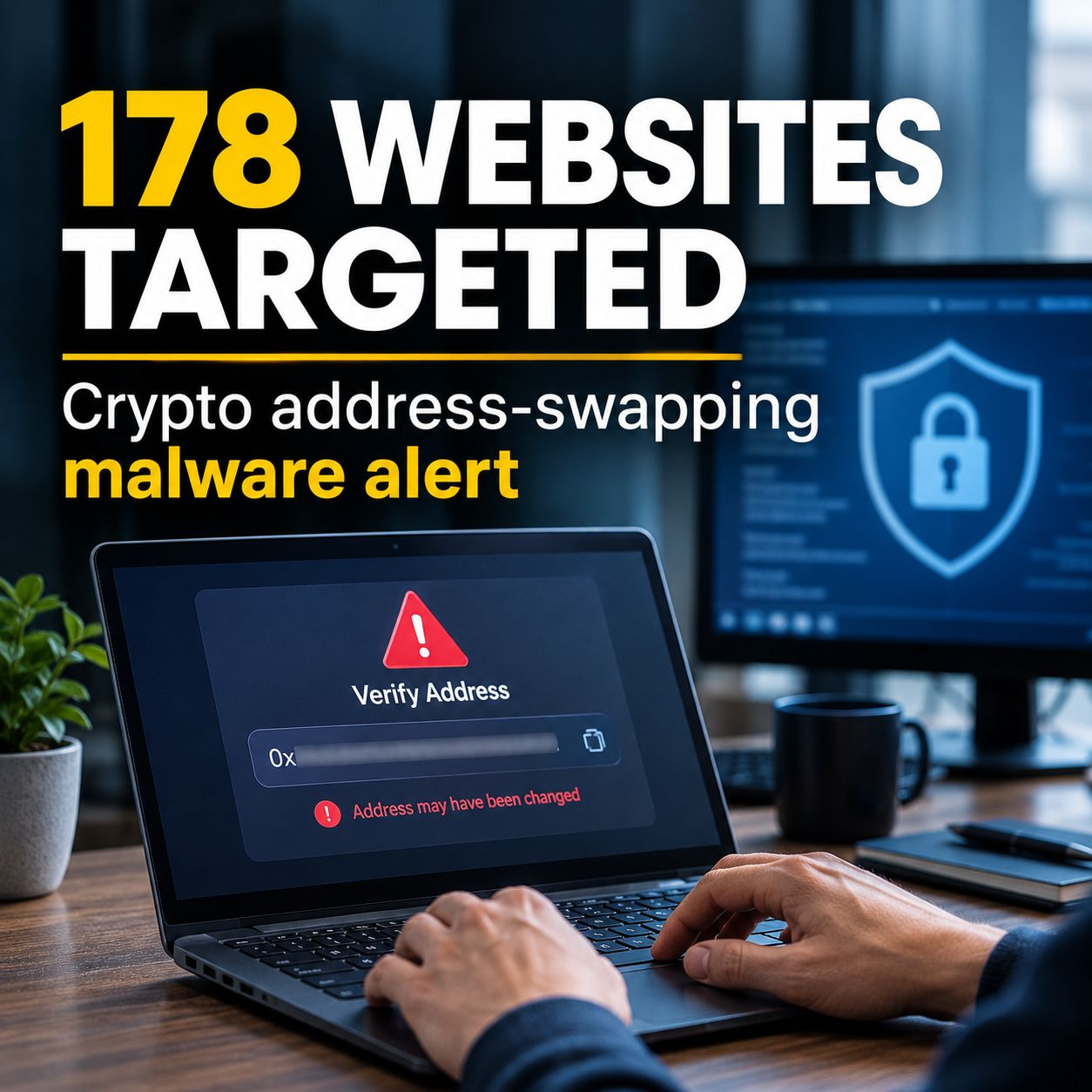
🚨 178 WEBSITES. ONE CRYPTO-THEFT CAMPAIGN.
A serious cybersecurity warning for crypto users!
Malicious code was delivered through websites linked to 178 organizations, including Zoom, CNN, HSBC and IKEA.
Here's what it could do:
🔴 Replace copied crypto wallet addresses with attackers' addresses.
🔴 Steal credit card details and browser data.
🔴 Target iPhone users with malicious code.
⚠️ Researchers have not confirmed how many victims lost money.
🔐 Protect yourself: Always verify the first and last characters of a wallet address before sending crypto.
💬 Have you ever checked a wallet address twice before making a transfer?
Follow for crypto news that actually matters.
$BNB
#CryptoSecurity #CryptoNews #CyberSecurity #blockchain
🚨 178 WEBSITES. ONE CRYPTO-THEFT CAMPAIGN.
A serious cybersecurity warning for crypto users!
Malicious code was delivered through websites linked to 178 organizations, including Zoom, CNN, HSBC and IKEA.
Here's what it could do:
🔴 Replace copied crypto wallet addresses with attackers' addresses.
🔴 Steal credit card details and browser data.
🔴 Target iPhone users with malicious code.
⚠️ Researchers have not confirmed how many victims lost money.
🔐 Protect yourself: Always verify the first and last characters of a wallet address before sending crypto.
💬 Have you ever checked a wallet address twice before making a transfer?
Follow for crypto news that actually matters.
$BNB
#CryptoSecurity #CryptoNews #CyberSecurity #blockchain
A serious cybersecurity warning for crypto users!
Malicious code was delivered through websites linked to 178 organizations, including Zoom, CNN, HSBC and IKEA.
Here's what it could do:
🔴 Replace copied crypto wallet addresses with attackers' addresses.
🔴 Steal credit card details and browser data.
🔴 Target iPhone users with malicious code.
⚠️ Researchers have not confirmed how many victims lost money.
🔐 Protect yourself: Always verify the first and last characters of a wallet address before sending crypto.
💬 Have you ever checked a wallet address twice before making a transfer?
Follow for crypto news that actually matters.
$BNB
#CryptoSecurity #CryptoNews #CyberSecurity #blockchain
76
·
--
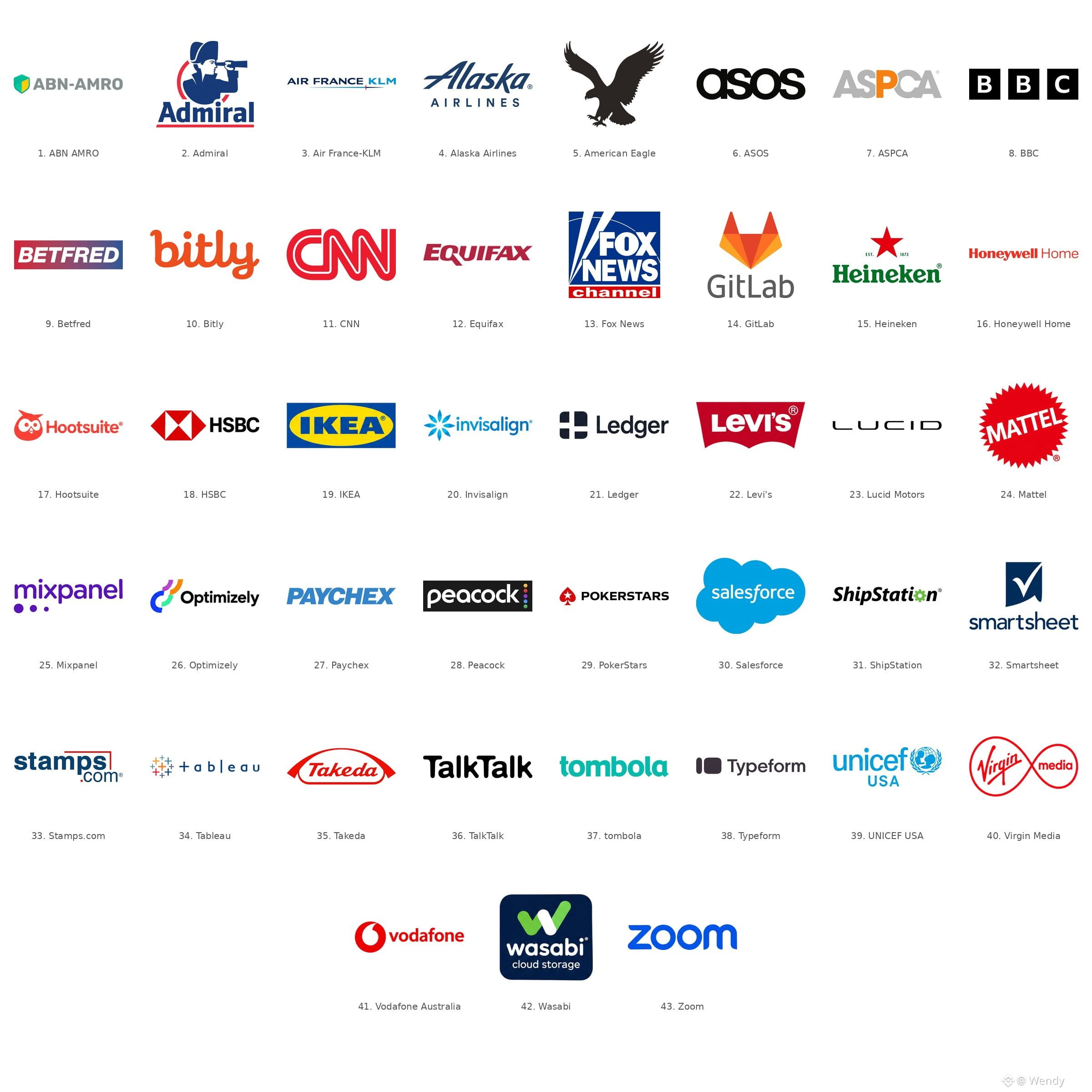
HACKERS REPORTEDLY COMPROMISE 178 MAJOR BRANDS IN CRYPTO-TARGETING ATTACK!
Zoom, BBC, HSBC, Ledger and other major brands were reportedly affected by malicious code distributed through Optimizely, a website testing platform.
The reported attack could:
• Replace copied crypto wallet addresses with attackers' addresses
• Steal payment card information
• Target older iPhones through additional exploits
Around $7,000 in stolen crypto has reportedly reached attacker-controlled wallets.
Even Optimizely's own website was reportedly affected.
The initial source of the compromise remains unclear.
Be careful when copying wallet addresses. Always verify the destination before sending crypto.
#CryptoSecurity #Cybersecurity
HACKERS REPORTEDLY COMPROMISE 178 MAJOR BRANDS IN CRYPTO-TARGETING ATTACK!
Zoom, BBC, HSBC, Ledger and other major brands were reportedly affected by malicious code distributed through Optimizely, a website testing platform.
The reported attack could:
• Replace copied crypto wallet addresses with attackers' addresses
• Steal payment card information
• Target older iPhones through additional exploits
Around $7,000 in stolen crypto has reportedly reached attacker-controlled wallets.
Even Optimizely's own website was reportedly affected.
The initial source of the compromise remains unclear.
Be careful when copying wallet addresses. Always verify the destination before sending crypto.
#CryptoSecurity #Cybersecurity
Zoom, BBC, HSBC, Ledger and other major brands were reportedly affected by malicious code distributed through Optimizely, a website testing platform.
The reported attack could:
• Replace copied crypto wallet addresses with attackers' addresses
• Steal payment card information
• Target older iPhones through additional exploits
Around $7,000 in stolen crypto has reportedly reached attacker-controlled wallets.
Even Optimizely's own website was reportedly affected.
The initial source of the compromise remains unclear.
Be careful when copying wallet addresses. Always verify the destination before sending crypto.
#CryptoSecurity #Cybersecurity

HSBCUS+0.00%
Mosarto :
any Hacker who is caught must be kill
12
1
56
28.4k
Log in to explore more content
Join global crypto users on Binance Square
⚡️ Get latest and useful information about crypto.
💬 Trusted by the world’s largest crypto exchange.
👍 Discover real insights from verified creators.
Email / Phone number
Trending Topics
1
#IsAnthropic’s$1.5TMarketCapJustified?
8,984 views
74 Discussing
2
#BTCRemainsUnderPressureAfterHawkishFOMCMinutes
221,705 views
2,029 Discussing
3
#NvidiaBoardReportedlySplitOverHuang’sReturn
107,730 views
1,086 Discussing
4
#StrategySTRCPreferredSlips3.65%Below$100Par
6,234 views
64 Discussing
5
#MASToUpgradeSGDTestnetToSGDigitalLedger
18,203 views
232 Discussing
6
#CanGTA6'sLaunchLiftTTWOShares?
77,210 views
795 Discussing
7
#Solana2027RoadmapTargetsDoubleComputeCapacity
7,280 views
125 Discussing
8
#InjectiveTokenizedRealEstateMortgagesTop$1.5B
1,046 views
28 Discussing
9
#TetherMakesStrategicInvestmentInSCRYPT
5,499 views
101 Discussing
10
#CapitalGroupAdds1264500StrategyShares
26,147 views
225 Discussing