

#unibtc
unibtc
43,917 views
210 Discussing
Hot
Latest

·
--
Verified
Bursting the "Seamless Full Chain" Bubble: What Does Bedrock 2.0 Bring to Solve Asset Disconnection?
Nowadays, the crypto scene is all about "full chain ecosystems" and "seamless interoperability," making it hard to keep a straight face. Many retail traders seriously think cross-chain is just a simple copy-paste until hackers exploit middleware delays to drain liquidity pools, then they slap their thighs in regret. As someone who's paid a hefty tuition in cross-chain bridges, I've been grinding on the underlying logic of @Bedrock lately, especially the iterative details of uniBTC and $BR in a multi-chain environment. $BR
Putting aside all the flashy marketing jargon, what really hits the cross-chain pain point in Bedrock 2.0 is its extremely strict physical-level limitations on "state synchronization" (that is, the microsecond-level state locking mechanism mentioned in the text).
Anyone who's dabbled in multi-chain derivatives knows a critical flaw: spacetime tearing. You stake native assets on the main chain while generating LST certificates on the target chain, and there’s a fatal information gap in between. Once the oracle or node network faces high-frequency congestion, the ledgers on both ends might briefly "lose contact." This few seconds of vacuum is enough for arbitrage bots to exploit the risk-free loophole and drain the protocol dry.
Bedrock 2.0's solution is super hardcore, directly embedding strong temporal constraints at the communication layer: it mandates that the minting or burning of derivative certificates must be confirmed with the real physical blocks of the underlying assets to achieve "synchronized locking." To put it simply, it’s like the "quantum entanglement" of ledgers—if side A hasn’t fully confirmed, side B can’t generate any valid certificates ahead of time. This mechanism completely shuts down the space for arbitrage using data delays. $BTC
People are always chasing how smooth interactions can be and how fast cross-chain processes are, but the foundation of finance is secure accounting. In the dark forest of decentralization, the real technological barrier is never about running bare without rules, but rather using the cold, hard laws of algorithms to weld shut every crack in asset circulation with reinforced concrete.
#Bedrock #uniBTC
{future}(BRUSDT)
Bursting the "Seamless Full Chain" Bubble: What Does Bedrock 2.0 Bring to Solve Asset Disconnection?
Nowadays, the crypto scene is all about "full chain ecosystems" and "seamless interoperability," making it hard to keep a straight face. Many retail traders seriously think cross-chain is just a simple copy-paste until hackers exploit middleware delays to drain liquidity pools, then they slap their thighs in regret. As someone who's paid a hefty tuition in cross-chain bridges, I've been grinding on the underlying logic of @Bedrock lately, especially the iterative details of uniBTC and $BR in a multi-chain environment. $BR
Putting aside all the flashy marketing jargon, what really hits the cross-chain pain point in Bedrock 2.0 is its extremely strict physical-level limitations on "state synchronization" (that is, the microsecond-level state locking mechanism mentioned in the text).
Anyone who's dabbled in multi-chain derivatives knows a critical flaw: spacetime tearing. You stake native assets on the main chain while generating LST certificates on the target chain, and there’s a fatal information gap in between. Once the oracle or node network faces high-frequency congestion, the ledgers on both ends might briefly "lose contact." This few seconds of vacuum is enough for arbitrage bots to exploit the risk-free loophole and drain the protocol dry.
Bedrock 2.0's solution is super hardcore, directly embedding strong temporal constraints at the communication layer: it mandates that the minting or burning of derivative certificates must be confirmed with the real physical blocks of the underlying assets to achieve "synchronized locking." To put it simply, it’s like the "quantum entanglement" of ledgers—if side A hasn’t fully confirmed, side B can’t generate any valid certificates ahead of time. This mechanism completely shuts down the space for arbitrage using data delays. $BTC
People are always chasing how smooth interactions can be and how fast cross-chain processes are, but the foundation of finance is secure accounting. In the dark forest of decentralization, the real technological barrier is never about running bare without rules, but rather using the cold, hard laws of algorithms to weld shut every crack in asset circulation with reinforced concrete.
#Bedrock #uniBTC
Nowadays, the crypto scene is all about "full chain ecosystems" and "seamless interoperability," making it hard to keep a straight face. Many retail traders seriously think cross-chain is just a simple copy-paste until hackers exploit middleware delays to drain liquidity pools, then they slap their thighs in regret. As someone who's paid a hefty tuition in cross-chain bridges, I've been grinding on the underlying logic of @Bedrock lately, especially the iterative details of uniBTC and $BR in a multi-chain environment. $BR
Putting aside all the flashy marketing jargon, what really hits the cross-chain pain point in Bedrock 2.0 is its extremely strict physical-level limitations on "state synchronization" (that is, the microsecond-level state locking mechanism mentioned in the text).
Anyone who's dabbled in multi-chain derivatives knows a critical flaw: spacetime tearing. You stake native assets on the main chain while generating LST certificates on the target chain, and there’s a fatal information gap in between. Once the oracle or node network faces high-frequency congestion, the ledgers on both ends might briefly "lose contact." This few seconds of vacuum is enough for arbitrage bots to exploit the risk-free loophole and drain the protocol dry.
Bedrock 2.0's solution is super hardcore, directly embedding strong temporal constraints at the communication layer: it mandates that the minting or burning of derivative certificates must be confirmed with the real physical blocks of the underlying assets to achieve "synchronized locking." To put it simply, it’s like the "quantum entanglement" of ledgers—if side A hasn’t fully confirmed, side B can’t generate any valid certificates ahead of time. This mechanism completely shuts down the space for arbitrage using data delays. $BTC
People are always chasing how smooth interactions can be and how fast cross-chain processes are, but the foundation of finance is secure accounting. In the dark forest of decentralization, the real technological barrier is never about running bare without rules, but rather using the cold, hard laws of algorithms to weld shut every crack in asset circulation with reinforced concrete.
#Bedrock #uniBTC
582

·
--
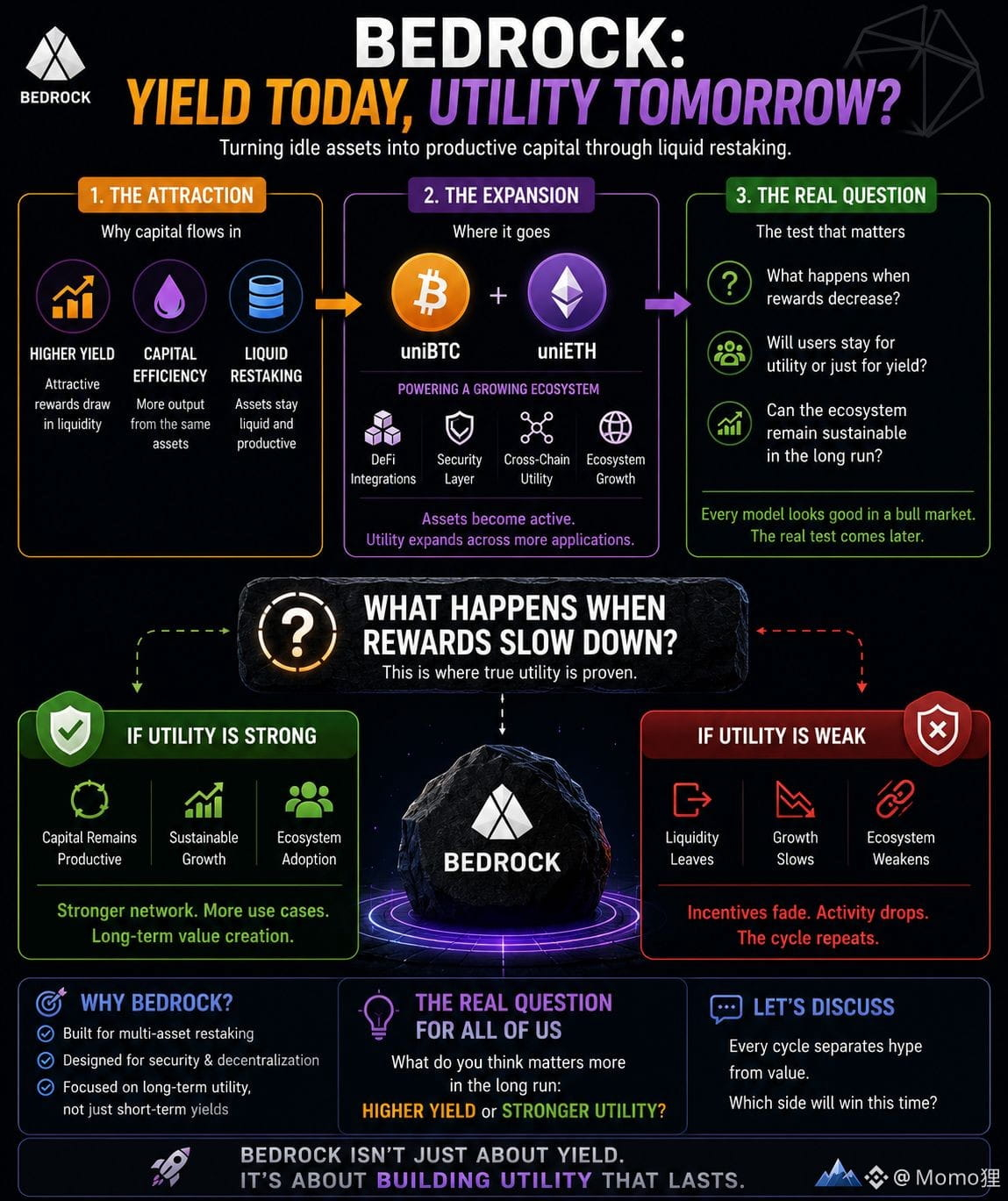
$BR spent some time comparing different liquid restaking models tonight and one question kept bothering me.
most protocols are very good at attracting liquidity. high yields appear, capital flows in, dashboards look impressive, and everyone talks about growth.
but what happens after that?
when rewards normalize and the excitement fades, does the ecosystem still have enough utility to keep users engaged?
that's where @Bedrock caught my attention.
the interesting part isn't simply the idea of earning additional yield from assets like BTC or ETH. what interests me more is whether capital can remain productive without constantly forcing users to move from one opportunity to another.
on paper, uniBTC and uniETH seem designed around that idea. instead of treating assets as something that should remain idle, the model tries to make them active across a broader ecosystem.
of course, every system looks efficient during favorable conditions. the real test comes when markets become quieter and participants start questioning where the long-term value actually comes from.
that's the reason i'm following @Bedrock more closely lately.
the rewards are interesting, but the bigger question for me is whether this approach can create sustainable utility after the initial growth phase ends.
what do you think matters more in the long run: higher yield or stronger utility?
#Bedrock #uniBTC #uniETH #Crypto
$BR spent some time comparing different liquid restaking models tonight and one question kept bothering me.
most protocols are very good at attracting liquidity. high yields appear, capital flows in, dashboards look impressive, and everyone talks about growth.
but what happens after that?
when rewards normalize and the excitement fades, does the ecosystem still have enough utility to keep users engaged?
that's where @Bedrock caught my attention.
the interesting part isn't simply the idea of earning additional yield from assets like BTC or ETH. what interests me more is whether capital can remain productive without constantly forcing users to move from one opportunity to another.
on paper, uniBTC and uniETH seem designed around that idea. instead of treating assets as something that should remain idle, the model tries to make them active across a broader ecosystem.
of course, every system looks efficient during favorable conditions. the real test comes when markets become quieter and participants start questioning where the long-term value actually comes from.
that's the reason i'm following @Bedrock more closely lately.
the rewards are interesting, but the bigger question for me is whether this approach can create sustainable utility after the initial growth phase ends.
what do you think matters more in the long run: higher yield or stronger utility?
#Bedrock #uniBTC #uniETH #Crypto
most protocols are very good at attracting liquidity. high yields appear, capital flows in, dashboards look impressive, and everyone talks about growth.
but what happens after that?
when rewards normalize and the excitement fades, does the ecosystem still have enough utility to keep users engaged?
that's where @Bedrock caught my attention.
the interesting part isn't simply the idea of earning additional yield from assets like BTC or ETH. what interests me more is whether capital can remain productive without constantly forcing users to move from one opportunity to another.
on paper, uniBTC and uniETH seem designed around that idea. instead of treating assets as something that should remain idle, the model tries to make them active across a broader ecosystem.
of course, every system looks efficient during favorable conditions. the real test comes when markets become quieter and participants start questioning where the long-term value actually comes from.
that's the reason i'm following @Bedrock more closely lately.
the rewards are interesting, but the bigger question for me is whether this approach can create sustainable utility after the initial growth phase ends.
what do you think matters more in the long run: higher yield or stronger utility?
#Bedrock #uniBTC #uniETH #Crypto
3
1
113

·
--
Recently, while running high-frequency scripts on the server and keeping an eye on the cross-chain routing of the underlying assets @Bedrock 2.0, I can't help but laugh at the community hype around 'absolutely decentralized DAOs'.
Anyone who's ever deployed a smart contract knows that my underlying logic is always 'safety first'. In the DeFi battleground, if protocols blindly hand over parameter modification rights early on, they're bound to get wrecked by whales armed with massive capital, using flash loans to breach governance defenses in an instant. Bedrock 2.0 has made a pragmatic defense in this regard: by binding the underlying asset routing to the veBR locking mechanism through contract code. Want to interfere with the distribution of core interests? You must convert $BR into veBR and face a long lock-up period. This time-weighted algorithm directly isolates the short-term speculators trying to 'pump and dump' from the underlying assets.
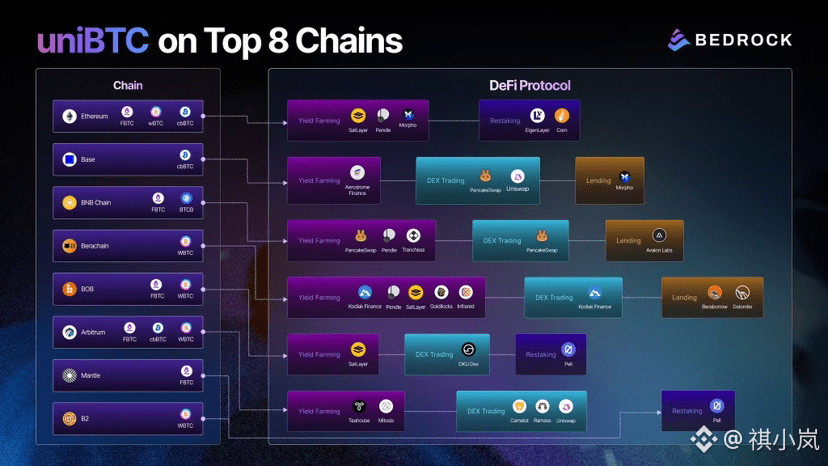
An even more hardcore change is the asset reconstruction of uniBTC. Compared to the past, when wBTC was merely a single-chain mapping, Bedrock essentially equips Bitcoin, which struggles to generate yield, with a cross-chain 'central nervous system'. Once this set of assets is stuffed into multi-tier vaults, tokens are no longer useless voting papers but become the foundational bandwidth for constructing a full-chain liquidity network. In my recent review of yield strategies, I found that to seize high-priority execution channels within this round of BTCFi's modular framework, holding and locking $BR has become an unavoidable ticket to entry.
However, what I'm really watching is not the short-term TVL growth, but the AI-driven on-chain modules and dynamic routing it promotes. In a bull market, all the favorable data is just fluff; when the market sees a 30%+ single-sided spike and on-chain gas fees skyrocket, will this automated risk control hold up under pressure? Can the risk isolation mechanism withstand the bad debt transmission across heterogeneous chains in milliseconds during extreme volatility? That’s the true test of its foundation.
Bedrock has indeed reconstructed a highly complex liquidity coordination network, but transitioning from the current 'defensive semi-centralization' to complete code-level autonomy is where this hardcore technical exam has just begun.
@Bedrock
#Bedrock $BR #uniBTC #BTCFi
Recently, while running high-frequency scripts on the server and keeping an eye on the cross-chain routing of the underlying assets @Bedrock 2.0, I can't help but laugh at the community hype around 'absolutely decentralized DAOs'.
Anyone who's ever deployed a smart contract knows that my underlying logic is always 'safety first'. In the DeFi battleground, if protocols blindly hand over parameter modification rights early on, they're bound to get wrecked by whales armed with massive capital, using flash loans to breach governance defenses in an instant. Bedrock 2.0 has made a pragmatic defense in this regard: by binding the underlying asset routing to the veBR locking mechanism through contract code. Want to interfere with the distribution of core interests? You must convert $BR into veBR and face a long lock-up period. This time-weighted algorithm directly isolates the short-term speculators trying to 'pump and dump' from the underlying assets.
An even more hardcore change is the asset reconstruction of uniBTC. Compared to the past, when wBTC was merely a single-chain mapping, Bedrock essentially equips Bitcoin, which struggles to generate yield, with a cross-chain 'central nervous system'. Once this set of assets is stuffed into multi-tier vaults, tokens are no longer useless voting papers but become the foundational bandwidth for constructing a full-chain liquidity network. In my recent review of yield strategies, I found that to seize high-priority execution channels within this round of BTCFi's modular framework, holding and locking $BR has become an unavoidable ticket to entry.
However, what I'm really watching is not the short-term TVL growth, but the AI-driven on-chain modules and dynamic routing it promotes. In a bull market, all the favorable data is just fluff; when the market sees a 30%+ single-sided spike and on-chain gas fees skyrocket, will this automated risk control hold up under pressure? Can the risk isolation mechanism withstand the bad debt transmission across heterogeneous chains in milliseconds during extreme volatility? That’s the true test of its foundation.
Bedrock has indeed reconstructed a highly complex liquidity coordination network, but transitioning from the current 'defensive semi-centralization' to complete code-level autonomy is where this hardcore technical exam has just begun.
@Bedrock
#Bedrock $BR #uniBTC #BTCFi
Anyone who's ever deployed a smart contract knows that my underlying logic is always 'safety first'. In the DeFi battleground, if protocols blindly hand over parameter modification rights early on, they're bound to get wrecked by whales armed with massive capital, using flash loans to breach governance defenses in an instant. Bedrock 2.0 has made a pragmatic defense in this regard: by binding the underlying asset routing to the veBR locking mechanism through contract code. Want to interfere with the distribution of core interests? You must convert $BR into veBR and face a long lock-up period. This time-weighted algorithm directly isolates the short-term speculators trying to 'pump and dump' from the underlying assets.
An even more hardcore change is the asset reconstruction of uniBTC. Compared to the past, when wBTC was merely a single-chain mapping, Bedrock essentially equips Bitcoin, which struggles to generate yield, with a cross-chain 'central nervous system'. Once this set of assets is stuffed into multi-tier vaults, tokens are no longer useless voting papers but become the foundational bandwidth for constructing a full-chain liquidity network. In my recent review of yield strategies, I found that to seize high-priority execution channels within this round of BTCFi's modular framework, holding and locking $BR has become an unavoidable ticket to entry.
However, what I'm really watching is not the short-term TVL growth, but the AI-driven on-chain modules and dynamic routing it promotes. In a bull market, all the favorable data is just fluff; when the market sees a 30%+ single-sided spike and on-chain gas fees skyrocket, will this automated risk control hold up under pressure? Can the risk isolation mechanism withstand the bad debt transmission across heterogeneous chains in milliseconds during extreme volatility? That’s the true test of its foundation.
Bedrock has indeed reconstructed a highly complex liquidity coordination network, but transitioning from the current 'defensive semi-centralization' to complete code-level autonomy is where this hardcore technical exam has just begun.
@Bedrock
#Bedrock $BR #uniBTC #BTCFi
190


·
--
#bedrock $BR I Stopped Calling Patience a Strategy
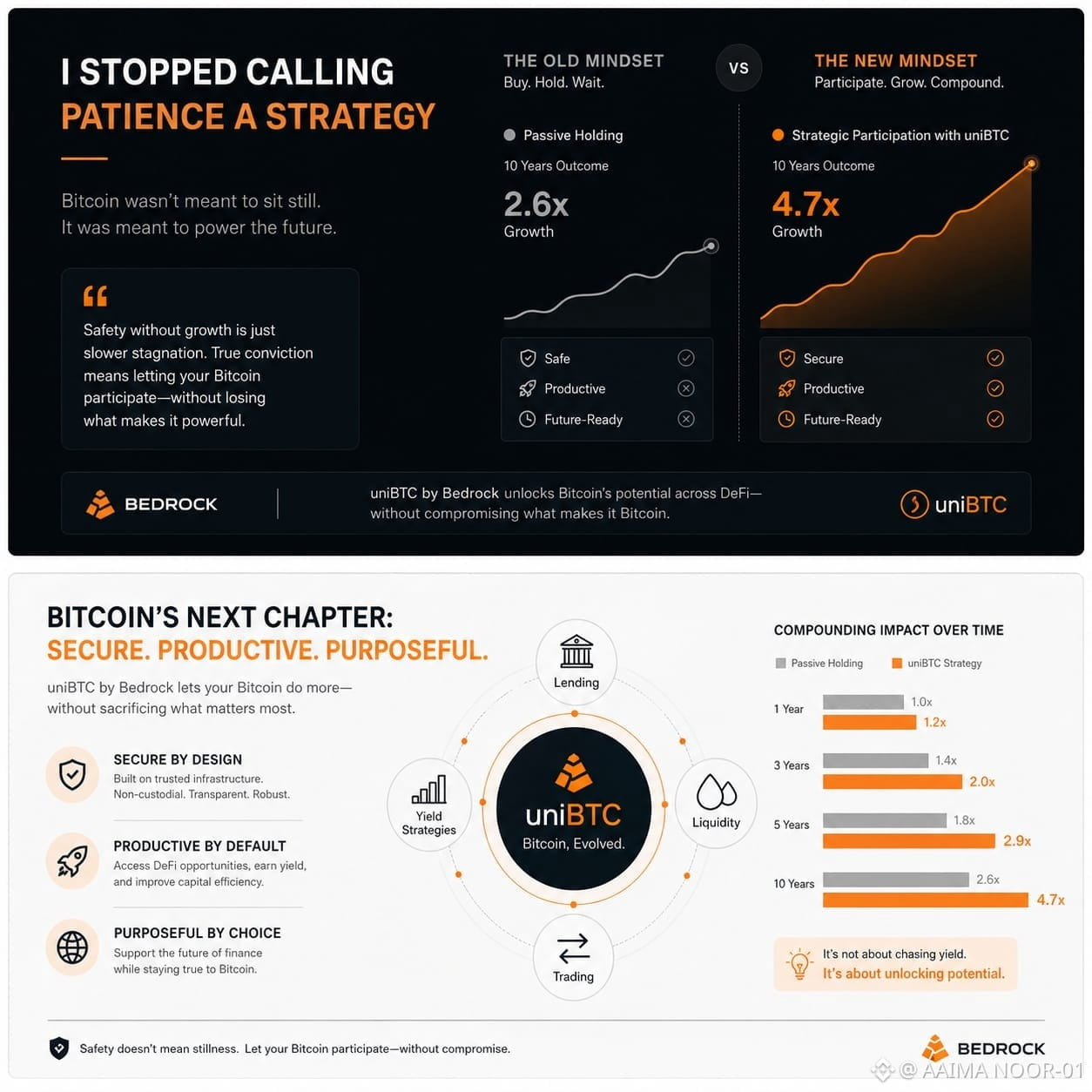
I used to believe that the highest form of Bitcoin wisdom was doing nothing.
Buy, forget, wait—I told myself that inactivity was discipline, that every day my capital sat frozen was a victory over the chaos of traders.
But lately, I've started noticing something strange. The people I admired most for their "conviction" weren't actually optimizing anything.
They were just paralyzed in a more respectable way.
Their wealth aged, but it never matured. And I finally had to ask myself: is that really the best we can do? Because the moment I looked at what Bedrock is building with uniBTC, I felt that assumption crack. Not because of the yield—yield is just a symptom.
What hit me was the realization that my Bitcoin had been living a smaller life than it deserved.
Safer, yes.
But smaller.
The market praises long-term holders as heroes, but heroes don't let their most powerful tools gather dust while the world builds liquidity rails around them.
So I'm rethinking everything. Not recklessly—I still want safety. But I no longer believe safety requires stillness.
I want my capital to participate without betraying its purpose.
And for the first time, that doesn't feel like greed. It feels like responsibility finally catching up to reality.
#Bitcoin #BTCFi #uniBTC
@Bedrock
$BR
#Bedrock
{future}(BRUSDT)
#bedrock $BR I Stopped Calling Patience a Strategy
I used to believe that the highest form of Bitcoin wisdom was doing nothing.
Buy, forget, wait—I told myself that inactivity was discipline, that every day my capital sat frozen was a victory over the chaos of traders.
But lately, I've started noticing something strange. The people I admired most for their "conviction" weren't actually optimizing anything.
They were just paralyzed in a more respectable way.
Their wealth aged, but it never matured. And I finally had to ask myself: is that really the best we can do? Because the moment I looked at what Bedrock is building with uniBTC, I felt that assumption crack. Not because of the yield—yield is just a symptom.
What hit me was the realization that my Bitcoin had been living a smaller life than it deserved.
Safer, yes.
But smaller.
The market praises long-term holders as heroes, but heroes don't let their most powerful tools gather dust while the world builds liquidity rails around them.
So I'm rethinking everything. Not recklessly—I still want safety. But I no longer believe safety requires stillness.
I want my capital to participate without betraying its purpose.
And for the first time, that doesn't feel like greed. It feels like responsibility finally catching up to reality.
#Bitcoin #BTCFi #uniBTC
@Bedrock
$BR
#Bedrock
I used to believe that the highest form of Bitcoin wisdom was doing nothing.
Buy, forget, wait—I told myself that inactivity was discipline, that every day my capital sat frozen was a victory over the chaos of traders.
But lately, I've started noticing something strange. The people I admired most for their "conviction" weren't actually optimizing anything.
They were just paralyzed in a more respectable way.
Their wealth aged, but it never matured. And I finally had to ask myself: is that really the best we can do? Because the moment I looked at what Bedrock is building with uniBTC, I felt that assumption crack. Not because of the yield—yield is just a symptom.
What hit me was the realization that my Bitcoin had been living a smaller life than it deserved.
Safer, yes.
But smaller.
The market praises long-term holders as heroes, but heroes don't let their most powerful tools gather dust while the world builds liquidity rails around them.
So I'm rethinking everything. Not recklessly—I still want safety. But I no longer believe safety requires stillness.
I want my capital to participate without betraying its purpose.
And for the first time, that doesn't feel like greed. It feels like responsibility finally catching up to reality.
#Bitcoin #BTCFi #uniBTC
@Bedrock
$BR
#Bedrock
200
88
3.9k

·
--
Partly True
#twopathsonetokendifferenjourneyssamedestination
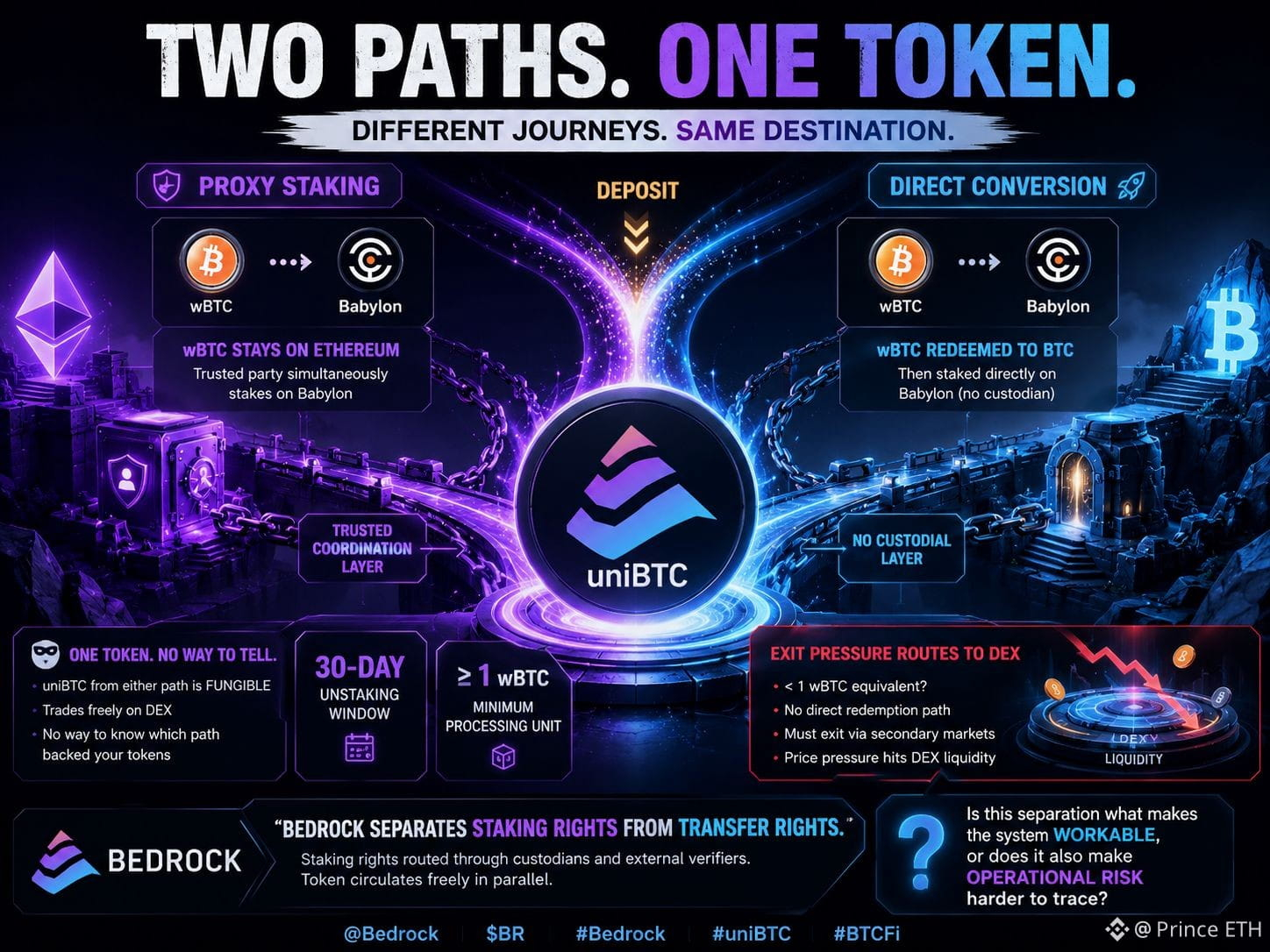
the first thing i noticed was that both deposit paths lead to the same place. you put in wBTC, you get out uniBTC, and somewhere between those two points there is a design decision most users never encounter.
the fork happens at deposit. in proxy staking, your wBTC stays on Ethereum while a trusted party simultaneously stakes the corresponding BTC amount on Babylon. in direct conversion, the wBTC is redeemed into native BTC first, then staked directly on Babylon without passing through a custodial wallet. both paths produce uniBTC the moment the deposit completes.
the asymmetry worth examining is in where trust actually lives. proxy staking keeps you within the Ethereum ecosystem but depends on a coordination layer between two networks, held together by a trusted party. direct conversion removes that layer but moves your BTC off Ethereum entirely, a different kind of dependency that does not disappear just because the interface looks the same.
here is what compounds that. uniBTC minted through either path is fungible and trades freely on DEX regardless of which mechanism backed it. the market sees one token, not two operational profiles. holders acquiring uniBTC on secondary markets have no way to distinguish which path produced the tokens they hold.
the 30-day unstaking window and the 1 wBTC minimum processing unit push this further. a holder below 1 wBTC equivalent has no direct redemption path through the protocol and must exit through secondary markets. during broad exits, price pressure routes to DEX liquidity rather than to the protocol redemption mechanics.
Bedrock separates staking rights from transfer rights deliberately, routing the first through custodians and external verifiers while the token circulates freely in parallel. it is a structurally interesting choice. the open question is whether that separation is what makes the system genuinely workable, or whether it also makes operational risk harder to trace once uniBTC is moving on the open market.
@Bedrock $BR #Bedrock #uniBTC
$H $BEAT
#twopathsonetokendifferenjourneyssamedestination
the first thing i noticed was that both deposit paths lead to the same place. you put in wBTC, you get out uniBTC, and somewhere between those two points there is a design decision most users never encounter.
the fork happens at deposit. in proxy staking, your wBTC stays on Ethereum while a trusted party simultaneously stakes the corresponding BTC amount on Babylon. in direct conversion, the wBTC is redeemed into native BTC first, then staked directly on Babylon without passing through a custodial wallet. both paths produce uniBTC the moment the deposit completes.
the asymmetry worth examining is in where trust actually lives. proxy staking keeps you within the Ethereum ecosystem but depends on a coordination layer between two networks, held together by a trusted party. direct conversion removes that layer but moves your BTC off Ethereum entirely, a different kind of dependency that does not disappear just because the interface looks the same.
here is what compounds that. uniBTC minted through either path is fungible and trades freely on DEX regardless of which mechanism backed it. the market sees one token, not two operational profiles. holders acquiring uniBTC on secondary markets have no way to distinguish which path produced the tokens they hold.
the 30-day unstaking window and the 1 wBTC minimum processing unit push this further. a holder below 1 wBTC equivalent has no direct redemption path through the protocol and must exit through secondary markets. during broad exits, price pressure routes to DEX liquidity rather than to the protocol redemption mechanics.
Bedrock separates staking rights from transfer rights deliberately, routing the first through custodians and external verifiers while the token circulates freely in parallel. it is a structurally interesting choice. the open question is whether that separation is what makes the system genuinely workable, or whether it also makes operational risk harder to trace once uniBTC is moving on the open market.
@Bedrock $BR #Bedrock #uniBTC
$H $BEAT
the first thing i noticed was that both deposit paths lead to the same place. you put in wBTC, you get out uniBTC, and somewhere between those two points there is a design decision most users never encounter.
the fork happens at deposit. in proxy staking, your wBTC stays on Ethereum while a trusted party simultaneously stakes the corresponding BTC amount on Babylon. in direct conversion, the wBTC is redeemed into native BTC first, then staked directly on Babylon without passing through a custodial wallet. both paths produce uniBTC the moment the deposit completes.
the asymmetry worth examining is in where trust actually lives. proxy staking keeps you within the Ethereum ecosystem but depends on a coordination layer between two networks, held together by a trusted party. direct conversion removes that layer but moves your BTC off Ethereum entirely, a different kind of dependency that does not disappear just because the interface looks the same.
here is what compounds that. uniBTC minted through either path is fungible and trades freely on DEX regardless of which mechanism backed it. the market sees one token, not two operational profiles. holders acquiring uniBTC on secondary markets have no way to distinguish which path produced the tokens they hold.
the 30-day unstaking window and the 1 wBTC minimum processing unit push this further. a holder below 1 wBTC equivalent has no direct redemption path through the protocol and must exit through secondary markets. during broad exits, price pressure routes to DEX liquidity rather than to the protocol redemption mechanics.
Bedrock separates staking rights from transfer rights deliberately, routing the first through custodians and external verifiers while the token circulates freely in parallel. it is a structurally interesting choice. the open question is whether that separation is what makes the system genuinely workable, or whether it also makes operational risk harder to trace once uniBTC is moving on the open market.
@Bedrock $BR #Bedrock #uniBTC
$H $BEAT
27
14
1.1k

·
--
Bearish
Verified
Looking at the charts today, the BTCFi narrative is getting spicy, but most people are missing the real play. Let’s talk about @Bedrock DAO ($BR) and uniBTC.
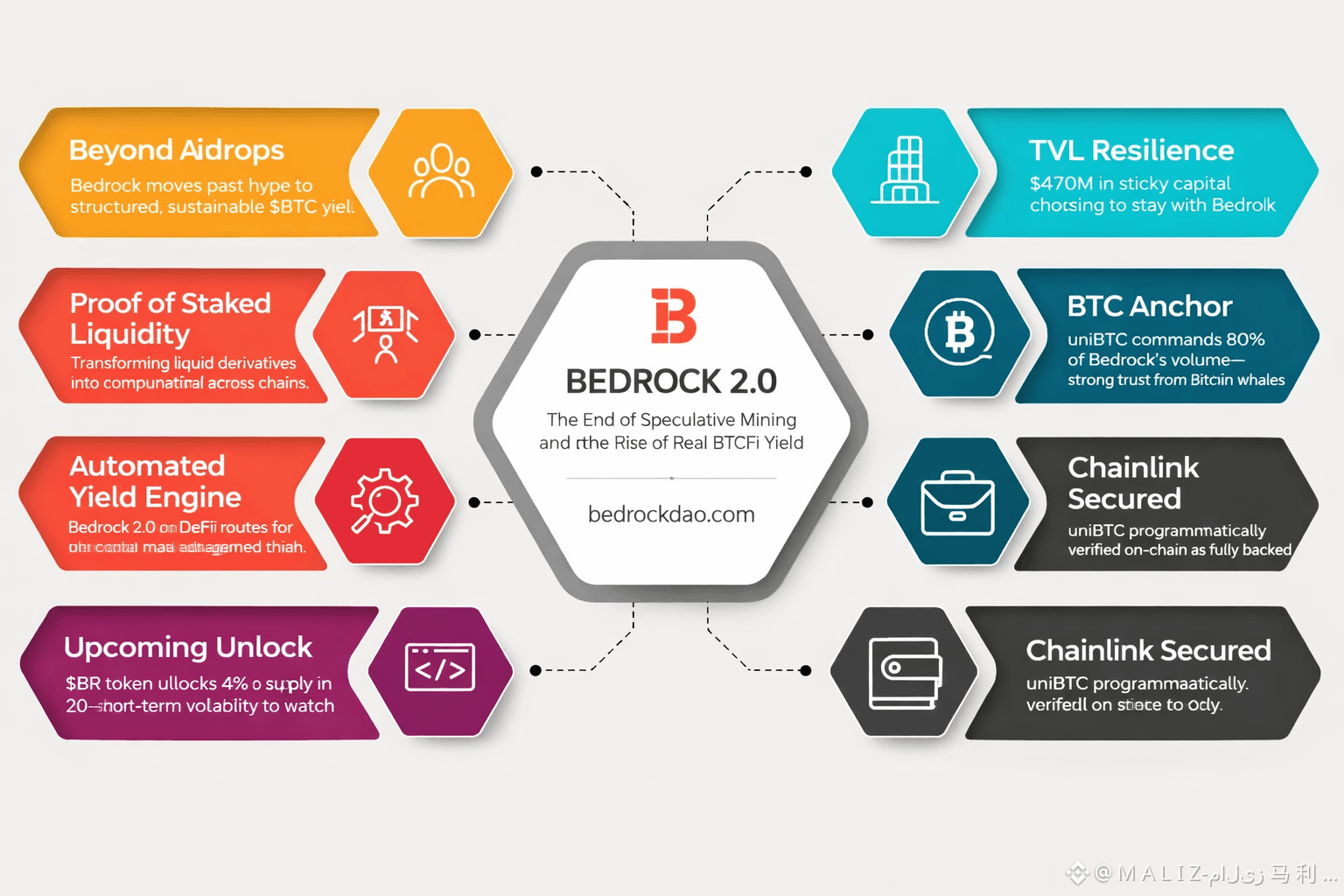
While everyone is chasing generic airdrops, Bedrock 2.0 is quietly shifting from speculative mining to a real, automated yield engine. Their TVL is holding strong at around $470M, and uniBTC alone commands 80% of that. That tells me whale money is sticky and trust is high—especially with Chainlink’s Secure Minting keeping things safe on-chain.
But here is my raw, tactical take: keep your eyes on the calendar. We have a $BR token unlock coming up on June 20, releasing about 4% of the supply. We might see some short-term volatility or a quick liquidity test around that date.
Personally, Ignoring the localized noise. If Bedrock successfully captures sustainable, institutional-grade yield through its new automated vaults, $br becomes a solid long-term accumulation play for governance and fee-sharing.
Are you holding $BR for the long haul, or just farming the BTCFi ecosystem for quick gains? Let me know below!
#uniBTC #BTCFi #CryptoAnalysis #defi #bedrock
DYOR
Looking at the charts today, the BTCFi narrative is getting spicy, but most people are missing the real play. Let’s talk about @Bedrock DAO ($BR ) and uniBTC.
While everyone is chasing generic airdrops, Bedrock 2.0 is quietly shifting from speculative mining to a real, automated yield engine. Their TVL is holding strong at around $470M, and uniBTC alone commands 80% of that. That tells me whale money is sticky and trust is high—especially with Chainlink’s Secure Minting keeping things safe on-chain.
But here is my raw, tactical take: keep your eyes on the calendar. We have a $BR token unlock coming up on June 20, releasing about 4% of the supply. We might see some short-term volatility or a quick liquidity test around that date.
Personally, Ignoring the localized noise. If Bedrock successfully captures sustainable, institutional-grade yield through its new automated vaults, $br becomes a solid long-term accumulation play for governance and fee-sharing.
Are you holding $BR for the long haul, or just farming the BTCFi ecosystem for quick gains? Let me know below!
#uniBTC #BTCFi #CryptoAnalysis #defi #bedrock
DYOR
While everyone is chasing generic airdrops, Bedrock 2.0 is quietly shifting from speculative mining to a real, automated yield engine. Their TVL is holding strong at around $470M, and uniBTC alone commands 80% of that. That tells me whale money is sticky and trust is high—especially with Chainlink’s Secure Minting keeping things safe on-chain.
But here is my raw, tactical take: keep your eyes on the calendar. We have a $BR token unlock coming up on June 20, releasing about 4% of the supply. We might see some short-term volatility or a quick liquidity test around that date.
Personally, Ignoring the localized noise. If Bedrock successfully captures sustainable, institutional-grade yield through its new automated vaults, $br becomes a solid long-term accumulation play for governance and fee-sharing.
Are you holding $BR for the long haul, or just farming the BTCFi ecosystem for quick gains? Let me know below!
#uniBTC #BTCFi #CryptoAnalysis #defi #bedrock
DYOR
50
2
52
562

·
--
Bullish
#bedrock $BR @Bedrock
I keep coming back to one question when I look at Bedrock....
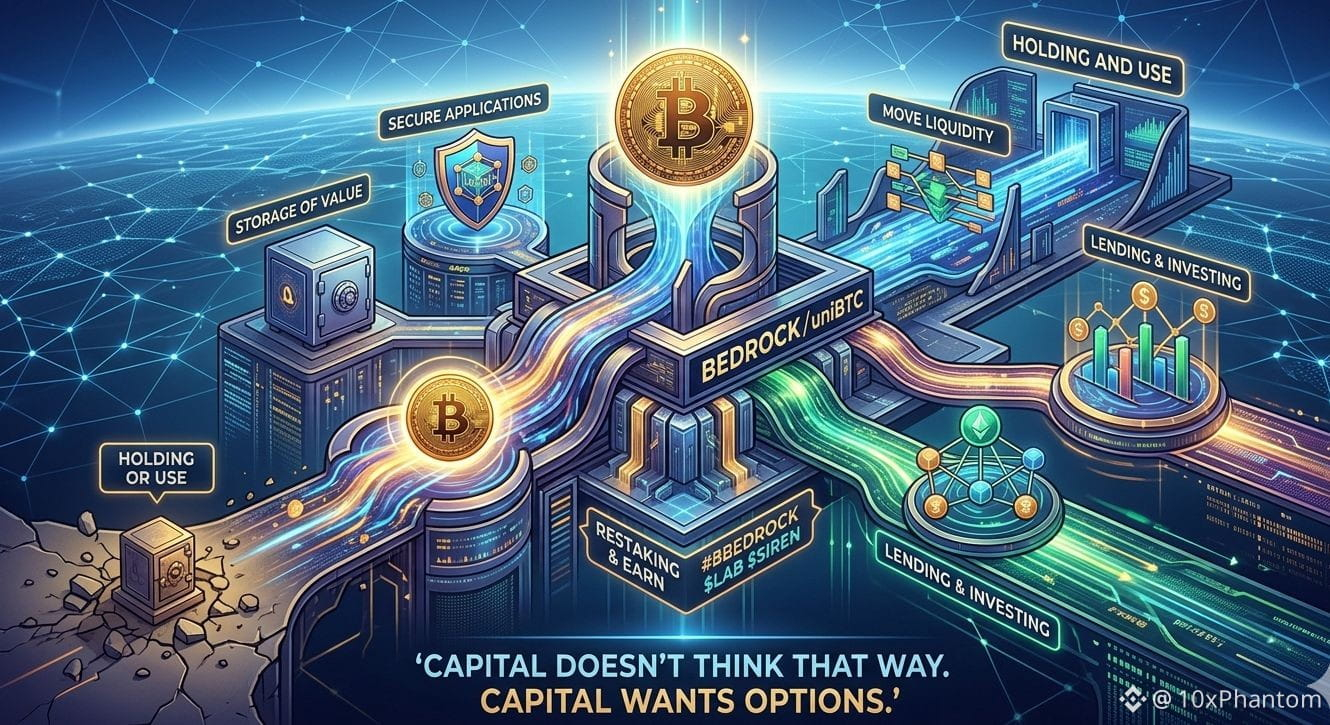
Why did we ever accept "hold it OR use it" as normal?
That was the unspoken rule in crypto forever.
Store of value. OR utility. Pick one.
Trust me.... that thinking is already dead.
Here's what nobody told us early on
Capital doesn't like sitting still.
In TradFi, your money saves, invests, lends, AND transacts.... all at once.
Same asset. Multiple jobs. Zero compromise.
Crypto never had that. Until now.
OMG 😱... Bedrock and uniBTC aren't just about yield.
They're breaking the old assumption completely.
Your BTC doesn't have to choose anymore.
Hold it. Earn on it. Use it. All at the same time.
You're not giving up ownership.
You're just making your asset work harder.
And here's the shift that actually matters..
Once a user experiences this?
They never go back.
Future questions won't be "how much yield am I getting?"
It'll be..."what ELSE can my asset do for me?"
That's the new standard.
We're early. But this is where everything is heading.
Position accordingly.
#Bitcoin #DeFi #Bedrock #uniBTC
{alpha}(560xff7d6a96ae471bbcd7713af9cb1feeb16cf56b41)
#bedrock $BR @Bedrock
I keep coming back to one question when I look at Bedrock....
Why did we ever accept "hold it OR use it" as normal?
That was the unspoken rule in crypto forever.
Store of value. OR utility. Pick one.
Trust me.... that thinking is already dead.
Here's what nobody told us early on
Capital doesn't like sitting still.
In TradFi, your money saves, invests, lends, AND transacts.... all at once.
Same asset. Multiple jobs. Zero compromise.
Crypto never had that. Until now.
OMG 😱... Bedrock and uniBTC aren't just about yield.
They're breaking the old assumption completely.
Your BTC doesn't have to choose anymore.
Hold it. Earn on it. Use it. All at the same time.
You're not giving up ownership.
You're just making your asset work harder.
And here's the shift that actually matters..
Once a user experiences this?
They never go back.
Future questions won't be "how much yield am I getting?"
It'll be..."what ELSE can my asset do for me?"
That's the new standard.
We're early. But this is where everything is heading.
Position accordingly.
#Bitcoin #DeFi #Bedrock #uniBTC
I keep coming back to one question when I look at Bedrock....
Why did we ever accept "hold it OR use it" as normal?
That was the unspoken rule in crypto forever.
Store of value. OR utility. Pick one.
Trust me.... that thinking is already dead.
Here's what nobody told us early on
Capital doesn't like sitting still.
In TradFi, your money saves, invests, lends, AND transacts.... all at once.
Same asset. Multiple jobs. Zero compromise.
Crypto never had that. Until now.
OMG 😱... Bedrock and uniBTC aren't just about yield.
They're breaking the old assumption completely.
Your BTC doesn't have to choose anymore.
Hold it. Earn on it. Use it. All at the same time.
You're not giving up ownership.
You're just making your asset work harder.
And here's the shift that actually matters..
Once a user experiences this?
They never go back.
Future questions won't be "how much yield am I getting?"
It'll be..."what ELSE can my asset do for me?"
That's the new standard.
We're early. But this is where everything is heading.
Position accordingly.
#Bitcoin #DeFi #Bedrock #uniBTC
39
18
225

·
--
Bullish
Verified
For Most of Time I Have Held Bitcoin, The Decision Was Pretty Simple.
Hold it, or move it to somewhere to earn a return and hope that choice still made sense a few months later..
But lately I have Been wondering if the bigger challenge isn't finding yield anymore.
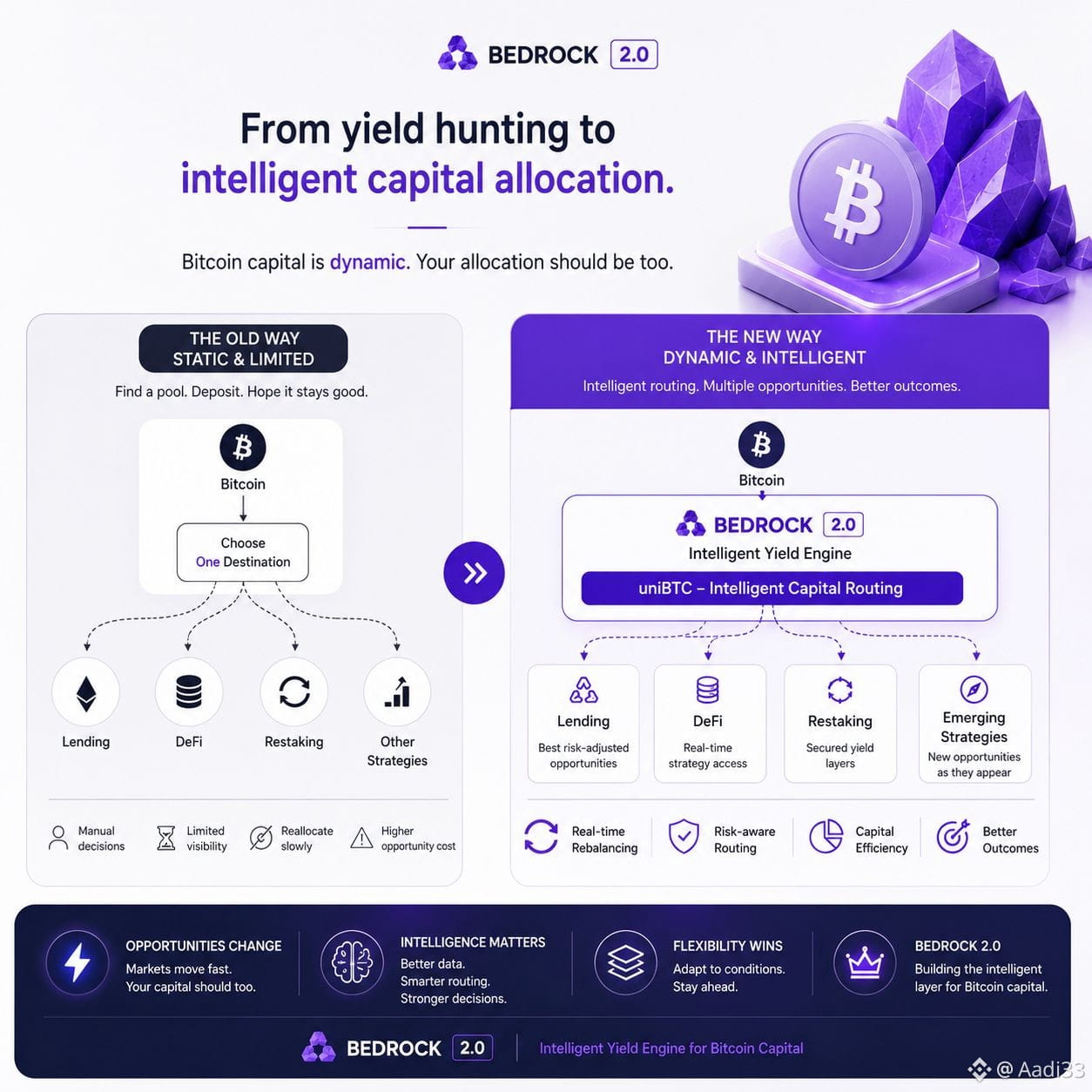
It iz deciding where Bitcoin should be postioned as conditions change.
That's the one reason why Bedrock 2.0 make me surprised and literally it caught my attention.
Most BTCFi protocols seem focused on a familiar question
Where can Bitcoin earn yield?
What I find interesting is that @Bedrock appears to be focused on a different one,
Where should Bitcoin go next?
Do you know, That may sound like a small difference, but I don't think it is.
Opportunities change. Risk changes. Market conditions change too.
A position that looks efficient today can become much less attractive tomorrow.
Through uniBTC and its approach to capital allocation, Bedrock is exploring a model where Bitcoin isn't tied to a Single destination. The focus is less on finding one opportunity and more on adapting as 0pportunities evolve.
I literally don't know if that approach will become the standard for BTCFi.
But I do really think the next phase may be defined less by who offers the highest APY and more by Who helps Bitcoin capital move intelligently over time.
#Bedrock $BR
#BTCFi #uniBTC #bitcoin
$ZEC
For Most of Time I Have Held Bitcoin, The Decision Was Pretty Simple.
Hold it, or move it to somewhere to earn a return and hope that choice still made sense a few months later..
But lately I have Been wondering if the bigger challenge isn't finding yield anymore.
It iz deciding where Bitcoin should be postioned as conditions change.
That's the one reason why Bedrock 2.0 make me surprised and literally it caught my attention.
Most BTCFi protocols seem focused on a familiar question
Where can Bitcoin earn yield?
What I find interesting is that @Bedrock appears to be focused on a different one,
Where should Bitcoin go next?
Do you know, That may sound like a small difference, but I don't think it is.
Opportunities change. Risk changes. Market conditions change too.
A position that looks efficient today can become much less attractive tomorrow.
Through uniBTC and its approach to capital allocation, Bedrock is exploring a model where Bitcoin isn't tied to a Single destination. The focus is less on finding one opportunity and more on adapting as 0pportunities evolve.
I literally don't know if that approach will become the standard for BTCFi.
But I do really think the next phase may be defined less by who offers the highest APY and more by Who helps Bitcoin capital move intelligently over time.
#Bedrock $BR
#BTCFi #uniBTC #bitcoin
$ZEC
Hold it, or move it to somewhere to earn a return and hope that choice still made sense a few months later..
But lately I have Been wondering if the bigger challenge isn't finding yield anymore.
It iz deciding where Bitcoin should be postioned as conditions change.
That's the one reason why Bedrock 2.0 make me surprised and literally it caught my attention.
Most BTCFi protocols seem focused on a familiar question
Where can Bitcoin earn yield?
What I find interesting is that @Bedrock appears to be focused on a different one,
Where should Bitcoin go next?
Do you know, That may sound like a small difference, but I don't think it is.
Opportunities change. Risk changes. Market conditions change too.
A position that looks efficient today can become much less attractive tomorrow.
Through uniBTC and its approach to capital allocation, Bedrock is exploring a model where Bitcoin isn't tied to a Single destination. The focus is less on finding one opportunity and more on adapting as 0pportunities evolve.
I literally don't know if that approach will become the standard for BTCFi.
But I do really think the next phase may be defined less by who offers the highest APY and more by Who helps Bitcoin capital move intelligently over time.
#Bedrock $BR
#BTCFi #uniBTC #bitcoin
$ZEC
Aisha-CoCo:
I interact with Bedrock, security matters just as much as yield. Clear Signing helps remove the uncertainty that has led to countless blind-signing mistakes across DeFi.
53
1
38
1.1k

·
--
@Bedrock just dropped an update for uniBTC to v1.0.5, and there are two key upgrades you should definitely keep an eye on:
1. CCIP Cross-Chain Transfers: uniBTC can now securely move between multiple chains using the Chainlink CCIP protocol. What does this mean? Your staked BTC earnings are no longer locked on a single chain, allowing free flow between Arbitrum, Scroll, and Merlin Chain—truly enabling cross-chain restaking.
2. Enhanced Redemption Security: Bedrock 2.0 clearly steps up the game on security. The biggest risk in the restaking arena isn't price volatility; it's the safety of the underlying assets. This upgrade shows the team is taking this issue seriously.
$BR serves as the governance token for the Bedrock ecosystem, and with the activation of uniBTC's cross-chain capabilities, there's now another tangible case for the BTCFi narrative.
#Bedrock #uniBTC #BTCFi
@Bedrock just dropped an update for uniBTC to v1.0.5, and there are two key upgrades you should definitely keep an eye on:
1. CCIP Cross-Chain Transfers: uniBTC can now securely move between multiple chains using the Chainlink CCIP protocol. What does this mean? Your staked BTC earnings are no longer locked on a single chain, allowing free flow between Arbitrum, Scroll, and Merlin Chain—truly enabling cross-chain restaking.
2. Enhanced Redemption Security: Bedrock 2.0 clearly steps up the game on security. The biggest risk in the restaking arena isn't price volatility; it's the safety of the underlying assets. This upgrade shows the team is taking this issue seriously.
$BR serves as the governance token for the Bedrock ecosystem, and with the activation of uniBTC's cross-chain capabilities, there's now another tangible case for the BTCFi narrative.
#Bedrock #uniBTC #BTCFi
1. CCIP Cross-Chain Transfers: uniBTC can now securely move between multiple chains using the Chainlink CCIP protocol. What does this mean? Your staked BTC earnings are no longer locked on a single chain, allowing free flow between Arbitrum, Scroll, and Merlin Chain—truly enabling cross-chain restaking.
2. Enhanced Redemption Security: Bedrock 2.0 clearly steps up the game on security. The biggest risk in the restaking arena isn't price volatility; it's the safety of the underlying assets. This upgrade shows the team is taking this issue seriously.
$BR serves as the governance token for the Bedrock ecosystem, and with the activation of uniBTC's cross-chain capabilities, there's now another tangible case for the BTCFi narrative.
#Bedrock #uniBTC #BTCFi
140

·
--
$BR is quietly building something massive 🔥**
Bedrock is a multi asset liquid re staking protocol redefining how users earn yield on their crypto assets
With **uniBTC uniETH and uniIOTX** Bedrock lets you restake assets and earn multiple layers of rewards simultaneously without sacrificing liquidity
The DeFi space is evolving fast and Bedrock is right at the forefront of this restaking revolution 🚀
Total Value Locked has been growing steadily showing strong community trust and adoption
If you are looking for a protocol that maximizes your yield while keeping assets productive **Bedrock deserves your attention**
Do your own research and stay ahead of the curve 👀
#LiquidRestaking #DeFiDominance #uniBTC #BinanceSquare #crypto
$BR is quietly building something massive 🔥**
Bedrock is a multi asset liquid re staking protocol redefining how users earn yield on their crypto assets
With **uniBTC uniETH and uniIOTX** Bedrock lets you restake assets and earn multiple layers of rewards simultaneously without sacrificing liquidity
The DeFi space is evolving fast and Bedrock is right at the forefront of this restaking revolution 🚀
Total Value Locked has been growing steadily showing strong community trust and adoption
If you are looking for a protocol that maximizes your yield while keeping assets productive **Bedrock deserves your attention**
Do your own research and stay ahead of the curve 👀
#LiquidRestaking #DeFiDominance #uniBTC #BinanceSquare #crypto
Bedrock is a multi asset liquid re staking protocol redefining how users earn yield on their crypto assets
With **uniBTC uniETH and uniIOTX** Bedrock lets you restake assets and earn multiple layers of rewards simultaneously without sacrificing liquidity
The DeFi space is evolving fast and Bedrock is right at the forefront of this restaking revolution 🚀
Total Value Locked has been growing steadily showing strong community trust and adoption
If you are looking for a protocol that maximizes your yield while keeping assets productive **Bedrock deserves your attention**
Do your own research and stay ahead of the curve 👀
#LiquidRestaking #DeFiDominance #uniBTC #BinanceSquare #crypto
64

·
--
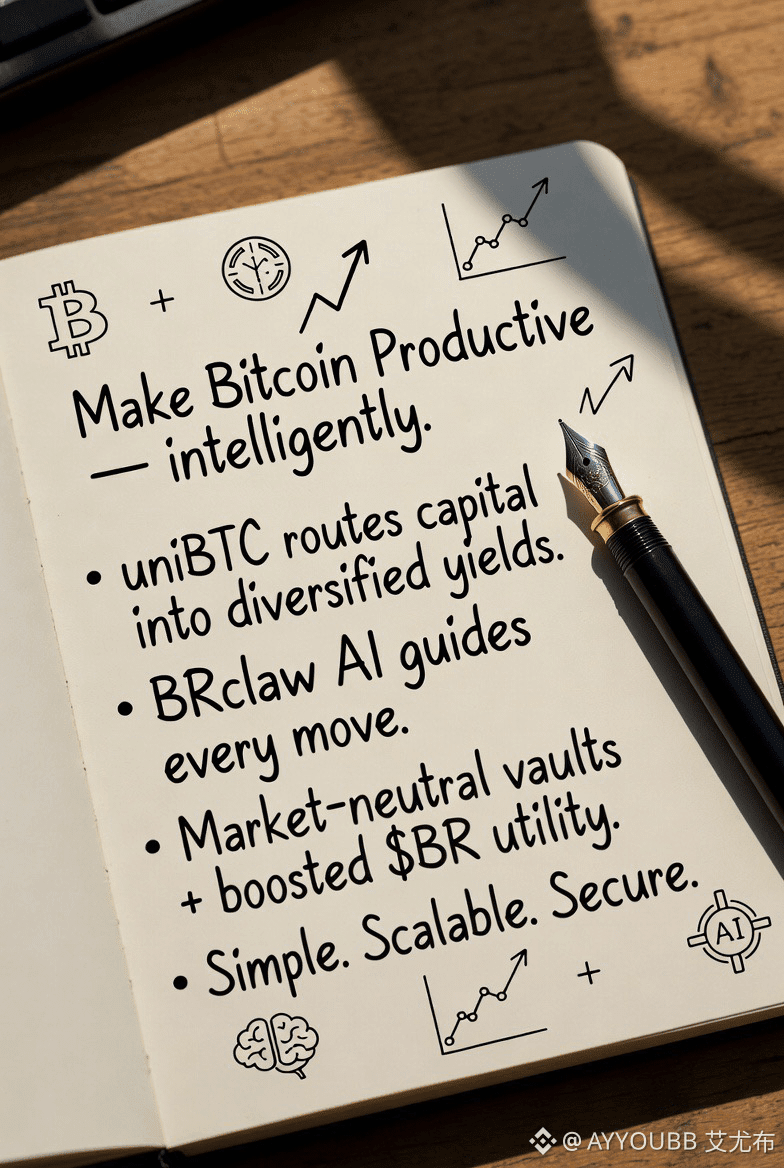
🚀 Make Bitcoin Productive — But Do It Intelligently!
@Bedrock 2.0 is redefining BTCfi as the ultimate Intelligent Yield Engine for your Bitcoin capital.
No more fragile single-source yields.
uniBTC dynamically routes your BTC into diversified, institutional-grade opportunities — while BRclaw AI breaks down every move so you actually understand it.
From market-neutral vaults to boosted utility for $BR holders — this is sustainable BTC productivity built for the long haul.
The new homepage says it all: Simple. Scalable. Secure.
The next wave of Bitcoin capital efficiency is here. Don’t sit on the sidelines! 🔥
What part of Bedrock 2.0 are you most bullish on right now?
Drop your thoughts 👇
#Bedrock #BTCFi #uniBTC $BR $BTC
https://www.bedrock.technology/
🚀 Make Bitcoin Productive — But Do It Intelligently!
@Bedrock 2.0 is redefining BTCfi as the ultimate Intelligent Yield Engine for your Bitcoin capital.
No more fragile single-source yields.
uniBTC dynamically routes your BTC into diversified, institutional-grade opportunities — while BRclaw AI breaks down every move so you actually understand it.
From market-neutral vaults to boosted utility for $BR holders — this is sustainable BTC productivity built for the long haul.
The new homepage says it all: Simple. Scalable. Secure.
The next wave of Bitcoin capital efficiency is here. Don’t sit on the sidelines! 🔥
What part of Bedrock 2.0 are you most bullish on right now?
Drop your thoughts 👇
#Bedrock #BTCFi #uniBTC $BR $BTC
https://www.bedrock.technology/
@Bedrock 2.0 is redefining BTCfi as the ultimate Intelligent Yield Engine for your Bitcoin capital.
No more fragile single-source yields.
uniBTC dynamically routes your BTC into diversified, institutional-grade opportunities — while BRclaw AI breaks down every move so you actually understand it.
From market-neutral vaults to boosted utility for $BR holders — this is sustainable BTC productivity built for the long haul.
The new homepage says it all: Simple. Scalable. Secure.
The next wave of Bitcoin capital efficiency is here. Don’t sit on the sidelines! 🔥
What part of Bedrock 2.0 are you most bullish on right now?
Drop your thoughts 👇
#Bedrock #BTCFi #uniBTC $BR $BTC
https://www.bedrock.technology/
46

·
--
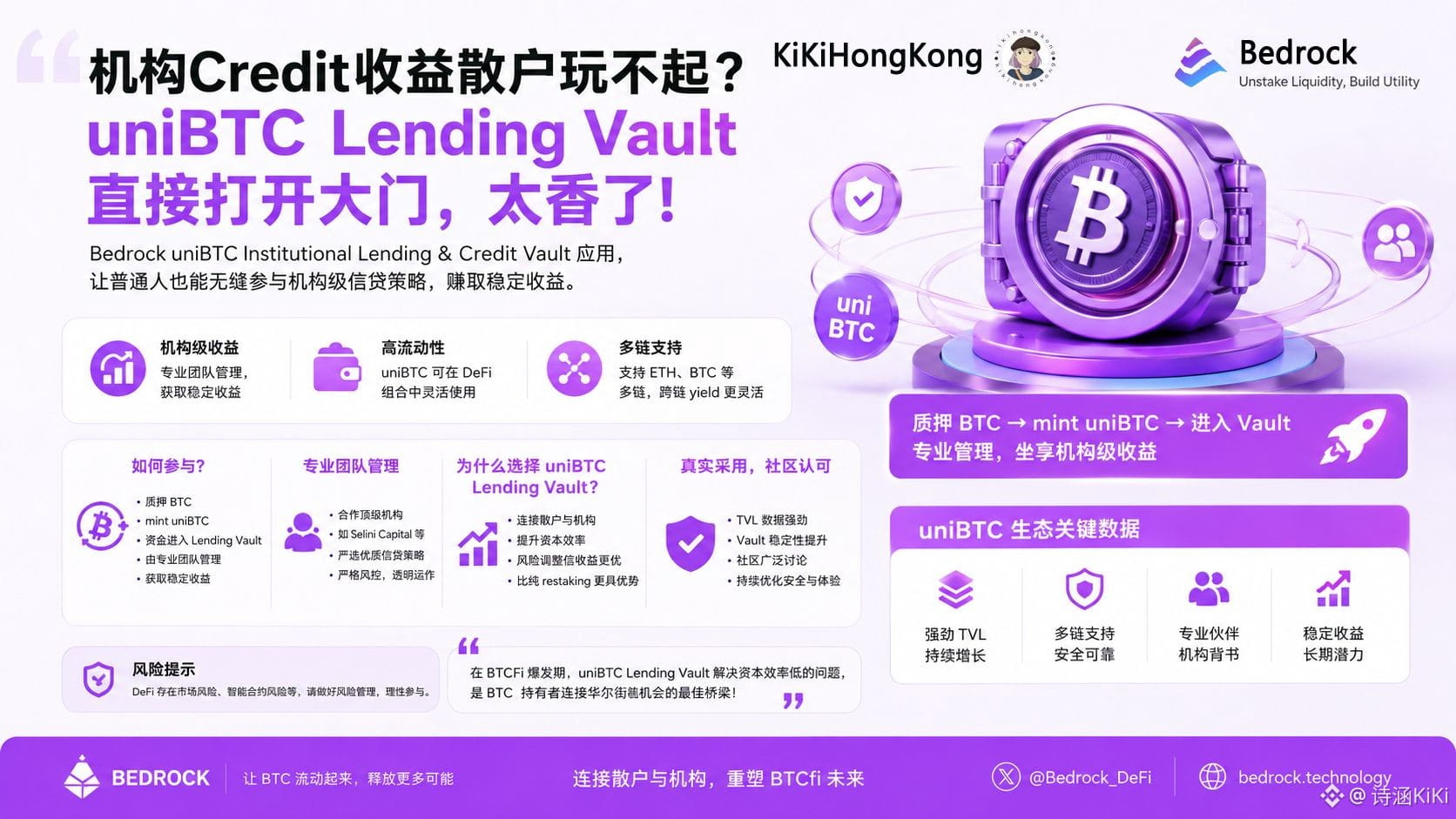
🔥 Institutions' Credit Yields Too Rich for Retail? @Bedrock_DeFi's uniBTC Lending Vault Just Opened the Gates, and It’s Smelling Sweet!
Right now, the DeFi spotlight is shifting to RWA and Credit, but regular folks are struggling to tap into those high-quality yields. @Bedrock_DeFi’s uniBTC Institutional Lending & Credit Vault is the perfect entry point!
By minting uniBTC, you can seamlessly participate in credit strategies managed by pros (like Selini Capital, etc.), becoming an institutional-level lender earning stable yields, all while keeping uniBTC highly liquid for use in your DeFi portfolio.
The actual process is straightforward: stake BTC to get uniBTC, and once the funds hit the vault, they’re managed by experts. With Bedrock’s multi-chain support (ETH, BTC, etc.), cross-chain yields are super flexible.
Recently, the official team has been focusing on core chain security, and community feedback indicates improved vault stability, with many talking about using it to optimize their BTC positions. TVL data shows uniBTC is performing strongly, proving real adoption.
Personal take: This Lending Vault function truly showcases Bedrock’s value—bridging retail and institutions.
During the BTCFi boom, it tackles the issue of low capital efficiency, with risk-adjusted returns being more appealing. Compared to pure restaking, having an extra layer of professional management and transparency makes it compelling. I think it has strong execution, solid partnerships backing it, and long-term competitive potential.
Of course, DeFi comes with market and contract risks, and past exploits remind us that vigilance is crucial. But overall, I’m optimistic about $BR 's role in the ecosystem, making it worth a deep dive for BTC players, with significant potential for mid-to-long-term positioning! 💎
Want to connect your BTC to Wall Street opportunities? This Bedrock vault is worth diving into! @Bedrock $BR #Bedrock #Bedrock_DeFi #uniBTC #LendingVault #BTCFi #RWA #CreditDeFi
🔥 Institutions' Credit Yields Too Rich for Retail? @Bedrock_DeFi's uniBTC Lending Vault Just Opened the Gates, and It’s Smelling Sweet!
Right now, the DeFi spotlight is shifting to RWA and Credit, but regular folks are struggling to tap into those high-quality yields. @Bedrock_DeFi’s uniBTC Institutional Lending & Credit Vault is the perfect entry point!
By minting uniBTC, you can seamlessly participate in credit strategies managed by pros (like Selini Capital, etc.), becoming an institutional-level lender earning stable yields, all while keeping uniBTC highly liquid for use in your DeFi portfolio.
The actual process is straightforward: stake BTC to get uniBTC, and once the funds hit the vault, they’re managed by experts. With Bedrock’s multi-chain support (ETH, BTC, etc.), cross-chain yields are super flexible.
Recently, the official team has been focusing on core chain security, and community feedback indicates improved vault stability, with many talking about using it to optimize their BTC positions. TVL data shows uniBTC is performing strongly, proving real adoption.
Personal take: This Lending Vault function truly showcases Bedrock’s value—bridging retail and institutions.
During the BTCFi boom, it tackles the issue of low capital efficiency, with risk-adjusted returns being more appealing. Compared to pure restaking, having an extra layer of professional management and transparency makes it compelling. I think it has strong execution, solid partnerships backing it, and long-term competitive potential.
Of course, DeFi comes with market and contract risks, and past exploits remind us that vigilance is crucial. But overall, I’m optimistic about $BR 's role in the ecosystem, making it worth a deep dive for BTC players, with significant potential for mid-to-long-term positioning! 💎
Want to connect your BTC to Wall Street opportunities? This Bedrock vault is worth diving into! @Bedrock $BR #Bedrock #Bedrock_DeFi #uniBTC #LendingVault #BTCFi #RWA #CreditDeFi
Right now, the DeFi spotlight is shifting to RWA and Credit, but regular folks are struggling to tap into those high-quality yields. @Bedrock_DeFi’s uniBTC Institutional Lending & Credit Vault is the perfect entry point!
By minting uniBTC, you can seamlessly participate in credit strategies managed by pros (like Selini Capital, etc.), becoming an institutional-level lender earning stable yields, all while keeping uniBTC highly liquid for use in your DeFi portfolio.
The actual process is straightforward: stake BTC to get uniBTC, and once the funds hit the vault, they’re managed by experts. With Bedrock’s multi-chain support (ETH, BTC, etc.), cross-chain yields are super flexible.
Recently, the official team has been focusing on core chain security, and community feedback indicates improved vault stability, with many talking about using it to optimize their BTC positions. TVL data shows uniBTC is performing strongly, proving real adoption.
Personal take: This Lending Vault function truly showcases Bedrock’s value—bridging retail and institutions.
During the BTCFi boom, it tackles the issue of low capital efficiency, with risk-adjusted returns being more appealing. Compared to pure restaking, having an extra layer of professional management and transparency makes it compelling. I think it has strong execution, solid partnerships backing it, and long-term competitive potential.
Of course, DeFi comes with market and contract risks, and past exploits remind us that vigilance is crucial. But overall, I’m optimistic about $BR 's role in the ecosystem, making it worth a deep dive for BTC players, with significant potential for mid-to-long-term positioning! 💎
Want to connect your BTC to Wall Street opportunities? This Bedrock vault is worth diving into! @Bedrock $BR #Bedrock #Bedrock_DeFi #uniBTC #LendingVault #BTCFi #RWA #CreditDeFi
289

·
--
Bullish
Bedrock 2.0 isn’t a restaking protocol.
It’s an Intelligent Yield Engine for Bitcoin capital.
Since mid-2024, yield compression has become the market reality. Bedrock’s answer is uniBTC — a dynamic routing layer that moves capital to where yield actually exists.
Four vault strategies are coming:
Delta-Neutral
DeFi-Native Yield
Lending & Credit
RWA
The first is Selini Vault — managed by Selini Capital, built on Cap’s credit infrastructure, and anchored by Symbiotic.
An institutional-grade strategy, now accessible to retail users.
$BR is the access key.
Higher tiers unlock:
boosted yield
priority access to capped vaults
exclusive features in BRclaw, Bedrock’s AI on-chain analyst now in beta
On security, Bedrock uses Chainlink Proof of Reserve and Secure Mint, with 1:1 real-time backing for every uniBTC.
In one year, Bedrock has reached:
6,200 $BTC secured
19 chains
83,000 holders
Binance listing
Stop chasing fake APY. Start routing intelligently.
@Bedrock
#bedrock #uniBTC $BR
Bedrock 2.0 isn’t a restaking protocol.
It’s an Intelligent Yield Engine for Bitcoin capital.
Since mid-2024, yield compression has become the market reality. Bedrock’s answer is uniBTC — a dynamic routing layer that moves capital to where yield actually exists.
Four vault strategies are coming:
Delta-Neutral
DeFi-Native Yield
Lending & Credit
RWA
The first is Selini Vault — managed by Selini Capital, built on Cap’s credit infrastructure, and anchored by Symbiotic.
An institutional-grade strategy, now accessible to retail users.
$BR is the access key.
Higher tiers unlock:
boosted yield
priority access to capped vaults
exclusive features in BRclaw, Bedrock’s AI on-chain analyst now in beta
On security, Bedrock uses Chainlink Proof of Reserve and Secure Mint, with 1:1 real-time backing for every uniBTC.
In one year, Bedrock has reached:
6,200 $BTC secured
19 chains
83,000 holders
Binance listing
Stop chasing fake APY. Start routing intelligently.
@Bedrock
#bedrock #uniBTC $BR
It’s an Intelligent Yield Engine for Bitcoin capital.
Since mid-2024, yield compression has become the market reality. Bedrock’s answer is uniBTC — a dynamic routing layer that moves capital to where yield actually exists.
Four vault strategies are coming:
Delta-Neutral
DeFi-Native Yield
Lending & Credit
RWA
The first is Selini Vault — managed by Selini Capital, built on Cap’s credit infrastructure, and anchored by Symbiotic.
An institutional-grade strategy, now accessible to retail users.
$BR is the access key.
Higher tiers unlock:
boosted yield
priority access to capped vaults
exclusive features in BRclaw, Bedrock’s AI on-chain analyst now in beta
On security, Bedrock uses Chainlink Proof of Reserve and Secure Mint, with 1:1 real-time backing for every uniBTC.
In one year, Bedrock has reached:
6,200 $BTC secured
19 chains
83,000 holders
Binance listing
Stop chasing fake APY. Start routing intelligently.
@Bedrock
#bedrock #uniBTC $BR
95

·
--
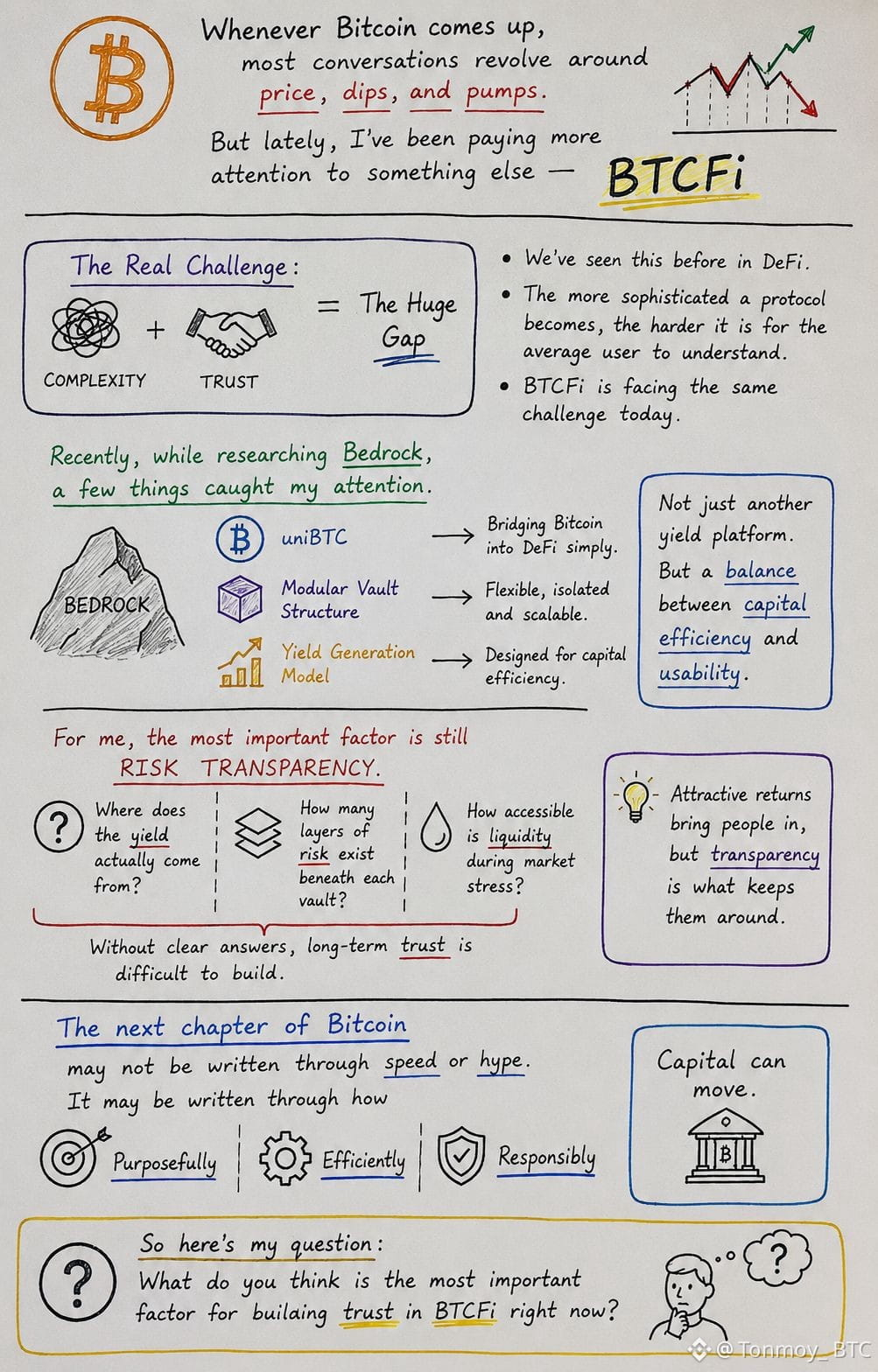
Whenever Bitcoin comes up, most conversations revolve around price, dips, and pumps. But lately, I’ve been paying more attention to something else BTCFi.
The more I read, the more I realize that the real challenge isn’t the technology itself. It’s the huge gap between complexity and trust. We’ve seen this before in DeFi. The more sophisticated a protocol becomes, the harder it is for the average user to understand. BTCFi is facing the same challenge today.
Recently, while researching Bedrock, a few things caught my attention. uniBTC, its modular vault structure, and its yield generation model didn’t feel like just another yield platform. Instead, it seemed like an attempt to find a balance between capital efficiency and usability.
That said, the most important factor for me is still risk transparency. Where does the yield actually come from? How many layers of risk exist beneath each vault? How accessible is liquidity during periods of market stress? In my view, long-term trust is difficult to build without clear answers to these questions.
Crypto history has shown that attractive returns bring people in, but transparency is what keeps them around.
The next chapter of Bitcoin may not be written through speed or hype. It may be written through how purposefully, efficiently, and responsibly capital can move.
So here’s my question: What do you think is the most important factor for building trust in BTCFi right now?
{future}(BRUSDT)
#bedrock $BR @Bedrock #bitcoin #uniBTC #DeFi #BitcoinDeFi
Whenever Bitcoin comes up, most conversations revolve around price, dips, and pumps. But lately, I’ve been paying more attention to something else BTCFi.
The more I read, the more I realize that the real challenge isn’t the technology itself. It’s the huge gap between complexity and trust. We’ve seen this before in DeFi. The more sophisticated a protocol becomes, the harder it is for the average user to understand. BTCFi is facing the same challenge today.
Recently, while researching Bedrock, a few things caught my attention. uniBTC, its modular vault structure, and its yield generation model didn’t feel like just another yield platform. Instead, it seemed like an attempt to find a balance between capital efficiency and usability.
That said, the most important factor for me is still risk transparency. Where does the yield actually come from? How many layers of risk exist beneath each vault? How accessible is liquidity during periods of market stress? In my view, long-term trust is difficult to build without clear answers to these questions.
Crypto history has shown that attractive returns bring people in, but transparency is what keeps them around.
The next chapter of Bitcoin may not be written through speed or hype. It may be written through how purposefully, efficiently, and responsibly capital can move.
So here’s my question: What do you think is the most important factor for building trust in BTCFi right now?
#bedrock $BR @Bedrock #bitcoin #uniBTC #DeFi #BitcoinDeFi
The more I read, the more I realize that the real challenge isn’t the technology itself. It’s the huge gap between complexity and trust. We’ve seen this before in DeFi. The more sophisticated a protocol becomes, the harder it is for the average user to understand. BTCFi is facing the same challenge today.
Recently, while researching Bedrock, a few things caught my attention. uniBTC, its modular vault structure, and its yield generation model didn’t feel like just another yield platform. Instead, it seemed like an attempt to find a balance between capital efficiency and usability.
That said, the most important factor for me is still risk transparency. Where does the yield actually come from? How many layers of risk exist beneath each vault? How accessible is liquidity during periods of market stress? In my view, long-term trust is difficult to build without clear answers to these questions.
Crypto history has shown that attractive returns bring people in, but transparency is what keeps them around.
The next chapter of Bitcoin may not be written through speed or hype. It may be written through how purposefully, efficiently, and responsibly capital can move.
So here’s my question: What do you think is the most important factor for building trust in BTCFi right now?
#bedrock $BR @Bedrock #bitcoin #uniBTC #DeFi #BitcoinDeFi
1
1
146

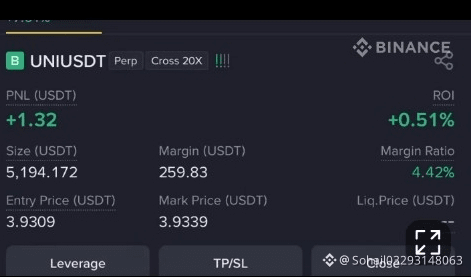
$UNI
{future}(UNIUSDT)
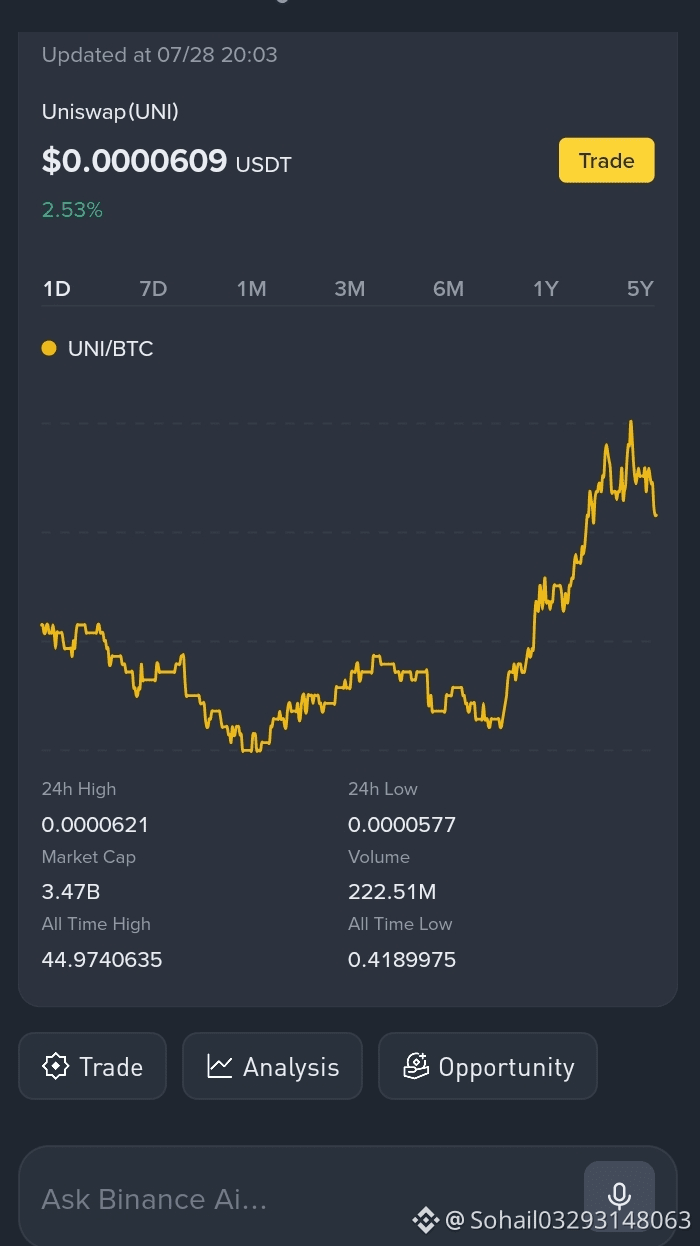
#UNIBTC is trading at 0.0000609 BTC right now, up about 2.5% over the last 24 hours. Today’s range has been 0.0000577 BTC to 0.0000621 BTC. Based on that, it’s showing short-term strength, but it’s also sitting fairly close to the daily high, so chasing aggressively is riskier.
Quick read:
Bias: mildly bullish intraday
24h open: 0.0000594 BTC
Current: 0.0000609 BTC
Near resistance: around 0.0000621 BTC
Near support: around 0.0000594 BTC, then 0.0000577 BTC
Today’s trading targets for UNIBTC
Conservative buy zone: near 0.0000594–0.0000600 BTC
Upside target 1: 0.0000618 BTC
Upside target 2: 0.0000621 BTC
Breakout target: if it clears 0.0000621 BTC with momentum, next stretch target is around 0.0000635 BTC
Risk stop idea: below 0.0000588 BTC for a tighter setup, or below 0.0000577 BTC for a wider invalidation
Success trading plan
If buying dips: better to wait for pullbacks near support rather than buying directly into resistance
If trading breakout: only consider it if price pushes above 0.0000621 BTC and holds
If already in profit: partial take-profit near 0.0000618–0.0000621 BTC is sensible
Important: these are trading levels, not guaranteed targets. Since this pair is quoted in BTC, UNI can move because of UNI strength, BTC weakness, or both — so watch BTC trend too.
#BitcoinRecoversFromAsianSessionLows
#SamsungSKHynixLeveragedETFsStokeKoreaVolatility
#VisaToCut2600JobsExpandStablecoins
#USTreasuryYieldsRetreat
$UNI
#UNIBTC is trading at 0.0000609 BTC right now, up about 2.5% over the last 24 hours. Today’s range has been 0.0000577 BTC to 0.0000621 BTC. Based on that, it’s showing short-term strength, but it’s also sitting fairly close to the daily high, so chasing aggressively is riskier.
Quick read:
Bias: mildly bullish intraday
24h open: 0.0000594 BTC
Current: 0.0000609 BTC
Near resistance: around 0.0000621 BTC
Near support: around 0.0000594 BTC, then 0.0000577 BTC
Today’s trading targets for UNIBTC
Conservative buy zone: near 0.0000594–0.0000600 BTC
Upside target 1: 0.0000618 BTC
Upside target 2: 0.0000621 BTC
Breakout target: if it clears 0.0000621 BTC with momentum, next stretch target is around 0.0000635 BTC
Risk stop idea: below 0.0000588 BTC for a tighter setup, or below 0.0000577 BTC for a wider invalidation
Success trading plan
If buying dips: better to wait for pullbacks near support rather than buying directly into resistance
If trading breakout: only consider it if price pushes above 0.0000621 BTC and holds
If already in profit: partial take-profit near 0.0000618–0.0000621 BTC is sensible
Important: these are trading levels, not guaranteed targets. Since this pair is quoted in BTC, UNI can move because of UNI strength, BTC weakness, or both — so watch BTC trend too.
#BitcoinRecoversFromAsianSessionLows
#SamsungSKHynixLeveragedETFsStokeKoreaVolatility
#VisaToCut2600JobsExpandStablecoins
#USTreasuryYieldsRetreat
#UNIBTC is trading at 0.0000609 BTC right now, up about 2.5% over the last 24 hours. Today’s range has been 0.0000577 BTC to 0.0000621 BTC. Based on that, it’s showing short-term strength, but it’s also sitting fairly close to the daily high, so chasing aggressively is riskier.
Quick read:
Bias: mildly bullish intraday
24h open: 0.0000594 BTC
Current: 0.0000609 BTC
Near resistance: around 0.0000621 BTC
Near support: around 0.0000594 BTC, then 0.0000577 BTC
Today’s trading targets for UNIBTC
Conservative buy zone: near 0.0000594–0.0000600 BTC
Upside target 1: 0.0000618 BTC
Upside target 2: 0.0000621 BTC
Breakout target: if it clears 0.0000621 BTC with momentum, next stretch target is around 0.0000635 BTC
Risk stop idea: below 0.0000588 BTC for a tighter setup, or below 0.0000577 BTC for a wider invalidation
Success trading plan
If buying dips: better to wait for pullbacks near support rather than buying directly into resistance
If trading breakout: only consider it if price pushes above 0.0000621 BTC and holds
If already in profit: partial take-profit near 0.0000618–0.0000621 BTC is sensible
Important: these are trading levels, not guaranteed targets. Since this pair is quoted in BTC, UNI can move because of UNI strength, BTC weakness, or both — so watch BTC trend too.
#BitcoinRecoversFromAsianSessionLows
#SamsungSKHynixLeveragedETFsStokeKoreaVolatility
#VisaToCut2600JobsExpandStablecoins
#USTreasuryYieldsRetreat
1
44
Verified
Ever feel like traditional staking locks your crypto in a digital prison? 🔒
We’ve all been there: you lock up your tokens for a juicy APY, but suddenly the market shifts, a massive DeFi opportunity pops up, or you just need quick liquidity. You’re forced to watch from the sidelines because your assets are frozen. That’s the "hidden cost" of crypto lock-ups, losing your freedom to move.
But @Bedrock DAO completely flips the script. Instead of freezing your wealth, Bedrock hands you the keys.
When you stake your BTC, ETH, or IOTX, you instantly get universal liquid tokens like uniBTC and uniETH in return. Your original assets earn native yields via elite layers like Babylon or EigenLayer, while your liquid tokens are completely free to trade, lend, or loop across the DeFi ecosystem.
It’s institutional-grade security with zero FOMO. You get the rewards and the freedom to pivot when the market moves. Stop choosing between yield and liquidity. Have both.
Quick Vote: What’s Your Crypto DNA? 👇
A) I’m okay with strict lock-ups if the APY is guaranteed.
B) I need absolute freedom! Give me rewards and liquidity at the same time.
Hashtags:
#BedrockDAO #LiquidRestaking #CryptoFreedom #DeFiStrategy #uniBTC #bedrock $BR DYOR
Ever feel like traditional staking locks your crypto in a digital prison? 🔒
We’ve all been there: you lock up your tokens for a juicy APY, but suddenly the market shifts, a massive DeFi opportunity pops up, or you just need quick liquidity. You’re forced to watch from the sidelines because your assets are frozen. That’s the "hidden cost" of crypto lock-ups, losing your freedom to move.
But @Bedrock DAO completely flips the script. Instead of freezing your wealth, Bedrock hands you the keys.
When you stake your BTC, ETH, or IOTX, you instantly get universal liquid tokens like uniBTC and uniETH in return. Your original assets earn native yields via elite layers like Babylon or EigenLayer, while your liquid tokens are completely free to trade, lend, or loop across the DeFi ecosystem.
It’s institutional-grade security with zero FOMO. You get the rewards and the freedom to pivot when the market moves. Stop choosing between yield and liquidity. Have both.
Quick Vote: What’s Your Crypto DNA? 👇
A) I’m okay with strict lock-ups if the APY is guaranteed.
B) I need absolute freedom! Give me rewards and liquidity at the same time.
Hashtags:
#BedrockDAO #LiquidRestaking #CryptoFreedom #DeFiStrategy #uniBTC #bedrock $BR DYOR
We’ve all been there: you lock up your tokens for a juicy APY, but suddenly the market shifts, a massive DeFi opportunity pops up, or you just need quick liquidity. You’re forced to watch from the sidelines because your assets are frozen. That’s the "hidden cost" of crypto lock-ups, losing your freedom to move.
But @Bedrock DAO completely flips the script. Instead of freezing your wealth, Bedrock hands you the keys.
When you stake your BTC, ETH, or IOTX, you instantly get universal liquid tokens like uniBTC and uniETH in return. Your original assets earn native yields via elite layers like Babylon or EigenLayer, while your liquid tokens are completely free to trade, lend, or loop across the DeFi ecosystem.
It’s institutional-grade security with zero FOMO. You get the rewards and the freedom to pivot when the market moves. Stop choosing between yield and liquidity. Have both.
Quick Vote: What’s Your Crypto DNA? 👇
A) I’m okay with strict lock-ups if the APY is guaranteed.
B) I need absolute freedom! Give me rewards and liquidity at the same time.
Hashtags:
#BedrockDAO #LiquidRestaking #CryptoFreedom #DeFiStrategy #uniBTC #bedrock $BR DYOR
A) High APY, Locked
59%
B) Rewards + Liquid
33%
C) Yield over Freedom
0%
D) Yield plus Trading
8%
12 votes • Voting closed
27
2
45
888
·
--
Bullish
$UNI
{future}(UNIUSDT)
#UNIBTC Universal BTC (uniBTC) is currently trading at approximately $93,002, staging a massive 45.88% rally in the last 24 hours. This explosive upward movement drastically shifts its immediate technical targets, pushing it back toward its yearly resistance zones.
1. Formulate Short-Term Price TargetsThe recent price spike from a 30-day low of $63,275 establishes the following primary technical targets for the days ahead:
Immediate Resistance (Target 1): $97,663. This aligns with the upper boundary of its defined 2026 trading range. Breaking above this level clears the path for psychological expansion.Major Upside Target (Target 2): $125,288 – $125,424. This represents its historical All-Time High (ATH). Reaching this zone would require sustained liquidity inflows and full validation of its newly launched vaults
Crucial Support (Downside Target): $63,275 – $64,299. Traders should monitor this baseline. If the current rally experiences a sharp retracement, this previous accumulation floor will act as critical support.
2. Evaluate Fundamental DriversThe primary catalyst fueling this market expansion is the protocol's transition into structured yield generation:Bedrock 2.0 System Re-architecture: The launch re-engineered uniBTC from a simple wrapped asset into a yield-bearing engine.Institutional Credit Vaults: Users can now route uniBTC into active vaults—such as the Alpha Selini Vault managed by Selini Capital. This introduces real economic yield derived from institutional credit markets, heavily boosting token velocity and demand.
#USStockFuturesRiseAheadOfMegacapEarningsAndFed #CXMTSurges472%OnShanghaiDebut
#WTICrudeFuturesFall8%
#GoldRises
@Square-Creator-2c0eae1a4c3de
$UNI
#UNIBTC Universal BTC (uniBTC) is currently trading at approximately $93,002, staging a massive 45.88% rally in the last 24 hours. This explosive upward movement drastically shifts its immediate technical targets, pushing it back toward its yearly resistance zones.
1. Formulate Short-Term Price TargetsThe recent price spike from a 30-day low of $63,275 establishes the following primary technical targets for the days ahead:
Immediate Resistance (Target 1): $97,663. This aligns with the upper boundary of its defined 2026 trading range. Breaking above this level clears the path for psychological expansion.Major Upside Target (Target 2): $125,288 – $125,424. This represents its historical All-Time High (ATH). Reaching this zone would require sustained liquidity inflows and full validation of its newly launched vaults
Crucial Support (Downside Target): $63,275 – $64,299. Traders should monitor this baseline. If the current rally experiences a sharp retracement, this previous accumulation floor will act as critical support.
2. Evaluate Fundamental DriversThe primary catalyst fueling this market expansion is the protocol's transition into structured yield generation:Bedrock 2.0 System Re-architecture: The launch re-engineered uniBTC from a simple wrapped asset into a yield-bearing engine.Institutional Credit Vaults: Users can now route uniBTC into active vaults—such as the Alpha Selini Vault managed by Selini Capital. This introduces real economic yield derived from institutional credit markets, heavily boosting token velocity and demand.
#USStockFuturesRiseAheadOfMegacapEarningsAndFed #CXMTSurges472%OnShanghaiDebut
#WTICrudeFuturesFall8%
#GoldRises
@Uni Uni
#UNIBTC Universal BTC (uniBTC) is currently trading at approximately $93,002, staging a massive 45.88% rally in the last 24 hours. This explosive upward movement drastically shifts its immediate technical targets, pushing it back toward its yearly resistance zones.
1. Formulate Short-Term Price TargetsThe recent price spike from a 30-day low of $63,275 establishes the following primary technical targets for the days ahead:
Immediate Resistance (Target 1): $97,663. This aligns with the upper boundary of its defined 2026 trading range. Breaking above this level clears the path for psychological expansion.Major Upside Target (Target 2): $125,288 – $125,424. This represents its historical All-Time High (ATH). Reaching this zone would require sustained liquidity inflows and full validation of its newly launched vaults
Crucial Support (Downside Target): $63,275 – $64,299. Traders should monitor this baseline. If the current rally experiences a sharp retracement, this previous accumulation floor will act as critical support.
2. Evaluate Fundamental DriversThe primary catalyst fueling this market expansion is the protocol's transition into structured yield generation:Bedrock 2.0 System Re-architecture: The launch re-engineered uniBTC from a simple wrapped asset into a yield-bearing engine.Institutional Credit Vaults: Users can now route uniBTC into active vaults—such as the Alpha Selini Vault managed by Selini Capital. This introduces real economic yield derived from institutional credit markets, heavily boosting token velocity and demand.
#USStockFuturesRiseAheadOfMegacapEarningsAndFed #CXMTSurges472%OnShanghaiDebut
#WTICrudeFuturesFall8%
#GoldRises
@Uni Uni
1
121

·
--
🚨I used to think the ultimate form of Bitcoin ownership was pure, untouched custody.
Leave it cold.
Lock it away.
Don't touch it.
For years, that was the gold standard.
And for years, it meant watching a massive reservoir of pristine capital sit completely dormant.
No velocity.
No yield.
Just static numbers on a screen.
The moment you tried to change that, you usually ran into a wall.
You had to sacrifice security, trust a shady custodian, or bridge your assets into some hyper-risky experimental ecosystem where your capital could vanish overnight.
Lately, I've been looking into how the restaking narrative is shifting toward Bitcoin, specifically focusing on Bedrock's vault structure. They have this flagship asset called uniBTC.
At first glance, it looks like just another synthetic wrapper.
But when you look at what's actually happening under the hood, it functions more like a yield passport for digital gold.
Through a strategic partnership with the Babylon chain, uniBTC essentially lets your wrapped Bitcoin act as an economic security layer for Proof-of-Stake networks.
But you aren't stuck on a sluggish or isolated network—it lives natively on Ethereum.
You get the yield from securing new networks, but your capital stays entirely composable.
It stays liquid.
It explains why uniBTC quietly captured 80% of Bedrock’s total multi-asset portfolio.
It’s sitting at the core of their TVL because it fixes a structural flaw we all just accepted for a decade.
Of course, adding layers always adds questions.
Smart contract risk doesn't just disappear, and anytime you turn passive collateral into an active financial instrument, you're trading absolute isolation for capital efficiency.
But the macro shift here is hard to ignore.
Bitcoin is transitioning from a purely reactive hedge into a proactive foundational asset class.
Are you still keeping your digital gold frozen🥶, or are you letting it move🔥?
@Bedrock
#Bedrock
$BR
{future}(BRUSDT)
#uniBTC
#BTCFi
🚨I used to think the ultimate form of Bitcoin ownership was pure, untouched custody.
Leave it cold.
Lock it away.
Don't touch it.
For years, that was the gold standard.
And for years, it meant watching a massive reservoir of pristine capital sit completely dormant.
No velocity.
No yield.
Just static numbers on a screen.
The moment you tried to change that, you usually ran into a wall.
You had to sacrifice security, trust a shady custodian, or bridge your assets into some hyper-risky experimental ecosystem where your capital could vanish overnight.
Lately, I've been looking into how the restaking narrative is shifting toward Bitcoin, specifically focusing on Bedrock's vault structure. They have this flagship asset called uniBTC.
At first glance, it looks like just another synthetic wrapper.
But when you look at what's actually happening under the hood, it functions more like a yield passport for digital gold.
Through a strategic partnership with the Babylon chain, uniBTC essentially lets your wrapped Bitcoin act as an economic security layer for Proof-of-Stake networks.
But you aren't stuck on a sluggish or isolated network—it lives natively on Ethereum.
You get the yield from securing new networks, but your capital stays entirely composable.
It stays liquid.
It explains why uniBTC quietly captured 80% of Bedrock’s total multi-asset portfolio.
It’s sitting at the core of their TVL because it fixes a structural flaw we all just accepted for a decade.
Of course, adding layers always adds questions.
Smart contract risk doesn't just disappear, and anytime you turn passive collateral into an active financial instrument, you're trading absolute isolation for capital efficiency.
But the macro shift here is hard to ignore.
Bitcoin is transitioning from a purely reactive hedge into a proactive foundational asset class.
Are you still keeping your digital gold frozen🥶, or are you letting it move🔥?
@Bedrock
#Bedrock
$BR
#uniBTC
#BTCFi
Leave it cold.
Lock it away.
Don't touch it.
For years, that was the gold standard.
And for years, it meant watching a massive reservoir of pristine capital sit completely dormant.
No velocity.
No yield.
Just static numbers on a screen.
The moment you tried to change that, you usually ran into a wall.
You had to sacrifice security, trust a shady custodian, or bridge your assets into some hyper-risky experimental ecosystem where your capital could vanish overnight.
Lately, I've been looking into how the restaking narrative is shifting toward Bitcoin, specifically focusing on Bedrock's vault structure. They have this flagship asset called uniBTC.
At first glance, it looks like just another synthetic wrapper.
But when you look at what's actually happening under the hood, it functions more like a yield passport for digital gold.
Through a strategic partnership with the Babylon chain, uniBTC essentially lets your wrapped Bitcoin act as an economic security layer for Proof-of-Stake networks.
But you aren't stuck on a sluggish or isolated network—it lives natively on Ethereum.
You get the yield from securing new networks, but your capital stays entirely composable.
It stays liquid.
It explains why uniBTC quietly captured 80% of Bedrock’s total multi-asset portfolio.
It’s sitting at the core of their TVL because it fixes a structural flaw we all just accepted for a decade.
Of course, adding layers always adds questions.
Smart contract risk doesn't just disappear, and anytime you turn passive collateral into an active financial instrument, you're trading absolute isolation for capital efficiency.
But the macro shift here is hard to ignore.
Bitcoin is transitioning from a purely reactive hedge into a proactive foundational asset class.
Are you still keeping your digital gold frozen🥶, or are you letting it move🔥?
@Bedrock
#Bedrock
$BR
#uniBTC
#BTCFi

2
1
94

·
--
Recently, the buzz around call signals @Bedrock in the square has been loud. As a seasoned trader who's been grinding in the crypto space for nearly a decade, whenever I hear terms like 'high-yield earnings', my instincts tell me to steer clear. However, over the weekend, I ran through the uniBTC contract logic in my Tokyo loft and found that it indeed has some slight innovations: it seems to eliminate the opaque operations of multi-signature wallets by hard-coding fund segmentation, automatically fetching lending interest differentials across multiple chains.
The logic checks out, but I'm a data-driven person. A few days ago, I specifically wrote a script to run a full-chain backtest on the mainnet using a few ETH. Unsurprisingly, while the APY on the front-end looks impressive, once you factor in cross-chain slippage, mainnet gas fees, and the actual slippage from Dex exchanges, the real profits are as thin as a whisper. This kind of model might catch a few small fish during sideways markets, but in the event of extreme volatility with a one-sided crash, those meager interests can't withstand the risks of exposed capital.
What raises my caution even more is its underlying chip structure. I pulled up some data panels on Dune, and the fund concentration is alarmingly high, almost all clustered in a few whale addresses. And don't be fooled by the active on-chain interactions; a run through a behavioral entropy model reveals that a significant portion is just bots cycling through. In this scenario, if the big players sense something's off and withdraw their liquidity, retail investors won't stand a chance; it would be a stampede disaster.
Old fishing buddies know, when the waters are murky, don’t bet big. My strategy remains purely defensive; I’ve only kept a minimal amount of $BR as a watchful observer. I don’t deny their exploration in modularity, but until they’ve faced a true test of on-chain liquidity, I absolutely won’t be the one to catch the falling knife with large funds.
$BTC
#Bedrock #uniBTC
{future}(BRUSDT)
Recently, the buzz around call signals @Bedrock in the square has been loud. As a seasoned trader who's been grinding in the crypto space for nearly a decade, whenever I hear terms like 'high-yield earnings', my instincts tell me to steer clear. However, over the weekend, I ran through the uniBTC contract logic in my Tokyo loft and found that it indeed has some slight innovations: it seems to eliminate the opaque operations of multi-signature wallets by hard-coding fund segmentation, automatically fetching lending interest differentials across multiple chains.
The logic checks out, but I'm a data-driven person. A few days ago, I specifically wrote a script to run a full-chain backtest on the mainnet using a few ETH. Unsurprisingly, while the APY on the front-end looks impressive, once you factor in cross-chain slippage, mainnet gas fees, and the actual slippage from Dex exchanges, the real profits are as thin as a whisper. This kind of model might catch a few small fish during sideways markets, but in the event of extreme volatility with a one-sided crash, those meager interests can't withstand the risks of exposed capital.
What raises my caution even more is its underlying chip structure. I pulled up some data panels on Dune, and the fund concentration is alarmingly high, almost all clustered in a few whale addresses. And don't be fooled by the active on-chain interactions; a run through a behavioral entropy model reveals that a significant portion is just bots cycling through. In this scenario, if the big players sense something's off and withdraw their liquidity, retail investors won't stand a chance; it would be a stampede disaster.
Old fishing buddies know, when the waters are murky, don’t bet big. My strategy remains purely defensive; I’ve only kept a minimal amount of $BR as a watchful observer. I don’t deny their exploration in modularity, but until they’ve faced a true test of on-chain liquidity, I absolutely won’t be the one to catch the falling knife with large funds.
$BTC
#Bedrock #uniBTC
The logic checks out, but I'm a data-driven person. A few days ago, I specifically wrote a script to run a full-chain backtest on the mainnet using a few ETH. Unsurprisingly, while the APY on the front-end looks impressive, once you factor in cross-chain slippage, mainnet gas fees, and the actual slippage from Dex exchanges, the real profits are as thin as a whisper. This kind of model might catch a few small fish during sideways markets, but in the event of extreme volatility with a one-sided crash, those meager interests can't withstand the risks of exposed capital.
What raises my caution even more is its underlying chip structure. I pulled up some data panels on Dune, and the fund concentration is alarmingly high, almost all clustered in a few whale addresses. And don't be fooled by the active on-chain interactions; a run through a behavioral entropy model reveals that a significant portion is just bots cycling through. In this scenario, if the big players sense something's off and withdraw their liquidity, retail investors won't stand a chance; it would be a stampede disaster.
Old fishing buddies know, when the waters are murky, don’t bet big. My strategy remains purely defensive; I’ve only kept a minimal amount of $BR as a watchful observer. I don’t deny their exploration in modularity, but until they’ve faced a true test of on-chain liquidity, I absolutely won’t be the one to catch the falling knife with large funds.
$BTC
#Bedrock #uniBTC
322

·
--
Bearish
I used to think owning 1 BTC was the finish line.
Then I realized — it was just the starting line.@Bedrock
Because here's what nobody tells you after you finally get your Bitcoin:
It just sits there.
Doing nothing. Going nowhere. Waiting for the price to move.
That felt wrong to me. You work hard, you save, you finally own real digital asset — and then what? You just stare at a number on a screen?
There had to be a better way.
That's when I discovered Bedrock and something called uniBTC.
The concept changed how I think about Bitcoin forever.$BR
Instead of your BTC sleeping in a wallet, you can put it to work — earning yield, accessing smart strategies, generating returns — all while still holding Bitcoin.
Still exposed to price upside. ✅
Still your Bitcoin. ✅
Now actually working for you. ✅
Bedrock doesn't touch Bitcoin's core. It doesn't break anything.
It simply asks one powerful question:
"What if your Bitcoin could earn while you hold?"
Through restaking and professionally managed vaults, even a market downturn doesn't have to mean dead money. You're no longer just waiting — you're participating.
The game has changed.
Owning Bitcoin used to be the goal.
Making Bitcoin productive is the new standard.
Most people are still asking "How do I get 1 BTC?"
The smarter question is :
"What is my 1 BTC doing for me right now?"
That's the Bedrock difference.
@Bedrock #Bedrock $BR
@bitcoin #bitcoin $BTC
#Bedrock #uniBTC #BR
#Bitcoin #BTC #DeFi #Altcoin #Blockchain
#MakeBitcoinProductive
{spot}(BTCUSDT)
{future}(BRUSDT)
I used to think owning 1 BTC was the finish line.
Then I realized — it was just the starting line.@Bedrock
Because here's what nobody tells you after you finally get your Bitcoin:
It just sits there.
Doing nothing. Going nowhere. Waiting for the price to move.
That felt wrong to me. You work hard, you save, you finally own real digital asset — and then what? You just stare at a number on a screen?
There had to be a better way.
That's when I discovered Bedrock and something called uniBTC.
The concept changed how I think about Bitcoin forever.$BR
Instead of your BTC sleeping in a wallet, you can put it to work — earning yield, accessing smart strategies, generating returns — all while still holding Bitcoin.
Still exposed to price upside. ✅
Still your Bitcoin. ✅
Now actually working for you. ✅
Bedrock doesn't touch Bitcoin's core. It doesn't break anything.
It simply asks one powerful question:
"What if your Bitcoin could earn while you hold?"
Through restaking and professionally managed vaults, even a market downturn doesn't have to mean dead money. You're no longer just waiting — you're participating.
The game has changed.
Owning Bitcoin used to be the goal.
Making Bitcoin productive is the new standard.
Most people are still asking "How do I get 1 BTC?"
The smarter question is :
"What is my 1 BTC doing for me right now?"
That's the Bedrock difference.
@Bedrock #Bedrock $BR
@Bitcoin #bitcoin $BTC
#Bedrock #uniBTC #BR
#Bitcoin #BTC #DeFi #Altcoin #Blockchain
#MakeBitcoinProductive
Then I realized — it was just the starting line.@Bedrock
Because here's what nobody tells you after you finally get your Bitcoin:
It just sits there.
Doing nothing. Going nowhere. Waiting for the price to move.
That felt wrong to me. You work hard, you save, you finally own real digital asset — and then what? You just stare at a number on a screen?
There had to be a better way.
That's when I discovered Bedrock and something called uniBTC.
The concept changed how I think about Bitcoin forever.$BR
Instead of your BTC sleeping in a wallet, you can put it to work — earning yield, accessing smart strategies, generating returns — all while still holding Bitcoin.
Still exposed to price upside. ✅
Still your Bitcoin. ✅
Now actually working for you. ✅
Bedrock doesn't touch Bitcoin's core. It doesn't break anything.
It simply asks one powerful question:
"What if your Bitcoin could earn while you hold?"
Through restaking and professionally managed vaults, even a market downturn doesn't have to mean dead money. You're no longer just waiting — you're participating.
The game has changed.
Owning Bitcoin used to be the goal.
Making Bitcoin productive is the new standard.
Most people are still asking "How do I get 1 BTC?"
The smarter question is :
"What is my 1 BTC doing for me right now?"
That's the Bedrock difference.
@Bedrock #Bedrock $BR
@Bitcoin #bitcoin $BTC
#Bedrock #uniBTC #BR
#Bitcoin #BTC #DeFi #Altcoin #Blockchain
#MakeBitcoinProductive
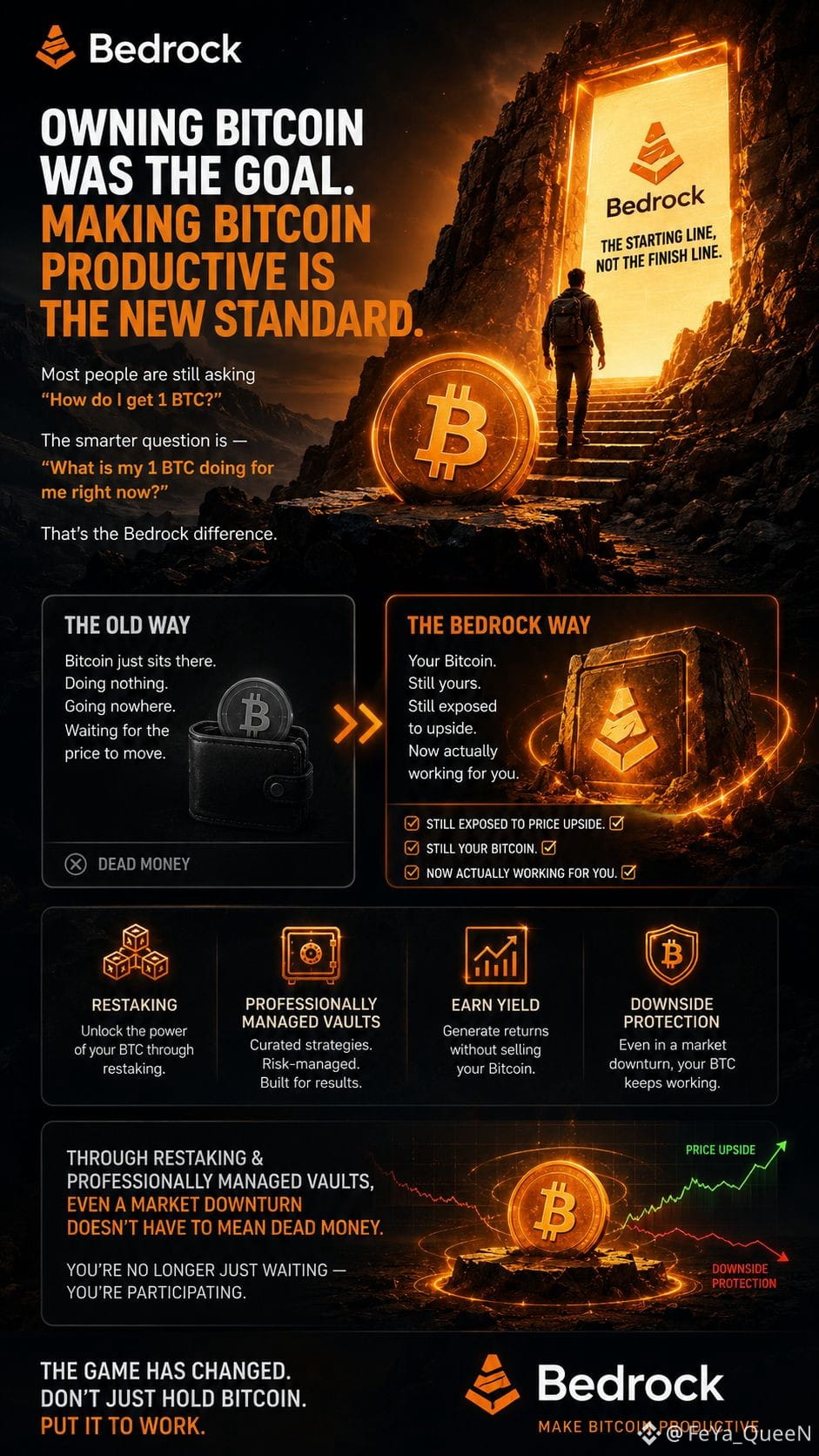
8
184
Log in to explore more content
Join global crypto users on Binance Square
⚡️ Get latest and useful information about crypto.
💬 Trusted by the world’s largest crypto exchange.
👍 Discover real insights from verified creators.
Email / Phone number
Trending Topics
1
#EarningsSeason
70,817 views
682 Discussing
2
#ECBToTestAIAgentsInDigitalEuroPayments
0 views
2 Discussing
3
#JapanFSABacksFourthStablecoinTradeSettlementPilot
1,457 views
128 Discussing
4
#BitgetHackerFailsToMoveStolenFunds
8,001 views
265 Discussing
5
#BitMineETHHoldingsTop6Million
11,159 views
424 Discussing
6
#StrategyAdds1666BTCHoldingsReach847666
9,975 views
291 Discussing
7
#NvidiaApproves$150BBuyback
3,287 views
60 Discussing
8
#OpenAIDelaysGPT6.1OverSafetyIssues
22,388 views
629 Discussing
9
#AMDToAcquireWorldLabsFor$8.2B
1,643 views
51 Discussing
10
#AnthropicIPOProspectusCouldValueItOver$2T
5,360 views
74 Discussing