

MAH N00R-01
12.6k Posts

MAH N00R-01
 Square Verified+
Report
Block User
crypto Enthausist .trader lover .KOL GEN
1.8K+ Following
32.0K+ Followers
16.1K+ Liked
Posts
All
Live
·
--
Bearish
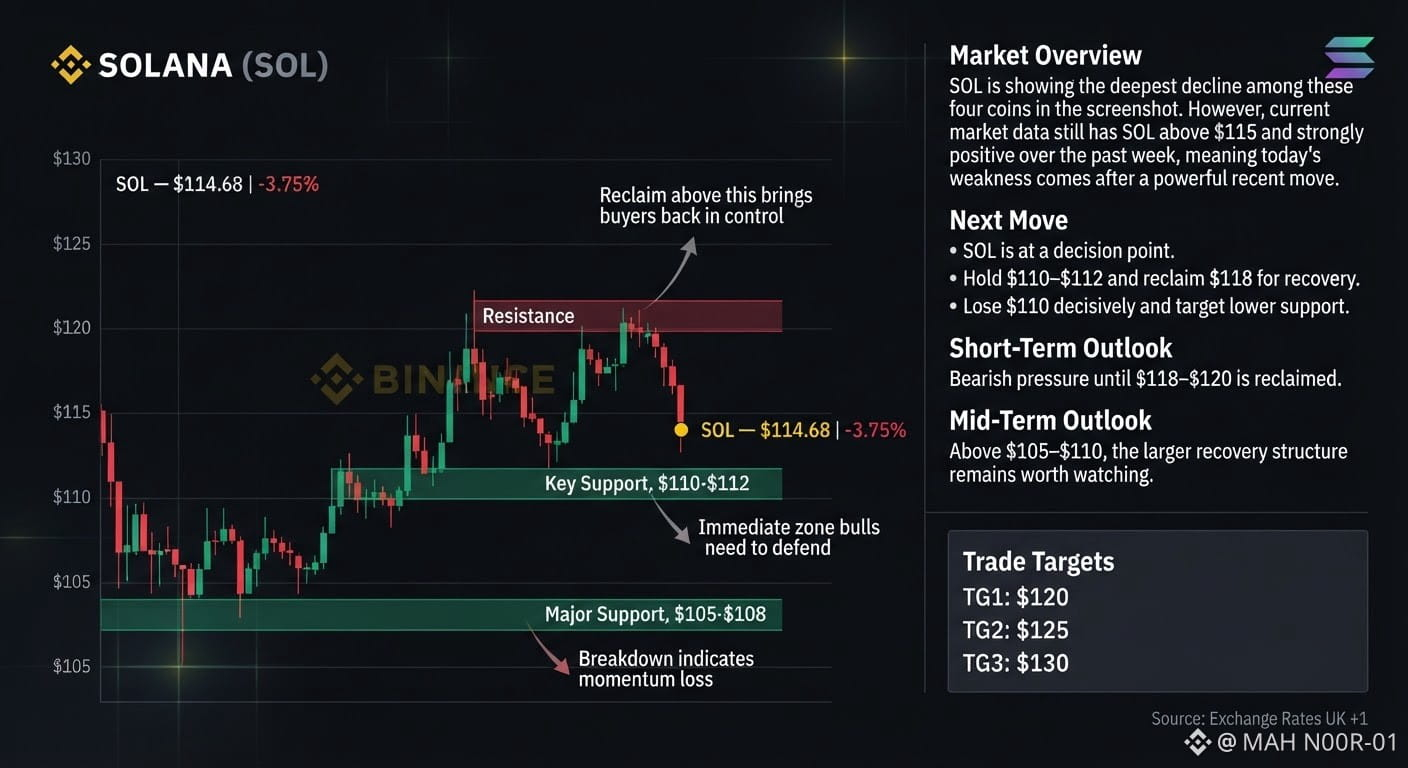
🟣 $SOL — $114.68 | -3.75%
Market Overview:
SOL is showing the deepest decline among these four coins in the screenshot. However, current market data still has SOL above $115 and strongly positive over the past week, meaning today's weakness comes after a powerful recent move. �
Exchange Rates UK +1
Key Support: $110–$112
This is the immediate zone bulls need to defend.
Major Support: $105–$108
A breakdown here would indicate that the recent momentum is losing strength.
Resistance: $118–$120
A reclaim above this area could bring buyers back into control.
Next Move:
SOL is at a decision point. Hold $110–$112 and reclaim $118, and the recovery structure can continue. Lose $110 decisively and the market could start targeting the lower support zone.
Trade Targets:
TG1: $120
TG2: $125
TG3: $130
Short-Term: Bearish pressure until $118–$120 is reclaimed.
Mid-Term: Above $105–$110, the larger recovery structure remains worth watching.
#21SharesLaunchesEuropesFirstZcashETP
{future}(SOLUSDT)
🟣 $SOL — $114.68 | -3.75%
Market Overview:
SOL is showing the deepest decline among these four coins in the screenshot. However, current market data still has SOL above $115 and strongly positive over the past week, meaning today's weakness comes after a powerful recent move. �
Exchange Rates UK +1
Key Support: $110–$112
This is the immediate zone bulls need to defend.
Major Support: $105–$108
A breakdown here would indicate that the recent momentum is losing strength.
Resistance: $118–$120
A reclaim above this area could bring buyers back into control.
Next Move:
SOL is at a decision point. Hold $110–$112 and reclaim $118, and the recovery structure can continue. Lose $110 decisively and the market could start targeting the lower support zone.
Trade Targets:
TG1: $120
TG2: $125
TG3: $130
Short-Term: Bearish pressure until $118–$120 is reclaimed.
Mid-Term: Above $105–$110, the larger recovery structure remains worth watching.
#21SharesLaunchesEuropesFirstZcashETP
Market Overview:
SOL is showing the deepest decline among these four coins in the screenshot. However, current market data still has SOL above $115 and strongly positive over the past week, meaning today's weakness comes after a powerful recent move. �
Exchange Rates UK +1
Key Support: $110–$112
This is the immediate zone bulls need to defend.
Major Support: $105–$108
A breakdown here would indicate that the recent momentum is losing strength.
Resistance: $118–$120
A reclaim above this area could bring buyers back into control.
Next Move:
SOL is at a decision point. Hold $110–$112 and reclaim $118, and the recovery structure can continue. Lose $110 decisively and the market could start targeting the lower support zone.
Trade Targets:
TG1: $120
TG2: $125
TG3: $130
Short-Term: Bearish pressure until $118–$120 is reclaimed.
Mid-Term: Above $105–$110, the larger recovery structure remains worth watching.
#21SharesLaunchesEuropesFirstZcashETP
1
366
·
--
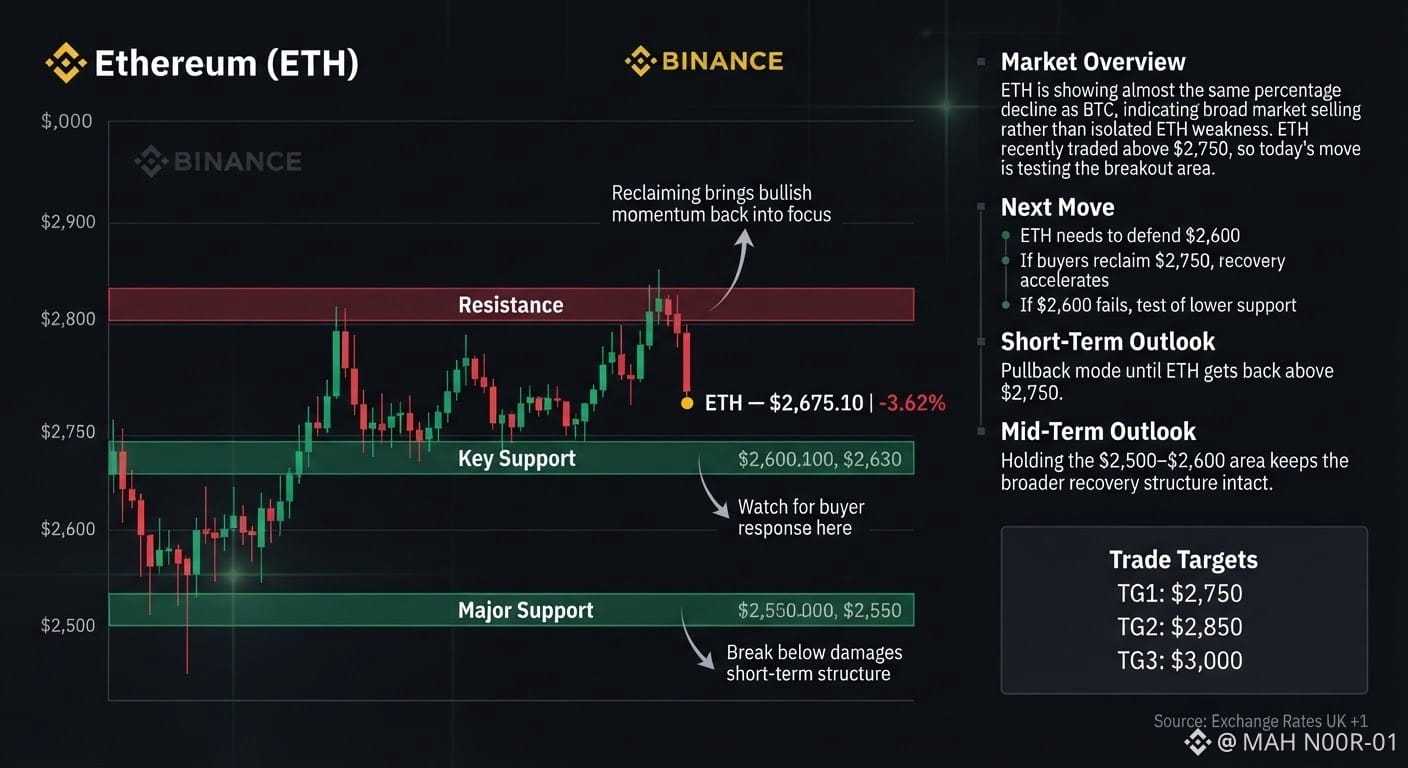
🔵 $ETH — $2,675.10 | -3.62%
Market Overview:
ETH is showing almost the same percentage decline as BTC, indicating broad market selling rather than isolated ETH weakness. ETH recently traded above $2,750, so today's move is testing the breakout area. �
Exchange Rates UK +1
Key Support: $2,600–$2,630
This is the first area I'd watch for a buyer response.
Major Support: $2,500–$2,550
A sustained break below this zone would damage the short-term structure.
Resistance: $2,750–$2,800
Reclaiming this region would bring bullish momentum back into focus.
Next Move:
ETH needs to defend $2,600. If buyers reclaim $2,750, the recovery can accelerate. If $2,600 fails decisively, expect sellers to test the next support zone.
Trade Targets:
TG1: $2,750
TG2: $2,850
TG3: $3,000
Short-Term: Pullback mode until ETH gets back above $2,750.
Mid-Term: Holding the $2,500–$2,600 area keeps the broader recovery structure intact.
#21SharesLaunchesEuropesFirstZcashETP
{future}(ETHUSDT)
🔵 $ETH — $2,675.10 | -3.62%
Market Overview:
ETH is showing almost the same percentage decline as BTC, indicating broad market selling rather than isolated ETH weakness. ETH recently traded above $2,750, so today's move is testing the breakout area. �
Exchange Rates UK +1
Key Support: $2,600–$2,630
This is the first area I'd watch for a buyer response.
Major Support: $2,500–$2,550
A sustained break below this zone would damage the short-term structure.
Resistance: $2,750–$2,800
Reclaiming this region would bring bullish momentum back into focus.
Next Move:
ETH needs to defend $2,600. If buyers reclaim $2,750, the recovery can accelerate. If $2,600 fails decisively, expect sellers to test the next support zone.
Trade Targets:
TG1: $2,750
TG2: $2,850
TG3: $3,000
Short-Term: Pullback mode until ETH gets back above $2,750.
Mid-Term: Holding the $2,500–$2,600 area keeps the broader recovery structure intact.
#21SharesLaunchesEuropesFirstZcashETP
Market Overview:
ETH is showing almost the same percentage decline as BTC, indicating broad market selling rather than isolated ETH weakness. ETH recently traded above $2,750, so today's move is testing the breakout area. �
Exchange Rates UK +1
Key Support: $2,600–$2,630
This is the first area I'd watch for a buyer response.
Major Support: $2,500–$2,550
A sustained break below this zone would damage the short-term structure.
Resistance: $2,750–$2,800
Reclaiming this region would bring bullish momentum back into focus.
Next Move:
ETH needs to defend $2,600. If buyers reclaim $2,750, the recovery can accelerate. If $2,600 fails decisively, expect sellers to test the next support zone.
Trade Targets:
TG1: $2,750
TG2: $2,850
TG3: $3,000
Short-Term: Pullback mode until ETH gets back above $2,750.
Mid-Term: Holding the $2,500–$2,600 area keeps the broader recovery structure intact.
#21SharesLaunchesEuropesFirstZcashETP
105
·
--
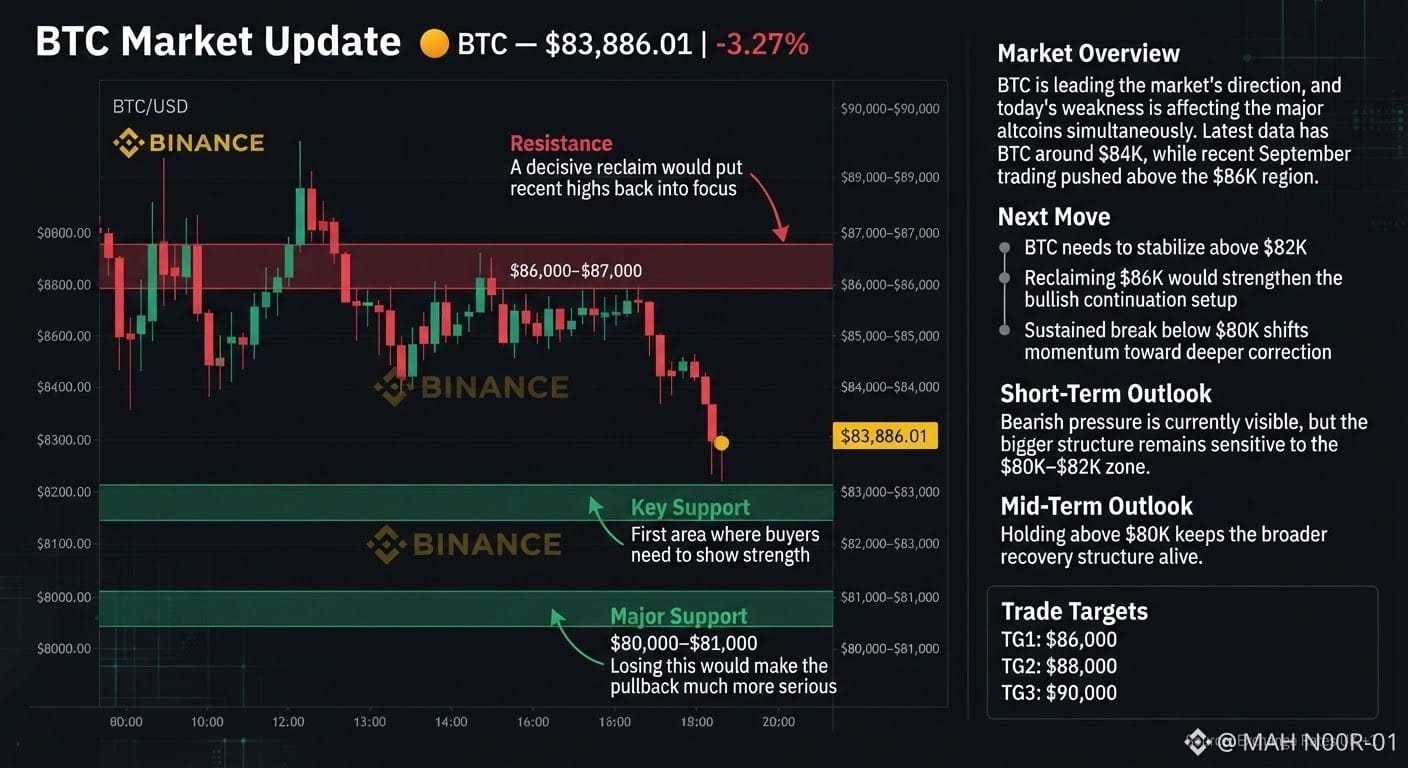
🟠 $BTC — $83,886.01 | -3.27%
Market Overview:
BTC is leading the market's direction, and today's weakness is affecting the major altcoins simultaneously. Latest data has BTC around $84K, while recent September trading pushed above the $86K region. �
Exchange Rates UK +1
Key Support: $82,000–$83,000
This is the first area where buyers need to show strength.
Major Support: $80,000–$81,000
Losing this region would make the current pullback much more serious.
Resistance: $86,000–$87,000
A decisive reclaim would put the recent highs back into focus.
Next Move:
BTC needs to stabilize above $82K. Reclaiming $86K would strengthen the bullish continuation setup, while a sustained break below $80K would shift momentum toward deeper correction.
Trade Targets:
TG1: $86,000
TG2: $88,000
TG3: $90,000
Short-Term: Bearish pressure is currently visible, but the bigger structure remains sensitive to the $80K–$82K zone.
Mid-Term: Holding above $80K keeps the broader recovery structure alive.
#21SharesLaunchesEuropesFirstZcashETP
{future}(BTCUSDT)
🟠 $BTC — $83,886.01 | -3.27%
Market Overview:
BTC is leading the market's direction, and today's weakness is affecting the major altcoins simultaneously. Latest data has BTC around $84K, while recent September trading pushed above the $86K region. �
Exchange Rates UK +1
Key Support: $82,000–$83,000
This is the first area where buyers need to show strength.
Major Support: $80,000–$81,000
Losing this region would make the current pullback much more serious.
Resistance: $86,000–$87,000
A decisive reclaim would put the recent highs back into focus.
Next Move:
BTC needs to stabilize above $82K. Reclaiming $86K would strengthen the bullish continuation setup, while a sustained break below $80K would shift momentum toward deeper correction.
Trade Targets:
TG1: $86,000
TG2: $88,000
TG3: $90,000
Short-Term: Bearish pressure is currently visible, but the bigger structure remains sensitive to the $80K–$82K zone.
Mid-Term: Holding above $80K keeps the broader recovery structure alive.
#21SharesLaunchesEuropesFirstZcashETP
Market Overview:
BTC is leading the market's direction, and today's weakness is affecting the major altcoins simultaneously. Latest data has BTC around $84K, while recent September trading pushed above the $86K region. �
Exchange Rates UK +1
Key Support: $82,000–$83,000
This is the first area where buyers need to show strength.
Major Support: $80,000–$81,000
Losing this region would make the current pullback much more serious.
Resistance: $86,000–$87,000
A decisive reclaim would put the recent highs back into focus.
Next Move:
BTC needs to stabilize above $82K. Reclaiming $86K would strengthen the bullish continuation setup, while a sustained break below $80K would shift momentum toward deeper correction.
Trade Targets:
TG1: $86,000
TG2: $88,000
TG3: $90,000
Short-Term: Bearish pressure is currently visible, but the bigger structure remains sensitive to the $80K–$82K zone.
Mid-Term: Holding above $80K keeps the broader recovery structure alive.
#21SharesLaunchesEuropesFirstZcashETP
97
·
--
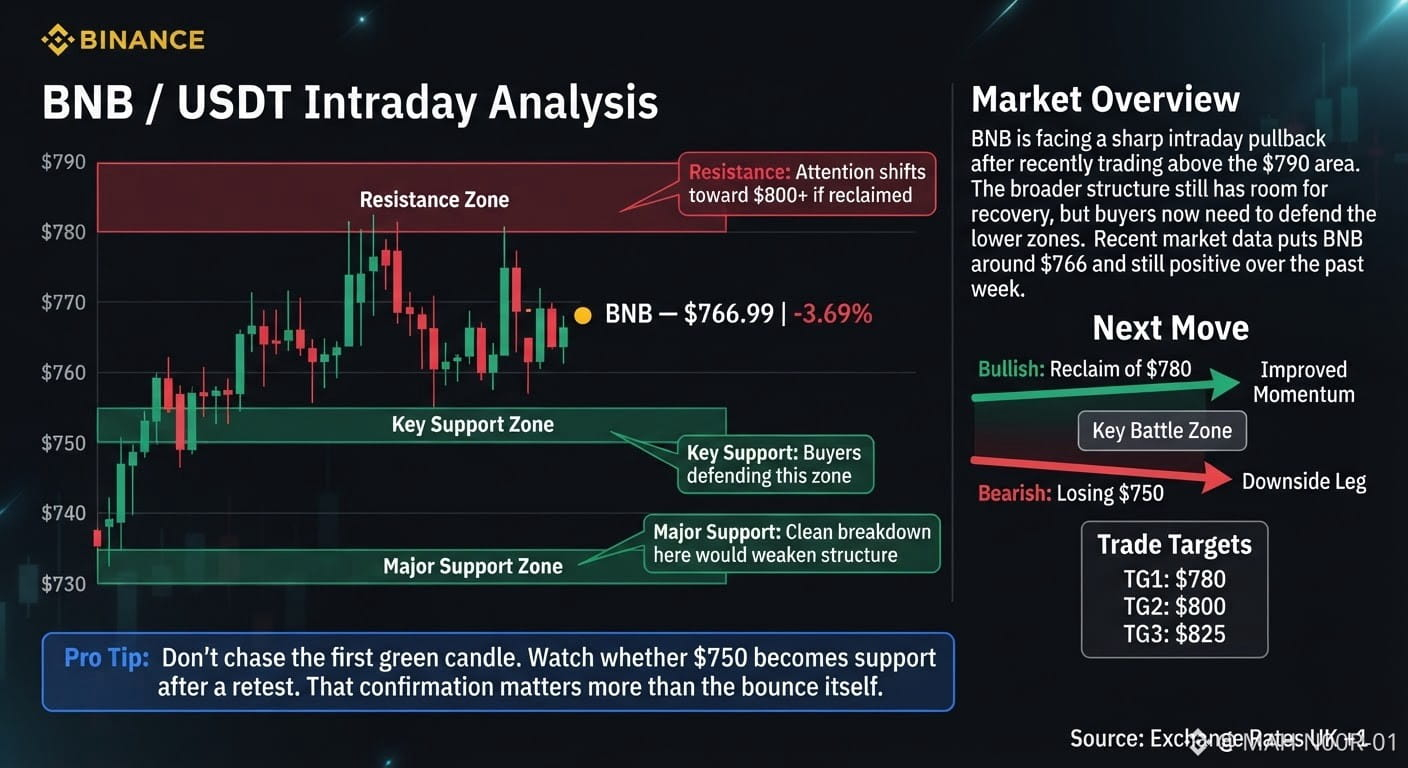
🟡 $BNB — $766.99 | -3.69%
Market Overview:
BNB is facing a sharp intraday pullback after recently trading above the $790 area. The broader structure still has room for recovery, but buyers now need to defend the lower zones. Recent market data puts BNB around $766 and still positive over the past week. �
Exchange Rates UK +1
Key Support: $750–$755
If this zone holds and buyers step back in, BNB can attempt another recovery.
Major Support: $730–$735
A clean breakdown here would weaken the short-term structure significantly.
Resistance: $780–$790
Above this zone, attention shifts toward $800+.
Next Move:
The key battle is around $750–$780. A reclaim of $780 with strong buying would improve momentum. Losing $750 could open another downside leg.
Trade Targets:
TG1: $780
TG2: $800
TG3: $825
Short-Term: Neutral-to-bearish while below $780, but a strong $750 defense could trigger a bounce.
Mid-Term: Structure remains constructive if BNB can maintain the higher support zone and eventually reclaim $800.
Pro Tip: Don't chase the first green candle. Watch whether $750 becomes support after a retest. That confirmation matters more than the bounce itself.
#AIStocksWhatNext
{future}(BNBUSDT)
🟡 $BNB — $766.99 | -3.69%
Market Overview:
BNB is facing a sharp intraday pullback after recently trading above the $790 area. The broader structure still has room for recovery, but buyers now need to defend the lower zones. Recent market data puts BNB around $766 and still positive over the past week. �
Exchange Rates UK +1
Key Support: $750–$755
If this zone holds and buyers step back in, BNB can attempt another recovery.
Major Support: $730–$735
A clean breakdown here would weaken the short-term structure significantly.
Resistance: $780–$790
Above this zone, attention shifts toward $800+.
Next Move:
The key battle is around $750–$780. A reclaim of $780 with strong buying would improve momentum. Losing $750 could open another downside leg.
Trade Targets:
TG1: $780
TG2: $800
TG3: $825
Short-Term: Neutral-to-bearish while below $780, but a strong $750 defense could trigger a bounce.
Mid-Term: Structure remains constructive if BNB can maintain the higher support zone and eventually reclaim $800.
Pro Tip: Don't chase the first green candle. Watch whether $750 becomes support after a retest. That confirmation matters more than the bounce itself.
#AIStocksWhatNext
Market Overview:
BNB is facing a sharp intraday pullback after recently trading above the $790 area. The broader structure still has room for recovery, but buyers now need to defend the lower zones. Recent market data puts BNB around $766 and still positive over the past week. �
Exchange Rates UK +1
Key Support: $750–$755
If this zone holds and buyers step back in, BNB can attempt another recovery.
Major Support: $730–$735
A clean breakdown here would weaken the short-term structure significantly.
Resistance: $780–$790
Above this zone, attention shifts toward $800+.
Next Move:
The key battle is around $750–$780. A reclaim of $780 with strong buying would improve momentum. Losing $750 could open another downside leg.
Trade Targets:
TG1: $780
TG2: $800
TG3: $825
Short-Term: Neutral-to-bearish while below $780, but a strong $750 defense could trigger a bounce.
Mid-Term: Structure remains constructive if BNB can maintain the higher support zone and eventually reclaim $800.
Pro Tip: Don't chase the first green candle. Watch whether $750 becomes support after a retest. That confirmation matters more than the bounce itself.
#AIStocksWhatNext
122
·
--
Bearish
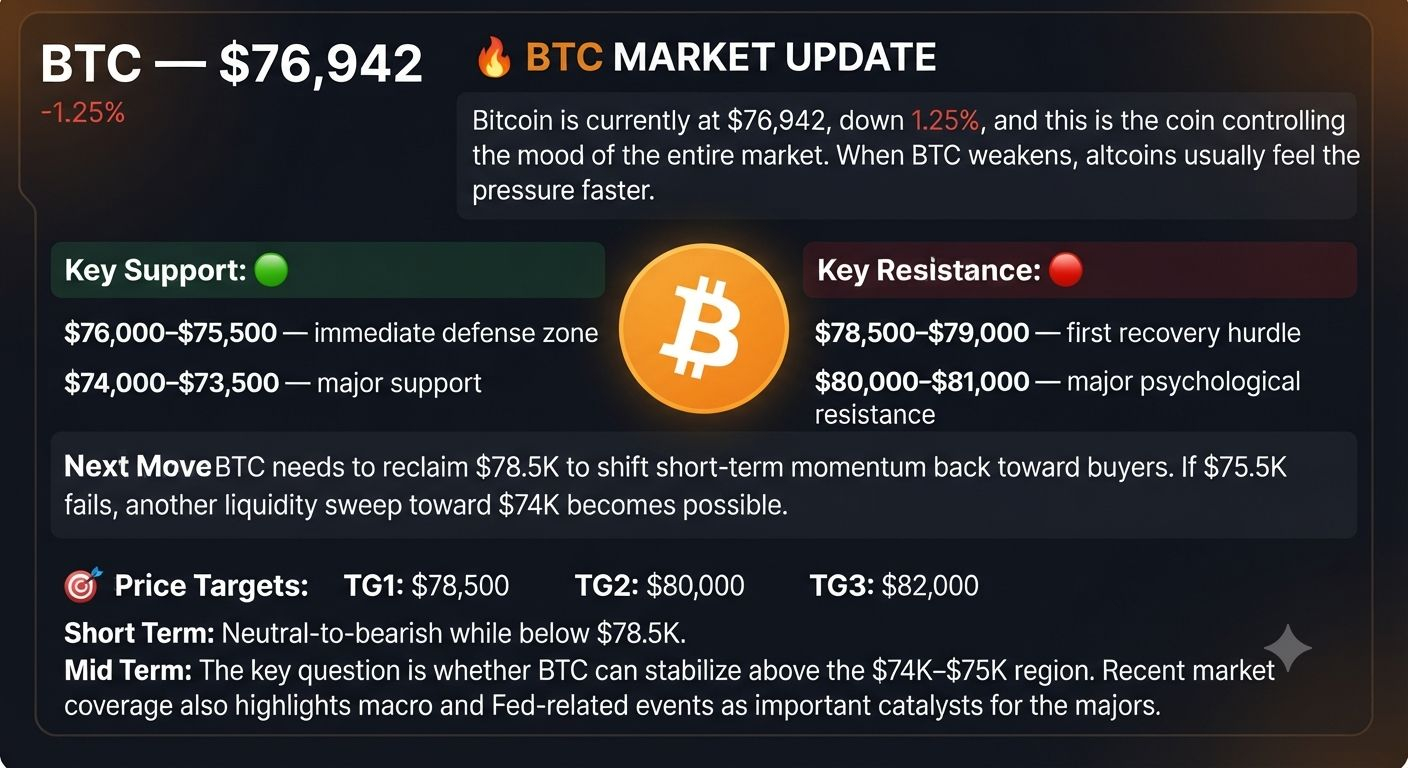
$BTC — $76,942 | -1.25%
🔥 BTC MARKET UPDATE
Bitcoin is currently at $76,942, down 1.25%, and this is the coin controlling the mood of the entire market. When BTC weakens, altcoins usually feel the pressure faster.
Key Support:
🟢 $76,000–$75,500 — immediate defense zone
🟢 $74,000–$73,500 — major support
Key Resistance:
🔴 $78,500–$79,000 — first recovery hurdle
🔴 $80,000–$81,000 — major psychological resistance
Next Move:
BTC needs to reclaim $78.5K to shift short-term momentum back toward buyers. If $75.5K fails, another liquidity sweep toward $74K becomes possible.
🎯 TG1: $78,500
🎯 TG2: $80,000
🎯 TG3: $82,000
Short Term: Neutral-to-bearish while below $78.5K.
Mid Term: The key question is whether BTC can stabilize above the $74K–$75K region. Recent market coverage also highlights macro and Fed-related events as important catalysts for the majors.
#GrayscalePutsXRPAt26.11%InAdvisorPortfolio
{future}(BTCUSDT)
$BTC — $76,942 | -1.25%
🔥 BTC MARKET UPDATE
Bitcoin is currently at $76,942, down 1.25%, and this is the coin controlling the mood of the entire market. When BTC weakens, altcoins usually feel the pressure faster.
Key Support:
🟢 $76,000–$75,500 — immediate defense zone
🟢 $74,000–$73,500 — major support
Key Resistance:
🔴 $78,500–$79,000 — first recovery hurdle
🔴 $80,000–$81,000 — major psychological resistance
Next Move:
BTC needs to reclaim $78.5K to shift short-term momentum back toward buyers. If $75.5K fails, another liquidity sweep toward $74K becomes possible.
🎯 TG1: $78,500
🎯 TG2: $80,000
🎯 TG3: $82,000
Short Term: Neutral-to-bearish while below $78.5K.
Mid Term: The key question is whether BTC can stabilize above the $74K–$75K region. Recent market coverage also highlights macro and Fed-related events as important catalysts for the majors.
#GrayscalePutsXRPAt26.11%InAdvisorPortfolio
🔥 BTC MARKET UPDATE
Bitcoin is currently at $76,942, down 1.25%, and this is the coin controlling the mood of the entire market. When BTC weakens, altcoins usually feel the pressure faster.
Key Support:
🟢 $76,000–$75,500 — immediate defense zone
🟢 $74,000–$73,500 — major support
Key Resistance:
🔴 $78,500–$79,000 — first recovery hurdle
🔴 $80,000–$81,000 — major psychological resistance
Next Move:
BTC needs to reclaim $78.5K to shift short-term momentum back toward buyers. If $75.5K fails, another liquidity sweep toward $74K becomes possible.
🎯 TG1: $78,500
🎯 TG2: $80,000
🎯 TG3: $82,000
Short Term: Neutral-to-bearish while below $78.5K.
Mid Term: The key question is whether BTC can stabilize above the $74K–$75K region. Recent market coverage also highlights macro and Fed-related events as important catalysts for the majors.
#GrayscalePutsXRPAt26.11%InAdvisorPortfolio
122
·
--
Bullish
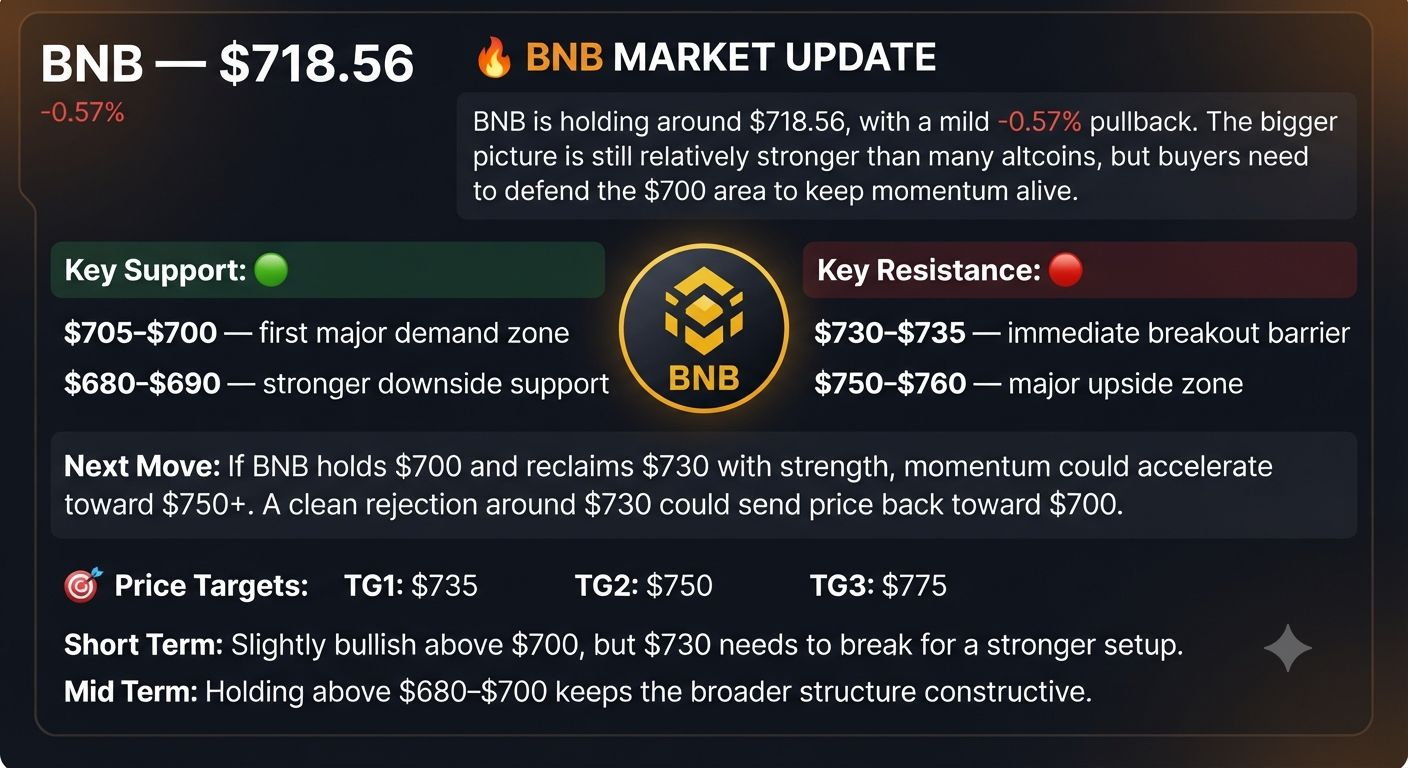
$BNB — $718.56 | -0.57%
🔥 BNB MARKET UPDATE
BNB is holding around $718.56, with a mild -0.57% pullback. The bigger picture is still relatively stronger than many altcoins, but buyers need to defend the $700 area to keep momentum alive.
Key Support:
🟢 $705–$700 — first major demand zone
🟢 $680–$690 — stronger downside support
Key Resistance:
🔴 $730–$735 — immediate breakout barrier
🔴 $750–$760 — major upside zone
Next Move:
If BNB holds $700 and reclaims $730 with strength, momentum could accelerate toward $750+. A clean rejection around $730 could send price back toward $700.
🎯 TG1: $735
🎯 TG2: $750
🎯 TG3: $775
Short Term: Slightly bullish above $700, but $730 needs to break for a stronger setup.
Mid Term: Holding above $680–$700 keeps the broader structure constructive.
#GrayscalePutsXRPAt26.11%InAdvisorPortfolio
{future}(BNBUSDT)
$BNB — $718.56 | -0.57%
🔥 BNB MARKET UPDATE
BNB is holding around $718.56, with a mild -0.57% pullback. The bigger picture is still relatively stronger than many altcoins, but buyers need to defend the $700 area to keep momentum alive.
Key Support:
🟢 $705–$700 — first major demand zone
🟢 $680–$690 — stronger downside support
Key Resistance:
🔴 $730–$735 — immediate breakout barrier
🔴 $750–$760 — major upside zone
Next Move:
If BNB holds $700 and reclaims $730 with strength, momentum could accelerate toward $750+. A clean rejection around $730 could send price back toward $700.
🎯 TG1: $735
🎯 TG2: $750
🎯 TG3: $775
Short Term: Slightly bullish above $700, but $730 needs to break for a stronger setup.
Mid Term: Holding above $680–$700 keeps the broader structure constructive.
#GrayscalePutsXRPAt26.11%InAdvisorPortfolio
🔥 BNB MARKET UPDATE
BNB is holding around $718.56, with a mild -0.57% pullback. The bigger picture is still relatively stronger than many altcoins, but buyers need to defend the $700 area to keep momentum alive.
Key Support:
🟢 $705–$700 — first major demand zone
🟢 $680–$690 — stronger downside support
Key Resistance:
🔴 $730–$735 — immediate breakout barrier
🔴 $750–$760 — major upside zone
Next Move:
If BNB holds $700 and reclaims $730 with strength, momentum could accelerate toward $750+. A clean rejection around $730 could send price back toward $700.
🎯 TG1: $735
🎯 TG2: $750
🎯 TG3: $775
Short Term: Slightly bullish above $700, but $730 needs to break for a stronger setup.
Mid Term: Holding above $680–$700 keeps the broader structure constructive.
#GrayscalePutsXRPAt26.11%InAdvisorPortfolio
516
·
--
Bullish
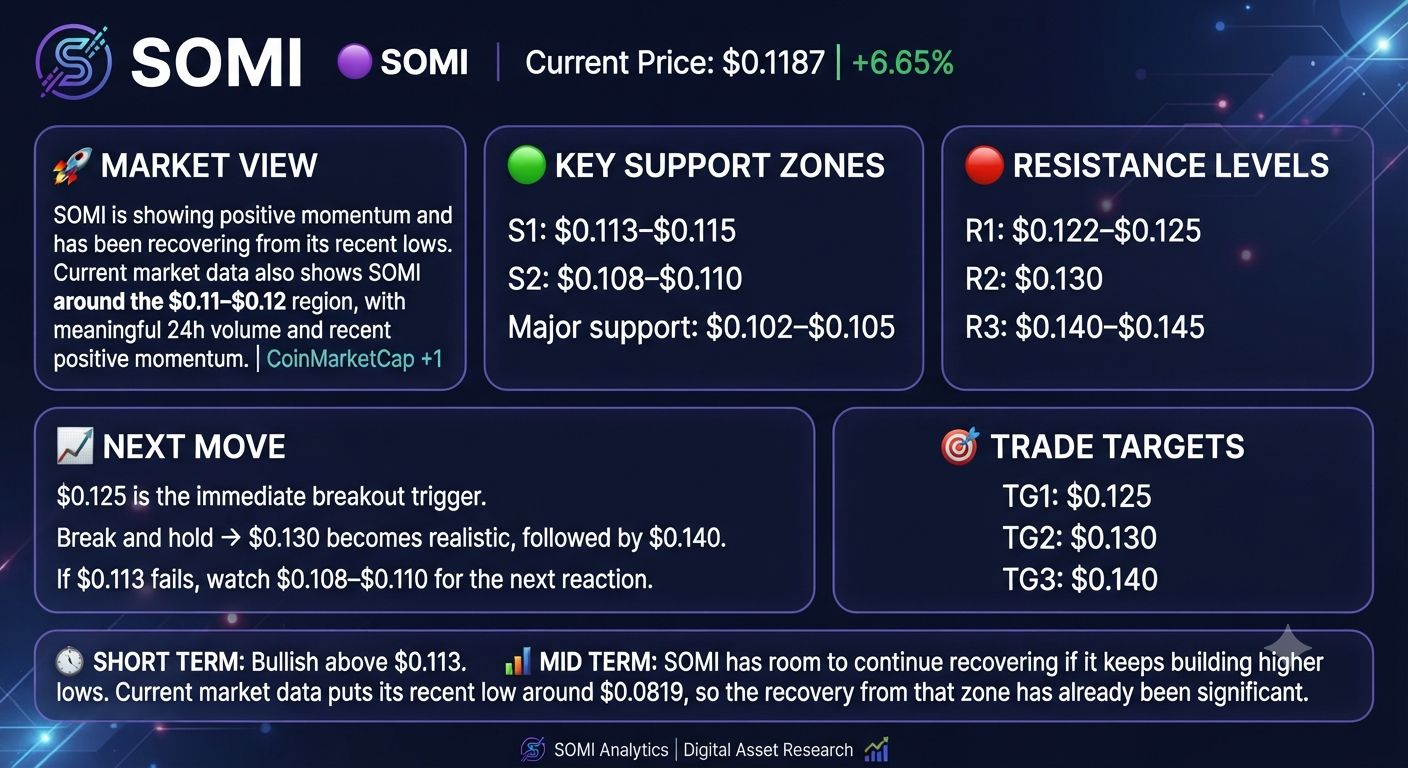
🟣 $SOMI — $0.1187 | +6.65%
🚀 MARKET VIEW
SOMI is showing positive momentum and has been recovering from its recent lows.
Current market data also shows SOMI around the $0.11–$0.12 region, with meaningful 24h volume and recent positive momentum.
CoinMarketCap +1
🟢 KEY SUPPORT
S1: $0.113–$0.115
S2: $0.108–$0.110
Major support: $0.102–$0.105
🔴 RESISTANCE
R1: $0.122–$0.125
R2: $0.130
R3: $0.140–$0.145
🎯 TRADE TARGETS
TG1: $0.125
TG2: $0.130
TG3: $0.140
📈 NEXT MOVE
$0.125 is the immediate breakout trigger.
Break and hold → $0.130 becomes realistic, followed by $0.140.
If $0.113 fails, watch $0.108–$0.110 for the next reaction.
⏱️ SHORT TERM
Bullish above $0.113.
📊 MID TERM
SOMI has room to continue recovering if it keeps building higher lows. Current market data puts its recent low around $0.0819, so the recovery from that zone has already been significant.
#GoldRisesAbout14%InAugust
{future}(SOMIUSDT)
🟣 $SOMI — $0.1187 | +6.65%
🚀 MARKET VIEW
SOMI is showing positive momentum and has been recovering from its recent lows.
Current market data also shows SOMI around the $0.11–$0.12 region, with meaningful 24h volume and recent positive momentum.
CoinMarketCap +1
🟢 KEY SUPPORT
S1: $0.113–$0.115
S2: $0.108–$0.110
Major support: $0.102–$0.105
🔴 RESISTANCE
R1: $0.122–$0.125
R2: $0.130
R3: $0.140–$0.145
🎯 TRADE TARGETS
TG1: $0.125
TG2: $0.130
TG3: $0.140
📈 NEXT MOVE
$0.125 is the immediate breakout trigger.
Break and hold → $0.130 becomes realistic, followed by $0.140.
If $0.113 fails, watch $0.108–$0.110 for the next reaction.
⏱️ SHORT TERM
Bullish above $0.113.
📊 MID TERM
SOMI has room to continue recovering if it keeps building higher lows. Current market data puts its recent low around $0.0819, so the recovery from that zone has already been significant.
#GoldRisesAbout14%InAugust
🚀 MARKET VIEW
SOMI is showing positive momentum and has been recovering from its recent lows.
Current market data also shows SOMI around the $0.11–$0.12 region, with meaningful 24h volume and recent positive momentum.
CoinMarketCap +1
🟢 KEY SUPPORT
S1: $0.113–$0.115
S2: $0.108–$0.110
Major support: $0.102–$0.105
🔴 RESISTANCE
R1: $0.122–$0.125
R2: $0.130
R3: $0.140–$0.145
🎯 TRADE TARGETS
TG1: $0.125
TG2: $0.130
TG3: $0.140
📈 NEXT MOVE
$0.125 is the immediate breakout trigger.
Break and hold → $0.130 becomes realistic, followed by $0.140.
If $0.113 fails, watch $0.108–$0.110 for the next reaction.
⏱️ SHORT TERM
Bullish above $0.113.
📊 MID TERM
SOMI has room to continue recovering if it keeps building higher lows. Current market data puts its recent low around $0.0819, so the recovery from that zone has already been significant.
#GoldRisesAbout14%InAugust
426
·
--
Bullish
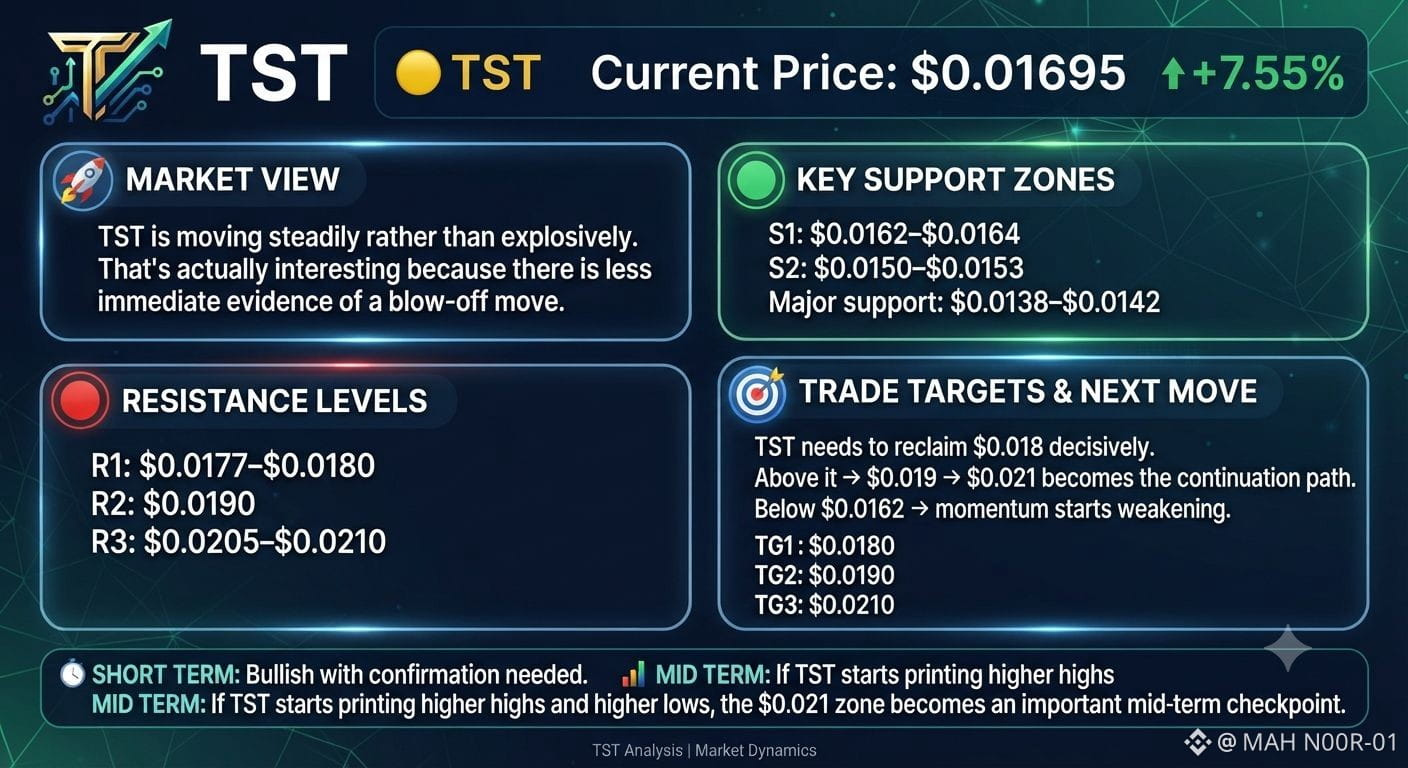
🟡 $TST — $0.01695 | +7.55%
🚀 MARKET VIEW
TST is moving steadily rather than explosively. That's actually interesting because there is less immediate evidence of a blow-off move.
🟢 KEY SUPPORT
S1: $0.0162–$0.0164
S2: $0.0150–$0.0153
Major support: $0.0138–$0.0142
🔴 RESISTANCE
R1: $0.0177–$0.0180
R2: $0.0190
R3: $0.0205–$0.0210
🎯 TRADE TARGETS
TG1: $0.0180
TG2: $0.0190
TG3: $0.0210
📈 NEXT MOVE
TST needs to reclaim $0.018 decisively.
Above it → $0.019 → $0.021 becomes the continuation path.
Below $0.0162 → momentum starts weakening.
⏱️ SHORT TERM
Bullish with confirmation needed.
📊 MID TERM
If TST starts printing higher highs and higher lows, the $0.021 zone becomes an important mid-term checkpoint.
#GoldRisesAbout14%InAugust
{future}(TSTUSDT)
🟡 $TST — $0.01695 | +7.55%
🚀 MARKET VIEW
TST is moving steadily rather than explosively. That's actually interesting because there is less immediate evidence of a blow-off move.
🟢 KEY SUPPORT
S1: $0.0162–$0.0164
S2: $0.0150–$0.0153
Major support: $0.0138–$0.0142
🔴 RESISTANCE
R1: $0.0177–$0.0180
R2: $0.0190
R3: $0.0205–$0.0210
🎯 TRADE TARGETS
TG1: $0.0180
TG2: $0.0190
TG3: $0.0210
📈 NEXT MOVE
TST needs to reclaim $0.018 decisively.
Above it → $0.019 → $0.021 becomes the continuation path.
Below $0.0162 → momentum starts weakening.
⏱️ SHORT TERM
Bullish with confirmation needed.
📊 MID TERM
If TST starts printing higher highs and higher lows, the $0.021 zone becomes an important mid-term checkpoint.
#GoldRisesAbout14%InAugust
🚀 MARKET VIEW
TST is moving steadily rather than explosively. That's actually interesting because there is less immediate evidence of a blow-off move.
🟢 KEY SUPPORT
S1: $0.0162–$0.0164
S2: $0.0150–$0.0153
Major support: $0.0138–$0.0142
🔴 RESISTANCE
R1: $0.0177–$0.0180
R2: $0.0190
R3: $0.0205–$0.0210
🎯 TRADE TARGETS
TG1: $0.0180
TG2: $0.0190
TG3: $0.0210
📈 NEXT MOVE
TST needs to reclaim $0.018 decisively.
Above it → $0.019 → $0.021 becomes the continuation path.
Below $0.0162 → momentum starts weakening.
⏱️ SHORT TERM
Bullish with confirmation needed.
📊 MID TERM
If TST starts printing higher highs and higher lows, the $0.021 zone becomes an important mid-term checkpoint.
#GoldRisesAbout14%InAugust
211
·
--
Bullish
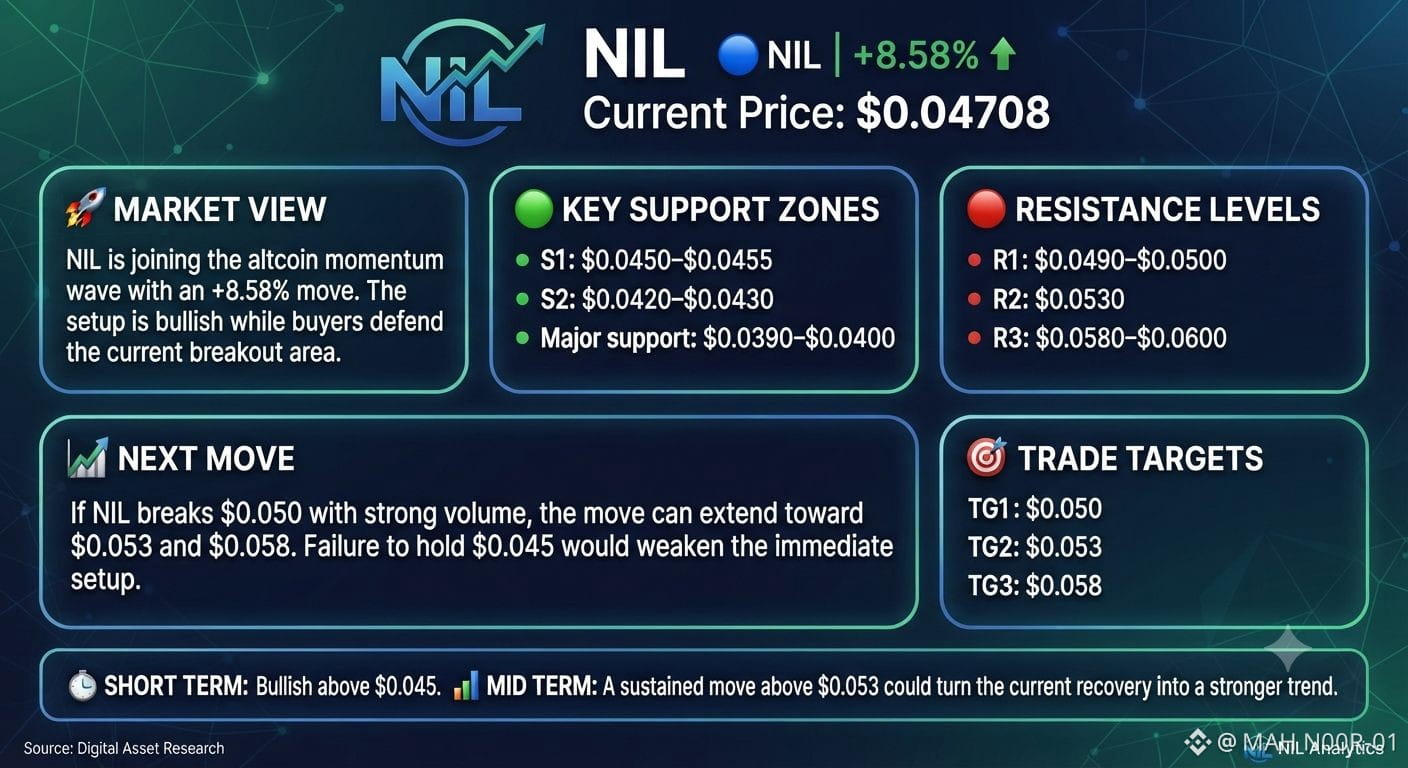
🔵 $NIL — $0.04708 | +8.58%
🚀 MARKET VIEW
NIL is joining the altcoin momentum wave with an +8.58% move.
The setup is bullish while buyers defend the current breakout area.
🟢 KEY SUPPORT
S1: $0.0450–$0.0455
S2: $0.0420–$0.0430
Major support: $0.0390–$0.0400
🔴 RESISTANCE
R1: $0.0490–$0.0500
R2: $0.0530
R3: $0.0580–$0.0600
🎯 TRADE TARGETS
TG1: $0.050
TG2: $0.053
TG3: $0.058
📈 NEXT MOVE
If NIL breaks $0.050 with strong volume, the move can extend toward $0.053 and $0.058.
Failure to hold $0.045 would weaken the immediate setup.
⏱️ SHORT TERM
Bullish above $0.045.
📊 MID TERM
A sustained move above $0.053 could turn the current recovery into a stronger trend.
#GoldRisesAbout14%InAugust
{future}(NILUSDT)
🔵 $NIL — $0.04708 | +8.58%
🚀 MARKET VIEW
NIL is joining the altcoin momentum wave with an +8.58% move.
The setup is bullish while buyers defend the current breakout area.
🟢 KEY SUPPORT
S1: $0.0450–$0.0455
S2: $0.0420–$0.0430
Major support: $0.0390–$0.0400
🔴 RESISTANCE
R1: $0.0490–$0.0500
R2: $0.0530
R3: $0.0580–$0.0600
🎯 TRADE TARGETS
TG1: $0.050
TG2: $0.053
TG3: $0.058
📈 NEXT MOVE
If NIL breaks $0.050 with strong volume, the move can extend toward $0.053 and $0.058.
Failure to hold $0.045 would weaken the immediate setup.
⏱️ SHORT TERM
Bullish above $0.045.
📊 MID TERM
A sustained move above $0.053 could turn the current recovery into a stronger trend.
#GoldRisesAbout14%InAugust
🚀 MARKET VIEW
NIL is joining the altcoin momentum wave with an +8.58% move.
The setup is bullish while buyers defend the current breakout area.
🟢 KEY SUPPORT
S1: $0.0450–$0.0455
S2: $0.0420–$0.0430
Major support: $0.0390–$0.0400
🔴 RESISTANCE
R1: $0.0490–$0.0500
R2: $0.0530
R3: $0.0580–$0.0600
🎯 TRADE TARGETS
TG1: $0.050
TG2: $0.053
TG3: $0.058
📈 NEXT MOVE
If NIL breaks $0.050 with strong volume, the move can extend toward $0.053 and $0.058.
Failure to hold $0.045 would weaken the immediate setup.
⏱️ SHORT TERM
Bullish above $0.045.
📊 MID TERM
A sustained move above $0.053 could turn the current recovery into a stronger trend.
#GoldRisesAbout14%InAugust
319
·
--
Bullish
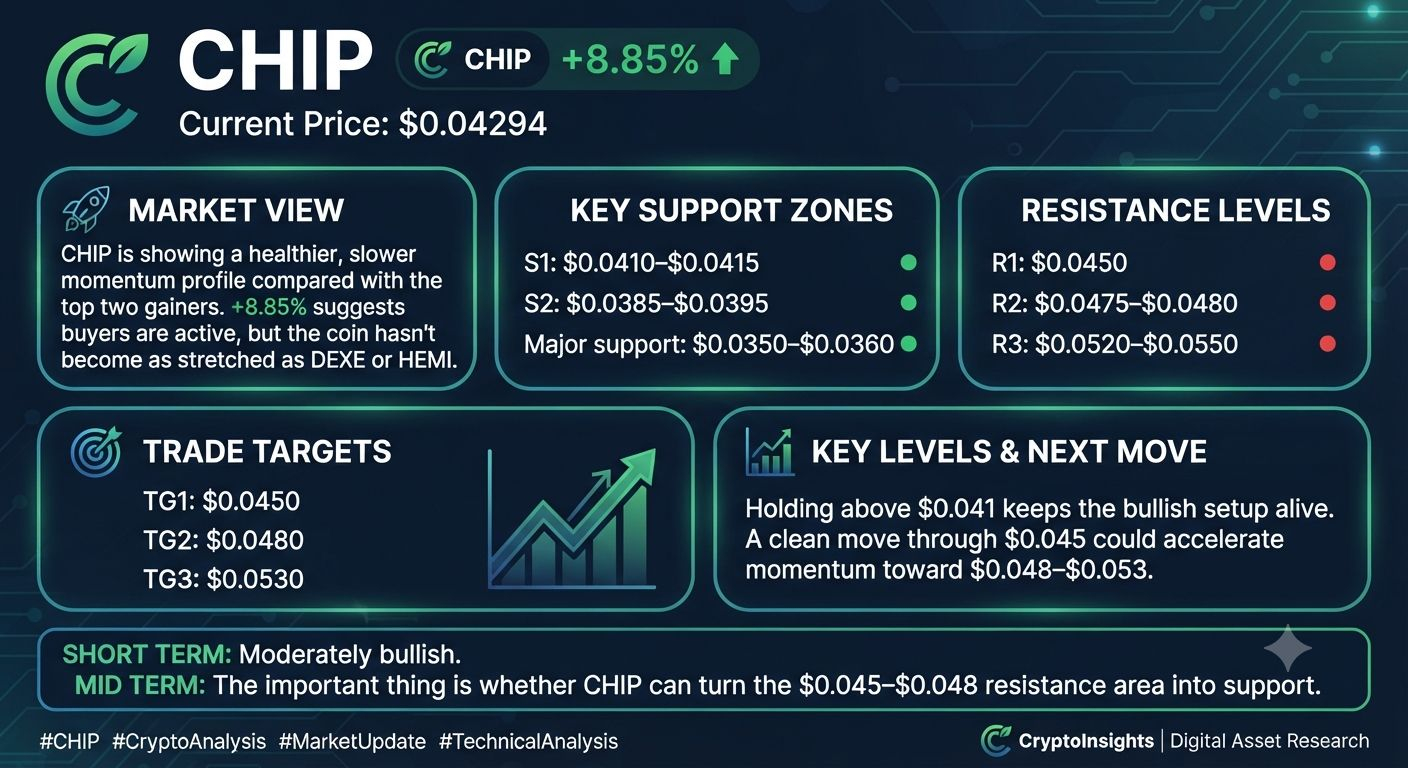
⚡ $CHIP — $0.04294 | +8.85%
🚀 MARKET VIEW
CHIP is showing a healthier, slower momentum profile compared with the top two gainers.
+8.85% suggests buyers are active, but the coin hasn't become as stretched as DEXE or HEMI.
🟢 KEY SUPPORT
S1: $0.0410–$0.0415
S2: $0.0385–$0.0395
Major support: $0.0350–$0.0360
🔴 RESISTANCE
R1: $0.0450
R2: $0.0475–$0.0480
R3: $0.0520–$0.0550
🎯 TRADE TARGETS
TG1: $0.0450
TG2: $0.0480
TG3: $0.0530
📈 NEXT MOVE
Holding above $0.041 keeps the bullish setup alive.
A clean move through $0.045 could accelerate momentum toward $0.048–$0.053.
⏱️ SHORT TERM
Moderately bullish.
📊 MID TERM
The important thing is whether CHIP can turn the $0.045–$0.048 resistance area into support.
#GoldRisesAbout14%InAugust
{future}(CHIPUSDT)
⚡ $CHIP — $0.04294 | +8.85%
🚀 MARKET VIEW
CHIP is showing a healthier, slower momentum profile compared with the top two gainers.
+8.85% suggests buyers are active, but the coin hasn't become as stretched as DEXE or HEMI.
🟢 KEY SUPPORT
S1: $0.0410–$0.0415
S2: $0.0385–$0.0395
Major support: $0.0350–$0.0360
🔴 RESISTANCE
R1: $0.0450
R2: $0.0475–$0.0480
R3: $0.0520–$0.0550
🎯 TRADE TARGETS
TG1: $0.0450
TG2: $0.0480
TG3: $0.0530
📈 NEXT MOVE
Holding above $0.041 keeps the bullish setup alive.
A clean move through $0.045 could accelerate momentum toward $0.048–$0.053.
⏱️ SHORT TERM
Moderately bullish.
📊 MID TERM
The important thing is whether CHIP can turn the $0.045–$0.048 resistance area into support.
#GoldRisesAbout14%InAugust
🚀 MARKET VIEW
CHIP is showing a healthier, slower momentum profile compared with the top two gainers.
+8.85% suggests buyers are active, but the coin hasn't become as stretched as DEXE or HEMI.
🟢 KEY SUPPORT
S1: $0.0410–$0.0415
S2: $0.0385–$0.0395
Major support: $0.0350–$0.0360
🔴 RESISTANCE
R1: $0.0450
R2: $0.0475–$0.0480
R3: $0.0520–$0.0550
🎯 TRADE TARGETS
TG1: $0.0450
TG2: $0.0480
TG3: $0.0530
📈 NEXT MOVE
Holding above $0.041 keeps the bullish setup alive.
A clean move through $0.045 could accelerate momentum toward $0.048–$0.053.
⏱️ SHORT TERM
Moderately bullish.
📊 MID TERM
The important thing is whether CHIP can turn the $0.045–$0.048 resistance area into support.
#GoldRisesAbout14%InAugust
392
·
--
Bullish
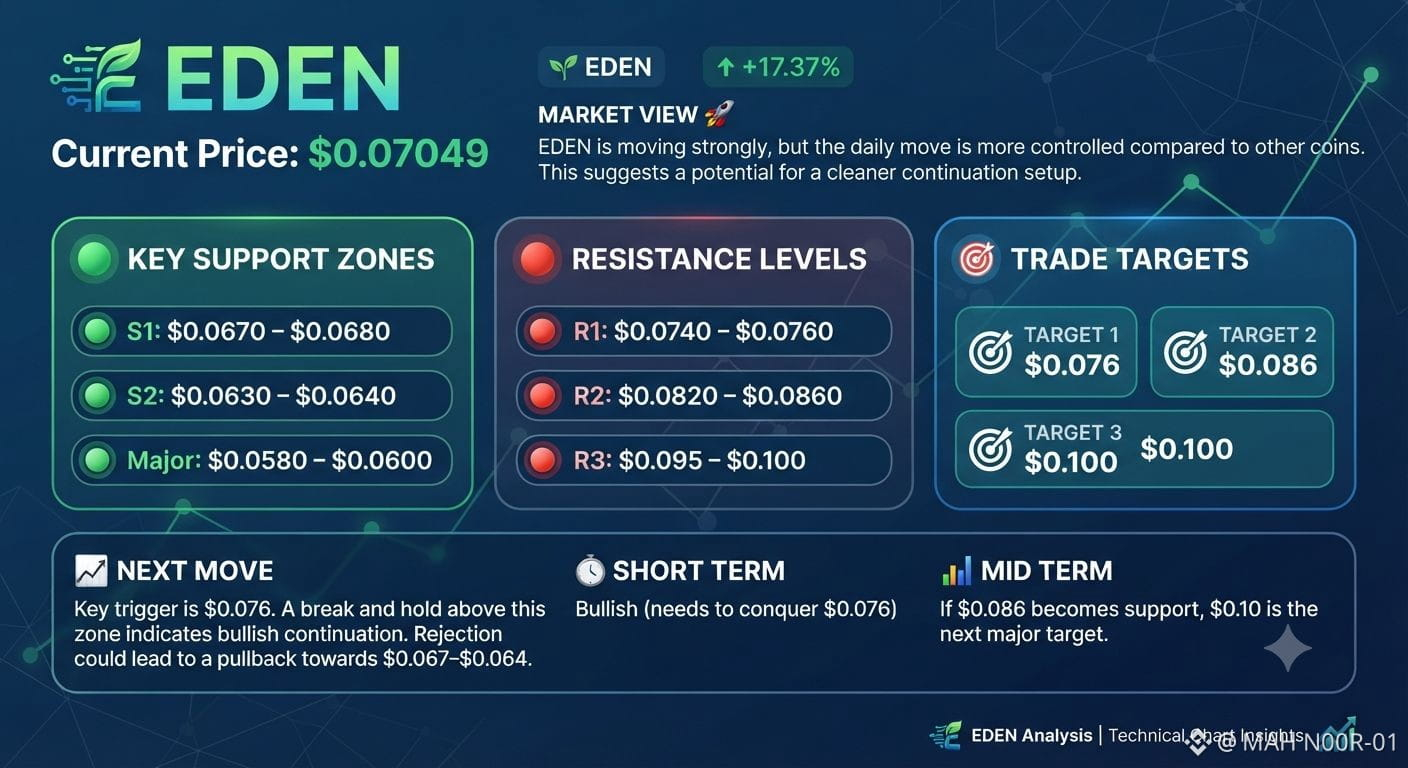
🌱 $EDEN — $0.07049 | +17.37%
🚀 MARKET VIEW
EDEN is moving strongly, but unlike DEXE/HEMI, the daily move is more controlled.
That can be interesting because less vertical momentum sometimes gives a cleaner continuation setup.
🟢 KEY SUPPORT
S1: $0.0670–$0.0680
S2: $0.0630–$0.0640
Major support: $0.0580–$0.0600
🔴 RESISTANCE
R1: $0.0740–$0.0760
R2: $0.0820–$0.0860
R3: $0.095–$0.100
🎯 TRADE TARGETS
TG1: $0.076
TG2: $0.086
TG3: $0.100
📈 NEXT MOVE
$0.076 is the key trigger.
Break and hold above that zone → bullish continuation.
Rejection → likely pullback toward $0.067–$0.064 before the next attempt.
⏱️ SHORT TERM
Bullish, but $0.076 needs to be conquered.
📊 MID TERM
If EDEN establishes $0.086 as support, the psychological $0.10 area becomes the next major upside magnet.
#GoldRisesAbout14%InAugust
{future}(EDENUSDT)
🌱 $EDEN — $0.07049 | +17.37%
🚀 MARKET VIEW
EDEN is moving strongly, but unlike DEXE/HEMI, the daily move is more controlled.
That can be interesting because less vertical momentum sometimes gives a cleaner continuation setup.
🟢 KEY SUPPORT
S1: $0.0670–$0.0680
S2: $0.0630–$0.0640
Major support: $0.0580–$0.0600
🔴 RESISTANCE
R1: $0.0740–$0.0760
R2: $0.0820–$0.0860
R3: $0.095–$0.100
🎯 TRADE TARGETS
TG1: $0.076
TG2: $0.086
TG3: $0.100
📈 NEXT MOVE
$0.076 is the key trigger.
Break and hold above that zone → bullish continuation.
Rejection → likely pullback toward $0.067–$0.064 before the next attempt.
⏱️ SHORT TERM
Bullish, but $0.076 needs to be conquered.
📊 MID TERM
If EDEN establishes $0.086 as support, the psychological $0.10 area becomes the next major upside magnet.
#GoldRisesAbout14%InAugust
🚀 MARKET VIEW
EDEN is moving strongly, but unlike DEXE/HEMI, the daily move is more controlled.
That can be interesting because less vertical momentum sometimes gives a cleaner continuation setup.
🟢 KEY SUPPORT
S1: $0.0670–$0.0680
S2: $0.0630–$0.0640
Major support: $0.0580–$0.0600
🔴 RESISTANCE
R1: $0.0740–$0.0760
R2: $0.0820–$0.0860
R3: $0.095–$0.100
🎯 TRADE TARGETS
TG1: $0.076
TG2: $0.086
TG3: $0.100
📈 NEXT MOVE
$0.076 is the key trigger.
Break and hold above that zone → bullish continuation.
Rejection → likely pullback toward $0.067–$0.064 before the next attempt.
⏱️ SHORT TERM
Bullish, but $0.076 needs to be conquered.
📊 MID TERM
If EDEN establishes $0.086 as support, the psychological $0.10 area becomes the next major upside magnet.
#GoldRisesAbout14%InAugust
269
·
--
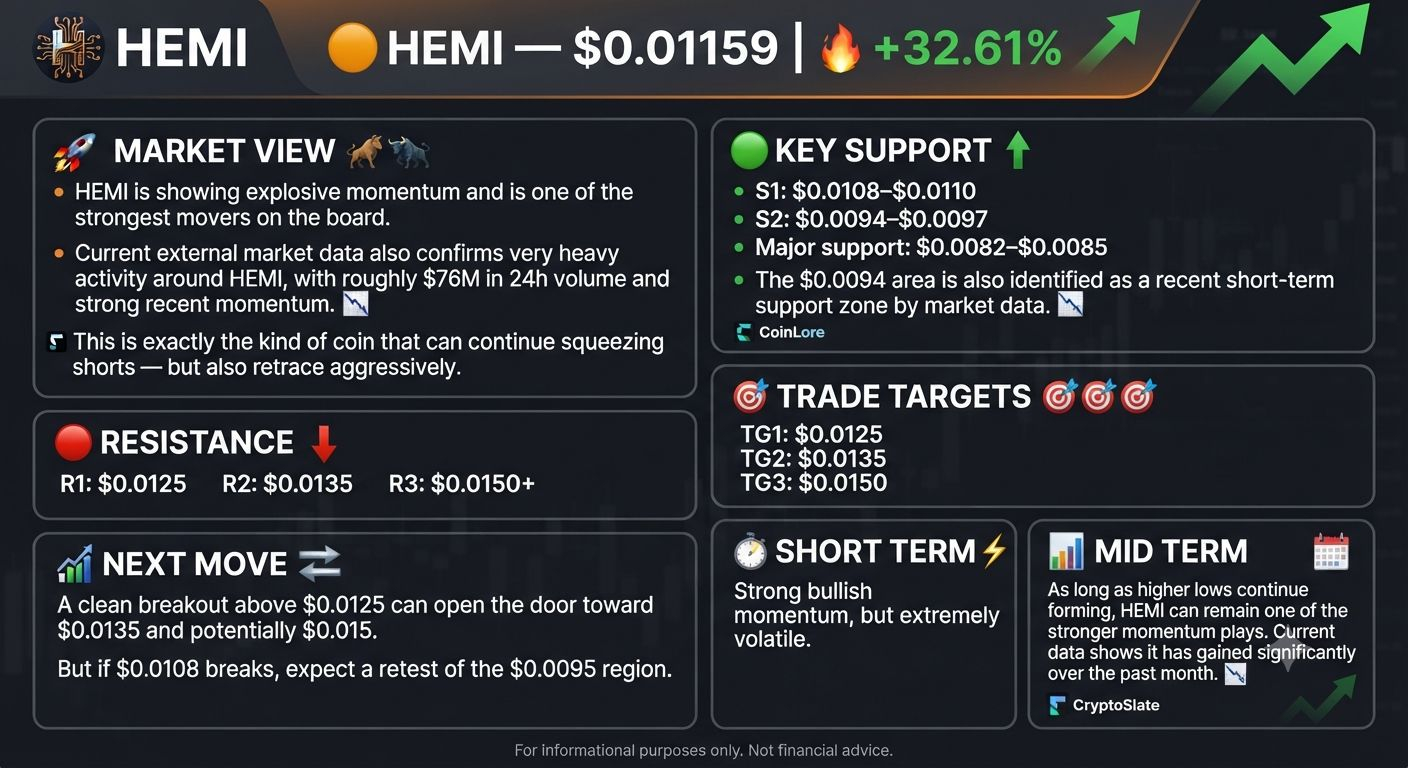
🟠 $HEMI — $0.01159 | +32.61%
🚀 MARKET VIEW
HEMI is showing explosive momentum and is one of the strongest movers on the board.
Current external market data also confirms very heavy activity around HEMI, with roughly $76M in 24h volume and strong recent momentum.
CryptoSlate
This is exactly the kind of coin that can continue squeezing shorts — but also retrace aggressively.
🟢 KEY SUPPORT
S1: $0.0108–$0.0110
S2: $0.0094–$0.0097
Major support: $0.0082–$0.0085
The $0.0094 area is also identified as a recent short-term support zone by market data.
CoinLore
🔴 RESISTANCE
R1: $0.0125
R2: $0.0135
R3: $0.0150+
🎯 TRADE TARGETS
TG1: $0.0125
TG2: $0.0135
TG3: $0.0150
📈 NEXT MOVE
A clean breakout above $0.0125 can open the door toward $0.0135 and potentially $0.015.
But if $0.0108 breaks, expect a retest of the $0.0095 region.
⏱️ SHORT TERM
Strong bullish momentum, but extremely volatile.
📊 MID TERM
As long as higher lows continue forming, HEMI can remain one of the stronger momentum plays. Current data shows it has gained significantly over the past month.
CryptoSlate
#GoldRisesAbout14%InAugust
{future}(HEMIUSDT)
🟠 $HEMI — $0.01159 | +32.61%
🚀 MARKET VIEW
HEMI is showing explosive momentum and is one of the strongest movers on the board.
Current external market data also confirms very heavy activity around HEMI, with roughly $76M in 24h volume and strong recent momentum.
CryptoSlate
This is exactly the kind of coin that can continue squeezing shorts — but also retrace aggressively.
🟢 KEY SUPPORT
S1: $0.0108–$0.0110
S2: $0.0094–$0.0097
Major support: $0.0082–$0.0085
The $0.0094 area is also identified as a recent short-term support zone by market data.
CoinLore
🔴 RESISTANCE
R1: $0.0125
R2: $0.0135
R3: $0.0150+
🎯 TRADE TARGETS
TG1: $0.0125
TG2: $0.0135
TG3: $0.0150
📈 NEXT MOVE
A clean breakout above $0.0125 can open the door toward $0.0135 and potentially $0.015.
But if $0.0108 breaks, expect a retest of the $0.0095 region.
⏱️ SHORT TERM
Strong bullish momentum, but extremely volatile.
📊 MID TERM
As long as higher lows continue forming, HEMI can remain one of the stronger momentum plays. Current data shows it has gained significantly over the past month.
CryptoSlate
#GoldRisesAbout14%InAugust
🚀 MARKET VIEW
HEMI is showing explosive momentum and is one of the strongest movers on the board.
Current external market data also confirms very heavy activity around HEMI, with roughly $76M in 24h volume and strong recent momentum.
CryptoSlate
This is exactly the kind of coin that can continue squeezing shorts — but also retrace aggressively.
🟢 KEY SUPPORT
S1: $0.0108–$0.0110
S2: $0.0094–$0.0097
Major support: $0.0082–$0.0085
The $0.0094 area is also identified as a recent short-term support zone by market data.
CoinLore
🔴 RESISTANCE
R1: $0.0125
R2: $0.0135
R3: $0.0150+
🎯 TRADE TARGETS
TG1: $0.0125
TG2: $0.0135
TG3: $0.0150
📈 NEXT MOVE
A clean breakout above $0.0125 can open the door toward $0.0135 and potentially $0.015.
But if $0.0108 breaks, expect a retest of the $0.0095 region.
⏱️ SHORT TERM
Strong bullish momentum, but extremely volatile.
📊 MID TERM
As long as higher lows continue forming, HEMI can remain one of the stronger momentum plays. Current data shows it has gained significantly over the past month.
CryptoSlate
#GoldRisesAbout14%InAugust
290
·
--
Bullish
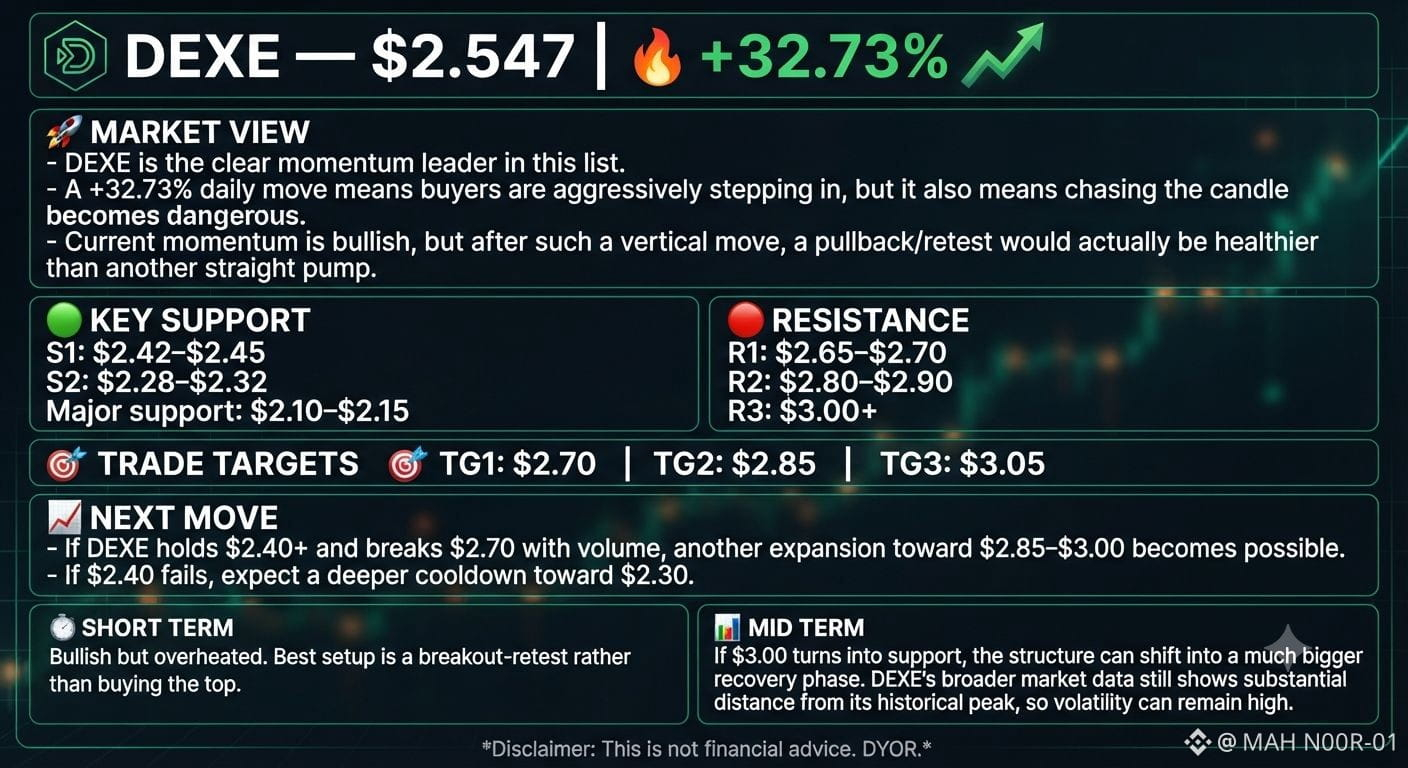
🔥 $DEXE — $2.547 | +32.73%
🚀 MARKET VIEW
DEXE is the clear momentum leader in this list. A +32.73% daily move means buyers are aggressively stepping in, but it also means chasing the candle becomes dangerous.
Current momentum is bullish, but after such a vertical move, a pullback/retest would actually be healthier than another straight pump.
🟢 KEY SUPPORT
S1: $2.42–$2.45
S2: $2.28–$2.32
Major support: $2.10–$2.15
🔴 RESISTANCE
R1: $2.65–$2.70
R2: $2.80–$2.90
R3: $3.00+
🎯 TRADE TARGETS
TG1: $2.70
TG2: $2.85
TG3: $3.05
📈 NEXT MOVE
If DEXE holds $2.40+ and breaks $2.70 with volume, another expansion toward $2.85–$3.00 becomes possible.
If $2.40 fails, expect a deeper cooldown toward $2.30.
⏱️ SHORT TERM
Bullish but overheated. Best setup is a breakout-retest rather than buying the top.
📊 MID TERM
If $3.00 turns into support, the structure can shift into a much bigger recovery phase. DEXE's broader market data still shows substantial distance from its historical peak, so volatility can remain high.
#GoldRisesAbout14%InAugust
{future}(DEXEUSDT)
🔥 $DEXE — $2.547 | +32.73%
🚀 MARKET VIEW
DEXE is the clear momentum leader in this list. A +32.73% daily move means buyers are aggressively stepping in, but it also means chasing the candle becomes dangerous.
Current momentum is bullish, but after such a vertical move, a pullback/retest would actually be healthier than another straight pump.
🟢 KEY SUPPORT
S1: $2.42–$2.45
S2: $2.28–$2.32
Major support: $2.10–$2.15
🔴 RESISTANCE
R1: $2.65–$2.70
R2: $2.80–$2.90
R3: $3.00+
🎯 TRADE TARGETS
TG1: $2.70
TG2: $2.85
TG3: $3.05
📈 NEXT MOVE
If DEXE holds $2.40+ and breaks $2.70 with volume, another expansion toward $2.85–$3.00 becomes possible.
If $2.40 fails, expect a deeper cooldown toward $2.30.
⏱️ SHORT TERM
Bullish but overheated. Best setup is a breakout-retest rather than buying the top.
📊 MID TERM
If $3.00 turns into support, the structure can shift into a much bigger recovery phase. DEXE's broader market data still shows substantial distance from its historical peak, so volatility can remain high.
#GoldRisesAbout14%InAugust
🚀 MARKET VIEW
DEXE is the clear momentum leader in this list. A +32.73% daily move means buyers are aggressively stepping in, but it also means chasing the candle becomes dangerous.
Current momentum is bullish, but after such a vertical move, a pullback/retest would actually be healthier than another straight pump.
🟢 KEY SUPPORT
S1: $2.42–$2.45
S2: $2.28–$2.32
Major support: $2.10–$2.15
🔴 RESISTANCE
R1: $2.65–$2.70
R2: $2.80–$2.90
R3: $3.00+
🎯 TRADE TARGETS
TG1: $2.70
TG2: $2.85
TG3: $3.05
📈 NEXT MOVE
If DEXE holds $2.40+ and breaks $2.70 with volume, another expansion toward $2.85–$3.00 becomes possible.
If $2.40 fails, expect a deeper cooldown toward $2.30.
⏱️ SHORT TERM
Bullish but overheated. Best setup is a breakout-retest rather than buying the top.
📊 MID TERM
If $3.00 turns into support, the structure can shift into a much bigger recovery phase. DEXE's broader market data still shows substantial distance from its historical peak, so volatility can remain high.
#GoldRisesAbout14%InAugust
1
2
1.1k
·
--
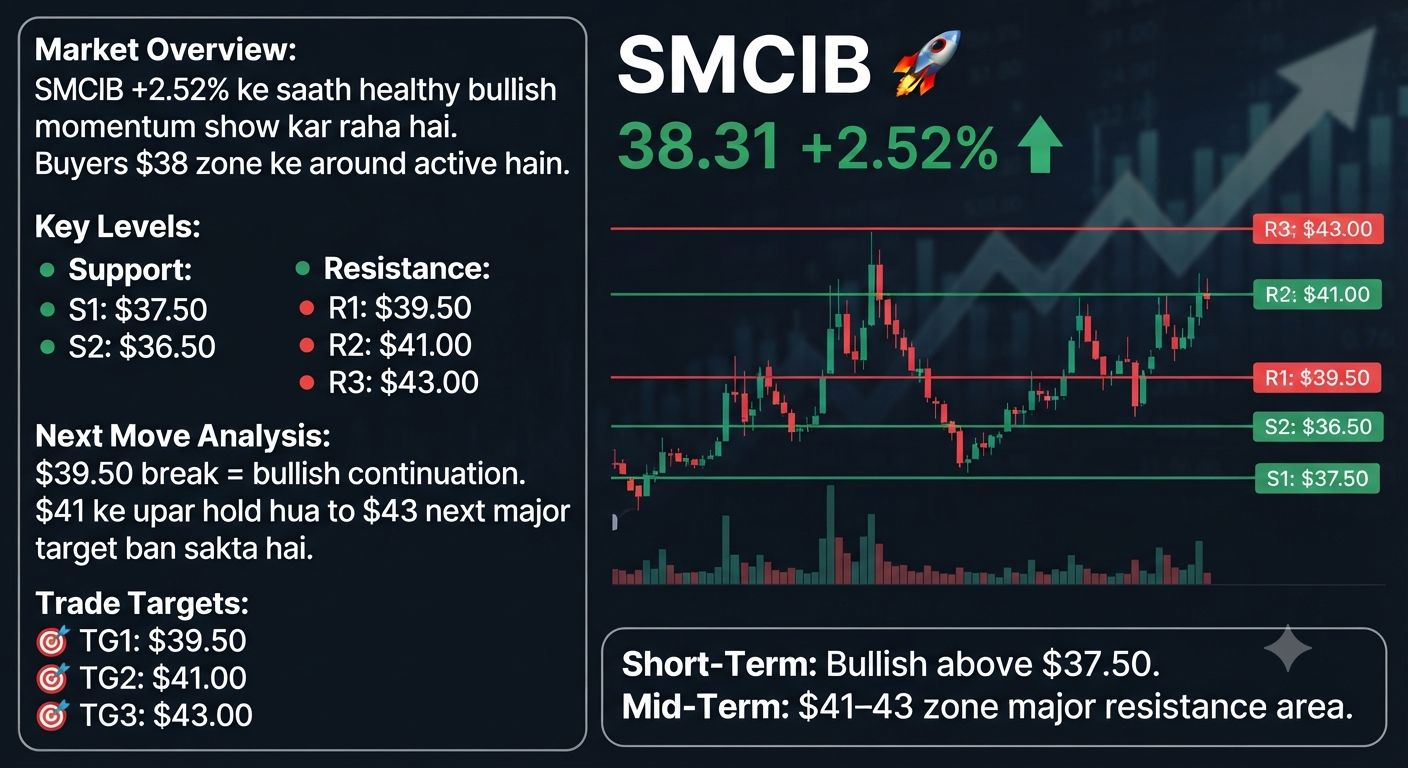
🚀 $SMCIB — $38.31 | +2.52%
Market Overview:
SMCIB is showing healthy bullish momentum with +2.52%. Buyers are active around the $38 zone.
Support:
🟢 S1: $37.50
🟢 S2: $36.50
Resistance:
🔴 R1: $39.50
🔴 R2: $41.00
🔴 R3: $43.00
Next Move:
A break above $39.50 = bullish continuation. If it holds above $41, then $43 could be the next major target.
Targets:
🎯 TG1: $39.50
🎯 TG2: $41.00
🎯 TG3: $43.00
Short-Term: Bullish above $37.50.
Mid-Term: The $41–43 zone is a major resistance area.
#XRPLeadsCryptoPullbackDropsNearly7%
🚀 $SMCIB — $38.31 | +2.52%
Market Overview:
SMCIB is showing healthy bullish momentum with +2.52%. Buyers are active around the $38 zone.
Support:
🟢 S1: $37.50
🟢 S2: $36.50
Resistance:
🔴 R1: $39.50
🔴 R2: $41.00
🔴 R3: $43.00
Next Move:
A break above $39.50 = bullish continuation. If it holds above $41, then $43 could be the next major target.
Targets:
🎯 TG1: $39.50
🎯 TG2: $41.00
🎯 TG3: $43.00
Short-Term: Bullish above $37.50.
Mid-Term: The $41–43 zone is a major resistance area.
#XRPLeadsCryptoPullbackDropsNearly7%
Market Overview:
SMCIB is showing healthy bullish momentum with +2.52%. Buyers are active around the $38 zone.
Support:
🟢 S1: $37.50
🟢 S2: $36.50
Resistance:
🔴 R1: $39.50
🔴 R2: $41.00
🔴 R3: $43.00
Next Move:
A break above $39.50 = bullish continuation. If it holds above $41, then $43 could be the next major target.
Targets:
🎯 TG1: $39.50
🎯 TG2: $41.00
🎯 TG3: $43.00
Short-Term: Bullish above $37.50.
Mid-Term: The $41–43 zone is a major resistance area.
#XRPLeadsCryptoPullbackDropsNearly7%
457
·
--
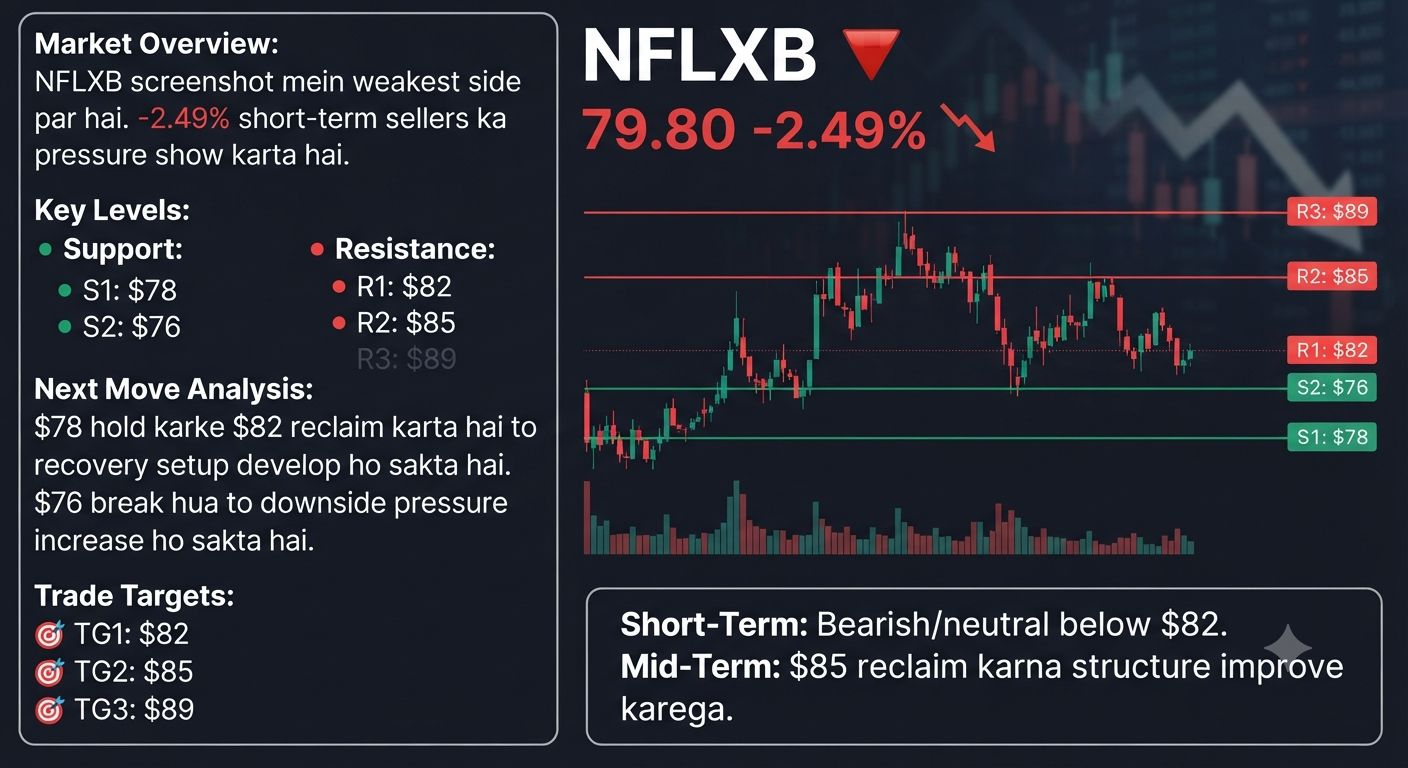
🔻 $NFLXB — $79.80 | -2.49%
Market Overview:
The NFLXB screenshot shows it is on the weakest side. -2.49% indicates short-term sellers’ pressure.
Support:
🟢 S1: $78
🟢 S2: $76
Resistance:
🔴 R1: $82
🔴 R2: $85
🔴 R3: $89
Next Move:
If it holds at $78 and reclaims $82, a recovery setup could develop. If $76 breaks, downside pressure may increase.
Targets:
🎯 TG1: $82
🎯 TG2: $85
🎯 TG3: $89
Short-Term: Bearish/neutral below $82.
Mid-Term: Reclaiming $85 will improve the structure.
#XRPLeadsCryptoPullbackDropsNearly7%
🔻 $NFLXB — $79.80 | -2.49%
Market Overview:
The NFLXB screenshot shows it is on the weakest side. -2.49% indicates short-term sellers’ pressure.
Support:
🟢 S1: $78
🟢 S2: $76
Resistance:
🔴 R1: $82
🔴 R2: $85
🔴 R3: $89
Next Move:
If it holds at $78 and reclaims $82, a recovery setup could develop. If $76 breaks, downside pressure may increase.
Targets:
🎯 TG1: $82
🎯 TG2: $85
🎯 TG3: $89
Short-Term: Bearish/neutral below $82.
Mid-Term: Reclaiming $85 will improve the structure.
#XRPLeadsCryptoPullbackDropsNearly7%
Market Overview:
The NFLXB screenshot shows it is on the weakest side. -2.49% indicates short-term sellers’ pressure.
Support:
🟢 S1: $78
🟢 S2: $76
Resistance:
🔴 R1: $82
🔴 R2: $85
🔴 R3: $89
Next Move:
If it holds at $78 and reclaims $82, a recovery setup could develop. If $76 breaks, downside pressure may increase.
Targets:
🎯 TG1: $82
🎯 TG2: $85
🎯 TG3: $89
Short-Term: Bearish/neutral below $82.
Mid-Term: Reclaiming $85 will improve the structure.
#XRPLeadsCryptoPullbackDropsNearly7%
476
·
--
⚡ $IRENB — $40.96 | +2.94%
Market Overview:
IRENB is on the strong side with +2.94%. Buyers are holding the price above the $40 psychological level.
Support:
🟢 S1: $40.00
🟢 S2: $39.00
Resistance:
🔴 R1: $42.00
🔴 R2: $44.00
🔴 R3: $47.00
Next Move:
After a $42 breakout, the next likely battle zone will be $44. If $44 is reclaimed, $47 is possible.
Targets:
🎯 TG1: $42
🎯 TG2: $44
🎯 TG3: $47
Short-Term: Bullish above $40.
Mid-Term: A $47 breakout could provide major momentum expansion.
#XRPLeadsCryptoPullbackDropsNearly7%
⚡ $IRENB — $40.96 | +2.94%
Market Overview:
IRENB is on the strong side with +2.94%. Buyers are holding the price above the $40 psychological level.
Support:
🟢 S1: $40.00
🟢 S2: $39.00
Resistance:
🔴 R1: $42.00
🔴 R2: $44.00
🔴 R3: $47.00
Next Move:
After a $42 breakout, the next likely battle zone will be $44. If $44 is reclaimed, $47 is possible.
Targets:
🎯 TG1: $42
🎯 TG2: $44
🎯 TG3: $47
Short-Term: Bullish above $40.
Mid-Term: A $47 breakout could provide major momentum expansion.
#XRPLeadsCryptoPullbackDropsNearly7%
Market Overview:
IRENB is on the strong side with +2.94%. Buyers are holding the price above the $40 psychological level.
Support:
🟢 S1: $40.00
🟢 S2: $39.00
Resistance:
🔴 R1: $42.00
🔴 R2: $44.00
🔴 R3: $47.00
Next Move:
After a $42 breakout, the next likely battle zone will be $44. If $44 is reclaimed, $47 is possible.
Targets:
🎯 TG1: $42
🎯 TG2: $44
🎯 TG3: $47
Short-Term: Bullish above $40.
Mid-Term: A $47 breakout could provide major momentum expansion.
#XRPLeadsCryptoPullbackDropsNearly7%
2
923
·
--
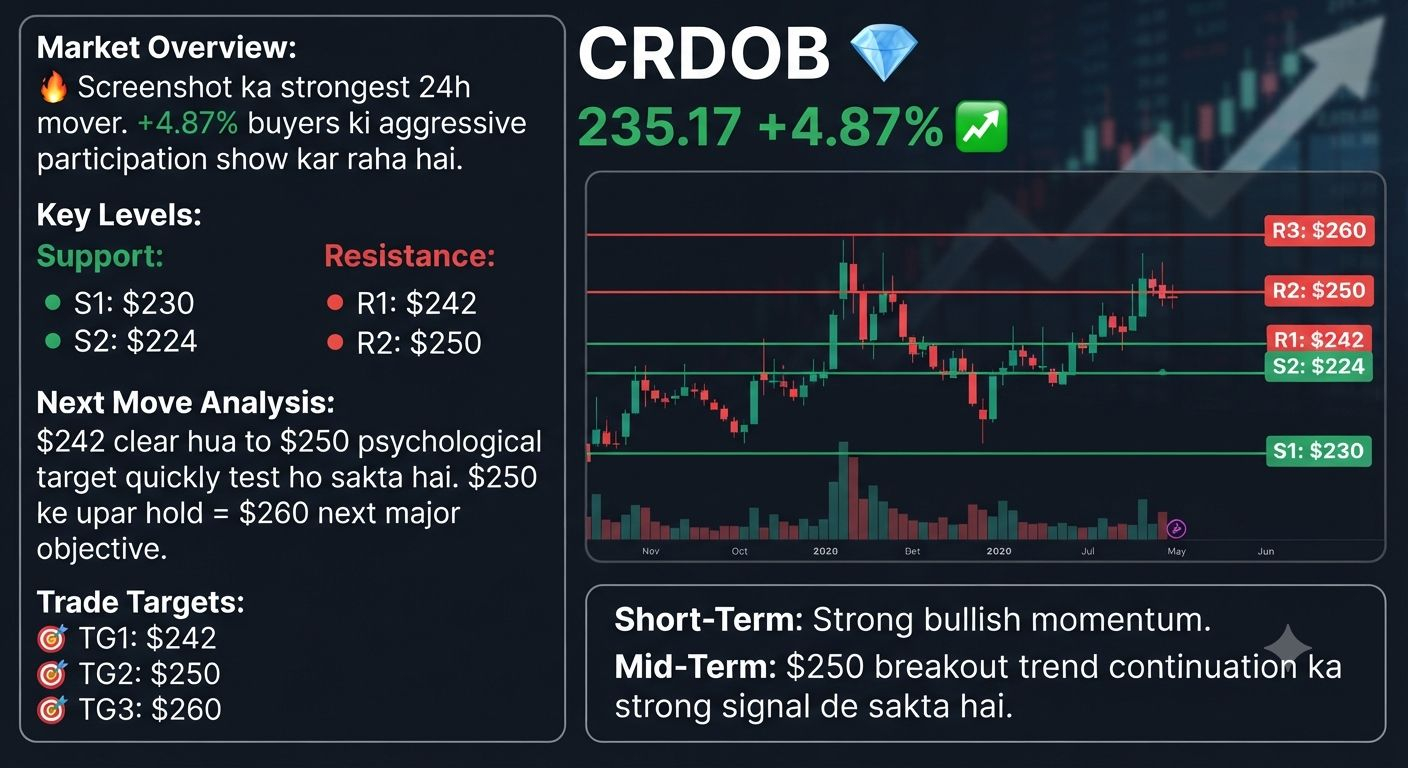
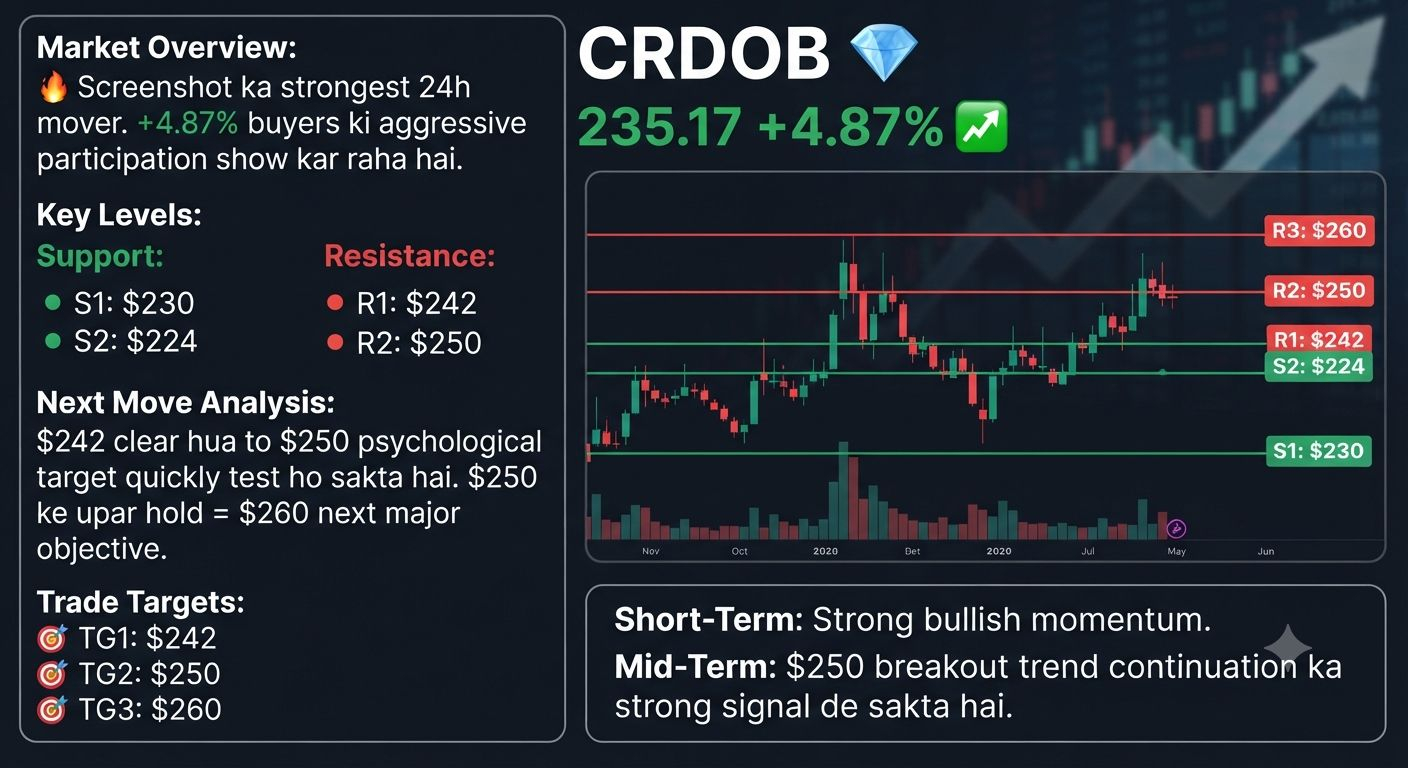
💎 $CRDOB — $235.17 | +4.87%
Market Overview:
🔥 Screenshot ka strongest 24h mover. +4.87% buyers ki aggressive participation show kar raha hai.
Support:
🟢 S1: $230
🟢 S2: $224
Resistance:
🔴 R1: $242
🔴 R2: $250
🔴 R3: $260
Next Move:
$242 clear hua to $250 psychological target quickly test ho sakta hai. $250 ke upar hold = $260 next major objective.
Targets:
🎯 TG1: $242
🎯 TG2: $250
🎯 TG3: $260
Short-Term: Strong bullish momentum.
Mid-Term: $250 breakout trend continuation ka strong signal de sakta hai.
#XRPLeadsCryptoPullbackDropsNearly7%
💎 $CRDOB — $235.17 | +4.87%
Market Overview:
🔥 Screenshot ka strongest 24h mover. +4.87% buyers ki aggressive participation show kar raha hai.
Support:
🟢 S1: $230
🟢 S2: $224
Resistance:
🔴 R1: $242
🔴 R2: $250
🔴 R3: $260
Next Move:
$242 clear hua to $250 psychological target quickly test ho sakta hai. $250 ke upar hold = $260 next major objective.
Targets:
🎯 TG1: $242
🎯 TG2: $250
🎯 TG3: $260
Short-Term: Strong bullish momentum.
Mid-Term: $250 breakout trend continuation ka strong signal de sakta hai.
#XRPLeadsCryptoPullbackDropsNearly7%
Market Overview:
🔥 Screenshot ka strongest 24h mover. +4.87% buyers ki aggressive participation show kar raha hai.
Support:
🟢 S1: $230
🟢 S2: $224
Resistance:
🔴 R1: $242
🔴 R2: $250
🔴 R3: $260
Next Move:
$242 clear hua to $250 psychological target quickly test ho sakta hai. $250 ke upar hold = $260 next major objective.
Targets:
🎯 TG1: $242
🎯 TG2: $250
🎯 TG3: $260
Short-Term: Strong bullish momentum.
Mid-Term: $250 breakout trend continuation ka strong signal de sakta hai.
#XRPLeadsCryptoPullbackDropsNearly7%
1
414
·
--
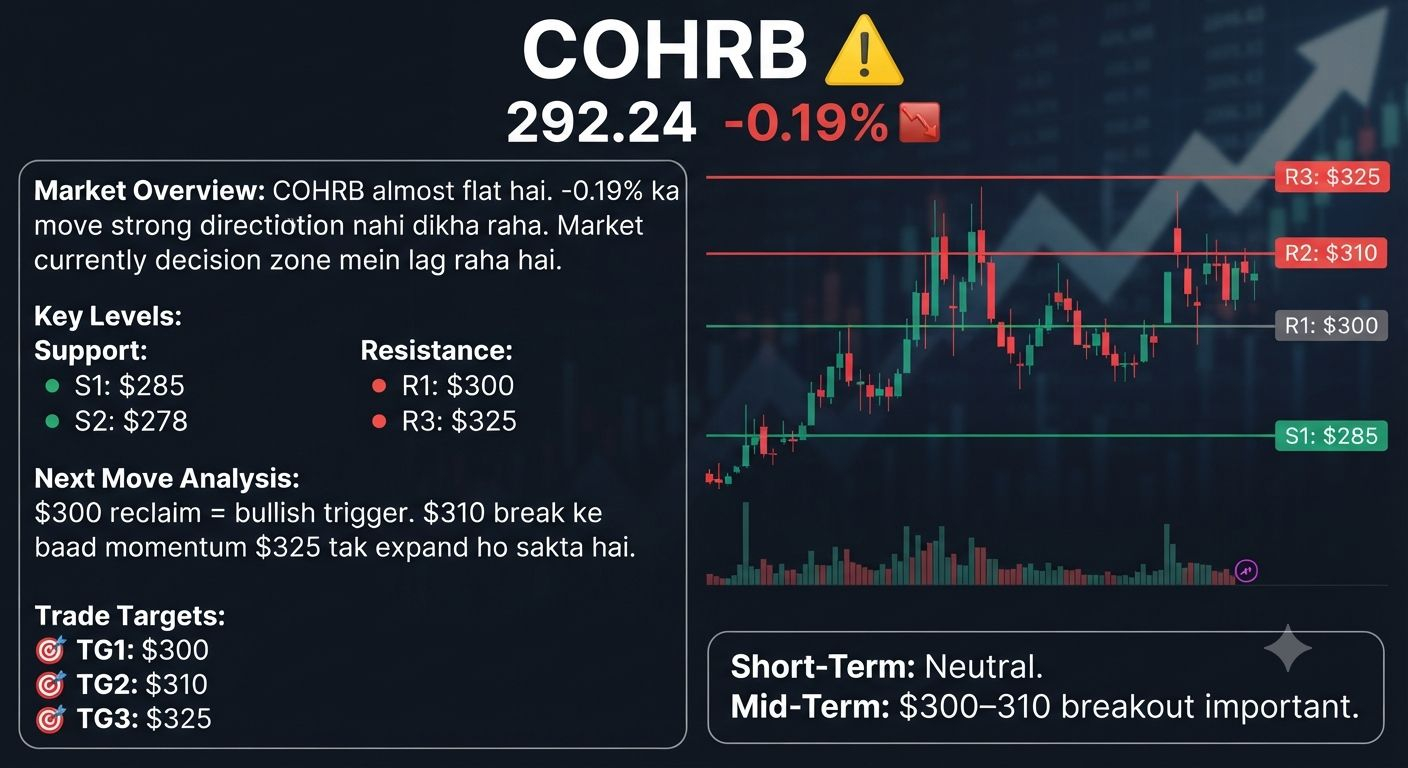
⚠️ $COHRB — $292.24 | -0.19%
Market Overview:
COHRB is almost flat. -0.19% movement is not showing strong directional conviction. The market currently seems to be in a decision zone.
Support:
🟢 S1: $285
🟢 S2: $278
Resistance:
🔴 R1: $300
🔴 R2: $310
🔴 R3: $325
Next Move:
Reclaiming $300 = bullish trigger. After a break of $310, momentum may expand up to $325.
Targets:
🎯 TG1: $300
🎯 TG2: $310
🎯 TG3: $325
Short-Term: Neutral.
Mid-Term: The $300–310 breakout is important.
#XRPLeadsCryptoPullbackDropsNearly7%
⚠️ $COHRB — $292.24 | -0.19%
Market Overview:
COHRB is almost flat. -0.19% movement is not showing strong directional conviction. The market currently seems to be in a decision zone.
Support:
🟢 S1: $285
🟢 S2: $278
Resistance:
🔴 R1: $300
🔴 R2: $310
🔴 R3: $325
Next Move:
Reclaiming $300 = bullish trigger. After a break of $310, momentum may expand up to $325.
Targets:
🎯 TG1: $300
🎯 TG2: $310
🎯 TG3: $325
Short-Term: Neutral.
Mid-Term: The $300–310 breakout is important.
#XRPLeadsCryptoPullbackDropsNearly7%
Market Overview:
COHRB is almost flat. -0.19% movement is not showing strong directional conviction. The market currently seems to be in a decision zone.
Support:
🟢 S1: $285
🟢 S2: $278
Resistance:
🔴 R1: $300
🔴 R2: $310
🔴 R3: $325
Next Move:
Reclaiming $300 = bullish trigger. After a break of $310, momentum may expand up to $325.
Targets:
🎯 TG1: $300
🎯 TG2: $310
🎯 TG3: $325
Short-Term: Neutral.
Mid-Term: The $300–310 breakout is important.
#XRPLeadsCryptoPullbackDropsNearly7%
360
·
--
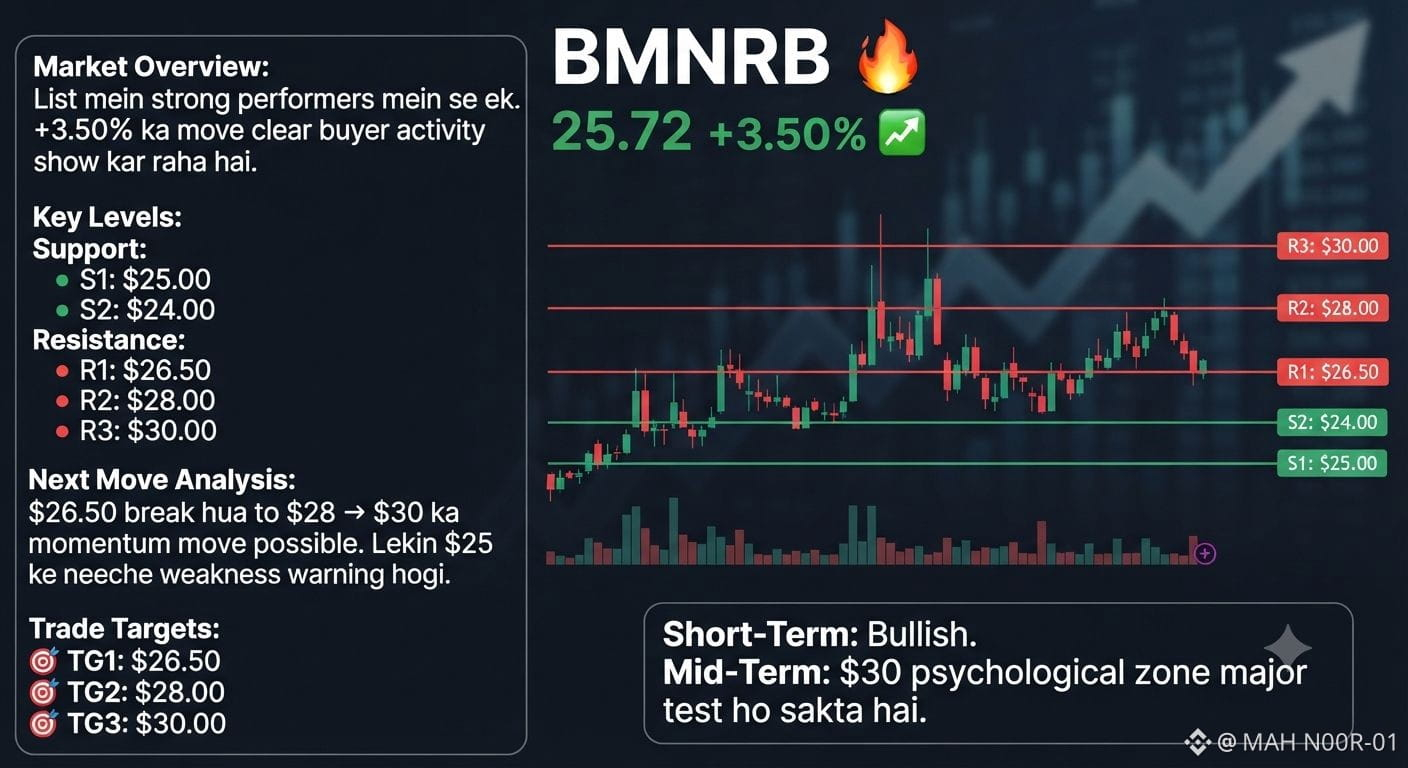
🔥 $BMNRB — $25.72 | +3.50%
Market Overview:
One of the strong performers on the list. The +3.50% move clearly shows active buyer interest.
Support:
🟢 S1: $25.00
🟢 S2: $24.00
Resistance:
🔴 R1: $26.50
🔴 R2: $28.00
🔴 R3: $30.00
Next Move:
If $26.50 breaks, momentum to $28 → $30 is possible. But a weakness warning will appear if price goes below $25.
Targets:
🎯 TG1: $26.50
🎯 TG2: $28.00
🎯 TG3: $30.00
Short-Term: Bullish.
Mid-Term: The $30 psychological zone could be a major test.
#XRPLeadsCryptoPullbackDropsNearly7%
🔥 $BMNRB — $25.72 | +3.50%
Market Overview:
One of the strong performers on the list. The +3.50% move clearly shows active buyer interest.
Support:
🟢 S1: $25.00
🟢 S2: $24.00
Resistance:
🔴 R1: $26.50
🔴 R2: $28.00
🔴 R3: $30.00
Next Move:
If $26.50 breaks, momentum to $28 → $30 is possible. But a weakness warning will appear if price goes below $25.
Targets:
🎯 TG1: $26.50
🎯 TG2: $28.00
🎯 TG3: $30.00
Short-Term: Bullish.
Mid-Term: The $30 psychological zone could be a major test.
#XRPLeadsCryptoPullbackDropsNearly7%
Market Overview:
One of the strong performers on the list. The +3.50% move clearly shows active buyer interest.
Support:
🟢 S1: $25.00
🟢 S2: $24.00
Resistance:
🔴 R1: $26.50
🔴 R2: $28.00
🔴 R3: $30.00
Next Move:
If $26.50 breaks, momentum to $28 → $30 is possible. But a weakness warning will appear if price goes below $25.
Targets:
🎯 TG1: $26.50
🎯 TG2: $28.00
🎯 TG3: $30.00
Short-Term: Bullish.
Mid-Term: The $30 psychological zone could be a major test.
#XRPLeadsCryptoPullbackDropsNearly7%
1
449
·
--
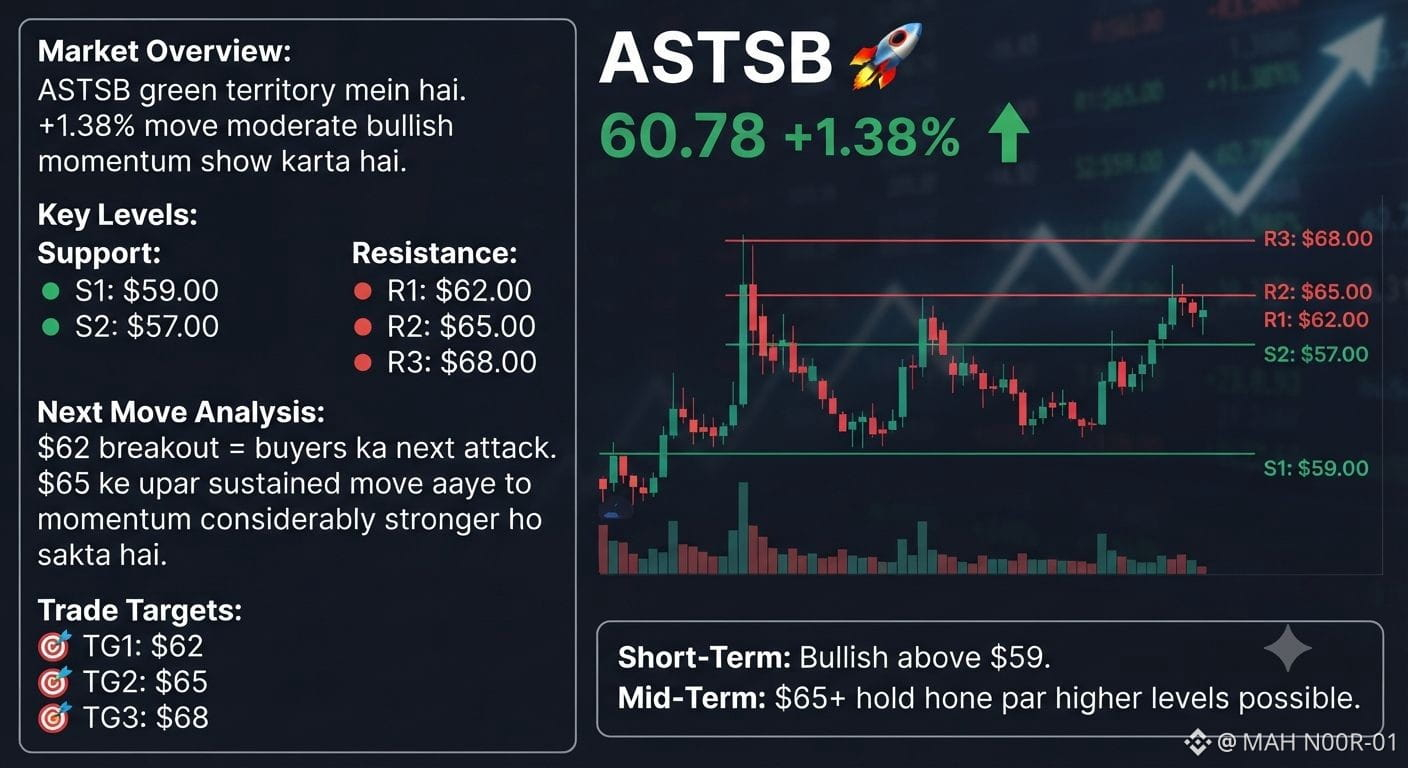
🚀 $ASTSB — $60.78 | +1.38%
Market Overview:
ASTSB is in green territory. +1.38% move shows moderate bullish momentum.
Support:
🟢 S1: $59.00
🟢 S2: $57.00
Resistance:
🔴 R1: $62.00
🔴 R2: $65.00
🔴 R3: $68.00
Next Move:
A $62 breakout will be the next attack by buyers. If a sustained move above $65 comes, momentum could become considerably stronger.
Targets:
🎯 TG1: $62
🎯 TG2: $65
🎯 TG3: $68
Short-Term: Bullish above $59.
Mid-Term: Higher levels are possible if $65+ holds.
#XRPLeadsCryptoPullbackDropsNearly7%
🚀 $ASTSB — $60.78 | +1.38%
Market Overview:
ASTSB is in green territory. +1.38% move shows moderate bullish momentum.
Support:
🟢 S1: $59.00
🟢 S2: $57.00
Resistance:
🔴 R1: $62.00
🔴 R2: $65.00
🔴 R3: $68.00
Next Move:
A $62 breakout will be the next attack by buyers. If a sustained move above $65 comes, momentum could become considerably stronger.
Targets:
🎯 TG1: $62
🎯 TG2: $65
🎯 TG3: $68
Short-Term: Bullish above $59.
Mid-Term: Higher levels are possible if $65+ holds.
#XRPLeadsCryptoPullbackDropsNearly7%
Market Overview:
ASTSB is in green territory. +1.38% move shows moderate bullish momentum.
Support:
🟢 S1: $59.00
🟢 S2: $57.00
Resistance:
🔴 R1: $62.00
🔴 R2: $65.00
🔴 R3: $68.00
Next Move:
A $62 breakout will be the next attack by buyers. If a sustained move above $65 comes, momentum could become considerably stronger.
Targets:
🎯 TG1: $62
🎯 TG2: $65
🎯 TG3: $68
Short-Term: Bullish above $59.
Mid-Term: Higher levels are possible if $65+ holds.
#XRPLeadsCryptoPullbackDropsNearly7%
1
649
Log in to explore more content
Join global crypto users on Binance Square
⚡️ Get latest and useful information about crypto.
💬 Trusted by the world’s largest crypto exchange.
👍 Discover real insights from verified creators.
Email / Phone number
Trending Topics
CircleMints500MUSDCOnSolana
48,930 views
1,233 Discussing
💵 Solana just received another $500M of USDC. But don't make the mistake everyone else is making...
#circlemints500musdconsolana
Circle's USDC Treasury recorded two 250M USDC mints on Solana, creating $500M of fresh supply through its authorized infrastructure.
Circle now reports $75.2B USDC in circulation globally.
But:
A mint is not the same as $500M of fresh market demand.
It tells us Circle created the inventory.
It does not tell us that $500M has already entered Solana DeFi, exchanges, payments or trading.
That's where the interesting signal begins.
Solana's stablecoin economy is already operating at enormous scale, with recent reporting putting network stablecoin volume above $5T in 2026.
So this isn't really a “USDC mint = SOL bullish” story.
It's an inventory → deployment story.
Watch the wallets.
Where does that $500M move next?
If it gets deployed into exchanges, lending, payments or liquidity pools, the market has something much more meaningful than a treasury print.
The mint confirms creation of USDC, not the eventual destination or economic use of the funds.
$SOL $RARE $USDC
#CircleMints500MUSDCOnSolana #solana #BlackRockBuildsTokenizedPortfoliosForOndo #defi
Stink meaner
·7 Likes
·5k views
PolymarketBankFailureBetsDrawFDICConcern
62,469 views
1,308 Discussing
BlackRockBuildsTokenizedPortfoliosForOndo
49,273 views
903 Discussing