
#rollup
rollup
37,880 views
168 Discussing
Hot
Latest

·
--
Initia-related Rollups have paused block production: If you still have assets on them, don’t rush to transfer them; no resumption time has been announced
At around 3:30 a.m. today (Hong Kong time), Initia said it was investigating an issue affecting its Rollup infrastructure and had coordinated a temporary shutdown with the relevant Rollups. The team stated that no impact on user funds has been identified so far and that it hopes to resume block production as soon as possible. The Layer 1 network is still running, but some services, including Initia Scan, are experiencing degraded performance.
Who is affected: Users whose assets or pending transactions are still on these related Rollups. While block production is paused, transfers and other on-chain operations may not go through. This is not an exchange suspension of deposits or withdrawals, nor is it an official confirmation of a theft. Initia has not named the affected Rollups or given a resumption time. As of around 10:21 a.m., the official status page still listed mainnet applications as experiencing degraded performance, and there was no new announcement that block production had resumed.
What to check next: Whether the relevant Rollups resume block production, whether the statement that “no impact on funds has been identified” still stands, and whether the front end returns to normal. Don’t click unfamiliar links claiming to offer “emergency withdrawals” or “compensation claims.”
Do you still have pending assets or transactions on Initia-related Rollups?
This is not investment advice.
Sources: Initia official X (@initia, 2026-11-10 03:30 HKT); official status page status.initia.xyz (some services still shown as disrupted at around 10:21 HKT); reports by Wu Shuo, ChainCatcher, Odaily, and TechFlow · 2026-11-10 around 10:25 HKT
#Initia #Rollup #夯B媒体 $INIT

301
·
--
The rollups were paused, but the token rose ~49% — INIT is leaving the market confused.
The facts: On Nov. 9, Initia announced it was investigating an issue with its Rollup infrastructure and coordinating a temporary pause for the affected rollups. Its L1 remained online, the team said no impact on user funds had been identified, and the cause was still under investigation (ChainCatcher via TradingView + KuCoin flash, Nov. 9, 23:18 UTC). At the same time, INIT surged: Binance data via Finnhub as of Nov. 10, 03:57 UTC showed a price of 0.18018 USDT, up 48.6% from its opening price of 0.12125 USDT, after briefly reaching 0.21402 USDT; volume was 8.72x the 30-day average (InteractiveCrypto). This is the second pause in two weeks, following the Oct. 23 incident — unauthorized token minting worth around $2.6 million, after which the L1 came to a complete halt before restarting on Nov. 2.
My take: The market is reading this pause differently — only the rollups stopped, the L1 is running, and there are no reports of lost funds. A rise from a low base after two weeks of bad news also explains why the jump was so big. But this is still a reaction to an unresolved situation: the cause has not been announced, and the rollups have not resumed block production.
What I’m watching next: Initia’s announcement of the cause and a schedule for resuming the rollups, and whether 0.21402 USDT (today’s high) holds as resistance; below that, 0.1638 USDT (the Nov. 9 close) is the first marker to watch if this euphoria cools.
What do you think — is this a healthy rebound because the issue really was limited to the rollups, or is the market celebrating too soon before the cause is clear?
#Initia #Rollup $INIT
141

·
--
Verified
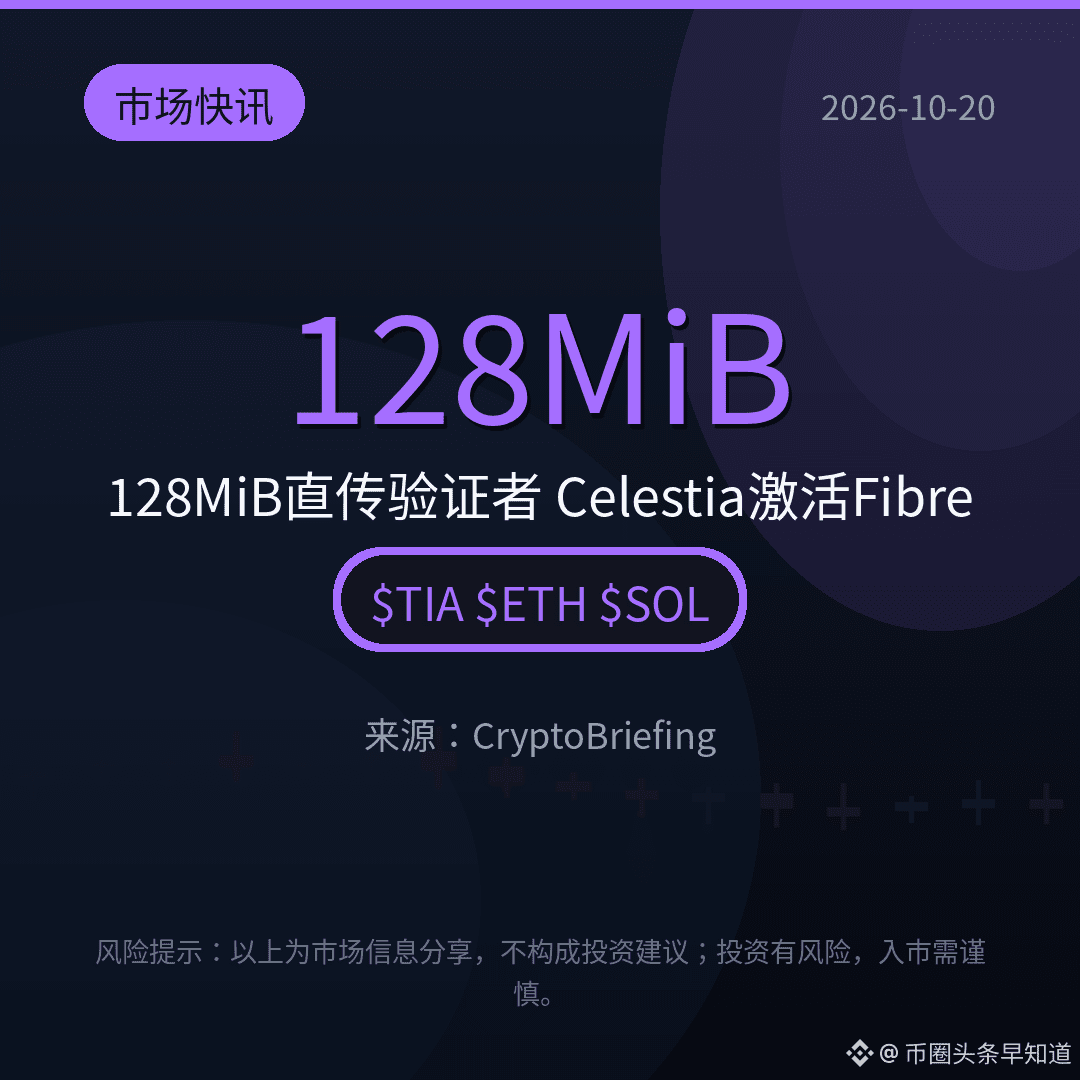
【Market Update】128 MiB sent directly to validators in one shot—Celestia has activated Fibre on mainnet, with a per-block data limit 16 times the original L1 route’s 8 MiB. It went live after validator voting power crossed the 83.33% threshold. Rollup data bypasses the Data Availability Square and goes straight to validators, while commitments and signatures are still recorded on-chain. October benchmarks reached 3.07 Tb/s with 120 validators. TIA is used for staking, custody deposits, and fees, so using this high-speed channel requires locking up TIA. The benchmarks are impressive, but mainnet is taking a cautious approach. Will large-data rollups really migrate over? Are you bullish, or waiting to see?
$TIA $ETH $SOL
#Celestia #Rollup #DataAvailability
(Source: CryptoBriefing)
⚠️Risk Warning: The above is shared for market information purposes only and does not constitute investment advice. Investing involves risk; please exercise caution.
$TIA $ETH $SOL
#Celestia #Rollup #DataAvailability
(Source: CryptoBriefing)
⚠️Risk Warning: The above is shared for market information purposes only and does not constitute investment advice. Investing involves risk; please exercise caution.
539

·
--

Article
Understand Two Types of Rollups, Don’t Be Misled by “Low Gas”Have you also seen a bunch of L2 projects, and in the end you only remember “lower Gas, maybe there will be an Airdrop”? Actually, to evaluate L2, you don’t need to memorize a list of projects—just抓住 one core point: how does it verify off-chain transactions?
Ethereum mainnet has to execute transactions and also handle consensus and data; when the network is congested, speed and fees affect the experience. The L2 approach is to execute a large number of transactions off-chain, then compress and package them back into $ETH the mainnet—like turning multiple people taking separate taxis into shared rides, so costs are distributed.
The key thing is to distinguish between two types of verification routes.
Understand Two Types of Rollups, Don’t Be Misled by “Low Gas”
Have you also seen a bunch of L2 projects, and in the end you only remember “lower Gas, maybe there will be an Airdrop”? Actually, to evaluate L2, you don’t need to memorize a list of projects—just抓住 one core point: how does it verify off-chain transactions?
Ethereum mainnet has to execute transactions and also handle consensus and data; when the network is congested, speed and fees affect the experience. The L2 approach is to execute a large number of transactions off-chain, then compress and package them back into $ETH the mainnet—like turning multiple people taking separate taxis into shared rides, so costs are distributed.
The key thing is to distinguish between two types of verification routes.
205

·
--
Bullish
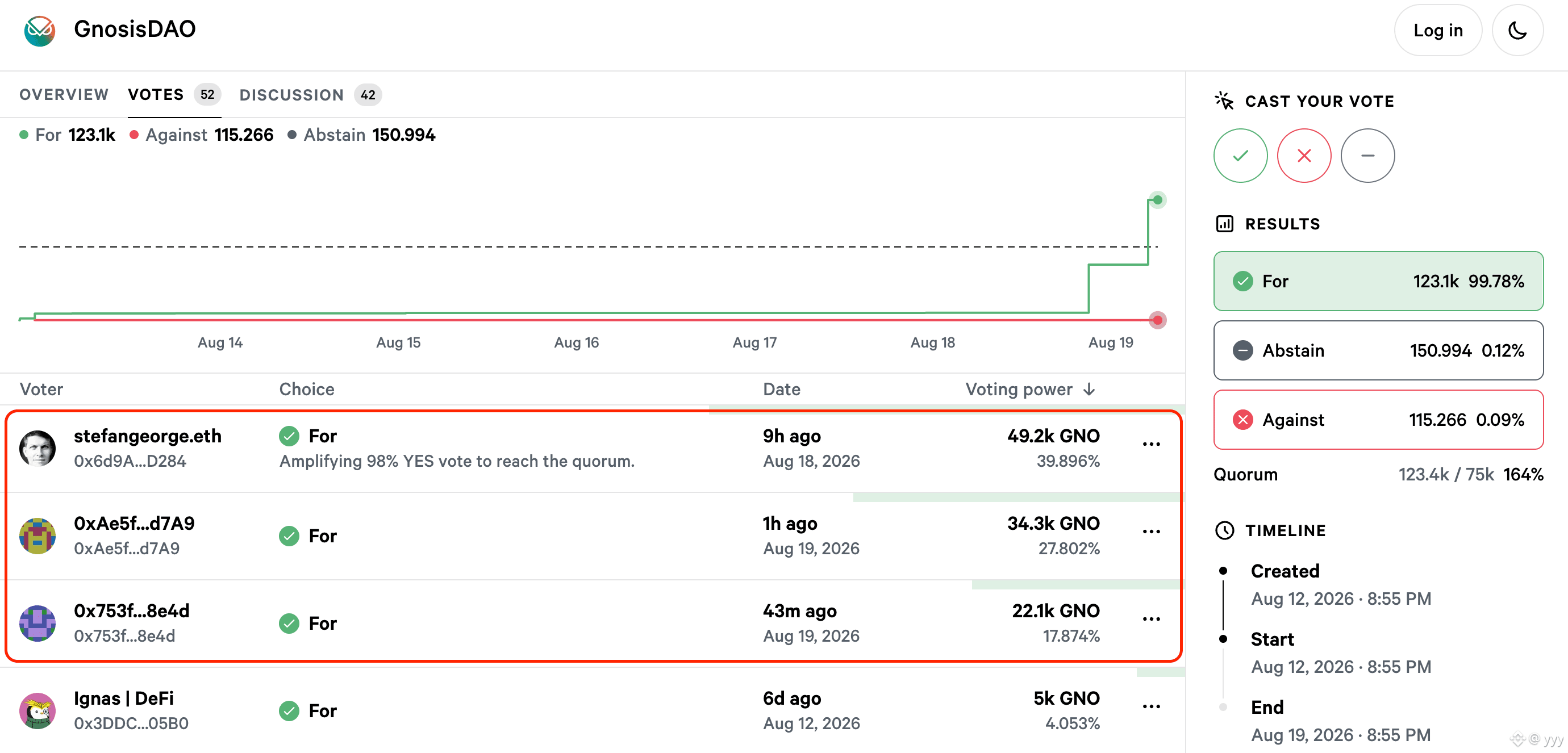
As expected, Gnosis officially has started with the big account.
A few addresses, including @gnosis_ co-founder @StefanDGeorge, cast their votes in favor a few hours ago. Quorum has been met.
Gnosis Chain will become the first Ethereum L2 to implement composable syncing.
#Rollup $GNO
{spot}(GNOUSDT)
As expected, Gnosis officially has started with the big account.
A few addresses, including @gnosis_ co-founder @StefanDGeorge, cast their votes in favor a few hours ago. Quorum has been met.
Gnosis Chain will become the first Ethereum L2 to implement composable syncing.
#Rollup $GNO
A few addresses, including @gnosis_ co-founder @StefanDGeorge, cast their votes in favor a few hours ago. Quorum has been met.
Gnosis Chain will become the first Ethereum L2 to implement composable syncing.
#Rollup $GNO
90
·
--
Bullish
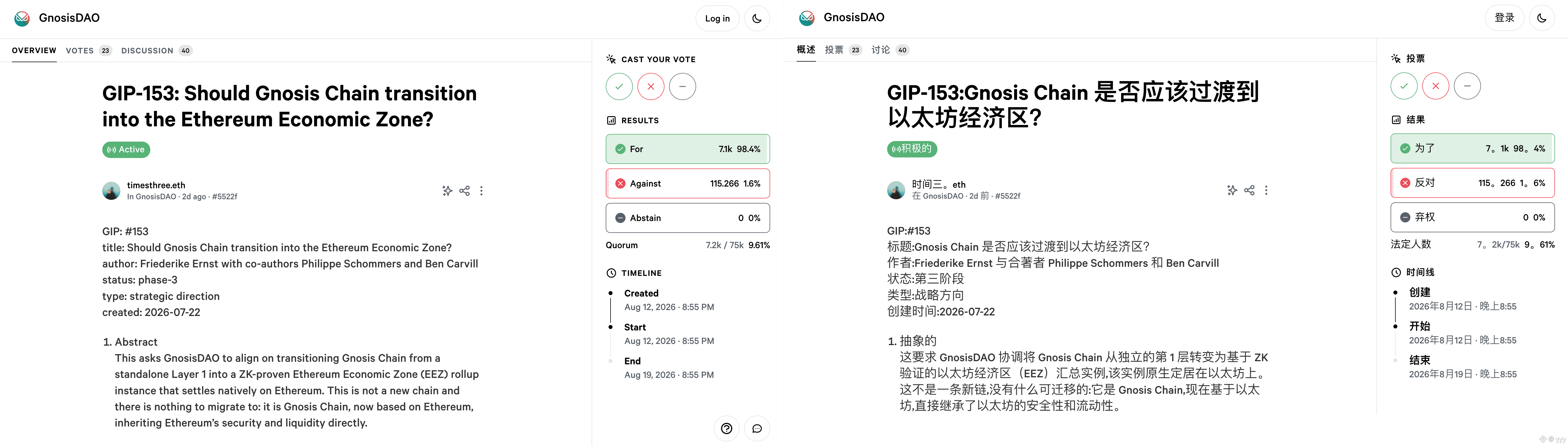
If you can’t beat them, join them. Gnosis Chain @gnosis_ is transitioning from a sovereign-independent L1 to a highly Ethereum-aligned L2—just one step away.
The GIP-153 proposal was jointly drafted and submitted by Gnosis’ founder @tw_tter along with two other core team members. It is a top-down reform. As of now, the support rate for the proposal is as high as 98.4%, with voting set to close in 5 days—almost a certain event.
As one of the oldest established public chains, Gnosis Chain has been running its mainnet for nearly 8 years. Choosing to pivot to an Ethereum L2 at this specific moment requires a great deal of resolve.
For most PoS chains acting as L1s, their security is far inferior to Ethereum. And in the long run, subsidizing validators through token inflation also directly harms the interests of non-stakers—this is essentially the common problem with nearly all PoS L1s.
Rather than dealing with this, it’s better to simply transition to Ethereum L2, hand the security to Ethereum validators, and directly inherit Ethereum’s security.
The new round of Ethereum L2 summer narratives won’t end at Robinhood Chain.
#Rollup $GNO
1
87
·
--
based/native rollups are a false proposition, just like shared sorters, because rollup project operators cannot possibly cede the ability to capture sorter privilege revenue.
This also explains why mainstream Rollups do not choose to upgrade to based/native rollups. It also explains why the former leaders in this niche, such as @Spire_Labs and @risechain, eventually fell into decline.
#Rollup
This also explains why mainstream Rollups do not choose to upgrade to based/native rollups. It also explains why the former leaders in this niche, such as @Spire_Labs and @risechain, eventually fell into decline.
#Rollup
94

·
--
🚀 Binance Square Post Draft
Is $STRK Ready for a Massive Breakout? Key Levels to Watch! 📉📈
#STARKNET ($STRK ) has been consolidating within a tight range, building up momentum for its next major expansion. As one of the premier #layer-2 Validity #Rollup solutions scaling Ethereum, $STRK remains a top contender for the upcoming altcoin rally.
Here is a quick breakdown of what the chart and fundamentals are telling us right now:#
3
137


·
--
ERA sees a short-term spot buying frenzy! ERA joins the ZK/Layer 2 sector rally
Caldera (ERA) rose from $0.069 yesterday to $0.07832 (+21.63%), with unusually active short-term spot trading.
No new rollup suite launches were found. As part of the Layer 2 / appchain concept basket, ERA moves in sync with STRK, but its overall gains and appeal to capital are weaker than STRK's.
Conclusion: Keep a close eye on STRK as the sector's market leader and hedge in line with the broader sector. Avoid chasing ERA too aggressively on its own.
#ERA #Caldera #Layer2 #Rollup
$ERA
{future}(ERAUSDT)
ERA sees a short-term spot buying frenzy! ERA joins the ZK/Layer 2 sector rally
Caldera (ERA) rose from $0.069 yesterday to $0.07832 (+21.63%), with unusually active short-term spot trading.
No new rollup suite launches were found. As part of the Layer 2 / appchain concept basket, ERA moves in sync with STRK, but its overall gains and appeal to capital are weaker than STRK's.
Conclusion: Keep a close eye on STRK as the sector's market leader and hedge in line with the broader sector. Avoid chasing ERA too aggressively on its own.
#ERA #Caldera #Layer2 #Rollup
$ERA
223

·
--
$ESP
A single 4-hour candlestick saw trading volume at 129 times the average level of the past month. The price surged from 0.078 straight up to 0.1055, and the upper wick left just 1.2 cents. This is a typical violent pump that got smashed—but the story isn’t over.
In the next two candlesticks, volume didn’t drop back to the original level; instead, it stayed at 80 to 90 times the average. The price didn’t collapse—it kept pushing higher. This isn’t a retail-trader kind of market.
Espresso is an Ethereum rollup infrastructure layer that handles transaction ordering and shared sequencing. Back in February, the Binance futures contract entered a consolidation around 0.07 for nearly a month before listing—tight-range fluctuations, with an amplitude of less than 16%. The longer the range-bound period, the more violent the breakout. This line is cliché, but it’s always true.
Market signals. For three consecutive 4-hour candlesticks, trading volume continuously held in the range of 550 million to 820 million. The first big bullish candle left a long upper wick, suggesting profit-taking at the highs. The second candle closed with its body at 0.0987, eating back more than half of that upper wick. The third candle is still forming: the high has reached 0.1147, and it’s currently closing at 0.1091—still a bullish candle. Three bullish candles in a row with no decrease in volume. The bulls show no intention of backing off.
Market sentiment. Over the last 24 hours, it’s up 46%, with trading value nearing 200 million USD. The funding rate is -0.0016, negative—short sellers are effectively being paid rent by the long side. What does that mean? A large amount of short-term funds are opening shorts against the trend, betting on a pullback. But the price hasn’t followed the shorts’ expectations. The most feared scenario in a short squeeze is when shorts refuse to admit defeat. Every extra minute they hold on increases the cost by another fraction.
Whale activity. The breakout candlestick came with volume of 823 million, 129 times the average volume of the previous 26 candles. In the following two candles volume declined to 580 million and 550 million, respectively, but it’s still at a “sky-high” level. Volume at this magnitude can’t be stacked by retail traders. Big money is steadily accumulating. In the 0.085 to 0.095 range—where the prior high resistance sits—it was pierced straight through. The retest only dipped to 0.0856 before snapping back. Large funds are defending the market.
Volume-price structure. Before the breakout, ESP spent about a month grinding between 0.070 and 0.081. The breakout occurred around 0.0784: it rallied immediately from the open, reaching a intraday high of 0.1055. The second candle opened at 0.0937, dipped to a low of 0.0856, and closed at 0.0987. The third candle opened at 0.0987, bottomed at 0.0957, and topped at 0.1147. Note that the lows are stepping higher: 0.077 → 0.085 → 0.095. This is a standard bullish alignment. But the upper wicks are also getting longer—0.1055, 0.1022, 0.1147—each leaving some overhead supply, meaning selling pressure above isn’t light. There’s clear resistance around 0.115.
Candlestick details. The first breakout candle has a body of 0.015, an upper wick of 0.012, and a lower wick of less than 0.001. It’s a strong bullish candle with almost no weakness from open to close. The second candle has both upper and lower wicks, but the body is relatively small—more like a consolidation/continuation pattern. The third candle stretches the upper wick again, but the low hasn’t broken the low of the previous candle. The combined candlestick pattern of these three candles looks a lot like the “rising three methods,” but the volume is too large—not like the gentle expansion you see in classic textbook examples. This is the route of a violent short-covering squeeze.
Nini’s plan. Current price is 0.1091. I won’t chase long positions—the upper wick is too long, and buying at the top of the mountain doesn’t make sense. I also don’t dare to touch shorts; the negative funding rate indicates the squeeze hasn’t ended. If a pullback to around 0.095 can hold steady and we get a stabilization signal, I’ll try a small long position. Stop loss: set below 0.085. If it breaks, I’ll accept it—I won’t hold and fight.
#ESP #Espresso #Rollup
186

·
--
Bearish
🚨 Bankless founder liquidates ETH!
But he says:
"I still have a lot of faith in Ethereum."
🧵 David Hoffman’s latest post explains the reason for selling ETH:
He’s not bearish on the Ethereum network,
but actually believes that:
✅ The ETH ecosystem is still strong
✅ The Rollup path is a success
✅ The application layer will thrive more and more
But the issue is👇
⚠️ "The ETH asset itself"
Is becoming increasingly difficult for the market to reprice.
He raises two key points:
1️⃣ The "Fat App" era
Apps will take most of the value and fees.
2️⃣ Centralized Rollup path
L2 can achieve up to 97% profit margins.
In other words:
The ecosystem is getting more prosperous,
But the value may not necessarily flow back to ETH.
💬 Hoffman candidly states:
Selling ETH,
Is not due to being bearish,
But because the narrative of "ETH as currency" has basically run its course.
🔥 This statement is quite painful:
In the past, the market believed:
"As long as the ETH ecosystem develops, ETH will definitely go up."
But now more and more people are starting to think:
📉 Ecosystem value ≠ ETH value?
👀 The next phase of Crypto,
May not be about "chain wins",
But rather "app wins".
#ETH #Ethereum #Crypto #Layer2 #Web3 #Bankless #Rollup #Solana年内下跌51.9% $ETH

153

·
--
$ARB up 10.6%, BTC barely moved. On CoinGecko’s trending list, it’s #6, price at $0.100, market cap at $640M, and 24h trading volume of $122M, turnover around 19%; the Rollup sector is also up 3.2% over 24h. This looks like funds testing L2’s elasticity—not the whole market turning strong. If trading volume drops back to $80M, I’ll look at the post-pump retreat and consider closing out the catch-up. If A chases L2, will B and BTC respond and show support? #L2观察 #Rollup
$ARB up 10.6%, BTC barely moved. On CoinGecko’s trending list, it’s #6, price at $0.100, market cap at $640M, and 24h trading volume of $122M, turnover around 19%; the Rollup sector is also up 3.2% over 24h. This looks like funds testing L2’s elasticity—not the whole market turning strong. If trading volume drops back to $80M, I’ll look at the post-pump retreat and consider closing out the catch-up. If A chases L2, will B and BTC respond and show support? #L2观察 #Rollup

175
·
--
$OP.
I’ve been watching this 4h candle that opened at 12:00 UTC for a while. It opened at 0.12452, surged to 0.13058, and hit a high of 0.13588, right at the day’s resistance. Volume was $11.7M, 2.05 times the average of the previous 20 candles. After a quiet week, it suddenly sprang into action.
Let’s go through what happened.
On the 16th, the high was 0.1438—the highest point in this 30-candle window. Then it broke down. At 16:00 UTC on the 18th, it hit 0.11845, the 30-candle low. From high to low, that’s a drop of more than 17%.
Next came the boring part. From 00:00 on the 19th to 08:00 on the 20th, for 32 hours, price stayed stuck between 0.123 and 0.128. Each candle got smaller, and volume shrank to $3.7M, the lowest in all 30 candles. With the range squeezed this tightly, a directional move was bound to come eventually.
Before the move, there was one last shakeout. The 04:00 candle on the 20th saw volume jump to $10.9M. Price swung across the full range from 0.12334 to 0.12909, then closed at 0.12504, with buyers absorbing the lower wick. Weak bulls got shaken out, then someone stepped in to buy.
And then came the 12:00 candle. On strong volume, it cleared 0.1277 and 0.1290, pushing up to 0.13588.
Market signals: 24h +4.47%, currently on a one-candle winning streak. Today’s low, 0.12253, is right at the support of the last 10 candles; today’s high, 0.13588, is right at the resistance of the last 10 candles. In a single day, price covered the entire width of the range. A high-volume break above 0.13588 would confirm a breakout from the range.
Market sentiment: Funding rate is +0.0079%/8h. Bulls have the edge, but things aren’t overheated. This rebound hasn’t run on excessive optimism, so there may still be room to go. If funding suddenly spikes and volume fails to keep up, that’s a different story.
Whale activity: Look at the volume and price action in these two candles. The 04:00 candle had $10.9M in volume—a shakeout with a lower wick bought back up, suggesting someone was actively absorbing sell pressure. Then the 12:00 candle came in at $11.7M and pushed price higher after the shakeout. Shakeout, then push—the rhythm is consistent. This isn’t the kind of price action retail traders can create. One candle’s volume accounted for 28% of the 24h total of $42.1M. The footprint of major players is clear.
Volume-price structure: Since falling to 0.11845, price hasn’t made a new low. Volume came in three stages: first, a low-volume base forming, from $3.7M to $5M; then the shakeout at $10.9M; and finally the push higher at $11.7M, with the latest volume ratio at 2.05. Each stage came with higher volume—this is bottoming-structure volume, not a one-off spike.
Candlestick details: The 12:00 candle has a long body and a small lower wick. It opened at 0.12452 and closed at 0.13058, with a body of 0.006 and a lower wick of just 0.00025. It pushed up right from the open, with no hesitation. The upper wick is 0.0053: price was pushed back from 0.13588 and couldn’t hold above it. That’s normal for a first test. But be careful if the next candle opens higher and then stalls.
OP is an Ethereum L2 and a Rollup. The OP Stack ecosystem also includes Base, so it has solid foundations. But the story isn’t new anymore—what you’re buying now is the technical setup, not the narrative.
Nini’s plan: Current price 0.13064.
There’s only one level to watch above: 0.13588. If price can’t break through, it’s just a rebound within the range—stay out.
If it breaks through on strong volume, watch 0.1438, the 30-candle high.
0.12253 is the line below. If price breaks below it, this volume-price setup is invalidated and we’re back to square one.
My view: Leaning bullish. The short-term rebound is confirmed; in the medium term, the key question is whether price can hold above 0.13588.
If you need a customized strategy, reach out to Nini.
#OP #Layer2 #Rollup
$OP .
I’ve been watching this 4h candle that opened at 12:00 UTC for a while. It opened at 0.12452, surged to 0.13058, and hit a high of 0.13588, right at the day’s resistance. Volume was $11.7M, 2.05 times the average of the previous 20 candles. After a quiet week, it suddenly sprang into action.
Let’s go through what happened.
On the 16th, the high was 0.1438—the highest point in this 30-candle window. Then it broke down. At 16:00 UTC on the 18th, it hit 0.11845, the 30-candle low. From high to low, that’s a drop of more than 17%.
Next came the boring part. From 00:00 on the 19th to 08:00 on the 20th, for 32 hours, price stayed stuck between 0.123 and 0.128. Each candle got smaller, and volume shrank to $3.7M, the lowest in all 30 candles. With the range squeezed this tightly, a directional move was bound to come eventually.
Before the move, there was one last shakeout. The 04:00 candle on the 20th saw volume jump to $10.9M. Price swung across the full range from 0.12334 to 0.12909, then closed at 0.12504, with buyers absorbing the lower wick. Weak bulls got shaken out, then someone stepped in to buy.
And then came the 12:00 candle. On strong volume, it cleared 0.1277 and 0.1290, pushing up to 0.13588.
Market signals: 24h +4.47%, currently on a one-candle winning streak. Today’s low, 0.12253, is right at the support of the last 10 candles; today’s high, 0.13588, is right at the resistance of the last 10 candles. In a single day, price covered the entire width of the range. A high-volume break above 0.13588 would confirm a breakout from the range.
Market sentiment: Funding rate is +0.0079%/8h. Bulls have the edge, but things aren’t overheated. This rebound hasn’t run on excessive optimism, so there may still be room to go. If funding suddenly spikes and volume fails to keep up, that’s a different story.
Whale activity: Look at the volume and price action in these two candles. The 04:00 candle had $10.9M in volume—a shakeout with a lower wick bought back up, suggesting someone was actively absorbing sell pressure. Then the 12:00 candle came in at $11.7M and pushed price higher after the shakeout. Shakeout, then push—the rhythm is consistent. This isn’t the kind of price action retail traders can create. One candle’s volume accounted for 28% of the 24h total of $42.1M. The footprint of major players is clear.
Volume-price structure: Since falling to 0.11845, price hasn’t made a new low. Volume came in three stages: first, a low-volume base forming, from $3.7M to $5M; then the shakeout at $10.9M; and finally the push higher at $11.7M, with the latest volume ratio at 2.05. Each stage came with higher volume—this is bottoming-structure volume, not a one-off spike.
Candlestick details: The 12:00 candle has a long body and a small lower wick. It opened at 0.12452 and closed at 0.13058, with a body of 0.006 and a lower wick of just 0.00025. It pushed up right from the open, with no hesitation. The upper wick is 0.0053: price was pushed back from 0.13588 and couldn’t hold above it. That’s normal for a first test. But be careful if the next candle opens higher and then stalls.
OP is an Ethereum L2 and a Rollup. The OP Stack ecosystem also includes Base, so it has solid foundations. But the story isn’t new anymore—what you’re buying now is the technical setup, not the narrative.
Nini’s plan: Current price 0.13064.
There’s only one level to watch above: 0.13588. If price can’t break through, it’s just a rebound within the range—stay out.
If it breaks through on strong volume, watch 0.1438, the 30-candle high.
0.12253 is the line below. If price breaks below it, this volume-price setup is invalidated and we’re back to square one.
My view: Leaning bullish. The short-term rebound is confirmed; in the medium term, the key question is whether price can hold above 0.13588.
If you need a customized strategy, reach out to Nini.
#OP #Layer2 #Rollup
14

Partly True
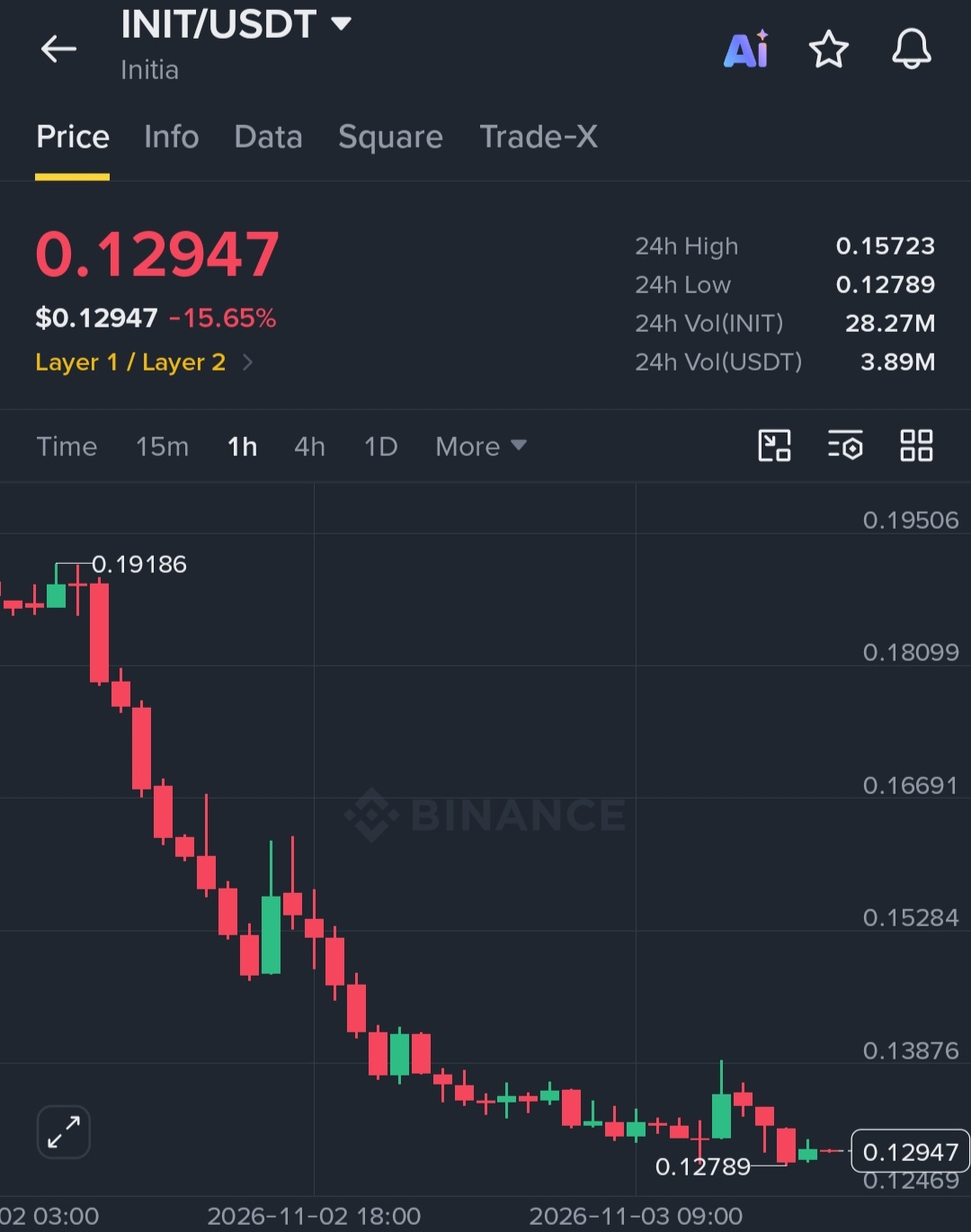
🧱 $INIT /USDT — 🔴 SHORT · Conf 65%
━━━━━━━━━━━━━━
📍 Entry: 0.129082 – 0.129858
🛑 SL: 0.133300
🎯 TP1: 0.122996
✅ TP2: 0.117817
🏆 TP3: 0.110050
━━━━━━━━━━━━━━
🔎 1H structure remains lower highs and lower lows, with price pinned below the EMA20. Even after a 15.65% drop, the funding rate is still positive (+0.0050%)—longs are still passively holding, and there's been no capitulation flush yet.
🧠 $INIT : Initia is a modular Rollup interoperability layer. On Oct 23, a MoveVM vulnerability halted the L1 and all connected rollups. The foundation has approved a bailout to restore 1:1 iUSD backing, but the restart date is still unconfirmed. The time gap between a dead chain and a live token is the core contradiction in this pricing.
💬 If the foundation's asset restoration plan lands before the chain restarts, should INIT be priced at "recovered net asset value" or at a "risk-free discount for the downtime"?
#INIT #Initia #Rollup #iUSD #AssetRestoration
{future}(INITUSDT)
🧱 $INIT /USDT — 🔴 SHORT · Conf 65%
━━━━━━━━━━━━━━
📍 Entry: 0.129082 – 0.129858
🛑 SL: 0.133300
🎯 TP1: 0.122996
✅ TP2: 0.117817
🏆 TP3: 0.110050
━━━━━━━━━━━━━━
🔎 1H structure remains lower highs and lower lows, with price pinned below the EMA20. Even after a 15.65% drop, the funding rate is still positive (+0.0050%)—longs are still passively holding, and there's been no capitulation flush yet.
🧠 $INIT : Initia is a modular Rollup interoperability layer. On Oct 23, a MoveVM vulnerability halted the L1 and all connected rollups. The foundation has approved a bailout to restore 1:1 iUSD backing, but the restart date is still unconfirmed. The time gap between a dead chain and a live token is the core contradiction in this pricing.
💬 If the foundation's asset restoration plan lands before the chain restarts, should INIT be priced at "recovered net asset value" or at a "risk-free discount for the downtime"?
#INIT #Initia #Rollup #iUSD #AssetRestoration
━━━━━━━━━━━━━━
📍 Entry: 0.129082 – 0.129858
🛑 SL: 0.133300
🎯 TP1: 0.122996
✅ TP2: 0.117817
🏆 TP3: 0.110050
━━━━━━━━━━━━━━
🔎 1H structure remains lower highs and lower lows, with price pinned below the EMA20. Even after a 15.65% drop, the funding rate is still positive (+0.0050%)—longs are still passively holding, and there's been no capitulation flush yet.
🧠 $INIT : Initia is a modular Rollup interoperability layer. On Oct 23, a MoveVM vulnerability halted the L1 and all connected rollups. The foundation has approved a bailout to restore 1:1 iUSD backing, but the restart date is still unconfirmed. The time gap between a dead chain and a live token is the core contradiction in this pricing.
💬 If the foundation's asset restoration plan lands before the chain restarts, should INIT be priced at "recovered net asset value" or at a "risk-free discount for the downtime"?
#INIT #Initia #Rollup #iUSD #AssetRestoration

3
751
·
--
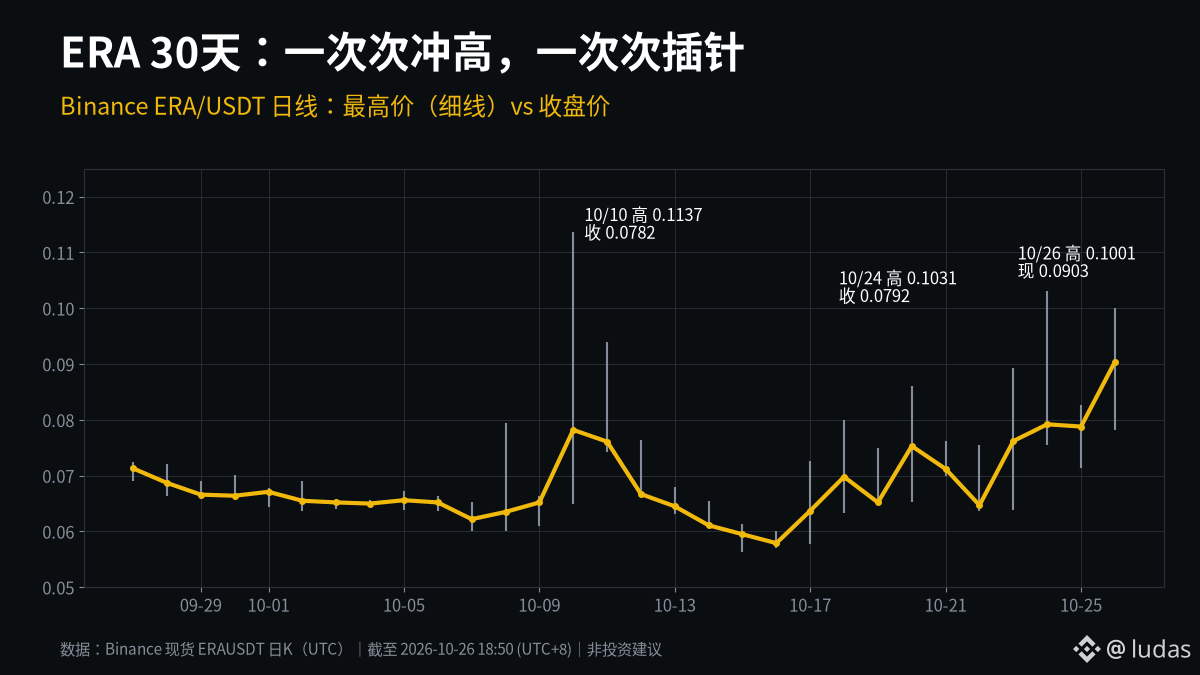
$ERA is up 21% in the past 24 hours, but this is already the third time this month it has approached 0.10—and it failed to hold above it the first two times 📌
📊 Binance spot daily chart (UTC):
• 10/10: Intraday high of 0.1137, closing at 0.0782
• 10/24: Intraday high of 0.1031, closing at 0.0792
• 10/26: Intraday high of 0.1001, currently around 0.0903 (as of 18:50)
• Monthly low: 0.0564 on 10/15
🔥 What kicked off today's move: During the hour starting at 08:00 Beijing time, trading volume was about 2.54 million USDT. In the preceding hours, it was only 200,000–300,000 per hour.
🧵 On the fundamentals side: About 23.31 million ERA tokens were unlocked on 10/17 (RootData data, via Gate News). I haven't found any project announcement that explains today's rally.
My take: The repeated long upper wicks suggest strong selling pressure around 0.10. Whether it can close above that level this time matters more than how much it has risen; without news to support the rally, be especially cautious about chasing the price. Not investment advice.
This is the third attempt at 0.10—do you think it can hold this time? Share your thoughts in the comments 👇
If you found this useful, give it a like~
#ERA #Caldera #山寨币 #Rollup
107

🔥 $ERA - Caldera entry $0.0901 - now $0.09 = exactly break-even 🟢*
*Current price:* $0.0906
- Your entry: $0.0901
- Current: $0.0906 = *Profit +0.55%* 🟢
- 24h high: $0.0974
- 24h low: $0.0714
- Volume: $30M - $39M - high
*Why is ERA special?*
- Rank #979 - #1133 - new, small-cap coin - opportunity
- ATH $1.88 - down 95% - at the bottom
- Strong support at $0.057 - $0.07 - you entered above it
- Rollup project on Ethereum - Metalayer - strong technology
- 174M of 1B in circulation - only 15% - unlock risk, but an opportunity if it succeeds
*Performance:*
- 24 hours: +15.78% 🟢🟢 explosive
- Today: +14.48% to +26% 🟢
- Week: +19.9% to +21.9%
- Month: +26.8%
- Year: -76% 🔴
*Exclusive analysis:*
\u003e *ERA - entry $0.0901 - now $0.0906 - break-even, in profit - but up +15% today*
\u003e
\u003e ERA is a new coin launched in March 2025 - it fell from $1.88 to $0.054 in September - and is now making a strong rebound from $0.071 → $0.097
\u003e
\u003e *My predictions:*
\u003e - If it holds above $0.09 → target $0.0974 (+8% from your entry) today
\u003e - If it breaks $0.0974 → target $0.116 (+28%)
\u003e - Support at $0.085 - $0.07 - stop-loss at $0.0714
\u003e
\u003e *Risk:* Large unlocks are putting pressure on the price - any unlock could trigger selling - but if the team holds on, ERA is headed to $0.15
\u003e
\u003e *Recommendation:* Hold - your entry is golden, right at the bottom - $0.097 is a near-term target - $0.116 next week
*#ERA #Caldera #تحليل_حصري #Rollup #كريبتو
$ERA
{spot}(ERAUSDT)
🔥 $ERA - Caldera entry $0.0901 - now $0.09 = exactly break-even 🟢*
*Current price:* $0.0906
- Your entry: $0.0901
- Current: $0.0906 = *Profit +0.55%* 🟢
- 24h high: $0.0974
- 24h low: $0.0714
- Volume: $30M - $39M - high
*Why is ERA special?*
- Rank #979 - #1133 - new, small-cap coin - opportunity
- ATH $1.88 - down 95% - at the bottom
- Strong support at $0.057 - $0.07 - you entered above it
- Rollup project on Ethereum - Metalayer - strong technology
- 174M of 1B in circulation - only 15% - unlock risk, but an opportunity if it succeeds
*Performance:*
- 24 hours: +15.78% 🟢🟢 explosive
- Today: +14.48% to +26% 🟢
- Week: +19.9% to +21.9%
- Month: +26.8%
- Year: -76% 🔴
*Exclusive analysis:*
\u003e *ERA - entry $0.0901 - now $0.0906 - break-even, in profit - but up +15% today*
\u003e
\u003e ERA is a new coin launched in March 2025 - it fell from $1.88 to $0.054 in September - and is now making a strong rebound from $0.071 → $0.097
\u003e
\u003e *My predictions:*
\u003e - If it holds above $0.09 → target $0.0974 (+8% from your entry) today
\u003e - If it breaks $0.0974 → target $0.116 (+28%)
\u003e - Support at $0.085 - $0.07 - stop-loss at $0.0714
\u003e
\u003e *Risk:* Large unlocks are putting pressure on the price - any unlock could trigger selling - but if the team holds on, ERA is headed to $0.15
\u003e
\u003e *Recommendation:* Hold - your entry is golden, right at the bottom - $0.097 is a near-term target - $0.116 next week
*#ERA #Caldera #تحليل_حصري #Rollup #كريبتو
$ERA
1
157
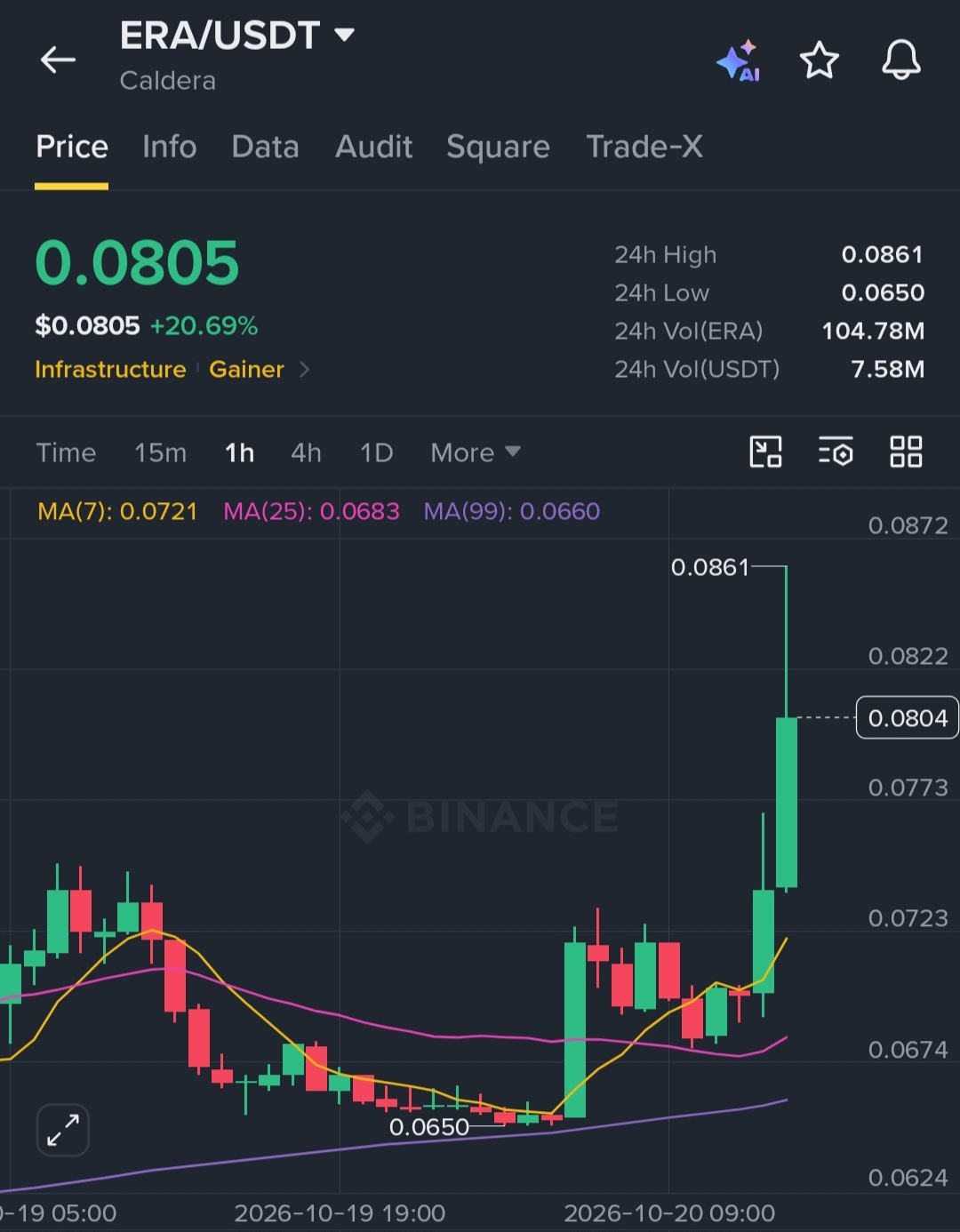
🏗️ $ERA /USDT — 🟢 LONG · Conf 91%
━━━━━━━━━━━━━━
📍 Entry: 0.0723 – 0.0747
🛑 SL: 0.0683
🎯 TP1: 0.0775
✅ TP2: 0.0817
🏆 TP3: 0.0836
━━━━━━━━━━━━━━
🔎 Price broke out of a 0.0650 to 0.0720 range on a volume spike and sits far above the 25-hour MA at 0.0683, so it is extended.
🧠 $ERA : Caldera is a rollup-as-a-service platform that lets teams launch custom rollups — the token is -79.43% over 1 year.
💬 Does Caldera's Metalayer interoperability matter if rollups can use shared bridges instead?
#ERA #Caldera #Metalayer #rollup #web3
{future}(ERAUSDT)
🏗️ $ERA /USDT — 🟢 LONG · Conf 91%
━━━━━━━━━━━━━━
📍 Entry: 0.0723 – 0.0747
🛑 SL: 0.0683
🎯 TP1: 0.0775
✅ TP2: 0.0817
🏆 TP3: 0.0836
━━━━━━━━━━━━━━
🔎 Price broke out of a 0.0650 to 0.0720 range on a volume spike and sits far above the 25-hour MA at 0.0683, so it is extended.
🧠 $ERA : Caldera is a rollup-as-a-service platform that lets teams launch custom rollups — the token is -79.43% over 1 year.
💬 Does Caldera's Metalayer interoperability matter if rollups can use shared bridges instead?
#ERA #Caldera #Metalayer #rollup #web3
━━━━━━━━━━━━━━
📍 Entry: 0.0723 – 0.0747
🛑 SL: 0.0683
🎯 TP1: 0.0775
✅ TP2: 0.0817
🏆 TP3: 0.0836
━━━━━━━━━━━━━━
🔎 Price broke out of a 0.0650 to 0.0720 range on a volume spike and sits far above the 25-hour MA at 0.0683, so it is extended.
🧠 $ERA : Caldera is a rollup-as-a-service platform that lets teams launch custom rollups — the token is -79.43% over 1 year.
💬 Does Caldera's Metalayer interoperability matter if rollups can use shared bridges instead?
#ERA #Caldera #Metalayer #rollup #web3

1
709

·
--
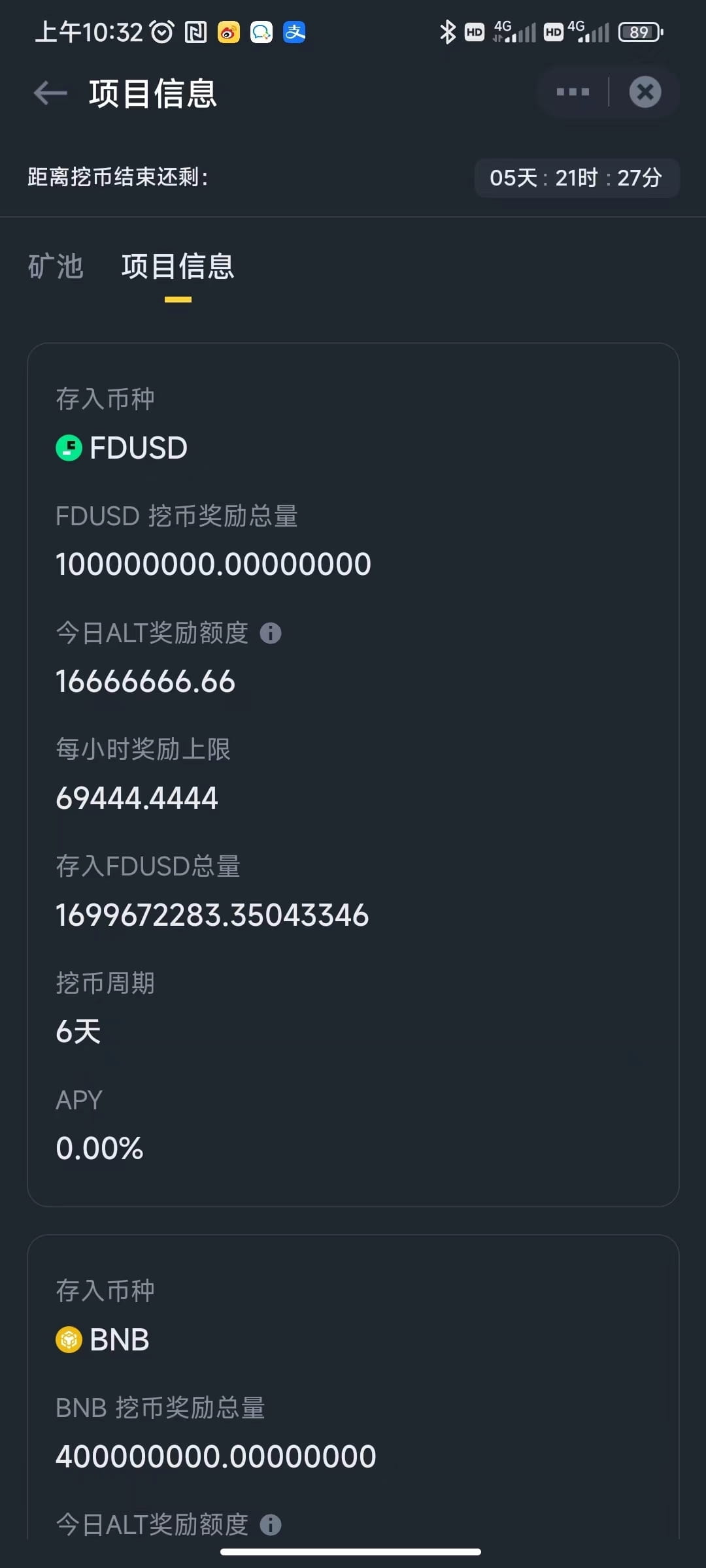
I just took a look at the Binance $ALT pool. There are more than 1.62 billion FDUSD deposited, and 1666,000 $ALT are mined every day.
Calculated, the six-day return rate of $FDUSD is about 30%, which can still be charged.
$ALT has a new concept of elasticity #Rollup , and it has taken advantage of the popularity of modularization and re-staking, but the total amount is a bit large: 10 billion! Calculated based on 5 billion FDV, let’s blindly guess the price at 0.5.
$ALT I feel like I can get it at the opening. It’s a great story to tell. It’s a brand new concept.
54
38
175.1k

·
--
$ESP $RAVE
$ESP: 0.09374 The chips above didn’t catch; the price slid to 0.08206. Over the past 24 hours it’s down 11.15%, and it’s very close to the intraday low of 0.08105. Trading volume is about $3.6M USDT. With limited depth, one round of selling can easily widen the downturn—more like a valuation pullback for a new token and pressure from liquidity conditions. Espresso is a shared confirmation and ordering layer for Rollups. Using HotShot consensus, it provides faster, lower-trust transaction confirmations for multiple L2s, and ESP will be used for network economic security. The official docs still list expanding validator participation, introducing PoS, and continuing to reduce confirmation latency as evolution directions, but they don’t provide a reliable completion date. Only if these upgrades and further Rollup integrations actually land could real demand improve.📈
$RAVE: After failing to break higher around 0.2094, it pulled back to 0.1863. Down 10.61% over the past 24 hours, the current price is nearly sitting on the low of 0.1856, and short-term selling pressure still dominates. Trading volume of about $7.25M USDT isn’t heavy; when sentiment fades, volatility may be amplified further. RaveDAO combines electronic music events, on-chain identity, and community governance. Participants can leave on-chain proof via event NFTs, and some event revenue is used for公益 projects chosen by the community. What the website can confirm is that the existing events and philanthropy model are already in place; there’s no clearly confirmable future positive catalyst yet. Going forward, it mainly depends on new city events, whether real participant counts can keep up, and whether token governance can continue to be implemented effectively.⚠️
#合约跌幅榜 #市场分析 #Rollup #RaveDAO #Risk Management
$ESP $RAVE
$ESP : 0.09374 The chips above didn’t catch; the price slid to 0.08206. Over the past 24 hours it’s down 11.15%, and it’s very close to the intraday low of 0.08105. Trading volume is about $3.6M USDT. With limited depth, one round of selling can easily widen the downturn—more like a valuation pullback for a new token and pressure from liquidity conditions. Espresso is a shared confirmation and ordering layer for Rollups. Using HotShot consensus, it provides faster, lower-trust transaction confirmations for multiple L2s, and ESP will be used for network economic security. The official docs still list expanding validator participation, introducing PoS, and continuing to reduce confirmation latency as evolution directions, but they don’t provide a reliable completion date. Only if these upgrades and further Rollup integrations actually land could real demand improve.📈
$RAVE : After failing to break higher around 0.2094, it pulled back to 0.1863. Down 10.61% over the past 24 hours, the current price is nearly sitting on the low of 0.1856, and short-term selling pressure still dominates. Trading volume of about $7.25M USDT isn’t heavy; when sentiment fades, volatility may be amplified further. RaveDAO combines electronic music events, on-chain identity, and community governance. Participants can leave on-chain proof via event NFTs, and some event revenue is used for公益 projects chosen by the community. What the website can confirm is that the existing events and philanthropy model are already in place; there’s no clearly confirmable future positive catalyst yet. Going forward, it mainly depends on new city events, whether real participant counts can keep up, and whether token governance can continue to be implemented effectively.⚠️
#合约跌幅榜 #市场分析 #Rollup #RaveDAO #Risk Management
246
·
--
Bearish
Partly True
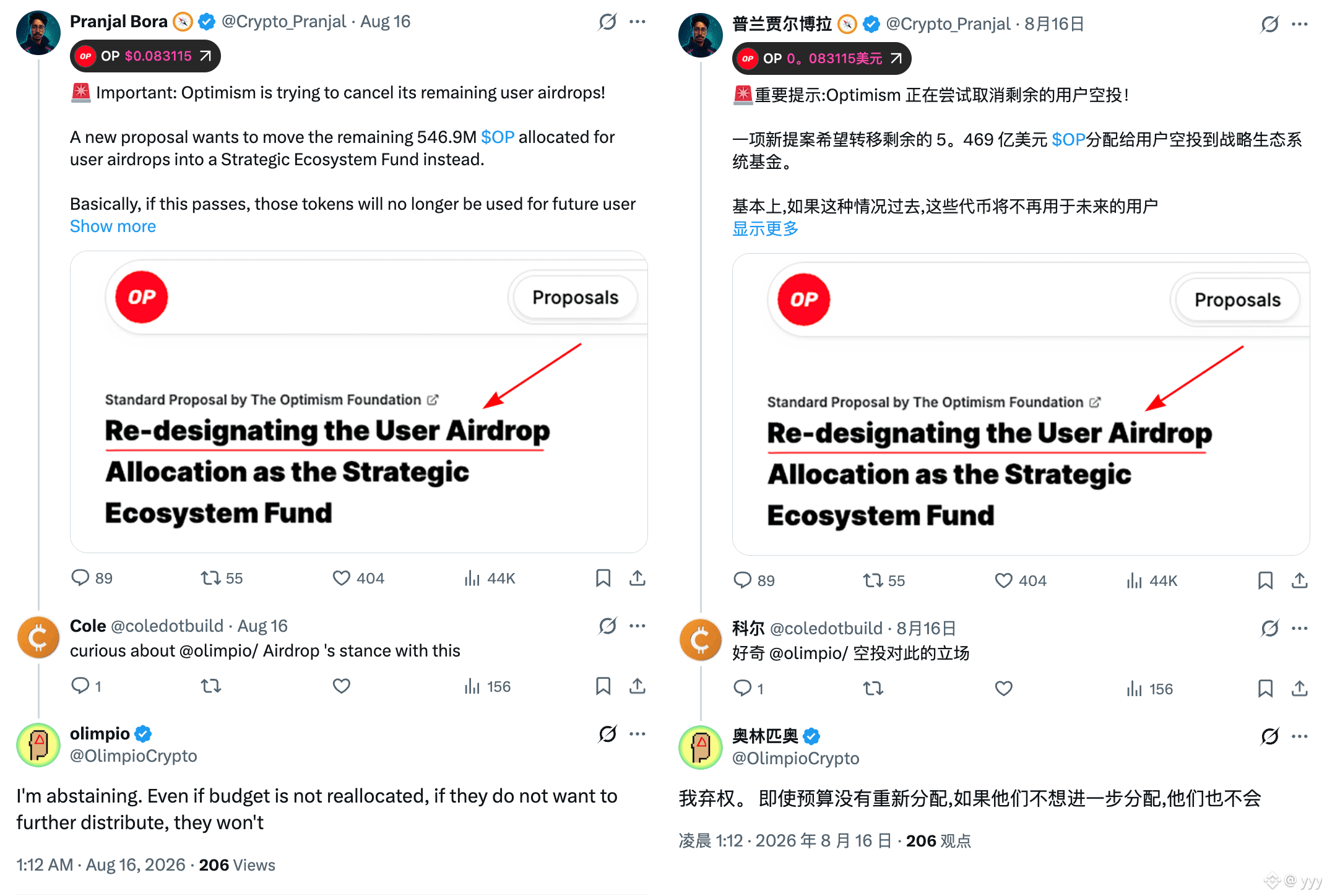
Optimism has been pulling one questionable move after another recently—first quietly pausing buybacks, and now openly abolishing the airdrop quota.
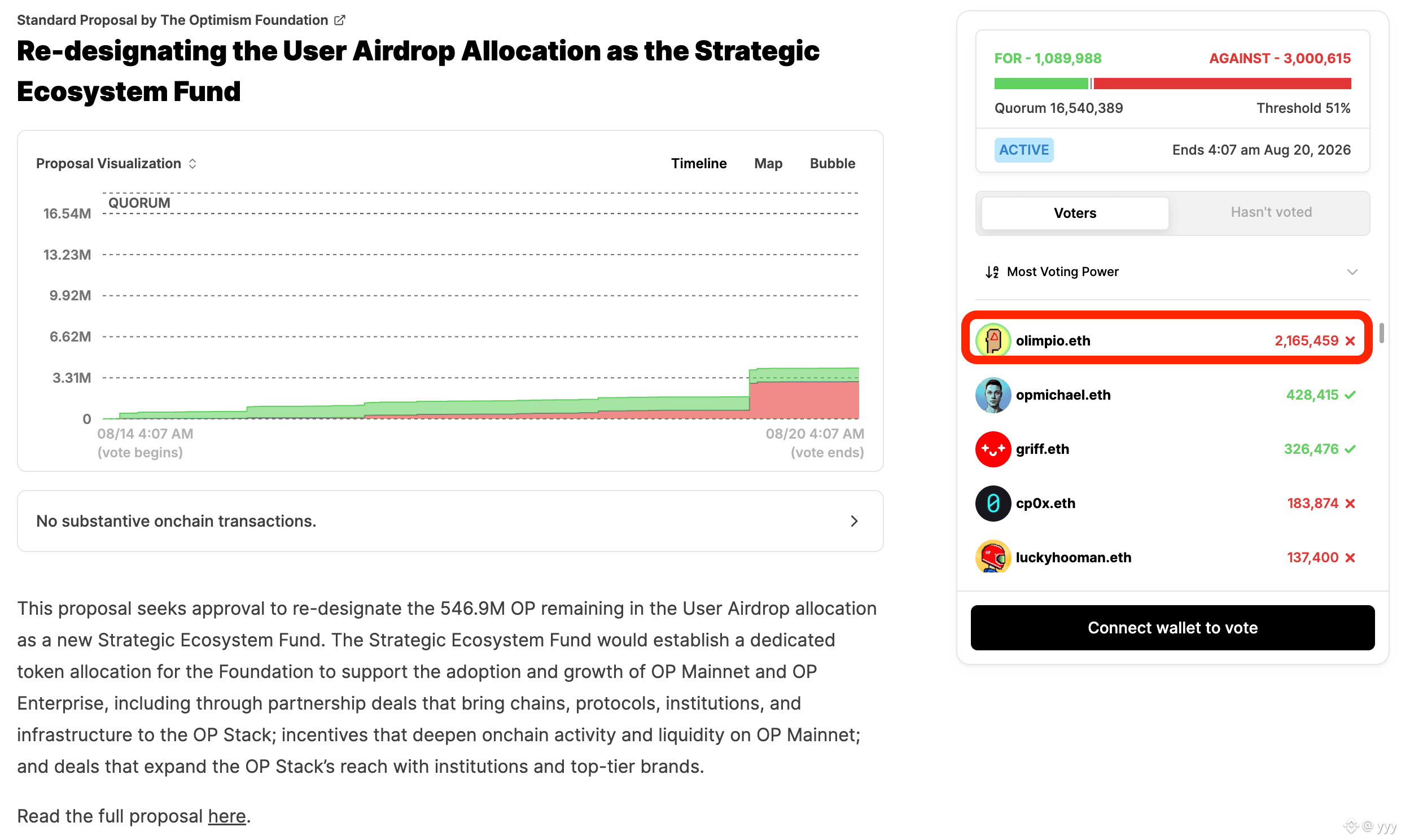
@Optimism’s official account has recently publicly initiated a governance proposal: to repurpose the remaining tokens reserved for user airdrops (546.9M $OP ) as a strategic ecosystem fund for other uses. This has sparked strong backlash from the community.
Because the proposal was initiated by the OP team itself, there was some internal consensus, so in the early voting stage it overwhelmingly leaned toward supporting the motion. As negative public sentiment intensified, the situation reversed.
The old-school airdrop legend who said yesterday that he would abstain, OP whale @OlimpioCrypto, changed his stance. In the critical moment, he still chose to vote “no.”
Worth noting: this “no” vote was the only time O God voted against in Optimism governance—out of as many as 125 governance votes he participated in.
At present, the proportion of “no” votes has already reached 73%. Unless something unexpected happens, the proposal will likely fail.
#Rollup $OP
{future}(OPUSDT)
Optimism has been pulling one questionable move after another recently—first quietly pausing buybacks, and now openly abolishing the airdrop quota.
@Optimism’s official account has recently publicly initiated a governance proposal: to repurpose the remaining tokens reserved for user airdrops (546.9M $OP ) as a strategic ecosystem fund for other uses. This has sparked strong backlash from the community.
Because the proposal was initiated by the OP team itself, there was some internal consensus, so in the early voting stage it overwhelmingly leaned toward supporting the motion. As negative public sentiment intensified, the situation reversed.
The old-school airdrop legend who said yesterday that he would abstain, OP whale @OlimpioCrypto, changed his stance. In the critical moment, he still chose to vote “no.”
Worth noting: this “no” vote was the only time O God voted against in Optimism governance—out of as many as 125 governance votes he participated in.
At present, the proportion of “no” votes has already reached 73%. Unless something unexpected happens, the proposal will likely fail.
#Rollup $OP
1
447
Log in to explore more content
Join global crypto users on Binance Square
⚡️ Get latest and useful information about crypto.
💬 Trusted by the world’s largest crypto exchange.
👍 Discover real insights from verified creators.
Email / Phone number
Trending Topics
1
#HotCPIDecemberHikePriced
79,251 views
945 Discussing
2
#AnthropicRejectsIPODelayValuationinQuestion
207,280 views
1,730 Discussing
3
#NvidiaInvestigatesAfterHuang’sAffairApology
494,629 views
3,142 Discussing
4
#CanNvidiaEarningsEaseMarketConcerns?
31,571 views
472 Discussing
5
#ADPWeeklyEstimateShowsUSPrivatePayrollsUp19750
14,166 views
255 Discussing
6
#US-IranTalksFuelStrongStockMarketRebound
138,184 views
604 Discussing
7
#BitcoinFiveWeeklyLosses
518,545 views
3,299 Discussing
8
#AIChipSlumpNasdaq
276,174 views
1,822 Discussing
9
#BitcoinSpotETFsPost$201MNetOutflowForThirdStraightDay
2,185 views
31 Discussing
10
#CryptoLiquidationsReach$1.16BIn24Hours
74,054 views
88 Discussing