

#riskmanagement
riskmanagement
17.1M views
60,719 Discussing
Hot
Latest

·
--
I almost bought $FLOKI today. Then I checked the volume, 0.3x average
Trading $FLOKI right now means risking capital in a thin book with only $1.7M in 24h volume
Exit liquidity looks thin here and real participation is missing entirely
I need an hourly close and hold above $0.00002977 to prove strength
Or I want to see a pullback that holds $0.00002824 and bounces cleanly
It could keep running without you and a bad entry costs more than a missed move
Chasing $FLOKI here, or waiting for $0.00002824?
#FLOKI #RiskManagement
I almost bought $FLOKI today. Then I checked the volume, 0.3x average
Trading $FLOKI right now means risking capital in a thin book with only $1.7M in 24h volume
Exit liquidity looks thin here and real participation is missing entirely
I need an hourly close and hold above $0.00002977 to prove strength
Or I want to see a pullback that holds $0.00002824 and bounces cleanly
It could keep running without you and a bad entry costs more than a missed move
Chasing $FLOKI here, or waiting for $0.00002824?
#FLOKI #RiskManagement
Trading $FLOKI right now means risking capital in a thin book with only $1.7M in 24h volume
Exit liquidity looks thin here and real participation is missing entirely
I need an hourly close and hold above $0.00002977 to prove strength
Or I want to see a pullback that holds $0.00002824 and bounces cleanly
It could keep running without you and a bad entry costs more than a missed move
Chasing $FLOKI here, or waiting for $0.00002824?
#FLOKI #RiskManagement
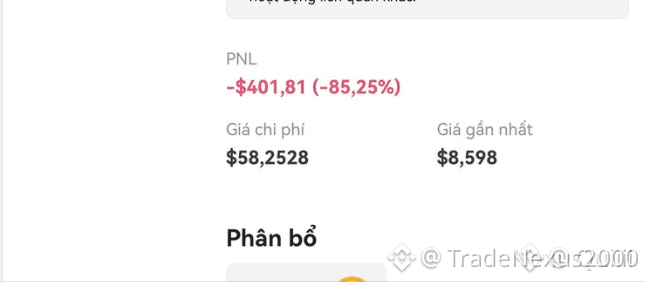
🚨 $TRUMP DROPS FROM $58 TO $2.50 IN A CLASSIC LIQUIDITY DRAIN 📉
📌 Buying high-timeframe distribution at $58 without a structural stop loss is how retail capital gets systematically trapped. 📊 With the position shrinking from $471 down to just $20 at current $2.50 levels, this textbook -95% drawdown illustrates what happens when smart money exits into retail enthusiasm.
💡 Institutional order flow requires tight risk parameters and waiting for clear market structure reclaims rather than buying momentum spikes near local peaks. 🔍 Without defined exit criteria, open drawdowns frequently turn structural corrections into complete capital depletion. 💬 What is your strict rule for cutting a trade when market structure breaks against you? 👇
⚠️ Not financial advice. Always manage your risk. 🛡️
🏷️ #TRUMP #RiskManagement #Crypto #MarketStructure
🎯 🔍
🚨 $TRUMP DROPS FROM $58 TO $2.50 IN A CLASSIC LIQUIDITY DRAIN 📉
📌 Buying high-timeframe distribution at $58 without a structural stop loss is how retail capital gets systematically trapped. 📊 With the position shrinking from $471 down to just $20 at current $2.50 levels, this textbook -95% drawdown illustrates what happens when smart money exits into retail enthusiasm.
💡 Institutional order flow requires tight risk parameters and waiting for clear market structure reclaims rather than buying momentum spikes near local peaks. 🔍 Without defined exit criteria, open drawdowns frequently turn structural corrections into complete capital depletion. 💬 What is your strict rule for cutting a trade when market structure breaks against you? 👇
⚠️ Not financial advice. Always manage your risk. 🛡️
🏷️ #TRUMP #RiskManagement #Crypto #MarketStructure
🎯 🔍
📌 Buying high-timeframe distribution at $58 without a structural stop loss is how retail capital gets systematically trapped. 📊 With the position shrinking from $471 down to just $20 at current $2.50 levels, this textbook -95% drawdown illustrates what happens when smart money exits into retail enthusiasm.
💡 Institutional order flow requires tight risk parameters and waiting for clear market structure reclaims rather than buying momentum spikes near local peaks. 🔍 Without defined exit criteria, open drawdowns frequently turn structural corrections into complete capital depletion. 💬 What is your strict rule for cutting a trade when market structure breaks against you? 👇
⚠️ Not financial advice. Always manage your risk. 🛡️
🏷️ #TRUMP #RiskManagement #Crypto #MarketStructure
🎯 🔍
45

·
--
💡 Trading tip #4
A 1% loss needs a 1.01% gain to recover. A 50% loss needs 100%. Small losses keep you in the game.
What would you add to this? 👇
#TradingTips #RiskManagement #Futures #CryptoTrading
💡 Trading tip #4
A 1% loss needs a 1.01% gain to recover. A 50% loss needs 100%. Small losses keep you in the game.
What would you add to this? 👇
#TradingTips #RiskManagement #Futures #CryptoTrading
A 1% loss needs a 1.01% gain to recover. A 50% loss needs 100%. Small losses keep you in the game.
What would you add to this? 👇
#TradingTips #RiskManagement #Futures #CryptoTrading

·
--
You can be right 7 out of 10 times and still blow your account — one oversized position is all it takes.
Before you click buy or sell:
→ What's your invalidation level?
→ What % of your account is actually at risk?
→ Would this trade still make sense if it lost?
Smart Money survives corrections. Retail gets liquidated by them.
Protect the account first. The profits follow.
#BİNANCE #BinanceSquare #TradingTips #RiskManagement #CryptoTrading
You can be right 7 out of 10 times and still blow your account — one oversized position is all it takes.
Before you click buy or sell:
→ What's your invalidation level?
→ What % of your account is actually at risk?
→ Would this trade still make sense if it lost?
Smart Money survives corrections. Retail gets liquidated by them.
Protect the account first. The profits follow.
#BİNANCE #BinanceSquare #TradingTips #RiskManagement #CryptoTrading
Before you click buy or sell:
→ What's your invalidation level?
→ What % of your account is actually at risk?
→ Would this trade still make sense if it lost?
Smart Money survives corrections. Retail gets liquidated by them.
Protect the account first. The profits follow.
#BİNANCE #BinanceSquare #TradingTips #RiskManagement #CryptoTrading
18
Most traders enter high-leverage trades looking at the profit potential:
If this hits, I’m 10x’ing my account." 🚀
That’s rookie thinking. Professional traders don't calculate gains first — they calculate pain.
Before you click buy, ask yourself:
How much can I lose if this dumps?
Can my account (and mind) survive that drawdown?
The reason 90% of traders panic and liquidate isn't bad strategy — it's bad risk control. They fall in love with the reward and completely ignore the risk.
Amateurs trade to make money.
Pros trade to manage risk.
Calculate your downside before you open the position. Panic sets in when you plan after the candle turns red.
#Crypto #TradingTips #RiskManagement #CryptoTrading #Futures $BTC $BNB
{spot}(BNBUSDT)
Most traders enter high-leverage trades looking at the profit potential:
If this hits, I’m 10x’ing my account." 🚀
That’s rookie thinking. Professional traders don't calculate gains first — they calculate pain.
Before you click buy, ask yourself:
How much can I lose if this dumps?
Can my account (and mind) survive that drawdown?
The reason 90% of traders panic and liquidate isn't bad strategy — it's bad risk control. They fall in love with the reward and completely ignore the risk.
Amateurs trade to make money.
Pros trade to manage risk.
Calculate your downside before you open the position. Panic sets in when you plan after the candle turns red.
#Crypto #TradingTips #RiskManagement #CryptoTrading #Futures $BTC $BNB
If this hits, I’m 10x’ing my account." 🚀
That’s rookie thinking. Professional traders don't calculate gains first — they calculate pain.
Before you click buy, ask yourself:
How much can I lose if this dumps?
Can my account (and mind) survive that drawdown?
The reason 90% of traders panic and liquidate isn't bad strategy — it's bad risk control. They fall in love with the reward and completely ignore the risk.
Amateurs trade to make money.
Pros trade to manage risk.
Calculate your downside before you open the position. Panic sets in when you plan after the candle turns red.
#Crypto #TradingTips #RiskManagement #CryptoTrading #Futures $BTC $BNB
43

·
--
Risk ManagementMost traders don't blow up their accounts because their analysis was wrong. They blow up because their position sizing was reckless.
If your strategy is to go 20x or 50x on every setup, a single wick will wipe out weeks of discipline.
Here is the exact risk framework professional traders use:
The Rule: Never risk more than 1% to 2% of your total account balance on a single trade.
The Difference: Risking 1% does not mean trading with 1% of your capital. It means your Stop Loss represents a 1% loss of your total balance if triggered.
The Math: On a $1,000 account, your maximum loss on any invalidation should be $10 to $20—regardless of your leverage.
Trading is a game of survival before it is a game of profit. Preserve your capital, and the opportunities will always be there.
What is your strict maximum risk per trade? Drop your percentage below. 👇
$BTC $ETH #RiskManagement #TradingTips #Binance
Risk Management
Most traders don't blow up their accounts because their analysis was wrong. They blow up because their position sizing was reckless.
If your strategy is to go 20x or 50x on every setup, a single wick will wipe out weeks of discipline.
Here is the exact risk framework professional traders use:
The Rule: Never risk more than 1% to 2% of your total account balance on a single trade.
The Difference: Risking 1% does not mean trading with 1% of your capital. It means your Stop Loss represents a 1% loss of your total balance if triggered.
The Math: On a $1,000 account, your maximum loss on any invalidation should be $10 to $20—regardless of your leverage.
Trading is a game of survival before it is a game of profit. Preserve your capital, and the opportunities will always be there.
What is your strict maximum risk per trade? Drop your percentage below. 👇
$BTC $ETH #RiskManagement #TradingTips #Binance
If your strategy is to go 20x or 50x on every setup, a single wick will wipe out weeks of discipline.
Here is the exact risk framework professional traders use:
The Rule: Never risk more than 1% to 2% of your total account balance on a single trade.
The Difference: Risking 1% does not mean trading with 1% of your capital. It means your Stop Loss represents a 1% loss of your total balance if triggered.
The Math: On a $1,000 account, your maximum loss on any invalidation should be $10 to $20—regardless of your leverage.
Trading is a game of survival before it is a game of profit. Preserve your capital, and the opportunities will always be there.
What is your strict maximum risk per trade? Drop your percentage below. 👇
$BTC $ETH #RiskManagement #TradingTips #Binance
74
🚨 The Biggest Trap in a Bull Run: Over-Leveraging & Greed! 📉
One of the costliest mistakes you can make in this cycle is riding the entire bull run only to end up with losses—just because you tried to squeeze out slightly higher gains.
If you trade futures using high leverage without strict Risk Management, market volatility can liquidate your account long before the price reaches your target.
Spot vs. Futures Breakdown:
Spot Trading (Safe & Stress-Free): Investing $100 into a solid blue-chip asset that grows 5x turns your money into $500 ($400 net profit) with zero liquidation risk.
Futures & Leverage (High Risk): Borrowing capital exposes your position to wild price swings that can wipe you out before the real upward move begins.
Lock in Profits: Paper gains mean nothing until you actually realize them.
Protect Your Capital: Prioritize risk control over high leverage.
Stay Patient: You don't need dangerous trades to make significant returns in a bull market.
Trade smart, stay disciplined, and protect your portfolio! 🚀
#CryptoAdvice #RiskManagement #SpotTrading #CryptoCommunity $NVDAB
{spot}(NVDABUSDT)
$AAPLB
{spot}(AAPLBUSDT)
$GOOGL.US
{stock_us}(GOOGL.US)
🚨 The Biggest Trap in a Bull Run: Over-Leveraging & Greed! 📉
One of the costliest mistakes you can make in this cycle is riding the entire bull run only to end up with losses—just because you tried to squeeze out slightly higher gains.
If you trade futures using high leverage without strict Risk Management, market volatility can liquidate your account long before the price reaches your target.
Spot vs. Futures Breakdown:
Spot Trading (Safe & Stress-Free): Investing $100 into a solid blue-chip asset that grows 5x turns your money into $500 ($400 net profit) with zero liquidation risk.
Futures & Leverage (High Risk): Borrowing capital exposes your position to wild price swings that can wipe you out before the real upward move begins.
Lock in Profits: Paper gains mean nothing until you actually realize them.
Protect Your Capital: Prioritize risk control over high leverage.
Stay Patient: You don't need dangerous trades to make significant returns in a bull market.
Trade smart, stay disciplined, and protect your portfolio! 🚀
#CryptoAdvice #RiskManagement #SpotTrading #CryptoCommunity $NVDAB
$AAPLB
$GOOGL.US
One of the costliest mistakes you can make in this cycle is riding the entire bull run only to end up with losses—just because you tried to squeeze out slightly higher gains.
If you trade futures using high leverage without strict Risk Management, market volatility can liquidate your account long before the price reaches your target.
Spot vs. Futures Breakdown:
Spot Trading (Safe & Stress-Free): Investing $100 into a solid blue-chip asset that grows 5x turns your money into $500 ($400 net profit) with zero liquidation risk.
Futures & Leverage (High Risk): Borrowing capital exposes your position to wild price swings that can wipe you out before the real upward move begins.
Lock in Profits: Paper gains mean nothing until you actually realize them.
Protect Your Capital: Prioritize risk control over high leverage.
Stay Patient: You don't need dangerous trades to make significant returns in a bull market.
Trade smart, stay disciplined, and protect your portfolio! 🚀
#CryptoAdvice #RiskManagement #SpotTrading #CryptoCommunity $NVDAB
$AAPLB
$GOOGL.US
49

Today's Gold scalp didn't go as planned! 👺
Took a Buy on *$XAUUSDT Perp 20X* at 4289.61 but Gold showed heavy volatility. I followed my discipline and closed at 4289.6 with a very small loss of *-0.05 USDT (-1.60%)*.
For me, protecting capital is more important than holding a losing trade. Small SL hit is part of the game. No revenge trading today. Will wait for a clean setup at NY session.
Remember: One loss doesn't define you. Risk management is the real profit. 💪
What do you guys think, will Gold pump again from here or more correction coming? Comment your view!
#XAUUSDT #GOLD #XAU #Binance #CryptoTrading #FuturesTrading #goldtrading #TradingJournal #RiskManagement
Today's Gold scalp didn't go as planned! 👺
Took a Buy on *$XAUUSDT Perp 20X* at 4289.61 but Gold showed heavy volatility. I followed my discipline and closed at 4289.6 with a very small loss of *-0.05 USDT (-1.60%)*.
For me, protecting capital is more important than holding a losing trade. Small SL hit is part of the game. No revenge trading today. Will wait for a clean setup at NY session.
Remember: One loss doesn't define you. Risk management is the real profit. 💪
What do you guys think, will Gold pump again from here or more correction coming? Comment your view!
#XAUUSDT #GOLD #XAU #Binance #CryptoTrading #FuturesTrading #goldtrading #TradingJournal #RiskManagement
Took a Buy on *$XAUUSDT Perp 20X* at 4289.61 but Gold showed heavy volatility. I followed my discipline and closed at 4289.6 with a very small loss of *-0.05 USDT (-1.60%)*.
For me, protecting capital is more important than holding a losing trade. Small SL hit is part of the game. No revenge trading today. Will wait for a clean setup at NY session.
Remember: One loss doesn't define you. Risk management is the real profit. 💪
What do you guys think, will Gold pump again from here or more correction coming? Comment your view!
#XAUUSDT #GOLD #XAU #Binance #CryptoTrading #FuturesTrading #goldtrading #TradingJournal #RiskManagement
108

·
--
$BTW fell 45% in 22 minutes overnight. Here's who got liquidated, by leverage.
BTWUSDT perp, Sep 26 (UTC), last price:
• 01:32 top: 1.3781
• 01:54 bottom: 0.7528
• Now: ~0.93, still -32% from the top
I ran a long from the mark-price top (1.3647) through the 1-minute candles. Rough liquidation points, ignoring maintenance margin, which only makes them worse:
🔴 20x (−5%): gone at 01:34, 2 minutes in
🔴 10x (−10%): gone at 01:34, same candle
🔴 5x (−20%): gone at 01:44
🔴 3x (−33%): gone at 01:48
🟡 2x (−50%): survived the −43% mark wick… and is sitting at about −63% of margin
So the "safe" 2x trader won the prize of not being liquidated. Congrats, you get to hold the bag. 🎒
The math I keep relearning the hard way (my last ZEC short got liquidated on a wick while price closed on my side):
→ Liquidation distance ≈ 1 / leverage
→ A coin's worst 1-hour move is your real stop, not its average daily range
→ BTW's 24h range was 83%. At that volatility, 5x isn't "moderate". It's a coin flip with extra fees.
My rule now: leverage ≤ 1 / (worst recent candle × 2). For BTW today that works out to about 1x. Just spot with extra steps.
What's the biggest wick that's ever taken you out, and at what leverage? 👇
#RiskManagement #CryptoFutures
$BTW
$BTW fell 45% in 22 minutes overnight. Here's who got liquidated, by leverage.
BTWUSDT perp, Sep 26 (UTC), last price:
• 01:32 top: 1.3781
• 01:54 bottom: 0.7528
• Now: ~0.93, still -32% from the top
I ran a long from the mark-price top (1.3647) through the 1-minute candles. Rough liquidation points, ignoring maintenance margin, which only makes them worse:
🔴 20x (−5%): gone at 01:34, 2 minutes in
🔴 10x (−10%): gone at 01:34, same candle
🔴 5x (−20%): gone at 01:44
🔴 3x (−33%): gone at 01:48
🟡 2x (−50%): survived the −43% mark wick… and is sitting at about −63% of margin
So the "safe" 2x trader won the prize of not being liquidated. Congrats, you get to hold the bag. 🎒
The math I keep relearning the hard way (my last ZEC short got liquidated on a wick while price closed on my side):
→ Liquidation distance ≈ 1 / leverage
→ A coin's worst 1-hour move is your real stop, not its average daily range
→ BTW's 24h range was 83%. At that volatility, 5x isn't "moderate". It's a coin flip with extra fees.
My rule now: leverage ≤ 1 / (worst recent candle × 2). For BTW today that works out to about 1x. Just spot with extra steps.
What's the biggest wick that's ever taken you out, and at what leverage? 👇
#RiskManagement #CryptoFutures
$BTW
BTWUSDT perp, Sep 26 (UTC), last price:
• 01:32 top: 1.3781
• 01:54 bottom: 0.7528
• Now: ~0.93, still -32% from the top
I ran a long from the mark-price top (1.3647) through the 1-minute candles. Rough liquidation points, ignoring maintenance margin, which only makes them worse:
🔴 20x (−5%): gone at 01:34, 2 minutes in
🔴 10x (−10%): gone at 01:34, same candle
🔴 5x (−20%): gone at 01:44
🔴 3x (−33%): gone at 01:48
🟡 2x (−50%): survived the −43% mark wick… and is sitting at about −63% of margin
So the "safe" 2x trader won the prize of not being liquidated. Congrats, you get to hold the bag. 🎒
The math I keep relearning the hard way (my last ZEC short got liquidated on a wick while price closed on my side):
→ Liquidation distance ≈ 1 / leverage
→ A coin's worst 1-hour move is your real stop, not its average daily range
→ BTW's 24h range was 83%. At that volatility, 5x isn't "moderate". It's a coin flip with extra fees.
My rule now: leverage ≤ 1 / (worst recent candle × 2). For BTW today that works out to about 1x. Just spot with extra steps.
What's the biggest wick that's ever taken you out, and at what leverage? 👇
#RiskManagement #CryptoFutures
$BTW
290

💰 Can $50 Make $2–$3 Every Day From Trading?If you’ve been learning trading for 3 months, starting with $50 can be a good way to gain real experience — but don’t make daily profit your main goal.
Making $2–$3 every day means roughly 4–6% daily, which is extremely difficult to sustain and comes with high risk. ⚠️
Instead, focus on: 📚 Learning consistently
🛡️ Protecting your $50
🎯 Using strict risk management
❌ Avoiding revenge trading and over-leverage
📈 Building consistency over time
Your first goal shouldn’t be “How much can I make today?”
It should be: “How can I become a better trader without losing my capital?” 🔥
What would you do with a $50 account — spot or futures? 👇
#Trading #CryptoTrading #Binance #RiskManagement #Crypto
$AAPL.US
{stock_us}(AAPL.US)
💰 Can $50 Make $2–$3 Every Day From Trading?
If you’ve been learning trading for 3 months, starting with $50 can be a good way to gain real experience — but don’t make daily profit your main goal.
Making $2–$3 every day means roughly 4–6% daily, which is extremely difficult to sustain and comes with high risk. ⚠️
Instead, focus on: 📚 Learning consistently
🛡️ Protecting your $50
🎯 Using strict risk management
❌ Avoiding revenge trading and over-leverage
📈 Building consistency over time
Your first goal shouldn’t be “How much can I make today?”
It should be: “How can I become a better trader without losing my capital?” 🔥
What would you do with a $50 account — spot or futures? 👇
#Trading #CryptoTrading #Binance #RiskManagement #Crypto
$AAPL.US
Making $2–$3 every day means roughly 4–6% daily, which is extremely difficult to sustain and comes with high risk. ⚠️
Instead, focus on: 📚 Learning consistently
🛡️ Protecting your $50
🎯 Using strict risk management
❌ Avoiding revenge trading and over-leverage
📈 Building consistency over time
Your first goal shouldn’t be “How much can I make today?”
It should be: “How can I become a better trader without losing my capital?” 🔥
What would you do with a $50 account — spot or futures? 👇
#Trading #CryptoTrading #Binance #RiskManagement #Crypto
$AAPL.US
AAPLUS+1.44%
30
SOLANA 🚀
BULL RUN PROFITS?
DON'T GET LIQUIDATED!
SPOT vs LEVERAGE🚨 DON’T LET LEVERAGE TURN YOUR SOL BULL RUN INTO A LOSS! 🐂
Imagine holding $SOL during a bull run, watching the price climb… but somehow ending up with ZERO profit.
Sounds crazy? It happens. 👀
One of the biggest mistakes traders make is chasing bigger profits through leverage without understanding the risks.
Here's the difference:
💎 SPOT TRADING
You buy SOL and hold it. If the price rises, your investment grows. You don't face futures liquidation from ordinary price fluctuations.
⚡ LEVERAGE TRADING
You borrow exposure to control a larger position with less capital.
Sounds attractive, right?
But there's a catch…
A sudden price movement against your position can trigger liquidation BEFORE the market moves in your expected direction.
📊 Simple Example:
Suppose you invest $100 in SOL at a hypothetical price of $100.
If SOL reaches $150, your investment becomes $150 — a $50 gain before fees.
But with leverage, even a temporary price drop could liquidate your position depending on your leverage, margin, and liquidation price.
🔥 THE REAL LESSON:
A bull run is not just about making profits.
It's also about protecting your capital long enough to participate in the next opportunity.
✅ Understand liquidation risk
✅ Use position sizing
✅ Set a risk limit
✅ Never trade with money you cannot afford to lose
👇 LET'S TALK, SOL COMMUNITY!
What's your strategy during a bull run?
🐂 A) Spot and hold
⚡ B) Futures with strict risk management
🧠 C) A combination of both
Comment A, B, or C! Let's hear your strategy.
#SOL #Solana $Crypto $Bitcoin #BullRun #FuturesTrading #RiskManagement $BinanceSquare
SOLANA 🚀
BULL RUN PROFITS?
DON'T GET LIQUIDATED!
SPOT vs LEVERAGE🚨 DON’T LET LEVERAGE TURN YOUR SOL BULL RUN INTO A LOSS! 🐂
Imagine holding $SOL during a bull run, watching the price climb… but somehow ending up with ZERO profit.
Sounds crazy? It happens. 👀
One of the biggest mistakes traders make is chasing bigger profits through leverage without understanding the risks.
Here's the difference:
💎 SPOT TRADING
You buy SOL and hold it. If the price rises, your investment grows. You don't face futures liquidation from ordinary price fluctuations.
⚡ LEVERAGE TRADING
You borrow exposure to control a larger position with less capital.
Sounds attractive, right?
But there's a catch…
A sudden price movement against your position can trigger liquidation BEFORE the market moves in your expected direction.
📊 Simple Example:
Suppose you invest $100 in SOL at a hypothetical price of $100.
If SOL reaches $150, your investment becomes $150 — a $50 gain before fees.
But with leverage, even a temporary price drop could liquidate your position depending on your leverage, margin, and liquidation price.
🔥 THE REAL LESSON:
A bull run is not just about making profits.
It's also about protecting your capital long enough to participate in the next opportunity.
✅ Understand liquidation risk
✅ Use position sizing
✅ Set a risk limit
✅ Never trade with money you cannot afford to lose
👇 LET'S TALK, SOL COMMUNITY!
What's your strategy during a bull run?
🐂 A) Spot and hold
⚡ B) Futures with strict risk management
🧠 C) A combination of both
Comment A, B, or C! Let's hear your strategy.
#SOL #Solana $Crypto $Bitcoin #BullRun #FuturesTrading #RiskManagement $BinanceSquare
BULL RUN PROFITS?
DON'T GET LIQUIDATED!
SPOT vs LEVERAGE🚨 DON’T LET LEVERAGE TURN YOUR SOL BULL RUN INTO A LOSS! 🐂
Imagine holding $SOL during a bull run, watching the price climb… but somehow ending up with ZERO profit.
Sounds crazy? It happens. 👀
One of the biggest mistakes traders make is chasing bigger profits through leverage without understanding the risks.
Here's the difference:
💎 SPOT TRADING
You buy SOL and hold it. If the price rises, your investment grows. You don't face futures liquidation from ordinary price fluctuations.
⚡ LEVERAGE TRADING
You borrow exposure to control a larger position with less capital.
Sounds attractive, right?
But there's a catch…
A sudden price movement against your position can trigger liquidation BEFORE the market moves in your expected direction.
📊 Simple Example:
Suppose you invest $100 in SOL at a hypothetical price of $100.
If SOL reaches $150, your investment becomes $150 — a $50 gain before fees.
But with leverage, even a temporary price drop could liquidate your position depending on your leverage, margin, and liquidation price.
🔥 THE REAL LESSON:
A bull run is not just about making profits.
It's also about protecting your capital long enough to participate in the next opportunity.
✅ Understand liquidation risk
✅ Use position sizing
✅ Set a risk limit
✅ Never trade with money you cannot afford to lose
👇 LET'S TALK, SOL COMMUNITY!
What's your strategy during a bull run?
🐂 A) Spot and hold
⚡ B) Futures with strict risk management
🧠 C) A combination of both
Comment A, B, or C! Let's hear your strategy.
#SOL #Solana $Crypto $Bitcoin #BullRun #FuturesTrading #RiskManagement $BinanceSquare
1
25

·
--
🖐️Dunno, who needs to learn from this, but before you click that buy button, run this 4-step check:👇
1️⃣ Check the 4H chart to see If the price is already far from the nearest support. If yes, chasing might not be worth it. wait for a better entry.
{spot}(SUIUSDT)
2️⃣ Check RSI, if RSI above 70 it means momentum is stretched. It doesn't guarantee a dump, but it’s a reason to be more careful.
3️⃣ Know your stop-loss, decide where you're wrong before entering. Keep the amount you're risking small enough to protect your account, Incase it go wrong.
{spot}(RAREUSDT)
4️⃣ Check the volume
A pump with strong volume has more participation behind it. A sharp move on weak volume deserves extra caution.
{spot}(ENAUSDT)
📌 If the setup doesn't make sense to you then, you don't have to take the trade.
The market will give you another opportunity, Protecting your capital is part of trading too.
Not financial advice. Always DYOR.
$ENA $SUI $RARE
#TechnicalAnalysis
#RiskManagement
🖐️Dunno, who needs to learn from this, but before you click that buy button, run this 4-step check:👇
1️⃣ Check the 4H chart to see If the price is already far from the nearest support. If yes, chasing might not be worth it. wait for a better entry.
2️⃣ Check RSI, if RSI above 70 it means momentum is stretched. It doesn't guarantee a dump, but it’s a reason to be more careful.
3️⃣ Know your stop-loss, decide where you're wrong before entering. Keep the amount you're risking small enough to protect your account, Incase it go wrong.
4️⃣ Check the volume
A pump with strong volume has more participation behind it. A sharp move on weak volume deserves extra caution.
📌 If the setup doesn't make sense to you then, you don't have to take the trade.
The market will give you another opportunity, Protecting your capital is part of trading too.
Not financial advice. Always DYOR.
$ENA $SUI $RARE
#TechnicalAnalysis
#RiskManagement
1️⃣ Check the 4H chart to see If the price is already far from the nearest support. If yes, chasing might not be worth it. wait for a better entry.
2️⃣ Check RSI, if RSI above 70 it means momentum is stretched. It doesn't guarantee a dump, but it’s a reason to be more careful.
3️⃣ Know your stop-loss, decide where you're wrong before entering. Keep the amount you're risking small enough to protect your account, Incase it go wrong.
4️⃣ Check the volume
A pump with strong volume has more participation behind it. A sharp move on weak volume deserves extra caution.
📌 If the setup doesn't make sense to you then, you don't have to take the trade.
The market will give you another opportunity, Protecting your capital is part of trading too.
Not financial advice. Always DYOR.
$ENA $SUI $RARE
#TechnicalAnalysis
#RiskManagement
422

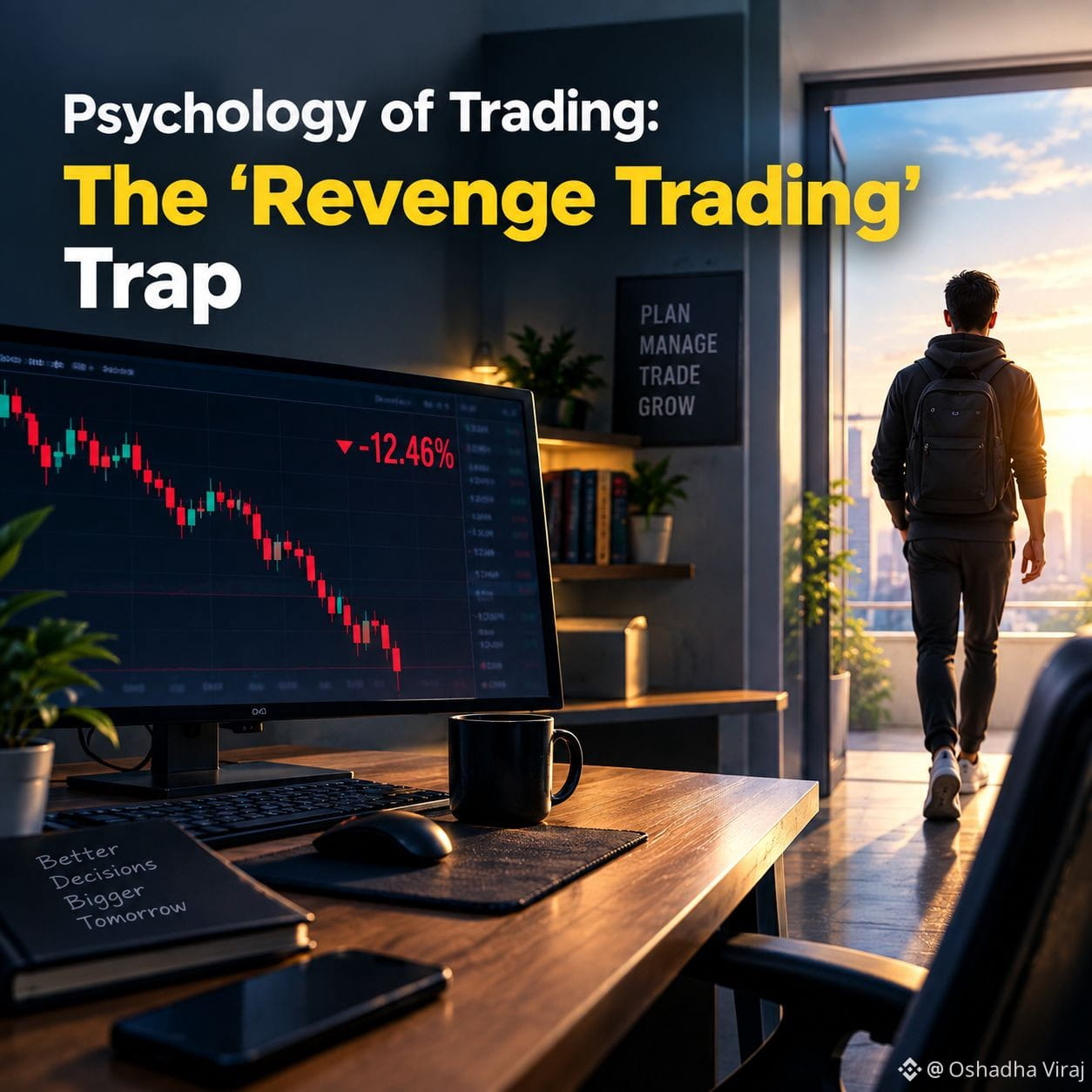
Psychology of Trading: The “Revenge Trading” Trap
A losing trade can trigger one of the most dangerous habits in trading: revenge trading.
You take a loss. You want to recover it immediately. You enter another trade without a proper setup, increase your position size, or ignore your risk limits.
One loss can quickly turn into several.
How to break the cycle:
1. Accept the Loss
A losing trade is part of trading. Don't let one result control your next decision.
2. Step Away
After a significant loss, take a break from the charts. Give yourself time to reset before making another trade.
3. Don't Increase Risk
Never increase position size just because you want to recover a previous loss.
4. Review, Don't Chase
Ask what went wrong: Was it the setup, risk management, entry, or emotions?
5. Follow Your Plan
Only take the next trade when your original strategy gives you a valid setup.
The goal isn't to win back every loss immediately.
The goal is to protect your capital and stay disciplined enough to keep trading with a clear plan.
Sometimes, the smartest trade after a loss is no trade at all.
Do you take a break after a losing trade?
$BTC $ETH $BNB
#BinanceSquare #TradingPsychology #RiskManagement #CryptoEducation #TradingTips
Psychology of Trading: The “Revenge Trading” Trap
A losing trade can trigger one of the most dangerous habits in trading: revenge trading.
You take a loss. You want to recover it immediately. You enter another trade without a proper setup, increase your position size, or ignore your risk limits.
One loss can quickly turn into several.
How to break the cycle:
1. Accept the Loss
A losing trade is part of trading. Don't let one result control your next decision.
2. Step Away
After a significant loss, take a break from the charts. Give yourself time to reset before making another trade.
3. Don't Increase Risk
Never increase position size just because you want to recover a previous loss.
4. Review, Don't Chase
Ask what went wrong: Was it the setup, risk management, entry, or emotions?
5. Follow Your Plan
Only take the next trade when your original strategy gives you a valid setup.
The goal isn't to win back every loss immediately.
The goal is to protect your capital and stay disciplined enough to keep trading with a clear plan.
Sometimes, the smartest trade after a loss is no trade at all.
Do you take a break after a losing trade?
$BTC $ETH $BNB
#BinanceSquare #TradingPsychology #RiskManagement #CryptoEducation #TradingTips
A losing trade can trigger one of the most dangerous habits in trading: revenge trading.
You take a loss. You want to recover it immediately. You enter another trade without a proper setup, increase your position size, or ignore your risk limits.
One loss can quickly turn into several.
How to break the cycle:
1. Accept the Loss
A losing trade is part of trading. Don't let one result control your next decision.
2. Step Away
After a significant loss, take a break from the charts. Give yourself time to reset before making another trade.
3. Don't Increase Risk
Never increase position size just because you want to recover a previous loss.
4. Review, Don't Chase
Ask what went wrong: Was it the setup, risk management, entry, or emotions?
5. Follow Your Plan
Only take the next trade when your original strategy gives you a valid setup.
The goal isn't to win back every loss immediately.
The goal is to protect your capital and stay disciplined enough to keep trading with a clear plan.
Sometimes, the smartest trade after a loss is no trade at all.
Do you take a break after a losing trade?
$BTC $ETH $BNB
#BinanceSquare #TradingPsychology #RiskManagement #CryptoEducation #TradingTips
1
81

Article
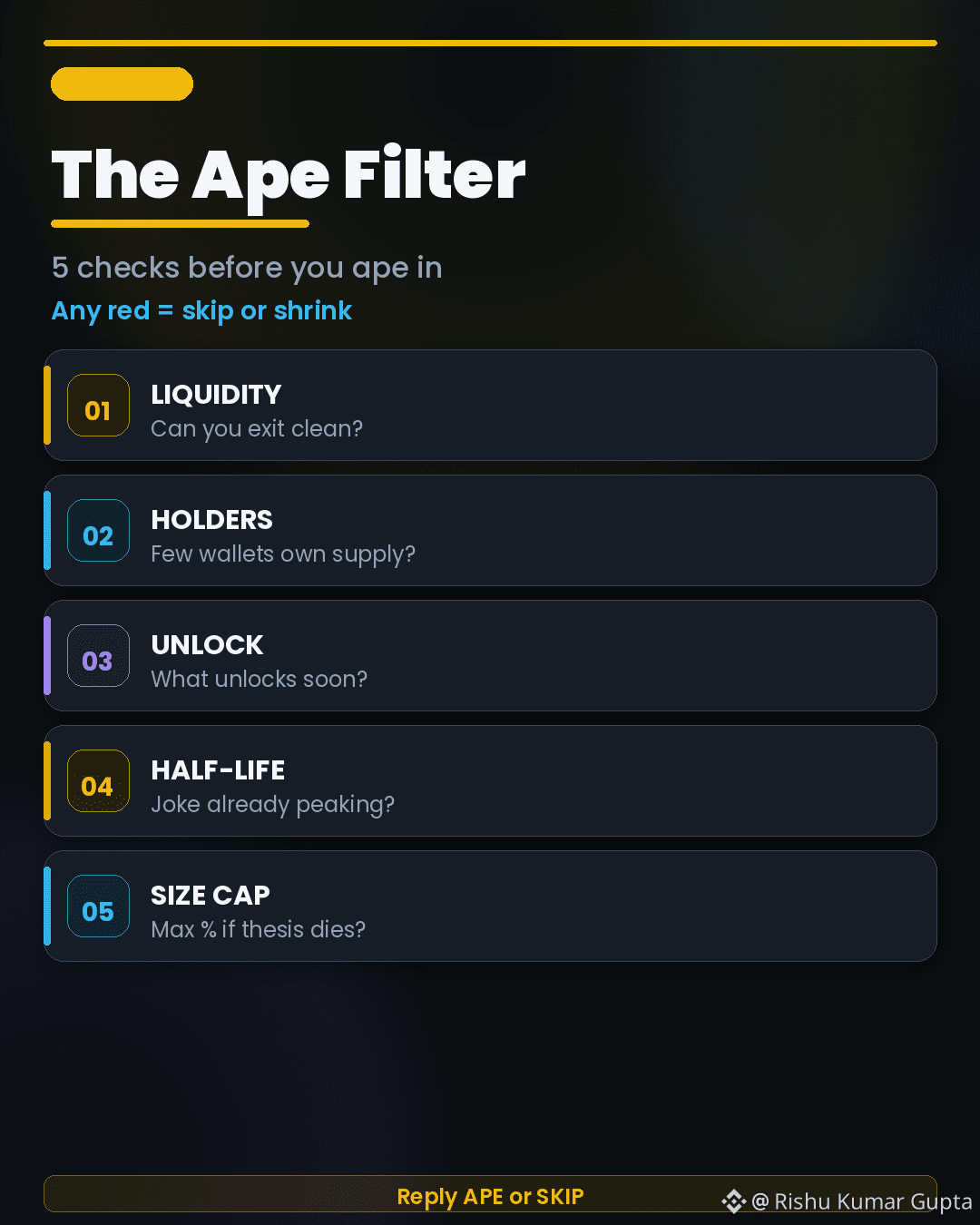
The Ape Filter: 5 checks before you buyMost memecoin losses aren't bad luck — they're skipped checks.
Before you ape a high-beta narrative coin, run The Ape Filter. Five lights. Any red = skip or shrink.
1) LIQUIDITY — Can you exit without wrecking yourself?
Thin books look fine on the way in and brutal on the way out. Ask: if I need to leave in size, who is on the other side?
2) HOLDERS — Is supply concentrated in a few wallets?
A cute chart dies fast when a handful of wallets decide they're done. Concentration isn't always evil — but it's always a risk dial.
3) UNLOCK / EMISSION — What unlocks soon?
Vesting cliffs and emissions can turn a "momentum" story into free float overnight. Know the calendar before you size.
4) NARRATIVE HALF-LIFE — Is the joke already peak?
Memes have a half-life. If the timeline is already exhausted and every account is posting the same punchline, you're late to the laugh — not early to the trade.
5) SIZE CAP — Max % of stack you'll risk if thesis dies overnight?
Write the number first. If you can't name a max loss you'll accept with a straight face, you don't have a plan — you have FOMO.
Any red light: skip the trade or cut size hard. Green across the board still isn't a guarantee — it just means you earned the right to consider a small, defined risk.
NFA — education only. Do your own research.
Reply APE or SKIP — which check fails most often for you?
#Memecoins #RiskManagement #CryptoEducation
The Ape Filter: 5 checks before you buy
Most memecoin losses aren't bad luck — they're skipped checks.
Before you ape a high-beta narrative coin, run The Ape Filter. Five lights. Any red = skip or shrink.
1) LIQUIDITY — Can you exit without wrecking yourself?
Thin books look fine on the way in and brutal on the way out. Ask: if I need to leave in size, who is on the other side?
2) HOLDERS — Is supply concentrated in a few wallets?
A cute chart dies fast when a handful of wallets decide they're done. Concentration isn't always evil — but it's always a risk dial.
3) UNLOCK / EMISSION — What unlocks soon?
Vesting cliffs and emissions can turn a "momentum" story into free float overnight. Know the calendar before you size.
4) NARRATIVE HALF-LIFE — Is the joke already peak?
Memes have a half-life. If the timeline is already exhausted and every account is posting the same punchline, you're late to the laugh — not early to the trade.
5) SIZE CAP — Max % of stack you'll risk if thesis dies overnight?
Write the number first. If you can't name a max loss you'll accept with a straight face, you don't have a plan — you have FOMO.
Any red light: skip the trade or cut size hard. Green across the board still isn't a guarantee — it just means you earned the right to consider a small, defined risk.
NFA — education only. Do your own research.
Reply APE or SKIP — which check fails most often for you?
#Memecoins #RiskManagement #CryptoEducation
Before you ape a high-beta narrative coin, run The Ape Filter. Five lights. Any red = skip or shrink.
1) LIQUIDITY — Can you exit without wrecking yourself?
Thin books look fine on the way in and brutal on the way out. Ask: if I need to leave in size, who is on the other side?
2) HOLDERS — Is supply concentrated in a few wallets?
A cute chart dies fast when a handful of wallets decide they're done. Concentration isn't always evil — but it's always a risk dial.
3) UNLOCK / EMISSION — What unlocks soon?
Vesting cliffs and emissions can turn a "momentum" story into free float overnight. Know the calendar before you size.
4) NARRATIVE HALF-LIFE — Is the joke already peak?
Memes have a half-life. If the timeline is already exhausted and every account is posting the same punchline, you're late to the laugh — not early to the trade.
5) SIZE CAP — Max % of stack you'll risk if thesis dies overnight?
Write the number first. If you can't name a max loss you'll accept with a straight face, you don't have a plan — you have FOMO.
Any red light: skip the trade or cut size hard. Green across the board still isn't a guarantee — it just means you earned the right to consider a small, defined risk.
NFA — education only. Do your own research.
Reply APE or SKIP — which check fails most often for you?
#Memecoins #RiskManagement #CryptoEducation
40

·
--
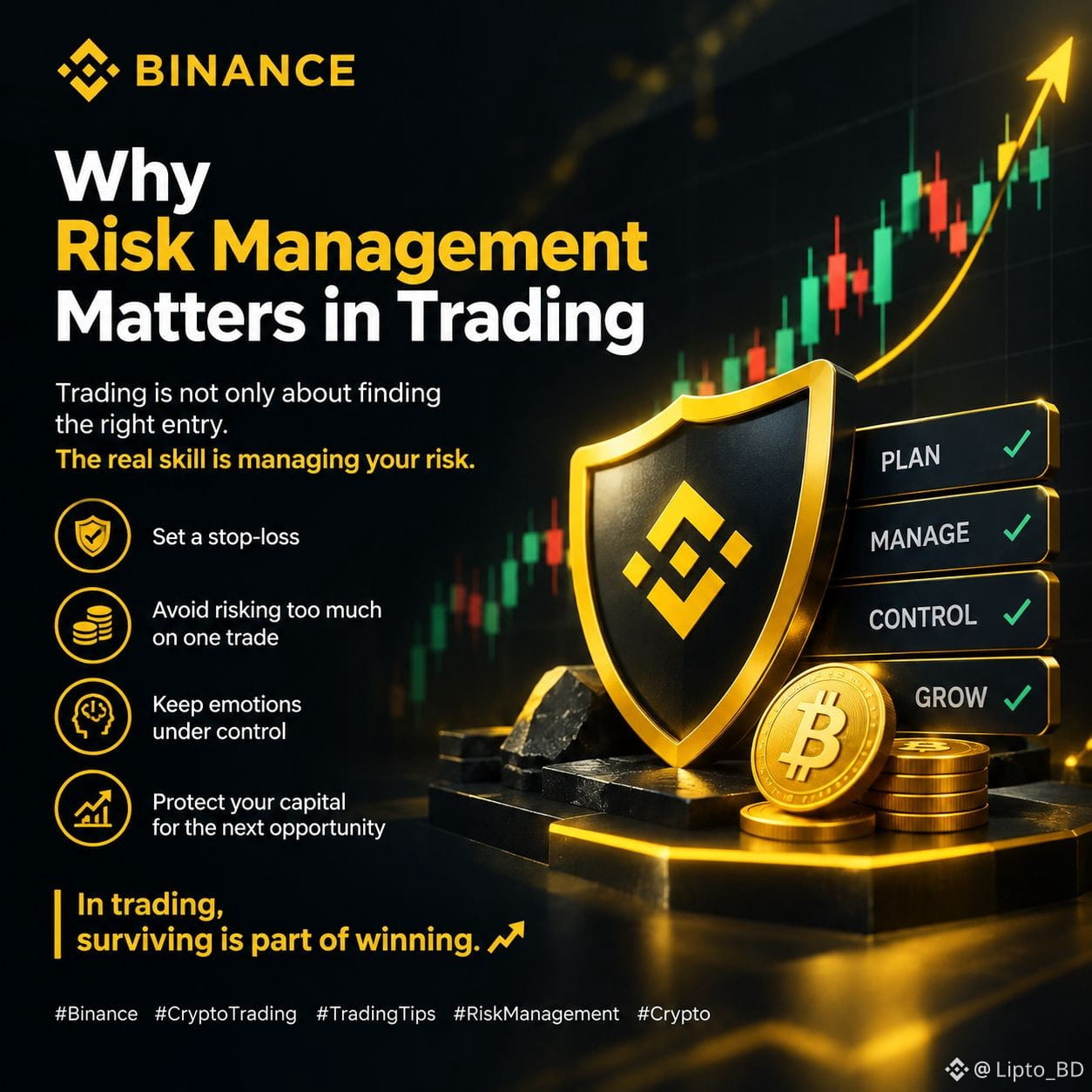
Trading is not only about finding the right entry.
The real skill is managing your risk.
✅ Set a stop-loss
✅ Avoid risking too much on one trade
✅ Keep emotions under control
✅ Protect your capital for the next opportunity
In trading, surviving is part of winning. 🚀
#Binance #CryptoTrading #TradingTips #RiskManagement #Crypto
Trading is not only about finding the right entry.
The real skill is managing your risk.
✅ Set a stop-loss
✅ Avoid risking too much on one trade
✅ Keep emotions under control
✅ Protect your capital for the next opportunity
In trading, surviving is part of winning. 🚀
#Binance #CryptoTrading #TradingTips #RiskManagement #Crypto
The real skill is managing your risk.
✅ Set a stop-loss
✅ Avoid risking too much on one trade
✅ Keep emotions under control
✅ Protect your capital for the next opportunity
In trading, surviving is part of winning. 🚀
#Binance #CryptoTrading #TradingTips #RiskManagement #Crypto
2
57

❤️ $ZEC
{spot}(ZECUSDT)
& $GIGGLE — BUYING CAN FEEL GOOD… BUT PROTECTING CAPITAL FEELS BETTER. 🛡️
Adding to a position can be exciting when you believe in the setup.
But remember:
💰 Profit can disappear.
🛡️ Capital keeps you in the game.
📊 Risk management keeps you trading another day.
Don’t overleverage.
Don’t chase candles.
Don’t revenge trade.
Stay patient. Protect your account. Let the market give you the next opportunity. 🚀
#ZEC #GIGGLE #Crypto #Altcoins #CryptoTrading #RiskManagement #Trading #Bitcoin #BinanceSquare
❤️ $ZEC
& $GIGGLE — BUYING CAN FEEL GOOD… BUT PROTECTING CAPITAL FEELS BETTER. 🛡️
Adding to a position can be exciting when you believe in the setup.
But remember:
💰 Profit can disappear.
🛡️ Capital keeps you in the game.
📊 Risk management keeps you trading another day.
Don’t overleverage.
Don’t chase candles.
Don’t revenge trade.
Stay patient. Protect your account. Let the market give you the next opportunity. 🚀
#ZEC #GIGGLE #Crypto #Altcoins #CryptoTrading #RiskManagement #Trading #Bitcoin #BinanceSquare
& $GIGGLE — BUYING CAN FEEL GOOD… BUT PROTECTING CAPITAL FEELS BETTER. 🛡️
Adding to a position can be exciting when you believe in the setup.
But remember:
💰 Profit can disappear.
🛡️ Capital keeps you in the game.
📊 Risk management keeps you trading another day.
Don’t overleverage.
Don’t chase candles.
Don’t revenge trade.
Stay patient. Protect your account. Let the market give you the next opportunity. 🚀
#ZEC #GIGGLE #Crypto #Altcoins #CryptoTrading #RiskManagement #Trading #Bitcoin #BinanceSquare
115

Crypto Market Reminder
Don’t chase green candles. Don’t panic during red candles.
Have a plan, manage your risk, and stay patient. 📊
In crypto, discipline often matters more than excitement.
#binance #cryptouniverseofficial #bitcoin #TradingCommunity #RiskManagement
Crypto Market Reminder
Don’t chase green candles. Don’t panic during red candles.
Have a plan, manage your risk, and stay patient. 📊
In crypto, discipline often matters more than excitement.
#binance #cryptouniverseofficial #bitcoin #TradingCommunity #RiskManagement
Don’t chase green candles. Don’t panic during red candles.
Have a plan, manage your risk, and stay patient. 📊
In crypto, discipline often matters more than excitement.
#binance #cryptouniverseofficial #bitcoin #TradingCommunity #RiskManagement
94
DYOR Checklist: 7 Things to Check Before Buying a Token
Buying a token simply because it is trending can expose you to unnecessary risk. Before entering a spot or futures position, consider this 7-point checklist:
1. Token Utility & Purpose
• What problem does the project solve? Look for a clear use case and reason for demand.
2. Market Cap vs. Fully Diluted Valuation (FDV)
• Check the circulating supply, FDV, and upcoming token unlocks. Large future unlocks can create additional supply and potential selling pressure.
3. Liquidity & Trading Volume
• Check whether there is enough liquidity and trading volume to enter and exit without significant slippage.
4. Token Distribution
• Review holder concentration and allocation. High concentration among a small number of wallets can increase concentration and manipulation risks.
5. Development & On-Chain Activity
• Where relevant, check development activity, active users, transactions, TVL, or other metrics that show whether the project is being used and developed.
6. Contract Security
• Verify the official contract address and review available security information. Avoid unknown contracts and suspicious token permissions.
7. Roadmap & Team Transparency
• Check the project's roadmap, development progress, and available information about the team and its track record.
Key Takeaway:
Smart traders don't chase hype; they verify the data first.
DYOR • Trade Smart • Stay Secure
$BTC $ETH $BNB
#BinanceSquare #CryptoEducation #DYOR #TradingTips #RiskManagement
DYOR Checklist: 7 Things to Check Before Buying a Token
Buying a token simply because it is trending can expose you to unnecessary risk. Before entering a spot or futures position, consider this 7-point checklist:
1. Token Utility & Purpose
• What problem does the project solve? Look for a clear use case and reason for demand.
2. Market Cap vs. Fully Diluted Valuation (FDV)
• Check the circulating supply, FDV, and upcoming token unlocks. Large future unlocks can create additional supply and potential selling pressure.
3. Liquidity & Trading Volume
• Check whether there is enough liquidity and trading volume to enter and exit without significant slippage.
4. Token Distribution
• Review holder concentration and allocation. High concentration among a small number of wallets can increase concentration and manipulation risks.
5. Development & On-Chain Activity
• Where relevant, check development activity, active users, transactions, TVL, or other metrics that show whether the project is being used and developed.
6. Contract Security
• Verify the official contract address and review available security information. Avoid unknown contracts and suspicious token permissions.
7. Roadmap & Team Transparency
• Check the project's roadmap, development progress, and available information about the team and its track record.
Key Takeaway:
Smart traders don't chase hype; they verify the data first.
DYOR • Trade Smart • Stay Secure
$BTC $ETH $BNB
#BinanceSquare #CryptoEducation #DYOR #TradingTips #RiskManagement
Buying a token simply because it is trending can expose you to unnecessary risk. Before entering a spot or futures position, consider this 7-point checklist:
1. Token Utility & Purpose
• What problem does the project solve? Look for a clear use case and reason for demand.
2. Market Cap vs. Fully Diluted Valuation (FDV)
• Check the circulating supply, FDV, and upcoming token unlocks. Large future unlocks can create additional supply and potential selling pressure.
3. Liquidity & Trading Volume
• Check whether there is enough liquidity and trading volume to enter and exit without significant slippage.
4. Token Distribution
• Review holder concentration and allocation. High concentration among a small number of wallets can increase concentration and manipulation risks.
5. Development & On-Chain Activity
• Where relevant, check development activity, active users, transactions, TVL, or other metrics that show whether the project is being used and developed.
6. Contract Security
• Verify the official contract address and review available security information. Avoid unknown contracts and suspicious token permissions.
7. Roadmap & Team Transparency
• Check the project's roadmap, development progress, and available information about the team and its track record.
Key Takeaway:
Smart traders don't chase hype; they verify the data first.
DYOR • Trade Smart • Stay Secure
$BTC $ETH $BNB
#BinanceSquare #CryptoEducation #DYOR #TradingTips #RiskManagement

2
175
🚨 MARKET ALERT: Smart Money vs. Retail FOMO! 🚨
When the market experiences rapid volatility, trading with data and clear technical analysis—rather than emotion—is the key to staying profitable! 📈📉
Keep these 3 golden rules in mind before placing your next trade:
1️⃣ Avoid FOMO: Chasing big green candles or sudden pumps significantly increases your risk. Always wait for proper support confirmation and retests.
2️⃣ Risk Management: Define your Stop-Loss and Take-Profit levels before entering any position. Never leave a trade unmanaged.
3️⃣ Capital Protection: The first rule of long-term trading is preserving your account balance. Capital safety is far more critical than quick, risky gains.
Are you currently buying the dip, or waiting for further market confirmation? Share your strategy below! 👇
#BinanceSquare #cryptotrading #MarketAnalysis #RiskManagement $BTC $ETH $SOL
🚨 MARKET ALERT: Smart Money vs. Retail FOMO! 🚨
When the market experiences rapid volatility, trading with data and clear technical analysis—rather than emotion—is the key to staying profitable! 📈📉
Keep these 3 golden rules in mind before placing your next trade:
1️⃣ Avoid FOMO: Chasing big green candles or sudden pumps significantly increases your risk. Always wait for proper support confirmation and retests.
2️⃣ Risk Management: Define your Stop-Loss and Take-Profit levels before entering any position. Never leave a trade unmanaged.
3️⃣ Capital Protection: The first rule of long-term trading is preserving your account balance. Capital safety is far more critical than quick, risky gains.
Are you currently buying the dip, or waiting for further market confirmation? Share your strategy below! 👇
#BinanceSquare #cryptotrading #MarketAnalysis #RiskManagement $BTC $ETH $SOL
When the market experiences rapid volatility, trading with data and clear technical analysis—rather than emotion—is the key to staying profitable! 📈📉
Keep these 3 golden rules in mind before placing your next trade:
1️⃣ Avoid FOMO: Chasing big green candles or sudden pumps significantly increases your risk. Always wait for proper support confirmation and retests.
2️⃣ Risk Management: Define your Stop-Loss and Take-Profit levels before entering any position. Never leave a trade unmanaged.
3️⃣ Capital Protection: The first rule of long-term trading is preserving your account balance. Capital safety is far more critical than quick, risky gains.
Are you currently buying the dip, or waiting for further market confirmation? Share your strategy below! 👇
#BinanceSquare #cryptotrading #MarketAnalysis #RiskManagement $BTC $ETH $SOL
95
·
--
$QI is up 176% today and I am not touching it. One number is why
Volume spiked 88x the 7 day average but price is already 19% off the high
1h ATR is 14.1% of price so any stop gets crushed by noise alone
Watch for a close above 0.005080 or a bounce off 0.001475
It could keep running without you and a bad entry costs more than a missed move
Chasing $QI here, or waiting for 0.001475?
#QI #RiskManagement
$QI is up 176% today and I am not touching it. One number is why
Volume spiked 88x the 7 day average but price is already 19% off the high
1h ATR is 14.1% of price so any stop gets crushed by noise alone
Watch for a close above 0.005080 or a bounce off 0.001475
It could keep running without you and a bad entry costs more than a missed move
Chasing $QI here, or waiting for 0.001475?
#QI #RiskManagement
Volume spiked 88x the 7 day average but price is already 19% off the high
1h ATR is 14.1% of price so any stop gets crushed by noise alone
Watch for a close above 0.005080 or a bounce off 0.001475
It could keep running without you and a bad entry costs more than a missed move
Chasing $QI here, or waiting for 0.001475?
#QI #RiskManagement
31
Log in to explore more content
Join global crypto users on Binance Square
⚡️ Get latest and useful information about crypto.
💬 Trusted by the world’s largest crypto exchange.
👍 Discover real insights from verified creators.
Email / Phone number
Trending Topics
1
#CircleMints500MUSDCOnSolana
78,043 views
1,815 Discussing
2
#PolymarketBankFailureBetsDrawFDICConcern
84,072 views
1,691 Discussing
3
#BlackRockBuildsTokenizedPortfoliosForOndo
74,548 views
1,198 Discussing
4
#BitwiseFilesToListNEARETFOnNYSEArca
63,313 views
981 Discussing
5
#SECCommissionerPeirceToLeaveOct2
62,005 views
797 Discussing
6
#SECSaysBuybacksUpgradesDontMakeTokenSecurity
50,691 views
596 Discussing
7
#StrategyProposesDailyDividendsForPreferreds
11,207 views
218 Discussing
8
#CircleTetherFreezeBitgetHackerWallet
12,786 views
133 Discussing
9
#CoinMarketCapCompletesCoinglassAcquisition
12,731 views
168 Discussing
10
#QNTRises39%
112,919 views
1,670 Discussing